Article

Impact of Adding Cerium Zirconium Oxide Nanofibers in 3D-Printed Denture Base Material

by
Sara Tawfiq Jassim
1,
Ihab Nabeel Safi
1,* and
Julfikar Haider
2,*
1
Department of Prosthodontics, College of Dentistry, University of Baghdad, Baghdad 10071, Iraq
2
Department of Engineering, Manchester Metropolitan University, Manchester M12 5GN, UK
*
Authors to whom correspondence should be addressed.
J. Compos. Sci. 2026, 10(4), 190; https://doi.org/10.3390/jcs10040190
Submission received: 5 February 2026 / Revised: 16 March 2026 / Accepted: 17 March 2026 / Published: 31 March 2026
(This article belongs to the Section Biocomposites)

Abstract

Purpose: Pure three-dimensional (3D)-printed resin for denture base shows strength in comparison with the conventional heat-cured materials. The purpose of this study was to assess how physical and mechanical properties of 3D-printed denture base resins are affected by the addition of cerium zirconium oxide nanofibers (CeZrO4 NFs), which have a unique combination of thermophysical and mechanical properties. Materials and Methods: The specimens were digitally created utilizing Microsoft Corporation’s 3D builder software through computer-aided design. To meet the test criteria for transverse strength, impact strength, hardness, radiopacity, and degree of conversion (DC), specimens were designed and printed with specific dimensions according to the relevant standards. The 3D-printed denture base resin was mixed with CeZrO4 NFs (diameter: 300–800 nm, length: 2–10 µm) at weight percentages of 0.5, 1.0%, 1.5%, 2%, and 2.5%. The data were analyzed using Tukey’s post hoc test (α = 0.05) and ANOVA. Field emission scanning electron microscopy (FESEM) and energy dispersive X-ray spectroscopy (EDX) were used to evaluate surface morphologies of the composites and nanofibers, and the dispersion of the NFs within the resin matrix respectively. Results: The results demonstrated that compared with those of the control group, the average transverse strength, impact strength, and hardness values of the CeZrO4 NF reinforcement groups significantly increased up to a nanofiller concentration of 1.5 wt.%., whereas those of the other reinforcement groups significantly decreased. For example, the impact strength significantly increased from 5.84 kJ/m2 (0 wt.%) to the maximum value 8.76 kJ/m2 at 1.0 wt.% CeZrO4 NF. On the other hand, the Shore D hardness increased from 80.84 for the control group to the maximum value 83.27 at 1.5 wt.% CeZrO4 NF. The radiopacity increased as the NF concentration increased. Although Fourier transform infrared (FTIR) spectroscopy analysis did not show any noticeable change in the chemical structure of the resin after incorporating the NFs, there was a notable improvement in the DC of the nanocomposites with NF concentrations of 0.5, 1.0 and 1.5 wt.%. Energy dispersive X-ray spectroscopy (EDX) and field emission scanning electron microscopy (FESEM) showed evidence of uniform distribution of the CeZrO4 NFs in the 3D-printed specimens. Conclusions: The properties of the denture bases fabricated from 3D-printed resin were enhanced by the addition of 0.5%, 1 wt.% and 1.5 wt.% CeZrO4-milled NFs, though the latter two concentrations produced the most significant results.

1. Introduction

A worldwide dental issue that mostly affects elderly individuals is complete or partial edentulism [1]. The rising trend of the aging population has led to an increasing demand for prosthetic tooth replacements that provide both functionality and esthetics. Since removable dentures are the most popular option clinically for replacing lost teeth, many studies have focused on developing new materials and manufacturing processes for next-generation dentures [2]. The primary goal is to create a material that is cost-effective, easily accessible, biologically compatible, and simple for the dentists to manipulate [3]. Despite its shortcomings, including poor mechanical and physical qualities and a lengthy production procedure, PMMA is still the most commonly used denture base material by the practitioners [4]. Digital technology has proven to have numerous advantages in dentistry in general and particularly in prosthodontics, in terms of manufacturing speed and precision and number of clinical visits. However, certain challenges such as inadequate mechanical qualities of the raw materials used to create dentures using 3D printing still need to be overcome [4,5]. In recent years, dentistry has made extensive use of digital manufacturing technology. Currently, removable dentures can be fabricated using computer-aided design and computer-aided manufacturing (CAD-CAM) technologies, which blend additive and subtractive methods. This technology is also known as rapid prototyping and 3D printing [6,7].
Despite being the current thrust for creating fully removable 3D-printed denture bases, they still have certain limitations with respect to their mechanical and physical characteristics [8,9]. While 3D-printed denture base materials possess flexural strength close to the ISO-accepted value of 65 MPa, they have the lowest flexural strength and surface hardness compared with the traditional and milled denture base materials. As a result, their clinical applications are restricted [5,10,11]. Furthermore, compared with the traditional acrylic resins, 3D printing resins result in inferior double-bond conversion [8].
The use of NPs has been proposed to enhance the characteristics of the polymethylmethacrylate (PMMA) denture base [12]. Following that trend, to overcome the limitations of the 3D-printed denture bases, many studies have explored the effects of adding reinforcing metal oxide nanoparticle (NP) fillers, such as TiO2, Al2O3, and SiO2, along with adjusting the post-polymerization time, layer thickness, and printing orientation, which appeared to improve some of the mechanical qualities of the 3D-printed resin used in dentures [13,14,15]. Furthermore, more recently, nanoscale molecules were considered as a functional filler for modifying dental restorative materials [16].
According to a study by Aati et al., provisional restorations enhanced with ZrO2 created with 3D-printed resin performed better over an extended period of time [17]. Mubarak et al. added less than 1 weight percent of silver–titanium dioxide nanofiller to 3D-printed material, which increased the tensile strength, tensile modulus, and flexural strength [18]. A recent study examined the mechanical and surface properties of 3D-printed resins that included silicon dioxide nanoparticles and reported that the hardness, flexural strength, and impact strength of the resins improved [19].
Nano-ZrO2 has recently drawn much interest as a filler which can enhance the mechanical properties of acrylic resins due to its advantages, including superior toughness, mechanical strength, abrasion, corrosion resistance, and biocompatibility. High mechanical properties of nano-ZrO2 enable resistance to crack propagation, and its crystalline structure increases the opacity value [15].
Since cerium oxide (CeO2) nanoparticles have special surface characteristics, high stability, and biocompatibility, they are utilized in many different fields, including biomedicine and technology, and provide surface protection from UV rays and oxidation [20]. In dentistry, CeO2 nanoparticles are used to reduce microbial development and inflammatory responses [21]. Adding varying amounts of CeO2 nanoparticles to 3D-printed resins can enhance the mechanical characteristics of the denture bases, including their bending resistance and impact strength [22,23]. CeZrO4 is a mixed metal oxide composed of cerium oxide (CeO2) and zirconium oxide (ZrO2). The CeO2 component offers an oxygen storage capacity (OSC) and redox behavior (Ce4+ ↔ Ce3+), whereas zirconia contributes to the thermal stability and mechanical strength of the material.
To the best of the authors’ knowledge, no prior research has investigated the impact of CeO2 or CeZrO4 nanofibers (NFs) on the mechanical characteristics of 3D-printed denture base materials. Therefore, in this study, hardness, flexural strength, impact strength, and radiopacity of the 3D-printed denture base resin were assessed after the addition of CeZrO4 NFs. High surface area-to-volume ratio of the nanoparticles increases nanofiber-matrix interfacial bonding (interlocking), which improves the mechanical properties, prevents crack propagation, and reduces polymerization shrinkage [24]. The null hypothesis predicted that the addition of CeZrO4 NFs would not affect the properties of the 3D-printed denture base resin.

2. Materials and Methods

2.1. Materials and Specimen Grouping

The 3D-printed specimens were fabricated using DentaBase (Asiga, Sydney, Australia, under ISO 13485:2016 and EN ISO 13485:2016), a denture base resin that is known for its great strength and natural pink shade. The manufacturer’s data sheet states that the resin has 7,7,9(or 7,9,9)-trimethyl-4,13-dioxo-3,14-dioxa-5,12-diazahexadecane-1,16-diyl bismethacrylate, tetrahydrofurfuryl methacrylate, and diphenyl(2,4,6-trimethylbenzoyl) phosphine oxide. CeZrO4 NFs with a diameter ranging between 300 and 800 nm and length varying between 2 and 10 µm (Sigma–Aldrich, Darmstadt, Germany) were added to the resin at various concentrations (0.5, 1.0, 1.5, 2.0, and 2.5, weight percent) to create nanocomposites. Three hundred specimens were prepared in conduct with various tests (60 specimens each for flexural strength, impact strength, hardness, radiopacity and degree of conversion with n = 10).

2.2. Specimen Preparation

2.2.1. Specimen Design

The flexural strength hardness test specimens had dimensions of 65 × 10 × 2.5 ± 0.2 mm in accordance with ISO 20795-1:2013 guidelines [25], whereas impact test specimens were fabricated with dimensions of 80 × 10 × 4 ± 0.2 mm in accordance with ISO 179 (2003) [26]. The specimen dimensions for the radiopacity test were 10 × 20 × 3 mm [27], and dusty powder was used for evaluating chemical bonding characteristics and polymerization. To create the specimens, CAD software was used, and a stereolithography (STL) file—a popular file format for 3D printing—was exported.

2.2.2. Mixing of CeZrO4 NFs with Resin

Initially, the NF suspension was made by mixing CeZrO4 NFs with 3 mL of 99.9% ethyl alcohol in an ultrasonic mixer (MSE Soniprep 150, Amsterdam, The Netherlands) for 3 min. The number of NFs added to the groups was 0.3 for 0.5 wt.%, 0.7 for 1.0 wt.%, 1.05 gm for 1.5 wt.%, 1.4 for 2 wt.% and 1.75 for 2.5 wt.% weight. A special shaker lc-3d mixer (NextDent, Rock Hill, SC, USA) was used to create a homogeneous mixture of basic resin for denture printing. Then, the NF suspension was mixed in a dark amber glass container with 70 g of denture base resin. An Alfa HS-860 magnetic stirrer (A-LEA, China) was used to mix the denture base resin and CeZrO4 NFs suspension for 30 min at 60 °C, and the glass container was partially covered to allow the evaporation of alcohol. The mixture was then kept in the dark amber glass container and mixed for 8 h at room temperature (25 ± 5 °C).

2.2.3. 3D Printing of Specimens and Post-Processing

The specimens were printed via a digital light processing (DLP) 3D printer (Asiga MAX UV, Sydney, Australia) with the following settings: layer thickness = 0.05 mm, separation velocity = 4.3 mm/s, separation pressure limit = 300 g/cm2, heater temperature = 30 °C, and high-power ultraviolet solid-state 385 nm Light Emitting Diode (LED). To prevent the resin with the CeZrO4 NF mixture from being exposed to outside light, the printer vat lid was sealed after the mixture was poured. On the build platform, the liquid resin started to solidify as a result of polymerization when the printer’s light was projected onto it. This process was repeated until the 3D models of the specimens were completed. All 30 specimens were printed within 40 min, and the layer development process was horizontal.
Using a sharp knife, the specimens were carefully removed from the 3D printer platform once the printing process was completed. Subsequently, the specimens were subjected to 3 min of ultrasonic cleaning (Dewin, Zhuhai, China); the layers were exposed to UV light at a wavelength of 405 nm to continue the polymerization process, which continued until the 3D-printed model was produced. The specimens were cured in a post-curing device (Otoflash G171, China) for 20 min in accordance with the manufacturer’s guidelines. The procedure was conducted with two cycles of 2000 flashes on each side of each specimen under an atmosphere of inert nitrogen gas.
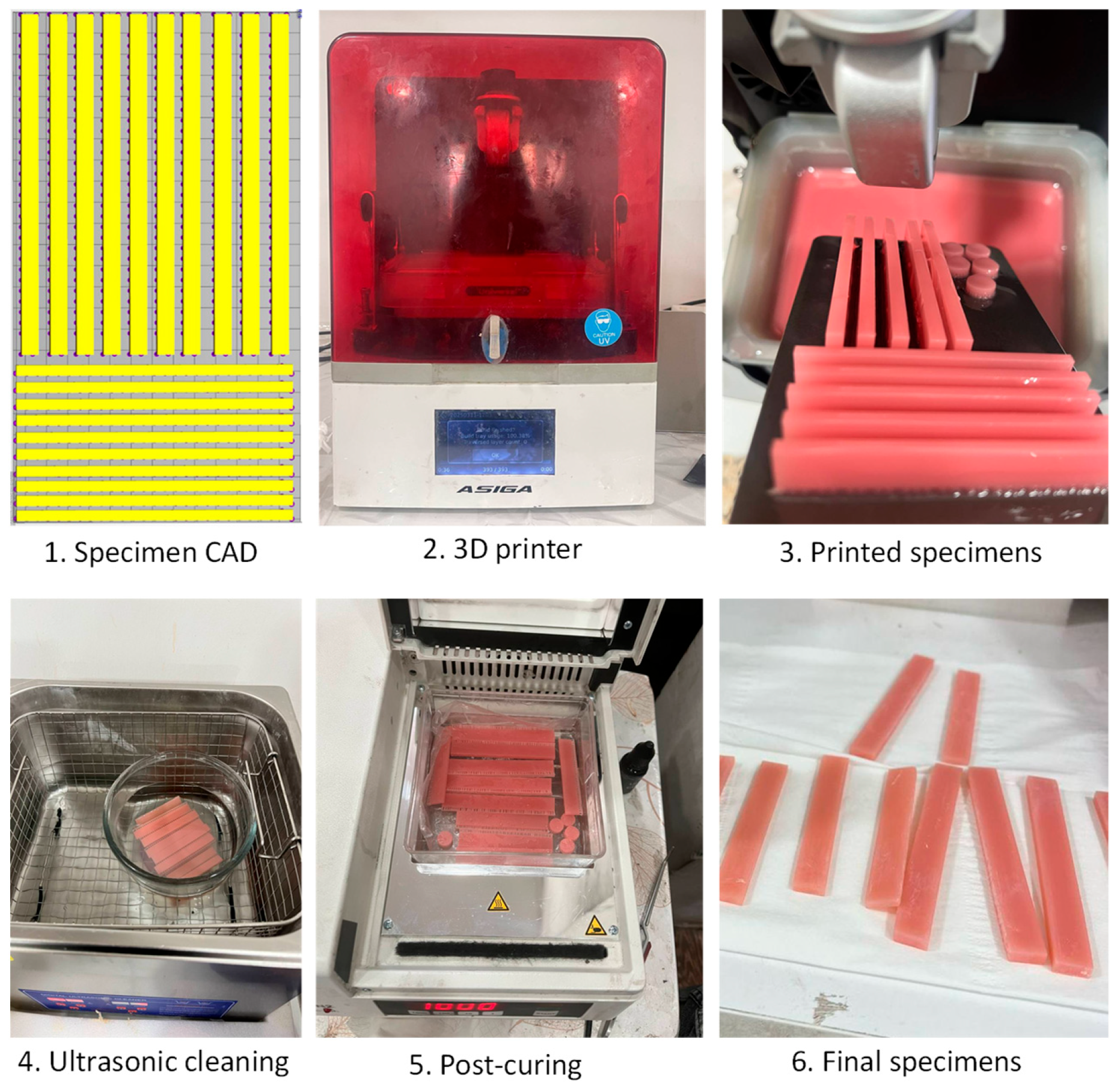
The specimens were subsequently cleaned with isopropyl alcohol (99.9%) to remove any uncured resin and polished using an acrylic bur (Syndent Tools Co., Jiangsu, China) and a lathe polishing tool (Renfert, Hilzingen, Germany). The dimensions of the specimens were measured using a digital Vernier scale (Kirti NDT/Maharashtra, India) with a precision of ±0.01 mm. Before testing, all specimens were submerged in distilled water for 48 h in accordance with ADA specification No. 12, 1999. Different steps of fabrication and post-processing are shown in Figure 1.

2.3. Characterization Procedures

2.3.1. Flexural Strength Test

A universal Instron testing apparatus (Jianqiao Testing Equipment, Dongguan, China) was used to perform three-point bending test. Each specimen was positioned using a fixture, which had two parallel supports spaced 50 mm apart. A plunger positioned in the middle of the supports applied a steady force at a cross-head speed of 1.0 mm/min until it broke. The test was carried out in compliance with ADA specifications No. 12, 1999, and with a 500 N load cell. The following formula was used for calculating the flexural strength [28].
Flexural   strength = 3 P I 2 b d 2 ( N m m 2 )
where I is the span length, P is the peak load, b is the specimen width (mm), and d is the specimen thickness (mm).

2.3.2. Impact Strength Test

In accordance with the ISO 179 guidelines, the amount of impact energy absorbed by the specimen during fracture was evaluated. An impact testing equipment (Testing Machines Inc. (TMI), New Castle, DE, USA) was used to perform the Charpy unnotched impact tests. The specimen was struck by a free-swinging pendulum with a two-joule capacity while being supported horizontally at both ends. The impact strength was calculated using the following formula [29].
Impact   strength = E B · D × 10 3 K J m 2
where E is the impact energy absorbed, D is the specimen thickness (mm), and B is the specimen width (mm).

2.3.3. Surface Hardness Test

The hardness of the specimens was evaluated via a Shore D device (Time Group Inc., Capannori, Italy). It was composed of an indenter that was blunt-pointed and had a diameter of 0.8 mm, tapering to 1.6 mm. The indenter was fitted with a digital scale that ranged from 0 to 100 units. The specimens were subjected to strong and quick indenter acceleration and hardness value was directly read from the digital scale. Shore D hardness was calculated using the mean of the three measurements on each specimen. The test was carried out in compliance with ADA standard, No. 12 (1999).

2.3.4. Radiopacity Test

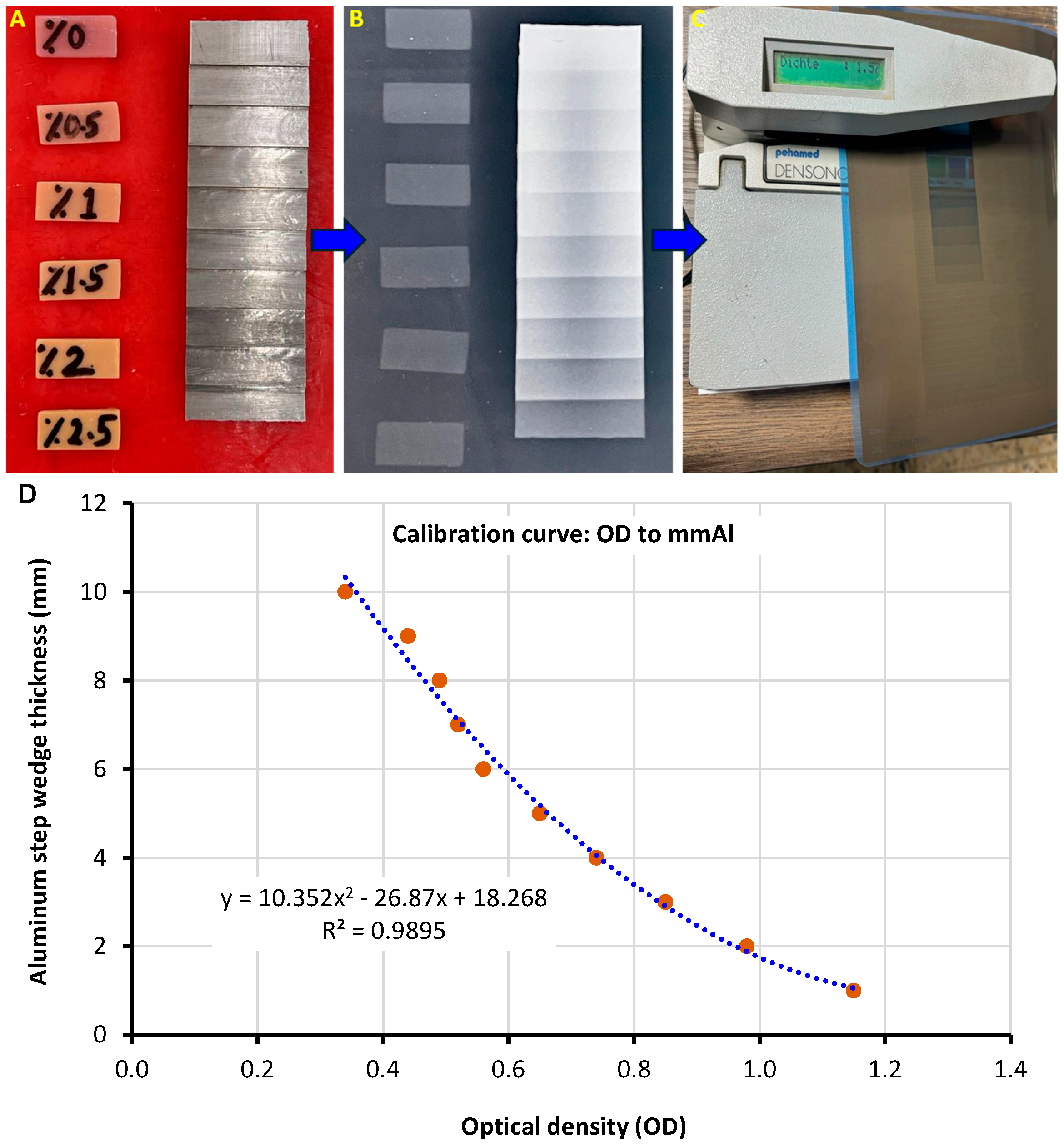
To assess radiopacity, the specimens were spread out across a wax plate of 3 mm thick. Wax was added to replicate soft tissue absorbing and dispersing media. To standardize the film density, a 10 mm aluminum step wedge with a sequential 1 mm step height was affixed next to the specimens. The specimens, wax plates, and aluminum step wedges were positioned on the exposure side of a 35 × 43 cm cassette. An X-ray machine (Siemens, Berlin, Germany) was used, with a distance of one meter between the specimens and the X-ray source. The equipment was operated at 53 kV and 5 mA and its exposure period was 0.35 s, much like that of standard chest radiography [27]. A light transmission densitometer (Pehamed Densonorm 21i, France) was used to measure the variation in image density (optical density, OD) of each specimen in comparison with standard acrylic resin and aluminum step wedges. Each specimen was subjected to five measurements at various locations, and a mean value was calculated. The procedure for measuring OD of the X-ray films by the densitometer is shown in Figure 2. The radiopacity of the tested samples was quantified in terms of aluminum equivalent thickness (mmAl) by applying a calibration curve derived from the aluminum step wedge thickness ranging from 1 to 10 mm according to the guidelines specified in ISO 4049. This calibration served as a reference for interpreting the radiopacity of the tested materials. By applying quadratic regression, the approximate conversion equation is: mmAl = 10.352 × (OD)2 + 26.870 × (OD) + 18.268, as shown in Figure 2D. The optical density decreased with increasing Al step wedge thickness, from 1.15 at a 1 mm Al thickness to 0.34 at a 10 mm Al thickness. This demonstrated the calibration and validity of the radiographic measurement system where thicker aluminum absorbed more X-rays resulting in lower optical density values and provided a reference scale for comparing the radiopacity of the tested materials with known aluminum thickness.

2.3.5. Chemical Characterization and Degree of Conversion Calculations

Fourier transform infrared (FTIR) spectroscopy (SHIMADZU, Kyoto, Japan) was employed to obtain FTIR spectra at wavelengths ranging from 4000 to 400 cm−1. Ten specimens from each group and CeZrO4 NF powder were tested. Furthermore, degree of conversion (DC) during polymerization was determined using the FTIR spectra according to Equation (3) [30]. Following polymerization, the nanocomposite specimens were compared to the liquid resin, which was scanned as the baseline [31,32].
DC ( % ) = ( 1 ( T 1637 T 1608 ) p e a k h i g h t s a f t e r p o l y m e r i z a t i o n ( T 1637 T 1608 ) p e a k h i g h t s b e f o r p o l y m e r i z a t i o n ) × 100

2.4. Characterization of Surface Morphology and Composition

CeZrO4 NFs and broken surface were investigated using a Field Emission Scanning Electron Microscope (FESEM—INSPECT F50, FEI business, Hillsboro, OR, USA) at various magnifications. Since the resin specimens are not conductive, charges might result in optical distortions, blurring, or even destruction. To enhance image quality and disperse any charge build-up on the non-conductive resin surface, the specimens were sputter-coated with gold to a thickness of approximately 1 nm. Energy dispersive X-ray (EDX) spectroscopy (MIRA3TESCAN, Denver, CO, USA) was used to analyze chemical composition of the specimen.

2.5. Statistical Analysis

Data analysis was conducted using Prism 9 (GraphPad Software, San Diego, CA, USA) and SPSS (Statistical Package for Social Science, version 21). One-way analysis of variance (ANOVA) was used in order to compare each group’s mean value and the post hoc Tukey’s HSD test to identify any significant difference between the individual groups. Data homogeneity was verified using the Levene test, and the normality of the data distribution was assessed via the Shapiro–Wilk test. Significant differences were indicated by p values less than 0.05.

3. Results

3.1. Transverse Strength

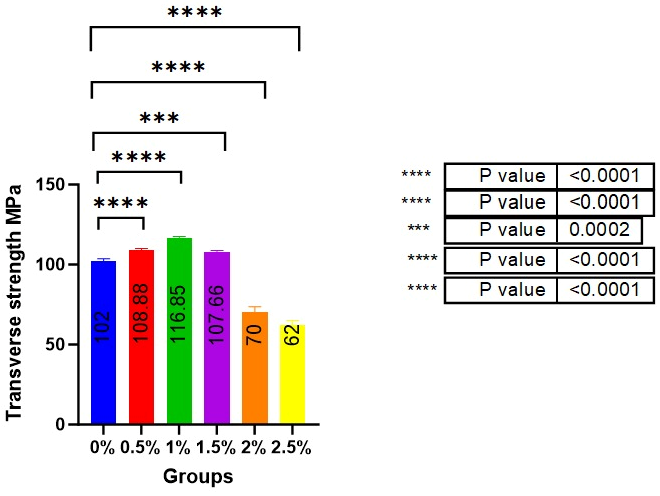
Figure 3 shows that the flexural strength significantly increased as the NF concentration increased. The values ranged from 102 MPa (95% CI: 100.96–103.03) in the control group to 108.88 MPa (95% CI: 108.08–109.69) at 0.5 wt.%; CeZrO4 NFs peaked at the 1 wt.% (116.85 MPa, 95% CI: 116.35–117.35) and then started to decrease at 1.5 wt.% (107.66 MPa, 95% CI: 106.92–108.40) until it reached the lowest value (62 MPa, 95% CI: 59.92–64.07) at the 2.5 wt.% NF concentration.

3.2. Impact Strength

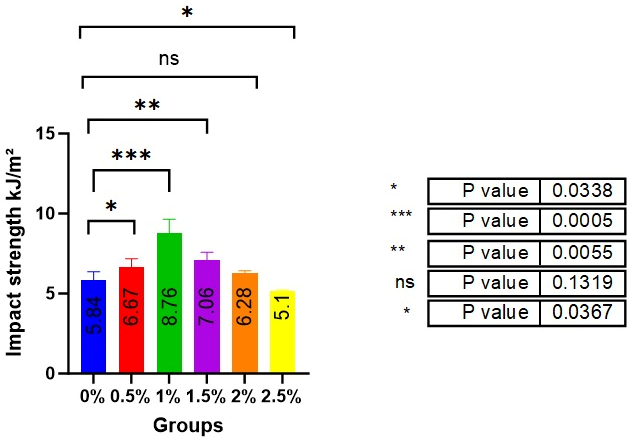
Figure 4 shows that impact strength (kJ/m2) significantly increased as the NF concentration increased from 5.84 kJ/m2 (95% CI: 5.50–6.19) at 0 wt.% to 6.67 kJ/m2 (95% CI: 6.32–7.01) at 0.5 wt.% with the maximum value at 1 wt.% (8.76 kJ/m2, 95% CI: 8.16–9.35), and then began to decrease at 1.5 wt.% (7.06 kJ/m2, 95% CI: 6.72–7.41) until reaching the lowest mean (5.1 kJ/m2, 95% CI: 5.02–5.17) at 2.5 wt.%.

3.3. Surface Hardness

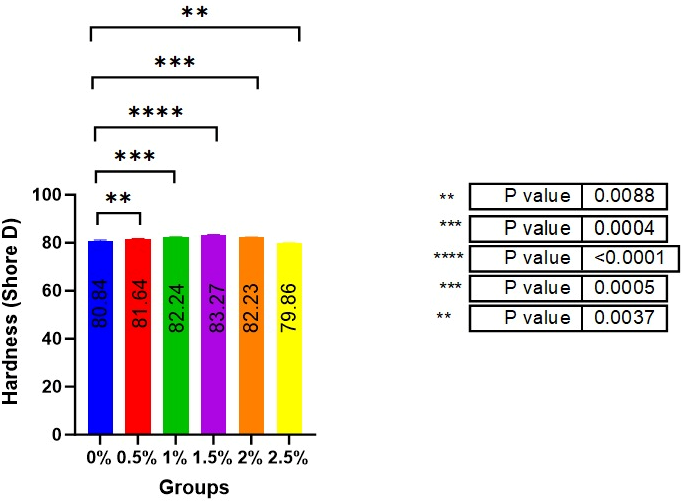
Figure 5 shows that hardness increased significantly as the NF concentration increased, with a peak value (83.27, 95% CI: 83.16–83.38) at 1.5 wt.%, after which it began to decrease gradually at 2.0 wt.% until reaching (79.86, 95% CI: 79.74–79.97) at 2.5 wt.%.

3.4. Radiopacity

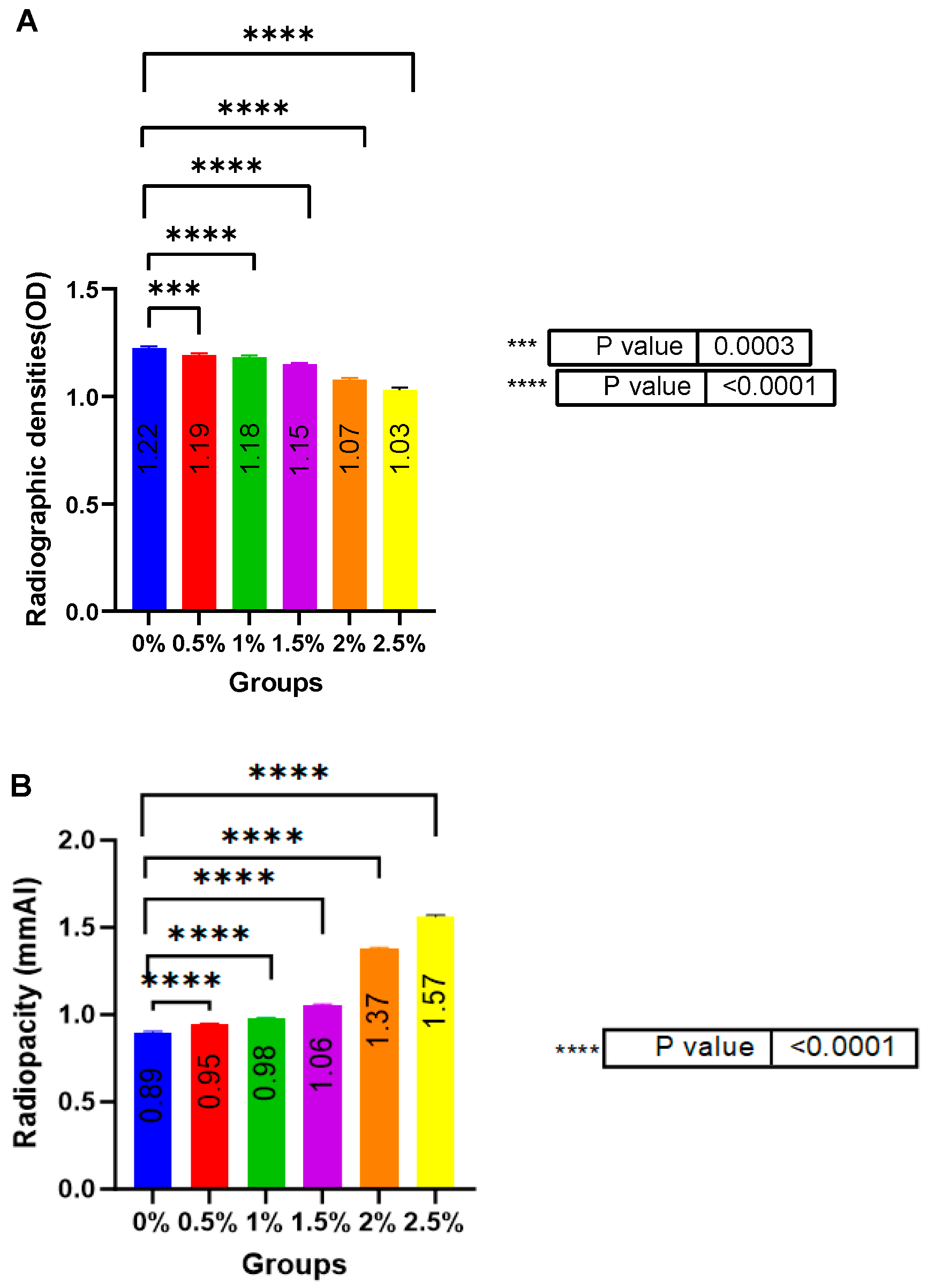
As shown in Figure 6A, the optical density was the highest (lowest radiopacity) in the control group (1.22, 95% CI: 1.22–1.23) and decreased gradually as the NF concentration increased until it reached (1.03, 95% CI: 1.02–1.03) at 2.5% (highest radiopacity). In addition, Figure 6B showed a gradual increase in radiopacity as the filler content increased, rising from 0.89 mmAl in the control specimen to 1.57 mmAl in the material containing 2.5 wt.% CeZrO4 NFs. This trend demonstrated that higher filler loading enhanced the material’s ability to attenuate X-rays. A filler concentration of 1.5 wt.% NPs is the minimum concentration that reached clinically acceptable radiopacity (≥1.0 mmAl) according to ISO 4049. However, other lower levels of concentrations such as 0.5 wt.% and 1.0 wt.% were also very close to the acceptable limit.

3.5. Microstructure and Composition

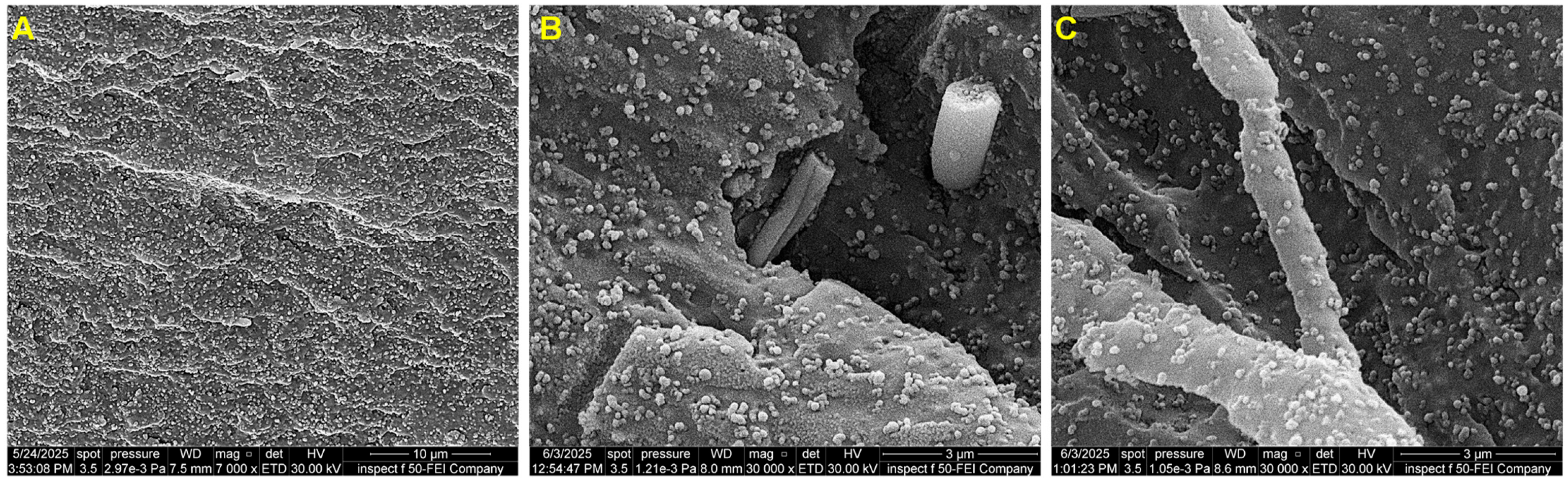
The FESEM images (Figure 7) demonstrated that CeZrO4 NFs were uniformly distributed within the 3D-printed denture base resin. Furthermore, the good bonding between the NFs and the resin matrix was also observed.
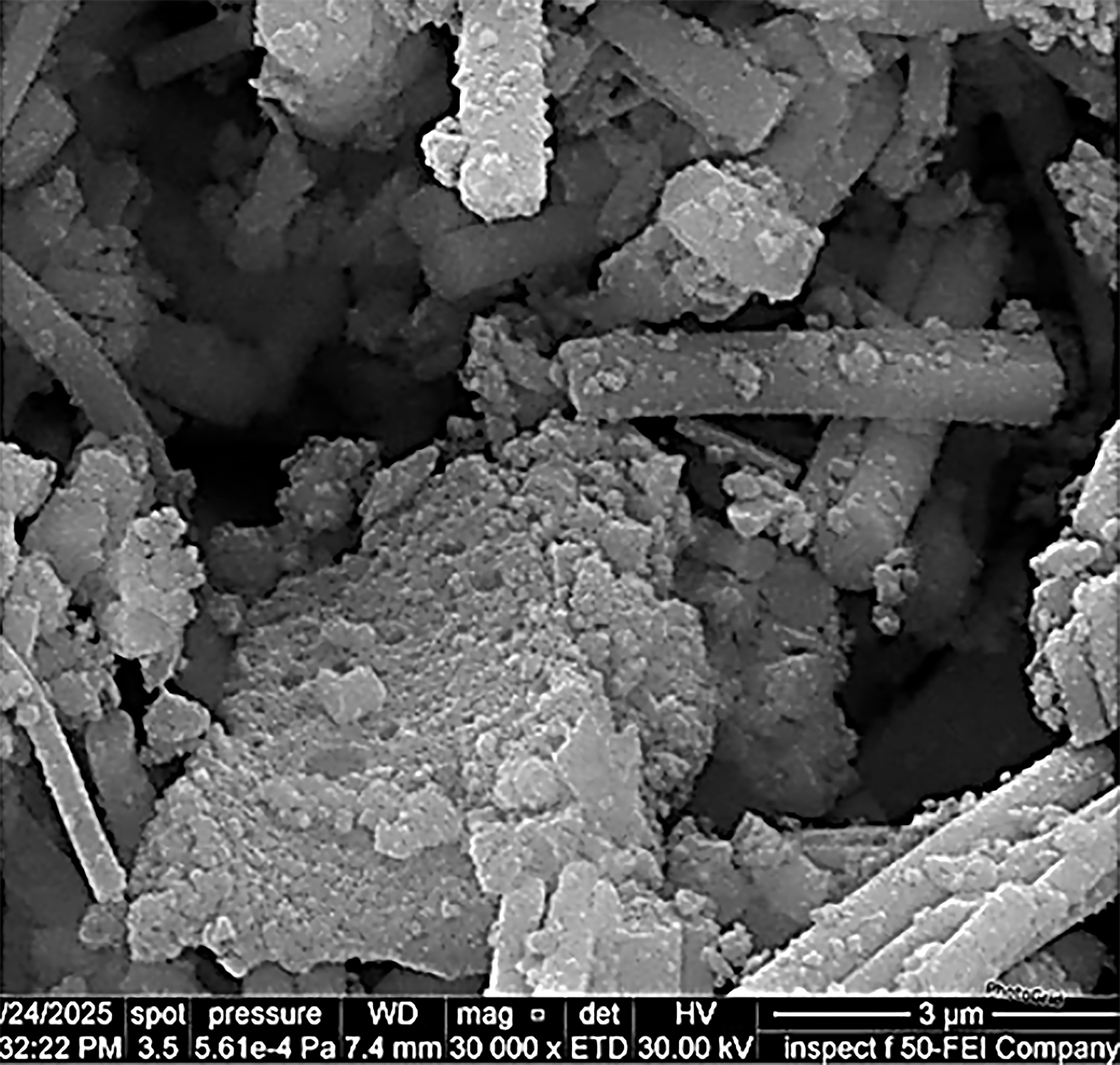
Figure 8 shows an overview of the CeZrO4 NFs, indicating a large amount of fiber material aggregation. The specimen consists of randomly oriented NFs mixed with smaller particles. The fibers and particles have rough surfaces, indicating that a high surface area was beneficial for application. Analysis of the NFs revealed that the effective particle size was 36.2 nm. The NFs appeared to have nonuniform diameters and lengths, with some being needle-like or rod-shaped.
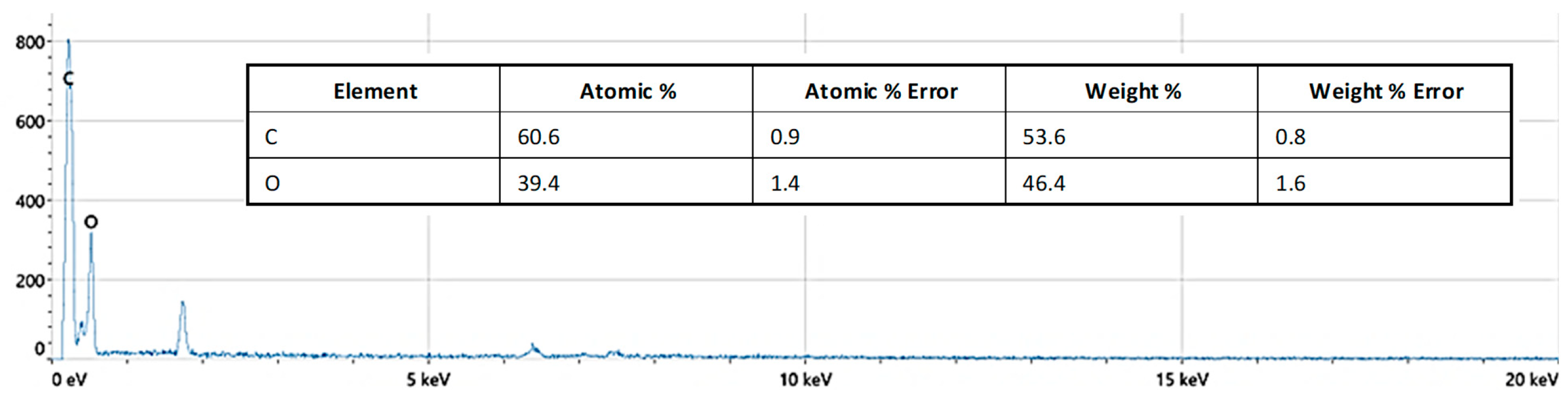
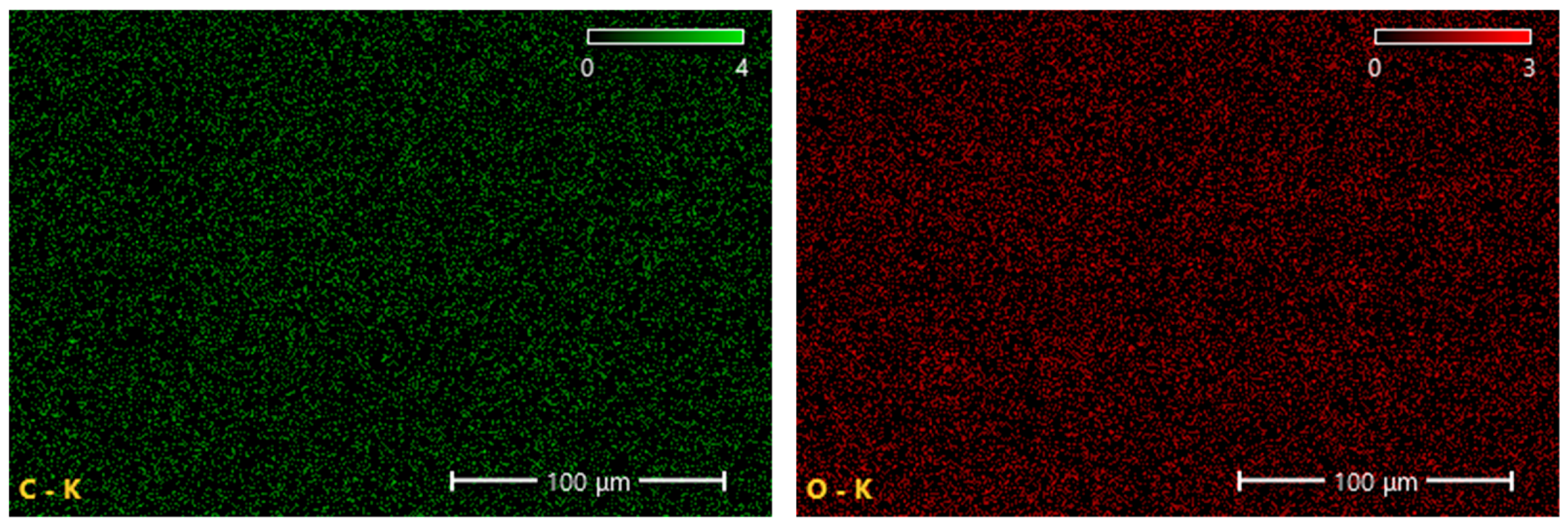
Figure 9 displays EDX diagrams for 3D-printed denture base resin that does not contain CeZrO4 NFs. EDX examination of the elemental makeup of the 3D-printed resin revealed carbon (C) and oxygen (O) as shown in Figure 10.
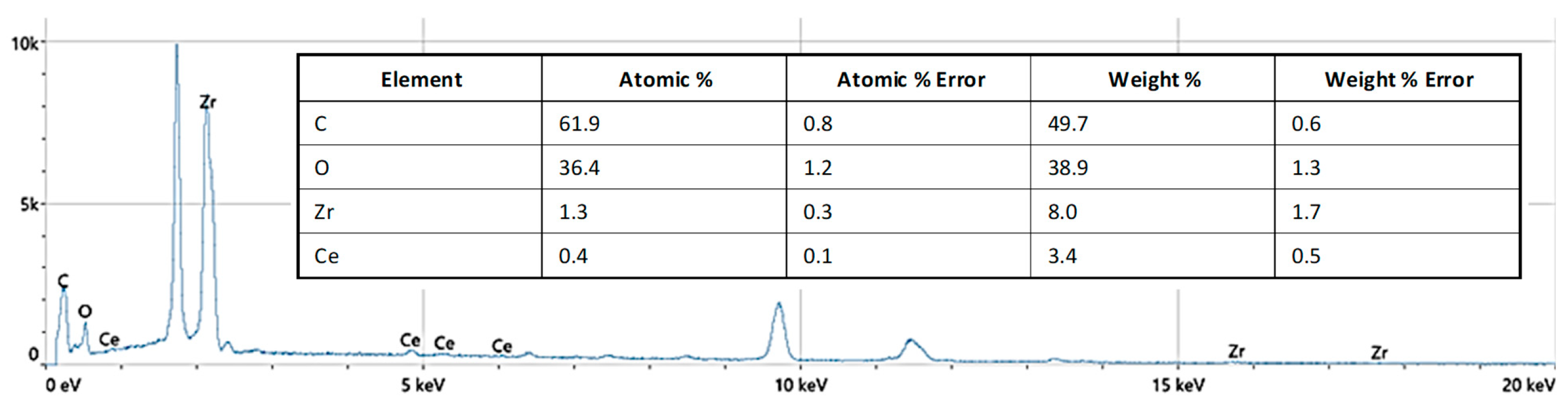
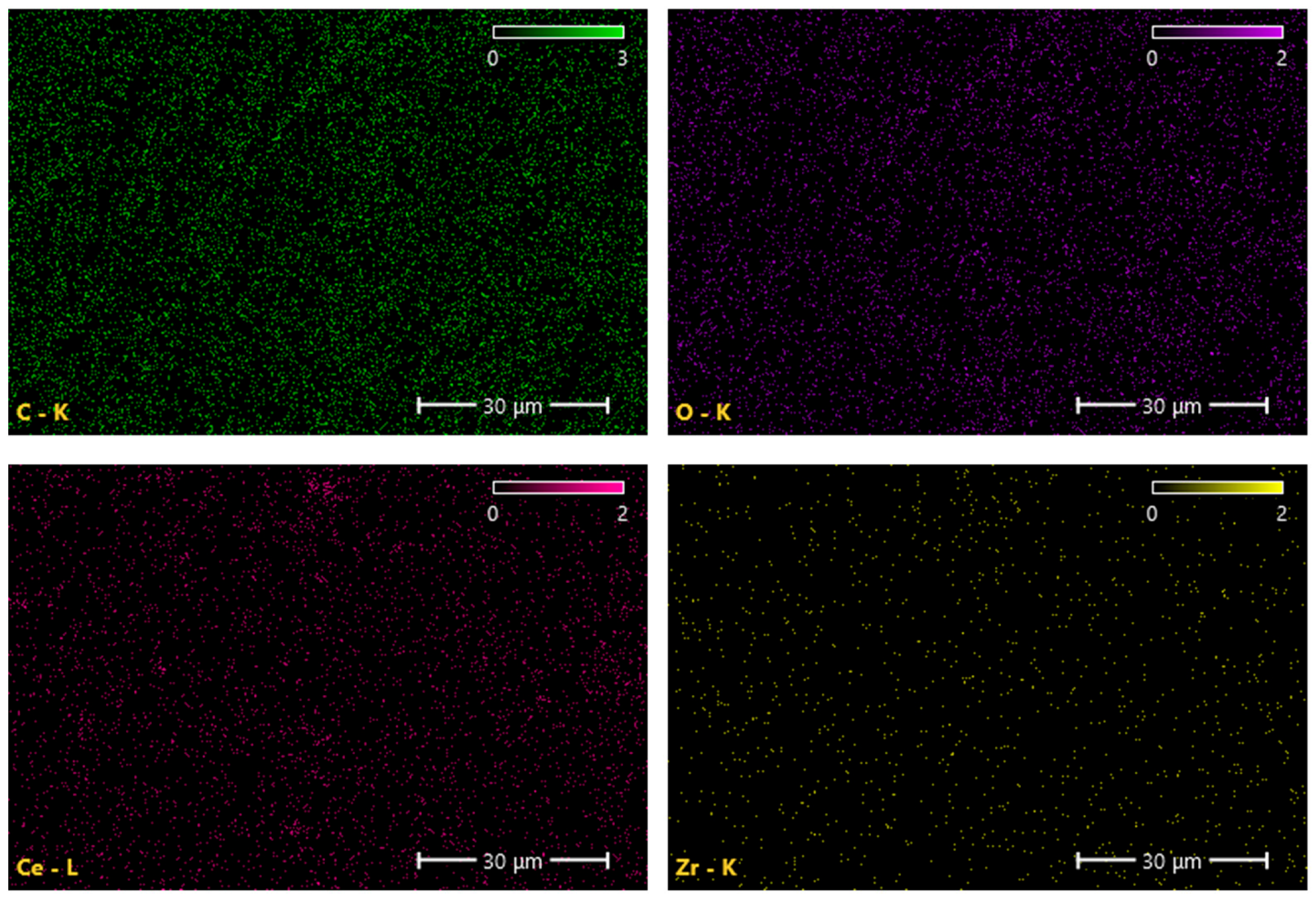
The elemental composition of the 3D-printed resin containing the CeZrO4 NFs was as follows: cerium (Ce), zirconium (Zr), oxygen (O), and carbon (C). The EDX analysis results are shown in Figure 11 whereas EDX mapping of the nanocomposite is presented in Figure 12.

3.6. FTIR and Degree of Conversion

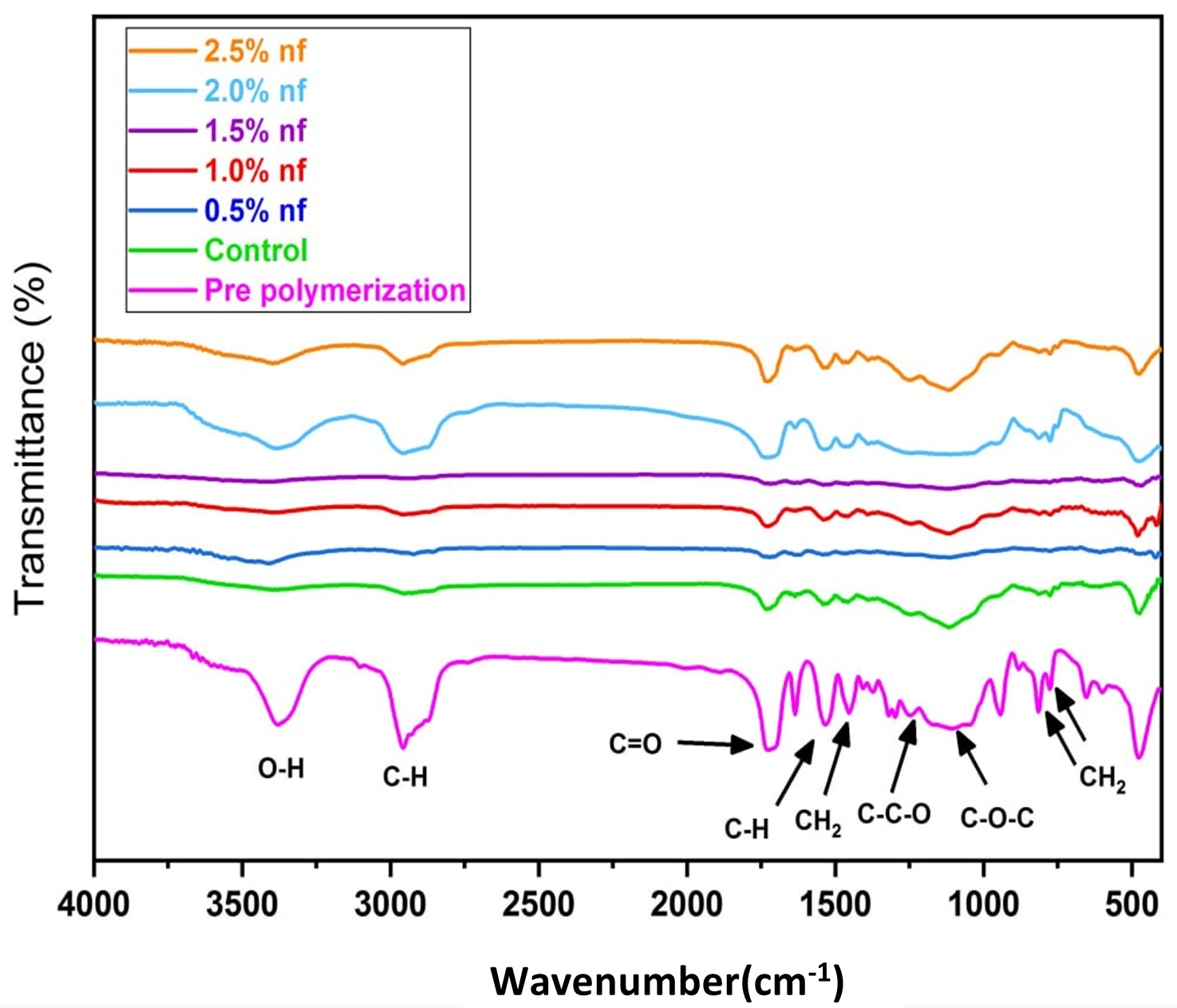
The FTIR spectrum for polymethylmethacrylate (PMMA) liquid in Figure 13 shows the presence of CH2 rocking mode peaks at 777.31, 813.96, and 943.19 cm−1. The asymmetric stretching bond peak appears at 1105.21 cm−1, which can be attributed to the C-O-C group. The methyl carbonyl group C-C-O stretching vibrations observed at about 1246.02 cm−1. The presence peak at 1454.33 cm−1 could be due to the CH2 deformation, while the peak at 1533.41 cm−1 was attributed to C-H stretching bond. The high peak observed at 1728.22 cm−1 could be due to the stretching vibration of the carbonyl group C=O. Moreover, a transmittance peak appears at about 2956.87 cm−1 resulting from the C-H bonds. Also, the peak at 3379.29 cm−1 was attributed to (O-H) stretching bond.
The FTIR spectrum for polymethylmethacrylate (PMMA) liquid after polymerization shows similar peaks as before polymerization. The presence of CH2 rocking mode peaks at 777.31 cm−1 and 813.96, cm−1. The asymmetric stretching bond peak appears at 1118.71 cm−1, which can be attributed to the C-O-C group. The methyl carbonyl group C-C-O stretching vibrations were observed at about 1244.09 cm−1. The peak at 1463.97 cm−1 is due to the CH2 deformation, while the peak at 1533.41 cm−1 was attributed to C-H stretching bond. The peak observed at 1734.01 cm−1 was due to the stretching vibration of the carbonyl group C = O but this time it was smaller than before polymerization. Also, the peak appears at approximately 2958.80 cm−1, which could be attributed to the C-H bonds. The peak at 3410.15 cm−1 was attributed to (O-H) stretching bond.
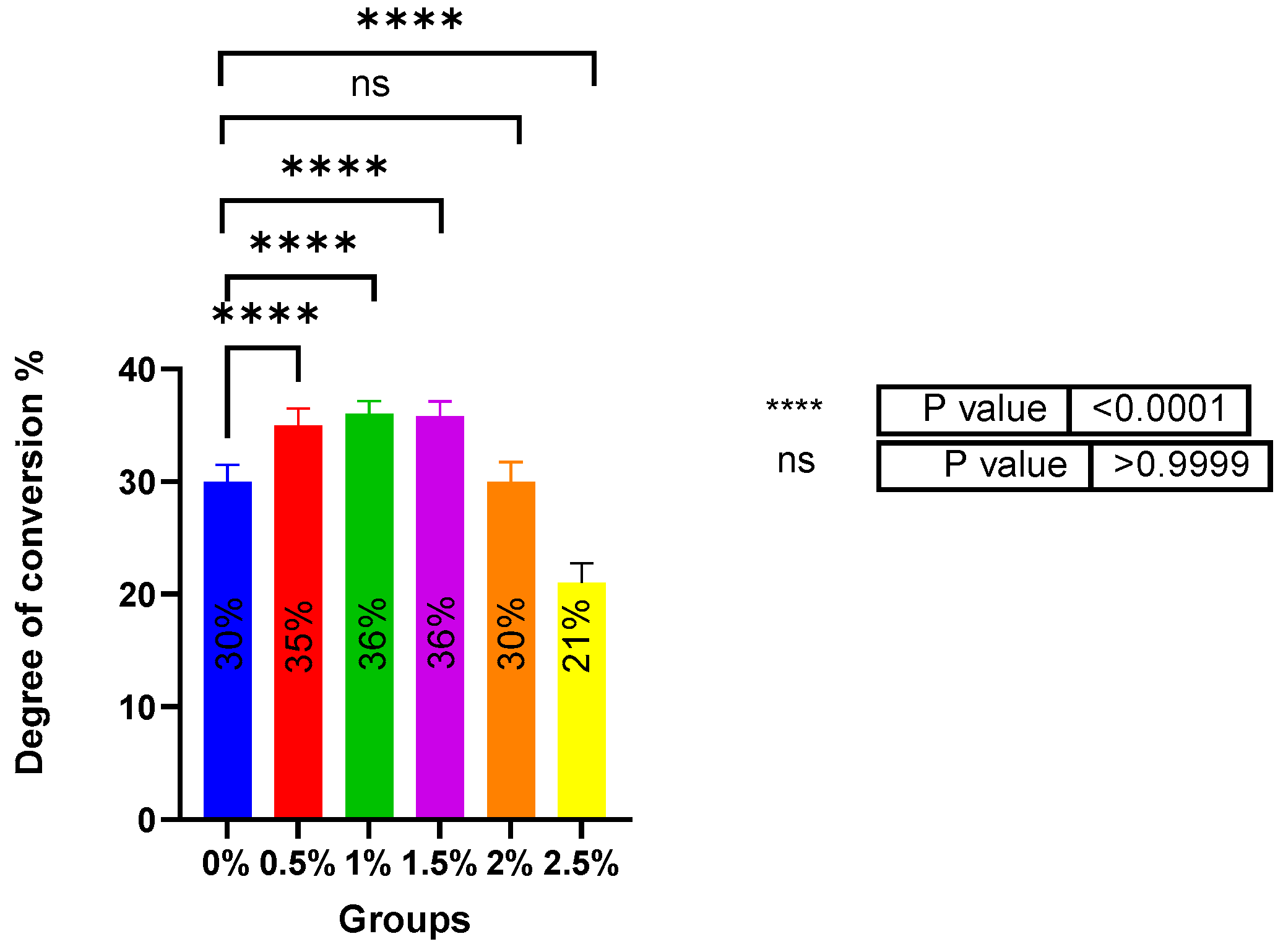
The FTIR spectrum of polymerized polymethylmethacrylate (PMMA) after the addition of CeZrO4 NFs at varying quantities of 0.5, 1.0, 1.5, 2.0 and 2.5 wt.% shows similar peaks as those before the addition of the NFs. The bands and their wavenumbers, which represent the FTIR spectrum comparison for all the specimens, clearly revealed that no new bonds appeared after the polymerization of the PMMA after the addition of the CeZrO4, i.e., there was no chemical reaction in the process, and it was only a physical blend. The degree of conversion (DC) values of the nanocomposites at lower concentrations (0.5 to 1.5 wt.%) showed statistically significant increase compared to the control group (Figure 14). However, at higher NF concentrations the DC values started to decrease.

4. Discussion

The incorporation of CeZrO4 NFs into 3D-printed denture base resin produced significant changes in flexural strength, impact strength, surface hardness, radiopacity and degree of conversion (DC) while 1.0 wt.% NFs addition produced the most optimal mechanical and physical properties. Increasing above this NFs concentration leads to a decrease in these properties, except a continuous decrease in radiopacity with increasing filler concentration. Therefore, the null hypothesis was rejected.
The DLP printer was utilized in this research since it is a faster technique that creates items with a higher resolution [33]. By producing patterned laser light, DLP technology offers an advantage over stereolithography where all layers can be cured in a single laser exposure rather than requiring the laser to scan each area one at a time. Owing to this advantage, the building time is unaffected by the shape of the associated layer or the quantity of items [6].
The mechanical and physical properties of 3D-printed denture base could be affected by the orientation, curing technique, building parameter, CAD-CAM software, layer shrinkage, layer thickness, and layer numbers [34]. Air trapped in the resin liquid during specimen printing might have led to the formation of voids between printed layers, which would have impacted the mechanical and physical characteristics of the printed specimen [24]. A layer thickness of 50 µm and 0° orientation were used while printing the specimens for this research. By improving interlayer diffusion, air voids can be reduced as the layer thickness decreases [35]. According to Borella et al., specimens printed at a 50 µm layer thickness had superior qualities to those printed at 100 µm [36]. Owing to thinner individual printing layers, the flexural strength improved, and this increase could be most likely attributable to the fact that smaller layers make the polymerization process more effective. They allow light to flow through them more easily than the thicker layers do [37]. The angle of printing orientation influences the mechanical properties of 3D-printed materials. Alqutaibi et al. [38] found that the 0° orientation resulted in better flexural than the 45° and 90° orientations did while printing denture base specimens. Another study by Shim et al. [39] found that 0° orientation showed the highest flexural strength in 3D-printed resins compared to 45° and 90° printing orientations. This could be due to changing the layer building printing direction from parallel to perpendicular to the load direction, which can produce strong adhesion within the same layers as opposed to 45° and 90° orientations [40]. However, Jafarpour et al. [41] found that flexural strength was significantly greater (p < 0.001) at an orientation of 90° compared with 0° and 45° during 3D printing of denture base resin.
The flexural strength improved progressively with increasing CeZrO4 NFs concentration, peaking at intermediate levels (0.5–1.5 wt.%), before decreasing at 2 wt.%. This could be due to the fact nanoparticles work as reinforcing agents, enhancing the resistance of the material to stress-induced fractures by filling the spaces between the polymer chains and improving the strength, stiffness, and overall structural integrity of the printed component. Previous research suggested that increasing the flexural strength of a nanocomposite might also depend on achieving a uniform dispersion of nanoparticles inside the resin matrix [42], confirming the findings of Majeed and Hamad, who reported similar improvements after the addition of 1.0 wt.% yttria-stabilized zirconia (YSZ) nanofillers to a 3D-printed denture base. However, the flexural strength of the 3D-printed resin decreased as YSZ nanoparticle concentrations increased beyond 1.0 wt.% [43]. Similarly, Kadhum and Hamad reported a significant increase in the flexural strength of the 3D-printed denture base after the addition of 0.5 wt.% barium titanate nanoparticles whereas an increase in BaTiO3 concentration exceeding 1.0 wt.% resulted in a reduction in the flexural strength of the 3D-printed resin [44]. Additionally, Mhaibes et al. reported that the flexural strength of 3D-printed denture base increased significantly after the addition of 1.0 wt.% titanium oxide nanotubes and decreased at 2.0 wt.% nanotube concentrations [24]. The statistically significant decrease in flexural strength at higher nanofiber concentrations could be explained by a change in the internal structure of the polymerized resin where the nanofiller works as an impurity or internal defects caused by particle clustering. In this study, higher concentrations of CeZrO4 (2.0 and 2.5 wt.%) in the resin matrix showed a negative impact on the DC and flexural strength possibly owing to an increase in the amount of unreacted monomer, which might act as a plasticizer. Therefore, in order to maximize the benefits of nano additives in terms of enhancing clinical performance of the denture base, it is crucial to determine their ideal concentration.
Lowery et al. [37] reported that a 50 µm layer thickness resulted in greater strength than a 100 µm layer thickness did and documented a general tendency toward better strength with a lower layer thickness. The smaller layer thickness used in this study could be the cause of the observed improvements in flexural strength. Furthermore, the post-curing unit plays a critical role in enhancing flexural strength. The inert post-curing process in a nitrogen gas atmosphere counteracts the detrimental effects of the oxygen inhibition layer [37]. The use of 3D-printed denture in clinical settings could be possible as both the control and modified groups at lower NF concentration exceeded the ISO-20795-1:2013 flexural strength criteria, which call for a minimum value of 65 MPa.
To avoid fractures in the case of a sudden drop, the denture base material must have sufficient impact strength. In this study, the incorporation of CeZrO4 NFs into 3D printing resin caused a significant increase in the impact strength reaching peak with the 1.0 wt.% and 1.5 wt.% NF concentrations compared with that of the control group, and these results were statistically significant for both experimental groups. This improvement could be attributed to the consequence of the development of cross-links or supramolecular bonds within the nanocomposites, which could stop fracture propagation. Additionally, a strong bond between the resin matrix and the nanofiller could increase interfacial shear strength and arrest crack progression [45]. Also, this increase in impact strength could be related to effective dispersion of NFs at lower concentration, combined with the thin layer thickness and controlled post-curing in nitrogen environment, which enhanced cross-link density by reducing oxygen inhibition. This finding was consistent with the results of Fatalla et al., who reported that improved impact strength could be attributed to strong interfacial adhesion between the nanoparticles and the polymer matrix. The nanoparticles occupy the interchain regions, restrict chain displacement, and promote effective energy dissipation, which suppresses crack growth and fracture propagation [46]. Gad et al. reported that the addition of nano-ZrO2 (with or without glass fibers) significantly improved the impact resistance [47]. These results agree with those of previous studies by Mhaibes et al. [24] Chen et al. [48] and Alshaikh et al. [13] which indicated that the impact strength was increased by the addition of titanium dioxide nanotubes (TiO2), polyetheretherketone (PEEK), titanium dioxide (TiO2), and zirconium dioxide nanoparticles (ZrO2) to 3D-printed resins. A reduction in impact strength at higher concentration might be associated with fiber clustering and reduced DC.
The enhanced hardness suggests better wear resistance and maintenance of the occlusal form, which are key for clinical durability. The surface hardness increased with increasing NFs loading owing to the inherently high hardness of the zirconia and cerium oxide. Furthermore, the stacking and overlapping of polymer molecules, which limit their mobility, are also responsible for the hardness increase. This enhances the ability of a material to withstand scratches, cuts, and plastic deformation. The types of forces holding atoms together determine a material’s hardness. Here, the coherence of the mixture was enhanced by fiber–fiber mesh formation in the resin matrix and uniformly dispersed stiff and rigid NFs, which increases the hardness of the NF-reinforced resin. Similar reinforcement effects were found in the study by Pavlíková et al. [49] on hybrid nanocomposites, where surface hardness improved with modified zirconia nanoparticle content. Kim et al. [50] reported that the hardness values of the 2.5wt.% Ce group were significantly greater than those of the control group (p  <  0.05), and the study of Aati et al. [17] demonstrated that adding ZrO2 NPs significantly increased the hardness of temporary restorations. Similarly, Gad et al. [18] reported that the hardness of 3D-printed resin increased with the addition of SiO2 NPs in comparison to the pure resin. It should be noted that with the increase in nanofiber content the numerical values of hardness changed only by a small margin, although statistical analysis confirmed that the differences were statistically significant (p < 0.05). Therefore, this small change might not translate to a real-life clinical significance.
Broken denture fragments could be swallowed by the wearers in some cases. In order to make it easier to locate the denture fragments, radiopacity in denture base is desirable. Since most denture base materials are radiolucent, researchers are now focusing heavily on developing radio-opaque denture base materials. Since extraoral radiographs are more frequently employed as diagnostic tools in emergency situations, they were used in this investigation [51]. Numerous investigations have been carried out on the radiopacity of denture base resins; an increase in radiopacity is correlated with a decrease in radiographic optical density (OD). Aluminum is used to equalize the density of exposed films in radiopacity testing because tooth structures such as enamel have a similar coefficient of linear absorption. In accordance with ISO 4049 standard, aluminum allows for radiopacity up to 2 mm thick that reaches clinically acceptable radiopacity (>1 mmAl) [52]. With an increase in radiographic densities, radiopacity increases. When the results of the reinforced groups were compared with those of the unaltered group, there was a statistically significant increase in radiopacity as the concentration of CeZrO4 NFs increased.
As a result, the transmission densitometer results indicated that the radiographic density decreases as greater amounts of CeZrO4 NFs are added, whereas the control group has the highest mean radiographic density (low radio-opacity). The increase in radio-opacity was statistically significant, and the relative radio-opacity increased as the CeZrO4 NFs concentration increased. This is evidently because the polymer matrix contains radio-opaque CeZrO4 NFs, which absorb more radiation than the polymer matrix and are more radio-opaque. The high atomic number of Ce (Ce, atomic number: 58) and the high atomic number of Zr (Zr, atomic number: 40) in comparison with the low atomic number of the chemical constituent of acrylic (C, atomic number: 6, O, atomic number: 8) brought radio-opacity characteristics by the presence of CeZrO4 NFs. An element’s ability to absorb X-rays is mostly determined by the cube of its atomic number [27].
FTIR spectra confirmed that the addition of CeZrO4 NFs did not introduce new chemical bonds when the 3D-printed resin and CeZrO4 NFs were combined, and all the bonds were the same in all the spectra except for those of the CeZrO4 NFs. This made it very evident that the mixing was only physical in nature and not chemical. This also suggests that the long-term stability of denture depends primarily on dispersion uniformity and mechanical entrapment of the NFs within the resin rather than their chemical bonding.
Mechanical characteristics like hardness are significantly impacted by the degree of monomer conversion, and this characteristic would be improved in proportion to the rate of converted monomer into a polymer network [17]. The degree of polymerization of composite resins is closely related to the curing process, which may be impacted by the energy of the radiation, the range of wavelengths, the duration of exposure, translucency, and light scattering by the filled system [53]. In this study, the addition of a small amount of CeZrO4 NFs (0.5 wt.%, 1.0 wt.% and 1.5wt.%) increased the DC (35%, 36% and 36%, respectively) compared with that of the control group (30%). This could be attributed to the photocatalytic properties of the CeZrO4 NFs [54,55]. NFs helped the curing light energy diffuse throughout the 3D-printed material and accelerated photopolymerization and DC, which would decrease the amount of unreacted monomer. This could explain why the nanocomposites had better mechanical properties and surface hardness than the pure resin [56]. A greater DC reflects increased cross-linking and denser polymeric matrix with fewer unreacted monomers and gaps [57]. This is consistent with the results of Altarazi et al., who reported that the DC considerably increased when 0.1% TiO2 was added to 3D-printed liquid resin [58]. A greater DC reduces the quantity of remaining monomer, which lowers the negative reactions in the oral tissues [59]. When the amount of NFs increased (2% and 2.5%wt NFs), the DC decreased (30% and 21%, respectively) and negatively affected the mechanical properties due to a reduction in light transmission and potential filler agglomeration which hinder polymerization [57]. Additionally, increased filler loading elevates the resin viscosity and restricts the mobility of unreacted monomers, further impacting polymerization kinetics [17].
Although these findings demonstrate promising improvement, several limitations must be considered. The present investigation focused on a single variety of CeZrO4 NFs, a particular printing orientation, a single post-printing polymerization and a specific 3D-printed denture resin. Therefore, the present outcomes might be different from those of alternative resins, printing techniques, and printing settings. Future research should build on these findings by examining the effects of CeZrO4 NFs on physical and mechanical properties of a variety of denture base resins in order to have a more complete understanding. The ideal NF percentages found in this study could not be directly compared due to a lack of prior studies on the utilization of CeZrO4 NFs in 3D-printed dental resins. Nevertheless, the ideal proportion of CeZrO4 NFs found in this investigation was comparable to that found in other studies that employed nanoparticles in 3D-printed resins. Furthermore, the current study was carried out in dry settings, which do not accurately reflect how they would function in an actual oral environment. Therefore, accelerated aging under different liquid media like water, artificial saliva, or coffee will be conducted to assess the performance of the nanocomposites.
The current results demonstrated that 3D-printed denture base materials represent a promising alternative to conventional heat-cured polymers in clinical settings. The integration of nanotechnology may further mitigate the limitations associated with current materials and improve their structural integrity and functional characteristics, leading to enhanced clinical durability and superior patient outcomes.

5. Conclusions

The foundation material for 3D-printed dentures was successfully reinforced with cerium zirconium oxide-milled nanofibers (CeZrO4 NFs) with different concentrations (0.5, 1.0, 1.5, 2.0, and 2.5 wt.%). The results showed that 1.0 wt.% and 1.5 wt.% CeZrO4 NFs nanocomposites had the highest flexural strength, impact strength, hardness and degree of conversion (DC) values. However, a general trend of decrease in mechanical properties at the highest concentration could be due to nanofiber clustering and the resultant reduction in DC. This new nanocomposite could help in improving the performance of dentures in clinical set-up.

Author Contributions

Conceptualization, I.N.S. and S.T.J.; methodology, formal analysis, I.N.S., S.T.J. and J.H.; investigation, I.N.S. and S.T.J.; data curation, I.N.S., S.T.J. and J.H.; writing—original draft preparation, I.N.S. and S.T.J.; writing—review and editing, J.H.; visualization, I.N.S., J.H. and S.T.J.; supervision, I.N.S. and J.H.; project administration, I.N.S.; All authors have read and agreed to the published version of the manuscript.

Funding

This research received no external funding.

Data Availability Statement

The raw data supporting the conclusions of this article will be made available by the authors on request.

Conflicts of Interest

The authors declare no conflicts of interest.

References

  1. Zhao, X.; Zhang, Q.; Tao, S.; Zhou, W.; Jia, P.-Y. Association of edentulism and all-cause mortality in Chinese older adults: Do sex differences exist? Public Health 2023, 221, 184–189. [Google Scholar] [CrossRef]
  2. Bai, X.; Lin, C.; Wang, Y.; Ma, J.; Wang, X.; Yao, X.; Tang, B. Preparation of Zn doped mesoporous silica nanoparticles (Zn-MSNs) for the improvement of mechanical and antibacterial properties of dental resin composites. Dent. Mater. 2020, 36, 794–807. [Google Scholar] [CrossRef]
  3. Sun, H.; Lei, C.; Xu, J.; Li, R. Foliar uptake and leaf-to-root translocation of nanoplastics with different coating charge in maize plants. J. Hazard. Mater. 2021, 416, 125854. [Google Scholar]
  4. Prpić, V.; Schauperl, Z.; Ćatić, A.; Dulčić, N.; Čimić, S. Comparison of mechanical properties of 3D-printed, CAD/CAM, and conventional denture base materials. J. Prosthodont. 2020, 29, 524–528. [Google Scholar] [PubMed]
  5. Freitas, R.F.C.P.d.; Duarte, S.; Feitosa, S.; Dutra, V.; Lin, W.S.; Panariello, B.H.D.; Carreiro, A.d.F.P. Physical, mechanical, and anti-biofilm formation properties of CAD-CAM milled or 3D printed denture base resins: In vitro analysis. J. Prosthodont. 2023, 32, 38–44. [Google Scholar] [PubMed]
  6. Kessler, A.; Hickel, R.; Reymus, M. 3D printing in dentistry—State of the art. Oper. Dent. 2020, 45, 30–40. [Google Scholar] [CrossRef]
  7. Dawood, A.; Marti, B.M.; Sauret-Jackson, V.; Darwood, A. 3D printing in dentistry. Br. Dent. J. 2015, 219, 521–529. [Google Scholar] [CrossRef]
  8. Alifui-Segbaya, F.; Bowman, J.; White, A.R.; George, R.; Fidan, I. Characterization of the double bond conversion of acrylic resins for 3D printing of dental prostheses. Compendium 2019, 40, e7–e11. [Google Scholar] [PubMed]
  9. Perea-Lowery, L.; Gibreel, M.; Vallittu, P.K.; Lassila, L.V. 3D-printed vs. heat-polymerizing and autopolymerizing denture base acrylic resins. Materials 2021, 14, 5781. [Google Scholar]
  10. Dimitrova, M.; Corsalini, M.; Kazakova, R.; Vlahova, A.; Chuchulska, B.; Barile, G.; Capodiferro, S.; Kazakov, S. Comparison between conventional PMMA and 3D printed resins for denture bases: A narrative review. J. Compos. Sci. 2022, 6, 87. [Google Scholar] [CrossRef]
  11. Al-Dwairi, Z.N.; Al Haj Ebrahim, A.A.; Baba, N.Z. A comparison of the surface and mechanical properties of 3D printable denture-base resin material and conventional polymethylmethacrylate (PMMA). J. Prosthodont. 2023, 32, 40–48. [Google Scholar]
  12. Gad, M.M.; Fouda, S.M.; Al-Harbi, F.A.; Näpänkangas, R.; Raustia, A. PMMA denture base material enhancement: A review of fiber, filler, and nanofiller addition. Int. J. Nanomed. 2017, 12, 3801–3812. [Google Scholar] [CrossRef]
  13. Alshaikh, A.A.; Khattar, A.; Almindil, I.A.; Alsaif, M.H.; Akhtar, S.; Khan, S.Q.; Gad, M.M. 3D-Printed Nanocomposite Denture-Base Resins: Effect of ZrO2 Nanoparticles on the Mechanical and Surface Properties In Vitro. Nanomaterials 2022, 12, 2451. [Google Scholar]
  14. Abushowmi, T.H.; AlZaher, Z.A.; Almaskin, D.F.; Qaw, M.S.; Abualsaud, R.; Akhtar, S.; Al-Thobity, A.M.; Al-Harbi, F.A.; Gad, M.M.; Baba, N.Z. Comparative effect of glass fiber and nano-filler addition on denture repair strength. J. Prosthodont. 2020, 29, 261–268. [Google Scholar]
  15. Gad, M.M.; Rahoma, A.; Al-Thobity, A.M.; ArRejaie, A.S. Influence of incorporation of ZrO2 nanoparticles on the repair strength of polymethyl methacrylate denture bases. Int. J. Nanomed. 2016, 11, 5633–5643. [Google Scholar] [CrossRef]
  16. Tamboura, B.; Yudaev, P.; Butorova, I.; Klyukin, B.; Chuev, V.; Chistyakov, E. Hexaallylaminocyclotriphosphazene-Modified Dental Compositions for 3D Printing of Dental Crowns. Polymers 2026, 18, 53. [Google Scholar]
  17. Aati, S.; Akram, Z.; Ngo, H.; Fawzy, A.S. Development of 3D printed resin reinforced with modified ZrO2 nanoparticles for long-term provisional dental restorations. Dent. Mater. 2021, 37, e360–e374. [Google Scholar]
  18. Mubarak, S.; Dhamodharan, D.; Kale, M.B.; Divakaran, N.; Senthil, T.; Sathiyanathan, P.; Wu, L.; Wang, J. A novel approach to enhance mechanical and thermal properties of SLA 3D printed structure by incorporation of metal–metal oxide nanoparticles. Nanomaterials 2020, 10, 217. [Google Scholar] [CrossRef] [PubMed]
  19. Gad, M.M.; Al-Harbi, F.A.; Akhtar, S.; Fouda, S.M. 3D-printable denture base resin containing SiO2 nanoparticles: An in vitro analysis of mechanical and surface properties. J. Prosthodont. 2022, 31, 784–790. [Google Scholar]
  20. Suhailath, K.; Thomas, M.; Ramesan, M. Effect of temperature on AC conductivity of poly(butyl methacrylate)/cerium dioxide nanocomposites and applicability of different conductivity modeling studies. Res. Chem. Intermed. 2020, 46, 2579–2594. [Google Scholar]
  21. Li, K.; Shen, Q.; Xie, Y.; You, M.; Huang, L.; Zheng, X. Incorporation of cerium oxide into hydroxyapatite coating regulates osteogenic activity of mesenchymal stem cell and macrophage polarization. J. Biomater. Appl. 2017, 31, 1062–1076. [Google Scholar]
  22. Shcherbakov, A.B.; Reukov, V.V.; Yakimansky, A.V.; Krasnopeeva, E.L.; Ivanova, O.S.; Popov, A.L.; Ivanov, V.K. CeO2 nanoparticle-containing polymers for biomedical applications: A review. Polymers 2021, 13, 924. [Google Scholar]
  23. Byun, S.-Y.; Han, A.R.; Kim, K.-M.; Kwon, J.-S. Antibacterial properties of mesoporous silica coated with cerium oxide nanoparticles in dental resin composite. Sci. Rep. 2024, 14, 18014. [Google Scholar] [CrossRef] [PubMed]
  24. Mhaibes, A.H.; Safi, I.N.; Haider, J. The influence of the addition of titanium oxide nanotubes on the properties of 3D printed denture base materials. J. Esthet. Restor. Dent. 2024, 36, 1574–1590. [Google Scholar] [CrossRef] [PubMed]
  25. McCabe, J.F.; Walls, A.W. Applied Dental Materials; Blackwell Publishing Ltd.: Oxford, UK, 2013. [Google Scholar]
  26. ISO 179-1: 2023; Plastics-Determination of Charpy Impact Properties: Part 1: Non-Instrumented Impact Test. International Standards Organization: Geneva, Switzerland, 2023.
  27. Ihab, N.; Moudhaffar, M. Evaluation the effect of modified nano-fillers addition on some properties of heat cured acrylic denture base material. J. Bagh. Coll. Dent. 2011, 23, 23–29. [Google Scholar]
  28. Dhole, R.I.; Srivatsa, G.; Shetty, R.; Huddar, D.; Sankeshwari, B.; Chopade, S. Reinforcement of aluminum oxide filler on the flexural strength of different types of denture base resins: An in vitro study. J. Clin. Diagn. Res. JCDR 2017, 11, ZC101. [Google Scholar]
  29. Nassani, L.M.; Storts, S.; Novopoltseva, I.; Place, L.A.; Fogarty, M.; Schupska, P. Impact Absorption Power of Polyolefin Fused Filament Fabrication 3D-Printed Sports Mouthguards: In Vitro Study. Dent. Traumatol. 2025, 41, 213–223. [Google Scholar]
  30. Altarazi, A.; Haider, J.; Alhotan, A.; Silikas, N.; Devlin, H. Assessing the physical and mechanical properties of 3D printed acrylic material for denture base application. Dent. Mater. 2022, 38, 1841–1854. [Google Scholar] [CrossRef]
  31. de Araujo, L.O.F.; Barreto, O.; de Mendonça, A.A.M.; França, R. Assessment of the degree of conversion in light-curing orthodontic resins with various viscosities. Appl. Adhes. Sci. 2015, 3, 26. [Google Scholar] [CrossRef]
  32. Ucuncu, M.K.; Celiksoz, O.; Sen, E.; Yucel, Y.Y.; Dinc, B. Investigation of the degree of monomer conversion in dental composites through various methods: An in vitro study. Appl. Sci. 2024, 14, 4406. [Google Scholar] [CrossRef]
  33. Huang, J.; Zhang, B.; Xiao, J.; Zhang, Q. An approach to improve the resolution of DLP 3D printing by parallel mechanism. Appl. Sci. 2022, 12, 12905. [Google Scholar] [CrossRef]
  34. Liu, Y.; Bai, W.; Cheng, X.; Tian, J.; Wei, D.; Sun, Y.; Di, P. Effects of printing layer thickness on mechanical properties of 3D-printed custom trays. J. Prosthet. Dent. 2021, 126, 671.e1–671.e7. [Google Scholar] [CrossRef]
  35. Benamira, M.; Benhassine, N.; Ayad, A.; Dekhane, A. Investigation of printing parameters effects on mechanical and failure properties of 3D printed PLA. Eng. Fail. Anal. 2023, 148, 107218. [Google Scholar] [CrossRef]
  36. Borella, P.S.; Alvares, L.A.; Ribeiro, M.T.; Moura, G.F.; Soares, C.J.; Zancope, K.; Mendonca, G.; Rodrigues, F.P.; das Neves, F.D. Physical and mechanical properties of four 3D-printed resins at two different thick layers: An in vitro comparative study. Dent. Mater. 2023, 39, 686–692. [Google Scholar] [CrossRef] [PubMed]
  37. Perea-Lowery, L.; Gibreel, M.; Vallittu, P.K.; Lassila, L. Evaluation of the mechanical properties and degree of conversion of 3D printed splint material. J. Mech. Behav. Biomed. Mater. 2021, 115, 104254. [Google Scholar] [CrossRef] [PubMed]
  38. Alqutaibi, A.Y.; Aljohani, R.; Almuzaini, S.; Alghauli, M.A. Physical–mechanical properties and accuracy of additively manufactured resin denture bases: Impact of printing orientation. J. Prosthodont. Res. 2025, 69, 461–471. [Google Scholar] [CrossRef] [PubMed]
  39. Shim, J.S.; Kim, J.-E.; Jeong, S.H.; Choi, Y.J.; Ryu, J.J. Printing accuracy, mechanical properties, surface characteristics, and microbial adhesion of 3D-printed resins with various printing orientations. J. Prosthet. Dent. 2020, 124, 468–475. [Google Scholar] [CrossRef]
  40. Gad, M.M.; Fouda, S.M.; Abualsaud, R.; Alshahrani, F.A.; Al-Thobity, A.M.; Khan, S.Q.; Akhtar, S.; Ateeq, I.S.; Helal, M.A.; Al-Harbi, F.A. Strength and surface properties of a 3D-printed denture base polymer. J. Prosthodont. 2022, 31, 412–418. [Google Scholar]
  41. Jafarpour, D.; El-Amier, N.; Tahboub, K.; Zimmermann, E.; Pero, A.C.; de Souza, R. Effects of DLP printing orientation and postprocessing regimes on the properties of 3D printed denture bases. J. Prosthet. Dent. 2025, 134, 239.e1–239.e9. [Google Scholar] [CrossRef]
  42. Kul, E.; Aladağ, L.İ.; Yesildal, R. Evaluation of thermal conductivity and flexural strength properties of poly(methyl methacrylate) denture base material reinforced with different fillers. J. Prosthet. Dent. 2016, 116, 803–810. [Google Scholar] [CrossRef]
  43. Majeed, H.F.; Hamad, T.I.; Al-Salihi, Z. Yttria stabilized zirconia: Innovative approach for improving the performance of additively manufactured denture resins. J. Baghdad Coll. Dent. 2025, 37, 27–36. [Google Scholar] [CrossRef]
  44. Kadhum, R.N.; Hamad, T.I. Evaluating the effects of barium titanate nanoparticles on the mechanical properties of 3D-printed acrylic denture base. Proc. Inst. Mech. Eng. Part L J. Mater. Des. Appl. 2025, 14644207251365614. [Google Scholar] [CrossRef]
  45. Sun, L.; Gibson, R.F.; Gordaninejad, F.; Suhr, J. Energy absorption capability of nanocomposites: A review. Compos. Sci. Technol. 2009, 69, 2392–2409. [Google Scholar] [CrossRef]
  46. Fatalla, A.A.; Tukmachi, M.S.; Jani, G.H. Assessment of some mechanical properties of PMMA/silica/zirconia nanocomposite as a denture base material. In Proceedings of the IOP Conference Series: Materials Science and Engineering; IOP Publishing: Bristol, UK, 2020; p. 012031. [Google Scholar]
  47. Gad, M.M.; Al-Thobity, A.M.; Rahoma, A.; Abualsaud, R.; Al-Harbi, F.A.; Akhtar, S. Reinforcement of PMMA denture base material with a mixture of ZrO2 nanoparticles and glass fibers. Int. J. Dent. 2019, 2019, 2489393. [Google Scholar]
  48. Chen, S.-G.; Yang, J.; Jia, Y.-G.; Lu, B.; Ren, L. TiO2 and PEEK reinforced 3D printing PMMA composite resin for dental denture base applications. Nanomaterials 2019, 9, 1049. [Google Scholar] [CrossRef]
  49. Elmadani, A.; Radović, I.; Tomić, N.Z.; Petrović, M.; Stojanović, D.B.; Heinemann, R.J.; Radojević, V. Hybrid denture acrylic composites with nanozirconia and electrospun polystyrene fibers. PLoS ONE 2019, 14, e0226528. [Google Scholar]
  50. Kim, M.-C.; Byeon, D.-J.; Jeong, E.-J.; Go, H.-B.; Yang, S.-Y. Color stability, surface, and physicochemical properties of three-dimensional printed denture base resin reinforced with different nanofillers. Sci. Rep. 2024, 14, 1842. [Google Scholar] [CrossRef] [PubMed]
  51. Mikael, J.; Al-Samaraie, S.; Ikram, F. Evaluation of Some Properties of Acrylic Resin Denture Base Reinforced with Calcium Carbonate Nano-Particles. Erbil Dent. J. (EDJ) 2018, 1, 41–47. [Google Scholar]
  52. Gul, P.; Çaglayan, F.; Akgul, N.; Akgul, H.M. Comparison of radiopacity of different composite resins. J. Conserv. Dent. Endod. 2017, 20, 17–20. [Google Scholar]
  53. Halvorson, R.H.; Erickson, R.L.; Davidson, C.L. Energy dependent polymerization of resin-based composite. Dent. Mater. 2002, 18, 463–469. [Google Scholar] [CrossRef] [PubMed]
  54. Al Thabaiti, S.A.; Khan, Z.; Al-Thubaiti, K.S.; Bawaked, S.M.; Al-Sheheri, S.Z.; Mokhtar, M.; Malik, M.A.; Narasimharao, K. Au-Deposited Ce0.5Zr0.5O2 Nanostructures for Photocatalytic H2 Production under Visible Light. Catalysts 2023, 13, 1340. [Google Scholar] [CrossRef]
  55. Gionco, C.; Paganini, M.C.; Chiesa, M.; Maurelli, S.; Livraghi, S.; Giamello, E. Cerium doped zirconium dioxide as a potential new photocatalytic material. The role of the preparation method on the properties of the material. Appl. Catal. A Gen. 2015, 504, 338–343. [Google Scholar] [CrossRef]
  56. Sulaiman, M.M.; Fatalla, A.A.; Haider, J. The Impact of Incorporating Grapefruit Seed Skin Particles into 3D-Printed Acrylic Resin on Mechanical Properties. Prosthesis 2024, 6, 1420–1436. [Google Scholar] [CrossRef]
  57. Aati, S.; Akram, Z.; Shrestha, B.; Patel, J.; Shih, B.; Shearston, K.; Ngo, H.; Fawzy, A. Effect of post-curing light exposure time on the physico–mechanical properties and cytotoxicity of 3D-printed denture base material. Dent. Mater. 2022, 38, 57–67. [Google Scholar]
  58. Altarazi, A.; Haider, J.; Alhotan, A.; Silikas, N.; Devlin, H. 3D printed denture base material: The effect of incorporating TiO2 nanoparticles and artificial ageing on the physical and mechanical properties. Dent. Mater. 2023, 39, 1122–1136. [Google Scholar] [CrossRef]
  59. Al-enbary, Z.B.; Safi, I.N.; Haider, J. Assessing the influence of titanium dioxide nanotubes incorporation on thermal and thermomechanical characteristics of 3D-printed denture base resin. J. Prosthodont. 2025. Epub ahead of printing. [Google Scholar] [CrossRef]
Figure 1. Fabrication steps for the 3D-printed PMMA-CeZrO4 nanocomposite specimen.
Jcs 10 00190 g001
Figure 2. Steps for measuring the optical density (OD) of the X-ray films by a light transmission densitometer: (A) specimens and aluminum step wedge on wax mold, (B) radiographic film and (C) light transmission densitometer and (D) calibration curve to convert OD to mmAl.
Jcs 10 00190 g002
Figure 3. Transverse strength results for denture base resins reinforced with CeZrO4 nanofibers at different concentrations (wt.%) (n = 10 for each nanofiber concentration).
Jcs 10 00190 g003
Figure 4. Impact strength results for CeZrO4 nanofiber-reinforced denture base resins at different concentrations (wt.%). (n = 10 for each nanofiber concentration).
Jcs 10 00190 g004
Figure 5. Hardness (Shore D) test results for denture base resins reinforced with CeZrO4 nanofibers at different concentrations (wt.%). (n = 10 for each nanofiber concentration).
Jcs 10 00190 g005
Figure 6. Radiographical measurement results: (A) optical density (OD) and (B) radiopacity (mmAl) for CeZrO4 nanofiber-reinforced denture base resins at different concentrations (wt.%). (n = 10 for each nanofiber concentration).
Jcs 10 00190 g006
Figure 7. FESEM images of the specimens’ broken cross sections at various magnifications: (A) control group, (B) 1.0% CeZrO4 group, (C) 2.5% CeZrO4 group.
Jcs 10 00190 g007
Figure 8. Field emission scanning electron microscopy image and particle size analysis of CeZrO4 nanofibers.
Jcs 10 00190 g008
Figure 9. EDX diagram for 3D-printed resin without incorporating CeZrO4 NFs.
Jcs 10 00190 g009
Figure 10. EDX mapping of the 3D-printed PMMA resin only with distribution of carbon and oxygen.
Jcs 10 00190 g010
Figure 11. EDX diagram for 3D-printed resin incorporating 1.5 wt.%CeZrO4 NFs.
Jcs 10 00190 g011
Figure 12. EDS maps of the 3D-printed resin incorporated with 1.5 wt.%CeZrO4 NFs.
Jcs 10 00190 g012
Figure 13. FTIR spectra of 3D-printed resin, CeZrO4 NFs, and 3D-printed nanocomposites.
Jcs 10 00190 g013
Figure 14. Degree of conversion (DC) values for the control and CeZrO4 nanofiber-reinforced 3D-printed nanocomposites (n = 10 for each nanofiber concentration).
Jcs 10 00190 g014
Disclaimer/Publisher’s Note: The statements, opinions and data contained in all publications are solely those of the individual author(s) and contributor(s) and not of MDPI and/or the editor(s). MDPI and/or the editor(s) disclaim responsibility for any injury to people or property resulting from any ideas, methods, instructions or products referred to in the content.