Article

Structural, Dielectric, and Impedance Properties of Sintered Al6Si2O13 Composite for Electronic Applications

1
LCM2E, Laboratory of Molecular Chemistry, Materials and Environment, Multidisciplinary Faculty of Nador (FPN), Mohammed Premier University, B.P. 300, Selouane, Nador 62700, Morocco
2
Laboratory Physics of Condensed Matter (LPMC), University of Chouaib Doukkali, El-Jadida 24000, Morocco
3
LCME, Faculté des Sciences et Techniques, Université Cadi Ayyad, Av. Abdelkrim El Khattabi, B.P. 549, Marrakech 40000, Morocco
4
Faculty of Chemistry and Chemical Technology, University of Ljubljana, Večna pot 113, 1000 Ljubljana, Slovenia
5
Faculty of Mathematics and Natural Sciences, South-West University “Neofit Rilski”, Ivan Mihailov 66, 2700 Blagoevgrad, Bulgaria
*
Author to whom correspondence should be addressed.
J. Compos. Sci. 2026, 10(3), 118; https://doi.org/10.3390/jcs10030118
Submission received: 19 December 2025 / Revised: 21 January 2026 / Accepted: 10 February 2026 / Published: 24 February 2026
(This article belongs to the Section Composites Manufacturing and Processing)

Abstract

Mullite (Al6Si2O13), an aluminosilicate with remarkable thermal and dielectric properties, is a promising material for advanced electronic applications. This study focuses on a sintered mullite composite and examines its structural, morphological, dielectric, and electrical properties. X-ray diffraction and scanning electron microscopy analyses confirm a well-defined crystalline structure and a homogeneous microstructure. Impedance spectroscopy measurements reveal a high relative permittivity at low frequencies, dominated by interfacial and jump polarization mechanisms. Electrical conductivity follows Jonscher’s double-power law, reflecting mixed ionic and electronic conduction due to contributions from grains and grain boundaries. Analysis of the Nyquist diagrams shows a marked decrease in resistances with increasing temperature: The grain resistance decreases from 21.87 MΩ to 4.85 MΩ, while that of the grain boundaries decreases from 89.44 MΩ to 5.94 MΩ between 450 °C and 900 °C. In addition, the relative permittivity increases sharply with temperature, from 25 × 103 to 350 × 103 at 1 kHz and from 200 to 1 × 10³ at 1 MHz over the same temperature range, highlighting the dominant influence of temperature and low frequencies on polarization mechanisms. These results confirm the strong potential of sintered mullite for electronic applications. The activation energy of the grain and grain boundary were determined to be Ea,g = 0.18 eV and Ea,bg = 0.22 eV, respectively.

1. Introduction

Mullite is a ceramic belonging to the aluminosilicate family, primarily composed of alumina (Al2O3) and silica (SiO2), with the chemical formula Al6Si2O13. It takes its name from the locality of mulla in Norway, where it was first identified in the 19th century [1]. Thanks to its exceptional properties [2], mullite is widely used in refractory materials and high-temperature ceramics.
Mullite is generally formed by the thermal transformation of minerals such as and alusite, sillimanite, or kaolin [3,4]. It exhibits excellent thermal resistance, low thermal conductivity, good resistance to thermal shock and high chemical stability [5,6,7,8], making it particularly suitable for high-temperature applications, especially in refractories, furnace linings, catalytic supports and combustion systems [9,10,11].
Furthermore, mullite possesses good mechanical properties, a low coefficient of thermal expansion, and high wear resistance, making it suitable for use in harsh environments, particularly in tribology, aerospace, and energy applications [12,13,14,15,16]. Its importance has led to the development of numerous synthesis methods aimed at improving its microstructure and performance, such as reactive sintering, polymer pioneers, and coating techniques [17,18,19,20,21,22,23,24].
Due to its remarkable thermal, mechanical, and chemical properties, mullite remains a ceramic material of choice for advanced industrial and electronic applications [5,25,26]. The study of its structural and functional properties using techniques such as X-ray diffraction (XRD), infrared spectroscopy (IR), scanning electron microscopy (SEM), and analysis of electrical (R) dielectric (C) properties allows for a more thorough understanding of its physico-chemical behavior and an evaluation of its application potential.
In this context, impedance spectroscopy is used to study the electrical and dielectric behavior of mullite as a function of temperature and frequency using various frequency representations, including Bode and Nyquist plots of the complex impedance Z*, as well as analysis of the electrical modulus M*, the complex conductivity σ*, and the loss factor tan (δ). Fitting the experimental data using an equivalent electrical circuit model allows for the identification of the respective contributions of the grains and grain boundaries and the extraction of the activation energies associated with the different transport mechanisms, as well as that of the mullite sample itself, within the studied frequency and temperature range.
More generally, impedance spectroscopy applied to dielectric materials is a valuable tool for characterizing their electrical and dielectric properties. In particular, it allows us to evaluate the dielectric constant, relaxation phenomena, electrical conductivity and its evolution as a function of temperature and frequency, as well as the influence of the microstructure on these physico-chemical parameters.

2. Structure of Mullite

2.1. Mullite Crystal

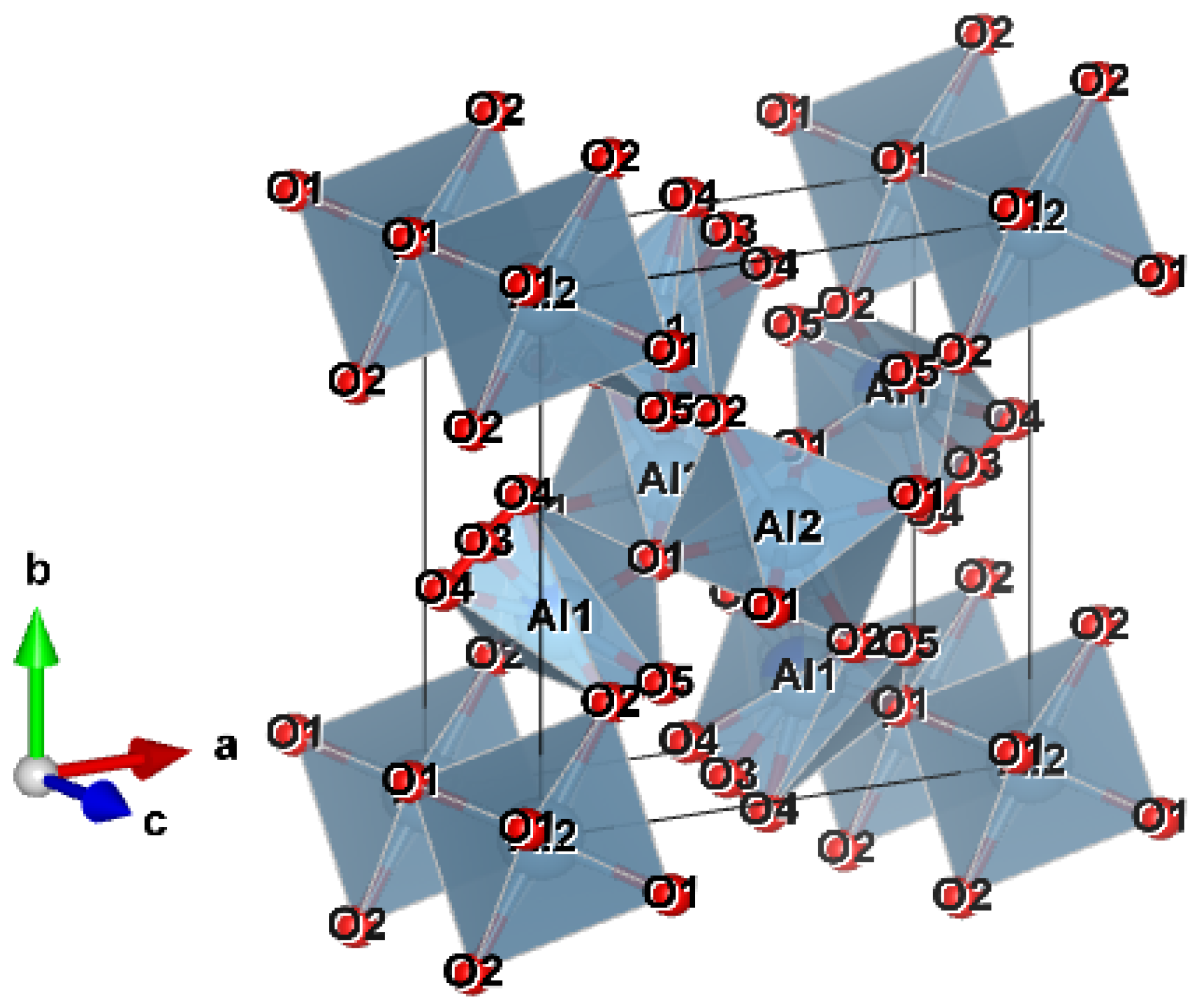
Fischer and Schneider described and categorized mullite systems [27,28]. According to reports, the fundamental building block of the mullite crystal structure is a sequence of facet-sharing octahedra organized in a tetragonal configuration with the highest topological symmetry. Mullite normally has an orthorhombic aluminosilicate crystal structure with the overall chemical formula Al2(Al2+2xSi2−2x)O10−x with 0.17 ≤ x ≤ 0.5 [29]. The essential structural aspect of mullite, that is parallel to the crystallographic c-axis, consists of chains of AlO6 octahedra at the edges of the unit cell and in its middle. Double-chain (Al,Si)O4 tetrahedra parallel to the c-axis connect these chains of octahedra [7]. Figure 1 shows the [001] projection of a mullite crystal unit cellular. Mullite includes a faulty crystal structure inclusive of AlO octahedral chains and runs parallel to the c-axis of the orthorhombic unit cell. These distortion chains in the crystal structure are related by using the Al-O and Si-O tetrahedral double chains with Al and Si atoms. This faulty shape has formed a brand-new stoichiometry, and the composition of mullite can alternate from 3Al2O3·2SiO2 (3/2) to 3Al2O3·SiO2 (3/1). The compositional variation in mullite is accomplished through substitution of a Si4 and elimination of an oxygen ion from an (Al,Si)O4 tetrahedron, leaving an oxygen vacancy after the following response:
2SiSi + OO ⇌ 2AlSi + VO2+
where V0 represents an oxygen emptiness, when exhibiting three:two stoichiometry, mullite crystallizes inside the orthorhombic device (Figure 1) of area group Pbam with lattice parameters a = 7.54 Å, b = 7.68 Å and c = 2.885 Å. The positional adjustments of partially occupied cations are illustrated in Figure 1 [27,30,31].
Table 1 summarizes the fractional atomic coordinates (x, y, z), site occupancy rates, and Wyckoff positions of the atoms in the crystal structure of mullite refined in the orthorhombic space group Pbam. The structure exhibits several partially occupied aluminum sites, reflecting the intrinsic non-stoichiometry of mullite and the coexistence of Al and Si atoms in equivalent crystallographic positions. The oxygen atoms occupy all sites and are distributed across multiple Wyckoff sites, thus ensuring structural stability. The reported atomic parameters are consistent with previously published crystallographic data for mullite.
The identified phase corresponds to mullite, with the chemical formula 3Al2O3·2SiO2.
It crystallizes in the orthorhombic space group Pbam, with the following lattice parameters: a = 7.55831 Å, b = 7.70574 Å, c = 2.88952 Å, α = β = γ = 90°, for a lattice volume V = 168.29 Å3.
The Rietveld refinement shows a good fit, characterized by the following reliability factors: Rwp = 12.88%, Rexp = 13.13%, χ2 = 0.97, and an overall quality factor (GoF) of 0.98.

2.2. Chemistry of Mullite

The stoichiometry of mullite, 3Al2O3•2SiO2, is well-known. Commercially produced mullite today, known as three/two mullite, is normally made from a strong solution of 71–76 wt% Al2O3 and 23–24 wt% SiO2. To adjust the sintering temperature, sure sintering aids are brought, along with TiO2, Fe2O3, CaO, and MgO. Glassy grain limitations form whilst the stoichiometric composition deviates, lowering the homes [28,32]. Without the glassy grain boundary segment (quartz), 3/2 mullite (stoichiometric mullite) is created, which has more extraordinary mechanical skills at very excessive temperatures [7].

2.3. Microstructure of Mullite

Processing strategies have a substantial effect on how mullite grows, and combining in the atomic or molecular stage has been proven to make a significant difference.The strategies used to manner mullite have an effect on its microstructure and physical characteristics. There must be several glassy levels and tiny crystals in mullite ceramic [33]. Mullite ought to be free of glassy sections in high-temperature structural applications, and a larger crystal length is preferred. The liquid silica section gift is inside the prismatic microstructure of mullite grains [34,35].

3. Material and Methods

3.1. Material

The following materials were used: silicon dioxide (98% purity, 20–30 nm), and α-Al2O3 (99.85% purity, average particle size (APS) 150 nm) purchased from ChemPUR (Karlsruhe, Germany).

3.2. Methods

In this work, mullite was synthesized using the solid-state reaction method from high-purity precursor powders. Aluminum oxide (Al2O3) and silicon dioxide (SiO2), each with a purity of at least 99%, were used as starting materials. The powders were mixed according to the stoichiometric composition of mullite (3Al2O3·2SiO2), corresponding to a molar ratio of 3 moles of Al2O3 to 2 moles of SiO2, i.e., approximately 71–76 wt% Al2O3 and 23–24 wt% SiO2. No additives or sintering aids were introduced during the synthesis process. The precursor powders were mixed by dry milling (solid-state route) to ensure a homogeneous and uniform dispersion of the oxides. Milling was carried out for 30 min, which was sufficient to achieve good homogeneity. The resulting powder was then placed in an alumina crucible, compatible with the oxides used and resistant to high temperatures during the subsequent thermal treatments. Sintering was performed at 1400 °C for 3 h, with a controlled heating rate of 5 °C/min. After holding at the maximum temperature, the samples were cooled down to room temperature at a rate of 5 °C/min inside the furnace under ambient air atmosphere. The influence of several key parameters, including sintering temperature, powder particle size distribution, and granulation method, was investigated using various characterization techniques. X-ray diffraction (XRD) (Bruker, Billerica, MA, USA) was employed for phase identification and structural analysis, Fourier transform infrared spectroscopy (FT-IR) (Bruker, Billerica, MA, USA) for chemical bond identification, field-emission scanning electron microscopy (FESEM) (FEI Company, Hillsboro, OR, USA) for microstructural and morphological observations, and impedance spectroscopy (Solartron Analytical, Farnborough, UK) for evaluating the electrical properties of the synthesized material.

3.3. Characterizations

The evaluation of crystalline materials after sintering was carried out by X-ray diffraction (XRD) on powder and sintered samples, using a Bruker diffractometer (version D8, made within the USA) running at forty kV and forty mA. Measurements were performed inside the angular range of 2θ from 10° to 80°, at a scanning velocity of 2.4°/min, using CuKα radiation (λ = 1.5406 Å). Phase identification was carried out using the JCPDS software program (PDF-2 Database, version 2023), and graphical representation of the information was executed with OriginPro 2022 (version 9.9).
The crystalline particle length (Dhkl) was estimated using the corrected Debye–Scherrer formulation.
Morphological characterization was executed by area-effect scanning electron microscopy (FE-SEM, FEI Quanta 250 version) (FEI Company, Hillsboro, OR, USA) prepared with an Oxford EDS detector (one hundred fifty mm2) (Oxford Instruments, Abingdon, UK). Raw nanopowders, sonicated combinations, and fracture surfaces of sintered samples were discovered after deposition of a thin platinum layer using a Quorum metallizer (Q150R model) (Quorum Technologies Ltd., Lewes, East Sussex, UK). Nanoparticle size was measured using the ImageJ® software program (version 1.53t).
Far infrared absorption spectra (FT-IR) were analyzed on samples organized as KBr pellets (99% purity) using a BRUKER spectrometer (Bruker, Billerica, MA, USA), protecting the frequency range 4000–400 cm−1, to study vibrational modes at room temperature.
Finally, the electric reaction of the materials were studied by means of impedance spectroscopy. This experimental method blanketed pattern training, tool setup, application of a low-amplitude sinusoidal signal with variable frequency, and simultaneous recording of the associated voltages and currents. This method makes it possible to gain the complex impedance of the gadget, decomposed directly into an actual element (resistance) and an imaginary part.

3.4. Impedance Spectroscopy Measurement

The samples studied were pressed into pellets approximately 1 mm thick and 13 mm in diameter. Measurements were performed using a Solartron S1260 impedance bridge (Solartron Analytical, Farnborough, UK) At each temperature, a stabilization time of several minutes was observed before data acquisition. A low-amplitude alternating voltage of approximately 20 mV was applied to remain within the linear range, with ten data points recorded per decade. Measurements were performed over a frequency range of 0.1 Hz to 10 MHz.

4. Results and Discussion

4.1. X-Ray Diffraction (XRD) Analysis

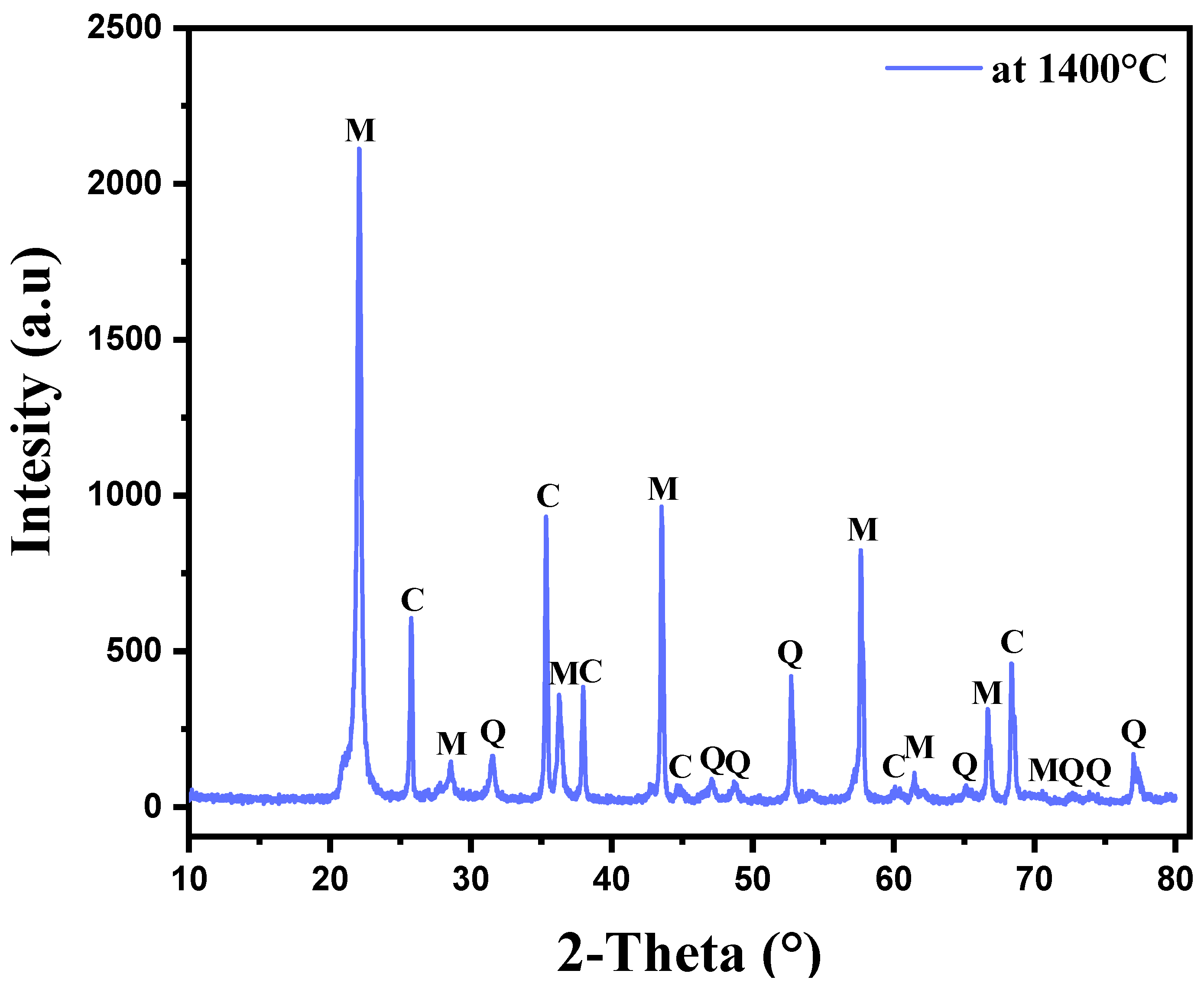
The X-ray diffractogram shown in Figure 2 corresponds to a mullite sample calcined at 1400 °C. Analysis of this pattern allows the identification of the crystalline phases present in the material based on the positions and intensities of the diffraction peaks. Intense, sharp, and well-defined peaks are observed, indicating a highly crystallized structure. These peaks correspond mainly to mullite (M), which is the principal phase. The high intensity and sharpness of these reflections indicate that mullite is well-formed and highly crystallized at this temperature, consistent with the fact that mullite becomes the dominant phase around 1400 °C. In addition to mullite, minor peaks corresponding to secondary phases are also detected. These include corundum (C), a refractory phase that may remain when free alumina has not fully reacted, and quartz (Q), whose presence may indicate excess silica or an incomplete reaction between the precursor oxides. Moreover, the progressive increase in sintering temperature promotes the transformation of intermediate phases into mullite and enhances its degree of crystallinity. This behavior is well-documented in the literature, which shows that, at higher sintering temperatures, the mullite content (M) increases at the expense of residual phases such as alumina (C) and silica (Q) [36,37,38].

4.2. FT-IR Analysis

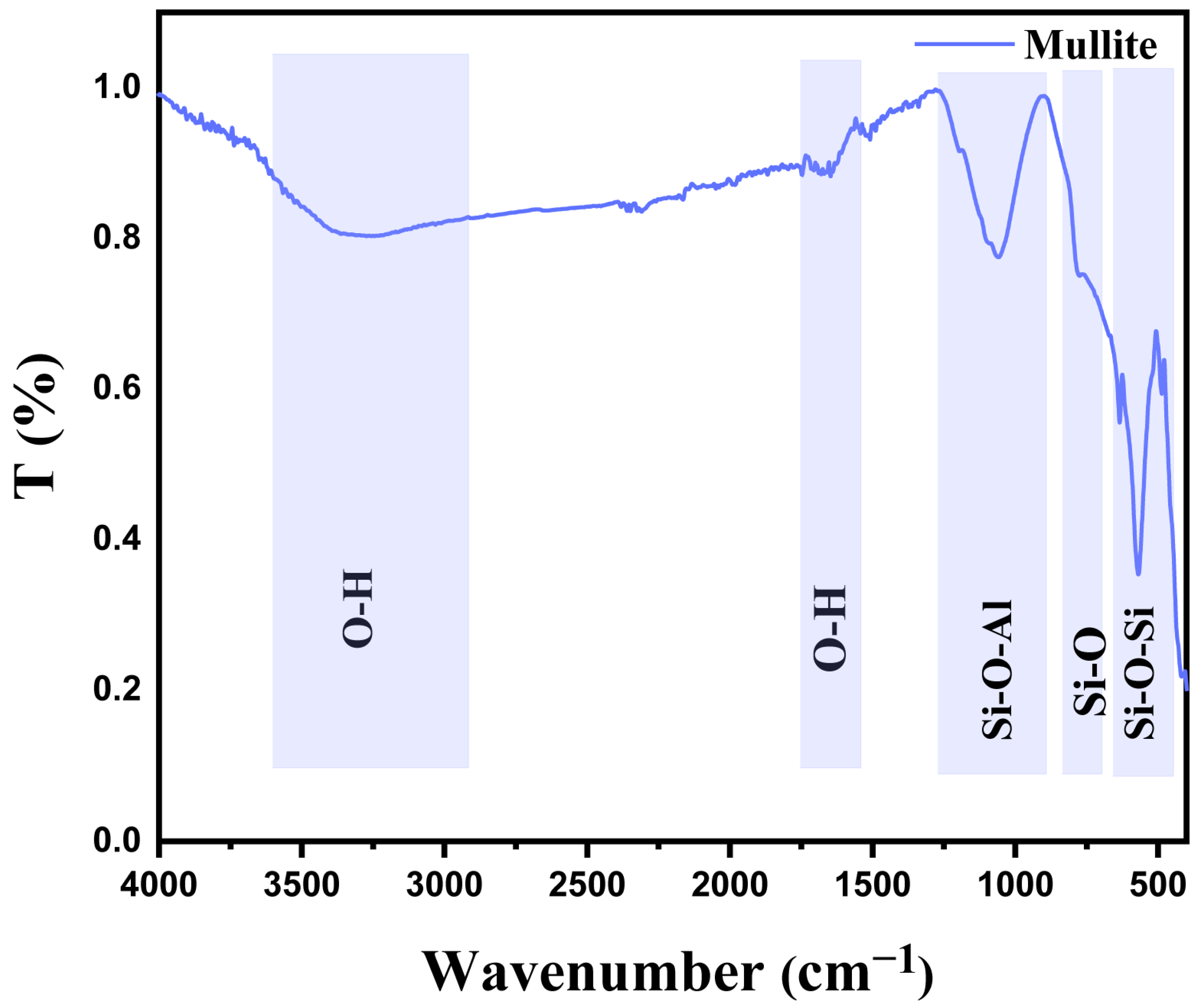
Figure 3, acquired through Fourier transform infrared spectroscopy (FTIR), shows the principle absorption bands feature of mullite-based total ceramics. In the location between 3400 and 3200 cm−1, a broad band is determined, attributed to the stretching vibrations of the hydroxyl corporations (O–H), probably related to slight residual humidity or water adsorption on the floor of the cloth. Another, greater discrete band appears around 1650 cm−1, corresponding to the deformation vibrations of certain water (H–O–H) bonds, indicating the viable presence of bodily adsorbed water [39]. The bands located between 1100 and one thousand cm−1 are attributed to the asymmetric elongation vibrations of the Si–O–Al bonds, characteristic of the crystalline structure of mullite [40,41]. The band placed round 800–750 cm−1 is associated with the vibrations of the Si–O bonds, whilst the ones located between six hundred and 500 cm−1 correspond to the vibrations of the Si–O–Si bonds. All of these bands affirm the presence of a crystallized alumino-silicate segment, typical of the mullite fashioned after the heat remedy [42]. The vibrational signature accordingly received consequently validates the formation of mullite in the analyzed ceramic.

4.3. SEM Microstructural Characterization

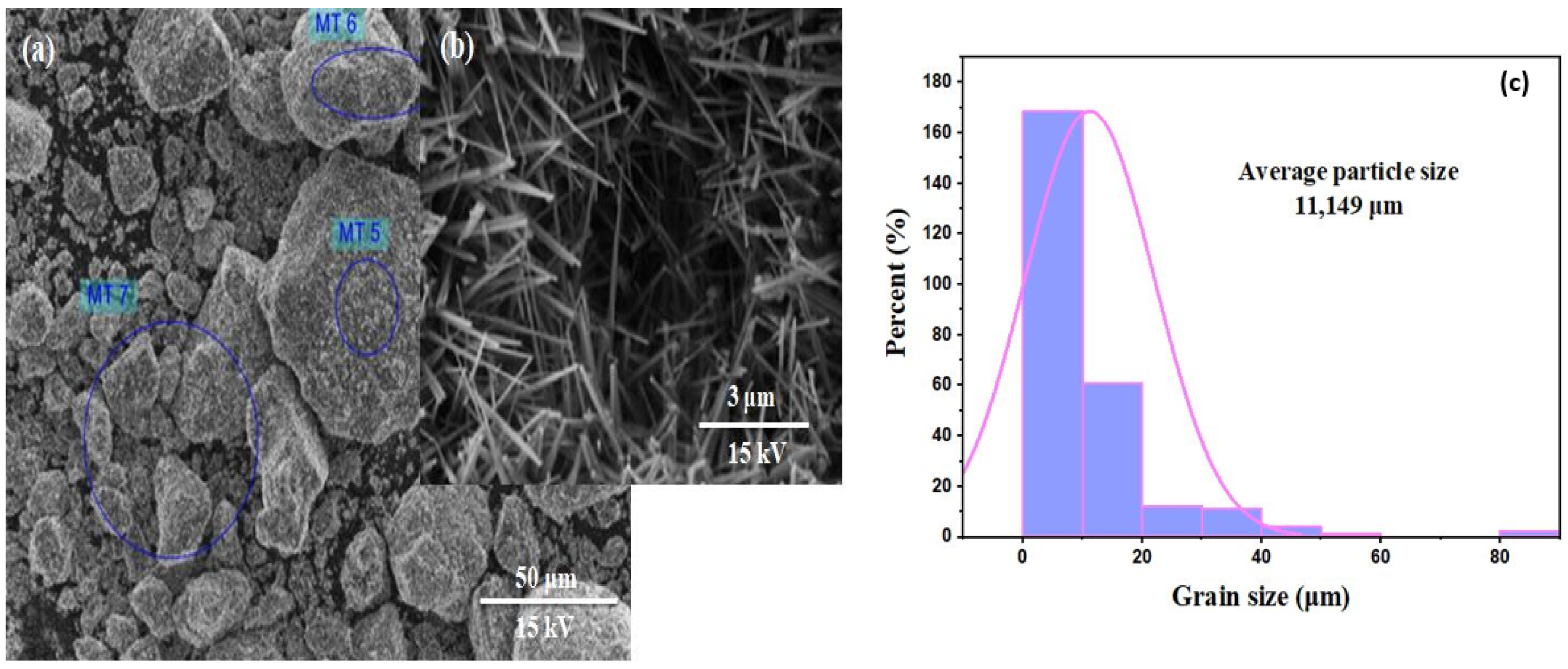
Figure 4 shows a scanning electron micrograph (SEM) of mullite after calcination at 1400 °C. Two complementary perspectives illustrate the morphology of the material at exceptional scales. The normal well-known view shows a surface composed of properly individualized grains of varying sizes, reflecting the fact that good-sized crystal increases following heat treatment. Grain length analysis, accomplished using ImageJ® software program (version 1.48e), suggests a median grain size of 11.149 µm. Some grains (classified MT5, MT6, MT7) were decided on as areas of interest for further evaluation. Their density and sharp edges suggest green crystallization, without marked sintering, which is consistent with a remedy temperature of 1400 °C. Magnification of the primary vicinity exhibits acicular (needle-fashioned) systems, common of mullite. These acicular crystals mirror orientated crystal boom and the right crystallinity of the fabric. This morphology is characteristic of mullite formations because of the reaction between alumina and silica at excessive temperature. Overall, the statement shows that the formation of the mullite segment is properly underway at 1400 °C, with coexistence among coarse grains and acicular crystals. Prolonged warmness treatment should choose the evolution towards a denser and greater homogeneous structure. Micrograph (b), obtained at a higher magnification (scale bar: 3 µm), reveals a fibrous/needle-like morphology characterized by elongated and intertwined structures. This organization suggests anisotropic crystallite growth, typical of certain aluminosilicate phases or of directional crystallization mechanisms during heat treatment. The interlocking needles create an open porous network, likely to influence the mechanical and electrical properties of the material.
Figure 4c presents the grain size distribution of the sample, obtained from SEM image analysis, as a histogram showing the percentage of grains as a function of their size, accompanied by a fitted distribution curve. The average grain size is estimated at 11.149 µm, indicating an overall micrometric microstructure.
The histogram reveals an asymmetric (skewed) distribution, with a high concentration of grains in the small size range, primarily less than 15 µm. This predominance of fine grains suggests moderate granular growth, likely limited by the sintering conditions and diffusion kinetics at the applied temperature.
The presence of a tail towards larger sizes, extending to approximately 80 µm, indicates the presence of abnormally enlarged grains or particle agglomerates, consistent with the morphological observations from the SEM micrographs. This phenomenon can be attributed to local heterogeneity in solid diffusion or to preferential coalescence of certain grains during heat treatment.
The relatively wide grain size distribution reflects a heterogeneous microstructure, characteristic of ceramic materials produced by solid-state reaction. This heterogeneity can directly influence the dielectric and electrical properties of the material, notably by enhancing the contribution of grain boundaries and inducing a dispersion of relaxation times, which is consistent with the results obtained by impedance spectroscopy.

5. Dielectric Properties

5.1. Study of Dielectric Properties

Complex impedance spectroscopy is an analytical approach used to examinethe electrical residences of substances [43]. The dielectric behavior of a solid material can be described by representing the relative dielectric constant as a complex entity, where ε′ and ε″ represent the real and imaginary parts of the dielectric permittivity. They correspond, respectively, to the energy stored in the dielectric material as polarization and to the energy loss experienced when it is subjected to an electric field generated by a very low electric potential.
The expression for complex permittivity is as follows:
ε * = ε j ε
Modulus of the complex permittivity:
ε * = ε 2 + ε 2
The relative permittivity (dielectric steady εr) and dielectric loss (tan δ) values were obtained from the complicated impedance facts Z* (Z* = Z′ (Zcos θ) + jZ″ (Zsin θ) with the aid of making use of the subsequent equations:
Real part of the complex permittivity:
ε = 1 ω C 0 × Z Z 2 + Z 2
Imaginary part of the complex permittivity:
ε = 1 ω C 0   ×   Z Z 2 + Z 2
where Z′, Z″, ω and C0 respectively represent the real and imaginary components of impedance, angular frequency and geometric capacitance.
Dielectric loss tangent:
tan ( δ ) = ε ε  
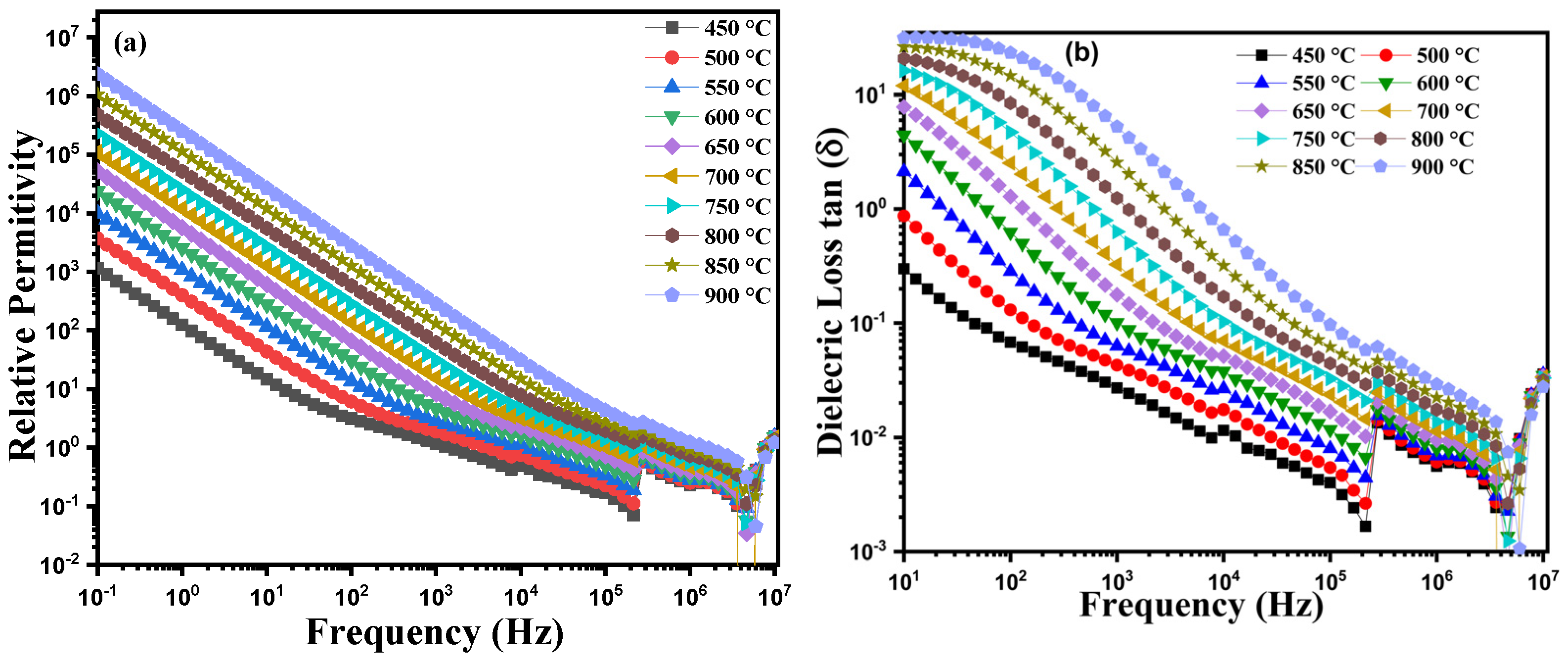
In Figure 5a, we examine the evolution of the dielectric constant (εr) of Mullite ceramic over a frequency range from 10 Hz to 1 MHz for different temperatures. We observe a gradual decrease in this constant as the frequency increases from 10 Hz to 100 Hz, followed by an almost complete stabilization beyond 100 Hz. This steady reduction in the dielectric constant with increasing frequency is a well-established characteristic of dielectric materials.
In Figure 5a, we examine the evolution of the relative dielectric permittivity (εr) of mullite ceramic over a frequency range from 10 Hz to at least 1 MHz for a given temperature. We observe a slow decrease in this constant as the frequency increases from 10 Hz to 100 Hz, followed by almost complete stabilization above 100 Hz. This steady decrease in the dielectric constant with increasing frequency is a well-established characteristic of dielectric substances. The excessive permittivity observed at low frequencies is attributed to many types of polarization present in these materials, including dipole polarization, such as interfacial polarization and jump polarization, where there are two types of conduction: ionic and electronic. At higher frequencies, the relative permittivity decreases to a plateau, suggesting the presence of charged species that cannot keep up with the rapid variations in the applied alternating electric field [39,44]. These results show a dominant mechanism: thermally activated conduction of the mixed ionic/electronic hopping type.
The variant of dielectric losses, expressed with the aid of tan (δ), as a feature of frequency and for extraordinary temperatures is illustrated in Figure 5b. For Al6Si2O13 ceramic, the values of tan (δ) display a behavior much like that of the dielectric regular; they lower with growing frequency to attain a strong value at high frequency. This trend of dielectric losses may be explained by using the dipolar rest phenomenon. The increase in dielectric loss values as a feature of temperature may be attributed to the presence of thermally activated rate vendors [45].
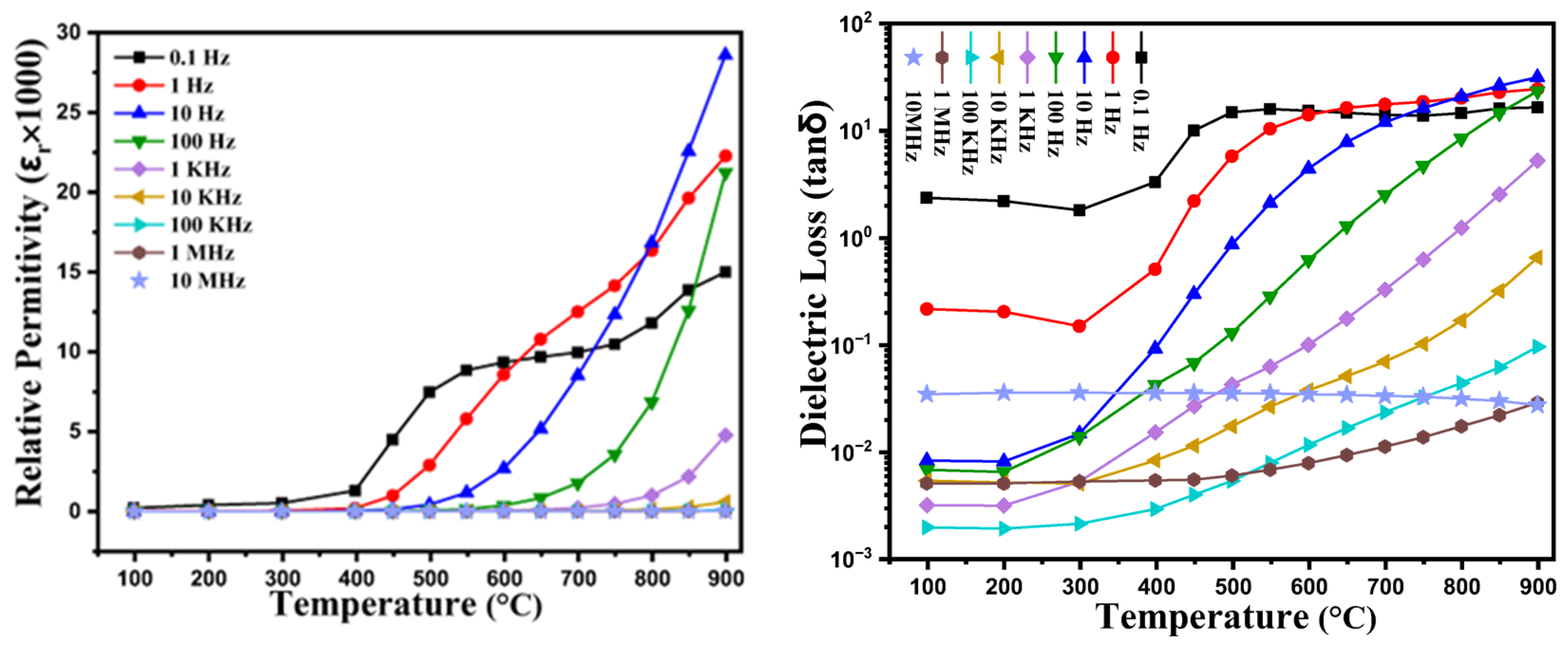
The temperature dependence of the dielectric consistent and dielectric loss for Al6Si2O13 ceramic is proven in Figure 6, at numerous selected frequencies (10 Hz, a hundred Hz, 1 kHz, 10 kHz, 100 kHz, and 1 MHz) over a temperature variety from 100 °C to 900 °C. Dielectric property measurements are carried out up to 450 °C because of instrumental obstacles. The temperature-based evolution of the dielectric steady demonstrates an absence of frequency dispersion under 300 °C. Beyond this temperature, the dielectric consistent will increase drastically with temperature, because of the enhancement of the temperature-sensitive dipole polarization. In parallel, the dipole alignment induced by using increasing temperature additionally enhances electric conduction, therefore leading to a growth in each the dielectric regular and the dielectric loss. However, for this pattern, a decrease inside the dielectric consistent is initially discovered with increasing temperature up to 400 °C. This phenomenon can be explained by using the impact of heat on the orientation of polarization. Up to this temperature, the molecules continue to be frozen, missing the energy to overcome the barrier, mainly to a decrease within the dielectric regular and dielectric loss. Subsequently, with growing temperature, the dipoles collect enough electricity to triumph over the potential barrier and align within the route of the electric subject, which explains a sluggish increase in the dielectric consistent and dielectric loss [46,47].

5.2. Complex Impedance Analysis (CIA)

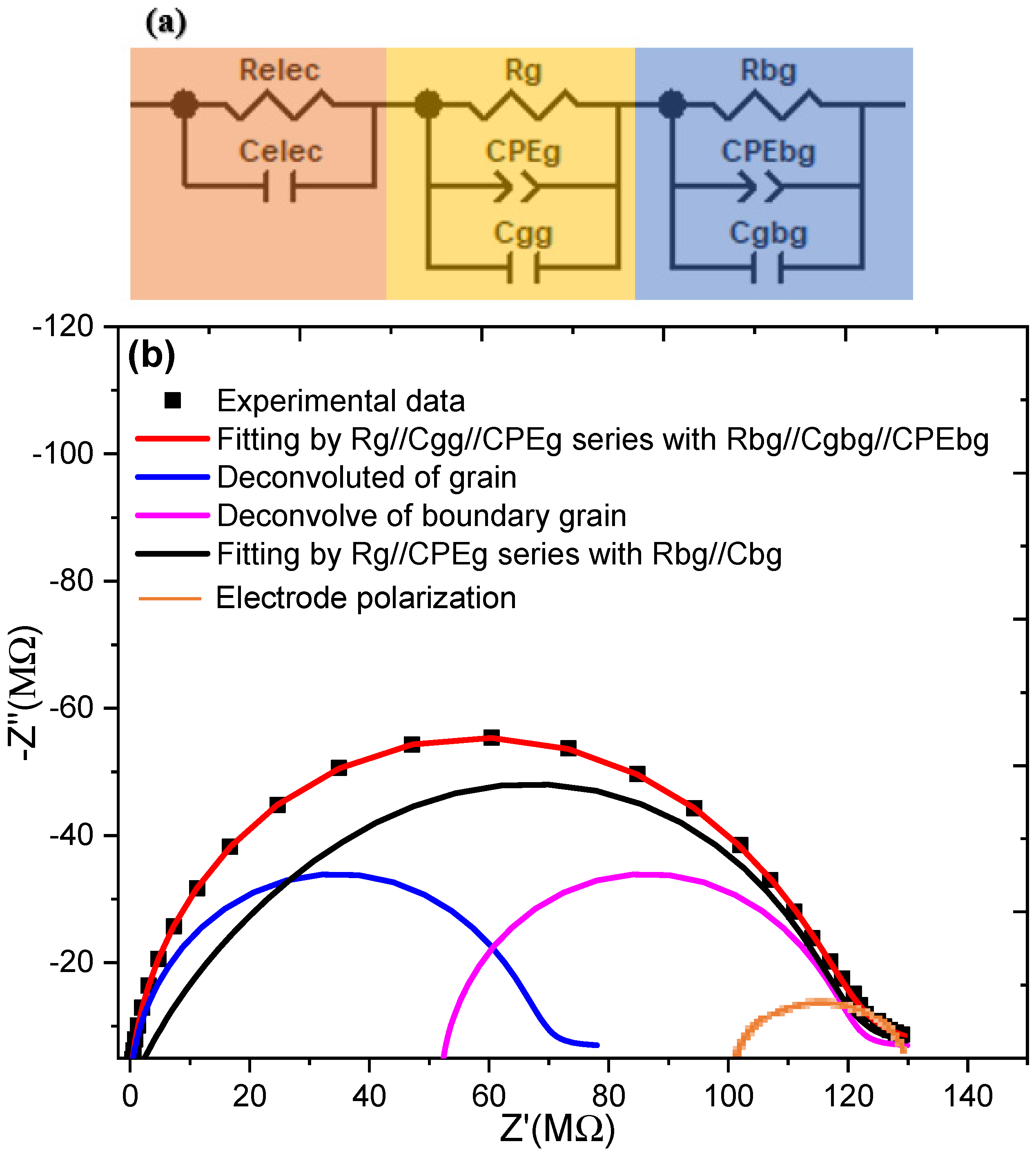
Analysis of the experimental data on complex impedance allowed us to determine the electrical circuit modeling the different processes of the system under study. The equivalent electrical circuit is therefore the one shown in Figure 7a.
Subcircuit block 1 represents the electrical and dielectric behavior of the measuring electrodes, whose contribution is predominant in the low-frequency range.
Block 2 describes the electrical (grain resistance, Rg) and dielectric (geometric capacity of the grain, Cgg) behavior, as well as the non-ideality related to grain surface roughness, accounted for using a constant phase element (CPEg).
Block 3 models the electrical (grain boundary resistance, Rbg) and dielectric (geometric capacity of grain joint, Cgbg) behavior, while also incorporating the non-ideality associated with grain boundary surface roughness (CPEbg).
Deconvolution of the various contributions is not trivial and remains challenging to perform using the equivalent electrical circuit, particularly within the framework of the formalism implemented in the ZView software (version 3.5d).
The mathematical expression for the complex impedance of the sample, neglecting the contribution of the electrode impedance, is written as follows:
Z * ω = Z g + Z b g = 1 R g 1 + T g ( j ω ) p g + j ω C g + 1 R b g 1 + T b g ( j ω ) p b b + j ω C b g
Here, Z′ = Re(Ztot) and Z″ = Im(Ztot) represent the real and imaginary parts of the impedance, respectively, while ( j 2 = 1 ) is the imaginary factor [48,49].
Real part of the total impedance:
R Z t o t = R g 1 + T g ω α g   cos π α g 2 R g 1 + T g ω α g   cos π α g 2 2 + ω C g + T g ω α g sin π α g 2 2 + R b 1 + T b ω α b   cos π α b 2 R b 1 + T b ω α b   cos π α b 2 2 + ω C b + T b ω α b sin π α b 2 2
Imaginary part of the total impedance:
I Z t o t = ω C g + T g ω α g   sin π α g 2 R g 1 + T g ω α g   cos π α g 2 2 + ω C g + T g ω α g sin π α g 2 2 + ω C b g + T b g ω α b b   sin π α b g 2 R b 1 + T b ω α b   cos π α b   2 2 + ω C b g + T b g ω α b g sin π α b g 2 2
The use of Nyquist diagrams by impedance spectroscopy allows us to understand the effects of grains, grain boundaries, and the influence of electrodes on the capacitive, reactive, resistive, and inductive properties of materials. The diagrams obtained by modeling are then superimposed on those obtained by impedance spectroscopy. For a truly effective comparison, a detailed calculation of the complex impedance Z*, found by modeling via the equivalent electrical circuit, is required.
The expression for the impedance is as follows:
Z * = R Z t o t   +   j I Z t o t
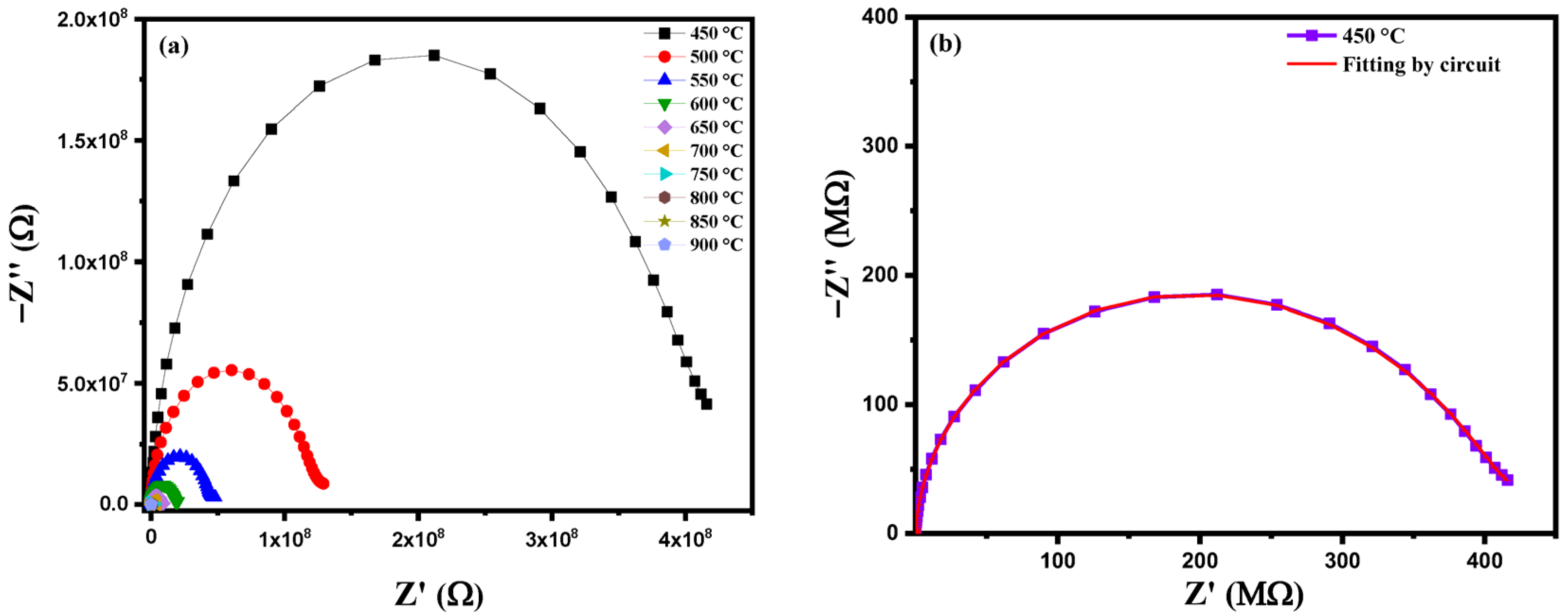
The parameters R(g), R(gb), and R(e) correspond respectively to the resistances of the grains, grain boundaries, and electrodes, while C(gg), C(ggb), and C(e) denote the associated capacitances [48]. Figure 8a illustrates the Nyquist plots of the Al6Si2O13 mullite ceramic recorded at different temperatures. These plots are characterized by flattened semicircles, which can be decomposed, using the deconvolution technique, into two distinct contributions of the equivalent electrical circuit, clearly identified for the entire temperature range studied (450 °C to 900 °C). Increasing the temperature leads to a decrease in the radius of the semicircles, reflecting a decrease in resistance. This behavior indicates that conduction is thermally activated in these materials, thus confirming their semiconducting nature [49,50,51,52,53].
To describe the electrical properties of mullite, an equivalent circuit consisting of two branches in series is used, representing the electrical properties of the grains and the grain boundaries, respectively. Furthermore, the Z-View software allows the parameters of each element in this circuit to be determined, as illustrated in Figure 8b. In the first branch, element Q1, a constant phase element (CPE), simulates the irregularities in charge distribution at the interfaces. The resistance R1 reflects the strong interference with current drift in the grain boundaries, often related to defects or impurities. The capacitance C1 represents the capacity of these interfaces to store charges, which can slow their mobility. The second branch of the circuit represents the grains themselves. Q2, also a CPE, generates a less-than-ideal but larger electrical response due to the stronger internal interaction between the grains. R2 is a resistance that is always lower than R1.
In this version, constant phase element (CPE) factors are incorporated to represent deviations from the ideal behavior of grains and grain boundaries. These deviations are generally attributed to the coexistence of several electrical and interfacial relaxation mechanisms. A mathematical model expresses the active capacitances of grains (Cg) and grain boundaries (Cbg) as a function of the parameters CPEg and Tg, as well as CPEbg and Tb, thus providing a more precise and rigorous interpretation of the observed electrical phenomena and indicating the degree of frequency dispersion and the ionic strength of the material.
Effective capacitance of the grains:
C g = R g x T g 1 / α g
Effective capacitance of the grain boundaries:
C b g = R b g x T b g α b g 1 α b g
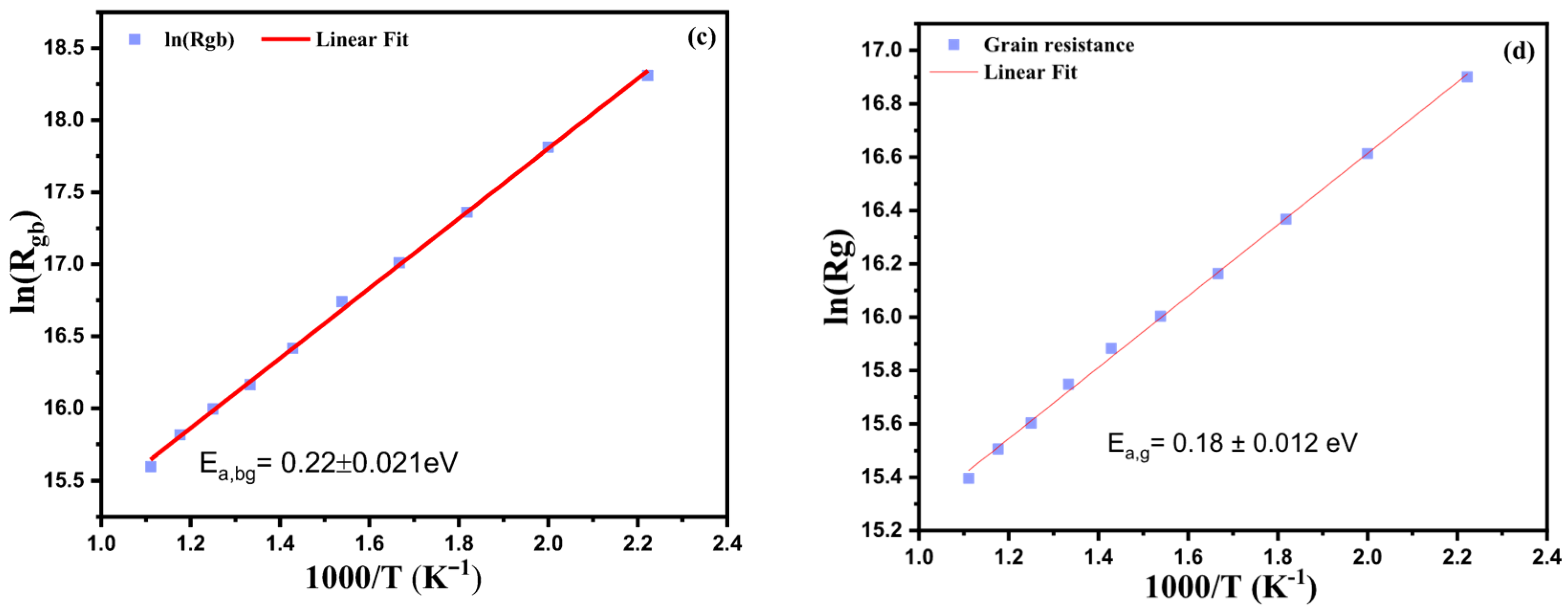
Figure 8c provides an Arrhenius representation of grain impedance, and Figure 8d provides an Arrhenius representation of grain boundary impedance, determined by the corresponding equivalent electrical circuits, generated using ZView software version 2.2. The adjusted values of the R, C, and CPE, related respectively to grains and grain boundaries, agree well with the experimental results, confirming the relevance of the model used. Table 1 suggests that the resistances related to grains (Rg) and grain boundaries (Rgb) decrease steadily with increasing temperature. This evolution is defined by the thermal activation of charge carriers and the discharge of trapped charges, thus confirming the semiconductor behavior of the fabric. At each measured temperature, the grain resistance remains lower than that of the grain barriers. The corresponding activation energies were adjusted using the Arrhenius law.
Resistance of the grains:
R g = R 0 g exp E a g k B T
Resistance of the grain boundaries:
R b g = R 0 b g e x p ( E a b g k B T )
where Rg, Rbg: resistance of the grains and grain boundaries. R0g, R0b: pre-exponential factors (resistances at infinite temperature). Eag, Eagb: activation energies for conduction through the grains and grain boundaries. KB: Boltzmann constant. T: absolute temperature (K).
Where Ea represents the activation energy, KB the Boltzmann constant, R0 the pre-exponential factor, and T the temperature in kelvins. Figure 8c,d show the Arrhenius diagram for the resistance of the grains and grain boundaries, used to determine the activation energies, respectively. Both resistances increase at low temperatures and decrease at high temperatures. The activation energies of the grains and grain boundaries are 0.18 eV and 0.22 eV, respectively.
Table 2 gives the electrical parameters extracted from the equivalent circuit version suited to the complex impedance spectra of the mullite-based ceramic. The table includes the resistance (R), capacitance (C), and constant phase element (CPE) parameters (T and α), and associated grain (g) and grain boundary (bg) contributions. These parameters provide perception into the electrical response of the material, distinguishing the respective roles of grains and grain limitations in rate transport and polarization phenomena.
The values of Rg and Rb represent the resistive components attributed to grains and grain obstacles, respectively. Similarly, Cg and Cbg denote the effective capacitances, whilst Tg, Tbg, αbg and αg correspond to the CPE parameters characterizing the non-best dielectric conduct of every vicinity. The combination of those elements helps to assemble a specific equal circuit model for decoding the impedance information of the ceramic.

5.3. Conductivity Study via Equivalent Circuit Electric

The electrical conductivity of a cloth measures its ability to permit the passage of electric cutting edge, decided by way of the convenience with which electric powered costs pass through the fabric. This conductivity can be obtained from the dielectric information using the following formulation [54]:
σAC = wε0εrtan(δ)
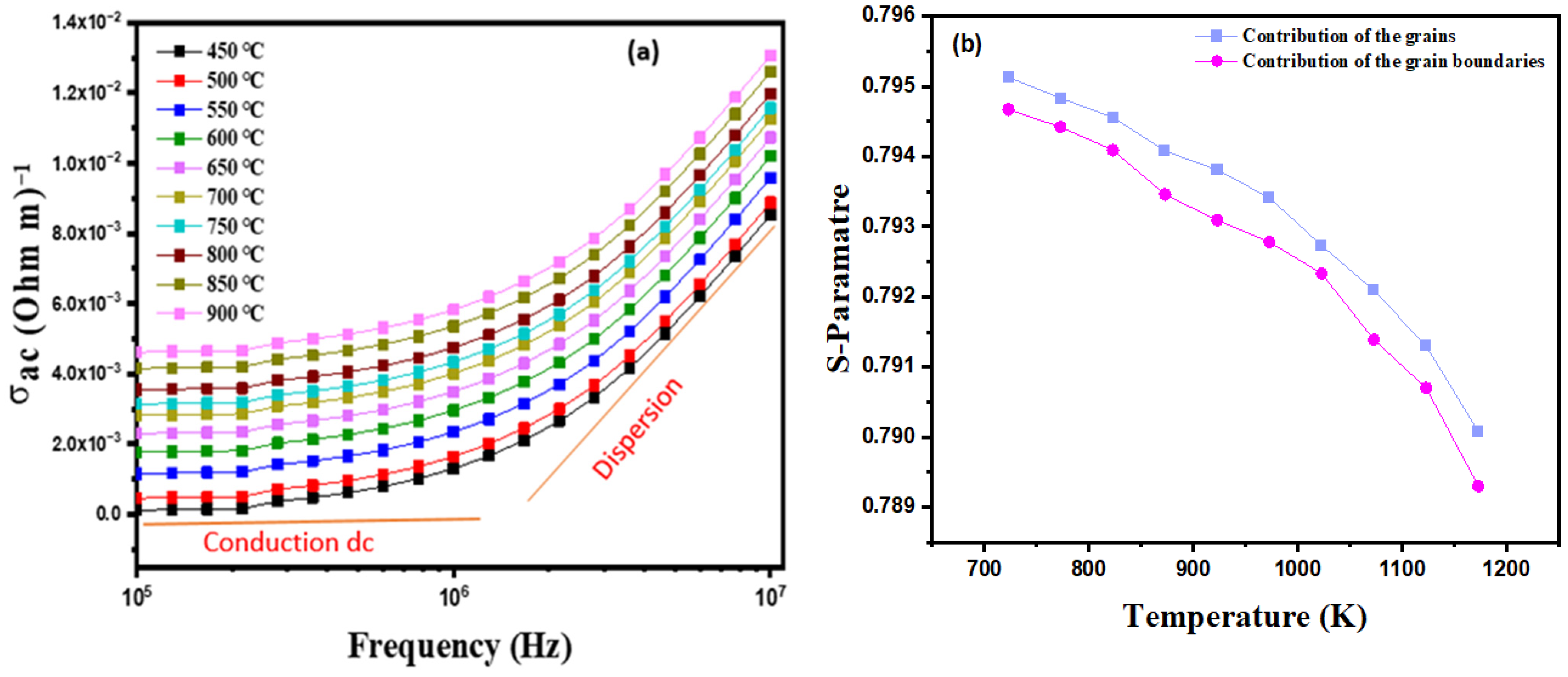
where ε0 represents the vacuum permittivity, εr is the relative permittivity, and tan (δ) denotes the dielectric losses. The AC conductivity conduct of the Al6Si2O13 pattern is analyzed through plotting σAC as opposed to ω (angular frequency). The low-temperature (450–900 °C) conductivity curves are substantially in three areas, as shown in Figure 9. The low-frequency plateau place corresponds to DC conduction at the same time, because the nonlinear intermediate region indicates quick-range hopping of charge groups, and the excessive frequency behavior is as follows:
σ(ω) = σDC + AωS1 + BωS2
σAC = σDC + AωS
This phenomenon is attributed to step conduction for grains and grain boundaries [55]. The curves clearly show an evolution that begins with direct current conduction at low frequencies, followed by an increasing slope of varying gradients that follows the Jonscher double-power law, where s1 and s2 are the exponents describing the slope for each conduction in the low-frequency (10 kHz–1 MHz) and medium-frequency (>1 MHz) regions, and high-frequency (>1 MHz) regions, respectively, with A and B being the pre-exponential factors of the conductivity. However, as the temperature increases, (s1, s2) tends towards 0, thus confirming the predominance of direct current conductivity at low frequencies. The relaxation times are very close for both relaxations, resulting in a single slope in the expression for the conductivity; in other words, the expression goes from the double Jonscher law to a simple Jonscher power law, in accordance with Equation 16. The conductivity curves of the Al6Si2O13 sample appear to follow the Jonscher power law [52,56,57].
In this expression, σDc represents the material’s forward conductivity, while “A” is the pre-exponential factor that defines the polarization intensity. Figure 9b illustrates that the frequency-independent parameter “S” is influenced by both temperature and the intrinsic properties of the material [52]. The initial decrease in conductivity with increasing temperature suggests the presence of a significant temperature coefficient of resistance (TCR) in mullite ceramics, attributed to the contribution of intergranular barriers that impede conduction. However, above 450 °C, the increase in conductivity with temperature has a temperature effect on grain and grain boundary resistance.

5.4. Study Through the Bode Diagram of Impedance and Modulus Complex

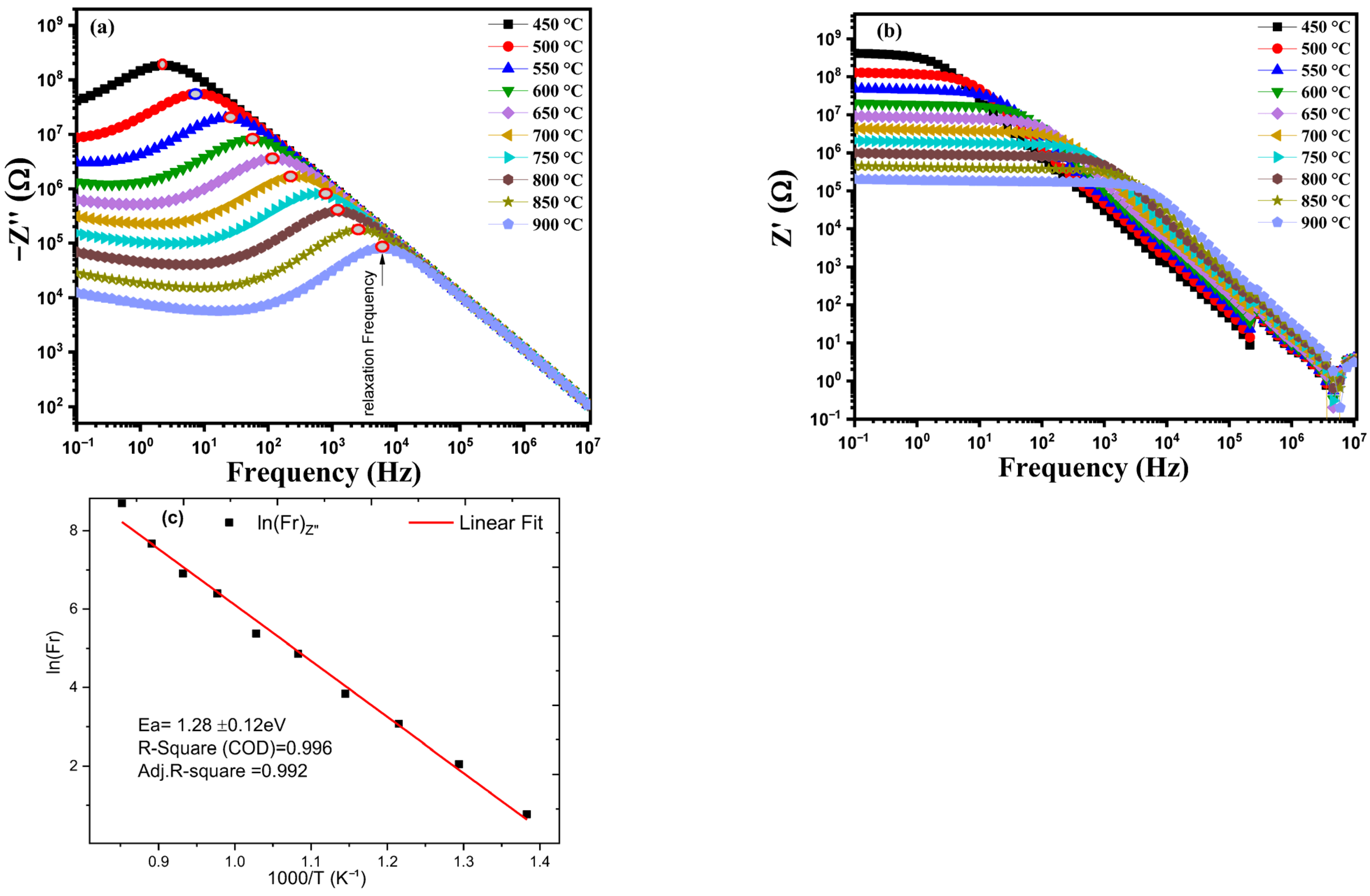
Figure 10b illustrates the variation in the real part of the impedance Z′ as a function of frequency for all temperatures studied for the Al6Si2O13 ceramic. It can be observed that the values of Z′ decrease with increasing frequency, tending towards Z′ = 0.1 ohm at high frequencies. At low frequencies, the real part of the impedance Z′ exhibits high values due to the presence of various polarizations, including electronic, ionic, orientational, and interfacial. However, at high frequencies, the contributions of the dipole orientation and interfacial polarization decrease, leading to a constant value for the real part of the impedance Z′ [57]. The decrease in Z′ with increasing frequency and temperature suggests an increase in AC conductivity [58,59,60,61].
Figure 10c shows the evolution of the relaxation frequency as a function of 1000/T in order to determine the overall activation energy of the sample, which was approximately 1.23 eV.

6. Module Spectroscopy Study

Complex dielectric modulus evaluation offers a convenient approach to explore electrical delivery mechanisms inside ceramics, in addition to differentiating microscopic processes contributing to dielectric rest [62]. It is defined by the inverse of the complex dielectric constant, the complex dielectric modulus, denoted M*
M* = 1/ε * = j C0Z* = M′ + j M″
M′ and M″ respectively denote the real and imaginary part of the dielectric module; the geometric capacity, noted C, can be expressed as follows:
C 0 = A ε 0 d
where ε0 represents the permittivity of vacuum, A is the surface location, and d is the thickness of the fabric. This expression quantifies the intrinsic capacity of the fabric to save electrical strength as a characteristic of its geometry and dielectric homes [63].
Real and imaginary parts of the electric modulus:
M = ε ε 2 + ε 2 ; M = ε ε 2 + ε 2
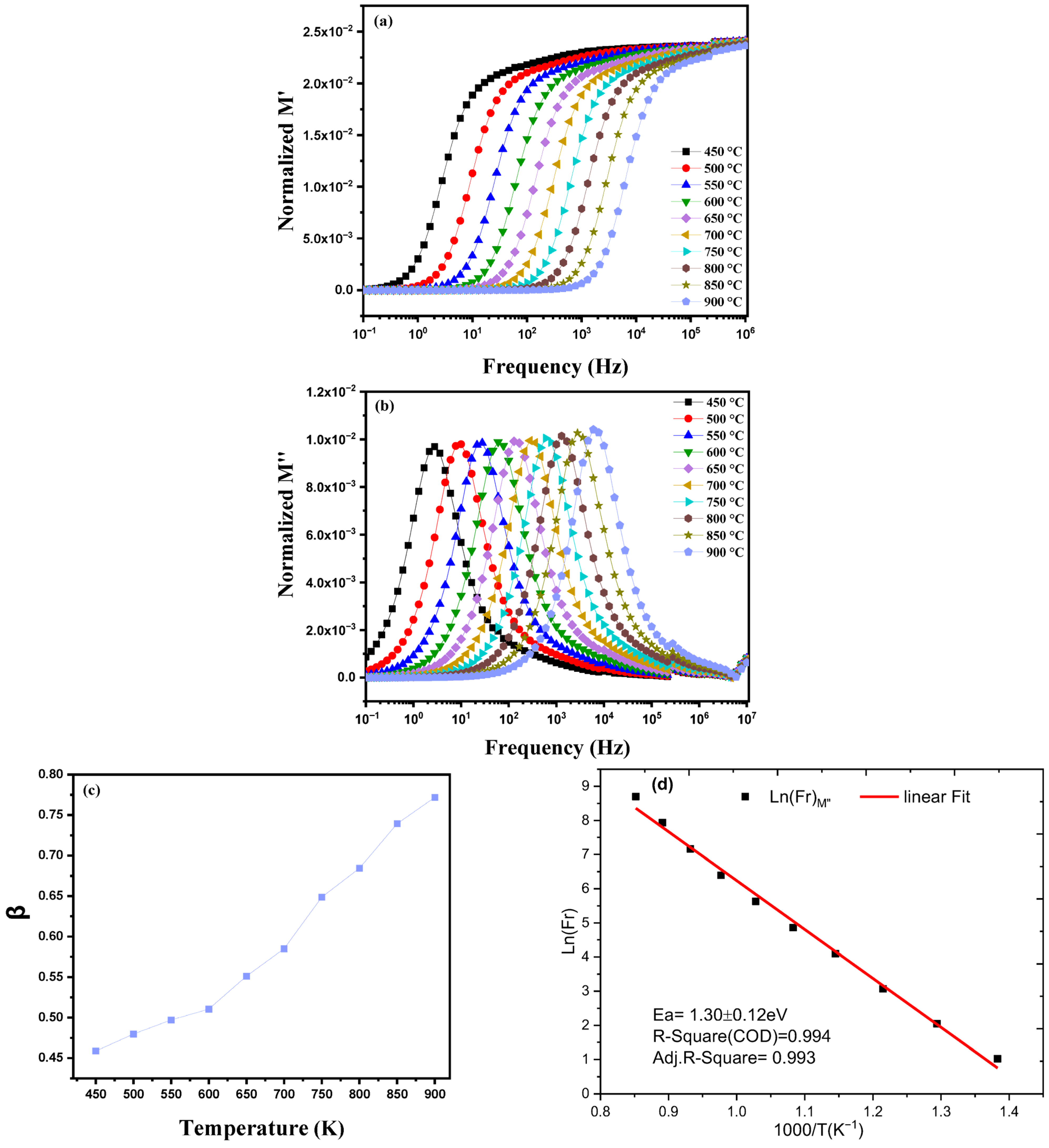
where ε′ and ε″ represent the real and imaginary parts of the dielectric permittivity, respectively. Figure 11a illustrates the evolution of the real part of the electric modulus M′ as a function of frequency at different temperatures. It can be observed that, at low frequencies, M′ tends towards 0. However, as the frequency increases, M′ gradually increases and reaches saturation after a certain frequency threshold. This saturation of M′ results from the conduction process induced by the movement of available charge carriers [64,65]. Furthermore, increasing the temperature increases the mobility of the charge carriers, which leads to a general increase in the saturation of M′ with temperature.
The study of the electrical modulus plays a fundamental role in characterizing the electrical properties of materials. This evaluation provides information on the electrical transport, dielectric strength, and electrical homogeneity of the materials under study. By analyzing the material’s response to an alternating electric field over a frequency range from 1 Hz to 1 MHz and at different temperatures, as illustrated in Figure 11b, relevant observations emerge. The modulus ratio increases with frequency, and reaches a maximum at the relaxation frequency, which indicates the frequency of change in behavior, and then decreases at higher frequencies. Furthermore, all the functions M″ of the normalized modulus shift towards higher frequencies and higher temperatures. For an electrically homogeneous pellet, only a symmetrical variation in the modulus M″ with respect to frequency is observed [66,67]. However, when only one variation is determined, the effects of grains and grain barriers are almost identical. Moreover, the peaks shift towards higher temperatures, indicating the thermal activation of the relaxation process. The irregular shape of the peaks indicates non-Debye relaxation.
Figure 11c highlights the dielectric behavior of mullite-based ceramics through the evolution of the relaxation parameter β, an indicator of the degree of frequency dispersion. The results reveal a progressive increase in β with increasing temperature, rising from 0.45 to 0.80. This trend is accompanied by a reduction in the dispersion of relaxation times, reflecting a more uniform relaxation process at higher temperatures. This evolution confirms the non-Debye nature of the relaxation mechanism, associated with a temperature-dependent distribution of relaxation times.
Figure 11d shows the evolution of the relaxation frequency extracted from the imaginary part of M* as a function of 1000/T in order to determine the activation energy of the sample.
The electrical modulus approach is employed to investigate the electrical relaxation mechanism in ion-conducting materials. A benefit of this technology is its ability to mitigate the impact of electrode polarization effects.
The figure illustrates the frequency dependence of the real part of the electrical modulus (M′) at different temperatures for mullite samples at various temperatures. It can be observed that, at low frequencies, M′ tends towards zero at all temperatures, indicating that electrode polarization has a negligible impact. Conversely, at high frequencies, M′ exhibits a maximum value.
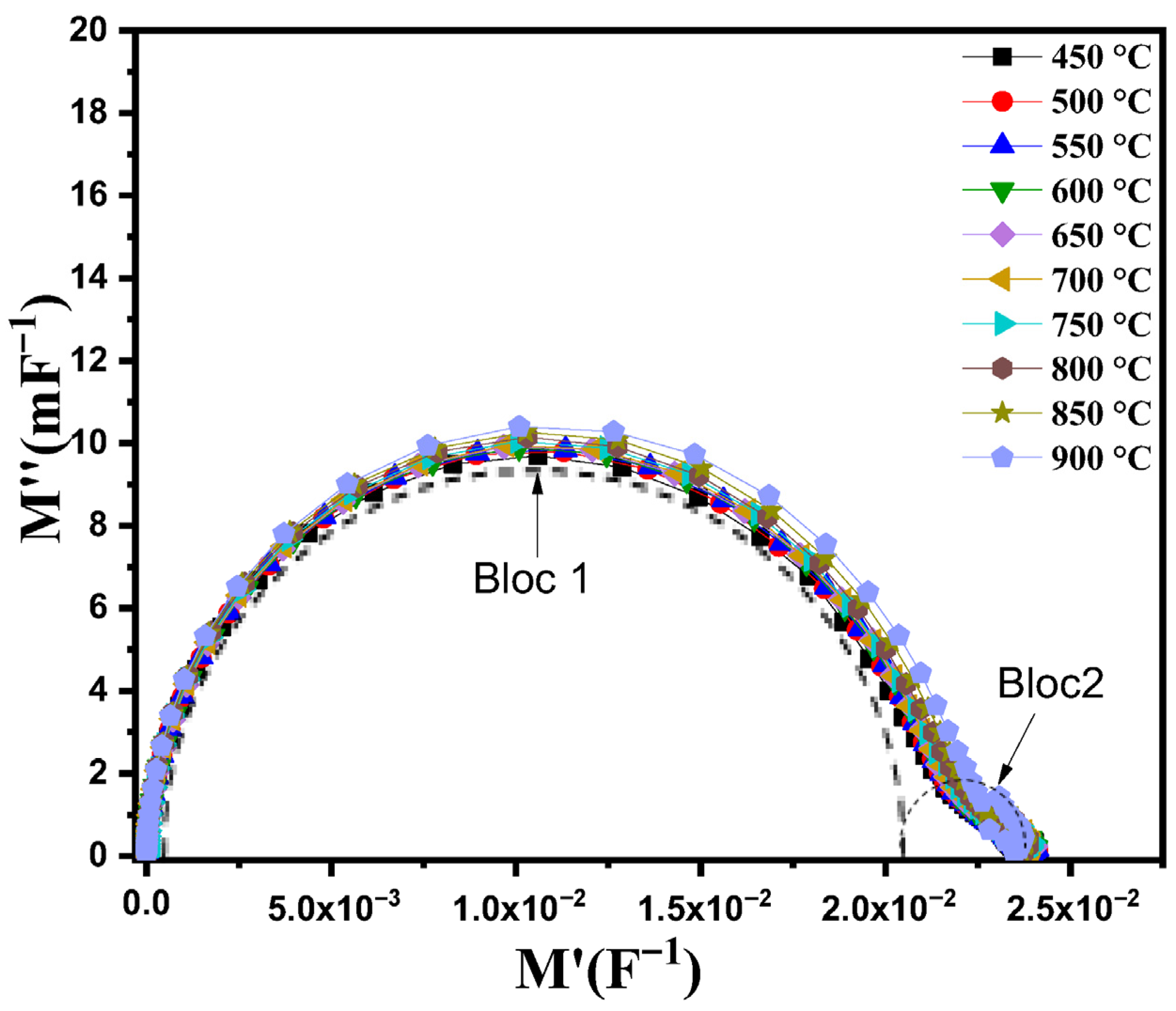
This study additionally investigated the modulus formalism. Figure 12 indicates the variations in M″ with respect to M′. The effects highlighted the emergence of semicircles, associated with each extent of obstacles and grains. These observations are in agreement with similar patterns stated in the specialized literature.
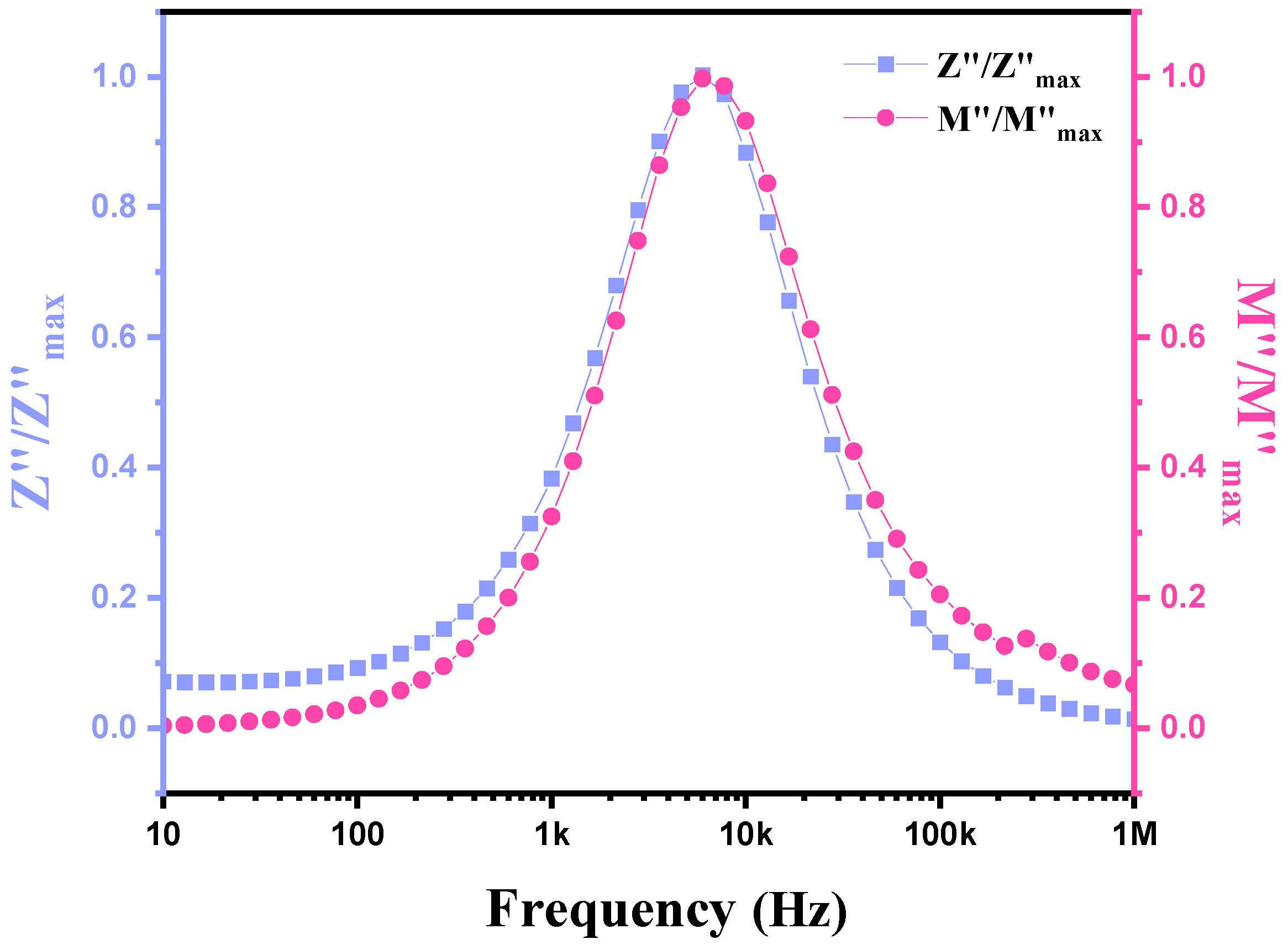
Figure 13 illustrates the comparison between the curves of the imaginary part of the impedance (Z″/Z″max) and the normalized electrical modulus (M″/M″max) as a feature of frequency (1 Hz–1 MHz) at 900 °C. The twist of fate or overlap of the peaks of M″ and Z″ shows a prolonged or delocalized rest. In our evaluation, we study marked differences inside the peak positions, accordingly confirming a quick-range relaxation within the tested compounds, specifically in the compound the peak positions of (Z″/Z″max) as a feature of frequency and (M″/M″max) as a function of frequency, is very near. In this context, we recommend that the coexistence of localized and prolonged relaxations ought to be considered [63,68,69].
Comparing electrical modulus and impedance data allows us to determine the bulk-state response of ceramics in terms of localized defect relaxation and/or non-localized ionic or electronic conduction [70]. The Debye model is linked to an ideal frequency response of localized relaxation. In reality, the process is dominated by non-localized relaxation at low frequencies. In the absence of interfacial effects, non-localized conductivity is known as direct current (DC) conductivity. However, for current systems, the overlap of the Z″/Z″max and M″/M″max peaks suggests the presence of components of both: long-range transport and localized relaxation. Indeed, in order to mobilize the localized charge carrier, the assistance of lattice oscillations is necessary. In these circumstances, the charge carriers are considered as if they do not move by themselves, but by the jumping mechanism activated by the lattice oscillations. Furthermore, the magnitude of the activation energies indicates that the transport of charge carriers is due to jump conduction [71,72,73].

7. Conclusions

Mullite has been validated to be a high-overall-performance ceramic material with super dielectric properties that supply it with outstanding capability in numerous electrical and electronic packages. Its excessive thermal balance, low dielectric loss, and excessive resistance to electric strain make it favored for harsh environments, being resistant to intense temperatures and high electrical stresses. It reveals strategic packages inside the electronics enterprise, particularly in the manufacture of incorporated circuit substrates, excessive-overall performance capacitors, and dependable and sturdy insulators. In the telecommunications discipline, mullite contributes to improving the performance of antennas, waveguides, and high-frequency communique gadgets with the aid of successfully reducing energy losses. Its use in the manufacture of refractory ceramics and corrosion-resistant coatings additionally enhances its value in excessive-temperature commercial packages. Compared to different advanced ceramics, together with certain perovskites (e.g., barium titanate BaTiO3 and strontium titanate SrTiO3), that have very excessive dielectric constants and are utilized in multilayer capacitors, piezoelectric devices, and photovoltaic cells, mullite offers an appealing compromise between performance, thermal stability, and value. Although perovskites outperform mullite for packages requiring extremely sensitive electrical homes, they remain more expensive and every now and then are constrained in phases of chemical and thermal balance. Thanks to its versatility, chemical robustness, and affordability, mullite is rising as a key material to support innovation in sustainable technology, mainly in the development of high-overall-performance batteries and power garage structures. Continued studies in this area will open new avenues to completely take advantage of mullite’s capacity and aid destiny technological advances.
The non-overlap of the Z″ (imaginary impedance) and M″ (imaginary electrical modulus) curves in the same figure reveals that the relaxation mechanisms involved are different. Indeed, Z″ is primarily sensitive to the most resistive regions of the material, such as interfaces, grain boundaries, or electrodes, while M″ highlights the contributions of the least capacitive regions, often associated with bulk. The difference between the Z″ and M″ peaks suggests the presence of several relaxation processes with distinct time constants, reflecting a distribution of relaxation times rather than an ideal Debye-type behavior. This non-superposition confirms the non-Debye character of the material, linked to its microstructural heterogeneity, to defects or complex interactions between charge carriers, and may also indicate the influence of interfacial polarization (Maxwell-Wagner type), particularly visible in the impedance but attenuated in the modulus.

Author Contributions

Conceptualization: N.R., M.A.-S. and M.L.; Methodology: N.R., A.E. and M.L.; Software: N.R., A.E. and O.R.; Validation: M.A.-S., A.E. and P.P.; Formal Analysis: M.M., B.G. and S.E.B., Investigation: N.R., M.A.-S., A.E. and M.L.; Resources: B.G.; Data Curation: N.R., M.A.-S. and A.E.; Writing—Original Draft Preparation: N.R. and A.E.; Writing—Review and Editing: N.R. and A.E.; Visualization: M.A.-S., M.L., A.E., P.P., S.E.B. and O.R.; Supervision: M.A.-S. and M.L.; Project Administration: Multidisciplinary Faculty of Nador (FPN), Mohammed Premier University; Funding Acquisition: P.P. All authors have read and agreed to the published version of the manuscript.

Funding

This research was conducted independently and did not receive any external funding or financial support from institutions, organizations, or funding agencies.

Data Availability Statement

All the data generated or analyzed during the course of this study are fully included in this article, ensuring transparency and allowing readers to verify the results presented.

Acknowledgments

We would like to express our deepest gratitude to the University of Ljubljana, Faculty of Chemistry and Technology, for their invaluable assistance and continuous support during the sample testing conducted as part of this study. We also wish to extend our sincere thanks to the South-West University, Faculty of Mathematics and Natural Sciences, in Blagoevgrad, for their highly valuable scientific support and for generously covering the publication costs of our scientific article. This financial support reflects the institution’s commitment to research, the promotion of academic work, and the dissemination of scientific knowledge. We also thank Cadi Ayyad University, Faculty of Sciences and Technology of Marrakech, for their contribution and guidance in carrying out the sample tests necessary for this work. Finally, we express our warmest appreciation to the Chemistry Department of the Multidisciplinary Faculty (FPN), whose collaboration, technical advice, and practical assistance were essential during the recording and analysis of the spectra.

Conflicts of Interest

The authors declare no conflicts of interest.

References

  1. Schneider, H.; Komarneni, S. Mullite; John Wiley & Sons: Hoboken, NJ, USA, 2006. [Google Scholar]
  2. Schneider, H.; Saruhan, B.; Voll, D.; Merwin, L.; Sebald, A. Mullite precursor phases. J. Eur. Ceram. Soc. 1993, 11, 87–94. [Google Scholar] [CrossRef]
  3. Bella, M.L. Élaboration et Caractérisation de Céramiques Structurales à base de Matériaux Locaux Destinés aux Mitigeurs de Robinets. Ph.D. Thesis, Dépôt Institutionnel de L’Université Ferhat ABBAS, Sétif, Algeria, 2022. [Google Scholar]
  4. Venkatesh, A.M. Analyse du Frittage de Poudres Céramiques par Nano-Tomographie aux Rayons X In-Situ. Ph.D. Thesis, Université Grenoble Alpes, Grenoble, France, 2023. [Google Scholar]
  5. Chahhou, B. Synthèse et Propriétés Thermochimiques de Composites SiC/MAX. Ph.D. Thesis, Université de Bordeaux, Bordeaux, France, 2023. [Google Scholar]
  6. Anggono, J. Mullite ceramics: Its properties structure and synthesis. J. Tek. Mesin 2005, 7, 1–10. [Google Scholar]
  7. Aksay, I.A.; Dabbs, D.M.; Sarikaya, M. Mullite for structural, electronic, and optical applications. J. Am. Ceram. Soc. 1991, 74, 2343–2358. [Google Scholar] [CrossRef]
  8. Yang, T.; Qiu, P.L.; Zhang, M.; Chou, K.C.; Hou, X.M.; Yan, B.J. Molten salt synthesis of mullite nanowhiskers using different silica sources. Int. J. Miner. Process. 2015, 22, 884–891. [Google Scholar] [CrossRef]
  9. Shahid, M.K.; Kashif, A.; Fuwad, A.; Choi, Y. Current advances in treatment technologies for removal of emerging contaminants from water—A critical review. Coord. Chem. Rev. 2021, 442, 213993. [Google Scholar] [CrossRef]
  10. Wang, S.; Li, L.; Yu, S.; Dong, B.; Gao, N.; Wang, X. A review of advances in EDCs and PhACs removal by nanofiltration: Mechanisms, impact factors, and the influence of organic matter. Chem. Eng. J. 2021, 406, 126722. [Google Scholar] [CrossRef]
  11. Samarghandi, M.R.; Ansari, A.; Dargahi, A.; Shabanloo, A.; Nematollahi, D.; Khazaei, M.; Nasab, H.Z.; Vaziri, Y. Enhanced electrocatalytic degradation of bisphenol A by graphite/β-PbO2 anode in a three-dimensional electrochemical reactor. J. Environ. Chem. Eng. 2021, 9, 106072. [Google Scholar] [CrossRef]
  12. Arcondéguy, A. Docteur de L’Université de Limoges. Ph.D. Thesis, École Nationale Supérieure de Chimie de Lille, Lille, France, 2008. [Google Scholar]
  13. Peigney, A. Céramiques Silicatées à Résistance Mécanique et Ténacité Elevées. Ph.D. Thesis, Université de Toulouse, Toulouse, France, 2013. [Google Scholar]
  14. Chen, X.; Zheng, W.; Zhang, J.; Liu, C.; Han, J.; Zhang, L.; Liu, C. Enhanced thermal properties of silica-based ceramic cores prepared by coating alumina/mullite on the surface of fused silica powders. Ceram. Int. 2020, 46, 11819–11827. [Google Scholar] [CrossRef]
  15. Liu, H.; Xiong, X.; Li, M.; Wang, Z.; Wang, X.; Ma, Y.; Yuan, L. Fabrication and properties of mullite thermal insulation materials with in-situ synthesized mullite hollow whiskers. Ceram. Int. 2020, 46, 14474–14480. [Google Scholar] [CrossRef]
  16. Rashad, M.; Sabu, U.; Logesh, G.; Balasubramanian, M. Development of porous mullite and mullite-Al2O3 composite for microfiltration membrane applications. Sep. Purif. Technol. 2019, 219, 74–81. [Google Scholar] [CrossRef]
  17. Cutard, T. Comportement d’une Matrice Alumine-Silice au Cours de L’élaboration de Composites à Matrice Céramique Oxyde/Oxyde. Ph.D. Thesis, INSA Lyon, Villeurbanne, France, 2020. [Google Scholar]
  18. Lima, L.K.S.; Silva, K.R.; Menezes, R.R.; Santana, L.N.L.; Lira, H.L. Microstructural characteristics, properties, synthesis, and applications of mullite: A review. Cerâmica 2022, 68, 126–142. [Google Scholar] [CrossRef]
  19. Tong, L.X.; Li, J.H.; Liu, F. Preparation of mullite nanocomposites powders by the hydrothermal crystallization method from coal gangue. Key Eng. Mater. 2012, 512–515, 49–53. [Google Scholar] [CrossRef]
  20. Tong, L.; Li, J.; Shen, J.; Jiang, X. Preparation of mullite nanocomposites powders from coal fly ash via hydrothermal crystallization. Adv. Mater. Res. 2011, 250–253, 3313–3319. [Google Scholar] [CrossRef]
  21. Dong, Y.; Hampshire, S.; Zhou, J.-E.; Lin, B.; Ji, Z.; Zhang, X.; Meng, G. Recycling of fly ash for preparing porous mullite membrane supports with titania addition. J. Hazard. Mater. 2010, 180, 173–180. [Google Scholar] [CrossRef]
  22. Liu, S.; Ma, C.; Ma, M.G.; Xu, F. Magnetic Nanocomposite Adsorbents; Elsevier Inc.: Amsterdam, The Netherlands, 2018. [Google Scholar]
  23. Potdar, H.; Vijayanand, S.; Mohaideen, K.K.; Patil, K.; Joy, P.; Madhavan, R.R.; Kutty, K.; Ambashta, R.; Wattal, P. A simple chemical co-precipitation/calcination route for the synthesis of simulated synroc-B and synroc-C powders. Mater. Chem. Phys. 2010, 123, 695–699. [Google Scholar] [CrossRef]
  24. Naja, A. Development of high oxidation resistant coating of nanostructured MgO on carbon nanotubes via simple precipitation technique in Mg/CO gas system. Ceram. Int. 2016, 42, 18573–18578. [Google Scholar]
  25. El Chawich, G. Élaboration et Caractérisation de Céramiques 3D en Couplant la Chimie des Précurseurs Avec L’impression 3D. Ph.D. Thesis, University of Montpellier, Montpellier, France, Lebanese University, Beirut, Lebanon, 2021. [Google Scholar]
  26. Pizongo, O.O. Valorisation des Aluminosilicates Dans la Fabrication de Vitrocéramique du Système Mas. Ph.D. Thesis, Institut National de la Recherche Scientifique (Canada), Québec City, QC, Canada, 2022. [Google Scholar]
  27. Fischer, R.X.; Schneider, H. Mullite: Crystal structure and related properties. Weinheim 2005, 98, 2948–2967. [Google Scholar]
  28. Fischer, R.X.; Gaede-Kohler, A.; Birkenstock, J.; Schneider, H. A study on the synthesis and characterization of mullite-based materials. Int. J. Mater. Res. 2012, 103, 402–407. [Google Scholar] [CrossRef]
  29. Ruiz de Sola, E.; Torres, F.J.; Alarcón, J. Thermal evolution and structural study of 2:1 mullite from monophasic gels. J. Eur. Ceram. Soc. 2006, 26, 2279–2284. [Google Scholar] [CrossRef]
  30. Naghizadeh, R.; Golestani-fard, F.; Razaie, H.R. Characterization of mullite powders synthesized via sol–gel method. Mater. Charact. 2011, 62, 540–544. [Google Scholar] [CrossRef]
  31. Schneider, H.; Okada, K.; Pask, J.A. Mullite and Related Materials; John Wiley & Sons Ltd.: Chichester, UK, 1994. [Google Scholar]
  32. Gridi, F. Matériaux de Mullite à Microstructure Organisée Composés D’assemblages Muscovite–Kaolinite. Ph.D. Thesis, Université de Limoges, Limoges, France, 2007. [Google Scholar]
  33. Cui, K.; Zhang, Y.; Fu, T.; Wang, J.; Zhang, X. Coatings on ceramic materials: An overview. Coatings 2020, 10, 672. [Google Scholar] [CrossRef]
  34. Ohnishi, H.; Maeda, K.; Nakamura, T.; Kawanami, T. Studies on mullite formation from kaolinite. J. Am. Ceram. Soc. 1990, 6, 605–612. [Google Scholar]
  35. Lee, W.E.; Rainforth, W.M. Ceramic Materials and Their Applications; Chapman and Hall: London, UK, 1994; pp. 290–316. [Google Scholar]
  36. Wu, R.; Wang, C.; Xu, G.; Fan, M.; Huang, Z.; Zeng, T.; Wang, X. Préparation et caractéristiques de céramiques de mullite poreuses par impression 3D et synthèse in situ. Materials 2025, 18, 956. [Google Scholar] [CrossRef]
  37. Chen, Y.; Tian, X.; Su, K.; Wang, Y.; Liu, X.; Zhao, F. Préparation et propriétés de céramiques poreuses à base de mullite fabriquées par réaction à l’état solide. Ceram. Int. 2023, 49, 31846–31854. [Google Scholar] [CrossRef]
  38. Wu, Z.; Xu, T.; Xu, X.; Dong, X.; Wang, Z.; Wu, J.; Yan, L.; Liu, J.; Guo, A. Fabrication of mullite micro/nano fiber-based porous ceramic with excellent mechanical and thermal insulation properties. Ceram. Int. 2024, 50, 2415–2423. [Google Scholar] [CrossRef]
  39. Shen, Z.J.; Chen, W.P.; Qi, J.Q.; Wang, Y.; Chan, H.L.W.; Chen, Y.; Jiang, X.P. Dielectric properties of barium titanate ceramics modified by SiO2 and by BaO–SiO2. Phys. B Condens. Matter 2009, 404, 2374–2376. [Google Scholar] [CrossRef]
  40. Padmaja, P.; Anilkumar, G.M.; Mukundan, P.; Aruldhas, G.; Warrier, K.G.K. Characterisation of stoichiometric sol–gel mullite by Fourier transform infrared spectroscopy. Int. J. Inorg. Mater. 2001, 3, 693–698. [Google Scholar] [CrossRef]
  41. Kool, A.; Thakur, P.; Bagchi, B.; Hoque, N.A.; Das, S. Mechanical, dielectric and photoluminescence properties of alumina–mullite composite derived from natural Ganges clay. Appl. Clay Sci. 2015, 114, 349–358. [Google Scholar] [CrossRef]
  42. Putz, A.-M.; Ivankov, O.I.; Kuklin, A.I.; Ryukhtin, V.; Ian, C.; Ciopec, M.; Negrea, A.; Trif, L.; Horváth, Z.E.; Almásy, L. Ordered mesoporous silica prepared in different solvent conditions: Application for Cu(II) and Pb(II) adsorption. Gels 2022, 8, 443. [Google Scholar] [CrossRef]
  43. Pradhan, D.K.; Choudhary, R.N.P.; Rinaldi, C.; Katiyar, R.S. Effect of Mn substitution on electrical and magnetic properties of Bi0.9La0.1FeO3. J. Appl. Phys. 2009, 106, 024102. [Google Scholar] [CrossRef]
  44. Shukla, A.; Choudhary, R. High-temperature impedance and modulus spectroscopy characterization of La3+/Mn4+ modified PbTiO3 nanoceramics. Phys. B Condens. Matter 2011, 406, 2492–2500. [Google Scholar] [CrossRef]
  45. Kool, A.; Thakur, P.; Bagchi, B.; Sepay, N. Physico-chemical property-driven dielectric behaviour and catalytic activity of nanocrystalline mullite synthesized from monophasic precursor gel. J. Sol-Gel Sci. Technol. 2016, 80, 769–782. [Google Scholar] [CrossRef]
  46. Kashif, I.; Rahman, S.A.; Abdelghany, A.; El-Said, R. Dielectric behavior and PTCR effect in nanocrystallite PMN ferroelectric ceramics. Philos. Mag. A 2010, 90, 2115–2123. [Google Scholar] [CrossRef]
  47. Kinoshita, K.; Yamaji, A. Grain size effects on dielectric properties in barium titanate ceramics. J. Appl. Phys. 1976, 47, 371–373. [Google Scholar] [CrossRef]
  48. Bendahhou, A.; Chourti, K.; Yahakoub, E.H.; Chaou, F.; Jalafi, I.; Barkany, S.E.; Abou-Salama, M. Structural study and temperature dependent relaxation and conduction mechanism of orthorhombic tungsten bronze Ba4La28/3(Zr0.05Ti0.95)18O54 ceramic. Mater. Res. Bull. 2023, 165, 112319. [Google Scholar] [CrossRef]
  49. Belarbi, M.; Benyoussef, M.; Tamraoui, Y.; Manoun, B.; Cantaluppi, A.; Favry, D.; Taïbi, K.; El Marssi, M.; Lahmar, A. Analysis of structural and electrical properties of NaBa(2-x)Nd2x/3Nb5O15 solid solution with (0 ≤ x ≤ 1). Mater. Chem. Phys. 2022, 277, 125513. [Google Scholar] [CrossRef]
  50. Bendahhou, A.; Marchet, P.; Barkany, S.E.; Abou-Salama, M. Structural and impedance spectroscopic study of Zn-substituted Ba5CaTi2Nb8O30 tetragonal tungsten bronze ceramics. J. Alloys Compd. 2021, 882, 160716. [Google Scholar] [CrossRef]
  51. Chourti, K.; Bendahhou, A.; Rabie, F.A.; Loutou, M.; Abou-Salama, M. Effects of Gd-substitution on structural, and impedance spectroscopic study of Sr2Sm1-xGdxTi2Nb3O15 tungsten bronze ceramics. Mater. Today: Proc. 2021, 45, 7450–7456. [Google Scholar] [CrossRef]
  52. Zhang, Y.; Li, W.; Zhang, S.; Tang, X.; Liu, Q.; Jiang, Y.; Tang, Z.; Guo, X. The dielectric relaxation and impedance spectroscopy analysis of (Bi0.5Na0.5)TiO3-based ceramics. Mater. Res. Bull. 2022, 153, 111874. [Google Scholar] [CrossRef]
  53. Mahato, D.K.; Dutta, A.; Sinha, T.P. Impedance spectroscopy analysis of double perovskite Ho2NiTiO6. J. Mater. Sci. 2010, 45, 6757–6762. [Google Scholar] [CrossRef]
  54. Yahakoub, E.H.; Bendahhou, A.; Chourti, K.; Chaou, F.; Jalafi, I.; Barkany, S.E.; Bahari, Z.; Abou-Salama, M. Structural, electrical, and dielectric study of the influence of 3.4% lanthanide (Ln3+=Sm3+ and La3+) insertion in the A-site of perovskite Ba0.95Ln0.034Ti0.99Zr0.01O3. RSC Adv. 2022, 12, 33124–33141. [Google Scholar] [CrossRef]
  55. Li, W.; Schwartz, R.W. AC conductivity relaxation processes in CaCu3Ti4O12 ceramics: Grain boundary and domain boundary effects. Appl. Phys. Lett. 2006, 89, 242906. [Google Scholar] [CrossRef]
  56. Jonscher, A.K. Dielectric relaxation in solids. J. Phys. D Appl. Phys. 1999, 32, R57. [Google Scholar] [CrossRef]
  57. Rao, K.S.; Tilak, B.; Varada Rajulu, K.C.; Swathi, A.; Workineh, H. A diffuse phase transition study on Ba2+ substituted (Na0.5Bi0.5)TiO3 ferroelectric ceramic. J. Alloys Compd. 2011, 509, 7121–7129. [Google Scholar] [CrossRef]
  58. Das, B.C.; Matin, M.; Hossain, A. Rietveld refinement structure, electric, dielectric and ferroelectric properties of lead-free Ba0.985Sr0.015Zr0.10Ti0.90O3 ceramics. J. Mater. Sci. Mater. Electron. 2021, 32, 4916–4936. [Google Scholar]
  59. Sakthisabarimoorthi, A.; Dhas, S.M.B.; Robert, R.; Jose, M. Influence of Erbium doping on the electrical behaviour of CaCu3Ti4O12 ceramics probed by impedance spectroscopy analysis. Mater. Res. Bull. 2018, 106, 81–92. [Google Scholar] [CrossRef]
  60. Hosseini, S.; Ranjbar, K.; Dehmolaei, R.; Amirani, A. Fabrication of Al5083 surface composites reinforced by CNTs and cerium oxide nanoparticles via friction stir processing. J. Alloys Compd. 2015, 622, 725–733. [Google Scholar] [CrossRef]
  61. Badapanda, T.; Senthil, V.; Rout, S.; Cavalcante, L.; Simões, A.Z.; Sinha, T.; Panigrahi, S.; De Jesus, M.; Longo, E.; Varela, J.A. Rietveld refinement, microstructure, conductivity and impedance properties of Ba[Zr0.25Ti0.75]O3 ceramic. Curr. Appl. Phys. 2011, 11, 1282–1293. [Google Scholar] [CrossRef]
  62. Cole, K.S.; Cole, R.H. Dispersion and absorption in dielectrics I. Alternating current characteristics. J. Chem. Phys. 1941, 9, 341–351. [Google Scholar] [CrossRef]
  63. Belarbi, M.; Benyoussef, M.; Zannen, M.; Belhadi, J.; Manoun, B.; Dellis, J.-L.; Lahmar, A.; El Marssi, M. Complex impedance and Raman spectroscopy of Na0.5(Bi1-xDyx)0.5TiO3 ceramics. Ceram. Int. 2020, 46, 10979–10991. [Google Scholar]
  64. Chérif, S.F.; Chérif, A.; Dridi, W.; Zid, M.F. AC conductivity, electric modulus analysis, dielectric behavior and Bond Valence Sum analysis of Na3Nb4As3O19 compound. Arab. J. Chem. 2020, 13, 5627–5638. [Google Scholar] [CrossRef]
  65. Wong, Y.; Hassan, J.; Hashim, M. Dielectric properties, impedance analysis and modulus behavior of CaTiO3 ceramic prepared by solid state reaction. J. Alloys Compd. 2013, 571, 138–144. [Google Scholar] [CrossRef]
  66. Rehman, F.; Li, J.B.; Zhang, J.S.; Rizwan, M.; Niu, C.; Jin, H.B. Grains and grain boundaries contribution to dielectric relaxations and conduction of Bi5Ti3FeO15 ceramics. J. Appl. Phys. 2015, 118, 214101. [Google Scholar] [CrossRef]
  67. Padmasree, K.; Kanchan, D.; Kulkarni, A. Impedance and Modulus studies of the solid electrolyte system 20CdI2–80[xAg2O–y(0.7V2O5–0.3B2O3)], where 1 ≤ x/y ≤ 3. Solid State Ion. 2006, 177, 475–482. [Google Scholar] [CrossRef]
  68. Chowdari, B.; Gopalakrishnan, R. AC conductivity analysis of glassy silver iodomolybdate system. Solid State Ion. 1987, 23, 225–233. [Google Scholar] [CrossRef]
  69. Soni, K.G.; Mangrola, M.; Joshi, V. Impedance and modulus spectroscopy of (Na0.2Bi0.3Zr0.5) TiO2 lead-free ceramics. Mater. Today Proc. 2018, 5, 17882–17888. [Google Scholar] [CrossRef]
  70. Moriana, A.D.; Zhang, S. Lead-free textured piezoceramics using tape casting: A review. J. Mater. 2018, 4, 277–303. [Google Scholar] [CrossRef]
  71. Gupta, P.; Mahapatra, P.; Choudhary, R. Investigation on structural and electrical properties of Co and W modified BaTiO3. Ceram. Int. 2019, 45, 22862–22871. [Google Scholar] [CrossRef]
  72. Prakash, V.; Choudhary, S.N.; Sinha, T.P. Dielectric relaxation in complex perovskite oxide BaCo1/2W1/2O3. Phys. B 2008, 403, 103–108. [Google Scholar] [CrossRef]
  73. Prakash, V.; Dutta, A.; Choudhary, S.N.; Sinha, T.P. Dielectric relaxation in perovskite Ba(Zn1/2W1/2)O3. Mater. Sci. Eng. B 2007, 142, 98–105. [Google Scholar] [CrossRef]
Figure 1. Structure of mullite projected in the plane (a-b-c).
Jcs 10 00118 g001
Figure 2. X-ray diffraction analysis of mullite after calcination at 1400 °C.
Jcs 10 00118 g002
Figure 3. FTIR spectra of mullite samples after heat treatment at 1400 °C.
Jcs 10 00118 g003
Figure 4. (a,b) SEM micrograph and grain size distribution analysis of ceramics sintered at 1400 °C. (c) Presents the grain size distribution of the sample.
Jcs 10 00118 g004
Figure 5. Diagram showing the evolution of the relative permittivity (a) and (b) dielectric losses as a function of temperature, from 450 °C to 900 °C, for mullite ceramic.
Jcs 10 00118 g005
Figure 6. Diagram illustrating the evolution of relative permittivity and dielectric losses as a function of temperature (from 100 °C to 900 °C) and frequency.
Jcs 10 00118 g006
Figure 7. (a) Proposed circuit modeling the complex impedance spectrum and (b) the Nyquist diagram contains all the deconvolutions of the different processes.
Jcs 10 00118 g007
Figure 8. (a) Nyquist curves obtained for the heat-treated ceramic between 450 °C and 900 °C, (b) schematic of the associated equivalent circuit at 450 °C, (c) Arrhenius representation of the grain impedance, and (d) Arrhenius representation of the grain boundary impedance.
Jcs 10 00118 g008aJcs 10 00118 g008b
Figure 9. (a) Variation in AC conductivity as a function of frequency for mullite ceramic at different temperatures, from 450 °C to 900 °C. (b) Variation in the parameter “s” according of temperature.
Jcs 10 00118 g009
Figure 10. (a) Diagram showing the evolution of the imaginary part (Z″) and (b) the real part (Z′) of the impedance as a function of frequency at different temperatures, from 450 °C to 900 °C, for Mullite ceramic. (c) Variation in the relaxation frequency extracted from Z″ as a function of frequency for all temperatures.
Jcs 10 00118 g010
Figure 11. (a) Evolution of the real part of the electric module M′ as a function of frequency, (b) variation in the imaginary part of the module M″ as a function of frequency at different temperatures, and (c) curve representing the evolution of the parameter β as a function of temperature for mullite-based ceramics. (d) Arrhenius diagram of ln (Fr)M″ as a function of 1000/T.
Jcs 10 00118 g011
Figure 12. Complex modulus diagram (M″ versus M′) for ceramics at different temperatures (450–900 °C).
Jcs 10 00118 g012
Figure 13. Evolution of the Z”/Z”max and M”/M”max ratio as a function of frequency for Mullite ceramic at 900 °C.
Jcs 10 00118 g013
Table 1. Atomic coordinates and site occupancies in the mullite structure.
AtomxyzOccupancySite (Wyckoff)
Al10.155300.339200.500000.754 h
Al20.000000.000000.000001.002 a
Al30.260800.192700.500000.504 h
Si10.260800.192700.500001.004 h
Si20.141330.339530.500001.004 h
O10.358400.422400.500001.004 g
O20.500000.000000.500001.002 d
O30.418000.075000.500001.004 h
O40.250000.250000.000001.004 g
Table 2. Electrical parameters of the equivalent circuit obtained from the complex impedance spectrum of mullite-based ceramic.
T (°C)Rgb (Ω)Cgb (nF)Qgb (nF.sα1)α1Rg (Ω)Cg (pF)Qg (F.sα2) α2
450 °C89.484 × 1060.19521.3910.185521.871 × 1061.7281.376 × 10−90.35
500 °C54.392 × 1060.19481.5050.229816.404 × 1061.7041.756 × 10−90.36
550 °C34.650 × 1060.18922.2470.232912.826 × 1061.62482.553 × 10−90.35
600 °C24.382 × 1060.17362.2530.249510.824 × 1061.5712.704 × 10−90.31
650 °C18.641 × 1060.16322.7540.39868.916 × 1061.5533.083 × 10−90.39
700 °C13.180 × 1060.15382.2530.42347.904 × 1061.4863.358 × 10−90.34
750 °C10.473 × 1060.14283.5360.57626.909 × 1061.4063.783 × 10−90.35
800 °C8.841 × 1060.14035.8810.64475.978 × 1061.3644.128 × 10−90.34
850 °C7.390 × 1060.13688.5890.22985.418 × 1061.3365.187 × 10−90.33
900 °C5.943 × 1060.12528.2320.24954.856 × 1061.2625.886 × 10−90.36
Disclaimer/Publisher’s Note: The statements, opinions and data contained in all publications are solely those of the individual author(s) and contributor(s) and not of MDPI and/or the editor(s). MDPI and/or the editor(s) disclaim responsibility for any injury to people or property resulting from any ideas, methods, instructions or products referred to in the content.