Review

High-Temperature Oxidation-Resistant Composite Coatings for Extreme Environments: Material Systems, Design Strategies, Preparation Technologies, Performance Characterizations, and Research Challenges

1
State Key Laboratory of Precision Welding & Joining of Materials and Structures, Harbin Institute of Technology, Harbin 150001, China
2
Institute for Advanced Ceramics, Harbin Institute of Technology, Harbin 150080, China
3
Key Laboratory of Advanced Structure-Function Integrated Materials and Green Manufacturing Technology, Harbin Institute of Technology, Harbin 150001, China
4
National Center for Materials Service Safety, University of Science and Technology Beijing, Beijing 100083, China
5
National Key Laboratory of Marine Corrosion and Protection, Qingdao 266237, China
6
Luoyang Ship Material Research Institute, Luoyang 471000, China
7
School of Energy Science and Engineering, Harbin Institute of Technology, Harbin 150080, China
8
National Key Laboratory of Science and Technology on Advanced Composites in Special Environments, Harbin Institute of Technology, Harbin 150080, China
*
Authors to whom correspondence should be addressed.
These authors contributed equally to this work.
J. Compos. Sci. 2026, 10(1), 51; https://doi.org/10.3390/jcs10010051
Submission received: 18 December 2025 / Revised: 9 January 2026 / Accepted: 14 January 2026 / Published: 16 January 2026
(This article belongs to the Section Composites Applications)

Abstract

With the development of aerospace, energy and power, nuclear energy, and chemical industries, hot-end components of various key equipment are gradually facing more severe high-temperature challenges. The high-temperature oxidation failure of key thermal structural materials in hot-end components has become a critical bottleneck restricting their service life. Consequently, there is an urgent need for oxidation protection of these components. Oxidation-resistant composite coatings are widely recognized as one of the most effective approaches to mitigating high-temperature oxidation. This review initially outlines the characteristics and anti-oxidation mechanisms of various coating materials, followed by an in-depth examination of the impact of structural modifications such as multi-layer/gradient design, diffusion barriers, and self-healing structures on the anti-oxidation efficacy of coatings. Furthermore, it discusses the fundamental principles and key features of advanced coating fabrication techniques, as well as summarizes the methods for characterizing the performance of anti-oxidation composite coatings under real operating conditions. Lastly, the review analyzes the current limitations and challenges facing anti-oxidation coatings in practical applications and provides insights into future development prospects.

1. Introduction

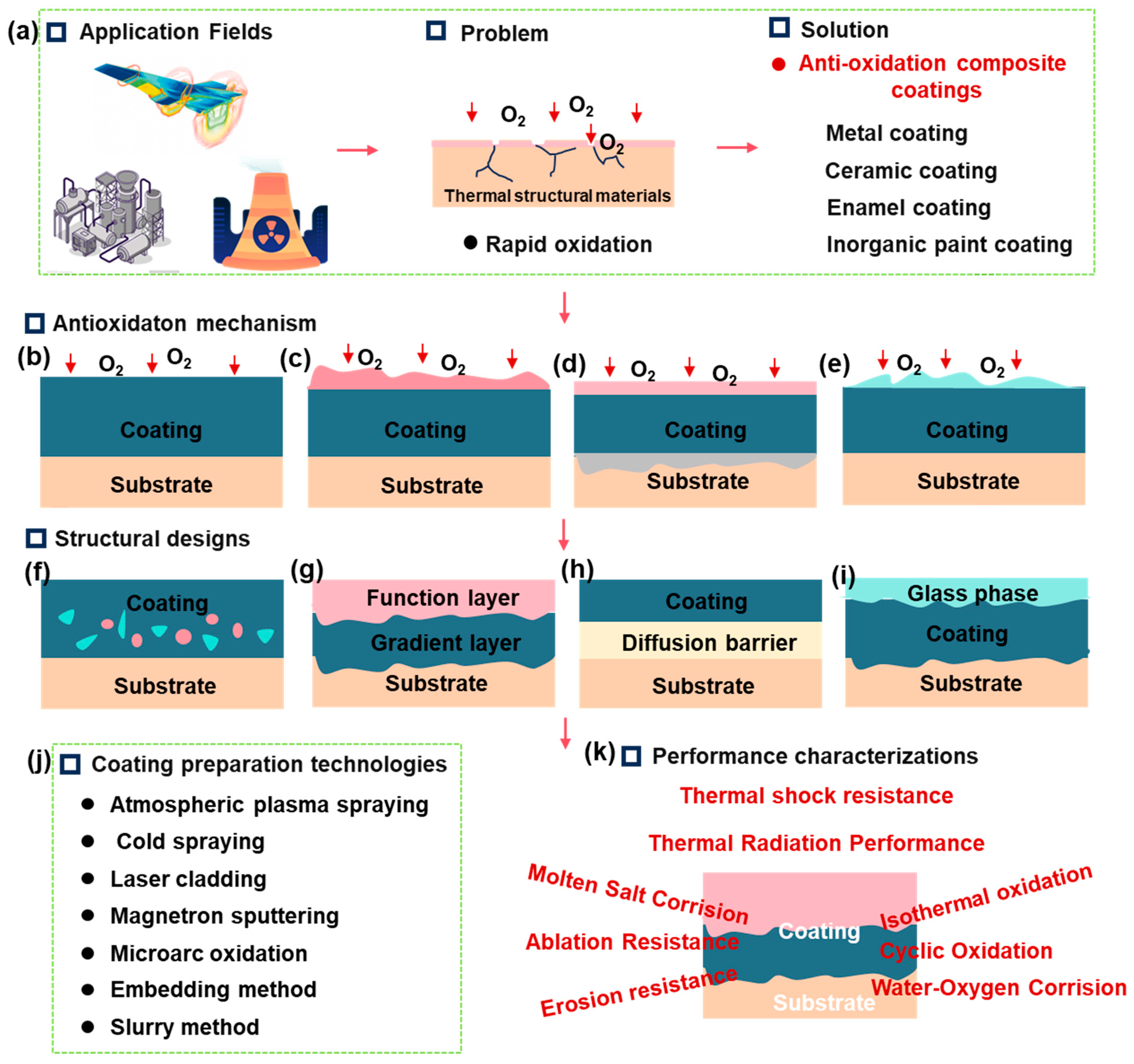
Currently, the aerospace, energy and power, nuclear energy, and chemical engineering industries, as well as other related fields, are developing rapidly. Against this backdrop, the hot-end components of various high-temperature equipments are confronting increasingly severe high-temperature challenges. Such equipment includes aerospace vehicles, aero-engines, gas turbines, industrial high-temperature pipelines, and nuclear fuel claddings [1,2]. The performance of hot-end components is a key factor of the service capability of high-temperature operating equipment [3]. Nickel-based superalloys, titanium alloys, refractory metals, ceramic composites, and carbon-based composites, among others, have become irreplaceable thermal structural materials in hot-end components due to their excellent mechanical properties and high-temperature stability. However, these materials all face a common problem: high-temperature oxidation, as shown in Figure 1a. For instance, when the temperature of nickel-based superalloys exceeds 1000 °C, the alloys undergo rapid oxidation, leading to severe degradation of mechanical properties and thus significantly shortening their service life [4]; titanium alloys, which have a strong ability to absorb oxygen, tend to undergo surface oxidation at high temperatures, and oxygen can further diffuse inward, which causes the alloy to become brittle and reduces its strength [5]; carbon-based composites undergo oxidation at temperatures above 400 °C, which affects their long-term use [6,7]. It is evident that the problem of high-temperature oxidation of hot-end components seriously impacts the service performance of equipment in multiple fields such as aerospace, energy, and chemical engineering. Therefore, establishing an effective thermal protection system is an urgent priority [8].
Applying an oxidation-resistant composite coating on the surface of hot-end components is currently one of the most effective approaches. This method can significantly alleviate the high-temperature oxidation of thermal structural materials. Additionally, it helps improve the service performance of key equipment such as aero-engines and gas turbines. Oxidation-resistant coatings typically need to have the following characteristics: (1) high melting point, (2) good oxidation resistance and low oxygen permeability, (3) stable mechanical properties at high temperatures, (4) thermal expansion coefficient matching the substrate, (5) high bonding strength with the substrate. Based on these requirements, many materials based on metals, ceramics, or metal–ceramic composites are potential candidates for preparing oxidation-resistant coatings [9]. However, several key issues restrict the long-term protective performance of coatings on hot-end components. For instance, in metal materials, pure MoSi2 silicide coatings undergo spontaneous powdering and cracking (“Pesting” failure) within the temperature range of 400–750 °C. For MCrAlY coatings, severe element diffusion occurs between the coating and the substrate. Furthermore, in ceramic materials, boride coatings generate a B2O3 glass phase during high-temperature oxidation, which volatilizes violently above 1000 °C. Moreover, ceramic coatings inherently exhibit high brittleness, further limiting their practical application [10,11,12,13]. Therefore, developing composite coatings with better oxidation resistance through rational material system design, coating structure regulation, and advanced preparation technologies is a current research hotspot.
This paper focuses on oxidation-resistant composite coatings for extreme high-temperature applications. It mainly summarizes various coating material systems, structural regulation methods, advanced coating preparation technologies, and coating system characterization methods in recent years. Additionally, it puts forward the current challenges faced by high-temperature oxidation-resistant coatings and their future development directions.

2. Oxidation-Resistant Composite Coating Systems

High-temperature oxidation-resistant composite coatings are important barriers ensuring long-term use of thermal structural materials. They evolved from single aluminide coatings and have developed into a series of coatings. Currently, high-temperature oxidation-resistant composite coatings are mainly divided into aluminide-based composite coatings, silicide-based composite coatings, MCrAlY-based composite coatings, ceramic-based composite coatings, enamel composite coatings, and inorganic paint composite coatings. Aluminide-based composite coatings can quickly form protective Al2O3 ceramic film under high-temperature conditions, but the coating is easy to fall off when facing thermal shock. Silicide-based composite coatings rely on SiO2 glass phases for oxygen blocking and self-healing, but heavy Si consumption during ultra-high-temperature long-term service will shorten the service life of the coatings. MCrAlY-based composite coatings have good compatibility with superalloys. But when used at high temperatures for a long time, elements between the coating and the base material mix together, leading to thickened oxide layers and coating spallation. Ceramic-based coatings, with dense structures and excellent high-temperature stability, show great potential in ultra-high-temperature oxidation resistance but are limited by poor toughness [14,15,16,17,18]. Enamel composite coatings rely on dense glass phases formed by multi-component oxidation for oxygen blocking, with simple preparation but insufficient high-temperature oxidation resistance. Inorganic paint composite coatings, composed of refractory fillers and binders, are economical and convenient but require further research for high-temperature applications. The following will explain the characteristics and oxidation resistance mechanisms of various anti-oxidation coating materials, with a brief summary of different composite coatings in Table 1.

2.1. Metal-Based Composite Coatings

2.1.1. Aluminide-Based Composite Coatings

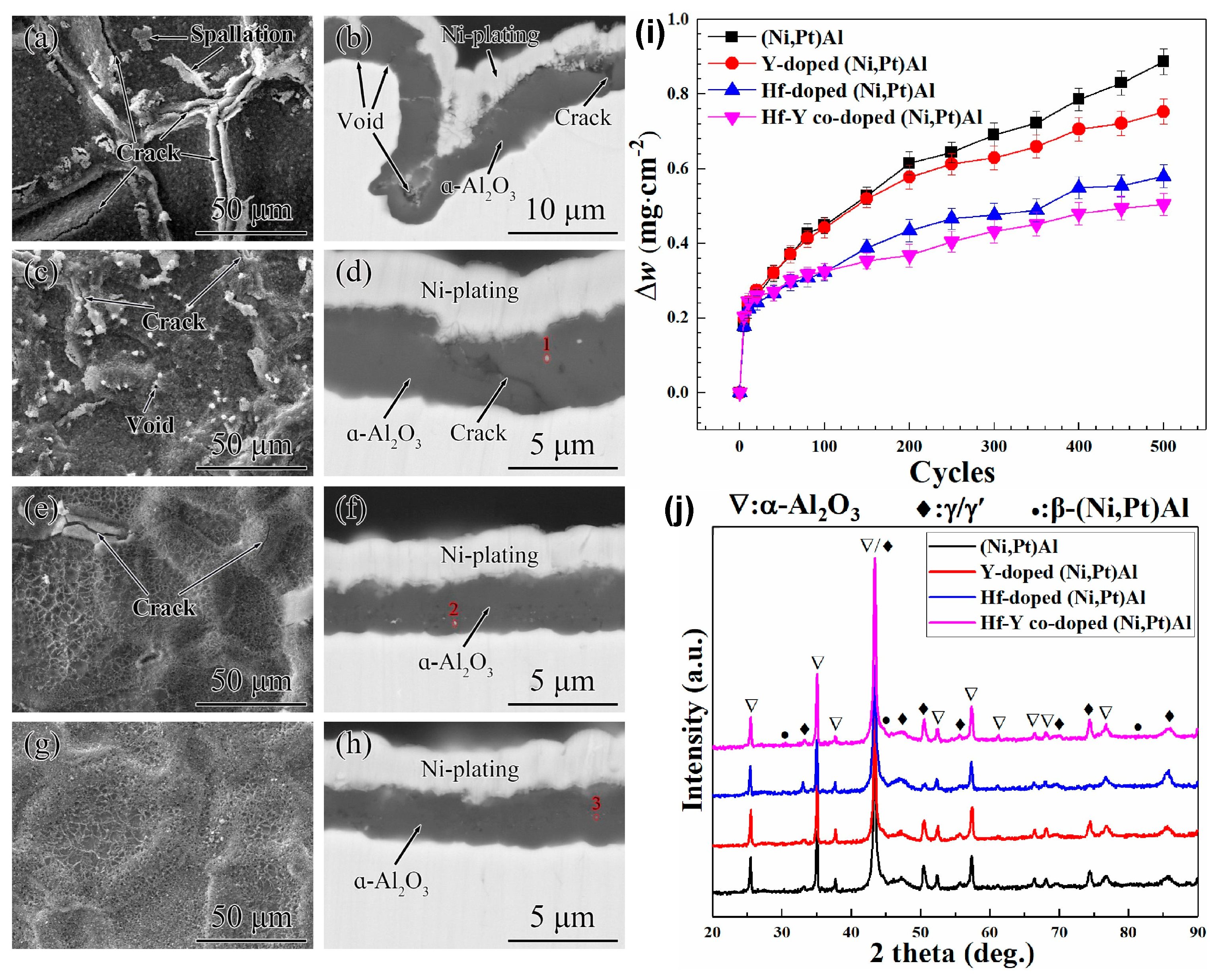
Aluminide-based composite coatings are thermally diffused composite systems formed by chemical reactions with the substrate. Due to aluminum’s low melting point, high thermal expansion coefficient, and high reactivity, aluminide-based composite coatings exhibit oxidation resistance by forming dense Al2O3 ceramic films on the surface through reaction of high-activity Al with oxygen at high temperatures [19]. Currently, the core matrices of widely studied aluminide-based composite coatings include TiAl, Ni3Al, Fe3Al, NiAl, and FeAl, among which Ni-Al- and Ti-Al-based composite systems exhibit superior high-temperature oxidation resistance, capable of protecting substrates at temperatures above 1000 °C. However, aluminide coatings have high brittleness, easily generating defects or even spallation during long-term high-temperature service. Additionally, their different compositions from the substrate causes element mixing, speeding up aluminum loss [20]. These limitations are be effectively addressed through the design of aluminide-based composite coatings. The fabrication of aluminide-based composite coatings is commonly realized via elemental doping (e.g., Pt, Si, Cr, Co, Hf, Y) [21,22,23], which can not only reduce the critical Al content required for selective oxidation but also enhance the adhesion of the Al2O3 film, thereby prolonging the service life of the coatings. For example, Yang et al. [24] effectively improved the oxidation resistance of aluminide coatings by adding an amount of element Y. They prepared Y-modified aluminide-based composite coatings on Ni-based superalloy via chemical vapor deposition (CVD). After 100 h cyclic oxidation at 1100 °C, the mass gain of single aluminide coatings was 0.55 mg/cm2, while that of Y-modified ones was 0.3 mg/cm2, representing a roughly 45% improvement in oxidation resistance. Huang et al. [25] prepared Ti(Al,Si)3 coatings on TiAl alloys by cold spraying. After 1000 h isothermal oxidation at 950 °C, the coating gradually transformed into a layered structure: oxide layer, Ti(Al,Si)3 layer with reticular Ti5Si3, continuous Ti5Si3 layer, and TiAl2 layer. During long-term oxidation, the thickness and morphology of the continuous Ti5Si3 diffusion barrier remained almost unchanged, effectively inhibiting inward Al diffusion and ensuring long-term oxidation resistance. Among various modified aluminide coatings, Pt has proven the most effective. The addition of Pt can not only reduce the amount of Al needed for selective growth and help form Al2O3, but also improve the adhesion between Al2O3 film and coating. Angenete et al. [26] prepared a Pt-modified Ni-based superalloy via CVD and Pt plating. Long-term high-temperature oxidation tests at 1050 °C showed that Pt-modified ones only started to peel off over 10% of the surface after 10,000 h, significantly outperforming regular aluminide coatings which spalled after 1000 h, demonstrating dramatically improved oxidation resistance. Li et al. [27] studied the cyclic oxidation performance of Hf, Y-doped (Ni,Pt) Al coatings at 1150 °C. As shown in Figure 2i, after 500 cycles, the mass gains of normal, Y-modified, Hf-modified, and Hf-Y co-modified aluminide coatings were 0.89, 0.75, 0.58, and 0.50 mg/cm2, respectively. It is clear that adding just Hf or Y made the coating gain less weight. Notably, adding both Hf and Y exhibited the most promising potential in slowing the rate of scale growth. Figure 2j shows XRD patterns of the four coatings after 500 cyclic oxidations at 1150 °C, indicating that all formed pure α-Al2O3, suggesting good oxidation resistance for both the regular (Ni,Pt)Al coatings and the ones with Y or Hf added. Additionally, Figure 2a–h show surface and cross-sectional morphologies of the four aluminide coatings after 500 oxidation cycles. The (Ni,Pt) Al coating surface exhibited numerous cracks and even slight oxide spallation at the edges. Y-doped and Hf-doped (Ni,Pt) Al coatings also showed varying degrees of defects, but the oxide scale formed on the (Ni,Pt) Al coating with both Hf and Y added was completely intact, with no damage at all, exhibiting the best oxygen-blocking performance, which explains why it gained the least mass.
In conclusion, high Al content endows aluminide-based composite coatings with excellent high-temperature oxidation and corrosion resistance. Ni-Al and Ti-Al system coatings show better high-temperature oxygen-blocking ability than Fe-Al systems. Synergistic modification with various elements has significantly improved the oxidation resistance of aluminide-based composite coatings. However, issues like rapid Al consumption at high temperatures and coating spallation under thermal shock limit their application in complex working conditions.

2.1.2. Silicide-Based Composite Coatings

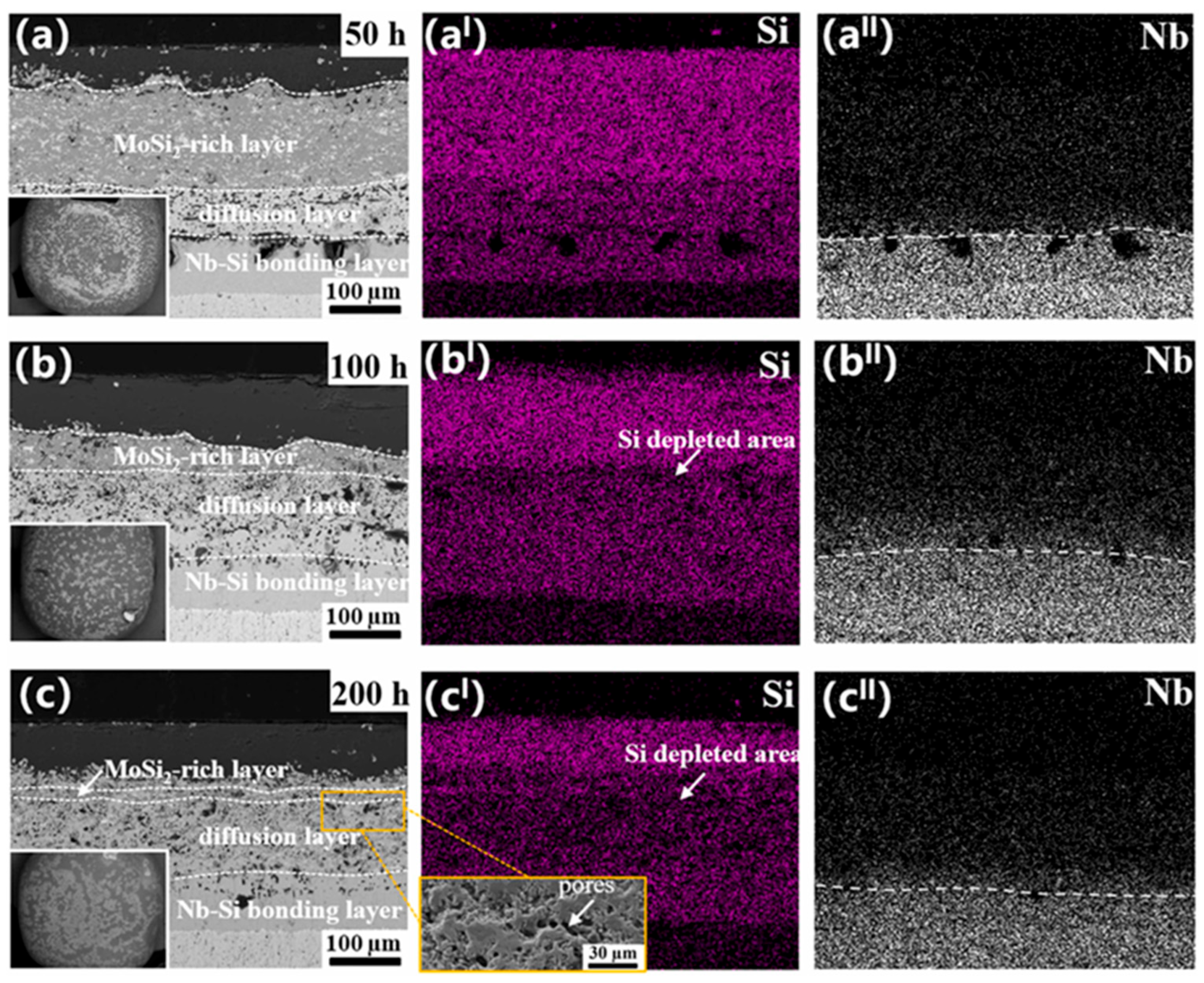
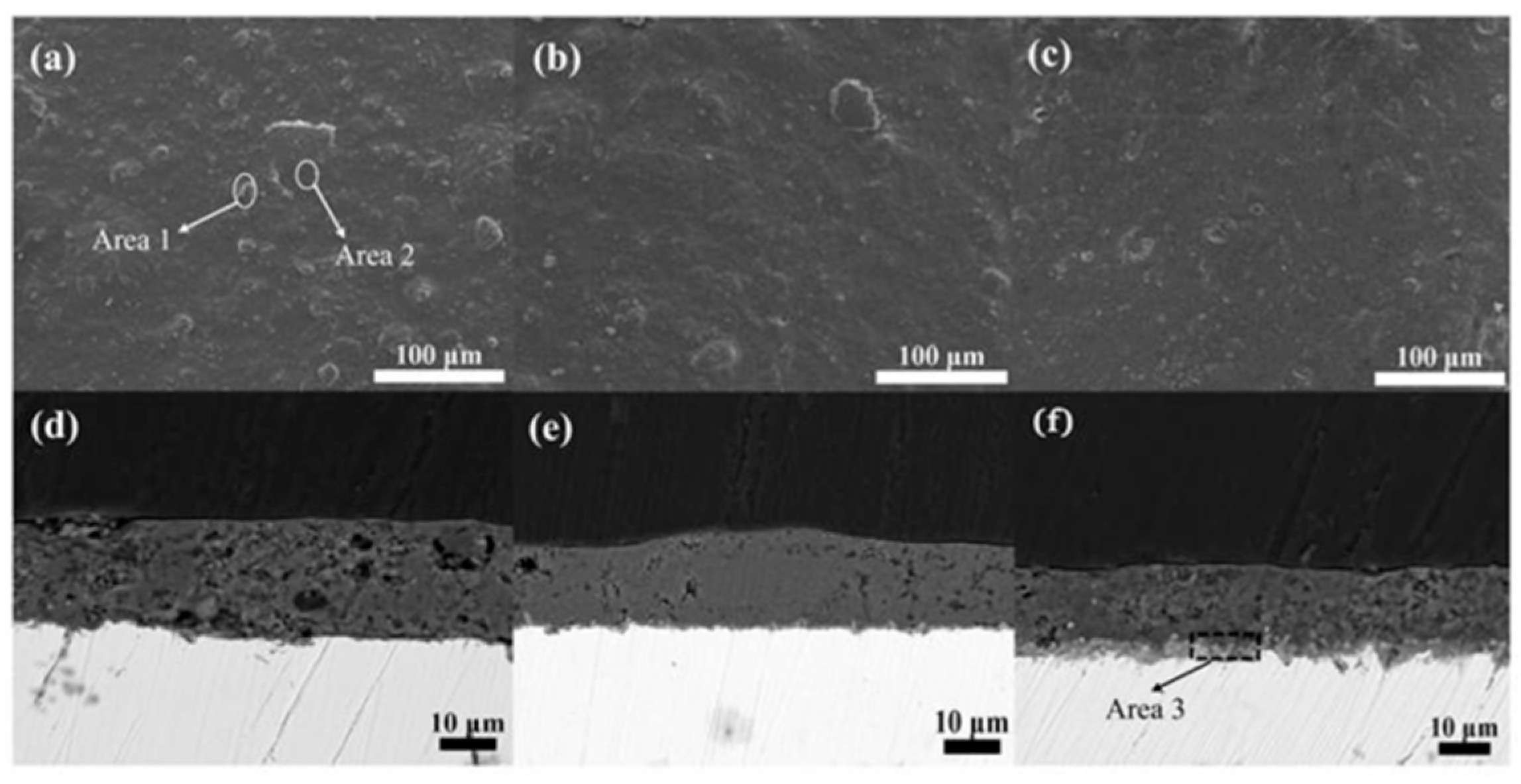
In high-temperature oxidizing environments, silicides form a continuous, dense, and fluid SiO2 glass phase on their surface. This glass phase effectively blocks oxygen from diffusing into the substrate. Additionally, when thermal stress-induced cracks form at high temperatures, the SiO2 glass phase can automatically flow into these cracks under capillary force, repairing the coating [28,29]. Thus, silicide-based composite coatings are promising high-temperature oxidation-resistant coatings. Silicide-based composite coatings are mainly constructed with refractory metal silicides such as MoSi2, NbSi2, and TaSi2 as the matrix, combined with functional additives. Among them, MoSi2 has high melting point, moderate density, good thermal stability, excellent oxidation and corrosion resistance, and effective protection over a wide temperature range, showing great potential in silicide-based composite coatings. But MoSi2 suffers from “pesting” at 400–600 °C, affecting oxidation resistance. During long-term high-temperature service, Si volatilizes as SiO2, damaging coating’s integrity and service life [30,31,32,33,34]. Therefore, extensive research has been performed to enhance MoSi2 coating oxidation resistance and extend service life. Zhu et al. [35] designed MoSi2 and MoSi2-bentonite oxidation-resistant coatings on Mo-based alloys by spark plasma discharge. Isothermal oxidation tests at 1500 °C for 300 h exhibited final mass gains of 1.14 mg/cm2 and 0.49 mg/cm2 for MoSi2 and MoSi2-bentonite coatings, respectively, with the oxidation rate of the bentonite-containing composite coating much lower than that of the MoSi2 coating, significantly improving high-temperature oxidation resistance. Tao et al. [36] created Si-MoSi2 composite coating on Mo substrate and studied its isothermal oxidation at 1200 °C. After 20 h exposure at 1200 °C, the coating mass gain was only 0.183 mg/cm2, and the oxide layer thickness was 6.72 μm. Heavy Si doping resulted in a smooth, compact surface structure, ensuring excellent oxidation resistance. Wang et al. [37] fabricated Y2O3-modified MoSi2-based coatings with different Y2O3 contents on C/C substrates via plasma spraying and studied their microstructure, oxidation behavior, and protection mechanism in air at 1500 °C. Experimental results demonstrated that among all Y2O3-modified MoSi2 coatings, the composite coating with 20 wt% Y2O3 exhibited the best oxidation resistance, with a weight loss rate of only 1.92% after 100 h oxidation at 1500 °C, a significant improvement compared to the unmodified silicide coating, which showed an oxidation weight loss rate of 8.98% after 88 h. The reason for this is that the appropriate amount of Y2O3 provided yttrium ions, which strengthened the Si-O bonds in the SiO2 network, increasing the density and viscosity of the Si-O-Y multicomponent glass layer, thus effectively blocking the inward spread of active oxygen. Zhai et al. [38] prepared MoSi2-MoB bilayer coating on Mo substrate; after 15 h at 1300 °C under isothermal oxidation conditions, a weight loss of 6.382 mg/cm2 was observed for the coating, exhibiting excellent oxygen-blocking ability due to the formation of a dense, continuous SiO2 layer during oxidation. Ou et al. [39] prepared MoSi2-HfO2 coating on niobium alloy. The coating with 20 wt% HfO2 doping (M20H) exhibited the best oxidation resistance, with a service life of up to 200 h at 1700 °C. Figure 3 shows surface, cross-sectional images, and element distribution maps of the M20H coating after 50 h, 100 h, and 200 h oxidation. As seen in Figure 3a–c, the thickness of the MoSi2-rich layer gradually decreased with increasing oxidation time, and numerous voids appeared after 100 h and 200 h, indicating significant Si consumption, but the coating did not fail, demonstrating that HfO2 doping significantly enhanced the high-temperature oxidation resistance of the MoSi2 coating. Zhang et al. [40] fabricated MoSi2 coatings with different mullite addition amounts on silicided niobium alloys. The addition of an appropriate amount of mullite can inhibit the crystallization of SiO2 during the oxidation process of the coating, obtain crack-free oxide scales, and prevent the inward diffusion of oxygen. In the team’s experiments, the coating with 10 wt% mullite had excellent oxidation resistance. After 140 h at 1500 °C, the coating exhibited minimal mass loss of 4.06 mg/cm2. In addition, the team [41] also prepared WSi2-mullite-MoSi2 coatings on silicided Nb alloys by atmospheric plasma spraying, which demonstrated a mass loss of only 4.41 mg/cm2 after oxidation at 1500 °C for 500 h. Moreover, Zhu et al. [42] utilized atmospheric plasma spraying to prepare a ZrB2-MoSi2 coating on tantalum via 20 h isothermal oxidation treatment at 1750 °C, which produced a mass gain of 1.75 mg/cm2 in the coating, exhibiting significant oxidation resistance.
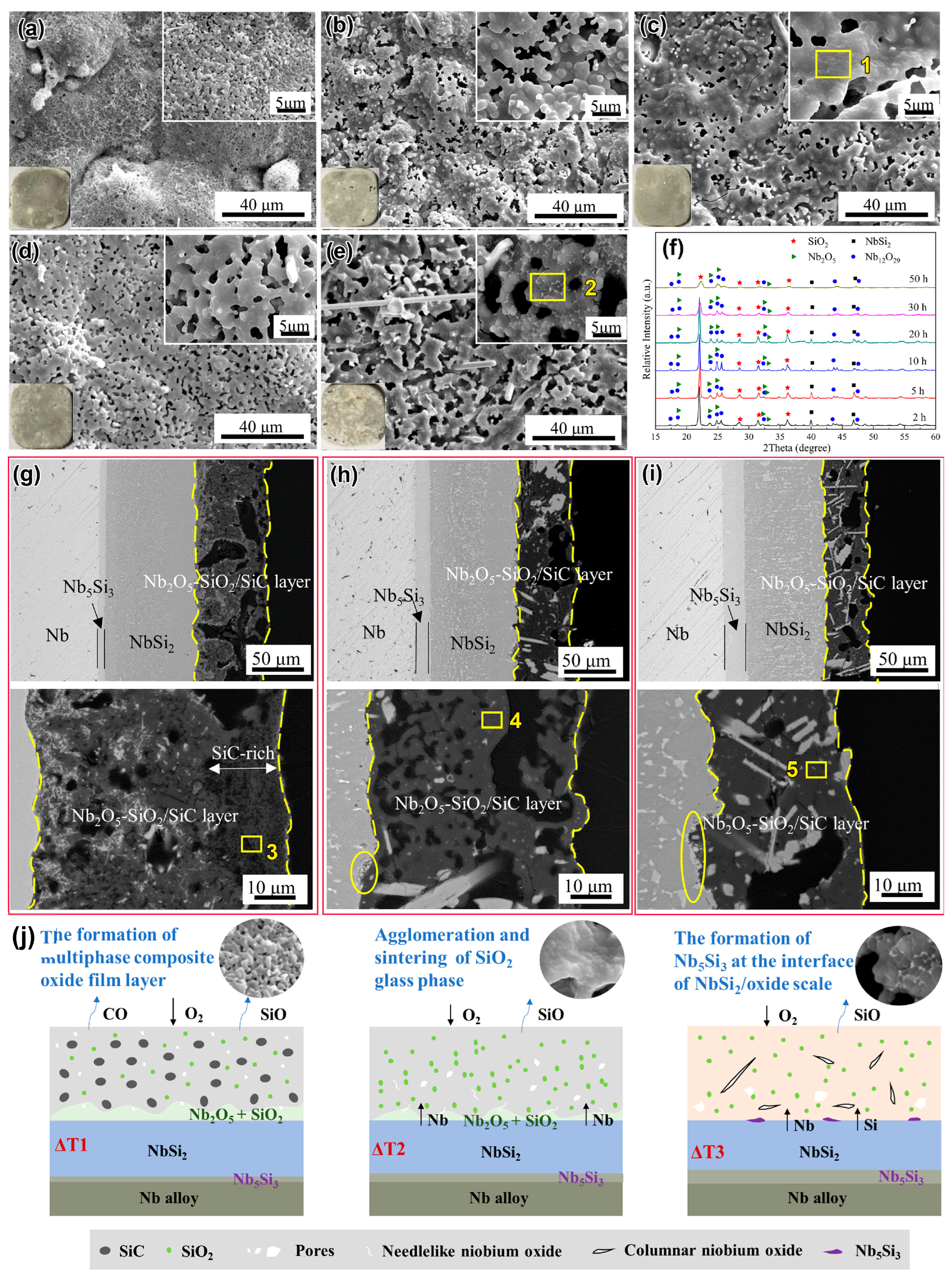
TaSi2 and NbSi2 are widely used as core matrix materials for silicide-based composite coatings, favored for their excellent high-temperature oxidation resistance in extreme environments [43,44]. TaSi2 mainly blocks oxygen from getting into the substrate by forming protective layers of low-viscosity Ta2O5 and dense SiO2. However, single TaSi2 is hard and brittle, and cracks formed in the coating at high temperatures are difficult to heal, so it is often used in combination with other thermal protection materials. NbSi2 has low density, good thermal stability, and a suitable thermal expansion coefficient. To achieve better high-temperature oxidation resistance, NbSi2 coatings are also often used as composite coatings [45,46]. For example, Tao et al. [47] created Si-NbSi2 composite coating with high Si content in niobium alloy, which demonstrated a mass gain per unit area of 45.68 mg/cm2 after 8 h exposure at 1200 °C. Wang et al. [48] constructed a NbSi2/Nb2O5-SiO2/SiC silicide-based composite coating on niobium alloy by incorporating nano-SiC particles, which displayed a mass gain of 2.49 mg/cm2 after 50 h oxidation at 1250 °C, significantly lower than the 6.49 mg/cm2 of the single-layer NbSi2 coating, for reasons detailed in Figure 4. As oxidation time increases, SiO2 gradually turns into a nanocrystalline or amorphous state, which is beneficial for improving the high-temperature oxidation resistance of the coating. Additionally, SiC provides an additional Si source to form a self-healing film, and the SiO2 phase keeps the oxide layer thickness within a stable range, avoiding oxide layer spallation and cracking caused by high growth stress. Ni et al. [49] applied low-pressure plasma spraying to prepare a TaSi2/MoSi2 bilayer coating on graphite substrate. After 30 min of high-temperature oxidation in static air at 1650 °C, the coating structure remained intact without macro-cracks, with a uniform and dense microstructure. A large amount of dense glassy SiO2 on the coating surface provided good protection for the substrate. Liu [25] invented a multi-layer SiB6-TaSi2-MoSi2 coating. After 200 h of isothermal oxidation at 1500 °C, the coating’s mass gain was about 1.41%, and its oxygen permeability was only 1.09%, exhibiting excellent oxidation resistance.
In summary, silicide-based composite coatings can generate SiO2 glass phases with good fluidity under high-temperature oxidizing conditions, which not only block oxygen, but also give the coating with certain self-healing ability, significantly extending the service life of the coating at high temperatures. In the field of high-temperature oxidation resistance, MoSi2 shows the most application potential, but the oxidation resistance of silicide-based composite coatings at temperatures above 1700 °C and their long-term service performance over a wide temperature range need further research and improvement.

2.1.3. MCrAlY-Based Composite Coatings

MCrAlY-based composite coatings are high-performance, high-temperature, oxidation-resistant composite systems, where M denotes Ni, Cr, or a combination of Ni and Cr. Al is the main element responsible for high-temperature oxidation resistance in MCrAlY-based composite coatings; it can form a continuous, dense Al2O3 protective film when oxidized at high temperatures. Cr reduces the critical Al content required for forming a continuous Al2O3 film and improves the coating’s resistance to hot corrosion. Y significantly enhances the spallation resistance of the oxide film [50,51].
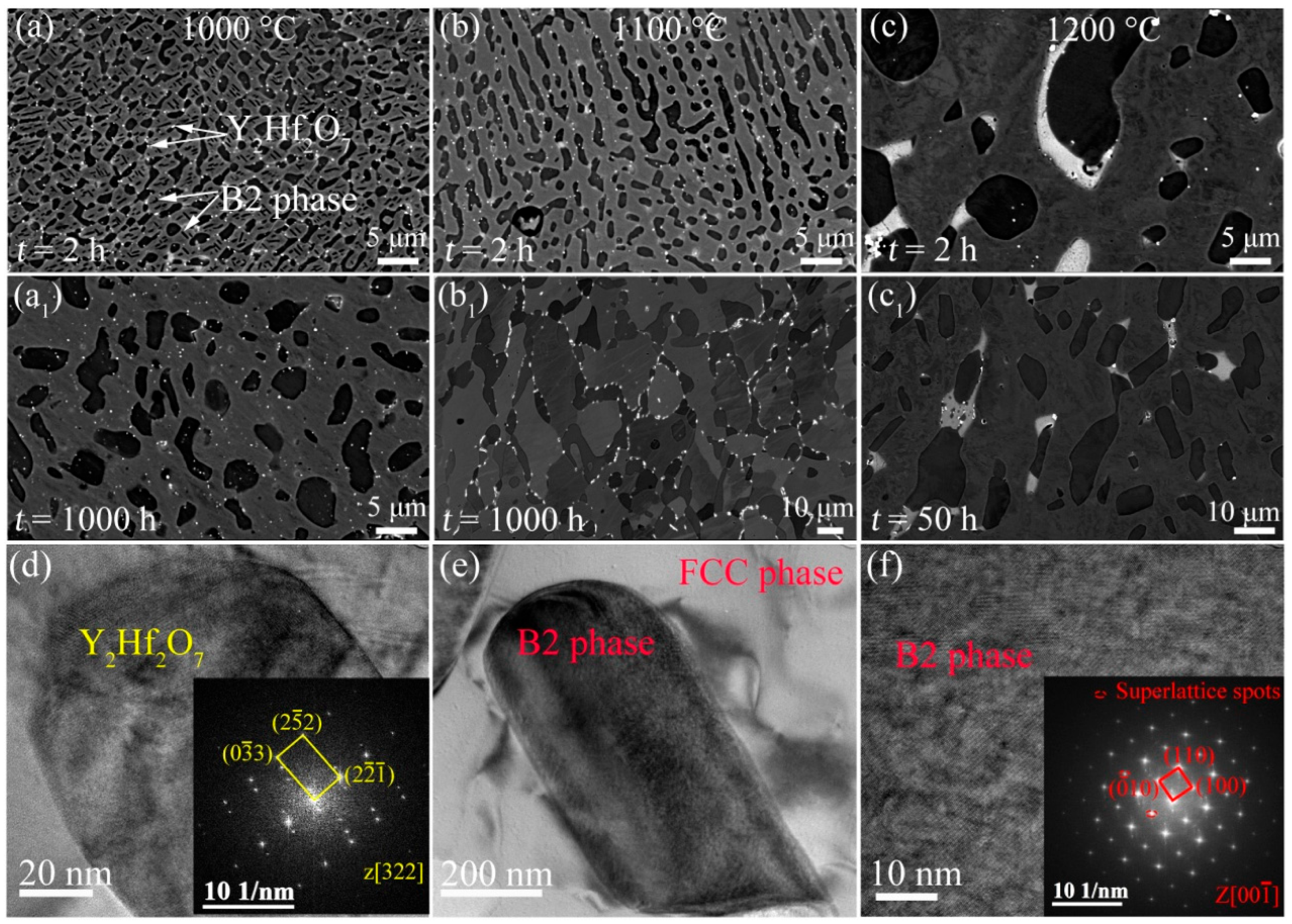
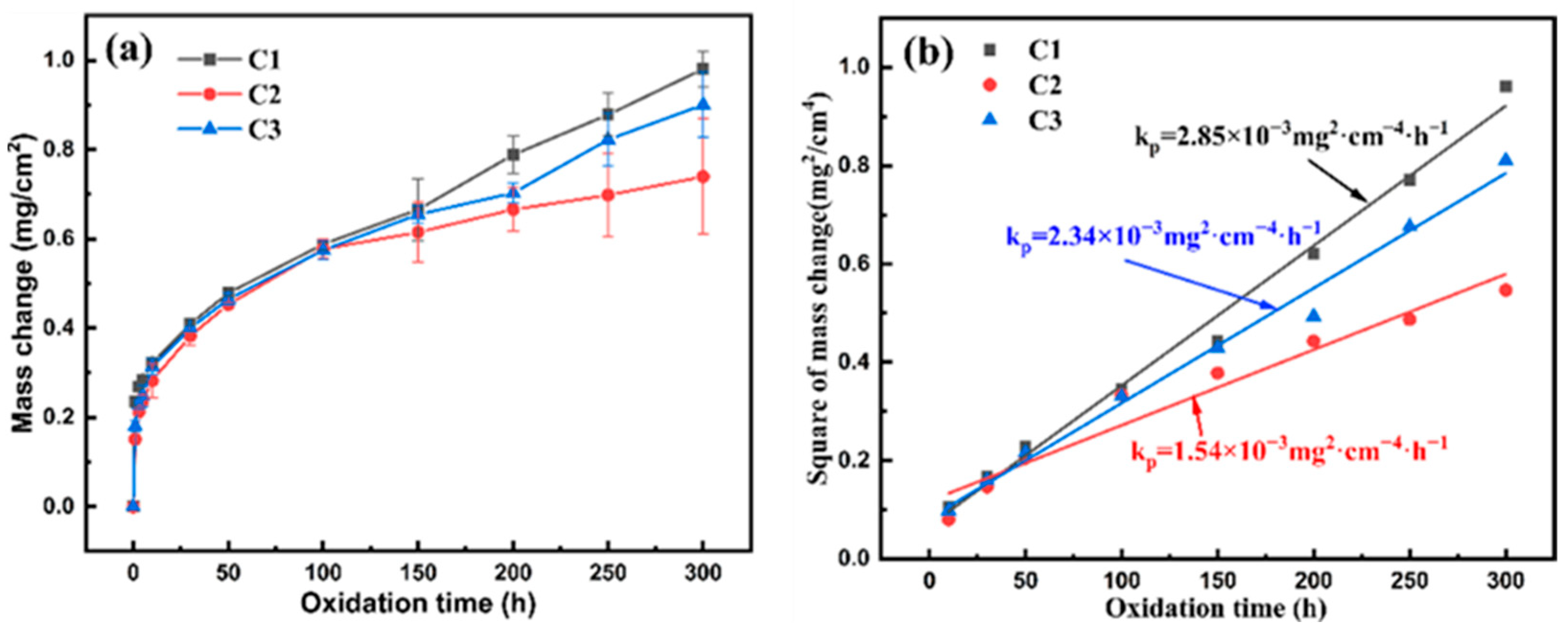
The composition of MCrAlY-based composite coatings can be flexibly adjusted according to specific service environments and substrate alloy compositions, with NiCrAlY and NiCoCrAlY as the most widely used composite systems [52]. They are commonly applied as overlay coatings for hot-end components of gas turbines and aero-engines or bond coats for thermal barrier coatings, thanks to their excellent compatibility with Ni-based superalloys and synergistic oxidation/corrosion resistance. However, when MCrAlY coatings are exposed to environments above 1000 °C for a long time, elements such as Al and Cr in the coating interdiffuse with the substrate, forming destructive substances, affecting the interfacial bonding between the substrate and the coating, and leading to rapid coating failure [14,53]. Many researchers have made efforts to improve coating performance through element doping, structural regulation, and preparation technology optimization [54,55,56]. For example, Duan et al. [57] added Hf and Ta to the NiCoCrAlY coating. The composite coating sample was tested with cyclic oxidation tests in air at 1050 °C and failed after 2664 h, significantly extending the service life compared to pure NiCoCrAlY, which failed after 240 h. Wang et al. [58] fabricated an ODS AlCoCrFeNi2.1 composite coating on Ni-based superalloy via laser cladding. After prolonged oxidation at 1000 °C and 1100 °C, the composite coating demonstrated superior oxidation resistance compared with conventional NiCoCrAlY coatings. As revealed by TEM results (Figure 5), this enhancement is primarily attributed to the formation of Y2Hf2O7 nanoparticles during oxidation, which effectively reduced the growth rate of the thermally grown oxide (TGO), alleviated the thermal expansion mismatch stress, and improved the toughness of the coating/TGO interface. Li et al. [59] combined arc ion plating and vacuum annealing to create MCrAlY-AlSiY composite coatings with different thicknesses. C1 was a 10 μm AlSiY layer, C2 consisted of a 20 μm NiCrAlYSi layer and a 10 μm AlSiY layer, and C3 was composed of a 30 μm NiCrAlYSi layer and a 10 μm AlSiY layer. The isothermal oxidation behavior of the coatings at 1100 °C for 300 h was studied (as shown in Figure 6). The results showed that the C2 coating had the lowest oxidation rate with a total mass gain of only 0.73 mg/cm2, exhibiting better high-temperature oxidation resistance. Kang et al. [60] invented gradient NiCrAlYSi coating, whose gradient design effectively extended the service life at 1200 °C.
In summary, MCrAlY-based composite coatings are mainly used for high-temperature oxidation protection of Ni-based superalloy components due to their good thermal matching with Ni-based superalloys. Adding small amounts of alloying elements to MCrAlY-based composite coatings primarily enhances the adhesion of the protective oxide film formed on the coating surface through the synergistic effect between the doping elements and the MCrAlY matrix, thereby significantly extending the high-temperature service life of the composite system. Nanocrystalline MCrAlY-based composite coatings, due to increased grain boundary density and reduced lattice diffusion distance, promote the formation of protective oxide scales during high-temperature exposure. Preparation technology optimization mainly improves coating oxidation resistance and service life by reducing defects such as microcracks and pores in the coating and preparing multi-layer/gradient coatings. However, when MCrAlY-based composite coatings are used in oxidizing environments above 1100 °C for a long time, stress tends to build up at the interface with the substrate, and once it exceeds the bonding strength limit, microcracks form, eventually leading to coating spallation. Therefore, slowing down the consumption of Al and Cr, which have oxygen-blocking effects, and the thickening of oxide growth layers is key to extending the application of MCrAlY-based composite coatings in higher-temperature oxidation resistance fields.

2.2. Ceramic-Based Composite Coatings

Ceramic-based composite coatings have dense structures, excellent high-temperature stability, and superior oxidation resistance [61,62]. These characteristics make them suitable for thermal protection of hot-end components operating under high-temperature and ultra-high-temperature conditions. Additionally, they are highly promising as high-temperature oxidation-resistant coatings. Common ceramic protective coatings include inert oxides like Al2O3, ZrO2, and YSZ. In recent years, borides, carbides, and nitrides of refractory metals (Hf, Zr, Ta, etc.) with high melting points, excellent high-temperature oxidation resistance, and ablation resistance and MAX phase ceramic coatings have also attracted much attention.

2.2.1. Boride-Based Composite Coatings

The oxidation resistance mechanism of boride-based composite coatings mainly involves forming a protective B2O3 glass phase in high-temperature oxidizing environments [63]. In the boride family, ZrB2 and HfB2 are the most promising oxidation-resistant ceramic materials. ZrB2 is a material with low density, high strength, ablation resistance, wear resistance, and excellent medium-to-low temperature oxidation resistance. Both ZrO2 and B2O3 formed after ZrB2 oxidation can play an antioxidant role. Additionally, ZrO2 formed after ZrB2 oxidation can react with SiO2 to form ZrSiO4, which has an antioxidant effect at 1700 °C. Meanwhile, Zr compound particles distributed in the SiO2 glass phase play a pinning role, improving coating stability. HfB2 also has excellent high-temperature oxidation resistance, but its natural ability to resist oxidation is not enough. To better exert the oxidation resistance of boride materials, they are usually compounded with SiC, silicides, rare earth oxides, and other thermal protection materials to prepare composite coatings [64,65,66]. Ma et al. [67] prepared Y2O3-modified ZrB2-SiC composite coating on C/C composites via atmospheric plasma spraying. The coating with 10% Y2O3 lost 5.77% of its mass after isothermal oxidation at 1450 °C for 10 h, while the undoped Y2O3 coating lost 16.79%. The improved thermal protection performance was mainly due to the presence of Y2O3 inhibiting the phase transformation of ZrO2, thereby avoiding cracks caused by coating volume expansion. Wang et al. [68] designed a ZrB2-HfB2-SiC-TaSi2 composite coating on the C/C substrate by plasma spraying. TaSi2 can form dense Zr-Ta-O and Hf-Ta-O oxides with Zr and Hf elements, effectively blocking oxygen. And the formation of a Ta-Si-O glass phase can effectively seal coating pores, preventing oxygen penetration. The coating exhibited excellent high-temperature oxidation resistance and ablation resistance. Duan et al. [69] fabricated a ZrB2-SiC coating on a graphite substrate via slurry brushing. After 120 min oxidation at 1200 °C, the weight loss rate was −0.38%. Its excellent high-temperature oxidation resistance was attributed to the low oxygen permeability of the borosilicate glass layer formed by B2O3 and SiO2, as well as the self-healing ability of molten B2O3 glass and borosilicate glass to automatically fill some pores and cracks in the coating. Li et al. [70] prepared multi-layer SiC/SiC-MoSi2-ZrB2 coating through a novel three-step method. The composite glass phase with good crack-sealing ability and the formation of thermally stable ZrSiO4 enabled the coating to effectively protect the C/C substrate at 1500 °C for 305 h.
In addition, there are many studies on HfB2-based composite coatings. For example, Zhang et al. [71] prepared a SiC-HfB2-Si ternary oxidation-resistant coating on C/C composites via slurry spraying and vapor silicon infiltration. The coating could protect the substrate for more than 1507 h under isothermal oxidation at 1773 K, with linear and mass ablation rates of −0.72 μm/s and 0.07 mg/s, respectively, significantly improving the oxidation resistance of C/C composites. Ren et al. [61] developed a HfB2-MoSi2-SiC coating with controllable composition and thickness through in situ reaction and slurry sintering. Due to the formation of a highly stable Hf-Si-O glass layer, the sample exhibited minimal weight loss of 0.08% at 1500 °C for 200 h. Lv et al. [72] prepared HfB2-SiC/SiC coating on C/C composite substrate through PC, slurry spraying, and partial reaction sintering. Due to the formation of a SiO2/HfSiO4/HfO2 protective layer with extremely high thermal stability, it could protect the substrate in air at 1700 °C for 100 h, with only 2.4% mass loss. Zhu et al. [73] utilized slurry impregnation to produce HfB2-SiC coatings with different HfB2 contents on SiC-coated C/C composites. The HfB2-SiC coating with 50 wt% HfB2 could protect C/C composites from oxidation for 494 h at 900 °C in air, exhibiting excellent oxidation resistance, which was attributed to the formation of a highly thermally stable and dense borosilicate glass layer on the coating surface during high-temperature oxidation. Zhang et al. [74] studied a CeO2-modified HfB2-MoSi2-SiC coating. Compared with the pure HfB2-MoSi2-SiC coating, the addition of CeO2 to the Hf-B-Si-O system formed a stable Hf-Ce-B-Si-O complex phase glass, greatly improving the viscosity, stability, and self-healing densification performance of the glass layer and reducing the sample mass gain rate from 0.53% to 0.41% after 100 min isothermal oxidation at 1700 °C. Ding et al. [75] developed MoSi2-modified HfB2-SiC-Si/SiC-Si coating on Cf/C substrate through slurry impregnation and gaseous silicon infiltration. The pinning effect of HfO2, formed MoB, and Hf, Mo co-doped silicon-based glass layer successfully prevented oxygen migration to the substrate, enabling the coating to protect Cf/C composites in air at 1700 °C for 276 h. Zhang et al. [76] prepared a HfB2-MoSi2-TaB2 coating via SPS technology. Compared with the HfB2-MoSi2 coating system, the addition of an appropriate amount of TaB2 reduced the oxidation mass gain by 78.56% at 900 °C and by 63.14% at 1700 °C, significantly enhancing the high-temperature oxidation resistance of the coating. Zhang et al. [77] utilized the LFT technology to produce high-quality HfB2-SiC-ZrSi2 oxidation-resistant coatings, which showed low oxygen permeability of only 0.28% during oxidation at 1700 °C, exhibiting excellent oxygen-blocking performance. Furthermore, MAB-based materials have also received a lot of attention in the field of oxidation-resistant coatings [78,79]. MAB phase materials are layered transition metal borides, where M represents a transition metal and A denotes aluminum [80,81]. These materials exhibit high thermal stability and excellent oxidation resistance. Commonly employed MAB phase systems primarily include Cr2AlB2, Cr3AlB4, and MoAlB. Their oxidation resistance mechanism primarily depends on the formation of continuous, dense protective films (such as Al2O3 and Cr2O3) at high temperatures [82]. Zhang et al. [83] prepared MoAlB composite coatings via magnetron sputtering. The presence of MoAlB nanocrystals promoted the selective formation of a dense α-Al2O3 scale through their oxygen-blocking effect, thereby imparting excellent oxidation resistance to the coatings. MAB materials show promise for high-temperature oxidation resistance. However, further exploration of different MAB phases and their high-temperature oxidation behavior in relation to their elemental and structural characteristics is still needed.
Boride-based ceramic coatings, through multi-phase composite and structural regulation, have not only significantly improved their high-temperature oxidation resistance, but also effectively enhanced the repair ability of self-healing glass phases under high-temperature oxidizing conditions, highlighting their application value in high-temperature oxidation resistance fields. However, issues such as rapid loss of glass phases during long-term high-temperature service and the ability of coatings to be applied over a wide temperature range require further research.

2.2.2. Carbide-Based Composite Coatings

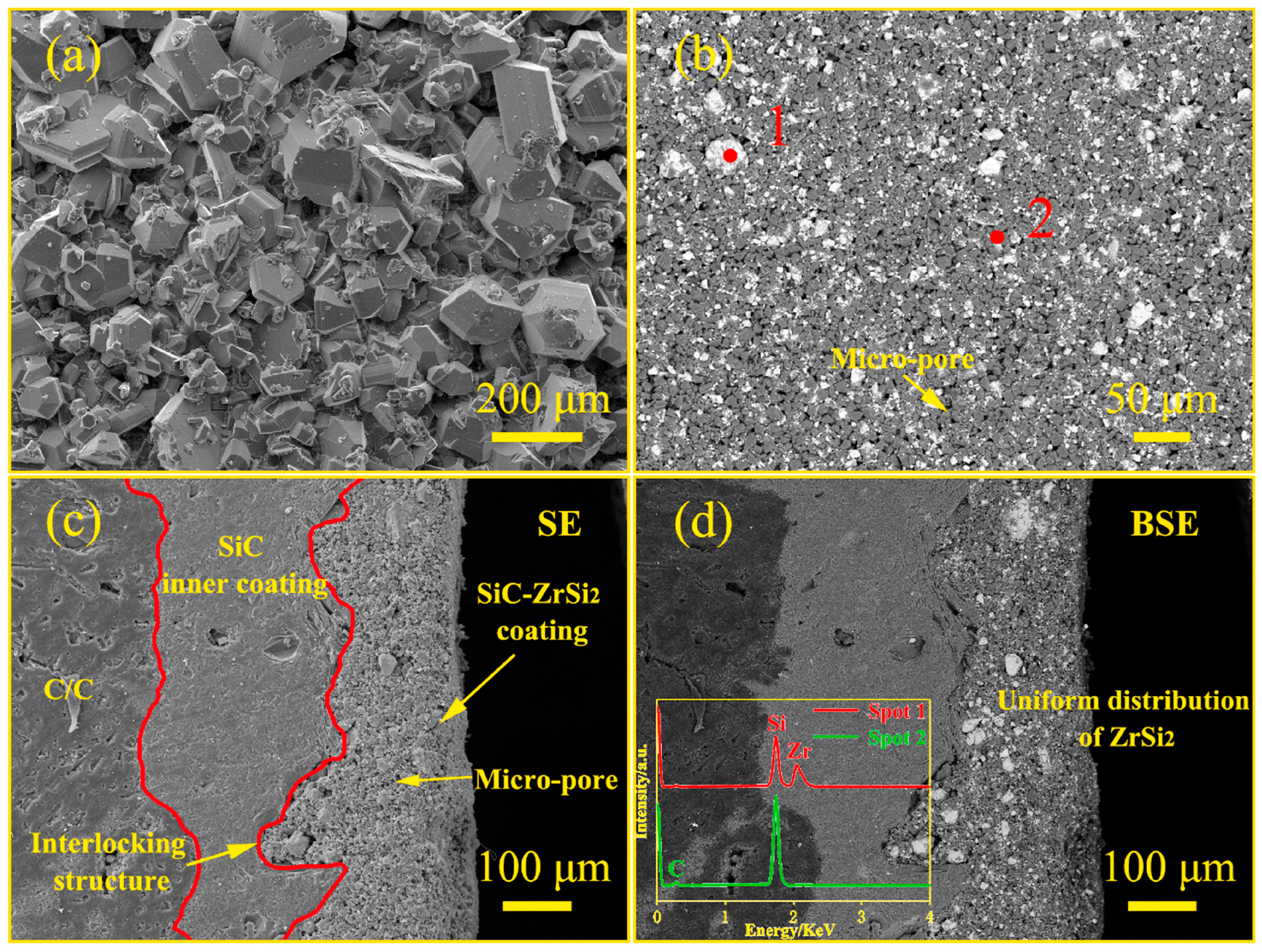
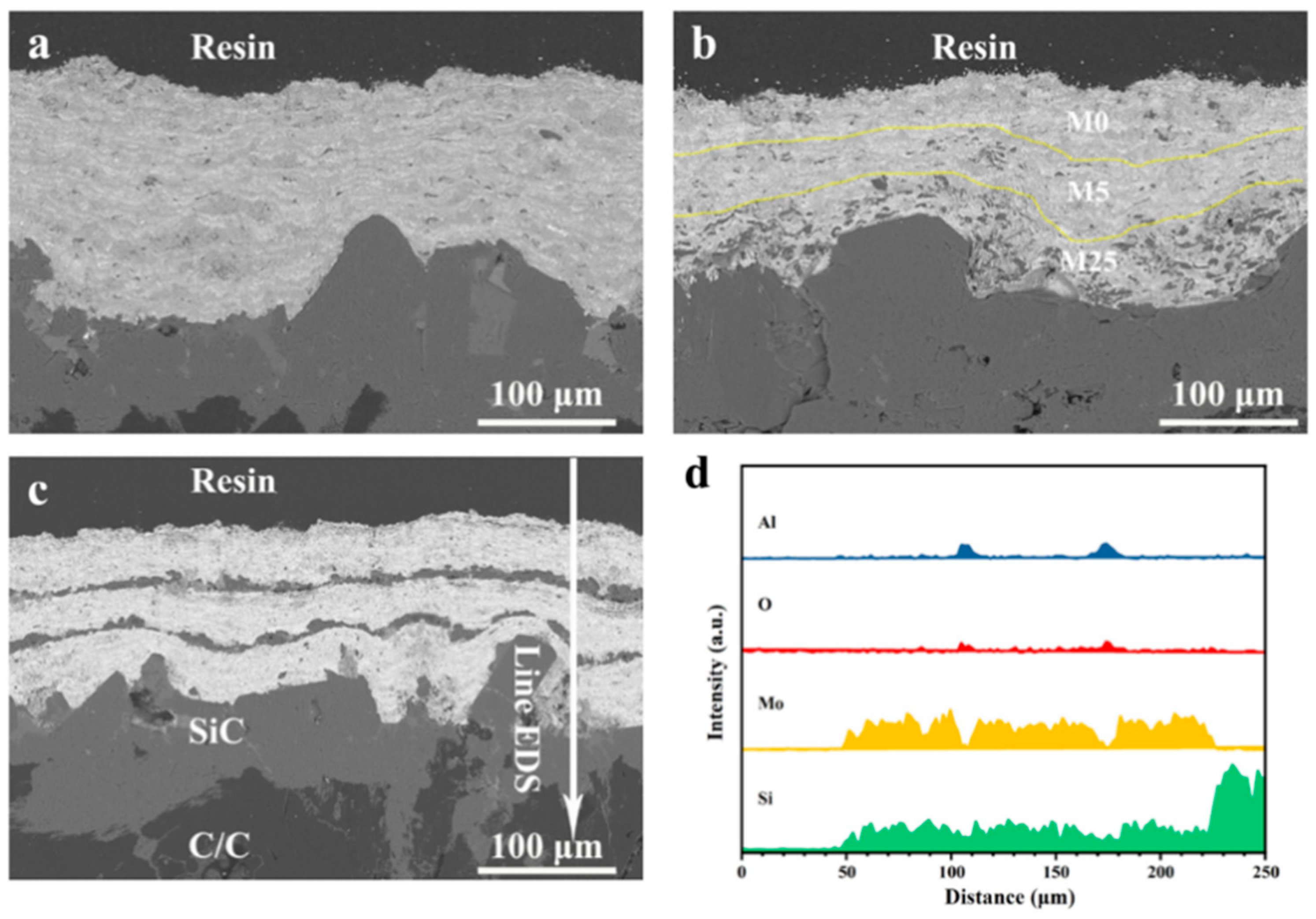
Similarly to boride-based composite coatings, carbide-based composite coatings have also attracted extensive research attention in the field of high-temperature oxidation protection [84]. They are anchored on core matrix phases of high-melting-point carbides such as SiC, ZrC, HfC, and TaC, owing to their exceptional thermal stability and chemical inertness. The difference is that carbides have higher melting points and excellent high-temperature stability, showing great potential in ultra-high-temperature oxidation protection [85,86]. Among these carbides, SiC is widely used because it can form SiO2 glass phases under high-temperature oxidizing conditions. However, single carbides are difficult to meet the long-term oxygen-blocking requirements at high temperatures. Therefore, in the actual design of high-temperature oxidation-resistant coatings, SiC is mainly compounded with other carbide ceramics or thermal protection materials, such as common systems like HfC-SiC, SiC/ZrB2-SiC, ZrB2-ZrC-SiC, and ZrC-SiC-TiC [87,88,89]. Additionally, Du et al. [90] prepared a HfC-TaC-B4C-SiC/ZrSiO4-glass composite coating on C/C composites through slurry sintering, which extended the oxidation resistance time by two to three times compared to traditional coatings. The long-term oxidation resistance of the coating was attributed to the fixing effect of ZrSiO4 in the outer layer, the increase in Al2O3 content, and the formation of a dense Hf-Ta-Si-O/Si layer during oxidation. Zhu et al. [91] designed SiC/SiC-ZrSi2 coating with a microporous structure on C/C substrate through simple filler cementation and slurry methods, as shown in Figure 7. This structured coating could oxidize at 1500 °C for 1194 h and only gained 1.42% in mass. This was mainly because the pores between SiC and ZrSi2 powders increased the oxidizable area, generating a large amount of SiO2 glass phase in the coating. The SiO2 glass phase not only repaired cracks on the coating surface, but also embedded into the ceramic particles of the SiC-ZrSi2 coating, forming a SiO2-ceramic embedding structure with extremely low oxygen permeability, and effectively alleviated the CTE mismatch. Huang et al. [92] prepared a ZrB2-ZrC-SiC high-temperature oxidation-resistant ceramic composite coating on C/C composites via laser cladding. The formation of high-temperature phases ZrO2 and ZrSiO4 effectively protected the C/C substrate at 1600 °C for 80 min. Liu et al. [93] employed liquid silicon infiltration to create a dense SiC-Si composite coating on graphite substrate. The network-structured Si promoted the development of SiO2 phases with excellent oxygen-blocking ability, resulting in a mass gain of only 3.018% after 300 h isothermal oxidation at 1600 °C. Yang et al. [94] generated TiSi2-Si-SiC/SiC bilayer coating on graphite via two-step filling and cementation technique. Small TiSi2 particles were embedded in SiC particles. In high-temperature oxidizing environments, small TiSi2 particles were oxidized firstly, reducing SiC consumption. Thus, after 200 h oxidation in static air at 1500 °C, the coating exhibited a mass gain of only 0.96%.
Overall, carbide composite coatings based on SiC exhibit excellent properties such as high melting point, excellent high-temperature oxidation resistance, and high-temperature strength of carbides. Additionally, they can utilize flowing glass phases to repair cracks, micropores, and other defects in the coating, achieving improved thermal stability of the coating. But carbide ceramic coatings have poor toughness, and further research is needed to address this mechanical performance deficiency.

2.2.3. Nitride-Based Composite Coatings

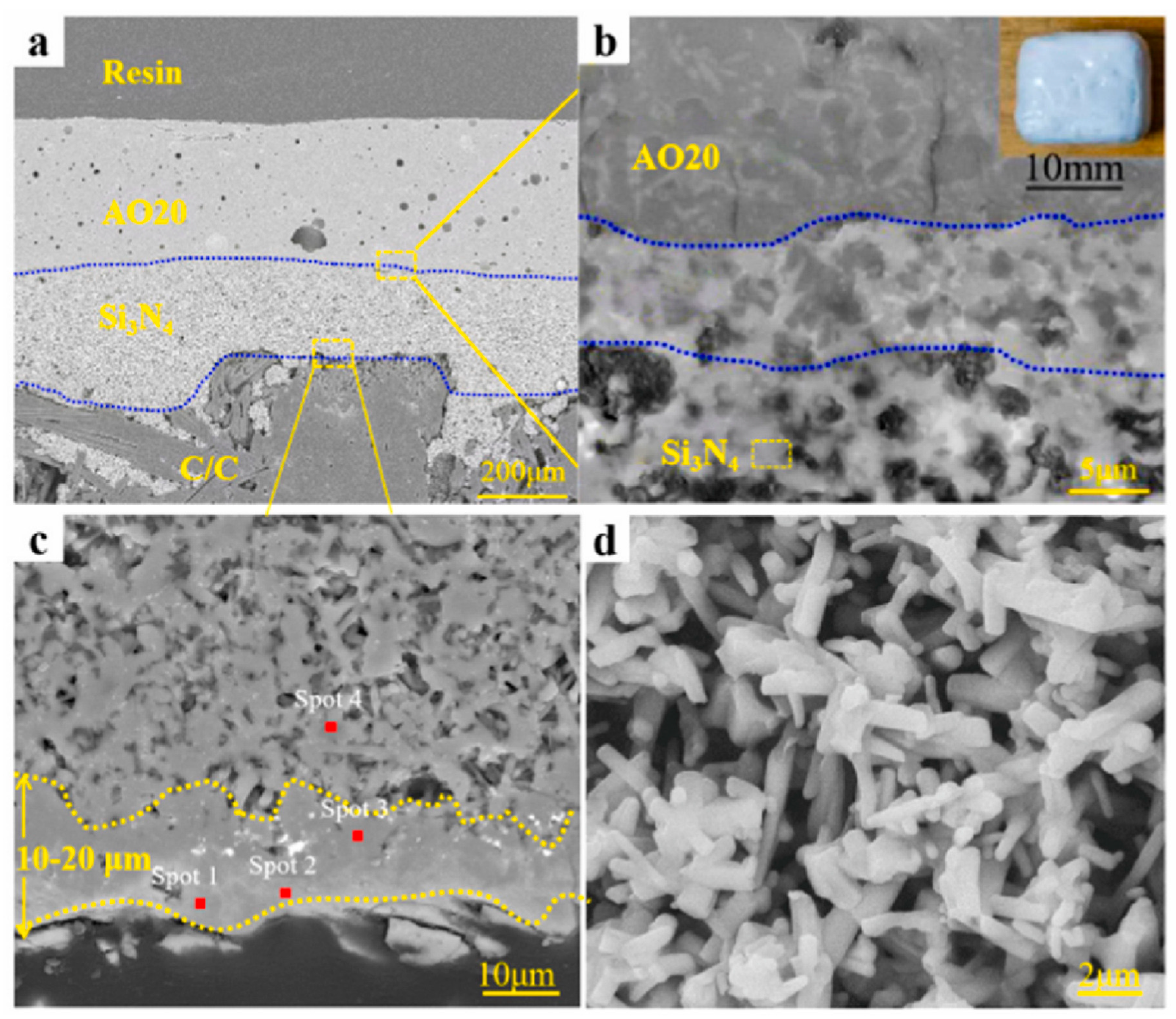
Nitride-based composite coatings have high hardness, thermal stability, excellent wear resistance, high oxidation resistance, and corrosion resistance, so they are also favored in the field of oxidation resistance. Materials such as TiAlN, TiAlSiN, and Si3N4 rely on Al and Si elements in the coating materials to form dense Al2O3 and SiO2 layers in high-temperature oxidizing environments, blocking further oxygen infiltration into the substrate [95,96]. Fan et al. [97] deposited a TiAlN/CrAlON/CrAlO composite coating via cathodic arc evaporation. It exhibited good oxidation resistance at 950 °C because the outer CrAlON and CrAlO can effectively slow down the spread of oxidation. However, Si3N4 performs even better in higher temperature fields, not only for its excellent high-temperature stability, but also for its ability to rapidly form a continuous, dense glass layer in high-temperature oxidizing atmospheres. Therefore, many researchers have developed a series of high-temperature oxidation-resistant coatings based on Si3N4. For example, Wang et al. [98] prepared a Al-doped Ti-12Si3N4 coating on a Ti-6Al-4V alloy surface via laser cladding. Following 100 h of isothermal oxidation at 700 °C, the coating gained only 3.9% in mass, much lower than the 32.3% of the uncoated substrate. This design skillfully alleviated the compatibility between Si3N4 and the titanium alloy substrate and improved coating oxidation resistance. Du et al. [99] combined embedding and slurry brushing to prepare AO20/Si3N4 bilayer coating on C/C substrate, as shown in Figure 8. The porous Si3N4 coating could effectively alleviate thermal stress in the coating, resulting in a weight loss of only 0.32% after 36 thermal shocks at 1400 °C and a mass loss rate of 2.86% after 134 h oxidation at 1400 °C.
It is evident that nitride-based composite coatings hold considerable promise for high-temperature oxidation protection. Porous Si3N4 coatings have also shown great application potential in alleviating thermal stress between coatings and substrates. However, compared with boride-based and carbide-based composite coatings, nitride-based composite coatings exhibit insufficient protection ability in high-temperature oxidation resistance fields due to their lower melting points, requiring further in-depth research.

2.2.4. Oxide Ceramic Composite Coatings

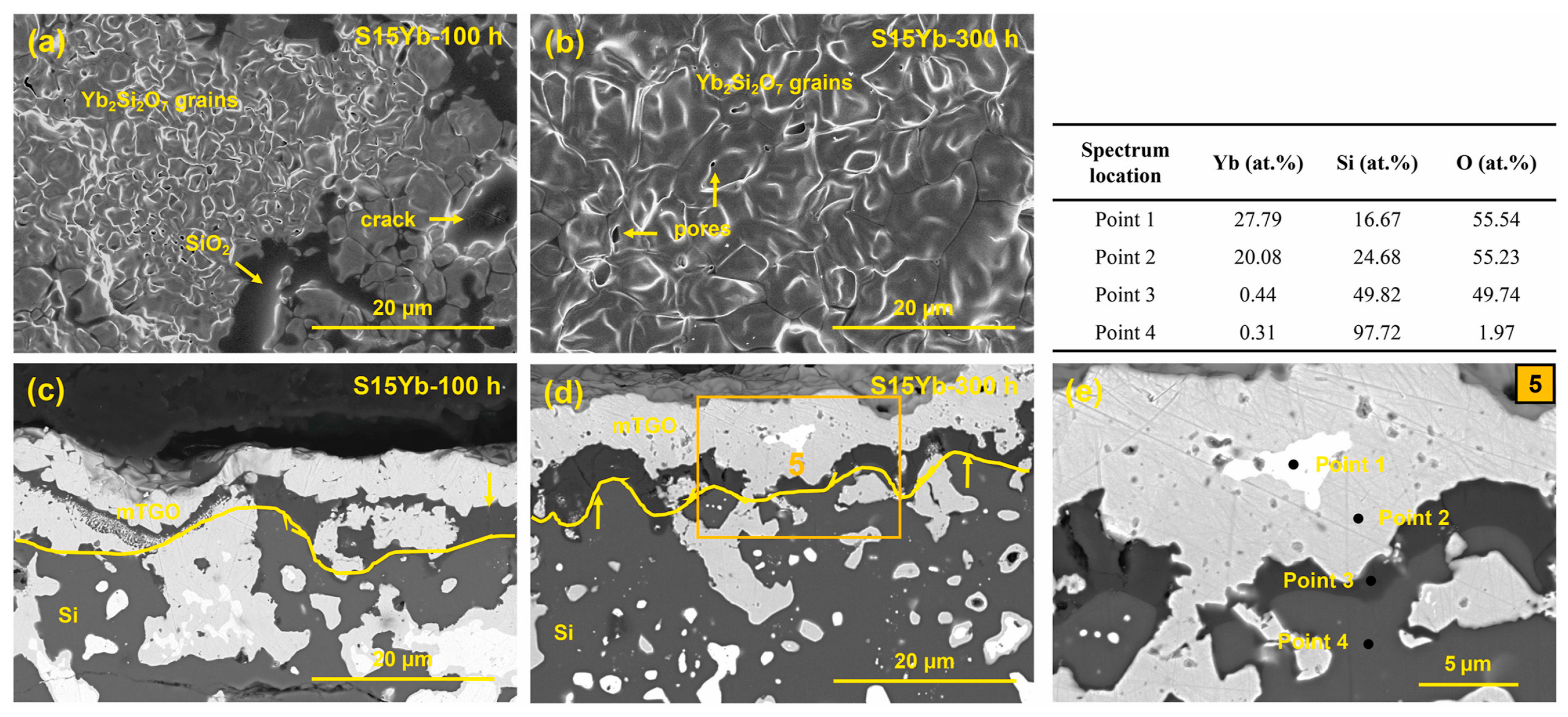
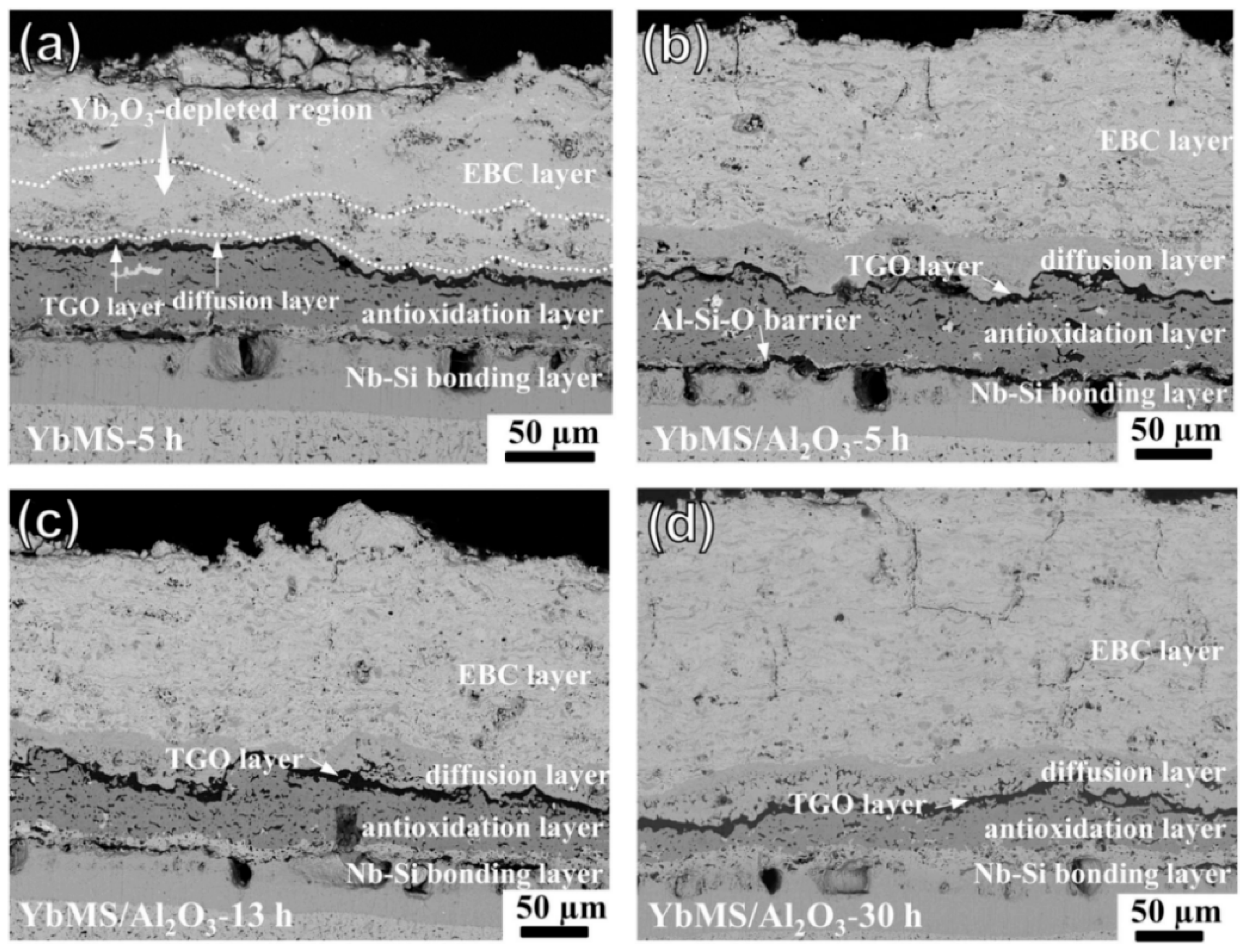
Oxide ceramic composite coatings consist of one or more inert oxides that hardly react with the substrate [100,101]. They take advantage of the high melting point, good chemical inertness, and high-temperature stability of oxide ceramics to mechanically block oxygen diffusion into the substrate, improving the high-temperature oxidation resistance of the substrate. Common ones include Al2O3, ZrO2, HfO2, etc. To avoid large cracks between the coating and the substrate, reasonable coating composition design and appropriate coating preparation processes are required [102,103]. For instance, Zhou et al. [104] fabricated a continuous, dense 8YSZ-Al2O3 composite coating on GH3039 alloy surface by sol–gel. After 100 h isothermal oxidation at 1000 °C, the coating showed no obvious spallation with a mass gain of 0.50 mg/cm2, only 14% of that of the substrate. It skillfully used YSZ as a transition coating to alleviate the negative impact of mismatched thermal expansion coefficients between the coating and the substrate. Mao et al. [105] prepared Yb2O3-Si coatings with different Yb2O3 contents through vacuum plasma spraying. The coating of 15 wt% Yb2O3 (S15Yb) offered the best high-temperature oxidation resistance, which can protect the substrate in oxidizing conditions at 1350 °C for 300 h, mainly attributed to the formation of a TGO layer composed of Yb2Si2O7 and an mTGO layer during high-temperature oxidation of the coating (as shown in Figure 9). Both thick and uneven oxide layers showed good oxygen diffusion resistance, greatly protecting the substrate. Zhou et al. [106] employed liquid plasma-assisted particle deposition and sintering to prepare a HfSi2-HfO2-SiO2 nanocomposite coating on a TiAl alloy. The introduction of SiO2 formed a dense HfO2-SiO2 oxide layer, which could effectively delay crack initiation and block oxygen diffusion into the substrate, exhibiting good oxidation and ablation resistance.
Coating systems composed of a variety of inert oxide components using their respective melting points, thermal expansion coefficients, thermal stability and other characteristics, or oxide ceramic coating systems that rely on high temperature, as well as Si, SiO2, and other components, to form dense layers all have their own shining points in the field of high temperature oxidation. Due to the inherent brittleness of oxide ceramic coatings and the difference in thermal expansion coefficients between high-temperature alloys and carbon-based composite substrates, the bonding strength between the coating and the substrate under greater thermal stress conditions requires close attention.

2.2.5. MAX Phase Composite Coatings

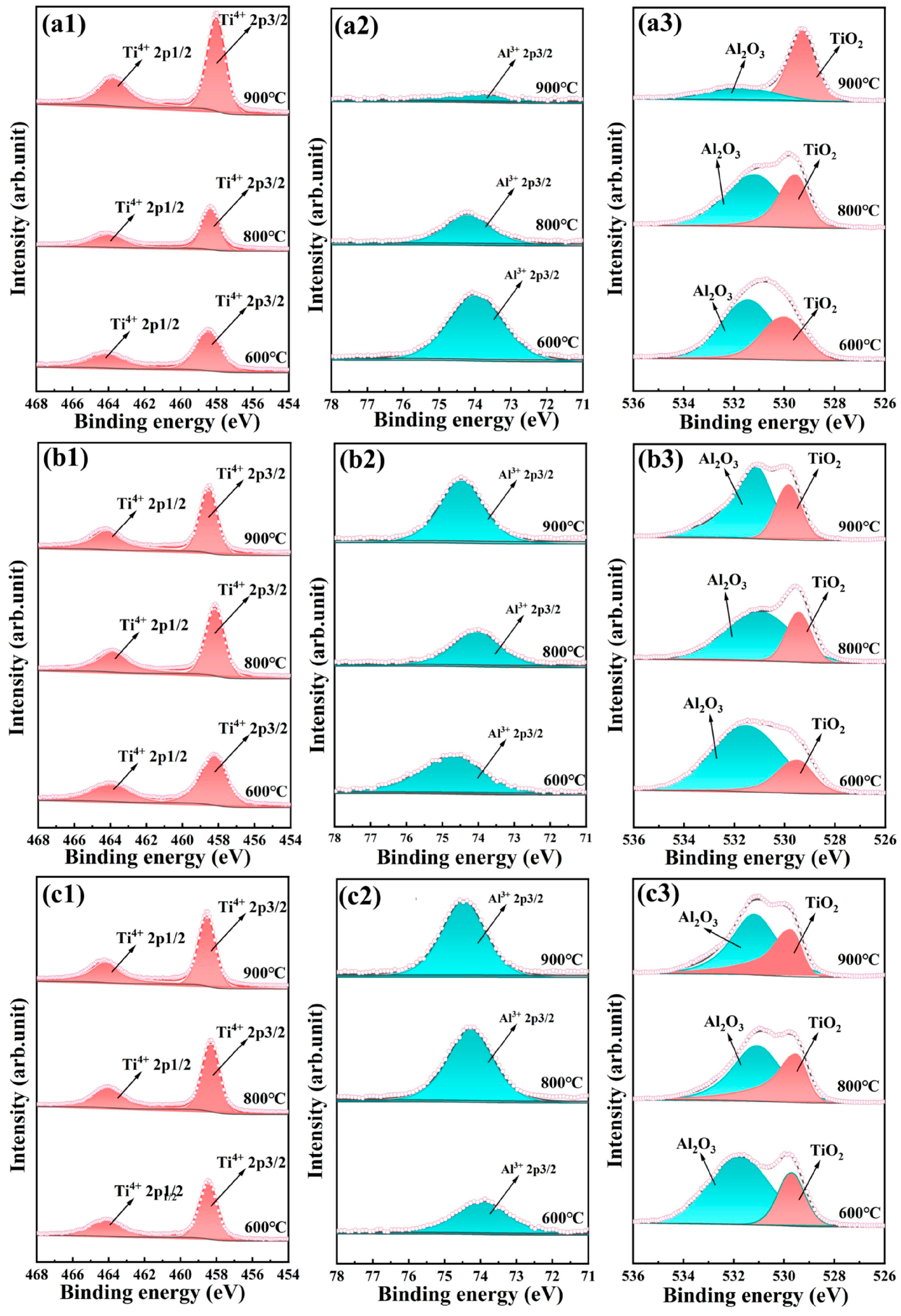
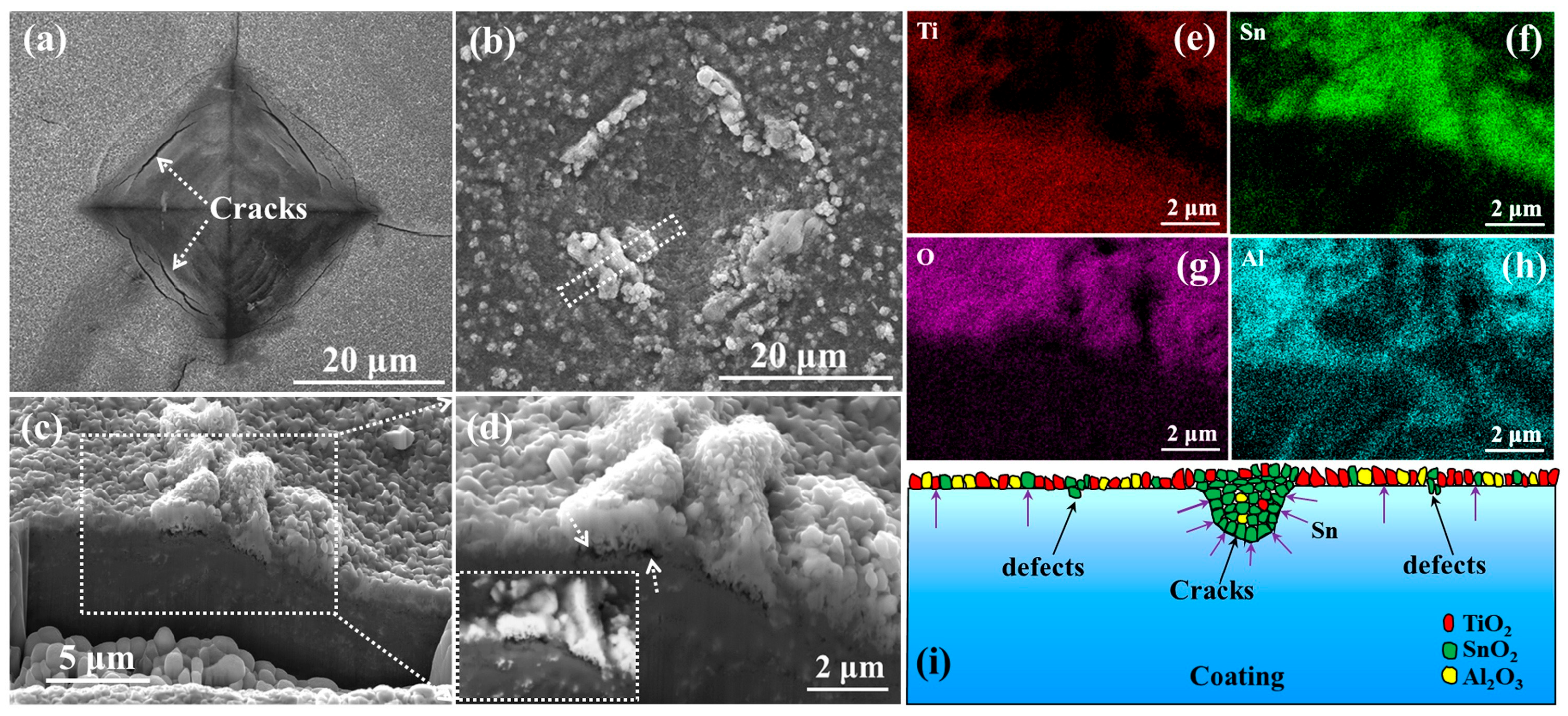
MAX phases are ternary carbides/nitrides or carbonitrides with a layered structure, with the general formula being Mn+1AXn (where M is an early transition metal, A is an A-group element, X is C, N, or both, and n = 1–3). They combine the advantages of metals and ceramics, such as good electrical and thermal conductivity, good oxidation resistance, excellent thermal shock resistance, and processability. High-temperature oxidation-resistant composite coatings developed based on MAX phases have great potential in the field of oxidation protection for thermal structures [107,108,109,110,111]. Aluminide MAX phase coatings have been studied a lot in the field of oxidation resistance, mainly because Al atoms can easily diffuse to the coating surface and form a continuous, dense α-Al2O3 protective layer on the coating surface. Therefore, current research on the high-temperature oxidation resistance of MAX phase composite coatings mainly focuses on Cr-based Cr2AlC and Ti-based Ti2AlC coatings. When exposed to high-temperature air, Cr2AlC coatings can form Cr2O3 and Al2O3 oxide layers, which exhibit excellent thermal and chemical stability, effectively preventing further oxidation of Cr2AlC coatings and substrates by oxygen or other oxidizing media [112,113,114,115,116]. Zhu et al. [117] prepared two types of Ti-Al-N MAX phase composite coatings (T1 and TA4) on TC4 alloy surfaces using laser cladding and laser heat treatment, respectively. Under high-temperature oxidation conditions ranging from 600 °C to 1000 °C, the oxide scale thickness of the T1 and TA4 coatings was reduced to approximately 0.93–0.5 and 0.74–0.49 times that of the pure TC4 substrate, respectively, demonstrating the excellent oxidation resistance of the composite coatings. According to XPS analysis (as shown in Figure 10), the oxidation resistance of both coatings and the difference between them are mainly attributed to the aluminum content available for forming a dense Al2O3/TiO2 composite protective layer. Mengis et al. [118] prepared Cr2AlC composite coating on titanium alloy substrate by magnetron sputtering. Due to the formation of protective Al2O3 and Cr2O3 oxide films during oxidation, the coating displayed a mass gain per unit area of only 0.70 mg/cm2 after 300 h isothermal oxidation at 800 °C. Wang et al. [119] designed a Sn-doped Ti2(Al0.6Sn0.4)C oxidation-resistant composite coating on a TC4 substrate by magnetron sputtering. Following 60 h of isothermal oxidation at 800 °C, the coating exhibited a mass gain of 1.75 mg/cm2. Doping Sn to replace part of Al enabled crack self-healing at 700 °C. Figure 11 shows the microstructure and main mechanism of the Ti2(Al0.6Sn0.4)C oxidation-resistant coating after self-healing. It can be seen that the main self-healing mechanism of the coating is the filling of cracks with SnO2 and TiO2, and the filled oxides show a dense structure, while the interface between the coating and the oxides is not completely healed, possibly due to limited healing time.
MAX phase composite coatings based on Cr2AlC and Ti2AlC provide a novel approach for oxidation resistance of substrates at 1000 °C by their ability to rapidly form protective films and self-healing mechanisms. However, when the temperature exceeds 1000 °C or even higher, severe interdiffusion occurs between Al-containing MAX coatings and substrates, which can lead to the formation of brittle phases such as Cr7C3 and Cr2Al, seriously affecting coating performance. Therefore, the diffusion mechanism of Al in coatings and service at higher temperatures are key areas for future research.

2.3. Enamel Composite Coatings

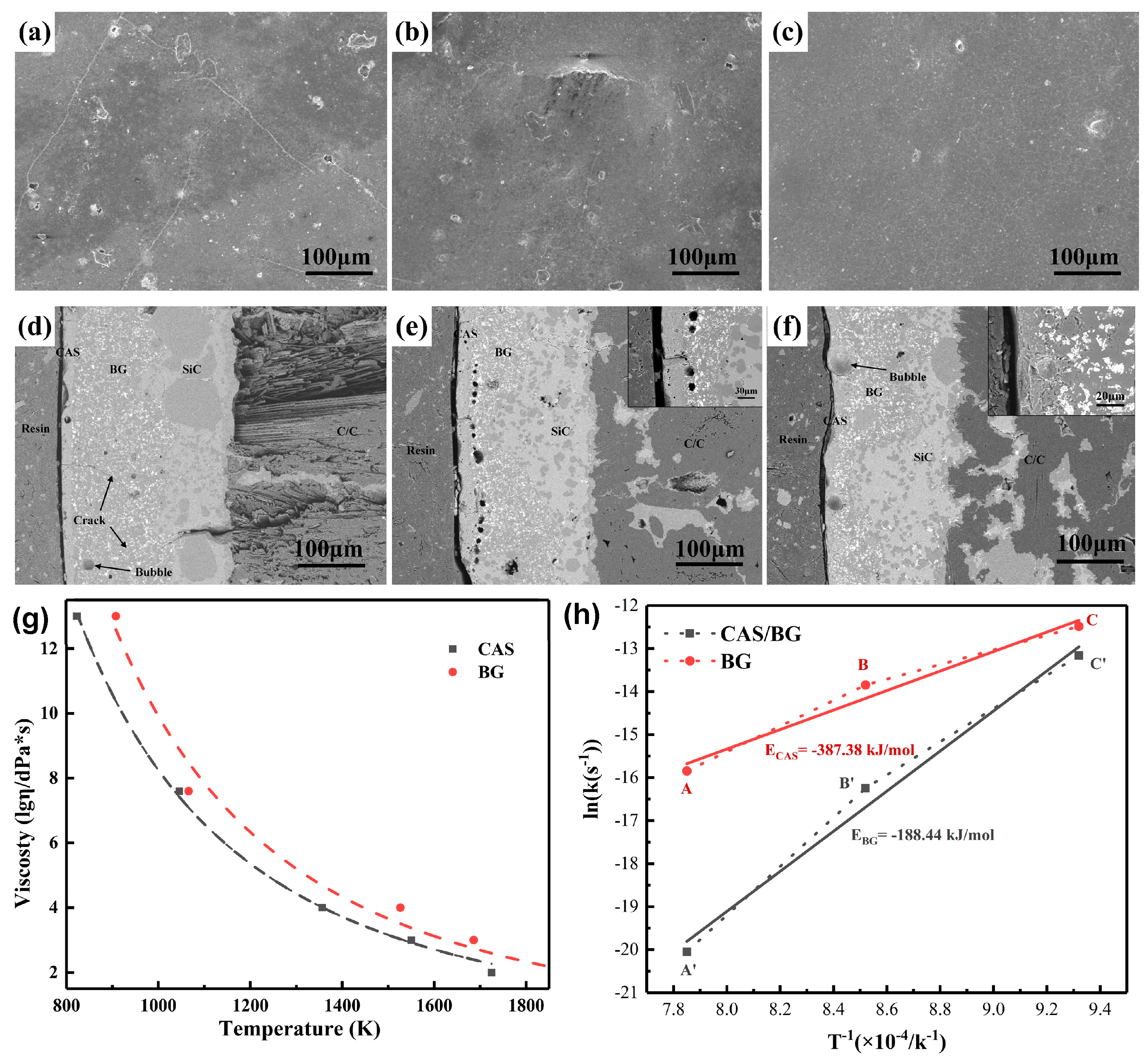
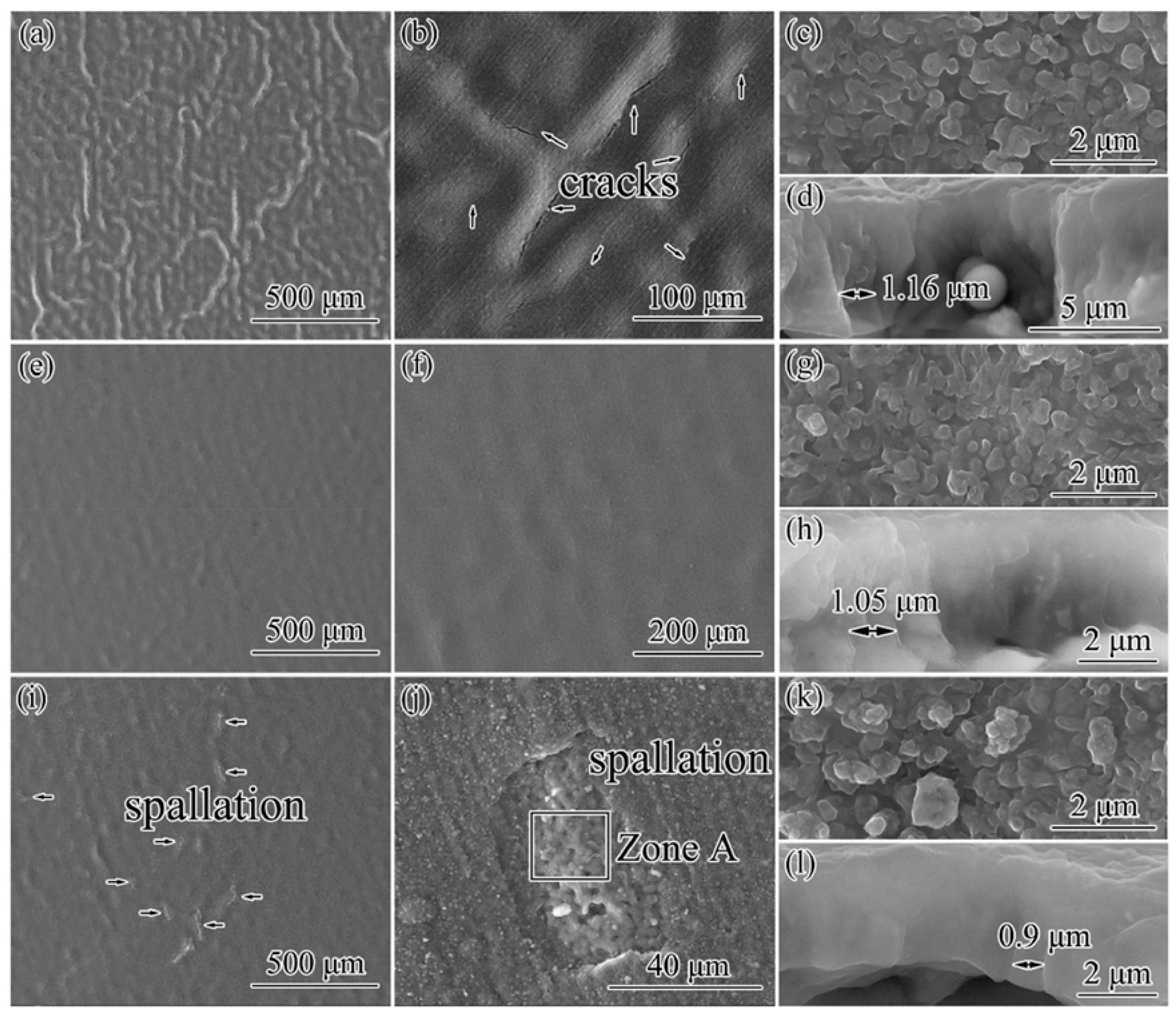
Currently, enamel-based composite coatings for high-temperature oxidation protection are mainly constructed with silicate glass coatings and multi-phase composite glass. By adjusting the oxide content, the thermal expansion coefficient of the coating can be matched to that of the substrate, further enhancing oxidation resistance [120]. For example, Yu et al. [121] prepared an oxidation-resistant enamel composite coating on the surface of Ti-6Al-4V alloy by slurry impregnation using SiO2, BaO, kaolin, and quartz particles as raw materials. The addition of kaolin and quartz ceramic particles improved the stability of the alloy/Ti5Si3/Al2O3/enamel layered structure formed at the interface and increased the viscosity of the glass phase. It effectively reduced oxygen permeability, providing 5 h of effective protection for the alloy substrate at 1200 °C and improving the oxidation resistance of the titanium alloy by 50%. Li et al. [122] created SiO2-MO-K2O-ZrO2 (M = Sr or Ca)-based enamel composite coatings with different Al2O3 contents on K444 superalloy via spraying. The coating with 10 wt% Al2O3 exhibited the best oxidation resistance, with almost no mass loss after cyclic oxidation tests at 1000 °C, mainly because enamel coatings with more than 6 wt% Al2O3 promoted the formation of a continuous alumina scale at the enamel/alloy interface, thereby improving the oxidation resistance and bonding strength of the enamel. Gu et al. [123] fabricated a CaO-Al2O3-SiO2/ZrO2-borosilicate multi-layer oxidation-resistant glass coating (CAS/BG) on a C/C substrate through the slurry method. The weight loss rates of the coated C/C samples after 50 h oxidation at 1073 K, 1173 K, and 1273 K were 21.70%, 1.63%, and 0.035%, respectively, showing an increasing trend in oxidation resistance with increasing temperature. According to the surface/cross-sectional morphologies of the coating after oxidation at different temperatures in Figure 12, as well as the analysis of the viscosity and activation energy of the inner and outer layers of the coating, this was mainly attributed to the improved glass flow healing ability at high temperatures. Fan et al. [124] applied PDC technology and slurry brushing to create a SiCN/borosilicate glass-B4C-Al2O3 coating on C/C composites. After 10 h oxidation in air at 700 °C, 800 °C, and 900 °C, the mass losses were 0.12%, 0.51%, and 0.29%, respectively. This was mainly because B2O3 could repair cracks in the coating, improving coating density, and Al2O3 present in the glass layer could inhibit B2O3 volatilization, synergistically endowing the coating with excellent oxidation resistance. Zhou et al. [125] used the PADD method to prepare a new β-Y2Si2O7NWs-Y2SiO5/YAS multi-layer microcrystalline composite coating on a SiC-coated C/C composite material. The dense microcrystalline glass coating effectively hindered the diffusion of oxygen to the matrix and inhibited crack propagation. It oxidized in air at 1400 °C for 176 h, and the mass loss of the coating sample is only 0.317 mg/cm2. Gao et al. [126] invented ZrO2/ZrSiO4-glass composite coating for high-temperature oxidation protection of C/C substrates. Due to the self-healing ability of the glass phase and the slow bubble growth rate, the coating with 20 wt% ZrO2 demonstrated the best performance, losing only 0.6% weight after 650 h at 1300 °C.
In conclusion, compared with other coatings, enamel composite coatings have simple preparation processes, low costs, and are suitable for parts with complex shapes. When the temperature is higher than the softening temperature of the glass components, the highly fluid glass migrates to defects such as microcracks and pores under surface tension and capillary force, thereby self-repairing damaged coatings and extending service life. However, enamel composite coatings tend to evaporate and degrade at very high temperatures and are easy to cracking during thermal cycling. These issues currently limit their broader application.

2.4. Inorganic Paint Composite Coatings

High-temperature oxidation-resistant inorganic paint composite coatings are typically formed by mixing high-temperature-resistant fillers into high-temperature-resistant inorganic binders, applying or spraying them onto the substrate surface at room temperature, followed by heating and curing. Common inorganic binders mainly include phosphate and silicate categories, among which aluminum phosphate binders are most widely used, benefiting from their excellent high- and low-temperature resistance, low curing temperature, adjustable curing temperature, good bonding performance, and simple processing and forming [127]. In recent years, high-temperature oxidation-resistant inorganic paint composite coatings based on inorganic aluminum phosphate binders have attracted much attention. For instance, Han et al. [128] used an aluminum phosphate binder mixed with Al2O3 and SiC as a slurry to fabricate an oxidation-resistant aluminum phosphate composite coating on a Ti65 titanium alloy substrate. Due to the high density, excellent thermal stability, and chemical stability of the coating, following 60 h of isothermal oxidation at 800 °C, the mass gain of the coating was 1.75 mg/cm2. Xu et al. [129] designed Y3+- and Zr4+-modified aluminum phosphate coatings on graphite substrate by solution impregnation. Y3+ could improve the wettability of the aluminum phosphate impregnating solution on the graphite surface, Zr4+ could reduce the thermal expansion coefficient of the aluminum phosphate coating, and the formation of small amounts of Y2O3 and ZrO2 resulted in a mass gain of approximately 6.23 mg/cm2 after 5 h isothermal oxidation at 1000 °C. Zhao et al. [130] employed slurry spraying to produce an Al/AlPO4 + SiC/AlPO4 multi-layer composite coating on Ti65 alloy. In the initial oxidation stage, a protective Al2O3 film formed rapidly and an intermetallic oxide diffusion layer also developed between the coating and the alloy substrate. As a result, after 400 h of isothermal oxidation at 650 °C, the coating exhibited a mass gain of only 0.25 mg/cm2, demonstrating excellent oxidation resistance. Li et al. [131] designed phenolic resin/phosphate organic–inorganic hybrid paint oxidation-resistant coating through a combination of sol–gel and air spraying. The addition of phenolic resin formed a heat-stable network structure with aluminum phosphate, and the carbonized resin provided structural support for the phosphate coating (as shown in the coating morphology after oxidation in Figure 13). After 100 h of isothermal oxidation at 600 °C, the mass gain was measured at 0.085 mg/cm2.
Overall, phosphate coatings themselves have good heat resistance. High-temperature oxidation-resistant inorganic paint composite coatings developed by doping Al, SiC, and other thermal protection fillers into phosphate or modifying their structure with resins have shown unique advantages in the field of oxidation resistance, achieving long-term oxidation protection at medium and low temperatures while simplifying preparation methods and enabling oxidation protection for various thermal structural substrates. However, coating systems for higher-temperature applications of inorganic paint composite coatings and effective measures to alleviate thermal expansion coefficient mismatch caused by the brittleness of phosphate-based coatings need further development.

3. Structural Regulation Design

Oxidation-resistant composite coatings are important barriers ensuring continuous use of thermal structural materials in high-temperature oxidation environments. The design of coating material compositions determines their ability to block oxygen under high-temperature conditions. As oxidation environments become more severe and complex, coatings face issues such as accumulated interfacial stress between coating and substrate as well as reduced service life, leading to decreased stability. Therefore, optimizing coating structures to improve their high-temperature oxidation resistance, thermal stability, and durability has become a research hotspot in the field of high-temperature oxidation resistance.

3.1. Multi-Layer/Gradient Structures

Under high-temperature oxidation conditions, once a single-layer coating is damaged, the substrate is exposed, affecting the service life of hot-end components. Designing multi-layer/gradient structures can significantly improve the high-temperature oxidation resistance of coatings and extend their service life. Multi-layer composite coatings usually consist of two or three of a buffer layer, an oxygen-blocking layer, and a sealing layer. The buffer layer alleviates thermal stress caused by mismatched thermal expansion coefficients between the substrate and the coating, avoiding crack formation between coatings. The oxygen-blocking layer acts as a barrier to prevent external oxygen from entering the substrate, and the sealing layer densifies the coating surface, reducing oxidation active sites [132,133,134]. Hu et al. [135] prepared a multi-layer MoSi2-Mullite composite coating on a C/C composite substrate via atmospheric plasma spraying, as shown in Figure 14. The design of the multi-layer structure effectively alleviated thermal stress in the coating, improved its high-temperature oxidation resistance, and after 226 h of isothermal oxidation at 1500 °C, a mass gain of 1.75 mg/cm2 was observed for the coating, which was only half the mass loss of the single-layer structure coating. Additionally, Tang et al. [136] combined the slurry method and vapor deposition to prepare a HfSi2-ZrSi2-modified SiC/ZrB2-SiC/SiC multi-layer coating on a Cf/SiC composite. The composite coating not only produced SiO2 glass phases that repaired defects, achieving self-densification of the coating, but also had excellent interfacial bonding strength and ablation resistance. Chen et al. [137] created a Yb2Si2O7/SiC bilayer oxidation-resistant coating on the surface of a C/SiC composite via combination of chemical vapor deposition (CVD), sol–gel, and air spraying. After 100 h isothermal oxidation at 1500 °C, the weight loss rate was only 0.81 mg/cm2, significantly improving the oxidation resistance of the C/SiC composite. To improve the oxidation resistance of C/C composites, Quan et al. [138] designed a multi-layer SiC/ZrB2-CrSi2-Si/SiC composite coating at low temperature through a combination of chemical vapor deposition, brush sintering, and pre-oxidation. Due to the formation of borosilicate glass and thermally stable ZrSiO4 phases after high-temperature oxidation, as well as the synergistic effect of self-healing mechanisms in inner and outer layers, the long-term oxidation life of the composite coating was effectively extended, exhibiting minimal mass loss of 8.05 mg/cm2 after 340 h isothermal oxidation at 1400 °C. Gai et al. [139] developed an alternating SiC/HfB2 multi-layer coating on a C/C composite by chemical vapor deposition. The alternating multi-layer structure effectively prevented stress concentration, enhanced the overall stability of the coating, and showed significant linear and mass ablation rates of −0.26 μm/s and 0.14 mg/s, respectively, after 30 s ablation by an oxyacetylene flame with a heat flux of 2.4 MW/m, exhibiting good high-temperature oxidation resistance and ablation resistance.
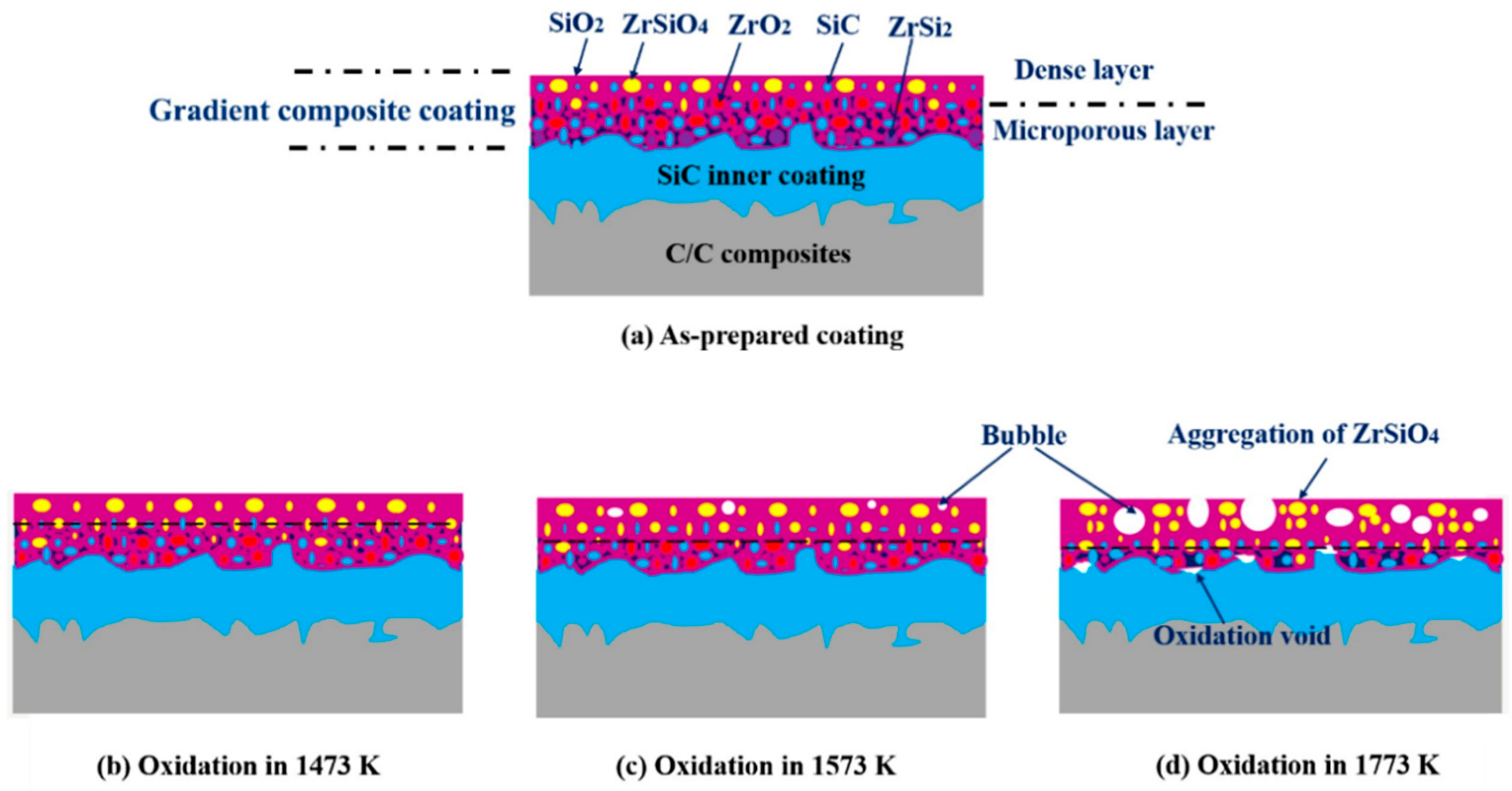
Gradient coatings refer to coating systems where composition and/or structure transition continuously and smoothly from the base material to the surface functional layer. Through gradient design, multiple thermal protection functions can be integrated into the coating, significantly improving its thermal protection performance. For example, Zhu et al. [140] designed a gradient structure coating with a dense outer layer and a microporous inner layer, where the dense layer had excellent oxygen diffusion resistance, and the microporous layer reduced CTE mismatch between the inner SiC layer and the glass layer on the coating surface. Compared with SiC-coated samples, the mass retention rate of gradient composite coating-coated samples increased from 62.9% to 97.94%. After oxidation at 1473 K for 810 h, 1573 K for 815 h, and 1773 K for 901 h, mass gains of the gradient coating were 1.62%, 1.48%, and 1.14%, respectively. The oxidation resistance mechanism of the gradient coating at different temperatures is shown in Figure 15. As oxidation temperature increased, SiC particles in the microporous layer were oxidized, generating SiO2 that filled pores and thickened the dense layer. After oxidation at 1573 K and 1773 K, although bubbles formed in the dense layer, a glass layer of a certain thickness still protected the substrate; ZrSiO4 particles also deflected and arrested cracks. Yang et al. [141] also prepared gradient ZrB2-MoSi2-SiC dense layer in porous 3D needled carbon fiber composite, which significantly improved both emissivity and oxidation resistance. Guan et al. [142] designed a gradient MoSi2-borosilicate glass composite coating on a mullite fiber insulation tile via in situ reaction. The excellent oxidation resistance of the coating is mainly due to the interface layer of the bilayer gradient coating, which improved mechanical and thermal compatibility with the substrate and effectively inhibited interfacial radial cracking. Additionally, the coating had excellent thermal shock resistance and high emissivity. Zhang et al. [143] fabricated a novel gradient CrSi2-ZrSi2-SiC-Si composite coating on a C/C composite via optimized pre-oxidation and two-step pack cementation. The SiO2-ZrO2-Cr2O3-ZrSiO4 oxide layer formed under high-temperature oxidation conditions had good structural stability and oxygen-blocking ability, and the final coating exhibited a weight gain of only 4.83 mg/cm2 at 1500 °C for 604 h. Wang et al. [144] utilized vacuum infiltration sintering to prepare a NiCoCrAlYTa/Al2O3 gradient coating on single-crystal superalloy. Al2O3 reacted with the matrix to form YAlO3, which inhibited intergranular crack propagation and improved thermal shock and oxidation resistance.
In summary, establishment of multi-layer/gradient structures can not only alleviate thermal stress between coating and substrate, but also further improve high-temperature service performance. However, further research is needed on the long-term service stability of multi-layer composite coatings and their performance under complex working conditions. The core advantage of gradient coatings lies in achieving adaptation to interfacial thermal stress between coating and substrate and improving oxygen-blocking performance through smooth transitions in structure and function. But in ultra-high-temperature environments, the bonding status of different layers in gradient coatings under higher thermal stress, and their adaptability to multi-field coupling require further research.

3.2. Diffusion Barriers

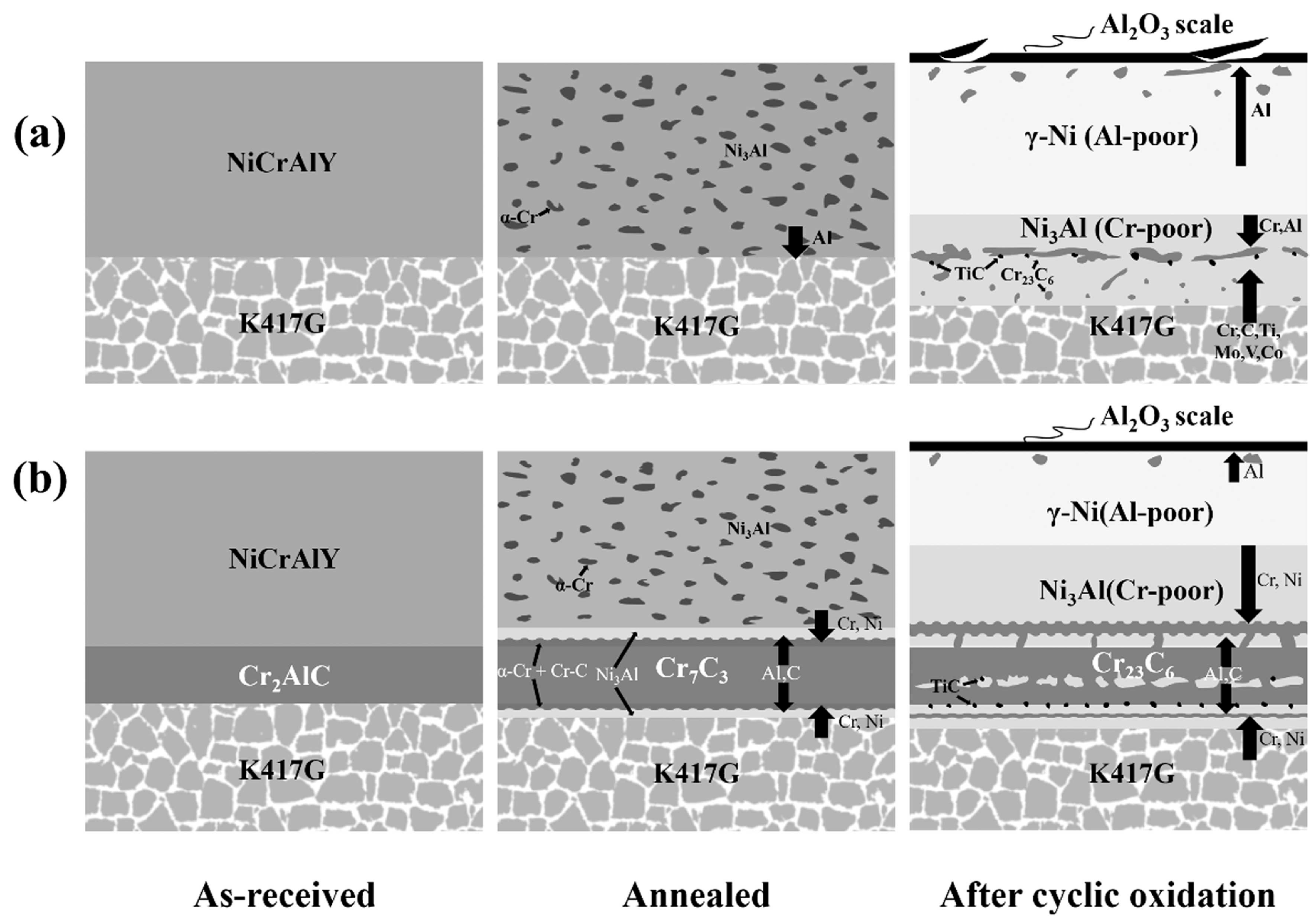
Diffusion barriers are primarily an added diffusion-blocking layer between the coating and the substrate, which can prevent element interdiffusion between the coating and the substrate, thereby increasing the service life of the coating. Due to severe element diffusion in metal substrates, especially superalloys, diffusion barriers are mainly applied to them. The primary function of a diffusion barrier is to reduce the rate of atomic migration near the interface, limiting mutual diffusion between the coating and the substrate. Based on material properties, they can be divided into metal diffusion barriers and ceramic diffusion barriers. Metal diffusion barriers have high compatibility with coatings or substrates but have poor stability and degrade quickly. In contrast, ceramic diffusion barriers have high stability and have attracted increasing research interest [145,146,147]. For example, Li et al. [148] prepared a Cr2AlC diffusion barrier between an NiCrAlY coating and an Ni-based superalloy, which underwent long-term cyclic oxidation at 1000 °C. As shown in Figure 16, after adding the diffusion barrier, Cr2AlC decomposed into Cr7C3 and Cr23C6 in sequence. The generated Cr23C6 could effectively block diffusion between the NiCrAlY coating and the substrate, and the Cr2AlC transition layer also provided additional Al for the NiCrAlY coating, significantly extending the service life of the NiCrAlY coating. Moreover, Cr2AlC, Cr23C6, and Cr7C3 all exhibited good thermal matching with both the substrate and coating, reducing the risk of spallation during thermal cycling. In another study, Li et al. [149] employed magnetron sputtering to prepare a Cr2AlC diffusion barrier on the surfaces of NiCrAlY and TiAl titanium alloy substrates. After being oxidized at 900 °C for 1000 h, the coating demonstrated a mass gain of 1.51 mg/cm2, exhibiting better oxidation resistance than the standalone NiCrAlY coating. Xu et al. [150] combined embedding and slurry sintering to produce a TaB2 diffusion barrier between the tantalum alloy substrate and MoSi2 coating. A porous layer formed between the boride diffusion barrier and the silicide layer, reducing the driving force for Si atom diffusion and slowing MoSi2 degradation. The coating provided oxidation protection to the alloy substrate at 1700 °C for 14 h and survived 1021 thermal cycles between room temperature and 1700 °C. Xu et al. [151] designed a Pt-modified, Re-based diffusion barrier NiCoCrAlY coating. The Re-based diffusion barrier can effectively inhibit element diffusion between the NiCoCrAlY coating and the substrate, thereby reducing the thickness of the oxide layer.
In summary, the diffusion barriers serve to enhance high-temperature coating stability. They achieve this by forming stable phases that block elemental interdiffusion, thereby slowing the generation of harmful phases at the interface. However, ideal diffusion barriers need to be good at stopping diffusion and stick strongly to both the substrate and the coating, but these requirements often conflict in practice. A barrier layer that completely blocks element diffusion may disrupt the formation of protective films at the interface and weaken coating–substrate adhesion. Additionally, harmful phases may form during long-term high-temperature diffusion reactions. Thus, further development is needed for research and application of diffusion barriers.

3.3. Self-Healing Structure Design

Designing self-healing structures in coatings is currently an extremely effective way to extend their service life. The self-healing mechanism of oxidation-resistant coatings primarily relies on low-viscosity glass phases formed at high temperatures, which can flow to fill small cracks or micropores generated in the coating during high-temperature service, repairing the coating and thus improving its oxidation resistance [152]. Among these, B2O3 and SiO2 are the most popular glass phases. B2O3 is typically generated by the oxidation of borides such as B4C, HfB2, and ZrB2, while SiO2 is provided by the oxidation of materials like SiC, SiB6, and MoSi2. It should be noted that pure B2O3 coatings tend to volatilize above 1000 °C, and SiC generates SiO2 slowly below 1500 °C with high viscosity, failing to effectively heal coating cracks. Therefore, to enhance coating self-healing ability, multiple self-healing system materials are usually combined to prepare oxidation-resistant coatings [153,154]. For example, Wang et al. [155] designed a self-healing ZrSi2-MoSi2 composite coating on SiC-coated C/C composites using ultrasonic plasma spraying. ZrO2/ZrSiO4 particles formed by the preferential oxidation of ZrSi2 reduced crack formation, and these particles pinned the surface protective SiO2 layer, inhibiting the re-cracking of the coating. Subjected to isothermal oxidation for 42 h at 1450 °C, the coating displayed a mass gain of 1.89%, exhibiting excellent oxidation resistance and self-healing ability. Wang et al. [156] prepared a SiB6-MoSi2 composite coating on a C/C composite substrate via plasma spraying. The rapid oxidation of SiB6 generated a low-viscosity B2O3-SiO2 borosilicate glass protective layer, reducing coating oxygen permeability and significantly extending service life and oxidation resistance. The coating exhibited only a 0.93% mass gain after 120 h isothermal oxidation at 1200 °C. Zhu et al. [154] applied low-temperature slurry impregnation densification to prepared HfO2-B2O3-SiC/SiC composite coating on C/C substrate. The coating was tested under isothermal oxidation at 1173 K for 403 h, 1473 K for 723 h, and 1773 K for 403 h, exhibiting mass gains of 0.38 mg/cm2, 2.14 mg/cm2, and 0.04 mg/cm2, respectively. As shown in Figure 17, the coating demonstrated broad-temperature self-healing capacity: it relied on B-O-Si glass for sealing cracks at lower temperatures and on HfSiO4-SiO2 glass at higher temperatures. Furthermore, HfO2 and HfSiO4 ceramic particles improved glass thermal stability and enhanced glass layer durability.
As a current research hotspot in high-temperature oxidation-resistant coatings, there are many composite coating systems that enhance high-temperature oxidation performance through self-healing structures listed in Table 2. Self-healing structure designs have effectively improved high-temperature oxygen-blocking ability and service life of coatings, complex compositional designs can even achieve wide-temperature-range protection. However, studies on how coatings behave at ultra-high temperatures and how well their mechanical properties are retained after self-healing require further attention.

3.4. Other Microstructures

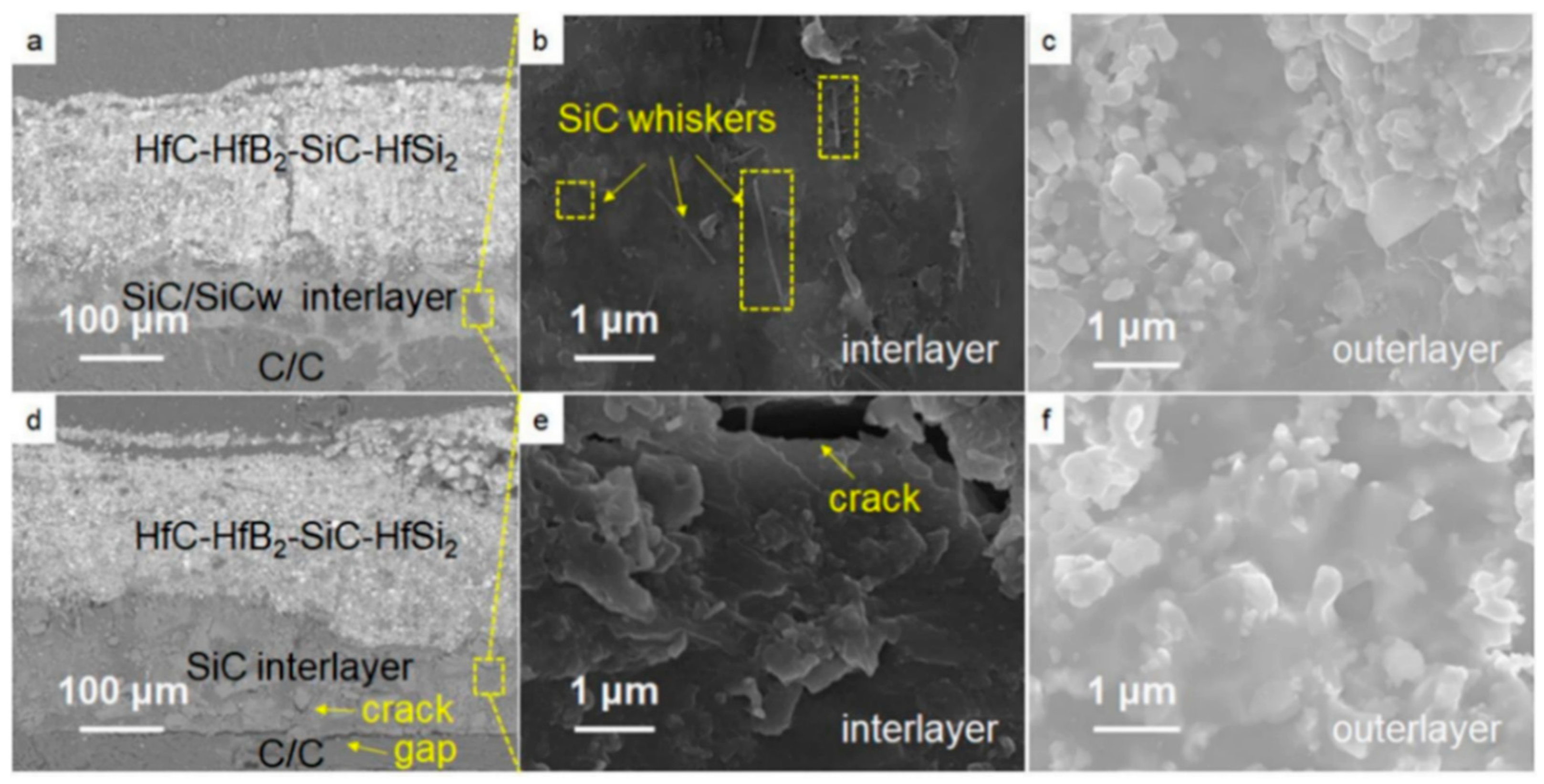
In addition to multi-layer/gradient designs, diffusion barriers, and self-healing structures, nanocrystalline structures, porous structures, and whisker introduction can also effectively enhance high-temperature oxidation resistance of coatings. Nanocrystalline coatings help oxidation-resistant components spread to the surface quickly, promoting dense protective film formation and improving oxidation resistance. Porous structures enhance oxidation resistance by increasing oxygen diffusion paths and whiskers improve the bonding strength between the coating and reduce thermal stress between coating and substrate [160,161,162,163,164]. For example, Yang et al. [165] developed three new nanocrystalline composite coatings with different Al contents on single-crystal superalloy. After 500 oxidation cycles between room temperature and 1100 °C in air, the Al-9 coating (with 8 wt% Al) displayed a dense, intact surface without defects (as shown in Figure 18), exhibiting the best oxidation resistance with a final mass gain of 0.51 mg/cm2. Zhu et al. [91] fabricated a SiC/SiC-ZrSi2 composite coating with microporous structure on a C/C substrate via filler cementation and slurry methods. The porous structure increased the oxidizable area, enabling rapid generation of more glass phases and significantly improving oxidation resistance. Thus, after 1194 h of isothermal oxidation at 1500 °C, the mass gain was 1.42%. Chen et al. [166] employed filler cementation and slurry brushing to prepare a HfC-HfB2-SiC composite coating with a SiC-SiCw interlayer on a C/C substrate, as shown in Figure 19. The SiC-SiCw interlayer strengthened the bond between the coating and the substrate’s surface, effectively anchored SiC-SiO2 oxidation products, promoted continuous protective glass layer formation, improved high-temperature oxidation resistance, and enhanced ablation resistance. Xie et al. [167] embedded silicon carbide whiskers (SiCw) into a SiC layer, creating a SiC-SiCw transition layer as an inner coating on the C/C substrate, significantly improving thermal expansion matching between the coating and the substrate and ensuring long-term service of the coating.
In summary, nanocrystalline structures are mainly applied to Al-containing coatings for oxidation resistance. Their excellent performance stems from extremely fine grain sizes providing abundant rapid diffusion paths for Al, reducing the critical Al concentration for Al2O3 formation, and high-density grain boundaries and dislocations promoting θ-Al2O3 to α-Al2O3 transformation. Porous structures increase oxygen diffusion paths, while whiskers reduce thermal stress between the coating and the substrate. However, before these structures can be reliably applied in real hot-end components, further research is needed on high-temperature phase stability, interface durability, adaptability to complex environments, and process controllability.

3.5. Coating Preparation Technologies

Rational structural regulation can enhance coating oxidation resistance, but structural designs require proper preparation technologies for implementation. Selecting suitable preparation technologies based on service conditions ensures coating quality and influences service performance. This section lists common preparation technologies for oxidation-resistant coatings, with their key characteristics summarized and applications in Table 3.

3.5.1. Atmospheric Plasma Spraying

Atmospheric plasma spraying (APS) uses a plasma arc as the heat source to fully or partially melt the feed materials, which are then sprayed at high speed to form coatings on substrate’s surface. It can melt high-melting-point metal alloys or ceramics, ensuring uniform particle integration. APS produces high-quality coatings with strong bonding. This technology is suitable for complex-shaped substrates, offering significant advantages in oxidation-resistant coating production. However, APS requires complex equipment and careful control of parameters [168].

3.5.2. Cold Spraying

Cold spraying is a coating deposition technique in which feed materials are accelerated by compressed gas and impacted at high velocity onto a substrate to form a coating. This process generates minimal thermal effect, thereby minimizing or avoiding oxidation and phase transformation of the sprayed material, so it is particularly suitable for applying coatings to temperature-sensitive substrates, such as titanium alloys. However, coatings produced by cold spraying generally exhibit limited bond strength and relatively high porosity, which restricts their broader application [169,170,171].

3.5.3. Laser Cladding

This technology mainly utilizes high-power-density laser beam to melt pre-placed coating materials on the substrate, which then rapidly solidify to bond with the substrate. This technique produces coatings with high bond strength and the thickness of coating is adjustable, but costs are high [172].

3.5.4. Magnetron Sputtering

Magnetron sputtering operates on the basis of electron collision with an inert gas, typically argon, within an electric field, leading to the generation of argon ions that then bombard a target material. Subsequently, target atoms acquire energy, enabling their release from the surface and deposition onto a substrate to create a coating. The coatings produced are uniform, dense, high-purity, and adhere well to the substrate. Consequently, this method is well-suited for creating antioxidant coatings on metal and ceramic surfaces [173].

3.5.5. Plasma-Electrolyte Oxidation

Plasma-Electrolyte Oxidation (PEO) employs plasma discharge to generate instantaneous high temperature and pressure on metal substrates. This environment causes components within the electrolyte to react and grow in situ into ceramic coatings. The advantages of PEO include strong coating adhesion, operational simplicity, and high process efficiency, but its application is restricted to metal substrates, and the resulting coatings are often porous [174,175,176,177].

3.5.6. Embedding Method

This method involves immersing composite components in a liquid or solid medium and heat-treating them in a high-temperature, protective atmosphere. During this process, reactants diffuse inward from the surface to form coatings. The technique is simple and allows for the flexible design of gradient structure formation. However, the adhesion and durability of the antioxidant coatings produced by this modified method remain unsatisfactory [178,179].

3.5.7. Slurry Method

In this process, a slurry with controlled rheological and adhesive properties is applied to a substrate via brushing, then cured and sintered to form dense coatings [180]. The primary advantages of slurry brushing are its simplicity, low cost, and applicability to large parts. However, its drawbacks include the requirement for multiple deposition steps and the production of coatings with lower bonding strength.
In summary, every technology has its own unique characteristics and application ranges, so the choice of which to use should align with actual service requirements. To ensure the bonding strength between the coating and the substrate under complex conditions, as well as to produce denser oxygen barrier structures, future research must explore new high-efficiency technologies and multi-technique combinations.

4. Coating Performance Evaluation Methods

Diverse coating material systems, structural designs, and advancing preparation technologies provide abundant solutions for high-temperature oxidation protection. However, when coatings are subjected to long-term service in extreme environments, they still face the challenges of multiple factors, including thermal shock, water–oxygen corrosion, molten salt corrosion, particle scouring, and so on. Systematic evaluation of coating performance can not only provide data support for coating optimization but also establish qualification standards for their service applications under complex working conditions. Therefore, this section will focus on the key evaluation methods and main indicators of coating performance during service in extreme high-temperature service.

4.1. Static Environment

Static environmental evaluation of composite coatings can simulate their service behavior in constant temperature and environment. It enables effective analysis of structural and compositional changes in coatings under extreme high-temperature conditions, thereby providing an important basis for the optimization of coating systems and structures.

4.1.1. Isothermal Oxidation

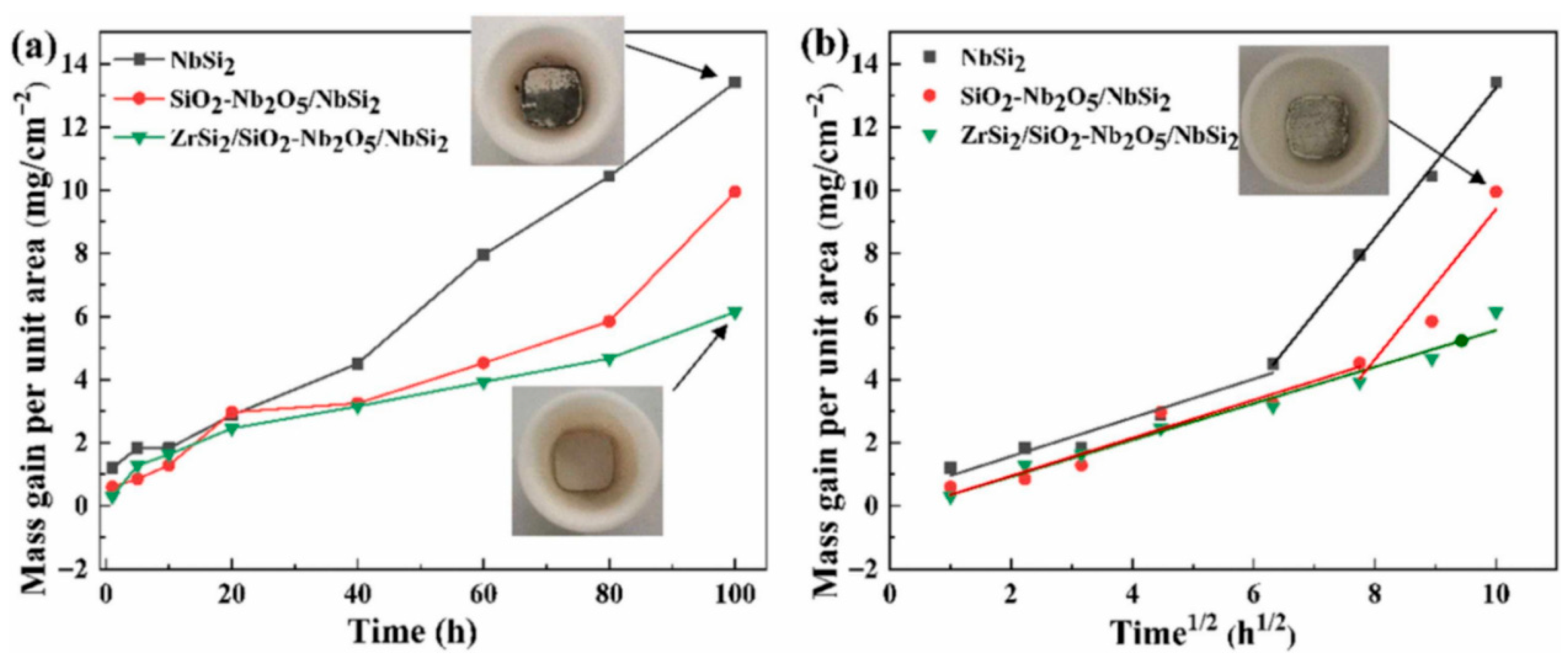
Isothermal oxidation mainly involves oxidation testing of coatings in air, which is the most basic method to characterize the high-temperature oxidation resistance of composite coatings. The evolution of the coating compositions and oxidation kinetic equations under this testing condition not only provide strong support for revealing oxidation resistance mechanisms but also offer ideas for further improving the long-term stability of coatings [181]. Wang et al. [182] combined the halide-activated pack cementation method and liquid plasma-assisted particle deposition and sintering technology to form a ZrSi2/SiO2-Nb2O5/NbSi2 multi-layer coating on niobium alloys. As shown in Figure 20, compared with single-layer NbSi2 and double-layer SiO2-Nb2O5/NbSi2, the multi-layer coating displayed the best high-temperature oxidation resistance due to the formation of a SiO2-ZrO2-ZrSiO4 framework. After oxidation at 1200 °C for 100 h, tahe weight gain of the coating was merely 4.86 mg/cm2. In addition, Wang et al. [183] invented a NbSi2/SiO2-Nb2O5/MoSi2-Yb2O3 multi-layer coating. The addition of appropriate amount of Yb3+ can effectively fill the gaps in the SiO2 network, thereby further inhibiting the diffusion of oxygen, with an oxidation weight gain of 4.86 mg/cm2 after 100 h of isothermal oxidation at 1200 °C, achieving high-temperature oxidation protection of niobium alloys. Wang et al. [184] also designed a NbSi2/SiO2-Nb2O5/HfSi2-HfO2 composite coating. HfO2 and HfSiO4 formed at high temperatures are anchored in the SiO2 layer, which can not only effectively block oxygen penetration, but also enhance the structural stability of the ceramic phase. The coating exhibited minimal mass gain of 5.583 mg/cm2 after static oxidation at 1200 °C for 100 h, greatly improving the high-temperature oxidation resistance of the coating. Furthermore, by depositing Al2O3/SiO2 composite coating on stainless steel, Ma et al. [185] achieved effective protection for the substrate at 900 °C for 100 h.
In conclusion, static isothermal oxidation serves as an effective way to evaluate the oxidation behavior of coatings under specific temperature field conditions and the oxidation kinetic equations offer the most direct and efficient method for screening high-temperature oxidation-resistant coatings. Nevertheless, the conditions of a single temperature field are difficult to simulate the temperature fluctuations that the coatings face during actual service.

4.1.2. Water–Oxygen Corrosion

In the service environment of hot-end components, water vapor has high chemical activity at high temperatures, and the water–oxygen coupling environment causes more severe damage to coatings, making it necessary to test their resistance to water–oxygen corrosion [186,187]. To study the service performance of coatings under water–oxygen conditions, Fan et al. [188] prepared a MoSi2/mullite composite coating on niobium alloys via plasma spraying. The team compared the water vapor corrosion behavior and dry oxygen oxidation behavior of the composite coating at 1500 °C. It was found that the mass change in the sample in the water vapor environment was −4.31 mg/cm2, and the oxidation rate was −0.39 mg/(cm2·h1/2), approximately 4 times higher than that in dry oxygen. The research results showed that high-temperature water vapor accelerates O2 penetration and exacerbates substrate oxidation. To improve the water–oxygen corrosion resistance of coatings, Ou et al. [189] utilized supersonic plasma spraying to prepare an Al2O3-modified Yb2SiO5 coating (YbMS/Al2O3) on niobium alloys. Coating oxidation tests were conducted in an environment with 50% oxygen and 50% water vapor at 1500 °C. The service life of the modified coating reached 30 h, 6 times that of the unmodified coating, with the cross-sectional condition of the coating after testing shown in Figure 21. This improvement is mainly because the addition of Al2O3 makes Yb2O3 tend to react with Al2O3 in situ to form Yb3Al5O12, which inhibited the inward diffusion of Yb2O3, thereby increasing the thickness of the diffusion layer and reducing micropores near the interface. Ou et al. [190] also fabricated the ZrO2-toughened Yb2SiO5 coating, which greatly improved corrosion resistance by enhancing atomic bonding and could effectively protect the substrate for 50 h under water vapor conditions at 1500 °C.
In summary, in the water–oxygen coupling environment, highly active water vapor enhances oxygen permeability and exacerbates coating damage. However, dynamic water–oxygen coupling field testing conditions are currently lacking. To better simulate the actual service environment of coatings, it is necessary to improve these testing conditions.

4.1.3. Molten Salt Corrosion

For power devices such as turbine engines and gas turbines, some impurity elements in fuel will form NaCl and Na2SO4 molten salt deposits under high-temperature conditions, which continuously dissolve the protective oxide film formed on the surface of hot-end components, thereby damaging the substrate. Notably, molten salt corrosion is more severe than oxidation [191,192,193,194]. Sun et al. [195] comparatively studied the hot corrosion behavior of niobium alloy substrates with MoSi2-based composite coatings exposed to air at 1000 °C and Na2SO4 molten salt at 1000 °C. They found that after 2 h of oxidation in air, the mass loss was 1.59 mg/cm2; while after 2 h of hot corrosion in Na2SO4 molten salt, corrosion products such as cristobalite scales and sodium molybdate appeared, resulting in a mass loss of 2.5 mg/cm2. Sun et al. [196] prepared SiO2-Ta2O5 oxide films with different Ta2O5 contents on MoSi2-based ceramics through pre-oxidation, and then tested these coatings in Na2SO4 molten salt at 1000 °C for 8 h. The cross-sectional micrographs of oxide layers formed with different Ta2O5 contents after corrosion are shown in Figure 22. The results demonstrated that the oxide scale with 10% Ta2O5 (T10) has excellent hot corrosion resistance, mainly because Ta2O5 preferentially reacts with Na2SO4 to form solid sodium tantalate, delaying the dissolution of the surface SiO2 dense layer.
Overall, high-temperature molten salt corrosion destroys the integrity of the protective film on the coating surface, thereby providing paths for oxygen diffusion to the substrate and exacerbating the damage process of hot-end components. However, there are few studies on long-term high-temperature molten salt corrosion, coatings designed for service in high-temperature molten salt environments require further development to meet the demands of complex operational conditions.

4.1.4. Thermal Radiation Performance

Radiation heat dissipation plays an important role in cooling hot-end components in high-temperature or ultra-high-temperature environments. The radiative heat dissipation capability of hot-end components primarily relies on the level of their surface infrared emissivity (ε). In particular, the spectral emissivity value in the near-to-mid infrared range is a key performance indicator that determines heat transfer, and it plays a crucial role in reducing the surface thermal equilibrium temperature of hot-end components. Therefore, adding high-emissivity components in the design of high-temperature oxidation-resistant coatings is an effective way to improve coating thermal protection performance [197,198]. Ye et al. [199] combined the embedding method and liquid plasma-assisted particle deposition and sintering technology to prepare a NbSi2/Nb2O5-SiO2/MoSi2 multi-layer coating on niobium alloys. The coating demonstrated minimal mass gain of 0.37 mg/cm2 after 50 h of isothermal oxidation in air at 1250 °C, and the thickness of the oxide layer of the multi-layer coating hardly changed after oxidation testing, showing high chemical stability. At the same time, the multi-layer coating also had excellent thermal radiation performance, with emissivity values above 0.88 in the 3–20 μm thermal infrared band (as shown in Figure 23). In addition, the team [200] developed a NbSi2/Nb2O5-SiO2/SiC multi-layer coating on niobium alloys to simultaneously improve thermal corrosion resistance and infrared thermal radiation performance. When tested under molten salt conditions (75% Na2SO4 + 25% NaCl) at 700 °C, the weight change after 100 h of the coating was −0.56 mg/cm2. The addition of SiC made the coating still have a high emissivity above 0.9 in the entire 3–20 μm wavelength range after oxidation at 700 °C.
In summary, radiation heat dissipation can effectively reduce the temperature of the coating system, thereby significantly improving the high-temperature thermal protection performance of the coating. However, as the temperature rises, the thermal radiation capacity of the coating will continuously decline, and there is an urgent need to develop coatings that can maintain high emissivity under high-temperature conditions.

4.2. Dynamic Environment

Evaluation and testing methods in dynamic environments can reflect the stability of coatings under fluctuating conditions, which is a more severe testing condition for coatings and can provide a more reliable basis for the application of coatings in complex environments

4.2.1. Cyclic Oxidation and Thermal Shock Resistance

During service in extreme high-temperature environments, coatings are subjected to cyclic thermal shocks and severe temperature fluctuations, which can cause crack propagation and coating spallation [201,202]. Excellent thermal shock resistance can effectively improve the stability of coatings when facing temperature fluctuations. Therefore, many researchers have improved coating composition and structure to enhance thermal shock resistance [203]. Yang et al. [204] prepared Pt-modified (Ni,Pt)Al composite coating on Ni-based superalloys through low-activity high-temperature aluminizing technology. After 300 cyclic oxidations at 1100 °C, the unmodified NiAl coating suffered significant mass loss, while the modified coating maintained mass gain, with partial wrinkles on the surface, exhibiting excellent thermal shock resistance. Zhang et al. [205] designed three types of composite coatings on Ni-based superalloys: NiAl coatings, Hf-modified 5Hf-NiAl coatings, and 15Hf-NiAl coatings. As shown in Figure 24, after 200 cyclic oxidation tests at 1100 °C, the weight gain of the NiAl coating was 0.51 mg/cm2, while those of the 5Hf-NiAl coating and 15Hf-NiAl coating were 0.63 mg/cm2 and 0.74 mg/cm2, respectively, close to their weight gains in static isothermal oxidation tests (0.65 mg/cm2 and 0.77 mg/cm2). The main reason for this lies in the addition of Hf, which inhibited interdiffusion between the coating and the substrate, thus helping maintain the integrity of the oxide scale. Wang et al. [206] synthesized a HfB2-modified SiC coating on a C/C substrate via in situ synthesis. After 30 thermal cycles, the optimized coating with 18.2 wt% HfB2 exhibited 25.8% lower mass loss compared to the unmodified coating. This enhancement is due to the formation of a Hf-Si-O glass layer during oxidation, which improved coating stability, reduced oxygen permeability, and thus enhanced oxygen-blocking performance. He et al. [4] fabricated a Ti3SiC2/MoSi2 composite coating on Nb-Si-based alloys. Among the samples tested, the composite coating with 10% Ti3SiC2 displayed the highest stability, gaining only −2.7 mg/cm2 after 100 thermal cycles, attributed to the formation of a compact and dense oxide scale in this type of composite coating. To design coatings with excellent thermal shock resistance, Wang et al. [207] prepared a multi-layer Cr/CrN/Cr/CrAlN coating via magnetron sputtering. During high-temperature oxidation, Cr2O3 and α-Al2O3 formed in the coating endowed the coating with excellent oxidation resistance and, at the same time, showed excellent thermal shock resistance within 700 °C. Li et al. [208] utilized the slurry method to form a ZrSiO4-glass coating on the C/C substrate. Due to the pinning effect of ZrSiO4 in the glass layer, the coating showed excellent thermal shock resistance, with a mass loss of only 0.33% after thermal shock testing at 1200 °C. Guan et al. [142] synthesized gradient MoSi2-borosilicate glass coating with excellent thermal shock resistance through in situ reaction. The coating can withstand 25 thermal shock tests between 1500 and 20 °C. The gradient interface layer reduced the CTE difference between the substrate and the dense coating, resulting in an interface bonding strength of over 0.67 ± 0.15 MPa, which can withstand higher thermal stress. Wu et al. [209] prepared plasma electrolytic oxidation (PEO) coatings and laser-assisted PEO (LPEO) coatings in NaAlO2-based electrolyte to enhance the high-temperature oxidation resistance and thermal shock resistance of Ti6Al4V alloys. They found that the LPEO-60 coating with a laser irradiation energy of 60 W had the best oxidation resistance and thermal shock resistance. Compared with other coatings, after 70 thermal shocks, although some cracks appeared on the surface, no spallation occurred in any area. The coating exhibited minimal mass gain of 0.211 mg/cm2 after 100 h of oxidation in air at 600 °C. In addition, the coating also showed high bonding strength after scratch testing.
Cyclic oxidation and thermal shock resistance tests provide important evaluation criteria for the synergistic performance of coatings in thermal shock resistance and oxidation resistance. However, current methods cannot adequately assess the synergy between thermal shock and multi-field coupling conditions, highlighting the need for more comprehensive evaluation systems.

4.2.2. Ablation Resistance

High-temperature ablation is also a challenge for coatings serving in extreme high-temperature environments. Ablation resistance tests can simulate environments where high-temperature oxidation and ablation are synergistic and reflect coating performance through mass ablation rate and linear ablation rate [210,211]. To improve coating ablation resistance, Xu [212] designed a ZrB2-SiC-TaSi2 coating. Plasma flame ablation tests showed that the coating exhibited excellent ablation resistance and oxidation resistance under a heat flux of 3.0 MW/m2 for 120 s. Ye et al. [213] developed a NbSi2/Nb2O5-SiO2/HfC-HfO2-MoSi2-Yb2O3 multi-functional thermal protection coating. The multi-particle components in the coating not only helped reduce oxygen permeability, but also improved the thermal stability of the oxide scale by forming a HfSiO4-Yb2O3-SiO2 framework. After 120 h of isothermal oxidation at 1200 °C, the oxide film thickness was only 128 μm, a 67% reduction compared to the uncoated sample (192 μm), exhibiting excellent oxidation resistance. Furthermore, the mass ablation rate and linear ablation rate were −0.116 mg/s and −0.29 μm/s during short-term ablation at 1800 °C with oxyacetylene, demonstrating good ablation resistance. Wang et al. [214] combined halide-activated pack cementation and liquid plasma-assisted particle deposition and sintering methods to prepare three types of multi-layer ceramic coatings on niobium alloys: NbSi2/SiO2-Nb2O5/MoSi2 (Mo), NbSi2/SiO2-Nb2O5/MoSi2-Yb2O3-SiO2 (MoYb), and NbSi2/SiO2-Nb2O5/MoSi2-Yb2O3-ZrO2-ZrC (MoYbZr). All three coatings remained intact after propane ablation at 1500 °C, demonstrating excellent ablation resistance. Under a more severe 1800 °C oxyacetylene flame test, as shown in Figure 25, their performances are significantly different: the Mo coating had long cracks, blisters, and local spallation, while the MoYb coating had large cracks but no spallation, and the MoYbZr coating remained intact without cracks. The mass ablation rate and linear ablation rate of the MoYbZr coating after oxyacetylene ablation were only 0.137 mg/s and 0.196 μm/s, 25.14% and 49.61% lower than those of the MoYb coating, and 88.01% and 75.37% lower than those of the Mo coating, respectively. The excellent ablation resistance of the MoYbZr coating is mainly due to the doping of Yb2O3 and ZrC. On the one hand, the introduction of Yb2O3 strengthened the Si-O bonds in the SiO2 network, increased the viscosity of the SiO2 oxide scale, and thus enhanced the self-healing ability of the oxide scale; on the other hand, ZrSiO4 generated during high-temperature oxidation of the coating can inhibit the generation and propagation of microcracks and play a pinning role in the oxide scale, enhancing the high-temperature structural stability of the coating. Qiang et al. [215] used chemical vapor deposition to in situ prepare a multi-layer silicon carbide nanowire-reinforced silicon carbide (SiCnws-SiC) coating on carbon/carbon composites. The C/C composites with the coating had a weight loss of only 1.77% after oxidation at 1500 °C for 361 h, and the coating completely failed after 130 h of testing in a 1600 °C wind tunnel, demonstrating excellent high-temperature oxidation resistance and ablation resistance.
In conclusion, oxyacetylene and wind tunnel tests effectively simulate the high-temperature ablation conditions that coatings face in actual service environments, and mass ablation rate and linear ablation rate provide data support for analyzing coating ablation resistance. However, characterization methods for instantaneous high-temperature ablation conditions need further development.

4.2.3. Erosion Resistance

Hot-end parts such as the front ends of aerospace vehicle wings and engines are usually subjected to erosion by particles in air or gas during service. As a result, coatings with excellent erosion resistance can better protect these hot-end parts. Erosion resistance is typically evaluated by testing with erosion media at different angles and distances, and finally through mass loss after erosion [216,217,218]. For example, Qiang et al. [215] employed chemical vapor deposition to synthesize a multi-layer SiCnws-SiC coating on carbon/carbon composites. After 130 h of thermal flux erosion at 1600 °C, the weight loss of the coated sample was only 1.1%, which is attributed to the introduction of SiCnws, which enhanced the coating’s toughness and thereby greatly improved its erosion resistance.
The erosion resistance test significantly improves the working conditions and data reliability of the evaluation of the erosion resistance performance of the coating, but the effects of microcrack propagation and interfacial stress accumulation caused by the erosion medium after scouring need to be further studied.

5. Summary and Outlooks

Currently, the application of oxidation-resistant composite coatings on the surface of hot-end components can significantly enhance their service performance. Commonly used high-temperature oxidation-resistant composite coating systems mainly include aluminide-based composite coatings, silicide-based composite coatings, MCrAlY coatings, boride-based composite coatings, carbide-based composite coatings, nitride-based composite coatings, oxide ceramic composite coatings, MAX phase composite coatings, as well as enamel and inorganic paint composite coatings. To further improve the high-temperature oxidation resistance of composite coatings, various effective structural regulation methods have emerged, mainly including the construction of multi-layer/gradient structures, the addition of diffusion barrier structures, the design of self-healing structures, and porous structures. At the same time, to adapt to different working conditions, advanced coating preparation technologies such as atmospheric plasma spraying, laser cladding, magnetron sputtering, and slurry methods have been continuously developed and applied. In view of the harsh and complex actual service environment of coatings, various evaluation methods for coatings under static and dynamic environments have emerged, such as isothermal oxidation, water–oxygen corrosion, molten salt corrosion, cyclic oxidation, thermal shock resistance, ablation resistance, and erosion resistance. This series of coating performance evaluation methods provides an important basis for coatings to move from laboratory to engineering applications.
At present, although the construction of high-temperature oxidation-resistant composite coatings has achieved certain results in solving the extreme high-temperature oxidation problem of hot-end components, the application of high-temperature oxidation-resistant coatings still faces many challenges, such as insufficient long-term service capability of coatings above 1700 °C, insufficient adaptability to multi-field coupling environments, and lack of evaluation methods for coating performance in complex environments. To address the above issues, some promising improvement measures are proposed.
(1)
Using first-principles, machine learning, finite element simulation, and other methods to establish the relationship between the physical properties of coating materials and coating structure design, screen and optimize coating systems with high-temperature oxidation resistance. At the same time, from the perspective of coating preparation, the combination of multiple efficient coating preparation technologies, such as embedding method and slurry sintering, chemical vapor deposition, sol–gel combined with air spraying, can be used to optimize the interface between the coating and the substrate, improve the bonding strength and stability of the coating during ultra-high-temperature service.
(2)
The actual service environment of coatings is mostly the coupling of multiple complex factors such as high temperature, oxidation, ablation, and thermal shock. Therefore, multiple functional layers can be combined to develop coatings adapted to multi-field coupling environments, such as gradient structure construction of high-emissivity layer–oxidation resistance layer, erosion resistance layer–heat insulation layer–oxidation resistance layer, etc. Meanwhile, by combining atomic-scale and macro-scale and conducting cross-scale regulation, we can guide the development of adaptive coatings that can independently adjust their structure and performance in response to changes in service environment.
(3)
Coating performance evaluation should focus on the development of evaluation systems under multi-factor coupling environments. This could be achieved by building a multi-field coupling simulation test platform to simulate the actual service environment of hot-end components, such as water–thermal–oxygen and thermal–force–oxygen coupling environments, and collecting oxidation kinetics, corrosion rates, and instantaneous high-temperature damage of coatings under simulated conditions. In addition, performance testing standards under multi-field coupling environments should be established as soon as possible to promote the transformation of excellent thermal protection coatings from laboratory to engineering applications.
In summary, selecting appropriate coating materials according to different working conditions, then conducting reasonable structural regulation and preparation, and finally undergoing strict performance evaluation to obtain high-quality coatings with excellent high-temperature oxidation resistance is of great significance for the development of hot-end components in aerospace, energy power, nuclear energy chemical engineering, and other fields towards high performance.

Author Contributions

Conceptualization, Y.-L.Y.; methodology, Q.-Y.Z.; software, G.-L.C.; validation, L.W., L.H. and J.-Q.Z.; formal analysis, E.-Y.X.; investigation, Y.-L.Y.; resources, Y.-M.W.; data curation, S.-Q.W.; writing—original draft preparation, Y.-L.Y.; writing—review and editing, Y.-L.Y. and S.-Q.W.; visualization, Y.-C.Z.; supervision, Y.Z. and Z.-Y.Y.; project administration, J.-H.O.; funding acquisition, S.-Q.W. All authors have read and agreed to the published version of the manuscript.

Funding

This research was funded by National Natural Science Foundation of China grant number [52301084], [523B2010] and [U21B2053]; and Postdoctoral Fellowship Program of CPSF grant number [YJB20240056] and the Opening Project Fund of Materials Service Safety Assessment Facilities number [MSAF-2024-007], the Fundamental Research Funds for the Central Universities number [MSE-2025-003].

Data Availability Statement

The original contributions presented in this study are included in the article. Further inquiries can be directed to the corresponding authors.

Conflicts of Interest

The authors declare no conflicts of interest.

References

  1. Peters, A.B.; Zhang, D.; Chen, S.; Ott, C.; Oses, C.; Curtarolo, S.; McCue, I.; Pollock, T.M.; Eswarappa Prameela, S. Materials design for hypersonics. Nat. Commun. 2024, 15, 3328. [Google Scholar] [CrossRef]
  2. Yeranee, K.; Rao, Y. A review of recent studies on rotating internal cooling for gas turbine blades. Chin. J. Aeronaut. 2021, 34, 85–113. [Google Scholar] [CrossRef]
  3. Zhang, J.; Zhang, Y.; Fu, Y.; Chen, R.; Li, T.; Hou, X.; Li, H. Research progress in chemical vapor deposition for high-temperature anti-oxidation/ablation coatings on thermal structural composites. Compos. Part B Eng. 2025, 291, 112015. [Google Scholar] [CrossRef]
  4. Li, W.; Zhao, X.; Cheng, Y.; Yue, Q.; Xia, W.; Gu, Y.; Zhang, Z. Effect of molybdenum on cyclic oxidation behavior of 4th generation nickel-based single crystal superalloys. Corros. Sci. 2023, 223, 111458. [Google Scholar] [CrossRef]
  5. Sun, J.; Lu, H.; Wang, Z.; Luo, K.; Lu, J. High-temperature oxidation behaviour of Ti65 titanium alloy fabricated by laser direct energy deposition. Corros. Sci. 2024, 229, 111866. [Google Scholar] [CrossRef]
  6. Chen, S.; Qiu, X.; Zhang, B.; Xu, J.; Zhong, F.; Zhu, B.; Zhang, Y.; Ou-Yang, J.; Yang, X. Advances in antioxidation coating materials for carbon/carbon composites. J. Alloys Compd. 2021, 886, 161143. [Google Scholar] [CrossRef]
  7. Fu, Q.; Zhang, P.; Zhuang, L.; Zhou, L.; Zhang, J.; Wang, J.; Hou, X.; Riedel, R.; Li, H. Micro/nano multiscale reinforcing strategies toward extreme high-temperature applications: Take carbon/carbon composites and their coatings as the examples. J. Mater. Sci. Technol. 2022, 96, 31–68. [Google Scholar] [CrossRef]
  8. Zhan, S.; Zhang, Y.; Ji, J.; He, H.; Hu, J.T.; Fu, T. The microstructure, mechanical properties and oxidation protection of niobium alloys for aerospace applications. J. Mater. Sci. 2025, 60, 19455–19483. [Google Scholar] [CrossRef]
  9. Anne, B.R.; Shaik, S.; Basu, A.; Ramakrishna R, V.S.M. Review on Electrodeposited Ni–W Based Composite Coatings in High-Temperature Applications Concerning Oxidation Behavior. Met. Mater. Int. 2024, 30, 1441–1458. [Google Scholar] [CrossRef]
  10. Ghadami, F.; Sabour Rouh Aghdam, A.; Ghadami, S. Microstructural characteristics and oxidation behavior of the modified MCrAlX coatings: A critical review. Vacuum 2021, 185, 109980. [Google Scholar] [CrossRef]
  11. Mao, X.; Meng, Q.; Wang, S.; Huang, S.; Yuan, M.; Qiu, Y. Oxidation mechanism and high–temperature strength of Mo-B-C-coated diamonds in the 700 °C–1200 °C temperature range. J. Mater. Res. Technol. 2024, 33, 7829–7841. [Google Scholar] [CrossRef]
  12. Sun, J.; Fu, Q.-G.; Huo, C.-X.; Li, T. Fracture toughness of thermally sprayed MoSi2 composite with different melting indices. Compos. Part B-Eng. 2018, 150, 242–247. [Google Scholar] [CrossRef]
  13. Ouyang, J.-H.; Li, Y.-F.; Zhang, Y.-Z.; Wang, Y.-M.; Wang, Y.-J. High-Temperature Solid Lubricants and Self-Lubricating Composites: A Critical Review. Lubricants 2022, 10, 177. [Google Scholar] [CrossRef]
  14. Ji, H.; Liu, Y.; Wang, T.; Yuan, Q.; Chen, H.; Wang, P.; Janković, N.; Zhu, X.; Chen, X. Isothermal oxidation behaviors of NiCrAlY coatings at 1100 °C. Mater. Today Commun. 2025, 46, 112902. [Google Scholar] [CrossRef]
  15. Yu, S.; Wang, Y.; Wang, S.; Zhao, Q.; Li, Y.; Ren, D.; Chen, G.; Zou, Y.; Ouyang, J.; Jia, D.; et al. Phase composition evolution and oxidation behavior of atmospheric plasma spraying Si and Si-HfO2 bond coats at 1300 °C. Corros. Sci. 2023, 222, 111439. [Google Scholar] [CrossRef]
  16. Ji, M.; Zhu, S.; Ma, Z. Research Progress on Thermal Protection Coatings for Metal Surfaces in Aerospace Applications. Surf. Technol. 2021, 50, 253–266. [Google Scholar] [CrossRef]
  17. Liao, Y.; Chen, M.; Wang, F.; ZHU, S. Self-healing metal enamel high-temperature protective coatings. Surf. Technol. 2020, 49, 25–34. [Google Scholar] [CrossRef]
  18. Wang, L.-Y.; Liu, R.-J.; Wang, Y.-F.; Li, D.; Miu, H.-M. Research progress and prospect of high-temperature oxidation-resistant ceramic protective coatings for C/C composites. J. Chin. Ceram. Soc. 2025, 53, 688–699. [Google Scholar] [CrossRef]
  19. Deevi, S.C. Advanced intermetallic iron aluminide coatings for high temperature applications. Prog. Mater. Sci. 2021, 118, 100769. [Google Scholar] [CrossRef]
  20. Jiang, C.; Feng, M.; Chen, M.; Geng, S.; Wang, F. Research status of simple/modified aluminide coatings. Surf. Technol. 2021, 50, 33–42. [Google Scholar] [CrossRef]
  21. Li, C.; Xu, X.; Wang, S.; Cai, C.; Ju, S.; Huang, J.; Yang, S. Microstructure and properties of Al and Al-Cr coatings on nickel-based superalloy GH625 by a thermal diffusion process. Mater. Res. Express 2019, 6, 046426. [Google Scholar] [CrossRef]
  22. Yang, Y.F.; Jiang, C.Y.; Yao, H.R.; Bao, Z.B.; Zhu, S.L.; Wang, F.H. Preparation and enhanced oxidation performance of a Hf-doped single-phase Pt-modified aluminide coating. Corros. Sci. 2016, 113, 17–25. [Google Scholar] [CrossRef]
  23. Hua, J.; Sun, Z.; Zhuo, E.; Ai, C. Research progress on high-temperature oxidation-resistant coatings for TiAl alloys. Trans. Nonferrous Met. Soc. China 2025, 35, 1062–1079. [Google Scholar]
  24. Zheng, L.; Liu, E.; Zheng, Z.; Ning, L.; Tong, J.; Tan, Z.; Li, H. Effects of Y addition on the pre-oxidation and corrosion behaviours of the alumina/niobium aluminide coatings on the surface of niobium core. Corros. Sci. 2023, 213, 110991. [Google Scholar] [CrossRef]
  25. Huang, J.; Zhao, F.; Cui, X.; Wang, J.; Xiong, T. Long-term oxidation behavior of silicon-aluminizing coating with an in-situ formed Ti5Si3 diffusion barrier on γ-TiAl alloy. Appl. Surf. Sci. 2022, 582, 152444. [Google Scholar] [CrossRef]
  26. Yang, H.; Wu, Y.; Sun, Q.; Yang, F.; Xia, C.; Xia, S.; Du, J. Study on High Temperature Properties of Yttrium-Modified Aluminide Coating on K444 Alloy by Chemical Vapor Deposition. Coatings 2024, 14, 750. [Google Scholar] [CrossRef]
  27. Li, S.; Xu, M.M.; Zhang, C.Y.; Niu, Y.S.; Bao, Z.B.; Zhu, S.L.; Wang, F.H. Co-doping effect of Hf and Y on improving cyclic oxidation behavior of (Ni,Pt)Al coating at 1150 °C. Corros. Sci. 2021, 178, 109093. [Google Scholar] [CrossRef]
  28. Zeng, Y.; Wang, R.; Zhang, J.; Hou, J.; Tan, C.; Li, H. Liquid-phase-rich compensatory layer enabled self-healing in Si-SiO2/SiC-SiCw-Si bilayer anti-oxidation coating. Surf. Coat. Technol. 2026, 519, 132980. [Google Scholar] [CrossRef]
  29. Zhu, L.; Ren, X.; Wang, X.; Kang, X.; Zheng, R.; Feng, P. Microstructure and high-temperature oxidation resistance of MoSi2-ZrO2 composite coatings for Niobium substrate. J. Eur. Ceram. Soc. 2021, 41, 1197–1210. [Google Scholar] [CrossRef]
  30. Cai, Z.; Wu, Y.; Liu, H.; Tian, G.; Pu, R.; Piao, S.; Tang, X.; Liu, S.; Zhao, X.; Xiao, L. Formation and oxidation resistance of a new YSZ modified silicide coating on Mo-based alloy. Mater. Des. 2018, 155, 463–474. [Google Scholar] [CrossRef]
  31. Han, J.-Y.; Wang, L.; Hu, P.; Hu, B.-L.; Ma, S.-J.; Gao, L.-L.; Bai, R.; Wang, Q.; Feng, R.; Jin, B.; et al. Research progress in modification of MoSi2 coatings on surface of refractory metals and their alloys: A review. Rare Met. 2024, 44, 793–821. [Google Scholar] [CrossRef]
  32. Sun, L.; Fu, Q.-G.; Sun, J. Effect of SiO2 barrier scale prepared by pre-oxidation on hot corrosion behavior of MoSi2-based coating on Nb alloy. Corros. Sci. 2020, 176, 109051. [Google Scholar] [CrossRef]
  33. Han, J.; Wang, Q.; Long, J.; Zhao, W.; Wang, L.; Feng, R.; Jin, B.; Hu, B.; Hu, P.; Wang, K. Research progress on preparation technologies of molybdenum disilicide coatings. Powder Metall. Technol. 2024, 42, 674–684. [Google Scholar] [CrossRef]
  34. Zhang, Y.; Wang, Q.; Li, Q.; Zhang, L.; Zhang, J.; Li, J.; Jin, H.; Chen, D. Research progress on high-temperature protective coatings for molybdenum and molybdenum alloy surfaces. Surf. Technol. 2023, 52, 48–63+74. [Google Scholar] [CrossRef]
  35. Zhu, L.; Ren, X.; Wang, G.; Kang, X.; Zhang, P.; Wang, X.; Feng, P. Preparation and 1500 °C oxidation behavior of crack-free bentonite doped MoSi2 protective coating on molybdenum. Corros. Sci. 2021, 184, 109379. [Google Scholar] [CrossRef]
  36. Fu, T.; Zhang, Y.; Chen, L.; Shen, F.; Zhu, J. Micromorphology evolution, growth mechanism, and oxidation behaviour of the silicon-rich MoSi2 coating at 1200 °C in air. J. Mater. Res. Technol. 2024, 29, 491–503. [Google Scholar] [CrossRef]
  37. Wang, C.-C.; Li, K.-Z.; He, D.-Y.; Shi, X.-H. Oxidation behavior and mechanism of MoSi2-Y2O3 composite coating fabricated by supersonic atmospheric plasma spraying. Appl. Surf. Sci. 2020, 506, 144776. [Google Scholar] [CrossRef]
  38. Zhai, R.; Song, P.; Huang, T.; Li, C.; Hua, C.; Huang, W.; Li, Q.; Zheng, B.; Lu, J. Microstructure and oxidation behaviour of MoSi2 coating combined MoB diffusion barrier layer on Mo substrate at 1300 °C. Ceram. Int. 2021, 47, 10137–10146. [Google Scholar] [CrossRef]
  39. Ou, H.; Liu, Y.; Fan, K.; Zhang, Y.; Guo, L.; Liu, B.; Sun, J.; Fu, Q. Long term protection of silicide coating at 1700 °C in air with HfO2 modification. Corros. Sci. 2025, 255, 113122. [Google Scholar] [CrossRef]
  40. Zhang, G.; Sun, J.; Fu, Q. Effect of mullite on the microstructure and oxidation behavior of thermal-sprayed MoSi2 coating at 1500 °C. Ceram. Int. 2020, 46, 10058–10066. [Google Scholar] [CrossRef]
  41. Zhang, G.; Sun, J.; Fu, Q. Microstructure and oxidation behavior of plasma sprayed WSi2-mullite-MoSi2 coating on niobium alloy at 1500 °C. Surf. Coat. Technol. 2020, 400, 126210. [Google Scholar] [CrossRef]
  42. Zhu, S.; Xu, Y.; Liu, R.; Yu, Y.; Duan, X.; Lei, Y.; Xia, H.; Jiang, Q.; Tang, J. Preparation of high-temperature antioxidant coatings on tantalum-based surfaces by atmospheric plasma spraying and their microstructural characterization. Surf. Coat. Technol. 2025, 501, 131928. [Google Scholar] [CrossRef]
  43. Chen, G.; Shao, W.; Wu, Y.; Xu, Y.; Yu, J.; He, D.; Guo, Y. Exploring oxygen adsorption and oxygen diffusion in B-modified NbSi2 alloy during high-temperature oxidation: First-principles calculations. J. Alloys Compd. 2025, 1038, 182970. [Google Scholar] [CrossRef]
  44. Ren, Y.; Qian, Y.; Xu, J.; Zuo, J.; Li, M. Ultra-high temperature oxidation resistance of ZrB2-20SiC coating with TaSi2 addition on siliconized graphite. Ceram. Int. 2019, 45, 15366–15374. [Google Scholar] [CrossRef]
  45. Shen, F.; Yu, L.; Fu, T.; Zhang, Y.; Wang, H.; Cui, K.; Wang, J.; Hussain, S.; Akhtar, N. Effect of the Al, Cr and B elements on the mechanical properties and oxidation resistance of Nb-Si based alloys: A review. Appl. Phys. A-Mater. 2021, 127, 851. [Google Scholar] [CrossRef]
  46. Zhang, Y.; Fu, T.; Yu, L.; Cui, K.; Wang, J.; Shen, F.; Zhang, X.; Zhou, K. Anti-Corrosion Coatings for Protecting Nb-Based Alloys Exposed to Oxidation Environments: A Review. Met. Mater. Int. 2022, 29, 1–17. [Google Scholar] [CrossRef]
  47. Fu, T.; Zhan, S.; Zhang, Y.; Shen, F.; Wang, H. Preparation of Si-rich NbSi2 coating on Nb surface by hot dip silicon-plating technology to improve the high-temperature oxidation resistance of pure Nb substrate. Ceram. Int. 2025, 51, 23341–23353. [Google Scholar] [CrossRef]
  48. Wang, S.; Ye, Z.; Ge, Y.; Zou, Y.; Zhang, T.; Zhao, X.; Wang, M.; Song, C.; Wang, Y.; Zhou, Y. High temperature oxidation behavior at 1250 °C: A new multilayer modified silicide coating design strategy on niobium alloys. J. Mater. Sci. Technol. 2025, 210, 159–169. [Google Scholar] [CrossRef]
  49. Ni, L.; Yang, Z.; Ma, K.; Wen, B.; Qu, D.; Yang, J. Study on microstructure and properties of TaSi2/MoSi2 coatings prepared by low-pressure plasma spraying. Therm. Spray Technol 2020, 12, 70–75. [Google Scholar]
  50. Lu, J.; Chen, Y.; Zhao, C.; Zhang, H.; Luo, L.; Xu, B.; Zhao, X.; Guo, F.; Xiao, P. Significantly improving the oxidation and spallation resistance of a MCrAlY alloy by controlling the distribution of yttrium. Corros. Sci. 2019, 153, 178–190. [Google Scholar] [CrossRef]
  51. Tian, J.; Wang, C.; Song, P.; Huang, T.; Zhang, X.; Lei, J.; Yang, T.; Ji, V. Research progress on the high-temperature oxidation resistance and hot corrosion resistance of MCrAlY coatings. J. Mater. Sci. 2025, 60, 2224–2251. [Google Scholar] [CrossRef]
  52. Tao, S.; Peng, H.; Zhang, A.; Guo, H. Coating-by-design: Design a high-temperature oxidation and corrosion resistant Zr-doped MCrAlY coating fabricated by magnetron sputtering. Appl. Surf. Sci. Adv. 2025, 27, 100766. [Google Scholar] [CrossRef]
  53. Tan, K.J.; Liang, J.J.; Wang, X.G.; Tao, X.P.; Gong, J.; Sun, C.; Zhou, Y.Z.; Sun, X.F. Oxidation Performance and Interdiffusion Behaviour of two MCrAlY Coatings on a Fourth-Generation Single-Crystal Superalloy. Acta Metall. Sin. 2021, 35, 679–692. [Google Scholar] [CrossRef]
  54. Cojocaru, C.V.; Aghasibeig, M.; Irissou, E. NiCoCrAlX (X = Y, Hf and Si) Bond Coats by Cold Spray for High Temperature Applications. J. Therm. Spray Technol. 2022, 31, 176–185. [Google Scholar] [CrossRef]
  55. Ghadami, F.; Sabour Rouh Aghdam, A.; Ghadami, S. A comprehensive study on the microstructure evolution and oxidation resistance of conventional and nanocrystalline MCrAlY coatings. Sci. Rep. 2021, 11, 875. [Google Scholar] [CrossRef]
  56. Zhang, B.; Zheng, S.; Dong, J.; Yin, W.; Wu, H.; Tian, L.; Liu, G. Effect of Pre-Heat-Treatment on the Oxidation Resistance of MCrAlY Coatings: A Review. Coatings 2023, 13, 1222. [Google Scholar] [CrossRef]
  57. Duan, W.; Huang, B.; Li, Y.; Huang, X.; Zhou, M.; Qiang, W. Hf and Ta co-doping MCrAlY alloy to improve the lifetime of coatings. Surf. Coat. Technol. 2023, 468, 129781. [Google Scholar] [CrossRef]
  58. Wang, P.; Zhou, X.; Chen, Z.; Shi, Y.; Liang, Y.; Zhang, M.; Sun, J.; Yu, Z.; Xu, P.; Wang, X.; et al. Microstructure evolution and oxidation behavior of in-situ oxide-dispersion-strengthened AlCoCrFeNi2.1 composite coatings manufactured by high-speed laser cladding. J. Mater. Sci. Technol. 2026, 244, 1–19. [Google Scholar] [CrossRef]
  59. Li, S.M.; Fu, L.B.; Zhang, W.L.; Li, W.; Sun, J.; Wang, T.G.; Jiang, S.M.; Gong, J.; Sun, C. Formation process and oxidation behavior of MCrAlY+AlSiY composite coatings on a Ni-based superalloy. J. Mater. Sci. Technol. 2022, 120, 65–77. [Google Scholar] [CrossRef]
  60. Kang, J.; Liu, Y.; Zhou, J.; Zhuo, W.; Zhang, J.; Zeng, J.; Zhang, H.; Pei, Y.; Li, S.; Gong, S. Temperature-dependent evolution mechanism of interface microstructure between gradient MCrAlY coatings and nickel-based superalloy. Mater. Des. 2024, 237, 112585. [Google Scholar] [CrossRef]
  61. Ren, X.-R.; Wang, W.-G.; Sun, K.; Hu, Y.-W.; Xu, L.-H.; Feng, P.-Z. Preparation of MoSi2-modified HfB2-SiC ultra high temperature ceramic anti-oxidation coatings by liquid phase sintering. New Carbon Mater. 2022, 37, 603–614. [Google Scholar] [CrossRef]
  62. Xiao, L.; Deng, G.; Zhao, X.; Jiang, Y.; Chen, H.; Yu, Q.; Dong, H.; Li, J.; Liu, S.; Cai, Z. Preparation and oxidation properties of tantalum-based Yb2O3 modified MoSi2 ceramic coating. J. Eur. Ceram. Soc. 2025, 45, 117546. [Google Scholar] [CrossRef]
  63. Li, B.; Su, X.; Wang, R.; Hou, J.; Tan, C.; Liu, T.; Zhang, J. Mitigating matrix silicification and enhancing performance in coated C/C-SiC-HfB2 composites with a PyC layer. J. Eur. Ceram. Soc. 2026, 46, 118011. [Google Scholar] [CrossRef]
  64. Zhai, R.; He, X.; Huang, T.; Huang, Y.; Zhuang, Y.; Hua, C.; Xiong, X.; Meng, J.; Hakimi, N.; Song, P. Crack-healing and 1500 °C oxidation behavior of ZrB2- and HfB2- MoSi2 protective coating on TZM alloys. Eng. Fail. Anal. 2025, 179, 109794. [Google Scholar] [CrossRef]
  65. Chen, Y.; Hong, C.; Hu, C.; Hu, P.; Li, L.; Liu, J.; Liu, L.; Long, D.; Qiu, H.; Tang, S.; et al. Thermal protection ceramic materials for aerospace vehicles. Adv. Ceram 2017, 38, 311–390. [Google Scholar] [CrossRef]
  66. Fang, Y.; Zhang, Z.; Wang, Y.; Peng, J.; Zhang, H.; Liu, J. Research progress on ZrB2-SiC based oxidation-resistant coatings for Cf/C composites. Rare Met. Mater. Eng. 2024, 53, 3259–3270. [Google Scholar]
  67. Ma, H.; Miao, Q.; Liang, W.; Liu, Y.; Lin, H.; Ma, H.; Zuo, S.; Xue, L. High temperature oxidation resistance of Y2O3 modified ZrB2-SiC coating for carbon/carbon composites. Ceram. Int. 2021, 47, 6728–6735. [Google Scholar] [CrossRef]
  68. Wang, Y.; Liu, Y.; Ma, Z.; Zhu, S.; Liu, L.; Xie, M.; Zhang, Z.; Wang, R. Oxidation ablation resistance of ZrB2-HfB2-SiC-TaSi2 coating prepared on C/C composite surface. Surf. Coat. Technol. 2023, 466, 129615. [Google Scholar] [CrossRef]
  69. Duan, Y.; Ren, J.; Lv, C.; Li, X.; Wu, Y. Effect of ZrB2 and Polyvinyl Butyral Content on the Oxidation Resistance of ZrB2-SiC Coatings Produced by Slurry Brushing Method. Adv. Eng. Mater. 2023, 25, 2300391. [Google Scholar] [CrossRef]
  70. Li, T.; Zhang, Y.; Li, J.; Lv, J.; Shuai, K. Improved mechanical strength and oxidation resistance of SiC/SiC-MoSi2-ZrB2 coated C/C composites by a novel strategy. Corros. Sci. 2022, 205, 110419. [Google Scholar] [CrossRef]
  71. Zhang, P.; Fu, Q.; Cheng, C.; Sun, J.; Zhang, J.; Xu, M.; Zhu, X. Microstructure evolution of in-situ SiC-HfB2-Si ternary coating and its corrosion behaviors at ultra-high temperatures. J. Eur. Ceram. Soc. 2021, 41, 6223–6237. [Google Scholar] [CrossRef]
  72. Lv, J.; Zhang, Y.; Li, W.; Zhu, X.; Li, J.; Zhang, J.; Li, T. Microstructure evolution of HfB2-SiC/SiC coating for C/C composites during long-term oxidation at 1700 °C. Corros. Sci. 2022, 206, 110524. [Google Scholar] [CrossRef]
  73. Zhu, X.; Zhang, Y.; Zhang, J.; Li, T.; Zhang, P.; Chen, R. Microstructure evolution and oxidation mechanism of HfB2-SiC coating on SiC-coated C/C composites at 1173 K and 1773 K. Ceram. Int. 2022, 48, 30807–30816. [Google Scholar] [CrossRef]
  74. Zhang, S.; Ji, X.; Chen, Y.; Wang, P.; Kiryukhantsev-Korneev, P.V.; Levashov, E.A.; Shi, J.; Ren, X.; Kang, X.; Zhang, B.; et al. Enhancing oxygen-blocking properties of HfB2-MoSi2-SiC coating by CeO2 modification. J. Am. Ceram. Soc. 2024, 108, e20266. [Google Scholar] [CrossRef]
  75. Ding, W.; Zhou, L.; Zhang, J.; Fu, Q. Long-term oxidation of MoSi2-modified HfB2-SiC-Si/SiC-Si coating at 1700 °C. Surf. Eng. 2023, 39, 315–325. [Google Scholar] [CrossRef]
  76. Zhang, M.; Wang, L.; Ren, X.; Ji, X.; Chen, Y.; Wu, B.; Kan, T.; Zhao, Y.; Chen, J.; Shi, D.; et al. Oxygen barrier resistance of HfB2-MoSi2-TaB2 coatings in a wide temperature region. Ceram. Int. 2023, 49, 25504–25515. [Google Scholar] [CrossRef]
  77. Zhang, M.; Ji, X.; Zhang, Y.; Chen, Y.; Wang, P.; Kiryukhantsev-Korneev, P.V.; Levashov, E.A.; Shi, J.; Ren, X.; Kang, X.; et al. Enhanced oxidation resistance of HfB2-SiC-ZrSi2 coating at 1700 °C through low-loss film-forming treatment. J. Am. Ceram. Soc. 2024, 107, 6678–6691. [Google Scholar] [CrossRef]
  78. Bai, Y.; Song, G.; He, X.; Qi, X.; Gao, J.; He, B.; Zhang, J. High-toughness ternary layered ceramics: From MAX phase to MAB phase. J. Mater. Eng. 2021, 49, 1–13. [Google Scholar]
  79. Kota, S.; Sokol, M.; Barsoum, M.W. A progress report on the MAB phases: Atomically laminated, ternary transition metal borides. Int. Mater. Rev. 2020, 65, 226–255. [Google Scholar] [CrossRef]
  80. Hanner, L.A.; Kota, S.; Barsoum, M.W. Formation mechanisms of Cr2AlB2, Cr3AlB4, and Fe2AlB2 MAB phases. Mater. Res. Lett. 2021, 9, 323–328. [Google Scholar] [CrossRef]
  81. Li, H.; Su, Y.; Hu, T.; Fan, H.; Zheng, X.; Song, J.; Zhang, R.; Hu, L. Progress in the Study of Ternary Layered MAB Phase Ceramics and Their Mechanical and Tribological Properties. Tribology 2025, 45, 1084–1100. [Google Scholar] [CrossRef]
  82. Zhang, Y.; Zhang, G.; Wang, T.; Wang, C.; Xie, Z.; Wang, W.; Xin, T. Synthesis, microstructure and properties of MoAlB MAB phase films. Ceram. Int. 2023, 49, 23714–23720. [Google Scholar] [CrossRef]
  83. Zhang, Y.; Zhang, G.; Xie, Z.; Wang, T.; Wang, C.; Zhao, Q.; Wang, B. Nanocapsule-inspired composite structure engineering of MoAlB thin films for enhanced oxidation resistance. Ceram. Int. 2025, 51, 25978–25989. [Google Scholar] [CrossRef]
  84. Sun, X.; Zhang, J.; Pan, W.; Wang, W.; Tang, C. Research progress in surface strengthening technology of carbide-based coating. J. Alloys Compd. 2022, 905, 164062. [Google Scholar] [CrossRef]
  85. Nisar, A.; Hassan, R.; Agarwal, A.; Balani, K. Ultra-high temperature ceramics: Aspiration to overcome challenges in thermal protection systems. Ceram. Int. 2022, 48, 8852–8881. [Google Scholar] [CrossRef]
  86. Xiao, J.; He, P.; Xue, L.; Sun, C.; Liang, X.; Cheng, J. Research progress on carbide ultra-high temperature ceramics for thermal protection of equipment. J. Mech. Eng. 2025, 61, 1–18. [Google Scholar]
  87. Pan, X.; Niu, Y.; Xu, X.; Zhong, X.; Shi, M.; Zheng, X.; Ding, C. Long time ablation behaviors of designed ZrC-SiC-TiC ternary coatings for environments above 2000 °C. Corros. Sci. 2020, 170, 108645. [Google Scholar] [CrossRef]
  88. Xu, X.; Pan, X.; Niu, Y.; Li, H.; Ni, D.; Huang, S.; Zhong, X.; Zheng, X.; Sun, J. Difference evaluation on ablation behaviors of ZrC-based and ZrB2-based UHTCs coatings. Corros. Sci. 2021, 180, 109181. [Google Scholar] [CrossRef]
  89. Zhang, J.; Zhang, Y.; Fu, Y.; Zhu, X.; Chen, R. Long-time ablation behavior of the multilayer alternating CVD-(SiC/HfC)3 coating for carbon/carbon composites. Corros. Sci. 2021, 189, 109586. [Google Scholar] [CrossRef]
  90. Du, W.; Zeng, F.; Gao, Y.; Wang, Z.; Chen, M.; Li, Z. Oxidation mechanism of HfC-TaC-B4C-SiC/ZrSiO4-glass coating with largely enhanced oxidation inhibition for C/C composites. Surf. Interfaces 2024, 53, 105100. [Google Scholar] [CrossRef]
  91. Zhu, X.; Zhang, Y.; Li, H.; Zhang, J.; Fu, Y.; Su, Y. SiC/SiC-ZrSi2 coating with micro-pore to protect C/C composites against oxidation for long-life service at high temperatures. Corros. Sci. 2021, 191, 109780. [Google Scholar] [CrossRef]
  92. Huang, K.; Xia, Y.; Wang, A. High Temperature Oxidation and Oxyacetylene Ablation Properties of ZrB2-ZrC-SiC Ultra-High Temperature Composite Ceramic Coatings Deposited on C/C Composites by Laser Cladding. Coatings 2023, 13, 173. [Google Scholar] [CrossRef]
  93. Liu, Z.; Zhang, W.; Bu, H.; Chen, K.; Jiang, Y.; Liu, H.; Zeng, C. Antioxidant performance and oxidation mechanism of a liquid silicon infiltration (LSI) SiC–Si coating at an ultra-high temperature of 1873 K. Ceram. Int. 2023, 49, 34038–34052. [Google Scholar] [CrossRef]
  94. Yang, H.; Zhao, H.; Wang, T.; Liu, X.; Zhang, K.; Li, Z.; Gao, Y.; Liu, B. Preparation and antioxidant mechanism of TiSi2-Si-SiC/SiC bilayer coating on matrix graphite. J. Alloys Compd. 2021, 858, 157721. [Google Scholar] [CrossRef]
  95. Hu, L.; Zhang, H.; Lai, T.; Liao, J.; Duo, S. Research progress on controllable preparation, structural characteristics and properties of nitride coatings. Mater. Prot. 2023, 56, 143–156+209. [Google Scholar] [CrossRef]
  96. Wang, X.; Li, Z.; Du, J.; Li, Q.; Yang, T.; Yan, P. Research progress on high-temperature protective coatings on titanium surfaces. Titan. Ind. Prog. 2017, 34, 1–8. [Google Scholar] [CrossRef]
  97. Fan, J.; Xu, Y.X.; Geng, D.; Chen, L.; Wang, Q. Improving the oxidation resistance of TiAlN/CrAlO coatings through CrAlON interlayer. Surf. Coat. Technol. 2024, 479, 130545. [Google Scholar] [CrossRef]
  98. Wang, L.; Huang, Y.; Yuan, Y.; Jia, C.; Yang, L. Microstructure, wear and oxidation resistance of Al-doped Ti-Si3N4 coatings by laser cladding. Surf. Coat. Technol. 2022, 429, 127942. [Google Scholar] [CrossRef]
  99. Du, W.; Zeng, F.; Dai, Y.; Gao, Y.; Chen, M.; Li, Z. Oxidation behavior and thermal-shock resistance of AO20/Si3N4 coating for carbon/carbon composites. Ceram. Int. 2024, 50, 21463–21472. [Google Scholar] [CrossRef]
  100. Yan, Q.; Chen, S.; Shi, H.; Gao, B.; Li, J.; Meng, S. Novel anti-oxidation coating prepared by polymer-derived ceramic for harsh environments up to 1200 °C. Surf. Coat. Technol. 2024, 494, 131420. [Google Scholar] [CrossRef]
  101. Dong, C.; Huang, J.; Cui, S.; Luo, J.; Zhou, Z.; Cheng, H.; Wen, Z.; Xu, J. Microstructure and high-temperature oxidation behavior of Al2O3/Cr composite coating on Inconel 718 alloy. J. Mater. Res. Technol. 2024, 28, 4498–4507. [Google Scholar] [CrossRef]
  102. Tang, Z.; Wang, F.; Wu, W. Effect of Al2O3 and enamel coatings on 900 °C oxidation and hot corrosion behaviors of gamma-TiAl. Mater. Sci. Eng. A-Struct. 2000, 276, 70–75. [Google Scholar]
  103. Vourdas, N.; Marathoniti, E.; Pandis, P.K.; Argirusis, C.; Sourkouni, G.; Legros, C.; Mirza, S.; Stathopoulos, V.N. Evaluation of LaAlO3 as top coat material for thermal barrier coatings. Trans. Nonferrous Met. Soc. China 2018, 28, 1582–1592. [Google Scholar] [CrossRef]
  104. Zhou, Y.; Yao, Z.; Yao, Y. High-temperature oxidation resistance of YSZ-Al2O3 composite coatings prepared by sol-gel method on GH3039 alloy surface. Hot Work. Technol. 2018, 47, 151–155. [Google Scholar] [CrossRef]
  105. Mao, F.; Niu, Y.; Zhong, X.; Wang, Y.; Zhu, X.; Zhang, L.; Li, Q.; Zheng, X. Oxidation behaviors and mechanisms of Yb2O3-doped silicon coatings fabricated by vacuum plasma spray. Ceram. Int. 2021, 47, 19906–19913. [Google Scholar] [CrossRef]
  106. Zou, Y.; Wang, J.; Zhang, L.; Fu, Y.; Ye, Z.; Wang, Y.; Wei, D.; Zhou, Y. Microstructure and ablation behavior of TiAl alloy with in-situ HfSi2-HfO2-SiO2 nanocomposite ceramic coating by LPDS technique. Surf. Coat. Technol. 2024, 476, 130268. [Google Scholar] [CrossRef]
  107. Eklund, P.; Beckers, M.; Jansson, U.; Högberg, H.; Hultman, L. The Mn+1AXn phases: Materials science and thin-film processing. Thin Solid Film. 2010, 518, 1851–1878. [Google Scholar] [CrossRef]
  108. Ma, C.; Yu, W.; Ma, Y.; Ma, G.; Wang, H. Atomic level out-diffusion and interfacial reactions of MAX phases in contact with metals and air. J. Eur. Ceram. Soc. 2024, 44, 1–22. [Google Scholar] [CrossRef]
  109. Ma, G.; Zhang, A.; Wang, Z.; Wang, K.; Zhang, J.; Xu, K.; Xu, Y.; Zhou, S.; Wang, A. MAX phase coatings: Synthesis, protective performance, and functional characteristics. Mater. Horiz. 2025, 12, 1689–1710. [Google Scholar] [CrossRef]
  110. Zhou, A.; Liu, Y.; Li, S.; Wang, X.; Ying, G.; Xia, Q.; Zhang, P. From structural ceramics to 2D materials with multi-applications: A review on the development from MAX phases to MXenes. J. Adv. Ceram. 2021, 10, 1194–1242. [Google Scholar] [CrossRef]
  111. Sun, Z.; Zhou, Y.; Li, M. Oxidation behaviour of Ti3SiC2-based ceramic at 900–1300 °C in air. Corros. Sci. 2001, 43, 1095–1109. [Google Scholar] [CrossRef]
  112. Chen, W.; Yu, W.; Ma, C.; Ma, G.; Zhang, L.; Wang, H. A review of novel ternary nano-layered MAX phases reinforced AZ91D magnesium composite. J. Magnes. Alloys 2022, 10, 1457–1475. [Google Scholar] [CrossRef]
  113. Sun, Y.; Zhou, C.; Zhao, Z.; Yu, Z.; Wang, Z.; Liu, H.; Zhang, N.; Yang, W.; Wu, G. Microstructure and mechanical properties of Ti2AlC particle and in-situ TiAl3 reinforced pure Al composites. Mater. Sci. Eng. A 2020, 785, 139310. [Google Scholar] [CrossRef]
  114. Xiao, Y.; Xiao, H.; Mo, T.; Ren, L.; Tian, Y.; Zhu, L. High-temperature and interfacial oxidation of MAX phase-reinforced composite coatings deposited by laser cladding on Zr alloy substrates. Ceram. Int. 2023, 49, 38672–38682. [Google Scholar] [CrossRef]
  115. Zha, X.-H.; Ma, X.; Du, S.; Zhang, R.-Q.; Tao, R.; Luo, J.-T.; Fu, C. Role of the A-Element in the Structural, Mechanical, and Electronic Properties of Ti3AC2 MAX Phases. Inorg. Chem. 2021, 61, 2129–2140. [Google Scholar] [CrossRef]
  116. Zhang, X.; Li, S.; Zhang, W.; Bei, G. Recent progress in preparation, microstructure and properties of Cr2AlC MAX phase coatings. J. Eur. Ceram. Soc. 2025, 45, 117555. [Google Scholar] [CrossRef]
  117. Zhu, L.; Xiao, H.; Ren, L.; Zheng, Y.; Yu, K.; Zhang, Z.; Mo, T.; Lin, B.; Fu, G. Microstructural characteristics and high-temperature oxidation behavior of Ti–Al–N MAX phase composite coatings. Surf. Coat. Technol. 2026, 520, 133043. [Google Scholar] [CrossRef]
  118. Mengis, L.; Oskay, C.; Laska, N.; Galetz, M.C. Synthesis, oxidation resistance and mechanical properties of a Cr2AlC-based MAX-phase coating on TiAl. Intermetallics 2023, 163, 108039. [Google Scholar] [CrossRef]
  119. Wang, Z.; Sun, J.; Xu, B.; Liu, Y.; Ke, P.; Wang, A. Reducing the self-healing temperature of Ti2AlC MAX phase coating by substituting Al with Sn. J. Eur. Ceram. Soc. 2020, 40, 197–201. [Google Scholar] [CrossRef]
  120. Parthiban, K.; Bysakh, S.; Date, A.; Kandare, E.; Ghosh, S. Mitigating TGO growth with glass-ceramic based thermal barrier coatings for gas turbine applications. Mater. Today Commun. 2024, 41, 111090. [Google Scholar] [CrossRef]
  121. Yu, Z.; Feng, M.; Chen, M.; Shen, C.; Zhu, S.; Wang, F. Temporary enamel coatings for oxidation protection of Ti-6Al-4V at its hot working temperature of 1200 °C. J. Alloys Compd. 2020, 815, 152295. [Google Scholar] [CrossRef]
  122. Li, F.; Chen, M.; Wang, Q.; Wang, F. Effect of Al2O3 content on microstructure and oxidation behavior of silicate enamel coatings on a Ni-based superalloy at 1000 °C. Ceram. Int. 2022, 48, 25445–25457. [Google Scholar] [CrossRef]
  123. Gu, Y.; Li, R.; Zeng, F.; Jiang, Z.; Shi, X.; Wu, A.; Huang, L. Microstructure evolution and oxidation resistance of CaO-Al2O3-SiO2/ZrO2-borosilicate multilayer coating for C/C composites. Corros. Sci. 2021, 191, 109723. [Google Scholar] [CrossRef]
  124. Fan, S.; Ma, X.; Ji, B.; Li, Z.; Xie, Z.; Deng, J.; Zhang, L.; Cheng, L. Oxidation resistance and thermal shock properties of self-healing SiCN/borosilicate glass-B4C-Al2O3 coatings for C/C aircraft brake materials. Ceram. Int. 2019, 45, 550–557. [Google Scholar] [CrossRef]
  125. Zhou, L.; Huang, J.; Cao, L.; Hao, W.; Wu, W. A novel design of oxidation protective β-Y2Si2O7 nanowire toughened Y2SiO5/Y2O3-Al2O3-SiO2 glass ceramic coating for SiC coated carbon/carbon composites. Corros. Sci. 2018, 135, 233–242. [Google Scholar] [CrossRef]
  126. Gao, Y.; Zeng, F.; Wang, Z.; Li, Y.; Liu, H.; Peng, Y.; Gu, Y.; Zhang, F. Enhanced oxidation resistance and failure mechanism of carbon/carbon composites with ZrO2/ZrSiO4-glass composite coating. Appl. Surf. Sci. 2022, 601, 154208. [Google Scholar] [CrossRef]
  127. Yin, H.; Li, H.; Chen, J.; Wang, Y.; Zhang, S.; Xu, L.; Li, T.; Zeng, Z.; Tang, J. Research progress and application of phosphate coatings. Surf. Technol. 2021, 50, 232–241. [Google Scholar] [CrossRef]
  128. Han, R.; Tariq, N.U.H.; Li, J.; Kong, L.; Liu, J.; Shan, X.; Cui, X.; Xiong, T. A novel phosphate-ceramic coating for high temperature oxidation resistance of Ti65 alloys. Ceram. Int. 2019, 45, 23895–23901. [Google Scholar] [CrossRef]
  129. Xu, Y.; Li, Z.; Chen, F.; Chen, Z.; Tang, H.-X.; Zhao, J.; Zhao, Y.-B.; Xiao, P. Comparison of oxidation resistance behavior between Y3+ and Zr4+ modified aluminum phosphate impregnated graphite. Surf. Coat. Technol. 2021, 423, 127629. [Google Scholar] [CrossRef]
  130. Zhao, F.; Niu, H.; Kong, L. Study on the effect of phosphate coatings on high-temperature oxidation resistance of Ti65 alloy. Foundry Equip. Technol. 2024, 4, 74–81. [Google Scholar] [CrossRef]
  131. Li, Q.; Zhang, Y.; Zhou, L.; Lei, P.; Liu, J.; Wang, F.; Xiang, X.; Wu, H.; Wang, W.; Wang, F. Preparation and High-Temperature Resistance Properties of Phenolic Resin/Phosphate Hybrid Coatings. Materials 2024, 17, 2081. [Google Scholar] [CrossRef]
  132. Chen, W.; Wang, W.; Hu, T.; Zhang, D.; Li, B.; Xiao, H. Enhancing the high-temperature oxidation performance of AlCrTiSiN coating by in-situ generation of multi-layer antioxidant composite structures. Corros. Sci. 2024, 233, 112097. [Google Scholar] [CrossRef]
  133. Li, Y.; Liu, Y.; Guo, C.; Chen, Y.; Liang, J.; Zhang, J.; Zhang, J.; Guo, L. Ablation resistance of ZrC-based composite coating with multi-layer structure for carbon/carbon composites above 2200 °C. Corros. Sci. 2022, 207, 110600. [Google Scholar] [CrossRef]
  134. Zhang, W.; Qiao, Y.; Guo, X.; Li, L.; Nan, X. Microstructure characteristics and oxidation behavior of a dense Si-Cr-Fe-Ti coating with a multi-layer structure on Nb-Si based alloy by slurry sintering. Corros. Sci. 2025, 246, 112743. [Google Scholar] [CrossRef]
  135. Hu, D.; Fu, Q.; Liu, B.; Zhou, L.; Sun, J. Multi-layered structural designs of MoSi2/mullite anti-oxidation coating for SiC-coated C/C composites. Surf. Coat. Technol. 2021, 409, 126901. [Google Scholar] [CrossRef]
  136. Tang, P.; Hu, C.; Pang, S.; Jiang, Y.; Liang, B.; Wang, L.; Tang, S. Self-densification behavior, interfacial bonding and cyclic ablation resistance of HfSi2-ZrSi2 modified SiC/ZrB2-SiC/SiC coating for Cf/SiC composite. Corros. Sci. 2023, 219, 111223. [Google Scholar] [CrossRef]
  137. Chen, P.; Pan, L.; Xiao, P.; Li, Z.; Pu, D.; Li, J.; Pang, L.; Li, Y. Microstructure and anti-oxidation properties of Yb2Si2O7/SiC bilayer coating for C/SiC composites. Ceram. Int. 2019, 45, 24221–24229. [Google Scholar] [CrossRef]
  138. Quan, H.; Sui, S.; Wang, L.; Luo, R.; Dong, X. A low-temperature preparation strategy of SiC/ZrB2-CrSi2-Si/SiC multilayer oxidation-resistant coating for C/C composites: Process, kinetics and mechanism research. Appl. Surf. Sci. 2021, 562, 149993. [Google Scholar] [CrossRef]
  139. Gai, W.; Zhang, Y.; Zhang, J.; Chen, H.; Chen, G.; Kong, J.A.; Fu, Y. A strategy to improve the anti-ablation performance of C/C composites under cyclic oxyacetylene flame: SiC/HfB2 multi-layer alternating coatings prepared by CVD. J. Alloys Compd. 2025, 1015, 178803. [Google Scholar] [CrossRef]
  140. Zhu, X.; Zhang, Y.; Zhang, J.; Li, T.; Li, J.; Chen, R. A gradient composite coating to protect SiC-coated C/C composites against oxidation at mid and high temperature for long-life service. J. Eur. Ceram. Soc. 2021, 41, 123–131. [Google Scholar] [CrossRef]
  141. Yang, L.-Y.; Dong, S.; Cui, T.-Y.; Xin, J.-Q.; Chen, G.-Q.; Hong, C.-Q.; Zhang, X.-H. Novel gradient ZrB2–MoSi2–SiC dense layer with enhanced emissivity and long-term oxidation resistance at ultra-high temperatures. Rare Met. 2024, 44, 2043–2058. [Google Scholar] [CrossRef]
  142. Guan, X.; Xu, X.; Hong, W.; Tao, X.; Wu, J.; Du, H.; Liu, J. Double-layer gradient MoSi2-borosilicate glass coating prepared by in-situ reaction method with high contact damage resistance and interface bonding strength. J. Alloys Compd. 2020, 822, 153720. [Google Scholar] [CrossRef]
  143. Zhang, B.; Yi, M.; Xie, A.; Zhou, Y.; Ning, Y.; Feng, Z. A novel gradient CrSi2-ZrSi2-SiC-Si coating for long-term oxidation protection of C/C composites at 1773 K. J. Eur. Ceram. Soc. 2024, 44, 1534–1542. [Google Scholar] [CrossRef]
  144. Wang, D.; Wang, J.; Wang, G.; Wang, W.; Liu, H.; Xiao, X.; Li, H.; Fan, Z. Thermal stability and abrasion resistance of NiCoCrAlYTa/Al2O3 gradient abrasive coating for blade tips by vacuum infiltration sintering. Surf. Coat. Technol. 2025, 511, 132312. [Google Scholar] [CrossRef]
  145. Chen, L.; Lei, Y.; Li, W.; Zhang, J.; Wang, J. Thermal stability and performance of optimized ZrCx diffusion barriers in ceramic coating systems for ATF applications. J. Am. Ceram. Soc. 2021, 104, 5424–5431. [Google Scholar] [CrossRef]
  146. Li, W.; Wang, Q.; Sun, C. Research progress on diffusion barrier layers of high-temperature protective coatings. Mater. Rev. 2009, 23, 30–34. [Google Scholar]
  147. Zhang, Y.; Jiang, H.; Tian, S.; Zhang, S.; Li, C. Research progress on high-temperature protection and thermal barrier coating systems for TiAl-based alloys. Mater. Rev. 2025, 39, 158–167. [Google Scholar]
  148. Li, Y.; Xu, J.; Li, J.; Li, Y.; Ma, K.; Wang, W.; Zhang, X.; Zhang, Y.; Li, M. Microstructure evolution and cyclic oxidation performance of Cr2AlC transition layer as active diffusion barrier for Ni-based superalloy and NiCrAlY coating. Corros. Sci. 2023, 222, 111416. [Google Scholar] [CrossRef]
  149. Li, Y.; Ma, K.; Xu, J.; Li, J.; Li, Y.; Zhang, Y.; Zuo, J.; Li, M. Microstructure evolution and cyclic oxidation performance of Cr2AlC as active diffusion barrier for NiCrAlY coating on TiAl alloy. Corros. Sci. 2024, 226, 111696. [Google Scholar] [CrossRef]
  150. Xu, J.; Xiao, L.; Zhang, Y.; Deng, G.; Liu, G.; Wu, R.; Shen, H.; Zhao, X.; Liu, S.; Cai, Z. Ultra-high temperature oxidation resistance of a MoSi2 composite coating with TaB2 diffusion barrier on tantalum alloy. Corros. Sci. 2023, 224, 111563. [Google Scholar] [CrossRef]
  151. Xu, M.M.; Li, S.; Dong, Z.H.; Liu, H.; Wang, J.M.; Bao, Z.B.; Zhu, S.L.; Wang, F.H. High temperature performance and interface evolution of a NiCoCrAlY coating with Pt modification and Re-based diffusion barrier. Surf. Coat. Technol. 2023, 463, 129510. [Google Scholar] [CrossRef]
  152. Liu, B.; Sun, J.; Guo, L.; Shi, H.; Feng, G.; Feldmann, L.; Yin, X.; Riedel, R.; Fu, Q.; Li, H. Materials design of silicon based ceramic coatings for high temperature oxidation protection. Mater. Sci. Eng. R Rep. 2025, 163, 100936. [Google Scholar] [CrossRef]
  153. Wei, Y.; Zhou, L.; Zhang, J.; Fu, Q. Effect of TiB2 on the self-crack-healing ability of SiC-Si coating at 1300 °C. Surf. Coat. Technol. 2021, 425, 127675. [Google Scholar] [CrossRef]
  154. Zhu, X.; Zhang, Y.; Zhang, J.; Li, T.; Jung, I.-H.; Su, Y.; Gai, W. A low-temperature prepared composite coating to protect SiC-coated C/C composites against oxidation in a wide temperature range for long-life service. J. Eur. Ceram. Soc. 2023, 43, 4349–4362. [Google Scholar] [CrossRef]
  155. Wang, L.; Fu, Q.; Zhao, F.; Zhao, Z. Constructing self-healing ZrSi2-MoSi2 coating for C/C composites with enhanced oxidation protective ability. Surf. Coat. Technol. 2018, 347, 257–269. [Google Scholar] [CrossRef]
  156. Wang, L.; Wang, W.; Fu, Q. The improvement of the self-healing ability of MoSi2 coatings at 900–1200 °C by introducing SiB6. J. Eur. Ceram. Soc. 2020, 40, 2896–2906. [Google Scholar] [CrossRef]
  157. Wang, P.; Zhang, M.; Sun, W.; Ren, X. Oxidation protection of B4C modified HfB2-SiC coating for C/C composites at 1073–1473 K. Ceram. Int. 2022, 48, 3206–3215. [Google Scholar] [CrossRef]
  158. Hu, D.; Fu, Q.; Zhou, L.; Liu, B.; Cheng, C.; Li, X.; Sun, J. Self-healing improvement strategy of thermally sprayed MoSi2 coating at 1773 K: From calculation to experiment. Corros. Sci. 2021, 189, 109599. [Google Scholar] [CrossRef]
  159. Lin, H.; Liang, W.; Miao, Q.; Qi, Y.; Zhou, S.; Jia, F.; Lan, H.; Xu, S. Investigation of the microstructure and oxidation behavior of monolayer and bilayer ZrB2-SiC-Y2O3/SiC coatings on C/C composites. Surf. Coat. Technol. 2024, 487, 131007. [Google Scholar] [CrossRef]
  160. Jia, J.; Lu, D.; Jia, S.; Ni, Z.; Su, L.; Niu, M.; Peng, K.; Wang, H. Gradient Lamellar SiC Nanowire Networks with Dense Coating for High-Performance Reusable Thermal Protection Materials. ACS Appl. Mater. Interfaces 2025, 17, 27136–27143. [Google Scholar] [CrossRef]
  161. Wang, J.; Chen, M.; Yang, L.; Sun, W.; Zhu, S.; Wang, F. Nanocrystalline coatings on superalloys against high temperature oxidation: A review. Corros. Commun. 2021, 1, 58–69. [Google Scholar] [CrossRef]
  162. Wu, B.; Ni, N.; Fan, X.; Zhao, X.; Xiao, P.; Guo, F. Strength degradation of SiC fibers with a porous ZrB2-SiC coating: Role of the coating porous structure. J. Eur. Ceram. Soc. 2020, 40, 961–971. [Google Scholar] [CrossRef]
  163. Xu, M.; Girish, Y.R.; Rakesh, K.P.; Wu, P.; Manukumar, H.M.; Byrappa, S.M.; Udayabhanu; Byrappa, K. Recent advances and challenges in silicon carbide (SiC) ceramic nanoarchitectures and their applications. Mater. Today Commun. 2021, 28, 102533. [Google Scholar] [CrossRef]
  164. Xu, Y.; Sun, W.; Xiong, X.; Liu, F.; Luan, X. Ablation characteristics of mosaic structure ZrC-SiC coatings on low-density, porous C/C composites. J. Mater. Sci. Technol. 2019, 35, 2785–2798. [Google Scholar] [CrossRef]
  165. Yang, S.; Yang, L.; Chen, M.; Wang, J.; Zhu, S.; Wang, F. Understanding of failure mechanisms of the oxide scales formed on nanocrystalline coatings with different Al content during cyclic oxidation. Acta Mater. 2021, 205, 116576. [Google Scholar] [CrossRef]
  166. Chen, C.; Li, W.; Zhen, Q.; Li, R.; Li, X.; Wang, J. In-situ SiC-SiCw layer enhances HfC-HfB2-SiC coatings for 2500 °C ablation. Surf. Coat. Technol. 2025, 509, 132184. [Google Scholar] [CrossRef]
  167. Xie, C.; Song, S.; He, G.; Mao, Z.; Ma, C.; Zhang, T.; Hu, P.; Zhen, Q. The toughening design of multi-layer antioxidation coating on C/C matrix via SiC-SiCw transition layer grown in-situ. J. Eur. Ceram. Soc. 2022, 42, 43–51. [Google Scholar] [CrossRef]
  168. Wang, Z.; Lv, X. Application status and prospect of plasma spraying technology in engineering ceramic coating preparation. Mater. Rev. 2024, 38, 52–61. [Google Scholar]
  169. Judas, J.; Zapletal, J.; Adam, O.; Řehořek, L.; Jan, V. Microstructural stability and precipitate evolution of thermally treated 7075 aluminum alloy fabricated by cold spray. Mater. Charact. 2024, 216, 114259. [Google Scholar] [CrossRef]
  170. Sun, W.; Chu, X.; Lan, H.; Huang, R.; Huang, J.; Xie, Y.; Huang, J.; Huang, G. Current Implementation Status of Cold Spray Technology: A Short Review. J. Therm. Spray Technol. 2022, 31, 848–865. [Google Scholar] [CrossRef]
  171. Liu, R.; Liu, Q.; Li, F. Post-treatment technology of cold spraying and its research progress. Acta Metall. Sin. 2025, 70, 1449–1468. [Google Scholar]
  172. Ding, R.; Wang, X.; Hu, C.; Zheng, J. Research status of material systems for laser cladding technology. Hot Work. Technol. 2025, 54, 1–9. [Google Scholar] [CrossRef]
  173. Wu, Y.; Ding, X.; Cui, M.; Cheng, Y.; Zhang, J.; Lian, Y. Research progress on high-temperature corrosion-resistant coatings for titanium alloys. Mater. Prot. 2025, 58, 1–12. [Google Scholar] [CrossRef]
  174. Dai, W.; Zhang, X.; Li, C.; Yao, G. Effect of thermal conductivity on micro-arc oxidation coatings. Surf. Eng. 2022, 38, 44–53. [Google Scholar] [CrossRef]
  175. Ji, R.; Wang, S.; Zhao, X.; Zou, Y.; Zhang, T.; Qian, X.; Chen, G.; Wang, Y.; Ouyang, J.; Jia, D.; et al. Enhanced wear resistance, corrosion behavior, and thermal management in magnesium alloys with PEO coatings. Surf. Coat. Technol. 2024, 494, 131438. [Google Scholar] [CrossRef]
  176. Wang, S.; Wang, Y.; Zou, Y.; Chen, G.; Wang, Z.; Ouyang, J.; Jia, D.; Zhou, Y. Research progress on micro-nano pore regulation and functional application of micro-arc oxidation coatings. Surf. Technol. 2021, 50, 1–22. [Google Scholar] [CrossRef]
  177. Wang, X.; Wang, P.; Liu, Y.; Yang, B.; Wu, T. Effect of HfO2 addition on characteristics of micro-arc oxidation films on titanium alloys. Rare Met. Mater. Eng. 2023, 52, 3452–3460. [Google Scholar]
  178. Nourpoor, P.; Javadian, S.; Sabour Rouh Aghdam, A.; Ghadami, F. Microstructure Investigation and Cyclic Oxidation Resistance of Ce-Si-Modified Aluminide Coating Deposited by Pack Cementation on Inconel 738LC. Coatings 2022, 12, 1491. [Google Scholar] [CrossRef]
  179. Wang, J.; Li, B.; Li, R.; Chen, X.; Zhang, G. Establishing multilayered coating on Mo-12Si-8.5 B alloy by Si pack cementation and its oxidation behavior at 900 °C–1300 °C. Mater. Corros. 2021, 72, 1328–1337. [Google Scholar] [CrossRef]
  180. Shi, H.; Fu, Q.; Liu, B.; Liu, F. Effect of porous pre-coating on the phase composition and oxidation protective performance of SiC coating by gaseous silicon infiltration. Surf. Coat. Technol. 2024, 480, 130597. [Google Scholar] [CrossRef]
  181. Liu, X.; Chen, W.; Tao, X.; Fan, H.; Liu, Z.; Ling, Y.; Guo, L. Preparation and oxidation behaviour of MoSi2-SiC-Si-ZrB2 composite coatings on carbon surface via laser cladding. Adv. Appl. Ceram. 2022, 121, 202–210. [Google Scholar] [CrossRef]
  182. Wang, Z.; Wang, Y.; Wang, S.; Zou, Y.; Chen, G.; Wen, L.; Ouyang, J.; Jia, D.; Zhou, Y. ZrSi2/SiO2-Nb2O5/NbSi2 multi-layer coating formed on niobium alloy by HAPC combined with LPDS: Microstructure evolution and high temperature oxidation behavior. Corros. Sci. 2022, 206, 110460. [Google Scholar] [CrossRef]
  183. Wang, Z.; Wang, Y.; Wang, S.; Zou, Y.; Chen, G.; Wen, L.; Zhang, G.; Zhao, L.; Ouyang, J.; Jia, D.; et al. High-temperature oxidation resistance and high emissivity of a novel NbSi2/SiO2-Nb2O5/MoSi2-Yb2O3 multilayer coating on Nb substrate for thermal protection. Corros. Sci. 2023, 224, 111519. [Google Scholar] [CrossRef]
  184. Wang, Z.; Wang, Y.; Wang, S.; Zou, Y.; Chen, G.; Wen, L.; Zhang, G.; Zhao, L.; Ouyang, J.; Jia, D.; et al. Enhanced high-temperature oxidation resistance of HfSi2-modified silicon based multilayer ceramic coating on Nb alloy prepared by a novel strategy. J. Eur. Ceram. Soc. 2023, 43, 4717–4730. [Google Scholar] [CrossRef]
  185. Ma, J.; Liu, S.-Z.; Chang, X.; Feng, Z.-H.; Li, J.-H.; Wang, J.-G.; Fan, M.-Q. Effect of Al2O3/SiO2 micro-stacked composite coatings on the high-temperature performance of AISI 304 steel. Ceram. Int. 2025, 51, 25788–25796. [Google Scholar] [CrossRef]
  186. Yu, S.; Chen, G.; Fu, J.; Wang, S.; Zhao, Q.; Li, Y.; Ren, D.; Zou, Y.; Wang, Y.; Ouyang, J.; et al. Yb2SiO5-Yb2Si2O7 gradient environment barrier coating: Rational design and corrosion behavior in water vapor environment at 1300 °C. J. Eur. Ceram. Soc. 2024, 44, 6097–6112. [Google Scholar] [CrossRef]
  187. Zhang, P.; Zhang, Y. Initial oxidation of 3C-SiC (111) in oxidizing atmosphere containing water vapor: H2O adsorption from first-principles calculations. Mater. Today Commun. 2021, 26, 102072. [Google Scholar] [CrossRef]
  188. Fan, K.; Guo, L.; Ou, H.; Li, H.; Sun, J. Microstructure and phase evolution of Yb2SiO5/MoSi2-Mullite environmental barrier coatings on niobium alloy at 1500 °C. Corros. Sci. 2023, 221, 111371. [Google Scholar] [CrossRef]
  189. Ou, H.; Fan, K.; Guo, L.; Zhang, Y.; Wang, Y.; Sun, J.; Fu, Q. Corrosion behavior of Al2O3-modified Yb2SiO5 environmental barrier coating under water vapor conditions at 1500 °C. J. Eur. Ceram. Soc. 2024, 44, 1202–1216. [Google Scholar] [CrossRef]
  190. Ou, H.; Gao, Z.; Fan, K.; Zhang, Y.; Sun, J.; Fu, Q. Investigation of ZrO2-toughened Yb2SiO5 environmental barrier coating on Nb alloy under water-vapor corrosion at 1500 °C. Corros. Sci. 2024, 236, 112255. [Google Scholar] [CrossRef]
  191. Li, X.; Zou, J.; Shi, Q.; Dai, M.; Lin, S.; Tang, P.; Su, Y. Molten salts induced hot corrosion of high temperature protective coatings: Research progress. Rare Met. Mater. Eng. 2022, 51, 3989–3997. [Google Scholar]
  192. Hu, Q.; Geng, S.; Wang, J.; Wang, F.; Sun, Q.; Xia, S.; Wu, Y. Effects of solid NaCl and water vapour on hot corrosion behaviour of Inconel 718 superalloy and its aluminide coating. Mater. Chem. Phys. 2023, 309, 128416. [Google Scholar] [CrossRef]
  193. Hu, Q.; Geng, S.; Wang, J.; Wang, F.; Sun, Q.; Xia, S.; Wu, Y. Solid/Molten Na2SO4-Induced Hot Corrosion Behaviors of Mar-M247 Alloy with CVD Aluminide Coatings. High Temp. Corros. Mater. 2024, 101, 283–307. [Google Scholar] [CrossRef]
  194. Wang, S.; Wang, Y.; Cao, G.; Chen, C.; Zhu, Y.; Serdechnova, M.; Blawert, C.; Zheludkevich, M.L.; Zou, Y.; Ouyang, J.; et al. High temperature oxidation and hot corrosion behaviors of PEO and PEO/polysilazane preceramic-based dual-layer coatings on Ti6Al4V alloy. Corros. Sci. 2023, 216, 111076. [Google Scholar] [CrossRef]
  195. Sun, L.; Fu, Q.-G.; Sun, J.; Zhang, G.-P. Comparison investigation of hot corrosion exposed to Na2SO4 salt and oxidation of MoSi2-based coating on Nb alloy at 1000 °C. Surf. Coat. Technol. 2020, 385, 125388. [Google Scholar] [CrossRef]
  196. Sun, L.; Fu, Q.-G.; Sun, J. Hot corrosion of SiO2-Ta2O5 binary scale on MoSi2-based ceramics. Corros. Sci. 2021, 185, 109413. [Google Scholar] [CrossRef]
  197. Huang, Y.; Zeng, J.; Dong, S.; Lu, K.; Liao, H.; Mao, C.; Jiang, J.; Deng, L.; Cao, X. Compatible performance of low thermal conductivity and high infrared radiation of Sm2O3-HfO2 series ceramics applied for thermal protection coatings. Ceram. Int. 2022, 48, 6372–6384. [Google Scholar] [CrossRef]
  198. Wang, S.; Ye, Z.; Zhang, H.; Wang, Y.; Zhang, T.; Zou, Y.; Ouyang, J.; Jia, D.; Zhou, Y. High-entropy strategy for high-temperature broadband infrared radiation and low thermal conductivity. Ceram. Int. 2024, 50, 18806–18813. [Google Scholar] [CrossRef]
  199. Ye, Z.; Wang, S.; Ge, Y.; Chen, G.; Zou, Y.; Wang, Z.; Wen, L.; Zhang, G.; Zhao, L.; Wang, Y.; et al. Multilayer synergistic design of NbSi2/Nb2O5-SiO2/MoSi2 ceramic coating on niobium alloys for multiple thermal protection properties. J. Eur. Ceram. Soc. 2024, 44, 2471–2485. [Google Scholar] [CrossRef]
  200. Ye, Z.; Wang, S.; Wang, Y.; Ge, Y.; Zou, Y.; Wang, Z.; Zhao, X.; Wen, L.; Zhang, G.; Zhao, L.; et al. Enhanced hot corrosion resistance and thermal radiation property of NbSi2/Nb2O5-SiO2/SiC ceramic coating for niobium alloys thermal protective system. Surf. Coat. Technol. 2024, 479, 130485. [Google Scholar] [CrossRef]
  201. Li, J.; Peng, Y.; Zhang, J.; Jiang, S.; Yin, S.; Ding, J.; Wu, Y.; Wu, J.; Chen, X.; Xia, X.; et al. Cyclic oxidation behavior of Ni3Al-basedsuperalloy. Vacuum 2019, 169, 108938. [Google Scholar] [CrossRef]
  202. Chen, Y.; Zhang, R.; Hu, S.; Jiang, P.; Song, J.; Huang, X. Corrosion resistance and thermal shock resistance of ScxTa0.5−xYSZ at high temperatures. Ceram. Int. 2021, 47, 33309–33314. [Google Scholar] [CrossRef]
  203. Wang, T.; Yang, Z.; Chen, S.; Sun, P. A Gauss Laser Pinning Method for Enhancing the Thermal Shock Resistance of Sprayed NiCoCrAlY Coatings. J. Therm. Spray Technol. 2025, 34, 2015–2025. [Google Scholar] [CrossRef]
  204. Yang, Y.F.; Ren, S.X.; Ren, P.; Wang, Q.W.; Bao, Z.B.; Li, W.; Zhu, S.L.; Wang, F.H. Hot corrosion and cyclic oxidation performance of a PtAl2-dispersed (Ni,Pt)Al coating prepared by low-activity high-temperature aluminizing. J. Alloys Compd. 2022, 911, 164978. [Google Scholar] [CrossRef]
  205. Zhang, W.L.; Li, S.M.; Fu, L.B.; Li, W.; Sun, J.; Wang, T.G.; Jiang, S.M.; Gong, J.; Sun, C. Preparation and cyclic oxidation resistance of Hf-doped NiAl coating. Corros. Sci. 2022, 195, 110014. [Google Scholar] [CrossRef]
  206. Wang, P.; Li, H.; Sun, J.; Yuan, R.; Zhang, L.; Zhang, Y.; Li, T. The effect of HfB2 content on the oxidation and thermal shock resistance of SiC coating. Surf. Coat. Technol. 2018, 339, 124–131. [Google Scholar] [CrossRef]
  207. Wang, D.; Lin, S.-S.; Duan, D.-Y.; Liu, M.-X.; Yin, Z.-F.; Qiu, Y.; Ye, F.-X.; Dai, M.-J.; Yang, H.-Z.; Zhou, K.-S. Thermal shock resistance of Cr/CrN/Cr/CrAlN multilayer anti-erosion coating. Surf. Coat. Technol. 2023, 470, 129776. [Google Scholar] [CrossRef]
  208. Li, Y.; Zeng, F.; Gao, B.; Chen, H.; Zhang, F.; Gu, Y. Durable anti-oxidation mechanism and failure analysis of the ZrSiO4 compound glass coating for carbon/carbon composites. Surf. Coat. Technol. 2018, 349, 233–241. [Google Scholar] [CrossRef]
  209. Wu, G.; Yin, Y.; Wang, R.; Li, L.; Wang, Y.; Wen, C.; Su, L.; Lei, L.; Yao, J. High-temperature oxidation and thermal shock resistance of laser-assisted PEO ceramic coatings on Ti6Al4V alloy. Ceram. Int. 2025, 51, 32326–32338. [Google Scholar] [CrossRef]
  210. Li, F.; Zhu, L.A.; Zhang, K.; Wang, Z.; Ye, Y.; Bai, S.; Li, S.; Zhang, Z.; Tang, Y. High heat flux ablation behaviors of Ir-Hf coatings in wind tunnel tests up to 6.6 MW/m2. Mater. Today Commun. 2024, 39, 109288. [Google Scholar] [CrossRef]
  211. Ma, J.; Kou, S.; Yang, S.; Liu, Y.; Luan, C.; Wang, P.; Fan, S. Ablation performance of C/C-ZrC-SiC composites with in-situ YSi2-doped ZrC-SiC-ZrSi2 coating under oxyacetylene torch. Corros. Sci. 2022, 209, 110802. [Google Scholar] [CrossRef]
  212. Xu, Y.; Huang, S.; Han, D.; Dai, M.; Zhong, X.; Niu, Y.; Zheng, X. Effect of different SiC/TaSi2 contents on ablation behavior of ZrB2 coating. Corros. Sci. 2022, 205, 110424. [Google Scholar] [CrossRef]
  213. Ye, Z.; Wang, S.; Zou, Y.; Chen, G.; Zhao, X.; Wen, L.; Zhang, G.; Zhao, L.; Wang, Y.; Zhou, Y. A promising high-temperature thermal protection performance of silicide-based ceramic coating based on multi-particles/multilayer synergistic design strategy. Chem. Eng. J. 2024, 496, 153556. [Google Scholar] [CrossRef]
  214. Wang, Z.; Wang, S.; Wang, Y.; Zou, Y.; Chen, G.; Wen, L.; Zhang, G.; Zhao, L.; Ouyang, J.; Jia, D.; et al. Microstructural evolution and ablation behaviors of NbSi2/SiO2-Nb2O5/X (X = MoSi2, MoSi2-Yb2O3, MoSi2-Yb2O3-ZrC) multilayer coatings on Nb alloy in different ablation environments. Ceram. Int. 2024, 50, 10497–10514. [Google Scholar] [CrossRef]
  215. Qiang, X.; Li, H.; Liu, Y.; Zhang, N.; Li, X.; Tian, S.; Cong, Y. Oxidation and erosion resistance of multi-layer SiC nanowires reinforced SiC coating prepared by CVD on C/C composites in static and aerodynamic oxidation environments. Ceram. Int. 2018, 44, 16227–16236. [Google Scholar] [CrossRef]
  216. Ak, A.; Karaahmet, O.; Çiçek, B. Effect of ZrB2 and ZrO2 on the erosion/corrosion behavior of glass-ceramic coating. Mater. Today Commun. 2023, 36, 106658. [Google Scholar] [CrossRef]
  217. Fu, Y.; Zhang, L.; Wang, J.; Wang, Z.; Zou, Y.; Qi, D.; Wang, Y.; Guo, Y.; Cheng, S.; Lin, L. Enhanced ablation resistance of ZrC-ZrO2 nanocomposite ceramic coating on TiAlNb medium-entropy alloy prepared by a novel strategy. Ceram. Int. 2023, 49, 37214–37227. [Google Scholar] [CrossRef]
  218. Zhang, K.; Li, M.; Wei, K.; Feng, P. Research progress on preparation technology and mechanism of erosion-wear resistant coatings. Welding 2022, 1, 9–16. [Google Scholar] [CrossRef]
Figure 1. (a) Challenges faced by hot-end components in aerospace, nuclear energy, energy, and chemical industries during high-temperature service and solutions. Oxidation resistance mechanisms of oxidation-resistant composite coatings: (b) mechanical oxygen blocking, (c) coating components reacting with oxygen to form a dense oxygen barrier layer, (d) chemical bonding between coating and substrate to enhance bonding strength, and (e) formation of repairable oxygen-blocking glass phases under high-temperature oxidation. Structural regulation designs for oxidation-resistant coatings: (f) designing nanocrystalline/porous structures (The pink and greenish-blue substances on the coating represent porous or fibrous structures), (g) constructing multi-layer/gradient structures, (h) adding diffusion barriers, (i) designing self-healing structures. Mainstream oxidation-resistant coating preparation technologies (j) and coating performance characterization methods (k).
Jcs 10 00051 g001
Figure 2. Surface and cross-sectional morphologies of (Ni,Pt)Al coating samples with normal (a,b), Y-doped (c,d), Hf-doped (e,f), and Hf-Y co-doped (g,h) coatings after 500 cyclic oxidations at 1150 °C. (i) Mass change curves of the samples during cyclic oxidation at 1150 °C. (j) XRD patterns of the samples after 500 cyclic oxidations at 1150 °C. Reprinted Ref. [27], Copyright 2021, with permission from Elsevier.
Jcs 10 00051 g002
Figure 3. Surface morphology and cross-section images of the M20H coating after oxidation for different times: (a) 50 h; (b) 100 h; (c) 200 h. (aIcI) shows the elemental distribution of Si and (aIIcII) shows the elemental distribution of Nb. Reprinted Ref. [39], Copyright 2025, with permission from Elsevier.
Jcs 10 00051 g003
Figure 4. Oxidation behavior of the NbSi2/Nb2O5-SiO2/SiC coating at 1250 °C for different times: surface morphologies after (a) 2 h, (b) 5 h, (c) 10 h, (d) 20 h, and (e) 50 h oxidation; (f) XRD patterns; cross-sectional morphologies after (g) 2 h, (h) 20 h, and (i) 50 h oxidation. (j) Schematic diagram of oxide layer evolution on the composite coating sample at 1250 °C. Reprinted Ref. [48], Copyright 2025, with permission from Elsevier.
Jcs 10 00051 g004
Figure 5. Characteristics of Y2Hf2O7 nanoparticle distribution within coatings after oxidation at different temperatures: (a,a1) 1000 °C; (b,b1) 1100 °C; (c,c1) 1200 °C; (d) HRTEM image of the Y2Hf2O7 nanoparticles and corresponding FFT; (e,f) STEM dark-field image, HRTEM image, and corresponding FFT of the B2 phase. Reprinted Ref. [58], Copyright 2026, with permission from Elsevier.
Jcs 10 00051 g005
Figure 6. Isothermal oxidation kinetic curves of coatings at 1100 °C: (a) total mass change, (b) oxidation rate constant (kp). Reprinted Ref. [59], Copyright 2022, with permission from Elsevier.
Jcs 10 00051 g006
Figure 7. Microstructure of the SiC/SiC-ZrSi2 coating: (a,b) surface of the inner coating and outer coating, respectively; (c) cross-section; (d) BSE image of (c) and EDS result of the corresponding position in (b). Reprinted Ref. [91], Copyright 2021, with permission from Elsevier.
Jcs 10 00051 g007
Figure 8. SEM images of the AO20/Si3N4 coating: (a) cross–section; (b,c) enlarged pictures between AO20 and Si3N4 as well as Si3N4 and C/C; (d) morphology of Si3N4. Reprinted Ref. [99], Copyright 2024, with permission from Elsevier.
Jcs 10 00051 g008
Figure 9. Surface and cross-sectional morphologies of S15Yb coatings after 100 h (a,c) and 300 h (b,d); oxidation and related EDS results (e). And (e) corresponds to the region outlined by the orange box in (d). Reprinted Ref. [105], Copyright 2021, with permission from Elsevier.
Jcs 10 00051 g009
Figure 10. High-resolution XPS spectra of Ti 2p, Al 2p, and O 1 s on the oxidized surfaces at different temperatures: (a1a3) TC4 substrate; (b1b3) T1 coating; (c1c3) TA4 coating. Reprinted Ref. [117], Copyright 2026, with permission from Elsevier.
Jcs 10 00051 g010
Figure 11. (a) The cracks on the surface of Ti2(Al0.6Sn0.4)C coating before self-healing. (b) Microstructures of the surface cracks after self-healing. (c) Low-magnification image of the self-healing cracks after FIB milling. (d) An enlarged image taken from the marked area in the set of (c); the inset is the backscattered electron image. (e) Ti mapping. (f) Sn mapping. (g) O mapping. (h) Al mapping. (i) Schematic illustration of Ti2(Al0.6Sn0.4)C coating during self-healing. Reprinted Ref. [119], Copyright 2020, with permission from Elsevier.
Jcs 10 00051 g011
Figure 12. The SEM images of the surface and the cross-section of CAS/BG glass coating after oxidation at different temperature: (a,d) 1073 K; (b,e) 1173 K; (c,f) 1273 K. (g) The relation curve between glass viscosity and temperature. (h) Oxidation rates curves with 1/T for the C/C composites coated with CAS and BG. Reprinted Ref. [123], Copyright 2021, with permission from Elsevier.
Jcs 10 00051 g012
Figure 13. Surface and cross-sectional microstructure of phosphate composite coatings after high-temperature oxidation at 600 °C for 1 h, 10 h, and 100 h. (a,d) depict the surface and cross-section of the coating after 1 h at high temperature; (b,e) depict the surface and cross-section of the coating after 10 h at high temperature; (c,f) depict the surface and cross-section of the coating after 100 h at high temperature.
Jcs 10 00051 g013
Figure 14. Cross-sectional morphologies and EDS spectra of as-sprayed coatings: (a) BSE images of the mono-layer MoSi2 coating, (b) the gradient MoSi2-mullite multi-layered coating, (c) and the laminated MoSi2/mullite multi-layered coating; (d) EDS spectra of laminated MoSi2/mullite multi-layered coating. Reprinted Ref. [135], Copyright 2021, with permission from Elsevier.
Jcs 10 00051 g014
Figure 15. Antioxidant mechanism diagram: (a) as-prepared coating; (bd) the coating after oxidation at 1473 K, 1573 K, and 1773 K, respectively. Reprinted Ref. [140], Copyright 2021, with permission from Elsevier.
Jcs 10 00051 g015
Figure 16. Schematic diagram of the phase transition and microstructure evolution of (a) NiCrAlY and (b) NiCrAlY/Cr2AlC coating systems. Reprinted Ref. [148], Copyright 2023, with permission from Elsevier.
Jcs 10 00051 g016
Figure 17. Cross-section microstructures and EDS results of the coated samples after oxidation at different temperatures: (a) at 1173 K; (b) at 1473 K; (c) local magnification of (b); (d) at 1773 K; (e) local magnification of (d). (f) EDS results of the corresponding position in (c) and (e), respectively. Reprinted Ref. [154], Copyright 2023, with permission from Elsevier.
Jcs 10 00051 g017
Figure 18. Surface and fractured cross-sectional morphologies of the oxide scales formed on the three nanocrystalline coatings after cyclic oxidation at 1100 °C for 500 cycles: (a,e,i) low-magnification SEM images, giving an overview of the oxide scales formed on Al-8, Al-9, and Al-11, respectively; (b,f,j) high-magnification SEM images, showing the integrity of the oxide scales formed on Al-8, Al-9, and Al-11, respectively; (c,g,k) amplified SEM images, showing the microstructure of the oxide scales formed on Al-8, Al-9, and Al-11, respectively, from the top view; (d,h,l) fractured cross-sectional SEM images, showing the microstructure of the oxide scales formed on Al-8, Al-9, and Al-11, respectively, from the cross-sectional view. Reprinted Ref. [165], Copyright 2021, with permission from Elsevier.
Jcs 10 00051 g018
Figure 19. Cross-section of coatings with a different interlayer: (ac) HfC-HfB2-SiC coating with SiC-SiCw interlayer; (df) HfC-HfB2-SiC coating with SiCw interlayer. Reprinted Ref. [166], Copyright 2025, with permission from Elsevier.
Jcs 10 00051 g019
Figure 20. (a) The isothermal oxidation kinetic curves of the NbSi2, SiO2-Nb2O5/NbSi2 and ZrSi2/SiO2-Nb2O5/NbSi2 multi-layer coatings at 1200 °C in the air. (b) Fitting curve of the corresponding coating. Reprinted Ref. [182], Copyright 2022, with permission from Elsevier.
Jcs 10 00051 g020
Figure 21. Cross-section images of the coatings after exposure for different times: (a) YbMS—5 h; (b) YbMS/Al2O3—5 h; (c) YbMS/Al2O3—13 h; (d) YbMS/Al2O3—30 h. Reprinted Ref. [189], Copyright 2024, with permission from Elsevier.
Jcs 10 00051 g021
Figure 22. Cross-sectional morphologies and mapping of the washed disks after hot corrosion. Reprinted Ref. [196], Copyright 2021, with permission from Elsevier.
Jcs 10 00051 g022
Figure 23. The emissivity values of various coatings. (a) Spectral emissivity and (b) average emissivity at different wavelength ranges. Reprinted Ref. [199], Copyright 2024, with permission from Elsevier.
Jcs 10 00051 g023
Figure 24. (a) Oxidation kinetics curves of three coatings and cross-sectional images of (b) the NiAl coating, (c) 5Hf-NiAl coating, (d) and 15Hf-NiAl coating after oxidizing at 1100 °C for 200 cycles. The red dotted line in the Figure showed the interface between β-NiAl phase and γ′-Ni3Al phase. Reprinted Ref. [205], Copyright 2022, with permission from Elsevier.
Jcs 10 00051 g024
Figure 25. (a) The mass ablation rate and linear ablation rate of Mo, MoYb, and MoYbZr coatings after oxyacetylene ablation for 120 s; (b) the surface temperature curves of the coatings during ablation; (ce) macroscopic morphology of Mo, MoYb, and MoYbZr coatings after oxyacetylene ablation. The orange circle in the picture represents the ablated area. Reprinted Ref. [215], Copyright 2025, with permission from Elsevier.
Jcs 10 00051 g025
Table 1. Comparison of different types of antioxidant composite coatings.
Types of CoatingsRepresentative MaterialOxygen Barrier Phase
Aluminide-Based Composite CoatingsTiAl, Ni3Al, (Ni,Pt)AlAl2O3
Silicide-Based Composite Coatings MoSi2, NbSi2, TaSi2SiO2
MCrAlY-Based Composite CoatingsNiCrAlY, NiCoCrAlYAl2O3
Boride-Based Composite CoatingsZrB2, HfB2, MABB2O3, ZrO2, Al2O3
Carbide-Based Composite CoatingsSiC, ZrC, HfC, TaCSiO2
Nitride-Based Composite CoatingsTiAlN, TiAlSiN, Si3N4Al2O3, SiO2
Oxide Ceramic Composite CoatingsAl2O3, ZrO2, HfO2Dense oxide layer
MAX Phase Composite CoatingsTi2AlC, Cr2AlCAl2O3, Cr2O3
Enamel Composite Coatingssilicate glass and multi-phase composite glassDense glassy phase
Inorganic Paint Composite CoatingsAl, SiCAl2O3, SiO2
Table 2. Coating systems with self-healing mechanisms.
Coating MaterialsTemperature/°CTime/hMass Loss/%Healing Phase
HfB2-B4C-SiC/SiC [157]8001014.8B-rich glass
12001045.45B-O-Si glass
MoSi2-Mullite/SiC [158]150080−2.60Al-Si-O glass
TiB2-SiC-Si/SiC-Si [153]1300300−0.03B-O-Si glass
SiC/ZrB2-SiC-Y2O3 [159]1450101.39B-O-Si glass
ZrB2-SiC-Y2O3 [67]1450105.77ZrSiO4-SiO2 glass
ZrO2/ZrSiO4-glass [126]13006500.60ZrSiO4-SiO2 glass
ZrB2-MoSi2 [42]175020−15.09SiO2 glass
Table 3. Comparison of technologies for preparing high-temperature oxidation-resistant coatings.
TechnologyCharacteristicCoating QualityDisadvantages
APSHigh coating quality
Suitable for complex shapes
High bonding strength
Excellent coating uniformity
Complex equipment
Complex parameters
Cold sprayingSmall thermal impact
Simple equipment
DenseLow bonding strength
Relatively high porosity
Laser claddingAdjustable thicknessHigh bonding strengthHigh cost
Magnetron sputteringControllable components
and thickness
High density
High bonding strength
High purity
Complex equipment
Slow deposition rate
PEOHigh efficiency
Simple operation
High bonding strengthMetal substrates only
More pores
Embedding methodSimple operation
Flexible design
Excellent substrate coverageLow bonding strength
Poor durability
Slurry methodLow cost
Simple operation
High coverage Low efficiency
Low bonding strength
Disclaimer/Publisher’s Note: The statements, opinions and data contained in all publications are solely those of the individual author(s) and contributor(s) and not of MDPI and/or the editor(s). MDPI and/or the editor(s) disclaim responsibility for any injury to people or property resulting from any ideas, methods, instructions or products referred to in the content.