


Abstract
Background and Objectives: Speech-in-noise testing is essential for evaluating functional hearing abilities in clinical practice. Although the Quick Speech-in-Noise test (QuickSIN) is widely used, no equivalent tool existed for European Portuguese. This study aimed to develop a Speech-in-Noise Test for European Portuguese (SiN-EP), linguistically adapted and calibrated for native speakers, to support clinical assessment of speech perception in realistic listening environments. Materials and Methods: The SiN-EP was developed through a multi-stage process. Sentences were drafted to reflect natural speech patterns and reviewed by native speakers for clarity and grammatical accuracy. Selected sentences were recorded by a female native speaker in a controlled acoustic environment and mixed with multi-talker babble at signal-to-noise ratios (SNR (dB)) from 25 to 0 SNR (dB). A pre-test in a free-field setting at 65 dB SPL was conducted with fifteen normal-hearing young adults. Participants repeated each sentence, and their responses were analyzed to refine list composition, adjust difficulty, and ensure phonetic balance. Results: Intelligibility decreased systematically as SNR (dB) worsened, with ceiling effects at 25 and 20 SNR (dB). At 5 SNR (dB), high variability was observed, with set 5 showing disproportionate difficulty and set 14 containing an incomplete sentence; both were removed. At 0 SNR (dB), all sets demonstrated expected low intelligibility. The final test comprises thirteen lists of six sentences, each maintaining stable intelligibility, phonetic representativeness, and consistent difficulty across SNRs (dB). Conclusions: The SiN-EP provides a linguistically appropriate, phonetically balanced, and SNR (dB) calibrated instrument for assessing speech-in-noise perception in European Portuguese. The refinement process improved reliability and list equivalence, supporting the test’s clinical and research applicability. The SiN-EP fills a critical gap in assessing speech-in-noise perception in European Portuguese speakers, providing a reliable tool for both clinical and research applications.
1. Introduction
When we attempt to understand speech, the brain integrates two primary sources of information: bottom-up sensory input from the acoustic signal and top-down cognitive processes from the language system, such as word frequencies and possible grammatical structures. These mechanisms operate together to enable comprehension, even in challenging listening conditions [1].
Perceiving speech in noise or otherwise degraded environments is a common difficulty, particularly for older adults and individuals with hearing loss. Understanding the underlying causes and their impact across populations is essential for developing effective interventions [2].
Noises sharing spectral components with speech, such as other voices, are particularly disruptive because they mask critical speech frequencies, making it harder to distinguish the target signal from background noise [1,3].
When such noise overlaps with the frequency range of key speech sounds, especially consonants, it can induce phonetic confusion, increasing listening effort and the likelihood of misunderstanding [1,3].
Difficulties in noisy environments often emerge between the ages of 45 and 55. At this stage, standard tonal audiograms may reveal only mild hearing loss, insufficient to explain the severity of reported difficulties. Middle-aged adults with slight hearing loss frequently expend significantly more effort to process speech in noise than younger adults with similar audiometric thresholds. This increased cognitive load can lead to listening fatigue, reducing both communicative effectiveness and enjoyment [4].
When audiograms indicate normal or near-normal hearing, patients reporting real-world difficulties may feel dismissed if their concerns are not acknowledged. Overlooking their subjective experience can cause frustration, as everyday listening challenges remain unresolved [4,5].
To address these limitations, incorporating speech-in-noise tests into audiological assessments is strongly recommended. These tests better reflect real-world listening demands than pure-tone audiometry [6].
In audiology, several speech-in-noise tests assess the ability to understand speech among background noise. Two widely used measures are the Hearing in Noise Test (HINT) and the Quick Speech-in-Noise Test (QuickSIN). Evidence indicates that QuickSIN is particularly sensitive and correlates well with patients’ subjective perceptions of their listening difficulties [6,7,8,9].
QuickSIN is a standardized measure designed to detect speech-in-noise deficits that may not appear on traditional audiograms [6]. Its sensitivity supports audiologists in making informed decisions regarding hearing aid selection, fitting, and fine-tuning, as well as tailoring auditory training and providing accurate counseling about hearing abilities and potential interventions [6,10].
The QuickSIN test includes twelve lists, each with six sentences containing five keywords, presented in four-talker babble. The signal-to-noise ratio (SNR (dB)) decreases in 5 dB steps from 25 (very easy) to 0 (very difficult), covering normal to severely impaired performance. Administering a single list takes approximately one minute [11].
Although the QuickSIN test is widely used to assess speech understanding in noise, its direct application in Portuguese-speaking populations is limited due to important clinical gaps and linguistic constraints. Clinically, there is a lack of standardized, validated speech-in-noise measures tailored to Portuguese, leaving professionals without tools that provide reliable Speech Noise Ratio specific benchmarks or normative data for older adults [11,12]. Moreover, linguistic and cultural differences prevent a simple translation of English materials, as phonetic inventories, lexical frequency, syntactic structure, and prosodic patterns differ significantly between languages [13]. These differences alter sentence predictability and intelligibility, ultimately affecting the psychometric properties of the test [14]. Therefore, the development of a language-specific version is necessary to ensure accurate assessment of speech-in-noise performance and to support evidence-based clinical decision-making for Portuguese-speaking individuals.
This study aimed to develop a Speech-in-Noise Test for European Portuguese (SiN-EP), linguistically adapted and calibrated for native speakers, to support clinical assessment of speech perception in realistic listening environments, based on the QuickSIN format.
2. Materials and Methods
This work forms part of a larger study assessing auditory perception in older adults using the SiN-EP. The protocol was approved by the Ethics Committee of the Polytechnic Institute of Coimbra (Approval No. 142_CEIPC/2022, approval date 30 November 2022) and followed the Declaration of Helsinki. All participants provided informed consent.
The development process involved several stages:
- -
- Sentence Drafting: An initial set of 165 sentences was drafted based on the structure and principles of the QuickSIN test, with each sentence containing exactly five target keywords. Sentences were designed to be semantically coherent, syntactically correct, and phonetically representative of European Portuguese. Care was taken to ensure natural sentence length, everyday vocabulary, and diversity in sentence construction to reflect realistic speech patterns.
- -
- Semantic and Syntactic Evaluation: The drafted sentences were evaluated by fifteen native European Portuguese speakers for semantic and syntactic appropriateness. Each sentence was rated on a 1–3 scale (1 = poor, 2 = acceptable, 3 = excellent). Inter-rater reliability was calculated using the intraclass correlation coefficient, ensuring consistent and reliable ratings across evaluators. Sentences achieving an average score above 2.5 were retained for the next phase. This rigorous evaluation ensured that only linguistically accurate and natural-sounding sentences were included, minimizing the risk of comprehension difficulties unrelated to noise perception during later testing.
- -
- Final Selection, Recording, and Intelligibility Testing: From the evaluated sentences, 120 were selected for the final test. These sentences were recorded using a female voice in the Audiology Laboratory of the School of Health Technology of Coimbra, with Audacity3.7.4 (https://www.audacityteam.org/, accessed on 9 January 2022). Recordings were conducted in a quiet environment, ensuring consistent speech rate, natural intonation, and clear articulation of all keywords, producing high-quality audio suitable for subsequent testing and signal-to-noise ratio calibration.
For intelligibility testing, the sentences were presented at 65 dB SPL in a free-field setting to twenty normal-hearing adults (thresholds ≤ 20 dB HL for 500–8000 Hz).
Only sentences that were repeated correctly by all participants (100% intelligibility) were retained for the next stage of test development. This approach ensured that the key words were perceptually uniform across sentences, providing practical homogeneity.
- -
- Sentence Grouping and Phoneme Balancing: The selected sentences were organized into fifteen sets of six, carefully designed to ensure that the distribution of phonemes within each set reflected their natural occurrence in European Portuguese. This balancing process maintained linguistic representativeness and phonetic diversity, preventing bias toward specific sounds or syllables. Each set thus provided a consistent and reliable measure of speech perception across all phonemes, supporting accurate assessment of participants’ ability to recognize speech in noise [15].
- -
- Noise Addition and SNR (dB) Calibration: Each sentence set was mixed with multi-talker babble noise, specifically developed from recordings of European Portuguese speakers, using Audacity® software. Root Mean Square levels of speech and noise tracks were measured, and gains were adjusted to achieve target SNR (dB) of 0, 5, 10, 15, 20 and 25. SNR (dB) levels were verified across multiple sentences to ensure accuracy within ±0.5 dB, maintaining consistent mixing and gradual increases in listening difficulty from easy (25 SNR (dB)) to highly challenging conditions (0 SNR (dB)). This approach ensured that the test materials spanned the full range of listening difficulty, enabling precise assessment of speech perception in noise. Special care was taken to maintain consistent mixing levels, preserve sentence intelligibility at higher SNRs (dB), and ensure a gradual and controlled increase in listening difficulty across the SNR (dB) spectrum.
- -
- Pre-Test: The pre-test was conducted in a free-field environment at 65 dB SPL in the Audiology Laboratory of the Coimbra Health School. Fifteen normal-hearing adults (hearing thresholds ≤ 20 dB HL at 500–8000 Hz), with type A tympanograms and present ipsilateral and contralateral reflexes at 1000 Hz, participated in this phase. Participants were aged 18–22 years (3 males and 12 females) and had no cognitive impairments. Each participant was instructed to listen carefully and repeat every sentence they heard. The responses were recorded, and the number of correctly repeated keywords was tallied for each sentence. From these data, the percentage of correctly repeated keywords was calculated for each signal-to-noise ratio (SNR (dB)), providing a quantitative measure of sentence intelligibility and guiding the final selection of sentences for the test.
All stimuli were delivered through two Wharfedale speakers connected to a GSI Audiostar Pro (Grason-Stadler (GSI), Eden Prairie, MN, USA) audiometer, which was properly calibrated for all transducers used. Equipment, software versions, and output levels were calibrated in accordance with standard procedures.
3. Results
The analysis of intelligibility across the fifteen sentence sets at different signal-to-noise ratios (SNR (dB)) revealed clear patterns of performance and variability, which were assessed using mean, median, standard deviation (SD), and range for each set. The results indicate progressively decreasing performance with decreasing SNR (dB) and highlight outlier sets that were subsequently excluded from the final version of the test.
At an SNR (dB) of 25, participants demonstrated near-ceiling performance across all sets. Median scores reached 100% for every set, indicating that the speech signal was well above the background noise and easily intelligible. Mean scores were uniformly high, ranging from 97.33% to 100%, with low standard deviations (0.0–7.04%), reflecting minimal variability among participants. Score ranges were narrow, predominantly between 80% and 100%, showing consistent performance across individuals. These results confirm a clear ceiling effect: at SNR (dB) of 25, sentences were readily understood by all participants, and no sets presented unusual difficulty.
At an SNR (dB) of 20, participants exhibited near-ceiling performance across all sets. Median scores were 100% for every set, reflecting that the speech signal was well above the background noise and easily intelligible. The mean scores were consistently high, ranging from 92.0% to 100%, with low SDs between 0.0% and 9.8%, indicating minimal variability among participants. Ranges were narrow, mostly between 80% and 100%, showing consistent performance across individual responses. This ceiling effect confirms that at SNR (dB) of 20, the sentences were easily understood by all participants, and no sets displayed unusual difficulty.
At an SNR (dB) of 15, median scores remained uniformly high at 100% across most sets. Mean scores were slightly lower than at SNR (dB) of 20, ranging from 90.7% to 100%, reflecting small reductions in average performance. Standard deviations increased slightly, ranging from 0.0% to 12.3%, and ranges expanded to 70–100% for some sets, indicating slightly greater variability in participant responses. All sets met the five-target-word criterion except for set 14, which contained an incomplete sentence. Despite its high median of 100%, this set was flagged for exclusion in the final test version.
At SNR (dB) of 10, median scores remained high at 100% across all sets, with mean scores ranging from 88.0% to 97.3%. Standard deviations ranged from 4.9% to 16.2%, and ranges varied between 70–100% and 60–100%, showing slightly greater variability than at higher SNRs (dB). These results indicate that participants were still able to reliably perceive the sentences, though minor difficulties began to emerge in certain sets.
At SNR (dB) of 5, intelligibility declined substantially, and variability between sets increased markedly. Median scores ranged from 0% to 80% (Table 1), with mean scores spanning 18.7% to 85.3%. Standard deviations varied widely, from 12.8% (set 6) to 38.9% (set 8), and ranges spanned the full scale (0–100%) in multiple sets, reflecting heterogeneous performance across participants.

Table 1.
Results of the different sets in the signal-to-noise ratio of 5 (N = 15).
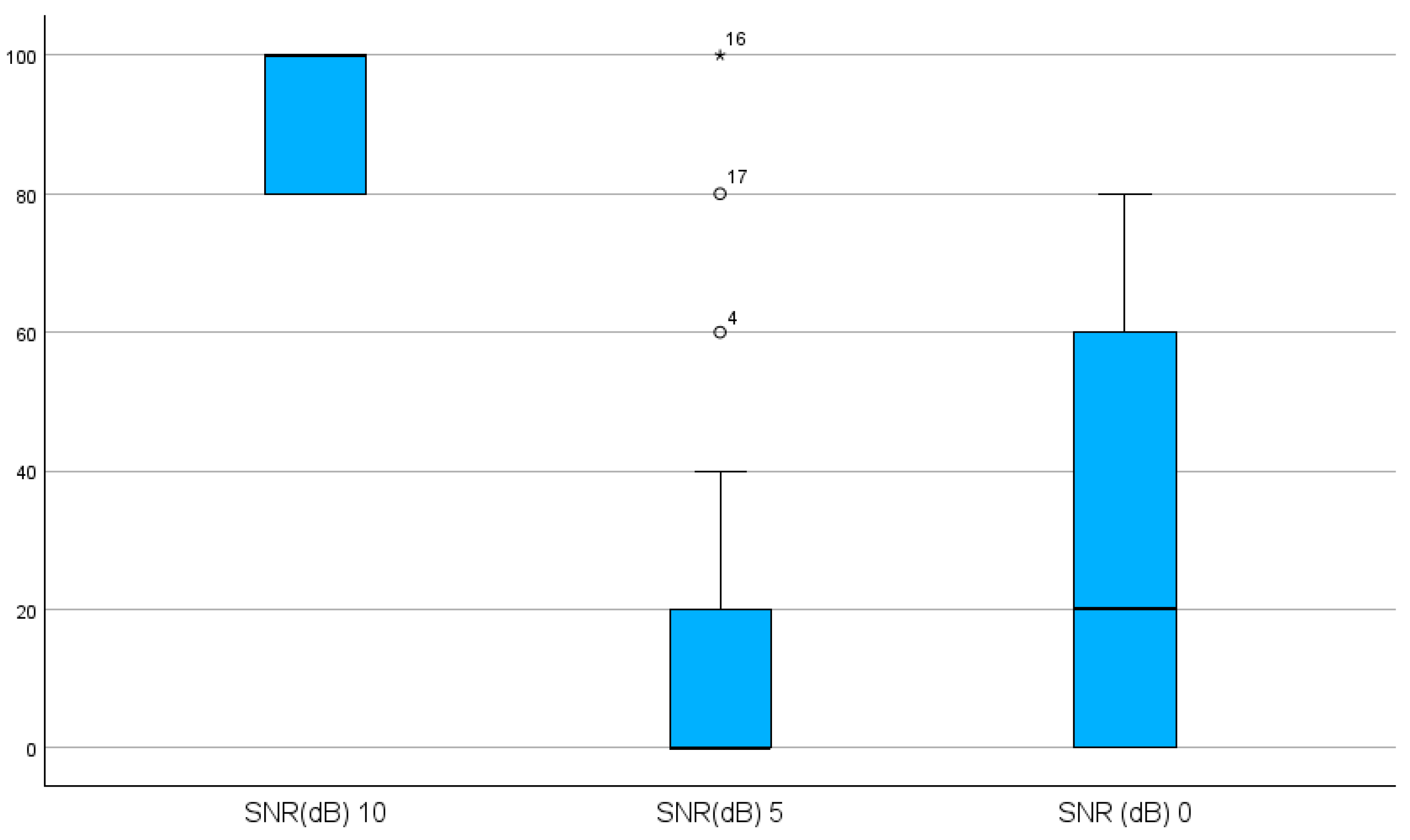
Set 5 was considered an outlier due to its low median (0%), high variability (SD 34.2%), and full performance range (0–100%), indicating disproportionate difficulty at 5 SNR (dB) (Table 2, Figure 1). Set 14 was excluded because the sentence at 15 SNR (dB) did not contain the required five keywords and exhibited performance deviating from other lists. Removing these sets resulted in a more uniform and reliable set of sentence lists for the final test.
Table 2.
Results from Set 5 across different signal-to-noise ratios (N = 15).
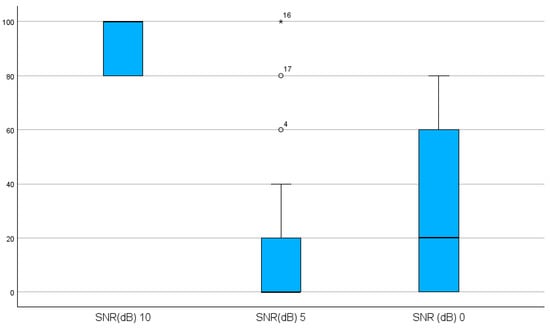
Figure 1.
Box plot from Set 5 across different signal-to-noise ratios. SNR (dB): Signal-to-Noise Ratio. Circles outliers between 1.5× IQR and 3× IQR, asterisks outliers greater than 3× IQR. IQR: Interquartile Range.
At the most challenging SNR (dB) of 0, intelligibility decreased sharply across all sets. Median scores ranged from 0% to 20%, mean scores varied from 12.0% to 40.3%, and standard deviations were high (up to 34.4%), reflecting large variability among participants. Ranges spanned nearly the full 0–80% scale for several sets, confirming that comprehension was generally low under extreme noise conditions.
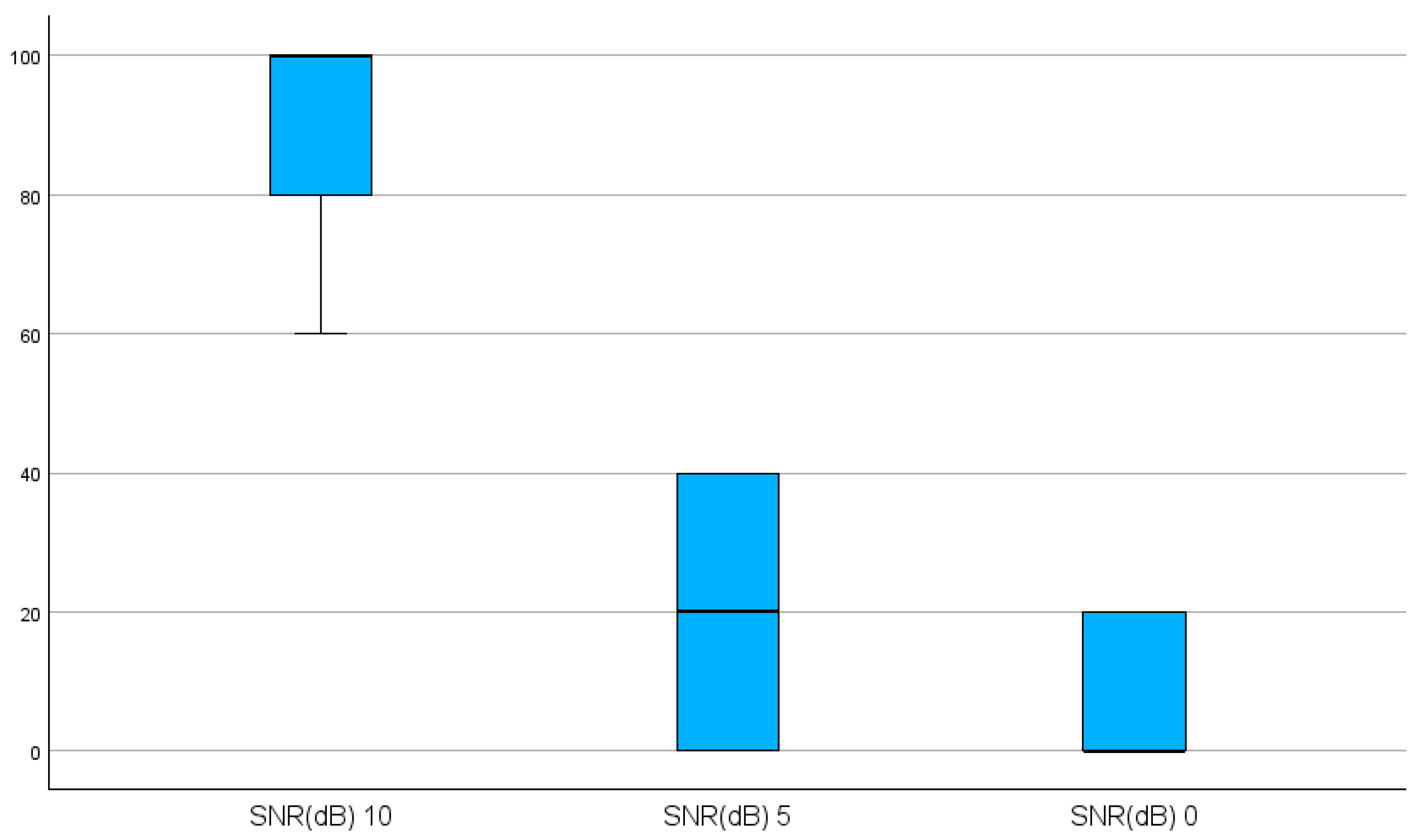
Despite high variability in intelligibility across sets at 5 SNR (dB), all sets, except set 5, showed a decline in intelligibility as the SNR (dB) decreased from 10 to 0 SNR (dB), as illustrated in Figure 2 for set 3.
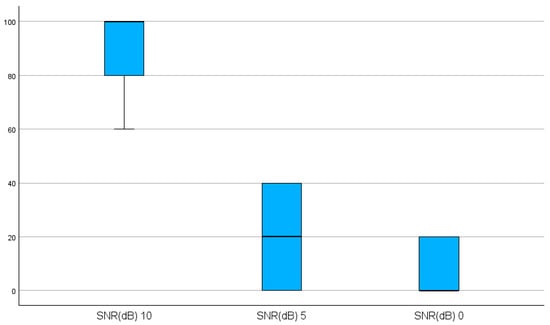
Figure 2.
Box plot from Set 3 across different signal-to-noise ratios. SNR (dB): Signal-to-Noise Ratio.
Based on these results, set 5 was removed from the final version of the SiN-EP due to its inconsistent performance. Set 14 was also excluded because the sentence at SNR (dB) of 15 did not contain the required five target words, and its minimum performance at SNR (dB) 5 deviated substantially from the other sets. The removal of these sets resulted in a more uniform set of sentences for the final test.
4. Discussion
The present study reports the development of the SiN-EP, a speech-in-noise (SiN) test specifically adapted for European Portuguese speakers. The results demonstrate consistent performance across thirteen lists of six sentences in varying noise levels, indicating that the SiN-EP functions reliably as a linguistically tailored measure of speech perception in noise. These findings align with the broader SiN literature and extend existing tools to Portuguese-speaking populations.
Adaptations of the QuickSIN framework into other languages have similarly aimed to ensure linguistic appropriateness, phonetic balance, and psychometric stability. For example, the Turkish QuickSIN was developed using native speakers and multi-talker babble noise to achieve list equivalence [16]. Likewise, investigations of the original QuickSIN’s 18 lists revealed that only a subset met criteria for homogeneity across listener groups [17]. Such work highlights the importance of sentence balance, controlled signal-to-noise ratios (SNRs(dB)), and realistic noise conditions—principles followed in the present study. The SiN-EP development process included drafting 165 sentences, evaluating them with native speakers, recording with a female voice, balancing phonemic content, and mixing with multitalker noise across SNRs (dB) from 25 to 0.
Pre-testing enabled the elimination of lists failing performance criteria, resulting in thirteen consistent, intelligible lists. Broader reviews of SiN assessments emphasize that standard audiometric tests (pure-tone thresholds, speech in quiet) often fail to capture everyday listening challenges. Reynard et al. [18], for example, stressed the need for clinically feasible tests simulating realistic listening. The SiN-EP contributes to this goal for Portuguese speakers, offering performance patterns comparable to other validated adaptations such as the Spanish and French QuickSIN tests [19,20]. Previous research further shows that SiN tests reveal listening difficulties in older adults and hearing-impaired listeners that are not detected by pure-tone audiometry [9,21]. Collectively, these findings support the SiN-EP as a reliable and context-appropriate tool for evaluating speech perception in noise.
A major strength of this study is the rigorous linguistic and phonetic adaptation process. Native speakers rated sentences for semantic and syntactic naturalness, ensuring that any comprehension difficulty arose from background noise rather than language complexity. Phoneme balancing across lists and controlled SNR (dB) calibration produced graded listening conditions (25–0 SNR (dB)). Pre-testing allowed the removal of non-performing lists, resulting in thirteen consistent, intelligible lists. These steps support the methodological robustness of the SiN-EP and its readiness for subsequent validation.
Nonetheless, several limitations must be acknowledged. First, the pre-test sample consisted solely of young adults (18–22 years) with normal hearing. Broader normative data, including older adults and hearing-impaired listeners, are required to establish reference values. Second, while the SNR (dB) range (25 to 0) captures a range of difficulty, real-world conditions can involve more adverse noise levels, spatial separation, or reverberation. Third, reliability measures such as test–retest consistency, list equivalence in clinical populations, and sensitivity to hearing status remain to be evaluated. Fourth, although list performance was consistent in this sample, equivalence should be confirmed across diverse populations. Finally, the influence of higher-level linguistic processes (e.g., semantic expectancy) was not manipulated, though prior research shows that listeners increasingly rely on context under challenging SNRs (dB) [22].
Despite these limitations, the SiN-EP has substantial potential for both clinical and research applications. Clinically, it provides a more ecologically valid assessment for Portuguese speakers who have trouble understanding speech in noise despite near-normal audiograms. It can aid in quantifying speech-in-noise deficits, guiding hearing-aid fitting or auditory training, and monitoring outcomes over time. For researchers, the SiN-EP offers a standardized, repeatable instrument for examining factors influencing SiN perception—such as aging, cognitive decline, or auditory processing disorders—and for tracking intervention effects. The use of thirteen equivalent lists minimizes learning effects, facilitating longitudinal studies and repeated testing.
Future work should address several key directions for advancing the validation and application of the SiN-EP:
First, normative data need to be collected across age ranges and hearing profiles, including both normal-hearing and hearing-impaired participants, to establish reference norms, percentile ranks, and clinically meaningful cut-offs.
Second, comprehensive reliability testing is essential, encompassing test–retest reliability, list equivalence, and sensitivity to group differences. Test–retest reliability should be assessed by administering the same lists twice over a 1–2 week interval, with stability indicated by an intraclass correlation coefficient (ICC ≥ 0.80) and coefficient of variation. List equivalence can be confirmed by comparing performance across all 13 lists at multiple SNRs (dB) using ANOVA or mixed-effects models, ensuring that no list differs significantly in difficulty. Sensitivity to hearing status should be evaluated by comparing normal-hearing and hearing-impaired listeners, using effect sizes (Cohen’s d) and receiver operating characteristic (ROC) curves to confirm the ability to detect clinically meaningful deficits [17].
Third, expanding testing conditions to include more realistic listening scenarios—such as negative SNRs (dB), spatially separated noise, reverberation, or competing talkers—would enhance ecological validity by simulating everyday auditory challenges [23].
Fourth, investigating cognitive and linguistic influences, including working memory, attention, bilingualism, and semantic context, can help explain inter-subject variability in SiN performance through correlation and regression analyses.
Fifth, applying the SiN-EP in intervention studies, such as hearing-aid use or auditory/cognitive training, and linking outcomes to self-reported listening difficulty, quality of life, and minimal clinically important differences will facilitate translation into meaningful clinical practice. Longitudinal stability can be confirmed by assessing detectable improvements over time, using effect sizes and significance testing.
Together, these steps form a structured, stepwise approach for validating the SiN-EP in clinical and research contexts, ensuring compliance with psychometric, linguistic, and functional standards.
5. Conclusions
In summary, the SiN-EP emerges as a methodologically sound and linguistically appropriate speech in noise test for European Portuguese speakers. The development process followed accepted best practices for adapting QuickSIN-style materials, and the initial data show clear and consistent participant performance across listening conditions. While further validation in broader populations and real-world listening settings is needed, the SiN-EP provides a promising tool for both clinical assessment and research of speech perception in noise among Portuguese speaking listeners.
Future studies will establish normative data and explore the test’s diagnostic sensitivity across diverse hearing populations.
Author Contributions
Conceptualization, J.T.F. and M.S.; methodology, M.S.; software, M.S.; validation, M.S., J.T.F. and M.F.; formal analysis, M.S.; investigation, M.F.; resources, J.S. and J.V.; data curation, M.S., J.S. and J.V.; writing—original draft preparation, M.S.; writing—review and editing, J.T.F. and A.M.; visualization, M.S.; supervision, J.T.F.; project administration, J.T.F. All authors have read and agreed to the published version of the manuscript.
Funding
This research received no external funding.
Institutional Review Board Statement
The study was conducted in accordance with the Declaration of Helsinki and approved by the Ethics Committee of Polytechnic Institute of Coimbra (approval number 142_CEIPC/2022, approval date 30 November 2022).
Informed Consent Statement
Informed consent was obtained from all subjects involved in the study.
Data Availability Statement
The data presented in this study are available on request from the corresponding author. The data are not publicly available due to privacy and ethical restrictions.
Conflicts of Interest
The authors declare no conflicts of interest.
References
- Van Os, M.; Kray, J.; Demberg, V. Rational Speech Comprehension: Interaction between Predictability, Acoustic Signal, and Noise. Front. Psychol. 2022, 13, 914239. [Google Scholar] [CrossRef] [PubMed]
- Shechter Shvartzman, L.; Lavie, L.; Banai, K. Speech Perception in Older Adults: An Interplay of Hearing, Cognition, and Learning? Front. Psychol. 2022, 13, 816864. [Google Scholar] [CrossRef] [PubMed]
- Rodriguez-Ferreiro, M.; Durán-Bouza, M.; Marrero-Aguiar, V. Design and Development of a Spanish Hearing Test for Speech in Noise (PAHRE). Audiol. Res. 2023, 13, 32–48. [Google Scholar] [CrossRef]
- Helfer, K.S.; Jesse, A. Hearing and Speech Processing in Midlife. Hear. Res. 2021, 402, 108097. [Google Scholar] [CrossRef] [PubMed]
- Pienkowski, M. On the Etiology of Listening Difficulties in Noise Despite Clinically Normal Audiograms. Ear Hear. 2017, 38, 135–148. [Google Scholar] [CrossRef]
- Billings, C.J.; Olsen, T.M.; Charney, L.; Madsen, B.M.; Holmes, C.E. Speech-in-Noise Testing: An Introduction for Audiologists. Semin. Hear. 2024, 45, 55–82. [Google Scholar] [CrossRef]
- Mendel, L.L. Objective and Subjective Hearing Aid Assessment Outcomes. Am. J. Audiol. 2007, 16, 118–129. [Google Scholar] [CrossRef]
- Sultan, O.A.; Elmahallawy, T.H.; Kolkaila, E.A.; Lasheen, R.M. Comparison between Quick Speech in Noise Test (QuickSIN) and Hearing in Noise Test (HINT) in Adults with Sensorineural Hearing Loss. Egypt. J. Ear Nose Throat Allied Sci. 2020, 21, 176–185. [Google Scholar] [CrossRef]
- Wilson, R.H.; McArdle, R.A.; Smith, S.L. An Evaluation of the BKB-SIN, HINT, QuickSIN, and WIN Materials on Listeners with Normal Hearing and Hearing Loss. J. Speech Lang. Hear. Res. 2007, 50, 844–856. [Google Scholar] [CrossRef]
- Davidson, A.; Marrone, N.; Souza, P. Hearing Aid Technology Settings and Speech-in-Noise Difficulties. Am. J. Audiol. 2022, 31, 21–31. [Google Scholar] [CrossRef]
- Killion, M.C.; Niquette, P.A.; Gudmundsen, G.I.; Revit, L.J.; Banerjee, S. Development of a Quick Speech-in-Noise Test for Measuring Signal-to-Noise Ratio Loss in Normal-Hearing and Hearing-Impaired Listeners. J. Acoust. Soc. Am. 2004, 116, 2395–2405, Erratum in J. Acoust. Soc. Am. 2006, 119, 1888. [Google Scholar] [CrossRef] [PubMed]
- Benzaquén, E.; Çolak, H.; Guo, X.; Lad, M.; Rushton, S.P.; Griffiths, T.D. Auditory-cognitive contributions to speech-in-noise perception determined with structural equation modelling of a large sample. Sci. Rep. 2025, 15, 34915. [Google Scholar] [CrossRef] [PubMed]
- Cutler, A. Native Listening: Language Experience and the Recognition of Spoken Words; MIT Press: Cambridge, MA, USA, 2012. [Google Scholar]
- Nilsson, M.; Soli, S.D.; Sullivan, J.A. Development of the Hearing in Noise Test for the measurement of speech reception thresholds in quiet and in noise. J. Acoust. Soc. Am. 1994, 95, 1085–1099. [Google Scholar] [CrossRef] [PubMed]
- Mendes, A.P.; Moreira, M.; Costa, A.; Murtinheira, A.; Jorge, A. Validade e Sensibilidade do Texto Fonetically Equilibrado para o Português-Europeu ‘O Sol’. Distúrb. Comun. 2014, 26, 277–286. [Google Scholar]
- Öztürk Karaburun, S.; Çiprut, A.A.; Akdeniz, E. Development of a Quick Speech in Noise Test in Turkish, Based on Quick-SIN. Egypt. J. Otolaryngol. 2025, 41, 41. [Google Scholar] [CrossRef]
- McArdle, R.A.; Wilson, R.H. Homogeneity of the 18 QuickSIN Lists. J. Am. Acad. Audiol. 2006, 17, 157–167. [Google Scholar] [CrossRef]
- Reynard, P.; Lagacé, J.; Joly, C.A.; Dodelé, L.; Veuillet, E.; Thai-Van, H. Speech-in-Noise Audiometry in Adults: A Review of the Available Tests for French Speakers. Audiol. Neurootol. 2022, 27, 185–199. [Google Scholar] [CrossRef]
- Leclercq, F.; Renard, C.; Vincent, C. Speech Audiometry in Noise: Development of the French-Language VRB (Vocale Rapide dans le Bruit) Test. Eur. Ann. Otorhinolaryngol. Head Neck Dis. 2018, 135, 315–319. [Google Scholar] [CrossRef]
- Cristiani, H.E.; Serra, V.; Guinguis, M. Development of a Quick Speech-in-Noise Test in “Rioplatense” Spanish, Based on Quick-SIN®. J. Phonet. Audiol. 2020, 6, 144. [Google Scholar]
- Wong, W.L. Assessing the Correlation Between Hearing Sensitivity and Quick Speech-in-Noise Test (QuickSIN) Performance: The Role of Extended High-Frequency Hearing and Conventional Frequency Range Hearing. Ph.D. Thesis, University of British Columbia, Vancouver, BC, Canada, 2025. [Google Scholar]
- Zekveld, A.A.; Rudner, M.; Johnsrude, I.S.; Festen, J.M.; Van Beek, J.H.; Rönnberg, J. The Influence of Semantically Related and Unrelated Text Cues on the Intelligibility of Sentences in Noise. Ear Hear. 2011, 32, e16–e25. [Google Scholar] [CrossRef]
- Brungart, D.S.; Sheffield, B.M.; Kubli, L.R. Development of a Test Battery for Evaluating Speech Perception in Complex Listening Environments. J. Acoust. Soc. Am. 2014, 136, 777–790. [Google Scholar] [CrossRef]
Disclaimer/Publisher’s Note: The statements, opinions and data contained in all publications are solely those of the individual author(s) and contributor(s) and not of MDPI and/or the editor(s). MDPI and/or the editor(s) disclaim responsibility for any injury to people or property resulting from any ideas, methods, instructions or products referred to in the content. |
© 2025 by the authors. Licensee MDPI, Basel, Switzerland. This article is an open access article distributed under the terms and conditions of the Creative Commons Attribution (CC BY) license (https://creativecommons.org/licenses/by/4.0/).