
Outcomes of Audiologist-Delivered Tinnitus Management in Singapore Public Health Service: A Retrospective Service Evaluation


Abstract
1. Introduction
2. Methods
2.1. Description of the Intervention
2.1.1. Education
2.1.2. Counselling
2.1.3. Hearing Aids
2.1.4. Sound Therapy
3. Results
3.1. Characteristics of the Patients
3.2. Post-Treatment THI Scores
4. Discussion
5. Conclusions
Author Contributions
Funding
Institutional Review Board Statement
Informed Consent Statement
Data Availability Statement
Conflicts of Interest
References
- Langguth, B.; Elgoyhen, A.B.; Cederroth, C.R. Therapeutic approaches to the treatment of tinnitus. Annu. Rev. Pharmacol. Toxicol. 2019, 59, 291–313. [Google Scholar] [CrossRef] [Scilit] [PubMed]
- Swain, S.K.; Nayak, S.; Ravan, J.R.; Sahu, M.C. Tinnitus and its current treatment–still an enigma in medicine. J. Formos. Med. Assoc. 2016, 115, 139–144. [Google Scholar] [CrossRef] [Scilit] [PubMed]
- Tyler, R.S.; Bergan, C.J. Tinnitus retraining therapy. Hear. J. 2001, 54, 36–42. [Google Scholar] [CrossRef] [Scilit]
- McCormack, A.; Edmondson-Jones, M.; Somerset, S.; Hall, D. A systematic review of the reporting of tinnitus prevalence and severity. Hear. Res. 2016, 337, 70–79. [Google Scholar] [CrossRef] [Scilit] [PubMed]
- Ministry of Health. News Highlights. 2023. Available online: https://www.moh.gov.sg/news-highlights/details/tinnitus (accessed on 12 October 2024).
- Png, S. Establishing the Prevalence and Severity of Tinnitus Among Singaporean Elderly Population; NUS: Singapore, 2017; Available online: https://www.audiologysingapore.org/wp-content/uploads/2018/10/Research_Presentation_Shermaine.pdf (accessed on 12 October 2024).
- Aazh, H.; Moore, B.C. Factors associated with depression in patients with tinnitus and hyperacusis. Am. J. Audiol. 2017, 26, 562–569. [Google Scholar] [CrossRef] [Scilit] [PubMed]
- Nondahl, D.M.; Cruickshanks, K.J.; Dalton, D.S.; Klein, B.E.; Klein, R.; Schubert, C.R.; Tweed, T.S.; Wiley, T.L. The impact of tinnitus on quality of life in older adults. J. Am. Acad. Audiol. 2007, 18, 257–266. [Google Scholar] [CrossRef] [Scilit] [PubMed]
- Udupi, V.A.; Uppunda, A.K.; Mohan, K.M.; Alex, J.; Mahendra, M.H. The relationship of perceived severity of tinnitus with depression. anxiety, hearing status, age and gender in individuals with tinnitus. Int. Tinnitus J. 2013, 18, 29–34. [Google Scholar] [CrossRef] [Scilit] [PubMed]
- Lee, G.J. Hearing loss among the elderly. In Assessments, Treatments and Modeling in Aging and Neurological Disease; Academic Press: Cambridge, MA, USA, 2021; pp. 173–182. [Google Scholar] [CrossRef] [Scilit]
- Tunkel, D.E.; Bauer, C.A.; Sun, G.H.; Rosenfeld, R.M. American Academy of Otolaryngology—Head and Neck Foundation Clinical Practice Guideline: Tinnitus. Otolaryngol.—Head Neck Surg. 2014, 151, P20. [Google Scholar] [CrossRef] [Scilit]
- Overview: Tinnitus: Assessment and management: Guidance. NICE, 2020. Available online: https://www.nice.org.uk/guidance/ng155 (accessed on 12 October 2024).
- Tyler, R.S.; Perreau, A. (Eds.) Tinnitus Treatment Clinical Protocols; Thieme: New York, NY, USA, 2022. [Google Scholar]
- Gander, P.E.; Hoare, D.J.; Collins, L.; Smith, S.; Hall, D.A. Tinnitus referral pathways within the National Health Service in england: A survey of their perceived effectiveness among Audiology Staff. BMC Health Serv. Res. 2011, 11, 162. [Google Scholar] [CrossRef] [Scilit] [PubMed]
- Folmer, R.L. Long-term reductions in tinnitus severity. BMC Ear Nose Throat Disord. 2002, 2, 3. [Google Scholar] [CrossRef] [Scilit] [PubMed]
- Folmer, R.L.; Martin, W.H.; Shi, Y. Tinnitus: Questions to reveal the cause. answers to provide relief. J. Fam. Pract. 2004, 53, 532–540. [Google Scholar] [PubMed]
- Jastreboff, P.J.; Hazell, J.W.P. Tinnitus Retraining Therapy: Implementing the Neurophysiological Model; Cambridge University Press: Cambridge, UK, 2008. [Google Scholar]
- Jastreboff, P.J.; Hazell, J.W. A neurophysiological approach to tinnitus: Clinical implications. Br. J. Audiol. 1993, 27, 7–17. [Google Scholar] [CrossRef] [Scilit] [PubMed]
- Pienkowski, M.; Tyler, R.S.; Roncancio, E.R.; Jun, H.J.; Brozoski, T.; Dauman, N.; Coelho, C.B.; Andersson, G.; Keiner, A.J.; Cacace, A.T.; et al. A review of Hyperacusis and future directions: Part II. measurement. mechanisms, and treatment. Am. J. Audiol. 2014, 23, 420–436. [Google Scholar] [CrossRef] [Scilit] [PubMed]
- Langguth, B.; Kreuzer, P.M.; Kleinjung, T.; De Ridder, D. Tinnitus: Causes and clinical management. Lancet Neurol. 2013, 12, 920–930. [Google Scholar] [CrossRef] [Scilit] [PubMed]
- Croft, C.; Brown, R.F.; Thorsteinsson, E.B.; Noble, W. Is tinnitus acceptance the same as tinnitus habituation? Int. Tinnitus J. 2013, 18, 143–148. [Google Scholar] [CrossRef] [Scilit] [PubMed]
- Hesser, H.; Gustafsson, T.; Lundén, C.; Henrikson, O.; Fattahi, K.; Johnsson, E.; Westin, V.Z.; Carlbring, P.; Mäki-Torkko, E.; Kaldo, V.; et al. A randomized controlled trial of internet-delivered cognitive behavior therapy and acceptance and commitment therapy in the treatment of tinnitus. J. Consult. Clin. Psychol. 2012, 80, 649–661. [Google Scholar] [CrossRef] [Scilit] [PubMed]
- Westin, V.Z.; Schulin, M.; Hesser, H.; Karlsson, M.; Noe, R.Z.; Olofsson, U.; Stalby, M.; Wisung, G.; Andersson, G. Acceptance and commitment therapy versus tinnitus retraining therapy in the treatment of tinnitus: A randomised controlled trial. Behav. Res. Ther. 2011, 49, 737–747. [Google Scholar] [CrossRef] [Scilit] [PubMed]
- Andersson, G.; Jüris, L.; Classon, E.; Fredrikson, M.; Furmark, T. Consequences of suppressing thoughts about tinnitus and the effects of cognitive distraction on brain activity in tinnitus patients. Audiol. Neurotol. 2006, 11, 301–309. [Google Scholar] [CrossRef] [Scilit] [PubMed]
- Sereda, M.; Hoare, D.J.; Nicholson, R.; Smith, S.; Hall, D.A. Consensus on hearing aid candidature and fitting for mild hearing loss. with and without tinnitus. Ear Hear. 2015, 36, 417–429. [Google Scholar] [CrossRef] [Scilit] [PubMed]
- Del Bo, L.; Ambrosetti, U. Hearing aids for the treatment of tinnitus. In Progress in Brain Research; Elsevier: Amsterdam, The Netherlands, 2007; pp. 341–345. [Google Scholar] [CrossRef] [Scilit] [PubMed]
- Jastreboff, P.J. Tinnitus retraining therapy. In Textbook of Tinnitus; Springer: Berlin/Heidelberg, Germany, 2011; pp. 575–596. [Google Scholar] [CrossRef] [Scilit]
- Zetterqvist, V. Tinnitus—An Acceptance-Based Approach; University Electronic Press: Linköping, Sweden, 2011. [Google Scholar]
- Gudex, C.; Skellgaard, P.H.; West, T.; Sørensen, J. Effectiveness of a tinnitus management programme: A 2-year follow-up study. BMC Ear Nose Throat Disord. 2009, 9, 6. [Google Scholar] [CrossRef] [Scilit] [PubMed]
- Newman, C.W.; Jacobson, G.P.; Spitzer, J.B. Development of the tinnitus handicap inventory. Arch. Otolaryngol.—Head Neck Surg. 1996, 122, 143–148. [Google Scholar] [CrossRef] [Scilit] [PubMed]
- Schulz, K.F.; Altman, D.G.; Moher, D. Consort 2010 statement: Updated guidelines for reporting parallel group randomised trials. PLoS Med. 2010, 7, e1000251. [Google Scholar] [CrossRef] [Scilit] [PubMed]
- Gibbons, R.D.; Hedeker, D.R.; Davis, J.M. Estimation of effect size from a series of experiments involving paired comparisons. J. Educ. Stat. 1993, 18, 271. [Google Scholar] [CrossRef] [Scilit]
- Morris, S.B.; DeShon, R.P. Combining effect size estimates in meta-analysis with repeated measures and independent-groups designs. Psychol. Methods 2002, 7, 105–125. [Google Scholar] [CrossRef] [Scilit] [PubMed]
- Lachenbruch, P.A.; Cohen, J. Statistical Power Analysis for the Behavioral Sciences (2nd ed.). J. Am. Stat. Assoc. 1989, 84, 1096. [Google Scholar] [CrossRef] [Scilit]
- Thong, J.F.; Ibrahim, J.B.; Wong, M.C.; Chan, Y.M. Habituation following tinnitus retraining therapy in tinnitus sufferers. Ann. Acad. Med. Singap. 2013, 42, 681–686. [Google Scholar] [CrossRef] [Scilit]
- Lim, J.J.B.H.; Lu, P.K.; Koh, D.; Eng, S.P. Impact of tinnitus as measured by the Tinnitus Handicap Inventory among tinnitus sufferers in Singapore. Singap. Med. J. 2010, 51, 551–557. [Google Scholar]
- Henry, J.A.; Dennis, K.C.; Schechter, M.A. General Review of tinnitus. J. Speech Lang. Hear. Res. 2005, 48, 1204–1235. [Google Scholar] [CrossRef] [Scilit] [PubMed]


| Gender | |
| - Male | 109 (54%) |
| - Female | 92 (46%) |
| Age | |
| - Median age | 52 years |
| - Age range | 18–86 years |
| - 18–30 | 29 (14%) |
| - 31–40 | 15 (7%) |
| - 41–50 | 31 (15%) |
| - 51–60 | 62 (31%) |
| - 61–70 | 54 (27%) |
| - >70 | 10 (5%) |
| Ethnicity | |
| - Chinese | 168 (84%) |
| - Malay | 21 (10%) |
| - Indian | 7 (3%) |
| - Others | 5 (2%) |
| Hearing thresholds (500–8 kHz) | |
| - Normal hearing (4FA ≤ 25 dBHL) in both ears | 88 (44%) |
| - Hearing loss (4FA > 25 dBHL) in at least one ear | 113 (56%) |
| Localisation of tinnitus | |
| - Right ear | 65 (32%) |
| - Left ear | 61 (30%) |
| - Both ears | 60 (30%) |
| - In head | 15 (7%) |
| Type of tinnitus sounds heard | |
| - Non-pulsatile ringing | 112 (56%) |
| - Crickets | 48 (24%) |
| - Others * | 41 (20%) |
| Tinnitus Severity Grade | |
| - Slight (Grade 1) | 48 (24%) |
| - Mild (Grade 2) | 60 (30%) |
| - Moderate (Grade 3) | 55 (27%) |
| - Severe (Grade 4) | 20 (10%) |
| - Catastrophic (Grade 5) | 18 (9%) |
| Tinnitus Management Domains | n |
|---|---|
| Education and Counselling | 201 (100%) |
| Sound therapy | 198 (99%) |
| Recommended and agreed to use hearing aid/sound generator | 36 (18%) |
| Referred to/already seeing psychiatrist or psychologist | 9 (4%) |
| Patients Who Returned for the 3-Month Follow-Up Appointment (n = 73) | Patients Who Did Not Return for the 3-Month Follow-Up Appointment (n = 128) | p Value | |
|---|---|---|---|
| Mean age, years | 50.4 | 52.6 | 0.34 |
| Gender (% male) | 47 | 58 | 0.168 |
| Mean 4FA of the better ear (dB HL) | 22.0 | 23.7 | 0.41 |
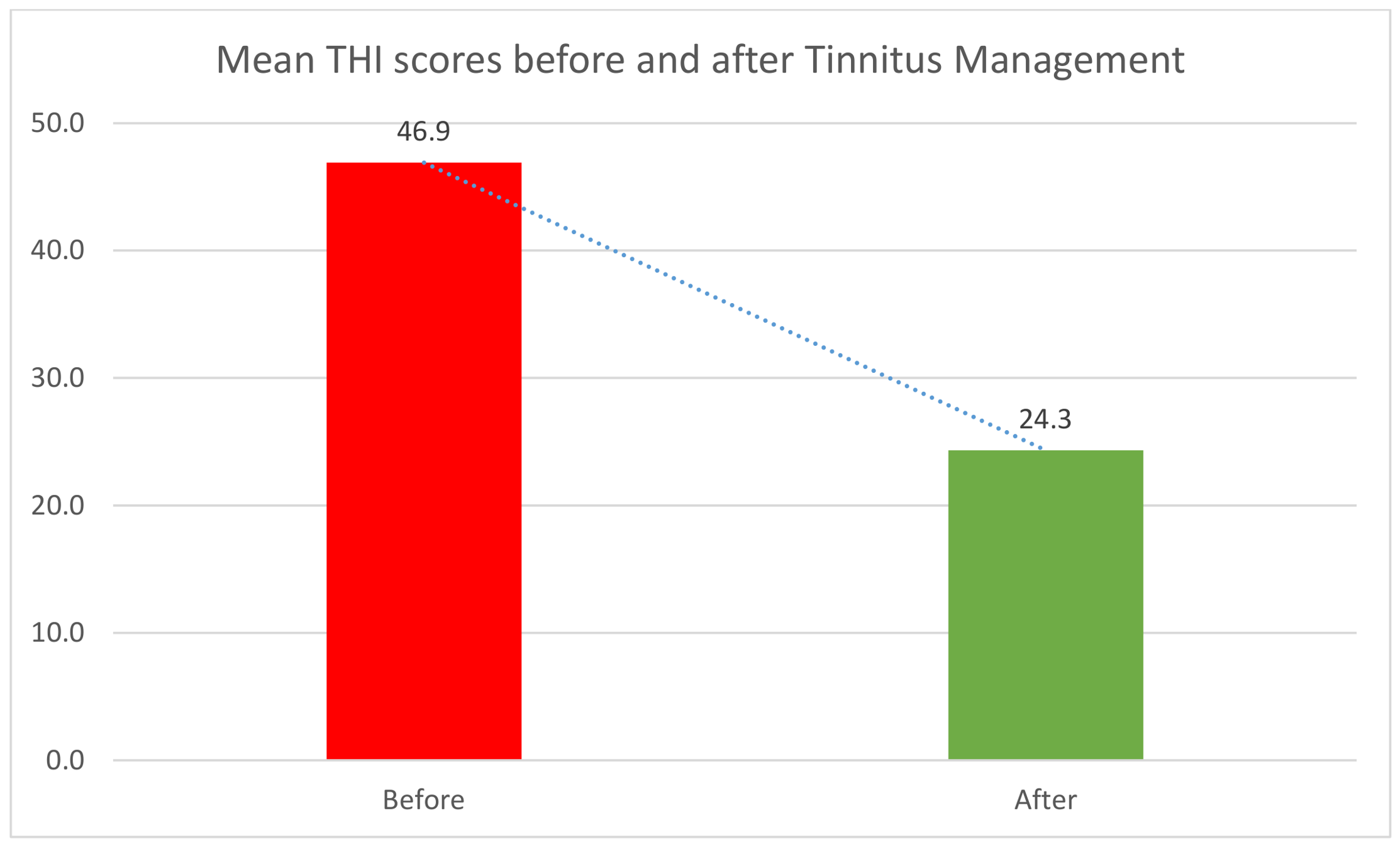
| Mean THI (Before) | 46.9 | 31.1 | 0.000 |
| THI Score | Tinnitus Severity Grade | Pre-Treatment n = 73 | Post-Treatment @ 3 Months n = 73 |
|---|---|---|---|
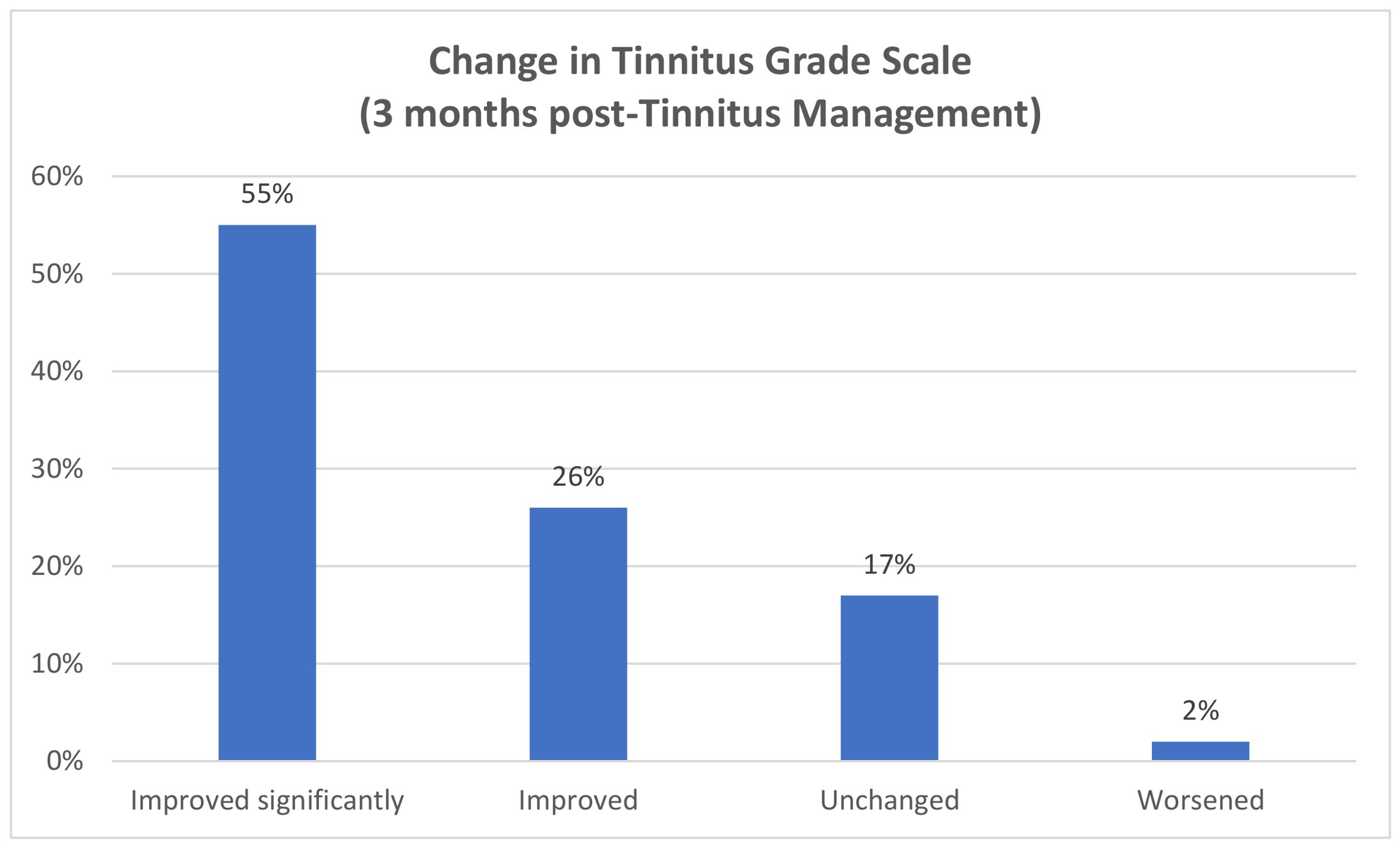
| 0–16 | 1 (Slight/No handicap) | 6 (8%) | 33 (45%) |
| 18–36 | 2 (Mild) | 20 (27%) | 24 (33%) |
| 38–56 | 3 (Moderate) | 26 (36%) | 12 (16%) |
| 58–76 | 4 (Severe) | 8 (11%) | 1 (1%) |
| 78–100 | 5 (Catastrophic) | 13 (18%) | 3 (4%) |
| Pre-Treatment M (SD) | Post-Treatment M (SD) | p Value | |
|---|---|---|---|
| THI (n = 73) | 46.9 (22.9) | 24.3 (19.6) | 0.0000 |
| THI (n = 201) * | 36.9 (23.7) | 28.7 (21.6) | 0.0003 |
Disclaimer/Publisher’s Note: The statements, opinions and data contained in all publications are solely those of the individual author(s) and contributor(s) and not of MDPI and/or the editor(s). MDPI and/or the editor(s) disclaim responsibility for any injury to people or property resulting from any ideas, methods, instructions or products referred to in the content. |
© 2026 by the authors. Licensee MDPI, Basel, Switzerland. This article is an open access article distributed under the terms and conditions of the Creative Commons Attribution (CC BY) license.
Share and Cite
Lee, G.J.C.; Liew, J.J.P.; Teng, A.W.L. Outcomes of Audiologist-Delivered Tinnitus Management in Singapore Public Health Service: A Retrospective Service Evaluation. J. Otorhinolaryngol. Hear. Balanc. Med. 2026, 7, 30. https://doi.org/10.3390/ohbm7020030
Lee GJC, Liew JJP, Teng AWL. Outcomes of Audiologist-Delivered Tinnitus Management in Singapore Public Health Service: A Retrospective Service Evaluation. Journal of Otorhinolaryngology, Hearing and Balance Medicine. 2026; 7(2):30. https://doi.org/10.3390/ohbm7020030
Chicago/Turabian StyleLee, Gary Jek Chong, Jasmine Jek Peng Liew, and Andrew Wei Li Teng. 2026. "Outcomes of Audiologist-Delivered Tinnitus Management in Singapore Public Health Service: A Retrospective Service Evaluation" Journal of Otorhinolaryngology, Hearing and Balance Medicine 7, no. 2: 30. https://doi.org/10.3390/ohbm7020030
APA StyleLee, G. J. C., Liew, J. J. P., & Teng, A. W. L. (2026). Outcomes of Audiologist-Delivered Tinnitus Management in Singapore Public Health Service: A Retrospective Service Evaluation. Journal of Otorhinolaryngology, Hearing and Balance Medicine, 7(2), 30. https://doi.org/10.3390/ohbm7020030