1. Introduction
Nasopharyngeal cancer (NPC) tends to affect healthy, middle-aged adults. Although the overall 5-year disease survival is > 70% for stages 1 to 3 NPC, patients suffer from side effects of chemoradiation treatment. Up to 46% of patients suffer from irreversible hearing loss from as early as three months after treatment [
1,
2]. As the median age of NPC patients is 45 years, hearing loss has a long-term impact on a patient’s quality of life.
NPC is treated based on its stage using three modalities: radiation (RT) alone, concurrent chemoradiation (cCRT), and induction chemotherapy with concurrent chemoradiation (icCRT). CRT treatment causes worse hearing loss than radiation alone because of the synergistic ototoxicity from the combined cisplatin and radiation treatment. In addition, whilst icCRT has improved outcomes in locally advanced NPC, the cumulative cisplatin dose for icCRT is almost double that of cCRT. Hence, patients undergoing icCRT are most vulnerable to hearing loss.
Prestin is a motor protein in the outer hair cells of the cochlea. Animal studies have shown that blood prestin levels are higher in cisplatin and radiation-induced hearing loss [
3], and the peak level occurs in the first week after cisplatin exposure [
4]. A study of patients receiving cisplatin found that prestin levels increased with cisplatin [
5]. However, to our knowledge, no study has examined how prestin levels change after cisplatin treatment.
Our primary aim was to investigate the relationship of prestin change with the presence of hearing loss. Our secondary aims were to investigate prestin levels with Tinnitus Handicap Inventory (THI) scores, and the time trend of prestin levels following cisplatin exposure.
2. Materials and Methods
Eleven patients with NPC undergoing icCRT from August 2020 to April 2022 were prospectively recruited. Ethical policies and procedures adhering to the Declaration of Helsinki were obtained from the IRB committee (ECOS ref 2020-2113). Written consent was obtained from all patients.
Inclusion criteria were adult patients above 21 years of age with nasopharyngeal carcinoma diagnosed on biopsy, a treatment plan of three cycles of induction chemotherapy (70–80 mg/m2 cisplatin per cycle every 3 weeks, gemcitabine 1000 mg/m2 on days 1 and 8) and three cycles of high-dose concurrent cisplatin chemotherapy (100 mg/m2 per cycle every 3 weeks) with radiation therapy (33 sessions of 69.96 Gy each).
Exclusion criteria included the presence of distant metastases, pre-existing severe-to-profound sensorineural hearing loss, tympanic membrane perforation in any ear, and the use of other ototoxic medications.
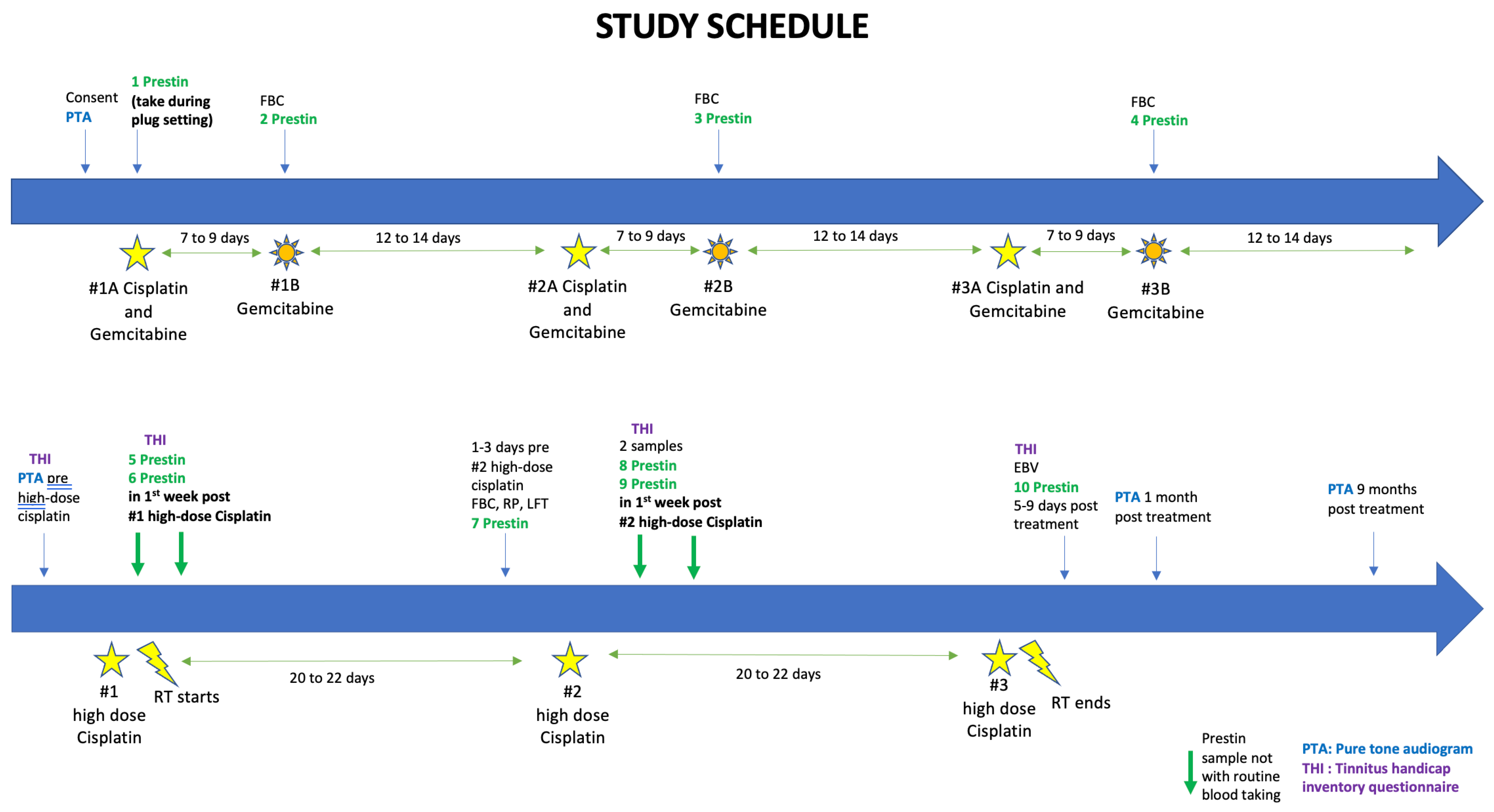
Blood samples were collected over 10 time points during treatment. Six blood samples were timed with routine blood collection during the patient’s treatment, and four additional samples were taken to measure prestin levels; The patients’ treatment and study schedule is illustrated in
Figure 1. 3 mL of blood was collected each time in ethylenediaminetetraacetic acid (EDTA) blood tubes (BD Vacutainer, Becton, Dickinson and Company, Franklin Lakes, NJ, USA). These collected blood samples were centrifuged for 15 min at 1000×
g at 4 °C, and plasma samples were aliquoted into Eppendorf tubes and stored in a −80 °C freezer until batch testing. A commercially available human prestin Enzyme-Linked Immunosorbent Assay (ELISA) (SLC26A5) (MyBioSource, San Francisco, CA, USA) was used to quantify plasma prestin levels. The assay was performed according to the manufacturer’s instruction manual. The optical density of each well was determined using a microplate reader set at 450 nm. Wavelength correction was set at 540 nm.
Four pure-tone audiograms and tympanograms were performed at the following time points: pre-treatment, pre-concurrent cisplatin, and one and nine months post treatment.
THI was assessed at the following time points: pre-concurrent cisplatin, and one week after the first, second, and third concurrent cisplatin.
Statistical Analysis
Hearing thresholds, THI scores, and prestin levels throughout the treatment period were compared using the Wilcoxon signed-rank test. Possible predictive variables such as prestin levels, radiation dose, and chemotherapy dose were analyzed for association with hearing loss and worsening of THI during treatment using the Mann–Whitney U test. Nonparametric tests were used because of the non-normal distribution of data. All tests were conducted at the 5% significance level. All analyses were performed using SPSS version 23 (IBM, Armonk, NY, USA).
3. Results
The demographics of our patients are represented in
Table 1.
Audiograms with baseline type B tympanograms were excluded. This was because bone thresholds at 500 to 4 kHz mostly did not worsen, whereas it was noted that the air thresholds worsened at 8 kHz. Because bone thresholds were not measured at 8 kHz, we excluded baseline type B tympanograms to exclude conductive hearing loss. Nine right-ear and six left-ear audiograms were analyzed.
Table 1 shows changes in hearing levels in both ears. There was a significant worsening of hearing after treatment. Hearing loss occurred at 8 kHz and was detected as early as one month after treatment. No significant loss of hearing was observed at the lower frequencies.
RT and induction cisplatin doses were correlated with worsening hearing (Z = 1.92, p = 0.05). However, RT and cisplatin doses showed no relationship with worsening of hearing at 1 and 9 months post treatment.
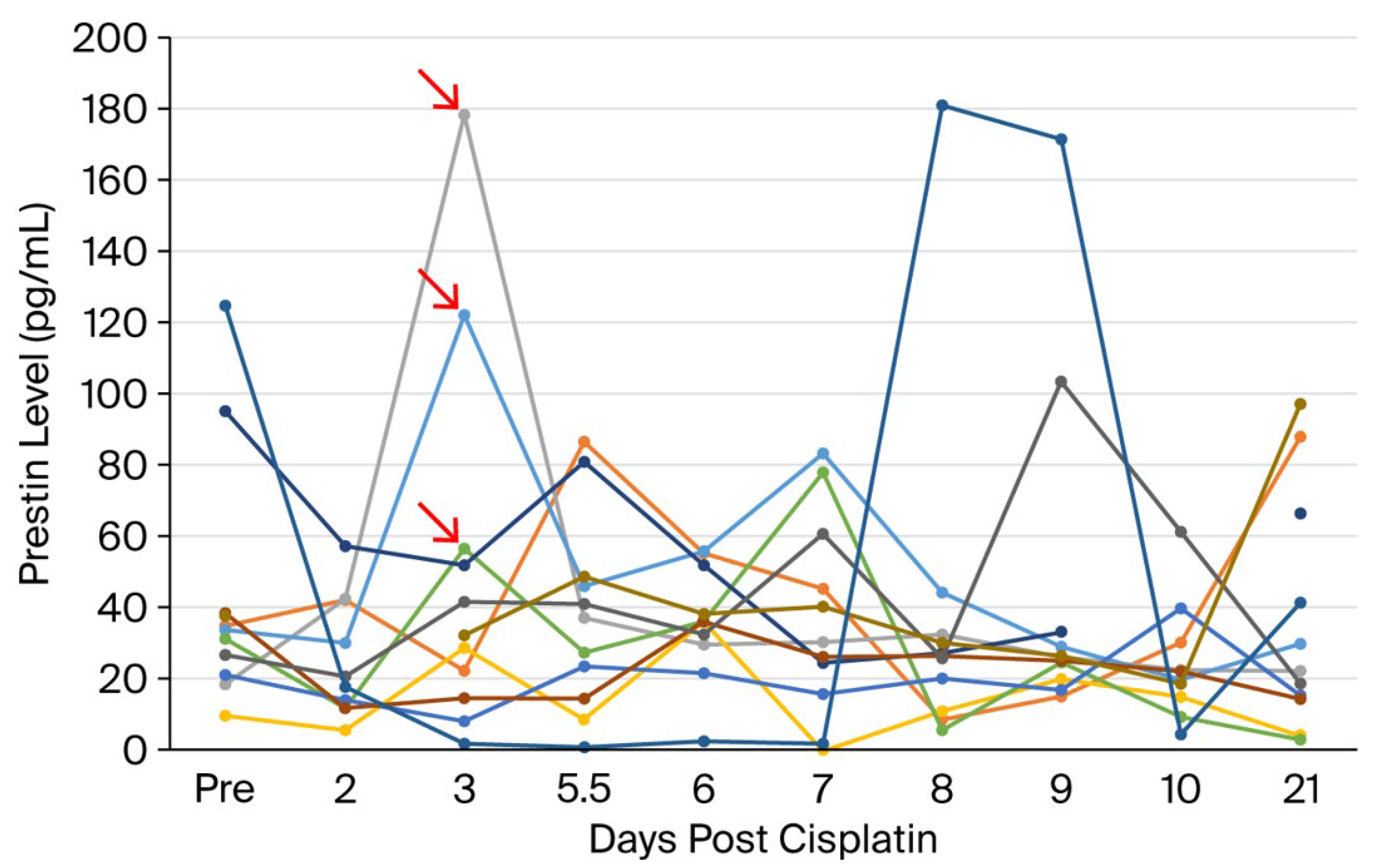
Figure 2 shows the prestin levels of each patient plotted against the number of days after cisplatin treatment. The red arrows indicate three patients with 8 kHz hearing loss at one month post treatment, each showing a marked increase in prestin levels three days after cisplatin administration.
Figure 2 shows the prestin levels of each patient plotted against the number of days after cisplatin treatment. These two readings were taken at 8 days post cisplatin administration, as shown in
Figure 2, as these samples were taken together with routine full blood counts during chemotherapy.
For patients who had worse THI, prestin levels at 5.5 days and 8 days post cisplatin administration were higher (p = 0.020 and p = 0.039 respectively). Compared to baseline, there was significant worsening of THI after the last dose of cisplatin (Z = −2.49, p = 0.013), but not after the first concurrent (Z = −1.22, p = 0.223) and second concurrent cisplatin doses (Z = −0.83, p = 0.405). The median THI score at baseline was 4 (IQR 0.004.00) and worsened to 20.00 (IQR 2.00–20.00) after the last dose of cisplatin. RT and the cumulative cisplatin dose showed no relationship with worsening THI (p > 0.05).
4. Discussion
Prestin is a motor protein of outer hair cells and a member of the anion transporter family [
6]. Intracellular anions are essential for the electromotility of outer hair cells. Some studies postulate that prestin can be used as a biomarker of hearing loss, as outer hair cells are vulnerable to damage from various insults, and found that prestin levels are affected in sensorineural hearing loss due to noise, cisplatin, and idiopathic sudden sensorineural hearing loss [
5,
7,
8,
9,
10,
11,
12,
13].
Serum levels of prestin are challenging to measure. One recent study showed that prestin concentrations measured by ELISA kits were significantly affected by the quality of the collected serum and that hemolysis could change the result [
14]. None of our samples showed signs of hemolysis.
Dilution significantly affected assay results. Pilot testing with serial serum dilutions (1:5–1:100) yielded prestin concentrations below the lowest standard. After consultation with the manufacturer (MyBioSource), subsequent assays were performed using neat serum. Four samples could not be reliably measured neat and were instead analyzed at a 1:50 dilution, which yielded higher prestin values, likely due to matrix effects. Components within a sample (e.g., carbohydrates, proteins, or phospholipids) that are not the target analyte interfere with the antibody binding of the analyte to the antibody. When a sample is diluted, interfering components no longer interact with the target analyte, which is readily available for measurement in the assay. Parker et al. used a dilution of 1:5 and found that although serum prestin varied between participants, individual levels were quite repeatable [
15].
Based on our findings, prestin is a short-living protein with levels that may peak at 3 days post cisplatin and pre-date detectable audiometric changes, allowing prestin to serve as a potential early biomarker of ototoxicity. A key challenge in the design of this study was determining the optimal timing for plasma prestin measurement, as we coincided our venipunctures with the chemotherapy venipuncture schedule.
We found the mean baseline prestin to be higher than it was post cisplatin, except at three days post cisplatin, where three patients had a steep increase in prestin (red arrows in
Figure 2). These patients had hearing worsening by 25 to 45 dB in the right ear at 8 kHz, and by 55 dB in the left ear. An animal study found that prestin levels reached a maximum on day 2 post cisplatin administration and remained high on day 3 before returning to baseline on days 7 and 14 [
4]. In future studies, one should consider measuring the prestin level closely over 5 days after cisplatin treatment. We also found prestin levels at 5.5 days and 8 days post cisplatin administration were higher in patients who had worsened tinnitus, although these were not associated with hearing loss.
To our knowledge, only one other human study has investigated the effects of cisplatin on serum prestin concentration [
5]. The authors of that study included a larger cohort of 52 patients treated with cisplatin for malignant solid tumors. In contrast to our cohort, they excluded patients who underwent RT to the head and neck region. Their cisplatin regimen also differed from ours, with patients receiving 20–40 mg (1 week), 40–80 mg (2 weeks), and > 80 mg (3 weeks), whereas our patients received a higher dose of cisplatin—three cycles of induction chemotherapy (70–80 mg/m
2 cisplatin per cycle every 3 weeks) and three cycles of high-dose concurrent cisplatin chemotherapy (100 mg/m
2 per cycle every 3 weeks). They used the ELISA Kit (BT Lab, Shanghai, China), whereas we used the SLC26A5 from My BioSource (San Francisco, CA, USA). They found that prestin levels significantly increased with cisplatin dosage. There was no mention of when blood samples were drawn in relation to cisplatin treatment.
The wide range of baseline prestin levels between patients, variable readings due to dilution and hemolysis, and large fluctuations within a short time span from ototoxic exposure are some challenges for prestin as a predictive biomarker. Its levels could also be affected by other confounders such as age, noise exposure, comorbidities, lifestyle, and medications [
16].
Measuring prestin with a different technique—mass spectrometry—may reduce variability. However, when we embarked on this study in 2020, there were few publications quantitating human prestin and there were grant budget constraints.
Our audiograms were performed only until 8 kHz. Further extended high-frequency testing and the use of the distortion product OAE (DPOAE) could potentially increase sensitivity in detecting ototoxicity. However, NPC patients who have type B tympanograms would not be ideal candidates for DPOAE. For patients with conductive hearing loss and type B tympanograms, myringotomy with a ventilation tube can be considered. We also noted that hearing loss may progress, as evidenced by the worsening of hearing in the right ear at 9 months. Hence, hearing should be monitored for a longer period.
The strengths of our study include the measurement of prestin levels at multiple time points following cisplatin treatment. The limitations of our study include the small sample size, in which several hearing results could not be analyzed due to type B tympanograms. As 25% of NPC patients suffer hearing loss, the study was meant to be exploratory and the grant budget could only support this sample size, we intended to recruit 20 patients over two years. However, we were only able to recruit 11 patients and decided to stop recruitment after a one-year extension of the grant. Poor recruitment was due to other ongoing trials for nasopharyngeal cancer patients and COVID. Ideally, this study would have excluded all patients who demonstrated type B tympanograms at any time point in either ear as this represents conductive hearing loss. However, nasopharyngeal carcinoma frequently involves the middle ear, and applying this exclusion criterion would have reduced the sample to only five patients. Therefore, type B tympanograms were excluded on an ear-specific basis, and each ear was analyzed separately.
5. Conclusions
Prestin was not identified as a biomarker of cisplatin-induced hearing loss in our cohort of NPC patients undergoing icCRT. NPC patients experience worsening of tinnitus with cumulative cisplatin, and hearing loss can persist at nine months post treatment. Future studies should focus on improved novel methods for measuring prestin or other cochlear proteins to better identify potential markers before permanent cisplatin induced hearing loss.
Author Contributions
Conceptualization: V.Y.J.T., A.M.K., K.S. data curation and project administration: V.Y.J.T. and O.N.G.; formal analysis: V.Y.J.T., N.J.H., L.O.F., C.X.N. and E.Z.Y.Z.; supervision: A.M.K., K.S., L.C.M.; writing original draft and funding acquisition: V.Y.J.T.; review and editing: all authors. All authors have read and agreed to the published version of the manuscript.
Funding
This work was supported by a grant from the Ministry of Health Healthcare Research Scholarship (Master of Clinical Investigation) Grant Number MH 114:016/096-0154.
Institutional Review Board Statement
This study was conducted in accordance with the Declaration of Helsinki and approved by the Institutional Review Board of Singhealth CIRB Board B (protocol code 2020-2113, approval date 10 March 2020).
Informed Consent Statement
Informed consent was obtained from all subjects involved in this study.
Data Availability Statement
The original contributions presented in this study are included in the article. Further inquiries can be directed to the corresponding author.
Acknowledgments
We acknowledge the Singapore General Hospital Clinical Trial Research Centre for helping with patient recruitment and follow-up.
Conflicts of Interest
The authors declare no conflicts of interest.
Abbreviations
The following abbreviations are used in this manuscript:
| NPC | Nasopharyngeal cancer |
| SNHL | Sensorineural hearing loss |
| icCRT | Induction cisplatin chemotherapy (icCRT) |
| THI | Tinnitus handicap inventory |
References
- Chan, S.L.; Ng, L.S.; Goh, X.; Siow, C.H.; Goh, H.L.; Goh, B.C.; Cheo, T.; Loh, K.S.; Brunham, L.R. Time course and clinical characterization of cisplatin-induced ototoxicity after treatment for nasopharyngeal carcinoma in a South East Asian population. Head Neck 2018, 40, 1425–1433. [Google Scholar] [CrossRef] [PubMed]
- Ho, J.C.S.; Ma, B.B.Y.; Chow, J.C.H. Optimizing Hearing Outcomes in Nasopharyngeal Cancer Survivors in the Era of Modern Radiotherapy and Systemic Therapy. Cancers 2024, 16, 3237. [Google Scholar] [CrossRef] [PubMed]
- Liba, B.; Naples, J.; Bezyk, E.; Campbell, C.; Mei, M.; Parham, K. Changes in Serum Prestin Concentration After Exposure to Cisplatin. Otol. Neurotol. 2017, 38, e501–e505. [Google Scholar] [CrossRef] [PubMed]
- Naples, J.; Cox, R.; Bonaiuto, G.; Parham, K. Prestin as an Otologic Biomarker of Cisplatin Ototoxicity in a Guinea Pig Model. Otolaryngol.—Head Neck Surg. 2018, 158, 541–546. [Google Scholar] [CrossRef] [PubMed]
- Jalali, M.M.; Saedi, H.S.; Saadat, F. Effect of cisplatin chemotherapy on the inner ear function and serum prestin concentration. Eur. Arch. Otorhinolaryngol. 2022, 279, 2783–2789. [Google Scholar] [CrossRef] [PubMed]
- Zheng, J.; Madison, L.D.; Oliver, D.; Fakler, B.; Dallos, P. Prestin, the motor protein of outer hair cells. Audiol. Neuro-Otol. 2002, 7, 9–12. [Google Scholar] [CrossRef] [PubMed]
- Asli, R.H.; Akbarpour, M.; Lahiji, M.R.; Leyli, E.K.; Pastadast, M.; Ramezani, H.; Nemati, S. Evaluation of the relationship between prestin serum biomarker and sensorineural hearing loss: A case-control study. Eur. Arch. Otorhinolaryngol. 2023, 280, 1147–1153. [Google Scholar] [CrossRef] [PubMed]
- Generotti, C.; Cox, B.C.; Singh, J.; Hamilton, D.; McKenzie, E.; O’Malley, B.W., Jr.; Li, D. Subclinical diagnosis of cisplatin-induced ototoxicity with biomarkers. Sci. Rep. 2022, 12, 18032. [Google Scholar] [CrossRef] [PubMed]
- Iliadou, E.; Plack, C.J.; Pastiadis, K.; Bibas, A. Serum Prestin Level May Increase Following Music Exposure That Induces Temporary Threshold Shifts: A Pilot Study. Ear Hear. 2024, 45, 1059–1069. [Google Scholar] [CrossRef]
- Parker, A.; Parham, K.; Skoe, E. Noise exposure levels predict blood levels of the inner ear protein prestin. Sci. Rep. 2022, 12, 1154. [Google Scholar] [CrossRef] [PubMed]
- Saadat, F.; Jalali, M.M.; Akbari, M. Assessment of prestin level changes as an inner-ear biomarker in patients with idiopathic sudden sensorineural hearing loss. J. Laryngol. Otol. 2022, 136, 1039–1043. [Google Scholar] [CrossRef] [PubMed]
- Sun, C.; Xuan, X.; Zhou, Z.; Yuan, Y.; Xue, F. A Preliminary Report on the Investigation of Prestin as a Biomarker for Idiopathic Sudden Sensorineural Hearing Loss. Ear Nose Throat J. 2019, 99, 528–531. [Google Scholar] [CrossRef] [PubMed]
- Tovi, H.; Ovadia, H.; Eliashar, R.; de Jong, M.A.; Gross, M. Prestin autoantibodies screening in idiopathic sudden sensorineural hearing loss. Eur. Ann. Otorhinolaryngol. Head Neck Dis. 2019, 136, 99–101. [Google Scholar] [CrossRef] [PubMed]
- Zheng, J.; Zhou, Y.; Fuentes, R.J.; Tan, X. Verification of Outer Hair Cell Motor Protein, Prestin, as a Serological Biomarker for Mouse Cochlear Damage. Int. J. Mol. Sci. 2024, 25, 7285. [Google Scholar] [CrossRef] [PubMed]
- Parker, A.; Parham, K.; Skoe, E. Reliability of Serological Prestin Levels in Humans and its Relation to Otoacoustic Emissions, a Functional Measure of Outer Hair Cells. Ear Hear. 2021, 42, 1151–1162. [Google Scholar] [CrossRef] [PubMed]
- Iliadou, E.; Kikidis, D.; Pastiadis, K.; Plack, C.J.; Bibas, A. Blood Prestin Levels in Normal Hearing and in Sensorineural Hearing Loss: A Scoping Review. Ear Hear. 2021, 42, 1127–1136. [Google Scholar] [CrossRef] [PubMed]
| Disclaimer/Publisher’s Note: The statements, opinions and data contained in all publications are solely those of the individual author(s) and contributor(s) and not of MDPI and/or the editor(s). MDPI and/or the editor(s) disclaim responsibility for any injury to people or property resulting from any ideas, methods, instructions or products referred to in the content. |




 ,
,