You are currently viewing a new version of our website. To view the old version click .
  • Review
  • Open Access

6 December 2025

Pupillometry as an Objective Measure of Auditory Perception and Listening Effort Across the Lifespan: A Review


Independent Researcher, Santa Clarita, CA 91350, USA
This article belongs to the Section Otology and Neurotology

Abstract

Background/Objectives: This narrative review aims to evaluate the use of pupillometry as an objective measure of auditory perception and listening effort across the lifespan. Specifically, it synthesizes research examining pupillary responses in individuals with and without hearing impairment across pediatric, adult, and older adult populations. The review addresses methodological practices and clinical implications for integrating pupillometry into routine audiological assessment. Methods: 12 peer-reviewed studies published between 2010 and 2025 were selected through a systematic search of databases including PubMed, Scopus, Web of Science, and Google Scholar. Inclusion criteria required empirical use of pupillometry in auditory tasks involving human participants with normal hearing or hearing impairment. Studies were analyzed for population characteristics, experimental paradigms, pupillometric metrics (e.g., peak pupil dilation), level of evidence, and relevance to clinical audiology. This article uses a narrative review approach to organize and interpret findings. Results: Across age groups and hearing conditions, pupillometry consistently demonstrated sensitivity to cognitive load and listening effort, particularly in noisy environments or during complex auditory tasks. Pediatric studies revealed its potential as a non-invasive tool for preverbal children. Adult and older adult studies confirmed that pupillary responses reflect device performance (e.g., hearing aids, cochlear implants) and cognitive–linguistic demands. Methodological variability and individual differences in pupil response patterns were noted as limitations. Conclusions: The findings support the use of pupillometry as a valuable adjunct to behavioral audiometry, offering objective insight into auditory–cognitive load. Its application holds promise for pediatric diagnostics, hearing technology evaluation, and geriatric audiology. Standardization of measurement protocols and development of normative data are necessary to enhance clinical applicability and generalizability.

1. Introduction

Hearing loss is a global public health challenge, with the World Health Organization estimating that over 1.5 billion people experience some degree of hearing impairment, a figure projected to reach 2.5 billion by 2050 [1] due to aging populations and increasing noise exposure. Hearing loss disrupts communication, impedes language development in children, and contributes to social isolation, cognitive decline, and reduced quality of life in adults [2,3]. Traditional audiometric assessments, such as pure-tone audiometry, speech detection, and speech recognition tests, are cornerstone tools in audiology, providing critical data on hearing thresholds and speech intelligibility. However, these tests primarily evaluate peripheral auditory function and do not adequately capture the cognitive effort required to process auditory information, particularly in complex listening environments like noisy classrooms or crowded social settings [4].
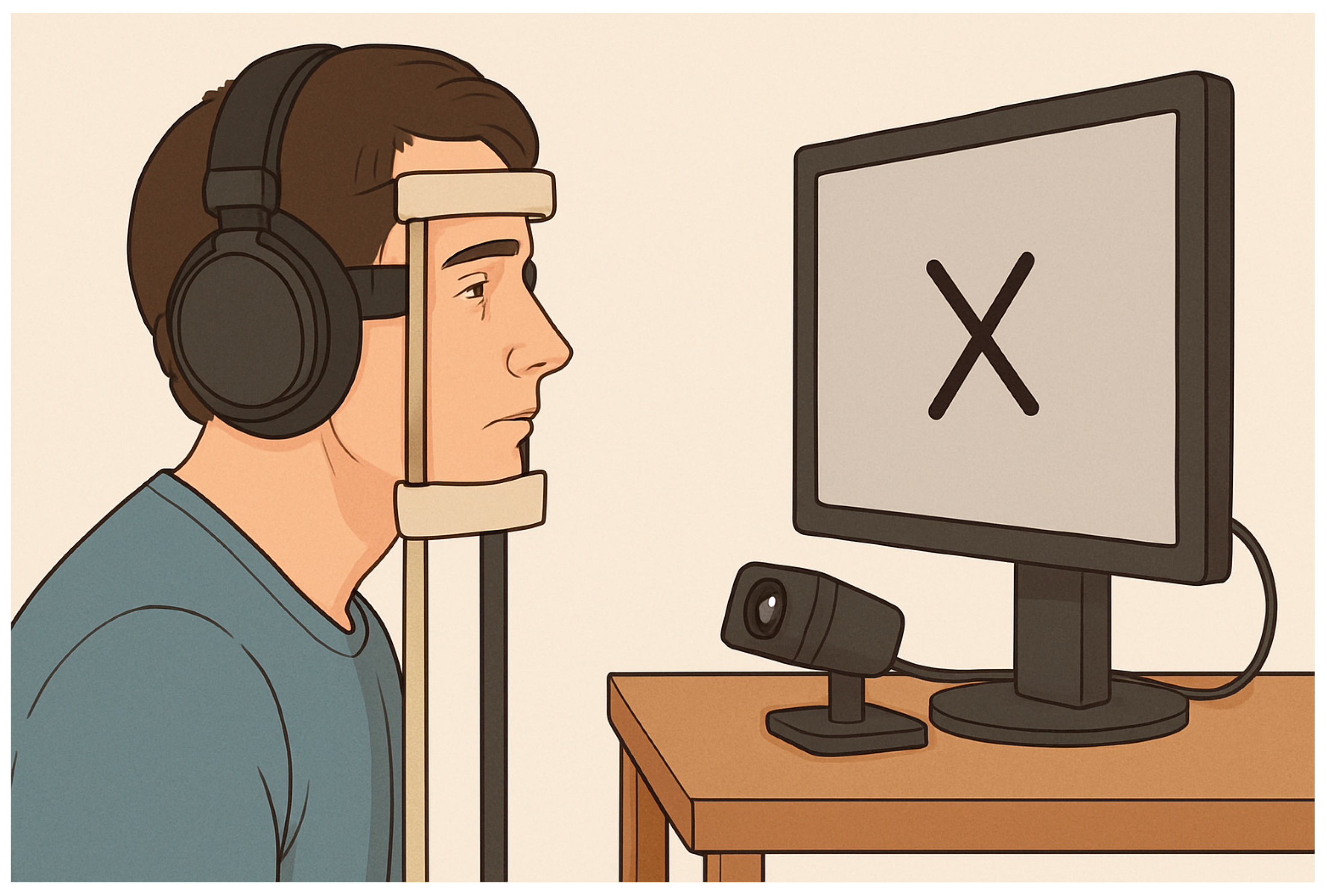
Listening effort, defined as the cognitive resources allocated to auditory processing, is a critical dimension of hearing impairment that influences real-world communication outcomes [4]. For example, individuals with hearing loss often report fatigue and reduced comprehension in noisy settings, even when audiometric thresholds suggest adequate hearing [5]. This discrepancy highlights the need for objective measures that reflect the cognitive demands of auditory processing. Pupillometry, the measurement of pupil size and reactivity, has emerged as a promising tool in this context [6,7]. Pupil dilation, regulated by the autonomic nervous system, correlates with cognitive load, arousal, and sensory processing, making it a sensitive indicator of listening effort [6,8,9]. A typical experimental setup for pupillometry-based auditory research is illustrated in Figure 1. Participants are seated in a dimly lit sound-attenuated booth, facing an infrared eye-tracking system calibrated to record pupil diameter at high temporal resolution (e.g., 60–120 Hz) [10]. Auditory stimuli, such as speech-in-noise tasks or tone detections, are delivered through calibrated headphones or speakers. Lighting is carefully controlled to minimize external influences on pupil size, and participants are instructed to fixate on a central point to reduce eye movement artifacts. This setup ensures that changes in pupil diameter primarily reflect cognitive and sensory processing demands rather than environmental noise. Unlike subjective measures like self-reports, pupillometry offers a non-invasive, objective approach that can be applied across diverse populations, including preverbal children and older adults with cognitive challenges.
Figure 1. Experimental setup for pupillometry-based listening effort measurement using a sound delivery and fixation system (e.g., laptop or monitor) with an infrared eye-tracker positioned beneath the screen, under controlled lighting conditions. Auditory stimuli are typically presented via headphones or spatially calibrated loudspeakers, depending on the study design. The setup ensures proper eye fixation and accounts for luminance-related effects on pupil dilation, which are known to influence pupillometric outcomes. A chin and head rest are used to stabilize the participant’s head and minimize movement-related artifacts. Because pupil size is highly sensitive to even small changes in gaze angle or head position, mechanical stabilization ensures that the infrared camera captures accurate, motion-free pupil dilation measurements throughout the listening task.
Listening effort encompasses both the perceived and objective exertion experienced by individuals during challenging auditory tasks [5]. Over the years, several methodologies have been developed to assess listening effort. Behavioral approaches, such as dual-task paradigms, measure performance decrements when listeners simultaneously complete an auditory task and a secondary task, providing insight into cognitive resource allocation [11]. Self-report questionnaires like the NASA Task Load Index (NASA-TLX) and listening effort rating scales offer subjective assessments of effort, though they may be influenced by memory and expectation biases [12]. Physiological measures, including electroencephalography (EEG), skin conductance, and heart rate variability, have also been used to quantify mental effort [13,14,15]. While each method offers distinct insights, they vary in terms of invasiveness, ecological validity, and clinical feasibility. Against this backdrop, pupillometry has emerged as a non-invasive, objective tool capable of providing real-time data on cognitive load during auditory processing.
The application of pupillometry in audiology builds on decades of research in cognitive psychology, where pupil responses have been linked to mental effort in tasks ranging from memory to problem-solving [6]. In auditory research, pupillometry has been used to assess listening effort in various contexts, including speech recognition in noise, auditory attention, and the evaluation of hearing technologies like Cochlear Implants (CIs) and Hearing Aids (HAs) [7,16,17,18]. This review aims to synthesize the literature on pupillometry’s role in evaluating auditory perception and listening effort across the lifespan, from infancy to older adulthood. By examining studies in pediatric and adult populations, with and without hearing impairment, this paper seeks to highlight pupillometry’s potential as a clinical tool, identify methodological challenges, and propose directions for future research and practice.

2. Materials and Methods

2.1. Literature Search Strategy

This review synthesizes peer-reviewed studies published between January 2010 and April 2025, sourced from PubMed, Scopus, Web of Science, and Google Scholar. Search terms included combinations of “pupillometry,” “auditory perception,” “listening effort,” “hearing impairment,” “audiology,” “speech-in-noise,” “cochlear implants,” “hearing aids,” and “cognitive load.” were used to refine searches, and reference lists of key articles were manually reviewed to identify additional studies.

2.2. Inclusion Criteria

To ensure scientific rigor and relevance, the following inclusion criteria were applied:
  • Use pupillometry as a primary measure of auditory processing or listening effort.
  • Involve human participants (pediatric or adult) with normal hearing or hearing impairment.
  • Be published in English in peer-reviewed journals.
  • Provide empirical data (e.g., pupil dilation metrics) related to auditory tasks.
Studies were excluded if they:
  • Focused solely on visual stimuli or non-speech sounds (e.g., tone pips, music).
  • Did not involve speech-in-noise paradigms (e.g., quiet listening tasks).
  • Used pupillometry for cognitive tasks unrelated to auditory effort (e.g., working memory, decision making unrelated to listening).
  • Reported only qualitative pupil changes without quantitative analysis (e.g., no baseline-corrected pupil metrics).
  • Examined clinical populations (e.g., dementia, stroke) where pupil response might reflect broader cognitive deficits rather than listening effort specifically.
  • Did not provide clear methodological details necessary for reproducibility (e.g., missing noise type, signal-to-noise ratio (SNR) level, pupil analysis window).
Exclusion criteria also encompassed non-human studies, conference abstracts, reviews without original data, and studies unrelated to auditory processing (e.g., pupillometry in visual or memory tasks). Although an initial search yielded a large number of studies examining pupillometry in auditory tasks, stringent inclusion and exclusion criteria were applied to ensure the scientific rigor and relevance of the final review. Only studies that specifically measured pupil dilation as an objective index of listening effort during speech-in-noise tasks were included.

2.3. Study Selection and Screening Process

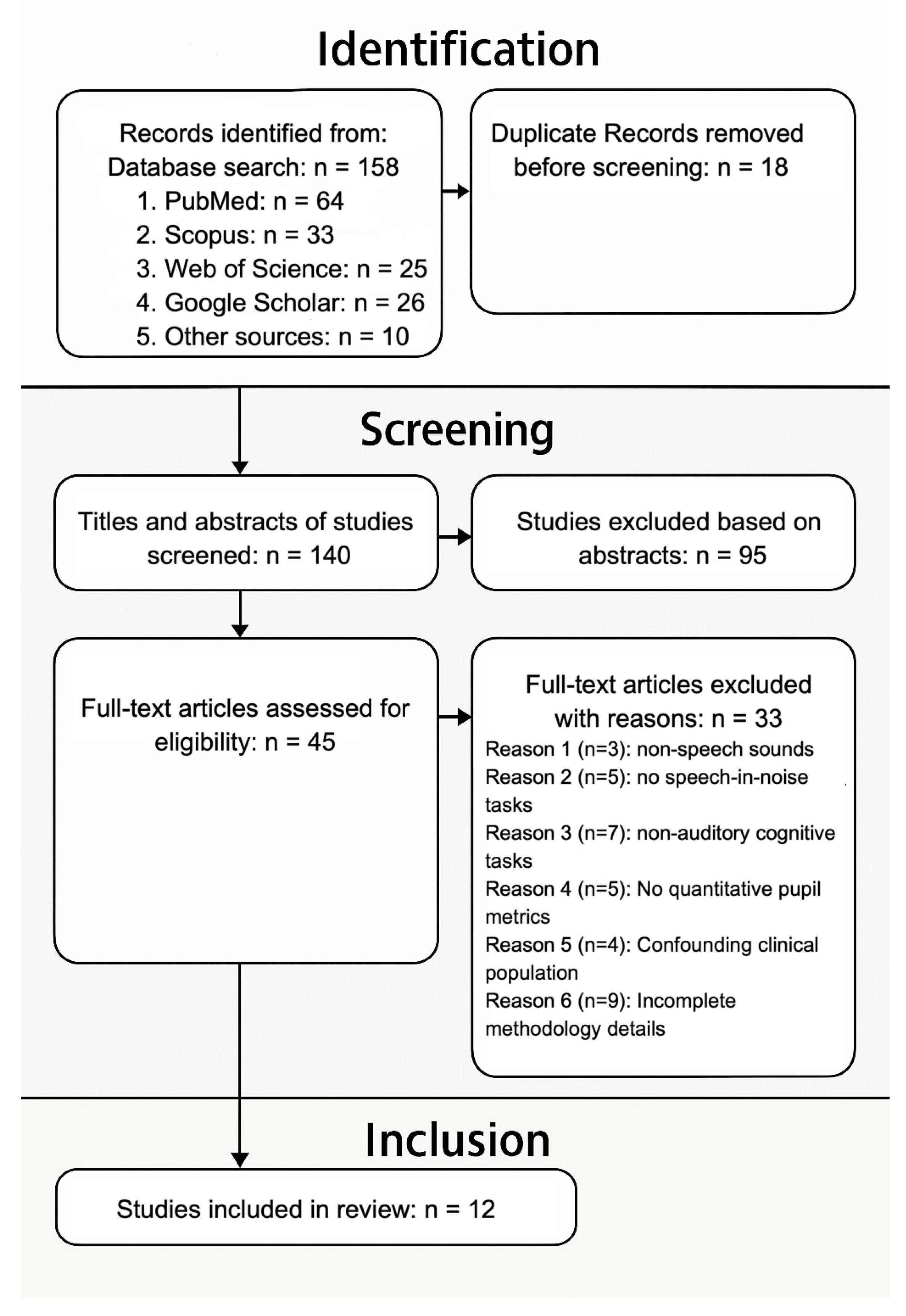
This review was conducted in accordance with the Preferred Reporting Items for Systematic Reviews and Meta-Analyses (PRISMA) 2020 guidelines [19]. A PRISMA flow diagram is presented in Figure 2 to illustrate the selection process.
Figure 2. PRISMA 2020 Flow Diagram illustrating the identification, screening, and selection of studies included in the systematic review.
An initial database search yielded 158 records (PubMed = 64, Scopus = 33, Web of Science = 25, Google Scholar = 26, Other sources = 10). After removing 18 duplicates, a total of 140 records remained for title and abstract screening. Following the screening, 45 full-text articles were assessed for eligibility, of which 12 studies met the inclusion criteria and were retained for synthesis.
All screening steps were independently performed by the author, with adherence to pre-specified criteria. Data extracted from each study included population characteristics, sample size, methodology, pupillometry metrics (e.g., peak pupil dilation, mean pupil dilation), key findings, and limitations. Studies were organized by population (pediatric, adult, older adult) and hearing status (normal hearing, hearing impairment, specific hearing technologies). Data extracted from each study included population characteristics, sample size, methodology, pupillometry metrics (e.g., peak or mean pupil dilation), key findings, and limitations. Findings are summarized in Table 1 and discussed narratively in the following sections.
Table 1. Summary of Studies on Pupillometry in Auditory Perception and Listening Effort.

2.4. Level of Evidence Assessment

To evaluate the quality and strength of the included studies, the level of evidence was assessed using the Oxford Centre for Evidence-Based Medicine (OCEBM) Levels of Evidence framework [20]. This framework categorizes studies from Level 1 (highest, e.g., systematic reviews of randomized trials) to Level 5 (lowest, e.g., expert opinion). All 12 included studies were experimental studies employing controlled designs to measure pupillary responses during auditory tasks. Most studies [7,10,16] utilized within-subject or between-subject designs with controlled laboratory conditions, corresponding to Level 2 (individual cohort studies or low-quality randomized controlled trials). These studies featured moderate to large sample sizes (e.g., 38–50 participants) and standardized protocols, enhancing their reliability. Studies involving smaller sample sizes or less controlled settings, such as [18] with 10 participants or [21] with 15 participants, were classified as Level 3 (case–control studies or retrospective cohort studies). The level of evidence was considered during data synthesis to weigh the strength of findings, with higher-level studies given greater emphasis in interpreting clinical implications. Limitations, such as small sample sizes or lack of randomization, were noted as factors potentially reducing the evidence level in some studies. While no Level 1 (systematic reviews of randomized trials) studies were found, all included studies were peer-reviewed, empirical investigations with well-documented experimental paradigms and objective outcome measures (e.g., peak pupil dilation). The lack of Level 1 evidence reflects the emerging nature of pupillometry in audiology, but the consistently replicated findings across multiple populations support the robustness of the observed effects.

3. Results

3.1. Overview of Studies

The 12 studies reviewed in this synthesis highlight the broad applicability and growing relevance of pupillometry as a non-invasive tool for assessing auditory perception and listening effort. These investigations span diverse listener populations including children, normal-hearing adults, individuals with hearing loss, and users of hearing assistive devices and employ a wide range of speech and noise conditions to systematically examine cognitive demand during auditory processing.
Across the studies, peak pupil dilation (PPD) and mean pupil diameter (MPD) are the most common outcome measures, used to quantify effort as participants engage in tasks involving speech recognition in quiet and noisy environments, categorical perception, and audiologic testing. Most studies confirm that increased task complexity, degraded signal quality, or hearing impairment results in larger pupil dilation, reflecting greater cognitive load. These consistent patterns underscore the potential of pupillometry as a biomarker for auditory strain, with possible clinical applications in diagnosis, device optimization, and rehabilitation.

3.2. Pupillometry in Pediatric Populations

Although pediatric research in this area is more limited, Ref. [20] represents a key study demonstrating the utility of pupillometry in children. Their investigation included both children with bilateral cochlear implants and those with normal hearing. Using simplified auditory stimuli: click trains and electrical pulses. The study observed that children with hearing loss exhibited significantly greater pupil dilation, particularly under conditions that required more attentional resources. This finding implies that children with hearing impairment expend more cognitive effort to process even basic auditory inputs, a reality that might go undetected in traditional behavioral tests.
This work is especially important given the difficulty of obtaining reliable behavioral audiometric data in children, particularly those who are very young, have additional disabilities, or are nonverbal. Pupillometry offers a window into their auditory experiences, allowing clinicians to infer how challenging a listening situation is without requiring verbal responses or active participation. However, the controlled laboratory setting and stimulus simplicity limit the real-world generalizability of this study. Future work should explore naturalistic listening conditions (e.g., speech-in-noise tasks) in pediatric populations to strengthen translational applications.
Although much of the literature highlights the usefulness of pupillometry in pediatric or young adult populations, it is equally relevant in older adults. Age-related hearing loss often increases cognitive load, even when audibility is restored through amplification, making pupil dilation a sensitive marker of compensatory listening effort in aging listeners. Older adults frequently display larger and more prolonged pupil responses, reflecting increased reliance on top-down cognitive resources. Thus, pupillometry can play a critical role in assessing cognitive-auditory interactions in presbycusis, evaluating benefit from hearing aids, and identifying early signs of cognitive decline.

3.3. Pupillometry in Adult Populations

Adult populations have been the primary focus of pupillometry research in auditory contexts, with studies consistently showing that pupil dilation increases under more demanding listening conditions.
Study [7] provided early evidence of this relationship by showing that pupil dilation increases as SNR worsens, even when participants maintained similar levels of speech recognition performance. This dissociation between accuracy and effort illustrates how pupillometry can reveal cognitive challenges not captured by performance metrics alone.
Study [16] further refined this understanding by introducing different types of background noise: stationary, fluctuating, and competing talkers. They found that informational masking introduced by single-talker distractors elicited larger pupil responses, even when intelligibility remained constant. This supports the idea that cognitive resources are taxed more by complex or meaningful noise, such as competing speech, than by simple acoustic interference like white noise.
Several studies investigated pupillometry in relation to hearing device performance. For instance, Ref. [22] studied users of bone-anchored hearing systems (BAHS) and found that more advanced processors were associated with lower pupil dilation, suggesting reduced effort. Similarly, Ref. [17] demonstrated that noise reduction (NR) algorithms in hearing aids led to smaller pupil responses in speech recognition tasks, especially in hearing-impaired individuals. These findings support the use of pupillometry as a real-time objective metric to assess and optimize hearing technologies, going beyond subjective preferences or standard clinical tests.
Study [21] examined pupil responses to ambiguous speech tokens at different SNRs. Their results indicated greater and delayed pupil dilation for acoustically ambiguous stimuli, underscoring the role of categorical speech perception and lexical uncertainty in cognitive effort. Ref. [23] added nuance by showing that baseline pupil size alone was not always predictive of effort, emphasizing the importance of dynamic pupil changes during listening tasks rather than static measures.
Ref. [26] demonstrated that task-evoked pupil dilation systematically increased with listening demand across various clinically relevant tests including pure-tone audiometry, gaps-in-noise, and speech-in-noise tasks in younger adults with normal hearing. These findings support the sensitivity of pupillometry in capturing effort even in standard audiological assessments.
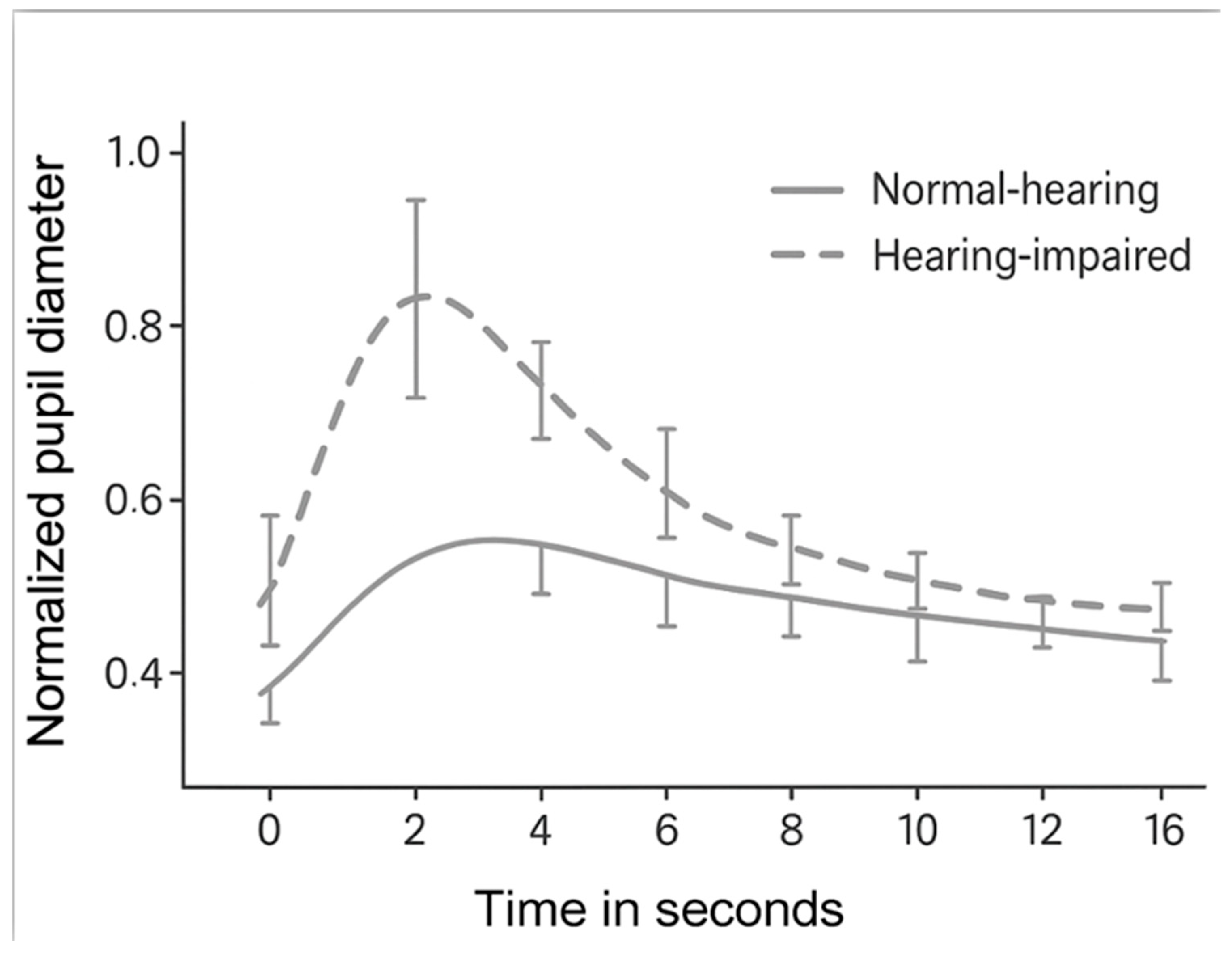
These studies collectively establish that pupillometry is sensitive to both acoustic degradation and cognitive demand, validating its relevance for clinical populations and auditory training research. They also highlight the need for standardized paradigms to compare outcomes across settings. Figure 3 illustrates typical peak pupil dilation trends observed in normal-hearing versus hearing-impaired listeners, based on findings from studies like [7,25], highlighting the increased listening effort in hearing-impaired individuals. Normal-hearing individuals show moderate pupil increases with noise, while hearing-impaired listeners display larger, more sustained dilation, reflecting higher listening effort and supporting subjective reports of fatigue. Figure 3 serves as a conceptual illustration of typical pupil dilation trends observed in the literature and does not depict original empirical data.
Figure 3. Conceptual illustration of peak pupil dilation (PPD) trends over time for normal-hearing and hearing-impaired listeners during speech-in-noise tasks, based on patterns reported in studies such as [7,25]. This figure depicts greater and more sustained pupil dilation in hearing-impaired listeners, reflecting increased listening effort. Not based on original empirical data.

3.4. Pupillometry in Specialized Populations

Pupillometry’s value is especially pronounced in specialized or underserved clinical populations, where traditional testing methods may fall short.
Study [18] studied adults with cochlear implants (CIs) and found that those with poorer speech perception exhibited larger pupil dilations, indicating greater cognitive effort during speech recognition tasks in noise. This supports the idea that listening effort varies even within individuals using similar devices, and that pupillometry can offer personalized insights for device programming and counseling. While the findings from [8] provide valuable insight into how cochlear implant users recruit cognitive resources during speech recognition in noise, the study’s small sample size (n = 10) substantially limits its statistical power and generalizability. Such limited participant numbers increase susceptibility to both Type I and Type II errors and restrict the reliability of group-level inferences. To strengthen the evidence base, future work should consider pooling across studies using systematic meta-analytic approaches to derive more stable effect estimates and identify consistent pupillometric trends in CI populations
Study [24] focused on individuals with SSD, comparing their performance to normal-hearing participants. Under speech masker conditions, both groups exhibited increased pupil dilation, but SSD listeners experienced greater strain, as evidenced by larger pupil size and slower return to baseline. This highlights the additional burden that asymmetrical hearing loss places on cognitive resources during speech processing, an insight not always evident in traditional audiologic testing.
Together, these studies show that pupillometry can help identify hidden listening burdens and guide tailored interventions for individuals with non-traditional hearing profiles.

3.5. Methodological Considerations

While the scientific foundation for pupillometry is strong, methodological variation remains a key barrier to clinical translation.
Study [10] provided one of the most comprehensive methodological guides to pupillometry in hearing science. Their recommendations include using a few second pre-stimulus baseline, removing blink and artifact contamination, and controlling for lighting levels (ideally 10–200 lux) to ensure consistent comparisons across participants and sessions. Most reviewed studies employed infrared eye-tracking systems such as Tobii or EyeLink, with sampling rates between 60 and 120 Hz, offering sufficient temporal resolution to track fine-grained pupil dynamics.
However, significant variability persists in how pupil dilation is measured and reported. Some studies use peak dilation, others use mean pupil diameter, and still others explore latency to peak or recovery time. In addition, task design differs: stimuli range from synthetic tones to meaningful speech, and masking noise varies in both acoustic and semantic content.
These inconsistencies complicate cross-study comparisons and pose challenges for developing normative reference values. Moreover, studies often exclude participants with ocular or neurological conditions, limiting the representativeness of findings.
To overcome these issues, future research must adopt standardized pupillometry protocols, validate findings in ecologically valid environments, and expand participant pools to ensure generalizability. Efforts should also be made to develop clinically friendly, portable pupillometry systems that can function reliably in real-world clinical settings. value is especially pronounced in specialized or underserved clinical populations, where traditional testing methods may fall short.

3.6. Findings: Thematic Synthesis of Evidence

3.6.1. Listening Effort and Pupil Dilation

General Trends across all 12 reviewed studies, a consistent finding emerged: greater task difficulty and auditory degradation led to increased pupil dilation. This was observed in both PPD and MPD. Regardless of population: children, adults, or older adults, pupillary responses were sensitive to changes in SNR, sentence complexity, and masking conditions. These results support the notion that pupillometry reliably indexes cognitive load associated with auditory processing.

3.6.2. Influence of Hearing Status on Listening Effort

A cross-study comparison revealed that individuals with hearing impairment exhibited significantly larger pupil dilations than their normal-hearing counterparts, even when their speech recognition performance was matched. For example, Refs. [18,25] demonstrated that hearing-impaired listeners, whether using HAs or CIs showed increased effort during speech-in-noise tasks. In contrast, normal-hearing participants [7,21] exhibited more moderate dilation under similar conditions. These findings underscore the invisible cognitive cost of hearing loss, which is often undetected through behavioral metrics alone.

3.6.3. Impact of Auditory Scene Complexity

Task complexity and the nature of background noise played critical roles in modulating pupil responses. Ref. [16] found that informational masking from single-talker distractors elicited larger pupil dilations than energetic masking from stationary or fluctuating noise, even at equal intelligibility levels. Ref. [24] extended these findings to individuals with SSD, who showed increased effort under masker conditions. Such patterns reinforce that pupil dilation reflects not just acoustic challenge but also cognitive load driven by semantic and attentional demands.

3.6.4. Influence of Technology

Hearing Aids and Cochlear Implants: Multiple studies evaluated how hearing devices affect listening effort. Refs. [17,23] found that noise reduction algorithms and advanced processors in HAs or BAHS significantly reduced pupil dilation compared to baseline devices, suggesting a reduction in cognitive demand. Similarly, Refs. [18,27] showed that users of CIs still exhibited elevated pupil dilation relative to normal-hearing peers, although device use mitigated some of the effort. These results position pupillometry as a promising tool for assessing hearing technology performance objectively.

3.6.5. Lexical and Semantic Effects on Cognitive Load

Several studies examined how linguistic complexity modulates listening effort. Refs. [10,21] found that ambiguous or low-context sentences increased pupil dilation, highlighting the cognitive load imposed by lexical uncertainty. Ref. [23] demonstrated that even the anticipation of difficult auditory conditions could modulate baseline pupil size, reflecting preparatory cognitive mobilization. These results suggest that pupillometry can provide insight into high-level linguistic and attentional processes during speech perception.
Together, these thematic findings highlight the robust sensitivity of pupillometry to both sensory and cognitive factors in auditory processing. The evidence supports its application in both clinical and experimental settings and underscores the importance of context, technological, linguistic, and environmental in shaping listening effort.

4. Discussion

4.1. Clinical Implications

The integration of pupillometry into auditory science and hearing healthcare presents a significant advancement in objectively quantifying listening effort—a construct long known to influence communication outcomes, especially in noisy or degraded environments. Across the 12 reviewed studies, pupillometry consistently demonstrated sensitivity to auditory task complexity, signal-to-noise ratio, hearing impairment, and device benefit, positioning it as a valuable biomarker of auditory cognitive load.
In pediatric audiology, where behavioral tests are often impractical or unreliable due to developmental limitations, Ref. [20] demonstrated that pupil dilation can reflect cognitive and auditory load in children with hearing loss. Such findings support the role of pupillometry as a non-invasive, real-time tool to complement or even substitute traditional metrics like speech recognition scores or pure-tone thresholds—especially in preverbal populations or children with additional disabilities.
In adult populations, studies like [7,16,18] highlight pupillometry’s robustness across a spectrum of auditory contexts. These include sentence recognition in noise, single- versus multi-talker masking, and perceptual ambiguity. The fact that pupil dilation scales with task difficulty and correlates with subjective effort reinforces its validity for both clinical diagnostics and hearing aid optimization. Importantly, Ref. [16] showed that pupil dilation is larger with speech maskers than stationary noise, underscoring that pupillometry captures cognitive load rather than just acoustic difficulty—something not easily inferred from behavioral performance alone.
The application of pupillometry in device evaluation is particularly promising. Ref. [22] demonstrated that more advanced BAHS processors resulted in reduced pupil dilation indicating reduced cognitive effort. Similarly, Ref. [17] confirmed that noise reduction (NR) algorithms in hearing aids reduced pupil responses in hearing-impaired individuals. These objective physiological indicators can be used to complement subjective satisfaction questionnaires, which are often influenced by user expectations and recall bias.
Specialized populations such as those with SSD [24] or those listening to ambiguous speech [21] further demonstrate pupillometry’s capacity to capture nuanced aspects of auditory processing and mental load. For example, SSD listeners exhibited greater pupil dilation in noise compared to quiet, highlighting their unique challenges. These insights can inform personalized rehabilitation strategies, including targeted auditory training, cross-hearing aids, or cochlear implantation.
Furthermore, Refs. [21,23] showed that beyond task accuracy, pupil metrics such as latency and dilation amplitude provide additional dimensions of cognitive effort, especially when behavioral metrics plateau (e.g., when speech recognition is already near ceiling or floor). This emphasizes the granularity and sensitivity of pupillometry, especially in populations where subjective effort may not correlate with performance.
As the field moves toward personalized and precision audiology, pupillometry offers a quantifiable, real-time, and user-specific measure of effort that can adaptively guide interventions whether programming a hearing aid, fitting a cochlear implant, or designing auditory training regimens. It could also serve as a biomarker in longitudinal monitoring, helping track auditory rehabilitation progress over time, such as reduced effort following acclimatization to a new hearing device.

4.2. Research Implications

Beyond its clinical potential, pupillometry offers significant opportunities to advance auditory research by providing a sensitive, objective measure of cognitive and sensory processing. The studies reviewed demonstrate that pupillometry can elucidate the interplay between auditory perception and cognitive load, offering insights into theoretical models of auditory processing. For instance, Refs. [7,16] showed that pupil dilation reflects the cognitive effort required to process speech in noise, supporting models like the Framework for Understanding Effortful Listening (FUEL) that posit listening effort as a function of both auditory and cognitive demands. These pupillary changes are supported by well-established neurophysiological mechanisms. Specifically, pupil dilation is tightly linked to activity in the locus coeruleus–norepinephrine (LC–NE) system, which modulates arousal, attention, and cognitive effort [8] Under increased auditory demand, heightened LC–NE activity leads to sympathetic activation and dilation of the pupil, providing a direct physiological index of listening effort. Pupillometry can thus serve as a tool to empirically validate and refine such theoretical frameworks, bridging auditory and cognitive neuroscience. In experimental research, pupillometry’s high temporal resolution enables researchers to track dynamic changes in cognitive load during auditory tasks, offering a window into real-time processing. For example, Ref. [21] used pupil dilation to study categorical speech perception, revealing how lexical ambiguity influences effort. This suggests pupillometry’s potential to explore fine-grained aspects of speech processing, such as the role of lexical competition, semantic integration, or attentional allocation, which are critical for advancing psycholinguistic and auditory processing theories. Pupillometry also holds promise for comparative studies across populations. Refs. [18,27] demonstrated its utility in pediatric and CI populations, respectively, highlighting its versatility in studying diverse groups. Researchers can leverage pupillometry to investigate developmental trajectories of auditory–cognitive interactions, such as how listening effort evolves from childhood to adulthood or how aging affects auditory processing efficiency. Such studies could inform models of auditory development and decline, contributing to a deeper understanding of lifespan auditory health. Additionally, pupillometry can enhance the design of auditory experiments by providing an objective metric to assess the efficacy of interventions, such as auditory training programs or novel hearing technologies. For instance, Refs. [17,22] used pupillometry to evaluate noise reduction algorithms and advanced sound processors, demonstrating its utility in quantifying device benefits beyond subjective reports. Future research could use pupillometry to test the effectiveness of cognitive training interventions aimed at reducing listening effort or to compare the cognitive demands of different hearing device configurations. Finally, integrating pupillometry with other neurophysiological measures, such as EEG or Functional Near-Infrared Spectroscopy (fNIRS), opens avenues for multimodal research. By combining pupillometry’s sensitivity to autonomic arousal with EEG’s neural event-related potentials or fNIRS’s cortical activation patterns, researchers can develop a comprehensive understanding of auditory–cognitive interactions. Such multimodal approaches could elucidate how top-down cognitive processes (e.g., attention, working memory) interact with bottom-up auditory processing, advancing both basic and applied auditory science.

4.3. Limitations

Despite its potential, several limitations must be addressed before pupillometry becomes a routine clinical tool.
First, individual variability in pupil response presents a challenge. Pupil size and reactivity can be affected by numerous factors unrelated to listening effort, including age, ambient lighting, circadian rhythm, emotional state, fatigue, medication (e.g., antihistamines), and systemic health conditions like diabetes. For example, older adults often experience reduced pupil motility, potentially masking true effort levels or introducing noise in data interpretation.
Second, many studies including [18,21] used small sample sizes and highly controlled laboratory settings, which limit external validity. While these controlled environments are ideal for isolating variables, they do not reflect the everyday acoustic realities that listeners face such as variable background noise, multi-talker conversations, and fluctuating attention.
Third, methodological inconsistency across studies poses barriers to cross-study comparisons. Differences in baseline correction methods, timing windows for peak pupil dilation, signal-to-noise ratio levels, linguistic material, and even definitions of listening effort complicate the synthesis of results into clinical guidelines. Although [10] provided best-practice recommendations, standardization across labs and clinics remains a pressing need.
Fourth, the hardware requirements for pupillometry such as infrared eye-tracking cameras, controlled lighting environments, and high sampling rates pose cost and training burdens for clinical audiologists. While some mobile or wearable eye-tracking solutions are emerging, their resolution and signal fidelity often fall short of lab-grade systems. This creates a technology gap that limits immediate scalability and accessibility, especially in underserved or resource-constrained clinical settings.
Finally, normative datasets stratified by age, cognitive ability, and hearing status are currently lacking. Without well-characterized baselines, interpreting an individual’s pupil dilation in relation to population norms remains speculative. Establishing these reference curves is essential for pupillometry to transition from a promising research tool to a validated clinical diagnostic method.
An additional consideration involves ethical and practical limitations in pediatric populations. Obtaining assent or informed consent from young children can be challenging, and some children may not tolerate extended eye-tracking procedures or sustained fixation requirements. These constraints can limit recruitment, session duration, and generalizability of pediatric pupillometry findings.

4.4. Future Directions

To address these limitations, future research should prioritize the development of normative pupillometry data, stratified by age, hearing status, and cognitive ability. Large-scale, multi-center studies could establish benchmarks for PPD and MPD in diverse populations, enabling standardized clinical protocols. Longitudinal studies are needed to evaluate pupillometry’s role in monitoring rehabilitation outcomes, such as changes in listening effort following cochlear implantation or hearing aid use. For example, tracking PPD over months could quantify the cognitive benefits of auditory interventions.
Integrating pupillometry with other objective measures, such as electroencephalography (EEG) or functional near-infrared spectroscopy (fNIRS), could provide a multimodal assessment of auditory processing. EEG, which captures neural responses like the P300, could complement pupillometry’s focus on cognitive effort, offering a comprehensive view of auditory–cognitive interactions. Simplifying pupillometry technology, such as developing portable, user-friendly eye-trackers, would facilitate its use in routine clinical practice, reducing costs and training requirements.
Research should also explore pupillometry in real-world settings, such as classrooms, workplaces, or social environments, to enhance ecological validity. For example, wearable eye-trackers could measure listening effort during naturalistic conversations, providing insights into daily auditory challenges. Finally, studies should investigate cultural and socioeconomic factors influencing pupil responses, ensuring equitable application across global populations.

5. Conclusions

Pupillometry represents a transformative tool for objectively assessing auditory perception and listening effort across the lifespan, addressing critical gaps in traditional audiometry. By capturing the cognitive demands of auditory processing, it offers unique insights into the experiences of individuals with hearing loss, from infants to older adults. The 12 studies reviewed demonstrate pupillometry’s versatility across pediatric, adult, and geriatric populations, with applications in normal hearing, CIs, HAs, BAHS, and SSD. Despite methodological challenges, such as individual variability and equipment costs, pupillometry’s integration into clinical audiology holds immense potential to enhance diagnostic precision, personalize rehabilitation strategies, and improve quality of life for those with hearing impairment. With standardized protocols, normative data, and technological advancements, pupillometry could become a cornerstone of modern audiology, bridging the gap between peripheral hearing and cognitive effort.

Funding

This research received no external funding.

Data Availability Statement

This article is a narrative review of previously published studies and does not report original data. All data discussed in this manuscript are available through the cited sources and can be accessed via the references provided.

Acknowledgments

This review was independently conducted by the author without external funding or institutional support.

Conflicts of Interest

The authors declare no conflicts of interest.

Abbreviations

The following abbreviations are used in this manuscript:
BAHSbone-anchored hearing systems
CICochlear Implant
EEGElectroencephalogram
MPDMean Pupil Dilation
NHNormal-Hearing
NRNoise Reduction
PPDPeak Pupil Dilation
SNRSignal-to-Noise Ratio
SRTSpeech Reception Threshold
SSDSingle-Sided Deafness

References

  1. World Health Organization (WHO). World Report on Hearing; World Health Organization: Geneva, Switzerland, 2021; Available online: https://www.who.int/publications/i/item/world-report-on-hearing (accessed on 9 November 2025).
  2. Lin, F.R.; Metter, E.J.; O’Brien, R.J.; Resnick, S.M.; Zonderman, A.B.; Ferrucci, L. Hearing loss and incident dementia. Arch. Neurol. 2011, 68, 214–220. [Google Scholar] [CrossRef] [PubMed]
  3. Gates, G.A.; Mills, J.H. Presbycusis. Lancet 2005, 366, 1111–1120. [Google Scholar] [CrossRef] [PubMed]
  4. Pichora-Fuller, M.K.; Kramer, S.E.; Eckert, M.A.; Edwards, B.; Hornsby, B.W.Y.; Humes, L.E.; Lemke, U.; Lunner, T.; Matthen, M.; Mackersie, C.L.; et al. Hearing impairment and cognitive energy: The framework for understanding effortful listening (FUEL). Ear Hear. 2016, 37, 5S–27S. [Google Scholar] [CrossRef] [PubMed]
  5. Hornsby, B.W.Y. The effects of hearing aid use on listening effort and mental fatigue associated with sustained speech processing demands. Ear Hear. 2013, 34, 523–534. [Google Scholar] [CrossRef]
  6. Kahneman, D.; Beatty, J. Pupil diameter and load on memory. Science 1966, 154, 1583–1585. [Google Scholar] [CrossRef]
  7. Zekveld, A.A.; Kramer, S.E.; Festen, J.M. Pupil response as an indication of effortful listening: The influence of sentence intelligibility. Ear Hear. 2010, 31, 480–490. [Google Scholar] [CrossRef]
  8. Beatty, J. Task-evoked pupillary responses, processing load, and the structure of processing resources. Psychol. Bull. 1982, 91, 276–292. [Google Scholar] [CrossRef]
  9. Granholm, E.; Steinhauer, S.R. Pupillometric measures of cognitive and emotional processes. Int. J. Psychophysiol. 2004, 52, 1–6. [Google Scholar] [CrossRef]
  10. Winn, M.B.; Wendt, D.; Koelewijn, T.; Kuchinsky, S.E. Best practices and advice for using pupillometry to measure listening effort: An introduction for those who want to get started. Trends Hear. 2018, 22, 2331216518800869. [Google Scholar] [CrossRef]
  11. Gagné, J.P.; Besser, J.; Lemke, U. Behavioral assessment of listening effort using a dual-task paradigm: A review. Trends Hear. 2017, 21, 2331216516687287. [Google Scholar] [CrossRef]
  12. Alhanbali, S.; Dawes, P.; Millman, R.E.; Munro, K.J. Measures of listening effort are multidimensional. Ear Hear. 2017, 38, 695–705. [Google Scholar] [CrossRef]
  13. Miles, K.; McMahon, C.; Boisvert, I.; Ibrahim, R.; de Lissa, P.; Graham, P.; Lyxell, B. Objective assessment of listening effort: Coregistration of pupillometry and EEG. Trends Hear. 2017, 21, 2331216517706396. [Google Scholar] [CrossRef] [PubMed]
  14. Raghavendra, S.; Chun, H.; Lee, S.; Chen, F.; Martin, B.A.; Tan, C. Cross-frequency coupling in cortical processing of speech. In Proceedings of the 44th Annual International Conference of the IEEE Engineering in Medicine and Biology Society (EMBC), Glasgow, UK, 11–15 July 2022; pp. 25–29. [Google Scholar] [CrossRef]
  15. Mackersie, C.L.; Calderon-Moultrie, N. Autonomic nervous system reactivity during speech repetition tasks: Heart rate variability and skin conductance. Ear Hear. 2016, 37 (Suppl. S1), 118S–125S. [Google Scholar] [CrossRef]
  16. Koelewijn, T.; Zekveld, A.A.; Festen, J.M.; Kramer, S.E. Pupil dilation uncovers extra listening effort in the presence of a single-talker masker. Ear Hear. 2012, 33, 291–300. [Google Scholar] [CrossRef]
  17. Wendt, D.; Hietkamp, R.K.; Lunner, T. Impact of noise and noise reduction on processing effort: A pupillometry study. Ear Hear. 2017, 38, 690–700. [Google Scholar] [CrossRef]
  18. Russo, F.Y.; Hoen, M.; Karoui, C.; Demarcy, T.; Ardoint, M.; Tuset, M.-P.; De Seta, D.; Sterkers, O.; Lahlou, G.; Mosnier, I. Pupillometry assessment of speech recognition and listening experience in adult cochlear implant patients. Front. Neurosci. 2020, 14, 556675. [Google Scholar] [CrossRef] [PubMed]
  19. Page, M.J.; McKenzie, J.E.; Bossuyt, P.M.; Boutron, I.; Hoffmann, T.C.; Mulrow, C.D.; Chou, R. The PRISMA 2020 statement: An updated guideline for reporting systematic reviews. BMJ 2021, 372, n71. [Google Scholar] [CrossRef] [PubMed]
  20. Steel, M.M.; Papsin, B.C.; Gordon, K.A. Binaural fusion and listening effort in children who use bilateral cochlear implants: A psychoacoustic and pupillometric study. PLoS ONE 2015, 10, e0117611. [Google Scholar] [CrossRef]
  21. Johns, M.A.; Calloway, R.; Karunathilake, I.D.; Decruy, L.P.; Anderson, S.; Simon, J.Z.; Kuchinsky, S.E. Attention mobilization as a modulator of listening effort: Evidence from pupillometry. Trends Hear. 2024, 28, 23312165241245240. [Google Scholar] [CrossRef]
  22. Lewis, G.A.; Bidelman, G.M. Autonomic nervous system correlates of speech categorization revealed through pupillometry. Front. Neurosci. 2020, 13, 1418. [Google Scholar] [CrossRef]
  23. Phillips, I.; Ellis, G.M.; McNamara, B.; Lefler, J.; DeRoy Milvae, K.; Gordon-Salant, S.; Kuchinsky, S.E.; Brungart, D.S. Examining the feasibility of integrating pupillometry measures of listening effort into clinical audiology assessments. J. Acoust. Soc. Am. 2023, 153 (Suppl. S3), A79. [Google Scholar] [CrossRef]
  24. Oxford Centre for Evidence-Based Medicine (OCEBM). The Oxford 2011 Levels of Evidence. Centre for Evidence-Based Medicine, University of Oxford. 2011. Available online: https://www.cebm.ox.ac.uk/resources/levels-of-evidence/ocebm-levels-of-evidence (accessed on 9 November 2025).
  25. Bianchi, F.; Wendt, D.; Wassard, C.; Maas, P.; Lunner, T.; Rosenbom, T.; Holmberg, M. Benefit of higher maximum force output on listening effort in bone-anchored hearing system users: A pupillometry study. Ear Hear. 2019, 40, 1220–1232. [Google Scholar] [CrossRef] [PubMed]
  26. Burg, E.A.; Thakkar, T.; Fields, T.; Misurelli, S.M.; Kuchinsky, S.E.; Roche, J.; Lee, D.J.; Litovsky, R.Y. Systematic comparison of trial exclusion criteria for pupillometry data analysis in individuals with single-sided deafness and normal hearing. Trends Hear. 2021, 25, 23312165211013256. [Google Scholar] [CrossRef]
  27. Ohlenforst, B.; Zekveld, A.A.; Lunner, T.; Wendt, D.; Naylor, G.; Wang, Y.; Kramer, S.E. Impact of stimulus-related factors and hearing impairment on listening effort as indicated by pupil dilation. Hear. Res. 2017, 351, 68–79. [Google Scholar] [CrossRef] [PubMed]
Disclaimer/Publisher’s Note: The statements, opinions and data contained in all publications are solely those of the individual author(s) and contributor(s) and not of MDPI and/or the editor(s). MDPI and/or the editor(s) disclaim responsibility for any injury to people or property resulting from any ideas, methods, instructions or products referred to in the content.

Article Metrics

Citations

Article Access Statistics

Multiple requests from the same IP address are counted as one view.