You are currently viewing a new version of our website. To view the old version click .
  • Article
  • Open Access

14 December 2025

Efficacy of Combined Hyperbaric Oxygen, per Os Steroid, and Prostaglandin E1 Therapy for Idiopathic Sudden Sensorineural Hearing Loss and Prognostic Factors for Recovery


,
,
,
,
,
,
,
and
Department of Otorhinolaryngology, Faculty of Medicine, Juntendo University, Tokyo 113-0034, Japan
*
Author to whom correspondence should be addressed.
J. Otorhinolaryngol. Hear. Balance Med.2025, 6(2), 25;https://doi.org/10.3390/ohbm6020025 
(registering DOI)
This article belongs to the Section Otology and Neurotology

Abstract

Background: Idiopathic sudden sensorineural hearing loss (ISSNHL) is an abrupt unilateral hearing loss of unknown origin. Combination therapy with hyperbaric oxygen (HBO), systemic steroids (SS), and prostaglandin E1 (PGE1) has been used in Japan; however, its prognostic factors remain unclear. Objective: To evaluate the efficacy of HBO combined with SS and PGE1 and to identify prognostic factors for hearing recovery in patients with ISSNHL. Methods: This retrospective study included 116 patients treated within 14 days of ISSNHL onset. Sixty patients received HBO, SS, and PGE1 (HBO group), and 56 received SS and PGE1 alone (No-HBO group). Hearing outcomes were assessed using PTA (arithmetic mean hearing at 250–4000 Hz) and graded by Siegel’s criteria. Prognostic factors were analyzed by multivariate logistic regression. Results: The HBO group showed significantly better hearing grade outcomes (p = 0.007) and greater PTA improvement (p = 0.003) than the No-HBO group. Vertigo and higher initial PTA were identified as independent predictors of poor hearing outcomes. Patients without vertigo showed significantly greater improvement at 2000 Hz (p = 0.009). Receiver operating characteristic analysis revealed an optimal initial PTA cutoff of ≥90.5 dB for predicting poor hearing outcome. Conclusions: HBO combined with SS and PGE1 significantly improves hearing outcomes in ISSNHL. However, the presence of vertigo and severe initial hearing loss remain poor prognostic indicators. These findings suggest that while the addition of HBO may enhance hearing outcomes, prognosis remains limited in severe cases. Further prospective studies are needed to confirm these results.

1. Introduction

Idiopathic sudden sensorineural hearing loss (ISSNHL) is defined as sudden unilateral hearing loss for which no cause can be identified even after a comprehensive examination [1]. Several etiologies of ISSNHL have been proposed, including viral infections, vascular disorders, autoimmune diseases, inner ear diseases, and central nervous system abnormalities [2,3]. The traditional initial treatment approach for ISSNHL involves the administration of hyperbaric oxygen therapy (HBO), systemic steroids (SS), systemic vasodilators, such as prostaglandin E1 (PGE1), or combinations of two of these therapies [4,5].
Although HBO therapy is not a global standard treatment for ISSNHL, HBO is mentioned as an “Option,” which represents the highest level of evidence for initial treatment, in both American and Japanese guidelines. The AAO-HNS 2019 guideline lists HBO as an Option for initial therapy within 2 weeks or as salvage within 1 month [4]. The Japanese clinical practice guideline likewise places HBO as an optional therapy, generally within 2 weeks of onset [6]. HBO increases arterial oxygen content and has been shown to raise the partial pressure of oxygen in the cochlear perilymph during treatment, which may enhance cochlear metabolic support. This increase has been directly measured in animal models; however, evidence for endolymphal oxygen changes is more limited than that for perilymph measurements [7].
Current guidelines recommend considering the administration of HBO alongside steroid treatment within two weeks after the onset of ISSNHL, or HBO alone within one month after onset [4]. Notably, treatment aimed at improving ischemia using PGE1 has also been attempted. Moreover, a systematic review showed potential benefits of vasodilators combined with steroids for the treatment of ISSNHL [4,8].
The prognosis of ISSNHL depends on several factors, including patient age, the presence of vertigo at onset, the degree of hearing loss, and the interval between onset and initiation of treatment [9]. It has been reported that vertigo negatively affects hearing recovery in patients with ISSNHL treated with HBO and SS or other pharmacological agents [1,10]. Previous work has suggested that cochlear and vestibular functions can be partly dissociated; therefore, the presence of vertigo in ISSNHL may indicate a more widespread or severe inner-ear injury [3]. Although the additional effect of HBO in combination with SS and PGE1 has been reported, prognostic factors for hearing recovery in patients with ISSNHL treated with this combination remain unclear [11].
In the present study, we therefore evaluated the impact of these clinical variables, including age, the presence of vertigo, initial pure-tone average (PTA), time from onset to treatment, and comorbidities such as diabetes mellitus (DM), hypertension (HT), and dyslipidemia (DL), on hearing recovery in patients with ISSNHL treated with or without HBO. Among these factors, particular attention was paid to vertigo, because previous studies have reported that ISSNHL accompanied by vertigo tends to present with more severe hearing loss and a poorer prognosis.

2. Materials and Methods

This study was approved by the Ethical Review Board of Juntendo University Faculty of Medicine (identification E24-0386-S01), which waived the requirement for informed consent; therefore, an opt-out approach was employed.

2.1. Patients

Inclusion criteria:
  • Age ≥ 18 years.
  • A diagnosis of unilateral idiopathic sudden sensorineural hearing loss, defined as ≥30 dB sensorineural hearing loss occurring within 72 h in at least three consecutive frequencies, according to our institutional protocol.
  • Initiation of treatment at our hospital within 14 days of symptom onset.
  • Availability of complete audiometric data at baseline and at least one month post-treatment.
  • Brain MRI demonstrating no retrocochlear pathology (e.g., vestibular schwannoma, stroke, demyelinating disease).
  • Availability of relevant medical records.
Exclusion criteria:
  • Receipt of intratympanic corticosteroid therapy.
  • History of previous sensorineural hearing loss in the affected ear.
  • Identifiable causes of hearing loss (e.g., Ménière’s disease, ototoxic drug exposure, noise-induced trauma).
  • Comorbidities contraindicating hyperbaric oxygen therapy.
  • Inability to complete the one-month follow-up assessment.
Between January 2013 and June 2023, 116 patients who met the above criteria were treated at our hospital, were followed for at least one month after initiating treatment. Among them, 60 patients were treated according to the treatment protocol using HBO, SS, and PGE1 (HBO group), whereas 56 patients were treated with SS and PGE1 alone (No-HBO group). Patients who received intratympanic corticosteroids were excluded to ensure homogeneity of steroid dosage and method of delivery in the study cohort.
A retrospective evaluation of 116 patients was performed. Patients were evaluated by sex, age, the interval from onset to treatment, the presence of vertigo, and the presence of DM, HT, and DL. Use of SS, PGE1, and HBO was recorded.

2.2. Treatment

At our institution, we use SS and PGE1 as the standard treatment for ISSNHL, and, in principle, recommend adjunctive HBO therapy for cases in which it is indicated. However, the final decision regarding whether to undergo HBO is made by the patient after receiving an explanation from the attending physician. Additionally, chest CT is performed for all patients prior to HBO therapy, and HBO is not administered to those who present with findings that constitute contraindications, such as pulmonary cysts or severe pulmonary emphysema.
Most patients received treatment on an outpatient basis; however, those who had difficulty attending daily visits or those with comorbid diabetes were admitted for inpatient management. Both intravenous PGE1 infusion and HBO were administered once daily, and, depending on each patient’s schedule, treatments were generally performed consecutively on weekdays.
SS consisted of oral prednisolone. The dose of prednisolone for SS was tapered over 7 days as follows: 60 mg/day (30 mg twice daily) for the first 3 days, followed by 30 mg/day (15 mg twice daily) for 2 days, and 15 mg/day (15 mg once daily) for the last 2 days. PGE1 (40 μg for 7 days) was dissolved in 200 mL of saline and administered intravenously by drip infusion. HBO was administered at a pressure of 2 atm absolute (ATA) for 60 min. Fifteen patients discontinued treatment because of headache or otitis media with effusion; however, they were included in the HBO group if they underwent the treatment more than once.

2.3. Patient Evaluation

Data extracted from the patients’ medical records were evaluated. The evaluated data included sex, age, the interval from onset to treatment, the presence of vertigo, the presence of DM (glycated hemoglobin level > 6.5%; National Glycohemoglobin Standardization Program), HT, DL (low-density lipoprotein cholesterol level ≥ 140 mg/dL, high-density lipoprotein cholesterol level < 40 mg/dL, or triglycerides level ≥ 150 mg/dL), number of HBO sessions. In addition, the use of SS, PGE1, and HBO was recorded.
The initial and final pure-tone audiogram of the patients were assessed to evaluate their initial and post-therapy hearing. This study used PTA, which is the arithmetic mean hearing at five frequencies (250, 500, 1000, 2000, and 4000 Hz), to evaluate hearing acuity. The hearing level one month after onset was considered fixed, and hearing recovery was graded according to these criteria. PTA improvement (dB) was calculated as (initial PTA) − (post-therapy PTA). The degree of hearing recovery was evaluated using Siegel’s criteria [12,13]. A post-therapy PTA of ≤25 dB one month after onset indicated complete recovery. PTA improvement of >15 dB and post-therapy PTA of >25 dB, but <45 dB, indicated a partial recovery. PTA improvement > 15 dB and post-therapy PTA > 45 dB, but <75 dB, indicated a slight recovery. PTA improvement of ≤15 dB or post-therapy PTA > 75 dB was considered indicative of no recovery. Based on Siegel’s criteria, a good outcome was defined as complete or partial recovery, whereas a poor outcome was defined as slight recovery or no improvement.

2.4. Statistical Analyses

All statistical analyses were performed using SPSS Statistics, version 25 (International Corp., Armonk, NY, USA). Normality of continuous variables was assessed using the Shapiro–Wilk test and visual inspection of histograms and Q–Q plots. Because the distributions of key continuous variables (e.g., initial PTA and PTA improvement) were non-normal, continuous variables were presented as the median and interquartile range (IQR), and between-group comparisons were performed using the Mann–Whitney U test. Correlations between continuous variables were evaluated using Spearman’s rank correlation coefficient. Categorical variables were summarized as numbers (%), and between-group comparisons were performed using the χ2 test. Variables with p < 0.05 in the univariate analyses were entered into a multivariate logistic regression model using a backward stepwise selection method. To identify prognostic factors for hearing recovery in patients with ISSNHL treated with the combination of HBO, SS, and PGE1, multivariate logistic regression analysis was performed to assess the associations between hearing recovery and variables including sex, age, the interval from onset to treatment, the presence of vertigo, DM, HT, DL, initial hearing level, and number of HBO sessions. The optimal cutoff value for initial PTA was determined using the Youden index of the receiver operating characteristic (ROC) curve. p < 0.05 was considered statistically significant.

3. Results

3.1. Patient Profiles

Table 1 shows the patient profiles of the HBO and No-HBO groups. The number of patients with vertigo was significantly higher (p < 0.05) in the HBO group (30/60 [50.0%]) than in the No-HBO group (11/56 [19.6%]). There were no significant differences in age, sex, affected side, the interval between onset and treatment, or the presence of DM, HT, or DL between the two groups. In the HBO group, the means ± SD of the number of HBO sessions and the interval between onset and HBO were 7.3 ± 4.9 sessions and 6.6 ± 4.4 days, respectively. A brain MRI was performed for all patients and revealed no cranial nerve involvement.
Table 1. Profiles of the patients in the HBO and the No-HBO groups.

3.2. Therapeutic Outcomes

Table 2 shows the hearing outcomes for the two groups. PTA improvement (dB) was significantly greater in the HBO group (median [IQR]: 36.5 [16.5–46.0]) than in the No-HBO group (19.5 [7.0–38.5]). Similarly, the grade of hearing recovery was significantly better in the HBO group than in the No-HBO group.
Table 2. Hearing outcomes for the two groups.
Separate analyses of each frequency showed that PTA improvement at the 125–4000 Hz frequencies was significantly better in the HBO group than in the No-HBO group. PTA improvement for the 8000-Hz frequency did not differ between the two groups.
A multivariate logistic regression analysis was performed to confirm the association between HBO and hearing outcome in Table 3. After adjustment for the presence of vertigo and initial hearing level identified as significant in univariate analyses, HBO was independently associated with a good hearing outcome (odds ratio [OR] = 3.076, 95% confidence interval [CI] 1.208–7.834, p = 0.018).
Table 3. Univariate and multivariate logistic regression analyses examining the association between HBO and hearing outcomes.

3.3. Prognostic Factors for Hearing Recovery After ISSNHL Treated with a Combination of HBO, SS, and PGE1

The association between hearing recovery and the prognostic factors in the HBO group is shown in Table 4. This table summarizes the clinical characteristics of the 60 patients who received HBO. Regarding the patients’ age, Spearman correlation coefficient analysis did not show any significant correlation between age and hearing recovery. However, a subgroup analysis in which patients were classified into two age groups using a cutoff age of 60 years revealed that patients <60 years tended to have better hearing recovery than those ≥60 years. Nevertheless, this result was not statistically significant (p = 0.052).
Table 4. Association between patient characteristics and the therapeutic effect of the combination HBO, SS, and PGE1.
Within the HBO treatment group, univariate and multivariate logistic regression analyses were performed to identify prognostic factors associated with a good hearing outcome (Table 5). In an univariate analysis, the presence of vertigo and initial PTA were significantly associated with hearing outcome, therefore, these variables were entered into the multivariate logistic regression analysis. No significant associations were observed for age, sex, comorbidities, interval between onset and treatment, or the number of HBO sessions.
Table 5. Univariate and multivariate logistic regression analyses of factors associated with good hearing outcomes in the HBO group.
In the multivariate logistic regression analysis, both the presence of vertigo (OR = 0.22, 95% CI 0.06–0.79, p = 0.020) and initial PTA (OR = 0.94 per 1-dB increase, 95% CI 0.91–0.98, p < 0.001) remained independently associated with hearing outcome.
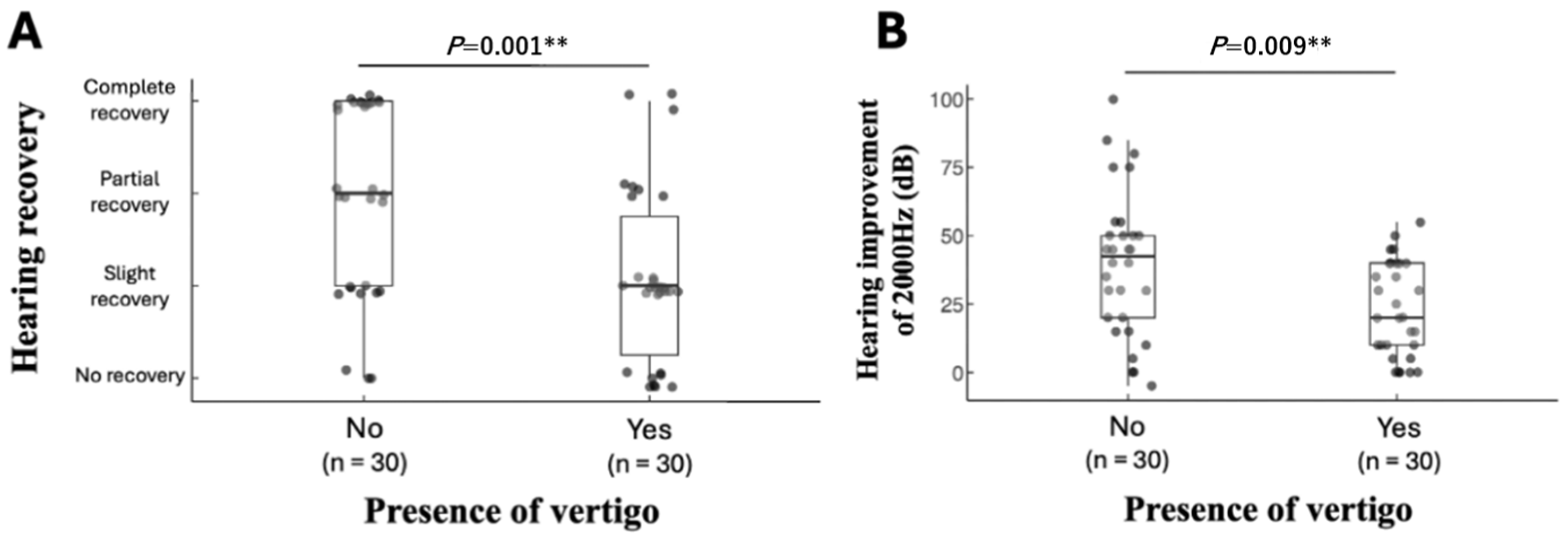
Patients without vertigo showed significantly better hearing recovery than those with vertigo (p = 0.001, Figure 1A). Analysis of hearing recovery at different frequencies revealed that patients without vertigo showed significantly better hearing improvement at 2000 Hz than those with vertigo (p = 0.009, Figure 1B).
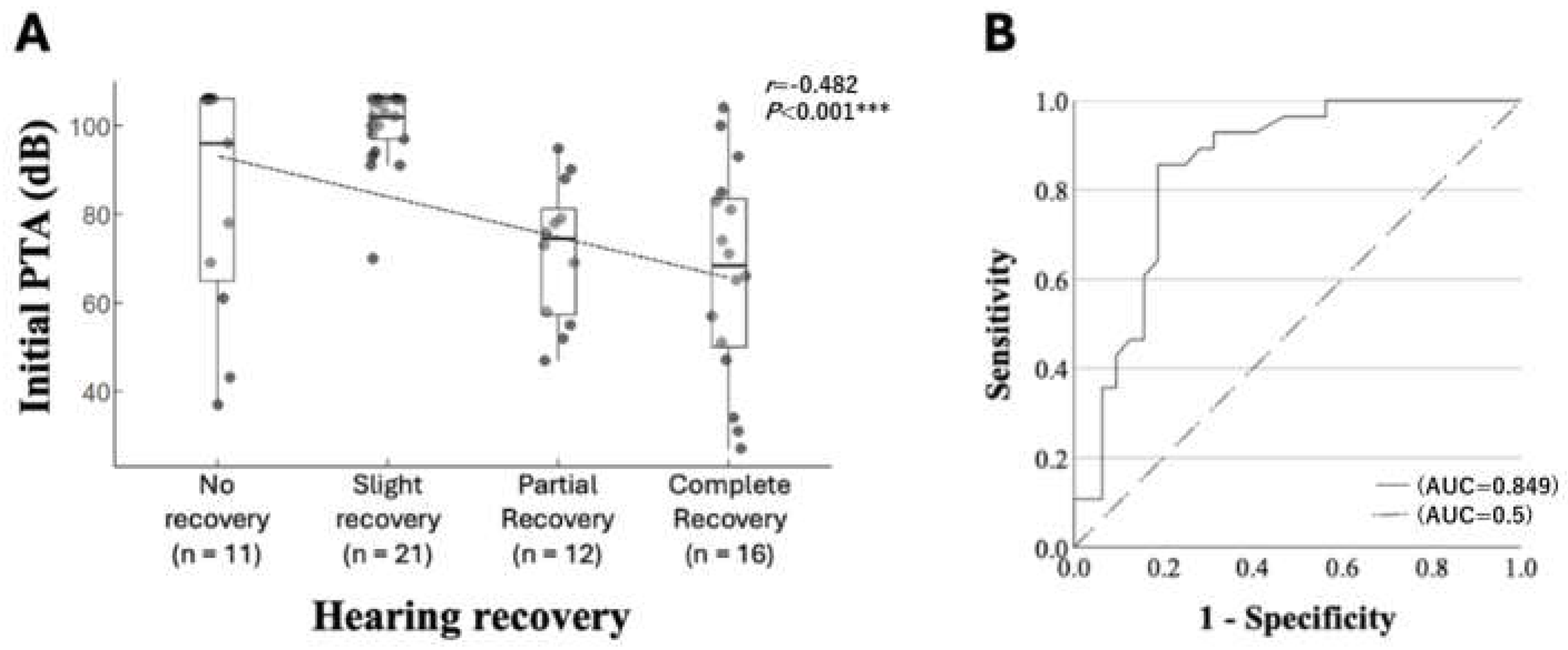
Figure 1. Box plots for hearing recovery and hearing improvement of 2000 Hz in patients without and with vertigo. The central line represents the median, the box indicates the interquartile range (IQR), and the whiskers extend to 1.5 × IQR. Individual points are plotted. (A) The Mann–Whitney U test showed that the patients without vertigo had significantly better hearing recovery than those with vertigo (p = 0.001). (B) The Mann–Whitney U test showed that hearing improvement at the 2000 Hz frequency was significantly better in the patients without vertigo than in those with vertigo. **, p < 0.01 We observed a moderate negative correlation between initial PTA and hearing recovery (Spearman’s ρ = −0.482, p < 0.001, n = 60; Figure 2A). In contrast, the presence of DM, HT, or DL was not significantly associated with hearing recovery.
Specifically, patients with a lower initial PTA showed better hearing recovery. Moreover, the patients who showed complete hearing recovery had the lowest mean initial PTA. A ROC analysis was performed to determine the optimal cut-off value of the initial PTA for the prediction of hearing recovery. The area under the curve was 0.849, which indicated excellent predictive ability (Figure 2B). The analysis revealed that the optimal cutoff for the initial PTA for predicting poor hearing recovery was ≥90.5 dB.
Figure 2. (A) Box plots for initial PTA and hearing recovery in the patients. The central line represents the median, the box indicates the interquartile range (IQR), and the whiskers extend to 1.5 × IQR. Individual points are plotted. Spearman correlation showed a significant negative moderate correlation (r = −0.482, p < 0.001). (B) Receiver operating characteristic (ROC) curve for predicting hearing recovery according to initial PTA. The area under the curve (AUC) was 0.849. PTA, arithmetic mean hearing at five frequencies (250, 500, 1000, 2000, and 4000 Hz); ***, p < 0.001.

4. Discussion

4.1. Summary of Main Findings

This study focused on combined therapy with HBO, SS, and PGE1 for ISSNHL. The effectiveness of HBO combined with SS and PGE1 for treating ISSNHL was evaluated. The results showed that patients treated with HBO, SS, and PGE1 had significantly better hearing recovery than those treated with SS and PGE1 alone. We also investigated the prognostic factors for hearing recovery in patients treated with combined therapy with HBO, SS, and PGE1 for ISSNHL. Patients with vertigo and those with a higher initial PTA (cutoff ≥ 90.5 dB) treated with HBO, SS, and PGE1 showed significantly poorer hearing recovery. In addition, patients with vertigo exhibited significantly poorer hearing improvement at 2000 Hz. These findings suggest that the addition of HBO to SS and PGE1 may improve hearing outcomes in patients with ISSNHL. Furthermore, the presence of vertigo and a higher initial PTA (cutoff ≥ 90.5 dB) were identified as prognostic factors for hearing recovery in patients treated with the combined therapy.

4.2. Potential Mechanisms Underlying the Benefit of HBO

Although the underlying mechanism of efficacy of the combined therapy with HBO, SS, and PGE1 remains unclear, we hypothesized that this combination improves cochlear ischemia more effectively than SS and PGE1 alone. Vascular impairment of the cochlea may be a principal etiology of ISSNHL, because the cochlea is extremely sensitive to ischemia [14]. HBO facilitates the delivery of high partial pressures of oxygen to the cochlea and has been used to improve cochlear ischemia [15]. SS is also known to have effects at multiple sites in the inner ear and to be effective in hearing loss of vascular origin [3]. PGE1 has also been used to enhance cochlear blood flow in the treatment of ISSNHL [16].

4.3. Prognostic Factors Associated with Hearing Recovery: The Presence of Vertigo

Previous studies indicated that vertigo at the time of ISSNHL onset is a prognostic factor for hearing recovery [4,14,17,18,19,20]. The pathophysiological mechanism for this remains unclear, but may involve a more extensive insult to the inner ear. The finding that auditory and vestibular deficits can progress independently is not unique to ISSNHL. A recent study by Maihoub et al. found no significant correlation between the degree of hearing loss and the degree of caloric weakness in patients with definite Ménière’s disease, highlighting a dissociation between cochlear and vestibular function [3]. This supports our hypothesis that the presence of vertigo in ISSNHL signifies a more diffuse or severe injury pattern, potentially affecting vascular supply or neural structures serving both systems, ultimately limiting recovery potential despite aggressive combination therapy.
It has been reported that approximately 28–57% of patients with ISSNHL experience vertigo at the time of onset [18]. Similarly, 50% of the patients in the present study had vertigo at the time of ISSNHL onset. Patients with ISSNHL who present with vertigo are more likely to have severe hearing loss than those without vertigo. Patients with ISSNHL who exhibit profound hearing loss experience vertigo and abnormal caloric results more frequently than those with less severe hearing loss [18]. Therefore, vertigo has been suggested to be a poor prognostic factor for hearing recovery after extensive and severe inner ear damage [21].
Patients with ISSNHL who exhibit hearing loss at high frequencies (2000 Hz and above) tend to be more susceptible to vertigo because, anatomically, the basal cochlear turn is more proximal to the vestibular end organs than the apical cochlear turn [22,23]. Moreover, it has been proposed that the obstruction of the arteria vestibulocochlearis leads to reduced blood supply to the lower cochlea, saccule, and posterior ampulla, resulting in high-frequency hearing loss accompanied by vertigo [24]. This anatomical theory could explain our finding that patients without vertigo showed significantly better hearing improvement at 2000 Hz than those with vertigo.

4.4. Prognostic Factors Associated with Hearing Recovery: Initial Hearing Level

Initial hearing level is a well-known prognostic factor for ISSNHL [4,13,14]. ISSNHL at higher thresholds is typically associated with poorer hearing recovery outcomes. Furthermore, patients with low initial hearing levels at the onset of symptoms show a slower rate of recovery than those with moderate initial hearing levels [13]. In the present study, ROC analysis demonstrated that the cutoff value of initial PTA for predicting a poor hearing recovery was ≥90.5 dB. This cutoff is close to 90 dB, which has traditionally been used as the cutoff for profound hearing loss [4,25,26,27]. Therefore, the present findings confirm that patients with severe ISSNHL treated with HBO, SS, and PGE1 are likely to have poor hearing outcomes.
With an increased number of cases, this study retrospectively analyzed 60 patients who received combined therapy with HBO, SS, and PGE1, focusing on prognostic factors [11]. The results revealed that vertigo and initial hearing level (cutoff ≥ 90.5 dB) were independent prognostic factors for poor hearing outcome. Furthermore, vertigo was significantly associated with hearing improvement at 2000 Hz. To maintain homogeneity of treatment delivery, only patients who received the full combination of HBO, SS, and PGE1 were included. Notably, these therapies are not used in combination in all patients but are individualized according to each case.

4.5. Limitations of the Present Study

This study has several limitations. First, it was a single-center retrospective study with a relatively small sample size, raising the possibility of selection bias. Although our findings suggest that adjunctive HBO is associated with improved hearing recovery in ISSNHL, the retrospective and non-randomized design precludes definitive conclusions regarding causality. However, unifying the treatment protocol allowed a clearer evaluation of the therapeutic effects of the combined regimen.
Although all patients received the same protocol, including HBO, SS, and PGE1, the number of HBO sessions differed between patients. The attending otologist decided whether to continue or discontinue HBO based on hearing recovery, patient preference, and adverse effects. Such heterogeneity in HBO exposure may have influenced outcomes and potentially led to an underestimation of its therapeutic effect. However, Spearman’s correlation analysis revealed no significant association between the number of HBO sessions and PTA improvement. Specifically, there was no significant association between an increase in the number of HBO sessions and the degree of hearing improvement. This result suggests that an increase in the number of HBO sessions may not necessarily lead directly to hearing recovery, and other treatment factors and individual patient conditions may have influenced recovery.
Another limitation is that speech intelligibility was not evaluated; hearing outcomes were assessed solely using pure-tone audiometry. Although pure-tone audiometry is essential, speech intelligibility provides a more practical measure of functional hearing, and incorporating it into future studies may yield a more comprehensive understanding of hearing outcomes.
In this study, the incidence of vertigo was significantly higher in the HBO group than in the no-HBO group. Because HBO treatment requires frequent hospital visits, it tends to be added for more severe cases that are often accompanied by vertigo. This likely explains the higher number of vertigo cases in the HBO group. To minimize this bias, multivariate logistic regression analysis including vertigo was performed, and HBO treatment remained independently associated with better hearing recovery after adjustment.
Finally, although vertigo and initial hearing level have been reported previously as prognostic factors [4,6], the clinical significance of this study lies in confirming that these factors also influence prognosis under the unique treatment protocol of combined HBO, SS, and PGE1 therapy. Despite limited novelty, this study provides valuable evidence regarding prognostic factors in ISSNHL treated with this specific regimen.

5. Conclusions

These findings demonstrate that additional HBO in combination with SS and PGE1 improves hearing outcomes in patients with ISSNHL. The presence of vertigo and a higher initial PTA (≥90.5 dB) were independent prognostic factors for poor recovery, with vertigo showing a significant negative association with hearing improvement at 2000 Hz. Although age > 60 years tended to be associated with worse outcomes, this finding was not statistically significant. These results suggest that additional HBO in combination with SS and PGE1 may provide a therapeutic advantage; however, hearing prognosis remains limited in patients with severe hearing loss and vertigo. Further prospective studies with larger cohorts are warranted to validate these findings and to optimize treatment strategies for ISSNHL.

Author Contributions

T.N., conceptualization, methodology, software, formal analysis, investigation, data curation, writing—original draft preparation; S.H., conceptualization, methodology, software, formal analysis, project administration, funding acquisition, writing—review and editing; T.K., methodology, conceptualization, funding acquisition; Y.T., conceptualization; H.H., conceptualization; T.A., conceptualization; Y.K., conceptualization; A.Y., investigation; F.M., conceptualization, supervision. All authors have read and agreed to the published version of the manuscript.

Funding

This work was supported by JSPS KAKENHI (Grant Number 24K19757 to Satoshi Hara; 15K10763, 18K09356, and 21K09589 to Takeshi Kusunoki) and by Institute for Environmental & Gender-Specific Medicine, Juntendo University (Grant Number E2837 to Takeshi Kusunoki).

Institutional Review Board Statement

This study was approved by the Ethical Review Board of Juntendo University Faculty of Medicine (identification E24-0386-S01, approval date: 6 January 2025).

Data Availability Statement

The data that support the findings of this study are available from the corresponding author upon reasonable request.

Acknowledgments

This study was supported by JSPS KAKENHI Grant Number 24K19757 (to Satoshi Hara), JSPS KAKENHI Grant Numbers 15K10763, 18K09356, and 21K09589 (to Takeshi Kusunoki), and a grant (E2837) to Takeshi Kusunoki from the Institute for Environmental & Gender-Specific Medicine, Juntendo University.

Conflicts of Interest

The authors declare that they have no conflicts of interest.

Abbreviations

The following abbreviations are used in this manuscript:
ATAAtm absolute
DLDyslipidemia
DMDiabetes mellitus
HBOHyperbaric oxygen therapy
HTHypertension
ISSNHLIdiopathic sudden sensorineural hearing loss
PGE1Prostaglandin E1
PTAPure tone average
ROCReceiver operating characteristic
SDStandard deviations
SSSystemic steroids

References

  1. Hosokawa, S.; Hosokawa, K.; Takahashi, G.; Sugiyama, K.I.; Nakanishi, H.; Takebayashi, S.; Mineta, H. Hyperbaric oxygen therapy as concurrent treatment with systemic steroids for idiopathic sudden sensorineural hearing loss: A comparison of three different steroid treatments. Audiol. Neurootol. 2018, 23, 145–151. [Google Scholar] [CrossRef]
  2. Murray, D.H.; Fagan, P.A.; Ryugo, D.K. Idiopathic sudden sensorineural hearing loss: A critique on corticosteroid therapy. Hear. Res. 2022, 422, 108565. [Google Scholar] [CrossRef]
  3. Maihoub, S.; Molnár, A.; Gáborján, A.; Tamás, L.; Szirmai, Á. Comparative study between the auditory and vestibular functions in Ménière’s disease. Ear Nose Throat J. 2022, 101, NP329–NP333. [Google Scholar] [CrossRef]
  4. Chandrasekhar, S.S.; Tsai Do, B.S.; Schwartz, S.R.; Bontempo, L.J.; Faucett, E.A.; Finestone, S.A.; Hollingsworth, D.B.; Kelley, D.M.; Kmucha, S.T.; Moonis, G.; et al. Clinical practice guideline: Sudden hearing loss (update). Otolaryngol. Head Neck Surg. 2019, 161 (Suppl. 1), S1–S45. [Google Scholar] [CrossRef]
  5. Wang, H.H.; Chen, Y.T.; Chou, S.F.; Lee, L.C.; Wang, J.H.; Lai, Y.H.; Chang, H.T. Effect of the timing of hyperbaric oxygen therapy on the prognosis of patients with idiopathic sudden sensorineural hearing loss. Biomedicines 2023, 11, 2670. [Google Scholar] [CrossRef]
  6. Kitoh, R.; Nishio, S.Y.; Sato, H.; Ikezono, T.; Morita, S.; Wada, T.; Usami, S.I. Research Group on Intractable Hearing Disorders and Japan Audiological Society. Clinical practice guidelines for the diagnosis and management of acute sensorineural hearing loss. Auris Nasus Larynx 2024, 51, 811–821. [Google Scholar] [CrossRef] [PubMed]
  7. Lamm, C.; Walliser, U.; Schumann, K.; Lamm, K. Sauerstoffpartialdruck-Messungen in der Perilymphe der Scala tympani unter normo- und hyperbaren Bedingungen. Eine tierexperimentelle Studie [Oxygen partial pressure measurements in the perilymph and scala tympani in normo- and hyperbaric conditions. An animal experiment study]. HNO Hals- Nasen- Ohrenärzte 1988, 36, 363–366. [Google Scholar] [PubMed]
  8. Li, Y. Interventions in the management of blood viscosity for idiopathic sudden sensorineural hearing loss: A meta-analysis. J. Health Res. Rev. 2017, 4, 50. [Google Scholar] [CrossRef]
  9. Haynes, D.S.; O’Malley, M.; Cohen, S.; Watford, K.; Labadie, R.F. Intratympanic dexamethasone for sudden sensorineural hearing loss after failure of systemic therapy. Laryngoscope 2007, 117, 3–15. [Google Scholar] [CrossRef]
  10. Tong, B.; Niu, K.; Ku, W.; Xie, W.; Dai, Q.; Hellström, S.; Duan, M. Comparison of therapeutic results with/without additional hyperbaric oxygen therapy in idiopathic sudden sensorineural hearing loss: A randomized prospective study. Audiol. Neurootol. 2021, 26, 11–16. [Google Scholar] [CrossRef]
  11. Hara, S.; Kusunoki, T.; Honma, H.; Kidokoro, Y.; Ikeda, K. Efficacy of the additional effect of hyperbaric oxygen therapy in combination of systemic steroid and prostaglandin E1 for idiopathic sudden sensorineural hearing loss. Am. J. Otolaryngol. 2020, 41, 102363. [Google Scholar] [CrossRef]
  12. Marx, M.; Younes, E.; Chandrasekhar, S.S.; Ito, J.; Plontke, S.; O’Leary, S.; Sterkers, O. International consensus (ICON) on treatment of sudden sensorineural hearing loss. Eur. Ann. Otorhinolaryngol. Head Neck Dis. 2018, 135, S23–S28. [Google Scholar] [CrossRef]
  13. Siegel, L.G. The treatment of idiopathic sudden sensorineural hearing loss. Otolaryngol. Clin. N. Am. 1975, 8, 467–473. [Google Scholar] [CrossRef]
  14. Lee, H.A.; Chung, J.H. Contemporary review of idiopathic sudden sensorineural hearing loss: Management and prognosis. J. Audiol. Otol. 2024, 28, 10–17. [Google Scholar] [CrossRef] [PubMed]
  15. Hirano, K.; Ikeda, K.; Kawase, T.; Oshima, T.; Kekehata, S.; Takahashi, S.; Sato, T.; Takasaka, T. Prognosis of sudden deafness with special reference to risk factors of microvascular pathology. Auris Nasus Larynx 1999, 26, 111–115. [Google Scholar] [CrossRef]
  16. Bennett, M.H.; Kertesz, T.; Yeung, P. Hyperbaric oxygen for idiopathic sudden sensorineural hearing loss and tinnitus. Cochrane Database Syst. Rev. 2007, 1, CD004739. [Google Scholar] [CrossRef]
  17. Ogawa, K.; Takei, S.; Inoue, Y.; Kanzaki, J. Effect of prostaglandin E1 on idiopathic sudden sensorineural hearing loss: A double-blinded clinical study. Otol. Neurotol. 2002, 23, 665–668. [Google Scholar] [CrossRef]
  18. Wu, H.; Wan, W.; Jiang, H.; Xiong, Y. Prognosis of idiopathic sudden sensorineural hearing loss: The nomogram perspective. Ann. Otol. Rhinol. Laryngol. 2023, 132, 5–12. [Google Scholar] [CrossRef]
  19. Hao, W.; Ye, L.; Yu, H.; Li, H. Prognosis of vestibular dysfunction in idiopathic sudden sensorineural hearing loss with vertigo: A prospective cohort study. J. Neurol. 2023, 270, 5516–5526. [Google Scholar] [CrossRef]
  20. Niu, X.; Zhang, Y.; Zhang, Q.; Xu, X.; Han, P.; Cheng, Y.; Gao, Y.; Zhang, R.; Yang, Y.; Chen, Z.; et al. The relationship between hearing loss and vestibular dysfunction in patients with sudden sensorineural hearing loss. Acta Oto-Laryngol. 2016, 136, 225–231. [Google Scholar] [CrossRef]
  21. Kim, C.H.; Choi, H.R.; Choi, S.; Lee, Y.S.; Shin, J.E. Patterns of nystagmus conversion in sudden sensorineural hearing loss with vertigo. Medicine 2018, 97, e12982. [Google Scholar] [CrossRef]
  22. Nakashima, T.; Yanagita, N. Outcome of sudden deafness with and without vertigo. Laryngoscope 1993, 103, 1145–1149. [Google Scholar] [CrossRef]
  23. Liu, J.; Zhou, R.H.; Liu, B.; Leng, Y.M.; Liu, J.J.; Liu, D.D.; Zhang, S.L.; Kong, W.J. Assessment of balance and vestibular functions in patients with idiopathic sudden sensorineural hearing loss. J. Huazhong Univ. Sci. Technol. Med. Sci. 2017, 37, 264–270. [Google Scholar] [CrossRef] [PubMed]
  24. Tange, R.A. Vascular inner ear partition: A concept for some forms of sensorineural hearing loss and vertigo. ORL 1998, 60, 78–84. [Google Scholar] [CrossRef] [PubMed]
  25. Clark, J.G. Uses and abuses of hearing loss classification. ASHA 1981, 23, 493–500. [Google Scholar] [PubMed]
  26. Suzuki, H.; Tabata, T.; Koizumi, H.; Hohchi, N.; Takeuchi, S.; Kitamura, T.; Fujino, Y.; Ohbuchi, T. Prediction of hearing outcomes by multiple regression analysis in patients with idiopathic sudden sensorineural hearing loss. Ann. Otol. Rhinol. Laryngol. 2014, 123, 821–825. [Google Scholar] [CrossRef]
  27. Filipo, R.; Attanasio, G.; Viccaro, M.; Russo, F.Y.; Mancini, P.; Rocco, M.; Pietropaoli, P.; Covelli, E. Hyperbaric oxygen therapy with short duration intratympanic steroid therapy for sudden hearing loss. Acta Oto-laryngol. 2012, 132, 475–481. [Google Scholar] [CrossRef]
Disclaimer/Publisher’s Note: The statements, opinions and data contained in all publications are solely those of the individual author(s) and contributor(s) and not of MDPI and/or the editor(s). MDPI and/or the editor(s) disclaim responsibility for any injury to people or property resulting from any ideas, methods, instructions or products referred to in the content.

Article Metrics

Citations

Article Access Statistics

Multiple requests from the same IP address are counted as one view.