Article

Ultrashort Pulsed Laser Fabrication of High-Performance Polymer-Film-Based Moulds for Rapid Prototyping of Microfluidic Devices


by
Pieter Daniël Haasbroek
1,2,
Mischa Wälty
1,
Michael Grob
1 and
Per Magnus Kristiansen
1,2,*
1
Institute of Polymer Nanotechnology (INKA), School of Engineering and Environment, FHNW University of Applied Sciences and Arts Northwestern Switzerland, 5210 Windisch, Switzerland
2
Centre of Micro/Nano Manufacturing Technology (MNMT-Dublin), School of Mechanical & Materials Engineering, University College Dublin, D04 V1W8 Dublin 4, Ireland
*
Author to whom correspondence should be addressed.
J. Manuf. Mater. Process. 2025, 9(9), 313; https://doi.org/10.3390/jmmp9090313
Submission received: 8 August 2025 / Revised: 2 September 2025 / Accepted: 5 September 2025 / Published: 12 September 2025

Abstract

Microfluidic device prototyping demands rapid, cost-effective, and high-precision mould fabrication, yet ultrashort pulsed laser structuring of polymer inserts remains underexplored. This study presents a novel method for fabricating microfluidic mould inserts using femtosecond (fs) laser ablation of polyimide (PI) films, achieving high precision from design to prototype. PI films (250 µm) were structured using a 355 nm fs laser (300 fs, 500 kHz, 0.95 J/cm2) in a photochemically dominated ablation regime and bonded to reusable steel plates. Injection moulding trials with cyclic olefin copolymer (COC) and polymethyl methacrylate (PMMA) were conducted with diverse designs, including concentration gradient generators (CGG), organ-on-chip (OOC) with 20 µm bridges, and double emulsion droplet generators (DEDG) with 100–500 µm channels, ensuring robustness across complex geometries. The method achieved near 1:1 replication (errors < 2%, microchannel height tolerances < 1%, Sa = 0.02 µm in channels, 0.26 µm in laser-structured areas), machining times under 2 h, and mould durability over 100 cycles without significant deterioration. The PI’s heat-retarding effect mimicked variothermal moulding, ensuring complete micro-penetration without specialised equipment. By reducing material costs using PI films and reusable steel plates, enabling rapid iterations within hours, and supporting industry-compatible prototyping, this approach lowers barriers for small-scale labs. It enables rapid prototyping of diagnostic lab-on-chip devices and supports decentralised manufacturing for biomedical, chemical, and environmental applications, offering a versatile, cost-effective tool for early-stage development.

1. Introduction

Microfluidic devices have become essential tools in diagnostics, life sciences, and analytical chemistry due to their ability to handle small fluid volumes with high precision and integration [1]. The widespread adoption of microfluidic systems relies on the ability to manufacture devices that are not only high-performing but also cost-effective and reproducible. Among the available fabrication methods, injection moulding (IM) remains one of the most promising for scaling up production, owing to its capacity to rapidly replicate complex three-dimensional microstructures with high fidelity and at low cost per part [2]. Thermoplastics such as polymethyl methacrylate (PMMA) and cyclic olefin copolymer (COC) are widely used in these applications due to their mechanical stability, optical transparency, and compatibility with mass-manufacturing processes, including IM [3,4].
However, developing IM tools for microfluidics poses unique challenges. Mould inserts must be able to resolve microscale features with sufficient dimensional accuracy and surface quality to ensure functional replication [5]. Such precision is essential in microfluidic systems, where surface roughness and dimensional deviations can, for instance, disrupt laminar flow, impair mixing efficiency, or compromise detection sensitivity. This requires expensive and time-consuming fabrication methods, such as lithography and electroforming processes (LIGA) [6,7], which can span several days to weeks, or precision micromilling, which is limited to simple 3D designs and maximum possible feature sizes [8,9]. Therefore, prototyping complex thermoplastic microfluidic devices remains a significant bottleneck. There is a need for mould inserts to be produced quickly and affordably to support the iterative cycles of design, testing, and validation typical in prototyping workflows [10]. This demand is further driven by the shift toward decentralised and application-specific microfluidic solutions, where traditional manufacturing timelines are too slow to keep pace with rapid development cycles [11]. Conventional mould inserts, typically made from metals through mechanical or electroforming processes, often involve long lead times and high production costs, both of which are at odds with the flexibility demanded in early-stage microfluidic development [12].
Laser-based micromachining has emerged as a versatile approach to directly structure mould inserts without masks or chemicals [13,14]. Pulsed laser systems offer an attractive alternative for structuring mould inserts, particularly due to their flexibility, digital control, and capacity for precise ablation [15,16]. Ultrashort pulsed (USP) lasers are especially well-suited for fabricating high-resolution features with minimal heat-affected zones [17]. Recent developments in high-repetition-rate USP laser systems have enabled more rapid structuring of metal mould inserts for microfluidic applications, with significantly improved throughput that allows complex microscale patterns to be generated within minutes. Nevertheless, the use of USP lasers to structure metals often results in low ablation rates (requiring high energy levels), poor surface quality, or excessive roughness, all of which hinder the structure fidelity required for microfluidic devices. The complexity of achieving adequate surface finishes through post-processing can limit their practicality for rapid prototyping [15]. Additionally, traditional metallic inserts offer high thermal conductivity, which can negatively affect the polymer flow and replication of small features during the brief fill and packing phases of IM, with some cases of polymer coatings being applied for better moulding and demoulding [18].
Polymeric mould inserts offer a compelling alternative route for rapid prototyping [19,20]. High-performance polymers such as polyimide (PI) combine high glass transition temperatures with thermal stability and dimensional integrity, making them viable candidates for prototype tooling in IM [21]. Compared to metals, high-performance polymers are more amenable to fast laser micromachining due to lower ablation thresholds. They also exhibit low thermal conductivity, which supports better thermal management during moulding to improve IM replication [22]. Lastly, better surface quality and microfeature precision can be achieved without post-processing. Despite these advantages, the use of USP lasers to structure polymer-based mould inserts has received little attention. Early studies using longer pulse durations (nanoseconds) and low pulse repetition rates (<2 kHz) demonstrated the feasibility of such approaches. However, their slow processing speeds limited their use in time-sensitive prototyping scenarios [23,24]. To date, the combination of high-repetition-rate USP laser processing with high-performance polymer moulds remains largely unexplored.
This study addresses this gap by presenting a rapid and versatile prototyping method for fabricating microfluidic mould inserts by means of femtosecond (fs) laser ablation of PI films. It demonstrates a direct-write laser fabrication approach that enables high-precision, multi-depth microstructuring of PI films using a single-step process, fully compatible with conventional IM systems without the need for specialised tooling. These films are integrated into hybrid mould inserts or polymer-film-based mould inserts. The approach enables fast turnaround, low material cost, and high design flexibility, while maintaining the resolution and dimensional fidelity required for microfluidic applications. The fabricated inserts are tested in IM trials to assess replication fidelity, surface quality, and feature integrity. Furthermore, the use of a thermally insulating polymer film that comes in contact with the polymer melt enhances replication fidelity, as it slows down cooling of the melt and thereby improves feature resolution, particularly for micro- and nanoscale structures on the replica [25]. The proposed method offers a fast and accessible route to producing high-quality microfluidic devices in small series, providing a valuable tool for early-stage device development. In the long term, this strategy could support decentralised or on-demand manufacturing of lab-on-chip devices for biomedical, chemical, and environmental applications.

2. Materials and Methods

2.1. Microfluidic Master Insert Fabrication

An easy, fast, and cost-effective method for producing high-quality injection mould inserts for microstructure replication is presented. This approach is particularly valuable in applications requiring rapid turnaround times and high throughput across multiple iterations, such as the prototyping of microfluidic devices. Polyimide film (Kpt HN, 250 µm, Tianjin Fortune International and Trade Co., Ltd., Tianjin, China) has been selected as a high-performance polymer due to its excellent absorption properties in the Ultraviolet (UV) wavelength range, thus enabling precise structuring via USP laser irradiation. Key laser parameters (fluence, scanning velocity, and pulse repetition rate [PRR]) control the ablation rate and feature quality by regulating heat accumulation in the material. Optimising these parameters facilitates efficient, high-precision micromachining of master structures. Previously, the optimal processing window has been identified for clean photo-chemical ablation of PI films using a 343 nm (300 fs) laser up to PRRs of up to 1000 kHz [26].
In contrast to polymers, traditional metals exhibit substantially lower ablation rates at the same energy level. Thus, metals such as steel are usually processed at much higher laser energies, which often requires post-processing to achieve sufficiently smooth surfaces. While thermally resistant polymers like PI are suitable alternatives for short-series IM (<1000 parts), machining of bulk PI sheets (e.g., 4.8 mm Vespel SP-1 [DuPont], previously investigated by the authors) is both expensive and wasteful due to significant material removal during preparation. Bonding laser-structured PI films to reusable metal plates offers a more efficient and sustainable solution. This method reduces material waste, lowers costs, and enables rapid interchangeability of master structures, thereby streamlining the iterative design process for microfluidic prototyping.

2.1.1. Polymer-Film-Based Mould Insert Assembly

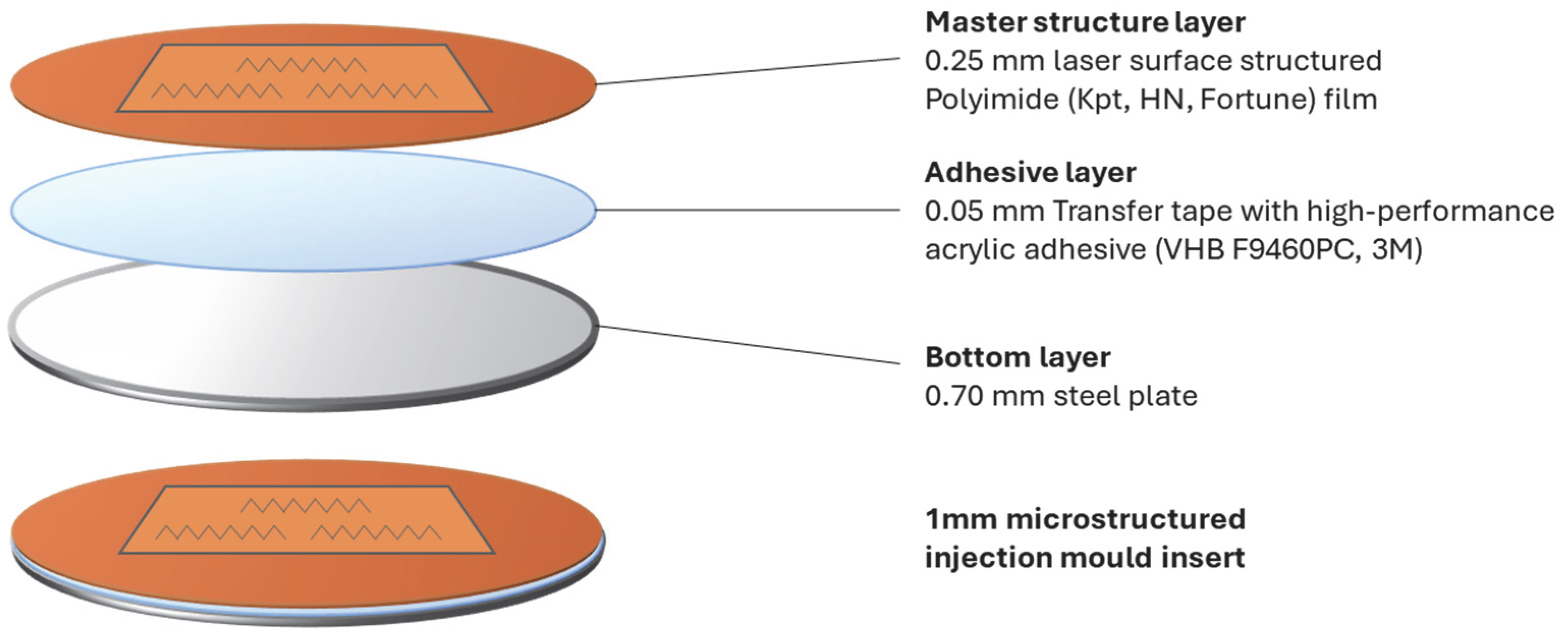
The injection mould used in this work requires disc-shaped inserts with a diameter of 49.5 mm and a thickness of 1 mm. The combined thickness of the PI film, adhesive layer, and steel base must meet the tool’s specifications. The master structure layer comprises a 0.25 mm-thick PI film, which is bonded to a steel base using an adhesive transfer tape (VHB F9460PC, 3M, Maplewood, MN, USA) of 0.05 mm thickness. This double-sided acrylic tape provides a high-strength bond, capable of withstanding short-term IM cycles at temperatures up to 260 °C (well above the maximum contact temperature observed upon contact with the polymer melt). A 0.7 mm-thick steel plate forms the bottom base layer. To prepare the inserts, 49.5 mm diameter discs are cut from sheet metal (Stainless Steel 1.4301, 0.7 mm, Hempel Special Metals AG, Dübendorf, Switzerland) using a water-jet cutter (Byjet 3015, Bystronic, Niederönz, Switzerland), and the PI film is similarly cut into 49.5 mm diameter circles. Each mould insert is assembled by bonding a PI film disc to a steel disc using adhesive tape, as illustrated in Figure 1. The stack is then pressed flat with a rubber roller to remove air pockets and ensure uniform adhesion. Finally, any excess tape is trimmed with a razor blade to align with the disc’s diameter.

2.1.2. Laser Surface Structuring of Master Design

The PI film surface of the prototype mould inserts is structured using an industrial-grade ultrashort-pulse laser (Carbide, Light Conversion, Vilnius, Lithuania) at 343 nm. Laser parameters were optimised based on previous work [26], which employed a 300 fs pulse duration, to achieve precise microfluidic master structure dimensions, optimal writing time, superior surface finish, and high process accuracy. The Gaussian beam quality factor M2 (third harmonic, 8W laser power, 100 kHz) was measured in the transverse directions x and y, as 1.165 and 1.026, respectively. This is achieved by identifying the photochemically dominated ablation regime, as well as accounting for the contribution that changes in PRR and scanning speeds (pulse overlaps) would have on the ablation rate as a result of their effect on heat accumulation.
The selected parameters are a peak fluence of 0.95 J/cm2, a PRR of 500 kHz, a scanning velocity of 1250 mm/s, and a 77% pulse and line overlap. This PRR allows for a sufficiently short processing time, with a higher speed of 1000 kHz suggested for larger or more intricate designs. These settings yield a surface structuring ablation rate, defined as ablation depth per layer, of 2.16 µm. For comparison, Leniz et al. [15] had to use 12.45 J/cm2 laser fluence to achieve a similar ablation depth per scan layer of 1.82 µm when creating microfluidic mould inserts in 1.2083 ESU stainless steel (<450 fs, 200 kHz). The high energy required to achieve a time-efficient ablation rate reduces surface and microfeature quality as well as dimensional integrity due to thermal defects, which have to be mitigated through additional laser polishing processes. In contrast, PI’s lower ablation threshold allows more efficient ‘cold’ ablation and greater material removal control, resulting in more robust and precise surface structuring and higher quality surface features. The microfluidic designs, created to demonstrate the process, are as follows:
  • A basic ‘organ-on-chip’ (OOC) building block
  • A ‘tree-shaped’ concentration gradient generator (CGG)
  • Two variations in a double emulsion droplet generator (DEDG)
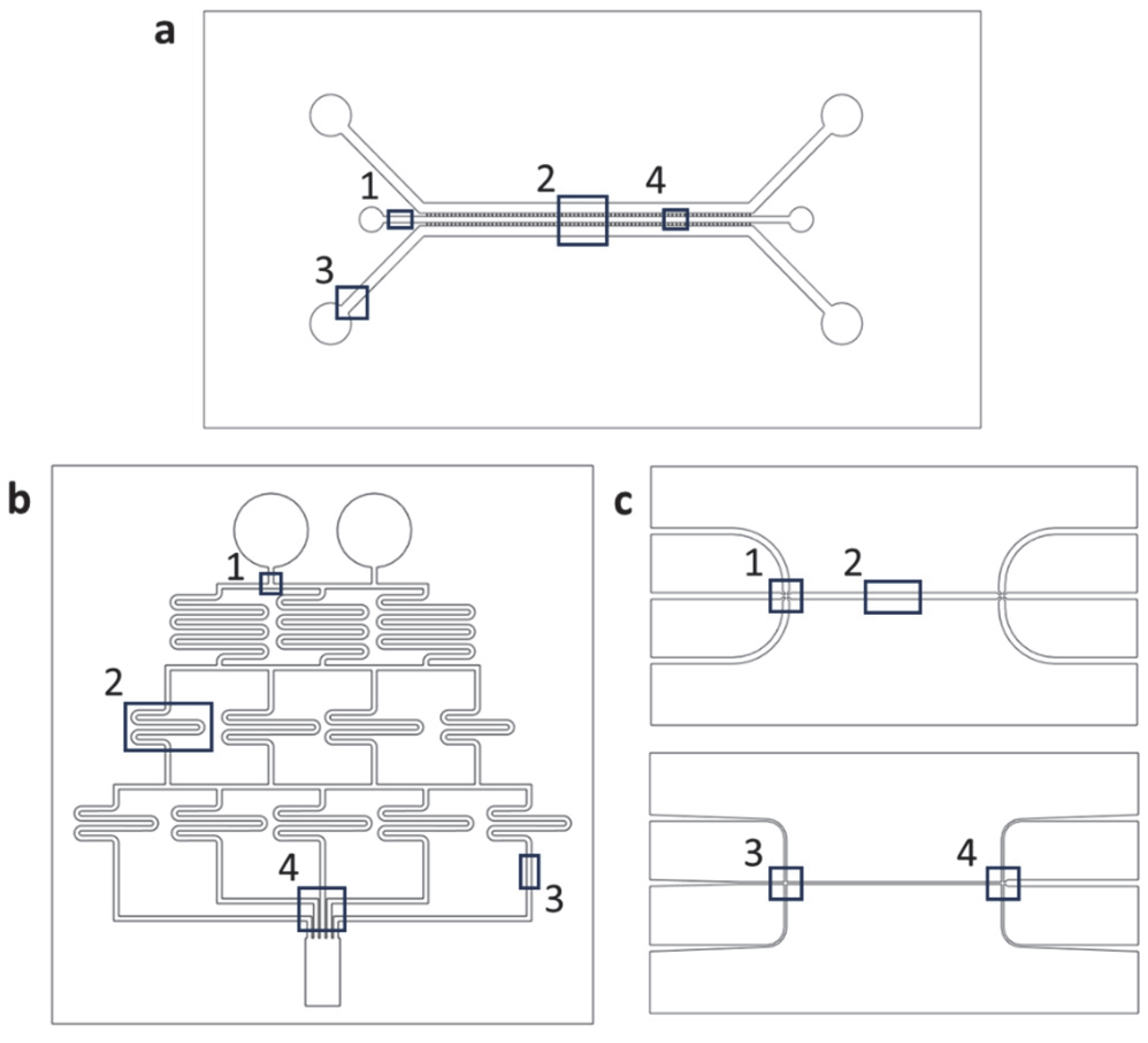
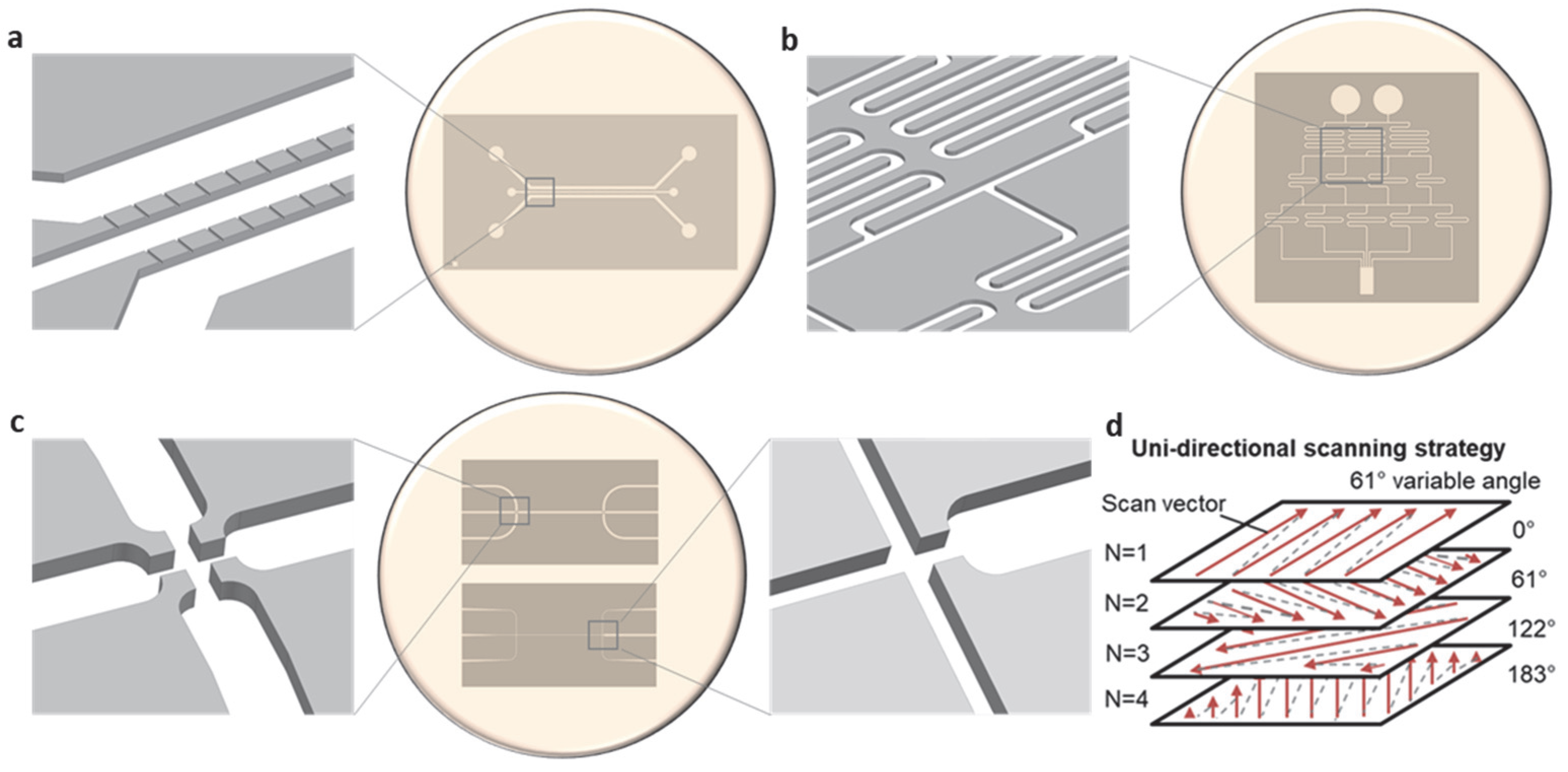
The OOC design (Mould 1) incorporates small ‘bridges’ (20 µm × 20 µm) that enable small-scale flow between an inner channel (200 µm × 60 µm) and two outer channels (500 µm × 60 µm), simulating membrane diffusion. This design tests the process’s minimum resolution and also evaluates the ability to manage varying height levels. The CGG (Mould 2) features channels (250 µm × 83 µm) with three levels of mixer modules, including 180° turns (meanders) with a mean radius of 450 µm, to produce four distinct solution concentrations. The DEDG designs (Mould 3) include 100 µm × 88.5 µm X-junctions forming a ‘nozzle’ for generating enveloped droplets, with wider channels measuring 300 µm.
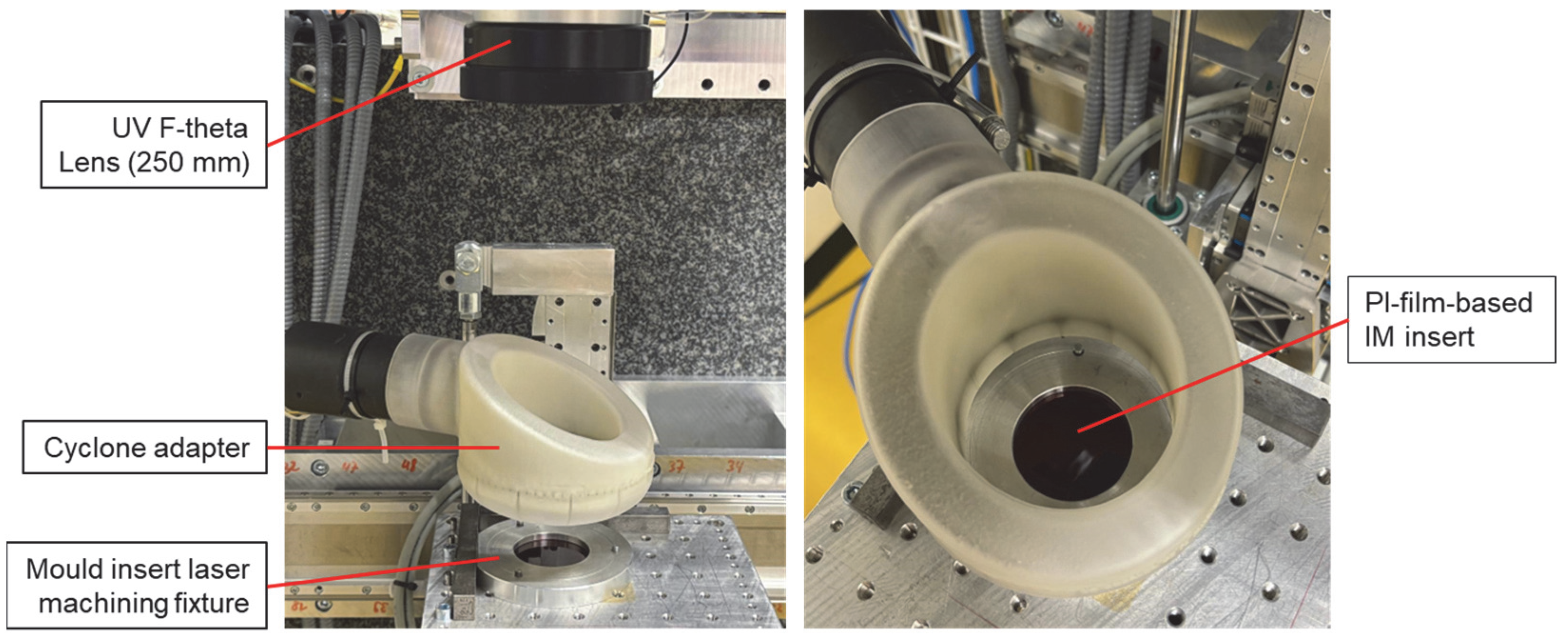
The ablation geometry, representing the material removed to create the master structure on the mould insert surface, is depicted for each microfluidic design in Figure 2a–c. These geometries are imported as STL files into the laser scanner software (SAMLight, SCAPS GmbH, Oberhaching, Germany). The geometry is sliced based on the total ablation depth and the surface structuring ablation rate. For example, a 65 µm channel height in Mould 1 is divided into 30 layers (65 µm/2.16 ≈ 30.09 µm). A galvanometric scanner (excelliSCAN 14 and varioSCAN de 20i, Scanlab, Puchheim, Germany) adjusts the laser beam’s position on the workpiece, while a 250 mm focal length standard UV F-theta lens (Sill Optics, Wendelstein, Germany) focuses the beam onto the mould insert surface. During laser processing, the inserts are held in the horizontal plane within an aluminium fixture, while gaseous emissions generated during the process are extracted from above the workpiece using a dedicated extraction system equipped with a specialised cyclone adapter. Figure 3 shows photographs of the mould insert laser structuring setup. A unidirectional scanning strategy with a 61° variable angle per slice is employed for improved surface roughness (see Figure 2d). Two inserts are produced for each mould design. The microstructured mould inserts are subsequently analysed using a Confocal Laser Scanning Microscope (CLSM, VK-X1100, Keyence, Osaka, Japan).

2.2. Injection Moulding Tests

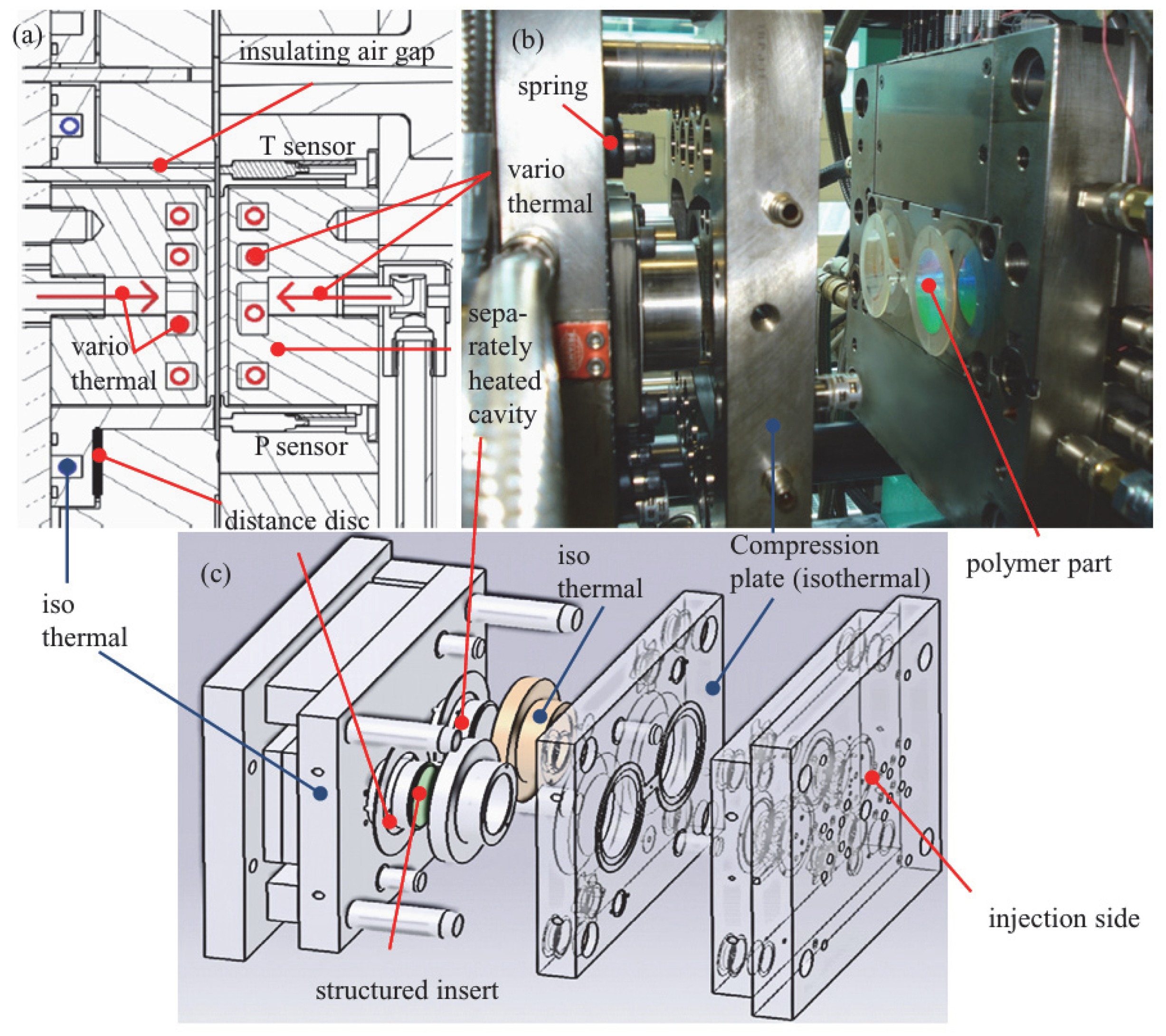
All trials are conducted using an injection moulding machine, the Arburg 320 A (Arburg AG, Lossburg, Germany), equipped with a hydraulic clamping unit with a maximum clamping force of 600 kN, an electrical injection unit with a maximum injection velocity of 142 cm3 s−1, a 3-zone screw with a diameter of 30 mm, a maximum injection volume of 77 cm3, and a maximum injection pressure of 2000 bar. A moulding tool with variothermal capability, designed internally and produced by AdvalTech AG (Niederwangen, Switzerland), is used as illustrated in Figure 4 [27]. It is built with space for two interchangeable inserts. The cavities containing the clamped inserts have a dedicated water circuit, allowing for rapid and independent temperature control separate from the rest of the mould. However, since the polymer mould surface has a heat retardation effect (‘poor man’s variothermal’), this functionality is not used in our injection moulding trials. The compression plate indicated in Figure 4 allows injection compression moulding, but was also not used in this study.
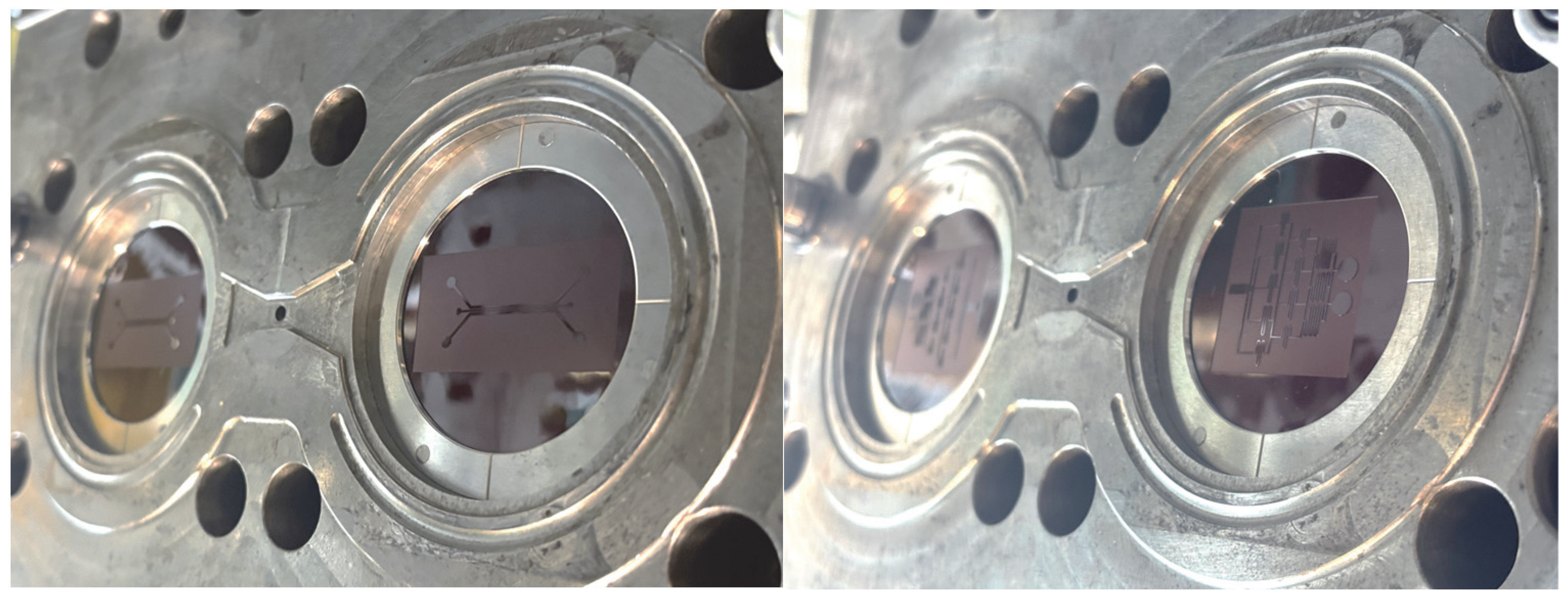
The dimensions of the mould insert, as described before, are determined by the IM tool. The two duplicate mould inserts for each of the three designs are installed into the injection mould tool for the three different tests, as shown in the photographs in Figure 5. Two commercial polymer grades, commonly chosen for microfluidic devices, are used for the trials: COC 6013 (TOPAS 6013M-07, Topas Advanced Polymers GmbH, Oberhausen, Germany) and PMMA 7N (Plexiglass 7N, Röhm GmbH, Darmstadt, Germany). Small-scale IM trials are conducted, and all three moulds are tested over 100 cycles, producing at least 200 parts per design (two cavities). Half of each trial is carried out with COC and the other with PMMA, resulting in 100 parts of each material per design. The aim is to observe whether the mould insert assemblies can withstand these cycles, whether the demoulding forces would tear the film-based assembly apart, and whether the microstructured parts produced are high-quality imprints. The thickness of each produced polymer part is 2 mm.
The recommended melt and mould temperature ranges for both materials are shown in Table 1. The selected melt temperature, which is material-dependent, must be balanced within its range to prevent incomplete melting and replication (too low a melt temperature) and thermal degradation (too high a melt temperature). In the case of micro-IM, a high melt temperature is preferred to ensure maximal penetration of the polymer melt into the microcavities. Therefore, the maximum recommended temperature is used, ensuring proper filling without reaching degradation. The right mould temperature is also imperative, as it affects both the shrinkage of the part and the cycle time. It has been shown that a high mould temperature delays solidification of the polymer melt at the entrance of microfeatures (hesitation effect), thereby ensuring optimal replication [28]. For this reason, the upper limit of the prescribed mould temperature range is selected for both materials.
The injection speed affects the filling pattern, part density and packing phase, which should be set to prevent flow lines and air traps. The holding pressure is applied once the mould is filled, to pack the material and compensate for shrinkage during cooling. The injection volume depends on the cavity’s size and is fine-tuned through inspection of the first few parts. The process parameters used for each material are shown in Table 2. The PMMA is dried at 80 °C for 2 h before use. The back pressure is set to 30 bar to ensure proper mixing and homogenisation of the molten polymer. The cycle time for each test was 50 s.
For each of the three prototype mould trials, post-IM 3D surface microstructure analysis is performed by CLSM. The mould inserts are observed for any signs of damage, deterioration, failure or debris collection. The parts are all screened for any macro-defects, followed by the CLSM analysis. Parts are analysed at approximately shot 30 and shot 80. This would assess consistency throughout the 100-cycle trial and the outcome of both materials. Finally, the replicas are imaged with Scanning Electron Microscopy (SEM, Hitachi S-3400N, Tokyo, Japan) to observe defects in detail.
The replication fidelity is assessed by measuring the height of the master and replicated channels in various areas of the three prototype designs. These ‘zones’ are shown in Figure 6, where n = 4 height measurements are taken in each zone and averaged. Mould 1 Zone 4 (Figure 6a) measures the 20 μm diffusion bridges of the OCC prototype. The widths are not considered here for twofold reasons: (i) the draft angle generated as a result of the angle of incidence of the laser (non-telecentric lens used) and the shape of the beam being Gaussian and (ii) the CLSM measurements are unreliable on structures close to vertical orientation such as the walls of the channels since the technique relies on reflected light.

3. Results

3.1. Injection Mould Insert Structures

Post-IM, the mould insert assemblies were observed. Forces from repeated injection and demoulding, and constant heating and cooling during cycles, proved to be within the prototype insert’s capability. The bonding between the PI film and the steel plate remained secure for all three trials, and the adhesive tape layer maintained its integrity. The clamped edge of the insert, the outer 2 mm radius, was exposed to the highest stress, resulting in a flattened edge with a swollen ridge where the unclamped region began. Some tiny pieces of adhesive tape material in this clamped region were expelled on the side of the insert.
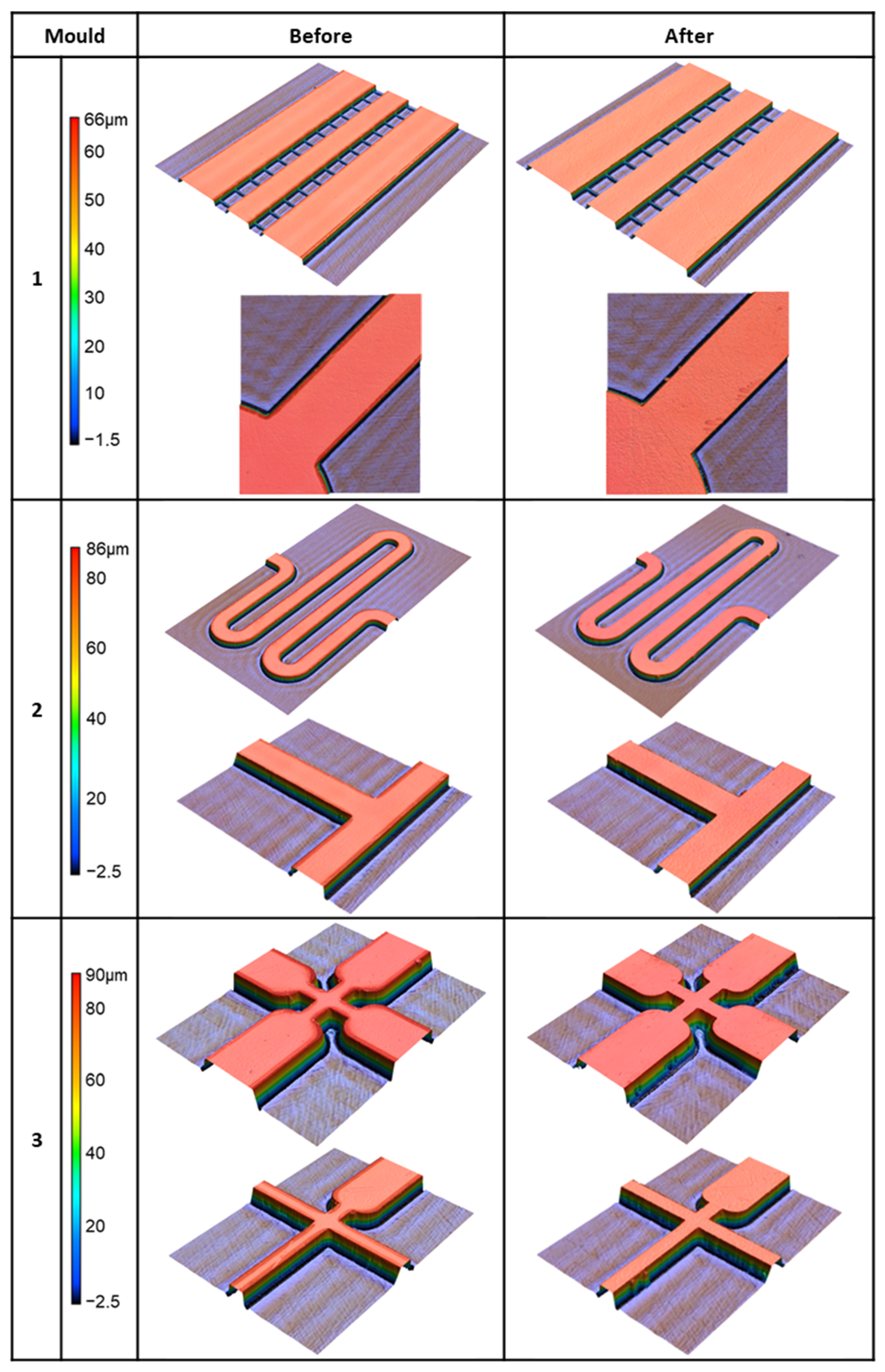
The master structures on each mould insert, analysed before and after the IM tests, exhibited little to no deterioration. This is shown in Figure 7, where they appear intact with the same dimensions as before IM. As anticipated, the high thermal resistance of PI ensured dimensional stability at the moulding temperatures, making it an excellent material for mastering and replicating. This was most evident in the 20 µm ‘bridge’ channels in Mould 1, which retained the same dimensions before and after IM. PI also promoted good wetting by the polymer melts (here COC and PMMA), and the roughness induced on the laser-processed surface enhanced this effect by increasing surface energy via the Wenzel mechanism [29]. The mould insert also demonstrated an optimal balance in polymer melt wettability, as excessive adhesion was not observed, injection debris is absent, and the mould surfaces remain entirely clean.
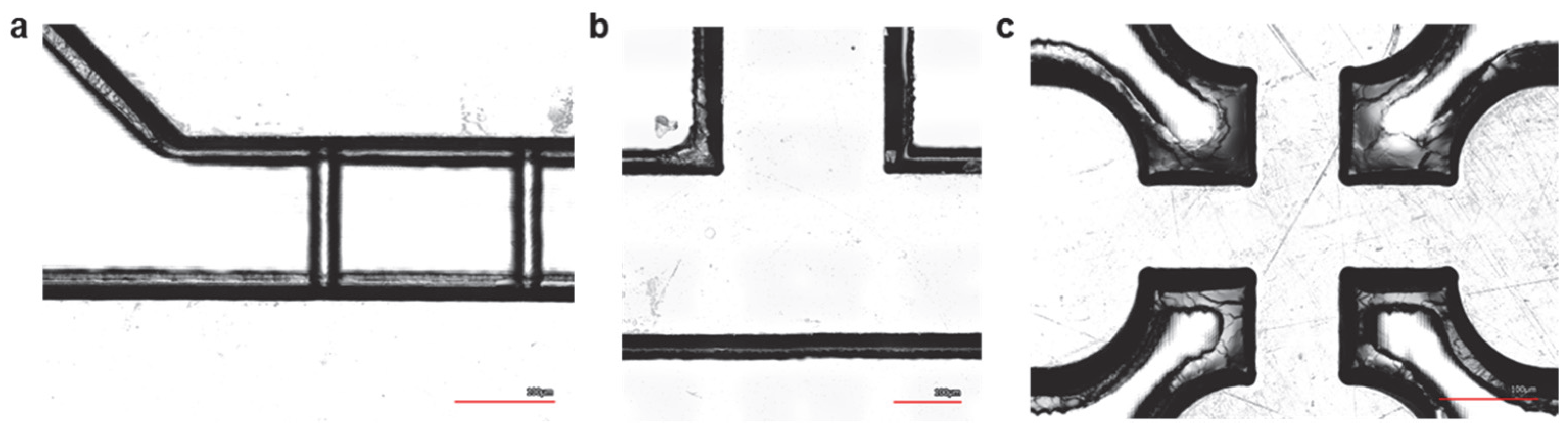
The grooves that form at the beginning of each structure of the mould surface are due to the delay during acceleration and deceleration of each laser scan. These can be seen more clearly as the darker trenches in the microscope images in Figure 8. This can be avoided through scanning strategies such as skywriting. This study overlooks it since it might be beneficial during the bonding of the open channel replicates, particularly for ultrasonic welding. Many bonding strategies, such as thermal or solvent bonding, can use the ridge (replicated groove) along the channel edge to act as a ‘seal’, especially if that extra surface material will dissolve or melt during bonding. However, this is observed as the only drawback from the IM tests. Following the 100-shot cycle for each mould, some solidified polymer melt begins to fill these grooves in some isolated spots, especially at corners. It is most prevalent at the X-junction (Figure 8c), where three corners are closely located, followed by a curved wall. This becomes an issue as the ‘debris’ material accumulates on the channel master’s wall, which can cause ‘leaks’ between the replicated channels, as shown in the following section.

3.2. Injection Moulding Replicates

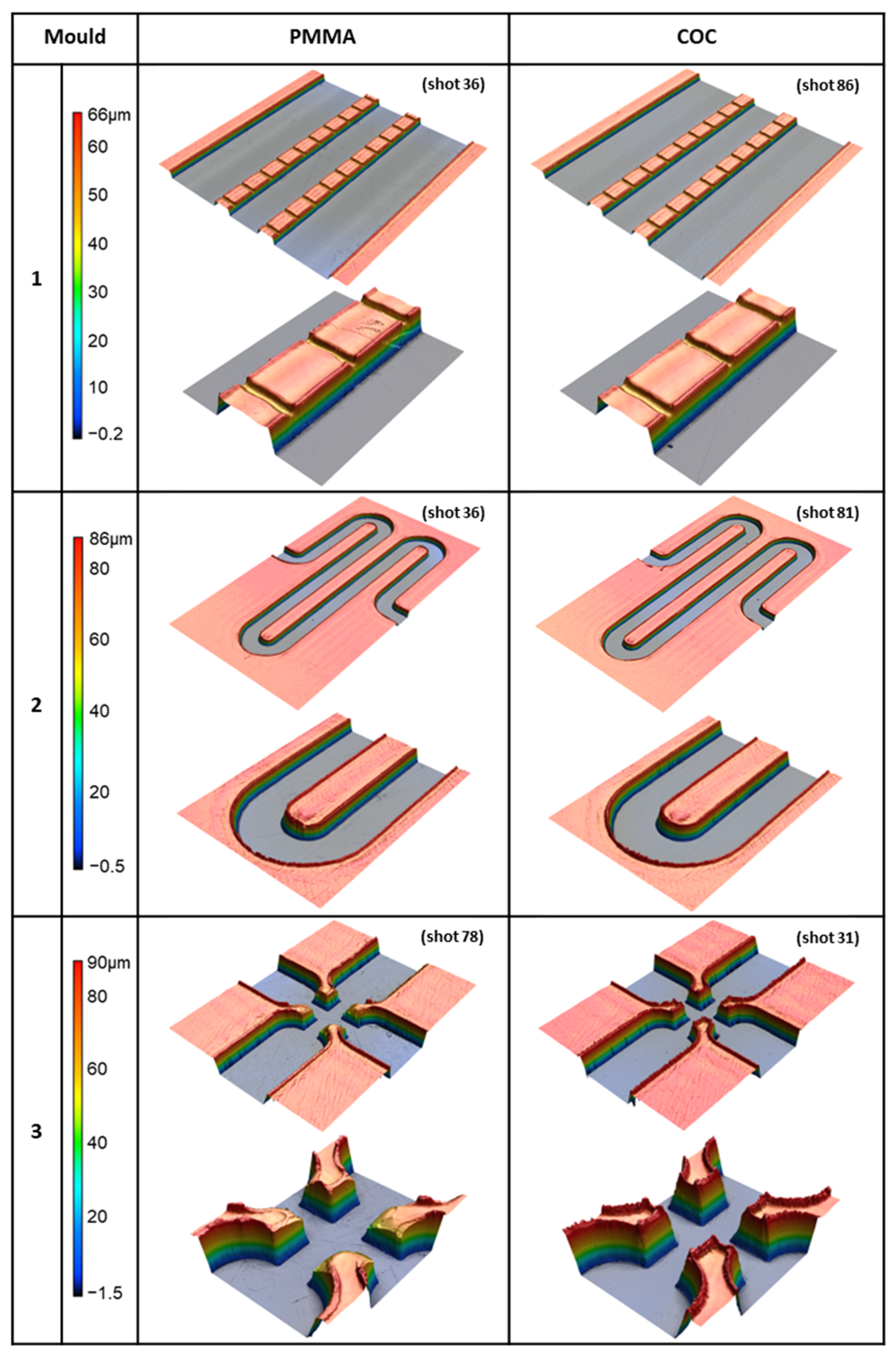
The results from the small-scale IM tests, as shown in Figure 9, were complete imprints of the microfluidic master moulds 1–3. The process proved feasible in producing prototype parts with fidelity high enough to enable the development of bonding (with a sealing layer), cutting, assembly, and the functionality of the final device. It also proved capable of producing injection-moulded prototypes with various geometries, widely used in microfluidics. One of the most critical surfaces, the bottom of the microfluidic channels, exhibited the same surface quality as the polished PI film before laser ablation (Sa = 0.02 µm). This resulted from the subtractive manufacturing process used to fabricate the master, provided the ablation depth remained constant for all surface structures. If features had multiple heights, the laser-processed surface roughness of 0.26 µm was imparted onto surfaces lower than the maximum height of the structures.
The micro-scale replication with the selected parameters achieved a near 1:1 part-to-master ratio. Complete filling was observed for all three moulds, evident in the sharply formed, non-rounded bottom edges of channels. The polymer film in the mould insert assembly acted as a ‘heat-retarding’ layer, allowing slower solidification and complete penetration of the polymer melt into the micro-cavities. In contrast, fully metallic moulds often require a variothermal IM process, setting the cavity and mould surface at a higher temperature at the start of each cycle to prevent premature solidification of the melt. Thus, the high-performance polymer-film-based IM replication provided a robust, simple, and cost-effective alternative, described here as a ‘poor-man’s variothermal IM’ process. Demoulding caused no failures, indicating that the polymer-melt wetting properties on the PI surface were sufficiently balanced to allow clean ejection of the formed parts.
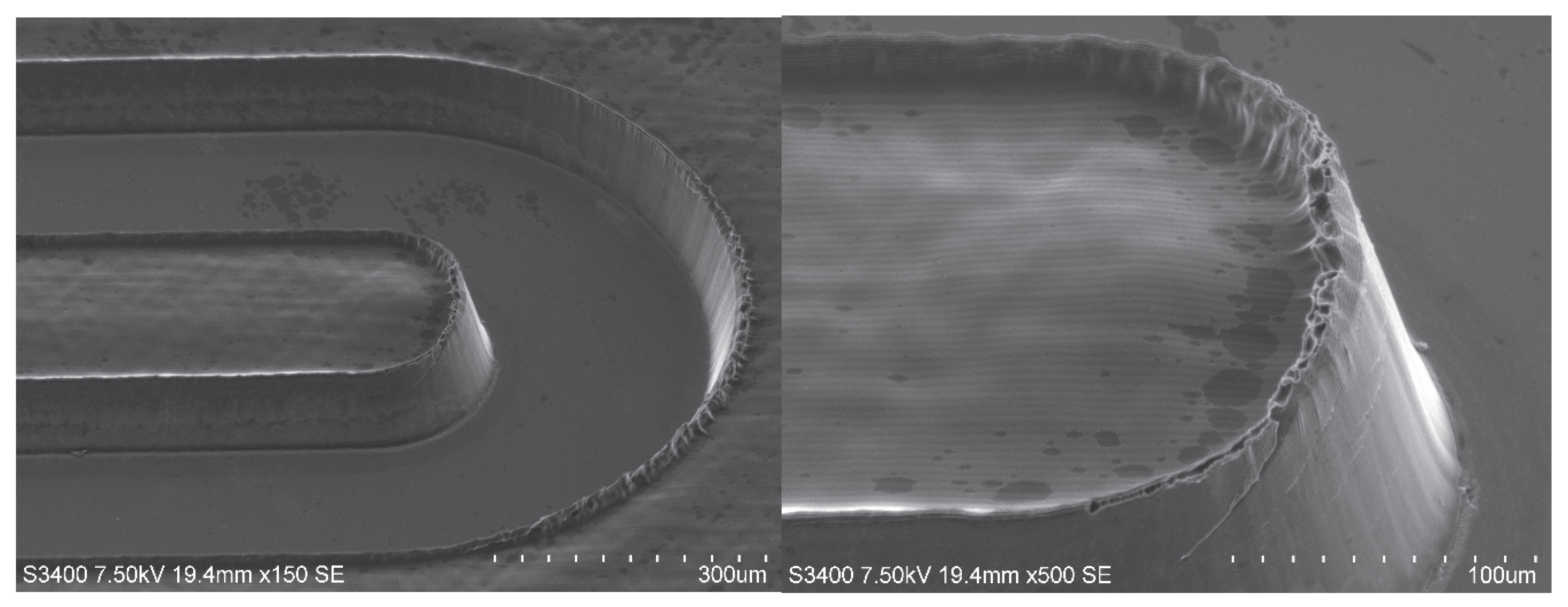
A noticeable defect arose from grooves at the start of the microchannel masters, which formed a protruding ridge on the edge of each microchannel. This is observed in greater detail in the Scanning Electron Microscopy (SEM) images in Figure 10. Although indicative of precise replication and potentially beneficial for the bonding process, this defect caused an issue in Mould 3. At shot 31, the X-junction of the droplet generator was fully formed. However, by shot 78, the channel walls were not fully formed due to a build-up of material at these critical corners in the mould, as described earlier. In this case, the insert could be reproduced promptly with minimal resources, using a writing strategy that largely avoids groove formation, thanks to the ease of this prototyping method.
Table 3 shows the heights of the microfluidic structures in the various zones of the benchmark design (refer to Figure 6). It compares the theoretical dimensions with measurements taken on the mould insert and on the injection-moulded replicas made from PMMA 7N and COC 6013. The accuracy of the fabricated inserts and the replication fidelity of the moulded replicas were evaluated based on four measurements (n = 4), using the mean and standard deviation per zone, to characterise the results. The error for the insert is calculated relative to the theoretical design dimensions, while the error for the replicas is determined relative to the measured dimensions of the insert. The overall deviation of the produced parts in relation to the design dimensions can therefore be found through the sum of the insert and the replica errors. Fortunately, the replication discrepancies are evidently and almost negligibly low for all cases (except the 20 μm bridges at Mould 1 zone 4). The threshold tolerance is defined as 10% for similar studies of robust IM tooling for microfluidics [15,30].
For the laser-structured inserts, deviations arise primarily from the rounding of the number of layers used to fabricate each structure, based on a surface structuring ablation rate of 2.16 μm (at 0.95 J/cm2 fluence, 300 fs pulses, 500 kHz repetition rate, and 77% pulse and line overlap). Additional deviation may result from the use of a photodiode-based laser power measurement prior to processing, which is employed to set the fluence level as close as possible to the target process fluence. Even small energy fluctuations can accumulate, leading to final structure heights that differ slightly from the target values. However, these errors remain minimal and well below critical thresholds.
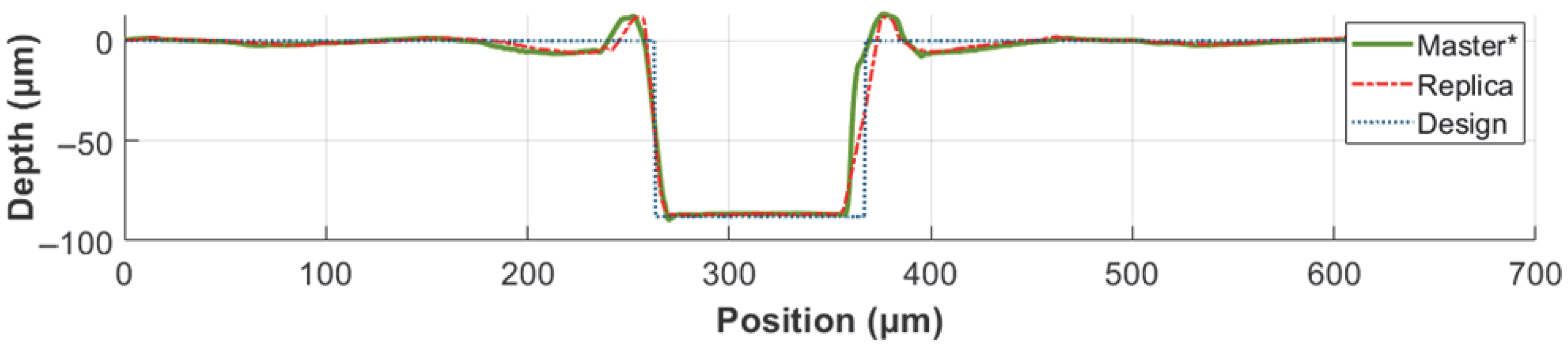
Only the 20 μm bridges on Mould 1 exhibit a notable error of −11.4%, likely attributable to the optical limitations of the laser system (focused beam diameter 2 ω0 of 15 μm) and a natural decline in structuring precision at smaller feature sizes. Replication fidelity for both polymers is excellent, with errors consistently below 2%, except for the 20 μm structures, which exhibit deviations of −3.3% for PMMA and −4.5% for COC. Consequently, the cumulative errors from design to final prototype are −14.7% and −15.9%, respectively, for the 20 μm bridges. Nevertheless, for typical microfluidic channel dimensions (>20 μm), the prototyping approach demonstrates excellent performance with negligible deviations in vertical dimensions, as illustrated in Figure 11.

4. Discussion and Conclusions

This study demonstrated that femtosecond (fs) laser ablation of PI films enables rapid, high-precision fabrication of microfluidic mould inserts, yielding four key findings. First, the process streamlines iterative prototyping by reducing turnaround times for design iterations (design, testing, and subsequent redesign) compared to traditional IM, which requires multiple steps and specialised tooling for mould manufacturing. Second, the method produces high-fidelity microfluidic structures with precise dimensions (average microchannel height tolerances < 1%) and excellent surface quality (Sa = 0.25 µm in laser-structured bonding areas, Sa = 0.02 µm within channels from polished film surfaces), enabling reliable replication of complex designs such as CGG, OOC, and DEDG. Third, by using materials compatible with commercial microfluidic systems, this approach bridges the gap between research-grade PDMS prototyping and pilot-scale production, aligning with industry standards. Finally, cost-effective PI films bonded to reusable steel plates minimise material costs and waste, enhancing prototyping accessibility.
These findings address the research gap in prior studies, where USP laser structuring of polymer-based mould inserts, particularly with high-repetition-rate fs lasers, was underexplored [23,24]. Unlike previous nanosecond laser approaches, which were limited by slow processing speeds, high-repetition-rate fs laser ablation (500 kHz, 0.95 J/cm2) enables rapid microstructuring without compromising either precision or surface quality [26]. The thermal stability and low thermal conductivity of PI films [21,22] enhances replication fidelity by slowing cooling rates during IM, improving resolution of micro- and nanoscale features as well as their surface integrity. Replication fidelity was excellent, with errors below 2% for most structures, well within the 10% tolerance threshold for robust IM tooling. The same tolerance has been used in other studies by authors investigating microfluidic device fabrication processes [15,30]. Compared to metal moulds [15], PI films offer superior design flexibility, better microfeature quality, and faster fabrication with similar energy parameters, meeting the demands of time-and cost-sensitive prototyping. Notably, while laser-fabricated PEEK inserts in [24] required 1–3 days from concept to part, this method reduced the turnaround to 5–8 h, with machining times below 2 h at 500 kHz, potentially further accelerated using 2 MHz PRRs (not tested here). The most time-consuming stage is the initial CAD design, with subsequent iterations that can be reduced to 3 h (e.g., 1–2.5 h for laser ablation, 1–2 h for injection moulding setup and production, 1 h for setup/bonding). The mould inserts were sufficiently robust to withstand 100 IM cycles without significant deterioration, and displayed clean demoulding, confirming their suitability for short-series prototyping (<1000 parts).
The implications are significant for both research and industry. This single-step, direct-write laser process supports decentralised, on-demand manufacturing of lab-on-chip devices for biomedical, chemical, and environmental applications. By leveraging existing laser systems and cost-effective materials, the method lowers barriers for small-scale research labs, democratising advanced prototyping. Additionally, the PI film’s heat-retarding effect mimics variothermal IM, simplifying the process and eliminating the need for specialised equipment, further reducing costs. Compatibility with conventional IM facilitates a smoother transition to pilot-scale production, potentially accelerating the development of commercially viable microfluidic devices.
However, some limitations still exist. While PI films withstood 100 cycles without failure, their durability under high-volume production (>1000 cycles) may be limited compared to metal moulds. The fs laser ablation process requires specialised systems, which may not be universally available. The study tested specific designs (CGG, OOC, DEDG), with 20 µm channels showing higher replication errors (−14.7% to −15.9%) due to laser optical limits, necessitating further validation across diverse geometries and smaller features. These limitations highlight areas for scaling up production while affirming the method’s prototyping utility.
Future research should assess the durability of PI-based mould inserts under repeated IM cycles to evaluate suitability for larger-volume manufacturing. Exploring alternative high-performance polymers or hybrid materials could enhance mould longevity while preserving cost-effectiveness. Expanding tested designs to include multi-level structures and testing smaller microfeatures using advanced laser optics (e.g., <10 µm spot size, telecentric lenses, optimised beam profiles) could improve precision for sub-20 µm features, addressing the −14.7% to −15.9% errors observed in 20 µm bridges. Implementing higher PRRs (e.g., 2 MHz) or skywriting scanning strategies could eliminate groove formation due to jitter effects, preventing material build-up as observed in Mould 3. Integrating machine learning to optimise laser parameters may further improve efficiency and precision.
In conclusion, this study presents a rapid, versatile, and cost-effective method for fabricating microfluidic mould inserts using fs laser ablation of PI films, offering high precision, industry compatibility, and minimal material investment. By addressing gaps in rapid prototyping, this approach provides a valuable tool for early-stage device development and supports decentralised manufacturing of microfluidic devices across diverse applications.

Author Contributions

Conceptualisation, P.D.H. and P.M.K.; methodology, P.D.H. and P.M.K.; software, P.D.H.; validation, P.D.H.; formal analysis, P.D.H.; investigation, P.D.H. and M.W.; resources, P.M.K. and M.G.; writing—original draft preparation, P.D.H.; writing—review and editing, P.D.H., P.M.K. and M.W.; visualisation, P.D.H.; supervision, P.M.K.; project administration, P.D.H.; funding acquisition, P.M.K. All authors have read and agreed to the published version of the manuscript.

Funding

This work has received funding from the European Union’s Horizon 2020 research and innovation programme under the Marie Skłodowska-Curie Grant no. 956097.

Data Availability Statement

Data are contained within the article. The original contributions presented in this study are included in the article. Further inquiries can be directed to the corresponding author.

Acknowledgments

The authors acknowledge the Institute of Process and Product Engineering (IPPE) at the FHNW School of Engineering and Environment for the use of their laser processing equipment. The authors would like to acknowledge the SIMPPER_MedDev MSCA Innovative Training Network for their learning and support.

Conflicts of Interest

The authors declare no conflicts of interest.

Abbreviations

The following abbreviations are used in this manuscript:
USPUltrashort pulsed
UVUltraviolet
PRRPulse repetition rate
PIPolyimide
IMInjection moulding
COCCyclic olefin copolymer
PMMAPolymethyl Methacrylate
OOCOrgan-on-chip
CGGConcentration gradient generator
DEDGDouble emulsion droplet generator

References

  1. Sackmann, E.K.; Fulton, A.L.; Beebe, D.J. The present and future role of microfluidics in biomedical research. Nature 2014, 507, 181–189. [Google Scholar] [CrossRef] [PubMed]
  2. Scott, S.; Ali, Z. Fabrication Methods for Microfluidic Devices: An Overview. Micromachines 2021, 12, 319. [Google Scholar] [CrossRef] [PubMed]
  3. Agha, A.; Waheed, W.; Alamoodi, N.; Mathew, B.; Alnaimat, F.; Abu-Nada, E. A Review of Cyclic Olefin Copolymer Applications in Microfluidics and Microdevices. Macromol. Mater. Eng. 2022, 307, 2200053. [Google Scholar] [CrossRef]
  4. Shakeri, A.; Khan, S.; Abu Jarad, N.; Didar, T.F. The Fabrication and Bonding of Thermoplastic Microfluidics: A Review. Materials 2022, 15, 6478. [Google Scholar] [CrossRef]
  5. Zhang, N.; Srivastava, A.P.; Browne, D.J.; Gilchrist, M.D. Performance of nickel and bulk metallic glass as tool inserts for the microinjection molding of polymeric microfluidic devices. J. Mater. Process. Technol. 2016, 231, 288–300. [Google Scholar] [CrossRef]
  6. Zhang, N.; Srivastava, A.; Kirwan, B.; Byrne, R.; Fang, F.Z.; Browne, D.J.; Gilchrist, M.D. Manufacturing microstructured tool inserts for the production of polymeric microfluidic devices. J. Micromech. Microeng. 2015, 25, 095005. [Google Scholar] [CrossRef]
  7. Chen, C.S.; Chen, S.C.; Liao, W.H.; Chien, R.D.; Lin, S.H. Micro injection molding of a micro-fluidic platform. Int. Commun. Heat Mass Transf. 2010, 37, 1290–1294. [Google Scholar] [CrossRef]
  8. Lu, Y.J.; Liu, B.; Zhang, Z.L.; Guo, M.R.; Wang, J.J.; Wang, C.J. Process chain for the mass production of polymeric microfluidic chips. Int. J. Adv. Manuf. Technol. 2023, 127, 3665–3680. [Google Scholar] [CrossRef]
  9. Chang, W.L.; Luo, X.C.; Ritchie, J.M.; Sun, J.N.; Mark, C. Fabrication of microfluidic injection moulds by a hybrid micromachining process. Proc. Inst. Mech. Eng. B J. Eng. Manuf. 2011, 225, 458–462. [Google Scholar] [CrossRef]
  10. León-Cabezas, M.A.; Martínez-García, A.; Varela-Gandía, F.J. Innovative advances in additive manufactured moulds for short plastic injection series. Procedia Manuf. 2017, 13, 732–737. [Google Scholar] [CrossRef]
  11. Cong, H.; Zhang, N. Perspectives in translating microfluidic devices from laboratory prototyping into scale-up production. Biomicrofluidics 2022, 16, 021301. [Google Scholar] [CrossRef]
  12. Vazquez, R.M.; Trotta, G.; Volpe, A.; Bernava, G.; Basile, V.; Paturzo, M.; Ferraro, P.; Ancona, A.; Fassi, I.; Osellame, R. Rapid Prototyping of Plastic Lab-on-a-Chip by Femtosecond Laser Micromachining and Removable Insert Microinjection Molding. Micromachines 2017, 8, 328. [Google Scholar] [CrossRef]
  13. Saadat, M.; Taylor, M.; Hughes, A.; Hajiyavand, A.M. Rapid prototyping method for 3D PDMS microfluidic devices using a red femtosecond laser. Adv. Mech. Eng. 2020, 12, 1687814020982713. [Google Scholar] [CrossRef]
  14. Pfleging, W.; Hanemann, T.; Bernauer, W.; Torge, M. Laser micromaching of mold inserts for replication techniques—State of the art and applications. Laser Appl. Microelectron. Optoelectron. Manuf. VI 2001, 4274, 331–345. [Google Scholar]
  15. Leniz, I.V.; Bakouche, T.; Astigarraga, M.; Husson, F.; Zaldua, A.M.; Gemini, L.; Vilas-Vilela, J.L.; Etxeberria, L. Analyzing the Potential of Laser Femtosecond Technology for the Mass Production of Cyclic Olefin Copolymer Microfluidic Devices for Biomedical Applications. Polymers 2025, 17, 1289. [Google Scholar] [CrossRef] [PubMed]
  16. Trotta, G.; Volpe, A.; Ancona, A.; Fassi, I. Flexible micro manufacturing platform for the fabrication of PMMA microfluidic devices. J. Manuf. Process. 2018, 35, 107–117. [Google Scholar] [CrossRef]
  17. Malinauskas, M.; Žukauskas, A.; Hasegawa, S.; Hayasaki, Y.; Mizeikis, V.; Buividas, R.; Juodkazis, S. Ultrafast laser processing of materials: From science to industry. Light Sci. Appl. 2016, 5, e16133. [Google Scholar] [CrossRef] [PubMed]
  18. Hopmann, C.; Weber, M.; Schongart, M.; Schafer, C.; Bobzin, K.; Bagcivan, N.; Brogelmann, T.; Theiss, S.; Munstermann, T.; Steger, M. Injection Moulding of Optical Functional Micro Structures Using Laser Structured, PVD-Coated Mould Inserts. In AIP Conference Proceedings; AIP Publishing LLC: Melville, NY, USA, 2015; Volume 1664. [Google Scholar]
  19. Griffiths, C.A.; Bigot, S.; Brousseau, E.; Worgull, M.; Heckele, M.; Nestler, J.; Auerswald, J. Investigation of polymer inserts as prototyping tooling for micro injection moulding. Int. J. Adv. Manuf. Technol. 2010, 47, 111–123. [Google Scholar] [CrossRef]
  20. Park, S.W.; Lee, W.I.; Moon, S.N.; Yoo, Y.-E.; Cho, Y.H. Injection molding micro patterns with high aspect ratio using a polymeric flexible stamper. Express Polym. Lett. 2011, 5, 950–958. [Google Scholar] [CrossRef]
  21. Dong, Z.H.; He, Q.P.; Shen, D.W.; Gong, Z.; Zhang, D.Y.; Zhang, W.Q.; Ono, T.; Jiang, Y.G. Microfabrication of functional polyimide films and microstructures for flexible MEMS applications. Microsyst. Nanoeng. 2023, 9, 31. [Google Scholar] [CrossRef]
  22. Stormonth-Darling, J.M.; Gadegaard, N. Injection Moulding Difficult Nanopatterns with Hybrid Polymer Inlays. Macromol. Mater. Eng. 2012, 297, 1075–1080. [Google Scholar] [CrossRef]
  23. Pfleging, W.; Hanemann, T.; Torge, M.; Bernauer, W. Rapid fabrication and replication of metal, ceramic and plastic mould inserts for application in microsystem technologies. Proc. Inst. Mech. Eng. C J. Mech. Eng. Sci. 2003, 217, 53–63. [Google Scholar] [CrossRef]
  24. Jensen, M.F.; McCormack, J.E.; Helbo, B.; Christensen, L.H.; Christensen, T.R.; Geschke, O. Rapid prototyping of polymer microsystems via excimer laser ablation of polymeric moulds. Lab Chip 2004, 4, 391–395. [Google Scholar] [CrossRef] [PubMed]
  25. Maghsoudi, K.; Jafari, R.; Momen, G.; Farzaneh, M. Micro-nanostructured polymer surfaces using injection molding: A review. Mater. Today Commun. 2017, 13, 126–143. [Google Scholar] [CrossRef]
  26. Haasbroek, P.D.; Stumpp, A.; Holtz, R.; Kristiansen, P.M. A Fundamental Approach to High-Precision 3D Microstructuring of High-Performance Polymers with Femtosecond Lasers. Lasers Manuf. Mater. Process. 2025, 12, 704–735. [Google Scholar] [CrossRef]
  27. Rytka, C.; Kristiansen, P.M.; Neyer, A. Iso- and variothermal injection compression moulding of polymer micro- and nanostructures for optical and medical applications. J. Micromech. Microeng. 2015, 25, 065008. [Google Scholar] [CrossRef]
  28. Lucchetta, G.; Sorgato, M.; Carmignato, S.; Savio, E. Investigating the technological limits of micro-injection molding in replicating high aspect ratio micro-structured surfaces. CIRP Ann.-Manuf. Technol. 2014, 63, 521–524. [Google Scholar] [CrossRef]
  29. Ubuo, E.E.; Udoetok, I.A.; Tyowua, A.T.; Ekwere, I.O.; Al-Shehri, H.S. The Direct Cause of Amplified Wettability: Roughness or Surface Chemistry? J. Compos. Sci. 2021, 5, 213. [Google Scholar] [CrossRef]
  30. Fu, G.; Tor, S.B.; Loh, N.H.; Hardt, D.E. Fabrication of robust tooling for mass production of polymeric microfluidic devices. J. Micromech. Microeng. 2010, 20, 085019. [Google Scholar] [CrossRef]
Figure 1. Polymer-film-based rapid prototype mould insert assembly.
Jmmp 09 00313 g001
Figure 2. The ablation geometry for each microfluidic master structure: (a) OCC (Mould 1), (b) CGG (Mould 2), and (c) DEDG (Mould 3), laser processed onto polymer-film-based IM inserts. (d) The laser scanning strategy employed in this work.
Jmmp 09 00313 g002
Figure 3. The workpiece setup used for laser surface structuring of the PI-film-based microfluidic IM inserts.
Jmmp 09 00313 g003
Figure 4. (a) Cross-sectional drawing of the variothermal moulding tool with individually heated cavities, (b) photograph of the IM tool with replicated polymer part on the injection side, and (c) 3D rendering of the mould tool (with permission from [27]).
Jmmp 09 00313 g004
Figure 5. IM inserts installed in the tool for rapid microfluidic device prototyping of an OOC ((left), Mould 1) and a CGG ((right), Mould 2) design.
Jmmp 09 00313 g005
Figure 6. Analysis regions of (a) OOC (Mould 1), (b) CGG (Mould 2), and (c) the two DEDGs (Mould 3) measured by CLSM to quantify the insert fabrication and IM replication fidelity by height.
Jmmp 09 00313 g006
Figure 7. Master structures from the three microfluidic prototype mould inserts, before and after a 100-shot cycle.
Jmmp 09 00313 g007
Figure 8. Optical microscopy images (obtained through CLSM) of (a) Mould 1, (b) Mould 2, and (c) Mould 3 laser-induced groove features (and injection material aggregation) next to microstructures. The scale bars represent 100 µm.
Jmmp 09 00313 g008
Figure 9. Selected regions of interest on the different microfluidic prototypes (moulds 1–3), replicated by injection moulding in both PMMA (left) and COC (right).
Jmmp 09 00313 g009
Figure 10. Scanning electron microscope images of a microchannel turn (left) and an inner curved wall within a mixer module (right) of the CGG design prototype.
Jmmp 09 00313 g010
Figure 11. Comparison of cross-sections of the PI master, COC replica, and the target design of Mould 3 (Zone 3, 100 μm × 88.5 μm), respectively. * The master structure is inverted for comparison.
Jmmp 09 00313 g011
Table 1. The recommended temperature ranges for IM.
COC 6013PMMA 7N
Melt Temperature 240–300 °C220–260 °C
Mould Temperature 95–130 °C55–90 °C
Table 2. The IM parameters used to test the prototyping process using PI-film-based inserts.
COC 6013PMMA 7N
Melt Temperature T 300 °C260 °C
Mould Temperature Tm 130 °C90 °C
Injection speed Q 30 cm3/s30 cm3/s
Holding Pressure P 700 bar600 bar
Injection Volume V 17.6 cm317.4 cm3
Holding time t12 s12 s
Table 3. Summary of the microchannel height measurements. * M refers to ‘Mould’, Z to ‘Zone’.
M *Z *DesignPI InsertErrorPMMA ReplicaErrorCOC ReplicaError
1160 µm61.31 ± 0.13 µm2.2%62.00 ± 0.37 µm1.0%62.50 ± 0.82 µm1.9%
260 µm61.50 ± 0.39 µm2.5%61.67 ± 0.51 µm0.0%61.92 ± 0.34 µm0.7%
360 µm63.19 ± 0.10 µm5.3%62.92 ± 0.04 µm−0.4%61.71± 0.53 µm−2.0%
420 µm 17.72 ± 0.58 µm−11.4%17.13 ± 0.27 µm−3.3%16.93 ± 1.07 µm−4.5%
2183 µm83.84 ± 0.81 µm1.0%84.98 ± 0.94 µm1.4%82.25 ± 0.43 µm−1.9%
283 µm83.58 ± 0.43 µm 0.7%85.18 ± 0.97 µm1.9%84.16 ± 0.24 µm0.7%
383 µm83.19 ± 0.18 µm0.0%82.62 ± 0.11 µm−0.7%82.09 ± 0.12 µm−1.3%
483 µm82.48 ± 0.95 µm−0.6%82.89 ± 1.21 µm0.5%82.59 ± 0.44 µm0.0%
3188.5 µm89.83 ± 0.29 µm 1.5%88.94 ± 0.81 µm−1.0%89.17 ± 0.27 µm−0.7%
288.5 µm87.29 ± 0.15 µm−1.4%86.82 ± 0.06 µm−0.5%86.39 ± 0.25 µm−1.0%
388.5 µm86.52 ± 0.44 µm−2.2%86.47 ± 0.30 µm0.0%86.71 ± 0.31 µm0.0%
488.5 µm87.09 ± 0.26 µm−1.6%86.21 ± 0.50 µm−1.0%86.88 ± 0.41 µm0.0%
Disclaimer/Publisher’s Note: The statements, opinions and data contained in all publications are solely those of the individual author(s) and contributor(s) and not of MDPI and/or the editor(s). MDPI and/or the editor(s) disclaim responsibility for any injury to people or property resulting from any ideas, methods, instructions or products referred to in the content.