Article

Advantages of Femtosecond Laser Microdrilling PDMS Membranes over Conventional Methods for Organ-on-a-Chip

by
Chahinez Berrah
1,†,
Daniel Sanchez-Garcia
1,2,†,
Javier Rodriguez Vazquez Aldana
1 and
Andres Sanz-Garcia
1,2,3,*
1
Aplicaciones del Láser y Fotónica (ALF-USAL), University of Salamanca, 37008 Salamanca, Spain
2
Department of Mechanical Engineering, University of Salamanca, 37700 Béjar, Spain
3
Institute of Biomedical Research of Salamanca (IBSAL), SACYL-University of Salamanca-CSIC, 37007 Salamanca, Spain
*
Author to whom correspondence should be addressed.
These authors contributed equally to this work.
J. Manuf. Mater. Process. 2025, 9(9), 300; https://doi.org/10.3390/jmmp9090300
Submission received: 30 July 2025 / Revised: 26 August 2025 / Accepted: 29 August 2025 / Published: 1 September 2025

Abstract

Organ-on-a-chip (OoC) technology aims to replicate the functions of human organs and tissues. This study evaluates femtosecond laser micromachining (FLM) for producing PDMS membranes with controlled porosity as an alternative approach to conventional microfabrication for OoCs. Membranes of varying thicknesses were microdrilled, and the influence of laser parameters on microhole geometry was assessed, showing that pulse energy strongly affected hole diameter, whereas exposure time had a lesser impact. The heat-affected zone (HAZ) and taper angle, key indicators of microhole geometric quality, were also analyzed and found to be strongly dependent on membrane thickness. Prediction models were developed to guide parameter selection for future laser-based ablation processes. A numerical model that predicts plasma shielding effects provided further insight into the physics of PDMS laser ablation, revealing that higher pulse energies led to a marked increase in crater diameter. The fabricated membranes were integrated into an OoC device, onto which human mesenchymal stem cells were seeded. The results demonstrated strong cell adhesion, the rapid formation of a homogeneous monolayer, and no evidence of cytotoxicity. These findings confirm that FLM is a versatile and flexible technique for microdrilling PDMS membranes, enabling their effective integration into OoC.

1. Introduction

Organ-on-a-chip (OoC) technology replicates the structural and functional aspects of human organs on microfluidic devices, aiming to overcome the limitations of traditional in vitro 2D culture and animal models [1]. These miniaturized platforms integrate channels, chambers, and porous membranes with living cells to biomimic organ and tissue functions [2], relying heavily on microfabrication to create complex channel networks for emulating nutrient circulation and other physiological systems [3]. Typically fabricated from optically transparent polymers via techniques such as replica molding and dry etching, OoCs consist of thin, porous membranes bonded between substrates to enable selective exchange or mixing [4], mimicking vessel permeability and tissue porosity [5]. Depending on the application, these membranes support cell co-cultures, act as artificial barriers, or function as filtration interfaces. Materials such as polyethylene terephthalate and polycarbonate offer low cost and scalability [6], but polydimethylsiloxane (PDMS) remains the most common choice for its biocompatibility, optical and thermal properties, and ease of handling [7].
PDMS membranes with controlled porosity are commonly fabricated using techniques such as replica molding and dry etching [6]. Replica molding, a soft lithography method using molds with micropillars [3], offers high resolution but involves manual steps that can deform patterns, warp membranes, or block pores due to micropillar breakage, especially at high aspect ratios, and requires new molds for each design [8,9]. Dry etching, adapted from microelectromechanical systems (MEMS) processing, uses oxygen plasma or reactive gases through a metal mask to form micropores [6,10], but demands costly equipment, poses safety risks, and often produces non-uniform pore geometries. To overcome the limitations of conventional microfabrication techniques, ultrafast laser ablation is emerging as a precise, low-thermal-damage alternative [11,12]. Using picosecond to femtosecond pulses, this “cold machining” process triggers nonlinear optical phenomena—including multiphoton absorption, tunnelling ionization, electron avalanche, and plasma formation—in dielectric materials like PDMS [13,14,15]. The technique enables control over surface geometry to tailor properties like wettability, refractive index, and light propagation [16]. All those processes can also enable the accurate micromachining of delicate microstructures without some of the drawbacks of conventional methods.
The ultrafast laser ablation technique employed in this work is femtosecond laser micromachining (FLM), which offers high resolution, minimal thermal impact, and greater flexibility and operational simplicity compared to traditional methods. FLM is capable of processing a wide range of materials, including metals and polymers, without the need for molds, masks, or additional components. Its potential has been explored in various fields, including photonics, optoelectronics, biomedicine, and microfluidics [17]. Compared to dry etching, FLM eliminates the need for controlled atmospheres and complex mask fabrication, thereby reducing equipment complexity. It also lowers the risk of defects by minimizing manual intervention, especially when compared with replica molding. FLM has been widely applied in micro- and nanostructuring, not only of metals but also of dielectrics such as PDMS and polymethyl methacrylate (PMMA). However, a major challenge remains in the optimization of operational parameters—such as laser power, wavelength, pulse duration, repetition rate, and beam polarization—which must be finely tuned to achieve the desired outcomes.
Much of the research on picosecond and FLM to date has relied on empirical approaches to characterize material response under various processing conditions. A key observation is the incubation effect, identified by Huang and Guo (2009), in which repeated laser pulses progressively lower the damage threshold of the material [18]. Many studies have been focused on studying the geometry and morphology of diverse laser ablation outcomes. A linear relationship between the number of pulses and channel depth was reported by Darvishi et al. (2012), suggesting a predictable accumulation of material removal [19]. Recent works [20] further demonstrated that channel width and depth produced with FLM are sensitive to beam size and scanning parameters, supporting the idea that channel resolution can be adjusted through process control. During the laser drilling of substrates, Zhang et al. (2022) identified a minimum energy threshold for ablation and observed that increasing the scan speed reduces the hole diameter but increases the taper angle [11]. These findings highlight a complex trade-off between resolution, aspect ratio, and ablation efficiency. Beyond morphology, researchers have also examined how FLM affects the material chemistry. Alshehri et al. (2016) showed that femtosecond laser irradiation can switch PDMS from hydrophobic to hydrophilic due to both chemical bond rearrangements and changes in surface roughness [21]. Despite these empirical insights, theoretical models of FLM for providing deep insight into the process remain limited. An initial framework was published by Stuart et al. (1996), describing the generation of free electrons through multiphoton ionization and avalanche processes [14]. This model was expanded by Feit et al. (2004) [13], who incorporated electron recombination and laser propagation effects, demonstrating that increasing electron density leads to plasma shielding, which in turn reduces laser penetration depth.
In the present study, arrays of microholes were fabricated on PDMS membranes with thicknesses of 25, 50, and 100 μm using femtosecond laser micromachining (FLM) to produce porous membranes for microfluidic applications. In organ-on-a-chip (OoC) systems, PDMS membranes are typically fabricated via replica molding rather than FLM. However, there is a lack of detailed information regarding the appropriate configuration of FLM parameters—an issue that constitutes the primary focus of this study. The effects of pulse energy, number of pulses, and membrane thickness on microhole geometry and quality were systematically investigated. This work aims to demonstrate that FLM is a more versatile technique than conventional fabrication methods, offering comparable precision in terms of hole diameter and taper angle. A numerical model was also developed to complement the experimental results by simulating the material removal process. Finally, the biological applicability of FLM-fabricated membranes was assessed by integrating them into an OoC device and evaluating their in vitro biocompatibility and ability to support cell monolayer formation.

2. Materials and Methods

2.1. Materials

PDMS Sylgard 184 (Dow Corning Corporation, Midland, USA) was purchased to prepare membranes of varying thicknesses. The kit includes the prepolymer (or base) and the cross-linker (or curing agent). The properties included in the numerical model corresponding to PDMS are summarized in Table 1. Known values for PDMS were used directly, whereas unknown parameters were either estimated or approximated using those of water due to the similarity in their optical properties and dielectric behavior. Similarly, in cases where variations in these parameters had minimal or no impact on the simulation results, reference values for water were also used.
Acrylic plates (Plásticos Durán e Hijos S.L., Salamanca, Spain) with a diameter of 80 m m and a thickness of 6 m m were used during the membrane preparation process. In subsequent FLM, the PDMS membranes were supported on 120 μm thick cover glasses (Thermo Fisher Scientific, Waltham, MA, USA). The prepared samples were placed on 1.5   m m thick glass slides (Thermo Fisher Scientific, Waltham, MA, USA) for microscopic inspection. The membranes were sputter-coated with Au/Pd (Leica Microsystems, Wetzlar, Germany) for visualization using a scanning electron microscope (SEM).

2.2. PDMS Membrane Preparation

PDMS membranes with controlled and uniform thickness were fabricated via spin coating, following established protocols [22]. The base and curing agent were mixed at a 10:1 weight ratio (as recommended by the manufacturer), degassed using a Thinky Mixer ARE-250 (Thinky Corporation, Tokyo, Japan) and poured onto a smooth acrylic plate. The mixture spread over approximately two-thirds to three-quarters of the plate and was further spread using a Spin 150i spin coater (SPS, Vaulx-Milieu, France) operating at speeds between 100 and 750 rpm . The spin-coating procedure was conducted for 120 s with an acceleration of 20 rpm  s−1 until the target speed was reached. The samples were cured in a 80 L convection drying oven (Thermo Fisher Scientific, Madrid, Spain) at 60 °C for 60 min and stored at room temperature (RT, 25 °C). After curing, the PDMS membranes were detached from the acrylic plates and sectioned from the edge toward the center. Three specimens from each membrane were mounted in a microscopy clamp and thickness was measured using an optical microscope. Membranes were acceptable if the mean thickness (n = 3) deviated by no more than 10% from the nominal value.

2.3. Manufacturing of Microholes on PDMS Membrane Using FLM

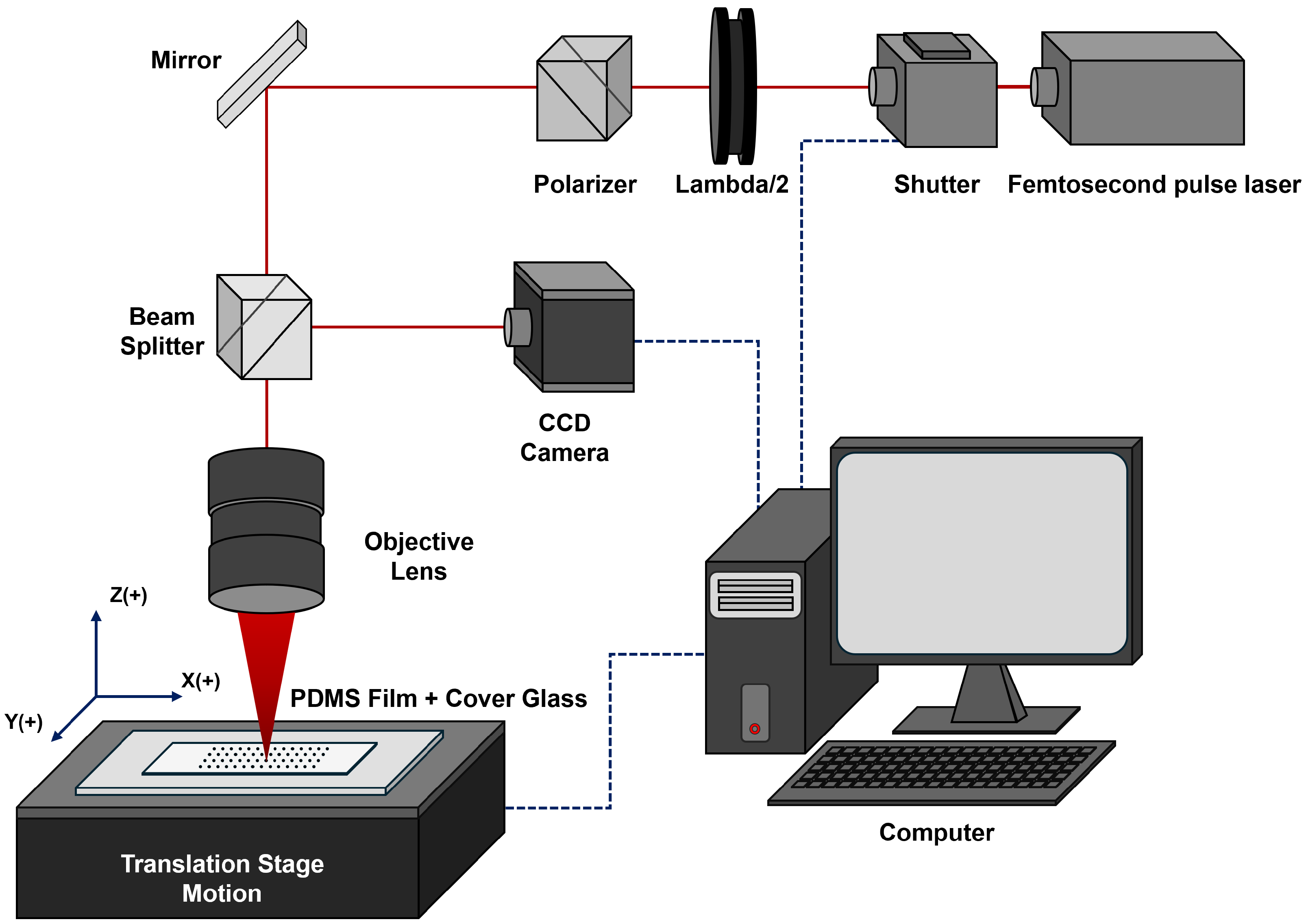
The FLM technique was used to create microholes in PDMS membranes. The experimental setup is shown in Figure 1. It consists of a chirped pulse amplification (CPA) Ti:Sa femtosecond laser system (Spectra-Physics, Milpitas, CA, USA) with a pulse duration of 60 f s , a wavelength of 800 n m , a pulse repetition rate of 5 k Hz , and a maximum pulse energy of 1.6   m J . The number of pulses or exposure time delivered to the PDMS membrane was controlled by an electromechanical shutter (Uniblitz VCM-D1 Shutter Driver, Vincent Associates, Rochester, NY, USA). Pulse energy was adjusted using an attenuator composed of a half wave plate and a linear polarizer (Thorlabs, Newton, NJ, USA). The samples were positioned on a cover glass and mounted on a motorized translation stage with three axes movement capabilities (Physik Instrumente, Eschbach, Germany). The laser beam was focused onto the PDMS surface using a microscope objective (HCX PL Fluotar 10×) with a numerical aperture of 0.30. The spot diameter at the focal plane was estimated to be 7 μm. A charge-coupled device (CCD) camera, connected to a computer via a beam splitter, was used to monitor the PDMS surface and assist with laser beam focusing.
The detailed processing parameters used for microdrilling the PDMS membranes are listed in Table 2. Two series of experiments were conducted on membranes of varying thicknesses to investigate the relationship between the processing parameters and the resulting hole geometry: (1) The exposure time was held constant while the pulse energy was varied; and (2) the pulse energy was held constant while the exposure time was adjusted.
All experiments were performed following the same procedure, which was automated using a single program (script) written in MATLAB© code (version R2025a, MathWorks Inc., Natick, MA, USA). An array of nine holes was created, with 40 μm spacing between holes in both directions. For each membrane thickness, the spot position was adjusted so that the focal point coincided with the top surface of the film. This setting was then kept constant throughout the laser drilling process. Porous PDMS membranes were then fabricated by adjusting the laser operational parameters to the most suitable values based on the experimental data gathered in the previous steps. These membranes feature holes with a diameter of 10 μm arranged in a staggered pattern. The vertical spacing, defined as the center-to-center distance between the axes of two consecutive rows of holes, was 33 μm, while the horizontal spacing between neighboring holes in the same row was 40 μm. The total microperforated area measured 1 m m × 1.5   m m .

2.4. Direct Optical Microscopy

PDMS membranes were placed on clean glass slides for microscopic observation. A motorized fluorescence microscope, ZEISS AXIO Imager Z1m (ZEISS, Oberkochen, Germany) equipped with objective lenses of 5×, 10×, 20×, and 50× magnification was used. Images of both sides of the membranes were acquired to evaluate the quality of the fabricated samples and to measure the entry and exit hole diameters using ImageJ software (version 1.8.0, National Institutes of Health, Maryland, USA).

2.5. Scanning Electron Microscopy Imaging

The quality and dimensions of the microdrilled membranes were assessed using a scanning electron microscope (SEM) Hitachi S4800 (University of Valencia, Spain). Samples were prepared by first being slowly cooled to −20 °C then immersed in liquid nitrogen for 10 min. After freezing, the samples were cut and coated with Au/Pd. SEM images were acquired under an accelerating voltage of 10 k V . Entry and exit microhole diameters were measured from SEM images of both sides of the membranes using ImageJ software.

2.6. Determination of the Taper Angle of Holes

The taper or conicity angle of the laser-drilled holes was calculated by applying the following equation:
θ = arctan D d 2 t m
where θ is the taper angle, D is the entrance diameter, d is the exit diameter, and t m is the membrane thickness.

2.7. Mathematical Modeling of the PDMS Ablation Process

To simulate the interaction between ultrashort pulse lasers and PDMS, a 2D axisymmetric model was developed. The temporal evolution of the electron density in the sample was modeled using the expression proposed by M.D. Feit et al. [13] to describe ablation in dielectric materials. This expression was adapted to include spatial dependence. To simplify the model, the electron spatial diffusion term was neglected:
n t = α ( I , n ) + P ( I ) β n 2
where n represents the free electron density as a function of time t and spatial coordinates r and z, the first term on the right-hand side, α ( I , n ) , represents the avalanche ionization process that occurs when conduction band electrons absorb energy from the laser, triggering an ionization cascade. The second term, P ( I ) , corresponds to the multiphoton and tunnelling ionization processes. The third term, β n 2 , accounts for the recombination of free electrons with available ions, with β being the recombination coefficient. To describe the avalanche ionization α ( I , n ) , the expression proposed by M.D. Feit et al. [13] was employed:
α ( I , n ) = 2 ω c Im ε ( n ) e e + Δ I
where ω is the laser frequency, c is the speed of light in vacuum, e e is the average energy of the free electrons, Δ is the energy required to overcome the band gap, and I denotes the laser intensity. The function ε ( n ) represents the dielectric permittivity of the material, modeled according to Drude´s theory:
ε ( n ) = ε r 1 n n c 1 1 + i υ ω
where υ is the collision frequency, ε r is the relative permittivity of the material, and n c is the critical electron density calculated as
n c = m e ε 0 ε r ω 2 e 2
where m e is the electron mass, and e is the electric charge.
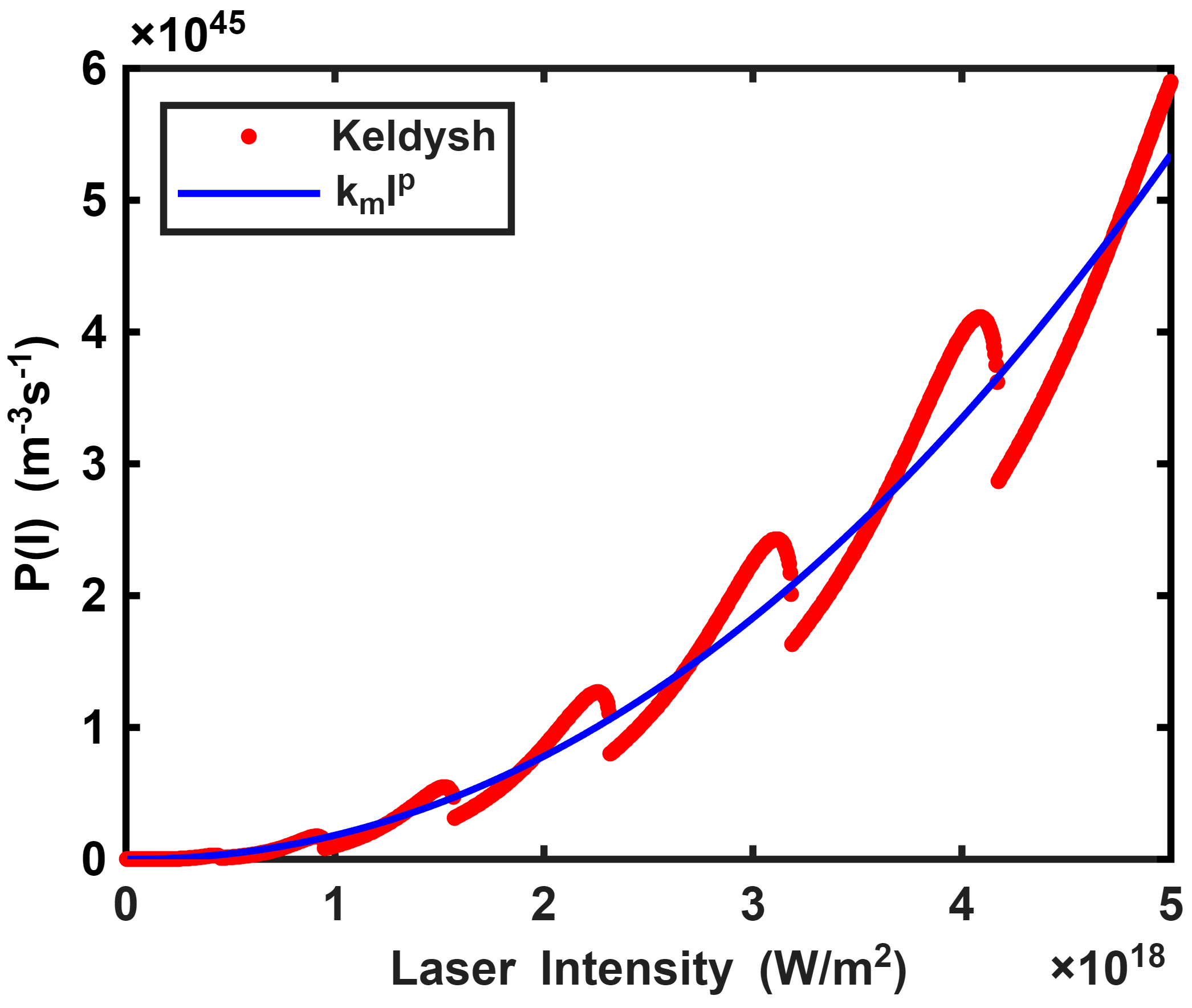
P ( I ) describes the ionization process due to the laser interaction, in which electrons reach the conduction band through the absorption of multiple photons and through tunnelling ionization. This term was modelled using a simplified form, adjusted to a power function of the general equation defined by Keldysh [23]. The resulting expression is as follows:
P ( I ) k m I p
where k m is a constant that depends on the material and the laser (3.36 × 10⁶ m−3 s−1 in this case, obtained from the curve fitting), and p is an exponent whose value depends on the laser intensity. For low intensities—below 1 TW cm−2, according to M. D. Feit et al. [13]—p equals the number of photons an electron must absorb to reach the conduction band, as multiphoton ionization dominates. At higher intensities, this approximation fails because tunnelling ionization becomes significant, and p takes values below the photon number required for purely multiphoton ionization. In the present simulations, since the laser intensity lies well above the low-intensity threshold and tunnelling ionization cannot be neglected, p was set to 2.1 (see Appendix B.1 for details of the fitting procedure).
The intensity of the laser pulse was simulated using the following model:
I ( r , z , t ) = Q ( r , z ) · T ( t )
where Q ( r , z ) represents the spatial distribution of the laser energy and T ( t ) describes the temporal evolution of the pulse. It was assumed that the energy supplied by the laser follows a Gaussian distribution with an exponential attenuation as a function of depth. In this context, the spatial distribution of the laser was defined by the following expressions:
Q ( r , z ) = 1 R s F 0 w 0 w z 2 exp 2 r 2 w z 2 exp a z
R s ( r , t , z = 0 ) = ε ( n ) 1 ε ( n ) + 1 2
F 0 = 2 E p π w 0 2
w z ( z ) = w 0 1 + λ z π w 0 2 2
where R s is the reflectivity at the incident surface, and F 0 represents the laser fluence, which depends on the pulse energy E p and the beam radius at the focal plane, w 0 . The parameter w z describes the variation in the beam radius as a function of depth z, which is defined as negative in the downward direction, taking into account the laser wavelength λ . The absorption coefficient, a, is derived from the ratio between the expression proposed by B.C. Stuart et al. [14] and that of M.D. Feit et al. [13]:
a ( n ) = 2 ω c Im ε ( n )
The temporal term T ( t ) , which describes the generation of a Gaussian pulse, is defined by the following function:
T ( t ) = 1 τ 4 log 2 π exp 4 log 2 t t 0 τ 2
where τ denotes the pulse width and t 0 is a temporal offset set equal to τ in the simulation. Material removal was defined under the condition that the generated plasma reaches the critical density, thus assuming it has absorbed enough energy to be expelled from the system.
For the simulation, a rectangular geometry was defined with its left edge aligned with the axis of revolution of the beam. The dimensions are a width of 50 μm, greater than the typical distance between the holes used in the fabrication of the membrane, and a depth of 25 μm, comparable to the thickness of the PDMS membranes used. To ensure adequate resolution in the calculations, the geometry was discretized using a structured quadrilateral mesh with a maximum element size of 0.25 μm. The simulation was carried out using COMSOL Multiphysics (version 6.2, COMSOL Inc., Burlington, MA, USA).

2.8. Cleaning and Assembling of OoC with Microdrilled PDMS Membranes

To clean the PDMS membranes, an ultrasonic cleaner was used at a frequency of 40 k Hz for 15 min using a solution (in a 1:1 volume ratio) of ethanol and acetone. Then, membranes were washed five times with 1x phosphate-buffered saline (PBS), soaked in 70% ethanol for 10 min , and left to dry in petri dishes overnight at RT. Membranes were observed under a scope to detect potential damage and check the status of both surfaces. After cleaning, samples were handled exclusively with forceps or gloved hands, taking care to touch only the edges of the membranes (undrilled areas).
PDMS drilled membranes and OoC were dried with an air gun before bonding to remove any debris on the surface. The surfaces to be exposed to plasma were free of any material or cover before moving into the glass chamber of the plasma machine. The bonding step was performed by using a plasma machine Diener Nano (Diener Electronic GmbH & Co. KG, Ebhausen, Germany) using as plasma settings a duration of 60 s with 20 W power and O 2 pressure lower than 0.8   m bar . An OoC device with double cell chamber and two fluid channels was selected for the experimental validation [24]. This OoC has an upper and lower cell chamber. The microdrilled membrane is located at the interface of both chambers. After plasma treatment, the membrane were gently laid on the plasma-treated side of the frame, as centered as possible. Every PDMS part was carefully aligned with the others to ensure uniform contact, and steps were taken to prevent air entrapment between the layers.

2.9. Cell Culture

Human adipose-derived mesenchymal stem cells (hASCs) from healthy donors aged 18–35 were graciously provided by Dr. Escobedo-Lucea at Fundación de Investigación del Hospital General de Valencia, Spain. hASCs were seeded in culture flasks containing growth medium—Dulbecco’s Modified Eagle’s Medium (DMEM, Invitrogen, Waltham, MA, USA)—supplemented with mesenchymal stem cell-qualified bovine serum (Gibco, Grand Island, NY, USA) and maintained in a humidified atmosphere of 95% air and 5% CO2 at 37 °C. The medium was replaced every three days [25]. Upon reaching confluency, cells were enzymatically detached using TrypLE© (Invitrogen) and transferred into the microfluidic devices containing fresh growth medium. Three OoC devices per membrane thickness (n = 3) were seeded at density 8000 cells. OoC were kept in the incubator for more than 24 h without flow stimulation to guarantee cell adhesion and monolayer formation over the PDMS membranes. Unprocessed membranes and glass cover slips were employed as controls.

2.10. Cell Staining

For cell staining, the samples were fixed with 4% paraformaldehyde solution (PFA, Sigma–Aldrich, Madrid, Spain) in PBS, followed by three washing steps of at least 5 min. Actin filaments were stained by incubation with Phalloidin Alexa 488 (dilution 1:100; Thermo Scientific, Waltham, MA, USA) at RT for 15 min and washed three times with PBS. The nuclei were counterstained with DAPI (Sigma–Aldrich, Madrid, Spain).

2.11. Inverted Optical and Confocal Microscopy

Inverted optical microscopy Leica DMi8 (University of Valencia, Spain) was employed to monitor multiple steps of the experimental work, such as the ablation procedure, cell seeding, monitoring of cell monolayer, surface morphology characterization, and finding potential defects.
Confocal microscopy was used to provide detailed pictures and cross sections (image stacks) of the hASCSs monolayer over the samples. Fluorescent images were captured using a ZEISS LSM 980 confocal microscope (University of Valencia, Spain). The samples were kept in darkness during the whole procedure. The situation of the microdrilled membranes during confocal imaging of OoC samples was determined by adding a transmitted PMT (T-PMT) to visualize the location of the holes.

2.12. Statistical Analysis

Statistical analysis was performed using MATLAB© version R2025a. For each set of experimental conditions, the mean, standard deviation (SD), and standard error were calculated from individual measurements obtained under identical conditions. For graphical representation and empirical modeling, linear regression analysis was applied to evaluate the relationships between variables. The models were expressed using fitted equations and coefficients of determination ( R 2 ) to describe trends and assess the goodness of fit.

3. Results and Discussion

3.1. Exploration of the Capabilities of FLM for Drilling PDMS Membranes

To investigate the influence of pulse energy and drilling time on microhole geometry, a series of experiments was conducted on PDMS membranes of varying thicknesses. The results are presented in two complementary phases: The first examines the effect of pulse energy under fixed exposure durations, while the second evaluates the influence of exposure time at constant energy levels.
To elucidate the influence of the laser operational parameters on the ablation dynamics and geometric precision of microholes produced in PDMS membranes, a systematic set of experiments was performed on films of three distinct thicknesses. In the first experimental set, the pulse energy ranged from 4 to 20 μJ under three exposure-time conditions: 600, 1000, and 1400 m s . In the second set, the pulse energy was fixed at 4, 10, and 16 μJ, while the exposure time was adjusted between 800 and 1800 m s . For each condition, a nine-hole array was manufactured. The entrance and exit diameters of the perforations were subsequently measured to assess the ablation efficiency and the geometrical quality of the resulting micro-patterns.

3.1.1. Effect of Drilling Time and Pulse Energy on Microholes Dimensions Using FLM

Pulse energy and drilling time seem to be the most influential parameters when determining microholes geometry [11]. A series of experiments was conducted on PDMS membranes of varying thickness to clarify material response under different processing conditions. The effect of pulse energy was first examined under fixed exposure durations, followed by a second experimental phase that evaluated the response under varying exposure times at constant energy levels.
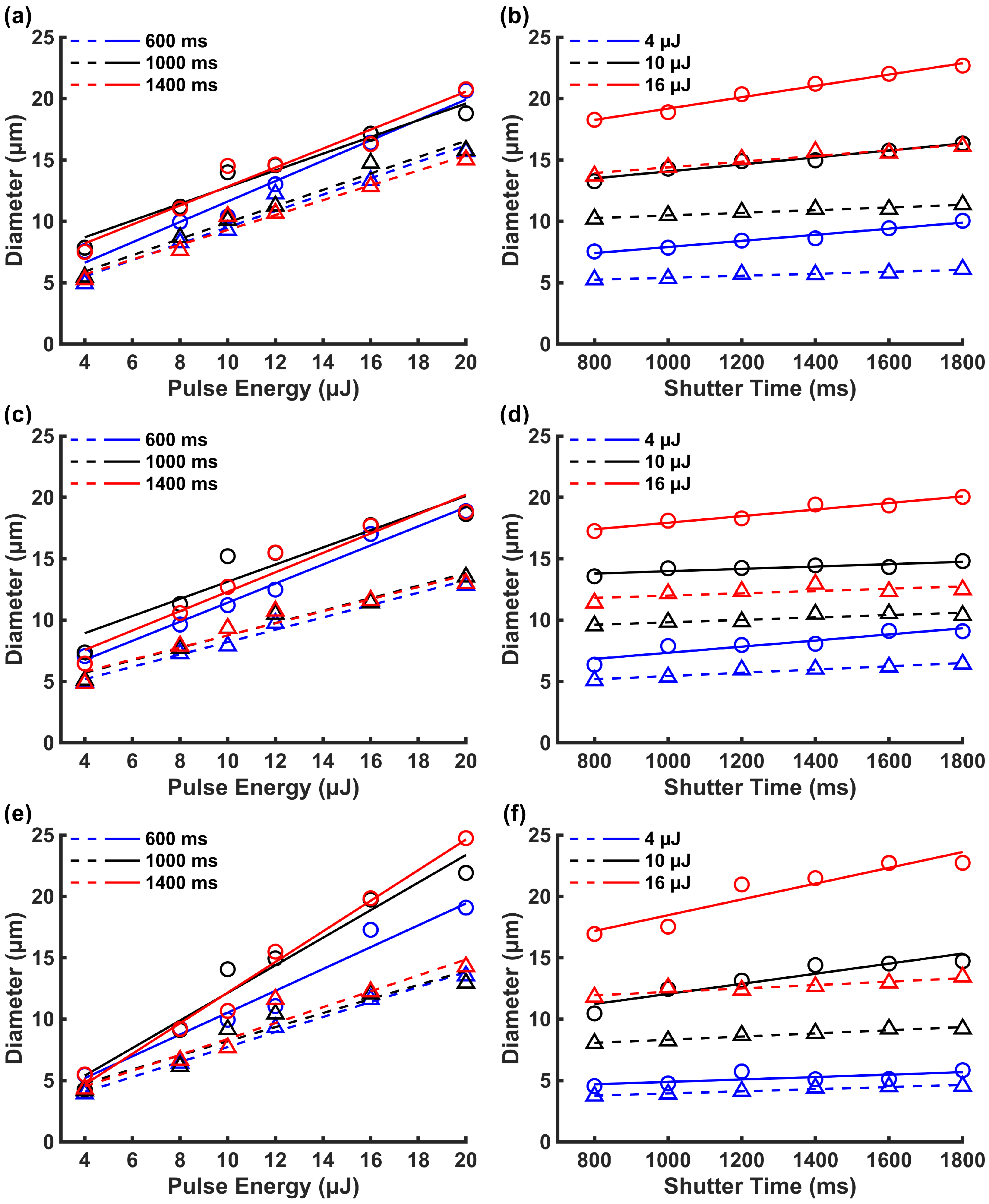
A linear relationship between the number of pulses and ablation depth has already been reported [19]. Figure 2a,c,e illustrates the evolution of entrance and exit hole diameters in three PDMS membrane thicknesses as a function of pulse energy under constant pulse duration. The results revealed a strong positive linear relationship between pulse energy and both entrance and exit diameters, with the lowest R 2 value being 0.8864 and all other regression values exceeding 0.9334. The rate of increase differs significantly: Entrance diameters expand more rapidly with increasing pulse energy, whereas exit diameters display a more gradual change. This divergence became more pronounced as membrane thickness increased, suggesting a more severe attenuation of the laser beam, enhanced plasma shielding effects, and a potential geometrical influence, whereby the laser pulse may be diffracted by the hole boundaries, thereby reducing the energy reaching the bottom of the membrane. In the 25 μm thick membranes, slope values reached up to 0.8305 for entry holes, while for exit holes, the lowest slope was 0.6046. The 50 μm thick membranes reached slope values of 0.7805 for entry holes, while the exit slope remained nearly constant at 0.50. In the case of the 100 μm membrane, the entrance diameter slope reached up to 1.2471, while the exit slope remained stable around 0.6.
For thin membranes, as shown in Figure 2a, the exit diameter remained relatively stable across all exposure times and varied primarily with pulse energy. This may be attributed to the ablation threshold of PDMS and the divergence of the laser beam during propagation in the membrane. Both parameters can limit the pulse energy reaching the exit surface of the membrane. Regions where the absorbed energy exceeded a critical threshold exhibited increased exit diameters. Under constant pulse energy, longer exposure times did not significantly affect the exit size due to the capacity of the material to dissipate energy. In contrast, entrance diameters displayed a modest but noticeable dependence on drilling time. As shown in Figure 2a, at a exposure time of 600 m s , entrance diameters were at least 12% smaller compared to those produced with longer exposures, particularly at pulse energies below 12 μJ. The largest difference was observed at 12 μJ, with a 40% increase in entrance diameter between 600 and 1400 m s . This trend is attributed to the incubation effect, which refers to the permanent modification of the material in regions where ablation was not initially achieved but where chemical damage occurred. As a result, material properties, such as absorption, were enhanced, and ionization during subsequent pulses became more readily attainable, thereby facilitating ablation. When individual pulses fell below the threshold fluence, the excitation induced by successive pulses gradually led to the incubation effect, ultimately resulting in a reduction of the ablation threshold. At very low energies, such as 4 μJ, this effect was barely noticeable, as the energy was insufficient to induce cumulative damage on the material. At pulse energies higher than 12 μJ energies, the entrance diameter did not change across different exposure times. This indicates that at an exposure time of 600 m s , direct ablation had already been completed, and the incubation effect had occurred in all regions where it was feasible. Consequently, further increases in exposure time did not result in significant changes to the final geometry. According to Figure 2c, a similar trend was found in membranes of 50 μm thickness, with entrance diameters exhibiting a strong time-dependent increase at lower energies but diminishing at high energy levels. Exit diameters remained relatively constant, reinforcing the conclusion previously drawn for thin membranes: The entrance diameter is more sensitive to variation in exposure time than the exit diameter, as the laser is focused on this plane, delivering more energy at this point, and phenomena such as incubation occur more effectively in this region.
We wondered whether the divergence between entrance and exit diameters would become more pronounced in 100 μm membranes. Entrance diameters increased sharply with pulse energy and showed strong dependence on the number of pulses. Surprisingly, exit diameters exhibited behavior similar to that observed in 25 μm membrane: They depended primary on pulse energy and remained relatively insensitive to exposure time. Entrance diameters reached up to 25 μm under the highest energy pulse and exposure conditions, whereas those in 25 and 50 μm membranes did not exceed 20 μm. This trend may reflect the combined effects of plasma shielding, which blocks or absorbs subsequent pulses, and increased energy attenuation within the bulk material [26]. Both effects can reduce the energy transmitted to the back surface of the membrane, and consequently, laser energy will become increasingly confined at the entry region, intensifying surface-level ablation and limiting laser penetration depth.
Studies on the effect of the number of pulses on the response of the material have primarily focused on identifying a relationship between the size of the permanently damaged area and the number of pulses, as well as on investigating the incubation effect [18]. Other studies have examined this effect indirectly by controlling the laser scanning speed or the number of passes, both of which are directly related to the amount of energy absorbed by different regions of the material along the laser path [11,20]. In the second experimental phase, the effect of the number of incident pulses on the resulting geometry was directly investigated. Figure 2b,d,f presents the results obtained from this experiment, showing that, with exposure times varying at fixed pulse energy levels, entrance diameters exhibited a slight linear increase again, with the steepest slope being 0.0064 μm/ms for thin membranes, while exit diameters remained largely unchanged. The almost negligible slope of the exit diameters in Figure 2b,d,f indicates a clear independence from processing time. The increase in entrance diameter with longer exposure times may be attributed to the accumulation of damage and energy in peripheral regions, where the extended exposure duration enabled these initially sub-threshold areas to eventually reach the ablation threshold and undergo material removal. This entrance diameter increment due to incubation phenomena was especially prominent in thick membranes, where energy delivery was reduced due to beam divergence and plasma shielding. Finally, it was shown that exposure time played a less significant role than pulse energy in determining the geometric dimensions of the hole, producing negligible changes in exit diameter for exposure time increases from 800 to 1800 m s , while the most pronounced increases in entrance diameter occurred at energy levels up to 16 μJ, likely due to the incubation effect in peripheral regions.
Thickness is considered by many researchers as a critical factor in micromachining materials [17]. Our results in Figure 2 indicate that membrane thickness was a key factor when setting up the processing parameters to achieve a particular hole geometry. At pulse energies above 12 μJ and for high number of pulses—particularly at exposure times of 1000 m s or longer—entrance diameters for membranes of 100 μm thickness were larger than those observed in thinner membranes, indicating a greater capacity for energy absorption. In contrast, exit diameters varied little with thickness, exhibiting similar growth trends across all samples. Another parameter, exposure time, has also emerged as crucial to the precise control of hole geometry. Short exposure durations (<1000 m s ) tended to yield smaller holes at fixed pulse energy, while those longer than 1000 m s produced nearly identical diameters. A saturation effect in PDMS ablation appears consistent with prior findings in other materials [27]. Given its dominant influence on hole diameter across both experimental phases, pulse energy must be carefully optimized with respect to membrane thickness, exposure time, and the intended geometric outcome.

3.1.2. Influence of the Main Process Parameters on Microhole Quality

The production of high-quality laser-drilled microholes is essential for ensuring the structural and functional performance of PDMS membranes in OoC devices. Imperfections introduced during laser processing—such as thermal damage or non-uniform geometry—can significantly affect membrane behavior, particularly fluid transport. A critical aspect in this context is the geometry of the holes, since theoretical and computational models often assume perfectly cylindrical channels to predict flow behavior accurately. We assessed microhole quality by two variables: (i) the heat-affected zone (HAZ) and (ii) the taper angle.
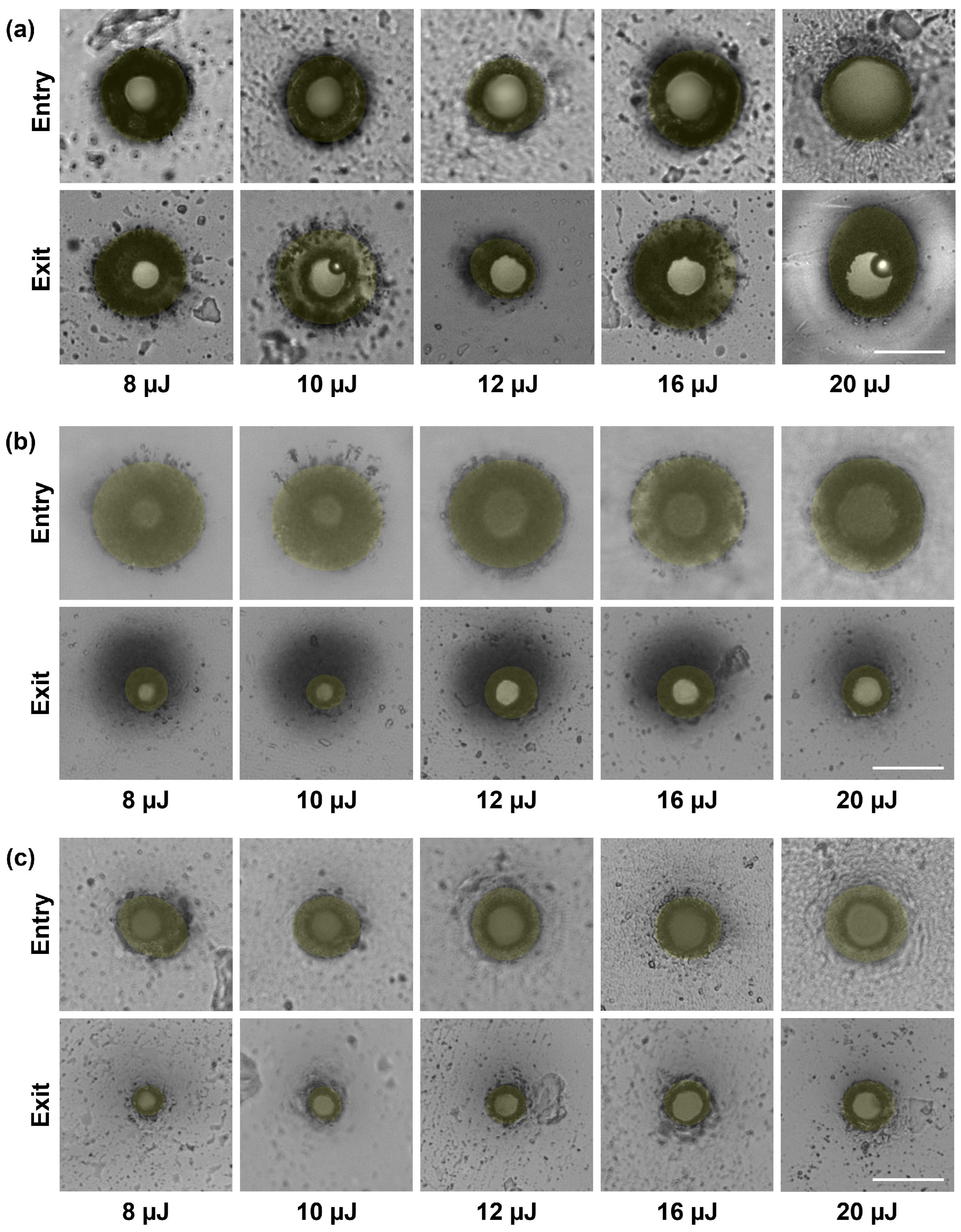
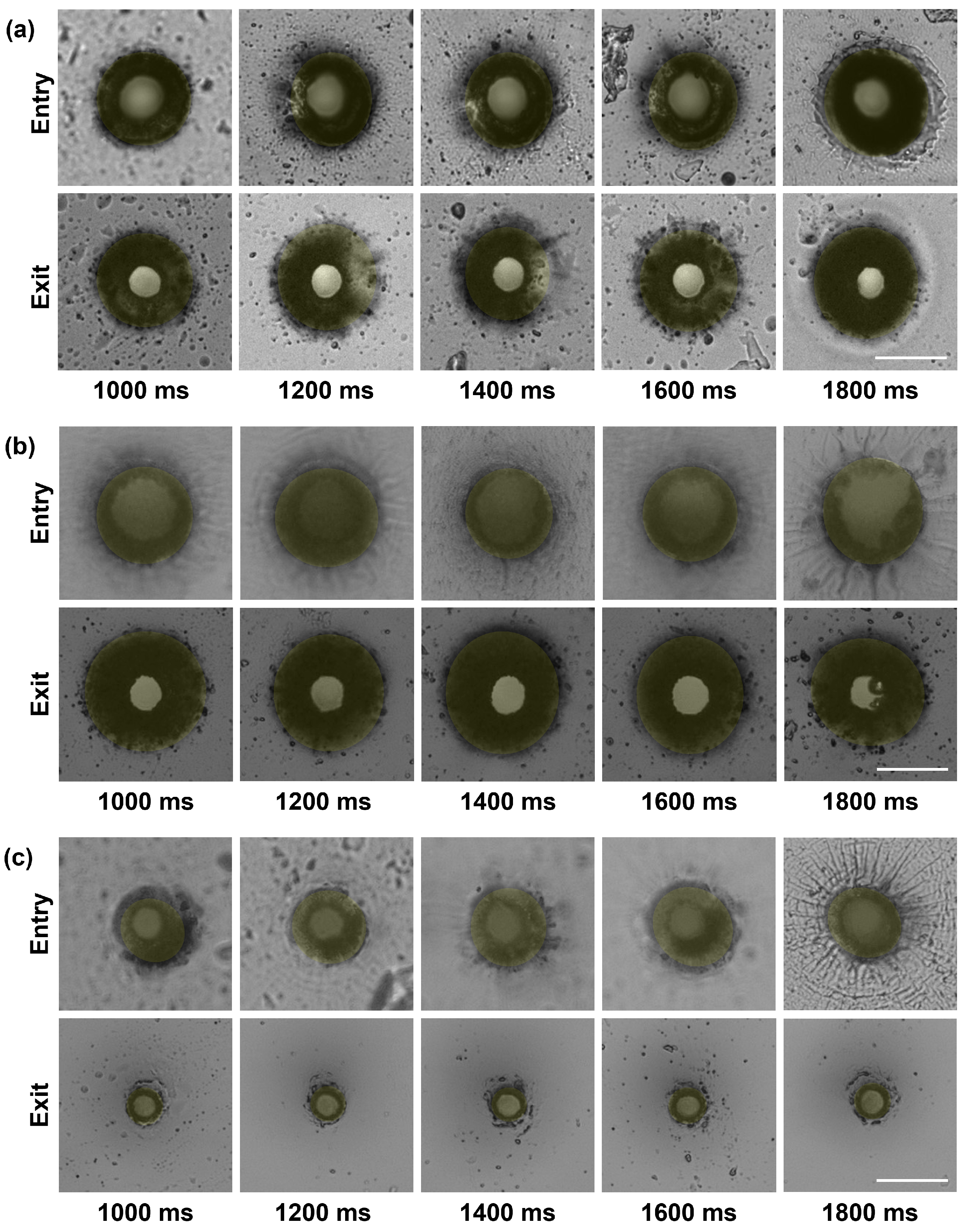
Figure 3 and Figure 4 show optical microscopy images of microholes obtained under varying pulse energy and exposure time, respectively. These results reveal clear trends in the extent and distribution of the HAZ as a function of membrane thickness.
As shown in Figure 3, at a constant exposure time of 1000  m s , increasing the pulse energy from 8 to 20 μJ resulted in negligible variations in the heat-affected zone (HAZ) across all three membrane thicknesses. However, differences in HAZ morphology were observed among the different thicknesses. In 25 μm membranes, the HAZ appeared as a darkened region surrounding both the entry and exit holes, extending to approximately twice the hole diameter. In 50 μm membranes, the HAZ retained similar dimensions at the entry site but was significantly reduced at the exit, showing less pronounced darkening. In 100 μm membranes, the HAZ was notably reduced, with a dimension reduction of 50% extension at the entry hole and negligible thermal effects at the exit. These observations suggest a direct relationship between membrane thickness and thermal damage. Thinner membranes are more susceptible to heat accumulation, resulting in more extensive HAZ formation, whereas thicker membranes dissipate heat more effectively, limiting thermal effects. Additionally, laser fluence decreases as the beam propagates through the material due to absorption, scattering, and divergence, reducing the energy available to affect deeper layers.
Figure 3 also confirms conclusions drawn in the previous section and, as demonstrated in Figure 2a,c,d shows that increasing the pulse energy consistently enlarged hole diameters across all membrane thicknesses. However, the size of the HAZ remained nearly constant for each thickness. This may be attributed to the fixed laser beam diameter of 7 μm, which constrained the irradiated area. Although the pulse energy increased significantly from the initial value, the beam footprint remained unchanged, resulting in higher fluence and more efficient ablation without significantly increasing lateral thermal diffusion. Consequently, the HAZ did not expand proportionally with the hole size.
A similar pattern was observed in Figure 4, where the pulse energy was held constant at 10 μJ while the exposure time was varied from 800 to 1800   m s . The extent and distribution of the HAZ varied markedly with membrane thickness. In 25 μm membranes, the HAZ remained pronounced and homogeneously distributed around hole openings. This is consistent with the limited heat diffusion capacity, which resulted in thermal accumulation even under moderate exposure times. As thickness increased to 50 μm, the HAZ became asymmetric—expanding significantly around the exit hole (up to three times its diameter) while diminishing near the entry. This effect could be attributed to laser beam attenuation and divergence, which may enlarge the interaction volume at the distal surface and promote sub-threshold heating in surrounding regions without triggering ablation. For 100 μm membranes, HAZ formation was minimal at both entry and exit sites. The greater material volume enhanced thermal dissipation near the entry, and beam attenuation—particularly as thickness approached or exceeded the Rayleigh length—limited energy delivery to the exit surface, reducing thermal effects.
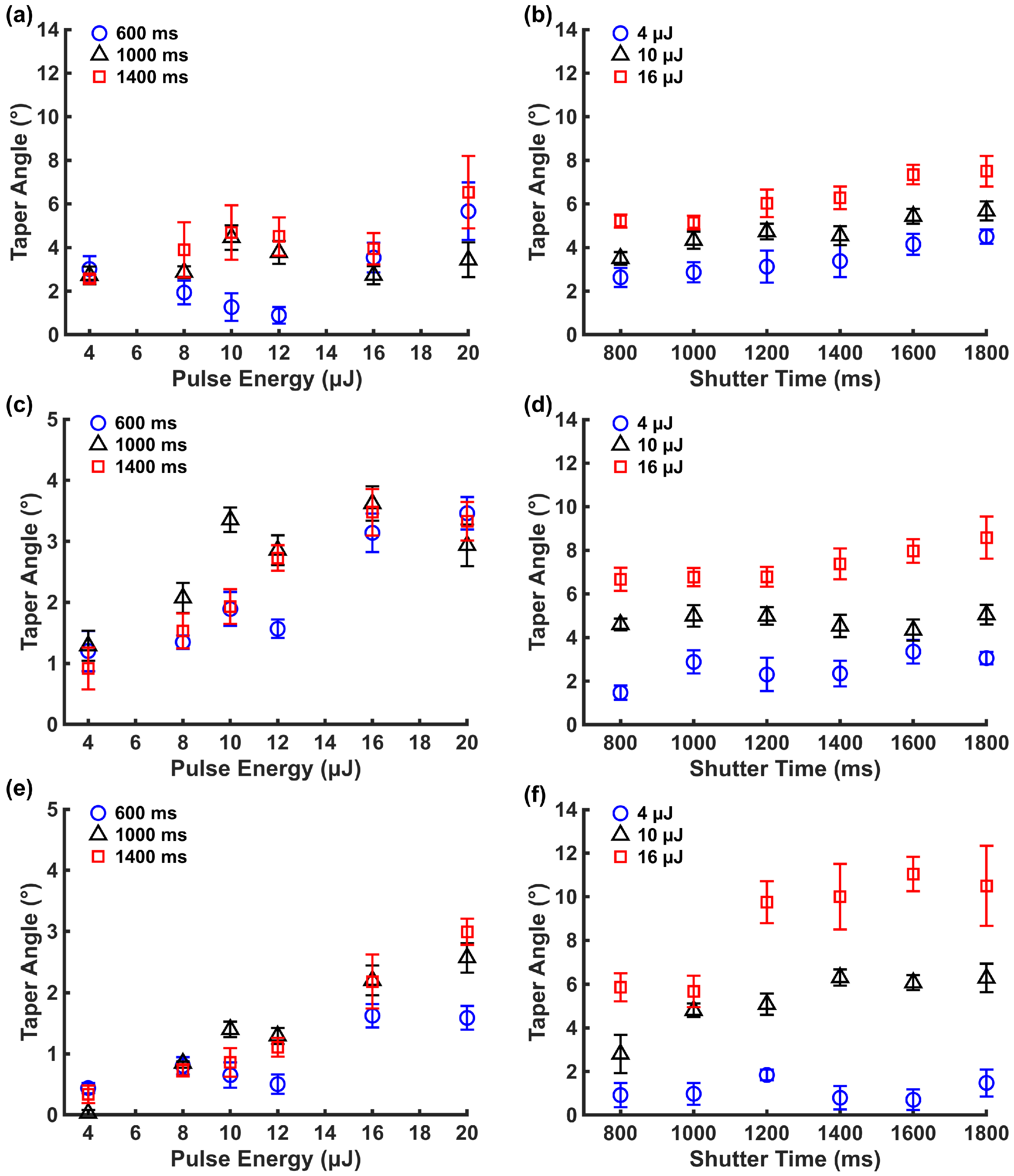
The taper angle of the microholes is a key indicator of geometric quality—particularly in applications requiring the precise control of fluid flow, and serves as an important metric alongside thermal effects. Minimizing the taper angle is essential for maintaining consistent cross-sectional geometry. Conicity in microholes fabricated by FLM arises from fundamental optical and thermal mechanisms. As the laser propagates into the material, the beam diverges beyond its focal point, leading to broader interaction zones at greater depths. Simultaneously, the effective laser fluence decreases with depth due to scattering, absorption, diffraction on the hole walls, and plasma shielding, which restricts ablation primarily to the laser-receiving region. These combined effects result in conical holes with narrower exits. Figure 5 shows that the taper angle increases directly with pulse energy under different laser conditions. In contrast, increasing the exposure time only produced a moderate increase, suggesting a potential saturation effect where longer exposures add little to entrance widening beyond a certain threshold. These geometric changes aligned with the diameter trends shown in Figure 2, where the entrance diameter grew more rapidly than the exit as energy or exposure time increased. This effect was more noticeable in thick membranes, where attenuation prevented the exit from expanding proportionally. Thus, the taper angle served as a reliable indicator of energy distribution and ablation dynamics along the depth of the hole.
We conclude that the HAZ and taper angle are strongly influenced by membrane thickness and laser operating parameters. While pulse energy was the dominant factor in determining hole morphology and thermal effects, exposure time and membrane thickness modulated these responses by affecting heat accumulation and energy propagation. A fine-tuning of these parameters is, therefore, essential to achieving high-quality microholes tailored to specific application requirements.

3.2. Numerical Simulation of Femtosecond Laser Pulse and PDMS Interaction

3.2.1. Temporal Evolution of the Electron Density for a Single Laser Pulse

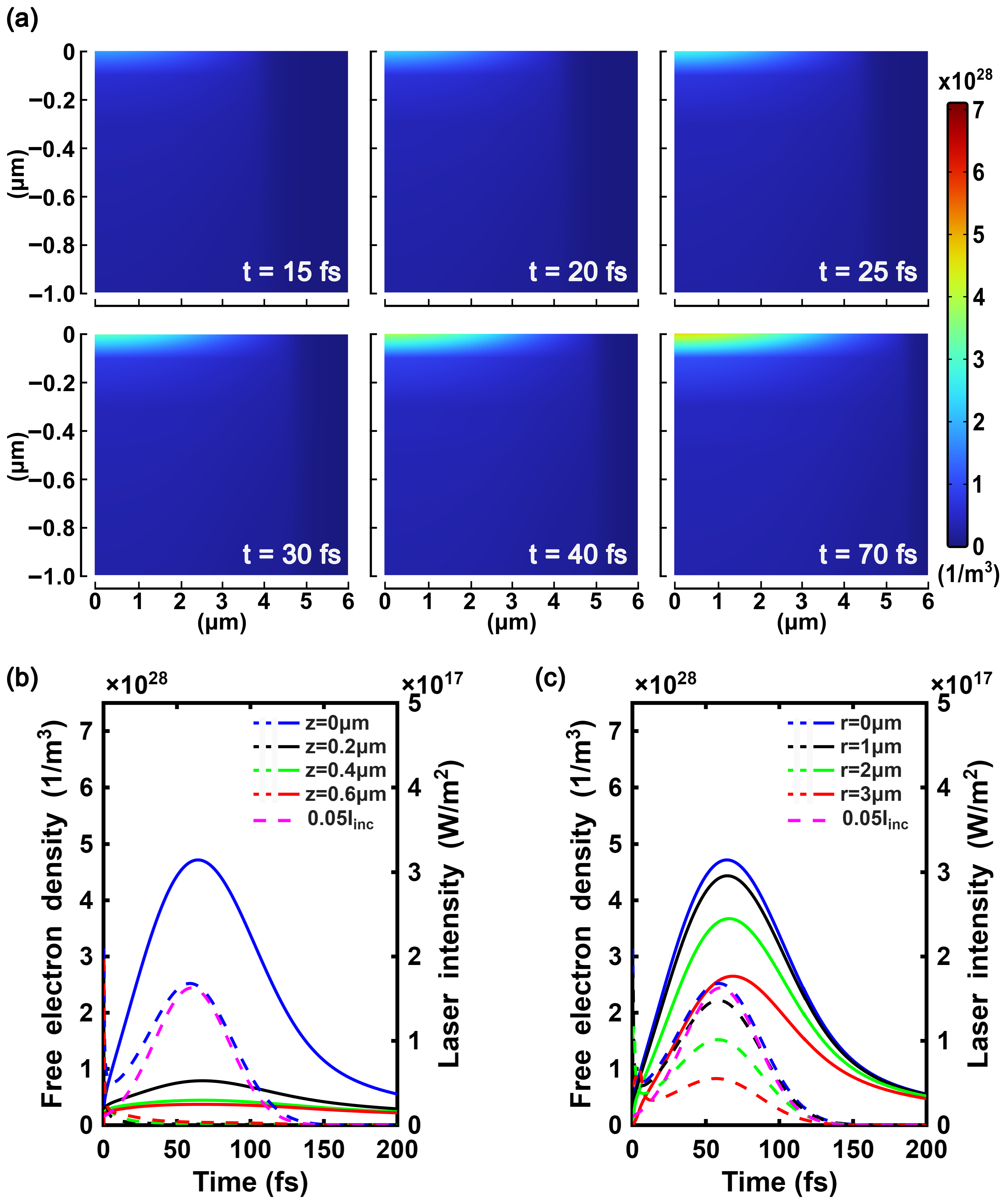
The ultrashort timescales, confined spatial domains, and intense energy levels characteristic of FLM give rise to a range of complex optical, thermodynamic, chemical, and mechanical phenomena [28]. To gain deeper insight into the response of PDMS under exposure to ultrashort laser pulses, the simulation was performed for a pulse energy of 4 μJ. This energy level proved sufficient to induce significant changes in the free electron density (n) throughout the simulation. Figure 6a illustrates the spatiotemporal evolution of the free electron density at selected time intervals during the simulation. Within the first 15 f s , even though during the start of the simulation the material behaved as a transparent medium, the increase in n became particularly noticeable at the surface. In this early stage, PDMS behaved as a transparent medium, since laser absorption depends on both the free electron density—which remained low at this point—and the laser intensity, which was still relatively weak. As the laser intensity rose, multiphoton and tunnelling ionization became increasingly significant, leading to a rapid increase in free electron generation and the onset of an avalanche ionization process. This resulted in a progressive accumulation of free electrons near the surface (t = 20 f s ), indicating increasingly localized energy deposition. Two key phenomena emerged from this behavior: (1) a sustained increase in absorption and free-electron generation in the superficial layers, driven by a positive feedback loop between these processes; and (2) a progressive reduction in free-electron density growth in the deeper regions, particularly beyond 10% of the laser wavelength. This attenuation was attributed to a screening effect that became more pronounced as the electron density approached the critical plasma density n c . At this point, the plasma on the surface absorbed and reflected most of the incoming radiation, significantly limiting the energy that penetrated deeper into the material. The reflection effect is clearly observed when comparing the curve of the laser intensity that the material absorbs at z = 0 with the curve corresponding to 5% of the actual laser intensity.
Figure 6b,c further quantify the temporal evolution of both the free electron density n and the laser intensity I at various spatial coordinates within the simulation domain, both in depth (z) and in radial distance from the beam axis (r). Figure 6b presents these variables at the surface and at three increasing depths, spaced 0.2  μm apart. During the first 5 f s , n and I exhibited similar behavior across all depths. However, after this point, the surface electron density reached n c , causing a steep decline in laser intensity at depths beyond a tenth of the wavelength. This effect was particularly evident at z = 0.2  μm, where a significant drop in intensity slowed the local increase in free electron density compared to the surface. These observations reinforced the earlier conclusion: Once the surface plasma reaches critical density, a strong screening mechanism arises, confining further increases in n to a sub-wavelength layer near the surface. In contrast, Figure 6c depicts the same variables as a function of radial position at the surface. Here, electron density growth became progressively more gradual with increasing radial distance, reflecting the Gaussian intensity profile of the laser beam. At the beam periphery, where intensity was lower, ionization was less efficient and n increased at a reduced rate. Since the analysis is restricted to the surface, the screening effect with depth was absent in this case, but the difference between the incident laser energy and the actual absorbed laser energy can be observed. Notably, the radial variations in n and I reveal a proportional relationship, whereby a decrease in local laser intensity is accompanied by a corresponding decrease in free electron density along the radial direction.
These results aligned well with previous findings by M.D. Feit et al. [13], who reported that once the critical density is reached, the plasma acts as an optical barrier, preventing further penetration of the laser energy. Furthermore, the simulation outcomes showed good consistency with experimental observations made by H. Huang and Z.X. Guo [18], who investigated the damage threshold of PDMS under femtosecond laser irradiation. They found that ablation from a single pulse was confined strictly to the material’s surface, a behavior fully consistent with the results of the simulation presented.

3.2.2. Effect of Pulse Energy on the Electron Density

A laser pulse with an energy of 4 μJ has been shown to be sufficient to induce a material response characterized by the generation of plasma and the attainment of critical free electron density. It follows that higher pulse energies are expected to produce similar or enhanced effects. To investigate how the material response evolves with increasing pulse energy, two additional simulations were performed with pulse energies of 8 and 12 μJ. This approach enabled an evaluation of whether the observed increase in electron density followed a linear trend or if nonlinear mechanisms, such as saturation effects or threshold-dependent behavior, began to dominate the interaction.
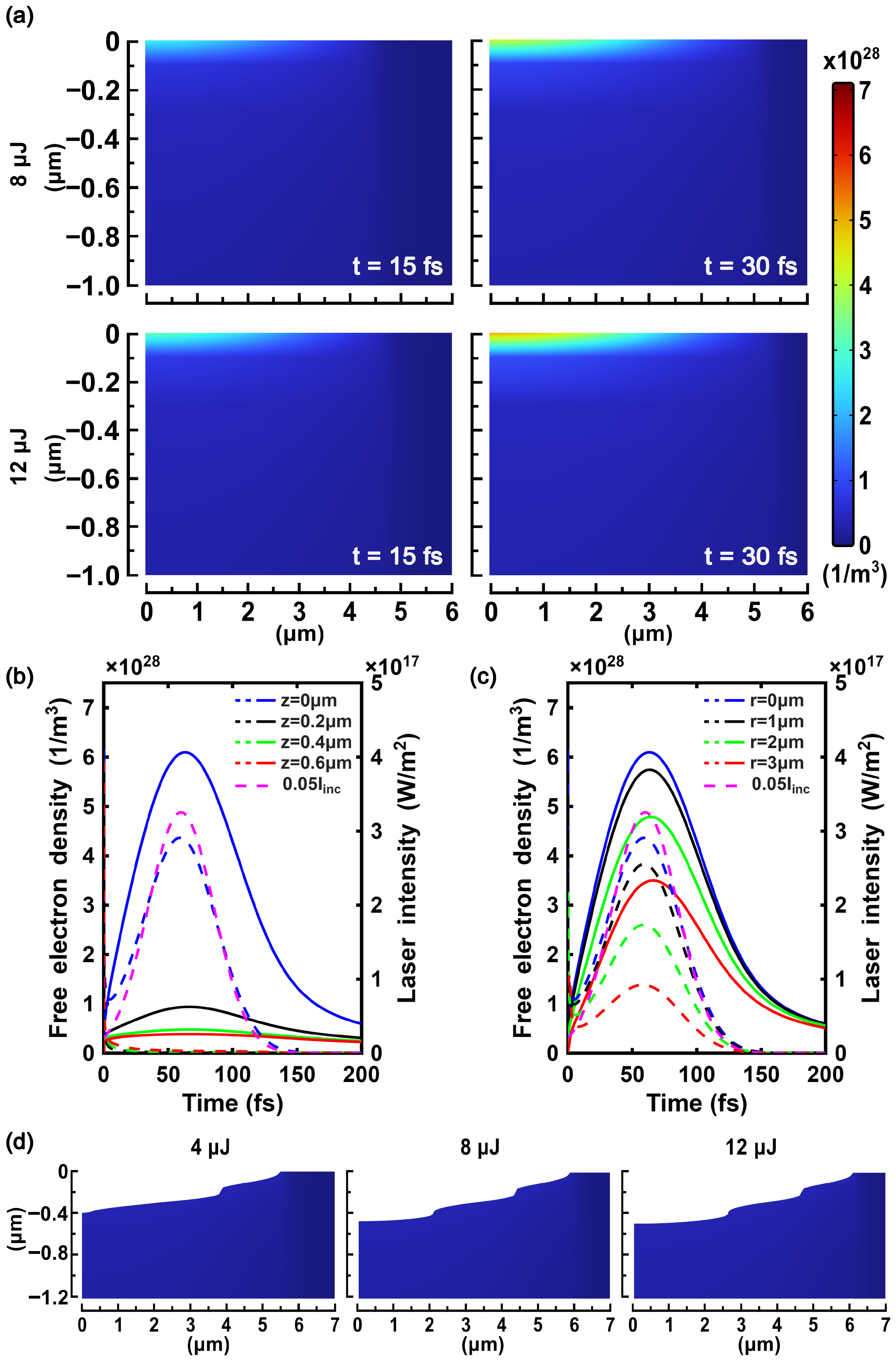
Figure 7a provides color maps showing the evolution of electron density at 15 f s and 30 f s for 8 and 12 μJ pulse energy, allowing direct comparison with Figure 6. Additionally, Figure 7b,c presents the same types of plots as those shown previously for the 4 μJ case, now with results corresponding to the 8 μJ. For 12 μJ, plots are provided in Figure A2 in Appendix B.2. The analysis of Figure 7b revealed that the increase in free electron density was not proportional to the increase in pulse energy. This was clearly evident in the evolution of n at the surface: While a peak density of 4.7 × 1028 m−3 is reached for 4 μJ, the values for 8 and 12 μJ rise to 6.1 × 1028 m−3 and 7.1 × 1028 m−3, respectively. Similarly, at z = −0.2 μm, little variation was observed among the three simulations, which was consistent with the fact that, once the critical density is reached, deeper growth is hindered by the screening effect. As a result, the internal regions of the simulated material experienced minimal changes in response to increasing pulse energy.
On the other hand, analysis of the system’s response to increased energy showed that higher-energy pulses triggered an earlier onset of ionization and the subsequent electron avalanche. This behavior was expected: During the initial phase of the pulse—when the laser intensity had not yet reached 15% of its peak value due to its Gaussian temporal profile—higher pulse energy accelerated the generation of free electrons. Figure 6c, Figure 7c and Figure A2b exhibited similar behavior, confirming that increasing the pulse energy led to higher electron densities. More importantly, a key aspect emerged: As the pulse energy increases, a larger surface area reaches the critical electron density. Consequently, the laser-affected zone expands, exceeding the ablation threshold in regions farther from the beam center. These observations were further corroborated by the density maps in Figure 7a. Compared with Figure 6a, it is evident that at t = 15 f s , the region of material notably affected lies within a 3 μm radius at 4 μ J , whereas at 8 and 12 μ J , plasma-induced screening had already become stronger, and the affected region extends beyond a 4 μ m radius. At t = 30 f s , the region of plasma generation clearly expanded radially with increasing pulse energy, in agreement with previous findings.
Although increasing the pulse energy did not produce a proportional rise in the maximum free electron density—according to the simulation results—it had a pronounced effect on the spatial extent of the modified region. This trend was consistent with experimental observations, where higher pulse energies led to a clear increase in the diameter of the ablation craters. These findings underscored the role of pulse energy as a key factor governing the lateral expansion of laser-induced damage in PDMS. This behavior was further supported by the work of H. Huang and Z.X. Guo [18], who, based on the empirical relation initially proposed by S. Baudach et al. [29] for polyamide and later extended to PDMS, reported that the diameter of the laser-affected zone scales with the incident pulse fluence.

3.2.3. Simulation of Material Removal by Laser Ablation

Predicting the amount of ablated material remains one of the major challenges in simulating ultrashort laser pulse interactions [30]. To estimate the quantity of material removed by the pulse, it was assumed that when the free electron density reaches the critical value ( n c ), irreversible changes at the atomic level occur, leading to material ablation. This evaluation was carried out at t = 130 f s , a time point at which the remaining laser energy is negligible compared to its peak value, and electron recombination becomes the dominant physical process.
Figure 7d presents the results of this evaluation for the three simulations. It was observed that the ablated surface area increased with pulse energy. However, this growth was not proportional: Between 4 μ J and 12 μ J , the pulse energy was tripled, yet the amount of material removed increased by less than 40%. For a 4 μ J pulse, the estimated crater depth was 0.40   μ m , with a radius of 5.49   μ m . In the case of 8 μ J , the depth reaches 0.46   μ m and the radius 5.86   μ m , while for 12 μ J , the values are 0.49   μ m and 6.07   μ m , respectively. This indicated that increasing the pulse energy did not produce a corresponding increase in the amount of material removed, neither in depth nor in diameter. While the variation in depth was on the order of 0.05   μ m , the affected diameter exhibited an increase approximately six times greater.
These findings suggest that, as the pulse energy increases, the lateral expansion of the crater tends to dominate over the material removal in depth. This observation aligns with the trends discussed in previous sections, where the screening effect appears to promote energy accumulation at the surface, thereby limiting laser penetration into deeper layers. Such behavior may account for the relatively low variability observed in crater depth. Conversely, the increase in crater diameter was consistent with the earlier analysis of the simulations, where it was shown that higher pulse energies lead to peripheral regions reaching the critical electron density, resulting in irreversible changes over larger areas. This finding implies that, in microhole FLM, the pulse energy becomes a key parameter for controlling the geometric dimensions of the resulting feature, as was shown in previous sections.

3.3. Scalability of the FLM for Large PDMS Membranes

Achieving industrial scalability in FLM requires overcoming the high cost and low throughput typically associated with processing at kilohertz repetition rates [31]. In this study, we investigated strategies to scale up the fabrication of microperforated PDMS membranes for OoC applications. For membranes intended for culturing human mesenchymal stem cells, we determined that a controlled-porosity design should incorporate a staggered matrix of holes with an exit diameter of 10 μ m . This value represents the minimum achievable size due to limitations imposed by the conicity of the laser-drilled holes. To minimize variability in the material response, a constant exposure time of 1000 m s was selected, resulting in a total fabrication time of approximately five hours per membrane. The pulse energy used for FLM across all membrane types was set to 12 μ J , corresponding to the average value derived from a previously developed linear regression model (Appendix A): 10.1   μ J , 12.5   μ J , and 13.1   μ J for the 25 μ m , 50 μ m , and 100 μ m membranes, respectively.
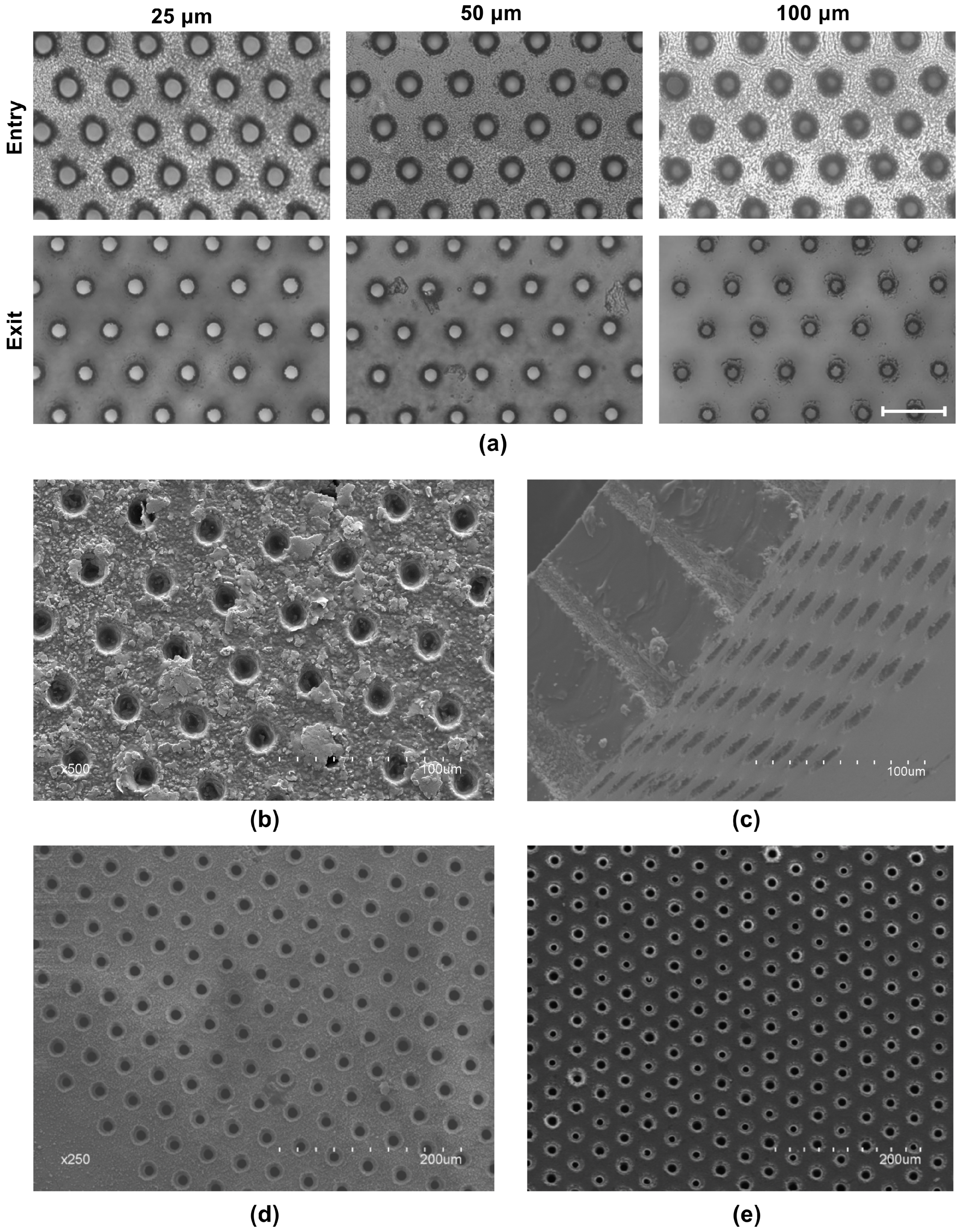
Figure 8a illustrates the fabricated membranes, highlighting the differences between entrance and exit microhole diameters across the three membrane thicknesses. Experimental and model-predicted diameters were compared to assess predictive accuracy. As summarized in Table 3, the linear model showed excellent agreement with the experimental entrance diameters for the 25 μ m membranes, yielding a relative error below 1% (n = 6). However, prediction accuracy declined substantially for thicker membranes, with relative errors exceeding 17%. In contrast, the model performed better in predicting exit diameters, with relative errors below 6.5% for all thicknesses. The lowest error (1.08%) was observed for the thickest membrane, suggesting that the model may more accurately capture the ablation behavior at greater depths. These results suggest that the regression models offer a reasonable first-order approximation for estimating the pulse energy required to achieve target hole diameters, particularly for exit dimensions. However, limited accuracy for entrance diameters in medium and thick membranes highlights the need for refined—potentially nonlinear—modeling approaches in applications requiring high geometric fidelity.
Confocal microscopy images in Figure 8a and SEM images in Figure 8b,c provide a detailed evaluation of the fabricated microholes. The replicated microstructures exhibit a high degree of uniformity, confirming the absence of cross-interference between adjacent holes during laser processing. Additionally, some residual material is observed on the membrane surface in Figure 8b. This material corresponds to ablation debris generated during the laser drilling process, which was expelled from the holes and subsequently redeposited due to interactions between the plasma plume and the surrounding surface. The characteristic conical morphology of the microholes, consistent with the expected tapering effect, is clearly visible in Figure 8c.
The successful fabrication of functional membranes highlights several advantages of the FLM process, most notably its excellent uniformity and repeatability. While replica molding and dry etching can achieve similar uniformity, any damage to the molds or masks can severely degrade product quality due to defects, necessitating their disposal and significantly increasing costs [6]. In contrast, FLM is not subject to any of these drawbacks. Herein, it is important to note that the equipment required for FLM is more expensive than for replica molding. However, the specific equipment or set up used in this article can be easily found in central research facilities. Researchers are only charged with small fees that might be structured based on the hourly usage of equipment or per-sample processing rate.
The specific microdrilling patterns defined for this study can be easily modified in terms of hole diameter, distribution, or the total number of drills. This can be readily adjusted through software, enabling the processing of any reasonable user-defined area. In contrast, classical microfabrication methods lack this flexibility. Soft lithography [3] offers some degree of adaptability, but once a mold is created, any modification requires producing a new mold. Thus, flexibility is probably the key advantage of the FLM process. Furthermore, FLM allows full automation of the complete fabrication workflow. The microdrilled membranes in this study were produced without any operator intervention during the ablation process. Autonomous operation also facilitates efficient experimental planning by enabling unattended processing under controlled conditions. Compared to replica molding and dry etching, the absence of human intervention in FLM minimizes operator-induced variability, enhances reproducibility, and reduces costs.

3.4. Effectiveness of Debris Removal from Processed Membranes

Material ablation leads to the formation of debris and surface contamination. These particles, varying in size, can potentially interfere with subsequent microfabrication steps. To address this issue, the cleaning protocol described in Section 2.8 was implemented to remove both surface-adhered residues and debris lodged within the microholes. The cleaning procedure was consistently applied to multiple PDMS membrane samples of varying thicknesses (25, 50, and 100 μ m ). In all cases (n = 5 per thickness), the protocol yielded satisfactory results without inducing visible damage. SEM images in Figure 8d,e illustrate the condition of the PDMS surface before and after the cleaning process. Figure 8d shows a membrane immediately following the FLM with substantial debris accumulation, particularly around the microhole edges. Notably, debris was not confined to the perforated regions; it was observed as fas as 150– 180 μ m from the outermost holes.
Following the cleaning process, debris was effectively removed from both the membrane surface and the interior of the microholes. Figure 8e shows a membrane after cleaning, demonstrating the effectiveness of the protocol. Light-toned regions around the hole edges indicate areas thermally affected but not ablated. Nevertheless, the laser energy absorbed in these zones was sufficient to induce thermal degradation of the PDMS. All cleaned samples were subsequently ready for the next fabrication step: bonding with the remaining chip components.

3.5. In Vitro Experimental Validation of the Assembled Membranes

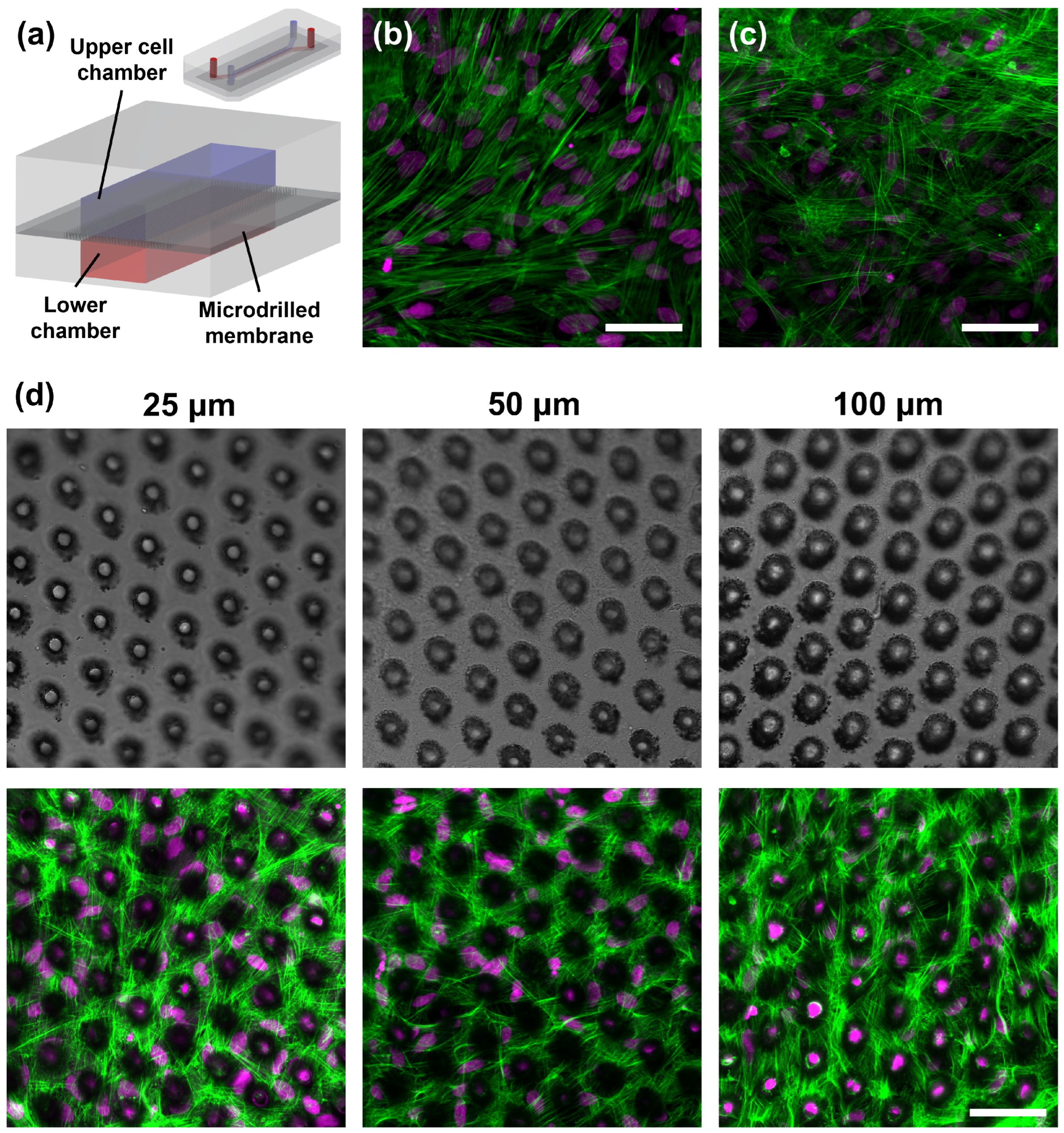
Validation of the PDMS membranes was conducted on the microdrilled PDMS membrane in the two-chamber OoC device selected (Figure 9a). Phosphate-buffered saline (PBS) was first perfused through one of the inlet ports, and membrane functionality was evaluated by monitoring fluid flow crossing the membrane and leaving the OoC through the opposing outlet port. The PBS flowing through the mentioned port was the confirmation that FLM enabled the fabrication of a functional membranes with user-defined porosity. Porosity was not predetermined but could be easily estimated by quantifying the total number of microholes and measuring their average diameter on the exit surface. This diameter could also be inferred based on the pulse energy used during fabrication (Figure 2). Better understanding of the fluid mechanics in the chambers of the OoC due to potential variations in orifice diameter should be examined by computational fluid dynamics simulations.
Biocompatibility assessment is a fundamental step in the preliminary evaluation of any material intended for cell culture. The membranes were evaluated for their ability to support the adhesion and growth of hASCs, chosen for their relevance in tissue engineering. A consistent cell seeding density was used that produced confluence in the controls within 48 h (Figure 9b,c). After seeding hASC in the OoCs (Figure 9d), cell cultures behaved in a very similar way to the controls and formed a homogeneous monolayer across all three membrane thicknesses within the same time. Multilayered cell growth (Figure 9d) was found in some areas of the membranes with 25 μ m thickness. Cell migration through the micropores of the membranes was examined. In several instances, hASCs were observed occupying pores within the membrane (Figure 9d), although the number of migrating cells was markedly lower in the 25 μ m membrane than in the case of the 100 μ m membrane. This difference in migration is attributed to the increased maximum pore diameter at the top surface of thicker membranes, resulting from higher energy per pulse during FLM, as discussed earlier. These observations supported the idea that the membranes were biocompatible.
Phalloidin, which binds specifically to filamentous actin (F-actin), helped to visualize the organization of the actin filaments of cells. hASCs cultured on microdrilled PDMS membranes (Figure 9d) showed a similar intensity and organization to that of cells grown on non-perforated PDMS membranes (Figure 9c). In contrast, cells seeded on glass coverslips (Figure 9b) exhibited more intense filament labeling than in the other cases. The literature attributes this finding to the higher stiffness (Young’s modulus) of glass (70 GPa is a typical estimate) compared to PDMS, which typically ranges from 100 kPa to 3 MPa. Importantly, no regions devoid of cells or exhibiting disrupted cytoplasmic actin structures were observed, indicating the effective adhesion of hASCs to all membranes. Therefore, we can conclude that FLM fabrication for creating porous PDMS membranes showed signs of biocompatibility, and the microdrilled surfaces allowed hASCs to adhere, migrate, and potentially proliferate over them.

4. Conclusions

Multiple arrays of microholes for microfluidic applications were fabricated on PDMS membranes with thicknesses of 25, 50, and 100 μ m using the flexible technique of FLM. The influence of various laser operating parameters was analyzed, revealing that pulse energy is the most critical factor in controlling microhole diameter, while exposure time and membrane thickness were identified as secondary parameters. Microhole quality showed a strong dependence on pulse energy, particularly with respect to the taper (conicity) angle; higher pulse energies resulted in significantly increased taper angles. This effect is primarily attributed to greater material removal at the entrance of the hole, while diffraction and attenuation reduce ablation efficiency near the exit, producing a non-uniform depth profile. In contrast, the extent of the heat-affected zone was mainly influenced by the laser beam size and membrane thickness. Overall, our findings demonstrate that FLM is a highly versatile and flexible technique, offering precision comparable to that of conventional micromachining methods in terms of diameter and taper angle.
The role of pulse energy was further explored through a numerical model developed in COMSOL Multiphysics, which provided deeper insights into laser–material interactions. The simulations revealed emergent effects such as plasma shielding and its influence on crater formation and hole diameter. In addition, a linear regression model was developed to guide the fabrication of high-quality porous PDMS membranes for batch production. This model also served as a first-order approximation for selecting the optimal pulse energy required to achieve a desired hole diameter. It may assist other researchers in adapting their own FLM setups for the fabrication of porous membranes in OoC applications.
Since the micromachining process can generate debris on the membrane surface, we validated the effectiveness of a cleaning protocol through SEM inspection and subsequent cell culture. The biocompatibility of the fabricated membranes was confirmed by successful cell adhesion and sustained metabolic activity. Overall, this study highlights key advantages of FLM over conventional techniques, including its flexibility to produce a wide range of patterns and geometries, as well as its fully autonomous operation, which enhances process repeatability and reduces the potential for human error.


Author Contributions

Conceptualization, C.B., D.S.-G., J.R.V.A. and A.S.-G.; methodology, C.B., D.S.-G., J.R.V.A. and A.S.-G.; software, C.B., D.S.-G., J.R.V.A. and A.S.-G.; validation, C.B., D.S.-G., J.R.V.A. and A.S.-G.; formal analysis, C.B., D.S.-G., J.R.V.A. and A.S.-G.; investigation, C.B., D.S.-G., J.R.V.A. and A.S.-G.; resources, C.B., D.S.-G., J.R.V.A. and A.S.-G.; data curation, C.B., D.S.-G., J.R.V.A. and A.S.-G.; writing—original draft preparation, C.B., D.S.-G., J.R.V.A. and A.S.-G.; writing—review and editing, C.B., D.S.-G., J.R.V.A. and A.S.-G.; visualization, C.B., D.S.-G., J.R.V.A. and A.S.-G.; supervision, C.B., D.S.-G., J.R.V.A. and A.S.-G.; project administration, C.B., D.S.-G., J.R.V.A. and A.S.-G.; funding acquisition, C.B., D.S.-G., J.R.V.A. and A.S.-G. All authors have read and agreed to the published version of the manuscript.

Funding

This research was funded by Consejería de Educación, Junta de Castilla y León (SA136P20, SA108P24); Ministerio de Ciencia, Innovación y Universidades y Agencia Estatal de Investigación (PID2023-149836NB, PLEC2022-009392 and FPU22/03616);Conselleria de Sanitat Conselleria de Sanidad (CDEI-02/20-A); Agencia Valenciana de la Innovación (CAICO/2023/282).

Institutional Review Board Statement

The study was conducted in accordance with the Declaration of Helsinki, and the protocol was approved by the Ethics Committee of Consorcio Hospital General Universitario de Valencia (BIOEEVOC-145/2020-Protocol 1.8) on 27 November 2020.

Informed Consent Statement

Not applicable.

Data Availability Statement

Dataset available on request from the authors.

Acknowledgments

D.S.G. would like to thank the Ministerio de Ciencia, Innovación y Universidades for the personal grant and FPU22/03616. We would like to express our sincere gratitude to Carmen Escobedo, Valencia, Spain for graciously providing the cell line and and her valuable expert assistance and advice on immunofluorescence staining methods, which significantly contributed to the successful completion of our research. The authors also acknowledge the use of QuillBot for style and spelling purposes, and ChatGPT-4o (OpenAI, San Francisco, CA, USA) for English grammar correction. All substantive content and interpretations were developed by the authors.

Conflicts of Interest

The authors declare no conflicts of interest.

Abbreviations

The following abbreviations are used in this manuscript:
OoCOrgan-on-a-chip
PDMSPolydimethylsiloxane
PMMAPolymethyl methacrylate
MEMSMicroelectromechanical systems
FLMFemtosecond laser micromachining
SEMScanning electron microscope
RTRoom temperature
CPAChirped pulse amplification
CCDCharge-coupled device
PBSPhosphate-buffered saline
hASCsHuman adipose-derived mesenchymall stem cells
SDStandard deviation
R 2 Coefficients of determination
HAZHeat-affected zone

Appendix A. Results of the Linear Regression Analyses of the Experimental Data

Table A1 and Table A2 summarize the linear regression results corresponding to the two experimental sets presented in Figure 2. Table A1 includes the linear fits obtained from the experiments where pulse energy was varied at fixed exposure time, while Table A2 presents the fits for experiments where exposure time was varied at fixed pulse energies.
Table A1. Linear regression results for hole diameters as a function of pulse energy for three values for the exposure time.
ThicknessExposure TimeDiameterEquationR2
25 μm600 msUpper D = 0.8305 E p + 3.3127 0.9741
Lower D = 0.6666 E p + 2.8483 0.9650
1000 msUpper D = 0.6809 E p + 5.9822 0.9605
Lower D = 0.6654 E p + 3.2514 0.9789
1400 msUpper D = 0.7728 E p + 5.1111 0.9526
Lower D = 0.6046 E p + 3.2606 0.9714
50 μm600 msUpper D = 0.7774 E p + 3.6483 0.9861
Lower D = 0.5029 E p + 3.1790 0.9835
1000 msUpper D = 0.6989 E p + 6.1390 0.8864
Lower D = 0.5062 E p + 3.6908 0.9659
1400 msUpper D = 0.7905 E p + 4.4073 0.9409
Lower D = 0.4925 E p + 3.8324 0.9353
100 μm600 msUpper D = 0.8894 E p + 1.6362 0.9677
Lower D = 0.6103 E p + 1.6298 0.9953
1000 msUpper D = 1.1236 E p + 0.9038 0.9593
Lower D = 0.5731 E p + 2.4743 0.9239
1400 msUpper D = 1.2471 E p 0.3044 0.9850
Lower D = 0.6464 E p + 1.9273 0.9334
Each table reports the regression equation (in the form y = m x + b ) and the coefficient of determination ( R 2 ) for both upper and lower hole diameters. The regressions were calculated separately for each membrane thickness (25, 50, and 100 μ m ), providing a quantitative representation of the trends observed in the figure. In the first set of experiments, E p denotes the pulse energy in μ J , while in the second set, t p denotes the exposure time in m s . In both cases, D represents the measured hole diameter in micrometers.
Table A2. Linear regression results for hole diameters as a function of exposure time for three pulse energies.
ThicknessPulse EnergyDiameterEquationR2
25 μm4 μJUpper D = 0.0025 t p + 5.4214 0.9714
Lower D = 0.0008 t p + 4.6046 0.9278
10 μJUpper D = 0.0028 t p + 11.2367 0.9616
Lower D = 0.0011 t p + 9.4035 0.9641
16 μJUpper D = 0.0046 t p + 14.5677 0.9857
Lower D = 0.0023 t p + 12.0929 0.9233
50 μm4 μJUpper D = 0.0025 t p + 4.8477 0.8520
Lower D = 0.0013 t p + 4.1236 0.9335
10 μJUpper D = 0.0010 t p + 13.0231 0.7831
Lower D = 0.0010 t p + 8.8346 0.8031
16 μJUpper D = 0.0027 t p + 15.2538 0.9447
Lower D = 0.0009 t p + 11.0637 0.4810
100 μm4 μJUpper D = 0.0010 t p + 3.9081 0.5122
Lower D = 0.0009 t p + 3.0804 0.9550
10 μJUpper D = 0.0041 t p + 7.9485 0.8748
Lower D = 0.0013 t p + 7.0346 0.9559
16 μJUpper D = 0.0064 t p + 12.0338 0.8912
Lower D = 0.0014 t p + 10.8276 0.8792
These linear models support the qualitative trends discussed in the main text and highlight the degree of correlation between FLM parameters and the resulting hole dimensions.

Appendix B. Supplementary Data for the Numerical Simulation

Appendix B.1. Curve Fitting of the Keldysh Ionization Expression

To reduce computational cost and improve the convergence of the simulation, the ionization probability expression proposed by Keldysh [23] was fitted using MATLAB©’s curveFitter function. A power function was chosen based on the form of the original expression and observations reported by B. C. Stuart et al. [14] and M. D. Feit et al. [13]. The equation proposed by Keldysh and the fitted curve are shown in Figure A1.
The simulated peak laser intensities for pulse energies of 4, 8, and 12 μ J were 3.25 × 10⁸, 6.51 × 10⁸, and 9.76 × 10⁸ TW cm−2, respectively. These values are well above the 1 TW cm−2 threshold reported by M. D. Feit et al. [13] as the upper limit for the low-intensity regime. Thus, tunnelling ionization becomes significant, and the approximation p equal to the number of photons an electron must absorb to reach the conduction band is no longer valid. Since tunnelling ionization reduces this photon number, due to the strong electric field of the laser and its interaction, an exponent below 3 was used in the fitting. The values k m =  3.36 × 10⁶ m−3 s−1 and p = 2.1 were selected, which provided the best fit to the Keldysh equation ( R 2 = 0.9689 ) over the simulated intensity range, corresponding to pulse energies from 0 to 16 μ J .
Figure A1. Representation of the original ionization expression proposed by Keldysh, along with the corresponding curve fitting used in the numerical model.
Jmmp 09 00300 g0a1

Appendix B.2. Simulation for 12 μJ Pulse Energy

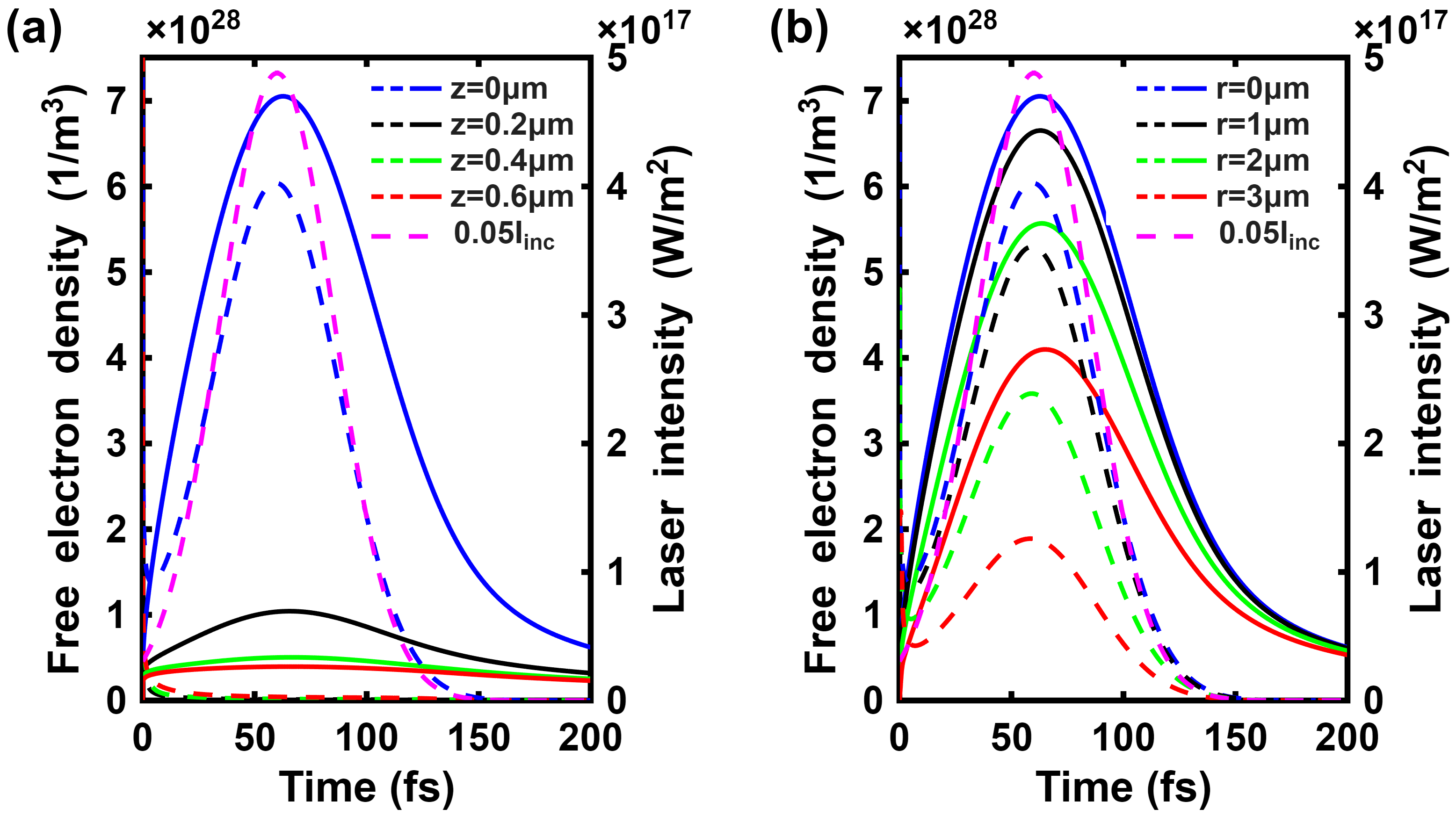
Figure A2 presents an additional simulation corresponding to a pulse energy of 12 μ J . This case complements the results discussed in Section 3.2.2, where the temporal evolution of the free electron density and laser intensity was shown for pulse energies of 4 and 8 μ J .
Figure A2. Temporal evolution of the free electron density n and laser intensity I for a pulse energy of 12 μJ, evaluated at different depths (a) and radial positions (b). The solid line represents the electron density, while the dashed line indicates the laser intensity.
Jmmp 09 00300 g0a2
The simulation data shown here have already been referenced in the main results section and are included for completeness and comparison. The Figure A2 displays two curves, the temporal evolution of the free electron density n and the laser intensity I, evaluated at various depths and radial positions within the material. The solid line represents the electron density, while the dashed line indicates the laser intensity.
This additional case illustrates the enhanced ionization dynamics associated with increased pulse energy and helps confirm the trends identified at lower energy levels.

References

  1. Tajeddin, A.; Mustafaoglu, N. Design and Fabrication of Organ-on-Chips: Promises and Challenges. Micromachines 2021, 12, 1443. [Google Scholar] [CrossRef]
  2. Sung, J.H.; Esch, M.B.; Prot, J.M.; Long, C.J.; Smith, A.; Hickman, J.J.; Shuler, M.L. Microfabricated mammalian organ systems and their integration into models of whole animals and humans. Lab Chip 2013, 13, 1201–1212. [Google Scholar] [CrossRef]
  3. Huh, D.; Kim, H.J.; Fraser, J.P.; Shea, D.E.; Khan, M.; Bahinski, A.; Hamilton, G.A.; Ingber, D.E. Microfabrication of human organs-on-chips. Nat. Protoc. 2013, 8, 2135–2157. [Google Scholar] [CrossRef]
  4. Mosadegh, B.; Agarwal, M.; Torisawa, Y.s.; Takayama, S. Simultaneous fabrication of PDMS through-holes for three-dimensional microfluidic applications. Lab Chip 2010, 10, 1983–1986. [Google Scholar] [CrossRef]
  5. Huh, D.; Matthews, B.D.; Mammoto, A.; Montoya-Zavala, M.; Hsin, H.Y.; Ingber, D.E. Reconstituting Organ-Level Lung Functions on a Chip. Science 2010, 328, 1662–1668. [Google Scholar] [CrossRef] [PubMed]
  6. Quirós-Solano, W.F.; Gaio, N.; Stassen, O.M.J.A.; Arik, Y.B.; Silvestri, C.; Van Engeland, N.C.A.; Van der Meer, A.; Passier, R.; Sahlgren, C.M.; Bouten, C.V.C.; et al. Microfabricated tuneable and transferable porous PDMS membranes for Organs-on-Chips. Sci. Rep. 2018, 8, 13524. [Google Scholar] [CrossRef] [PubMed]
  7. Mata, A.; Fleischman, A.J.; Roy, S. Characterization of Polydimethylsiloxane (PDMS) Properties for Biomedical Micro/Nanosystems. Biomed. Microdevices 2005, 7, 281–293. [Google Scholar] [CrossRef]
  8. Gale, B.K.; Jafek, A.R.; Lambert, C.J.; Goenner, B.L.; Moghimifam, H.; Nze, U.C.; Kamarapu, S.K. A Review of Current Methods in Microfluidic Device Fabrication and Future Commercialization Prospects. Inventions 2018, 3, 60. [Google Scholar] [CrossRef]
  9. Qin, D.; Xia, Y.; Whitesides, G.M. Soft lithography for micro- and nanoscale patterning. Nat. Protoc. 2010, 5, 491–502. [Google Scholar] [CrossRef]
  10. Hwang, S.J.; Oh, D.J.; Jung, P.G.; Lee, S.M.; Go, J.S.; Kim, J.H.; Hwang, K.Y.; Ko, J.S. Dry etching of polydimethylsiloxane using microwave plasma. J. Micromech. Microeng. 2009, 19, 095010. [Google Scholar] [CrossRef]
  11. Zhang, X.; Yao, Z.; Hou, Z.; Song, J. Processing and Profile Control of Microhole Array for PDMS Mask with Femtosecond Laser. Micromachines 2022, 13, 340. [Google Scholar] [CrossRef] [PubMed]
  12. Volpe, A.; Conte Capodacqua, F.M.; Garzarelli, V.; Primiceri, E.; Chiriacò, M.S.; Gaudiuso, C.; Ferrara, F.; Ancona, A. Femtosecond Laser Fabrication of Microporous Membranes for Biological Applications. Micromachines 2022, 13, 1371. [Google Scholar] [CrossRef]
  13. Feit, M.; Komashko, A.; Rubenchik, A. Ultra-short pulse laser interaction with transparent dielectrics. Appl. Phys. A 2004, 79, 1657–1661. [Google Scholar] [CrossRef]
  14. Stuart, B.C.; Feit, M.D.; Herman, S.; Rubenchik, A.M.; Shore, B.W.; Perry, M.D. Nanosecond-to-femtosecond laser-induced breakdown in dielectrics. Phys. Rev. B 1996, 53, 1749–1761. [Google Scholar] [CrossRef]
  15. Liu, X.; Du, D.; Mourou, G. Laser ablation and micromachining with ultrashort laser pulses. IEEE J. Quantum Electron. 1997, 33, 1706–1716. [Google Scholar] [CrossRef]
  16. Vorobyev, A.Y.; Guo, C. Direct femtosecond laser surface nano/microstructuring and its applications. Laser Photonics Rev. 2013, 7, 385–407. [Google Scholar] [CrossRef]
  17. Alnaser, A.S.; Khan, S.A.; Ganeev, R.A.; Stratakis, E. Recent Advances in Femtosecond Laser-Induced Surface Structuring for Oil–Water Separation. Appl. Sci. 2019, 9, 1554. [Google Scholar] [CrossRef]
  18. Huang, H.; Guo, Z. Ultra-short pulsed laser PDMS thin-layer separation and micro-fabrication. J. Micromech. Microeng. 2009, 19, 055007. [Google Scholar] [CrossRef]
  19. Darvishi, S.; Cubaud, T.; Longtin, J.P. Ultrafast laser machining of tapered microchannels in glass and PDMS. Opt. Lasers Eng. 2012, 50, 210–214. [Google Scholar] [CrossRef]
  20. Hsieh, Y.K.; Chen, S.C.; Huang, W.L.; Hsu, K.P.; Gorday, K.A.V.; Wang, T.; Wang, J. Direct Micromachining of Microfluidic Channels on Biodegradable Materials Using Laser Ablation. Polymers 2017, 9, 242. [Google Scholar] [CrossRef]
  21. Alshehri, A.M.; Hadjiantoniou, S.; Hickey, R.J.; Al-Rekabi, Z.; Harden, J.L.; Pelling, A.E.; Bhardwaj, V.R. Selective cell adhesion on femtosecond laser-microstructured polydimethylsiloxane. Biomed. Mater. 2016, 11, 015014. [Google Scholar] [CrossRef]
  22. Torino, S.; Conte, L.; Iodice, M.; Coppola, G.; Prien, R.D. PDMS membranes as sensing element in optical sensors for gas detection in water. Sens. Bio-Sens. Res. 2017, 16, 74–78. [Google Scholar] [CrossRef]
  23. Keldysh, L. Ionization in field of a strong electromagnetic wave. J. Exp. Theor. Phys. 1965, 20, 1307–1314. [Google Scholar] [CrossRef]
  24. Özkayar, G.; Lötters, J.C.; Tichem, M.; Ghatkesar, M.K. Toward a modular, integrated, miniaturized, and portable microfluidic flow control architecture for organs-on-chips applications. Biomicrofluidics 2022, 16, 021302. [Google Scholar] [CrossRef] [PubMed]
  25. Escobedo-Lucea, C.; Bellver, C.; Gandia, C.; Sanz-Garcia, A.; Esteban, F.J.; Mirabet, V.; Forte, G.; Moreno, I.; Lezameta, M.; Ayuso-Sacido, A.; et al. A Xenogeneic-Free Protocol for Isolation and Expansion of Human Adipose Stem Cells for Clinical Uses. PLoS ONE 2013, 8, e67870. [Google Scholar] [CrossRef] [PubMed]
  26. Gaudiuso, C.; Giannuzzi, G.; Volpe, A.; Lugarà, P.M.; Choquet, I.; Ancona, A. Incubation during laser ablation with bursts of femtosecond pulses with picosecond delays. Opt. Express 2018, 26, 3801–3813. [Google Scholar] [CrossRef]
  27. Chuang, M.; Tam, A.C. On the saturation effect in the picosecond near ultraviolet laser ablation of polyimide. J. Appl. Phys. 1989, 65, 2591–2595. [Google Scholar] [CrossRef]
  28. Cheng, J.; Perrie, W.; Edwardson, S.; Fearon, E.; Dearden, G.; Watkins, K. Effects of laser operating parameters on metals micromachining with ultrafast lasers. Appl. Surf. Sci. 2009, 256, 1514–1520. [Google Scholar] [CrossRef]
  29. Baudach, S.; Bonse, J.; Kautek, W. Ablation experiments on polyimide with femtosecond laser pulses. Appl. Phys. A 1999, 69, S395–S398. [Google Scholar] [CrossRef]
  30. Peng, L.; Li, M.; Wang, P.; Li, X.; Zhang, Y.; He, M.; Zhou, C.; Zhang, H.; Chen, S. Numerical simulation and investigation of ultra-short pulse laser ablation on Ti6Al4V and stainless steel. AIP Adv. 2023, 13, 065018. [Google Scholar] [CrossRef]
  31. Holder, D.; Hagenlocher, C.; Weber, R.; Röcker, C.; Abdou Ahmed, M.; Graf, T. Model for designing process strategies in ultrafast laser micromachining at high average powers. Mater. Des. 2024, 242, 113007. [Google Scholar] [CrossRef]
Figure 1. Schematic illustration of the setup employed for PDMS membrane production with femtosecond laser ablation.
Jmmp 09 00300 g001
Figure 2. Evolution of upper and lower hole diameters as a function of pulse energy (left) and exposure time (right) for membrane thicknesses of 25 (a,b), 50 (c,d), and 100 μ m (e,f). Circular markers and solid lines represent entrance diameters, while triangular markers and dashed lines indicate exit diameters.
Jmmp 09 00300 g002
Figure 3. Microhole quality and geometry of micromachined PDMS membranes processed at a constant exposure time of 1000 m s and pulse energy varying from 4 to 20 μ J . Optical microscopy images were taken of entry and exit holes for (a) 25, (b) 50, and (c) 100 μ m membrane thickness. HAZ shaded in yellow. Scale bar: 20 μ m .
Jmmp 09 00300 g003
Figure 4. Optical microscopy images of micromachined samples processed at a constant pulse energy of 10 μ J while varying the exposure time (800– 1800 m s ). Comparison of geometry, quality, and dimensions for different membrane thicknesses. Entry and exit holes for (a) 25, (b) 50, and (c) 100 μ m thick membranes. HAZ shaded in yellow. Scale bar: 20 μ m .
Jmmp 09 00300 g004
Figure 5. Evolution of taper angle as a function of pulse energy (left) and exposure time (right) for membrane thicknesses of 25 (a,b), 50 (c,d), and 100 μ m (e,f).
Jmmp 09 00300 g005
Figure 6. Temporal evolution of the free electron density n induced by a 4 μ J laser pulse. (a) Spatial distribution and growth. (b,c) Free electron density n and laser intensity I for a pulse energy of 4 μ J , evaluated at different depths and radial positions. The solid line represents the electron density, while the dashed line indicates the laser intensity.
Jmmp 09 00300 g006
Figure 7. Effect of the increment of pulse energy on the electron density. (a) Spatial distribution of the free electron density n, shown as color maps at two time points: t = 15 f s and t = 30 f s . (b,c) Temporal evolution of the free electron density n and laser intensity I for a pulse energy of 8 μ J , evaluated at different depths and radial positions. The solid line represents the electron density, while the dashed line indicates the laser intensity. (d) Ablated material and dimensions of the resulting modified geometry following exposure to different laser pulse energies.
Jmmp 09 00300 g007
Figure 8. Microdrilled PDMS membranes fabricated using a pulse energy of 12 μ J and a exposure time of 1000 m s . (a) Confocal microscopy images of the three types of membranes detailing entry and exit holes. Scale bar: 50 μ m . (b) SEM images showing ablation-induced residues and hole matrix. (c) Detail of the taper angle of holes in a 100 μ m thick membrane. (d) Laser-drilled PDMS membrane before the cleaning procedure. (e) Laser-drilled PDMS membrane after the cleaning procedure.
Jmmp 09 00300 g008
Figure 9. (a) Schematic of the two-chamber OoC device selected with the flexible microdrilled membrane. (bd) Confocal fluorescence images of in vitro hASCs seeded on (b) glass coverslip; (c) undrilled PDMS membrane; (d) microdrilled PDMS membrane of 25, 50, and 100 μ m assembled in the OoCs. Left images represent the membranes imaged with PMT in transmitted mode. hASCs stained with phalloidin (green) and DAPI (magenta). Scale bars: 50 μ m .
Jmmp 09 00300 g009
Table 1. Material parameters for PDMS used in the developed numerical model.
ParameterValueUnits
Collision factor, ν  1 3 · 10 14 1/s
Bandgap, Δ 4.2eV
Free electron energy, e e 0.5 Δ eV
Refractive index, n m 1.4235-
Relative permittivity, ε r n m 2 -
Critical electron density, n c 3.5 · 10 27 1/m3
Recombination coefficient, β  1 3 · 10 9 cm3/s
1 Reference values for water.
Table 2. Operational parameters and main characteristics of the ablation process, the PDMS membranes, and the femtosecond pulse laser.
ParameterValueUnits
Laser wavelength, λ 800 n m
Pulse duration, t p 60 f s
Repetition rate, f5 k Hz
Laser spot diameter, w 0 7 μ m
Thickness of PDMS membranes, e t h 25, 50, 100 μ m
Exposure time, t s 800, 1000, 1200, 1400, 1600, 1800 m s
Pulse energy, E p 4, 8, 10, 12, 14, 16, 18, 20 μ J
Table 3. Comparison between experimental results and linear model predictions for entrance and exit diameters at different membrane thicknesses. Units in μ m .
ThicknessEntrance DiameterExit Diameter
Experimental Model E r Experimental Model E r
2514.02 ± 0.1514.150.93%10.83 ± 0.0911.243.79%
5012.41 ± 0.1214.5317.08%10.44 ± 0.109.776.42%
10012.28 ± 0.2214.3917.18%9.25 ± 0.079.351.08%
Disclaimer/Publisher’s Note: The statements, opinions and data contained in all publications are solely those of the individual author(s) and contributor(s) and not of MDPI and/or the editor(s). MDPI and/or the editor(s) disclaim responsibility for any injury to people or property resulting from any ideas, methods, instructions or products referred to in the content.