1. Introduction
Additive manufacturing (AM) has shaped every field of engineering, not only due to the weight reduction it offers for full-scale products [
1,
2], but also the time it saves in prototyping design phases [
3]. These benefits are further realized by incorporating lattices into a structure, which have been shown to improve heat dissipation [
4], and increase structural ductility [
5,
6] and energy absorption [
7,
8], in addition to many other applications. Triply periodic minimal surfaces (TPMSs), equation-based lattices that are a particularly advantageous subset of lattices [
9,
10], use combinations of periodic functions to define smoothly repeating 3D surfaces that avoid stress concentration points while exhibiting excellent stiffness and strength properties as a function of volume fraction [
11,
12]. The equation defines an infinitely thin
isosurface; offsetting the isosurface by some value on either side, the space between the offset surfaces can be filled in to realize a solid structure. When the offsets are equal in magnitude, the resulting solid roughly follows the shape of the initial isosurface and we call it the
triply
periodic
sur
face (TPSf) lattice for that equation [
11]. Because of the repeating nature of lattice structures, we can define a volume that contains exactly one period of the lattice in each coordinate direction. This volume is known as a
unit cell of that lattice. Unit cells are very useful for visualizing, understanding, and comparing lattices. Equation-based lattices have found application in many areas of engineering, including, but not limited to, heat exchangers, latent heat thermal energy storage, adsorption cooling systems, hydrogen storage, thermal management, and membrane distillation [
13]. Despite the advantages of lattices, there is a lack of research applying them in large-scale additive manufacturing.
Current methods of manufacturing equation-based lattices rely on high-precision placement of material, often using micro-scale regions of solidification to create highly detailed parts [
2,
13,
14]. Material requirements often dictate the AM method necessary for fabrication to meet functional requirements, where the most common materials explored in AM consist of polymers, ceramics, and metals [
13]. Once a material is selected, there are several main types of additive manufacturing to select from as per the ASTM/ISO 52900 standard [
15]: powder bed fusion (PBF), vat photopolymerization, material jetting (MJ), and material extrusion (MEX) additive manufacturing (AM) [
13,
16]. Lattice structures are often manufactured using PBF [
14,
17,
18], photopolymerization [
13], or MJ [
16] due to the small region of solidification relative to the smallest features of the lattices being produced. However, the main limitation of these methods is the build volume. Liu et al. show that many metal powder bed fusion methods are typically limited to a build volume of 0.5 m × 0.5 m × 0.5 m [
17]. For polymers, there are many AM methods that can generate lattice structures, such as stereolithography (SLA), selective laser sintering (SLS), and digital light processing (DLP) [
14]. The resolutions in these methods are roughly 5 μm, 100 μm, and 5 μm for SLA, SLS, and DLP, respectively [
16]. In general, all of these AM methods have a
small region of solidification relative to the smallest features of the lattice structures being produced, allowing the manufacture of these complex geometries. In addition, all of these additive manufacturing methods have limited build volumes that cannot accommodate large-scale manufacturing. In order to achieve higher build volumes, most large-scale additive manufacturing uses material extrusion.
Though it would be advantageous to incorporate equation-based lattices into large-scale AM methods, it is not as simple as scaling existing designs, as drastic modifications would be needed to account for the limitations of current AM methods. As parts need to be scaled in geometric size, there are limitations as to what AM methods can be applied that will effectively maintain speed and address material requirements. Even though lattice structures are a major appeal of AM, they are often difficult or impossible to produce with large-scale AM methods at sufficient resolution to realize their geometry-dependent property gains. For large-scale AM, researchers often use directed energy deposition (DED) methods, such as wire arc additive manufacturing (WAAM), laser engineered net shaping (LENS), and laser-based metal wire deposition (LMWD), as they can produce large parts efficiently [
17]. However, these methods have a large region of solidification, which prevents the manufacture of highly detailed parts with relatively small minimum feature sizes. In WAAM the nozzle size is about 1–5 mm; LENS has a laser thickness of about 0.5–2 mm; and LMWD has a laser thickness of about 1–5 mm [
17]. There is extensive discussion in the literature comparing different lattice designs [
13,
14,
17], but DED is excluded from this discussion altogether, likely due to the large solidification diameter of large-scale AM. However, equation-based lattices could prove to be effective for manufacturing with DED, as many of the lattices have uniform wall thicknesses which could translate well if those thicknesses could be defined intuitively.
Current equation-based lattice definitions have no concept of thickness, which requires that they be generated based on their volume fraction relative to the level set. Unfortunately, this is not a tunable metric field, with meaningful unit values, but rather a scalar field [
11] that is unitless. As the level set increases linearly, the thickness of the equation-based lattices increases with an indeterminate relationship, caused by the complexity of the functional definition. This has resulted in the development of high-dimensional lookup tables to facilitate the development of structures to meet mass requirements based on their level set and unit cell size [
11,
19]. The current literature exploring alternative equation-based lattice definitions is highly focused on improving the mechanical performance of unit cells [
20]. Ma et al. developed an optimization scheme that enforces uniform wall thickness; however, it operates on a B-spline model which does not allow integration into typical lattice design tools [
21]. Zhu et al. developed a method that specifically tuned the wall thickness to improve permeability and mechanical properties [
22], but yet again it cannot specifically define a thickness discretely. The lack of precision in defining the wall thickness of smooth topologies, such as TPMS easily generated using implicit fields, coupled with the limited literature addressing the improvement of manufacturability for large-scale equation-based lattices from a design perspective, motivates this work.
Large-scale equation-based lattices could be beneficial in many fields of engineering given the value provided by small-scale equation-based lattices [
23]. The current literature has demonstrated a clear need to design intricate geometries by developing custom topology optimization and lattice manufacturing design methods to address large-scale manufacturing limitations. Fernández et al. have explored the development of a topology optimization scheme that addresses the manufacturing limitations of large-scale AM, which highlights the need for large-scale manufacturing of intricate geometries to address complex loading conditions [
24]. Lattice structures have also been manufactured using WAAM, which have demonstrated the feasibility of their general incorporation into other large-scale AM methods. In order to effectively manufacture strut-based lattices, Li et al. formed struts using WAAM droplets to build the intricate structures [
25]. Although droplet-based deposition enabled the manufacture of strut-based lattices, the authors did not take advantage of the continuous bead deposition enabled by WAAM. As such, Campocasso et al. argue that equation-based lattices are more appropriate for DED since they are thin-walled structures that can utilize continuous bead deposition [
26]. In their work, they develop single-width toolpaths for WAAM based on the underlying equation for Schwarz-P lattices and manufacture them using WAAM. However, the path optimization scheme is not generalizable to other lattice types, so it does not integrate well into the traditional design for additive manufacturing framework, as it requires designers to relinquish control over the design and slicing methodology.
This work proposes a mathematical framework to modify the implicit equation-based lattice definition to address the manufacturing constraints of large-scale print methodologies, which are often limited by large solidification diameters (manufacturing feature sizes). Spatially modifying the TPMS with
local modifications encourages designers to adjust their models in order to achieve effective slicing and toolpaths for their specific AM process. The new definition can be applied to any implicit equation-based lattice to generate lattices with meaningful units to enable the design of more uniform structures to adapt to large regions of solidification. To facilitate the design of parts for AM methods limited to three degrees of freedom, the definition is split into build direction and planar components, so that they can be defined independently. To accommodate AM methods that have adaptive build directions, the build direction can be rotated to change the lattice thickness locally. Additionally, the definition is field-driven, so that it can incorporate physics-based analysis to thicken and rotate regions as needed. This definition has been implemented in the implicit modeling tool nTop v5.5.2 [
27], which is made available on GitHub (
https://github.com/mebaldwi/Equation-Based-Lattice-Thickness-Control (accessed on 1 August 2025)).
2. Methods
To develop equation-based lattice structures, the most effective method is to implement an implicit design to approximate the original surface using a scalar field equation [
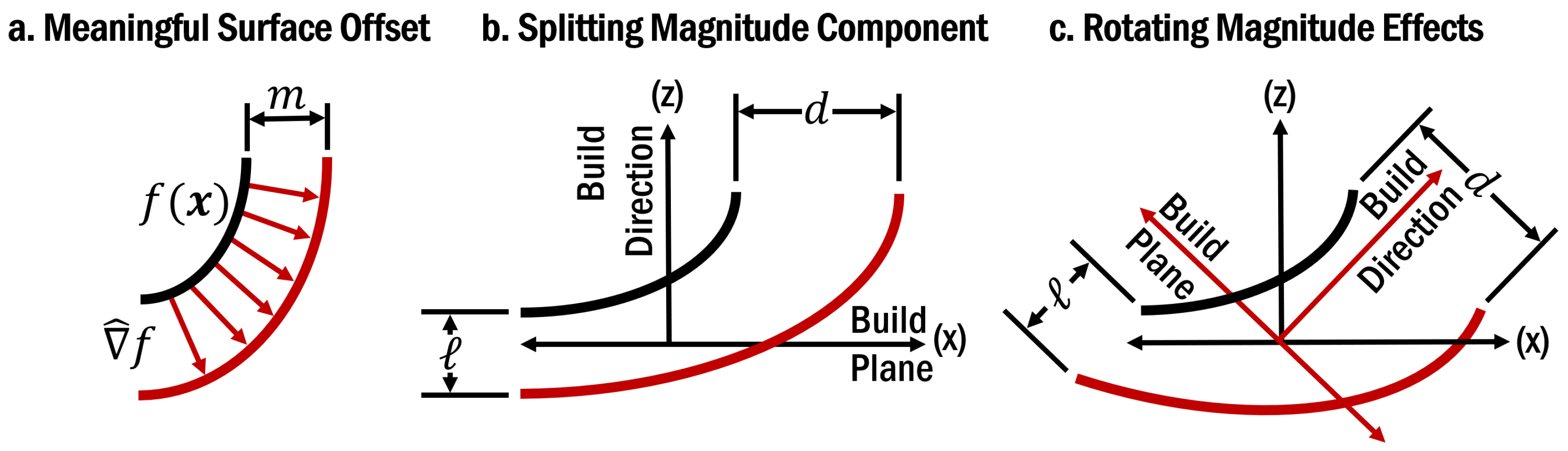
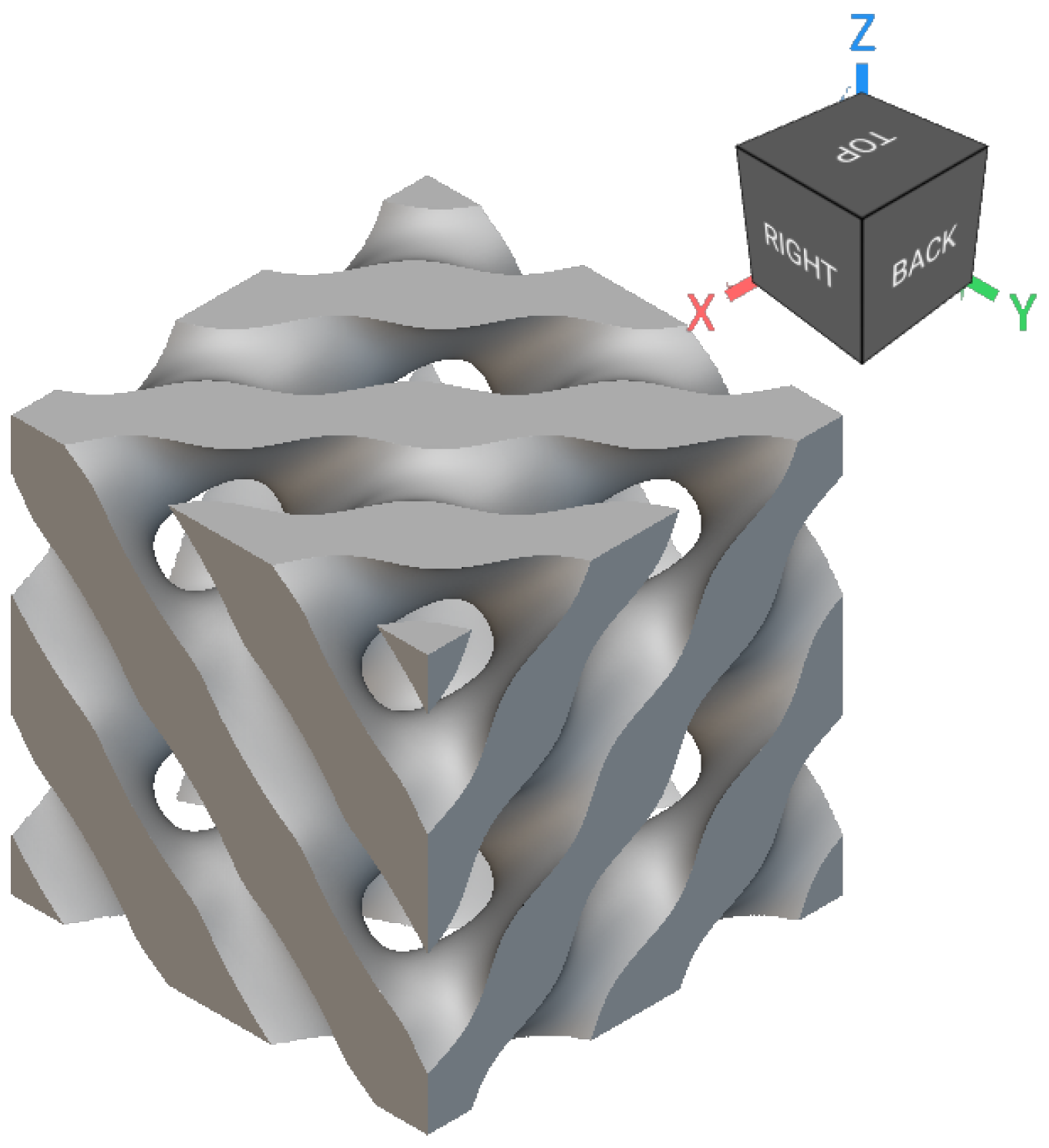
11]. Scalar fields are the foundation of implicit modeling tools like nTop, an implicit design tool often used for lattice structural design, which makes them the ideal representation for designers. This work modifies the original field definition of any equation-based lattice such that users can generate meaningful and uniform offsets, regardless of the magnitude of the field and its gradient, while adapting to build direction (see
Figure 1).
To effectively modify existing equation-based lattice definitions, the key manufacturing constraints of large-scale AM were considered in order to determine what to incorporate into the new functional definition. Within large-scale AM there is one notable method that uses material extrusion, namely, wire arc additive manufacturing [
17]. The main trait of WAAM is the deposition of material in the form of a continuous bead. This bead placement serves as a major limitation, as it requires that parts can only be manufactured using discrete bead widths to maintain process stability, geometric accuracy, and avoid metallurgical defects [
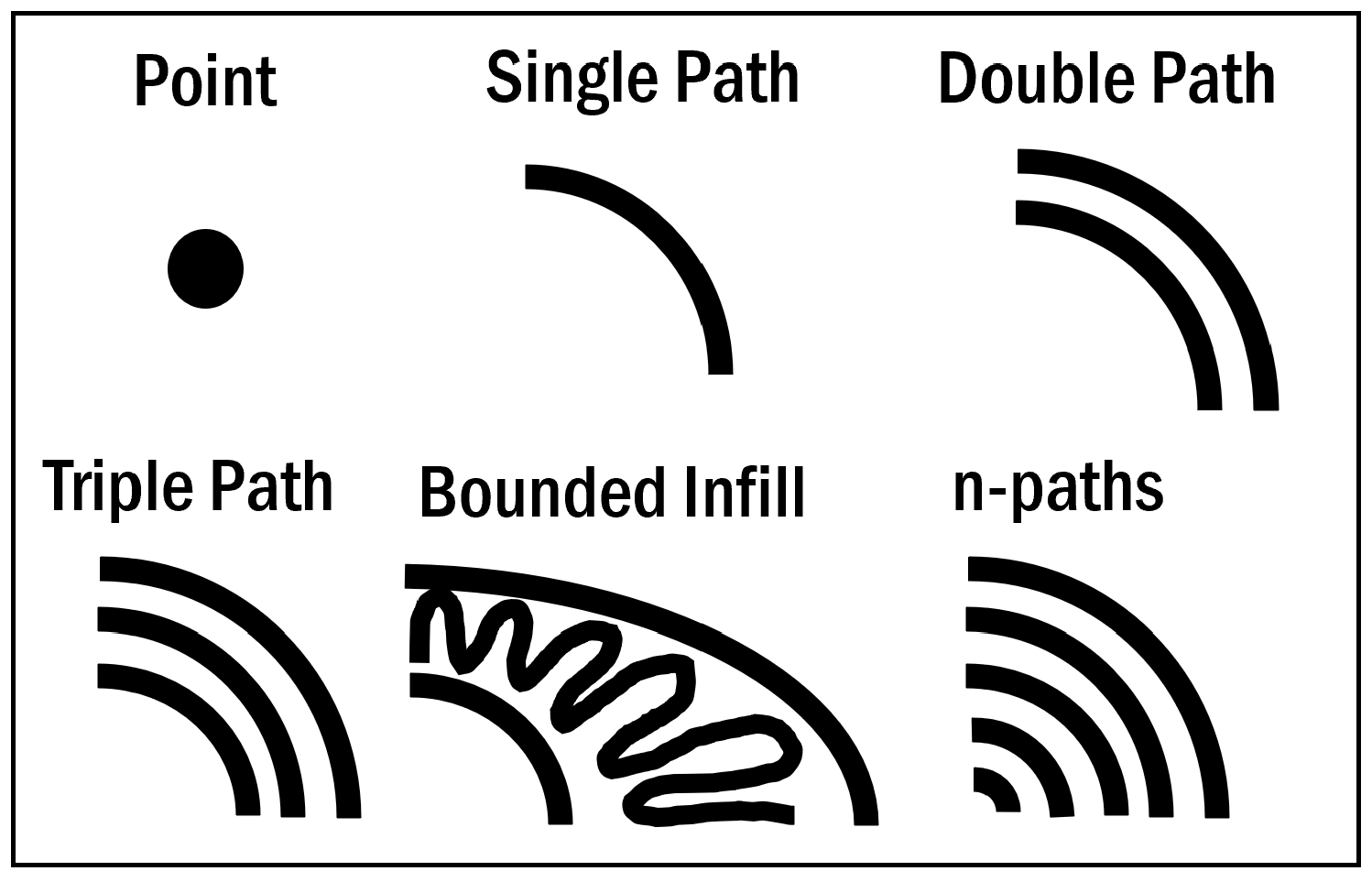
24]. Continuous deposition of material means that there are only six possible configurations for planar deposition to create a solid object and maintain a continuous bead on the boundary (see
Figure 2). Current methods of ensuring discrete bead placement incorporate a minimum feature restriction to adhere to manufacturing constraints [
24]. However, this can be further enforced by ensuring uniform wall thickness. Therefore, due to this design limitation, (1) it is desirable to design lattices such that they are meaningfully and uniformly generated such that they can maintain a boundary wall for accurate manufacturing. By discretely defining the wall thickness of the lattices, we can achieve finer features using n-paths to encourage the use of continuous beads (see
Figure 2).
Notably, the bead is not a uniform sphere, but most often represented using a short rectangle [
28]. This means that material placement is limited by the layer height, the height between layers of the part in the build direction, in addition to the wall thickness, which is controlled by the amount of material placed in the plane normal to the build direction. Therefore, (2) there is value in separately defining the thickness of the lattice based on the build direction, such that layer height and wall thickness can be defined independently.
The final consideration was the dynamic build directions offered by different AM methods, which suggests that the layer height and wall thickness elements need to be orientation-dependent. Additionally, the layer height and wall thickness need to adapt to various lattice orientations in order to apply them to the respective dimension when rotated. Therefore, (3) there is benefit to incorporating a rotation term to rotate the effects of the magnitudes of the wall thickness, because wall thickness changes as the build direction changes.
In summary, this work aims to modify the evaluation of equation-based lattices such that the following is true:
- 1.
They provide meaningful (actionable) thickness values that are uniformly generated such that they can maintain a boundary wall for accurate manufacturing;
- 2.
They define separately the thickness of the lattice based on the build direction, such that layer height and wall thickness can be defined independently;
- 3.
They incorporate a rotation term to rotate the effects of the wall thickness magnitudes.
2.1. Meaningful Surface Offset
To understand the final functional representation, this section reviews each of the components of the new definition and their effects on the final shifted field. The first item to address is incorporating meaningful offsets to the field such that uniform walls can be generated. A function can be shifted by adding or subtracting a scalar value; however, this does not work for functions with concave curvature in the offset direction without intersection. Therefore, the next option is to shift from the field using first-order gradients to provide a direction and specify a magnitude with meaningful distance, as in Equation (
1):
where
x is the input feature space;
is the unit gradient of
f, which is the lattice equation with no offset; and
m is the magnitude of the vector
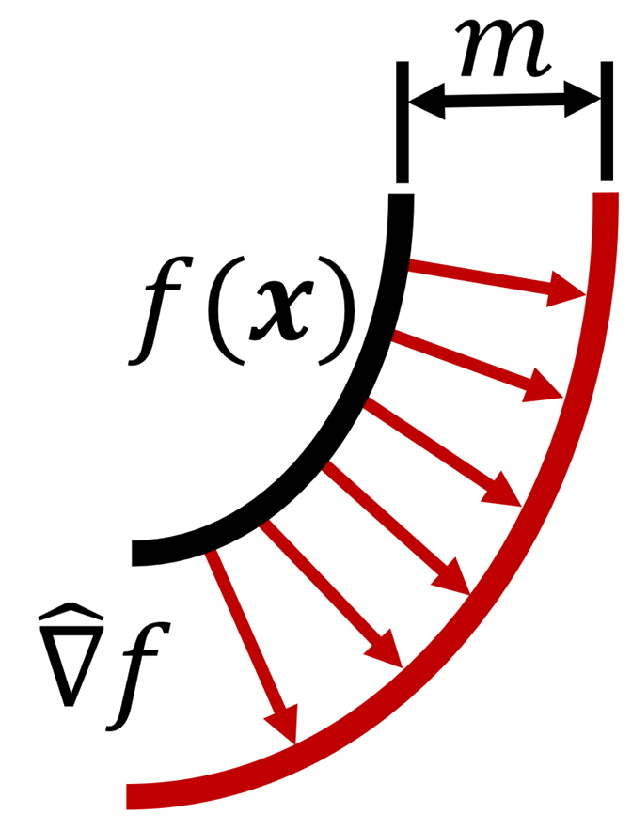
f representing the desired offset. This form of the field shift equation uniformly offsets an implicit surface equation by a known magnitude,
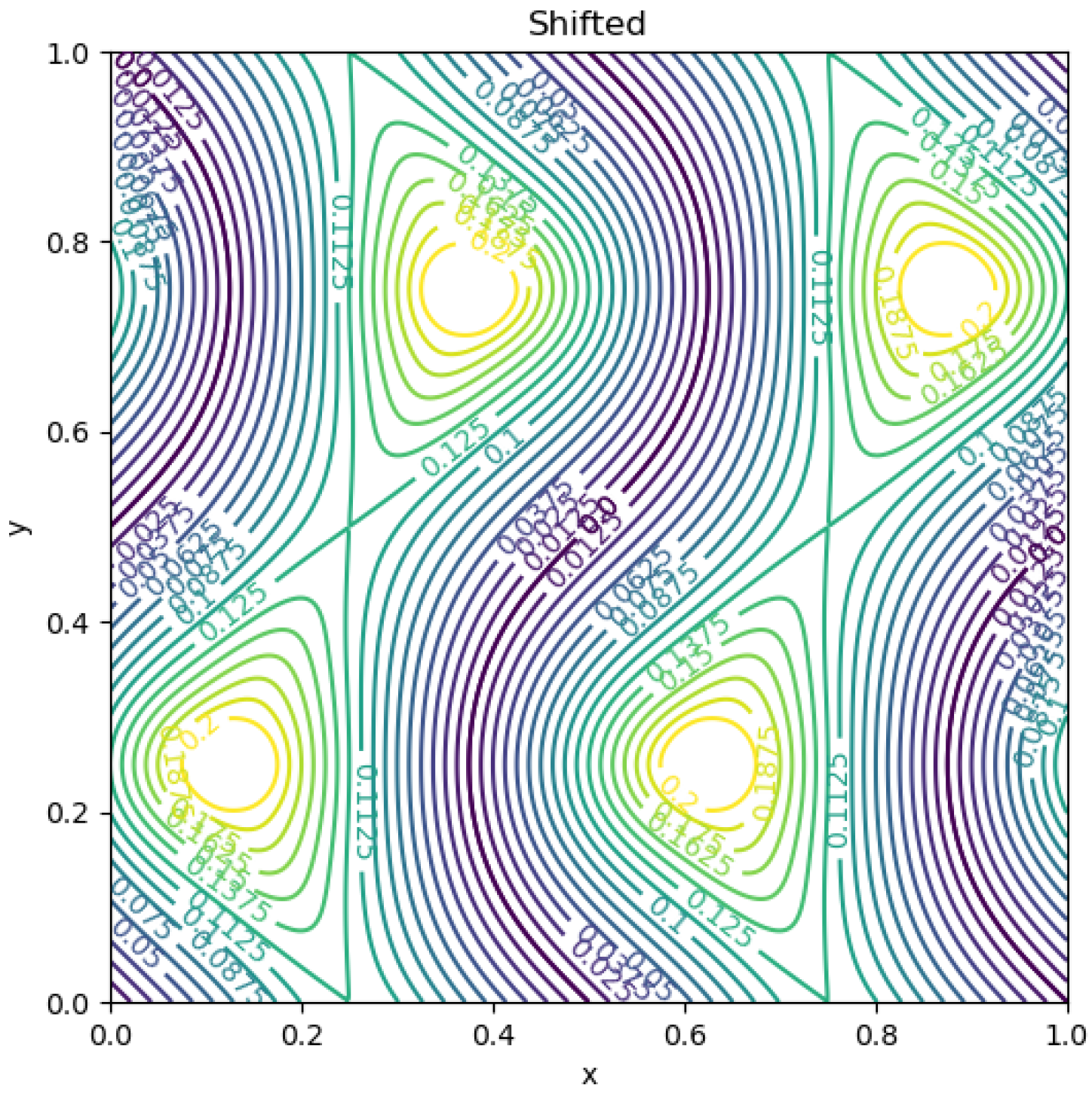
m, which can be visualized in
Figure 3. This figure shows a single shift; however, there are actually two shifts of the original surface, a positive and a negative, which define the boundaries of the desired TPSf lattice body.
2.2. Splitting Magnitude Component
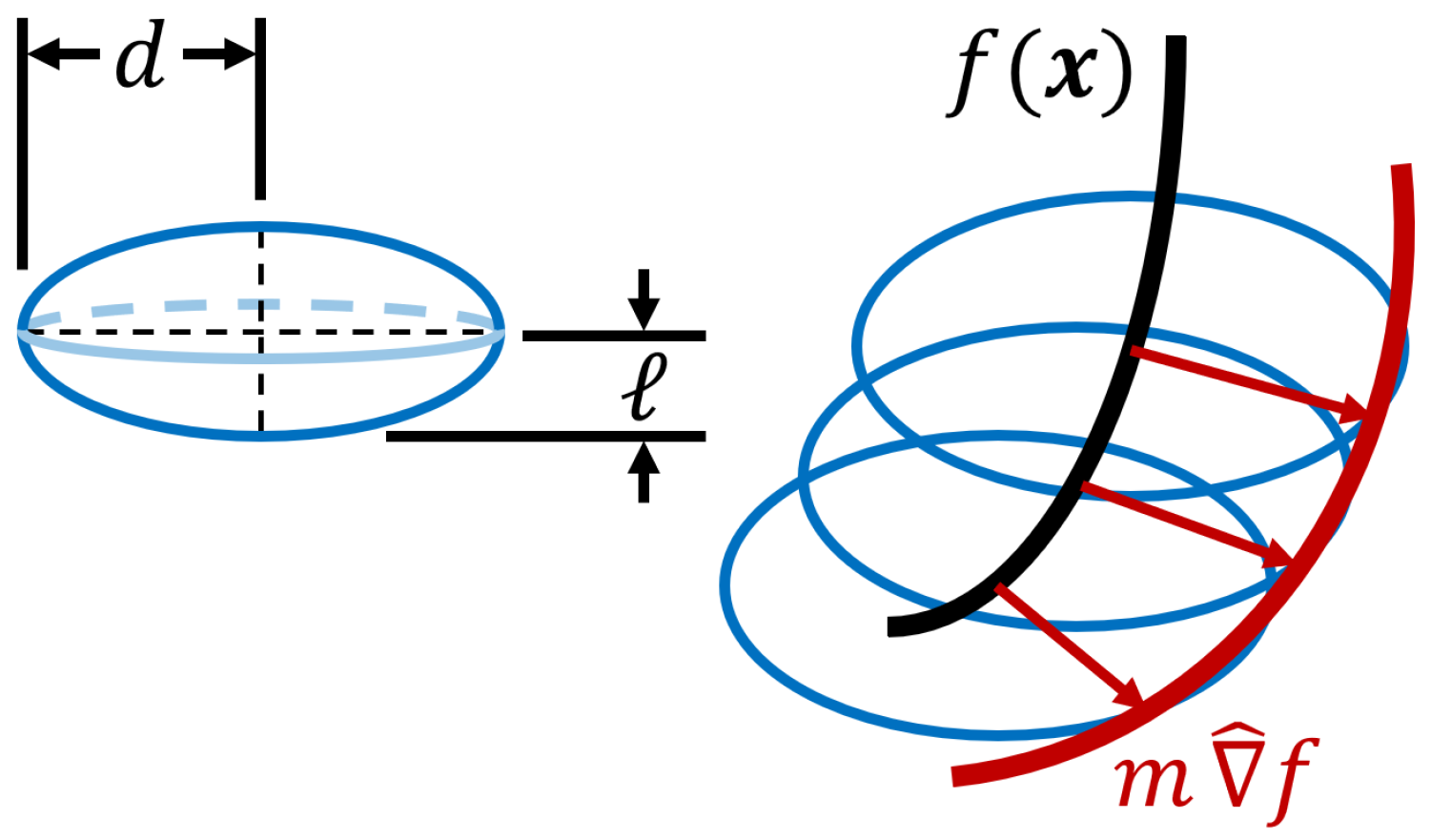
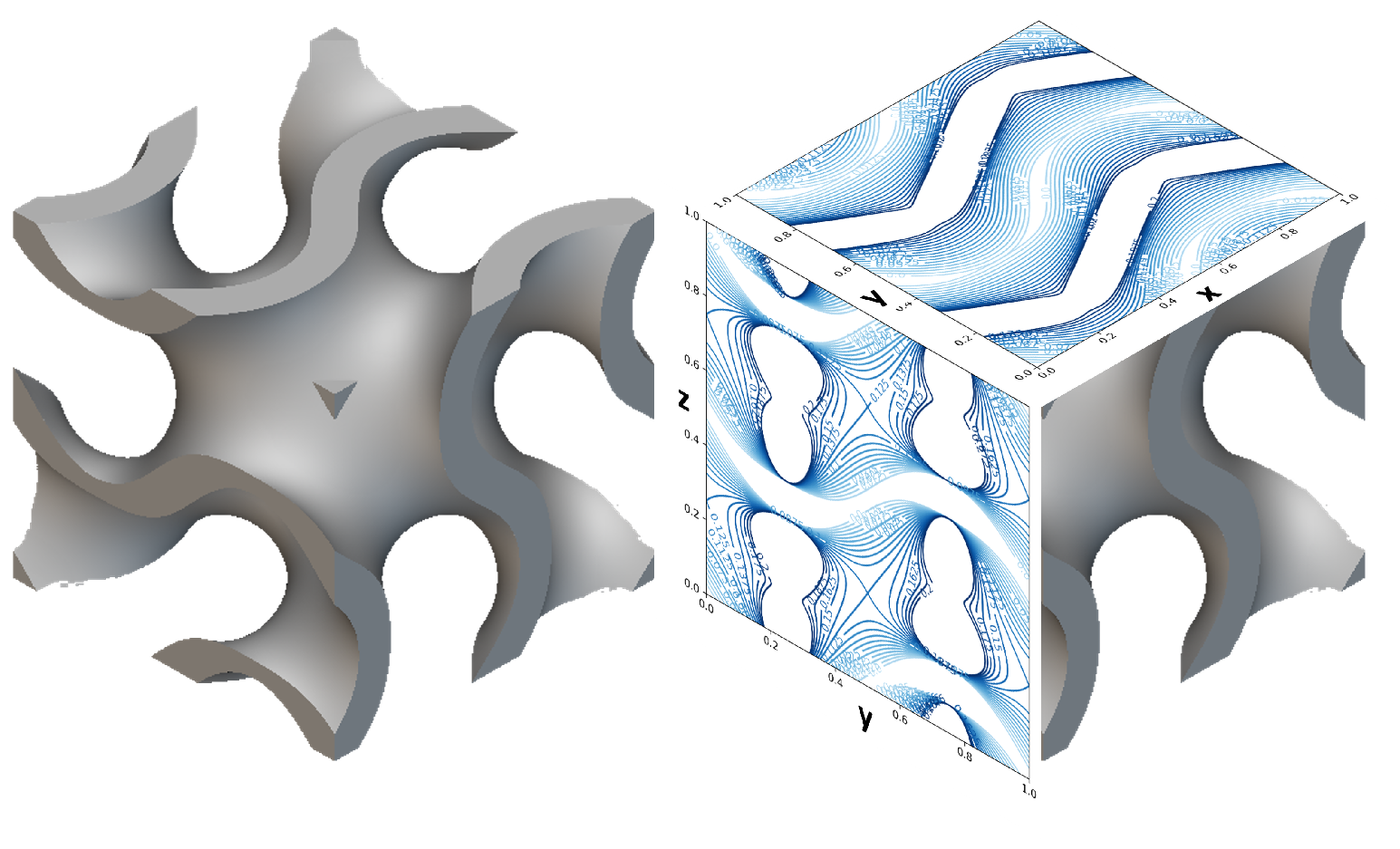
The next item to consider is separating the components of the magnitude based on their relation to the build direction. If this is to be implemented in 3D space while considering the layer height and build height, then this offset will need to shift the magnitudes relative to an ellipsoid. Consider the
z-dimension as the build direction, where the desired layer height is different from the desired wall thickness. Imagine projecting an ellipsoid along the surface, such that the unit gradients are intersecting that ellipsoid at a point that determines their length (see
Figure 4). This is the desired result in order to uniformly and smoothly offset the surface.
There were two methods considered for implementing this: a vector-based projection and a scalar-based projection. The vector-based projection uses the equation of an ellipsoid defined as
where
ℓ is the desired layer height;
d is the desired wall thickness; and
x,
y, and
z are the feature space dimensions. Then, the magnitude can be determined by the intersection of the unit gradient vectors and the ellipsoids:
where
,
, and
are the
x,
y, and
z components of unit vector gradient
and
m is the magnitude at which the unit gradient vectors intersect the ellipsoids. Solving for
m the following is found:
This
can be substituted into Equation (
1), and can produce some adequate surfaces in special cases. However, this representation alone fails as the unit vector component
approaches 1 or 0, because the vector-based definition sharply curves between
ℓ and
d, causing discontinuities in the surface. An alternative method is to apply a scalar-based projection, which can be implemented by applying the magnitudes directly to each desired dimension using
in the form
where ⊙ denotes element-wise multiplication. This method holds for two special cases that we present here in limit form. First, that as the direction of the gradient approaches perpendicular to the build direction, the magnitude of the offset approaches the prescribed wall thickness
. Secondly, that as the direction of the gradient approaches parallel to the build direction, the magnitude of the offset approaches the prescribed layer thickness
. Both cases hold for Equation (
7) because
has a magnitude of one by definition.
2.3. Rotating the Magnitude Effects
Another benefit of the scalar-based projection is the ability to apply rotation to the magnitude vector in order to dynamically change the build direction. Using Rodrigues’ rotation formula, we can develop a rotation matrix:
where
is Rodrigues’ rotation formula,
is the cross-product matrix,
is the identity matrix,
is the current assumed build direction vector [0, 0, 1], and
is the new desired build direction vector. Then, Rodrigues’ rotation formula can be further simplified by applying the trigonometric cross-product formula and applying the known assumptions of vectors
and
. Knowing
is a unit vector since it defines the original build direction, and
can be assumed as a unit vector of the new build direction:
If
, our current build direction, is to be rotated to align to
, some field of build direction vectors, then to describe the rotation between the build directions we solve the simplified Rodrigues formula by combining Equations (
8), (
9), (
10), and (
11) to produce the rotation build direction matrix
in Equation (
12).
There are two special cases that must be accounted for to address the limitations of the rotation matrix: division by zero and rotation of
. To avoid division by zero in the case where
, we apply the signum function defined in Equation (
13).
Since
is non-negative, the signum(
) will be 0 or 1. Therefore,
becomes
to account for this special case. A second modification was made to account for the fact that the Rodrigues formula does not allow rotations of
, which occur when the original and new vectors are aligned, so it does not perceive the need for rotation. Therefore, a fix was developed to address the case where
. If
, then
; applying this to the rotation matrix will allow the
term to address the negative components necessary; since the only cases to address are those where
, we can apply the signum function:
The rotation formulation of Equation (
14) was reduced to its algebraic form and implemented in a rotation block in nTop to perform rotations of fields; this can be found in ‘
CB Rotation Transformation’. The matrix must be applied to a unit vector based on our prior assumption of
being a unit vector, and the magnitude can be reapplied after the rotation transformation is performed. When applied to our magnitude unit vector,
, the rotation can produce a vector with negative components due to the nature of rotating vectors. Therefore, the absolute value of the rotation is used, since the magnitude should have no effect on the direction of the gradients. This ensures that the effects of the magnitude are rotated effectively. This results in the final scalar-based projection shift formulation:
4. Conclusions
The benefits of additive manufacturing have been exemplified by the many advantages of lattice structures: improved strength-to-weight ratios, effective heat dissipation, increased ductility, and many more. However, these benefits have yet to be realized in large-scale additive manufacturing as it prioritizes high material placement over precision, which limits the ability to print complex geometries. To support the manufacture of large-scale lattices, this work proposes a new equation-based lattice definition to directly define lattice wall thickness. This definition was motivated by the three key design features of large-scale AM:
- 1.
It is desirable to design lattices such that they are meaningfully and uniformly generated such that they can maintain a boundary wall for accurate manufacturing;
- 2.
There is value in separately defining the thickness of the lattice based on the build direction;
- 3.
There is benefit to rotating the effects of the wall thickness magnitudes to accommodate build direction-agnostic AM methods.
The new definition will benefit both small- and large-scale AM as it empowers designers to have more control over how their lattices are generated with respect to wall thickness rather than volume fraction. This definition was implemented using implicit fields directly in nTop to enable accessibility.
The primary benefit of the method was demonstrated in the ‘Uniform Shift’ nTop block, which develops a uniform offset from the isosurface, allowing designers to explicitly define the thickness of the lattice. This demonstrated that the field is only uniform when the offset is less than 10% of the unit cell body width for gyroid unit cells. The new definition proved immune to scaling the unit cell width, whereas with the original definition, scaling requires careful tuning to determine its effects. This ensures the development of unit cells with meaningful units. For applications where the build direction can change, such as WAAM, it is beneficial to dynamically define the build direction such that the nozzle orientation is considered. This benefit was realized in the ‘Shift Rotation’ nTop block, which can accept a field of unit build directions to dynamically define the layer height and wall thickness throughout the unit cell as it is built. This feature will enable designers to print more detailed lattice structures by taking advantage of the finer precision offered by layer height rather than nozzle size. Finally, the field definition of the function still enables the application of physics-informed analysis, where the fields can be used to thicken and rotate fields as needed.
Limitations to this method appear when the applied offset thickness is below a critical value relative to the lattice unit cell size. For example, the current definition only maintains uniformity for gyroids when the thickness is less than 10% of the unit cell width; outside of those values the holes in the lattice start to negatively affect the definition, which is a limitation of the first-order gradient shifting technique. Other lattice fields should be adjusted based on their individual fields, as it is unclear if they will maintain uniformity as the wall thickness increases to larger than 10% of the unit cell width. Another major limitation of large-scale AM is often the maximum overhang angles, which will require further investigation to incorporate into the method. Finally, the effects of rotation were not directly measured and will require further validation before implementing complex rotation fields.
Future work will explore how these functions translate to the physical space. This will include building equation-based lattice structures using DED or MEX systems, and comparing the as-built structures to the intended as-designed geometry. Further testing would include an evaluation of the effects on the equation-based lattice mechanical properties from the defined thickness method presented here relative to the conventionally defined geometry. Additional work will be required to adapt this equation-based lattice definition to multi-axis AM systems, including those based in a polar coordinate system [
30].