1. Introduction
Eco-friendly innovations such as electric mobility are encountering obstacles including the depletion of resources and global warming [
1]. The battery is the pivotal component that plays the most critical role in the transition from internal combustion engine vehicles to future vehicles. Not only are lightweight packages required to improve mobility efficiency, but high-strength materials and designs that can protect components from external impacts are required. Through research and development, traditional combustion engine-powered vehicles have provided durable and high standards to users. Therefore, the components that serve as the key to future vehicles must be sufficiently stable and protected from shock and corrosion [
1,
2,
3].
Automobiles have been constructed with complex structures and various metal materials to enhance reliability. Increasing steel strength in components and modules is a common practice, but this entails unnecessary structure and weight. To reduce weight and improve driving efficiency, the thickness of steel can be reduced. However, the strength is also reduced, and the manufacturer’s investment in optimization design and verification increases. Recently, methods have emerged to assemble various materials and appropriately utilize their individual characteristics effectively. For example, batteries connect multiple materials to achieve efficient packaging and performance [
1,
4,
5,
6,
7,
8,
9,
10].
Mainly, batteries consist of hundreds to thousands of cells connected in series, each very sensitive to assembly. However, materials exhibiting high electrical and thermal conductivities, such as copper and aluminum, are generally termed “difficult to weld” [
1,
6,
8]. Mechanical assembly using bolts, etc., is traditionally available, but problems such as structural deformation may occur because high pressure is applied. Using chemical adhesives can reduce weight with a simple process, but adhesives have the weakness of losing strength due to temperature or humidity. To overcome these limitations, welding techniques have been developed for the copper cathodes and the aluminum anodes; ultrasonic, resistance-spot, and laser welding are employed to this end [
1,
2,
3]. Ultrasonic welding is a solid-state method that converts high-frequency electrical energy into mechanical vibration to generate heat between the bonding interfaces. Since ultrasonic welding is a reliable process, it is used principally to form tap-tap and tap-bus bar joints. However, the equipment is ordinarily expensive and challenging to operate in confined spaces [
1,
4,
5,
6,
7]. Arc or electric resistance welding is common and has a favorable technical approach for users, but it is not easy to achieve high-quality welding of dissimilar materials. The joint will fail because of its low precision controllability if the heat input is insufficient. At the other extreme, intermetallic compounds will form at the joint interface if excessive heat is applied, causing damage and reducing the weld’s strength and durability [
9].
Laser welding is a facile method that enables automated production and is thus commonly used to manufacture components [
11,
12,
13,
14]. Compared to the other joining techniques described above, the area to be processed by heat can be minimized. Therefore, the mechanical and electrical properties of the material are adequately protected, because external forces and chemical impacts are not entailed [
11,
15,
16]. Laser welding of dissimilar materials uses low photon energy to preserve material properties, so the reduction of laser absorption due to optical reflection on the material surface is a crucial factor in reducing the quality of the joint. Methods to modulate the laser power more precisely, in a pattern, or to use multiple beams have also been studied. Moreover, laser keyhole welding of dissimilar materials, specifically for battery welding applications, offers outstanding advantages [
16,
17,
18].
The focused laser beam can create a deep, narrow, keyhole-shaped penetration into the materials, allowing fast and efficient welding with minimal heat input. Laser keyhole welding can achieve high welding speeds, significantly increasing the productivity and efficiency of battery welding processes. The small heat-affected zone and minimal thermal distortion associated with laser keyhole welding allow for precise control over the welding process, resulting in high-quality and consistent welds [
15,
16]. Since accurate and reliable assembly processes are essential to ensure battery integrity and performance, keyhole laser welding machining advantages can be well-utilized in battery component assembly. The keyhole laser can penetrate the battery materials, enabling the reliable welding of thick and multi-layered battery components. The ability to create deep and narrow welds with a single pass reduces the need for multiple welding passes, saving time and improving efficiency in battery welding. Energy efficiency is significant compared to traditional welding methods. The focused laser beam delivers energy precisely to the desired welding area, minimizing heat loss to the surrounding materials [
13]. This results in reduced energy consumption and lower operating costs. These advantages make laser keyhole welding a preferred choice for battery welding applications, improving productivity, quality, and cost-effectiveness in producing batteries for various industries, including electric vehicles, consumer electronics, renewable energy storage, and more [
11,
12,
13,
14,
15].
Dual-beam laser welding is advancing manufacturing sectors, including automotive, aerospace, and EV battery production. It enables the precise joining of dissimilar materials, such as aluminum and copper, which are challenging due to their differing physical and chemical properties [
19,
20,
21,
22]. Issues such as intermetallic compound (IMC) formation, heat input control, and thermal mismatches hinder traditional welding. Dual-beam systems improve energy distribution and joint quality [
19,
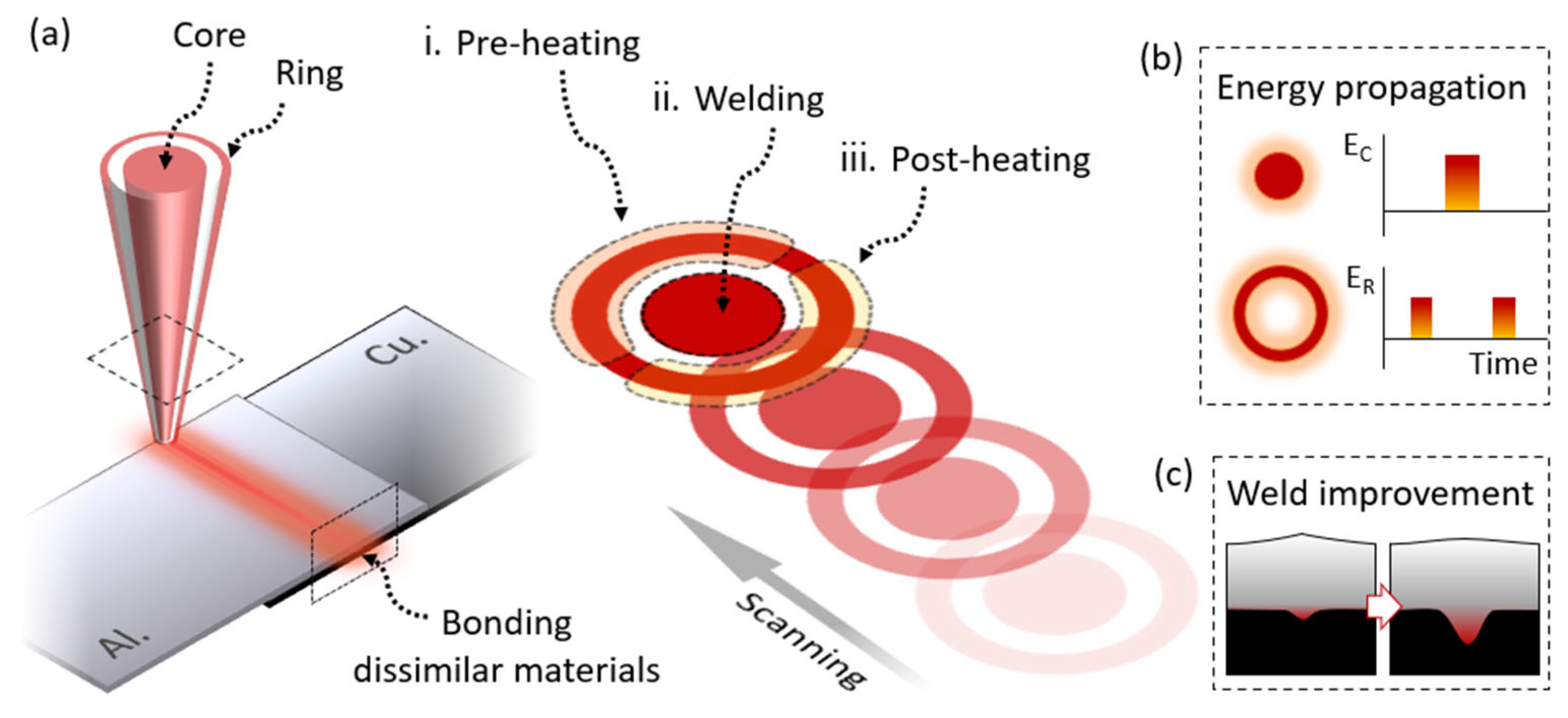
21]. Combining core and ring laser beams, dual-beam systems control energy input for pre-heating, welding, and post-heating. This minimizes IMC formation and enhances tensile strength [
10,
22].
Tools like CFD and meta-models optimize process parameters for joint geometry, heat distribution, and defect mitigation. Empirical studies validate simulations, refining welding parameters to ensure quality and scalability [
10,
20,
22]. Dual-beam welding reduces defects like cracks and porosities, improving manufacturing throughput and product reliability. These techniques enable the scalable production of lightweight, high-performance assemblies for diverse applications, from EV batteries to aerospace. Developing real-time monitoring systems and extending methodologies to more material combinations can increase adoption and industrial impact [
10,
19,
20,
21,
22].
To study dissimilar material welding, it is important to understand the material interaction between lasers and materials. Molecular dynamics simulations and experimental verifications have been carried out to address challenges in integrating graphene with Cu nanoparticles for advanced interconnect materials. These studies determined that graphene slows the sintering process while enhancing mechanical properties such as shear strength and reducing porosity. Simulating various sintering temperatures, it demonstrated that higher temperatures accelerate sintering, improving its efficiency, thus validating the applicability of graphene-Cu composites in high-performance, low-temperature scenarios [
23,
24].
To understand a laser’s material interactions with dielectric materials, laser ablation of alumina-zirconia composites was carried out to investigate the potential for medical implants, highlighting how varying alumina content influences material removal rates, thermal cracking susceptibility, and laser ablation thresholds. Composite materials showed lower ablation thresholds compared to single-phase materials, suggesting their higher machinability. Insights from this study offer significant implications for optimizing laser parameters and material compositions to improve the performance of dental and orthopedic implants [
25,
26]. Femtosecond laser fabrication of infrared micro-optical devices focus on leveraging advanced laser processing for hard and brittle materials. By combining etching and laser techniques, it enables precise three-dimensional structuring of infrared optical components, including microlenses and anti-reflective structures. These advancements demonstrate significant applications in fields like aerospace, biomedical imaging, and infrared detection systems [
24,
25,
26].
Laser modulation is another way to improve weld quality. High-density laser welding creates a rapid temperature rise in the material, and the rapid decrease makes the weld brittle. Studies have improved welding quality via real-time pre-heating, welding, or post-heating [
6,
10]. However, the increase in processing time increases the cost and reduces productivity [
10,
16]. To encounter the problem, real-time modulation methods such as dual-beam and transverse mode are used [
17,
18,
27,
28]. Laser beam modulation refers to the intentional variation of the characteristics of a laser beam, such as its intensity, frequency, or phase, over time [
10,
27,
28]. Thus, we suggest that the laser with modulation is appropriate to increase the absorption of difficult to weld materials such as copper and aluminum. Still, the effect of laser beam modulation can vary depending on the specific modulation technique and its parameters. Keyhole laser welding with modulation is quick and energy-dense. Studying the complex energy behavior within the weld pool is a challenge. Ultrafast lasers can be used to weld transparent materials, leveraging nonlinear absorption and precise energy deposition to achieve localized thermal effects and melt pool control [
29]. It can minimize the accumulation of heat through high-repetition-rate lasers, dynamic plasma morphology management, and spatial/temporal shaping, which enhance melt pool flow stability and enable advanced applications in transparent and heterogeneous material joining [
29].
This research introduces Ring Beam Modulation-assisted Laser (RBML) welding as a novel technique for joining dissimilar materials like aluminum and copper, addressing challenges such as thermal mismatches and brittle intermetallic compounds. The findings demonstrate enhanced weld quality, energy efficiency, and reliability through optimized laser modulation, with applications in industries like electric vehicles and aerospace. However, the study is limited to specific materials and parameters. Future research should explore a wider range of materials, adaptive laser modulation, and long-term joint performance under operational conditions to expand the technique’s industrial applicability.
Here, we propose state of the art beam modulation of the laser into the core and ring. The specimens are fabricated using a multi-beam laser. The welding characteristics of copper and aluminum under various heat input distributions were studied theoretically and experimentally. The optimal heat input and methodology were obtained by analyzing the weld cross-section and tensile load. We performed computer simulations to ensure the reliability of the laser machining technology. In addition, the computational analysis developed an optimal balance of core and ring laser power, which may reduce the significant thermal mismatch in laser welding. We expect that the proposed compelling idea of assembling dissimilar materials will contribute to the processing of lightweight and multi-property components and assemblies. Furthermore, the idea can be extended to apply to various industries such as batteries, aerospace, and medical devices.
3. Results and Discussion
3.1. Fabrication
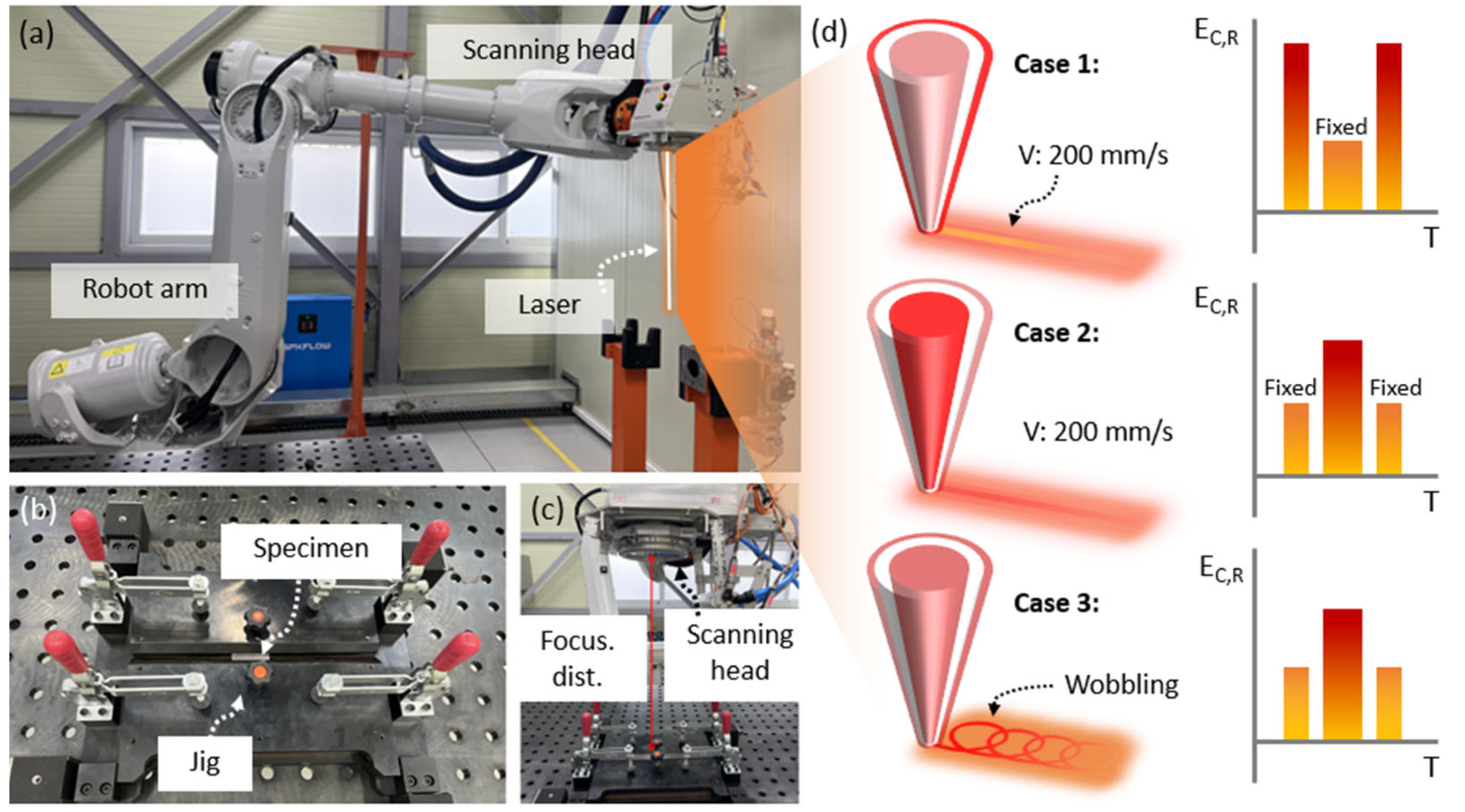
In Case 1, the center beam output was fixed at 800 W, the ring beam output was 1600 W to 2400 W, and the welding speed was 200 mm/s. In Case 2, the center beam output varied in 50 W steps from 950 to 1150 W, the ring beam output was fixed at 500 W, and the welding speed was set at 200 mm/s. These optimal parameters are identified via initial experiments, and the optimized procedures are performed at least five times.
3.2. Vision Analysis
To investigate the effects of pre- and post-heating through the ring beam modulation-assisted laser welding, we performed a visual analysis to figure out the cross-section of each sample. For the cross-sectional analysis, we used the Keller etch solution (H2O 950 mL + HNO3 25 mL + HCl 15 mL + HF 10 mL). Specimens were cut, mounted, polished, and etched, and regions with welding defects such as cracks and pores were identified.
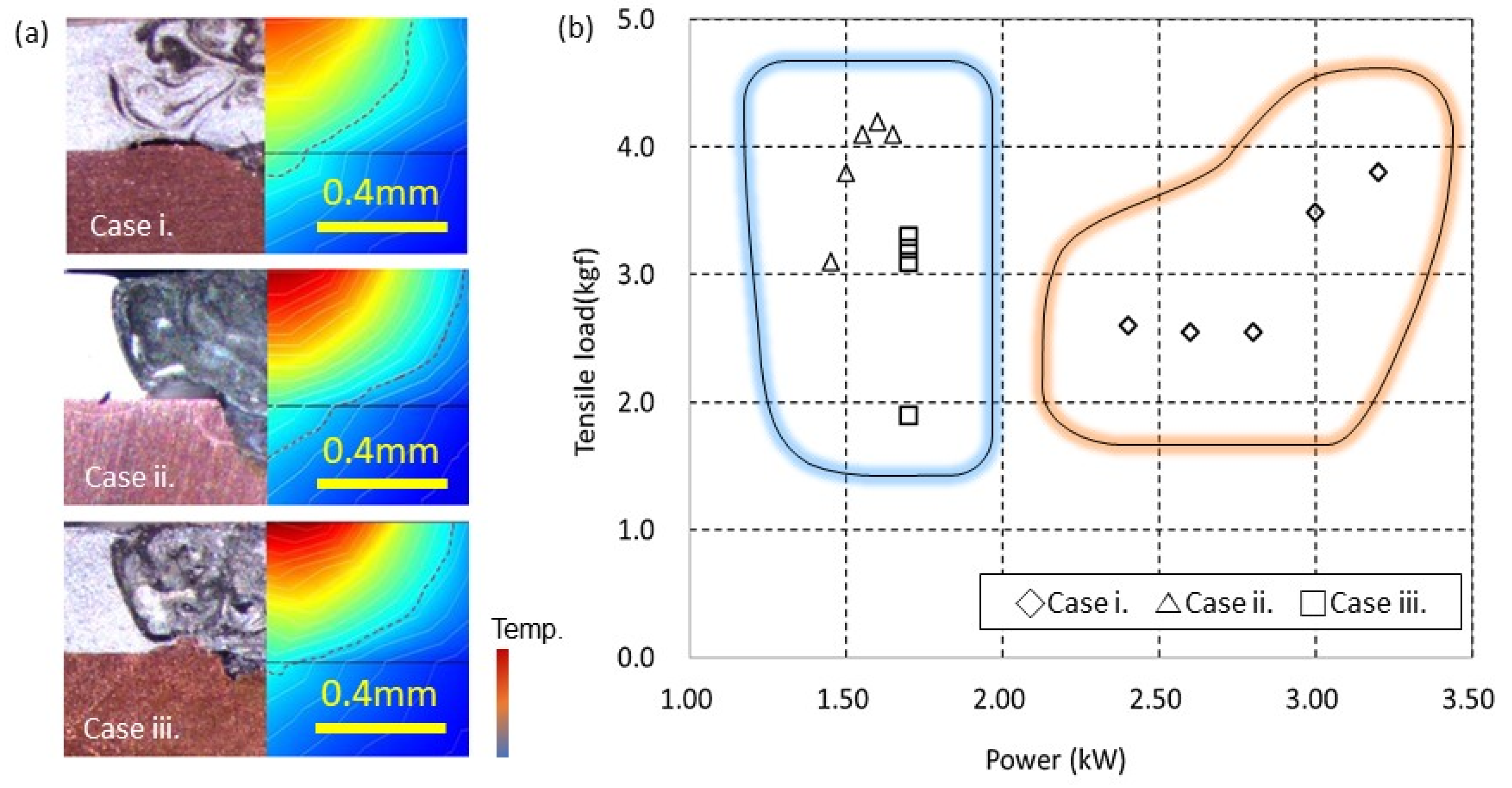
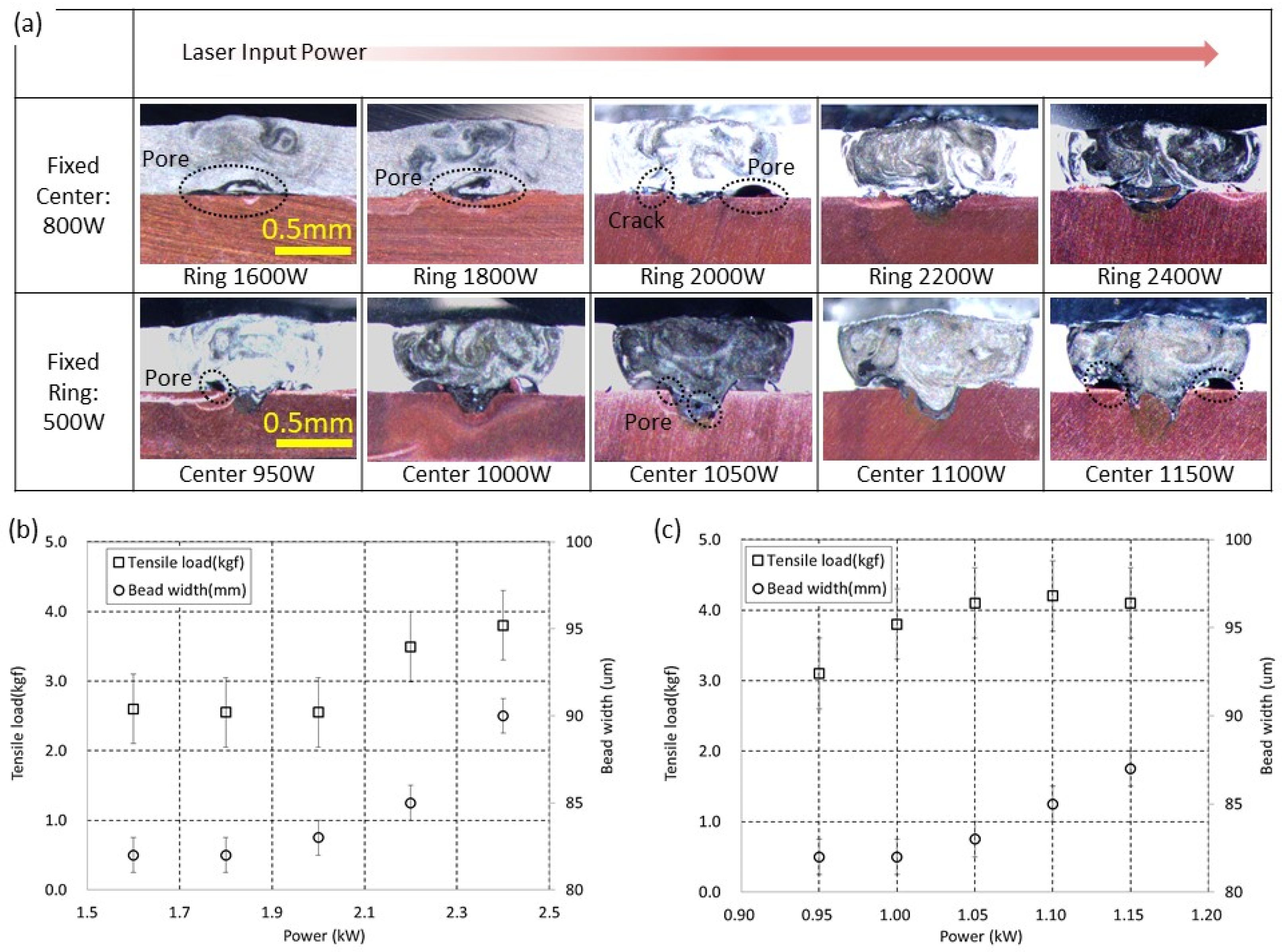
As shown in
Figure 3a, the cross-sections revealed uniform interfacial bonding throughout the welds and local finger-like welds; the copper and aluminum layers were well-mixed. Generally, the stronger the bonding strength, the more the two layers are mixed and welded. Since the laser is irradiated from top to bottom, as shown in the picture, the stronger the laser input energy, the more the structure that invades downward at the interface of the two materials develops.
The shaded area in the picture mainly indicates pores. Pores occur when there is not enough support energy for bonding. In our tests, pores occurred when ring modulations of 1600 W to 2000 W and core modulations of 950 W and 1050 W were used. Pores also occur when the input energy of the ring is insufficient compared to the core; in our tests, this occurred at a core modulation of 1150 W. In addition, cracks may occur during the curing process if the post-heating is inappropriate. In our case, this occurred when the ring input power modulation was 2000 W.
3.3. Mechanical Analysis
Next, we performed a tensile test. The maximum tensile force was measured by output and condition using a lab scale tester (Cometech QC-528K4). The speed of the tensile test was 20 mm/min, and the force was evenly distributed along the 20 mm weld length. In
Figure 3b, the maximum loads were 2.6 and 3.8 kgf at the minimum and maximum ring beam outputs (1.6 and 2.4 kW, respectively).
Slight deformations with no distortion were apparent in the welds and the heat-affected zones. When the center beam was fixed and the ring beam was modulated from 2200 W, not only did the tensile load increase rapidly, but also defects such as pores or cracks did not occur. This result suggests that proper support of the ring laser can effectively improve the strength and quality of laser welding. According to the significant finger-like welds in cross-sectional views, central beam modulation can provide improved welding.
In
Figure 3c, the beads in the welds are quite uniform; the bead width of the upper layer is 80~90 µm depending on the output. The maximum allowable load was 3.1 kgf at 0.95 kW (the minimum center beam output) and the maximum load was 4.2 kgf at an output of 1.1 kW. The maximum allowable load decreased slightly at 1.15 kW, but the difference was within the range of error. No weld distortion or deformation was observed. The welds of Case 2 were slightly better than those of Case 1. Comparing the weld quality according to the bead width of Case 1 and Case 2, Case 2 provided a strong weld. When the bead width of Case 1 was about 81 to 83 um, the tensile load was 2 to 3 kgf/mm, while for Case 2 it was 2.6 to 3.6 kgf/mm. When the bead width of Case 2 was about 84 to 86 um, the tensile load was 3 to 4 kgf/mm, while for Case 2 it was 3.8 to 4.8 kgf/mm.
3.4. Application: Wobble Welding
Cases 1 and 2 focused on evaluating the effectiveness of weld joint strength by varying the laser power. In contrast, Case 3 explores an alternative approach to achieving controlled heat distribution. While heat distribution can typically be managed through laser beam shaping or adjustments in laser power, we employed laser beam wobbling in Case 3 to achieve a similar effect. This technique introduces oscillatory motion to the laser beam, enabling precise control of heat distribution and potentially enhancing weld quality.
A scanning modulation, called wobbling, increases weld reliability because interfacial fusion proceeds throughout the welds, resulting in fewer pores and cracks than in non-wobble welds, as shown in
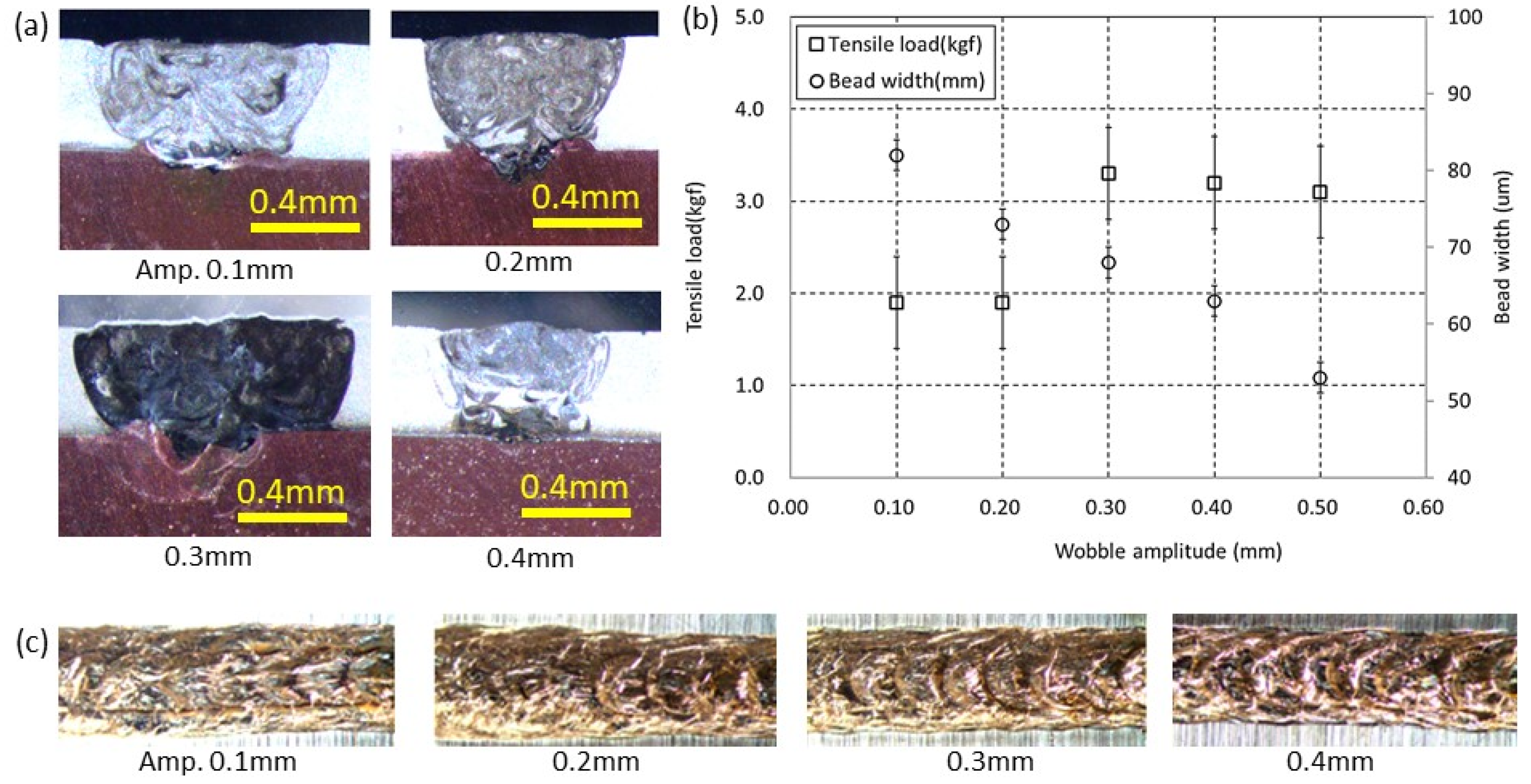
Figure 3a. Here, to overcome these limitations, we adopted wobble welding. To investigate the advance of wobbling modulation, the output of the center beam was fixed at 1.1 kW and that of the ring beam at 0.6 kW (Case 3).
Wobbling was performed by varying the amplitude (rotating radius) of the laser beam from 0.1 to 0.5 mm. The wobbling frequency was 500 Hz and the linear feed rate was 200 mm/s. No shielding gas was supplied. The results are shown in the
Figure 4a. The welded beads are uniform and the upper bead width range is 53~82 µm, depending on the amplitude. As the wobble amplitude increased, the maximum allowable tensile force also increased. This amplitude is linked to the wobbling frequency and welding speed. The cross-sectional view shows the uniform interfacial bonding throughout the welds; there are no pores or cracks.
Figure 4b shows the tensile/shear tests. The minimum allowable load was 1.9 kgf at an amplitude of 0.5 mm, and the maximum allowable load was 3.3 kgf at an amplitude of 0.3 mm.
Comparing Cases 2 and 3, Case 3 shows a higher resolution welding capability and improved welding quality. In Case 2, the bead width is 81~83 um when the tensile load was 2.6~3.6. In Case 3, the bead width is about 51~55 um. There are no pores or cracks. The difference is outside the error range; the maximum allowable load decreased as the amplitude increased. In the case of
Figure 4c, it can be seen that the higher the overlap rate of the welding beads as the amplitude value decreases under the same welding conditions and frequency, the higher the tendency of the width of the formed welding beads to increase. For this reason, it is judged that the bead width changes according to the value of the amplitude, affecting the maximum allowable tensile force.
3.5. Computer Simulation
Computational analyses were conducted for shape factors 1, 2, and 3.
Figure 5a compares the experimental cross-sections and the simulated temperature distributions, in which the maximum temperature reached 1085 °C at the fusion boundary between dissimilar materials (dotted lines). Simulation elucidated the flow and heat distributions within dissimilar materials welded at high speeds. The shape factor and the surface penetration depth connected the simulations to real-world welding. The optimal shape factor was derived by comparing the temperature during welding measured by a thermocouple with the simulated temperature. The simulated cooling rates facilitate an understanding of the intermetallic compound layer. For shape factors between 1 and 3, the respective maximum temperatures were changed to 976.7, 857.4, and about 775 °C.
All of the simulated factors of previous studies were 1; our figures are more similar to the experimental results. As an earlier study revealed that the optimal copper-layer penetration depth was 0.15 mm, we simulated depths of 0.05, 0.1, 0.15, and 0.2 mm; the respective temperatures were 1575.6, 857.3, 602.2, and 462.8 °C. The 0.15 mm value is closest to the experimental result.
To study the quenching effect, we simulated cooling rates after welding and compared them to the experimental results. The maximum temperature for a center beam of 800 W was 336 °C. On cooling, the temperature fell to 59 °C after 0.05 s. The temperature decrease was 82%, thus rapid. For the dual (center- and ring-) beam laser with a central beam of 800 W and a ring beam of 700 W, the maximum temperature was 518 °C. After 0.05 s of cooling, the temperature was 158 °C. The temperature reduction was 69%. Dual-beam laser welding thus afforded better cooling control than single-beam welding.
3.6. Effectiveness of Idea
Figure 5b combines results. The laser input powers ranged from 1.5 to 3.3 kW. At 2 kW, low and high heat input regions were discernible, and welding reliability was acceptable at 3 kgf. Excessive heat input did not necessarily increase weld strength. A comparison of Cases 1–3 revealed no proportional relationship between the welding strengths of the low and high heat input areas. Case 1 (◇) was associated with 2 to 3.3 kW input, but the welding strength was below 3 kgf. In Case 2 (△), the heat input was 1.5 to 1.7 kW, but the welding strength remained excellent. In Case 3 (□), the laser beam wobbled, and the welding strength varied while the heat input remained constant.
In summary, joining dissimilar materials of aluminum and copper by laser welding presents specific challenges and requires a careful consideration of their disparate properties. Based on the results, there is a significant thermal mismatch, which reduces the joint’s quality. Since aluminum has higher thermal conductivity and a lower melting point than copper, the thermal mismatch can result in uneven heat distribution during laser welding, leading to potential issues such as incomplete melting, excessive melt pool, or distortion. Aluminum and copper exhibit limited solubility in each other in their liquid state, which can form brittle intermetallic compounds at the weld interface. These intermetallic compounds can adversely affect mechanical properties of the joint such as strength and ductility.
Proper selection of laser parameters and joint design is crucial to mitigate the formation of intermetallic compounds and ensure a sound joint. In our experiment, the weld quality also depended on surface preparation. Due to the oxide layer of material that forms on aluminum surfaces and the potential for intermetallic compound formation at the weld interface, careful surface preparation is essential for successful dissimilar material joining of aluminum and copper by laser welding.
4. Conclusions
The experimental findings underscore the intricate interplay between laser beam modulation and the physical properties of dissimilar materials like aluminum and copper. The observed weld joint quality highlights the critical role of precise energy distribution. In Case 1, fixing the center beam output while varying the ring beam demonstrated how controlled pre- and post-heating can influence weld bead uniformity and tensile strength. However, excessive heat accumulation from the ring beam led to swelling in the upper weld zones, emphasizing the need for an optimal balance between the center and ring outputs. Case 2, on the other hand, showcased the advantages of modulating the core beam output, achieving superior tensile strength and bead uniformity compared to Case 1. These results suggest that a relatively low and stable ring beam output, combined with a modulated center beam, enhances energy efficiency while mitigating deformation risks. In Case 3, wobble welding further refined the control over heat distribution and weld quality. The smaller bead width and higher resolution of welds compared to Cases 1 and 2 signify the potential of wobble welding for applications requiring precision. The simulation results complement the experimental data by providing insights into the thermal dynamics of the weld pool, confirming that dual-beam laser setups achieve better cooling control and reduced thermal mismatches than single-beam systems.
Through this experimental study, we propose ring beam modulation-assisted laser welding on dissimilar materials. Note that the appropriate ring beam modulation enhances weld reliability. On cross-sectional analysis, finger-like penetrations were observed in the weld centers. Thus, energy consumption was effective, and reliable welding proceeded over minimal areas. When the core beam output was fixed, and that of the ring beam was varied, the weld beads were good, and the maximum allowable load increased as the output increased. However, as excessive heat from the ring beam traveled to areas affected by the center beam, the upper part of the weld became swollen, because the ring beam energy generated before and after welding diffused internally and became trapped, resulting in deformation. However, interfacial bonding occurred over a wide area, and the welding was nonetheless reliable. Swelling was not observed when the ring beam output was fixed at 500 W and that of the center beam varied. Therefore, to maximize the beneficial effects of pre- and post-heating, it is best to vary the output to the weld center and set the ring beam output relatively low.