
Article

A Bidirectional Digital Twin System for Adaptive Manufacturing

Institute of Production Engineering and Machine Tools, Leibniz University Hannover, 30823 Garbsen, Germany
*
Author to whom correspondence should be addressed.
J. Manuf. Mater. Process. 2025, 9(12), 400; https://doi.org/10.3390/jmmp9120400
Submission received: 28 October 2025 / Revised: 20 November 2025 / Accepted: 28 November 2025 / Published: 4 December 2025
(This article belongs to the Special Issue Digital Twinning for Manufacturing)

Abstract

Digital Twin Systems (DTSs) are increasingly recognized as enablers of data-driven manufacturing, yet many implementations remain limited to monitoring or visualization without closed-loop control. This study presents a fully integrated DTS for CNC milling that emphasizes real-time bidirectional coupling between a real machine and a virtual counterpart as well as the use of machine-native signals. The architecture comprises a physical space defined by a five-axis machining center, a virtual space implemented via a dexel-based technological simulation environment, and a digital thread for continuous data exchange between those. A full-factorial simulation study investigated the influence of dexel density and cycle time on engagement accuracy and runtime, yielding an optimal configuration that minimizes discretization errors while maintaining real-time feasibility. Latency measurements confirmed a mean response time of 34.2 ms, supporting process-parallel decision-making. Two application scenarios in orthopedic implant milling validated the DTS: process force monitoring enabled an automatic machine halt within 28 ms of anomaly detection, while adaptive feed rate control reduced predicted form error by 20 µm. These findings demonstrate that the DTS extends beyond passive monitoring by actively intervening in machining processes; enhancing process reliability and part quality; and establishing a foundation for scalable, interpretable digital twins in regulated manufacturing.

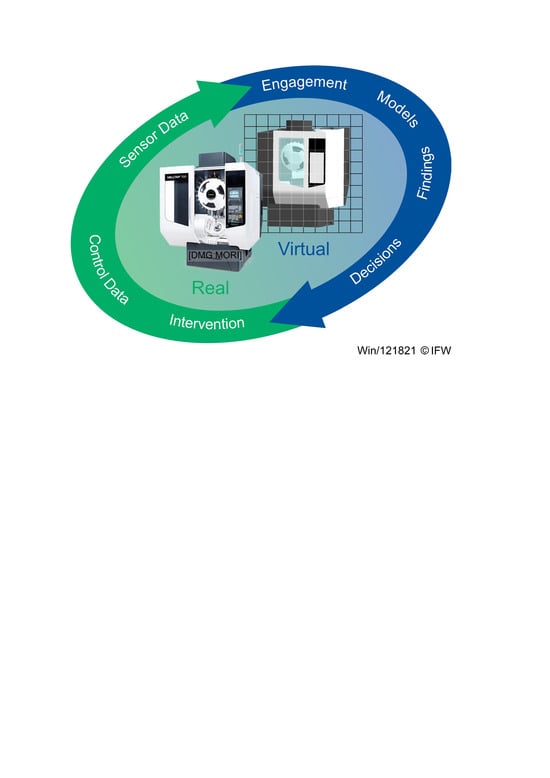
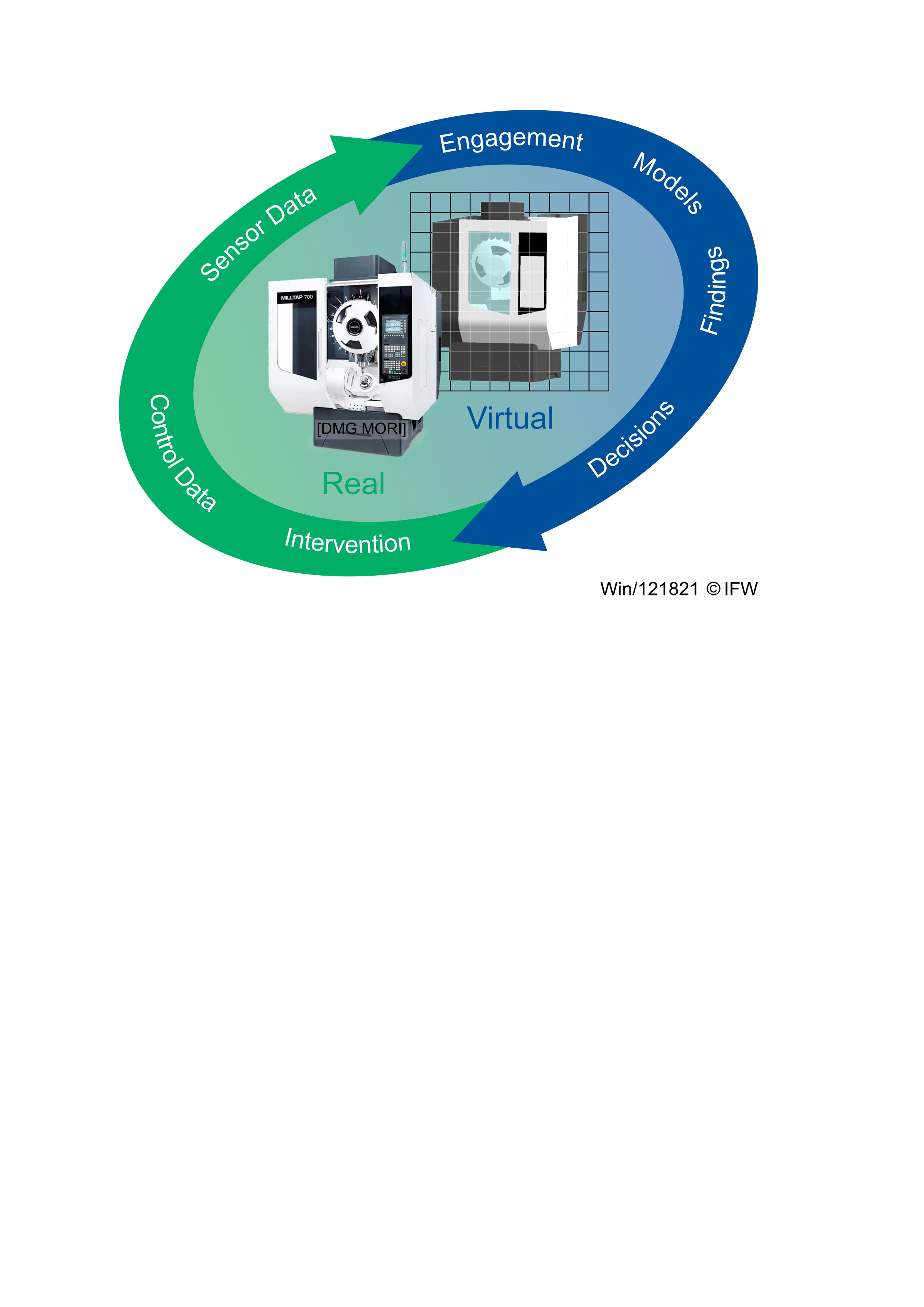
Graphical Abstract

1. Introduction

The increasing demand for customized, high-quality products across various industries is pushing conventional manufacturing environments to their limits. High-mix, low-volume production scenarios require maximum flexibility, precision, and lifecycle-wide traceability, thereby challenging traditional approaches to production planning and control. Especially in regulated sectors such as medical technology, strict documentation, risk management, and transparency requirements intensify these challenges and call for advanced digitalization strategies to ensure traceable and adaptive manufacturing processes [1,2,3]. Similar demands arise in aerospace, where the regeneration and maintenance of high-value components such as turbine blades require efficient, knowledge-based decision-making and robust traceability to guarantee safety and sustainability throughout multiple life cycles [4,5]. In the automotive industry, rising product variety, shortened lifecycles, and the need for sustainable and resource-efficient production further emphasize the importance of digitally supported, reconfigurable manufacturing systems [6,7]. Across these domains, Digital Twin Systems (DTSs) have emerged as a key enabler, providing the integration of real-time process data, simulation models, and lifecycle-wide transparency to enhance adaptability, quality assurance, and regulatory compliance in manufacturing operations [8,9].

1.1. Digital Twin Systems in Manufacturing

The concept of the Digital Twin (DT) originated in the early 2000s in the context of Product Lifecycle Management, initially as the “Mirrored Spaces Model” and later formalized by NASA for complex aerospace systems [10]. In manufacturing, DTs gained momentum from 2013 onward through Industry 4.0 initiatives, where they became closely linked with hybrid modeling, real-time feedback, and lifecycle integration [8,11,12]. A DTS typically comprises three interconnected domains: the physical space (the real asset); the virtual space (its digital counterpart); and a continuous, bidirectional data flow between them. This is commonly known as the digital thread [8,11] as shown in Figure 1. Kritzinger et al. [9] emphasize that this real-time, bidirectional interaction distinguishes DTs from simpler digital models or shadows.
Grieves further differentiates between three types of DTs: the Digital Twin Prototype (DTP) for virtual development, the Digital Twin Instance (DTI) for representing real-world entities, and the Digital Twin Aggregate (DTA) for fleet-level insights [8]. This typology enables DT deployment across the full product lifecycle. Stark et al. [15] propose a methodological framework for systematic DT development in industrial environments, emphasizing lifecycle integration and engineering-data traceability. To operationalize DTs in manufacturing environments, modular architectures have been proposed that decouple data acquisition, model computation, and service-level functions [6,13,14]. These architectures combine physical simulation with Machine Learning (ML) to enable real-time monitoring and process control [6,16]. For high-precision, low-volume production, such as the machining of orthopedic implants or high-pressure turbine blades, three DT capabilities are particularly critical: domain-specific modeling of geometry and material behavior, real-time responsiveness, and seamless integration into existing infrastructure [4,5]. Standards such as ISO 23247 [14] and IEC 62832 [13,17] provide structural foundations for interoperability and scalability. Recent studies position DTs not only as monitoring tools but also as decision-support systems that actively influence process outcomes [7,18]. When built on hybrid models and adaptive analytics, DTs can predict process behavior, adapt to disturbances, and improve manufacturing outcomes even in complex, individualized scenarios. A recent review by da Silva et al. [19] consolidates these developments, highlighting the convergence of real-time data integration, adaptive control, and predictive maintenance strategies in Industry 4.0 environments.
These application scenarios can broadly be grouped into three strategic objectives: quality assurance, efficiency improvement, and adaptability to individualization. DTs enable continuous monitoring of process-relevant variables, such as cutting forces, temperature, or tool wear, which forms the basis for predictive quality control. Zhang et al. [12] emphasize that combining physics-based simulation, data-driven modeling, and ML results in intelligent, adaptive systems that enhance the responsiveness of machine tools. Fu et al. [20] showcase the role of DTs in achieving high-precision tolerances through multi-scale modeling and integration into adaptive control loops. These capabilities support not only real-time condition monitoring but also active optimization of machining parameters and continuous process refinement. In dynamic machining environments, particularly in individualized manufacturing such as patient-specific implants, DTs allow the synchronization of geometric models, process strategies, and machine settings, even at batch size one. In this context, benefits arise especially from combining process-specific physics with data-driven prediction methods, enabling early anomaly detection and feedback control [12,20,21]. By linking real-time data, predictive models, and domain-specific process logic, the DT evolves from a digital representation to a key decision-making component. As such, it becomes an essential enabler for quality, adaptability, and closed-loop optimization in high-variance production environments [7,9]. Concrete implementations underline this potential: Denkena et al. [22] realized a DT in the aerospace sector by integrating simulation-based soft sensors for tool wear estimation, enabling predictive process adaptation. Kellenbrink et al. [5] developed a DT-based decision support system for turbine blade regeneration, facilitating adaptive selection of repair processes based on sensor feedback and part-specific data. Latif et al. [23] demonstrated a human-integrated DT for adaptive manufacturing, combining real-time process simulation with reinforcement learning to guide decision-making in human–machine interaction scenarios. Ward et al. [24] proposed a model-based machining DT with real-time simulation and lookahead logic for contour-parallel milling, achieving cycle-level process updates and minimal lag between virtual prediction and physical execution. Lu et al. [25] implemented a DT monitoring system for large-part milling, combining toolpath analysis, sensor data, and remote visualization to detect anomalies and evaluate process stability. Zhao et al. [26] introduced a hybrid digital twin architecture for CNC feed systems using co-simulation and neural networks to model dynamic behavior of drives and predict internal system states in real time.

1.2. Process Simulation

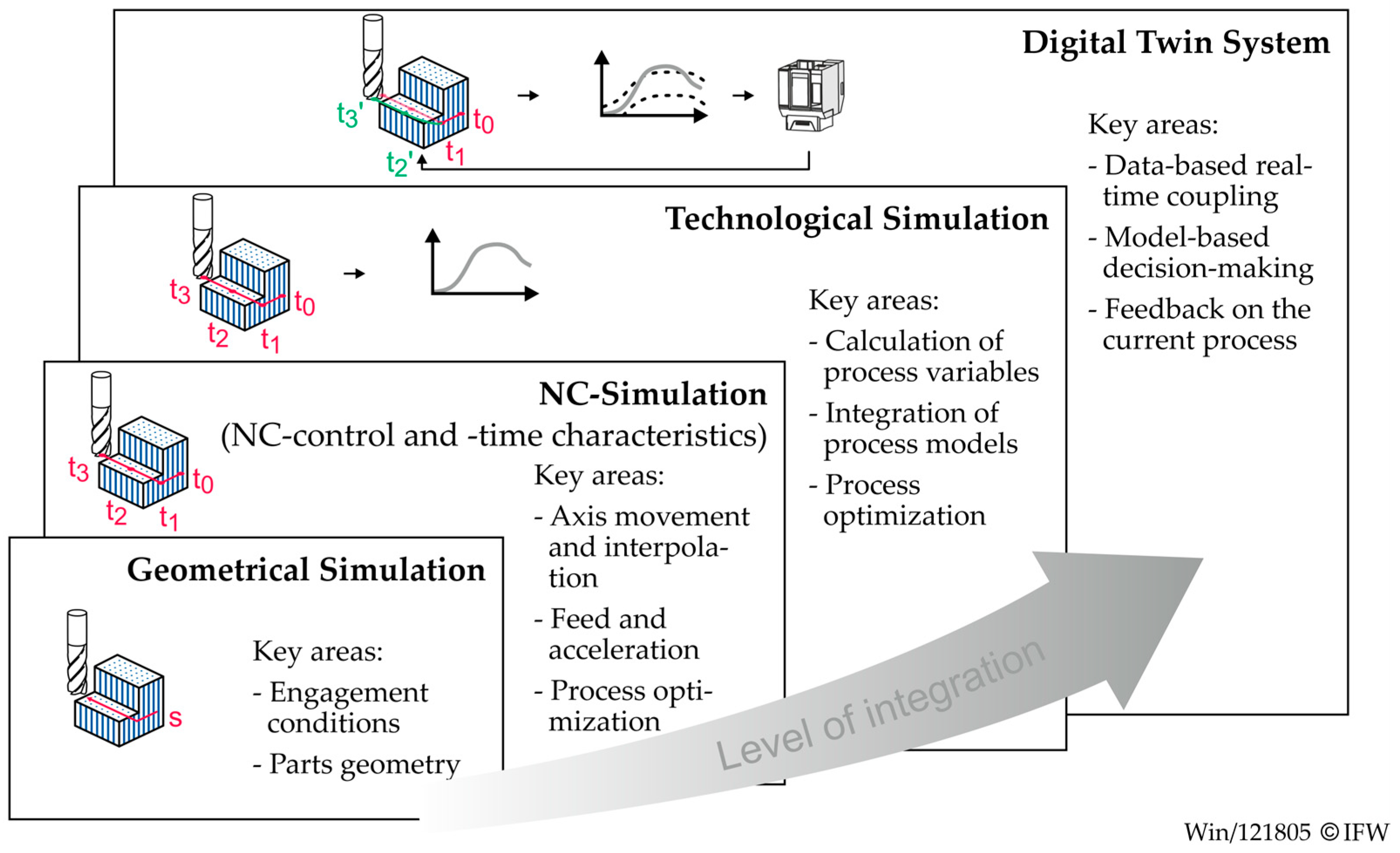
While DTS offer the architectural framework for data-driven manufacturing, their practical utility hinges on the accuracy and depth of the underlying process models. Among these, process simulation serves as a key enabler, particularly when embedded as the virtual space within a DTS. This integration not only enhances model accuracy but also supports real-time synchronization with the physical process. It enables predictive analysis of technological dependencies and plays a key role in the transition from automated to autonomous manufacturing systems [27]. Simulation-driven approaches have been demonstrated in the aerospace sector, where Denkena et al. [22] realized DTs using simulation-based soft sensors to bridge the gap between physical measurements and virtual representations. Within industrial process chains, simulation is well established for geometric and collision checking, particularly as part of numerical control (NC) simulation systems based on standards such as VDI 4499 Part 2 [28]. However, to achieve higher levels of autonomy, simulation must be more tightly integrated with machine-level control logic. This requires a shift from offline planning tools toward machine-integrated, real-time simulation architectures [27]. A pivotal step in this development is the transition from conventional technological simulation to DTS, in which simulations are executed in parallel to real processes and dynamically updated through sensor feedback. Three stages of increasing model depth can be distinguished: geometric simulation, NC-simulation, and technological simulation, as illustrated in Figure 2.
The accompanying pictograms depict the respective model characteristics: geometric simulation shows the tool path representation, NC-simulation adds discrete time steps (t0–t3) to indicate controller-based motion, and technological simulation extends the model with process-variable prediction. In the final stage, the DTS integrates the technological simulation with the real machine, shown by a feedback loop and modified tool positions (t2′, t3′) that replace the original ones (t2, t3). Geometric simulation often relies on voxel or dexel-based workpiece models [29,30] and is commonly used in industrial computer-aided manufacturing systems. NC-simulation increases the modeling accuracy by incorporating controller-specific behavior, including axis dynamics and timing effects [31]. Unlike pure NC-simulation, technological simulation allows the prediction of process variables such as cutting force, temperature, and tool wear. This is achieved through physics-based or hybrid modeling, combining empirical calibration with analytical formulations [32,33]. Hybrid approaches, as discussed by Arrazola et al. [34], integrate simulation and artificial intelligence methods to form adaptive, learning-capable systems. Together, these models establish the foundation for the DTS implementation developed in this work. Simulation-based monitoring systems, such as the teachless milling process monitoring for small-batch production by Yohannes [35] and the sensor-integrated machine concepts described by Denkena et al. [36], demonstrate the feasibility of real-time process evaluation and corrective action, even in batch-size-one manufacturing. Yohannes [35] realized adaptive monitoring for small-batch milling with sensor-based tool condition assessment, while Denkena et al. [36] introduced cyber-physical “gentelligent” systems linking process data and digital models for lifecycle-oriented feedback.
DTS in machining are often conceptualized as monitoring frameworks or visualization tools rather than autonomous decision-making entities [7,9,10,18]. While many architectures emphasize digital-physical integration, only a few demonstrate true bidirectional data flows that enable real-time synchronization, feedback, and process intervention [35,36]. Most implementations focus on either geometric simulation or discrete monitoring events, without embedding models into machine-level control loops. Consequently, real-time adjustments to cutting parameters or tool paths based on predictive analytics are rarely realized in practice. Recent studies demonstrate progress toward adaptive control, yet several limitations remain. For example, Ward et al. [24] introduced an online residual stress control system that combines model-based simulation and feedback control for adaptive feed rate and chatter suppression. However, the material removal simulation underlying this approach is executed offline, and engagement conditions are not recalculated during machining. As a result, the system cannot dynamically adapt to changing tool–workpiece interactions, which limits its applicability to pre-characterized or stationary process conditions. Lu et al. [25] developed a digital twin monitoring system for large-part milling that integrates geometric models and sensor data to visualize process states and detect anomalies. While this implementation demonstrates strong capabilities in visualization and remote diagnostics, it remains unidirectional—process data are monitored but not used for direct feedback or control intervention. Consequently, real-time responsiveness and closed-loop adaptation are not achieved. Zhao et al. [26] realized a hybrid digital twin for CNC feed drive systems, combining mechanism-based modeling with neural networks to predict internal dynamic behavior. Although the work achieves high accuracy in drive-level simulation, its scope is limited to subsystem modeling and does not extend to process-level engagement or material removal prediction.
Even among systems that incorporate simulation-based monitoring, such as those described by Denkena et al. [36] and Yohannes [35], the feedback remains limited to event-driven logic (e.g., machine stop or tool change), without deeper integration into standardized DT architectures or adaptive control schemes. Moreover, lifecycle-wide traceability and model-based synchronization are often missing, undermining the long-term utility and scalability of these systems. To close these gaps, the present work proposes a fully integrated DTS with a real-time, bidirectional data flow and embedded prediction capabilities. By combining simulation-based process understanding with interpretable ML models for process signal inference, the system enables closed-loop operation, scalability across part variants, and traceability in regulated manufacturing domains such as medical device production. In this study, the DTS is specifically applied to subtractive machining of medical components, with a focus on milling processes.
Therefore, the objectives of this study are twofold:
  • Realizing a complete DTS with a bidirectional data flow for closed-loop integration of real and virtual machining states, and
  • Validating the system’s capability for process-parallel monitoring and intervention through representative use cases in orthopedic implant manufacturing.

2. Architecture of the Digital Twin System

The developed DTS adopts a modular three-tier architecture comprising the physical space, a digital thread, and the virtual space. This structure is aligned with established reference models in the state of the art [6,8,9,14]. Its implementation targets real-time synchronization between machine and simulation and the active use of predictive models for process intervention. Simulation-based control parameters, physics-informed process models, and data-driven predictions are embedded within a closed-loop information flow. Distinct from existing approaches, the architecture emphasizes:
  • Real-time coupling between machine and simulation at the controller level;
  • Utilization of machine-native signals for scalable process diagnostics;
  • Integration of explainable, domain-specific predictive models;
  • Feedback of condition evaluations into process control or user interface.
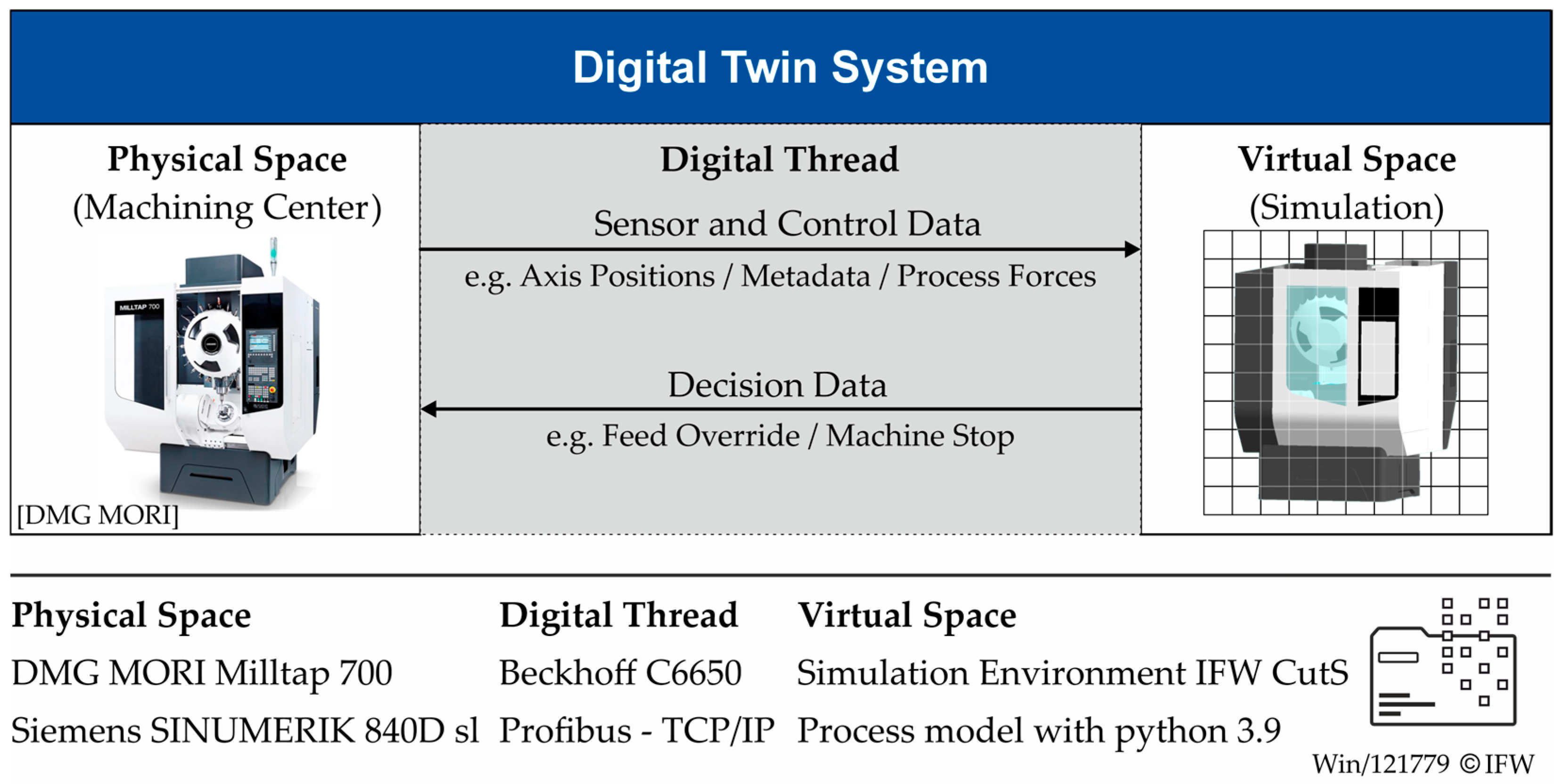
This design enables synchronized evaluation of cutting conditions, model-based prediction of process variables, and rule-based responses to critical events (e.g., adaptive feed rate adjustment or machine halt). The system is realized on a DMG MORI Milltap 700 machining center, connected to the modular simulation environment IFW CutS [31] via an industrial PC (IPC, Beckhoff C6650). Figure 3 illustrates the architecture: sensor and control signals (axis positions, axis currents, metadata like tool data and process forces) flow from the physical space to the virtual space, where process conditions are computed. Optimized feed rates or machine stop signals are fed back as decision data to the controller.

2.1. Physical Space

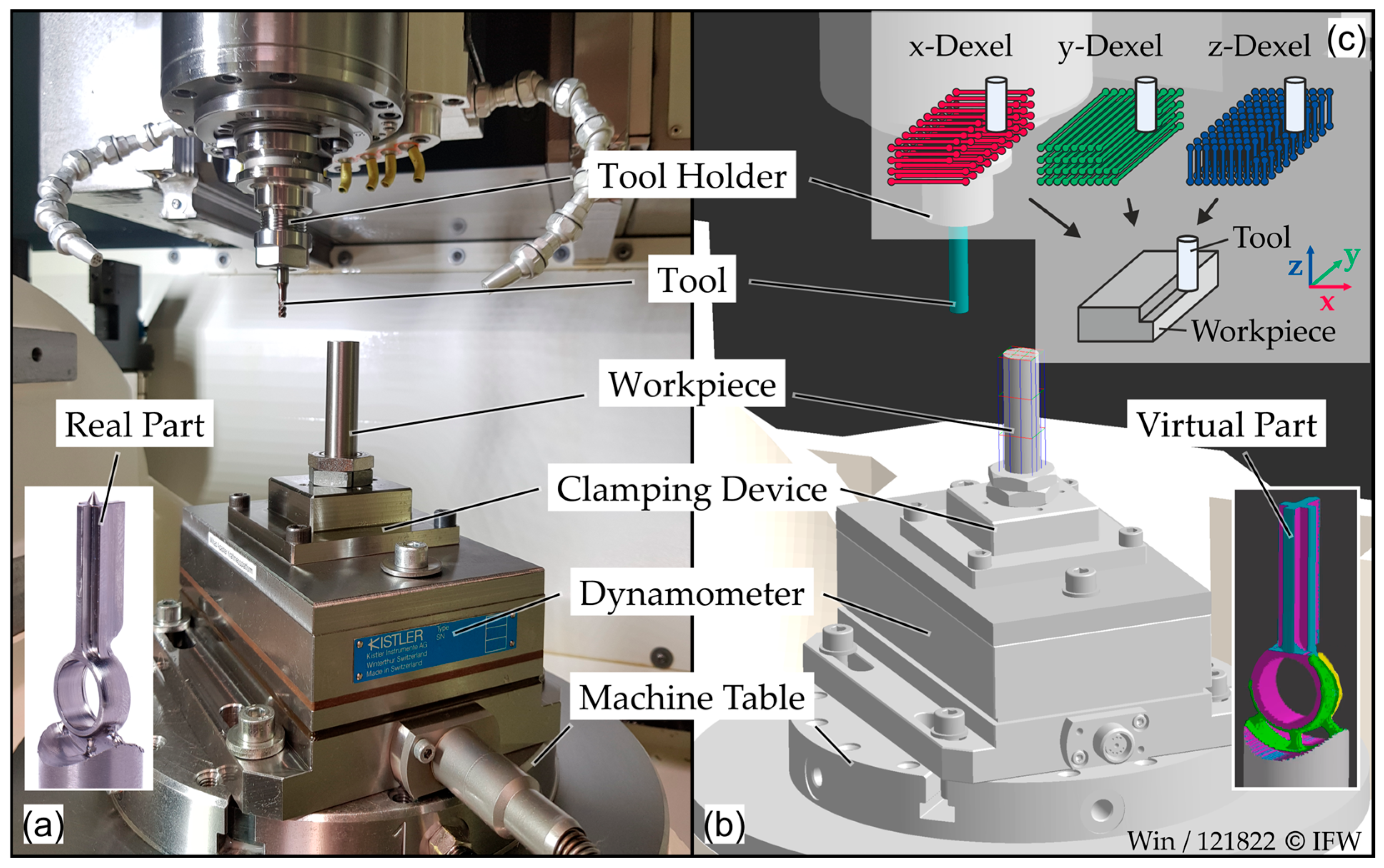
In this paper the physical space of the DTS is represented by the 5-axis machining center DMG MORI Milltap 700. Real-time coupling to the virtual space is enabled by accessing internal control signals from the Siemens Sinumerik 840D sl Computerized Numerical Control (CNC) via a Beckhoff IPC. These signals include axis positions, axis currents, spindle current, spindle speed, feed override, tool parameters, and zero offset values. To measure process forces, a piezoelectric multicomponent dynamometer (Kistler 9257B) is integrated as an example of external sensor use. Process forces can, e.g., be used for process monitoring. In addition, a SPRINT probe system (Renishaw OSP60) is used as a second external sensor for inline form deviation measurements during part inspection. It is automatically loaded into the spindle in place of the cutting tool to perform 3D measurements directly on the machine tool. Separately, a three-dimensional probing routine is executed before data acquisition to determine the machine’s actual kinematic structure. The identified axis offsets and rotation centers are used to parameterize the virtual model, enabling consistent mapping between real and simulated machine behavior. Figure 4 illustrates this coupling: the real machining process (Figure 4a) is mirrored in the simulation environment (Figure 4b), where identical tool–workpiece interactions are represented in parallel.

2.2. Virtual Space

The virtual space is implemented using the technological simulation environment IFW CutS. Its standard functionality of cycle-based, real-time simulation is extended by a newly self-developed plugin, which was implemented within this work to collect and process external data. The workpiece geometry is represented as a multi-dexel model (compare Figure 4c), discretized along the x-, y-, and z-directions, as described in [30]. As shown in Figure 5, each simulation step follows a modular pipeline implemented in C#.
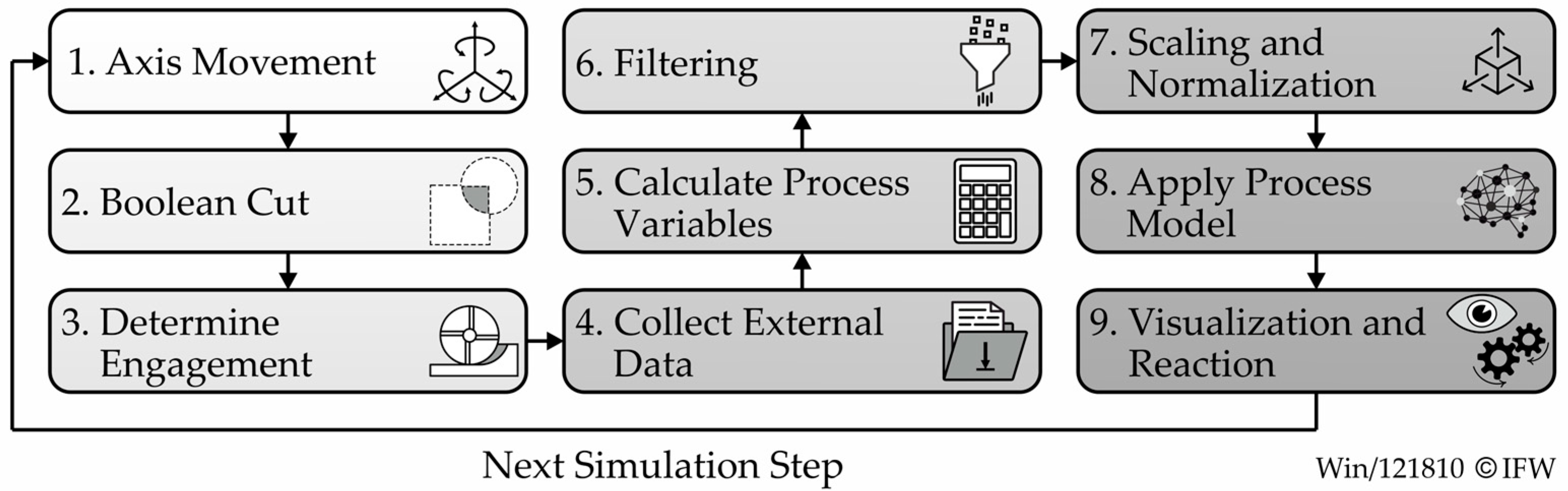
Axis Movement (step 1) interprets machine kinematics based on trajectory input, which may originate from NC code, precomputed CSV files, or live control signals. Step 2: Boolean Cut checks for tool–workpiece intersection. If contact is detected, Boolean cutting operations are performed by splitting, shortening, or removing dexels from the multi-dexel model. The geometric changes yield updated engagement conditions such as depth of cut and width of cut, which are determined in Step 3: Determine Engagement. In Step 4: Collect External Data, sensor signals (e.g., process forces from a piezoelectric dynamometer) and machine-internal signals (e.g., spindle current, feed override) are captured via the bidirectional data interface, described in Section 2.4. In Step 5: Calculate Process Variables, analytically derived process features—such as material removal rate, chip cross-section, and mean chip thickness—are computed from the collected data. Step 6: Filtering applies adaptive noise reduction techniques implemented in C# (Hampel, Kalman, and Butterworth filters). Scaling and Normalization (step 7) adjusts the preprocessed values using transformation parameters consistent with those used during model training when needed. In Step 8: Apply Process Model, machine learning models (e.g., CNNs, XGBoost, Gaussian process regression), trained externally in Python 3.9, are loaded from ONNX format and executed using the ONNX Runtime, fully compatible with .NET Framework 4.8. Finally, in Step 9: Visualization and Reaction, predicted and measured values are displayed using Windows Forms and passed to a rule-based control module, which may trigger events such as a machine stop or feed rate adjustment. At the end of this cycle, control returns to Step 1, and the next simulation step begins based on the updated machine and workpiece states.
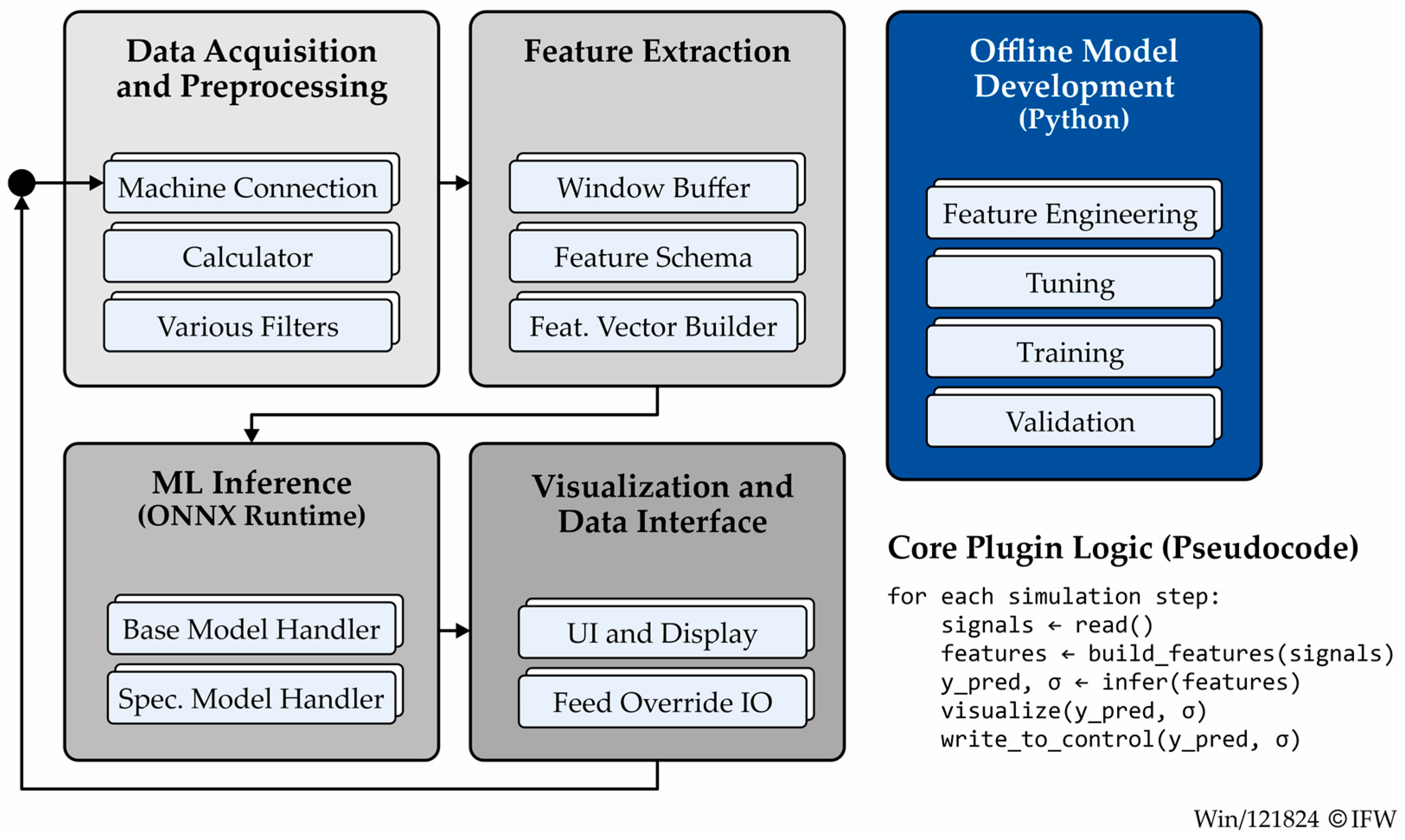
To implement the data-driven functionality described in Figure 5, the self-developed plugin was designed as a modular C# framework integrated into the IFW CutS environment. The plugin manages data acquisition, preprocessing, feature extraction, and execution of ML models exported from Python, ensuring consistent data handling and reproducibility. Its internal structure and execution flow are summarized in Figure 6.
Each module in Figure 6 is implemented as an independent class or python script, respectively, providing clear separation of responsibilities and allowing direct reproducibility of the presented results. The corresponding components are listed in Table 1.
While Figure 5 explains the physical and logical process flow of each simulation step, Figure 6 and Table 1 highlight the software architecture and implementation logic that realize these functions within the plugin.
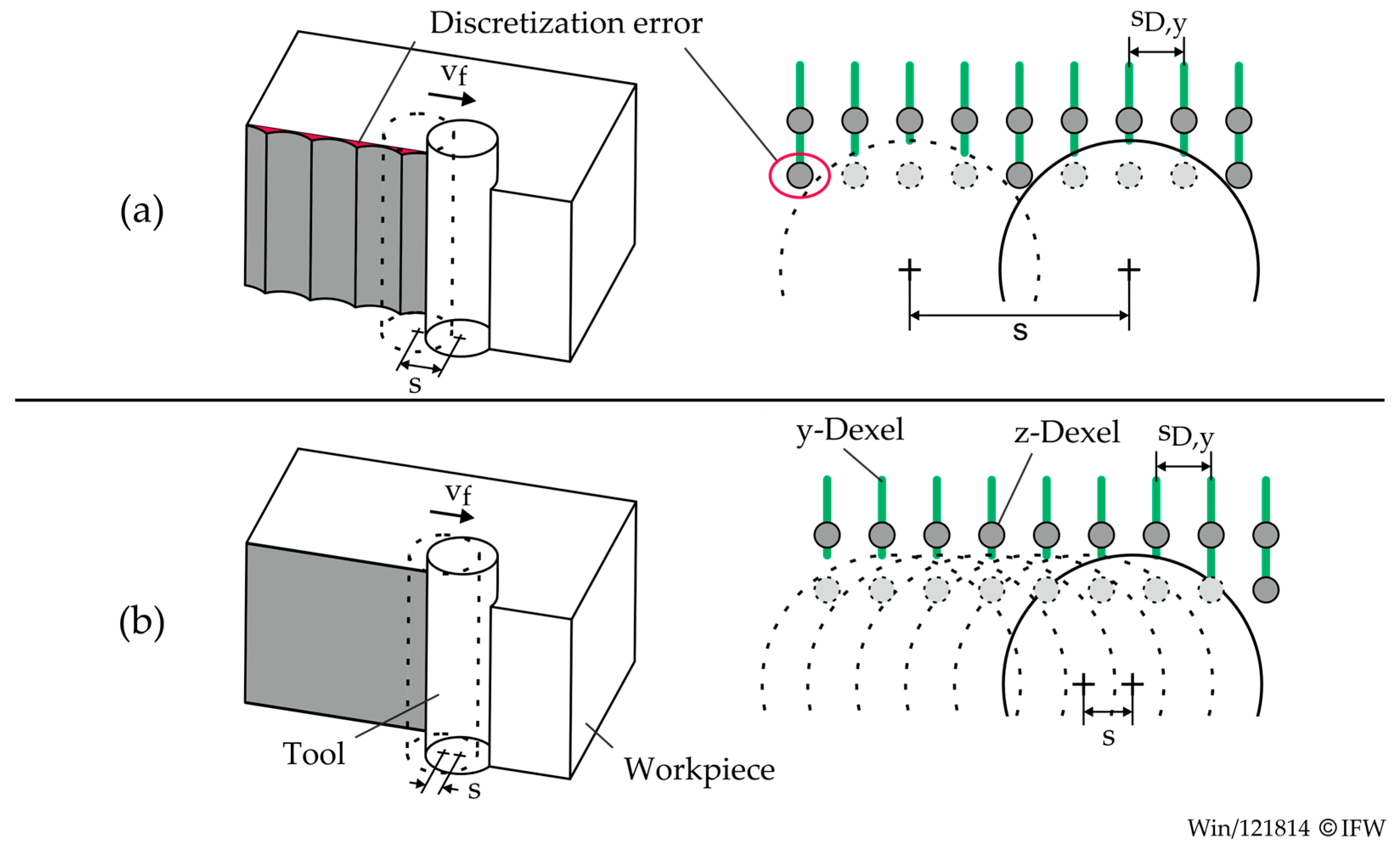
The accuracy of engagement values critically depends on the spatial resolution of the dexel grid and the temporal resolution (cycle time). The ratio between the simulation step size s and the spatial dexel pitch sD strongly influences discretization errors: if the step size exceeds the dexel pitch, tool–workpiece interactions are under-sampled, whereas excessive refinement increases computational cost without significant accuracy gains. The implemented geometric simulation is based on a discrete sequence of tool positions using the tool envelope to approximate the removed volume, as described by Pape [37]. This simplified modeling approach achieves high computational efficiency and real-time capability within the DTS, whereas more detailed swept-volume or discrete-cutting-edge simulations would provide higher geometric accuracy at significantly increased computational cost. Figure 7 illustrates typical discretization artifacts for different dexel densities and cycle times. In Figure 7a, an unfavorable ratio between simulation step size s and dexel pitch sD results in noticeable discretization errors, whereas in Figure 7b, these errors are effectively avoided through appropriate parameter selection.
The accuracy of engagement condition calculations is a critical enabler for the entire DTS. Accurate width and depth of cut values directly determine the quality of (ML-) model predictions, which in turn provide the decision data within the digital thread. Thus, the system’s capability to trigger reliable interventions, such as adaptive feed rate adjustment or machine stop, depends directly on avoiding discretization errors and on selecting optimal simulation parameters.

2.3. Simulation Study: Influence of Parameters on Model Accuracy and Runtime

To ensure real-time applicability of the DTS during milling operations, the trade-off between simulation accuracy and computational load must be carefully balanced. This is especially relevant in dynamic machining scenarios, where the feed rate varies along the tool path and imposes time-critical constraints on simulation responsiveness. To investigate the influence of simulation parameters on model quality and runtime, a full-factorial simulation study was conducted.
The study varied two key parameters: (1) the spatial resolution of the simulation grid, defined by the dexel density ρxyz, and (2) the temporal resolution, defined by the simulation cycle time tcycle. In total, 240 parameter combinations were simulated using a controlled slot milling scenario with six discrete feed rate levels ranging from 480 to 2880 mm/min. A simplified cylindrical tool geometry (diameter 6 mm) and constant engagement conditions (ae = 1.8 mm, ap = 10 mm) were applied. Each toolpath segment was simulated with different combinations of ρxyz and tcycle, and the resulting engagement parameters, such as width of cut ae and feed rate vf, were compared to their programmed reference values. An overview of the parameter combinations examined is presented in Table 2.
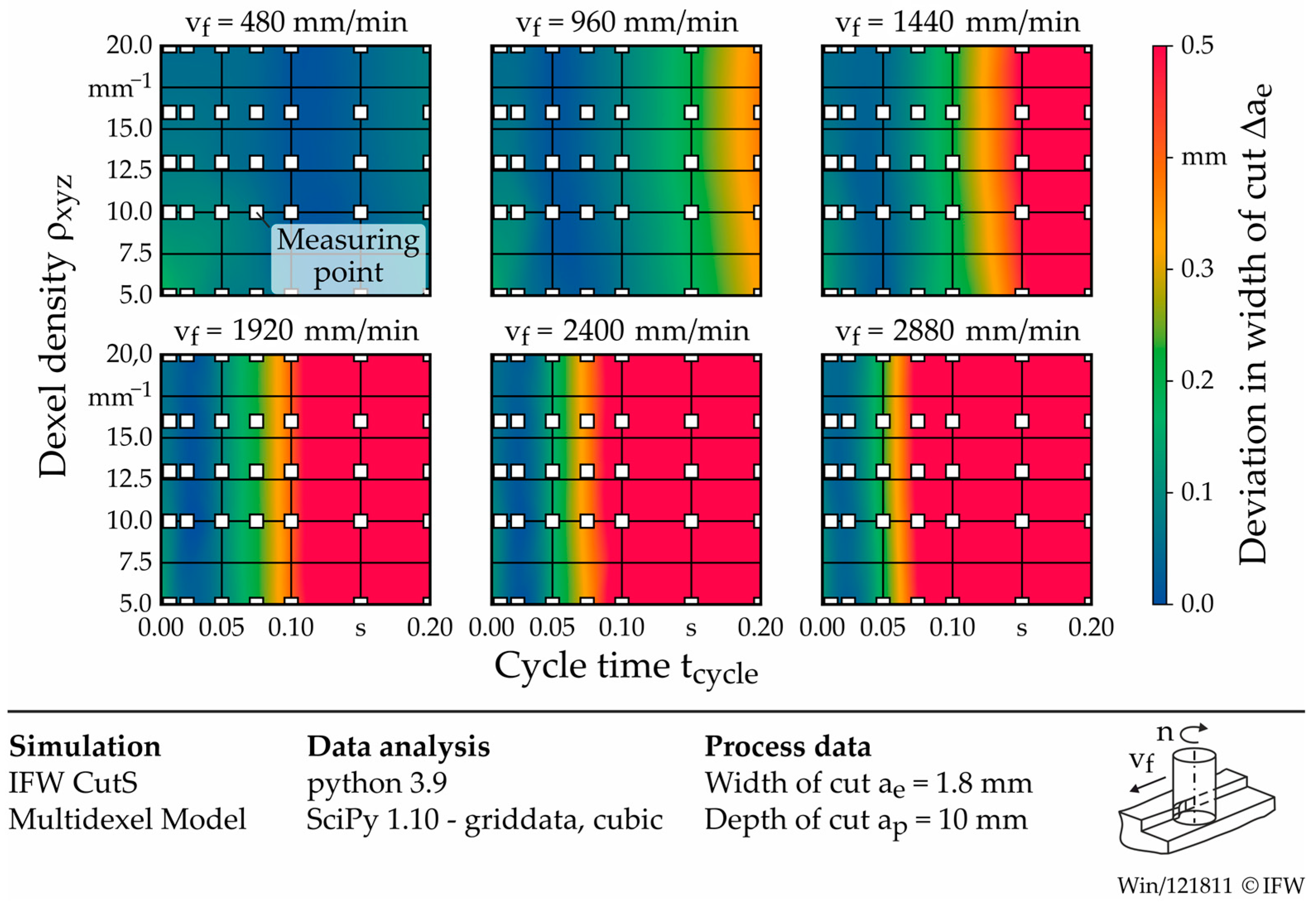
The parameters shown in Table 2 were selected to reflect typical slot milling conditions with small-diameter end mills in aluminum alloys, which are widely used in the production of medical devices and other high-value components. The selected ranges of dexel density and cycle time were defined empirically based on prior experience with the IFW CutS framework and exploratory testing [38]. Starting from commonly used mid-range values, the parameter space was systematically extended toward lower and higher bounds to capture relevant accuracy-performance trade-offs across typical machining conditions. The chosen radial and axial depths of cut correspond to standard roughing operations, while the feed rate range covers realistic cutting conditions for cavity structures common in medical, aerospace, and automotive applications. Figure 8 presents a series of six interpolated heatmaps that illustrate the deviation in width of cut Δae as a function of cycle time and dexel density across varying feed rates.
Each subplot corresponds to a specific programmed feed rate vf, ranging from low to high values, and visualizes the error between the engagement width calculated by the simulation and the nominal width defined by the toolpath. The deviation Δae is expressed as an absolute value and serves as a measure of simulation accuracy. Discrete simulation results, obtained from a structured parameter study, are marked as individual measuring points within each heatmap and have been interpolated using a bicubic surface algorithm to improve readability. All heatmaps share the same axis configuration: the x-axis denotes the simulation cycle time tcycle, while the y-axis represents the spatial resolution, expressed as dexel density ρxyz. The color scale reflects the magnitude of Δae, ranging from low deviations (blue) to high deviation (red).
The results reveal a clear dependency between simulation accuracy and the selected spatio-temporal parameters. The most significant influence is exerted by the cycle time, particularly at higher feed rates. As the feed rate increases, the simulation becomes increasingly sensitive to temporal discretization. For instance, at vf = 2880 mm/min, only cycle times shorter than 0.05 s yield sufficiently low deviations in engagement width. Longer intervals lead to considerable errors due to inadequate temporal resolution, which causes the simulation to miss critical engagement dynamics. At lower feed rates, specifically vf ≤ 1440 mm/min, dexel density becomes a more significant factor influencing the accuracy of engagement width calculation. Here, low spatial resolutions (e.g., ρxyz < 10 dexel/mm) result in visible inaccuracies due to coarse representation of the tool–workpiece interaction. While increasing dexel density improves the spatial accuracy, its impact diminishes as feed rates rise and temporal resolution becomes limiting. Overall, the heatmaps demonstrate that no single combination of dexel density and cycle time yields universally accurate results across all feed levels. Instead, the optimal parameter regions vary with feed rate, underscoring the importance of feed-dependent simulation parameterization.
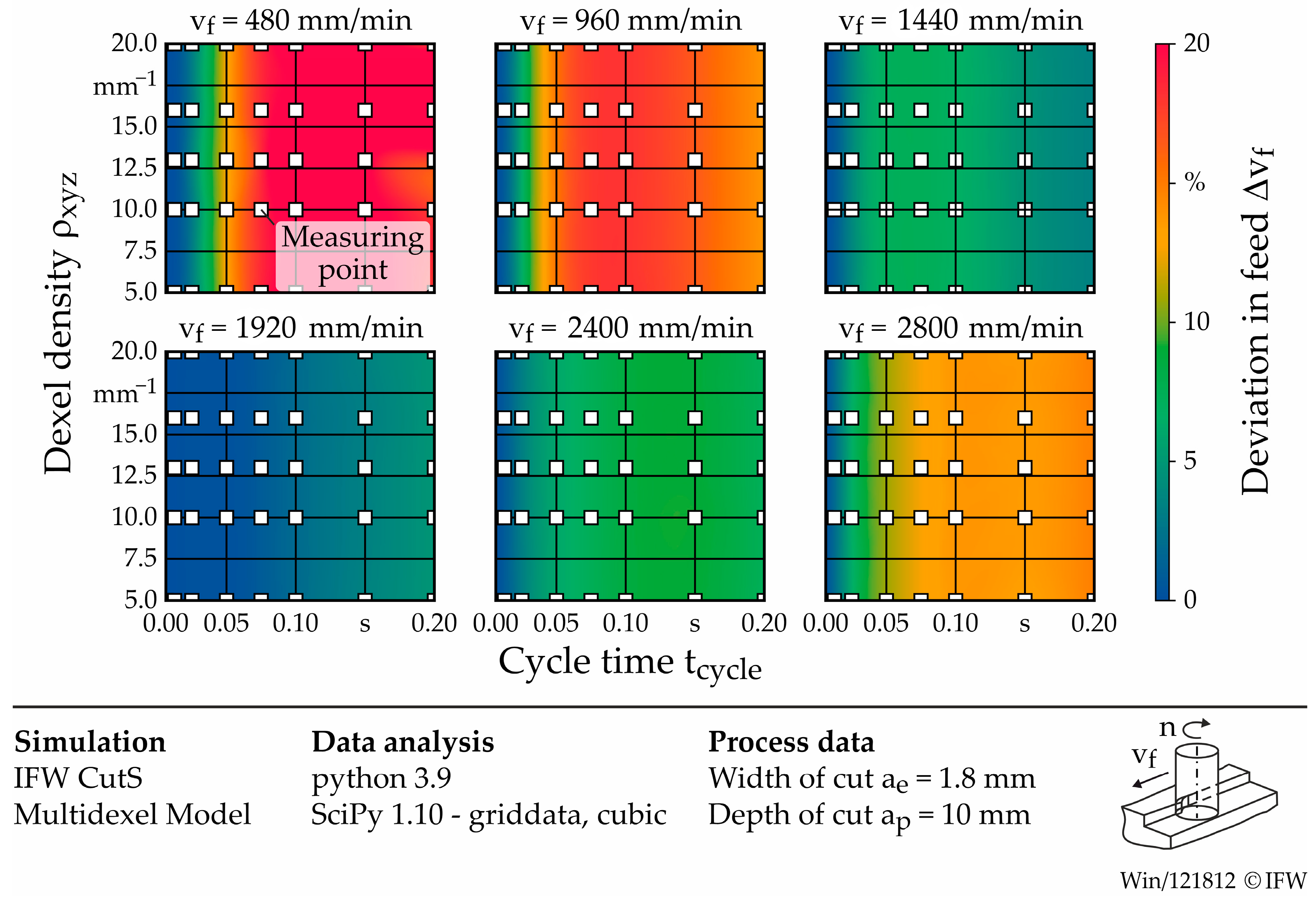
Figure 9 presents the corresponding deviation in feed rate prediction Δvf, which is derived from tool path displacement per simulation step.
While the structural layout of the diagram mirrors that of Figure 8, including the same axis scaling, dexel density on the vertical axis, and cycle time on the horizontal axis, the color gradient here encodes the magnitude of Δvf in percent. Δvf is expressed as the percentage deviation between the programmed feed rate and the feed rate determined by the simulation. The heatmaps reveal distinct patterns of deviation depending on the feed rate level. At lower feed rates, particularly below 1440 mm/min, coarse temporal resolution (i.e., large cycle times) leads to a significant overestimation of the feed rate. This effect arises because the TCP advances only minimally between steps, and larger cycle times interpolate over long time spans, systematically overestimating the displacement and thus inflating the feed calculation. In contrast, at higher feed rates (e.g., 2880 mm/min), the TCP covers larger distances per cycle, but due to the absence of intermediate trajectory interpolation, the displacement is treated as a linear segment between two discrete points. This introduces geometric approximation errors, causing consistent underestimation of the actual feed rate. The heatmaps also confirm that very small cycle times (<0.05 s) are necessary to ensure accurate feed reconstruction, especially in high-speed scenarios. Overall, the results emphasize the importance of simulation parameter selection depending on the kinematic range, as both spatial and temporal resolution interact differently across the feed rate spectrum. These results highlight the trade-off between simulation accuracy and parameter settings, especially under varying feed rates. To assess the practical feasibility for process-parallel applications, the associated computational cost was analyzed.
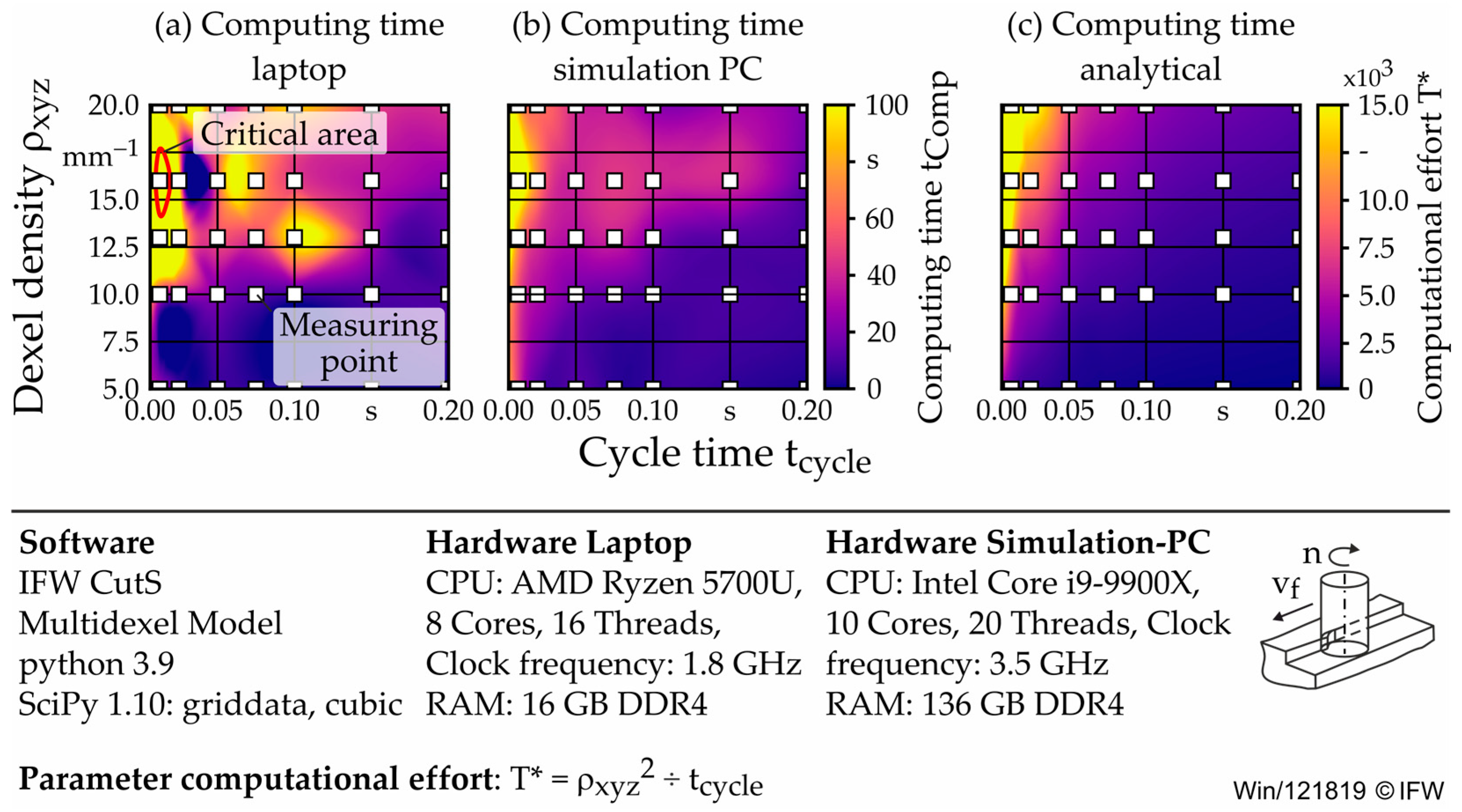
Figure 10 provides an overview of the simulation runtimes for different parameter configurations.
Figure 10a,b show the measured runtimes on two hardware platforms, a standard laptop and a dedicated simulation PC, while 9c presents the analytically derived computational effort T*. All three heatmaps share the same axes as Figure 8 and Figure 9: the x-axis represents the cycle time and the y-axis the dexel density. In Figure 10a,b, the runtime is color-coded using a colormap, where darker shades indicate shorter runtimes and lighter yellow areas denote high computational loads. The inclusion of two hardware systems demonstrates the sensitivity of simulation runtimes to system performance, highlighting the variability introduced by hardware architecture. In contrast, the analytical map in Figure 10c abstracts from platform-specific effects by calculating the computational effort based solely on simulation parameters. As expected, runtime increases with finer dexel resolution and shorter cycle times. On the laptop (Figure 10a), high-resolution, low-cycle time configurations even exceed the actual process time of 328 s, thereby violating real-time feasibility. This critical area is illustrated by the area circled in red in the heatmap. On the more powerful simulation PC, runtimes remain below process time for all tested configurations. Following Böß et al. [38], the computational effort per simulation step of cartesian multi-dexel models scales with the square of the spatial discretization (O(n2)), i.e., with the dexel density ρxyz2. In addition, for a given toolpath length or process duration, the number of simulation steps is inversely proportional to the cycle time tcycle (smaller cycle times yield more updates). From these factors, we derive the analytical scaling metric introduced in Equation (1).
T* = ρxyz2 ÷ tcycle
This metric aggregates spatial and temporal resolution into a single indicator of computational effort. As shown in Figure 10c, this metric reproduces the empirical runtime trends across hardware platforms and thus serves as an effective early feasibility criterion for selecting real-time capable simulation settings.
To quantify accuracy and runtime trade-offs, three key metrics were evaluated for each parameter configuration:
  • Mean deviation of simulated width of cut (Aae);
  • Relative error in simulated feed rate (Avf);
  • Total simulation runtime (AT).
These metrics were normalized using min–max scaling (Equation (2)) and aggregated into a unified scoring function (Equation (3)), where A represents the respective values for each parameter across all combinations and is scaled to the range [0, 1] by normalization.
A i * = ( A i     min ( A ) )   ÷   ( max ( A ) min ( A ) )   for   i     a e ,   v f ,   t cycle
S = wae ∙ Aae* + wvf ∙ Avf* + wT ∙ AT*
Ai* denotes the normalized value and the weights were chosen as wae = 0.4, wvf = 0.4 and wT = 0.2, placing slightly higher importance on physical accuracy over runtime performance. The resulting scoring function identified a global optimum at a dexel density of 10 dexel/mm and a cycle time of 12.5 ms. These values are considered generally suitable for the investigated feed range and can serve as default simulation settings in comparable milling scenarios. Under the specific condition of ae = 1.8 mm and ap = 10 mm, the mean deviation of width of cut is 0.093 mm, the feed rate deviation is 0.61%, and the average computing time is 41.7 s for a process duration of 328 s, yielding an aggregate score of 0.056. This result provides practical parameter settings that minimize discretization error while maintaining real-time feasibility, thereby ensuring reliable input data for the machine learning models and robust decision-making in the DTS.

2.4. Digital Thread

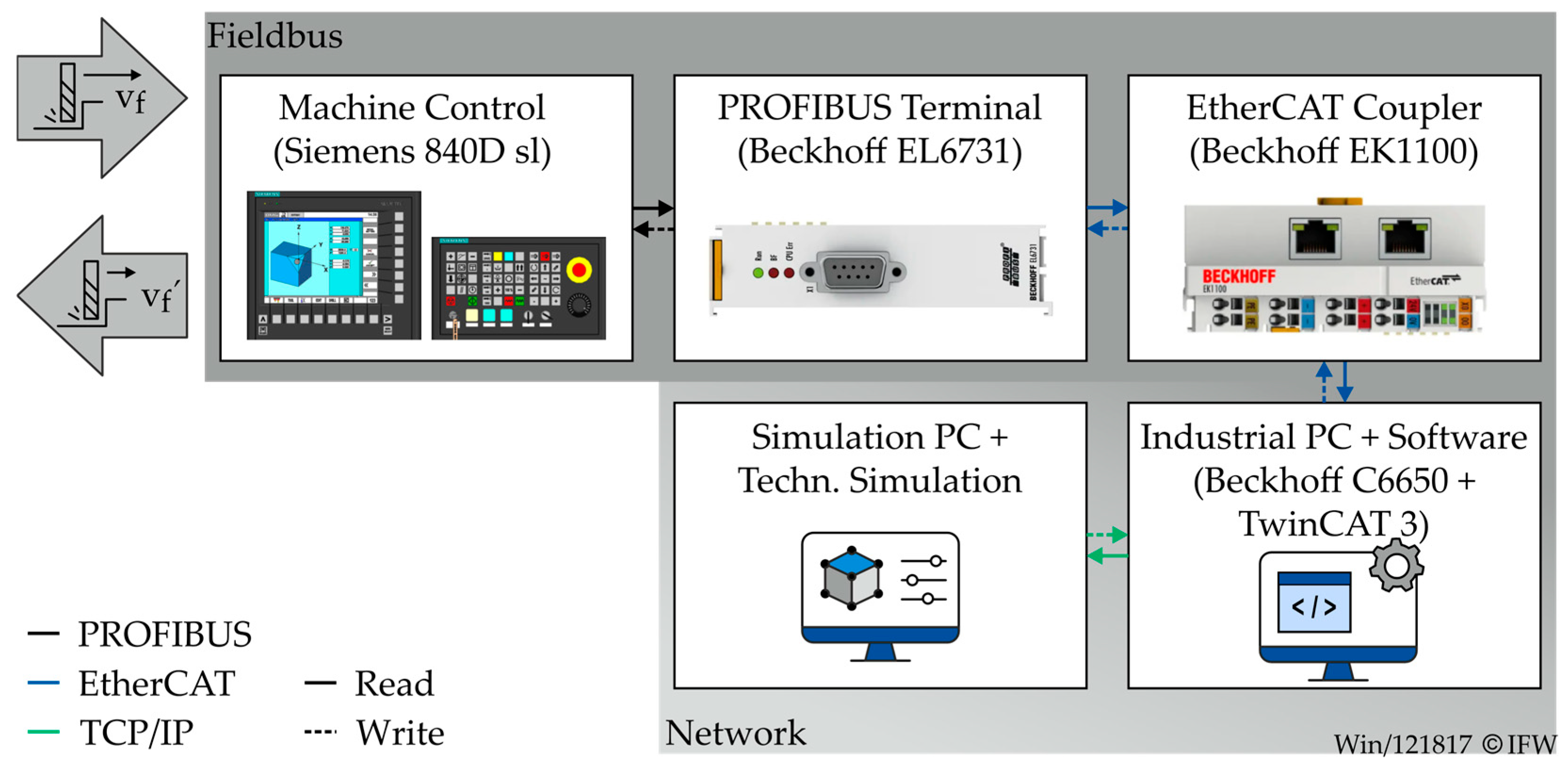
In this work, we implement a digital data flow between the simulation environment and the machine control system to enable bidirectional communication, allowing process-relevant control variables to be continuously exchanged between the physical and virtual spaces. This communication infrastructure was realized using the self-developed plugin of the technological simulation environment, configured via a TwinCAT system on a Beckhoff IPC (C6650). Data exchange is performed using both Automation Device Specification (ADS) and Modbus protocols, which are embedded for both read and write operations to ensure seamless connectivity, offering robust, industry-proven communication with low latency and high reliability at the control level. During machining operations, for example milling, the real-time state of internal control variables is continuously updated and monitored. A key variable is the current feed override, internally managed by the CNC controller (Siemens Sinumerik 840D sl). For system-wide integration into the simulation environment, this variable is transferred along a dedicated digital communication chain from the machine to the simulation computer. The system architecture is divided into two layers: a fieldbus layer for real-time communication with the machine and a network layer for simulation and data processing, as illustrated in Figure 11.
The Siemens 840D sl exposes the current feed override value via its Process Field Bus interface, acting as a PROFIBUS slave. This value is transmitted to a Beckhoff EL6731 PROFIBUS master terminal, which is part of a decentralized Input/Output system connected to an EK1100 Ethernet for Control Automation Technology (EtherCAT) coupler. The coupler relays the data to the EtherCAT master of the Beckhoff IPC. Within the TwinCAT runtime, the value is mapped into the process image memory and made accessible via symbolic variables. The simulation plugin on the simulation PC accesses these variables via the ADS protocol over Transmission Control Protocol/Internet Protocol (TCP/IP, ADS port 851). Using the TcAdsClient class, the simulation software initiates a connection and performs an ADS read request to retrieve the real-time value of the feed override. In reverse, the system also supports write access to control variables, enabling simulation-based feedback into the CNC system. To issue new setpoints (e.g., a feed override command), the simulation plugin generates an ADS write request. This is processed by the ADS server and passed through EtherCAT and PROFIBUS to the CNC. A read-back of the updated variable allows direct verification of the control effect. All override commands issued by the DTS are executed within the safety bounds enforced by the machine control; certified safety functions such as emergency stops remain unaffected.

2.5. Communication Latency Analysis

To validate the real-time capability of the DTS, the responsiveness of the digital data flow was assessed through a latency analysis. Ensuring sufficiently low latency is essential: the DTS can intervene in time to adjust feed rates or stop the machine in case of anomalies only if information can be exchanged quickly between physical and virtual spaces.
In the test, a new setpoint value for the feed override was written from the simulation environment via ADS, while the corresponding feedback variable was continuously monitored until the update was registered. The test comprised 500 consecutive roundtrips, each separated by a 500 ms delay. In addition to the total response time, the write duration in the simulation environment and the read duration of the updated feedback value were also measured to isolate software overhead from protocol latency. The 500 ms delay was chosen to prevent self-interference between measurements and to allow representative background effects such as thread scheduling or network jitter to manifest without artificially inflating latency through test-induced load. The results yielded mean durations of 3.1 ms for write operations and 9.5 ms for read operations, with standard deviations of 0.5 ms and 1.6 ms, respectively. The overall response time averaged 34.2 ms (σ = 4.5 ms), with observed minimum and maximum values of 27.8 ms and 51.4 ms. The median response time was 32.9 ms, confirming the high stability of the communication chain. By subtracting the internal application-level processing time (~12.5 ms) from the reaction time in the simulation environment, the effective transmission time across ADS, EtherCAT, and PROFIBUS can be approximated at 21.7 ms. This analysis highlights that although software overhead contributes, most latency stems from protocol communication and hardware interfaces. Overall, the measured one-way latency of ~17 ms (half of the response time) plus the simulation environment overhead remains well within the required bounds for process-parallel feedback loops. As Bate et al. [39] highlight, there is no universal millisecond threshold for ‘real-time’. Timing requirements must instead be derived from the control-loop dynamics and application context. To assess robustness under realistic factory conditions, additional latency measurements were conducted by injecting synthetic one-way jitter into the ADS communication path. Uniformly distributed random delays of ±5 ms, ±10 ms, and ±20 ms were added before each write and read operation, and the 500-trial measurement protocol was repeated for each case. This approach emulates sensor-side and network-induced timing variability without modifying PLC or fieldbus behavior. Under increasing jitter levels, the mean round-trip time rose from 34.2 ms to 57.2 ms, 60.1 ms, and 66.9 ms, respectively. The standard deviation increased accordingly (≈9.7 ms, 10.4 ms, 14.3 ms), with maximum values reaching up to 112 ms. Notably, no communication timeouts occurred under any condition, confirming functional robustness of the DTS even under degraded latency conditions. However, the observed increases in mean and tail latency indicate a loss of timing margin that must be considered in timing-critical applications.
Overall, the latency analysis confirms that the digital thread operates reliably under both nominal and perturbed conditions. Even with injected jitter, the system remained responsive and stable, maintaining sufficient margin to support real-time process monitoring and control. This ensures that anomalies can be detected and corrective actions—such as feed rate reduction or machine stop—can be executed within critical timing constraints.

3. Application Scenarios for Process Monitoring and Control Using the Digital Twin System

To demonstrate the functional capabilities of the developed DTS, two application scenarios from orthopedic implant manufacturing were implemented: (1) process monitoring via force prediction and machine halt, and (2) process control via form error prediction and adaptive feed rate adjustment.

3.1. Use Case 1: Process Force Monitoring and Machine Halt

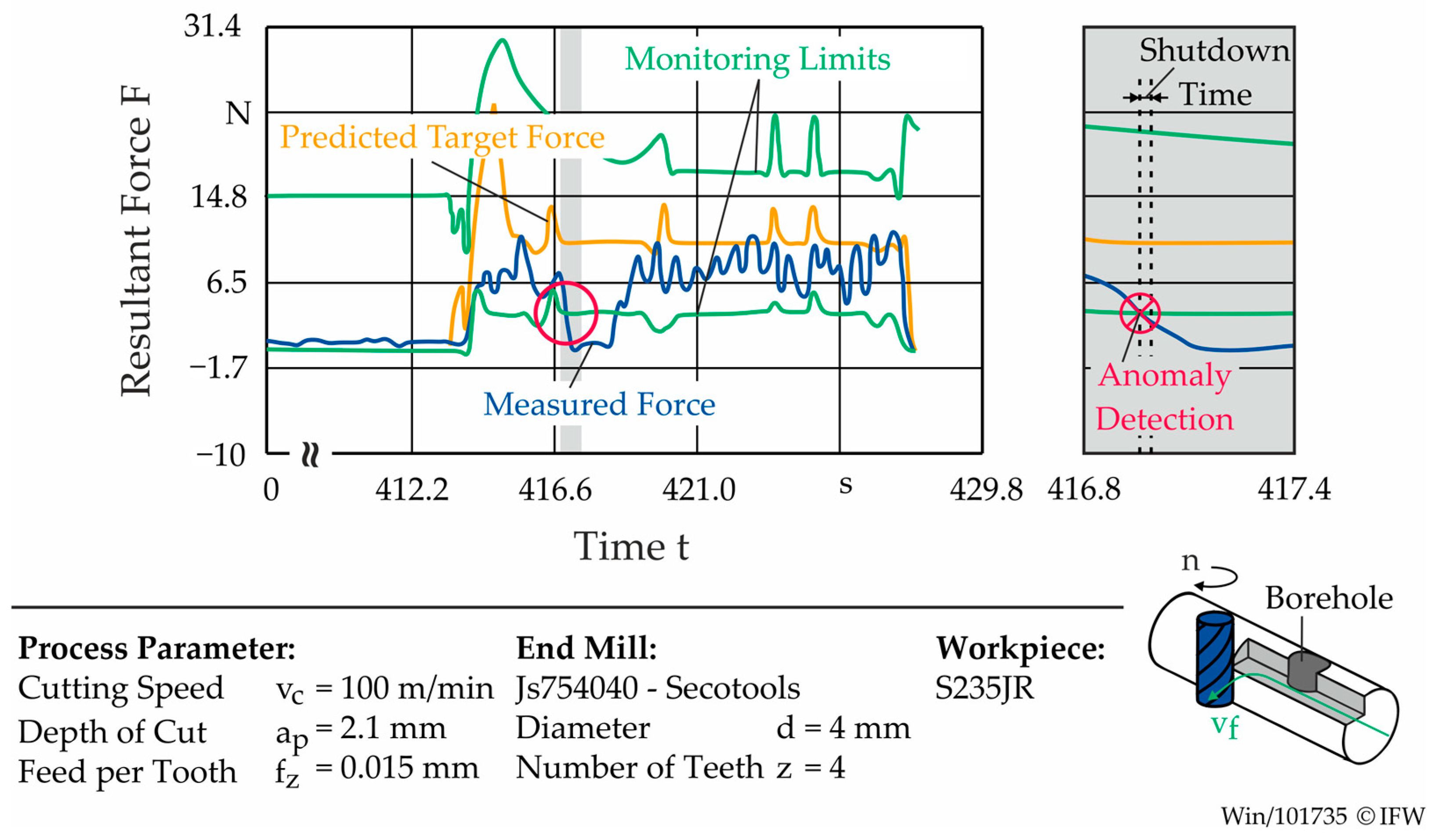
Tool breakage and unexpected load peaks pose a considerable risk in small-batch and individualized manufacturing, where each component is unique and tolerances are tight. In the publicly funded project TempoPlant [40], the DTS was deployed for process-force monitoring during the milling of a wrist-implant component. A Gaussian process regression model predicted the resultant force from active, passive and cutting force and defined upper and lower monitoring boundaries under nominal machining conditions. The machine learning model was trained on cutting force data collected from five repetitions each of a simplified implant component. After synchronization and filtering, the final datasets comprised approximately 37,000 samples. Input features included cutting speed, feed per tooth, width of cut and depth of cut, and tool–workpiece intersection angle. The model was trained using Microsoft ML.NET AutoML and evaluated on 20% hold-out test data. The resulting mean absolute error (MAE) was 5.0 N, corresponding to a relative deviation of 2.5% of the maximum measured force. During machining, the actual force signal was acquired via a sensor-integrated clamping system and continuously compared with the prediction. To test the anomaly-detection capability, a drilled hole was deliberately introduced into the raw blank to imitate a tool-breakage event that was not represented in the virtual model. As shown in Figure 12, the real-time comparison revealed a sudden drop in measured force. The relevant signal section is illustrated by the red circle in Figure 12 and is further detailed in a zoomed view to illustrate the anomaly and subsequent shutdown timing.
Once the deviation exceeded the monitoring threshold, the DTS triggered an automatic machine halt to prevent further damage. The stop signal was issued within 28 ms shutdown time after the threshold violation, fully in line with the latency budget established in the communication analysis. Such rapid reaction is particularly relevant in orthopedic implant milling, where tool breakage directly threatens part integrity and traceability. The same principle applies to aerospace and automotive machining, where tool-induced defects can compromise safety and reliability.

3.2. Use Case 2: Shape Error Control and Feed Rate Adjustment

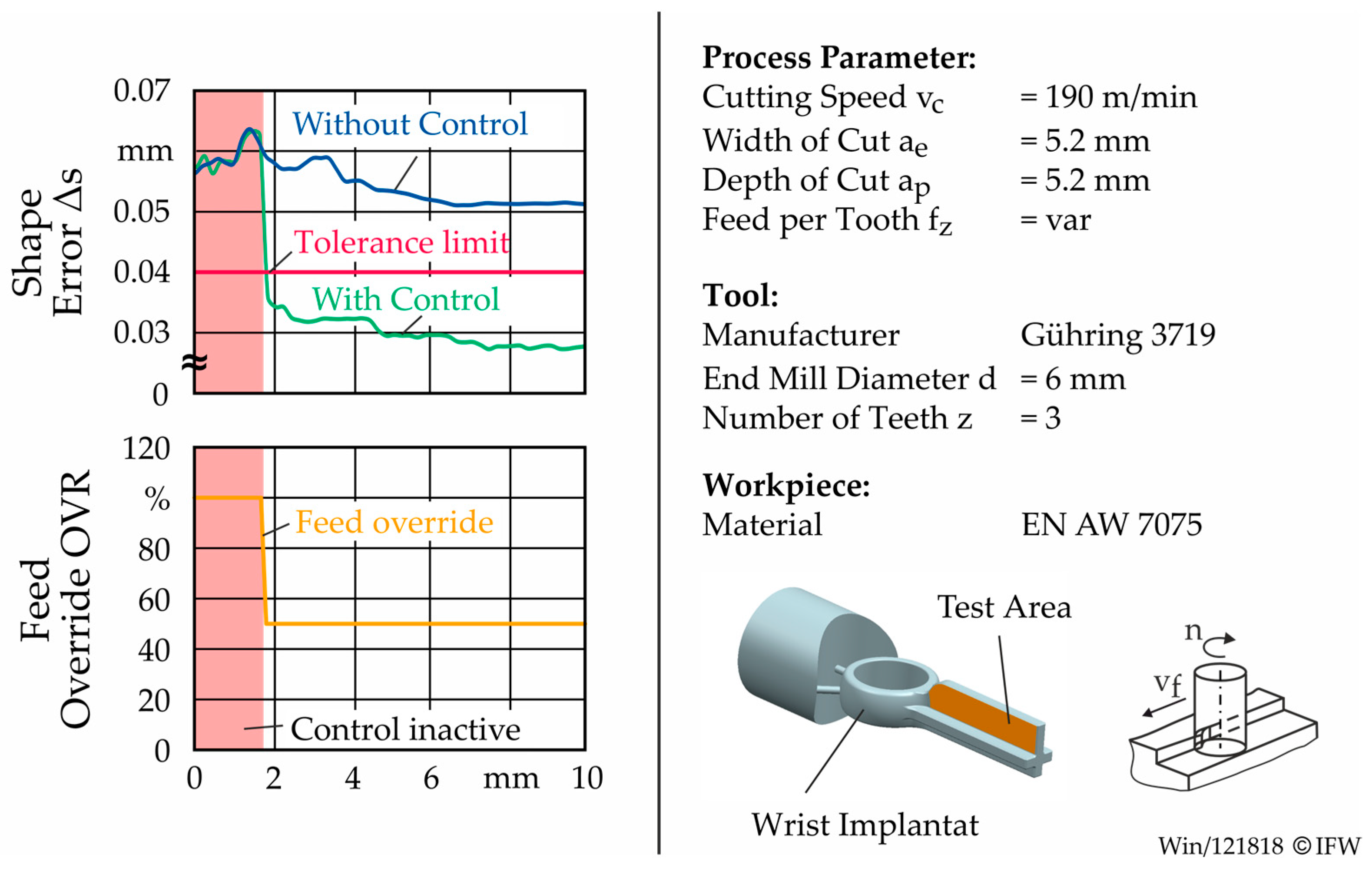
In a second scenario, the DTS was extended with a predictive control mechanism targeting geometric accuracy. During the milling of a wrist implant component, the system monitored the form deviation along a critical flank segment (highlighted in yellow in Figure 13).
A machine learning model, integrated into the virtual space of the DTS, continuously predicted the resulting shape error based on tool engagement parameters such as width of cut and time-specific material removal volume. To reflect the stringent quality standards in orthopedic manufacturing, a static tolerance limit of ±40 µm was applied. This value is in line with ISO 2768-f for general tolerances in precision medical device manufacturing, where typical permissible deviations for structural features of approximately 5 mm fall within ±50 µm. The applied threshold therefore represented a conservative yet industry-relevant boundary condition. As illustrated in Figure 13, the predicted deviation initially exceeded this limit during machining. Once the control algorithm was activated, the DTS automatically reduced the feed rate override to 50%. This adaptation decreased mechanical tool deflection, leading to an immediate reduction in the predicted form error. In practice, this brought the shape deviation back within the specified tolerance band and improved dimensional accuracy by approximately 20 µm. Unlike anomaly detection scenarios that trigger reactive machine stops, this case demonstrates proactive compensation through closed-loop control, ensuring stable machining under varying process conditions. The successful implementation validates the DTS’s role as an active, process-parallel control instance.
Together, the two use cases underscore the capabilities of the presented digital twin system: anomaly detection with rapid response, and adaptive compensation of process deviations. Both scenarios highlight the practical feasibility and industrial relevance of the approach, proving that the DTS not only mirrors the physical process but can actively stabilize it through real-time intervention.

4. Discussion

In machining research, DTs are frequently conceptualized as monitoring frameworks or visualization tools rather than as autonomous decision-making entities. Kritzinger et al. [9] emphasize that only a true bidirectional coupling between physical and virtual spaces distinguishes a DT from a digital shadow, yet such implementations remain rare in practice. Similarly, Schleich et al. [7] and Uhlemann et al. [18] note that most DT efforts lack lifecycle-wide traceability and deep integration into adaptive control loops. Recent implementations address these aspects to varying degrees: Ward et al. [24] integrate real-time feedback for chatter and residual stress control but rely on offline simulations and static engagement assumptions. Lu et al. [25] emphasize remote monitoring and anomaly detection without enabling process feedback. Zhao et al. [26] focus on subsystem-level dynamics but do not model engagement or material removal. The results of this study demonstrate that the developed DTS overcomes these gaps by enabling controller-level coupling, utilizing machine-native signals, integrating explainable predictive models, and feeding evaluations back into the machining process. Within Grieves’ typology [8] of DTP, DTI, and DTA, the presented system operationalizes a DTI that actively intervenes in real machining states. This directly fulfills the realization of a complete DTS with bidirectional data flow and the validation of process-parallel monitoring and intervention in orthopedic implant milling.
Recent reviews [19,20] highlight that the industrial value of DTs in machining depends on reliable real-time data integration, adaptive control, and predictive quality assurance. While Ward et al. [24] successfully implement real-time data acquisition and adapt machine parameters, their control logic is constrained to predefined states due to the offline nature of the simulation model. Lu et al. [25] and Zhao et al. [26], by contrast, do not realize any adaptive control functionality, making them less suitable for applications that require immediate intervention or optimization during machining. The factorial study of this work quantified the trade-off between dexel density and cycle time, showing how simulation fidelity directly influences the accuracy of engagement features. The identified optimal configuration (10 dexels/mm, 12.5 ms cycle time) minimizes discretization artifacts while preserving real-time feasibility. This experimentally verified relationship between simulation accuracy and the reliability of downstream control decisions provides concrete support for the multi-scale modeling and prediction concepts discussed by Fu et al. [20] and da Silva et al. [19]. The runtime analysis confirmed the O(n2) complexity of Cartesian multi-dexel models described by Böß [38]. By incorporating the inverse dependence on cycle time as the number of required steps over a given toolpath, the analytical metric T* = ρ xyz2 ÷ tcycle was introduced. The close match between empirical runtimes and this indicator provides a practical tool for early feasibility assessment of simulation setups. None of the compared DTS studies by Ward, Lu, or Zhao [24,25,26] quantify the runtime complexity or derive analytical performance metrics for their digital twin implementations. For the digital thread, Bergs et al. [4] show that latency and communication reliability remain critical bottlenecks for deploying DTs in production. Ward et al. [24] report a maximum system response time below 100 ms but do not provide a breakdown of write, protocol, or software delays. In this study a latency decomposition showed that software overhead accounts for ~12.5 ms, while protocol transmission contributes ~21.7 ms, yielding a mean response time of 34.2 ms and an effective one-way delay of ~17 ms. These values confirm that the DTS operates within real-time boundaries and can support process-parallel decision-making. Two application scenarios further substantiate this point. In Use Case 1, the DTS detected a force anomaly and issued a stop command within 28 ms after threshold violation, demonstrating rapid protective action. While earlier approaches, such as those of Denkena et al. [36] and Yohannes [35], also rely on event-driven stop signals, they do not embed predictive force models within a bidirectional DTS architecture nor validate end-to-end latency for process-parallel operation. Ward et al. [24] implement stop triggers based on residual stress or chatter prediction. However, their system lacks end-to-end validation of detection and intervention timing in milliseconds. In Use Case 2, the system reduced the predicted form error from ≈0.05 mm to <0.03 mm (≈20 µm) by adaptive feed rate control. This illustrates the transition from passive observation to active parameter optimization, answering calls for DTs that influence outcomes rather than only visualize states. Beyond these scenarios, the DTS architecture is designed for cross-platform applicability: its modular engagement models and fieldbus-based IO mapping enable deployment across different controllers and machining processes—such as turning, drilling, or grinding—without modifying the core system.
Despite these contributions, several limitations must be acknowledged. First, validation was conducted on a single machine. Signal availability and latency envelopes may differ for other controllers and architectures potentially affecting the generalizability of the approach. Although the DTS was validated on a single machine, the underlying architecture is designed to be transferable to other CNC platforms. The virtual representation can be adapted by importing the CAD models and machine archive data of the target machine into the simulation environment. Based on these files, the machine kinematics can be redefined by adjusting axis orientations, offsets, and rotation centers. The bidirectional data flow can be reconstructed by reconnecting the communication modules described in this work—either via PROFIBUS or more efficiently via direct Ethernet communication. For the latter, industrial communication libraries such as ACCON AGLink (Deltalogic) can be used, eliminating the need for an intermediate industrial PC. However, transferring the DTS also requires model validation on the new platform. The work by Stiehl [41] highlights that the robustness and generalizability of simulation-based models across different machine geometries and control systems cannot be assumed without re-calibration and testing. Thus, while the DTS architecture is transferable, its deployment requires careful adaptation and validation in each new application scenario. As a second limitation, the predictive models were trained and evaluated under defined materials and geometries. Robustness across alloys, tools, and complex geometries remains to be demonstrated, as highlighted in recent reviews on machining-oriented DTs [19]. Third, while the study linked simulation accuracy to decision quality, long-term effects such as tool wear, thermal drift, and uncertainty propagation were not addressed. These aspects are emphasized by Fu et al. [20] as critical challenges for reliable DT deployment. In addition, several technical and infrastructural constraints currently limit the immediate transferability of the system to industrial settings. The high update frequency and resolution of the simulation may require considerable computing power, potentially necessitating dedicated high-performance hardware. This could pose integration hurdles in cost-sensitive production environments. Moreover, the current prototype relies on TCP/IP communication layered over a legacy PROFIBUS connection, which, while sufficient for the tested use cases, may limit further reductions in reaction time. Future implementations may benefit from more performant industrial communication protocols such as real-time Ethernet variants [20], such as AGLink. TSN (Time-Sensitive Networking), for instance, offers deterministic transmission guarantees but requires specialized hardware and has not yet seen widespread deployment in CNC machine tools. Another limitation is the reliance on the proprietary simulation software IFW CutS, which is not commercially available. While it provided the flexibility to implement and validate the proposed architecture, widespread deployment would require migration to open or standardized simulation platforms or the development of robust commercial equivalents. Functionally similar engagement simulations can be implemented using commercial software such as Toolyzer (Tetralytix GmbH), which offers a Python interface for external control and was specifically designed for high-fidelity engagement modeling. CAM-based systems like hyperMILL (OpenMind Technologies AG) also provide engagement estimation with scripting support but may not reach the same level of spatial and temporal precision—particularly in multi-tooth or dynamically changing cutting scenarios. Finally, the system must currently be regarded as a technology demonstrator or prototype. While functional validation was achieved under near-industrial conditions, further work is needed to ensure robustness, maintainability, and standard-compliant integration before real-world deployment in regulated manufacturing sectors such as medical or aerospace.
Future research will expand the presented DTS along several directions. First, a comparative evaluation of different machine learning approaches is planned, with emphasis on interpretability and stability under real-time constraints. This includes a systematic comparison between purely data-driven black-box models and hybrid or physics-informed models to improve generalization and trustworthiness across diverse machining tasks. Second, physics-informed and hybrid models that embed domain knowledge will be explored to reduce the reliance on black-box learning. Third, systematic selection and validation of monitoring signals, particularly machine-native channels such as spindle current, will be investigated to ensure robustness and minimize integration effort. Finally, the adaptive adjustment of monitoring thresholds in response to critical process scenarios will be studied, enabling context-aware decision logic. These directions aim to further consolidate the DTS as an interpretable, reliable, and transferable decision-support system in machining.

5. Conclusions

This work presented a fully integrated digital twin system for milling. It comprises a technological simulation as the virtual space, a machine tool as the physical space, and a real-time bidirectional data flow that connects both domains for synchronized monitoring and control. The factorial study demonstrated that simulation accuracy and computational efficiency must be jointly optimized to ensure reliable decision data, while the latency analysis confirmed real-time capability with a mean response time of 34.2 ms. Two application scenarios in orthopedic implant milling showed the DTS’s ability to detect anomalies within 28 ms and to restore form accuracy by 20 µm through adaptive feed rate control. Together, these results confirm that the DTS extends beyond monitoring by functioning as a responsive decision-support system for process-parallel intervention. Future work will focus on advancing physics-informed modeling, comparative evaluation of machine learning methods, and adaptive monitoring strategies to further enhance reliability and scalability across domains such as medical, aerospace, and automotive manufacturing.

Author Contributions

Conceptualization, M.W. and K.M.H.; methodology, M.W.; software, M.W.; validation, K.M.H.; formal analysis, M.W.; investigation, M.W.; resources, B.D.; data curation, M.W.; writing—original draft preparation, M.W.; writing—review and editing, K.M.H. and B.D.; visualization, M.W.; supervision, K.M.H.; project administration, M.W.; funding acquisition, B.D. and K.M.H. All authors have read and agreed to the published version of the manuscript.

Funding

This research was funded by the Bundesministerium für Bildung und Forschung (02P18C030 to 02P18C035) within the project “TempoPlant”. Further development of the digital twin system was supported by the Deutsche Forschungsgemeinschaft (DE 447/270-1) within the project “EmSim”. Additional support was provided by the Sieglinde Vollmer Foundation.

Data Availability Statement

Data are contained within the article.

Acknowledgments

During the preparation of this manuscript, the authors used ChatGPT (OpenAI, GPT-5, 2025) to improve the clarity and language of the text. The authors have reviewed and edited the output and take full responsibility for the content of this publication.

Conflicts of Interest

The authors declare no conflicts of interest.

Abbreviations

The following abbreviations are used in this manuscript:
ADSAutomation Device Specification
C#C Sharp (programming language)
CNCComputerized Numerical Control
DTDigital Twin
DTADigital Twin Aggregate
DTIDigital Twin Instance
DTPDigital Twin Prototype
DTSDigital Twin System
EtherCATEthernet for Control Automation Technology
IPCIndustrial PC
MAEMean Absolute Error
MLMachine Learning
NCNumerical Control
ONNXOpen Neural Network Exchange
PCPersonal Computer
PROFIBUSProcess Field Bus

References

  1. Europäische Union. Verordnung (EU) 2017/745 des Europäischen Parlaments und des Rates: MDR; Europäische Union: Bruxelles, Belgium, 2017. [Google Scholar]
  2. Springer Fachmedien Wiesbaden GmbH. Whitepaper 2025: Aktuelles zu MDR, AI Act und Cybersecurity; Springer Fachmedien Wiesbaden GmbH: Wiesbaden, Germany, 2025. [Google Scholar]
  3. International Medical Device Regulators Forum. Unique Device Identification System (UDI System) Application Guide: IMDRF/UDI WG/N48 FINAL:2019; International Medical Device Regulators Forum: Sapporo, Japan, 2019. [Google Scholar]
  4. Bergs, T.; Biermann, D.; Erkorkmaz, K.; M’Saoubi, R. Digital twins for cutting processes. CIRP Ann. 2023, 72, 541–567. [Google Scholar] [CrossRef]
  5. Kellenbrink, C.; Nübel, N.; Schnabel, A.; Gilge, P.; Seume, J.R.; Denkena, B.; Helber, S. A regeneration process chain with an integrated decision support system for individual regeneration processes based on a virtual twin. Int. J. Prod. Res. 2022, 60, 4137–4158. [Google Scholar] [CrossRef]
  6. Bergs, T.; Gierlings, S.; Auerbach, T.; Klink, A.; Schraknepper, D.; Augspurger, T. The Concept of Digital Twin and Digital Shadow in Manufacturing. Procedia CIRP 2021, 101, 81–84. [Google Scholar] [CrossRef]
  7. Schleich, B.; Dittrich, M.-A.; Clausmeyer, T.; Damgrave, R.; Erkoyuncu, J.A.; Haefner, B.; de Lange, J.; Plakhotnik, D.; Scheidel, W.; Wuest, T. Shifting value stream patterns along the product lifecycle with digital twins. Procedia CIRP 2019, 86, 3–11. [Google Scholar] [CrossRef]
  8. Grieves, M.W. Digital Twins: Past, Present, and Future. In The Digital Twin; Crespi, N., Drobot, A.T., Minerva, R., Eds.; Springer International Publishing: Cham, Switzerland, 2023; pp. 97–121. ISBN 978-3-031-21342-7. [Google Scholar]
  9. Kritzinger, W.; Karner, M.; Traar, G.; Henjes, J.; Sihn, W. Digital Twin in manufacturing: A categorical literature review and classification. IFAC-Pap. 2018, 51, 1016–1022. [Google Scholar] [CrossRef]
  10. Grieves, M.; Vickers, J. Digital Twin: Mitigating Unpredictable, Undesirable Emergent Behavior in Complex Systems. In Transdisciplinary Perspectives on Complex Systems; Kahlen, F.-J., Flumerfelt, S., Alves, A., Eds.; Springer International Publishing: Cham, Switzerland, 2017; pp. 85–113. ISBN 978-3-319-38754-3. [Google Scholar]
  11. Grieves, M. Digital Twin: Manufacturing Excellence through Virtual Factory Replication. 2014. Available online: https://www.researchgate.net/publication/275211047 (accessed on 8 June 2025).
  12. Zhang, L.; Liu, J.; Zhuang, C. Digital Twin Modeling Enabled Machine Tool Intelligence: A Review. Chin. J. Mech. Eng. 2024, 37, 47. [Google Scholar] [CrossRef]
  13. International Electrotechnical Commission. Industrial-Process Measurement, Control and Automation—Digital Factory Framework: Part 2: Model Elements, 2020 ed.; International Electrotechnical Commission: Geneva, Switzerland, 2020. [Google Scholar]
  14. ISO 23247-1:2021(en); Digital Twin Framework for Manufacturing—Part 1: Overview and General Principles. ISO: Geneva, Switzerland, 2021.
  15. Stark, R.; Fresemann, C.; Lindow, K. Development and operation of Digital Twins for technical systems and services. CIRP Ann. 2019, 68, 129–132. [Google Scholar] [CrossRef]
  16. Schleich, B.; Anwer, N.; Mathieu, L.; Wartzack, S. Shaping the digital twin for design and production engineering. CIRP Ann. 2017, 66, 141–144. [Google Scholar] [CrossRef]
  17. International Electrotechnical Commission. Industrial-Process Measurement, Control and Automation—Digital Factory Framework: Part 1: General Principles, 2020 ed.; International Electrotechnical Commission: Geneva, Switzerland, 2020. [Google Scholar]
  18. Uhlemann, T.H.-J.; Lehmann, C.; Steinhilper, R. The Digital Twin: Realizing the Cyber-Physical Production System for Industry 4.0. Procedia CIRP 2017, 61, 335–340. [Google Scholar] [CrossRef]
  19. Da Silva, L.R.R.; Pimenov, D.Y.; Da Silva, R.B.; Ercetin, A.; Giasin, K. Review of Applications of Digital Twins and Industry 4.0 for Machining. JMMP 2025, 9, 211. [Google Scholar] [CrossRef]
  20. Fu, X.; Li, S.; Song, H.; Lu, Y. Digital Twin-driven multi-scale characterization of machining quality: Current status, challenges, and future perspectives. Robot. Comput.-Integr. Manuf. 2025, 93, 102902. [Google Scholar] [CrossRef]
  21. Qi, Q.; Tao, F. Digital Twin and Big Data Towards Smart Manufacturing and Industry 4.0: 360 Degree Comparison. IEEE Access 2018, 6, 3585–3593. [Google Scholar] [CrossRef]
  22. Denkena, B.; Wichmann, M.; Reuter, L.; Schlenker, F. Realizing Digital Twins in the Aircraft Industry by Using Simulation-Based Soft Sensors. MIC Procedia 2022, 72–79. [Google Scholar] [CrossRef]
  23. Latif, H.; Shao, G.; Starly, B. A Case Study of Digital Twin for Manufacturing Process Involving Human Interactions. In Proceedings of the 2020 Winter Simulation Conference, Orlando, FL, USA, 13–16 December 2020. [Google Scholar]
  24. Ward, R.; Sun, C.; Dominguez-Caballero, J.; Ojo, S.; Ayvar-Soberanis, S.; Curtis, D.; Ozturk, E. Machining Digital Twin using real-time model-based simulations and lookahead function for closed loop machining control. Int. J. Adv. Manuf. Technol. 2021, 117, 3615–3629. [Google Scholar] [CrossRef]
  25. Lu, Y.; Yue, C.; Liu, X.; Wang, L.; Liang, S.Y.; Xia, W.; Dou, X. Research on digital twin monitoring system during milling of large parts. J. Manuf. Syst. 2024, 77, 834–847. [Google Scholar] [CrossRef]
  26. Zhao, R.; Huang, H.; Mei, L. A method for constructing digital twins of CNC machine tools feed systems based on hybrid mechanism-data. Sci. Rep. 2025, 15, 32186. [Google Scholar] [CrossRef] [PubMed]
  27. Dittrich, M.-A. Autonome Werkzeugmaschinen: Definition, Elemente und Technische Integration; TEWISS Verlag: Garbsen, Germany, 2021; ISBN 9783959005920. [Google Scholar]
  28. Verein Deutscher Ingenieure. Digitale Fabrik: Digitaler Fabrikbetrieb; VDI-Gesellschaft Produktion und Logistik: Düsseldorf, Germany, 2011; VDI 4499 Blatt 2. [Google Scholar]
  29. Rehling, S. Technologische Erweiterung der Simulation von NC-Fertigungsprozessen; Zugl.: Hannover, Univ., Diss., 2008; PZH Produktionstechnisches Zentrum: Garbsen, Germany, 2009; ISBN 9783941416086. [Google Scholar]
  30. Stautner, M. Simulation und Optimierung der Mehrachsigen Fräsbearbeitung; Vulkan-Verlag: Essen, Germany, 2006; ISBN 3802787323. [Google Scholar]
  31. Denkena, B.; Böß, V. Technological NC Simulation for Grinding and Cutting Processes Using CutS. In Proceedings of the 12th CIRP Conference on Modelling of Machining Operations, Donostia-San Sebastián, Spain, 7–8 May 2009; Arrazola, P.J., Ed.; Mondragon Unibertsitateko Zerbitzu Ed: Mondragon, Spain, 2009; pp. 563–566, ISBN 9788460808640. [Google Scholar]
  32. Altintas, Y.; Kersting, P.; Biermann, D.; Budak, E.; Denkena, B.; Lazoglu, I. Virtual process systems for part machining operations. CIRP Ann. 2014, 63, 585–605. [Google Scholar] [CrossRef]
  33. Niederwestberg, D. Prognose und Kompensation der Temperaturbedingten Werkstückverlagerungen beim Trockenfräsen; Gottfried Wilhelm Leibniz Universität Hannover: Hannover, Germany, 2016. [Google Scholar]
  34. Arrazola, P.J.; Özel, T.; Umbrello, D.; Davies, M.; Jawahir, I.S. Recent advances in modelling of metal machining processes. CIRP Ann. 2013, 62, 695–718. [Google Scholar] [CrossRef]
  35. Yohannes, B. Industrielle Prozessüberwachung für die Kleinserienfertigung; PZH-Verlag: Garbsen, Germany, 2013; ISBN 9783944586137. [Google Scholar]
  36. Denkena, B. Cyber-Physical and Gentelligent Systems in Manufacturing and Life Cycle: Genetics and Intelligence–Keys to Industry 4.0; Elsevier Science: Saint Louis, MO, USA, 2017; ISBN 978-0-12-811939-6. [Google Scholar]
  37. Pape, O.; Denkena, B. Entwicklung von Fräswerkzeugen Durch Geometrische Simulationen; Gottfried Wilhelm Leibniz Universität Hannover: Hannover, Germany, 2021. [Google Scholar]
  38. Böß, V.; Denkena, B.; Breidenstein, B.; Dittrich, M.-A.; Nguyen, H.N. Improving technological machining simulation by tailored workpiece models and kinematics. Procedia CIRP 2019, 82, 224–230. [Google Scholar] [CrossRef]
  39. Bate, I.; McDermid, J.; Nightingale, P. Establishing timing requirements for control loops in real-time systems. Microprocess. Microsyst. 2003, 27, 159–169. [Google Scholar] [CrossRef]
  40. Denkena, B.; Winkler, M. Teilautonome Fertigung orthopädischer Implantate: TempoPlant, teilautonome Fertigungszelle für orthopädische Implantate: Abschlussbericht zum BMBF-Verbundprojekt; TEWISS Verlag: Garbsen, Germany, 2024; ISBN 9783959009157. [Google Scholar]
  41. Stiehl, T.H. Transfer von Wissen zwischen Werkzeugmaschinen für die Prozessüberwachung; Gottfried Wilhelm Leibniz Universität Hannover: Hannover, Germany, 2025. [Google Scholar]
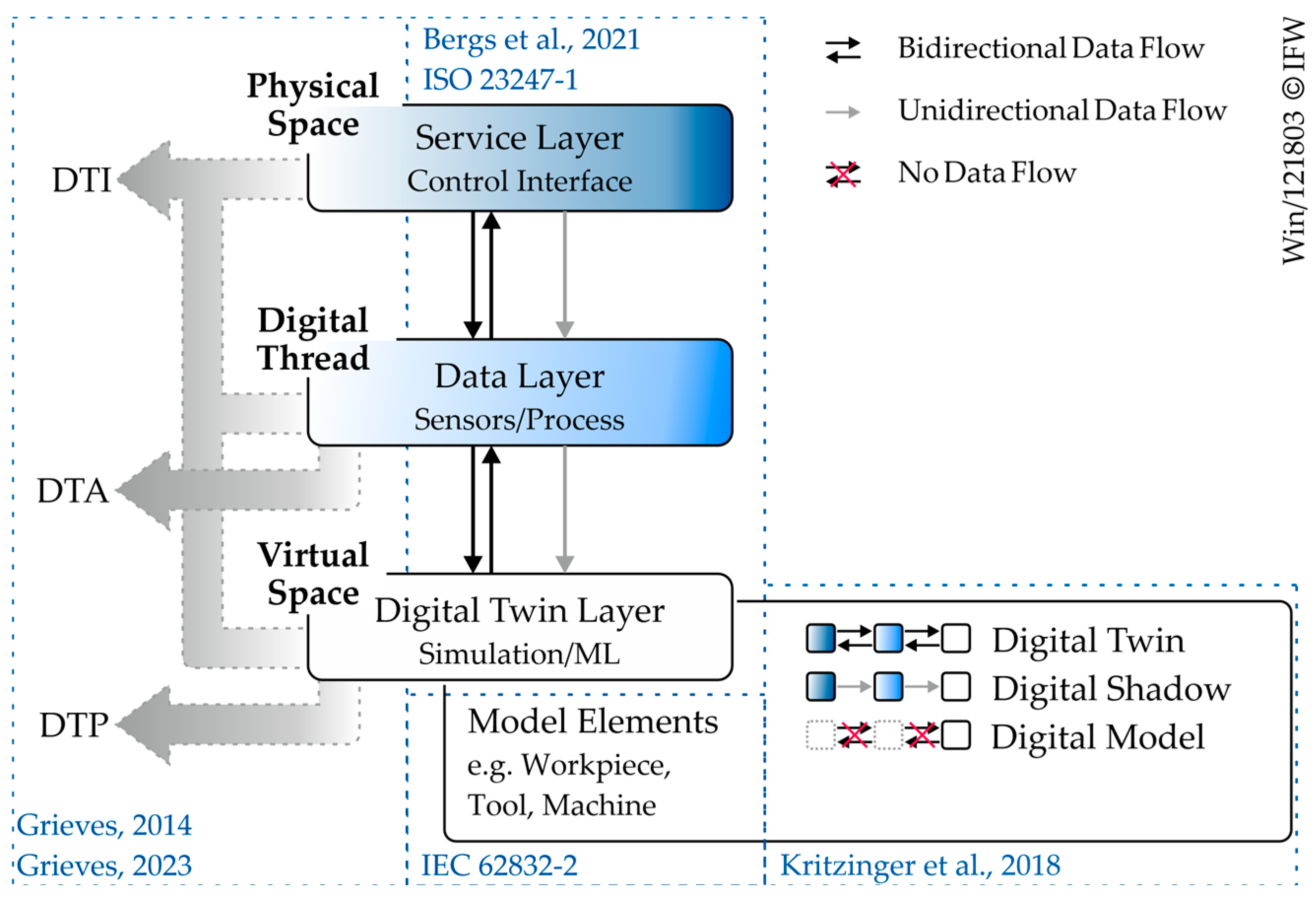
Figure 1. Structured comparison of the architectural levels of DTS according to [6,8,9,11,13,14]. Dashed boxes indicate conceptual elements adopted from the referenced works.
Jmmp 09 00400 g001
Figure 2. Extended representation of process simulation levels through integration of the DTS based on [29].
Jmmp 09 00400 g002
Figure 3. System architecture of the digital twin system.
Jmmp 09 00400 g003
Figure 4. Process-parallel simulation: setup in the real machining center (a); mirrored representation in the virtual space (b); workpiece geometry as multi-dexel model.
Jmmp 09 00400 g004
Figure 5. Process flow of a single simulation step within the DTS virtual space.
Jmmp 09 00400 g005
Figure 6. Architecture of the self-developed plugin integrated in the technological simulation environment IFW CutS. The core execution flow is shown as simplified pseudocode.
Jmmp 09 00400 g006
Figure 7. Discretization artifacts in dexel-based simulation depending on parameter selection: (a) unfavorable ratio of simulation step size to dexel pitch leading to under-sampling; (b) appropriate parameterization preventing discretization errors.
Jmmp 09 00400 g007
Figure 8. Deviation of width of cut depending on dexel density and cycle time for six different feed rates.
Jmmp 09 00400 g008
Figure 9. Percentage deviation of feed rate as a function of dexel density and cycle time for six different feed rates.
Jmmp 09 00400 g009
Figure 10. Heatmap comparison of simulation runtimes and analytical estimation: (a) measured runtimes on laptop, (b) measured runtimes on simulation PC, and (c) analytically calculated computational effort.
Jmmp 09 00400 g010
Figure 11. Communication architecture between machine controller, Beckhoff IPC, and simulation PC showing separation of fieldbus and network layers.
Jmmp 09 00400 g011
Figure 12. Signal curve during machine halt due to violation of the process monitoring limit with tool breakage imitation.
Jmmp 09 00400 g012
Figure 13. Signal curve during feed adjustment due to violation of tolerance limits while manufacturing of a wrist implant.
Jmmp 09 00400 g013
Table 1. Overview of the main software modules of the self-developed plugin shown in Figure 6.
Class/Python ScriptMain Function
Machine connectionProvides a communication interface to the machine controller, managing all read and write handles for real-time process signals.
CalculatorSynchronizes simulation steps in IFW CutS, retrieves geometric and process values, and orchestrates data flow to the plugin modules.
Various filtersImplements Hampel, Kalman, and Butterworth filters for adaptive noise reduction and signal smoothing in real time.
Window bufferMaintains sliding windows of time-series data for subsequent feature extraction; defines window size and step interval.
Feature schemaStores the feature order and names consistent with the Python training to ensure identical model inputs.
Feature vector builderAggregates filtered signals within each window to numerical features (mean, RMS, slope, quantiles, etc.).
Base model handlerGeneric ONNX Runtime interface responsible for loading and executing trained ML models.
Specific model handlerConcrete model implementation (e.g., XGBoost, Gaussian Process Regression, Neural Network) derived from the Base Model Handler.
UI and displayWindows Forms interface that visualizes measured and predicted process values in real time.
Feed override IOImplements the functional logic for sending override or stop commands through the machine connection.
Python: feature engineeringGenerates standardized feature sets from experimental data, including filtering, normalization, and windowing logic.
Python: tuningPerforms automated hyper-parameter optimization for each ML model using grouped cross-validation.
Python: trainingTrains the final ML model (XGBoost, CNN, DNN, or GPR) on pre-processed data and exports the model to ONNX format.
Python: validationEvaluates model accuracy on unseen hold-out groups and calibrates residual and uncertainty models
Table 2. Simulation parameters of the full factorial study to analyze the influence of cycle time and dexel density on the accuracy of the intervention variables and computing time.
Dexel Density
ρxyz
[mm−1]
Cycle Time
tcycle
[s]
Feed Velocity
vf
[mm/min]
5
10
13
16
20
0.00625
0.0125480
0.075960
0.0251440
0.051920
0.12400
0.152880
0.2
Disclaimer/Publisher’s Note: The statements, opinions and data contained in all publications are solely those of the individual author(s) and contributor(s) and not of MDPI and/or the editor(s). MDPI and/or the editor(s) disclaim responsibility for any injury to people or property resulting from any ideas, methods, instructions or products referred to in the content.