Article

Natural Rubber-Based Encapsulation for Wireless Intraruminal Monitoring: Effects of Latex Processing Parameters on Mechanical, Chemical, and RF Transmission Performance


by
Prachid Saramolee
1,2,
Siraporn Sakphrom
1,2,
Choosak Rittiphet
1,2,
Supawat Kotchparadit
3,
Koki Ogura
4 and
Sarawuth Chaimool
5,*
1
School of Engineering and Technology, Walailak University, Nakhon Si Thammarat 80160, Thailand
2
Center of Excellence on Wood and Biomaterials, Walailak University, Nakhon Si Thammarat 80160, Thailand
3
School of Electronic Engineering, Suranaree University of Technology, Nakhon Ratchasima 30000, Thailand
4
Department of Electrical Engineering, Kyushu Sangyo University, Fukuoka 813-8503, Japan
5
Electrical Engineering, Khon Kaen University, Khon Kaen 40002, Thailand
*
Author to whom correspondence should be addressed.
J. Manuf. Mater. Process. 2026, 10(9), 344; https://doi.org/10.3390/jmmp10090344
Submission received: 21 July 2026 / Revised: 2 September 2026 / Accepted: 4 September 2026 / Published: 7 September 2026

Abstract

Encapsulation for wireless dairy-cattle implants must resist acidic, moisture-rich gastrointestinal conditions while remaining transparent to radio-frequency (RF) signals. This study evaluated vulcanized natural rubber (NR) latex as an intraruminal encapsulant, examining how total solid content (TSC; 30, 40, 50 wt%), stirring duration (24–72 h), and TiO2 loading affect tensile and tear strength, acidic swelling, dip-coating thickness, and received signal strength indicator (RSSI) at 433 MHz. Multilayer dip-coating produced films 0.25–0.38 mm thick. Tensile strength rose with TSC and stirring (26.6 → 32.2 MPa), whereas tear strength peaked at 40 wt% (31.97 N mm−1). Adding 5 phr (parts per hundred rubber) TiO2 cut pH-4 swelling ~four-fold (21.1 → 5.25%) with a negligible RSSI penalty, and 3–5 coating layers kept the link well above the −120 dBm sensitivity floor over 5–55 m. The optimum—40 wt% TSC, 72 h stirring, 5 phr TiO2—best balanced mechanical integrity, swelling resistance, thickness, and wireless performance. Vulcanized NR is therefore a promising bio-based encapsulant under simulated conditions; dielectric characterization, long-term aging, and in vivo validation remain future work.

1. Introduction

Precision livestock farming increasingly relies on sensors that continuously track animal health, behavior, and physiology [1,2]. Intraruminal devices are especially valuable in dairy cattle, delivering real-time temperature, pH, and motility data relevant to digestive health, metabolic disorders, and herd management [3,4]. Reliable operation in the gastrointestinal tract, however, demands encapsulation that shields the electronics from moisture, acid, ionic species, and cyclic mechanical loading while remaining transparent to wireless signals [5,6]. The ruminal environment is aggressive: devices face prolonged contact with aqueous media, fluctuating acidity, dissolved salts, feed abrasion, microbial activity, and cyclic compression from rumen motility [7,8]. Unsuitable encapsulants respond with water uptake, swelling, cracking, softening, loss of adhesion, or degraded dielectric behavior [9,10], compromising both structural reliability and communication. Encapsulation design must therefore reconcile mechanical durability, chemical resistance, processability, and RF transparency [11,12]. Epoxies, polyurethane (PU), polydimethylsiloxane (PDMS), and parylene coatings have all been used for electronic and biomedical encapsulation [13,14], offering varied stiffness, flexibility, barrier, and dielectric properties. Yet materials suited to conventional packaging are often ill-matched to intraruminal use, which additionally demands large-deformation tolerance, tear resistance, and compatibility with dip- or conformal coating [15,16]; many are also stiff, fossil-derived, or incompatible with thick elastomeric layers [17]. Natural rubber (NR) is an attractive alternative for its high elasticity, resilience, and low modulus relative to structural polymers [18,19]. Vulcanized NR resists repeated deformation and, with its low dielectric constant, offers favorable RF compatibility versus more polar materials [20,21]; latex systems further enable aqueous compounding and dip-coating of conformal films on irregular surfaces [22,23]. These traits make vulcanized NR a plausible encapsulant for wireless intraruminal devices. NR performance, however, depends strongly on formulation and processing. Total solid content (TSC) governs viscosity, film build-up, and drying [22]; stirring duration controls additive dispersion, colloidal homogeneity, and cured-film properties [24]; and fillers such as TiO2 improve dimensional stability and fluid resistance but can impair mechanical or RF behavior at excessive loading [25,26]. Optimizing NR encapsulation thus requires a systematic study of formulation–process–property relationships.
This work evaluates vulcanized NR latex as an encapsulant for wireless intraruminal monitoring in dairy cattle. We assess how TSC (30, 40, 50 wt%), stirring duration (24–72 h), and 5 phr TiO2 govern tensile and tear strength, acidic swelling, coating thickness, and RSSI at 433 MHz, so as to define a practical formulation window that balances mechanical robustness, chemical stability, and wireless function. The study is framed as materials screening and process optimization rather than in vivo validation [27].

2. Materials and Methods

2.1. Materials

High-ammonia NR latex (HA-NR; 60% dry rubber content, DRC) was supplied by Num Rubber & Latex Co., Ltd. (Trang, Thailand).
The compounding chemicals—potassium hydroxide (KOH), sodium dodecyl sulphate (SDS), sulfur, zinc 2-mercaptobenzothiazole (ZMBT), zinc diethyldithiocarbamate (ZDEC), Lowinox CPL, zinc oxide (ZnO), and titanium dioxide (TiO2)—were supplied by Thanodom Trading Co., Ltd. (Bangkok, Thailand).
All loadings are expressed in parts per hundred rubber (phr), i.e., per 100 parts by mass of dry NR solids.

2.2. Formulation Design

Formulation and process variables were chosen to probe their effects on mechanical, swelling, and wireless performance. Three TSC levels (30, 40, 50 wt%) and stirring durations of 24, 48, and 72 h were examined, with TiO2 varied at 0, 5, and 10 phr for the swelling and wireless evaluations (5 phr in the base compound of Table 1) and dip-coating at 1, 3, 5 and 7 layers to relate thickness to device performance, with film thickness characterized at 1, 3 and 5 layers and the wireless tests covering 1, 3, 5 and 7 layers. Lower TSC was expected to aid flow and wetting, higher TSC to raise deposition per cycle, longer stirring to improve additive dispersion, and TiO2 to reinforce and resist swelling at a level low enough to avoid excessive rigidity or signal attenuation. The latex formulation is summarized in Table 1. The 30–50 wt% window was fixed by the latex itself and by the dip-coating process. The as-received HA-NR concentrate is supplied at ~60% dry rubber content, so 50 wt% is close to the highest solids attainable without re-concentration, while below 30 wt% the deposit per dip cycle becomes too thin for practical build-up and demands additional cycles and drying time. Above approximately 50 wt% the latex viscosity rises steeply and promotes air entrapment, uneven withdrawal films and reduced colloidal stability during prolonged compounding [22]. Conditions outside this window are nevertheless of interest: 20 wt% for very thin conformal layers over fine features and 55–60 wt% for single-dip thick walls are planned once a higher-shear dipping rig with controlled withdrawal is available.

2.3. Preparation of Latex with Different Total Solid Contents

The TSC of the as-received HA-NR latex was determined gravimetrically before formulation, from the ratio of oven-dried solids to initial wet mass:
T S C % = C A / B A × 100
where A is the mass of the glass plate and cover, B the initial total mass (plate, cover, and wet latex), and C the total mass after drying (plate, cover, and dried solids).
A known latex mass was oven-dried at 100 °C to constant mass, and TSC was computed in triplicate. The deionized water needed to reach each target TSC was then obtained from a solids mass balance:
m i T S C i = m f T S C f
where m i is the mass of the received latex, T S C i is the measured initial total solid content, m f is the mass after dilution, and T S C f is the desired (target) total solid content.
This two-step approach both verified the received solids content and enabled controlled dilution for compounding. Water was added slowly under gentle stirring to preserve colloidal stability, and each diluted latex was re-verified gravimetrically before compounding. The measured TSC values are summarized in Table 2.

2.4. Compounding Procedure

Compounding ingredients were added as aqueous dispersions: ZnO first, then sulfur, ZMBT, ZDEC, and CPL; TiO2 was ball-milled separately for 72 h before addition.
The dispersions were added gradually under mechanical stirring at 80 rpm, and the compounds were stirred for 24, 48, or 72 h at 25 °C to assess the effect of mixing time on homogeneity and film properties.

2.5. Dip-Coating and Vulcanization

Films and coated devices were produced by dip-coating the compounded latex. Substrates were cleaned with ethanol, dried, immersed for 10 s, and withdrawn vertically at 50 mm min−1, with 30 min air-drying between successive dip cycles, giving coatings of 1, 3, 5 and 7 layers. Coated samples were then vulcanized at 70 °C for 24 h in a convection oven, cooled, and conditioned for 24 h before testing.
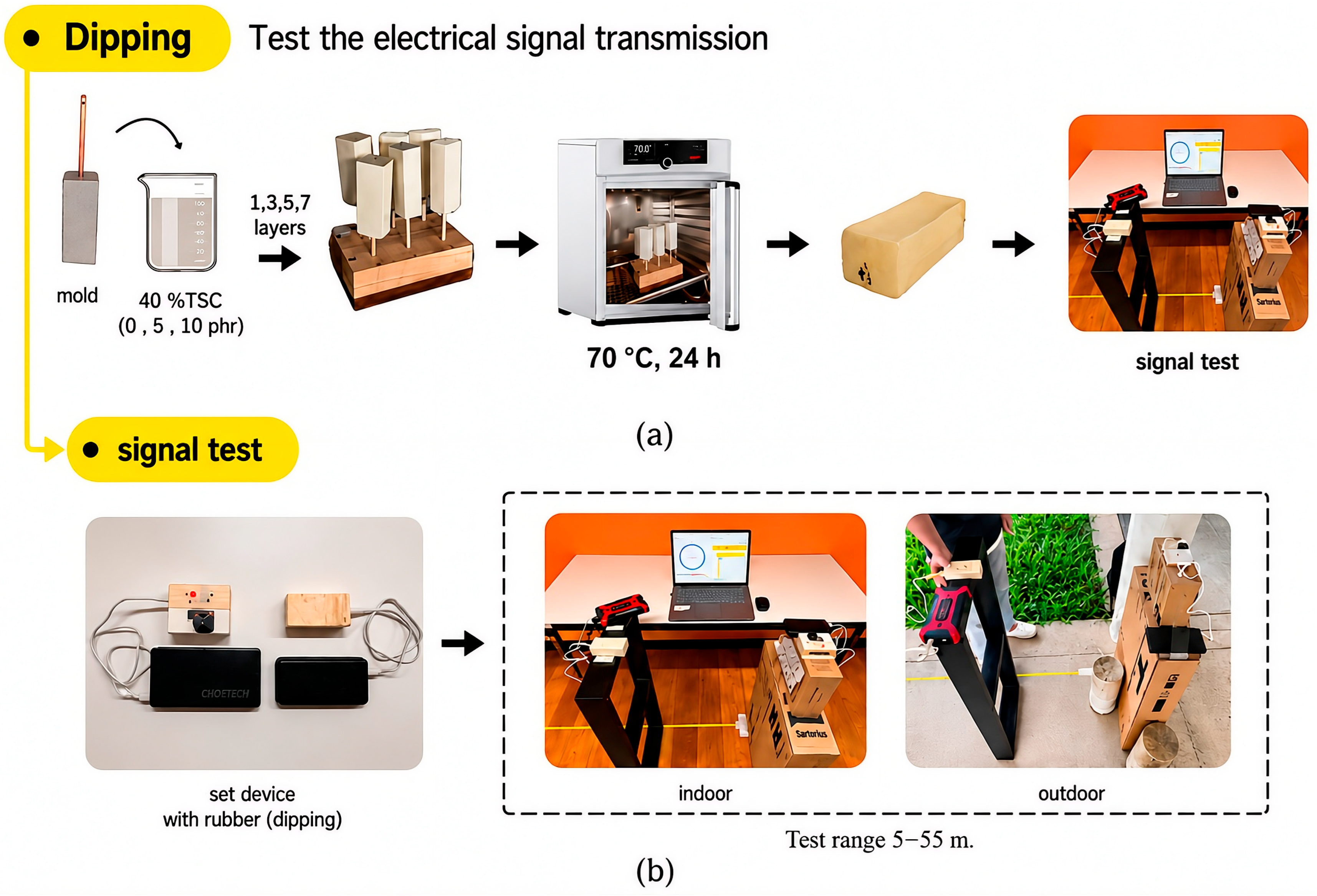
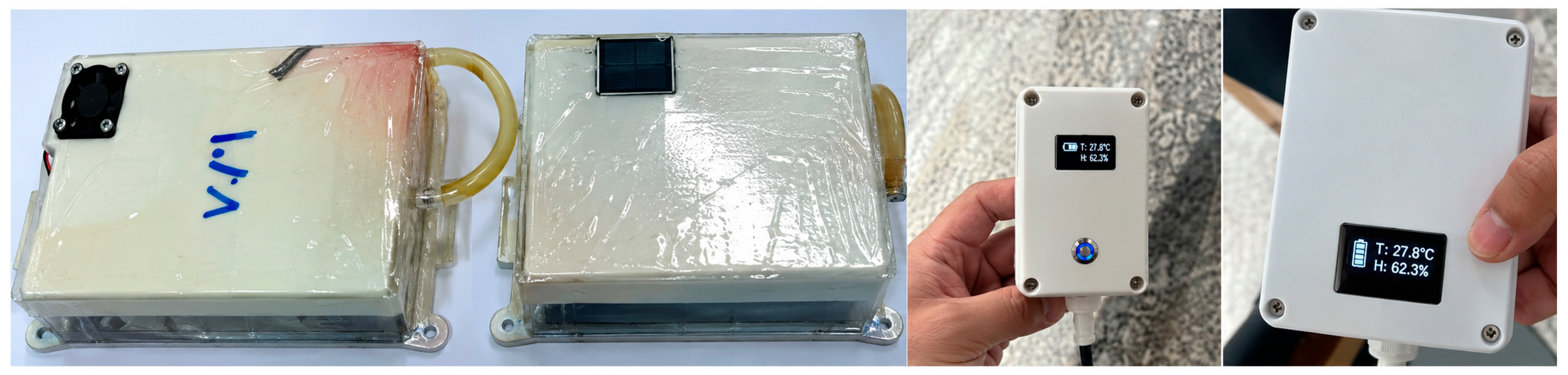
The overall fabrication and testing workflow are illustrated in Figure 1 and Figure 2. Figure 1 shows the dipping and curing sequence, while Figure 2 summarizes the assembly of the encapsulated device and the wireless RSSI test configuration.

2.6. Thickness Measurement

Coating thickness was measured with a digital micrometer (Mitutoyo 547–301, Mitutoyo Corporation, Kawasaki, Japan; ±0.01 mm) at three locations per sample and averaged for 1, 3 and 5 dip layers. Values are reported as mean ± standard deviation across the three independently coated formulations (0, 5 and 10 phr TiO2) measured at each layer count (Table 3).

2.7. Tensile Testing

Tensile properties followed ASTM D412 (type D) [28] on dumbbell specimens whose thickness was measured before testing, using a UT-2060 universal testing machine (U-CAN DYNATEX INC., Taichung City, Taiwan) at 500 mm min−1, with four valid replicate specimens per formulation.
Tensile strength at break was taken as the maximum load divided by the initial cross-sectional area:
σ b = F m a x / A 0
where σ b is the tensile strength at break (MPa), F m a x is the maximum load at failure (N), and A 0 is the initial cross-sectional area of the specimen (mm2). This definition was used consistently for all tensile data reported in Table 4.

2.8. Tear Resistance Testing

Tear resistance followed ASTM D624 (die C) [29] on the same machine at 50 mm min−1, with four replicate specimens per condition:
T = F / t
where T is the tear resistance, F is the maximum tearing force, and t is the specimen thickness. The calculated tear resistance values were reported in N mm−1. If any test was invalid due to premature grip failure, irregular crack propagation, or specimen defects, the result was excluded and the number of valid replicates was stated explicitly in the corresponding table. This calculation was applied to all valid tear-test specimens reported in Table 5.

2.9. Swelling Test in Acidic Medium

Swelling was assessed in a simplified acidic medium representing abomasal conditions—deionized water adjusted to pH 4 with HCl. Lacking enzymes, surfactants, or added salts, this is a screening medium rather than a full simulated gastrointestinal fluid.
Specimens were immersed at 25 ± 2 °C for 24 h, blotted, and immediately reweighed; the swelling ratio was obtained from the mass change:
Q s % = W f W i / W i × 100
where W i is the initial dry weight (g) and W f is the weight after immersion (g). Three specimens were tested for each TiO2 loading condition. The swelling ratio was used as a comparative indicator of fluid uptake and dimensional stability under acidic exposure.

2.10. Wireless Transmission Test and Link Budget Estimation

Wireless performance was evaluated with a 433 MHz LoRa link using ESP32-driven transmitter and receiver nodes with Ra-02 LoRa module (Shenzhen Ai-Thinker Technology Co., Ltd., Shenzhen, China), based on the SX1278 transceiver. The transmitter delivered up to +20 dBm and both nodes used 1–2 dBi antennas. RSSI was recorded indoors and outdoors at 5–55 m under fixed antenna orientation, averaging three readings per distance and condition. No in vivo measurements were made, so the results reflect propagation in air rather than through rumen tissue or fluid. The comparison covered encapsulations of 1, 3, 5 and 7 coating layers.
To interpret the distance-dependent RSSI and relate it to intraruminal use, a first-order link-budget analysis estimated the received power as:
P r = P t + G t + G r P L F S L b o d y L m i s c
where P r is the received power (dBm), P t is the transmitter output power (dBm), G t and G r are the transmitter and receiver antenna gains (dBi), P L F S is the free-space path loss (dB), L b o d y is the additional attenuation associated with propagation through ruminal contents and body tissues (dB), and L m i s c accounts for miscellaneous losses such as polarization mismatch, antenna detuning, and fading (dB).
The free-space path loss at 433 MHz was calculated as
P L F S d B = 32.44 + 20 l o g 10 f M H z + 20 l o g 10 d k m
which can be simplified for f = 433 MHz to
P L F S d B = 25.17 + 20 l o g 10 d m
where d m is the transmission distance in meters. These equations were used only as a first-order reference for interpreting distance-dependent RSSI trends. More detailed propagation through lossy encapsulation media was not modeled because the dielectric properties of the fabricated NR formulations were not directly measured in this study.
Because attenuation within bovine ruminal media was not measured directly, additional body/rumen loss was estimated from implantable- and ingestible-telemetry studies near 402–433 MHz, where fluid-rich tissues add substantial loss depending on depth, dielectric loading, antenna efficiency, and orientation [30,31,32]. Two representative values were considered: 20 dB (moderate) and 30 dB (conservative). RSSI is recorded to the 1 dB resolution of the SX1278 receiver and each reported value is the mean of three consecutive readings; the transmitter–receiver separation was set with a positioning tolerance of ±0.5 m.

2.11. Statistical Analysis

Results are reported as mean ± standard deviation (SD). TSC, coating thickness, and swelling were measured in triplicate (n = 3), tensile and tear strength on four valid replicate specimens per formulation (three for the 40 wt% tear conditions, where one test was invalidated), and each RSSI value is the mean of three readings. Effects of TSC and TiO2 were tested by one-way ANOVA with Tukey’s HSD post hoc comparisons (p < 0.05); RSSI–distance relationships were fitted by ordinary least-squares regression. Where only group means and SDs were available, significance statements indicate dominant trends.

3. Results

3.1. Determination of TSC

The measured TSC values are summarized in Table 2. The latexes were adjusted to the 30, 40, and 50 wt% targets with only minor deviation, confirming that dilution gave acceptable control of solids content before compounding and dipping.
Table 2. Total solid content (TSC) of the NR latex compounds.
Sample No.Glass Plate + Cover (g)Initial Mass (g)Dry Mass (g)TSC (%)
192.3994.7293.0126.61
294.4297.5495.7241.67
398.21100.6799.5554.47
Film thickness increased monotonically with the number of dip cycles, from 0.25 ± 0.02 mm (1 layer) to 0.28 ± 0.02 and 0.38 ± 0.03 mm at 3 and 5 layers (Table 3); the 3–5-layer range balances protective coverage and RF transmission.
Table 3. Average thickness of vulcanized NR films as a function of the number of dipping layers.
Number of Dipping LayersAverage Thickness (mm) *
1 layer0.25 ± 0.02
3 layers0.28 ± 0.02
5 layers0.38 ± 0.03
* Mean ± standard deviation across the three independently coated formulations (0, 5 and 10 phr TiO2) measured at each layer count; each formulation value is itself the mean of three micrometer readings (Mitutoyo 547–301, ±0.01 mm).
This consistent build-up matters for device packaging, since thickness affects not only mechanical protection but also device mass and drying time.

3.2. Effect of TSC on Tensile Strength

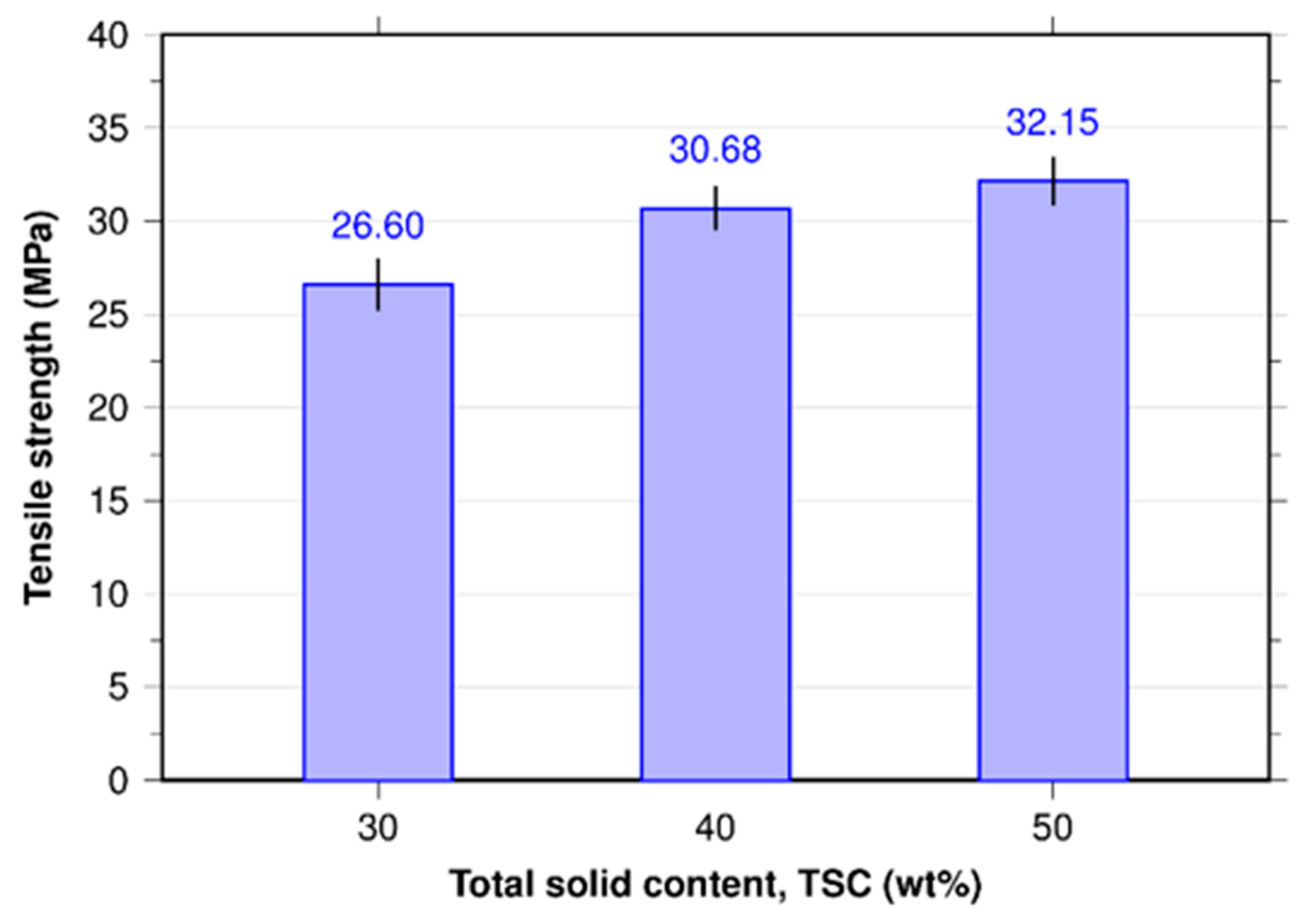
Tensile results are summarized in Table 4 and Figure 3. Tensile strength increased with TSC and, in several cases, with longer stirring. These trends may be associated with improved film formation and mixing uniformity; however, the present study did not directly measure crosslink density or network structure. Formulations A–C in Table 4 and Table 5 differ in total solid content, so the tabulated comparison isolates TSC; stirring duration was not resolved as an independent variable within this set, and the influence of mixing time is therefore reported as a trend observed during compounding rather than as a separately tabulated effect.
Table 4. Tensile strength of vulcanized NR films prepared at different TSC.
FormulationTSC (%)Average Tensile Strength (MPa) *
A3026.60 ± 0.47
B4030.68 ± 0.62
C5032.15 ± 0.58
* Mean ± standard deviation of the replicate dumbbell specimens tested for each formulation (Section 2.7).
Table 5. Tear resistance of vulcanized NR films prepared at different TSC.
FormulationTSC (%)Average Tear Strength (N/mm) *
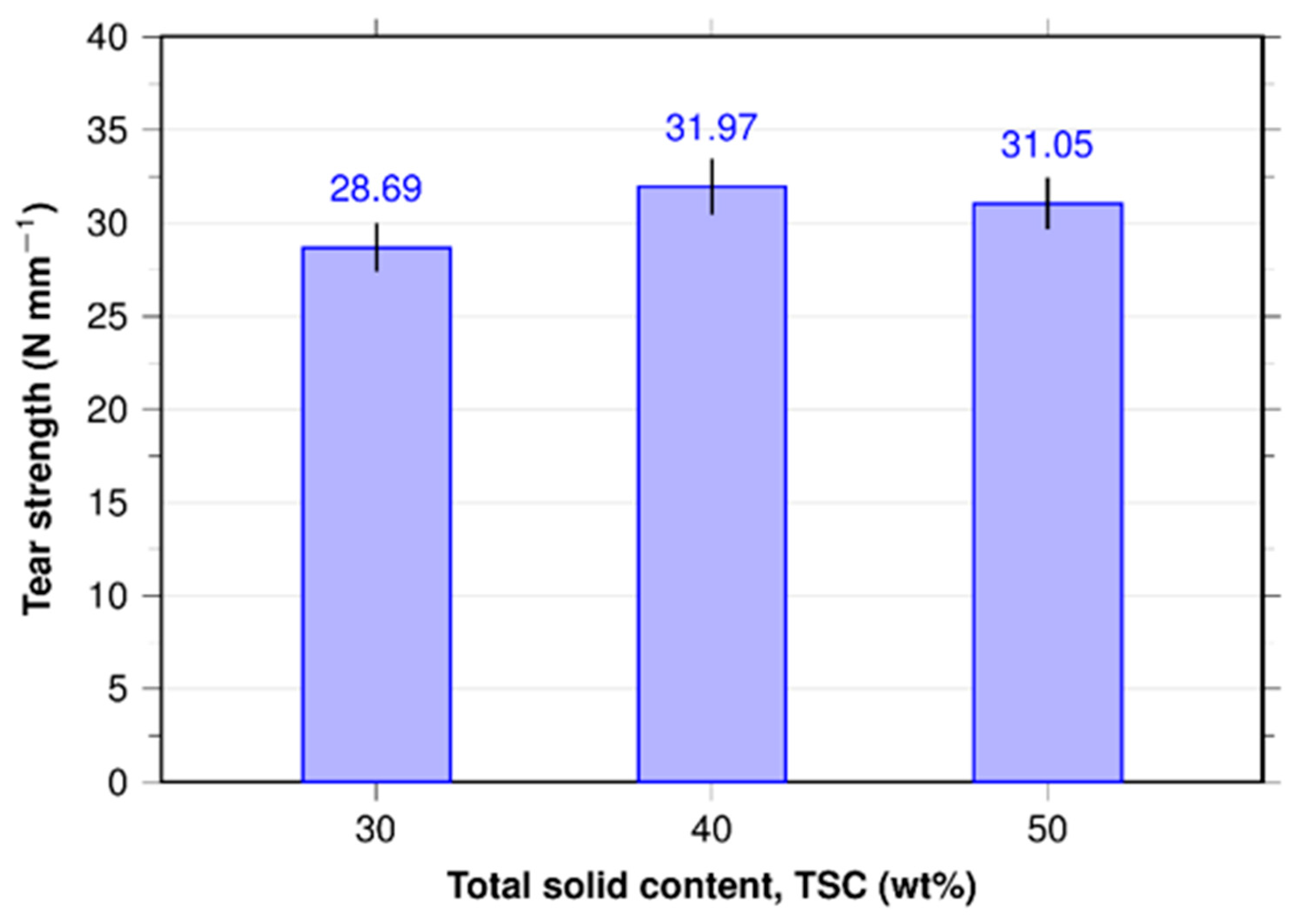
A3028.69 ± 1.63
B4031.97 ± 5.17
C5031.05 ± 4.09
* Mean ± standard deviation; n = 4 replicate specimens, except the 40 wt% condition (n = 3), for which one specimen was excluded because of premature grip failure in accordance with Section 2.8. The replicate scatter of the tear test is large relative to the differences between conditions, so the 40 wt% maximum should be read as a trend rather than as a statistically resolved optimum.
The 50 wt% formulation gave the highest mean tensile strength. Longer stirring was qualitatively associated with improved film properties, although its independent effect was not resolved in the present dataset. One-way ANOVA confirmed a significant TSC effect (p < 0.05): the 30 wt% film (26.60 ± 0.47 MPa) was significantly weaker than the 40 and 50 wt% films (30.68 ± 0.62 and 32.15 ± 0.58 MPa), whereas the 40–50 wt% difference was small (≈5%). Tensile strength alone is therefore an insufficient selection criterion, since tear resistance, swelling, and wireless performance also matter.
Higher TSC also lessens the water removed during drying, improving process efficiency, though excessive TSC can raise viscosity and reduce coating uniformity; tensile data should thus be read alongside thickness and coating quality.
Microstructurally, the rise in tensile strength with TSC reflects closer latex-particle packing: smaller interparticle spacing in the wet deposit promotes more complete capillary deformation and autohesion during drying and vulcanization, giving a more continuous network with fewer void-like stress concentrators. Longer stirring reinforces this by distributing sulfur, accelerators (ZDEC, ZMBT), and ZnO more uniformly, yielding more homogeneous crosslinking and load transfer. The resulting tensile strengths of 26.6–32.2 MPa are higher than the typical tensile-strength range reported for PDMS encapsulants (≈3–10 MPa [33]); however, this comparison is based on the literature data obtained under different test conditions and does not constitute a direct experimental comparison. This account is inferential: neither crosslink density nor its spatial uniformity was measured in this study, so the reference to more homogeneous crosslinking denotes a proposed mechanism consistent with the mechanical response rather than an observed quantity.

3.3. Effect of TSC on Tear Resistance

Tear results appear in Table 5 and Figure 4. Unlike tensile strength, tear resistance did not increase monotonically with TSC: it peaked at 40 wt% (31.97 ± 5.17 N mm−1), indicating that an intermediate formulation best resists crack initiation and propagation. The 40 and 50 wt% means differ by less than one standard deviation of either condition (Table 5), so this maximum indicates a trend rather than a statistically resolved optimum.
Thus, the strongest formulation is not the most tear-resistant: excessive stiffness or crosslink density reduces stress dissipation at the crack tip. For gastrointestinal implants subject to local defects, abrasion, and repeated deformation, tear resistance is especially relevant.
The tear maximum at 40 wt% reflects competing effects of network density: crack-tip energy dissipation via large local deformation and strain-induced crystallization is greatest at moderate crosslink density, whereas the denser, more heterogeneous network at 50 wt% restricts chain extensibility and shrinks the dissipation zone, arresting cracks less effectively despite higher tensile strength. The divergence between the tensile maximum (50 wt%) and tear maximum (40 wt%) is the expected strength–toughness trade-off. Because intraruminal failure more likely initiates at surface flaws than under uniform tension, tear resistance is the more service-relevant metric, favoring the 40 wt% formulation. Network density was likewise not measured here, so this reading of the tear maximum—and the associated statement that excessive stiffness or crosslink density suppresses crack-tip dissipation—should be taken as a mechanistic interpretation consistent with the observed strength–toughness divergence, not as a demonstrated causal relationship. The measurements required to test it are listed in Section 4.5.

3.4. Effect of TiO2 on Swelling Behavior in Acidic Medium

The swelling results for the 5 phr TiO2 formulation are summarized in Table 6. Among the compositions tested, the 5 phr TiO2 film showed the lowest mean swelling, indicating that moderate loading restricts fluid uptake—likely by increasing diffusion-path tortuosity and network stability.
The large standard deviation of the 0 phr sample reflects variability from local thickness, non-uniform crosslinking, or post-immersion handling, so the unfilled condition should be read with caution.
Because the test used a simplified acidic medium rather than a full biological fluid, the data serve as comparative screening for formulation selection rather than proof of long-term in vivo stability.
The effect is large: the unfilled film swelled 21.10 ± 22.75% after 24 h at pH 4, whereas 5 and 10 phr TiO2 reduced this to 5.25 ± 0.22% and 5.35 ± 0.76%—a ~four-fold suppression. This is consistent with a tortuosity (barrier) effect, impermeable submicron TiO2 lengthening the diffusion path and lowering the effective diffusion coefficient. That 5 phr matches 10 phr shows the benefit saturates at low loading, while the unfilled film’s large scatter (±22.75%, driven by one specimen swelling ≈ 43%) reflects the absence of a stabilizing barrier phase. These data cannot, however, be converted into a crosslink density. Flory–Rehner analysis requires equilibrium swelling in a thermodynamically good solvent, whereas water uptake by a hydrophobic cis-1,4-polyisoprene network at pH 4 is governed by diffusion into hydrophilic non-rubber domains and microvoids rather than by the elasticity of the network [18,23]. The low, reproducible uptake of the filled films is therefore evidence of an effective diffusion barrier and of good film integrity, but the network density itself must be measured independently, as set out in Section 4.1 and Section 4.5.

3.5. RF Transmission Performance and Implications for Intraruminal Use

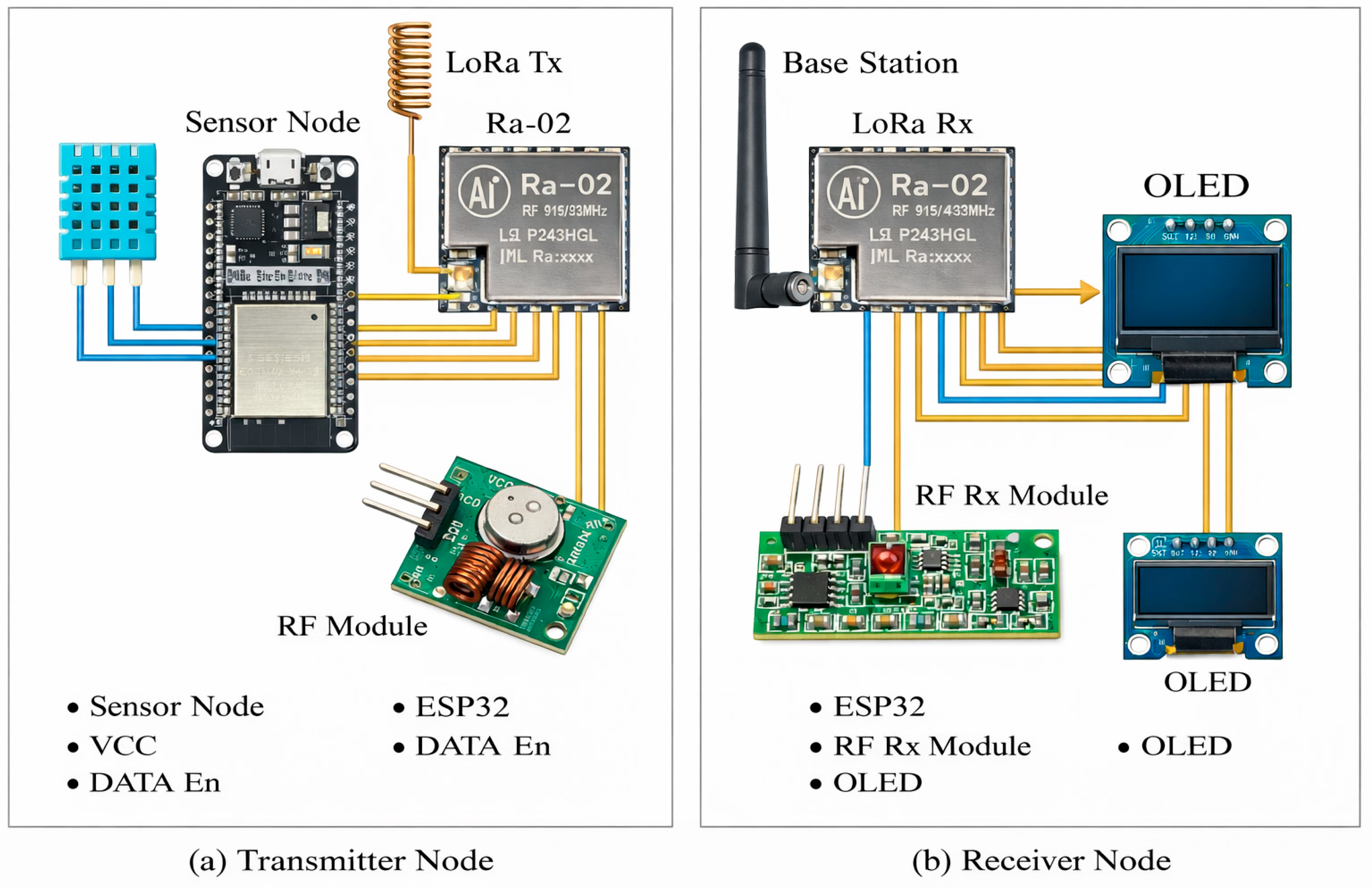
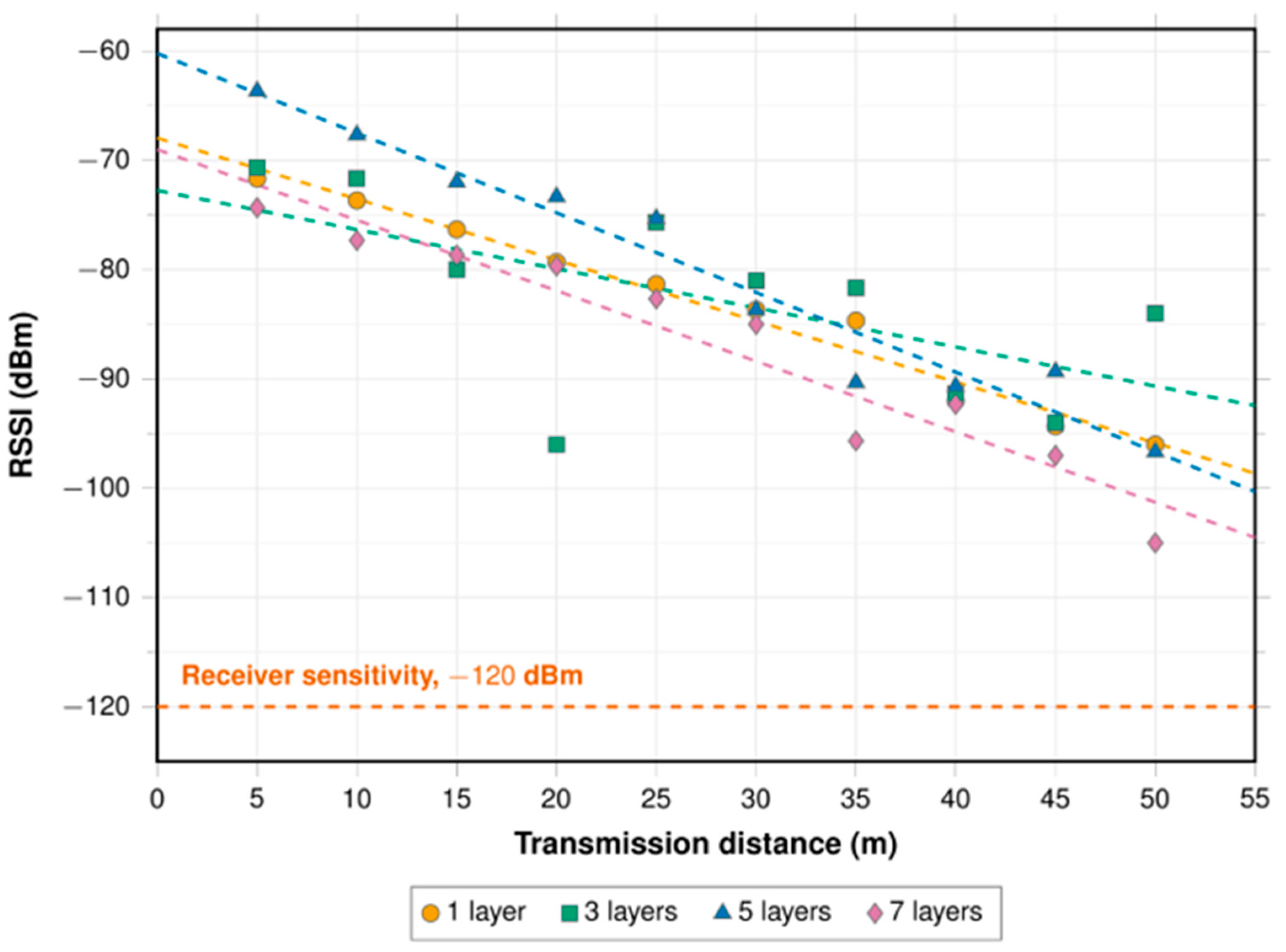
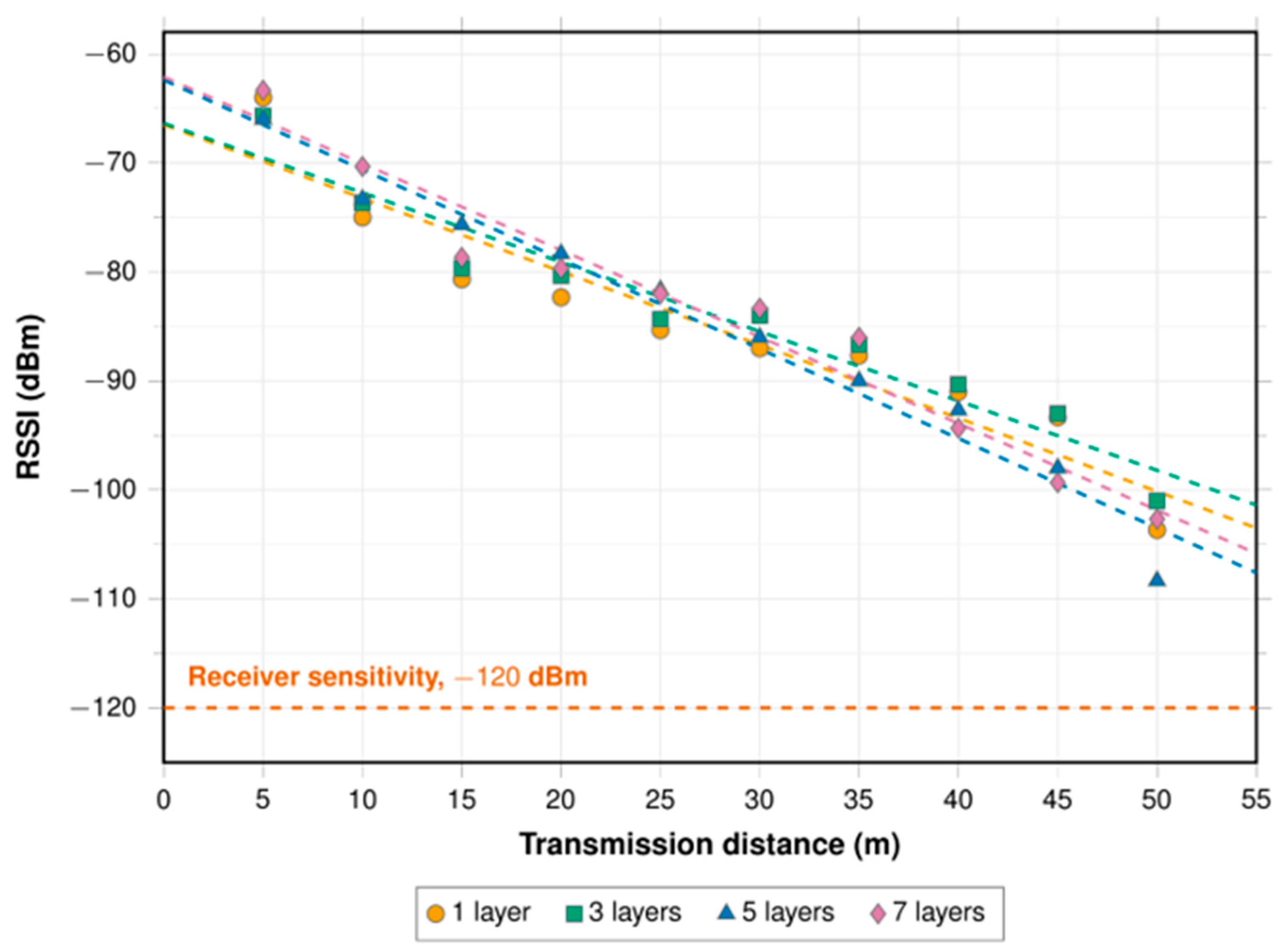
The wireless devices and link configuration used for the RSSI measurements consisted of an ESP32 sensor node and an ESP32 base station, each equipped with an SX1278 (Ra-02) transceiver, as shown in Figure 5. Wireless performance was measured indoors and outdoors with the NR-encapsulated devices to evaluate whether the coating and TiO2 affected transmission over practical distances (Figure 6). At 433 MHz, the devices sustained communication in both settings (Figure 7 and Figure 8); RSSI decreased with distance, as expected, but the NR coatings did not prevent reception, confirming compatibility with wireless operation under above-ground conditions.
TiO2 loading affected RSSI far less than swelling, so low-to-moderate TiO2 can enhance chemical stability without a marked wireless penalty. The 5 phr film combined stable RSSI with the best swelling resistance, making it the most attractive from an integrated-performance standpoint.
Figure 7 and Figure 8 show the RSSI–distance behavior of the optimized 5 phr TiO2 (40 wt% TSC) coatings for 1–7 layers. RSSI decreased approximately linearly (slopes ≈ 0.56–0.82 dB m−1, R2 ≈ 0.9 for most conditions), matching the free-space trend of Equation (8). The three- and five-layer coatings gave the strongest, most consistent signals (e.g., −63.7 dBm at 5 m and better than −97 dBm at 50 m indoors for 5 layers), while the seven-layer coating rolled off slightly faster, consistent with a longer, more attenuating dielectric path. All conditions stayed well above the −120 dBm sensitivity floor across 5–55 m, confirming reliable above-ground communication.
The weak TiO2 influence follows from the dielectric contrast (Table 7). Vulcanized NR is a low-permittivity, low-loss elastomer (εr ≈ 2.1–2.5, tan δ ≈ 0.002–0.01 at UHF), more RF-transparent than the more polar PDMS (2.7–3.0), PU (3.0–4.0), and epoxy (3.5–4.5). Rutile TiO2 is highly polar (εr ≈ 80–110), but at the low volume fractions used (5 phr ≈ 1.4 vol%, 10 phr ≈ 2.7 vol%) effective-medium models predict only a small rise in composite permittivity and loss, so the sub-millimeter coating perturbs the 433 MHz link weakly. This decoupling lets TiO2 suppress fluid uptake without degrading RF transparency—critical because the intraruminal medium is strongly dissipative (rumen fluid εr ≈ 60–75, conductivity ≈ 0.8–1.5 S m−1 near 400 MHz, with added tissue loss), so minimizing the encapsulant’s own dielectric loading preserves link margin.
Coating thickness also shapes device design: too thin gives insufficient protection, too thick raises material use and can lengthen the transmission path or enlarge the device; the three- and five-layer coatings offered the best protection–RF compromise.
The indoor and outdoor RSSI tests were performed in air to represent cattle-housing and grazing environments, not inside the rumen; they therefore provide baseline environmental communication data rather than direct evidence of intraruminal transmission.
A first-order 433 MHz link budget relates these baselines to intraruminal use. Free-space path loss was 39.15, 45.17, 51.19, 54.71, 57.21, and 59.15 dB at 5, 10, 20, 30, 40, and 50 m. With a best-case air-link RSSI of about −80 dBm at 20 m, −86 to −87 dBm at 30 m, and −96 to −98 dBm at 50 m, and −120 dBm receiver sensitivity, the corresponding margins are ~40 dB (20 m), 33–34 dB (30 m), and 22–24 dB (50 m). Equations (7) and (8) are deterministic in distance, so the uncertainty of these path-loss figures follows from the ±0.5 m positioning tolerance of the measurement course and amounts to ±0.87 dB at 5 m, ±0.22 dB at 20 m and ±0.09 dB at 50 m, which is small compared with the 1 dB RSSI resolution of the receiver and with the environmental variability of the measured links.
Adding a literature-based 20 dB rumen/body loss [30,31,32] keeps the margin positive at 20–30 m and marginally positive at 50 m for the best condition; a conservative 30 dB loss reduces it sharply, implying that longer-range operation would need a more sensitive receiver, shorter range, better antenna matching, or a closer gateway.
Overall, vulcanized NR encapsulation is compatible with 433 MHz transmission above ground, and the link budget suggests intraruminal communication may be feasible over short-to-moderate ranges. Because propagation through ruminal contents and tissue was not measured, definitive validation will require tissue-equivalent phantoms, ex vivo media, or in vivo studies.
Finally, the RF assessment used RSSI rather than direct dielectric characterization; the results confirm wireless compatibility but do not establish quantitative dielectric superiority over PDMS or PU.

3.6. Integrated Formulation Selection and Sustainability Implications

Taken together, no single formulation maximized every property: higher TSC and longer stirring improved tensile strength, tear resistance peaked at an intermediate condition, and 5 phr TiO2 gave the lowest swelling among filled systems, while all NR coatings remained RF-compatible at 433 MHz.
On balance, 40 wt% TSC with 72 h stirring and 5 phr TiO2 is the best compromise among mechanical integrity, swelling resistance, coating thickness, and wireless performance.
This choice is also resource-efficient: moderate TSC lowers water handling relative to dilute latex while avoiding high-viscosity coating defects, and 5 phr TiO2 matches 10 phr for swelling at half the additive. Very extensive stirring, by contrast, adds processing time and energy and is justified only when its benefit is clear.
These sustainability implications remain qualitative: no life-cycle, carbon-footprint, biodegradation, or end-of-life analysis was performed, and the formulation still relies on conventional curatives (ZnO, sulfur, accelerators) that temper the bio-based advantage of NR. The results thus indicate a promising route toward more sustainable encapsulation rather than a fully sustainable solution.

4. Discussion

4.1. Relationship Between Processing Parameters and Mechanical Performance

The TSC and stirring effects underscore the role of latex processing in setting film structure. TSC governs both the solids available for film formation and latex rheology during dipping: low TSC deposits less per cycle and needs more drying, risking shrinkage and non-uniformity, whereas high TSC builds thickness readily but can impair coating smoothness at high viscosity. A 40–50 wt% window balanced these factors.
Stirring controls how uniformly curatives, activators, antioxidants, and fillers disperse; poor mixing leaves concentration gradients and non-uniform vulcanization. Extended stirring improved tensile performance, confirming the importance of dispersion, yet stronger films were not always the most tear-resistant—reinforcing the need to balance properties.
A quantitative link between processing, network structure and properties was not established here, and this is a genuine limitation of the present dataset. Crosslink density was neither measured nor inferred, because the only swelling experiment performed uses an aqueous acidic medium, which is unsuitable for Flory–Rehner evaluation for the reasons set out in Section 3.4. The mechanistic reading offered above—closer particle packing and more uniform curative distribution at higher TSC and longer stirring—therefore remains an inference from the mechanical response rather than a measured structure–property relationship. Establishing it requires equilibrium swelling in toluene with Flory–Rehner evaluation, sol–gel (gel content) determination and cure rheometry of the compounds, from which crosslink density can be regressed against tensile strength, tear resistance and acidic uptake. Those measurements head the follow-up program summarized in Section 4.5. For the same reason, the effect of stirring duration is not quantified here: the tensile and tear data of Table 4 and Table 5 resolve total solid content only, so statements that longer mixing improves film properties should be read as qualitative observations awaiting a dedicated stirring-time series.

4.2. TiO2 as Functional Reinforcement for Chemical Stability

TiO2 markedly improved acidic swelling resistance, which matters for intraruminal use because fluid-driven dimensional change can induce internal stress, microcracking, or coating–component debonding. Reduced swelling thus aids both acidic swelling resistance and long-term mechanical integrity.
That 5 phr performed as well as or better than 10 phr indicates an optimal filler window in which diffusion is restricted without excessive loading; higher contents risk agglomeration and interfacial defects. Moderate reinforcement therefore suffices to improve swelling resistance while preserving flexibility and RF transmission.
The dispersion state of the TiO2 was not imaged, so the barrier interpretation above rests on macroscopic evidence alone: the pigment was ball-milled for 72 h before addition, the compounds were stirred for up to 72 h, and the filled films swelled reproducibly (5.25 ± 0.22% at 5 phr and 5.35 ± 0.76% at 10 phr) whereas the unfilled films did not (21.10 ± 22.75%). Low and repeatable uptake across independent specimens is consistent with a homogeneously distributed filler, because agglomerates would create preferential ingress paths and inflate specimen-to-specimen scatter, but it is not a substitute for direct observation. Cross-sectional scanning and transmission electron microscopy, supported by energy-dispersive X-ray mapping of titanium, are needed to resolve the dispersion, the agglomerate size distribution and the state of the filler–rubber interface, and to test the hypothesis that the saturation between 5 and 10 phr marks the onset of agglomeration [20,25,26].
Two considerations qualify how far this indirect argument should be taken, and both follow from the design of the study. First, the filler loading was deliberately low: 5 phr corresponds to approximately 1.4 vol% (Section 3.5), which lies well below the volume fraction at which a percolated or heavily agglomerated filler network—the feature that cross-sectional SEM or TEM imaging most readily resolves—would be expected to form. Macroscopic swelling was therefore adopted as an indirect but practical descriptor of filler–matrix interaction, consistent with common practice for elastomer systems at low filler content. Second, the objective of this work was to determine how filler incorporation affects the barrier and signal-transmission behavior of the encapsulant, not to establish its morphological state; the experimental design and the analysis were accordingly centered on functional and RF-related properties rather than on structural characterization. Within that scope, the swelling response taken together with the RSSI trends of Section 3.5 is sufficient to support the conclusions drawn here about the effect of TiO2 addition. It does not, however, license any claim that the dispersion is uniform, and no such claim is intended: the dispersion state of these films remains unverified. Direct morphological validation—most informative at higher loadings, where agglomeration becomes likely and structure–property correlations can be resolved—is left to the program outlined in Section 4.5.
The acid exposure was likewise characterized gravimetrically over 24 h with no spectroscopic analysis, so the molecular consequences of the exposure remain unproven. Two points should nevertheless be noted. First, the cis-1,4-polyisoprene main chain is a pure hydrocarbon and contains no hydrolysable linkage; the acid-labile species in natural rubber are the non-rubber constituents—proteins, phospholipids and residual carbohydrate, part of which is bound at the chain ends—together with any hydrolysis-sensitive additive residues [23,24]. Second, TiO2 is chemically inert under these conditions, so its action is expected to be a physical barrier through increased diffusion-path tortuosity rather than chemical inhibition of hydrolysis. Testing this requires attenuated-total-reflectance Fourier-transform infrared (ATR-FTIR) spectroscopy of the film surfaces before and after immersion, tracking the C=C stretching and =C–H bending bands of polyisoprene against the amide, carbonyl and hydroxyl regions, combined with longer exposures at 7, 14 and 28 days, gravimetric determination of extractables, and gel-permeation chromatography of the sol fraction where mass loss is detected.
Only TiO2 was screened in this work, at a loading chosen for pigmentation and dimensional stability, and other functional additives merit the same treatment. Layered or tubular aluminosilicates such as halloysite and organoclay give large aspect-ratio barrier reinforcement at low loading [25]; precipitated silica reinforces strongly but is more polar and would be expected to raise both water uptake and dielectric loss; calcium carbonate offers a low-cost, low-permittivity extender; and functional additions such as ZnO beyond its activator role, or barium sulfate for radiographic bolus localization, address requirements that TiO2 does not. A comparative screen at matched volume fraction, evaluating mechanical properties, acidic uptake and RSSI together, is the appropriate way to establish whether TiO2 is the best choice or merely a workable one.

4.3. Mechanical–Chemical–RF Trade-Off in Formulation Selection

The central finding is that no single variable optimized all targets: higher TSC and longer stirring favored tensile strength, tear resistance favored an intermediate TSC, TiO2 was optimal at 5 rather than 10 phr, and thickness had to protect without adding bulk.
Balancing these trade-offs, the 40 wt% TSC, extended-stirring, 5 phr TiO2 formulation was the most balanced overall—good tensile behavior, the best tear resistance, low acidic swelling, and acceptable RF performance—which is more meaningful for intraruminal encapsulation than maximizing any single metric.

4.4. Comparison with Prior Encapsulation Materials, RF Applicability, and Study Limitations

Vulcanized NR combines high elasticity, dip-coating compatibility, and a low modulus [13,14,15,16,17,18,19,20,21,22,23], which are relevant to encapsulation in the mechanically dynamic gastrointestinal tract where the coating must flex repeatedly while maintaining coverage. However, no direct experimental benchmarking was performed, so NR’s performance should be viewed as promising rather than conclusively superior.
This comparison is drawn from the literature and not from measurement: no PDMS, medical-grade polyurethane or parylene control specimens were prepared, cured and tested alongside the NR films. The values quoted for those materials in Table 7 and Section 3.2 therefore describe typical published behavior rather than a matched comparison, and they cannot establish that NR is superior overall. A defensible benchmark requires control coatings of the same thickness, applied to the same substrate geometry and evaluated with identical protocols—ASTM D412 tensile, ASTM D624 tear, pH-4 uptake and 433 MHz RSSI—so that the materials differ only in chemistry. That experiment is planned; until it is completed, the supportable claim is that vulcanized NR meets the requirements identified here, not that it outperforms the established alternatives.
The RF data must likewise be read within scope: the in-air indoor/outdoor tests represent housing and grazing scenarios, not intraruminal propagation, and thus provide baseline environmental transmission data.
The link-budget analysis bridges these baselines to the target application: free-space path loss rises from ~39.15 dB at 5 m to 59.15 dB at 50 m (±0.87 and ±0.09 dB, respectively, for the ±0.5 m positioning tolerance), and the best condition retained a positive air-link margin throughout. Added rumen/body loss reduces this margin but may still allow operation over short-to-moderate ranges with a sensitive receiver, whereas conservative loss assumptions make gateway placement, antenna matching, receiver settings, and device orientation decisive.
This agrees with implantable/ingestible telemetry near 402–433 MHz, where tissue and fluid add substantial loss with depth, dielectric loading, and antenna efficiency [30,31,32]. NR encapsulation is thus compatible with 433 MHz transmission but not yet proven for communication from within the rumen.
Several limitations remain. The swelling test used a simplified pH 4 solution lacking the ionic, enzymatic, microbial, and thermal complexity of the in vivo tract; the RF evaluation used RSSI rather than dielectric spectroscopy, so permittivity and loss tangent were not measured directly; and testing was laboratory-scale, without long-term cyclic aging, biocompatibility, tissue-phantom, ex vivo, or in vivo studies. The findings are therefore a formulation screen rather than deployment validation.
Future work should include dielectric characterization of the cured films, direct comparison with PDMS and PU, prolonged exposure in realistic simulated gastrointestinal media, and RF validation in tissue-equivalent phantoms, ex vivo rumen contents, and controlled animal trials.

4.5. Planned Characterization and Biological Safety Assessment

The points raised above define the characterization program that must precede any animal work. It comprises cross-sectional SEM and TEM with elemental mapping to resolve filler dispersion and interfacial quality; toluene equilibrium swelling with Flory–Rehner evaluation, gel content and cure rheometry to quantify crosslink density and correlate it with tensile, tear and barrier performance; ATR-FTIR and extractables analysis before and after extended acid exposure; matched-thickness benchmarking against PDMS, medical-grade polyurethane and parylene; and dielectric spectroscopy of the cured films at ultra-high frequency to replace the indicative values of Table 7 with measured permittivity and loss tangent.
Biological safety was outside the scope of this study: no cytotoxicity, hemolysis or protein-adsorption testing was performed, the experiments were conducted on material specimens and in air, and no animals were used. Biological evaluation should include cytotoxicity, hemocompatibility, protein adsorption, and sensitization-related assessment before animal studies. This reflects a deliberate sequencing of the work, in which formulation screening precedes biological evaluation, but the requirement is unavoidable before deployment. The intended device is a bolus retained in the reticulorumen, so the exposure is prolonged contact with luminal contents rather than implantation into vascularized tissue, and the relevant route is the ISO 10993 evaluation pathway for a prolonged externally communicating device [37]. The applicable elements are in vitro cytotoxicity (ISO 10993-5) [38], skin sensitization (ISO 10993-10) [39] and irritation (ISO 10993-23) [40], hemocompatibility where blood contact cannot be excluded (ISO 10993-4) [41], and chemical characterization of extractables and leachables (ISO 10993-18) [42] in a medium representative of ruminal fluid.
Two composition-specific risks deserve explicit statement. Natural rubber latex retains water-soluble proteins that are the established cause of Type I hypersensitivity in humans; although this response has not been characterized in ruminants, protein leaching is prudent for both the animal and the handler, and enzymatic deproteinization or the use of protein-free natural rubber grades is an available mitigation that also improves batch-to-batch consistency [24]. Separately, the dithiocarbamate and thiazole accelerators used here, ZDEC and ZMBT, are recognized Type IV contact sensitizers, and their residues are the usual reason for adopting low-accelerator, alternative-accelerator or accelerator-free vulcanization in medical applications. Both mitigations are compatible with the processing window identified in this work, and quantifying their effect on the mechanical, barrier and RF properties reported here is a necessary part of translating this formulation into a deployable product.

5. Conclusions

Vulcanized NR latex was evaluated as an encapsulant for wireless intraruminal monitoring in dairy cattle, and formulation and processing were shown to significantly influence its mechanical, chemical, and RF performance.
Tensile strength rose with TSC and stirring, whereas tear resistance peaked at 40 wt%, showing that balanced optimization outperforms maximizing strength alone. TiO2 (5 phr) cut acidic swelling ~four-fold, dip-coating gave 0.25–0.38 mm films, and 3–5 layers balanced protection with transmission; at 433 MHz the encapsulated devices remained well above the −120 dBm receiver-sensitivity floor across 5–55 m.
The best overall balance—mechanical integrity, swelling resistance, and RF transmission—was obtained with 40 wt% TSC, extended stirring, and 5 phr TiO2, marking vulcanized NR as a promising encapsulant for wireless intraruminal devices under simulated conditions.
Further work should quantify dielectric properties, benchmark NR against common encapsulation polymers, and validate long-term performance under realistic gastrointestinal and in vivo conditions. The characterization needed to convert this screening result into a deployable material is set out in Section 4.5: filler dispersion by electron microscopy, crosslink density by solvent swelling and gel content, molecular stability by ATR-FTIR after extended acid exposure, matched-thickness benchmarking against PDMS and medical-grade polyurethane, and biological evaluation under ISO 10993.

Author Contributions

Conceptualization, S.C.; methodology, P.S. and S.S.; software, S.K.; validation, P.S., S.S. and S.K.; formal analysis, S.S., C.R. and S.C.; investigation, P.S., S.S. and S.K.; resources, P.S. and S.S.; data curation, P.S. and S.S.; writing—original draft preparation, S.C.; writing—review and editing, S.C.; supervision, S.C. and K.O.; project administration, S.C. All authors have read and agreed to the published version of the manuscript.

Funding

This research received no external funding.

Institutional Review Board Statement

Not applicable. The reported experiments were conducted on material specimens and in-air wireless measurements and did not involve live animals or human subjects.

Informed Consent Statement

Not applicable.

Data Availability Statement

The original contributions presented in this study are included in the article. Further inquiries can be directed to the corresponding author.

Acknowledgments

The authors thank Num Rubber & Latex Co., Ltd. (Trang, Thailand) for supplying the high-ammonia natural rubber latex used in this work. ChatGPT-4o (OpenAI) and Claude Opus 5 (Anthropic) were used only for English language editing, grammar checking, and improving the clarity and readability of the manuscript. The authors were fully responsible for all scientific content, data analysis, interpretation, and conclusions.

Conflicts of Interest

The authors declare no conflicts of interest.

References

  1. Berckmans, D. General Introduction to Precision Livestock Farming. Anim. Front. 2017, 7, 6–11. [Google Scholar] [CrossRef] [Scilit]
  2. Neethirajan, S. Recent Advances in Wearable Sensors for Animal Health Management. Sens. Bio-Sens. Res. 2017, 12, 15–29. [Google Scholar] [CrossRef] [Scilit]
  3. Rutten, C.J.; Velthuis, A.G.J.; Steeneveld, W.; Hogeveen, H. Invited Review: Sensors to Support Health Management on Dairy Farms. J. Dairy Sci. 2013, 96, 1928–1952. [Google Scholar] [CrossRef] [Scilit] [PubMed]
  4. Hamilton, A.W.; Davison, C.; Tachtatzis, C.; Andonovic, I.; Michie, C.; Ferguson, H.J.; Somerville, L.; Jonsson, N.N. Identification of the Rumination in Cattle Using Support Vector Machines with Motion-Sensitive Bolus Sensors. Sensors 2019, 19, 1165. [Google Scholar] [CrossRef] [Scilit] [PubMed]
  5. Seymour, J.P.; Elkasabi, Y.M.; Chen, H.Y.; Lahann, J.; Kipke, D.R. The Insulation Performance of Reactive Parylene Films in Implantable Electronic Devices. Biomaterials 2009, 30, 6158–6167. [Google Scholar] [CrossRef] [Scilit] [PubMed]
  6. Green, R.A.; Lovell, N.H.; Wallace, G.G.; Poole-Warren, L.A. Conducting Polymers for Neural Interfaces: Challenges in Developing an Effective Long-Term Implant. Biomaterials 2008, 29, 3393–3399. [Google Scholar] [CrossRef] [Scilit] [PubMed]
  7. Dijkstra, J.; Forbes, J.M.; France, J. Quantitative Aspects of Ruminant Digestion and Metabolism, 2nd ed.; CABI: Wallingford, UK, 2005. [Google Scholar]
  8. Russell, J.B.; Rychlik, J.L. Factors That Alter Rumen Microbial Ecology. Science 2001, 292, 1119–1122. [Google Scholar] [CrossRef] [Scilit] [PubMed]
  9. Nguyen, T.; Byrd, E.; Bentz, D. Method for Measuring Water Diffusion in a Coating Applied to a Substrate. J. Coat. Technol. 1995, 67, 37–46. [Google Scholar]
  10. Celina, M. Review of Polymer Oxidation and Its Relationship with Materials Performance and Lifetime Prediction. Polym. Degrad. Stab. 2013, 98, 2419–2429. [Google Scholar] [CrossRef] [Scilit]
  11. Jeong, J.-W.; McCall, J.G.; Shin, G.; Zhang, Y.; Al-Hasani, R.; Kim, M.; Li, S.; Sim, J.Y.; Jang, K.-I.; Shi, Y.; et al. Wireless Optofluidic Systems for Programmable In Vivo Pharmacology and Optogenetics. Cell 2015, 162, 662–674. [Google Scholar] [CrossRef] [Scilit] [PubMed]
  12. Minev, I.R.; Musienko, P.; Hirsch, A.; Barraud, Q.; Wenger, N.; Moraud, E.M.; Gandar, J.; Capogrosso, M.; Milekovic, T.; Asboth, L.; et al. Electronic Dura Mater for Long-Term Multimodal Neural Interfaces. Science 2015, 347, 159–163. [Google Scholar] [CrossRef] [Scilit] [PubMed]
  13. Hsu, J.-M.; Rieth, L.; Normann, R.A.; Tathireddy, P.; Solzbacher, F. Encapsulation of an Integrated Neural Interface Device with Parylene, C. IEEE Trans. Biomed. Eng. 2009, 56, 23–29. [Google Scholar] [CrossRef] [Scilit] [PubMed]
  14. Lee, J.N.; Park, C.; Whitesides, G.M. Solvent Compatibility of Poly(dimethylsiloxane)-Based Microfluidic Devices. Anal. Chem. 2003, 75, 6544–6554. [Google Scholar] [CrossRef] [Scilit] [PubMed]
  15. Ratner, B.D.; Hoffman, A.S.; Schoen, F.J.; Lemons, J.E. Biomaterials Science: An Introduction to Materials in Medicine, 3rd ed.; Elsevier: Amsterdam, The Netherlands, 2013. [Google Scholar]
  16. Anderson, J.M.; Rodriguez, A.; Chang, D.T. Foreign Body Reaction to Biomaterials. Semin. Immunol. 2008, 20, 86–100. [Google Scholar] [CrossRef] [Scilit] [PubMed]
  17. Williams, D.F. On the Mechanisms of Biocompatibility. Biomaterials 2008, 29, 2941–2953. [Google Scholar] [CrossRef] [Scilit] [PubMed]
  18. Mark, J.E.; Erman, B.; Eirich, F.R. Science and Technology of Rubber, 4th ed.; Academic Press: Oxford, UK, 2013. [Google Scholar]
  19. Nakason, C.; Kaesaman, A.; Kiatkamjornwong, S. The Grafting of Maleic Anhydride onto Natural Rubber. Polym. Test. 2004, 23, 35–41. [Google Scholar] [CrossRef] [Scilit]
  20. Thomas, S.; Stephen, R. Rubber Nanocomposites: Preparation, Properties, and Applications; Wiley: Hoboken, NJ, USA, 2010. [Google Scholar]
  21. Kuo, D.-H.; Chang, C.-C.; Su, T.-Y.; Wang, W.-K.; Lin, B.-Y. Dielectric Behaviours of Multi-Doped Batio3/Epoxy Composites. J. Eur. Ceram. Soc. 2001, 21, 1171–1177. [Google Scholar] [CrossRef] [Scilit]
  22. Blackley, D.C. Polymer Latices: Science and Technology, 2nd ed.; Chapman & Hall: London, UK, 1997. [Google Scholar]
  23. Toki, S.; Hsiao, B.S.; Amnuaypornsri, S.; Sakdapipanich, J. New Insights into the Relationship between Network Structure and Strain-Induced Crystallization in Un-Vulcanized and Vulcanized Natural Rubber by Synchrotron X-Ray Diffraction. Polymer 2009, 50, 2142–2148. [Google Scholar] [CrossRef] [Scilit]
  24. Chaikumpollert, O.; Yamamoto, Y.; Suchiva, K.; Kawahara, S. Protein-Free Natural Rubber. Colloid Polym. Sci. 2012, 290, 331–338. [Google Scholar] [CrossRef] [Scilit]
  25. Ismail, H.; Pasbakhsh, P.; Ahmad Fauzi, M.N.; Abu Bakar, A. Morphological, Thermal and Tensile Properties of Halloysite Nanotubes Filled Ethylene Propylene Diene Monomer (EPDM) Nanocomposites. Polym. Test. 2008, 27, 841–850. [Google Scholar] [CrossRef] [Scilit]
  26. Ahmed, K.; Nizami, S.S.; Raza, N.Z.; Mahmood, K. Effect of Micro-Sized Marble Sludge on Physical Properties of Natural Rubber Composites. Chem. Ind. Chem. Eng. Q. 2013, 19, 281–293. [Google Scholar] [CrossRef] [Scilit]
  27. Anderson, J.M. Future Challenges in the In Vitro and In Vivo Evaluation of Biomaterial Biocompatibility. Regen. Biomater. 2016, 3, 73–77. [Google Scholar] [PubMed]
  28. ASTM D412-16; Standard Test Methods for Vulcanized Rubber and Thermoplastic Elastomers—Tension. ASTM: West Conshohocken, PA, USA, 2021.
  29. ASTM D624-00; Standard Test Method for Tear Strength of Conventional Vulcanized Rubber and Thermoplastic Elastomers. ASTM: West Conshohocken, PA, USA, 2020.
  30. Arai, S.; Okada, H.; Sawada, H.; Takahashi, Y.; Kimura, K.; Itoh, T. Evaluation of Ruminal Motility in Cattle by a Bolus-Type Wireless Sensor. J. Vet. Med. Sci. 2019, 81, 1835–1841. [Google Scholar] [CrossRef] [Scilit] [PubMed]
  31. Benaissa, S.; Verloock, L.; Nikolayev, D.; Deruyck, M.; Vermeeren, G.; Martens, L.; Govaere, J.; Tuyttens, F.; Sonck, B.; Plets, D.; et al. Propagation-Loss Characterization for Livestock Implantables at 433, 868, and 1400 MHz. IEEE Trans. Antennas Propag. 2021, 69, 5166–5170. [Google Scholar] [CrossRef] [Scilit]
  32. Benaissa, S.; Plets, D.; Nikolayev, D.; Deruyck, M.; Verloock, L.; Vermeeren, G.; Martens, L.; De Poorter, E.; Tuyttens, F.A.M.; Sonck, B.; et al. Experimental Characterisation of In-to-Out-Body Path Loss at 433 MHz in Dairy Cows. Electron. Lett. 2019, 55, 422–424. [Google Scholar] [CrossRef] [Scilit]
  33. Johnston, I.D.; McCluskey, D.K.; Tan, C.K.L.; Tracey, M.C. Mechanical Characterization of Bulk Sylgard 184 for Microfluidics and Microengineering. J. Micromech. Microeng. 2014, 24, 035017. [Google Scholar] [CrossRef] [Scilit]
  34. Dow. SYLGARD 184 Silicone Elastomer: Technical Data Sheet; Dow Silicones Corporation: Midland, MI, USA, 2017. [Google Scholar]
  35. Hepburn, C. Polyurethane Elastomers, 2nd ed.; Elsevier Applied Science: London, UK, 1992. [Google Scholar]
  36. Ellis, B. (Ed.) Chemistry and Technology of Epoxy Resins; Blackie Academic and Professional: London, UK, 1993. [Google Scholar]
  37. ISO 10993-1:2018; Biological Evaluation of Medical Devices—Part 1: Evaluation and Testing within a Risk Management Process. International Organization for Standardization: Geneva, Switzerland, 2018.
  38. ISO 10993-5:2009; Biological Evaluation of Medical Devices—Part 5: Tests for In Vitro Cytotoxicity. International Organization for Standardization: Geneva, Switzerland, 2009.
  39. ISO 10993-10:2021; Biological Evaluation of Medical Devices—Part 10: Tests for Skin Sensitization. International Organization for Standardization: Geneva, Switzerland, 2021.
  40. ISO 10993-23:2021; Biological Evaluation of Medical Devices—Part 23: Tests for Irritation. International Organization for Standardization: Geneva, Switzerland, 2021.
  41. ISO 10993-4:2017; Biological Evaluation of Medical Devices—Part 4: Selection of Tests for Interactions with Blood. International Organization for Standardization: Geneva, Switzerland, 2017.
  42. ISO 10993-18:2020; Biological Evaluation of Medical Devices—Part 18: Chemical Characterization of Medical Device Materials Within a Risk Management Process. International Organization for Standardization: Geneva, Switzerland, 2020.
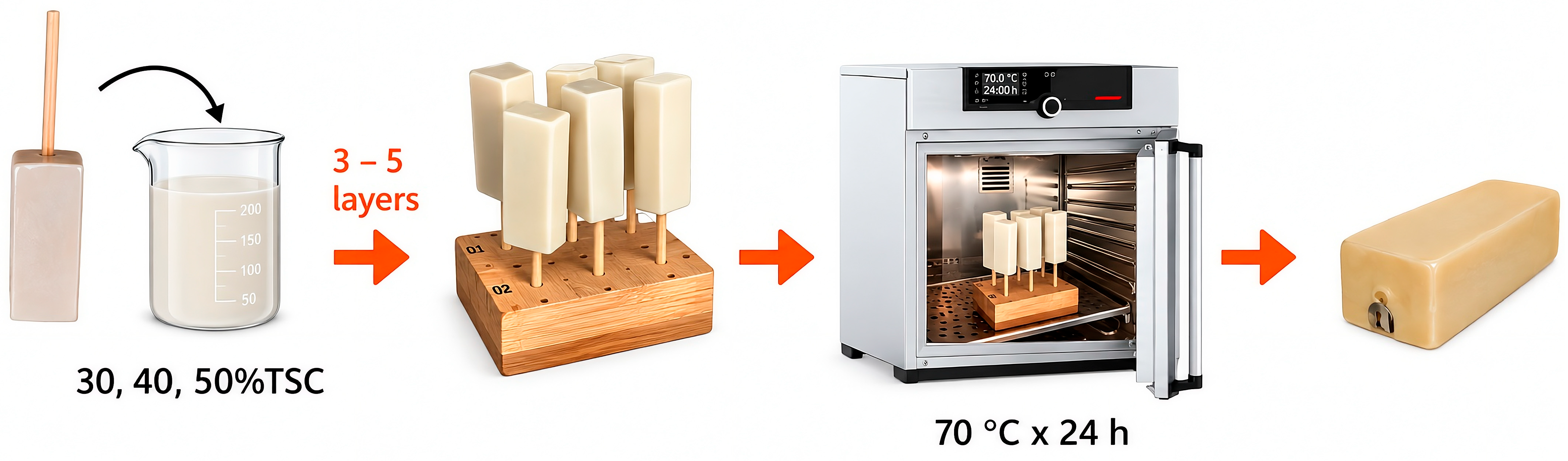
Figure 1. Schematic representation of the NR latex compounding, TiO2 dispersion, maturation, and dipping process.
Jmmp 10 00344 g001
Figure 2. Overview of the experimental workflow for vulcanized natural rubber encapsulation. (a) Preparation of the encapsulation by dip-coating the device substrate with compounded NR latex containing different TiO2 loadings and coating layer numbers (1, 3, 5 and 7), followed by thermal drying and vulcanization at 70 °C for 24 h as specified in Section 2.5. (b) Assembly of the encapsulated wireless device and the indoor/outdoor RSSI measurement setup used for signal transmission tests over distances of 5–55 m.
Jmmp 10 00344 g002
Figure 3. Tensile strength of vulcanized NR films as affected by total solid content.
Jmmp 10 00344 g003
Figure 4. Tear resistance of vulcanized NR films as affected by total solid content.
Jmmp 10 00344 g004
Figure 5. Block diagram of the 433 MHz LoRa wireless link used for the RSSI measurements: (a) the transmitter (sensor) node, comprising an ESP32 microcontroller, a sensing element and an SX1278/Ra-02 LoRa module, and (b) the receiver (base-station) node, comprising an SX1278/Ra-02 module, an ESP32 and an OLED read-out.
Jmmp 10 00344 g005
Figure 6. Experimental setup for indoor and outdoor RSSI measurements of NR-encapsulated wireless devices.
Jmmp 10 00344 g006
Figure 7. Indoor RSSI of the NR-encapsulated wireless device measured at 433 MHz as a function of transmission distance for the optimized 5 phr TiO2 formulation (40 wt% TSC) at different coating-layer numbers (1, 3, 5, and 7 layers). Measurements were performed in air under indoor conditions and represent above-ground environmental communication performance rather than direct intraruminal propagation; each point is the mean of three readings and the dashed lines are linear-regression fits.
Jmmp 10 00344 g007
Figure 8. Outdoor RSSI of the NR-encapsulated wireless device measured at 433 MHz as a function of transmission distance for the optimized 5 phr TiO2 formulation (40 wt% TSC) at different coating-layer numbers (1, 3, 5, and 7 layers). Measurements were performed in air under outdoor conditions to represent open-field communication scenarios relevant to grazing cattle; each point is the mean of three readings and the dashed lines are linear-regression fits.
Jmmp 10 00344 g008
Table 1. Compound formulation of NR latex compounds.
IngredientsFunctionAmount (phr 1)
60% HA NRElastomer matrix100
10% KOHStabilizer0.2
10% SDSSurfactant0.1
50% SulfurVulcanizing agent1.5
50% ZDECAccelerator0.4
50% ZMBTAccelerator0.4
50% ZnOActivator3
50% Lowinox CPLAntioxidant1
50% TiO2 Filler5
Water Adjusted TSC 30, 40, 50%
1 phr = parts per hundred rubber (100% DRC).
Table 6. Swelling ratio of vulcanized NR films containing 5 phr of TiO2 at 30% TSC after immersion in acidic medium. Per-specimen data are tabulated for the 5 phr condition only; the corresponding mean swelling ratios of the unfilled (0 phr) and 10 phr films, 21.10 ± 22.75% and 5.35 ± 0.76%, are reported in the text of this section.
SpecimenThickness (mm)Initial Weight (g)Final Weight (g)Swell Ratio (%)
110.91140.95935.2557
210.96131.00965.0244
310.90060.94995.4741
Mean ± SD5.25 ± 0.22
Table 7. Indicative dielectric properties of vulcanized natural rubber and representative encapsulation polymers at ultra-high frequency (typical literature ranges, compiled for qualitative benchmarking). The values for PDMS, polyurethane and epoxy are indicative literature and datasheet ranges for the cited sources and were not measured here; the natural rubber entry is likewise a literature range for vulcanized NR, since no dielectric characterization was performed in this study (Section 4.5).
MaterialRelative Permittivity, εrLoss Tangent, tan δRF TransparencyTypical Application
Natural rubber (vulcanized NR latex) [18,20]2.1–2.50.002–0.01HighFlexible biomedical encapsulation
PDMS [34]2.7–3.00.01–0.03Moderate–highImplantable sensors
Polyurethane [35]3.0–4.00.02–0.04ModerateBiomedical coatings
Epoxy resin [36]3.5–4.50.02–0.05MediumElectronic packaging
Disclaimer/Publisher’s Note: The statements, opinions and data contained in all publications are solely those of the individual author(s) and contributor(s) and not of MDPI and/or the editor(s). MDPI and/or the editor(s) disclaim responsibility for any injury to people or property resulting from any ideas, methods, instructions or products referred to in the content.