Article

Laser Remelting-Induced Microstructure Refinement and Strengthening of (TaWZrHf)95Y5 Refractory High-Entropy Alloy

1
Institute of Process Engineering, Chinese Academy of Sciences, Beijing 100190, China
2
Ganjiang Innovation Academy, Chinese Academy of Sciences, Ganzhou 341119, China
3
School of Chemical Engineering, University of Chinese Academy of Sciences, Beijing 100049, China
*
Author to whom correspondence should be addressed.
J. Manuf. Mater. Process. 2026, 10(7), 255; https://doi.org/10.3390/jmmp10070255
Submission received: 8 June 2026 / Revised: 14 July 2026 / Accepted: 18 July 2026 / Published: 21 July 2026

Abstract

A novel (TaWZrHf)95Y5 refractory high-entropy alloy (RHEA) matrix was fabricated via vacuum hot pressing (VHP) sintering and subsequently modified through laser remelting (LR) surface treatment. Thermodynamic phase diagram calculations predicted the alloy’s dual-phase BCC structure, and the effects of LR on phase composition, microstructure, and mechanical properties were systematically investigated. LR induced a significant phase transition, promoting rapid solidification and substantial grain refinement. The surface hardness increased to 848 HV0.2, approximately 1.5 times higher than that of the matrix, while the compressive strength reached 1635 MPa, surpassing the matrix by 200 MPa without compromising ductility. Importantly, the LR process effectively mitigated rare-earth (yttrium) segregation and loss, a common challenge in conventional arc melting of refractory HEAs, thereby enhancing solid solution strengthening and phase stability. This work pioneers the application of laser surface engineering to VHP-sintered refractory HEAs, bridging critical gaps in fabrication, microstructural optimization, and performance enhancement, and offering valuable insights for the future design of high-performance multi-principal element alloy development.

1. Introduction

Refractory high-entropy alloys (RHEAs) have garnered significant attention due to their exceptional high-temperature strength, corrosion resistance, and mechanical properties, making them ideal candidates for applications in aerospace, nuclear, and energy industries [1,2,3,4]. These alloys, characterized by the incorporation of multiple principal elements in nearly equiatomic proportions, offer unique advantages over traditional alloys, including enhanced phase stability and superior performance at elevated temperatures [5,6,7].
Electric arc melting (EAM) is the most widely used method for fabricating HEAs. However, it often results in compositional segregation and metallurgical defects, leading to coarse microstructures and reduced mechanical properties [8,9,10]. In contrast, vacuum hot pressing (VHP) sintering offers a promising alternative, enabling densification at lower temperatures through the synergistic effects of temperature and pressure [11,12,13]. This process is particularly beneficial for RHEAs with large melting point differences, such as the (TaWZrHf)95Y5 system studied in this work. Xie et al. demonstrated the successful synthesis of dense W-Zr-Y2O3 alloys via VHP sintering, achieving impressive mechanical properties, including tensile strengths of 911 MPa and elongation of 3.2% [14]. Švec, Pavol et al. optimized the VHP sintering process, improving processing flexibility, material efficiency, and cost-effectiveness [15]. However, the VHP process may still lead to structural inhomogeneities due to insufficient atomic diffusion or incomplete densification, which compromises mechanical performance.
The incorporation of rare-earth yttrium (Y) has opened a new avenue for modulating the phase constitution and mechanical response of RHEAs. Recent investigations have demonstrated that in Y-modified dual-phase BCC RHEAs, an optimal Y content of 0.2 at.% yields a remarkable strength–ductility synergy, with a yield strength of 1838.7 MPa and a fracture strain of 19.8% [16]. Similarly, trace Y addition (0.4 at.%) to the TaMoNbZrTiAl system induces grain refinement, concurrently elevating the compressive strength to ~1669 MPa and fracture strain to ~20.6% [17]. Critically, the atomic radius of Y (~180 pm) far exceeds those of Ta (~147 pm) and W (~139 pm), and its equilibrium solid solubility in BCC refractory matrices is extremely limited. This pronounced atomic-scale mismatch, compounded by the kinetic constraints of solid-state diffusion during VHP processing, renders Y highly susceptible to segregation at grain and phase boundaries. More fundamentally, RHEAs are perennially confronted with the strength–ductility trade-off—a classic seesaw dilemma that has become a primary obstacle to their widespread engineering deployment.
To address these challenges, laser processing has emerged as a promising surface modification technique that refines the microstructure, enhances elemental homogeneity, and improves mechanical properties [18,19,20,21,22]. By locally melting and rapidly solidifying the surface with a high-energy laser beam, laser remelting processing not only mitigates elemental segregation but also introduces fine-grain strengthening and phase transformation mechanisms [23,24,25]. For instance, Cui et al. reported up to about a 16% increase in hardness after laser remelting of Ti41V27Hf16Nb16 alloys [26]. Liu et al. successfully prepared a WC particle-enhanced CoCrFeNiMo high-entropy alloy (HEA) composite coating on the surface of Cr12MoV steel substrate through laser cladding technology, which significantly improved the wear resistance of the substrate [27]. However, the microstructural evolution of RHEAs during LR and VHP processing, as well as the effect of LR on their performance, remains underexplored.
In this study, we investigated the combined use of VHP sintering and LR for the fabrication and enhancement of the (TaWZrHf)95Y5 RHEA. The primary focus of this work is to explore how LR influences phase evolution, microstructure refinement, and mechanical property enhancement, with particular emphasis on mitigating rare-earth element loss—a common issue in conventional arc-melting processes. This study provides new insights into the surface engineering of VHP-sintered RHEAs and lays the foundation for the design of next-generation RHEAs.

2. Materials and Methods

High-purity elemental powders of Ta, W, Zr, and Hf (purity ≥ 99.9%, particle size 1–10 μm, Aladdin Industrial Corporation, Shanghai, China) were mechanically mixed with YH2 powder (purity ≥ 99.5%, particle size 10–20 μm, Jiangxi Zhongxi Metal Materials Co., Ltd., Ganzhou, China) to achieve a uniform elemental distribution. The powder mixture was consolidated into the (TaWZrHf)95Y5 RHEA matrix by vacuum hot pressing (VHP) at 1500 °C under a pressure of 40 MPa. Laser remelting was performed using a continuous-wave fiber laser (wavelength 1070 nm) with a spot diameter of 0.1 mm and a hatching distance of 0.05 mm. The laser parameters—power 325 W, scanning speed 100 mm/s, and 15 remelting cycles—were determined through systematic screening experiments. The screening strategy employed surface morphology quality as the primary criterion across the 100–500 mm/s range and surface hardness enhancement as the secondary criterion, ultimately narrowing the optimal window to 100–300 mm/s, within which the samples exhibited both optimal surface quality and relatively higher hardness response. The final parameters were chosen to achieve a dense, crack-free and pore-free remelted layer with maximum surface hardness (detailed screening process is provided in Supplementary Figures S1–S6). Phase identification was performed using X-ray diffraction (XRD, X’Pert PRO MPD) with Cu Kα radiation (λ = 1.5406 Å), operated at 40 kV and 40 mA, over a 2θ range of 10–90° with a step size of 0.02°. The surface morphology, microstructure, and elemental distribution were characterized by scanning electron microscopy (SEM, GeminiSEM 300, Jena, Germany) coupled with energy-dispersive X-ray spectroscopy (EDS) and backscattered electron (BSE) detectors. Vickers hardness (HV0.2) measurements were conducted on polished cross-sections using a 200 g load and a 15 s dwell time, with hardness values averaged over seven different points. Room-temperature compression tests were performed on cylindrical specimens (4 mm diameter × 3 mm height) using a Shimadzu AGS-X 10 kN (Kyoto, Japan) testing machine at a strain rate of 0.001 s−1. Thermal diffusivity was measured by the laser flash method (NETZSCH LFA 427, Selb, Germany) on disk-shaped samples (10 mm diameter × 2 mm thickness).

3. Results and Discussion

3.1. Phase Structure of (TaWZrHf)95Y5 RHEA

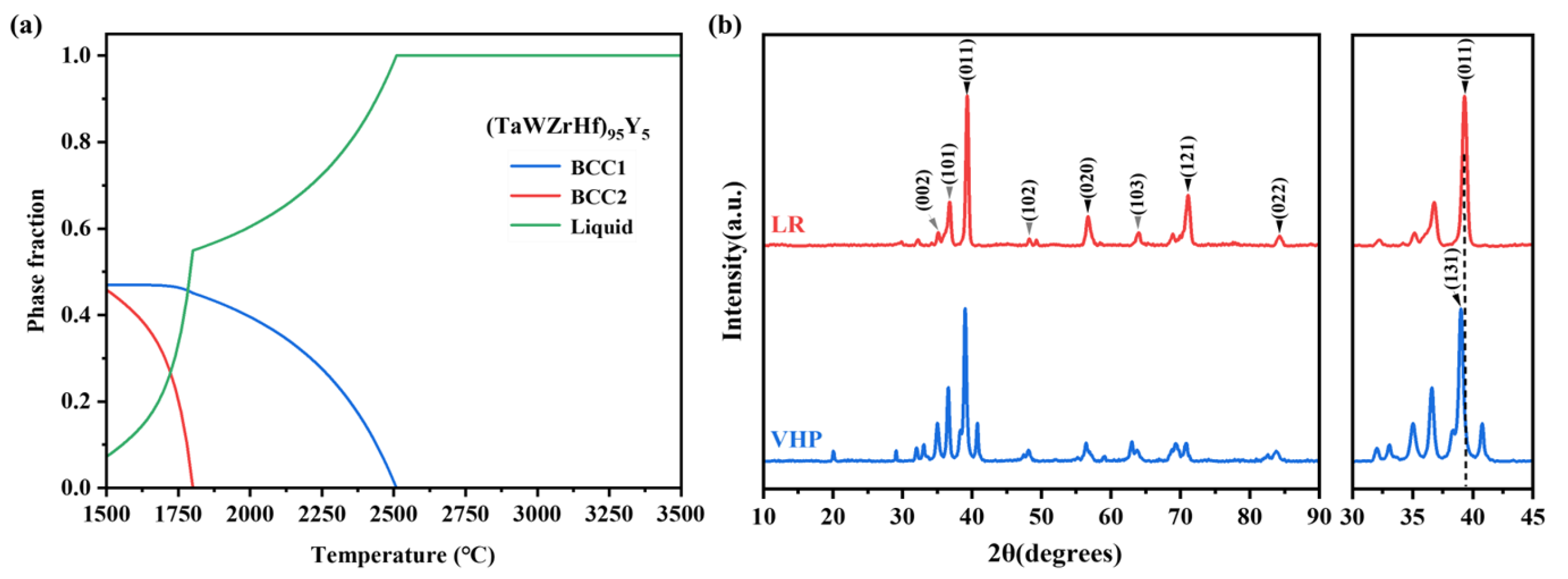
The phase composition of the (TaWZrHf)95Y5 RHEA was predicted using the Pandat software (software version: Pandat 2024), which integrates thermodynamic databases for high-entropy alloys (HEAs). As shown in Figure 1a, the alloy primarily consists of two body-centered cubic (BCC) phases: BCC1, enriched in Ta and W, and BCC2, enriched in Zr, Hf, and Y. The phase diagram simulation predicts that at elevated temperatures, BCC1 is the dominant phase, while BCC2 starts to form at approximately 1850 °C. At the same time, we found that the addition of the Y element changes the solidus and liquidus temperatures of the alloy, thereby lowering its melting point. Additionally, it inhibits the formation of the BCC2 phase (Figure S7).
Experimental phase analysis via XRD of both the VHP-sintered and LR-treated samples revealed that the LR process significantly altered the phase structure. The XRD patterns in Figure 1b show that the VHP-sintered sample exhibits a multiphase structure, including W2Zr intermetallics, Zr-Hf-Y-enriched BCC2, and elemental Ta, with the strongest diffraction peak corresponding to the (131) plane. In contrast, the LR-treated sample exhibited a simplified dual-phase BCC structure, consistent with phase diagram predictions, with the strongest peak shifting to the (011) plane. Thus, BCC1 became the dominant phase. This phase transformation is linked to the unique characteristics of RHEAs, where the high entropy of mixing leads to a more stable solid solution phase, facilitating a more homogenous microstructure. To gain deeper insight into the structural evolution induced by laser remelting, we performed a detailed analysis of the XRD diffraction features. As shown in Figure 1b, the (011) peak of the BCC1 phase in the LR sample exhibits a distinct shift relative to the (131) peak of elemental Ta in the VHP state, reflecting lattice distortion from supersaturated solid solution of Ta and W during ultra-fast laser melting. Concurrently, the FWHM of the (011) peak broadens from 0.410° (VHP intermetallic) to 0.437° (LR), representing an increase of ~6.6%. Using the Scherrer equation, the crystallite size (coherent scattering domain) decreases marginally from 20.5 nm to 19.3 nm—a trend qualitatively consistent with the substantial macroscopic grain refinement observed by SEM (from 7.6 μm to 2.34 μm, a ~69% reduction). The marked disparity in the magnitude of the reduction (~6% vs. ~69%) reveals that the primary role of LR lies in eliminating micron-scale coarse grains and rare-earth segregation, rather than predominantly relying on nanoscale subgrain fragmentation. Furthermore, the relative intensity of the BCC1 diffraction peaks is substantially enhanced in the LR sample, indicating that the high-energy laser input promotes the formation and preferred orientation of the high-melting-point TaW-enriched BCC phase. Together with the compositional redistribution confirmed by SEM-EDS mapping and point analysis (Figure 2), the XRD and EDS results mutually reinforce the conclusion of phase transformation and compositional homogenization induced by laser remelting.
The laser remelting process, providing rapid heating and cooling rates, promotes the formation of the high-melting-point TaW-rich BCC1 phase, which is thermodynamically more stable. This behavior highlights the distinctive high-entropy effect in the alloy’s performance, which stabilizes multiple phases under extreme conditions.

3.2. Microstructure of (TaWZrHf)95Y5 RHEA

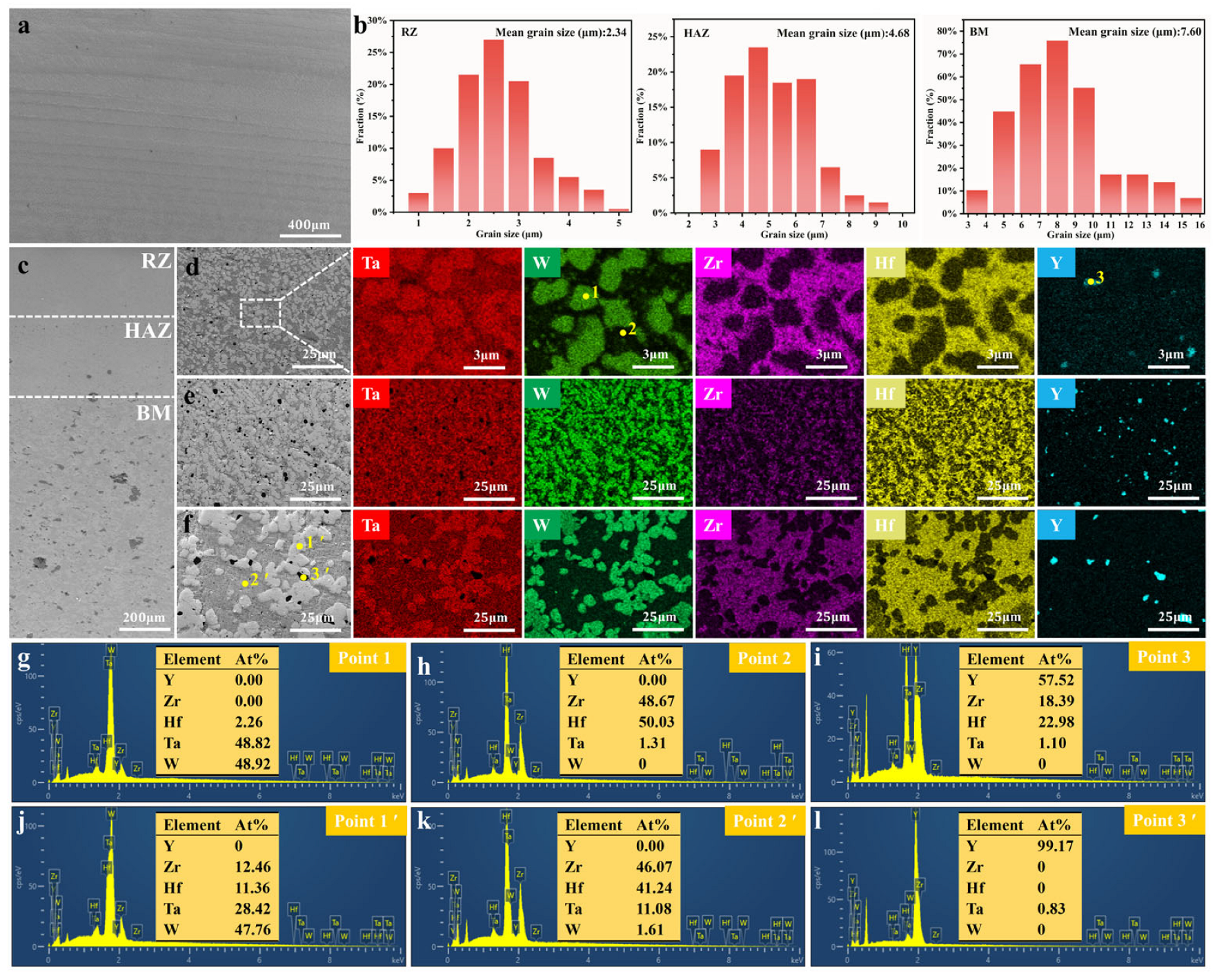
The surface and cross-sectional microstructures of the LR-treated (TaWZrHf)95Y5 RHEA are shown in Figure 2a,c. After laser remelting, the alloy surface exhibits a dense, defect-free morphology with a uniform elemental distribution, and no significant porosity or cracking is observed. The cross-section reveals a well-bonded, fully dense structure without noticeable delamination or distortion. Three distinct zones can be identified in the cross-section: the remelted zone (RZ), the heat-affected zone (HAZ), and the base matrix (BM). The RZ exhibits a fine, homogeneous cellular microstructure with clearly defined grains and grain boundaries (Figure 2d). Energy-dispersive X-ray spectroscopy (EDS) mapping confirms that Ta and W are preferentially enriched within grain interiors, whereas Zr, Hf, and Y tend to segregate along grain boundaries, albeit with a more uniform distribution of Y compared to the matrix. This segregation phenomenon can be rationalized by considering both thermodynamic and kinetic factors. Although VHP sintering at 1500 °C under 40 MPa achieves full densification of the alloy, this temperature remains in a significantly low thermodynamic regime relative to the melting points of the refractory principal elements Ta and W (3017 °C and 3422 °C, respectively). At this temperature, the self-diffusion coefficients of Ta and W are extremely low, and the atomic mobility in the solid state decreases exponentially, preventing interdiffusion among constituent elements from reaching equilibrium within the finite holding time. Moreover, the atomic radius of Y (~180 pm) is much greater than those of Ta (~147 pm) and W (~139 pm), and this pronounced atomic size mismatch results in an extremely limited equilibrium solid solubility of Y in the BCC-structured refractory matrix. Consequently, under the kinetically constrained conditions of VHP sintering, Y atoms are unable to diffuse sufficiently into the matrix lattice, and are thus forced to segregate to grain boundaries and phase boundaries, forming the pronounced elemental segregation observed in the BM. This mechanistic understanding underscores the inherent challenge of achieving microstructural homogeneity in powder-metallurgy-processed RHEAs, and provides the rationale for introducing the subsequent laser remelting treatment.
The average grain size within the RZ is approximately 2.34 μm, roughly one-third that of the base matrix (7.60 μm), indicating substantial grain refinement due to the rapid solidification associated with LR. During the laser remelting process, the extremely high cooling rate of the molten pool, driven by the concentrated laser energy and rapid heating rate, facilitates increased nucleation opportunities [28]. Additionally, the incorporation of rare-earth element yttrium (Y) not only enhances the nucleation rate but also significantly refines the grain size of the remelting zone by reducing the critical nucleation radius. The surface activity of yttrium in molten metal reduces the surface tension, thereby decreasing the energy required for nucleation and boosting the nucleation rate. Furthermore, the enrichment of yttrium at the solid–liquid interface inhibits grain growth [29,30]. For instance, when the yttrium content reaches 2.0%, the grain size decreases from 300 μm to 8.86 μm [31]. In the HAZ, partial grain refinement is observed, with an average grain size of 4.68 μm, representing a 38.4% reduction relative to the BM (Figure 2e,f). In contrast, the BM retains a relatively coarse and heterogeneous grain structure with pronounced elemental segregation, particularly of Y, resulting from the low-temperature, solid-state diffusion-limited nature of the VHP process.
Furthermore, EDS point analysis (Figure 2i,j) reveals that LR promotes improved elemental homogeneity by facilitating enhanced solid solution formation between Y, Zr, and Hf elements. This eliminates the severe Y segregation observed in the VHP-sintered matrix. Overall, laser remelting significantly refines the microstructure, reduces elemental segregation, and promotes a more homogeneous chemical distribution, all of which are beneficial for enhancing the mechanical properties of the (TaWZrHf)95Y5 RHEA.
In summary, laser remelting exerts a profound effect on the microstructure of the alloy substrate, primarily manifested in substantial grain refinement, enhanced elemental solubility, and the elimination of segregation and inhomogeneous distribution.

3.3. Mechanical Properties of (TaWZrHf)95Y5 RHEA

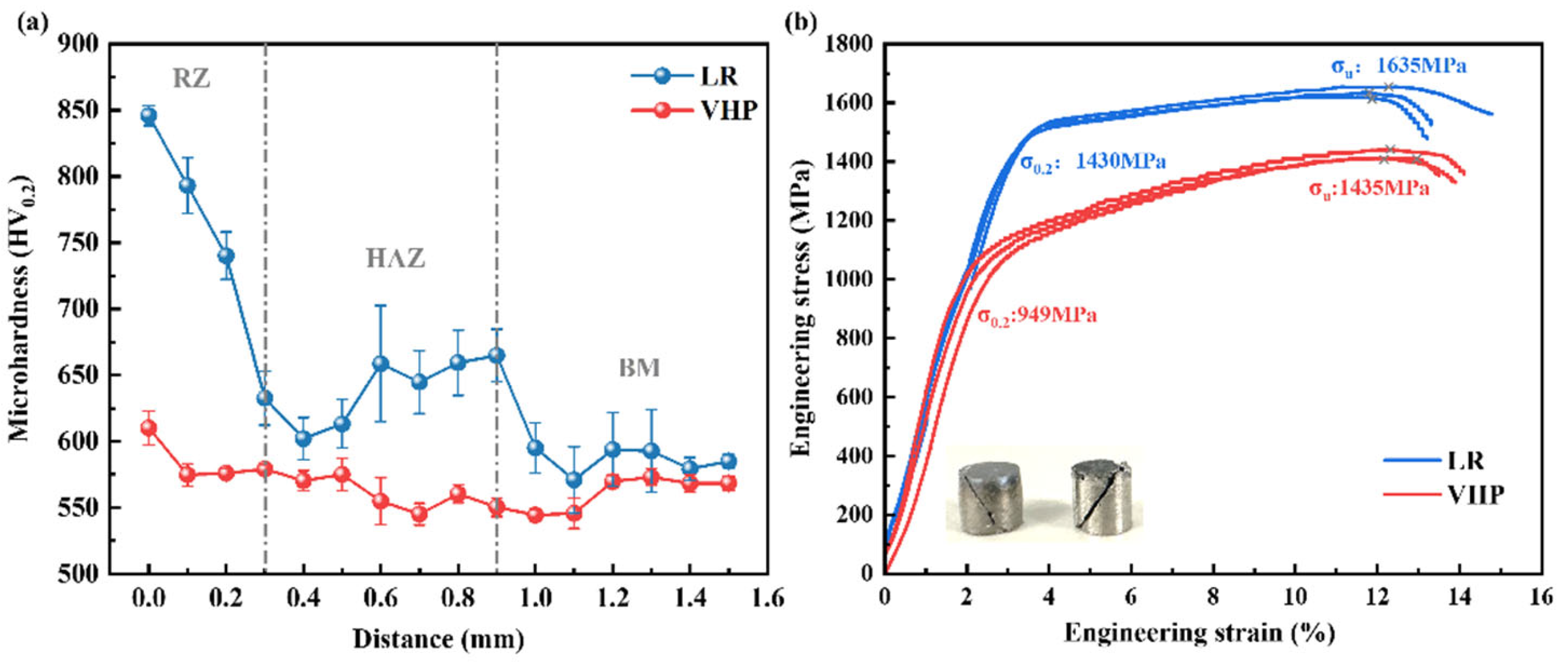
The hardness distribution across the cross-section of the LR-treated (TaWZrHf)95Y5 RHEA is shown in Figure 3a. Compared to the VHP-sintered sample, the LR sample exhibits significantly enhanced surface hardness, reaching a peak value of approximately 848 HV0.2, about 1.5 times higher than that of the matrix. The hardness profile can be divided into three distinct regions, corresponding to the microstructural zones observed in Figure 2c. Specifically, the remelted zone (0–0.3 mm from the surface) displays the highest hardness (~845 HV0.2), followed by the HAZ (0.3–0.9 mm), where the hardness gradually decreases from 658 to 602 HV0.2. Beyond 0.9 mm, in the matrix region, the hardness further drops to between 595 and 579 HV0.2.
The enhanced surface hardness after LR is primarily attributed to multiple strengthening mechanisms: (1) significant grain refinement, as evidenced by the much smaller grain size in the remelted layer compared to the matrix (Figure 2d,f); (2) improved solid solution strengthening, resulting from the more uniform distribution of Y within the TaW-based matrix; and (3) phase transformation strengthening, owing to the formation of a hard TaW-rich BCC phase (Figure 1b).
The compressive engineering stress–strain curves for both VHP-treated and LR-treated samples are presented in Figure 3b, with the detailed mechanical properties summarized in Table 1. The VHP-sintered sample exhibits a yield strength (σ0.2) of 949 MPa and a fracture strain (εf) of 12.1%. After LR treatment, the yield strength and compressive strength increased significantly to 1430 MPa and 1635 MPa, representing improvements of 50.7% and 13.9%, respectively, while the fracture strain remained nearly unchanged at 11.9%. The hardness profile is consistent with the microstructure of the alloy, where the remelted zone exhibits the highest hardness due to finer grains and enhanced solid solution strengthening. The compressive yield strength of the LR-treated sample reaches 1430 MPa, a 50.7% increase over the VHP-sintered alloy.
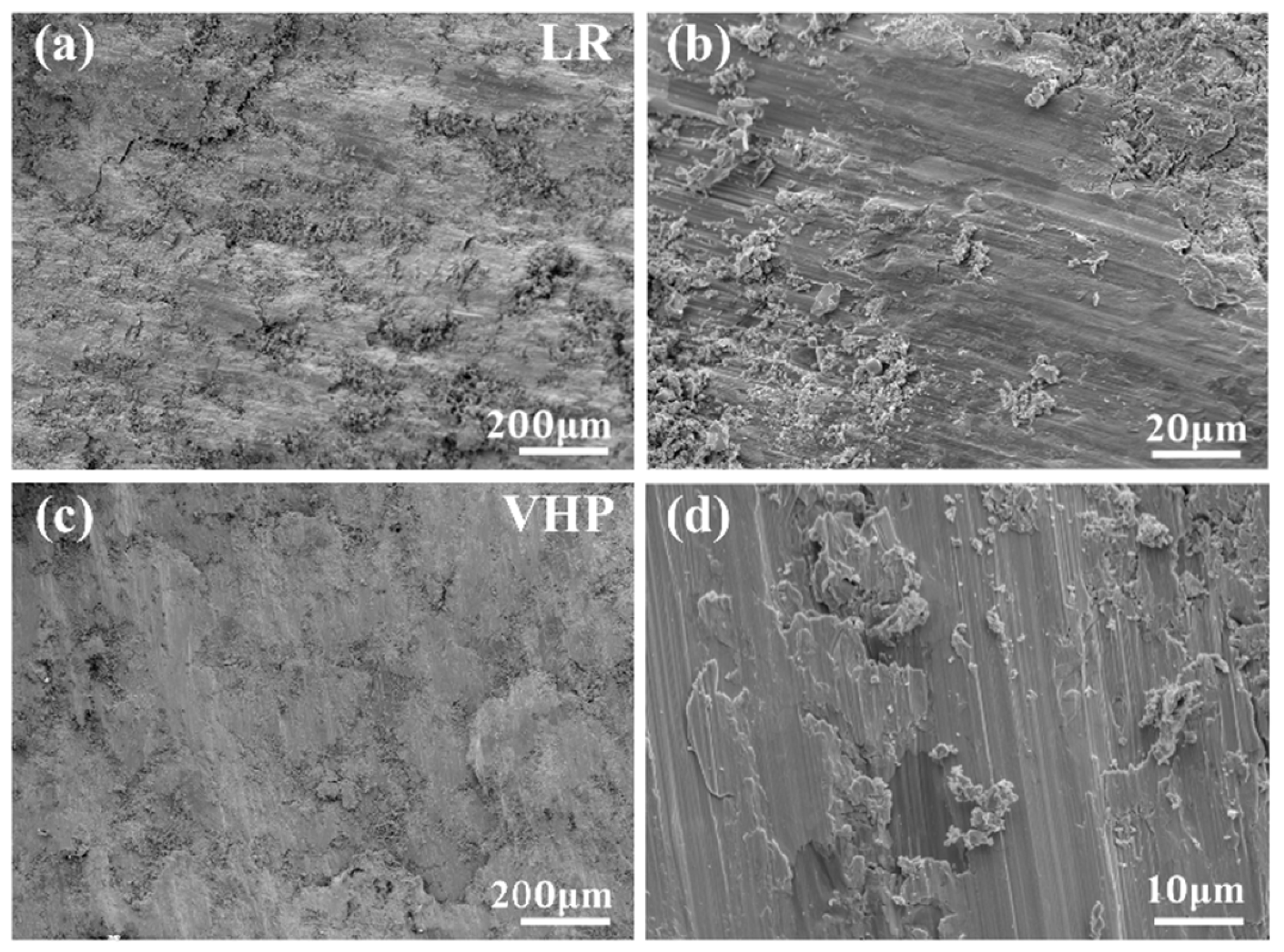
The combination of fine-grain strengthening and solid solution strengthening, facilitated by the high-entropy effect, leads to a remarkable improvement in both strength and toughness. Compression fracture surfaces (Figure 4) exhibit a typical shear fracture morphology, with smooth facets and a 45° fracture angle, confirming the alloy’s ductile fracture behavior. This is particularly evident in the compression fracture morphology (Figure 4), where the LR-treated sample exhibits typical shear fracture, indicating a ductile failure mode, characteristic of RHEAs.
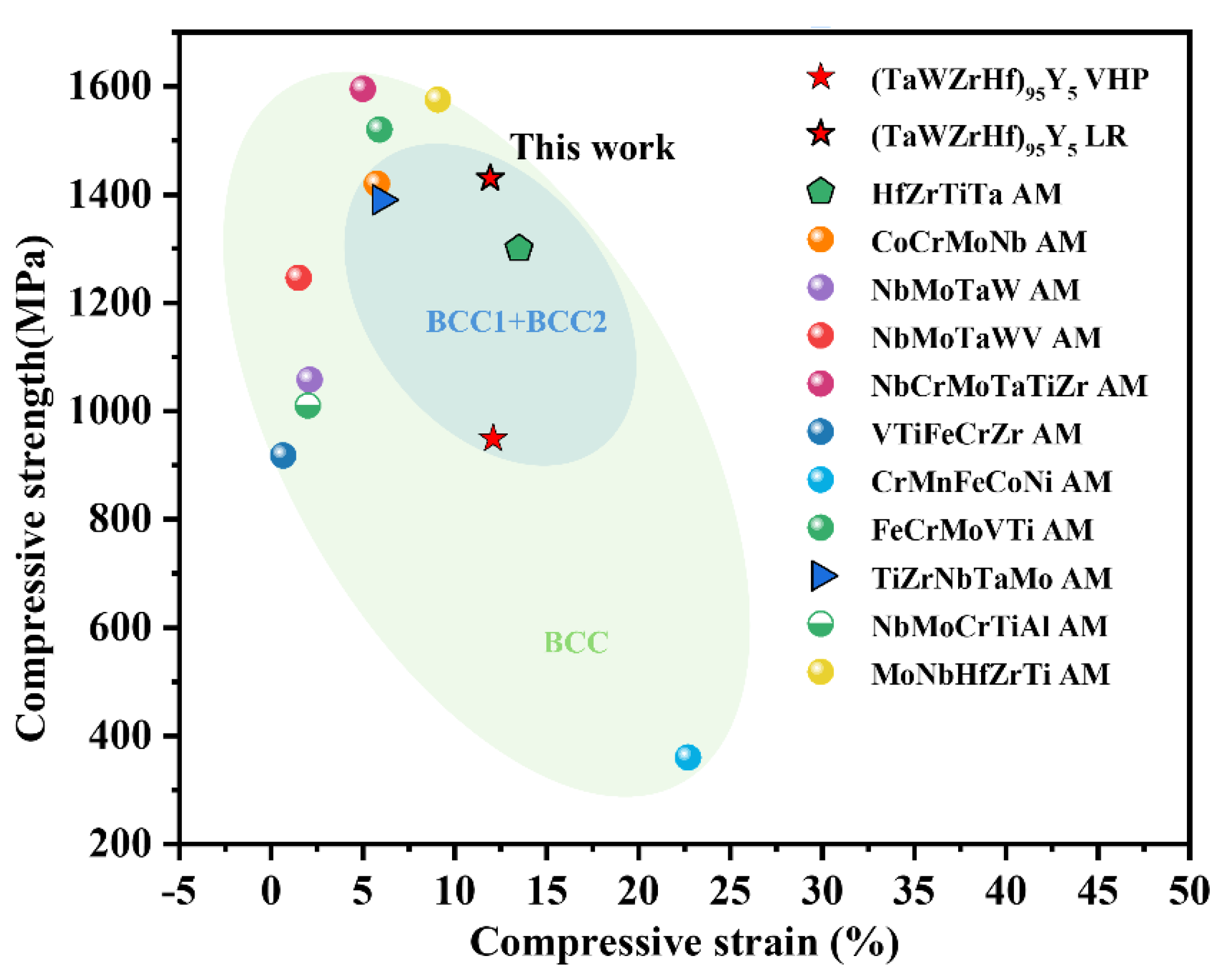
The mechanical properties of the alloys developed in this study were compared with those of conventional alloys and typical multi-principal element alloys, as shown in Figure 5 and detailed in Table S4 [25,28,32,33,34,35,36,37,38,39]. Compared to NbMoTaW and VNbMoTaW alloys, which were prepared by arc melting and reported by O.N. Senkov et al., where the yield strengths (σ0.2) at room temperature were 1058 MPa and 1246 MPa, respectively, and fracture strains (εf) were 1.5% and 0.5%, the yield strength and uniform elongation of the novel (TaWZrHf)95Y5 RHEA developed in this study are notably superior. The two-phase BCC structure of the (TaWZrHf)95Y5 alloy exhibits higher toughness compared to the single-phase BCC solid solution, while maintaining similar strength and superior overall mechanical properties. Additionally, it was found that multi-principal element alloys with a two-phase BCC structure demonstrate enhanced toughness and better mechanical properties than those with a single-phase BCC solid solution.
Comparative analysis with traditional alloys demonstrates that the (TaWZrHf)95Y5 RHEA exhibits superior yield strength and fracture strain, further validating the advantages of RHEAs in high-temperature and high-stress applications. This enhancement in mechanical properties is attributed to the unique combination of high-entropy, fine-grain, and solid solution strengthening mechanisms in the alloy.

4. Conclusions

A novel (TaWZrHf)95Y5 RHEA was successfully fabricated using a combined approach of vacuum hot pressing sintering and laser remelting surface treatment. The surface hardness increased to 848 HV0.2, while the compressive yield strength improved to 1635 MPa without compromising ductility, achieving an optimal balance between strength and toughness. Phase diagram calculations and experimental analyses confirmed that LR induces a significant phase transition, resulting in a dual-phase BCC structure comprising a TaW-rich BCC1 phase and a ZrHfY-rich BCC2 phase.
The study demonstrated that LR significantly enhances the microstructure, refining the grain size and promoting more uniform elemental distribution, especially for rare-earth elements. The laser remelting process led to a remarkable improvement in mechanical properties, including a substantial increase in surface hardness and compressive yield strength, without compromising ductility. These enhancements are attributed to the unique high-entropy effect, which stabilizes multiple phases, refines grain structures, and improves the solid solution strengthening of rare-earth elements in the RHEA matrix. This work pioneers the application of LR to VHP-sintered RHEAs, offering a new approach to mitigate rare-earth element loss and achieve superior mechanical performance. The findings provide valuable insights for the design of high-performance refractory alloys with multi-principal elements, opening new avenues for RHEA development in extreme environment applications.

Supplementary Materials

The following supporting information can be downloaded at: https://www.mdpi.com/article/10.3390/jmmp10070255/s1, Figure S1: The surface SEM morphology of 25 groups of orthogonal experimental samples by laser remelting. The results show that when the laser power is controlled in the range of 300~350 W, the surface-forming quality of the sample is better. However, when the laser power exceeds 350 W, the excessive energy input causes the molten pool to fluctuate violently, forming a large number of defects such as holes on the alloy surface. When the scanning rate is controlled in the range of 100~400 mm/s, the moderate scanning rate makes the surface elements of the sample evenly dis-tributed without obvious defects such as holes, and the surface quality of the sample is better; Figure S2: The SEM morphology of the remelted sample surface (a,d,g) corresponds to P = 350 W, P = 325 W, P = 300 W, (b,e,h) is a magnification of P = 350 W, P = 325 W, P = 300 W at 40 μm, (c,f,i) is a magnification of P = 350 W, P = 325 W, P = 300 W at 2 μm; Figure S3: The cross-section morphology of the remelted sample (a–c) corresponds to P = 350 W, P = 325 W, P = 300 W, respectively. (d–f) is the enlarged image of P = 350 W, P = 325 W, P = 300 W at 40 μm and P = 325 W, P = 300 W at 2 μm. When the laser energy is moderate, the surface quality of the remelted layer is excellent and the bonding with the substrate is strong. Therefore, the optimal power parameter is determined to be P = 325 W; Figure S4: Comprehensive properties of remelted sample surface. While the surface morphology of the laser remelting sample is good, it is also hoped that the surface strength of the sample can be improved by laser remelting. Therefore, we tested the surface hardness of 25 groups of orthogonal experimental alloy samples. The comprehensive performance is shown in Figure 3. When the scanning rate is in the range of 100–300 mm/s, the sample has both excellent morphology and high hardness. Therefore, the fixed laser power is 325 W, the scanning rate is 100 ~ 300 mm/s, the step size is 100 mm/s, and the univariate experiment is carried out. The effect of scanning rate on the surface quality and microstructure of the alloy was investigated, and the optimal rate param-eters were determined. Figure S5: P = 325 W The surface morphology (a,d,g) of the remelted sample corresponds to V = 300 mm/s, V = 200 mm/s, V = 100 mm/s, respectively. (b,e,h) is the enlarged image of V = 300 mm/s, V = 200 mm/s, V = 100 mm/s at 40 μm, respectively. (c,f,i) is the enlarged image of V = 300 mm/s, V = 200 mm/s, V = 100 mm/s at 2 μm, respectively.; Figure S6: P = 325 W Remelted sample cross-sectional morphology (a,d,g) corresponding to V = 300 mm/s, V = 200 mm/s, V = 100 mm/s; (b,e,h) is the enlarged image of V = 300 mm/s, V = 200 mm/s, V = 100 mm/s at 40 μm; (c,f,i) is the magnification diagram of V = 300 mm/s, V = 200 mm/s, V = 100 mm/s at 2 μm. The measured surface roughness in the fifth layer of the (a,b) 5L1H sample and (c,d) HED sample. The sample with a scanning rate of 100 mm/s has good forming quality, a smooth surface, no obvious scanning trace after laser remelting, and no cracks or holes on the surface. It is found that the remelting layer is closely combined with the substrate at this scanning rate by cross-section observation. It shows that the parameter matches the alloy best and can achieve good forming effect; Figure S7: The calculation results of TaWZrHfYx refractory high entropy alloys with different Y content; Table S1: Orthogonal experimental factors and level table head design; Table S2: Orthogonal experiment surface morphology results variance analysis table; Table S3: Visual analysis table of surface morphology results of the orthogonal experiment; Table S4: Statistics of room temperature compression properties of alloys.

Author Contributions

Conceptualization, C.H. and W.Z.; methodology, J.J. and Y.S.; validation, C.H., J.J. and Y.S.; formal analysis, C.H. and J.J.; investigation, C.H. and J.J.; resources, C.H. and J.J.; data curation, J.J.; writing—original draft preparation, J.J.; writing—review and editing, C.H., J.J., H.L. and W.Z.; supervision, C.H. and W.Z. All authors have read and agreed to the published version of the manuscript.

Funding

This research was funded by the Key Research and Development Plan of Jiangxi Province (20252BCE310022, Department of Science and Technology of Jiangxi Province), Ganzhou’s Project: ‘Leading the Charge with Open Competition’ (2025ULCY001, Ganzhou Science and Technology Bureau), Self-deployed Projects of Ganjiang Innovation Academy, Chinese Academy of Sciences (E555D001, Ganjiang Innovation Academy, Chinese Academy of Sciences).

Data Availability Statement

The data that support the findings of this study are available upon reasonable request from the corresponding author.

Conflicts of Interest

The authors declare no conflicts of interest.

References

  1. George, E.P.; Raabe, D.; Ritchie, R.O. High-entropy alloys. Nat. Rev. Mater. 2019, 4, 515–534. [Google Scholar] [CrossRef]
  2. Miracle, D.B.; Senkov, O.N. A critical review of high entropy alloys and related concepts. Acta Mater. 2017, 122, 448–511. [Google Scholar] [CrossRef]
  3. Senkov, O.N.; Miracle, D.B.; Chaput, K.J.; Couzinie, J.-P. Development and exploration of refractory high entropy alloys—A review. J. Mater. Res. 2018, 33, 3092–3128. [Google Scholar] [CrossRef]
  4. Griffiths, R.J.; Wilson-Heid, A.E.; Linne, M.A.; Garza, E.V.; Wright, A.; Beyerlein, A.A.M. Additive friction stir deposition of a tantalum–tungsten refractory alloy. J. Manuf. Mater. Process. 2024, 8, 177. [Google Scholar] [CrossRef]
  5. Wang, Z.Q.; Fan, M.Y.; Zhang, Y.; Li, J.P.; Liu, L.Y.; Han, J.H.; Li, X.H.; Zhang, Z.W. A novel immiscible high entropy alloy strengthened via L12-nanoprecipitate. J. Cent. South Univ. 2024, 31, 1808−1822. [Google Scholar] [CrossRef]
  6. Yasuda, H.Y.; Yamada, Y.; Cho, K.; Nagase, T. Deformation behavior of HfNbTaTiZr high entropy alloy singe crystals and polycrystals. Mater. Sci. Eng. A 2021, 809, 140983. [Google Scholar] [CrossRef]
  7. An, Z.B.; Mao, S.C.; Liu, Y.N.; Wang, L.; Zhou, H.; Gan, B.; Zhang, Z.; Han, X.D. A novel HfNbTaTiV high-entropy alloy of superior mechanical properties designed on the principle of maximum lattice distortion. J. Mater. Sci. Technol. 2021, 79, 109–117. [Google Scholar]
  8. Yeh, J.W.; Chen, S.K.; Lin, S.J.; Gan, J.Y.; Chin, T.S.; Shun, T.T.; Tsau, C.H.; Chang, S.Y. Nanostructured High-Entropy Alloys with Multiple Principal Elements: Novel Alloy Design Concepts and Outcomes. Adv. Eng. Mater. 2004, 5, 6. [Google Scholar]
  9. Xiong, W.; Guo, A.X.; Zhan, S.; Liu, C.-T.; Cao, S.C. Refractory high-entropy alloys: A focused review of preparation methods and properties. J. Mater. Sci. Technol. 2023, 142, 196–215. [Google Scholar] [CrossRef]
  10. Zhang, B.; Huang, Y.; Dou, Z.; Wang, J.; Huang, Z. Refractory high-entropy alloys fabricated by powder metallurgy: Progress, challenges and opportunities. J. Sci. Adv. Mater. Dev. 2024, 9, 100688. [Google Scholar] [CrossRef]
  11. Ma, M.; Ye, B.; Han, Y.; Sun, L.; He, J.; Chu, Y. High-pressure sintering of ultrafine-grained high-entropy diboride ceramics. J. Am. Ceram. Soc. 2020, 103, 6655–6658. [Google Scholar] [CrossRef]
  12. Xing, Y.; Li, C.; Mu, Y.; Jia, Y.; Song, K.; Tan, J.; Wang, G.; Zhang, Z.; Yi, J.; Eckert, J. Strengthening and deformation mechanism of high-strength crmnfeconi high entropy alloy prepared by powder metallurgy. J. Mater. Sci. Technol. 2023, 132, 119–131. [Google Scholar] [CrossRef]
  13. Yan, H.; Wang, W.; Zhang, S.; Ma, S.; Li, J.; Wang, B. Microstructure and thermal de-formation behavior of hot-pressing sintered Zr-6Al-0.1B alloy. Materials 2022, 15, 1816. [Google Scholar] [CrossRef] [PubMed]
  14. Zhao, K.; Wang, R.; Zhang, Z.; Li, S.; Tang, Y.; Bai, S. Research progress in W-Zr alloy reactive structural materials. J. Mater. Eng. 2023, 51, 56–66. [Google Scholar]
  15. Švec, P.; Gábrišová, Z.; Brusilová, A. Hot pressing of boron carbide based ceramic composites. Manuf. Technol. 2020, 20, 394–399. [Google Scholar] [CrossRef]
  16. Wang, E.; Liu, Z.; Kang, F.; Chen, H.; Lin, C.; Han, Y.; Dong, J.; Li, J.; Jiang, W. Dual-BCC microstructure evolution and strengthening mechanisms in Yttrium-modified (Ti25Zr25Nb20Hf5Ta15W10)100−xYx refractory high-entropy alloys. Mater. Sci. Eng. A 2025, 941, 148653. [Google Scholar] [CrossRef]
  17. Lian, G.; Wang, B.; Gao, W.; Chen, C.; Feng, M.; Zhao, C. Current research status on the effects of processing and composition design of refractory high-entropy alloys on performance. J. Alloy. Compd. 2026, 1050, 185465. [Google Scholar] [CrossRef]
  18. Zhou, K.; Li, J.; Wu, Q.; Zhang, Z.; Wang, Z.; Wang, J. Remelting induced fully-equiaxed microstructures with anomalous eutectics in the additive manufactured Ni32Co30Cr10Fe10Al18 eutectic high-entropy alloy. Scr. Mater. 2021, 201, 113952. [Google Scholar] [CrossRef]
  19. Luo, J.; Sun, W.; Duan, R.; Yang, W.; Chan, K.; Ren, F.; Yang, X.-S. Laser surface treatment-introduced gradient nanostructured TiZrHfTaNb refractory high-entropy alloy with significantly enhanced wear resistance. J. Mater. Sci. Technol. 2022, 110, 43–56. [Google Scholar] [CrossRef]
  20. Wang, L.; Liu, D.-R.; Chen, T.; Wang, S.; Cao, Y. Grain refinement and high thermal stability in laser surface remelted Mg-4Y-3Nd-1.5Al alloy. Scr. Mater. 2023, 222, 115000. [Google Scholar] [CrossRef]
  21. Temmler, A.; Küpper, M.; Walochnik, M.A.; Lanfermann, A.; Schmickler, T.; Bach, A.; Greifenberg, T.; Oreshkin, O.; Willenborg, E.; Wissenbach, K.; et al. Surface structuring by laser remelting of metals. J. Laser Appl. 2017, 29, 012015. [Google Scholar] [CrossRef]
  22. Bukhari, S.M.A.; Husnain, N.; Siddiqui, F.A.; Anwar, M.T.; Khosa, A.A.; Imran, M.; Qureshi, T.H.; Ahmad, R. Effect of laser surface remelting on microstructure, mechanical properties and tribological properties of metals and alloys: A review. Opt. Laser Technol. 2023, 165, 109588. [Google Scholar] [CrossRef]
  23. Cui, D.; Chen, Y.; Liu, X.; Dong, Z.; Wang, Z.; Li, J.; Wang, J.; He, F. Microstructural and hardness investigation in laser surface remelted refractory high-entropy alloys. Vacuum 2025, 233, 113965. [Google Scholar] [CrossRef]
  24. Wang, J.; Gao, S.; Chen, X.; Zhang, M. Mechanical properties of A356 aluminum alloy after laser surface remelting. Chin. J. Lasers 2020, 47, 0402002. [Google Scholar] [CrossRef]
  25. Guo, N.; Wang, L.; Luo, L.; Li, X.; Su, Y.; Guo, J.; Fu, H. Microstructure and mechanical properties of refractory MoNbHfZrTi high-entropy alloy. Mat. Des. 2015, 81, 87–94. [Google Scholar] [CrossRef]
  26. Cui, D.; Zhang, Y.; Liu, L.; Li, Y.; Wang, L.; Wang, Z.; Li, J.; Wang, J.; He, F. Oxygen-assisted spinodal structure achieves 1.5 GPa yield strength in a ductile refractory high-entropy alloy. J. Mater. Sci. Technol. 2023, 157, 11–20. [Google Scholar] [CrossRef]
  27. Liu, X.Y.; Yang, X.; Chen, Z.B.; Guo, C.H.; Li, H.X.; Yang, Z.L.; Dong, T.; Jiang, F.C.; Qiao, Z.H. Microstructure and wear property of laser cladded WC particles reinforced CoCrFeNiMo composite coatings on Cr12MoV steel. J. Cent. South Univ. 2025, 32, 49−70. [Google Scholar] [CrossRef]
  28. Wang, S.P.; Xu, J. TiZrNbTaMo high-entropy alloy designed for orthopedic implants: As-cast microstructure and mechanical properties. Mater. Sci. Eng. C 2017, 73, 80–89. [Google Scholar] [CrossRef]
  29. StJohn, D.H.; Easton, M.A.; Qian, M.; Taylor, J.A. Grain refinement of magnesium alloys: A review of recent research, theoretical developments, and their application. Metall. Mater. Trans. A 2013, 44, 2935–2949. [Google Scholar]
  30. Guo, Y.; He, J.; Li, Z.; Wu, X.; Lu, W.; Liu, C. Solidification segregation-driven microstructural evolution of trace yttrium-alloyed TaMoNbZrTiAl refractory high entropy alloys. Mater. Charact. 2022, 194, 112495. [Google Scholar] [CrossRef]
  31. Qian, J. Effect of rare earth Y element on grain refinement and mechanical properties of CuAlMn shape memory alloys. J. Mater. Eng. 2024, 52, 214–224. [Google Scholar]
  32. Chen, H.; Kauffmann, A.; Gorr, B.; Schliephake, D.; Seemuller, C.; Wagner, J.; Christ, H.-J.; Heilmaier, M. Microstructure and mechanical properties at elevated temperatures of a new al-containing refractory high-entropy alloy Nb-Mo-Cr-Ti-Al. J. Alloys Compd. 2016, 661, 206–215. [Google Scholar] [CrossRef]
  33. Xian, X.; Zhong, Z.; Zhang, B.; Song, K.; Chen, C.; Wang, S.; Cheng, J.; Wu, Y. A high-entropy V35Ti35Fe15Cr10Zr5 alloy with excellent high-temperature strength. Mat. Des. 2017, 121, 229–236. [Google Scholar] [CrossRef]
  34. Senkov, O.N.; Woodward, C.F. Microstructure and properties of a refractory NbCrMo0.5Ta0.5TiZr alloy. Mater. Sci. Eng. A 2011, 529, 311–320. [Google Scholar] [CrossRef]
  35. Cantor, B.; Chang, I.T.H.; Knight, P.; Vincent, A.J.B. Microstructural development in equiatomic multicomponent alloys. Mater. Sci. Eng. A 2004, 375–377, 213–218. [Google Scholar] [CrossRef]
  36. Guo, J.; Huang, X.F.; Huang, W.G. Microstructure and room-temperature mechanical properties of FeCrMoVTix high-entropy alloys. J. Mater. Eng. Perform. 2017, 26, 3071–3078. [Google Scholar] [CrossRef]
  37. Waseem, O.A.; Ryu, H.J. Powder metallurgy processing of a WxTaTiVCr high-entropy alloy and its derivative alloys for fusion material applications. Sci. Rep. 2017, 7, 1926. [Google Scholar] [CrossRef] [PubMed]
  38. Zhang, Z.; Zhang, H.; Tang, Y.; Zhu, L.; Ye, Y.; Li, S.; Bai, S. Microstructure, mechanical properties and energetic characteristics of a novel high-entropy alloy HfZrTiTa0.53. Mater. Des. 2017, 133, 435–443. [Google Scholar] [CrossRef]
  39. Senkov, O.N.; Wilks, G.B.; Scott, J.M.; Miracle, D.B. Mechanical properties of Nb25Mo25Ta25W25 and V20Nb20Mo20Ta20W20 refractory high entropy alloys. Intermetallics 2011, 19, 698–706. [Google Scholar] [CrossRef]
Figure 1. (a) Calculated phase diagram of the (TaWZrHf)95Y5 RHEA. (b) XRD patterns of the LR-treated and VHP-sintered (TaWZrHf)95Y5 RHEA samples, highlighting phase transition and stabilization.
Jmmp 10 00255 g001
Figure 2. (a) SEM image of the surface morphology of the LR-treated (TaWZrHf)95Y5 RHEA showing a uniform, defect-free structure. (b) Grain size distribution across the cross-sectional regions of the RHEA after laser remelting. (c) BSE image showing the cross-sectional microstructure of the RHEA with well-defined remelted zone (RZ), heat-affected zone (HAZ), and base matrix (BM). (df) SEM and EDS mapping images of the remelted zone (RZ), heat-affected zone (HAZ), and base matrix (BM) showing elemental distribution. (gl) EDS point scan elemental distribution across different regions of the RHEA cross-section.
Jmmp 10 00255 g002
Figure 3. (a) Hardness profile across the cross-section of the LR-treated (TaWZrHf)95Y5 RHEA, showing significant hardness increase in the remelted zone (RZ). (b) Compressive engineering stress–strain curves of the VHP-sintered and LR-treated (TaWZrHf)95Y5 RHEAs, demonstrating the impact of laser remelting on yield strength and fracture strain.
Jmmp 10 00255 g003
Figure 4. Compressive fracture morphologies of the (TaWZrHf)95Y5 RHEA. (a,b) SEM images of the compressive fracture surfaces of the laser-remelted (LR) sample at low and high magnifications, respectively; (c,d) SEM images of the compressive fracture surfaces of the vacuum hot-pressed (VHP) sintered matrix at low and high magnifications, respectively.
Jmmp 10 00255 g004
Figure 5. Room-temperature compressive properties of the (TaWZrHf)95Y5 RHEA in comparison with other refractory multi-principal element alloys. Data points represent the combination of yield strength (σ0.2) and fracture strain (εf) for various alloys. Red stars denote the performance of the VHP matrix and LR sample from this work, respectively. Other symbols represent room-temperature compressive data of arc-melted (AM) refractory high-entropy alloys reported in the literature (data sources are provided in Refs. [25,28,32,33,34,35,36,37,38,39]). The alloys developed in this work achieve substantially higher yield strengths than the reported literature alloys while maintaining relatively high fracture strains.
Jmmp 10 00255 g005
Table 1. Compression properties of the (TaWZrHf)95Y5 RHEA.
SampleYield Strength σ0.2(MPa)Compressive Strength σu(MPa)Fracture Strain εf (%)
LR1430 ± 181635 ± 2211.93 ± 0.21
VHP949 ± 121435 ± 1812.09 ± 0.19
Disclaimer/Publisher’s Note: The statements, opinions and data contained in all publications are solely those of the individual author(s) and contributor(s) and not of MDPI and/or the editor(s). MDPI and/or the editor(s) disclaim responsibility for any injury to people or property resulting from any ideas, methods, instructions or products referred to in the content.