Article

Effect of Sintering Temperature and Artificial Aging on the Microstructure and Mechanical Properties of AlSi10Mg Alloy


by
Mohamed Khaled Trigui
1,
Alena Kreitcberg
1,*,
Abdelberi Chandoul
1,
Roger Pelletier
2 and
Vincent Demers
1
1
Department of Mechanical Engineering, École de Technologie Supérieure, Montreal, QC H3C 1K3, Canada
2
National Research Council of Canada, Boucherville, QC J4B 6Y4, Canada
*
Author to whom correspondence should be addressed.
J. Manuf. Mater. Process. 2026, 10(6), 208; https://doi.org/10.3390/jmmp10060208 (registering DOI)
Submission received: 22 May 2026 / Revised: 10 June 2026 / Accepted: 11 June 2026 / Published: 15 June 2026

Abstract

This study investigates the correlation between sintering temperature, microstructure, and mechanical properties in AlSi10Mg alloy produced by supersolidus liquid phase sintering and subsequent artificial aging. Sintering was performed at 571, 575, and 579 °C using different heating rates for a total duration of approximately 5 h, followed by a 2 h dwell at the sintering temperature. At low sintering temperature, the alloy exhibits relatively fine α-Al grains with uniformly distributed Si precipitates, whereas intermediate temperature promotes Si coarsening. At higher temperature, excessive liquid formation leads to coarse α-Al grains and the development of partially interconnected Si networks. β-Al5FeSi progressively coarsen with increasing sintering temperature. In the as-sintered state, the modest mechanical properties result from coarse α-Al grain size and subgrain structure, as well as from the size, morphology, and distribution of the Si phase. After aging (at 160 °C for 6 h following solution treatment at 530 °C for 30 min), the hardness and UTS were almost double (going from 44 ± 1 to 103 ± 2 HV and from 121 ± 1 to 273 ± 40 MPa). Meanwhile, α-Al grain size and Si morphology remained unchanged and Fe-rich intermetallics partially transformed into the more stable γ-Al3FeSi2 phase.

1. Introduction

AlSi10Mg is a lightweight alloy composed of about 89–91% aluminum, 9–11% silicon, and 0.2–0.45% magnesium [1]. It is well known for its low density, good conductivity, high mechanical strength, and corrosion resistance [2,3]. Owing to these attractive properties, this alloy is widely employed in the aerospace, automotive, and electronics industries, where it enables the design of complex and lightweight components [4,5]. The components can be fabricated using several manufacturing routes, including casting, additive manufacturing (AM), and powder metallurgy (PM), each of which results in distinct microstructure features and mechanical properties.
The relatively high silicon content (~10 wt. %) provides AlSi10Mg with excellent castability, allowing the production of geometrically complex components [6]. However, the alloy’s microstructure and mechanical properties are strongly dependent on solidification conditions. In casting, α-Al dendrites are surrounded by an interdendritic eutectic Al + Si network, within which secondary phases such as Mg2Si and Fe-rich intermetallics precipitate [7]. Under the slow cooling conditions typically observed in gravity casting, eutectic silicon solidifies into a coarse acicular structure, while Fe-rich intermetallics commonly form needle- or plate-like phases [8,9,10,11,12]. These coarse microstructure features and the presence of elongated phases significantly reduce the mechanical performance of the produced parts [13,14]. In contrast, the higher cooling rates (102 °C/s in the shot sleeve and up to 103 °C/s in the die) experienced during high-pressure die casting (HPDC) refine the eutectic network. Silicon appears in fibrous or short rod-like morphology, and the α-Al grains become significantly finer [15]. Although these refinements enhance the mechanical strength, improvements in ductility are limited or may even be reduced [16]. In addition, increasing cooling rates generally produce finer and more rounded Fe-rich intermetallics, which, while having no impact on the mechanical strength, are known to reduce crack sensitivity [17].
Laser powder bed fusion (LPBF) produces a unique microstructure in AlSi10Mg alloy. Indeed, extremely high cooling rates (104 to 105 °C/s) lead to fine columnar α-Al grains along and a continuous, interconnected eutectic Si network with small Fe-rich particles [18,19,20,21]. This microstructure imparts superior tensile strength, but exhibits pronounced anisotropy and limited ductility as compared to cast parts [22]. However, LPBF-processed alloys develop high residual stresses, and their microstructure undergoes significant changes during post-processing treatments [23,24,25,26]. Moreover, solution heat treatment disrupts the fine eutectic network, leading to Si spheroidization and transformation of the π-Al8Si6Mg3Fe phase into coarse β-Al5FeSi [27,28]. While fragmentation and spheroidization of coarse eutectic Si generally enhance hardness and tensile strength in cast Al-Si alloys, coarsening of Si during solution treatment of LPBFed alloys significantly reduces mechanical performance. Although subsequent aging promotes Mg2Si precipitation, the overall hardness typically remains below that reached in the as-built state [29,30].
Powder metallurgy (PM) offers an alternative processing route for AlSi10Mg. Gas- or plasma-atomized powders, similar to those used in LPBF, consist of a supersaturated α-Al matrix decorated by a fine eutectic Si network [31]. Unlike LPBF, PM consolidation occurs at lower temperatures and can preserve the equiaxed grain structure of the atomized powder, while still achieving relatively high density [32]. In this case, microstructure evolution is primarily governed by Si morphological transformation and the formation of Fe-rich intermetallic phases. Recent studies on AlSi10Mg alloys consolidated by spark plasma sintering have shown that increasing the solid-state sintering temperature to the 475–550 °C range initially promotes the formation of fine Si precipitates (2–4 µm), resulting in a 5% improvement in hardness. However, they also show that any sintering performed above 525 °C leads to grain growth and has a negative impact on the hardness [33,34]. Consolidation of AlSi10Mg powder has also been achieved using low-intensity ultrasound in the 600–660 °C range. When consolidated at 620 °C, the microhardness increased to 56.5HV compared with 10 HV at 600 °C primarily due to the higher density achieved under these conditions [35].
The supersolidus liquid phase sintering (SLPS) represents another promising PM technique for processing AlSi10Mg alloys. By introducing controlled partial melting along α-Al grain boundaries, SLPS helps overcome the native oxide layer, enhances particle bonding, and promotes densification. This approach is particularly attractive for other additive manufacturing technologies, such as material extrusion and binder jetting, which rely on powder consolidation via partial melting. Although our previous work demonstrated the influence of the SLPS temperature, heating and cooling rates, and dwell time on the densification behavior of AlSi10Mg [36], its effect on the resulting microstructure and mechanical properties continues to be insufficiently explored. In particular, the relationships between sintering parameters, α-Al grain growth, evolution of Si and transformation of Fe-rich phases, and the corresponding mechanical properties are not well understood. Existing studies on AlSi10Mg processed by casting, LPBF, or conventional PM do not capture the phase-transformation pathways associated with SLPS, leaving a critical knowledge gap regarding how partial melting governs microstructure–property interactions. Accordingly, the present study investigates the combined effect of sintering temperature and artificial aging on the microstructure and mechanical properties of SLPS-processed AlSi10Mg alloy. By clarifying how SLPS controls grain coarsening, Si redistribution, and Fe-phase evolution, this work provides new insight into the process–structure–property relationships of AlSi10Mg and offers practical guidance for optimizing sintering and post-treatment strategies for aluminum alloys.

2. Materials and Methods

2.1. Powder

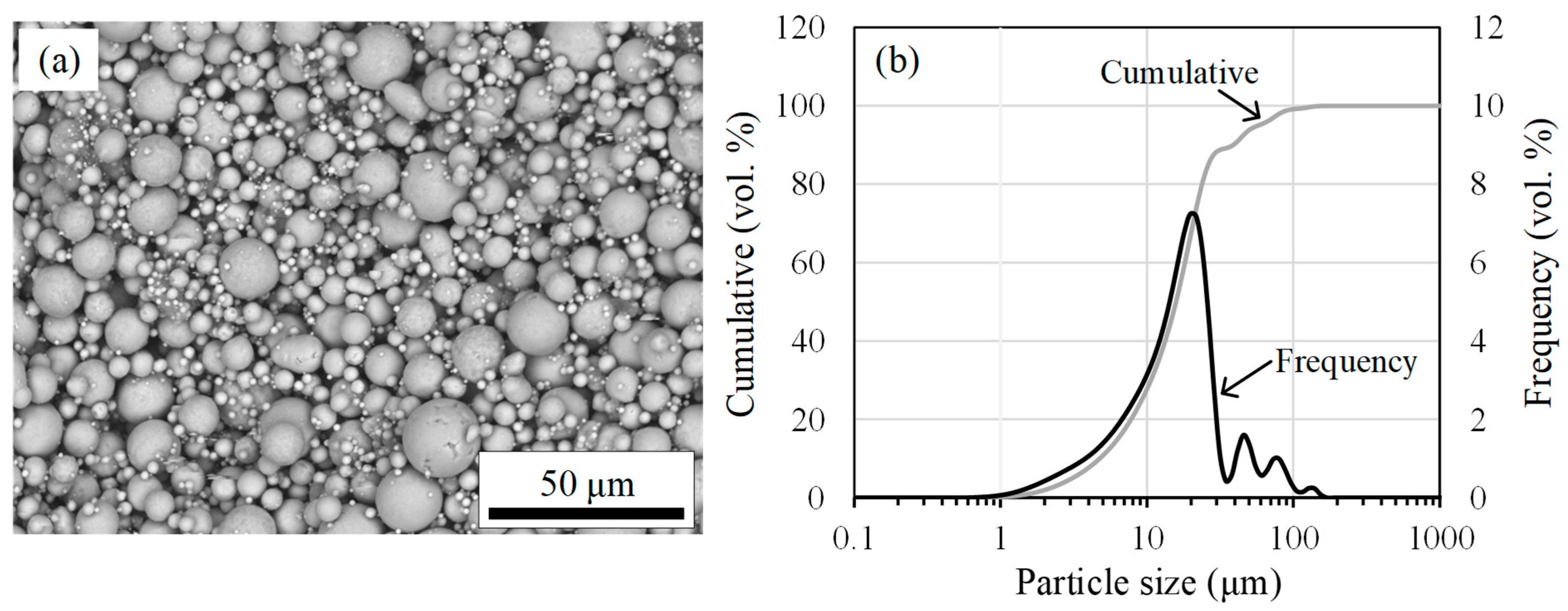
The plasma-atomized AlSi10Mg powder (AP&C, GE Additive, Saint-Eustache, QC, Canada), shown in Figure 1a, was used in this study. This high-sphericity powder exhibits a quadrimodal particle size distribution presented in Figure 1b in percentiles at D10 = 5 µm, D50 = 16 µm, and D90 = 42 µm. The chemical composition of the dry powder provided by the manufacturer is listed in Table 1 and complies with the DIN EN 1706 (EN AC-43000) standard [1].

2.2. Sintering and Heat Treatment

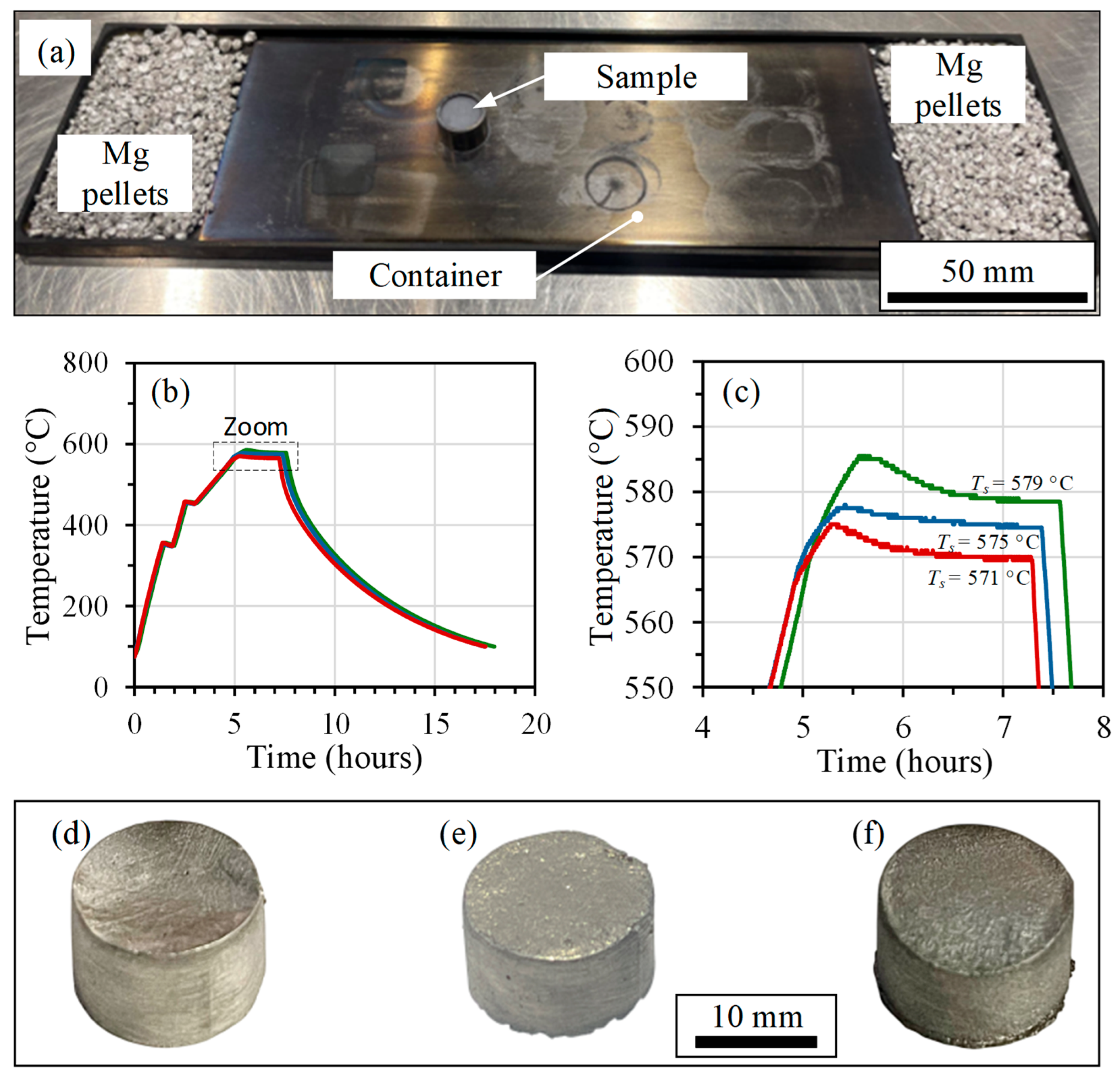
Loose powder was poured into a stainless-steel cylindrical mold (∅ 15 × H 10 mm), manually compacted, and placed on a stainless-steel setter together with Mg pellets (~20 g in total) as illustrated in Figure 2a. This setup was introduced into a tube furnace (Lindberg Model 54579, Lindberg, MI, USA) and sintered under a continuous flow (5 L/min) of ultra-high-purity nitrogen. Nitrogen gas was purified using a two-stage purification system consisting of a gas purifier system (Centor Model 2A-100-SS, Centorr vacuum Industries, Nashua, NH, USA) to reduce oxygen content below 10−11 ppm, and Mg pellets used as an oxide getter to further lower oxygen partial pressure during sintering.
Samples were processed using the sintering profiles presented in Figure 2b. Each cycle consisted of three heating segments taking about 7.5 h, followed by gas cooling steps taking an additional 10 h. In that context, the samples were heated at a rate of 3 °C/min to 350 °C and maintained for 30 min before repeating a similar cycle up to 450 °C (same heating rate and time). After this second plateau, the heating rate was decreased to 1 °C/min, followed by a second decrease at 0.5 °C/min, i.e., 10 °C before reaching the sintering temperature, in order to minimize the temperature overshoot seen in Figure 2c. Based on prior optimization reported in [36], the maximum sintering temperature was varied from 571 to 579 °C and maintained for 2 h. Cooling was programmed at 5 °C/min down to 100 °C, followed by natural cooling to room temperature. The sintered samples shown in Figure 2d–f were cut along the central vertical plane.
Three sample halves were set aside (three samples in as-sintered condition), while the other three were heat-treated and artificially aged (three samples in the artificial aging condition). To that end, the solution treatment was performed at 530 °C for 30 min, followed by water quenching and aging at 160 °C for 6 h, both using a refractory furnace (Thermo Scientific Thermolyne F48000, Waltham, MA, USA).

2.3. Metallographic Characterization

Each sample half was prepared following the metallographic procedure described in the ASTM E3 standard [37]. Grinding was performed using SiC abrasive papers (320 to 1200 grit, MetLab, Natick, MA, USA), followed by a rough polishing with a diamond suspension (3 and 1 µm, Struers, Struers ApS, Ballerup, Denmark) and a fine polishing with a fumed silica suspension (OP-S, 0.25 µm, Struers). For powder characterization, a small amount of powder was placed in a mounting mold, and embedded in epoxy resin by cold mounting to prepare a cross-section for metallographic analysis. The mounted powder was then ground and polished using a similar procedure as for the sintered samples.
Phase identification was performed using X-ray diffraction (XRD) on an Anton Paar XRDynamiX 500 diffractometer (Anton Paar GmbH, Graz, Austria) equipped with a Cu Kα radiation source. Scans were carried out over a 2θ 10–85° range, using a step size of 0.01° and an acquisition time of 100 ms per step. The volume fraction of each phase was estimated using the reference intensity ratio method described in [38]. This semi-quantitative approach relates the integrated peak intensity of each phase to that of a reference standard (Al2O3) using a known constant.
Metallographic analyses of Si precipitates were carried out using a Keyence VHX (Keyence Corporation, Osaka, Japan) digital microscope. To that end, ten images were acquired from each sample, covering a total area of about 1710 × 1070 µm, encompassing approximately 400 to 10,000 Si precipitates, depending on the sintering temperature. Image analysis was performed using Keyence VHX Analyzer software (VHX-7000 Series) to quantify the surface fraction and equivalent diameter of the Si precipitates.
Observation of Fe-rich intermetallic was performed using a Hitachi TM3000 scanning electron microscope (SEM, Hitachi High-Tech Corporation, Tokyo, Japan). Energy-dispersive X-ray spectroscopy (EDX) was also used to confirm the phase composition.
The α-Al grains were characterized using Electron Backscatter Diffraction (EBSD) analysis performed on a Hitachi SU-70 SEM (Hitachi High-Tech Corporation, Tokyo, Japan) with a step size of 0.3 µm and the indexing rate exceeded 95%. Before these EBSD analyses, an additional ultra-fine polishing step using colloidal silica (0.05 µm for 10 h) was applied. The magnification was set to ×1000 for samples sintered at 571 and 575 °C, and ×500 for the sample sintered at 579 °C. In addition, the samples were electro-etched using Barker’s reagent (5% HF solution containing boric acid, prepared from 5 mL of 48% HF, 200 mL of distilled water, and 1.5 g of H3BO3) for 90 s at 24 V and 30 mA to reveal the particle boundaries and assess the visibility of the internal grain structure. The average grain size, obtained from EBSD, was determined using two complementary approaches. The first method involved ImageJ-based image analysis (ImageJ with Java 8), in which individual grain areas and equivalent diameters were measured. The second method followed ASTM E112 [39], applying the linear intercept technique to obtain a statistically representative grain size.
Vickers hardness measurements were performed using a DuraVista-40 durometer (Checkline / Electromatic Equipment Co., Inc., Cedarhurst, NY, USA). For the powder, micro-Vickers indentations were made at the center of six particles using a 0.025 kg load, while a 2 kg load was used for the sintered samples. Six indentations were performed on each sample, ensuring a minimum spacing of 6 and 3 times the diagonal length of the Vickers indent between two indents and between the sample edges and the indent, respectively (as specified in ISO 6507-1:2023 [40]).
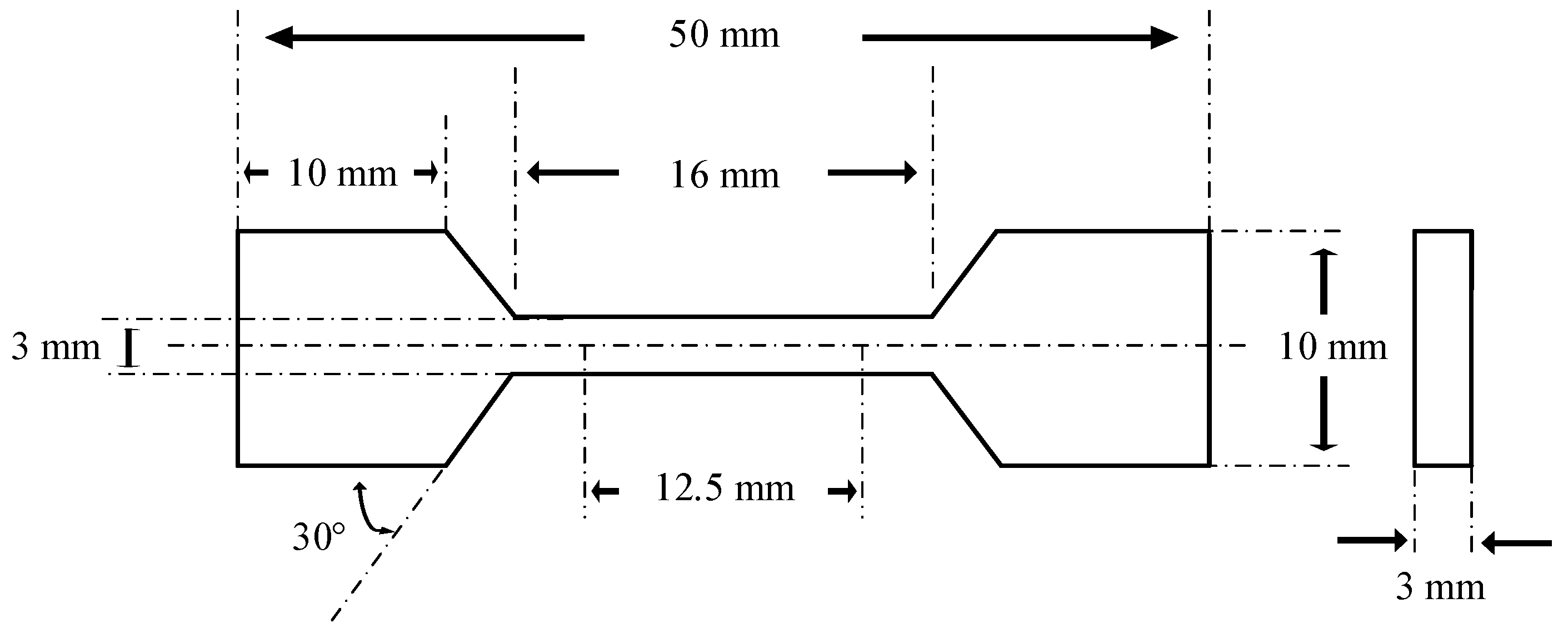
Tensile tests were performed on samples sintered at 575 °C, before and after artificial aging, using the subsize flat dog-bone specimen presented in Figure 3, designed in accordance with ASTM E8/E8M [41]. The tests were carried out on an Instron (Instron, Norwood, MA, USA) 100 kN universal testing machine. For each condition, three samples were tested.

3. Results and Discussion

3.1. Phase Analysis

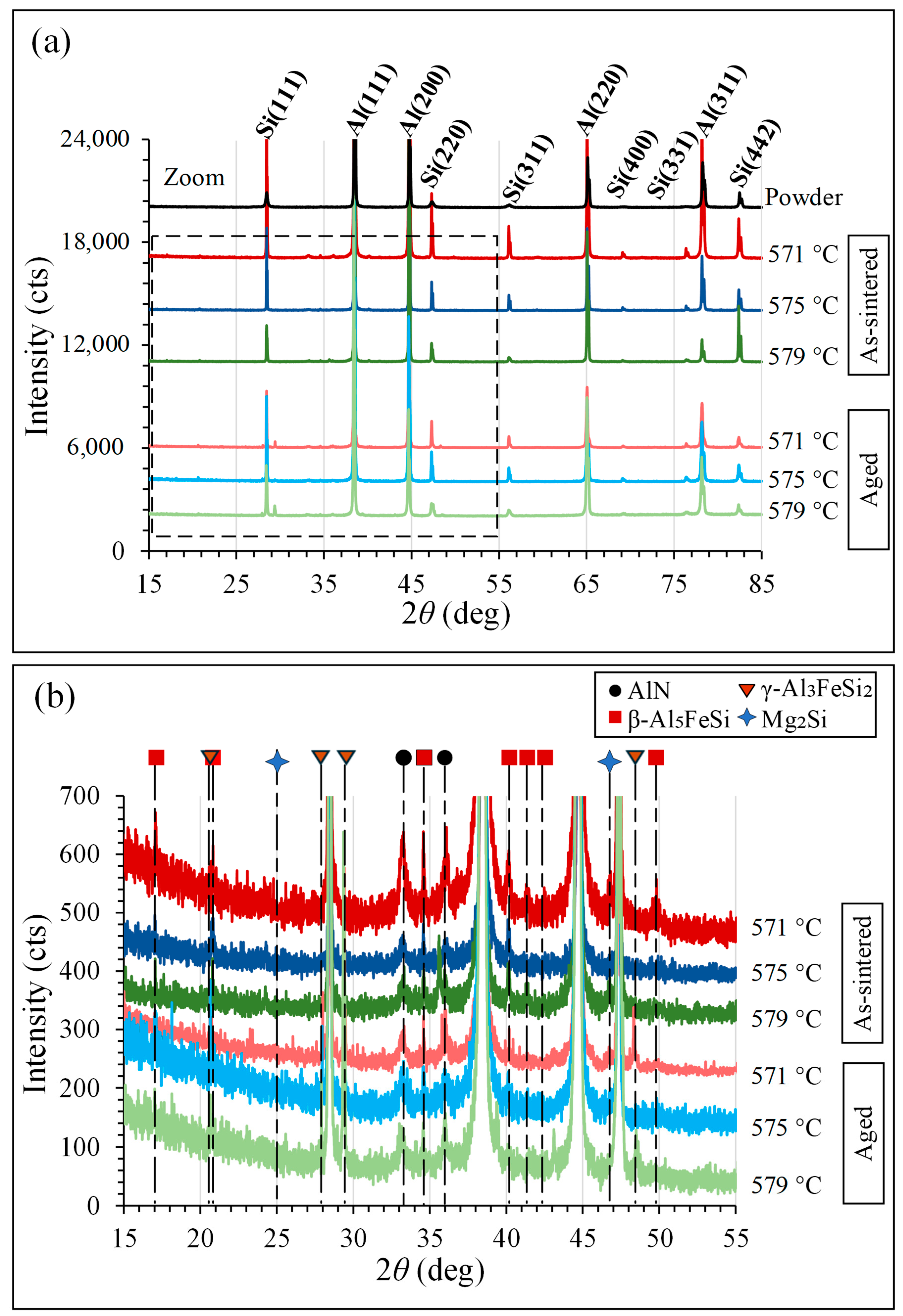
The XRD diffractograms of the powder, the as-sintered, and the aged samples are presented in Figure 4. In all conditions, the most intense peaks correspond to the α-Al and Si phases, identified as ICDD 04-012-7848 and ICDD 00-026-1481, respectively [42,43]. In the starting powder (black curve in Figure 4a), only these two phases were detected. The lattice parameter, a = 4.0460 ± 0.0004 Å, of the α-Al phase was calculated using (111), (200), (220), and (311) diffraction peaks and corrected using the Nelson–Riley extrapolation method. After sintering, the lattice parameter of the α-Al phase increased to a = 4.0485 ± 0.0003, 4.0480 ± 0.0003, and 4.0486 ± 0.0004 Å for samples sintered at 571, 575, and 579 °C, respectively. This indicates that the powder contains a supersaturated α-Al solid solution of Si, likely formed during the rapid solidification associated with the plasma atomization process. During sintering, partial melting facilitates Si distribution, resulting in partial removal from the α-Al lattice and a corresponding increase in the lattice parameter. Following aging, the Mg2Si phase has no measurable effect on the α-Al lattice parameter, which remains in the range of 4.0480 to 4.0486 Å, i.e., values nearly identical to those measured in the as-sintered condition.
In the as-sintered state, the Si diffraction peaks become stronger relative to the α-Al peaks, as compared to the peaks measured from the starting powder. As shown in Figure 4b (zoomed view between 15 and 55°), additional diffraction peaks, which were absent in the starting powder, appeared after sintering. Weak peaks in the 2θ 33.24–36.07° range correspond to the hexagonal AlN phase, marked by black dots in Figure 4b (ICDD 01-086-8211; a = 3.11 Å, b = 3.11 Å, c = 4.98 Å) [44]. This phase formed during sintering in a nitrogen atmosphere and has previously been reported in [36]. Furthermore, peaks located at 17.03, 20.78, 34.79, 41.38, 41.98,43.91, and 50.04° were attributed to Fe-rich intermetallics, mainly the β-Al5FeSi phase, indicated by red squares in Figure 4b (ICDD 00-049-1499, and monoclinic, a = 5.80 Å, b = 12.27 Å, c = 3.31 Å) [45]. Note that the AlN and β-Al5FeSi phases were present in both the as-sintered and aged conditions.
After aging, four additional weak peaks appeared at 20.67, 27.94, 29.45, and 48.47°, attributable to the γ-Al3FeSi2 phase, marked by inverted red triangles in Figure 4b (ICDD 00-052-0917; tetragonal, a = 6.10 Å, b = 6.10 Å, c = 9.53 Å) [46]. No peaks corresponding to Mg2Si phase, expected at 2θ positions indicated by blue stars in Figure 4b (ICDD 01-079-5427), were detected in any condition. This is likely due to the very small size and low volume fraction of Mg2Si, which are below the detection limit of the XRD technique.
Quantitative phase analysis was performed on the XRD patterns using the reference intensity ratio method [38], and the resulting phase volume fractions are summarized in Table 2. The starting powder is mainly composed of α-Al, with only 3.2 vol. % of Si. This low Si fraction supports the assumption of a supersaturated α-Al solid solution (i.e., Si fraction < 10.3 vol. %) and is consistent with the smaller lattice parameter of the α-Al-phase calculated for the powder. After sintering at 571, 575 and 579 °C, the Si fraction increased to 11.3, 10.8, and 11.4 vol. %, respectively. As expected, the Si fraction remained nearly unchanged after aging, staying in the 10.4 to 11.0 vol. % range. This range corresponds to the equilibrium state expected for this alloy. The AlN phase exhibited low volume fractions in the as-sintered samples, ranging from 1.8 to 1.9 vol. %. The volume fraction of the β-Al5FeSi phase in the as-sintered condition was estimated at 4.0 vol. % for the sample sintered at the lowest temperature and increased slightly to 5.6 and 4.8 vol. % for the samples sintered at intermediate and high temperatures, respectively.
After aging, the fraction of β-Al5FeSi decreased significantly by ~1.5–2 times, reaching values between 2.2 and 3.6 vol. %. Meanwhile, the fractions of the other phases remained essentially unchanged. The reduction in β-Al5FeSi was accompanied by the appearance of a new γ-Al3FeSi2 phase, whose volume fraction almost compensates for the loss of β-Al5FeSi. These results suggest a partial transformation of the metastable β-Al5FeSi into the more thermodynamically stable γ-Al3FeSi2 during the solution-annealing stage of the aging treatment, driven by Fe and Si diffusion. Similar transformations of Fe-rich intermetallics have been reported in LPBF-processed AlSi10Mg alloys, where the Fe-rich π-Al8Si6Mg3Fe phase detected in the as-built condition decomposed into β-Al5FeSi after solution treatment at 520 °C for 1h [28]. A comparable behavior has also been observed in cast Al-20Si-0.7Fe alloys, in which β-Al5FeSi formed in the as-cast state transformed into the stable δ-Al4FeSi2 phase after solution treatment at 530 °C for 30 min [47].

3.2. Metallographic Analyses

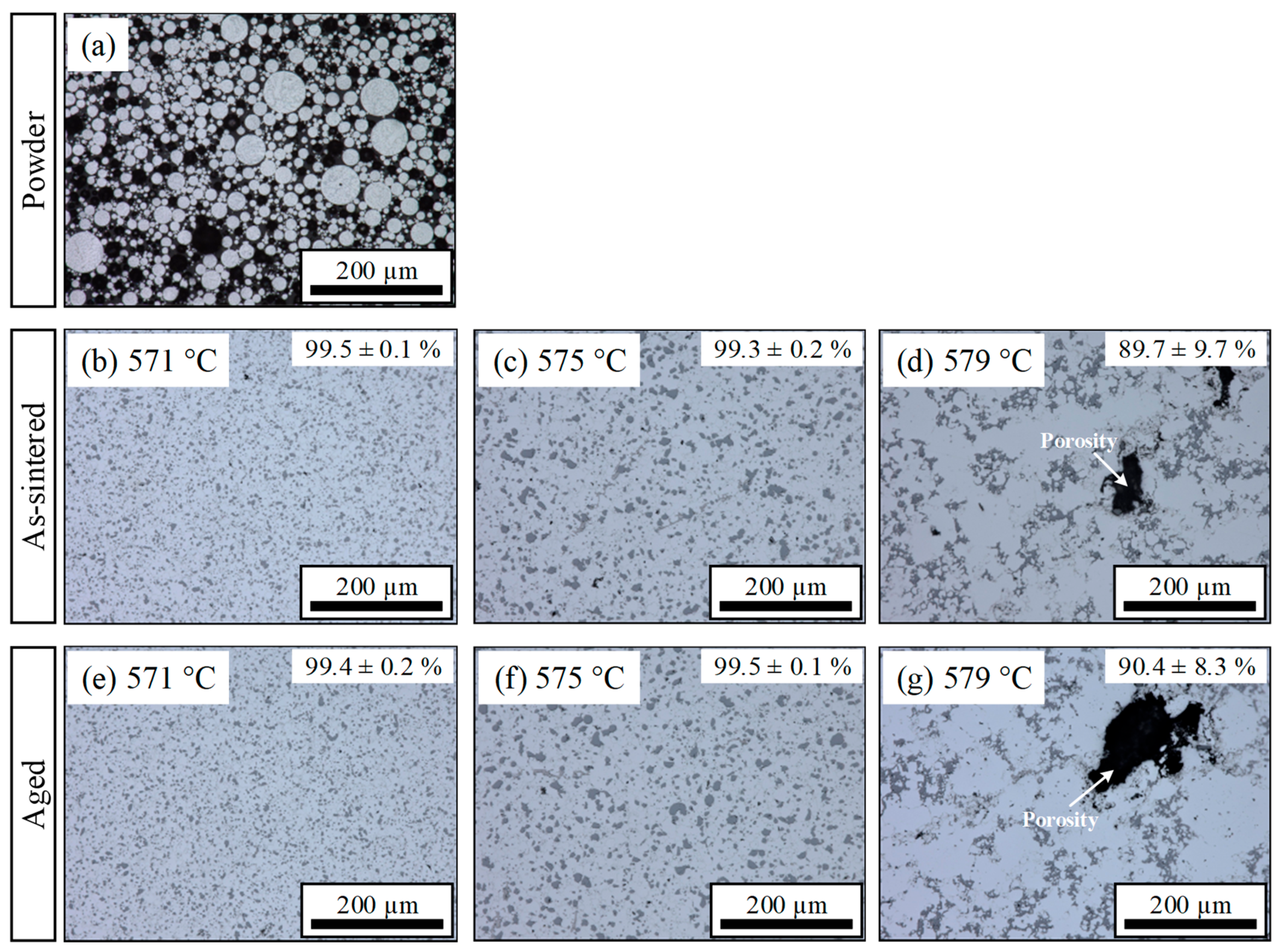
Metallographic analyses were conducted using an optical microscope for low-magnification observations and a scanning electron microscope for both low- and high-magnification imaging. The optical micrographs shown in Figure 5 reveal the α-Al matrix (light-colored phase) and its continuous microstructure in the sintered samples, along with pores (black regions) and the Si phase (dark gray spots).
The optical micrographs were first used to visually assess the porosity. No pores were observed within the individual powder particles, as shown in Figure 5a. After compaction and sintering, the particles underwent significant rearrangement and interparticle bonding, as illustrated in Figure 5b–d, yielding a continuous microstructure and making particle boundaries less distinct. The corresponding sample relative densities, determined via image analysis, are also indicated in Figure 5. Sintering at 571 and 575 °C resulted in high densities of 99.3–99.5%. These values are comparable to those reported for LPBF-processed AlSi10Mg alloys (>99%) [48,49] and slightly exceed typical values for SLPS-processed materials (~98.8%) [50]. However, increasing the sintering temperature to 579 °C caused a ~10 percentage-point drop in density to 89.7%. The formation of large pores (100–200 µm) and the resulting density decrease at 579 °C can be attributed to excessive liquid formation during SLPS, uneven liquid distribution, localized overheating, particle clustering, and gas entrapment, phenomena also reported in other studies on SLPS [51]. As expected, after aging, the metallurgical continuity and density trends shown in Figure 5e–g remain unchanged. The same micrographs were used to quantify the Si phase after sintering and aging.

3.2.1. Observation and Quantification of the Si Phase

A quantitative image analysis of optical micrographs (similar to those shown in Figure 5) was used to determine the Si volume fraction. For each condition (as-sintered or aged), ten images were acquired both at the center and near the surface of the samples. These images were then processed by thresholding to measure the gray regions corresponding to the Si phase. In the as-sintered condition, the measured Si fractions were 10.2 ± 1.2% for sample #1, 11.5 ± 2.1% for sample #2, and 11.9 ± 2.1% for sample #3. After aging, a slight decrease was observed in all samples, with Si fractions of approximately 8.7 ± 0.3%, 9.9 ± 1.1%, and 10.4 ± 0.9%, respectively. These trends are consistent with the phase fractions obtained from XRD analysis.
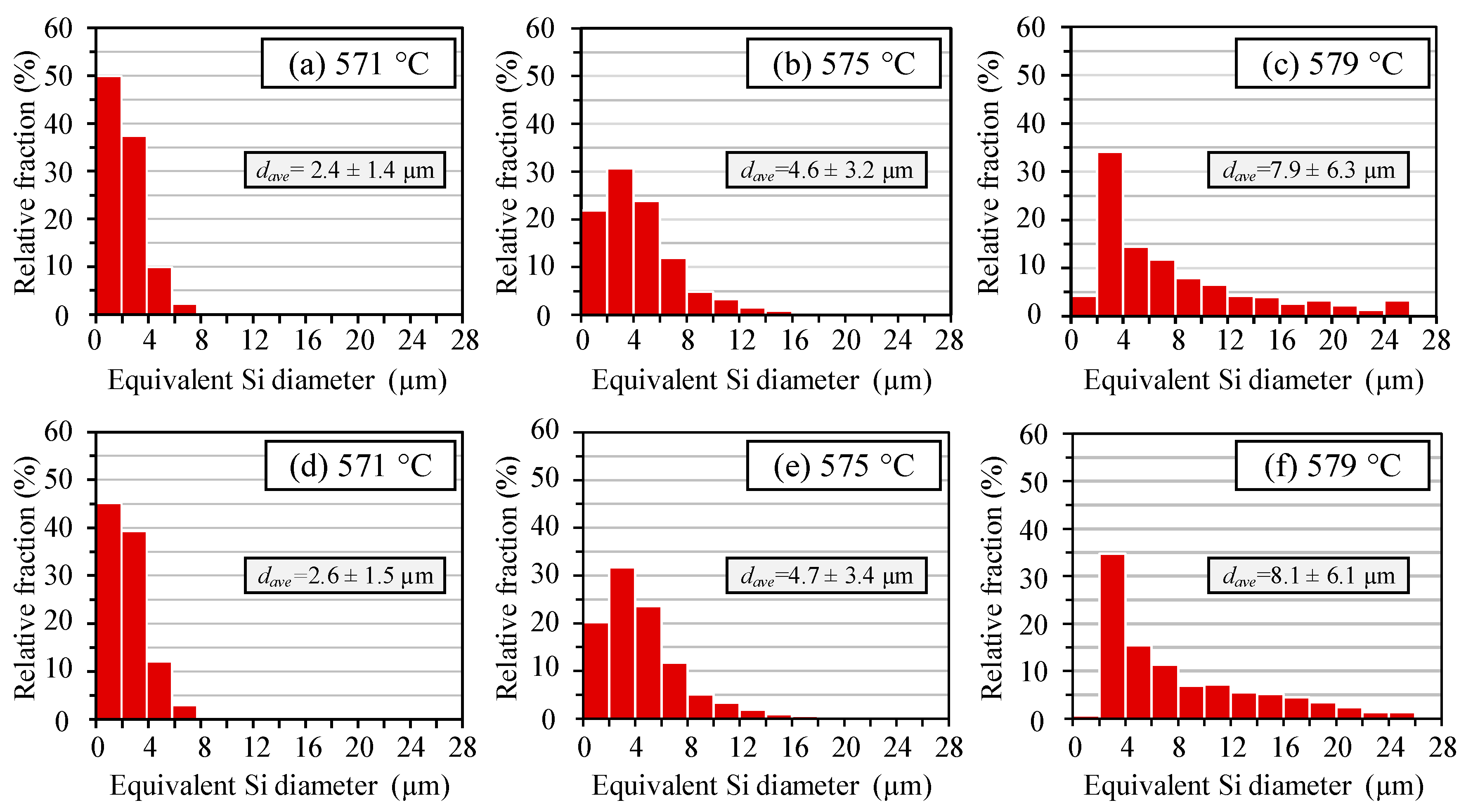
Figure 6 represents the Si phase size distributions for these three sintering temperatures, both before and after aging. In the as-sintered state, the sample sintered at 571 °C exhibits a narrow distribution dominated by fine particles with a homogeneous Si dispersion, as shown in Figure 6a. Increasing the sintering temperature to 575 °C results in coarsening of the Si phase, as observed in Figure 6b, producing a broader distribution with a tail extending toward large particles (up to ~16 µm). The fraction of fine particles (<2 µm) decreases, while the proportion of coarse particles (>8 µm) increases, resulting in an average equivalent diameter of 4.6 ± 3.2 µm. This coarsening is attributed to Ostwald ripening, where smaller particles dissolve and precipitate onto larger, more energetically stable particles, as reported in previous works [52,53]. For the sample sintered at 579 °C, the Si size distribution shifts further toward larger sizes and broadens significantly to ~25 µm, increasing the average particle diameter to 7.9 µm, which is almost twice and four times the average diameters observed after sintering at 575 and 571 °C, respectively, as illustrated in Figure 6c. After aging, the overall Si size distributions shown in Figure 6d–f remained similar to those observed in the as-sintered condition.
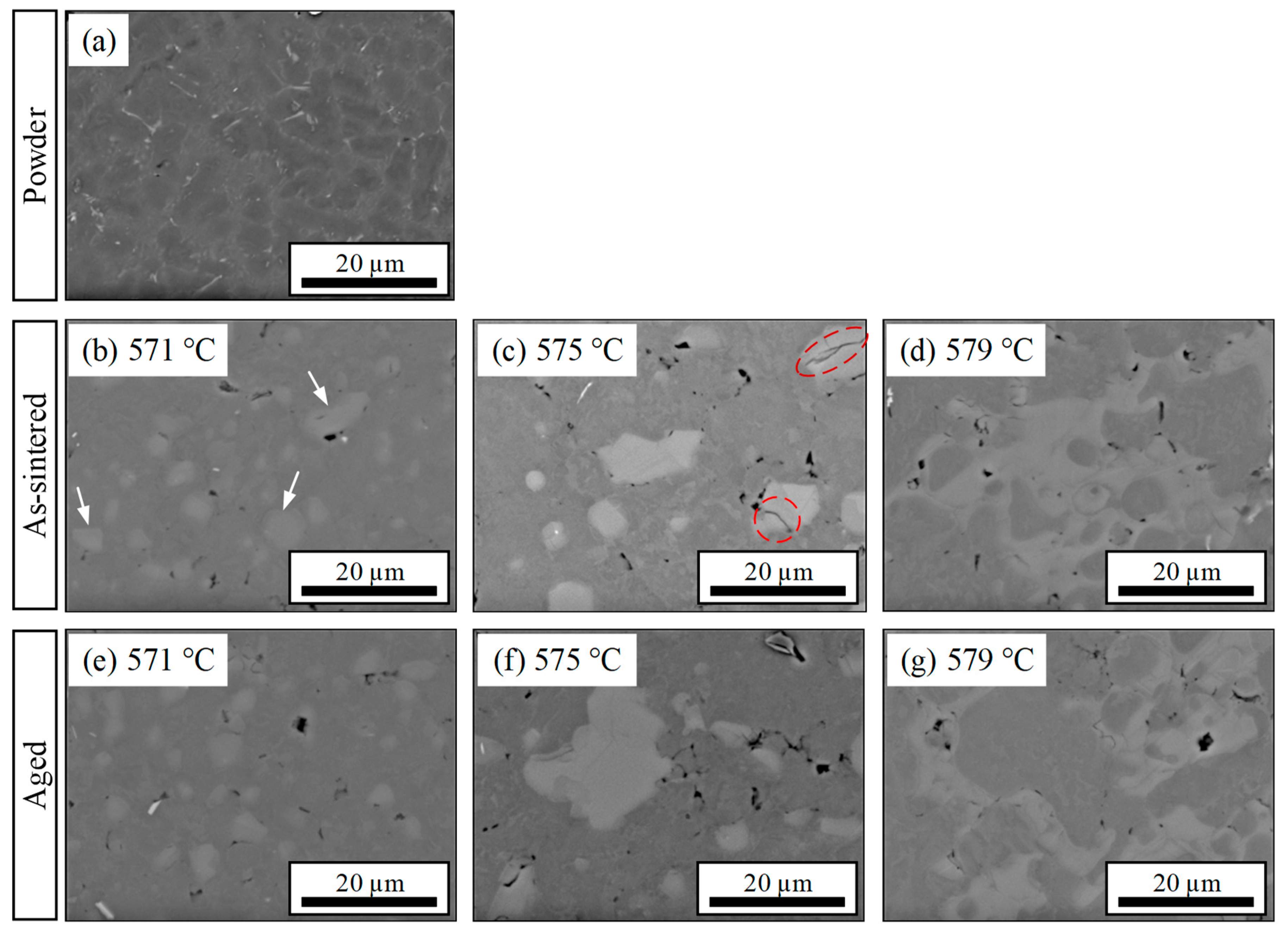
Higher-magnification SEM observations were carried out, and the images of the power and sintering samples are presented in Figure 7 to study the Si phase morphology. In the starting powder (Figure 7a), the Si phase forms a fine and interconnected network along the α-Al, whereas small white regions are associated with a Mg-rich phase. This microstructure is commonly observed following rapid solidification of AlSi10Mg alloys. After sintering at 571 °C, this interconnected network transforms into isolated Si particles uniformly distributed within the α-Al (Figure 7b). The coarse particles likely result from spheroidization of the original eutectic Si, while finer particles may form by precipitation from the supersaturated α-Al, as initially detected by XRD analysis of the starting powder. Although this process is commonly referred to as “Si spheroidization,” many particles retain faceted shapes with sharp corners and edges (white arrows in Figure 7b). In samples sintered at 575 °C, SEM observations reveal cracking in some Si particles, highlighted by red dashed outlines in Figure 7c. As reported by other research groups [54], this cracking may be due to thermal stresses arising from the differences in the coefficient of thermal expansion between α-Al and Si phases, accommodated either by plastic deformation of the ductile α-Al matrix (when no crack is observed in the Si phase) or by cracking of the brittle Si particles.
A further increase in the sintering temperature to 579 °C produced significant changes in the Si morphology, as illustrated in Figure 7d. The Si phase becomes irregular, coarse, and preferentially concentrated along particle boundaries. Rather than forming bulky particles, Si transforms into thick, partially interconnected networks resembling coarse primary Si typically observed in hypereutectic alloys. This morphology after high-temperature sintering may be attributed to the formation of an extensive liquid phase (>80 vol. % according to [36]), in which Si is under thermodynamic conditions that allow it to dissolve and form a Si-rich melt. Local enrichment occurs predominantly near regions originally occupied by fine powder particles due to a high boundary density and an elevated chemical potential. Owing to the coexistence of a partially solid phase and a Si-rich melt, upon cooling the newly formed Si phase develops a morphology different from the typical fibrous/lamellar eutectic Al-Si structure expected in cast AlSi10Mg. After aging, the overall morphology of the Si phase shown in Figure 7e–g remains similar to that observed in the as-sintered condition. Note that the SEM images for the Si particles or the Fe-rich particles were acquired under different imaging conditions to selectively enhance the phase contrast.

3.2.2. Observation of the Fe-Rich Phases

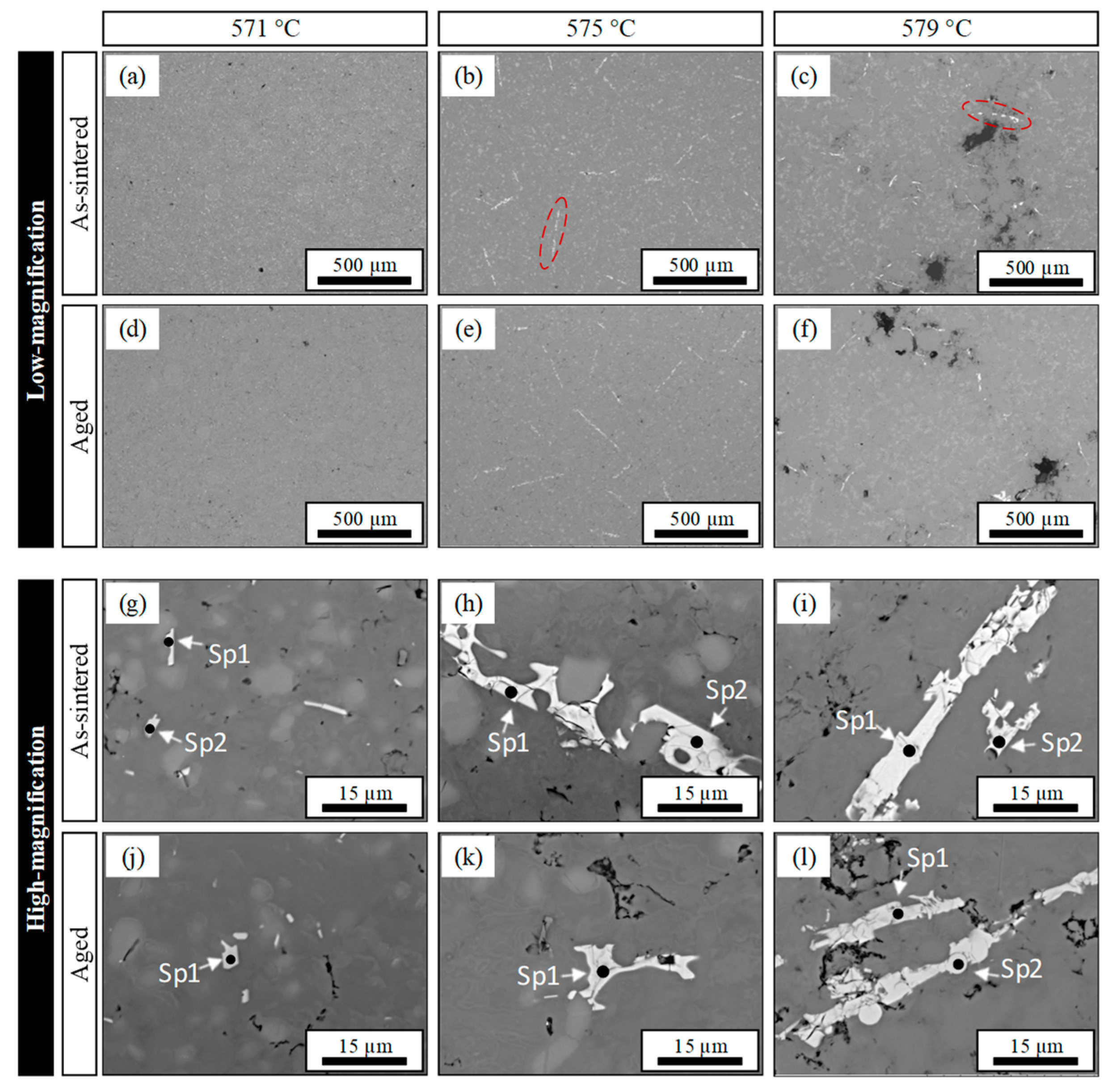
SEM imaging was used to investigate the evolution of the size and morphology of Fe-rich phases. Figure 8 shows the Fe-rich phases (bright regions) in both the as-sintered and aged samples. The Fe-rich intermetallics are uniformly distributed within the α-Al matrix, but their morphology changes with the sintering temperature. At 571 °C, the Fe-rich phase appears as fine, precipitate-like particles that are barely visible at this low magnification, as shown in Figure 8a. Increasing the sintering temperature to 575 and 579 °C promotes coarsening of the Fe-rich phase, resulting in an elongated morphology (indicated by red dashed outlines in Figure 8b,c). In high-magnification SEM observations, these Fe-rich phases are visible and appear as white regions, as evident in Figure 8g–i. After sintering at 571 °C, the morphology is characterized by fine, plate-like particles with typical sizes varying from 1 to 8 µm, as observed in Figure 8g. With an increasing sintering temperature to 575 and 579 °C, the Fe-rich phases seen in Figure 8h,i locally evolve into script-like morphologies, reaching lengths of over 63 µm. After aging, the overall size and morphology of the Fe-rich intermetallics remain similar to those observed in the as-sintered condition, as shown in the low-magnification micrographs in Figure 8d–f and the high-magnification micrographs in Figure 8j–l. However, EDS analyses were performed to examine the elemental composition of these phases.
As detailed in Table 3, EDS analysis performed on the “white phase” (marks Sp1 and Sp2 in Figure 8g–i) indicates Al, Fe, and Si contents varying between 65–75 at. %, 11–17 at. %, and 14–19 at. %, respectively, with the Fe/Si ratio typically in the 0.78–0.98 range in the as-sintered samples. This composition is consistent with that expected for the β-Al5FeSi phase. Slight deviations in the Fe and Si contents (i.e., 14 at. % is expected for both elements) could be due to the large interaction volume of EDS analysis, which can sample a volume larger than the phase size and averages compositions from surrounding matrix and precipitates. Although the aging produces no perceptible effect on the size and morphology of the Fe-rich phase, EDS analyses of spectra marked in Figure 8j–l reveal a significant decrease in the Fe/Si atomic ratio for several particles, with values ranging from 0.47 to 0.73 (Table 3). This evolution supports a partial transformation of β-Al5FeSi into the more stable γ-Al3FeSi2 phase, which occurs during solution treatment at 530 °C through solid-state diffusion of Fe and Si, enabling rearrangement of the intermetallic structure [47]. The transformation remains incomplete, as the Fe/Si ratio of 0.73 measured for Sp2 at 579 °C indicates that a fraction of the initial β-Al5FeSi phase is still present. This partial conversion is likely due to the relatively short solution treatment duration (30 min), which may not provide sufficient time for a complete diffusion-controlled transformation.

3.2.3. Determination of the Average Grain Size of α-Al Phase

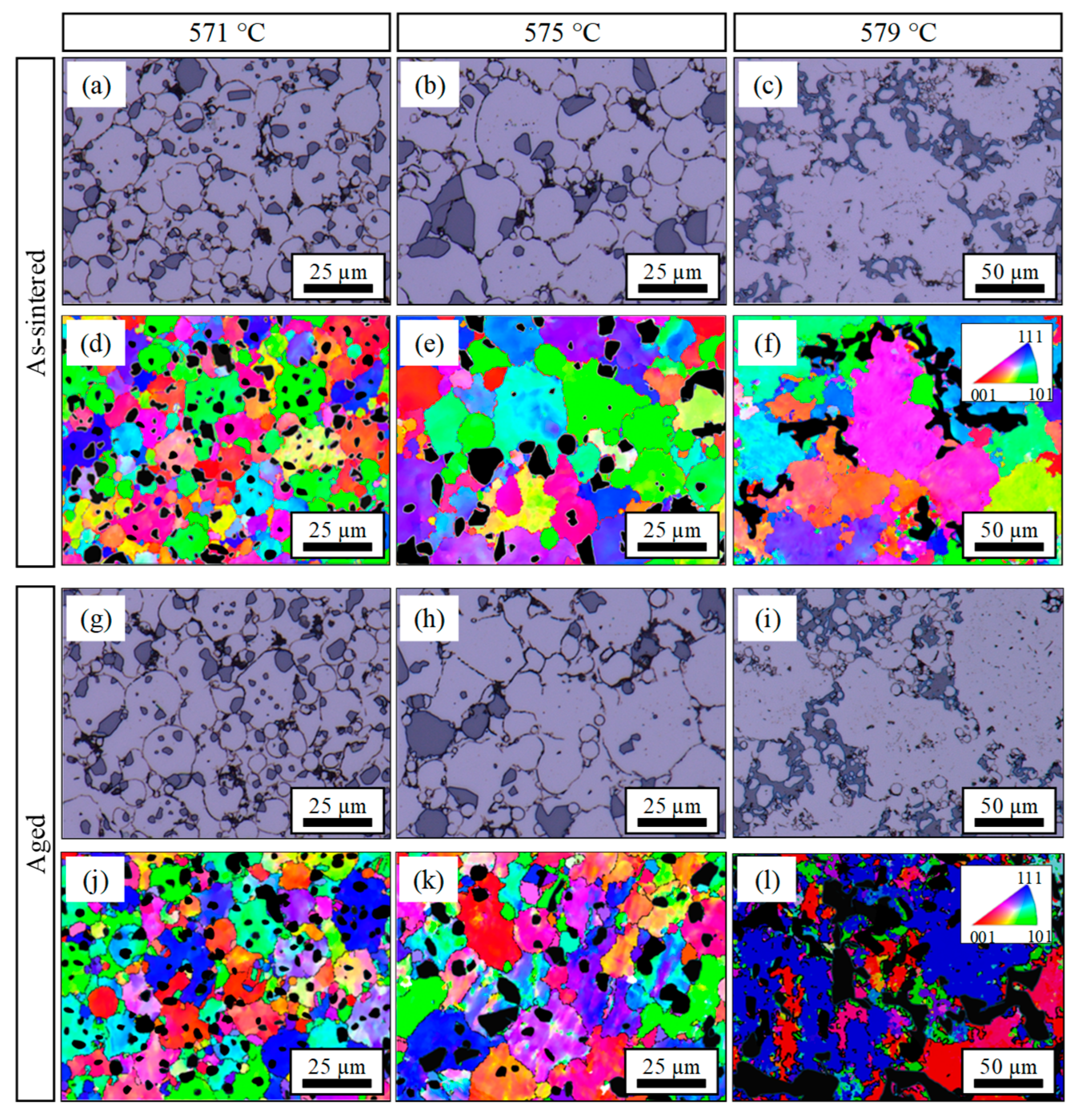
The α-Al grain structure was evaluated using optical micrographs and EBSD analyses before and after aging, as shown in Figure 9. Optical micrographs after etching reveal the original powder particle boundaries but no resolvable internal grain structure, as observed in Figure 9a–c, suggesting that α-Al grains are either too fine for optical resolution or not delineated by the etchant. However, EBSD inverse pole figure (IPF) maps provide definitive insights, as presented in Figure 9d–f. For the sample sintered at 571 °C, each original powder particle maintains a single dominant crystallographic orientation, with no high-angle grain boundaries (>15°) within particles. High misorientations occur only at prior powder particle boundaries. Note that grain colors correspond to the crystallographic triangle shown in Figure 9f, while black regions represent Si particles. Subtle color variations within particles reflect low-angle subgrain boundaries (<5°) and the retained dendritic substructure of the atomized powder. Thus, α-Al grains of the sintered samples appear relatively coarse, with the grain size at 571 °C closely matching the original powder size, indicating limited grain growth, as seen in Figure 9d. Higher sintering temperatures (575 °C and 579 °C) result in grain coarsening, as observed in Figure 9e,f, with liquid-assisted grain boundary migration evident as outward bulging and fading particle boundaries, particularly at 579 °C, where a more important amount of liquid breaks surface phases such as AlN. Despite this coarsening, subgrain structures, visible as slight color variations within individual grains, remain present, likely inherited from the original powder particles, as shown in Figure 9e,f. After aging, the overall grain morphology remains unchanged for all three sintering temperatures, as illustrated Figure 9g–l. However, subgrain structures become more pronounced, suggesting polygonization during the solution stage of aging.
The EBSD maps were used to quantify the grain size of the α-Al phase before and after aging. The equivalent grain diameter was determined by image analysis, whereas the average grain size was evaluated using the linear-intercept method in accordance with ASTM E112 [39] (Table 4). Both methods yielded similar trends. The results show a progressive grain coarsening with increasing sintering temperature, with the average grain size increasing by approximately 1.5 times from 571 to 575 °C, and by about 2 times from 575 to 579 °C. After aging, the grain size values remained very close to those measured in the as-sintered condition, confirming that the solution treatment did not induce any coarsening of the α-Al grains.

3.3. Mechanical Properties

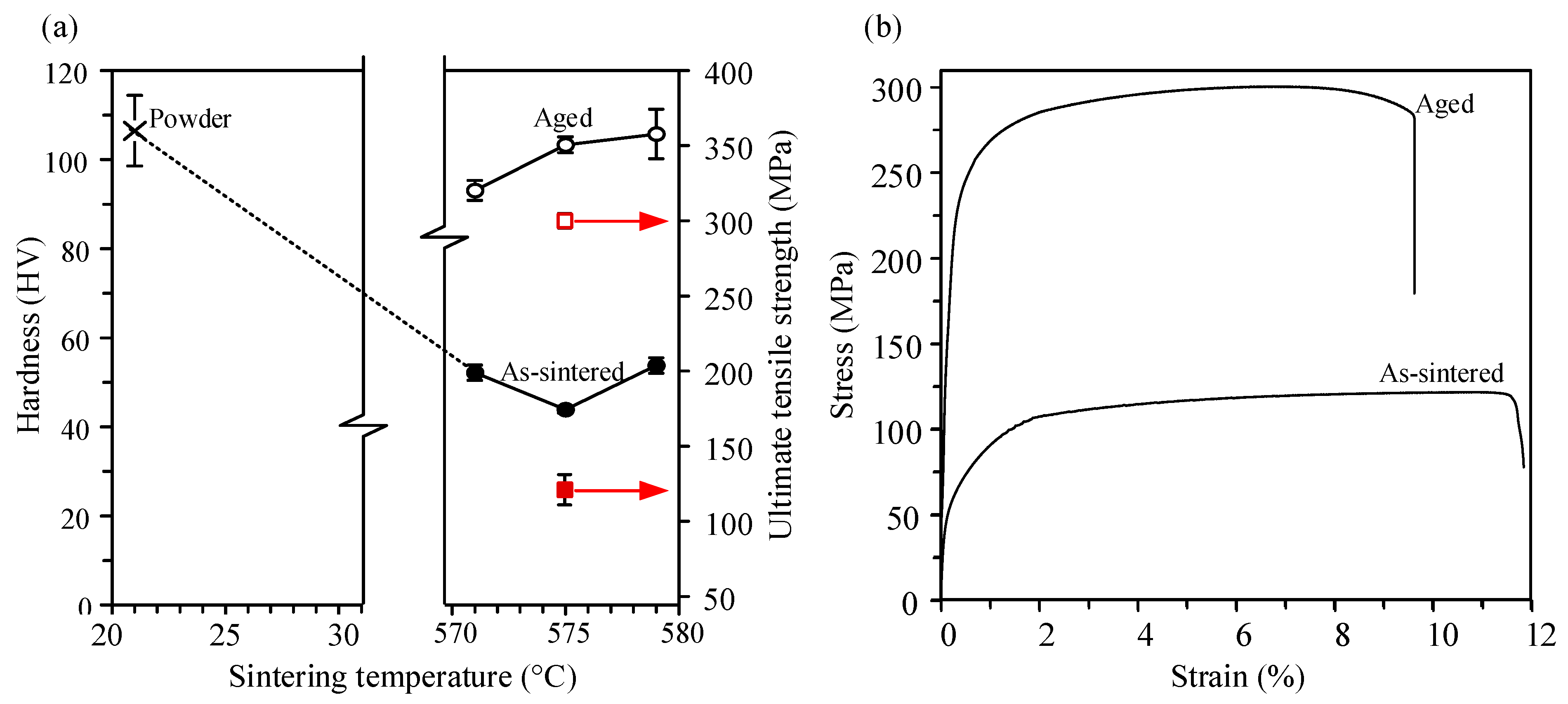
In this work, the mechanical properties were quantified using hardness measurements and tensile tests. As seen in Figure 10a, the starting powder exhibited a high hardness of about 107 ± 8 HV, which is attributable to the fine Si phase distributed within a supersaturated α-Al solid solution formed during rapid solidification associated with the plasma-atomization process. A similar high hardness was reported by Aboulkhair et al. [55] for parts fabricated by LPBF using the same alloy, which also experienced extremely high solidification rates during this additive manufacturing process.
Sintering in the 571–579 °C range for a long period of time led to an approximately twofold reduction in hardness (44–54 HV), driven by a decrease in solute supersaturation of the α-Al matrix and by the coarsening and redistribution of the Si phase. This return toward an equilibrium microstructure produces a soft alloy, with hardness values depending on the sintering temperature (black markers in Figure 10a). Among the studied as-sintered conditions, the sample sintered at 571 °C exhibits an intermediate hardness of about 52 HV, promoted by fine Si precipitates (~2.4 µm), and its homogenous dispersion at grain boundaries and within α-Al grains (~8 µm). Increasing the sintering temperature to 575 °C accelerates the coarsening of α-Al grains (~12 µm), Si particles (~4.6 µm), and Fe-rich intermetallics (~63 µm), likely causing the measured lowest hardness of about 44 HV. At 579 °C, grain growth becomes more pronounced (α-Al ~22 µm), and Fe-intermetallics further coarsen. Nevertheless, the hardness increases relative to the 579 °C sample (54 HV). This unexpected increase in hardness can be attributed to the formation of interconnected Si structures located primarily in interparticle regions, the slightly higher Si fraction, and the α-Al grain polygonization visible in EBSD maps (Figure 9). At 575 °C, the Si phase appeared only as isolated particles, whereas at 579 °C nearly the entire Si phase formed a continuous network. This transition from isolated to fully interconnected Si significantly increases the stiffness of interparticle regions and constrains local plastic deformation, thereby contributing to higher hardness.
Compared with AlSi10Mg produced by LPBF [18,19,20] and casting [6], the as-sintered alloy exhibits a lower hardness. LPBF alloys typically possess a fine α-Al grain structure (~10 µm [56]) and an ultrafine, continuous Si network [18,19,20], which significantly enhance the hardness up to 113–125 HV, depending on the build orientation [57]. In contrast, cast Al-Si alloys show very coarse α-Al grains (up to 3 mm for parts cast in sand molds, and 0.3 mm for those cast in copper molds) surrounded by plate- or needle-shaped eutectic Si [8,9,10,11,57]. As a result, as-cast AlSi10Mg shows a lower hardness (~73 HV [6]), but this is still higher than for as-sintered SLPS alloy.
Aging almost doubles the hardness, restoring values close to that of the starting powder (open black markers in Figure 10a). In this case, the hardening is certainly attributed to the precipitation of fine Mg2Si particles during artificial aging, which leads to hardness values between 93 and 106 HV. The lower hardness of the sample sintered at 571 °C after aging is likely related to insufficient Mg homogenization during sintering. Limited liquid phase formation at this temperature may restrict Mg redistribution between powder particles, reducing the available solute for Mg2Si precipitation during artificial aging. Consequently, fewer strengthening Mg2Si precipitates form during artificial aging, leading to a lower hardness than for samples sintered at higher temperatures. Nevertheless, these values exceed the values reported for T6-treated LPBF (~78 HV) but remain lower than those of T6-treated cast alloy (~126 HV) [6].
Typical tensile stress–strain curves for samples in the as-sintered (575 °C) and artificially aged (575 °C + aging) state are presented in Figure 10b. Note that tensile tests were conducted only on samples sintered at 575 °C, as this condition provided the most optimized consolidation, with stable microstructure and sufficiently high density and hardness after aging. Three specimens were tested in each condition, and the average UTS values are reported in Figure 10a (red square for the as-sintered condition vs. open red square for the aged condition) along with the minimum and maximum values as error bars. In the as-sintered condition, the yield strength (YS, 0.2% offset) and ultimate tensile strength (UTS) are 56 ± 1 MPa and 121 ± 1 MPa, respectively. After aging treatment, these values increase to 209 ± 36 MPa and 273 ± 37 MPa, respectively. The elongation at rupture decreases slightly from about 9 ± 4 to 6 ± 3%. The reduced elongation after aging is attributed to the precipitation of fine Mg2Si precipitates, which increases the strength of the samples but simultaneously reduces their ability to accommodate plastic deformation.
Although the mechanical properties of powder-metallurgy aluminum alloys vary widely with alloy composition, the additives used to promote bonding and consolidation, and the specific processing route, Table 5 summarizes representative properties reported for PM aluminum alloys subjected to artificial aging. These values illustrate the comparative performance of sintered AlSi10Mg relative to other PM-processed and heat-treated Al alloys.
Overall, the tensile properties of sintered AlSi10Mg fall within the performance envelope of powder-metallurgy aluminum alloys subjected to artificial aging. Although the as-sintered microstructure does not achieve the extreme refinement characteristic of AM alloy, it can provide a favorable balance between strength and ductility for PM AlSi10Mg. When combined with aging, SLPS leads to mechanical properties approaching those of T6-treated cast and AM alloys, while maintaining advantages in microstructure stability and uniformity during heat treatment. These results establish SLPS as a promising and versatile route for producing high-density AlSi10Mg components, particularly for powder-based shaping technologies that do not rely on full melting.

4. Conclusions

The influence of the supersolidus liquid-phase sintering (SLPS) temperature on the microstructure and mechanical response of high-density AlSi10Mg, in both the as-sintered and aged conditions, was investigated. Three sintering temperatures (571, 575, and 579 °C) were studied under an identical sintering protocol. The main conclusions are summarized as follows:
  • SLPS is a promising and versatile processing route for AlSi10Mg. Sintering in the 571–575 °C range provides high densification (≈99.5%), isotropic microstructures, controlled Si evolution, and excellent compatibility with aging treatment. In contrast, sintering at 579 °C results in density loss and pronounced microstructural coarsening, which is detrimental. These results identify the 571 and 575 °C sintering temperatures as the optimal processing window for producing high-performance, powder-based AlSi10Mg components by SLPS.
  • Microstructural coarsening increases with the sintering temperature. Higher sintering temperatures promote α-Al grain growth, Si particle coarsening, and enlargement of Fe-rich intermetallics through enhanced liquid formation, dissolution precipitation, and Ostwald ripening.
  • The microstructure is established during SLPS and remains thermally stable during aging. No significant changes in α-Al grain size or Si particle morphology occur during the solution treatment and aging. However, this treatment modifies the composition of Fe-rich intermetallics.
  • Aging significantly improves the mechanical properties of SLPS AlSi10Mg. For samples sintered at 575 °C, aging increases the average hardness and ultimate tensile strength values respectively from 44 to 103 HV and from 121 MPa to 273 MPa, demonstrating the synergy between the SLPS microstructure control and precipitation hardening.

Author Contributions

M.K.T.: conceptualization, methodology, investigation, data curation, validation, writing—original draft. A.K.: supervision, conceptualization, validation, visualization, writing—original draft, writing—review & editing. A.C.: methodology. R.P.: validation, writing—review & editing. V.D.: supervision, conceptualization, validation, writing—review & editing, project administration, funding acquisition. All authors have read and agreed to the published version of the manuscript.

Funding

This project was funded by the National Research Council of Canada (the National Program Office; proposal #AM-125-1) and the Centre Québécois de Recherche et de Développement de l’Aluminium (project #1148).

Data Availability Statement

The datasets generated during the current study are available from the corresponding author upon reasonable request.

Acknowledgments

The authors gratefully acknowledge the NRC R&D industrial group METALTec for initiating this project, and extend their thanks to the industrial partners AP&C and Dana Incorporated for their continued collaboration and contributions.

Conflicts of Interest

The authors declare no conflicts of interest.

References

  1. Deutsches Institut für Normung e. V. (DIN). Aluminium and Aluminium Alloys—Castings—Chemical Composition and Mechanical Properties; Deutsches Institut für Normung e.V. (DIN): Berlin, Germany, 2020. [Google Scholar]
  2. Ramavajjala, A.; Dandekar, T.; Khatirkar, R.; Joshi, C.; Chouhan, R.; Agnihotri, A. A review on the correlation between microstructure, heat treatment and mechanical properties of additively manufactured AlSi10Mg by LPBF. Crit. Rev. Solid State Mater. Sci. 2024, 50, 239–274. [Google Scholar] [CrossRef]
  3. EOS GmbH. Electro Optical Systems Material Data Sheet: EOS Aluminium AlSi10Mg. 2021. Available online: https://www.eos.info/var/assets/03_system-related-assets/material-related-contents/metal-materials-and-examples/metal-material-datasheet/aluminium/material_datasheet_eos_aluminium-alsi10mg_en_web.pdf (accessed on 1 April 2026).
  4. Dash, S.S.; Chen, D. A Review on Processing–Microstructure–Property Relationships of Al-Si Alloys: Recent Advances in Deformation Behavior. Metals 2023, 13, 609. [Google Scholar] [CrossRef]
  5. Singhal, V.; Shelly, D.; Babbar, A.; Lee, S.-Y.; Park, S.-J. Review of Wear and Mechanical Characteristics of Al-Si Alloy Matrix Composites Reinforced with Natural Minerals. Lubricants 2024, 12, 350. [Google Scholar] [CrossRef]
  6. Amith, K.V.; Baloor, S.S.; Polishetty, A.; Bolar, G.; Govindhan, A.N. Heat treatment and its effect on machining induced surface roughness of cast and additive manufactured AlSi10Mg. Sci. Rep. 2025, 15, 26433. [Google Scholar] [CrossRef]
  7. Shakil, S.I.; Hadadzadeh, A.; Amirkhiz, B.S.; Pirgazi, H.; Mohammadi, M.; Haghshenas, M. Additive manufactured versus cast AlSi10Mg alloy: Microstructure and micromechanics. Results Mater. 2021, 10, 100178. [Google Scholar] [CrossRef]
  8. Obara, T.J.; Minei, R.O.; Kakitani, R.; Spinelli, J.E.; Garcia, A.; Cheung, N. Solidification microstructure and mechanical properties of an Al-11wt%Si alloy modified with Nb and Sb. J. Phys. Chem. Solids 2023, 181, 111521. [Google Scholar] [CrossRef]
  9. Abdelaziz, M.H.; Samuel, A.M.; Doty, H.W.; Samuel, F.H. Effect of morphological changes of eutectic Si particles on the ambient and high temperature tensile properties of Zr containing Al–Si alloys. J. Mater. Res. Technol. 2020, 9, 5962–5981. [Google Scholar] [CrossRef]
  10. Jiang, D.; Yu, J. Simultaneous refinement and modification of the eutectic Si in hypoeutectic Al–Si alloys achieved via the addition of SiC nanoparticles. J. Mater. Res. Technol. 2019, 8, 2930–2943. [Google Scholar] [CrossRef]
  11. Neuser, M.; Schaper, M.; Grydin, O. Mechanical and Microstructure Characterisation of the Hypoeutectic Cast Aluminium Alloy AlSi10Mg Manufactured by the Twin-Roll Casting Process. J. Manuf. Mater. Process. 2023, 7, 132. [Google Scholar] [CrossRef]
  12. Dahle, A.K.; Nogita, K.; McDonald, S.D.; Dinnis, C.; Lu, L. Eutectic modification and microstructure development in Al–Si Alloys. Mater. Sci. Eng. A 2005, 413–414, 243–248. [Google Scholar] [CrossRef]
  13. Campbell, J. Time-Dependent Failure Mechanisms of Metals: The Role of Bifilms in Precipitation Cleavage. Metals 2025, 15, 1084. [Google Scholar] [CrossRef]
  14. Cao, X.; Campbell, J. Morphology of β-Al5FeSi phase in Al-Si cast alloys. Mater. Trans. 2006, 47, 1303–1312. [Google Scholar] [CrossRef]
  15. Liu, F.; Zhao, H.; Yang, R.; Sun, F. Microstructure and Mechanical Properties of High Vacuum Die-Cast AlSiMgMn Alloys at as-Cast and T6-Treated Conditions. Materials 2019, 12, 2065. [Google Scholar] [CrossRef] [PubMed]
  16. Li, L.; Li, D.; Feng, J.; Zhang, Y.; Kang, Y. Effect of Cooling Rates on the Microstructure and Mechanical Property of La Modified Al7SiMg Alloys Processed by Gravity Die Casting and Semi-Solid Die Casting. Metals 2020, 10, 549. [Google Scholar] [CrossRef]
  17. Shen, X.; Liu, S.; Wang, X.; Cui, C.; Gong, P.; Zhao, L.; Han, X.; Li, Z. Effect of Cooling Rate on the Microstructure Evolution and Mechanical Properties of Iron-Rich Al–Si Alloy. Materials 2022, 15, 411. [Google Scholar] [CrossRef]
  18. Li, P.; Kim, Y.; Bobel, A.C.; Hector, L.G.; Sachdev, A.K.; Kumar, S.; Bower, A.F. Microstructural origin of the anisotropic flow stress of laser powder bed fused AlSi10Mg. Acta Mater. 2021, 220, 117346. [Google Scholar] [CrossRef]
  19. Macías, J.G.S.; Douillard, T.; Zhao, L.; Maire, E.; Pyka, G.; Simar, A. Influence on microstructure, strength and ductility of build platform temperature during laser powder bed fusion of AlSi10Mg. Acta Mater. 2020, 201, 231–243. [Google Scholar] [CrossRef]
  20. Delahaye, J.; Tchuindjang, J.T.; Lecomte-Beckers, J.; Rigo, O.; Habraken, A.M.; Mertens, A. Influence of Si precipitates on fracture mechanisms of AlSi10Mg parts processed by Selective Laser Melting. Acta Mater. 2019, 175, 160–170. [Google Scholar] [CrossRef]
  21. Yan, Q.; Song, B.; Shi, Y. Comparative study of performance comparison of AlSi10Mg alloy prepared by selective laser melting and casting. J. Mater. Sci. Technol. 2020, 41, 199–208. [Google Scholar] [CrossRef]
  22. Li, Z.; Kuai, Z.; Bai, P.; Nie, Y.; Fu, G.; Liu, W.; Yang, S. Microstructure and Tensile Properties of AlSi10Mg Alloy Manufactured by Multi-Laser Beam Selective Laser Melting (SLM). Metals 2019, 9, 1337. [Google Scholar] [CrossRef]
  23. Roveda, I.; Serrano-Munoz, I.; Kromm, A.; Madia, M. Investigation of residual stresses and microstructure effects on the fatigue behaviour of a L-PBF AlSi10Mg alloy. Procedia Struct. Integr. 2022, 38, 564–571. [Google Scholar] [CrossRef]
  24. Roveda, I.; Serrano-Munoz, I.; Mishurova, T.; Madia, M.; Pirling, T.; Evans, A.; Klaus, M.; Haubrich, J.; Requena, G.; Bruno, G. Influence of a 265 °C heat treatment on the residual stress state of a PBF-LB/M AlSi10Mg alloy. J. Mater. Sci. 2022, 57, 22082–22098. [Google Scholar] [CrossRef]
  25. Daoud, M.; Taha, I.; Abdelgawad, A.; Barsoum, I.; Khan, K.; Anjum, D. Mapping residual stresses in AlSi10Mg alloy fabricated by powder bed fusion-laser beam method. Sci. Rep. 2025, 15, 24784. [Google Scholar] [CrossRef]
  26. Siqi, C.; Huang, X.; Shuai, L.; Wu, G.; Huang, T.; Huang, X. Annealing behavior of AlSi10Mg alloy fabricated by laser powder bed fusion. J. Phys. Conf. Ser. 2023, 2635, 012036. [Google Scholar] [CrossRef]
  27. Ilangovan, R.K.; Amirthalingam, M.; Krishnaswamy, H.; Kottada, R.S. Assessing critical role of iron on microstructure and deformation behaviour of AlSi10Mg processed via laser powder bed fusion additive manufacturing. Materialia 2025, 39, 102320. [Google Scholar] [CrossRef]
  28. Zhou, L.; Mehta, A.; Schulz, E.; McWilliams, B.; Cho, K.; Sohn, Y. Microstructure, precipitates and hardness of selectively laser melted AlSi10Mg alloy before and after heat treatment. Mater. Charact. 2018, 143, 5–17. [Google Scholar] [CrossRef]
  29. Liu, W.; Huang, S.; Du, S.; Gao, T.; Zhang, Z.; Chen, X.; Huang, L. The Effects of Heat Treatment on Microstructure and Mechanical Properties of Selective Laser Melting 6061 Aluminum Alloy. Micromachines 2022, 13, 1059. [Google Scholar] [CrossRef] [PubMed]
  30. Wu, L.; Zhao, Z.; Bai, P.; Zhang, Z.; Li, Y.; Liang, M.; Du, W. The Effect of Silicon Phase Morphology on Microstructure and Properties of AlSi10Mg Alloys Fabricated by Selective Laser Melting. Materials 2022, 15, 8786. [Google Scholar] [CrossRef] [PubMed]
  31. Gao, C.; Xiao, Z.; Zou, H.; Liu, Z.; Chen, J.; Li, S.; Zhang, D. Characterization of spherical AlSi10Mg powder produced by double-nozzle gas atomization using different parameters. Trans. Nonferrous Met. Soc. China 2019, 29, 374–384. [Google Scholar] [CrossRef]
  32. Tian, H.; Zhao, F.; Ma, D.; Zhao, X.; Meng, J.; Zhang, G.; Wu, F. An Improved Process for Solving the Sintering Problem of Al-Si Alloy Powder Metallurgy. Metals 2024, 14, 1295. [Google Scholar] [CrossRef]
  33. Rong, G.; Xin, W.; Zhou, M.; Ma, T.; Wang, X.; Jiang, X. Exploring Microstructure, Wear Resistance, and Electrochemical Properties of AlSi10Mg Alloy Fabricated Using Spark Plasma Sintering. Materials 2023, 16, 7394. [Google Scholar] [CrossRef] [PubMed]
  34. Kong, Z.; Wang, Z.; Li, Y.; Li, R. Effect of Spark Plasma Sintering Temperature on the Microstructure and Thermophysical Properties of High-Silicon–Aluminum Composites. Coatings 2024, 14, 299. [Google Scholar] [CrossRef]
  35. Li, Y.-Z.; Zhu, L.-F.; Wang, X.; Tang, S.; Luo, T.; Wang, J.-Y. Low-temperature pressureless consolidation of AlSi10Mg powders by low-intensity ultrasound. Trans. Nonferrous Met. Soc. China 2025, 35, 349–361. [Google Scholar] [CrossRef]
  36. Kreitcberg, A.; Trigui, M.K.; Chandoul, A.; Pelletier, R.; Demers, V. Effect of Temperature, Heating Rate, and Cooling Rate on Bonding and Nitriding of AlSi10Mg Powder Occurring During Supersolidus Liquid-Phase Sintering. J. Manuf. Mater. Process. 2025, 9, 296. [Google Scholar] [CrossRef]
  37. ASTM E3–11; Standard Guide for Preparation of Metallographic Specimens. ASM International: West Conshohocken, PA, USA, 2017.
  38. Connolly, J.R. Introduction Quantitative X-Ray Diffraction Methods. 2003. Available online: https://www.xray.cz/xray/csca/kol2011/kurs/dalsi-cteni/Connolly-2005/09-Quant-intro.pdf (accessed on 20 May 2026).
  39. ASTM E112-10; Standard Test Methods for Determining Average Grain Size. ASM International: West Conshohocken, PA, USA, 2010.
  40. ISO 6507-1:2023; Metallic Materials—Vickers Hardness Test—Part 1: Test Method. International Organization for Standardization: Geneva, Switzerland, 2023.
  41. ASTM E8/E8M-25; Standard Test Methods for Tension Testing of Metallic Materials. E28 Committee: West Conshohocken, PA, USA, 2025. [CrossRef]
  42. ICDD. PDF-4+ Database, Card 04-012-7848—Aluminum (Al); International Centre for Diffraction Data (ICDD): Newtown Square, PA, USA, 2011. [Google Scholar]
  43. ICDD. PDF-4+ Database, Card 00-026-1481—Silicon (Si); International Centre for Diffraction Data (ICDD): Newtown Square, PA, USA, 1976. [Google Scholar]
  44. ICDD. PDF-4+ Database, Card 01-086-8211—Aluminium Nitride (AlN); International Centre for Diffraction Data (ICDD): Newtown Square, PA, USA, 2011. [Google Scholar]
  45. ICDD. PDF-4+ Database, Card 00-049-1499—Aluminum Iron Silicon (Al5FeSi); International Centre for Diffraction Data (ICDD): Newtown Square, PA, USA, 1970. [Google Scholar]
  46. ICDD. PDF-4+ Database, Card 00-052-0917—Aluminum Iron Silicon (Al3FeSi2); International Centre for Diffraction Data (ICDD): Newtown Square, PA, USA, 2002. [Google Scholar]
  47. Que, Z.; Mendis, C.L. Formation of θ-Al13Fe4 and the multi-step phase transformations to α-Al8Fe2Si, β-Al5FeSi and δ-Al4FeSi2 in Al–20Si-0.7Fe alloy. Intermetallics 2020, 127, 106960. [Google Scholar] [CrossRef]
  48. Raus, A.A.; Wahab, M.S.; Ibrahim, M.; Kamarudin, K.; Ahmed, A.; Shamsudin, S. Mechanical and physical properties of AlSi10Mg processed through selective laser melting. AIP Conf. Proc. 2017, 1831, 020027. [Google Scholar] [CrossRef]
  49. Majeed, A.; Zhang, Y.; Lv, J.; Peng, T.; Atta, Z.; Ahmed, A. Investigation of T4 and T6 heat treatment influences on relative density and porosity of AlSi10Mg alloy components manufactured by SLM. Comput. Ind. Eng. 2020, 139, 106194. [Google Scholar] [CrossRef]
  50. Ji, X.; Li, S.; Zhang, X.; Liu, L.; Li, S.; Gao, L.; Li, X.; Wang, S. Influence of characteristic parameters of SiC reinforcements on mechanical properties of AlSi10Mg matrix composites by powder metallurgy. J. Mater. Res. Technol. 2023, 24, 6843–6853. [Google Scholar] [CrossRef]
  51. Lin, C.-W.; Hung, F.-Y.; Lui, T.-S.; Chen, L.-H. Microstructure Evolution and High-Temperature Compressibility of Modified Two-Step Strain-Induced Melt Activation-Processed Al-Mg-Si Aluminum Alloy. Metals 2016, 6, 113. [Google Scholar] [CrossRef]
  52. Ibrahim, M.; Abdelaziz, M.; Samuel, A.; Doty, H.; Samuel, F. Spheroidization and Coarsening of Eutectic Si Particles in Al-Si-Based Alloys. Adv. Mater. Sci. Eng. 2021, 2021, 6678280. [Google Scholar] [CrossRef]
  53. German, R.M.; Suri, P.; Park, S.J. Review: Liquid phase sintering. J. Mater. Sci. 2009, 44, 1–39. [Google Scholar] [CrossRef]
  54. Chen, C.-L.; Thomson, R.C. Study on thermal expansion of intermetallics in multicomponent Al–Si alloys by high temperature X-ray diffraction. Intermetallics 2010, 18, 1750–1757. [Google Scholar] [CrossRef]
  55. Aboulkhair, N.T.; Maskery, I.; Tuck, C.; Ashcroft, I.; Everitt, N.M. The microstructure and mechanical properties of selectively laser melted AlSi10Mg: The effect of a conventional T6-like heat treatment. Mater. Sci. Eng. A 2016, 667, 139–146. [Google Scholar] [CrossRef]
  56. Guo, M.; Sun, M.; Huang, J.; Pang, S. A Comparative Study on the Microstructures and Mechanical Properties of Al-10Si-0.5Mg Alloys Prepared under Different Conditions. Metals 2022, 12, 142. [Google Scholar] [CrossRef]
  57. Serjouei, A.; Libura, T.; Brodecki, A.; Radziejewska, J.; Broniszewska, P.; Pawłowski, P.; Szymczak, T.; Bodaghi, M.; Kowalewski, Z.L. Strength-hardness relationship for AlSi10Mg alloy produced by laser powder bed fusion: An experimental study. Mater. Sci. Eng. A 2022, 861, 144345. [Google Scholar] [CrossRef]
  58. Lall, C.; Bishop, D.P. Conventional Powder Metallurgy Aluminum Alloys. In Powder Metallurgy; Samal, D.P., Newkirk, J., Eds.; ASM International: West Conshohocken, PA, USA, 2015; pp. 581–590. [Google Scholar] [CrossRef]
Figure 1. (a) SEM morphology of AlSi10Mg powder; (b) particle size distribution.
Jmmp 10 00208 g001
Figure 2. (a) Experimental setup for the sintering process, (b,c) temperature profiles for sintering performed at 571, 575, and 579 °C, and (df) dense cylindrical samples after sintering.
Jmmp 10 00208 g002
Figure 3. Subsize tensile specimen geometry.
Jmmp 10 00208 g003
Figure 4. XRD patterns of the AlSi10Mg powder and sintered samples (Ts = 571, 575, and 579 °C) in the as-sintered or aged conditions, (a) full diffraction profiles in the 10–85° 2θ range, (b) enlarged view of the 15–55° region.
Jmmp 10 00208 g004
Figure 5. Typical optical micrographs of (a) powder and samples sintered at 571, 575 and 579 °C in the (bd) as-sintered or (eg) aged conditions.
Jmmp 10 00208 g005
Figure 6. Size distributions of Si particles in samples sintered at 571, 575 and 579 °C in the (ac) as-sintered or (df) aged conditions.
Jmmp 10 00208 g006
Figure 7. High-magnification SEM micrographs (a) powder, and samples sintered at 571, 575 and 579 °C in the (bd) as-sintered or (eg) aged conditions.
Jmmp 10 00208 g007
Figure 8. Low- and high-magnification SEM images of the samples sintered at 571, 575 and 579 °C in the ((ac) and (gi)) as-sintered or ((df) and (jl)) aged conditions.
Jmmp 10 00208 g008
Figure 9. Optical micrographs and representative EBSD inverse pole figure maps of the samples sintered at 571, 575 and 579 °C in the (af) as-sintered or (gl) aged conditions.
Jmmp 10 00208 g009
Figure 10. Mechanical properties of samples sintered at 575 °C, (a) hardness and ultimate tensile strength, (b) typical tensile stress–strain curves.
Jmmp 10 00208 g010
Table 1. Chemical composition of the AlSi10Mg powder (wt. %).
AlSiMgTiFeMnCuNiZnSnPb
Bal.10.30.350.150.17<0.01<0.01<0.01<0.01<0.01<0.01
Table 2. Quantitative phase volume fractions (vol. %).
ConditionsTemperatureα-AlSiAlNβ-Al5FeSiγ-Al3FeSi2
Powder-96.83.2---
571 °C82.911.31.84.0-
As-sintered575 °C81.810.81.85.6-
579 °C81.911.41.94.8-
571 °C83.410.71.52.22.1
Aged575 °C83.410.41.33.61.2
579 °C82.211.01.73.41.7
Table 3. EDS analysis.
As-SinteredAged
571 °C575 °C579 °C571 °C575 °C579 °C
Element (at. %)Sp1Sp2Sp1Sp2Sp1Sp2Sp1Sp1Sp1Sp2
Al68.364.667.966.175.266.373.267.381.074.0
Si16.519.417.317.113.918.118.022.312.115.0
Fe15.216.014.816.810.915.68.810.46.911.0
Fe/Si ratio0.920.820.850.980.780.860.490.470.570.73
Table 4. Equivalent diameter and average grain size of AlSi10Mg in as-sintered and aged conditions.
ConditionsTemperatureEquivalent Diameter, µmAverage Grain Diameter, µm
571 °C8 ± 39
As-sintered575 °C12 ± 513
579 °C21 ± 1326
571 °C9 ± 311
Aged575 °C12 ± 613
579 °C21 ± 1424
Table 5. Comparison of properties of sintered AlSi10Mg with representative PM + T6 aluminum alloys.
AlloyUTS, MPaElongation, %References
AlSi10Mg2736Present study
A-2014248–3271–2[58]
A-22142277[58]
A-6061183–2381–2[58]
A-6002180–1862–3[58]
A-7075497–4991[58]
Disclaimer/Publisher’s Note: The statements, opinions and data contained in all publications are solely those of the individual author(s) and contributor(s) and not of MDPI and/or the editor(s). MDPI and/or the editor(s) disclaim responsibility for any injury to people or property resulting from any ideas, methods, instructions or products referred to in the content.