Article

Dynamic Modeling and Chatter Stability of a Robotic Milling Manipulator Considering the Flexibility of Arms and Joints

1
School of Mechanical Engineering and Automation, Beihang University, Beijing 100191, China
2
Jiangxi Research Institute, Beihang University, Nanchang 330096, China
3
State Key Laboratory of High-End Heavy-Load Robots, Foshan 528311, China
4
Guangdong Midea Electric Co., Ltd., Foshan 528311, China
*
Author to whom correspondence should be addressed.
J. Manuf. Mater. Process. 2026, 10(6), 206; https://doi.org/10.3390/jmmp10060206 (registering DOI)
Submission received: 22 April 2026 / Revised: 9 June 2026 / Accepted: 10 June 2026 / Published: 14 June 2026

Abstract

The application of robotic milling manipulators demonstrates a promising method for the efficient manufacturing of large-scale structures. However, the cutting accuracy and efficiency of milling robots are predominantly subjected to their low stiffness, which may easily cause chatter during machining. Accurate prediction of chatter stability for robots is of practical importance and is challenging. This paper develops a dynamic model of flexible link elements by considering link flexibility and joint torsional deformation and then constructs a multi-link flexible coupled dynamic model using the receptance coupling substructure analysis (RCSA) method. Subsequently, the equivalent dynamic parameters are identified via the particle swarm optimization (PSO) algorithm. On this basis, the end-effector frequency response functions (FRFs) of the robot under different poses are predicted, and the stability lobe diagram (SLD) for milling is generated based on chatter theory. Finally, the predicted FRFs and stability regions are validated through modal tests and milling experiments. Experimental results demonstrate that the proposed model can predict the end-effector dynamic characteristics and chatter occurrence conditions under different poses, confirming its effectiveness in the analysis of milling chatter stability. Quantitative validation yields a maximum error of 3% for predicted first-order modal frequencies and relative modal amplitude errors below 10%, with experimentally confirmed critical depths of cut of 0.1–0.2 mm at 3000 rev/min and 0.5–0.6 mm at 5000 rev/min.

1. Introduction

Industrial robots have found widespread application in fields such as aerospace, mold manufacturing, and the machining of complex structural components due to their greater flexibility, larger working space, and lower production costs compared to traditional machine tool processing methods [1,2]. However, the precision and surface quality in robotic milling are often limited by the occurrence of chatter, which can be classified into mode-coupling chatter and regenerative chatter [3,4]. Due to the relatively low overall structural stiffness of industrial robots, mode-coupling chatter frequently occurs during the cutting process, resulting in reduced machining accuracy, surface quality, and process efficiency [5]. Therefore, accurately modeling the robot’s dynamic response and predicting its frequency behavior are fundamental for ensuring machining accuracy. Owing to the multiple degrees of freedom of industrial robots, it is difficult to obtain the tool-point FRF of the robotic milling system at arbitrary poses through impact testing. At the present stage, the end-effector FRF of robots is mainly acquired by combining experimental methods and theoretical modeling [6]. Nevertheless, due to oversimplified rigid-body assumptions or incomplete modeling of joint flexibility, these existing methods either exhibit limited prediction accuracy or require computationally intensive calculations, which makes it difficult to achieve a balance between real-time performance and accuracy in chatter stability prediction. Accordingly, this paper conducts research on robotic dynamic modeling, chatter stability prediction in robotic milling, and optimization of cutting parameters for industrial robots.
Research on robotic dynamic modeling often treats the manipulator links as rigid bodies and describes the motion characteristics of the robotic system by establishing a rigid-body dynamic model [7]. In recent years, several studies have extended these models to incorporate additional physical considerations. For instance, Yang et al. [8] integrated physics-informed neural networks (PINNs) with the dynamics model of collaborative robots; Yaren et al. [9] developed a dynamic model of a three-DOF RRP serial robotic manipulator using the Lagrange–Euler formulation; and Maged [10] formulated kinematic and dynamic models for a three-DOF variable-stiffness articulated robotic arm and validated them experimentally. However, in practical machining processes, the links and joints of robotic arms typically exhibit a certain degree of flexibility [11]. Sun et al. [12] proposed a trajectory tracking method for flexible robotic arms based on an improved adaptive PSO algorithm combined with fuzzy PD control, which enhances tracking accuracy and system stability; Ni et al. [13] developed a dynamic model for multi-flexible-link spatial robotic arms under time-varying dynamic boundary conditions, providing theoretical support for their control and practical applications; and Farid and Cleghorn [14] developed a curvature-based finite element method for the dynamic modeling of multi-flexible-link planar manipulators, which uses curvature as a nodal variable instead of displacement and rotation, potentially achieving higher accuracy with fewer degrees of freedom. In addition, under conditions of high payload or extended arm reach, the flexural deformation of robot arms can significantly affect the dynamic characteristics of the system [15]. Alongside link flexibility, the modeling and identification of joint stiffness are also essential for predicting the chatter stability of robots. Currently, research on robotic joint stiffness primarily follows two mainstream approaches: theoretical prediction and experimental identification. Chen et al. [16] proposed a rigid–flexible coupling simulation method that accounts for joint flexibility and employed a neural network to establish a mapping model between robot pose and end-effector stiffness; Zhang et al. [17] proposed a unified framework for dynamic parameter identification and experimentally validated it on a two-DOF elastic-joint robot; and Liu et al. [18] proposed a simple and cost-effective stiffness identification method aimed at improving the positioning accuracy of robots. It should be noted that parallel manipulators generally exhibit higher structural stiffness compared to serial manipulators, making them more suitable for high-precision milling applications where large cutting forces are involved. For instance, Ma et al. [19] applied oppositely oriented series multiple tuned mass dampers to a parallel machine tool for vibration suppression, while Abadi and Vakilzadeh [20] analyzed the natural frequency of a planar parallel mechanism with task space redundancy for high-precision milling. Nevertheless, despite their lower stiffness, serial industrial robots offer a larger workspace and greater flexibility, which are indispensable for machining large-scale complex structural components. This inherent low-stiffness characteristic makes chatter prediction and stability analysis particularly critical for serial robotic milling. However, existing studies still exhibit limitations in parameter identification and optimization for complex flexible structures, particularly in accurately describing the system’s dynamic characteristics under multi-parameter coupling conditions. Therefore, it is necessary to incorporate parameter identification and optimization methods based on dynamic modeling to enhance model prediction accuracy. Wan et al. [21] constructed a robotic milling stability model incorporating the influence of three-directional low-frequency vibrations and experimentally verified the prediction accuracy of the model. Ma et al. [22] proposed a FRF-based dynamic model updating method for robotic mobile machining systems, suitable for predicting and identifying the dynamic characteristics of parallel or hybrid-parallel robotic machining equipment.
For the analysis of chatter stability in robotic milling, the prediction of the stability region for regenerative chatter can be categorized into two main approaches: frequency-domain methods [23] and time-domain methods [24]. For example, Altintas [25] proposed a frequency-domain analysis method that analytically solves the time-delay dynamic equations of the milling system to rapidly predict chatter stability boundaries and generate SLDs. Tlusty et al. [26] analyzed the dynamic interaction between the tool and workpiece during high-speed milling, accurately simulating cutting forces, vibrations, and deformations to predict chatter stability. In addition, various other methods are also employed, such as numerical simulation [27] and the semi-discretization method [28]. Research on mode-coupling chatter in robotic milling has developed relatively late. Wang et al. [29] introduced a reliability-based probabilistic approach to predict mode-coupling chatter, examining the influence of input parameter variability on the prediction results; Yang et al. [30] optimized the working posture in robotic milling based on a stiffness-oriented approach, enhancing machining stability and reducing chatter; and Pan et al. [31,32] found that the angle between the cutting force direction and the principal stiffness direction of an industrial robot is a key factor influencing machining stability, and they established a predictive criterion for mode-coupling chatter. On the basis of chatter stability prediction, the core objective of research lies in how to select optimal cutting parameters or avoid chatter. Wang et al. [33] proposed a parameter optimization method incorporating chatter stability constraints, which significantly expanded the stability region in robotic milling; He et al. [34] proposed a stiffness orientation method that integrates modal shapes with the kinematics of industrial robots; and Gonul et al. [35] proposed a chatter suppression method that exploits the kinematic redundancy of robots. By selecting poses that avoid low-frequency natural modes, the approach enhances the robot’s dynamic stiffness and effectively suppresses low-frequency coupled chatter while maintaining the desired trajectory, making it particularly suitable for large-scale robotic milling.
Based on the research background presented above, this study proposes a dynamic modeling approach for industrial robots that incorporates both link flexibility and joint stiffness. By integrating theoretical analysis with experimental validation, it investigates the prediction of FRFs and milling chatter stability under different robot poses. A multi-link dynamic coupling model is constructed by establishing a flexible structure model accounting for joint compliance. The substructure response coupling method is employed to predict the end-effector FRFs, and the PSO algorithm is used for parameter identification and model optimization. Furthermore, by combining the cutting force model with the mode-coupling chatter theory, the cutting stability region is predicted, and the accuracy of both the model and stability predictions is verified through modal and cutting experiments. This approach significantly reduces computational cost while maintaining the accuracy of end-effector FRF predictions, thereby providing a feasible pathway for rapid chatter stability assessment in milling operations under varying robot poses. This study provides a theoretical foundation for analyzing the dynamic characteristics of industrial robotic machining systems and selecting stable cutting parameters, thereby enhancing machining accuracy and stability.

2. Dynamic Modeling of the Robot with Joint Flexibility

During the cutting process, changes in the robot’s pose alter its dynamic characteristics, thereby affecting machining stability. This poses a core challenge for accurately predicting chatter stability. Traditional dynamic modeling often simplifies the manipulator as a rigid body, neglecting link and joint flexibility, which significantly reduces modeling accuracy under high end-effector load conditions. Although finite element models can accurately represent robot flexibility, their computational cost is significant, making the efficient prediction of chatter stability regions difficult. Therefore, developing a multi-pose dynamic model that balances modeling accuracy and computational efficiency has become a key issue in the dynamic modeling of robotic machining.

2.1. Dynamic Modeling of a Single Robotic Link

For typical six-DOF industrial robots, joint flexibility generally dominates the low-order natural frequencies and overall chatter stability. This is because the equivalent torsional stiffness of joint transmissions is significantly lower than the bending stiffness of the links, and joint compliance propagates through the kinematic chain, generating low-frequency global vibration modes. Link flexibility primarily affects higher-order modes and becomes more influential in lightweight or high-payload configurations. In this study, both effects are considered to achieve accurate prediction of the end-effector FRF and SLD. With link flexibility incorporated into the robot dynamic model, a dynamic modeling method is proposed to improve model accuracy and achieve more precise predictions of the robot’s dynamic characteristics. The subsequent analysis adopts the linear assumption, indicating that the flexural beam undergoes small deformations without significant rigid-body motion. The model is simplified to a planar configuration, as the milling operations considered are predominantly three-axis slot milling, where the tool axis is nearly aligned with gravity; thus, the planar model sufficiently captures the robot’s low rigidity. Furthermore, most machining scenarios such as slot milling involve three-axis operations, and a planar model is sufficient to characterize the majority of working conditions. Figure 1 illustrates the relationship between nodal forces and nodal displacements for a uniform cross-section flexural beam element.
Z i , j = [ X j ( ω ) , F j ( ω ) ] T = [ u j ; w j ; φ j ; N j ; Q j ; M j ] Z i , k = [ X k ( ω ) , F k ( ω ) ] T = [ u k ; w k ; φ k ; N k ; Q k ; M k ]
In Equation (1), each node possesses three degrees of freedom for nodal displacement X and nodal force F. The vibration amplitude in modal coordinates is defined as Z, with element subscripts j and k representing the nodes associated with the element and i denoting the beam element number. Extensive research has been conducted on computing the dynamic stiffness matrices of uniform cross-section Euler–Bernoulli and Timoshenko beams, which generally take the form of Equation (2):
F j F k = D i ( ω ) · X j X k = d j , j d j , k d k , j d k , k · X j X k = d 1 0 0 d 5 0 0 d 2 d 3 0 d 6 d 7 d 4 0 d 7 d 8 d 1 0 0 s y m d 2 d 3 d 4 · X j X k
The specific composition of the dynamic stiffness matrix is provided in Appendix A Equations (A1) and (A2). In general studies, the beam transfer matrix is obtained using a direct calculation method. By transforming the dynamic stiffness matrix Di(ω), the nodal transfer matrix of beam Ti is obtained:
X k F k = T i · X j F j = d j , k 1 d j , k 1 d k , k · d j , k 1 · d j , j d k , j d k , k · d j , k 1 · X j F j
The advantage of the above method for calculating the transfer matrix lies in providing a convenient computational approach for the subsequent coupling of arm rods. Furthermore, this method is applicable to the study of beams with different properties.

2.2. Dynamic Coupling of Robot Arms Considering Joint Flexibility

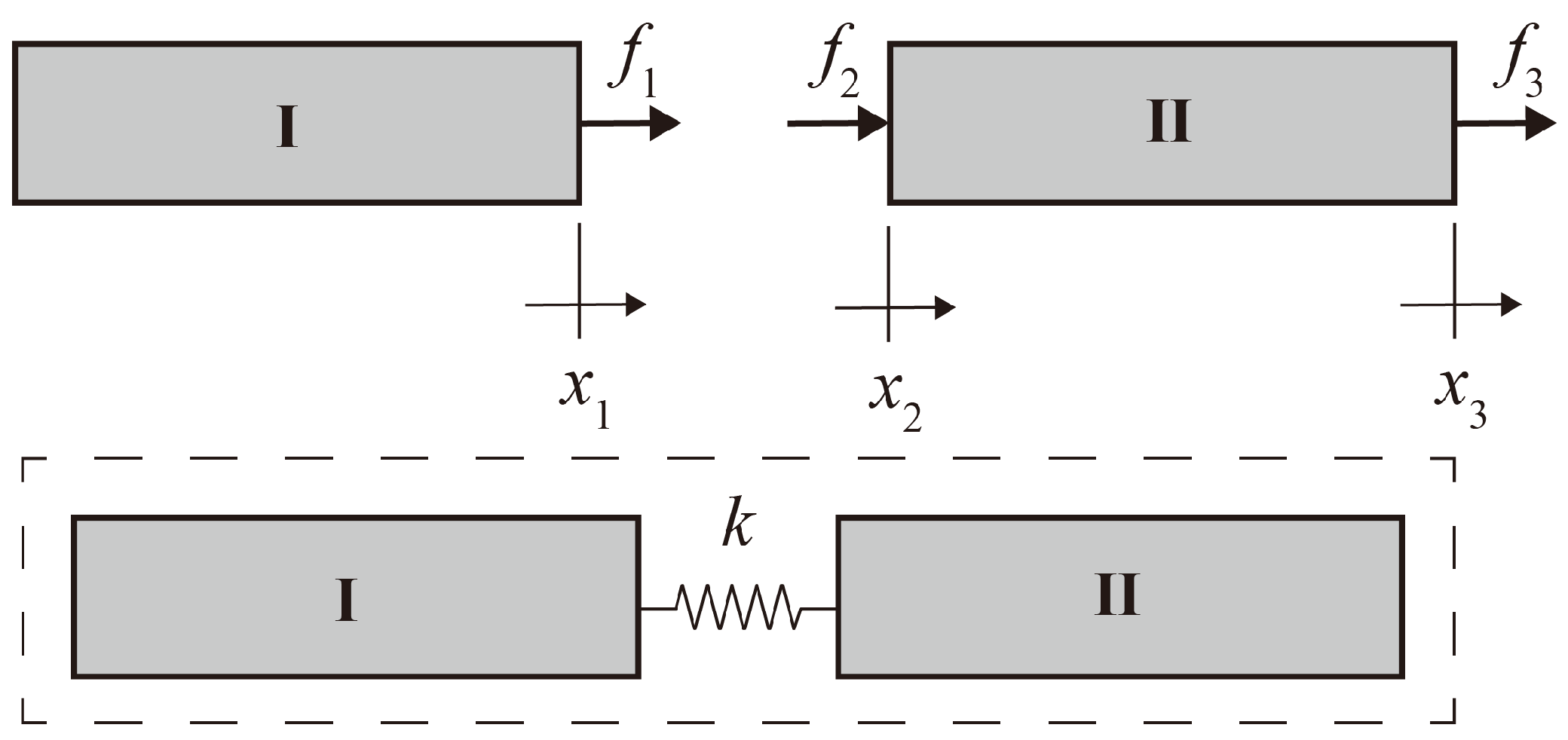
Given that the links of an actual robot arm are flexibly connected due to torsional compliance, it is necessary to predict their FRFs. As illustrated in Figure 2, the FRFs are predicted using the RCSA method, where hij denotes the FRF from the theoretical model, with subscripts i and j representing the response point and excitation point, respectively.
When substructures I and II are separated, there is no interaction between forces and displacements, so h12 = h21 = h13 = h31 = 0 according to the reciprocity of the FRF matrix. Therefore, the original FRF matrix H of the two connected components can be written as Equation (4):
H ω = X ω F ω = h 11 0 0 0 h 22 h 23 0 h 32 h 33
In practical robotic systems, the presence of motorized joints leads to non-rigid connections between the links. A torsional stiffness k is introduced between the joints. The FRF matrix H should be updated by incorporating the torsional stiffness between the two components.
After incorporating the torsional stiffness k, the force distribution between the two components is altered. Based on the displacement constraints, the relationship is expressed as in Equation (5):
X ¯ = x ¯ 1 x ¯ 2 x ¯ 3 = H f ¯ 1 + k x ¯ 1 k x ¯ 2 f ¯ 2 k x ¯ 1 + k x ¯ 2 f ¯ 3 = H F ¯ + k k 0 k k 0 0 0 0 x ¯ 1 x ¯ 2 x ¯ 3
By reorganizing the above equation, it can be rewritten to express the updated relationship between forces and displacements as follows:
I H k k 0 k k 0 0 0 0 X ¯ = P X ¯ = H F ¯
where I is the 3 × 3 identity matrix. The new FRF matrix is thus obtained as H   =   P 1 H , and the elements of the new FRF matrix are given as Equation (7):
H ¯ = 1 h 11 k + h 22 k 1 h 11 ( h 22 k 1 ) h 11 h 22 k h 11 h 23 k h 11 h 22 k h 22 ( h 11 k 1 ) h 23 ( h 11 k 1 ) h 11 h 32 k h 32 ( h 11 k 1 ) k ( h 11 h 33 + h 22 h 33 h 23 h 32 h 33 )
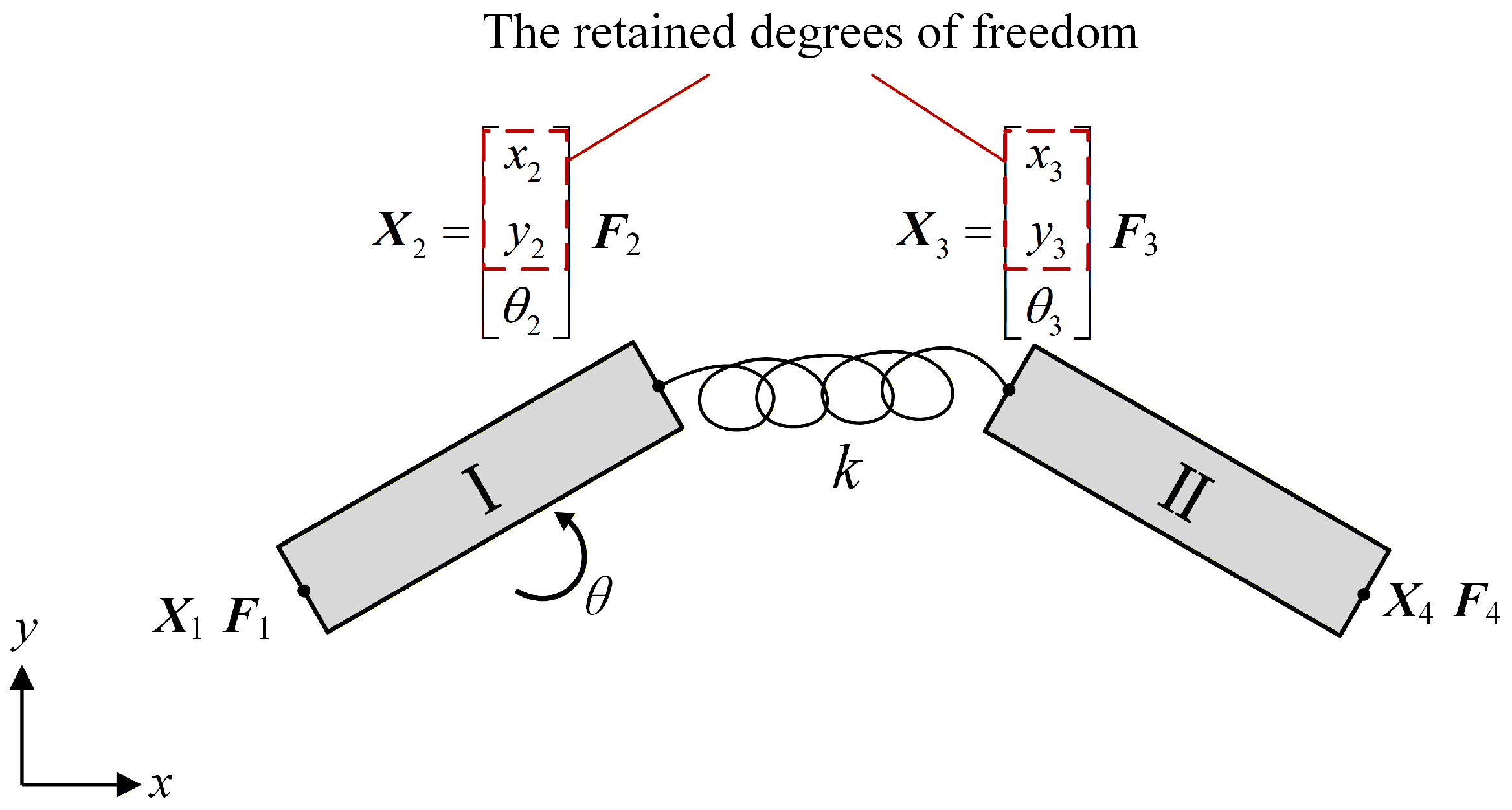
From Section 2.1, the transfer matrix of a single element is obtained. Taking two beam elements with torsional stiffness k as an example (Figure 3), the coupled frequency response function matrix can be derived.
Assume the initial transfer matrices of the two elements are T1 and T2. To couple the independent beam elements, they must be transformed into a unified coordinate system. The coordinate transformation consists of rotation and translation. Since the beam elements in this case are directly connected, translational transformation is disregarded. The rotation matrix for a planar beam is as shown in Equation (8):
T i = R i T · T i · R i     ;     R i = cos θ i sin θ i 0 sin θ i cos θ i 0 0 0 1 O 3 × 3 O 3 × 3 cos θ i sin θ i 0 sin θ i cos θ i 0 0 0 1
The coordinate-transformed transfer matrix T′ is converted into the dynamic stiffness matrix D, with the matrix relationship expressed in Equation (9):
D i ( ω ) = d j , j d j , k d k , j d k , k           T i ( ω ) = d j , k 1 d j , k 1 d k , k · d j , k 1 · d j , j d k , j d k , k · d j , k 1
In this example, the variable sequence follows the node numbering. The matrices D1 and D2 are assembled into the matrix D0:
F 0 = F 1   ;   F 2   ; F 3   ; F 4 = D 0 X 0   ;     D 0 = D 1 D 2
By performing row and column transformations on D0, the transformation matrix P is readily obtained such that F = PF0, leading to Equation (11):
P 1 F = D 0 P 1 X   ;       F = P D 0 P 1 X = D X            
The subscript m denotes the retained degrees of freedom, while s denotes the redundant degrees of freedom, as shown in Equation (12):
F = D X = F m F s = D m m D m s D s m D s s X m X s
By introducing the internal constraint forces Fmi and Fsi, Equation (13) is obtained:
D m m X m + D m s X s = F m + F m i D s m X m + D s s X s = F s + F s i
Equation (14) is obtained from the constraint relationships and the condition of zero virtual work:
X s = A X m         A = 0 0 0 1 0 0 0 0 0 0 0 0 0 0 1 0 0 0 0 0 δ F m i T δ X m + δ F s i T δ X s = 0
From the arbitrariness of Xm, the relationship of the internal constraint forces is obtained as shown in Equation (15):
F m i = A F s i
Substituting back into Equation (13), the coupled dynamic stiffness matrix Dm is obtained as shown in Equation (16):
D m = D m m + D m s A + A T D s m + A T D s s A
Introducing the torsional stiffness k into Dm yields the final dynamic stiffness matrix Df:
D f = D m + K             K = O 5 × 5 0 k k k k 0 O 5 × 5
It should be noted that the positions of elements in the stiffness matrix K depend on the order of variables. Inverting the matrix Df yields the FRF of the two coupled elements. Similarly, the FRF matrix for three or more flexibly connected components can be derived using the same principle. Therefore, by first obtaining the FRF of individual components through theoretical analysis, finite element simulation, or modal testing, the overall FRF matrix of the robot with flexible connections can be constructed.

3. Numerical Simulation and Dynamic Prediction of the Robot

Changes in robot pose directly affect its dynamic characteristics and cutting stability, and it is difficult to efficiently obtain the required frequency response data through experiments alone. Numerical simulation can rapidly predict the end-effector frequency response of the robot under multiple poses, verify the correctness of the established model, and forecast the frequency response characteristics of the robot end-effector. Based on the simulation results, the influence law of pose on the dynamic characteristics of the robot can be revealed, providing a key basis for stability lobe analysis.

3.1. Equivalent Parameter Identification of the Robot

The robot model is simplified by considering the orthogonal arrangement of the six joint axes and the short lengths of all links except the upper arm and forearm, focusing on the upper arm, forearm, and end-effector joints’ contributions to stiffness. Links are treated as homogeneous beams, with the three primary joints projected onto a common plane for planar approximation. Since joint compliance dominates over link flexibility, links are assumed to be rigid during equivalent parameter identification, and a coupled link dynamics model is derived via Lagrange equations. Incorporating experimental parameters and Section 2.2, a multi-loop coupled dynamics model including link flexibility is established, capturing higher-order background modes induced by link elasticity and enhancing the accuracy of chatter stability identification.
Let the stiffness of each joint be ki, the length of each link be ai, the mass of each link be mi (i = 1, 2, 3), and the joint rotation angles be αi. Taking the small-vibration rotation angles θ as the generalized displacements, the Lagrange function is expressed as Equation (18):
T = 1 2 i = 1 3 J i θ ˙ i 2 + i = 1 3 m i v x i 2 + i = 1 3 m i v y i 2 V = 1 2 i = 1 3 k i θ i 2 + i = 1 3 y i m i g
From the Lagrange equations, the generalized force–displacement relationship is obtained, which can be expressed in matrix form as Equation (19):
F = m Y ¨ + k Y
Additionally, it is necessary to determine the damping matrix c to prevent the FRF from approaching infinity at its natural frequencies, which would adversely affect subsequent FRF curve fitting. According to R. Clough et al. in Dynamics of Structures, for any given set of modal damping ratios, the damping matrix can be computed by pre- and post-multiplying the generalized damping coefficients with the modal matrix Φ, thereby forming a complete diagonal matrix in Equation (20):
c = m   Φ   d   Φ T m
The matrix d is a diagonal matrix with elements dn. At this stage, the theoretical expressions for the system’s mass matrix m, damping matrix c, and stiffness matrix k have been derived.
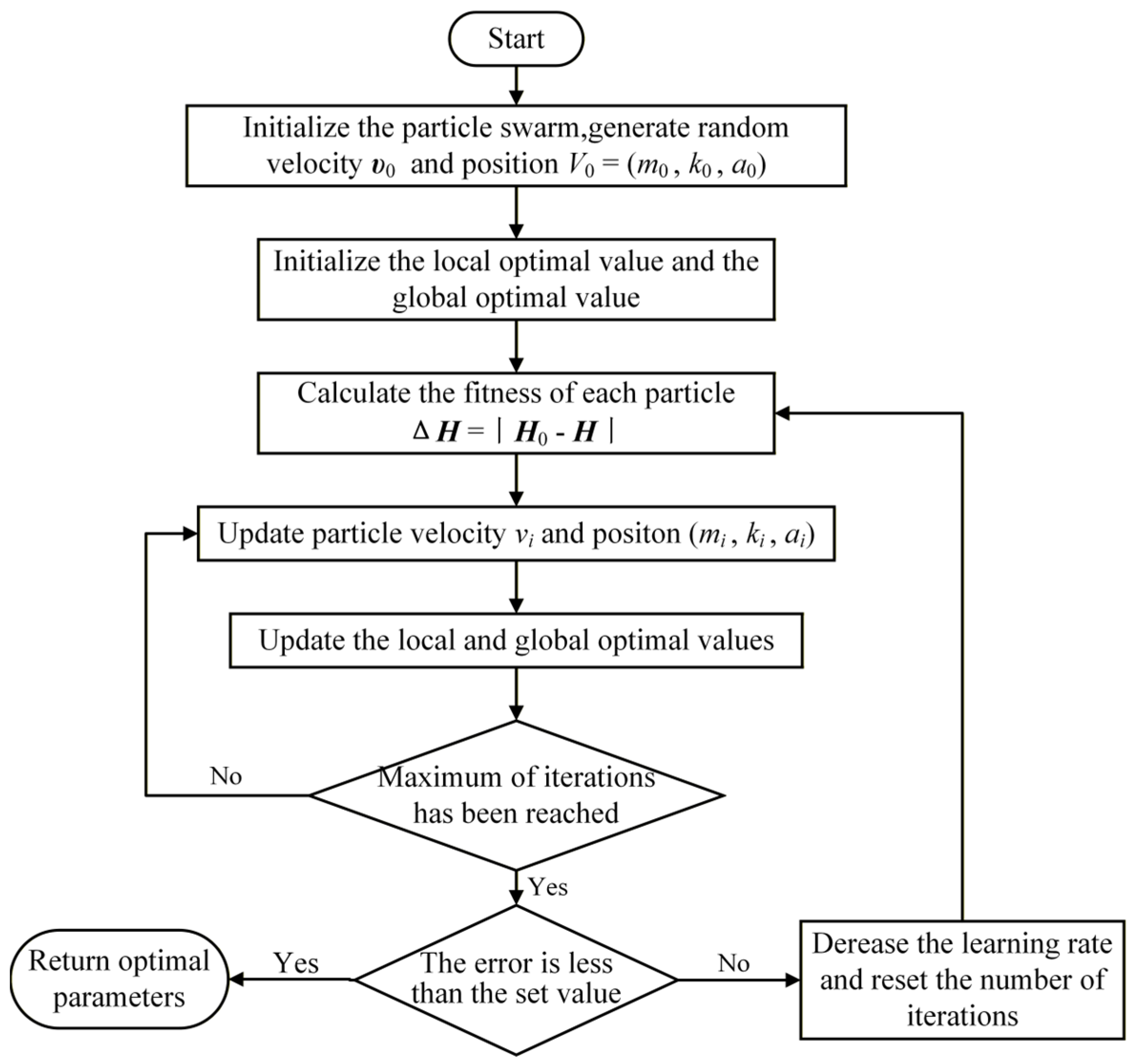
Based on the aforementioned robotic dynamic modeling, frequency response curve fitting is performed according to the specified robot dynamic parameters. The frequency response curve measured experimentally at a specific robot pose is fitted to extract the corresponding dynamic parameters. Considering the large number of parameters in the robot dynamic model and their strong coupling, this study employs the PSO algorithm for parameter identification. The specific optimization procedure of the PSO algorithm is illustrated in Figure 4.
The robot parameter optimization problem can be formulated as Equation (21):
f i n d : V = m i k i a i T m i n   f V = min Δ H s . t .         15 < m i < 125 ,   1 × 10 3 < k i < 1 × 10 7 ,   0.2 < a i < 1.1
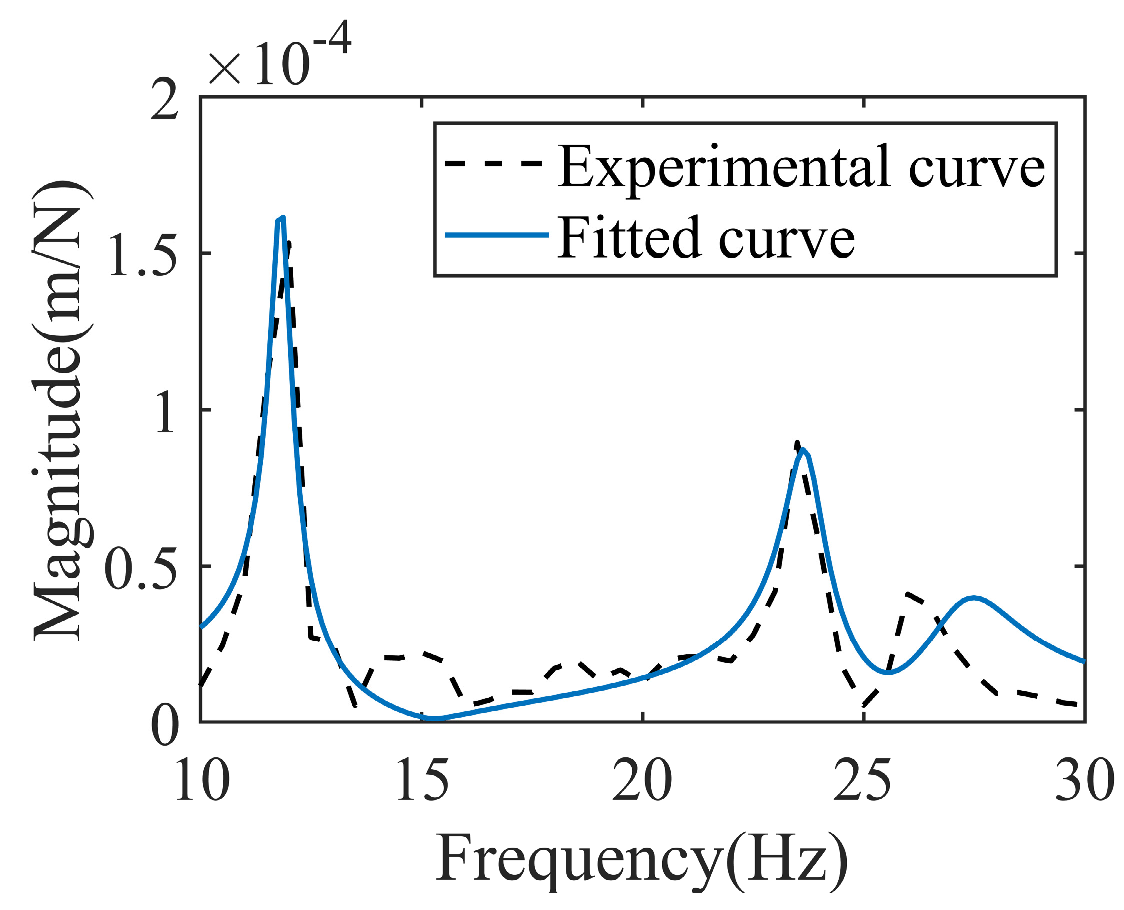
By establishing the robot’s dynamic model and inputting the known initial parameters, an initial FRF is obtained. Subsequently, a representative frequency range is selected for FRF fitting; in this study, the 10–30 Hz band is chosen as the fitting interval. This frequency range clearly reflects the dynamic characteristics of the robotic system and typically exhibits a high signal-to-noise ratio.
Based on the robot’s technical specifications and 3D model, the initial link masses mi and link lengths ai are determined. During the fitting process, particular attention is given to the accuracy of the curve fit near the robot’s modal frequency amplitudes. The identified dynamic parameters obtained from the fitting are presented in Table 1.
As shown in Figure 5, taking the first resonance peak as an example, the error in the predicted natural frequency is approximately 1% and the error in the amplitude is within 5%, demonstrating good agreement between the experimentally measured frequency response curve and the fitted curve; Meanwhile, the background modal amplitudes between the two modes are relatively low and have limited influence on the milling stability of the robot. This indicates that the established dynamic model and parameter identification method can accurately characterize the main dynamic characteristics of the robot, providing reliable dynamic parameters for subsequent multi-pose frequency response prediction and stability lobe analysis.

3.2. Numerical Prediction of End-Effector FRF and Cutting Stability

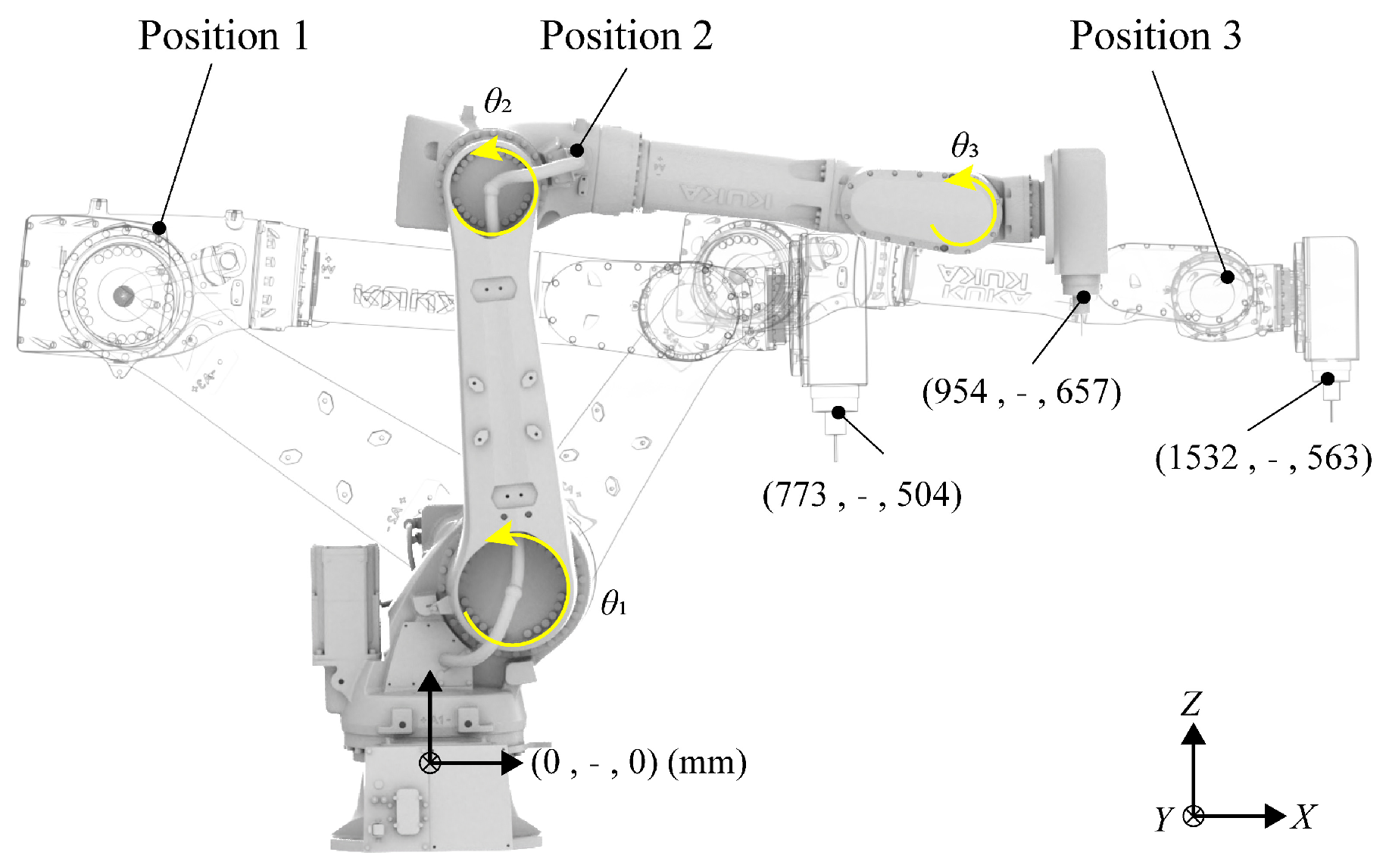
To comprehensively analyze the dynamic characteristics of the robot under different poses, this study expands the range of pose adjustment. Modal tests are carried out on the fully extended and retracted poses under extreme working conditions, as well as typical working poses commonly used in actual cutting experiments. Three selected robot poses and their corresponding joint angles are listed in Figure 6 and Table 2.
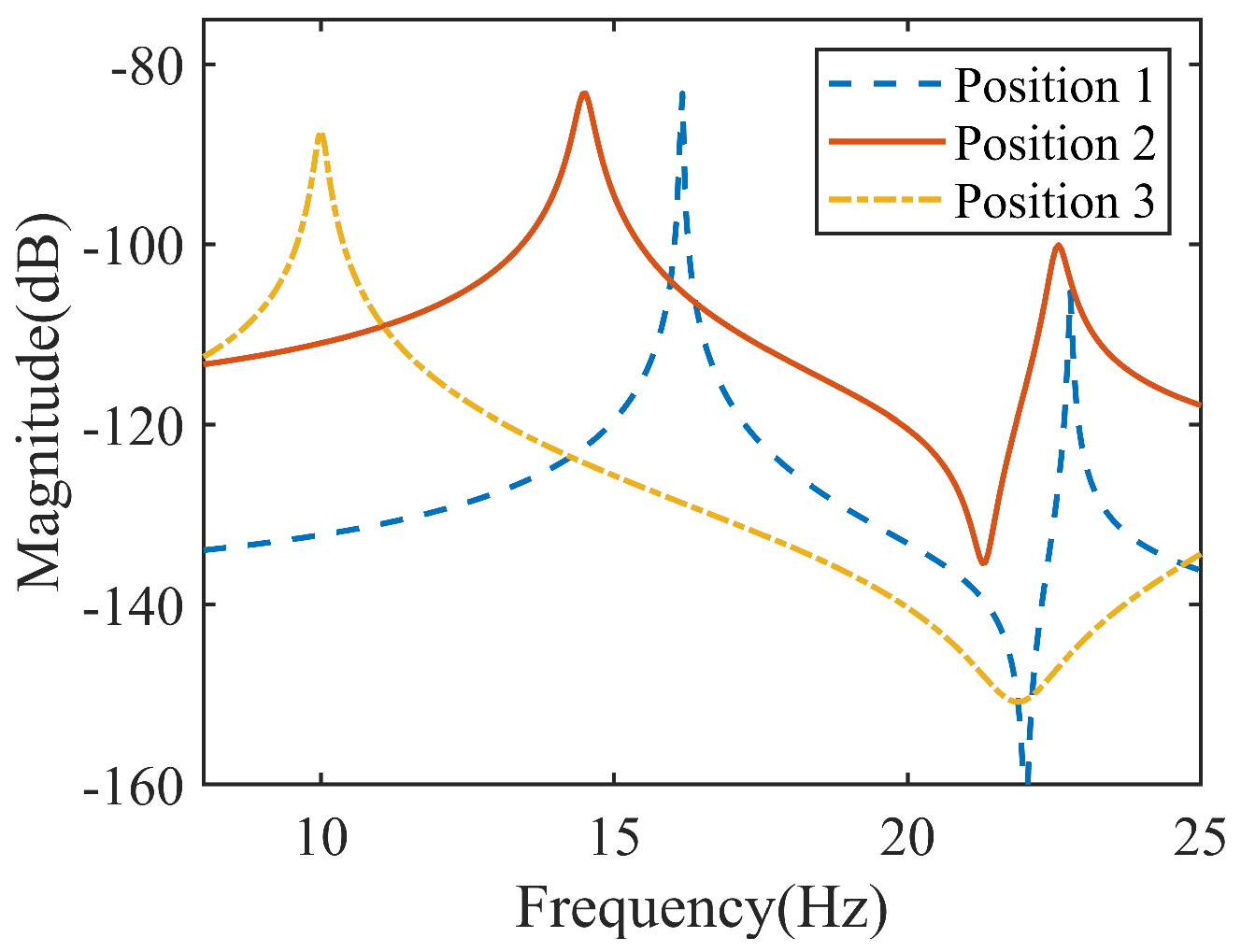
With the identified dynamic parameters in Table 1 incorporated, the end-effector FRFs for the robot in three different poses are predicted based on the model established in Section 2. It can be observed from Figure 7 that the first-order modal frequencies for the three poses are 16 Hz, 14 Hz, and 10 Hz, respectively. Analysis of the FRF curves under different poses indicates that as the robot transitions from the retracted configuration of Position 1 to the fully extended configuration of Position 3, the cantilever length increases, leading to a decrease in overall robot stiffness and a corresponding drop in the first-order modal frequency from 16 Hz to 10 Hz. It should be noted that the robot’s first- and second-order modes correspond to end-effector oscillations along the Y and Z axes, with closely spaced modal frequencies. Given the FRF prediction frequency interval of 0.05 Hz, these two modes appear as a single peak in the predicted end-effector FRFs.
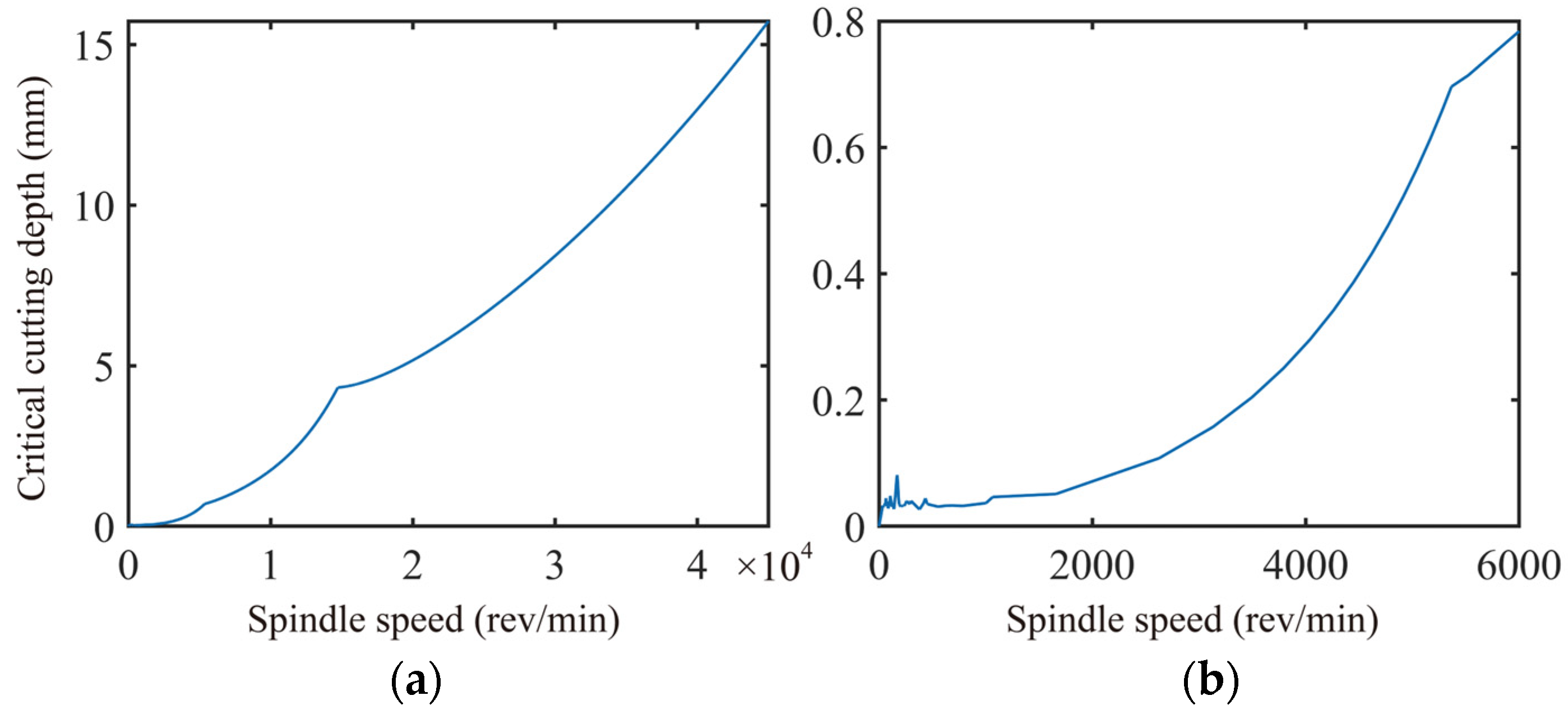
Based on the FRFs obtained for the three poses, the chatter stability diagram of the robot at Position 2 was predicted using the zero-order frequency-domain method in Figure 8. In the experiments, aluminum alloy 7075 was selected as the workpiece material, and a four-flute cemented carbide end mill with a diameter of 6 mm was used under slot milling conditions. Due to the robot’s relatively low rigidity and low modal frequencies, the stability diagram exhibits dense lobe shapes at low spindle speeds. When the spindle speed exceeds 1000 rev/min, the critical stable cutting depth increases gradually with spindle speed, and the robot stability diagram transforms into a configuration with larger lobes.

4. Experimental Validation

To validate the accuracy of the established flexible-link robotic dynamic model and the end-effector FRF prediction method, modal experiments were conducted to obtain measured FRFs for different robot poses and compare them with theoretical predictions. Simultaneously, robotic milling experiments were performed under actual machining conditions to examine the consistency between observed chatter occurrences and the predicted stability regions, thereby verifying the reliability of the multi-pose cutting stability theoretical model.

4.1. Modal Testing of the Robot at Different Poses

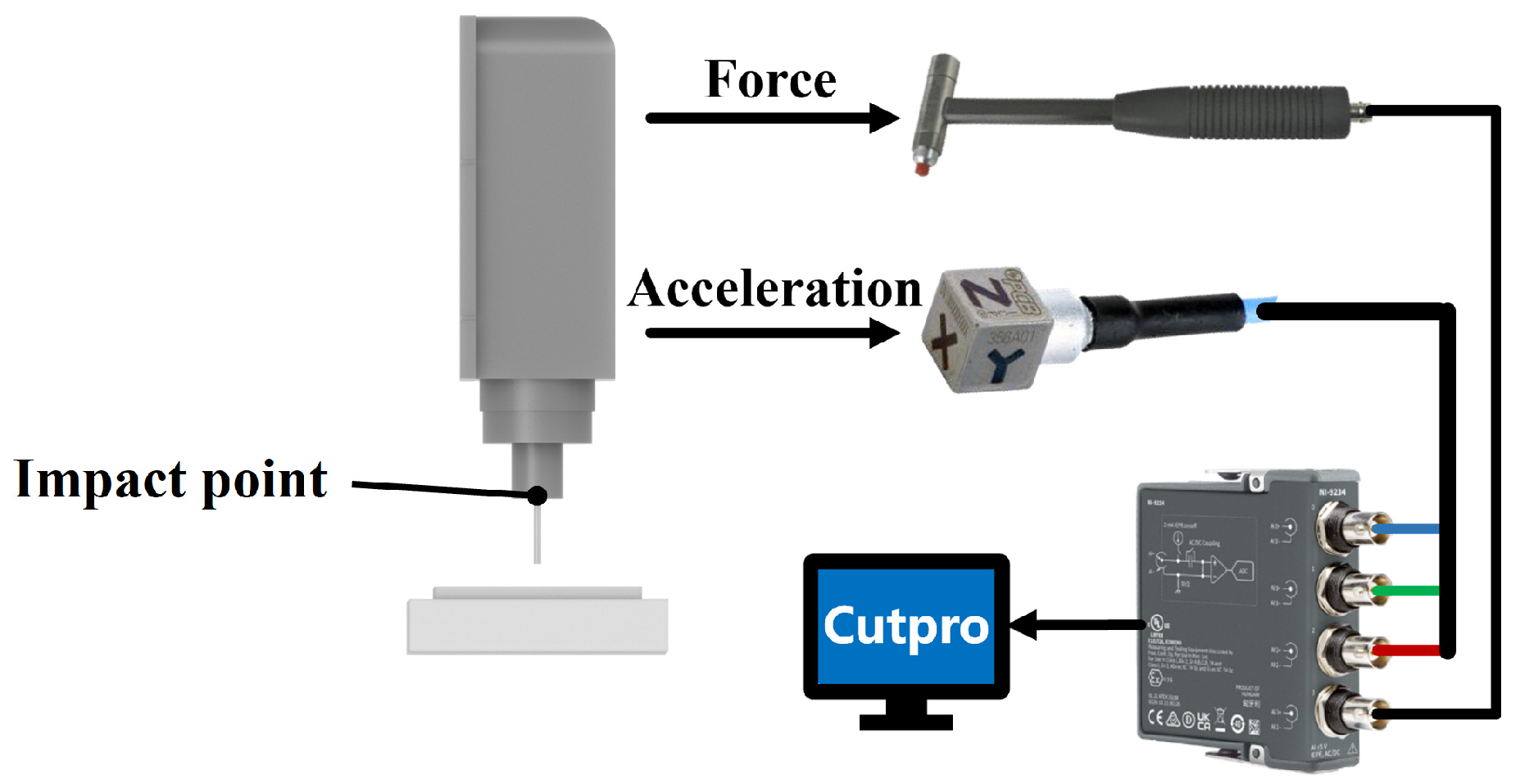
Based on the theoretical predictions, the natural frequencies and mode shapes of the robot in different poses were determined to serve as a reference for the modal experiments. The modal testing was conducted using an impact hammer to apply impulse excitation to the robot’s end-effector, while response signals were captured by accelerometers. The signals were processed through a data acquisition system, a PC, and the data analysis software CutPro 16.0, and FRFs were obtained via fast Fourier transform (FFT), as shown in Figure 9.
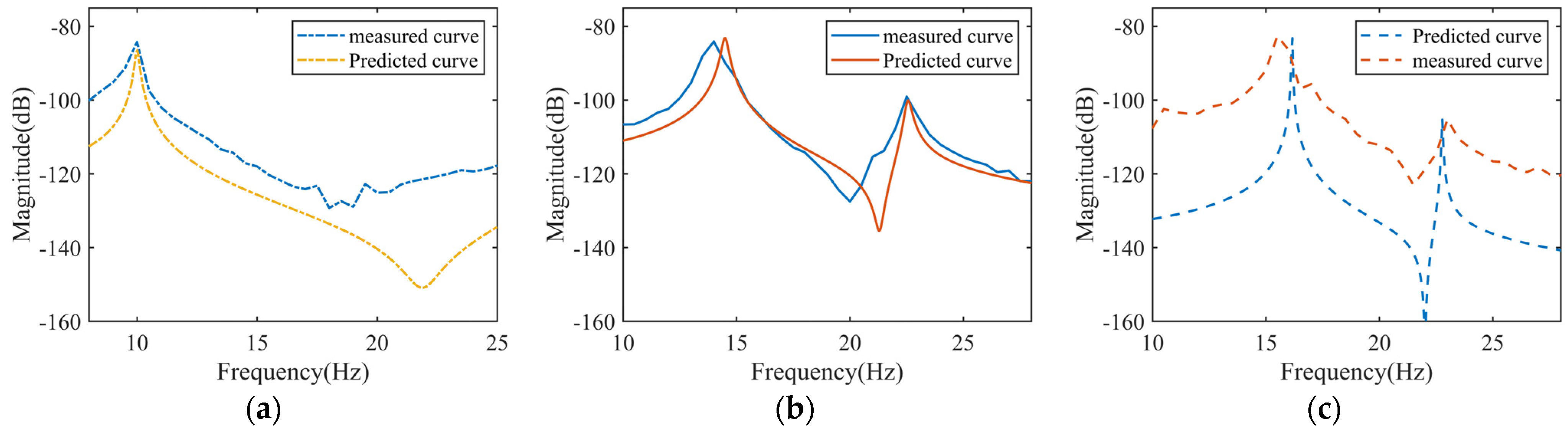
The experiments were conducted with the same three robot poses used in the theoretical predictions to perform modal impact testing, and the measured FRFs for each condition were obtained. From the FRF curves, it can be observed that the first-order modal frequencies of the robot in the three poses are 15.5 Hz, 13.6 Hz, and 10 Hz, respectively. Comparing the experimentally measured FRFs with the theoretically predicted FRFs indicates that the maximum error in end-effector modal frequencies is 3%. Furthermore, since damping variations are minimal across different poses, the average error in modal amplitudes is less than 1 dB, with relative errors within 10%, showing good consistency with the predictions presented in Section 3.2.
Through comparative analysis in Figure 10, the experimentally measured end-effector frequency responses show good agreement with the theoretically predicted responses near the peak frequency, confirming the accuracy and applicability of the established robotic dynamic model in predicting the robot’s dynamic characteristics across different poses. This validation provides a reliable theoretical basis for subsequent stability region predictions in cutting experiments.

4.2. Robotic Milling Experiments

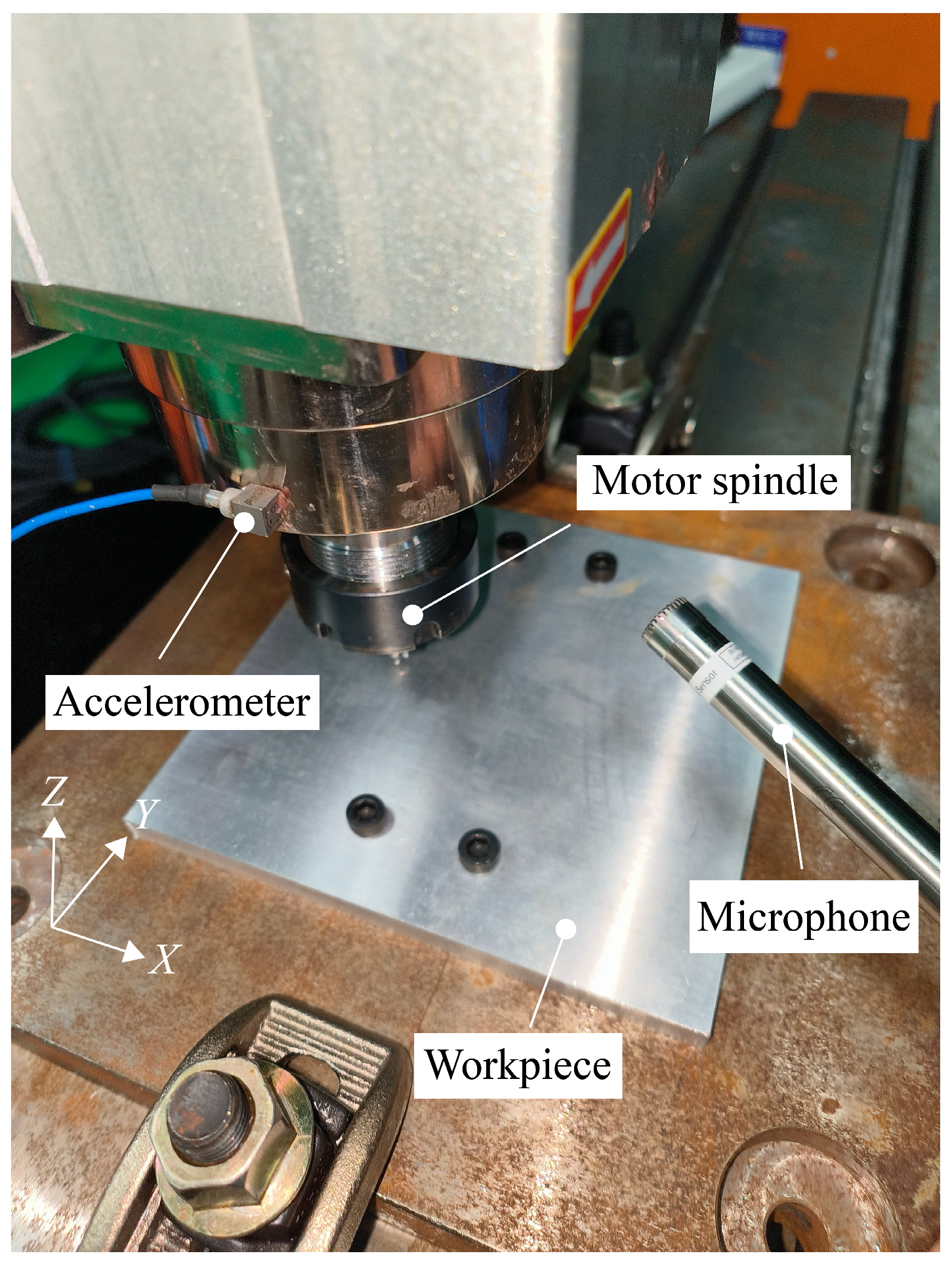
To further evaluate the accuracy of the robotic dynamic model and its engineering applicability, robotic milling experiments were conducted. The experimental setup is shown in Figure 11. Considering the robot’s workspace limitations and actual cutting conditions, experiments were carried out based on Position 2. Using the previously fitted FRFs, combined with the cutting force model and mode-coupling chatter theory, the SLD of the robotic system was generated to identify stable cutting regions under different combinations of cutting depth and spindle speed.
Aluminum alloy plates were selected as workpieces for milling at the robot’s end-effector spindle. Cutting force and vibration signals were collected, and chatter occurrence was evaluated based on the machined surface quality and spectral analysis. The experimentally observed chatter conditions were compared with the predicted stability regions, validating the effectiveness of the SLDs established from the FRFs in guiding the selection of robotic cutting parameters.
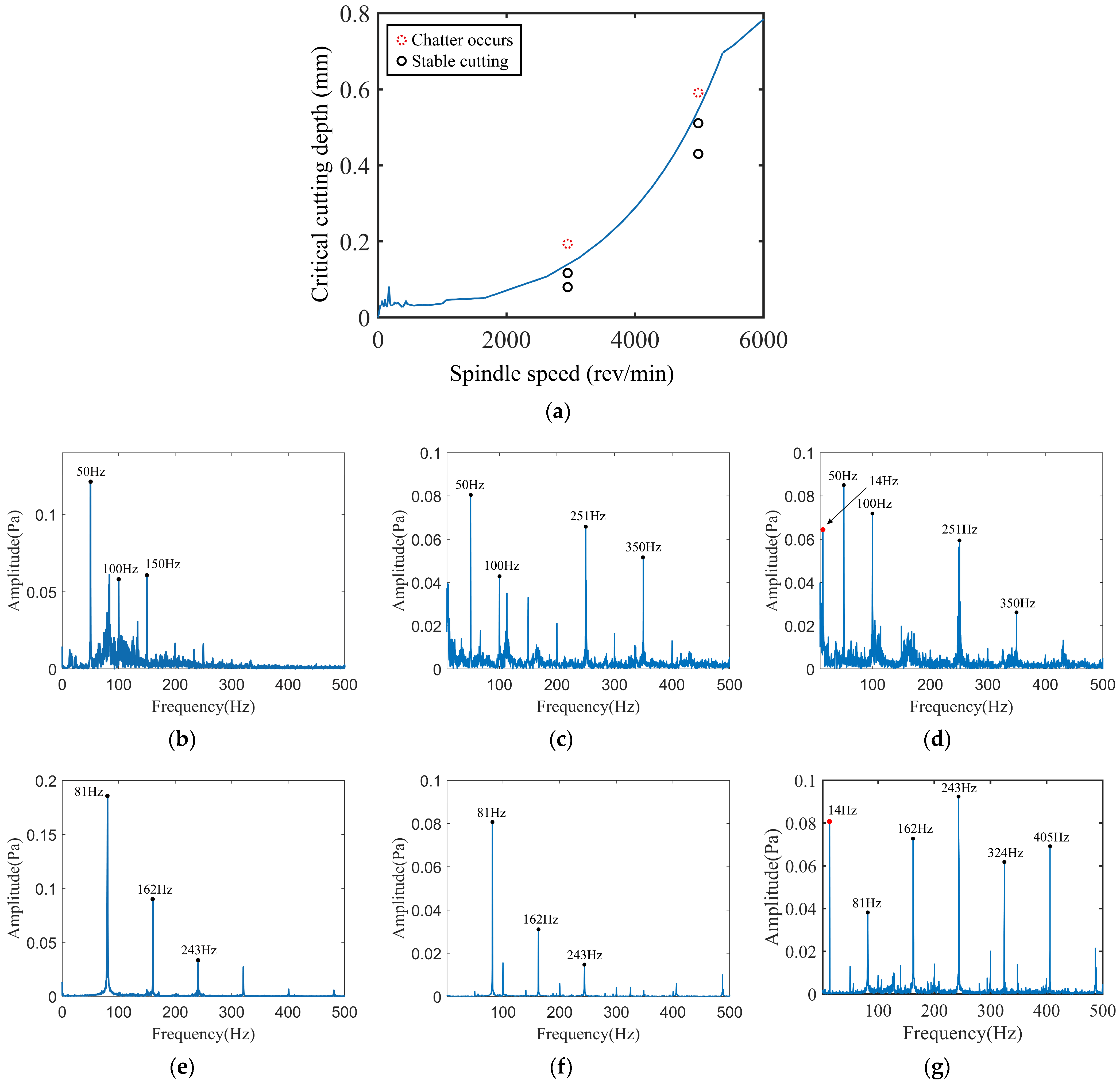
Figure 12 presents the experimental results of chatter stability under different cutting parameter combinations alongside the theoretically predicted SLD. The results indicate good agreement between the experimental observations and the theoretical predictions. To identify chatter frequencies, the time-domain sound signals from the cutting process were transformed using FFT, yielding the spectra shown in Figure 12b–e. At a spindle speed of n = 3000 rev/min and a cutting depth of ap = 0.2 mm for each experimental set, the feed rate was 3 mm/s. A frequency component at 14 Hz appeared in the spectrum and no such component was present at ap = 0.1 mm under the same spindle speed. The spindle-tool system’s frequency components were 50 Hz and its harmonics, indicating that the 14 Hz component does not belong to these subharmonics or harmonics; thus, the cutting process experienced chatter. This chatter frequency matches the natural frequency of the robot in Position 2, consistent with theoretical predictions.
Similarly, at n = 5000 rev/min and ap = 0.6 mm, the 14 Hz component appeared in the spectrum, while the spindle-tool system’s frequency components were 81 Hz and its harmonics, confirming chatter occurrence. No chatter was observed at ap = 0.5 mm for the same spindle speed. These experimental observations validate the high predictive accuracy of the SLD.
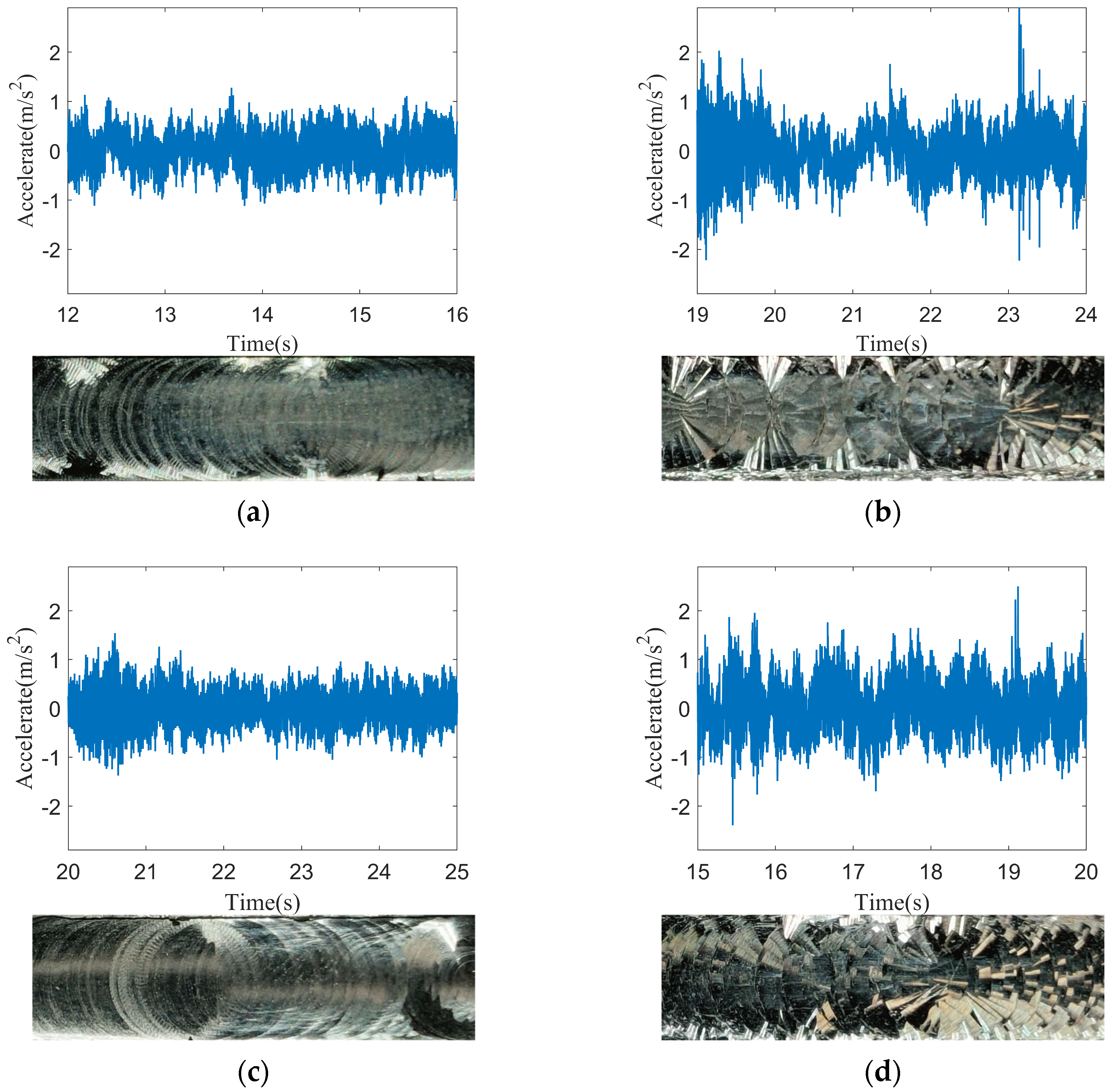
Additionally, the time-domain vibration signals of the robot end-effector during the machining process were measured using accelerometers. As shown in Figure 13b,d, chatter occurred during cutting under the conditions of n = 3000 rev/min, ap = 0.2 mm, and n = 5000 rev/min, ap = 0.6 mm. Compared with the non-chatter conditions shown in Figure 13a–c, the RMS value increases by 24.6%, and noticeable vibration ripples appeared on the machined workpiece surfaces.

5. Conclusions

Accurate prediction of chatter stability is essential in robotic milling, and the reliability of the SLD is fundamentally determined by the accuracy of the robot’s dynamic model. This study proposes a dynamic modeling approach for the chatter stability problem in robotic milling that simultaneously accounts for link flexibility and joint stiffness. The RCSA method is employed to predict the end-effector FRFs, and the PSO algorithm is used for model parameter identification of the links and joint flexibility. On this basis, numerical simulation of the robot under different poses is carried out. Modal tests and cutting experiments were performed to evaluate the effectiveness of the model.
By employing the established dynamic model, the end-effector FRFs of the robot under three typical poses are predicted by numerical simulations, yielding first-order modal frequencies of 16 Hz, 14 Hz, and 10 Hz, respectively. The model is validated through modal tests, in which the measured first-order modal frequencies are 15.5 Hz, 13.6 Hz, and 10 Hz, with a maximum prediction error of 3%, the relative error of the modal amplitude is less than 10%, and the average error is below 1 dB.
Milling experiments are conducted to validate the SLD derived from the proposed model. At a spindle speed of 3000 rev/min, the critical stable depth of cut lies between 0.1 mm and 0.2 mm; at 5000 rev/min, it lies between 0.5 mm and 0.6 mm. The cutting experimental results show that at 3000 rev/min with a depth of cut of 0.2 mm, a chatter frequency of 14 Hz appears in the spectrum, consistent with the first natural frequency of the robot. The RMS value of the vibration signal increases by 24.6% compared with the non-chatter condition at a depth of cut of 0.1 mm. At 5000 rev/min with a depth of cut of 0.6 mm, the 14 Hz chatter component also appears, whereas no chatter is observed at a depth of cut of 0.5 mm. The experimental results exhibit good agreement with theoretical predictions, confirming the accuracy of the proposed model in predicting the milling chatter stability regions.
Furthermore, it is worth noting that the dynamic modeling approach presented above has the potential to be further extended to the structural design of robotic manipulators. By formulating an objective function based on the predicted end-effector FRFs and SLDs, one can perform topology or parametric optimization to maximize the chatter stability of robots. Design variables may include link lengths, cross-sectional geometries, material distributions, and joint stiffness parameters, with constraints on mass and workspace. This approach provides a systematic pathway to tailor robot structures for high-performance milling applications. Future work will focus on extending the current planar dynamic model to a full spatial representation, thereby capturing the three-dimensional coupling effects among multiple links and joints that are inherent in industrial robots under real machining conditions. Furthermore, the integration of the proposed dynamic model with online chatter detection and active vibration control strategies would be explored, such as spindle speed modulation or real-time posture adjustment, to achieve robust and adaptive robotic milling.

Author Contributions

Formal analysis, C.C. and Y.Y.; funding acquisition, W.W. and W.M.; project administration, J.Y.; software, C.C. and Y.Y.; supervision, J.Y. and W.M.; writing—original draft, C.C. and J.Y.; writing—review and editing, W.M. All authors have read and agreed to the published version of the manuscript.

Funding

This research was funded by the Jiangxi Provincial Natural Science Foundation (grant no. 20252BAC240136), the State Key Laboratory of High-end Heavy-load Robots (Open Fund Project no. HHR2024010212), and the Fundamental Research Funds for the Central Universities (JKF-20240515).

Data Availability Statement

Data is contained within the article.

Conflicts of Interest

Author Wenjing Wu was employed by the company Guangdong Midea Electric Co., Ltd. The remaining authors declare that the research was conducted in the absence of any commercial or financial relationships that could be construed as a potential conflict of interest.

Abbreviations

The following abbreviations are used in this manuscript:
DOFDegree of freedom
FRFFrequency response function
RCSAReceptance coupling substructure analysis
SLDStability lobe diagrams

Appendix A

D(ω) denotes the dynamic stiffness matrix, where the subscripts j, k of d represent the submatrices of the dynamic stiffness matrix, and d1 to d8 are the corresponding matrix coefficients. For an Euler–Bernoulli beam:
d 1 = E A μ cot μ / L , d 5 = E A μ csc μ / L d 2 = E I λ 3 ( cos λ sinh λ + sin λ cosh λ ) / R L 3 d 3 = E I λ 2 ( sin λ sinh λ ) / R L 2 d 4 = E I λ ( sin λ cosh λ cos λ sinh λ ) / R L d 6 = E I λ 3 ( sin λ + sinh λ ) / R L 3 d 7 = E I λ 2 ( cosh λ cos λ ) / R L 2 d 8 = E I λ ( sinh λ sin λ ) / R L R = 1 cos λ cosh λ μ 2 = ρ L 2 ω 2 / E , λ 4 = ρ A L 4 ω 2 / E I
For a Timoshenko beam, the dynamic stiffness matrix is more complex, with the matrix coefficients defined as follows:
d 2 = E I σ 2 ( α + η β ) ( cos β sinh α + η sin β cosh α ) / α β R L 3 d 3 = E I ( s 2 σ 2 β 2 ) [ ( α η β ) ( cos β cosh α 1 ) + ( β + η α ) sin β sinh α ] / β R L 2 d 4 = E I ( α + η β ) ( sin β cosh α η cos β sinh α ) / R L d 6 = E I σ 2 ( α + η β ) ( sinh α + η sin β ) / α β R L 3 d 7 = E I η ( α 2 + β 2 ) ( cosh α cos β ) / R L 2 d 8 = E I ( α + η β ) ( η sinh α sin β ) / R L R = 2 η ( 1 cos β cosh α ) + ( 1 η 2 ) sin β sinh α σ 2 = ρ A L 4 ω 2 E I , s 2 = E I κ G A L 2 , r 2 = I A L 2 , η = α ( β 2 σ 2 S 2 ) β ( α 2 + σ 2 S 2 ) α 2 = σ 2 2 [ ( r 2 + s 2 ) 2 + 4 ( 1 r 2 s 2 σ 2 ) σ 2 ( r 2 + s 2 ) ] β 2 = σ 2 2 [ ( r 2 + s 2 ) 2 + 4 ( 1 r 2 s 2 σ 2 ) σ 2 + ( r 2 + s 2 ) ]
Here, L denotes the beam length, A the cross-sectional area, I the area moment of inertia, E the Young’s modulus, ρ the mass density, G the shear modulus, and κ the shear correction factor.

References

  1. Ji, W.; Wang, L. Industrial robotic machining: A review. Int. J. Adv. Manuf. Technol. 2019, 103, 1239–1255. [Google Scholar] [CrossRef]
  2. Chen, Y.; Dong, F. Robot machining: Recent development and future research issues. Int. J. Adv. Manuf. Technol. 2013, 66, 1489–1497. [Google Scholar] [CrossRef]
  3. Tobias, S.A.; Fishwick, W. The chatter of lathe tools under orthogonal cutting conditions. Trans. ASME J. Fluids Eng. 1958, 80, 1079–1088. [Google Scholar] [CrossRef]
  4. Tlusty, J.; Polacek, M. The stability of the machine tool against self-excited vibration in machining. Proc. Int. Res. Prod. Eng. 1963, 1, 465–474. [Google Scholar]
  5. Yuan, L.; Pan, Z.; Ding, D.; Sun, S.; Li, W. A review on chatter in robotic machining process regarding both regenerative and mode coupling mechanism. IEEE/ASME Trans. Mechatron. 2018, 23, 2240–2251. [Google Scholar] [CrossRef]
  6. Ji, Y.; Han, Q.; Xu, X. Robotic milling chatter stability analysis considering the coupling effects between the robot and spindle system. J. Vib. Shock 2025, 44, 13–27. [Google Scholar]
  7. Arteaga, M.A.; Gutiérrez-Giles, A.; Pliego-Jiménez, J. Local Stability and Ultimate Boundedness in the Control of Robot Manipulators; Dynamics of Rigid Robot Manipulators; Springer: Cham, Switzerland, 2021; Chapter 3; pp. 70–102. [Google Scholar] [CrossRef]
  8. Yang, X.; Zhou, Z.; Li, L.; Zhang, X. Collaborative robot dynamics with physical human–robot interaction and parameter identification with PINN. Mech. Mach. Theory 2023, 189, 105439. [Google Scholar] [CrossRef]
  9. Yaren, T.; Küçük, S. Dynamic modeling of 3-DOF RRP type serial robotic manipulator using Lagrange-Euler method. In Proceedings of the International Marmara Sciences Congress (Autumn), Balikesir, Turkey; Kocaeli University: İzmit, Turkey, 2019; pp. 372–378. [Google Scholar]
  10. Ramzy, M.R.; Hammad, S.; Maged, S.A. Kinematic and dynamic modeling of 3DOF variable stiffness links manipulator with experimental validation. Appl. Sci. 2024, 14, 5285. [Google Scholar] [CrossRef]
  11. Farid, M.; Lukasiewicz, S.A. Dynamic modeling of spatial manipulators with flexible links and joints. Comput. Struct. 2000, 75, 419–437. [Google Scholar] [CrossRef]
  12. Sun, W.; Jin, Y.; Dai, K.; Guo, Z.; Ma, F. Flexible manipulator trajectory tracking based on an improved adaptive particle swarm optimization algorithm with fuzzy PD control. Mech. Sci. 2025, 16, 125–141. [Google Scholar] [CrossRef]
  13. Ni, S.; Chen, W.; Chen, T. Dynamic modeling and analysis of multi-flexible-link space manipulators under time-varying dynamic boundary conditions. Adv. Space Res. 2024, 74, 5224–5243. [Google Scholar] [CrossRef]
  14. Farid, M.; Cleghorn, W.L. Dynamic modeling of multi-flexible-link planar manipulators using curvature–based finite element method. J. Vib. Control. 2014, 20, 1682–1696. [Google Scholar] [CrossRef]
  15. Li, Z.; Li, B.; Tian, W.; Cui, G.; Zhao, Y. Dynamics modelling of milling robot with variable posture. In Proceedings of the 2nd International Conference on Mechanical System Dynamics; Lecture Notes in Mechanical Engineering; Springer: Cham, Switzerland, 2024; pp. 2217–2226. [Google Scholar] [CrossRef]
  16. Chen, J.; Liu, Z.; Chen, C.; Qi, B.; Xu, J.; Tao, L.; Yan, Q. Robot stiffness modeling based on the rigid flexible coupling simulation and its application to trajectory planning. Precis. Eng. 2025, 92, 77–89. [Google Scholar] [CrossRef]
  17. Zhang, J.; Zhao, H.; Liu, Z.; Cao, R.; Zhang, B.; Liu, H.; Ding, H. A unified framework for dynamic parameter identification of elastic joint robots with hysteresis and friction nonlinearities. Mech. Syst. Signal Process. 2025, 238, 113208. [Google Scholar] [CrossRef]
  18. Liu, Y.; Li, Y.; Song, H.; Yu, J.; Zhou, X. Joint stiffness identification of robots based on the kinetoelastic model with a multiple-point contact measuring instrument. Ind. Robot 2025, 53, 561–572. [Google Scholar] [CrossRef]
  19. Ma, W.; Jin, X.; Yu, J.; Yang, Y.; Shen, R. Oppositely oriented series multiple tuned mass dampers and application on a parallel machine tool. Mech. Syst. Signal Process. 2022, 163, 108196. [Google Scholar] [CrossRef]
  20. Abadi, B.N.R.; Vakilzadeh, M. Natural frequency analysis of a planar parallel mechanism with task space redundancy for high-precision milling. J. Braz. Soc. Mech. Sci. Eng. 2025, 47, 439. [Google Scholar] [CrossRef]
  21. Wan, M.; Shen, C.-J.; Qu, X.; Yang, Y.; Zhang, W. Chatter stability of the robotic milling process involving the influences of low frequency vibrations in three directions. Mech. Syst. Signal Process. 2025, 224, 112014. [Google Scholar] [CrossRef]
  22. Ma, Z.; Xie, F.; Liu, X.-J. A two-stage dynamic model updating method for the FRF prediction of the robotized mobile machining equipment. Robot. Comput.-Integr. Manuf. 2025, 92, 102895. [Google Scholar] [CrossRef]
  23. Merdol, S.D.; Altintas, Y. Multi frequency solution of chatter stability for low immersion milling. J. Manuf. Sci. Eng. 2004, 126, 459–466. [Google Scholar] [CrossRef]
  24. Campomanes, M.; Altintas, Y. An improved time domain simulation for dynamic milling at small radial immersions. J. Manuf. Sci. Eng. 2003, 125, 416–422. [Google Scholar] [CrossRef]
  25. Altintaş, Y.; Budak, E. Analytical prediction of stability lobes in milling. CIRP Ann. Manuf. Technol. 1995, 44, 357–362. [Google Scholar] [CrossRef]
  26. Tlusty, J. Dynamics of high-speed milling. J. Eng. Ind. 1986, 108, 59–67. [Google Scholar] [CrossRef]
  27. Zheng, Y.; Zhao, Z.; Xu, B.; Yu, Y.; Xu, J. A method to predict chatter stability accurately in milling thin-walled parts by considering force-induced deformation. J. Manuf. Process. 2023, 106, 552–563. [Google Scholar] [CrossRef]
  28. Insperger, T.; Stépán, G. Semi-discretization method for delayed systems. Int. J. Numer. Methods Eng. 2002, 55, 503–518. [Google Scholar] [CrossRef]
  29. Wang, L.; Liu, Y.; Yu, Y.; He, F. Research on reliability of mode coupling chatter of orthopedic surgery robot. Proc. Inst. Mech. Eng. Part C J. Mech. Eng. Sci. 2022, 236, 8609–8620. [Google Scholar] [CrossRef]
  30. Yang, J.; Zhang, X.; Wu, Y.; Ye, S.; Yan, S.; Lu, J. Posture optimization based on stiffness orientation method for industrial robotic milling. China Mech. Eng. 2022, 33, 1957–1964. [Google Scholar] [CrossRef]
  31. Pan, Z.; Zhang, H.; Zhu, Z.; Wang, J. Chatter analysis of robotic machining process. J. Mater. Process. Technol. 2006, 173, 301–309. [Google Scholar] [CrossRef]
  32. Pan, Z.; Zhang, H. Analysis and suppression of chatter in robotic machining process. In Proceedings of the International Conference on Control, Automation and Systems, Seoul, Korea; IEEE: New York, NY, USA, 2007; pp. 595–600. [Google Scholar] [CrossRef]
  33. Wang, L.; Liu, Y.; Yu, J.; Shu, B. Optimization of redundant degree of freedom in robotic milling considering chatter stability. Int. J. Adv. Manuf. Technol. 2022, 121, 8379–8394. [Google Scholar] [CrossRef]
  34. He, F.; Liu, Y.; Liu, K. A chatter-free path optimization algorithm based on stiffness orientation method for robotic milling. Int. J. Adv. Manuf. Technol. 2018, 101, 2739–2750. [Google Scholar] [CrossRef]
  35. Gonul, B.; Sapmaz, O.F.; Tunc, L.T. Improved stable conditions in robotic milling by kinematic redundancy. Procedia CIRP 2019, 82, 485–490. [Google Scholar] [CrossRef]
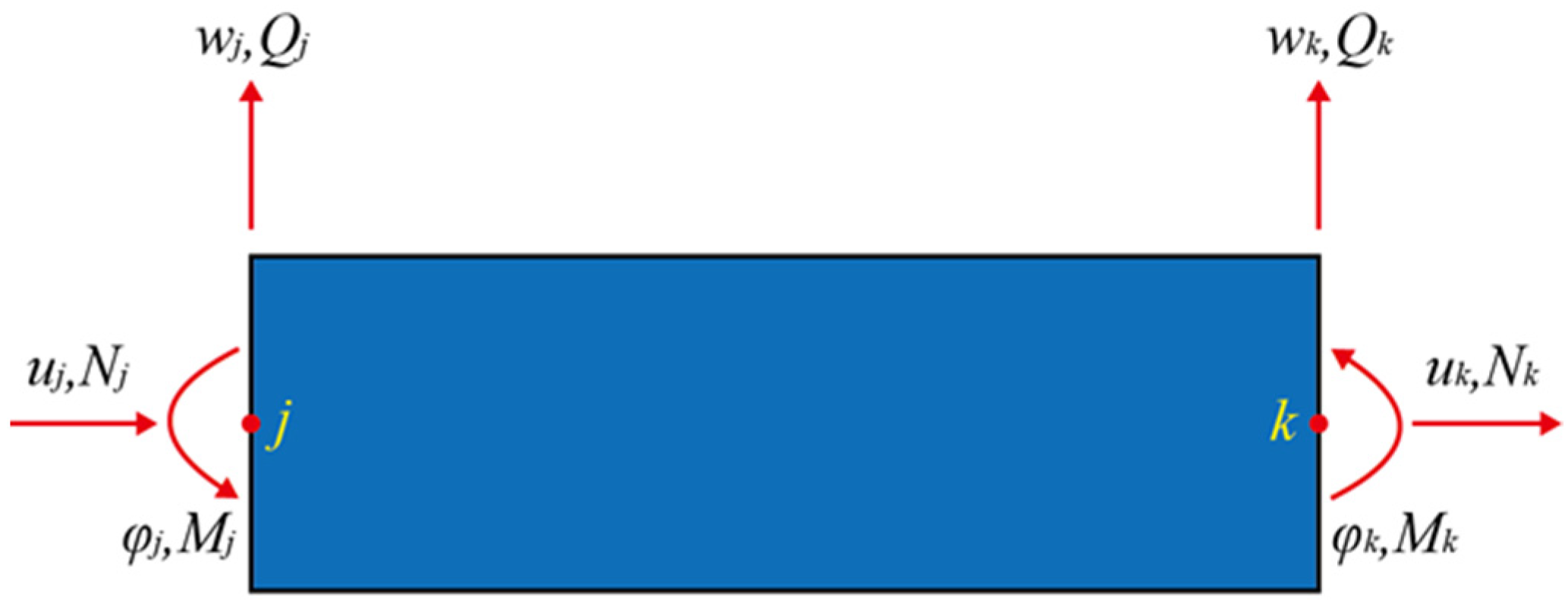
Figure 1. Nodal forces and nodal displacements of beam elements.
Jmmp 10 00206 g001
Figure 2. Receptance coupling substructure analysis.
Jmmp 10 00206 g002
Figure 3. Example of coupled solution for two elements.
Jmmp 10 00206 g003
Figure 4. Parameter identification flowchart.
Jmmp 10 00206 g004
Figure 5. Robot frequency response curve fitting.
Jmmp 10 00206 g005
Figure 6. Robot in different poses.
Jmmp 10 00206 g006
Figure 7. Prediction of robot end-effector FRFs under multiple poses.
Jmmp 10 00206 g007
Figure 8. Predicted SLD for robotic milling. (a) Prediction of SLD for the 0–40,000 rev/min range; (b) prediction of SLD for the 0–6000 rev/min range.
Jmmp 10 00206 g008
Figure 9. Experimental setup of modal test.
Jmmp 10 00206 g009
Figure 10. Measured and predicted end-effector FRF. (a) Curves of Position 1; (b) curves of Position 2; (c) curves of Position 3.
Jmmp 10 00206 g010
Figure 11. Experimental verification of robotic milling chatter stability.
Jmmp 10 00206 g011
Figure 12. Experimental verification of robotic milling chatter stability. (a) Theoretical prediction and experimental results of the SLD; (b) n = 3000 rev/min, ap = 0.08 mm; (c) n = 3000 rev/min, ap = 0.1 mm; (d) n = 3000 rev/min, ap = 0.2 mm; (e) n = 5000 rev/min, ap = 0.4 mm; (f) n = 5000 rev/min, ap = 0.5 mm; (g) n = 5000 rev/min, ap = 0.6 mm.
Jmmp 10 00206 g012
Figure 13. End-effector vibration signals and machined surface. (a) n = 3000 rev/min, ap = 0.1 mm; (b) n = 3000 rev/min, ap = 0.2 mm; (c) n = 5000 rev/min, ap = 0.5 mm; (d) n = 5000 rev/min, ap = 0.6 mm.
Jmmp 10 00206 g013
Table 1. Equivalent fitted parameters of the robot.
Serial NumberLength (ai)Mass (mi)Damping Ratio (ξi)Angle (θi)Torsional Stiffness (ki)
i = 10.90 m41.0 kg0.02120°2.25 × 10⁶ Nm/rad
i = 21.04 m121.0 kg0.02−1°4.05 × 10⁵ Nm/rad
i = 30.20 m15.8 kg0.01−7°3.99 × 10³ Nm/rad
Table 2. Joint angles for the robot’s three poses.
Serial NumberAngle (θ1)Angle (θ2)Angle (θ3)
1−120.13°133.37°−14.13°
2−100.59°119.81°−19.55°
3−84.75°104.63°−20.08°
Disclaimer/Publisher’s Note: The statements, opinions and data contained in all publications are solely those of the individual author(s) and contributor(s) and not of MDPI and/or the editor(s). MDPI and/or the editor(s) disclaim responsibility for any injury to people or property resulting from any ideas, methods, instructions or products referred to in the content.