Article

Microstructural Evolution and Mechanical Behavior of L-PBF Al-Cu 224 Alloy: Role of Process Parameters and Heat Treatment


1
Department of Applied Science, University of Quebec at Chicoutimi, Saguenay, QC G7H 2B1, Canada
2
Arvida Research and Development Center, Rio Tinto Aluminium, Saguenay, QC G7S 4K8, Canada
3
Québec Metallurgy Center, Trois-Rivières, QC G9A 5E1, Canada
*
Author to whom correspondence should be addressed.
J. Manuf. Mater. Process. 2026, 10(6), 205; https://doi.org/10.3390/jmmp10060205 (registering DOI)
Submission received: 11 May 2026 / Revised: 8 June 2026 / Accepted: 11 June 2026 / Published: 12 June 2026

Abstract

This study investigates the effect of laser powder bed fusion (L-PBF) parameters and T7 heat treatment on the defect formation, microstructure, and mechanical properties of a high-strength Al-Cu 224 aluminum alloy. The laser power (200–370 W), scanning speed (130–1900 mm/s), and hatch spacing (90–130 μm) were varied to evaluate their influence on hot cracking and porosity. Microstructural characterization using optical microscopy, scanning electron microscopy, and electron backscatter diffraction revealed that an energy density of 400 J/mm3 substantially reduced visible hot cracking in the examined microscopic regions by reducing the thermal gradients. However, this resulted in increased keyhole porosity, thereby limiting the relative density to 95%. The as-built samples exhibited a yield strength of 152 MPa and an elongation of 9.2%, and the T7 heat treatment improved the yield strength to 233 MPa, whereas the elongation remained unchanged. Keyhole pores served as primary crack initiation/propagation sites during tensile loading, reducing ductility. Lower energy densities increased the geometrically necessary dislocation density and promoted cracking because of higher residual stresses due to greater accumulated plastic strain and lattice curvature. These results clarify process–structure–property relationships, emphasize the trade-offs between defect types and performance, and provide a robust framework for optimizing L-PBF processing of high-strength Al alloys through parameter tuning and post-heat treatment.

1. Introduction

Additive manufacturing (AM) has emerged as a transformative technology for producing industrial metal components, owing to its ability to fabricate components with complex geometries, high precision, and enhanced design flexibility [1,2,3,4]. Among the various AM techniques, laser powder bed fusion (L-PBF) has shown remarkable potential in fabricating near-net-shape metallic parts with excellent mechanical performance and minimal material waste. This process operates through a layer-by-layer approach, in which the metallic powder is selectively melted using a high-energy laser source according to a predefined computer-aided design (CAD) model [5,6]. Owing to the rapid melting and solidification cycles inherent to L-PBF (often with cooling rates exceeding 106 K/s), unique microstructural features such as refined grains and non-equilibrium phases can be realized. This capability has enabled the successful application of L-PBF to a wide range of alloy systems, including titanium alloys, nickel-based superalloys, steels, and aluminum alloys [7,8,9].
Although L-PBF has demonstrated considerable success in fabricating Al components, most studies have focused on Al-Si foundry alloys, such as AlSi10Mg, AlSi7Mg, and AlSi12, owing to their excellent processability and low tendency for hot cracking. Hot cracking is a defect that manifests during the final stages of solidification when the material exists in a semi-solid state. The typical chemical composition of AlSi10Mg, characterized by its proximity to the eutectic point, results in a narrow solidification temperature range. This characteristic helps minimize thermal stress and suppress defect formation during rapid solidification [10,11,12,13,14]. However, despite its widespread use and manufacturability, AlSi10Mg generally exhibits inferior mechanical strength when compared to conventional high-strength Al alloys, such as 2xxx, 6xxx, and 7xxx series alloys [1,15,16]. These high-strength alloys present serious challenges for L-PBF processing, primarily owing to their broader solidification ranges, which promote hot cracking, columnar dendritic growth, and directional grain structures. Moreover, the high vapor pressure of elements such as Mg and Zn [17], along with the formation of turbulent melt pools, excessive sputtering, and porosity, further complicate the printing of these alloys. Consequently, processing high-strength Al alloys through L-PBF remains a significant research challenge [18,19]; however, addressing these limitations is crucial for unlocking their full potential in advanced structural applications.
Al-Cu alloys, particularly those in the 2xxx series, are widely used in aerospace and automotive industries because of their high strength-to-weight ratio, excellent fatigue resistance, and superior thermal stability [20,21]. Furthermore, Al–Cu cast alloys have gained significant attention for use in internal combustion engine components owing to their low density and excellent mechanical properties [22]. The mechanical performance of 224 cast alloys renders it suitable for internal combustion parts, where lightweight and load-bearing capabilities are essential. These properties are further enhanced by microalloying with Mg, Zr, V, and Ti, which improves the alloy’s elevated-temperature mechanical strength and creep properties [22]. However, processing these alloys using L-PBF remains highly challenging because of their wide solidification range, high susceptibility to hot cracking, and the tendency to form brittle intermetallic phases during rapid solidification. Recently, several studies have been performed to control the microstructure of Al-Cu alloys during the L-PBF process, as they are the most susceptible to cracking. Karg et al. [23] examined the effect of processing parameters on porosity and tensile properties of the EN AW-2219 alloy. Their results demonstrated that vertical tensile specimens with low porosity and no cracks can be successfully fabricated using a 100 W laser power. Elambasseril et al. [24] quantified the hot tearing susceptibility of the AA2139 alloy during L-PBF. Their results indicated that increasing the energy density significantly reduced hot tearing. Their study also revealed that the evaporation of Mg during processing contributed to a reduction in the susceptibility of hot tearing. However, porosity was not examined for this alloy. Wang et al. [25,26] investigated the L-PBF processing behavior of an Al–3.5Cu–1.5Mg–1Si alloy and reported that the use of lower laser power and reduced scan speed is necessary to minimize defect formation. Tan et al. [18] investigated the densification behavior and defect evolution in L-PBF-processed 2024 alloy under varying processing parameters. Their study revealed an inverse relationship between porosity formation and crack density considering the applied process parameters. Guercio et al. [27] investigated the underlying mechanisms responsible for hot crack formation in the AA2024 alloy. Their findings indicated that high laser power and scanning speed intensified the cracking tendencies, whereas the use of lower power and reduced scan speeds significantly mitigated crack formation. Gharbi et al. [28] demonstrated that crack-free AA2024 components can be fabricated using a continuous laser system operated at 80 W power and a scan speed of 0.30 m/s. Pekok et al. [29] examined the influence of laser power, hatch spacing, and scanning speed on the microstructure and mechanical properties of AA2024 alloy fabricated through L-PBF and showed that slower scanning speeds yielded higher relative densities at constant laser power and hatch spacing.
Until now, the majority of the research on the Al-Cu system has been performed on the AA2024 alloy. Although the Mg content in this alloy can contribute to the strengthening effect by the formation of S-precipitates, the Mg evaporation results in compositional variations, subsequently increasing the porosity, defect formation, and reproducibility. It has been reported that Mg can increase the hot tearing susceptibility of the final product [24,29,30]. The Al-Cu 224 cast alloy, valued for its high strength, is also prone to cracking and keyhole porosity during L-PBF; however, the interplay among the processing parameters, defect formation, and mechanical performance remains unclear. The objective of this study was to investigate the processing behavior of the 224 alloy during L-PBF and to determine how variations in processing parameters influence the formation of defects, specifically cracking and other material imperfections. Optical microscopy (OM), scanning electron microscopy (SEM), and electron backscatter diffraction (EBSD) were used to characterize the microstructural evolution in the as-built and T7 heat-treated samples, focusing on the role of geometrically necessary dislocations (GNDs) and keyhole porosity in crack initiation. Mechanical tensile properties provided new insights into the process–structure–property relationships of this alloy. These findings offer practical guidance for mitigating the defects in L-PBF-fabricated Al-Cu 224 alloys, thereby advancing their application in sustainable, high-performance components for aerospace and automotive industries.

2. Materials and Methods

2.1. Material Preparation

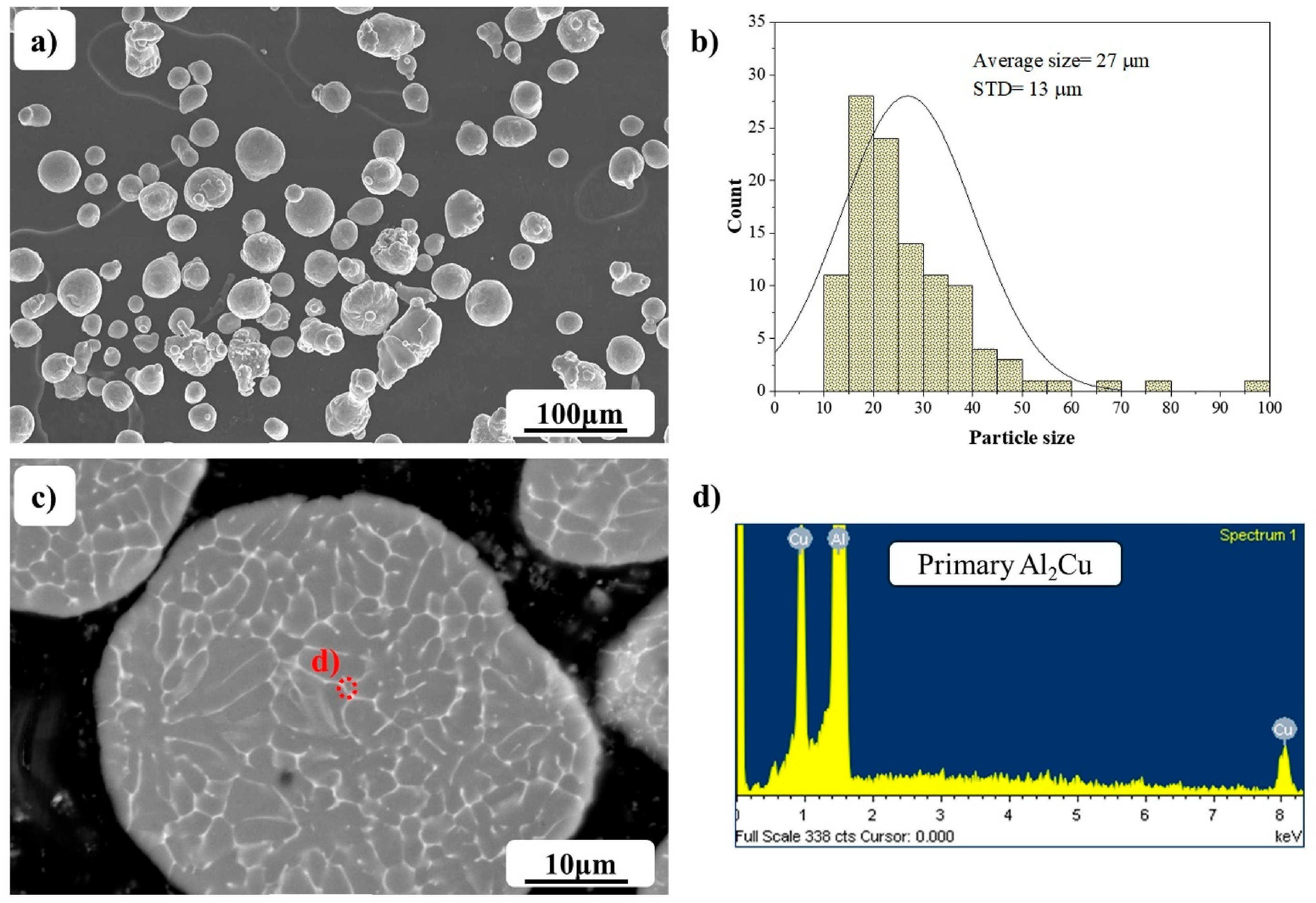
The 224 alloy powder used in this study was produced by gas atomization at the Québec Metallurgy Center, Trois-Rivières, QC, Canada, using an ArCast gas atomizer (Arcast In., Oxford, ME, USA) under an argon atmosphere. After gas atomization, the powder was dried prior to L-PBF processing to reduce residual surface moisture and minimize the possibility of hydrogen-related gas porosity. Figure 1a shows a representative SEM image illustrating the morphology of the powder used in this study. A majority of the powder particles exhibited a predominantly spherical shape, although some irregularly shaped particles were also present. The statistical characteristics of the particle shape and size distribution, analyzed using the ImageJ software (Version 1.54k), are shown in Figure 1b. The particle size distribution of the powder, determined from several SEM images, was characterized by d10 = 15.5 µm, d50 = 22.2 µm, and d90 = 40.5 µm, with an average particle size of approximately 27 µm. The microstructure of a polished cross-section of individual powder particles is shown in Figure 1c. The corresponding SEM–EDS analysis (Figure 1d) confirmed the presence of primary Al2Cu intermetallics in the dendrite cell boundaries. The overall chemical composition of the powder feedstock was determined using inductively coupled plasma (ICP) spectroscopy, and the results are shown in Table 1. This chemical composition was chosen based on previous research within this alloy system [22].

2.2. L-PBF Processing and Heat Treatment

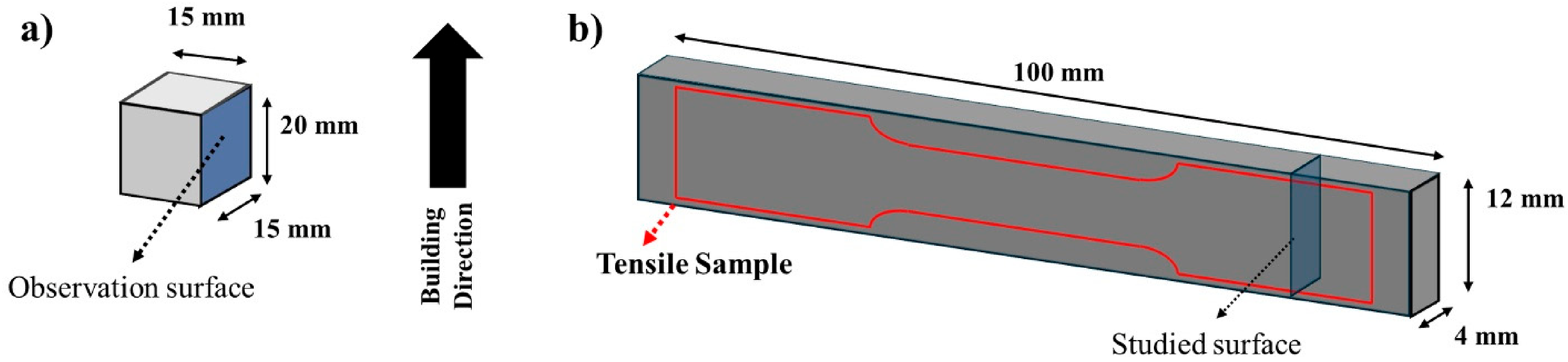
The L-PBFed samples were fabricated using an SLM 125 (SLM Solutions Group AG, Lubeck, Germany) operating at a platform temperature of 150 °C, employing a 400 W IPG fiber laser. Two types of specimens were printed: (1) cubic samples (15 mm × 15 mm × 20 mm) for investigating the densification behaviour and microstructure (Figure 2a), and (2) rectangular samples for tensile testing (Figure 2b). The length, height, and thickness of the rectangular specimens were 100, 12, and 4 mm, respectively, and their longitudinal axis was oriented perpendicular to the build direction. To evaluate the impact of the process parameters on the cube samples, an extensive range of conditions was employed as follows: laser power, 200, 250, and 370 W; scan speed, 130–1900 mm/s; hatch distance, 90 and 130 μm; powder layer thickness, 30 μm; laser spot diameter, 62 μm; and rotation angle, 67° between the adjacent layers. The chosen parameters are consistent with the values reported in the literature for similar alloying systems [18,24]. Volumetric energy density (EDv) according to Equation (1) was considered to optimize the process parameters [30]. The rectangular samples for tensile testing were printed using the selected optimum processing parameters obtained from the densification and microstructure characterization of the cube samples (hatch distance, 90 μm; energy density, 400 J/mm3; layer thickness, 30 μm, scan speed of approximately 185 mm/s, and laser power, 200 W). Additionally, two different heat treatment states (F and T7), outlined in Table 2 based on previous studies for the same alloy [22,32], were selected to assess their influence on the microstructural features and mechanical performance of the printed samples.
E D v = P ( v · h · t )
where P is the laser power (W), v is the scan speed (mm/s), h is the hatch distance (mm), and t is the layer thickness (mm).

2.3. Microstructure Characterization

The building direction surfaces were selected for microstructural characterization, as shown in Figure 2, which was performed using both optical microscope (OM, Nikon, Eclipse ME600, Nikon Instruments Inc., Melville, NY, USA) and scanning electron microscope (SEM, JEOL-6480LV, JEOL USA Inc., Peabody, MA, USA) equipped with an EBSD system. EBSD analysis with a step size of 0.5 μm was used to evaluate the grain structure and size. The acquired Kikuchi patterns were processed using the HKL Channel 5 and ATEX 5.03 software. The bulk density of the as-built samples was measured using a density determination kit based on the Archimedes’ principle according to the ASTM B962 standard [33], whereas the relative density was calculated by comparing it with the theoretical density of a nominal alloy of the same composition based on Aluminum Standards and Data Metric [31], as shown in Table 1. The same theoretical density value was used consistently for all relative-density calculations. To reveal the microstructure, specimens were etched for 60 s using a 0.5 vol% HF solution to enhance the contrast. Quantitative assessments of the imperfections, number density, and volume fraction were performed using multiple OM and SEM images analyzed using the ImageJ software (Version 1.54k).

2.4. Tensile Testing

Subsize tensile specimens with a 25 mm gauge length were extracted from the printed rectangular plates (Figure 2b) and subjected to tensile testing using an Instron 8801 servo-hydraulic machine (Instron, Norwood, MA, USA). The tests were conducted at a strain rate of 3.3 × 10⁻⁴ s−1 in compliance with the ASTM-E8 standard [34]. All tensile specimens were oriented horizontally, perpendicular to the build direction. A minimum of three tensile specimens were tested per condition to ensure reliable average results.

3. Results

3.1. Densification Behavior
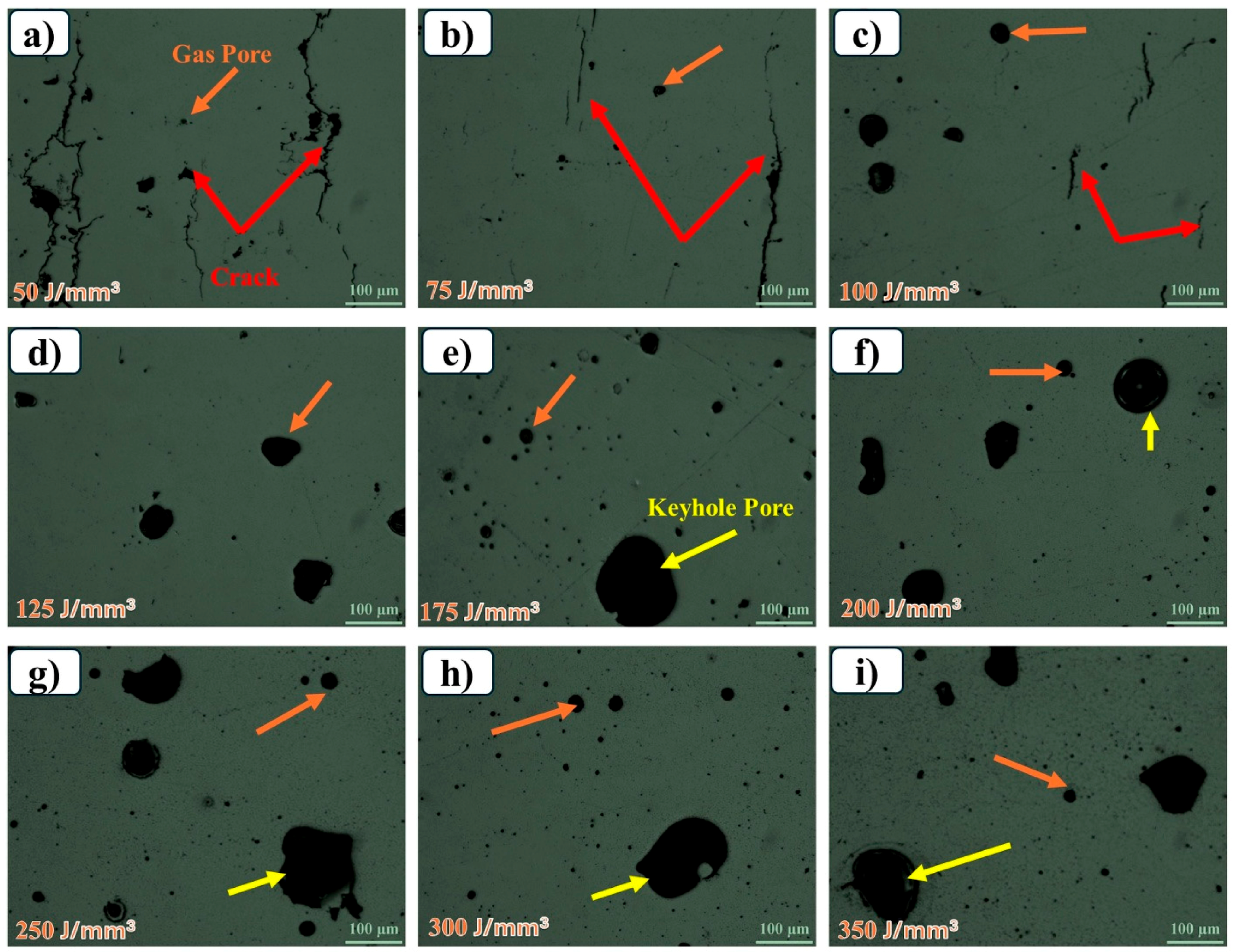
Figure 3 shows the microstructures of the fabricated cube samples produced at different scanning speeds using a constant laser power of 370 W, a layer thickness of 0.03 mm, and a hatch distance of 0.13 mm. These variations resulted in different energy densities (50–350 J/mm3) during the L-PBF process, which in turn influenced the formation and the nature of imperfections within the samples. Three distinct types of imperfections were identified across the specimens. For samples fabricated with low energy density (particularly those below 125 J/mm3), noticeable cracking was observed on the build-direction surfaces, as indicated by the red arrows. This cracking is primarily attributed to the wide solidification temperature range of the alloy, which promotes significant hot tearing during the final stages of solidification in the L-PBF process [26,35]. Such imperfections are a severe challenge in processing high-strength aluminum alloys such as 6xxx and 7xxx alloys and have been reported in the literature as a critical limitation to their additive manufacturability [36,37]. The above findings confirm that the volumetric energy density strongly influences the crack formation in the L-PBFed 224 alloy. Nevertheless, the exact relationship between the energy density and the crack mechanisms occurring within the melt pool during processing is not yet fully understood. Gaining insight into how the energy input influences the melt pool dynamics is crucial for refining the process parameters and reducing the crack susceptibility in 224 Al alloys.
Besides the formation of cracks, another prevalent defect consistently detected across all the energy density levels was the appearance of fine, rounded pores (highlighted with orange arrows in Figure 3). These pores typically possess a smooth morphology and occur in a broad size range from submicron dimensions to several micrometers. Such features are indicative of gas-induced porosity [30], and their origin can be traced to either preceding or coinciding with the production process. Possible contributors include trapped gases within the powder particles owing to gas atomization during powder fabrication, argon gas employed as a shielding atmosphere during L-PBF, the evaporation of certain alloying constituents, and hydrogen release originating from residual moisture on the surface of the powder [30,38]. This type of imperfection is present in all the samples; however, its number density noticeably increases at higher energy densities (e.g., Figure 3h,i compared to Figure 3a,b).
Another type of imperfection observed was the large porosity (typically exceeding 50 microns in diameter), which was identified as keyhole porosity. As shown in Figure 3, such pores were absent at low energy densities and became increasingly prevalent at higher energy densities (highlighted with yellow arrows). It is reported that keyhole porosities commonly originate when the melting regime shifts from the conduction mode to the keyhole mode under high energy densities [39]. The transition from conduction-dominated melting to keyhole mode instability was interpreted based on the observed defect morphology and supported by melting mode classifications reported for L-PBF aluminum alloys. Patel et al. [40] investigated L-PBF of the high-reflectivity AlSi10Mg alloy and classified conduction, transition, and keyhole melting regimes using a dimensionless keyhole number and melt-pool aspect ratio. They reported that the transition from conduction to transition/keyhole melting was associated with an increase in melt-pool penetration and a depth-to-width ratio threshold of approximately 0.4. In the present study, large rounded or irregular pores became more frequent at higher energy densities, which is consistent with the onset of keyhole mode instability caused by excessive energy input and unstable melt pool behavior.
Briefly, under this condition, the laser input is sufficient to induce significant metal evaporation, thereby generating a strong recoil pressure that drives the molten metal downward, forming a deep and unstable melt pool. The dynamic fluctuation of the melt, driven by the recoil pressure, surface tension, and hydrostatic forces, can create inward closure along the keyhole walls. They may eventually collapse and entrap vapor, resulting in irregular cavities typically located at the bottom of the melt pool that solidified rapidly when exposed to the laser during L-PBF. In the samples fabricated with an energy density of 350 J/mm3 (Figure 3i), the average size of the keyhole pores was measured to be approximately 120 ± 30 μm. The use of higher laser power is believed to enhance the keyhole-mode melting during the L-PBF process, thereby contributing to the formation of larger pores. To address this issue, subsequent samples were fabricated using reduced laser power, simultaneously maintaining a sufficiently high energy density to avoid cracking in the final parts.
Figure 3. OM images of as-fabricated specimens produced at 370 W laser power under varying energy densities, (a) 50 J/mm3, (b) 75 J/mm3, (c) 100 J/mm3, (d) 125 J/mm3, (e) 175 J/mm3, (f) 200 J/mm3, (g) 250 J/mm3, (h) 300 J/mm3, (i) 350 J/mm3, outlined in the bottom left of each micrograph), highlighting defects such as cracks (red arrows), gas-induced porosity (orange arrows), and keyhole pores (yellow arrows).
Jmmp 10 00205 g003
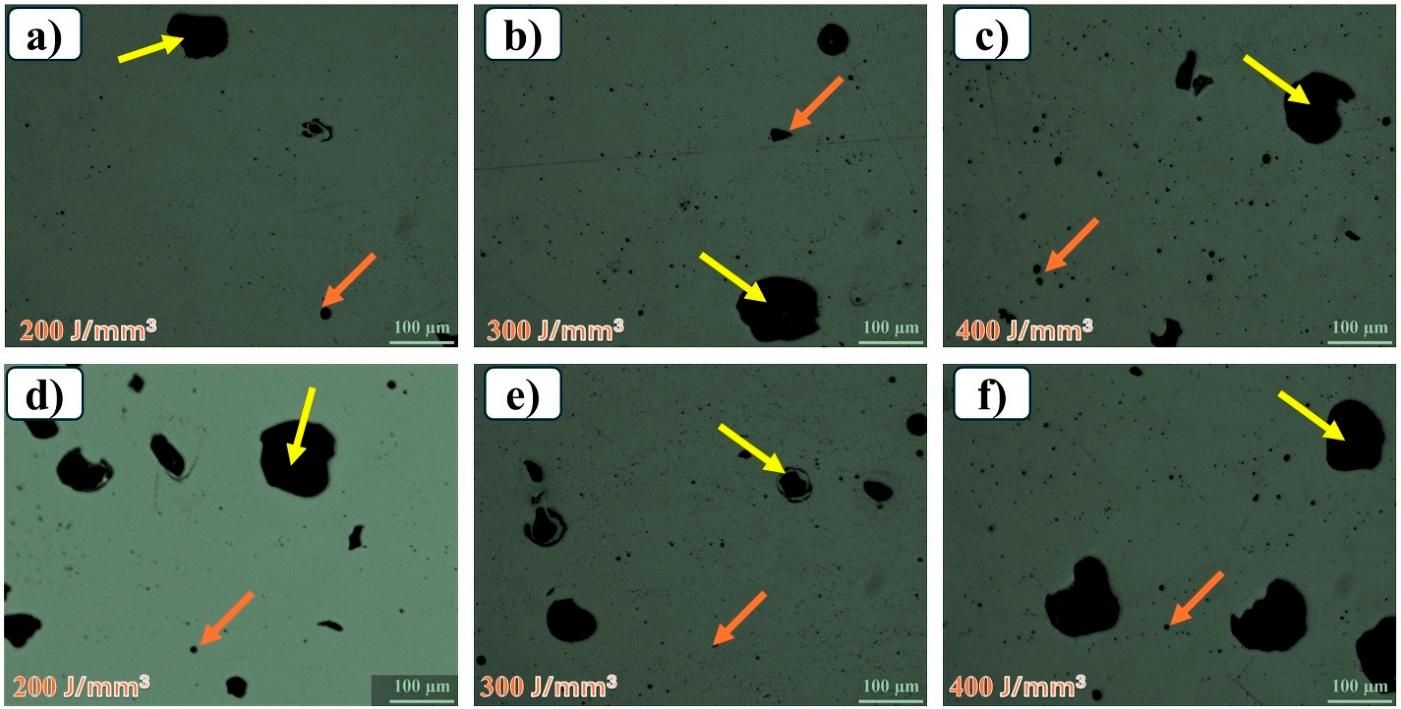
Figure 4a–c show the microstructures of samples fabricated using a laser power of 250 W at varying scanning speeds, with a constant layer thickness of 0.03 mm and a hatch distance of 0.13 mm. The selected range of energy densities (200, 300, and 400 J/mm3) were intended to prevent cracking in the specimens. All the samples exhibited porosity, including both gas-induced and keyhole-type pores. The size of the keyhole pores was significantly reduced to approximately 80 ± 30 μm compared to the samples fabricated at 370 W (Figure 3). Figure 4d–f show the microstructures of the samples fabricated using a laser power of 200 W and energy densities of 200, 300, and 400 J/mm3. Both the gas and keyhole porosities persisted in this energy density range, with the keyhole pore sizes remaining at approximately 80 ± 30 μm. Despite adjustments to the processing parameters, the resulting microstructures continued to exhibit porosity.
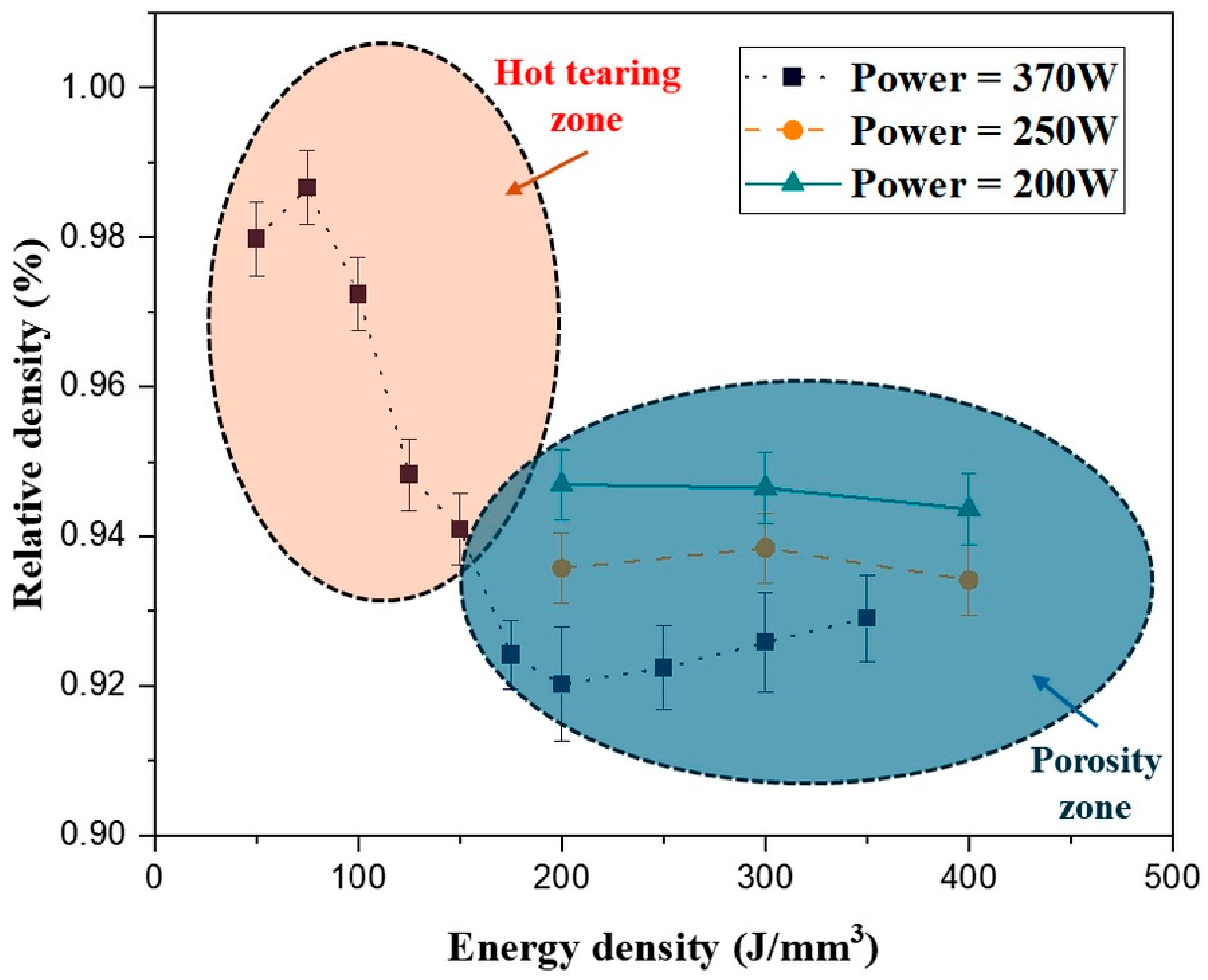
The effects of porosity and cracking were evident in the measured relative densities of the fabricated samples, as shown in Figure 5, which depicts the relative density variations with respect to the energy density and laser power. As shown, the samples fabricated at low energy densities (particularly those below 125 J/mm3) exhibited relatively high-density values. However, as indicated in Figure 3, these samples also exhibited significant cracking. This region is therefore marked as the “hot tearing zone” in Figure 5. Conversely, increasing the energy density (regardless of laser power) resulted in a notable decrease in the relative density, which dropped to 92–96%. Although no visible cracks were detected in the examined microscopic regions under these conditions, porosity remained a dominant defect and significantly reduced the overall density. This area is labeled as the “porosity zone” in the image. Another key observation was that at lower laser powers, the relative density improved and remained more stable across the increasing energy densities. This graph clearly demonstrates that significant variations in relative density are influenced by energy density and by laser power. It highlights that the fabrication of the 224 alloy through L-PBF cannot be accurately predicted based solely on energy density, because laser power also plays a critical role in the process outcomes [18,26]. The sample fabricated with a laser power of 200 W and an energy density of 400 J/mm3 achieved a relative density of approximately 95%. Based on this result, this combination of laser power and energy density was selected for further investigation. It should be emphasized that relative density alone does not fully represent the structural integrity of the L-PBFed 224 alloy. Samples produced at lower energy densities exhibited higher apparent relative densities; however, OM observations revealed visible hot cracks in these samples. In contrast, the sample fabricated at 400 J/mm3 and 200 W showed a lower relative density of approximately 95%, but no visible hot cracks were detected in the examined microscopic regions, as shown in Figure 4f and Figure 6.
Hatch spacing is a critical parameter in the L-PBF process, as it directly influences both the energy distribution and melt pool behavior. According to Equation (1), the energy density decreases with increasing hatch distance. Furthermore, variations in hatch spacing alter the degree of overlap between the adjacent scan tracks. A smaller hatch distance causes larger overlap areas and multiple remelting cycles, whereas a wider spacing may result in insufficient overlap, leaving gaps between the tracks. Previous studies have reported that reducing the hatch distance can enhance part quality and control imperfections [41].
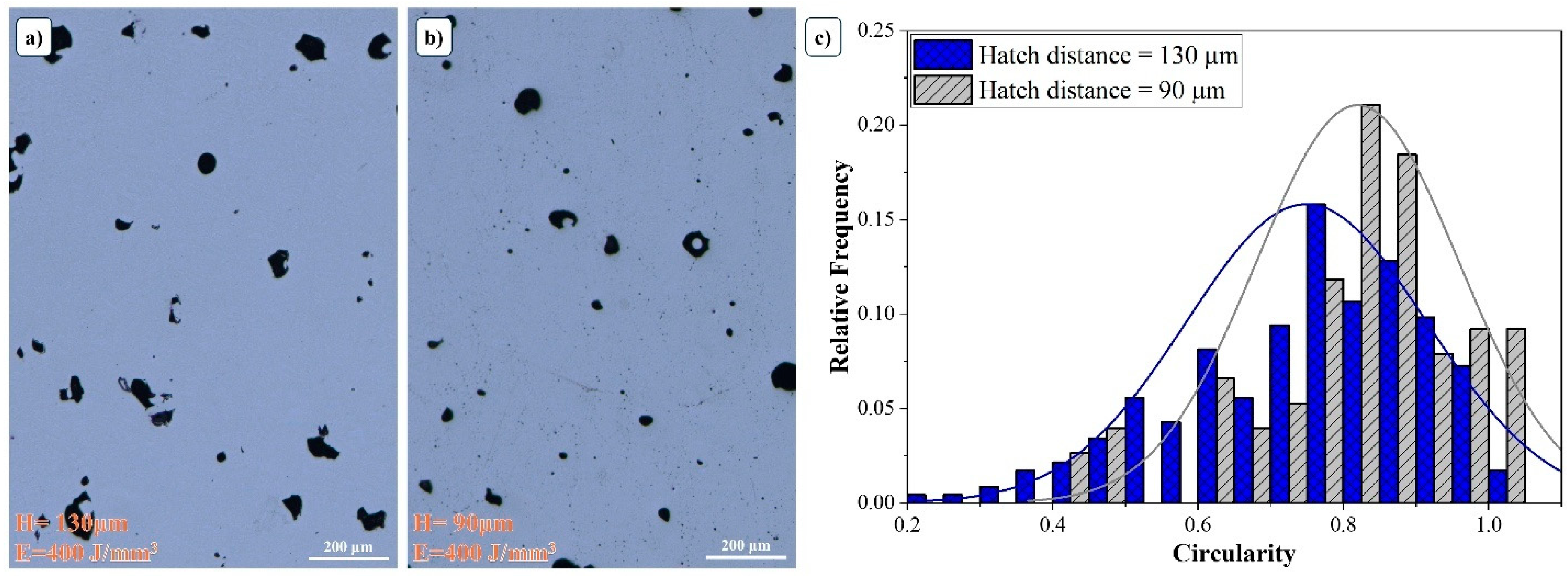
Figure 6. OM observations of L-PBFed alloy with energy density 400 (J/mm3), laser power 200 W, and the hatch distance of (a) 130 μm and (b) 90 μm, (c) circularity distribution of the remaining porosity in the samples shown in (a,b).
Jmmp 10 00205 g006
The influence of hatch spacing was examined in the samples fabricated using the previously optimized energy density and laser power conditions, as shown in Figure 6. Figure 6a presents the microstructure of the sample fabricated with a hatch distance of 130 μm, whereas Figure 6b shows the sample produced with a 90 μm hatch distance. In both cases, keyhole porosity remained as a dominant imperfection. Although the relative density of both samples remained approximately the same (95%), a noticeable difference was observed in the circularity of the pores which is measured by image analysis.
Figure 6c shows the distribution of the circularity of porosity in the two samples. As the hatch distance decreased, the material underwent multiple remelting and solidification cycles owing to increased track overlap, which can promote the reshaping of pores. The data indicate that lower hatch spacing causes porosities with higher sphericity. Based on these findings, the sample fabricated with a hatch distance of 90 μm, energy density of 400 J/mm3, and laser power of 200 W was selected as the optimized parameter for further characterization of the microstructure, tensile, and fracture properties.

3.2. Microstructure in the F State

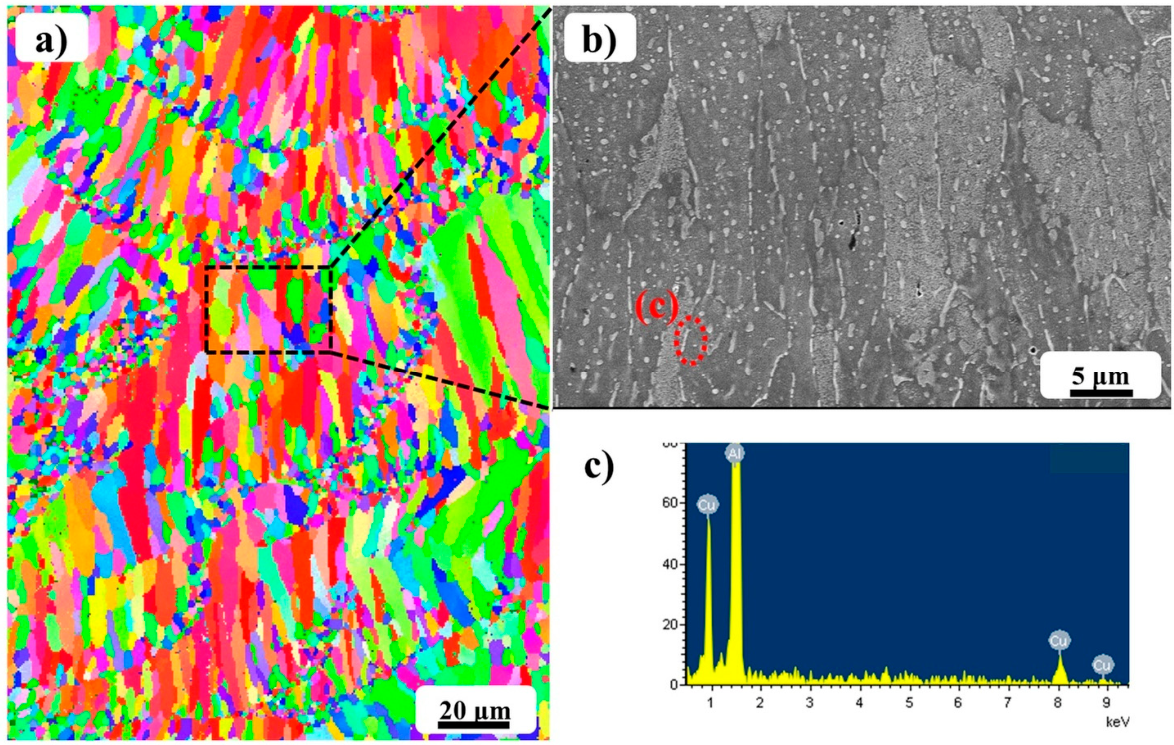
Figure 7a presents the EBSD orientation map of the as-fabricated cube sample along the build direction surface. The melt pool boundaries are distinctly visible, with an average depth of 35.8 ± 5 μm. The measured melt pool depth was slightly higher than the applied powder layer thickness of 30 μm, indicating that the melt pool penetrated through the deposited layer and partially remelted the underlying layer. This overlap between successive layers is important for metallurgical bonding and suggests that the selected processing parameters provided sufficient interlayer fusion. Therefore, lack-of-fusion defects were not the dominant imperfection under this condition. Instead, as discussed in Section 3.1, the remaining defects were mainly gas-induced pores and keyhole-type porosity. Although a limited number of fine equiaxed grains were observed along the melt pool borders, the majority of the grains within the melt pool center exhibited a columnar morphology, with an average columnar grain length of 20 ± 5 μm and an average width of 4 ± 2 μm. These columnar grains were elongated in the direction of the thermal gradient and exhibited epitaxial growth, which is characteristic of directional solidification during the L-PBF process. The presence of very fine equiaxed grains at the melt pool boundaries was attributed to heterogeneous nucleation, facilitated by partial remelting of the underlying layers during the solidification of successive layers. This grain structure evolution is consistent with previous studies on L-PBF-processed Al-based alloys, including Al–Si and Al–Si–Mg systems [12,42,43].
Figure 7b,c display the SEM and EDS analyses of the as-built 224 cube samples with the optimized parameter. The SEM image shows elongated grains with a fine granular Al2Cu uniformly distributed within the grains, Accordingly, the intragranular Al2Cu features are attributed to in-situ precipitation during the build (heated platform at 150 °C and cyclic reheating/intrinsic heat treatment). This microstructural feature aligns with the previous observations reported for low-silicon aluminum alloys fabricated through L-PBF [44,45,46,47]. Furthermore, a significant number of Cu-enriched intermetallic particles were concentrated along the grain boundaries (Figure 7b,c), indicating pronounced solute segregation and the formation of an Al2Cu intermetallic phase.

3.3. Effect of T7 Heat Treatment on the Microstructure

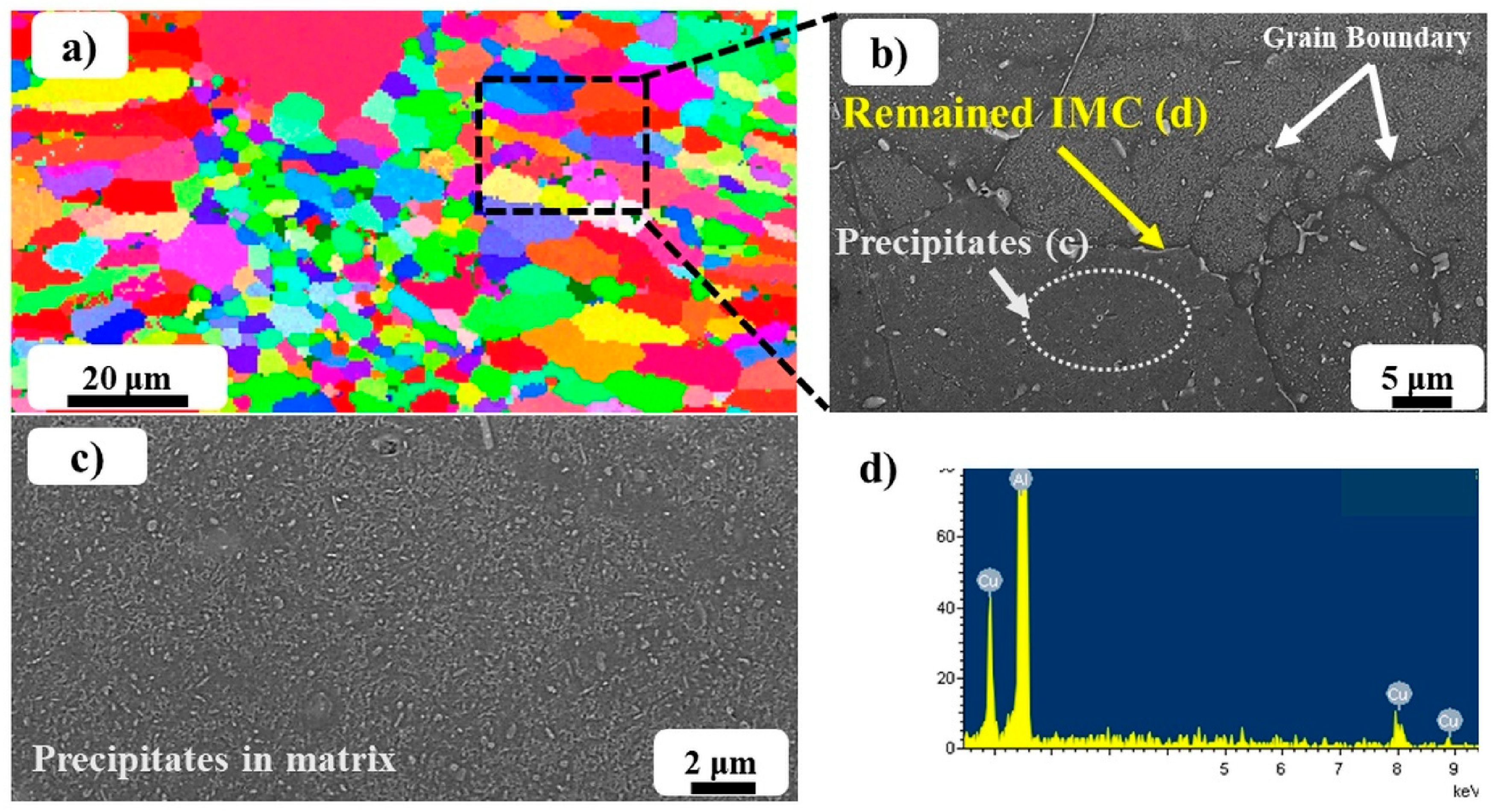
Figure 8a presents the EBSD orientation map of the T7 sample along the build direction surface. Although the material reveals a mixed grain structure comprising elongated columnar grains and smaller equiaxed grains as in Figure 7a, there was an increased prevalence of equiaxed grains after the T7 post-heat treatment. The average grain size of the mostly equiaxed grains in the scanned region (Figure 8a) was 15 ± 3 μm, suggesting that the long T7 solution treatment led to an increased equiaxed grain size. As shown in Figure 8b, the Cu-rich intermetallic particles located along the grain boundaries in the F state (Figure 7b) were mostly dissolved during the solution heat treatment of the T7 process, and only a small amount of intermetallic particles remained in the grain boundaries [22].
Figure 8d shows the SEM–EDS results, which confirms that the residual inter-metallics were primarily Cu-rich. Additionally, the high-magnification SEM micrograph (Figure 8c) suggests the presence of fine, uniformly distributed precipitates in the Al matrix. These intragranular precipitates are likely to play a significant role in enhancing the mechanical properties through the precipitation strengthening mechanism. According to the literature, such fine precipitates are expected to correspond predominantly to metastable θ′ and θ″ phases, which are the main strengthening phases in Al–Cu-based alloys subjected to T7 aging treatments [48].

3.4. Tensile Behaviors

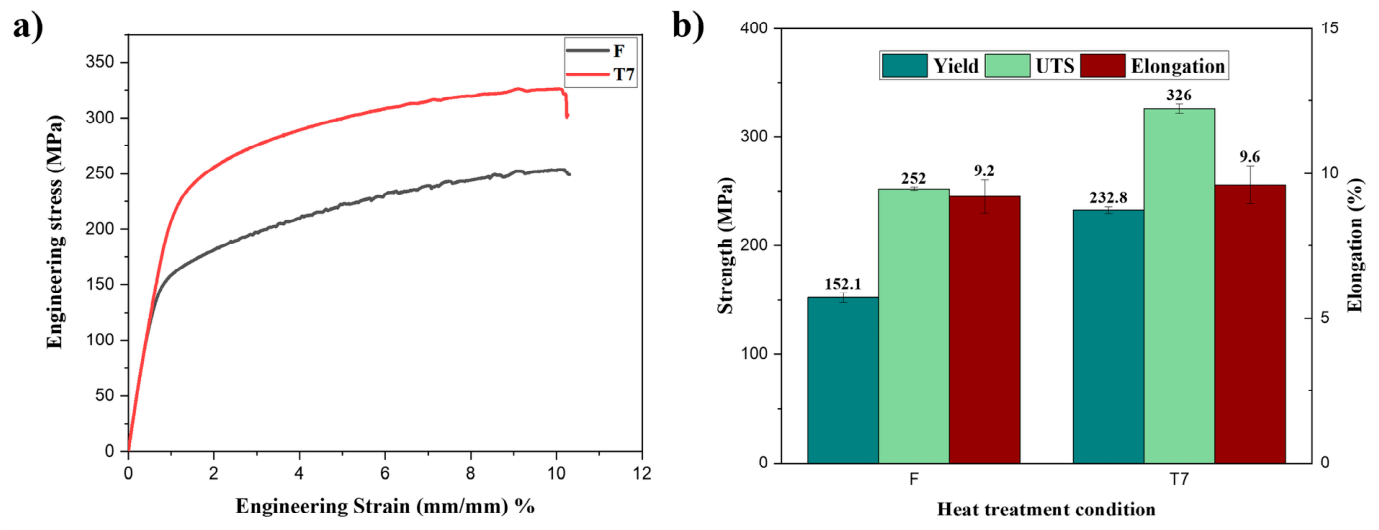
Rectangular samples (Figure 2b), fabricated using the optimized printing parameters (Section 3.1), were used to investigate the mechanical behavior. Representative tensile properties of the L-PBFed 224 aluminum alloy under both the F and T7 heat-treated conditions are shown in Figure 9. Figure 9a shows the engineering stress–strain curves, whereas Figure 9b shows their corresponding mechanical properties, including the yield strength (YS), ultimate tensile strength (UTS), and elongation at fracture. Under the F condition, the alloy exhibited a YS of 152.1 ± 4.3 MPa, UTS of 252.0 ± 1.7 MPa, and an elongation of 9.2 ± 1%. Following T7 treatment, both the YS and UTS improved to 232.8 ± 3.0 MPa and 326.0 ± 4.1 MPa, respectively; however, the elongation remained almost unchanged, indicating that strength enhancement did not compromise the ductility.
The improvement in strength after T7 treatment is primarily attributed to the precipitation of the fine, uniformly distributed nanoprecipitates, most likely θ′ and θ″ (Figure 8) and supported by previous studies [49]. Despite the fine grains (Figure 7 and Figure 8), the mechanical performance of the alloy under both the F and T7 conditions remained lower than that typically achieved through conventional casting processes (i.e., the T7 YS reaches more than 300 MPa in cast 224 alloys) [50]. This difference is mainly attributed to the presence of process-induced keyhole porosity in the L-PBFed samples. Although the T7 treatment promoted precipitation strengthening and increased the matrix strength, it did not eliminate the pores formed during fabrication. Therefore, the keyhole porosity introduced during L-PBF processing limited the macroscopic tensile properties. This reduction in the mechanical properties is further analyzed and discussed in the context of fracture surface characteristics.
Figure 9. Mechanical properties of printed samples with the optimized parameters, (a) engineering stress–strain curves, (b) comparison of tensile properties in F and T7 conditions.
Jmmp 10 00205 g009
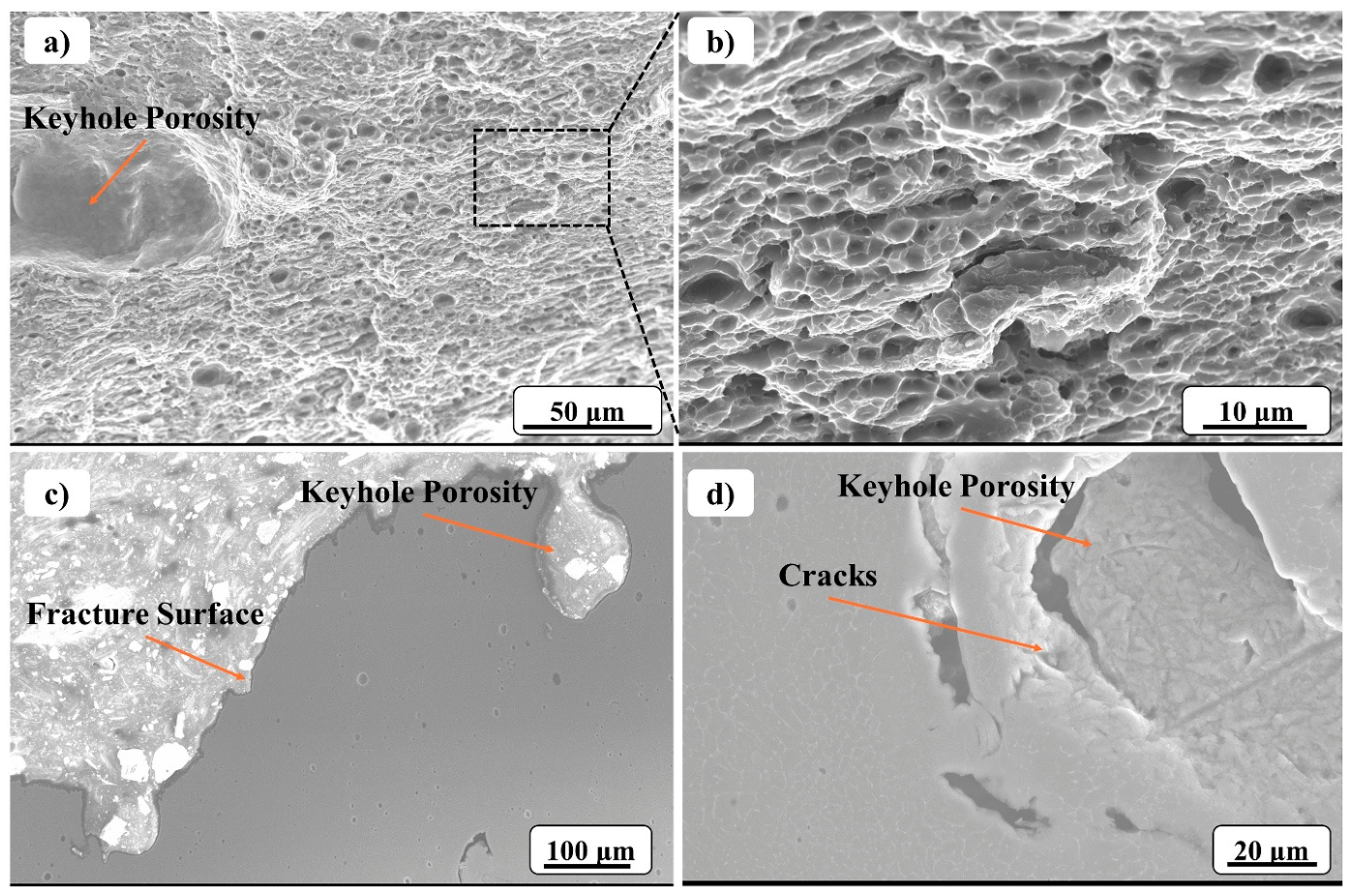
To better understand the failure mechanism, the fracture surface of the tensile specimens under the F condition was examined using SEM, as shown in Figure 10. Figure 10a shows the presence of large keyhole pores embedded within the fracture surface, indicating their involvement in the failure process. Detailed SEM observations (Figure 10b) show the widespread presence of small dimples with an average diameter of approximately 2.5 ± 0.5 μm, which are typically indicative of ductile fracture through micro-void coalescence.
However, despite these ductile features, the tensile test results in Figure 9 indicate the absence of necking, suggesting that the material failed abruptly at its UTS (an indication of brittle fracture behavior). This apparent contradiction indicates a mixed-mode fracture mechanism in the F and T7 samples, involving both the ductile and brittle features. Further insight is provided by examining the damage zone near the fracture surface, as depicted in Figure 10c. The fracture surface contains keyhole pores, which typically exhibited irregular morphologies to some extent, suggesting that these volumetric and morphologic defects played a critical role in crack initiation and propagation. During tensile loading, such pores act as local stress concentrators, facilitating the nucleation of cracks under applied strain [51,52]. Figure 10d highlights a representative keyhole pore within the damage zone, where visible crack traces originating from the pore surface and propagating to the sample confirmed its role as a crack origin site for failure. The T7 specimens exhibited the same fracture mechanism and similar overall fracture morphology.
Figure 10. Fractographic analysis of the tensile sample under the as-fabricated (F) condition: (a) fracture surface showing the keyhole porosity and ductile dimples; (b) higher magnification of the region from (a), revealing detailed dimple morphology; (c) sideview of the fractured sample, highlighting the fracture surface and associated keyhole porosity; (d) evidence of crack initiation and propagation originating from the surface of a keyhole pore.
Jmmp 10 00205 g010

4. Discussion

4.1. Hot Tearing Susceptibility in Al-Cu 224 Alloy During L-PBF

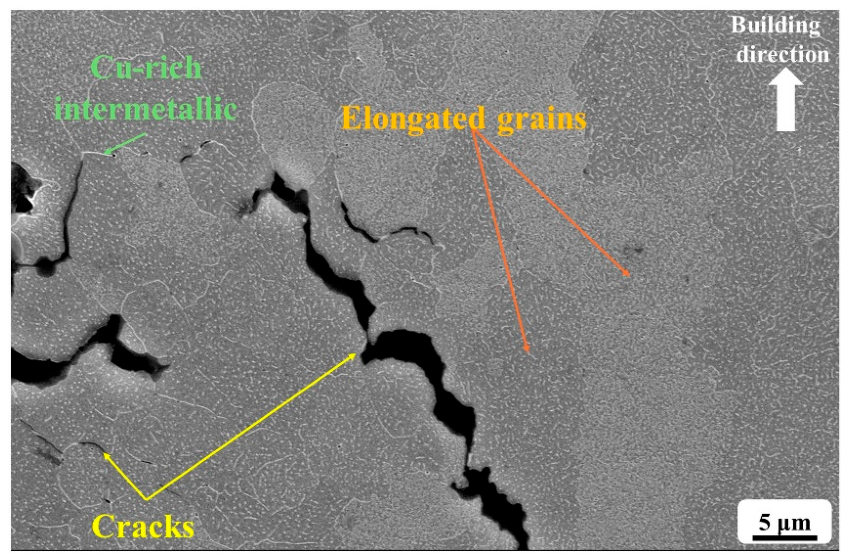
As demonstrated in our previous study, the 224 alloy exhibits a relatively wide solidification interval of approximately 140 °C [32], rendering it highly susceptible to hot tearing. Figure 11 presents a longitudinal SEM micrograph of a sample fabricated at an energy density of 50 J/mm3 (Figure 3a). A significant number of Cu-rich intermetallic particles (appearing as white phases along the grain boundaries, see the green arrow) were observed in the vicinity of a crack between adjacent Al grains, indicating pronounced copper segregation in these regions. The broad solidification range of the alloy promotes solute enrichment at the grain boundaries and forms intergranular liquid films at low temperature during the final stages of solidification. These residual liquid channels act as mechanically weak zones, increasing the risk of crack initiation along the grain boundaries. This type of defect represents the primary failure mode in samples produced at low energy densities in this study. However, as shown in Figure 5, increasing the energy density during the L-PBF process effectively reduced the occurrence of such hot cracking.
Multiple studies have shown that raising the volumetric energy density (e.g., via higher laser power or slower scan speed) can significantly mitigate solidification cracking in high-strength Al alloys [24,53]. The fundamental reason is that higher energy input produces a deeper, hotter, and more stable melt pool that cools more slowly, which flattens the thermal gradients and lowers the build-up of thermal stress. A larger and more sustained melt pool enables the inter-dendritic liquid to remain available longer and to efficiently back-fill the shrinking channels, thereby compensating for solidification shrinkage and preventing hot cracks [54]. For example, decreasing the scan speed (thereby increasing the energy per unit length) in Al–Cu alloys consistently resulted in fewer cracks, as the reduced solidification rate and more moderate thermal gradients gave the remaining liquid metal time to feed vulnerable inter-dendritic regions [24,27]. Thermomechanical simulations further confirmed that higher volumetric energy density directly translates to lower residual tensile stresses in the solidifying material, correlating with a significant drop in hot-crack formation [24]. Conversely, at too low energy densities, the melt pool rapidly solidified, creating steep thermal gradients and insufficient liquid feeding, which greatly increased the hot tearing susceptibility, as shown in Figure 11. Therefore, within an optimized processing window, increasing the laser energy density improves the melt pool depth and stability, moderates thermal gradients, and reduces the solidification cracking sensitivity of the alloy.
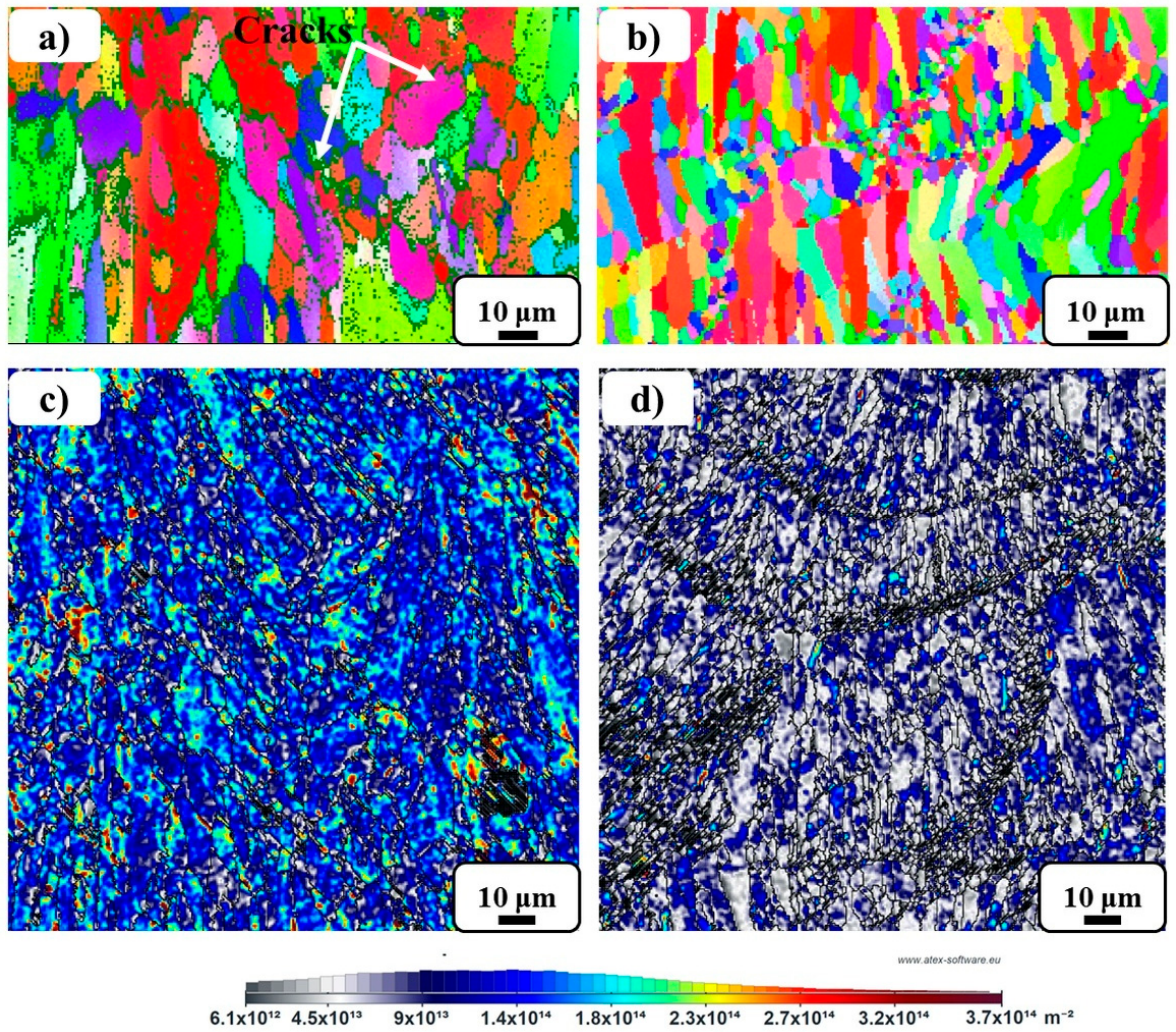
The local accumulated plastic deformation in the final samples was evaluated by tracking geometrically necessary dislocations (GNDs) using EBSD-based analysis [52,55]. It should be noted that GND density does not directly measure the instantaneous residual stress in the part. Instead, it reflects lattice curvature and accumulated plastic strain associated with the thermomechanical history during L-PBF processing. Figure 12 shows the EBSD inverse pole figure (IPF) and GND maps of samples produced at both the energy densities of 50 J/mm3 (Figure 12a,c) and 400 J/mm3 (Figure 12b,d). The sample fabricated at the low energy density of 50 J/mm3 exhibited a higher GND density (~1.3 × 10¹⁴ m−2) as shown in Figure 12c, and clearly visible intergranular cracks (white arrows in Figure 12a). Conversely, although the high energy density sample (400 J/mm3), had a slightly finer grain size (7.1 µm vs. 8.4 µm), it showed a lower GND density (~7.0 × 10¹³ m−2) as shown in Figure 12d and no visible cracks were detected in the examined EBSD observation area (Figure 12b). Lower laser energy inputs in L-PBF create steeper thermal gradients and rapid solidification in the Al–Cu alloys, resulting in coarse columnar grains and vulnerable “mushy” zones that promote hot tearing along the grain boundaries. In such low-energy builds, the Kernel Average Misorientation (KAM) in EBSD maps reported that the regions around hot cracks (typically at the columnar grain boundaries) showed markedly higher local misorientations, i.e., higher GND densities. For example, L-PBF-fabricated Al–Cu samples at high scan speed (lower volumetric energy density) developed cracks along the grain boundaries with large orientation gradients near the crack paths, indicating intense localized stress concentration where the cracks formed [56]. It has been reported that stress concentration at the crack tips and grain boundaries confirm that the cracks were initiated in areas of stress concentration [57]. The material near a propagating hot crack yielded and accumulated dislocations as it relieved the intense stress, which increased the measured GND level in that vicinity [58]. In summary, the low energy density exacerbates thermal stresses and hot cracking in Al–Cu alloys, and the elevated GND densities measured using EBSD in the cracked regions were a microstructural signature of the severe stress concentration at the crack tips or along the grain boundaries. A higher energy density decreases the GND in the final samples, which can control cracking during L-PBF.

4.2. Effect of Porosity on the Mechanical Properties and Elongation

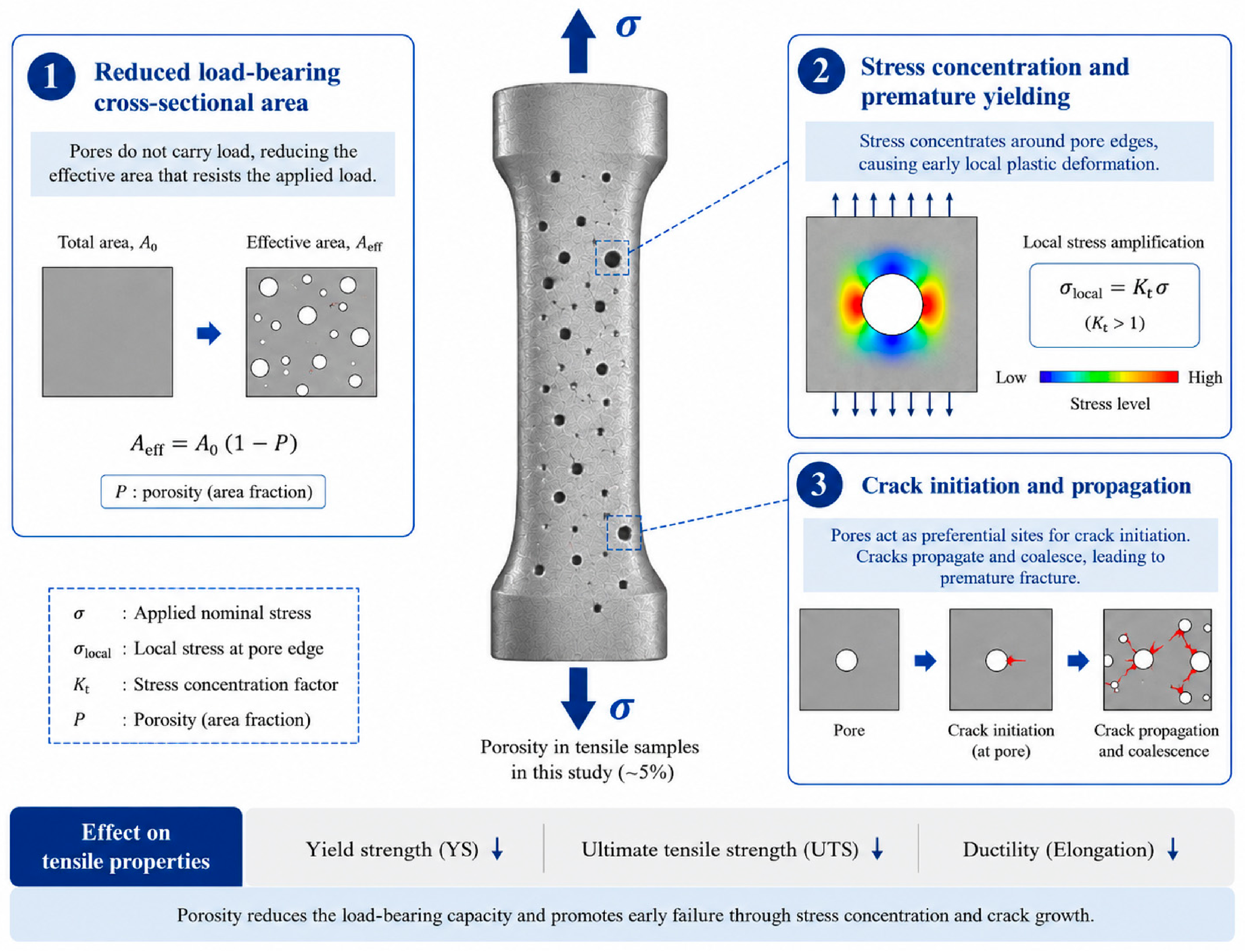
In L-PBFed high-strength aluminum alloys, such as the 224 alloy studied here, internal porosity is a common defect that significantly influences the mechanical performance. The degradation in the tensile properties because of porosity can be attributed to three mechanisms.
First, porosity reduces the effective load-bearing cross-sectional area of the material. When internal voids occupy a fraction of the cross-section, the actual material available to resist the applied loads decreases, thereby resulting in lower YS and UTS as explained in this study (Figure 9). This interpretation is consistent with Kramer et al. [59], who investigated PBF-LB AlSi10Mg and calculated a corrected UTS using a linear rule-of-mixture approach by considering pores as a null-strength phase. However, for elongation at fracture and toughness, the decrease was significantly more pronounced, indicating that these properties are particularly sensitive to porosity levels and not strictly governed by volume fraction alone [60].
Second, pores serve as stress concentrators. Under external loading, local stresses around the voids are magnified, especially in the case of irregularly shaped pores. Stress concentration factors in these regions can exceed three times that of the applied nominal stress, potentially reaching the local yield limit of the material and initiating plastic deformation at lower global stress levels. Yao et al. [57] demonstrated that in L-PBFed 2024 aluminum alloy, the fracture mode was a combination of ductile and brittle features. Their study linked this behavior to the high number of internal pores, which created weak zones where the stress was concentrated, and failure was initiated.
Figure 12. EBSD (a,b) and GND (c,d) maps, (a,c) the sample produced with E = 50 J/mm3, (b,d) the sample produced with E = 400 J/mm3, respectively.
Jmmp 10 00205 g012
Third, porosity plays a key role in reducing the ductility by acting as a crack initiation and propagation pathway. Once a crack initiates at a pore, it can easily propagate and coalesce with the neighboring defects, resulting in premature failure before any significant necking occurs. This phenomenon explains the reduction in elongation observed in porous samples. In the present study, fractographic analysis of the 224 alloy (Figure 10) confirmed this mechanism, demonstrating that keyhole pores were directly involved in crack initiation and propagation. Previous research has shown that even low levels of porosity can drastically reduce the elongation compared to strength [60,61]. These mechanisms are not unique to the L-PBF process; similar effects have been reported in other AM processes such as electron beam melting and directed energy deposition. A schematic summary of the three main pathways through which porosity affects the tensile properties is provided in Figure 13.
The nearly unchanged elongation after T7 treatment (Figure 9) can therefore be explained by the dominant role of keyhole porosity in controlling fracture. Although the T7 treatment increased the YS and UTS through precipitation strengthening (Figure 8), it did not remove the pre-existing keyhole pores generated during L-PBF processing. These pores remained the preferential crack-initiation sites under tensile loading and continued to limit the attainable elongation in both the F and T7 conditions. As a result, the improvement in the matrix strength after T7 treatment was reflected mainly in higher YS and UTS, whereas the elongation was still governed by pore-controlled premature fracture. Therefore, the unchanged elongation should not be interpreted as the absence of a heat treatment effect, but rather as evidence that ductility in the present L-PBFed 224 alloy is mainly limited by keyhole porosity and associated crack initiation mechanism.
Figure 13. Schematic summary of the three main pathways through which porosity affects the tensile properties.
Jmmp 10 00205 g013

4.3. Strategy for Enhancing the L-PBF Processability of 224 Alloy

The high solidification interval of this 224 aluminum alloy renders it susceptible during L-PBF owing to its rapid solidification nature. This study highlights that the L-PBF parameters play a crucial role in controlling the melt pool behavior (including its imperfections), which collectively influence the densification response of the 224 Al alloy under the L-PBF process. Based on experimental observations, a processable energy density was developed for the alloy, as shown in Figure 5. It was determined that operating within a controlled energy density range of approximately less than 150 J/mm3 significantly minimized the porosity levels, resulting in a relatively high overall density of up to 99%. Despite these improvements, the incidence of solidification cracking remained pronounced within this range, with cracks being the major imperfection.
Attempts to reduce cracking by increasing the energy density were met with undesirable trade-offs. Under these conditions, the formation of severe keyhole porosity, besides the gas porosities, caused a considerable drop in the relative density of the final parts, underscoring the intrinsic processability limitations of the 224 alloy. These porosities resulted in decreased mechanical properties of the final samples under the as-fabricated and T7 conditions (Figure 9). Although the high energy density (more than 150 J/mm3 was observed in this study) generated keyhole porosities in the final samples, it may require adjustment depending on the variations in the material or equipment. Because it has been reported that process optimization is not solely governed by energy density or laser power, other variables such as the characteristics of the powder feedstock (particularly particle size distribution and morphology and machine-specific attributes such as laser type and beam profile, also play a significant role in determining the final part quality [58,59].
The formation of keyhole porosity at high energy densities appears to be an inherent characteristic of Al alloys processed through L-PBF. Therefore, when attempting to mitigate solidification cracking at lower energy densities, understanding the underlying mechanisms of crack formation is crucial. As shown in Figure 7, the rapid solidification inherent to the L-PBF process, combined with steep thermal gradients, promotes the growth of elongated columnar grains. During the final stages of solidification, these grains are subjected to substantial tensile stresses, particularly along the grain boundaries. This, coupled with the high residual stress retained in the part, facilitates the nucleation and propagation of cracks (Figure 11).
Even though reducing the solidification rate (such as by implementing elevated build temperatures or preheating the substrate [52,62]) has been explored as a method to control cracking, these approaches often involve significant increases in process cost and complexity, which may not be feasible for widespread industrial use. A more practical and promising strategy, as demonstrated in other alloy systems, involves controlling the grain structure within the melt pool. This can be achieved by modification of the alloy chemistry to promote equiaxed grain formation or by the incorporation of nucleating agents to refine the microstructure. Both of these approaches aim to disrupt the formation of large, columnar grains and reduce cracking susceptibility during solidification in the L-PBF process [63,64]. Future work will focus on the chemical modification of the 224 alloy to improve its processability during L-PBF. In particular, alloy design strategies will be investigated to reduce hot-cracking susceptibility, control keyhole porosity, and improve densification while maintaining the high-strength potential of the Al-Cu alloy system.

5. Conclusions

This study significantly improves the understanding of laser powder bed fusion (L-PBF) processing of high-strength Al-Cu 224 aluminum alloy by establishing process–structure–property relationships through systematic investigation of process parameters and T7 heat treatment. By varying the laser power (200–370 W), scanning speed (130–1900 mm/s), and hatch spacing (90–130 μm), the research elucidates the manner in which these parameters influence the defect formation, microstructure, and mechanical performance, and addresses the critical challenges such as hot cracking and porosity. The key results are summarized as follows:
  • Defect evolution with energy density: A low energy density (<150 J/mm3) caused pronounced hot cracking, with cracks visible along the grain boundaries. Increasing the energy density to 400 J/mm3 at 200 W laser power substantially reduced visible hot cracking in the examined microscopic regions, it introduced keyhole porosity and limited the relative density to 95%. Reducing the hatch spacing from 130 μm to 90 μm increased the pore circularity and enhanced the microstructural uniformity.
  • Mechanical properties: The as-built samples achieved a yield strength of 152 MPa and elongation of 9.2%. Furthermore, a T7 heat treatment increased the yield strength to 233 MPa owing to precipitation strengthening, whereas the elongation remained at the same level.
  • Microstructural evolution: The as-built sample exhibited columnar grains with Al2Cu intermetallics along the grain boundaries. The T7 treatment dissolved most of the intermetallics, and formed fine intragranular precipitates, thereby enhancing the strength without significant grain coarsening.
  • Effect of keyhole porosity on the mechanical performance: Large keyhole pores were determined to act as crack initiation and propagation sites during tensile testing, limiting the ductility under both the as-built and T7 conditions. Additionally, the presence of these pores reduced the effective load-bearing area and caused localized stress concentrations, resulting in premature yielding and reduced mechanical performance.
  • Residual stress and cracking susceptibility: A low energy density (50 J/mm3) resulted in a high geometrically necessary dislocation (GND) density (~1.3 × 10¹⁴ m−2), promoting cracking because of elevated residual stresses due to greater accumulated plastic strain and lattice curvature. The higher energy density (400 J/mm3) reduced the GND density to ~7.0 × 10¹³ m−2, enhancing crack resistance by moderating the thermal gradients.
This study provides a robust framework to balance defect mitigation and mechanical properties in the L-PBF process, offering actionable insights for optimizing the L-PBF parameters and post-processing strategy to enhance the processability and performance of high-strength Al alloys.

Author Contributions

E.P.: Conceptualization, Investigation, Formal analysis, Writing—original draft. P.R.: Conceptualization, Methodology, Validation, Writing—review & editing. M.J.: Methodology, Validation, Writing—review & editing, Supervision. A.B.: Investigation, Formal analysis. X.-G.C.: Conceptualization, Methodology, Validation, Writing—review & editing, Supervision. All authors have read and agreed to the published version of the manuscript.

Funding

This research was funded by the Centre Québécois de Recherche et de Développement de l’Aluminium (CQRDA) under the project No. 1065 and the Natural Sciences and Engineering Research Council of Canada (NSERC) under the grant numbers CRDPJ 514651–17 and ALLRP 576503–22.

Data Availability Statement

The data that support the findings of this study are available from the corresponding author upon request.

Acknowledgments

The authors appreciate all supports received from the technical teams of Arvida Research and Development Center of Rio Tinto Aluminum, Center de Métallurgie du Québec (CMQ), Center Universitaire de Recherche sur l’Aluminium (CURAL), and Chaire de recherche Institutionnelle en Métallurgie de la Transformation de l’Aluminium (CIMTAL) in preparing and characterizing samples.

Conflicts of Interest

Co-author Paul Rometsch was employed by Rio Tinto Aluminium. The remaining authors declare that the research was conducted in the absence of any commercial or financial relationships that could be construed as a potential conflict of interest.

References

  1. Rometsch, P.A.; Zhu, Y.; Wu, X.; Huang, A. Review of high-strength aluminium alloys for additive manufacturing by laser powder bed fusion. Mater. Des. 2022, 219, 110779. [Google Scholar] [CrossRef]
  2. Zhang, J.; Song, B.; Wei, Q.; Bourell, D.; Shi, Y. A review of selective laser melting of aluminum alloys: Processing, microstructure, property and developing trends. J. Mater. Sci. Technol. 2019, 35, 270–284. [Google Scholar] [CrossRef]
  3. Guan, B.; Qin, L.; Yang, G.; Ren, Y.; Wang, X. Laser Polishing of Directed Energy Deposition Metal Parts: A Review. Addit. Manuf. Front. 2024, 3, 200174. [Google Scholar] [CrossRef]
  4. Chua, C.; Liu, Y.; Williams, R.J.; Chua, C.K.; Sing, S.L. In-process and post-process strategies for part quality assessment in metal powder bed fusion: A review. J. Manuf. Syst. 2024, 73, 75–105. [Google Scholar] [CrossRef]
  5. Yang, X.; Li, R.; Yuan, T.; Ke, L.; Bai, J.; Yang, K. A comprehensive overview of additive manufacturing aluminum alloys: Classifications, structures, properties and defects elimination. Mater. Sci. Eng. A 2025, 919, 147464. [Google Scholar] [CrossRef]
  6. Olakanmi, E.O.; Cochrane, R.F.; Dalgarno, K.W. A review on selective laser sintering/melting (SLS/SLM) of aluminium alloy powders: Processing, microstructure, and properties. Prog. Mater. Sci. 2015, 74, 401–477. [Google Scholar] [CrossRef]
  7. Song, H.; Wang, C.; Yu, W.; Zhang, M.; Shao, J.; Liang, H.; Wu, T.; Dong, X. Recent progress in additive manufacturing of porous titanium: From design to applications. J. Alloys Compd. 2025, 1026, 180451. [Google Scholar] [CrossRef]
  8. Xu, G.; Wang, Q.; Chen, R.; Li, A.; Chen, D.; Fu, H. Columnar to equiaxed transition in additively manufactured titanium alloys: A comprehensive review of mechanisms and grain control strategies. J. Alloys Compd. 2025, 1032, 181196. [Google Scholar] [CrossRef]
  9. Li, J.; Wang, X.; Cheng, M.; Ma, X. Progress in the preparation method and mechanical properties of TiC particle-reinforced steel matrix composites. Mater. Today Commun. 2025, 42, 111311. [Google Scholar] [CrossRef]
  10. Limbasiya, N.; Jain, A.; Soni, H.; Wankhede, V.; Krolczyk, G.; Sahlot, P. A comprehensive review on the effect of process parameters and post-process treatments on microstructure and mechanical properties of selective laser melting of AlSi10Mg. J. Mater. Res. Technol. 2022, 21, 1141–1176. [Google Scholar] [CrossRef]
  11. Lu, Q.; Xu, B.; Liu, C.; Peng, Y.; Miao, K.; Wu, H.; Li, R.; Li, X.; Fan, G. Interplay of heat treatment and deformation temperature on the microstructural evolution and mechanical behavior of SLM AlSi10Mg alloy. J. Alloys Compd. 2024, 999, 174995. [Google Scholar] [CrossRef]
  12. Pourkhorshid, E.; Rometsch, P.; Chen, X.G. Evolution of mechanical properties and microstructure of selective laser melted AlSi10MgMn alloy with different post heat treatments. Mater. Sci. Eng. A 2024, 915, 147249. [Google Scholar] [CrossRef]
  13. Pourkhorshid, E.; Rometsch, P.; Bois-Brochu, A.; Taylor, A.; Marceau, R.K.W.; Chen, X.G. Effect of Mn on Microstructural Characteristics and Mechanical Behavior of AlSi10Mg Alloys Produced by Laser Powder Bed Fusion. Addit. Manuf. 2025, 110, 104923. [Google Scholar] [CrossRef]
  14. Ghosh, A.; Pourkhorshid, E.; Rometsch, P.; Chen, X.-G. Microstructure, Processability, and Strength of SiC-Reinforced AlSi9Mg Composite After Laser Surface Remelting and Post-Heat Treatment. J. Manuf. Mater. Process. 2025, 9, 379. [Google Scholar] [CrossRef]
  15. Zhang, J.; Gao, J.; Song, B.; Zhang, L.; Han, C.; Cai, C.; Zhou, K.; Shi, Y. A novel crack-free Ti-modified Al-Cu-Mg alloy designed for selective laser melting. Addit. Manuf. 2021, 38, 101829. [Google Scholar] [CrossRef]
  16. Zhang, D.; Han, Y.; Sun, Z.; Liu, Z.; Xing, Y.; Yin, H. Study on the laser selective melting and forming process and organizational properties of a TiSi2-modified 7075 aluminum alloy. Mater. Today Commun. 2025, 42, 111110. [Google Scholar] [CrossRef]
  17. Liu, P.; Hu, J.-Y.; Li, H.-X.; Sun, S.-Y.; Zhang, Y.-B. Effect of heat treatment on microstructure, hardness and corrosion resistance of 7075 Al alloys fabricated by SLM. J. Manuf. Process. 2020, 60, 578–585. [Google Scholar] [CrossRef]
  18. Tan, Q.; Liu, Y.; Fan, Z.; Zhang, J.; Yin, Y.; Zhang, M.-X. Effect of processing parameters on the densification of an additively manufactured 2024 Al alloy. J. Mater. Sci. Technol. 2020, 58, 34–45. [Google Scholar] [CrossRef]
  19. Galy, C.; Le Guen, E.; Lacoste, E.; Arvieu, C. Main defects observed in aluminum alloy parts produced by SLM: From causes to consequences. Addit. Manuf. 2018, 22, 165–175. [Google Scholar] [CrossRef]
  20. Gamba, M.; Cristoforetti, A.; Fedel, M.; Ceriani, F.; Ormellese, M.; Brenna, A. Plasma Electrolytic Oxidation (PEO) coatings on aluminum alloy 2024: A review of mechanisms, processes, and corrosion resistance enhancement. Appl. Surf. Sci. Adv. 2025, 26, 100707. [Google Scholar] [CrossRef]
  21. Wen, X.; Wang, Q.; Mu, Q.; Kang, N.; Sui, S.; Yang, H.; Lin, X.; Huang, W. Laser solid forming additive manufacturing TiB2 reinforced 2024Al composite: Microstructure and mechanical properties. Mater. Sci. Eng. A 2019, 745, 319–325. [Google Scholar] [CrossRef]
  22. Hu, P.; Liu, K.; Pan, L.; Chen, X.G. Effects of individual and combined additions of transition elements (Zr, Ti and V) on the microstructure stability and elevated-temperature properties of Al–Cu 224 cast alloys. Mater. Sci. Eng. A 2023, 867, 144718. [Google Scholar] [CrossRef]
  23. Karg, M.C.H.; Ahuja, B.; Wiesenmayer, S.; Kuryntsev, S.V.; Schmidt, M. Effects of Process Conditions on the Mechanical Behavior of Aluminium Wrought Alloy EN AW-2219 (AlCu6Mn) Additively Manufactured by Laser Beam Melting in Powder Bed. Micromachines 2017, 8, 23. [Google Scholar] [CrossRef]
  24. Elambasseril, J.; Benoit, M.J.; Zhu, S.; Easton, M.A.; Lui, E.; Brice, C.A.; Qian, M.; Brandt, M. Effect of process parameters and grain refinement on hot tearing susceptibility of high strength aluminum alloy 2139 in laser powder bed fusion. Prog. Addit. Manuf. 2022, 7, 887–901. [Google Scholar] [CrossRef]
  25. Wang, P.; Lei, Y.; Qi, J.-F.; Yu, S.-J.; Setchi, R.; Wu, M.-W.; Eckert, J.; Li, H.-C.; Scudino, S. Wear Behavior of a Heat-Treatable Al-3.5Cu-1.5Mg-1Si Alloy Manufactured by Selective Laser Melting. Materials 2021, 14, 7048. [Google Scholar] [CrossRef] [PubMed]
  26. Wang, P.; Gammer, C.; Brenne, F.; Prashanth, K.G.; Mendes, R.G.; Rümmeli, M.H.; Gemming, T.; Eckert, J.; Scudino, S. Microstructure and mechanical properties of a heat-treatable Al-3.5Cu-1.5Mg-1Si alloy produced by selective laser melting. Mater. Sci. Eng. A 2018, 711, 562–570. [Google Scholar] [CrossRef]
  27. Del Guercio, G.; McCartney, D.G.; Aboulkhair, N.T.; Robertson, S.; Maclachlan, R.; Tuck, C.; Simonelli, M. Cracking behaviour of high-strength AA2024 aluminium alloy produced by Laser Powder Bed Fusion. Addit. Manuf. 2022, 54, 102776. [Google Scholar] [CrossRef]
  28. Gharbi, O.; Jiang, D.; Feenstra, D.R.; Kairy, S.K.; Wu, Y.; Hutchinson, C.R.; Birbilis, N. On the corrosion of additively manufactured aluminium alloy AA2024 prepared by selective laser melting. Corros. Sci. 2018, 143, 93–106. [Google Scholar] [CrossRef]
  29. Pekok, M.A.; Setchi, R.; Ryan, M.; Han, Q.; Gu, D. Effect of process parameters on the microstructure and mechanical properties of AA2024 fabricated using selective laser melting. Int. J. Adv. Manuf. Technol. 2021, 112, 175–192. [Google Scholar] [CrossRef]
  30. Aboulkhair, N.T.; Simonelli, M.; Parry, L.; Ashcroft, I.; Tuck, C.; Hague, R. 3D printing of Aluminium alloys: Additive Manufacturing of Aluminium alloys using selective laser melting. Prog. Mater. Sci. 2019, 106, 100578. [Google Scholar] [CrossRef]
  31. The Aluminum Association. Aluminum Standards and Data 2024; The Aluminum Association: Arlington, VA, USA, 2024. [Google Scholar]
  32. Pourkhorshid, E.; Rometsch, P.; Chen, X.G. Laser-Based Additive Manufacturing Processability and Mechanical Properties of Al-Cu 224 Alloys with TiB Grain Refiner Additions. Materials 2025, 18, 516. [Google Scholar] [CrossRef]
  33. ASTM-B962; Standard Test Methods for Density of Compacted or Sintered Powder Metallurgy (PM) Products Using Archimedes’ Principle. ASTM International: West Conshohocken, PA, USA, 2023.
  34. ASTM-E8; Standard Test Methods for Tension Testing of Metallic Materials. ASTM International: West Conshohocken, PA, USA, 2022.
  35. Kou, S. A simple index for predicting the susceptibility to solidification cracking. Weld. J. 2015, 94, 374–388. [Google Scholar]
  36. Kaufmann, N.; Imran, M.; Wischeropp, T.M.; Emmelmann, C.; Siddique, S.; Walther, F. Influence of Process Parameters on the Quality of Aluminium Alloy EN AW 7075 Using Selective Laser Melting (SLM). Phys. Procedia 2016, 83, 918–926. [Google Scholar] [CrossRef]
  37. Li, W.; Qian, F.; Li, J.; Zhu, Y.; Liang, Y.; Xu, S.; Li, Y.; Cheng, X. Design strategy for eliminating cracking and improving mechanical properties of Al-Mg-Si alloys fabricated by laser melting deposition. Addit. Manuf. 2023, 68, 103513. [Google Scholar] [CrossRef]
  38. Weingarten, C.; Buchbinder, D.; Pirch, N.; Meiners, W.; Wissenbach, K.; Poprawe, R. Formation and reduction of hydrogen porosity during selective laser melting of AlSi10Mg. J. Mater. Process. Technol. 2015, 221, 112–120. [Google Scholar] [CrossRef]
  39. Yang, J.; Han, J.; Yu, H.; Yin, J.; Gao, M.; Wang, Z.; Zeng, X. Role of molten pool mode on formability, microstructure and mechanical properties of selective laser melted Ti-6Al-4V alloy. Mater. Des. 2016, 110, 558–570. [Google Scholar] [CrossRef]
  40. Patel, S.; Chen, H.; Vlasea, M.; Zou, Y. The influence of beam focus during laser powder bed fusion of a high reflectivity aluminium alloy—AlSi10Mg. Addit. Manuf. 2022, 59, 103112. [Google Scholar] [CrossRef]
  41. Deng, J.; Chen, C.; Zhang, W.; Li, Y.; Li, R.; Zhou, K. Densification, Microstructure, and Mechanical Properties of Additively Manufactured 2124 Al–Cu Alloy by Selective Laser Melting. Materials 2020, 13, 4423. [Google Scholar] [CrossRef] [PubMed]
  42. Lopez-Botello, O.; Martinez-Hernandez, U.; Ramírez, J.; Pinna, C.; Mumtaz, K. Two-dimensional simulation of grain structure growth within selective laser melted AA-2024. Mater. Des. 2017, 113, 369–376. [Google Scholar] [CrossRef]
  43. Xu, R.; Li, R.; Yuan, T.; Niu, P.; Wang, M.; Lin, Z. Microstructure, metallurgical defects and hardness of Al–Cu–Mg–Li–Zr alloy additively manufactured by selective laser melting. J. Alloys Compd. 2020, 835, 155372. [Google Scholar] [CrossRef]
  44. Kimura, T.; Nakamoto, T.; Mizuno, M.; Araki, H. Effect of silicon content on densification, mechanical and thermal properties of Al-xSi binary alloys fabricated using selective laser melting. Mater. Sci. Eng. A 2017, 682, 593–602. [Google Scholar] [CrossRef]
  45. Jägle, E.A.; Sheng, Z.; Wu, L.; Lu, L.; Risse, J.; Weisheit, A.; Raabe, D. Precipitation Reactions in Age-Hardenable Alloys During Laser Additive Manufacturing. JOM 2016, 68, 943–949. [Google Scholar] [CrossRef]
  46. Fiocchi, J.; Tuissi, A.; Biffi, C.A. Heat treatment of aluminium alloys produced by laser powder bed fusion: A review. Mater. Des. 2021, 204, 109651. [Google Scholar] [CrossRef]
  47. Chambrin, N.; Dalverny, O.; Cloue, J.-M.; Brucelle, O.; Alexis, J. In Situ Ageing with the Platform Preheating of AlSi10Mg Alloy Manufactured by Laser Powder-Bed Fusion Process. Metals 2022, 12, 2148. [Google Scholar] [CrossRef]
  48. Rakhmonov, J.; Liu, K.; Pan, L.; Breton, F.; Chen, X.G. Enhanced mechanical properties of high-temperature-resistant Al–Cu cast alloy by microalloying with Mg. J. Alloys Compd. 2020, 827, 154305. [Google Scholar] [CrossRef]
  49. Li, D.; Liu, K.; Rakhmonov, J.; Chen, X.G. Enhanced thermal stability of precipitates and elevated-temperature properties via microalloying with transition metals (Zr, V and Sc) in Al–Cu 224 cast alloys. Mater. Sci. Eng. A 2021, 827, 142090. [Google Scholar] [CrossRef]
  50. Rakhmonov, J.; Liu, K.; Chen, G.X. Effects of Compositional Variation on the Thermal Stability of θ′-Al2Cu Precipitates and Elevated-Temperature Strengths in Al-Cu 206 Alloys. J. Mater. Eng. Perform. 2020, 29, 7221–7230. [Google Scholar] [CrossRef]
  51. Gairola, S.; Jayaganthan, R.; Ajay, J. Laser powder bed fusion on Ti modified Al 2024 alloy: Influence of build orientation and T6 treatment on mechanical behaviour, microstructural features and strengthening mechanisms. Mater. Sci. Eng. A 2024, 896, 146296. [Google Scholar] [CrossRef]
  52. Khoshghadam-Pireyousefan, M.; Javidani, M.; Maltais, A.; Lévesque, J.; Chen, X.G. Breaking the strength-conductivity paradigm in hypoeutectic Al–Si alloy via annealing-induced Si nanoprecipitation. Mater. Sci. Eng. A 2024, 911, 146924. [Google Scholar] [CrossRef]
  53. Chen, Y.; Zhang, D.; O’Toole, P.; Qiu, D.; Seibold, M.; Schricker, K.; Bergmann, J.-P.; Rack, A.; Easton, M. In situ observation and reduction of hot-cracks in laser additive manufacturing. Commun. Mater. 2024, 5, 84. [Google Scholar] [CrossRef]
  54. Riener, K.; Pfalz, T.; Funcke, F.; Leichtfried, G. Processability of high-strength aluminum 6182 series alloy via laser powder bed fusion (LPBF). Int. J. Adv. Manuf. Technol. 2022, 119, 4963–4977. [Google Scholar] [CrossRef]
  55. Khoshghadam-Pireyousefan, M.; Javidani, M.; Maltais, A.; Lévesque, J.; Chen, X.G. Strength-conductivity synergy in hypoeutectic Al-Si conductors via ultrafine-grained embedded Si nanoprecipitates. Mater. Sci. Eng. A 2025, 929, 148124. [Google Scholar] [CrossRef]
  56. Xi, L.; Lu, Q.; Gu, D.; Cao, S.; Zhang, H.; Kaban, I.; Sarac, B.; Prashanth, K.G.; Eckert, J. Circumventing Solidification Cracking Susceptibility in Al-Cu Alloys Prepared by Laser Powder Bed Fusion. 3D Print. Addit. Manuf. 2024, 11, e731–e742. [Google Scholar] [CrossRef]
  57. Yao, S.; Wang, J.; Li, M.; Chen, Z.; Lu, B.; Shen, S.; Li, Y. LPBF-Formed 2024Al Alloys: Process, Microstructure, Properties, and Thermal Cracking Behavior. Metals 2023, 13, 268. [Google Scholar] [CrossRef]
  58. Huang, B.; Tang, H.; Huang, J.; Jia, Y.; Liao, L.; Pang, S.; Zheng, X.; Chen, Z. Influence of Laser-Based Powder Bed Fusion of Metals Process Parameters on the Formation of Defects in Al-Zn-Mg-Cu Alloy Using Path Analysis. Micromachines 2024, 15, 1121. [Google Scholar] [CrossRef]
  59. Kramer, S.; Wexel, H.; Purwitasari, A.; Jarwitz, M.; Schulze, V.; Zanger, F. Impact of different pore types on the tensile and fatigue properties of AlSi10Mg parts produced by laser powder bed fusion. Prog. Addit. Manuf. 2025, 10, 11305–11317. [Google Scholar] [CrossRef]
  60. Pan, Y.; Yu, M.; Xu, C.; Zhang, J.; Geng, L. High-Performance 2319 Aluminum Alloy via CMT-WAAM: Microstructure, Porosity, and Mechanical Properties. Metals 2024, 14, 797. [Google Scholar] [CrossRef]
  61. Langebeck, A.; Bohlen, A.; Rentsch, R.; Vollertsen, F. Mechanical Properties of High Strength Aluminum Alloy EN AW-7075 Additively Manufactured by Directed Energy Deposition. Metals 2020, 10, 579. [Google Scholar] [CrossRef]
  62. Dixit, S.; Liu, S. Laser Additive Manufacturing of High-Strength Aluminum Alloys: Challenges and Strategies. J. Manuf. Mater. Process. 2022, 6, 156. [Google Scholar] [CrossRef]
  63. Liu, X.; Liu, Y.; Zhou, Z.; Wang, K.; Zhan, Q.; Xiao, X. Grain refinement and crack inhibition of selective laser melted AA2024 aluminum alloy via inoculation with TiC–TiH2. Mater. Sci. Eng. A 2021, 813, 141171. [Google Scholar] [CrossRef]
  64. Huang, B.; Liu, Y.; Zhou, Z.; Cheng, W.; Liu, X. Selective laser melting of 7075 aluminum alloy inoculated by Al–Ti–B: Grain refinement and superior mechanical properties. Vacuum 2022, 200, 111030. [Google Scholar] [CrossRef]
Figure 1. Characteristics of the 224 alloy powder: (a) typical SEM image of powder morphology, (b) particle size distribution, (c) microstructure of powder particles, (d) SEM-EDS result of Al2Cu intermetallics in (c).
Jmmp 10 00205 g001
Figure 2. Schematic illustration of the two types of printed samples in this study, (a) cube samples showing their dimensions and build orientation and observation surface, (b) rectangular samples for tensile tests showing their dimensions and the studied surface.
Jmmp 10 00205 g002
Figure 4. OM images of as-fabricated specimens produced at 250 W (ac) and 200 W (df) laser power under varying energy densities (outlined in the bottom left of each micrograph), showing porosity defects including gas-induced porosity (orange arrows) and keyhole pores (yellow arrows).
Jmmp 10 00205 g004
Figure 5. Relative density measurements of the as-fabricated specimens as a function of energy density and laser power.
Jmmp 10 00205 g005
Figure 7. Microstructure of the F state: (a) EBSD results in the building direction surface, (b) enlarged SEM micrograph from (a) showing elongated grains and intermetallics distributed mostly along the grain boundaries, (c) corresponding SEM-EDS showing the chemical composition of intermetallic particles along the grain boundaries from ((b), red dotted circle).
Jmmp 10 00205 g007
Figure 8. Microstructure of T7 condition: (a) EBSD results in the building direction surface, (b) SEM micrograph of grains, (c) presence of precipitates in the matrix shown in (b), (d) corresponding SEM-EDS showing the chemical composition of intermetallic particles along the grain boundaries indicated in (b).
Jmmp 10 00205 g008
Figure 11. SEM image of the sample fabricated at 50 J/mm3, showing the elongated grains (orange arrows), Cu-rich intermetallic particle (green arrow), and crack initiation and propagation along the grain boundaries (yellow arrows).
Jmmp 10 00205 g011
Table 1. Chemical compositions of the powder feedstock for the studied alloy.
AlloyChemical Composition (wt.%)Nominal Density * (kg/m3 × 103)
CuSiFeMgMnTiZrV
2244.870.260.090.120.330.350.090.212.803
* Based on Aluminum Standards and Data 2024, The Aluminum Association 2024 [31].
Table 2. Heat treatment conditions.
LabelConditionProcedure
FAs-fabricated
T7SHT (Solution Heat Treatment) + Artificial aging528 °C for 10 h; water quench; natural aging 24 h; artificial aging at 200 °C for 4 h
Disclaimer/Publisher’s Note: The statements, opinions and data contained in all publications are solely those of the individual author(s) and contributor(s) and not of MDPI and/or the editor(s). MDPI and/or the editor(s) disclaim responsibility for any injury to people or property resulting from any ideas, methods, instructions or products referred to in the content.