1. Introduction
Aluminum alloys of the Al–Sn–Pb system are widely used as materials for sliding bearings operating under high specific loads. The antifriction properties of these alloys are determined by the presence of soft phases (tin and lead) which, in the absence of lubrication, are exuded to form a self-lubricating layer on the friction surface, preventing adhesive interaction between contacting surfaces [
1,
2]. A uniform distribution of the soft phase within the aluminum matrix volume is a decisive factor for the stability of the tribological characteristics of the alloys [
1,
2,
3].
The production of bearing alloys by traditional methods, such as die casting or powder metallurgy, is associated with several technological limitations. Differences in the liquidus temperatures of the components (Al: 660 °C, Sn: 232 °C, Pb: 327 °C) and significant differences in density (Al: 2.7 g/cm
3, Sn: 7.3 g/cm
3, Pb: 11.3 g/cm
3) lead to inevitable microsegregation during crystallization. As a result, soft phases concentrate at the grain boundaries of the aluminum matrix, forming a connected network that reduces the load-bearing capacity of the alloy and accelerates its wear [
4].
Laser Powder Bed Fusion (LPBF) technology provides a solution to overcome these limitations [
5,
6]. Cooling rates during LPBF reach 10
4–10
7 K/s, which is orders of magnitude higher than in casting [
7]. Such crystallization conditions suppress diffusion processes, limit grain growth, and contribute to the formation of supersaturated solid solutions with non-equilibrium microstructures [
8,
9]. For the Al–Sn–Pb system, this means the potential to obtain a more uniform distribution of soft phases in the aluminum matrix by suppressing macrosegregation [
10,
11]. In particular, Confalonieri et al. [
2] showed that LPBF allows reaching high dispersion of tin inclusions, which is unattainable with traditional casting and sintering.
However, the synthesis of Al–Sn–Pb alloys by LPBF is associated with several problems. The evaporation of low-melting components at melt pool temperatures (the partial pressure of Pb at 1000 °C is ~180 Pa) changes the chemical composition of the powder mixture [
12]. Melt pool instability at high scanning speeds leads to the formation of lack-of-fusion and gas cavities [
13]. Residual porosity in LPBF Al–Si alloys can reach 4.5%, which is unacceptable for critical parts [
14].
Ultrafast cooling rates during LPBF contribute to the formation of a fine-grained structure with submicron grain sizes, providing higher strength characteristics compared to traditional methods. However, previous studies indicate that the Al-10Sn-10Pb alloy in its as-built state after LPBF demonstrates a compressive strength of approximately 108 MPa but limited ductility (10%). To increase ductility in previous work, annealing at temperatures of 200–500 °C was applied, which increased the strain at peak stress to 26% at 400 °C, but led to a monotonic decrease in strength to 70 MPa at 500 °C. Thus, annealing provides high ductility but does not allow achieving a combination of high strength and ductility simultaneously [
15].
A compromise for simultaneously increasing strength and ductility may be hot pressing (HP). Unlike annealing, which involves only stress relaxation and partial recrystallization, HP combines the action of temperature and external pressure, ensuring not only the removal of defects but also additional densification of the material.
Hot Isostatic Pressing (HIP) is currently the most studied and technologically mature post-processing method for Al-based alloys produced by LPBF, primarily AlSi10Mg. For such materials, regimes on the order of 500–530 °C at pressures around 100 MPa and holding times of ~2 h are used, although processing at lower temperatures or higher pressures is also discussed in the literature [
16,
17,
18]. HIP effectively reduces internal porosity in AlSi10Mg and, in some cases, ensures its near-complete elimination at temperatures as low as 400 °C. At the same time, densification is accompanied by a noticeable evolution of the initial rapidly solidified microstructure: the decomposition of the cellular Si-containing network, coarsening of precipitates, and a decrease in strength properties. Important limitations of HIP include the high cost of equipment and the need for an isostatic inert gas medium, typically argon.
Uniaxial hot pressing (HP) is of interest as a simpler thermomechanical post-processing scheme. It is known that hot deformation of metals is usually carried out in the temperature range of 0.4–0.6 Tmelt, which for aluminum alloys corresponds approximately to 137–287 °C. In this interval, the application of external pressure can contribute to pore closure due to the plastic and viscoplastic flow of the matrix, as well as creep and diffusion mass transfer in the vicinity of defects. However, regarding LPBF aluminum alloys, the quantitative patterns of densification during HP are studied much less than for HIP; therefore, HP should be considered a promising but insufficiently researched approach.
Literature analysis shows that research on the thermal and mechanical post-processing of LPBF materials is currently focused mainly on Al-Si alloys, primarily AlSi10Mg, as well as on certain high-strength aluminum alloys [
19,
20]. For such materials, both the patterns of microstructure evolution under thermal influence and the specifics of densification during HIP and other types of thermomechanical processing are described in detail. At the same time, information on the behavior of LPBF alloys containing a significant volume fraction of virtually insoluble low-melting additives remains extremely limited and fragmentary. This fully applies to Al-Sn-Pb system alloys, for which a direct transfer of approaches developed for AlSi10Mg and related materials is incorrect. In particular, the use of standard high-temperature pressing regimes in this case is associated with the risk of melting or intense redistribution of soft phases, which can lead not only to changes in densification mechanisms but also to the loss of the part’s shape or the “sweating” of the liquid phase.
Thus, there is currently a significant gap in understanding the mechanisms of consolidation, pore closure, and structure formation in LPBF Al-Sn-Pb alloys during subsequent hot pressing. The temperature range of 100–400 °C is of interest because various material states are realized sequentially in this interval: the formation of Sn-Pb eutectic (183 °C), solid-phase deformation (<232 °C), pressing in the presence of a liquid or viscoplastic Sn-containing phase (232–327 °C), and deformation under conditions where two low-melting phases associated with Sn- and Pb-containing components may already be present (>327 °C). Under these conditions, external pressure interacts not only with the solid aluminum matrix and pore space but also with intergranular or interdendritic layers of low-melting phases, which potentially can fundamentally change the kinetics of densification, the nature of soft component redistribution, and the final morphology of phase boundaries.
Optimizing the thermomechanical post-processing windows for such aluminum matrix composites with soft phases is highly relevant for the development and manufacturing of heavy-duty tribological components such as high-pressure sliding bearings and anti-friction bushings operating under severe loads. The aim of the present work was to establish the patterns of the influence of hot pressing temperature (100–400 °C) on the change in structure, phase composition, and mechanical properties of the Al-10Sn-10Pb (vol.%) alloy produced by LPBF.
2. Materials and Methods
For the synthesis of the Al-10Sn-10Pb (vol.%) alloy, mixtures of commercial aluminum powders (ASD-1), tin (PO-1), and lead (PS-1) were used. The powder fraction of 25–50 μm was sieved. The powders were mixed for four hours in a Turbula SPD/2-P mixer (Techno-Center LLC, Rybinsk, Russia) at a container rotation speed of 30 rpm, after which the resulting mixture was dried in a vacuum oven for 8 h at 120 °C.
Sample printing was performed on an ONSINT AM150 3D printer (ONSINT, Zelenograd, Russia) in a chamber with a high-purity argon flow. Samples were fused onto an AMg6 aluminum alloy substrate heated to 120 ± 5 °C. The layer thickness of the powder mixture applied by the recoater (h) was 30 μm. A unidirectional linear scanning strategy with a 67° interlayer rotation was employed. Scanning speed v = 1000 mm/s. Laser power P = 130 W. Nominal laser beam spot diameter (d) = 75 ± 5 μm, hatching s = 90 μm. These printing parameters were chosen for comparison with results obtained in a previous study [
15].
Hot pressing (HP) was carried out in the temperature range of 100–400 °C with a 100 °C step at a pressure of 300 MPa. The holding time at each temperature was 30 min. After pressing, the samples were air-cooled.
Metallographic specimens were prepared using standard methods: grinding with sandpaper of decreasing grit size and polishing with diamond paste with a particle size of less than 1 μm. Microstructure and element distribution analysis was performed on a LEO EVO 50 scanning electron microscope (Zeiss, Oberkochen, Germany) with an energy-dispersive spectrometer (EDS) at an accelerating voltage of 20 kV. Image processing was performed using ImageJ V. 1.54q8 software. To quantitatively evaluate the evolution of the secondary phase, the size distribution of the Sn–Pb regions was determined via automated image analysis of backscattered electron (BSE) SEM micrographs using ImageJ software. Due to the significant difference in atomic numbers between the aluminum matrix (Z = 13) and the heavy alloying elements (Sn, Z = 50; Pb, Z = 82), the secondary phase regions were baseline-identified using a high-contrast brightness thresholding protocol (Z-contrast). For the phase coarsening analysis, at least 20 micrographs of real Sn–Pb regions at different magnifications were processed for each state using the mean Feret diameter (dFeret) as the core metric, fitted with a log-normal distribution function. To distinguish between true porosity and polishing artifact, morphological parameters were determined for each object considered a defect: circularity (Circularity = 4π × Area/Perimeter2), aspect ratio (Aspect Ratio = Major axis/Minor axis), and solidity (Solidity = Area/Convex Area). Objects with Solidity > 0.80 and a size corresponding to the diamond paste grit (1–2 μm) were classified as polishing artifacts. Combined with the fact that the spatial and size distributions of these specific objects remained entirely independent of the thermomechanical processing regime, this allowed them to be confidently classified as diamond particle imprints rather than structural porosity. These artifacts were excluded from the pore-counting datasets.
X-ray diffraction (XRD) analysis was performed on a DRON-8 diffractometer (Innovation Center Burevestnik, Saint Petersburg, Russia) (CuKα, λ = 1.5406 Å) in the angular range 2θ = 20–90°. Peak parameters (Centroid positions, FWHM (β)) were used to analyze the substructural evolution and quantify the dislocation dynamics within the Al matrix. The instrumental broadening obtained on the reference quartz sample was subtracted when analyzing the FWHM. Deconvolution using the Pseudo-Voigt function was applied due to the multi-phase state of the LPBF alloy and partial overlapping of the aluminum peaks with secondary phases. The separated peak parameters were subsequently utilized to determine the average crystallite size (D, coherent scattering domain) and the microstrain (ε) via the classical Williamson–Hall (W–H) uniform deformation model:
where λ is the X-ray wavelength (Cu-Kα = 0.1542 nm) and K is the Scherrer shape factor (K = 0.9). The dislocation density (ρ) was explicitly calculated using the relation:
where b is the Burgers vector for aluminum (b = 0.286 nm). This comprehensive approach effectively decoupled the instrumental broadening from the lattice defects induced by both the LPBF thermal cycles and the subsequent thermomechanical processing.
Mechanical tests were performed on an Instron-1185 universal testing machine (Instron, Norwood, MA, USA) by compression of prismatic samples at a strain rate of 0.5 mm/min. The compression axis was perpendicular to the material growth direction during LPBF. To reduce the influence of friction forces on the nature of plastic flow, the end surfaces of the samples were coated with graphite powder. Prismatic specimens with dimensions of 5 × 5 × 8 mm and an aspect ratio of 1.6 were used for the testing. Tests were performed in accordance with the international standard ASTM E9 and conducted on three samples for each HP regime [
21].
To evaluate the statistical significance of the experimental data and account for the defect-driven variability inherent to LPBF structures, a one-way analysis of variance (ANOVA) followed by Tukey’s honestly significant difference (HSD) post hoc test was performed using OriginPro 2018 software. The threshold for statistical significance across all tests was maintained at α = 0.05. The results are reported using the global variance ratio (F-value), the calculated probability value (p-value), and the statistical significance indicator (Sig).
The equipment used in the work was provided by the “Nanotech” Shared Use Center of ISPMS SB RAS.
3. Results and Discussion
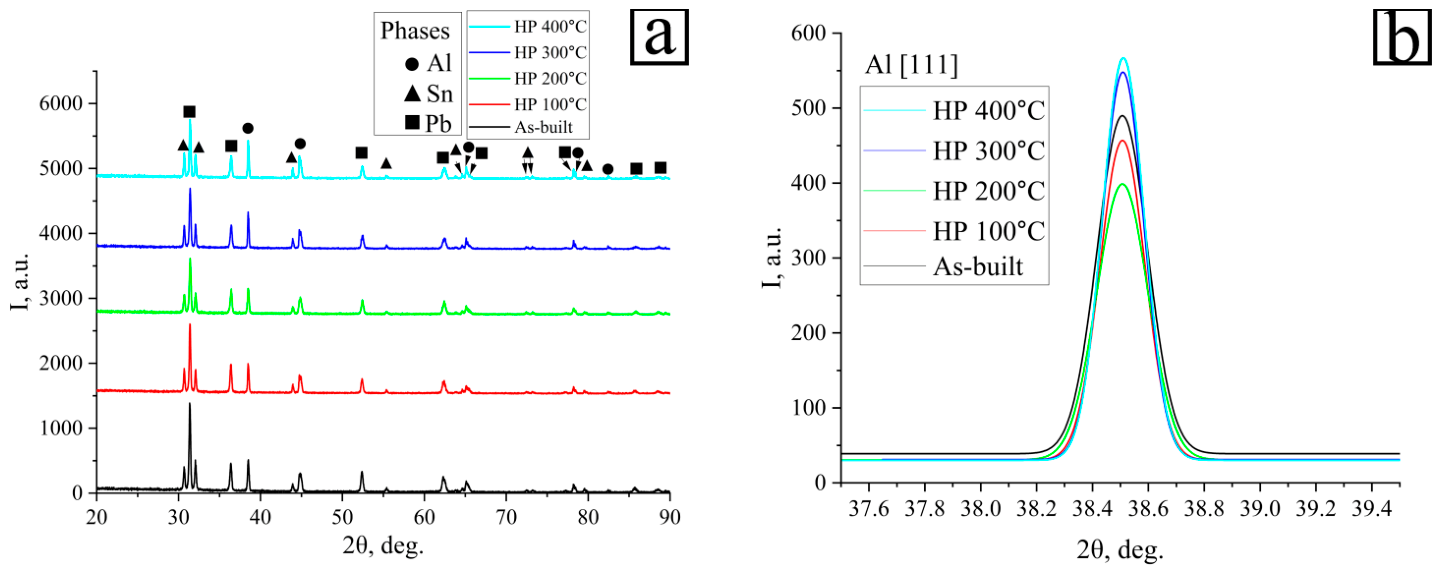
Diffraction patterns confirm the preservation of Al, Sn, and Pb phases throughout the investigated HP temperature range (100–400 °C) (
Figure 1).
Reflections corresponding to the aluminum matrix with a face-centered cubic (FCC) lattice, tin with a tetragonal lattice, and lead with a face-centered cubic lattice are clearly identified on the diffractograms. The aluminum lattice parameter, calculated from the position of the (111) reflection using Bragg’s law, is 4.046 ± 0.001 Å and remains practically unchanged across the entire HP temperature range. The obtained value agrees well with the reference parameter for pure aluminum (a = 4.049 Å, PDF no. 00-004-0787), with the difference within the measurement error. This indicates the absence of significant supersaturation of the aluminum matrix with alloying elements after the LPBF process.
Full width and half maximum (FWHM) analysis shows a trend toward narrowing with increasing HP temperature. Specifically, for the Al (200) reflection, the FWHM value monotonically decreases from 0.390° in the as-built state after LPBF to 0.333° after hot pressing at 400 °C. This narrowing of diffraction maxima indicates the relaxation of residual thermal microstresses accumulated during rapid cooling in laser melting and the initiation of recovery processes in the aluminum matrix [
15].
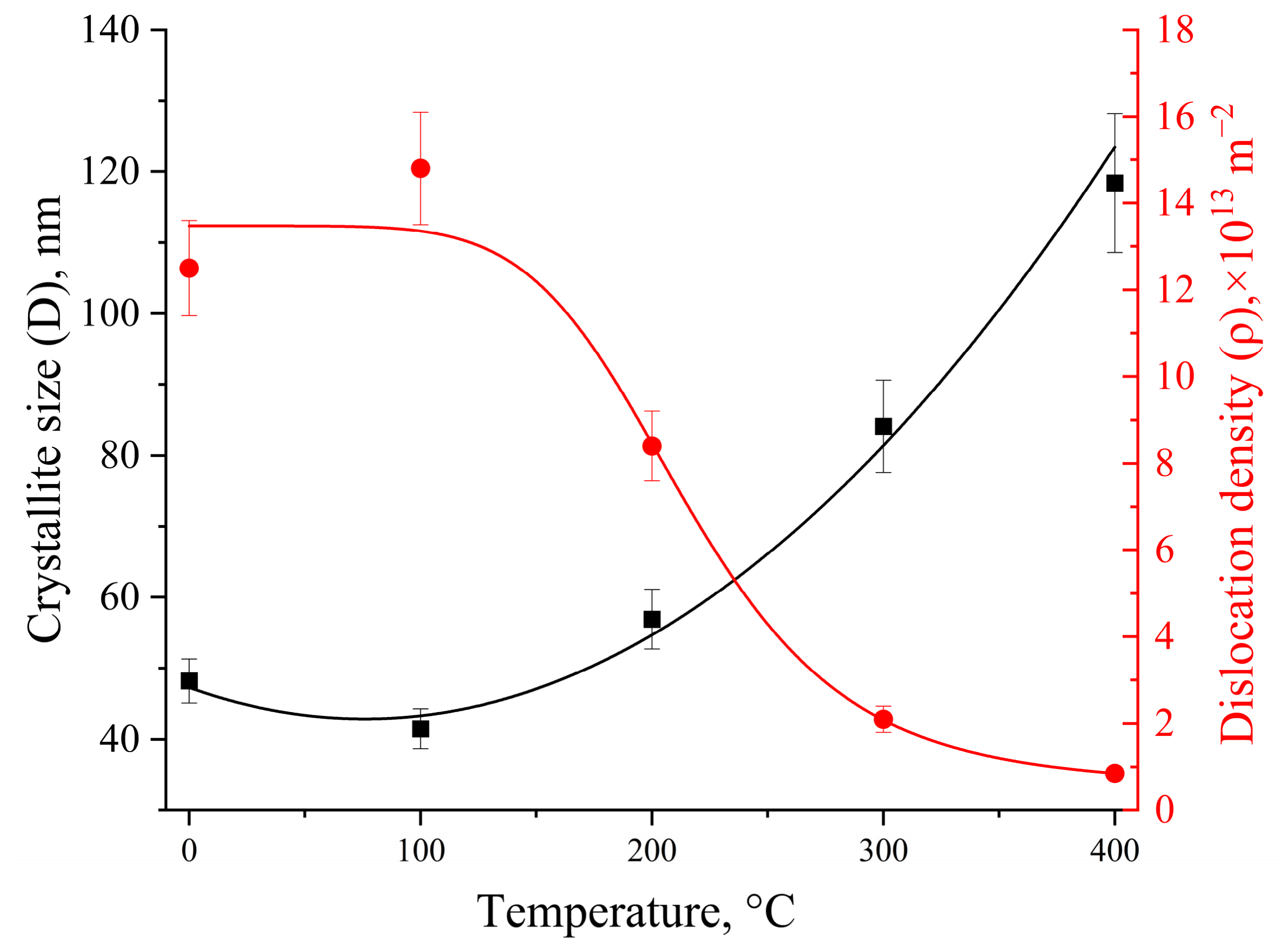
To track the microstructural parameters directly governing the mechanical behavior, the evolution of both the average coherent scattering regions size (D) and dislocation density (rho) of the Al matrix was quantified using the Williamson–Hall equation. The resulting comprehensive substructural trends are visualized in
Figure 2.
As-built LPBF specimens exhibit a high initial dislocation density (~12.5 × 10¹³ m−2) coupled with a highly refined crystallite size (48.2 nm), which is a direct consequence of the rapid solidification rates and severe residual thermal stresses inherent to laser additive manufacturing. Thermomechanical processing at 100 °C under an applied pressure of 300 MPa leads to a noticeable refinement of the crystallite domains to 41.5 nm, accompanied by an increase in dislocation density to ~15 × 1013 m−2. This variation indicates that severe deformation and strain hardening dominate within the Al matrix at this stage, because at 100 °C, thermal recovery processes cannot yet exert influence. At 200 °C, the dislocation density drops to 8.4 × 10¹³ m−2, while the crystallite size increases to 56.9 nm. This trend demonstrates the onset of dynamic recovery and partial stress relaxation within the aluminum lattice. However, because the dislocation framework does not collapse completely, the matrix retains a robust substructural strengthening effect. When the temperature crosses the melting point of the Sn-Pb eutectic (183 °C), the liquid phase starts to act as a “healing fluid” to close the defect-driven LPBF pores under the 300 MPa pressure. Further heating to 300 °C and 400 °C triggers a decrease in the dislocation density down to 2.1 × 10¹³ m−2 and 0.85 × 10¹³ m−2, respectively, while the crystallite domains undergo rapid thermal growth up to 118.4 nm. This indicates that complete thermal relaxation and recrystallization take place at these elevated temperatures.
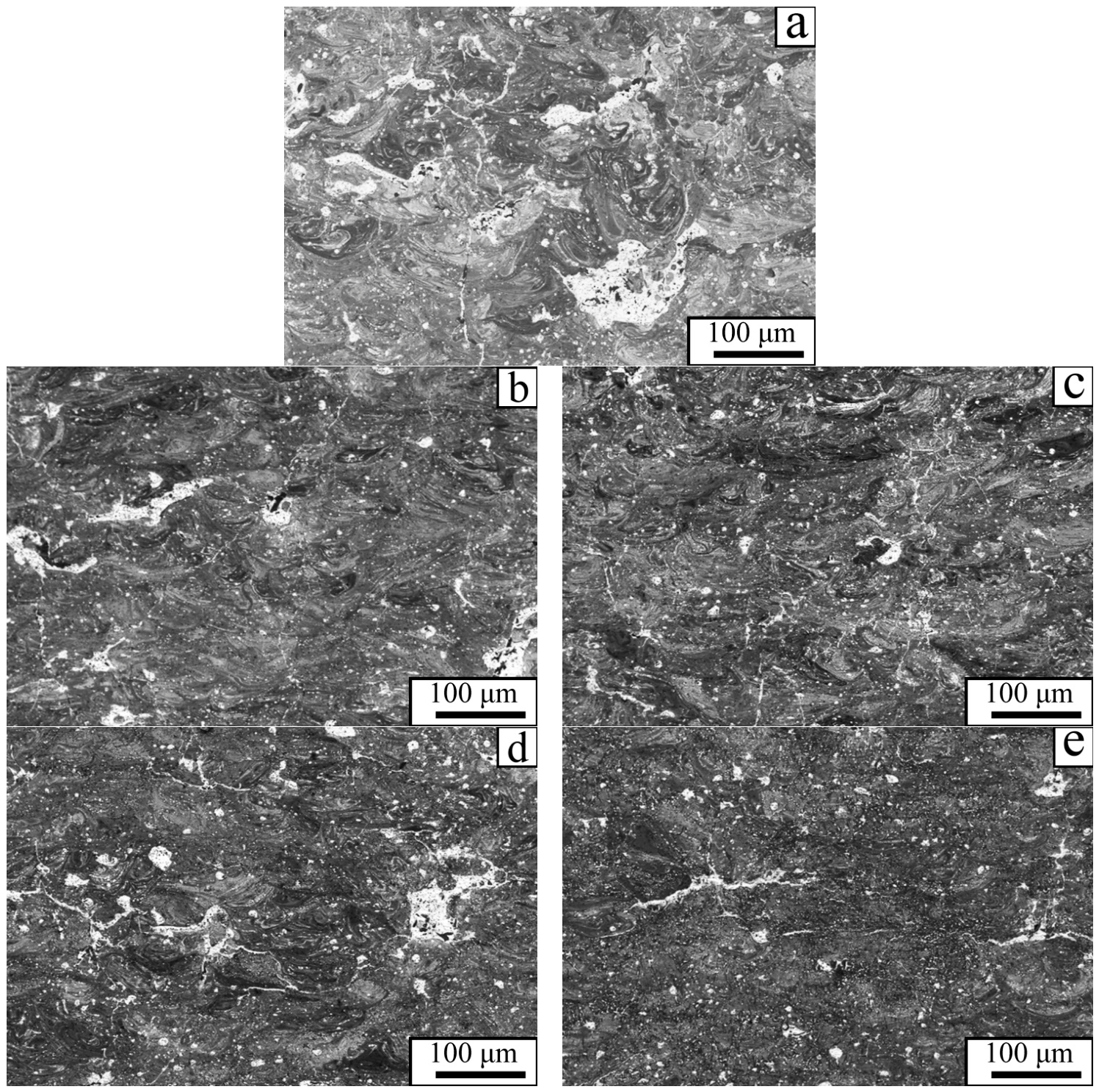
The microstructure of Al-10Sn-10Pb samples in the as-built state after LPBF is characterized by residual porosity of about 0.4%, represented as cracks and pores of various shapes (
Figure 3).
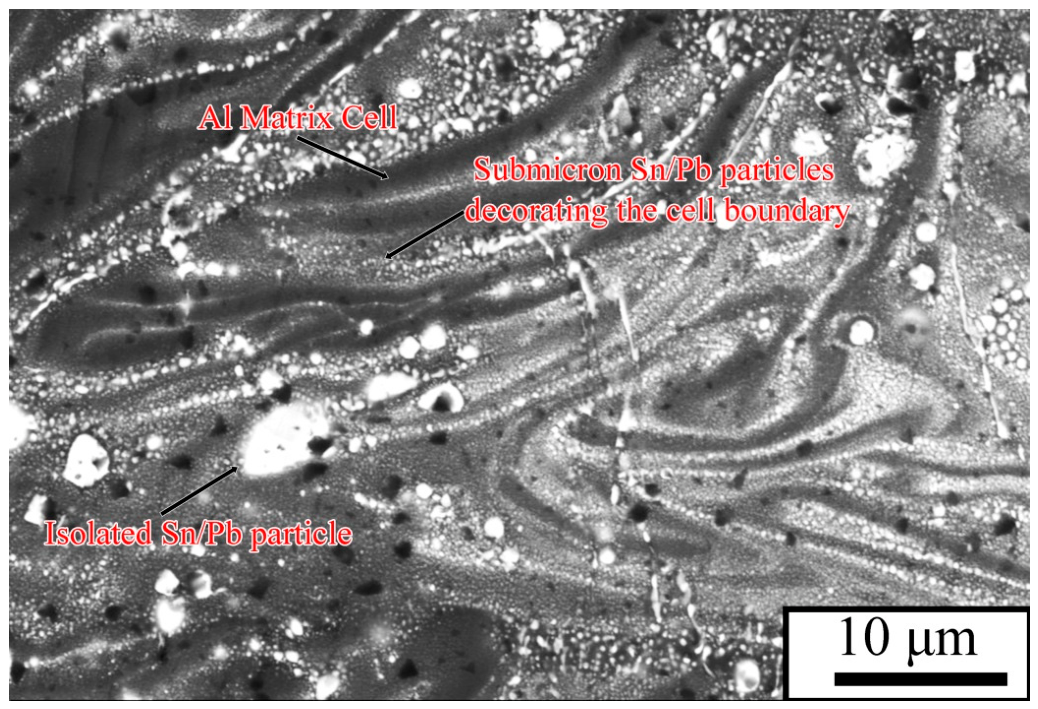
In backscattered electron (BSD) mode micrographs, characteristic features of the structure formed during LPBF are clearly visible. Instead of strict track geometry and ordered melt pools, complex arc-shaped and vortex patterns are observed, corresponding to overlapping melt pools. The observed “scale-like” patterns represent the boundaries of overlapping melt pools, while the internal distribution of alloying elements exhibits complex vortex-like structures driven by intense Marangoni convection [
5]. During rapid crystallization, heavier and lower-melting elements (Sn and Pb, which have a bright contrast in BSD mode) are pushed toward the boundaries of crystallizing cells. As a result, a characteristic hierarchical structure is formed: the smallest particles of submicron size (<1 μm) form a continuous network at the boundaries of crystallized cells within the melt pools. Larger isolated particles (2–10 μm) are distributed within the aluminum matrix volume. At ×5000 magnification, it is visible that submicron Sn/Pb inclusions have a predominantly spheroidal shape and decorate the boundaries of the cellular elements of the aluminum matrix (
Figure 4).
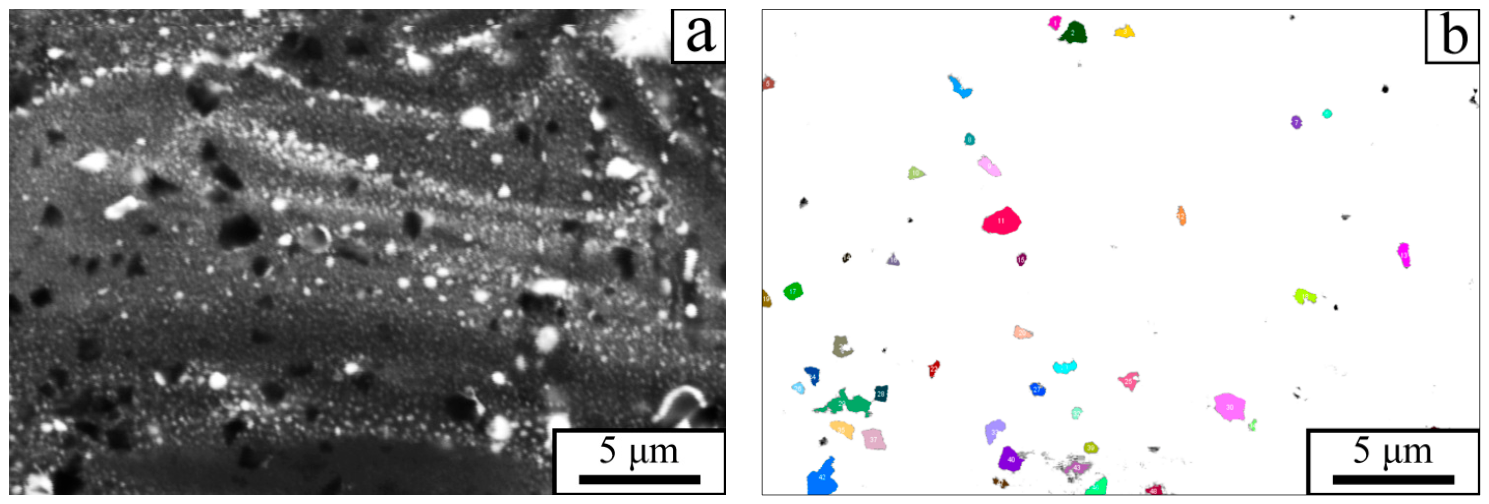
Detailed analysis of the metallographic specimens revealed a specific feature: pores characteristic of the as-built state after LPBF are virtually absent. Instead, angular defects of 1–2 μm in size are observed on the specimen surface, corresponding to the grit of the diamond paste used for final polishing (
Figure 5a). The use of morphological filters (Circularity = 0.6, Aspect Ratio = 1.66, Solidity = 0.82) combined with the independence of the distribution of these objects from the processing regime allowed them to be classified as diamond particle imprints in the soft phases (Sn, Pb) rather than pores (
Figure 5b).
The absence of real pores in the hot-pressed samples indicates near-full consolidation of the material as a result of HP at 200–300 °C. This is achieved due to the plastic flow of the material under an external pressure of 300 MPa at temperatures sufficient for viscoplastic flow of the aluminum matrix (T > 0.4 T
melt, for Al = 660 °C) for effective pore closure and diffusion bonding of the walls. Increasing the processing temperature above 200 °C led to the coarsening of Sn and Pb inclusions and the appearance of pure aluminum regions (
Figure 3). This phenomenon is associated with the increased mobility of Sn and Pb at temperatures above the eutectic (183 °C) and their active agglomeration. Disintegration of the connected Sn network formed during LPBF was also observed. EDS analysis showed that the initial content of alloy elements remains unchanged in all investigated HP states.
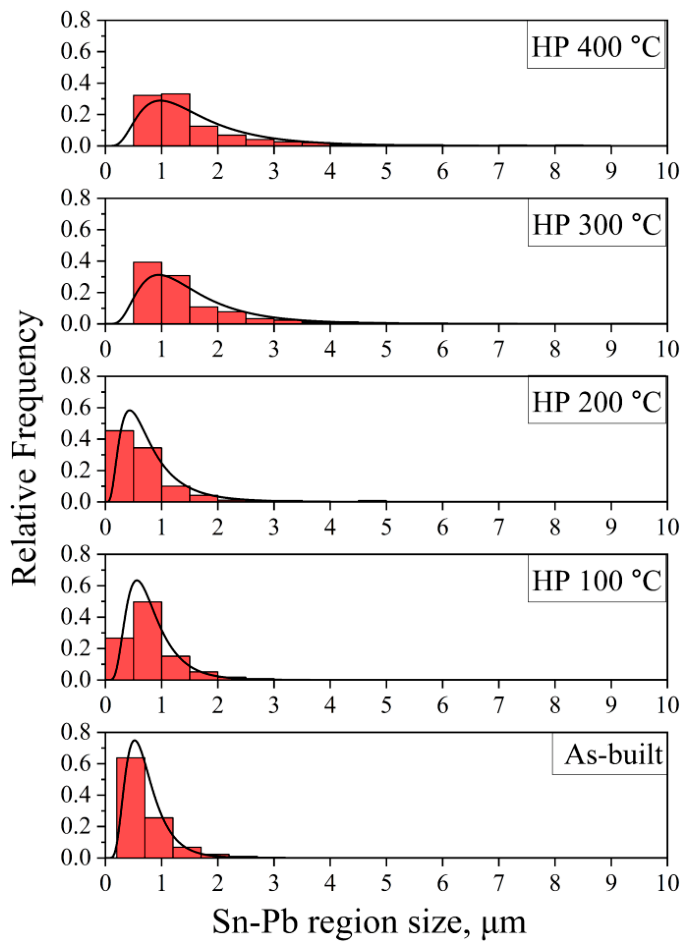
Figure 6 illustrates the evolution of the Sn–Pb secondary phase region size distribution as a function of the HP temperature.
Statistical analysis of the mean Feret diameter (dFeret) reveals a distinct non-linear coarsening behavior. In the as-built state and after low-temperature HP at 100 °C, the alloy maintains a highly refined structure with a mean dFeret of 0.723 μm and 0.818 μm, respectively. Interestingly, although the hot-pressing temperature of 200 °C exceeds the thermodynamic melting point of the Sn–Pb eutectic (183 °C), the mean region size exhibits only a marginal increase to 0.876 μm. This strong resistance to dynamic coarsening in the presence of a liquid phase is likely related to capillary confinement effects. Due to the highly refined, sub-micron cellular architecture inherited from the LPBF process, the local capillary pressure may act as a potential barrier that restricts the migration and free coalescence of the molten Sn–Pb phase within the nano-sized intercellular pockets. Furthermore, at a relatively low overheating level extended just 17 °C above the eutectic line, the 30 min holding time appears to be insufficient to trigger long-range diffusional growth under the high dislocation density induced by the concurrent 300 MPa compressive loading. A sharp structural transition is observed as the HP temperature shifts to 300 °C and 400 °C, where the mean dFeret jumps dynamically to 1.726 μm and 1.811 μm, respectively. This evolution is accompanied by a pronounced flattening of the distribution profiles and the appearance of an extended ‘tail’ reaching up to 4–5 μm. This statistical shift provides quantitative evidence of accelerated diffusion-driven coalescence and liquid-phase migration along the Al matrix grain boundaries once the processing temperature is high enough (300–400 °C) to trigger matrix recrystallization and overcome capillary barriers.
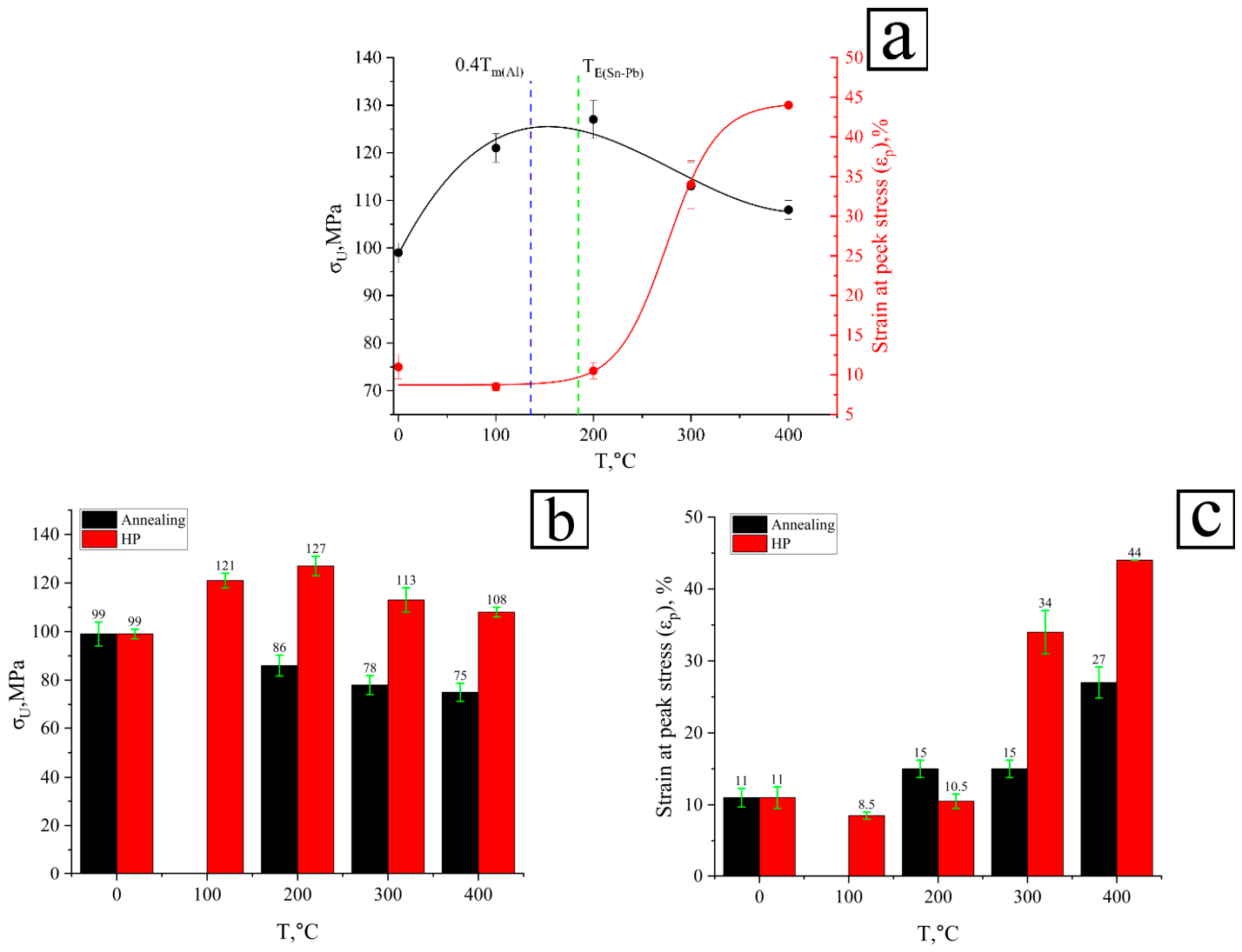
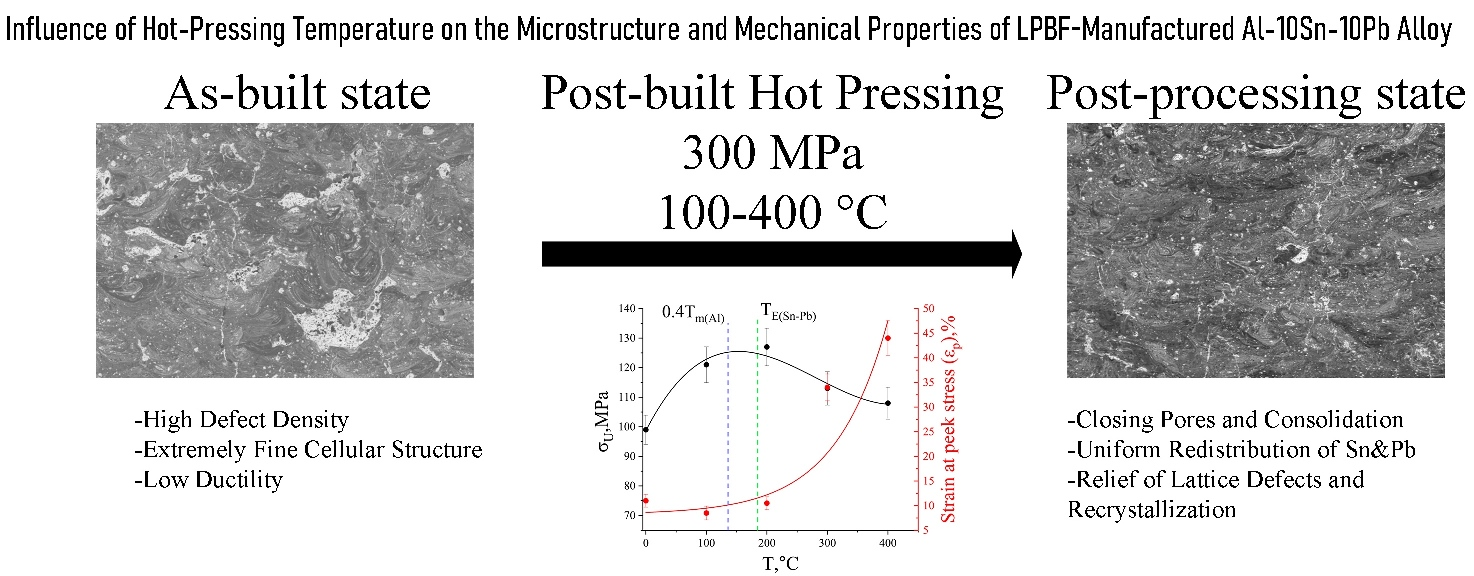
Compression test results demonstrate a significant influence of HP temperature on the mechanical characteristics of the Al-10Sn-10Pb alloy (
Figure 7).
The as-built state after LPBF is characterized by a relatively low ultimate strength (99 MPa), which is explained by residual pores serving as stress concentrators and initiating premature failure. The strain corresponding to the peak stress was chosen as the ductility criterion, above which softening processes begin to prevail over strain hardening, leading to a decrease in flow stress. It was found that at an HP temperature of 100 °C, a decrease in ductility (~9%) compared to the as-built state (11%) is observed. This effect is explained by the dominance of the strain hardening mechanism over recovery processes. The plastic deformation required for pore closure creates additional dislocations, and the temperature is insufficient for their annihilation and dynamic recrystallization [
16,
22]. It is known that the onset temperature of recrystallization for aluminum alloys is ~0.4 T
melt; for aluminum (T
melt = 660 °C), this corresponds to 137 °C [
23]. At HP 100 °C (0.37 T
melt), recovery processes are suppressed, and hardening from plastic deformation during pore closure dominates over stress relaxation. Consequently, as a result of strain hardening and reduced porosity, a 22% increase in ultimate strength (up to 121 MPa) is observed.
Increasing the HP temperature to 200 °C returns the ductility to the initial level (11%), while strength further increases to 127 MPa. The increase in strength with simultaneous ductility recovery is due to the fact that the intensity of the initiated dynamic crystallization processes, attributed to strain hardening dominating over recovery processes. The peak of strength achieved at a hot-pressing temperature of 200 °C is governed by a kinetic interplay between strain hardening, dynamic recovery, and microstructural confinement. Processing at a lower temperature of 100 °C induces severe plastic deformation under the 300 MPa load, resulting in a high dislocation density and pronounced strain hardening. However, the lack of thermal activation leaves the Al matrix highly strained and brittle. At 200 °C, the thermal energy becomes sufficient to trigger dynamic recovery, promoting partial dislocation annihilation. Concurrently, because this temperature is far below the active recrystallization range of the Al matrix, the alloy successfully retains a substantial portion of its substructural and dislocation strengthening. This matrix behavior is further reinforced by the fact that the low-melting Sn–Pb phases remain strictly sub-micron (dFeret = 0.876 μm) due to capillary confinement, preventing intergranular embrittlement.
Further growth to 300–400 °C leads to a significant increase in alloy ductility to 34–44%, while the ultimate strength decreases to 113–108 MPa. The 10–15% decrease in strength and a 3–4-fold increase in ductility are associated with active recrystallization processes leading to coarsening of the structural components, as well as the disintegration of the thin connected tin network, which contributes to deformation localization during loading. Analysis of the HP pressure influence showed that strength increases up to 300 MPa (σU increases from 115 MPa to 127 MPa). Further increasing the pressure to 400 MPa practically does not affect the ultimate strength (127–124 MPa). Therefore, further pressure increase is not advisable.
The results of statistical analysis showed that for the hot-pressed (HP) specimens, the processing temperature was confirmed to exert a significant effect on both the ultimate compressive strength (F = 80.20, p < 0.0001) and ductility (F = 47.28, p < 0.0001). Tukey’s test mathematically validated the reality of the ultimate compressive strength peak at 200 °C, showing a statistically significant strength increment of +6.0 MPa (p = 0.0421) compared to the 100 °C condition. Conversely, the results for the specimens processed by annealing demonstrated a different trend with lower overall significance for strength (F = 13.69, p = 0.0016) and ductility (F = 10.22, p = 0.0041). Crucially, the strength variation between the as-built and 200 °C annealed states was found to be statistically non-significant (p = 0.0598, Sig = 0). This quantitative plateau proves that the microstructural changes occurring during hot pressing at 200 °C and the resulting strength peak are mostly driven by the pressure-assisted pore closure rather than purely thermal relaxation of the matrix.
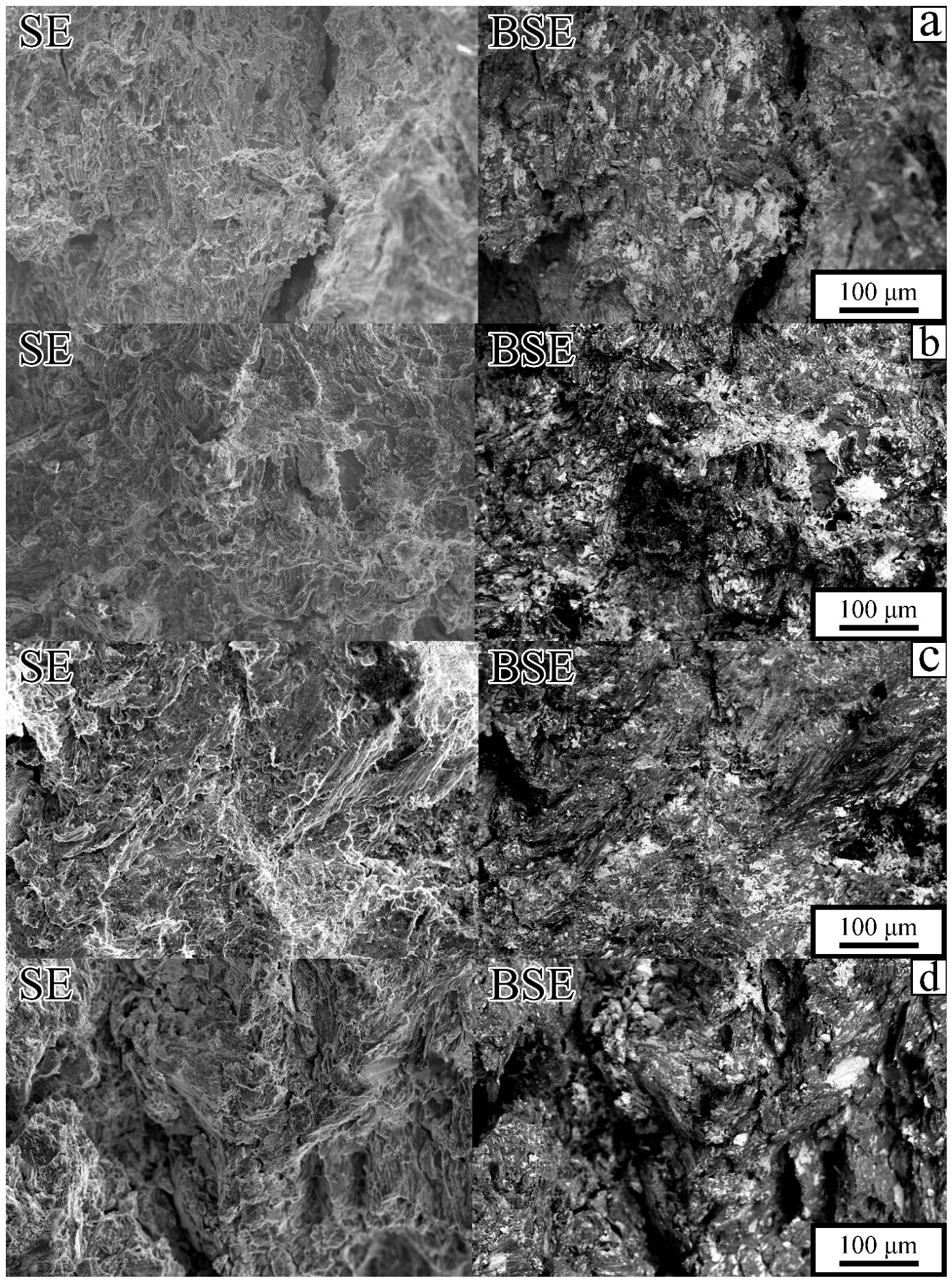
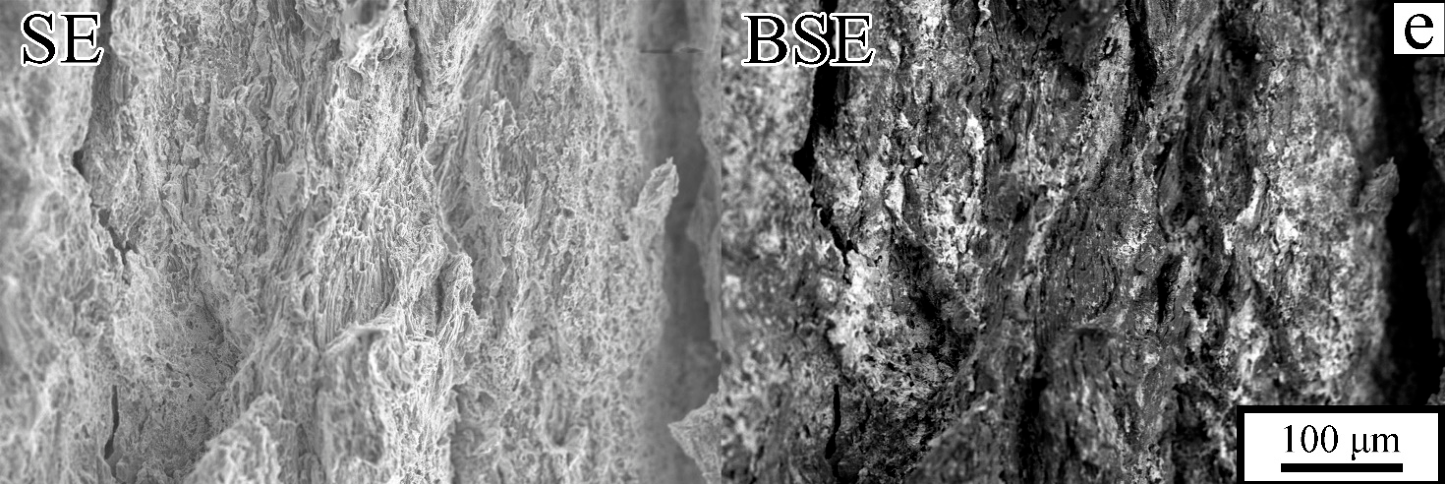
Fracture surface analysis revealed an evolution of fracture mechanisms depending on the HP temperature (
Figure 8).
In the case of the as-built material after LPBF, a dominant failure mechanism cannot be identified; it is mixed. Predominantly brittle interlayer delamination along weakened LPBF inter-track boundaries occurs, along with local quasi-brittle fracture near keyhole pores. A small number of plastic dimples are present on the fracture surface, where liquid tin and lead formed ductile interlayers between aluminum dendrites during solidification.
At an HP temperature of 100 °C, the overall fracture morphology is preserved and characterized by a quasi-brittle inter-particle fracture (
Figure 8b). The fracture surface demonstrates a blocky relief with large cleavage facets. Significant waviness of the fracture surface with height differences is characteristic, associated with crack propagation along tortuous paths. Local dimples are rare, indicating a minimal plastic component [
24,
25].
Increasing the HP temperature to 200 °C leads to a noticeable change in fracture morphology (
Figure 8c). The fracture surface becomes more isotropic and less blocky compared to the as-built and 100 °C HP samples. Large pores and cracks characteristic of weak inter-particle bonding become rarer, though individual large defects are still present. A mixed fracture type is still observed: cleavage areas coexist with dimple fracture fields. A characteristic feature is the presence of flat facets with angular outlines against the background of curved ductile zones: such a mixed relief is typical for a transition fracture regime where the Al matrix partially activates plastic deformation mechanisms, while incompletely consolidated inter-particle zones still fail brittle [
24,
25].
At an HP temperature of 300 °C, signs of significant plastic deformation are visible: the surface has a “torn”, rough character with numerous ridges and matrix petals (
Figure 8d). The fracture demonstrates a mixed dimple-quasi-brittle relief. Dimples are larger than at 200 °C with shallower walls, which is typical for failure at elevated temperatures and reduced yield strength. At 300 °C, the low-melting components are in a liquid state and redistribute along grain boundaries, forming characteristic light streaks and droplets. The presence of large, partially coalesced bright aggregates on the BSD image indicates the expulsion of soft phases from the matrix during deformation. Individual straight cracks passing along grain boundaries indicate the initiation of intergranular fracture components induced by the liquid phase, marking the onset of liquid-mediated grain boundary penetration and weakening [
25,
26].
At 400 °C HP, the fracture mode transitions to a predominantly intergranular character. The crack faces appear relatively smooth, which is a characteristic feature of a fracture path following grain boundaries that were extensively wetted by liquid Sn and Pb phases during the hot-pressing process. Although the mechanical tests were performed at room temperature, the redistribution of low-melting components into thin intergranular films at 400 °C creates pre-existing weakened zones [
27]. Upon cooling, these phases solidify as soft, continuous layers that promote intergranular decohesion under loading. This explains the observed decrease in strength (~108 MPa) compared to the 200 °C state, while the high ductility (ε ≈ 46%) is attributed to the soft nature of these intergranular layers and active recrystallization of the Al matrix. Thus, 400 °C pushes the alloy beyond the optimal processing range due to severe liquid-phase grain boundary wetting.
It is worth noting that while the established hot-pressing windows (200–300 °C) effectively eliminate processing porosity and optimize the Al matrix substructure, the current stage of research is limited to a single compressive loading mode. To fully validate these LPBF Al-Sn-Pb composites for heavy-duty industrial applications, expanding the testing program to include a wider range of mechanical and service-oriented performance evaluations represents the necessary next step of this research.



 ,
,