Article

Dual Beam Laser Welding of Superduplex Stainless Steel: Microstructure, Mechanical Properties, and Electrochemical Behavior


1
Institute of Materials and Machine Mechanics, Slovak Academy of Sciences (IMSAS), Dúbravská Cesta 9, 845 13 Bratislava, Slovakia
2
Faculty of Mechanical Engineering, Slovak University of Technology, Námestie Slobody 2910/17, 812 31 Bratislava, Slovakia
3
Departamento de Corrosión y Protección, Centro Nacional de Investigaciones Metalúrgicas (CENIM/CSIC), Avenida Gregorio del Amo 8, E-28040 Madrid, Spain
*
Author to whom correspondence should be addressed.
J. Manuf. Mater. Process. 2026, 10(5), 181; https://doi.org/10.3390/jmmp10050181
Submission received: 21 April 2026 / Revised: 14 May 2026 / Accepted: 18 May 2026 / Published: 21 May 2026

Abstract

Dual beam laser welding of UNS S32750 superduplex stainless steel was performed to investigate the effect of beam-power distribution on microstructure and mechanical properties. Plates with a thickness of 3 mm were welded at a constant total power and travel speed using leading and lagging power splits of 50:50, 80:20, and 65:35. The heat affected zone width was metallographically estimated at approximately 100 µm for all conditions, consistent with comparable gross thermal exposure under constant nominal linear energy input (Ptotal/v). A slight modification to the power distribution altered the solidification texture and austenite morphology. The 50:50 configuration produced a refined ferritic matrix with a continuous network of grain boundaries, Widmanstätten, and intragranular acicular austenite. The 80:20 condition increased ferrite path continuity, while the 65:35 split produced an intermediate morphology. Vickers hardness reached a maximum for the 80:20 split (HAZ: 345 HV; weld metal: 349 HV). Ultimate tensile strength remained statistically constant between 908 MPa and 914 MPa, whereas elongation decreased from 28% at 50:50 to 24% at 80:20 and 23% at 65:35. All welds exhibited ductile fracture with microvoid coalescence, and electrochemical performance was comparable, with critical pitting temperature values between 78 °C and 91 °C. Beam power distribution primarily affects solidification morphology and enables control of the hardness-to-ductility balance, with a 50:50 split providing the most favorable combination of properties.

1. Introduction

Superduplex stainless steels (SDSS), such as UNS S32750, are widely used in offshore, marine, desalination, and chemical-processing applications because they combine high strength with excellent resistance to localized corrosion in chloride-containing environments. These properties arise from their duplex microstructure, consisting of ferrite (δ) and austenite (γ), together with high Cr, Mo, and N contents. During welding, however, the phase balance and phase morphology can be significantly altered. Rapid thermal cycles, particularly in laser-based processes, may suppress austenite re-formation and produce ferrite-rich weld metal, whereas excessive heat input or slow cooling may promote intermetallic precipitation, such as sigma (σ) and chi (χ) phases. Both effects can reduce toughness, ductility, and corrosion resistance. Therefore, controlling the welding thermal cycle and the resulting phase topology is essential for maintaining the performance of SDSS welded joints [1,2,3,4,5].
Conventional welding processes, including TIG, GMAW, SAW, and hybrid techniques, can produce acceptable SDSS joints when heat input, shielding conditions, and cooling rates are properly controlled [6,7,8,9,10]. In these processes, austenite can reform during cooling as grain-boundary austenite, Widmanstätten austenite, and intragranular austenite, which strongly influence toughness and ductility [11,12,13,14,15,16]. Laser beam welding offers high precision, low distortion, and deep penetration, but its high cooling rate can restrict austenite regeneration and lead to ferrite-enriched weld metal [4,17,18]. Thus, strategies that improve thermal control while preserving the advantages of laser welding are of practical interest.
Dual-beam laser welding (DBLW) provides an additional process-control variable by distributing the total laser power between leading and lagging beams. Unlike single-beam laser welding, DBLW can modify the spatial energy distribution within the weld pool without necessarily changing the nominal linear heat input. Beam-power partitioning can influence weld-pool geometry, keyhole stability, heat-flow directionality, solidification front evolution, phase connectivity, and crystallographic texture. Previous studies have shown that coordinated dual-beam arrangements can improve weld-pool stability, reduce defects, and modify fusion-zone geometry in steels and dissimilar joints [19,20,21,22,23]. However, the relationship between lead/lag power distribution, phase topology, mechanical behavior, and corrosion performance in UNS S32750 SDSS remains insufficiently clarified.
Although laser welding of superduplex stainless steels has been widely investigated, the specific effect of dual-beam spatial energy distribution on phase connectivity, solidification texture, mechanical response, and electrochemical behavior remains insufficiently clarified. In particular, it is not yet well understood whether changing the lead/lag beam-power partitioning at constant nominal linear heat input can be used as an independent processing variable to tailor the hardness–ductility balance without compromising corrosion resistance. This scientific gap defines the main problem addressed in the present work.
In this study, dual-beam laser power partitioning is investigated as a practical processing parameter for tailoring the weld performance of UNS S32750 superduplex stainless steel under constant nominal linear energy input. Three lead/lag power splits, 50:50, 80:20, and 65:35, are compared to determine how spatial energy distribution affects weld geometry, microstructure, phase morphology, hardness, tensile behavior, and electrochemical response. Particular attention is given to the relationship between austenite connectivity, ferrite continuity, ductility, and passivity. The results clarify how beam-power distribution can be used as a microstructural tuning parameter to adjust the hardness–ductility balance while maintaining comparable overall tensile strength and corrosion resistance under the tested conditions.

2. Materials and Methods

UNS S32750 super duplex stainless steel was selected for its outstanding combination of strength, ductility, and corrosion resistance, properties that critically depend on maintaining its solution-annealed 50:50 ferrite-to-austenite microstructure. The chemical composition was measured using an optical emission spectrometry (OES) analyzer, (SPECTROMAXx LMX06; SPECTRO Analytical Instruments GmbH, Kleve, Germany) summarized in Table 1. Table 2 shows mechanical properties from the UNS S32750 standard. The required standard ranges originally shown in Table 2 have been replaced by the mechanical properties reported in the material certificate of the UNS S32750 sheet used in this study.
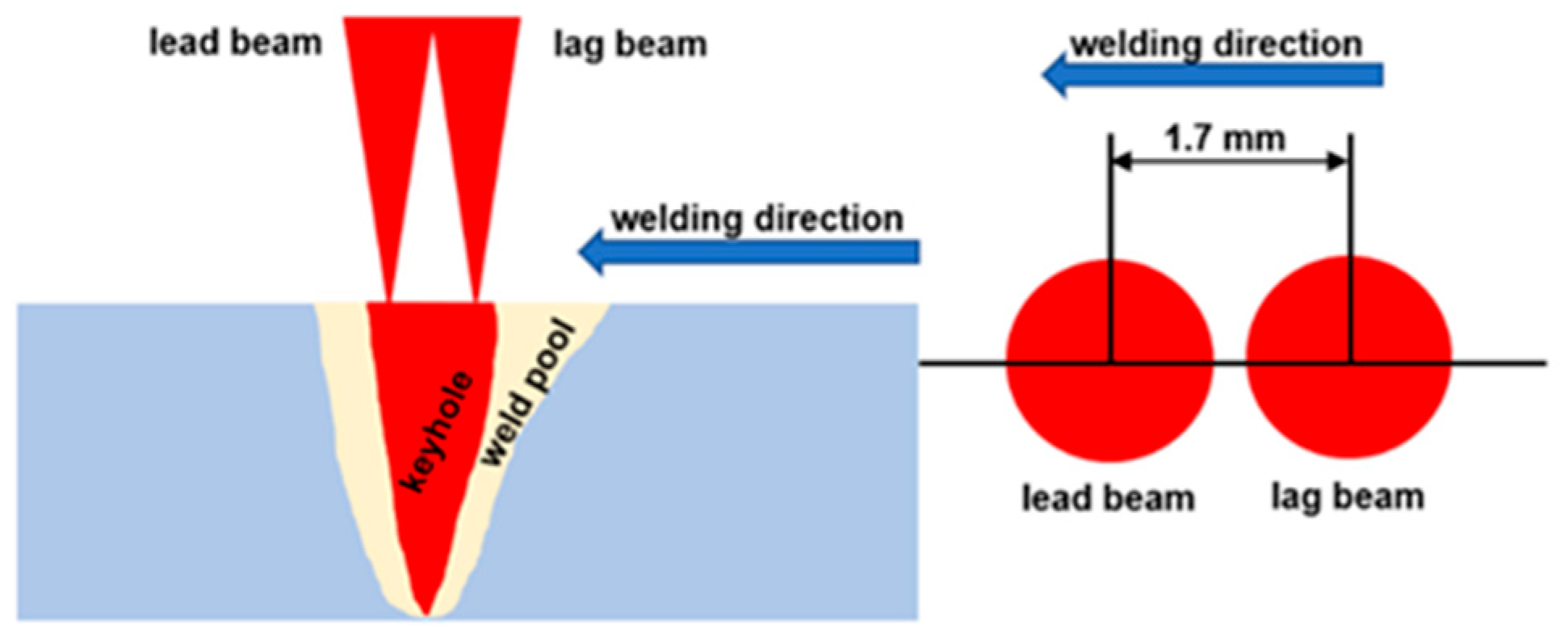
Welded butt joints of UNS S32750 were prepared from commercially available, hot-rolled sheets (100 mm × 100 mm × 3 mm) supplied by Outokumpu. Dual-beam laser welding (DBLW) was performed using a 5 kW continuous-wave ytterbium fiber laser (λ = 1.06 μm, YLS-5000; IPG Photonics, Oxford, MA, USA) equipped with a laser head (YW52; Precitec GmbH, Gaggenau, Germany) featuring a 200 mm collimation lens and a 150 mm focusing lens. A twin spot module enabled precise splitting of the laser beam into a tandem arrangement with a 1.7 mm separation, allowing controlled nominal linear energy input (Figure 1). Laser power, welding speed, shielding gas flow, and beam focus were held constant, while the beam-power distribution ratio was varied (50:50, 80:20, and 65:35) to systematically investigate its effect on weld microstructure and properties. The processing parameters were selected to isolate the effect of dual-beam-power partitioning while keeping the nominal linear energy input constant. Total laser power, welding speed, shielding gas flow, and focus position were therefore maintained unchanged for all welds. The 50:50 ratio was selected as the balanced reference condition, the 65:35 ratio as an intermediate asymmetric condition, and the 80:20 ratio as a strongly asymmetric condition. This parameter range was chosen to evaluate whether progressive deviation from equal lead/lag power sharing modifies weld-pool geometry, solidification morphology, phase connectivity, and the resulting mechanical and electrochemical properties. Welding parameters are summarized in Table 3, and high-purity nitrogen (5.0) was used as the shielding gas. Shielding gas flow was kept constant at 30 L/min for all welding conditions to maintain consistent shielding and comparability between power-partitioning trials. In addition, root-side backing (purge) shielding was applied using nitrogen (same as the shielding gas) at a constant flow rate of 15 L·min−1 for all experiments. No additional experiments with varied flow rates were performed because the study was designed to isolate the influence of dual-beam-power partitioning under fixed boundary conditions.
Linear heat input was kept constant across all power distributions by maintaining constant total laser power,
P t o t a l = P l e a d + P l a g
H = η   P t o t a l v
In Equation (1), Ptotal represents the total laser power, while Plead and Plag correspond to the power of the leading and lagging laser beams, respectively. In Equation (2), H′ denotes the nominal linear heat input, η is the process efficiency, Ptotal is the total laser power, and v is the welding speed.
No in situ thermal measurements were performed; therefore, the temperature field and its gradients are not reported and are discussed only inferentially based on weld geometry and microstructural indicators. Because no in situ thermal measurements were performed, the observed microstructural differences cannot be attributed uniquely to cooling-rate variations. They are interpreted more broadly as the result of changes in the local solidification environment caused by beam-power partitioning, including melt-pool geometry, heat-flow directionality, fluid flow, and possible variations in solidification front velocity.
The heat input values reported in Table 3 correspond to the nominal linear energy input, calculated as Ptotal/v, without correction for experimentally measured laser absorption efficiency. Therefore, η was taken as 1 for nominal comparison purposes. For Ptotal = 2 kW and v = 10 mm/s, the nominal linear energy input is 0.2 kJ/mm.
Transverse cross-sections of UNS S32750 butt joints were prepared by embedding in a conductive resin, followed by sequential grinding with abrasive papers (240–1200 grit) and polishing with diamond suspensions (9, 6, 3, and 1 μm), and finally with oxide polishing suspension (OPS, 0.04 μm). The polished specimens were etched in Beraha’s solution (30 mL HCl, 60 mL H2O, 1 g K2S2O5) for approximately 5 s. Weld geometry and macroscopic features were examined using a Carl Zeiss Axio Observer Z1m optical microscope (ZEISS, Oberkochen Germany), while microscopic features were performed with a Zeiss Sigma 560 VP-FE-SEM (ZEISS, Oberkochen Germany) equipped with an electron backscatter diffraction detector (EBSD) and all measurements were carried out with a step size of 0.4 μm and an accelerating voltage of 25 kV. Vickers microhardness (HV0.1) was mapped across the joint by placing indentations at 0.2 mm intervals along a line normal to the weld centerline, spanning the weld metal, heat-affected zone (HAZ), and base material. A test load of 100 gf (0.98 N) with a 10 s dwell was used, measured according to STN EN ISO 6507-1 using an FM 100 tester with a Future FM-ARS 9000a source. Tensile testing was performed in accordance with EN ISO 6892-1 using a Zwick/Roell Z600 testing machine (ZwickRoell, Ulm, Germany). For each set of welding parameters, five specimens were tested to evaluate the reproducibility. The percentage deviations beside each mean value indicate the spread of results, with all measured properties falling within a narrow tolerance of ±7%, confirming excellent repeatability of the welding conditions. Residual stresses were not measured because the study was designed to focus on the process–microstructure–property relationships (phase balance, morphology, mechanical response, and corrosion behavior) as a function of beam-power partitioning. In addition, for the thin plate geometry and the low overall heat input used here, distortion was minimal and comparable across conditions, so residual stress evaluation was not prioritized within the scope of the present work. Electrochemical techniques were carried out to evaluate the corrosion resistance of the welded butt joints. A Gamry Reference 600 potentiostat (Gamry, Warminster, PA, USA) and a conventional three-electrode cell consisting of a working electrode (the sample under study), an Ag/AgCl (3M KCl) reference electrode, and a counter-electrode consisting of a Pt wire were used. The area of the working electrode selected for analysis was 1 cm2. This comprised both the welding track and the surrounding area (HAZ and base metal (BM)).
After measuring the open circuit potential (OCP) for 900 s, polarization curves were done in 0.6 M NaCl and 1 M NaCl + 0.01M Na2S2O3 at room temperature.
The potential scan started at −300 mV versus OCP in the anodic direction at a scan rate of 0.167 mV/s, up to 3 V vs. Ag/AgCl (3 M KCl) or a maximum current density of 0.25 mA/cm2. After that, the reverse scan started at a scan rate of 0.167 mV/s.
Critical pitting temperature (CPT) tests in 1 M NaCl solutions were performed in duplicate because they are time-consuming and experimentally demanding under laboratory conditions. According to the test criterion used, the CPT was considered to be reached only when a current density of 100 μA/cm2 was sustained for at least 60 s. This criterion was applied to distinguish stable pitting from short-duration current transients associated with metastable pit initiation. The CPT is the lowest temperature at which pitting is observed under the studied conditions. The electrolyte temperature was increased in steps of 1 °C/min during the test. At each temperature, a constant voltage of 700 mV vs. Ag-AgCl reference electrode was applied to promote pitting initiation. The current response is recorded until a current limit of 100 μA/cm2 is exceeded.

3. Results

3.1. Cross-Section of Weld Joints

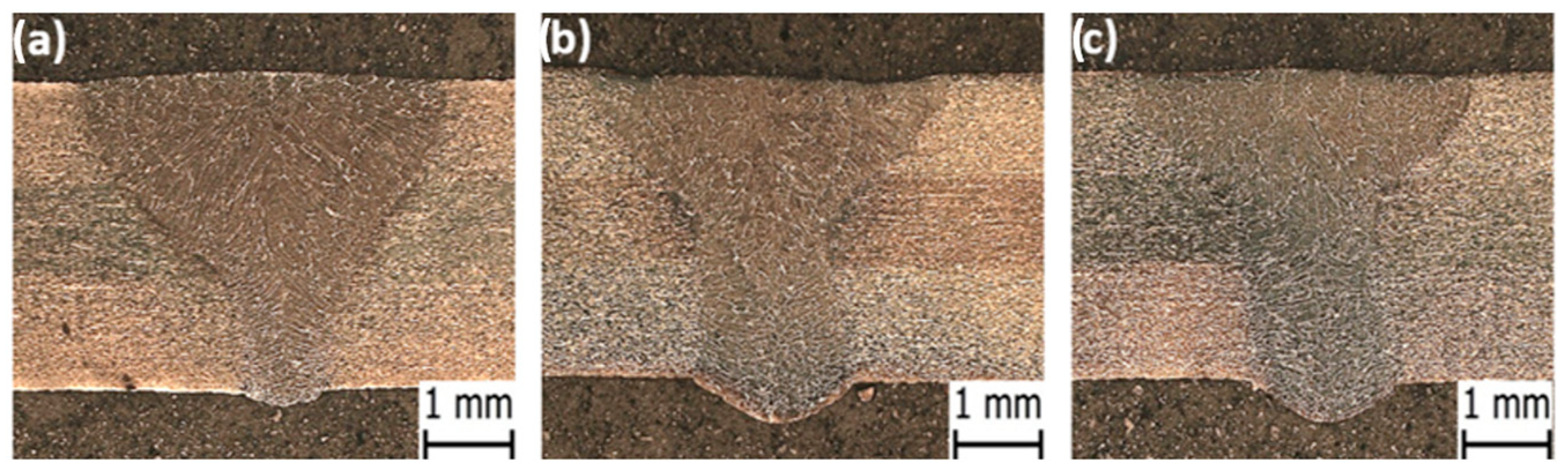
The effects of a balanced 50:50 laser beam-power distribution on weld geometry and quality were systematically examined. At this power distribution, the weld cross-section (Figure 2a–c) exhibits a teardrop-like profile with a broad bead face and a tapered bead root, a smooth fusion boundary, and no evidence of undercut, spatter, porosity, or surface cracking. The bead face width is 4.19 mm, whereas the root width is 0.85 mm (Figure 2a), yielding a face-to-root width ratio of approximately 4.9:1 and an absolute difference of 3.34 mm in Table 4. This geometry indicates lateral spreading of the melt pool with limited constriction at the root, consistent with a more uniform allocation of energy across the joint. The symmetric penetration and flatter crown are consistent with a more uniform thermal distribution during welding; however, temperature profiles and thermal gradients were not measured directly in this study. Such conditions can reduce peak thermal stresses and the likelihood of solidification cracking while maintaining continuous fusion along the joint interface [24,25].
With a beam-power distribution of 80:20, the higher-power beam (80%) dominates penetration by concentrating energy into a stable keyhole, producing a deep, relatively narrow root, whereas the lower-power beam (20%) primarily supports keyhole stability and can broaden the bead face. The combined effect yields an elliptical or hourglass-like geometry: penetration depth is governed by the high-energy beam, while bead-face width is influenced by the lower-energy beam. In this case, the bead face width is 3.97 mm, and the bead root width is 1.70 mm, corresponding to a face to root ratio of 2.34:1 and a difference of 2.27 mm (Figure 2b), which is smaller than in the balanced 50:50 condition (3.34 mm). From a process perspective, this partitioning is expected to promote more localized melting and more directional heat flow, which can increase local cooling rates at depth, while the lower power beam provides additional near-surface reheating that can moderate cooling locally. These thermal cycle effects are inferred from weld geometry and microstructure, as no in situ thermal measurements were performed. This synergy promotes continuous fusion through the thickness and reduces the likelihood of defects such as porosity or lack of fusion.
With a 65:35 beam-power distribution, the lead beam (65%) governs nominal energy delivery and melt pool size, generating a deeper molten zone at its focus, while the lag beam (35%) contributes less to penetration but modifies the pool shape and broadens the bead edges. The resulting geometry is asymmetric, typically resembling a tilted teardrop or uneven keyhole with greater penetration on the higher-power beam side and a shallower, laterally spread surface on the lower-power beam side (Figure 2c). In this case, the bead-face width is 3.78 mm, and the bead root width is 1.71 mm, corresponding to a face-to-root ratio of 2.21:1 and a difference of 2.07 mm in Table 4. These values are comparable to the 80:20 configuration (3.97 mm/1.70 mm; 2.34:1; 2.27 mm). The interaction between the two laser beams contributes significantly to melt-pool stability: the trailing (lagging) beam reheats the partially solidified region, which can locally reduce the cooling rate and thermal gradients on the trailing side [26]. This interpretation is inferential because the thermal field was not measured directly.
As a result, the process not only improves the quality and uniformity of the solidified material but may also lead to a slight increase in the width of the heat-affected zone (HAZ), potentially influencing the mechanical properties of the final component.

3.2. Microscopic Analysis of the Weld Joint

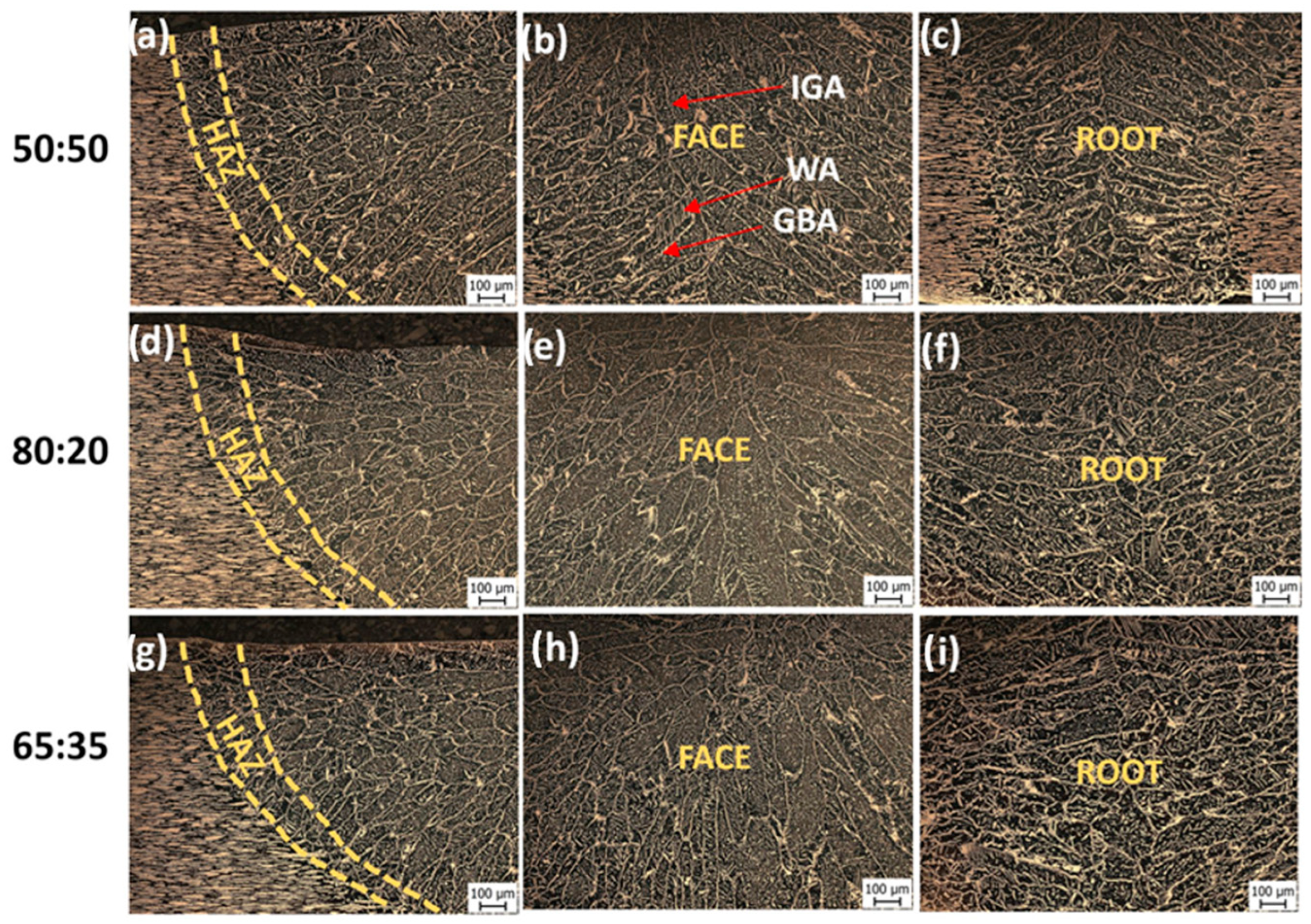
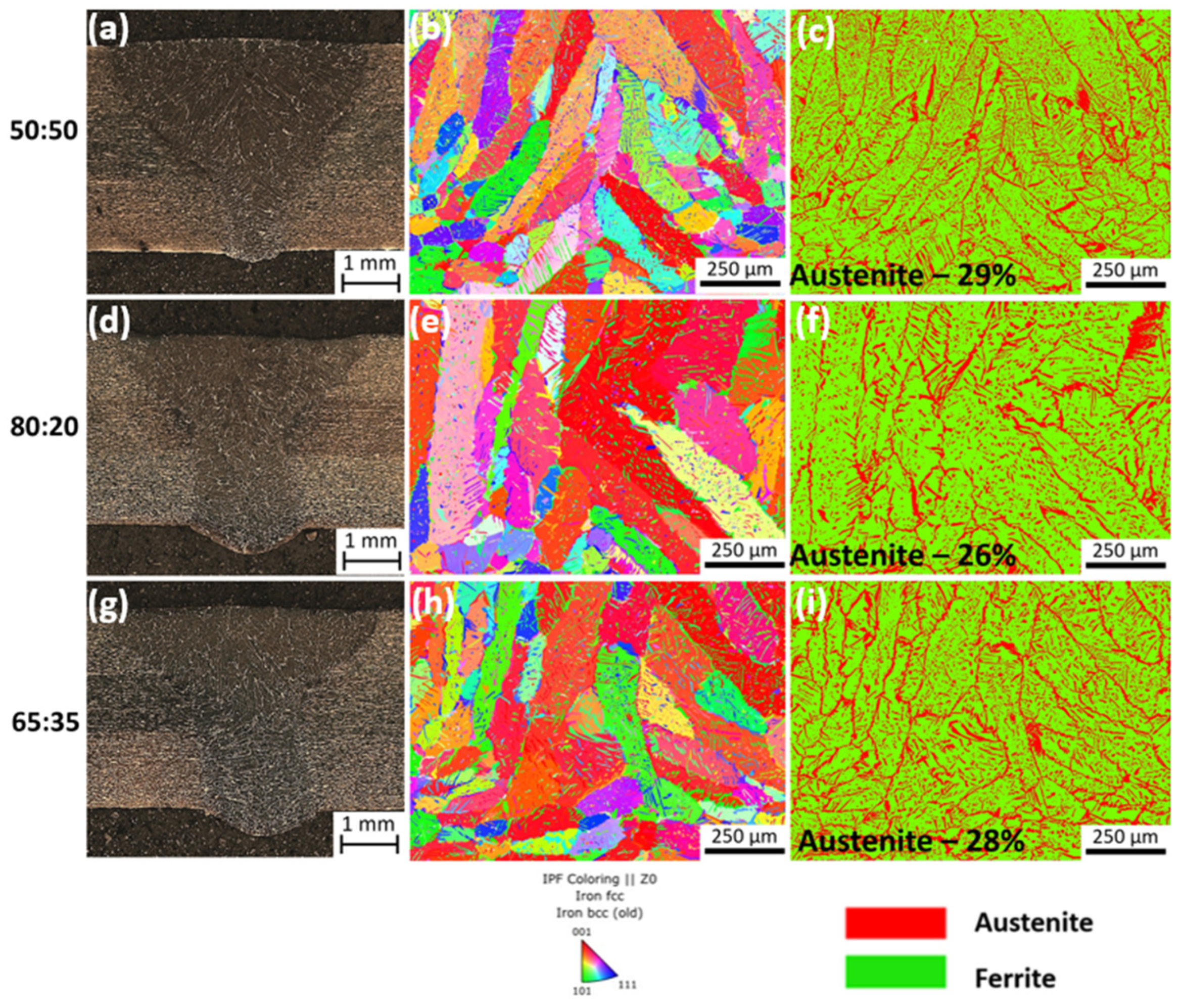
Across the three beam-power distribution ratios 50:50 (Figure 3a–c), 80:20 (Figure 3d–f), and 65:35 (Figure 3g–i) the heat-affected zone (HAZ) appears as a narrow band of 100 µm between the base metal (BM) and weld metal (WM). This is evident in Figure 3a,d,g, where the HAZ width is comparable to a single ferritic grain, so only partial grains are captured and robust sub-zoning is not apparent; the BM retains its typical duplex/lamellar appearance.
Microscopic examination of weld joints made with different beam-power distribution ratios reveals that the HAZ width remains nearly constant at approximately 100 µm across various conditions (Figure 3a,d,g); this width was estimated from optical and SEM micrographs based on the transition in etched contrast and grain morphology between the base metal and the fusion zone. Because the HAZ was very narrow and comparable to the size of individual ferritic grains, its boundaries could not be defined with complete statistical certainty; therefore, no separate quantitative HAZ phase-fraction analysis was performed, and the reported HAZ width should be regarded as an approximate microstructural estimate. At the bead face, the weld metal in Figure 3b (50:50), Figure 3e (80:20), and Figure 3h (65:35) is dominated by elongated, columnar ferritic grains aligned with the thermal gradient; austenite appears as grain-boundary austenite (GBA), Widmanstätten austenite (WA), and intragranular acicular austenite (IGA), explicitly annotated in Figure 3b. The beam-power split modulates this morphology: the 50:50 case exhibits a more continuous GBA network with a more uniform IGA population and a comparatively refined grain structure; the 80:20 case shows coarser ferrite, a discontinuous and variably thick GBA layer, and a lower apparent IGA fraction; the 65:35 case is intermediate. At the bead root (Figure 3c,f,i), a consistent columnar/dendritic morphology oriented along the maximum thermal gradient indicates epitaxial growth from the fusion boundary, with little evidence of equiaxed grains, implying low nucleation density at the solid-liquid interface.
These trends suggest consequences for performance: finer, more interlocked ferrite with higher WA/IGA fractions should enhance toughness, while coarser, strongly textured microstructures are more prone to residualstress buildup [27,28] and defect susceptibility. EBSD analysis confirmed these findings, showing lower texture intensity and misorientation in welds with higher WA/IGA fractions.

3.3. EBSD Analysis

The influence of laser beam energy distribution on crystallographic texture was analyzed using EBSD (Figure 4). Measurements were performed at mid-thickness, 1 mm from the weld surface, in the same regions previously examined by optical microscopy (Figure 4a,d,g). Phase distribution was evaluated from EBSD phase maps, where red denotes austenite and green ferrite. The highest austenite fraction (29%) was obtained with a 50:50 energy distribution, while the lowest (26%) occurred at 80:20, and at 65:35, the austenite fraction reached 28% (Figure 4c,f,i). In the 50:50 map, austenite and ferrite are homogeneously distributed, with a uniform distribution of GBA along the ferritic grain boundaries and IGA in their interior. While the 80:20 and 65:35 maps reveal a more random distribution of austenite with local clustering of GBA along grain boundaries and a non-uniform distribution of IGA within ferritic grains, leading to microstructural inhomogeneity and potential property anisotropy.
In the following measurements, Inverse Pole Figure (IPF) maps were generated to characterize the crystallographic orientation of ferritic and austenitic phases (Figure 4b,e,h). The IPF maps show that all three welds solidified into pronounced columnar grains extending from the fusion boundary toward the weld center. The microstructure consists of coarse ferritic grains, within which finely dispersed intragranular austenite is present, accompanied by thin austenitic films decorating the ferrite grain boundaries. The ferritic grains exhibit a broad distribution of orientations with no strong texture relative to the normal direction (ND). However, the IPF coloring indicates that many grains tend to align toward the <001> and <111> directions, represented by red and blue, respectively. This orientation pattern appears consistently across all three laser beam energy distributions, suggesting that while the energy distribution affects the grain morphology and size, it induces only limited variation in the crystallographic texture of the ferritic phase.

3.4. Mechanical Properties

3.4.1. Microhardness

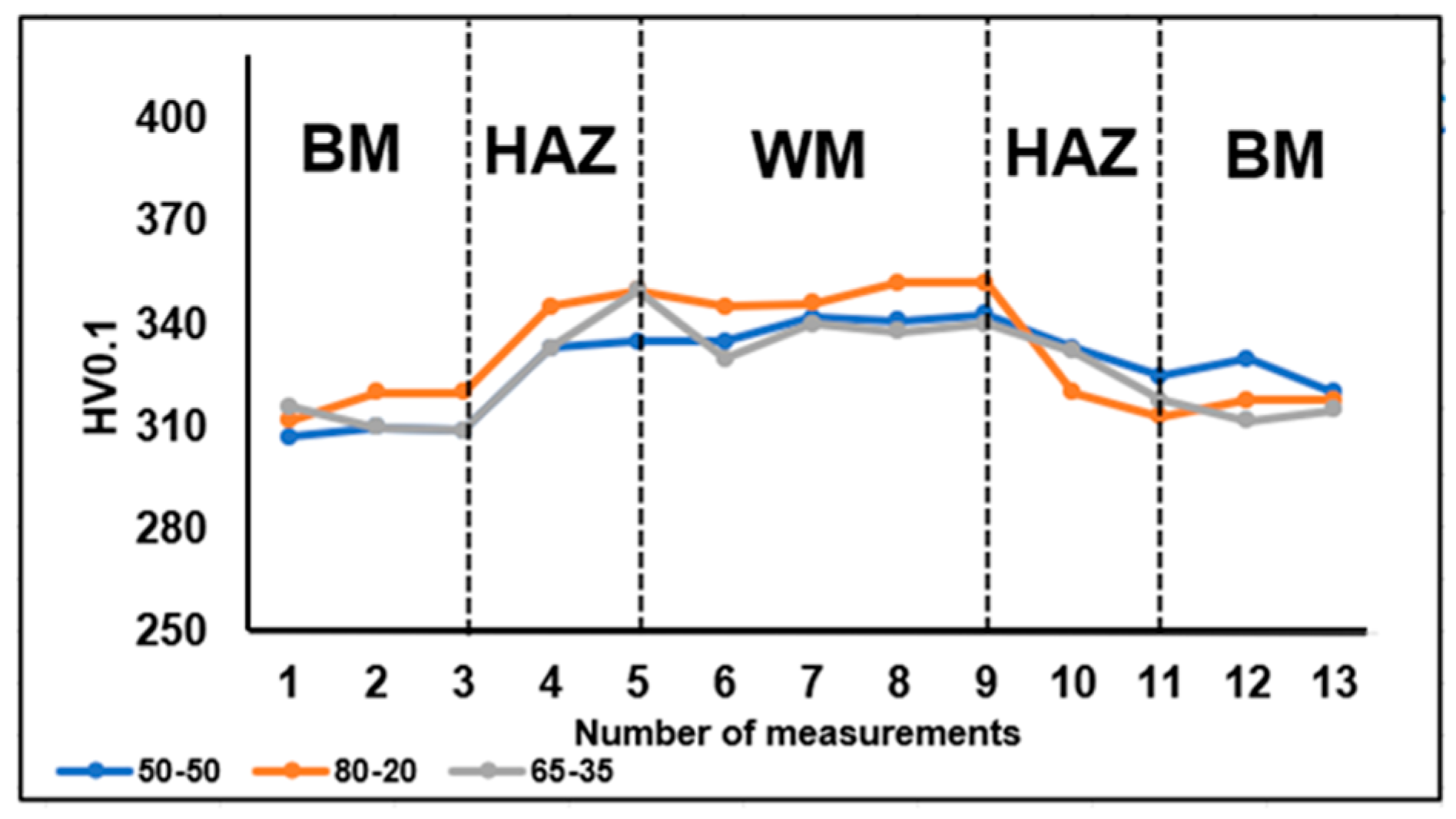
The Vickers microhardness (HV0.1) profiles (Figure 5) show the typical trough–peak–trough trend across BM, HAZ, and WM. Base-material hardness matches the manufacturer’s data, confirming no changes outside the weld-affected region. In the HAZ, hardness reached 333 HV (50:50), 345 HV (80:20), and 333 HV (65:35), while the WM showed 344 HV, 349 HV, and 341 HV for the same splits. Overall, the 80:20 beam-power split produced the highest hardness in both zones, whereas 50:50 and 65:35 yielded similar values.

3.4.2. Tensile Strength

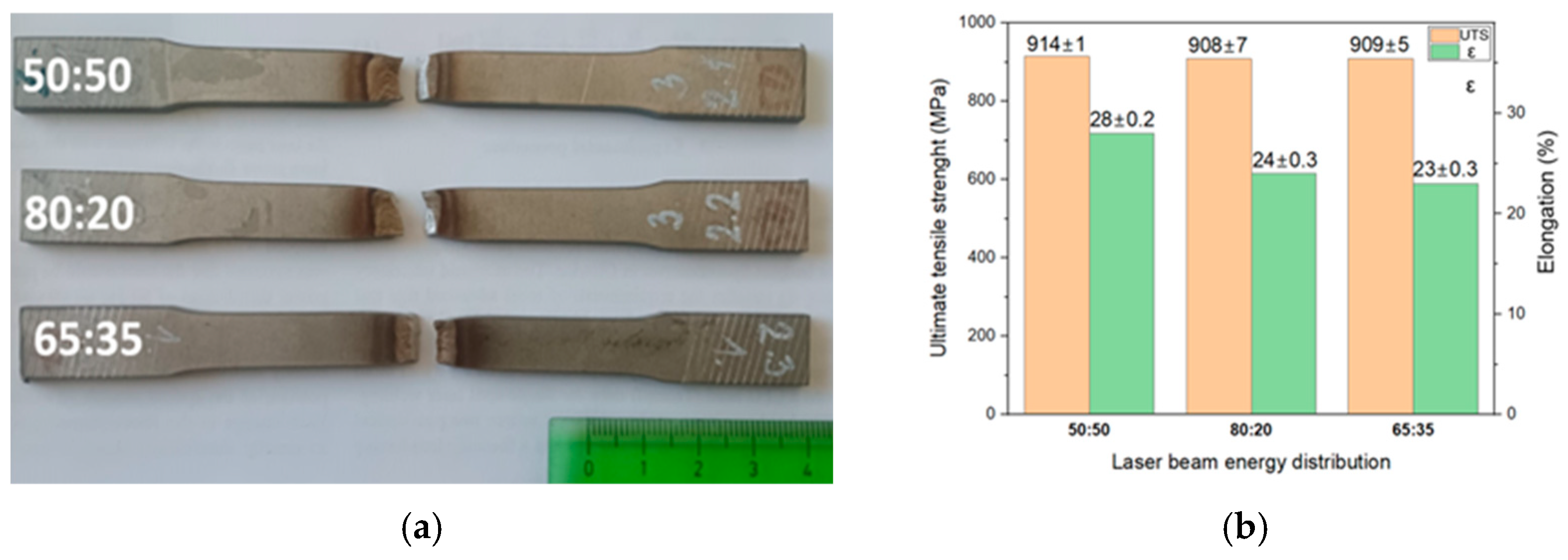
Tensile properties showed only minor sensitivity to the beam-power distribution. The fractured specimens in Figure 6a failed consistently in the weld region, without visible macroscopic differences between the conditions. The UTS values were similar: 914 ± 1 MPa for 50:50, 909 ± 5 MPa for 65:35 and 908 ± 7 MPa for 80:20, remaining within the range of experimental uncertainty (Figure 6b).
In contrast, elongation shows a systematic decline as the split departs from balance: 28 ± 0.2% (50:50) decreases to 24 ± 0.3% (80:20) and 23 ± 0.3% (65:35). Although the 50:50 and 65:35 conditions exhibited similar local HAZ hardness values, their elongation differed markedly. This indicates that ductility is not governed solely by local indentation hardness. Instead, elongation is strongly affected by phase connectivity, austenite morphology, crystallographic texture, and the distribution of damage-initiation sites across the weld region. Therefore, similar hardness values can coexist with different macroscopic ductility responses. This behavior is consistent with the microstructural trends inferred from microhardness and microscopy: a balanced 50:50 split promotes a more homogeneous weld-metal morphology and a more continuous/interconnected austenite distribution, although the weld metal remains ferrite-rich. This more favorable phase topology can improve strain redistribution and delay strain localization, which explains the higher elongation observed for the 50:50 condition. In contrast, deviations from the balanced split increase ferrite continuity and solidification-texture effects, resulting in reduced macroscopic ductility. Increasing asymmetry (80:20, 65:35) likely elevates local cooling-rate gradients and solidification texture, fostering higher ferrite fractions and reduced austenite continuity; the result is higher local hardness but diminished plasticity. Overall, the 50:50 distribution delivers the best strength–ductility balance, whereas 80:20 and 65:35 maintain similar UTS but at the expense of elongation, in line with established phase-balance and grain-size effects in duplex stainless steel.
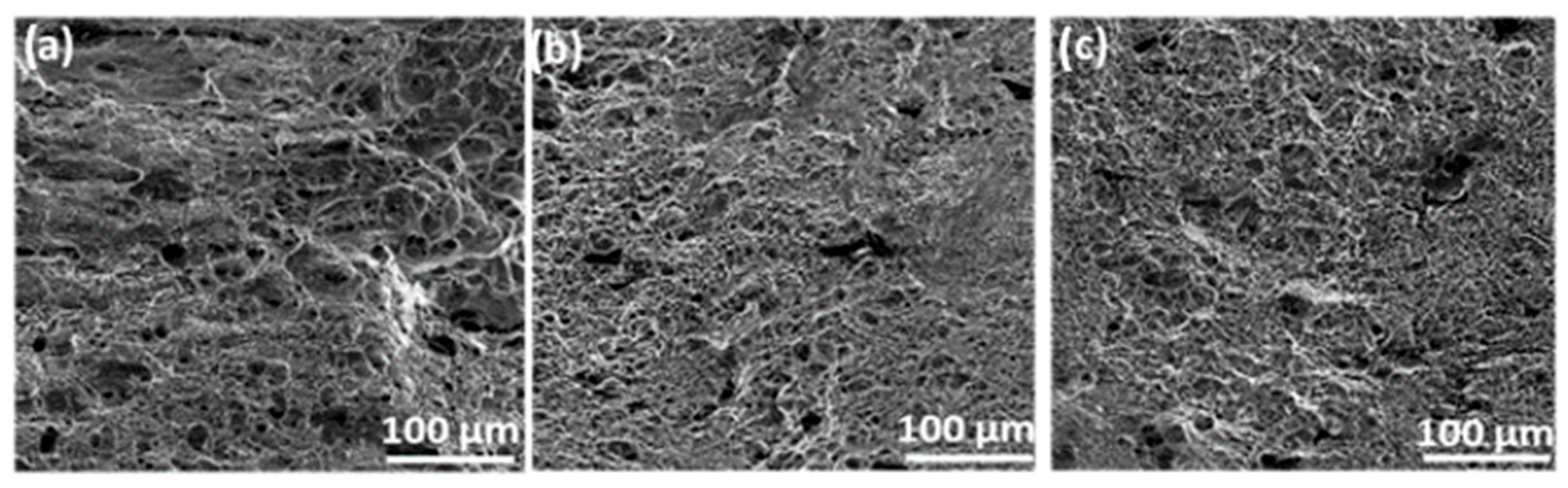
The fractographic interpretation presented below is based on qualitative SEM observations. Quantitative image analysis of dimple size, dimple density, and void area fraction was not performed in the present study; therefore, the observed differences in dimple morphology are discussed as qualitative indicators of damage evolution rather than as statistically quantified fracture parameters. The observed decrease in elongation (28 → 24 → 23%) can be attributed to differences in (i) the extent and uniformity of plastic deformation sustained prior to fracture and (ii) the effective density of microvoid/defect initiation sites that control damage evolution and void coalescence. As shown in Figure 7a, the fracture surface exhibits more pronounced plastic flow and a stronger shear component, evidenced by elongated dimples, tear ridges, and locally smeared regions. This morphology is consistent with an extended stage of stable plastic deformation and an enhanced ability to redistribute stress before final rupture, resulting in the highest elongation. Figure 7b remains predominantly ductile (dimpled), but local discontinuities—such as a secondary crack/groove and larger voids—effectively reduce the load-bearing cross-section and promote earlier strain localization. Consequently, the critical condition for void coalescence is reached at a lower macroscopic strain, leading to reduced elongation. In Figure 7c, the very dense, fine dimple population indicates extensive microvoid nucleation at numerous sites, followed by relatively early coalescence. This accelerates damage accumulation and shortens the period over which uniform plastic deformation can be maintained. Overall, Figure 7b,c likely possess a higher effective concentration of void-initiation sites, which promotes faster damage evolution and yields lower elongation than Figure 7a.

3.5. Corrosion Behavior

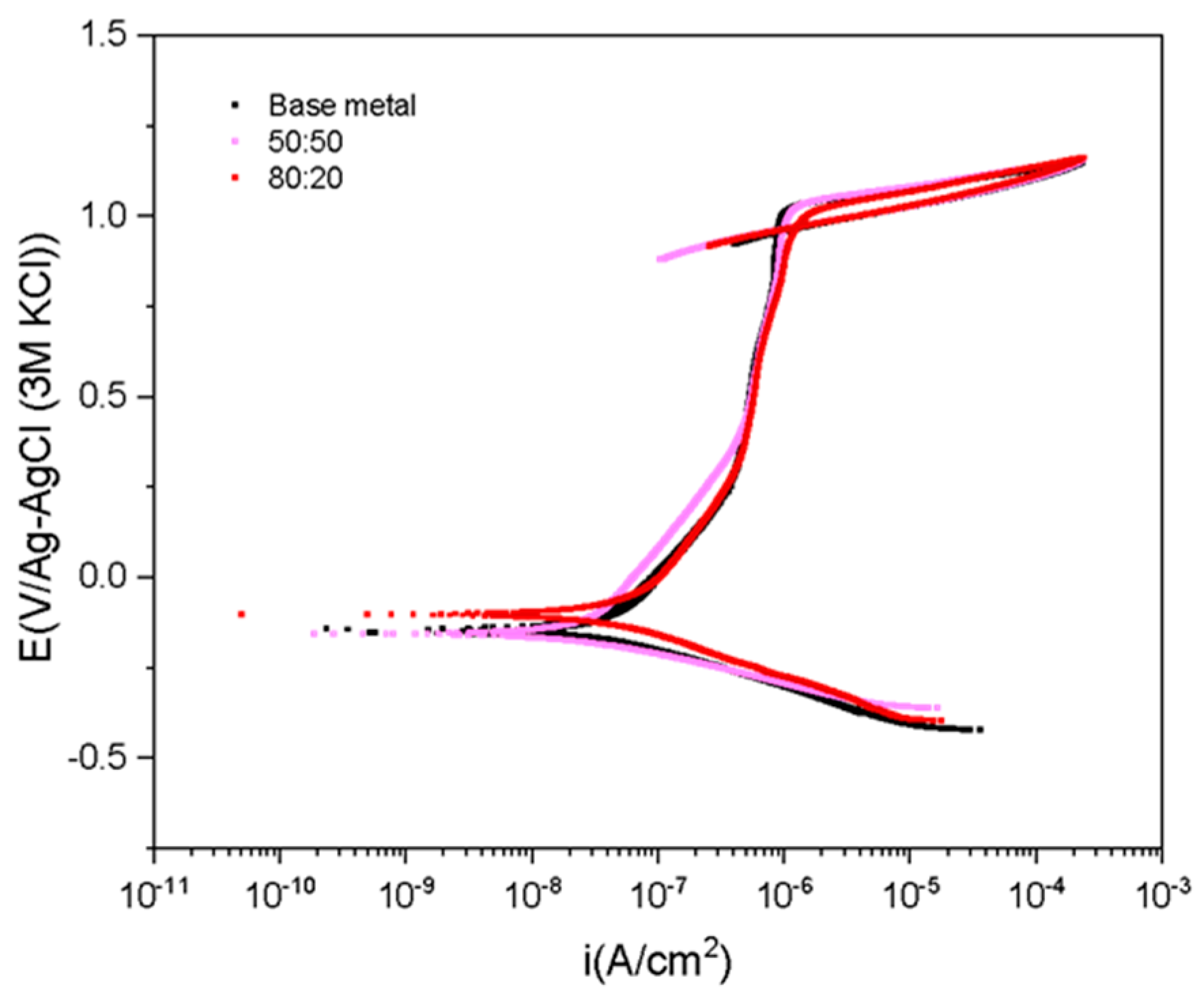
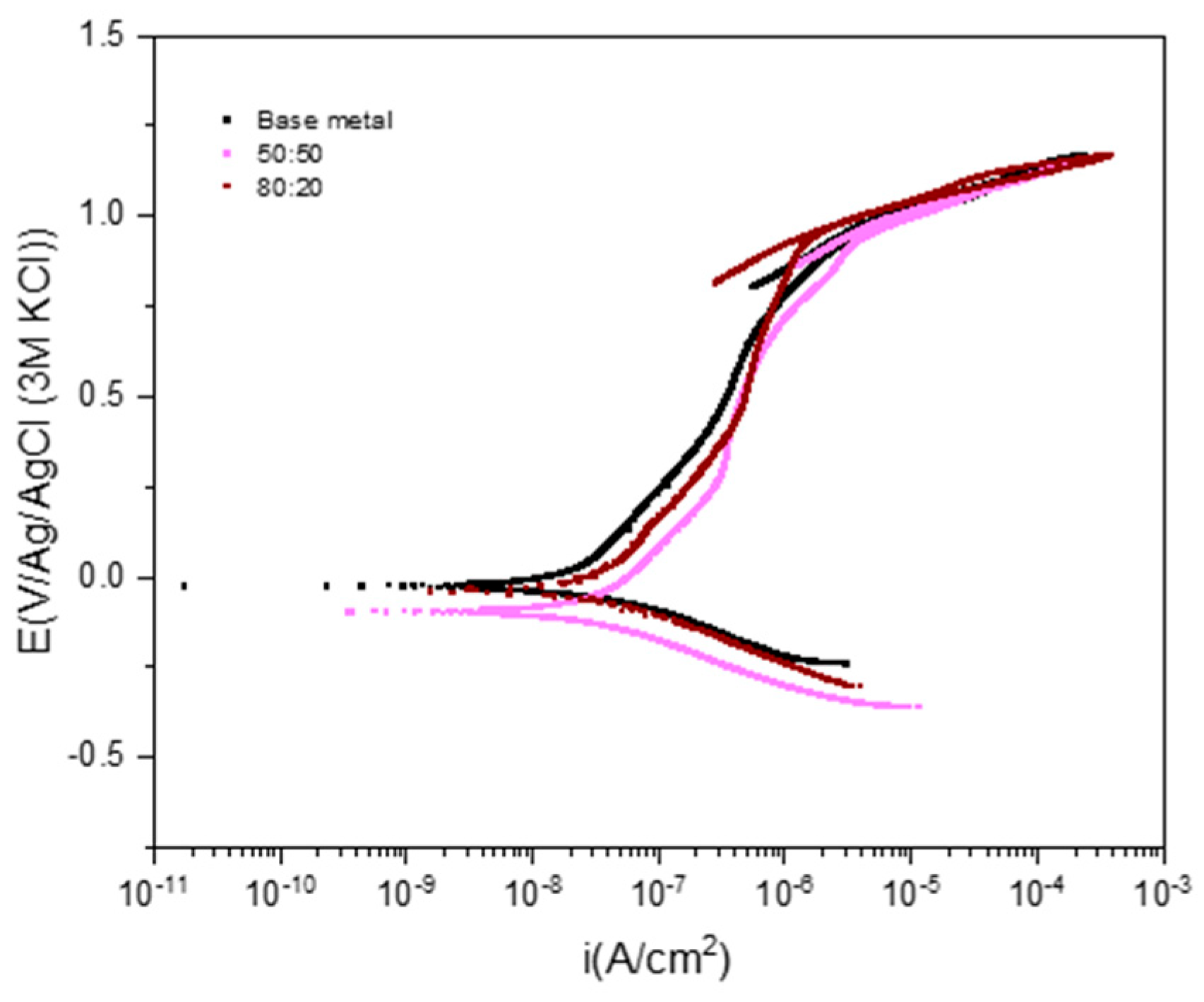
The corrosion and CPT tests were performed for the base metal and for the 50:50 and 80:20 welded conditions, which represent the two boundary cases of beam-power distribution investigated in this study. The 65:35 condition was not included in the electrochemical testing matrix; therefore, its corrosion behavior cannot be directly assessed from the present dataset. Although the 65:35 weld exhibited intermediate microstructural characteristics, particularly in terms of austenite fraction, a non-linear electrochemical response cannot be excluded. This represents a limitation of the present study, and future work should include corrosion and CPT testing of intermediate beam-power distributions. In Figure 8, at potentials below approximately −0.1 V vs. Ag/AgCl, all samples exhibit very low current densities, indicating limited cathodic activity dominated by charge transfer resistance. The similarity among curves suggests that microstructural variations have negligible influence on cathodic kinetics. Following the cathodic branch, a passive region is defined between ~−0.1 V and +1 V vs. Ag-AgCl. All tested conditions maintain a stable passive state with current densities around 4 × 10⁻⁷ A/cm2. This behavior confirms the excellent passivity of superduplex stainless steels due to the presence of chromium-rich oxide film. Minor differences in current density indicate slight variations in passive film stability, with the base metal and 50:50 condition showing nearly identical performance. Beyond +1 V, a sharp increase in current density occurs, marking the onset of transpassive dissolution, primarily associated with chromium oxide film oxidation. The 80:20 condition exhibits a slightly higher current density in this region, suggesting reduced resistance to transpassive attack, potentially due to compositional or phase distribution effects. Post-test surface examination revealed no evidence of pitting corrosion in either the base metal or the weld tracks corresponding to the 50:50 and 80:20 splits. Figure 8 illustrates the polarization curves of the base metal and 50:50 and 80:20 splits in a NaCl 1 M + 0.01 M Na2S2O3 solution. All samples exhibit passive behavior, with an ipass of about 3 × 10⁻⁷ A/cm2. The addition of thiosulfate ions to the chloride-containing electrolyte does not modify the electrochemical response of the materials, suggesting that the presence of S2O32− does not affect the passive behavior. Similarly to that observed in the chloride solution, a transpassive phenomenon is also observed at high potential, around 1010 mV vs. Ag-AgCl, indicating the onset of further oxidation of the passive film. No pitting was observed after the tests.
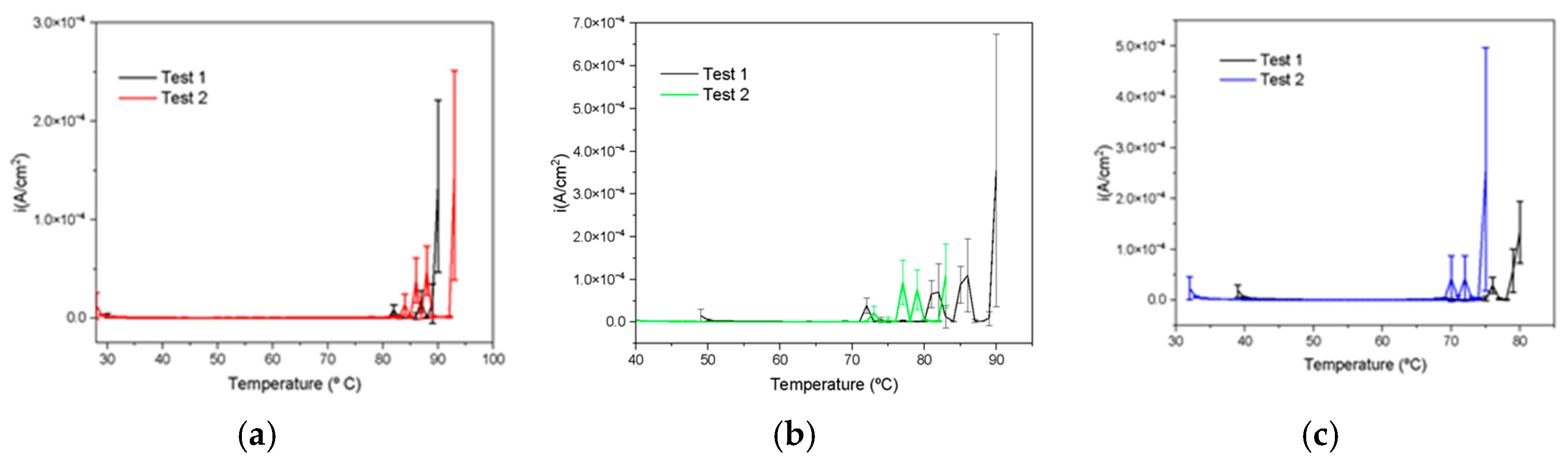
Figure 9 present the Critical Pitting Temperature (CPT) results for the superduplex stainless steel (base metal) and the two lead-lag split conditions, 50:50 and 80:20. The CPT for base metal is about 92 ± 1 °C. For the 50:50 condition, both experimental tests revealed negligible current densities up to approximately 80 °C, with pitting initiation occurring at 80 °C in Test 1 and slightly earlier in Test 2. The CPT for this condition is measured at 86.5 ± 4.9 °C.
In contrast, the 80:20 condition exhibited a CPT of about 77.5 °C (Figure 10c), as indicated by a sharp increase in current density beyond this temperature. Both laser beam-power distribution conditions (Figure 10b,c) demonstrate excellent resistance to localized corrosion, with CPT values exceeding 77 °C. The higher CPT observed for the 50:50 condition (Figure 10b) should not be attributed solely to the small difference in global austenite fraction, which was modest between the 50:50 and 80:20 welds. Instead, the CPT response may reflect subtle local microstructural and compositional effects, including ferrite/austenite connectivity, interface density, local passive-film stability, and possible phase-specific chemical partitioning. In particular, nitrogen partitioning between ferrite and austenite and phase-specific PREN values are known to strongly influence pitting resistance in superduplex stainless steels. These parameters were not measured in the present study; therefore, the mechanistic interpretation of the CPT difference remains limited. The CPT curves of the base material (Figure 10a), 50:50 condition (Figure 10b), and 80:20 condition (Figure 10c) are presented respectively.
These findings suggest that weld-metal microstructure and local electrochemical stability contribute to pitting resistance at elevated temperatures. However, without post-CPT SEM characterization, the specific pit initiation sites and their relationship to ferrite/austenite interfaces, grain-boundary austenite, or ferritic regions cannot be determined. After CPT testing, localized corrosion was observed preferentially in the weld region based on optical inspection and macroscopic surface examination. However, detailed SEM characterization of pit morphology and pit initiation sites was not performed. Therefore, it cannot be determined from the present dataset whether pit nucleation occurred preferentially at ferrite/austenite interfaces, grain-boundary austenite, ferritic regions, or other weld-metal microstructural features. This represents a limitation of the present study.

4. Discussion

Dual beam-power partitioning is best understood as a means of controlling the local solidification environment in the fusion zone—particularly heat-flow directionality, epitaxial growth, and the resulting phase topology and texture—which together govern deformation and damage evolution in duplex weld metals. Because no in situ thermal measurements were acquired, the mechanistic interpretation relies on weld geometry and microstructural indicators rather than on directly measured thermal gradients. Nevertheless, the trends are consistent with established links between cooling history and austenite re-formation [29,30,31,32] and between directional solidification and texture development in laser welds [33,34]. In this framework, a more balanced partition is expected to promote a more uniform heat distribution and reduce solidification directionality, whereas increasing asymmetry is expected to enhance directional heat flow and ferrite continuity under non-uniform solidification [35]. The effect of beam-power partitioning is expected to depend not only on the power ratio but also on which beam, leading or lagging, carries the higher power. Therefore, inverted configurations such as 20:80 may not produce symmetric results relative to 80:20. The leading beam governs initial melting and keyhole formation, while the lagging beam can reheat or stabilize the molten/partially solidified region. Consequently, lead/lag power assignment should be considered an additional process-design variable in dual-beam laser welding. More specifically, the dual-beam configuration redistributes the same nominal energy input between the leading and lagging heat sources. The balanced 50:50 condition is expected to generate a less asymmetric thermal field and a more uniform solidification path, whereas the non-balanced 80:20 and 65:35 conditions concentrate a larger fraction of the energy in one beam. This changes the local melt-pool shape and heat-flow direction, which can promote more directional epitaxial ferrite growth and modify the subsequent nucleation and growth of austenite. As a result, the main effect of power partitioning is reflected in the connectivity of ferrite and austenite and in the intensity of solidification-related orientation features rather than only in the total phase fraction.
To contextualize the present processing window, it is useful to benchmark nominal heat input against single-spot laser welding. Single-spot Nd:YAG welding of UNS S32750 at ~187 J/mm has been reported to yield a predominantly ferritic weld metal (~60% ferrite) and a CPT of ~78 °C in the undeformed condition [36], while a process-window study for pulsed Nd:YAG welding reports defect-free full-penetration welds at ~100–200 J/mm [37]. Although strict comparability is limited by differences in thickness, shielding, and testing protocols, these data indicate that the present dual-beam regime is not atypical in terms of gross heat input; therefore, the performance changes observed here are most plausibly attributed to the spatial distribution of energy and its impact on phase connectivity/texture rather than to heat input alone.
The key microstructural implication is that power partitioning primarily changes not “which phases form” but how they connect. In duplex laser welds, austenite reforms via grain-boundary austenite followed by Widmanstätten and intragranular acicular morphologies when cooling rates and nitrogen availability permit [38,39]. A more interlocked austenite architecture is expected to improve strain partitioning and delay strain localization, whereas greater ferrite contiguity and stronger solidification texture tend to constrain slip and promote earlier localization. Such topology-driven behavior is consistent with duplex welding studies across varied thermal cycles, where morphology and texture often dominate over modest shifts in phase fraction [40,41,42].
The microstructural difference between the balanced and non-balanced welds is therefore mainly topological. In the 50:50 weld, the austenite is distributed more continuously along ferrite grain boundaries and within ferrite grains as Widmanstätten and intragranular austenite, producing a more interlocked duplex morphology. In the 80:20 and 65:35 welds, the austenite distribution is less uniform, and the ferritic matrix shows greater continuity. Even when the difference in austenite fraction is modest, such changes in phase connectivity can strongly influence deformation because continuous ferrite paths favor strain localization, whereas a more connected austenite network improves strain sharing across the weld metal.
This connectivity-based view rationalizes the mechanical trends without reiterating the Results: hardness increases when ferrite continuity/texture strengthens, because deformation is more constrained at the indentation scale [43,44,45], whereas ultimate tensile strength is comparatively insensitive within a strength-stable microstructural regime [46,47]. Ductility is more discriminating because it depends strongly on the continuity and distribution of austenite pathways that redistribute stress and retard localization [48,49]. The observed hardness variations should therefore be interpreted as local comparative changes in indentation resistance rather than as direct evidence of yield-strength variation. Since residual stresses were not measured, possible effects of localized residual stresses, including indentation pile-up or sinking-in, cannot be fully excluded [50].
This interpretation also explains why similar hardness values do not necessarily lead to similar tensile ductility. Hardness represents a local indentation response, while elongation is a macroscopic property controlled by the continuity of deformable phases, crystallographic orientation, and the distribution of damage-initiation sites across the weld region. The higher elongation of the 50:50 condition is therefore attributed to its more favorable austenite connectivity and less pronounced ferrite path continuity. By contrast, the non-balanced conditions retain comparable ultimate tensile strength but show reduced ductility because their phase topology promotes earlier strain localization and faster microvoid coalescence.
Fractography provides a complementary indicator of the same mechanism. The persistence of microvoid coalescence across conditions indicates that partitioning does not introduce a brittle fracture mode, while systematic variations in dimple geometry are consistent with differences in the duration of stable crack-tip plasticity and the effective density of void-initiation sites—both are expected to be sensitive to phase-boundary topology and strain localization behavior [51,52,53].
Electrochemically, the largely invariant passive response suggests that, within the examined window, morphology/texture effects are secondary to alloy chemistry and the avoidance of deleterious intermetallic precipitation [54,55]. It should be emphasized that the difference in global austenite fraction between the 50:50 and 80:20 welds was small; therefore, phase fraction alone cannot explain the CPT difference. The CPT response may also depend on local chemical partitioning between ferrite and austenite, particularly nitrogen distribution, phase-specific PREN, and the density and continuity of ferrite/austenite interfaces. Since phase-specific chemical compositions and nitrogen partitioning were not measured, PREN was considered only on the basis of the bulk alloy composition and not separately for individual phases. Consequently, the CPT interpretation is limited to correlations with the observed microstructure, and future work should combine localized chemical analysis with phase-specific electrochemical characterization [56]. Overall, dual-beam partitioning emerges as a microstructural “tuning knob” that primarily adjusts phase connectivity and texture, enabling a controlled hardness–ductility trade-off without materially changing tensile strength or passivity under the present conditions [57]. Future work should combine direct thermal-cycle measurements or validated modeling with quantitative connectivity metrics and localized electrochemical mapping to strengthen causal attribution [58,59,60,61].
The same microstructural framework can be used to interpret the corrosion results, but only for the electrochemically tested conditions. The base metal and the 50:50 and 80:20 welds all maintained stable passivity in the tested electrolytes, indicating that beam-power partitioning did not produce severe degradation of passive-film stability under the present conditions. The slightly more favorable CPT response of the 50:50 weld may be associated with its more homogeneous phase distribution and austenite connectivity, which can reduce local microgalvanic heterogeneity. However, because the 65:35 condition was not included in the corrosion and CPT testing program, its electrochemical response cannot be directly inferred, and a non-linear dependence on beam-power distribution cannot be excluded.
Future work should combine direct thermal-cycle measurements or validated modeling with quantitative connectivity metrics, phase-specific chemical analysis, localized electrochemical mapping, and systematic post-CPT SEM characterization of pit initiation sites to strengthen causal attribution.

5. Conclusions

Dual beam-power partitioning provides a practical route to tailor weld-metal morphology in UNS S32750 while maintaining overall strength and corrosion resistance in the electrolytes examined.
Within the studied window, a balanced (50:50) split promotes a more refined, interlocked duplex morphology with higher austenite connectivity, which supports strain redistribution and maximizes ductility. Increasing asymmetry enhances ferrite continuity and texture, increasing local hardness but reducing elongation; the fracture mode remains ductile (microvoid coalescence) for all conditions.
Electrochemical response remains broadly comparable across partitions (stable passivity and no room-temperature pitting), indicating no measurable corrosion penalty associated with power partitioning under the present conditions. From an application perspective, a 50:50 split offers the most favorable strength-ductility balance for damage-tolerant service, whereas more asymmetric splits can be selected to elevate local hardness where reduced plasticity is acceptable.

Author Contributions

L.K.: Writing—original draft, Visualization, Investigation, Conceptualization. T.D.: Methodology, Writing—review and editing, Visualization, Investigation. M.A.A.: Methodology, Writing—original draft, Writing—review and editing, Data curation, Conceptualization. E.H.: Writing—original draft, Visualization, Investigation, Data curation, Conceptualization, Writing—review and editing. A.C.: Data curation, Conceptualization, Methodology, Writing—review and editing, Supervision. M.Č.: Visualization, Investigation, Data curation, Conceptualization, Writing—review and editing. J.J.d.D.: Data curation, Writing—review and editing, Supervision. M.N.: Formal analysis, Project administration, Resources, Supervision. N.B.: Formal analysis, Funding acquisition, Writing—review and editing, Supervision. All authors have read and agreed to the published version of the manuscript.

Funding

This work was financially supported by the following funding bodies: the Slovak Research and Development Agency (APVV-21-0232), the Scientific Grant Agency of the Ministry of Education, Science, Research, and Sport of the Slovak Republic (VEGA 2/0121/25), and the Slovak Academy of Science (CSIC-SAS-2023-02) and the Spanish National Research Council (CSIC-SAS BILAT23126).

Data Availability Statement

Data will be made available on request.

Acknowledgments

The authors are grateful to PRVÁ ZVÁRAČSKÁ, a.s. for the preparation of the welded joints and to STU MTF for conducting the tensile strength tests.

Conflicts of Interest

The authors declare that they have no known competing financial interests or personal relationships that could have appeared to influence the work reported in this paper.

References

  1. Kotecki, D.J.; Siewert, T.A. WRC-1992 Constitution Diagram for Stainless Steel Weld Metals: A Modification of the WRC-1988 Diagram. Weld. J. 1992, 71, 171s–178s. [Google Scholar]
  2. Borhani, M.R.; Kermani, F.; Razavi, R.S.; Erfanmanesh, M.; Barekat, M. A comparative study on corrosion and mechanical performance of X2CrNiMoN22-5-3 super duplex steel in marine applications. Heliyon 2024, 10, e38353. [Google Scholar] [CrossRef] [PubMed]
  3. Maurya, A.K.; Pandey, S.M.; Chhibber, R.; Fydrych, D.; Pandey, C. Corrosion performance of super duplex stainless steel and pipeline steel dissimilar welded joints. Int. J. Adv. Manuf. Technol. 2024, 135, 1009–1033. [Google Scholar] [CrossRef]
  4. Wang, R. Precipitation of sigma phase in duplex stainless steel and recent development on its detection by electrochemical potentiokinetic reactivation: A review. Corros. Commun. 2021, 2, 41–54. [Google Scholar] [CrossRef]
  5. Valiente Bermejo, M.A.; Eyzop, D.; Hurtig, K.; Karlsson, L. Welding of Large Thickness Super Duplex Stainless Steel: Microstructure and Properties. Metals 2021, 11, 1184. [Google Scholar] [CrossRef]
  6. Gunn, R. (Ed.) Duplex Stainless Steels: Microstructure, Properties and Applications; Elsevier: Amsterdam, The Netherlands, 1997; ISBN 1-85573-281-5. [Google Scholar]
  7. Lippold, J.C.; Kotecki, D.J. Welding Metallurgy and Weldability of Stainless Steels; Wiley: Hoboken, NJ, USA, 2005; ISBN 978-0-471-47379-4. [Google Scholar]
  8. Li, T.; Wang, K.; Lei, Y. A Review of Welding Process for UNS S32750 Super Duplex Stainless Steel. Materials 2024, 17, 5215. [Google Scholar] [CrossRef]
  9. Lopez, N.; Ramirez, A.J.; Brandi, S. Laser beam welding of UNS S32750 superduplex stainless steel. Mater. Charact. 2008, 59, 1582–1589. [Google Scholar]
  10. Zhang, Z.; Farrar, J.C.M. Hybrid laser–GMAW welding of duplex stainless steels. Weld. J. 1997, 76, 305s–312s. [Google Scholar]
  11. Zhang, Z.; Han, Y.; Lu, X.; Zhang, T.; Bai, Y.; Ma, Q. Effects of N2 Content in Shielding Gas on Microstructure and Toughness of Cold Metal Transfer and Pulse Hybrid Welded Joint for Duplex Stainless Steel. Mater. Sci. Eng. A 2023, 872, 144936. [Google Scholar] [CrossRef]
  12. Yelamasetti, B.; Karuna, B.N.R.; Vishnu Vardhan, T.; Dasore, A.; Saxena, K.K.; Faroque, F.A.; Revathi, V.; Abduvalieva, D. Mechanical and micro-structural studies of pulsed and constant current TIG weldments of super duplex stainless steels and Austenitic stainless steels. High Temp. Mater. Process. 2024, 43, 20240003. [Google Scholar] [CrossRef]
  13. Fande, A.W.; Taiwade, R.V.; Narayane, D.C. Experimental Investigation of the Flux-Assisted TIG Weldment of Super Duplex Stainless Steel. Mater. Today Proc. 2024, 98, 21–27. [Google Scholar] [CrossRef]
  14. Lippold, J.C. Welding Metallurgy and Weldability; John Wiley & Sons: Hoboken, NJ, USA, 2014; ISBN 978-1-118-23591-0. [Google Scholar]
  15. Karlsson, L. Welding Duplex Stainless Steels—A Review of Current Recommendations. Weld. World 2013, 56, 65–76. [Google Scholar] [CrossRef]
  16. Haghdadi, N.; Cizek, P.; Hodgson, P.D.; Beladi, H. Microstructure dependence of impact toughness in duplex stainless steel. Mater. Sci. Eng. A 2019, 745, 369–378. [Google Scholar] [CrossRef]
  17. Odermatt, A.E.; Ventzke, V.; Dorn, F.; Dinsé, R.; Merhof, P.; Kashaev, N. Effect of laser beam welding on microstructure, tensile strength and fatigue behaviour of duplex stainless steel 2205. J. Manuf. Process. 2021, 72, 148–158. [Google Scholar] [CrossRef]
  18. El-Batahgy, A.M.; Khourshid, A.F.; Sharef, T. Effect of Laser Beam Welding Parameters on Microstructure and Properties of Duplex Stainless Steel. Mater. Sci. Appl. 2011, 2, 1443–1451. [Google Scholar] [CrossRef]
  19. Xie, J. Dual Beam Laser Welding. Weld. J. 2002, 81, 223-s–230-s. [Google Scholar]
  20. Mohammadpour, M.; Haghpanahi, M.; Parvin, N.; Mosavi Mashhadi, M.M. Effect of dual laser beam on dissimilar welding-brazing of aluminum to galvanized steel. Opt. Laser Technol. 2018, 98, 214–228. [Google Scholar] [CrossRef]
  21. Chen, X.; Liu, C.; Zhang, Y.; Wang, Q.; Wang, Z.; Wu, C. Vapor plume oscillation mechanisms in transient keyhole during tandem dual-beam fiber laser welding. Opt. Lasers Eng. 2018, 100, 239–247. [Google Scholar] [CrossRef]
  22. Cui, L.; Chen, B.; Chen, L.; He, D. Dual beam laser keyhole welding of steel/aluminum lapped joints. J. Mater. Process. Technol. 2018, 256, 87–97. [Google Scholar] [CrossRef]
  23. Yang, G.; Ma, J.; Carlson, B.; Wang, H.P.; Kovacevic, R. Effect of laser beam configuration on microstructure evolution and joint performance in laser joining AA6111 panels. Mater. Des. 2017, 127, 34–45. [Google Scholar]
  24. Ayoola, W.A.; Suder, W.J.; Williams, S.W. Effect of beam shape and spatial energy distribution on weld bead geometry in conduction welding. Opt. Laser Technol. 2019, 117, 280–287. [Google Scholar] [CrossRef]
  25. Abadi, S.M.A.N.R.; Mi, Y.; Sikström, F.; Ancona, A.; Choquet, I. Effect of Shaped Laser Beam Profiles on Melt Flow Dynamics in Conduction Mode Welding. Int. J. Therm. Sci. 2021, 166, 106957. [Google Scholar] [CrossRef]
  26. Pang, S.; Chen, W.; Zhou, J.; Liao, D. Self-consistent modeling of keyhole and weld pool dynamics in tandem dual-beam laser welding of aluminum alloy. J. Mater. Process. Technol. 2015, 217, 131–143. [Google Scholar] [CrossRef]
  27. Laukkanen, A.; Uusikallio, S.; Lindroos, M.; Andersson, T.; Kömi, J.; Porter, D. Micromechanics driven design of ferritic–austenitic duplex stainless steels. Eng. Fract. Mech. 2021, 253, 107878. [Google Scholar] [CrossRef]
  28. Hassel, T.A.; Kulbotten, I.M.; Arbo, S.M.; Rørvik, G.; Brøtan, V.; Sørby, K. Corrosion, Impact Toughness and Tensile Properties of Duplex Stainless Steels Manufactured by Directed Energy Deposition. Metall. Mater. Trans. A 2025, 56, 269–293. [Google Scholar] [CrossRef]
  29. Chen, T.; Yang, J. Microstructural characterization of simulated HAZ in a nitrogen-containing 2205 duplex stainless steel. Mater. Sci. Eng. A 2002, 338, 166–181. [Google Scholar] [CrossRef]
  30. Muthupandi, V.; Bala Srinivasan, P.; Seshadri, S.; Sundaresan, S. Effect of weld-metal chemistry and heat input on the structure and properties of duplex stainless steel welds. Mater. Sci. Eng. A 2003, 358, 9–16. [Google Scholar] [CrossRef]
  31. Liou, H.-Y.; Pan, Y.-T.; Park, C.-J.; Kwon, H.-S. The Microstructure and Pitting Resistance of 2002 Lean Duplex Stainless Steel after the Simulated Welding Thermal Cycle Process. Materials 2018, 12, 70. [Google Scholar] [CrossRef]
  32. Rahimi, S.; Konkova, T.N.; Violatos, I.; Baker, T.N. Evolution of microstructure and crystallographic texture during dissimilar friction-stir welding of DSS to low-carbon steel. Metall. Mater. Trans. A 2019, 50, 664–687. [Google Scholar] [CrossRef]
  33. Wei, H.L.; Elmer, J.W.; DebRoy, T. Crystal growth during keyhole mode laser welding. Acta Mater. 2017, 133, 10–20. [Google Scholar] [CrossRef]
  34. Belsvik, M.A.; Tucho, W.M.; Hansen, V. Microstructural studies of direct-laser-deposited stainless steel 316L-Si on 316L base material. SN Appl. Sci. 2020, 2, 1967. [Google Scholar] [CrossRef]
  35. Deng, S.; Yuan, R.; Tang, X.; Lu, F. Migration behavior of IMC layer in twin-spot laser welding-brazing of aluminum to steel. Mater. Des. 2020, 188, 108489. [Google Scholar] [CrossRef]
  36. Gennari, C.; Lago, M.; Bögre, B.; Meszaros, I.; Calliari, I.; Pezzato, L. Microstructural and Corrosion Properties of Cold Rolled Laser Welded UNS S32750 Duplex Stainless Steel. Metals 2018, 8, 1074. [Google Scholar] [CrossRef]
  37. Sivagurumanikandan, N.; Saravanan, S.; Sivakumar, G.; Raghukandan, K. Process Window for Nd:YAG Laser Welding of Super Duplex Stainless Steel. J. Russ. Laser Res. 2018, 39, 575–584. [Google Scholar] [CrossRef]
  38. Zhang, Z.; Jing, H.; Xu, L.; Han, Y.; Zhao, L. Investigation on microstructure evolution and properties of duplex stainless-steel joint multi-pass welded by different methods. Mater. Des. 2016, 109, 670–685. [Google Scholar] [CrossRef]
  39. Nishimoto, K.; Saida, K.; Katsuyama, O. Prediction of sigma-phase precipitation in super duplex stainless-steel weldments. Weld. World 2006, 50, 13–28. [Google Scholar] [CrossRef]
  40. Hertzman, S.; Brolund, B.; Ferreira, P.J. An experimental and theoretical study of HAZ austenite reformation in three duplex stainless steels. Metall. Mater. Trans. A 1997, 28, 277–285. [Google Scholar] [CrossRef]
  41. Wu, T.; Wang, J.; Li, H.; Jiang, Z.; Liu, C.; Zhang, H. Effect of heat input on austenite microstructural evolution of simulated heat affected zone in 2205 duplex stainless steel. J. Iron Steel Res. Int. 2019, 26, 435–441. [Google Scholar] [CrossRef]
  42. Moreira, A.B.; Costa, A.P.O.; Ribeiro, L.M.M.; Santos, A.D.; De Jesus, A. On the correlation between fatigue behaviour and the multiphase microstructure of a super duplex stainless steel. Eng. Fract. Mech. 2024, 307, 110341. [Google Scholar] [CrossRef]
  43. Han, L.; Wang, L.; Li, X.; Zhang, X.; Zhou, Y. Influence of heat input on microstructure, hardness and pitting corrosion of weld metal in duplex stainless steel welded by keyhole-TIG. Mater. Charact. 2021, 175, 111052. [Google Scholar] [CrossRef]
  44. Shirahata, H.; Miki, C.; Yamaguchi, R.; Kinoshita, K.; Yaginuma, Y. Fatigue crack detection by the use of ultrasonic echo height change with crack tip opening. Weld. World 2014, 58, 681–690. [Google Scholar] [CrossRef]
  45. Köse, C.; Kaçar, R. Texture, Microstructure and Mechanical Properties of Laser Beam Welded AISI 2507 Super Duplex Stainless Steel. Mater. Chem. Phys. 2022, 289, 126490. [Google Scholar] [CrossRef]
  46. Eghlimi, A.; Shamanian, M.; Raeissi, K.; Ashrafizadeh, F.; Kermanpur, A. Characterization of microstructure and texture across dissimilar super duplex/austenitic stainless steel weldment joint by super duplex filler metal. Mater. Charact. 2015, 106, 27–36. [Google Scholar] [CrossRef]
  47. Ramkumar, K.D.; Thiruvengatam, G.; Sudharsan, S.; Mishra, D.; Arivazhagan, N.; Sridhar, R. Characterization of weld strength and impact toughness in multi-pass welding of UNS S32750 SDSS. Mater. Des. 2014, 60, 125–135. [Google Scholar] [CrossRef]
  48. Xie, X.F.; Li, J.; Jiang, W.; Dong, Z.; Tu, S.T.; Zhai, X.; Zhao, X. Nonhomogeneous Microstructure Formation and Its Role on Tensile and Fatigue Performance of Duplex Stainless Steel 2205 Multi-Pass Weld Joints. Mater. Sci. Eng. A 2020, 786, 139426. [Google Scholar] [CrossRef]
  49. Sayyar, N.; Tucho, W.M.; Hansen, V. Pulsed laser directed energy deposition of super duplex stainless steel: Engineering microstructure and improving mechanical properties. Int. J. Adv. Manuf. Technol. 2025, 136, 983–1008. [Google Scholar] [CrossRef]
  50. Quackatz, L.; Westin, E.M.; Griesche, A.; Kromm, A.; Kannengiesser, T.; Treutler, K.; Wesling, V. Assessing ferrite content in duplex stainless weld metal—Accuracy of WRC-92 routes. Weld. World 2025, 69, 31–35. [Google Scholar] [CrossRef]
  51. Zhang, M.; Xie, D.; Chen, Y.; Yang, C.; Zhao, H. Study on fracture properties of duplex stainless steel and its weld under ultra-low-cycle fatigue. Int. J. Fatigue 2022, 162, 106972. [Google Scholar] [CrossRef]
  52. Sieurin, H.; Sandström, R. Fracture toughness of a welded duplex stainless steel. Eng. Fract. Mech. 2006, 73, 377–390. [Google Scholar] [CrossRef]
  53. Pilhagen, J.; Sieurin, H.; Sandström, R. Fracture toughness of a welded super duplex stainless steel. Mater. Sci. Eng. A 2014, 606, 40–45. [Google Scholar] [CrossRef]
  54. Kang, D.H.; Lee, H.W. Effect of different chromium additions on microstructure and mechanical properties of multipass weld joint of duplex stainless steel. Metall. Mater. Trans. A 2012, 43, 4678–4687. [Google Scholar] [CrossRef]
  55. Tan, H.; Wang, Z.; Jiang, Y.; Han, D.; Hong, J.; Chen, L.; Jiang, L.; Li, J. Annealing temperature effect on the pitting corrosion resistance of plasma-arc welded UNS S32304 duplex stainless steel in 1.0 M NaCl. Corros. Sci. 2011, 53, 2191–2200. [Google Scholar] [CrossRef]
  56. Kim, S.T.; Lee, I.S.; Kim, J.S.; Jang, S.H.; Park, Y.S.; Kim, K.T.; Kim, Y.S. Localized corrosion associated with phase transformation of hyper-duplex tube-to-tubesheet welds in acidified chloride. Corros. Sci. 2012, 64, 164–173. [Google Scholar] [CrossRef]
  57. Vignal, V.; Delrue, O.; Heintz, O.; Peultier, J. Influence of the Passive Film Properties and Residual Stresses on the Micro-Electrochemical Behavior of Duplex Stainless Steels. Electrochim. Acta 2010, 55, 7118–7125. [Google Scholar] [CrossRef]
  58. Pan, J. Studying the passivity and breakdown of duplex stainless steels using local probing and synchrotron based analyses. Front. Mater. 2020, 7, 133. [Google Scholar] [CrossRef]
  59. Sayyar, N.; Hansen, V.F.; Tucho, W.M.; Minde, M.W. Directed laser deposition of super duplex stainless steel: Microstructure, texture evolution, and mechanical properties. Heliyon 2023, 9, e15144. [Google Scholar] [CrossRef]
  60. Silva, R.; Kugelmeier, C.L.; Martins Junior, C.B.; Oliveira, P.H.F.; Magalhães, D.C.C.; Plaine, A.H.; Magnabosco, R.; Rovere, C.A.D. Mechanisms of intergranular corrosion and self healing in high temperature aged lean duplex stainless steel 2404. npj Mater. Degrad. 2024, 8, 51. [Google Scholar] [CrossRef]
  61. Matlakhova, L.A.; Matlakhov, A.N.; Monteiro, S.N. Temperature Effect on the Elastic Modulus, Internal Friction and Related Phase Transformations in Ti–Nb–2%Al Quenched Alloys. Mater. Charact. 2008, 59, 1234–1240. [Google Scholar] [CrossRef]
Figure 1. Scheme of dual laser beam welding.
Jmmp 10 00181 g001
Figure 2. Cross-sectional micrographs of welds at different laser beam-power distribution ratios, (a) laser beam-power distribution ratio 50:50, (b) laser beam-power distribution ratio 80:20, (c) laser beam-power distribution ratio 65:35.
Jmmp 10 00181 g002
Figure 3. Cross-sectional micrographs of welds produced using different laser beam-power distribution ratios: (ac) 50:50, (df) 80:20, and (gi) 65:35. For each power distribution ratio, the micrographs show different regions of the weld cross-section: (a,d,g) the base metal/weld metal interface including the heat-affected zone, (b,e,h) the weld face region, and (c,f,i) the weld root region. HAZ—heat-affected zone; IGA—intergranular austenite; GBA—grain boundary austenite; WA—Widmanstätten austenite.
Jmmp 10 00181 g003
Figure 4. Macrostructure of the samples 50:50, 80:20, 65:35—Geometry of welding area—(a,d,g); EBSD-IPF—(b,e,h); EBSD-Phase map—(c,f,i).
Jmmp 10 00181 g004
Figure 5. Microhardness distribution of the welded joint from base metal to weld area.
Jmmp 10 00181 g005
Figure 6. Tensile strength test results: (a) test samples 50:50, 80:20, 65:35 after rupture; (b) effect of energy distribution on UTS and elongation.
Jmmp 10 00181 g006
Figure 7. Fractographs: (a) laser beam-power distribution ratio 50:50, (b) laser beam-power distribution ratio 80:20, (c) laser beam-power distribution ratio 65:35.
Jmmp 10 00181 g007
Figure 8. Potentiodynamic polarization curves of the base metal and laser beam-power distribution ratios of 50:50 and 80:20 in NaCl M 0.6.
Jmmp 10 00181 g008
Figure 9. Potentiodynamic polarization curves of the base metal and laser beam-power distribution ratios of 50:50 and 80:20 in NaCl 1 M + 0.01 M Na2S2O3.
Jmmp 10 00181 g009
Figure 10. Critical Pitting Test (CPT) curves for (a) base metal, (b) laser beam-power distribution ratio of 50:50 and (c) laser beam-power distribution ratio of 80:20.
Jmmp 10 00181 g010
Table 1. Chemical composition (wt.%).
CMnSiPSCrMoNiCuNFe
0.010.640.270.030.00124.93.75.50.270.29Bal.
Table 2. Mechanical properties of the UNS S32750 sheet according to the material certificate.
UTS (MPa)A5 (%)HB
800–1000≥25≤310
Table 3. Welding parameters for UNS S32750 material with a thickness of 3 mm.
UNS S32750Laser Power
[kW]
Welding Speed
[mm/s]
Gas Flow [l/min]Defocusing
Distance [mm]
Beam Power
Distribution Ratio [Lead/Lag Beam]
Heat Input [kJ/mm]
2.121030050:500.2
2.221030080:200.2
2.321030065:350.2
Table 4. Effect of laser beam energy distribution on weld face and root widths for 3 mm thick UNS S32750 steel.
Laser Beam Energy
Distribution
Weld Face Side Width [mm]Weld Root Side Width [mm]
50:504.190.85
80:203.971.70
65:353.781.71
Disclaimer/Publisher’s Note: The statements, opinions and data contained in all publications are solely those of the individual author(s) and contributor(s) and not of MDPI and/or the editor(s). MDPI and/or the editor(s) disclaim responsibility for any injury to people or property resulting from any ideas, methods, instructions or products referred to in the content.