Article

Numerical Modeling of Picosecond Laser-Induced Phase Change and Amorphization in Silicon Using Green Lasers


1
Department of Industrial and Manufacturing Systems Engineering, Kansas State University, Manhattan, KS 66506, USA
2
National Center for Supercomputing Applications, University of Illinois Urbana-Champaign, Urbana, IL 61801, USA
*
Author to whom correspondence should be addressed.
J. Manuf. Mater. Process. 2026, 10(5), 180; https://doi.org/10.3390/jmmp10050180
Submission received: 2 April 2026 / Revised: 14 May 2026 / Accepted: 19 May 2026 / Published: 20 May 2026

Abstract

Pulsed laser-induced phase change in silicon underpins applications from photonic device trimming to stealth dicing, yet predictive models that capture the non-equilibrium kinetics governing the competition between epitaxial recrystallization and amorphization remain limited. In this work, we developed a two-dimensional axisymmetric numerical model at the continuum level for picosecond laser-induced melting, resolidification, and amorphization of crystalline silicon at 532 nm laser wavelength, coupling transient heat conduction with Wilson–Frenkel interface kinetics and Lagrangian marker-based interface tracking. The model predicts a bounded amorphization window defined by lower and upper fluence thresholds, within which the central amorphous thickness exhibits a bell-shaped fluence dependence. Under a Gaussian beam, this window governs a morphological transition from a central amorphous spot to an amorphous ring. The predicted amorphization threshold of ≈0.22 J/cm2 agrees with published experimental data for 20 ps, 532 nm irradiation. Parametric studies reveal that reducing the spot diameter or substrate temperature shifts or eliminates the upper threshold, transforming the bounded window into a monotonically increasing function, while increasing the pulse duration narrows the window symmetrically until collapse. These results provide quantitative guidelines for selecting irradiation parameters to control phase change in silicon photonic and laser processing applications.

1. Introduction

Silicon is the foundational material of the semiconductor industry and, increasingly, of integrated photonics. Over the past several decades, pulsed lasers have emerged as versatile tools for modifying the structure and properties of silicon at length scales from nanometers to micrometers. Pulsed laser-induced phase change in silicon, the cycle of melting, resolidification, and possible amorphization triggered by a single pulse underpins a range of technologies including post-fabrication trimming of silicon-on-insulator photonic circuits [1,2], stealth dicing of semiconductor wafers [3,4], direct-write waveguide inscription [5,6,7], the fabrication of broadband absorbers [8], and the recently demonstrated rewritable optical memories and reconfigurable photonic systems realized through critical plasma seeds for in-chip laser writing of silicon [9]. In each application, the final phase outcome depends sensitively on the laser parameters and the non-equilibrium kinetics of the solid–liquid interface. Since amorphous silicon generally exhibits a higher refractive index than crystalline silicon [10,11], controlled amorphization provides a direct route to writing positive refractive-index changes for photonic device applications.
At 532 nm, single-photon interband absorption dominates because the photon energy (2.33 eV) exceeds the indirect bandgap of crystalline silicon (Δ ≈ 1.12 eV). The high thermal diffusivity of silicon (D ≈ 8.8 × 10⁻⁵ m2 s−1) [12] drives extreme cooling rates during resolidification, and the competition between these rates and the crystallization kinetics determines whether the material recrystallizes epitaxially or quenches into an amorphous state [13]. The picosecond regime is particularly attractive; the carrier–lattice thermalization time in silicon (∼1–10 ps) [8] is comparable to or shorter than the pulse duration, justifying a single-temperature description [14,15], while the short pulse duration concentrates the deposited energy in a thin near-surface layer before significant thermal diffusion can occur, producing the steep post-pulse thermal gradients necessary to drive the solidification front into the amorphization regime [16,17].
The choice of 532 nm is motivated by several complementary factors. First, 532 nm is the second harmonic of the Nd:YAG laser at 1064 nm, the most widely deployed solid-state laser platform, frequency-doubled via KTP or LBO crystals with high conversion efficiency [18]. This makes picosecond pulses at 532 nm readily accessible without dedicated laser sources. Second, the optical penetration depth at 532 nm (∼1 µm in crystalline silicon at room temperature) occupies a favorable intermediate range; it is deep enough to produce melt depths of tens to hundreds of nanometers suitable for near-surface modification, yet shallow enough to maintain the steep thermal gradients required for rapid quenching and amorphization. By contrast, UV wavelengths confine the melt to an extremely thin surface layer with a narrower processing window, while at 1064 nm the much deeper penetration distributes energy too broadly for surface amorphization [17]. Third, the linear absorption regime at 532 nm yields a deterministic Beer–Lambert energy deposition profile free from the nonlinear feedback mechanisms (Kerr self-focusing, plasma defocusing, intensity clamping) [19]. These attributes make 532 nm attractive for applications requiring precise control over the amorphous-to-crystalline ratio, including post-fabrication trimming of silicon photonic devices [20,21] and green laser annealing (GLA) in which amorphous silicon thin films are crystallized into polycrystalline silicon for thin-film device applications [22,23].
The experimental foundation was established through pioneering studies in the early 1980s. Liu et al. [24] first observed picosecond laser-induced amorphization using 532 and 266 nm pulses. Thompson et al. [13] measured a critical amorphization velocity of ∼15 m/s and established that the interface velocity–temperature relationship is non-monotonic; velocity increases with moderate undercooling, peaks, and then decreases as atomic mobility is lost. Cullis et al. [25] mapped the orientation dependence of maximum crystal growth velocities, and Yater and Thompson [26] demonstrated a finite fluence window for amorphization, bounded by a lower threshold below which the melt is too shallow and an upper threshold above which reduced cooling rates permit full recrystallization. Under Gaussian beam illumination, this window maps onto a radially varying fluence, producing transitions from central amorphous spots to ring-shaped patterns as total fluence increases. Such ring morphologies have been observed by Fuentes-Edfuf et al. [27], quantified by Bonse [28] and Florian et al. [29] who reported amorphous thicknesses of 50–60 nm, and comprehensively mapped across pulse durations and wavelengths by Garcia-Lechuga et al. [16]. More recently, Garcia-Lechuga et al. [30] performed real-time reflectivity measurements at nanosecond resolution across single-pulse femtosecond irradiation of silicon from UV to mid-IR wavelengths, directly resolving the time-evolution of the molten phase and the subsequent solidification process that determines the final amorphous-layer thickness. In the UV regime, Blumenstein et al. further demonstrated controlled fluence-dependent regime selection, with a single 248 nm, 450 fs pulse producing surface amorphization, structure formation via lateral melt flow, or void formation depending on the deposited energy [31].
Computational modeling of this process has a four-decade history. Baeri et al. [32] developed the foundational melting model for pulsed laser annealing. Wood et al. [33] constructed a macroscopic theory incorporating non-equilibrium solidification at temperatures deviating from the melting point. Černý et al. [34] compared equilibrium and non-equilibrium models within a front-fixing finite element technique. The Wilson–Frenkel kinetic formulation, relating interface velocity to undercooling through the thermodynamic driving force and activated diffusivity, was experimentally validated by Stolk et al. [35] with an activation energy of 0.7–1.1 eV. Interface tracking has been approached through enthalpy methods [36], phase-field methods [37,38], and front-tracking methods [39,40], with enthalpy methods lacking direct access to the interface velocity that governs the amorphization criterion.
For the nanosecond and picosecond regimes, Ohmura et al. [3,4] revealed the role of temperature–absorption feedback in stealth dicing, Kiyota et al. [41] developed a comprehensive optical–thermal–mechanical model for 1550 nm nanosecond pulses, Zhang et al. [42] built a 2D/3D finite element model for nanosecond ablation, and Papadaki et al. [43] captured thermomechanical dynamics during nanosecond irradiation. Recent multiscale simulation work has approached this problem from complementary directions: Ivanov and Itina [44] developed a hybrid atomistic-continuum (nTTM–MD) framework that explicitly resolves free-carrier dynamics, electron–phonon coupling, and atomistic melting at the silicon surface for ultrashort 100 fs pulses; He and Zhigilei [17] developed a multiscale model that combined molecular dynamics (MD)-parameterized interface kinetics with a continuum finite-difference formulation in 1D/2D domains. Their model predicted the two-threshold amorphization window and central-to-ring transitions, with kinetics calibrated from MD simulation using a modified Tersoff potential [45]. Despite this important multiscale advance, several aspects remain unresolved since this model mostly relied on one-dimensional simulations for the parametric studies. Consequently, the detailed morphology of the amorphous and recrystallized zones, including the radial extent of the amorphous ring, the spatial transition between recrystallized and amorphous regions, and how these morphologies evolve with processing parameters such as spot diameter and substrate temperature, has not been predicted. Furthermore, no systematic investigation has been reported on how the amorphization window boundaries shift, reshape, or collapse under variations in spot diameter, pulse duration, and substrate temperature within a unified modeling framework.
In this work, we present a numerical model for picosecond laser-induced phase change in crystalline silicon at 532 nm that addresses this gap. The model couples transient heat conduction with Wilson–Frenkel interface kinetics and tracks the crystalline–liquid/amorphous interface using Lagrangian markers on a fixed Eulerian mesh, implemented in the FEniCS/DOLFINx library [46]. Relative to the previous studies, the present contribution advances two main aspects. First, whereas the previous study [17] relied primarily on one-dimensional simulations for parametric studies, we perform fully two-dimensional axisymmetric simulations across the entire parameter space, enabling direct prediction of the radial morphology, including the two-threshold fluence window and the transition from a central amorphous spot to an amorphous ring under Gaussian illumination. This also enables explicit identification of three distinct radial zones in the laser-modified region: the unaffected crystalline substrate, the recrystallized zone where resolidification was completed before the interface temperature reached the glass transition temperature ( T g ) , and the amorphous zone where the rapid quench arrested crystallization. Resolving the boundaries between these zones is essential for photonic applications in which the refractive-index contrast between amorphous and recrystallized silicon governs device performance. Second, we perform a systematic parameter-space mapping covering the four key processing parameters of this study, including fluence (F), spot diameter (D), pulse duration ( t p ), and initial substrate temperature ( T 0 , spanning both preheated and precooled conditions), and identify the topological transition that emerges in the amorphization-window structure. Together, these two advances provide a predictive roadmap for selecting processing conditions that lead to controlled amorphization or complete recrystallization, directly addressing the design needs of laser-based post-processing of silicon photonic devices, laser annealing, and laser doping. The model has been validated against experimental literature data on the amorphization threshold and through cross-wavelength validation of the amorphized layer thickness, as discussed in Section 2.5.

2. Methodology

2.1. Governing Heat Equation

The temperature evolution in the silicon target is governed by the transient heat conduction equation in two-dimensional axisymmetric coordinates ( r , z ), where r is the radial distance from the beam axis and z is the depth into the silicon target measured from the irradiated surface. The governing heat equation can be expressed as:
ρ c p d T d t = k T + Q L + ρ L d F s d t      
Here ρ is the density, c p the specific heat, k the thermal conductivity, Q L the laser heat source, L the latent heat of fusion, and F s the crystalline solid fraction field. The computational domain is a cylindrical system with radius R m and depth chosen large enough so that no significant temperature change reaches the boundaries during the simulation. A Dirichlet boundary condition ( T = T 0 ) is applied at the bottom boundary, and adiabatic (zero-flux) conditions are imposed along the symmetry axis ( r = 0 ) and the far radial boundary. At the top (irradiated) surface, a combined convective–radiative boundary condition is applied:
k T . n = h T T + ε σ ( T 4 T a m b 4 )
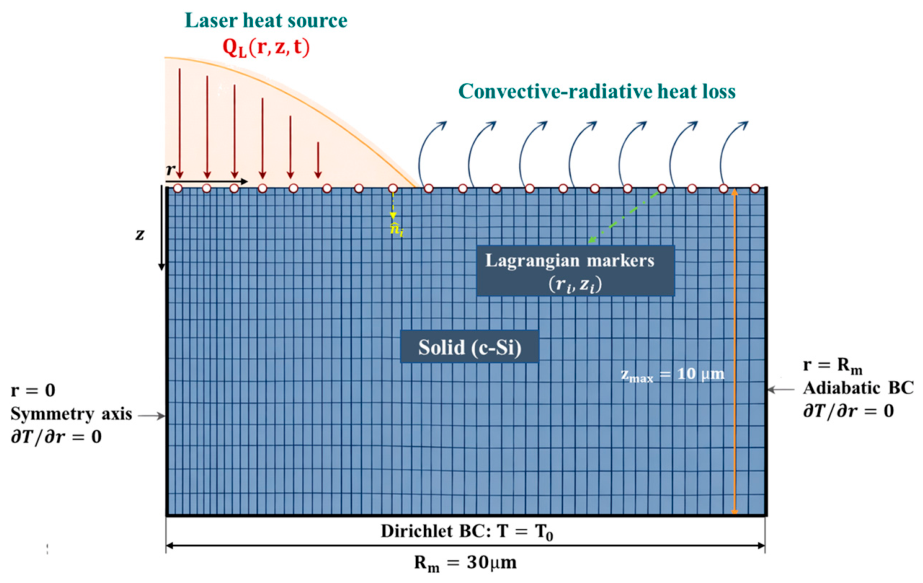
where n is the outward surface normal, h is the convective heat transfer coefficient, T a m b is the ambient temperature, σ is the Stefan–Boltzmann constant, and ε is the surface emissivity of silicon. Figure 1 shows the schematic illustration of the computational domain, boundary conditions, and the laser irradiation configuration used in the simulation.
For picosecond pulse durations in this study at 532 nm, the photon energy (2.33 eV) greatly exceeds the silicon bandgap, and the electron–phonon scattering time in silicon (~1–10 ps) [8] is shorter than the pulse duration. Consequently, the carrier and lattice temperatures can be regarded as approximately equilibrated during the pulse, making a single-temperature description appropriate. This assumption is further supported by the space–time resolved reflectivity measurements of Yen et al. [47] under 20 ps, 532 nm irradiation of Si(111), which were in quantitative agreement with a simple heating model in which electrons and phonons maintain local thermodynamic equilibrium on the picosecond time scale. A two-temperature treatment would be required for pulse durations shorter than the electron–phonon coupling time, where carrier–lattice decoupling and non-thermal melting pathways can become significant—a regime outside the scope of the present work.
At 532 nm, energy deposition follows the Beer–Lambert law. The volumetric laser source is modeled as a Gaussian pulse in both space and time:
Q L = α ( 1 R ) I 0 × e x p α z × e x p t t 0 2 2 σ t 2 × e x p r 2 2 σ r 2  
Here R is the reflectivity, α the absorption coefficient, I 0 the peak intensity, t 0 the peak time, and τ = σ t 8 l n ( 2 ) relates the Gaussian width to the FWHM pulse duration. The beam diameter at the 1 e 2 level is D L = 4 σ r . The fluence and peak intensity also satisfy F 0 = 2 π σ t I 0 [17]. Table 1 lists the parameters and variables used in this simulation. In this simulation, the reflectivity is treated as temperature- and phase-dependent, with values taken from Refs. [48,49,50], while the absorption coefficient α is taken from the temperature- and phase-dependent data reported in [48,49] accounting for both the crystalline and molten phases. At 532 nm, the reflectivity increases from about 0.37 for crystalline silicon near room temperature to about 0.44 near the melting point, and then rises sharply to about 0.72 in the liquid state. Thus, once melting begins, the reflected fraction more than doubles relative to the room-temperature crystalline surface, substantially reducing the fraction of incident laser energy absorbed at the surface [17,50]. This formulation accounts for the strong optical contrast between crystalline and molten silicon at 532 nm and allows the model to capture the corresponding redistribution of absorbed laser energy during melting and resolidification.

2.2. Wilson–Frenkel Interface Kinetics and Marker-Based Tracking

The evolution of the solid–liquid interface during laser-induced melting and resolidification is governed by the competition between the thermodynamic driving force for crystallization and the atomic mobility at the interface. Following the Wilson–Frenkel formulation [17,45,51,52], the interface velocity v T is expressed as:
v T = C 0 D ( T ) exp Δ H k B T m e x p Δ H k B T
Here, C 0 is a kinetic prefactor that represents the atomic attachment frequency and the geometric efficiency of atomic rearrangements at the crystal–liquid interface, D ( T ) is the atomic diffusivity, Δ H is the activation enthalpy for the phase transformation, and k B is the Boltzmann constant. In the formulation adopted from Ref. [17], C 0 is calibrated from molecular-dynamics predictions of melting-front velocities, whereas D ( T ) and Δ H are also taken from atomistic simulations that resolve the temperature dependence of liquid mobility and phase energetics. The first exponential term represents the thermally activated atomic mobility available for interface motion, while the difference between the two exponential terms expresses the competition between forward and reverse atomic transfer across the interface. As a result, the equation naturally combines the thermodynamic driving force for melting or solidification with the temperature dependence of interfacial mobility, and therefore reproduces the characteristic non-monotonic solidification behavior of silicon. The sign convention gives v T > 0 for solidification ( T < T m ) and v T < 0 for melting ( T > T m ).
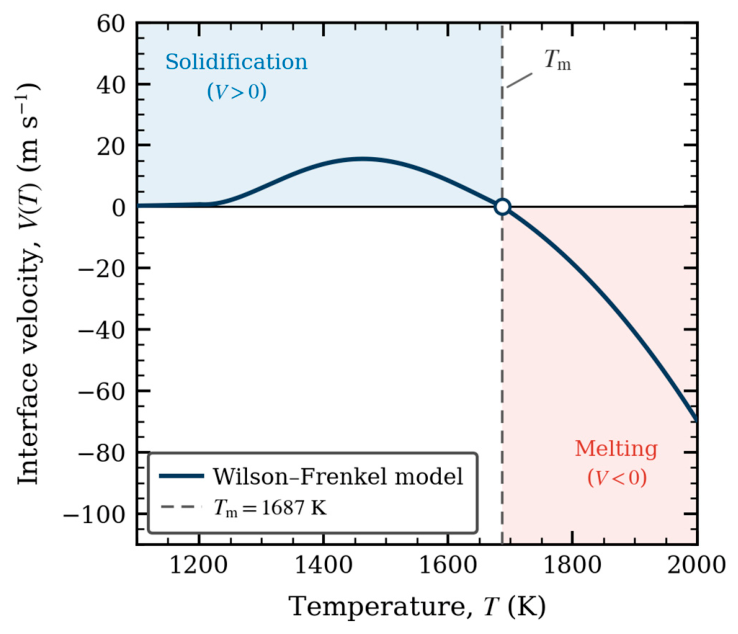
Figure 2 illustrates the resulting non-monotonic velocity. The super-linear increase of the melting front velocity with increasing heating above T m is driven by the simultaneous increase of the driving force and atomic mobility. Below T m , the solidification velocity initially increases with undercooling, reaches a maximum at approximately 0.85 T m , and then decreases as the atomic mobility drops faster than the driving force grows. The decrease of the solidification velocity at deep undercooling allows the undercooled liquid to freeze into a metastable amorphous state.
Table 1. Material properties and model parameters used in the simulation of laser induced phase change in silicon using 532 nm laser wavelength.
ParameterSymbolValue
Density ( k g / m 3 ) ρ 2.33 2.19 × 10 5 T 10 3
2560 for T > T m [41]
Specific heat capacity (J/kg·K) c p [41]
Thermal conductivity (W/m·K) k 158,500 × T 1.23 , constant with the value at T = T m for T > T m [41]
Latent heat of fusion ( J / m 3 ) L 1.8 × 10 6
Convective heat transfer coefficient ( W m 2 K ) h 9.5 [53]
Surface emissivity of silicon ε 0.8 [53]
Linear absorption coefficient (1/m) α 5.02 × 10 5 e x p ( T 430 ) for crystalline silicon
1.1659 × 10 8 for liquid silicon [48,49]
Reflectivity R 0.356 + 5 × 10 5   T for crystalline silicon
0.72 for liquid silicon [48,49,50]
W-F equation’s pre-exponential factor ( m 1 ) C 0 1.12 × 10 11 [17]
Atomic diffusivity ( c m 2 / s ) D ( T ) [17]
Activation enthalpy for the phase transformation (kJ/mol) Δ H [17]
In the continuum algorithm, the interface is discretized as a chain of marker points distributed along the phase boundary, where each marker’s position is defined in physical coordinates ( r i ,   z i ) with a distance of 1 nm from each other. To update marker motion, the temperature field is evaluated at each marker location by mapping it into the underlying finite element cell. This provides the local lattice temperature T ( r i ,   z i ,   t ) needed to compute the Wilson–Frenkel velocity. The tangent vector is estimated from adjacent markers, and the normal n ^ i is taken as its perpendicular, oriented from the liquid phase toward the solid phase. Each marker position is then evolved according to the following equation, as illustrated in Figure 1.
d x i d t = v ( T ) n ^ i  
Here v T is evaluated at the local temperature. The markers are massless and serve to mark the phase boundary. Markers activate when the local temperature exceeds T m and remain active through both the melting phase ( v T < 0 , interface advancing into the solid) and the resolidification phase ( v T > 0 , interface retreating toward the surface). This mixed Eulerian–Lagrangian approach solves the heat equation on a fixed Eulerian grid while explicitly advecting the interface in a Lagrangian manner, providing direct access to the interface position, velocity, and temperature, the fundamental quantities governing amorphization without remeshing or complex moving-boundary conditions.

2.3. Crystalline Fraction Field and Amorphization Criterion

The crystalline fraction field F s provides a continuous representation of the phase distribution throughout the computational domain, transitioning smoothly from F s = 1 (crystalline solid) to F s = 0 (non-crystalline) where F s = 0 corresponds to the liquid phase during melting and resolidification, and is identified as the amorphous phase in regions where the temperature has fallen below T g without complete recrystallization. The transition between F s = 0 and F s = 1 is smoothed across an interface width d =   γ × h m i n , where γ ≈ 8–12 (selected based on mesh resolution) and h m i n is the minimum mesh element size. At each time step, F s is reconstructed from the signed distance “s” to the marker curve using a narrowband profile:
F s = 1                                                                                                                                                                 s   d 2 0.5 0.5 sin π s d                                                                                     d 2 s d 2   0                                                                                                                                                             s     d 2          
This field is essential to capture the phase change. The time derivative d F s d t enters the heat equation as the latent heat source/sink term L d F s d t . This provides crucial coupling between interface motion and the thermal field; during melting, the conversion from solid to liquid absorbs latent heat ( d F s d t < 0 ), accelerating local cooling, while during solidification, the conversion from liquid to solid releases latent heat ( d F s d t > 0 ), which self-heats the interface. This bidirectional energy exchange significantly influences whether amorphization occurs or complete recrystallization is dominant.
Amorphization is captured through the crystal/liquid interface velocity vanishing at glass transition temperature T g = 1200   K , which is also identified from molecular dynamics simulations as the temperature below which the diffusion coefficient drops by more than an order of magnitude and the undercooled liquid transforms into a low-density amorphous phase [17,45,54]. Below T g , atomic mobility becomes insufficient for continued crystal growth and the Wilson–Frenkel velocity used in this work correspondingly approaches zero (Figure 2).
In this simulation, homogeneous nucleation of new crystalline grains within the supercooled melt is not modeled. This assumption is supported by the MD simulations [17,45], which confirmed that for picosecond and nanosecond pulse durations, solidification proceeds entirely by propagation of relatively flat interfaces with no homogeneous nucleation observed in the undercooled liquid even under the high cooling rates (~109–1012 K/s) produced by picosecond irradiation.

2.4. Numerical Implementation and Simulation Conditions

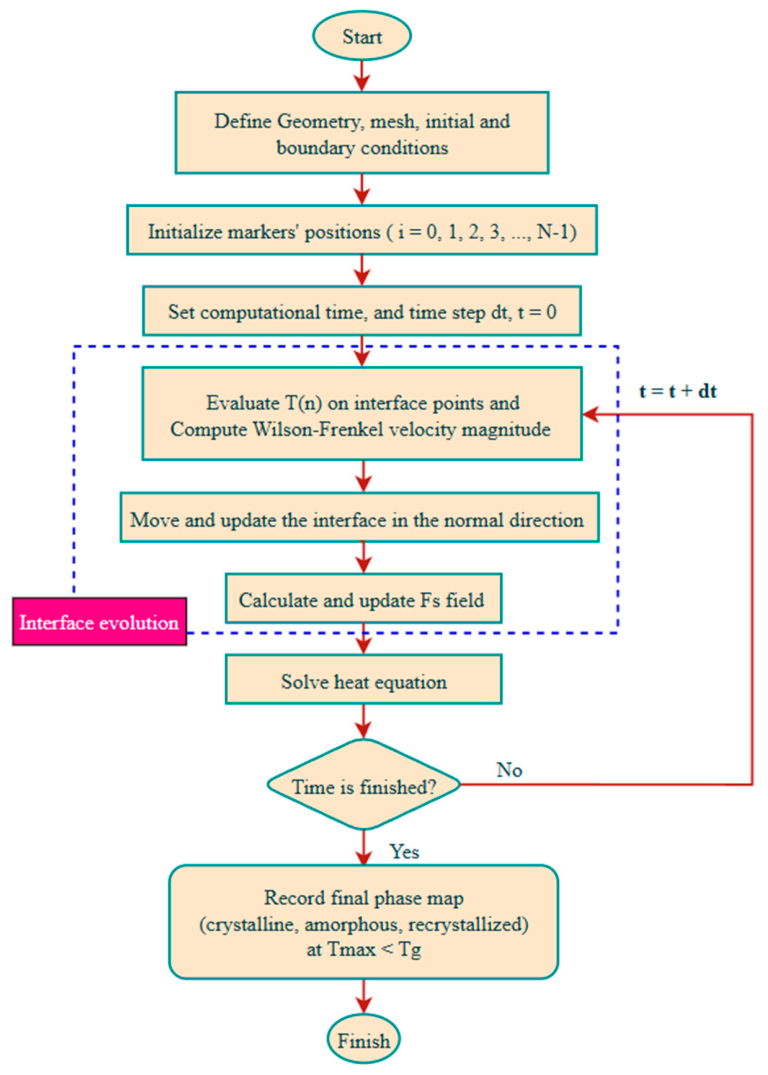
The coupled system of equations is solved by finite element discretization on an unstructured rectangular mesh of the axisymmetric domain, with local refinement in the near-surface region where melting and resolidification occur. The minimum element sizes in the z direction (dz(min) ~ 2 nm) and r direction (dr(min) ~ 10 nm) are chosen to resolve the thermal penetration depth and the thinnest expected amorphous layers, while the mesh coarsens progressively toward the domain boundaries (shown schematically in Figure 1). The domain radius Rm is selected as 30 µm and the domain axial depth is selected as 10 µm to ensure that no significant temperature change reaches the boundaries. A time step of d t 0.2 ps is employed to ensure high accuracy and numerical convergence. Figure 3 shows the flowchart of the model and the overall algorithm at each time step.

2.5. Model Validation

Before applying the framework to the parametric study presented in Section 3, the model was validated against two independent sets of experimental measurements covering different wavelengths and pulse durations. All validation simulations were performed with the same Wilson–Frenkel equation kinetic parameter set used throughout the rest of the paper, with no re-tuning between operating points. Only the wavelength-specific optical inputs (the absorption coefficient and the reflectivity) were updated for the 355 nm cases accordingly [17,55,56].
The first validation point is the amorphization fluence threshold under 20 ps, 532 nm irradiation. The simulations performed in the present framework predict an amorphization threshold of approximately 0.22 J/cm2, in close agreement with the experimental value of approximately 0.20 J/cm2 reported by Liu et al. [57] under the same wavelength and pulse duration. The +10% deviation between simulation and experiment provides a direct quantitative validation of the present framework at the wavelength and pulse duration that are the primary focus of this paper.
To test the predictive capability of the framework beyond the 532 nm regime, additional simulations were performed at 355 nm and compared with the electron-microscopy measurements of Maley et al. [58] who produced thin amorphous silicon layers on (001) c-Si under a fluence of 0.4 J/cm2 at two pulse durations. For 0.4 J/cm2 at 700 ps, the present simulations predict a central amorphous thickness of approximately 83 nm, which is within 4% of the upper bound of the 60–80 nm range reported experimentally; for 0.4 J/cm2 at 2500 ps, the simulations predict approximately 11 nm, compared with the reported approximately 15 nm measured by electron microscopy. The systematic decrease of predicted amorphous thickness from 83 nm to 11 nm as the pulse duration is increased from 700 to 2500 ps is consistent with the physical picture developed in Section 3.2.2: longer pulses distribute the deposited energy over a longer interval, weakening the post-pulse thermal gradient and allowing the Wilson–Frenkel crystallization front to reclaim a larger fraction of the melted volume before the interface quenches below T g .
Together, the threshold agreement at 532 nm and the amorphous-layer thickness agreements at 355 nm provide three independent quantitative validation points spanning two wavelengths and three pulse durations (20, 700, and 2500 ps). The relative deviations of the predictions from the experimental values are approximately +10%, +19%, and −27%, respectively. This consistent level of agreement across two wavelengths and three pulse durations confirms that the framework predicts the experimentally observed amorphization behavior of silicon and supports the application of the model to the parametric study presented in the next section.

3. Results

3.1. Fluence-Dependent Phase Outcomes and the Amorphization Window

The phase outcome of picosecond laser irradiation at 532 nm is governed by the competition between the melt-front penetration depth, post-pulse cooling rate and the velocity of the epitaxial crystallization front. To map this competition, simulations are performed at D = 20 µm and t p = 20 ps for fluences spanning from below the melting threshold to the recrystallization limit.
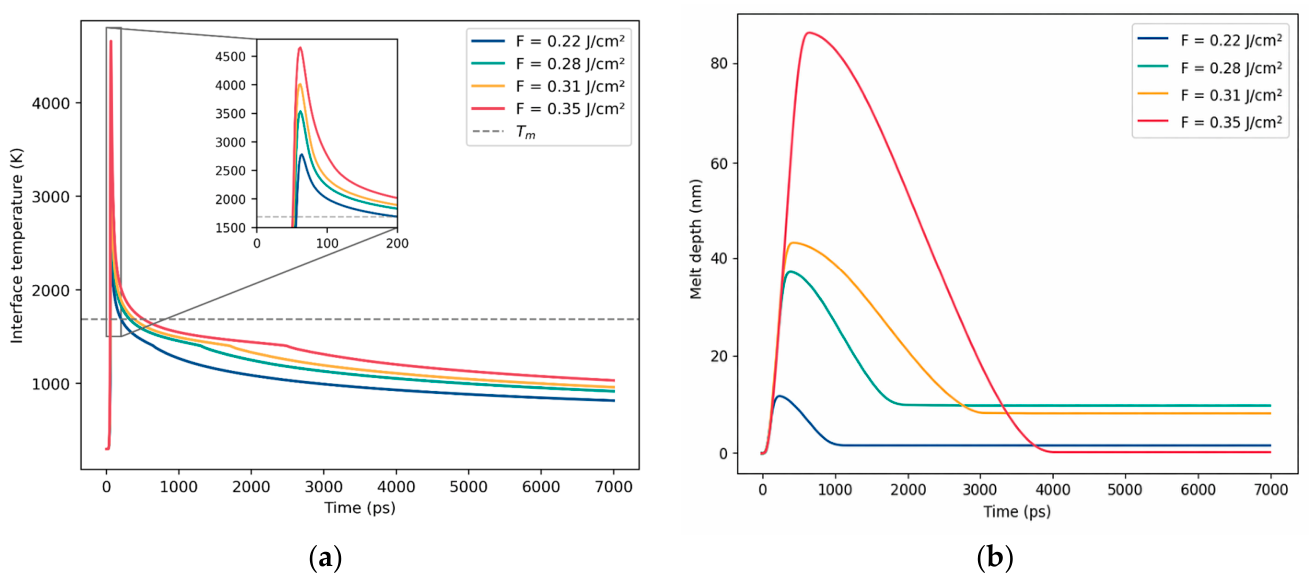
The simulations predict a melting threshold F m ≈ 0.16 J/cm2. Between F m and F ≈ 0.22 J/cm2, a crystallization regime exists in which the melt penetration is extremely shallow, and the steep thermal gradient drives the solidification front back to the surface before the interface temperature can approach T g . At F = 0.22 J/cm2 (Figure 4a,b, blue curves), the melt front reaches only ~11 nm, yet the melt pool is now just deep enough that the interface cools below T g before complete regrowth, trapping a thin (~1.5 nm) amorphous layer. This onset of amorphization at ~0.22 J/cm2 corresponds to the experimental threshold of ~0.2 J/cm2 which was discussed in model validation in Section 2.5.
As the fluence increases to F = 0.28 J/cm2 (teal curve), the deeper melt (~37 nm) prolongs the resolidification time and allows the interface to cool well below T g before the crystallization front can reach the surface, trapping a ~9.6 nm amorphous layer, which is the maximum central thickness at this spot size and pulse duration. At F = 0.31 J/cm2 (orange curve), the melt depth increases further (~43 nm), but the thermal gradient at the onset of resolidification is weaker because the deposited energy has diffused over a larger volume during the longer melting phase. The interface consequently spends more time in the high-mobility regime near 0.85 T m , where the crystallization velocity is near its maximum, allowing more epitaxial regrowth before freezing and thinning the central amorphous layer to ~8 nm. At F = 0.35 J/cm2 (red curve), the gradient is sufficiently weak that the crystallization front maintains high crystallization velocity in a prolonged cooling time.
These results define two fluence thresholds; a lower threshold F L ≈ 0.22 J/cm2 below which the melt is too shallow, and an upper threshold F U ≈ 0.35 J/cm2 above which complete recrystallization occurs in the central region of the laser spot. Within this window, the central amorphous thickness exhibits a bell-shaped fluence dependence, peaking near F ≈ 0.28 J/cm2.
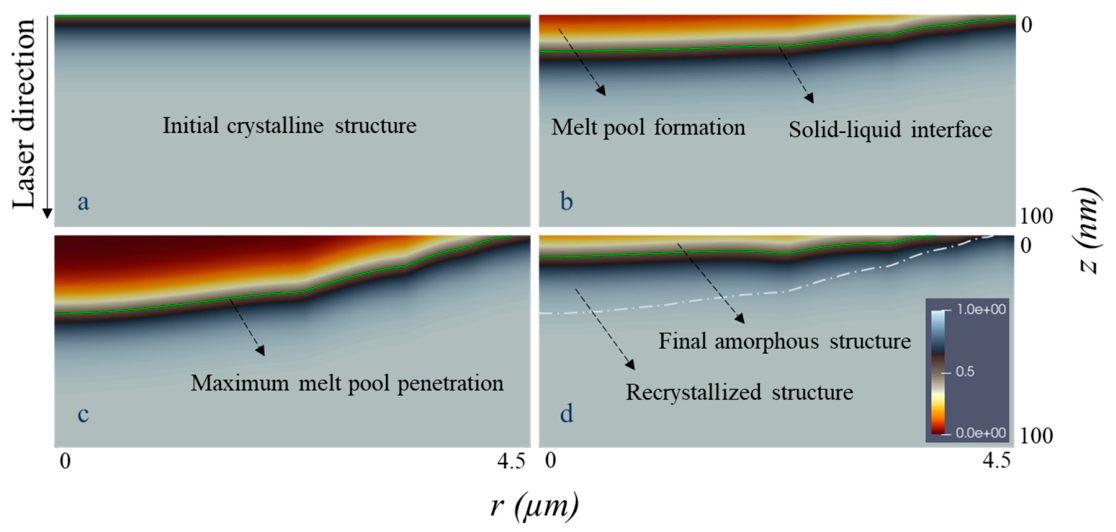
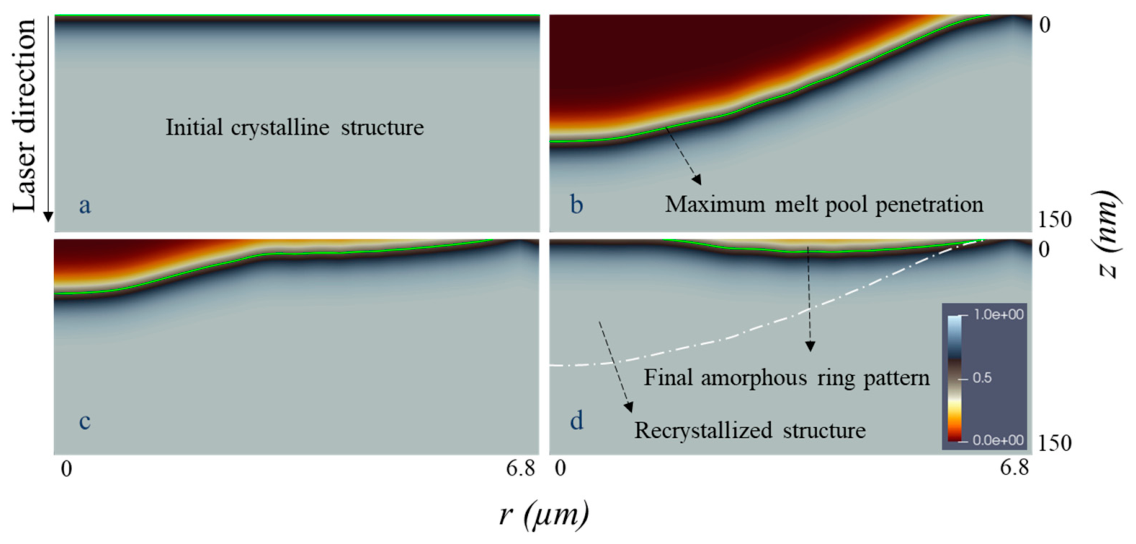
Under a Gaussian beam, the radially varying local fluence maps these one-dimensional thresholds into two-dimensional morphologies. When the peak fluence lies within the window ( F L < F < F U ), a central amorphous spot forms (Figure 5, F = 0.28 J/cm2). When the peak fluence exceeds F U , the center recrystallizes while intermediate radii retain an amorphous annulus (Figure 6, F = 0.35 J/cm2). This central-spot-to-ring transition with increasing fluence is consistent with the experimental observations of Liu et al. [57], confirming that the model captures both the threshold fluences and the spatial phase distribution. Additionally, Liu et al. [57] observed that the amorphous ring is accompanied by slight surface ablation at fluences above F U . The present simulations predict this amorphous ring structure accompanied by surface temperatures exceeding the boiling point of silicon (3538 K) in this fluence range (Figure 4a), which is qualitatively consistent with the onset of ablation in the experiments. However, because the present model does not include ablation and evaporative mass loss, the predicted phase patterns at fluences exceeding the boiling point are interpreted as qualitative indications of the phase distribution rather than quantitative predictions of the final morphology. The model is therefore applicable to irradiation conditions for which the peak surface temperature remains at or modestly above the silicon boiling point, where “gentle ablation” or slight surface evaporation may introduce small corrections but does not dominate the solidification history that governs the amorphous-layer thickness.
Figure 5 and Figure 6 show phase evolution for F = 0.28 J/cm2 and F = 0.35 J/cm2, respectively. In these figures, the green line shows the 0.5 contour of F s , which traces the crystalline–liquid interface during melting and resolidification (panels a–c, where T m a x > T g and the interface moves according to the Wilson–Frenkel equation), and marks the final amorphous–crystalline boundary (panel d, where T m a x < T g and the crystallization front has stopped moving, leaving the trapped region in an amorphous state). Also, the dashed white line shows the boundary between the unaffected single-crystal substrate and the recrystallized zone. The recrystallized zone refers to the region that was melted and subsequently resolidified epitaxially into the crystalline phase and therefore differs from the unaffected substrate in its thermal and microstructural history.

3.2. Parametric Control of the Amorphization Window

The amorphization window established in Section 3.1 is not a fixed material property; it is controlled by the irradiation parameters that govern the thermal gradient and cooling rate at the solidification front. The following subsections demonstrate how the spot diameter, pulse duration, and initial substrate temperature each reshape the window.

3.2.1. Effect of Spot Diameter

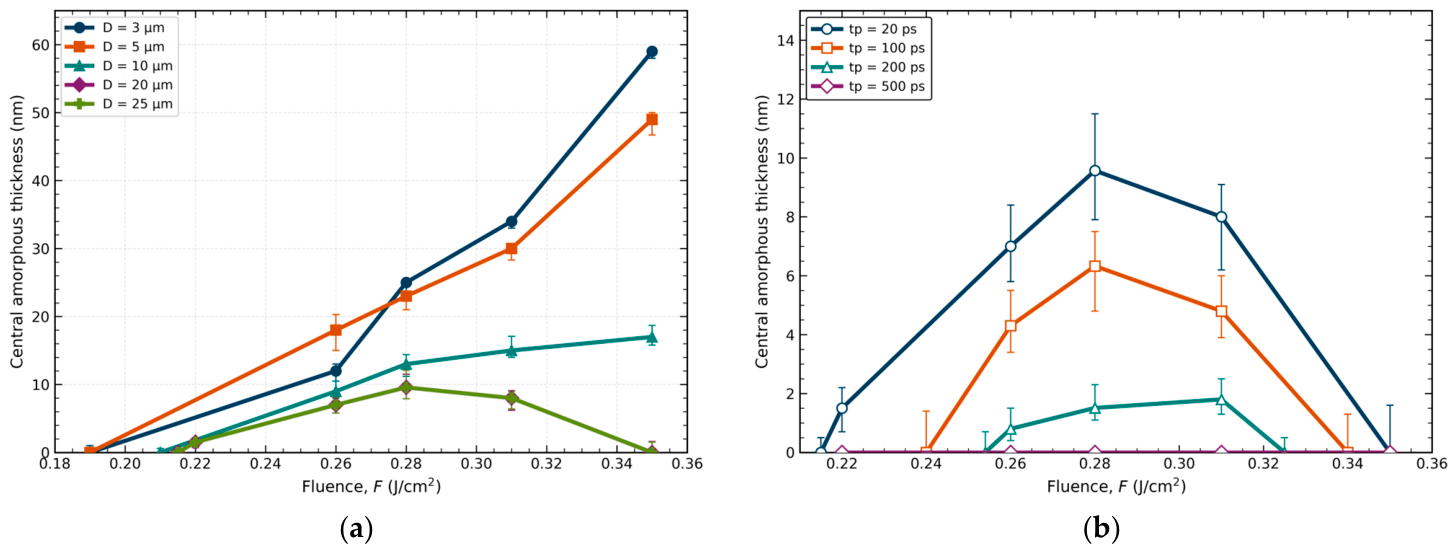
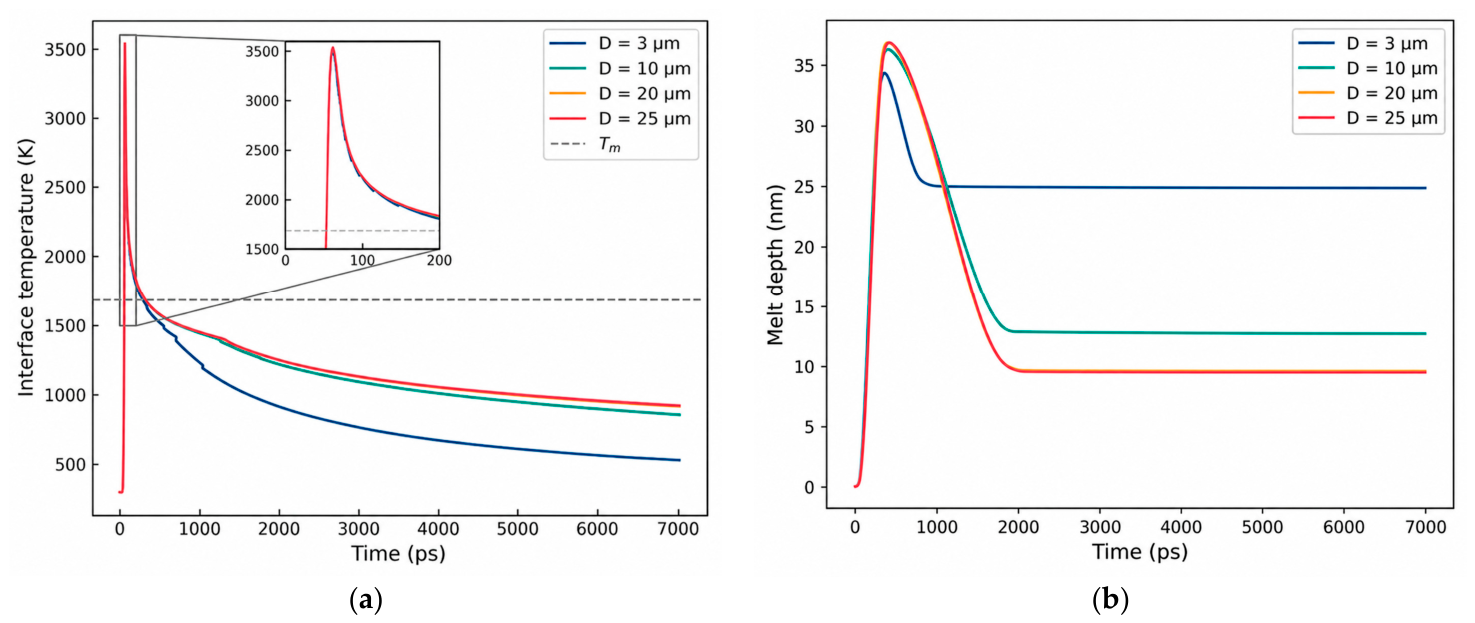
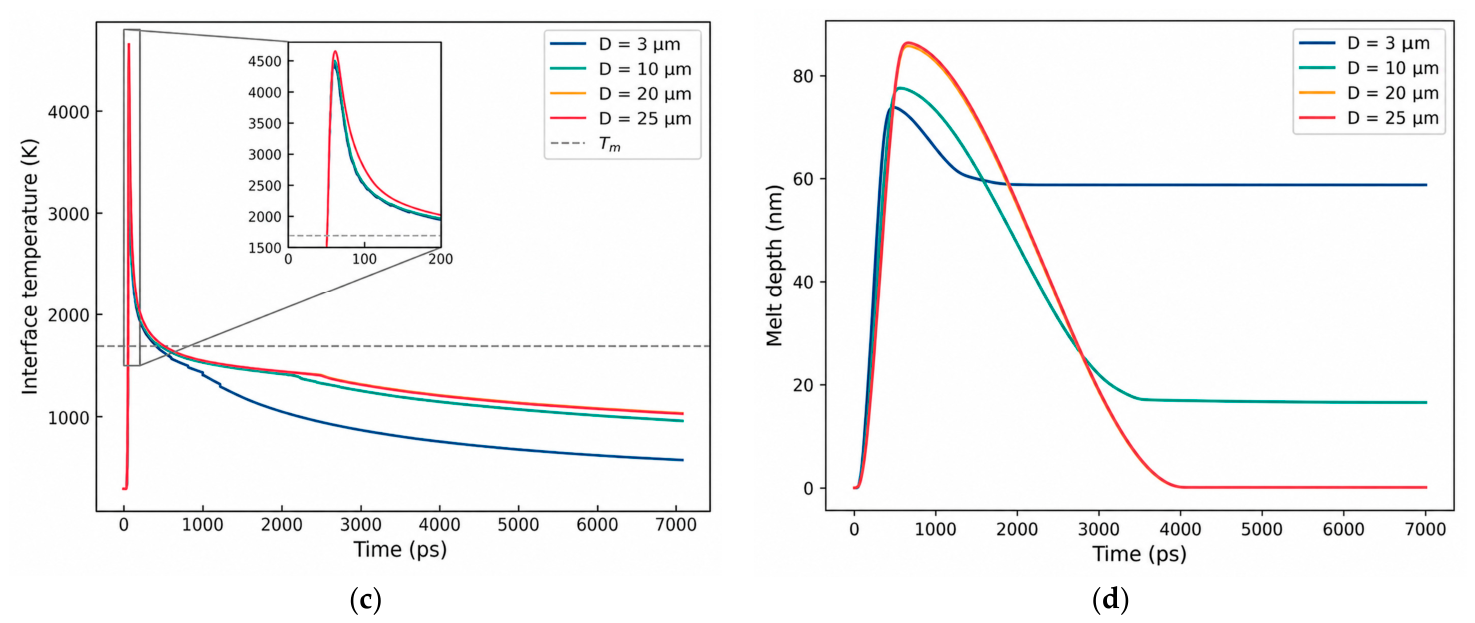
The laser spot diameter determines the lateral extent of the heated zone relative to the surrounding cold silicon and therefore controls the balance between axial and radial heat conduction during post-pulse cooling. Simulations at D = 3, 10, 20, and 25 µm with t p = 20 ps are performed at F = 0.28 and 0.35 J/cm2. The peak interface temperature is independent of spot diameter (Figure 7a,c), confirming that the one-dimensional Beer–Lambert energy deposition governs the initial thermal state. The post-pulse cooling, however, diverges markedly.
At F = 0.28 J/cm2 (Figure 7a,b), the D = 20 and 25 µm curves are indistinguishable, indicating that the amorphization behavior has saturated with respect to spot diameter for D ≥ 20 µm, where radial heat transfer becomes negligible relative to axial conduction into the bulk. At D = 10 µm, enhanced radial heat flux increases the amorphous thickness from ~9.6 nm to ~13 nm. At D = 3 µm, the cold unirradiated silicon is less than 1.5 µm (beam waist) from the beam axis, producing a steep radial gradient that drives the interface below T g much earlier, yielding ~25 nm, more than double the cases with D ≥ 20 µm.
The consequence is more dramatic at F = 0.35 J/cm2 (Figure 7c,d). For D = 20 and 25 µm, this fluence lies above F U and the crystal structure is fully recovered (the curves are overlapping). For D = 10 µm, radial cooling drives the interface below T g , trapping ~17 nm, a fluence that produced complete central recrystallization at D = 20 µm. For D = 3 µm, the interface freezes at ~59 nm, illustrating higher amorphization possibility at smaller spot diameters.

3.2.2. Effect of Pulse Duration

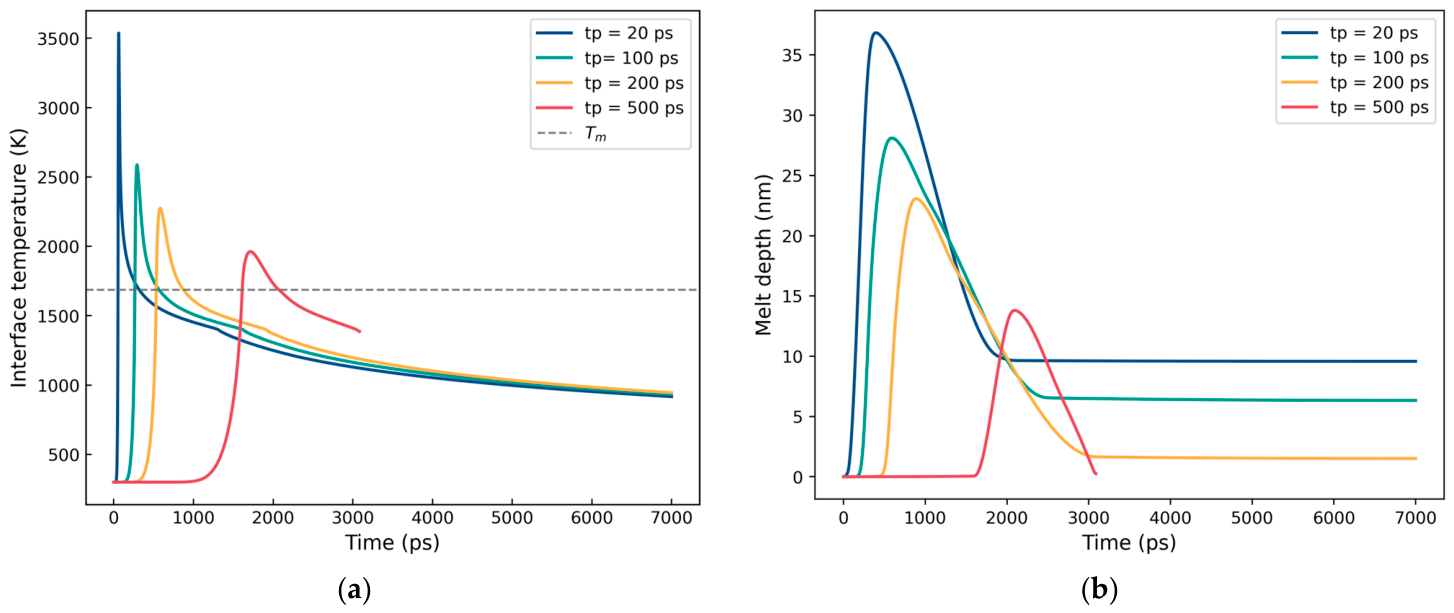
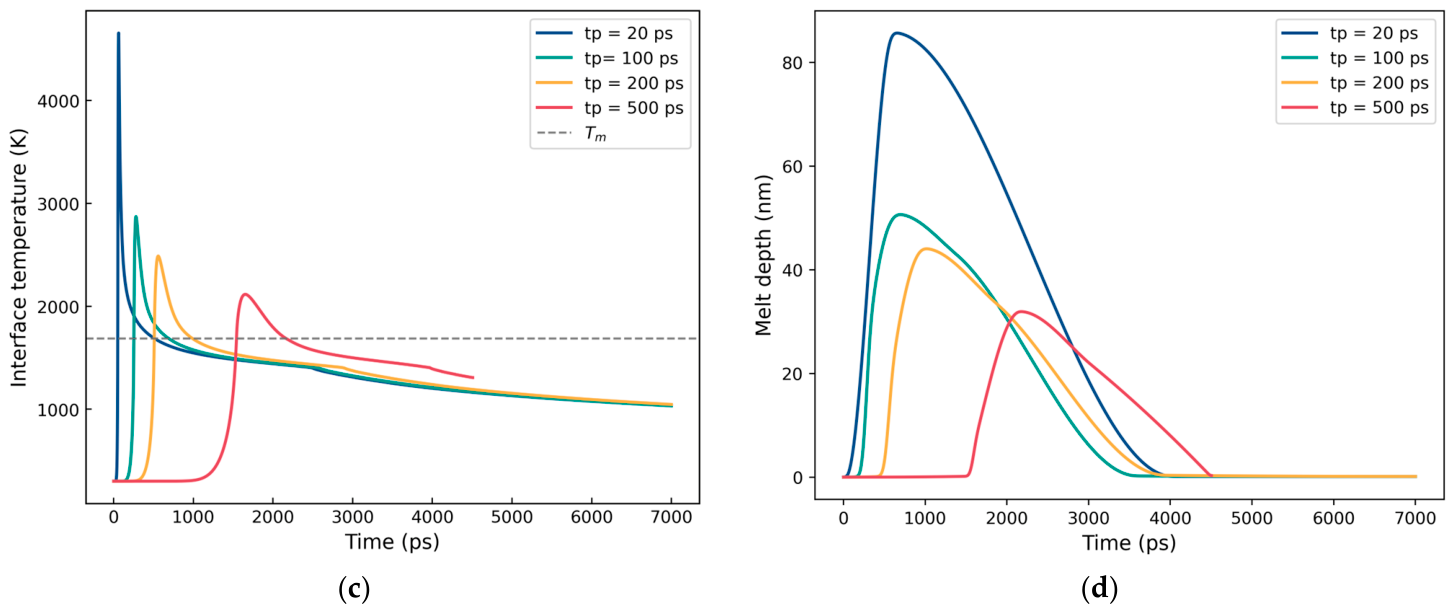
The pulse duration governs the timescale over which the laser energy is deposited relative to the thermal diffusion time and therefore controls the peak temperature and the thermal gradient established at the onset of resolidification. Simulations at t p = 20, 100, 200, and 500 ps with D = 20 µm are performed at F = 0.28 and 0.35 J/cm2. Increasing the pulse duration allows more thermal diffusion during energy deposition, reducing both the peak temperature and the post-pulse gradient.
At F = 0.28 J/cm2 (Figure 8a,b), the peak temperature drops from ~3500 K at 20 ps to ~1950 K at 500 ps, and the peak melt depth decreases from ~37 nm to ~13 nm. The amorphous thickness decreases monotonically: ~9.6 nm at 20 ps, ~6.5 nm at 100 ps, ~1.5 nm at 200 ps, and zero at 500 ps. The reduced melt depth and shallower gradient at longer pulse durations give the crystallization front more time in the high-mobility regime to reclaim the melted volume before the temperature drops below T g .
At F = 0.35 J/cm2 (Figure 8c,d), the interface returns to the surface at all four pulse durations, indicating that this fluence lies above F U regardless of t p in the range investigated. The peak melt depth decreases substantially with increasing t p (from ~86 nm at 20 ps to ~31 nm at 500 ps), and the thermal gradient in this case remains too weak to drive the interface below T g . Therefore, the longer pulse durations do not open a new amorphization window at this fluence.

3.2.3. Amorphization Window Maps: Layer Thickness and Amorphization Efficiency

Figure 9 consolidates the parametric trends into amorphization window maps, revealing that the spot diameter and pulse duration control fundamentally different geometric properties of the window.
The spot-diameter maps (Figure 9a) show that reducing spot diameter modifies both boundaries of the amorphization window simultaneously, but asymmetrically. The lower threshold F L decreases from ~0.22 J/cm2 for D ≥ 20 µm to ~0.185 J/cm2 for D = 3 and 5 µm. This shift occurs because the enhanced radial heat extraction at small spot sizes steepens the post-pulse thermal gradient, enabling even relatively shallow melt pools to cool below T g before the crystallization front can reach the surface. The practical consequence is a significant narrowing of the recrystallization window ( F m < F < F L ) from approximately 0.06 J/cm2 wide (0.16–0.22 J/cm2) at D ≥ 20 µm to only ~0.025 J/cm2 (0.16–0.185 J/cm2) at D = 3 µm. The upper threshold F U responds even more dramatically. It recedes from ~0.35 J/cm2 at D ≥ 20 µm to beyond the investigated fluence range at D = 5 µm, and is absent entirely at D = 3 µm. This elimination of F U transforms the bell-shaped thickness curve into a monotonically increasing function, reaching ~59 nm at F = 0.35 J/cm2 for D = 3 µm compared to zero at the same fluence for D ≥ 20 µm. The disappearance of F U also has a fundamental consequence for the spatial phase distribution; for large spots where both F L and F U exist, the Gaussian beam profile generates a central amorphous spot that transitions to an amorphous ring pattern as the peak fluence crosses F U , and ultimately to central ablation at still higher fluences. For sufficiently small spots where F U is eliminated, this intermediate ring stage cannot occur; the central amorphous region persists and thickens monotonically with increasing fluence until the ablation threshold is reached, producing a direct transition from central amorphous spot to ablation.
On the other hand, the pulse-duration maps (Figure 9b) show that increasing t p narrows the amorphization window by simultaneously raising F L and lowering F U . At t p = 20 ps, the window spans ~0.22–0.35 J/cm2 with a width of ~0.13 J/cm2 and a peak thickness of ~9.6 nm. At 100 ps, F L rises to ~0.24 J/cm2 and F U contracts to ~0.34 J/cm2, narrowing the window to ~0.10 J/cm2 with a reduced peak of ~6.4 nm. At 200 ps, the convergence continues ( F L ≈ 0.255, F U ≈ 0.325 J/cm2), leaving a window of only ~0.07 J/cm2 and a peak of ~1.5 nm. At 500 ps, the two thresholds have effectively merged and the window collapses; no amorphization occurs at any fluence. The physical origin of this symmetric narrowing is that a longer pulse weakens the thermal gradient at the solidification front; this raises F L because a deeper melt is now needed before the weakened cooling can drive the interface below T g , and simultaneously lowers F U because the reduced gradient means that complete recrystallization can occur at lower fluences than before.
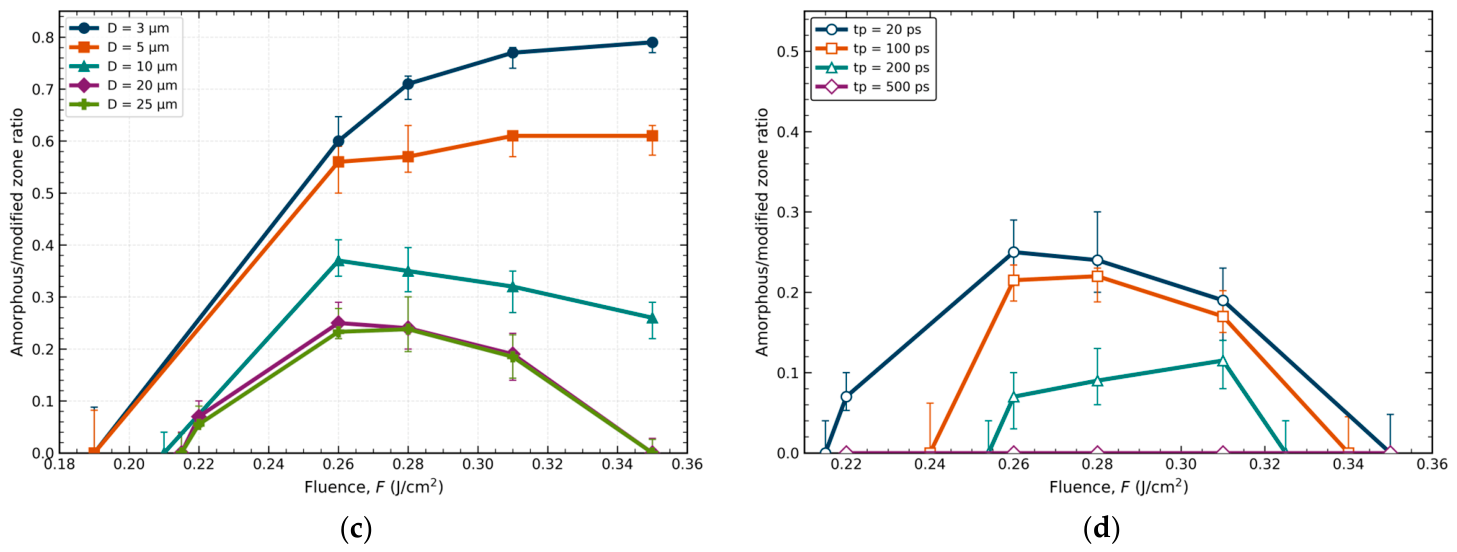
The amorphization efficiency plots (Figure 9c,d) provide additional insight into the partitioning of the modified zone. For spot diameter (Figure 9c), the ratio at D = 3 µm saturates near 0.8, indicating that radial cooling traps ~80% of the melt pool as amorphous material regardless of fluence. At D = 5 µm, the ratio saturates at ~0.61. For D = 10 µm, the maximum ratio is about 37% at 0.26 J/cm2 and shows reduction by increasing the fluence. For D = 20 and 25 µm, the ratio exhibits a bell-shaped dependence with very close results. For the pulse-duration dependence, (Figure 9d), all curves show bell-shaped behavior with peaks that decrease from ~0.25 at t p = 20 ps to ~0.22 at 100 ps and ~0.12 at 200 ps. The ratio is zero at 500 ps. This behavior indicates more favorable crystallization conditions at longer pulse durations.
To assess the robustness of these predictions to uncertainty in the kinetic parameter set, the simulations underlying Figure 9 were repeated with the Wilson–Frenkel velocity perturbed by ±10%. The peak resolidification velocity predicted by the Wilson–Frenkel law under the conditions of this study is approximately 15 m/s, in agreement with reported maximum crystal–liquid interface velocities for silicon under pulsed laser irradiation [13], and the ±10% range was therefore chosen as a conservative estimate of the residual uncertainty in this quantity. The resulting bands are shown as error bars in Figure 9a–d. Across all spot diameters and pulse durations, the predicted central amorphous thickness varies within a few nanometers around the reference value depending on the specific laser-parameter condition, while the topological features of the window such as the existence of F L and F U , the bell-shaped versus monotonic character of the thickness–fluence response, and the qualitative trends with D and t p are preserved. The amorphization-efficiency curves (Figure 9c,d) show similarly bounded sensitivity. This indicates that the principal qualitative conclusions of the parametric study are robust within the ±10% velocity uncertainty considered here.

3.2.4. Effect of Initial Substrate Temperature

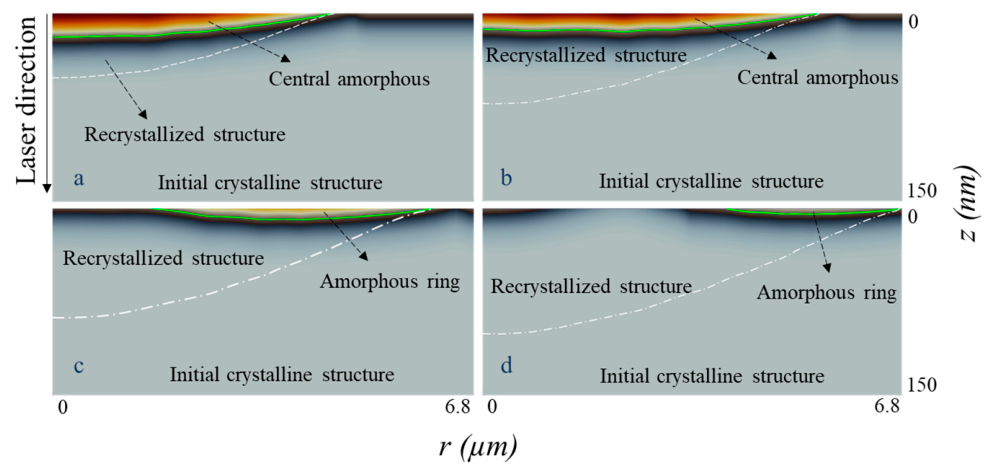
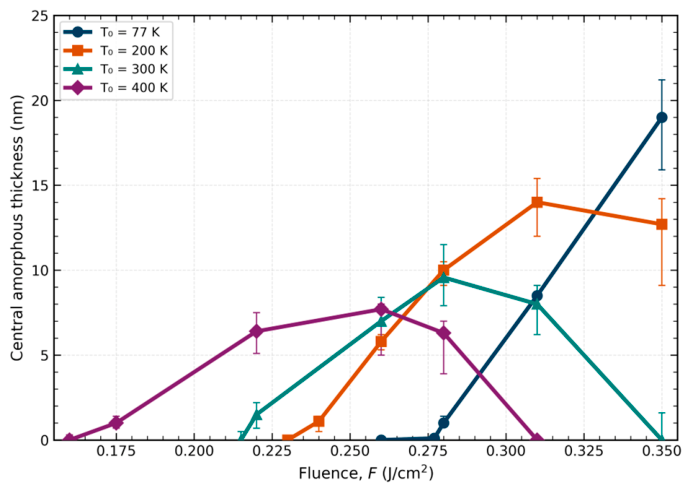
The initial substrate temperature T 0 modulates the phase change window through its effect on the thermal conductivity of crystalline silicon, which increases strongly with decreasing temperature. A colder substrate conducts heat away from the melt zone more efficiently, steepening the post-pulse thermal gradient and accelerating the cooling of the solidification front. Figure 10 and Figure 11 present the final phase map and the central amorphous thickness for T 0 = 77, 200, 300, and 400 K at D = 20 µm and t p = 20 ps.
The substrate temperature shifts both thresholds simultaneously, but in a manner that reveals two distinct regimes of window behavior. At T 0 = 400 K, the low thermal conductivity reduces the melting threshold and lowers F L to ~0.16 J/cm2, but the same weak conduction limits the post-pulse cooling rate, bringing F U down to ~0.31 J/cm2. The resulting window, while spanning a moderate fluence range, supports only a thin peak amorphous thickness of ~7.5 nm, the shallow thermal gradient cannot drive deep amorphization at any fluence. At T 0 = 300 K, the improved conduction shifts F L upward to ~0.22 J/cm2 and F U to ~0.35 J/cm2, and the steeper gradient raises the peak thickness to ~9.6 nm. At T 0 = 200 K, F L shifts further to ~0.24 J/cm2 while F U recedes beyond the highest fluence investigated, broadening the effective window and increasing the peak to ~14 nm. At T 0 = 77 K, the cryogenic thermal conductivity pushes F L to ~0.27 J/cm2 and eliminates F U ; the amorphous thickness increases monotonically to ~19 nm at the highest fluence, undergoing the same topological transition from a bounded bell to an unbounded monotonic function observed for small spot diameters in Section 3.2.1.
This window evolution is directly visualized in Figure 10, which presents the final phase map at a fixed fluence of F = 0.35 J/cm2 for the four substrate temperatures. At T 0 = 77 K (Figure 10a), this fluence lies within the amorphization window because F U has been eliminated, and the simulation produces a central amorphous spot with a deep modified zone and a thick amorphous layer at the beam center. At T 0 = 200 K (Figure 10b), F U is at the boundary of the investigated range, and the center shows a modest amorphous layer with recrystallization beginning to compete, a transitional morphology between the central spot and ring regimes. It can be observed that the maximum amorphous thickness no longer forms at the center under this condition showing the start of the transition to ring pattern. At T 0 = 300 K (Figure 10c), F = 0.35 J/cm2 exceeded F U , and the center has fully recrystallized while an amorphous ring persists at intermediate radii where the local Gaussian fluence falls within the window. At T 0 = 400 K (Figure 10d), the ring is narrower and displaced to larger radii. This occurs because the lower F U at this temperature (~0.31 J/cm2) means that the fixed peak fluence of 0.35 J/cm2 exceeds the upper threshold by a wider margin, pushing the inner ring boundary, where the local Gaussian fluence drops to F U further from the beam axis. Simultaneously, the amorphous layer within the ring is also thinner because the weaker thermal gradient at elevated substrate temperature limits the cooling rate at the solidification front, allowing more epitaxial regrowth before the interface reaches T g . The four panels thus capture the complete morphological transition from a central amorphous spot to an amorphous ring, driven not by increasing the fluence but by raising the substrate temperature at a fixed fluence.
The transformation from a narrow bell at T 0 = 400 K to a broad, monotonically increasing curve at 77 K (Figure 11) is qualitatively analogous to the spot-diameter effect (Section 3.2.1), although the underlying mechanism differs; reduced T 0 enhances heat extraction into the bulk, while reduced D enhances mostly radial heat extraction into the surrounding unirradiated material. Both routes steepen the thermal gradient at the solidification front, suppress the recrystallization pathway, and widen the processing window for controlled amorphization. The substrate temperature thus provides a thermal route to the same morphological control that the spot diameter achieves geometrically. The error bars in Figure 11 show the corresponding ±10% v T sensitivity band, comparable in magnitude to that of Figure 9 and confirming the robustness of the initial-temperature trend.

4. Conclusions

This work establishes that the amorphization and recrystallization outcome in picosecond laser-irradiated silicon at 532 nm is governed by underlying competition between post-pulse cooling and epitaxial regrowth velocity, and that this competition can be systematically manipulated through the irradiation parameters. The central finding is that fluence, spot diameter, pulse duration, and substrate temperature each control qualitatively different geometric properties of the amorphization window. Fluence sets the amorphous thickness and drives the transition to an amorphous ring at high fluences. The spot diameter and substrate temperature modify the window topology by shifting or eliminating the upper fluence threshold. Within the applicability range of the present model, the simulations rigorously resolve the two-dimensional phase distributions of the modified zone and distinguish the recrystallized and amorphous sub-regions that determine device-relevant refractive-index contrast. In this regime, elimination of F U (at small spot diameters or low substrate temperatures) implies that the central amorphous region persists and thickens monotonically with increasing fluence, rather than collapsing to a ring; at still higher fluences this morphology is ultimately interrupted by ablation, a regime that lies outside the scope of the present model. The pulse duration serves a different role, acting as a temporal gate that progressively narrows the window from both thresholds until amorphization becomes inaccessible beyond a critical pulse duration. In practice, for 532 nm irradiation, applications requiring controlled amorphous layers benefit from tightly focused beams (D ≤ 5 µm) or cryogenic substrates that eliminate F U , whereas applications targeting complete recrystallization, such as laser doping, dopant activation, and laser annealing, are better served by large spots (D ≥ 20 µm), elevated substrate temperatures, and pulse durations beyond 500 ps.
The framework has been quantitatively validated through cross-wavelength comparison with experimental data, including the amorphization fluence threshold and amorphous-layer thickness at different pulse durations, with predicted values lying within 10–27% of the reported measurements. Further direct experimental imaging of the predicted two-dimensional spatial phase distributions would provide a morphology-resolved complement to the present validation and represents a natural next step.
For future research, the framework developed here can also be extended in several directions. Incorporating an ablation model would enable the simulation to capture the complete morphological sequence from amorphization through ring formation to the ablation regime within a single simulation, particularly at fluences where the peak surface temperature approaches the thermodynamic critical temperature of silicon and phase explosion becomes the dominant ablation mechanism (strong ablation regime). Multi-pulse accumulation would allow modeling of industrially relevant scanning and repetitive irradiation conditions, and coupling with a stress solver would capture stress-driven amorphous-to-crystalline transformation during post-irradiation cooling.

Author Contributions

Conceptualization, F.J., Q.L. and S.L.; methodology, F.J., Q.L. and S.L.; formal analysis, F.J., Q.L. and S.L.; investigation, F.J.; resources, S.L.; writing—original draft preparation, F.J.; writing—review and editing, F.J., Q.L. and S.L.; supervision, Q.L. and S.L.; project administration, S.L. All authors have read and agreed to the published version of the manuscript.

Funding

This research was partially funded by the National Science Foundation under Grant Nos. ECCS-2128962 and ECCS-2129006.

Data Availability Statement

Data underlying the results presented in this paper are not publicly available at this time but may be obtained from the authors upon reasonable request.

Acknowledgments

The computing for this project was performed on the Beocat Research Cluster at Kansas State University, which is funded in part by NSF grants CNS-1006860, EPS-1006860, EPS-0919443, ACI-1440548, CHE-1726332, and NIH P20GM113109.

Conflicts of Interest

The authors declare no conflicts of interest.

References

  1. Lipson, M. Guiding, Modulating, and Emitting Light on Silicon-Challenges and Opportunities. J. Light. Technol. 2005, 23, 4222–4238. [Google Scholar] [CrossRef]
  2. Hochberg, M.; Baehr-Jones, T. Towards Fabless Silicon Photonics. Nat. Photonics 2010, 4, 492–494. [Google Scholar] [CrossRef]
  3. Ohmura, E.; Fukuyo, F.; Fukumitsu, K.; Morita, H. Modified-Layer Formation Mechanism into Silicon with Permeable Nanosecond Laser. Int. J. Comput. Mater. Sci. Surf. Eng. 2007, 1, 677–691. [Google Scholar] [CrossRef]
  4. Ohmura, E. Temperature Rise of Silicon Due to Absorption of Permeable Pulse Laser. In Heat Transfer-Engineering Applications; InTechOpen: London, UK, 2011. [Google Scholar][Green Version]
  5. Chambonneau, M.; Li, Q.; Chanal, M.; Sanner, N.; Grojo, D. Writing Waveguides inside Monolithic Crystalline Silicon with Nanosecond Laser Pulses. Opt. Lett. 2016, 41, 4875–4878. [Google Scholar] [CrossRef]
  6. Tokel, O.; Turnall, A.; Makey, G.; Elahi, P.; Çolakoǧlu, T.; Ergeçen, E.; Yavuz, Ö.; Hübner, R.; Zolfaghari Borra, M.; Pavlov, I.; et al. In-Chip Microstructures and Photonic Devices Fabricated by Nonlinear Laser Lithography Deep inside Silicon. Nat. Photonics 2017, 11, 639–645. [Google Scholar] [CrossRef]
  7. Wang, X.; Yu, X.; Shi, H.; Tian, X.; Chambonneau, M.; Grojo, D.; DePaola, B.; Berg, M.; Lei, S. Characterization and Control of Laser Induced Modification inside Silicon. J. Laser Appl. 2019, 31, 022601. [Google Scholar] [CrossRef]
  8. Sundaram, S.K.; Mazur, E. Inducing and Probing Non-Thermal Transitions in Semiconductors Using Femtosecond Laser Pulses. Nat. Mater. 2002, 1, 217–224. [Google Scholar] [CrossRef]
  9. Wang, A.; Das, A.; Fedorov, V.Y.; Sopeña, P.; Tzortzakis, S.; Grojo, D. In-Chip Critical Plasma Seeds for Laser Writing of Reconfigurable Silicon Photonics Systems. Nat. Commun. 2025, 16, 6733. [Google Scholar] [CrossRef] [PubMed]
  10. Forouhi, A.R.; Bloomer, I. Optical Dispersion Relations for Amorphous Semiconductors and Amorphous Dielectrics. Phys. Rev. B 1986, 34, 7018–7026. [Google Scholar] [CrossRef] [PubMed]
  11. De Dood, M.J.A.; Polman, A.; Zijlstra, T.; Van Der Drift, E.W.J.M. Amorphous Silicon Waveguides for Microphotonics. J. Appl. Phys. 2002, 92, 649–653. [Google Scholar] [CrossRef]
  12. Shanks, H.R.; Maycock, P.D.; Sidles, P.H.; Danielson, G.C. Thermal Conductivity of Silicon from 300 to 1400°K. Phys. Rev. 1963, 130, 1743. [Google Scholar] [CrossRef]
  13. Thompson, M.O.; Mayer, J.W.; Cullis, A.G.; Webber, H.C.; Chew, N.G.; Poate, J.M.; Jacobson, D.C. Silicon Melt, Regrowth, and Amorphization Velocities during Pulsed Laser Irradiation. Phys. Rev. Lett. 1983, 50, 896–899. [Google Scholar] [CrossRef]
  14. Mirza, I.; Sládek, J.; Levy, Y.; Bulgakov, A.V.; Dimitriou, V.; Papadaki, H.; Kaselouris, E.; Gečys, P.; Račiukaitis, G.; Bulgakova, N.M. Coherence Effects in LIPSS Formation on Silicon Wafers upon Picosecond Laser Pulse Irradiations. J. Phys. D Appl. Phys. 2025, 58, 085307. [Google Scholar] [CrossRef]
  15. Papadaki, H.; Mirza, I.; Bulgakova, N.M.; Kaselouris, E.; Dimitriou, V. Thermomechanical Investigation of Silicon Wafer Dynamics Within the Melting Regime Driven by Picosecond Laser Pulses for Surface Structuring. Materials 2025, 18, 5506. [Google Scholar] [CrossRef]
  16. Garcia-Lechuga, M.; Casquero, N.; Siegel, J.; Solis, J.; Clady, R.; Wang, A.; Utéza, O.; Grojo, D. Amorphization and Ablation of Crystalline Silicon Using Ultrafast Lasers: Dependencies on the Pulse Duration and Irradiation Wavelength. Laser Photon. Rev. 2024, 18, 2301327. [Google Scholar] [CrossRef]
  17. He, M.; Zhigilei, L.V. Multiscale Modeling of Short Pulse Laser Induced Amorphization of Silicon. J. Appl. Phys. 2024, 136, 213103. [Google Scholar] [CrossRef]
  18. Koechner, W. Solid-State Laser Engineering, 6th ed.; Springer Series in Optical Sciences; Springer: New York, NY, USA, 2006. [Google Scholar]
  19. Chambonneau, M.; Grojo, D.; Tokel, O.; Ilday, F.Ö.; Tzortzakis, S.; Nolte, S. In-Volume Laser Direct Writing of Silicon—Challenges and Opportunities. Laser Photon. Rev. 2021, 15, 2100140. [Google Scholar] [CrossRef]
  20. Bachman, D.; Chen, Z.; Fedosejevs, R.; Tsui, Y.Y.; Van, V. Permanent Fine Tuning of Silicon Microring Devices by Femtosecond Laser Surface Amorphization and Ablation. Opt. Express 2013, 21, 11048–11056. [Google Scholar] [CrossRef]
  21. Logan, A.M.; Chen, X.; Yu, X.; Shen, W.; Yan, X.; Zhang, W.; Mashanovich, G.Z.; Reed, G.T.; Thomson, D.J. Towards Precise Trimming and Programming of Photonic Integrated Circuits. In 2025 IEEE Silicon Photonics Conference (SiPhotonics); IEEE: New York, NY, USA, 2025. [Google Scholar]
  22. Pyo, J.; Ryu, H.Y. Comparative Study on Crystallinity of Laser-Annealed Polysilicon Thin Films for Various Laser Sources. Mater. Express 2021, 11, 1239–1244. [Google Scholar] [CrossRef]
  23. Arduino, D.; Stassi, S.; Spano, C.; Scaltrito, L.; Ferrero, S.; Bertana, V. Silicon and Silicon Carbide Recrystallization by Laser Annealing: A Review. Materials 2023, 16, 7674. [Google Scholar] [CrossRef]
  24. Liu, P.L.; Yen, R.; Bloembergen, N.; Hodgson, R.T. Picosecond Laser-Induced Melting and Resolidification Morphology on Si. Appl. Phys. Lett. 1979, 34, 864–866. [Google Scholar] [CrossRef]
  25. Cullis, A.G.; Chew, N.G.; Webber, H.C.; Smith, D.J. Orientation Dependence of High Speed Silicon Crystal Growth from the Melt. J. Cryst. Growth 1984, 68, 624–638. [Google Scholar] [CrossRef]
  26. Yater, J.A.; Thompson, M.O. Orientation Dependence of Laser Amorphization of Crystal Si. Phys. Rev. Lett. 1989, 63, 2088–2091. [Google Scholar] [CrossRef]
  27. Fuentes-Edfuf, Y.; Garcia-Lechuga, M.; Puerto, D.; Florian, C.; Garcia-Leis, A.; Sanchez-Cortes, S.; Solis, J.; Siegel, J. Fabrication of Amorphous Micro-Ring Arrays in Crystalline Silicon Using Ultrashort Laser Pulses. Appl. Phys. Lett. 2017, 110, 211602. [Google Scholar] [CrossRef]
  28. Bonse, J. All-Optical Characterization of Single Femtosecond Laser-Pulse-Induced Amorphization in Silicon. Appl. Phys. A Mater. Sci. Process. 2006, 84, 63–66. [Google Scholar] [CrossRef]
  29. Florian, C.; Fischer, D.; Freiberg, K.; Duwe, M.; Sahre, M.; Schneider, S.; Hertwig, A.; Krüger, J.; Rettenmayr, M.; Beck, U.; et al. Single Femtosecond Laser-Pulse-Induced Superficial Amorphization and Re-Crystallization of Silicon. Materials 2021, 14, 1651. [Google Scholar] [CrossRef]
  30. Garcia-Lechuga, M.; Sopeña, P.; Grojo, D.; Siegel, J. Evidence of Counter-Propagating Solidification Fronts in Silicon upon Femtosecond Laser Induced Amorphization. J. Appl. Phys. 2025, 137, 155702. [Google Scholar] [CrossRef]
  31. Blumenstein, A.; Simon, P.; Ihlemann, J. High-Resolution Laser Interference Ablation and Amorphization of Silicon. Nanomaterials 2023, 13, 2240. [Google Scholar] [CrossRef] [PubMed]
  32. Baeri, P.; Campisano, S.U.; Foti, G.; Rimini, E. A Melting Model for Pulsing-Laser Annealing of Implanted Semiconductors. J. Appl. Phys. 1979, 50, 788–797. [Google Scholar] [CrossRef]
  33. Wood, R.F.; Giles, G.E. Macroscopic Theory of Pulsed-Laser Annealing. I. Thermal Transport and Melting. Phys. Rev. B 1981, 23, 2923. [Google Scholar] [CrossRef]
  34. Černý, R.; Šáršik, R.; Lukeš, I.; Cháb, V. Excimer-Laser-Induced Melting and Solidification of Monocrystalline Si: Equilibrium and Nonequilibrium Models. Phys. Rev. B 1991, 44, 4097–4102. [Google Scholar] [CrossRef] [PubMed]
  35. Stolk, P.A.; Polman, A.; Sinke, W.C. Experimental Test of Kinetic Theories for Heterogeneous Freezing in Silicon. Phys. Rev. B 1993, 47, 5–13. [Google Scholar] [CrossRef]
  36. Hackenberg, M.; Pichler, P.; Huet, K.; Negru, R.; Venturini, J.; Pakfar, A.; Tavernier, C.; La Magna, A. Enthalpy Based Modeling of Pulsed Excimer Laser Annealing for Process Simulation. Appl. Surf. Sci. 2012, 258, 9347–9351. [Google Scholar] [CrossRef]
  37. La Magna, A.; Alippi, P.; Privitera, V.; Fortunato, G.; Camalleri, M.; Svensson, B. A Phase-Field Approach to the Simulation of the Excimer Laser Annealing Process in Si. J. Appl. Phys. 2004, 95, 4806–4814. [Google Scholar] [CrossRef]
  38. Bergmann, S.; Albe, K.; Flegel, E.; Barragan-Yani, D.A.; Wagner, B. Anisotropic Solid-Liquid Interface Kinetics in Silicon: An Atomistically Informed Phase-Field Model. Model. Simul. Mater. Sci. Eng. 2017, 25, 065015. [Google Scholar] [CrossRef]
  39. Wood, R.F.; Geist, G.A. Modeling of Nonequilibrium Melting and Solidification in Laser-Irradiated Materials. Phys. Rev. B 1986, 34, 2606–2620. [Google Scholar] [CrossRef]
  40. Xu, X.; Grigoropoulos, C.P.; Russo, R.E. Heat Transfer in Excimer Laser Melting of Thin Polysilicon Layers. J. Heat Transf. 1995, 117, 708–715. [Google Scholar] [CrossRef]
  41. Kiyota, H.; Hara, K.; Jankowski, M.; Fejer, M.M. Numerical Simulation and Validation of Subsurface Modification and Crack Formation Induced by Nanosecond-Pulsed Laser Processing in Monocrystalline Silicon. J. Appl. Phys. 2020, 127, 085106. [Google Scholar] [CrossRef]
  42. Zhang, J.; Zhao, L.; Rosenkranz, A.; Song, C.; Yan, Y.; Sun, T. Nanosecond Pulsed Laser Ablation of Silicon-Finite Element Simulation and Experimental Validation. J. Micromech. Microeng. 2019, 29, 075009. [Google Scholar] [CrossRef]
  43. Papadaki, H.; Kaselouris, E.; Bakarezos, M.; Tatarakis, M.; Papadogiannis, N.A.; Dimitriou, V. A Computational Study of Solid Si Target Dynamics under Ns Pulsed Laser Irradiation from Elastic to Melting Regime. Computation 2023, 11, 240. [Google Scholar] [CrossRef]
  44. Ivanov, D.S.; Itina, T.E. Numerical Investigation of the Kinetics of Non-Equilibrium Phase Transitions in Silicon Induced by an Ultra-Short Laser Pulse. arXiv 2024, arXiv:2411.10073. [Google Scholar]
  45. Karim, E.T.; He, M.; Salhoumi, A.; Zhigilei, L. V Kinetics of Solid–Liquid Interface Motion in Molecular Dynamics and Phase-Field Models. Philos. Trans. Math. Phys. Eng. Sci. 2021, 379, 1–14. [Google Scholar]
  46. Baratta, I.A.; Dean, J.P.; Dokken, J.S.; Habera, M.; Hale, J.S.; Richardson, C.N.; Rognes, M.E.; Scroggs, M.W.; Sime, N.; Wells, G.N. DOLFINx: Next Generation FEniCS Problem Solving Environment. ACM Trans. Math. Softw. 2023, 1–38. [Google Scholar]
  47. Yen, R.; Liu, J.M.; Kurz, H.; Bloembergen, N. Space-Time Resolved Reflectivity Measurements of Picosecond Laser-Pulse Induced Phase Transitions in (111) Silicon Surface Layers. Appl. Phys. A 1982, 27, 153–160. [Google Scholar] [CrossRef]
  48. Beránek, J.; Bulgakov, A.V.; Bulgakova, N.M. On the Melting Thresholds of Semiconductors under Nanosecond Pulse Laser Irradiation. Appl. Sci. 2023, 13, 3818. [Google Scholar] [CrossRef]
  49. Lowndes, D.H.; Wood, R.F.; Westbrook, R.D. Pulsed Neodymium: Yttrium Aluminum Garnet Laser (532 Nm) Melting of Crystalline Silicon: Experiment and Theory. Appl. Phys. Lett. 1983, 43, 258–260. [Google Scholar] [CrossRef]
  50. Moody, J.E.; Hendel, R.H. Temperature Profiles Induced by a Scanning Cw Laser Beam. J. Appl. Phys. 1982, 53, 4364–4371. [Google Scholar] [CrossRef]
  51. Wilson, H.W. XX. On the Velocity of Solidification and Viscosity of Super-Cooled Liquids. Lond. Edinb. Dublin Philos. Mag. J. Sci. 1900, 50, 238–250. [Google Scholar] [CrossRef]
  52. Frenkel, J. Note on a Relation between the Speed of Crystallization and Viscosity. Phisik. Zeit. Sowjetunion 1932, 1, 498–510. [Google Scholar]
  53. Wang, Z.; Wang, G.; Liu, M.; Li, S.; Xie, Z.; Hu, L.; Li, H.; Ning, F.; Zhao, W.; Ke, C.; et al. Laser Annealing of Si Wafers Based on a Pulsed CO2 Laser. Photonics 2025, 12, 359. [Google Scholar] [CrossRef]
  54. Hedler, A.; Klaumünzer, S.L.; Wesch, W. Amorphous Silicon Exhibits a Glass Transition. Nat. Mater. 2004, 3, 804–809. [Google Scholar] [CrossRef]
  55. Li, K.D.; Fauchet, P.M. Drude Parameters of Liquid Silicon at the Melting Temperature. Appl. Phys. Lett. 1987, 51, 1747–1749. [Google Scholar] [CrossRef]
  56. Aspnes, D.E.; Studna, A.A. Dielectric Functions and Optical Parameters of Si, Ge, GaP, GaAs, GaSb, InP, InAs, and InSb from 1.5 to 6.0 EV. Phys. Rev. B 1983, 27, 985–1009. [Google Scholar] [CrossRef]
  57. Liu, J.M.; Yen, R.; Kurz, H.; Bloembergen, N. Phase Transformation on and Charged Particle Emission from a Silicon Crystal Surface, Induced by Picosecond Laser Pulses. Appl. Phys. Lett. 1981, 39, 755–757. [Google Scholar] [CrossRef]
  58. Maley, N.; Lannin, J.S.; Cullis, A.G. Vibrational Spectrum and Order of Laser-Quenched Amorphous Silicon. Phys. Rev. Lett. 1984, 53, 1571–1573. [Google Scholar] [CrossRef]
Figure 1. Schematic illustration of the 2D axisymmetric computational domain, mesh discretization, boundary conditions, laser irradiation, and interface-tracking configuration.
Jmmp 10 00180 g001
Figure 2. The crystallization/melting front velocity calculated from the Wilson–Frenkel equation, parameterized based on Ref. [17]. The solidification velocity ( v T > 0 ) exhibits a non-monotonic temperature dependence, reaching a maximum near 0.85 T m before decreasing toward zero near the glass transition temperature T g = 1200   K . The melting velocity ( v T < 0 ) increases super-linearly above T m . The dashed line marks the equilibrium melting temperature T m   = 1687   K .
Jmmp 10 00180 g002
Figure 3. Flowchart of the phase change simulation algorithm.
Jmmp 10 00180 g003
Figure 4. On-axis (a) interface temperature and (b) interface position (melt front) evolution for D = 20 µm, t p = 20 ps and various laser fluences.
Jmmp 10 00180 g004
Figure 5. The crystalline fraction field F s for D = 20 µm, t p = 20 ps, F = 0.28 J/cm2: (a) before melting, (b) during melting, (c) maximum melt penetration, (d) final state in which a central amorphous spot is produced.
Jmmp 10 00180 g005
Figure 6. The crystalline fraction field F s for D = 20 µm, t p = 20 ps, F = 0.35 J/cm2: (a) before melting, (b) maximum melt penetration, (c) during resolidification, (d) final state in which an amorphous ring pattern is produced.
Jmmp 10 00180 g006
Figure 7. On-axis (a) interface temperature and (b) interface position (melt front) evolution at F = 0.28 J/cm2, and (c) interface temperature and (d) interface position (melt front) evolution at F = 0.35 J/cm2, for t p = 20 ps and various spot diameters.
Jmmp 10 00180 g007aJmmp 10 00180 g007b
Figure 8. On-axis (a) interface temperature and (b) interface position (melt front) evolution at F = 0.28 J/cm2, and (c) interface temperature and (d) interface position (melt front) evolution at F = 0.35 J/cm2, for D = 20 µm and various pulse durations.
Jmmp 10 00180 g008aJmmp 10 00180 g008b
Figure 9. Amorphization window maps: central amorphous thickness versus fluence for (a) various spot diameters at t p = 20   p s and (b) various pulse durations at D = 20   µ m ; amorphization efficiency (ratio of central amorphous zone to complete modified-zone) versus fluence for (c) various spot diameters at t p = 20   p s and (d) various pulse durations at D = 20   µ m .
Jmmp 10 00180 g009aJmmp 10 00180 g009b
Figure 10. Final phase map for four initial substrate temperatures at F = 0.35 J/cm2, D = 20 µm, and t p = 20   p s : (a) T 0 = 77 K, (b) T 0 = 200 K, (c) T 0 = 300 K, (d) T 0 = 400 K. At cryogenic temperatures, a central amorphous spot is produced; as T 0 increases, the morphology transitions to an amorphous ring with central recrystallization.
Jmmp 10 00180 g010
Figure 11. Central amorphous thickness versus fluence for four initial substrate temperatures at D = 20 µm and t p = 20   p s .
Jmmp 10 00180 g011
Disclaimer/Publisher’s Note: The statements, opinions and data contained in all publications are solely those of the individual author(s) and contributor(s) and not of MDPI and/or the editor(s). MDPI and/or the editor(s) disclaim responsibility for any injury to people or property resulting from any ideas, methods, instructions or products referred to in the content.