1. Introduction
Laser powder bed fusion (LPBF) has emerged as one of the most important metal additive manufacturing technologies for producing high-performance components with complex geometries in aerospace, biomedical, and tooling applications [
1,
2,
3]. Its layer-wise fabrication principle offers a degree of design freedom that is difficult to achieve using conventional subtractive or formative routes. However, the localized melting and rapid solidification inherent to LPBF also induce severe thermal cycling and steep thermal gradients during processing. These thermo-mechanical conditions inevitably generate residual stress and geometric distortion, which remain major barriers to achieving high dimensional accuracy in practical applications [
4,
5]. Song et al. [
6] identified distortion prediction as a central topic in the simulation of complex additively manufactured metallic components, while Sarkar et al. [
7] further emphasized that finite element (FE) approaches for LPBF are increasingly focused on part-scale prediction of residual stress and distortion.
The development of residual stress and distortion in LPBF is fundamentally associated with the repeated mismatch between thermal expansion and constrained shrinkage during layer deposition [
8,
9,
10]. DebRoy et al. [
11] pointed out that such distortion arises from strong thermo-mechanical incompatibility under fusion-based manufacturing conditions. Lu et al. [
12] likewise highlighted residual stress control as a prerequisite for improving the geometrical stability of additively manufactured parts. This issue is particularly critical for titanium alloys processed by LPBF, where the combination of high cooling rate and strong structural constraint can readily induce warpage, local geometric deviation, and even cracking in deformation-sensitive regions.
The distortion problem becomes even more pronounced in thin-walled or spatially curved structures, where local stiffness is low and heat dissipation is highly non-uniform. Vivegananthan et al. [
13] noted that lightweight thin-walled metallic structures are especially vulnerable to geometrical instability during additive manufacturing. In LPBF-fabricated thin features, even small variations in section thickness, overhang condition, or thermal accumulation can result in noticeable out-of-plane bending or asymmetric deformation. Zongo et al. [
14], for example, showed through numerical-experimental comparisons that the geometric deviations of LPBF-fabricated AlSi10Mg components depend strongly on structural configuration and support conditions. Similarly, Afazov et al. [
15] demonstrated for a thin Inconel 718 manifold that the distortion field is highly non-uniform and difficult to eliminate by process control alone. For shell lattice structures with continuously varying inclination and wall thickness, Ding et al. [
16] further reported that deviation behavior becomes more complex because multiple geometric factors interact simultaneously during fabrication.
To reduce distortion in LPBF, extensive efforts have been devoted to process optimization and structural design. These include adjusting process parameters and scan strategies to reduce thermal gradients and stress accumulation, as well as optimizing supports or substrates to improve geometric stability during fabrication [
17,
18,
19,
20]. Although such approaches can be effective in specific cases, they generally act indirectly on the final geometric error and are often constrained by material system, part geometry, and process window. Consequently, they do not always provide a robust solution for complex components requiring tight dimensional tolerances. This limitation has motivated growing interest in compensation-based strategies, in which the initial geometry is intentionally modified to offset the expected deformation.
Geometric compensation, also referred to as pre-deformation or pre-distortion, has therefore emerged as a direct and efficient strategy for improving geometric fidelity in additive manufacturing [
21,
22]. An early study by Afazov et al. [
23] demonstrated that distortion predicted by FE analysis can be used to compensate the initial geometry in selective laser melting. Yaghi et al. [
24] further extended this concept to “design against distortion,” showing that pre-adjustment of the manufacturing geometry can reduce the final deviation after both additive manufacturing and post-machining. These studies established the key idea that distortion should not only be predicted, but also embedded into the design stage in a physically informed manner.
Subsequent studies have advanced compensation methods from several perspectives. Zhang et al. [
25] proposed a NURBS-based compensation approach and showed that compensation performed directly on CAD geometry can provide better geometric consistency than compensation based only on STL meshes. In directed energy deposition, Biegler et al. [
26] demonstrated that transient thermo-mechanical simulation can be used to generate compensated geometries for industrial-scale components, achieving substantial distortion reduction after a single compensation iteration. In LPBF, Afazov et al. [
15] further showed that a right-first-time compensation strategy can be effective for thin manifold structures, although local over-compensation may still occur in certain regions.
In addition to simulation-driven approaches, measurement-based compensation has attracted increasing attention. Afazov et al. [
27] developed an improved compensation method using optically scanned data and demonstrated that scan-based inverse correction can significantly reduce the distortion of thin LPBF components. Fischer et al. [
28] further showed that layer-wise images can be used to reconstruct part geometry during LPBF, highlighting the potential of integrating in situ monitoring with compensation workflows. More recently, Lechner et al. [
29] proposed a statistical pre-deformation strategy for LPBF series production and emphasized that compensation should target deterministic deviations rather than random scatter. From the standpoint of metrology, Lopes et al. [
30] also noted that the reliability of compensation is strongly influenced by the measurement system used to quantify geometric error.
At the same time, model efficiency has become another central issue in compensation research [
31,
32]. Fully coupled transient thermo-mechanical models can provide detailed histories of temperature, stress, and deformation, but they are often computationally prohibitive for large or highly complex components. To improve practicality, reduced-order strategies such as inherent strain, modified inherent strain, and super-layer activation have been introduced. Brenner and Nedeljkovic-Groha [
33] showed that a refined super-layer strategy can improve the prediction and compensation of thin-walled parts fabricated by PBF-LB/M. More recently, Makeen et al. [
34] employed a modified inherent strain method to predict and compensate the distortion of LPBF Ti-6Al-4V parts, demonstrating that even a single compensation iteration can significantly reduce deviation for selected geometries. These studies confirm the feasibility of simulation-driven compensation, while also indicating that prediction fidelity remains sensitive to geometric complexity.
Despite these advances, most existing studies have focused on relatively simple benchmark geometries, such as thin walls, wedges, manifolds, or lattice substructures [
14,
15,
16,
23,
24,
25,
26,
33,
34]. Existing compensation strategies for LPBF distortion control can be broadly grouped into inherent strain-based methods, data-driven approaches, optical scan-based compensation, and FE simulation-driven inverse compensation. Inherent strain-based and super-layer-based methods are computationally efficient and suitable for part-scale distortion prediction, but their accuracy depends strongly on strain calibration and may decrease for structures with highly heterogeneous thermal histories and stiffness distributions [
33,
34]. Data-driven approaches can rapidly establish process–distortion relationships, but their transferability is limited by the available training data and by the geometric similarity between the training and target components [
21,
22,
32]. Optical scan-based compensation can directly correct measured geometric deviations, but it usually requires fabrication–measurement iterations and provides limited insight into the underlying thermo-mechanical mechanism [
27,
28,
29,
30]. By contrast, FE simulation-driven inverse compensation can directly correlate stress/deformation evolution with geometric correction, making it useful for deterministic distortion compensation in geometrically complex LPBF components [
15,
23,
24,
25,
26].
Despite these advances, validation of FE simulation-driven inverse compensation remains relatively limited for LPBF components that combine annular curvature, protruding features, thin walls, and heterogeneous stiffness within a single geometry. In such structures, the distortion field is often coupled in multiple directions, and the compensation accuracy is more sensitive to the predicted thermo-mechanical response. The WAFS investigated in this work provides a representative case, as its annular body, wing-like extensions, and non-uniform structural continuity generate a deformation mode that differs from conventional benchmark specimens.
In this study, a transient thermo-mechanically coupled FE model was established to predict the distortion behavior of an LPBF-fabricated WAFS. The predicted displacement field was inversely mapped to generate a compensated geometry, which was then re-fabricated and evaluated by 3D scanning. By integrating thermo-mechanical prediction, inverse geometric compensation, and experimental re-fabrication validation, this work extends an existing FE-based compensation concept to a complex thin-walled LPBF component with heterogeneous structural constraints. The contribution is therefore positioned as an engineering-oriented validation and application, rather than the proposal of a fundamentally new compensation principle.
3. Numerical Simulation and Geometric Compensation Strategy
3.1. Simulation Framework
To predict the geometric distortion of the WAFS during LPBF and to generate a compensated geometry, a thermo-mechanically coupled FE framework was established using the in-house simulation platform [
35,
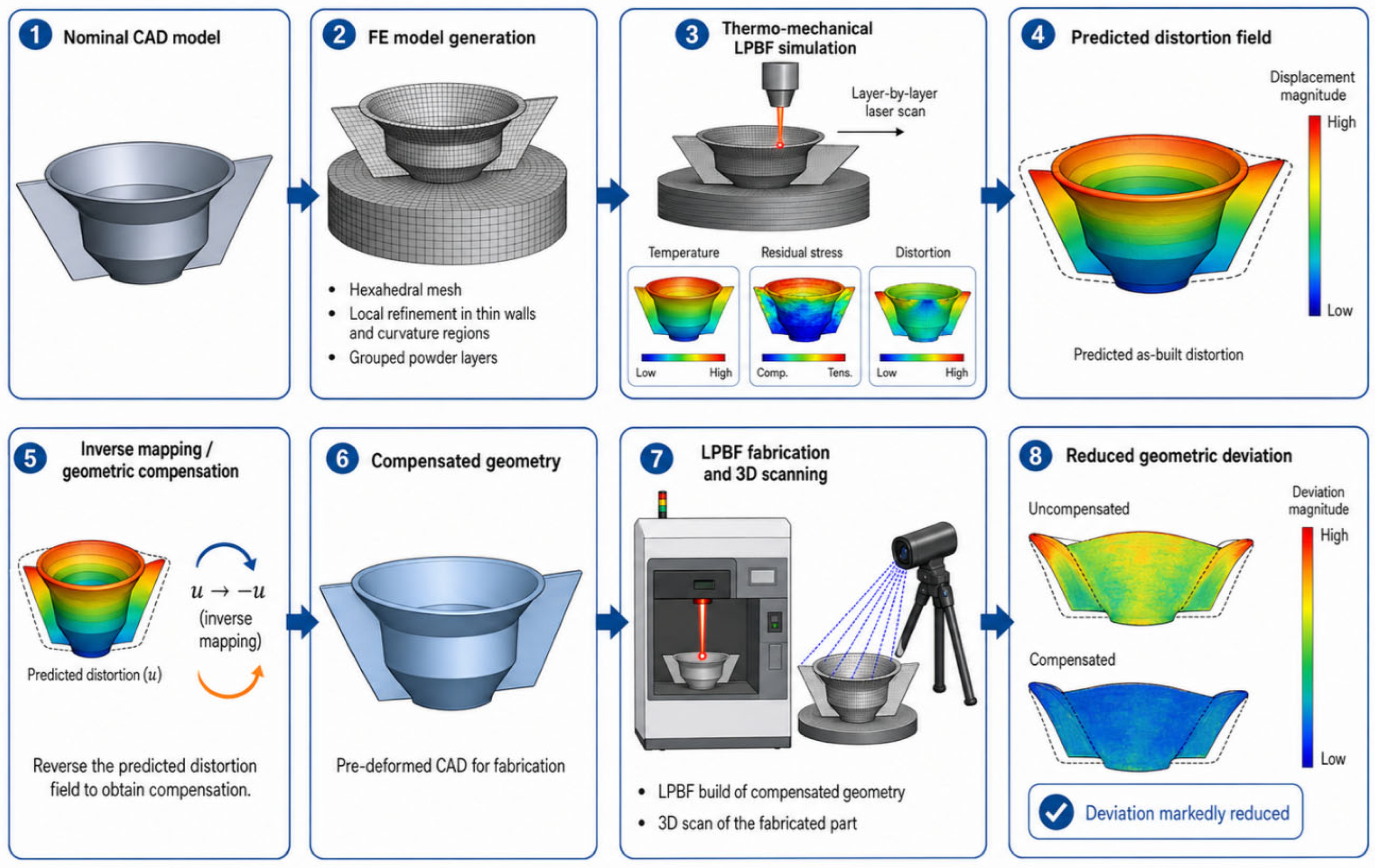
36]. The numerical procedure consisted of three sequential steps. First, the LPBF process of the nominal WAFS was simulated to obtain the temperature evolution, residual stress development, and the final distortion field after fabrication. Second, the predicted displacement field was inversely mapped onto the nominal geometry to generate a compensated WAFS model. Third, the compensated CAD model was re-simulated to examine its thermo-mechanical response and was subsequently fabricated by LPBF under the same processing conditions. The fabricated compensated WAFS was then measured by 3D scanning to experimentally evaluate the effectiveness of the compensation strategy.
This workflow establishes a direct link between distortion prediction and geometric correction. Rather than relying on repeated empirical trial-and-error, the compensation design was derived directly from the numerically predicted deformation behavior of the target structure. In this way, the FE model served not only as a tool for distortion analysis, but also as the basis for compensation geometry generation.
3.2. Thermo-Mechanical FE Model
The thermo-mechanical response of the WAFS during LPBF was solved using a staggered coupling strategy. At each time step, the transient thermal problem was solved first to obtain the temperature field, which was then transferred to the mechanical analysis to calculate the corresponding stress and deformation. This sequential solution scheme provides a computationally efficient approach for capturing the evolution of process-induced distortion in complex LPBF components.
The layer-by-layer deposition process was represented using an element activation technique, in which elements corresponding to newly deposited material were progressively activated according to the build sequence. The surrounding loose powder was not explicitly modeled as a mechanical domain because of its negligible stiffness; however, its thermal influence was accounted for through equivalent thermal boundary conditions. This treatment reduced the computational cost while preserving the key heat-transfer characteristics relevant to part-scale distortion prediction.
3.3. Governing Equations
The transient thermal field during LPBF was governed by the energy conservation equation:
where
is the enthalpy rate,
is the thermal conductivity,
is the temperature, and
is the internal heat input generated by the laser source.
The volumetric heat input was expressed as:
where
is the nominal laser power,
is the laser absorption coefficient, and
is the effective melt volume associated with the activated material.
The conductive heat flux followed Fourier’s law:
In addition, convective and radiative heat losses from the exposed surfaces were considered through:
where
is the convective heat transfer coefficient,
is the emissivity,
is the Stefan-Boltzmann constant, and
is the ambient temperature.
The mechanical response was governed by the equilibrium equation:
where
is the Cauchy stress tensor and
is the body force vector. The total strain was decomposed into elastic, plastic, and thermal contributions:
where the thermal strain was determined from the temperature-dependent thermal expansion behavior of the material.
During LPBF, the material experiences repeated heating and cooling between room temperature (
) and temperatures above the melting point (
). Therefore, the constitutive description should account for the mechanical response of the material in the solid, mushy, and liquid states. A J2-thermo-elastovisco-plastic model is adopted in the solid phase, from
to the annealing temperature
. All the material properties are assumed as temperature-dependent. The von-Mises yield-surface can be formulated as:
where
is the temperature-dependent yield stress that is accounted for the thermal softening and
is the stress-like variable controlling the isotropic strain-hardening, which can be defined as:
where
and
are the isotropic strain-hardening variable and the temperature-dependent saturation flow stress, respectively, while
and
h are the temperature-dependent parameters to model the exponential and linear hardening laws, respectively.
The deviatoric counterpart of Cauchy’s stress tensor s can be expressed as follows:
where
is the (temperature-dependent) shear modulus, e is the total (deviatoric) strain, which is obtained from the total strain tensor
, and
is the visco-plastic strain. The evolution laws of both the visco-plastic strain tensor and the isotropic strain-hardening variable are obtained from the principle of maximum plastic dissipation:
where
stands for the normal to the yield surface, and
is the viscoplastic multiplier and can be expressed as:
where
are the Macaulay brackets, and
and
are the temperaturedependent rate sensitivity and plastic viscosity, respectively. Note that when the temperature of material gets close to
the yield limit
tends to be 0. Thereby, the deviatoric Cauchy stress reduces to:
where
is the effective viscosity. Thus, the material is featured by a purely viscous law when the temperature is higher than
[
37]. A non-Newtonian behavior with
m > 1 is adopted for the mushy phase (from
to
), while a Newtonian law,
m = 1, is featured for the liquid phase (for
>
).
3.4. FE Mesh, Material Properties, and Boundary Conditions
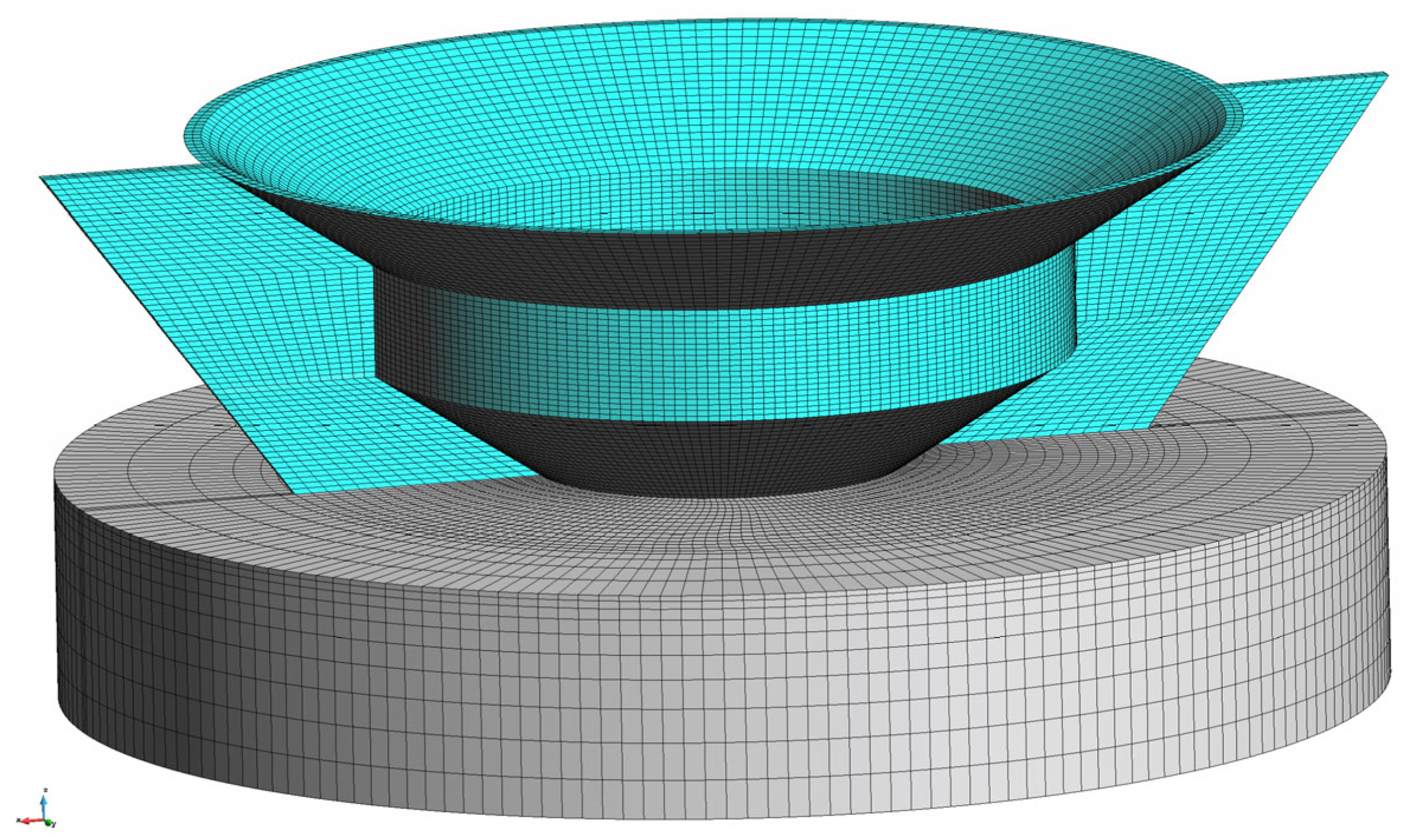
The FE model of the WAFS was established based on the nominal CAD geometry. To balance computational efficiency and prediction accuracy, a hexahedral mesh with local refinement in the thin-walled and curvature-sensitive regions was adopted. Mesh-size sensitivity was evaluated by comparing the predicted distortion fields under different discretization levels. Based on this comparison, a mesh size of 0.5 × 0.5 × 0.25 mm3 was adopted in the build region because it provided a stable deformation distribution while maintaining acceptable computational efficiency. Further refinement did not change the dominant distortion mode of the WAFS, whereas coarser discretization noticeably smoothed the local deformation gradient. Therefore, this mesh was selected as a practical compromise for the present compensation-oriented part-scale simulation.
In addition, a layer-grouping strategy was adopted to improve the computational efficiency of the part-scale simulation. In the present model, four physical powder layers were grouped into one computational layer, corresponding to an effective numerical layer thickness of approximately 0.24 mm. The total heat input was scaled accordingly to preserve energy equivalence within each activated computational layer. This treatment reduces the number of activation steps while retaining the dominant thermal accumulation and deformation response at the structural scale. It should be noted that overly coarse layer grouping may smooth local thermal gradients and affect deformation prediction, whereas very fine layer activation would substantially increase computational cost. Therefore, the adopted four-layer grouping was used as a practical compromise between prediction stability and computational efficiency.
A separate time-step sensitivity analysis was not performed in this work, since the present model focuses on structural-scale distortion prediction using layer-wise activation and equivalent volumetric heat input rather than resolving melt-pool-scale transient behavior. The numerical increment was associated with the layer activation procedure and was kept consistent during the simulations. This point is acknowledged as a limitation of the present model.
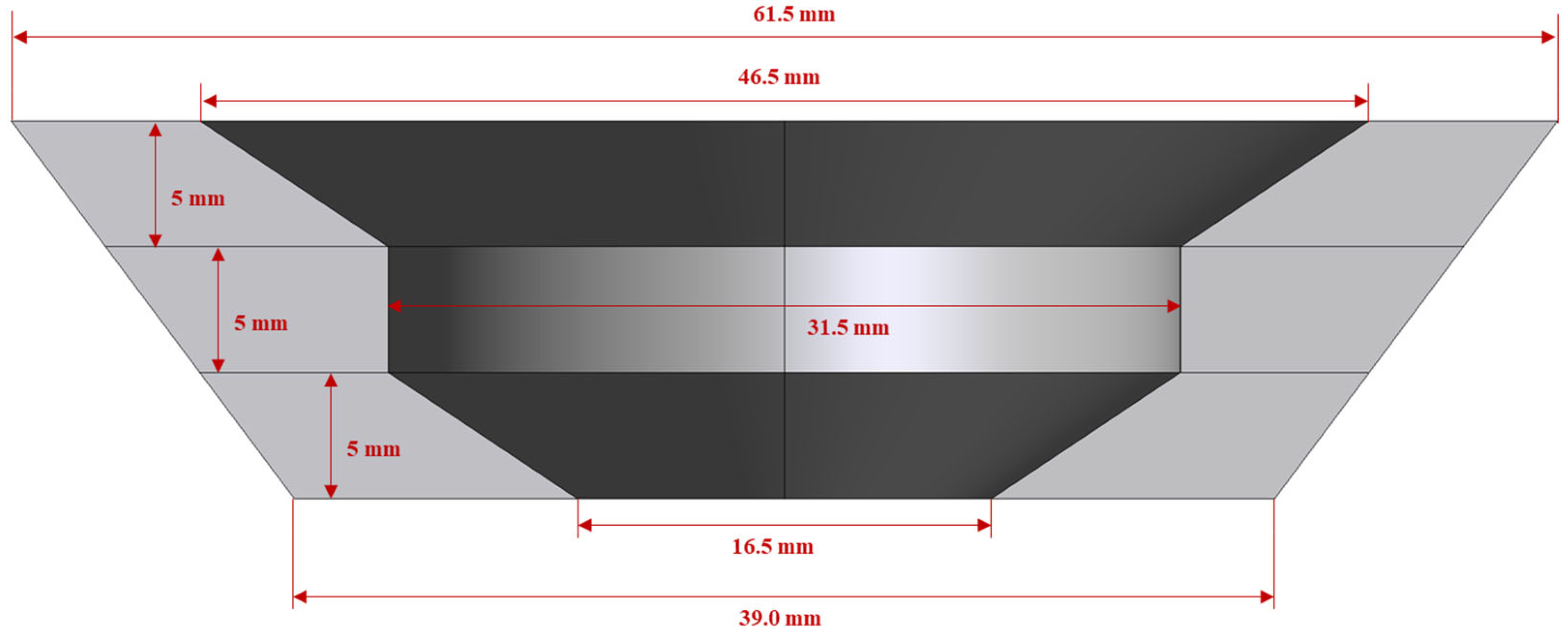
The thermo-mechanical simulations were performed on a workstation equipped with an Intel Core i7-14700K CPU, 32 GB RAM, and an NVIDIA GeForce RTX 3050 GPU. The final FE model contained 83,160 elements and 104,952 nodes, corresponding to approximately 314,856 displacement degrees of freedom in the mechanical analysis, as shown in
Figure 5. Under this hardware configuration, one full thermo-mechanical simulation corresponding to one compensation iteration required approximately 5 h. This computational cost is acceptable for the present WAFS and demonstrates the practical feasibility of the proposed framework for engineering-oriented distortion prediction and compensation. However, the computational expense is expected to increase with geometric complexity, mesh refinement, and higher-fidelity physical modeling. Future work may therefore consider reduced-order models, adaptive meshing, or surrogate modeling strategies [
38] to improve scalability for large-scale industrial LPBF components.
The temperature-dependent thermophysical properties of the TA15 powder-built material and the Ti-6Al-4V baseplate material used in the simulation are listed in
Table 3 and
Table 4, respectively [
39,
40].
To improve computational efficiency while maintaining acceptable predictive accuracy, an equivalent volumetric heat input model was adopted to represent the laser energy input. In this approach, the laser energy was spatially homogenized within each activated computational layer rather than applied as a moving point or surface heat source. The effective heated volume was defined by the volume of the activated numerical layer in the element activation procedure. Since four physical powder layers were grouped into one computational layer, the total heat input was scaled according to the corresponding physical layer thickness to preserve energy equivalence within each activated layer. The effective power density was determined from the experimentally applied LPBF parameters, including laser power, scan speed, hatch distance, layer thickness, and laser absorption coefficient.
This heat input model was not intended to resolve detailed melt-pool-scale thermal-fluid behavior. Instead, it was used to capture the dominant thermal accumulation and thermo-mechanical response governing component-scale distortion. Although the homogenized heat input and layer-wise activation may introduce deviations from the local transient melt-pool physics, similar layer-based simplifications have been widely used in structural-scale LPBF thermo-mechanical simulations to achieve a reasonable balance between computational efficiency and prediction accuracy [
41,
42]. The agreement between the simulated and measured deformation fields further supports the adequacy of this simplified heat input treatment for the present WAFS compensation study.
For the thermal analysis, the laser heat input was introduced through the activated layers, while heat dissipation to the surrounding environment and to the baseplate was represented through equivalent boundary conditions. The conductive heat transfer coefficient between the substrate and the worktable was set to 1000 W/(m
2·°C), the convective heat transfer coefficient to the shielding gas atmosphere was taken as 12.7 W/(m
2·°C), the ambient temperature was 23 °C, and the surface emissivity was set to 0.35 [
43]. The laser absorption coefficient was taken as 0.45 [
44].
For the mechanical analysis, the bottom surface of the baseplate was fully constrained to represent the fixation condition during LPBF fabrication. In this work, the objective was to predict the as-built distortion of the WAFS under the build-plate constraint and to use this displacement field for subsequent geometric compensation. Therefore, no artificial part-removal or stress-release step was introduced in the model. This treatment also keeps the simulation condition consistent with the experimental deviation measurement of the as-built structure. It should be noted that distortion induced by substrate removal may further affect the final free-state geometry. Such post-release deformation is beyond the scope of the present study and will be considered in future work when off-plate dimensional accuracy is targeted.
3.5. Geometric Compensation Strategy
Based on the distortion field predicted for the nominal WAFS, a geometric compensation strategy was implemented by inversely mapping the nodal displacement field onto the original geometry. As illustrated in
Figure 6, the LPBF process of the nominal geometry was first simulated to obtain the temperature evolution, stress accumulation, and final distortion of the WAFS. The predicted displacement field was then extracted and reversely imposed on the nominal geometry to generate a compensated CAD model before slicing and fabrication. Finally, the LPBF process of the compensated geometry was re-simulated under the same processing conditions to evaluate the effectiveness of the compensation strategy.
In the present study, the geometric correction was applied in the direction opposite to the predicted displacement vector at each corresponding point on the nominal geometry. In other words, if the predicted displacement at a given point was , the compensated geometry was generated by applying a correction of . Through this inverse-mapping treatment, the distortion expected during fabrication was pre-embedded into the initial design, allowing the final as-built shape after LPBF to approach the target geometry more closely.
Compared with conventional trial-and-error correction based solely on repeated experimental builds, this simulation-driven strategy provides a more efficient route for geometric compensation of complex LPBF components. It enables the compensated geometry to be determined directly from the predicted thermo-mechanical response of the structure, thereby reducing experimental iteration and improving dimensional control for geometrically sensitive parts such as the WAFS.
To quantify the compensation effect, the distortion distributions of the original and compensated WAFS were compared using the same deviation evaluation procedure based on 3D scanning and CAD alignment. The reduction in maximum deviation and overall deviation level was then used to assess the effectiveness of the proposed compensation strategy.
4. Results and Discussion
4.1. Distortion Prediction and Experimental Validation of the As-Built WAFS
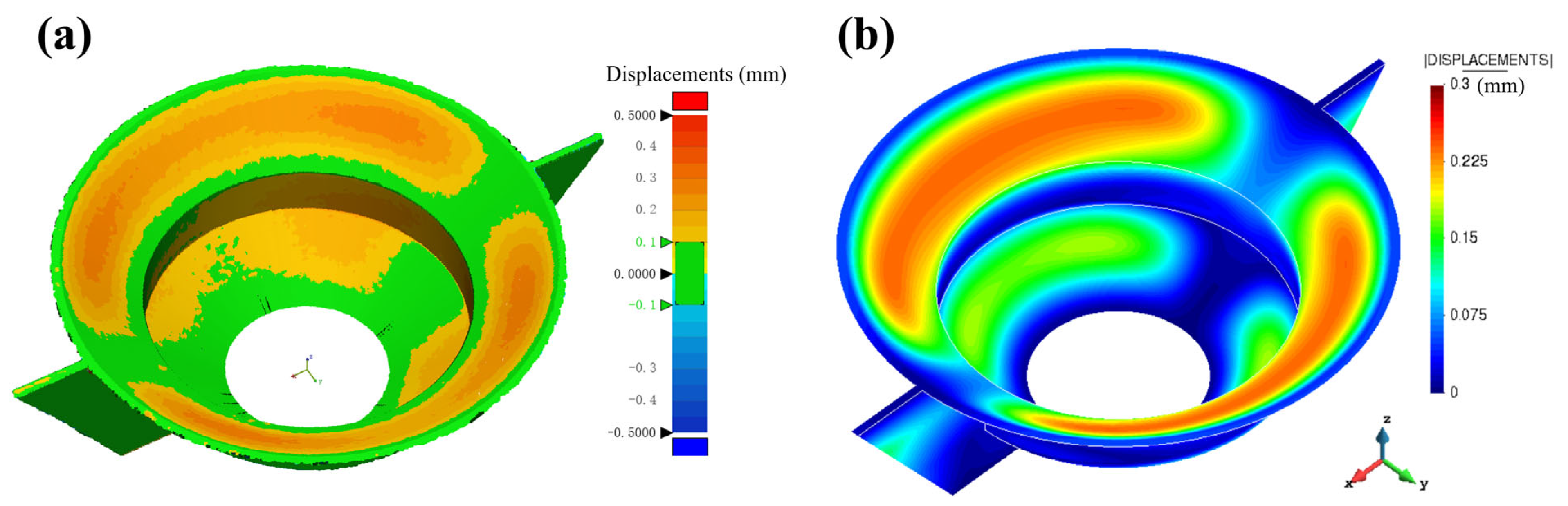
Figure 7 compares the deformation contour maps of the as-built WAFS obtained from 3D scanning and thermo-mechanical simulation. The measured and predicted results show good agreement in both the overall distortion pattern and the local deformation characteristics, indicating that the proposed model can capture the dominant deformation behavior of the WAFS during LPBF. Both results reveal a distinctly non-uniform deformation distribution. The largest deformation is symmetrically concentrated on the two sides adjacent to the wing-like features and forms a band-like circumferential distribution along the funnel wall. In contrast, the deformation gradually decreases from the outer rim toward the lower portion of the funnel. This trend is mainly associated with the stronger constraint imposed by the baseplate, which suppresses deformation in the lower region of the structure.
Compared with the numerical prediction, the experimentally measured deformation contours exhibit stronger local fluctuations. These fluctuations are mainly attributed to surface imperfections generated during LPBF and measurement noise introduced during 3D scanning. Nevertheless, the main deformation magnitude and spatial distribution are well reproduced by the simulation, confirming that the developed thermo-mechanical model provides a reliable description of the macroscopic distortion response of the WAFS.
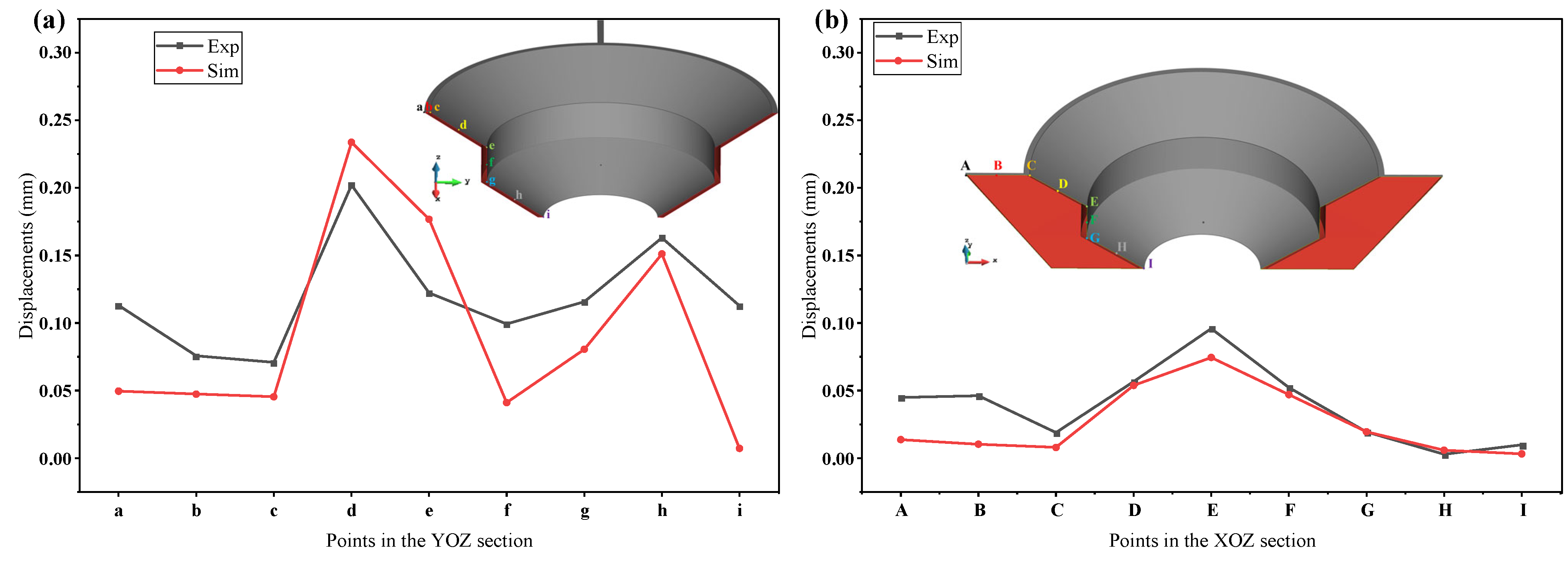
To further evaluate the predicted deformation distribution on the inner surface of the WAFS, characteristic-point displacements were extracted from two representative cross-sections, as shown in
Figure 8. Considering the approximately symmetric deformation behavior of the structure along the X and Y directions, nine characteristic points were selected on the inner surface of the YOZ plane, and another nine points were selected on the XOZ plane. The corresponding displacement values obtained from simulation and 3D scanning were then compared at these representative locations. This point-wise comparison provides a direct quantitative assessment of the local deformation magnitude and variation trend on typical sections of the WAFS. As shown in
Figure 8, the numerical results agree reasonably well with the experimental measurements in terms of both displacement level and spatial variation, further supporting the capability of the model to predict the component-scale distortion behavior.
The remaining local discrepancies may arise from several sources. First, the 3D scanner has a finite measurement accuracy of 0.015 mm, which becomes non-negligible when the measured deformation is at the sub-millimeter scale. Second, the surface roughness of the LPBF-fabricated part, matte coating treatment, local point-cloud fluctuation, and alignment between the scanned data and the nominal CAD model may introduce additional uncertainty. Moreover, the layer-wise activation and equivalent volumetric heat-input model used in the simulation inevitably smooth part of the local thermal and deformation gradients. Therefore, although local point-wise deviations remain, the consistency in the dominant deformation pattern and characteristic displacement distribution confirms that the developed thermo-mechanical model is sufficiently reliable for subsequent stress analysis and geometric compensation design.
4.2. Evolution of Temperature, Stress, and Deformation During LPBF
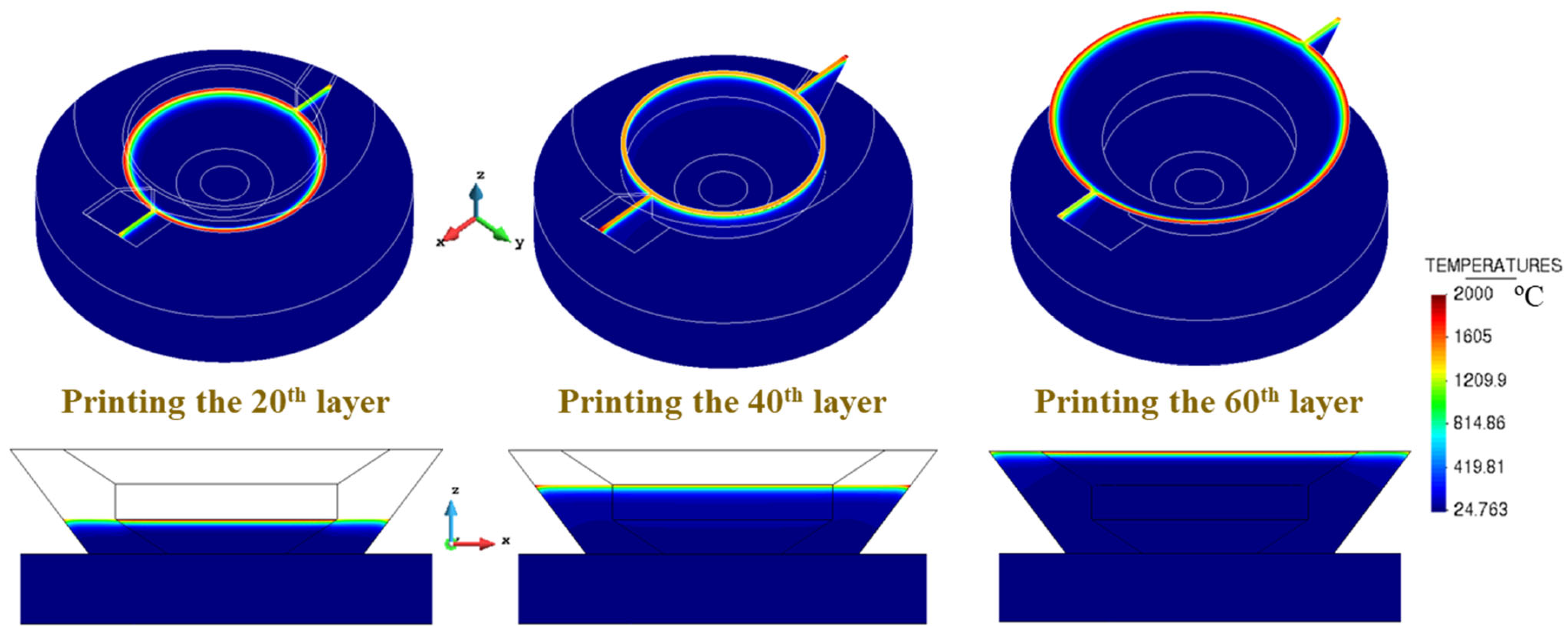
Figure 9 shows the temperature evolution of the WAFS at different deposition stages during LPBF. Each newly activated layer is rapidly heated, and the peak temperature consistently exceeds 1900 °C, indicating that the applied equivalent heat input is sufficient to ensure complete melting of the deposited material. Before the subsequent layer is activated, however, the previously deposited portion of the WAFS cools substantially, and the overall structure returns to a temperature close to room temperature at the macroscopic scale. This suggests that no pronounced global thermal accumulation occurs under the present processing conditions, although intense local thermal cycling remains an inherent feature of the layer-wise LPBF process.
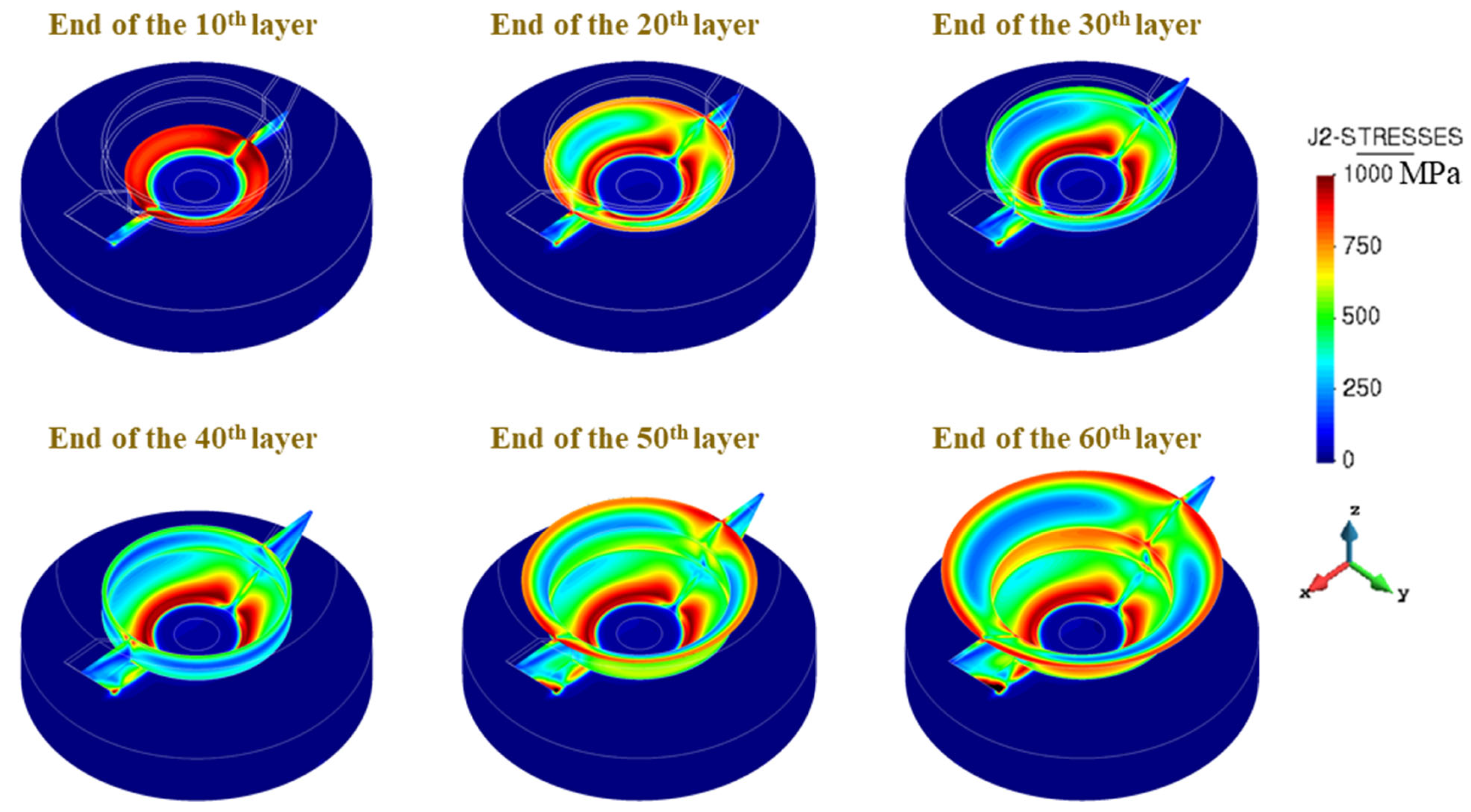
The evolution of the von Mises stress is presented in
Figure 10. A strong coupling between stress distribution and structural geometry can be observed throughout the fabrication process. At the initial stage of deposition, high stress is mainly concentrated near the part–baseplate interface because of the strong mechanical restraint imposed by the substrate. At the same time, the wing-like features introduce additional structural constraint, leading to stress concentration near the junctions between the funnel body and the wing plates. In particular, the sharp geometric transition near the lower connection between the wing features and the baseplate further intensifies local stress concentration, which accumulates progressively with increasing build height and may increase the risk of local separation or defect formation. From a structural design perspective, such local concentration could be alleviated by introducing smoother geometric transitions, such as local fillets.
As deposition proceeds, the stress state in the funnel body evolves from a localized concentration pattern into a more distributed one. High-stress regions gradually extend along the structural contour and eventually develop into a relatively stable circumferential stress band on the inner wall of the funnel. After fabrication is completed, the overall stress field becomes more stable, and the high-stress regions are mainly concentrated on the inner wall and at the geometric transition zones. In contrast, partial stress relaxation occurs in some wall regions owing to local plastic deformation, resulting in comparatively lower stress levels there. Because of the presence of the wing-like features, the final stress field also exhibits a pronounced mirror-symmetric distribution on the two sides of the structure.
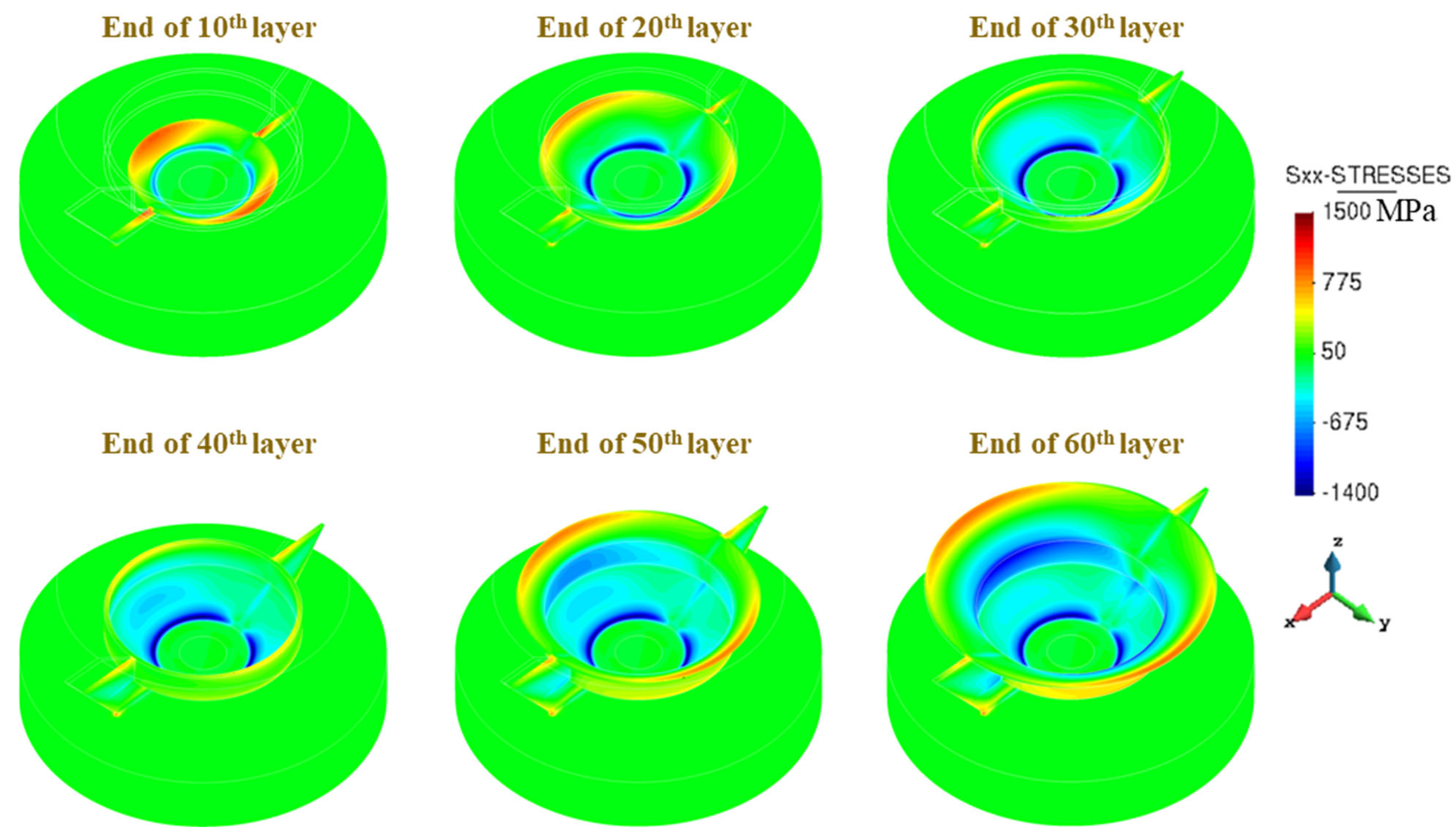
Figure 11 presents the evolution of the longitudinal residual stress,
σxx. At the initial stage of fabrication, compressive stress forms in the inner-wall region because thermal contraction is strongly constrained by the baseplate. With increasing deposition height, the current deposited layer gradually develops circumferential tensile stress, whereas the previously deposited lower region experiences compressive stress induced by the shrinkage and constraint of the upper layers. As a consequence, compressive stress progressively accumulates in the lower cylindrical section near the baseplate and also appears along the outer rim in a ring-like pattern. However, because the wing-like features modify the local structural stiffness, the continuous annular stress distribution is interrupted in the vicinity of the wing plates, and the final stress field is mainly manifested as a symmetric distribution on the two sides of the structure.
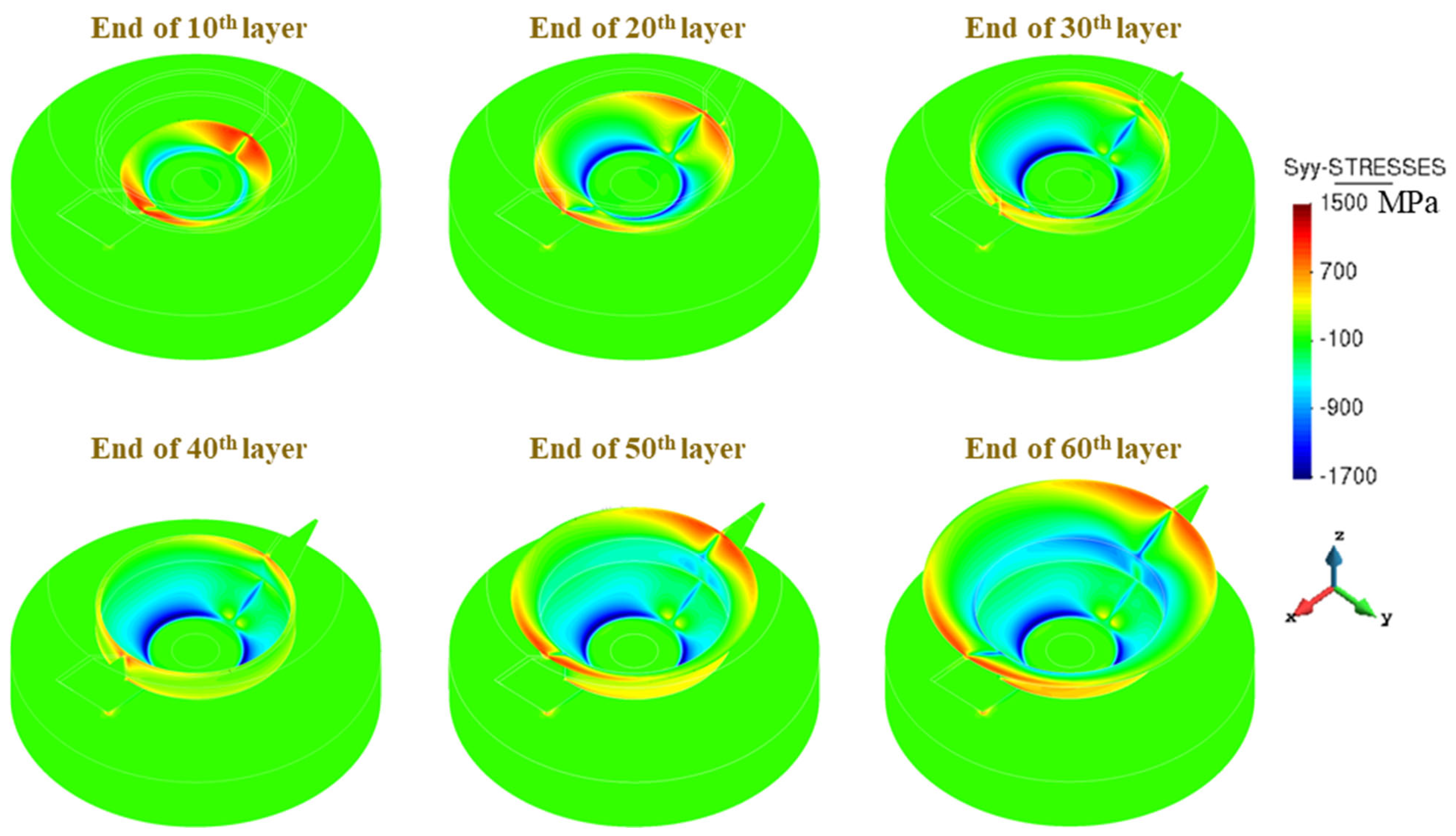
The transverse residual stress,
σyy, shown in
Figure 12, exhibits a distribution pattern generally similar to that of
σxx. However, the influence of the wing-like features on the transverse stress field is more pronounced. In the high-stress regions, the wing-like geometry introduces sharper stress discontinuities and significantly disrupts the continuity of the circumferential stress band. Combined with the deformation contours shown in
Figure 7, this result indicates that the wing features locally increase the structural stiffness and hinder the uniform radial shrinkage of the funnel body. Consequently, the deformation mode evolves into a symmetric pattern concentrated on both sides adjacent to the wing plates. The stress field undergoes a corresponding redistribution and becomes increasingly symmetric because of the geometric constraint introduced by the wing-like structures.
Overall, the results demonstrate that the thermo-mechanical response of the WAFS during LPBF is governed not only by the intrinsic thermal cycling of the process, but also, to a large extent, by geometry-dependent constraint effects. In particular, the baseplate restraint and the wing-induced stiffness heterogeneity jointly determine the localization, redistribution, and final symmetry of both stress and deformation fields, which in turn provides the physical basis for the subsequent geometric compensation strategy.
4.3. Effectiveness of the Geometric Compensation Strategy
Based on the experimentally validated thermo-mechanical model, the predicted distortion field of the nominal WAFS was inversely mapped to generate the compensated geometry. In the present work, the inverse-mapping procedure was implemented as a node-based translational coordinate correction. The displacement components predicted by the thermo-mechanical simulation were first extracted at the corresponding nodes of the nominal geometry. For a node with original coordinates
and predicted displacement vector
, the compensated coordinate was calculated as
=
, as displayed in
Figure 13. In this way, the predicted deformation was embedded into the initial geometry in the opposite direction before fabrication. Since the compensation involved relatively small pre-deformation adjustments compared with the overall structural dimensions of the WAFS, rotational correction and geometric nonlinear inverse-mapping were not introduced in the present procedure.
It should be noted that the compensated geometry may introduce certain changes to the thermo-mechanical response during LPBF because of the modified local geometry. To examine this effect, the compensated geometry was re-simulated under the same processing conditions. For the investigated WAFS, the compensation mainly involved small pre-deformation adjustments, while the overall structural topology, wall thickness, scanning strategy, and process parameters remained unchanged. Therefore, the global thermal response and the dominant distortion mechanism were not expected to change substantially after compensation. The re-simulation confirmed that the compensated geometry still exhibited a deformation mode generally consistent with that of the original structure, but with a markedly reduced distortion level.
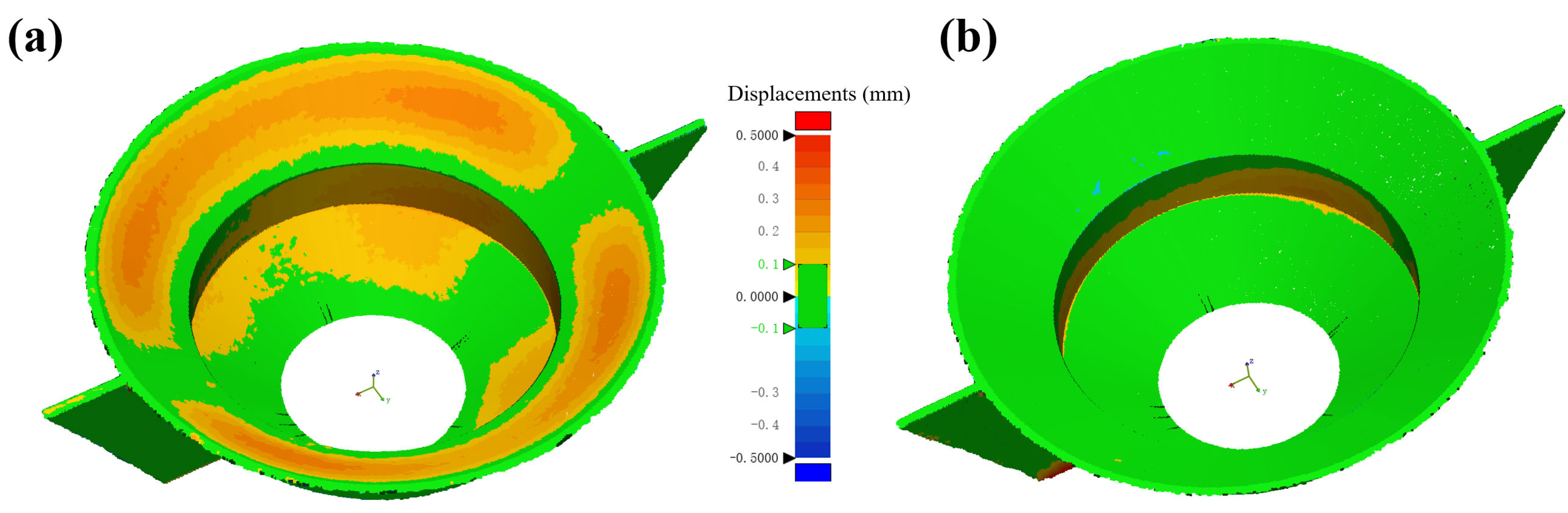
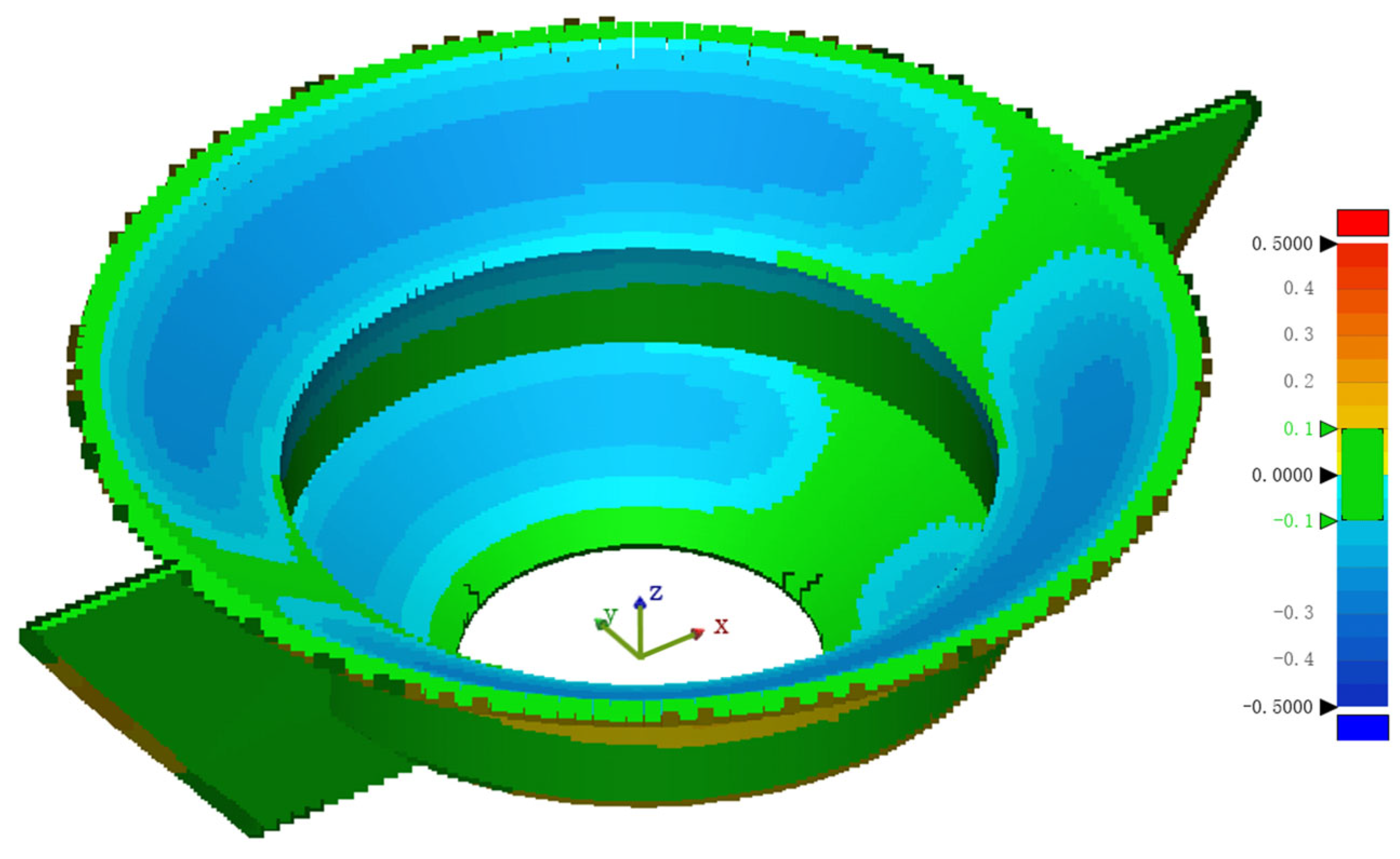
In addition, the compensated CAD model was fabricated by LPBF and subsequently measured by 3D scanning. The measured deformation result shown in
Figure 14b verifies that the compensation strategy remained effective after re-fabrication. Nevertheless, for structures with larger compensation amplitudes or stronger geometry-dependent thermo-mechanical coupling, the influence of the compensated geometry on thermal accumulation, stress evolution, and compensation accuracy should be further evaluated.
As shown in
Figure 13, the deviation of the compensated CAD model relative to the original nominal model essentially represents the intentionally introduced pre-deformation prior to fabrication. It can be seen that the spatial distribution of the compensation field is highly consistent with that of the predicted distortion field, but with the opposite sign. The largest geometric corrections are mainly concentrated near the outer rim and in the vicinity of the wing-like features. This indicates that the proposed compensation strategy successfully captures the dominant deformation mode of the WAFS and embeds it into the initial geometry in a physically meaningful manner.
The effectiveness of the proposed strategy can be further evaluated by comparing the deformation contours of the WAFS before and after compensation, as shown in
Figure 14. The uncompensated structure exhibits pronounced non-uniform distortion, characterized by the coexistence of global warpage and local deviation. In contrast,
Figure 14b presents the measured deformation result of the compensated WAFS after LPBF re-fabrication and subsequent 3D scanning. Compared with the uncompensated structure, the overall deformation level is significantly reduced, and the deviation field becomes much more uniform, with most regions approaching a near-zero state. These results demonstrate that the inverse-mapping strategy can effectively transform the predicted thermo-mechanical response during fabrication into a pre-corrective geometric adjustment, thereby enabling the fabricated part to evolve closer to the target geometry during LPBF.
The clear homogenization of the deviation field after compensation indicates that the major systematic distortion has been effectively counteracted. Nevertheless, the inverse-mapping approach still has certain limitations. This method assumes that the predicted distortion field can be approximately compensated by applying an opposite geometric correction. However, LPBF-induced distortion is not strictly linear or fully reversible because of temperature-dependent material behavior, local plasticity, stress redistribution, and geometry-dependent thermal accumulation. Therefore, local over-compensation or residual deviation may occur in regions with sharp geometric transitions or strong thermal/stress gradients.
In the present WAFS, the overall geometric distortion was reduced by more than 85% after a single compensation iteration, demonstrating the effectiveness of the proposed method for this structure. The remaining deviation may originate from numerical discretization, simplification of the equivalent heat input model, measurement uncertainty, point-cloud alignment error, and nonlinear thermo-mechanical response during LPBF. A second compensation iteration may further improve dimensional accuracy by correcting the remaining systematic deviation, but its convergence behavior and cost-effectiveness require further investigation.