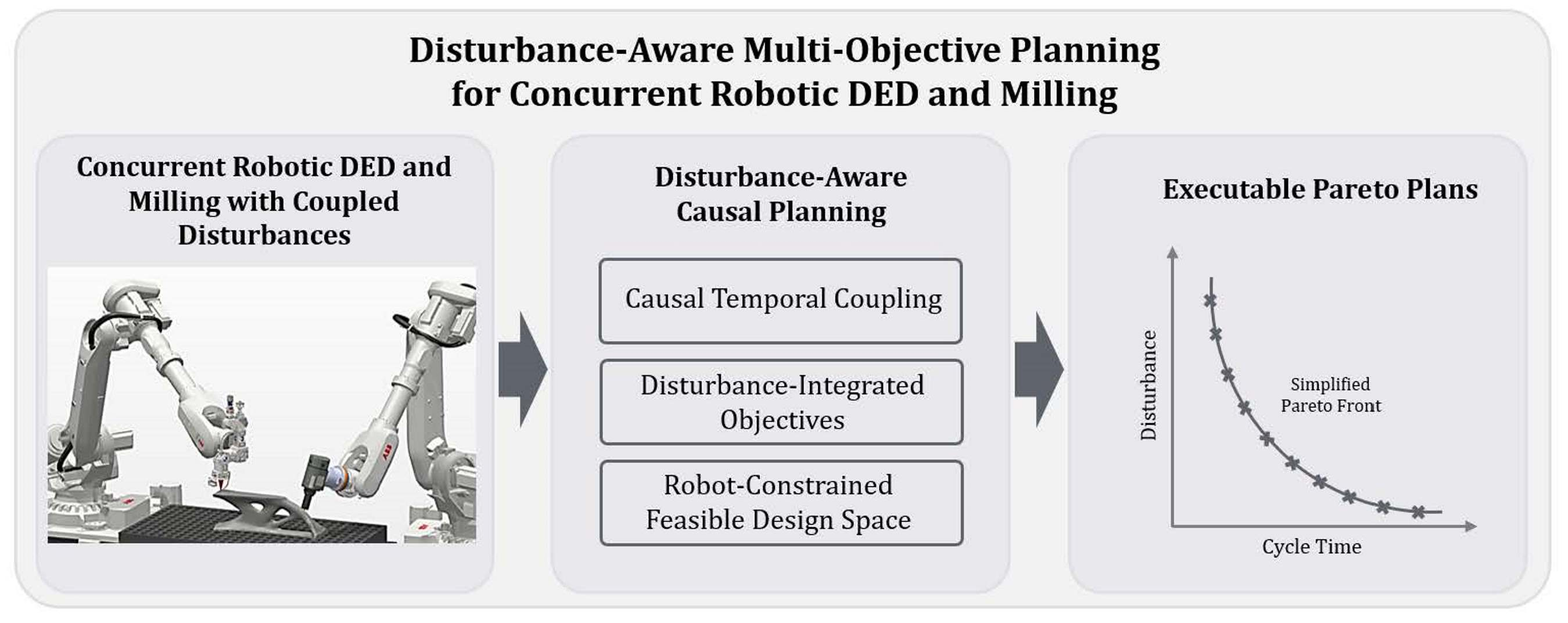
1. Introduction
The continuous demand for increased flexibility, reduced lead times, and improved resource efficiency has stimulated the integration of multiple manufacturing processes within unified hybrid production systems. Hybrid manufacturing, understood as the synergistic combination of additive and subtractive processes, enables the fabrication of complex near-net-shape components while maintaining geometric accuracy and surface quality [
1]. In this context, the coupling of Directed Energy Deposition (DED) with milling operations has emerged as a promising approach for agile production of high-value metallic components in aerospace, energy and tooling applications.
In most existing hybrid robotic cells, additive and subtractive operations are executed sequentially. Material is first deposited in near-net shape, followed by milling operations to refine geometry and surface properties. While effective, this temporal decoupling leads to long cycle times and limited utilisation of available system resources, particularly for large-scale parts where deposition dominates overall process duration. A key opportunity therefore lies in the concurrent or tightly interleaved execution of additive and subtractive tasks, enabling continuous surface accessibility and early shape correction. However, such simultaneous operation fundamentally alters the interaction landscape between processes and introduces tightly coupled physical effects that must be addressed at the planning stage [
2].
Concurrent execution of milling and DED gives rise to multiple interdependent disturbance mechanisms. Milling-generated chips and debris may contaminate the deposition zone, perturb shielding-gas flows and interfere with melt-pool stability, increasing the risk of porosity or lack-of-fusion defects. Thermal interaction constitutes an additional critical coupling: recently deposited regions may remain thermally affected, leading to altered material properties that influence chip formation, cutting forces and tool wear if milling is performed before sufficient cooling [
3]. When robotic manipulators are used for both processes, dynamic coupling further complicates simultaneous operation. Milling-induced vibrations may excite posture-dependent structural modes of the robot–tool–workpiece system, degrading positioning accuracy and force stability and potentially disturbing the deposition process [
4]. Together, these thermo-mechanical and dynamic interactions impose stringent, highly parameter-dependent constraints on feasible tool orientations, sequencing and timing.
Conventional hybrid process planning approaches, which typically rely on sequential heuristics or manually defined rules, are not suitable to address this coupled and high-dimensional planning problem. Decisions such as selecting a milling orientation or execution time during deposition can have far-reaching implications for tool wear, dynamic stability and deposition quality. Moreover, several relevant process interactions, such as heat accumulation, residual stress evolution, and vibration-induced surface deviations, cannot be captured by simple closed-form models and must instead be represented through empirical or data-driven abstractions.
As a result, planning for concurrent hybrid operation naturally gives rise to a mixed-integer, nonlinear, multi-objective optimisation problem (MINLP-MOP) that exceeds the scope of classical scheduling or trajectory planning methods.
To enable systematic investigation and exploitation of concurrent hybrid manufacturing, there is a need for a formal planning framework that integrates discrete sequencing and orientation decisions with continuous process parameters, explicitly accounts for temporal and spatial coupling between additive and subtractive trajectories, and provides a structured interface for incorporating surrogate representations of disturbance mechanisms. Such a framework must be able to generate executable plans that expose trade-offs between machining efficiency and preservation of deposition process integrity, while remaining extensible as higher-fidelity models and experimental data become available.
The present work addresses this need by proposing a hierarchical, surrogate-assisted optimisation framework for concurrent robot-assisted wire-based DED-LB/M and milling. The focus is placed on the formal problem formulation, decision-variable encoding, deterministic temporal coupling and optimisation architecture, rather than on the instantiation or experimental validation of specific surrogate models. The framework is intended as a methodological foundation that supports systematic development, comparison and future validation of disturbance-aware hybrid process planning strategies. The main contributions of this work are as follows:
A disturbance-aware formulation of concurrent hybrid process planning is introduced, in which milling-path planning for wire-based DED-LB/M is cast as an MINLP-MOP with explicit temporal coupling to the deposition trajectory. In contrast to sequential or weakly coupled approaches, disturbance mechanisms arising from thermal interaction, particulate interference and pose-dependent dynamic effects are treated as first-class planning criteria.
Unified continuous decision encoding is proposed that simultaneously represents discrete sequencing decisions, discrete pose selections and continuous cutting parameters within a single optimisation vector. Combined with deterministic, causality-preserving decoding of machining start times, this encoding eliminates explicit temporal decision variables, reduces search dimensionality and guarantees temporally consistent candidate solutions.
A hierarchical, surrogate-assisted optimisation architecture is developed that separates global structural decisions from local continuous refinement while embedding robot-aware feasibility checks and disturbance-aware objective evaluation. This architecture provides a generic and extensible foundation for integrating experimentally calibrated surrogate models, robot cell-specific constraints and future sensing-driven refinements without modification of the core planning logic.
By framing concurrent hybrid operation as a disturbance-aware and robot-feasible optimisation problem, this work establishes a transferable methodological foundation for future research on experimentally calibrated surrogate models, sensor-informed refinement and system-specific validation. In doing so, it provides a principled basis for extending concurrent hybrid manufacturing from heuristic process coordination toward predictive and optimisation-driven planning.
3. Process Interaction and Disturbance Mechanisms in Concurrent Wire-Based DED-LB/M and Milling
Concurrent or closely coupled execution of wire-based DED-LB/M and milling within a shared work envelope introduces interaction mechanisms that are fundamentally absent in sequential or spatially separated process chains. When additive deposition and subtractive finishing are performed in temporal proximity or in parallel on the same workpiece, thermal, mechanical and particulate disturbances can propagate across process boundaries and affect both deposition quality and machining performance. This section consolidates the principal interaction mechanisms relevant to concurrent wire-based DED-LB/M and milling, and clarifies their implications for planning and optimisation in hybrid manufacturing cells. The focus is deliberately on physical and process-level causality rather than on control or optimisation strategies, which are addressed in subsequent sections.
3.1. Thermal Coupling Between Deposition and Machining
Thermal interaction constitutes one of the dominant coupling mechanisms that must be accounted for when coordinating DED and milling within a shared work envelope. The DED process generates highly localised, transient heat input with steep thermal gradients, leading to evolving temperature fields, residual stresses and microstructural transformations in the as-built material. These thermally induced material states directly condition the machinability of recently deposited regions by modifying local hardness, flow stress and tool–workpiece friction, thereby influencing cutting forces, tool wear and surface integrity during subsequent or near-concurrent milling operations [
46,
47].
From a planning perspective, additional complexity arises when milling is scheduled before sufficient thermal equilibration has occurred. Residual heat in the workpiece can cause transient softening or altered chip formation behaviour, while heat generated during cutting may further elevate local temperatures near newly deposited regions through plastic deformation and tool–chip friction. The superposition of these effects can induce dimensional drift, tool elongation and trajectory deviations unless anticipated at the planning stage [
48,
49]. Reduced-order thermal predictors and experimentally informed approximations have therefore been proposed to estimate layerwise thermal histories and deformation risks in DED processes [
50]. For concurrent or tightly interleaved operation, such predictors serve not as end models themselves, but as abstractions that enable conservative assessment of admissible temporal offsets and process parameter combinations.
3.2. Particulate Interaction and Chip-Induced Contamination
Chip ejection during milling represents a primary particulate disturbance channel for concurrent DED operation. High-velocity chips, fines and airborne particulates generated during cutting can enter the vicinity of the active deposition zone, where they may impinge on the molten pool, become entrained in the melt or shielding-gas flow, or adhere to critical surfaces such as the deposition nozzle or freshly deposited layers. Such interactions can perturb melt-pool stability, degrade wetting behaviour and promote defect formation, including lack-of-fusion and porosity.
The severity and likelihood of chip-induced interference depend on a combination of cutting parameters, tool orientation, local geometry and the spatial–temporal relationship between milling and deposition operations. While physical shielding, spatial separation and conservative sequencing are commonly employed mitigation measures, systematic characterisation of chip trajectories and probabilistic interaction with active deposition regions under concurrent execution remains limited. As a result, particulate contamination is recognised as a key obstacle to reliable parallel operation and must be treated as a first-class disturbance mechanism in planning contexts.
3.3. Dynamic Disturbances and Structural Coupling
Dynamic interaction between milling and deposition arises from vibrations induced by the milling process that can propagate through the robot, workpiece and fixtures and interfere with the laser-based deposition process. In robot-assisted hybrid cells, the structural response of the combined robot–tool–workpiece system depends strongly on robot posture and part geometry, resulting in configuration-dependent stiffness and natural frequencies [
51].
When milling excites structural modes of the system, particularly near dominant natural frequencies, vibration amplitudes can increase substantially. Under concurrent or closely interleaved operation, such vibrations may perturb melt-pool stability, affect layer placement accuracy or induce defects in the deposited material. The risk of dynamic interference is therefore governed less by vibration levels in a generic sense and more by whether milling is performed in configurations that coincide with dynamically weak poses or unfavourable modal characteristics.
These considerations highlight dynamic compatibility as a key system-level constraint for concurrent DED and milling, motivating the use of pose-dependent stiffness or modal descriptors to assess and limit vibration-induced interference during planning.
3.4. Temporal Coupling and Process Synchronisation
Beyond individual disturbance channels, concurrent DED and milling are governed by strict temporal and causal relationships. Machining operations on a given region must respect minimum spatial and temporal separation from the deposition process to avoid interference with the melt pool or thermally unstable material states. At the same time, excessive delays between deposition and machining may negate potential productivity gains or lead to unfavourable residual stress redistribution.
In multi-robot hybrid cells, temporal coordination is further constrained by collision avoidance, shared workspace access and safety requirements. These factors impose causal ordering constraints and admissible timing windows that must be respected regardless of the specific disturbance mechanism considered. As such, temporal coupling serves as a unifying dimension through which thermal, particulate and dynamic interactions are mediated and must be explicitly accounted for when planning concurrent or closely interleaved operations.
3.5. Implications for Planning and Modelling
Taken together, thermal, particulate, dynamic and temporal interactions define a tightly coupled disturbance landscape for concurrent DED and milling. These mechanisms are highly context-dependent, vary across the build geometry and evolve over time as the part is constructed. While individual effects have been studied in isolation, their combined impact under concurrent execution motivates modelling abstractions that are sufficiently expressive to capture dominant interactions yet computationally tractable for repeated evaluation.
The subsequent sections build on this mechanistic understanding. The conceptual framework formalises the system scope, decision variables and modelling assumptions required to reason about these interactions in an offline planning context. Following this, the identified disturbance channels are operationalised through quantitative objective functions and constraints suitable for multi-objective optimisation.
4. System Model of the Concurrent DED–Milling Cell
This section introduces the system model used to formalise the concurrent operation of wire-based DED-LB/M and robotic milling within a shared manufacturing cell. The model defines the geometric representation of machining tasks, the deposition trajectory, and the temporal coupling between both processes. These elements establish the planning context in which the optimisation framework introduced in the subsequent sections operates.
4.1. Hybrid Robotic Cell Configuration
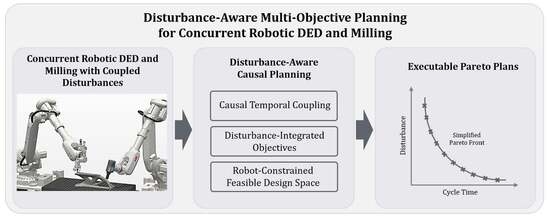
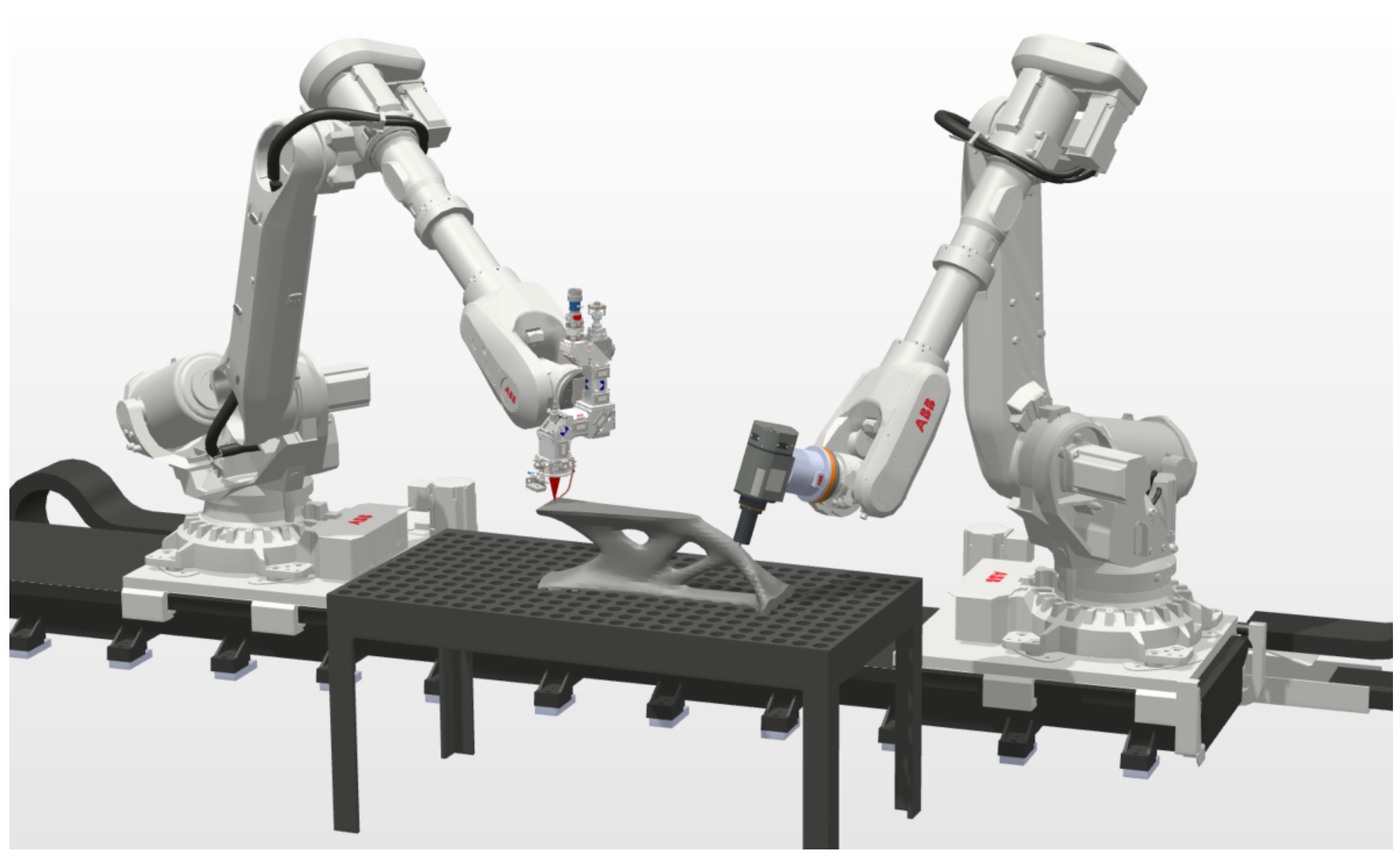
The considered manufacturing system is a hybrid robotic cell in which two articulated industrial manipulators (ABB IRB 6700, ABB, Zurich, Switzerland) operate on a common workpiece. One robot performs wire-based DED-LB/M with a Precitec CoaxPrinter (Precitec, Gaggenau, Germany) following a predefined additive toolpath, while the second robot executes milling operations on selected surface regions of the partially built component with a milling spindle (Hiteco PX-2 15/12, Hiteco, Rimini, Italy) (see
Figure 1) [
52].
Both robots share a common workspace and therefore require coordinated operation to ensure collision-free execution. The deposition robot follows a predetermined trajectory generated by an external additive manufacturing process planning stage. In contrast, the milling robot performs intermediate machining operations on pre-segmented regions of the workpiece surface in order to refine geometry and surface quality during the build process.
The planning problem considered in this work focuses exclusively on the milling side of this hybrid system. The deposition trajectory and its approximate timing are assumed to be known a priori, while the milling sequence, tool orientations, process parameters, and execution timing must be determined by the planning framework.
Because both manipulators operate concurrently within the same workspace, the generated machining plan must satisfy robot-specific feasibility constraints including kinematic reachability, joint limits, and collision avoidance with the deposition robot and the evolving workpiece geometry.
4.2. Workpiece Representation and Machining Segments
The partially built workpiece surface is represented as a set of predefined machining regions
where each segment
corresponds to a local surface region requiring machining. Each segment is associated with a reference point
which represents the spatial location used for planning and scheduling decisions.
For each segment
, a set of admissible tool orientations
is defined based on geometric accessibility and tool engagement considerations. These orientation sets constrain the feasible poses of the milling robot during execution.
4.3. Deposition Trajectory
Material deposition is performed along a predefined trajectory
where
denotes the position of the laser tool centre point as a function of time. The trajectory is assumed to be known a priori from an external deposition planning stage and is therefore not subject to optimisation within the present framework.
The temporal evolution of the deposition trajectory determines when newly deposited material becomes available for machining and thus establishes a causal relationship between additive and subtractive operations.
4.4. Temporal Coupling Between Deposition and Machining
Machining operations are temporally coupled to the deposition process through the spatial relationship between machining segments and the deposition trajectory.
For each machining segment
, the corresponding laser passage time is defined as
This quantity represents the time at which the deposition tool passes closest to the reference point of segment . It is used to enforce causal consistency between material deposition and subsequent machining operations.
The temporal coupling between both processes therefore constrains feasible machining schedules and plays a central role in the disturbance-aware planning formulation introduced later in this work.
4.5. Robotic Execution Context
Both deposition and machining operations are executed by articulated industrial robots whose feasible motion is subject to kinematic and workspace constraints. The milling robot must therefore satisfy robot-specific feasibility conditions including kinematic reachability, joint limits, and collision avoidance with the deposition robot, the workpiece, and the surrounding environment.
These constraints define the set of robot-feasible machining poses and are incorporated into the planning framework through staged feasibility verification during the optimisation process.
The resulting system model provides the geometric, temporal, and robotic execution context required for formulating the disturbance-aware planning problem addressed in the following sections. Based on this model, the planning task is subsequently formulated as a multi-objective optimisation problem that determines feasible machining sequences, tool orientations, process parameters, and execution timing for the milling robot.
Industrial robots inherently exhibit positioning deviations characterised by accuracy and repeatability. These effects are not explicitly modelled in the present framework. However, their influence is partially captured through pose-dependent dynamic compliance in the objective , which affects load-induced deflections, as well as through uncertainty-aware surrogate evaluation that accounts for unmodelled variability.
Explicit modelling of positioning errors, for example via calibrated kinematic models or stochastic perturbations, is not included and represents a potential extension of the framework toward execution-aware planning.
5. Objective Functions and Disturbance Metrics
Building on the system model introduced in
Section 4, the planning problem is formulated as a multi-objective optimisation problem in which machining productivity must be balanced against disturbance-related risks affecting the ongoing DED process.
The objective vector is defined as
where
x denotes the decision vector of the planning problem defined in
Section 6. Each objective function represents a distinct aspect of the planning task and captures either a disturbance mechanism or an operational performance metric.
The optimisation problem is formulated as a multi-objective optimisation problem, where the goal is to approximate the Pareto-optimal set of solutions with respect to the objective vector
, rather than minimising a scalar objective function. To formalise this notion, a solution
is said to dominate another solution
if and only if
where
denotes the
k-th objective function. Solutions that are not dominated by any other candidate are referred to as non-dominated and form the Pareto-optimal set.
Rather than resolving detailed multi-physics behaviour, the objectives rely on compact surrogate-based metrics that approximate dominant interaction effects while remaining computationally tractable for repeated evaluation within an optimisation algorithm. This modelling approach is consistent with contemporary manufacturing research, where data-driven surrogate models and surrogate-assisted optimisation methods are widely employed to approximate complex process behaviour. In particular, SA-MOEAs and machine learning models such as neural networks have demonstrated strong predictive capabilities for process outcomes including surface quality, geometric deviations, and thermal states under varying conditions (see
Section 2). These approaches enable efficient approximation of complex multi-physics interactions that would otherwise be computationally prohibitive, thereby providing a practical foundation for optimisation-based planning in hybrid manufacturing systems. In this context, each objective is defined as an explicit function of the decision variables and is evaluated via a surrogate mapping that provides a scalar risk or performance estimate based on local process conditions.
5.1. Chip Scattering and Particulate Interference ()
This objective quantifies the propensity for milling-induced chip ejection to interfere with the active deposition process, as discussed in
Section 3.2.
For each machining segment
, a surrogate model predicts a local scattering-risk value
. The cumulative particulate interference objective is defined as
Each local contribution is evaluated as
where
denotes the feed rate,
the radial immersion,
the selected tool orientation, and
a descriptor of the spatial–temporal proximity between machining segment
and the active deposition region. The function
represents a surrogate mapping that approximates chip scattering behaviour based on these local inputs.
The surrogate prediction depends on local cutting parameters, tool orientation, and the spatial–temporal relationship between the milling operation and the deposition trajectory. Rather than resolving individual chip trajectories, the objective provides a conservative abstraction that distinguishes between low and elevated contamination risk conditions.
5.2. Thermal Interference with the Deposition Process ()
Thermal interaction between milling and deposition, introduced in
Section 3.1, is represented through a thermal-interference objective that captures the risk of excessive local temperature elevation in recently deposited regions.
For each machining segment
, a surrogate model provides a thermal interaction estimate
. The overall thermal disturbance objective is defined as
Each local contribution is computed as
where
denotes the temporal offset between deposition and machining, and
captures geometric proximity. The surrogate function
maps these inputs to a scalar thermal-risk index reflecting potential overheating or insufficient cooling.
The surrogate predictors map geometric proximity, temporal offset between deposition and machining, and local process parameters to a scalar thermal-risk index.
5.3. Dynamic Compatibility and Pose-Dependent Stability ()
Dynamic coupling between milling and deposition, discussed in
Section 3.3, is operationalised through an objective that penalises machining in dynamically unfavourable robot configurations.
For each machining segment
, a configuration-dependent penalty
is computed based on pose-dependent stiffness or stability indicators of the robot–tool–workpiece system. The cumulative dynamic compatibility objective is defined as
Each term is evaluated as
where
denotes the selected tool orientation and
the corresponding robot joint configuration obtained through inverse kinematics. The surrogate function
provides a scalar penalty based on pose-dependent stiffness or dynamic stability indicators.
Configurations associated with low structural stiffness or proximity to critical dynamic modes yield larger penalty values, reflecting an increased risk of vibration-induced disturbance of the deposition process.
5.4. Cycle Time ()
Cycle time represents the primary operational performance metric. The total execution time of the machining plan is defined as
where
denotes the start time of machining segment
and
represents its corresponding machining duration, which is a function of the local cutting parameters (e.g., feed rate
and engagement conditions).
5.5. Normalisation and Uncertainty-Aware Formulation
All objectives are normalised to comparable scales to support balanced multi-objective optimisation.
The surrogate functions introduced above are understood as generic regression or model-based mappings that approximate dominant physical effects based on a reduced set of input variables. Their specific form depends on the availability of experimental data, simulation models, or heuristic approximations.
The framework does not require a specific surrogate formulation; instead, it defines a structured interface through which calibrated models can be integrated. In this work, simplified surrogate instantiations are used for demonstration purposes (see
Section 7), while higher-fidelity models can be incorporated without modifying the optimisation structure.
Surrogate predictive uncertainty is explicitly incorporated, either through weighted combinations of mean prediction and scaled variance or via chance-constrained formulations where safety margins are mandated. This uncertainty-aware treatment ensures that Pareto-optimal solutions reflect not only nominal performance but also robustness to modelling error, yielding plans that are both executable and resilient under realistic execution conditions.
6. Methodology and Formal Problem Definition
This section presents the methodological core of the proposed planning framework. Building on the process interaction mechanisms identified in
Section 3, the system model introduced in
Section 4, and the objective definitions in
Section 5, the following describes how the concurrent DED–milling planning problem is cast into a solvable optimisation task. Emphasis is placed on the formal encoding of decision variables, deterministic decoding with temporal causality, staged feasibility enforcement, and a surrogate-assisted hierarchical optimisation strategy that enables tractable exploration of a high-dimensional mixed discrete–continuous search space.
For clarity, the key quantities used in the formulation are briefly restated. Let
denote the set of machining segments with reference points
and admissible orientation sets
, as defined in
Section 4. The deposition trajectory is given by
.
6.1. Mathematical Formulation of the Milling Planning Problem
The planning problem for concurrent robot-assisted wire-based DED-LB/M and milling is defined as the search for a machining plan that specifies: an ordered sequence of machining segments, a tool pose for each segment, continuous cutting parameters, and a temporal schedule coordinated with the laser deposition trajectory.
The resulting problem belongs to the class of MINLP-MOPs. Its complexity arises from the combinatorial nature of sequencing and orientation selection, continuous process parameters, and causal temporal coupling to the deposition process. Rather than attempting to solve this problem through monolithic formulations, the proposed methodology relies on a structured encoding and decoding strategy that exposes exploitable regularities for optimisation.
6.2. Decision Variables and Practical Encoding
Let
N denote the number of pre-segmented machining patches. The segments
and their reference points
are defined in the system model presented in
Section 4. The decision vector is decomposed into discrete and continuous components,
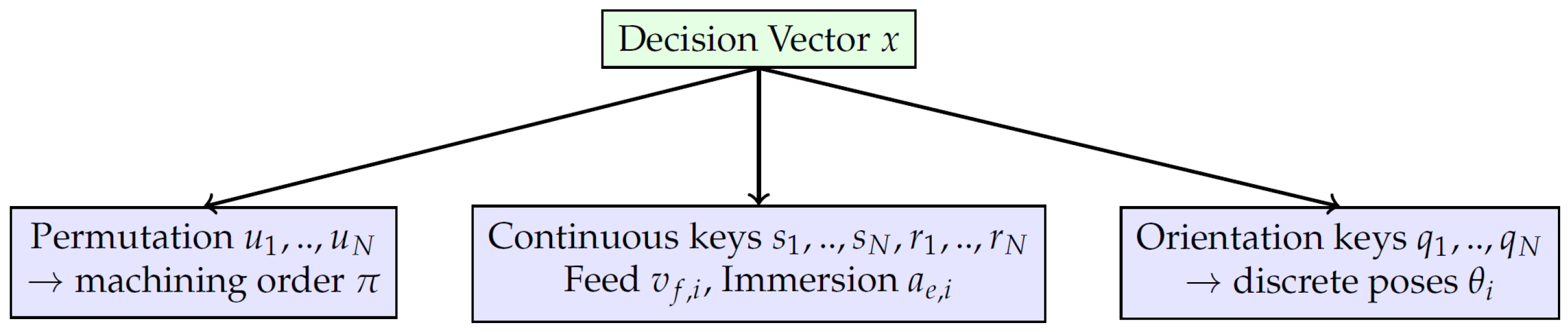
which are jointly encoded in a unified continuous representation to facilitate evolutionary optimisation.
The discrete component consists of:
Permutation keys
where sorting
u induces a machining order
. This continuous permutation encoding enables standard genetic operators while implicitly representing combinatorial structure.
Orientation keys
mapped to discrete orientation indices within predefined admissible sets
.
The continuous component contains normalised process parameters:
Feed-rate keys mapped to ;
Immersion keys mapped to .
Here denotes the feed rate applied during the machining of segment , and represents the radial immersion (cutting width) of the milling tool. Furthermore, denotes the start time of segment machining, which is not an independent decision variable but is deterministically derived during decoding.
Temporal variables are not explicitly optimised but are deterministically derived during decoding. The optimiser therefore operates on a continuous vector
as illustrated in
Figure 2. This encoding constitutes a key enabler for a scalable search in the presence of mixed decision types.
6.3. Temporal Coupling with the Laser and Causality
Let the laser tool centre point trajectory be denoted by
. For each machining segment
i with reference point
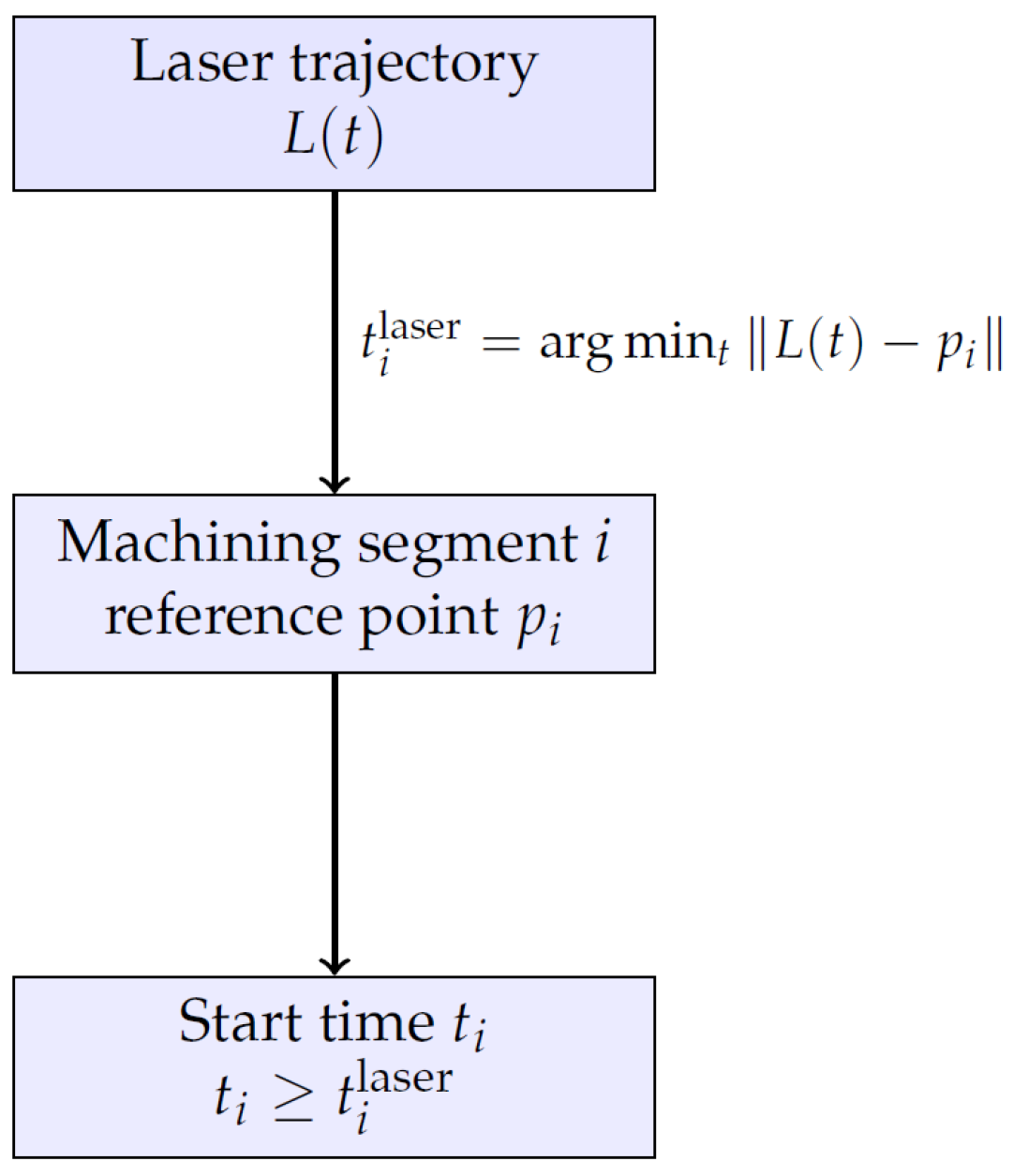
, the corresponding laser passage time is defined as
This definition provides a compact approximation of the time at which the deposition process reaches the spatial neighbourhood of segment
and therefore establishes the earliest admissible start time for machining at that location.
where
denotes a safety offset ensuring sufficient temporal separation between the deposition tool and the milling operation at the same spatial location. During decoding, machining start times are computed deterministically as
The term denotes the travel time required for the robot to move between consecutive machining segments, based on kinematic motion constraints and path planning assumptions.
This deterministic decoding removes explicit temporal decision variables from the optimisation problem while guaranteeing causally valid schedules. As a result, the search space dimensionality is reduced and temporal consistency with the deposition process is ensured by construction (see
Figure 3).
6.4. Feasibility Constraints and Staged Enforcement
Feasibility is expressed through constraint functions covering kinematic limits, collision avoidance, pose reachability, and thermal timing constraints. To maintain tractability, feasibility checks are staged.
Low-cost filters reject candidates violating simple kinematic bounds or gross collision criteria early in the evaluation process. Candidates that pass this initial screening proceed to more detailed feasibility checks, including inverse kinematics solvability for sampled waypoints and collision-aware geometric constraints that enforce minimum separation between the deposition and machining systems as well as the evolving workpiece geometry. These constraints provide a conservative approximation of collision-free operation within the optimisation loop. While high-resolution collision checking based on full robot geometry (e.g., URDF models) can be integrated into this framework, the present implementation focuses on computationally efficient approximations that ensure tractability during optimisation. Where surrogate uncertainty or borderline feasibility is encountered, chance-constrained formulations and conservative penalties are applied so that the optimisation favours robust, executable solutions over marginally superior but practically fragile designs.
6.5. Formal Optimisation Problem
The optimisation problem is stated as
subject to
Objective functions are evaluated as defined in
Section 5. The present section focuses on how these objectives are embedded into a computationally viable optimisation workflow.
6.6. Hierarchical Surrogate-Assisted Optimisation Strategy
The methodological contribution of this work lies in a hierarchical discrete–continuous optimisation scheme tailored to the structure of the milling planning problem.
The optimisation architecture adopts a hierarchical two-stage search to manage combinatorial complexity while allowing detailed continuous refinement.
In the first stage, a population-based metaheuristic explores sequencing and orientation decisions while holding continuous process parameters at nominal values. This stage identifies structurally promising solution skeletons and eliminates infeasible or dynamically fragile configurations early in the search process.
In the second stage, selected skeletons undergo continuous multi-objective refinement, optimising feed rates, immersion depths and schedule slack under full surrogate-based objective evaluation and feasibility enforcement. Iterative feedback between stages allows the search to adaptively refine discrete decisions in response to continuous-level performance. The population-based search is implemented using a multi-objective evolutionary algorithm, which is detailed in the following subsection.
6.7. Evolutionary Optimisation and Fitness Assignment
The multi-objective optimisation problem defined in
Section 6.5 is solved using a population-based evolutionary algorithm. In contrast to scalar optimisation, no single aggregated fitness function is defined. Instead, candidate solutions are evaluated based on Pareto dominance relations in the objective space (see
Section 6.5).
The optimisation is implemented using a variant of the NSGA-II. The algorithm operates on the unified continuous encoding introduced in
Section 6.2, enabling direct application of standard genetic operators.
Fitness assignment is performed through non-dominated sorting combined with a diversity-preserving mechanism. The population is partitioned into a sequence of Pareto fronts
where
contains all non-dominated solutions, and subsequent fronts contain solutions dominated only by members of preceding fronts. Each solution is assigned a rank corresponding to its front index, which reflects its degree of Pareto optimality.
Diversity is maintained using a crowding-distance metric, while selection is performed via binary tournament based on Pareto rank and crowding distance. Offspring are generated using simulated binary crossover and polynomial mutation, and elitism is ensured through non-dominated sorting of the combined population.
Feasibility is enforced using a feasibility-first principle (
Section 6.4). Within the hierarchical framework (
Section 6.6), the algorithm explores discrete decisions in the first stage and refines continuous parameters in the second stage under surrogate-based evaluation. Diversity preservation mitigates premature convergence in the surrogate-induced uncertain fitness landscape.
6.8. Surrogate Modelling and Mixed-Fidelity Evaluation
Key modelling components of the optimisation framework are surrogate-based predictors that estimate disturbance interactions between milling and the concurrent deposition process. These predictors must remain computationally inexpensive in order to allow for repeated evaluation within the optimisation loop while retaining sufficient fidelity to capture dominant multi-physics interaction mechanisms such as thermal coupling, particle contamination and vibration transmission.
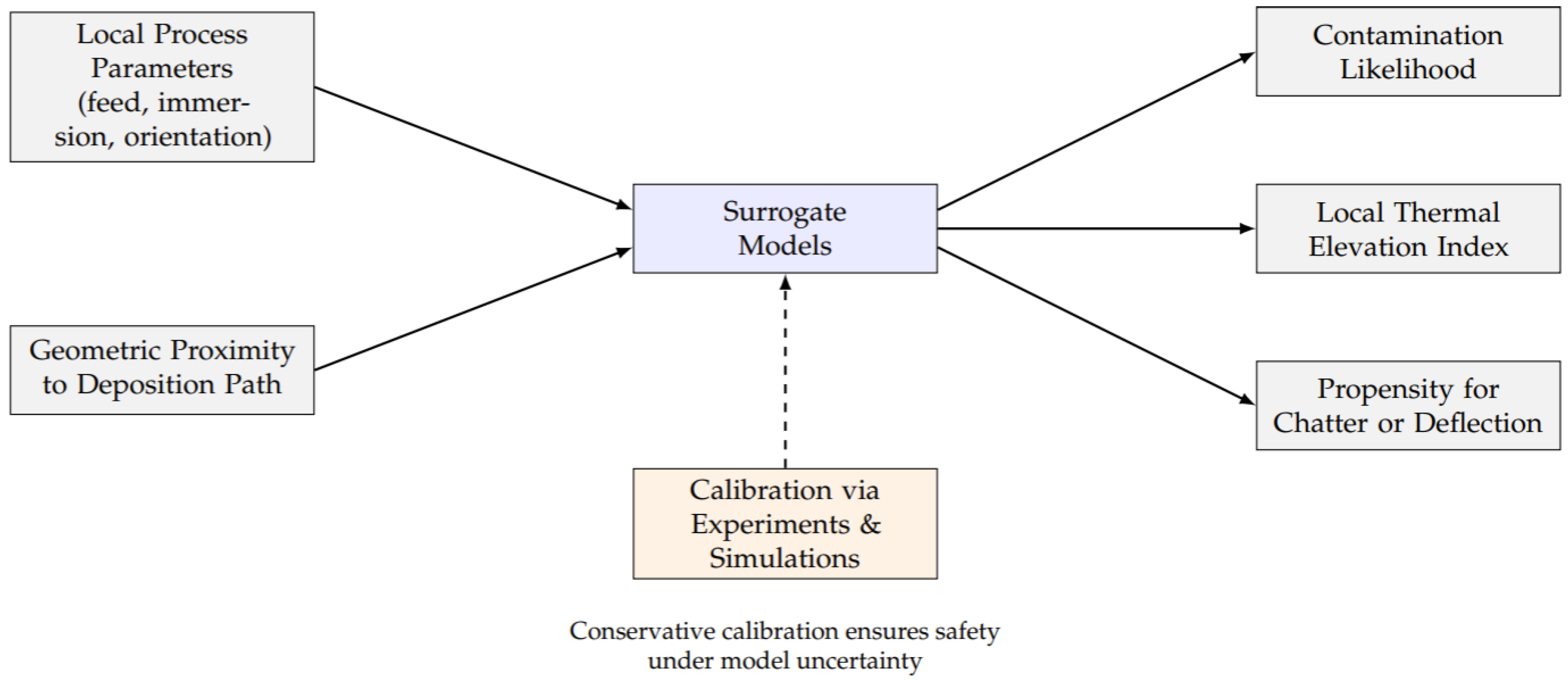
Typical surrogate inputs comprise local process parameters (feed rate, radial immersion and tool orientation), robot configuration descriptors, and geometric proximity to the deposition trajectory at the planned machining time. Surrogate outputs include contamination likelihood, an index of local thermal elevation, and an estimated propensity for vibration-induced disturbance or structural deflection at the planned pose.
Data-driven surrogate models are employed for objectives whose direct evaluation is computationally prohibitive. Gaussian-process and ensemble-based regressors provide both mean predictions and uncertainty estimates, enabling uncertainty-aware optimisation.
As illustrated in
Figure 4, the surrogate models map local process parameters, robot configuration and geometric proximity to the deposition trajectory to disturbance indicators used within the optimisation framework.
Surrogates are trained using structured experimental datasets and refined through active learning. Candidates associated with high predictive uncertainty are either penalised or selected for higher-fidelity evaluation, resulting in a mixed-fidelity optimisation loop that balances exploration efficiency and model reliability.
6.9. Post-Optimisation Selection and Validation
The optimisation yields a Pareto approximation of candidate plans. Final selection employs knee-point detection or stakeholder-weighted utility functions, followed by rigorous verification including collision checking, inverse kinematics validation and chance-constraint evaluation.
Selected plans may undergo local continuous refinement with a fixed discrete structure to further improve performance while preserving feasibility. Experimental execution and measurement close the loop by validating surrogate predictions and informing subsequent model updates.
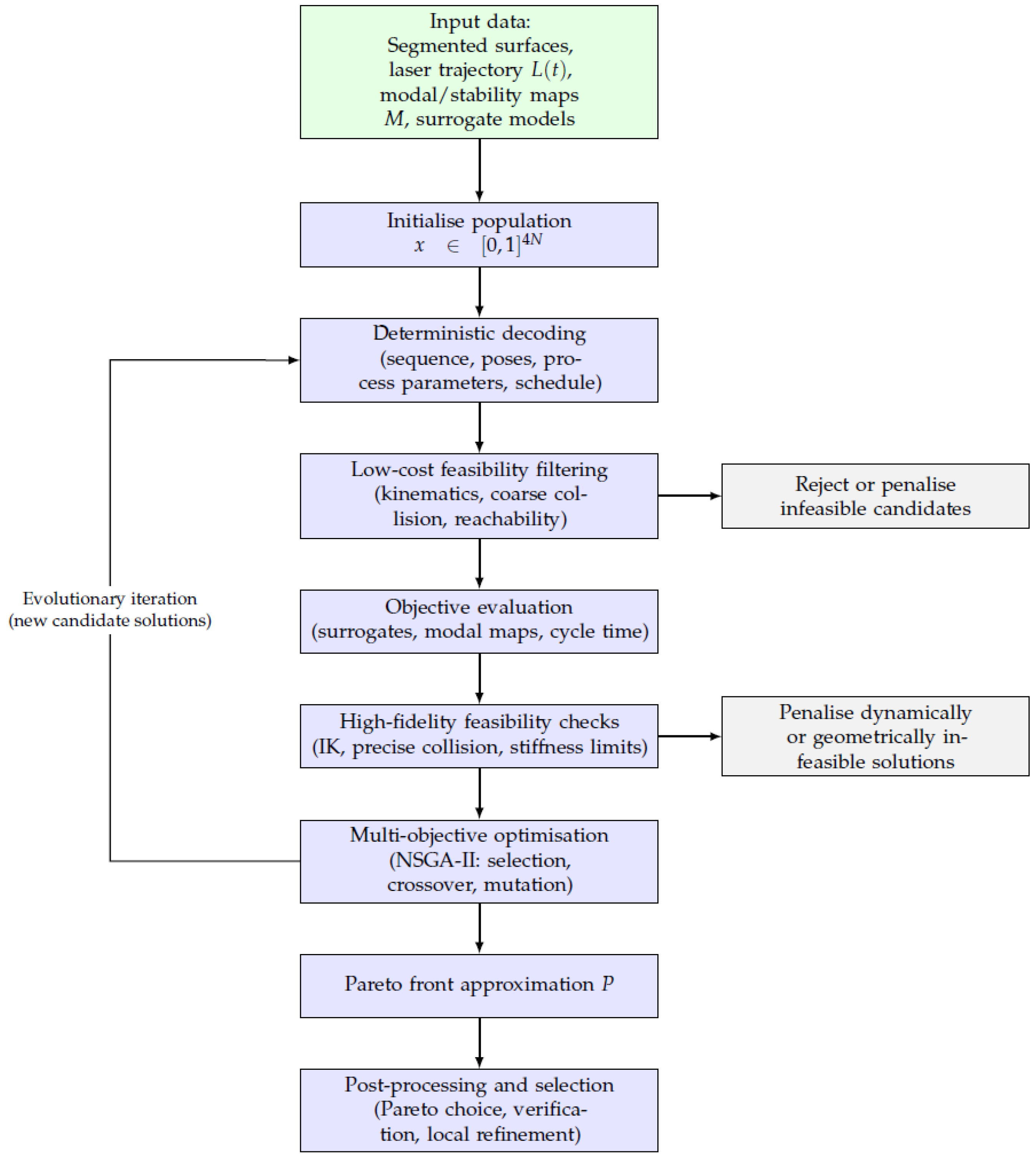
To summarise the interaction between decision-variable encoding, deterministic decoding, staged feasibility enforcement and hierarchical optimisation,
Figure 5 provides a compact overview of the offline planning workflow. The figure highlights how candidate solutions are progressively filtered through low-cost kinematic checks, surrogate-based objective evaluation and high-fidelity feasibility verification, before contributing to the Pareto front approximation. This staged structure enables tractable exploration of a high-dimensional mixed discrete–continuous design space while preserving robotic executability and disturbance-aware planning objectives.
7. Demonstrative Case Study of Disturbance-Aware Planning for Hybrid Manufacturing
Section 7 demonstrates the proposed framework through a controlled case study designed as an ablation-style instantiation of the full planning methodology. Rather than reproducing the full physical and robotic complexity introduced in
Section 3,
Section 4,
Section 5 and
Section 6, selected model components (in particular high-fidelity dynamic interaction, full inverse kinematics-based feasibility evaluation, and spatially coupled thermal fields) are intentionally simplified.
This reduction is performed in a structured manner to isolate and analyse the contribution of the core methodological elements of the framework, namely the unified decision-variable encoding, deterministic temporal coupling, and surrogate-based multi-objective optimisation. By selectively retaining the structural dependencies between sequencing, timing, and disturbance-aware objectives, the case study enables transparent examination of how feasible concurrent machining strategies emerge from the proposed formulation.
Accordingly, the purpose of this section is not to provide a high-fidelity validation of process physics, but to demonstrate the internal consistency and functional behaviour of the optimisation framework under controlled conditions. The implications of these modelling simplifications and their relation to real-world execution are discussed in the concluding section.
7.1. Geometry and Deposition Scenario
The demonstrative case study considers a single planar layer extracted from a topology-optimised component and uses this layer as a simplified geometric representative of the concurrent DED-milling planning problem. The purpose of this geometric abstraction is not to reproduce the full morphological complexity of an industrial part, but to provide a structured spatial setting in which the temporal and disturbance-related consequences of concurrent execution can be analysed transparently.
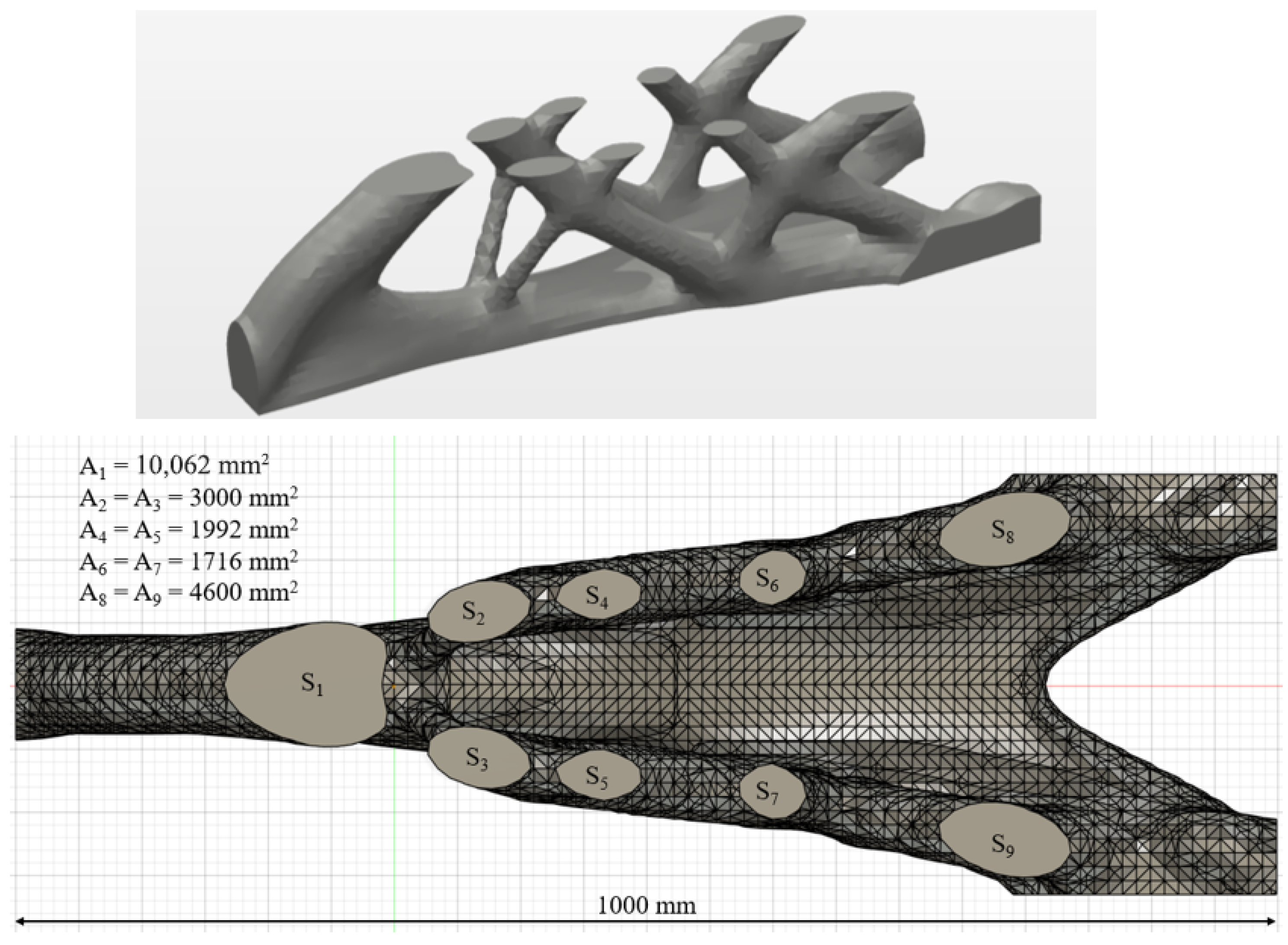
An overview of the considered geometry is shown in
Figure 6. The upper part of the figure depicts the underlying topology-optimised reference component, whereas the lower part shows the discretisation of the selected layer into surface segments.
The layer is partitioned into
surface segments,
, each characterised by a representative reference point
and a corresponding surface area
. The segments are arranged in a branching spatial configuration, leading to progressively increasing geometric separation along the deposition direction. This spatial structure is deliberately chosen because it induces heterogeneous temporal availability and non-uniform interaction conditions for subsequent machining operations. The geometric properties of all segments are summarised in
Table 1.
Material deposition is assumed to follow the predefined sequential order , reflecting a directed build strategy in which the active deposition region moves progressively away from the machining robot. As a consequence, the additive process generates a non-uniform spatio-temporal pattern of segment availability for subsequent milling.
The temporal evolution of deposition is approximated on the basis of a constant scanning velocity
and a hatch spacing of
. Under the simplifying assumption of parallel hatch trajectories, the effective deposition path length associated with segment
is estimated as
which yields the segment-wise deposition duration
Cumulative laser passage times are then obtained by sequential aggregation of the segment-wise deposition durations. These passage times define the earliest admissible temporal access to each segment from the perspective of the milling process and therefore establish the causal temporal coupling between additive and subtractive execution.
Although the resulting deposition scenario is geometrically simple, it gives rise to a non-trivial planning structure. Segments deposited early become available sooner, but remain spatially close to the active deposition region and are therefore more susceptible to disturbance-related restrictions. Conversely, later segments provide increased geometric separation from the active DED process but become available only after longer deposition delays. This tension between temporal availability and spatial separation constitutes the central structural trade-off of the case study and forms the basis for the disturbance-aware optimisation analysed in the following subsections.
The case study is intentionally formulated at a reduced level of model fidelity in order to preserve analytical transparency of the underlying optimisation structure. Rather than aiming at a high-fidelity representation of coupled thermo-mechanical process physics, the instantiation focuses on activating the structural elements of the planning problem introduced in
Section 4,
Section 5 and
Section 6, in particular temporal coupling, disturbance-aware objective evaluation, and mixed discrete–continuous decision interactions.
7.2. Process and Robot Model
This subsection defines the process-level and robot-level assumptions used to instantiate the case study. The objective is not to reproduce the full thermo-mechanical and kinematic complexity of concurrent DED and robotic milling, but to establish a computationally tractable execution model that preserves the dominant spatial, temporal, and scheduling-relevant interactions required for disturbance-aware planning.
To represent local machining decisions at a finer spatial resolution than the segment level introduced in
Section 7.1, each surface segment
is subdivided into a set of smaller machining patches. In the following, these patches are denoted by
, where
i identifies the parent segment and
the local patch index within that segment. Each patch is represented by a reference point
and inherits the geometric and temporal attributes of its parent segment. The larger segments
,
, and
are subdivided into four patches each, whereas all remaining segments are subdivided into two patches. All local disturbance surrogates are evaluated on this patch level under the simplifying assumption that process conditions are approximately homogeneous within each patch.
The additive process follows the predefined deposition sequence introduced in
Section 7.1. Deposition timing is derived from the constant scanning velocity and hatch spacing specified there, yielding segment-wise deposition durations
and cumulative laser passage times
. Each machining patch
inherits the laser passage time of its parent segment, such that the additive process defines the earliest admissible temporal access to that patch.
Each patch is machined individually. A ball-end milling tool with diameter
is assumed. The local feed rate
and radial immersion
are treated as optimisation variables and are bounded to ranges representative of robotic milling,
For the additive process, a nominal laser power of
is assumed, consistent with typical industrial wire-based DED-LB/M systems. The milling spindle speed is not fixed a priori, but varies implicitly with the locally selected feed rate and radial immersion parameters, reflecting standard process-dependent parameter adaptation in robotic milling. The corresponding machining duration
is determined from the local patch geometry and the selected cutting parameters, as specified in the numerical parameterisation in
Section 7.3.
Non-productive motion between machining patches is modelled through a constant travel velocity of
. For two consecutive patches
and
, the associated travel time is approximated as
This yields a simple geometric proxy for inter-patch transition time and allows travel-induced scheduling effects to be incorporated into the decoding of candidate solutions.
All machining patches are assumed to be kinematically reachable within the considered workspace. Rather than embedding full inverse kinematics evaluation within the optimisation loop, robot feasibility is approximated through reduced-order descriptors that capture proximity to workspace limits and configuration-dependent accessibility. These proxies provide a computationally efficient representation of robot-related constraints while preserving the coupling between pose selection and feasibility.
To ensure consistency with the robot-aware formulation introduced in
Section 4,
Section 5 and
Section 6, selected candidate solutions from the final Pareto set are additionally subjected to inverse kinematics validation in a post-processing step.
This hybrid treatment ensures that robot feasibility remains structurally embedded in the optimisation problem while maintaining tractability of the demonstrative case study.
Instead of restricting the machining process to a single fixed orientation, a reduced discrete set of admissible tool orientations is assigned to each machining patch,
This preserves the combinatorial structure of pose selection while maintaining tractability of the demonstrative setting.
The selected orientation enters the evaluation of disturbance-related objectives through simplified configuration-dependent descriptors, thereby retaining the functional role of pose selection within the optimisation framework. In the present case study, tool orientation is introduced as a discrete decision variable to activate pose-dependent effects within the optimisation framework. While orientation can, in general, influence multiple process interactions such as chip formation or thermal behaviour, its effect is restricted here to the dynamic compatibility objective. This selective abstraction enables controlled analysis of pose-dependent decision-making without introducing additional cross-coupling between surrogate models.
Concurrent execution of deposition and machining is restricted by a conservative minimum-distance condition between the active tool centre points of both processes. For a machining patch executed at time
, the constraint
must be satisfied, where
. In addition, a temporal safety offset is imposed to prevent immediate local overlap between deposition and machining,
with
.
The minimum-distance condition acts as a conservative first-order proxy for collision-safe concurrent operation during optimisation. In accordance with the hierarchical methodology described in
Section 6, detailed collision analysis is not embedded in the optimisation loop itself but deferred to a subsequent validation stage in which full robot geometries and trajectories can be examined. This staged separation between planning-time approximation and post-optimisation verification preserves computational tractability while maintaining consistency with the intended robotic execution context.
Overall, the resulting process and robot model provides a simplified yet explicit representation of local machining actions, temporal availability, inter-patch travel, and conservative concurrency constraints. It therefore forms the operational basis for the numerical parameterisation and optimisation study presented in the following subsections.
7.3. Numerical Parameterisation
This subsection provides the reduced numerical instantiation of the case study. It specifies the geometric patch areas, deposition-time approximation, local surrogate functions, and objective aggregation used in the optimisation. The purpose of this parameterisation is not to establish a high-fidelity predictive model of concurrent DED and milling, but to define a transparent and reproducible numerical testbed through which the structural behaviour of the proposed planning framework can be examined.
The machining patches introduced in
Section 7.2 inherit their surface areas from the corresponding parent segments. A uniform subdivision is assumed, such that the area of patch
associated with segment
is given by
where
denotes the number of patches assigned to segment
. As defined in
Section 7.2, the larger segments
,
, and
are subdivided into
patches, whereas all remaining segments are subdivided into
patches.
The additive process is parameterised by the constant scanning velocity
and the hatch spacing
. Under the assumption of parallel hatch trajectories, the effective deposition path length associated with segment
is approximated by
, which yields the segment-wise deposition duration
Cumulative laser passage times are obtained on the segment level by sequential aggregation of the segment-wise deposition durations according to the predefined deposition order, i.e.,
Since the machining patches inherit the deposition state of their parent segment, all patches
associated with segment
are assigned the same laser passage time,
For each machining patch
, the local machining duration is approximated as
where
denotes the feed rate and
the radial immersion, with admissible ranges as specified in
Section 7.2. Within the present case study, this expression is interpreted as a simplified process-time proxy that links local material coverage to the selected cutting parameters and thereby preserves the scheduling dependence of machining duration.
Thermal interaction is modelled as a local, time-dependent surrogate. While metallic materials exhibit non-negligible thermal conductivity, heat transfer in the present case study is governed by the underlying structural topology rather than Euclidean proximity between surface regions.
The considered geometry is characterised by a branched layout in which individual segments are connected through elongated material paths. As a result, thermal interaction between spatially neighbouring segments depends on the effective conduction distance along the material rather than their geometric distance.
For two machining patches
and
, this can be expressed by introducing an effective conduction distance
which represents the shortest heat-conducting path along the deposited structure. A generic form of thermal cross-coupling can then be written as
where
denotes a characteristic thermal interaction length.
Due to the branched geometry, conductive paths between distinct segments require traversal movement along extended structural branches, yielding
for all
. Consequently, cross-segment thermal coupling decays rapidly and can be neglected to first order within the time scales relevant for the present planning problem.
Under this condition, the thermal state of a machining patch is approximated as a function of the elapsed time due to the deposition of its parent segment. For each patch
, the corresponding temporal offset is defined as
The local thermal penalty is then expressed as
with characteristic cooling time
. This surrogate captures the dominant temporal cooling behaviour relevant for scheduling decisions.
Particulate interaction is represented by a distance- and intensity-dependent surrogate. Let
denote the instantaneous distance between machining patch
and the active deposition location at machining time
. The local machining intensity is approximated by
Based on these quantities, the local spatial interference surrogate is defined as
where
controls the characteristic spatial decay of the interaction. This surrogate reflects the assumption that chip-related disturbance risk increases with machining intensity and decreases with growing spatial separation from the active DED process.
The dynamic compatibility objective introduced in
Section 5.3 is instantiated here in a reduced surrogate form. Dynamic interaction effects are represented through a reduced surrogate capturing pose-dependent variations in structural stability. For each machining patch
, the dynamic compatibility objective is defined as
where
denotes the selected tool orientation.
In the present case study,
is instantiated as a discrete mapping assigning configuration-dependent penalty values,
with
representing relative indicators of dynamic favourability. Lower values correspond to configurations associated with higher effective stiffness and reduced vibration susceptibility.
This abstraction preserves the functional role of pose-dependent dynamic compatibility within the optimisation problem while avoiding explicit modelling of the underlying structural dynamics.
Accordingly, the general disturbance-aware formulation is reduced to a two-objective case-study instantiation comprising disturbance and cycle time. The aggregated disturbance objective is defined as
with equal weighting factors
. This aggregated disturbance measure is jointly evaluated with the cycle-time objective in the subsequent optimisation, thereby yielding a reduced bi-objective planning problem for the demonstrative case study. The aggregated disturbance objective
is introduced for interpretability and compact representation within the case study. The optimisation itself is conducted in a multi-objective manner, preserving the trade-off structure between disturbance mechanisms and cycle time.
7.4. Optimisation Setup
The planning problem defined by the case-study parameterisation in
Section 7.3 is solved as a bi-objective optimisation problem comprising cycle time and an aggregated disturbance measure, which itself combines multiple disturbance components, using NSGA-II. The optimiser is applied directly to the unified continuous encoding introduced in
Section 6, in which sequencing decisions, orientation selection, and local machining parameters are represented within a single normalised decision vector.
The population size is set to 100 individuals and the optimisation is run for 150 generations. The initial population is generated by uniform random sampling over the normalised decision space , thereby avoiding any additional structural bias in the initial search distribution.
Each candidate solution is deterministically decoded according to the procedure defined in
Section 6. This decoding step yields a complete machining schedule, including the execution order of machining patches, the selected tool orientations, the associated local process parameters, and the resulting start and completion times. Temporal consistency with the deposition process is enforced by construction through causal decoding, such that infeasible start times with respect to deposition availability are excluded at the schedule-generation stage.
Constraint handling follows a penalty-based feasibility strategy. Candidate solutions that violate essential execution constraints, in particular the minimum spatial separation from the active deposition process or the imposed temporal safety offset, are either discarded or mapped to strongly penalised objective values. This biases the evolutionary search toward admissible and operationally robust schedules while preserving sufficient population diversity for exploration of the trade-off surface.
Objective evaluation is performed using the surrogate-based formulation introduced in
Section 7.3. For each decoded solution, the aggregated disturbance objective-comprising thermal interaction, particulate interference, and pose-dependent dynamic compatibility and the resulting cycle time are computed and used for non-dominated sorting. The optimisation therefore produces a Pareto approximation of scheduling solutions that expose the trade-off between productivity and disturbance mitigation under the structured simplifications of the demonstrative case study. These solutions form the basis for the detailed schedule analysis presented in the following subsection.
7.5. Results and Analysis
This subsection analyses the representative solution obtained from the optimisation and interprets it with respect to the temporal coupling between deposition and machining, the induced schedule structure, and the resulting trade-off between cycle time and disturbance mitigation, including thermal, particulate, and pose-dependent dynamic effects. The objective is not to present an exhaustive statistical evaluation, but to demonstrate how the proposed framework translates the case-study assumptions into a physically consistent and non-trivial concurrent process plan.
The additive process follows the predefined deposition order and completes after approximately 327 s. The corresponding laser passage times define the earliest admissible machining times for the individual segments and thereby determine the temporal windows within which concurrent milling can occur.
Table 2 summarises the representative schedule obtained from the optimisation. Each step corresponds to a temporal interval in which a specific set of machining actions is feasible under the current deposition state and the imposed disturbance constraints.
The generated schedules can be interpreted as executable machining plans at the level of segment- and patch-wise operations, including consistent temporal ordering and process parameter assignment. While explicit toolpath generation is not performed within the present study, the resulting schedules are compatible with standard downstream toolpath planning and robot trajectory generation workflows.
The schedule reveals three characteristic phases. During the initial phase (0–130 s), no machining operation is feasible because the active deposition region remains spatially close to the candidate machining zones and the local thermal state does not yet permit safe concurrent execution. The first feasible machining action appears only once the deposition process reaches at approximately 130 s, where patch becomes accessible under conservative process settings.
In the second phase, beginning at approximately 160 s, the spatial separation between the active DED region and previously deposited areas increases sufficiently to permit more aggressive machining of the remaining patches of . At the same time, the first patch of becomes feasible, although it is still treated conservatively due to its limited separation from the active deposition region.
Between approximately 180 s and 240 s, the schedule exhibits alternating machining actions across , , and . This pattern reflects the combined effect of thermal relaxation and spatial separation, both of which modulate feasibility on a patch-by-patch basis. Rather than machining entire segments in a strictly monotonic order, the optimiser decomposes the problem into temporally interleaved local actions whenever this reduces disturbance without violating the causal coupling to deposition.
In addition to thermal relaxation and spatial separation, pose-dependent dynamic compatibility acts as a secondary selection criterion at the level of local machining configurations. While it does not fundamentally alter the global sequencing structure in the present case study, it influences the choice among locally feasible alternatives.
As the deposition process progresses towards the outer segments – (approximately 220–327 s), the geometric separation from the active deposition zone increases further. This permits larger portions of the component, including and later , to be machined with more aggressive parameter settings. Nevertheless, regions that are currently being deposited or have only recently been processed remain temporarily unavailable, which preserves the causality enforced by the schedule-decoding procedure.
After completion of the deposition process at approximately 327 s, the remaining machining operations are executed without additional deposition-related constraints. Owing to the substantial degree of overlap between additive and subtractive operations, only a limited amount of machining remains to be completed in the post-deposition phase. The final operations conclude at approximately 450 s, yielding a total process time of approximately 450 s.
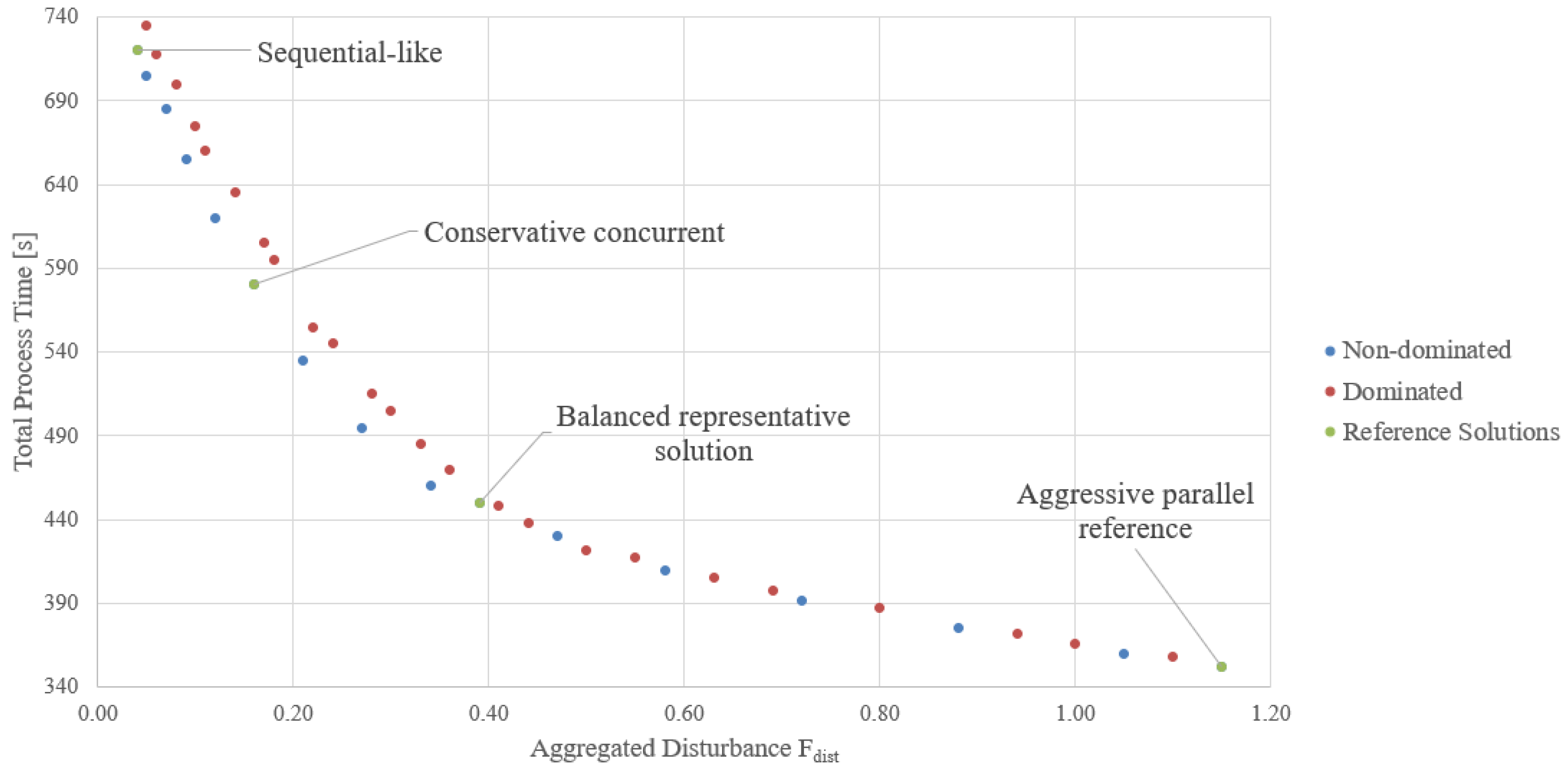
Relative to the purely sequential reference strategy, in which machining is performed only after completion of deposition and conservative parameters are used throughout, this corresponds to a cycle-time reduction of more than 35 %. In contrast, an aggressive parallel strategy that initiates machining immediately after satisfaction of the safety constraint and applies maximal cutting parameters throughout achieves a shorter total process time of approximately 352 s, but at the expense of substantially increased disturbance. The representative solution therefore occupies an intermediate region of the trade-off space and demonstrates that a meaningful reduction in cycle time can be obtained while maintaining controlled disturbance levels.
A particularly relevant outcome of the optimisation is that the milling sequence does not follow the deposition order monotonically. For example, patch
is machined before
, even though
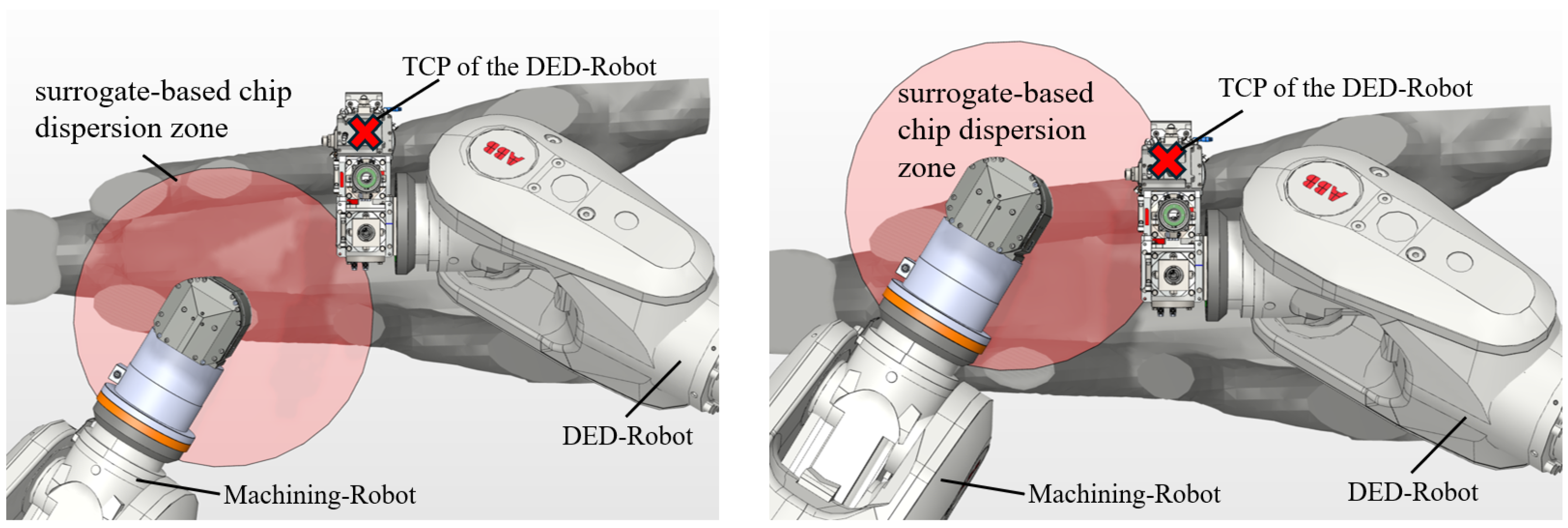
would appear to be the more immediate continuation from a purely geometric standpoint. This behaviour is explained by the chip-dispersion surrogate, which introduces a directional interaction criterion between the two processes.
Figure 7 illustrates this mechanism for a representative process state in which the DED tool is active above
. If the milling robot were to machine
in that state, the projected chip-dispersion zone would overlap with the active DED TCP region, indicating a high likelihood of process disturbance. In contrast, machining
keeps the disturbance zone outside the active deposition region and is therefore classified as feasible. The resulting sequence thus reflects not only scalar spatial separation, but also the directional structure of particulate interaction.
Beyond the representative schedule, the optimisation yields a set of non-dominated solutions that form a Pareto approximation of the trade-off between cycle time and disturbance.
Figure 8 visualises this trade-off in objective space and highlights several characteristic scheduling regimes along the non-dominated boundary. As illustrated, non-dominated solutions correspond to trade-off-optimal machining plans, whereas dominated solutions are inferior in at least one objective without compensating improvements in others.
A first regime is characterised by limited parallelism and predominantly conservative parameter settings. In this region of the Pareto approximation, machining is delayed for segments that are both thermally critical and spatially close to the active deposition process, resulting in total process times of approximately 600 s and comparatively low disturbance levels.
A second regime increases the degree of parallelism while selectively delaying only those operations that remain strongly affected by thermal or spatial interaction. This yields balanced concurrent schedules with total process times close to the representative solution analysed above, i.e., approximately 450 s.
Further along the Pareto approximation, more aggressive solutions initiate machining as soon as the temporal safety constraint is satisfied, while still adapting local parameters in particularly sensitive regions. In this regime, total process times of approximately 400 s are achieved.
Finally, in the limit of fully aggressive parallel execution, machining is performed at maximum parameter settings whenever admissible under the simplified feasibility constraints. This results in minimum process times of approximately 350–380 s, but only at the cost of substantially elevated disturbance.
Overall, the Pareto approximation indicates that the largest cycle-time gains are realised when transitioning from sequential execution to balanced concurrent strategies. Further reductions in process time require increasingly aggressive machining decisions and therefore incur disproportionately higher disturbance. This behaviour confirms that the proposed framework enables systematic exploration of the productivity–stability trade-off and produces actionable planning strategies that can be selected according to application-specific priorities.
The candidate solutions represented in the Pareto approximation were additionally subjected to the staged feasibility checks introduced in
Section 6.4. Solutions failing these checks were discarded, and only verified feasible schedules were retained for the analysis presented above. Consequently, the reported trade-offs reflect not only surrogate-based objective values, but also compliance with the executability requirements considered in the present robotic planning model.
7.6. Discussion and Limitations
The case study demonstrates that the proposed framework is capable of generating physically interpretable concurrent DED–milling schedules under explicitly modelled temporal and spatial interaction constraints. In particular, the obtained solutions show that feasible overlap between deposition and machining does not emerge uniformly across the workpiece, but only within specific spatio-temporal windows determined by deposition order, geometric separation, and local disturbance sensitivity. The resulting schedules are therefore neither purely sequential nor trivially parallel, but instead exhibit selective concurrency, non-monotonic machining order, and local adaptation of cutting parameters.
A central observation is that the most relevant performance gains are achieved not in the limit of maximally aggressive parallel execution, but in the regime of balanced concurrency. In this regime, substantial cycle-time reductions can be realised while disturbance remains comparatively moderate. This behaviour is reflected by the shape of the Pareto approximation and indicates that the proposed framework can support planning decisions beyond simple earliest-start or maximum-throughput heuristics.
At the same time, the present case study is intentionally based on a reduced modelling setup. Thermal effects are represented by a local time-dependent surrogate, spatial interaction is approximated through distance- and direction-related disturbance proxies, and dynamic interaction effects are represented through simplified, configuration-dependent surrogate mappings, and tool orientation is introduced as a reduced discrete decision variable. However, these effects are intentionally modelled in a decoupled and low-order manner, and detailed robot kinematics as well as full collision checking are not embedded within the optimisation loop itself, but deferred to a subsequent validation stage. These simplifications imply that the results should not be interpreted as a high-fidelity predictive representation of a specific industrial process chain.
Rather, the role of the case study is to provide a controlled demonstration of the structural capabilities of the framework. Under this interpretation, the simplified setup is methodologically useful because it isolates the planning mechanisms of interest, namely the coupling between deposition state, local machining feasibility, surrogate-based disturbance evaluation, and schedule generation. The fact that the optimisation yields differentiated, interpretable, and non-trivial schedule patterns under these assumptions supports the validity of the proposed formulation at the level of planning logic.
For transfer to industrial deployment, the framework should be extended along several dimensions. First, the surrogate models used here should be replaced or complemented by experimentally calibrated thermo-mechanical and process-interaction models. Second, the simplified representation of pose-dependent accessibility and orientation selection should be extended towards more detailed kinematic modelling and configuration-dependent feasibility evaluation. Finally, experimental studies will be required to assess how accurately the surrogate-based disturbance objectives correlate with measurable process quality and process stability.
In practical applications, surrogate models can be constructed using experimentally acquired process data, including temperature measurements, surface quality metrics, and vibration signals. Such data can be obtained through instrumented test builds and subsequently used to train data-driven models that capture process-specific interaction effects.
To ensure that surrogate-based disturbance models remain scientifically meaningful and consistent with underlying process physics, explainable artificial intelligence (XAI) techniques can be integrated to analyse model behaviour and validate learned relationships.
In particular, feature attribution methods such as SHAP (Shapley Additive Explanations) or gradient-based approaches (e.g., Grad-CAM) enable attribution of surrogate predictions to individual input variables. This enables verification of physically plausible dependencies and detection of spurious correlations.
For instance, in the thermal interaction model , attribution analysis identifies the temporal offset as the dominant explanatory variable, reflecting the underlying cooling behaviour. A deviation from this pattern, such as a disproportionate influence of unrelated process parameters, would indicate a lack of physical consistency in the learned model.
Similarly, for the spatial interaction surrogate , explainability analysis confirms that the predicted disturbance decreases with increasing distance from the active deposition region and increases with machining intensity. This provides a direct validation of the assumed monotonic relationships embedded in the surrogate formulation.
In the case of the dynamic compatibility objective , attribution methods can reveal whether pose-dependent descriptors dominate the prediction, thereby confirming that the surrogate correctly reflects configuration-induced stability variations.
Such analyses establish a direct link between data-driven surrogate predictions and physically interpretable process mechanisms. Consequently, XAI techniques provide a means to systematically validate surrogate models and enhance the reliability of disturbance-aware planning frameworks, particularly in industrial contexts where model transparency and trustworthiness are critical.
These approaches enable the identification of dominant input features and their influence on predicted process behaviour, thereby providing a link between surrogate predictions and physically interpretable process variables such as thermal gradients, tool engagement conditions, or vibration-related effects.
As a result, explainable surrogate models can support both validation and trust in data-driven planning frameworks by ensuring that learned relationships are consistent with known physical principles and process understanding.
Overall, the results of the case study should therefore be interpreted as a proof of structural feasibility rather than a proof of predictive completeness. Within this scope, the presented analysis confirms that disturbance-aware concurrent planning can systematically exploit overlap potential between additive and subtractive operations and can generate meaningful trade-off solutions between productivity and process stability. Consequently, the contribution of the case study lies in demonstrating that the proposed optimisation framework produces structurally consistent, feasible, and interpretable planning solutions under explicitly modelled constraints, rather than in validating the predictive accuracy of individual surrogate components.
8. Conclusions, Scope and Outlook
This work presented a disturbance-aware planning and optimisation framework for concurrent robot-assisted wire-based DED-LB/M and milling. Its central contribution lies in treating dominant process-interference mechanisms not as secondary feasibility checks, but as explicit planning objectives within a temporally coupled multi-objective formulation. In this way, the proposed approach enables systematic generation of concurrent additive–subtractive schedules that account for productivity, disturbance mitigation, and execution consistency in an integrated manner.
Methodologically, the framework combines a structured decomposition of particulate, thermal, and pose-dependent dynamic interactions with unified decision encoding and deterministic temporal decoding of candidate process plans. This representation enables the joint optimisation of sequencing, local machining parameters, and execution timing under causal coupling to the deposition process. The resulting planning architecture supports a scalable search over complex concurrent schedules while retaining a clear separation between optimisation-time surrogate evaluation and subsequent feasibility validation.
The demonstrative case study showed that the framework can generate non-trivial and physically interpretable concurrent schedules under explicitly stated assumptions. In particular, the results revealed that feasible overlap between deposition and milling emerges only in specific spatio-temporal windows and that effective schedules require selective concurrency, non-monotonic execution order, and local adaptation of machining parameters. The observed Pareto trade-offs further indicated that the main productivity gains arise in regimes of balanced concurrency rather than in maximally aggressive parallel execution.
At the same time, the scope of the present study remains deliberately limited. The surrogate models used here are not experimentally calibrated, the robotic execution model is intentionally simplified, and the numerical case study serves as a controlled demonstration of the framework rather than as an experimentally validated prediction of industrial process performance. Accordingly, the contribution of this work should be understood as a proof of structural feasibility and planning capability, not as a proof of predictive completeness. This distinction is important because it preserves the generality of the proposed framework while leaving room for future process-specific refinement and validation.
Future work should therefore focus on three closely connected directions. First, the surrogate models should be calibrated and validated experimentally on hybrid DED–milling testbeds in order to establish quantitative links between the optimisation objectives and measurable process outcomes. Second, in situ sensing and state estimation should be integrated to enable uncertainty-aware disturbance assessment and adaptive replanning during execution. Third, the framework should be extended toward full robot-level deployment, including pose-dependent accessibility, trajectory-level validation, and potentially multi-robot coordination for larger-scale hybrid manufacturing scenarios.
Overall, the proposed framework provides a general methodological foundation for disturbance-aware planning and optimisation in hybrid robotic manufacturing systems. Beyond the specific DED–milling setting considered here, the formulation is sufficiently modular to support extension to other tightly coupled multi-process production scenarios in which productivity and process interaction must be balanced explicitly.