Article

Development of Simplified Mechanical Model for Welding Deformation in Multi-Pass Welding

Graduate School of Engineering, Osaka Metropolitan University, Sakai 599-8531, Osaka, Japan
*
Author to whom correspondence should be addressed.
J. Manuf. Mater. Process. 2026, 10(3), 96; https://doi.org/10.3390/jmmp10030096
Submission received: 20 January 2026 / Revised: 10 February 2026 / Accepted: 6 March 2026 / Published: 12 March 2026

Abstract

This paper proposes a simplified mechanical model to estimate transverse shrinkage and angular distortion in multi-pass butt welding. The simplified mechanical model is first derived for an I-groove joint by representing the heated weld region with one-dimensional bar elements and by enforcing force equilibrium to obtain closed-form expressions for pass-by-pass deformation increments and cumulative deformation. For non-I-groove joints, the same simplified mechanical model is applied by updating the layer partition and geometric parameters for each pass based on the pass-wise high-temperature region; the inherent shrinkage of each pass is evaluated from the heat input and an equivalent heated-layer thickness. The simplified mechanical model is validated for V-groove multi-pass joints by comparison with thermo-elastic-plastic finite element (FE) analyses and available experimental data, and for X-groove multi-pass joints by comparison with thermo-elastic-plastic FE analyses. In addition, a parametric study on the V-groove angle (40°–70°) for SUS316L demonstrates that the model captures the increasing trend of final transverse shrinkage with groove angle without a pronounced degradation in prediction accuracy. The results show that the simplified mechanical model reproduces both deformation histories and final values with good accuracy while using only a small set of input parameters and negligible computational cost, making it useful for early-stage welding procedure planning and quick parameter studies.

1. Introduction

Welding is indispensable for thick-plate structures such as ships, bridges, and plant piping, and multi-pass welding is widely used, particularly for joints with a large plate thickness. During welding operations, the region near the weld is locally heated and cooled by heat input from the welding torch, and the thermal strain generated in this process is constrained by the surrounding base material, resulting in welding deformation and residual stress after cooling [1]. Welding deformation not only impairs product appearance but also causes gaps and misalignments in subsequent assembly processes, which can lead to reduced workability and quality deterioration [2]. Particularly in thick-plate welding, the high rigidity of structural members often makes it difficult to correct deformation once it has occurred [3]. Therefore, it is important to minimize welding deformation as much as possible during the fabrication stage. In multi-pass welding, the temperature history becomes superimposed as the number of passes increases, and the existing residual-stress state also changes, making the deformation behavior more complex than in single-pass welding [4].
Previous studies on multi-pass welding deformation have systematically investigated the effects of welding conditions and pass progression on transverse shrinkage and angular distortion, and the effectiveness of heat-input parameters as indices for organizing angular distortion has also been discussed [5]. However, for thick-plate multi-pass welding, the overlapping temperature histories and evolving residual-stress states make the deformation behavior increasingly complex with pass progression. Consequently, few studies provide a mechanically interpretable description of deformation-history generation that is also practical for early-stage fabrication planning (e.g., selecting welding conditions and pass sequences). Therefore, a simple prediction method that provides mechanical insight is needed to support the planning of welding conditions and sequences, which still often relies on empirical rules.
Regarding the current state of welding deformation prediction, existing approaches can be broadly positioned into four categories: (i) high-fidelity thermo-mechanical simulations, (ii) reduced-order elastic analyses driven by inherent quantities (inherent strain/inherent deformation), (iii) data-driven surrogate or machine learning (ML) models, and (iv) practical formulas based on theoretical analysis/mechanism-based closed-form formulations. Recent review studies summarize this landscape and the corresponding prediction/control strategies across these categories [6]. For category (i), a framework is widely used in which the temperature field during welding and the stress/strain field are directly evaluated through temperature field analysis based on a moving heat source model coupled with thermo-elastic-plastic FE analysis [4,7,8]. While these methods can handle material nonlinearity and welding conditions relatively faithfully, they become computationally expensive when applied to thick-plate multi-pass welding or large-scale structures, making their use in practical iterative studies (e.g., exploring welding sequences and parameter windows) challenging. For category (ii), the inherent strain method has been proposed, in which plastic strain generated by welding is identified as inherent strain (inherent deformation) and introduced as an equivalent source term in elastic analysis [9]. This framework enables fast distortion analysis once the inherent quantities are prepared; however, in multi-pass welding, it typically requires prior identification/parameterization of the pass-wise inherent quantities (often relying on experiments, detailed simulations, or a database), and the link between pass progression and deformation-history generation may not remain mechanically transparent under varying thermal cycles and evolving residual-stress states. For category (iii), surrogate/ML models have been explored for accelerating repeated prediction and optimization tasks [10,11]. However, their practical use depends on the availability of reliable training data and appropriate descriptors, and extrapolation/interpretability remains a concern when applied to diverse joint geometries and pass sequences. For category (iv), mechanism-based practical formulas (closed-form formulations) aim at rapid and interpretable estimation based on simplified kinematics and physically meaningful parameters. Representative recent analytical formulations for multi-pass angular distortion under restraint have also been reported [12]. However, such formulations often require additional inputs that are not directly available from fabrication parameters alone; for example, the model by Seong et al. explicitly involves the plastic-region (plasticity) area A p , which is estimated from the peak temperature field (i.e., a heat conduction-based temperature distribution) [12]. Therefore, for complex multi-pass welding, determining pass-wise A p without an accompanying thermal analysis is non-trivial. In addition, classical/foundational works by Watanabe and Satoh and related studies have established the basis for understanding and organizing welding deformation in terms of shrinkage and angular distortion mechanisms [5]. Comprehensive monographs also provide a systematic overview of deformation and residual-stress prevention in welded structures and their practical countermeasures [13]. However, existing formulations are often tailored to specific joint configurations or restraint conditions, and few studies provide a mechanically interpretable description of pass-wise deformation-history generation that is also practical for thick-plate multi-pass welding in early-stage fabrication planning. Therefore, a simple yet mechanically explainable prediction method is still required while quickly comparing multiple welding conditions and sequences.
Therefore, in this study, we propose a simplified mechanical method for predicting welding deformation based on a bar-element mechanical model in which the weld metal and heat-affected zone are idealized as a collection of bar elements arranged between rigid walls, with the objective of rapidly evaluating the average transverse shrinkage and angular distortion during multi-pass welding. The purpose of this method is not to advance the numerical analysis method itself, but rather to clarify the dominant factors and generation mechanism of deformation history associated with welding pass progression through closed-form expressions that can be calculated by hand and to quickly grasp deformation tendencies at the initial stage of fabrication planning.

2. Proposed Simplified Mechanical Method for Welding Deformation Prediction in Multi-Pass Welding

In this study, we employ a simplified mechanical model in which the weld metal and heat-affected zone are idealized as a collection of bar elements arranged between rigid walls, with the objective of simply evaluating the average transverse shrinkage and angular distortion during multi-pass welding. In this section, we define the multi-pass welding process by distinguishing between “pass (fabrication step)” and “layer (geometric layer in the plate thickness direction)”. Let P pass denote the total number of passes and N layer denote the total number of layers. The pass number is denoted as p = 1 , , P pass , and the superscript ( p ) represents the state after the p-th pass welding. The layer number is denoted as n = 1 , , N layer .

2.1. Modeling of I-Groove Multi-Pass Welding (One Layer per Pass)

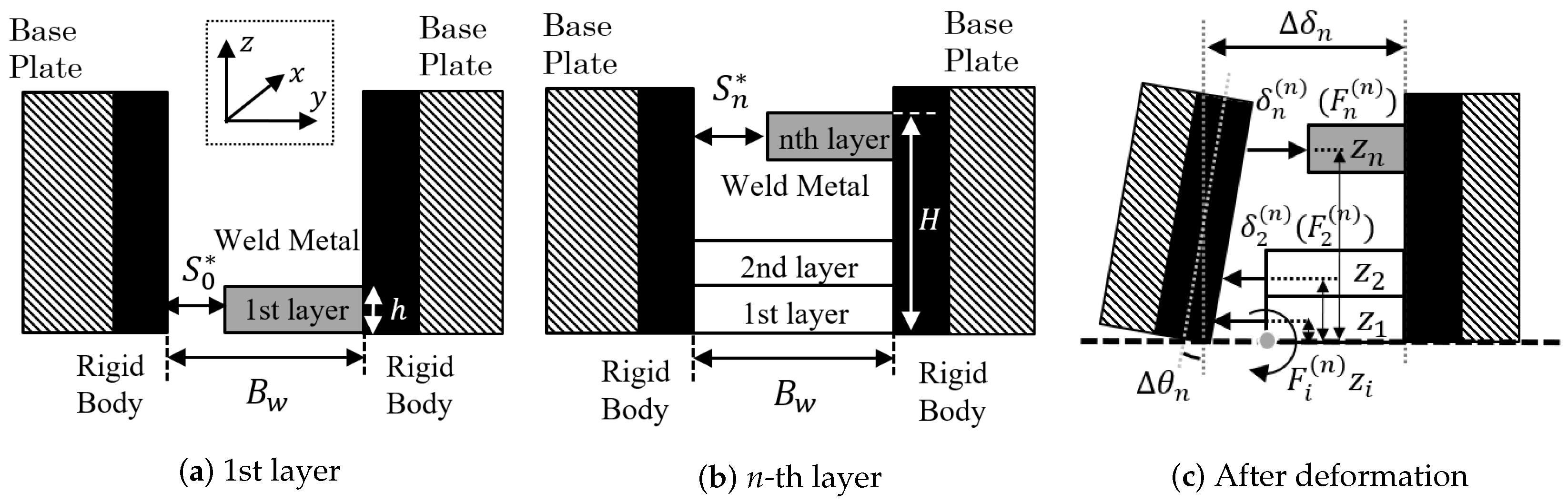
In this mechanical model, we consider an I-groove butt joint with plate thickness H. The concept of the I-groove joint cross-section and the bar-element model is shown in Figure 1. In this section, we assume one layer per pass, so N layer = P pass holds, and the layer number n coincides with the pass number p. Hereinafter, for convenience, we use the layer number n (=p).
The entire weld bead is divided into P pass passes of equal thickness h in the plate thickness direction, and each layer is modeled as a bar with cross-sectional area A and length B w to represent the mechanical state of the weld zone. The displacement in the plate width direction (y-direction) at the edges of the plate is constrained, and it is assumed that both ends of the bar elements are connected to the left and right rigid walls (solid black regions) shown in Figure 1. Figure 1a shows a schematic diagram during the first-layer welding, and Figure 1b shows a schematic diagram during the intermediate n-th layer welding ( 2 n N layer ) .
Following the pure-shrinkage model, the transverse shrinkage can be expressed as Δ w = ( 1 + ν ) η α ρ c q v t [5], where q is the power, v is the welding speed, t is the plate thickness, η is the thermal efficiency, and ν is Poisson’s ratio. By defining the effective heat input per unit length as Q = η q / v and taking h = t , this relation motivates the non-dimensional heat-input parameter S 0 * used in this study:
S 0 * = α Q c ρ h
Here, S 0 * corresponds to the quantity obtained by averaging the inherent strain generated in the weld metal and heat-affected zone in single-layer welding with small restraint in the throat thickness direction and integrating it over the throat thickness h. That is, in this study, S 0 * is used as a reference value for providing the inherent shrinkage of each layer in multi-pass welding. This normalization is in line with practical inherent deformation approaches, where transverse shrinkage is commonly parameterized by heat-input measures scaled by thickness (e.g., Q and h) for engineering estimation and database construction [14,15].

2.2. Equilibrium Equations in the Mechanical Model

During welding of the n-th layer, let δ i ( n ) ( i = 1 , , n ) be the axial displacement of layer i in the plate-width (y) direction, and let F i ( n ) be the axial force in layer i. The displacement state after the n-th layer welding and the relationship between the displacement and position of each layer are shown in Figure 1c. In this simplified mechanical model, the following three conditions are applied.
1.
Axial-force equilibrium. Assuming that no external force acts in the plate-width (y) direction, the total axial force over the cross-section is zero:
i = 1 n F i ( n ) = 0
2.
Moment equilibrium. Let z i be the through-thickness coordinate of the center of layer i, measured from the bottom surface of the plate. The sum of moments of the axial forces about the reference plane is zero:
i = 1 n F i ( n ) z i = 0
3.
Linear displacement distribution constraint. The rigid walls are assumed to move as rigid bodies in the plate-width (y) direction, undergoing translation and rotation. Let δ 1 ( n ) denote the y-direction translation component (opening/closing) of the wall spacing after welding the n-th layer, and let Δ θ n be the increment of angular distortion of the entire model caused by welding the n-th layer. Under these assumptions, the y-displacement varies linearly along the thickness direction z, and the displacement of layer i (centered at z i ) satisfies
δ i ( n ) δ 1 ( n ) = ( i 1 ) h Δ θ n ( i = 1 , , n ) .
That is, the displacement difference between layer i and layer 1 is proportional to the inter-layer distance ( i 1 ) h , and the displacement gradient in the thickness direction is constant, equal to Δ θ n .
The stress–strain relationship of each bar element is assumed to be linear elastic, and the axial force is expressed as
F i ( n ) = E A ε i ( n )
Here, the subscript i indicates the layer number, and the superscript ( n ) indicates the state after the n-th layer welding.
The superscript * indicates an inherent quantity (inherent strain or inherent shrinkage) introduced by welding. In this model, the inherent strain ε * is introduced by subtracting it from the elastic strain. The stress (and thus the axial force) is determined by the elastic strain ε e = ε ε * . In the n-th layer welding step, the inherent strain ε n * is applied only to the newly welded layer i = n . For the other layers ( i = 1 , , n 1 ) , ε i * = 0 . Therefore, the average strain of layer i in the y direction during the n-th layer welding step is
ε i ( n ) = δ i ( n ) B w ( i n ) δ n ( n ) B w ε n * ( i = n ) ε n * = S n * B w
Here, S n * is the inherent shrinkage assigned to layer n. It is prescribed based on the reference inherent shrinkage S 0 * . Because the formulation adopts a kinematic idealization to keep the solution closed-form and hand-calculable, the predicted values should be interpreted as mechanism-based estimates of the dominant pass-wise deformation trend rather than an exact reproduction under all restraint and thermal conditions.
The above derivation relies on three fundamental relations: (i) kinematic compatibility imposed by rigid-wall idealization, where the wall-spacing change in the y direction is described by only two degrees of freedom (rigid-body translation and rotation), leading to a linear through-thickness distribution of transverse displacement for all layers; (ii) transverse force equilibrium in the absence of external loading in the y direction; and (iii) moment equilibrium about the reference axis in the absence of external bending moments. These relations provide the mechanical premise that enables a closed-form, hand-calculable solution for pass-wise increments of transverse shrinkage and angular distortion.
This idealization is primarily intended for cases where the transverse restraint provided by the surrounding base material and/or fixtures is sufficiently strong and approximately uniform along the weld line, such that the deformation is dominated by the average transverse shrinkage and angular rotation captured by the present kinematics. In contrast, the accuracy may deteriorate when the restraint is compliant and significantly relaxes, when the restraint varies markedly along the weld line or across the plate width, or when additional deformation modes such as longitudinal bending, twisting, or out-of-plane instability become significant (e.g., in plates/panels with low out-of-plane bending stiffness or large width-to-thickness/aspect ratios).
By solving Equations (2)–(6) together, the displacements δ i ( n ) of all layers and the angular distortion increment Δ θ n caused by welding of the n-th layer can be obtained.

2.3. Simplified Prediction Formulas for I-Groove Multi-Pass Welding

For an I-groove joint, the solutions from the above conditions can be organized as the layer-by-layer history of average transverse shrinkage and angular distortion. These solutions can be summarized in a simple form that is easy to use in practice. As shown in Figure 1c, the increment of average transverse shrinkage at the plate edge caused by the n-th layer welding is defined as Δ δ n , and the increment of angular distortion is defined as Δ θ n :
Δ δ n = δ 1 ( n ) + δ n ( n ) 2 , Δ θ n = δ n ( n ) δ 1 ( n ) ( n 1 ) h
By substituting Equations (2)–(6) into Equation (7) and rearranging, the following simplified prediction formulas for I-groove multi-pass welding are obtained:
Δ δ n = S n * n
Δ θ n = n 1 k = 1 n a k S n * h
Here, a k is a coefficient that depends on the layer number k and is defined as
a k = 1 ( k = 1 ) a k 1 + ( k 1 ) ( k 2 )
For an I-groove joint, the throat thickness of each layer is constant, so h is constant. From Equation (8), the absolute value of the average transverse shrinkage increment | Δ δ n | decreases approximately as 1 / n as the layer number increases. From Equation (9), the angular distortion increment depends on the layer number through the summation term k = 1 n a k . While k = 1 n a k increases as a k accumulates, | Δ θ n | tends to decrease as the layer number increases. By accumulating Δ δ n and Δ θ n for each layer, the total transverse shrinkage and angular distortion at the completion of multi-pass welding can be evaluated.

2.4. Application to General Groove Shapes

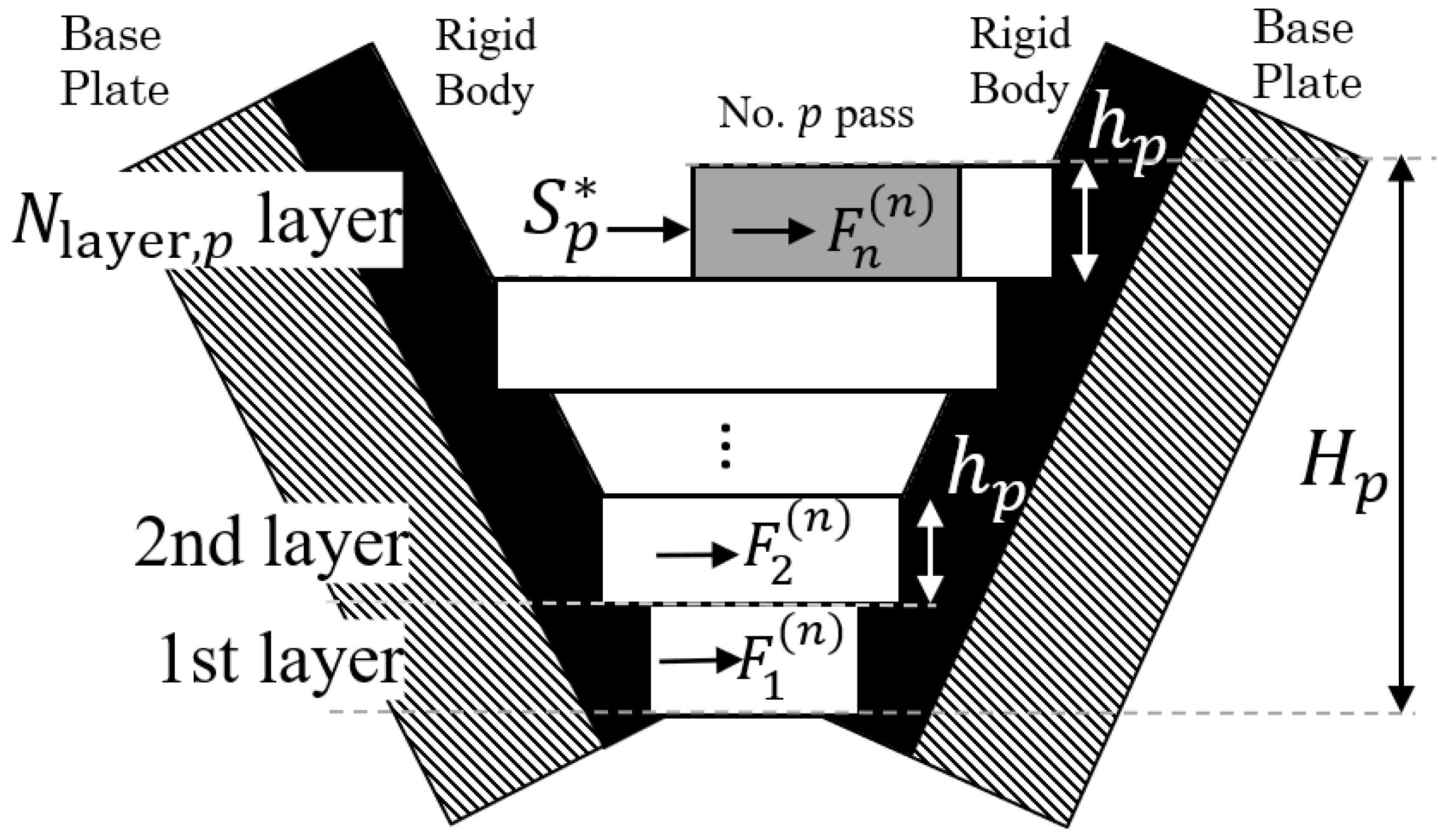
In multi-pass welding for grooves other than I-grooves, the shape of the weld metal zone changes in the through-thickness direction due to the groove angle and gap. In such cases, if the width change of the weld metal zone is given step by step as length and width parameters of the bar elements, the basis for each layer setting becomes unclear and the modeling process becomes complex. Therefore, in this study, even when the groove shape changes, general groove shapes are treated based on the same mechanical model as in the previous sections, as shown in Figure 2.
In general grooves, the heat input Q p can be different for each pass, so the peak temperature distribution (effective zone) changes and the equivalent throat thickness is not constant. At the p-th pass, the through-thickness direction is divided into layers with equal thickness h p , and the number of layers N layer , p is determined to satisfy N layer , p h p = H p . Here, H p is the total layer thickness from the reference plane (bottom surface of the first layer) to the top of the p-th pass. The thickness h p is evaluated based on the temperature distribution, and the region where the temperature is approximately above 750 °C is considered as the mechanical fusion zone. Note that the threshold temperature used to define the effective softened region (MFZ) is a modeling parameter and, in principle, should be adjusted depending on the material-dependent high-temperature mechanical degradation (mechanical melting/softening concept) [16,17]. In this study, however, a common value TMFZ = 750 °C is adopted for the target cases (SM490A and SUS316L) for consistency and to keep the closed-form procedure parameter-minimal. Meanwhile, the temperature-dependent yield stress used in the thermo-mechanical FE analyses is material-specific; therefore, the yield stress at 750 °C differs between SM490A and SUS316L.
For the inherent shrinkage of the p-th pass, the Q and h in Equation (1) are replaced with Q p and h p of the current pass, and the reference inherent shrinkage is defined as
S p * = α Q p c ρ h p
Under the above definitions, the inherent shrinkage S p * is applied only to the bar element corresponding to the p-th pass. For the p-th pass, the current number of layers is set as n = N layer , p , and the equilibrium equations in Section 2.2 (Equations (2)–(6)) are treated as an n-layer problem. That is, the unknowns δ i ( n ) and F i ( n ) ( i = 1 , , n ) are solved, and the average transverse shrinkage increment and angular distortion increment can be obtained step by step as the pass progresses. Here, the superscript ( n ) indicates the state after the source term is applied to the mechanical model with n layers. The practical determination of H p and h p and the sign convention for X-groove welding are summarized in Section 2.5.

2.5. Definition of Displacement Measures and Implementation Details

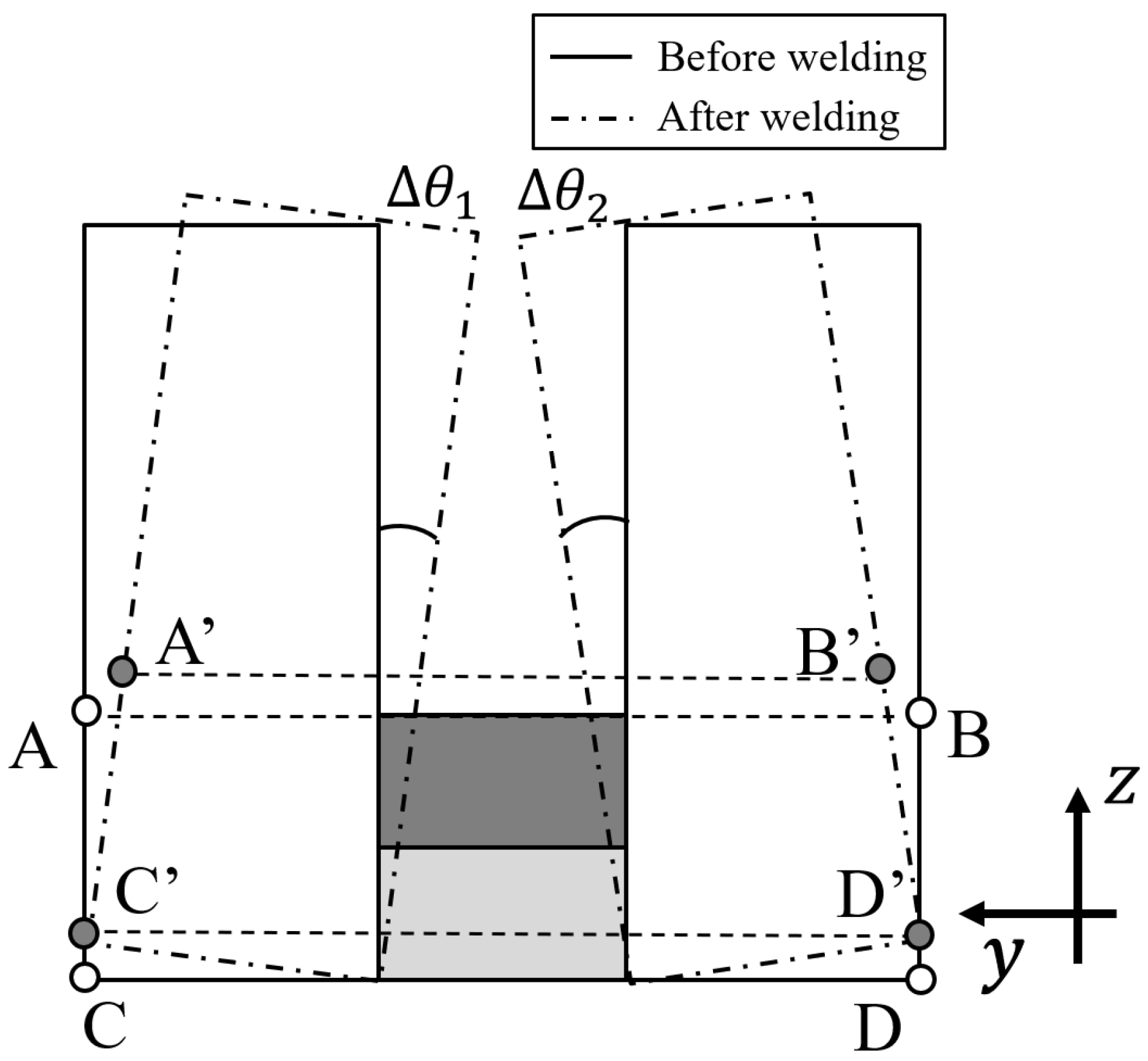
In this study, angular distortion and transverse shrinkage are defined based on Figure 3 as indicators that are less affected by rigid-body translation and rigid-body rotation components during welding progress. The angular distortion increment Δ θ is defined as the sum of the rotation components of the left and right base plates, Δ θ 1 and Δ θ 2 , at the cross-section at the weld line center:
Δ θ = Δ θ 1 + Δ θ 2
Transverse shrinkage is defined as the sum of the average values of the relative displacement differences before and after welding, using the plate-width direction displacements u y at the evaluation points A, B, C, and D (and A , B , C , and D ) near the weld metal. That is,
δ = 1 2 u y ( A ) u y ( B ) + u y ( C ) u y ( D ) , Δ δ = δ after δ before
By using the average of two sets of relative displacement differences, local variations and contamination from angular distortion components can be reduced, allowing stable evaluation of transverse shrinkage behavior near the weld metal.
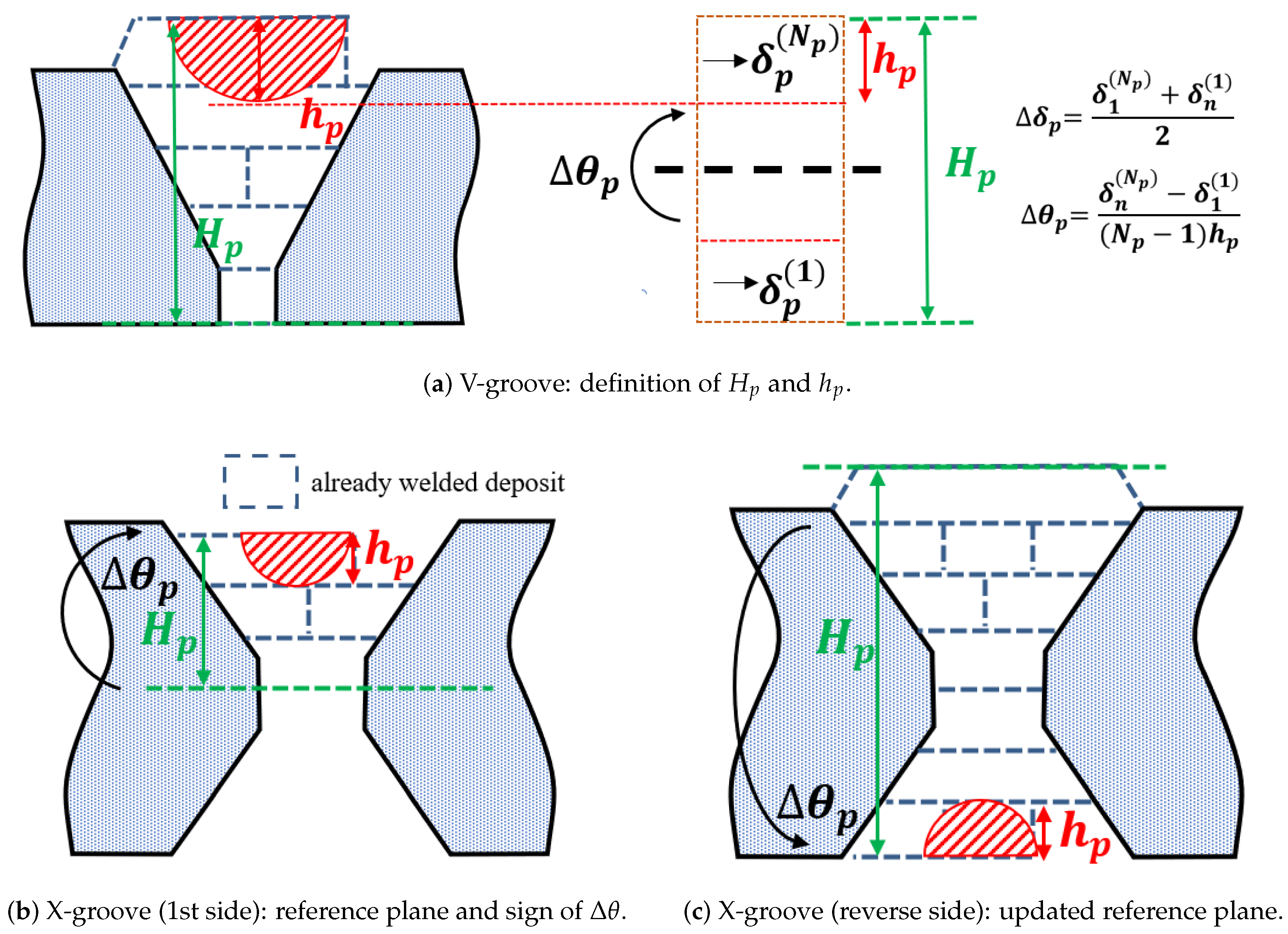
In addition to the above displacement measures, the proposed closed-form formulation requires the cumulative build-up height H p and the MFZ-based pass-wise equivalent throat thickness h p to define the current idealized layer partition for the p-th pass. Here, the current number of model layers is denoted by N p ( = N layer , p ) . Since h p is determined from a temperature-based partition (MFZ), the resulting model layers do not necessarily coincide with the physical deposition layers. By applying the I-groove relations to a general groove at pass p, the layer-thickness parameter is taken as h h p and the layer count as n N p .
The practical procedure is summarized as follows (Figure 4):
  • Define H p from the current reference plane to the top surface after pass p.
  • Determine h p from the MFZ of pass p (e.g., T max T MFZ ), and set N p ( = N layer , p ) by the equal-thickness partition.
  • Evaluate the pass-wise increments using the layer-midline displacements, where the superscript indicates the layer index: Δ δ p = ( δ p ( 1 ) + δ p ( N p ) ) / 2 and Δ θ p = ( δ p ( N p ) δ p ( 1 ) ) / ( ( N p 1 ) h p ) .
  • Accumulate transverse shrinkage as δ = p Δ δ p .
  • For X-groove welding, the reference line is taken as the lowest point where Pass 1 contacts the base plate for the first-side passes and, after turning over, is reset to the top of the first-side reinforcement (Figure 4b,c). Angular distortion is still evaluated from the displacement difference between the bottom and top layer midlines, but after turning over, the thickness-wise configuration is reversed with respect to the neutral axis; therefore, the sign of Δ θ p becomes opposite and the cumulative angular distortion may decrease during reverse-side passes.

3. Application of Simplified Welding Deformation Prediction Method to V-Groove Butt-Welded Joints

The purpose of this section is to apply the simplified mechanical model proposed in Section 2 to V-groove multi-pass welding and to verify its validity. This V-groove case is positioned as the primary benchmark in this paper because deformation histories are available from both experiments and validated thermo-mechanical simulations under well-documented conditions. For verification, experimental results are used together with thermo-elastic-plastic FE analysis results as reference solutions. In this paper, the thermo-elastic-plastic analyses are carried out using the Idealized Explicit FEM framework [18,19,20]. Unless otherwise noted, the thermo-mechanical simulation procedure in the subsequent sections follows the same analysis framework described in this section.

3.1. V-Groove Analysis Model and Specimen Geometry

The V-groove multi-pass welding examined in this section is based on the study conducted by Murakawa, Shibahara, and colleagues at the Welding Mechanics Simulation Research Group [21]. That is, in this study, the same geometry and welding conditions as the V-groove multi-pass welding specimens of Murakawa et al. [21] are used, and the experimental results and thermo-elastic-plastic analysis results obtained there are reorganized for comparison with the simplified mechanical model.
First, the method for giving input parameters to the simplified mechanical model is organized. The inherent shrinkage S p * for each pass is calculated using the heat input Q p of each pass and the material constants (room temperature values for SM490A) α , c, and ρ , following the concept of reference inherent shrinkage based on bead-on-plate tests. In the verification in this section, no correction factor is introduced, and the reference inherent shrinkage defined in Section 2 (Equation (11)) is used directly as the input value for each pass. This is intentional to keep the formulation fully analytical and to avoid case-dependent tuning; the comparisons are performed consistently under the same input definition.
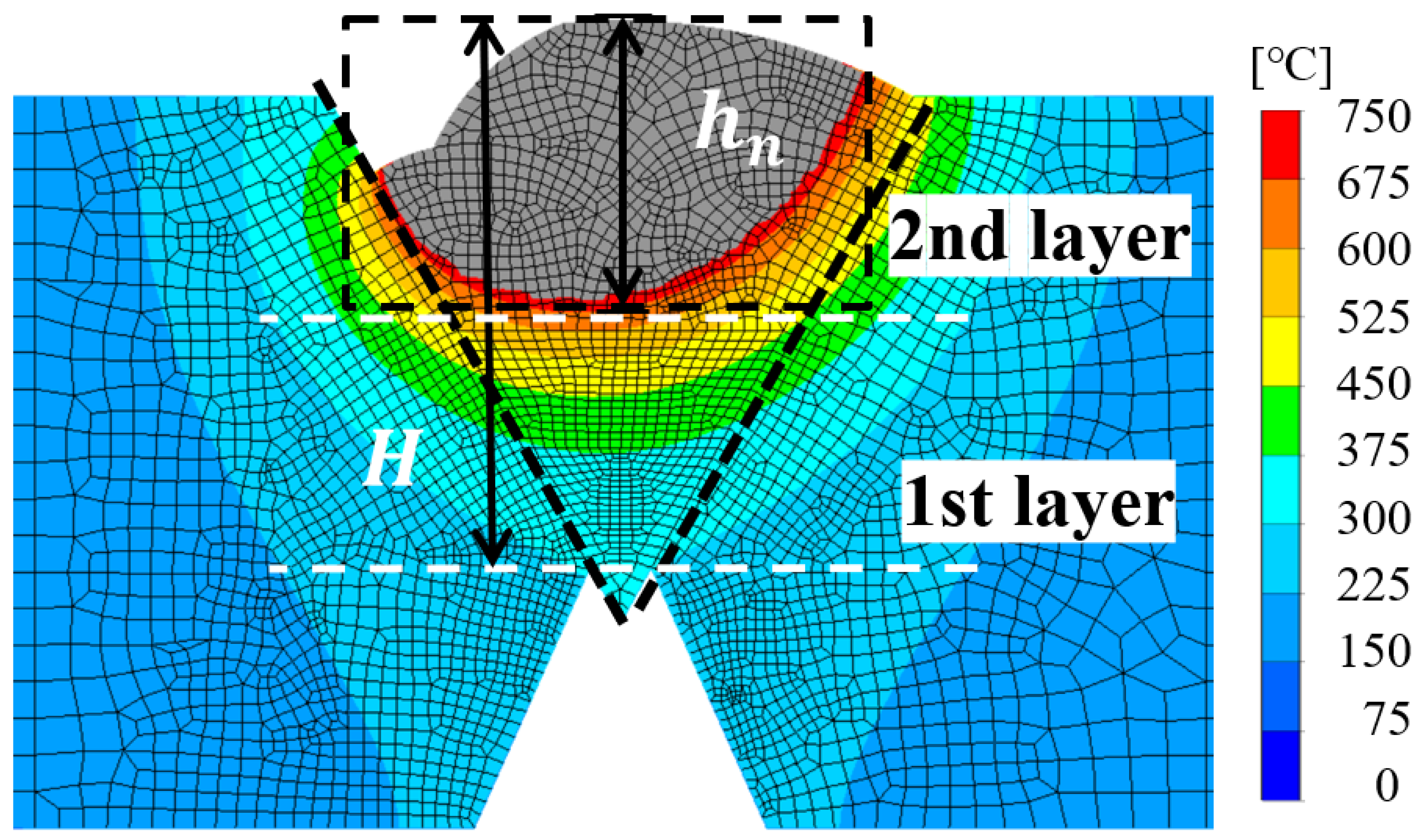
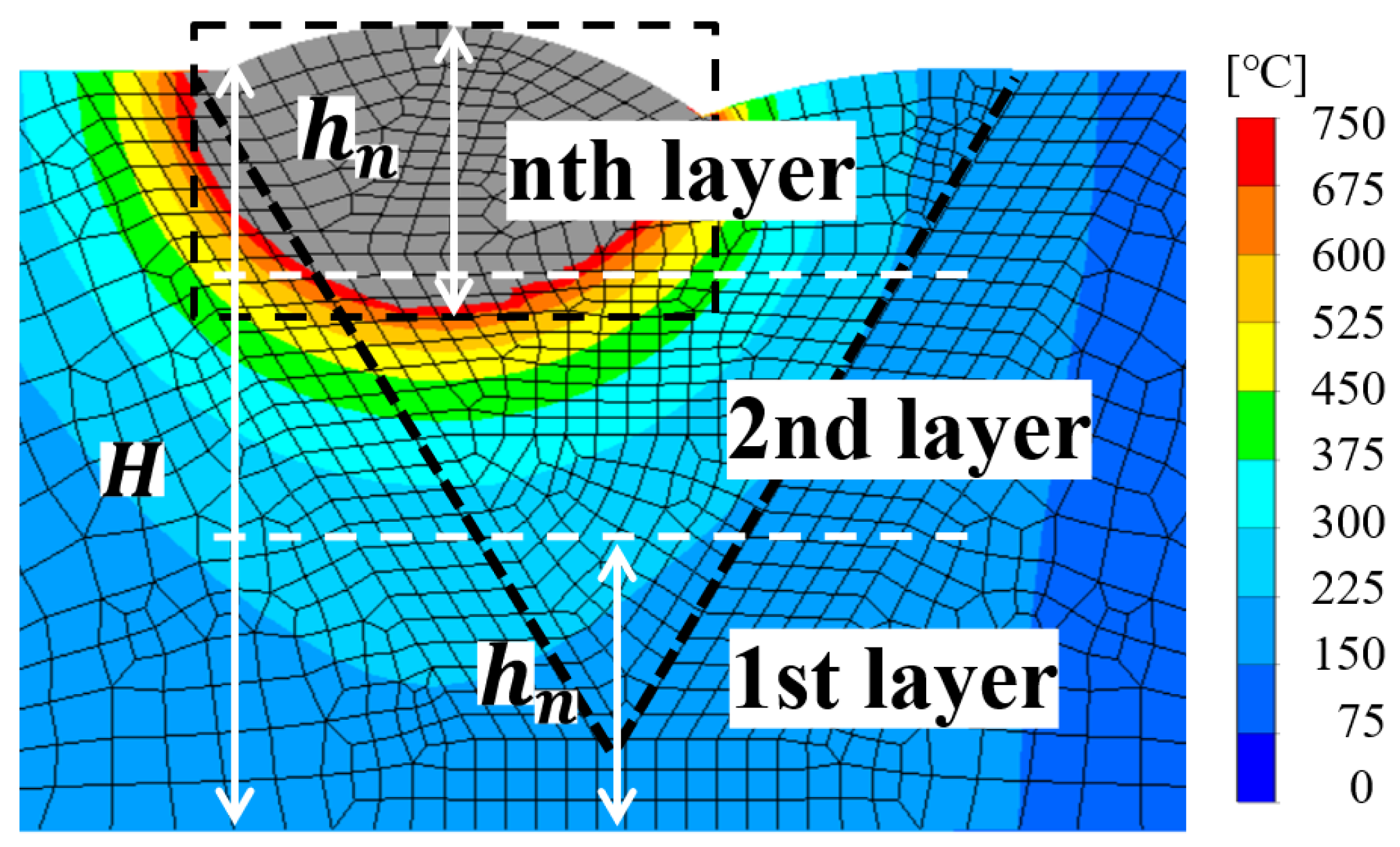
As shown in Figure 5, the equivalent throat thickness h p is defined based on the peak temperature distribution evaluated using the theoretical formula for heat conduction. Following the definition in Section 2, the region where the peak temperature in the p-th pass is approximately above 750 °C is considered as the mechanical fusion zone, and the depth from the top surface to its lower end is defined as h p . Since h p is a continuous quantity, it does not necessarily need to be an integer multiple of constant layer thickness and can be directly used in the simplified prediction formulas in this section.
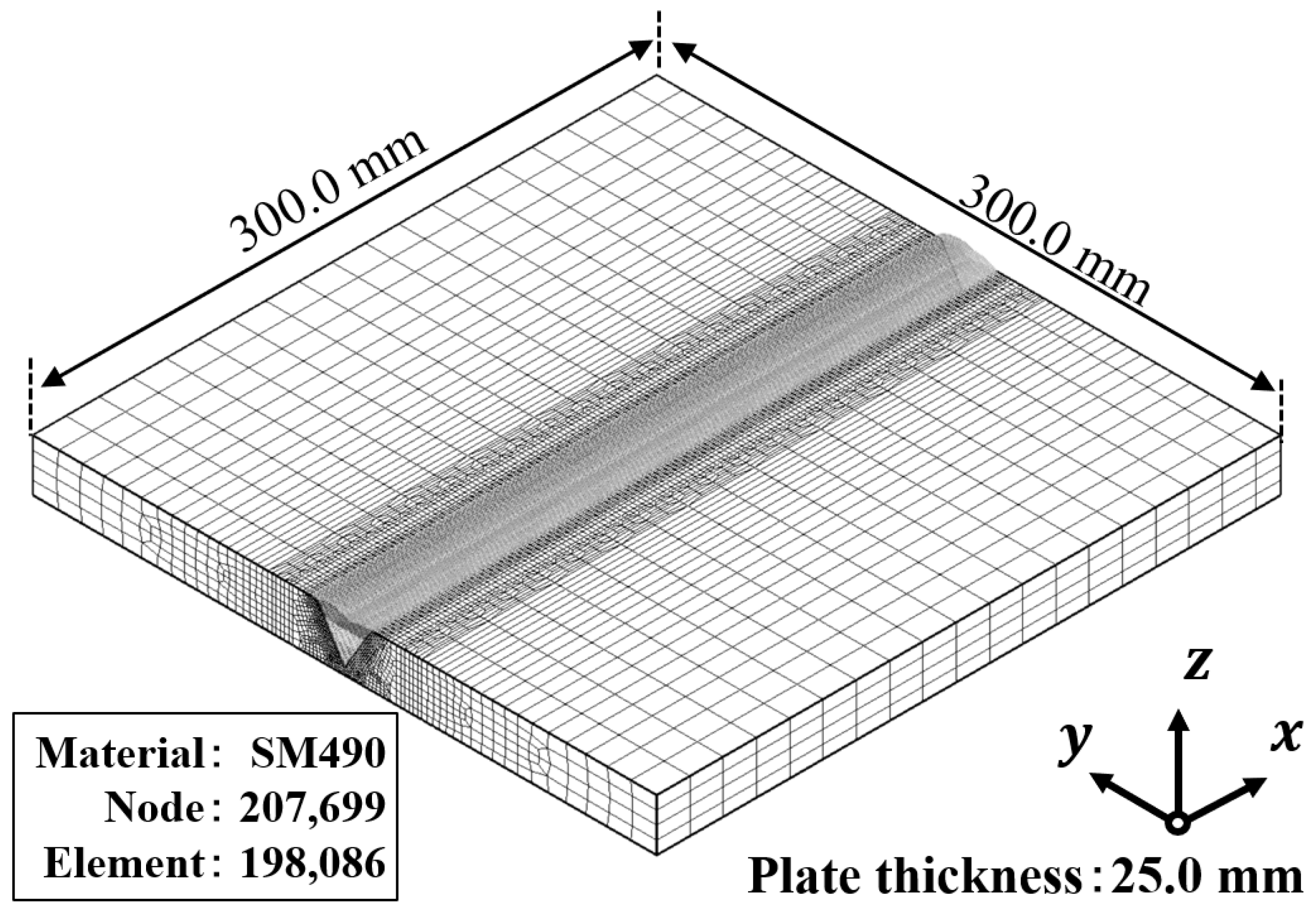
The analysis model is shown in Figure 6. It consists of two flat plates with length 300 mm, width 300 mm, and thickness 25 mm, joined by a V-groove butt weld. As shown in the figure, the analysis model has 207,699 nodes and 198,086 elements, and is modeled with three-dimensional solid elements including the weld line direction.
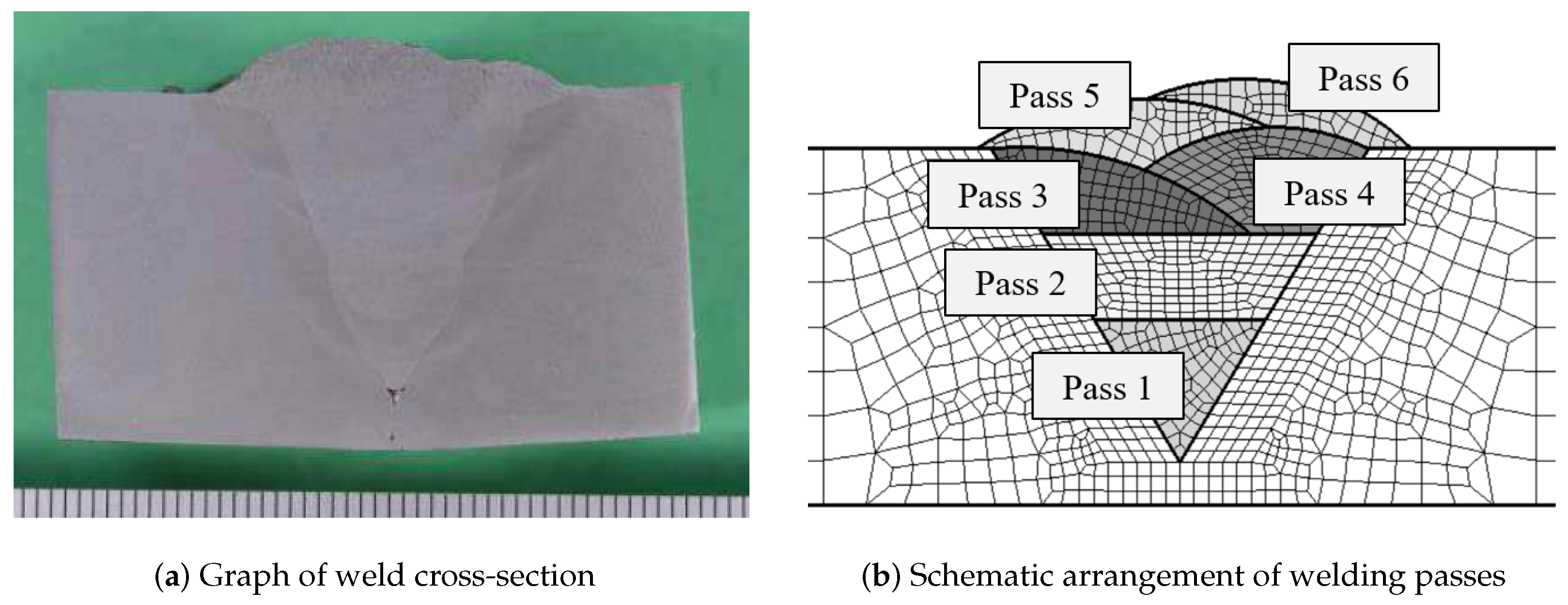
Figure 7a shows a macro cross-section photograph showing the range of the weld metal and heat-affected zone [21], and Figure 7b shows the welding pass sequence for Pass 1 through Pass 6. Welding was performed in six passes, and the welding current, voltage, welding speed, and heat input for each pass are shown in Table 1. The thermal efficiency was set to 0.8 for all passes.
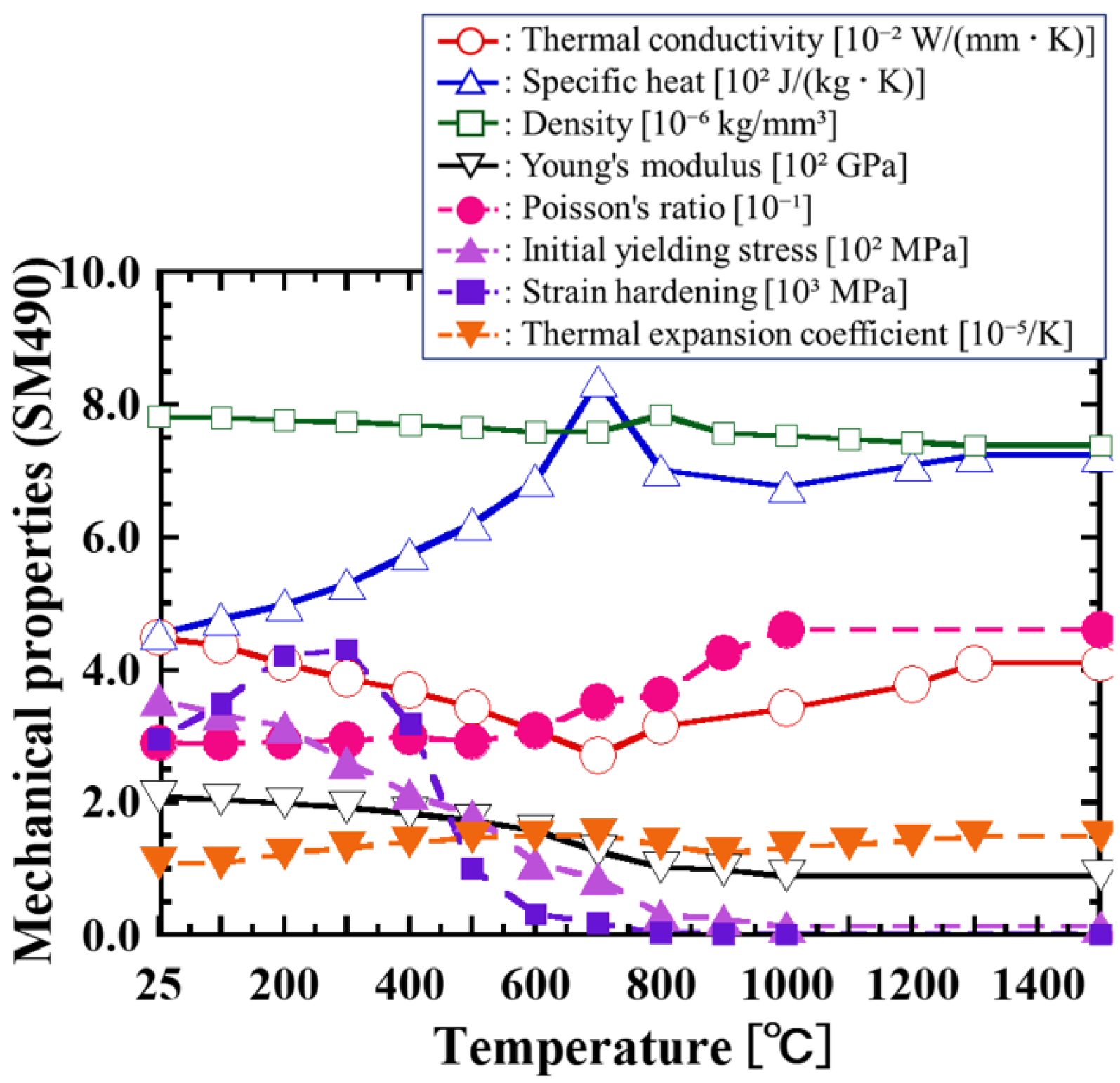
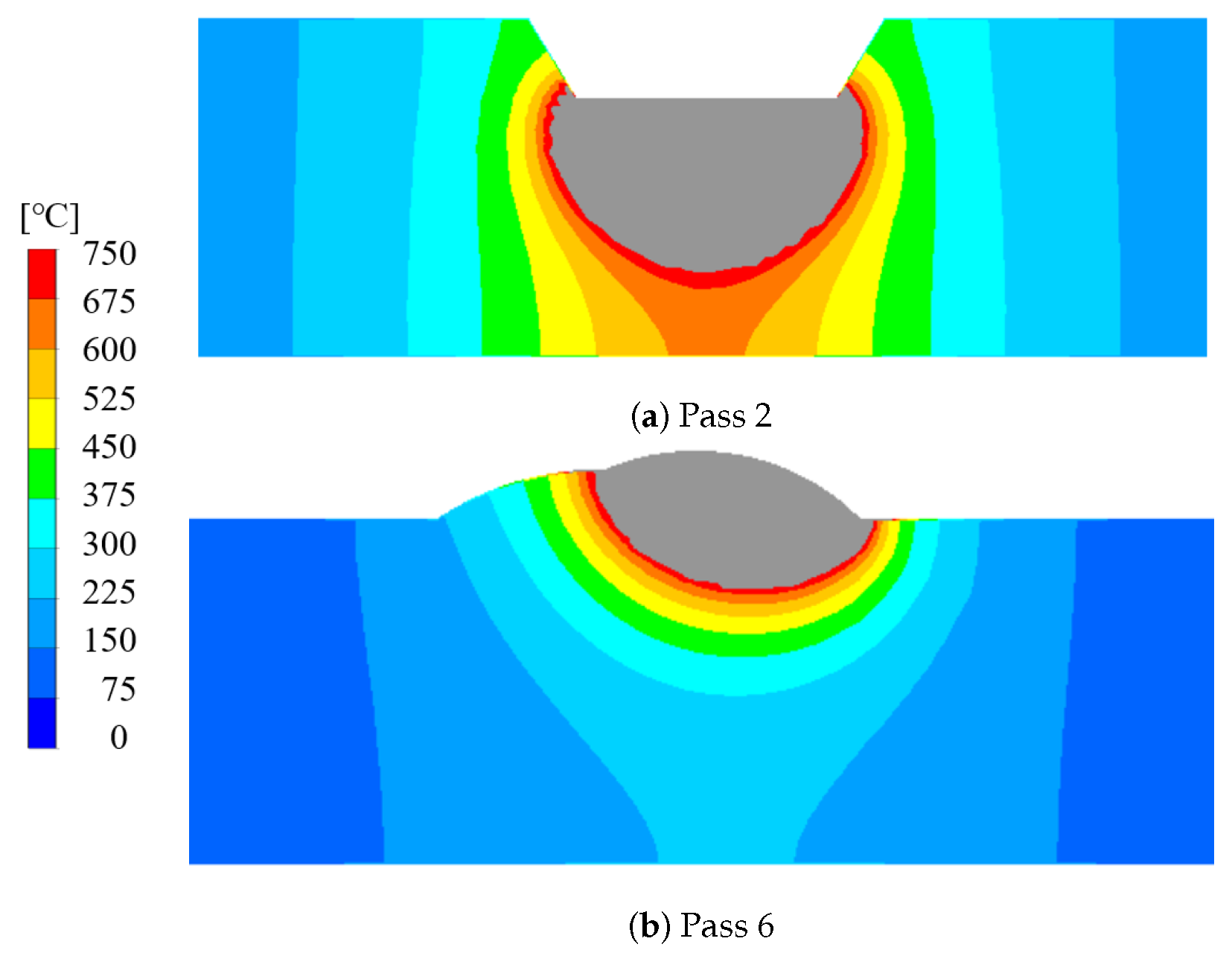
In the thermo-elastic-plastic analysis, three-dimensional heat conduction analysis [20] was first performed to obtain the temperature field and stress/strain field for each pass. The material is assumed to be SM490A, and its temperature-dependent material properties are shown in Figure 8. Figure 9 shows examples of the peak temperature distribution for the selected passes (Pass 2 and Pass 6) in the six-pass V-groove welding. In the simplified mechanical model, transverse shrinkage and angular distortion are evaluated using Equations (8) and (9) shown in Section 2, using the heat input Q p and equivalent throat thickness h p for each pass.

3.2. Comparison of Mechanical Model, Thermo-Elastic-Plastic Analysis, and Experimental Results

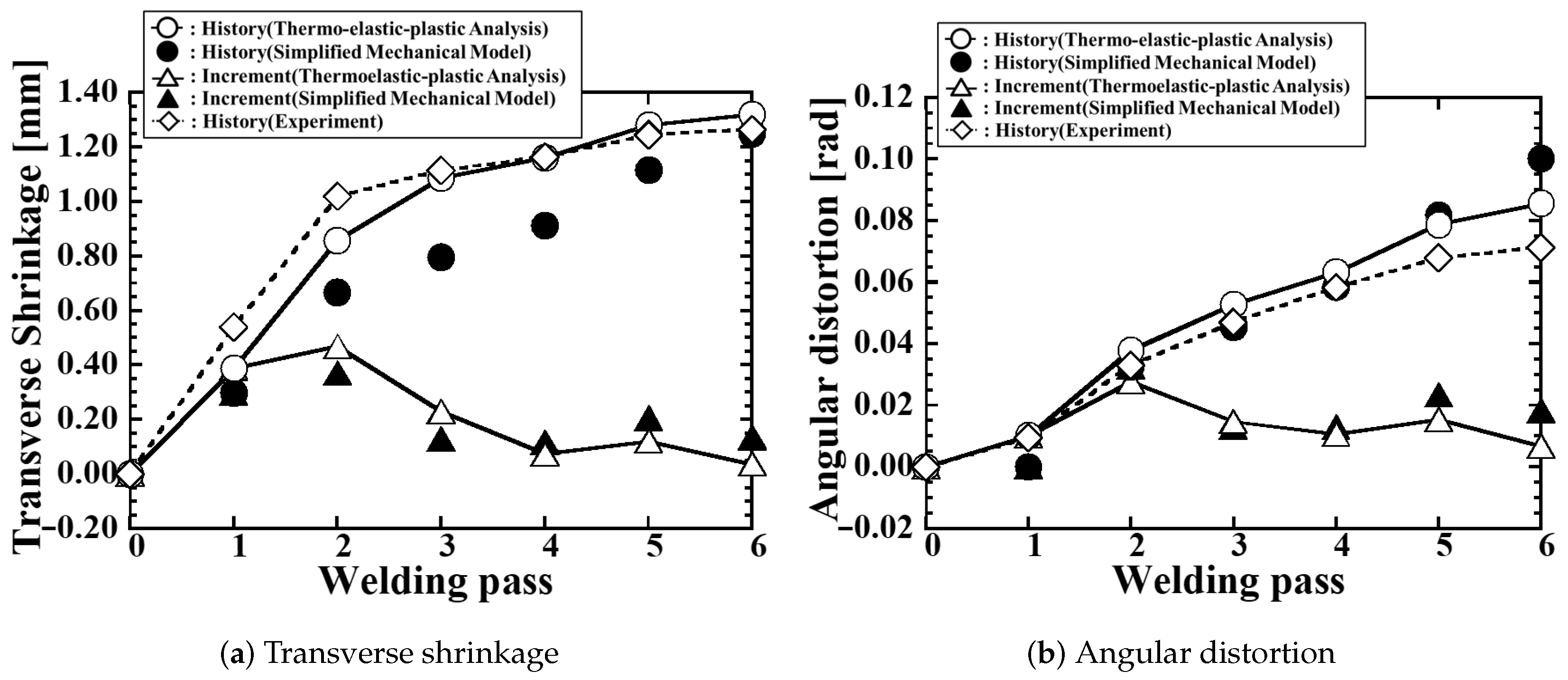
Figure 10 compares the history and increment for each pass of transverse shrinkage and angular distortion. Panel (a) shows the average transverse shrinkage at the plate edge. Panel (b) shows the angular distortion at the center cross-section of the specimen. The horizontal axis shows the welding pass number. In Panel (a), the vertical axis shows the average transverse shrinkage in the plate-width direction. In Panel (b), the vertical axis shows the angular distortion. The circles (○) show the history values from thermo-elastic-plastic analysis, the triangles (∆) show the increment values from thermo-elastic-plastic analysis, the filled circles (●) show the history values from the simplified mechanical model, the filled triangles (▲) show the increment values from the simplified mechanical model, and the diamonds (♢) show the history values from the experiment.
From the above, it can be seen that for V-groove multi-pass welding, the simplified mechanical model using the inherent shrinkage S p * based on bead-on-plate tests can reproduce the experimental results and thermo-elastic-plastic analysis results well, not only for the history of transverse shrinkage and angular distortion but also for the increment of each pass.
Table 2 indicates that the proposed model reproduces the final level of cumulative transverse shrinkage with small discrepancies: RE final = 5.31 % against FEM ( | δ P model δ P FEM |   0.070 ) and 1.19% against experiment ( | δ P model δ P exp |   0.015 ). These results support that the hand-calculable formulation provides a practically useful quantitative estimate of the dominant shrinkage magnitude over the full welding sequence. The increment-based transverse shrinkage metrics (MAE 0.0857 per pass; MaxAE 0.101 ) characterize pass-wise deviations, which are expected to be larger than the cumulative-history error because the per-pass increment is more sensitive to local thermal-cycle fluctuations and transient restraint/residual-stress effects. Accordingly, these increment-based metrics are used as a supplementary indicator of pass-wise consistency, whereas the cumulative history remains the primary measure for the predicted deformation level. For angular distortion, larger discrepancies are observed because bending-type deformation depends not only on the net contraction but also on the effective bending compliance and lever arm during multi-pass deposition. The final absolute difference against FEM is ≈0.0144 rad (∼ 0 . 83 ), which provides a physically intuitive magnitude corresponding to the percentage error.

4. Application to X-Groove Butt-Welded Joints

In addition to the V-groove benchmark, an X-groove joint is examined to test the proposed method under double-sided welding and a different pass arrangement. For this configuration, since experimental measurements under identical conditions are not available, thermo-elastic-plastic FE analysis results are used as reference solutions for assessing the applicability of the simplified mechanical model in this section.
For X-groove multi-pass welding, the welding is performed from both the front and back surfaces of the plate, making the problem more complex than V-groove welding. The reference plane for defining displacement increases the complexity, and the positive and negative directions of angular distortion θ vary depending on the welding surface. Therefore, a detailed description of the sign convention and reference plane is necessary for this case.

4.1. X-Groove Analysis Model and Specimen Geometry

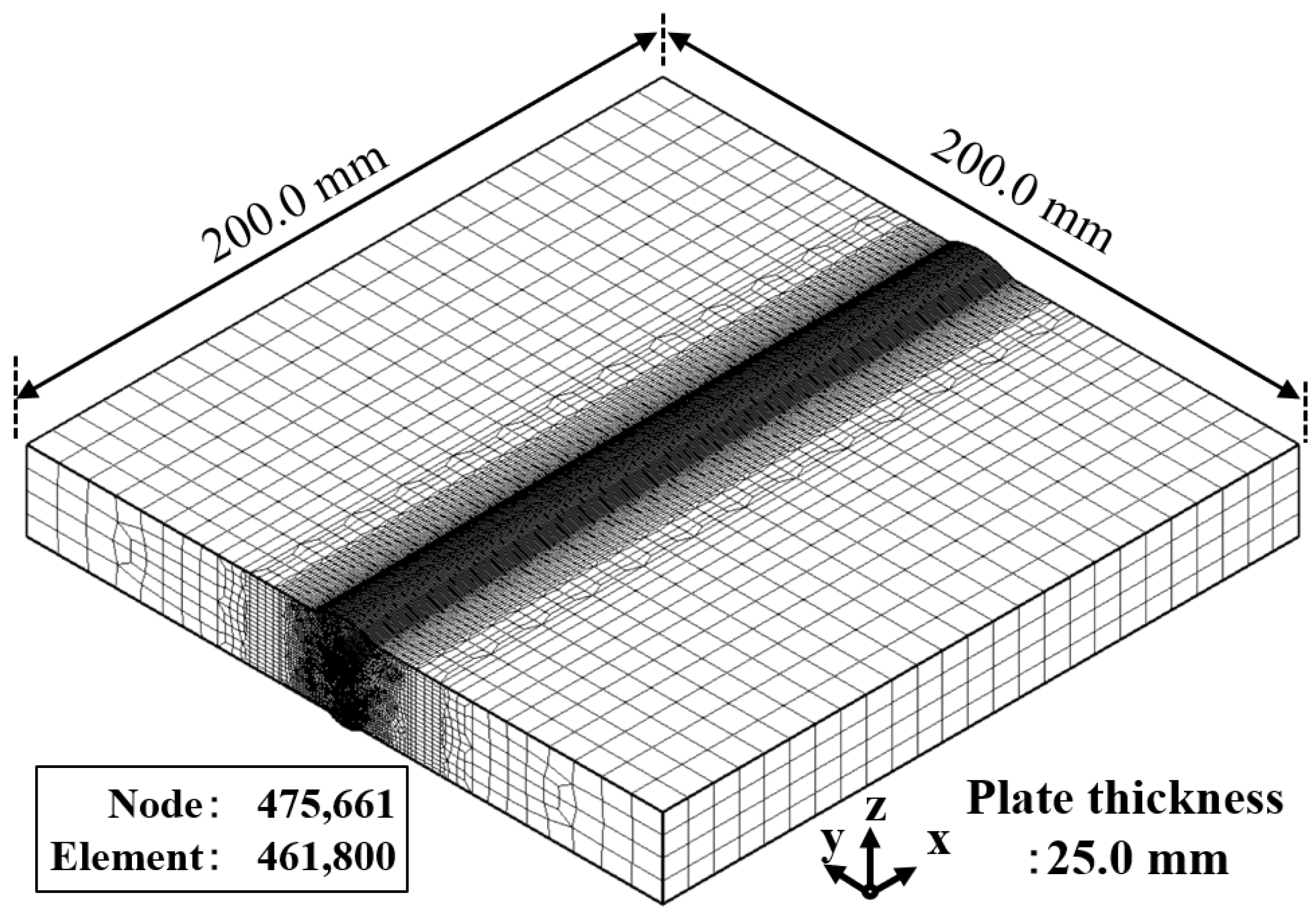
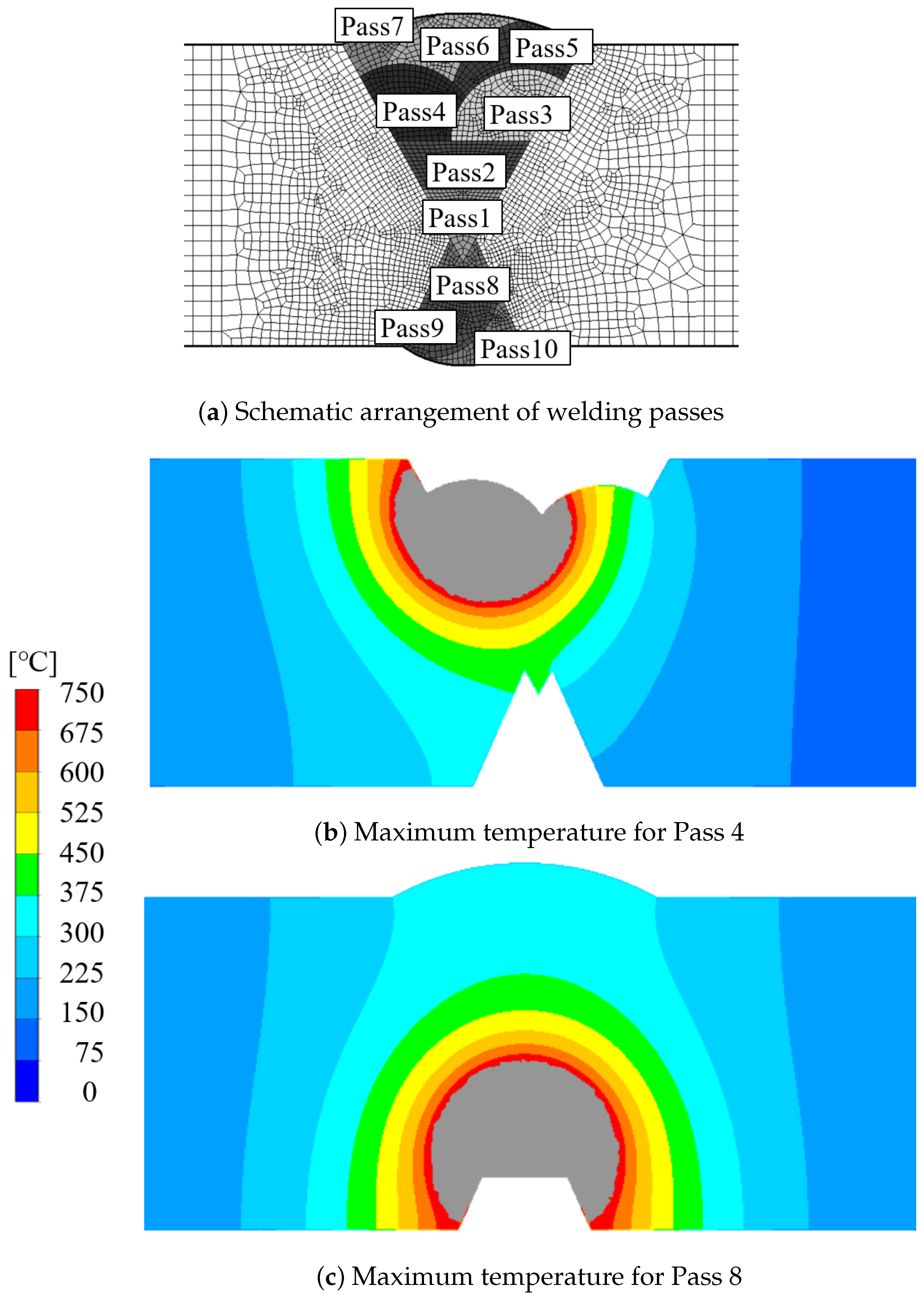
Figure 11 shows the FE analysis model of the X-groove butt-welded joint. For the plate, the same material used in the V-groove butt-welded joint (SM490A) was used. However, in this case, welding passes 1–7 are performed from the front surface (top side), and welding passes 8–10 are performed from the back surface (bottom side). Figure 12 shows the layer partitioning based on the equivalent thickness for X-groove welding. Figure 13b,c shows representative maximum temperature distributions for Pass 4 and Pass 8. For welding from the front surface (Passes 1–7), the lowest point where Pass 1 contacts the base plate is taken as the reference line, whereas for welding from the back surface (Passes 8–10), the top of the first-side reinforcement is taken as the reference line. The vertical upward direction is defined as the positive direction for angular distortion when welding from the back surface, and the vertical downward direction is defined as the positive direction for angular distortion when welding from the front surface.
The thermo-mechanical simulation procedure is the same as described in Section 3. The number of nodes is 475,661, and the number of elements is 461,800. The heat input Q p ( J / mm ) and the number of layers N layer , p for each pass are listed in Table 3. The welding sequence is shown in Figure 13a. The total number of welding passes is ten, comprising seven passes from the front surface and three passes from the back surface.

4.2. Comparison of Transverse Shrinkage and Angular Distortion

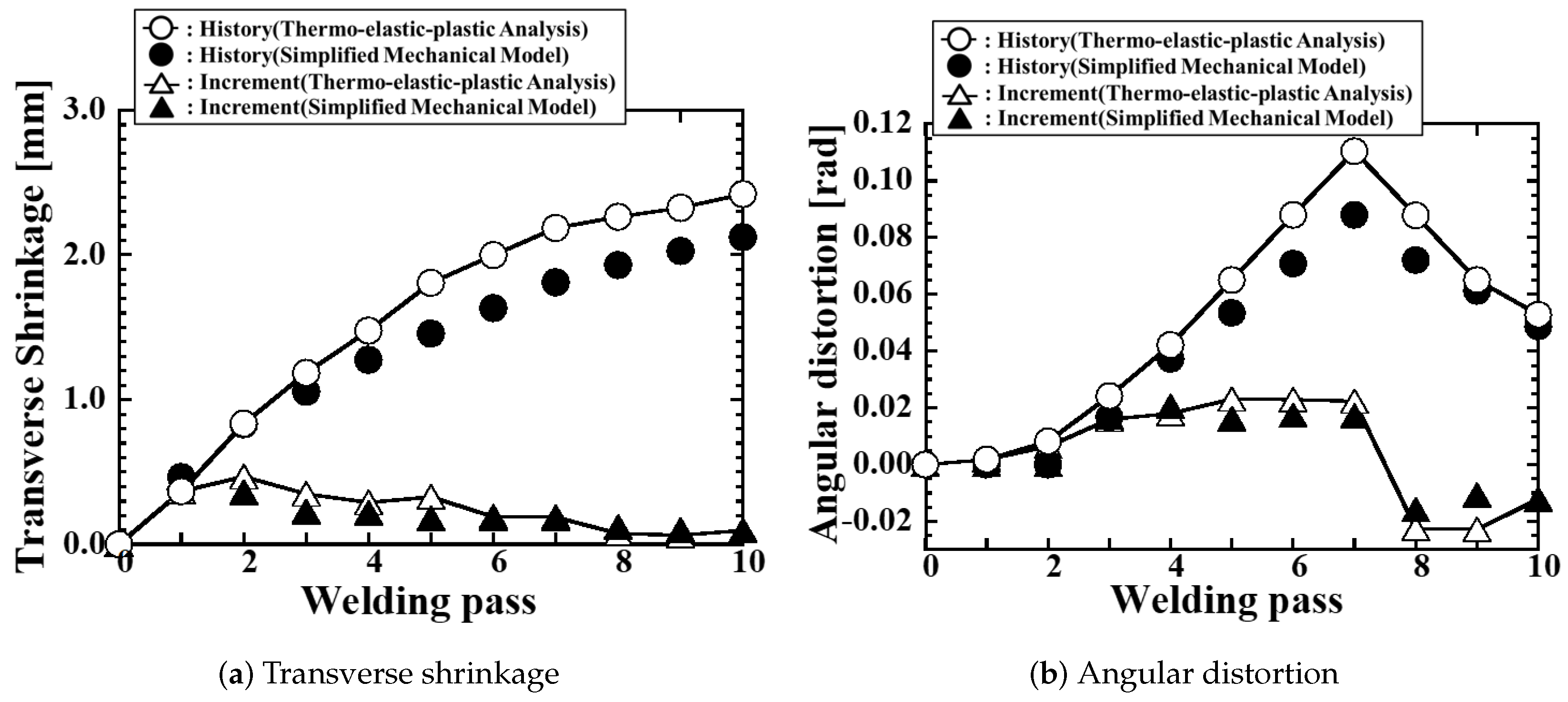
Figure 14 compares the history and increment for each pass of transverse shrinkage and angular distortion for X-groove multi-pass welding. Panel (a) shows the average transverse shrinkage at the plate edge. Panel (b) shows the angular distortion. The horizontal axis shows the welding pass number. Open circles (○) show the history from thermo-elastic-plastic analysis, open triangles (∆) show the increment from thermo-elastic-plastic analysis, filled circles (●) show the history from the simplified mechanical model, and filled triangles (▲) show the increment from the simplified mechanical model.
From the above, it can be seen that for X-groove multi-pass welding, the simplified mechanical model shows good agreement with the thermo-elastic-plastic FE analysis results, not only in the deformation histories but also in the increment trends for each pass.
To objectively quantify the agreement discussed above, quantitative error metrics are evaluated for both the cumulative histories and the pass-wise increments, using the same definitions introduced in the V-groove validation section (MAE, RMSE, MaxAE, and the final-value relative error for cumulative histories, excluding the initial state p = 0 ). Table 4 summarizes the metrics for the X-groove case.

5. Influence of V-Groove Angle on the Prediction Accuracy of the Simplified Mechanical Model

The previous sections demonstrated that the proposed simplified mechanical model can accurately predict welding deformation for both V-groove and X-groove joints in structural steel (SM490A). However, the robustness of the model across different groove geometries and materials remains to be examined. The V-groove angle is a critical design parameter that directly affects the amount of deposited weld metal and, consequently, the magnitude and distribution of welding-induced deformation [22]. This section investigates how the V-groove angle affects (i) the transverse shrinkage behavior in multi-pass butt welding and (ii) the prediction accuracy of the proposed simplified mechanical model. The analysis is performed for SUS316L austenitic stainless steel joints with groove angles ranging from 40° to 70°.
Because experimental measurements under identical conditions are not available for this parametric study on the V-groove angle (40°–70°) for SUS316L, the following discussion focuses on whether the proposed model captures the systematic trend with groove angle and whether the discrepancy relative to the FE reference results changes markedly across the investigated angles.
The thermo-mechanical simulation procedure (including the Idealized Explicit FEM framework and heat source modeling) follows the same approach as Section 3. The deformation metric is the transverse shrinkage, defined consistently with the previous sections. The thermo-mechanical FE results are used as reference solutions, and the simplified mechanical model predictions are compared against the FE deformation histories and the final total shrinkage.

5.1. Analysis Conditions

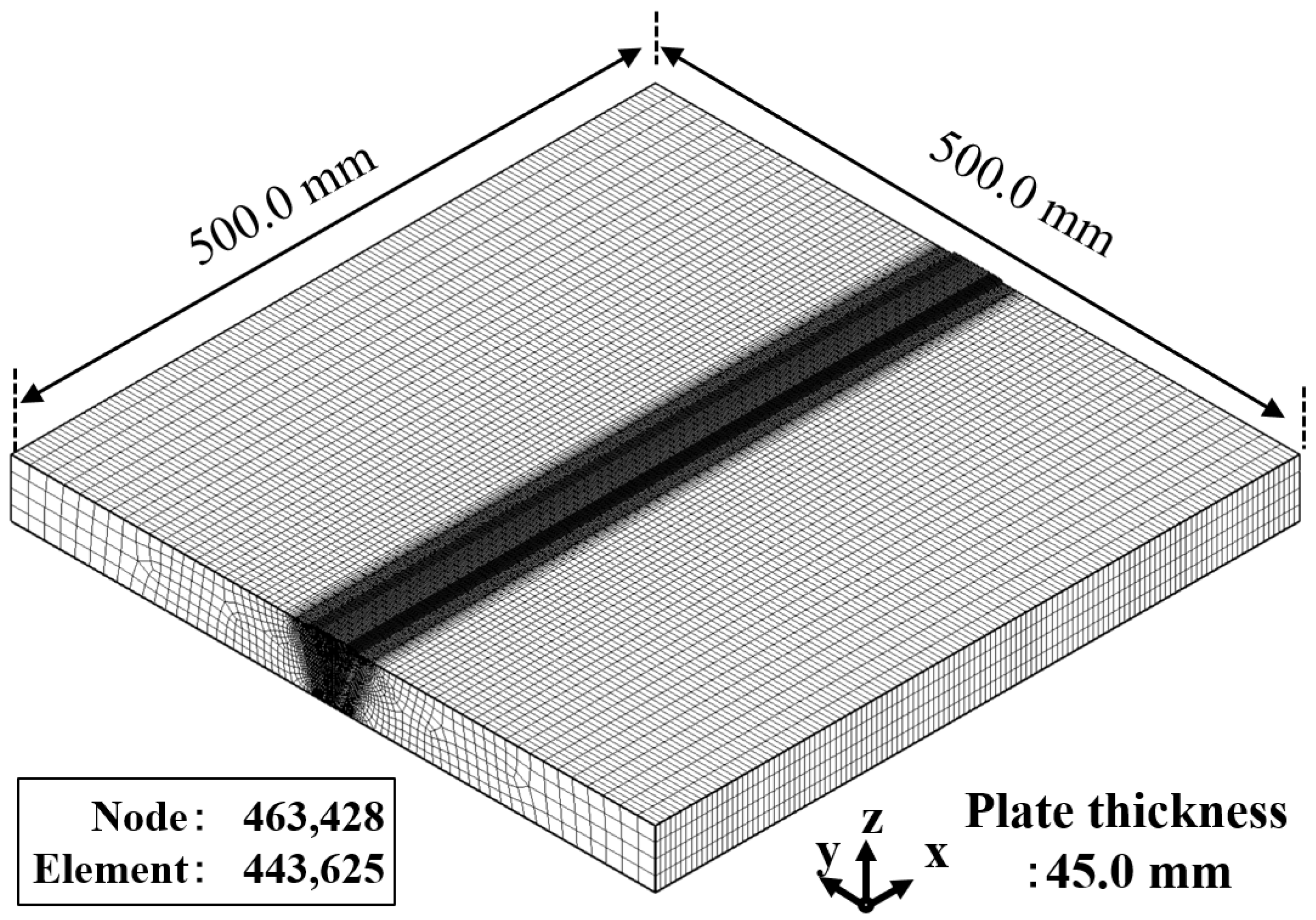
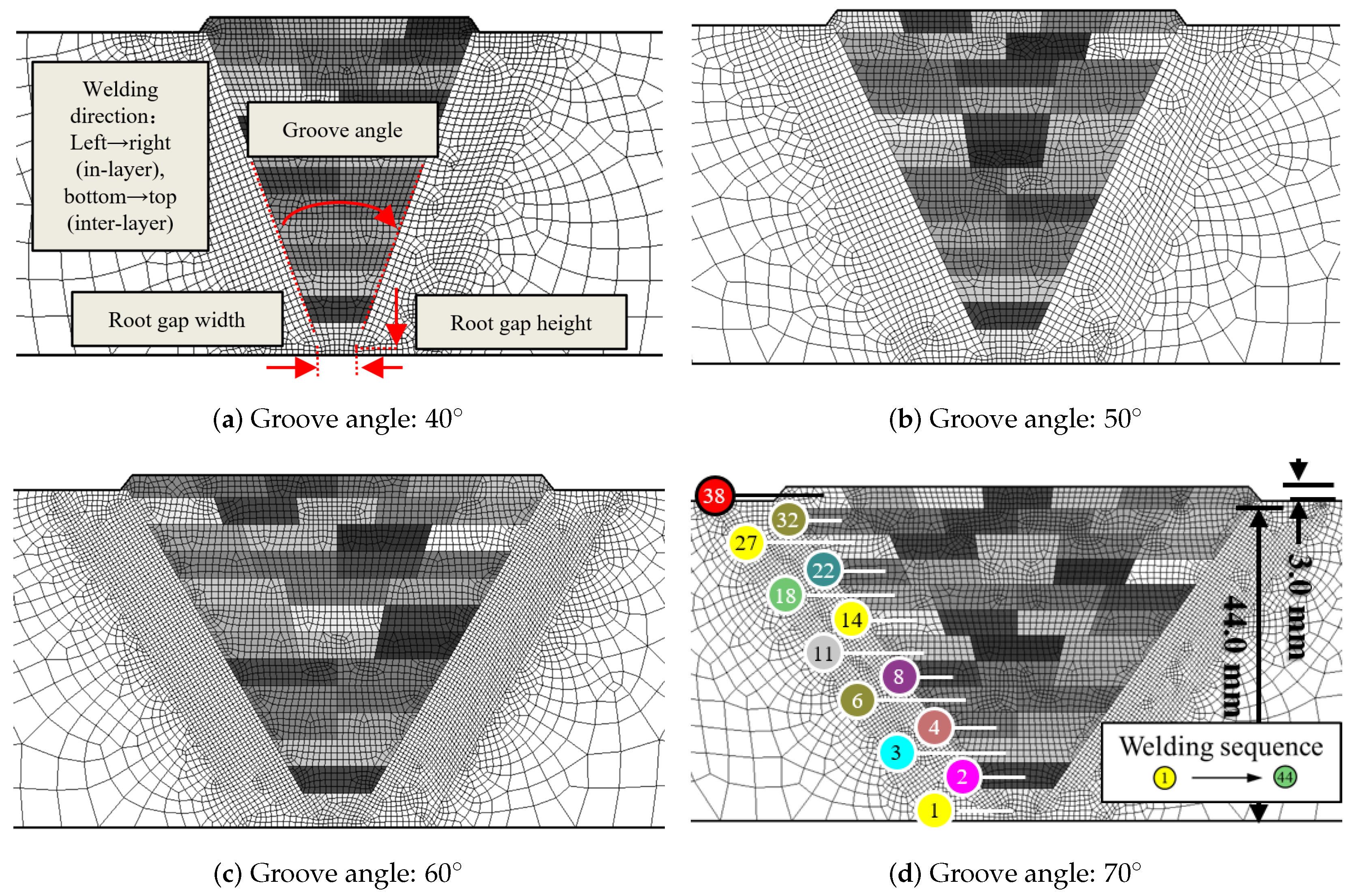
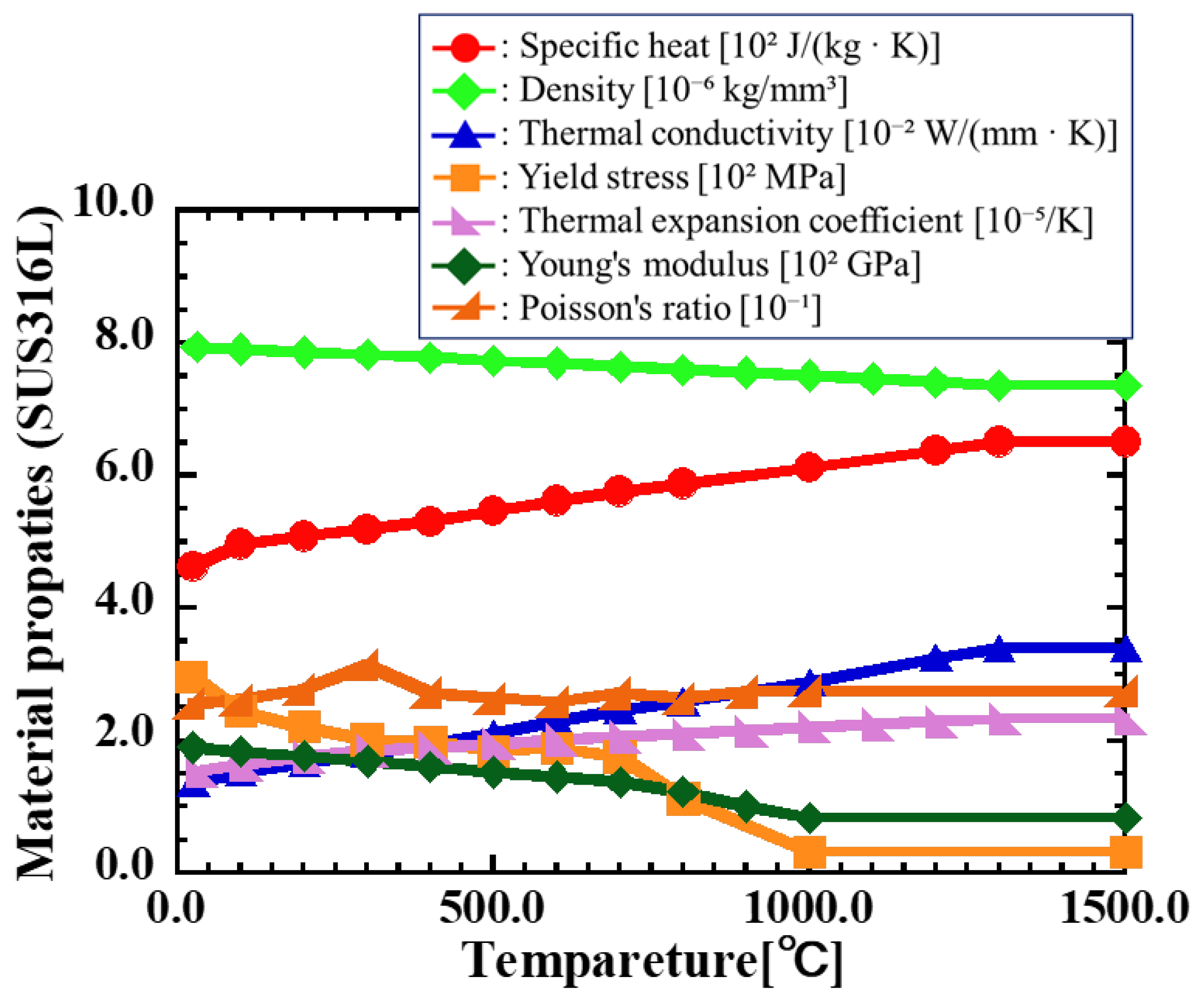
The target joint is an SUS316L plate with dimensions of 500 mm × 500 mm and a thickness of 45 mm. The FE model and mesh are shown in Figure 15. Four groove angles are examined: 40°, 50°, 60°, and 70°. To isolate the effect of the groove angle on welding deformation, all other welding conditions are kept identical among the four cases; the detailed settings are summarized in Table 5. In particular, the root gap width and height are fixed (50.0 mm and 1.0 mm, respectively), and the nominal layer thickness is prescribed by welding stage (first: 4.67 mm, intermediate: 3.67 mm, final: 3.00 mm). The welding speed is set to 3.0 mm/s for all passes. In addition, a volumetric heat input (energy per unit deposited weld volume) is prescribed as q 0 = 50.0 J / mm 3 , so that the line heat input for each pass is given by Q p = q 0 A p , where A p is the deposited cross-sectional area of the p-th pass. For each case, the number of passes is determined to achieve a bead aspect ratio close to 1:3. By maintaining these constant parameters, the observed differences in deformation behavior can be directly attributed to the variation in the groove angle. Figure 16 illustrates the pass stacking sequence and the local mesh around the groove for each groove angle. The temperature-dependent material properties of SUS316L used in the thermo-mechanical FE analyses are summarized in Figure 17.

5.2. FE Analysis Results: Effect of Groove Angle on Transverse Shrinkage Histories

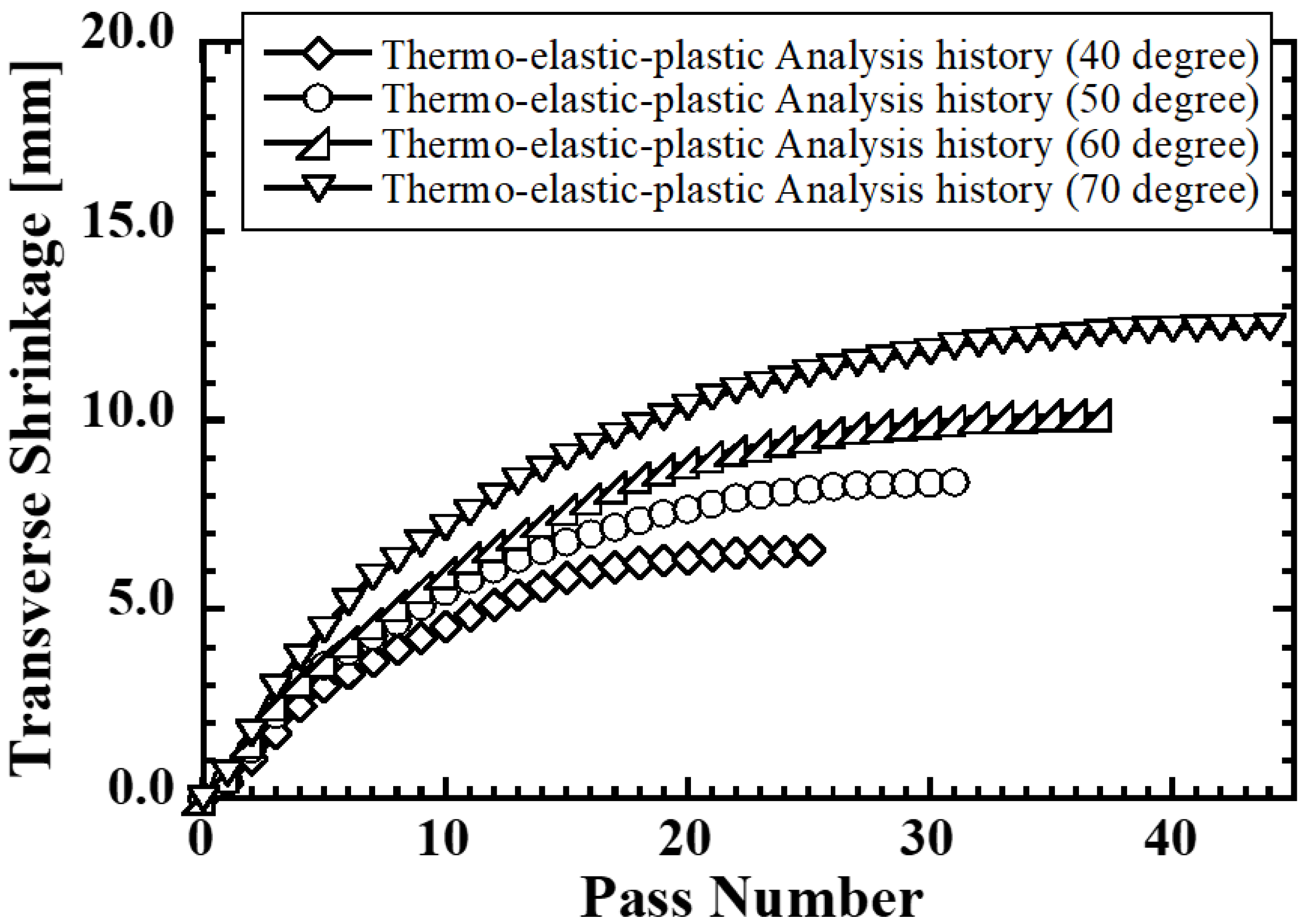
Figure 18 presents the transverse shrinkage histories obtained by FE analysis for the four groove angles. In all cases, transverse shrinkage accumulates monotonically with an increasing pass number, and a larger groove angle leads to a larger final transverse shrinkage. This trend is consistent with geometric considerations: increasing the groove angle enlarges the amount of filler metal required to fill the groove, thereby increasing the cumulative thermal contraction and plastic strain associated with multi-pass deposition.
It should be noted that, in this study, the welding speed and the nominal heat-input density parameter are prescribed uniformly across cases (Table 5). Therefore, the observed dependence on groove angle primarily reflects the combined effect of groove geometry and the resulting pass stacking rather than a change in heat source parameters.

5.3. Comparison Between the Simplified Mechanical Model and FE Analysis

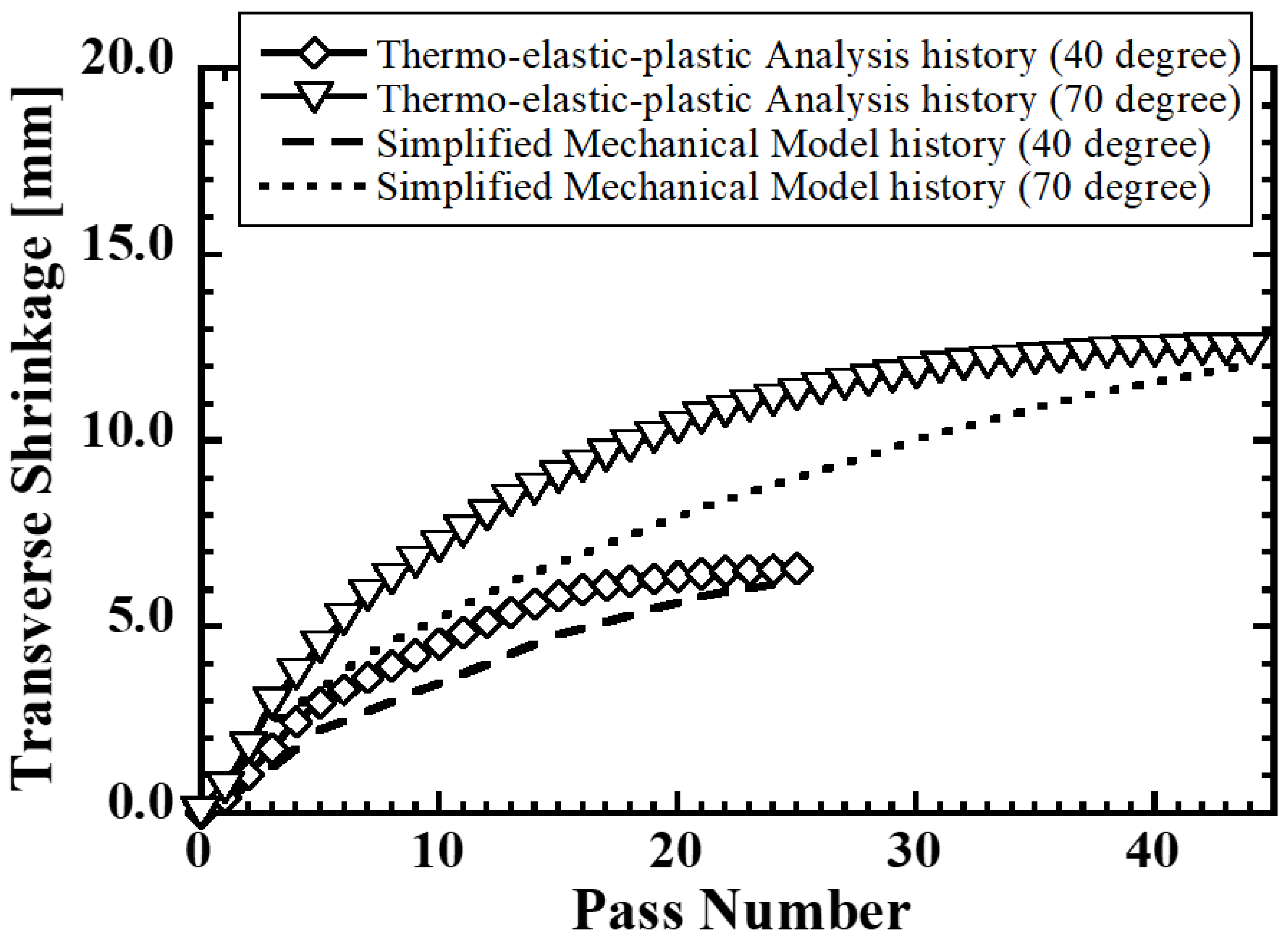
Figure 19 compares the transverse shrinkage histories predicted by the simplified mechanical model with those obtained by FE analysis for two representative groove angles (40° and 70°). The simplified mechanical model reproduces the overall monotonic accumulation of transverse shrinkage with pass number for both cases. The discrepancy between the model and FE analysis remains at a similar level for both groove angles, indicating that increasing the groove angle does not cause a systematic deterioration in prediction accuracy within the investigated range.
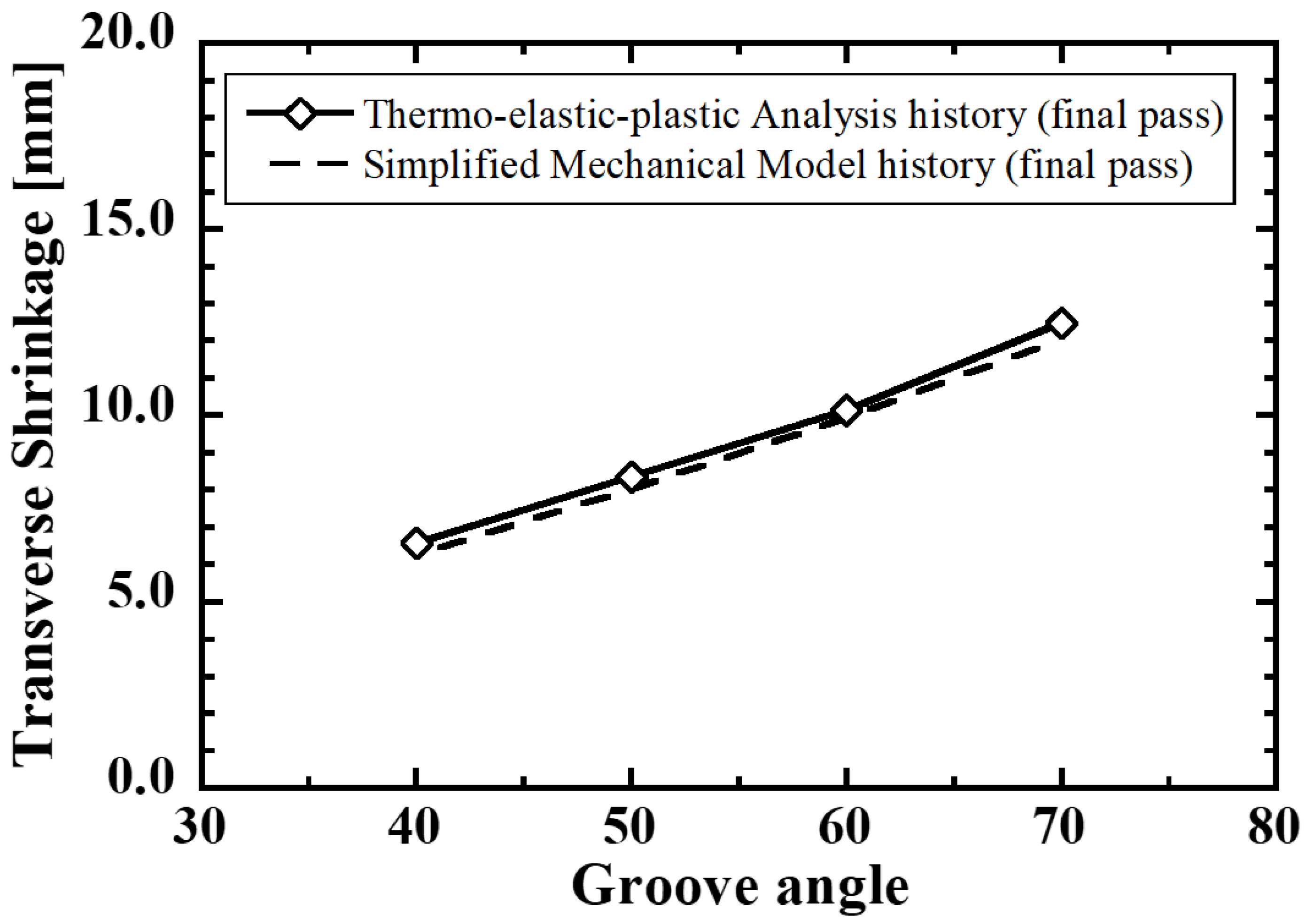
To further assess the groove-angle sensitivity, Figure 20 summarizes the final total transverse shrinkage after the completion of all passes as a function of the groove angle, comparing FE analysis and the simplified mechanical model. Both FE analysis and the simplified mechanical model show an increasing trend with the groove angle. The simplified mechanical model captures this trend, and the difference between them does not exhibit a pronounced angle dependence, indicating that the simplified mechanical model captures the angle-dependent variation in the final transverse shrinkage without requiring additional angle-specific calibration.
Although the simplified mechanical model captures the fundamental deformation mechanisms in multi-pass welding to a considerable extent, some sources of error remain difficult to account for, including the effects of mechanical constraints and residual-stress distributions. The remaining discrepancies are mainly attributable to the idealizations adopted in the present formulation, such as the rigid-wall kinematics for the surrounding base plate and the neglect of residual-stress carryover between passes. These assumptions are chosen to keep the model fully analytical and mechanically interpretable, and all validations in this paper are conducted consistently under the same assumptions.
To objectively evaluate the prediction accuracy across groove angles, Table 6 reports the final transverse shrinkage and the corresponding final-value relative error for each case (model vs. FEM), indicating no pronounced degradation of prediction accuracy with an increasing groove angle in the investigated range.

5.4. Summary

This section evaluated the applicability of the simplified mechanical model to V-groove multi-pass butt welding with groove angles ranging from 40 ° to 70° for SUS316L. The FE analysis results showed that a larger groove angle increases the final transverse shrinkage (Figure 18). The simplified mechanical model reproduced the same trend and maintained comparable agreement with FE analysis for representative angles (Figure 19) and in the final totals across groove angles (Figure 20). These results suggest that, for the welding conditions listed in Table 5 and the examined angle range, the prediction accuracy of the simplified mechanical model is not strongly sensitive to the V-groove angle, supporting its use for rapid assessments across different groove geometries.

6. Conclusions

In this study, a simplified prediction method based on a mechanical model was developed for welding deformation in multi-pass welding, and its validity was verified through comparison with thermo-elastic-plastic FE analysis results obtained using the Idealized Explicit FEM framework. This study aimed to develop a preliminary evaluation method for welding procedure conditions, enabling a rapid comparison of combinations of heat input and pass sequence prior to detailed numerical analyses or experimental trials. The conclusions obtained are shown below.
1.
A simplified mechanical model prediction formula based on inherent shrinkage was proposed. It was confirmed that transverse shrinkage and angular distortion in multi-pass welding can be expressed in a consistent framework.
2.
For V-groove and X-groove multi-pass welded joints, it was confirmed that the simplified prediction formula proposed in this study can accurately evaluate the deformation history for each welding pass and the final deformation amount.
3.
For the V-groove-angle study, the thermo-elastic-plastic FE analyses showed that the final transverse shrinkage increases with an increasing groove angle over the examined range (40°–70°).
4.
The simplified mechanical model reproduced the monotonic accumulation histories and the increasing trend of final transverse shrinkage with groove angle, and the discrepancy relative to FE analysis did not exhibit a pronounced angle dependence within the investigated range.
5.
These results support the use of the proposed method for rapid, preliminary assessments and parameter studies across different groove geometries, enabling a quick comparison of welding procedures before detailed thermo-mechanical simulations.
6.
From a practical standpoint, the proposed method requires only closed-form algebraic evaluations and therefore incurs negligible computation time compared with detailed thermo-elastic-plastic FE analysis. This enables rapid parametric studies and early-stage screening of welding procedures before committing to computationally intensive simulations.

Author Contributions

Conceptualization, W.W. and M.S.; methodology, W.W. and M.S.; software, W.W.; validation, W.W.; formal analysis, W.W.; investigation, W.W.; resources, M.S.; data curation, M.S.; writing—original draft preparation, W.W.; writing—review and editing, S.M. and K.I.; visualization, W.W.; supervision, S.M. and K.I.; project administration, S.M. and K.I. All authors have read and agreed to the published version of the manuscript.

Funding

This research was funded by the Japan Science and Technology Agency (JST) SPRING, grant number JPMJSP2139. The APC was funded by the Japan Science and Technology Agency (JST) SPRING, grant number JPMJSP2139.

Data Availability Statement

The data presented in this study are available from the corresponding author upon reasonable request.

Conflicts of Interest

The authors declare no conflicts of interest. The funders had no role in the design of the study; in the collection, analyses, or interpretation of data; in the writing of the manuscript; or in the decision to publish the results.

References

  1. Masubuchi, M. Analysis of Welded Structures; Pergamon Press: Oxford, UK, 1980. [Google Scholar]
  2. Radaj, D. Welding Residual Stresses and Distortion; Springer: Berlin/Heidelberg, Germany, 1992. [Google Scholar]
  3. Ueda, Y.; Yamakawa, T. Analysis of Thermal Elastic–Plastic Behavior of Metals During Welding by Finite Element Method. J. Jpn. Weld. Soc. 1973, 42, 567–577. (In Japanese) [Google Scholar] [CrossRef]
  4. Lindgren, L.E. Finite Element Modeling and Simulation of Welding Part 1: Increased Complexity. J. Therm. Stress. 2001, 24, 141–192. [Google Scholar] [CrossRef]
  5. Andersson, O.; Budak, N.; Melander, A.; Palmquist, N. Experimental measurements and numerical simulations of distortions of overlap laser-welded thin sheet steel beam structures. Weld. World 2017, 61, 927–934. [Google Scholar] [CrossRef]
  6. Wang, J.; Ma, N.; Deng, D. Progress in welding distortion prediction and control technology for advanced manufacturing. J. Manuf. Process. 2025, 152, 1012–1036. [Google Scholar] [CrossRef]
  7. Goldak, J.; Chakravarti, A.; Bibby, M. A New Finite Element Model for Welding Heat Sources. Metall. Trans. B 1984, 15B, 299–305. [Google Scholar] [CrossRef]
  8. Deng, D.; Murakawa, H. Numerical Simulation of Temperature Field and Residual Stress in Multi-Pass Welds in Stainless Steel Pipe and Comparison with Experimental Measurements. Comput. Mater. Sci. 2006, 37, 269–277. [Google Scholar] [CrossRef]
  9. Liang, W.; Deng, D.; Sone, S.; Murakawa, H. Prediction of Welding Distortion by Elastic Finite Element Analysis using Inherent Deformation Estimated Through Inverse Analysis. Weld. World 2005, 49, 30–39. [Google Scholar] [CrossRef]
  10. Rubio-Ramirez, C.; Giarollo, D.F.; Mazzaferro, J.E.; Mazzaferro, C.P. Prediction of angular distortion due GMAW process of thin-sheets Hardox 450® steel by numerical model and artificial neural network. J. Manuf. Process. 2021, 68, 1202–1213. [Google Scholar] [CrossRef]
  11. Miao, Z.; Margetts, L.; Vasileiou, A.N.; Yin, H. Surrogate model development using simulation data to predict weld residual stress: A case study based on the NeT-TG1 benchmark. Int. J. Press. Vessel. Pip. 2023, 206, 105014. [Google Scholar] [CrossRef]
  12. Seong, W.J.; Park, S.C.; Lee, H.K. Analytical Model for Angular Distortion in Multilayer Welding under Constraints. Appl. Sci. 2020, 10, 1848. [Google Scholar] [CrossRef]
  13. Ma, N.; Deng, D.; Osawa, N.; Rashed, S.; Murakawa, H.; Ueda, Y. Welding Deformation and Residual Stress Prevention, 2nd ed.; Elsevier: Amsterdam, The Netherlands, 2022. [Google Scholar]
  14. Wang, R.; Rashed, S.; Serizawa, H.; Murakawa, H.; Zhang, J. Study on Welding Inherent Deformations in Welded Structural Materials. Trans. JWRI 2008, 37, 91–100. [Google Scholar] [CrossRef]
  15. Gotoh, K.; Toyosada, M. A Practical Estimation Method of the Skin Plate Distortion Caused by Fillet Weld. In Proceedings of the 21st International Conference on Offshore Mechanics and Arctic Engineering (OMAE 2002), Oslo, Norway, 23–28 June 2002; pp. 113–119, Paper No. OMAE2002-28181. [Google Scholar] [CrossRef]
  16. Mochizuki, M.; Okano, S. Effect of Welding Process Conditions on Angular Distortion Induced by Bead-on-Plate Welding. ISIJ Int. 2018, 58, 153–158. [Google Scholar] [CrossRef]
  17. Mochizuki, M.; Okano, S. Dominant parameter of weld angular distortion in structural materials based on theory of inherent strain (Development of accuracy management system for high quality construction in welded structures on the basis of advanced theory of inherent strain). Trans. JSME 2016, 82, 15-00567. [Google Scholar] [CrossRef]
  18. Ikushima, K.; Itoh, S.; Shibahara, M. Development of Parallelized Idealized Explicit FEM Using GPU. Q. J. Jpn. Weld. Soc. 2013, 31, 23–32. [Google Scholar] [CrossRef]
  19. Ikushima, K.; Itoh, S.; Shibahara, M. Development of idealized explicit FEM using GPU parallelization and its application to large-scale analysis of residual stress of multi-pass welded pipe joint. Weld. World 2015, 59, 589–595. [Google Scholar] [CrossRef]
  20. Ikushima, K.; Itoh, S.; Shibahara, M. Heat Conduction Analysis of Welding Using Idealized Explicit FEM. Q. J. Jpn. Weld. Soc. 2013, 31, 153s–157s. [Google Scholar] [CrossRef]
  21. Nakatani, M.; Murakawa, H.; Shibahara, M.; Serizawa, H.; Tsumura, S.; Yamada, J.; Nagaki, H.; Nakatani, Y.; Tadano, S.; Kamitani, K.; et al. Verification of Prediction Method for Welding Deformation on Application to Actual Structure: Guideline for FE Analysis of Multi-Pass Welding Based on Round-robin Test. In Proceedings of the National Meeting of the Japan Welding Society, Tokyo, Japan, 11–14 October 2016; Volume 2016f, pp. 338–339. [Google Scholar] [CrossRef]
  22. Jenney, C.L.; O’Brien, A. (Eds.) Welding Handbook, Volume 1: Welding and Cutting Science and Technology; American Welding Society: Doral, FL, USA, 2019. [Google Scholar]
Figure 1. Schematic illustration of transverse shrinkage on multi-pass welding in the proposed model. Black regions: rigid bodies; hatched regions: base plates; gray regions: layer currently being welded; white regions: previously welded layers. Horizontal arrows show the direction and effective range of transverse shrinkage force. The curved arrow indicates the bending moment direction, and the gray dot indicates the moment action point: (a) 1st layer; (b) n-th layer; (c) after deformation.
Jmmp 10 00096 g001
Figure 2. Simplified mechanical model for generalized multi-pass welding.
Jmmp 10 00096 g002
Figure 3. Schematic definition of transverse shrinkage and angular distortion measurements.
Jmmp 10 00096 g003
Figure 4. Practical determination of H p and MFZ-based h p for non-I grooves (shown by a V-groove example), and the reference-plane setting and sign convention for X-groove welding on the first and reverse sides.
Jmmp 10 00096 g004
Figure 5. Schematic illustration of layer partitioning using equivalent thickness of V-groove welding. The grey region indicates the area where the peak temperature exceeds 750 °C, corresponding to the mechanical fusion zone.
Jmmp 10 00096 g005
Figure 6. FE analysis model of V-groove multi-pass butt-welded joint.
Jmmp 10 00096 g006
Figure 7. Cross-section and pass arrangement of V-groove welding: (a) Graph of weld cross-section [21]. (b) Schematic arrangement of welding passes.
Jmmp 10 00096 g007
Figure 8. Temperature-dependent material properties of SM490A.
Jmmp 10 00096 g008
Figure 9. Distribution of maximum temperature for each welding pass; temperature scale is shown on the left. The grey region indicates the area where the maximum temperature exceeds 750 °C, corresponding to the mechanical fusion zone. (a) Pass 2; (b) Pass 6.
Jmmp 10 00096 g009
Figure 10. Comparison of history and increment for V-groove multi-pass welding: (a) transverse shrinkage; (b) angular distortion.
Jmmp 10 00096 g010
Figure 11. FE analysis model of X-groove multi-pass butt-welded joint. The densely meshed region near the weld line corresponds to the welding zone, while the coarsely meshed region represents the base plate.
Jmmp 10 00096 g011
Figure 12. Schematic illustration of layer partitioning using equivalent thickness of X-groove welding.
Jmmp 10 00096 g012
Figure 13. Cross-section and pass arrangement of X-groove weld; temperature scale is shown at the left of the right-side panels. (a) Schematic arrangement of welding passes. (b) Maximum temperature for Pass 4; (c) Maximum temperature for Pass 8.
Jmmp 10 00096 g013
Figure 14. Comparison of history and increment for X-groove multi-pass welding: (a) transverse shrinkage; (b) angular distortion.
Jmmp 10 00096 g014
Figure 15. Finite element model and mesh of the butt-welded joint used in the groove-angle study (SUS316L). The densely meshed region near the weld line corresponds to the welding zone, while the coarsely meshed region represents the base plate.
Jmmp 10 00096 g015
Figure 16. Pass stacking sequence and local mesh around the groove for each groove angle. The different shaded regions indicate the individual welding passes. Panel (d) further shows the welding direction and the stacking order of the passes.
Jmmp 10 00096 g016
Figure 17. Temperature-dependent material properties of SUS316L used in the thermo-mechanical FE analyses.
Jmmp 10 00096 g017
Figure 18. Transverse shrinkage histories obtained by FE analysis for the four groove angles (40°, 50°, 60°, and 70°).
Jmmp 10 00096 g018
Figure 19. Comparison of transverse shrinkage histories between the simplified mechanical model and FE analysis for two representative groove angles (40° and 70°).
Jmmp 10 00096 g019
Figure 20. Final total transverse shrinkage at the completion of all passes as a function of groove angle: comparison between FE analysis and the simplified mechanical model.
Jmmp 10 00096 g020
Table 1. Welding conditions for V-groove butt-welded joint.
PassCurrentVoltageSpeedEfficiencyHeat Input
[A][V][cm/min][-][J/mm]
122026200.81372
227029150.82505
322027250.81140
421027250.81088
524027150.82073
622027200.81425
Table 2. Quantitative error metrics for the V-groove validation (comparison with FEM and experiment).
(a) Transverse Shrinkage
QuantityReferenceMAERMSEMaxAE RE final [%]
δ p (history)FEM0.17700.19380.29215.3106
δ p (history)Experiment0.21880.24710.35231.1937
Δ δ p (increment)FEM0.085650.088010.1014
(b) Angular Distortion
QuantityReferenceMAERMSEMaxAE RE final [%]
θ p (history)FEM0.0075590.0084510.0144316.83
θ p (history)Experiment0.0090690.013590.0286640.07
Δ θ p (increment)FEM0.0064290.0073890.01136
Table 3. Welding conditions for X-groove butt-welded joint.
Pass No.Current [A]Voltage [V]Welding Speed [mm/s] Efficiency
1170232.750.7
2–7205273.000.7
8–9190272.000.7
10190273.580.7
Table 4. Quantitative error metrics for X-groove validation (model vs. FEM): (a) transverse shrinkage and (b) angular distortion.
CaseReferenceMAERMSEMaxAE RE final [%]
(a) Transverse shrinkage
δ p (history)FEM0.24580.27440.376612.2926
Δ δ p (increment)FEM0.065410.081720.1480
(b) Angular distortion
θ p (history)FEM0.0096830.011650.022407.809
Δ θ p (increment)FEM0.0048000.0058640.01203
Table 5. Welding conditions and geometric parameters for the V-groove-angle study (SUS316L).
CategoryParameterValue/Range
Variable parametersGroove angle40.0 °–70.0°
Fixed parametersRoot gap width50.0 mm
Root gap height1.0 mm
Layer thicknessFirst: 4.67 mm; intermediate: 3.67 mm; final: 3.00 mm
Number of passesClosest to aspect ratio 1:3
Nominal heat-input density q 0 50.0 J/mm3 (line heat input: Q p = q 0 A p )
Welding speed3.0 mm/s (all passes)
Table 6. Final transverse shrinkage and relative error for the parametric study on the V-groove angle (40°–70°) for SUS316L (model vs. FEM).
Groove Angle [°]No. of Passes δ final model δ final FEM RE final [%]
40256.25226.55954.6848
45277.11537.54035.6364
50318.01028.35684.1475
55328.94229.26133.4455
60379.917610.15102.2993
654010.943011.31403.2791
704412.028012.49303.7221
Disclaimer/Publisher’s Note: The statements, opinions and data contained in all publications are solely those of the individual author(s) and contributor(s) and not of MDPI and/or the editor(s). MDPI and/or the editor(s) disclaim responsibility for any injury to people or property resulting from any ideas, methods, instructions or products referred to in the content.