


On the Ultrasonic Atomization of SS316L Parts Manufactured via Laser Powder Bed Fusion for the Closed-Loop Production
 , ,
, ,  ,
,
Abstract
1. Introduction
2. Materials and Methods
2.1. Raw Material and PBF-LB Process
2.2. Ultrasonic Atomization
2.3. Powder Analysis
3. Results and Discussion
3.1. Powder Morphology
3.2. Powder Microstructure
3.3. Chemical Composition of the Powder
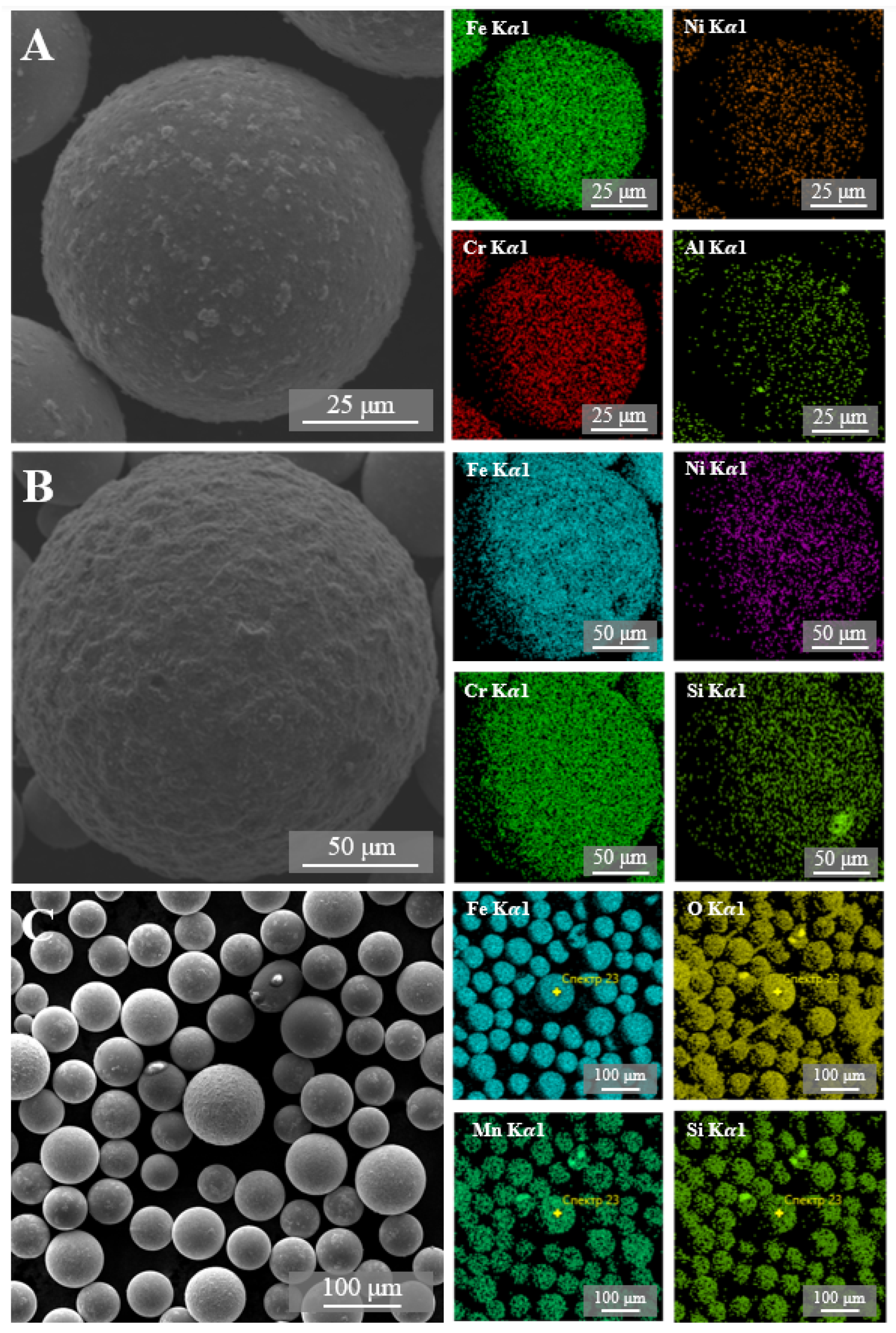
- In atomized powders, there is a significant decrease in the mass fraction of manganese (Mn) by more than three times compared to the initial powder (from 0.88% to 0.27–0.28%). This change in chemical composition is due to the evaporation of Mn, which has the highest equilibrium vapor pressure among all elements in the powder composition. Mn evaporation most likely occurred during the PBF-LB process due to the high temperatures reached in the melt bath. Along with this, this process is characteristic of the atomization process of 316L stainless steel [18,22].
- 2.
- The measured content of Cr, Ni, and Mo in atomized powders is within the range typical for this material, confirming the chemical stability of the process with respect to the main alloying elements of the material.
- 3.
- A slight increase in Si content was observed in atomized powders compared to the original powder. These changes in chemical composition may be associated with local heterogeneity in the distribution of Si in the powder particles.
3.4. Oxygen and Nitrogen Contents After Recycling Atomization
3.5. Efficiency of Ultrasonic Atomization
4. Conclusions
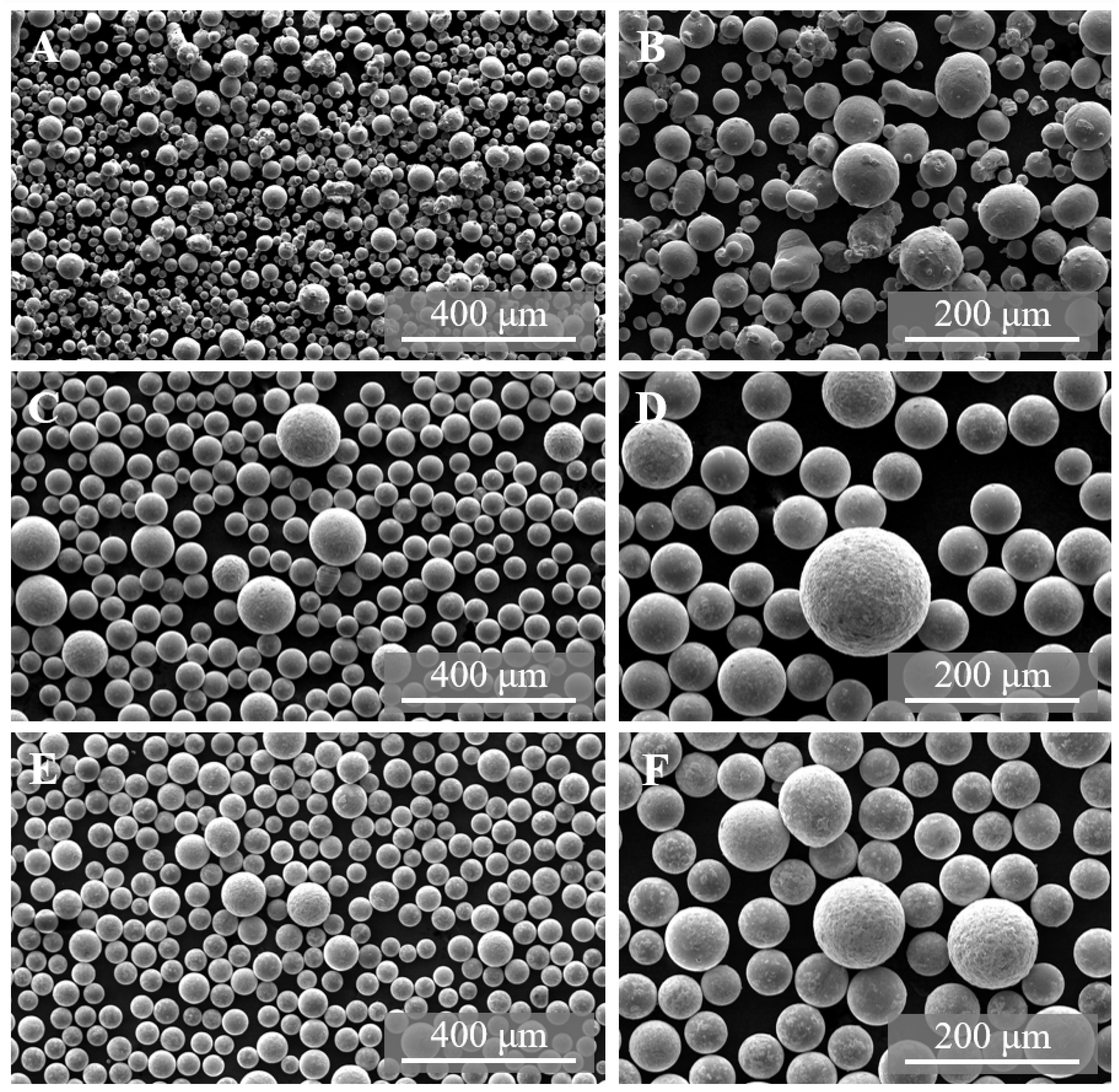
- Ultrasonic atomization produces highly spherical powder particles with a significantly reduced number of satellites and agglomerates compared to the virgin gas-atomized powder. Particle morphology is governed by capillary-wave-droplet detachment and surface-tension-driven spheroidization, resulting in improved geometric uniformity.
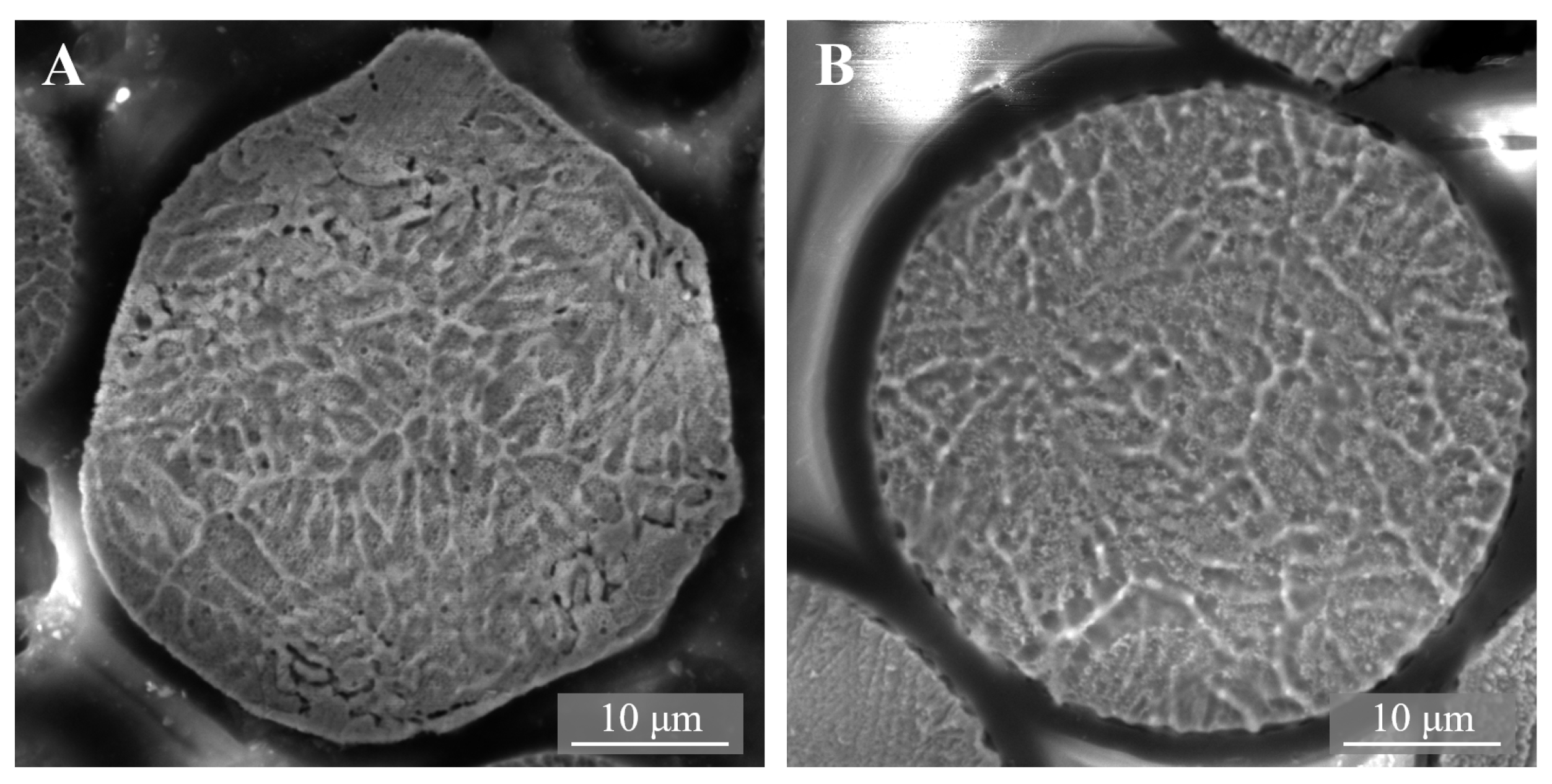
- The internal microstructure of ultrasonically atomized particles is finer and more homogeneous, with reduced internal porosity relative to the reference powder. This indicates more stable solidification conditions and reduced melt circulation during droplet formation.
- The primary alloying elements (Cr, Ni, Mo) remain within the compositional range of 316L after recycling atomization. A noticeable decrease in Mn content was observed due to evaporation during high-temperature processing, while Si shows a slight increase. These changes do not strongly depend on the atomization process conditions within the investigated parameter window.
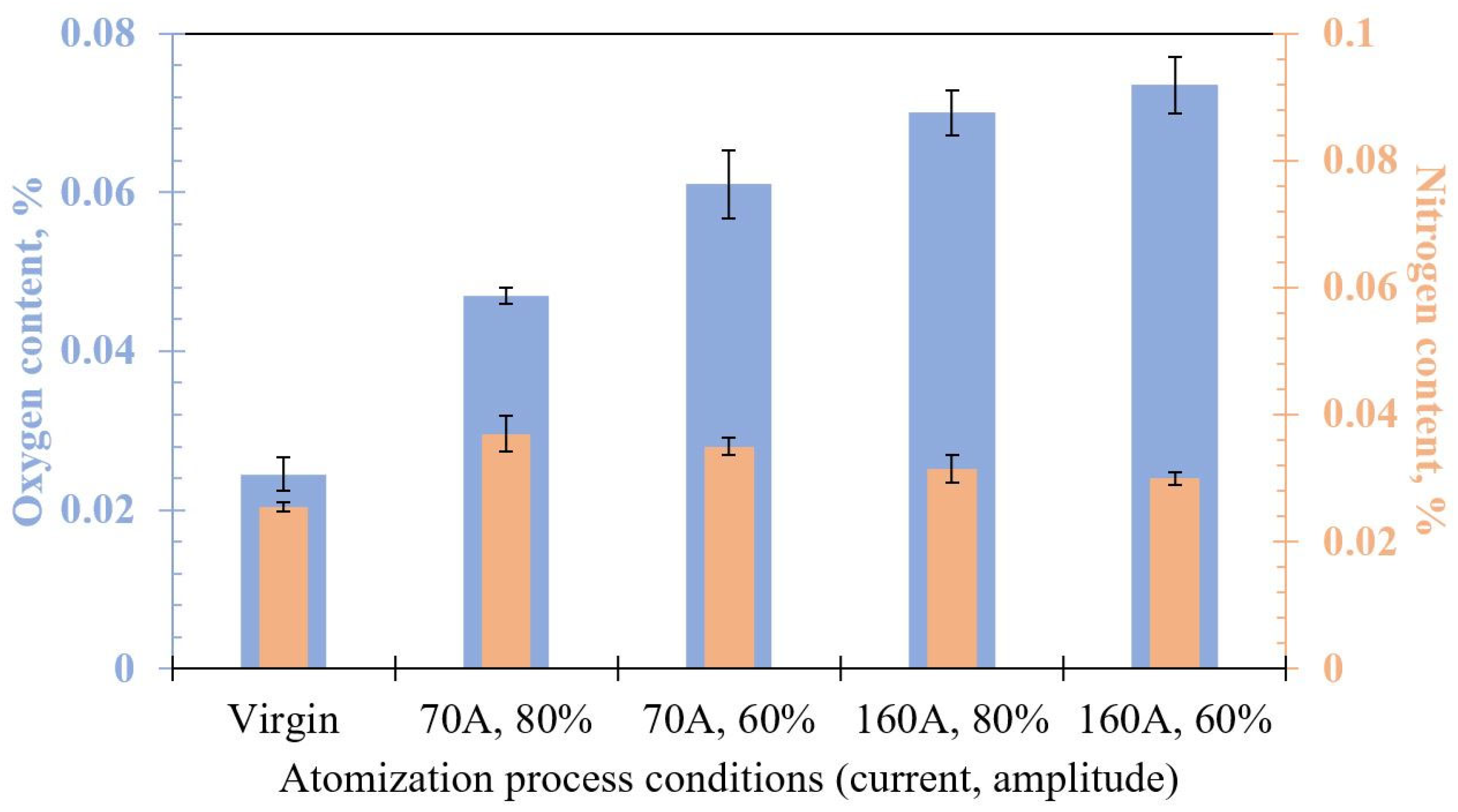
- The oxygen content of the recycled powder increases, whereas nitrogen remains nearly constant. This behavior suggests selective high-temperature oxidation under non-ideal inert conditions rather than simple atmospheric contamination. The oxygen level therefore becomes a process-dependent parameter in recycling routes and may approach a steady state during repeated cycles.
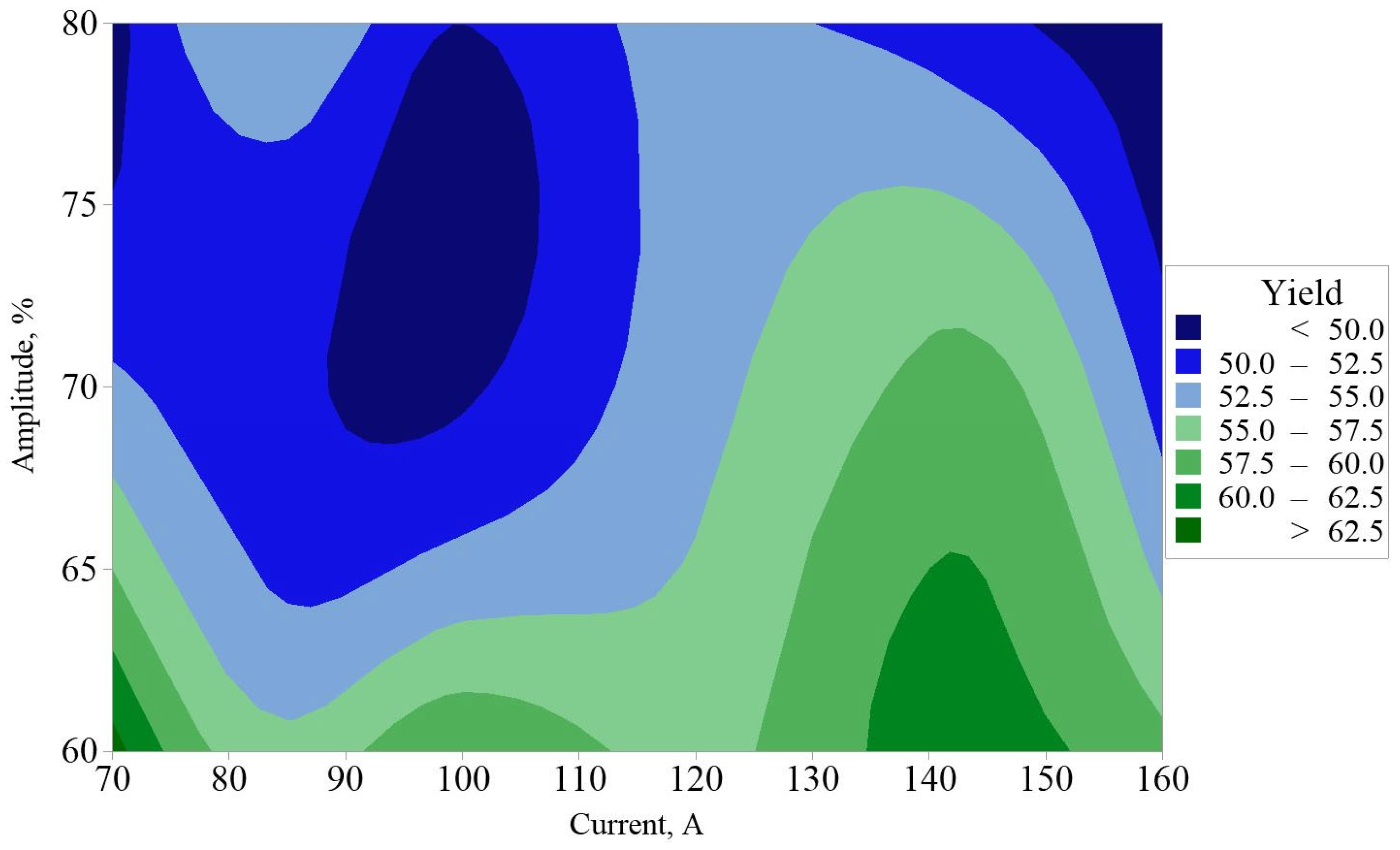
- The efficiency of ultrasonic atomization is controlled by the stability of the liquid film on the vibrating surface. Increasing thermal input promotes stable capillary breakup and increases yield, while excessive vibration amplitude destabilizes droplet formation. The optimal window of process parameters in this study corresponds to higher current and lower vibration amplitude.
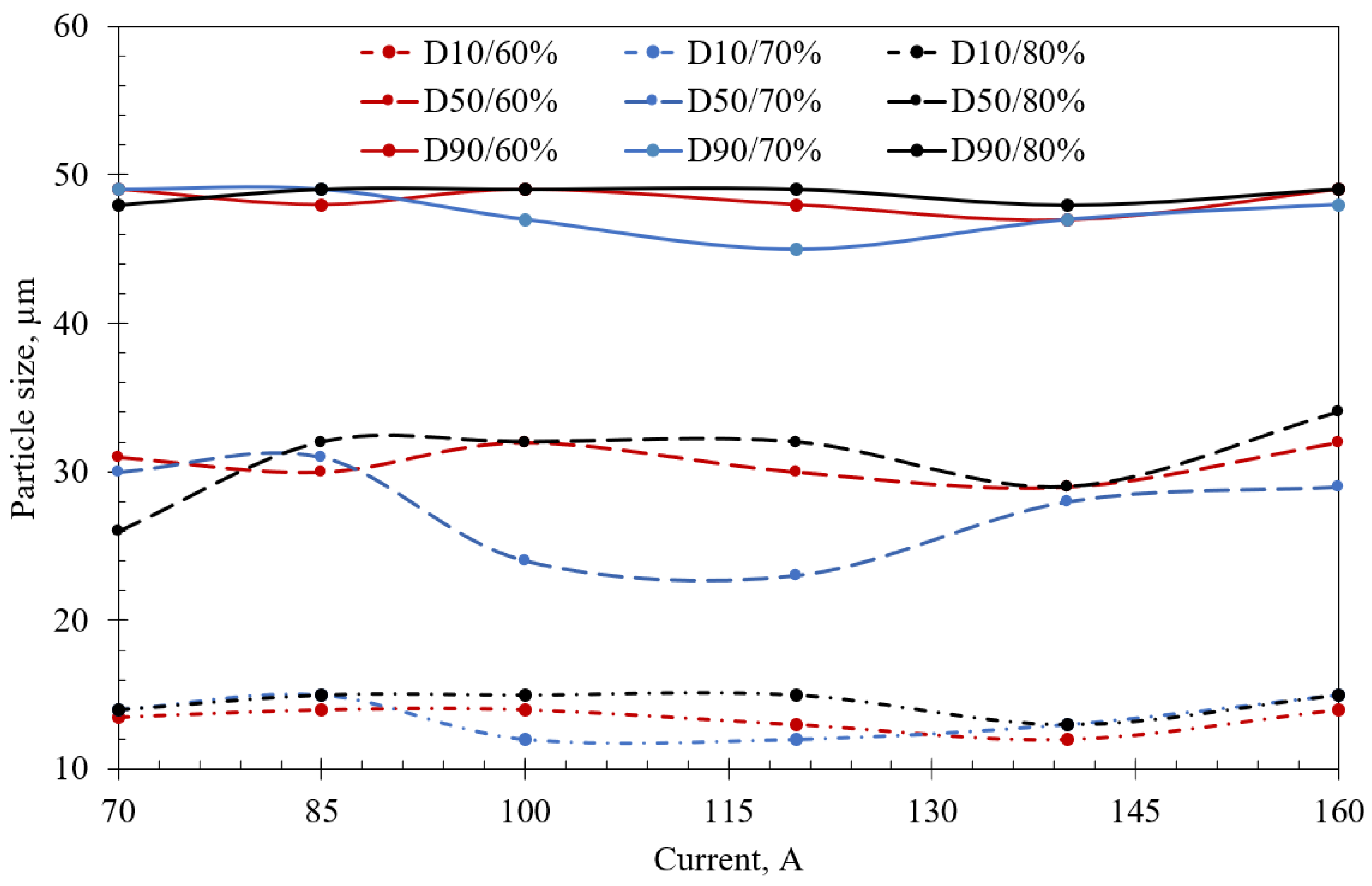
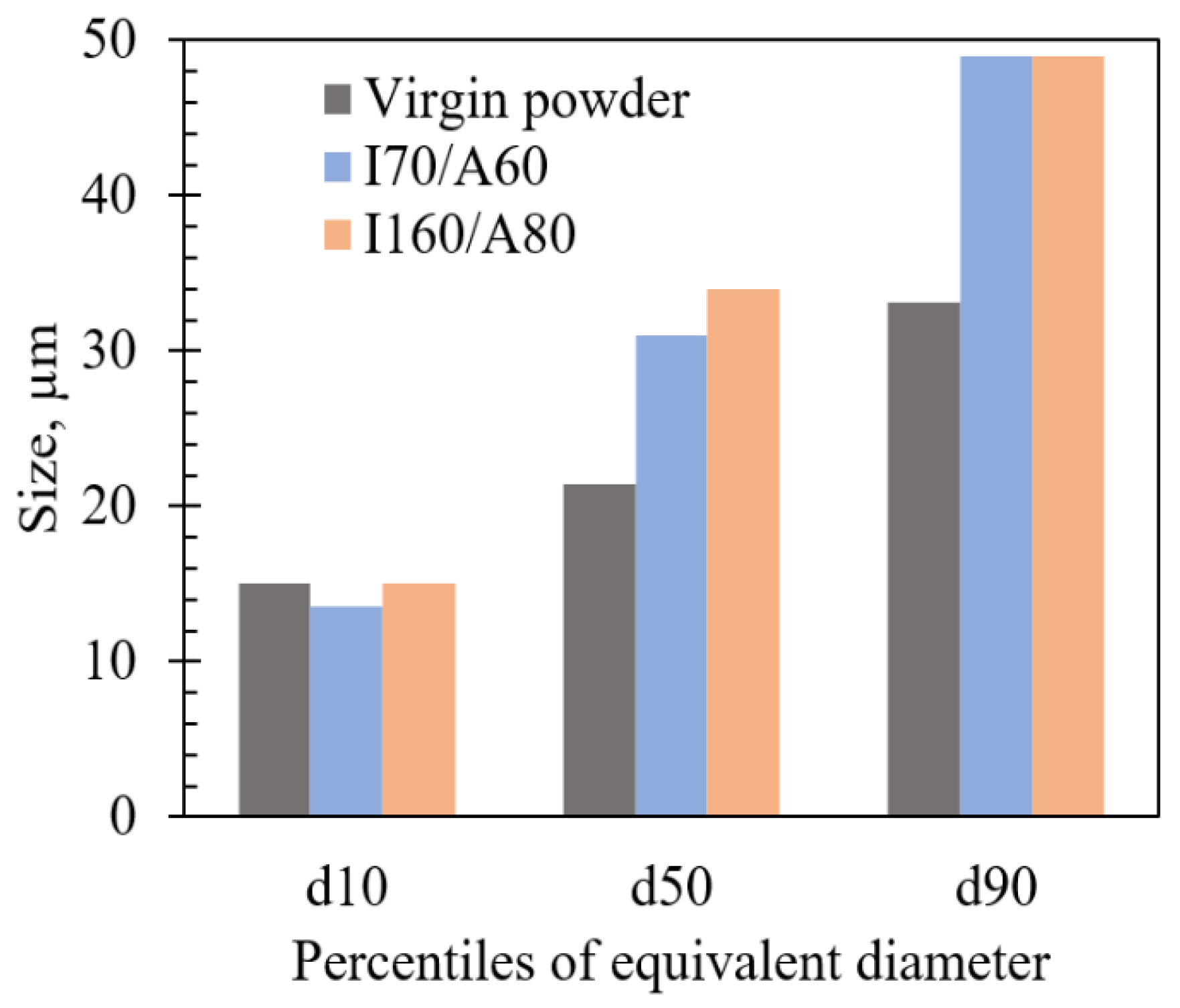
- The particle size distribution after sieving remains relatively stable across processing parameters (D50 ≈ 31 μm), while its width decreases, improving powder flowability. The resulting distribution is suitable for further PBF-LB processing.
Author Contributions
Funding
Data Availability Statement
Conflicts of Interest
References
- Ashgriz, N. (Ed.) Handbook of Atomization and Sprays; Springer US: Boston, MA, USA, 2011. [Google Scholar]
- Cui, Y.; Zhao, Y.; Numata, H.; Yamanaka, K.; Bian, H.; Aoyagi, K.; Chiba, A. Effects of Process Parameters and Cooling Gas on Powder Formation during the Plasma Rotating Electrode Process. Powder Technol. 2021, 393, 301–311. [Google Scholar] [CrossRef]
- Kassym, K.; Perveen, A. Atomization Processes of Metal Powders for 3D Printing. Mater. Today Proc. 2020, 26, 1727–1733. [Google Scholar] [CrossRef]
- Schade, C.; Dunkley, J.J. Atomization. In Powder Metallurgy; ASM International: Metals Park, OH, USA, 2015; pp. 58–71. [Google Scholar]
- Uskoković, D.; Uskoković, V. Magical Spherical Particles Produced by Centrifugal Atomization. Powder Technol. 2024, 444, 120017. [Google Scholar] [CrossRef]
- Sista, K.S.; Moon, A.P.; Sinha, G.R.; Pirjade, B.M.; Dwarapudi, S. Spherical Metal Powders through RF Plasma Spherodization. Powder Technol. 2022, 400, 117225. [Google Scholar] [CrossRef]
- Peskin, R.L.; Raco, R.J. Ultrasonic Atomization of Liquids. J. Acoust. Soc. Am. 1963, 35, 1378–1381. [Google Scholar] [CrossRef]
- Priyadarshi, A.; Bin Shahrani, S.; Choma, T.; Zrodowski, L.; Qin, L.; Leung, C.L.A.; Clark, S.J.; Fezzaa, K.; Mi, J.; Lee, P.D.; et al. New Insights into the Mechanism of Ultrasonic Atomization for the Production of Metal Powders in Additive Manufacturing. Addit. Manuf. 2024, 83, 104033. [Google Scholar] [CrossRef]
- Bałasz, B.; Bielecki, M.; Gulbiński, W.; Słoboda, Ł. Comparison of Ultrasonic and Other Atomization Methods in Metal Powder Production. J. Achiev. Mater. Manuf. Eng. 2023, 116, 11–24. [Google Scholar] [CrossRef]
- Wood, R.W.; Loomis, A.L. XXXVIII. The Physical and Biological Effects of High-Frequency Sound-Waves of Great Intensity. Lond. Edinb. Dublin Philos. Mag. J. Sci. 1927, 4, 417–436. [Google Scholar] [CrossRef]
- Mir, J.M. Cavitation-Induced Capillary Waves in Ultrasonic Atomization. J. Acoust. Soc. Am. 1980, 67, 201–205. [Google Scholar] [CrossRef]
- Cui, K.; Pang, X.; Zhou, Z.; Ren, Z. Efficient Capture of Fine Particulate Matters by Ultrasonic Atomization. J. Environ. Chem. Eng. 2021, 9, 106307. [Google Scholar] [CrossRef]
- Rajan, R.; Pandit, A.B. Correlations to Predict Droplet Size in Ultrasonic Atomisation. Ultrasonics 2001, 39, 235–255. [Google Scholar] [CrossRef] [PubMed]
- Pelevin, I.A.; Nalivaiko, A.Y.; Ozherelkov, D.Y.; Shinkaryov, A.S.; Chernyshikhin, S.V.; Arnautov, A.N.; Zmanovsky, S.V.; Gromov, A.A. Selective Laser Melting of Al-Based Matrix Composites with Al2o3 Reinforcement: Features and Advantages. Materials 2021, 14, 2648. [Google Scholar] [CrossRef] [PubMed]
- Sefene, E.M. State-of-the-Art of Selective Laser Melting Process: A Comprehensive Review. J. Manuf. Syst. 2022, 63, 250–274. [Google Scholar] [CrossRef]
- Bogdanova, M.; Chernyshikhin, S.; Zakirov, A.; Zotov, B.; Fedorenko, L.; Belousov, S.; Perepelkina, A.; Korneev, B.; Lyange, M.; Pelevin, I.; et al. Mesoscale Simulation of Laser Powder Bed Fusion with an Increased Layer Thickness for AlSi10Mg Alloy. J. Manuf. Mater. Process. 2024, 8, 7. [Google Scholar] [CrossRef]
- Rogachev, S.O.; Fedorenko, L.V.; Naumova, E.A.; Tabachkova, N.Y.; Bazhenov, V.E.; Chernyshikhin, S.V. Laser Powder Bed Fusion of Mixed Aluminum Powders: Microstructure Features and Mechanical Properties. Mater. Lett. 2025, 389, 138404. [Google Scholar] [CrossRef]
- Grzelak, K.; Bielecki, M.; Kluczyński, J.; Szachogłuchowicz, I.; Śnieżek, L.; Torzewski, J.; Łuszczek, J.; Słoboda, Ł.; Wachowski, M.; Komorek, Z.; et al. A Comparative Study on Laser Powder Bed Fusion of Differently Atomized 316L Stainless Steel. Materials 2022, 15, 4938. [Google Scholar] [CrossRef]
- Kavousi Sisi, A.; Ozherelkov, D.; Chernyshikhin, S.; Pelevin, I.; Kharitonova, N.; Gromov, A. Functionally Graded Multi-Materials by Laser Powder Bed Fusion: A Review on Experimental Studies. Prog. Addit. Manuf. 2024, 10, 1843–1912. [Google Scholar] [CrossRef]
- Douglas, R.; Barnard, N.; Lavery, N.; Sullivan, J.; Jones, T.; Lancaster, R. The Effect of Powder Recycling on the Mechanical Performance of Laser Powder Bed Fused Stainless Steel 316L. Addit. Manuf. 2024, 88, 104245. [Google Scholar] [CrossRef]
- Lu, C.; Zhang, R.; Xiao, M.; Wei, X.; Yin, Y.; Qu, Y.; Li, H.; Liu, P.; Qiu, X.; Guo, T. A Comprehensive Characterization of Virgin and Recycled 316L Powders during Laser Powder Bed Fusion. J. Mater. Res. Technol. 2022, 18, 2292–2309. [Google Scholar] [CrossRef]
- Bałasz, B.; Żurawski, Ł.; Laskowska, D.; Muts, N.; Ivanushko, A. An Investigation of the Metal Powder Ultrasound Atomisation Process of 316L Stainless Steel. Materials 2024, 17, 5642. [Google Scholar] [CrossRef]
- Yankin, A.; Murtaza, H.A.; Ospanov, A.; Zharkynbekova, G.; Yuldasheva, D.; Perveen, A.; Talamona, D. Comprehensive Analysis of Ultrasonically Atomized 316L Stainless Steel Powder Using Adjusted Additive Manufacturing Suitability Factor. Powder Technol. 2024, 444, 120004. [Google Scholar] [CrossRef]
- Toprak, İ.B. Investigation of the Effect of Frequency on 316L Powder Production Using Ultrasonic Atomization. Pamukkale Univ. J. Eng. Sci. 2025, 31, 564–569. [Google Scholar] [CrossRef]
- ISO 4490:2018; Metallic Powders—Determination of Flow Rate by Means of a Calibrated Funnel (Hall Flowmeter). International Organization for Standardization: Geneva, Switzerland, 2018.
- Topp, M.N. Ultrasonic Atomization-a Photographic Study of the Mechanism of Disintegration. J. Aerosol Sci. 1973, 4, 17–25. [Google Scholar] [CrossRef]
- Cacace, S.; Semeraro, Q. Influence of the Atomization Medium on the Properties of Stainless Steel SLM Parts. Addit. Manuf. 2020, 36, 101509. [Google Scholar] [CrossRef]
- Türkmen, M.; Tanouz, A.M.; Akgün, M.; Erden, M.A. The Effect of Mn and Ti Ratio on Microstructure and Mechanical and Machinability Properties of 316 L Stainless Steel Used in Biomedical Applications. Metals 2023, 13, 1804. [Google Scholar] [CrossRef]
- Yakout, M.; Elbestawi, M.A.; Veldhuis, S.C. A Study of Thermal Expansion Coefficients and Microstructure during Selective Laser Melting of Invar 36 and Stainless Steel 316L. Addit. Manuf. 2018, 24, 405–418. [Google Scholar] [CrossRef]
- Ledwig, P.; Pasiowiec, H.; Truczka, B.; Falkus, J. Impact of Chemical Composition Changes during Ultrasound Atomization and Laser Powder Bed Fusion of Low Alloy Steel. Steel Res. Int. 2025, 96, 2400257. [Google Scholar] [CrossRef]
- Pinto, F.C.; Aota, L.S.; Souza Filho, I.R.; Raabe, D.; Sandim, H.R.Z. Recrystallization in Non-Conventional Microstructures of 316L Stainless Steel Produced via Laser Powder-Bed Fusion: Effect of Particle Coarsening Kinetics. J. Mater. Sci. 2022, 57, 9576–9598. [Google Scholar] [CrossRef]
- Chniouel, A.; Giroux, P.-F.; Lomello, F.; Aubry, P.; Vasquez, É.; Hercher, O.; Maskrot, H. Influence of Substrate Temperature on Microstructural and Mechanical Properties of 316L Stainless Steel Consolidated by Laser Powder Bed Fusion. Int. J. Adv. Manuf. Technol. 2020, 111, 3489–3503. [Google Scholar] [CrossRef]



| Designation | Electrical Current, A | Vibration Amplitude, % | Pump Power, % | Ultrasonic Frequency, kHz |
|---|---|---|---|---|
| 70A60% | 70 | 60 | 60 | 35 |
| 70A70% | 70 | 70 | ||
| 70A80% | 70 | 80 | ||
| 85A60% | 85 | 60 | ||
| 85A70% | 85 | 70 | ||
| 85A80% | 85 | 80 | ||
| 100A60% | 100 | 60 | ||
| 100A70% | 100 | 70 | ||
| 100A80% | 100 | 80 | ||
| 120A60% | 120 | 60 | ||
| 120A70% | 120 | 70 | ||
| 120A80% | 120 | 80 | ||
| 140A60% | 140 | 60 | ||
| 140A70% | 140 | 70 | ||
| 140A80% | 140 | 80 | ||
| 160A60% | 160 | 60 | ||
| 160A70% | 160 | 70 | ||
| 160A80% | 160 | 80 |
| Current, A | Vibration Amplitude, % | d10, μm | d50, μm | d90, μm | Flow Rate, s/50 g | Span |
|---|---|---|---|---|---|---|
| 70 | 60 | 14 | 31 | 49 | 5.2 | 1.15 |
| 70 | 70 | 14 | 30 | 49 | 4.3 | 1.17 |
| 70 | 80 | 14 | 26 | 48 | 4.5 | 1.31 |
| 85 | 60 | 14 | 30 | 48 | 4.4 | 1.13 |
| 85 | 70 | 15 | 31 | 49 | 4.2 | 1.10 |
| 85 | 80 | 15 | 32 | 49 | 5.1 | 1.06 |
| 100 | 60 | 14 | 32 | 49 | 4.6 | 1.09 |
| 100 | 70 | 12 | 24 | 47 | 4.2 | 1.46 |
| 100 | 80 | 15 | 32 | 49 | 4.3 | 1.06 |
| 120 | 60 | 13 | 30 | 48 | 4.4 | 1.17 |
| 120 | 70 | 12 | 23 | 45 | 4.7 | 1.43 |
| 120 | 80 | 15 | 32 | 49 | 3.9 | 1.06 |
| 140 | 60 | 12 | 29 | 47 | 4.4 | 1.21 |
| 140 | 70 | 13 | 28 | 47 | 5.1 | 1.21 |
| 140 | 80 | 13 | 29 | 48 | 3.6 | 1.21 |
| 160 | 60 | 14 | 32 | 49 | 4.1 | 1.09 |
| 160 | 70 | 15 | 29 | 48 | 3.9 | 1.14 |
| 160 | 80 | 15 | 34 | 49 | 3.7 | 1.00 |
| Element | Standard Composition of 316L [27] | Virgin Powder | Atomized Powder (70A60%) | Atomized Powder (160A80%) |
|---|---|---|---|---|
| Cr | 15.5–17.5 | 15.54 ± 0.716 | 15.75 ± 0.264 | 15.92 ± 0.078 |
| Ni | 10–14 | 11.72 ± 0.824 | 11.34 ± 0.120 | 11.44 ± 0.180 |
| Mo | 2–3 | 2.03 ± 0.085 | 2.27 ± 0.027 | 2.32 ± 0.028 |
| Mn | ≤2.0 | 0.88 ± 0.094 | 0.27 ± 0.004 | 0.28 ± 0.005 |
| Si | ≤1.0 | 1.20 ± 0.032 | 1.33 ± 0.069 | 1.37 ± 0.064 |
| Cu | 0.10 ± 0.018 | 0.12 ± 0.001 | 0.12 ± 0.005 | |
| Al | 0.10 ± 0.002 | 0.13 ± 0.001 | 0.12 ± 0.002 | |
| V | 0.07 ± 0.018 | 0.09 ± 0.001 | 0.09 ± 0.012 | |
| Co | 0.26 ± 0.030 | 0.23 ± 0.003 | 0.23 ± 0.002 | |
| Fe | Bal. | Bal. | Bal. | Bal. |
Disclaimer/Publisher’s Note: The statements, opinions and data contained in all publications are solely those of the individual author(s) and contributor(s) and not of MDPI and/or the editor(s). MDPI and/or the editor(s) disclaim responsibility for any injury to people or property resulting from any ideas, methods, instructions or products referred to in the content. |
© 2026 by the authors. Licensee MDPI, Basel, Switzerland. This article is an open access article distributed under the terms and conditions of the Creative Commons Attribution (CC BY) license.
Share and Cite
Bashmakova, O.; Fedorenko, L.; Vasilev, A.; Zotov, B.; Urzhumtsev, A.; Kavousi Sisi, A.; Lyange, M.; Pelevin, I.; Gilvitinov, M.; Petukhova, K.; et al. On the Ultrasonic Atomization of SS316L Parts Manufactured via Laser Powder Bed Fusion for the Closed-Loop Production. J. Manuf. Mater. Process. 2026, 10, 93. https://doi.org/10.3390/jmmp10030093
Bashmakova O, Fedorenko L, Vasilev A, Zotov B, Urzhumtsev A, Kavousi Sisi A, Lyange M, Pelevin I, Gilvitinov M, Petukhova K, et al. On the Ultrasonic Atomization of SS316L Parts Manufactured via Laser Powder Bed Fusion for the Closed-Loop Production. Journal of Manufacturing and Materials Processing. 2026; 10(3):93. https://doi.org/10.3390/jmmp10030093
Chicago/Turabian StyleBashmakova, Olga, Leonid Fedorenko, Andrey Vasilev, Boris Zotov, Andrey Urzhumtsev, Ali Kavousi Sisi, Maria Lyange, Ivan Pelevin, Mikhail Gilvitinov, Ksenia Petukhova, and et al. 2026. "On the Ultrasonic Atomization of SS316L Parts Manufactured via Laser Powder Bed Fusion for the Closed-Loop Production" Journal of Manufacturing and Materials Processing 10, no. 3: 93. https://doi.org/10.3390/jmmp10030093
APA StyleBashmakova, O., Fedorenko, L., Vasilev, A., Zotov, B., Urzhumtsev, A., Kavousi Sisi, A., Lyange, M., Pelevin, I., Gilvitinov, M., Petukhova, K., Zinovyeva, E., & Chernyshikhin, S. (2026). On the Ultrasonic Atomization of SS316L Parts Manufactured via Laser Powder Bed Fusion for the Closed-Loop Production. Journal of Manufacturing and Materials Processing, 10(3), 93. https://doi.org/10.3390/jmmp10030093