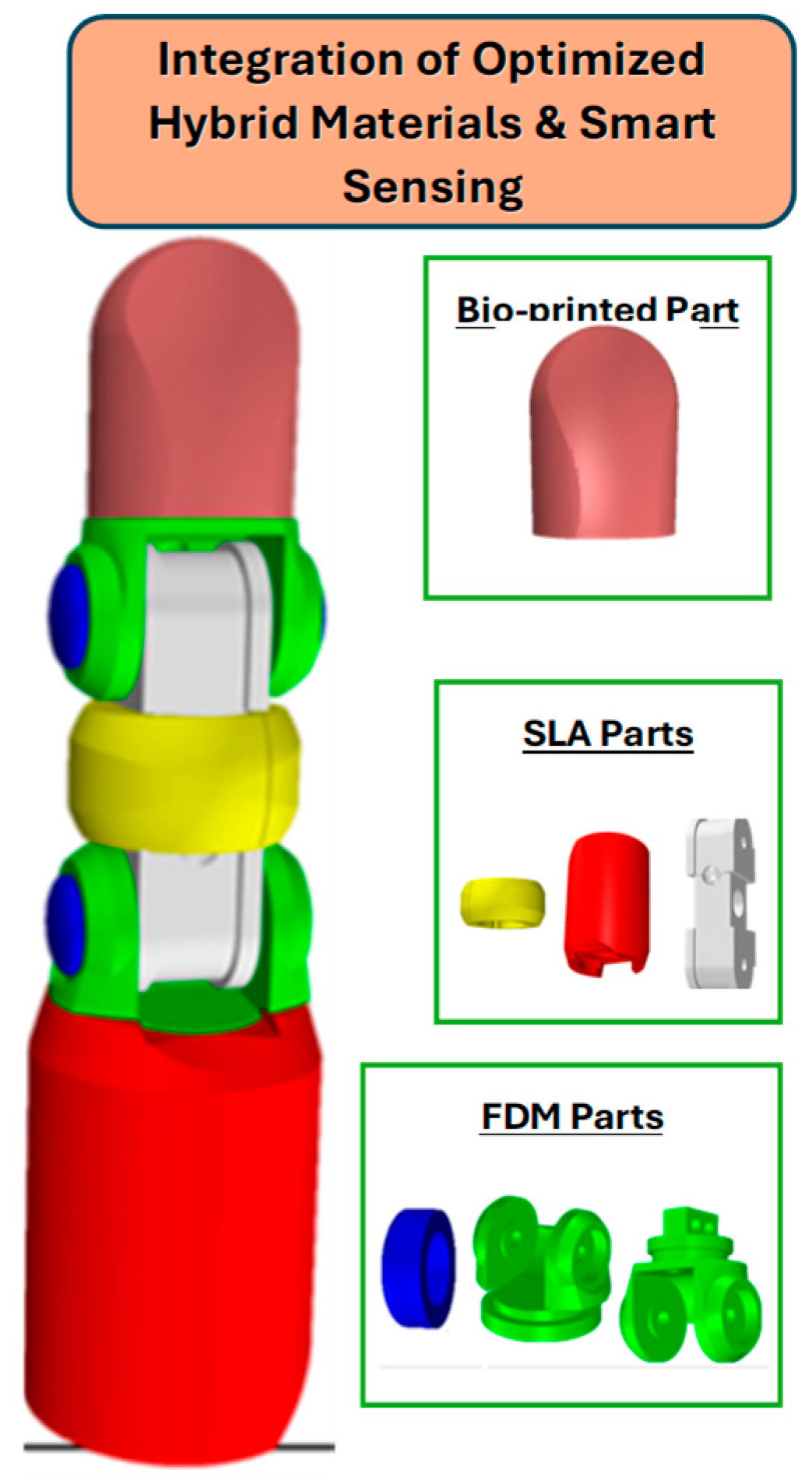
Figure 1.
The integration of hybrid manufacturing and materials and smart sensing.
Figure 1.
The integration of hybrid manufacturing and materials and smart sensing.
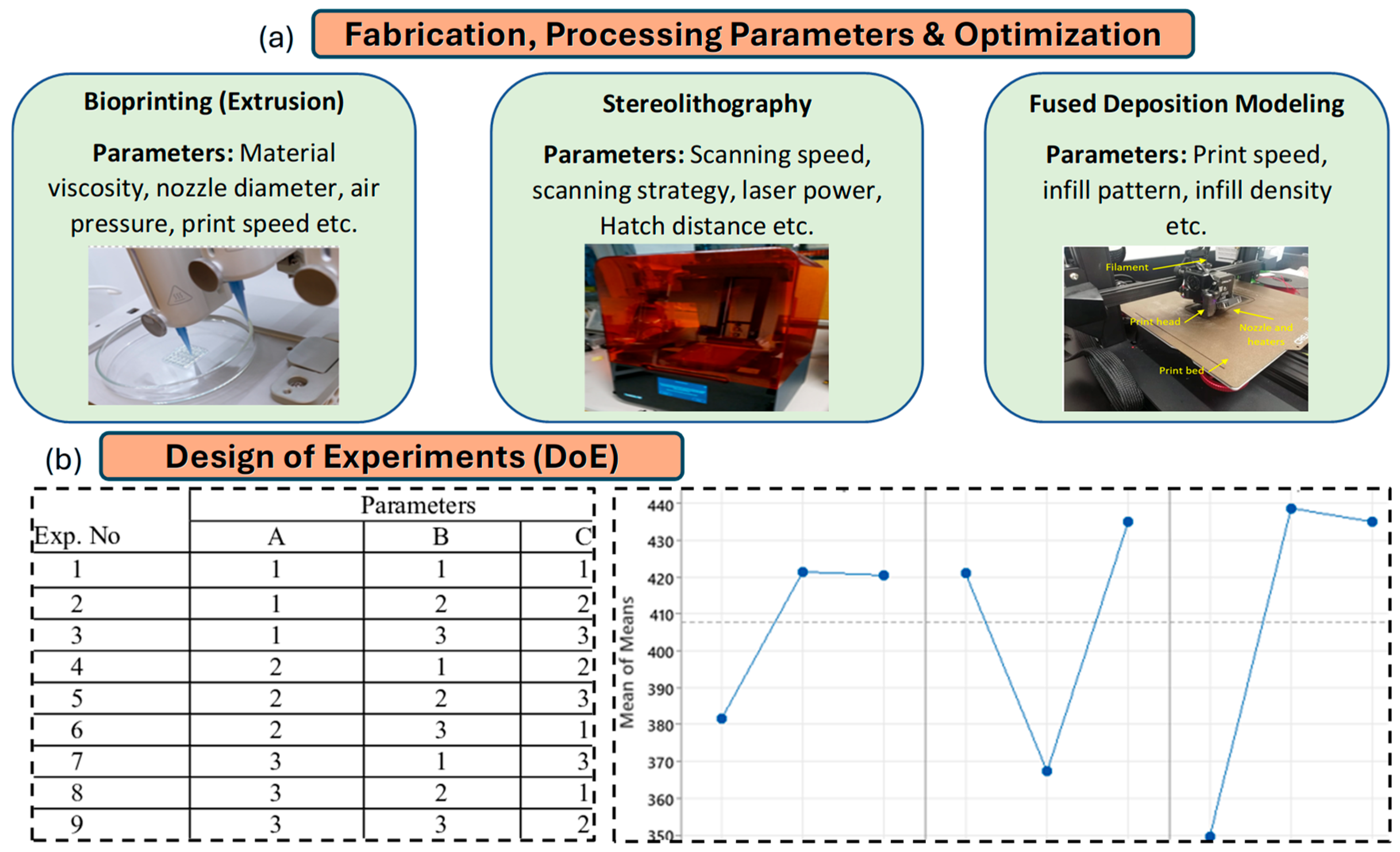
Figure 2.
(a) Fabrication techniques with (b) process optimization highlights the use of design of experiments (DoE) and additive manufacturing methods, culminating in the development of a robust and responsive prosthetic finger.
Figure 2.
(a) Fabrication techniques with (b) process optimization highlights the use of design of experiments (DoE) and additive manufacturing methods, culminating in the development of a robust and responsive prosthetic finger.
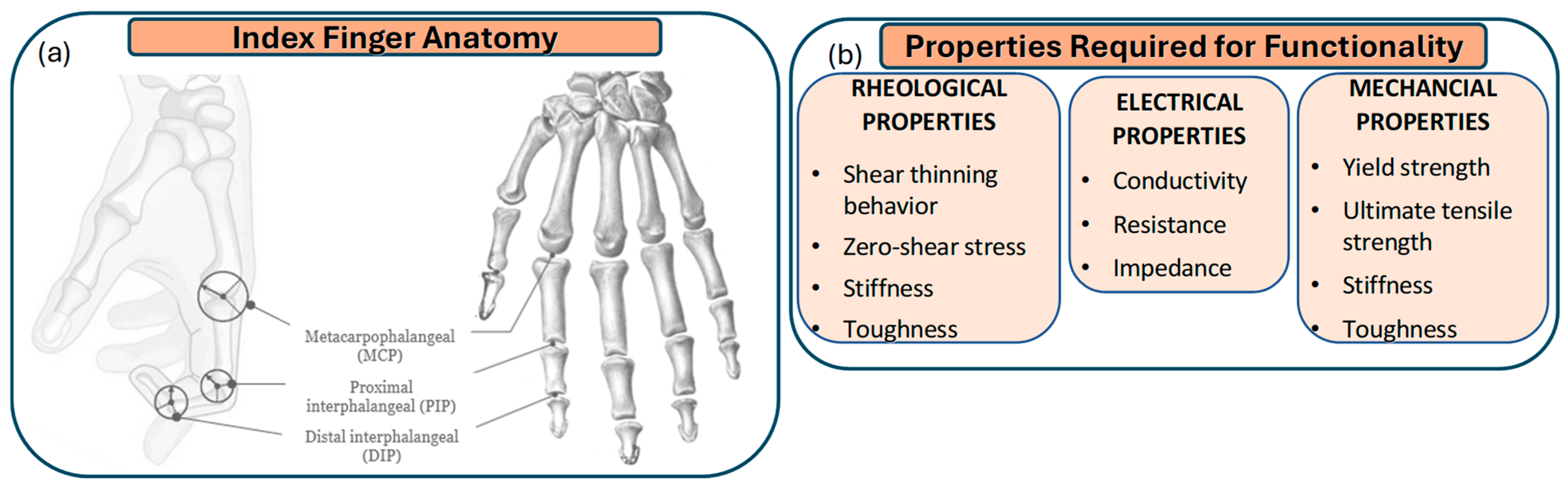
Figure 3.
Comprehensive framework for developing a functional prosthetic finger: this figure presents the full narrative of the study, detailing (
a) the anatomical analysis of the index finger [
32,
33] and (
b) essential rheological, electrical, and mechanical properties for prosthetic functionality.
Figure 3.
Comprehensive framework for developing a functional prosthetic finger: this figure presents the full narrative of the study, detailing (
a) the anatomical analysis of the index finger [
32,
33] and (
b) essential rheological, electrical, and mechanical properties for prosthetic functionality.
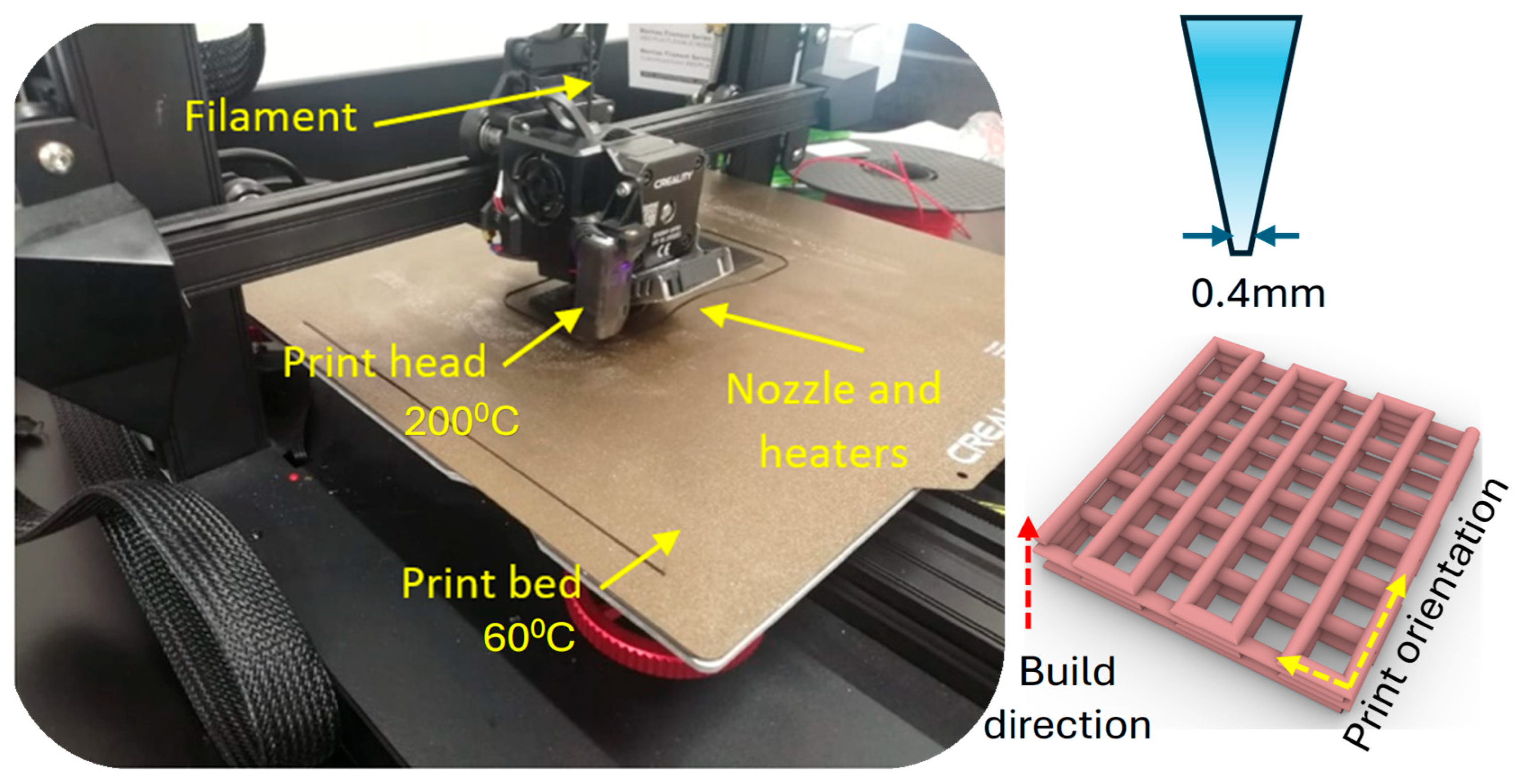
Figure 4.
Components and print orientation in FDM 3D printing: The key components of an FDM 3D printer, including the filament, heated print head (200 °C), nozzle, and print bed (60 °C), along with a schematic of the print orientation and build direction for a structure.
Figure 4.
Components and print orientation in FDM 3D printing: The key components of an FDM 3D printer, including the filament, heated print head (200 °C), nozzle, and print bed (60 °C), along with a schematic of the print orientation and build direction for a structure.
Figure 5.
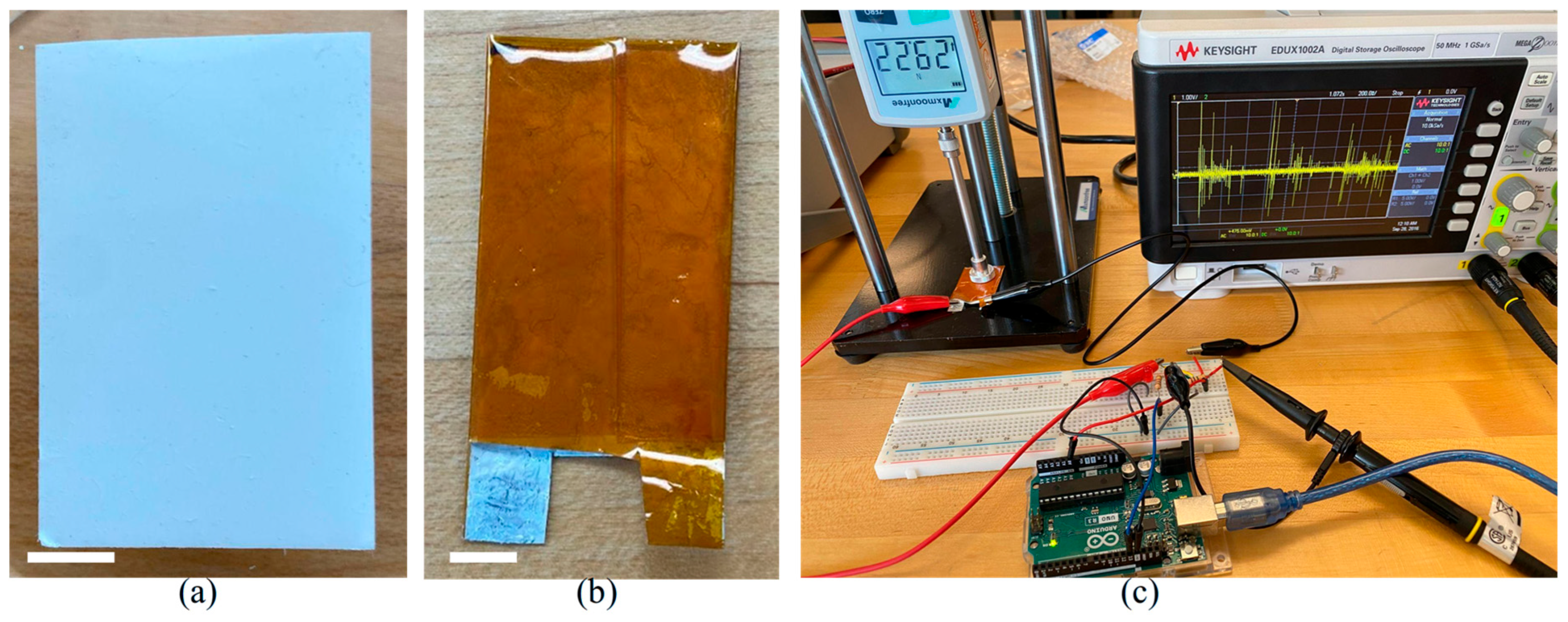
Fabrication and testing of sensor-integrated systems: (a) Sample fabricated with 10:1 PDMS-40% BaTiO3, (b) constructed assembly of Kapton tape, silver ink, and the 10:1 PDMS-40% BaTiO3 composite, and (c) testing setup for the sensor involving a force gauge, an oscilloscope, and an Arduino Uno. Scale = 1.0 mm.
Figure 5.
Fabrication and testing of sensor-integrated systems: (a) Sample fabricated with 10:1 PDMS-40% BaTiO3, (b) constructed assembly of Kapton tape, silver ink, and the 10:1 PDMS-40% BaTiO3 composite, and (c) testing setup for the sensor involving a force gauge, an oscilloscope, and an Arduino Uno. Scale = 1.0 mm.
Figure 6.
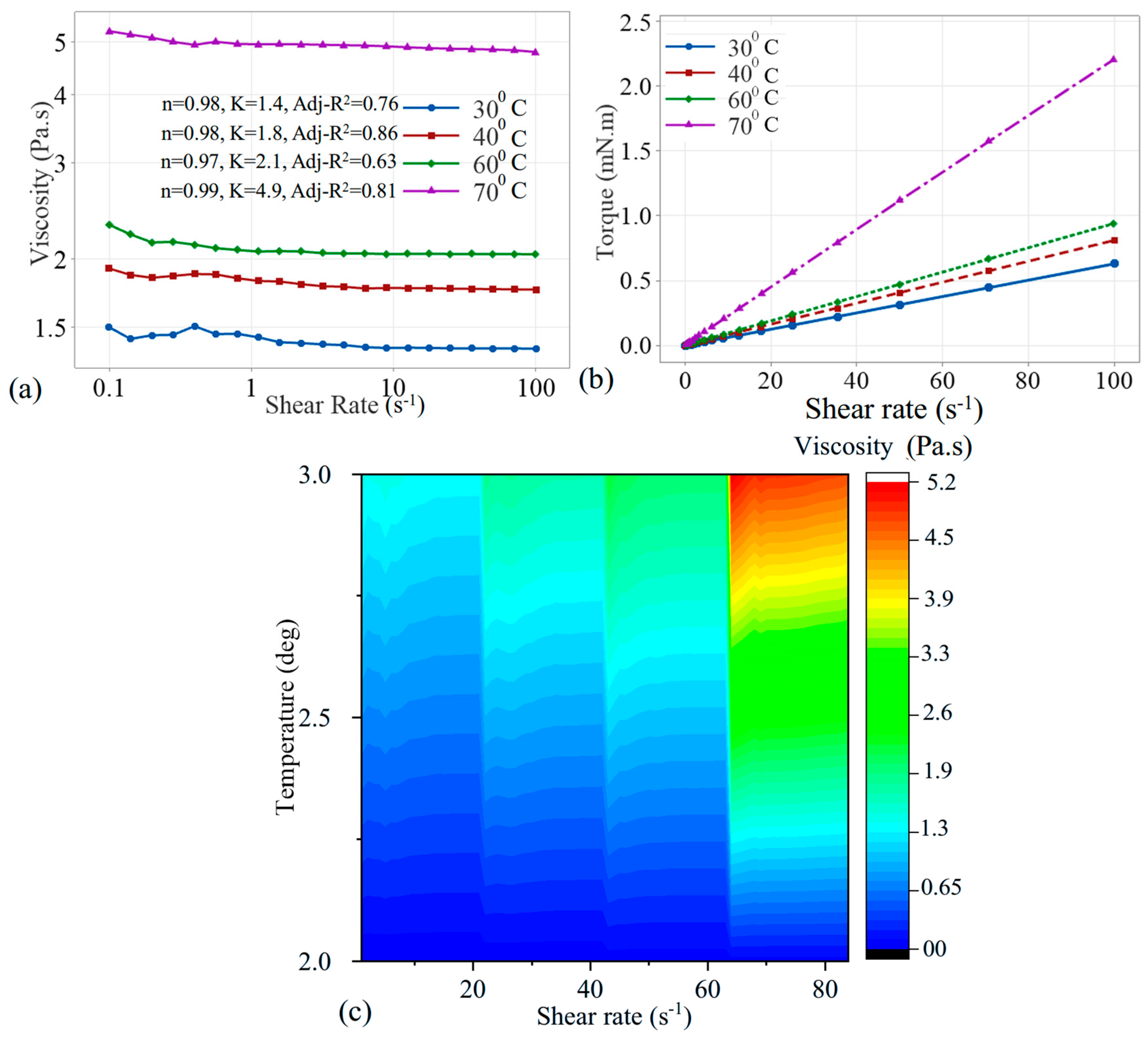
Flow behavior with respect to (a) viscosity, (b) shear stress of 10:3 PDMS composition at various temperatures (°C), e.g., 30 °C, 40 °C, 60 °C, 70 °C, and (c) viscosity distribution of PDMS with respect to shear rate and temperature.
Figure 6.
Flow behavior with respect to (a) viscosity, (b) shear stress of 10:3 PDMS composition at various temperatures (°C), e.g., 30 °C, 40 °C, 60 °C, 70 °C, and (c) viscosity distribution of PDMS with respect to shear rate and temperature.
Figure 7.
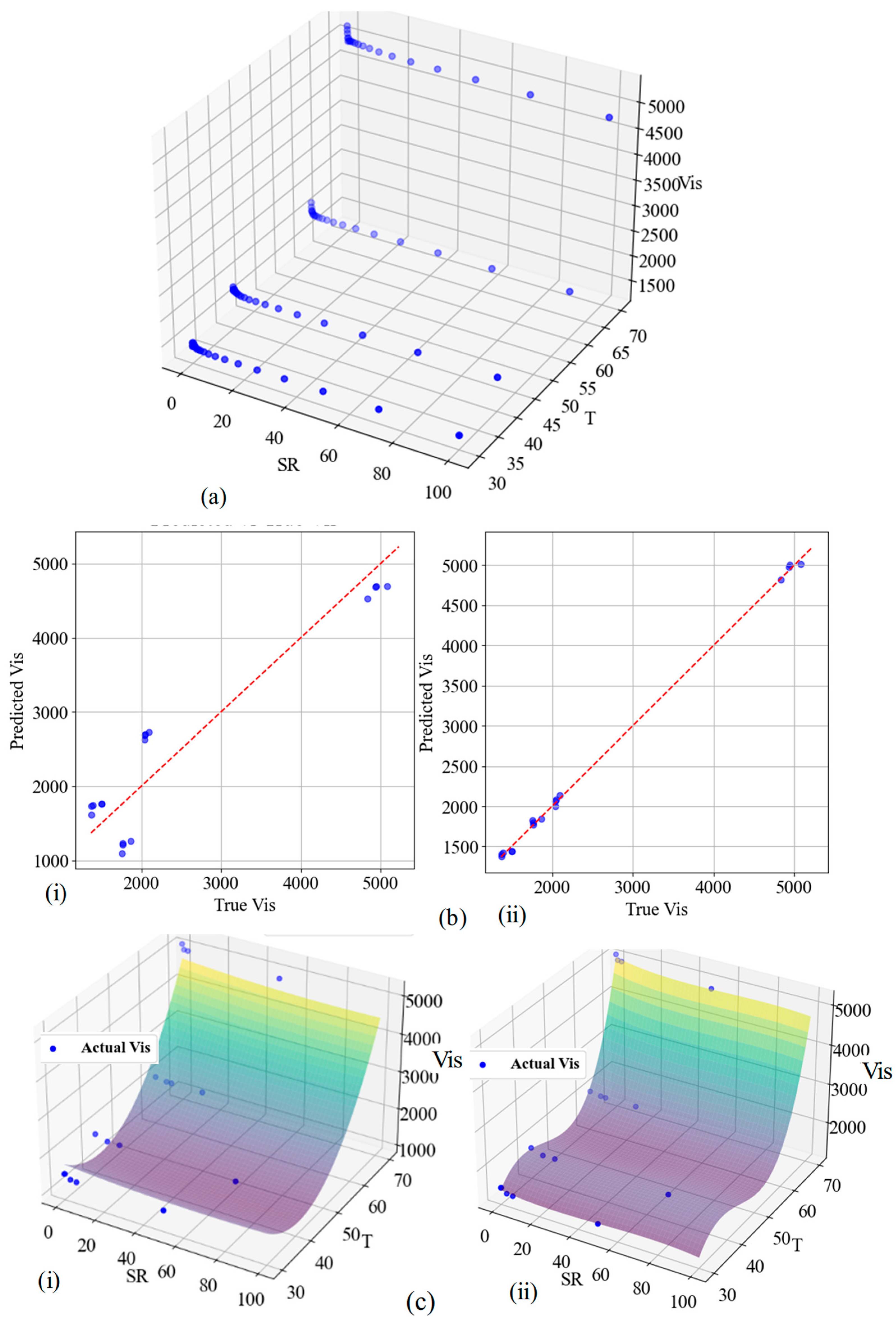
(a) The 3D distribution of actual viscosity with the change in shear rate and temperature, (b) true viscosity versus predicted viscosity obtained from the predictive model of viscosity as a function of shear rate and temperature for (i) second-order polynomial model and (ii) third-order polynomial model, and (c) predictive surface of viscosity with respect to shear rate and temperature for (i) second-order polynomial model and (ii) third-order polynomial model. , and , .
Figure 7.
(a) The 3D distribution of actual viscosity with the change in shear rate and temperature, (b) true viscosity versus predicted viscosity obtained from the predictive model of viscosity as a function of shear rate and temperature for (i) second-order polynomial model and (ii) third-order polynomial model, and (c) predictive surface of viscosity with respect to shear rate and temperature for (i) second-order polynomial model and (ii) third-order polynomial model. , and , .
Figure 8.
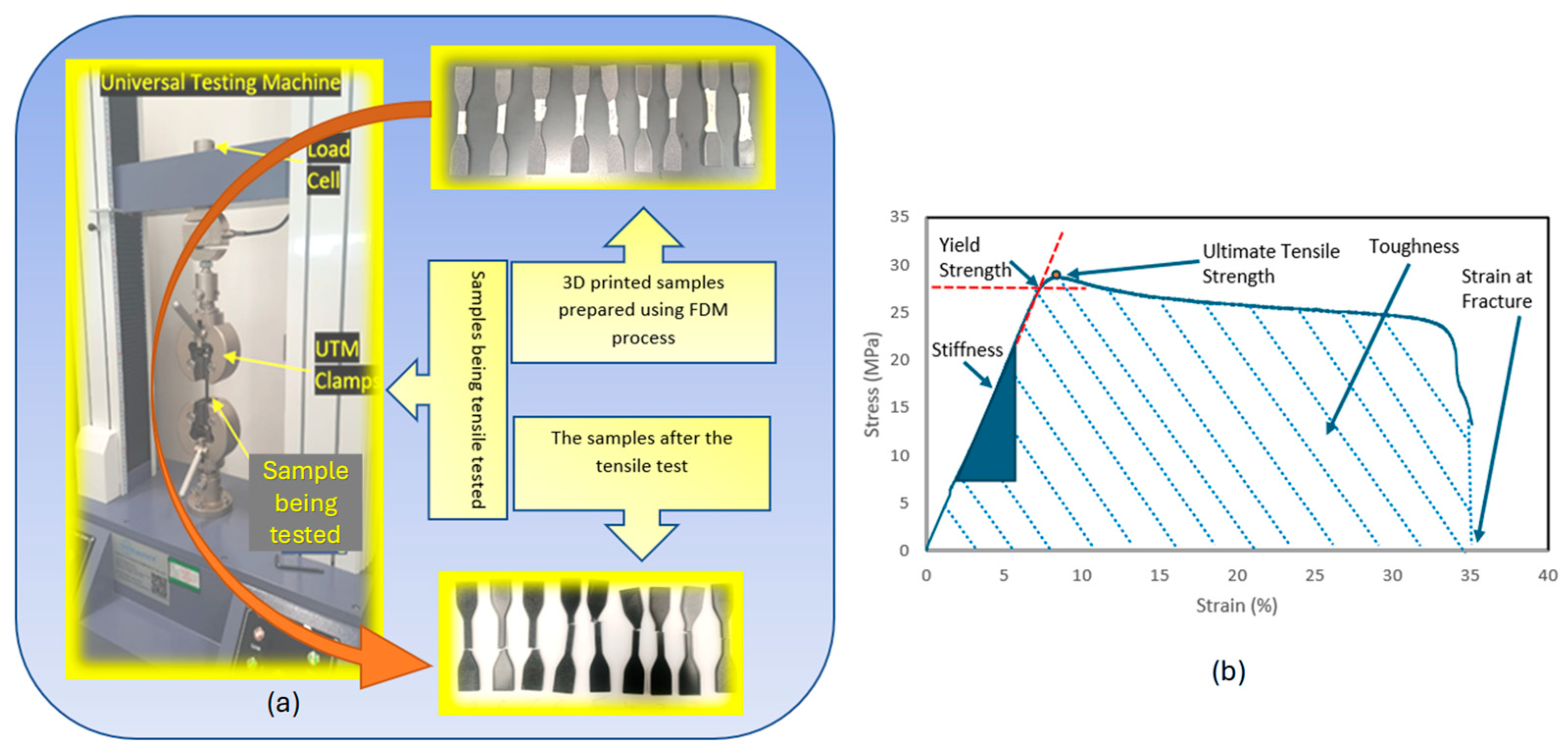
(a) Universal testing machine performing the tensile test on PLA sample: the prepared samples, their placement in UTM clamps, and the results post-tensile testing, emphasizing the evaluation of mechanical properties; (b) first replication of Sample 1 after testing stress strain diagram: This figure depicts a stress–strain curve highlighting key mechanical properties, including yield strength, ultimate tensile strength, stiffness, toughness, and strain at fracture.
Figure 8.
(a) Universal testing machine performing the tensile test on PLA sample: the prepared samples, their placement in UTM clamps, and the results post-tensile testing, emphasizing the evaluation of mechanical properties; (b) first replication of Sample 1 after testing stress strain diagram: This figure depicts a stress–strain curve highlighting key mechanical properties, including yield strength, ultimate tensile strength, stiffness, toughness, and strain at fracture.
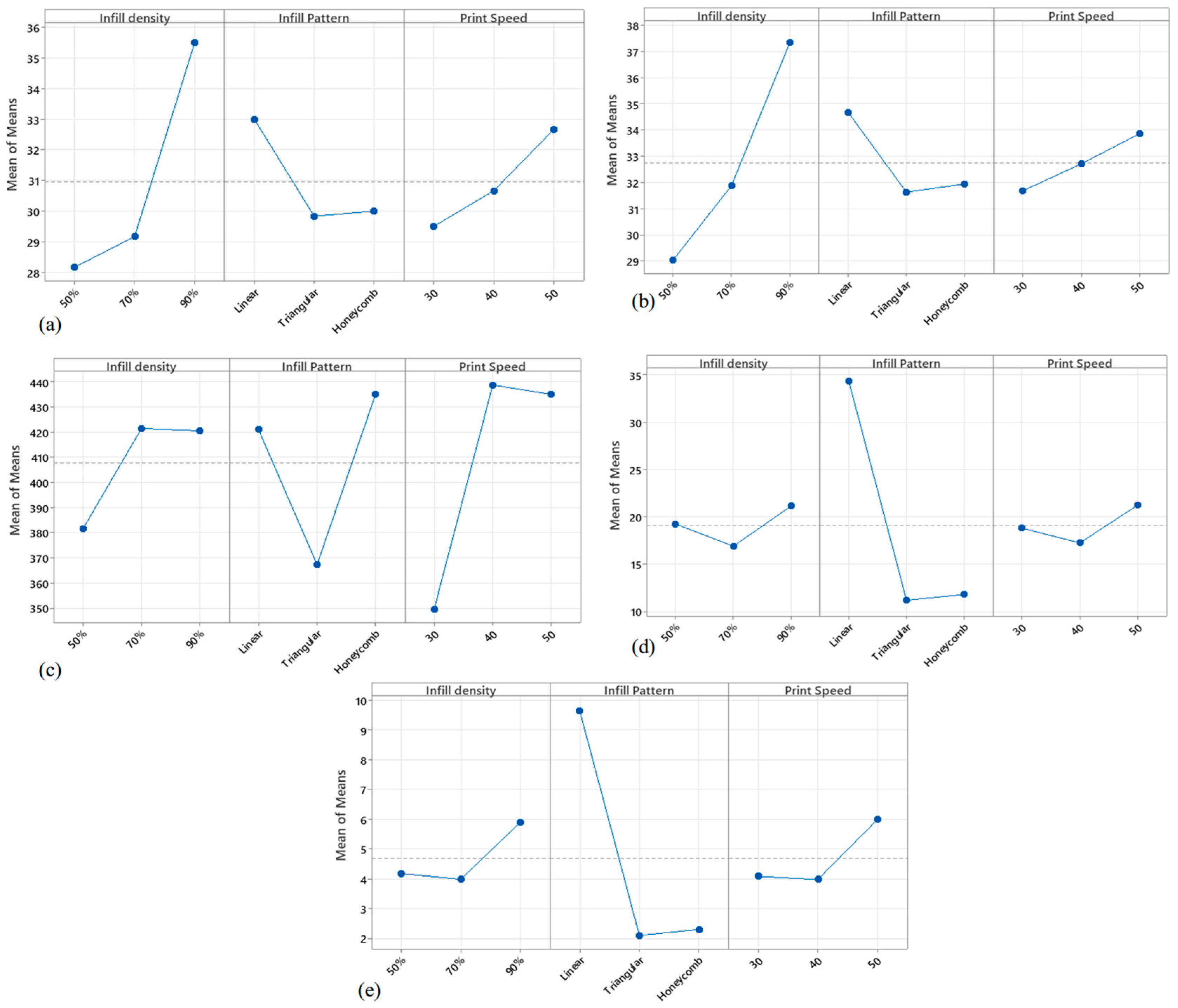
Figure 9.
Influence of infill density, pattern, and print speed on 3D printing outcomes. The graphs illustrate the effects of varying infill density, infill pattern, and print speed on key 3D printing parameters, providing insights into optimizing print quality and structural properties through statistical analysis of mean performance metrics: Mean effect plots for (a) Yield strength (MPa), (b) Ultimate tensile strength (MPa), (c) Stiffness (MPa), (d) Strain at fracture (%), and (e) Toughness (MJ/m3).
Figure 9.
Influence of infill density, pattern, and print speed on 3D printing outcomes. The graphs illustrate the effects of varying infill density, infill pattern, and print speed on key 3D printing parameters, providing insights into optimizing print quality and structural properties through statistical analysis of mean performance metrics: Mean effect plots for (a) Yield strength (MPa), (b) Ultimate tensile strength (MPa), (c) Stiffness (MPa), (d) Strain at fracture (%), and (e) Toughness (MJ/m3).
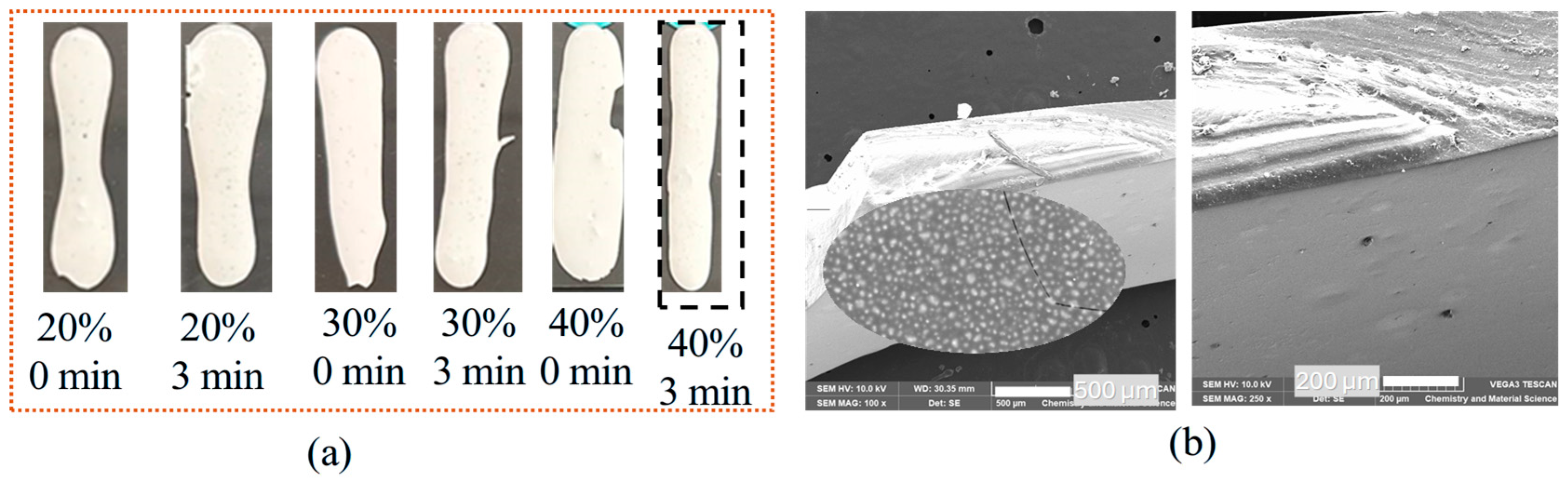
Figure 10.
Characterization of pdms-batio3 composite and tactile sensing performance. This figure illustrates (a) fabricated PDMS-BaTiO3 composite samples with various percentages of PDMS and changes over time. (b) SEM images highlighting the uniform distribution of BaTiO3 particles within the PDMS matrix. The inset shows how Backscattered electron detection method shows the particles under the surface of the sample.
Figure 10.
Characterization of pdms-batio3 composite and tactile sensing performance. This figure illustrates (a) fabricated PDMS-BaTiO3 composite samples with various percentages of PDMS and changes over time. (b) SEM images highlighting the uniform distribution of BaTiO3 particles within the PDMS matrix. The inset shows how Backscattered electron detection method shows the particles under the surface of the sample.
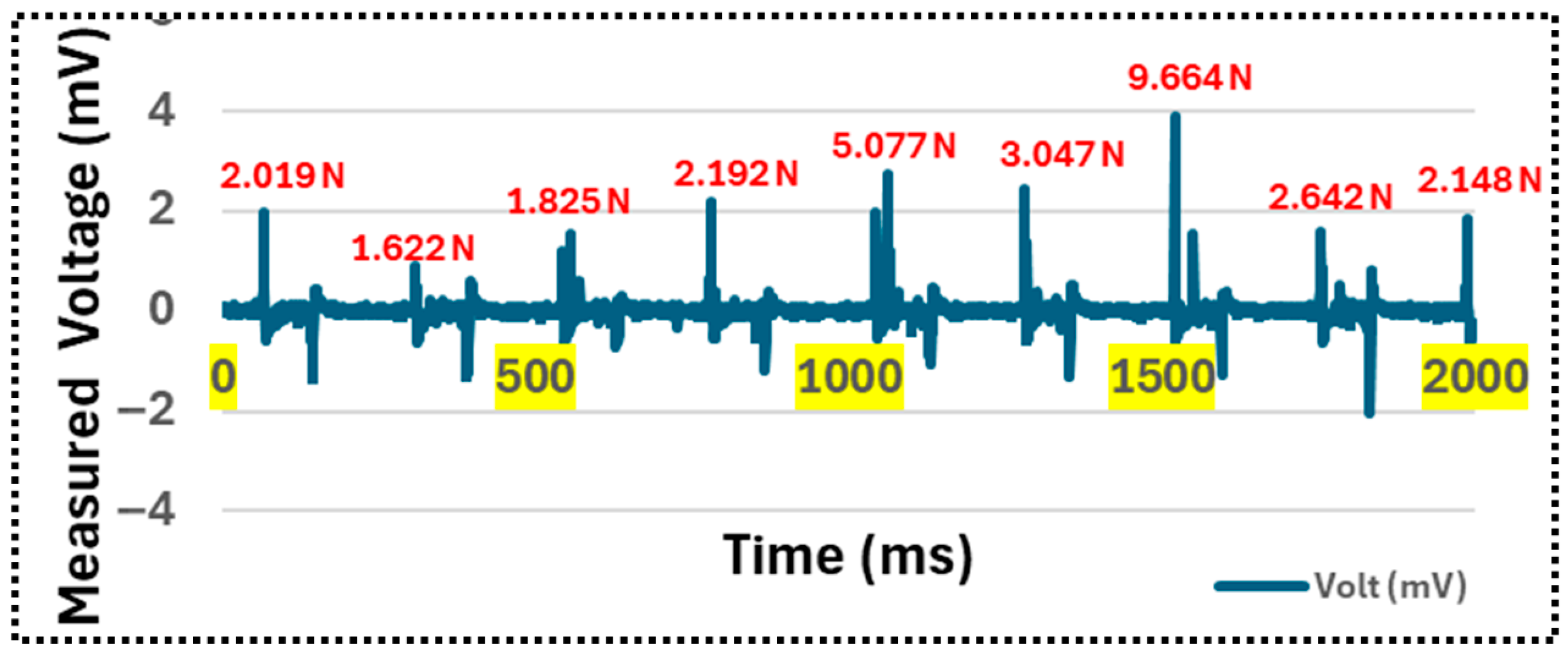
Figure 11.
The measured voltage (mV) over time (ms) corresponding to different applied forces (N). The piezoelectric sensor demonstrates distinct voltage peaks at specified force intervals, showcasing its responsiveness to applied mechanical loads.
Figure 11.
The measured voltage (mV) over time (ms) corresponding to different applied forces (N). The piezoelectric sensor demonstrates distinct voltage peaks at specified force intervals, showcasing its responsiveness to applied mechanical loads.
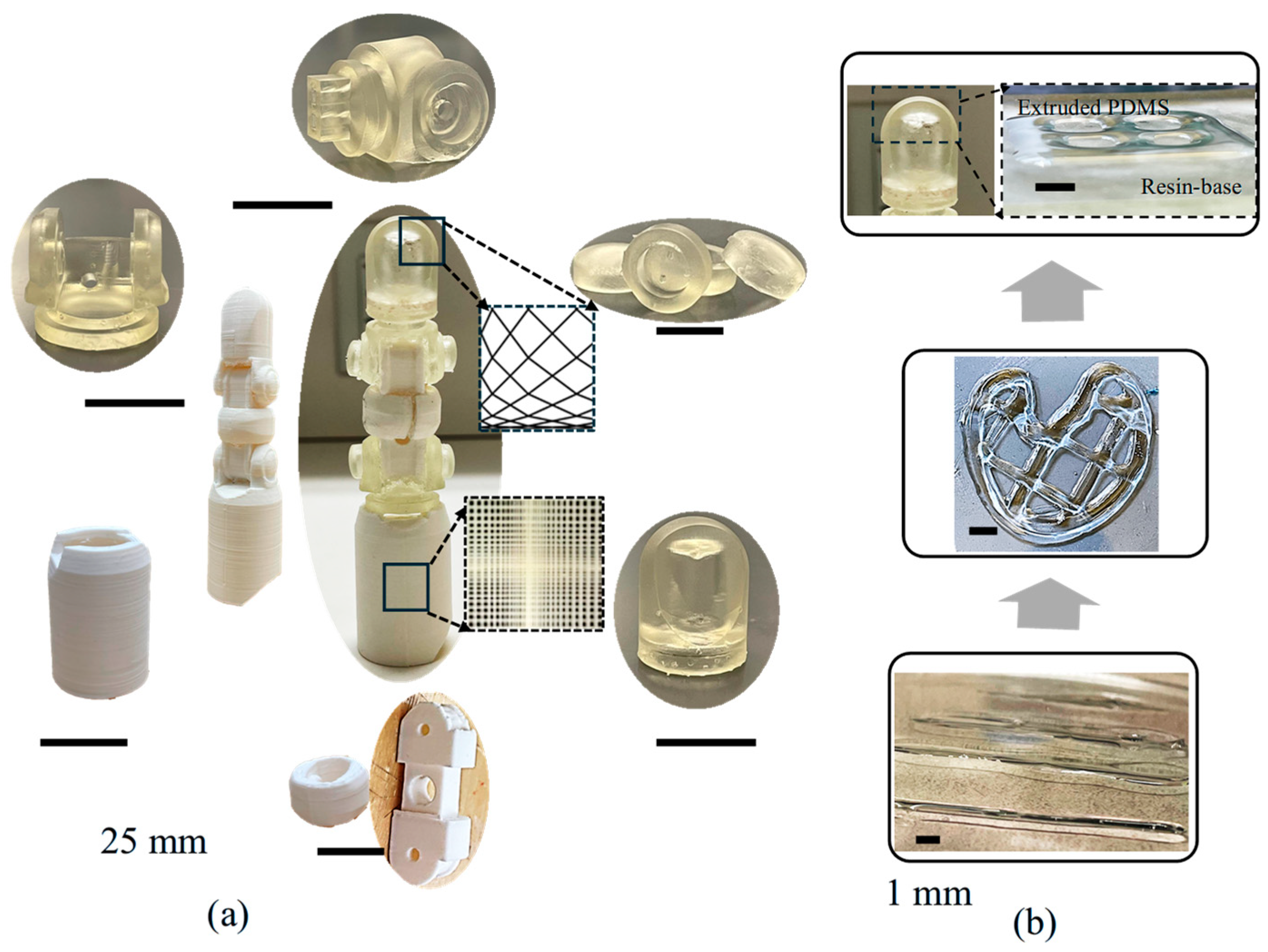
Figure 12.
Prototype development of a multi-material 3D-printed finger prosthesis integrating SLA, FDM, and extrusion-based bioprinting (EBP) processes. (a) Overview of the assembled finger prosthesis and its individual components, highlighting the use of SLA for high-precision parts (finger plug, base, and middle-to-fingertip connector) and FDM for structural sections (socket, middle segment, and bumper). SLA fabrication consumed 5.16 mL of resin over 75 min, while FDM components were printed using 13 g of optimized PLA in 132 min. (b) Fabrication steps demonstrating material interfacing: optimized PDMS extrusion over SLA-printed fingertips and hybrid PDMS–hydrogel deposition, showcasing the feasibility of embedding soft sensing materials within rigid structures. The optimized PDMS retained strong surface interaction even four hours post-printing, confirming compatibility for tactile sensor integration.
Figure 12.
Prototype development of a multi-material 3D-printed finger prosthesis integrating SLA, FDM, and extrusion-based bioprinting (EBP) processes. (a) Overview of the assembled finger prosthesis and its individual components, highlighting the use of SLA for high-precision parts (finger plug, base, and middle-to-fingertip connector) and FDM for structural sections (socket, middle segment, and bumper). SLA fabrication consumed 5.16 mL of resin over 75 min, while FDM components were printed using 13 g of optimized PLA in 132 min. (b) Fabrication steps demonstrating material interfacing: optimized PDMS extrusion over SLA-printed fingertips and hybrid PDMS–hydrogel deposition, showcasing the feasibility of embedding soft sensing materials within rigid structures. The optimized PDMS retained strong surface interaction even four hours post-printing, confirming compatibility for tactile sensor integration.
Table 1.
Printing process parameters for FDM, EBP, and SLA techniques.
Table 1.
Printing process parameters for FDM, EBP, and SLA techniques.
| Printing Process Parameters | FDM | EBP |
|---|
| Nozzle Diameter (mm) | 0.4 | 0.58 |
| Printing Temperature (°C) | 200 | Varies |
| Printer Bed Temperature (°C) | 60 | Varies |
| Print Orientations | 0° Flat | 0° Flat |
| Layer height (mm) | 0.2 | 0.25 |
| SLA Printing |
| Default settings with 100% infill |
Table 2.
Optimization of 3D printing parameters for improved structural integrity and print efficiency. This study investigated the impact of varying infill density, infill patterns, and print speeds on the quality and efficiency of 3D-printed constructs. Nine test combinations were analyzed to identify optimal settings for strength, precision, and production speed.
Table 2.
Optimization of 3D printing parameters for improved structural integrity and print efficiency. This study investigated the impact of varying infill density, infill patterns, and print speeds on the quality and efficiency of 3D-printed constructs. Nine test combinations were analyzed to identify optimal settings for strength, precision, and production speed.
| Test No. | Infill Density (%) | Infill Pattern | Print Speed (mm/s) |
|---|
| 1 | 50 | Linear | 30 |
| 2 | 50 | Triangular | 40 |
| 3 | 50 | Hexagonal | 50 |
| 4 | 70 | Linear | 40 |
| 5 | 70 | Triangular | 50 |
| 6 | 70 | Hexagonal | 30 |
| 7 | 90 | Linear | 50 |
| 8 | 90 | Triangular | 30 |
| 9 | 90 | Hexagonal | 40 |
Table 3.
Ranking the impact of printing parameters on mechanical properties of 3D-printed constructs. This table highlights the influence of infill density, infill pattern, and print speed on key mechanical properties—yield strength, ultimate tensile strength, stiffness, strain at fracture, and toughness. Rankings indicate infill density’s primary influence on strength, while infill pattern and print speed significantly affect stiffness and strain.
Table 3.
Ranking the impact of printing parameters on mechanical properties of 3D-printed constructs. This table highlights the influence of infill density, infill pattern, and print speed on key mechanical properties—yield strength, ultimate tensile strength, stiffness, strain at fracture, and toughness. Rankings indicate infill density’s primary influence on strength, while infill pattern and print speed significantly affect stiffness and strain.
| | Level | Infill Density | Infill Pattern | Print Speed |
| Yield Strength | 1 | 28.17 | 33.00 | 29.50 |
| 2 | 29.17 | 29.83 | 30.67 |
| 3 | 35.50 | 30.00 | 32.67 |
| Delta | 7.33 | 3.17 | 3.17 |
| Rank | 1 | 2 | 3 |
| | Level | Infill Density | Infill Pattern | Print Speed |
| Ultimate Tensile Strength | 1 | 29.03 | 34.68 | 31.68 |
| 2 | 31.88 | 31.63 | 32.71 |
| 3 | 37.35 | 31.94 | 33.87 |
| Delta | 8.32 | 3.05 | 2.19 |
| Rank | 1 | 2 | 3 |
| | Level | Infill Density | Infill Pattern | Print Speed |
| Stiffness | 1 | 381.5 | 421.0 | 349.7 |
| 2 | 421.5 | 367.3 | 438.8 |
| 3 | 420.6 | 435.2 | 435.1 |
| Delta | 40.0 | 67.9 | 89.1 |
| Rank | 3 | 2 | 1 |
| | Level | Infill Density | Infill Pattern | Print Speed |
Strain
at Fracture | 1 | 19.26 | 34.32 | 18.83 |
| 2 | 16.91 | 11.20 | 17.26 |
| 3 | 21.16 | 11.81 | 21.25 |
| Delta | 4.25 | 23.12 | 3.99 |
| Rank | 2 | 1 | 3 |
| Level | Infill Density | Infill Pattern | Print Speed |
| Toughness | 1 | 4.163 | 9.637 | 4.073 |
| 2 | 3.980 | 2.093 | 3.973 |
| 3 | 5.883 | 2.297 | 5.980 |
| Delta | 1.903 | 7.543 | 2.007 |
| Rank | 3 | 1 | 2 |
Table 4.
Influence of parameter variations on mechanical properties of 3D-printed constructs. This table examines how different combinations of parameters (A, B, C) affect key mechanical properties such as toughness, Young’s modulus, yield strength, ultimate tensile strength, and strain at fracture. The results highlight significant variability, with certain combinations achieving superior performance in toughness and tensile strength.
Table 4.
Influence of parameter variations on mechanical properties of 3D-printed constructs. This table examines how different combinations of parameters (A, B, C) affect key mechanical properties such as toughness, Young’s modulus, yield strength, ultimate tensile strength, and strain at fracture. The results highlight significant variability, with certain combinations achieving superior performance in toughness and tensile strength.
| Runs | A | B | C | Toughness (MJ/m3) | Young’s Modulus (MPa) | Yield Strength (MPa) | Ultimate Tensile Strength (MPa) | % Strain Fracture |
| 1 | 1 | 1 | 1 | 7.95 | 352.6 | 27.5 | 28.739 | 34.07 |
| 2 | 1 | 2 | 2 | 2.19 | 401.63 | 29 | 29.175 | 11.59 |
| 3 | 1 | 3 | 3 | 2.35 | 390.26 | 28 | 29.175 | 12.12 |
| 4 | 2 | 1 | 2 | 7.5 | 419.8 | 30 | 33.61 | 28.3 |
| 5 | 2 | 2 | 3 | 2.13 | 424.27 | 28.5 | 30.72 | 11.02 |
| 6 | 2 | 3 | 1 | 2.31 | 420.4 | 29 | 31.3 | 11.41 |
| 7 | 3 | 1 | 3 | 13.46 | 490.7 | 41.5 | 41.7 | 40.6 |
| 8 | 3 | 2 | 1 | 1.96 | 276 | 32 | 35 | 11 |
| 9 | 3 | 3 | 2 | 2.23 | 495 | 33 | 35.35 | 11.89 |
Table 5.
Normalized mechanical properties of 3D-printed constructs. This table presents the normalized outputs for key mechanical properties, including toughness, Young’s modulus, yield strength, ultimate tensile strength (UTS), and strain at fracture. The normalized values highlight relative performance across samples, identifying the most optimized parameter combinations.
Table 5.
Normalized mechanical properties of 3D-printed constructs. This table presents the normalized outputs for key mechanical properties, including toughness, Young’s modulus, yield strength, ultimate tensile strength (UTS), and strain at fracture. The normalized values highlight relative performance across samples, identifying the most optimized parameter combinations.
| | Toughness | Young’s Modulus | Yield Strength | UTS | Strain Fracture |
| 1 | 0.52 | 0.35 | 0.00 | 0.00 | 0.78 |
| 2 | 0.02 | 0.57 | 0.11 | 0.03 | 0.02 |
| 3 | 0.03 | 0.52 | 0.036 | 0.03 | 0.04 |
| 4 | 0.48 | 0.66 | 0.18 | 0.38 | 0.58 |
| 5 | 0.01 | 0.68 | 0.07 | 0.15 | 0.00 |
| 6 | 0.03 | 0.66 | 0.11 | 0.20 | 0.019 |
| 7 | 1.00 | 0.98 | 1.00 | 1.00 | 1.00 |
| 8 | 0.00 | 0.00 | 0.32 | 0.48 | 0.00 |
| 9 | 0.02 | 1.00 | 0.40 | 0.51 | 0.03 |
Table 6.
Deviation sequence of mechanical responses for 3D-printed constructs. This table outlines the deviation sequence of mechanical properties such as toughness, Young’s modulus, yield strength, ultimate tensile strength, and strain at fracture. The data highlights variations in performance across different runs, helping to identify patterns and deviations in the mechanical responses of the samples.
Table 6.
Deviation sequence of mechanical responses for 3D-printed constructs. This table outlines the deviation sequence of mechanical properties such as toughness, Young’s modulus, yield strength, ultimate tensile strength, and strain at fracture. The data highlights variations in performance across different runs, helping to identify patterns and deviations in the mechanical responses of the samples.
| Runs | Toughness | Young’s Modulus | Yield Strength | UTS | Strain@ Fracture |
| 1 | 0.47 | 0.65 | 1.00 | 1.00 | 0.22 |
| 2 | 0.98 | 0.43 | 0.90 | 0.97 | 0.98 |
| 3 | 0.97 | 0.48 | 0.96 | 0.97 | 0.96 |
| 4 | 0.52 | 0.34 | 0.82 | 0.62 | 0.42 |
| 5 | 0.99 | 0.32 | 0.93 | 0.85 | 1.00 |
| 6 | 0.97 | 0.34 | 0.90 | 0.80 | 0.99 |
| 7 | 0.00 | 0.02 | 0.00 | 0.00 | 0.00 |
| 8 | 1.00 | 1.00 | 0.68 | 0.52 | 1.00 |
| 9 | 0.98 | 0.00 | 0.61 | 0.49 | 0.97 |
Table 7.
Estimation of grey relational coefficient (GRC) for mechanical properties. This table presents the grey relational coefficients (GRC) for mechanical properties including toughness, Young’s modulus, yield strength, ultimate tensile strength, and strain at fracture. The GRC values provide insights into the relative performance and importance of these responses across various test conditions.
Table 7.
Estimation of grey relational coefficient (GRC) for mechanical properties. This table presents the grey relational coefficients (GRC) for mechanical properties including toughness, Young’s modulus, yield strength, ultimate tensile strength, and strain at fracture. The GRC values provide insights into the relative performance and importance of these responses across various test conditions.
| | Toughness | Young’s Modulus | Yield Strength | UTS | Strain@ Fracture |
| 1 | 0.51 | 0.43 | 0.33 | 0.33 | 0.69 |
| 2 | 0.34 | 0.54 | 0.36 | 0.34 | 0.34 |
| 3 | 0.34 | 0.51 | 0.34 | 0.34 | 0.34 |
| 4 | 0.49 | 0.59 | 0.38 | 0.44 | 0.55 |
| 5 | 0.34 | 0.61 | 0.35 | 0.37 | 0.33 |
| 6 | 0.34 | 0.59 | 0.36 | 0.38 | 0.34 |
| 7 | 1 | 0.96 | 1 | 1 | 1 |
| 8 | 0.33 | 0.33 | 0.42 | 0.49 | 0.33 |
| 9 | 0.34 | 1 | 0.45 | 0.51 | 0.34 |
Table 8.
Final ranking of samples based on grey relational grade. This table ranks the samples based on their grey relational grades (GRG) calculated for mechanical properties. Sample 7 achieves the highest performance with a GRG of 0.99, followed by Sample 9 and Sample 4.
Table 8.
Final ranking of samples based on grey relational grade. This table ranks the samples based on their grey relational grades (GRG) calculated for mechanical properties. Sample 7 achieves the highest performance with a GRG of 0.99, followed by Sample 9 and Sample 4.
| | Toughness | Young’s Modulus | Yield Strength | UTS | Strain@ Fracture | Grade | Rank |
| 1 | 0.51 | 0.43 | 0.33 | 0.33 | 0.69 | 0.46 | 4 |
| 2 | 0.34 | 0.54 | 0.36 | 0.34 | 0.34 | 0.38 | 8 |
| 3 | 0.34 | 0.51 | 0.34 | 0.34 | 0.34 | 0.37 | 9 |
| 4 | 0.49 | 0.59 | 0.38 | 0.44 | 0.55 | 0.49 | 3 |
| 5 | 0.34 | 0.61 | 0.35 | 0.37 | 0.33 | 0.40 | 6 |
| 6 | 0.34 | 0.59 | 0.36 | 0.38 | 0.34 | 0.40 | 5 |
| 7 | 1 | 0.96 | 1 | 1 | 1 | 0.99 | 1 |
| 8 | 0.33 | 0.33 | 0.42 | 0.49 | 0.33 | 0.38 | 7 |
| 9 | 0.34 | 1 | 0.45 | 0.51 | 0.34 | 0.53 | 2 |