

Article

L1 Adaptive Nonsingular Fast Terminal Super-Twisting Control for Quadrotor UAVs Under Unknown Disturbances

Department of Aerospace Engineering, College of Science and Technology, Nihon University, Chiba 274-8501, Japan
*
Author to whom correspondence should be addressed.
Drones 2025, 9(12), 878; https://doi.org/10.3390/drones9120878
Submission received: 28 October 2025 / Revised: 6 December 2025 / Accepted: 16 December 2025 / Published: 18 December 2025

Highlights

What are the main findings?
  • The proposed L 1 -NFTSTC exhibits high robustness and fast finite-time convergence under unknown disturbances.
  • The results show that it outperforms conventional methods in scenarios involving wind disturbances, collision avoidance under periodic disturbances, and sudden partial propeller damage.
What are the implications of the main findings?
  • The proposed L 1 -NFTSTC mitigates the trade-off issues inherent in the respective designs of the low-pass filter for L 1 adaptive control and the switching gain for nonsingular fast terminal super-twisting sliding mode control.
  • The proposed L 1 -NFTSTC is a promising technique that enhances the robustness of the quadrotor against disturbances while leveraging its high maneuverability.

Abstract

Quadrotor UAVs benefit from control strategies that can deliver rapid convergence and strong robustness in order to fully exploit their high agility. Finite-time control based on terminal sliding modes has been recognized as an effective alternative to classical sliding mode control, which only guarantees asymptotic convergence. Its enhanced variant, nonsingular fast terminal sliding mode control, eliminates singularities and achieves accelerated convergence; however, chattering-induced high-frequency oscillations remain a major concern. To address this issue, this study introduces a hybrid control framework that combines the super-twisting algorithm with L 1 adaptive control. The super-twisting component preserves the robustness of sliding mode control while mitigating chattering, whereas L 1 adaptive control provides rapid online estimation and compensation of model uncertainties and unknown disturbances. The resulting scheme is implemented in a quadrotor flight-control architecture and evaluated through numerical simulations. The results show that the proposed controller offers faster convergence and enhanced robustness relative to existing approaches, particularly in the presence of wind perturbations, periodic obstacle-avoidance maneuvers, and abrupt partial loss of propeller thrust.

1. Introduction

Quadrotor platforms have become common in various applications ranging from delivery and surveying to emergency support [1,2,3,4,5,6]. Their vertical take-off capability and ability to maintain hover, realized through a mechanically simple architecture, allow agile motion in confined areas. In contrast to fixed-wing aircraft, a quadrotor has fewer actuators than its degrees of freedom, and its motion is produced through strongly coupled forces and moments. These features lead to highly nonlinear behavior and make the vehicle vulnerable to wind, parameter variations, and actuator degradation. As a consequence, flight stability in realistic outdoor environments often requires control schemes that can explicitly tolerate modeling errors and external disturbances.
A wide range of control techniques have been explored for quadrotor systems, including classical linear approaches such as PID, LQR, and MPC [7,8,9], and nonlinear strategies such as backstepping control [10] and Sliding Mode Control (SMC) [11,12,13,14]. Linear methods are frequently used because of their simplicity or optimality, but their reliance on accurate models often limits performance unless combined with additional robust mechanisms [15,16,17,18,19]. Nonlinear controllers were developed to explicitly handle uncertainties and coupling effects. In particular, SMC maintains motion along a designed manifold, improving tolerance to disturbances, but often requires careful tuning to avoid excessive oscillations.
Although significant progress has been made, the aforementioned controllers generally ensure only asymptotic stability, in which the system state approaches the equilibrium point at an exponential rate but does so over an infinite horizon. To achieve faster convergence characteristics, Finite-Time Control (FTC) has been investigated as a promising framework [20,21,22]. FTC explicitly guarantees that the state reaches the desired objective within a bounded time interval, a property that is typically associated with enhanced robustness and improved performance in tasks requiring rapid response, such as obstacle avoidance. Terminal Sliding Mode Control (TSMC) represents a notable approach within this category, as it modifies the switching surface to ensure finite-time convergence [23,24]. In contrast to conventional SMC employing linear switching manifolds, which results only in asymptotic convergence, TSMC introduces nonlinear functions to enforce finite-time stability. However, the initial formulation of TSMC led to a singularity issue, wherein the control signal becomes unbounded at the equilibrium point. This deficiency motivated the development of nonsingular terminal sliding mode control, followed by Nonsingular Fast Terminal Sliding Mode Control (NFTSMC), which further accelerates convergence speed while preserving nonsingularity [25,26,27,28,29,30,31,32,33,34,35,36].
Nevertheless, sliding mode control still suffers from the well-known chattering phenomenon. This behavior manifests as high-frequency oscillations of the control signal, primarily resulting from the ideal assumption that the input can switch instantaneously on the sliding manifold. Since such infinitely fast switching cannot be implemented in physical systems, the resulting actuation commands may excite unmodeled dynamics, accelerate wear, and even compromise stability. The fundamental origins of chattering are twofold: the use of discontinuous control laws and the adoption of overly conservative switching gains, both of which tend to amplify rapid variations in the control effort.
One common strategy to alleviate chattering induced by discontinuous control actions is to substitute the sign function with a smooth approximation, such as a saturation map. Although this modification effectively reduces oscillatory behavior, it inevitably introduces a trade-off, since the attenuation of discontinuities often weakens robustness against disturbances. To overcome this limitation, second-order sliding mode schemes have been studied, among which the super-twisting algorithm has gained particular prominence. This method provides continuous control signals while preserving disturbance rejection capability, and has consequently become a widely adopted solution for chattering mitigation [37,38,39,40,41,42].
Another major source of chattering arises from the use of excessively large switching gains. In many sliding mode formulations, the gain is selected under the assumption that external disturbances are bounded and that the bound is known a priori. In practice, however, such knowledge is rarely available, and conservative gain selection often amplifies oscillatory control behavior. To address this issue, the integration of disturbance estimation techniques has been explored, enabling online compensation of unknown perturbations and yielding improved performance under uncertain environments [43,44]. When disturbances exhibit nonlinear characteristics, conventional observer-based estimators face additional difficulties, motivating the development of advanced schemes capable of handling nonlinear uncertainty [45]. These approaches, however, frequently rely on accurate plant models, and their estimation fidelity can degrade substantially in the presence of modeling errors.
To address performance degradation arising from modeling inaccuracies and parameter variations, adaptive control schemes have been extensively studied as a means of adjusting controller parameters online and compensating for uncertainties without resorting to conservative fixed gains. Among these approaches, L 1 Adaptive Control ( L 1 AC), a particular implementation of Model Reference Adaptive Control (MRAC) proposed by Cao and Hovakimyan, has gained prominence owing to its favorable transient and steady-state properties [46,47,48,49,50,51,52,53,54,55,56]. In MRAC, a reference model prescribes the desired closed-loop dynamics, and adaptive laws update control parameters so that the plant output follows the reference response. While this mechanism can reduce the adverse effects of model mismatches and disturbances, accelerating the adaptation to improve compensation frequently produces high-frequency oscillations in the control effort, which can excite unmodeled dynamics and degrade robustness. L 1 AC mitigates this limitation by introducing a low-pass filter that decouples rapid parameter adaptation from the applied control signal. This architecture enables fast estimation of uncertainties while restricting high-frequency components, thereby respecting actuator bandwidth and improving closed-loop robustness. Consequently, L 1 AC achieves smooth transient behavior and accurate steady-state tracking by compensating for uncertainties within the filter bandwidth.
Building on the preceding discussion, this study introduces an L 1 Adaptive Nonsingular Fast Terminal Super-Twisting Sliding Mode Controller ( L 1 -NFTSTC). The proposed design aims to provide high robustness in situations where the disturbance bound is unknown, while ensuring finite-time convergence to the desired state. By combining nonsingular terminal dynamics with a fast terminal super-twisting mechanism, the controller exhibits rapid transient response and accurate steady-state performance. The effectiveness of the method is verified through numerical simulations on a quadrotor platform, in which it is benchmarked against conventional controllers under severe operational conditions, including turbulent wind, periodic perturbations during collision avoidance, and partial actuator degradation such as propeller failure. The results demonstrate improved tracking performance and robustness across these scenarios.
The main contributions of this work can be articulated through the following three aspects:
  • Complementary effects of L 1 adaptive control and NFTSTC in disturbance suppression:  L 1 adaptive control possesses a structure that compensates for disturbances using a low-pass filter following disturbance estimation. Consequently, while it can suppress low-frequency and high-amplitude disturbances, the issue remains that high-frequency disturbances persist to a certain extent. Conversely, the NFTSTC demonstrates suppression performance based on the super-twisting algorithm against residual disturbances that could not be fully eliminated by L 1 adaptive control. As a result, the proposed L 1 -NFTSTC achieves complementary disturbance suppression that leverages the characteristics of both methods.
  • Mitigation of trade-offs in controller design parameters: The proposed L 1 -NFTSTC mitigates the issue of trade-offs in design parameters through the complementary effects in disturbance suppression. First, in the design of the low-pass filter for L 1 adaptive control, since the NFTSTC suppresses high-frequency disturbances, it becomes possible to set a conservative bandwidth that prioritizes noise rejection. Furthermore, since most of the disturbances are cancelled by L 1 adaptive control, the upper bound of the disturbance that the NFTSTC must handle is reduced, allowing the switching gain to be set to a minimal value. Such measures avoid excessive switching gains in the NFTSTC even in environments where the upper bound of the disturbance is unknown, thereby preventing chattering caused by the high switching gain.
  • Improvement of robustness in the reaching mode: Although the NFTSTC possesses robustness during the sliding mode, it lacks robustness against disturbances during the reaching mode. Conversely, since L 1 adaptive control performs disturbance suppression across the entire time domain, it can compensate for the vulnerability of the NFTSTC during the reaching mode. Consequently, the proposed L 1 -NFTSTC maintains robustness throughout the entire time domain, and since the baseline NFTSTC can focus on tracking control, its fast finite-time convergence performance is fully maximized.
The remainder of this article is organized as follows: Section 2 formulates the quadrotor model and the associated feedback linearization. Section 3 outlines the proposed control strategy. Section 4 presents simulation studies that evaluate its performance. Section 5 summarizes the conclusions.

2. Dynamics of the Quadrotor UAV and Feedback Linearization

In this section, we describe the nonlinear dynamic modeling of the quadrotor UAV used in this study. The discussion encompasses the governing nonlinear equations of motion, the linear model obtained through the application of feedback linearization, and the definition of the control commands required for the flight control system.

2.1. Nonlinear Equations of Motion for the Quadrotor UAV

Figure 1 presents the structural diagram of the quadrotor UAV, which serves as the control target in this study, depicting the coordinate system and each parameter. In this setup, the notation O X Y Z denotes the inertial coordinate system, and O x y z denotes the body coordinate system.
The equations of motion for the translation and rotation of the quadrotor UAV [57,58] are shown below:
X ¨ = c o s ϕ s i n θ c o s ψ + s i n ϕ s i n ψ 1 m q U 1 + d X
Y ¨ = c o s ϕ s i n θ s i n ψ s i n ϕ c o s ψ 1 m q U 1 + d Y
Z ¨ = c o s ϕ c o s θ 1 m q U 1 g + d Z
ϕ ¨ = θ ˙ ψ ˙ I y y I z z I x x J r θ ˙ 1 I x x Ω + 1 I x x U 2 + d ϕ
θ ¨ = ϕ ˙ ψ ˙ I z z I x x I y y + J r ϕ ˙ 1 I y y Ω + 1 I y y U 3 + d θ
ψ ¨ = θ ˙ ϕ ˙ I x x I y y I z z + 1 I z z U 4 + d ψ
where p = X Y Z T is the position, η = ϕ θ ψ T is the attitude angle, d p = d X d Y d Z T is the disturbance in the direction of translation, d η = d ϕ d θ d ψ T is the disturbance in the direction of rotation, m q is the body mass, I x y z = d i a g I x x , I y y , I z z is the moment of inertia, g is the gravitational acceleration, J r is the moment of rotor inertia, Ω = Ω 2 + Ω 4 Ω 1 Ω 3 is the composite speed of the rotor in the yaw direction, J r θ ˙ Ω , J r ϕ ˙ Ω are the gyro effects of the rotors in the roll and pitch direction, and Ω i i = 1 4 is the number of revolutions of each rotor. U 1 , U 2 , U 3 , U 4 are shown below:
U 1 = b q Ω 1 2 + Ω 2 2 + Ω 3 2 + Ω 4 2
U 2 = b q L Ω 4 2 Ω 2 2
U 3 = b q L Ω 3 2 Ω 1 2
U 4 = d q Ω 2 2 + Ω 4 2 Ω 1 2 Ω 3 2
where U 1 is the total thrust, U 2 , U 3 , U 4 are the input torques in the roll, pitch, and yaw directions, b q is the lift coefficient of rotor, d q is the Drag coefficient of the rotor, and L is the distance from the aircraft center of gravity to the rotor center.

2.2. Feedback Linearization and Control Commands

Although the quadrotor can only generate thrust along the z-axis of its body-fixed frame, virtual control inputs are calculated in the control system design stage. Based on these virtual inputs, the thrust for each rotor is then determined using attitude control.
Let the translational control inputs in the inertial frame be denoted as U X , U Y and U Z . These inputs can be expressed using the total thrust from the rotors U 1 and the attitude angles ϕ ,   θ ,   ψ , as shown in the following equations:
U X = U 1 c o s ϕ s i n θ c o s ψ + s i n ϕ s i n ψ
U Y = U 1 c o s ϕ s i n θ s i n ψ s i n ϕ c o s ψ
U Z = U 1 c o s ϕ c o s θ
The pseudo-input for the translational direction is defined as u p = u X u Y u Z T and u η = u ϕ u θ u ψ T as the pseudo-input for the rotational direction. Using feedback linearization [59], the control forces and input torques are designed as follows:
U X = m q u X
U Y = m q u Y
U Z = m q u Z + g
U 2 = I x x u ϕ θ ˙ ψ ˙ I y y I z z I x x + J r θ ˙ 1 I x x Ω
U 3 = I y y u θ ϕ ˙ ψ ˙ I z z I x x I y y J r ϕ ˙ 1 I y y Ω
U 4 = I z z u ψ θ ˙ ϕ ˙ I x x I y y I z z
By applying feedback linearization, Equations (1)–(6) can be reduced to the following equations:
p ¨ = u p + d p
η ¨ = u η + d η
Therefore, the state-space equations for the translational and rotational dynamics are expressed as follows:
d d t p p ˙ = 0 3 × 3 I 3 × 3 0 3 × 3 0 3 × 3 p p ˙ + 0 3 × 3 I 3 × 3 u p + 0 3 × 3 I 3 × 3 d p
d d t η η ˙ = 0 3 × 3 I 3 × 3 0 3 × 3 0 3 × 3 η η ˙ + 0 3 × 3 I 3 × 3 u η + 0 3 × 3 I 3 × 3 d η
The total thrust U 1 of the quadrotor is obtained using the translational control inputs in the inertial frame as follows:
U 1 = U X 2 + U Y 2 + U Z 2
The desired attitude angles η d = ϕ d θ d ψ d T are defined by the following equation:
ϕ d = tan 1 cos θ d U X sin ψ U Y cos ψ U Z
θ d = tan 1 U X cos ψ + U Y sin ψ U Z
ψ d = 0
Using the desired position p d = X d Y d Z d T and desired angles η d = ϕ d θ d ψ d T , the position error and angle error e p = X e Y e Z e T and e η = ϕ e θ e ψ e T are, respectively, defined as follows:
e p = p p d
e η = η η d
Therefore, the final rotor thrusts of the quadrotor f = f 1 f 2 f 3 f 4 T are calculated as follows:
f 1 = U 1 4 U 3 2 L b q U 4 4 d q
f 2 = U 1 4 U 2 2 L + b q U 4 4 d q
f 3 = U 1 4 + U 3 2 L b q U 4 4 d q
f 4 = U 1 4 + U 2 2 L + b q U 4 4 d q
Note that the relationship between the rotor thrust and the rotational speed is given by
f i = b q Ω i 2
where a response lag with a time constant T c exists between the commanded and output rotor speeds.
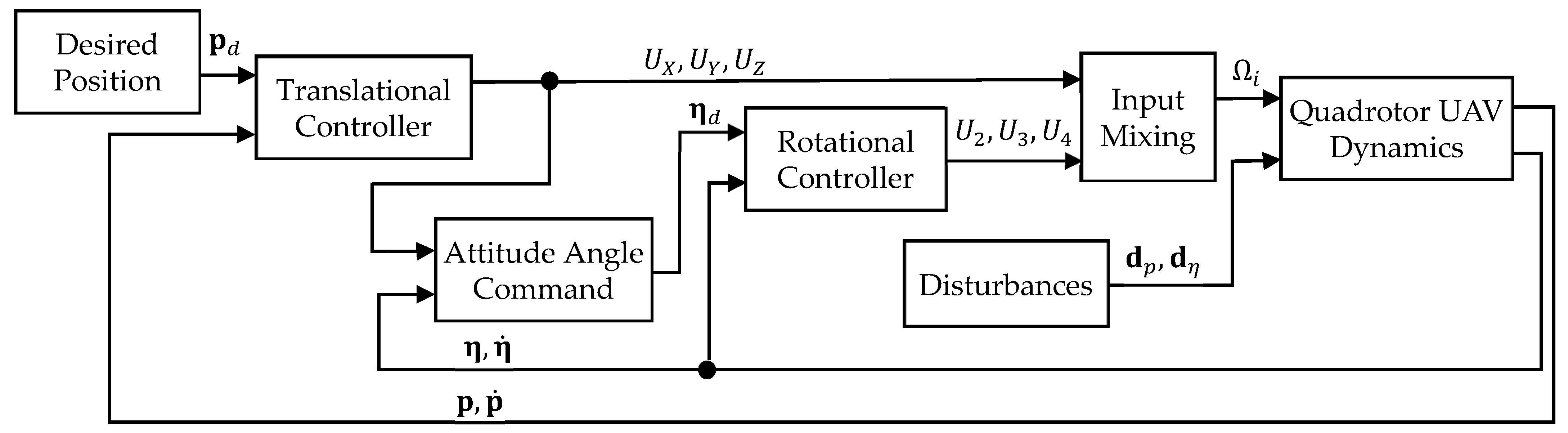
Figure 2 illustrates the overall architecture of the proposed flight control scheme for the quadrotor UAV.

3. Controller Design

3.1. L 1 Adaptive Control

The proposed method achieves convergence of the error to the reference value in finite time using NFTSTC and simultaneously suppresses unknown external disturbances by employing L 1 adaptive control. The L 1 adaptive controller consists of a state predictor, an adaptation law, and a low-pass filter. There are two types of L 1 adaptive control: Lyapunov-based and piecewise constant adaptation law. In this study, we adopt the piecewise constant adaptation law.
For the L 1 adaptive controller design [50,51,52], the following state-space equation is used:
x ˙ t = A x t + B u t + d m t + B d u m t
where x = x 1 x 2 T R n is the state vector, A R n × n is the system matrix, B R n × m is the input matrix, B R n × n m is a constant matrix that satisfies B T B = 0 , d m t R m is the matched disturbance, d u m R n m is the unmatched disturbance, and u t R m is defined as the sum of the sliding mode control terms ( u e q and u s t ) and L 1 adaptive control input u L 1 , as shown below:
u t = u e q t + u s t t + u L 1 t
The state predictor for L 1 adaptive control is as follows:
x ^ ˙ t = A x t + B u t + d ^ m t + B d ^ u m t + A s x ~ t
where A s is a Hurwitz matrix, x ~ = x ^ x is the prediction error, and · ^ denotes the estimated value. The adaptation law using the piecewise constant adaptive law is defined as follows:
d ^ t = d ^ i T s = B ¯ 1 Φ 1 μ i T s
where t i T s , i + 1 T s , T s is the sampling time and d ^ , B ¯ , Φ ,   μ i T s are as follows:
d ^ = d ^ m T d ^ u m T T B ¯ = B B Φ = A s 1 e x p A s T s I μ i T s = e x p A s T s x ~ i T s
In L 1 adaptive control, a low-pass filter C s is used to remove signals containing high-frequency components. In this case, the control input of L 1 adaptive control is expressed by the following equation:
u L 1 s = C s d ^ m s
In this study, a first-order low-pass filter C s as shown in the following equation is used:
C s = 1 τ s + 1 I
where the cutoff angular frequency is ω c = 1 / τ , and the low-pass filter satisfies C 0 = I .
Next, the disturbance rejection capability of L 1 adaptive control is analyzed. The prediction error dynamics is derived using x ~ = x ^ x as follows:
x ~ ˙ t = A s x ~ t + B ¯ d ^ d
Over the sampling interval t i T s , i + 1 T s , the solution to this differential equation is expressed as follows:
x ~ T s = e x p A s T s x ~ 0 + e x p A s T s I A s 1 B ¯ d ^ 0 + 0 T s e x p T s t A s B ¯ d t d t
where the adaptation law of L 1 adaptive control at t = 0 is defined as follows:
d ^ 0 = B ¯ 1 Φ 1 e x p A s T s x ~ 0
Substituting this adaptation law into the prediction error dynamics cancels out the first and second terms, leaving only the integral term as shown below.
x ~ T s = 0 T s e x p T s t A s B ¯ d t d t
Consequently, the prediction error of L 1 adaptive control is determined only by the accumulated effect of small disturbance variations over the sampling interval T s . Reducing T s therefore improves disturbance rejection, because shorter sampling periods confine these effects and ensure that both the state prediction error x ~ and the disturbance estimation error d ^ remain uniformly bounded.

3.2. Nonsingular Fast Terminal Super Twisting Sliding Mode Control

In this study, we employ a Nonsingular Fast Terminal Super-Twisting Sliding Mode Control strategy. It combines the singularity-free, fast transient response of Nonsingular Fast Terminal Sliding Mode Control with the robustness of the super-twisting algorithm.
The controller is designed for the nominal model, assuming that disturbances are effectively compensated by L 1 adaptive control. The state-space equation neglecting disturbances is defined as follows:
x ˙ = A x + B u e q + u s t
This system can be decomposed as the following equations.
x ˙ 1 = x 2
x ˙ 2 = u e q + u s t
The tracking error vector e = e 1 e 2 e n / 2 T R n / 2 and its derivative are defined below.
e = x 1 x d , e ˙ = x ˙ 1 x ˙ d
where x d R n / 2 is the desired state vector.
For comparison, the conventional linear sliding switching function σ l R n / 2 is given by
σ l = s l e + e ˙
where s l is a positive coefficient. Under the condition σ l = 0 , the error converges exponentially as e t = e t r e x p s l t t r , where t r is the time when the reaching phase ends. As indicated by this solution, the error e t converges to zero only as t , which represents asymptotic convergence, meaning that, theoretically, the error never reaches exactly zero in finite time.
Next, the equivalent control law for this linear surface is derived. Taking the time derivative of σ l yields the following:
σ ˙ l = s l e ˙ + e ¨   = s l e ˙ + x ¨ 1 x ¨ d
Designing the equivalent control law to satisfy σ ˙ = 0 yields the following equation:
u e q = s l e ˙ + x ¨ d
To address the limitation of asymptotic convergence, we employ the nonsingular fast terminal sliding nonlinear switching function σ = σ 1 σ 2 σ n / 2 T R n / 2 [28,29,30,31,32], designed as follows:
σ = e + α e λ s g n e + β e ˙ μ s g n e ˙
where α and β are positive coefficients, λ and μ satisfy 1 < μ < 2 and λ > μ , s g n · is the sign function, e λ = d i a g e 1 λ , e 2 λ , , e n / 2 λ and e ˙ μ = d i a g e ˙ 1 μ , e ˙ 2 μ , , e ˙ n / 2 μ . The sign function vectors are defined as s g n e = s g n e 1 s g n e 2 s g n e n / 2 T and s g n e ˙ = s g n e ˙ 1 s g n e ˙ 2 s g n e ˙ n / 2 T . When the state deviates significantly from the equilibrium, the first and second terms dominate and induce rapid convergence. As the state approaches the equilibrium, however, the first and third terms become prevalent. This arrangement facilitates a fast transient response while ensuring finite-time convergence.
Taking the time derivative of the nonlinear switching function yields the following:
σ ˙ = e ˙ + α λ e λ 1 e ˙ + β μ e ˙ μ 1 e ¨   = e ˙ + α λ e λ 1 e ˙ + β μ e ˙ μ 1 x ¨ 1 x ¨ d
Designing the equivalent control law to satisfy σ ˙ = 0 yields the following equation:
u e q = 1 + α λ e λ 1 β μ e ˙ 2 μ s g n e ˙ + x ¨ d
The control input in the super-twisting algorithm [39] is expressed as the following equations, using the switching function.
u s t = k 1 σ 1 2 s g n σ + ν s t   ν ˙ s t = k 2 s g n σ
where the switching gains k 1 and k 2 are positive coefficients, σ 1 2 = d i a g σ 1 1 2 , σ 2 1 2 , , σ n / 2 1 2 , and s g n σ = s g n σ 1 s g n σ 2 s g n σ n / 2 T .

3.3. Stability Analysis

The stability analysis is performed by dividing the behavior of the system into the reaching phase and the sliding phase. For each phase, finite-time convergence and an explicit bound on the convergence time are established through a Lyapunov-based argument.
First, it is shown that the system trajectories reach the sliding manifold σ i = 0   ( i = 1 , , n / 2 ) within a finite time by means of the Super-Twisting Algorithm (STA). For the stability analysis, attention is restricted to the i -th scalar subsystem. To facilitate the proof, the following vector ζ is introduced, following the formulation in [31,39].
ζ = ζ 1 ζ 2 T = σ i 1 2 s g n σ i ν s t T
The time derivative of this vector is given by
ζ ˙ = 1 ζ 1 Γ ζ Γ = 1 2 k 1 1 2 k 2 0
where ζ 1 = σ i 1 2 . Consider a quadratic Lyapunov function candidate expressed as follows:
V = ζ T Θ ζ
where Θ is a symmetric positive definite matrix. Differentiating the Lyapunov function yields the following equation.
V ˙ = 1 σ i 1 2 ζ T Λ ζ
where Λ is an arbitrary symmetric positive definite matrix. The matrices Γ , Θ satisfy the following algebraic Lyapunov equation.
Γ T Θ + Θ Γ = Λ
Here, when the switching gains satisfy k 1 > 0 and k 2 > 0 , the matrix Γ becomes a Hurwitz matrix. Consequently, if Γ is Hurwitz, the existence of a positive definite matrix Θ is guaranteed for any arbitrary symmetric positive definite matrix Λ . Thus, V ˙ becomes negative definite, ensuring the stability of the system. Furthermore, using Rayleigh’s inequality, the following finite-time convergence condition is derived.
V ˙ κ V 1 2
where κ is a coefficient defined by
κ = λ m i n Λ λ m i n 1 2 Θ λ m a x Θ
where λ m i n · and λ m a x · denote the minimum and maximum eigenvalues, respectively.
Therefore, the system converges to the sliding surface σ i = 0 within a finite time t r given by
t r 2 κ V σ i 0
The condition σ i = 0 holds during the sliding mode established by the super-twisting algorithm. Consequently, the nonlinear switching function [29] is expressed as follows:
e i + α e i λ s g n e i + β e ˙ i μ s g n e ˙ i = 0 β e ˙ i μ s g n e ˙ i = e i + α e i λ s g n e i
The above equation can be separated into the sign function and the remaining terms.
s g n e ˙ i = s g n e i , β e ˙ i μ = e i + α e i λ
The state error derivative e ˙ i is obtained by the following equation.
e ˙ i = 1 β e i + α e i λ   1 μ
Using the relationship s g n e ˙ i = e ˙ i / e ˙ i , the following equation is derived.
e ˙ i = 1 β e i + α e i λ   1 μ   s g n e i
To analyze the convergence of this nonlinear equation, the following Lyapunov candidate function is defined.
V = 1 2 e i 2
Differentiating the Lyapunov function with respect to time results in
V ˙ = e i e ˙ i
Substituting the previously derived state error derivative into this equation yields the following:
V ˙ = e i 1 β e i + α e i λ   1 μ   s g n e i   = 1 β e i μ + 1 + α e i λ + μ   1 μ
Thus, V ˙ < 0 , guaranteeing asymptotic stability. Furthermore, using the relationship e i = 2 V 1 2 from the defined Lyapunov function, the derivative is expressed as follows:
V ˙ = 1 β 2 V μ + 1 2 + α β 2 V λ + μ 2   1 μ
Based on finite-time stability theory, if the derivative of the Lyapunov function satisfies the form V ˙ < κ V ς   κ > 0 ,   0 < ς < 1 , the state converges to zero in finite time. In this study, the parameters are selected as 1 < μ < 2 , λ > μ to satisfy this condition. Consequently, the proposed method guarantees finite-time convergence, achieving faster tracking performance.
Therefore, unlike the asymptotic behavior of linear surfaces, the time t s required for the initial error e i t r 0 to reach zero e i t r + t s = 0 after entering the sliding mode is a finite time [32], which can be found as
t s = 0 e i t r β 1 μ e + α e i λ 1 μ d e = μ e i t r 1 1 μ α μ 1 · F 1 μ , μ 1 μ λ 1 ; 1 + μ 1 μ λ 1 ; α e i t r λ 1
where F · is the Gauss hypergeometric function [60].
The total convergence time t f is expressed by the following equation, combining the reaching mode time and the sliding mode time:
t f = t r + t s
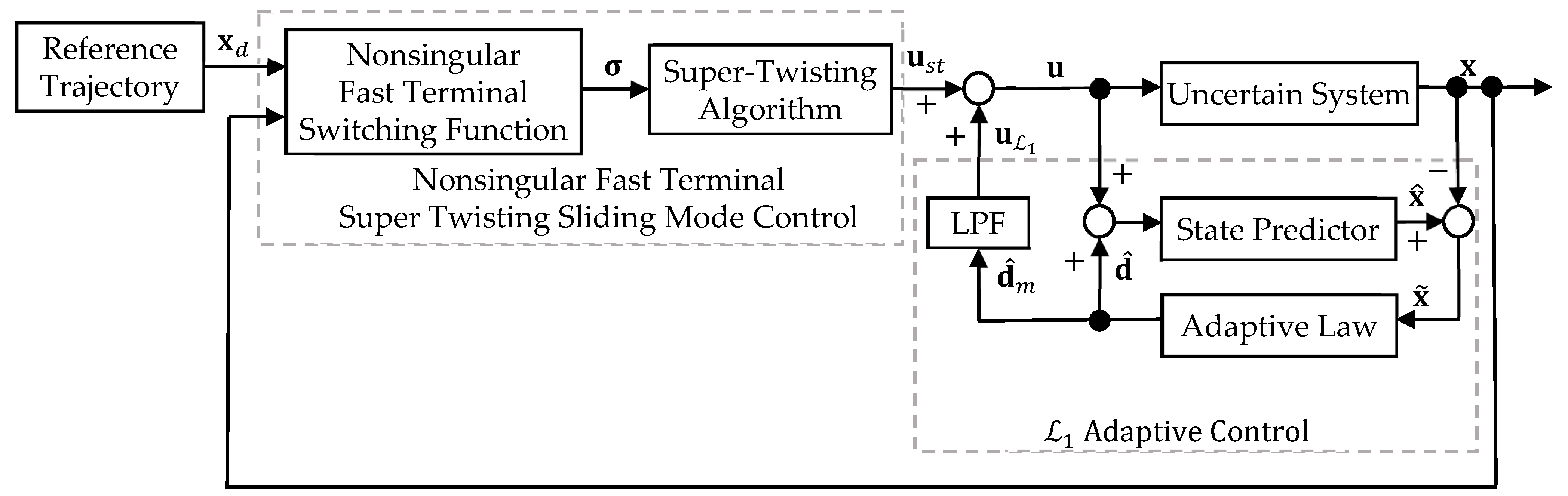
Figure 3 illustrates the structure of the proposed controller.

4. Numerical Simulation

In this section, we present the numerical simulations conducted to validate the proposed control method applied to a quadrotor UAV across three distinct scenarios. To evaluate its performance, the proposed method is compared with the following four existing control schemes: Super-Twisting Control (STC), Nonsingular Fast Terminal Super-Twisting Control (NFTSTC), L 1 Adaptive Super-Twisting Control ( L 1 -STC), and L 1 Adaptive Nonsingular Fast Terminal Super-Twisting Control ( L 1 -NFTSTC). Numerical simulations are conducted using MATLAB R2024b.
In the numerical simulations, the quadrotor is made to track a circular reference trajectory given below for 90 s in Scenario 1 and 30 s in Scenarios 2 and 3.
X d = 5 sin π 15 t
Y d = 5 cos π 15 t
Z d = 5
The parameters of the quadrotor are shown in Table 1, and the controller parameters are shown in Table 2. A quadrotor is an underactuated system that generates horizontal acceleration by tilting its thrust vector. Therefore, to achieve the desired translational motion, the attitude control must converge to the target value rapidly. Considering this physical characteristic, the control parameters for rotational motion were selected to ensure a faster response compared to those for translational motion. The switching gains k 1 and k 2 were set to identical values for both the comparative and proposed methods. The linear switching function gain s l for the STC and the nonlinear switching function gains α and β for the NFTSTC were tuned to achieve the shortest convergence time without overshoot. The parameters λ and μ were selected to satisfy the conditions 1 < μ < 2 and λ > μ . Similarly, for L 1 adaptive control, the parameter A s was selected to prioritize a faster response for the rotational motion, whereas the cutoff frequency ω c was chosen based on realistic actuator constraints.

4.1. Scenario 1: External Disturbance

In Scenario 1, the quadrotor was subjected to wind disturbances generated using the Dryden turbulence model [61].
To evaluate the reference trajectory tracking performance, the Integral of Squared Error (ISE) and Integral of Absolute Error (IAE) for position were calculated. Their results are shown in Table 3.
I S E = 0 T e p 2 d t
I A E = 0 T e p d t
where e p = p p d represents the position tracking error vector.
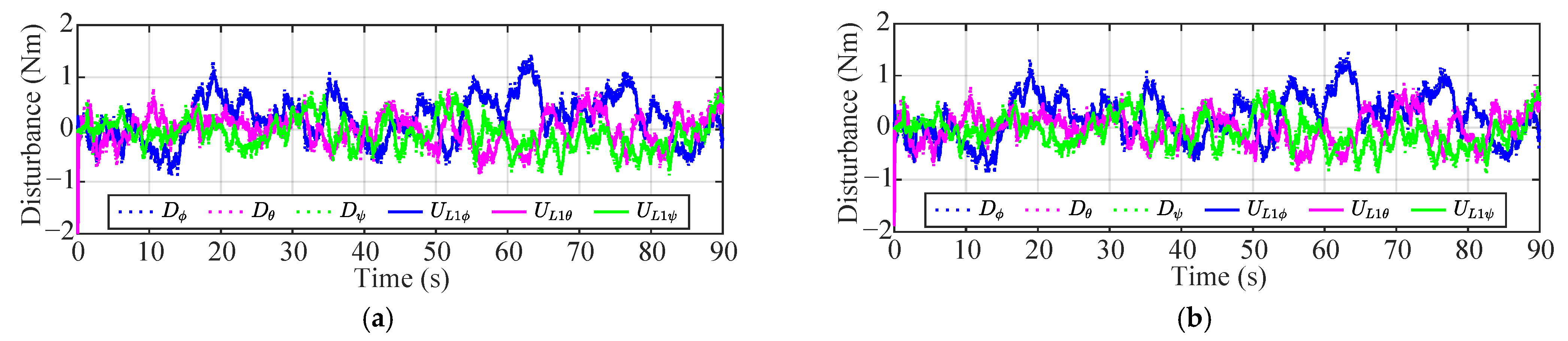
To demonstrate the disturbance rejection performance, the actual disturbances applied to the quadrotor are compared with the adaptive control inputs generated by the L 1 adaptive controller.
The translational disturbance D p = D X D Y D Z T and the rotational disturbance D η = D ϕ D θ D ψ T acting on the quadrotor are represented by the following models.
D p = m q d p
D η = I x y z d η
The translational L 1 adaptive control input U L 1 p = U L 1 X U L 1 Y U L 1 Z T and the rotational L 1 adaptive control input U L 1 η = U L 1 ϕ U L 1 θ U L 1 ψ T are defined.
U L 1 p = m q u L 1 p
U L 1 η = I x y z u L 1 η
Note that the sign of the control input from the above equation is reversed in the figure for the sake of clarity.
From Table 3, it is evident that NFTSTC has smaller values for both ISE and IAE than STC, indicating superior tracking performance. Furthermore, for both NFTSTC and STC, the methods combined with L 1 adaptive control show a dramatic decrease in ISE and IAE values. It is clear that the proposed method, L 1 -NFTSTC, has the smallest values for both ISE and IAE, demonstrating the most excellent control performance.
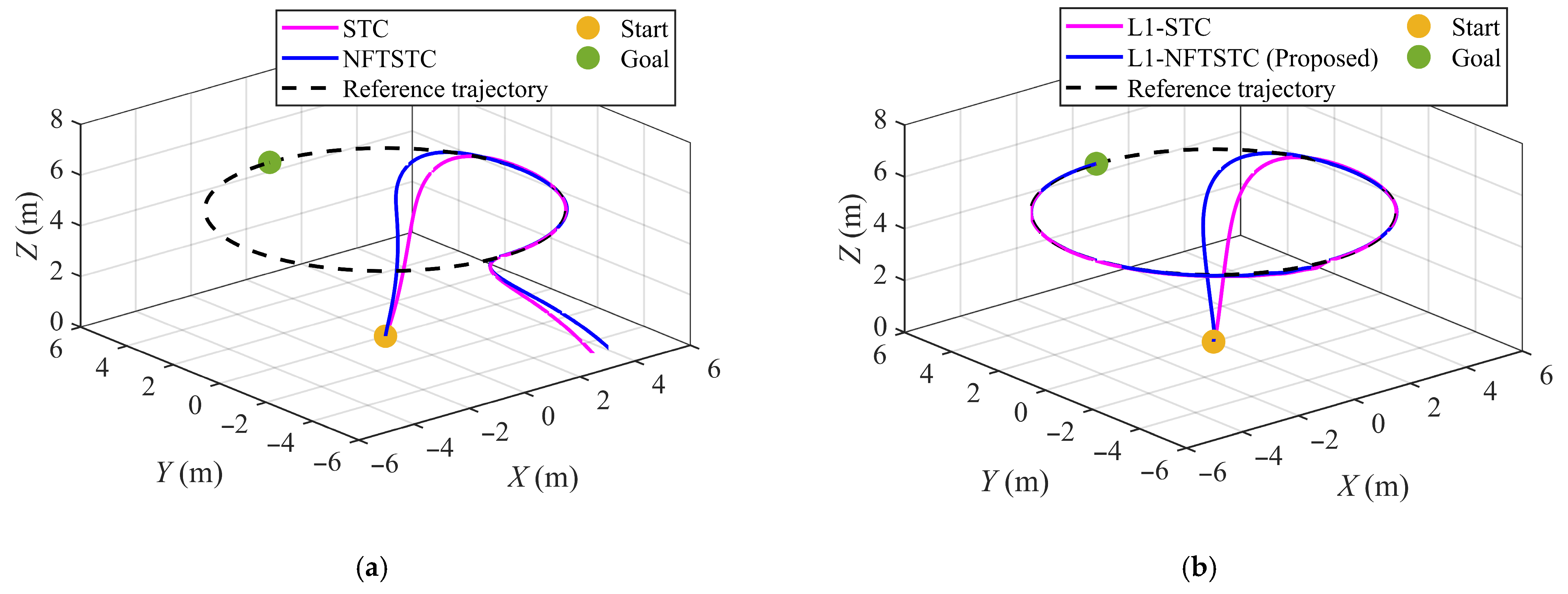
Figure 4 shows the quadrotor’s trajectory. Figure 4a shows the results for STC (magenta line) and NFTSTC (blue line), while Figure 4b shows the results for L 1 -STC (magenta line) and L 1 -NFTSTC (blue line). Even in the methods without L 1 adaptive control, divergence from the reference trajectory does not occur due to the robustness inherent in sliding mode control; however, oscillations around the reference trajectory are observed due to the influence of disturbances. In contrast, the methods augmented with L 1 adaptive control track the reference trajectory with high precision despite the disturbance environment, confirming improved robustness against disturbances. In particular, the proposed L 1 -NFTSTC demonstrates improved tracking performance at the beginning of the transient period.
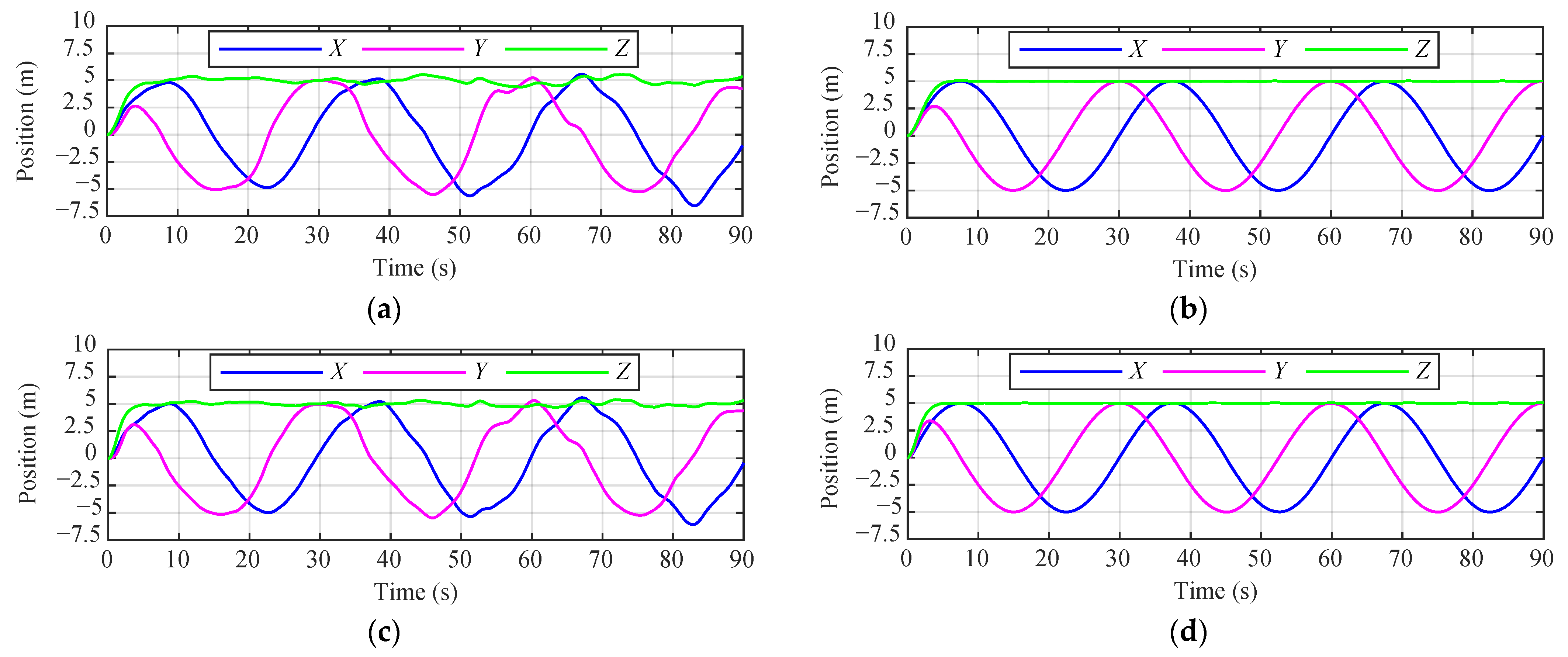
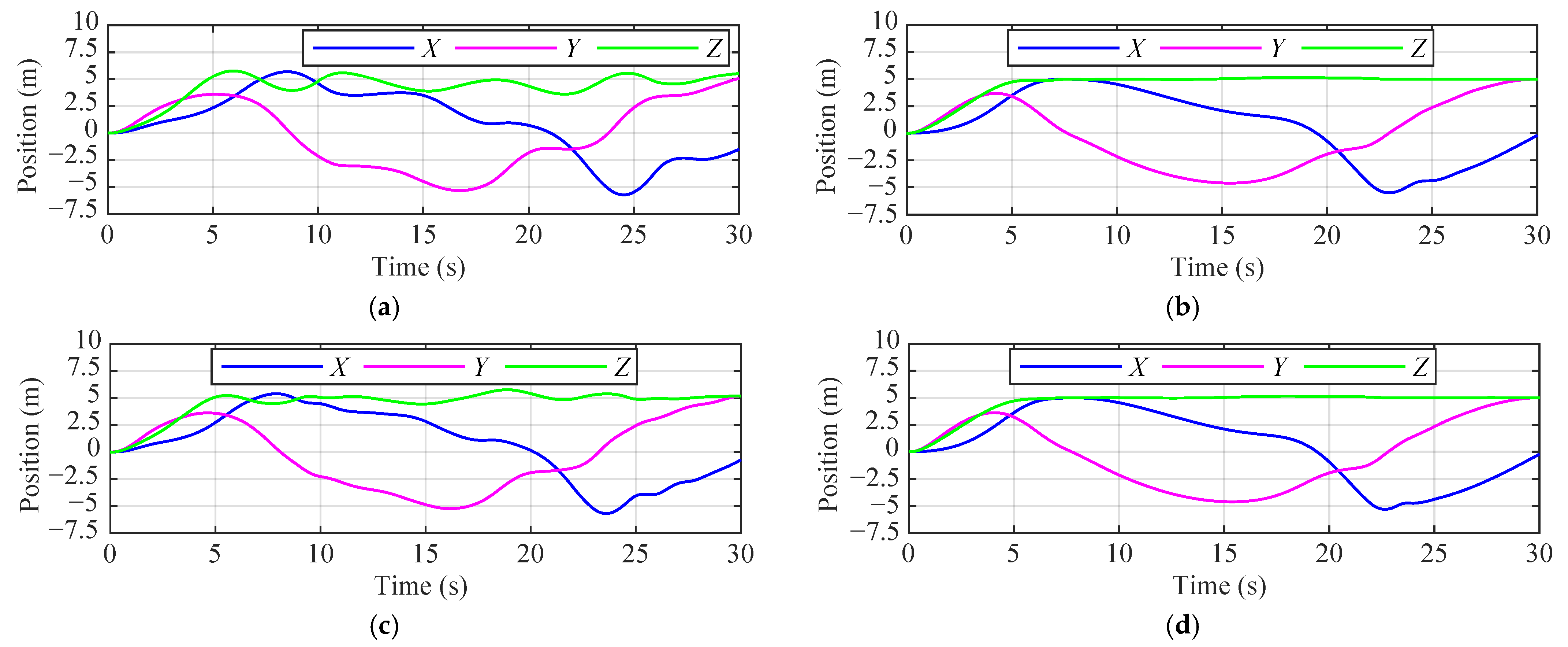
Figure 5 presents the time response of the quadrotor’s position. Examining both figures, it is observed that oscillations caused by disturbances are suppressed in the methods utilizing L 1 adaptive control, similar to the results in Figure 4. Furthermore, it is confirmed that the proposed L 1 -NFTSTC achieves faster convergence in the Z-axis direction compared to L 1 -STC.
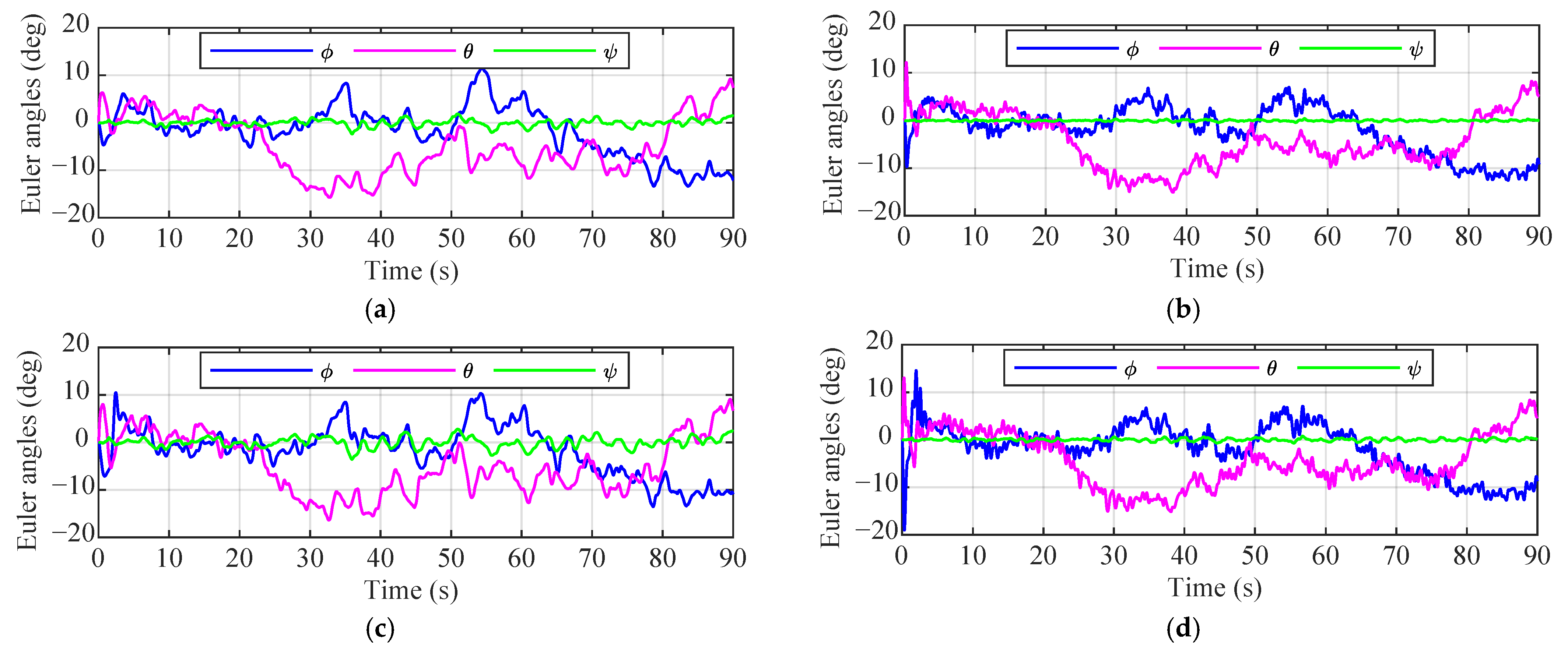
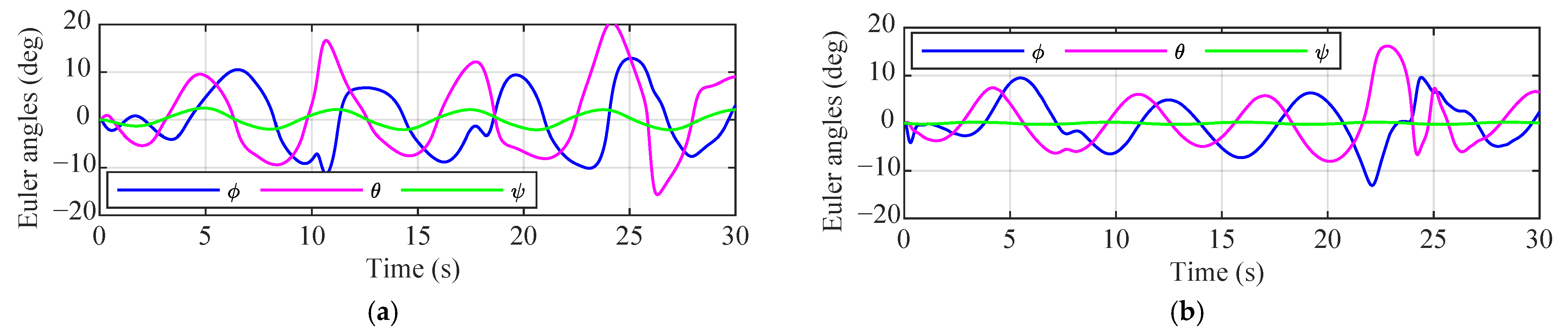
Figure 6 shows the time history of the quadrotor’s attitude angles. In the methods utilizing L 1 adaptive control, the attitude angles fluctuate actively as the controllers work to suppress disturbances.
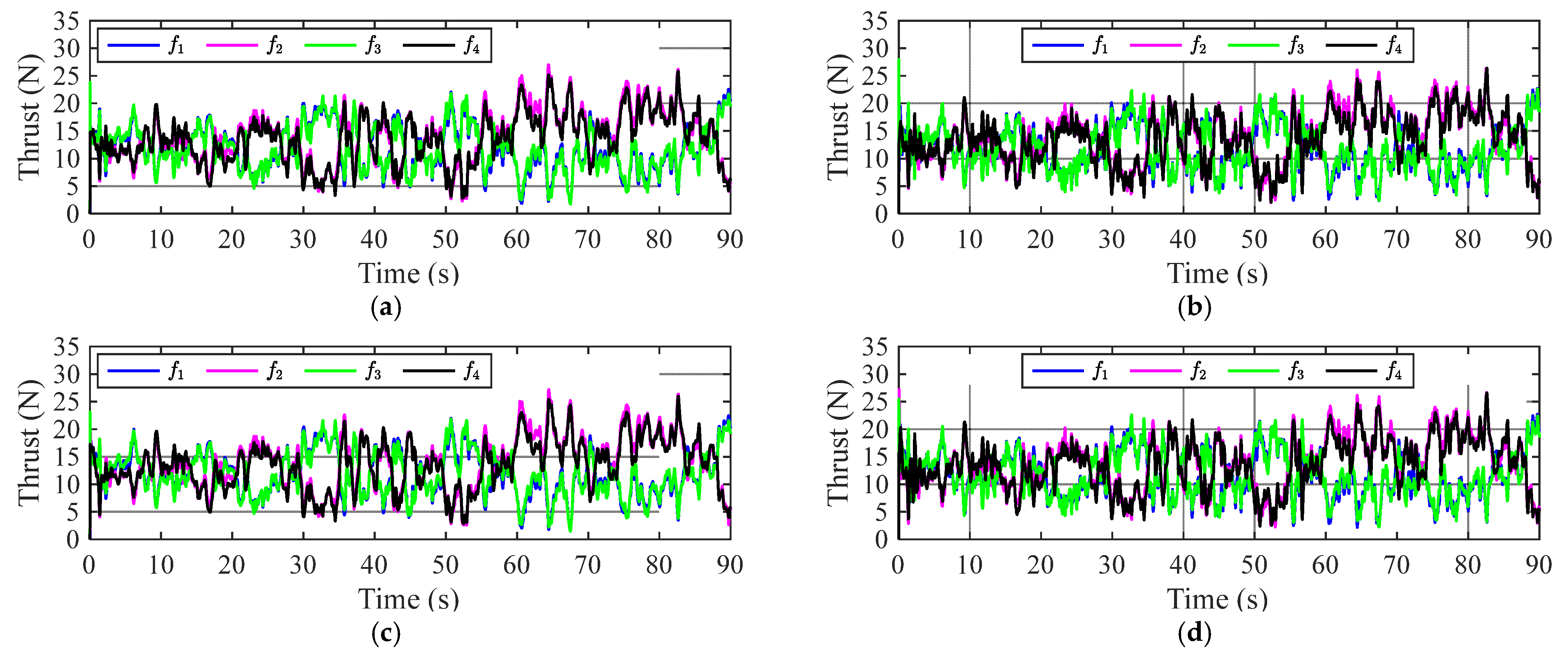
Figure 7 shows the time history of the quadrotor’s thrust. In all results, the significant chattering typically seen in conventional sliding mode control is not observed. This is considered an effect of introducing the Super-Twisting Algorithm and setting the switching gains to a minimum. Avoiding chattering is essential to prevent mechanical wear and system instability.
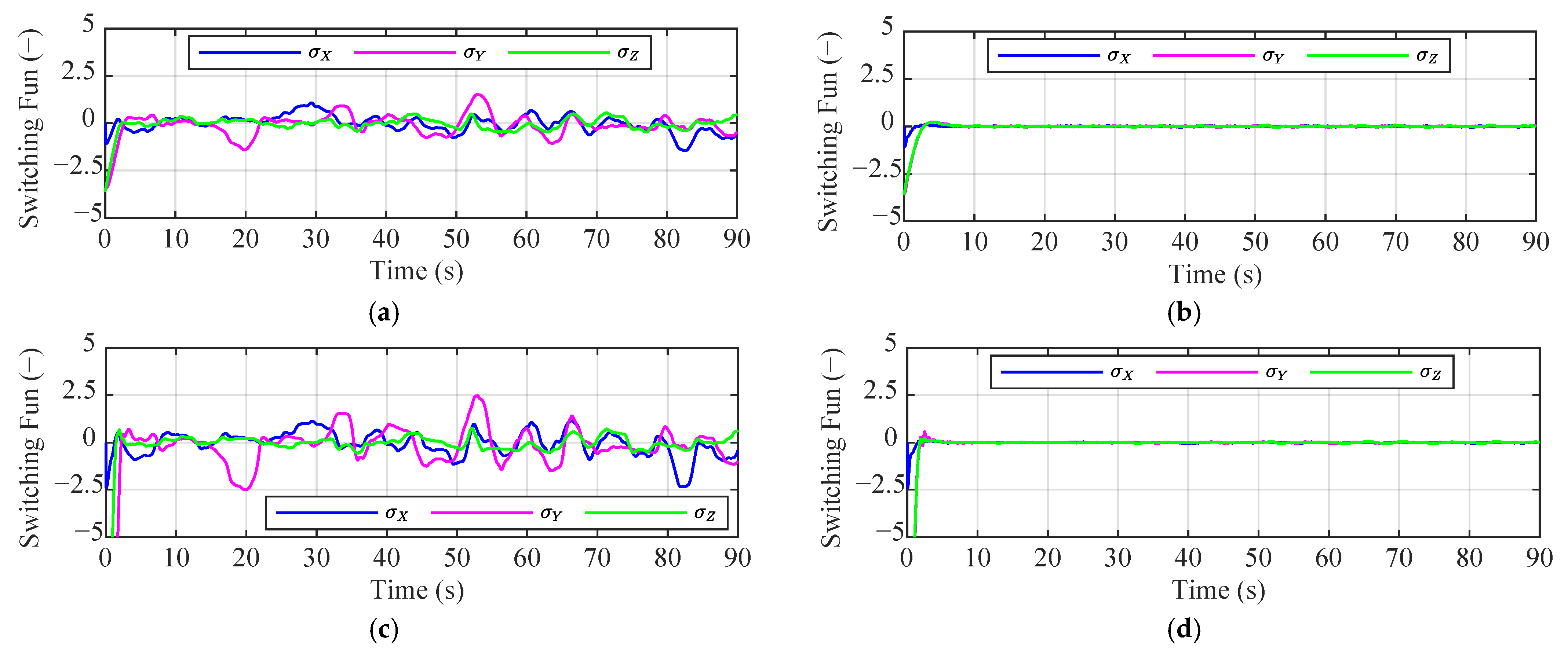
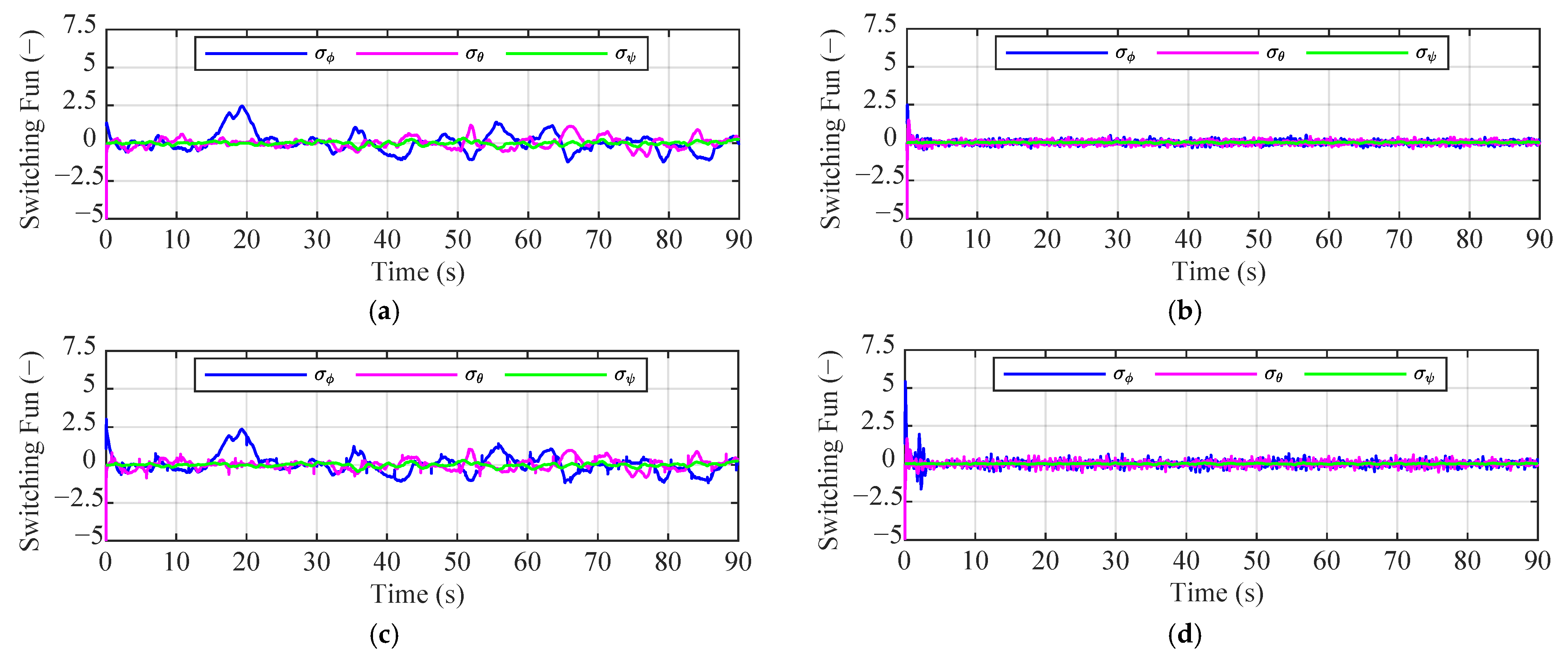
Figure 8 and Figure 9 present the temporal evolution of the switching functions associated with the translational and rotational controllers, respectively. In the methods without L 1 adaptive control, the switching function cannot be fully constrained to the sliding mode surface zero ( σ = 0 ) due to the influence of disturbances. In contrast, the methods combined with L 1 adaptive control successfully constrain the switching function to zero.
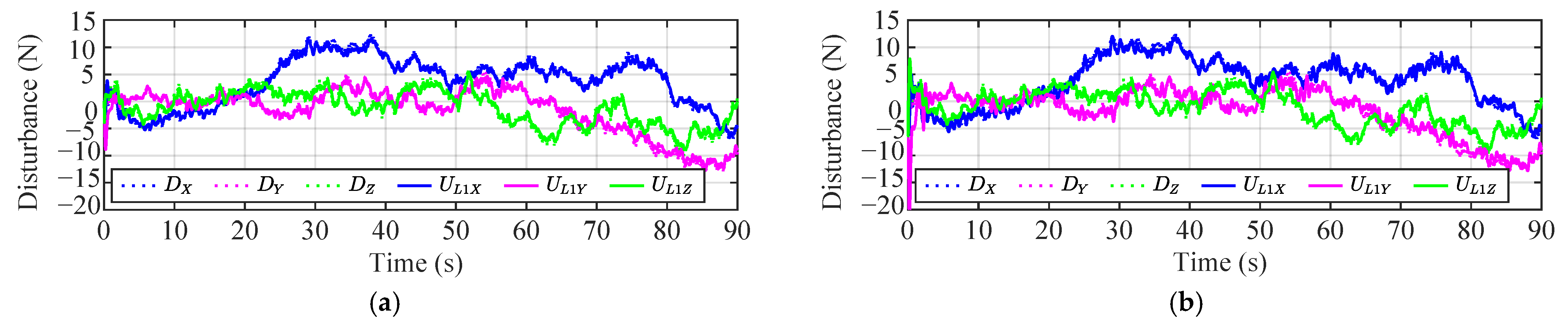
Figure 10 and Figure 11 show the time histories of the adaptive control inputs and the actual disturbances for the translational and rotational motions. Although there is a slight time delay between the estimated and actual disturbances, high-frequency noise is not observed. These results confirm that the L 1 adaptive controller effectively fulfills the role of disturbance rejection without destabilizing the quadrotor system.
Here, we revisit the time history of the quadrotor’s attitude angles in Figure 6. The combination with L 1 adaptive control leads to an increase in small high-frequency oscillations. At first glance, it appears that the L 1 adaptive control is commanding high-frequency signals. In reality, however, this behavior is attributed to the sign function switching within the sliding mode, as the integration of L 1 adaptive control successfully constrains the switching function to zero ( σ = 0 ). In other words, since the ideal sliding mode state is maintained, this result indicates continuous suppression of the residual error that the L 1 adaptive control could not fully cancel. If one were to attempt to achieve a similar level of disturbance suppression without L 1 adaptive control, a large switching gain would be required; this would lead to larger amplitude oscillations in the attitude angles, posing a problem of system instability.

4.2. Scenario 2: Collision Avoidance

Scenario 2 demonstrates robust collision avoidance using the artificial potential function in the presence of external disturbances. To test this robustness, the following time-varying disturbances are applied to the translational and rotational dynamics, respectively.
d p = sin t sin t cos t T , d η = sin t sin t cos t T
An obstacle is present on the reference trajectory corresponding to t = 15   s , and its radius is assumed to be 1 m. In this section, we explain the artificial potential function guidance law [62] used in this study. The attractive potential field U s , which guides the vehicle to the target, and the repulsive potential field U r , for avoiding obstacles, are given by the following equations.
U s e p = C s e p 2 + L s
U r e o = C r exp e o 2 L r
where C s is the magnitude of the attractive potential gradient, L s is the rate of change of the gradient near the attractive potential equilibrium point, e p is the relative distance between the target and current positions, C r is the magnitude of the repulsive potential gradient, L r is the rate of change of the gradient near the repulsive potential equilibrium point, and e o is the relative distance between the obstacle and current positions.
Consequently, the desired velocity vector v d based on the potential function guidance law is defined as the negative gradient of the potential functions:
v d = U s e p U r e o
The desired position p d is obtained by integrating the desired velocity vector as follows:
p d = v d d t
The quadrotor is guided using the potential function guidance law described above.
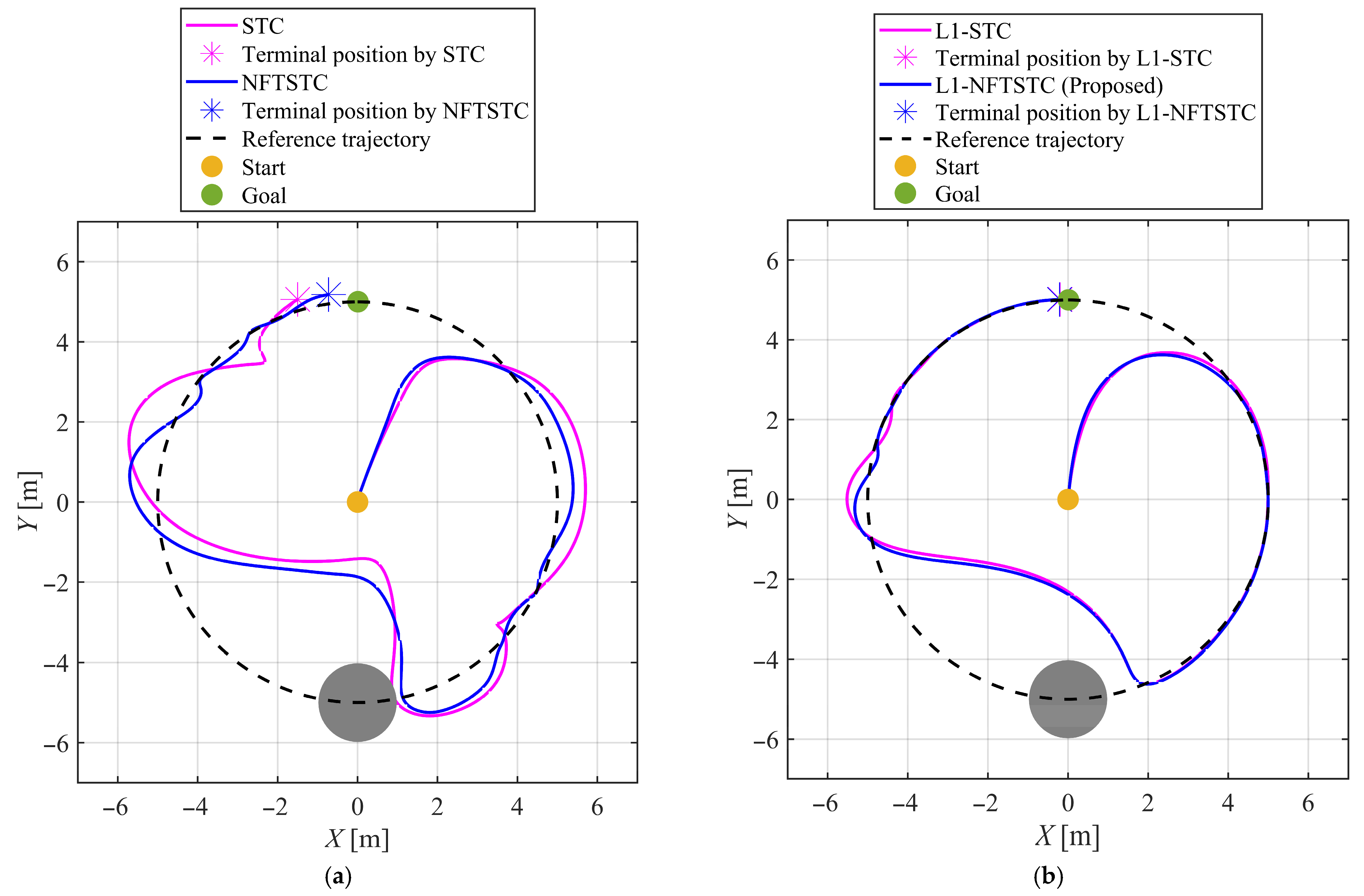
The flight path followed by the quadrotor is provided in Figure 12. In Figure 12a, the curves corresponding to the STC (magenta line) and NFTSTC (blue line) are plotted for comparison. Figure 12b shows the results for L 1 -STC (magenta line) and L 1 -NFTSTC (blue line). The methods without L 1 adaptive control fail to track the reference trajectory accurately due to the influence of disturbances, exhibiting unstable behavior near the obstacle. It can be seen that the NFTSTC, with its fast finite-time convergence property, tracks the reference trajectory better than the STC before and after obstacle avoidance, despite exhibiting oscillations due to disturbances. Furthermore, it is evident that the terminal position of the NFTSTC is closer to the goal compared to that of the STC. In contrast, the methods combined with L 1 adaptive control successfully perform both trajectory tracking and obstacle avoidance by suppressing the effects of disturbances. Consequently, the terminal position is closer to the goal compared to the methods without L 1 adaptive control. Furthermore, it is evident that the proposed L 1 -NFTSTC exhibits rapid convergence when returning to the reference trajectory after collision avoidance.
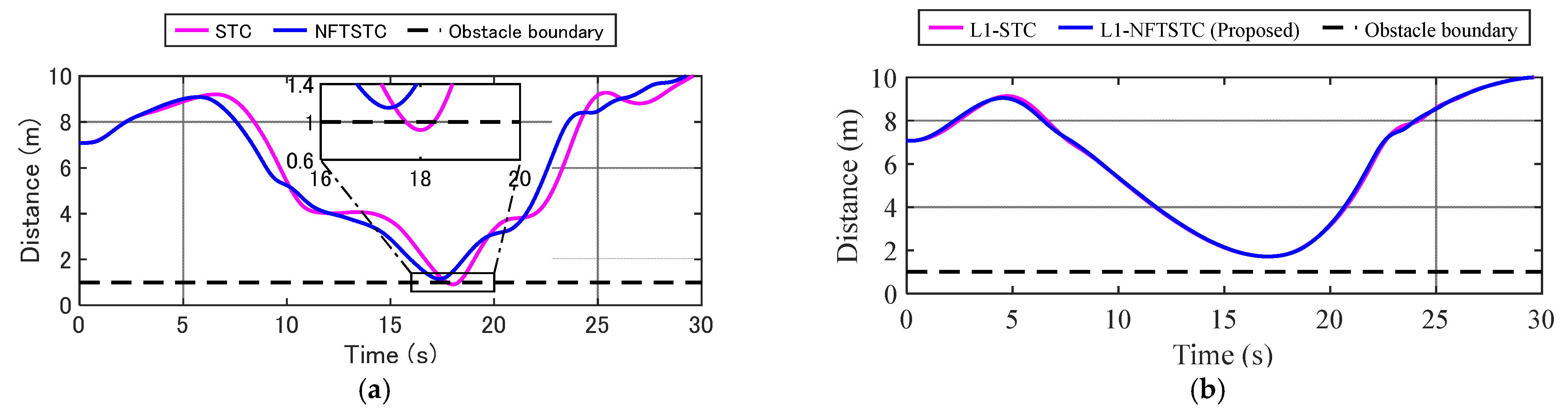
This observation is further supported by the time history of the relative distance e o between the quadrotor and the obstacle shown in Figure 13. Among the methods without L 1 adaptive control, the STC specifically allows the distance to the obstacle to drop below 1 m. Furthermore, the standard STC fails to reach the target value within the simulation time. In the methods combined with L 1 adaptive control, there is no significant difference in collision avoidance capability between L 1 -STC and L 1 -NFTSTC, as both maintain a safe distance from the obstacle.
Figure 14 shows the time history of the quadrotor’s position. Although there is no significant difference between L 1 -STC and L 1 -NFTSTC, a comparison between the NFTSTC and STC reveals that the NFTSTC effectively suppresses vibrations. These results suggest that the finite-time convergence property contributes to the improvement of robustness.
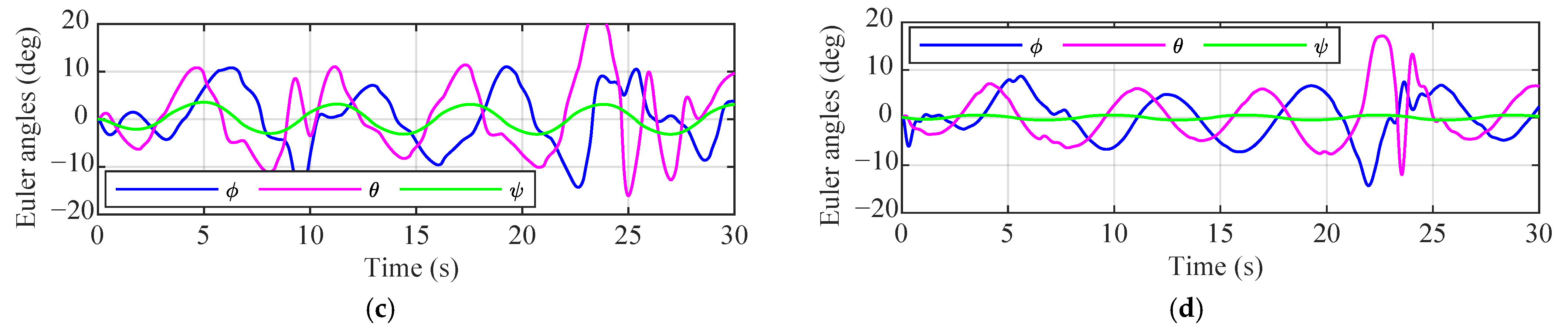
Figure 15 presents the time response of the quadrotor’s attitude angles. While L 1 -STC and L 1 -NFTSTC show similar performance, abrupt changes in attitude angles are observed in the NFTSTC and STC.
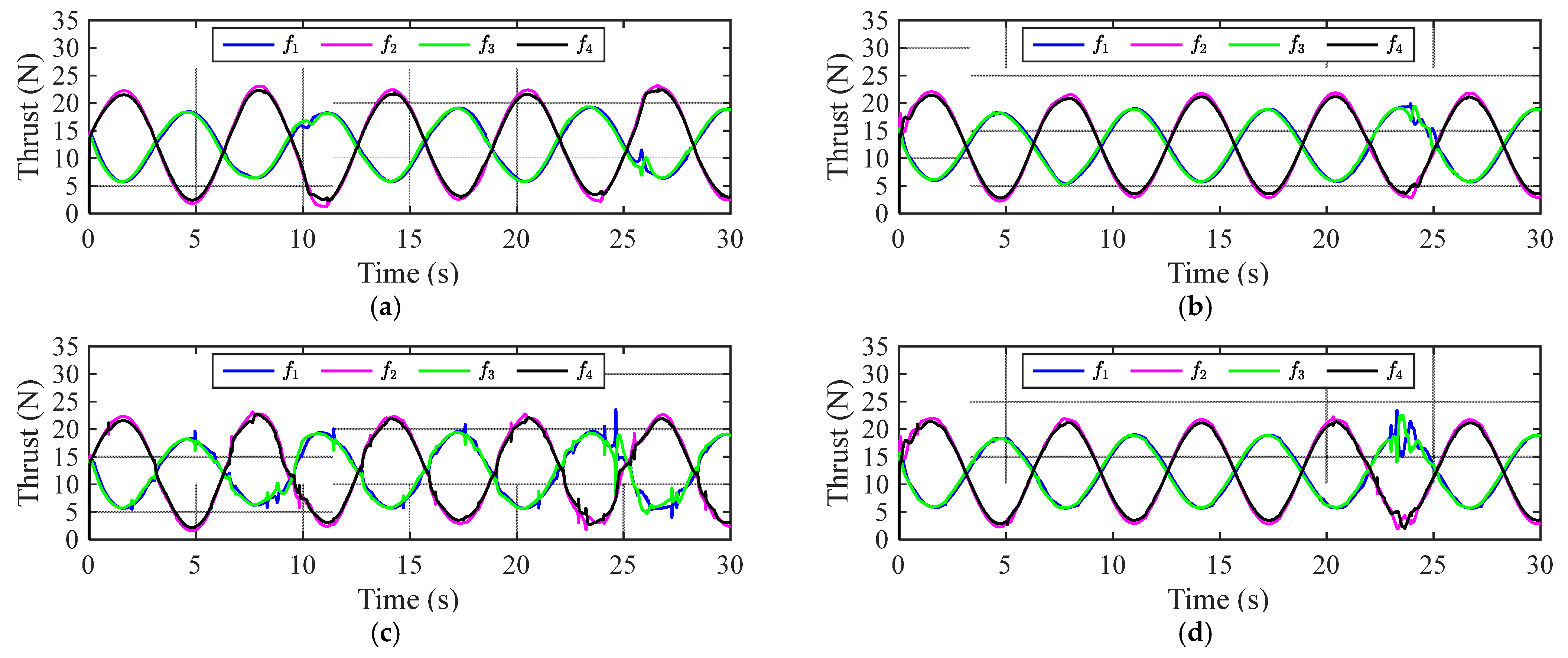
Figure 16 shows the time history of the quadrotor’s thrust. No chattering is observed in any of the methods.
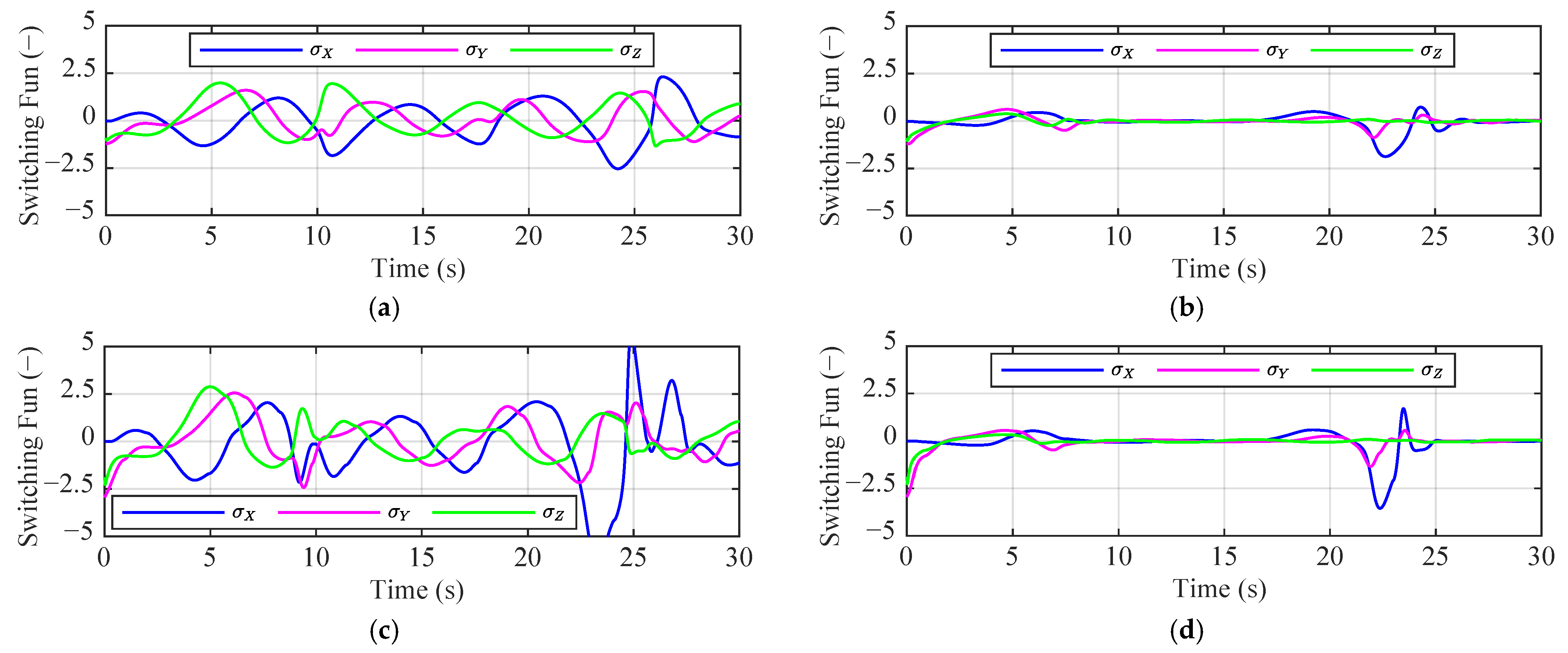
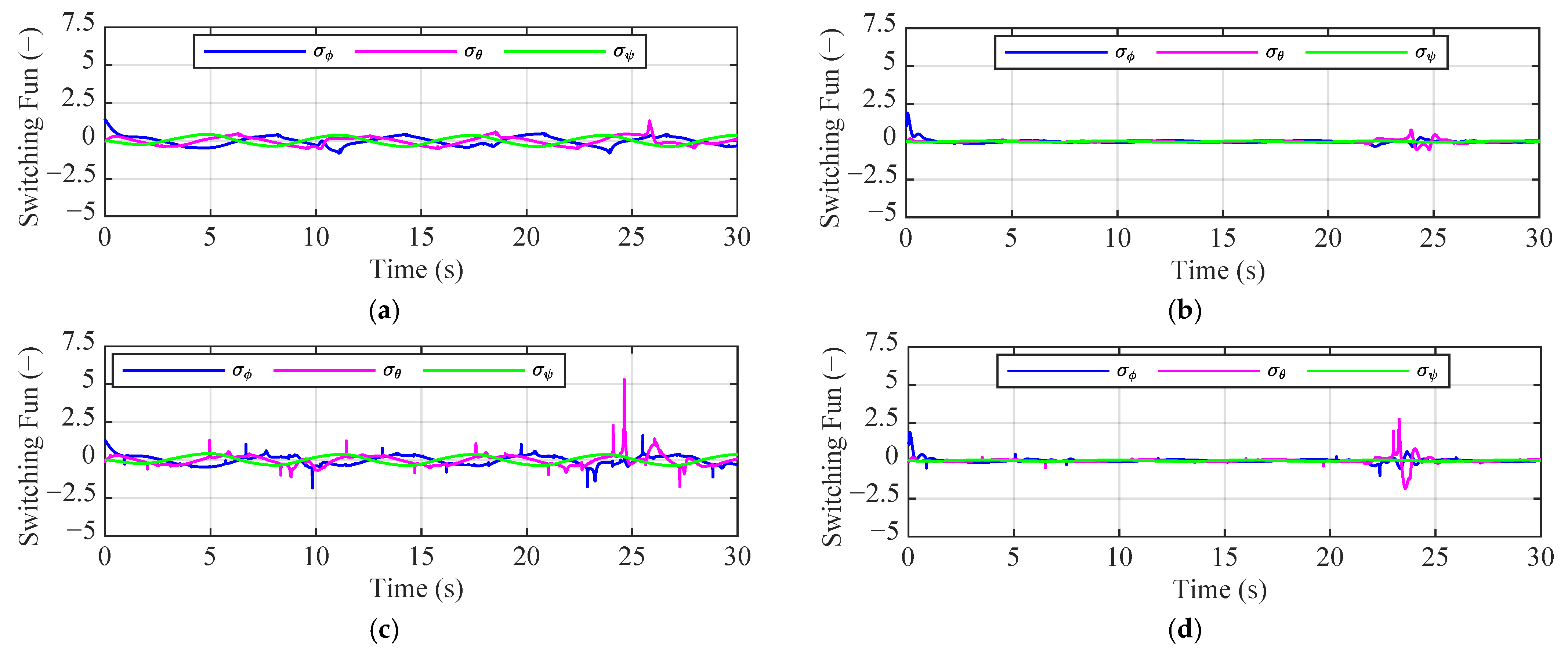
Figure 17 and Figure 18 show the time histories of the switching functions for the translational and rotational controllers, respectively. Compared to the methods without L 1 adaptive control, the methods utilizing L 1 adaptive control successfully constrain the switching functions to zero.
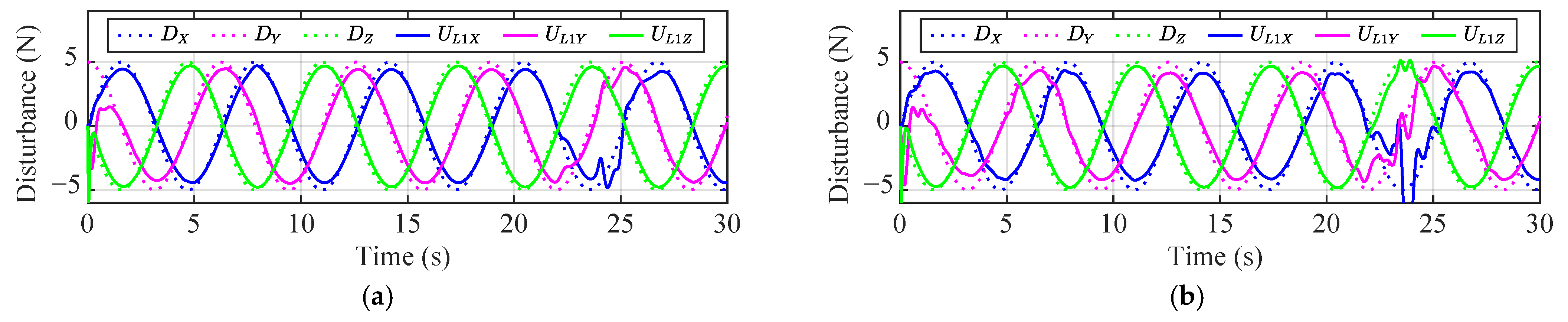
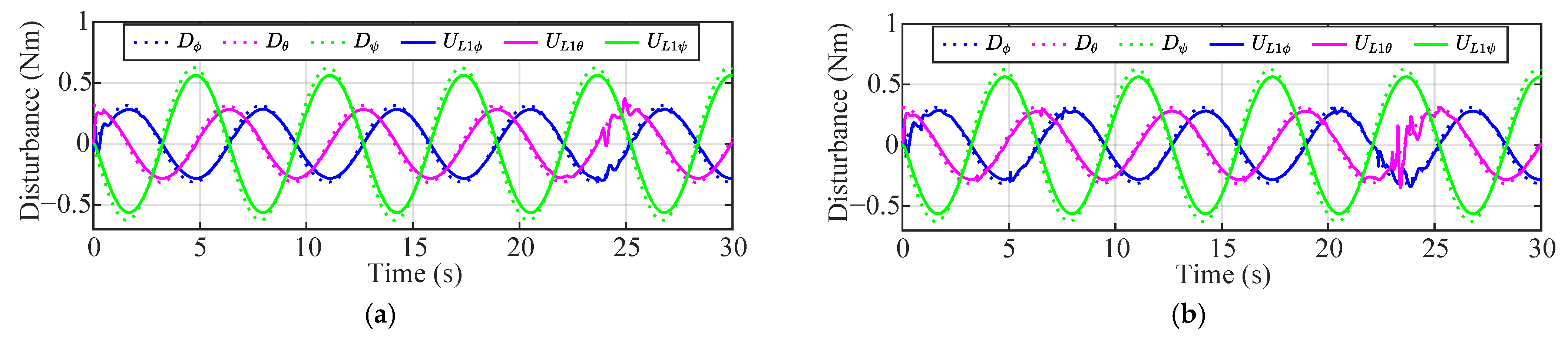
Figure 19 and Figure 20 show the time histories of the L 1 adaptive control inputs and the external disturbances for the translational and rotational axes, respectively. It can be seen that the disturbances are effectively estimated through L 1 adaptive control.
Based on these results, the proposed method is considered effective even in complex environments such as collision avoidance, as it demonstrates high tracking performance and robustness in following the guidance commands from the potential function guidance law. However, it should be noted that oscillations occur in the trajectory when returning to the path after avoiding the obstacle in each figure.

4.3. Scenario 3: Propeller Damage

In Scenario 3, damage to one of the quadrotor’s propellers is simulated at 15 s into the flight, reducing its thrust to 60% of its nominal value.
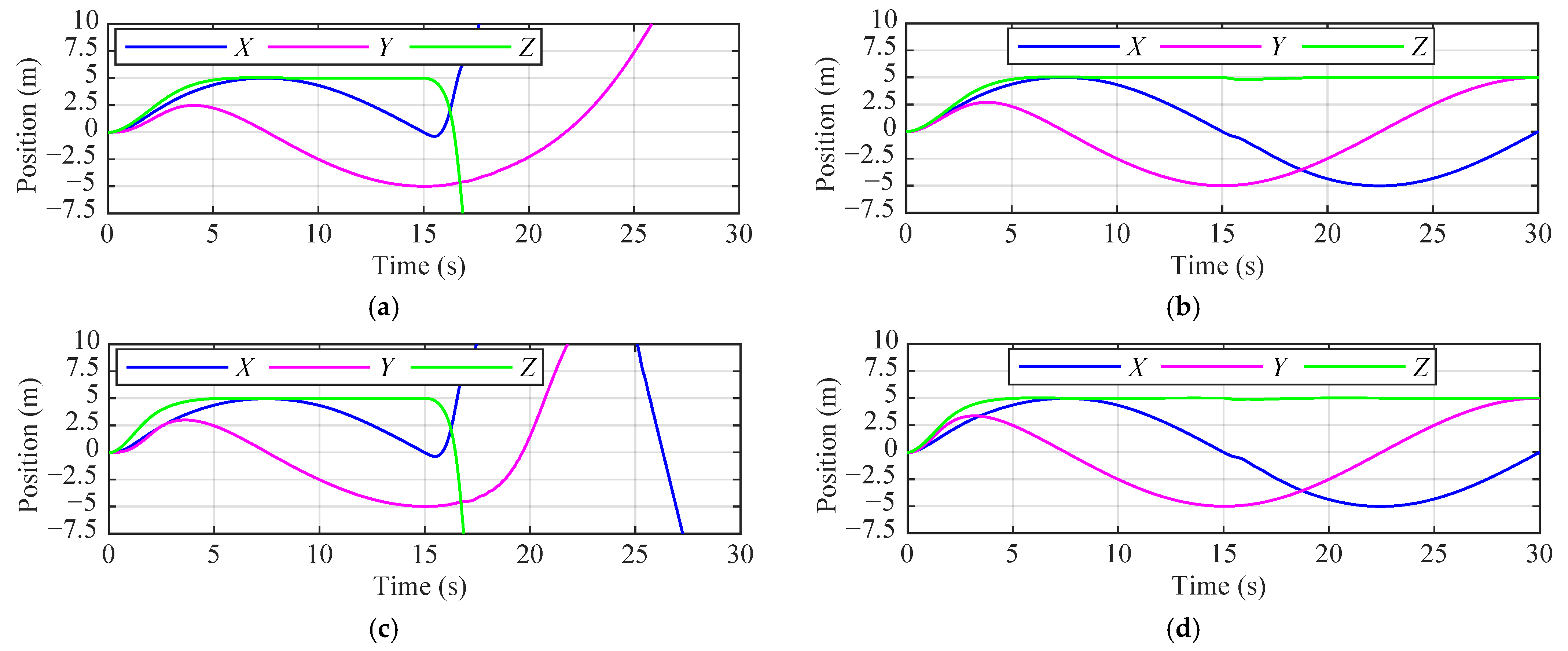
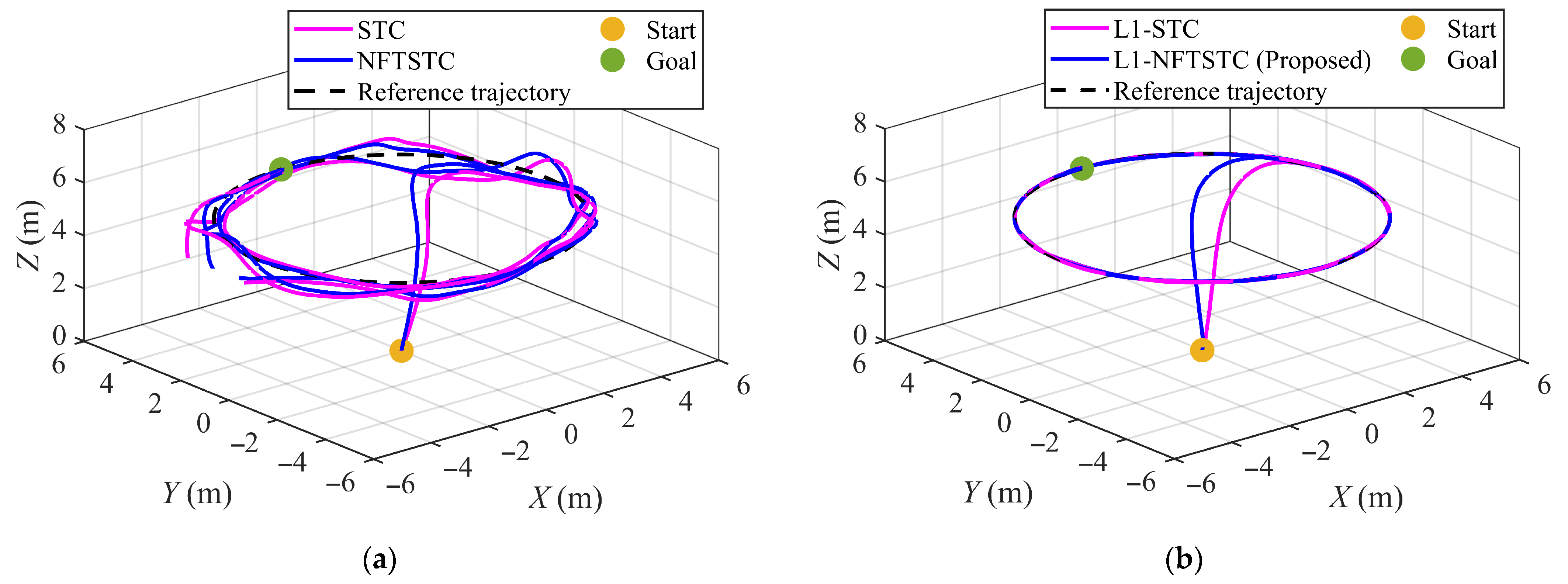
Figure 21 shows the quadrotor’s trajectory, and Figure 22 shows the time history of the quadrotor’s position. Figure 21a shows the results for STC (magenta line) and NFTSTC (blue line), and Figure 21b shows the results for L 1 -STC (magenta line) and L 1 -NFTSTC (blue line). The methods without L 1 adaptive control deviate significantly from the reference trajectory and diverge when propeller damage occurs. In contrast, the methods combined with L 1 adaptive control continue stable flight and maintain the trajectory by adapting quickly after propeller damage.
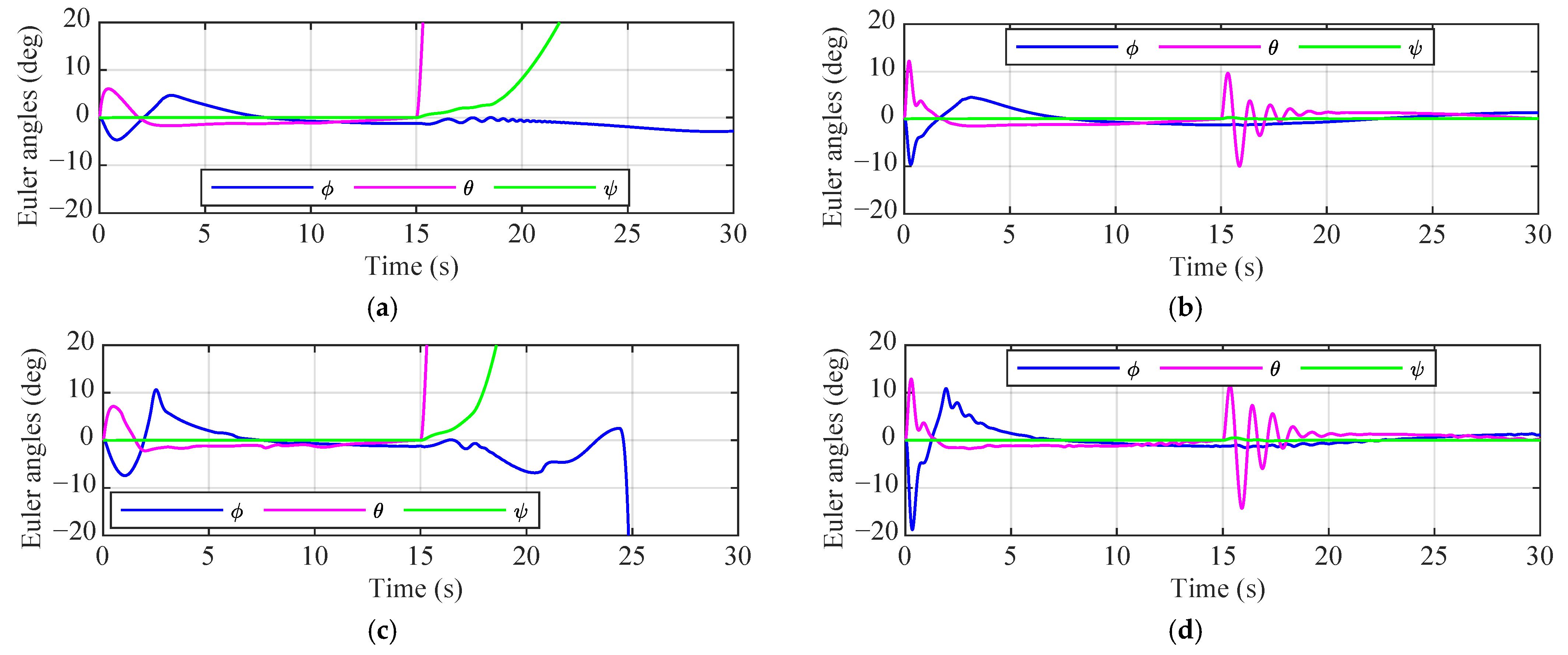
Figure 23 presents the time response of the quadrotor’s attitude angles. The methods without L 1 adaptive control lose their attitude and diverge at the time of propeller damage; however, the methods with L 1 adaptive control, although showing a momentary attitude disturbance, maintain a stable attitude, indicating that they can adapt quickly to unexpected model changes.
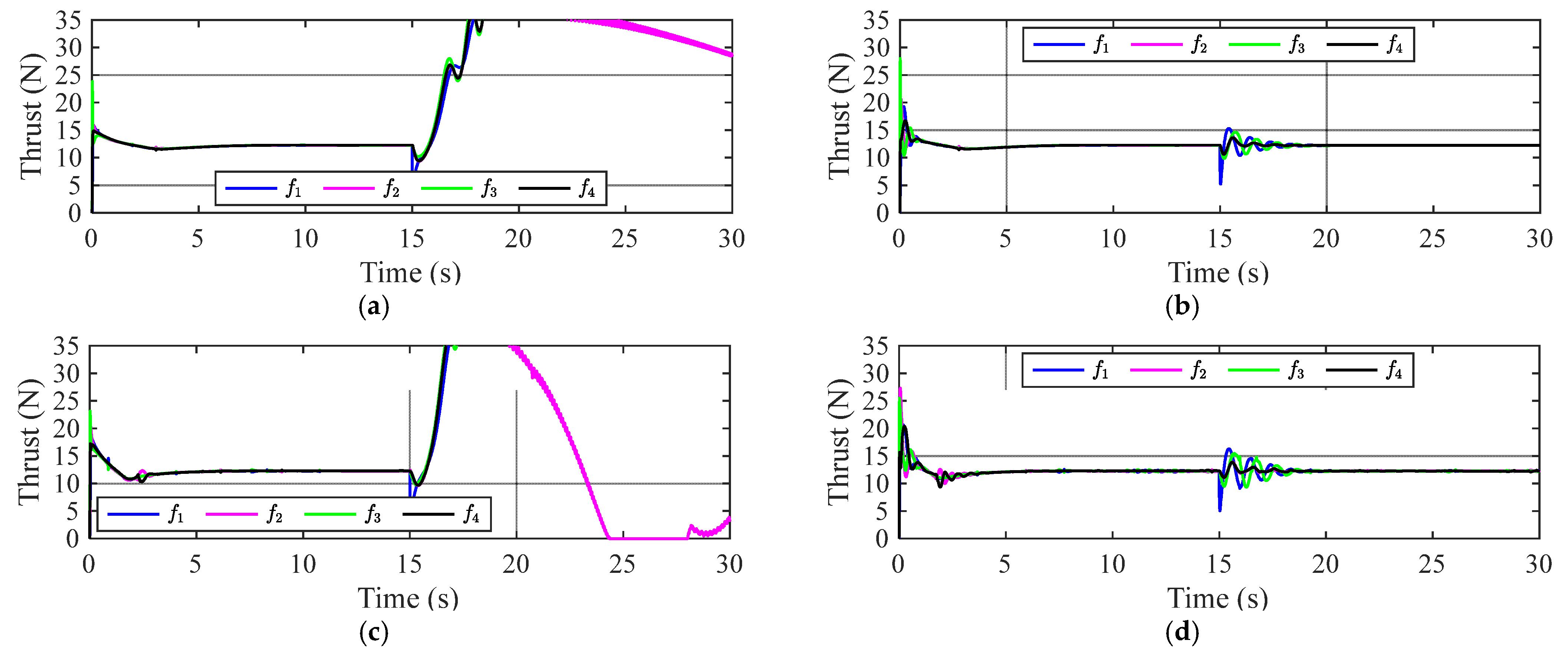
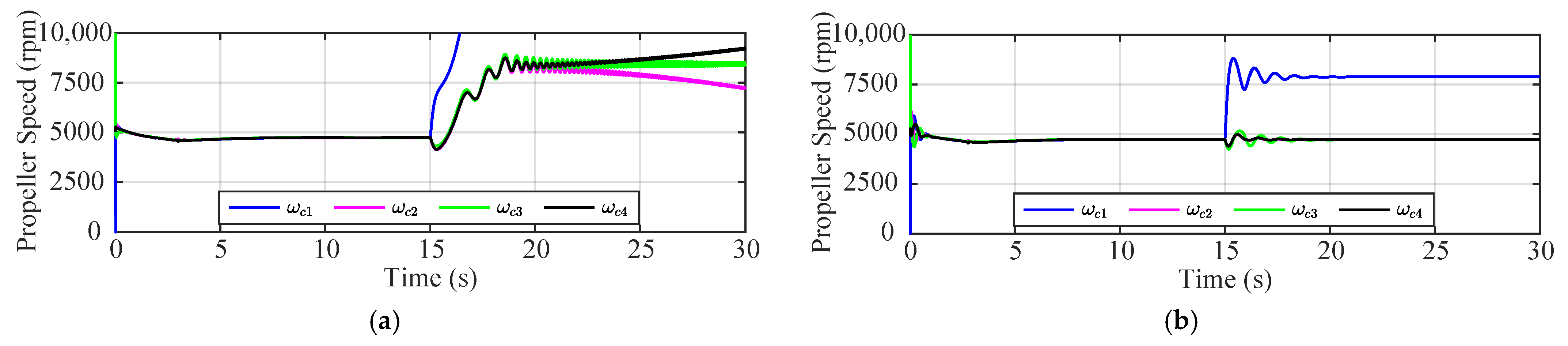
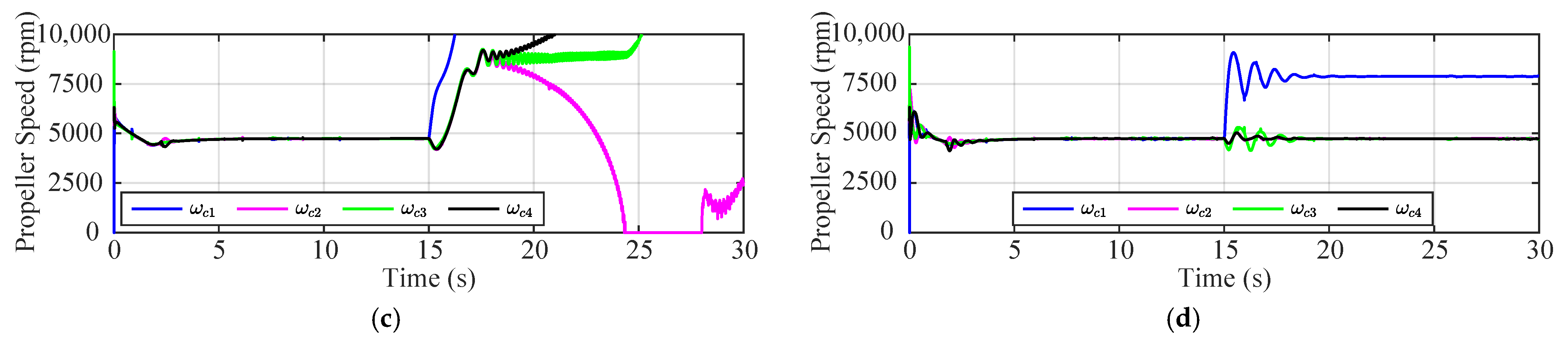
Figure 24 shows the time history of the quadrotor’s thrust, and Figure 25 shows the time history of the commanded rotational speed of the quadrotor’s rotors. The methods with L 1 adaptive control restore thrust by quickly increasing the rotational speed of the propellers at the time of damage compared to the methods without this feature, showing that they maintain the balance of the aircraft’s thrust and torque, allowing it to continue flying.
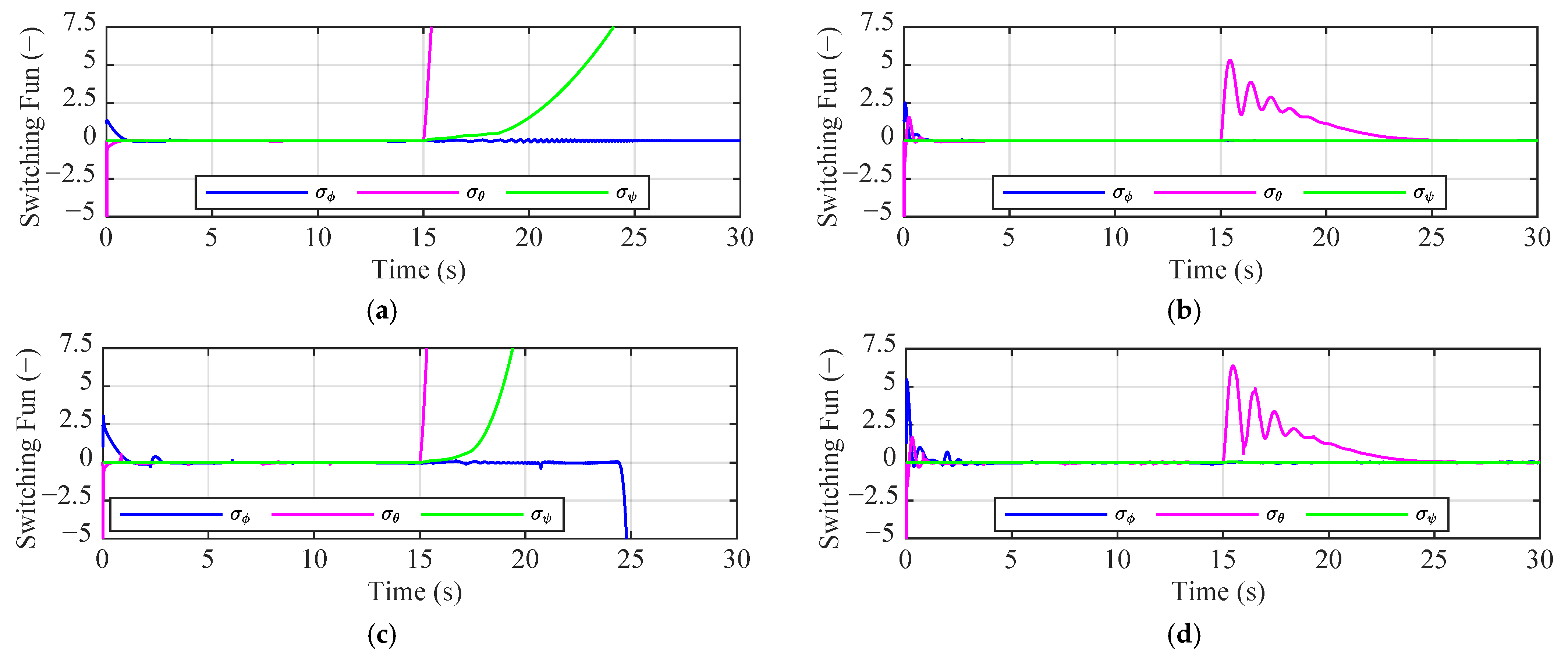
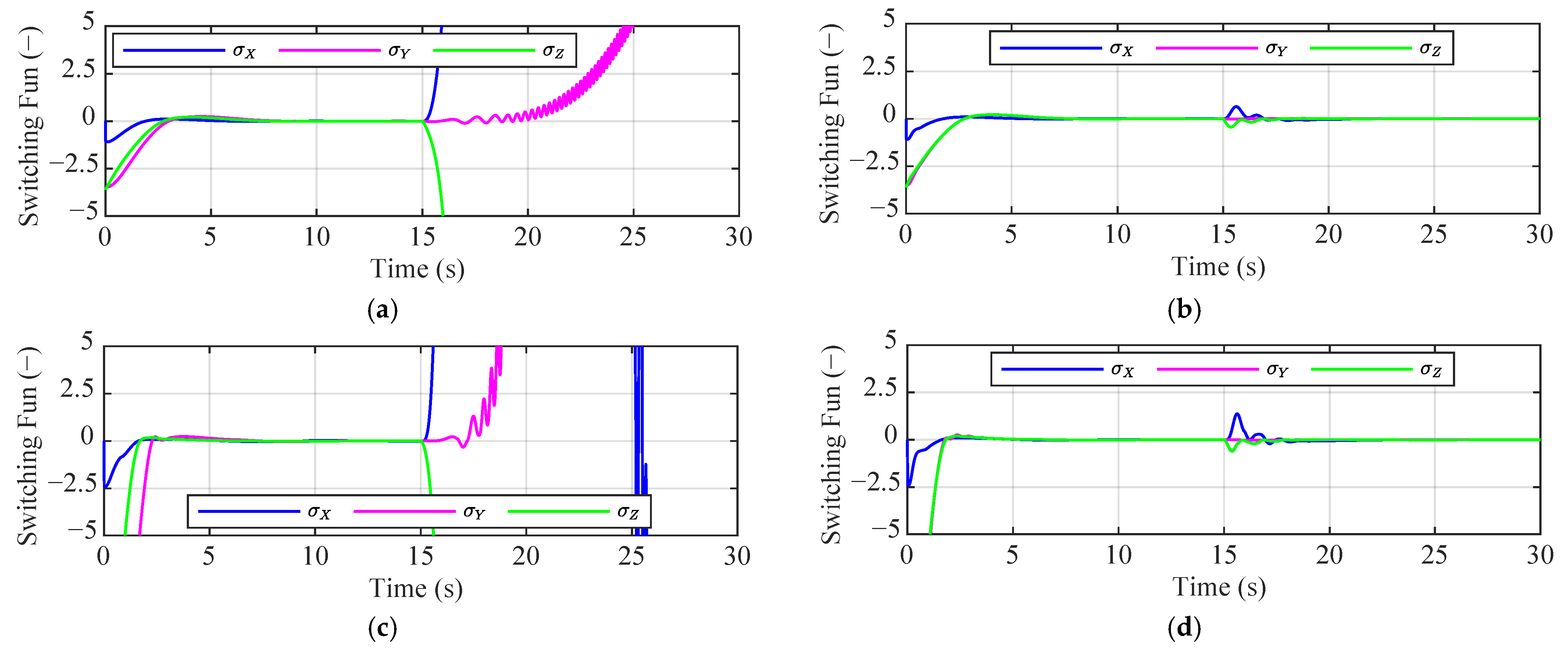
Figure 26 shows the time history of the translational switching function, and Figure 27 shows the time history of the rotational switching function. In the methods without L 1 adaptive control, the switching function diverges significantly at the time of propeller damage, leading to loss of control. In contrast, in the methods with L 1 adaptive control, the switching function vibrates slightly at the time of damage but is immediately constrained back to zero, suggesting that L 1 adaptive control treats the effect of the damage as a disturbance, assisting the sliding mode control to function stably.

4.4. Discussion on Real-Time Implementation

In this section, we discuss the feasibility of real-time implementation of the proposed L 1 -NFTSTC.
First, regarding L 1 adaptive control, although it involves matrix operations for the state predictor and adaptation law, the computational burden is limited. This is because the employed piecewise constant adaptation law relies solely on matrix calculations. Furthermore, the sampling interval can be set to accommodate the processing capabilities of the CPU. This advantage of light computational load is also explicitly stated in Reference [51].
Second, the NFTSTC (sliding mode control) component is primarily composed of algebraic computations involving power terms and sign functions. Consequently, the proposed L 1 -NFTSTC does not require computationally expensive iterative optimization processes at each control step. Unlike Model Predictive Control (MPC), which typically necessitates solving optimization problems online, the computational load of the NFTSTC is sufficiently low for modern processors.
Therefore, although the complexity increases compared to linear controllers like PID, the proposed method is considered computationally realizable on resource-constrained embedded systems.

5. Conclusions

This study introduced an L 1 Adaptive Nonsingular Fast Terminal Super-Twisting Sliding Mode Control architecture designed to ensure finite-time stability and high robustness under uncertain and unbounded disturbances. The controller was implemented on a quadrotor model, and its performance was investigated numerically. The simulation outcomes show clear advantages over traditional techniques, including greater disturbance tolerance and faster stabilization when confronted with wind effects, periodic obstacle-avoidance scenarios, and unexpected propeller degradation.
Subsequent studies will seek to address robustness issues arising from practical constraints such as noisy measurements and communication or processing delays, and to conduct experimental validation on a physical quadrotor system.

Author Contributions

Conceptualization, S.K.; methodology, S.K.; software, S.K.; validation, S.K. and K.U.; investigation, K.M.; writing—original draft preparation, S.K.; writing—review and editing, K.U.; supervision, K.U.; funding acquisition, K.U. All authors have read and agreed to the published version of the manuscript.

Funding

This work was partly supported by JSPS KAKENHI Grant Number 25K07670.

Data Availability Statement

The original contributions presented in this study are included in the article. Further inquiries can be directed to the corresponding author.

Conflicts of Interest

The authors declare no conflicts of interest.

Abbreviations

The following abbreviations are used in this manuscript:
UAVUnmanned Aerial Vehicle
PIDProportional–Integral–Derivative Control
LQRLinear Quadratic Regulator
MPCModel Predictive Control
FTCFinite-Time Control
SMCSliding Mode Control
STCSuper-Twisting (Sliding Mode) Control
STASuper-Twisting Algorithm
TSMCTerminal Sliding Mode Control
NFTSMCNonsingular Fast Terminal Sliding Mode Control
NFTSTCNonsingular Fast Terminal Super-Twisting (Sliding Mode) Control
MRACModel Reference Adaptive Control
L 1 AC L 1 Adaptive Control
L 1 -STC L 1 (Adaptive) Super-Twisting (Sliding Mode) Control
L 1 -NFTSTC L 1 (Adaptive) Nonsingular Fast Terminal Super-Twisting (Sliding Mode) Control
ISEIntegral of Squared Error
IAEIntegral of Absolute Error

References

  1. Gupte, S.; Mohandas, P.I.T.; Conrad, J.M. A survey of quadrotor Unmanned Aerial Vehicles. In Proceedings of the 2012 IEEE Southeastcon, Orlando, FL, USA, 15–18 March 2012; pp. 1–6. [Google Scholar] [CrossRef]
  2. Guenard, N.; Hamel, T.; Eck, L. Control Laws for the Tele Operation of an Unmanned Aerial Vehicle Known as an X4-flyer. In Proceedings of the 2006 IEEE/RSJ International Conference on Intelligent Robots and Systems, Beijing, China, 9–15 October 2006; pp. 3249–3254. [Google Scholar] [CrossRef]
  3. Nigam, N.; Bieniawski, S.; Kroo, I.; Vian, J. Control of Multiple UAVs for Persistent Surveillance: Algorithm and Flight Test Results. IEEE Trans. Control Syst. Technol. 2012, 20, 1236–1251. [Google Scholar] [CrossRef]
  4. Islam, S.; Liu, P.X.; El Saddik, A. Robust Control of Four-Rotor Unmanned Aerial Vehicle with Disturbance Uncertainty. IEEE Trans. Ind. Electron. 2015, 62, 1563–1571. [Google Scholar] [CrossRef]
  5. Abdelmaksoud, S.I.; Mailah, M.; Abdallah, A.M. Control Strategies and Novel Techniques for Autonomous Rotorcraft Unmanned Aerial Vehicles: A Review. IEEE Access 2020, 8, 195142–195169. [Google Scholar] [CrossRef]
  6. Kim, J.; Gadsden, S.A.; Wilkerson, S.A. A Comprehensive Survey of Control Strategies for Autonomous Quadrotors. Can. J. Electr. Comput. Eng. 2020, 43, 3–16. [Google Scholar] [CrossRef]
  7. Cao, N.; Lynch, A.F. Inner–Outer Loop Control for Quadrotor UAVs with Input and State Constraints. IEEE Trans. Control Syst. Technol. 2016, 24, 1797–1804. [Google Scholar] [CrossRef]
  8. Faessler, M.; Falanga, D.; Scaramuzza, D. Thrust Mixing, Saturation, and Body-Rate Control for Accurate Aggressive Quadrotor Flight. IEEE Robot. Autom. Lett. 2017, 2, 476–482. [Google Scholar] [CrossRef]
  9. Nguyen, H.; Kamel, M.; Alexis, K.; Siegwart, R. Model Predictive Control for Micro Aerial Vehicles: A Survey. In Proceedings of the 2021 European Control Conference (ECC), Delft, The Netherlands, 29 June–2 July 2021; pp. 1556–1563. [Google Scholar] [CrossRef]
  10. Madani, T.; Benallegue, A. Backstepping Control for a Quadrotor Helicopter. In Proceedings of the 2006 IEEE/RSJ International Conference on Intelligent Robots and Systems, Beijing, China, 9–15 October 2006; pp. 3255–3260. [Google Scholar] [CrossRef]
  11. Utkin, V.I. Variable structure systems with sliding modes. IEEE Trans. Autom. Control 1977, 22, 212–222. [Google Scholar] [CrossRef]
  12. Utkin, V.I. Sliding mode control design principles and applications to electric drives. IEEE Trans. Ind. Electron. 1993, 40, 23–36. [Google Scholar] [CrossRef]
  13. Hung, J.Y.; Gao, W.; Hung, J.C. Variable structure control: A survey. IEEE Trans. Ind. Electron. 1993, 40, 2–22. [Google Scholar] [CrossRef]
  14. Xu, R.; Ozguner, U. Sliding Mode Control of a Quadrotor Helicopter. In Proceedings of the 45th IEEE Conference on Decision and Control, San Diego, CA, USA, 13–15 December 2006; pp. 4957–4962. [Google Scholar] [CrossRef]
  15. Lv, T.; Yang, Y.; Chai, L. Extended State Observer based MPC for a Quadrotor Helicopter Subject to Wind Disturbances. In Proceedings of the 2019 Chinese Control Conference (CCC), Guangzhou, China, 27–30 July 2019; pp. 8206–8211. [Google Scholar] [CrossRef]
  16. Komiyama, S.; Uchiyama, K.; Masuda, K. Combined Robust Control for Quadrotor UAV Using Model Predictive Control and Super-Twisting Algorithm. Drones 2025, 9, 576. [Google Scholar] [CrossRef]
  17. Rubagotti, M.; Raimondo, D.M.; Ferrara, A.; Magni, L. Robust Model Predictive Control with Integral Sliding Mode in Continuous-Time Sampled-Data Nonlinear Systems. IEEE Trans. Autom. Control 2011, 56, 556–570. [Google Scholar] [CrossRef]
  18. Incremona, G.P.; Ferrara, A.; Magni, L. MPC for Robot Manipulators with Integral Sliding Modes Generation. IEEE/ASME Trans. Mechatron. 2017, 22, 1299–1307. [Google Scholar] [CrossRef]
  19. Zhou, Z.; Wang, M.; Liang, T. H-Infinity Model Predictive Control of Discrete-Time Constrained Singular Piecewise-Affine Systems with Time Delay. In Proceedings of the 2014 Fourth International Conference on Instrumentation and Measurement, Computer, Communication and Control, Harbin, China, 18–20 September 2014; pp. 447–461. [Google Scholar] [CrossRef]
  20. Liu, Y.; Li, H.; Lu, R.; Zuo, Z.; Li, X. An Overview of Finite/Fixed-Time Control and Its Application in Engineering Systems. IEEE/CAA J. Autom. Sinica 2022, 9, 2106–2120. [Google Scholar] [CrossRef]
  21. Bakhtiari, M.; Panahyazdan, A.; Abbasali, E. Finite-Time Control for Satellite Formation Reconfiguration and Maintenance in LEO: A Nonlinear Lyapunov-Based SDDRE Approach. Aerospace 2025, 12, 201. [Google Scholar] [CrossRef]
  22. Zhang, G.; Han, J.; Li, J.; Zhang, X. Distributed Robust Fast Finite-Time Formation Control of Underactuated ASVs in Presence of Information Interruption. J. Mar. Sci. Eng. 2022, 10, 1775. [Google Scholar] [CrossRef]
  23. Yu, X.; Feng, Y.; Man, Z. Terminal Sliding Mode Control—An Overview. IEEE Open J. Ind. Electron. Soc. 2021, 2, 36–52. [Google Scholar] [CrossRef]
  24. Man, Z.; Paplinski, A.P.; Wu, H.R. A robust MIMO terminal sliding mode control scheme for rigid robotic manipulators. IEEE Trans. Autom. Control 1994, 39, 2464–2469. [Google Scholar] [CrossRef]
  25. Man, Z.; Yu, X.H. Terminal sliding mode control of MIMO linear systems. IEEE Trans. Circuits Syst. I Fundam. Theory Appl. 1997, 44, 1065–1070. [Google Scholar] [CrossRef]
  26. Yu, X.; Man, Z. Fast terminal sliding-mode control design for nonlinear dynamical systems. IEEE Trans. Circuits Syst. I Fundam. Theory Appl. 2002, 49, 261–264. [Google Scholar] [CrossRef]
  27. Wang, X.; Jin, Y.; Xu, Y.; Yang, X.; Yang, Y.; Liu, Y. RBFNN-based nonsingular fast terminal sliding mode control for piezoelectric stack actuator. In Proceedings of the 2024 International Conference on Advanced Mechatronic Systems (ICAMechS), Kusatsu, Shiga, Japan, 26–30 November 2024; pp. 111–116. [Google Scholar] [CrossRef]
  28. Ullah, M.; Gao, H.; Nasir, A.; Wang, Y.; Wang, C. Adaptive-Neural Finite-Time Sliding Mode Control for Quadrotor Helicopter Attitude Stabilization in Complex Environments. IEEE Trans. Aerosp. Electron. Syst. 2025, 61, 1175–1185. [Google Scholar] [CrossRef]
  29. Lee, J.E.; Kim, B.W. A Novel Adaptive Non-Singular Fast Terminal Sliding Mode Control for Direct Yaw Moment Control in 4WID Electric Vehicles. Sensors 2025, 25, 941. [Google Scholar] [CrossRef]
  30. Bhat, S.; Bernstein, D. Finite-time stability of continuous autonomous systems. SIAM J. Control Optim. 2000, 38, 751–766. [Google Scholar] [CrossRef]
  31. Kamath, A.K.; Zheng, Z.; Feroskhan, M. Depth-Independent Augmented Dynamics Visual Servoing of Multirotor. IEEE Trans. Aerosp. Electron. Syst. 2025, 61, 5444–5453. [Google Scholar] [CrossRef]
  32. Yang, L.; Yang, J. Nonsingular fast terminal sliding-mode control for nonlinear dynamical systems. Int. J. Robust Nonlinear Control 2011, 21, 1865–1879. [Google Scholar] [CrossRef]
  33. Huang, S.; Yang, Y. Adaptive Neural-Network-Based Nonsingular Fast Terminal Sliding Mode Control for a Quadrotor with Dynamic Uncertainty. Drones 2022, 6, 206. [Google Scholar] [CrossRef]
  34. Zhang, Y.; Fu, Y.; Han, Z.; Wang, J. Super-Twisting Algorithm Backstepping Adaptive Terminal Sliding-Mode Tracking Control of Quadrotor Drones Subjected to Faults and Disturbances. Drones 2025, 9, 82. [Google Scholar] [CrossRef]
  35. Xu, W.; Cao, L.; Peng, B.; Wang, L.; Gen, C.; Liu, Y. Adaptive Nonsingular Fast Terminal Sliding Mode Control of Aerial Manipulation Based on Nonlinear Disturbance Observer. Drones 2023, 7, 88. [Google Scholar] [CrossRef]
  36. Guo, L.; Liu, W.; Li, L.; Xu, J.; Zhang, K.; Zhang, Y. Fast Finite-Time Super-Twisting Sliding Mode Control with an Extended State Higher-Order Sliding Mode Observer for UUV Trajectory Tracking. Drones 2024, 8, 41. [Google Scholar] [CrossRef]
  37. Levant, A. Sliding order and sliding accuracy in sliding mode control. Int. J. Control 1993, 58, 1247–1263. [Google Scholar] [CrossRef]
  38. Boiko, I.; Fridman, L. Analysis of chattering in continuous sliding-mode controllers. IEEE Trans. Autom. Control 2005, 50, 1442–1446. [Google Scholar] [CrossRef]
  39. Moreno, J.A.; Osorio, M. Strict Lyapunov Functions for the Super-Twisting Algorithm. IEEE Trans. Autom. Control 2012, 57, 1035–1040. [Google Scholar] [CrossRef]
  40. Gonzalez, T.; Moreno, J.A.; Fridman, L. Variable Gain Super-Twisting Sliding Mode Control. IEEE Trans. Autom. Control 2012, 57, 2100–2105. [Google Scholar] [CrossRef]
  41. Ahn, H.; Hu, M.; Chung, Y.; You, K. Sliding-Mode Control for Flight Stability of Quadrotor Drone Using Adaptive Super-Twisting Reaching Law. Drones 2023, 7, 522. [Google Scholar] [CrossRef]
  42. Liu, W.; Ye, H.; Yang, X. Super-Twisting Sliding Mode Control for the Trajectory Tracking of Underactuated USVs with Disturbances. J. Mar. Sci. Eng. 2023, 11, 636. [Google Scholar] [CrossRef]
  43. Yu, G.; Chen, Y.; Chen, Z.; Wu, H.; Cheng, L. Design of terminal sliding mode controller for a quadrotor UAV with disturbance observer. In Proceedings of the 2020 39th Chinese Control Conference (CCC), Shenyang, China, 27–29 July 2020; pp. 2072–2077. [Google Scholar] [CrossRef]
  44. Xu, H.; Wang, C.; Zhang, Q. Second-order Terminal Sliding Mode Control for Near-space Vehicles Based on Disturbance Observer. In Proceedings of the 2018 Chinese Automation Congress (CAC), Xi’an, China, 30 November–2 December 2018; pp. 605–610. [Google Scholar] [CrossRef]
  45. Li, J.; Ren, H.; Wang, S.; Fang, Y. Integral Sliding Mode Control for PMSM with Uncertainties and Disturbances via Nonlinear Disturbance Observer. In Proceedings of the 2020 39th Chinese Control Conference (CCC), Shenyang, China, 27–29 July 2020; pp. 2055–2060. [Google Scholar] [CrossRef]
  46. Cao, C.; Hovakimyan, N. Design and Analysis of a Novel L1 Adaptive Controller, Part I: Control Signal and Asymptotic Stability. In Proceedings of the 2006 American Control Conference, Minneapolis, MN, USA, 14–16 June 2006; pp. 3397–3402. [Google Scholar] [CrossRef]
  47. Cao, C.; Hovakimyan, N. Stability Margins of L1 Adaptive Controller: Part II. In Proceedings of the 2007 American Control Conference, New York, NY, USA, 11–13 July 2007; pp. 3931–3936. [Google Scholar] [CrossRef]
  48. Cao, C.; Hovakimyan, N. Design and Analysis of a Novel L1 Adaptive Control Architecture with Guaranteed Transient Performance. IEEE Trans. Autom. Control 2008, 53, 586–591. [Google Scholar] [CrossRef]
  49. Cao, C.; Hovakimyan, N. L1 Adaptive Output Feedback Controller for Systems of Unknown Dimension. IEEE Trans. Autom. Control 2008, 53, 815–821. [Google Scholar] [CrossRef]
  50. Zhang, L.; Huang, S.; Xiang, C.; Teo, R.; Srigrarom, S.; Leong, W.W.L. AI-based Adaptive Nonlinear MPC for Quadrotors. In Proceedings of the 2024 International Conference on Unmanned Aircraft Systems (ICUAS), Chania, Crete, Greece, 4–7 June 2024; pp. 216–223. [Google Scholar] [CrossRef]
  51. Wu, Z.; Zhang, G.; Zhu, B.; Cheng, X.; Hovakimyan, N.; Cao, C. L1Quad:L1 Adaptive Augmentation of Geometric Control for Agile Quadrotors with Performance Guarantees. IEEE Trans. Control Syst. Technol. 2025, 33, 597–612. [Google Scholar] [CrossRef]
  52. Hu, Y.; Miao, Z.; Wang, Y.; Tang, H.; Wang, X.; He, W. L1 Adaptive Control-Based Formation Tracking of Multiple Quadrotors Without Linear Velocity Feedback Under Unknown Disturbances. IEEE Trans. Autom. Sci. Eng. 2025, 22, 5804–5815. [Google Scholar] [CrossRef]
  53. Sainz, J.J.; Becerra, V.; Revestido Herrero, E.; Llata, J.R.; Velasco, F.J. L1 Adaptive Control for Marine Structures. Mathematics 2023, 11, 3554. [Google Scholar] [CrossRef]
  54. Yuan, J.; She, Y.; Zhang, Y.; Xu, J.; Wan, L. Research on L1 Adaptive Control of Autonomous Underwater Vehicles with X-Rudder. J. Mar. Sci. Eng. 2023, 11, 1946. [Google Scholar] [CrossRef]
  55. Zhou, Y.; Liu, H.; Guo, H. L1 Adaptive Fault-Tolerant Control for Nonlinear Systems Subject to Input Constraint and Multiple Faults. Actuators 2024, 13, 258. [Google Scholar] [CrossRef]
  56. Cheng, L.; Li, Y.; Yuan, J.; Ai, J.; Dong, Y. L 1 Adaptive Control Based on Dynamic Inversion for Morphing Aircraft. Aerospace 2023, 10, 786. [Google Scholar] [CrossRef]
  57. Bouabdallah, S.; Murrieri, P.; Siegwart, R. Design and control of an indoor micro quadrotor. In Proceedings of the 2004 IEEE International Conference on Robotics and Automation (ICRA ‘04), New Orleans, LA, USA, 26 April–1 May 2004; pp. 4393–4398. [Google Scholar] [CrossRef]
  58. Kim, H.; Ahn, H.; Chung, Y.; You, K. Quadrotor Position and Attitude Tracking Using Advanced Second-Order Sliding Mode Control for Disturbance. Mathematics 2023, 11, 4786. [Google Scholar] [CrossRef]
  59. Sadiq, M.; Hayat, R.; Zeb, K.; Al-Durra, A.; Ullah, Z. Robust Feedback Linearization Based Disturbance Observer Control of Quadrotor UAV. IEEE Access 2024, 12, 17966–17981. [Google Scholar] [CrossRef]
  60. Abramowitz, M.; Stegun, I.A. Handbook of Mathematical Functions: With Formulas, Graphs, and Mathematical Tables; Dover: New York, NY, USA, 1972; pp. 556–562. [Google Scholar]
  61. U.S. Department of Defense. Flying Qualities of Piloted Airplanes; U.S. Military Specification MIL-F-8785C; U.S. Department of Defense: Washington, DC, USA, 1980.
  62. Chiba, S.; Uchiyama, K.; Masuda, K. Guidance Method without Terrain Information for an Exploration Rover. In Proceedings of the 2019 Australian & New Zealand Control Conference (ANZCC), Auckland, New Zealand, 27–29 November 2019; pp. 36–41. [Google Scholar] [CrossRef]
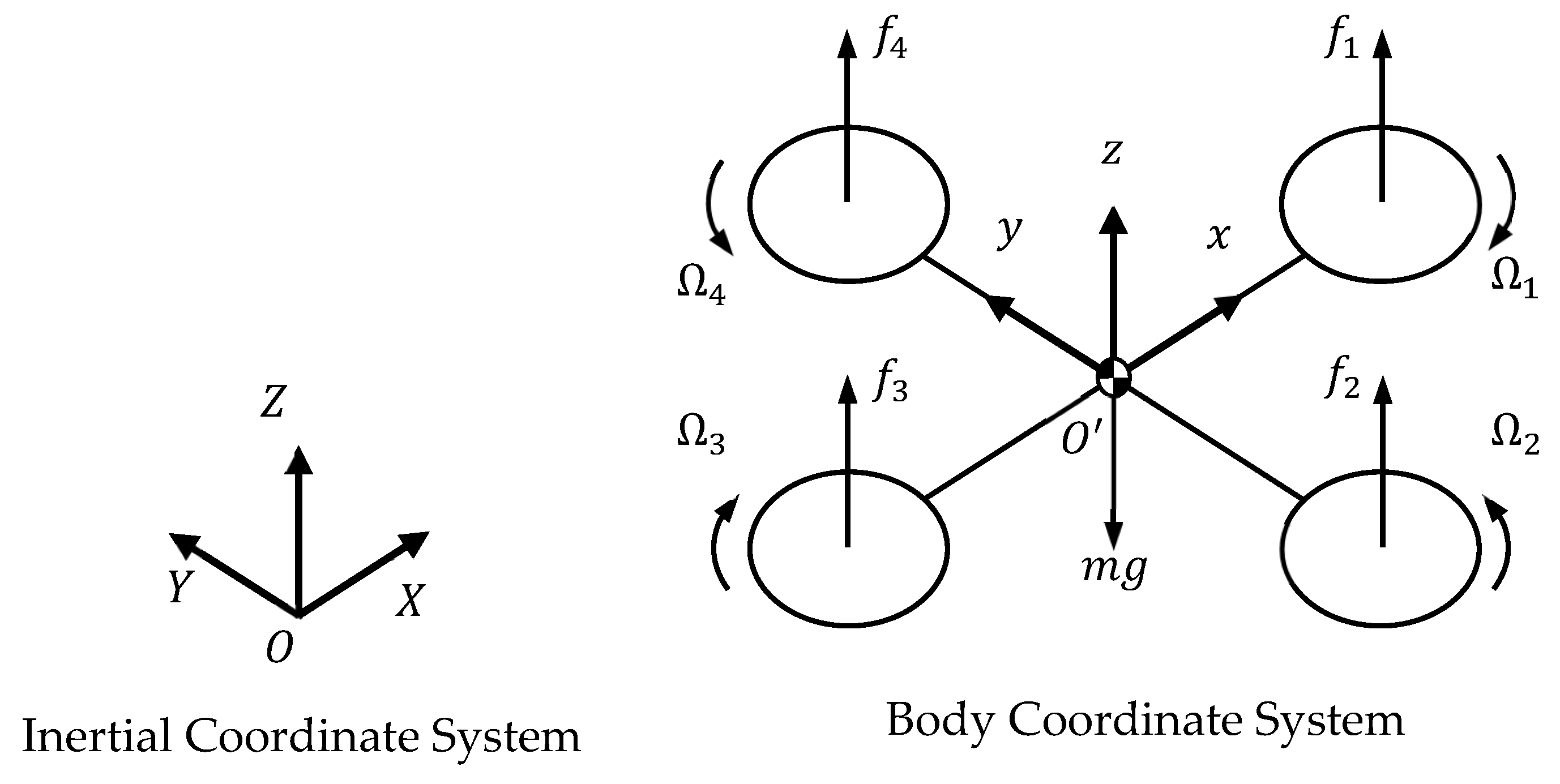
Figure 1. Quadrotor UAV coordinate systems.
Drones 09 00878 g001
Figure 2. Block diagram of the proposed flight control system for the quadrotor UAV.
Drones 09 00878 g002
Figure 3. Block diagram of the proposed controller.
Drones 09 00878 g003
Figure 4. Simulated trajectory of the quadrotor in Scenario 1: (a) STC (magenta line), NFTSTC (blue line), (b) L 1 -STC (magenta line), and L 1 -NFTSTC (blue line).
Drones 09 00878 g004
Figure 5. Simulated position response in Scenario 1: (a) STC; (b) L 1 -STC; (c) NFTSTC; (d) L 1 -NFTSTC.
Drones 09 00878 g005
Figure 6. Euler angle responses in Scenario 1: (a) STC; (b) L 1 -STC; (c) NFTSTC; (d) L 1 -NFTSTC.
Drones 09 00878 g006
Figure 7. Thrust output obtained from the simulation in Scenario 1: (a) STC; (b) L 1 -STC; (c) NFTSTC; (d) L 1 -NFTSTC.
Drones 09 00878 g007
Figure 8. Translational switching function obtained from the simulation in Scenario 1: (a) STC; (b) L 1 -STC; (c) NFTSTC; (d) L 1 -NFTSTC.
Drones 09 00878 g008
Figure 9. Rotational switching function obtained from the simulation in Scenario 1: (a) STC; (b) L 1 -STC; (c) NFTSTC; (d) L 1 -NFTSTC.
Drones 09 00878 g009
Figure 10. Time response of translational disturbance and its estimate in Scenario 1: (a) L 1 -STC and (b) L 1 -NFTSTC.
Drones 09 00878 g010
Figure 11. Rotational disturbance and its estimate in Scenario 1: (a) L 1 -STC and (b) L 1 -NFTSTC.
Drones 09 00878 g011
Figure 12. Quadrotor trajectory obtained from the simulation in Scenario 2: (a) STC (magenta line), NFTSTC (blue line) and (b) L 1 -STC (magenta line), L 1 -NFTSTC (blue line).
Drones 09 00878 g012
Figure 13. Proximity profile of the quadrotor relative to the obstacle in Scenario 2: (a) STC (magenta line), NFTSTC (blue line) and (b) L 1 -STC (magenta line), L 1 -NFTSTC (blue line).
Drones 09 00878 g013
Figure 14. Time responses of position in Scenario 2: (a) STC; (b) L 1 -STC; (c) NFTSTC; (d) L 1 -NFTSTC.
Drones 09 00878 g014
Figure 15. Euler angle responses in Scenario 2: (a) STC; (b) L 1 -STC; (c) NFTSTC; (d) L 1 -NFTSTC.
Drones 09 00878 g015aDrones 09 00878 g015b
Figure 16. Thrust response in Scenario 2: (a) STC; (b) L 1 -STC; (c) NFTSTC; (d) L 1 -NFTSTC.
Drones 09 00878 g016
Figure 17. Translational switching function response in Scenario 2: (a) STC; (b) L 1 -STC; (c) NFTSTC; (d) L 1 -NFTSTC.
Drones 09 00878 g017
Figure 18. Rotational switching function obtained in Scenario 2: (a) STC; (b) L 1 -STC; (c) NFTSTC; (d) L 1 -NFTSTC.
Drones 09 00878 g018
Figure 19. Translational external disturbance and corresponding estimate in Scenario 2: (a) L 1 -STC and (b) L 1 -NFTSTC.
Drones 09 00878 g019
Figure 20. Rotational external disturbance and corresponding estimate in Scenario 2: (a) L 1 -STC and (b) L 1 -NFTSTC.
Drones 09 00878 g020
Figure 21. Simulated trajectory of the quadrotor in Scenario 3: (a) STC (magenta line), NFTSTC (blue line) and (b) L 1 -STC (magenta line), L 1 -NFTSTC (blue line).
Drones 09 00878 g021
Figure 22. Time responses of position in Scenario 3: (a) STC; (b) L 1 -STC; (c) NFTSTC; (d) L 1 -NFTSTC.
Drones 09 00878 g022
Figure 23. Euler angle responses in Scenario 3: (a) STC; (b) L 1 -STC; (c) NFTSTC; (d) L 1 -NFTSTC.
Drones 09 00878 g023
Figure 24. Thrust response in Scenario 3: (a) STC; (b) L 1 -STC; (c) NFTSTC; (d) L 1 -NFTSTC.
Drones 09 00878 g024
Figure 25. Propeller speed response in Scenario 3: (a) STC; (b) L 1 -STC; (c) NFTSTC; (d) L 1 -NFTSTC.
Drones 09 00878 g025aDrones 09 00878 g025b
Figure 26. Translational switching function response in Scenario 3: (a) STC; (b) L 1 -STC; (c) NFTSTC; (d) L 1 -NFTSTC.
Drones 09 00878 g026
Figure 27. Rotational switching function obtained in Scenario 3: (a) STC; (b) L 1 -STC; (c) NFTSTC; (d) L 1 -NFTSTC.
Drones 09 00878 g027
Table 1. Parameters of the quadrotor UAV.
ParameterSymbolValue
Mass of quadrotor m q   ( k g ) 5.0
Rotor and axis distance L   ( m ) 0.5
Inertia tensor of quadrotor J ( k g m 2 ) d i a g ( 0.3125 , 0.3125 , 0.6250 )
Inertia tensor of rotor J r ( k g m 2 ) 1.0 × 10 4
Lift coefficient of rotor b q   ( ) 5.0 × 10 5
Drag coefficient of rotor d q   ( ) 1.0 × 10 6
Time constant of rotor T c ( s ) 0.01
Sampling time T s ( s ) 0.01
Table 2. Parameters of the controller.
TranslationRotation
s l   ( ) 0.7 10
α   ( ) 1 10
β   ( ) 2.2 1
λ   ( ) 1.6 1.2
μ   ( ) 1.5 1.1
k 1   ( ) 1 2
k 2   ( ) 0.2 0.4
A s   ( ) 5 I 6 × 6 10 I 6 × 6
ω c ( r a d / s ) 10 10
Table 3. Performance evaluation of trajectory tracking.
Without   L 1 with   L 1
ISEIAEISEIAE
STC149.279.2186.0119.01
NFTSTC101.659.4161.4814.58
Disclaimer/Publisher’s Note: The statements, opinions and data contained in all publications are solely those of the individual author(s) and contributor(s) and not of MDPI and/or the editor(s). MDPI and/or the editor(s) disclaim responsibility for any injury to people or property resulting from any ideas, methods, instructions or products referred to in the content.