3.1. Overall Framework
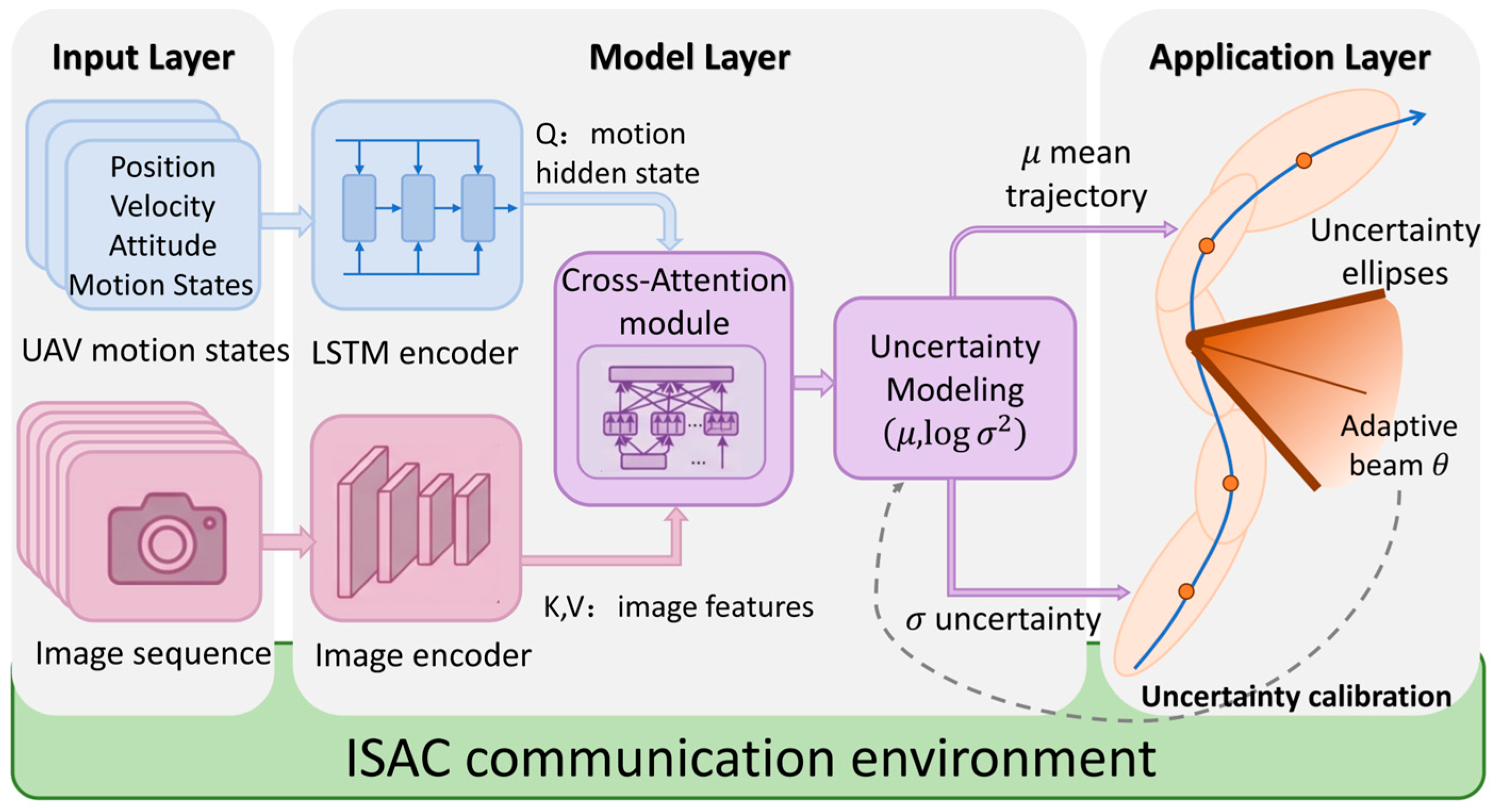
To achieve reliable trajectory prediction and prediction-driven beam control in UAV-assisted ISAC scenarios, this paper develops a unified methodological pipeline that integrates multimodal probabilistic prediction, uncertainty calibration, and risk-aware beam control. The overall framework is illustrated in
Figure 1. Specifically, the framework first fuses historical motion states with visual context to perform probabilistic trajectory prediction, producing both position means and uncertainty estimates. The predicted uncertainty is then post-processed through calibration and reliability diagnosis. Finally, the calibrated uncertainty is explicitly mapped to beamwidth and switching decisions as a risk signal, enabling a dynamic trade-off between narrow-beam gain and link robustness.
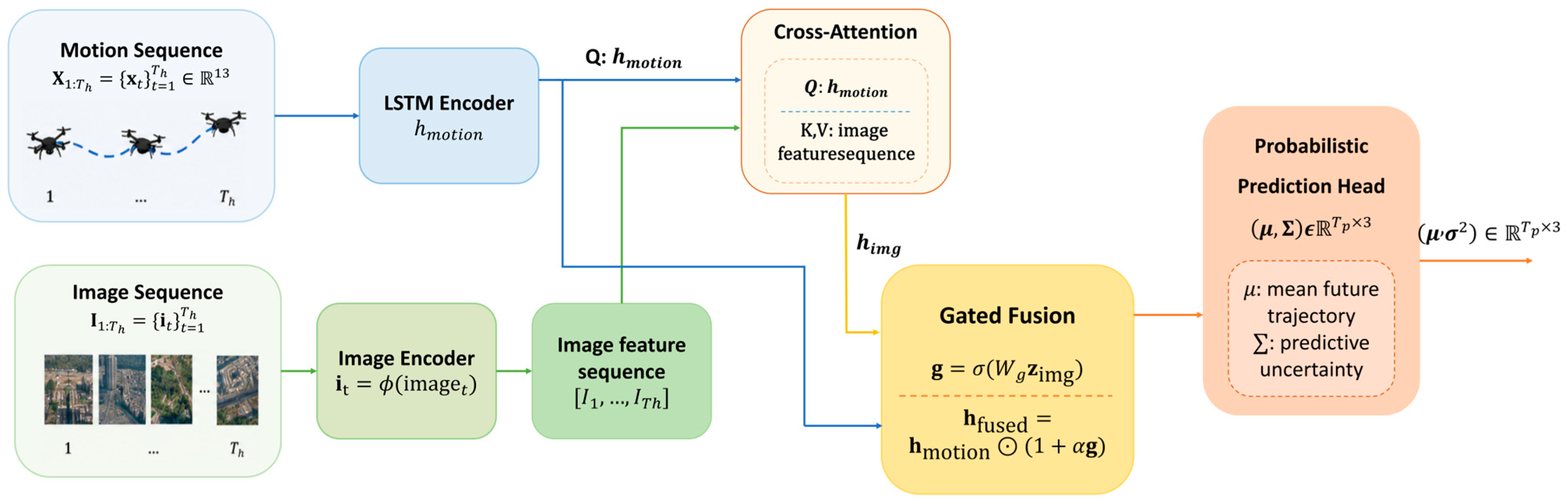
From a system perspective, the proposed method consists of four sequential stages. In the first stage, data organization and multimodal input construction are performed. Based on the EuRoC MAV dataset, sliding-window samples are generated, where each sample consists of a historical motion state sequence of length , a temporally aligned image feature sequence, and future position labels of length . In the second stage, multimodal probabilistic trajectory prediction is conducted. The model takes motion state encoding as the backbone and employs cross-modal attention to select context from the visual sequence that is most relevant to the current motion state. A gated fusion mechanism is then used to conditionally enhance motion representations, ultimately producing the mean and variance of future 3D positions. In the third stage, uncertainty calibration and reliability analysis are performed. The scale of uncertainty is calibrated, and its statistical consistency is evaluated across multiple dimensions, including prediction horizons, spatial dimensions, and scenario difficulty levels. In the fourth stage, uncertainty-aware beam management is integrated. The calibrated uncertainty serves as a key intermediate variable linking the prediction module and the beam controller. The uncertainty output from the prediction model is transformed into a risk signal that directly drives beamwidth selection and switching cost trade-offs, thereby translating prediction accuracy into actionable control decisions.
It should be emphasized that the proposed framework is not intended to claim novelty from the individual use of LSTM, cross-attention, gated fusion, or conformal calibration alone. These components are adopted as functional modules within a control-oriented pipeline. The key design is the definition of calibrated predictive uncertainty as an intermediate control variable. Specifically, the prediction module provides a distributional estimate of future UAV positions, the calibration module converts the raw uncertainty into a statistically more reliable spatial risk bound, and the beam management module uses this bound to determine whether a narrow high-gain beam or a wider robust beam should be selected from the codebook. Therefore, the novelty of the framework lies in the explicit prediction–calibration–control mapping, rather than in treating trajectory prediction and beam management as two separate tasks.
3.3. Uncertainty Modeling
In UAV-assisted ISAC scenarios, the more critical issue in the trajectory prediction task is how to obtain reliable and decision-influencing uncertainty estimates. This work focuses on improving the practical reliability of existing probabilistic outputs and examining how calibrated uncertainty can be effectively utilized in control-oriented applications. The motivation for applying conformal calibration is to obtain an operationally meaningful uncertainty bound for downstream control. Raw Gaussian variance learned through NLL training can reflect relative prediction difficulty, but it does not guarantee that the predicted confidence region matches the empirical error distribution. Such under-calibrated uncertainty may cause the controller to select an overly narrow beam and increase the probability of outage. Therefore, calibration is introduced as a risk-regularization step before beam-control decision-making.
3.3.1. Split Conformal Calibration on Validation Set
As described in
Section 3.2.5, the model predicts the Gaussian distribution of future trajectories by outputting the mean and variance at each prediction step. In multi-step predictions, errors accumulate over time, and the predicted variance may not accurately reflect this temporal propagation. Therefore, the original Gaussian uncertainty cannot be directly used for risk-sensitive ISAC decisions that require accurate coverage and reliable confidence estimation.
To address the above issue, a validation set-based split conformal calibration method is used to post-process the predicted uncertainty. A nonconformity score is defined on the validation set as:
where
denotes the scalar spatial uncertainty radius obtained from the coordinate-wise standard deviations.
By analyzing the distribution of scores on the validation set, the quantile
corresponding to a confidence level
can be obtained. During testing, this quantile is used to rescale the original uncertainty, yielding calibrated confidence intervals:
This approach does not require additional model training and relies solely on validation statistics to achieve distribution calibration. Compared with retraining-based calibration or ensemble-based uncertainty estimation, split conformal calibration is selected because it is model-agnostic, lightweight, and directly provides empirical coverage control on a held-out validation set. These properties are important for UAV-assisted communication systems. Therefore, the calibration step is suitable for serving as a practical interface between probabilistic prediction and communication control.
3.3.2. Reliability Diagnostics Across Dimension, Horizon, and Difficulty
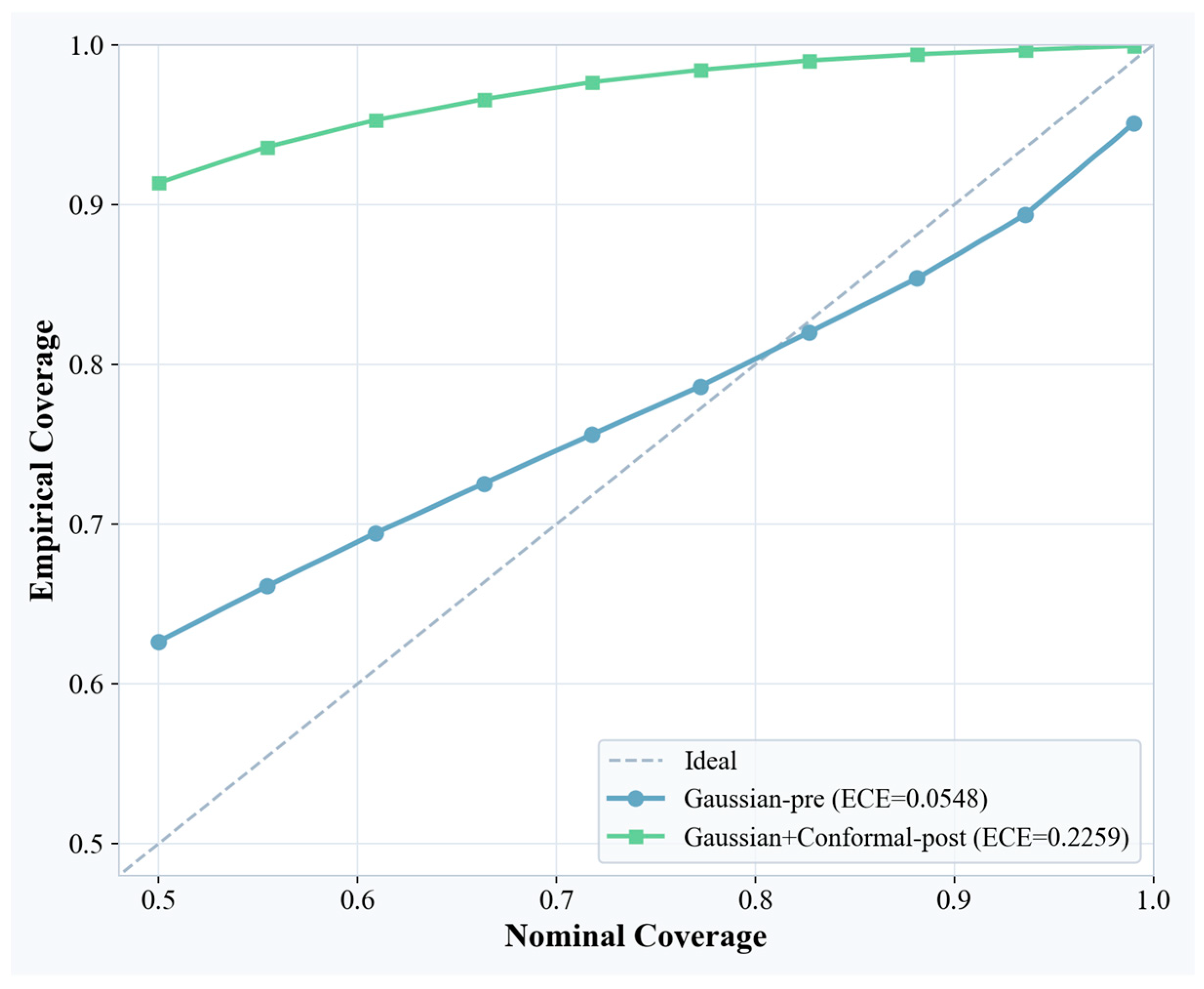
After post hoc calibration, a single metric is insufficient to fully evaluate the quality of uncertainty estimates. This paper conducts systematic diagnostics of predictive uncertainty from multiple perspectives to assess both statistical consistency and practical usability. First, from a global distribution perspective, the Negative Log-Likelihood (NLL) is used as a baseline metric for probabilistic prediction quality. In addition, the deviation between the empirical coverage rate and the nominal coverage is used to define the calibration error:
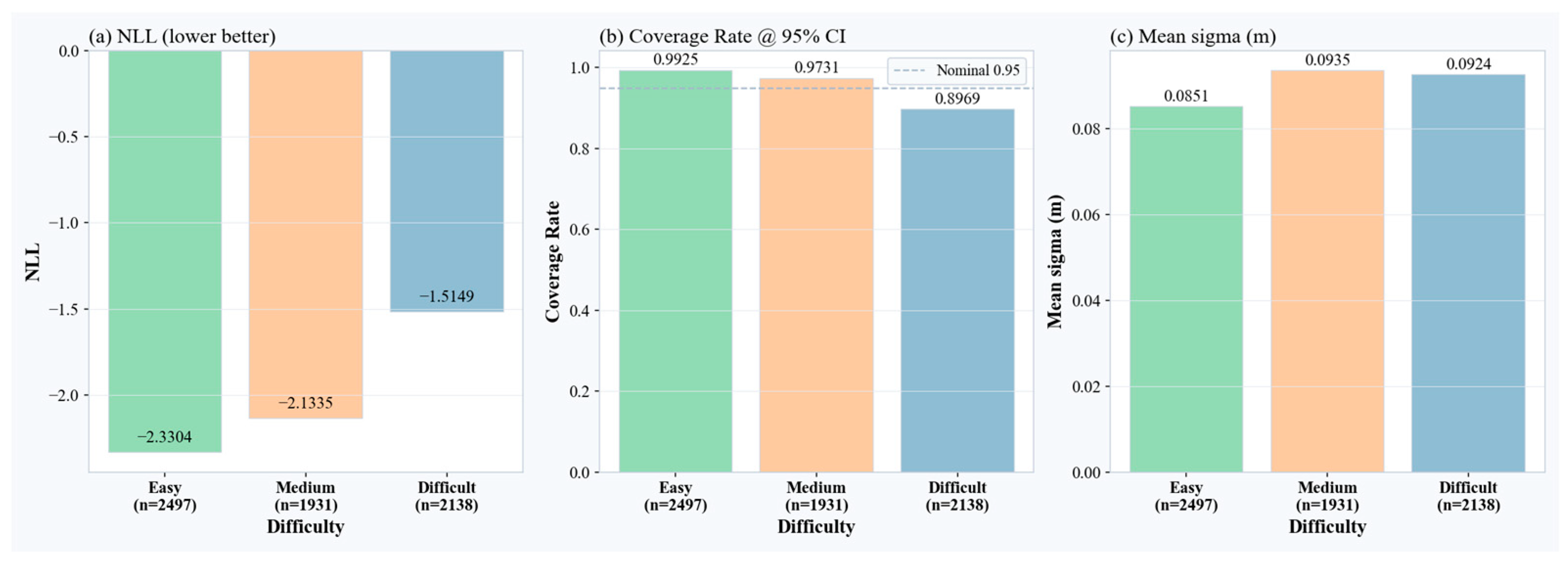
In the spatial domain, uncertainty is analyzed separately along the , , and axes to examine the consistency between prediction errors and standard deviations in different directions. In the temporal domain, trends of ADE, standard deviation, and coverage rate are examined across prediction steps to verify whether uncertainty expands reasonably over time. In the scenario domain, the dataset is divided into easy, medium, and difficult subsets to evaluate the responsiveness of uncertainty under different complexity levels.
Through these multi-dimensional diagnostics, this work not only verifies the accuracy of uncertainty estimation, but also reveals how multimodal information fusion affects uncertainty quality.
3.3.3. Calibration-Driven Risk Quantification for Beam Control
After calibration, uncertainty is further interpreted from a system perspective as a control-oriented risk signal. The calibrated standard deviation
is no longer merely a statistical measure of error scale, but can be directly mapped to decision risk. A larger
indicates a more dispersed future position distribution, corresponding to higher uncertainty and a greater risk of link mismatch. Conversely, a smaller
indicates more reliable predictions, allowing for more aggressive resource allocation strategies. Accordingly, the prediction output can be unified as:
This enables a direct mapping from prediction to control in ISAC systems. In the subsequent beam management module, this risk signal is explicitly used to guide beamwidth adaptation, achieving a dynamic trade-off between communication gain and coverage robustness.
This section does not aim to develop a new uncertainty estimation method, but rather to enhance the reliability and practical usability of predictive uncertainty, enabling its effective integration into downstream communication control.
3.4. Risk-Aware Adaptive Beam Management
After completing multimodal trajectory prediction and uncertainty calibration, this paper incorporates the prediction outputs into an Integrated Sensing and Communication (ISAC) system, enabling end-to-end optimization from trajectory distribution estimation to communication resource control. This work treats calibrated uncertainty as a risk measure and explicitly embeds it into the beam control strategy, thereby constructing a risk-aware adaptive beam management mechanism for dynamic UAV scenarios.
In millimeter-wave communication systems, narrow beams provide higher array gain but are highly sensitive to pointing errors, whereas wide beams offer stronger coverage at the cost of reduced signal-to-noise ratio (SNR) and system capacity.
Based on the modeling results in
Section 3.2 and
Section 3.3, the model outputs the future position distribution parameters at time
:
where
denotes the predicted position mean, and
represents the calibrated standard deviation.
In practical mmWave systems, beams are typically selected from predefined codebooks. This work extends continuous beam control to a discrete beam selection problem under codebook constraints. Let the finite beam codebook be denoted as
, where each candidate beam
is associated with a beam direction, a beamwidth
, and a beam gain
. The beam selection can then be formulated as:
where the optimal beam must be chosen from a finite candidate set. The calibrated spatial uncertainty is converted into an angular risk margin according to the predicted link distance. Specifically, for the predicted link distance
, the angular uncertainty margin can be approximated as:
A candidate beam is regarded as feasible when its half beamwidth can cover both the predicted mean direction and the calibrated angular risk margin. To this end, the continuous prediction results are mapped to the discrete codebook by quantizing the predicted mean direction and determining candidate beams based on uncertainty.
Building upon this, a utility-driven risk-aware decision mechanism is introduced, formulating beam selection as an optimization problem that jointly considers communication performance and reliability. For any candidate beam
, the utility function is defined as:
where
denotes the communication rate,
is the link outage probability, and
represents the beam switching cost. The coefficients
and
are weighting factors. The communication rate is computed according to the Shannon formula. Since the link budget is first expressed in the dB domain, the dB-scale SNR is defined as:
where
denotes the transmit power,
is the beam gain of candidate beam
,
is the path loss at link distance
, and
denotes the noise power. The dB-scale SNR is then converted into the linear-scale SNR:
Therefore, the achievable communication rate is given by:
where
denotes the system bandwidth, and
denotes the linear-scale SNR converted from the dB-domain link budget. The path loss model is given by:
and the beam gain is inversely proportional to the beamwidth:
for a given candidate beam
, the coverage condition is expressed as:
where
is the ground-truth UAV position,
is the predicted position mean,
is the predicted link distance, and
is the beamwidth of candidate beam
. Based on the calibrated distribution, the coverage probability can be computed, leading to the link outage probability:
The calibrated uncertainty
has improved statistical consistency and can serve as a reliable risk measure in the decision process. In addition, to avoid excessive beam switching overhead, a switching penalty is introduced:
By combining the above factors, the final beam selection strategy is formulated as:
This strategy enables beam control to jointly consider communication performance, link reliability, and system stability.
In summary, the proposed risk-aware adaptive beam management method forms a coherent end-to-end framework that connects trajectory prediction, uncertainty calibration, and communication control. As a result, the proposed design enhances system robustness in dynamic UAV scenarios, while providing an interpretable and practically deployable framework for uncertainty-driven wireless resource optimization.