1. Introduction
Distributed estimation by multiple UAV networks offers several advantages over central estimation for tracking maneuvering targets, including greater scalability, better robustness, lower communication requirements, and lower computational costs [
1,
2,
3]. Similarly, the passive sensors equipped on UAVs exhibit some strengths in anti-interference, invisibility, and survivability. Typically, passive sensors, the bearing-only sensors (e.g., passive radar, infrared) can only provide angle measurements of a target. This means that target tracking can only be accomplished through multi-UAV cooperation [
4,
5,
6,
7]. Unlike the central fusion scheme, distributed schemes eliminate the need to process all UAV’s node information. On the contrary, each UAV achieves state estimations based on its local filter estimation, only combined with its immediate neighbor’s local estimations through the UAV network.
The distributed schemes can be classified as diffusion-based [
8,
9] and consensus-based [
10,
11,
12,
13] strategies. The diffusion-based mainly exchanges estimations with direct neighbors only once in each fusion period. Ref. [
8] proposed a diffusion Kalman filtering with fixed smoothing to estimate and track the position of a projectile. However, in a diffusion-based scheme, the estimations of each sensor may not be in consensus. The consensus-based scheme iterates estimations with direct neighbors several times in each fusion period. Based on the metropolis consensus weighting matrix in [
11,
12], estimations for each sensor converge to the global average consensus when the number of iterations is infinite. To address the above limitations, a finite-time distributed state estimation via a sensor network was proposed in [
13] to achieve maneuvering target tracking. The global average consensus is an arithmetic mean of the estimates of all the sensor nodes, which matches the covariance interaction (CI) fusion rule.
Regardless of the cross-correlation between multiple estimations, the CI fusion rule [
14] has become a pioneering research achievement in the field of information fusion. The core principle of CI is to select the appropriate weights so that the weighted sum of each sensor information matrix is minimized. The weights can be achieved by solving an optimization problem [
15]. To simplify the calculation cost, several suboptimal specific solutions have been proposed to determine the weights, such as a simple convex combination CI [
16,
17] and a fast CI [
18,
19]. While the CI fusion rule is consistent and tight, it may be overly conservative, leading to an over-approximation of the uncertainty upper bound.
Consequently, alternatives to CI have been proposed to achieve a tighter upper bound on the fused rule [
20,
21]. In [
21], the inverse CI (ICI) is proposed for two estimations to achieve more accurate fusion results than the CI method. Furthermore, ref. [
22] generalizes the ICI rule to fusing multiple estimations. Based on that, the ICI rule is applied to the distributed system by consensus-based over sensors network [
10,
23]. By setting parallel consensus filters enables global state estimation at each sensor, a novel distributed estimation algorithm [
23] is proposed, satisfying the ICI fusion rule to address the cross-correlation problems.
In addition, the aforementioned distributed estimation methods suffer from three drawbacks: (1) In local estimation, most filter methods do not consider special bearing-only UAVs that cannot report range measurements directly. Additionally, they struggle to encounter invalid measurements. (2) In consensus-based iterative estimations, existing methods do not effectively balance the number of iterations and estimation accuracy in a fusion period. (3) In fusion rules, current methods do not adopt a tighter upper bound on the fused rule and typically only consider the fusion of two sensors.
To address these limitations, a distributed consensus-based estimation (DCE) method with an ICI fusion rule is proposed within the framework of local square-root cubature information filter (SRCIF) estimation, consensus iteration and fusion estimations for maneuvering target tracking. The principal contributions of this study are outlined as follows:
- 1.
Different from [
13,
23], the proposed DCE–ICI effectively delivers local estimation for bearing-only UAV platforms, even if certain platforms are unable to receive measurements.
- 2.
Unlike the approaches in [
11,
12], based on the concepts of betweenness and closeness centrality in multi-UAV networks, the proposed DCE–ICI constructs a novel consensus weighting matrix that ensures all UAVs converge to a consensus result within a finite number of iterations.
- 3.
In contrast to previous research [
18,
22,
23], the proposed DCE–ICI conducts new parameter forms of global ICI fusion in which all UAVs perform only once fusion after the completion of iterations, resulting in enhanced estimation accuracy.
The structure of this paper is organized as follows:
Section 2 gives the related preliminaries.
Section 3 describes the design of the distributed consensus estimation method by ICI fusion. Numerical simulations are presented in
Section 4, and conclusions are drawn in
Section 5.
3. Distributed Consensus Estimation by ICI
The consensus algorithm is as follows [
27]:
where
and
are the local variables and consensus weighting coefficients for the
mth iteration, respectively.
denotes the neighbors of UAV
i.
(if
,
). The weighting matrix
can generally be taken as Metropolis weights [
11].
Further, the consensus algorithm in (
52) can be expressed as matrix form:
where
is the stacked vector including all local values.
is the product of the weighted matrices.
Based on the consensus algorithm above, the centralized fusion described by (
47)–(
50) can be generalized to distributed inverse covariance fusion. The terms in the above formulas can be obtained from the consensus algorithm after a certain number of iterations.
In the parallel consensus iteration (PCI), let
be the variable of the
ith UAV and
, and there are
Similarly, let
,
;
, which yields
where
,
are the parameters to be determined by (
51).
After
L iterations, let
, and we can get the following:
Using all the variables obtained from the four consensus iterations above, the data fusion process for each UAV
i is as follows:
Based on the multiple UAV local estimation in
Section 2.2, the distributed consensus ICI fusion is shown in Algorithm 1.
| Algorithm 1 Distributed consensus ICI fusion for SRCIF |
- Require:
, , , , , , , L - Ensure:
, - 1:
for to do // is the simulation time // Local estimation by SRCIF - 2:
for do - 3:
complete filter initialization as ( 12)–( 14) - 4:
run independent time update as ( 15)–( 22) - 5:
for do // receive neighbors info - 6:
calculate the info contribution as ( 23)–( 31) - 7:
end for - 8:
obtain , , and as ( 32)–( 37) - 9:
end for // Consensus Iteration CL1-CL4 - 10:
Initialization//omitting “" for brevity - 11:
, - 12:
, - 13:
for do // run in parallel - 14:
for do - 15:
- 16:
- 17:
- 18:
- 19:
end for - 20:
end for // ICI fusion - 21:
for do - 22:
, - 23:
, - 24:
, - 25:
- 26:
, - 27:
end for - 28:
end for
|
3.1. Consensus Analysis of Estimations
Metropolis weights only consider the effect of degree centrality (DC) on the consensus algorithm. The betweenness centrality (BC) [
28] and closeness centrality (CC) [
29] of UAV networks also have an impact on the efficiency of consensus estimation.
Since networks i has degree centrality , betweenness centrality , and closeness centrality .
Transforming the above centrality to the same interval, the centrality
of UAV
i is defined as follows:
where the weight coefficients can be taken as
, with
.
Thus, the consensus weighting matrix is designed as follows:
Note that the above weight matrix used in the DCE–ICI method is a double-stochastic matrix.
Lemma 1
(Asymptotic behavior [
11])
. For undirected connected graphs, tends to as the number of iterations increases, that is Remark 3.
In (58)–(61), let , i.e., . By Lemma 1, when , , i.e., . From (51), let . Similarly, when , . Remark 4.
When , the variables of the four consensus iterative algorithms (CL1-CL4), respectively converge to the same value, i.e., the information is weighted average consensus,with It can be seen that when time tends to infinity, each UAV has access to four consensus global messages. Combined with (
62) and (
63), each UAV can obtain the same inverse covariance estimation results. However, infinite iterations are almost impossible to guarantee in practice, so finite-time stability of the algorithm is analyzed below.
3.2. Finiteness Analysis of Stability
In the consensus algorithm, the boundedness of is required to ensure the boundedness of the variables (e.g., ) after a several iterations.
Lemma 2
([
23])
. When satisfies, is bounded with . Remark 5.
In the consensus iteration, to ensure boundedness, the number of iterations is chosen to be bigger than the diameter of the graph, i.e., .
Based on Remark 2, the selection of is necessary to satisfy and , or to satisfy the equivalence condition . The above constraints can be satisfied by selecting the number of iterations.
Lemma 3
([
23])
. Each row of yields valid ICI fusion rule when , where λ is the second-largest eigenvalue of Π
. Proof. The convergence of the consensus algorithm is analyzed to determine the lower bound of the iteration satisfying the rows of the transfer matrix
. The center vector is defined as
, and let
(i.e., rows of the transfer matrix
) are considered as state variables. From Remark 3, the steady state value of
is
and the dynamic error is expressed as follows [
30]:
Since
is a double stochastic matrix,
. There is
and
The above equation holds due to the following:
Substituting it in yields the following:
where the first term of the inequality
. By definition,
is a primitive matrix with maximal eigenvalue 1. Since the maximal eigenvalue 1 vanishes, the maximal eigenvalue of (
) is the second-largest eigenvalue of
.
The second term is bounded with the following:
Since , is the dimensional simplex. denotes the sphere whose center is at the center of the simplex. In the intersection of both, the minimum value of their radius is 0, while the maximum value is when the sphere intersects any vertex of a simplex.
Combining with (
75), by imposing constraints on the coefficients, the number of iterations that can guarantee the effective fusion of ICI can be obtained as follows:
Solving gives . When L is larger than , then holds. Combined with Remarks 2 and 3, the condition is satisfied, i.e., each is a valid set of coefficients that satisfies ICI fusion rules. Similarly, each also satisfies ICI fusion rules. □
Based on the above analysis, the number of iterations L can be set as . The boundary performance of the algorithm is to be analyzed as below in a finite number of iterations.
3.3. Boundedness Analysis of Errors
The analysis of estimation error boundedness of the algorithm is categorized into local estimation and consensus iteration.
Assumption 2
([
24,
31])
. The local estimated SRCIF information matrix for UAV j is bounded, , where and are positive real numbers. Theorem 1.
After a finite number of iterations L, the fusion information matrix obtained by Algorithm 1 is larger than that of the covariance interaction .
Proof. According to (
62), (
68) and (
70), one can obtain as follows:
where
and
are positive definite matrices, it yields
. Thus, the first inequality holds. The fused information matrix
satisfies the CI fusion rule and has
. □
Remark 6.
It can be seen that , i.e., the fusion information matrix obtained by the proposed method is larger than that of the CI fusion rule at each UAV i. In other words, the ICI error covariance matrix is less than that of the CI fusion rule.
According to Theorem 1, the fusion estimate generated by Algorithm 1 for each UAV remains bounded when the number of iterations L is finite.
Compared to the local estimation in
Section 2.2, achieving consensus results requires additional iterations. Each UAV node exchanges an information set
with its neighboring nodes (i.e., parallel consensus iterations). Given a UAV topology, the computational cost increases linearly with the number of iterations
L. Furthermore, the computational cost exhibits no significant correlation with the number of UAVs. It is primarily proportional to the number of edges in the UAV topology graph (i.e., the total number of neighbors for all UAV nodes). Therefore, the computational cost can be expressed as follows:
where
are the edges of topology graph.
For a given communication topology, this estimate usually converges to a result close to the exact average consensus within a few iterations, which is verified in simulation experiments.
4. Simulation
In this section, numerical simulations and performance comparisons are presented to evaluate the effectiveness of the proposed DCE–ICI method. The norm error (NE) and the root mean square error (RMSE) were adopted to assess finite and estimated performance. The iterative NE of the consensus weighting matrix is defined as follows:
where
and
are given in (
72).
4.1. Simulation Parameters
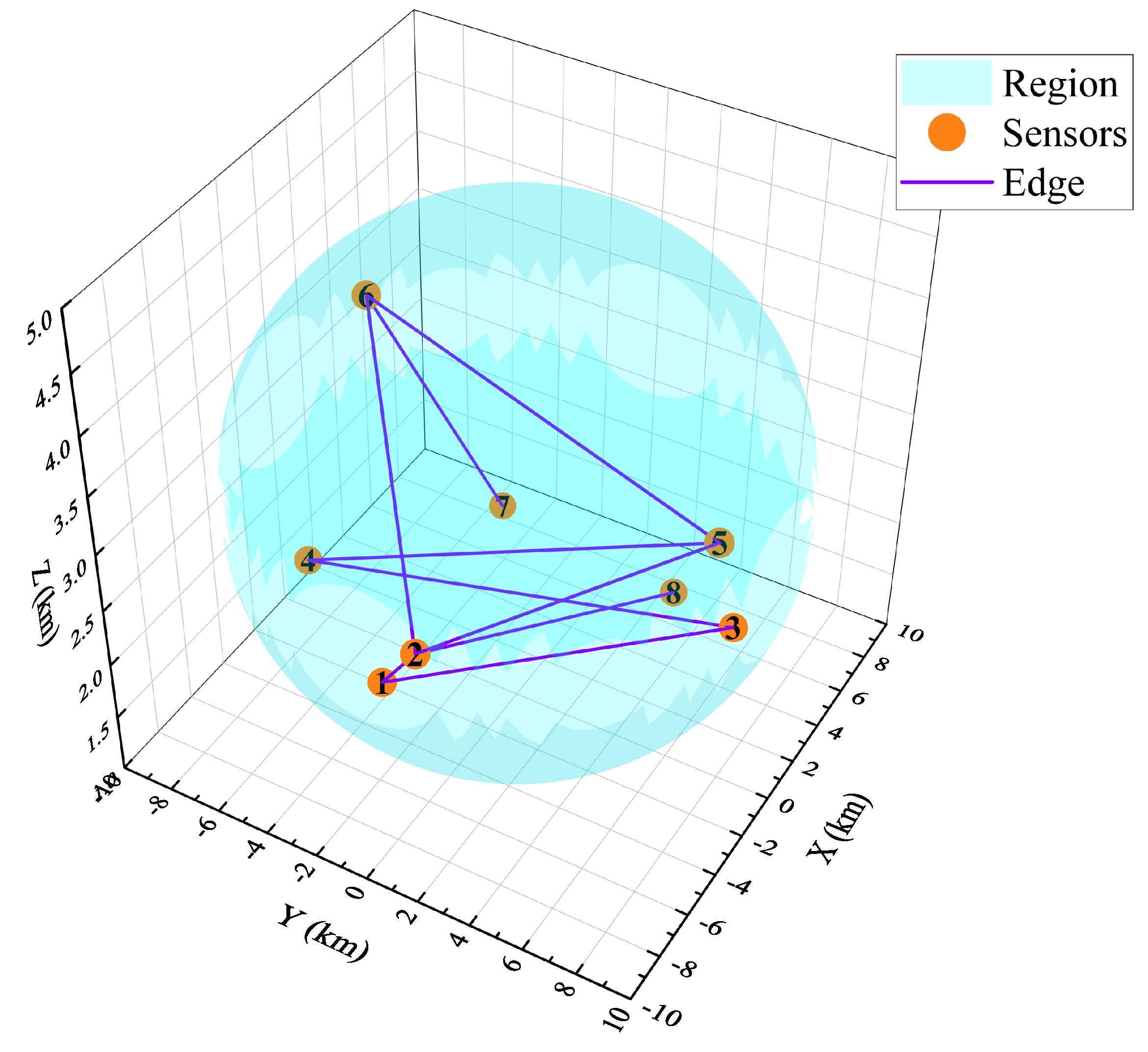
We considered a distributed consensus estimation problem for maneuvering target tracking with bearing-only mobile UAV platforms in three-dimensional Cartesian coordinates. The UAV network consisted of eight UAV nodes. As illustrated in
Figure 1 and
Table 1, the initial position of the UAVs was randomly distributed in the ellipsoid region of
with a standard deviation of
. The probability of any two nodes was set as 0.3. The measurement noise covariance in elevation and azimuth was set to the same, with random values of 0.1 or 0.5 degree. Based on the connectivity in
Figure 1, the centrality of networks is shown in
Table 1. The diameter
is 4. The
is ln(7)/ln(1/0.8343) = 10.74. The finite iteration number
that satisfies a valid ICI fusion rule.
The motion of the UAV networks followed the CA model. The velocities and accelerations of the UAVs were initialized as and , respectively. The standard deviation of the process noise was set to in the model.
The trajectory of the target evolved according to the CA models. The positions, velocities, and accelerations of the target were initialized as , , and , respectively. The standard deviation of position and process noise was set to be the same as the UAV networks.
The fusion period
was defined as
throughout the simulation duration of
. The filter initialization (i.e., initial state vector and covariance matrix) was calculated by the one-point initialization method in [
6]. Numerical simulations are presented with 300 Monte Carlo runs.
4.2. Multiple UAV State Estimation
In this subsection, the consensus weighting matrix of the proposed DCE–ICI algorithm is compared with the Metropolis in [
11]. The performance of the proposed DCE–ICI method is compared to the local estimation algorithm (Local) described in
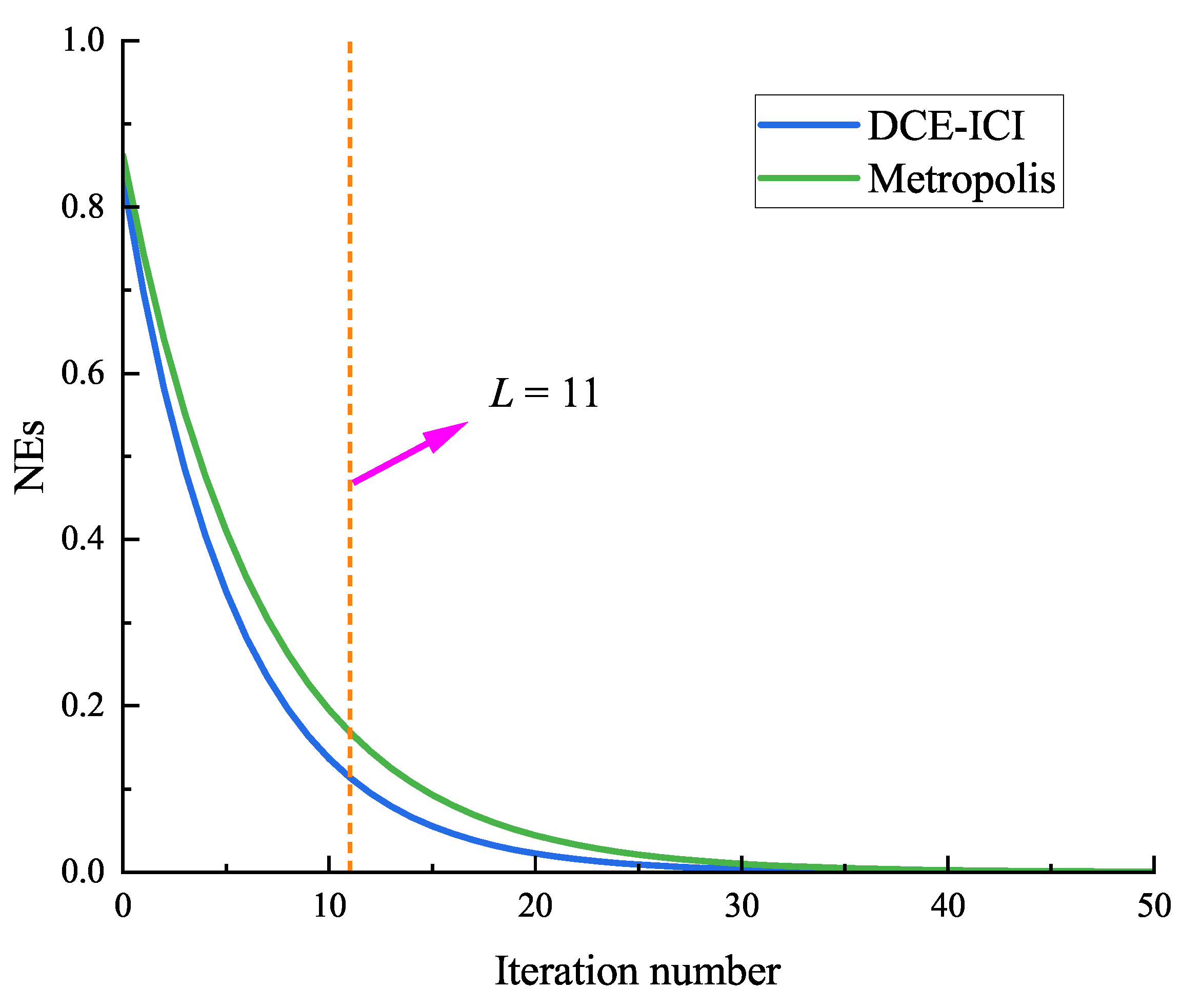
Section 2.2, the diffusion FCI (Diff–FCI), the diffusion ICI (Diff–ICI), and the distributed consensus estimation FCI (DCE–FCI). All methods used the same local estimation algorithm (i.e., Local) to ensure a fair performance comparison. The iterative NE of the consensus weighting matrix are shown in
Figure 2.
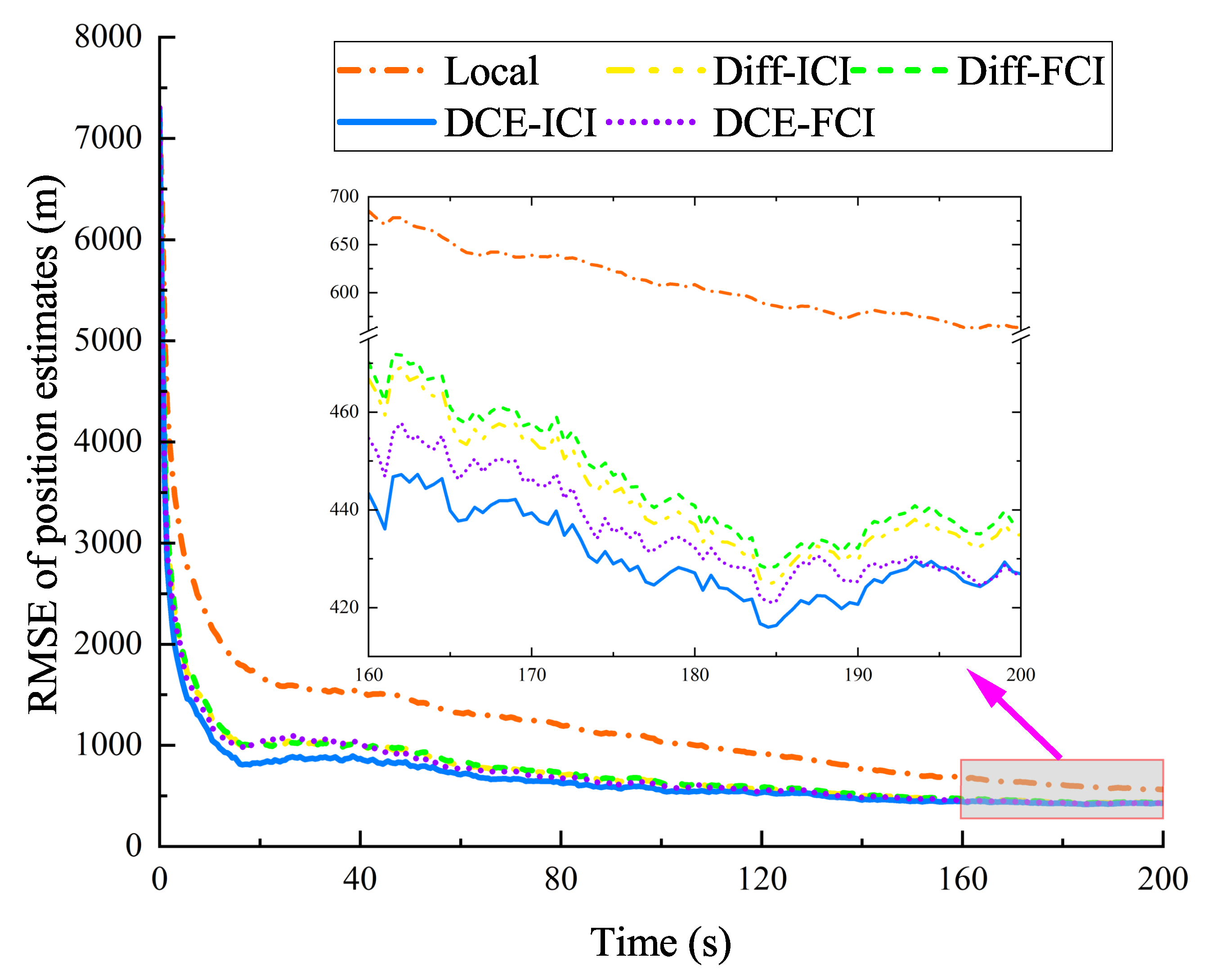
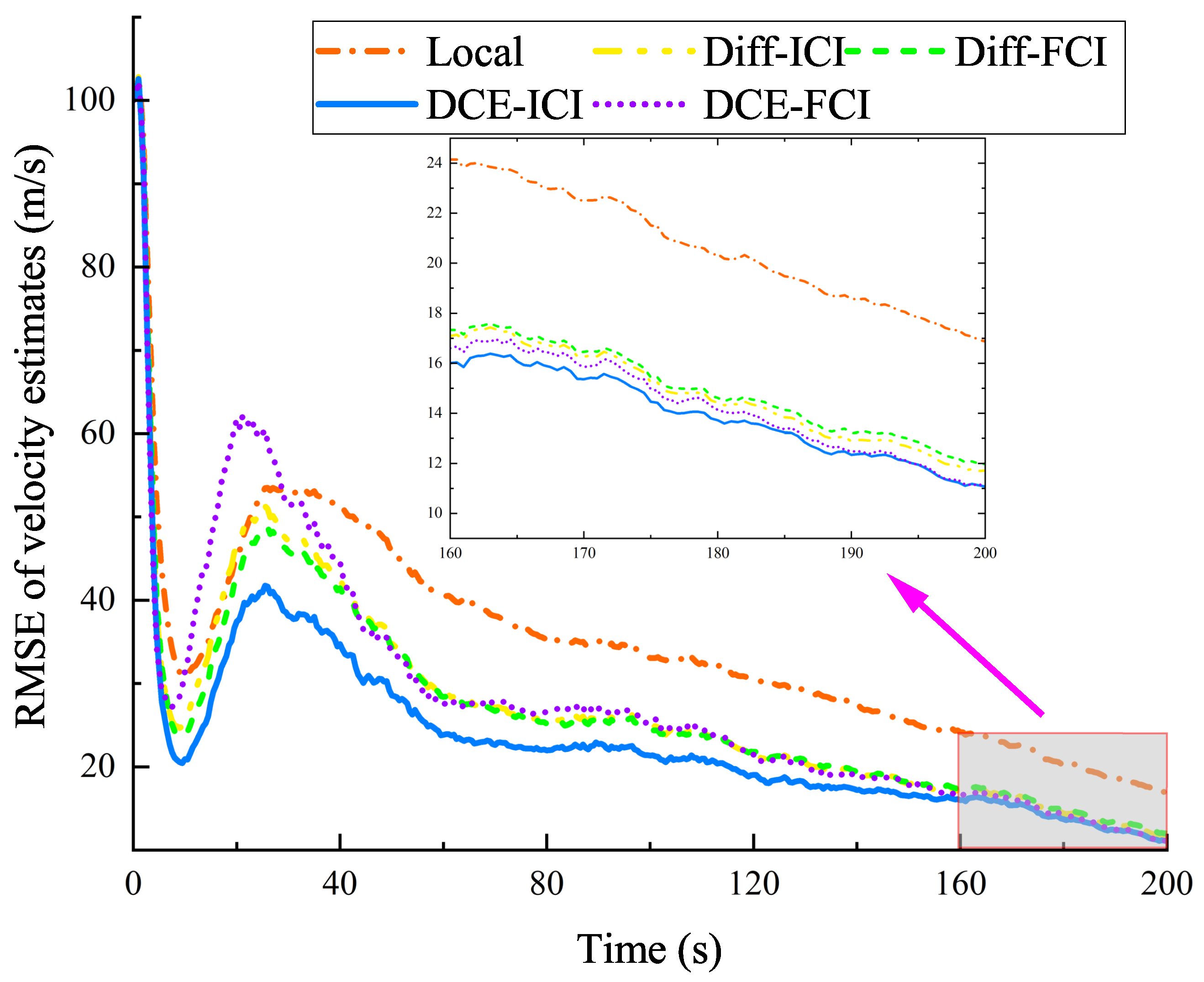
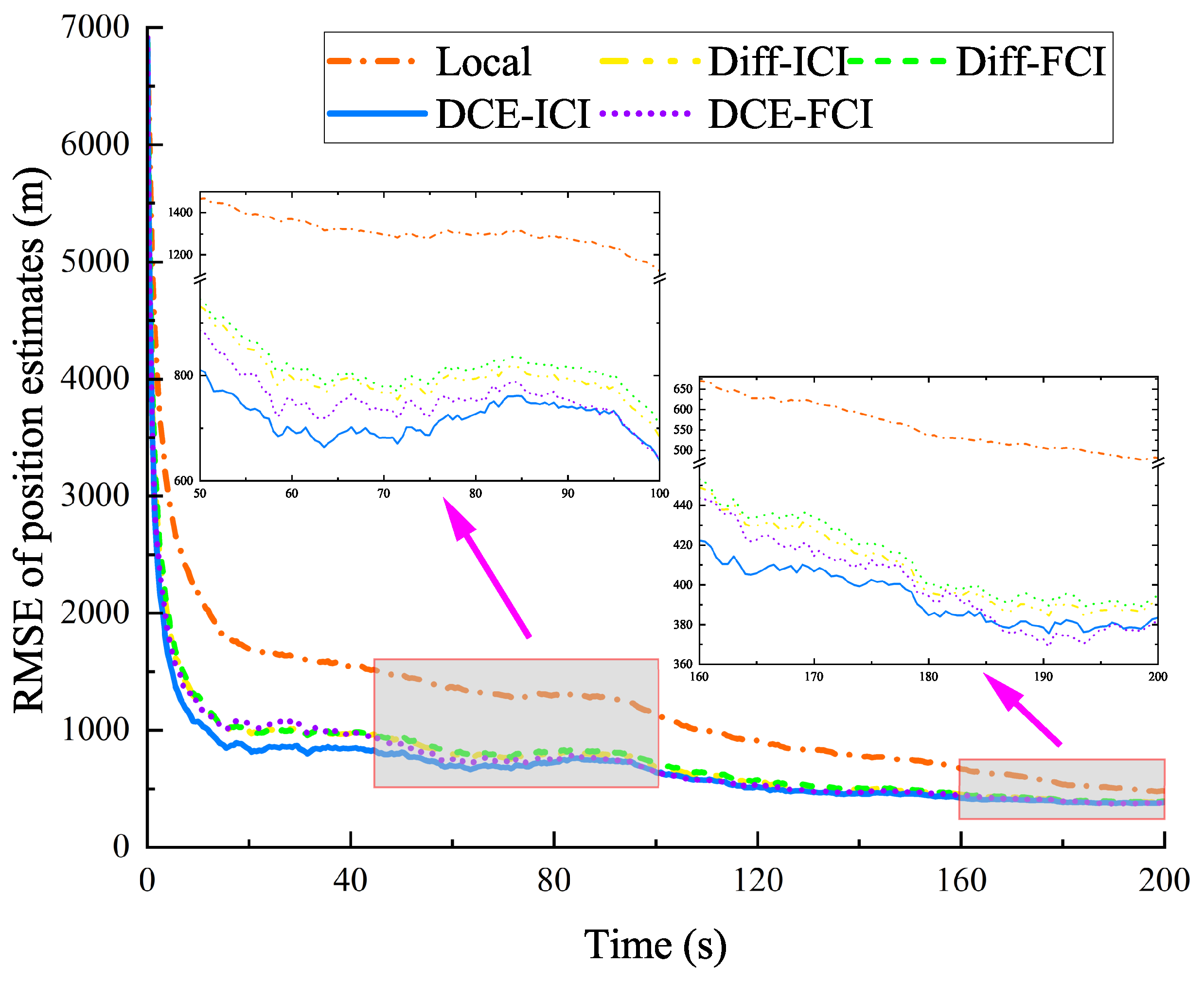
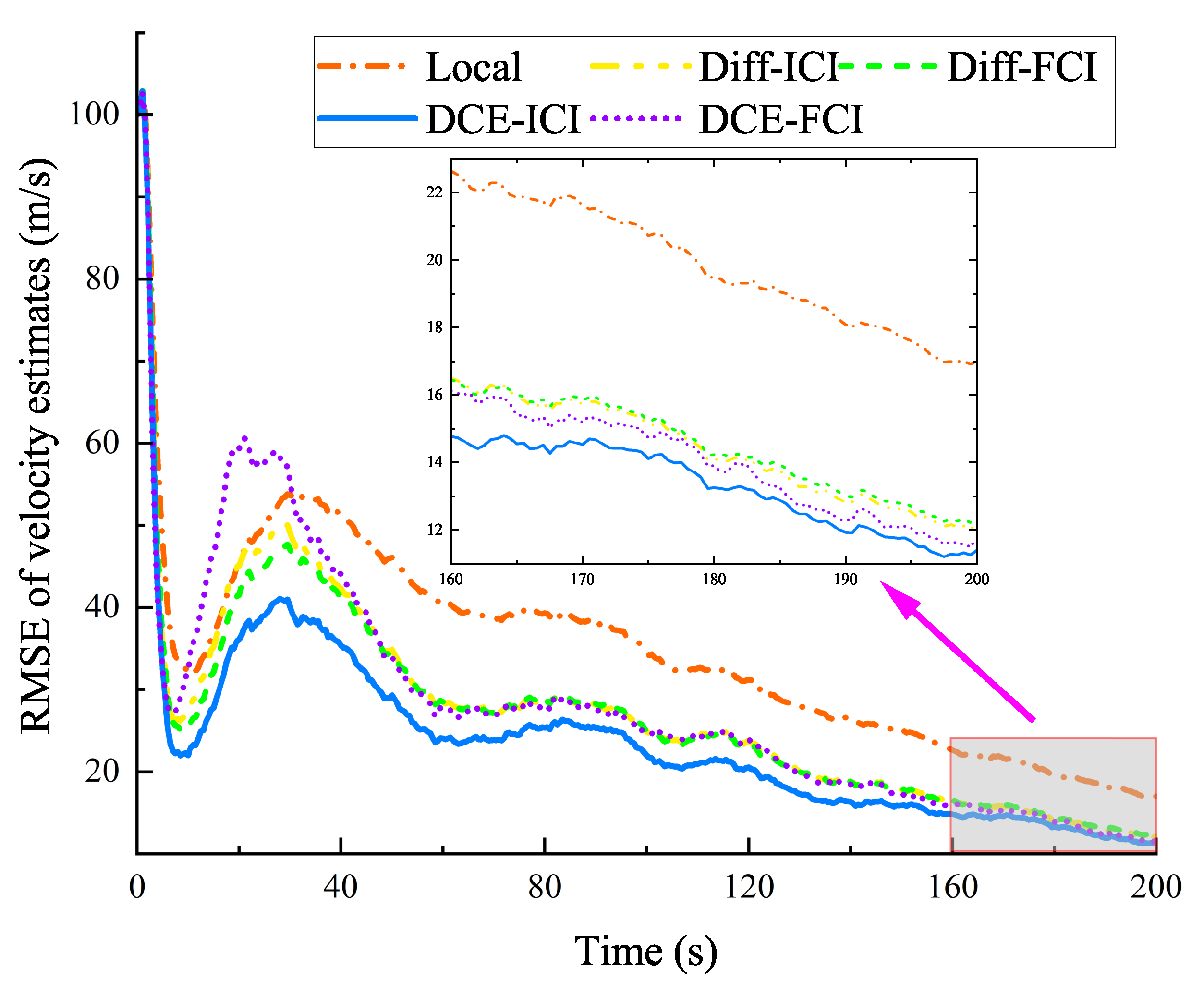
Figure 3 and
Figure 4 show the RMSE of the target position and velocity estimation.
As shown in
Figure 2, the NE of weights in both methods (i.e., DCE–ICI and Metropolis) gradually converge to zero as the number of iterations increases. The trends of the above two curves are consistent with Remark 3. Under the same number of iterations, the value of the DCE–ICI method is smaller than that of Metropolis, which means that the proposed DCE–ICI method approaches the stable value (
) faster and has better convergence performance. When the number of iterations reaches a finite number (
), the NE have not yet converged to zeros. Nevertheless, each row of the consensus weighting matrix
constitutes a valid set of coefficients satisfying the ICI fusion rule.
To demonstrate the tracking errors further, the RMSE of the position and velocity are shown in
Figure 3 and
Figure 4. The position and velocity RMSE of the proposed DCE–ICI method are smaller than those of all other methods. The performance of consensus-based methods (DCE) is generally better than that of diffusion (Diff) methods. Under the same distributed scheme (i.e., diffusion-based or consensus-based), the performance of the ICI fusion rule is superior to that of the CI fusion rule. In addition, Local and DCE–ICI methods performed best and worst, respectively. As listed in
Table 2, the average RMSE of the position and velocity in the DCE–ICI method is approximately 684.19 m and 23.41 m/s. In the 0∼40 s interval, the RMSE of the velocity changed more sharply than that of the position. This is because, in the initial calculation of the filter, only the prior position information of the target can be obtained by the one-point initialization method, rather than the prior velocity information. Combining the results shown in
Figure 3 and
Figure 4 and
Table 2, it is evident that the DCE–ICI method continuously provides accurate target state estimates, outperforming the other comparison distributed methods.
4.3. Multiple UAV State Estimation with Different Target Maneuvering
In this subsection, we primarily performed the target state estimation in different maneuvering models. As shown in
Table 3, the positions and velocities of the target were initialized as
, and
, respectively. The accelerations of the target were initialized as
,
, and
in 0∼50 s, 50∼100 s, and 100∼200 s, respectively. Except for the maneuvering models, all remaining parameter settings are the same as the simulation experiment in
Section 4.2.
Figure 5 and
Figure 6 illustrate the RMSE of the target position and velocity estimation in different maneuvering models. And
Table 4 lists the average RMSEs of different methods.
From
Figure 5 and
Figure 6, the position and velocity RMSE of the proposed DCE–ICI method are smaller than those of all other methods in different maneuvering models. The performance of consensus-based methods (DCE) is consistent with the simulation results in
Section 4.2. The RMSE of the position and velocity changed sharply than that of the CA model, especially at 50 s and 100 s, when the acceleration of the target exhibits a sudden change. As listed in
Table 4, the average RMSE of the position and velocity in the DCE–ICI method is approximately 684.72 m and 23.69 m/s. These results are very close to those obtained by the target that follows the CA model. Based on the results shown in
Figure 5 and
Figure 6 and
Table 4, we can conclude that the DCE–ICI method can effectively achieve accurate target state estimates in different maneuvering models.
The simulations are conducted for a fixed communication topology. If the communication topology is a directed graph, some nodes may fail to receive information from their neighbors, making it difficult to achieve consensus. Therefore, as long as Assumption 1 holds, increasing or decreasing UAV nodes will not affect the output of the system. In practice, topology switching primarily impacts the consensus weight matrix in (
65). Provided that each node can adaptively determine its own centrality, the proposed DCE–ICI method can effectively achieve consensus-based state estimation during topology transitions. Furthermore, a finite number of consensus iterations are performed at each fusion period (0.5 s), enabling each node to output a consensus estimate. A topology switch occurring at any given time does not affect subsequent consensus iteration estimates.
5. Conclusions
In this study, a DCE method with ICI fusion rule(DCE–ICI) is proposed in the framework of the local estimation and consensus iteration fusion for target tracking in multi-UAV systems. The proposed method can effectively and precisely achieve local estimation in bearing-only UAVs, even for invalid measurements. Based on centralities in a multi-UAV network, the proposed DCE–ICI method with novel consensus weighting matrix enables each UAV to obtain consensus results faster in a finite number of iterations. In addition to this, the fusion estimations have superior performance than the diffusion-based scheme and CI fusion. Simulation results indicate that the proposed method can effectively estimate target states. Compared with other existing distributed methods, the proposed method exhibits strong applicability in performing local estimation and can achieve significantly better estimation accuracy for maneuvering target tracking. These results highlight the effectiveness and superiority of the proposed method for distributed state estimation in bearing-only UAVs.
Subsequent work will focus on the following: (1) the study of consensus weighting matrix with faster convergence and investigation of deep reinforcement learning for calculating the optimal topology connection for UAV networks, and (2) application of the distributed consensus estimation method in a real experiment addressing the constraints of limited onboard computing cost, the stochastic nature of low-cost sensor noise, and potential environmental disturbances.