Article

Leader–Follower Formation Reconfiguration Control for Fixed-Wing UAVs Using Multiplayer Stackelberg–Nash Game


School of Aeronautics and Astronautics, Shanghai Jiao Tong University, Shanghai 200240, China
*
Author to whom correspondence should be addressed.
Drones 2025, 9(6), 439; https://doi.org/10.3390/drones9060439
Submission received: 30 April 2025 / Revised: 6 June 2025 / Accepted: 11 June 2025 / Published: 16 June 2025
(This article belongs to the Section Drone Design and Development)

Abstract

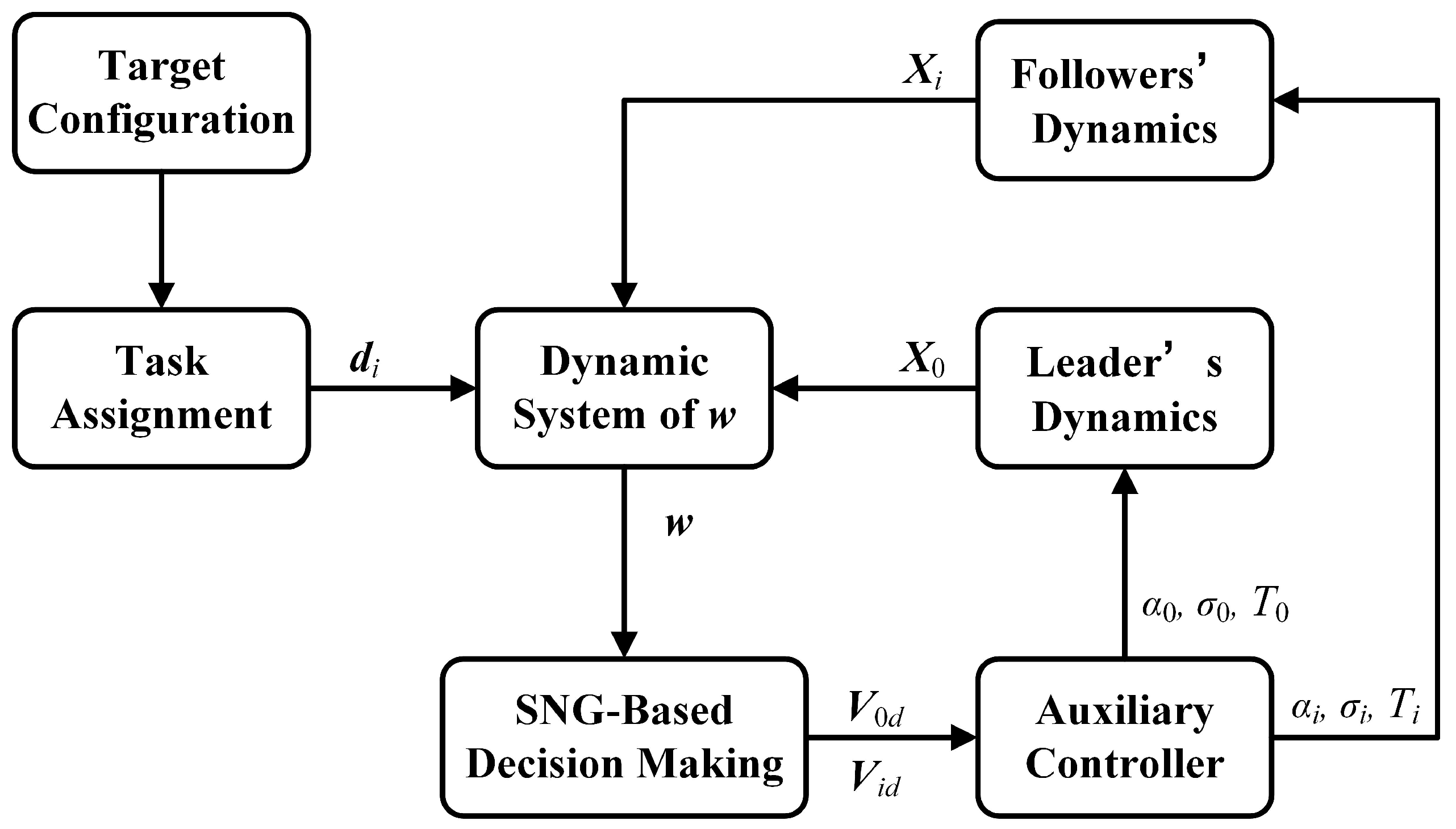
For the formation reconfiguration of fixed-wing unmanned aerial vehicles (UAVs), a hierarchical control decision-making method considering both convergence and optimality is studied. To begin with, the dynamic model of the fixed-wing UAVs is established, and the formation reconfiguration control problem formally constructed. Subsequently, based on information such as the initial positions of the UAVs and the expected geometric configuration, an integer programming issue is formulated to determine the destinations of the UAVs. After completing the aforementioned preparations, by incorporating the concept of hierarchical games, the formation guidance and control problem is consequently reformulated as a multiplayer Stackelberg–Nash game (SNG). Through rigorous analysis, the optimality of using the Stackelberg–Nash equilibrium solution as the UAV control commands was demonstrated. Furthermore, a novel policy iteration (PI) algorithm for solving this equilibrium based on fixed-point iteration is proposed. To guarantee the accurate execution of the control commands, an auxiliary control system is designed, thereby forming a closed-loop real-time control decision-making mechanism. The numerical simulation results illustrate that the UAVs can rapidly switch to the desired formation configuration, thus validating the effectiveness of the proposed method.
Keywords: fixed-wing unmanned aerial vehicles; formation reconfiguration control; Stackelberg–Nash game; optimal feedback control; hierarchical control decision making fixed-wing unmanned aerial vehicles; formation reconfiguration control; Stackelberg–Nash game; optimal feedback control; hierarchical control decision making