

Timescale-Separation-Based Source Seeking for USV



Highlights
- A source-seeking controller for USVs is developed based on timescale separation, where the task-level reference update and the motion-level tracking are treated on different time scales.
- A steady-state mapping between the reference velocity and the required surge–yaw actuation is established, which enables composite Lyapunov–based convergence analysis of the coupled slow–fast closed-loop system without assuming direct access to the field gradient.
- The controller offers a structured way to incorporate optimization-based reference generation into a dynamic USV model without requiring model reduction to single-integrator or unicycle forms.
- The simulation results indicate that the method can maintain stable seeking behavior in scenarios with typical USV nonlinearities and measurement uncertainties.
Abstract
1. Introduction
- We address the kinematic–dynamic mismatch in USV source seeking by embedding optimization-layer gradient updates directly into the surge–yaw dynamics. This produces a physically realizable time-scale-separated framework that avoids the infeasibility issues inherent in hierarchical kinematic controllers.
- We design a smooth projected-gradient subsystem whose descent direction is restricted to the USV’s attainable surge axis. This ensures continuous heading evolution and bounded yaw-rate commands, and circumvents Brockett’s necessary condition, which rules out asymptotic stabilization via static gradient feedback.
- We introduce a steady-state embedding that maps optimization-layer descent directions to feasible steady-state velocities. This guarantees consistency between the optimization dynamics and the vehicle’s physical constraints, enabling implementable gradient flows for nonholonomic marine vehicles.
- We develop a composite Lyapunov framework that integrates the projected-gradient objective with the attitude and actuator dynamics, accounts for bounded sway-induced drift, and establishes local exponential stability of the full slow–fast closed-loop system.
2. USV Model
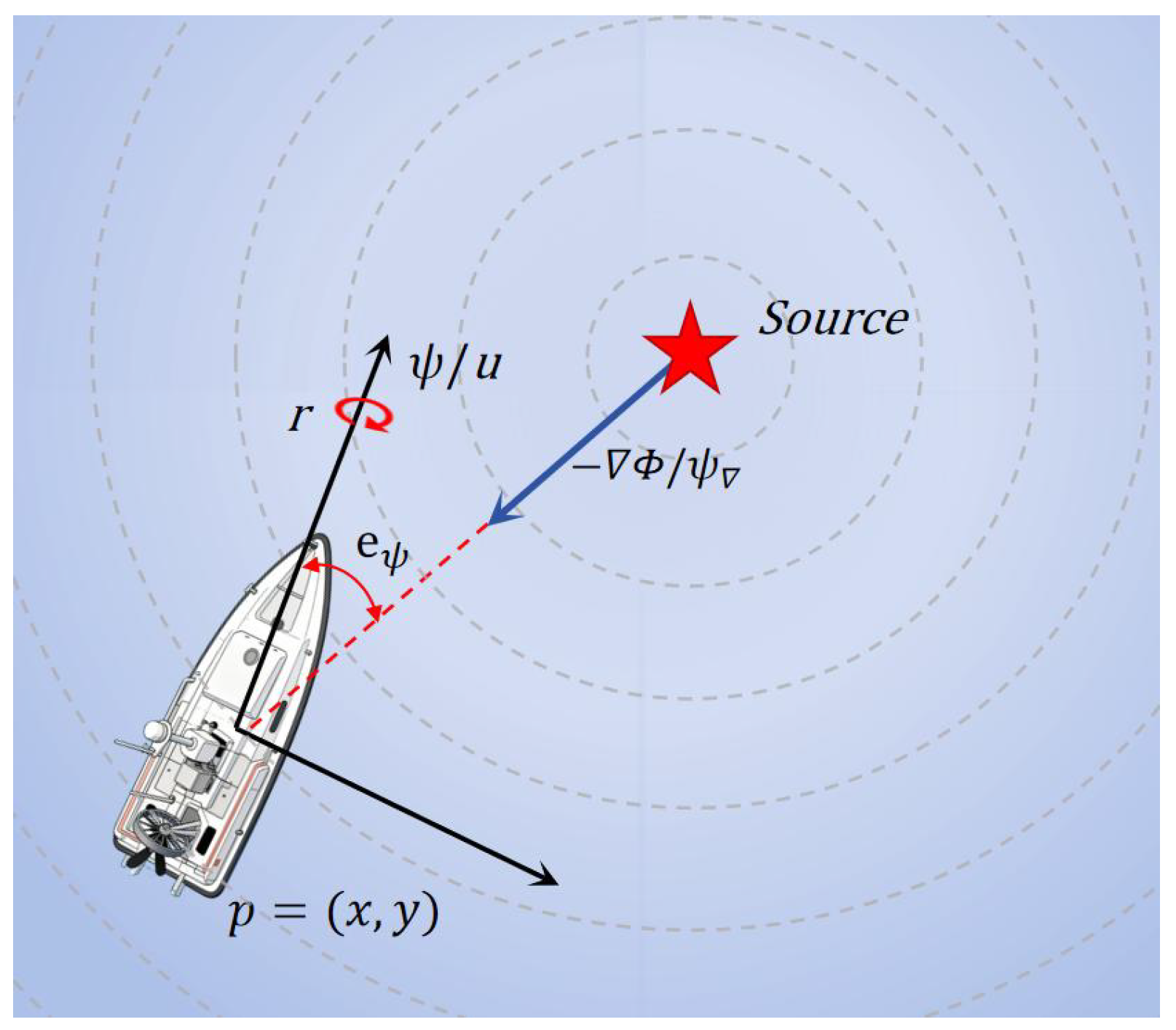
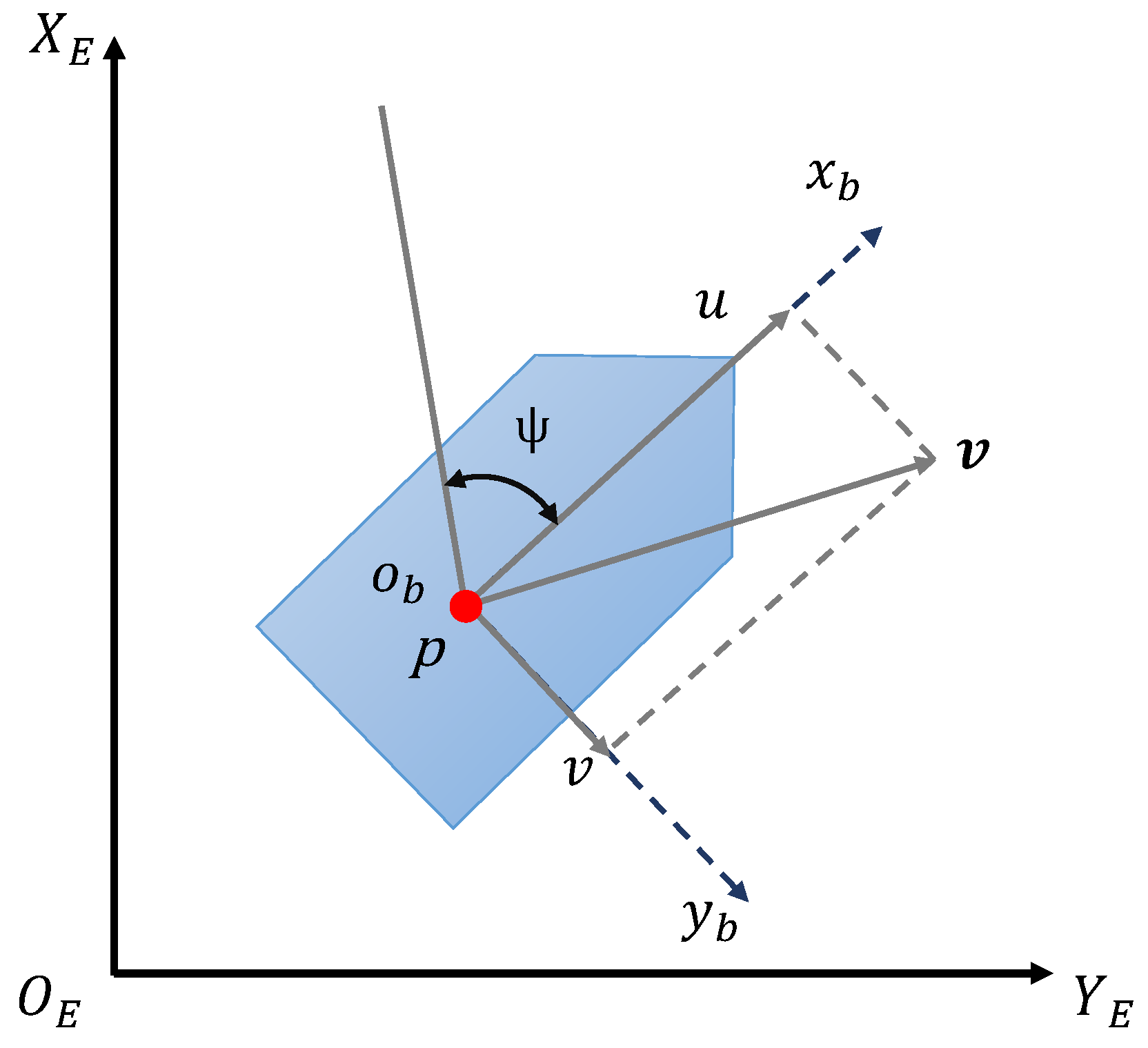
2.1. Coordinate Frames and State Variables
2.2. Kinematic Model
2.3. Dynamic Model
2.4. Low-Speed Modeling Simplifications
2.5. Model Properties
- (i)
- Bounded inertia and damping. The inertia and damping matrices satisfyfor some constants .
- (ii)
- Skew symmetry of the Coriolis matrix. The Coriolis–centrifugal matrix satisfies
3. Problem Formulation
3.1. Scalar Field and Source Location
3.2. Assumptions on the Field
- 1.
- Φ is twice continuously differentiable, and is globally Lipschitz; i.e., there exists such that
- 2.
- Near the minimizer , the Hessian is uniformly positive definite:
3.3. Control Objective
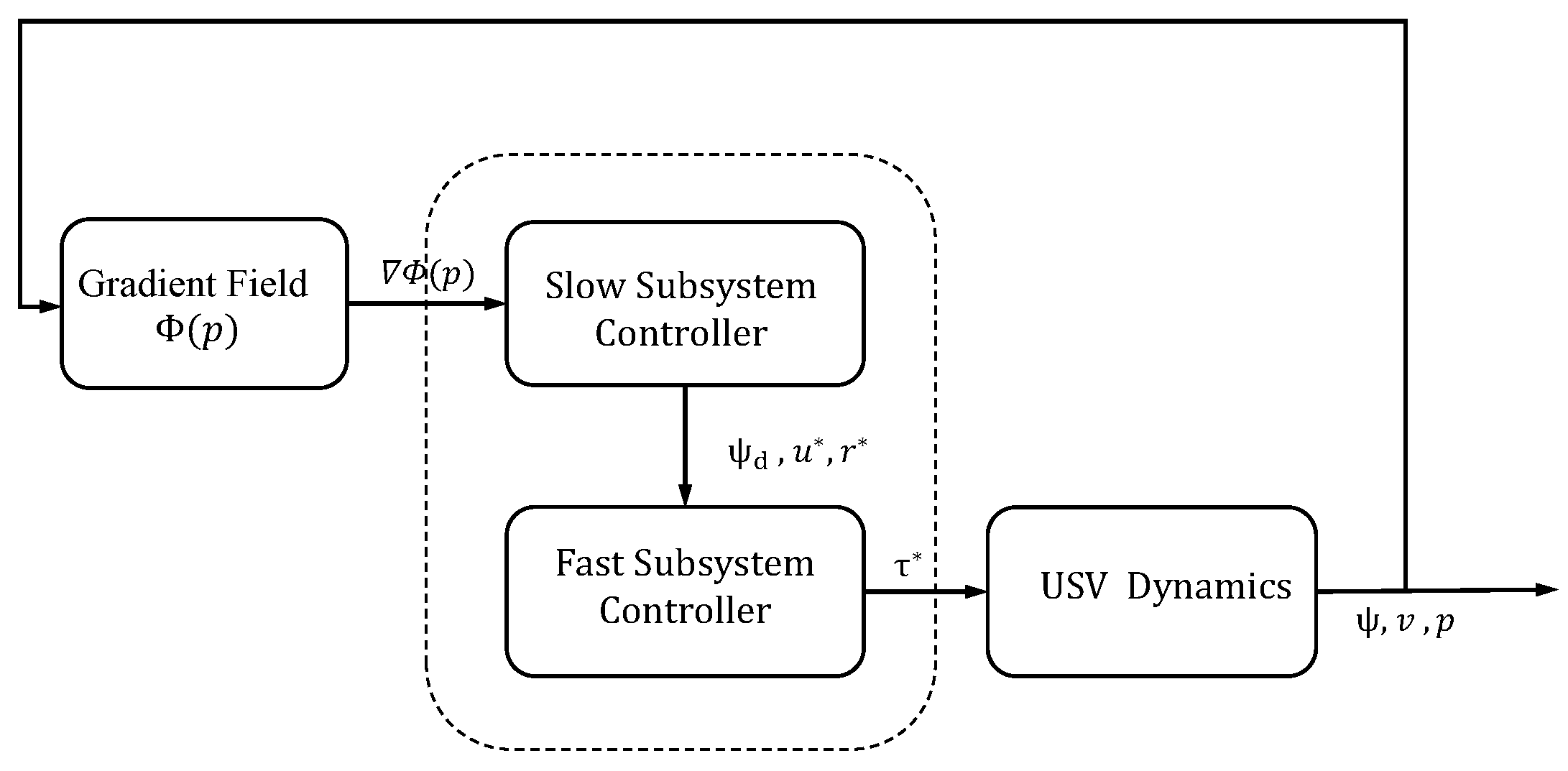
4. Source-Seeking Algorithm Based on Timescale Separation
4.1. Slow Subsystem: Reference Heading and Velocity Design
4.2. Fast Subsystem: Control Input Tracking
4.3. Composite Control Law
| Algorithm 1: Composite Control Algorithm for USV Source Seeking |
|
5. Main Results and Stability Analysis
5.1. Fast Subsystem
- (A1)
- and .
- (A2)
- The reference satisfies .
- (A3)
- The Coriolis matrix is skew-symmetric: .
5.2. Slow Subsystem
- (A1)
- satisfies Assumption 2;
- (A2)
- is with ;
- (A3)
- angular errors are small so that and act linearly.
5.3. Composite Stability
6. Numerical Simulation
6.1. Simulation Setup
6.1.1. Simulation Setup of the Scalar Field
6.1.2. USV Dynamic Model
6.1.3. Controller Parameters
6.1.4. Numerical Integration and Convergence Criterion
6.2. Simulation Settings for Baseline Algorithms
- Gradient-based Source-Seeking (Gradient).
- Extremum Seeking Control (ESC).
6.2.1. Common Dynamic Model and Initial Conditions
6.2.2. Baseline 1: Gradient-Based Source Seeking
6.2.3. Baseline 2: Extremum Seeking Control (ESC)
6.2.4. Noise and Disturbance Model
- Position noise:
- Field-value noise:
- Environmental velocity disturbance:
6.2.5. Monte Carlo Simulation Setup
- Number of trials: .
- Initial positions: .
- Simulation horizon: with .
- Convergence threshold: .
6.3. Simulation Results
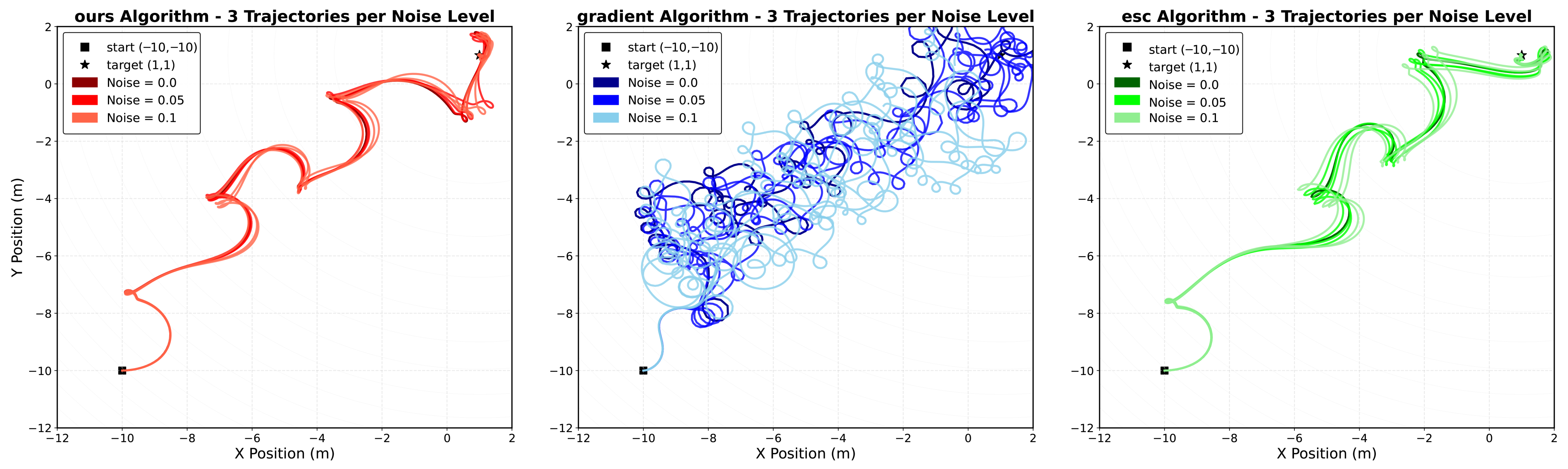
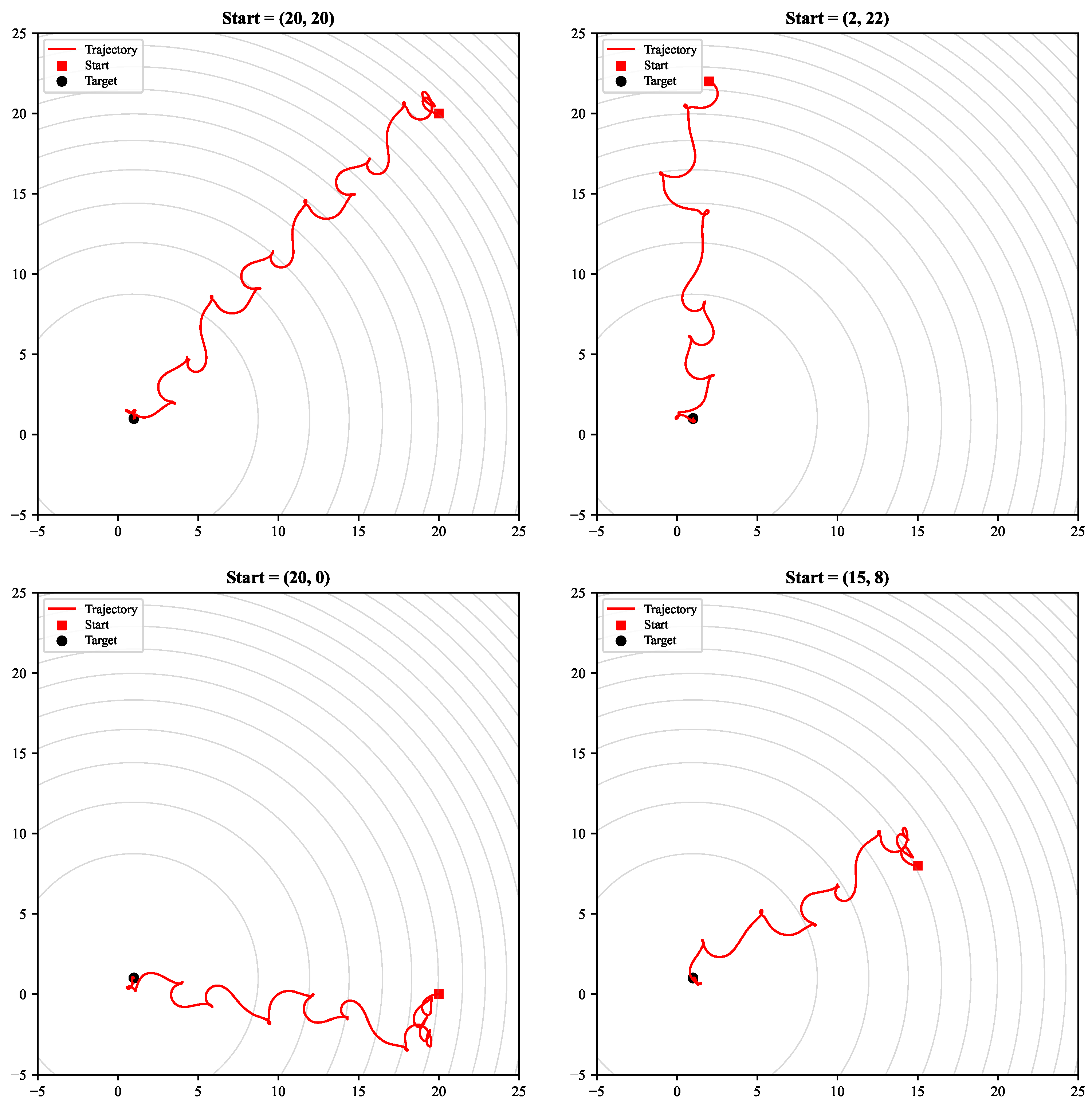
6.3.1. Single-Trajectory Behavior
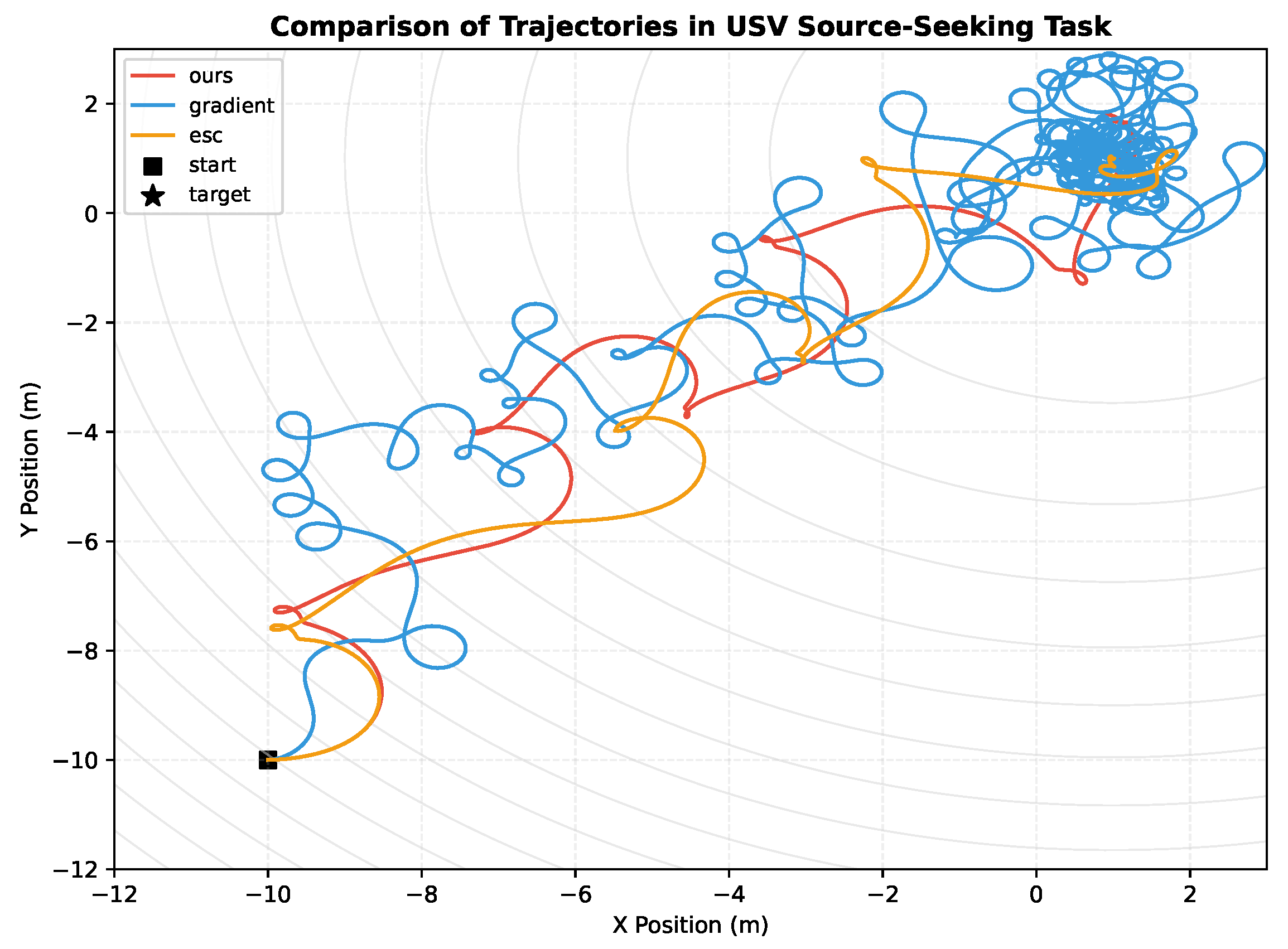
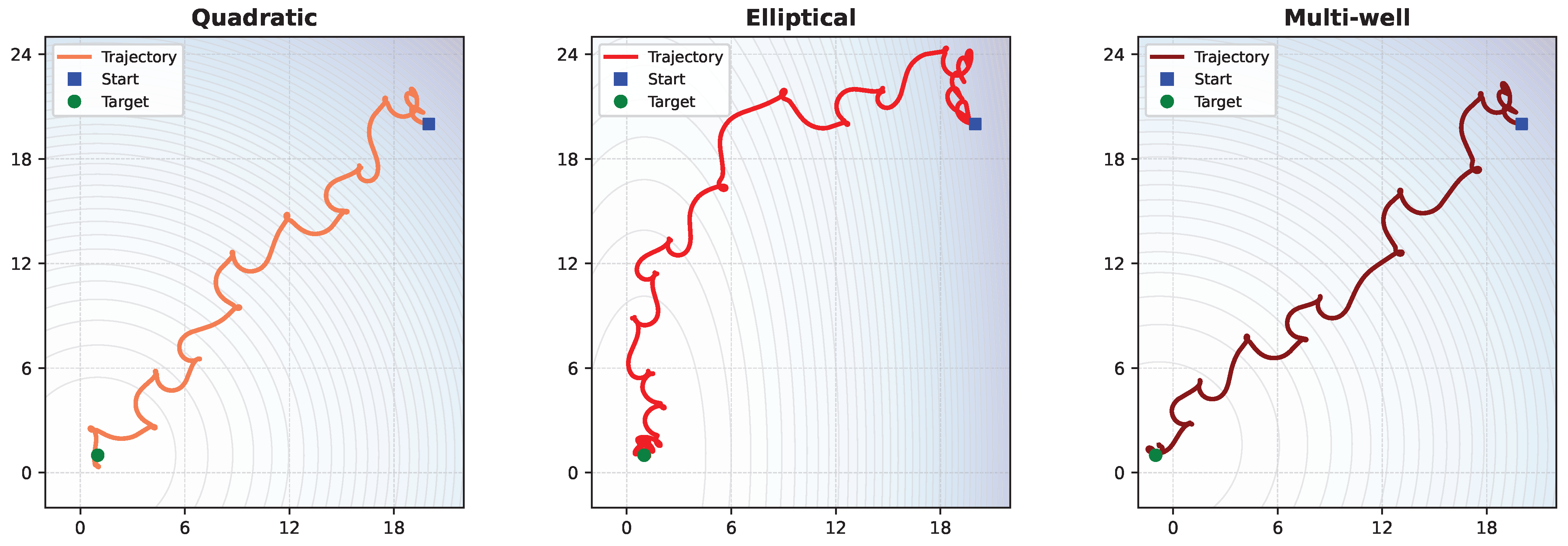
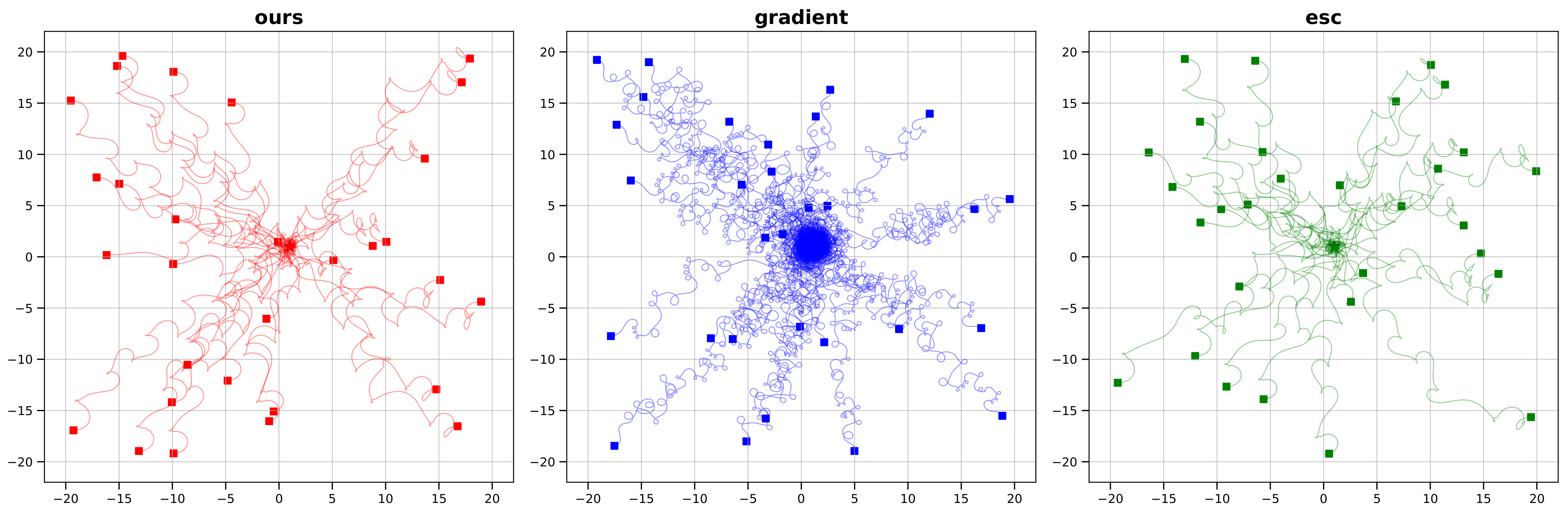
6.3.2. Trajectory Performance Under Noise-Free Conditions
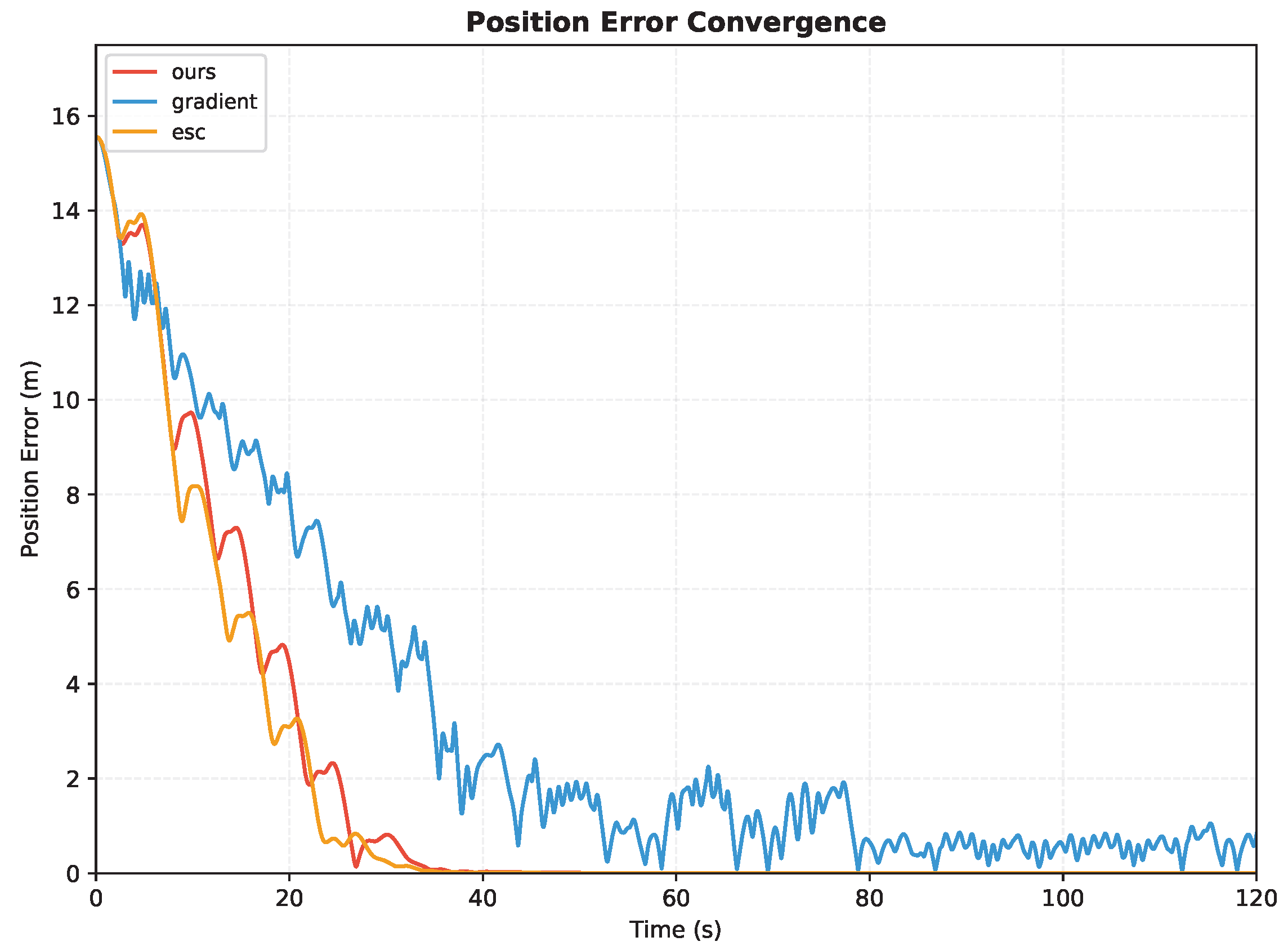
6.3.3. Error Convergence Characteristics
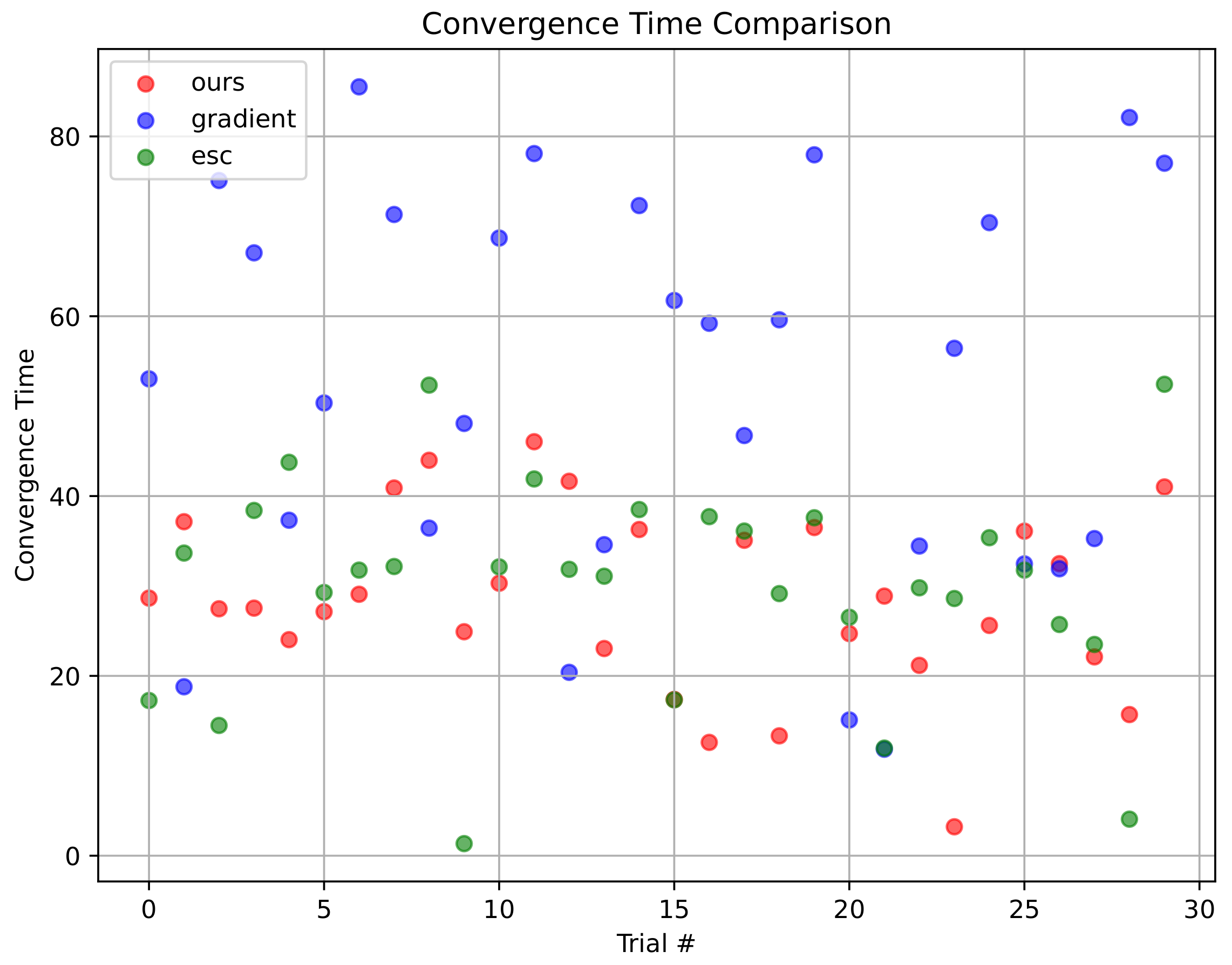
6.3.4. Effect of Measurement Noise
7. Conclusions
Author Contributions
Funding
Data Availability Statement
Conflicts of Interest
References
- Lewis, T.; Bhaganagar, K. A comprehensive review of plume source detection using unmanned vehicles for environmental sensing. Sci. Total Environ. 2021, 762, 144029. [Google Scholar] [CrossRef] [PubMed]
- Yang, T.; Hsiung, S.; Kuo, C.; Tsai, Y.; Peng, K.; Hsieh, Y.; Shen, Z.; Feng, J.; Kuo, C. Development of unmanned surface vehicle for water quality monitoring and measurement. In Proceedings of the 2018 IEEE International Conference on Applied System Invention (ICASI), Chiba, Japan, 13–17 April 2018; IEEE: New York, NY, USA, 2018; pp. 566–569. [Google Scholar]
- Farrell, J.A.; Pang, S.; Li, W. Chemical plume tracing via an autonomous underwater vehicle. IEEE J. Ocean. Eng. 2005, 30, 428–442. [Google Scholar] [CrossRef]
- Hu, H.; Song, S.; Chen, C.P. Plume tracing via model-free reinforcement learning method. IEEE Trans. Neural Netw. Learn. Syst. 2019, 30, 2515–2527. [Google Scholar] [CrossRef] [PubMed]
- Liu, M.; Wei, J.; Liu, K. A two-stage target search and tracking method for UAV based on deep reinforcement learning. Drones 2024, 8, 544. [Google Scholar] [CrossRef]
- Abdelgalil, M.; Taha, H. Recursive averaging with application to bio-inspired 3-D source seeking. IEEE Control Syst. Lett. 2022, 6, 2816–2821. [Google Scholar] [CrossRef]
- Li, W.; Farrell, J.A.; Pang, S.; Arrieta, R.M. Moth-inspired chemical plume tracing on an autonomous underwater vehicle. IEEE Trans. Robot. 2006, 22, 292–307. [Google Scholar] [CrossRef]
- Wu, W.; Couzin, I.D.; Zhang, F. Bio-inspired source seeking with no explicit gradient estimation. IFAC Proc. Vol. 2012, 45, 240–245. [Google Scholar] [CrossRef]
- Naeem, W.; Sutton, R.; Chudley, J. Chemical plume tracing and odour source localisation by autonomous vehicles. J. Navig. 2007, 60, 173–190. [Google Scholar] [CrossRef]
- Harvey, D.J.; Lu, T.F.; Keller, M.A. Comparing insect-inspired chemical plume tracking algorithms using a mobile robot. IEEE Trans. Robot. 2008, 24, 307–317. [Google Scholar] [CrossRef]
- Atanasov, N.A.; Le Ny, J.; Pappas, G.J. Distributed algorithms for stochastic source seeking with mobile robot networks. J. Dyn. Syst. Meas. Control 2015, 137, 031004. [Google Scholar] [CrossRef]
- Li, T.; Jayawardhana, B.; Kamat, A.M.; Kottapalli, A.G.P. Source-seeking control of unicycle robots with 3-D-printed flexible piezoresistive sensors. IEEE Trans. Robot. 2021, 38, 448–462. [Google Scholar] [CrossRef]
- Suttner, R.; Krstić, M. Source seeking with a torque-controlled unicycle. IEEE Control Syst. Lett. 2022, 7, 79–84. [Google Scholar] [CrossRef]
- Torres-Zuniga, I.; Lopez-Caamal, F.; Hernandez-Escoto, H.; Alcaraz-Gonzalez, V. Extremum seeking control and gradient estimation based on the Super-Twisting algorithm. J. Process Control 2021, 105, 223–235. [Google Scholar] [CrossRef]
- Salomon, R. Evolutionary algorithms and gradient search: Similarities and differences. IEEE Trans. Evol. Comput. 2002, 2, 45–55. [Google Scholar] [CrossRef]
- Tekaslan, H.E.; Atkins, E.M. Gradient-Guided Search for Autonomous Contingency Landing Planning. Drones 2025, 9, 642. [Google Scholar] [CrossRef]
- Fisher, A.W.; Nidzieko, N.J.; Scully, M.E.; Chant, R.J.; Hunter, E.J.; Mazzini, P.L. Turbulent mixing in a far-field plume during the transition to upwelling conditions: Microstructure observations from an AUV. Geophys. Res. Lett. 2018, 45, 9765–9773. [Google Scholar] [CrossRef]
- Fahad, M.; Guo, Y.; Bingham, B. Simulating fine-scale marine pollution plumes for autonomous robotic environmental monitoring. Front. Robot. 2018, 5, 52. [Google Scholar] [CrossRef]
- Pomareda, V.; Magrans, R.; Jiménez-Soto, J.M.; Martínez, D.; Tresánchez, M.; Burgués, J.; Palacín, J.; Marco, S. Chemical source localization fusing concentration information in the presence of chemical background noise. Sensors 2017, 17, 904. [Google Scholar] [CrossRef]
- Gaitsgory, V. Suboptimal control of singularly perturbed systems and periodic optimization. IEEE Trans. Autom. Control 2002, 38, 888–903. [Google Scholar] [CrossRef]
- Zhao, J.; Yang, C.; Gao, W.; Zhou, L.; Liu, X. Adaptive optimal output regulation of interconnected singularly perturbed systems with application to power systems. IEEE/CAA J. Autom. Sin. 2024, 11, 595–607. [Google Scholar] [CrossRef]
- Fu, Z.; Xie, W.; Rakheja, S.; Na, J. Observer-based adaptive optimal control for unknown singularly perturbed nonlinear systems with input constraints. IEEE/CAA J. Autom. Sin. 2017, 4, 48–57. [Google Scholar] [CrossRef]
- Isidori, A.; Sastry, S.; Kototovic, P.; Byrnes, C. Singularly perturbed zero dynamics of nonlinear systems. IEEE Trans. Autom. Control 2002, 37, 1625–1631. [Google Scholar] [CrossRef]
- Pang, S.; Farrell, J.A. Chemical plume source localization. IEEE Trans. Syst. Man, Cybern. Part B (Cybern.) 2006, 36, 1068–1080. [Google Scholar] [CrossRef] [PubMed]
- Fahad, M.; Guo, Y.; Bingham, B.; Krasnosky, K.; Fitzpatrick, L.; Sanabria, F.A. Ocean plume tracking with unmanned surface vessels: Algorithms and experiments. In Proceedings of the 2018 13th World Congress on Intelligent Control and Automation (WCICA), Changsha China, 4–8 July 2018; IEEE: New York, NY, USA, 2018; pp. 1–6. [Google Scholar]
- Farrell, J.A.; Pang, S.; Li, W. Plume mapping via hidden Markov methods. IEEE Trans. Syst. Man, Cybern. Part B (Cybern.) 2003, 33, 850–863. [Google Scholar] [CrossRef]
- Fossen, T.I. Handbook of Marine Craft Hydrodynamics and Motion Control; John Wiley & Sons: Hoboken, NJ, USA, 2011. [Google Scholar]
- Fredriksen, E.; Pettersen, K.Y. Global κ-exponential way-point maneuvering of ships: Theory and experiments. Automatica 2006, 42, 677–687. [Google Scholar] [CrossRef]
- Mazenc, F.; Pettersen, K.; Nijmeijer, H. Global uniform asymptotic stabilization of an underactuated surface vessel. IEEE Trans. Autom. Control 2002, 47, 1759–1762. [Google Scholar] [CrossRef]
- Brockett, R.W. Asymptotic stability and feedback stabilization. Differ. Geom. Control Theory 1983, 27, 181–191. [Google Scholar]





Disclaimer/Publisher’s Note: The statements, opinions and data contained in all publications are solely those of the individual author(s) and contributor(s) and not of MDPI and/or the editor(s). MDPI and/or the editor(s) disclaim responsibility for any injury to people or property resulting from any ideas, methods, instructions or products referred to in the content. |
© 2025 by the authors. Licensee MDPI, Basel, Switzerland. This article is an open access article distributed under the terms and conditions of the Creative Commons Attribution (CC BY) license (https://creativecommons.org/licenses/by/4.0/).
Share and Cite
Gong, C.; Wang, H.; Chen, C.; Jin, Z. Timescale-Separation-Based Source Seeking for USV. Drones 2025, 9, 879. https://doi.org/10.3390/drones9120879
Gong C, Wang H, Chen C, Jin Z. Timescale-Separation-Based Source Seeking for USV. Drones. 2025; 9(12):879. https://doi.org/10.3390/drones9120879
Chicago/Turabian StyleGong, Chenxi, Hexuan Wang, Chongqing Chen, and Zhenghong Jin. 2025. "Timescale-Separation-Based Source Seeking for USV" Drones 9, no. 12: 879. https://doi.org/10.3390/drones9120879
APA StyleGong, C., Wang, H., Chen, C., & Jin, Z. (2025). Timescale-Separation-Based Source Seeking for USV. Drones, 9(12), 879. https://doi.org/10.3390/drones9120879