


Application of UAVs and Machine Learning Methods for Mapping and Assessing Salinity in Agricultural Fields in Southern Kazakhstan

Highlights
- A method for quickly assessing field salinity has been developed based on the use of a UAV equipped with a multispectral camera and laboratory studies of the electrical conductivity of soil samples.
- Labeled datasets have been developed for tuning machine learning models and mapping field salinity in southern Kazakhstan.
- The use of a UAV equipped with a multispectral camera and machine learning methods enables highly detailed salinity mapping of large field areas.
- Conditions in each field can vary; therefore, achieving expected results requires individual tuning of the models for each field.
Abstract
1. Introduction
- (1)
- How much do weather conditions, lighting, soil type, and existing vegetation affect the results of assessing the salinity level of agricultural fields?
- (2)
- How much do the climatic and landscape conditions of the analyzed agricultural area affect the results?
- (3)
- What is the optimal configuration of UAV attachments?
- (4)
- What is the optimal amount of field data to ensure sufficient accuracy in determining salinity?
- (5)
- What are the optimal methods for preprocessing the collected data, and what combinations of input parameters and machine learning algorithms provide the most accurate and stable results?
- Development of a methodological scheme for obtaining the current salinity maps of fields in Southern Kazakhstan using multispectral imaging from a UAV, which allows high spatial and temporal resolution to be achieved and significantly reduces dependence on expensive ground-based soil surveys.
- Implementation of a comparative analysis using the high-detail surface soil salinity mapping technologies for two regions of southern Kazakhstan; this allows a more accurate identification of the limitations of the method under development.
- Development of a dataset, which allows configuration and investigation of the behavior of various machine learning models in the process of assessing salinity based on a combination of multispectral data from UAVs and soil conductivity estimates.
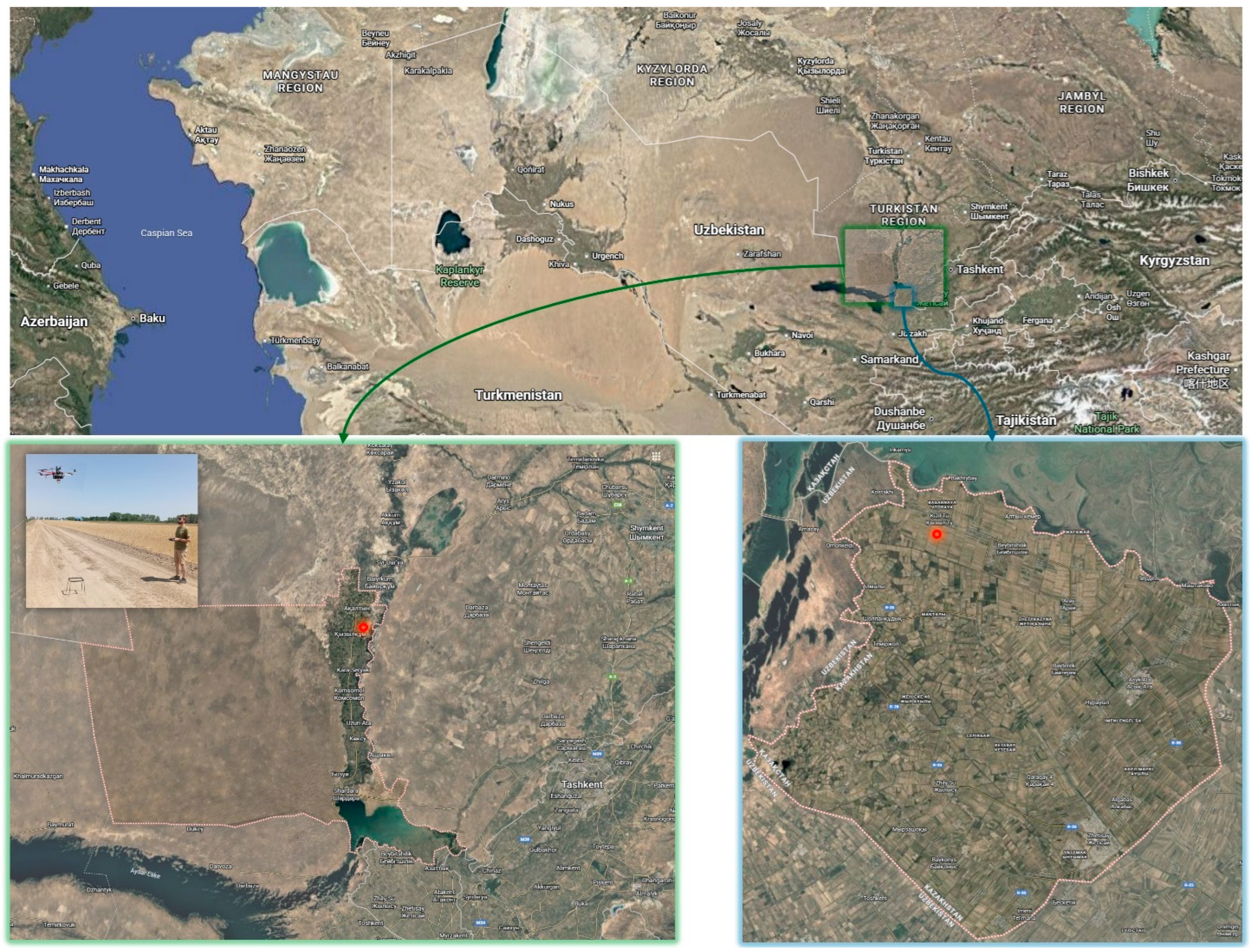
2. Regions Under Research
3. Materials and Methods
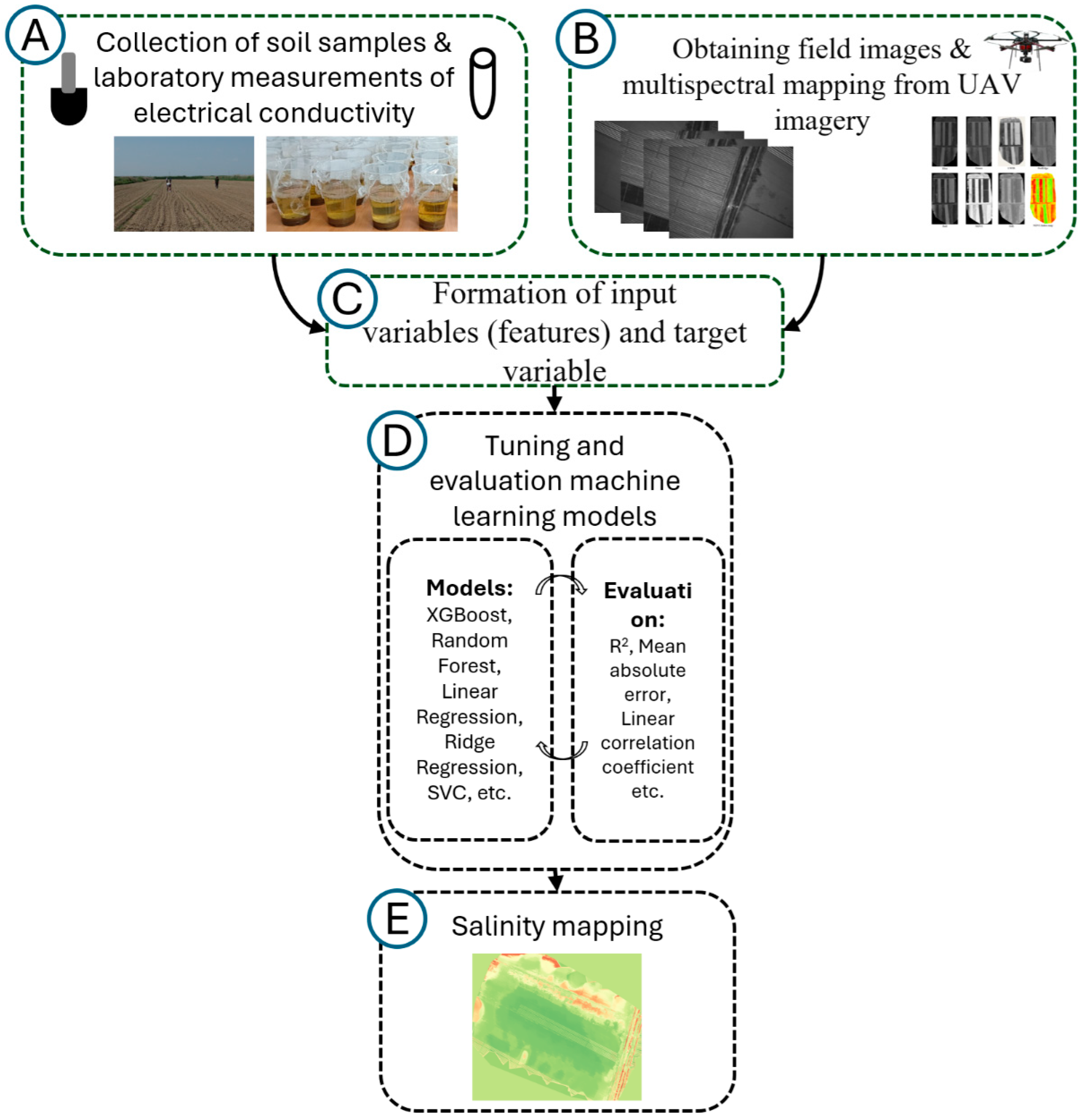
- A.
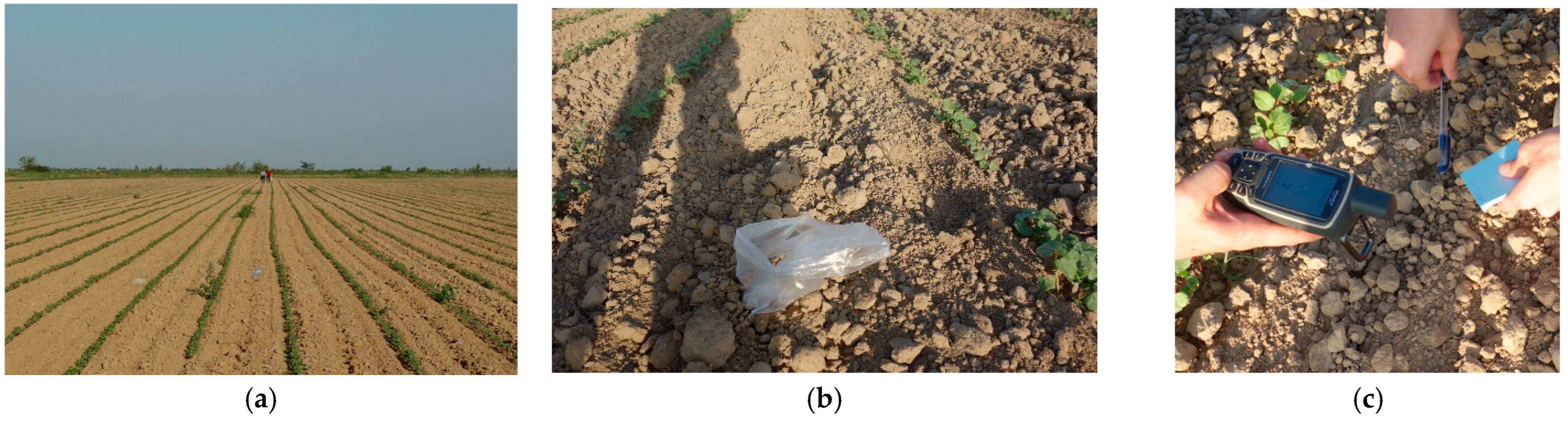
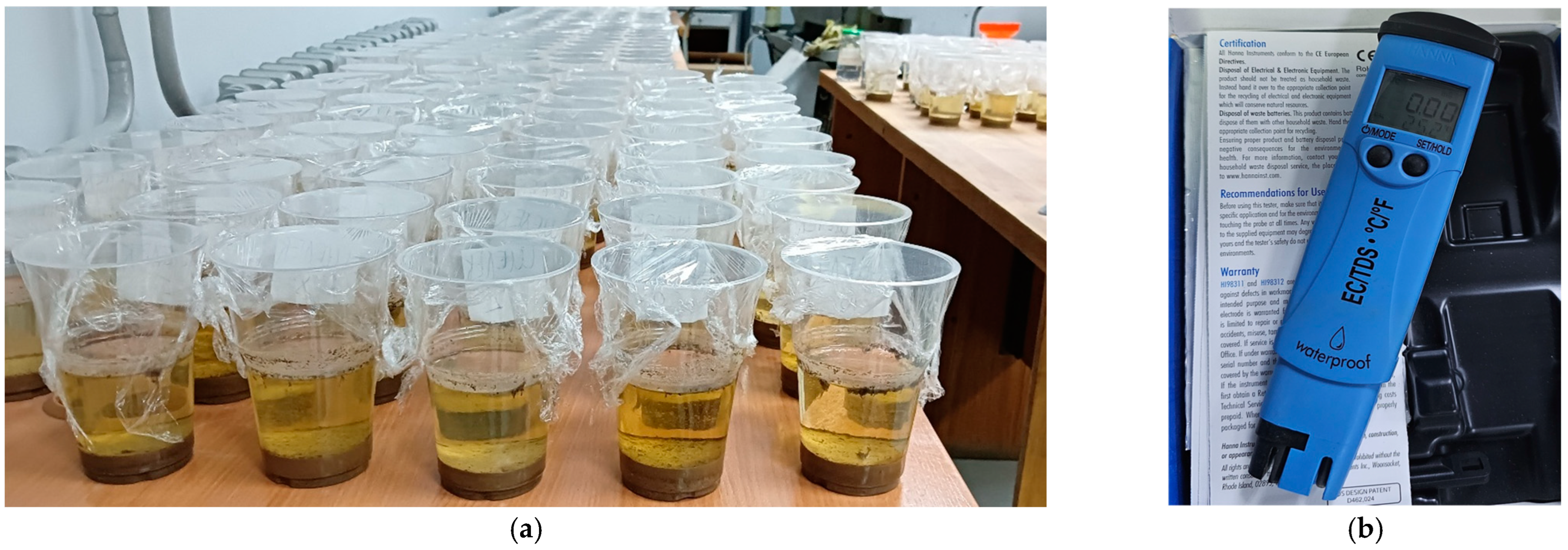
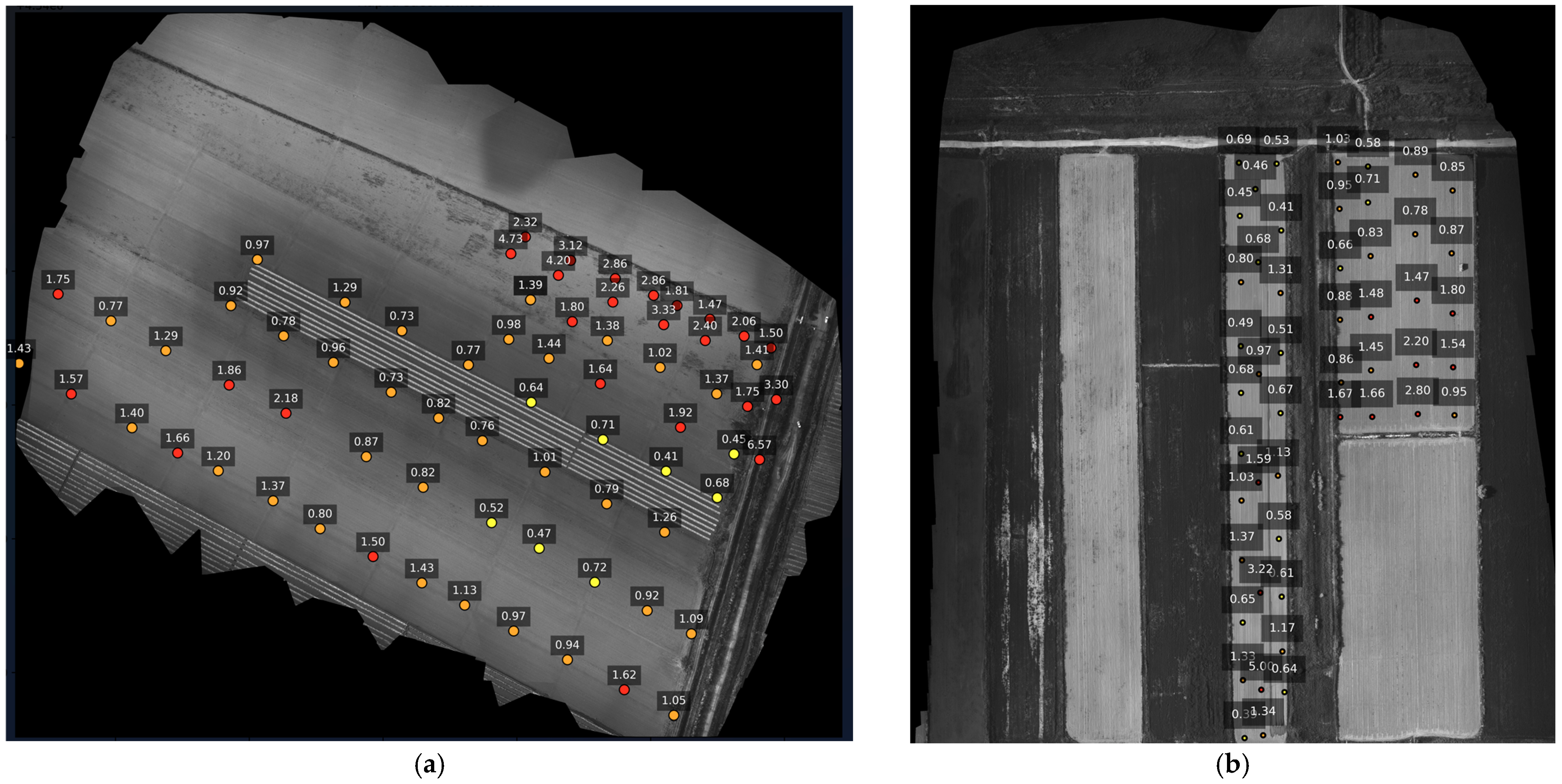
- Ground samples were taken from the depth of 10–20 cm in the accessible part of the fields. The locations of the sampling points were recorded. The samples were processed in the laboratory to assess their electrical conductivity.
- B.
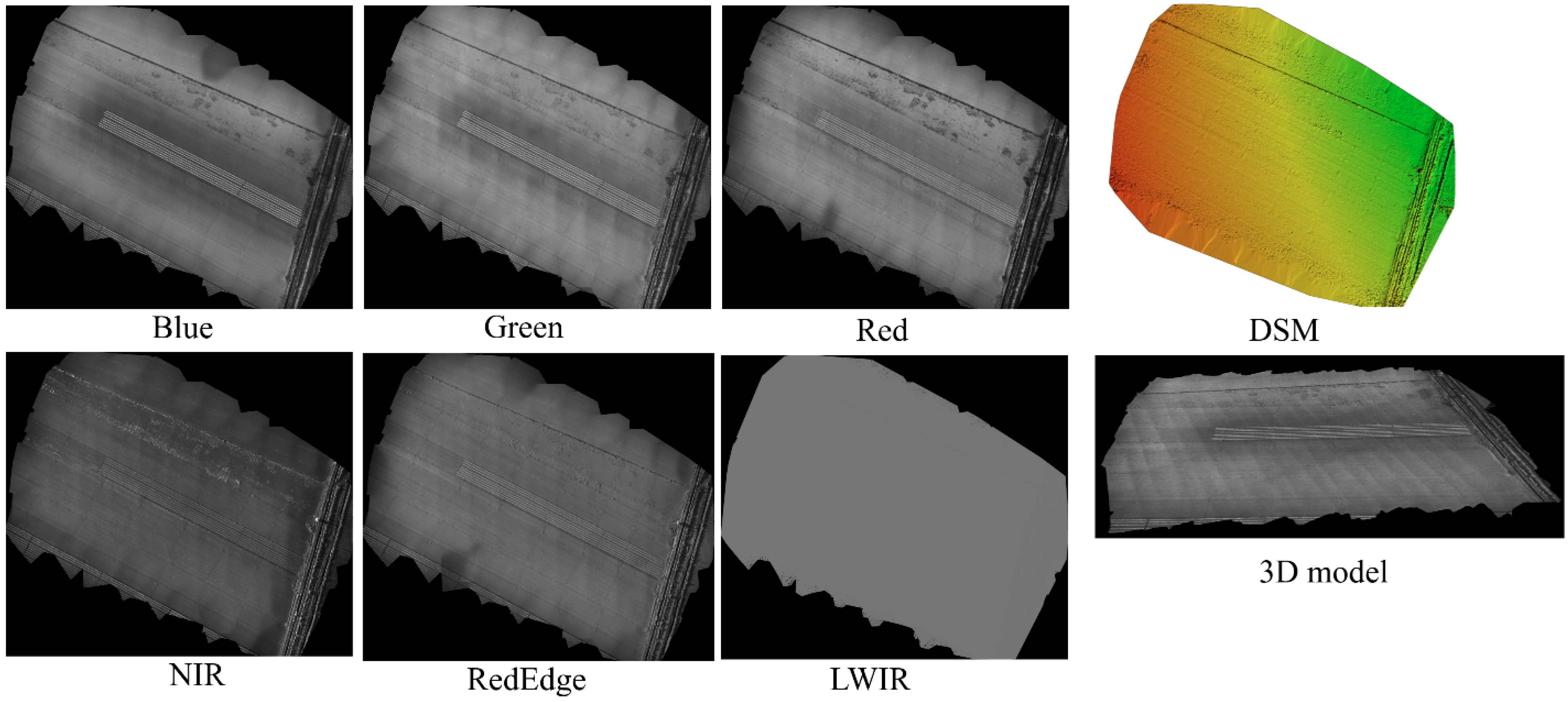
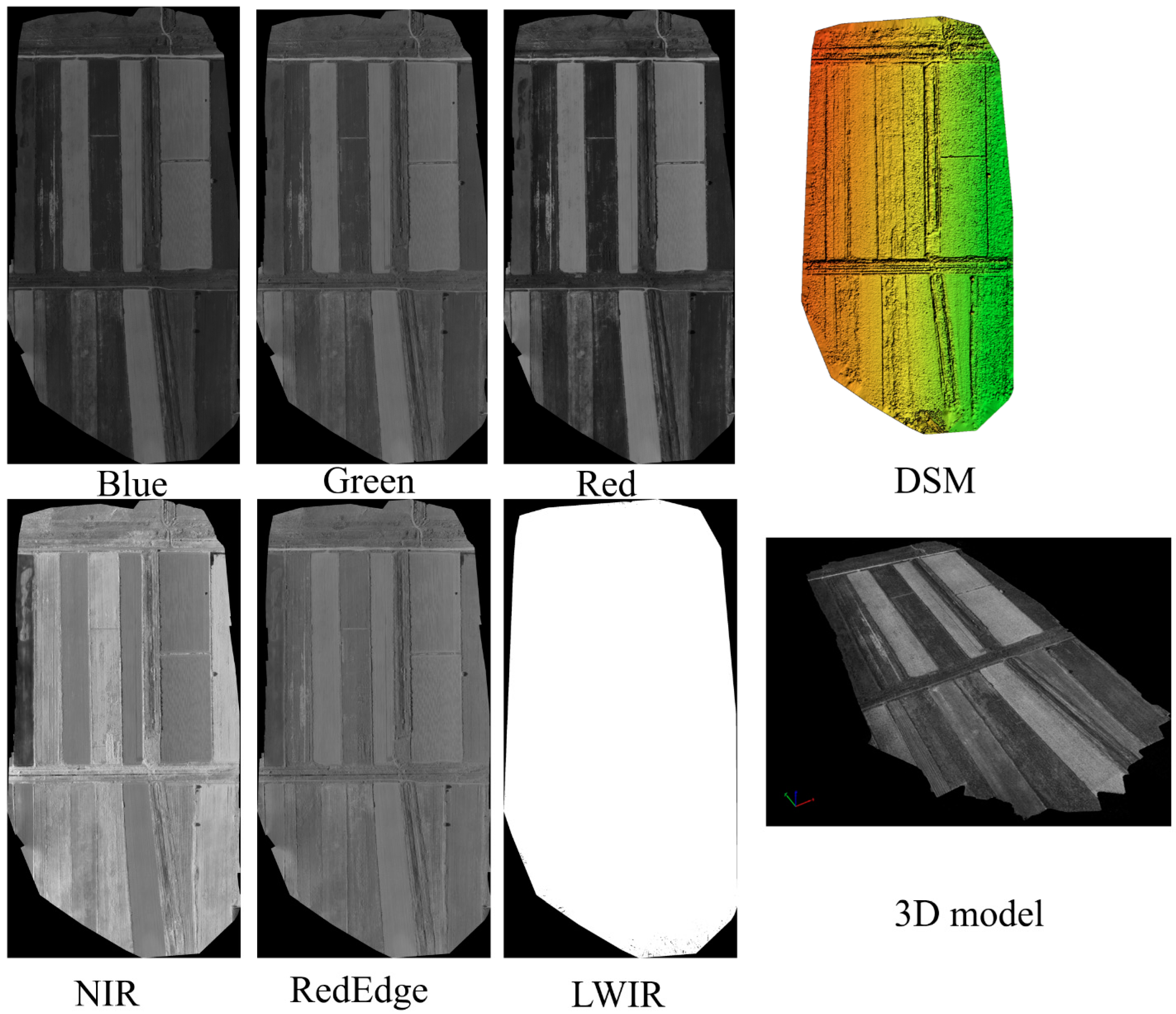
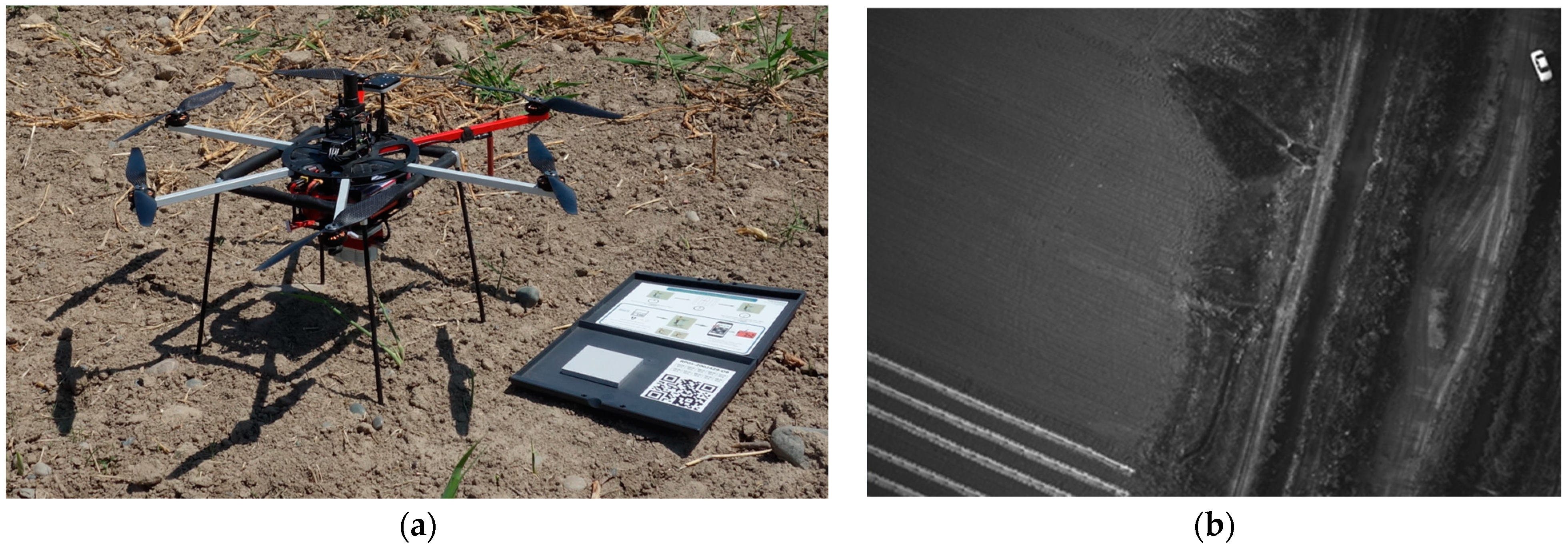
- The fields were flown over, and multispectral images were obtained. The multispectral images were processed to obtain spectrum maps, spectral indices, and a DSM map.
- C.
- Using the obtained data, a set of input features was formed and a target variable (electrical conductivity) was determined.
- D.
- Machine learning models and spectrum map preprocessing parameters were configured, and the model with the best results was selected.
- E.
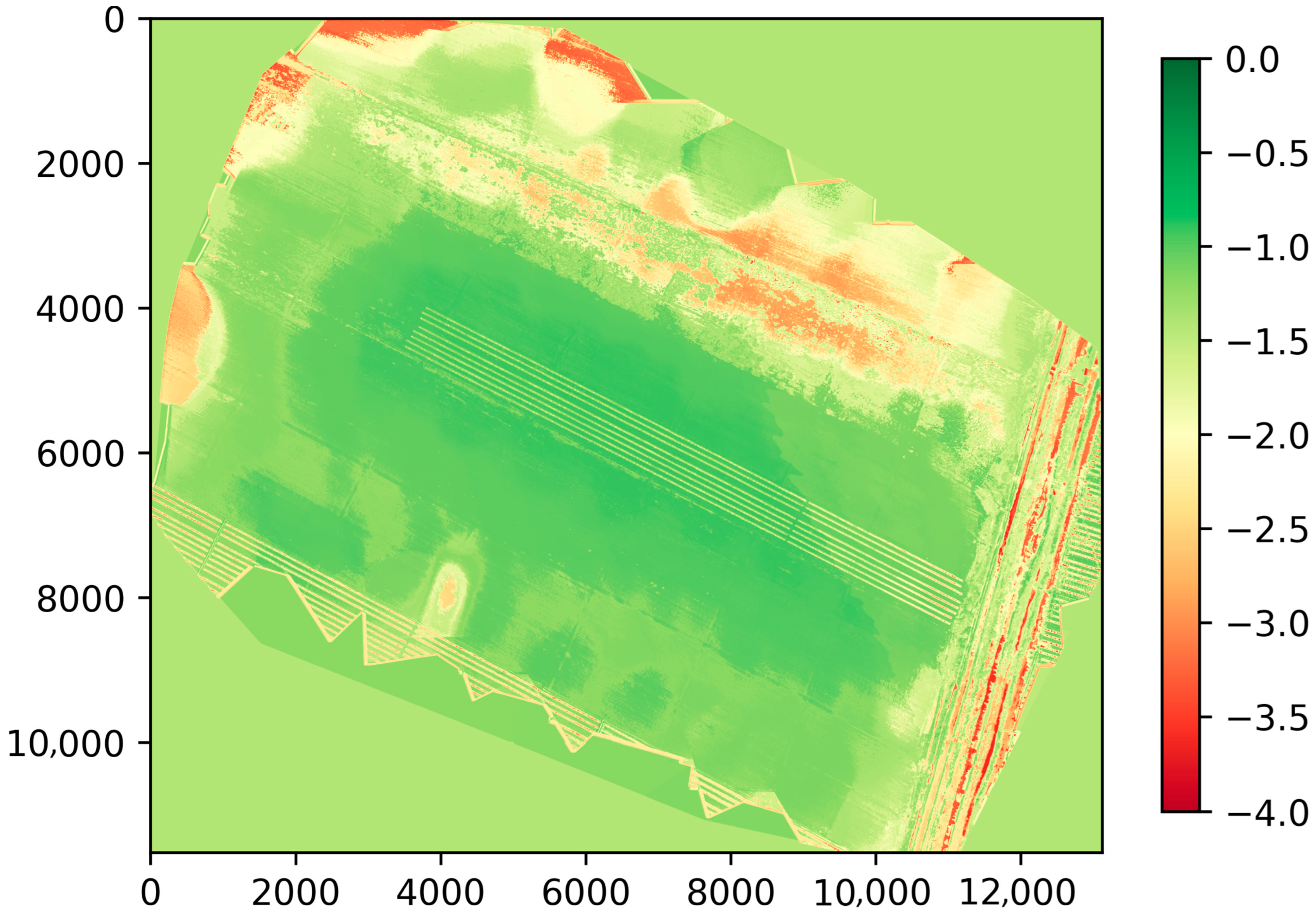
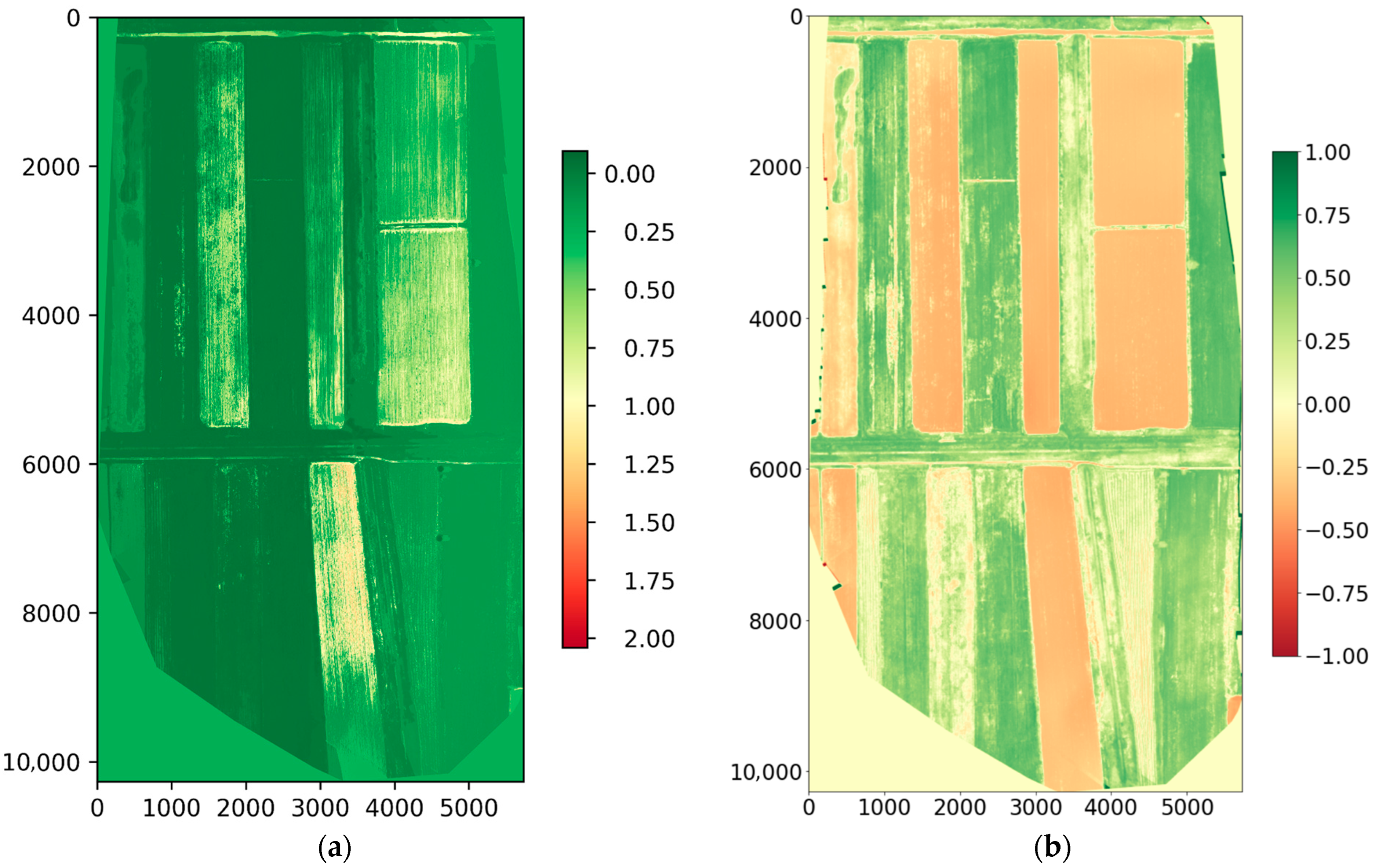
- Using the machine learning model, the salinity maps of the fields at the time of data collection were obtained.
3.1. Field Survey
3.2. Soil Sampling and Electrical Conductivity Assessment
3.3. Multispectral Images Processing
- Initial processing;
- Generation of orthophoto plan, multispectral maps, digital surface model (DSM), and digital terrain model (DTM);
- Calculation of spectral indices.
3.4. Customization of Machine Learning Models
- a.
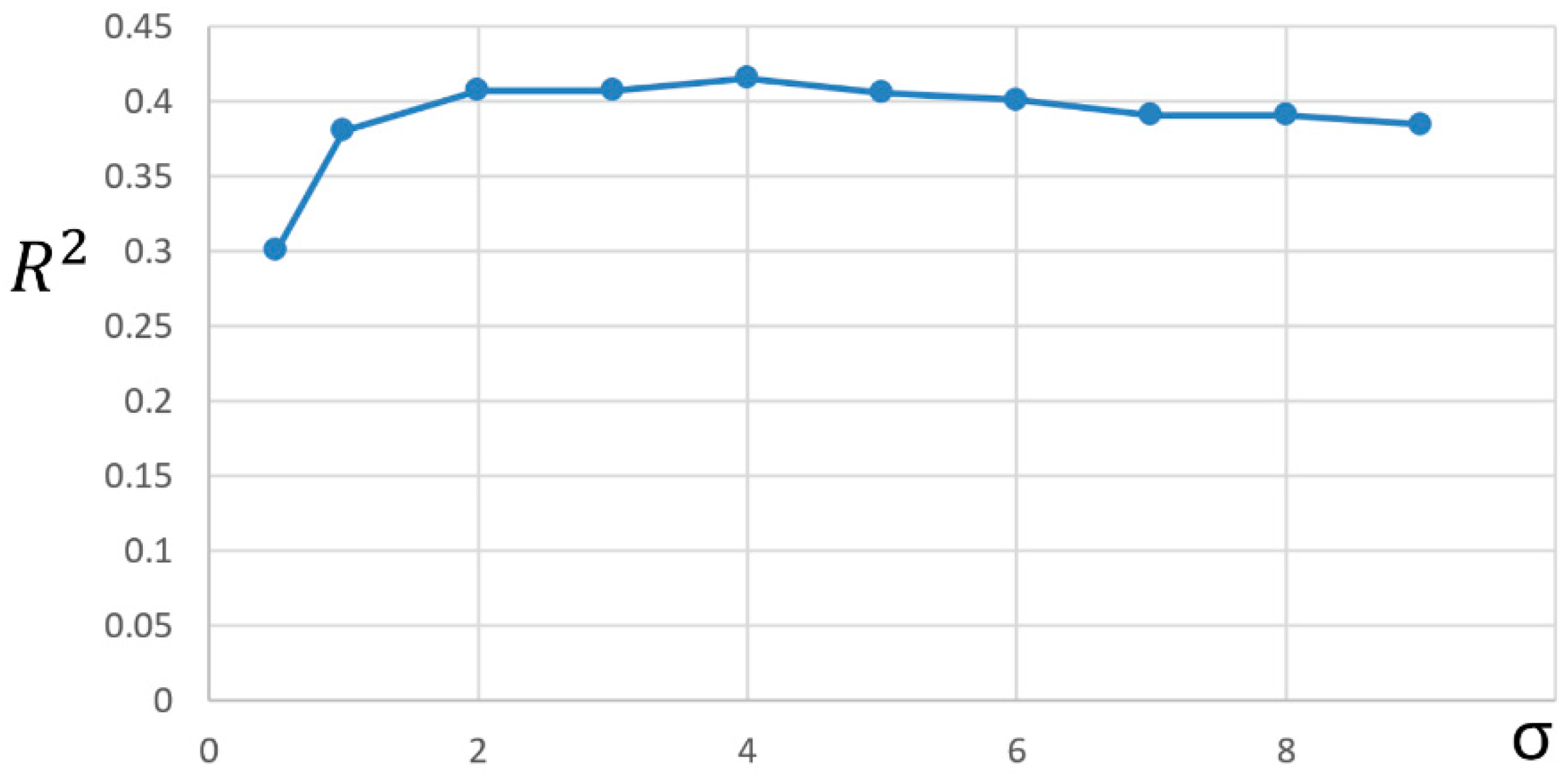
- High-resolution images from UAVs can lead to large differences in images of small field fragments with similar salinity values due to the chaotic arrangement of clumps of soil. To level out these differences, images were smoothed using a Gaussian filter.
- b.
- The spectral channel values of the field images are extracted based on the coordinates of the collection points. Then, the spectral indices are calculated (see Table 2) and the resulting set of input parameters is fed into machine learning models (the model Table). During the experiments and visualization of the results, a significant systematic inaccuracy in the measurement of soil sample coordinates was discovered. The locations of the samples were additionally verified manually.
- c.
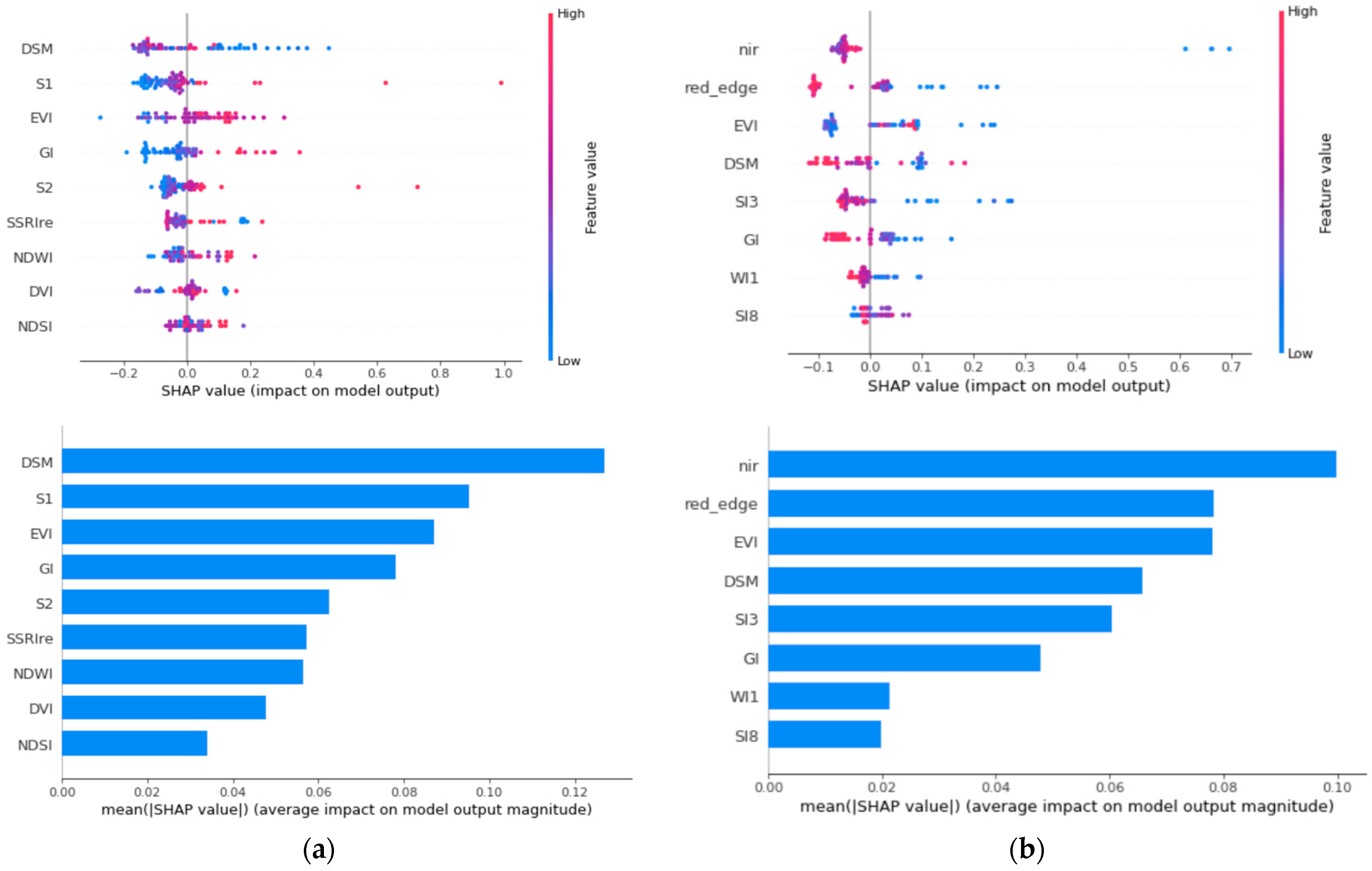
- The performance of machine learning models depends on input features. If there is an excessive set of parameters, the quality of the model’s performance may deteriorate significantly. The mlxtend library [74] was used to select significant features. The library allows the discarding of those input parameters that impair the predictive capabilities of the model.
- d.
- Given that the amount of data for training and validating models is small, cross-validation was used for their objective evaluation. In this study, the author used a cross-validation of random permutations—ShuffleSplit. In this case, the initial data is divided into training and test data in a given proportion (in our case, 80% are training data and 20% are test data). To ensure a statistically stable result, this division was performed 200 times for each regression model. The obtained model estimates (MAE, R2, Rp) were averaged and taken as an assessment of the quality of each model.
4. Results
5. Discussion
- Small amount of field data. For example, for the fields in the Shardara district, there are fewer than 50 measurements.
- Coordinate calculation errors. A systematic error in coordinate calculation, which arose for an unknown reason, led to unsatisfactory results at the initial stage. Manual correction improved the results but may not have been sufficient.
- Soil samples and surveys were performed using different positioning devices, each of which may introduce its own error.
- Soil sampling methodology. Unlike previous works, the soil samples were collected from a larger area of the fields, and the distance between samples was significantly greater.
- For these fields, it would be useful to conduct surveys at the time of intensive growth of useful plants in order to use plants as another indicator of salinity.
- Increasing the frequency of sampling will be useful for improving the quality of models.
- The use of visual landmarks and Real Time Kinematic systems [81] will significantly improve positioning accuracy.
6. Advantages and Limitations
- High accuracy: UAVs are able to obtain data with high resolution and accuracy.
- Cost-effectiveness: The use of UAVs reduces costs compared to traditional aerial photography methods.
- Flexibility: UAVs can be used in areas that are difficult to access and dangerous for humans.
- Speed: Data collection and processing take less time compared to traditional methods.
- High costs of equipment: Purchasing and maintaining drones and multispectral cameras can be expensive for small farms.
- Special skills required: Operating drones and analyzing data requires special training and skills.
- Weather restrictions: Drones may be limited in their use in adverse weather conditions, such as strong winds or rain.
- Legal and regulatory restrictions: Some regions have strict rules and restrictions on the use of drones, which can create some difficulties in using them.
- The results are applicable at a specific time, since irrigation and other agronomic processes can significantly alter the distribution of salinity in the surface soil layer.
- Optical methods are unable to detect salinity in deep soil layers.
- Collecting and analyzing soil samples is a fairly labor-intensive process.
- Machine learning models require individual configuration for each group of fields.
7. Conclusions
Funding
Data Availability Statement
Conflicts of Interest
Appendix A
Appendix A.1

| Model | mMAE | mMSE | Duration (s) | ||
|---|---|---|---|---|---|
| XGB | 0.4094 | 0.4794 | 0.1996 | 0.8005 | 9.188 |
| GBT | 0.5079 | 0.5655 | −0.0692 | 0.7018 | 2.695 |
| kNN | 0.4838 | 0.5543 | −0.0127 | 0.7028 | 0.946 |
| RF | 0.4545 | 0.5422 | −0.2878 | 0.7808 | 20.204 |
| LR | 0.6854 | 1.2768 | −3.027 | 0.6518 | 0.334 |
| MLP | 0.4904 | 0.5677 | −0.0594 | 0.7382 | 19.045 |
| Lasso | 0.5095 | 0.6385 | −0.5949 | 0.6847 | 0.326 |
| ElasticNet | 0.5135 | 0.6343 | −0.1368 | 0.6738 | 0.314 |
| LGBM | 0.531 | 0.629 | −0.2156 | NaN | 9.285 |
| Ridge | 0.5011 | 0.6067 | −0.0594 | 0.7155 | 0.764 |
| SVM | 0.4142 | 0.4613 | 0.2228 | 0.8244 | 0.3729 |
| Model | Params |
|---|---|
| XGB | XGBRegressor(base_score=0.5, booster=‘gbtree’, colsample_bylevel=0.5, colsample_bynode=1, colsample_bytree=0.7, early_stopping_rounds=50, eval_metric=‘rmse’, gamma=0.0, gpu_id=−1, importance_type=‘gain’, interaction_constraints=‘’, learning_rate=0.022, max_delta_step=0, max_depth=3, min_child_weight=1, missing=nan, monotone_constraints=‘()’, n_estimators=100, n_jobs=−1, nthread=8, num_parallel_tree=1, random_state=0, reg_alpha=0, reg_lambda=1, scale_pos_weight=1, subsample=0.8, tree_method=‘exact’, validate_parameters=1, verbosity=None) |
| GBT | GradientBoostingRegressor(learning_rate=0.0052, max_depth=2, n_estimators=50, random_state=199) |
| kNN | KNeighborsRegressor(n_neighbors=11) |
| RF | RandomForestRegressor(max_depth=4) |
| LR | LinearRegression() |
| MLP | MLPRegressor(hidden_layer_sizes=(10, 30), max_iter=250, random_state=199) |
| Lasso | Lasso(alpha=0.01) |
| ElasticNet | ElasticNet(alpha=0.039) |
| LGBM | {‘boosting_type’: ‘gbdt’, ‘objective’: ‘regression’, ‘metric’: {‘l1’, ‘l2’}, ‘num_leaves’: 4, ‘learning_rate’: 0.1, ‘feature_fraction’: 0.9, ‘bagging_fraction’: 0.8, ‘bagging_freq’: 5, ‘verbose’: 0, ‘max_depth’: 4, ‘num_iterations’: 100} |
| Ridge | Pipeline(steps=[(‘polynomialfeatures’, PolynomialFeatures(degree=3)), (‘ridge’, Ridge(alpha=35.5))]) |
| SVM | SVR(C=0.9695, gamma=2.7) |
Appendix B
Appendix C
| Name | Result |
|---|---|
| Camera spectral channel names | Altum_8.0_2064 × 1544 (Blue), Altum_8.0_2064 × 1544 (Green), Altum_8.0_2064 × 1544 (Red), Altum_8.0_2064 × 1544 (NIR), Altum_8.0_2064 × 1544 (Red edge), Altum_1.8_160 × 120 (LWIR) |
| Average ground sampling distance (GSD) | 4.70 cm/1.85 in |
| Covered area | 0.234 km2/26.4243 ha |
| Time for initial processing (without report) | 03 h:40 m:24 s |
| Photo | Median of 11,270 key points per image |
| Dataset | 3750 out of 3750 images calibrated (100%), 12 images not used |
| Camera optimization | The relative difference between the original and optimized internal camera parameter is 0.09% |
| Compliance | Median of 3366.98 matches per calibrated image |
| Number of georeferenced images | 3750 out of 3750 |
| Name | Result |
|---|---|
| Camera spectral channel names | Altum_8.0_2064 × 1544 (Blue), Altum_8.0_2064 × 1544 (Green), Altum_8.0_2064 × 1544 (Red), Altum_8.0_2064 × 1544 (NIR), Altum_8.0_2064 × 1544 (Red edge), Altum_1.8_160 × 120 (LWIR) |
| Average ground sampling distance (GSD) | 9.66 cm/3.80 in |
| Covered area | 0.528 km2/52.7530 ha |
| Time for initial processing (without report) | 03 h:40 m:24 s |
| Photo | Median of 12,677 key points per image |
| Dataset | 2100 out of 2100 images calibrated (100%), 12 images not used |
| Camera optimization | The relative difference between the original and optimized internal camera parameter is 0.11% |
| Compliance | Median of 3366.98 matches per calibrated image |
| Number of georeferenced images | 2112 out of 2112 |
References
- Li, X.; Wang, Z.; Song, K.; Zhang, B.; Liu, D.; Guo, Z. Assessment for Salinized Wasteland Expansion and Land Use Change Using GIS and Remote Sensing in the West Part of Northeast China. Environ. Monit. Assess. 2007, 131, 421–437. [Google Scholar] [CrossRef]
- Hossain, S. Present Scenario of Global Salt Affected Soils, Its Management and Importance of Salinity Research. Int. Res. J. Biol. Sci. 2019, 1, 1–3. [Google Scholar]
- Qadir, M.; Quillérou, E.; Nangia, V.; Murtaza, G.; Singh, M.; Thomas, R.J.; Drechsel, P.; Noble, A.D. Economics of Salt-Induced Land Degradation and Restoration. Nat. Resour. Forum 2014, 38, 282–295. [Google Scholar] [CrossRef]
- Chen, Y.; Zhang, W.-Y.; Wang, M.; Zhang, J.-H.; Chen, M.-X.; Zhu, F.-Y.; Song, T. Integrated Approaches for Managing Soil Salinization: Detection, Mitigation, and Sustainability. Plant Physiol. Biochem. 2025, 229, 110484. [Google Scholar] [CrossRef] [PubMed]
- Toderić, K.; Khuzhanazarov, T.; Ibraeva, M.; Toreshov, P.; Bozaeva, Z.H.; Konyushkova, M.; Krenke, A. Innovative Approaches and Technologies for Managing Salinization of Marginal Lands in Central Asia; Nur-Sultan FAO: Nur-Sultan, Kazakhstan, 2022. [Google Scholar]
- Approximately 85% of the Soil in the Kyzylorda Region Is Saline. Available online: https://eldala.kz/novosti/kazahstan/5735-v-kyzylordinskoy-oblasti-zasoleny-okolo-85-pochv (accessed on 5 October 2025).
- In the Turkestan Region, 32% of Arable Land Is Salinated. Available online: https://www.inform.kz/ru/v-turkestanskoy-oblasti-zasoleni-32-pahotnih-zemel-ac4fcf (accessed on 5 October 2025).
- A Map of Saline Soils Is Being Compiled in Kazakhstan. Available online: https://eldala.kz/novosti/kazahstan/2085-v-kazahstane-sostavlyayut-kartu-zasolennyh-pochv (accessed on 5 October 2025).
- RK Government on the Approval of the Concept for the Development of the Agro-Industrial Complex of the Republic of Kazakhstan for 2021–2030. Available online: https://adilet.zan.kz/rus/docs/P2100000960 (accessed on 5 October 2025).
- RK Government on the Approval of the National Development Plan of the Republic of Kazakhstan Until 2025 and the Recognition of Certain Decrees of the President of the Republic of Kazakhstan. Available online: https://adilet.zan.kz/rus/docs/U1800000636 (accessed on 5 October 2025).
- RK Government on the Approval of the Concept for Digital Transformation, Development of the Information and Communication Technology Industry, and Cybersecurity for 2023–2029. Available online: https://adilet.zan.kz/rus/docs/P2300000269 (accessed on 5 October 2025).
- Getahun, S.; Kefale, H.; Gelaye, Y. Application of precision agriculture technologies for sustainable crop production and environmental sustainability: A systematic review. Sci. World J. 2024, 1, 2126734. [Google Scholar] [CrossRef] [PubMed]
- Adrian, A.M.; Norwood, S.H.; Mask, P.L. Producers’ Perceptions and Attitudes toward Precision Agriculture Technologies. Comput. Electron. Agric. 2005, 48, 256–271. [Google Scholar] [CrossRef]
- Sishodia, R.P.; Ray, R.L.; Singh, S.K. Applications of Remote Sensing in Precision Agriculture: A Review. Remote Sens. 2020, 12, 3136. [Google Scholar] [CrossRef]
- Crop Monitoring Software for Remote Farm Analytics. Available online: https://eos.com/products/crop-monitoring/ (accessed on 5 October 2025).
- Cropinno–AI Powered Crop Innovations. Available online: https://cropinno.com/ (accessed on 29 October 2025).
- Cropwise. Available online: https://www.cropwise.com/ (accessed on 5 October 2025).
- Kouadio, L.; El Jarroudi, M.; Belabess, Z.; Laasli, S.-E.; Roni, M.; Amine, I.; Mokhtari, N.; Mokrini, F.; Junk, J.; Lahlali, R. A Review on UAV-Based Applications for Plant Disease Detection and Monitoring. Remote Sens. 2023, 15, 4273. [Google Scholar] [CrossRef]
- Zhu, H.; Lin, C.; Liu, G.; Wang, D.; Qin, S.; Li, A.; Xu, J.-L.; He, Y. Intelligent Agriculture: Deep Learning in UAV-Based Remote Sensing Imagery for Crop Diseases and Pests Detection. Front. Plant Sci. 2024, 15, 1435016. [Google Scholar] [CrossRef]
- Mukhamediev, R.I.; Smurygin, V.; Symagulov, A.; Kuchin, Y.; Popova, Y.; Abdoldina, F.; Tabynbayeva, L.; Gopejenko, V.; Oxenenko, A. Fast Detection of Plants in Soybean Fields Using UAVs, YOLOv8x Framework, and Image Segmentation. Drones 2025, 9, 547. [Google Scholar] [CrossRef]
- Agricultural Drone Mapping: Crop Protection and Production. Available online: https://www.pix4d.com/industry/agriculture (accessed on 5 October 2025).
- Shakhatreh, H.; Sawalmeh, A.H.; Al-Fuqaha, A.; Dou, Z.; Almaita, E.; Khalil, I.; Othman, N.S.; Khreishah, A.; Guizani, M. Unmanned Aerial Vehicles (UAVs): A Survey on Civil Applications and Key Research Challenges. IEEE Access 2019, 7, 48572–48634. [Google Scholar] [CrossRef]
- Mukhamediev, R.I.; Symagulov, A.; Kuchin, Y.; Zaitseva, E.; Bekbotayeva, A.; Yakunin, K.; Assanov, I.; Levashenko, V.; Popova, Y.; Akzhalova, A.; et al. Review of Some Applications of Unmanned Aerial Vehicles Technology in the Resource-Rich Country. Appl. Sci. 2021, 11, 10171. [Google Scholar] [CrossRef]
- Taghadosi, M.; Hasanlou, M.; Eftekhari, K. Soil Salinity Mapping Using Dual-Polarized SAR Sentinel-1 Imagery. Int. J. Remote Sens. 2018, 40, 237–252. [Google Scholar] [CrossRef]
- Grissa, M.; Abdelfattah, R.; Mercier, G.; Zribi, M.; Chahbi, A.; Lili-Chabaane, Z. Empirical Model for Soil Salinity Mapping from SAR Data. In Proceedings of the 2011 IEEE International Geoscience and Remote Sensing Symposium, Vancouver, BC, Canada, 24–29 July 2011; pp. 1099–1102. [Google Scholar]
- Hoa, P.V.; Giang, N.V.; Binh, N.A.; Hai, L.V.H.; Pham, T.-D.; Hasanlou, M.; Tien Bui, D. Soil Salinity Mapping Using SAR Sentinel-1 Data and Advanced Machine Learning Algorithms: A Case Study at Ben Tre Province of the Mekong River Delta (Vietnam). Remote Sens. 2019, 11, 128. [Google Scholar] [CrossRef]
- Fan, X.; Weng, Y.; Tao, J. Towards Decadal Soil Salinity Mapping Using Landsat Time Series Data. Int. J. Appl. Earth Obs. Geoinf. 2016, 52, 32–41. [Google Scholar] [CrossRef]
- Qu, Y.; Duan, X.; Gao, H.; Chen, A.; An, Y.; Song, J.; Zhou, H.; He, T.; Qu, Y.; Duan, X.; et al. Quantitative Retrieval of Soil Salinity Using Hyperspectral Data in the Region of Inner Mongolia Hetao Irrigation District. Guang Pu Xue Yu Guang Pu Fen Xi 2009, 29, 1362–1366. [Google Scholar] [PubMed]
- Fallah Shamsi, S.R.; Zare, S.; Abtahi, S.A. Soil Salinity Characteristics Using Moderate Resolution Imaging Spectroradiometer (MODIS) Images and Statistical Analysis. Arch. Agron. Soil Sci. 2013, 59, 471–489. [Google Scholar] [CrossRef]
- Mukhamediev, R.I.; Merembayev, T.; Kuchin, Y.; Malakhov, D.; Zaitseva, E.; Levashenko, V.; Popova, Y.; Symagulov, A.; Sagatdinova, G.; Amirgaliyev, Y. Soil Salinity Estimation for South Kazakhstan Based on SAR Sentinel-1 and Landsat-8,9 OLI Data with Machine Learning Models. Remote Sens. 2023, 15, 4269. [Google Scholar] [CrossRef]
- Nurmemet, I.; Ghulam, A.; Tiyip, T.; Elkadiri, R.; Ding, J.-L.; Maimaitiyiming, M.; Abliz, A.; Sawut, M.; Zhang, F.; Abliz, A.; et al. Monitoring Soil Salinization in Keriya River Basin, Northwestern China Using Passive Reflective and Active Microwave Remote Sensing Data. Remote Sens. 2015, 7, 8803–8829. [Google Scholar] [CrossRef]
- Nurmemet, I.; Aili, Y.; Xiang, Y.; Aihaiti, A.; Qin, Y.; Aizezi, B. A Three-Dimensional Feature Space Model for Soil Salinity Inversion in Arid Oases: Polarimetric SAR and Multispectral Data Synergy. Agronomy 2025, 15, 1590. [Google Scholar] [CrossRef]
- Mukhamediev, R.I.; Terekhov, A.; Amirgaliyev, Y.; Popova, Y.; Malakhov, D.; Kuchin, Y.; Sagatdinova, G.; Symagulov, A.; Muhamedijeva, E.; Gricenko, P. Using Pseudo-Color Maps and Machine Learning Methods to Estimate Long-Term Salinity of Soils. Agronomy 2024, 14, 2103. [Google Scholar] [CrossRef]
- Wang, J.; Ding, J.; Yu, D.; Teng, D.; Chen, X.; Ge, X.; Zhang, Z.; Wang, Y.; Yang, X.-D.; Shi, T.; et al. Machine Learning-Based Detection of Soil Salinity in an Arid Desert Region, Northwest China: A Comparison between Landsat-8 OLI and Sentinel-2 MSI. Sci. Total Environ. 2020, 707, 136092. [Google Scholar] [CrossRef]
- Cui, X.; Han, W.; Zhang, H.; Cui, J.; Ma, W.; Zhang, L.; Li, G. Estimating Soil Salinity under Sunflower Cover in the Hetao Irrigation District Based on Unmanned Aerial Vehicle Remote Sensing. Land Degrad. Dev. 2023, 34, 84–97. [Google Scholar] [CrossRef]
- Ivushkin, K.; Bartholomeus, H.; Bregt, A.K.; Pulatov, A.; Kempen, B.; Sousa, L.D. Global Mapping of Soil Salinity Change. Remote Sens. Environ. 2019, 231, 111260. [Google Scholar] [CrossRef]
- Ma, G.; Ding, J.; Han, L.; Zhang, Z.; Ran, S. Digital Mapping of Soil Salinization Based on Sentinel-1 and Sentinel-2 Data Combined with Machine Learning Algorithms. Reg. Sustain. 2021, 2, 177–188. [Google Scholar] [CrossRef]
- Mohamed, S.A.; Metwaly, M.M.; Metwalli, M.R.; AbdelRahman, M.A.E.; Badreldin, N. Integrating Active and Passive Remote Sensing Data for Mapping Soil Salinity Using Machine Learning and Feature Selection Approaches in Arid Regions. Remote Sens. 2023, 15, 1751. [Google Scholar] [CrossRef]
- Albrekht, V.; Mukhamediev, R.I.; Popova, Y.; Muhamedijeva, E.; Botaibekov, A. Top2Vec Topic Modeling to Analyze the Dynamics of Publication Activity Related to Environmental Monitoring Using Unmanned Aerial Vehicles. Publications 2025, 13, 15. [Google Scholar] [CrossRef]
- Guan, Y.; Grote, K.; Schott, J.; Leverett, K. Prediction of Soil Water Content and Electrical Conductivity Using Random Forest Methods with UAV Multispectral and Ground-Coupled Geophysical Data. Remote Sens. 2022, 14, 1023. [Google Scholar] [CrossRef]
- Mukhamediev, R.; Amirgaliyev, Y.; Kuchin, Y.; Aubakirov, M.; Terekhov, A.; Merembayev, T.; Yelis, M.; Zaitseva, E.; Levashenko, V.; Popova, Y.; et al. Operational Mapping of Salinization Areas in Agricultural Fields Using Machine Learning Models Based on Low-Altitude Multispectral Images. Drones 2023, 7, 357. [Google Scholar] [CrossRef]
- Yang, N.; Yang, S.; Cui, W.; Zhang, Z.; Zhang, J.; Chen, J.; Ma, Y.; Lao, C.; Song, Z.; Chen, Y. Effect of Spring Irrigation on Soil Salinity Monitoring with UAV-Borne Multispectral Sensor. Int. J. Remote Sens. 2021, 42, 8952–8978. [Google Scholar] [CrossRef]
- Wang, D.; Chen, H.Y.; Wang, G.F.; Cong, J.Q.; Wang, X.F.; Wei, X.W. Salinity Inversion of Severe Saline Soil in the Yellow River Estuary Based on UAV Multi-Spectra. Sci. Agric. Sin. 2019, 52, 1698–1709. [Google Scholar] [CrossRef]
- Wei, G.; Li, Y.; Zhang, Z.; Chen, Y.; Chen, J.; Yao, Z.; Lao, C.; Chen, H. Estimation of Soil Salt Content by Combining UAV-Borne Multispectral Sensor and Machine Learning Algorithms. PeerJ 2020, 8, e9087. [Google Scholar] [CrossRef]
- Liu, X.; Hu, Y.; Li, X.; Du, R.; Xiang, Y.; Zhang, F. An Interpretable Model for Salinity Inversion Assessment of the South Bank of the Yellow River Based on Optuna Hyperparameter Optimization and XGBoost. Agronomy 2025, 15, 18. [Google Scholar] [CrossRef]
- Dayal, D.; Palmate, S.S.; Luera, E.D.; Ganjegunte, G.K.; Kumar, S. A Spatially Aware Bayesian Deep Learning Framework for UAV-Based Soil Salinity Prediction. Smart Agric. Technol. 2025, 12, 101359. [Google Scholar] [CrossRef]
- Wang, Y.; Qu, Z.; Yang, W.; Chen, X.; Qiao, T. Inversion of Soil Salinity in the Irrigated Region along the Southern Bank of the Yellow River Using UAV Multispectral Remote Sensing. Agronomy 2024, 14, 523. [Google Scholar] [CrossRef]
- Zhang, Z.; Niu, B.; Li, X.; Kang, X.; Hu, Z. Estimation and Dynamic Analysis of Soil Salinity Based on UAV and Sentinel-2A Multispectral Imagery in the Coastal Area, China. Land 2022, 11, 2307. [Google Scholar] [CrossRef]
- Yu, X.; Chang, C.; Song, J.; Zhuge, Y.; Wang, A. Precise Monitoring of Soil Salinity in China’s Yellow River Delta Using UAV-Borne Multispectral Imagery and a Soil Salinity Retrieval Index. Sensors 2022, 22, 546. [Google Scholar] [CrossRef] [PubMed]
- Comparison of MicaSense Cameras. Available online: https://support.micasense.com/hc/en-us/articles/1500007828482-Comparison-of-MicaSense-Cameras (accessed on 5 October 2025).
- Rasterio: Access to Geospatial Raster Data—Rasterio 1.4.3 Documentation. Available online: https://rasterio.readthedocs.io/en/stable/ (accessed on 5 October 2025).
- Department of Primary Industries and Regional Development, Western Australia. Measuring Soil Salinity; Natural resources factsheets; Department of Primary Industries and Regional Development: Perth, Australia, 2024. [Google Scholar]
- Professional Photogrammetry and Drone Mapping Software. Available online: https://www.pix4d.com/ (accessed on 5 October 2025).
- Clevers, J.G.P.W. Application of a Weighted Infrared-Red Vegetation Index for Estimating Leaf Area Index by Correcting for Soil Moisture. Remote Sens. Environ. 1989, 29, 25–37. [Google Scholar] [CrossRef]
- McFeeters, S.K. The Use of the Normalized Difference Water Index (NDWI) in the Delineation of Open Water Features. Int. J. Remote Sens. 1996, 17, 1425–1432. [Google Scholar] [CrossRef]
- Kriegler, F.; Malila, W.; Nalepka, R.; Richardson, W. Preprocessing Transformations and Their Effects on Multispectral Recognition. In Proceedings of the 6th International Symposium on Remote Sensing of Environment, Ann Arbor, MI, USA, 13–16 May 1969. [Google Scholar]
- Huete, A.; Didan, K.; Miura, T.; Rodriguez, E.P.; Gao, X.; Ferreira, L.G. Overview of the Radiometric and Biophysical Performance of the MODIS Vegetation Indices. Remote Sens. Environ. 2002, 83, 195–213. [Google Scholar] [CrossRef]
- Green Growth Index-Green Growth Index. Available online: https://greengrowthindex.gggi.org/ (accessed on 5 October 2025).
- Chen, T.; Guestrin, C. XGBoost: A Scalable Tree Boosting System. In Proceedings of the 22nd ACM SIGKDD International Conference on Knowledge Discovery and Data Mining, San Francisco, CA, USA, 13–17 August 2016; p. 794. [Google Scholar]
- Friedman, J.H. Greedy Function Approximation: A Gradient Boosting Machine. Ann. Stat. 2001, 29, 1189–1232. [Google Scholar] [CrossRef]
- Fix, E.; Hodges, J.L. Discriminatory Analysis. Nonparametric Discrimination: Consistency Properties. Int. Stat. Rev. Rev. Int. Stat. 1989, 57, 238–247. [Google Scholar] [CrossRef]
- Breiman, L. Random Forests. Mach. Learn. 2001, 45, 5–32. [Google Scholar] [CrossRef]
- Galton, F. Regression Towards Mediocrity in Hereditary Stature. J. Anthropol. Inst. Great Br. Irel. 1886, 15, 246–263. [Google Scholar] [CrossRef]
- Galushkin, A.I. Neural Networks Theory; Springer: Berlin/Heidelberg, Germany, 2007; ISBN 978-3-540-48124-9. [Google Scholar]
- Hornik, K.; Stinchcombe, M.; White, H. Multilayer Feedforward Networks Are Universal Approximators. Neural Netw. 1989, 2, 359–366. [Google Scholar] [CrossRef]
- Tibshirani, R. Regression Shrinkage and Selection via the Lasso. J. R. Stat. Soc. Ser. B Stat. Methodol. 1996, 58, 267–288. [Google Scholar] [CrossRef]
- Zou, H.; Hastie, T. Regularization and Variable Selection Via the Elastic Net. J. R. Stat. Soc. Ser. B Stat. Methodol. 2005, 67, 301–320. [Google Scholar] [CrossRef]
- Bentéjac, C.; Csörgő, A.; Martínez-Muñoz, G. A Comparative Analysis of Gradient Boosting Algorithms. Artif. Intell. Rev. 2021, 54, 1937–1967. [Google Scholar] [CrossRef]
- Ke, G.; Meng, Q.; Finley, T.; Wang, T.; Chen, W.; Ma, W.; Ye, Q.; Liu, T.-Y. LightGBM: A Highly Efficient Gradient Boosting Decision Tree. In Proceedings of the 31st International Conference on Neural Information Processing Systems, Long Beach, CA, USA, 4–9 December 2017; Curran Associates Inc.: Red Hook, NY, USA, 2017; pp. 3149–3157. [Google Scholar]
- Daoud, E.A. Comparison between XGBoost, LightGBM and CatBoost Using a Home Credit Dataset. Int. J. Comput. Inf. Eng. 2019, 13, 6–10. [Google Scholar]
- Hoerl, A.E.; Kennard, R.W. Ridge Regression: Biased Estimation for Nonorthogonal Problems. Technometrics 1970, 12, 55–67. [Google Scholar] [CrossRef]
- Cortes, C.; Vapnik, V. Support-Vector Networks. Mach. Learn. 1995, 20, 273–297. [Google Scholar] [CrossRef]
- Mukhamediev, R.I.; Amirkaliyev, E.N. Introduction to Machine Learning: Textbook; LitRes: Almaty, Kazakhstan, 2023. [Google Scholar]
- Raschka, S. MLxtend: Providing Machine Learning and Data Science Utilities and Extensions to Python’s Scientific Computing Stack. J. Open Source Softw. 2018, 3, 638. [Google Scholar] [CrossRef]
- Lundberg, S.M.; Lee, S.-I. A Unified Approach to Interpreting Model Predictions. In Proceedings of the 31st International Conference on Neural Information Processing Systems, Long Beach, CA, USA, 4–9 December 2017; Curran Associates Inc.: Red Hook, NY, USA, 2017; pp. 4768–4777. [Google Scholar]
- Muhamedyev, R.; Yakunin, K.; Kuchin, Y.A.; Symagulov, A.; Buldybayev, T.; Murzakhmetov, S.; Abdurazakov, A. The Use of Machine Learning “Black Boxes” Explanation Systems to Improve the Quality of School Education. Cogent Eng. 2020, 7, 1769349. [Google Scholar] [CrossRef]
- Linardatos, P.; Papastefanopoulos, V.; Kotsiantis, S. Explainable AI: A Review of Machine Learning Interpretability Methods. Entropy 2021, 23, 18. [Google Scholar] [CrossRef] [PubMed]
- Moriasi, D.N.; Arnold, J.G.; Van Liew, M.W.; Bingner, R.L.; Harmel, R.D.; Veith, T.L. Model Evaluation Guidelines for Systematic Quantification of Accuracy in Watershed Simulations. Trans. ASABE 2007, 50, 885–900. [Google Scholar] [CrossRef]
- Shi, S.; Wang, N.; Chen, S.; Hu, B.; Peng, J.; Shi, Z. Digital Mapping of Soil Salinity with Time-Windows Features Optimization and Ensemble Learning Model. Ecol. Inform. 2025, 85, 102982. [Google Scholar] [CrossRef]
- Jiang, Z.; Hao, Z.; Ding, J.; Miao, Z.; Zhang, Y.; Alimu, A.; Jin, X.; Cheng, H.; Ma, W. Weighted Variable Optimization-Based Method for Estimating Soil Salinity Using Multi-Source Remote Sensing Data: A Case Study in the Weiku Oasis, Xinjiang, China. Remote Sens. 2024, 16, 3145. [Google Scholar] [CrossRef]
- Wabbena, G.; Schmitz, M.; Bagge, A. PPP-RTK: Precise Point Positioning Using State-Space Representation in RTK Networks. In Proceedings of the 18th International Technical Meeting, Long Beach, CA, USA, 13–16 September 2005. [Google Scholar]
- Karpiński, P. The Use of Drones in Agriculture: Perspectives and Limitations. In Farm Machinery and Processes Management in Sustainable Agriculture; Springer: Cham, Switzerland, 2024; pp. 219–228. ISBN 978-3-031-70954-8. [Google Scholar]
- Liu, Y.; Wang, X.; Hu, E.; Wang, A.; Shiri, B.; Lin, W. VNDHR: Variational single nighttime image Dehazing for enhancing visibility in intelligent transportation systems via hybrid regularization. IEEE Trans. Intell. Transp. Syst. 2025, 26, 10189–10203. [Google Scholar] [CrossRef]
- Singh, A.; Chougule, A.; Narang, P.; Chamola, V.; Yu, F.R. Low-light image enhancement for UAVs with multi-feature fusion deep neural networks. IEEE Geosci. Remote Sens. Lett. 2022, 19, 3513305. [Google Scholar] [CrossRef]





| Salinity Class | EC1:5 for Sands (dS/m) | EC1:5 for Loams (dS/m) | EC1:5 for Clays (dS/m) | ECe (dS/m) | Color on Map | Color of Marker |
|---|---|---|---|---|---|---|
| Unsalted | 0–0.14 | 0–0.18 | 0–0.25 | 0–2 | Green | |
| Lightly salted | 0.15–0.28 | 0.19–0.36 | 0.26–0.50 | 2–4 | Blue | |
| Moderately salted | 0.29–0.57 | 0.37–0.72 | 0.51–1.00 | 4–8 | Yellow | |
| Heavily salted | 0.58–1.14 | 0.73–1.45 | 1.01–2.00 | 8–16 | Orange | |
| Very heavily salted | 1.15–2.28 | 1.46–2.90 | 2.01–4.00 | 16–32 | Red | |
| Extremely salted | >2.28 | >2.90 | >4.00 | >32 | Red |
| Spectral Indices | Ref. |
|---|---|
| [41] | |
| [42] | |
| [42] | |
| [42] | |
| [45] | |
| [44] | |
| [35] | |
| [45] | |
| [46] | |
| [48] | |
| [41] | |
| [41] | |
| [41] | |
| [54] | |
| [55] | |
| [56] | |
| [57] | |
| [58] |
| Abbreviated Name | Classifier | References |
|---|---|---|
| XGB | Extreme gradient boosting | [59] |
| GBT | Gradient boosted trees | [60] |
| kNN | k-Nearest neighbors | [61] |
| RF | Random forest | [62] |
| LR | Linear regression | [63] |
| MLP or ANN | Artificial neural network or multilayer perceptron | [64,65] |
| Lasso | Lasso Regression | [66] |
| ElasticNet | Elastic net | [67] |
| LGBM | Light gradient boosting machine | [68,69,70] |
| Ridge | Ridge regression | [71] |
| SVM | Support vector machines | [72] |
| Metrics | Formula | Explanation |
|---|---|---|
| Mean absolute error | where n is the sample size; is the real value of the target variable for the i-th example; and is calculated value of the i-th example | |
| Mean square error | ||
| Determination coefficient | ||
| Linear correlation coefficient (or Pearson correlation coefficient) | where |
| № | Longitude | Latitude | Altitude | Wet Sample Weight | Dry Sample Weight | Moisture Content | Conductivity |
|---|---|---|---|---|---|---|---|
| 14 | 68.051052 | 41.92827 | 223.42334 | 187.61 | 178.3 | 5.22% | 1.03 |
| 15 | 68.051074 | 41.927914 | 222.164368 | 244.42 | 228.95 | 6.76% | 0.95 |
| 16 | 68.051088 | 41.927458 | 223.933487 | 177.25 | 172.94 | 2.49% | 0.66 |
| 17 | 68.05109 | 41.927064 | 220.892654 | 168.5 | 163.87 | 2.83% | 0.88 |
| 18 | 68.051109 | 41.926581 | 224.125793 | 181.6 | 175.55 | 3.45% | 0.86 |
| 19 | 68.051105 | 41.926316 | 217.128967 | 213.16 | 203.73 | 4.63% | 1.67 |
| 20 | 68.051432 | 41.926322 | 211.334152 | 257.06 | 243.25 | 5.68% | 1.66 |
| … | … | … | … | … | … | … | … |
| 53 | 68.050303 | 41.924963 | 223.266144 | 172.81 | 163.85 | 5.47% | 3.22 |
| Regression Model | Params |
|---|---|
| XGB | XGBRegressor(base_score=0.5, booster=‘gbtree’, colsample_bylevel=0.5, colsample_bynode=1, colsample_bytree=0.7, early_stopping_rounds=50, eval_metric=‘rmse’, gamma=0.0, gpu_id=−1, importance_type=‘gain’, interaction_constraints=‘’, learning_rate=0.02, max_delta_step=0, max_depth=2, min_child_weight=1, missing=nan, monotone_constraints=‘()’, n_estimators=100, n_jobs=−1, nthread=8, num_parallel_tree=1, random_state=0, reg_alpha=0, reg_lambda=1, scale_pos_weight=1, subsample=0.8, tree_method=‘exact’, validate_parameters=1, verbosity=None) |
| GBT | GradientBoostingRegressor(random_state=42) |
| kNN | KNeighborsRegressor() |
| RF | RandomForestRegressor(max_depth=6) |
| LR | LinearRegression() |
| MLP | MLPRegressor(hidden_layer_sizes=(10, 30), max_iter=250, random_state=42) |
| Lasso | Lasso(alpha=0.01) |
| ElasticNet | ElasticNet(alpha=0.02) |
| LGBM | {‘boosting_type’: ‘gbdt’, ‘objective’: ‘regression’, ‘metric’: {‘l1’, ‘l2’}, ‘num_leaves’: 2, ‘learning_rate’: 0.1, ‘feature_fraction’: 0.9, ‘bagging_fraction’: 0.8, ‘bagging_freq’: 5, ‘verbose’: 0, ‘max_depth’: 4, ‘num_iterations’: 100} |
| Ridge | Pipeline(steps=[(‘polynomialfeatures’,PolynomialFeatures(degree=3)), (‘ridge’, Ridge(alpha=35.5))]) |
| SVM | SVR(C=0.695, gamma=2.7) |
| Duration (s) | Model | mMAE | mMSE | ||
|---|---|---|---|---|---|
| 9.11652 | XGB | 0.4962 | 0.6277 | 0.4158 | 0.8623 |
| 7.312303 | GBT | 0.5307 | 0.6525 | 0.3087 | 0.8611 |
| 1.203192 | kNN | 0.5726 | 0.8689 | 0.2017 | 0.7782 |
| 28.34155 | RF | 0.5046 | 0.6052 | 0.4101 | 0.8638 |
| 0.492644 | LR | 4.5207 | 1850.976 | −3024.31 | 0.7335 |
| 26.82196 | MLP | 0.595 | 0.8605 | 0.2047 | 0.7918 |
| 0.416424 | Lasso | 0.6054 | 0.8154 | 0.1924 | 0.8019 |
| 0.38149 | ElasticNet | 0.5891 | 0.8155 | 0.2164 | 0.8014 |
| 6.164825 | LGBM | 0.5777 | 0.8176 | 0.2126 | NaN |
| 0.692634 | Ridge | 0.5535 | 0.7601 | 0.2964 | 0.8316 |
| 0.457154 | SVM | 0.5064 | 0.7164 | 0.3564 | 0.8409 |
Disclaimer/Publisher’s Note: The statements, opinions and data contained in all publications are solely those of the individual author(s) and contributor(s) and not of MDPI and/or the editor(s). MDPI and/or the editor(s) disclaim responsibility for any injury to people or property resulting from any ideas, methods, instructions or products referred to in the content. |
© 2025 by the author. Licensee MDPI, Basel, Switzerland. This article is an open access article distributed under the terms and conditions of the Creative Commons Attribution (CC BY) license (https://creativecommons.org/licenses/by/4.0/).
Share and Cite
Mukhamediev, R.I. Application of UAVs and Machine Learning Methods for Mapping and Assessing Salinity in Agricultural Fields in Southern Kazakhstan. Drones 2025, 9, 865. https://doi.org/10.3390/drones9120865
Mukhamediev RI. Application of UAVs and Machine Learning Methods for Mapping and Assessing Salinity in Agricultural Fields in Southern Kazakhstan. Drones. 2025; 9(12):865. https://doi.org/10.3390/drones9120865
Chicago/Turabian StyleMukhamediev, Ravil I. 2025. "Application of UAVs and Machine Learning Methods for Mapping and Assessing Salinity in Agricultural Fields in Southern Kazakhstan" Drones 9, no. 12: 865. https://doi.org/10.3390/drones9120865
APA StyleMukhamediev, R. I. (2025). Application of UAVs and Machine Learning Methods for Mapping and Assessing Salinity in Agricultural Fields in Southern Kazakhstan. Drones, 9(12), 865. https://doi.org/10.3390/drones9120865