
Aeroacoustic Source Mechanisms of Fixed-Wing VTOL Configuration at Takeoff Hover †


 ,
,  , ,
, , 
Highlights
- The study identifies two dominant noise generation mechanisms in unmanned fixed-wing VTOL propeller–wing configurations at takeoff: (1) interference between direct and image sources due to acoustic reflections from the wing, and (2) unsteady blade loading caused by azimuthal flow variations as the propeller blades pass over the wing when overlaps.
- Analytical modelling based on Goldstein’s formulation and inflow-distortion theory validates that unsteady lift due to proximity effects is the primary noise source under takeoff hover conditions.
- The study demonstrates that close propeller–wing spacing in VTOL aircraft can significantly amplify tonal and broadband noise, emphasising the importance of installation geometry in low-noise vehicle design.
- The findings provide guidance for designing quieter unmanned fixed-wing VTOL configurations by optimising propeller–wing separation and overlap to minimise unsteady loading and reflection-driven amplification.
Abstract
1. Introduction
2. Dominant Sources of Noise at Takeoff Configuration at Hover
2.1. Radiation from the Propeller
- Unsteady propeller loading: The propeller loading fluctuates periodically at the Blade Passing Frequency (BPF) due to the following two effects, leading to the generation of tones at harmonics of BPF.
- (a)
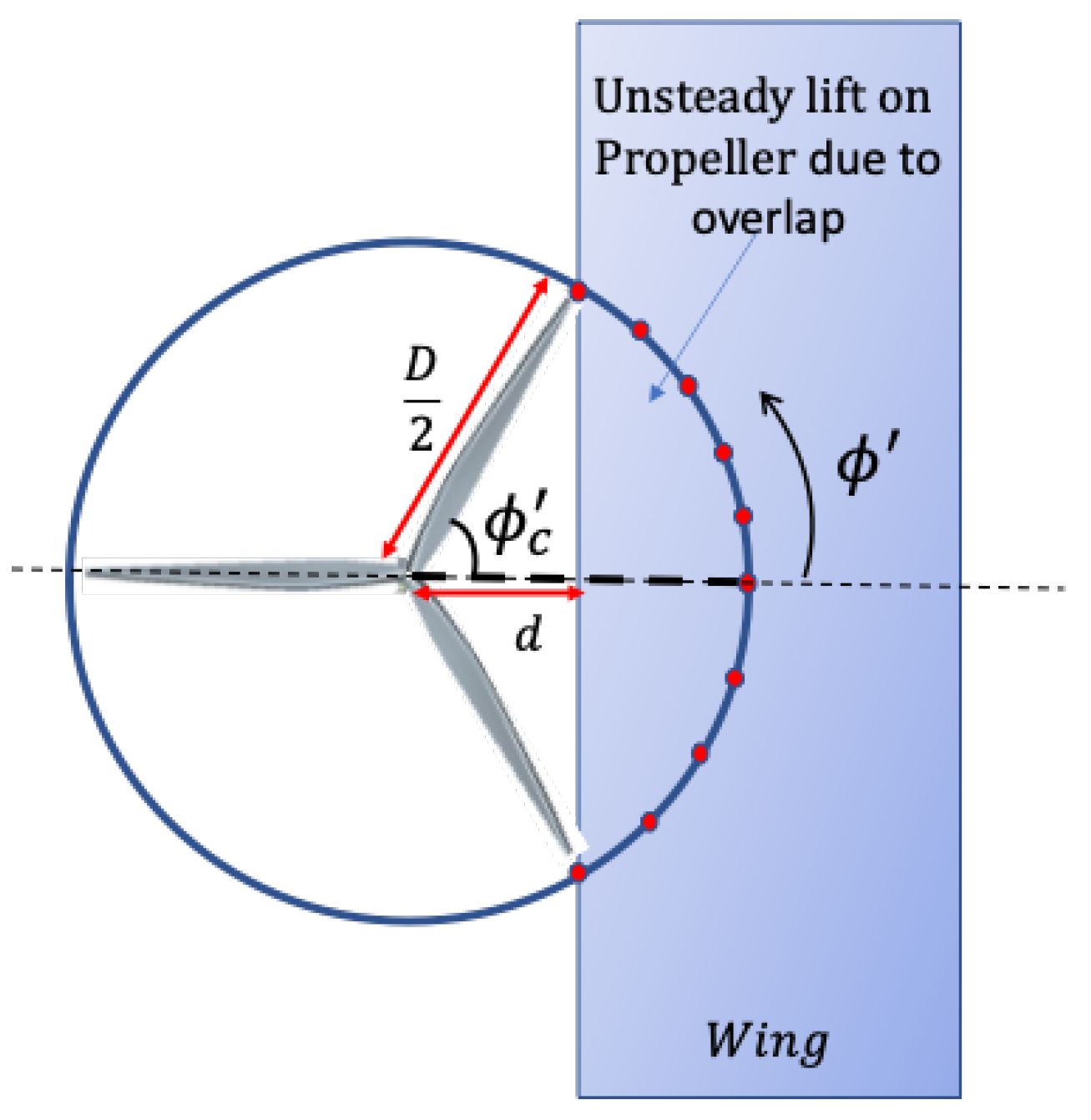
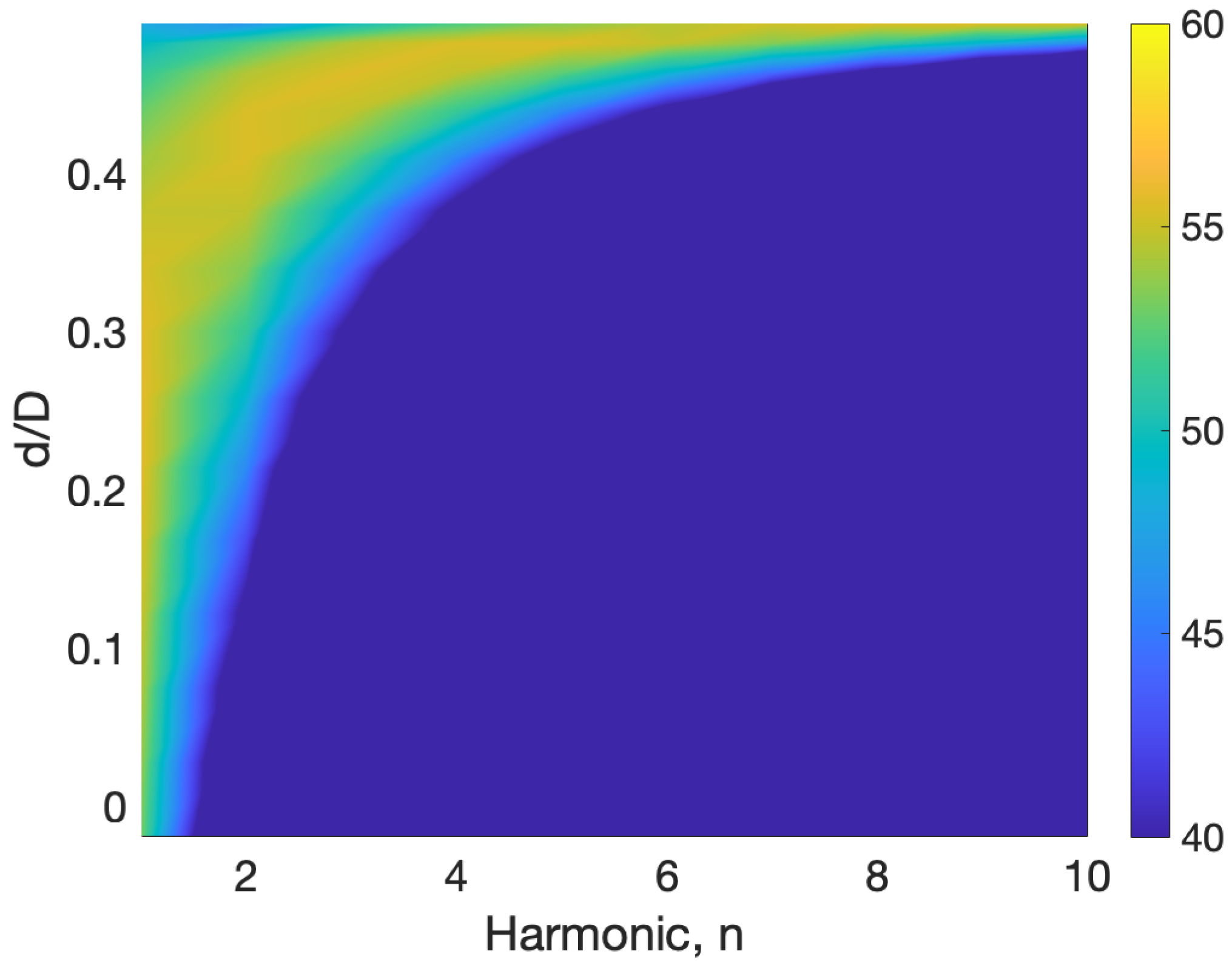
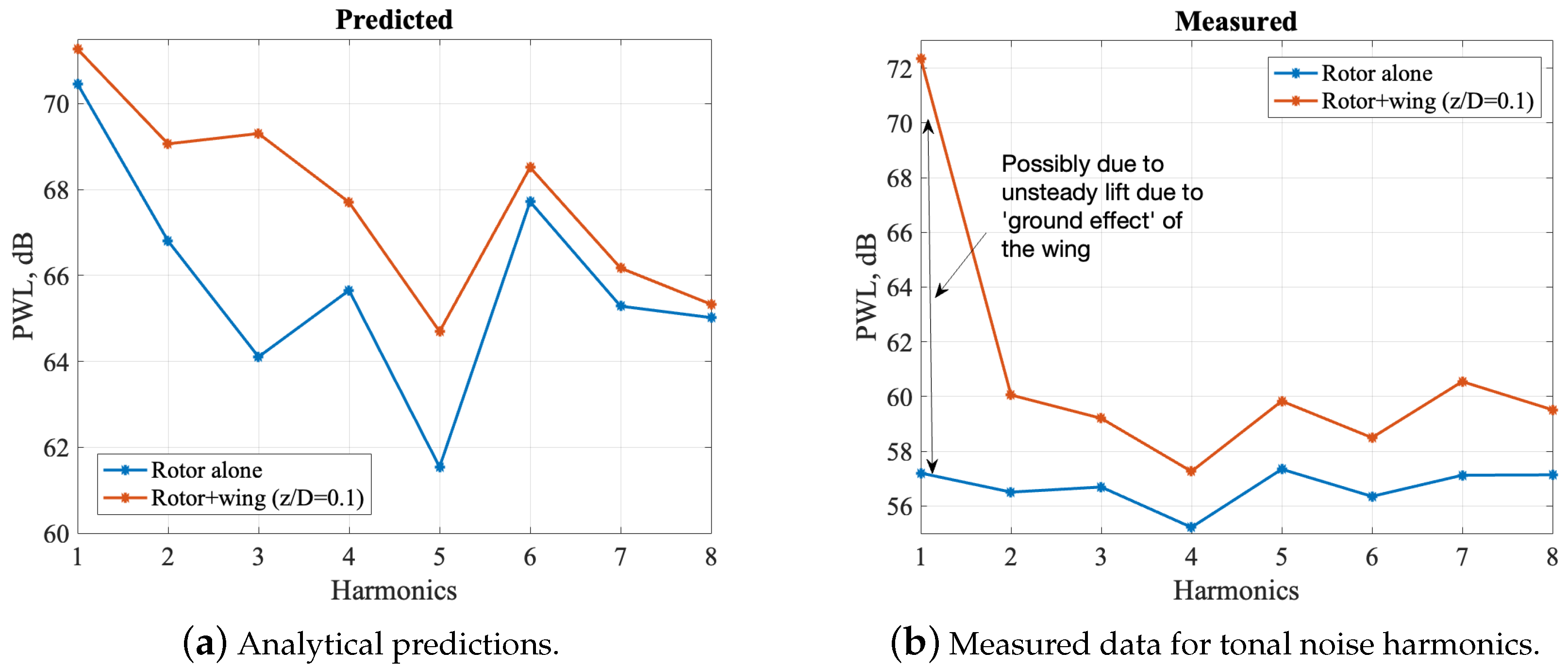
- Due to partial wing blockage: The most important is due to blockage caused by ‘ground effects’, which is well documented in the literature [22]. However, the important difference in the case of propeller–wing interaction is that the ‘ground effects’ only influence the portion of the propeller disc that overlaps with the wing. This results in non-axisymmetric blade loading. This mechanism will be referred to hereafter as ‘ground effects’, but is always related to the effects of the wing and not of the actual ground below the VTOL vehicle.
- (b)
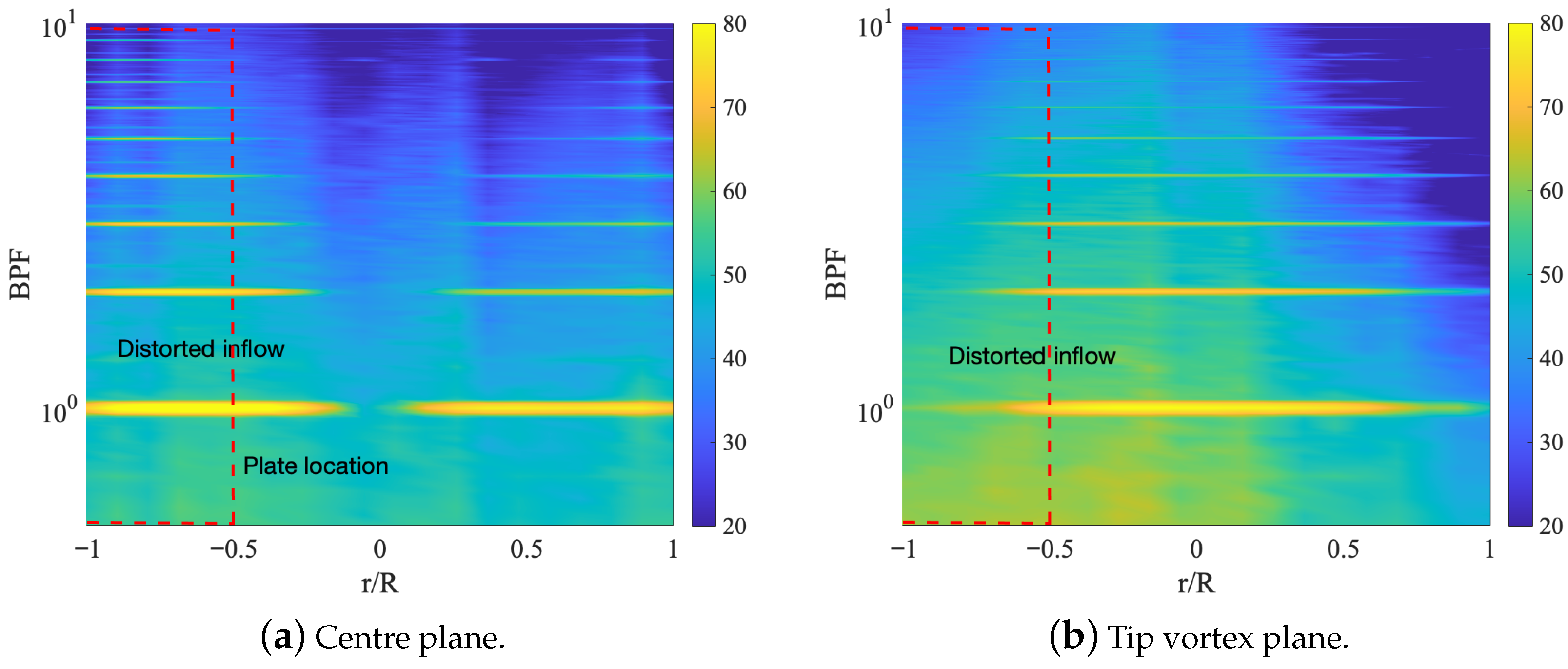
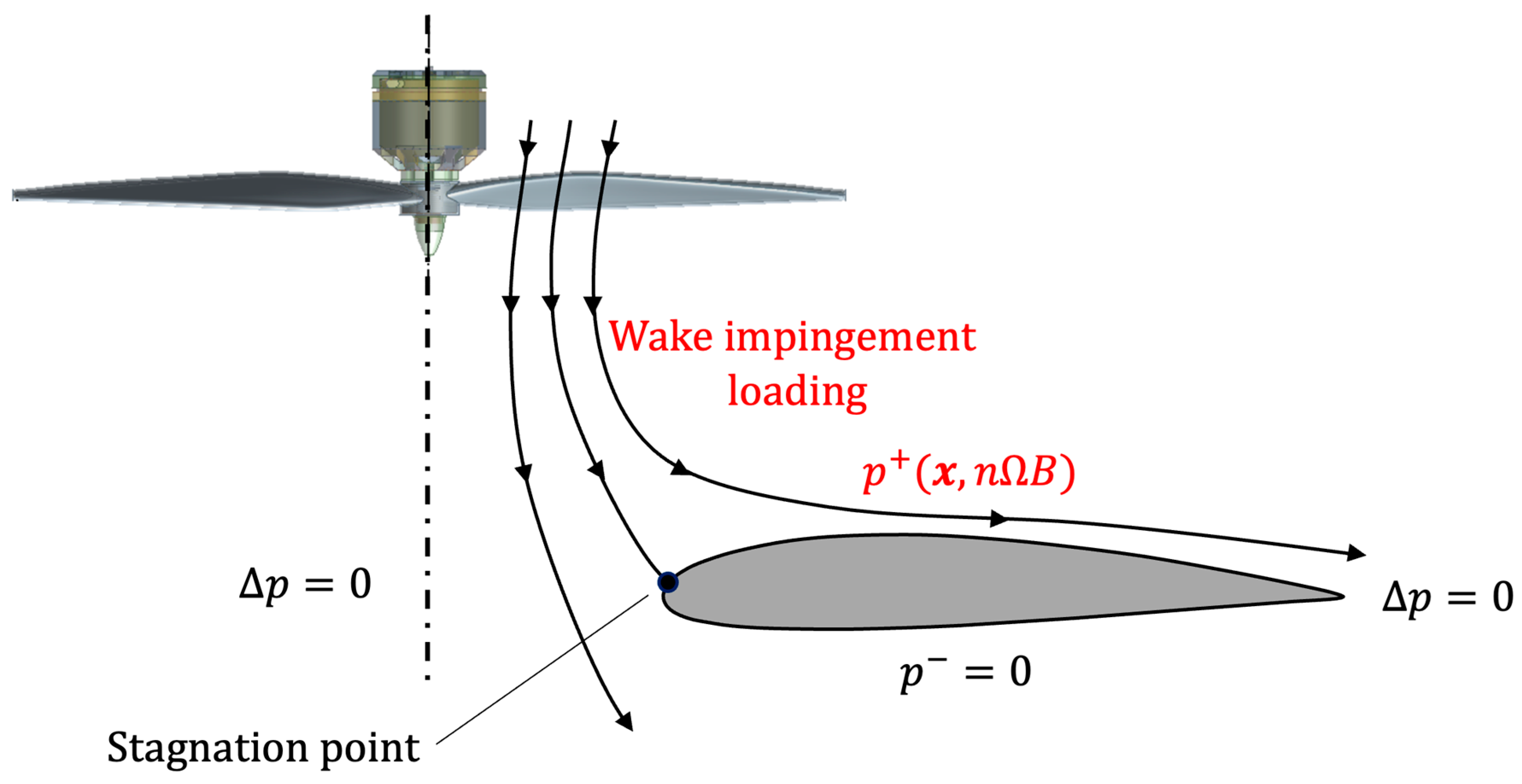
- Due to inflow distortion: The second cause of the unsteady blade loading is due to variations in the inflow velocity onto the propeller and the local angle of attack due to the overlap with the wing [23]. This contribution is also shown in the current paper.
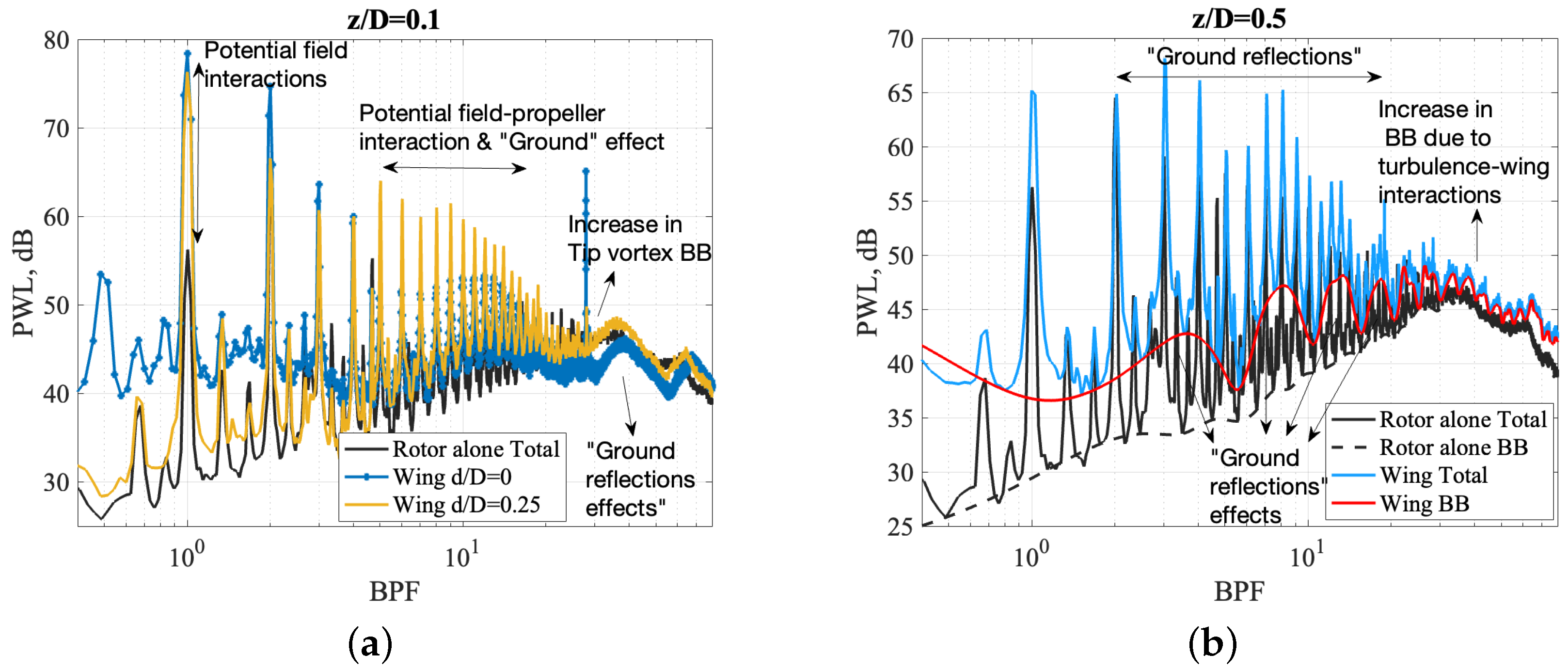
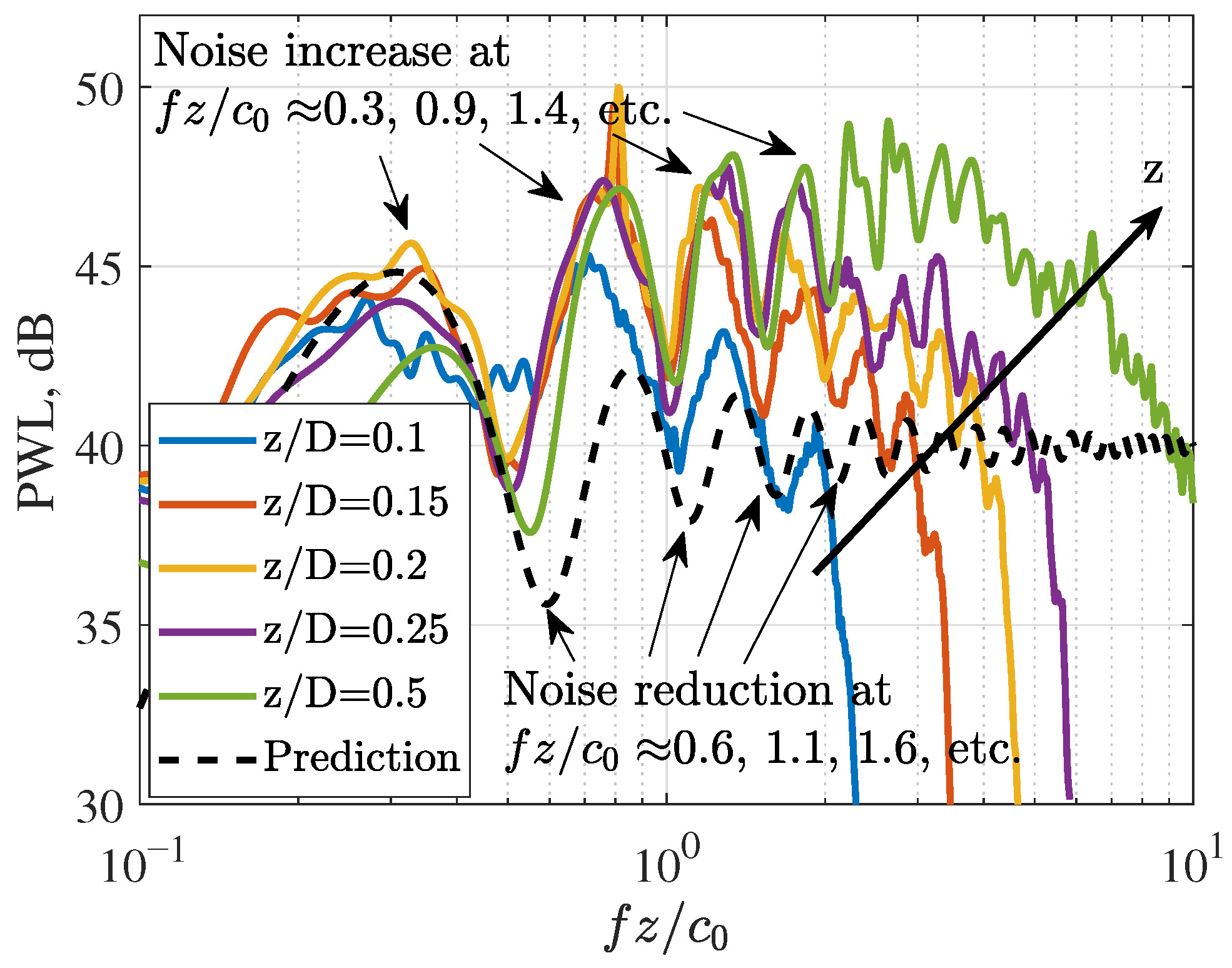
- Acoustic reflections from the wing: Another important effect on the propeller noise due to the wing is that both the tonal and broadband noise spectra become periodically modulated, which we shall show below is due to reflections from the wing when the propeller blades and the wing are overlapped. This behaviour is examined in detail in Section 4.4.1. This mechanism will be referred to hereafter as ‘ground reflection effects’, which are again related solely to reflections by the wing and not by the ground below the VTOL vehicle.
- Potential field interactions: Another source of interaction tonal noise is due to the propeller operating in the potential near field of the wing, resulting in a non-axisymmetric upwash velocity and hence blade loading. Potential interaction noise refers to the tonal noise generated when the propeller interacts with the bound potential field of the wing and vice versa. It is identified by its tonal character and its strong sensitivity to very small separation distances (, where D is diameter of propeller), consistent with [6,24]. This differs from broadband mechanisms such as turbulent ingestion or loading noise.
2.2. Radiation from the Wing
- Flow separation: In the overlap region, the flow may separate on the wing due to high incidence, resulting in additional noise at harmonics of the blade passing frequency.
- Edge scattering: Interactions of the potential near field, viscous wake and tip vortex in these configurations are currently unknown as we could not separate individual noise sources and also we do not have any analytical models for the configuration where flow impinges normal to the wing.
- Trailing edge interactions: Additional noise generation is observed when the flow passes parallel to the trailing edge of the wing.
3. Experimental Setup and Procedure
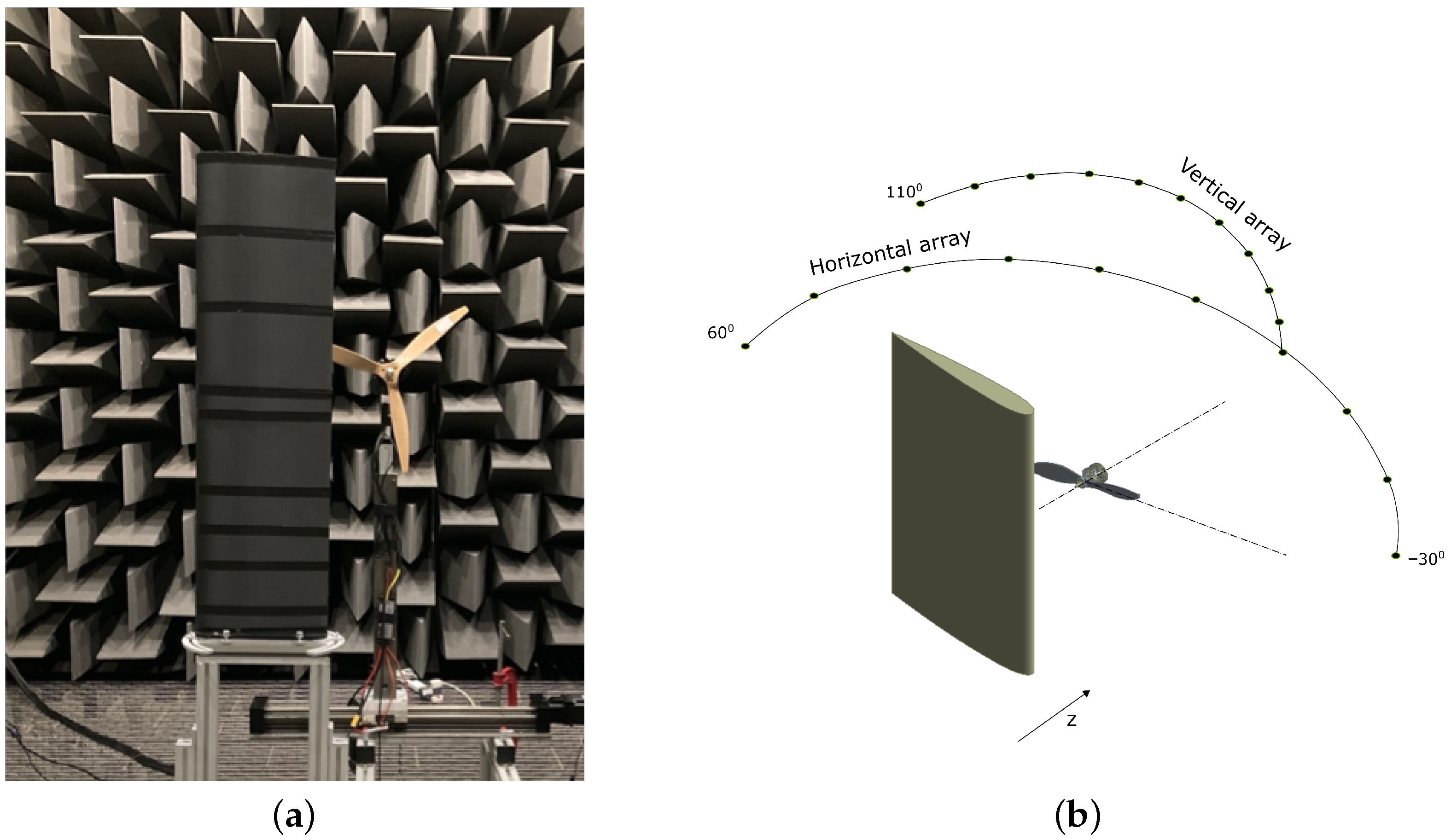
3.1. Propeller Rig
3.2. Wing Geometry
3.3. Far-Field Noise Measurements
3.4. Hot-Wire Measurements
3.5. Configurations Tested
4. Acoustic Results
4.1. Source Balance
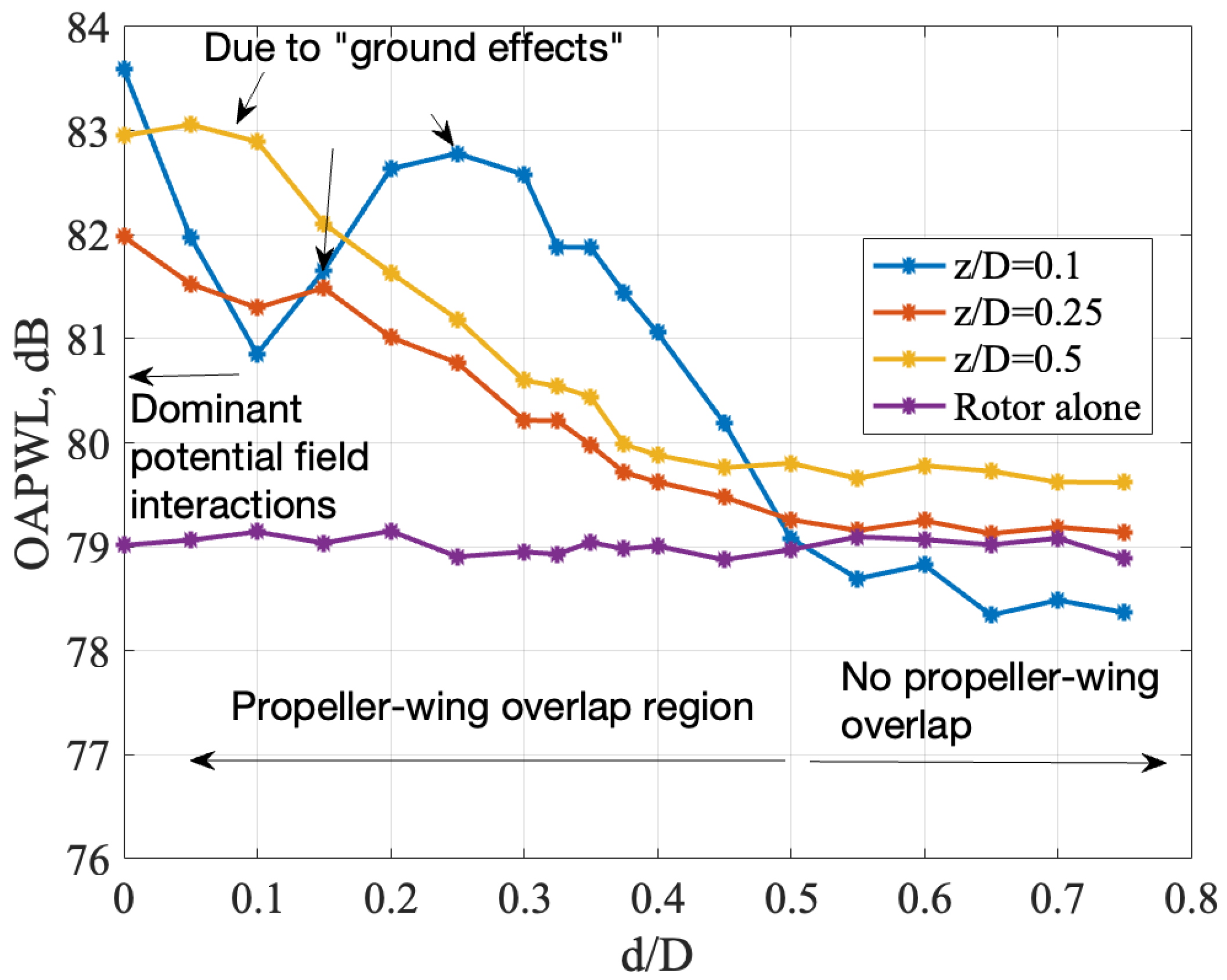
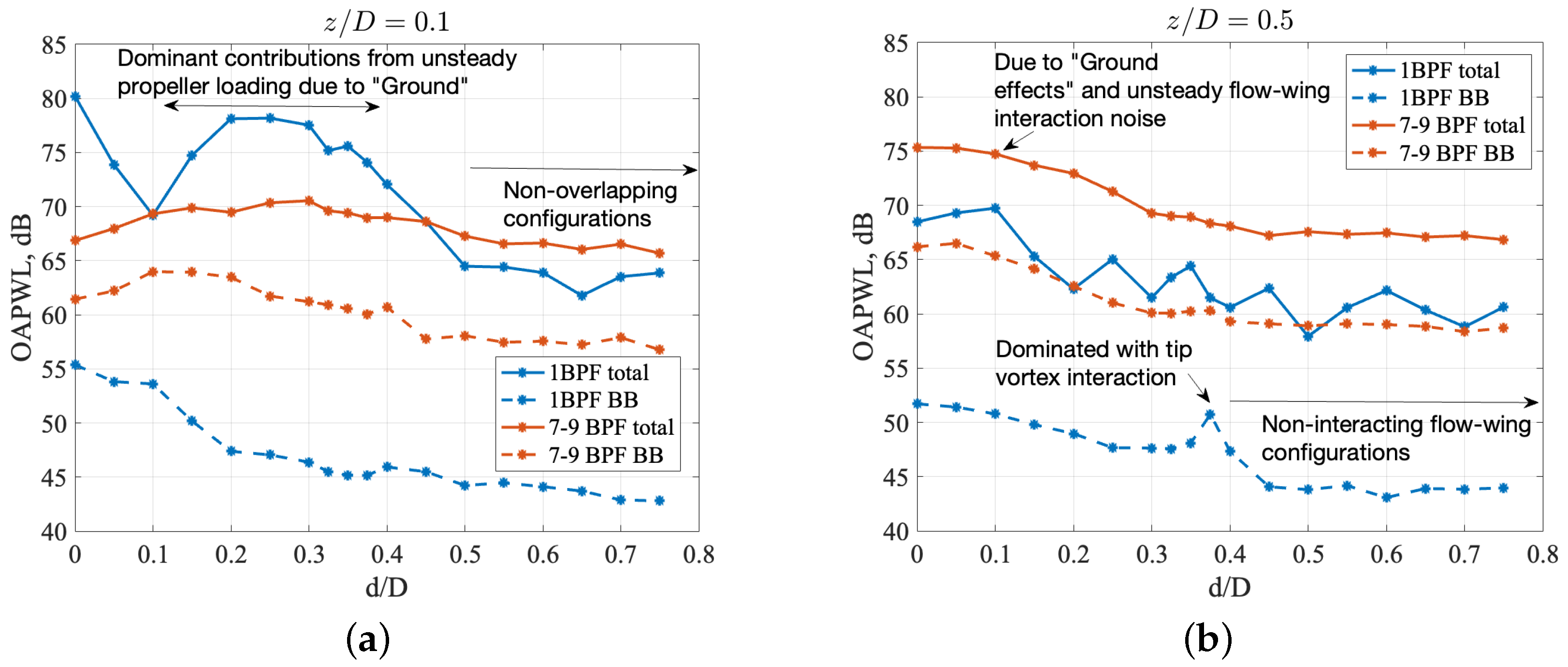
- For overlap distances (), the interaction noise sources make a significant contribution to the overall noise compared to the rotor self-noise. As increases beyond 0.5, the overall noise tends to collapse with the rotor self-noise, indicating the accuracy of the measurements. However, for and , the rotor alone slightly dominates the total interaction noise by 0.5 dB. This is due to the slight decrease in the RPM of the propeller for small to maintain the same thrust which was set for lower , which effectively leads to lower self-noise.
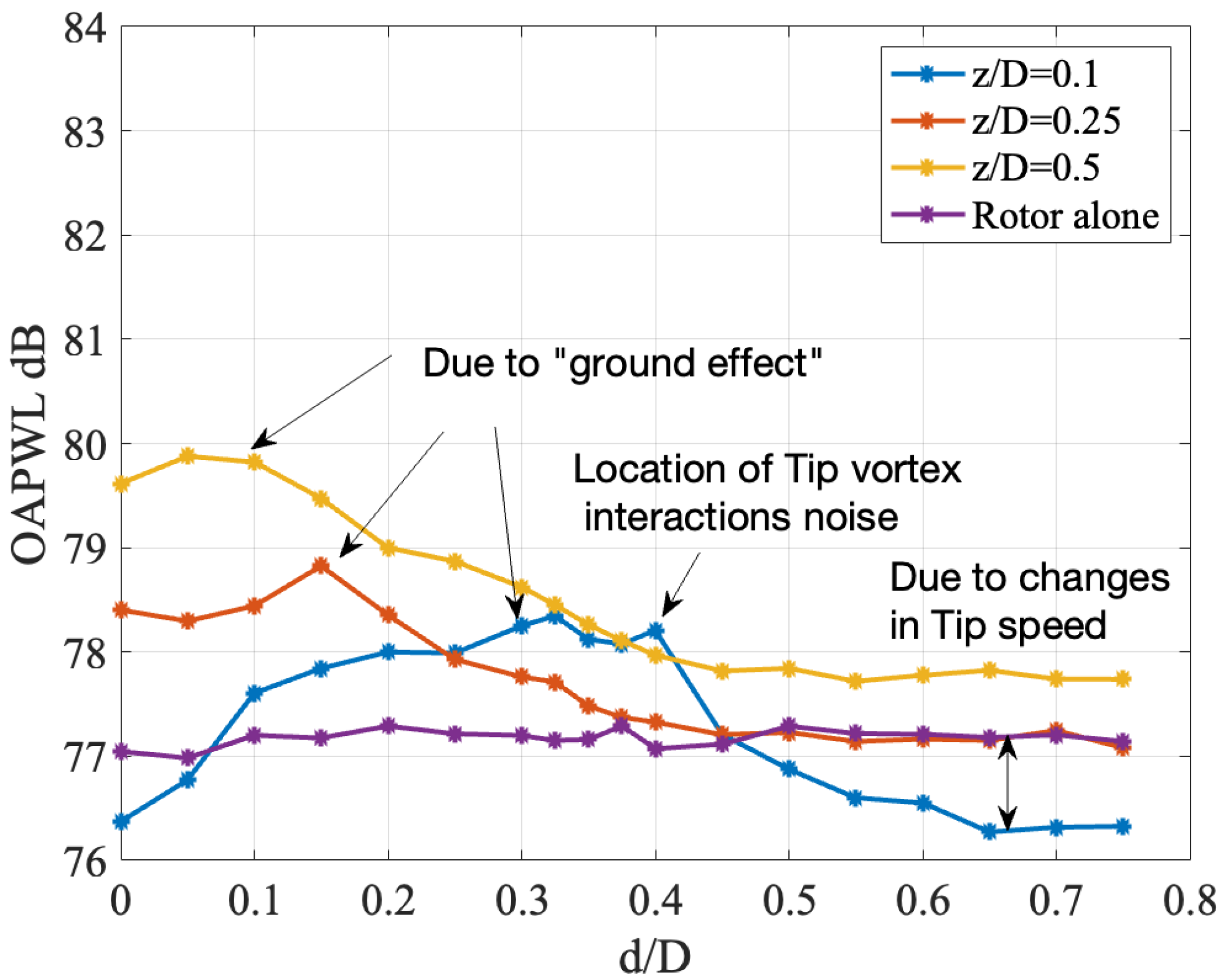
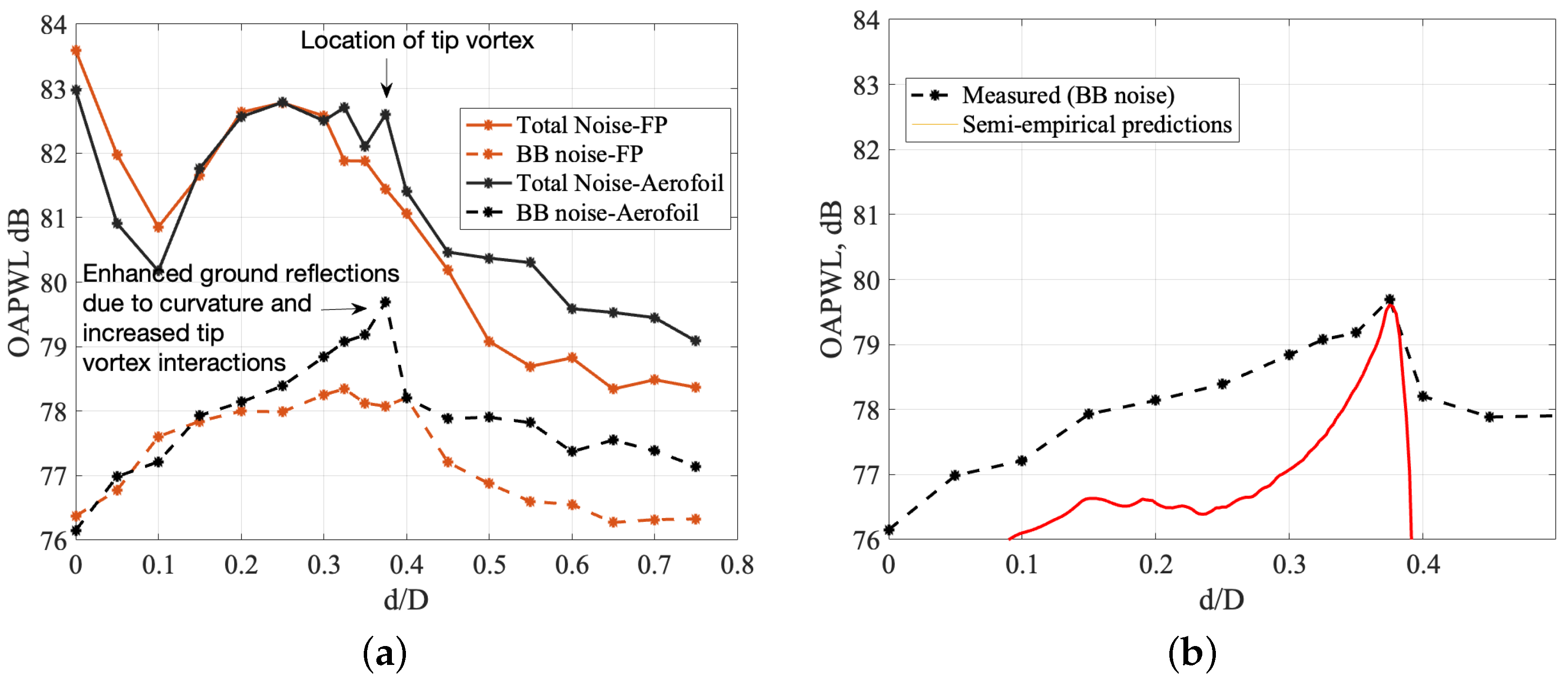
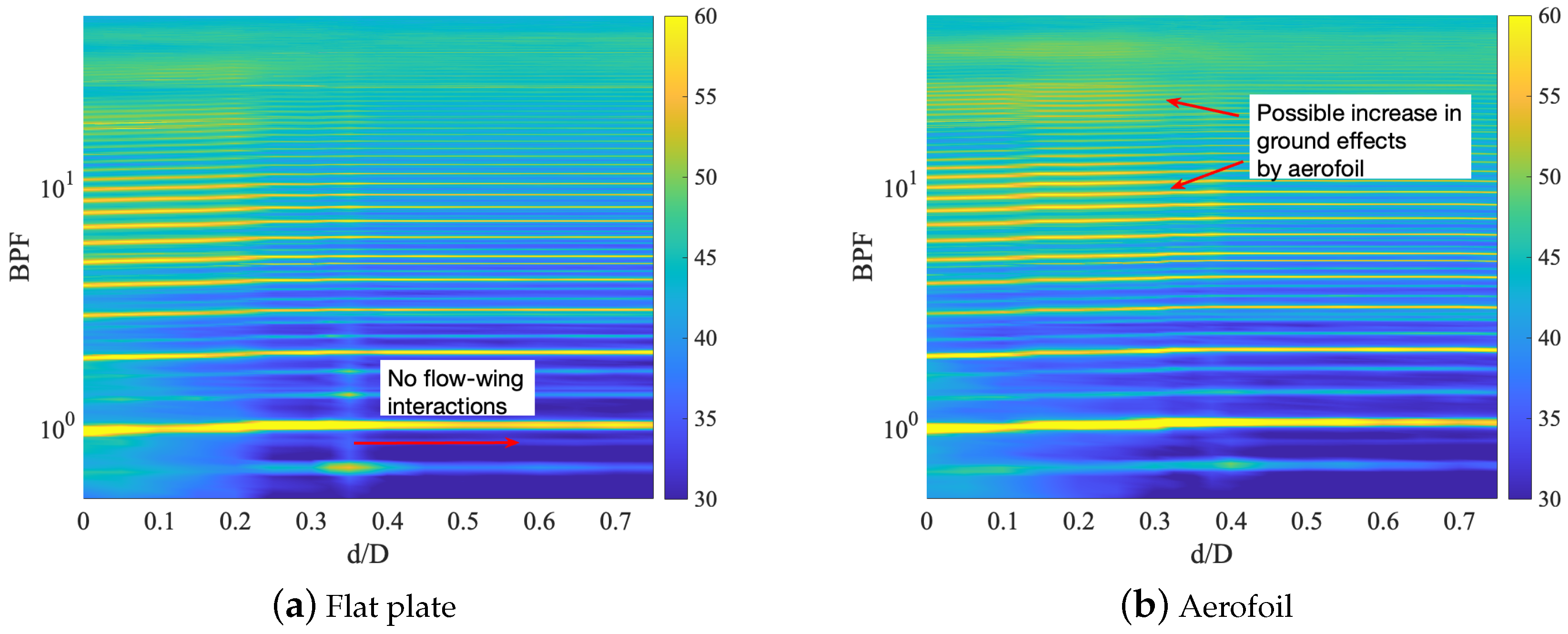
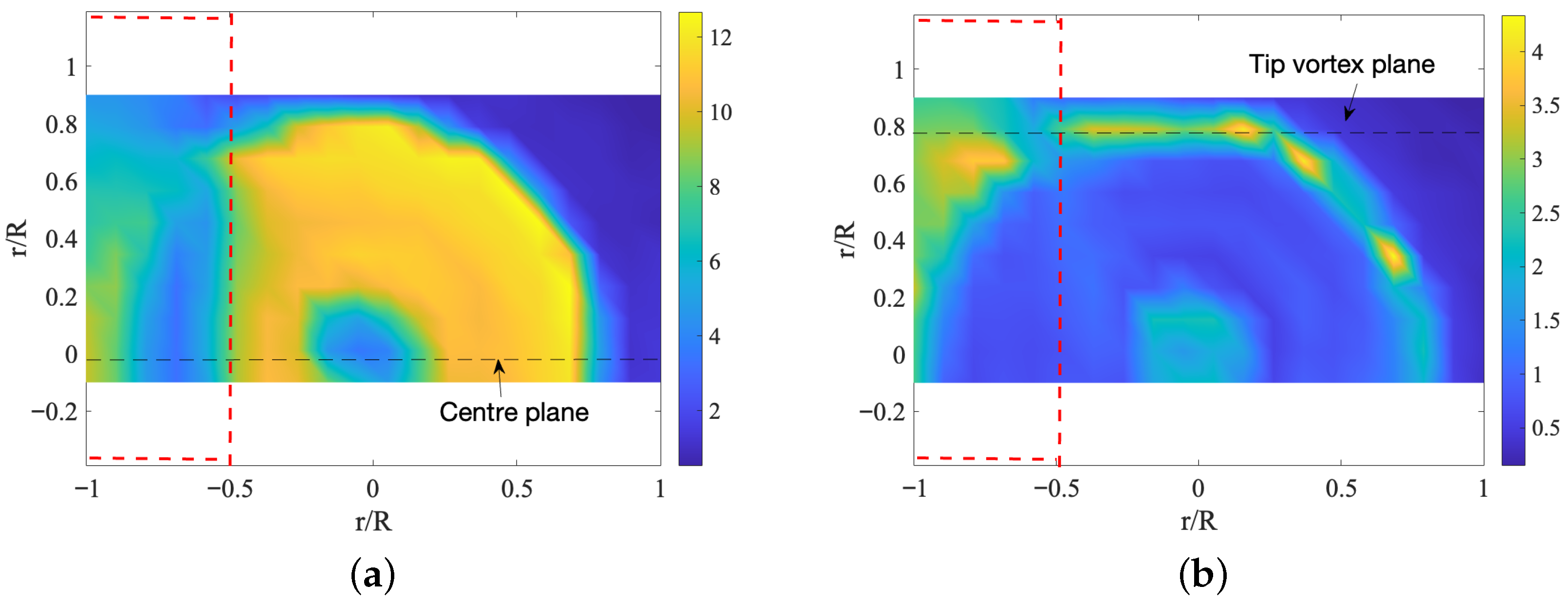
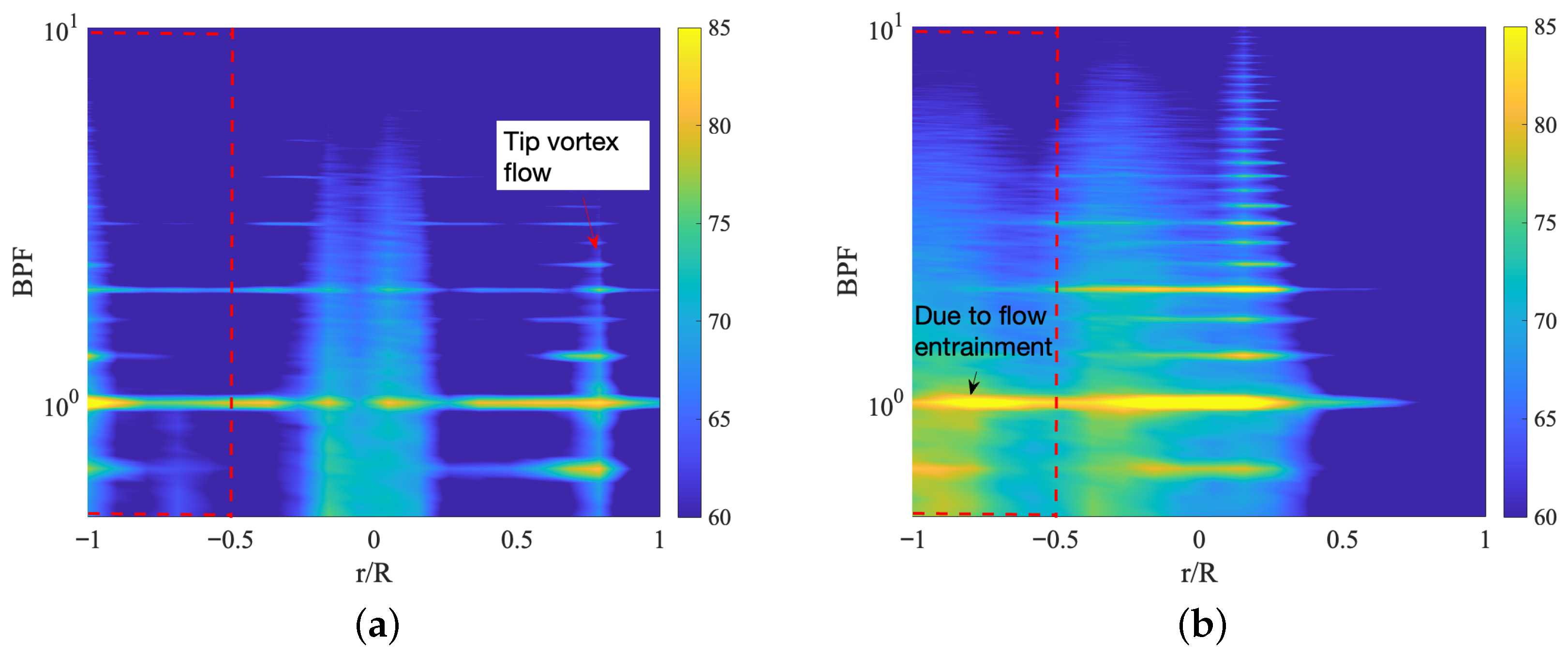
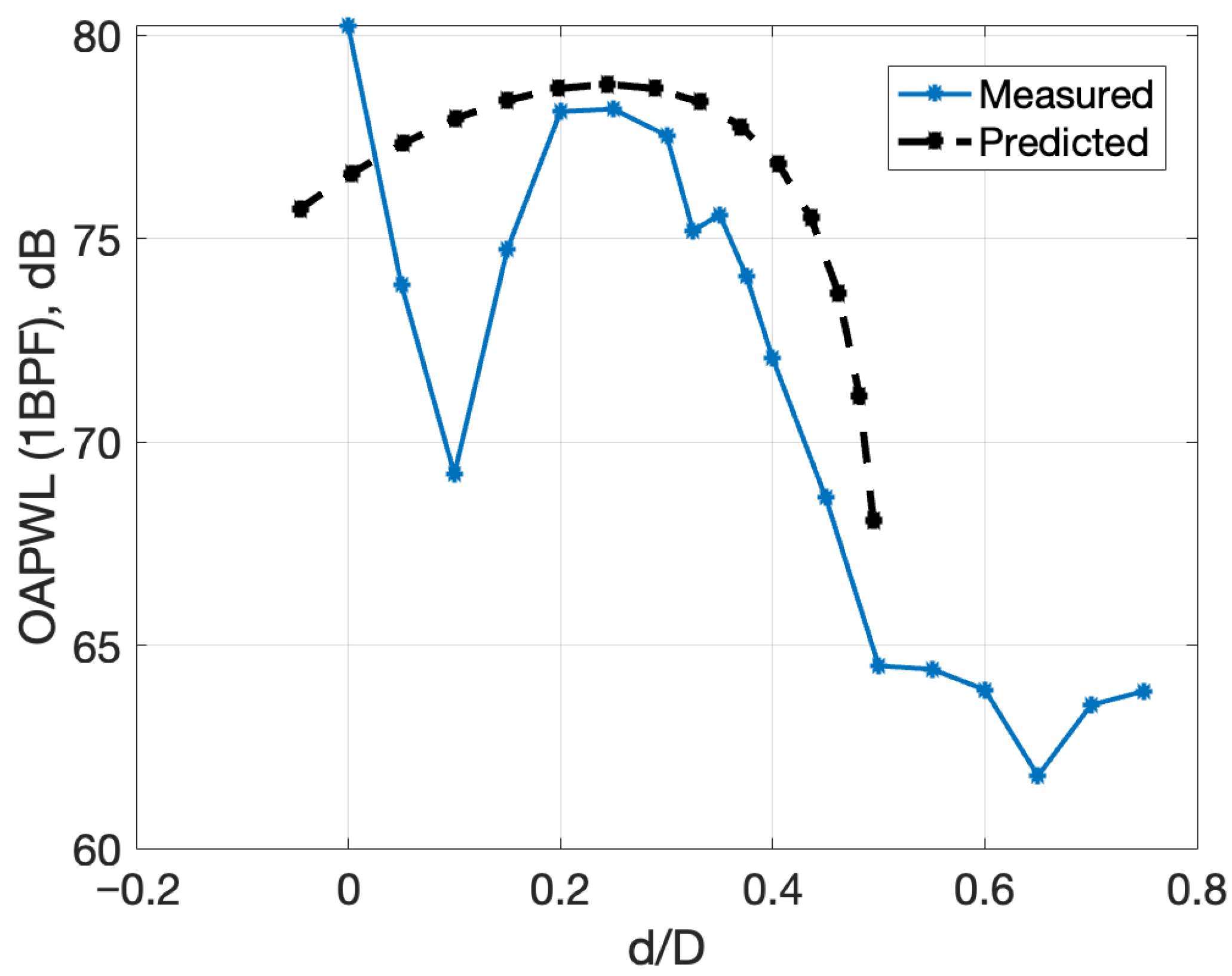
- At a lower separation distance of , two distinct peaks appear in the overall sound power level when plotted against overlapping distance . The first peak is possibly linked to the impact of potential field interaction for smaller overlaps (), while the second peak () is associated with asymmetric lift on the propeller due to wing overlap. An additional interaction source emerges due to tip vortex flow around . Notably, the location of maximum tip vortex interactions () aligns precisely with the tip vortex’s location measured by the hot wire, which will be detailed in subsequent sections. Furthermore, a peak around in broadband noise level is observed, representing peak rms fluctuations in the tip vortex flow at . The subsequent Section 4.2 provides a detailed exploration of these observations and the underlying reasons behind them.
- With the increase in , interactions occur at smaller overlap regions due to slipstream contraction. Similar patterns are evident in both total and broadband noise levels for values of 0.25 and 0.5. The rise in broadband noise is likely attributed to ‘ground reflection effects’ associated with acoustic reflection from the wing. This mechanism and its role in the larger broadband noise when increasing is discussed in Section 4.4, where a simplified model is also presented to support our hypothesis.
4.2. Comparison Between Aerofoil and Wing
4.3. Flow Measurements
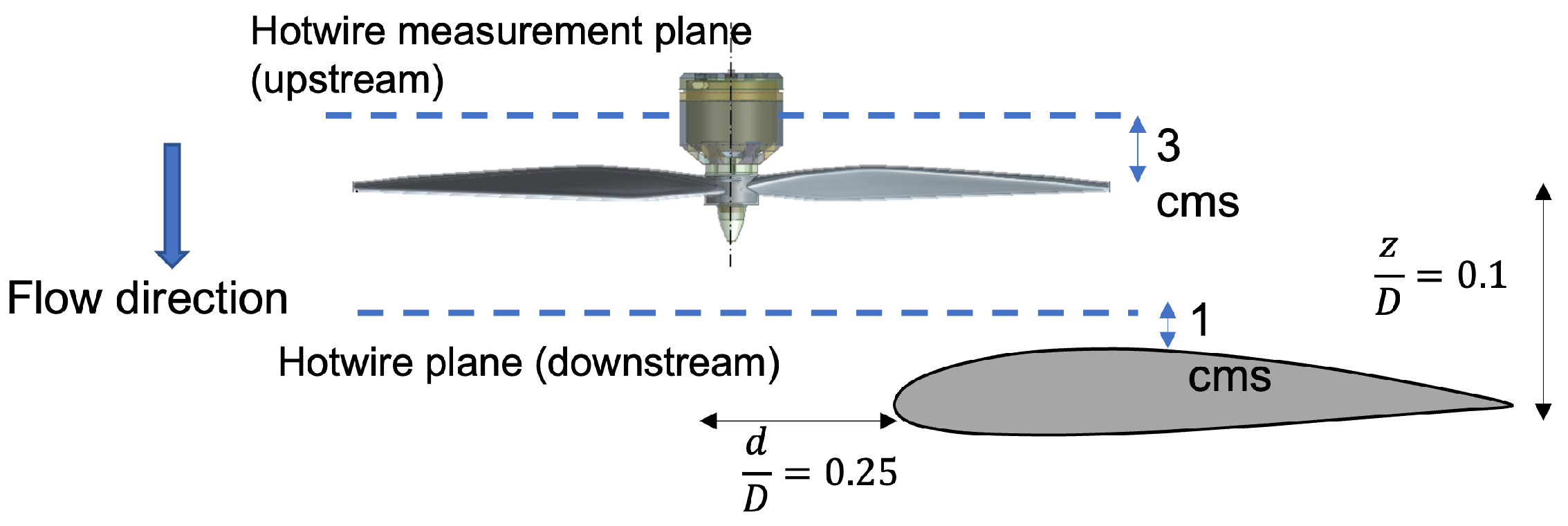
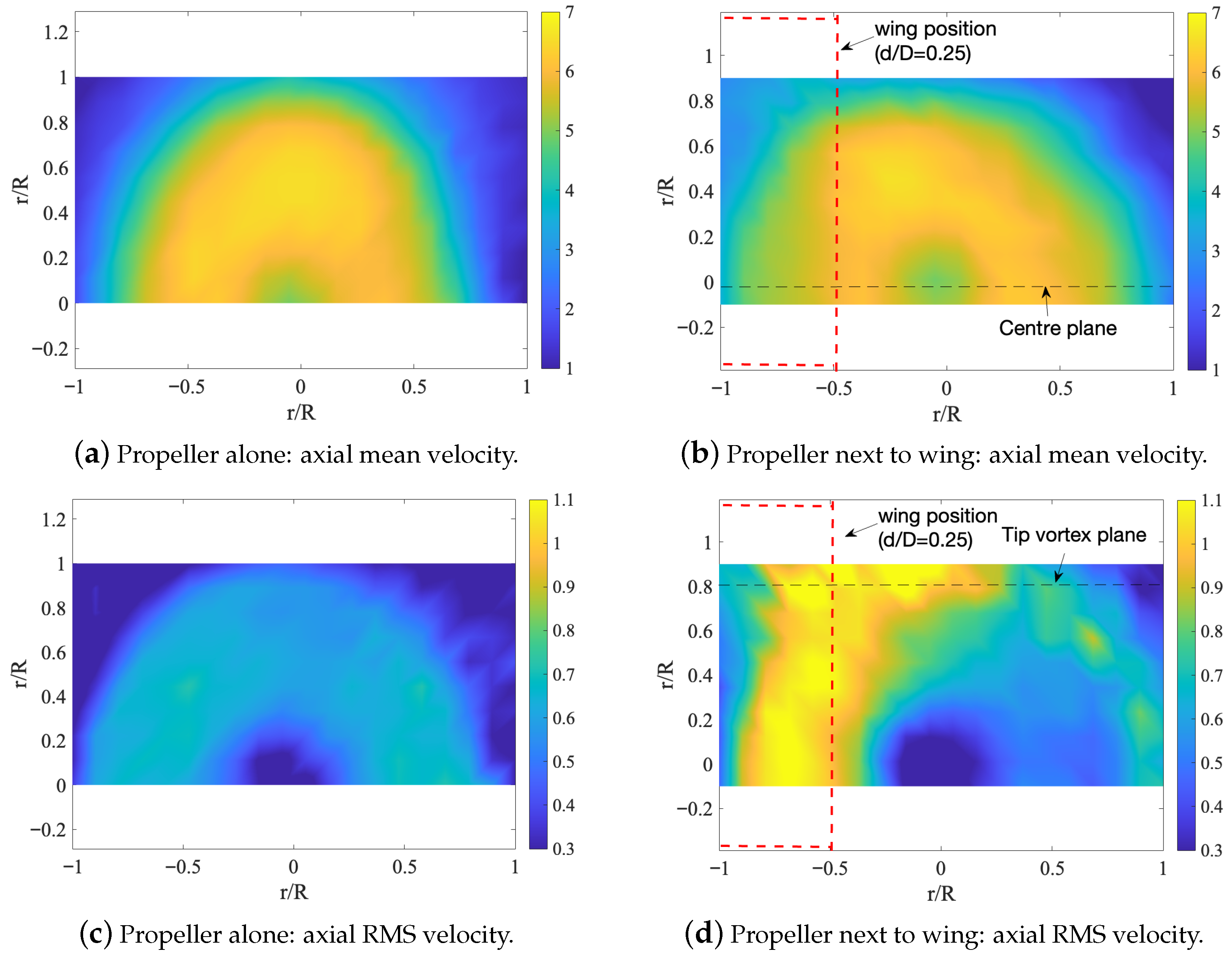
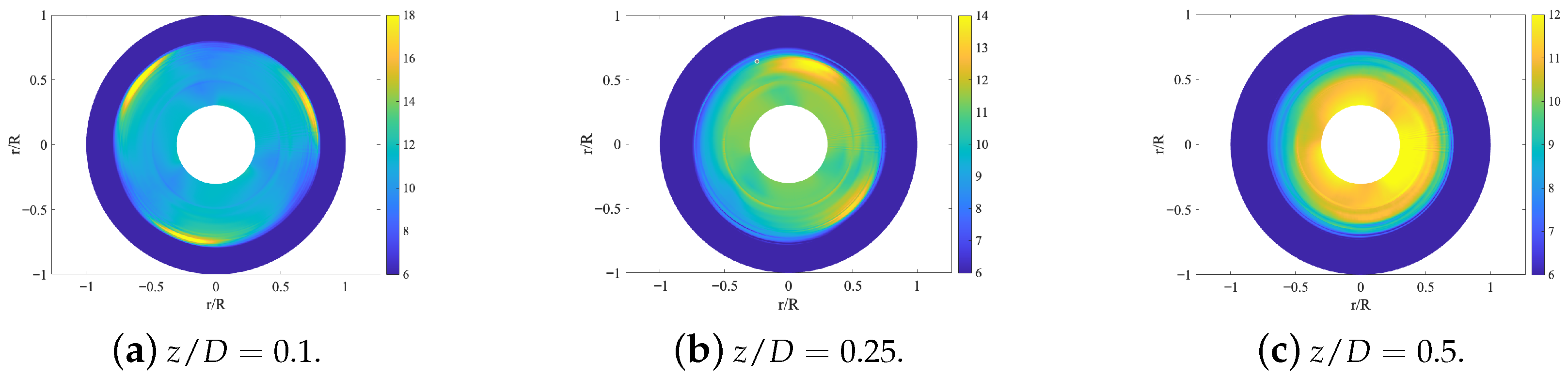
- Propeller-Alone Downstream Flow: We measured the velocity at various positions downstream of the propeller (at values of 0.1, 0.25, and 0.5) across all radial locations.
- Propeller-Alone Upstream Inflow: The velocity was measured at a location situated 3 cm above the propeller plane, capturing the upstream inflow across all radial positions.
- Propeller Plus Wing at = 0.25 and = 0.1: In this configuration, we measured the downstream flow and upstream inflow velocities across all radial locations.
4.3.1. Inflow Characteristics
4.3.2. Wake and Tip Vortex Characteristics
4.4. Interpretation: Radiation from Propeller
4.4.1. Role of Acoustic Reflections from the Wing
4.4.2. Role of Unsteady Lift Due to ‘Ground’ Effect
4.4.3. Role of Inflow Distortion
4.4.4. Role of Potential Field Interactions
4.5. Interpretation: Radiation from Wing
4.5.1. Edge Scattering by the Wing by Wake/Tip Vortex Flow
4.5.2. Edge Scattering by the Wing by Rotor Potential Field
4.5.3. Leading Edge Separation
5. Conclusions
Author Contributions
Funding
Data Availability Statement
Acknowledgments
Conflicts of Interest
References
- Mann, S.; Stuart, C. Advanced propulsion through the 1990s-An airframer’s view. In Proceedings of the 21st Joint Propulsion Conference, Monterey, CA, USA, 8–11 July 1985; p. 1192. [Google Scholar] [CrossRef]
- Parry, A.B. Theoretical Prediction of Counter-Rotating Propeller Noise. Ph.D. Thesis, University of Leeds, Leeds, UK, 1988. [Google Scholar]
- Akkermans, R.A.; Pott-Pollenske, M.; Buchholz, H.; Delfs, J.; Almoneit, D. Installation effects of a propeller mounted on a high-lift wing with a Coanda flap. Part I: Aeroacoustic experiments. In Proceedings of the 20th AIAA/CEAS Aeroacoustics Conference, Atlanta, GA, USA, 16–20 June 2014; p. 3191. [Google Scholar] [CrossRef]
- Sinnige, T. Aerodynamic and Aeroacoustic Interaction Effects for Tip-Mounted Propellers: An Experimental Study. Ph.D. Thesis, Delft University of Technology, Delft, The Netherlands, 2018. [Google Scholar]
- Zawodny, N.S.; Boyd, D.D.; Nark, D.M. Aerodynamic and Acoustic Interactions Associated with Inboard Propeller-Wing Configurations. In Proceedings of the AIAA Scitech 2021 Forum, Virtual, 11–15 & 19–21 January 2021; p. 0714. [Google Scholar] [CrossRef]
- Chaitanya, P.; Akiwate, D.C.; Palleja-Cabre, S.; Karimian, A.; Joseph, P.; Parry, A.B. Investigation into the mechanisms of propeller-wing interaction noise. In Proceedings of the 28th AIAA/CEAS Aeroacoustics 2022 Conference, Southampton, UK, 14–17 June 2022. [Google Scholar] [CrossRef]
- Silva, C.; Johnson, W.; Antcliff, K.R.; Patterson, M.D. VTOL urban air mobility concept vehicles for technology development. In Proceedings of the 2018 Aviation Technology, Integration, and Operations Conference, Atlanta, GA, USA, 25–29 June 2018; pp. 1–16. [Google Scholar] [CrossRef]
- Lee, T.; Leishman, J.; Manikandan, R. Fluid Dynamics of Interacting Blade Tip Vortices with a Ground Plane. J. Am. Helocopter Soc. 2010, 55, 22005. [Google Scholar] [CrossRef]
- Hanson, L.; Jawahar, H.K.; Vemuri, S.S.; Azarpeyvand, M. Experimental investigation of propeller noise in ground effect. J. Sound Vib. 2023, 559, 117751. [Google Scholar] [CrossRef]
- Hanson, D.B. Noise of counter-rotation propellers. J. Aircr. 1985, 22, 609–617. [Google Scholar] [CrossRef]
- Magliozzi, B.; Hanson, D.; Amiet, R. Propeller and propfan noise. Aeroacoustics Flight Veh. Theory Pract. 1991, 1, 1–64. [Google Scholar]
- Node-Langlois, T.; Wlassow, F.; Languille, V.; Colin, Y.; Caruelle, B.; Gill, J.R.; Chen, X.; Zhang, X.; Parry, A.B. Prediction of contra-rotating open rotor broadband noise in isolated and installed configurations. In Proceedings of the 20th AIAA/CEAS Aeroacoustics Conference, Atlanta, GA, USA, 16–20 June 2014; p. 2610. [Google Scholar] [CrossRef]
- Roger, M.; Schram, C.; Moreau, S. On vortex-airfoil interaction noise including span-end effects, with application to open-rotor aeroacoustics. J. Sound Vib. 2014, 333, 283–306. [Google Scholar] [CrossRef]
- Ekoule, C.M. Advanced Open Rotor Far-Field Tone Noise. Ph.D. Thesis, University of Southampton, Southampton, UK, 2017. [Google Scholar]
- Quaglia, M.E.; Léonard, T.; Moreau, S.; Roger, M. A 3D analytical model for orthogonal blade-vortex interaction noise. J. Sound Vib. 2017, 399, 104–123. [Google Scholar] [CrossRef]
- Acevedo-Giraldo, D.; Roger, M.; Jacob, M.C.; Bériot, H. Analytical study of the aerodynamic noise emitted by distributed electric propulsion systems. In Proceedings of the 28th AIAA/CEAS Aeroacoustics 2022 Conference, Southampton, UK, 14–17 June 2022. [Google Scholar] [CrossRef]
- Roger, M.; Acevedo-Giraldo, D.; Jacob, M.C. Acoustic versus aerodynamic installation effects on a generic propeller-driven flying architecture. Int. J. Aeroacoustics 2022, 21, 585–609. [Google Scholar] [CrossRef]
- Chen, M.; Liu, L.; Chen, Y. Aeroacoustic and aerodynamic measurements at the rotor plane in the interaction of a small rotor with wings. J. Acoust. Soc. Am. 2024, 156, 2816–2828. [Google Scholar] [CrossRef] [PubMed]
- Chen, M.; Chen, Y.; Hua, J.; Maier, N.; Burdette, D. Experimental assessment of blowing effect on vehicle performance and aero-acoustics in small-rotor/wing interaction. J. Vib. Control 2025, 31, 966–980. [Google Scholar] [CrossRef]
- Chen, M.; Liu, T.; Wimsatt, J.; Edwards, J. Numerical Study of a Small Rotor Interacting with a Generic Wing Using a Transient Solver. In Proceedings of the AIAA Aviation Forum and ASCEND, Las Vegas, NV, USA, 21–25 July 2025. [Google Scholar] [CrossRef]
- Chaitanya, P.; Cho, M.; Palleja-Cabre, S.; Akiwate, D.C.; Joseph, P.; Westcott, O.; Ferraro, M. Aeroacoustics source mechanisms of fixed-wing VTOL configuration. In Proceedings of the AIAA AVIATION 2023 Forum, San Diego, CA, USA, 12–16 June 2023. [Google Scholar] [CrossRef]
- Cai, J.; Gunasekaran, S.; Ol, M. Effect of Partial Ground and Partial Ceiling on Propeller Performance. J. Aircr. 2023, 60, 648–661. [Google Scholar] [CrossRef]
- Xie, J.; Zhou, Q.; Joseph, P.F. Tone Noise Prediction of a Propeller Operating in Nonuniform Flows. AIAA J. 2011, 49, 111–118. [Google Scholar] [CrossRef]
- Akiwate, D.C.; Parry, A.B.; Joseph, P.; Paruchuri, C.C. Analytical investigation of propeller-wing interaction noise. In Proceedings of the 28th AIAA/CEAS Aeroacoustics Conference, Southampton, UK, 14–17 June 2022. [Google Scholar] [CrossRef]
- Amiet, R.K. High frequency thin-airfoil theory for subsonic flow. AIAA J. 1976, 14, 1076–1082. [Google Scholar] [CrossRef]
- Ingard, U.; Lamb, G.L. Effect of a Reflecting Plane on the Power Output of Sound Sources. J. Acoust. Soc. Am. 1957, 29, 743–744. [Google Scholar] [CrossRef]
- Goldstein, M. Aeroacoustics; McGraw-Hill International Book Co.: New York, NY, USA, 1976. [Google Scholar]
- Paruchuri, C.C.; Joseph, P.; Akiwate, D.C.; Parry, A.B.; Prior, S.D. On the noise generation mechanisms of overlapping propellers. In Proceedings of the AIAA Aviation 2021 Forum, Virtual, 2–6 August 2021; p. 2281. [Google Scholar] [CrossRef]
- Gill, J.; Zhang, X.; Joseph, P. Symmetric Airfoil Geometry Effects on Leading Edge Noise. J. Acoust. Soc. Am. 2013, 134, 2669–2680. [Google Scholar] [CrossRef] [PubMed]
- Akiwate, D.C.; Parry, A.B. Propeller wake interaction noise with downstream wing: Effect of wing sweep, lean, and offset. In Proceedings of the AIAA Aviation 2023 Forum, San Diego, CA, USA, 12–16 June 2023. [Google Scholar] [CrossRef]


Disclaimer/Publisher’s Note: The statements, opinions and data contained in all publications are solely those of the individual author(s) and contributor(s) and not of MDPI and/or the editor(s). MDPI and/or the editor(s) disclaim responsibility for any injury to people or property resulting from any ideas, methods, instructions or products referred to in the content. |
© 2025 by the authors. Licensee MDPI, Basel, Switzerland. This article is an open access article distributed under the terms and conditions of the Creative Commons Attribution (CC BY) license (https://creativecommons.org/licenses/by/4.0/).
Share and Cite
Chaitanya, P.; Corbishley, T.; Palleja-Cabre, S.; Cho, M.; Karimian, A.; Joseph, P.; Akiwate, D.C.; Westcott, O.; Krishna, S. Aeroacoustic Source Mechanisms of Fixed-Wing VTOL Configuration at Takeoff Hover. Drones 2025, 9, 864. https://doi.org/10.3390/drones9120864
Chaitanya P, Corbishley T, Palleja-Cabre S, Cho M, Karimian A, Joseph P, Akiwate DC, Westcott O, Krishna S. Aeroacoustic Source Mechanisms of Fixed-Wing VTOL Configuration at Takeoff Hover. Drones. 2025; 9(12):864. https://doi.org/10.3390/drones9120864
Chicago/Turabian StyleChaitanya, Paruchuri, Thomas Corbishley, Sergi Palleja-Cabre, Minki Cho, Amin Karimian, Phillip Joseph, Deepak C. Akiwate, Oliver Westcott, and Swathi Krishna. 2025. "Aeroacoustic Source Mechanisms of Fixed-Wing VTOL Configuration at Takeoff Hover" Drones 9, no. 12: 864. https://doi.org/10.3390/drones9120864
APA StyleChaitanya, P., Corbishley, T., Palleja-Cabre, S., Cho, M., Karimian, A., Joseph, P., Akiwate, D. C., Westcott, O., & Krishna, S. (2025). Aeroacoustic Source Mechanisms of Fixed-Wing VTOL Configuration at Takeoff Hover. Drones, 9(12), 864. https://doi.org/10.3390/drones9120864