Review

Electric Propulsion and Hybrid Energy Systems for Solar-Powered UAVs: Recent Advances and Challenges


by
Norliza Ismail
,
Nadhiya Liyana Mohd Kamal
*,
Nurhakimah Norhashim
,
Sabarina Abdul Hamid
,
Zulhilmy Sahwee
and
Shahrul Ahmad Shah
Unmanned Aerial System Research Laboratory, Avionics Section, Malaysian Institute of Aviation Technology, Universiti Kuala Lumpur, 43800 Dengkil, Selangor, Malaysia
*
Author to whom correspondence should be addressed.
Drones 2025, 9(12), 846; https://doi.org/10.3390/drones9120846
Submission received: 5 June 2025 / Revised: 5 August 2025 / Accepted: 8 August 2025 / Published: 10 December 2025

Abstract

Unmanned aerial vehicles (UAVs) are increasingly utilized across civilian and defense sectors due to their versatility, efficiency, and cost-effectiveness. However, their operational endurance remains constrained by limited onboard energy storage. Recent research has focused on electric propulsion systems integrated with hybrid energy sources, particularly the combination of solar cells and advanced battery technologies to overcome this limitation. This review presents a comprehensive analysis of the latest advancements in electric propulsion architecture, solar-based power integration, and hybrid energy management strategies for UAVs. Key components, including motors, electronic speed controllers (ESCs), propellers, and energy storage systems, are examined alongside emerging technologies such as wireless charging and flexible photovoltaic (PV) materials. Power management techniques, including maximum power point tracking (MPPT) and intelligent energy control algorithms, are also discussed in the context of long-endurance missions. Challenges related to energy density, weight constraints, environmental adaptability, and component integration are highlighted, with insights into potential solutions and future directions. The findings of this review aim to guide the development of efficient, sustainable, and high-endurance UAV platforms leveraging electric-solar hybrid propulsion systems.

1. Introduction

The development of solar-powered unmanned aerial vehicles (UAVs) offers huge potential for long-endurance missions, yet it remains constrained by several technical and environmental challenges. A primary limitation is the low energy density of current battery technologies, which restricts flight duration and payload capacity [1]. Although photovoltaic (PV) integration can supplement energy storage, real-world conditions such as partial shading, thermal cycling, and varying solar irradiance significantly reduce conversion efficiency often by as much as 40–60% [2,3]. Additionally, solar UAVs must operate reliably in dynamic environments, including high-altitude, low-temperature, and harsh weather conditions, which pose further complications for power management and structural integrity. Balancing lightweight design with robust energy systems introduces trade-offs that are not easily resolved. Moreover, intelligent power routing strategies are required to adapt to fluctuating energy availability throughout the day, yet many of these systems remain computationally intensive for onboard use. These interrelated factors create a complex design challenge that has limited the widespread adoption of solar-electric UAVs. However, hybrid energy architecture combining solar cells, advanced batteries, supercapacitors, and fuel cells offer a promising path forward. The 2018 flight of Airbus’ Zephyr S, which achieved nearly 26 days of continuous flight, demonstrates this potential, while also highlighting the need for further innovation in power efficiency and durability [4,5,6].
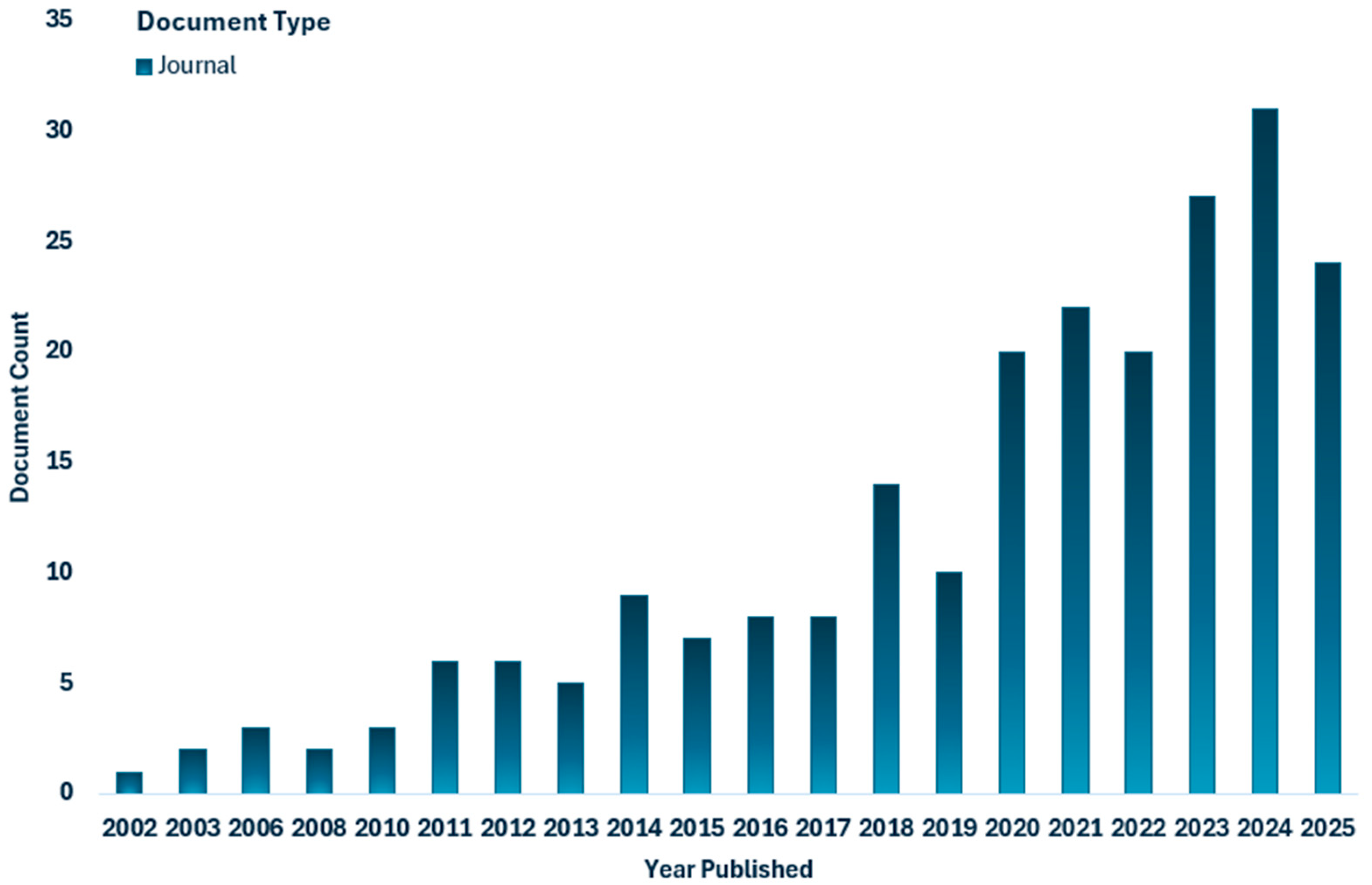
In response to these technical challenges and performance goals, academic and industrial researchers have increasingly turned their attention to solar-powered propulsion systems. A search conducted on https://www.lens.org (accessed on 26 May 2025) using the keywords solar AND (UAV AND propulsion) yielded 213 journal articles published between 2002 and 2025. The publication trend indicates a growing research interest in solar-powered propulsion systems for UAVs over the past two decades (Figure 1).
Recent years have seen significant advancements across three critical domains. First, solar cell technology has progressed from rigid silicon panels (12–15% efficiency) to lightweight, flexible alternatives such as perovskite (25% lab efficiency) and GaAs thin-film cells (29% efficiency) [7,8,9]. Second, energy storage systems have evolved beyond conventional Li-ion batteries, with solid-state batteries (500 Wh/kg projected) and Li-S prototypes (600 Wh/kg) now under active development [10,11]. Third, propulsion systems have achieved unprecedented efficiency, with high-temperature superconducting motors and optimized propeller designs reaching up to 90% efficiency [12,13]. Despite these innovations, real-world deployment faces a critical energy trilemma: the competing demands of maximizing endurance, minimizing weight, and ensuring operational robustness across diverse environmental conditions.
A key unresolved challenge lies in power management. While hybrid solar-battery systems theoretically enable perpetual flight, actual performance suffers from 15 to 20% power loss in conversion chains and 40–60% PV efficiency degradation due to factors like thermal cycling and partial shading [14,15,16,17]. Furthermore, the dynamic power demands of UAVs ranging from high-thrust takeoff to low-power loitering require sophisticated energy routing strategies [18,19]. Recent studies have demonstrated that AI-driven power management can improve energy utilization by 12–18% compared to rule-based systems [20,21] but these approaches remain computationally intensive for onboard implementation.
This review examines the latest advancements in electric propulsion systems for UAVs that use solar and hybrid energy sources. It covers key components like motors, propellers, speed controllers, and batteries, focusing on how to improve their efficiency and performance. The study also looks at challenges in managing energy in real-time, especially when dealing with changing weather and sunlight conditions, where smarter and more adaptive systems are needed. Another major focus is on solar technology for UAVs, comparing traditional rigid solar cells with newer flexible options like perovskite and thin-film materials. The review also explores hybrid systems that combine solar power with batteries, supercapacitors, or hydrogen fuel cells to extend flight time and reliability.
While several previous reviews have focused on specific aspects such as solar integration [22], propulsion components [23], or endurance optimization for small UAVs [24], few have attempted to synthesize these topics into a system-level analysis. In particular, the role of alternative energy sources such as hydrogen fuel cells and refueling strategies has begun to gain attention in the broader UAV energy research community [25,26], though this area remains underexplored. This review contributes by integrating propulsion modeling, hybrid energy architecture, and intelligent power management strategies, while also highlighting current limitations, practical trade-offs, and technology trends relevant to solar-electric UAV systems. In order to clarify the scope and unique contributions of this review, Table 1 provides a comparison with recent related works. Unlike prior work, this paper emphasizes propulsion component integration, performance modeling, and real-world perspectives, including recent patent activity and practical design trade-offs.
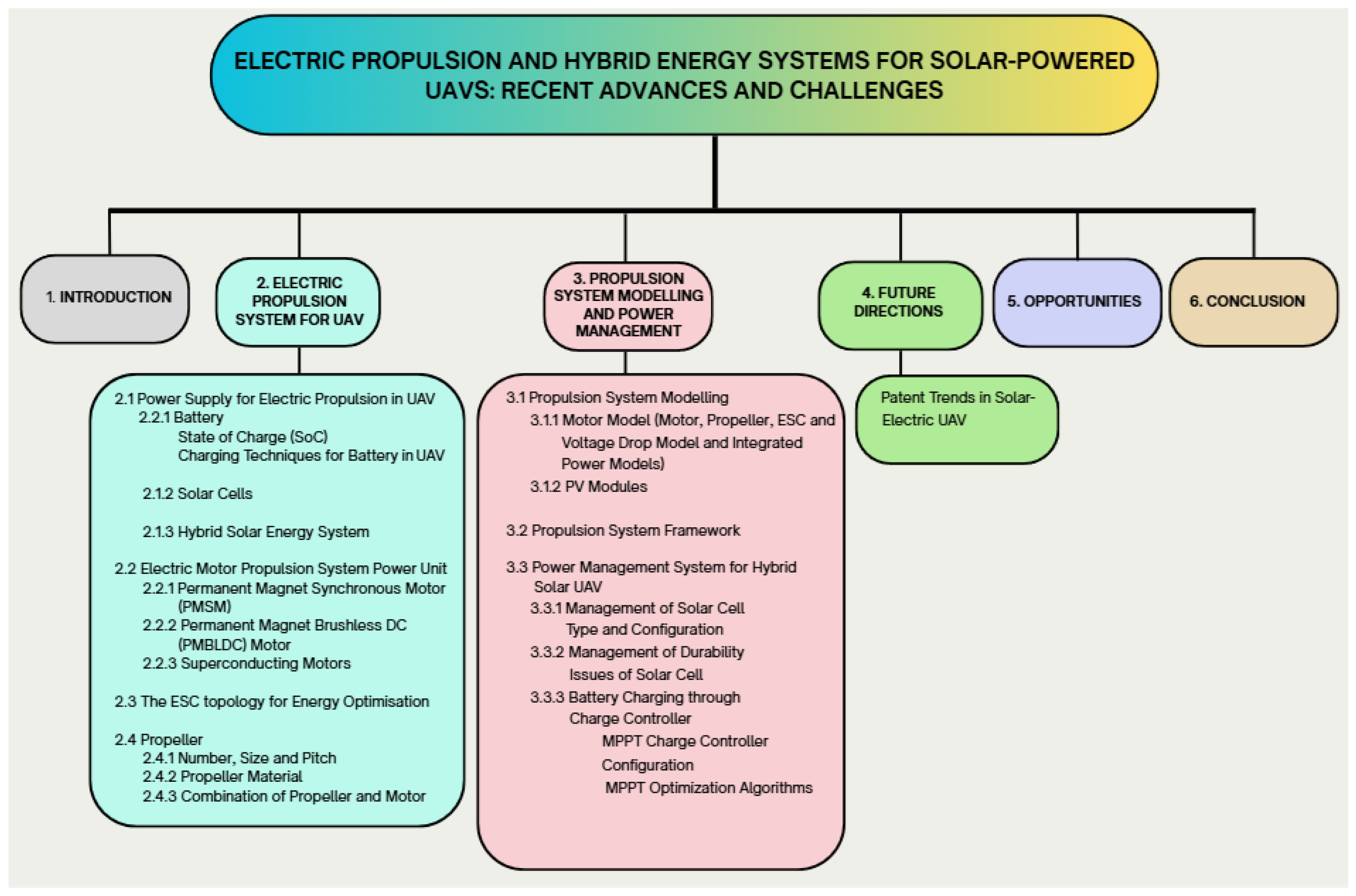
By bringing together research from electrical engineering, materials science, aerodynamics, and energy management, this review highlights the potential for long-endurance, self-sufficient UAVs. These advancements could greatly benefit applications like surveillance, environmental monitoring, and disaster response. Finally, the paper identifies the remaining challenges and future research directions to help guide the development of next-generation energy-efficient UAVs. Figure 2 summarizes the overall structure of this review.

2. Electric Propulsion System for UAV

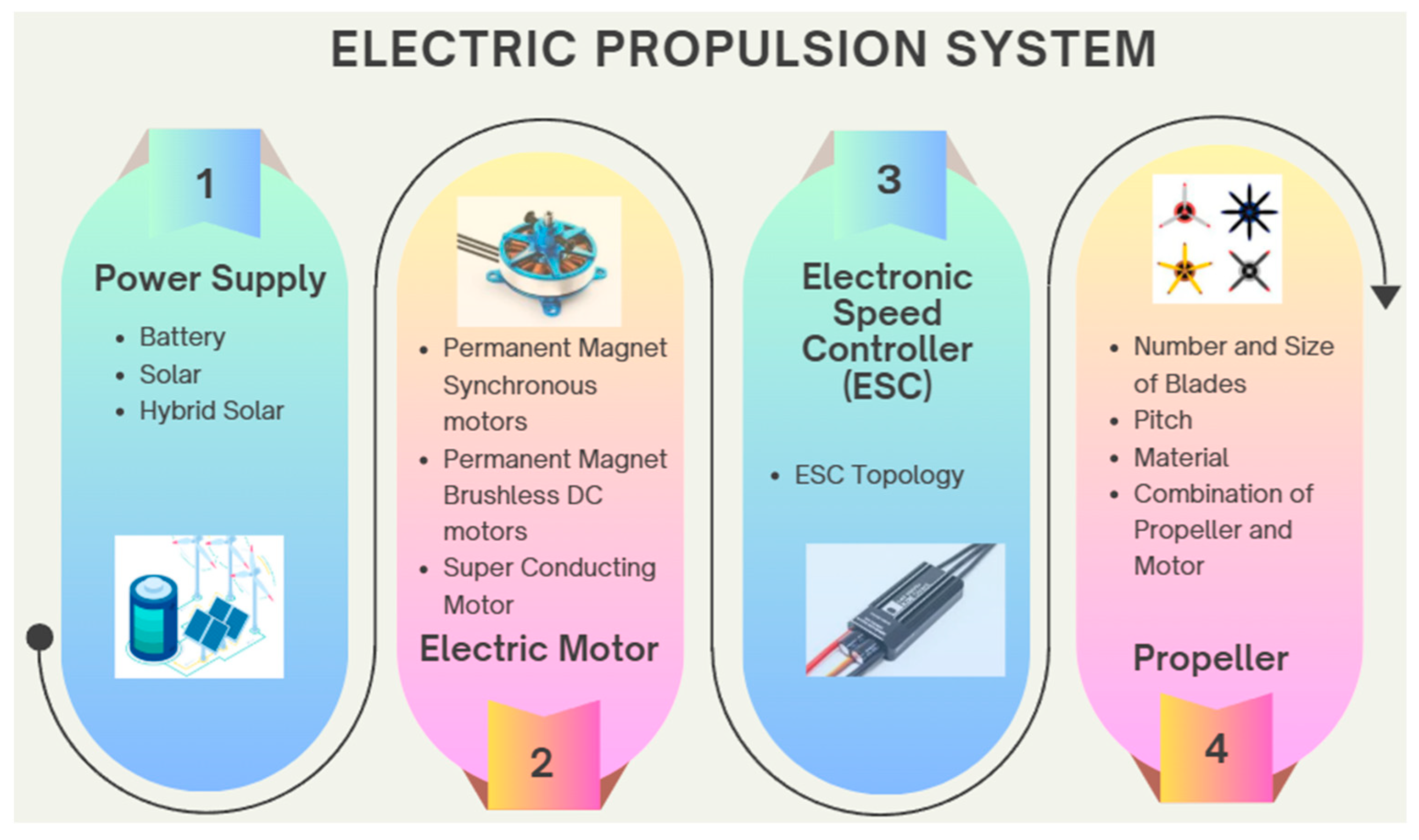
Generally, UAVs have several essential components, including flying platforms, propulsion, on-board electrical, control or navigation, and communication systems. The propulsion mechanism of the UAV applies to a significant portion of the available power, and UAV efficiency is crucial in developing the overall performance of the vehicle and its ability to execute a designated mission successfully. Various propulsion systems have also powered these UAVs, including fuel engines, electric motors, or hybrid fuel-electric motors. The primary energy source employed in the hybrid solution is a fuel engine, which encompasses an internal combustion, gas, or turbojet engines. Conversely, an electric motor is utilized for actuation purposes [30,31,32]. Electric motors are often used for small to medium-sized UAVs due to their numerous advantages. These advantages include excellent efficiency, small noise emission, reduced thermal dissipation, dependability, no pollution emission, self-starting, controllability, and increased maneuverability [33,34,35]. Figure 3 displays the electric propulsion system in this review.
Electric propulsion is widely recognized for its ecological benefits while indirectly improving the operational efficiency of many sensors and systems in UAVs owing to its minimal noise, vibration, and pollutants. An electric UAV presents a compelling alternative to traditional UAVs due to its enhanced efficiency, durability, and user-friendliness [36,37]. Table 2 provides a comprehensive overview of an electric propulsion system.

2.1. Power Supply for Electric Propulsion in UAV

A power source with a high energy density and lightweight characteristics is required to provide the optimal range and endurance of an electric-propelled UAV. The power system is referred to as the central component of the system due to its role in delivering power to the operating system as a whole, which plays a crucial role in the flight performance of UAVs [35]. Numerous primary energy sources are observed for electric-powered UAVs, including batteries, supercapacitors, fuel cells (FCs), and PVs. Table 3 tabulates a comprehensive overview of the advantages and disadvantages associated with each power source. The present electric propulsion options for UAVs exhibit a notable dependence on renewable energy sources, such as lithium batteries combined with FCs or lithium batteries connected with PVs.

2.1.1. Battery

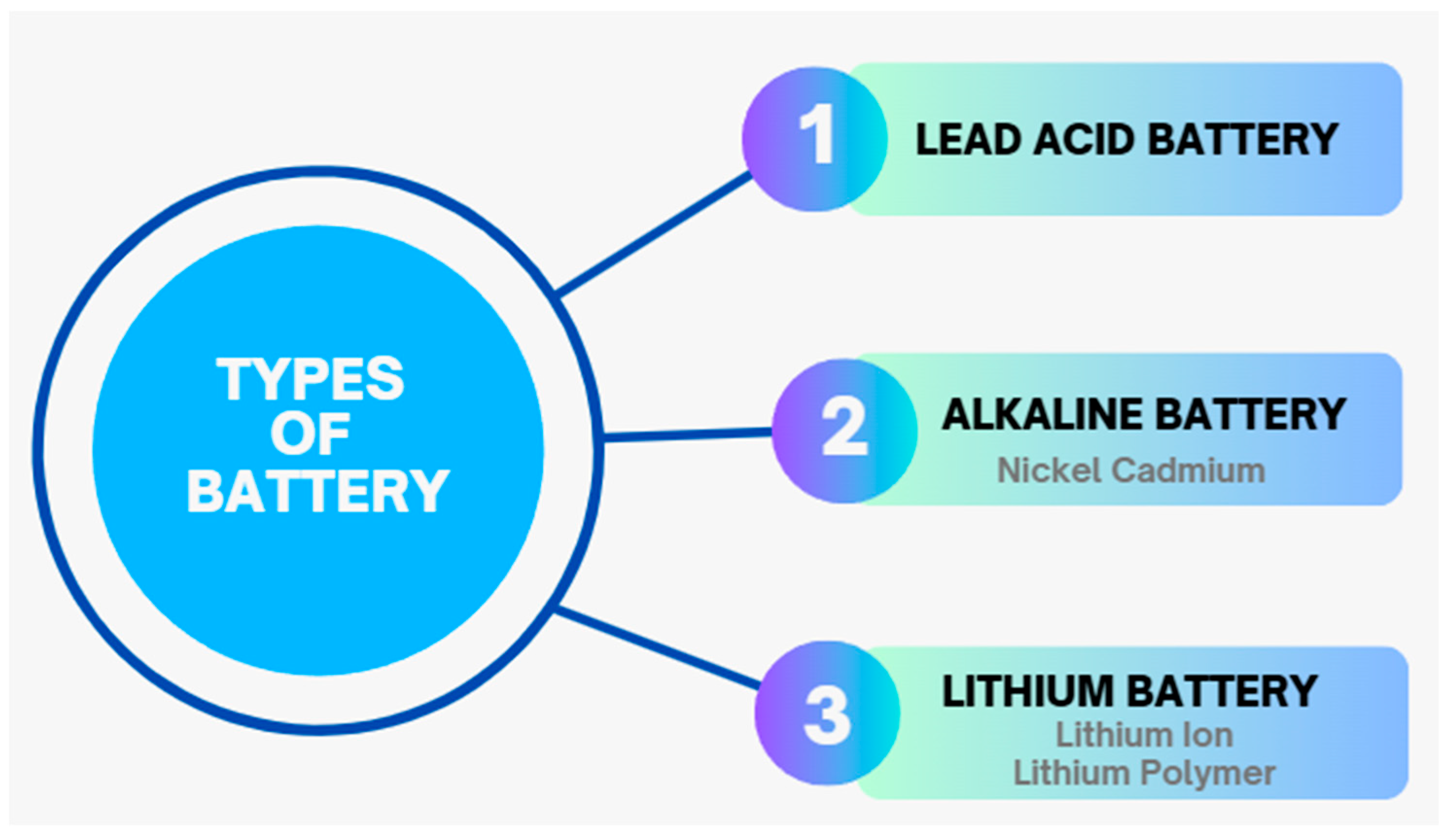
Figure 4 illustrates three commercially available battery types: lead-acid, alkaline, and lithium. Lead-acid batteries offer a modest specific energy of 30 Wh/kg and exhibit a high self-discharge rate of 2% per day. They are not suitable for cold environments and, despite their widespread use in the automotive sector, are rarely applied in UAVs due to their weight and limited volumetric capacity [43]. Alkaline batteries including nickel-cadmium, nickel-iron, nickel-zinc, and nickel-metal hydride are more efficient, with specific energies between 50 and 65 Wh/kg. These batteries support faster recharging and can operate across a wide temperature range of −40 °C to 80 °C, making them more versatile.
Lithium batteries, which include lithium-metal, lithium-ion, and lithium-polymer types, are widely adopted in UAVs due to their high specific energy, strong power output, and fast charging capability [43,49]. They feature low monthly self-discharge (5–10%) and nearly 100% charging efficiency significantly better than the 85% efficiency of lead-acid batteries. Lithium-polymer batteries, with an operating range of −20 °C to over 60 °C and a flexible electrolyte structure, are particularly suitable for compact UAVs. However, their energy density (250–700 Wh/kg) limits their use to small and micro-UAVs, making them inadequate for larger aircraft [50,51].
Modern solar-powered aircraft utilize rechargeable lithium-polymer batteries, prolonging the flight duration to 90 min [46,52]. Therefore, future lithium-air batteries have the potential to power various equipment, including solar-powered airplanes and electric vehicles. This demand is due to the theoretically higher energy density of approximately 11,680 Wh/kg, surpassing current batteries. Given that petrol produces an energy density of 13,000 Wh/kg, the remarkable energy density of a Li-air battery signifies a noteworthy technological progression. This observation highlights the indispensability of Li-air batteries in effectively enabling solar-powered aircraft to rival conventional airplanes in the foreseeable future. Table 4 comprehensively compares acid, alkaline, and lithium batteries.
The battery capacity is typically determined by factors such as the nominal rated voltage, battery current, application type, and discharge operating conditions. However, this approach does not fully account for the discharge characteristics of lithium-ion batteries. When subjected to currents beyond their nominal discharge limits, the internal impedance of Li-ion batteries increases significantly due to the specific design of the electrodes and the composition of the electrolyte [35]. To overcome these limitations particularly concerning discharge behavior and state-of-charge (SoC) imbalance, researchers have proposed optimized battery configuration strategies. These configurations aim to improve current handling capabilities, ensure balanced charging and discharging across modules, and extend battery life in UAV applications.
One of the primary challenges associated with UAVs that rely on battery power is the notable reduction in operational independence. Despite recent breakthroughs in battery technology, the flying range and endurance of batteries (measured by their specific energy) continue to be constrained. The selection of components for the power supply will likely result in suboptimal performance and limited durability. The PV electricity allows UAVs to sustain flight for extended durations (spanning multiple days) while accommodating diverse sensor payloads through a battery storage system.
State of Charge (SoC)
The SoC determination of a battery or the charging scheme is crucial to optimize the charging process, which provides information regarding the remaining capacity of the battery. Estimating the SoC determination of a battery is performed by measuring the voltage and current. Additional considerations to be taken into consideration include the operational history of the battery, its age, the environmental conditions in which it has been used, and the amplitude of the discharge current [45].
Lithium-ion transportation occurs bidirectionally during charging and discharging between the electrodes. Lithium ions migrate from the positive to the negative electrode during the charging phase. Otherwise, the movement is reversed during discharging, with the ions traversing from the negative to the positive electrode. The lithium-ion battery undergoes a continuous charging process, wherein a constant current is applied until the voltage achieves its peak level. The current progressively decreases to lower magnitudes once the circuit transitions to voltage control [55,56]. Therefore, ensuring precise voltage regulation is vital to deliver the maximum safe charge to the battery.
The SoC of battery overtime is a crucial parameter in battery management systems [57,58]. Several techniques are employed to determine the SOC of a battery, including specific gravity, terminal voltage, and ampere-hour (Ah) balancing operations [59,60,61]. Ah balancing is the most favored approach for SoC batteries in dynamic systems. This preference is primarily due to measurements based on specific gravity and terminal voltage requiring additional time for stabilizing delays. The balancing process involves assessing the inflow and outflow of the current in a battery to ascertain the net Ah value of the battery. Furthermore, balance is commonly employed in assessing battery depletion within shorter timeframes, particularly in UAV applications. Conversely, a balance can lead to substantial inaccuracies over extended durations and in processes that entail fractional charges owing to the cumulative nature of errors. The losses incurred by battery exhibit variability depending on its SoC and are subject to the influence of factors, such as battery voltage and temperature [62]. Hence, PV systems that solely rely on Ah balancing or employ constant loss terms yield unsatisfactory outcomes [63].
Charging Techniques for Battery in UAVs
Batteries are widely favored as the primary energy storage solution in UAVs owing to their many benefits and ability to utilize chemical processes for efficient energy collection and release. Battery switching is a commonly employed method for charging UAVs [64,65]. The increasing interest of professionals is being drawn towards the possibility of wireless charging in modern times. There are two unique wireless charging types which are Electromagnetic Force-based (EMF) and non-EMF-based [35]. Multiple EMF-based charging techniques are commonly employed to prolong the operational duration of UAVs throughout their missions. A study by Pham et al. investigated the feasibility of utilizing the electromagnetic field of power lines for charging UAVs [39]. The study proposed a methodology to assess the amount of energy a UAV could extract from the magnetic field of a transmission line. This process used capacitive, inductive, and magnetic resonant charging techniques. One concern with this approach was maintaining optimal battery levels for UAVs and ensuring efficient power transmission during flight. Table 5 tabulates various alternatives to EMF-based wireless charging.

2.1.2. Solar Cells

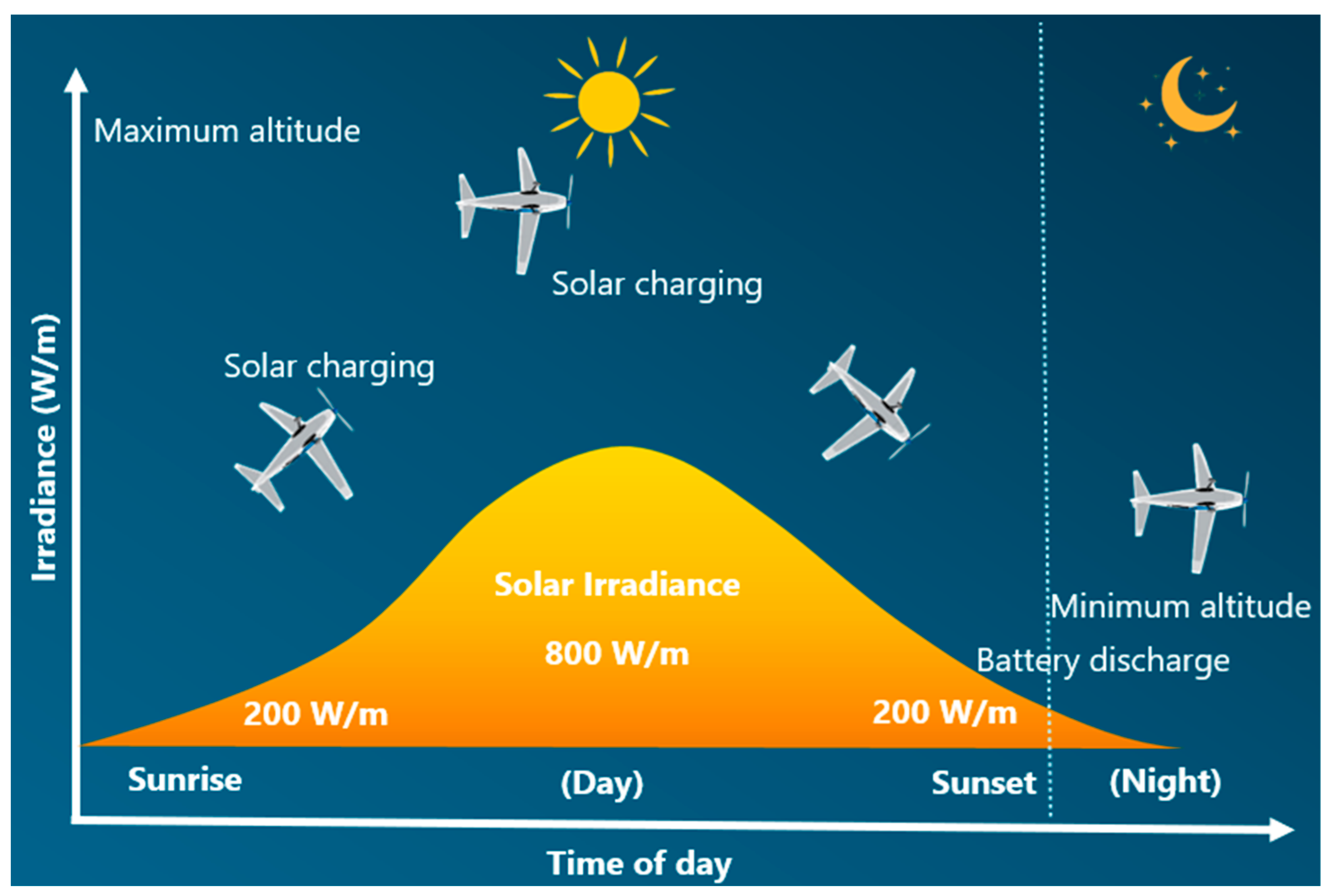
Solar cells are an environmentally friendly and sustainable energy source as they transform light energy into electricity through the PV effect. The source of the energy is obtained from sun radiation. Certain solar-powered UAVs attain heights as high as 20,000 feet. Given the relatively small conversion efficiency and energy density, the coverage area of these cells requires improvement to ensure an adequate power supply. Altitude is often actively controlled in solar UAVs to optimize energy usage climbing during daytime to maximize solar exposure and descending at night to reduce power consumption, as illustrated in Figure 5. Consequently, solar-powered UAVs integrate PVs into their wings and produce a substantial wing to chord ratio [35]. Although the viable and sustainable solar energy source possesses certain inherent restrictions, the advantages significantly surpass the associated drawbacks. The global proliferation of industrial practices reliant on carbon-based fuels has been implicated in global warming and the depletion of the ozone layer. Hence, significant PV technology studies have been performed for commercial, industrial, and military uses. Solar panels for power generation are poised to emerge as a powerful contender within the energy sector. Section 3 comprehensively analyses solar cell types, configurations, and durability concerns.

2.1.3. Hybrid Solar Energy System

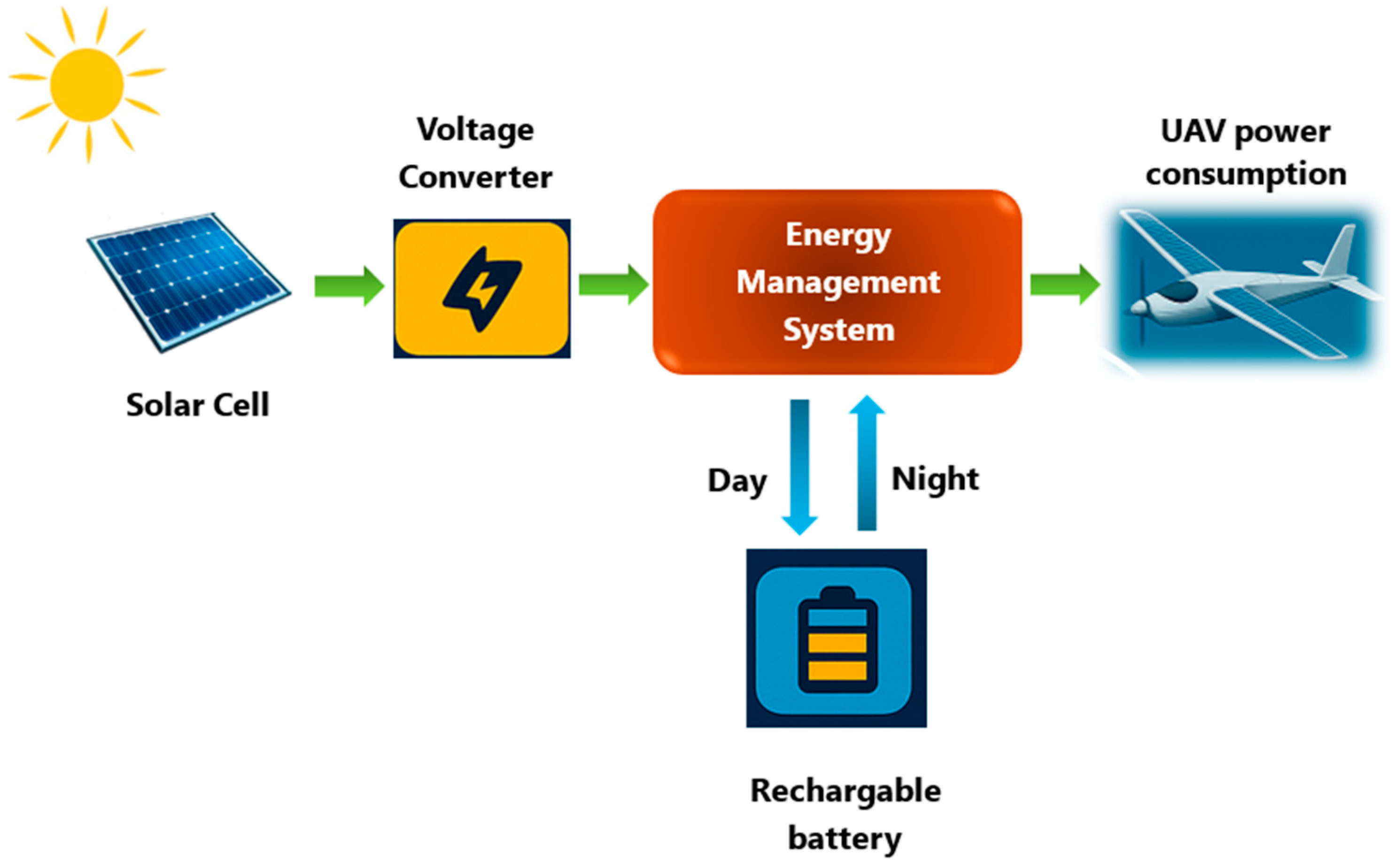
Most geographical regions worldwide have continuous access to solar radiation, harnessed and converted into useful electrical energy through PV technology. The primary components of a conventional hybrid solar energy system are solar cells, voltage converters with maximum power point tracking (MPPT) functionalities, energy management systems, and rechargeable batteries with management systems (see Figure 6) [73,74]. Due to its operational principle, a solar UAV has favorable characteristics for deployment in high-altitude and lengthy-duration missions. During midday, the energy management system directly accesses power from the solar panels installed on the wings. Over time, the battery is replenished by solar radiation. During night-time, the hybrid solar UAV depends solely on its rechargeable battery as a source of electrical power. Therefore, the UAV can sustain uninterrupted flight operations daily to attain the long-endurance characteristic. Nevertheless, the drawbacks encompass the insufficient energy density of batteries used for energy storage and the inadequate energy management system to navigate a multifaceted setting effectively.
Standalone PV systems have limitations as a reliable electricity source due to their inability to sustain power supply during night-time hours and their susceptibility to power fluctuations resulting from fluctuating solar radiation [76]. Hence, UAVs frequently employ a hybrid power supply system architecture comprising PVs and rechargeable batteries to ensure continuous power availability throughout a 24 h, 7-day operational cycle. To attain the desired extended endurance over several days, the weight of the rechargeable batteries should constitute approximately 30% of the total mass of solar-powered aircraft [77]. While an increased number of rechargeable batteries provides a greater power supply during night-time operations, the additional weight of these batteries necessitates a higher power consumption to sustain continuous flight. Therefore, solar-powered aircraft designers should meticulously evaluate the most suitable rechargeable batteries for their aircraft [78].
The present advancements in battery technology enable a significant enhancement in endurance of approximately 90 min using lithium polymer (LiPo) batteries. Nevertheless, the number of cells is not feasible to increase due to weight and space limitations [79]. Supplementary power sources are required to be incorporated to enhance the endurance of UAVs. This requirement is essential for striking a delicate equilibrium between the limitations of battery capacity and the need to adhere to weight and space restrictions. UAVs can also incorporate solar panels on their wings, enabling them to harness solar energy. This integration of multiple power sources (known as hybridization) has emerged as the most effective approach to enhance the durability of UAVs through their power supply system [80]. These limitations underscore the necessity of robust energy management and hybridization to maintain 24 h flight cycles in dynamic atmospheric conditions.

2.2. Electric Motor Propulsion System Power Unit

The electric motor is the principal component for converting electromechanical energy inside the electric propulsion system, transforming electrical into mechanical energy. This mechanical energy is subsequently utilized to rotate the propeller, generating the necessary thrust for the aerial propulsion of the UAV. Generally, UAV electric propulsion systems necessitate motors with high-power density because of size and weight limitations. The primary factors influencing motor power density include magnetic load, electrical load, frequency, linear rotor speed, and current density [81]. The power density and output power of the motor are improved by maximizing these features, potentially rendering it appropriate for utilization in the power unit of UAV [82]. The predominant motor types used in UAV propulsion systems include permanent magnet synchronous motors (PMSM), superconducting motors, and permanent magnet brushless DC motors (PMBLDC), each offering distinct advantages in terms of efficiency, power-to-weight ratio, and controllability for electric and hybrid-electric UAV applications.

2.2.1. Permanent Magnet Synchronous Motor (PMSM)

Rare-earth permanent magnet materials possess superior characteristics, such as greater maximum magnetic energy and elevated maximum working temperatures. These attributes facilitate further enhancements in the power density of PMSMs [83]. The PMSMs are employed in UAV propulsion systems because of their excellent power density, high efficiency, and lower technical risk [84]. Furthermore, PMSMs in UAVs are prevalent in high-speed applications due to the positive correlation between motor speed and power density, which requires gearboxes in such scenarios. Nevertheless, gearboxes give rise to additional concerns, including the size and weight of the gearboxes and the prospective motor output loss [85]. Therefore, enhancing the power density of the motor is obtained by increasing the frequency and amount of pole pairs in the PMSM and improving the magnetic density of the air gap [86].
The PMSMs demonstrate challenges in sustaining elevated power output due to concerns related to the heat dissipation and demagnetization of the permanent magnets, thereby reducing reliability. Therefore, the PMSM in these vehicles undergo additional advancements in increased power capacity and improved cooling with heat dissipation. This outcome occurs to fulfill the demands of forthcoming UAV electric propulsion systems.

2.2.2. Permanent Magnet Brushless DC (PMBLDC) Motor

A trapezoidal or square wave-shaped counter-electromotive force waveform characterizes an electric motor type called a PMBLDC. The conventional components of a PMBLDC motor include an inverter, a sensor, and a motor body. The PMBLDC motor operates by utilizing Direct Current (DC) power due to an integrated inverter. In contrast to conventional brushed DC motors, brushless motors are characterized by their ability to function without generating sparks. This outcome is achieved through electronic switching circuits instead of commutators. The brushless DC motor also maintains commendable controllability and a wide range of speed regulation performance exhibited by DC motors [87].
Due to their notable attributes, PMBLDC motors are frequently employed in electric propulsion systems for UAVs. These attributes include outstanding reliability, little noise emissions, compact dimensions, extended operational longevity, and straightforward maintenance requirements [37,46]. Notably, brushless DC (BLDC) motors are one of the various motor types employed for electric propulsion in UAVs. This observation is attributed to numerous advantages (including high rotational speed exceeding 10,000 RPM), rendering them suitable for improving aerial vehicles. Precise shaft position detection or approximation is also crucial to guarantee optimal efficiency and minimize power loss within the system [85].

2.2.3. Superconducting Motors

A superconducting motor has been observed in a novel and auspicious electric propulsion system designed for UAVs. This motor aims to boost the magnetic density in the air gap and the line load of the armature, reducing the overall volume and weight of the motor while simultaneously improving its performance. Superconducting materials are applied to achieve this objective by harnessing their large current density and small loss capabilities [86]. In contrast to conventional motors, this motor necessitates reduced energy consumption and less space for cooling mechanisms due to the absence of overheating in superconducting motor conductors during operation.
Rotor-excited superconducting motors are commonly applied in aircraft for their favorable characteristics, including large power density, compact dimensions, lightweight construction, good efficiency, minimal reliance on ferromagnetic compounds, and small armature reactance. The feasibility of high-temperature superconducting motors is significantly affected by the low critical temperature of the superconducting material. This superconducting motor technology is still in its early stage, characterized by ongoing theoretical investigations and less practical implementation. Nonetheless, superconducting motors experience considerable alternating current (AC) losses when operating at high speeds. Hence, superconducting motors need to address several key challenges to be employed in electric propulsion systems for UAVs. These challenges include minimizing the AC loss associated with superconducting armatures, enhancing the critical temperature of superconducting materials, and reducing the expenses associated with cooling mechanisms [88].
Superconducting motors are often cited for their significantly higher efficiency and power density compared to conventional copper-wound motors. For instance, studies have shown that superconducting motors can achieve efficiency levels of over 98%, compared to 93–95% for high-performance permanent magnet synchronous motors (PMSMs) under similar power ratings. In terms of power density, superconducting motors have demonstrated values exceeding 15 kW/kg, while typical commercial UAV-grade electric motors range between 2 and 5 kW/kg. This represents a 3–7× improvement, which is critical for weight-sensitive platforms like solar UAVs. The high efficiency is attributed to the near-zero resistance in superconducting coils and reduced core losses, particularly at cryogenic operating temperatures (e.g., ~77 K using liquid nitrogen) [89,90].

2.3. The ESC Topology for Energy Optimization

In regulating a brushless motor in a closed loop, the inverter or Electronic Speed Controller (ESC) in UAVs necessitates higher-cost hardware components, such as hall effect sensors, rotary encoders, and complex, processor-intensive software algorithms [86]. The feasibility of measurement acquisition requires supplementary passive and active electrical components, notwithstanding the sensorless, closed-loop operation. These rationales contribute to the prevalent ESCs in UAV applications in an open-loop configuration to minimize manufacturing expenses. Hence, an inefficient driving technique causes a variable rotor position, increasing load jitter and power loss [91]. This controller substantially amplifies aircraft vibration during elevated rotational velocities, utilizing inexpensive and imbalanced propellers.
Several studies by Piccoli et al. [91] and Gebauer et al. [92] proposed a closed-loop algorithm relying on back electromotive force (back-EMF). The study reported that the algorithm could conveniently be integrated into a low-resource Microcontroller (MCU), commonly observed in specialized ESCs in multirotor applications. Moreover, this algorithm ensured the production of a cost-effective product [92,93]. In systems using Hall sensors, signal changes generated during rotor movement are used to trigger commutation through logical functions such as XOR. In sensorless designs, where Hall sensors or rotary encoders are absent, back-EMF is used instead to estimate the rotor’s position in real-time and initiate commutation accordingly.
The back-EMF integrating algorithm is a method that relies on the back-EMF observation. This technique involves the voltage across the unpowered winding by the inverter throughout each commutation sequence to ascertain the magnetic flux. Regardless of whether the winding is during a falling or rising edge, the voltage integration for a particular winding occurs now when the back-EMF of that winding reaches 0 V. A commutation event takes place after the integral hits a suitable threshold (specified by the user), and the control scheme is established [87].
Motor type selection is frequently determined through a motor-control algorithm, including trapezoidal or field-oriented control (FOC). In addition, the wound of the motor impacts the control algorithm selection to yield the highest motor efficiency level. The flight characteristic of the UAV also depends on the control algorithm. Sensorless controllers are commonly used due to their simplified construction and extended operational lifespan compared to mechanical speed sensors [94].

2.4. Propeller

Considering the substantial influence of the total weight of an aircraft on its flight dynamics, the payload weight relative to the weight of the UAV should be considered. Selecting the most suitable propeller for each configuration is vital to achieving optimal flight characteristics [95]. Replacing a propeller on an aircraft while in flight is not feasible under typical conditions. Hence, a mechanism capable of altering the rotor shape to enable the propulsion system to adapt to diverse flight conditions is necessary [96]. This section examines the propeller features of a solar UAV, including size, number, pitch, and material, which can influence its efficiency.

2.4.1. Number, Size, and Pitch

The design of a propeller is a critical factor in determining a UAV’s performance, with the number of blades, size (diameter), and pitch each playing distinct roles based on the platform’s intended use. These characteristics must be carefully selected to align with operational requirements, payload capacity, and flight conditions. The number of blades on a propeller varies depending on the UAV’s application. Aerobatic and racing drones typically use fewer blades with smaller diameters (under eight inches), paired with high-kV motors for rapid acceleration and maneuverability. In contrast, heavy-lift UAVs, such as those used for aerial photography or agricultural spraying, require larger propellers (exceeding eight inches) paired with low-kV motors to generate sufficient thrust for heavier payloads [97]. While smaller propellers offer greater responsiveness, larger propellers enhance stability, particularly during hovering.
Propeller diameter significantly influences efficiency and performance. Smaller blades (less than eight inches) allow for quicker speed adjustments, making them ideal for agile flight. However, they struggle to produce adequate thrust when paired with underpowered motors [98]. Larger blades, on the other hand, displace more air, improving lift and stability, but require lower rotational speeds, which can increase power consumption. For high-altitude operations, propellers with diameters of five to six feet are recommended to achieve efficiencies exceeding 80%, with twist angles adjusted for optimal performance, 25° for high-altitude flight and 15° for low-altitude operations [99].
Pitch, defined as the distance a propeller moves forward in one full rotation, is another crucial design parameter. Low-pitch propellers generate higher torque with less turbulence, making them energy-efficient and well-suited for takeoff and heavy payloads. High-pitch propellers, while capable of displacing more air, produce less thrust and are better suited for high-speed cruising [97]. The trade-offs between pitch and performance are particularly evident in different flight phases: takeoff demands high thrust at low speeds (favoring low pitch), while cruising benefits from higher pitch settings for sustained speed. To overcome these limitations, variable-pitch propellers have been developed, allowing dynamic adjustments to optimize performance across all flight conditions [96].
Ultimately, propeller selection involves balancing competing factors—stability versus agility, payload capacity versus speed, and efficiency versus power consumption. The optimal configuration depends on the UAV’s specific mission profile, whether it prioritizes heavy lifting, high-speed flight, or endurance. By carefully considering the interplay between blade count, diameter, and pitch, designers can tailor propeller performance to meet the demands of diverse aerial applications.

2.4.2. Propeller Material

Early aircraft relied on wooden propellers due to their lightweight nature and vibration-damping properties. However, wood degrades under environmental stress and lacks aerodynamic efficiency. Metal propellers (aluminum or steel), introduced later, improved durability but increased weight, reducing responsiveness which is a critical drawback for modern UAVs, where agility and efficiency are paramount. While these materials shaped aviation history, their limitations make them impractical for most drone applications today [100,101].
Composite materials revolutionized propeller design by combining high strength with minimal weight. Modern composite propellers utilize advanced materials like carbon fiber and fiberglass in monocoque or foam-core constructions. These manufacturing techniques allow for precisely optimized aerodynamic profiles that would be impossible with wood or metal. The production process, however, remains complex and often involves significant trial and error. While automated tape placement systems have improved manufacturing precision, the high cost and technical challenges of composite production continue to present barriers to widespread adoption, particularly for smaller manufacturers [102,103].
For small UAV applications, chopped fiberglass-reinforced nylon has become a popular material choice due to its favorable balance of strength, weight, and cost-effectiveness. The injection molding process used for these propellers enables mass production but requires expensive custom tooling for each design variation. This makes technology economically viable only for large production runs, limiting its suitability for customs or low-volume applications where design flexibility is required [104].
Additive manufacturing has emerged as a promising alternative for specialized propeller production. Three-dimensional printing allows for rapid prototyping and the creation of complex geometries without traditional manufacturing constraints. While this technology offers unparalleled design freedom and eliminates tooling costs, it faces limitations in production speed, material costs, and long-term durability. Current 3D-printed propellers generally cannot match the performance characteristics of conventionally manufactured counterparts. However, as technology continues to advance and costs decrease, additive manufacturing is finding increasing applications in aerospace, particularly for prototyping and low-volume specialty production [105,106].
The selection of propeller material ultimately depends on a careful evaluation of performance requirements, production volume, and cost considerations. While traditional materials like wood and metal still find niche applications, modern composites and reinforced plastics dominate contemporary UAV propeller design due to their superior strength-to-weight ratios. Additive manufacturing, although not yet suitable for mass production, offers exciting possibilities for customized solutions and rapid development cycles. As materials science and manufacturing technologies continue to advance, we can expect further innovations in propeller design that will push the boundaries of aerial vehicle performance. Table 6 summarizes the advantages, disadvantages, and typical applications of the propeller materials discussed above.

2.4.3. Combination of Propeller and Motor

Propellers employed in UAVs typically consist of two or more blades interconnected by a central hub, which secures the blades to the shaft of a BLDC motor. The primary function of these propellers is to provide thrust and torque, enabling effective control of UAVs. Moreover, the efficiency of the motor depends on its output torque, which is subject to several parameters, such as the speed, size, and type of the propeller. Therefore, selecting an appropriate propeller and motor pairing increases performance efficiency, producing longer flight periods with the same propulsion while consuming less energy. Motor and propeller arrangement is key in designing and managing UAVs [37,107]. A solar-powered aircraft is expected to maintain a constant altitude for extended periods to preserve energy, so the propulsion system should be optimized for maximum efficiency. This process entails identifying the most efficient operating position of the engine and propeller, which synchronizes these factors at the aircraft level to enhance overall efficiency. Propeller efficiency is maximized in non-obstructed conditions, and the detrimental effects caused by turbulence are minimized.
A big propeller is commonly employed for this function due to the low angular velocity and high torque requirements. Alternatively, electric motors specifically engineered for generating low torque and achieving high angular velocity produce enhanced efficiency and compactness. A trade-off exists when considering a higher-efficiency motor necessitating a gearbox, characterized by inefficiency and susceptibility to wear. This trade-off is opposed to a direct drive motor that exhibits lower efficiency. An electric motor and propeller combination should also generate the necessary thrust to achieve take-off. This mission phase for high endurance requires the greatest power [36].
Identifying the optimal propulsion system component combination for a given mission profile is crucial. Due to the fundamental propulsion component combination, design engineers often find it straightforward to choose an electric propulsion system for UAVs. This combination often includes an electric motor, gearbox, ESC, propeller, and battery packs. Manufacturers typically provide recommendations for these components based on the weight of the UAV. The aircraft type specification of the propulsion system packages is also used by manufacturers, such as sailplanes, trainers, aerobatic planes, and 3D aircraft. Even in the same UAV model, the potential weight range fluctuation between the lower and higher weight thresholds can reach up to 25% of the maximum take-off weight. The potential for unique and varied versions of UAVs becomes evident when considering different sets [98].
A propulsion system optimization tool is developed to effectively accommodate diverse motor and propeller configurations to meet specific mission requirements. The optimization tool assesses the power output of several propeller motor combinations at a designated minimum aircraft speed. This evaluation is conducted to gauge the capacity of the combination to maintain an adequate safety margin in the event of an unexpected disturbance. The tool serves a dual purpose, aiding pre-flight planning and post-flight analysis by assessing the performance of a combination across various velocities and thrusts. This evaluation can be conducted based on flight conditions or test information [108].

3. Propulsion System Modeling and Power Management

Solar-powered UAVs rely heavily on their propulsion system and power management to fly longer and use energy efficiently. Since solar energy is limited and changes with conditions, we need accurate models of the propulsion system (motor, ESC, and propeller which use the most power) and smart power management to balance energy between flight systems, electronics, and batteries. This section explains how to model these components and manage power effectively for reliable operation in different flight conditions.

3.1. Propulsion System Modeling

The propulsion system is one of the most energy-intensive subsystems in a solar-powered UAV, directly influencing flight performance, endurance, and energy efficiency. Accurate modeling of this system is essential for estimating power consumption, optimizing flight profiles, and ensuring compatibility with onboard energy sources such as solar panels and batteries. The electric propulsion system typically comprises a brushless DC (BLDC) motor, an electronic speed controller (ESC), and a propeller each contributing to the overall power dynamics. By establishing the mathematical models of these components, it is possible to predict the system’s electrical and mechanical behavior under various flight conditions. This section presents the key equations and performance parameters used to evaluate the energy flow and thrust generation in solar-electric UAV propulsion systems.

3.1.1. Propulsion System Power Modeling (Motor, Propeller, ESC and Voltage Drop Model, and Integrated Power Models)

Motor Model
BLDCs are widely used in UAVs due to their high efficiency, reliability, and favorable torque-to-weight ratio. The electrical input power to the motor can be calculated using
P i n = V × I
This represents the electrical power drawn from the battery or power source, where V is the input voltage and I is the current. This value is critical for battery sizing and real-time energy monitoring.
The mechanical power output from the motor shaft is given by
P m e c h = T × ω
This represents the useful mechanical power that turns the propeller. Torque (T) and angular velocity (ω) together determine the thrust potential and mechanical workload.
The angular velocity (in radians per second) is computed from RPM as
ω = 2 π × R P M 60
This equation translates motor speed from RPM to standard SI units for use in further dynamics modeling.
The motor efficiency is calculated as
η m o t o r = P m e c h P i n
This defines how effectively electrical energy is converted into mechanical output. High-efficiency motors (>90%) reduce thermal losses and improve endurance. Well-optimized brushless DC (BLDC) motors used in small UAVs typically achieve efficiencies ranging from 80% to over 90%, depending on factors such as load, cooling, and motor design [109,110,111].
Propeller Model
The propeller converts motor torque into thrust, and its performance is influenced by parameters such as diameter, pitch, and rotational speed. A simplified empirical thrust model is expressed as:
T = C T   ×     ρ   .     n 2   .     D 4
This empirical formula estimates generated thrust (T) as a function of the thrust coefficient ( C T ), air density (ρ), propeller speed (n in rev/s), and diameter (D). It is used in sizing and selecting propellers for a target thrust profile.
ESC and Voltage Drop Model
The ESC modulates power delivery to the motor based on PWM signals from the flight controller. It introduces small but non-negligible losses due to internal resistance and switching inefficiency. The effective voltage applied to the motor is
V m o t o r = V b a t t e r y ( I × R E S C )
where RESC is the internal resistance of the ESC. This shows the effective voltage delivered to the motor. Accurate modeling here is important for predicting performance under high-load conditions, where ESC resistance can impact motor speed and thrust.
Integrated Power Model
By integrating the models of the motor, ESC, and propeller, the total propulsion power requirement can be estimated as
P t o t a l = P m o t o r + P E S C _ l o s s + P c o n t r o l l e r
where Pmotor is the electrical input power to the motor, PESC_loss is the power lost in the ESC, Pcontroller is the flight controller power consumption. This cumulative model is essential for estimating the UAV’s net propulsion power requirement, which directly influences system endurance and solar battery sizing.

3.1.2. PV Modules

The solar cells onto the curved wing of a UAV introduce complexities in the power generation measurement. When the wing surface is assumed to be planar, the computational process becomes less complex, but the accuracy is compromised [112]. One possible solution involves calculating and overlaying solar radiation energy at different plane angles [113]. Nonetheless, this methodology is characterized by its time-intensive nature and many limitations.
Numerous models proposed by Bird and Hay, Davies, Klucher, and Reindl (HDKR models) are integrated to provide a more accurate and flexible solution [114]. The Bird model is utilized to compute direct solar radiation intensity, atmospheric scattering intensity, and ground reflection radiation. During the flight of a solar-powered UAV, the orientation of the solar panels deviates from a horizontal position due to the wing surface and the flying attitude. Therefore, the HDKR model encompasses isotropic diffuse, circumsolar radiation, and horizontal brightening components [115]. This Bird and HDKR combination model allow for the solar radiation estimation to reach the inclined surface of the wing.
Given that most PV panels are attached to the wing, flexible PVs are frequently applied despite their smaller efficiency than their traditional counterparts. A study by Papis et al. [116] demonstrated that altering the airfoil shape through partial flattening is not advantageous from an aerodynamic standpoint. Hence, a flexible PV system with lower efficiency is more suitable. The energy storage and management systems become imperative to compensate for the smaller energy conversion efficiency of solar panels.

3.2. Propulsion System Framework

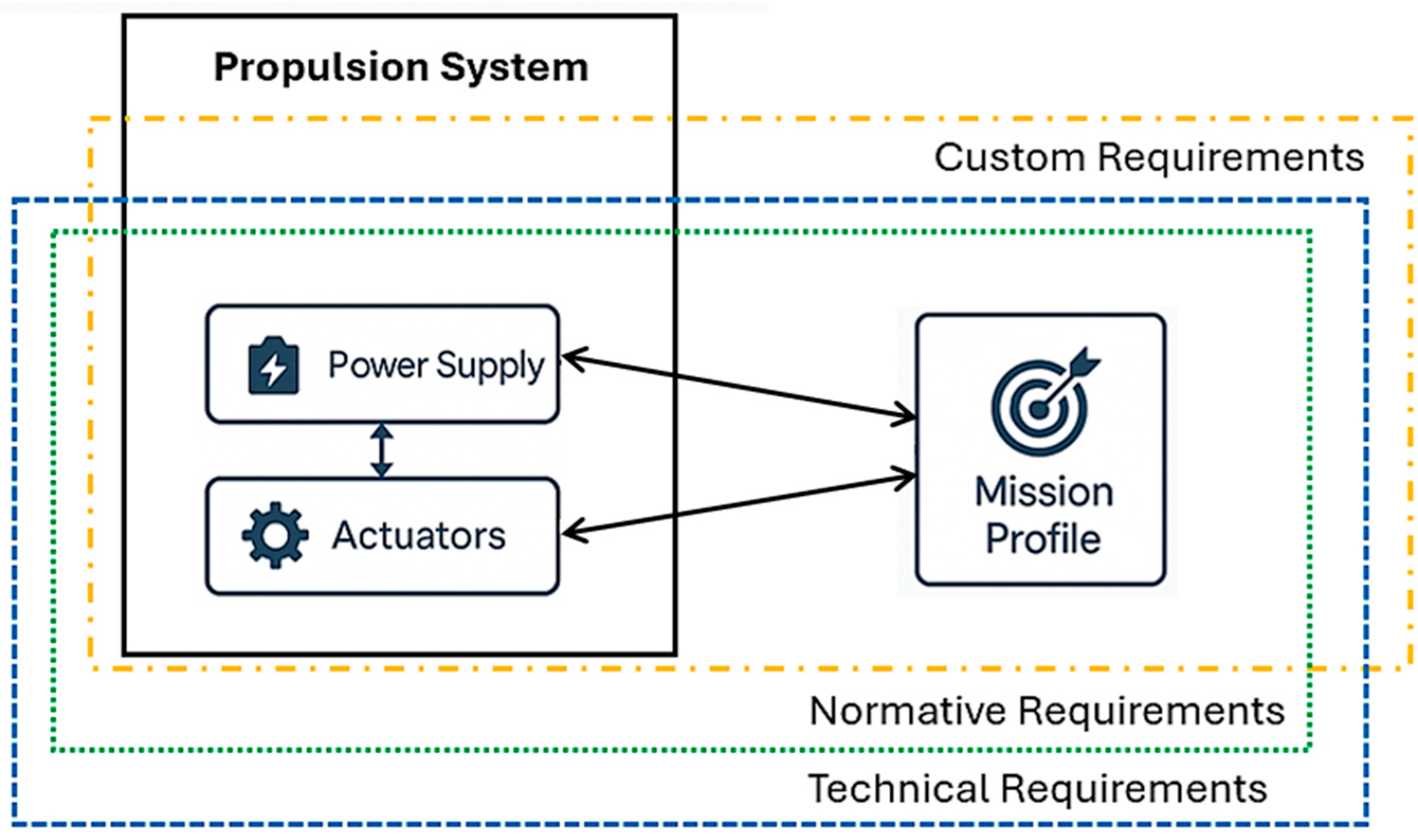
Figure 7 illustrates the functional design framework of a propulsion system for UAVs, which incorporates several considerations [117]. This framework facilitates the initial design phases by proposing prospective components. Several categories necessitate fulfillment, including technical, normative, custom, and peculiar requirements.
The maximum UAV size and cruising speed should be considered in technical requirements. Conversely, careful consideration must be given to the full UAV size and operating altitude when addressing normative requirements. Several constraints, such as the personal preferences of the creator or developer, influence the architecture or selection criteria for custom parts. These preferences include sustainability in procedures or production data and management-related properties (vendor service contract types, provider reliability, quality of the supporting channel, and consistency with existing infrastructures). Lastly, the peculiar requirements encompass the mission profile, power supply, and actuation sub-system [117].
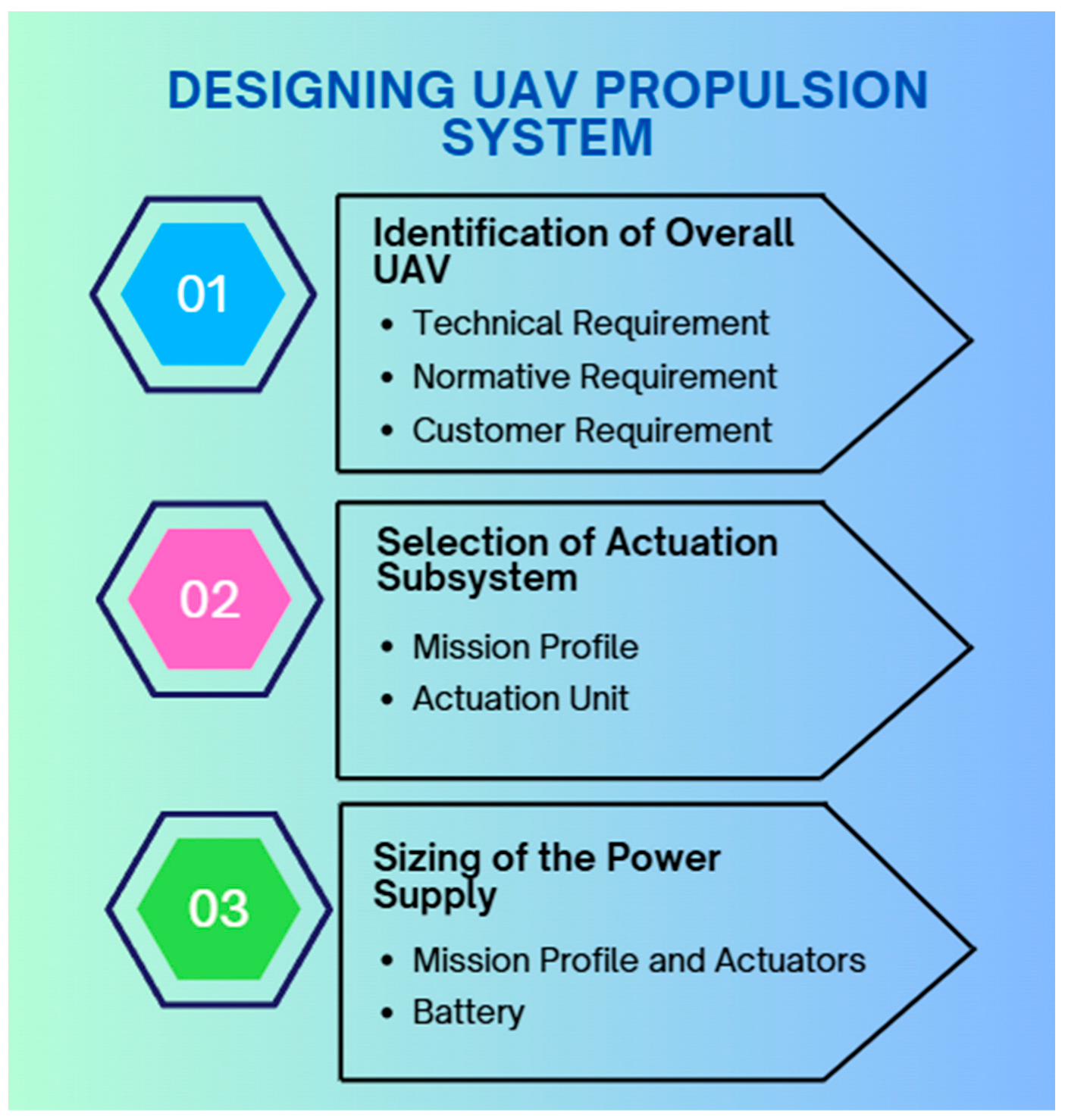
Figure 8 reveals the three primary stages of the UAV propulsion system design. The initial phase involves the primary design limitations (preference for a hybrid or electric propulsion system), technical aspects (desired payload, cruise velocity, and round-trip), normative constraints (total mass during take-off), and custom requirements. An initial attempt at the actuation group is undertaken by considering potential actuator candidates constrained by these limitations.
The second step of the study outlines the key design constraints on working conditions and tasks. These primary kinematic constraints of the UAV are determined after carefully selecting a suitable actuator variant (AC or DC and brushed or brushless). The worst possible functioning situation should be considered when determining the initial actuation component size. The characteristic equations of the system are also identified, and the generalized forces (linear forces and torques) acting on the device were derived by a free-body analysis UAV. Various factors, including power and energy densities, application requirements, size, shape, flying mode, mission, and endurance, influence the actuation type selection for generating motion in UAVs. Three primary technologies have been employed for actuators: internal combustion engines, electric motors, and hybrid systems. Furthermore, the electric motor types commonly observed in UAVs include brushless and brushed DC motors [117].

3.3. Power Management System for Hybrid Solar UAV

Passive power management (PPM) and active power management (APM) represent the energy management strategies employed in hybrid-powered UAVs. The voltage of the two power sources is typically similar in PPM systems, while the alternative power supply and the battery are interconnected in parallel. The aggregate power is then transmitted to the ESC, facilitating the aircraft movement by the propeller. Alternatively, the PPM method is characterized by its reduced weight, eliminating unnecessary electrical components to regulate the electrical current. Insufficient control over the power flow inside the system develops lower efficiency and safety, while supervisory electronic components are responsible for regulating power flow in APM systems. Therefore, an APM system necessitates more circuits to control the power flow effectively. This circuitry necessity increases the weight, cost, and energy consumption of an aircraft [112].
The rule-based approach is a widely recognized and straightforward power management technique in hybrid solar UAVs. This approach is characterized as a set of laws based on predetermined limits for control variables. The power system operates in different modes by comparing the control variables with their respective thresholds. A study by Lee et al. [118] developed an active power management system for their hybrid power system using six rules, which underwent a flying test lasting 3.6 h [118]. Although the approach was simple and dependable, the dynamic adaptation to power was only presented in finite states.
Another study by Gao et al. [119] proposed a power management system centered around a PV battery-powered long-endurance UAV. During the initial stage, the PV energy was divided into three distinct components: (1) supplying power to the UAV, (2) accumulating surplus energy for future utilization, and (3) recharging the battery. A new phase commenced when there was a reduction in solar irradiance. The power limitation of the UAV was then effectively managed by the hybrid approach involving energy-saving and gravity-gliding techniques. Thus, the battery served as a power source for the UAV during low altitudes, enabling a regulated descent in the event of the total depletion of solar energy (mission completion). The proposed PMS in the study demonstrated a significant increase in energy conservation of approximately 23.5% compared to an alternative management strategy. This evaluation also takes into consideration the influence of wind [119].
The fuzzy logic-based intelligent energy management system presents an alternate methodology to the rule-based approach by eliminating the need for a specific numerical threshold. Moreover, historical data is not a prerequisite for fuzzy logic implementation due to the probabilistic nature of fuzzy rules. A study by Zhang et al. [118] introduced an online fuzzy logic approach that employed seven membership functions for their hybrid power system. This method also demonstrated a lower energy consumption than the Rule-based method through field testing [120,121].
A study by El-Atab et al. [122] presented two energy management schemes to address diverse scenarios effectively. The strategies optimized energy utilization by harnessing solar energy, gravitational potential energy, and wind power while accounting for battery capacity variations. The proposed methodologies in the study were categorized into several stages based on the chronological sequence of solar irradiation conditions, electrical energy storage conditions, and the relative motion dynamics between the UAV and wind. Particularly, the fundamental premise behind the energy management techniques in the study entailed the development of target functions and switching conditions tailored to each stage.
Several key components influence the efficacy of a power management system. These components include solar array configuration, solar power conversion calculation accuracy, charge controller type, and the optimization algorithm for producing peak power from the charge controller. This impact also includes the power management approaches of the power resources in a hybrid system. The subsequent part discusses the prior research conducted on this topic. The previous studies can be classified into three main categories: management of solar cell type and configuration, management of solar cell durability, and battery charging management by applying a charge controller.

3.3.1. Management of Solar Cell Type and Configuration

The present PV manufacturing sector is classified into five broad categories: silicon cells, organic and polymer cells, thin-film solar cells composed of cadmium telluride (CdTe), gallium arsenide (GaAs), titanium dioxide (TiO2), and hybrid PVs [123,124,125]. Nevertheless, solar-powered aircraft are limited to a few choices due to the stringent requirements on energy conversion efficiency, substrate weight, affordability, sustainability, and durability [126]. Hence, silicon PVs are widely employed as the predominant PV type in solar-powered aircraft applications. Although many researchers have suggested thin film solar cells on airplanes, flight testing has not yet confirmed their effectiveness [78].
A study by Grano et al. [127] discussed a PV reconfiguration system incorporating various reconfiguration strategies. These strategies included parallel reconfiguration, enabling the system to provide maximum torque until the climb zone was reached. Additionally, parallel-series reconfiguration was employed to maintain a constant velocity within the climb zone. In contrast, series reconfiguration was utilized to ensure the highest voltage was supplied during the altitude hold zone. The simulation outcome in the study concluded that the reconfigurable PV system fulfilled the energy requirements of the motor of the aircraft [127].
The centralized energy system topology is common in conventional PV energy systems. Therefore, the necessary power output is achieved by employing an MPPT controller to interconnect several solar cell arrays in series and parallel configurations [128]. On the contrary, the topology of the centralized energy system has demonstrated challenges due to changing environmental conditions, including uneven sunlight, unequal properties, and shadow limitations. Many maximum power points on the output static characteristic plot of the solar cell array can occur, complicating the MPPT algorithm and reducing the total conversion efficiency [129].

3.3.2. Management of Durability Issues of Solar Cell

Monocrystalline silicon is prevalent in most solar-powered aircraft, with an energy conversion efficiency of 13% to 20%. One of the primary obstacles in employing silicon PVs for solar-powered aircraft is the solar cell encapsulation for flexibility along the contour of the airfoil. This concern is due to the inherent brittleness of crystalline materials, which poses difficulties in shaping them into a seamless aerodynamic contour. A smooth aerodynamic contour is crucial for solar-powered aircraft to uphold optimal aerodynamic efficiency [78].
One issue with silicon PV encapsulation is the dissimilarity between the thermal coefficient expansion of the encapsulating material and that of the solar cell. This mismatch can develop bowing and cracking phenomena when the solar cells are subjected to elevated temperatures. One potential solution to mitigate this issue involves incorporating additional heat-dissipative material beneath the solar cells. Nevertheless, this approach would result in heavier weight and lower flying time [122].
A study by El-Atab et al. [130] discovered lightweight silicon PVs with high efficiency, similar to their rigid counterparts, which employed corrugation techniques and interdigitated back contacts (IBC) technology. The study produced flexible monocrystalline silicon solar cells featuring IBC architecture using a widely recognized deep-reactive ion etching-based corrugation technique [130]. This outcome exhibited remarkable mechanical resilience while maintaining their efficiency. Meanwhile, polydimethylsiloxane (PDMS) has been employed as an encapsulation material owing to its advantageous characteristics, including its affordability, excellent transparency, resistance to water, and quick curing properties. The encapsulation procedure involves the application of a thin PDMS layer to the back side of the cell, while the front side is left exposed for corrugation [122,131,132].

3.3.3. Battery Charging Through Charge Controller

The major purpose of the solar charge controller is to regulate the charge flow from the solar PV module into the battery ban, preventing the overcharging of the batteries. Pulse width modulation (PWM) and MPPT charge controllers are widely utilized in contemporary applications. Both technologies are extensively employed in the off-grid solar businesses for effectively charging batteries, namely solar PV systems and wind turbines. The major purpose of the PWM is to facilitate the switching of power devices in a solar system controller, providing a constant voltage battery charge.
Modern charge controllers utilize the PWM to reduce power consumption when the batteries approach full charge. Therefore, the PWM enables the achievement of a complete battery charge while minimizing the strain imposed on it, prolonging the overall lifespan of the battery [133]. The MPPT enhances the efficiency of a solar panel, which initiates operation at the Maximum Power Point (MPP) and achieves optimal power generation by detecting the highest solar radiation level incident on the PV module. Furthermore, the MPPT technique is employed to enhance the efficiency of solar panels [134].
MPPT Charge Controller Configuration
The primary performance metric for a high-quality MPPT system is power conversion efficiency, which quantifies the input power ratio from the PV to the output power achieved through MPPT. Two primary methods for MPPT are recorded: direct and indirect approaches, also called smart and traditional methods. Indirect methodologies do not require a prior understanding of meteorological conditions, which rely on mathematical connections to deduce PV characteristics. Conversely, direct approaches mandate the inclusion of weather-related data [112].
The MPPT hardware system consists of a microcontroller connected to a basic converter and current and voltage sensors. A study by Shiau et al. developed and authenticated a solar power management system (SPMS) for an experimental UAV relying on solar cells and batteries for its power source [45]. The SPMS in the study comprised three tiers that operated in a cascading manner, in which temperature and solar radiation fluctuations were employed to optimize PV output through an MPPT stage. The battery management module was accountable for allocating and regulating energy delivery and storage. The final phase also used a DC/DC converter, responsible for supplying all internal electrical components with +5 V and +12 V power sources. Nonetheless, the study failed to consider the influence of propulsion in the design and the energy management approach.
Another study by Lokeshreddy et al. [135] simulated the combined series and shunt charge controller using MATLAB/Simulink. Series controllers were utilized to charge the battery and avoid excessive current flow, while shunt controllers were applied to connect the load and provide an uninterrupted power supply. The proposed technique demonstrated several advantages, including cost reduction due to eliminating a converter, improved charging process and battery lifespan efficiency, and a decreased charging duration [135].
MPPT Optimization Algorithms
Multiple optimization strategies exist for MPPT to achieve the optimal voltage for maximum power output. A study by Peng et al. [136] introduced a noteworthy MPPT strategy based on perturb and observe methodology. The study enhanced the effectiveness of PV systems in situations where solar irradiances fluctuated rapidly, such as in UAVs. Approximately 3% efficiency enhancement was observed for the solar module using the suggested approach [136]. Likewise, a study by Suryoatmojo et al. [137] examined the performance of the MPPT in intermittent irradiance caused by the movement of the UAV. The study involved the construction of an MPPT system utilizing the incremental conductance algorithm, which was enhanced by incorporating the PV conductance value as a correction factor. Thus, the proposed methodology computed a marginally faster MPPT response time than the hill-climbing algorithm. This outcome was mostly attributed to irradiance level fluctuations and reduced power fluctuations.
Developing a dependable and precise representation of a PV holds significant importance. Although the backpropagation (BP) neural network is widely used in solar power-generating controls, it still produces a sluggish convergence rate and suboptimal efficiency. A study by Wang et al. [138] constructed an upgraded mind evolutionary algorithm integrated with a BP neural network to estimate the voltage at the maximum power of the solar panel for the UAV. Based on the simulation results in the MATLAB/Simulink environment, the suggested approach computed efficient voltage tracking capabilities for solar PV modules with high stability and precision [138]. Another study by Arther et al. [139] provided a hybrid approach for optimizing power delivery from a solar PV array to a load. The proposed hybrid strategy was the Quasi Oppositional Chaotic Gray Wolf Optimizer-Random Forest Algorithm (QOCGWO-RFA) technique. The QOCGWO-RFA method was utilized to calculate the most efficient duty cycles for the DC-DC converter, considering the input voltage and current [139].
Artificial intelligence (AI) approaches are often regarded as the most effective approach for addressing the non-linear aspects of a solar PV system. Artificial Neural Networks (ANNs) are algorithms rooted in AI that aim to replicate the cognitive processing capabilities of biological brains. A computational unit referred to as a neuron in this methodology initially performs a linear evaluation of the input data, followed by an expansion of the aggregate by a non-linear operation called an activation function (AF). The resulting outcomes are then transmitted to succeeding neurons. Consequently, ANNs have gained significant traction in MPPT research and development. This technique is based on ANNs utilizing a network of node layers to perform the necessary operation. Faster and more precise results can then occur concerning timing and accuracy, which demonstrates potential due to its ability to surpass the constraints associated with conventional approaches [140].

4. Future Directions

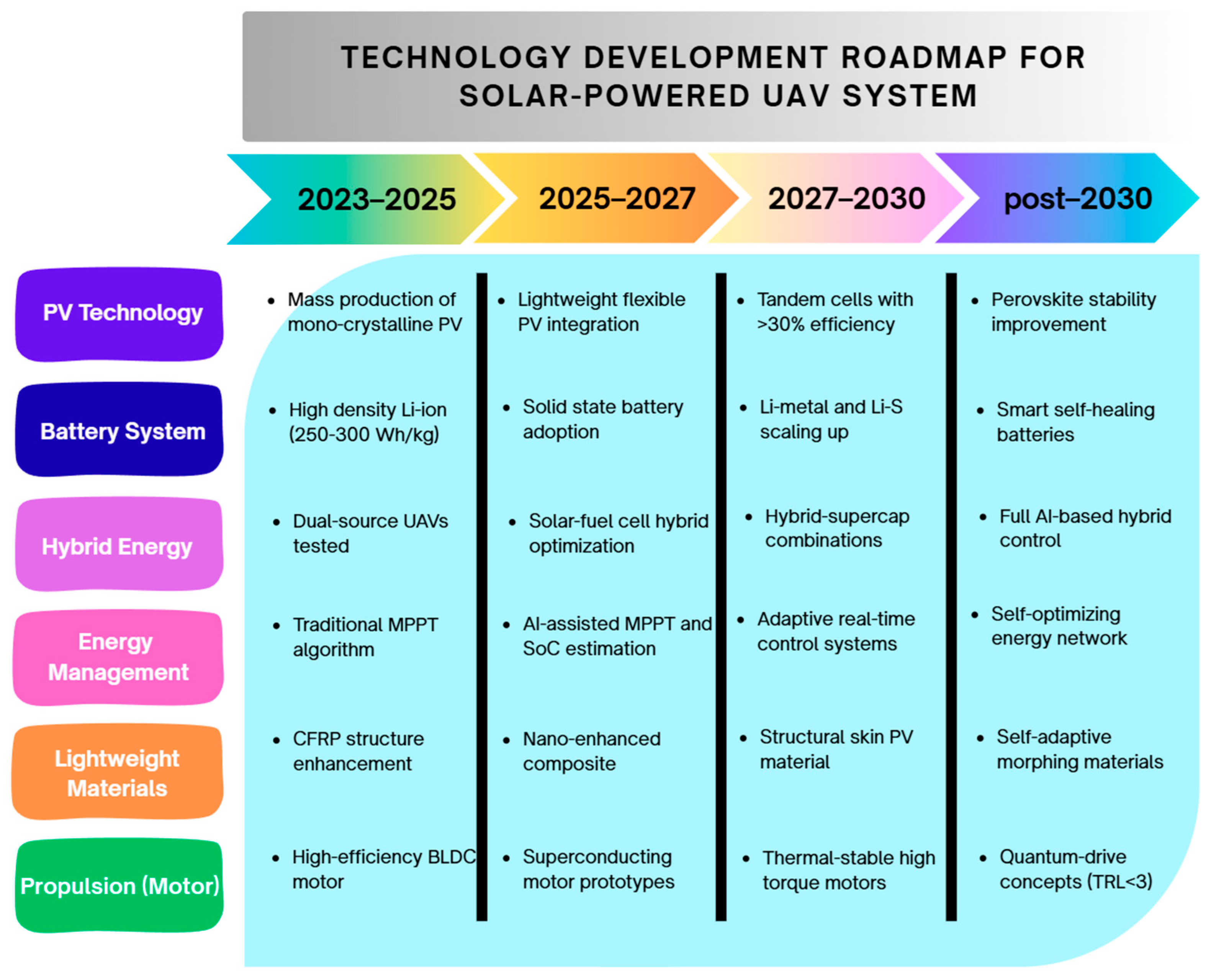
The future development of solar-electric UAVs is expected to progress significantly through advancements in energy systems, lightweight materials, and intelligent control technologies. Figure 9 outlines the main strategic directions driving these innovations. As shown in Figure 9, solar-powered UAV systems are expected to evolve across multiple domains. In the short term (2023–2025), improvements focus on maturing existing technologies, such as high-efficiency Li-ion batteries, traditional MPPT, and monocrystalline PV production. Between 2025 and 2027, integration of lightweight materials and AI-assisted energy management is anticipated, along with solid-state batteries and hybrid systems optimization. Looking toward 2030, advancements such as tandem PV cells, hybrid-supercap combinations, and adaptive control systems are projected to enhance energy efficiency and autonomy. In the long term, post-2030 developments may include perovskite PV, smart self-healing batteries, and AI-driven energy networks, significantly improving reliability, intelligence, and endurance in UAV operations.
One of the most critical areas of development lies in next-generation energy storage solutions. While lithium-ion batteries currently dominate UAV propulsion, their limited energy density (~250–300 Wh/kg) restricts flight endurance. Emerging technologies such as solid-state and lithium-air batteries promise energy densities exceeding 500 Wh/kg, which could dramatically extend mission durations. However, challenges related to cycle life, thermal management, and scalability must be addressed before these technologies can be widely adopted. Additionally, hybrid energy architecture combining solar cells with ultracapacitors or fuel cells offers a compelling pathway to balance power density and energy capacity, particularly for UAVs operating in variable environmental conditions [141,142].
Another key area of focus is the integration of advanced PV technologies into UAV airframes. Current solar cells, primarily rigid silicon-based panels, face limitations in weight and flexibility, which impact aerodynamic efficiency. The development of lightweight, flexible solar cells using perovskite or thin-film GaAs materials could revolutionize UAV design by enabling seamless integration into curved wing surfaces [143,144]. Multi-junction solar cells, with theoretical efficiencies surpassing 30%, also hold promise but require further research to reduce costs and improve durability under real-world flight conditions [145]. Furthermore, the incorporation of dynamic solar tracking systems, albeit challenging due to weight constraints, could optimize energy harvesting throughout the day.
Intelligent power management systems will play a pivotal role in maximizing the efficiency of solar-electric UAVs. Traditional MPPT algorithms, while effective under steady conditions, often struggle with rapid changes in irradiance caused by cloud cover or UAV maneuvering. The integration of artificial intelligence and machine learning into MPPT systems could enable real-time adaptation to environmental fluctuations, significantly improving energy yield [146]. Adaptive energy routing algorithms that dynamically allocate power between propulsion, avionics, and payloads will also be essential for optimizing endurance, particularly during critical flight phases such as takeoff and night-time operation [147].
Propulsion system innovations are equally vital for the future of solar-electric UAVs. High-temperature superconducting (HTS) motors, with efficiencies exceeding 95%, represent a groundbreaking advancement but face practical hurdles such as AC losses and the need for cryogenic cooling. Research into room-temperature superconductors or advanced cooling techniques could mitigate these challenges. Another promising avenue is the development of morphing propellers capable of adjusting pitch and shape in response to flight conditions, thereby optimizing aerodynamic efficiency across different operational regimes. These advancements, combined with lightweight materials and improved electronic speed controllers (ESCs), could significantly reduce energy consumption and enhance overall performance [148,149].
Finally, the scalability and operational viability of solar-electric UAVs will depend on advancements in supporting technologies and infrastructure. Wireless charging networks, utilizing laser or resonant inductive coupling, could enable mid-air recharging, extending mission durations beyond the limits of onboard energy storage [150,151]. Autonomous swarming technologies, where multiple UAVs collaborate to share energy and computational resources, offer another pathway to achieving persistent aerial presence [152,153]. However, these innovations must be accompanied by robust regulatory frameworks to address airspace integration, safety, and environmental concerns. As the field progresses, interdisciplinary collaboration between researchers, industry stakeholders, and policymakers will be essential to translate laboratory breakthroughs into practical, deployable solutions.
While this review synthesizes current research and presents analytical models for propulsion and power systems, future work may focus on optimizing UAV designs using multi-variable simulations, such as mission-based power optimization and propeller sizing trade-offs. These models can be refined and validated through wind tunnel tests, hardware-in-the-loop simulations, and in-flight power logging to enhance accuracy and enable the real-world deployment of solar-electric UAVs.
Real-world deployments of solar-electric UAVs further validate the potential of the technologies reviewed in this paper. A notable example is the Airbus Zephyr S, a stratospheric solar-powered UAV that achieved continuous flight endurance exceeding 64 days at altitudes around 21 km. Its design leverages ultra-lightweight composite airframes, thin-film gallium arsenide (GaAs) solar cells, and a lithium-sulfur battery system tailored for high-altitude and night-time energy demands [154,155]. These missions show how combining efficient solar cells, lightweight materials, and smart energy management can successfully apply the key design ideas and address challenges discussed in this review.

Patent Trends in Solar-Electric UAV

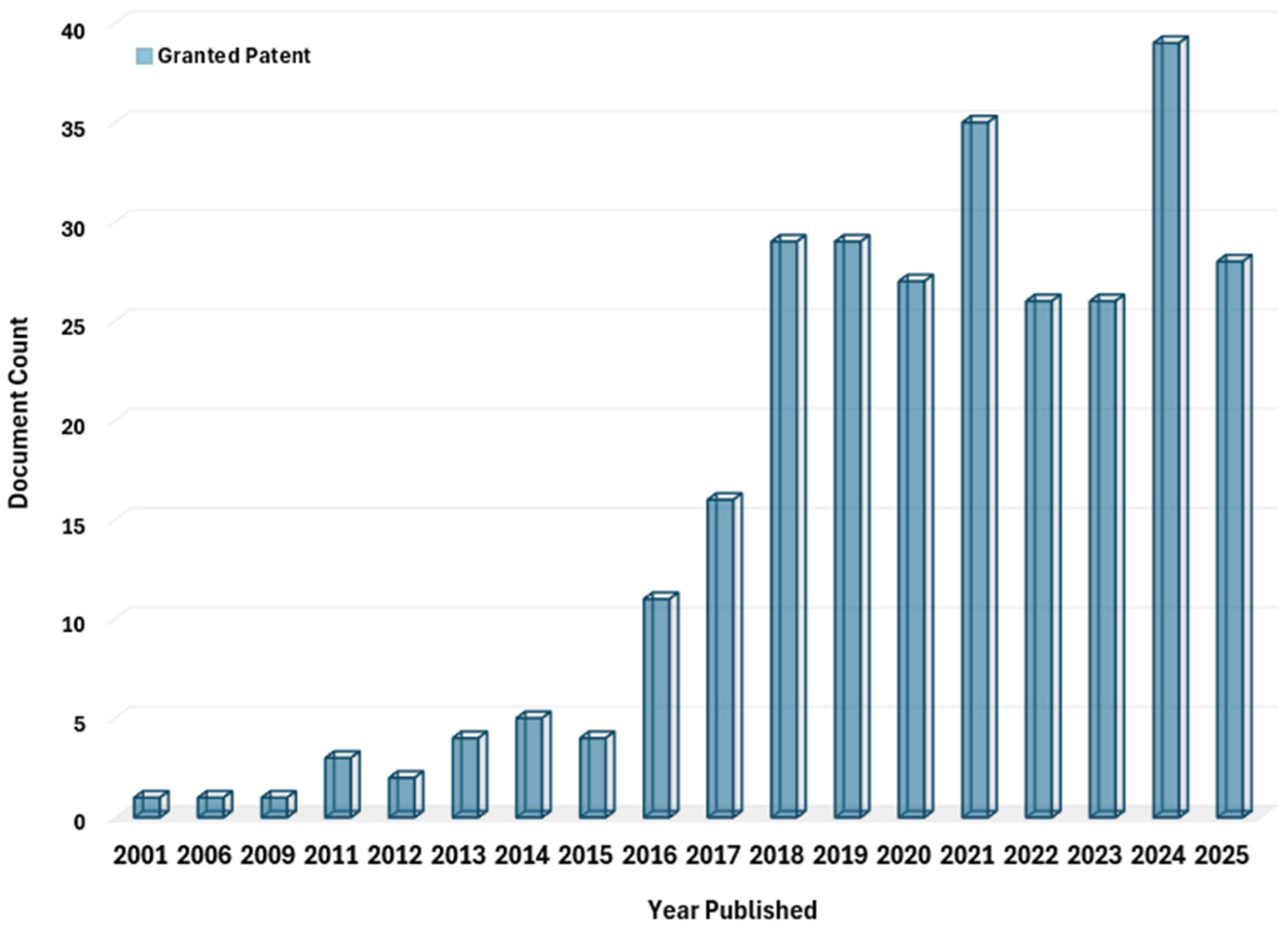
To evaluate innovative trends in the field of solar-assisted electric UAV propulsion systems, a targeted patent search was conducted on https://www.lens.org (accessed on 15 July 2025) using the keyword “electric propulsion UAV” with a focus on solar power integration technologies. The results, filtered from 2000 to 2025, reflect a growing body of intellectual property that signals emerging research hotspots and industrial interests. Patent filings in this area primarily focus on four categories: electric propulsion systems (e.g., high-efficiency BLDC and PMSM), solar power integration using lightweight and flexible panels, hybrid systems combining solar energy with batteries or fuel cells for extended flight, and energy management technologies such as MPPT and AI-based controllers that adapt to varying flight and sunlight conditions [156].
As shown in Figure 10, annual granted patents remained under 10 until 2015, followed by a sharp rise beginning in 2016. The number peaked around 2024, with close to 40 granted patents. This trend illustrates the growing shift from basic research to applied development, particularly in commercial and aerospace applications. The surge in intellectual property filings suggests that solar-electric UAV technologies are moving toward widespread adoption, with patent activity serving as a key indicator of both technological progress and competitive positioning.

5. Opportunities

Solar-electric UAVs present transformative opportunities across multiple domains. Flight testing validation remains critical, particularly for assessing component durability under real-world conditions like vibration and thermal cycling. Establishing standardized testing protocols would enable reliable performance benchmarking and accelerate technology maturation [157,158,159].
Cross-disciplinary collaborations offer significant potential, especially between materials scientists and aerospace engineers. Joint efforts could advance flexible PV and high-density batteries while addressing manufacturing scalability challenges [160,161]. Parallel engagement with regulators is essential to develop certification frameworks for safe airspace integration. These systems enable unique applications where conventional UAVs fall short. Persistent solar-powered platforms could revolutionize disaster response by providing uninterrupted surveillance when ground infrastructure fails. In precision agriculture, they could enable continuous crop monitoring across vast areas, while environmental science applications include long-term atmospheric monitoring and wildlife tracking.
Technical improvements present further opportunities, particularly in hybrid energy harvesting. Supplementing solar with RF or vibrational energy capture could extend operations in low-light conditions [162,163]. Cost reduction through advanced manufacturing and alternative materials remains crucial for commercial viability. The data revolution offers transformative potential for system optimization. Open flight datasets would enable performance benchmarking, while machine learning could uncover non-intuitive design optimizations. Digital twin technology promises to accelerate development cycles through virtual testing and predictive maintenance solutions. Establishing shared data repositories will be key to fostering collaborative innovation in this rapidly evolving field [164,165].

6. Conclusion

Solar-electric hybrid propulsion systems present a promising solution to overcome the endurance limitations of conventional battery-powered UAVs. This review has explored the enabling technologies, including high-efficiency BLDC motors, solar–battery–fuel cell architectures, MPPT-based energy management, and hybrid system modeling techniques. Both analytical modeling approaches and real-world deployment cases were discussed to provide a comprehensive understanding of current progress and challenges. Main findings from this review include the following:
(1)
Propulsion systems consume over 70% of total energy in typical solar UAV missions, highlighting the critical need for efficient BLDC motors and lightweight, aerodynamically optimized propeller designs.
(2)
Advanced energy storage technologies, such as lithium–sulfur batteries and hydrogen fuel cells, offer high theoretical energy densities (>500 Wh/kg), but practical adoption is still limited by issues like cycle life, thermal stability, and integration complexity.
(3)
Real-world demonstrations such as the Airbus Zephyr S confirm the technical viability of multi-day or multi-week solar-electric flights when energy systems are tightly co-optimized with aerodynamic structures and propulsion components.
This review provides a system-level perspective on solar-electric UAVs by integrating propulsion modeling, hybrid energy architecture, energy optimization strategies, and patent trend analysis. As previously summarized in Table 1, this work builds upon and extends prior reviews by bridging the gap between theoretical advancements and practical deployment challenges. The insights presented here can serve as a foundation for future work, including mission-based system optimization, application-specific design, and experimental validation through flight tests or wind tunnel campaigns. As solar-electric UAVs progress toward real-world implementation, sustained interdisciplinary research will be vital to address ongoing challenges in integration, reliability, and scalability.

Author Contributions

All authors have made significant contributions to the manuscript and agree with its content. Conceptualization, N.L.M.K. and N.I.; writing—original draft preparation, N.L.M.K. and N.N.; writing—review and editing, N.N. and S.A.H.; supervision, Z.S. and S.A.S. All authors have read and agreed to the published version of the manuscript.

Funding

This research received no external funding.

Data Availability Statement

No data was used to support this study.

Acknowledgments

The authors sincerely acknowledge Universiti Kuala Lumpur, Malaysia, for their financial support.

Conflicts of Interest

The authors declare no conflicts of interest.

References

  1. Abdulrahman, G.A.Q.; Qasem, N.A.A.; Abdelrahman, W.G.; Abdallah, A.M. A Review of Powering Unmanned Aerial Vehicles by Clean and Renewable Energy Technologies. Sustain. Energy Technol. Assess. 2025, 73, 104150. [Google Scholar] [CrossRef]
  2. Ouissaaden, F.I.; Dlimi, S.; Kamel, H.; Khaldi, S.E.; Elmourabit, F.; Khoukh, A. Effect of Partial Shading on a PV System. In Proceedings of the 2024 International Conference on Circuit, Systems and Communication (ICCSC), Fes, Morocco, 28–29 June 2024; pp. 1–6. [Google Scholar]
  3. Lorenzi, B.; Mariani, P.; Reale, A.; Di Carlo, A.; Chen, G.; Narducci, D. Practical Development of Efficient Thermoelectric—Photovoltaic Hybrid Systems Based on Wide-Gap Solar Cells. Appl. Energy 2021, 300, 117343. [Google Scholar] [CrossRef]
  4. Gonzalo, J.; López, D.; Domínguez, D.; García, A.; Escapa, A. On the Capabilities and Limitations of High-Altitude Pseudo-Satellites. Prog. Aerosp. Sci. 2018, 98, 37–56. [Google Scholar] [CrossRef]
  5. Müller, R.; Kiam, J.J.; Mothes, F. Multiphysical Simulation of a Semi-Autonomous Solar Powered High Altitude Pseudo-Satellite. In Proceedings of the IEEE Aerospace Conference Proceedings, Big Sky, MT, USA, 3–10 March 2018; Volume 2018-March. [Google Scholar]
  6. Wu, Y.; Wang, C.; Wang, L.; Ma, R.; Lu, X.; Yao, W. Altitude Control Performance of a Natural Energy Driven Stratospheric Aerostat. Adv. Space Res. 2015, 56, 2508–2514. [Google Scholar] [CrossRef]
  7. Liu, X.; Chen, L.; Yu, Y.; He, D.; Shai, X.; Zhang, S.; Zhang, Z.; Feng, J.; Yi, J.; Chen, J. Advancements of Highly Efficient Perovskite Based Tandem Solar Cells. Sci. China Mater. 2025, 68, 691–708. [Google Scholar] [CrossRef]
  8. Deshpande, R.A. Advances in Solar Cell Technology: An Overview. J. Sci. Res. 2021, 65, 72–75. [Google Scholar] [CrossRef]
  9. Di Sabatino, M.; Hendawi, R.; Garcia, A.S. Silicon Solar Cells: Trends, Manufacturing Challenges, and AI Perspectives. Crystals 2024, 14, 167. [Google Scholar] [CrossRef]
  10. Chang, X.; Zhao, Y.M.; Yuan, B.; Fan, M.; Meng, Q.; Guo, Y.-G.; Wan, L.-J. Solid-state lithium-ion batteries for grid energy storage: Opportunities and challenges. Sci. China Chem. 2024, 67, 43–66. [Google Scholar] [CrossRef]
  11. Li, Q.; Chen, J.; Zhang, S.; Liu, R.; Jiang, X.; Zhang, Z.; Wang, C.; Yin, L.; Wang, R. The developments, challenges, and prospects of solid-state Li-Se batteries. Energy Storage Mater. 2024, 65, 103138. [Google Scholar] [CrossRef]
  12. Torrey, D.; Parizh, M.; Bray, J.; Stautner, W.; Tapadia, N.; Xu, M.; Wu, A.; Zierer, J. Superconducting Synchronous Motors for Electric Ship Propulsion. IEEE Trans. Appl. Supercond. 2020, 30, 5204708. [Google Scholar] [CrossRef]
  13. Lee, J.Y.; Nam, G.D.; Yu, I.K.; Park, M. Design and Characteristic Analysis of an Axial Flux High-Temperature Superconducting Motor for Aircraft Propulsion. Materials 2023, 16, 3587. [Google Scholar] [CrossRef] [PubMed]
  14. Dhimish, M.; Tyrrell, A.M. Power Loss and Hotspot Analysis for Photovoltaic Modules Affected by Potential Induced Degradation. NPJ Mater. Degrad. 2022, 6, 11. [Google Scholar] [CrossRef]
  15. Aboagye, B.; Gyamfi, S.; Ofosu, E.A.; Djordjevic, S. Investigation into the Impacts of Design, Installation, Operation and Maintenance Issues on Performance and Degradation of Installed Solar Photovoltaic (PV) Systems. Energy Sustain. Dev. 2022, 66, 165–176. [Google Scholar] [CrossRef]
  16. Jamil, Q.; Shahzad, N.; Abdullah Khalid, H.; Iqbal, S.; Waqas, A.; Kamboh, A.H. Experimental Investigation of Potential Induced Degradation of Poly-Crystalline Photovoltaic Modules: Influence of Superstrate and Encapsulant Types. Sustain. Energy Technol. Assess. 2022, 52, 102162. [Google Scholar] [CrossRef]
  17. Alhmoud, L. Why Does the PV Solar Power Plant Operate Ineffectively? Energies 2023, 16, 4074. [Google Scholar] [CrossRef]
  18. Guinot, B.; Champel, B.; Montignac, F.; Lemaire, E.; Vannucci, D.; Sailler, S.; Bultel, Y. Techno-Economic Study of a PV-Hydrogen-Battery Hybrid System for off-Grid Power Supply: Impact of Performances’ Ageing on Optimal System Sizing and Competitiveness. Int. J. Hydrogen Energy 2015, 40, 623–632. [Google Scholar] [CrossRef]
  19. Tian, W.; Liu, L.; Zhang, X.; Shao, J.; Ge, J. Adaptive Hierarchical Energy Management Strategy for Fuel Cell/Battery Hybrid Electric UAVs. Aerosp Sci Technol 2024, 146, 108938. [Google Scholar] [CrossRef]
  20. Noviati, N.; Maulina, S.; Smith, S. Smart Grids: Integrating AI for Efficient Renewable Energy Utilization. Int. Trans. Artif. Intell. (ITALIC) 2024, 3, 1–10. [Google Scholar] [CrossRef]
  21. Ali, D.M.T.E.; Motuzienė, V.; Džiugaitė-Tumėnienė, R. AI-Driven Innovations in Building Energy Management Systems: A Review of Potential Applications and Energy Savings. Energies 2024, 17, 4277. [Google Scholar] [CrossRef]
  22. Sornek, K.; Augustyn-Nadzieja, J.; Rosikoń, I.; Łopusiewicz, R.; Łopusiewicz, M. Status and Development Prospects of Solar-Powered Unmanned Aerial Vehicles—A Literature Review. Energies 2025, 18, 1924. [Google Scholar] [CrossRef]
  23. Kurt, E.; Arabul, A.Y.; Keskin Arabul, F.; Senol, I. Parallel Hybrid Propulsion System with Integration of Designed Electric Machine for Medium Altitude Long Endurance UAV. Heliyon 2025, 11, e42871. [Google Scholar] [CrossRef] [PubMed]
  24. Zhao, T.; Zhang, Y.; Wang, M.; Feng, W.; Cao, S.; Wang, G. A Critical Review on the Battery System Reliability of Drone Systems. Drones 2025, 9, 539. [Google Scholar] [CrossRef]
  25. Shen, Z.; Liu, S.; Zhu, W.; Ren, D.; Xu, Q.; Feng, Y. A Review on Key Technologies and Developments of Hydrogen Fuel Cell Multi-Rotor Drones. Energies 2024, 17, 4193. [Google Scholar] [CrossRef]
  26. Tian, W.; Zhang, X.; Zhou, P.; Guo, R. Review of Energy Management Technologies for Unmanned Aerial Vehicles Powered by Hydrogen Fuel Cell. Energy 2025, 323, 135751. [Google Scholar] [CrossRef]
  27. Al Dhafari, L.S.; Afzal, A.; Al Abri, O.K.; Khan, A. Solar-Powered UAVs: A Systematic Literature Review. In Proceedings of the 2024 2nd International Conference on Unmanned Vehicle Systems-Oman (UVS), Muscat, Oman, 12–14 February 2024; pp. 1–8. [Google Scholar]
  28. Mohammed, A.A.; Shinkafi, A.A.; Isah, A.; Ajayi, J.A.; Pedro, P.T.; Asooto, B.C.; Ejakita, J.O.; Johnson-Anamemena, N. Prospects and Challenges of Propulsion Technologies of Unmanned Aerial Vehicles: A Review. Niger. J. Technol. 2022, 40, 1063–1071. [Google Scholar] [CrossRef]
  29. El-Atab, N.; Mishra, R.B.; Alshanbari, R.; Hussain, M.M. Solar Powered Small Unmanned Aerial Vehicles: A Review. Energy Technol. 2021, 9, 2100587. [Google Scholar] [CrossRef]
  30. Wang, B.; Zhao, D.; Li, W.; Wang, Z.; Huang, Y.; You, Y.; Becker, S. Current Technologies and Challenges of Applying Fuel Cell Hybrid Propulsion Systems in Unmanned Aerial Vehicles. Prog. Aerosp. Sci. 2020, 116, 100620. [Google Scholar] [CrossRef]
  31. Xu, L.; Huangfu, Y.; Ma, R.; Xie, R.; Song, Z.; Zhao, D.; Yang, Y.; Wang, Y.; Xu, L. A Comprehensive Review on Fuel Cell UAV Key Technologies: Propulsion System, Management Strategy, and Design Procedure. IEEE Trans. Transp. Electrif. 2022, 8, 4118–4139. [Google Scholar] [CrossRef]
  32. Marto, D.; Brójo, F. Hybrid-Electric Propulsion Solutions for UAV Application. In Proceedings of the ASME International Mechanical Engineering Congress and Exposition, Proceedings (IMECE), Columbus, OH, USA, 30 October–3 November 2022; Volume 3. [Google Scholar]
  33. Babu, B.H.; Kumar, I.; Naveen; Singh, M.K.; Sarojwal, A.; Vidhya, R.G. Propelling the Future: Advanced Electric Propulsion Systems for Unmanned Aerial Vehicles. In Proceedings of the 2024 2nd International Conference on Sustainable Computing and Smart Systems (ICSCSS), Coimbatore, India, 10–12 July 2024; pp. 5–9. [Google Scholar]
  34. Farajollahi, A.H.; Rostami, M.; Marefati, M. A Hybrid-Electric Propulsion System for an Unmanned Aerial Vehicle Based on Proton Exchange Membrane Fuel Cell, Battery, and Electric Motor. Energy Sources Part A Recovery Util. Environ. Eff. 2022, 44, 934–950. [Google Scholar] [CrossRef]
  35. Zhang, B.; Song, Z.; Zhao, F.; Liu, C. Overview of Propulsion Systems for Unmanned Aerial Vehicles. Energies 2022, 15, 455. [Google Scholar] [CrossRef]
  36. Morton, S.; D’Sa, R.; Papanikolopoulos, N. Solar Powered UAV: Design and Experiments. In Proceedings of the IEEE International Conference on Intelligent Robots and Systems, Hamburg, Germany, 28 September–2 October 2015; Volume 2015-December. [Google Scholar]
  37. Joshi, D.; Deb, D.; Muyeen, S.M. Comprehensive Review on Electric Propulsion System of Unmanned Aerial Vehicles. Front. Energy Res. 2022, 10, 752012. [Google Scholar] [CrossRef]
  38. Mohiuddin, A.; Tarek, T.; Zweiri, Y.; Gan, D. A Survey of Single and Multi-UAV Aerial Manipulation. Unmanned Syst. 2020, 8, 119–147. [Google Scholar] [CrossRef]
  39. Pham, K.L.; Leuchter, J.; Bystricky, R.; Andrle, M.; Pham, N.N.; Pham, V.T. The Study of Electrical Energy Power Supply System for UAVs Based on the Energy Storage Technology. Aerospace 2022, 9, 500. [Google Scholar] [CrossRef]
  40. Joshi, P.S.; Sutrave, D.S. A Brief Study of Cyclic Voltammetry and Electrochemical Analysis. Int. J. Chemtech Res. 2018, 11, 77–88. [Google Scholar]
  41. Rajendran, P.; Smith, H. Review of Solar and Battery Power System Development for Solar-Powered Electric Unmanned Aerial Vehicles. Adv. Mat. Res. 2015, 1125, 641–647. [Google Scholar]
  42. Gong, A.; Verstraete, D. Fuel Cell Propulsion in Small Fixed-Wing Unmanned Aerial Vehicles: Current Status and Research Needs. Int. J. Hydrogen Energy 2017, 42, 1311–21333. [Google Scholar] [CrossRef]
  43. Townsend, A.; Gouws, R. A Comparative Review of Lead-Acid, Lithium-Ion and Ultra-Capacitor Technologies and Their Degradation Mechanisms. Energies 2022, 15, 4930. [Google Scholar] [CrossRef]
  44. Mendis, N.; Muttaqi, K.M.; Perera, S. Management of Low- and High-Frequency Power Components in Demand-Generation Fluctuations of a DFIG-Based Wind-Dominated RAPS System Using Hybrid Energy Storage. IEEE Trans. Ind. Appl. 2013, 50, 2258–2268. [Google Scholar] [CrossRef]
  45. Shiau, J.K.; Ma, D.M.; Yang, P.Y.; Wang, G.F.; Gong, J.H. Design of a Solar Power Management System for an Experimental UAV. IEEE Trans. Aerosp. Electron. Syst. 2009, 45, 1350–1360. [Google Scholar] [CrossRef]
  46. Boukoberine, M.N.; Zhou, Z.; Benbouzid, M. A Critical Review on Unmanned Aerial Vehicles Power Supply and Energy Management: Solutions, Strategies, and Prospects. Appl. Energy 2019, 255, 113823. [Google Scholar] [CrossRef]
  47. Kim, T.; Kwon, S. Design and Development of a Fuel Cell-Powered Small Unmanned Aircraft. Int. J. Hydrogen Energy 2012, 37, 615–622. [Google Scholar] [CrossRef]
  48. Mohsan, S.A.H.; Khan, M.A.; Noor, F.; Ullah, I.; Alsharif, M.H. Towards the Unmanned Aerial Vehicles (UAVs): A Comprehensive Review. Drones 2022, 6, 147. [Google Scholar] [CrossRef]
  49. Dwivedi, V.S.; Patrikar, J.; Addamane, A.; Ghosh, A.K. MARAAL: A Low Altitude Long Endurance Solar Powered UAV for Surveillance and Mapping Applications. In Proceedings of the 2018 23rd International Conference on Methods and Models in Automation and Robotics, MMAR 2018, Miedzyzdroje, Poland, 7–30 August 2018. [Google Scholar]
  50. Weiss, M.; Ruess, R.; Kasnatscheew, J.; Levartovsky, Y.; Levy, N.R.; Minnmann, P.; Stolz, L.; Waldmann, T.; Wohlfahrt-Mehrens, M.; Aurbach, D.; et al. Fast Charging of Lithium-Ion Batteries: A Review of Materials Aspects. Adv. Energy Mater. 2021, 11, 2101126. [Google Scholar] [CrossRef]
  51. Lei, S.; Zeng, Z.; Cheng, S.; Xie, J. Fast-Charging of Lithium-Ion Batteries: A Review of Electrolyte Design Aspects. Battery Energy 2023, 2, 20230018. [Google Scholar] [CrossRef]
  52. Saravanakumar, Y.N.; Sultan, M.T.H.; Shahar, F.S.; Giernacki, W.; Łukaszewicz, A.; Nowakowski, M.; Holovatyy, A.; Stępień, S. Power Sources for Unmanned Aerial Vehicles: A State-of-the Art. Appl. Sci. 2023, 13, 11932. [Google Scholar] [CrossRef]
  53. Cano, Z.P.; Banham, D.; Ye, S.; Hintennach, A.; Lu, J.; Fowler, M.; Chen, Z. Batteries and Fuel Cells for Emerging Electric Vehicle Markets. Nat. Energy 2018, 3, 279–289. [Google Scholar] [CrossRef]
  54. Townsend, A.; Jiya, I.N.; Martinson, C.; Bessarabov, D.; Gouws, R. A Comprehensive Review of Energy Sources for Unmanned Aerial Vehicles, Their Shortfalls and Opportunities for Improvements. Heliyon 2020, 6, e05285. [Google Scholar] [CrossRef] [PubMed]
  55. Fu, Z.-H.; Chen, X.; Zhang, Q. Review on the Lithium Transport Mechanism in Solid-State Battery Materials. WIREs Comput. Mol. Sci. 2023, 13, e1621. [Google Scholar] [CrossRef]
  56. Shchurov, N.I.; Dedov, S.I.; Malozyomov, B.V.; Shtang, A.A.; Martyushev, N.V.; Klyuev, R.V.; Andriashin, S.N. Degradation of Lithium-Ion Batteries in an Electric Transport Complex. Energies 2021, 14, 8072. [Google Scholar] [CrossRef]
  57. Rimsha; Murawwat, S.; Gulzar, M.M.; Alzahrani, A.; Hafeez, G.; Khan, F.A.; Abed, A.M. State of Charge Estimation and Error Analysis of Lithium-Ion Batteries for Electric Vehicles Using Kalman Filter and Deep Neural Network. J. Energy Storage 2023, 72, 108039. [Google Scholar] [CrossRef]
  58. Pillai, P.; Sundaresan, S.; Kumar, P.; Pattipati, K.R.; Balasingam, B. Open-Circuit Voltage Models for Battery Management Systems: A Review. Energies 2022, 15, 6803. [Google Scholar] [CrossRef]
  59. Zhou, W.; Zheng, Y.; Pan, Z.; Lu, Q. Review on the Battery Model and SOC Estimation Method. Processes 2021, 9, 1685. [Google Scholar] [CrossRef]
  60. How, D.N.T.; Hannan, M.A.; Hossain Lipu, M.S.; Ker, P.J. State of Charge Estimation for Lithium-Ion Batteries Using Model-Based and Data-Driven Methods: A Review. IEEE Access 2019, 7, 136116–136136. [Google Scholar] [CrossRef]
  61. Tang, C.Y.; Lin, J.T. Online Autonomous Specific Gravity Measurement Strategy for Lead-Acid Batteries. IEEE Sens. J. 2020, 20, 1980–1987. [Google Scholar] [CrossRef]
  62. Lin, C.; Tang, A.; Mu, H.; Wang, W.; Wang, C. Aging Mechanisms of Electrode Materials in Lithium-Ion Batteries for Electric Vehicles. J. Chem. 2015, 2015, 104673. [Google Scholar] [CrossRef]
  63. Duryea, S.; Islam, S.; Lawrance, W. A Battery Management System for Stand-Alone Photovoltaic Energy Systems. IEEE Ind. Appl. Mag. 2001, 7, 67–72. [Google Scholar] [CrossRef]
  64. Williams, A.; Yakimenko, O. Persistent Mobile Aerial Surveillance Platform Using Intelligent Battery Health Management and Drone Swapping. In Proceedings of the Proceedings-2018 4th International Conference on Control, Automation and Robotics, ICCAR 2018, Auckland, New Zealand, 20–23 April 2018. [Google Scholar]
  65. Jawad, A.M.; Jawad, H.M.; Nordin, R.; Gharghan, S.K.; Abdullah, N.F.; Abu-Alshaeer, M.J. Wireless Power Transfer with Magnetic Resonator Coupling and Sleep/Active Strategy for a Drone Charging Station in Smart Agriculture. IEEE Access 2019, 7, 139839–139851. [Google Scholar] [CrossRef]
  66. Chen, Q.; Zhang, D.; Zhu, D.; Shi, Q.; Gu, J.; Ai, Y. Design and Experiment for Realization of Laser Wireless Power Transmission for Small Unmanned Aerial Vehicles. In Proceedings of the AOPC 2015: Advances in Laser Technology and Applications, Beijing, China, 15 October 2015; Volume 9671. [Google Scholar]
  67. Lim, Y.; Choi, Y.W.; Ryoo, J. Study on Laser-Powered Aerial Vehicle: Prolong Flying Time Using 976nm Laser Source. In Proceedings of the International Conference on ICT Convergence, Jeju-si, Republic of Korea, 20–22 October 2021; pp. 1220–1225. [Google Scholar]
  68. Ouyang, J.; Che, Y.; Xu, J.; Wu, K. Throughput Maximization for Laser-Powered UAV Wireless Communication Systems. In Proceedings of the 2018 IEEE International Conference on Communications Workshops, ICC Workshops 2018-Proceedings, Kansas City, MO, USA, 20–24 May 2018; pp. 1–6. [Google Scholar]
  69. Achtelik, M.C.; Stumpf, J.; Gurdan, D.; Doth, K.-M. Design of a Flexible High Performance Quadcopter Platform Breaking the MAV Endurance Record with Laser Power Beaming. In Proceedings of the 2011 IEEE/RSJ International Conference on Intelligent Robots and Systems, San Francisco, CA, USA, 25–30 September 2011; IEEE: New York, NY, USA, 2011; pp. 5166–5172. [Google Scholar]
  70. Bocewicz, G.; Nielsen, P.; Banaszak, Z.; Thibbotuwawa, A. A Declarative Modelling Framework for Routing of Multiple UAVs in a System with Mobile Battery Swapping Stations. In International Conference on Intelligent Systems in Production Engineering and Maintenance; Springer International Publishing: Cham, Switzerland, 2019; pp. 429–441. [Google Scholar]
  71. Feng, X.; Sun, Y.; Chang, M.; Bai, J. Endurance Improvement by Battery Dumping Strategy Considering Peukert Effect for Electric-Powered Disposable UAVs. Proc. Aeronaut. J. 2021, 125, 42–59. [Google Scholar] [CrossRef]
  72. Gao, Y.; Qiao, Z.; Pei, X.; Wu, G.; Bai, Y. Design of Energy-Management Strategy for Solar-Powered UAV. Sustainability 2023, 15, 14972. [Google Scholar] [CrossRef]
  73. Shan, C.; Lv, M.; Sun, K.; Gao, J. Analysis of Energy System Configuration and Energy Balance for Stratospheric Airship Based on Position Energy Storage Strategy. Aerosp. Sci. Technol. 2020, 101, 105844. [Google Scholar] [CrossRef]
  74. Liao, J.; Jiang, Y.; Li, J.; Liao, Y.; Du, H.; Zhu, W.; Zhang, L. An Improved Energy Management Strategy of Hybrid Photovoltaic/Battery/Fuel Cell System for Stratospheric Airship. Acta Astronaut. 2018, 152, 727–739. [Google Scholar] [CrossRef]
  75. Sun, M.; Shan, C.; Sun, K.W.; Jia, Y.H. Energy Management Strategy for High-Altitude Solar Aircraft Based on Multiple Flight Phases. Math. Probl. Eng. 2020, 2020, 6655031. [Google Scholar] [CrossRef]
  76. Norhashim, N.; Kamal, N.L.M.; Shah, S.A.; Sahwee, Z.; Ruzani, A.I.A. A Review of Unmanned Aerial Vehicle Technology Adoption for Precision Agriculture in Malaysia. Unmanned Syst. 2024, 12, 707–725. [Google Scholar] [CrossRef]
  77. Cestino, E. Design of Solar High Altitude Long Endurance Aircraft for Multi Payload & Operations. Aerosp. Sci. Technol. 2006, 10, 541–550. [Google Scholar] [CrossRef]
  78. Gao, X.Z.; Hou, Z.X.; Guo, Z.; Chen, X.Q. Reviews of Methods to Extract and Store Energy for Solar-Powered Aircraft. Renew. Sustain. Energy Rev. 2015, 44, 96–108. [Google Scholar] [CrossRef]
  79. Verstraete, D.; Lehmkuehler, K.; Wong, K.C. Design of a Fuel Cell Powered Blended Wing Body UAV. In Proceedings of the ASME International Mechanical Engineering Congress and Exposition, Proceedings (IMECE), Houston, TX, USA, 9–15 November 2012; Volume 1. [Google Scholar]
  80. Boukoberine, M.N.; Zhou, Z.; Benbouzid, M. Power Supply Architectures for Drones—A Review. In Proceedings of the IECON Proceedings (Industrial Electronics Conference), Lisbon, Portugal, 14–17 October 2019; Volume 2019-October. [Google Scholar]
  81. Jansen, R.H.; Bowman, C.; Jankovsky, A. Sizing Power Components of an Electrically Driven Tail Cone Thruster and a Range Extender. In Proceedings of the 16th AIAA Aviation Technology, Integration, and Operations Conference, Washington, DC, USA, 13–17 June 2016. [Google Scholar]
  82. Yu, J.; Liu, C.; Song, Z.; Zhao, H. Permeance and Inductance Modeling of a Double-Stator Hybrid-Excited Flux-Switching Permanent-Magnet Machine. IEEE Trans. Transp. Electrif. 2020, 6, 1134–1145. [Google Scholar] [CrossRef]
  83. Dever, T.P.; Duffy, K.P.; Provenza, A.J.; Loyselle, P.L.; Choi, B.B.; Morrison, C.R.; Lowe, A.M. Assessment of Technologies for Noncryogenic Hybrid Electric Propulsion; NASA’s Glenn Research Center: Cleveland, OH, USA, 2015. [Google Scholar]
  84. Song, Z.; Liu, C.; Liu, S.; Wang, W. Active Harmonic Suppression of Low-Reactance Multiphase Slotless Permanent Magnet Synchronous Machines. IEEE J. Emerg. Sel. Top. Power Electron. 2022, 10, 777–1787. [Google Scholar] [CrossRef]
  85. Liu, C. Emerging Electric Machines and Drives-An Overview. IEEE Trans. Energy Convers. 2018, 33, 2270–2280. [Google Scholar] [CrossRef]
  86. Kong, X.; Zhang, Z.; Lu, J.; Li, J.; Yu, L. Review of Electric Power System of Distributed Electric Propulsion Aircraft. Hangkong Xuebao/Acta Aeronaut. Astronaut. Sin. 2018, 39, 21651. [Google Scholar]
  87. Przeniosło, Ł.; Hołub, M. Efficient Electronic Speed Controller Algorithm for Multirotor Flying Vehicles. In Proceedings of the 2018 Innovative Materials and Technologies in Electrical Engineering, i-MITEL 2018, Sulecin, Poland, 18–20 April 2018. [Google Scholar]
  88. Masson, P.J.; Luongo, C.A. HTS Machines for Applications in All-Electric Aircraft. In Proceedings of the 2007 IEEE Power Engineering Society General Meeting, PES, Tampa, FL, USA, 24–28 June 2007. [Google Scholar]
  89. Saeidabadi, S.; Parsa, L.; Corzine, K.; Kovacs, C.; Haugan, T.J. A Partially Superconducting Flux Reversal Machine with High Power Density. In Proceedings of the 2023 IEEE International Electric Machines and Drives Conference, IEMDC 2023, San Francisco, CA, USA, 15–18 May 2023. [Google Scholar]
  90. Saeidabadi, S.; Parsa, L.; Corzine, K.; Kovacs, C.; Haugan, T.J. A Double Rotor Flux Switching Machine With HTS Field Coils for All Electric Aircraft Applications. IEEE Trans. Appl. Supercond. 2023, 33, 5203107. [Google Scholar] [CrossRef]
  91. Piccoli, M.; Yim, M. Cogging Torque Ripple Minimization via Position-Based Characterization. In Proceedings of the Robotics: Science and Systems, Berkeley, CA, USA, 12–16 July 2014. [Google Scholar]
  92. Gebauer, J.; Fojtik, D.; Podešva, P. Modeling of the Electronic Variable Pitch Drive. In Proceedings of the 2015 16th International Carpathian Control Conference, ICCC 2015, Szilvasvarad, Hungary, 27–30 May 2015. [Google Scholar]
  93. Franchi, A.; Mallet, A. Adaptive Closed-Loop Speed Control of BLDC Motors with Applications to Multi-Rotor Aerial Vehicles. In Proceedings of the IEEE International Conference on Robotics and Automation, Singapore, 29 May–3 June 2017. [Google Scholar]
  94. Kristen, N. Mogensen Motor-Control Considerations for Electronic Speed Control in Drones. Analog. Appl. J. 2016, 1–6. [Google Scholar]
  95. Chan, K.I. Generalized Aerodynamic Optimization of Hovering Coaxial Rotor Blades. J. Am. Helicopter Soc. 2019, 64, 1–13. [Google Scholar] [CrossRef]
  96. Podsędkowski, M.; Konopiński, R.; Obidowski, D.; Koter, K. Variable Pitch Propeller for UAV-Experimental Tests. Energies 2020, 13, 5264. [Google Scholar] [CrossRef]
  97. Czyż, Z.; Karpiński, P.; Skiba, K.; Wendeker, M. Wind Tunnel Performance Tests of the Propellers with Different Pitch for the Electric Propulsion System. Sensors 2022, 22, 2. [Google Scholar] [CrossRef]
  98. Rajendran, P.; Smith, H.; Yahaya, K.I.; Mazlan, N. Electric Propulsion System Sizing for Small Solar-Powered Electric Unmanned Aerial Vehicle. Int. J. Appl. Eng. Res. 2016, 11, 9419–9423. [Google Scholar]
  99. Palombo, D.; Miller, G.D. A High Efficiency Electric Motor Propeller Propulsion System for Solar Powered UAVs. SAE Tech. Pap. 1998, 8. [Google Scholar] [CrossRef]
  100. Jangam, S.; Verma, S.; Ramesha, K. Design and Structural Mechanics of a Modified Wood—Composite Integrated Propeller Blade; EAI: Gent, Belgium, 2021. [Google Scholar]
  101. Dhinnesh, S.; Guru Prasath, K.S.; Venkatesh, N. Design and Analysis of UAV Propeller for Composite Materials. Int. Res. J. Adv. Eng. Hub (IRJAEH) 2024, 2, 20–26. [Google Scholar] [CrossRef]
  102. Qing, G.; Koucheata, C.; Sharify, M.; Khal, A.; Ketekun, B. Numerical Comparison of Tilt Rotor Propeller Composites Materials of Carbon Fiber-Reinforced Plastic (CFRP), Wood, and Plastic. Int. J. Front. Eng. Technol. Res. 2024, 6, 12–18. [Google Scholar]
  103. Xie, J.; Zhu, L.; Lee, H.M.; Lee, H.P. Performance of Hybrid Composite Propellers for Drone. J. Aerosp. Eng. 2021, 34, 4021038. [Google Scholar] [CrossRef]
  104. Rutkay, B.; Laliberté, J. Design and Manufacture of Propellers for Small Unmanned Aerial Vehicles. J. Unmanned Veh. Syst. 2016, 4, 228–245. [Google Scholar] [CrossRef]
  105. Popișter, F. Experimental Study of Comprehensive Performance Analysis Regarding the Dynamical/Mechanical Aspects of 3D-Printed UAV Propellers and Sound Footprint. Polymers 2025, 17, 1466. [Google Scholar] [CrossRef] [PubMed]
  106. Toleos, L.R.; Luna, N.J.A.B.D.; Manuel, M.C.E.; Chua, J.M.R.; Sangalang, E.M.A.; So, P.C. Feasibility Study for Fused Deposition Modeling (FDM) 3D-Printed Propellers for Unmanned Aerial Vehicles. Int. J. Mech. Eng. Robot. Res. 2020, 9, 548–558. [Google Scholar] [CrossRef]
  107. Gupta, G.; Abdallah, S. Propeller Force-Constant Modeling for Multirotor UAVs from Experimental Estimation of Inflow Velocity. Int. J. Aerosp. Eng. 2018, 2018, 9632942. [Google Scholar] [CrossRef]
  108. Dantsker, O.D.; Caccamo, M.; Imtiaz, S. Electric Propulsion System Optimization for Long-Endurance and Solar-Powered Unmanned Aircraft. In Proceedings of the AIAA Propulsion and Energy Forum and Exposition, Indianapolis, IN, USA, 22–24 August 2019. [Google Scholar]
  109. Ozer, K.; Yilmaz, M. Design and Analysis of a High-Power Density Brushless DC Motor for a Multi-Rotor Unmanned Aircraft. In Proceedings of the 2021 13th International Conference on Electrical and Electronics Engineering, ELECO 2021, Bursa, Turkey, 25–27 November 2021. [Google Scholar]
  110. Park, Y.; Kim, H.; Jang, H.; Ham, S.H.; Lee, J.; Jung, D.H. Efficiency Improvement of Permanent Magnet BLDC with Halbach Magnet Array for Drone. IEEE Trans. Appl. Supercond. 2020, 30, 5201405. [Google Scholar] [CrossRef]
  111. Rodrigues Van Niekerk, D. MTECH Dissertation of Daniel van Niekerk (Final Version). Master’s Thesis, University of Johannesburg, Johannesburg, South Africa, 2024. [Google Scholar]
  112. Chu, Y.; Ho, C.; Lee, Y.; Li, B. Development of a Solar-Powered Unmanned Aerial Vehicle for Extended Flight Endurance. Drones 2021, 5, 44. [Google Scholar] [CrossRef]
  113. Safyanu, B.D.; Abdullah, M.N.; Omar, Z. Review of Power Device for Solar-Powered Aircraft Applications. J. Aerosp. Technol. Manag. 2019, 11, e4119. [Google Scholar] [CrossRef]
  114. Zhang, Y.; Wang, Z.P.; Guo, C.W. The Calculation and Analysis of UAV Solar Array Power Generation. Adv. Mater. Res. 2014, 1008–1009, 22–30. [Google Scholar]
  115. Tian, Z.; Perers, B.; Furbo, S.; Fan, J.; Deng, J.; Dragsted, J. A Comprehensive Approach for Modelling Horizontal Diffuse Radiation, Direct Normal Irradiance and Total Tilted Solar Radiation Based on Global Radiation under Danish Climate Conditions. Energies 2018, 11, 1315. [Google Scholar] [CrossRef]
  116. Papis, K.; Figaj, R.; Kuś, J.; Zołądek, M.; Zając, M. Application of Photovoltaic Cells as a Source of Energy in Unmanned Aerial Vehicle (UAV)-Case Study. E3S Web Conf. 2020, 173, 2002. [Google Scholar] [CrossRef]
  117. Amici, C.; Ceresoli, F.; Pasetti, M.; Saponi, M.; Tiboni, M.; Zanoni, S. Review of Propulsion System Design Strategies for Unmanned Aerial Vehicles. Appl. Sci. 2021, 11, 5209. [Google Scholar] [CrossRef]
  118. Lee, B.; Kwon, S.; Park, P.; Kim, K. Active Power Management System for an Unmanned Aerial Vehicle Powered by Solar Cells, a Fuel Cell, and Batteries. IEEE Trans. Aerosp. Electron. Syst. 2014, 50, 3167–3177. [Google Scholar] [CrossRef]
  119. Gao, X.Z.; Hou, Z.X.; Guo, Z.; Liu, J.X.; Chen, X.Q. Energy Management Strategy for Solar-Powered High-Altitude Long-Endurance Aircraft. Energy Convers. Manag. 2013, 70, 20–30. [Google Scholar] [CrossRef]
  120. Zhang, X.; Liu, L.; Dai, Y.; Lu, T. Experimental Investigation on the Online Fuzzy Energy Management of Hybrid Fuel Cell/Battery Power System for UAVs. Int. J. Hydrogen Energy 2018, 43, 10094–10103. [Google Scholar] [CrossRef]
  121. Lei, T.; Yang, Z.; Lin, Z.; Zhang, X. State of Art on Energy Management Strategy for Hybrid-Powered Unmanned Aerial Vehicle. Chin. J. Aeronaut. 2019, 32, 1488–1503. [Google Scholar] [CrossRef]
  122. El-Atab, N.; Khan, S.M.; Hussain, M.M. Flexible High-Efficiency Corrugated Monocrystalline Silicon Solar Cells for Application in Small Unmanned Aerial Vehicles for Payload Transportation. Energy Technol. 2020, 8, 2000670. [Google Scholar] [CrossRef]
  123. Ovaitt, S.; Mirletz, H.; Seetharaman, S.; Barnes, T. PV in the Circular Economy, a Dynamic Framework Analyzing Technology Evolution and Reliability Impacts. iScience 2022, 25, 103488. [Google Scholar] [CrossRef]
  124. Benda, V.; Černá, L. PV Cells and Modules—State of the Art, Limits and Trends. Heliyon 2020, 6, e05666. [Google Scholar] [CrossRef]
  125. Aleksandra, A.; Sara, B.P.; Małgorzata, J.; Brian, B.; Davide, P.; Miguel, C. Role of Solar PV in Net-Zero Growth: An Analysis of International Manufacturers and Policies. Prog. Photovolt. Res. Appl. 2024, 32, 607–622. [Google Scholar] [CrossRef]
  126. Fazelpour, F.; Vafaeipour, M.; Rahbari, O.; Shirmohammadi, R. Considerable Parameters of Using PV Cells for Solar-Powered Aircrafts. Renew. Sustain. Energy Rev. 2013, 22, 81–91. [Google Scholar] [CrossRef]
  127. Grano-Romero, C.; Garcia-Juarez, M.; Guerrero-Castellanos, J.F.; Guerrero-Sanchez, W.F.; Ambrosio-Lazaro, R.C.; Mino-Aguilar, G. Modeling and Control of a Fixed-Wing UAV Powered by Solar Energy: An Electric Array Reconfiguration Approach. In Proceedings of the International Power Electronics Congress-CIEP, Guanajuato, Mexico, 20–23 June 2016; Volume 2016-August. [Google Scholar]
  128. Jin, Y.; Wang, X.; Ma, D.; Jin, S.N. Design and Implementation of an Innovative Series Power Supplies for Solar Unmanned Aerial Vehicles. IOP Conf. Ser. Earth Environ. Sci. 2021, 701, 12023. [Google Scholar] [CrossRef]
  129. Zhao, B.; Yu, Q.; Sun, W. Extended-Phase-Shift Control of Isolated Bidirectional DC-DC Converter for Power Distribution in Microgrid. IEEE Trans. Power Electron. 2012, 27, 4667–4680. [Google Scholar] [CrossRef]
  130. El-Atab, N.; Shamsuddin, R.; Bahabry, R.; Hussain, M.M. High-Efficiency Corrugated Monocrystalline Silicon Solar Cells with Multi-Directional Flexing Capabilities. In Proceedings of the Conference Record of the IEEE Photovoltaic Specialists Conference, Chicago, IL, USA, 16–21 June 2019. [Google Scholar]
  131. Sahwee, Z.; Abdul Hamid, S.; Mohd Kamal, N.L.; Norhashim, N. Experimental Evaluation of Encapsulated Solar Cells for Unmanned Aerial Vehicle Application. In Proceedings of the 2019 IEEE International Conference on Aerospace Electronics and Remote Sensing Technology, ICARES 2019, Yogyakarta, Indonesia, 17–18 October 2019. [Google Scholar]
  132. Shah, S.A.; Hamid, S.A.; Kamal, N.L.M.; Norhashim, N.; Sahwee, Z.; Azaldin, A.R.R.; Zolkifli, M.I. Experimental Evaluation of Solar Charge Controller Installed in a Solar-Powered Unmanned Aerial Vehicle (UAV). Def. S T Tech. Bull 2021, 14, 198–210. [Google Scholar]
  133. Swarnakar, B.; Datta, A. Design and Implementation of PWM Charge Controller and Solar Tracking System. Int. J. Sci. Res. 2015, 5, 1214–1217. [Google Scholar]
  134. Tabassum, M.; Jahan, M.A.A.; Jahan, N.; Rahman, M.M.; Sadik, M.N. Design and Development of Maximum Power Point Tracker for Solar Module Using Microcontroller. Open Access Libr. J. 2017, 4, 1–12. [Google Scholar] [CrossRef]
  135. Lokeshreddy, M.; Kumar, P.J.R.P.; Chandra, S.A.M.; Babu, T.S.; Rajasekar, N. Comparative Study on Charge Controller Techniques for Solar PV System. Energy Procedia 2017, 117, 1070–1077. [Google Scholar] [CrossRef]
  136. Peng, L.; Zheng, S.; Chai, X.; Li, L. A Novel Tangent Error Maximum Power Point Tracking Algorithm for Photovoltaic System under Fast Multi-Changing Solar Irradiances. Appl. Energy 2018, 210, 303–316. [Google Scholar] [CrossRef]
  137. Suryoatmojo, H.; Hakim, R.M.; Riawan, D.C.; Mardiyanto, R.; Anam, S.; Setijadi, E.; Ashari, M. MPPT Based on Modified Incremental Conductance Algorithm for Solar Powered UAV. In Proceedings of the 2019 International Seminar on Intelligent Technology and Its Application, ISITIA 2019, Surabaya, Indonesia, 28–29 August 2019. [Google Scholar]
  138. Wang, H.; Shen, J. An Improved Model Combining Evolutionary Algorithm and Neural Networks for PV Maximum Power Point Tracking. IEEE Access 2019, 7, 2823–2827. [Google Scholar] [CrossRef]
  139. Arther Jain, A.; Rabi, B.J.; Darly, S.S. Application of QOCGWO-RFA for Maximum Power Point Tracking (MPPT) and Power Flow Management of Solar PV Generation System. Int. J. Hydrogen Energy 2020, 45, 4122–4136. [Google Scholar] [CrossRef]
  140. Mittal, P.; Goel, T.; Gupta, P. Evolution of MPPT Algorithms in Solar Arrays. Mater. Today Proc. 2020, 37, 3154–3158. [Google Scholar] [CrossRef]
  141. Alenezi, A.; Huang, P.; Enjeti, P. A Hybrid Energy Storage System for EVTOL Unmanned Aerial Vehicles Using Supercapacitors. In Proceedings of the 2025 IEEE Applied Power Electronics Conference and Exposition (APEC), Atlanta, GA, USA, 16–20 March 2025; pp. 1217–1223. [Google Scholar]
  142. Liller, J.; Goel, R.; Aziz, A.; Hester, J.; Nguyen, P. Development of a Battery Free, Solar Powered, and Energy Aware Fixed Wing Unmanned Aerial Vehicle. Sci. Rep. 2025, 15, 6141. [Google Scholar] [CrossRef]
  143. Miglani, A.; Ogale, S.B.; Game, O.S. Architectural Innovations in Perovskite Solar Cells. Small 2025, 21, 2411355. [Google Scholar] [CrossRef] [PubMed]
  144. Hu, Y.; Niu, T.; Liu, Y.; Zhou, Y.; Xia, Y.; Ran, C.; Wu, Z.; Song, L.; Müller-Buschbaum, P.; Chen, Y.; et al. Flexible Perovskite Solar Cells with High Power-Per-Weight: Progress, Application, and Perspectives. ACS Energy Lett. 2021, 6, 2917–2943. [Google Scholar] [CrossRef]
  145. Raisa, A.T.; Sakib, S.N.; Hossain, M.J.; Rocky, K.A.; Kowsar, A. Advances in Multijunction Solar Cells: An Overview. Sol. Energy Adv. 2025, 5, 100105. [Google Scholar] [CrossRef]
  146. Mamodiya, U.; Kishor, I.; Garine, R.; Ganguly, P.; Naik, N. Artificial Intelligence Based Hybrid Solar Energy Systems with Smart Materials and Adaptive Photovoltaics for Sustainable Power Generation. Sci. Rep. 2025, 15, 17370. [Google Scholar] [CrossRef]
  147. Hassan, E.S.; Jabbari, A.; Alharbi, A.A. Smart Irrigation Enhancement Through UAV-Based Clustering and Wireless Charging in Wireless Sensor Networks. Drones 2025, 9, 253. [Google Scholar] [CrossRef]
  148. Gao, X.; Zhang, Y.; Fang, H.; Li, D.; Cheng, Y.; Qu, R. A Novel Topology With the Combination of Superconducting Magnet and Permanent Magnet for the Propulsion Motor of EVTOL Aircraft. IEEE Trans. Appl. Supercond. 2025, 35, 3600605. [Google Scholar] [CrossRef]
  149. Li, M. Beyond Conventional Drones: A Review of Unconventional Rotary-Wing UAV Design. Drones 2025, 9, 323. [Google Scholar] [CrossRef]
  150. Betalo, M.L.; Leng, S.; Seid, A.M.; Abishu, H.N.; Erbad, A.; Bai, X. Dynamic Charging and Path Planning for UAV-Powered Rechargeable WSNs Using Multi-Agent Deep Reinforcement Learning. IEEE Trans. Autom. Sci. Eng. 2025, 22, 15610–15626. [Google Scholar] [CrossRef]
  151. Shaikh, P.W.; Mouftah, H.T. Edge Computing-Aided Dynamic Wireless Charging and Trip Planning of UAVs. J. Sens. Actuator Netw. 2025, 14, 8. [Google Scholar] [CrossRef]
  152. Alqudsi, Y.; Makaraci, M. UAV Swarms: Research, Challenges, and Future Directions. J. Eng. Appl. Sci. 2025, 72, 12. [Google Scholar] [CrossRef]
  153. Du, Z.; Luo, C.; Min, G.; Wu, J.; Luo, C.; Pu, J.; Li, S. A Survey on Autonomous and Intelligent Swarms of Uncrewed Aerial Vehicles (UAVs). IEEE Trans. Intell. Transp. Syst. 2025, 1–24. [Google Scholar] [CrossRef]
  154. Hasan, Y.J.; Roeser, M.S.; Hepperle, M.; Niemann, S.; Voß, A.; Handojo, V.; Weiser, C. Flight Mechanical Analysis of a Solar-Powered High-Altitude Platform. CEAS Aeronaut J. 2023, 14, 201–223. [Google Scholar] [CrossRef]
  155. Dinca, L.; Corcau, J.I.; Voinea, D.G. Solar UAVs More Aerodynamic Efficiency or More Electrical Power? Energies 2023, 16, 3778. [Google Scholar] [CrossRef]
  156. The Lens. The Lens Free and Open Patent and Scholarly Search. Available online: https://www.lens.org/ (accessed on 14 July 2025).
  157. Sahwee, Z.; Mohd Kamal, N.L.; Norhashim, N.; Shah, S.A.; Hamid, S.A. From Concept to Flight: Developing a Hybrid Solar-Powered UAV Prototype for Malaysian Skies. In Proceedings of the 10th International Conference on Recent Advances in Air and Space Technologies, RAST 2023, Istanbul, Türkiye, 7–9 June 2023. [Google Scholar]
  158. Ahmed, N.; Zakaria, M.Y.; Kamal, A.M. Investigating Tailless UAV Flight Dynamics through Modeling, Simulation, and Flight Testing. Unmanned Syst. 2024, 13, 455–475. [Google Scholar] [CrossRef]
  159. Krishnamoorthy, R.R.; Rozani, N.; Marius, D. Chapter Four-Mechanical and Stability Testing of Aerospace Materials. In Aerospace Materials; Sultan, M.T.H., Uthayakumar, M., Korniejenko, K., Mashinini, P.M., Najeeb, M.I., Krishnamoorthy, R.R., Eds.; Elsevier: Amsterdam, The Netherlands, 2025; pp. 75–101. [Google Scholar]
  160. Xu, Z.; Xue, T.; Guo, Q.; Yao, J.; Li, G.; Du, J.; Zhou, E.; Tan, Z. Emerging Flexible Photovoltaic Technology: From Materials to Devices. Inf. Funct. Mater. 2025, 2, 1–39. [Google Scholar] [CrossRef]
  161. Tang, G.; Chen, L.; Cao, X.; Wang, Y.; Zhang, H.; Tai, Q. A Review on Recent Advances in Flexible Perovskite Solar Cells. Sol. RRL 2025, 9, 2400844. [Google Scholar] [CrossRef]
  162. Hadi, G.S.; Ramesh, S.; Chan, M.C. PADrone: Pre-Flight Abnormalities Detection on Drone via Deep RF Sensing. ACM Trans. Internet Things 2025, 6, 1–30. [Google Scholar] [CrossRef]
  163. Gogolou, V.; Noulis, T.; Pavlidis, V.F. Multi-Source Energy Harvesting Systems Integrated in Silicon: A Comprehensive Review. Electronics 2025, 14, 1951. [Google Scholar] [CrossRef]
  164. Alqaraleh, M.; Salem Alzboon, M.; Subhi Al-Batah, M. Real-Time UAV Recognition Through Advanced Machine Learning for Enhanced Military Surveillance. Gamification Augment. Real. 2025, 3, 63. [Google Scholar] [CrossRef]
  165. Zhang, Z.; Zhao, P.; Zhang, Z.; Sun, Q.; Zhang, J.; Deng, Z. Machine Learning-Enhanced Optimization of Rotor Blades for Rotary-Wing Mars UAVs through Coupled CFD Simulation. Aerosp. Sci. Technol. 2025, 158, 109858. [Google Scholar] [CrossRef]
Figure 1. Publication trend from 2002 to 2025 on solar-powered UAV propulsion, based on https://www.lens.org (accessed on 26 May 2025) search using “solar AND (UAV AND propulsion)”.
Drones 09 00846 g001
Figure 2. Summary of the overall structure in this review.
Drones 09 00846 g002
Figure 3. Electric propulsion system.
Drones 09 00846 g003
Figure 4. Types of battery in the market.
Drones 09 00846 g004
Figure 5. Altitude and energy profile of a solar-powered UAV over a 24 h cycle. The UAV ascends during daylight for solar charging and descends at night to conserve battery power [72]. Altitude representation is illustrative and not to scale.
Drones 09 00846 g005
Figure 6. The energy management system in a solar-powered UAV [75].
Drones 09 00846 g006
Figure 7. Various requirements for fulfilling the electric propulsion system design [116].
Drones 09 00846 g007
Figure 8. The three stages in designing a UAV propulsion system.
Drones 09 00846 g008
Figure 9. Roadmap of solar-powered UAV technologies and their projected development timeline.
Drones 09 00846 g009
Figure 10. Number of granted patents published between 2000 and 2025 on “electric propulsion UAV” with solar power integration, based on https://www.lens.org (accessed on 15 July 2025) data [156].
Drones 09 00846 g010
Table 1. Comparison with Related Review Articles on Solar-Powered UAVs.
TitleYearFocus and ContributionLimitation of Prior Work and Contribution of This Review
Solar-Powered UAVs: A Systematic Literature Review [27] 2024Broad overview of solar-powered UAV applications (e.g., surveillance, agriculture).Lacks system level analysis and modeling. This review provides propulsion modeling, hybrid power system integration, and patent analysis.
Prospects and Challenges of UAV Propulsion [28]2022General UAV propulsion technologies (ICEs and electric).Not focused on solar UAVs. This review focuses on solar-electric hybrid propulsion and MPPT-based energy strategies.
Status and Development Prospects of Solar-Powered Unmanned Aerial Vehicles—A Literature Review [22]2023Structural and solar integration design aspects.Limited discussion on power management. This review adds energy optimization, MPPT, and modeling of hybrid energy systems.
Solar Powered Small Unmanned Aerial Vehicles: A Review [29]2021Solar cell technologies, materials, and endurance challenges in small UAVs.Emphasizes materials and control but lacks full system modeling. This review covers complete propulsion system integration and real-world validation.
Table 2. Summary of the advantages and disadvantages of an electric propulsion system.
AdvantagesDisadvantages
  • Eco-friendly: Reduced fuel usage and negligible emissions [35]
  • Mission-optimized: Using electric motors to produce propulsion and optimizing flight performance to resolve specific mission requirements [38]
  • Dynamic performance: Start and response faster
  • Various energy sources: Consists of fuel cells, solar energy, and batteries
  • Structural simplicity: Modest design and easy to maintain
  • Noise level: Reduced noise
  • Efficiency: 90% efficiency vs. 35 to 55% for small and large turbofans
  • Scalability: Performance is similar regardless of the number of large or tiny motors used [39]
  • Operating temperature ranges: Moderate (typically −20 °C to 60 °C)
  • Low energy density: The lithium battery has a low energy density, resulting in a heavy battery weight [37,40]
  • High cost: Lithium batteries are costly [37]
  • Low environmental adaptability: Difficult to work in adverse weather conditions and affected by its electromagnetic environment [39]
Table 3. Summary of various primary energy sources for the electric propulsion in UAVs.
ComponentAdvantagesDisadvantages
Battery: Converts chemical energy into electrical energy using the electrodes and electrolytes in a cell
  • Cost-effective and more reliable than fuel or solar cells
  • Simple and flexible
  • Less weight
  • Batteries exhibit superior charge and discharge efficiency in comparison to fuel or solar cells (not operating at low temperatures) [41]
  • Low energy density [42]
  • Requires a fast power response for the maneuvering of a UAV
  • Weak power dynamic [43,44]
  • Short flight period
  • The procedure for recharging is lengthy [41,45]
FC: Applies electrochemical reaction concerning hydrogen and oxygen to produce water
  • Green and quiet operations
  • High specific energy and quasi-instantaneous refueling [46,47]
  • Lower flight durations
  • Lengthy recharge period than refilling a hydrogen tank [41,45]
  • The hydrogen tank shifts the center of gravity of the aircraft, generating increased weight
PV: Apply solar irradiance to produce power
  • Green and quiet operations [48,49]
  • Flexible PV produces low efficiency
  • High brittleness, which is not sufficient for the wings
  • Only daylight operations
Table 4. Summary of available batteries in the current market for solar hybrid power generation [43,53,54].
ParameterLead AcidNickel-CadmiumLithium-IonLithium Polymer
Year of discovery1970195019912001
TypeAcidicAlkalineLithiumLithium
Specific energy (Wh/kg)305090155
Specific power (W/kg)250125300315
Nominal cell voltage (V)21.33.53.7
Efficiency (%)807599.999.8
Self-discharge2% per day0.5% per day10% per month5% per month
Recharge time (h)8
(90% in 1 h)
1
(60% in 20 min)
2–31
Number of life cycle800, 80% capacity1200, 80% capacity>1000>1000
Operating temperature (°C)Ambient−40–80Ambient−20–60
Typical Test Condition25 °C, 0.2C, 80% DoD25 °C, 1C, 100% DoD25 °C, 0.5C, 80% DoD25 °C, 1C, 100% DoD
Example UAV Battery Configuration--8 sets in parallel (3 cells per set, 11.1 V, 9600 mAh); 4 charge + 4 discharge modules7 sets of 2.6 Ah, 11.1 V in parallel; 1 set = 3 batteries
Current Output---36.4 A
Table 5. Summary of various non-EMF-based techniques for wireless charging.
Non-EMF-Based TechniqueSolution
Gust soaringThe UAV alters its trajectory to harness ascending air currents, transforming wind energy into the required operational energy. Zhang et al. suggested performing a quantitative analysis of dynamic soaring, a highly effective technique for fixed-wing UAVs relying heavily on wind conditions [35].
Laser beaming to extend flight timesChen et al. proposed the potential laser integration onto UAVs to emit a focused and coherent light beam with certain frequency and wavelength characteristics [66]. This laser beam was targeted towards a PV, transforming the laser beam into a form of energy that could be effectively harnessed for recharging the UAV battery [67,68,69].
Battery dumpingThis technique potentially extends the mission time of the UAV by facilitating the removal of depleted battery packs, reducing the overall weight of the UAV. The flight duration of the aircraft is prolonged through this strategic removal. Automated battery changing systems replace depleted batteries with fully charged ones installed on specially designed platforms [70,71].
Table 6. Advantages, disadvantages, and applications of propeller materials.
MaterialAdvantagesDisadvantagesTypical Applications
WoodLightweight, low cost, good vibration dampingMoisture sensitive, can deform with humiditySmall UAVs; prototyping
Metal
(Aluminum, Steel)
Durable, strongHeavy, fatigue-prone, slow motor responseRare in UAVs; legacy aircraft
Composite
(Carbon Fiber, Kevlar)
High strength to weight ratio, aerodynamic shaping Expensive, complex manufacturingHigh performance/endurance UAVs
Fiberglass-Reinforced NylonInexpensive, tough, injection-moldableLower performance than compositeCommercial small UAVs
3D-Printed
(PLA, ABS, Nylon blends)
Rapid prototyping, customizable Lower durability, inconsistent propertiesPrototyping, low-speed test UAVs
Disclaimer/Publisher’s Note: The statements, opinions and data contained in all publications are solely those of the individual author(s) and contributor(s) and not of MDPI and/or the editor(s). MDPI and/or the editor(s) disclaim responsibility for any injury to people or property resulting from any ideas, methods, instructions or products referred to in the content.