
Article

Resilient Last-Mile Logistics in Smart Cities Through Multi-Visit and Time-Dependent Drone–Truck Collaboration

1
School of Business, Sichuan Normal University, Chengdu 610066, China
2
School of Economics and Management, Southwest Jiaotong University, Chengdu 610031, China
*
Author to whom correspondence should be addressed.
Drones 2025, 9(11), 782; https://doi.org/10.3390/drones9110782
Submission received: 26 September 2025 / Revised: 6 November 2025 / Accepted: 7 November 2025 / Published: 10 November 2025
(This article belongs to the Special Issue Urban Air Mobility Solutions: UAVs for Smarter Cities)

Highlights

What are the main findings?
  • A novel truck–drone collaborative model that integrates multi-visit capability and simultaneous pickup–delivery services is proposed. This model is shown to reduce total operational costs by 19–40% compared to systems with simpler operational rules (e.g., single-visit drones or delivery-only services).
  • Drone operational efficiency is critically dependent on its synchronization with the ground vehicle navigating dynamic urban traffic. Neglecting the truck’s time-dependent speed leads to poor coordination, suboptimal drone sorties, and system-wide cost increases of over 20%.
What are the implications of the main findings?
  • For logistics practitioners, this research provides a quantitative decision-making tool. It demonstrates that investing in advanced, multi-visit-capable drones and sophisticated routing software that accounts for real-world traffic can lead to substantial cost savings and a more competitive last-mile delivery operation.
  • For the Urban Air Mobility (UAM) and Smart City sectors, this study offers a validated operational blueprint. It shows how urban complexities can be effectively managed to design and deploy resilient, scalable, and economically viable drone delivery networks, accelerating the practical application of UAM in urban logistics.

Abstract

Urban logistics in smart cities are increasingly challenged by congestion, sustainability pressures, and the growing demand for resilient delivery systems. To address these challenges, this study introduces the Multi-Visit Time-Dependent Truck–Drone Routing Problem with simultaneous Pickup and Delivery (MTTRP-PD), a novel framework that integrates three realistic features: (i) drones serving multiple customers per sortie, (ii) time-dependent truck speeds reflecting dynamic traffic conditions, and (iii) synchronized pickup and delivery between trucks and drones. By incorporating these elements, the proposed model provides a more realistic and comprehensive representation of urban air-ground collaborative logistics in the last mile. An optimization framework and an efficient solution approach are developed and validated through computational experiments. The results demonstrate that enabling multi-visit sortie and simultaneous pickup–delivery operations can significantly reduce logistics costs compared with conventional single-visit or delivery-only strategies. Sensitivity analyses further reveal the critical influence of dynamic traffic conditions on fleet configuration and operational decision making. The findings offer actionable insights for logistics operators and policymakers, illustrating how coordinated UAV–truck collaboration can enhance efficiency, resilience, and environmental sustainability in next-generation urban logistics systems.

1. Introduction

The rapid expansion of global e-commerce is projected to maintain an average annual growth rate of 8.94% in the next five years [1], exacerbating last-mile delivery challenges in smart cities. Increasing traffic congestion, rising operational costs, and dense service demands are imposing unprecedented pressure on urban logistics systems [2]. These challenges have stimulated growing interest in Urban Air Mobility (UAM) solutions, particularly the deployment of autonomous aerial vehicles (drones), which offer advantages of high speed, low emissions, and independence from ground transportation networks [3,4]. However, the practical deployment of drones in urban freight remains constrained by limited endurance, low payload capacity, and vulnerability to adverse weather [5].
To overcome these limitations, major logistics enterprises such as Amazon, UPS, and JD.com have pioneered the truck–drone collaborative delivery model, in which drones are launched and retrieved from trucks functioning as mobile depots [6]. This hybrid system extends operational range and flexibility while enabling seamless integration with existing ground logistics. In parallel, the academic community has increasingly investigated the Vehicle Routing Problem with Drones (VRP-D), focusing on optimizing routing coordination, temporal synchronization, and resource allocation [7]. Despite substantial progress, most existing studies rely on simplifying assumptions that limit practical applicability. For instance, constraining drones to serve a single customer per sortie, assuming constant vehicle speeds, or limiting services to deliveries only. Such simplifications risk overlooking the inherently dynamic and complex characteristics of real-world urban logistics systems.
The rapid transformation of last-mile logistics has created new opportunities for integrating drone–truck collaboration, yet existing research remains fragmented. Most have addressed either time-dependent routing or drone-assisted delivery in isolation, while overlooking their interdependencies. To bridge this gap, this paper proposes the Multi-Visit Time-Dependent Truck–Drone Routing Problem with simultaneous Pickup and Delivery (MTTRP-PD). The contribution of this study lies not merely in extending existing frameworks, but in revealing how the interaction among these features fundamentally reshapes the feasibility and efficiency of collaborative delivery systems.
A fundamental challenge arises from the interplay between time-dependent truck speeds and drone operations. The feasibility of a drone sortie hinges on the truck’s arrival time at the rendezvous point, which fluctuates with urban traffic conditions. Neglecting such temporal dynamics may result in infeasible drone schedules or missed synchronization windows. Meanwhile, a complementary yet intricate relationship exists between multi-visit sorties and simultaneous pickup–delivery operations. Allowing a drone to perform multiple visits increases utilization, yet it also complicates payload management and energy control. These intertwined dynamics define a tightly coupled system that cannot be decomposed into independent subproblems without compromising realism.
Recognizing this interdependence, we construct a unified MTTRP-PD framework that explicitly links dynamic traffic conditions with drone sortie planning. The framework is formulated as a mixed-integer linear programming mode that captures synchronization, timing, and capacity constraints in an integrated manner. Because exact optimization quickly becomes intractable, we develop a two-stage heuristic algorithm that integrates problem-specific neighborhood operators with embedded feasibility tests. Computational experiments confirm the effectiveness of this algorithm, achieving notable cost reductions and enhanced reliability across varying traffic scenarios.
This study makes three key contributions. First, it introduces a new problem class that reflects the operational reality of truck–drone systems under dynamic traffic conditions. Second, it provides a scalable modeling and solution approach that balances precision and tractability. Third, it provides managerial insights for sustainable last-mile logistics, demonstrating how joint optimization of time, energy, and coordination can enhance both efficiency and resilience in urban delivery networks.
The remainder of this paper is structured as follows: Section 2 reviews the relevant literature, Section 3 introduces the problem and the model, Section 4 presents the heuristic solution approach, Section 5 reports on the computational experiments and sensitivity analyses, and Section 6 concludes, presenting future research directions.

2. Literature Review

2.1. Time-Dependent Truck Routing Problem

Urban traffic networks exhibit time-varying characteristics due to rush hours, speed limits, traffic regulations, and unexpected accidents. The time dependence of truck speed impacts not only the timeliness of deliveries but also the estimation of energy consumption. Khanchehzarrin et al. [8] established a Time-Dependent Vehicle Routing Problem (TDVRP) model by analyzing traffic congestion and speed variations at different times. Huang et al. [9] utilized piecewise functions to simulate variations in vehicle travel times. Liu et al. [10] explored routing strategies for the TDVRP. Norouzi et al. [11] proposed a time-dependent shortest path algorithm to avoid congestion and minimize vehicle energy consumption. Galvin [12] investigated the impact of travel times and speed variations on energy consumption. Zhang et al. [13] addressed the reliable shortest path problem in time-dependent networks. Afshar-Nadjafi et al. [14] explored multi-objective TDVRP aimed at balancing travel time and costs. Karoonsoontawong et al. [15] extended the TDVRP to multi-trip scenarios, combined soft time windows with overtime constraints, and minimized vehicle usage and penalty costs through the Single-Trip Tour Counterpart with a Post-Processing Greedy Heuristic. Spliet et al. [16] studied the Time Window Assignment VRP under time-varying travel times, and reduced costs using an exact labeling algorithm and tabu search. Zhang et al. [17] focused on time-varying electric logistics vehicle routing, considered peak-hour speeds and tolls, and solved it using the Adaptive Large Neighborhood Search. To efficiently solve TDVRP, numerous studies have developed effective algorithms, including the column generation algorithm [18], and the neighborhood search-based metaheuristic algorithm [19].
With the rapid development of intelligent technology, a logistics model of collaborative delivery using trucks and drones has emerged. The current research primarily focuses on optimizing delivery routes and reducing costs. However, these studies often assume that vehicle speeds are constant, ignoring the actual impact of the road network on vehicle speeds. This assumption may result in less effective coordination between trucks and drones during delivery tasks. Therefore, research on TDVRP can provide valuable insights for solving the MTTRP-PD problem.

2.2. Trucks and Drones Cooperative Routing Problem

Research on the truck–drone routing problem originates from two variants of the Traveling Salesman Problem (TSP): the Flying Sidekick Traveling Salesman Problem (FSTSP) and the Traveling Salesman Problem with Drone (TSP-D). Murray et al. [20] first proposed the FSTSP, in which drones cooperate with trucks for package delivery. Agatz et al. [21] proposed the TSP-D model, which supports cyclical drone operations where the takeoff and landing node can be identical. Based on the FSTSP, Murray et al. [22] studied the multiple flying sidekicks traveling salesman problem, considering scheduling activities and nonlinear power consumption of multiple drones. Other research has proposed extensions to the TSP-D, such as the multi-drone TSP [23], focusing on minimizing total operating costs and customer waiting times. To address these complex issues, researchers have developed exact algorithms for small instance solutions and heuristic algorithms for larger problems [24]. Moreover, various real-world scenarios have been considered, including linear energy consumption [25], cost constraints [26], no-fly zone restrictions [27], and uncertainty factors [28].
Compared with FSTP and TSP-D, research on the collaboration between multiple drones and a fleet of trucks is more complex. Wang et al. [29] proposed the Vehicle Routing Problem with Drones (VRP-D), which considers a fleet of trucks, each equipped with one or more drones. These drones can either deliver packages directly or be deployed by trucks for delivery. Drones can take off from warehouses or any customer location and be retrieved by trucks.
Some VRP-D studies have enriched problem scenarios by expanding model assumptions, such as allowing package exchange between trucks and drones at customer locations [30], supporting flexible selection of drone take-off and landing points [31], and equipping drones with multi-package cargo holds [32]. Other studies have conducted in-depth exploration on collaborative operation mechanisms: Thomas et al. [33] investigated the collaborative delivery problem between heterogeneous drone fleets and trucks, with a focus on drone scheduling and enroute operations; Fu et al. [34] constructed a collaborative delivery model considering time windows and designed a two-stage heuristic algorithm to solve it.
Wang et al. [35] considered the possibility of drones making multiple visits to customer locations, with the objective of minimizing total costs. The results showed that effective drone flight time could reduce delivery costs by approximately 10%. Gu et al. [36] proposed a hybrid algorithm combining iterated local search and variable neighborhood descent for multi-visit VRP-D to minimize total costs. Luo et al. [37] studied the one-to-one pickup and delivery scenario involving multiple trucks and multi-visit drones and adopted an iterated local search algorithm to minimize fixed costs and duration costs. Gao et al. [38] explored the multi-truck collaborative pickup and delivery problem (here, each truck is equipped with multiple drones, and drones can only operate at pre-designated take-off and landing points) through a hybrid algorithm. Meng et al. [39] developed an improved simulated annealing algorithm for multi-visit VRP-D with pickup and delivery functions, aiming to minimize total costs. Jiang et al. [40] proposed a customized adaptive large neighborhood search algorithm for multi-visit VRP-D with flexible docking to achieve cost minimization.
Yin et al. [41] adopted an improved branch-and-price-and-cut algorithm for multi-visit VRP-D with time windows. Ren et al. [42] developed a Q-learning-based large neighborhood search algorithm for multi-visit electric VRP-D. Liu et al. [43] designed a variable neighborhood search algorithm combined with simulated annealing for multi-visit VRP-D with time windows. Meng et al. [44] proposed a hybrid iterated greedy metaheuristic algorithm to solve multi-visit VRP-D with hard time windows and stochastic truck travel times. Mulumba and Diabat [45] studied the drone-assisted one-to-one pickup and delivery problem (here, drones are only responsible for delivery and serve one customer per flight, while vehicles are responsible for both pickup and delivery), and proposed a heuristic algorithm based on the Clarke–Wright savings method to reduce total costs.
In actual delivery, on-time service is crucial, and time-dependent road networks affect the routing planning of both vehicles and drones. Therefore, research on VRP-D under real-time vehicle speeds has emerged. Wang et al. [46] studied time-dependent VRP-D and adopted an iterated local search heuristic algorithm to reduce costs; Xing et al. [47] developed a space–time hybrid heuristic algorithm to minimize the total time in time-dependent VRP-D. Peng et al. [48] introduced a synchronous decision-making mechanism for trucks and drones under time-dependent networks and proposed a reinforcement-learning-based real-time collaborative solution method. Duan et al. [49] simultaneously considered pickup and delivery, time windows, and time-dependent road networks. They adopted a “one-truck-one-drone” pairing mode to serve customers and constructed a multi-objective mathematical model with the objectives of minimizing total costs and total violation time.
Table 1 summarizes the main characteristics of the problems in the most relevant studies, mainly including the problem constraints, solution methods, and optimization objectives [49]. It can be seen from Table 1 that, currently, only the study by Duan et al. has simultaneously considered multi-visit, pickup–delivery, and time-dependent road networks in VRP-D. In terms of research on time-dependent road networks, most VRP-D models assume that vehicle speeds vary in different time periods but remain constant within each time period. The study by Duan et al. also adopts this assumption. However, the time-dependent network considered in this study uses a polynomial function to represent the continuous variation in speed with time based on urban traffic characteristics.

3. Problem Formulation

3.1. Problem Description

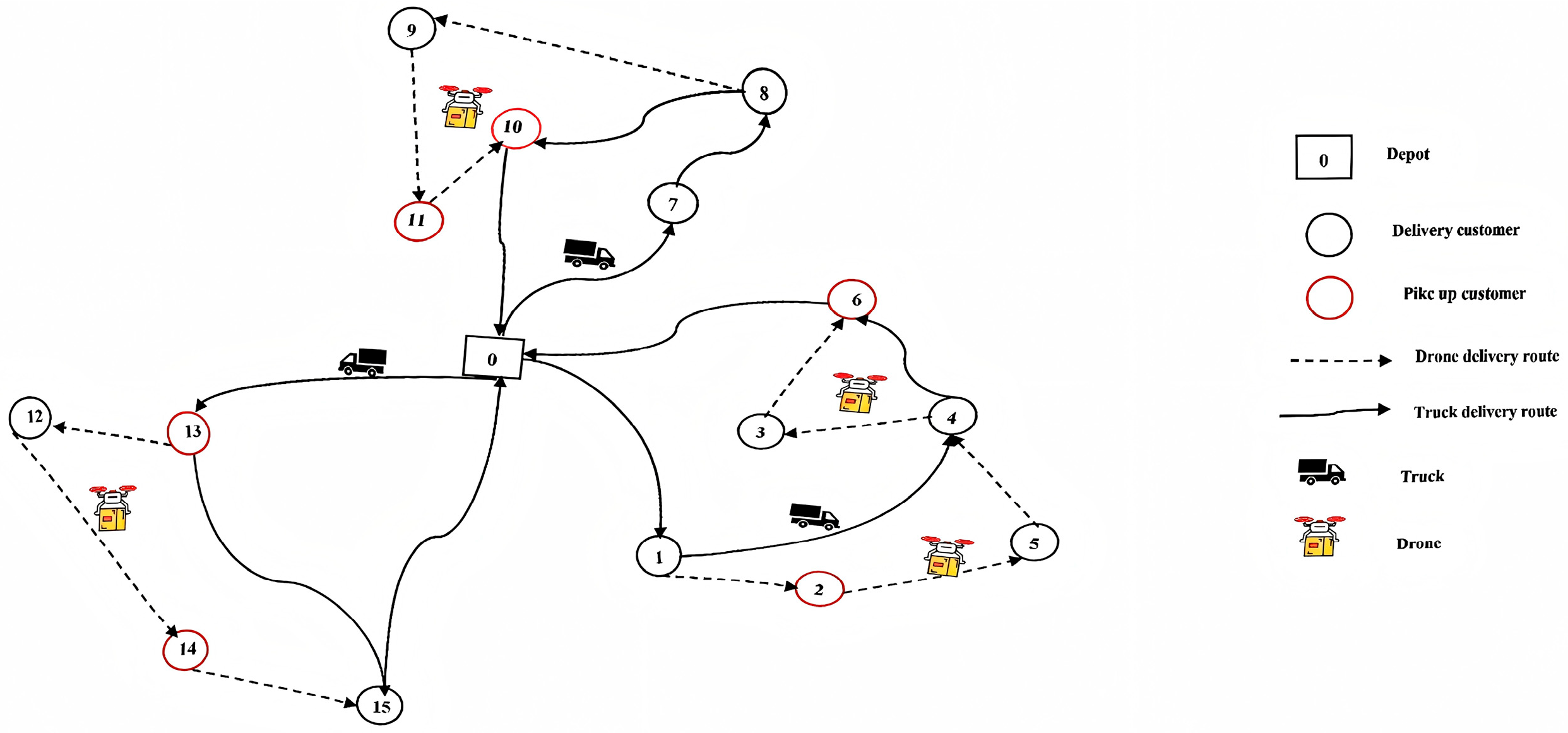
This paper investigates the MTTRP-PD problem in time-varying urban road networks. The goal is to build a coordinated delivery system with trucks and drones to meet customers’ pickup and delivery needs. Each truck is equipped with a homogeneous drone, which incurs a fixed cost. Transportation costs for trucks are proportional to driving distance and fuel consumption, which are affected by road conditions. Drone costs are determined by flying distance. The objective of the MTTRP-PD is to determine the optimal routes for trucks and drones to minimize total costs while satisfying all customer demands. Figure 1 illustrates an example of the MTTRP-PD.
The assumptions of this problem are as follows:
  • Drones can depart from the depot or return to any customer.
  • If a drone arrives at the rendezvous point earlier than the truck, it can land and wait to conserve energy, synchronizing with the truck upon arrival.
  • The maximum flight range of a drone is dynamic, depending on its payload.
  • A non-zero time duration (denoted as SR/SL in the model) is required for the drone’s launch and recovery operations.
  • Drone movement paths are considered only in the horizontal direction, excluding vertical travel.
  • A drone cannot be relaunched before being retrieved.

3.2. Notations

To establish the MTTRP-PD model, the sets, parameters, and variables are defined in Table 2.

3.3. Time-Dependent Speed

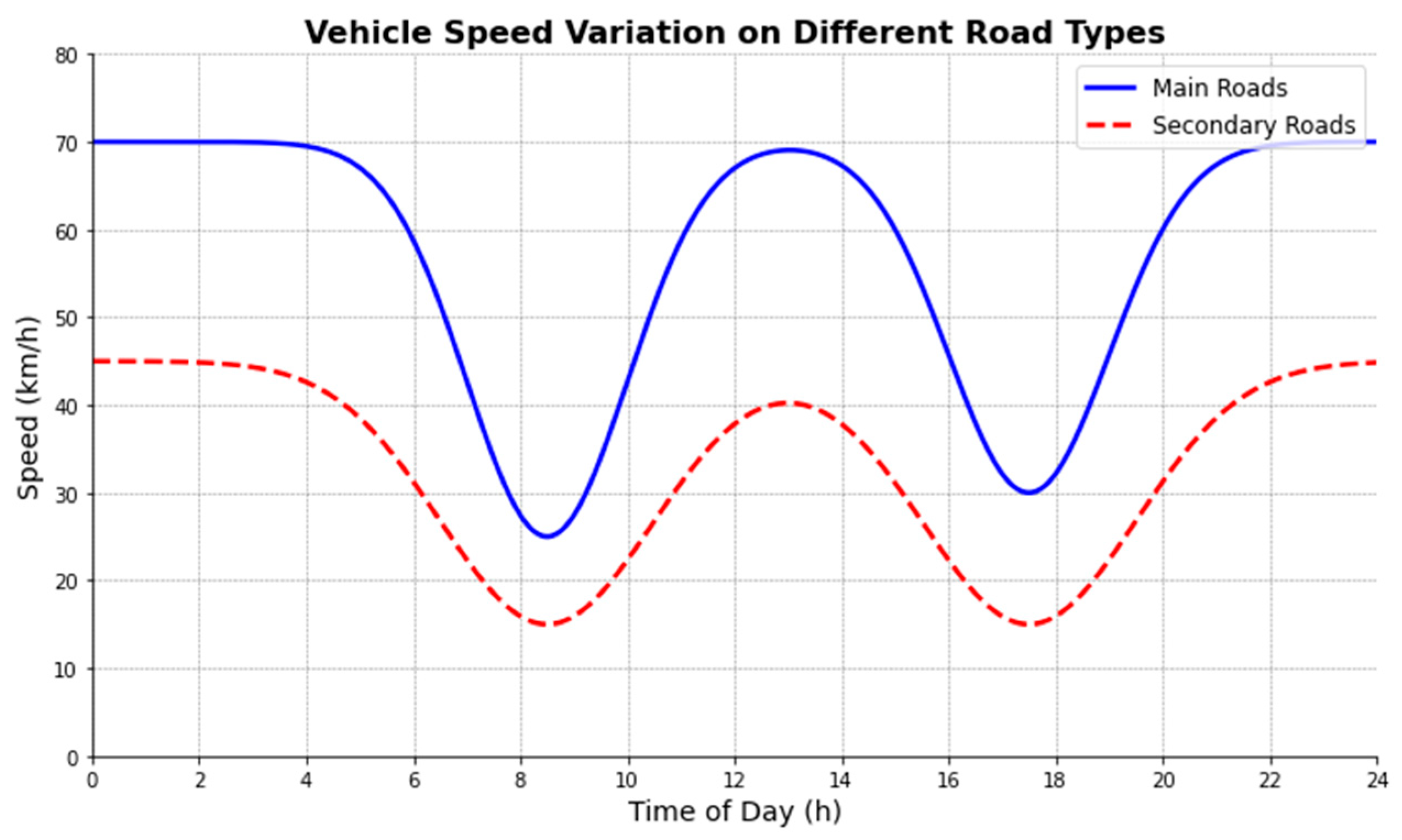
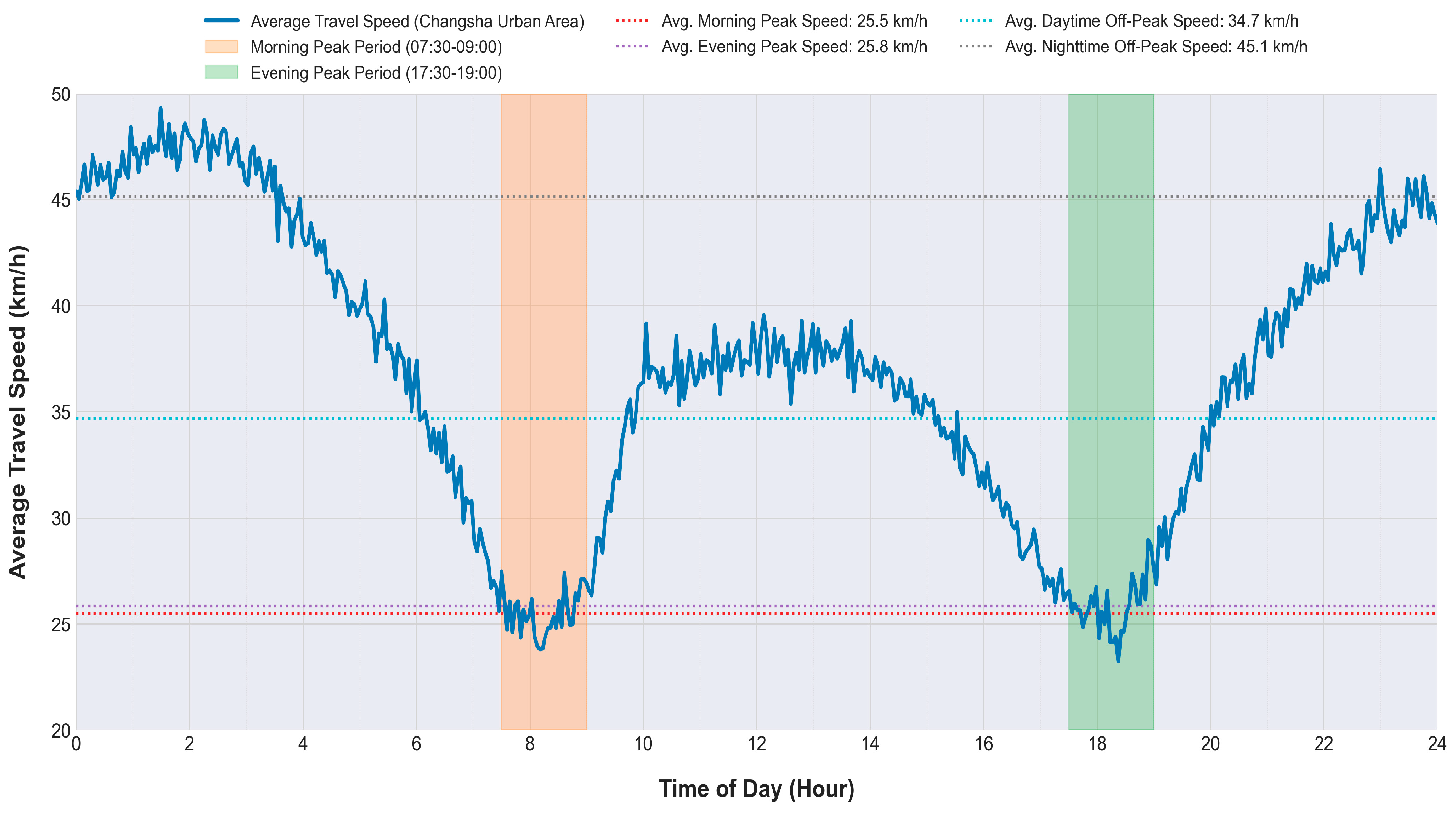
Existing research on time-dependent vehicle routing problems often represents changes in vehicle speed using step functions. That approach disregards gradual speed changes and fails to capture road network constraints on delivery areas during peak hours. In response, this study classifies road networks in the delivery area into main roads and secondary roads based on traffic flow characteristics [50]. It represents the continuous changes in speed over time using polynomial functions, as shown in Figure 2.
Let T = [ T 0 , T 1 , T 2 , T 24 ] represent the set of time intervals throughout the day. Then, the speed that varies with time v T = φ sin ( γ t ) + δ , t [ T 0 , T 24 ] , where φ , γ , and δ denote factors relating to road conditions. [ T L , T L + 1 ] represents the L t h time interval, following the first in–first out principle. The method for calculating the travel distance along segments is based on this principle. Assuming that time T i for a truck to travel from customer i is within [ T L , T L + 1 ] , there are two possible scenarios:
  • Single-Interval Travel
If d i j T T i T L + 1 V T ( t ) d t , the truck reaches j within [ T i , T L + 1 ] . Without spanning time intervals, the travel time t i j is obtained by calculating the upper limit of the integral based on the speed function relationship within the interval.
  • Multiple-Intervals Travel
If d i j T > T i T L + 1 V T ( t ) d t , the truck needs to traverse periods. Suppose the truck travels from node i to node j; here, the travel time is t i j = ( T L + p 1 T i ) + t i j L + p and cross p periods, the distance traveled in each period is d i j L , d i j L + 1 , , d i j L + p , and the time t i j L + p traveled in period P can be obtained by calculating the upper limit of the integral based on the speed function relationship within the interval.

3.4. Truck Energy Consumption Estimation

Truck energy consumption is influenced by many factors. This paper adopts the function f i j presented in [50] to calculate the time-dependent truck energy consumption, as shown in Equation (1).
f i j = λ × T i T j [ ( 110 + 0.000375 v T 3 + 8702 / v T ) × G C × L C ] v T d t
λ = 0.00043 L / g , G C is the road gradient correction coefficient, L C is corrected load gradient correction factor. The calculation formula of G C and L C is as follows:
G C = exp ( ( 0.0059 v T 2 0.0775 v T + 11.936 ) )
L C = 0.27 ϖ + 1 + 0.0614 ϖ 0.0011 3 ϖ 0.00235 v T ϖ ( 0.33 / v T ) ϖ
denotes the road slope, which is expressed as a percentage. In Equation (3), ϖ is the corrected ratio of truck load to truck capacity which is a digit between [0, 1].

3.5. Mathematical Model

3.5.1. Objective Function

The objective function minimizes the total cost. The first term is the transportation cost of trucks, the second term is the transportation cost of drones, and the last two term is fixed cost of truck and drone. c 1 , c 2 , c 3 , and c 4 represent the cost coefficients, respectively.
min Z = c 1 i C 0 j C + k K f i j x i j k + c 2 i C 0 j C + r C k K ( d i r U + d r j U ) y i r j k + c 3 i C 0 j C + k K x i j k + c 4 i C 0 j C + k K y i j k

3.5.2. Routing Constraints

Constraint (5) ensures each customer receives package delivery via either a drone or a truck, precluding concurrent visitation by multiple modes. Constraint (6) mandates that each truck route originates from and terminates at the depot. Constraint (7) imposes flow conservation at each i for truck routes, ensuring that if a truck k arrives at a node, it must depart from that node. Constraints (8) and (9) stipulate that for drone k to service a customer at node j, there must exist an outbound arc from the drone designated origin to node j, and an inbound arc from node j to the drone origin, enforcing flow conservation for drone routes at customer nodes. Constraints (10) and (11) are sets of the subtour elimination constraints, designed with the aim of ensuring that no subtours exist in any of the vehicle routes.
k K i C ( y d i k + y t i k ) = 1
i C + x 0 ( s ) i k = i C + x i 0 ( r ) k = 1
j C + x i j k = j C 0 x j i k = y t i k ; i C , k K
y d j k ( i C y j i k 1 ) = 0 ; j C , k K
y d j k ( i C y i j k 1 ) = 0 ; j C , k K
up i k u p j k + Q T ( x i j k ) Q T q i ; i , j C C 0 C + , k K
q i u p i k Q T ; i C C 0 C + , k K

3.5.3. Spatial Constraints

Constraints (12) and (13) ensure that a drone leaves or enters node i. Constraint (14) specifies that, if node i has a truck serving customers and a drone arc leaves that node, then i is considered a launch node, and the drone takes off from here. Constraint (15) states that if node i has a truck serving customers and a drone arc enters, then i is considered a landing node. Constraint (16) prohibits drones from flying directly from a node i with truck service to a node j with truck service. Constraints (17) and (18) stipulate that, when the auxiliary variable is present, the drone cannot take off or land at node j. Constraints (19) and (20) work together to enforce the critical truck–drone rendezvous synchronization. Constraint (19) links the truck’s route to the drone’s flight, specifying that, if a truck k arrives at a rendezvous node j, it cannot depart from j until the drone has been successfully retrieved. Constraint (20) handles the case where the drone has taken off but not returned to j.
k K j C y i j k ( z d i 1 1 ) = 0 ; i C
k K j C y j i k ( z d i 2 1 ) = 0 ; i C
j C k K y i j k 1 M ( 2 y t i k z d i 1 ) ; i C , k K
j C k K y j i k 1 M ( 2 y t i k z d i 2 ) ; i C , k K
y i j k 2 ( y t i k + y t j k ) ; i , j C , k K
( x i j k ) ( r C r i y r j k ) l a j k = 0 ; j C , k K
l a i k ( j C y i j k ) = 0 ; i N , k K
( x i j k ) ( s C s j y i s k ) ( 1 r C r i y r j k ) ( 1 l a j k ) = 0 ; i , j C , k K
( x i j k l a i k ) ( 1 r C r i y r j k ) ( 1 l a j k ) = 0 ; i , j C , k K

3.5.4. Time Constraints

Constraints (21) and (22) ensure that the arrival times of the drone and truck at the rendezvous point are synchronized, enabling precise coordination between them. Constraint (23) tracks the truck’s arrival time at each customer node. When the truck moves from one customer node to the next, its arrival time is the sum of the previous node’s arrival time and the travel time. At certain nodes, the truck must also account for the drone’s landing or takeoff time (SR/SL). Constraint (24) tracks the drone’s return time to the rendezvous node after delivery. This time is the sum of the drone’s departure time from the previous node, the flight time, and the landing/takeoff time at the rendezvous node (SR/SL).
j C y i j k ( t t i k d t i k ) = 0 ; i C 0 , k K
j C y j i k ( t t i k d t i k ) = 0 ; i C , k K
t t j k t t i k + τ t i j k M ( 1 x i j k ) + S L ( h C k K y i h k ) + S R ( g C k K y g j k ) ; i C 0 , j C + , k K
d t j k d t i k + τ d i j k M ( 1 y i j k ) + S L ( h C + x i h k ) + S R ( p C 0 x p j k ) ; i , j C , k K

3.5.5. Drone Energy Consumption Constraints

In practical applications, the payload of drones significantly affects energy consumption. Based on the endurance model from Zhang and Liu [51], this study incorporates the influence of payload, assuming that maximum endurance is 90% of the endurance in the unloaded state. This payload-dependent endurance model is a deterministic simplification. Other factors that introduce uncertainty and affect energy consumption, such as variable weather conditions (e.g., wind, temperature) and battery health, are not considered in this study to maintain tractability. The drone flight process is divided into two stages: First, it flies from node i to node r with a certain payload ratio. After unloading, it flies from node r to node j in an unloaded state. The drone endurance range is the weighted sum of the maximum ranges in these two stages.
Constraint (25) defines the payload ratio of the drone, reflecting the actual utilization rate of drone performance under a specific task load. Constraint (26) defines the payload-dependent scaling factor. This factor models the rate at which payload impacts energy consumption and is used to adjust the drone’s maximum flight endurance in Constraint (27). Constraint (27) establishes the payload-dependent endurance limit, modeling how the maximum flight range is affected by the payload for a multi-stop sortie (from node i to r, and then to j). Constraint (28) then ensures that the actual accumulated flight time for that sortie does not exceed this calculated maximum endurance.
Constraint (27) limits the expected maximum flight endurance of the drone during the entire route from node i to node r, and then from node r to node j, ensuring that it does not exceed the maximum flight endurance. Constraint (28) ensures that the actual flight time of the drone does not exceed its maximum endurance.
θ ij = q i Q U
E ( θ i j ) = E ( 1 0.1 θ i j )
E i r j = E [ ( d t i r k d t i r k + d t r j k × ( 1 0.2 θ i j ) ) + ( d t r j k d t i r k + d t r j k ) ]
d t j k d t i k r C E i r j + M ( 1 r C y i r j k ) ; j C + , i C , i r , k K

3.5.6. Truck Loading Constraints

Constraint (29) is the load update equation for deliveries, precisely tracking the dynamic change in truck load. It states that the load on truck k after visiting node j is equal to its load upon arrival, minus the delivered amount, dj. Constraint (30) is the corresponding non-negativity constraint, which ensures that the truck’s load does not fall below zero at any point in the route. Constraints (31) and (32) are the update equations for the truck’s separate pickup load. Constraint (31) tracks the load added when the truck itself performs a pickup at a node j, while Constraint (32) handles the load transferred from a returning drone’s payload at a rendezvous node. Constraints (33) and (34) set the initial load conditions at the depot for both delivery and pickup flows. Constraint (33) sets the initial delivery load to the sum of all delivery demands on the route. Conversely, Constraint (34) initializes the separate pickup load to zero, as no parcels have been collected yet. Constraint (35) is the critical total capacity constraint that links both load types. It ensures that at any node j along the route, the sum of the remaining delivery load and the accumulated pickup load never exceeds the truck’s maximum physical capacity.
F D j k F D i k q i u U D f d i u + M ( 1 x i j k ) , i C , j C + , k K
F D j k F D i k q i u U D f d i u + M ( 1 x i j k ) , i C , , j C + , k K
G D j k G D i k + p i + u U D g d i u + M ( 1 x i j k ) , i C , , j C + , k K
G D j k G D i k + p i + u U D g d i u M ( 1 x i j k ) , i C , j C + , k K
FD j k F D 0 ( s ) k + M ( 1 x 0 ( s ) j k ) , j C + , k K
G D j k G D 0 ( s ) k M ( 1 x 0 ( s ) j k ) , j C + , k K
F D i k + G D i k Q T , i C , k K

3.5.7. Drone Loading Constraints

This set of constraints manages the drone’s dual-load (delivery and pickup) flow. Constraints (36) and (37) are the core payload update equations for customer visits; Constraint (36) tracks the decrease in the drone’s delivery load after servicing a node j, while (37) tracks the increase in its pickup load from that same node. Constraints (38) and (39) manage the payload reset when the drone returns to a rendezvous node. Constraint (38) requires that the drone’s delivery load is zero upon its return. Constraint (39) ensures all collected packages are transferred to the truck before it can be redeployed on a new sub-route. Constraints (40) to (43) are the launch constraints. They set the initial delivery and pickup loads on the drone when it departs from the truck at a launch node i to begin its sortie. Constraint (44) is the drone’s total capacity constraint. It ensures that, at any point during its flight, the sum of its remaining delivery load and its accumulated pickup load does not exceed its maximum physical payload limit.
f d j k f d i k + q i ( 1 l a i k ) + M ( 1 y i j k ) , i C , j C + , k K
g d j k g d i k + + p i ( 1 l a i k ) M ( 1 y i j k ) , i C , j C + , k K
f d j k M ( 1 l a j k ) , j C + , k K
g d j k + M ( 1 l a j k ) , j C 0 , k K
f d j k f d j k + M ( l a j k ) , j C , k K
f d j k f d j k + + M ( l a j k ) , j C , k K
g d j d g d j k + M ( l a j k ) , j C , k K
g d j d g d j k + + M ( l a j k ) , j C , k K
f d j k + g d j k Q U , j N , k K

4. Solution Approach

Considering the NP-hard nature of the VRP, the introduction of drones, the time-varying road network, and the integration of pickup and delivery services make the MTTRP-PD more complex. To address this, this study introduces a two-stage heuristic algorithm. This approach first constructs an initial feasible solution using a Scanning Heuristic Insertion method (SH) and then optimizes this solution using an Enhanced Simulated Annealing algorithm (ESA). This integrated two-stage algorithm is hereafter referred to as SH–ESA, is illustrated in Algorithm 1.
Algorithm 1 Presents the pseudocode of SH–ESA
1:    Input:  d i j T , d i j U , q i , p i , W T , W U , E , v T
2:    Output: Best drone–truck solution S B e s t
3:        Truck-only routes (CVRP) ← SH Method
4:        Initial solution S I n i t Heuristic insertion operations
5:        Best solution S B e s t E S A algorithm
6:    Return  S B e s t

4.1. Initial Solution

To address the MTTRP-PD problem, a Scanning Heuristic Insertion method (SH) is designed to construct an initial feasible solution. First, the scanning algorithm constructs the initial delivery routes for the trucks. Then, considering the drone’s endurance, payload capacities, and other feasibility constraints, feasible drone sub-routes are inserted into each truck route. Algorithm 2 presents the pseudocode of initial solution.
Algorithm 2 Truck–drone route construction algorithm
1:    Input:
Truck route, truck fleet, drone fleet, customers geographical coordinates, and service time windows U Q , D i , E
2:    Output: Drone route, truck route
3:    For Route ∈, truck route
4:          Set CN = {All customer nodes in route}
5:          Initialized 1st launch node = 1st truck node in route (customer points near depot), LandingCN = []
6:          While CN ∈ ∅
7:                Please select drone from the available drones = {1,2,…, a}
8:                If available drone = = ∅, go to line (16), else
9:                   Update available drones = available drones/drone
10:                  Repeat
11:                  Select the next drone delivery point min λ = γ / ζ
12:                   / / ( γ = d i s t a n c e ( c u r r e n t   d r o n e   n o d e , u n v i s t e d   n o d e )
/ / ( ζ = c u r r e n t   d r o n e   l o a d + u n v i s t e d   n o d e ( + i s   d e l i v e r y   p a c k a g e , i s   p i c k u p   p a c k a g e ) )
13:                  Update drone E, drone load, route
14:                  Update CN = CN − {next drone delivery node}
15:                  Unit drone load ≥ UQ||drone battery ≥ E E
16:                  Update LandingCN = LandingCN ∪ last drone delivery node
17:             End if
18:             Choose the next truck delivery node m i n γ from CN ∪ LandingCN
19:             Update route, CN = CN − next truck delivery node
20:             If Next truck delivery node = = LandingCN
21:                  Reprogram drone load, drone battery = 0
22:                  Available drones = available drone ∪ drone
23:             End if
24:       End while
25:       Return drone route for each route
26:    End for
27:    Return drone route
28:    Output the drone–truck route

4.2. Enhance Simulated Annealing

In this study, we developed the ESA to optimize the initial solution generated by the SH method. Simulated annealing (SA) is a classical metaheuristic that explores the solution space by probabilistically accepting not only better but also worse solutions, thus avoiding premature convergence to local optima. However, the intricate synchronization and time-dependent constraints of the MTTRP-PD can easily trap standard SA in suboptimal regions, particularly in large-scale instances. To address these challenges, our ESA is specifically designed to enhance both search diversity and convergence efficiency through three major improvements: (1) a set of diversified, problem-specific neighborhood search operators (Section 4.2.1); (2) a regional setting (RS) acceleration strategy to intelligently prune the search space (Section 4.2.2); and (3) a tailored annealing operation strategy (Algorithm 3) that adaptively manages the search process. In each iteration, the initial temperature, T, gradually decreases through the update formula, T = β T , where β [ 0 , 1 ] is the cooling rate of ESA. By implementing the annealing operation strategy, the ESA can avoid repeatedly searching for the same solution and improve search efficiency.
Algorithm 3 ESA
1:    Input:
T 0 : initial annealing temperature, T f : final annealing temperature; : annealing factor; : tempering factor; T C : final tempering temperature; L e n : the Markov chain length; T = T 0 ; initial solution: S o i n i t ; initial cost: C o i n i t
2:      Output: Best truck–drone route S *
3:           S o c u r r = S o i n i t ,   C o c u r r = C o i n i t
4:    While (Within the time limit)
5:             For k = 1: Len
6:                   S o n e w S o c u r r (Neighborhood Search Strategy)
7:                   If  C o n e w < C o c u r r
8:                          S o c u r r = S o n e w ; C o c u r r = C o n e w
9:                   If  C o n e w < C o b e s t
10:                               S o b e s t = S o n e w ; C o b e s t = C o n e w
11:                         End
12:                  Else
13:                         If rand < e x p ( C o n e w C o c u r r ) / T
14:                               S o c u r r = S o n e w ; C o c u r r = C o n e w
15:                         End
16:                  End
17:                   T = T
18:                  If  T < T f
19:                         T 0 = T 0 ; T = T 0 ; S o c u r r = S o b e s t
20:                  End
21:            End
22:       End

4.2.1. Neighborhood Search Strategy for ESA

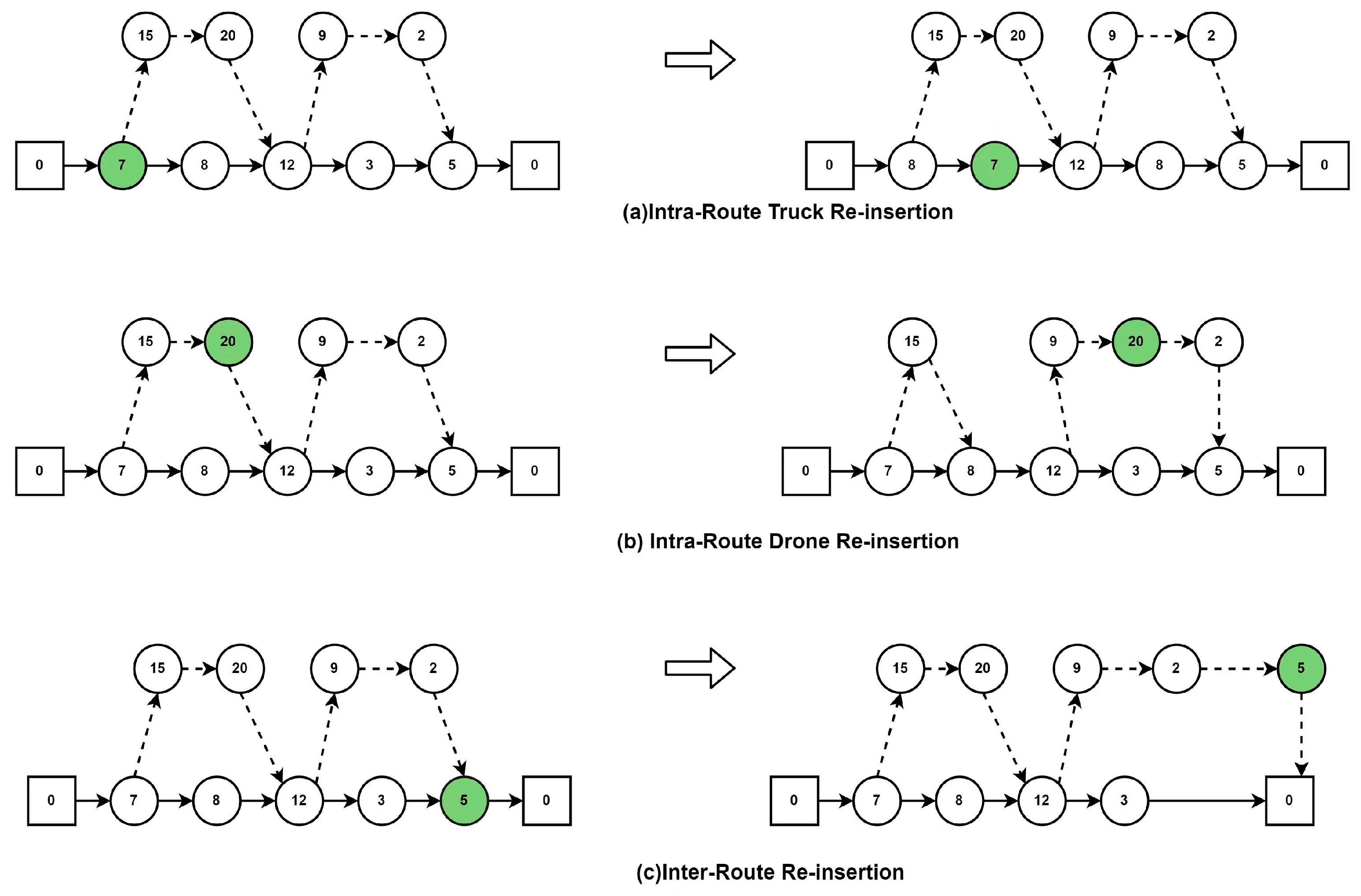
The selection of neighborhood operators is critical for effectively exploring the complex solution space of the MTTRP-PD. A diversified set of operators is designed based on both theoretical and empirical insights, balancing fine-grained local optimization and disruptive exploration to avoid local optima. Specifically, relocation moves enable customer reassignment between truck and drone deliveries, exchange moves refine route efficiency, and remove–reinsert moves introduce major structural changes that enhance global exploration.
These nine operators are organized into three neighborhood structures within the ESA framework. In each iteration, the algorithm sequentially applies these neighborhoods to explore alternative solutions, adopting the best feasible one as the next candidate; if none is feasible, then the previous best solution is retained. This integrated mechanism ensures both stability and diversity in the search process within each truck–drone route.
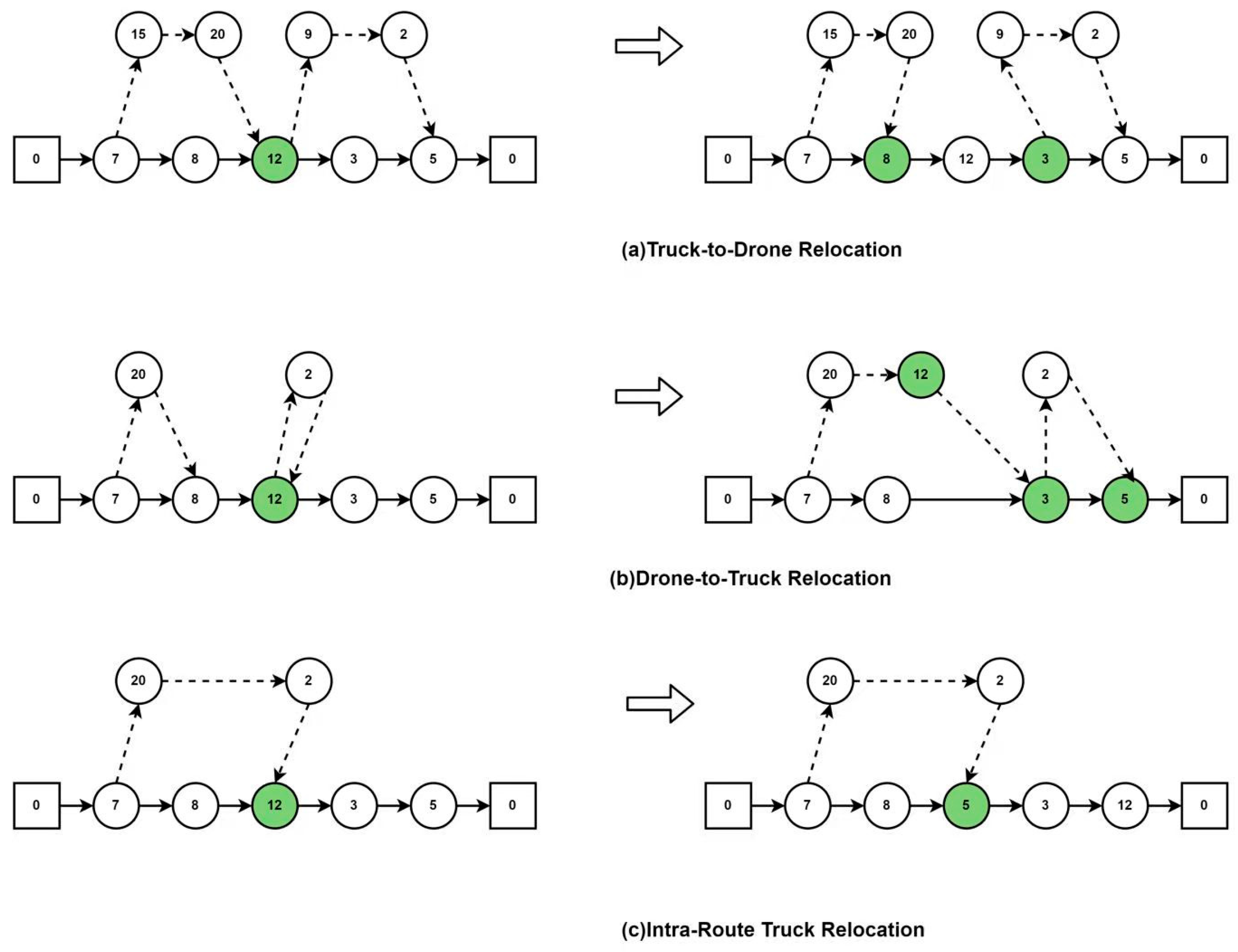
  • Relocation: The relocation operator randomly selects customers and moves them to the most promising positions in the truck route or drone flight. This involves three scenarios: first, transferring a truck-served node to a drone route and determining new launch and rendezvous nodes for the drone, as illustrated in Figure 3a; second, moving a truck-served node or drone node, similar to basic vehicle routing problem operations, but also allowing the construction of new flight tasks [39], as illustrated in Figure 3b; finally, relocating a truck-only node within the truck route and designating its adjacent nodes as new launch or rendezvous nodes for the affected flight, as illustrated in Figure 3c.
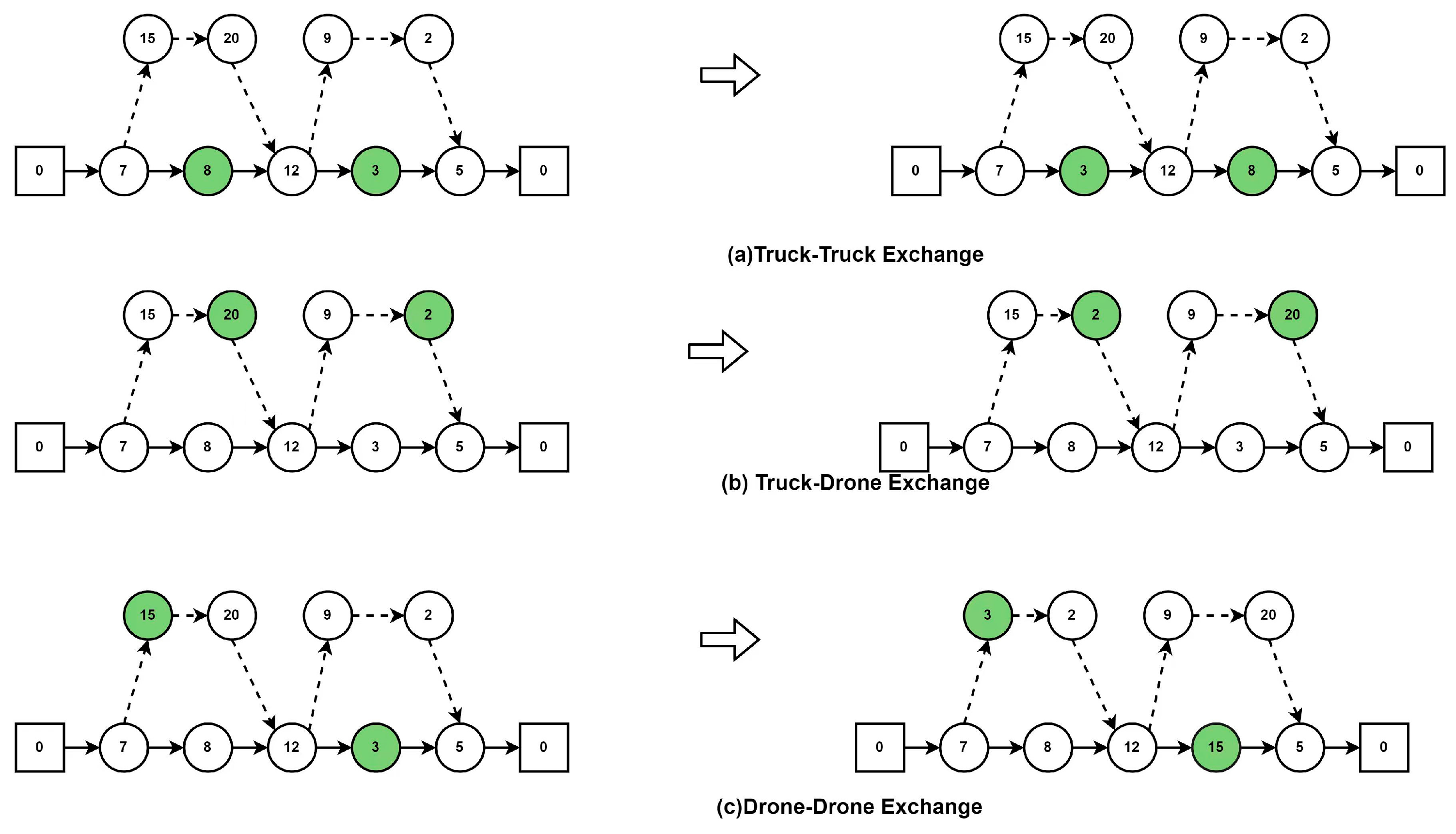
  • Exchange: Exchange operations involve exchanging two truck service nodes, as illustrated in Figure 4a, exchanging a truck node with a drone node, as illustrated in Figure 4b and exchanging two drone nodes, as illustrated in Figure 4c. These exchanges follow the basic two-point exchange principle. When the exchange involves drone nodes, nodes can be chosen from different drone routes. Additionally, if joint nodes are involved, all relevant nodes within the affected drone routes are collectively exchanged.
  • Remove–Reinsert: The remove–reinsert operator operates in three distinct scenarios. The first involves removing and reinserting a truck delivery node within the same truck route, as illustrated in Figure 5a. The second permits removing a drone delivery node from a drone sub-route and reinserting it at a different position within the same sub-route, as depicted in Figure 5b. The third allows removing a delivery node from a truck or drone route and reinserting it into a different route. It is imperative to note that the removed node should be either a truck delivery node or a drone launch node, excluding rendezvous nodes, as shown in Figure 5c.

4.2.2. Algorithm Acceleration Strategies

The Regional Setting (RS) acceleration strategy is designed in response to the inherent operational constraints of drone-assisted delivery. Due to limited flight endurance, a drone can only serve customers located close to the truck’s current or future route. Exploring assignments that involve distant nodes would dramatically expand the neighborhood size and introduce a large number of infeasible moves, leading to unnecessary computational consumption. The RS method formalizes this operational intuition by dynamically partitioning unserved customers based on geographical proximity and the truck’s residual capacity, so that potential drone sorties are examined only within reachable subsets. It further distinguishes drone-served and truck-served customer regions to prevent redundant or infeasible customer exchanges across distant areas. As analytically reasoned in Equations (29)–(33) and validated through the ablation study reported in Section 5.5, this structural reduction in the search space significantly accelerates neighborhood evaluation without compromising global solution quality.
To demonstrate the effectiveness of the regional setting (RS) methods, let LQ i denote the payload capacity of the truck k, and let S q i denote the total demand of nodes already served by it. The remaining payload capacity for truck k is defined as follows: r i = L Q i S q i . All unvisited nodes are partitioned into m zones, set of nodes in partition P i = { j | q j r i } . Before employing the RS method, the original search space requires evaluating all possible nodes, S o r i g i n a l = n ( n 1 ) 2 , where n represents the total number of all unvisited nodes. With the RS method, the search space for the i partition is S i = P i ( P i 1 ) 2 , where P i denotes the number of nodes in the i partition. Since the number of nodes in each partition is significantly less than the total number of nodes. The capacity-constrained partitioning strategy ensures that each zone contains only a subset of feasible nodes, resulting in ( P i n ) for all partitions. The search space for each partition is significantly smaller than the original search space, S i S o r i g i n a l . Here, the total search space under the RS method is the sum of the search spaces for all partitions, S R S = i = 1 m S i . Here, we obtain: S R S = 1 2 i = 1 m P i ( P i 1 ) < 1 2 n ( n 1 ) = S o r i g i n a l .

4.3. Multi-Visit Route Feasibility Testing for Each Truck–Drone Route

Verifying the feasibility of a multi-visit drone route within a specific truck–drone route is a complex task. It depends not only on the drone’s individual flight tasks but, more critically, on its synchronization with the associated truck route. While payload capacity checks are relatively straightforward (a simple sum), the battery feasibility is the core challenge. This is because the drone’s total sortie time (which includes flight and any potential waiting time at the rendezvous node) must be within its endurance limit, and this feasibility is entirely dependent on the truck’s time-dependent arrival at the rendezvous node. Therefore, our focus is on this dynamic temporal feasibility test, which is detailed in Algorithm 4.
Algorithm 4 Drone feasibility test for each truck–drone route
1:    Input:  d i j T , d i j U , q i , p i , W T , W U , E , v T , ψ , C u r r e n t S , I t e r , T , T max , S (truck–drone route)
2:    Output: −1 (if infeasible), or the Total Running Time (if feasible)
3:            Check load feasibility for each drone route s d in S
4:            If any flight is infeasible then
5:                Return −1//Indicate infeasibility
6:            End If
7:             S ← modify S by handling nodes requiring combined truck–drone services
8:            For each node i in the modified route S do
9:                   Calculate τ t i j k   τ d i j k   τ s //travel time and flight time for truck–drone
10:                  Apply R1 rule, update μ ( i ) , μ ( i ) , μ ( i )
11:                  Apply R2 rule, update μ ( i + 1 ) , μ ( i + 1 ) , μ ( i + 1 )
12:          End For
13:    Return  μ ( e ) //Return the total running time if feasible

4.4. Complexity Analysis

The computational complexity of the proposed two-stage SH–ESA is analyzed as follows. Let n be the number of customers and k be the number of available trucks.
Stage 1: initial solution (SH Method)—the construction of the initial solution involves two main steps. First, the scanning algorithm is used to create initial truck-only routes. This step is dominated by sorting the customer nodes by polar angle, which has a complexity of O ( n log n ) . Second, the heuristic insertion method integrates drone sub-routes. In the worst case, this involves iterating through each node in the truck routes and considering insertions for remaining drone-eligible customers, leading to a polynomial complexity, approximately O ( k · n 2 ) .
Stage 2: optimization (ESA method)—the complexity of the enhanced simulated annealing algorithm depends on its control parameters (the number of temperature decrements (I), the Markov chain length ( L m c ) , and the complexity of generating and evaluating a neighborhood solution). Our algorithm employs nine distinct neighborhood operators. With efficient data structures, the cost of evaluating a single move can be performed in approximately constant time, O ( 1 ) . Therefore, the complexity of a single iteration of the outer loop is O ( L m c ) . The total complexity of the ESA stage is O ( I · L m c ) .

5. Computational Results

This section presents a series of computational experiments to comprehensively validate the proposed MTTRP-PD model and SH–ESA. Section 5.1 describes the benchmark instances and parameter settings. Section 5.2 tests the algorithm’s effectiveness by comparing its results with the optimal solutions obtained by CPLEX and the standard simulated annealing algorithm on different scale instances. Section 5.3 conducts an ablation study to assess the contribution of the acceleration strategy (RS). Section 5.4 evaluates the economic benefits of the MTTRP-PD model under different delivery scenarios, Section 5.5 performs a sensitivity analysis to explore the effects of key parameters, particularly traffic dynamics, on system performance and managerial insights, and Section 5.6 demonstrates the comparison between TDVRP and MTTRP-PD system through a real-life case from a logistics company in Changsha, China.

5.1. Test Instance and Parameter Setting

To evaluate the performance of the proposed approach, benchmark instances from the Capacitated Vehicle Routing Problem Library [52] were adopted. In these instances, n denotes the number of customers and k denotes the number of vehicles, where each vehicle is equipped with one drone. Three standard datasets were used: Set A, Set B, and Set P. All these differ in their customer spatial distribution. Set A and Set B feature customers randomly and uniformly distributed across the service area, corresponding to suburban or sparsely populated regions, while Set P presents clustered customer distributions that reflect dense urban delivery environments. This diversity allows for comprehensive assessment of the model under varying geographical densities.
To customize the instances for mixed truck–drone operations, customer requests were modified by generating delivery and pickup demands within 0 to 2.3 times the original values for 90% of nodes, with the remaining 10% set to zero, consistent with the constraint that most commercial parcels weigh no more than 5 pounds (approximately 2.27 kg) [53]. Additionally, 10% of customers were designated as truck-only service nodes to represent regulatory and infrastructure limitations on drone usage. To reflect practical road hierarchies, customer nodes were further categorized into main-road (30%) and side-road (70%) locations according to their proximity to the distribution center, where main roads connect customers directly to the depot while side roads capture lower-accessibility urban streets. Other parameter settings for the MTTRP-PD are provided in Table 3. These adaptations preserve the structural characteristics of the original benchmarks while enabling realistic evaluation of drone-assisted delivery scenarios.
All experiments were conducted on a Lenovo Yoga 2021 laptop (Lenovo Group Ltd., Beijing, China) running a 64-bit Windows 11 operating system, equipped with an Intel Core i5-11300H CPU @ 3.1GHz and 16 GB of RAM. The SH–ESA was coded in MATLAB R2022a (The MathWorks, Inc., Natick, MA, USA), and optimization was performed using IBM ILOG CPLEX Optimization Studio V12.10 (IBM Corporation, Armonk, NY, USA).
To determine the optimal parameter settings for the SH–ESA, we conducted parameter tuning experiments, balancing solution quality and computation time to identify the key parameters. In the small-scale experiments, we set the initial temperature as T 0 = 50 , the termination temperature as T s = 0.1 , and the annealing factor as θ = 0.95 . For the large-scale experiments, we incorporated features of the SH–ESA, adjusting the reheating factor to = 0.8 , the reheating termination temperature to T c = 10 , and the maximum computation time to 3600 s.

5.2. Experiment with Different Scale Instances

In this section, SH–ESA is compared with the commercial software CPLEX to evaluate the solution quality and efficiency in small-scale instances. Due to the computational complexity of MTTRP-PD, only 10 small-scale instances are tested to ensure that CPLEX can solve the mathematical model to optimality within an acceptable time frame. The maximum execution time for CPLEX is set to 3600 s. The obtained results are detailed in Table 4, including lower bound, upper bound (both representing the total objective function value), optimality gap, and solving time. The SH–ESA average objective value, the SH–ESA best objective value, and the average solving time. The two metrics measuring SH–ESA performance are B e s t G a p =   ( B e s t   o b j e c t i v e L o w e r   b o u n d ) L o w e r   b o u n d × 100 % , and R e G a p = ( A v e r a g e   o b j e c t i v e B e s t   o b j e c t i v e ) B e s t   o b j e c t i v e × 100%.
Table 4 shows that, when n 8 , CPLEX can obtain the optimal solution within 500 s. As the problem scale increases, when n < 20 , CPLEX can find a feasible solution within 1000 s, SH–ESA only needs 30 s to obtain a feasible solution. This indicates that the exact solver (CPLEX) can quickly find optimal solutions for small-scale instances but has significant limitations when solving larger-scale problems. On the P-n16-k8 instance, SH–ESA average objective value is equivalent to CPLEX optimal solution, but SH–ESA completes within 50 s. When n 20 , Re G a p % is within 2%, SH–ESA shows excellent approximation performance for small-scale instances. On the P-n23-k8, SH–ESA requires only 32 s to obtain a feasible solution, outperforming CPLEX, which takes 709 s. The Re G a p % remains stable at around 0.3%, verifying SH–ESA robustness and accuracy.
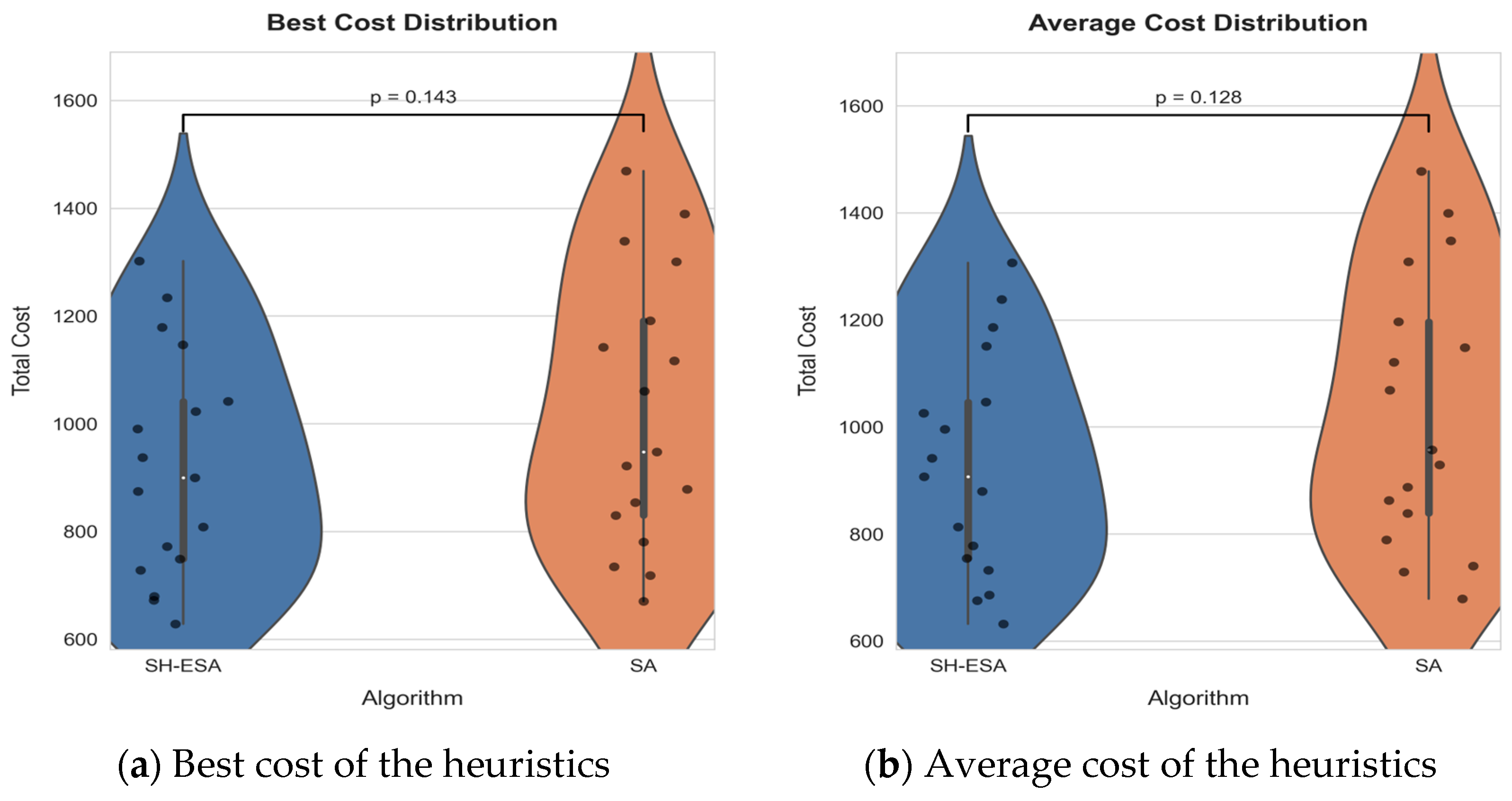
To evaluate the effectiveness of the SH-ESA in large-scale instances, we conducted comparative experiments with the standard SA algorithm. Table 5 shows the results of both algorithms solving the MTTRP-PD model. The SH–ESA obtained the best objective value, average objective value, and a standard deviation. The SA algorithm yielded a best value, the average objective value, and the standard deviation. Gap1 and Gap2 represent the difference between the best and average objective values for SH–ESA and SA, respectively, calculated using the method described in Section 5.3.
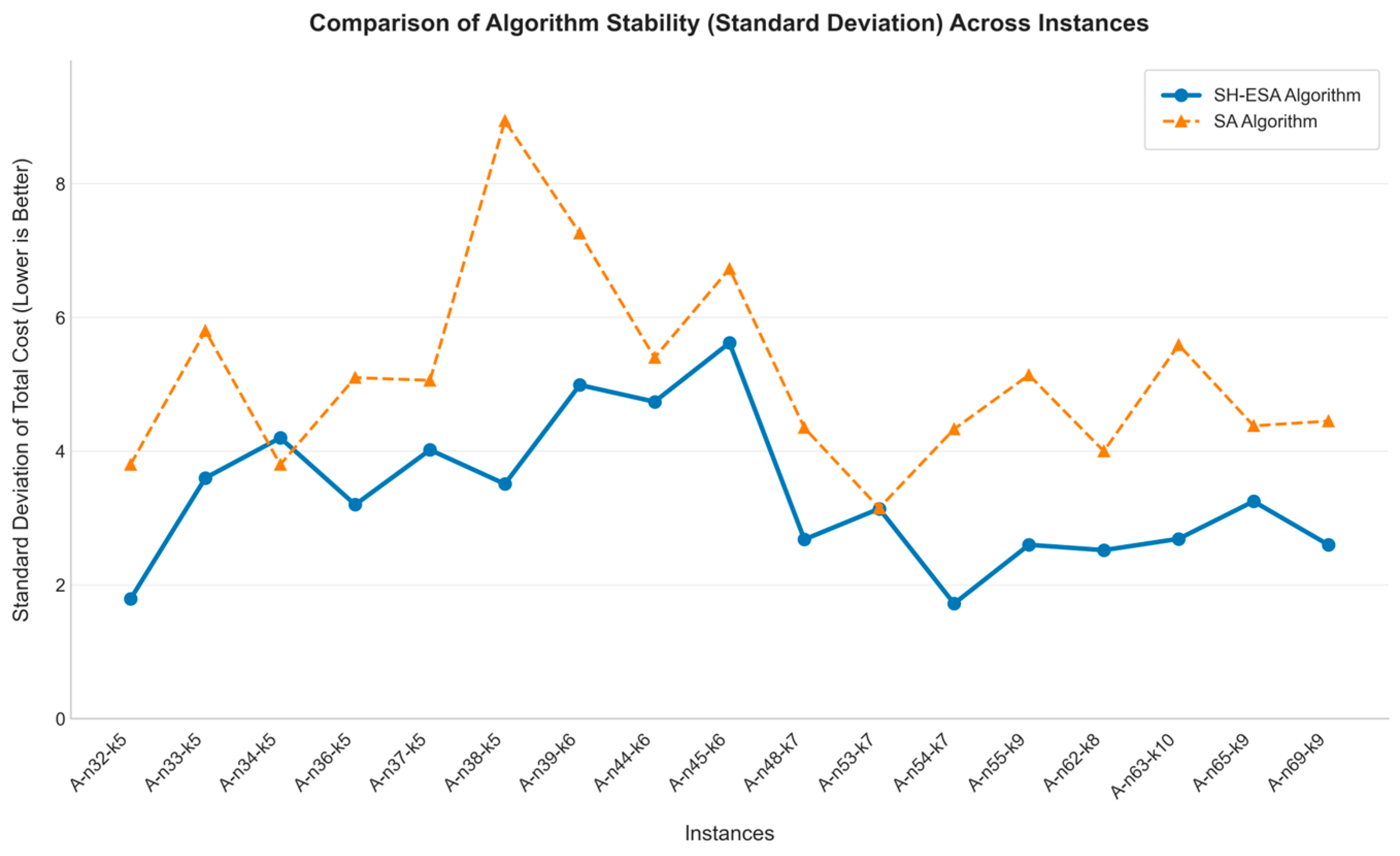
The results presented in Table 5 demonstrate that the SH-ESA consistently outperforms the standard SA in both solution quality and stability. Specifically, SH–ESA achieves lower average costs across all seventeen large-scale instances and exhibits smaller standard deviations in fifteen of them, indicating higher robustness. As shown in Figure 6b, these improvements lead to an average cost reduction of 10.53 percent, with the average cost of SH–ESA being 926.45 compared with 1028.26 for SA. Moreover, Figure 7 reveals that SH–ESA produces more stable solutions, exhibiting smaller standard deviations in 15 out of 17 instances. To statistically assess these improvements, a paired t-test was conducted on the average cost results, yielding a p-value of 0.128, which exceeds the conventional significance level of α = 0.05. Although the difference is not statistically significant at the 5% level, the consistent improvement across all instances and the notable 10.53% cost reduction highlight the practical relevance of SH–ESA. Overall, these findings indicate that the incorporation of tailored neighborhood search mechanisms and acceleration strategies enables SH–ESA to deliver robust and consistently superior performance in large-scale optimization settings compared with the conventional SA approach.
Furthermore, Figure 7 shows that SH–ESA exhibits smaller solution variability in most instances. For example, in A-n38-k5, the standard deviation of SH–ESA is 3.51, in contrast to the standard deviation of SA, which is 8.94, thereby proving SH–ESA’s higher stability.

5.3. Effect of Using Acceleration Strategies

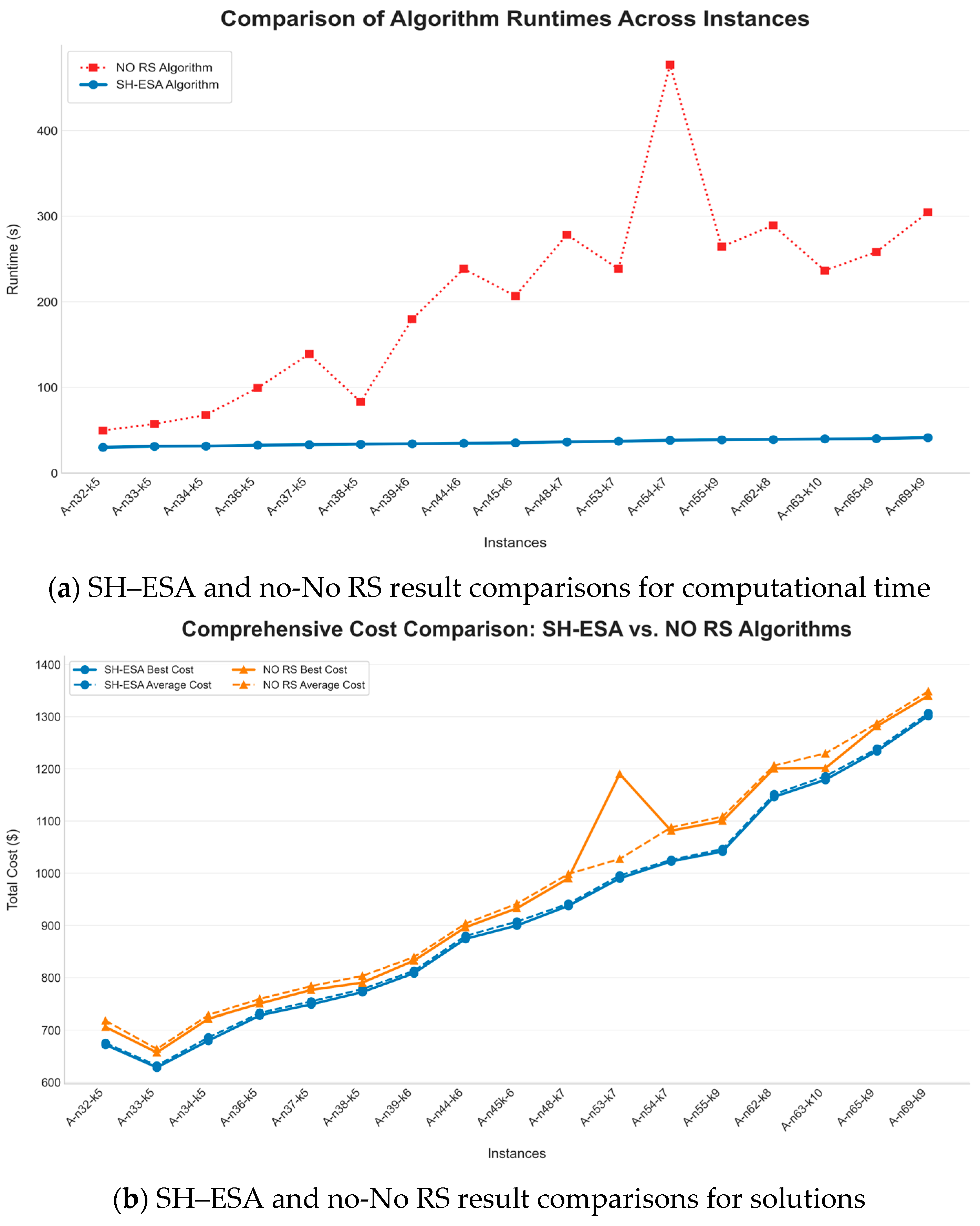
To rigorously quantify the contribution of the regional setting (RS) acceleration mechanism in SH–ESA, an ablation experiment was conducted by comparing the full algorithm against a baseline variant without the RS strategy (denoted as NO-RS). Both methods were executed 10 times per instance on Set A to ensure statistical robustness. The results, illustrated in Figure 8a, indicate that execution time increases with instance scale for both algorithms, while SH–ESA consistently exhibits substantially lower growth rates. The gap becomes more pronounced as the number of customers increases, demonstrating that the RS strategy effectively reduces the neighborhood search burden and significantly enhances computational scalability. Moreover, Figure 8b shows that SH–ESA achieves superior solution quality in the majority of instances, reflecting the ability of RS not only to accelerate the search process but also to guide the algorithm toward higher-quality regions of the solution space. These findings confirm that the RS strategy provides a strong performance advantage without compromising optimality.

5.4. Comparison with Different Models

5.4.1. Impact of Multi-Visit Service

To further explore the advantages of multi-visit drone delivery mode, a comparison was conducted with its single-visit counterpart. The results are shown in Table 6, n u d represents the number of customers served by drones, C v ( $ ) denotes the variable transportation cost (the sum of truck and drone transport costs, excluding all fixed costs), and R ( k m ) indicates the total distance traveled by trucks. Δ n u d % , Δ C V % , and Δ R % , respectively, represent the relative change rates of the number of customers served by drones, transportation costs, and truck travel distances under the two modes.
Table 6 summarizes the overall impact of the multi-visit mode across all seventeen instances. On average, drones served 46.6% of customers, indicating a substantial expansion of drone coverage in mixed operations. Meanwhile, variable transportation costs decreased by 19.76% on average, and truck travel distance dropped by 45.19%, confirming a notable improvement in routing efficiency and resource utilization.
These improvements stem from the operational flexibility introduced by the multi-visit mode within the MTTRP-PD framework. Enabled by Constraints (8) and (9), drones are no longer restricted to a single out-and-back sortie and can instead visit multiple customers in a single mini-tour. This allows trucks to maintain more direct travel paths, avoiding detours to geographically inefficient nodes. As reflected in the model’s objective function, longer truck travel is systematically substituted with shorter and less costly drone flights, which ultimately drives the observed reductions in both operational costs and truck mileage.

5.4.2. Impact of Different Delivery and Pickup Scenarios

To analyze the impact of drone delivery and pickup operations on MTTRP-PD, we compared two modes: pickup–delivery mode and only delivery mode. Considering the impact of the pickup customer ratio, the experiment used four instances (A-n36-k5, A-n45-k6, A-n55-k9, and A-n65-k9), each with five different levels of the pickup customer ratio. The solution results are shown in Table 7.
From Table 7, the pickup and delivery mode consistently outperforms the delivery mode across service capability, economic efficiency, and delivery distance. The pickup and delivery mode increases customer service capacity by 55.44% on average, indicating that loadable pickup tasks allow drones to operate closer to their designed capability range. In addition, the pickup and delivery mode achieves an average cost reduction of 40.12%, confirming its advantage in resource utilization and vehicle coordination. The reduction in delivery distance reaches 77.65%, which directly contributes to lower truck fuel consumption and improved delivery efficiency. These advantages further expand as the proportion of pickup tasks increases, reinforcing the pickup and delivery mode’s scalability in practical deployment.
The performance superiority of the pickup–delivery mode is primarily attributed to improved payload utilization supported by the proposed flexible loading constraints. Unlike the delivery mode, where drones often return empty and incur deadheading flight penalties, the pickup–delivery mode dynamically updates payload variables to consolidate deliveries and pickups within a single sortie. This operational design enables drones to convert traditionally idle return trips into productive resources. As more pickup tasks emerge, the model identifies additional consolidation opportunities, effectively eliminating redundant drone sorties and unnecessary truck travel. This mechanism explains both the significant cost savings and the pronounced reduction in truck-dependent delivery distance observed in the results.

5.5. Sensitivity Analysis

To examine the factors influencing the MTTRP-PD, sensitivity analyses were conducted on four representative instances: A-n36-k5, A-n45-k6, A-n55-k9, and A-n65-k9. Each experiment systematically varied parameter settings, generating 80 scenarios by assigning five distinct levels to each parameter per instance. The One-Factor-at-a-Time design was adopted to isolate the influence of individual parameters and provide clear managerial insights into their marginal effects. Although this approach does not capture potential parameter interactions—such as the joint effect of battery capacity and payload—it enables a transparent interpretation of direct sensitivities with manageable computational effort. A full factorial analysis, while offering a more comprehensive understanding, was considered computationally prohibitive for the present study. Therefore, in each scenario, only one parameter was adjusted while the others remained fixed at their baseline values to ensure effect isolation.

5.5.1. Robustness Analysis Under Different Traffic Dynamics Scenarios

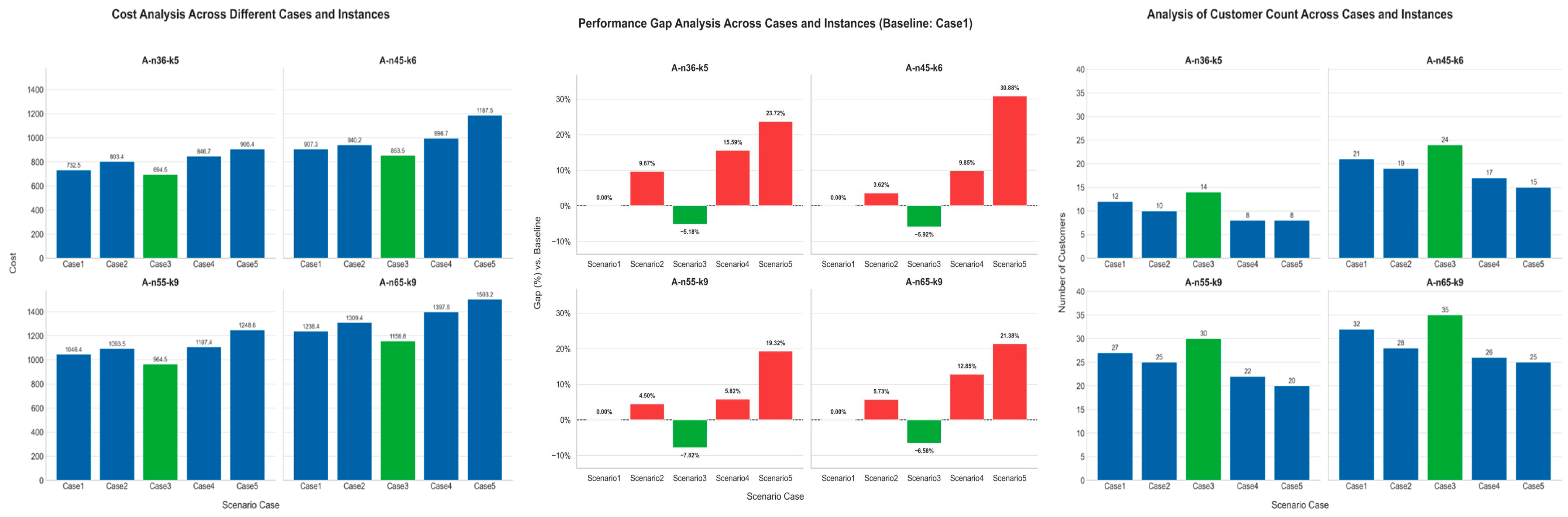
To thoroughly evaluate the robustness and applicability of the proposed model, we designed five distinct traffic scenarios using instances A-n36-k5, A-n45-k6, A-n55-k9, and A-n65-k9. Scenario 1 (Baseline: Highly Dynamic) employs the time-dependent polynomial speed function developed in this study, representing urban environments with substantial traffic fluctuations. Scenarios 2 and 3 test sensitivity to peak speeds by adjusting the baseline speed by ±5 km/h. Scenario 4 (Low-Variability Dynamic) assumes fixed speeds of 60 km/h for arterial roads and 40 km/h for secondary roads, reflecting a city with predictable traffic but clear road hierarchy. Scenario 5 (No-Variability/Static) assumes a uniform speed of 50 km/h for all roads, corresponding to the classical VRP assumption that neglects traffic dynamics. These scenarios collectively cover a range of real-world urban conditions and facilitate systematic assessment of the model under varying degrees of traffic dynamism.
Figure 9 illustrates the impact of these speed variations on the on MTTRP-PD. Compared with the baseline scenario, changes in vehicle speed significantly affect the required number of drones, total delivery cost, and the proportion of cost savings. For instance, under Scenarios 4 and 5, instance A-n65-k9 achieves total cost savings of 12.85% and 21.38%, respectively, relative to the baseline. These results indicate that neglecting temporal variability in vehicle speeds can lead to substantial underestimation of delivery costs and suboptimal allocation of resources.
The high sensitivity of the system arises from the time synchronization constraint, which governs the coordination between trucks and drones. When truck speed decreases (Scenario 2), arrival at the rendezvous node is delayed, forcing drones to wait longer or rendering the sortie infeasible if total flight and waiting time exceed the drone’s maximum endurance (Equation (28)). In such cases, the model reassigns customers to trucks, often resulting in costly detours. Complete neglect of time-dependent dynamics (Scenario 5) leads to systematically infeasible plans, explaining the 21.38% underestimation of total cost. This highlights the critical importance of accurately modeling time-dependent vehicle speeds in truck–drone collaborative delivery optimization.

5.5.2. The Impact of Maximum Battery Capacity of Drone

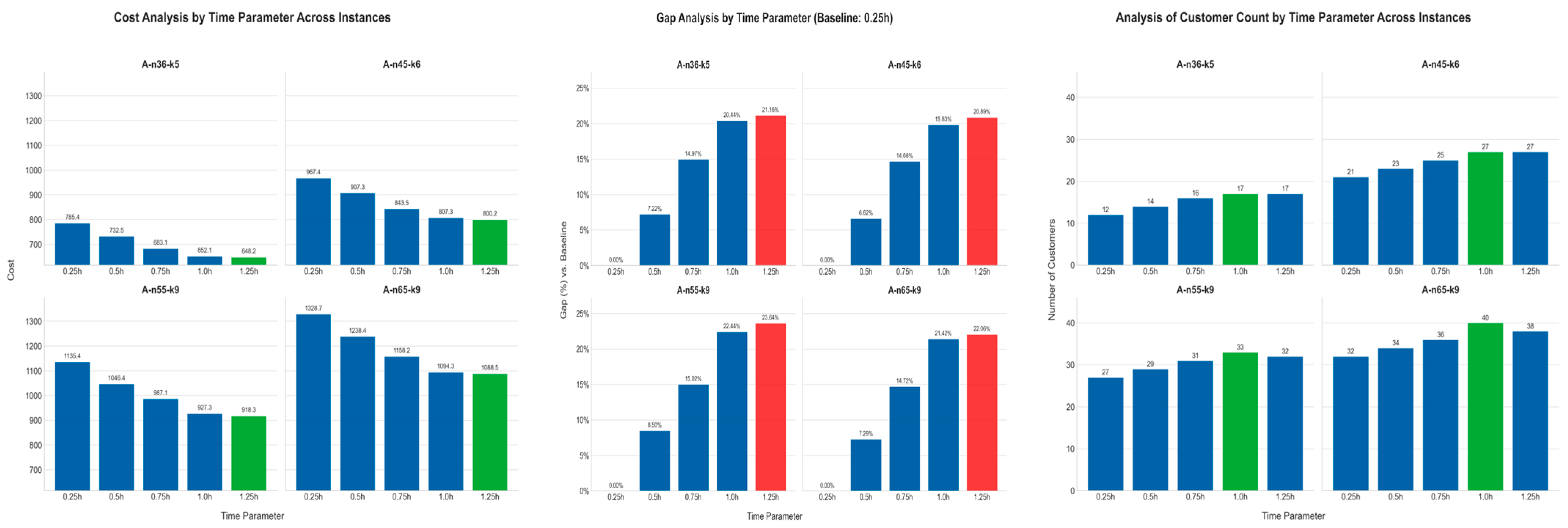
Figure 10 illustrates the impact of drone battery endurance. As drone battery endurance increases, the number of customers serve grows, as extended endurance allows for more customers per flight. However, once drone battery endurance exceeds 1 h, the total cost remains unchanged. In this scenario, the drone’s payload capacity becomes the primary limiting factor, even though its battery endurance is not fully depleted.
The diminishing returns observed in Figure 10 illustrate a classic ‘bottleneck shift’ phenomenon. Initially, at low endurance levels, the drone endurance constraint is the primary limiting factor for the system. As we relax this constraint by increasing the battery capacity, the system’s performance improves. However, once endurance reaches a sufficient level, it ceases to be the bottleneck. At this point, the drone’s maximum load capacity constraint becomes the new binding constraint, preventing the drone from serving more customers even with surplus flight time. This explains why the total cost plateaus beyond 1.0 h.

5.5.3. The Impact of Maximum Load Capacity of Drone

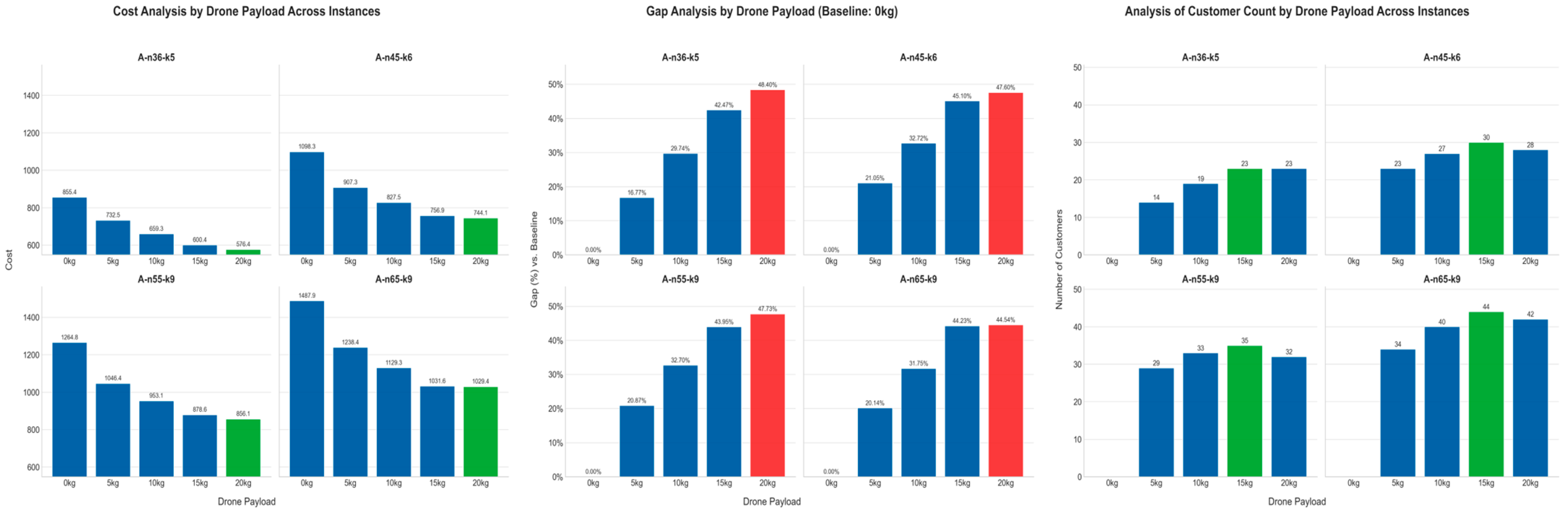
Figure 11 shows how increasing drone payload capacity affects delivery performance. As payload capacity grows, drones can serve more customers, which reduces total delivery cost, especially when the capacity reaches 10 kg. Increasing the payload further to 15 kg allows drones to take over deliveries that would otherwise require trucks, producing additional cost savings. Beyond this point, however, larger payloads do not always lead to lower costs, because drone endurance becomes the main constraint. This interaction between payload and endurance demonstrates the trade-offs that must be considered when designing an effective and balanced drone fleet.

5.6. Case Analysis

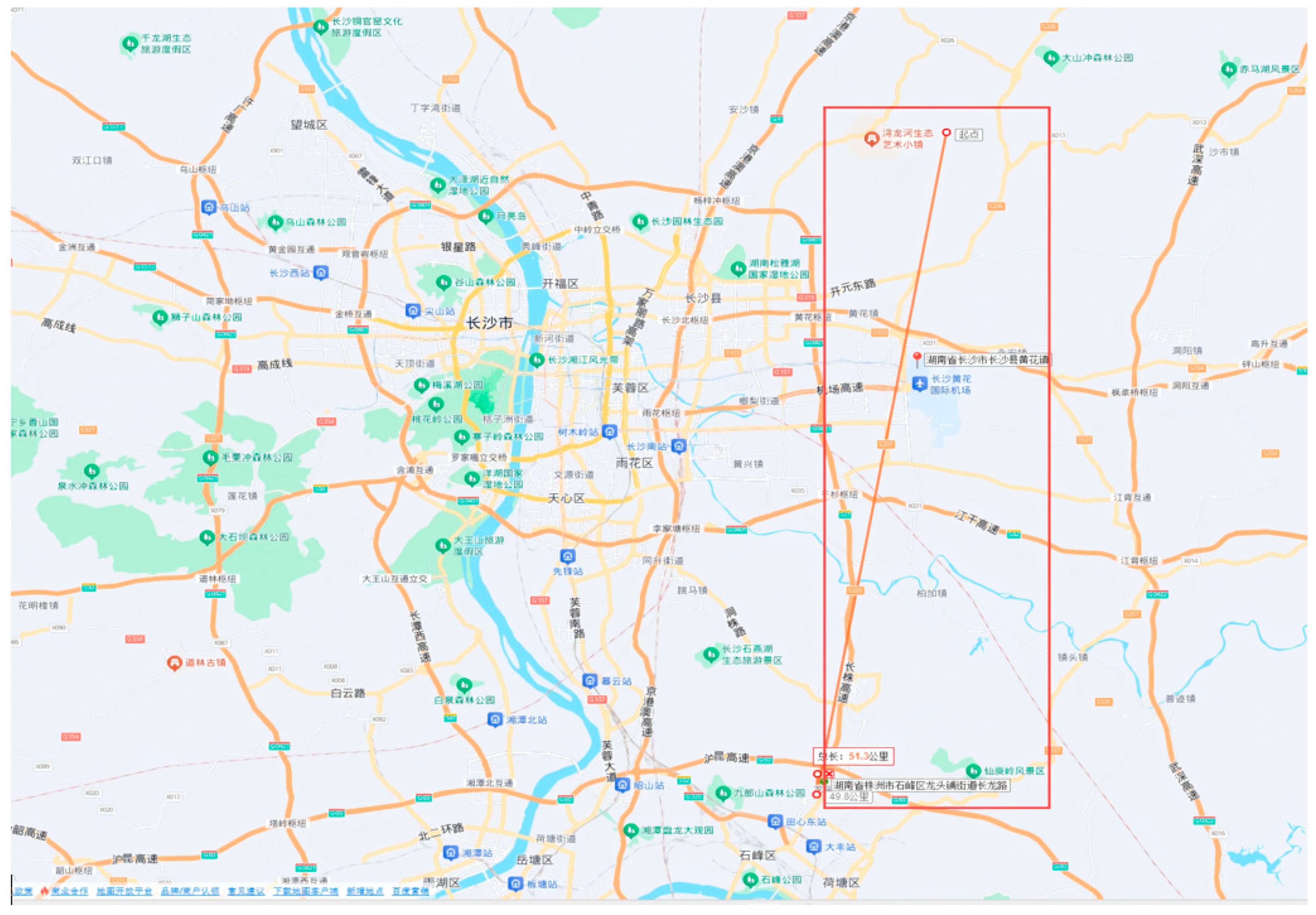
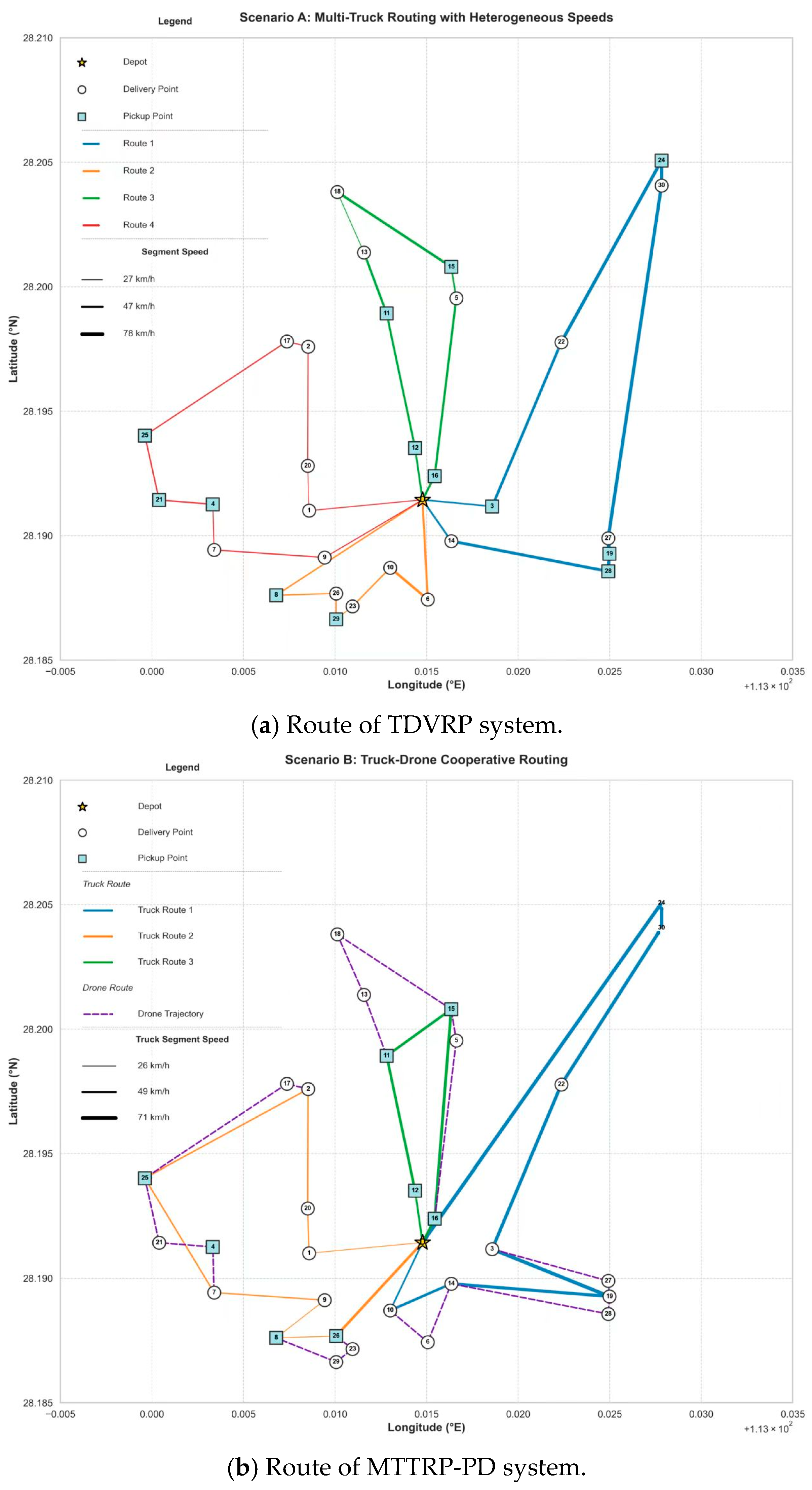
The real-life data from a logistic company in Changsha of China, encompassing 1 depot and 30 customers. The depot is strategically located near the Changsha Railway Station Business District (coordinates: 113.014781238307° E, 28.1914392693442° N), Customer nodes characteristics are presented in Table 8, with other parameters consistent with Section 5.1. The case targets mixed-order delivery scenarios during typical weekdays, categorizing customer nodes into two types: high-density clusters served by trucks through optimized routing, and dispersed customer locations served by point-to-point drone delivery. Under this configuration, drones handle 36% of delivery nodes while trucks service the remaining nodes. All node geographic coordinates were converted to a planar coordinate system using ArcGIS,10.8, with operations commencing at 8:00 a.m.
The operational feasibility of this study is supported by Hunan Province’s status as China’s first low-altitude airspace management reform pilot region, providing a compliant and implementable regulatory environment. According to Changsha’s airspace control maps Figure 12, both the selected UDH and its service coverage areas are situated outside restricted zones, ensuring flight safety and policy compliance. This study classifies the time-varying speeds on weekdays in its delivery area into three operational scenarios: first, peak hours (7:30–9:00 and 17:30–19:00), with an average truck speed of 26 km/h reflecting severe congestion; second, overnight low-traffic periods (22:00–5:00), with speeds increasing to 46 km/h; and third, urban expressway segments (e.g., Wanjiali Elevated Road, Xiangfu Road Elevated Road), maintaining speeds of 76 km/h, as illustrated in Figure 13. This spatiotemporally differentiated velocity parameterization accurately captures urban traffic dynamics, providing a robust simulation foundation for subsequent collaborative route optimization.
As shown in Table 9, the collaborative scheme achieved a 19.58% reduction in total cost and a 21.79% decrease in operational time compared with the traditional one. In the baseline scheme, the truck incurred a cost of 806.42 and required 3.6 units of delivery time, mainly because it was forced to travel through congested low-speed segments. In contrast, the truck–drone collaborative scheme mitigated this bottleneck through a spatiotemporal decoupling strategy. Spatially, the distribution network was divided into high-speed trunk routes handled by trucks and flexible terminal segments served by drones. Temporally, drones operated in parallel with trucks and were unaffected by ground traffic conditions, substantially reducing the overall task duration.
Figure 14 further illustrates the advantage of this cooperative structure. Under the traditional scheme, four trucks were required to construct long and overlapping routes to cover all customers. After introducing drones, the truck routes were reorganized into three main transportation corridors, resulting in a 36.72% reduction in total distance and a smaller fleet size, decreasing from four trucks to three. This improvement arises from the model’s ability to assign off-route deliveries to drones, thereby avoiding inefficient detours. For example, in the collaborative scheme, a truck launched a drone at Node 3 to serve Nodes 27 and 28 while it continued along the main corridor, effectively reducing time and distance losses caused by rerouting. The effectiveness of this coordination relies on the multi-visit capability of drones. In this case, each drone served an average of 1.4 customers per flight. A representative example is the drone launched from Node 15 that sequentially visited Nodes 18 and 13. Limiting drones to single-visit operations would require more takeoff and landing cycles, increasing both time costs and operational complexity.
In summary, both the quantitative evidence and route visualization confirm the effectiveness and practicality of the proposed MTTRP-PD model. By integrating the truck’s long-haul efficiency with the drone’s flexibility in last-mile delivery, the model achieves a high degree of spatial division and temporal parallelism. This cooperative framework offers a feasible and generalizable solution for optimizing urban logistics operations under time-dependent traffic conditions, providing new insights for resilient and efficient last-mile distribution systems.

6. Conclusions

This study addressed the optimization of truck–drone collaboration for simultaneous pickup and delivery in dynamic urban environments. We proposed the MTTRP-PD, integrating payload-dependent drone endurance and time-varying truck speeds into a unified framework. To solve this NP-hard problem, a scalable two-stage heuristic was developed and validated through extensive computational experiments. The results provide three key insights: (1) The proposed SH–ESA heuristic demonstrated strong practical performance, achieving an average cost reduction of 10.53% and more stable results compared to the standard simulated annealing benchmark across all test instances. (2) Multi-visit sortie and simultaneous pickup-and-delivery operations reduce costs and improve resource utilization. (3) Time-dependent traffic dynamics substantially affect system costs, fleet composition, and achievable savings. These findings underscore the importance of balancing drone endurance, payload constraints, and urban traffic variability in designing effective truck–drone systems.
From a managerial perspective, this study provides actionable insights for logistics firms and policymakers. The demonstrated cost advantages of multi-visit and dual-service drone operations indicate that investments in flexible drone technologies can generate substantial economic returns. The sensitivity analysis further highlights the necessity of accounting for traffic dynamics when determining fleet size and formulating delivery strategies, particularly in congested urban settings. Overall, the proposed framework offers a quantitative foundation for assessing trade-offs among efficiency, cost, and resilience, thereby supporting evidence-based decision making toward sustainable and adaptive urban logistics.
Despite these contributions, several limitations remain, offering promising avenues for future research. First, the model assumes deterministic traffic conditions, whereas urban logistics systems are inherently exposed to stochastic disruptions such as congestion, weather variability, and fluctuating demand. Incorporating robust or stochastic optimization techniques could better capture these dynamics and enhance system resilience. Second, certain operational and regulatory aspects are simplified, including fixed drone launch and retrieval times and the omission of no-fly zones or feasible landing constraints. Addressing these factors would improve the realism and practical applicability of the framework. Third, although the energy model considers payload effects, it omits aerodynamic influences such as wind resistance and vertical motion; integrating these aspects with learning-based coordination methods could strengthen real-time decision making. Moreover, the reported 19–40% cost reduction primarily reflects routing efficiency rather than total operational costs, which also depend on maintenance, battery degradation, and infrastructure investment. Finally, although the SH–ESA consistently outperformed the standard simulated annealing benchmark, its superiority was not statistically significant (p = 0.128); hence, further validation on larger and more diverse datasets is required to confirm its robustness and generalizability.

Author Contributions

Conceptualization, methodology, writing—review and editing, Q.X. Conceptualization, software, formal analysis, writing—original draft preparation, J.G. All authors have read and agreed to the published version of the manuscript.

Funding

This research was supported by the National Natural Science Foundation of China under grant number 72371206.

Data Availability Statement

The data used in this study were sourced from the publicly available databases cited in Augerat et al.’s article [52]. These datasets are publicly archived and can be accessed through the links provided in the original article. For further information, please contact the corresponding author.

Conflicts of Interest

The authors declare no conflicts of interest.

Abbreviations

AcronymsFull Name
MTTRP-PDMulti-Visit Time-Dependent Truck–drone Routing Problem with simultaneous Pickup and Delivery
TDVRPTime-Dependent Vehicle Routing Problem
FSTSPFlying Sidekick Traveling Salesman Problem
VRPVehicle Routing Problem
TSPTraveling Salesman Problem
TSP-DTraveling Salesman Problem with Drone
VRP-DVehicle Routing Problem with Drones
SH–ESAScanning Heuristic Insertion and Enhanced Simulated Annealing
SHScanning Heuristic Insertion
ESAEnhanced Simulated Annealing
SASimulated Annealing
RSregional setting

References

  1. Peng, X.; Zhang, L. A three-phase heuristic for last-mile delivery with spatial-temporal consolidation and delivery options. Int. J. Prod. Econ. 2023, 266, 109044. [Google Scholar] [CrossRef]
  2. Mohri, S.S.; Ghaderi, H.; Nassir, N.; Thompson, R.G. Crowdshipping for sustainable urban logistics: A systematic review of the literature. Transp. Res. E Logist. Transp. Rev. 2023, 178, 103289. [Google Scholar] [CrossRef]
  3. Rejeb, A.; Rejeb, K.; Simske, S.; Treiblmaier, H. Humanitarian drones: A review and research agenda. Internet Things 2021, 16, 100434. [Google Scholar] [CrossRef]
  4. Kirschstein, T. Comparison of energy demands of drone-based and ground-based parcel delivery services. Transp. Res. D Transp. Environ. 2020, 78, 102209. [Google Scholar] [CrossRef]
  5. Mohsan, S.A.H.; Khan, M.A.; Noor, F.; Ullah, I.; Alsharif, M.H. Towards the unmanned aerial vehicles (UAVs): A comprehensive review. Drones 2022, 6, 147. [Google Scholar] [CrossRef]
  6. Shi, Y.; Yang, J.H.; Han, Q.; Song, H.; Guo, H.X. Optimal decision-making of post-disaster emergency material scheduling based on helicopter–truck–drone collaboration. Omega 2024, 127, 103104. [Google Scholar] [CrossRef]
  7. Gayialis, S.P.; Kechagias, E.P.; Konstantakopoulos, G.D. A city logistics system for freight transportation: Integrating information technology and operational research. Oper. Res. 2022, 22, 5953–5982. [Google Scholar] [CrossRef]
  8. Khanchehzarrin, S.; Shahmizad, M.; Mahdavi, I.; Mahdavi-Amiri, N.; Ghasemi, P. A model for the time dependent vehicle routing problem with time windows under traffic conditions with intelligent travel times. Rairo Oper. Res. 2021, 55, 2203–2222. [Google Scholar] [CrossRef]
  9. Huang, Y.X.; Zhao, L.; Van Woensel, T.; Gross, J.P. Time-dependent vehicle routing problem with path flexibility. Transp. Res. Part B Meth. 2017, 95, 169–195. [Google Scholar] [CrossRef]
  10. Liu, C.S.; Kou, G.; Zhou, X.C.; Peng, Y.; Sheng, H.Y.; Alsaadi, F.E. Time-dependent vehicle routing problem with time windows of city logistics with a congestion avoidance approach. Knowl.-Based Syst. 2020, 188, 104813. [Google Scholar] [CrossRef]
  11. Norouzi, N.; Sadegh-Amalnick, M.; Tavakkoli-Moghaddam, R. Modified particle swarm optimization in a time-dependent vehicle routing problem: Minimizing fuel consumption. Optim. Lett. 2017, 11, 121–134. [Google Scholar] [CrossRef]
  12. Galvin, R. Energy consumption effects of speed and acceleration in electric vehicles: Laboratory case studies and implications for drivers and policymakers. Transp. Res. D Transp. Environ. 2017, 53, 234–248. [Google Scholar] [CrossRef]
  13. Zhang, Y.F.; Khani, A. An algorithm for reliable shortest path problem with travel time correlations. Transp. Res. Part B Meth. 2019, 121, 92–113. [Google Scholar] [CrossRef]
  14. Nadjafi, B.A.; Nadjafi, A.A. Multi-depot time dependent vehicle routing problem with heterogeneous fleet and time windows. Int. J. Oper. Res. 2016, 26, 88. [Google Scholar] [CrossRef]
  15. Karoonsoontawong, A.; Punyim, P.; Nueangnitnaraporn, W.; Ratanavaraha, V. Multi-trip time-dependent vehicle routing problem with soft time windows and over-time constraints. Netw. Spat. Econ. 2020, 20, 803–831. [Google Scholar] [CrossRef]
  16. Spliet, R.; Dabia, S.; Van Woensel, T. The time window assignment vehicle routing problem with time-dependent travel times. Transp. Sci. 2018, 52, 261–276. [Google Scholar] [CrossRef]
  17. Zhang, R.; Guo, J.; Wang, J. A Time-dependent electric vehicle routing problem with congestion tolls. IEEE Trans. Eng. Manag. 2020, 69, 861–873. [Google Scholar] [CrossRef]
  18. Victoria, J.F.; Afsar, H.M.; Prins, C. Column generation based heuristic for the vehicle routing problem with time-dependent demand. IFAC-Pap. Online 2016, 49, 526–531. [Google Scholar] [CrossRef]
  19. Rincon-Garcia, N.; Waterson, B.J.; Cherrett, T.J. A hybrid metaheuristic for the time-dependent vehicle routing problem with hard time windows. Int. J. Ind. Eng. Comp. 2017, 8, 141–160. [Google Scholar] [CrossRef]
  20. Murray, C.C.; Chu, A.G. The flying sidekick traveling salesman problem: Optimization of drone-assisted parcel delivery. Transp. Res. Part C Emerg. Technol. 2015, 54, 86–109. [Google Scholar] [CrossRef]
  21. Agatz, N.; Bouman, P.; Schmidt, M. Optimization approaches for the traveling salesman problem with drone. Transp. Sci. 2018, 52, 965–981. [Google Scholar] [CrossRef]
  22. Murray, C.C.; Raj, R. The multiple flying sidekicks traveling salesman problem: Parcel delivery with multiple drones. Transp. Res. Part C Emerg. Technol. 2020, 110, 368–398. [Google Scholar] [CrossRef]
  23. Moshref-Javadi, M.; Lee, S.; Winkenbach, M. Design and evaluation of a multi-trip delivery model with truck and drones. Transp. Res. E Logist. Transp. Rev. 2020, 136, 101887. [Google Scholar] [CrossRef]
  24. Pasha, J.; Elmi, Z.; Purkayastha, S.; Fathollahi-Fard, A.M.; Ge, Y.E.; Lau, Y.Y.; Dulebenets, M.A. The drone scheduling problem: A systematic state-of-the-art review. IEEE Trans. Intell. Transp. Syst. 2022, 23, 14224–14247. [Google Scholar] [CrossRef]
  25. Bruni, M.E.; Khodaparasti, S.; Perboli, G. Energy Efficient UAV-Based Last-Mile Delivery: A Tactical-Operational Model with Shared Depots and Non-Linear Energy Consumption. IEEE Access 2023, 11, 18560–18570. [Google Scholar] [CrossRef]
  26. Dukkanci, O.; Kara, B.Y.; Bekta, T. Minimizing energy and cost in range-limited drone deliveries with speed optimization. Transp. Res. Part C Emerg. Technol. 2021, 125, 102985. [Google Scholar] [CrossRef]
  27. Gao, J.J.; Guo, X.P. Collaborative routing optimization for heterogeneous trucks-drones under urban regional restrictions. Asia Pac. J. Oper. Res. 2025, 42, 2440016. [Google Scholar] [CrossRef]
  28. Luigi, D.P.P.; Guerriero, F.; Scutellá, M.G. The last-mile delivery process with trucks and drones under uncertain energy consumption. J. Optim. Theory Appl. 2021, 191, 31–67. [Google Scholar] [CrossRef]
  29. Wang, X.Y.; Poikonen, S.; Golden, B. The vehicle routing problem with drones: Several worst-case results. Optim. Lett. 2017, 11, 679–697. [Google Scholar] [CrossRef]
  30. Salama, M.R.; Srinivas, S. Collaborative truck multi-drone routing and scheduling problem: Package delivery with flexible launch and recovery sites. Transp. Res. E Logist. Transp. Rev. 2022, 164, 102788. [Google Scholar] [CrossRef]
  31. Villegas, G.; Rizzoli, A.E.; Vigo, D. Dynamic collaborative truck-drone delivery with en-route synchronization and random requests. Transp. Res. Part B Meth. 2020, 143, 102177. [Google Scholar] [CrossRef]
  32. Masmoudi, M.A.; Mancini, S.; Baldacci, R.; Kuo, Y.H. Vehicle routing problems with drones equipped with multi-package payload compartments. Transp. Res. E Logist. Transp. Rev. 2022, 164, 102757. [Google Scholar] [CrossRef]
  33. Thomas, T.; Srinivas, S.; Rajendran, C. Collaborative truck multi-drone delivery system considering drone scheduling and enroute operations. Ann. Oper. Res. 2024, 339, 693–739. [Google Scholar] [CrossRef]
  34. Fu, T.; Li, S.; Li, Z. Research on collaborative delivery path planning for trucks and drones in parcel delivery. Sensors 2025, 25, 3087. [Google Scholar] [CrossRef]
  35. Wang, Z.; Sheu, J.B. Vehicle routing problem with drones. Transp. Res. Part B Methodol. 2019, 122, 350–364. [Google Scholar] [CrossRef]
  36. Gu, R.; Poon, M.; Luo, Z.; Liu, Y.; Liu, Z. A hierarchical solution evaluation method and a hybrid algorithm for the vehicle routing problem with drones and multiple visits. Transp. Res. Part C Emerg. Technol. 2022, 141, 103733. [Google Scholar] [CrossRef]
  37. Luo, Z.; Gu, R.; Poon, M.; Liu, Z.; Lim, A. A last-mile drone-assisted one-to-one pickup and delivery problem with multi-visit drone trips. Comput. Oper. Res. 2022, 148, 106015. [Google Scholar] [CrossRef]
  38. Gao, J.; Zhen, L.; Wang, S. Multi-trucks-and-drones cooperative pickup and delivery problem. Transp. Res. Part C Emerg. Technol. 2023, 157, 104407. [Google Scholar] [CrossRef]
  39. Meng, S.; Guo, X.; Li, D.; Liu, G. The multi-visit drone routing problem for pickup and delivery services. Transp. Res. Part E Logist. Transp. Rev. 2023, 169, 102990. [Google Scholar] [CrossRef]
  40. Jiang, J.; Dai, Y.; Yang, F.; Ma, Z. A multi-visit flexible-docking vehicle routing problem with drones for simultaneous pickup and delivery services. Eur. J. Oper. Res. 2024, 312, 125–137. [Google Scholar] [CrossRef]
  41. Yin, Y.; Li, D.; Wang, D.; Ignatius, J.; Cheng, T.C.E.; Wang, S. A branch-and-price-and-cut algorithm for the truck-based drone delivery routing problem with time windows. Eur. J. Oper. Res. 2023, 309, 1125–1144. [Google Scholar] [CrossRef]
  42. Ren, X.X.; Fan, H.M.; Bao, M.X.; Fan, H. The time-dependent electric vehicle routing problem with drone and synchronized mobile battery swapping. Adv. Eng. Inf. 2023, 57, 102071. [Google Scholar] [CrossRef]
  43. Liu, Y.; Shi, J.; Luo, Z.; Hu, X.; Pedrycz, W.; Liu, Z. Cooperated truck-drone routing with drone energy consumption and time windows. IEEE Trans. Intell. Transp. Syst. 2024, 25, 20390–20404. [Google Scholar] [CrossRef]
  44. Meng, S.; Li, D.; Liu, J.; Chen, Y. The multi-visit drone-assisted routing problem with soft time windows and stochastic truck travel times. Transp. Res. Part B Methodol. 2024, 190, 103101. [Google Scholar] [CrossRef]
  45. Mulumba, T.; Diabat, A. Optimization of the drone-assisted pickup and delivery problem. Transp. Res. Part E Logist. Transp. Rev. 2024, 181, 103377. [Google Scholar] [CrossRef]
  46. Wang, Y.; Wang, Z.; Hu, X.; Xue, G.; Guan, X. Truck-drone hybrid routing problem with time-dependent road travel time. Transp. Res. Part C Emerg. Technol. 2022, 144, 103901. [Google Scholar] [CrossRef]
  47. Xing, J.; Su, L.; Hong, W.; Tong, L.; Lyu, R.; Du, W. Aerial-ground collaborative routing with time constraints. Chin. J. Aeronaut. 2023, 36, 270–283. [Google Scholar] [CrossRef]
  48. Peng, Y.; Ren, Z.; Yuc, D.Z.; Zhang, Y.H. Transportation and carbon emissions costs minimization for time-dependent vehicle routing problem with drones. Comput. Oper. Res. 2025, 176, 106963. [Google Scholar] [CrossRef]
  49. Duan, H.; Li, X.L.; Zhang, G.H.; Feng, Y.X.; Lu, Q.C. Elite-based multi-objective improved iterative local search algorithm for time-dependent vehicle-drone collaborative routing problem with simultaneous pickup and delivery. Eng. Appl. Artif. Intel. 2025, 139, 109608. [Google Scholar] [CrossRef]
  50. Fan, H.; Zhang, Y.G.; Tian, P.J.; Lv, Y.C.; Fan, H. Time-dependent multi-depot green vehicle routing problem with time windows considering temporal-spatial distance. Comput. Oper. Res. 2021, 129, 105211. [Google Scholar] [CrossRef]
  51. Zhang, S.; Liu, S.L.; Xu, W.B.; Wang, W.R. A novel multi-objective optimization model for the vehicle routing problem with drone delivery and dynamic flight endurance. Comput. Ind. Eng. 2022, 173, 108679. [Google Scholar] [CrossRef]
  52. Augerat, P.; Naddef, D.; Belenguer, J.M.; Benavent, E.; Corberan, A. Computational results with a branch and cut code for the capacitated vehicle routing problem. Rapp. Rech. IMAG 1995, 495, 1–30. [Google Scholar]
  53. Stolaroff, J.K.; Samaras, C.; O’Neill, E.R.; Lubers, A.; Mitchell, A.S.; Ceperley, D. Energy use and life cycle greenhouse gas emissions of drones for commercial package delivery. Nat. Commun. 2018, 9, 409. [Google Scholar] [CrossRef]
Figure 1. Example of MTTRP-PD.
Drones 09 00782 g001
Figure 2. Time-dependent function of vehicle speed.
Drones 09 00782 g002
Figure 3. Example of relocation operator.
Drones 09 00782 g003
Figure 4. Example of exchange operator.
Drones 09 00782 g004
Figure 5. Example of remove–reinsert operator.
Drones 09 00782 g005
Figure 6. Best cost and average cost of the heuristics.
Drones 09 00782 g006
Figure 7. Standard deviation of SH–ESA and SA.
Drones 09 00782 g007
Figure 8. SH–ESA and no-RS result comparisons for computational time and solutions.
Drones 09 00782 g008
Figure 9. Impact of the different truck speeds.
Drones 09 00782 g009
Figure 10. Impact of maximum battery capacity of drone.
Drones 09 00782 g010
Figure 11. Impact of maximum load capacity of drone.
Drones 09 00782 g011
Figure 12. Schematic diagram of the no-fly zone in Changsha.
Drones 09 00782 g012
Figure 13. Weekday vehicle speed in the study’s delivery area.
Drones 09 00782 g013
Figure 14. Route comparison of TDVRP and MTTRP-PD systems.
Drones 09 00782 g014
Table 1. Summary of the most related studies and current work.
ReferenceConsiderationsMethod
VehicleDroneMulti-
Visit
Pickup–
Delivery
Time-
Dependent
Vehicle SpeedObjectiveSolution Approach
[29]nm×××constantsingleheuristic
[30]n1×××constantsinglemeta-heuristic
[31]n1×××constantsinglemeta-heuristic
[32]11××constantsinglemeta-heuristic
[33]nm×××constantmultiplemeta-heuristic
[34]nm×××constantsinglemeta-heuristic
[35]nm×××constantsingleexact method
[36]n1××constantsinglemeta-heuristic
[37]n1×constantsinglemeta-heuristic
[38]nm×constantsingleheuristic
[39]n1×constantsinglemeta-heuristic
[40]nm×constantsinglemeta-heuristic
[41]n1××constantsingleexact method
[42]n1×piecewise functionsinglemeta-heuristic
[43]n1××constantsinglemeta-heuristic
[44]n1××constantsinglemeta-heuristic
[45]n1××constantsinglemeta-heuristic
[46]n1××piecewise functionsinglemeta-heuristic
[47]nm××piecewise functionsinglemeta-heuristic
[48]n1××piecewise functionsinglemeta-heuristic
[49]n1piecewise functionmultiplemeta-heuristic
Current workn1continuous functionsinglemeta-heuristic
Note: “✓” indicates this factor is considered in the paper; “×” indicates it is not.
Table 2. Notation in the mathematical model.
NotationDescription
Sets:
C The set of nodes representing all customers, N = { 1 , 2 , , n }
C 0 The set of customer nodes including the start depot, 0 ( s ) , C 0 = C { 0 ( s ) }
C + The set of customer nodes including the ending depot, 0 ( r ) , C + = C { 0 ( r ) }
N The set of all nodes, N = { 0 ( s ) } C { 0 { r } } , where 0 ( s ) and 0 { r } correspond to the same depot, denoting the starting depot and ending depot
A The set of all arcs, A = { ( i , j ) | i C 0 , j C + , i j }
K The set of homogeneous trucks/drones K = { 1 , 2 , , a }
Parameters:
Q T Load capacity of trucks (unit: kg)
Q U Load capacity of drones (unit: kg)
W T Tare (empty) weight of trucks
W U Tare (empty) weight of drones
q i Demand of customer i C (unit: kg)
p i Pickup demand of customer i C (unit: kg)
E Maximum endurance of empty drone
M A large of positive number
d i j T Euclidean distance for the truck to travel from node i to node j
d i j U Manhattan distance for the drone to flight from node i to node j
f d i u , g d i u The delivery and pickup load of drone u when it arrives at node i
f d i u + , g d i u + The delivery and pickup load of drone u when it leaves at node i
F D i k , G D i k The delivery and pickup load of truck k when it arrives at node i
F D i u + , G D i u + The delivery and pickup load of truck k when it leaves at node i
t t i k , d t i k The arrival time of truck k and of drone k at node i, respectively
τ t i j k , τ d i j k The travel time of truck k and of drone k from node i to node j
S L , S R The time required for the launch/reception of drones
Decision variable:
x i j k { 0 , 1 } Equal to 1 if the truck k travels along the arc ( i , j ) A , and otherwise 0
y i j k { 0 , 1 } Equal to 1 if the drone k travels along the arc ( i , j ) A , and otherwise 0
y t i k { 0 , 1 } Equal to 1 if a truck k serves customer i , and otherwise 0
y d i k { 0 , 1 } Equal to 1 if a drone k serves customer i , and otherwise 0
u p i Which used to eliminate the sub-route constraints in VRP
l a i k { 0 , 1 } Equal to 1 if the drone k can be launched from customer i, and otherwise 0
z d i 1 & z d i 2 { 0 , 1 } Equal to 1 if any drone arc departs from node i or enters node i, and otherwise 0
Table 3. Parameter setting of the MTTRP-PD.
ParameterNotationNumber ValueReference
Tare weight of trucks W T 150 kg[31]
Maximum load capacity of trucks Q T 100 kg
Tare weight of drones W U D 25 kg[44]
Maximum load capacity of drones Q U D 5 kg
The drone launch/recovery timeSL/SR2/min[47]
Maximum endurance of empty drones E 0.5/h[44]
Transportation cost per truck unit distance c 1 $1.5/km[48]
Travel cost of drone c 2 $0.3/km
Fixed costs of each truck c 3 $200
Fixed cost of each drone c 4 $30
Table 4. Result of small-scale instances.
InstanceCPLEXSH–ESA
Lower
Bound
Upper
Bound
GapTime [s]Average
Objective
Best
Objective
B e s t G a p Re G a p Time [s]
A1-n8-k2333.4334.20.23490.6335.6335.30.560.0821.91
A2-n8-k2341.3342.50.35434.2344.5344.20.840.0822.22
A3-n8-k2356.1358.70.73483.5359.4359.10.850.0823.83
B1-n8-k2403.7406.80.76507.9408.7408.41.160.0724.09
B2-n8-k2387.3390.40.80518.7394.1393.81.670.0723.65
B3-n8-k2408.4410.70.56508.3410.6409.50.260.2625.15
P-n8-k2426.8430.60.89562.4428.3427.60.180.1726.08
P-n8-k3447.9451.30.75558.2456.1455.71.740.0827.19
P-n16-k8498.3503.91.12692.7498.1497.6−0.14−0.1428.63
P-n19-k2525.8545.63.76734.6527.1526.50.130.1129.19
P-n20-k2538.1569.95.91785.3540.2539.70.290.0929.93
P-n21-k2559.5615.910.08943.6550.3549.7−1.750.130.74
P-n22-k2573.3639.611.561098.3563.4562.6−1.860.1431.71
p-n23-k8624.1709.413.671839.9600.9600.2−3.820.1131.92
Table 5. Result of large-scale instance.
InstancesSH–ESASA
Average
Objective
Best
Objective
Standard
Deviation
Average
Objective
Best
Objective
Standard
Deviation
Gap1Gap2
A-n32-k5675.3672.11.79729.2718.53.86.90%7.98%
A-n33-k5632.1628.53.6678.9670.15.86.61%7.40%
A-n34-k5685.9679.84.2740.1734.83.88.09%7.90%
A-n36-k5732.5727.93.2789.3780.65.17.24%7.75%
A-n37-k5754.3748.74.02838.3829.65.0610.80%11.13%
A-n38-k5778.1772.43.51862.9853.58.9410.49%10.89%
A-n39-k6813.1808.44.99887.4878.27.268.63%9.13%
A-n44-k6879.9874.24.74929.3921.65.405.42%5.61%
A-n45-k6907.3899.85.62957.3947.46.735.29%5.51%
A-n48-k7941.6937.52.681068.51060.14.3513.07%13.47%
A-n53-k7995.7990.23.141120.61116.53.1512.75%12.54%
A-n54-k71025.51022.81.721148.51141.94.3311.64%11.99%
A-n55-k91046.41041.72.601196.81191.35.1414.36%14.38%
A-n62-k81151.21146.32.521308.71300.44.013.44%13.68%
A-n63-k101185.91179.12.691347.51338.95.5913.50%13.62%
A-n65-k91238.41233.93.251399.41389.54.3812.61%13.00%
A-n69-k91306.51301.72.61477.81469.34.4512.87%13.11%
Mean926.45921.473.341028.261020.125.1310.21%10.53%
Table 6. Best results of two modes for set A.
Instance U D / K Multi-Visit DroneSingle-Visit Drone
n u d C v [ $ ] R [ k m ] n u d C v [ $ ] R [ k m ] Δ n u d % Δ C V % Δ R %
A-n32-k5310390.3100.44443.9136.5−60.0013.7335.95
A-n33-k5313347.189.56405.7108.7−53.8416.8821.45
A-n34-k5311400.9113.85467.5157.9−54.5416.6138.75
A-n36-k5312447.5139.64501.6188.3−66.6611.3234.88
A-n37-k5315469.3153.78549.8220.9−46.6617.1143.72
A-n38-k5317493.1180.49580.6265.8−47.0517.7447.33
A-n39-k6316528.1203.87619.3299.2−56.2517.2646.80
A-n44-k6422499.9186.310589.1271.7−54.5417.8445.84
A-n45-k6421527.3235.111625.4308.5−47.6118.6031.22
A-n48-k7423561.6250.312668.1351.5−47.8218.9640.43
A-n53-k7528520.7228.514618.7301.9−50.0018.8232.12
A-n54-k7529550.5247.215673.8364.2−48.2722.3947.33
A-n55-k9527571.4271.913703.6395.3−51.8523.1345.38
A-n62-k8636581.2265.419727.4429.5−47.2225.1561.83
A-n63-k10634615.9284.917786.4463.1−50.0027.6862.54
A-n65-k9632668.4311.515831.9507.5−53.1224.4662.92
A-n69-k9630736.5330.612871.2561.3−60.0018.2969.78
Table 7. Best results of two modes at different pick levels.
Instance P i c k % Pickup–Delivery ModeDelivery Mode
n u d C v [ $ ] R [ k m ] n u d C v [ $ ] R [ k m ] Δ n u d % Δ C V % Δ R %
A-n36-k510%13428.6127.58484.9169.8−38.4613.1333.17
25%12439.7132.67518.1188.7−41.6617.8342.30
40%12446.9133.97519.6189.6−41.6616.2641.59
55%12450.3134.65548.7216.5−58.3321.8560.84
70%12458.1136.82589.2259.8−83.3328.6189.91
A-n45-k610%23461.7239.713639.7326.5−43.4738.5536.21
25%21472.8243.210689.5368.3−52.3845.8351.43
40%22468.3238.58718.6392.7−63.6353.4464.65
55%20493.7262.36759.1431.8−70.0053.7564.62
70%22528.6294.44800.3503.7−81.8151.3471.09
A-n55-k910%30548.2258.916703.2408.5−46.6628.2757.78
25%27570.1281.413753.9442.9−51.8532.2357.39
40%27579.7286.19820.3493.5−66.6638.3872.49
55%28562.9277.310849.3521.4−64.2850.878.02
70%25621.9311.87899.4571.9−72.0044.6278.39
A-n65-k910%35648.1286.518908.6590.4−48.5740.19106.07
25%33630.9278.315944.5638.5−54.5449.70129.42
40%36620.5261.713969.3664.1−63.8856.12153.76
55%35668.2309.3121004.6689.3−65.7150.34122.85
70%30699.4328.581197.5759.5−80.0071.21131.20
Table 8. Parameters of the 30 nodes case in Changsha city.
IDLongitudeLatitudeDeliveryPickupIDLongitudeLatitudeDeliveryPickup
1113.008581928.1910046910 16113.015448928.19239431 8.8
2113.008534228.197590072 17113.007372028.197802021.7
3113.018586128.1911759711 18113.010125728.203808011.2
4113.003331328.19125859 1.719113.024993228.189270259.3
5113.016623028.199536002.2 20113.008511228.1928058822.6
6113.015069628.187435642.1 21113.022360228.191432981.5
7113.003398928.1894270512 22113.022360228.1977739212.7
8113.007067528.18788799 8.623113.010359928.187159361.5
9113.009158028.1888420215 24113.027833928.2045669216.4
10113.013018128.1887097417.1 25112.999616428.19402037 11.3
11113.012823028.19892437 1326113.010359828.18715936 12.4
12113.014376928.19352086 1427113.024919128.189894832.8
13113.011585128.20137429 1.828113.024923328.188565752.2
14113.016350028.189782927.9 29113.010359928.187159361.3
15113.001602428.20079642 6.430113.027833928.204566925.8
Table 9. Cost comparison of TDVRP and MTTRP-PD system.
Delivery ModelTotal CostTrucks DeployedTruck DistanceDelivery TimeCdrone
Truck806.424152.53.60
Truck–drone648.1396.52.111
Disclaimer/Publisher’s Note: The statements, opinions and data contained in all publications are solely those of the individual author(s) and contributor(s) and not of MDPI and/or the editor(s). MDPI and/or the editor(s) disclaim responsibility for any injury to people or property resulting from any ideas, methods, instructions or products referred to in the content.