
Article

Safety-Critical Fixed-Time Formation Control of Quadrotor UAVs with Disturbance Based on Robust Control Barrier Functions

by
Zilong Song
2 and
Haocai Huang
1,2,3,4,*
1
Donghai Laboratory, Zhoushan 316021, China
2
Ocean College, Zhejiang University, Hangzhou 310058, China
3
Laboratory for Marine Geology, Qingdao Marine Science and Technology Center, Qingdao 266061, China
4
Hainan Institute of Zhejiang University, Sanya 572025, China
*
Author to whom correspondence should be addressed.
Drones 2024, 8(11), 618; https://doi.org/10.3390/drones8110618
Submission received: 1 August 2024 / Revised: 10 October 2024 / Accepted: 17 October 2024 / Published: 28 October 2024
(This article belongs to the Special Issue Flight Control and Collision Avoidance of UAVs)

Abstract

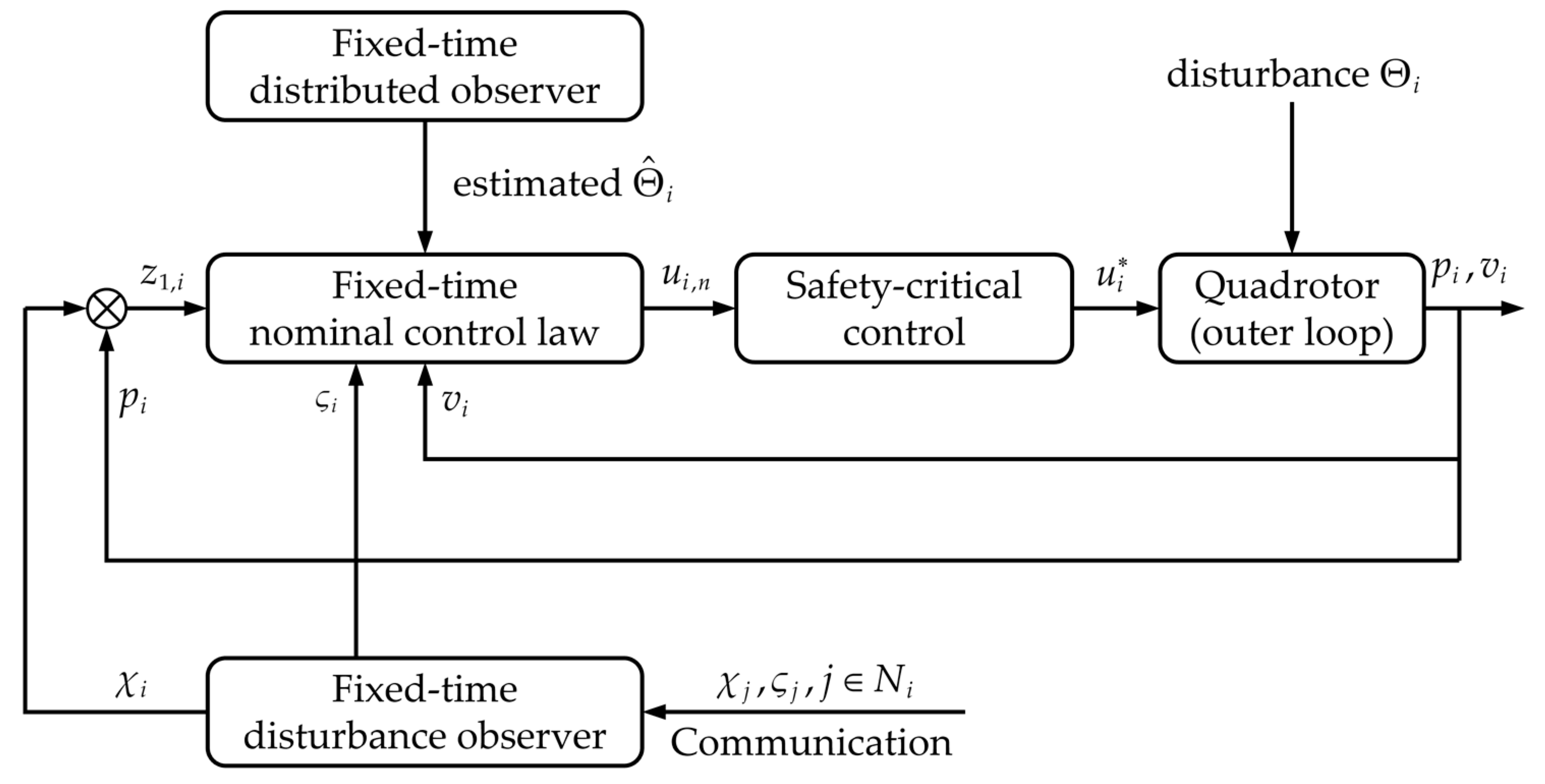
This paper focuses on the safety-critical fixed-time formation control of quadrotor UAVs with disturbance and obstacle collision risk. The control scheme is organized in a distributed manner, with the leader’s position and velocity being estimated simultaneously by a fixed-time distributed observer. Meanwhile, a disturbance observer that combines fixed-time control theory and sliding mode control is designed to estimate the external disturbance. Based on these techniques, we design a nominal control law to drive UAVs to track the desired formation in a fixed time. Regarding obstacle avoidance, we first construct safety constraints using control barrier functions (CBFs). Then, obstacle avoidance can be achieved by solving an optimization problem with these safety constraints, thus minimally affecting tracking performance. The main contributions of this process are twofold. First, an exponential CBF is provided to deal with the UAV model with a high relative degree. Moreover, a robust exponential CBF is designed for UAVs with disturbance, which provides robust safety constraints to ensure obstacle avoidance despite disturbance. Finally, simulation results show the validity of the proposed method.
Keywords: formation control; fixed-time control; control barrier functions; safety-critical control; obstacle avoidance; quadrotor UAVs formation control; fixed-time control; control barrier functions; safety-critical control; obstacle avoidance; quadrotor UAVs