
Article

HCLOD-Net: Hierarchical Contrastive Learning Guided Object Detection Network for Low-Light UAV Conditions

1
Engineering Technology Training Center, Civil Aviation Flight University of China, Guanghan 618307, China
2
College of Aviation Electronic and Electrical Engineering, Civil Aviation Flight University of China, Chengdu 641419, China
3
School of Computing and Artificial Intelligence, Civil Aviation Flight University of China, Guanghan 618307, China
*
Author to whom correspondence should be addressed.
Drones 2026, 10(8), 592; https://doi.org/10.3390/drones10080592
Submission received: 10 June 2026 / Revised: 30 July 2026 / Accepted: 30 July 2026 / Published: 2 August 2026

Highlights

What are the main findings?
  • The proposed HCLOD-Net, which integrates Hierarchical Contrastive Learning (HCL) training with a modified YOLOv11 detector, an innovative object detection architecture tailored for low-light UAV applications.
  • The HCL optimizes feature space distribution with zero additional inference computational cost and improves feature discriminability; FGDA (Frequency Guided Dynamic Attention) enhances focus on key features through frequency decoupling and multiscale dilated convolutions; and AGDSF (Adaptive Gated Dual-Spatial Fusion) filters background interference through channel gating and adaptive resolution strategies, improving precision.
What are the implications of the main findings?
  • The HCLOD-Net architecture demonstrates that hierarchical contrastive learning and object detection can be effectively integrated, enhancing feature robustness without additional inference costs and thereby improving detection accuracy. This provides a viable technical pathway for deploying robust detection on resource-constrained UAV edge devices that require real-time performance.
  • The ablation experiments demonstrate that the proposed method achieves effective collaboration among modules under various low-light conditions, showing consistent performance improvements across the two evaluated low-light UAV datasets and confirming its application potential across diverse scenarios.

Abstract

To address the performance degradation of UAV object detection under low-light conditions, we develop an end-to-end object detection network. This proposed method integrates contrastive learning into the detection framework and establishes feature consistency constraints between low-light and normal-light images through a hierarchical contrastive selection encoder. Since the encoder is required only during training and removed during inference, the proposed framework improves feature robustness without introducing additional inference cost. To further improve object detection accuracy, Frequency Guided Dynamic Attention (FGDA) is introduced into the object detection network, focusing on resolving the issue of redundant interference during feature transmission and enhancing feature representation capability. To improve multi-level spatial feature fusion, an Adaptive Gated Dual-Spatial Fusion (AGDSF) module is further developed, which adaptively strengthens target-relevant responses while weakening background noise. According to the experiments on the VisDrone (dark) dataset and a self-collected nighttime UAV-dark dataset illustrate that the proposed method ensures heightened detection accuracy with low computational overhead, complying with the real-time and robustness requirements of UAV perception in low-light contexts.

1. Introduction

The widespread adoption of UAVs in public security inspection [1], disaster rescue [2], night monitoring [3], and border patrol [4] is fueled by their rapid evolution. Among these, detecting objects under insufficient lighting has become a core technical bottleneck restricting UAVs from performing tasks autonomously around the clock. In complex environments like dusk, night, or under poor lighting conditions [5], images captured by UAVs are often accompanied by severe issues such as color shift, sharp contrast drop, and loss of high-frequency details [6,7]. This significant decline in signal-to-noise ratio owing to lighting degradation submerges the target’s texture features in noise and blurs semantic information [8], greatly increasing the difficulty of object detection. Concurrently, challenges such as the UAV platform’s dynamic flight attitudes, varying shooting angles, and significant discrepancies in target scales further aggravate the challenge of the detection task. Therefore, achieving robust and high precision object detection under poor lighting conditions has emerged as a pivotal and pressing issue in the realm of modern computer vision.
Currently, investigations into UAV object detection in low-light environments can be broadly divided into two categories: The first is the cascaded paradigm combining image enhancement with object detection [9,10]. This approach first utilizes various image enhancement methods [11,12,13] to improve image brightness and contrast. Then, the enhanced images are input into a one-stage object detection network [14,15,16] or a two-stage object detection network [17,18,19] to improve the detection performance. Although the aforementioned cascaded methods improve image quality before detection, this cascaded paradigm has inherent defects. First, the independent training of the enhancement network and the detection network separately leads to a significant increase in the model’s parameter quantity and computational load, making it difficult to meet the real-time requirements of UAVs. Second, the enhancement process often introduces uncontrollable artifacts or amplifies background noise, and these visual defects are transmitted to the downstream detector, causing errors to continuously accumulate and amplify. Finally, there is a semantic gap between enhancement indices including PSNR and SSIM [20] and the actual requirements for detection missions; an excellent enhancement effect does not necessarily guarantee good detection performance.Therefore, some researchers have proposed directly training detection networks on low-light datasets, leading to the second paradigm: end-to-end detection fine-tuning. For example, Zhang et al. [21] incorporated deformable convolutions and a bidirectional feature pyramid mechanism into YOLOv8. This strategy substantially bolsters the model’s representational capacity regarding target deformation and features across various scales, thus markedly curtailing instances of missed and false detections. The 3L-YOLO model proposed by Han et al. [22] adopts a dynamic detection head with multiscale aggregation to improve detection performance without additional image enhancement, but it performs poorly on small objects. Although these methods have achieved some progress, low-illumination drone target recognition still faces barriers such as suboptimal detection accuracy, high computational complexity, and low inference speed, making them incompatible with the limited computational resources and real-time operational demands of UAV edge devices. Consequently, recent studies have attempted to enhance low-light detection performance by embedding illumination enhancement modules and feature decoupling. For instance, Cui et al. [23] devised MAET, an architecture that captures the intrinsic visual layout of images. This is achieved by reconstructing physical noise and image signals through a self-supervised paradigm, enabling the detection task via the interpretation of bounding box coordinates and categories. Lin et al. [24] proposed SCDet, which decouples the discriminative representations of images in low-light environments through supervised contrastive learning, thereby realizing dark object detection.
However, methods such as MAET and SCDet still heavily rely on a large amount of precisely annotated data, while the cost of obtaining high-quality annotated data in low-light scenarios is extremely high, which further limits the generalization ability of deep learning detection models. Therefore, on the premise of ensuring detection performance, improving the utilization efficiency of models for limited training data has become an important research direction in the field of visual detection. Relevant articles [25,26,27,28,29,30] conducted research from aspects such as data-efficient learning, optimization of image processing efficiency, and feature representation learning, and maintained good target detection performance while reducing the demand for training data. These studies show that learning robust feature representations can effectively reduce the dependence of models on large-scale annotated data and provide new research ideas for target detection in complex environments. However, the above research mainly focuses on multi-spectral images or general visual tasks, and still lacks targeted research on the problems of feature distortion and sample scarcity caused by illumination degradation in low-light UAV target detection.
In recent years, contrastive learning has made remarkable progress in the field of visual representation learning due to its ability to fully mine discriminative information from unlabeled or weakly labeled data. Representative instance level contrastive learning methods, such as MoCo [31] and SimCLR [32], learn feature representations with illumination robustness by constructing positive and negative sample pairs. Furthermore, PCL [33] introduces clustering prototypes as semantic constraints to improve the clustering ability of the feature space; HCSC [34] constructs a hierarchical prototype structure and imposes contrastive constraints at multiple semantic levels, further enhancing the feature representation ability. In addition, Domain Contrast [35] and SeaDAT [36] respectively verify the effectiveness of contrastive learning in domain-adaptive object detection and multimodal semantic alignment. These studies provide an important foundation for instance-level and prototype-level feature learning. However, existing contrastive learning methods mainly focus on general image representation learning or domain adaptation tasks. Their goal is usually to learn visual representations with good generalization ability, and they rarely consider the problem of false negative samples caused by illumination degradation, enhanced background noise, and category confusion in low-light UAV object detection, nor do they have a joint optimization mechanism closely integrated with the object detection task. Therefore, how to design a contrastive learning strategy suitable for low-light UAV scenarios and enable it to be co-optimized with the object detection network is still a problem worthy of further research.
In view of the identified limitations, this paper develops a Hierarchical Contrastive Learning Object detection Architecture termed HCLOD-Net aimed at low-light UAV object detection. Without increasing the model size during inference, this framework provides a novel end-to-end detection approach to alleviate sample scarcity and low detection accuracy in low-light conditions. Specifically, we construct an Instance and Prototype dual-driven Hierarchical Contrastive Learning (HCL) mechanism. Building upon traditional instance contrast, it innovatively introduces prototype contrastive constraints. By constructing a hierarchical prototype space through online clustering, it utilizes prototype distribution priors to guide feature aggregation. This mechanism not only effectively suppresses the difficulty of traditional image-level contrast in capturing the detail features of local targets, leading to poor adaptability of training features to the detection head, but also avoids the semantic differences caused by the nonlinear attenuation of low-light and spatial noise, forming false negative samples and thus damaging the feature compactness. However, directly applying this hierarchical contrastive learning mechanism to low-light detection tasks not only suffers from insufficient discriminability but also risks falling into the common collapse solutions in contrastive learning. To address this, we introduce the single-stage object detection network YOLOv11 for joint optimization. Aiming at the problem that in low-light environments, the shallow texture features of the YOLOv11 detector are lost and the deep semantic information is blurred, making it difficult for conventional feature fusion paths to effectively distinguish between targets and backgrounds. This paper makes targeted modifications to the Backbone and Neck parts of YOLOv11 and proposes the Frequency Guided Dynamic Attention (FGDA) and Adaptive Gated Dual Spatial Fusion (AGDSF) modules. The embedding of these two modules effectively compensates for the deficiencies of the model in low-light feature expression. Working together with the pre-placed hierarchical contrast training features, it ultimately improves the detection accuracy and robustness in low-light UAV scenarios.
The key contributions of this study are delineated below.
1.
This paper introduces HCLOD-Net, an innovative object detection architecture tailored for low-light UAV applications. Without enlarging the model’s size during inference, we develop an integrated end-to-end detection pipeline that simultaneously refines Hierarchical Contrastive Learning (HCL) and YOLOv11. Specifically, HCL provides robust feature representations for downstream object detection, while the YOLOv11 detection objective guides HCL to learn more discriminative representations through joint optimization. This joint optimization prevents the representation collapse common in contrastive learning and tailors the features to detection requirements, thereby effectively alleviating the dilemma of sample scarcity and insufficient detection precision in low-light settings.
2.
A Frequency Guided Dynamic Attention (FGDA) module is proposed. Through the synergistic fusion of frequency decoupling alongside multiscale dilated convolutions, the framework distills features into their underlying low-frequency and high-frequency constituents. By unifying channel and dynamic spatial attentions, the defects of noise amplification and fixed receptive fields in the backbone network under low-light conditions are effectively overcome.
3.
An Adaptive Gated Dual-Spatial Fusion (AGDSF) module is designed. A front-end channel-gating mechanism is utilized to focus on key features. Combined with symmetric dual-space branches and an adaptive resolution projection strategy, the computational cost incurred by the self-attention mechanism is significantly reduced, while efficient feature fusion for high resolution inputs is guaranteed.
4.
A real-world low-light UAV dataset named UAV-dark is constructed. To address the scarcity of existing data, a dataset comprising 5690 images across five object categories is collected and annotated, providing a new benchmark for low-light UAV object detection research.

2. Materials and Methods

2.1. Materials

Datasets

The VisDrone dataset [37], a sizable publicly available UAV image repository developed by researchers from Tianjin University and others, boasts a wide range of image resolutions and numerous categories. Specifically, these categories include 12 classes of interest, ranging from motorcycles to awning-tricycles. Data partitioning is conducted as follows: 6471 samples are allocated for training, 548 for validation, and 1610 for testing. Motivated by reference [38], we carefully curated nighttime images and their corresponding annotations to establish the VisDrone (dark) subset, which includes 2023 training samples and 56 test samples.
This paper constructs a low-light drone perspective dataset named UAV-dark. The dataset was acquired using a DJI Mavic 4 Pro UAV equipped with a Hasselblad camera system at flight altitudes ranging from 20 m to 50 m. Data collection was conducted over roads, intersections, and public areas under different nighttime illumination conditions. The captured images exhibit diverse viewpoints, target distances, and illumination variations. All images were manually annotated according to the standard object detection annotation format. A total of 5690 qualified images were collected and randomly divided into training and testing sets at an approximate ratio of 8:2, resulting in 4352 training images and 1340 testing images. The dataset contains five object categories, namely car, motor, truck, van, and person. Sample images from the UAV-dark dataset are shown in Figure 1, and the number of samples in each category is presented in Table 1.
Table 1 presents the category distribution of the UAV-dark dataset. From the distribution, the dataset exhibits inter-class imbalance, which accurately reflects the target distribution patterns in real-world traffic monitoring scenarios. A total of 12,470 object instances in the dataset are annotated into five major categories. Among them, the “car” category contains the largest number of instances, totaling 6813, which accounts for 54.64% of the total instances. In contrast, the “van” category has the fewest instances, with only 917, accounting for 7.35% of the total annotations, whereas the “motor” category contains 1281 instances, accounting for 10.27%, this small-sample distribution effectively increases the challenge of the detection task. In addition, the “person” and “truck” categories contribute 1808 and 1651 instances, respectively, accounting for 14.50% and 13.24%. Since a single image may contain objects from multiple categories, the sum of the category-specific image counts exceeds the total number of images in the dataset. Overall, this diverse and practically oriented sample distribution, combined with high-precision manual annotations, provides a solid data foundation for the training and evaluation of low-light UAV object detection algorithms, serving as a key support for the effective verification and superior performance of the proposed method.

2.2. Methods

2.2.1. Overall Network Framework

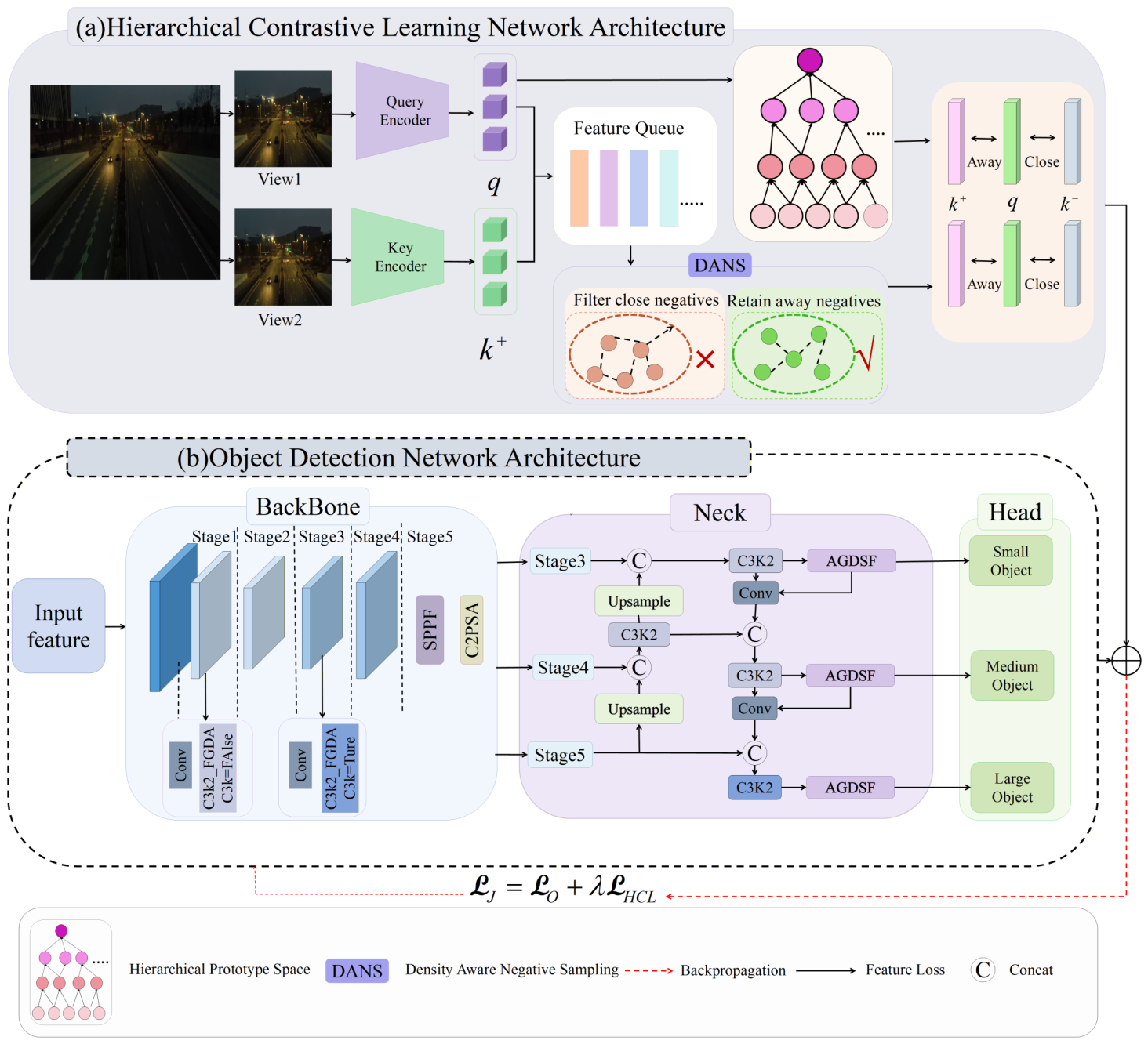
The framework proposed herein, which represents the overarching network design of this work, is depicted in Figure 2. Comprising (a) the Hierarchical Contrastive Learning Network Architecture and (b) the Object Detection Network Architecture, this framework discards the traditional cascaded enhancement paradigm and decouples the learning process into two highly synergistic stages. The core idea is to optimize features through the hierarchical contrastive learning network, which utilizes encoders from two different views for feature extraction. By incorporating a feature queue, Density-Aware Negative Sampling (DANS), and a hierarchical prototype space, the model establishes consistency constraints bridging low-light and normal-light features. This allows it to acquire illumination-invariant features from UAV imagery, thus laying a solid foundation for robust object detection. Structurally, the detection pipeline features a tripartite structure, encompassing a Backbone, a Neck, and a Head. In particular, the backbone captures multiscale input features via FGDA, the neck employs the AGDSF module for adaptive gated dual-spatial fusion, while the head conducts detection across varying feature map scales. The entire model is trained through weighted joint optimization combining the detection loss and the contrastive loss, achieving efficient and accurate detection of UAV images in low-light environments.

2.2.2. Joint Optimization

The central concept of joint training lies in integrating the hierarchical contrastive loss into the object detection objective, thereby enabling the downstream detection stage to simultaneously optimize both the detection and contrastive losses. By constraining contrastive learning through supervised signals, it guides the model to learn more discriminative representations. This joint design ensures that while the detection network optimizes tasks such as bounding box regression, the underlying backbone remains continuously guided by contrastive learning. This effectively prevents feature degradation caused by a purely detection oriented objective and averts the forgetting of low-light robust features, ultimately achieving an efficient synergy between feature learning and task optimization.
Specifically, we achieve joint optimization training by synergistically designing the HCL loss and the YOLOv11 loss, as follows:
L J = L O + λ L H C L ,
L O = L c l a + L b o x + L o b j ,
where L H C L is the HCL loss, L O is the YOLOv11 loss, L c l a is classification loss, L b o x is the Bounding Box Loss [39], and L o b j is Objectness Loss [40], respectively; λ is the parameter of the HCL loss, fixed at 0.5 to strike a balance the joint training of the object detection loss and the contrastive loss, and the basis for the value selection is in Section 3.3.1.

2.2.3. Hierarchical Contrastive Learning

Existing contrastive learning techniques are principally divided into instance-based and prototype-oriented frameworks. The former aims to decrease distances in the latent space while maximizing them for non-matching pairs, all while maintaining a coherent structure among diverse image representations. In contrast, prototype-level contrastive learning strives to generate compact image representations that cluster around their respective center points, capturing the essential semantic structure that can be represented by a single hierarchical clustering framework.
The proposed contrastive learning algorithm in this study employs instance-level hierarchical contrastive encoding. The main goal of instance-level contrastive learning is to achieve self-supervised representation learning. Its core mechanism involves placing similar instances in close proximity within the latent space while separating dissimilar instances. Positive instance pairs, which consist of similar instances, can be readily obtained through data augmentation techniques. However, establishing negative instance pairs, comprising dissimilar instances, presents a non-trivial challenge. The conventional approach involves contrasting one positive instance pair against multiple negative instance pairs. Given a representation (z, z′) corresponding to a pair of associated instances, one typically utilizes the standard InfoNCE loss [41] to enhance the agreement within the positive pair and reduce the agreement with arbitrarily selected negative pairs:
L infonce ( z , z , N , τ ) = log exp ( z · z / τ ) z j z N exp ( z · z j / τ ) ,
where N denotes the negative sample set derived from z, and τ serves as the temperature scaling factor.
To resolve the problem of feature space collapse resulting from false negative sample interference in standard instance contrastive learning under extreme low-light conditions, this stage constructs a hierarchical prototype-based instance contrastive learning mechanism, referred to as Hierarchical Contrastive Learning (HCL) for short. As shown in Figure 2a, the input low-light aerial imagery undergoes dual augmentation approaches and is subsequently fed into the Query encoder and momentum updated Key encoder respectively to derive the query feature q and positive sample feature k + . Following this, a tree-structured hierarchical prototype space is constructed via bottom-up K-means online clustering. Guided by this hierarchical semantic architecture, for each query sample, we identify the most similar prototype at every semantic level to construct robust positive pairs. Additionally, for each candidate negative sample pair, a density-aware negative sampling strategy leveraging prototype distribution priors is introduced to softly mask and filter negative samples within the feature queue, thereby reducing gradient interference from false negative samples.
Specifically, assuming the hierarchical prototype space has l semantic levels, the hierarchical prototype space c l is constructed through bottom-up K-means online clustering, as shown in the following equation:
c l = KMeans c ( l 1 ) , M l .
where c ( l 1 ) denotes the prototype space at the previous level, and M l represents the total number of prototypes at the l-th level. At the l-th semantic level, the prototype most similar to the query feature q is defined as follows:
c l ( q ) = arg max c c i l i = 1 M l s q , c i l .
where c l ( q ) denotes the prototype that is most similar to the query feature q at the l-th semantic level. The similarity function s ( q , c i l ) measures the similarity between the query feature q and the prototype c i l , which is typically computed using cosine similarity. Here, c i l denotes the i-th prototype at the l-th semantic level:
s ( q , c i l ) = q T c i l q 2 c i l 2 .
Therefore, at the l-th semantic level, the hierarchical prototype-based positive pair set is constructed as
M q l = ( q , k + ) , ( q , c l ( q ) ) .
Subsequently, density-aware negative sampling is performed. For each candidate negative sample z j , the probability of being selected as a negative sample is determined by the semantic discrepancy between z j and the assigned prototype c l ( q ) , which is defined as follows:
p l ( z j ) = 1 s z j , c l ( q ) + 1 2 .
Finally, Bernoulli sampling as shown in Equation (9) is applied to each candidate negative sample to retain negative samples with large semantic differences and filter out those that may be semantically similar.
N q = { B ( z j ; p i ( z j ) z j N } ,
where B ( z ; p ) represents a Bernoulli experiment that accepts z with probability p.
After the aforementioned selection, a high-quality set of negative samples N s is obtained. The instance level contrastive loss is calculated independently at each layer and then aggregated to derive the final loss, the process is as follows:
L H C L = E x P d 1 L l = 1 L L i n f o N C E ( q , M q l , N q , τ ) ,
where p d signifies the data distribution, M q l denotes the positive sample pair, i.e., different augmented views of an identical image.

2.2.4. FGDA, Frequency Guided Dynamic Attention

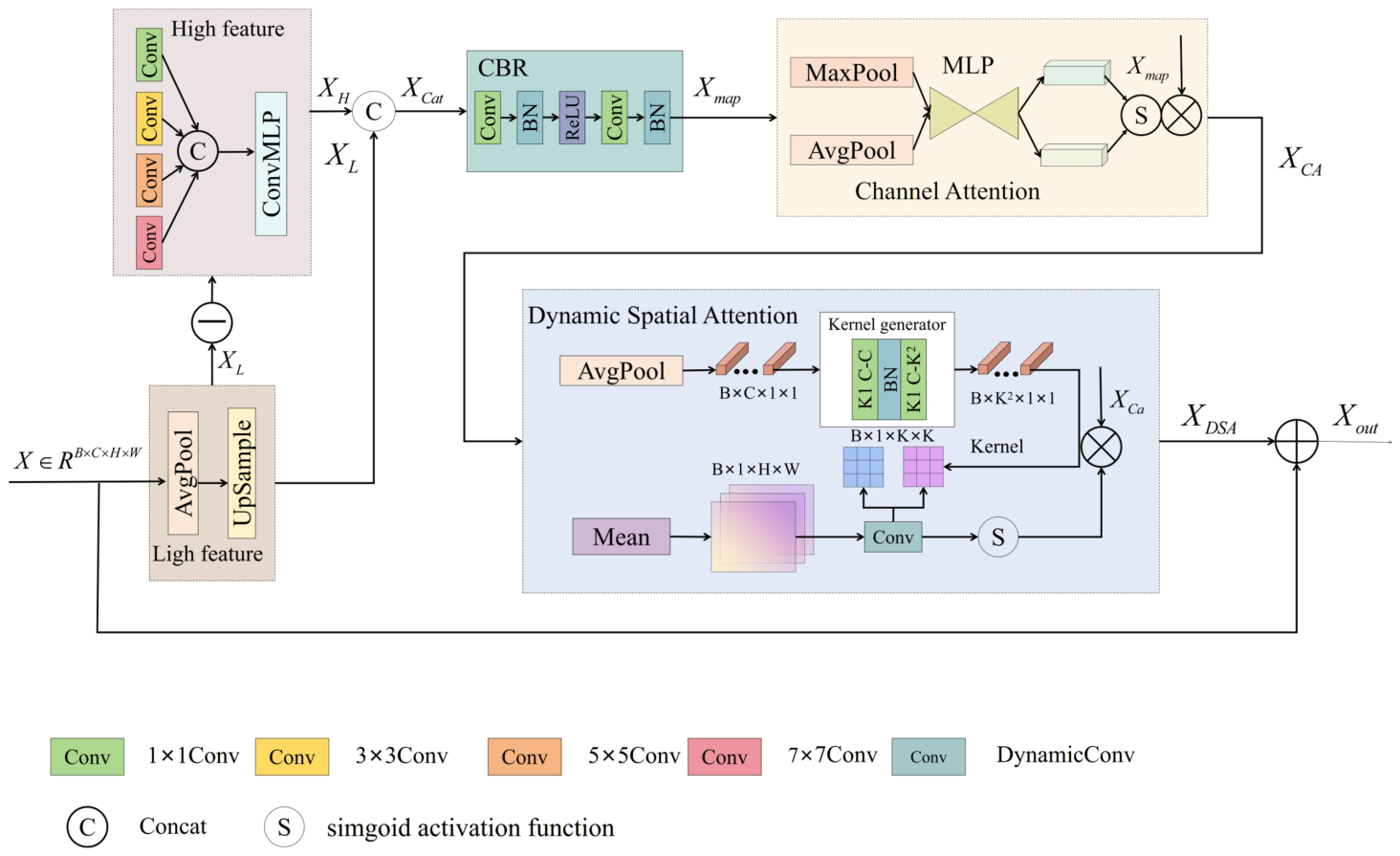
Standard convolution struggles to distinguish valid high-frequency edges from invalid high-frequency noise during image feature extraction in low-light environments, which leads to continuous noise amplification in deep networks, as well as the inherent defects of the receptive field. To address these issues, this paper designs FGDA and embeds it into the C3k2 structure of the Backbone, denoted as C3k2-FGDA. The schematic of FGDA can be seen in Figure 3. Local details and structural cues are initially captured through dedicated high-frequency and low-frequency feature extraction processes within this module. This is followed by a multiscale extraction stage applied to the high-frequency signals using diverse convolution kernels. Finally, the features are effectively fused through channel attention and dynamic spatial attention. Specifically, for a given feature map, the low-frequency structural features are first extracted through average pooling, and the high-frequency detail features are separated by subtracting the upsampled low frequency features from the original features. This process is expressed as follows:
X l o w = G A P 2 × 2 ( X ) R B × C × H 2 × W 2 ,
X h i g h = X F U p S a m p l e ( X l o w ) R B × C × H × W ,
where G A P 2 × 2 denotes average pooling with a 2 × 2 kernel, and F U p S a m p l e denotes upsampling to restore the low-frequency features to the same resolution as the input features. The upsampled low-frequency features are denoted as X L R B × C × H × W .
Because the high-frequency branch contains target edge contours and low-light shot noise, direct fusion introduces interference. Subsequently, during the acquisition of high-frequency features, parallel atrous convolutions with dilation factors of 1, 3, 5, and 7 are utilized, superseding large-kernel convolutions to facilitate multiscale feature representation. This approach effectively expands the receptive field and acquires contextual information at multiple scales, without leading to an increase in parameter count. A 3 × 3 convolutional kernel with dilation factor d is designated as f d ( · ) , and contextual information at multiple scales is captured from high-frequency features accordingly:
F d = f d ( X h i g h ) , d { 1 , 3 , 5 , 7 } .
By concatenating features across four receptive fields and applying channel compression via MLP, the model derives the multiscale high-frequency feature X H R B × C × H × W . As shown in Equation (14), channel-wise concatenation of the high-frequency and low-frequency representations is performed to derive X C a t , a concatenated feature abundant in multiscale information.
X C a t = C o n c a t ( X H , X L ) R 2 C × H × W ,
Since the number of channels after concatenation is 2C, a CBR consisting of a 3 × 3 convolution, batch normalization, and ReLU is introduced to perform channel compression and dimensionality reduction, as shown in Equation (15), restoring the channel number to C while further fusing cross channel interaction information.
X m a p = R e L U ( B N ( C o n v 3 × 3 ( X C a t ) ) ) .
These features, having undergone dimensionality reduction, are then passed to a dual-calibration attention scheme that amalgamates channel attention adjustment with dynamic spatial attention allocation. Following this, the initial input X is integrated with these features through a global residual connection, generating the ultimate result, as illustrated in Equation (16). This structure effectively maintains the inherent information of the source data and facilitates the network’s ability to focus on meaningful target areas amidst background noise, thus providing more accurate and distinctive features for the ensuing network stages.
X F G D A = X + X D S A ( X C A ( X m a p ) ) ,
where X F G D A signifies the output of FGDA, and X D S A and X C A stand for the dynamic spatial attention calibration and channel attention calibration [42], respectively. In greater detail, the channel attention operations can be executed as follows:
X C A = σ ( δ ( G A P ( X m a p ) ) + δ ( G M P ( X m a p ) ) ) X m a p ,
where G A P represents average pooling, G M P represents max pooling, δ represents the fully connected MLP network, and σ denotes the sigmoid activation function.
Dynamic Spatial Attention Calibration initially employs global average pooling in the spatial dimension to extract context vectors. Then, a kernel generator comprising two 1 × 1 pointwise convolution layers, followed by ReLU and a sigmoid non-linearity, is employed to yield a dynamic convolution kernel featuring a K 2 dimension, as follows:
W k = σ ( C o n v 2 ( R e L U ( C o n v 1 ( G A P ( X c a ) ) ) ) ) ,
where G A P stands for mean pooling, and σ signifies the sigmoid function.
After that, pooling is performed along the channel dimension to yield the spatial descriptor F m e a n R B × 1 × H × W . Then, convolution with the corresponding dynamic convolution kernel is conducted on each spatial descriptor to produce the dynamic attention map M a t t , as formulated below:
X D S A = σ ( C o n v d y n a m i c ( F m e a n , W k ) ) ,
where C o n v d y n a m i c represents the sample dynamic convolution operation, and σ is the sigmoid function.

2.2.5. AGDSF, Adaptive Gated Dual-Spatial Fusion

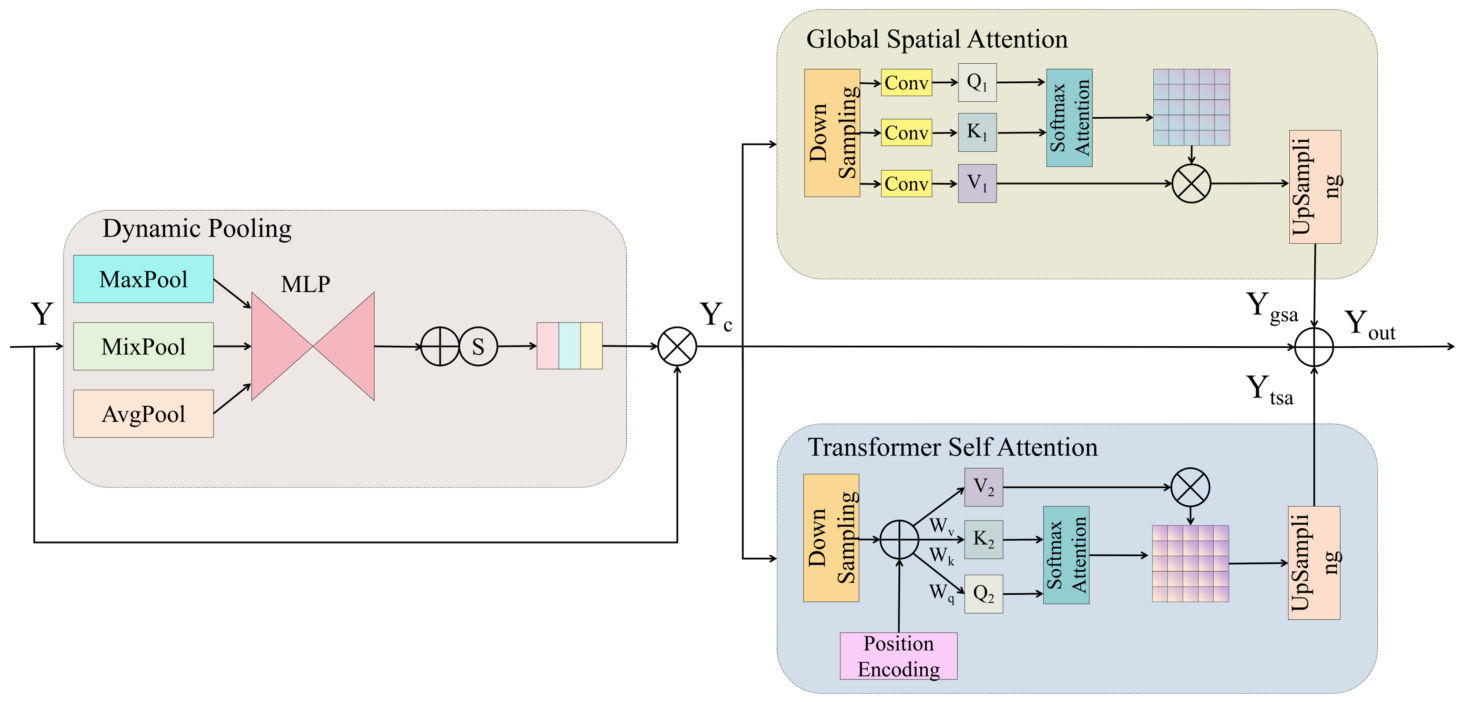
In the YOLO Neck, feature fusion mainly faces two challenges: first, the noise prevalent in shallow features under low-light conditions propagates to deeper layers through the Concat operation, leading to fusion failure; second, while introducing global spatial attention is an effective approach to strengthen contextual interaction, the high resolution inputs of UAVs substantially elevate the computational complexity of conventional self-attention. To tackle these challenges, this study proposes an adaptive dual-spatial fusion module that utilizes dynamic pooling as a pre-gating mechanism, empowering the model to attend to the most discriminative features. Following this, a parallel dual-branch architecture integrating adaptive resolution positional attention and self-attention mechanisms with multiple heads is established to adaptively extract contextual information, thereby obtaining more extensive and detailed image features.
The architectural layout of AGDSF can be observed in Figure 4. At the outset, the input features are directed into the Dynamic Pooling (DP) acting as a preliminary gating unit. Unlike traditional pooling, which typically only uses global average pooling and max pooling, DP introduces learnable weights to construct a three-branch hybrid pooling strategy as follows:
P a v g = G A P ( Y ) P m a x = G M P ( Y ) P m i x = α P a v g + ( 1 α ) P m a x ,
where G A P represents average pooling, G M P represents max pooling.
As depicted in Equation (21), the aforementioned three types of pooled features are individually input into a shared weight fully connected layer, and the three way outputs are accumulated and relayed via a sigmoid function to derive the weight matrix W c .
W c = σ ( δ ( P a v g ) + δ ( P m a x ) + δ ( P m i x ) ) ,
where δ represents the fully connected layer, and σ denotes sigmoidal activation.
Subsequently, the input features are modulated by the shared weight matrix, as illustrated in Equation (22), to obtain the feature Y c . Through this operation, the response to low-light noise is suppressed in advance prior to the parallel dual-branch processing, thereby outputting enhanced features with a higher signal-to-noise ratio and stronger discriminability.
Y c = W c Y ,
In the parallel dual-branch structure, to avoid issues such as memory explosion and runtime instability caused by high-resolution feature maps, this paper introduces an adaptive resolution strategy in both the positional attention and multi-head self-attention branches. A threshold T is set to 4096; when H × W > T , downsampling is automatically performed to map the features into a lower-dimensional space for self-attention computation as follows:
Y d o w n = F d o w n s a m p l e ( Y c ) ,
where F d o w n s a m p l e represents downsampling.
The positional attention GSA aims to capture positional dependencies between global and local contexts through linear projection, as shown in Equation (24). It utilizes 1 × 1 convolutions to decompose the downsampled features into query Q 1 , key K 1 , and value V 1 .
Q 1 = C o n v 1 × 1 q ( Y d o w n ) K 1 = C o n v 1 × 1 k ( Y d o w n ) V 1 = C o n v 1 × 1 v ( Y d o w n ) .
Then Q 1 and K 1 are transformed into the matrix form E 1 . Following this, a matrix multiplication process integrated with softmax normalization is conducted to generate the positional attention matrix A 1 as follows:
E 1 = Q 1 T K 1 ,
A 1 ( i , j ) = exp ( E 1 max ( E 1 ) ) i = 1 n exp ( E 1 max ( E 1 ) ) ,
where A 1 quantifies the extent to which the i-th location influences the j-th location, while n = h × w represents the total pixel count. The resulting positional attention matrix is element-wise multiplied by the value matrix to compute the per-location feature V 1 A 1 T , which is then upsampled to its original dimensions. To avoid random noise filling the feature map, it is reshaped via a learnable parameter γ for the purpose of generating the ultimate output as follows:
Y g s a = γ · F u p s a m p l e ( V 1 A 1 T ) .
The foundation of TSA stems from the attention architecture embedded in conventional Transformers. Diverging from the typical Transformer, TSA does not require feature reconstruction via linear layers; instead, it directly introduces learnable positional encodings into the downsampled encoder features, which can be shared across all attention layers for a given query and key-value sequence. Specifically, the downsampled feature Y d o w n is directly fed into the split sub-spaces to compute the Q 2 , K 2 , and V 2 , the detailed procedure is outlined below:
Q 2 = Y c · W q K 2 = Y c · W k V 2 = Y c · W v ,
where W q , W k , and W v act as the parameter matrices for the corresponding projection layers. Subsequently, Q 2 and K 2 are reshaped into the matrix form E 2 , and a matrix multiplication process utilizing softmax normalization is carried out to produce the contextual attention matrix A 2 , as defined below:
E 2 = Q 2 T K 2 τ ,
A 2 = s o f t m a x ( E 2 ) ,
where A 2 represents the affinity of each query element in Q 2 with respect to all key elements in K 2 . As shown in Equation (26), the contextual attention weights are multiplied by V 2 and reshaped to its initial dimensions, yielding the ultimate feature map Y t s a of the multi-head attention.
Y t s a = F u p s a m p l e ( V 2 A 2 T ) .
Finally, the ADGSF module adopts an additive fusion strategy, as shown in Equation (32), to aggregate features from various branches.
Y o u t = Y t s a + Y g s a + Y c .

3. Experimental Results and Analysis

3.1. Experimental Design and Evaluation Criteria

All experiments were conducted on a workstation equipped with an NVIDIA GeForce RTX 3070 Ti GPU running the Windows operating system. The software environment consisted of CUDA 11.0, cuDNN 8.0, and the PyTorch deep learning framework. The model was trained using the Adam optimizer with an initial learning rate of 0.015 and a momentum of 0.937. The batch size was set to 8, the number of training epochs was 300, and the random seed was fixed at 0.
To ensure controlled and fair comparisons, all experiments were conducted using the same fixed random seed, dataset split, number of training epochs, optimizer settings, input resolution, and evaluation protocol. The reported results were obtained from a single training run for each model configuration. Therefore, they do not reflect the performance variance across different random seeds. For the evaluation phase, the model’s performance was assessed using the standard metrics of Mean Average Precision (mAP) across all classes, along with Recall (R) and Precision (P). The formulas that elaborate on these metrics are presented below.
P = T P T P + F P ,
R = T P T P + F N ,
m A P = 1 N i = 0 N A P i .

3.2. Comparative Experimental Results and Analysis

To validate the feasibility of the algorithm, this paper conducts comparative experiments between HCLOD-Net and classic two-stage object detection algorithms, single-stage YOLO series baseline models, and improved YOLO models proposed in recent years. Experiments were conducted on the VisDrone (dark) and UAV-dark datasets using identical training epochs, optimizers, and evaluation metrics, as shown in Table 2 and Table 3.
As observed from Table 2, our approach surpasses other algorithms across metrics. While two-stage detectors like Faster R-CNN and RetinaNet, despite theoretically having stronger feature extraction capabilities, exhibit low accuracy in low-light environments. Their mAP@0.5:0.95 are merely 10.4% and 8.1%, respectively, and their computational demands reach 223 GFLOPs and 230 GFLOPs, respectively. In contrast, our method achieves 13.9% and 23.8% in mAP@0.5:0.95 and mAP@0.5, respectively. Compared to Faster R-CNN, it improves by 3.5% and 4%, and compared to RetinaNet, it improves by 5.8% and 8.6%, while requiring only 25.9 GFLOPs, thus achieving simultaneous improvements in both accuracy and efficiency.
In comparisons with different scales of the YOLOv5, YOLOv8, and YOLOv11 series, our method demonstrates significant performance advantages. YOLOv5n has the smallest computational cost, only 4.5 GFLOPs, its mAP@0.5:0.95 and mAP@0.5 are merely 8.37% and 17.5%, which are 5.53% and 6.3% lower than those of our algorithm, respectively. Although YOLOv8s achieves a high precision of 58.7%, its recall is only 15.9%, dropping the F1-score to 25. This indicates that the model is too conservative in predicting targets, leading to severe missed detections. The proposed method strikes an optimal balance between precision and recall, registering an F1-score of 28.46. Relative to the baseline YOLOv11s, the proposed method improves mAP@0.5 and mAP@0.5:0.95 to 23.8% and 13.9%, marking increments of 3.1% and 1.9%, respectively, with only a minor computational increase of 4.6 GFLOPs, validating the effectiveness of the network architecture improvements.
Meanwhile, comparisons with improved models such as Gold-YOLO, SOD-YOLO, ASF-YOLO, and FBRT-YOLO demonstrate that our method increases the mAP@0.5:0.95 by 4.1%, 0.6%, 3.7%, and 3.4%, respectively, and increases the mAP@0.5 by 4.2%, 0.1%, 3.4%, and 4.5%, respectively. Among them, although the mAP@0.5 of SOD-YOLO is close to that of our algorithm, its computational cost reaches 32.7 GFLOPs, whereas our algorithm requires only 25.9 GFLOPs. This lower computational burden better satisfies the real-time requirements of UAVs.
As shown in Table 3, the proposed method achieves strong overall detection performance on the UAV-dark dataset, with mAP@0.5:0.95, mAP@0.5, Precision, Recall, and F1-score reaching 52.3%, 89.5%, 85.6%, 88.4%, and 86.98, respectively. Among these metrics, mAP@0.5, Recall, and F1-score are the best among all compared methods, indicating that HCLOD-Net can effectively improve object detection capability from a low-light UAV perspective while achieving a favorable balance between precision and recall. Although the mAP@0.5:0.95 of the proposed method is slightly lower than the 53.3% achieved by SOD-YOLO, its mAP@0.5, Recall, and F1-score are higher by 3.2%, 5.5%, and 1.47, respectively. Meanwhile, the computational cost is reduced from 32.7 GFLOPs to 25.9 GFLOPs, demonstrating that the proposed method achieves a better trade-off between detection performance and computational complexity.
Compared with Faster R-CNN and RetinaNet, the proposed method improves mAP@0.5 by 8.1% and 5.6%, Recall by 28.3% and 28.8%, and F1-score by 28.58 and 28.29, respectively. Although RetinaNet achieves a slightly higher mAP@0.5:0.95 than the proposed method, its lower Precision and Recall indicate that it still suffers from relatively evident false detections and missed detections under low-light conditions. These results demonstrate that HCLOD-Net can maintain strong detection capability while substantially reducing computational complexity, making it more suitable for deployment on UAV platforms with limited computational resources.
In comparison with the YOLO-series models, the proposed method also demonstrates clear advantages. Compared with YOLOv5n, the proposed method improves mAP@0.5:0.95 and mAP@0.5 by 6% and 8.5%, respectively, while Recall and F1-score increase by 8.3% and 3.39. Although YOLOv5n requires only 4.5 GFLOPs, its overall detection performance is significantly lower than that of the proposed method. Compared with YOLOv8n, the Precision of the proposed method decreases by 3.1%, whereas Recall and mAP@0.5 increase by 4.8% and 4.9%, respectively, indicating that the proposed method can detect more true objects. Compared with the baseline model YOLOv11s, the proposed method introduces only an additional 4.6 GFLOPs, while mAP@0.5:0.95 and mAP@0.5 increase by 2.1% and 5.8%, and Recall and F1-score increase by 6.2% and 2.26, respectively. Although Precision decreases by 1.8%, the substantial improvement in Recall effectively reduces missed detections in low-light environments, validating the effectiveness of the proposed modules in enhancing weak object features and integrating multiscale information.
Compared with the improved models Gold-YOLO, ASF-YOLO, and FBRT-YOLO, the proposed method improves mAP@0.5:0.95 by 4.9%, 5.3%, and 1.1%, mAP@0.5 by 11.3%, 6.1%, and 4.8%, and Recall by 32.3%, 5.1%, and 3.2%, respectively. Compared with ASF-YOLO, the proposed method improves F1-score by 2.64 while reducing the computational cost from 117.9 GFLOPs to 25.9 GFLOPs. Compared with FBRT-YOLO, the proposed method introduces only an additional 3 GFLOPs, while mAP@0.5 and Recall increase by 4.8% and 3.2%, respectively. Overall, the experimental results demonstrate that HCLOD-Net has strong low-light object detection capability on the UAV-dark dataset and achieves higher Recall, detection accuracy, and overall evaluation performance with a controllable computational cost.
It should be noted that the proposed method achieves a Precision of 85.6% on the UAV-dark dataset, which is lower than those of YOLOv8n, YOLOv11s, SOD-YOLO, and FBRT-YOLO. This result indicates that, although the proposed method enhances the responses of weak targets, it still exhibits a certain tendency toward false-positive detections. One possible explanation is that AGDSF strengthens low-contrast target representations by integrating multiscale contextual information. However, in scenes with relatively simple backgrounds or indistinct object boundaries, excessive contextual aggregation may confuse foreground and background responses and blur object contours, causing some background regions to be incorrectly classified as targets. Therefore, the current results demonstrate that the proposed module is effective in enhancing weak-target features and fusing multiscale information, while also revealing a trade-off between improving Recall and suppressing false-positive detections.

3.3. Ablation Experimental Results and Analysis

3.3.1. Ablation Experimental Results and Analysis of λ

To isolate the influence of the weighting coefficient λ on the hierarchical contrastive learning objective, the sensitivity analysis was conducted using the YOLOv11+HCL configuration. With all other experimental settings kept unchanged, λ was set to 0.1, 0.3, 0.5, 0.7, and 0.9, respectively, and the corresponding results are presented in Table 4. It should be noted that the results reported in this table correspond to the joint optimization of YOLOv11 and HCL rather than the complete HCLOD-Net. Based on this controlled experiment, λ = 0.5 was selected and subsequently fixed for the complete model incorporating HCL, FGDA, and AGDSF.
As shown in Table 4, the model performance fluctuates as λ varies. When λ = 0.1 , the model achieves an mAP @ 0.5 of 22.1%, indicating that even a relatively weak contrastive constraint can improve the discriminability of the feature space. When λ increases to 0.3, the performance slightly decreases to 21.6%. At λ = 0.5 , the model obtains the highest mAP @ 0.5 of 22.4%, demonstrating that a moderate weighting coefficient can better balance the object detection objective and the hierarchical contrastive learning objective. When λ is further increased to 0.7 and 0.9, the mAP @ 0.5 decreases to 21.4% and 21.3%, respectively. This suggests that an excessively large weight assigned to the hierarchical contrastive learning loss may interfere with task-specific detection optimization, thereby reducing detection performance. Overall, the results indicate that a moderate value of λ is more beneficial for joint optimization.

3.3.2. Ablation Experimental Results and Analysis of the Proposed Algorithm

With the aim of assessing the efficacy of each component to the algorithm’s performance, this study conducts an ablation study using YOLOv11s as the baseline. The evaluation is carried out on the VisDrone (dark) dataset alongside the self-built nighttime dataset, UAV-dark, to assess the effect of each module quantitatively, as illustrated in Table 5 and Table 6.
As shown in Table 5, after introducing HCL, the GFLOPs of the model remained unchanged at 21.3, indicating that hierarchical contrastive learning optimizes the feature distribution only during the training stage. Since its encoder is removed during inference, HCL does not alter the actual inference network architecture or introduce additional theoretical computational overhead. To reduce the influence of single-run fluctuations on the evaluation of inference efficiency, the FPS of each model configuration was measured five times under the same hardware, software environment, and experimental settings, and the results are reported as the mean ± standard deviation. The baseline YOLOv11s and YOLOv11s + HCL achieved inference speeds of 53.27 ± 0.29 FPS and 53.06 ± 1.97 FPS, respectively. The two configurations have identical GFLOPs and nearly identical average FPS, further indicating that HCL has no substantial impact on inference efficiency. The slight difference between them can be attributed to measurement fluctuations caused by runtime factors such as GPU operating state, CUDA asynchronous execution, memory allocation, and system workload.
In terms of detection performance, introducing HCL increased the mAP@0.5 from 20.7% to 22.4%, while both Precision and Recall showed steady improvements, and the F1-score reached 30.2. This indicates that hierarchical contrastive learning effectively enhances the model’s ability to extract target features in complex backgrounds by reducing the distances between features of the same class and increasing those between different classes. When only FGDA was introduced into the object detection network, the mAP@0.5 increased to 22.1%, indicating that this attention mechanism effectively enhances the network’s focus on key features. However, Precision decreased from 42.2% to 37.2%, and the F1-score dropped to 26.6. This suggests that, while improving feature representation, FGDA also introduces more redundant predictions or background noise, thereby increasing false detections. Since FGDA is retained during inference, its additional computational operations reduce the average inference speed of the model from 53.27 ± 0.29 FPS to 43.11 ± 1.76 FPS. When only AGDSF was introduced into the YOLOv11 object detection network, it exhibited characteristics different from those of FGDA. Precision increased substantially to 52.4%, representing an improvement of 10.2 percentage points over the baseline YOLOv11, whereas Recall decreased from 22% to 20.3%. This indicates that AGDSF enhances feature discriminability and can suppress confusing background interference, but may also cause some difficult targets to be missed. Since AGDSF introduces additional feature-fusion operations during inference, its average inference speed was 42.22 ± 1.44 FPS. When HCL was combined with FGDA, the mAP@0.5 further increased from 22.1% to 22.9%, and Recall improved from 20.7% to 22.5% compared with the configuration using FGDA alone, indicating that HCL improves target-feature aggregation and class discrimination and enhances the model’s response to true targets. However, Precision decreased to 32.5%, suggesting that, under low-light and high-noise conditions, FGDA may introduce or reinforce certain background-related responses while enhancing high-frequency details and multiscale contextual information. Since HCL is not specifically designed to suppress high-frequency background interference, it is difficult for it to completely eliminate such redundant responses, resulting in more false-positive predictions under the current confidence threshold. The average inference speed of this configuration was 46.08 ± 1.20 FPS. Although its speed was lower than that of the baseline model, it remained higher than that of the configuration using FGDA alone. The difference may be jointly affected by runtime fluctuations and the actual execution efficiency of the operators. When hierarchical contrastive learning was combined with AGDSF, both Precision and Recall improved, indicating that HCL increases inter-class separability in the feature space and effectively compensates for the missed detections caused by the feature-selection process of AGDSF. Since HCL is removed during inference, the inference overhead of this configuration mainly originates from AGDSF. Although its FPS differs to some extent from that of the configuration using AGDSF alone, this difference should not be directly attributed to HCL, but is more likely related to actual runtime conditions and variations in operator execution.
By integrating HCL, FGDA, and AGDSF, the proposed model achieved the best overall detection performance. Its mAP@0.5 and mAP@0.5:0.95 reached 23.8% and 13.9%, respectively, while Precision and Recall reached 50.7% and 22.9%, respectively. The F1-score reached 31.6, the highest among all ablation configurations. Since both FGDA and AGDSF participate in the inference stage, the GFLOPs of the complete model increased from 21.3 to 25.9, while the average inference speed decreased to 38.91 ± 1.84 FPS. Overall, the three proposed modules significantly improve the detection accuracy and overall performance of low-light UAV object detection while introducing a moderate increase in computational overhead.
According to Table 6, the performance variations of the proposed modules on the UAV-dark dataset differ to some extent from those observed on the VisDrone (dark) dataset. These differences may be attributed to the variations between the two datasets in terms of scene complexity, background composition, target scale distribution, target visibility, and the severity of low-light degradation. Consequently, HCL, FGDA, and AGDSF exhibit different performance characteristics on the UAV-dark and VisDrone (dark) datasets.
To reduce the influence of single-run fluctuations on the evaluation of inference efficiency, the FPS of each model configuration was measured five times under the same hardware and software environments using identical input resolution, batch size, inference precision, and evaluation protocol. The results are reported as the mean ± standard deviation. The baseline YOLOv11s and YOLOv11s+HCL achieved inference speeds of 110.60 ± 2.18 FPS and 111.06 ± 0.68 FPS, respectively. Since the two configurations share the same inference network architecture and computational complexity of 21.3 GFLOPs, and their average FPS values are highly comparable, the results are consistent with the design in which the HCL encoder is removed during inference, indicating that HCL introduces no additional theoretical computational overhead during inference.
In terms of detection performance, HCL improved the detection accuracy, Precision, Recall, and inference efficiency without increasing the computational cost. This further demonstrates that HCL enhances nighttime target representation by optimizing the feature space distribution and producing more discriminative network representations. When FGDA was introduced alone, the mAP@0.5:0.95 increased from 50.2% to 52.2%, indicating that this module can better refine spatial feature interactions and improve bounding box regression under high-accuracy scenarios. Unlike the results obtained on the VisDrone (dark) dataset, introducing AGDSF on the UAV-dark dataset reduced the Precision to 85.1% while increasing the Recall to 85.8%. This is because the UAV-dark dataset contains relatively simple backgrounds, and AGDSF, as a feature aggregation module, excessively integrates surrounding contextual information under low-light conditions, resulting in blurred prediction boundaries while simultaneously enlarging the effective receptive field to recover more targets. By integrating HCL, FGDA, and AGDSF, the proposed method achieved an mAP@0.5 of 89.5% and an mAP@0.5:0.95 of 52.3%, representing improvements of 5.8% and 2.1%, respectively, over the baseline model.

3.4. Visualization Results and Analysis

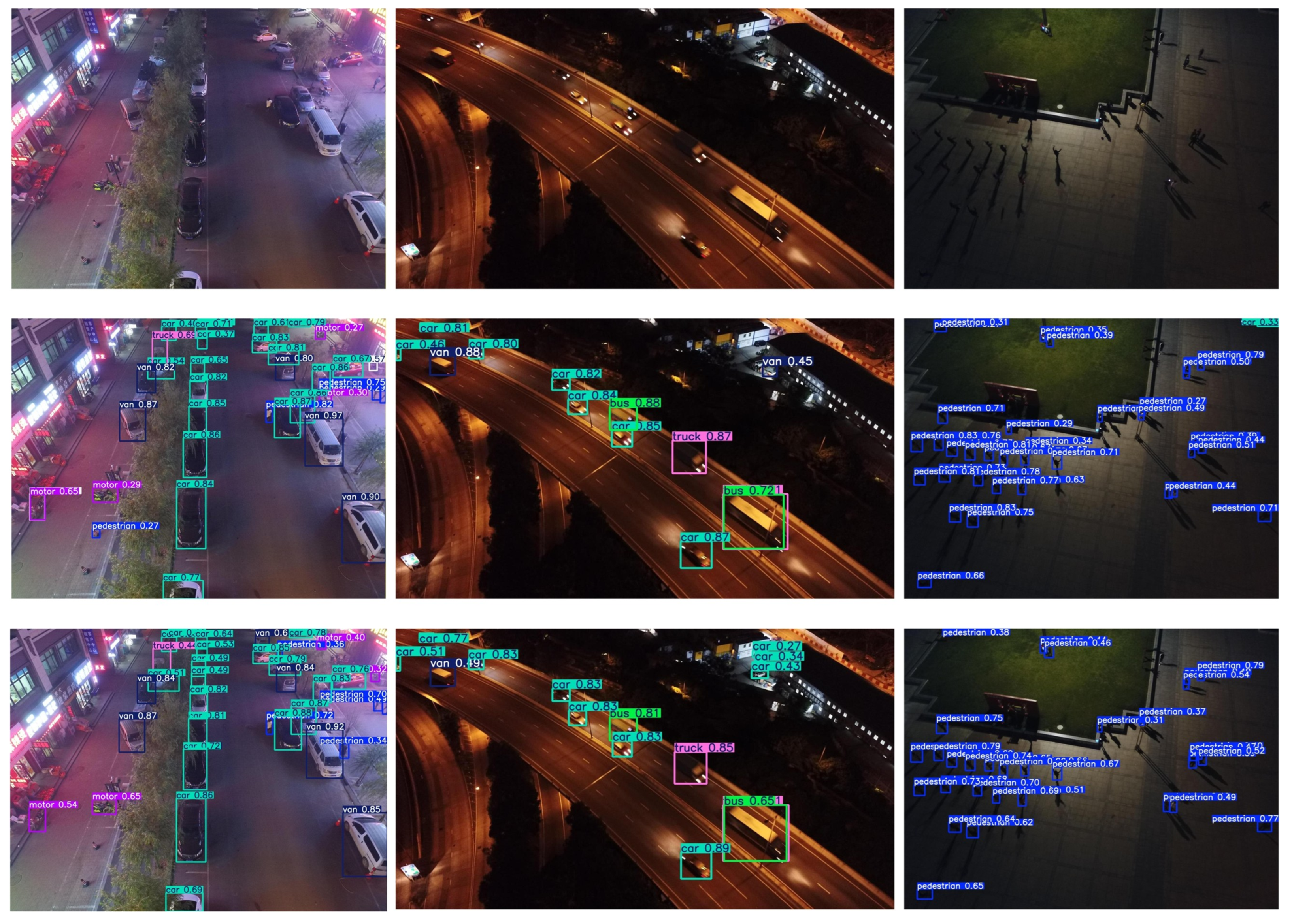
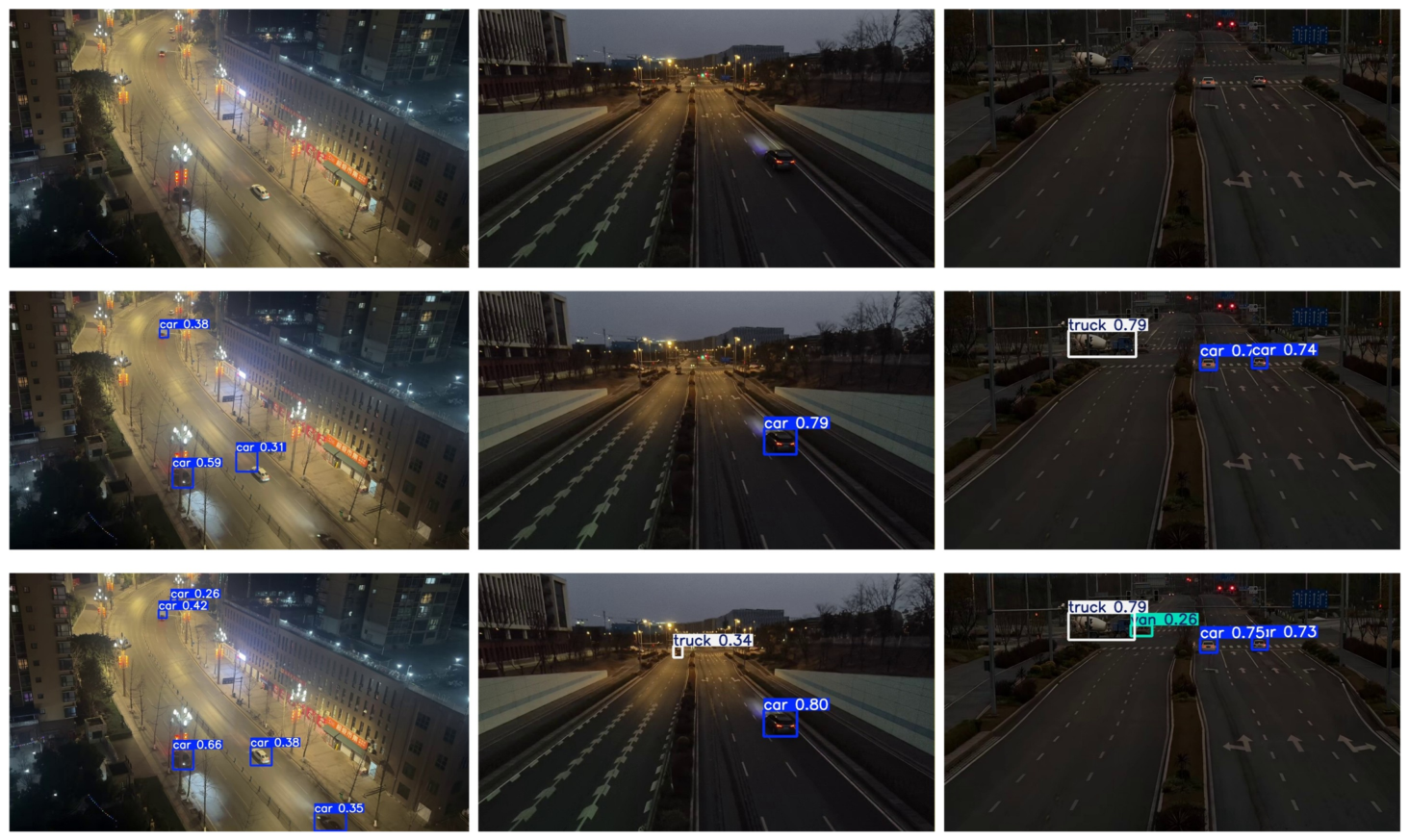
Samples were arbitrarily extracted from the VisDrone (dark) dataset and the UAV-dark dataset for qualitative comparison. The selected images cover various illumination conditions, shooting viewpoints, and object scales. The top row shows the input images, the middle row presents the detection results of the baseline model, and the bottom row illustrates the detection results produced by the proposed method. The visualization results on the VisDrone (dark) dataset are shown in Figure 5, whereas those on the UAV-dark dataset are presented in Figure 6.
As can be seen from Figure 5, the VisDrone (dark) datasets exhibits crowded objects and significant scale variations. In the scenarios shown in the first and third columns, where targets are clustered but differ in type, the original YOLOv11s object detection algorithm exhibits obvious false detection. For instance, in the first image, a traffic cone in the background is misidentified as a “pedestrian”, additionally, the third image falsely detects a shadow as a “car”. This indicates that the original algorithm has a significant deficiency in feature discriminative capability within dense target scenarios. In the second column, which features relatively sparse targets but low contrast, the YOLOv11s algorithm clearly suffers from missed detection for distant “car” targets. In contrast, our proposed algorithm demonstrates much greater robustness. In dense scenes, it effectively suppresses false detection and improves the bounding box localization accuracy; in sparse scenes, it enhances the feature perception capability and reduces the missed detection rate, exhibiting stronger robustness overall.
UAV-dark is a custom UAV-perspective datasets captured in low-light environments. Although the targets are relatively sparse, they exhibit low contrast and blurred features. As shown in Figure 6, in the first column, although the “car” target is relatively obvious, YOLOv11s still suffers from missed detection and even inaccuracies in bounding box localization. This indicates that the original algorithm has deficiencies in learning the semantic features of targets. In the second and third columns, despite the small total number of targets, the original algorithm still exhibits category level missed detection, such as failing to detect the “truck” from the second column and the “van” from the third column. This demonstrates the original algorithm’s insufficient generalization capability for targets. In contrast, our algorithm not only successfully detects the targets in the images but also produces no false detection, demonstrating that the proposed algorithm possesses superior generalization and feature extraction capabilities under low-light conditions.
In summary, based on the comparative experiments and visual analysis of the two aforementioned datasets, it can be observed that when facing various complex challenges such as dense targets, multiscale objects, and insufficient lighting, the original YOLOv11s model exhibits significant shortcomings in terms of false detections, missed detections, and classification errors. The improved algorithm developed in this work, by integrating hierarchical contrastive learning and object detection networks, boosts the model’s perception and discrimination capabilities in intricate environments. This method significantly reduces the false detection rate whilst keeping a high recall rate, demonstrating better generalization performance and practical application potential.

4. Discussion

This paper proposes an object detection network named HCLOD-Net for low-light UAV scenarios. Through the joint optimization of hierarchical contrastive learning pre-training and a modified YOLOv11 detector, it effectively alleviates the issues of annotated sample scarcity and feature degradation. It was found that our novel strategy surpasses mainstream algorithms in terms of detection accuracy on both the VisDrone (Dark) and the self-constructed UAV-dark datasets, while maintaining low computational overhead and real-time inference speed.
The ablation study results demonstrate that the contributions of the proposed modules exhibit clear complementarity. Hierarchical Contrastive Learning (HCL) significantly improves feature discriminability and robustness without introducing additional computational overhead during inference. On the VisDrone dark dataset, the introduction of HCL increases mAP@0.5 from 20.7% to 22.4% and the F1-score from 28.9 to 30.2, while the computational complexity remains unchanged at 21.3 GFLOPs. On the UAV-dark dataset, HCL improves mAP@0.5 from 83.7% to 86.9% and the F1-score from 84.7 to 87.9. These results confirm that contrastive constraints can optimize feature organization under low-light conditions without increasing the inference burden. Frequency Guided Dynamic Attention (FGDA) enhances the model response to key features through frequency decoupling and multiscale dilated convolution. However, when FGDA is applied independently on the VisDrone dark dataset, Precision decreases from 42.2% to 37.2%, indicating that further improvement is required in suppressing high-frequency noise. Adaptive Gated Dual-Spatial Fusion (AGDSF) effectively filters background interference and improves detection precision through channel gating and adaptive-resolution strategies. When applied independently, AGDSF increases Precision to 52.4%, whereas Recall decreases to 20.3%, suggesting that excessive contextual fusion may lead to missed detections of certain difficult objects. After integrating all three modules, mAP@0.5, mAP@0.5:0.95, and the F1-score reach 23.8%, 13.9%, and 31.6, respectively, on the VisDrone dark dataset. On the UAV-dark dataset, the corresponding values reach 89.5%, 52.3%, and 86. These results indicate that HCLOD-Net achieves a better balance between Precision and Recall and attains the best overall detection performance.
Meanwhile, the experimental performance differs between the VisDrone (dark) and UAV-dark datasets. The VisDrone (dark) scenarios are characterized by dense targets and large scale variations, where the introduced approach exhibits notable superiority in eliminating false detections and enhancing the recognition of small objects; whereas the UAV-dark dataset features relatively simple backgrounds but more severe lighting conditions, where the model primarily benefits from the feature regularization effect induced by contrastive learning. These findings suggest that the proposed method exhibits considerable generalization capability across low-light environments of varying complexities.
From the perspective of practical deployment, HCLOD-Net requires 25.9 GFLOPs and maintains real-time inference speed on the experimental platform. The improvement in Recall is particularly important for UAV applications, since missed detections may result in the loss of critical information in scenarios such as nighttime traffic monitoring, public-area patrol, emergency search and rescue, and aerial surveillance under low-light conditions. Therefore, the proposed method provides a practical trade-off between detection accuracy and computational efficiency for UAV platforms with limited onboard computing resources. However, actual deployment performance may also be affected by factors such as hardware type, memory bandwidth, input resolution, and inference framework. Further evaluation on embedded UAV processors is therefore still required.
However, several limitations of this study should be acknowledged. First, the VisDrone (dark) test subset contains only 56 images because of the limited availability of nighttime images with valid annotations in the original VisDrone dataset. The relatively small test-set size may increase the sensitivity of the reported metrics to individual samples, object density, and scene composition. Therefore, the results obtained on VisDrone (dark) should be interpreted within the context of the current test subset. Second, the experiments mainly focus on conventional low-light conditions, whereas more challenging scenarios involving multiple degradations, such as near-complete darkness, foggy conditions, and rainy nights, have not been sufficiently evaluated. The generalization ability of the proposed method across different sensors, viewpoints, scene distributions, and illumination patterns therefore remains to be further examined. Third, the comparison and ablation experiments were conducted using a controlled single-run protocol with a fixed random seed, and the performance variance across multiple independent runs was not estimated. Fourth, all efficiency measurements were obtained on an RTX 3070 Ti GPU and thus do not directly reflect the inference latency, memory consumption, or energy usage on resource-constrained UAV platforms. In addition, FPS may be affected by warm-up procedures, caching mechanisms, memory allocation, and data-loading conditions; therefore, the reported efficiency analysis primarily relies on GFLOPs to characterize theoretical computational complexity. Finally, the hierarchical prototype clustering strategy in HCL depends on a predefined number of hierarchy levels, and the optimal hierarchical structure cannot yet be determined adaptively according to the data distribution. Moreover, AGDSF may cause excessive contextual aggregation in relatively simple scenes, potentially blurring object boundaries and increasing false-positive detections.
Although the existing experiments demonstrate the robustness of the model on two low-light UAV datasets, they do not fully validate the reliability of illumination-invariant representation learning under substantial variations in illumination conditions. In future work, we will evaluate the trained model on different low-light datasets without fine-tuning and introduce cross-domain evaluation protocols to investigate its generalization capability across different sensors, viewpoints, scene distributions, and illumination patterns. Domain generalization and unsupervised domain adaptation strategies will also be explored to further improve cross-dataset robustness. Finally, although the computational overhead remains at a moderate level, a gap still exists between the current model and its deployment on highly resource-constrained micro-UAV platforms. Therefore, future research will focus on network pruning, lightweight architecture design, quantization, and knowledge distillation. Overall, HCLOD-Net provides a feasible technical solution for UAV object detection under low-light conditions and has demonstrated strong performance on two UAV-oriented low-light benchmarks. Future work will focus on cross-dataset generalization, feature recovery under extreme low-light conditions, multimodal information fusion, and edge-deployment optimization to further enhance the practical value of the proposed method.

Author Contributions

Conceptualization, Y.W. and G.F.; methodology, Y.W. and J.X.; software, J.X.; validation, Y.W., J.X. and K.Y.; formal analysis, M.L.; investigation, Y.W., L.D. and M.L.; resources, L.D.; data curation, J.X. and M.L.; writing—original draft preparation, Y.W.; writing—review and editing, G.F., J.X. and M.L.; visualization, M.L.; supervision, G.F.; project administration, G.F. and K.Y.; funding acquisition, G.F. All authors have read and agreed to the published version of the manuscript.

Funding

This work was supported in part by Key Research and Development Program Project of Xizang Autonomous Region under Grant Number XZ202601ZY0012 and the Fundamental Research Funds for the Central Universities under Grant Number 26CAFUC03011.

Data Availability Statement

The original data presented in the study are openly available at https://github.com/xjy12-x/HCLOB-main (accessed on 30 June 2026).

Acknowledgments

The authors would like to thank the institute of Civil Aviation Flight University of China for administrative and technical support.

Conflicts of Interest

The authors declare no conflicts of interest. The funders had no role in the design of the study; in the collection, analyses, or interpretation of data; in the writing of the manuscript; or in the decision to publish the results.

References

  1. Xiao, Q.; Li, Y.; Luo, F.; Liu, H. Analysis and assessment of risks to public safety from unmanned aerial vehicles using fault tree analysis and Bayesian network. Technol. Soc. 2023, 73, 102229. [Google Scholar] [CrossRef]
  2. Wang, Y.; Su, Z.; Xu, Q.; Li, R.; Luan, T.H.; Wang, P. A secure and intelligent data sharing scheme for UAV-assisted disaster rescue. IEEE/ACM Trans. Netw. 2023, 31, 2422–2438. [Google Scholar] [CrossRef]
  3. Li, X.; Levin, N.; Xie, J.; Li, D. Monitoring hourly night-time light by an unmanned aerial vehicle and its implications to satellite remote sensing. Remote Sens. Environ. 2020, 247, 111942. [Google Scholar] [CrossRef]
  4. Biskin, B.; Fliege, J.; Martinez-Sykora, A. Autonomous navigation of unmanned aerial vehicles (UAVs) for border patrolling: A stochastic framework. IMA J. Manag. Math. 2025, 36, 231–254. [Google Scholar] [CrossRef]
  5. Wei, H.; Yu, B.; Wang, W.; Zhang, C. Adaptive enhanced detection network for low illumination object detection. Mathematics 2023, 11, 2404. [Google Scholar] [CrossRef]
  6. Feng, C.; Chen, Z.; Li, X.; Wang, C.; Dai, Y.; Fu, Q.; Yang, J.; Cheng, M.-M. HazyDet: Open-Source Benchmark for Drone-View Object Detection with Depth Cues in Hazy Scenes. IEEE Trans. Geosci. Remote Sens. 2026, 64, 5006414. [Google Scholar] [CrossRef]
  7. Wang, D.; Liu, W.; Fang, J.; Xu, Z. Enhancement algorithm of low illumination image for UAV images inspired by biological vision. J. Northwest. Polytech. Univ. 2023, 41, 144–152. [Google Scholar] [CrossRef]
  8. Munir, A.; Siddiqui, A.J.; Anwar, S.; El-Maleh, A.; Khan, A.H.; Rehman, A. Impact of adverse weather and image distortions on vision-based UAV detection: A performance evaluation of deep learning models. Drones 2024, 8, 638. [Google Scholar] [CrossRef]
  9. Abdullah Almujally, N.; Mehmood Qureshi, A.; Alazeb, A.; Rahman, H.; Sadiq, T.; Alonazi, M.; Algarni, A.; Jalal, A. A Novel Framework for Vehicle Detection and Tracking in Night Ware Surveillance Systems. IEEE Access 2024, 12, 88075–88085. [Google Scholar] [CrossRef]
  10. Wang, W.; Peng, Y.; Cao, G.; Guo, X.; Kwok, N. Low-Illumination Image Enhancement for Night-Time UAV Pedestrian Detection. IEEE Trans. Ind. Inform. 2021, 17, 5208–5217. [Google Scholar] [CrossRef]
  11. Wang, S.; Jiang, H.; Li, Z.; Yang, J.; Ma, X.; Chen, J.; Tang, X. PHSI-RTDETR: A lightweight infrared small target detection algorithm based on UAV aerial photography. Drones 2024, 8, 240. [Google Scholar] [CrossRef]
  12. Mi, A.; Luo, W.; Qiao, Y.; Huo, Z. Rethinking zero-DCE for low-light image enhancement. Neural Process. Lett. 2024, 56, 93. [Google Scholar] [CrossRef]
  13. Xu, X.; Wang, R.; Fu, C.; Jia, J. SNR-Aware Low-light Image Enhancement. In Proceedings of the 2022 IEEE/CVF Conference on Computer Vision and Pattern Recognition (CVPR); IEEE: New Orleans, LA, USA, 2022; pp. 17693–17703. [Google Scholar]
  14. Redmon, J.; Divvala, S.; Girshick, R.; Farhadi, A. You Only Look Once: Unified, Real-Time Object Detection. In Proceedings of the IEEE Conference on Computer Vision and Pattern Recognition; IEEE: New York, NY, USA, 2016; pp. 779–788. [Google Scholar]
  15. Lin, T.-Y.; Goyal, P.; Girshick, R.; He, K.; Dollár, P. Focal Loss for Dense Object Detection. In Proceedings of the IEEE Conference on Computer Vision and Pattern Recognition; IEEE: New York, NY, USA, 2017; pp. 2999–3007. [Google Scholar]
  16. Kandavel, N.; Vinod, S.; Shalini, B.; Karthikeyan, P.; Pavithra, R.; Thangam, S. Comparative Analysis of YOLOv8 and EfficientDet for Object Detection in Autonomous Vehicles. In Proceedings of the 2025 International Conference on Data Science, Agents & Artificial Intelligence (ICDSAAI); IEEE: New York, NY, USA, 2025; pp. 1–6. [Google Scholar]
  17. Ren, S.; He, K.; Girshick, R.; Sun, J. Faster R-CNN: Towards Real-Time Object Detection with Region Proposal Networks. IEEE Trans. Pattern Anal. Mach. Intell. 2017, 39, 1137–1149. [Google Scholar] [CrossRef] [PubMed]
  18. Wang, J.; Zhang, X.; Gao, G.; Lv, Y. OP Mask R-CNN: An Advanced Mask R-CNN Network for Cattle Individual Recognition on Large Farms. In Proceedings of the 2023 International Conference on Networking and Network Applications (NaNA); IEEE: New York, NY, USA, 2023; pp. 601–606. [Google Scholar]
  19. Pang, J.; Chen, K.; Shi, J.; Feng, H.; Ouyang, W.; Lin, D. Libra R-CNN: Towards Balanced Learning for Object Detection. In Proceedings of the IEEE/CVF Conference on Computer Vision and Pattern Recognition; IEEE: New York, NY, USA, 2019; pp. 821–830. [Google Scholar]
  20. Setiadi, D.R.I.M. PSNR vs SSIM: Imperceptibility quality assessment for image steganography. Multimed. Tools Appl. 2021, 80, 8423–8444. [Google Scholar] [CrossRef]
  21. Zhang, L.; Sun, Z.; Tao, H.; Hao, S.; Yan, Q.; Li, X. Research on real-time monitoring method of mine personnel protective equipment with improved Yolov8. Coal Sci. Technol. 2024, 53, 354–365. [Google Scholar]
  22. Han, Z.; Yue, Z.; Liu, L. 3L-YOLO: A lightweight low-light object detection algorithm. Appl. Sci. 2024, 15, 90. [Google Scholar] [CrossRef]
  23. Cui, Z.; Qi, G.; Gu, L.; You, S.; Zhang, Z.; Harada, T. Multitask AET with Orthogonal Tangent Regularity for Dark Object Detection. In Proceedings of the 2021 IEEE/CVF International Conference on Computer Vision (ICCV); IEEE: Montreal, QC, Canada, 2021; pp. 2533–2542. [Google Scholar]
  24. Lin, T.; Huang, G.; Yuan, X.; Zhong, G.; Huang, X.; Pun, C. SCDet: Decoupling discriminative representation for dark object detection via supervised contrastive learning. Vis. Comput. 2024, 40, 3357–3369. [Google Scholar] [CrossRef]
  25. Wang, Y.; Yao, Q.; Kwok, J.T.; Ni, L.M. Generalizing from a few examples: A survey on few-shot learning. ACM Comput. Surv. 2020, 53, 1–34. [Google Scholar]
  26. Sun, B.; Li, B.; Cai, S.; Yuan, Y.; Zhang, C. FSCE: Few-Shot Object Detection via Contrastive Proposal Encoding. In Proceedings of the IEEE/CVF Conference on Computer Vision and Pattern Recognition; IEEE: New York, NY, USA, 2021; pp. 7348–7358. [Google Scholar]
  27. Mehta, S.; Rastegari, M. MobileViT: Light-weight, general-purpose, and mobile-friendly vision transformer. arXiv 2021, arXiv:2110.02178. [Google Scholar]
  28. Howard, A.; Sandler, M.; Chen, B.; Wang, W.; Chen, L.-C.; Tan, M.; Chu, G.; Vasudevan, V.; Zhu, Y.; Pang, R.; et al. Searching for MobileNetV3. In Proceedings of the 2019 IEEE/CVF International Conference on Computer Vision (ICCV); IEEE: New York, NY, USA, 2019; pp. 1314–1324. [Google Scholar]
  29. Rusyn, B.; Lutsyk, O.; Kosarevych, R.; Maksymyuk, T.; Gazda, J. Features extraction from multi-spectral remote sensing images based on multi-threshold binarization. Sci. Rep. 2023, 13, 19655. [Google Scholar] [CrossRef] [PubMed]
  30. Zhang, L.; Wang, Y.; Yang, L.; Chen, J.; Liu, Z.; Bian, L.; Yang, C. D2S2BoT: Dual-dimension spectral-spatial bottleneck transformer for hyperspectral image classification. IEEE J. Sel. Top. Appl. Earth Obs. Remote Sens. 2023, 17, 2655–2669. [Google Scholar] [CrossRef]
  31. He, K.; Fan, H.; Wu, Y.; Xie, S.; Girshick, R. Momentum Contrast for Unsupervised Visual Representation Learning. In Proceedings of the 2020 IEEE/CVF Conference on Computer Vision and Pattern Recognition (CVPR); IEEE: Seattle, WA, USA, 2020; pp. 9726–9735. [Google Scholar]
  32. Zhang, H.; Cao, Y. Understanding the benefits of simclr pre-training in two-layer convolutional neural networks. arXiv 2024, arXiv:2409.18685. [Google Scholar]
  33. Li, J.; Zhou, P.; Xiong, C.; Hoi, S.C.H. Prototypical contrastive learning of unsupervised representations. arXiv 2020, arXiv:2005.04966. [Google Scholar]
  34. Guo, Y.; Xu, M.; Li, J.; Ni, B.; Zhu, X.; Sun, Z.; Xu, Y. HCSC: Hierarchical Contrastive Selective Coding. In Proceedings of the IEEE/CVF Conference on Computer Vision and Pattern Recognition; IEEE: New York, NY, USA, 2022; pp. 9696–9705. [Google Scholar]
  35. Liu, F.; Zhang, X.; Wan, F.; Ji, X.; Ye, Q. Domain Contrast for Domain Adaptive Object Detection. IEEE Trans. Circuits Syst. Video Technol. 2022, 32, 8227–8237. [Google Scholar] [CrossRef]
  36. Dong, S.; Xie, W.; Yang, D.; Li, Y.; Zhang, J.; Tian, J.; Lei, J. SeaDATE: Remedy Dual-Attention Transformer With Semantic Alignment via Contrast Learning for Multimodal Object Detection. IEEE Trans. Circuits Syst. Video Technol. 2025, 35, 4713–4726. [Google Scholar] [CrossRef]
  37. Cao, Y.; He, Z.; Wang, L.; Wang, W.; Yuan, Y.; Zhang, D.; Zhang, J.; Zhu, P.; Van Gool, L.; Han, J.; et al. VisDrone-DET2021: The Vision Meets Drone Object detection Challenge Results. In Proceedings of the IEEE/CVF International Conference on Computer Vision; IEEE: New York, NY, USA, 2021; pp. 2847–2854. [Google Scholar]
  38. Fu, S.; Zhao, Q.; Liu, H.; Tao, Q.; Liu, D. Low-light object detection via adaptive enhancement and dynamic feature fusion. Alex. Eng. J. 2025, 126, 60–69. [Google Scholar] [CrossRef]
  39. Rezatofighi, H.; Tsoi, N.; Gwak, J.; Sadeghian, A.; Reid, I.; Savarese, S. Generalized Intersection Over Union: A Metric and a Loss for Bounding Box Regression. In Proceedings of the 2019 IEEE/CVF Conference on Computer Vision and Pattern Recognition (CVPR); IEEE: Long Beach, CA, USA, 2019; pp. 658–666. [Google Scholar]
  40. Ma, Y.; Liu, Q.; Qian, Z. Automated image segmentation using improved PCNN model based on cross-entropy. In Proceedings of the 2004 International Symposium on Intelligent Multimedia, Video and Speech Processing; IEEE: Hong Kong, China, 2004; pp. 743–746. [Google Scholar]
  41. Oord, A.V.D.; Li, Y.; Vinyals, O. Representation learning with contrastive predictive coding. arXiv 2018, arXiv:1807.03748. [Google Scholar]
  42. Woo, S.; Park, J.; Lee, J.; Kweon, I. Cbam: Convolutional block attention module. In Proceedings of the European Conference on Computer Vision (ECCV); Springer: Munich, Germany, 2018; pp. 3–19. [Google Scholar]
  43. Wang, C.; He, W.; Nie, Y.; Guo, J.; Liu, C.; Han, K.; Wang, Y. Gold-YOLO: Efficient Object Detector via Gather-and-Distribute Mechanism. arXiv 2023, arXiv:2309.11331. [Google Scholar]
  44. Li, Y.; Li, Q.; Pan, J.; Zhou, Y.; Zhu, H.; Wei, H.; Liu, C. Sod-yolo: Small-object-detection algorithm based on improved yolov8 for uav images. Remote Sens. 2024, 16, 3057. [Google Scholar] [CrossRef]
  45. Kang, M.; Ting, C.; Ting, F.F.; Phan, R.C. ASF-YOLO: A novel YOLO model with attentional scale sequence fusion for cell instance segmentation. Image Vis. Comput. 2024, 147, 105057. [Google Scholar] [CrossRef]
  46. Xiao, Y.; Xu, T.; Xin, Y.; Li, J. Fbrt-yolo: Faster and better for real-time aerial image detection. Proc. AAAI Conf. Artif. Intell. 2025, 39, 8673–8681. [Google Scholar] [CrossRef]
Figure 1. Example image from the UAV-dark datasets.
Drones 10 00592 g001
Figure 2. Overall framework diagram. (a) Hierarchical contrastive learning framework. (b) Object detection framework.
Drones 10 00592 g002
Figure 3. Frequency Guided Dynamic Attention structure diagram.
Drones 10 00592 g003
Figure 4. Adaptive Gated Dual-Spatial Fusion structure diagram.
Drones 10 00592 g004
Figure 5. Comparison chart of visualization effects under the VisDrone (dark) datasets.
Drones 10 00592 g005
Figure 6. Comparison chart of visualization effects under the UAV-dark datasets.
Drones 10 00592 g006
Table 1. Statistics of Object Categories in the UAV-dark dataset.
CategoryNumber of ImagesNumber of InstancesPercentage of Instances (%)
car3148681354.64
motor858128110.27
truck1433165113.24
van4739177.35
person960180814.50
total687712,470100.00
Table 2. Comparative experimental results of VisDrone (dark) dataset.
ModelmAP@0.5:0.95 (%)mAP@0.5 (%)Precision (%)Recall (%)GFLOPsF1-Score
Faster R-CNN10.419.843.818.9223.026.4
RetinaNet8.115.242.314.5230.021.6
YOLOv5n8.3717.540.818.34.525.3
YOLOv5s11.32228.325.31626.7
YOLOv8n10.117.942.318.28.925.4
YOLOv8s8.8616.158.715.98.125
YOLOv11n10.218.138.819.66.626.0
YOLOv11s1220.742.22221.328.9
Gold-YOLO [43]9.819.643.218.54625.99
SOD-YOLO [44]13.323.748.224.632.732.6
ASF-YOLO [45]10.220.445.219.3117.927.05
FBRT-YOLO [46]10.519.350.818.622.927.23
ours13.923.850.722.925.928.46
Table 3. Comparative experimental results of UAV-dark dataset.
ModelmAP@0.5:0.95 (%)mAP@0.5 (%)Precision (%)Recall (%)GFLOPsF1-Score
Faster R-CNN51.781.456.860.1223.058.4
RetinaNet52.883.957.859.6230.058.69
YOLOv5n46.38187.480.14.583.59
YOLOv5s45.979.187.375.71681.09
YOLOv8n50.384.688.783.68.986.07
YOLOv8s50848582.58.183.73
YOLOv11n5083.186.881.16.683.85
YOLOv11s50.287.387.482.221.384.72
Gold-YOLO [43]47.478.248.756.14652.14
SOD-YOLO [44]53.386.388.382.932.785.51
ASF-YOLO [45]4783.485.483.3117.984.34
FBRT-YOLO [46]51.284.787.585.222.986.33
Ours52.389.585.688.425.986.98
Table 4. Sensitivity analysis of the weighting coefficient λ .
λ 0.10.30.50.70.9
mAP @ 0.5 % 22.121.622.421.421.3
Table 5. VisDrone (dark) dataset ablation experiment.
ModelP (%)R (%)mAP@0.5 (%)mAP@0.5:0.95 (%)F1-ScoreFPS (Mean ± SD)GFLOPs
YOLOv1142.22220.71228.953.27 ± 0.2921.3
YOLOv11 + HCL44.522.822.412.930.253.06 ± 1.9721.3
YOLOv11 + FGDA37.220.722.112.426.643.11 ± 1.7624.9
YOLOv11 + AGDSF52.420.322.113.129.342.22 ± 1.4422.1
YOLOv11 + HCL + FGDA32.522.522.913.226.646.08 ± 1.2024.9
YOLOv11 + HCL + AGDSF43.723.722.713.430.745.24 ± 0.4322.1
YOLOv11 + HCL + + FGDA + AGDSF50.722.923.813.931.638.91 ± 1.8425.9
Table 6. UAV-dark dataset ablation experiment.
ModelP (%)R (%)mAP@0.5 (%)mAP@0.5:0.95 (%)F1-ScoreFPS (Mean ± SD)GFLOPs
YOLOv1187.482.283.750.284.7110.60 ± 2.1821.3
YOLOv11 + HCL89.686.286.951.287.9111.06 ± 0.6821.3
YOLOv11 + FGDA88.485.285.952.286.8101.72 ± 0.5824.9
YOLOv11 + AGDSF85.185.886.350.885.5100.88 ± 0.5222.1
YOLOv11 + HCL + FGDA86.287.487.75386.8101.36 ± 0.5624.9
YOLOv11 + HCL + AGDSF83.589.287.151.586.3100.56 ± 0.4822.1
YOLOv11 + HCL + FGDA + AGDSF85.688.489.552.38694.76 ± 0.6425.9
Disclaimer/Publisher’s Note: The statements, opinions and data contained in all publications are solely those of the individual author(s) and contributor(s) and not of MDPI and/or the editor(s). MDPI and/or the editor(s) disclaim responsibility for any injury to people or property resulting from any ideas, methods, instructions or products referred to in the content.