Article

Detection of Stationary Human Targets on the Ground Using UAV-Borne Fully Polarimetric SAR: Proof of Concept and Preliminary Results

1
Shaanxi Provincial Key Laboratory of Bioelectromagnetic Detection and Intelligent Perception, Department of Military Biomedical Engineering, Air Force Medical University, Xi’an 710032, China
2
School of Electronic Information Engineering, Xi’an Technological University, Xi’an 710021, China
*
Author to whom correspondence should be addressed.
Drones 2026, 10(8), 590; https://doi.org/10.3390/drones10080590
Submission received: 27 May 2026 / Revised: 21 July 2026 / Accepted: 25 July 2026 / Published: 1 August 2026

Highlights

What are the main findings?
  • To the best of our knowledge, this work is the first to utilize UAV-borne SAR for long-range detection of stationary human targets.
  • A polarimetric feature-based human target enhancement method is proposed, which improves the signal-to-clutter-plus-noise ratio (SCNR) of human targets by more than 13 dB on average (with the best improvement reaching 37 dB); by combining this method with neighborhood density filtering and dual-pass local binary-map correlation, no false-positive target indications were observed in the tested scene.
What are the implications of the main findings?
  • Polarimetric features are used for the first time for enhanced imaging of human targets.
  • The results indicate the feasibility of UAV-borne PolSAR for long-range stationary human target detection under the tested conditions.

Abstract

Bio-radar is widely used for casualty search and rescue. However, its short-range and handheld operation mode limits the efficiency of wide-area detection. This paper applies UAV-borne fully polarimetric synthetic aperture radar (PolSAR) to the detection of stationary human targets at long ranges and experimentally validates the feasibility of this framework. To address the difficulty of detecting weakly scattering stationary human targets in strong clutter backgrounds, we propose a novel framework that integrates clutter suppression, target enhancement, and false-alarm suppression. The method introduces, for the first time, polarimetric scattering mechanism analysis into human target enhancement. This improves the SCNR of stationary human targets by approximately 13 dB on average. Then, using neighborhood density features, we reduced the number of non-zero pixels in non-human-target areas (NPINA) by 93.8% and 96.9% in the two passes, respectively. Finally, through dual-pass local binary-map correlation, we obtained the locations of the human targets. This study serves as a proof-of-concept and presents preliminary experimental results on the feasibility of UAV-borne PolSAR for long-range stationary human target detection. The experiment was conducted in a parking lot adjacent to a highway, with three subjects lying supine or prone on a gravel surface, and the scene included buildings such as garages and vegetation such as grass. The experimental results indicate that, under the tested conditions, UAV-borne fully polarimetric SAR is feasible for long-range stationary human target detection. This study expands the application scope of SAR and provides a new technical approach for rapid UAV-based human target detection.

1. Introduction

China has a vast and diverse terrain and experiences frequent natural disasters. Particularly when disasters occur in sparsely populated areas such as grasslands, cold high-altitude plateaus, and Gobi deserts, the casualties are often scattered and remain stationary, lying supine or prone on the ground, which makes the search considerably difficult. At present, search operations mostly rely on manual visual inspection using a dragnet method. This approach consumes substantial manpower and is time-consuming, which calls for urgent development of novel search and rescue technologies suited to China’s national conditions.
Currently, preliminary attempts have been made to use UAV-borne visible-light and infrared pods to search for stationary personnel on the ground. However, optical detection methods are susceptible to adverse weather, night-time conditions, and obstructions. Therefore, their capability to detect ground casualties with limited mobility is restricted to some extent [1,2,3,4]. Bio-radar technology possesses unique advantages in penetrating cover and camouflage, and in being independent of lighting conditions, and has been widely used in post-disaster search and rescue, counter-terrorism operations, and riot control [5]. For example, ultra-wideband bio-radar can detect human targets behind walls by sensing weak respiratory signals [6,7,8,9,10]. However, current bio-radar systems are mainly employed in a hand-held, short-range detection mode. Their resolution degrades significantly at long distances, thus limiting their applicability for close-range use. These systems are time-consuming when searching large areas, making it difficult to meet the timeliness requirements of rescue operations.
Synthetic aperture radar (SAR) synthesizes a virtual large-aperture antenna by exploiting platform motion. This enables high image resolution at long detection ranges [11,12,13]. It is expected to detect human targets while simultaneously acquiring the surrounding environmental information, offering a new approach to overcome the limitations of conventional bio-radar [14]. At present, SAR target detection mainly focuses on large-sized targets with strong electromagnetic scattering characteristics [12,15], such as trucks, aircraft, and ships [16,17,18,19]. These targets usually have relatively stable scattering mechanisms and high contrast against the background [20]. Effective features are generally derived from the statistical difference between the strong scattering centers generated by their metallic structures and the background, and methods such as constant false alarm rate (CFAR) detection, machine learning, and deep learning are commonly employed to detect suspected targets [18,21,22,23,24,25]. In recent years, SAR detection of weak and small targets, such as shallowly buried landmines and “low, slow, and small” targets, has also emerged [26,27,28,29].
A human target is a structurally complex, non-rigid weak target. Its radar cross section (RCS) usually ranges from −20 dBsm to 0 dBsm, which is lower than that of metallic targets such as vehicles or ships [30], and is easily overwhelmed by strong ground clutter. Moreover, the posture of humans is variable and the distribution of scattering centers is unstable, making it difficult to extract stable texture features. Therefore, SAR detection of stationary human targets remains a highly challenging topic.
Our research group has previously used ground-based SAR to detect stationary human targets [31]. That system can perform high-resolution imaging of the monitored area while detecting these targets [32]. However, the coverage of ground-based SAR remains limited and cannot meet the requirements for large-area coverage, mobility, and flexibility in emergency search and rescue. Rong Yu et al. attempted to employ UAV-borne SAR to detect stationary supine human targets on the ground, but the flight altitude was only 2 m, which still failed to validate the effectiveness of UAV-borne SAR for long-range stationary human target detection [33,34]. In long-range, large-area detection, there generally exist a large number of strong clutter interferences in the scene. How to enhance stationary human targets under such a strong clutter background and detect them while effectively reducing false alarms, remains to be explored.
To better situate this work within the existing body of literature, we elaborate on the relationships between the proposed method and several relevant technical domains herein. First, while existing research on PolSAR target decomposition predominantly focuses on theoretical refinements of decomposition algorithms themselves [35], the present work applies the established Cloude–Pottier decomposition to a novel task: human target enhancement. Second, existing UAV-SAR applications have been mainly directed towards the detection of rigid metallic targets, whereas human target detection has mostly relied on optical and infrared sensors. This work extends the application scope of UAV-SAR to the search for human targets. Third, the proposed method complements, rather than competes with, micro-Doppler vital sign radars: PolSAR conducts large-scale coarse screening, whereas biometric radars perform close-range precise detection. As a proof-of-concept study, this paper aims to lay a technical foundation for this emerging research direction.
The rest of this paper is organized as follows: Section 2 describes the proposed method for stationary human target enhancement and detection, including clutter suppression based on morphological filtering and adaptive enhancement function, human target enhancement by combining polarimetric entropy and scattering angle features, large guard window CA-CFAR detection, and false alarm suppression via neighborhood density filtering and multi-temporal local binary-map correlation. Section 3 presents the UAV-borne fully polarimetric SAR system, the experimental scene setup, the enhanced imaging results of stationary human targets, and the final detection results. Section 4 is the discussion. Section 5 draws conclusions.

2. Methods

2.1. Workflow of the Method

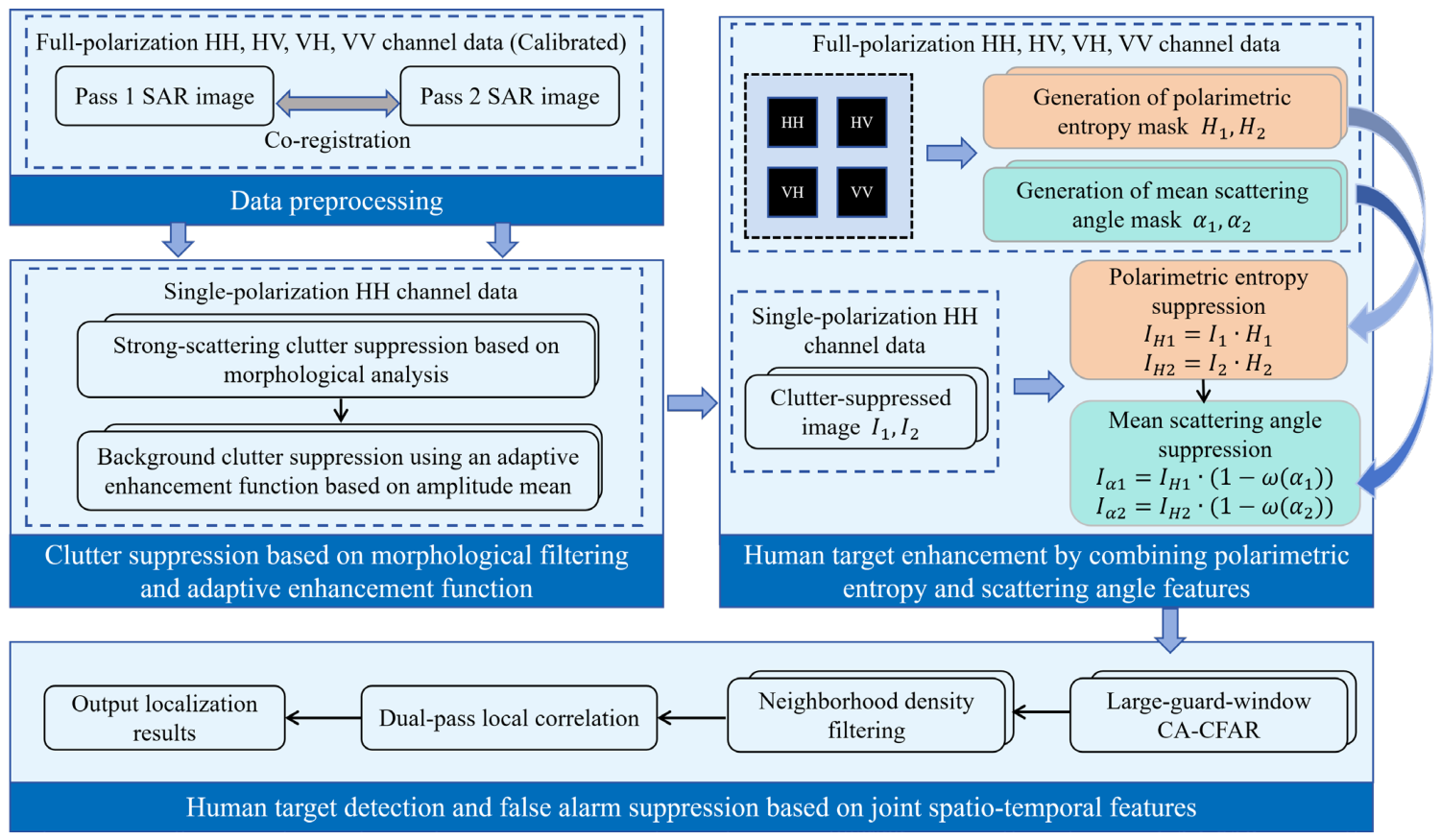
Under long-range airborne detection, a stationary human target occupies only a few pixels in SAR imagery and has a low SCNR. This makes it difficult to detect such targets against a strong clutter background. In this paper, a method for stationary human target enhancement and detection is proposed by fully exploiting information such as the polarimetric characteristics and geometric dimensions of human targets (as shown in Figure 1). The process is as follows.
Step 1: During the preprocessing after onboard data collection, we need to perform polarization calibration and radiometric calibration. These calibrations are used to correct the four-channel polarimetric data (HH, HV, VH, VV). This allows us to do imaging and feature extraction in later steps.
Step 2: ω–k imaging is performed on the fully polarimetric radar data collected from two passes. The four polarization channels are co-registered by onboard registration. The Speeded-Up Robust Features (SURF) algorithm is used to extract stable feature points from two SAR images of the same polarization, and the random sample consensus (RANSAC) algorithm is employed to estimate the geometric transformation model, achieving sub-pixel level co-registration between the two images [36,37]. The SURF algorithm detected 72 initial feature points, and 47 of them were inliers. The reprojection errors were 0.51 pixels in range and 0.46 pixels in azimuth.
Step 3: Select the polarization channel that yields the best signal-to-clutter ratio for stationary human targets. In this paper, the HH channel is chosen as the optimal channel. For the multiple types of clutter in complex scenes, clutter caused by large-sized strong scatterers such as buildings is removed based on morphological analysis. The statistical difference between the local image amplitude and the global image amplitude is utilized to construct a gain function, thereby suppressing homogeneous background clutter caused by ground vegetation and similar sources.
Step 4: Polarimetric scattering features, including polarimetric entropy and the mean scattering angle, are introduced to suppress clutter that is close to human targets in size and shape (such as trihedral corner reflectors). Specifically, a mask is constructed based on the polarimetric entropy feature to suppress low-entropy interference from regular scatterers with a single scattering mechanism. A Gaussian weighting function is constructed using the mean scattering angle to suppress clutter dominated by even-bounce scattering and to enhance human targets.
Step 5: Apply CA-CFAR detection to the clutter-suppressed SAR image. Use a large guard window to improve the detection rate. A neighborhood density filtering method is proposed to eliminate discrete suspected target points with low density caused by background clutter.
Step 6: Perform local binary-map correlation on the multi-temporal detection results. The local correlation of human targets between the two passes is leveraged to further filter out false alarms, yielding the final stationary human target detection results.

2.2. Clutter Suppression Based on Morphological Filtering and Adaptive Enhancement Function

In long-range, large-area detection scenarios, large man-made targets such as buildings are often present. Detection of stationary human targets is generally aimed at personnel outside buildings, whereas detection of people inside buildings is mainly carried out by through-wall radar at a short range. In SAR images, targets such as buildings appear as large continuous bright areas, and their side lobes can easily submerge human target signals while also introducing a large number of false alarms.
A stationary human target occupies only a small number of pixels in an SAR image, whereas targets such as buildings cover relatively large continuous areas of pixels with amplitudes much higher than those of human targets and background clutter. First, the amplitude of the entire image is statistically analyzed, and a threshold T g is set to extract a portion of the pixels with the highest amplitudes as suspected man-made targets,
B ( i , j ) = 1 , I ( i , j ) T g 0 , I ( i , j ) < T g
where B is the binary image of the extracted strong-scattering clutter and T g is the amplitude corresponding to the top 2% of pixels with the strongest amplitude,
number { I ( i , j ) > T g } number { I ( i , j ) } = 2 %
where I ( i , j ) is the HH polarization channel image, in which stationary human targets exhibit a relatively high signal-to-clutter ratio, and number{·} is the number of elements that satisfy the condition in parentheses.
A morphological closing operation is applied to B to fill the holes inside clutter areas such as buildings, which are caused by occlusion and other factors,
B = ( B x ) x
where is the dilation operation, is the erosion operation, and x is a circular structuring element with a radius of 40 pixels.
For each connected region in B , the number of pixels is counted. Any connected region whose pixel count exceeds the threshold S T is considered as large-sized strong-scattering clutter,
C k = 1 , S ( A ) < S T 0 , S ( A ) S T
where A is the set of connected regions. S ( A ) is the area of the connected region A. The threshold S T is estimated based on the actual dimensions of buildings. In this paper, S T is set to 1000 pixels.
The scattering from weeds or low vegetation in the co-polarization channel is generally weaker than that from a human target. However, due to its extensive distribution and large coverage, it will generate a large number of false alarms in the detection results, severely interfering with stationary human target detection. Inspired by the design concept of the intensity similarity kernel function in bilateral filtering, this paper proposes a gain function f ( x ) based on the local mean, as shown in Equation (5). Let μ s be the mean amplitude of the pixels within a sliding window (3 × 3) centered at pixel x i j , and let μ x be the mean amplitude of all pixels in the SAR image. When μ S μ X , the window is regarded as a noise region, and the gain function f ( x ) = 0 . For homogeneous clutter regions formed by low vegetation, μ s μ x , so that ( μ s μ X ) approaches zero, and f ( x ) provides a small gain to the pixel values in this region. If the window contains scatterers stronger than the background clutter (such as a human target or a trihedral corner reflector), μ s will be higher than μ x . In this case, the gain function can selectively enhance the amplitude range in which the human target is located via the parameter μ 0 , and the enhancement effect on the trihedral corner reflector will be weaker than that on the human target. The background clutter suppression processing is shown in Equation (6).
f ( μ S ) = k × μ S μ X σ g × exp ln ( μ S μ X + ε ) μ 0 2 2 σ g 2 , μ S > μ X 0 , μ S μ X
y i j = x i j + f ( μ S ) × ( μ S μ X )
where k is the gain factor, which determines the overall gain intensity of the image; ε is a small positive constant used to ensure the domain of the logarithm; and μ 0 is the peak center position of the gain function in the logarithmic domain, i.e., when ln ( μ S μ X + ε ) = μ 0 , f ( x ) attains its maximum gain. Since both the human target and the trihedral corner reflector are stronger than the global mean μ x , the gain interval of the gain function can be controlled by adjusting the parameter μ 0 to achieve enhancement of specific target amplitudes. σ g is the standard deviation of the gain function in the logarithmic domain. A larger σ g results in a broader and gentler gain function curve, whereas a smaller σ g yields a sharper curve.

2.3. Human Target Enhancement by Combining Polarimetric Entropy and Scattering Angle Features

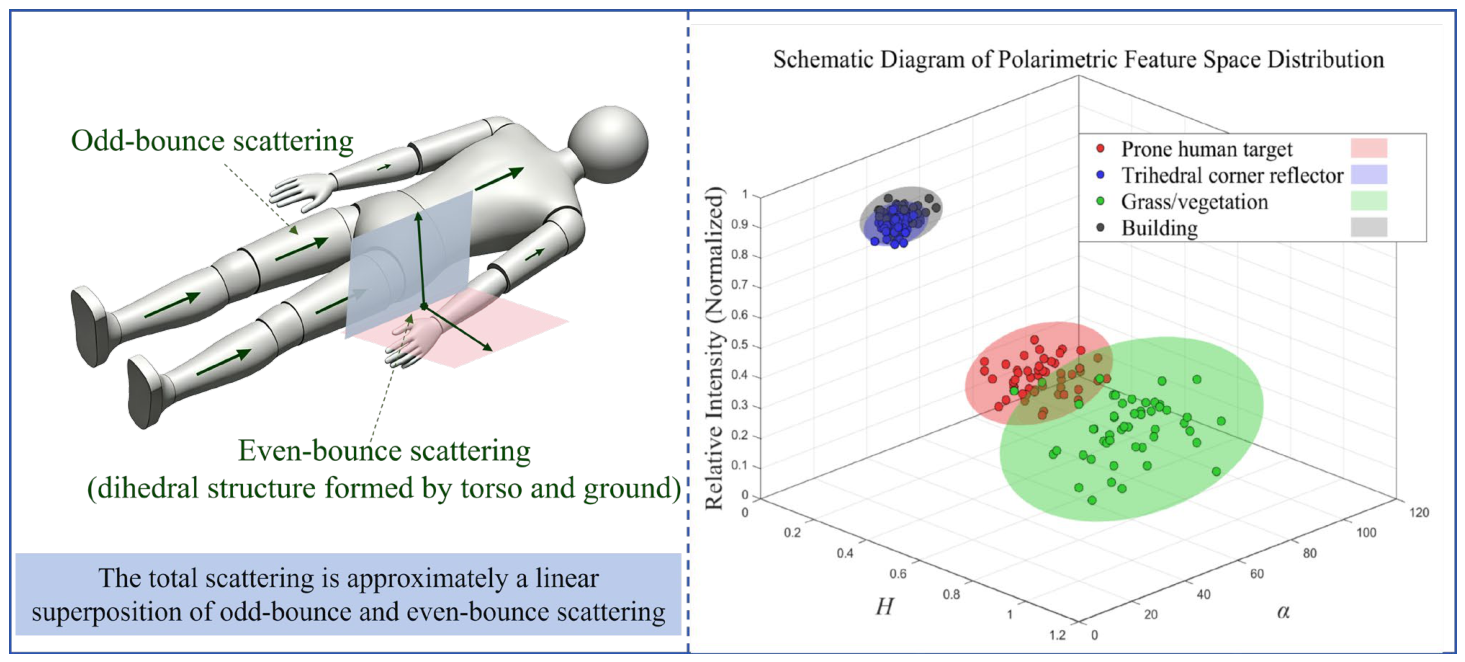
After the aforementioned clutter suppression processing, a considerable amount of clutter with size and image morphology similar to human targets (such as trihedral corner reflectors) still remains in the image. These clutter returns have amplitudes close to or even stronger than those of human targets, generating a large number of false alarms. In this paper, the polarimetric characteristics of human targets are introduced for the first time to achieve human target enhancement and suppress such clutter. To simplify the analysis, the body parts of a stationary human target can be approximated as regular scatterers: the arms and legs are approximated as cylinders of different lengths, the torso as an elliptical cylinder, and the head as a sphere. Surface reflections from regular scatterers such as cylinders, elliptical cylinders, and spheres mainly manifest as odd-bounce scattering, whereas the dihedral structure approximately formed by the torso and the ground, as well as the coupling among different body parts, mainly produces double-bounce scattering. Therefore, the polarimetric scattering characteristics of a stationary supine/prone human target can be regarded as a linear superposition of odd-bounce and double-bounce scattering [38,39]. Table 1 presents the differences in polarimetric characteristics between a human target and typical clutter based on measured data statistics.
Specifically, the total scattering power of a human target is at a moderate level—not as extremely high as that of buildings and trihedral corner reflectors, which produce strong structural scattering, nor as low as that of grassland and vegetation with weak scattering. The polarimetric entropy of a human target is concentrated in the middle range, indicating that its scattering mechanism is not singular or deterministic (as shown in Table 2). This clearly distinguishes the human target from low-entropy buildings and trihedral corner reflectors, as well as from high-entropy vegetation areas in the entropy dimension. The mean scattering angle of a human target lies in the medium-to-high range, differing from the medium-to-low scattering angles of trihedral corner reflectors and buildings, and from the high scattering angles of vegetation (as shown in Figure 2). In summary, the polarimetric feature regions of human targets and typical clutter do not overlap with each other, providing a physical basis for selectively enhancing human targets and specifically suppressing clutter using polarimetric information.
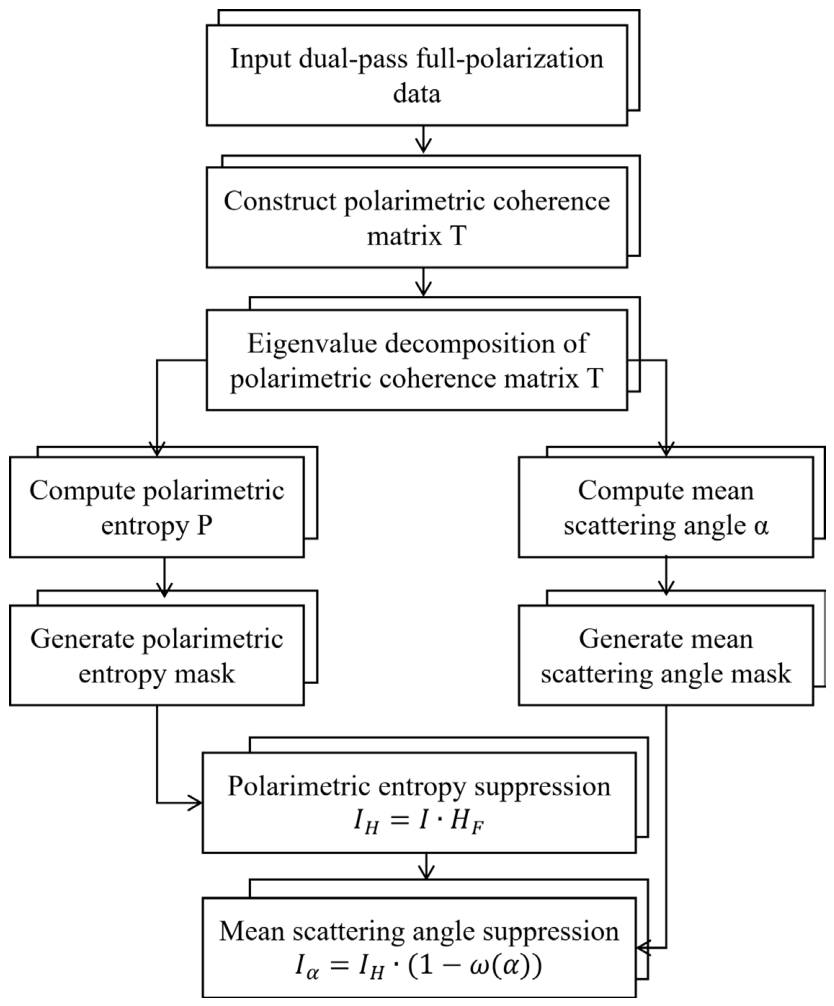
Based on the aforementioned differences in scattering mechanisms, this paper proposes a method for enhancing stationary human targets. The workflow of the method is illustrated in Figure 3.
The polarimetric information acquired by fully polarimetric SAR is represented by the scattering matrix S,
S = S H H S H V S V H S V V
In the scattering matrix S, the first subscript denotes the polarization mode of transmission, and the second subscript denotes the polarization mode of reception, where H represents horizontal polarization and V represents vertical polarization. A single instantaneous scattering matrix S is insufficient to characterize the statistical properties of a target. Therefore, it is necessary to vectorize the polarimetric scattering matrix of the target to obtain its polarimetric scattering coherence matrix T:
T = 1 2 | S H H + S V V | 2 ( S H H + S V V ) ( S H H S V V ) * 2 ( S H H + S V V ) S H V * ( S H H S V V ) ( S H H + S V V ) * | S H H S V V | 2 2 ( S H H S V V ) S H V * 2 S H V ( S H H + S V V ) * 2 S H V ( S H H S V V ) * 4 | S H V | 2
where · denotes averaging over a window, and * denotes complex conjugation. The diagonal elements T 11 , T 22 , T 33 of T represent the average odd-bounce, even-bounce, and volume scattering powers, respectively.
Eigenvalue decomposition of the polarimetric coherence matrix T can reveal its underlying scattering mechanism composition, thereby sequentially obtaining the data characteristics of different types of targets in fully polarimetric SAR imagery,
T = i = 1 3 λ i V i V i H
where λ i are the eigenvalues of the polarimetric coherence matrix T , with λ 1 λ 2 λ 3 0 , and V i is the eigenvector corresponding to λ i . The eigenvalues λ i characterize the relative intensities of different scattering mechanisms.
The scattering mechanism probability P i is defined as the energy proportion of the i-th mechanism. A larger P i indicates that the i-th scattering mechanism dominates the total scattering energy.
P i = λ i λ 1 + λ 2 + λ 3 , i = 1 , 2 , 3
H = i = 1 3 P i log 3 P i
The polarimetric entropy H is defined. For man-made targets such as trihedral corner reflectors, the polarimetric scattering mechanism is singular, so H is close to 0. For human targets, due to the combined influence of multiple factors on their scattering mechanisms, the uncertainty is higher compared with trihedral corner reflectors; therefore, H is significantly greater than 0. The polarimetric entropy image is multiplied element-wise by the clutter-suppressed SAR image,
I H = I · H F
where I is the background-equalized SAR image, H F is the polarimetric entropy map, and I H is the SAR image after human target enhancement using polarimetric entropy.
Each eigenvector V i of T can be represented by a set of angular parameters:
V i = cos α i sin α i cos β i e j δ i sin α i sin β i e j γ i
α i = arccos U 1 i
where α i is the scattering angle of the eigenvector V i , characterizing the type of scattering mechanism; β i is the azimuth angle, β i 0 , π ; and δ i and γ i are phase angles. U 1 i is the first element of the eigenvector V i .
For each resolution cell, the weighted average scattering angle α of the three scattering mechanisms is calculated as
α = i = 1 3 p i α i
This weighted average reflects the type of dominant scattering mechanism. The scattering mechanism of human targets is mixed, with the average scattering angle satisfying α 40 ° , 60 ° .
Based on the difference in α values between trihedral corner reflectors and human targets, a Gaussian weighting function is constructed.
ω ( α ) = exp α α t 2 2 σ 2
where α t is the scattering angle of regular scatterers such as trihedral corner reflectors, and is taken as 30° based on statistical analysis of measured data in this paper.
The weighting function is applied to I H to obtain the SAR image after mean scattering angle suppression, denoted as I α .
I α = I H · ( 1 ω ( α ) )

2.4. Human Target Detection and False Alarm Suppression Based on Joint Spatio-Temporal Features

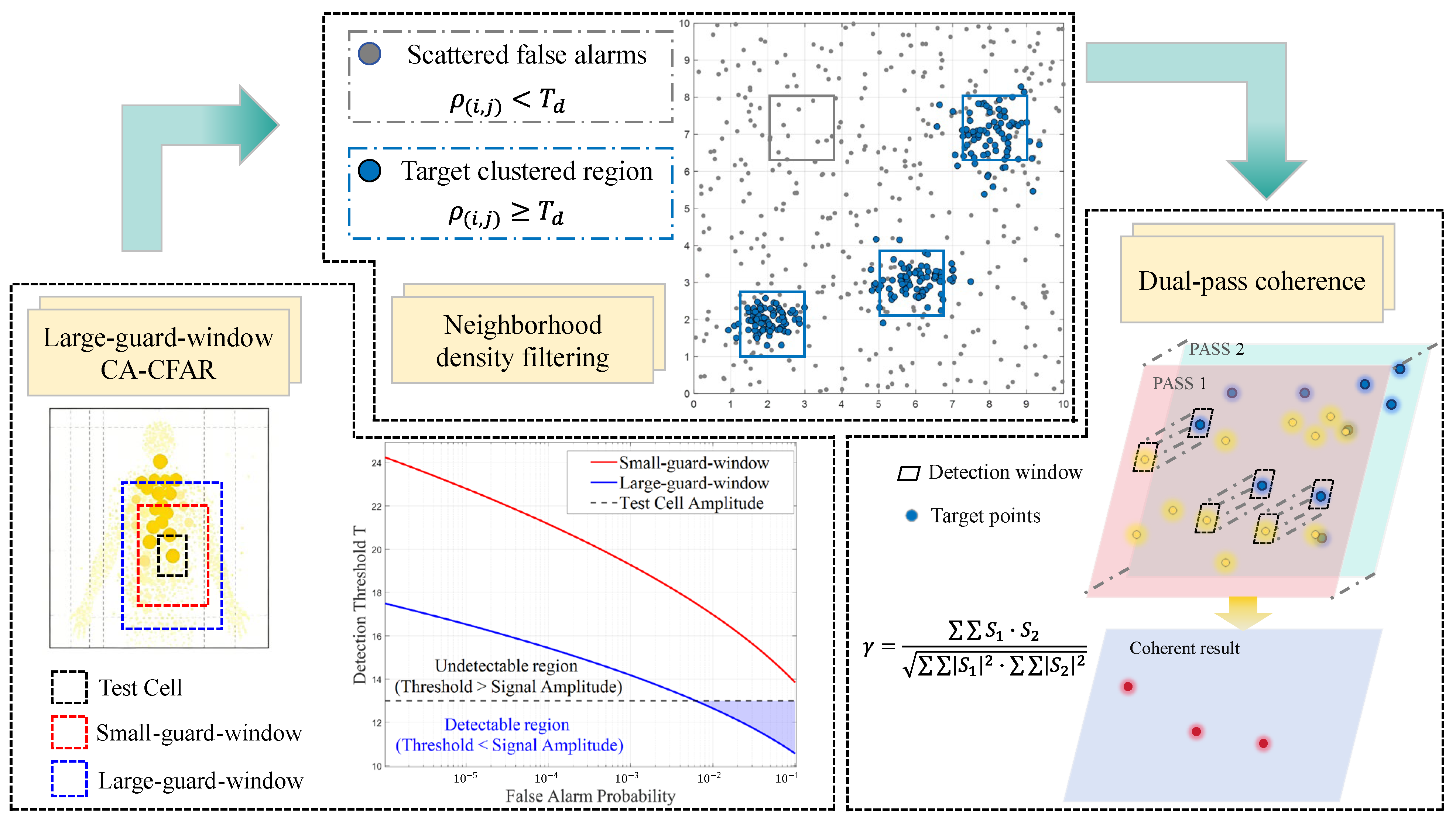
This secondary discrimination effectively combines spatial aggregation and temporal stability, further eliminating false alarms that are difficult to remove in single-temporal processing, and finally outputs high-confidence human target detection results (as shown in Figure 4). The overall processing flow starts with CFAR detection on a single image, strengthens the spatial aggregation characteristics of targets through density filtering, and then performs dual-pass local correlation verification, forming a progressive false alarm suppression architecture that provides a reliable guarantee for accurate human target detection.

2.4.1. Large Guard Window CA-CFAR for Stationary Human Target Detection

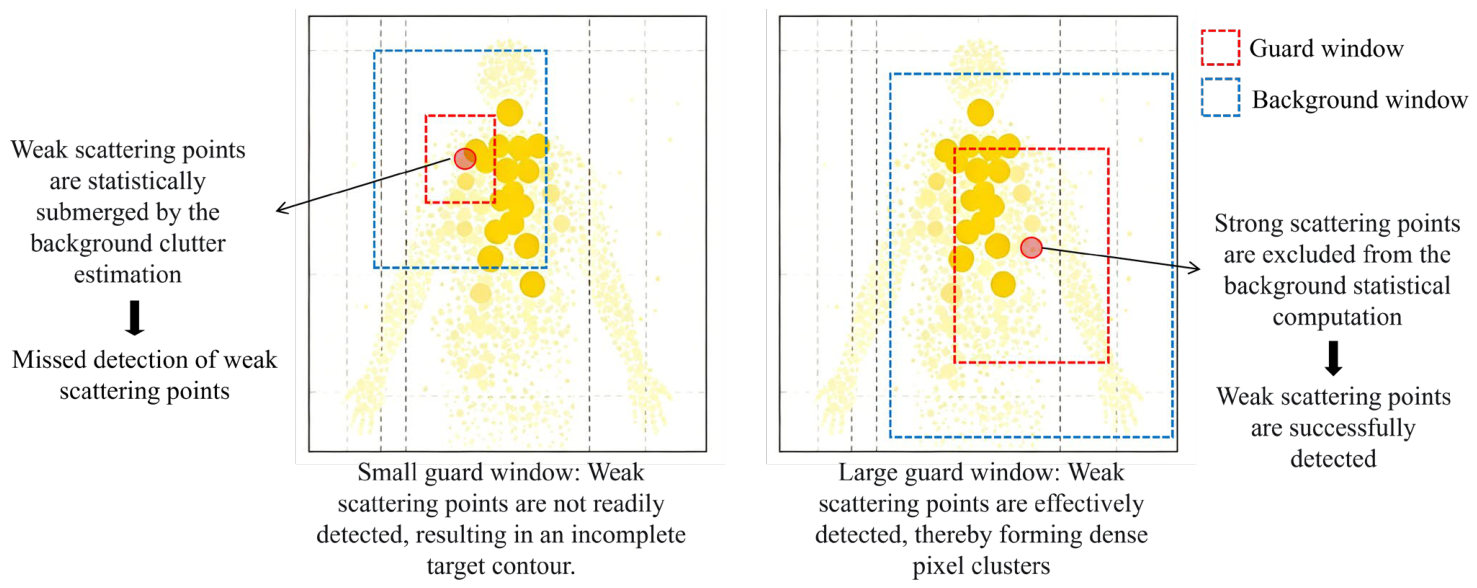
CA-CFAR is suitable for detecting weak and small targets under strong clutter backgrounds. The CA-CFAR detector typically assumes that weak and small targets are point targets and often adopts a “small guard window”, i.e., the guard window size is approximately consistent with the target size, and the background window is set to 2~3 times the guard window size. This configuration prevents target energy leakage from interfering with the statistical estimation of the background clutter distribution. As a volumetric target with a complex structure, the stationary human target exhibits variations in scattering intensity among its different parts, presenting an uneven intensity distribution in high-resolution SAR imagery. If a small guard window is used, when the sliding window passes over a weak scattering center of the stationary human target, the scattering center within the guard window is weak and can easily be overwhelmed by the background clutter statistics. As a result, only strong scattering centers, such as those from the torso, are retained in the detection results, making it difficult to preserve the target contour (as shown in Figure 5). In this paper, a “large guard window” configuration is adopted, where the guard window size is set larger than the human body size. When the sliding window contains strong scattering points belonging to the same target, these strong points are excluded from the background statistics, thereby effectively reducing the local background mean and standard deviation, and making the weak scattering points more likely to exceed the detection threshold. Based on the physical dimensions of the stationary supine or prone human target and the image resolution, the guard window ( W g ) is set as a square window of size 3 m × 3 m with a pixel spacing of 0.12 m in range and 0.04 m in azimuth, corresponding to 25 pixels in the range direction and 77 pixels in the azimuth direction. The background window size ( W b ) is set to twice the guard window size and the false alarm probability is set to 10 6 . Although this strategy may introduce more more non-zero pixels in non-human-target areas, it maximally preserves the dense pixel clusters formed by the human target.

2.4.2. False Alarm Suppression Based on Neighborhood Density Filtering and Multi-Temporal Local Binary-Map Correlation

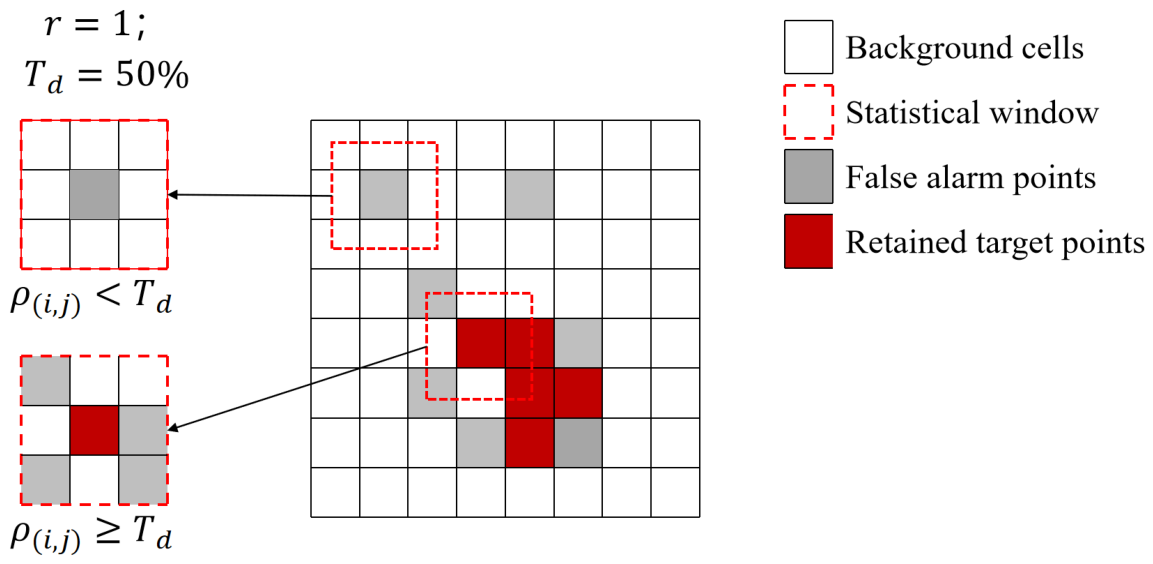
A neighborhood density filtering method is proposed after CA-CFAR detection to post-process the detection results. The schematic diagram of the principle is shown in Figure 6. The core idea is to exploit the spatial aggregation of real targets and to eliminate isolated noise points by counting the number of other target points in the neighborhood of each candidate pixel. Specifically, let the binary image obtained by CA-CFAR detection be denoted as D (where 1 indicates a target point and 0 indicates background). A density threshold T d is defined. The shape of the window is related to the shape of the target to be detected. In this paper, a square window is adopted, with window radius r and side length of 2 r + 1 pixels. For each target pixel ( i , j ) in D , the number N i , j of all target points within a square window of radius r centered at i , j is counted. The mathematical expression is as follows:
N i , j = m = r r n = r r D ( i + m , j + n ) 1 { ( i + m , j + n ) D }
ρ i , j = N i , j 2 r + 1 2
The density value ρ i , j is compared with a preset threshold T d . If ρ i , j T d , the pixel is retained; otherwise, it is determined as an isolated non-zero pixels in non-human-target areas and discarded. Finally, the filtered binary image S is output as follows:
S ( i , j ) = 1 , if   D ( i , j ) = 1   and   ρ i , j T d 0 , otherwise
Through the above operations, scattered random non-zero pixels can be effectively filtered out, while the aggregated regions formed by human targets are preserved, significantly reducing false alarms(non-zero pixels in non-human-target areas). However, under strong clutter backgrounds, a certain number of residual interferences may still exist, such as grating lobes of buildings or stable but isolated bright spots caused by incomplete polarimetric suppression. To address this, this paper proposes a secondary identification using local correlation of the two CFAR detection maps. For real human targets, their scattering characteristics exhibit high temporal stability over two independent passes with a short time interval. Therefore, in the two CFAR detection result images, the target regions not only correspond in position but also exhibit strong spatial correlation within local neighborhoods. In contrast, noise and random clutter, due to their lack of temporal consistency, tend to appear at random positions in the two images, resulting in low correlation. Based on this principle, this paper calculates the cross-correlation coefficient within a local window for the two CFAR detection result images after density filtering. For any pixel i , j , the local correlation coefficient within a local window of radius r 1 is defined as follows:
γ ( i , j ) = m = r 1 r 1 n = r 1 r 1 S 1 ( i + m , j + n ) S 2 ( i + m , j + n ) m = r 1 r 1 n = r 1 r 1 S 1 ( i + m , j + n ) 2 m = r 1 r 1 n = r 1 r 1 S 2 ( i + m , j + n ) 2 + ε , ( i + m , j + n ) D
where S 1 and S 2 denote the CFAR detection result maps based on local neighborhood density statistics from two independent passes, respectively. r 1 is set to 5 pixels. ε = eps is a small positive constant added to prevent division by zero when the local window contains no target pixels. This ensures the numerical stability of the correlation calculation.
When the two CFAR maps are identical within the local window, γ = 1 ; when they are completely uncorrelated, γ = 0 . Only when both images detect a target at the same location and the local correlation coefficient exceeds a preset threshold is the region determined as a real human target.
This secondary discrimination mechanism effectively combines spatial aggregation and temporal stability, further eliminating non-zero pixels in non-human-target areas that are difficult to remove in single-temporal processing, and finally outputs high-confidence human target detection results. The overall processing flow starts with CFAR detection on a single image, strengthens the spatial aggregation characteristics of targets through density filtering, and then performs dual-pass local binary-map correlation, forming a progressive false alarm suppression architecture that provides a reliable guarantee for accurate human target detection.

3. Experiments

3.1. UAV-Borne Fully Polarimetric SAR System

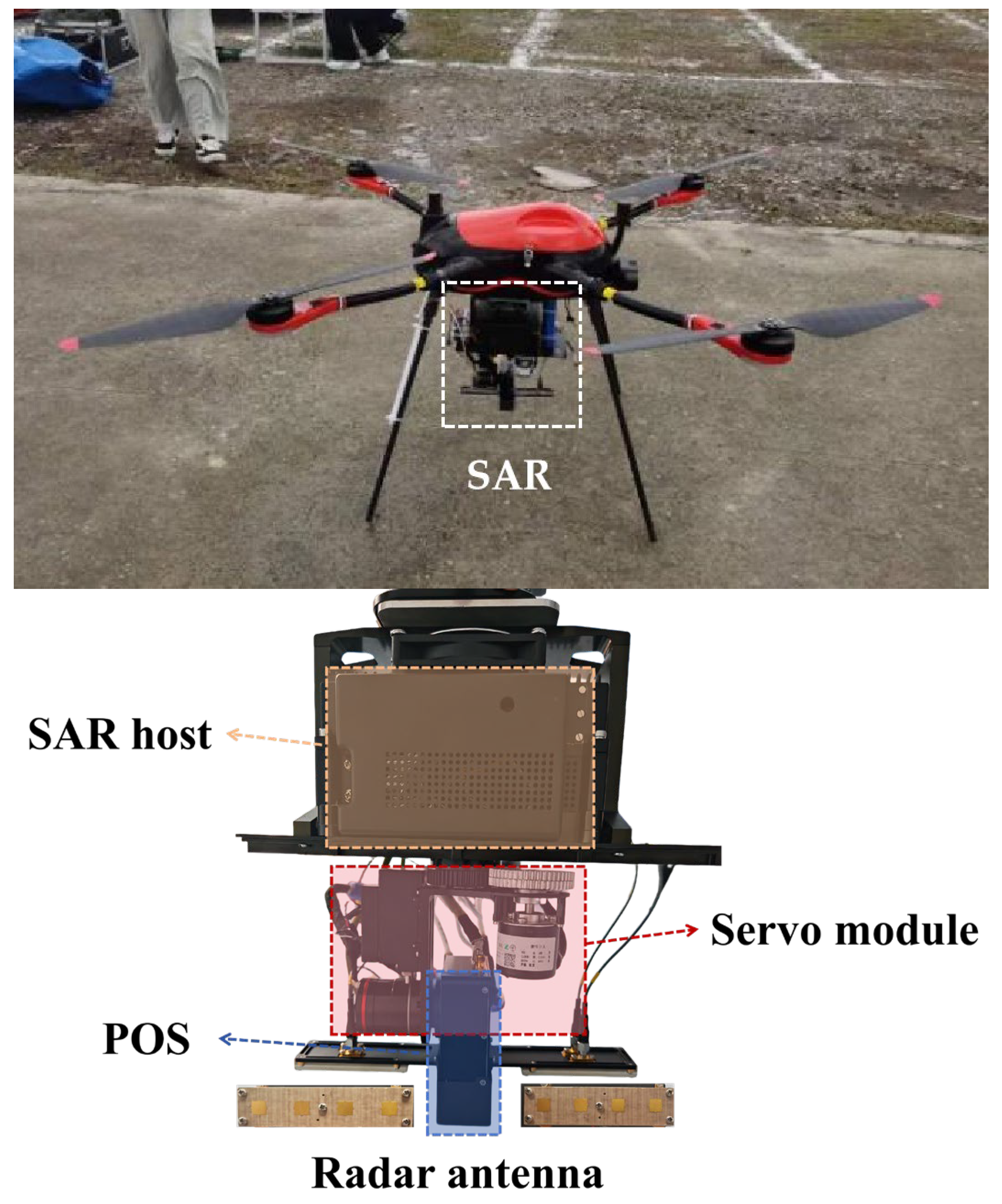
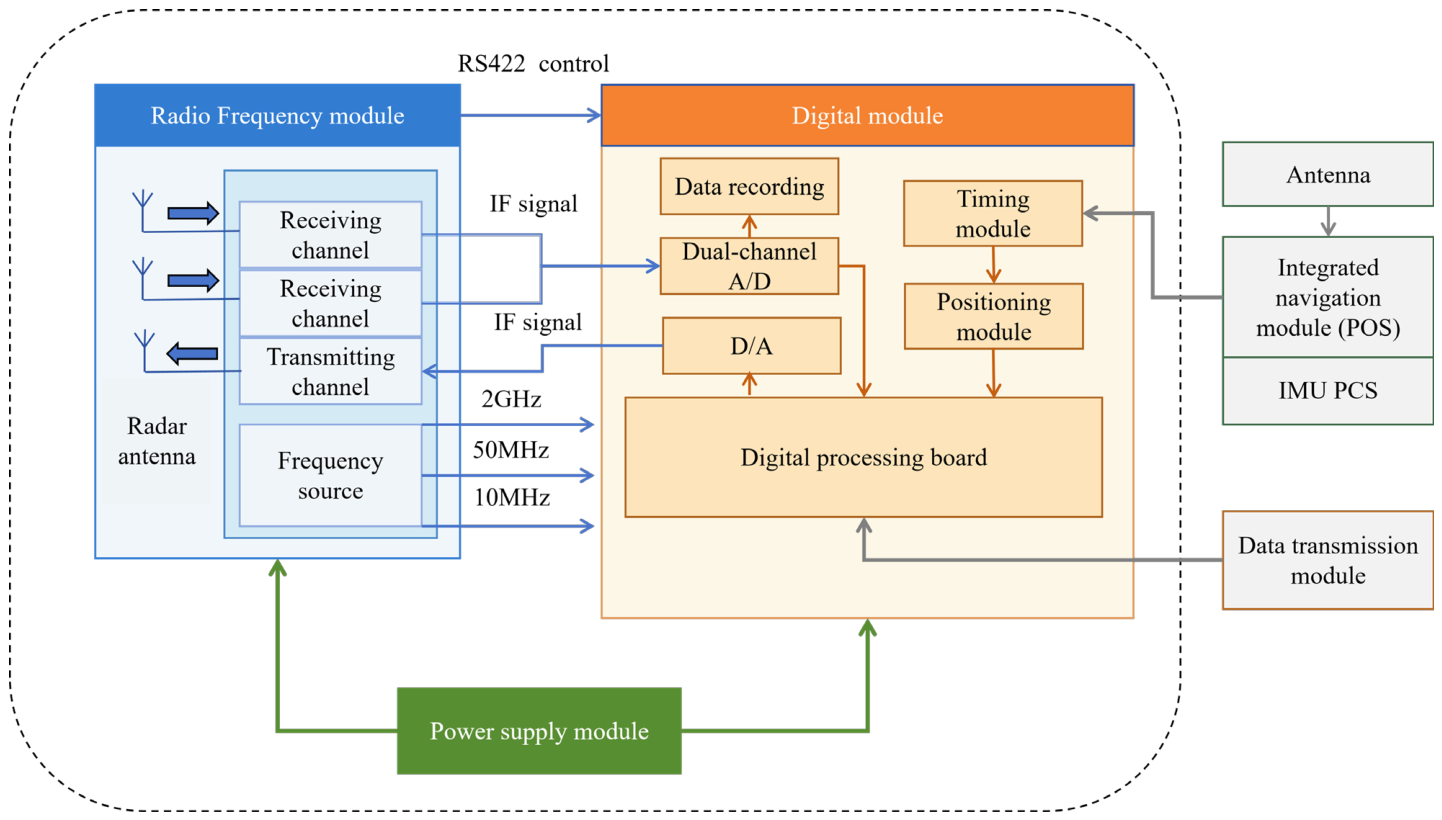
To verify the correctness and effectiveness of our proposed algorithm, we apply it to measured data from a UAV-borne X-band fully polarimetric SAR system. The physical setup of the UAV-borne fully polarimetric SAR system is shown in Figure 7, which mainly consists of the radar host, UAV platform, inertial navigation system, etc. The system parameters are listed in Table 3. The functional block diagram of the radar host is shown in Figure 8, comprising a radio frequency (RF) module, a digital processing module, a cascaded inertial navigation module, and a power supply module. The radar host adopts a frequency-modulated continuous-wave (FMCW) scheme and operates in the X-band, with a center frequency of 9.6 GHz and a signal bandwidth of 1.2 GHz. It employs one transmitting channel and two receiving channels. The transmitting channel alternately transmits H- and V-polarized signals via a polarization switch, while the H and V dual channels receive simultaneously. Thus, we can acquire four-channel fully polarimetric data (HH, HV, VH, VV) in a single flight. The radar host weighs approximately 2.9 kg, with a total power consumption of 60 W. The UAV platform is a quadrotor UAV manufactured by Keweitai, with a maximum flight time of up to one hour. The GPS system adopts the APX-15 UAV module, whose positioning accuracy reaches ≤1 cm in the horizontal direction and ≤2 cm in the vertical direction, with a data refresh rate of 200 Hz.
The signal processing procedure is as follows. The FPGA in the digital module generates an FMCW signal. The D/A conversion module converts it to an IF analog signal, amplifies it, and then the transmitting antenna radiates it to the ground. The receiving antenna captures echo signals. The RF module performs low-noise amplification and filtering. Then, the A/D conversion module converts them to digital signals and inputs them to the digital processing board. After onboard preprocessing such as dechirping, the data are stored in the onboard storage module for subsequent high-precision post-processing.

3.2. Parameter Sensitivity Analysis

The complete parameter table is shown in Table 4. In the parameter sensitivity analysis, this paper focuses on the influence of four key parameters on the final detection performance. First, the morphological area threshold S T is used to distinguish buildings from human targets. The pixel area is 0.04 m (azimuth) × 0.125 m (range) = 0.005 m2. This threshold is set based on field measurements of typical buildings in wilderness search-and-rescue scenarios. For example, with dimensions of approximately 5–8 m in length and 3–5 m in width, the corresponding connected region in the image typically exceeds 3000–5000 pixels, while the pixel cluster of a human target is far below 500 pixels.n this paper, the threshold is set to 1000 pixels, leaving a sufficient margin. Even if this threshold varies within the range of 500–1500 pixels, it will neither mistakenly remove human regions as buildings nor leave residual building clutter as false alarms.
Second, the Gaussian-weighted mean scattering angle parameter is based on the physical definition of the scattering angle in polarimetric decomposition. The scattering angle of trihedral corner reflectors (man-made strong clutter) is stably concentrated in the range of 30–40° (dominated by odd-bounce scattering), while that of stationary human targets is a mixture of odd- and even-bounce scattering, distributed in the range of 40–60°. In this paper, the mean of the Gaussian weight is set to 30°. Even if this center value shifts by 5–8° to either side, the suppression effect of the Gaussian curve on clutter is only slightly attenuated and will not change the binary decision outcome of the subsequent detection.
Third, the density filtering threshold T d serves as a pre-processing step before the main detection to remove isolated noise points. When T d varies within the range of 100–150, the retention rate of pixels belonging to human targets exceeds 90%. In non-human-target areas, the rejection rate of non-zero pixels varies between 72% and 94%. All residual false alarms (non-zero pixels in non-human-target areas) can be completely removed in the subsequent coherence verification step. Therefore, this threshold is not sensitive to the final detection rate over a relatively wide range.
Finally, the coherence coefficient threshold γ is used for dual-pass local binary-map correlation verification. In the binary detection maps, clutter pixels are unlikely to exceed the threshold in both passes simultaneously. Even if they occasionally exceed the threshold in both passes, their coherence coefficient remains low. In this paper, the coherence threshold is set to 0.7. Even if this threshold fluctuates within ±0.1, the coherence values of true targets remain stably above the threshold, while the coherence values of random clutter always remain below this range. In addition, increasing the window size for coherence estimation increases both the retained target pixels and the false-alarm pixels. However, it does not change the essential separability between true targets and noise in the distribution of coherence coefficients, and therefore does not affect the final target confirmation results.

3.3. Experimental Scene Setup and PolSAR Imaging Results

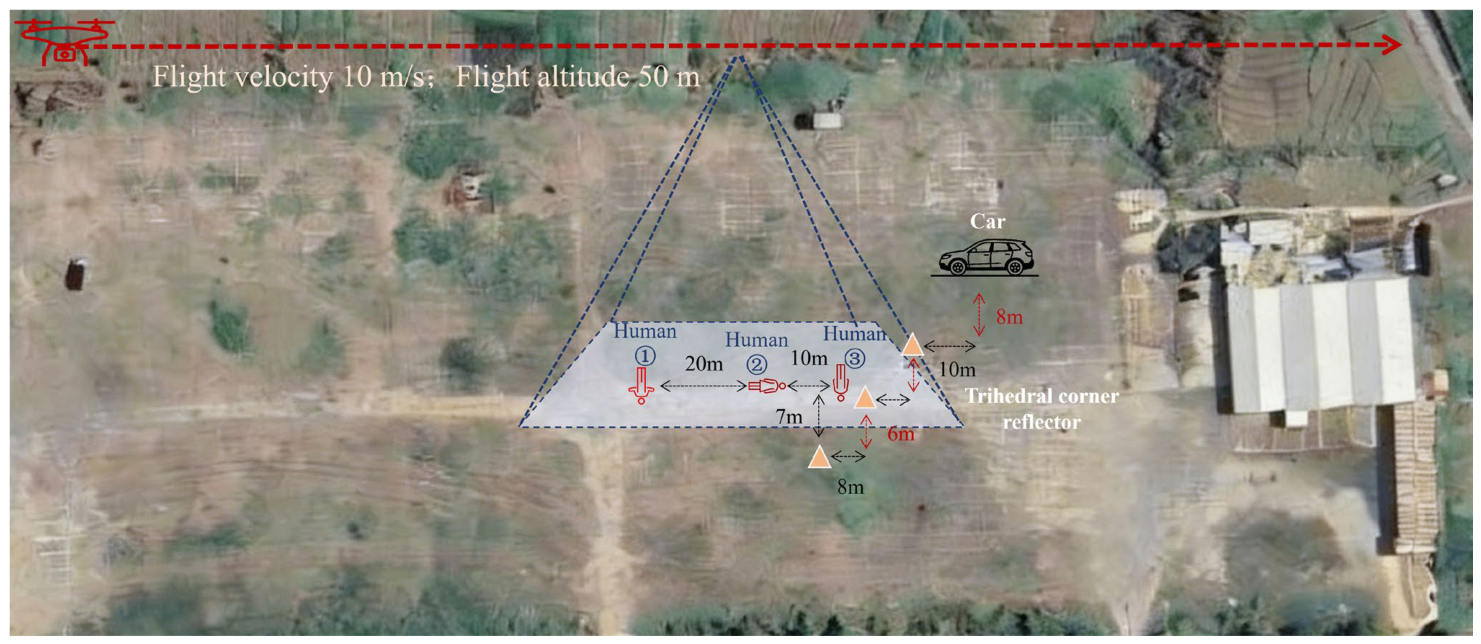
The PolSAR system was operated in a side-looking observation mode, with a look angle of 60°, a beamwidth of 40°, a flight altitude of approximately 50 m, and a flight speed of about 10 m/s. The time interval between the two independent passes was 118.75 s, during which the human targets remained stationary. The PolSAR flew from east to west along the azimuth direction for approximately 330 m, and the range beam coverage width was approximately 220 m. The scene contained large buildings, weeds, and vegetation. Trihedral corner reflectors (with an edge length of 0.3 m) were also placed as reference targets. Three volunteers lay supine or prone on the ground to simulate the injured personnel. From left to right in the image, the target configurations are as follows:
  • Leftmost human target (Target 1): Male, 23 years old, height 1.8 m, weight approximately 70 kg. The posture is lying supine on the ground perpendicular to the UAV flight direction, with limbs naturally extended, arms spread approximately 90° from the torso, and legs slightly apart.
  • Middle human target (Target 2): Female, 25 years old, height 1.6 m, weight approximately 45 kg. The posture is lying supine on the ground parallel to the UAV flight direction, with arms close to the torso and legs together.
  • Rightmost human target (Target 3): Male, 40 years old, height 1.78 m, weight approximately 60 kg. The posture is lying prone on the ground perpendicular to the UAV flight direction, with arms close to the torso and legs together.
The three human targets are spaced 10–20 m apart in the azimuth direction, while their range positions are consistent. A schematic diagram of the data acquisition scene is shown in Figure 9.
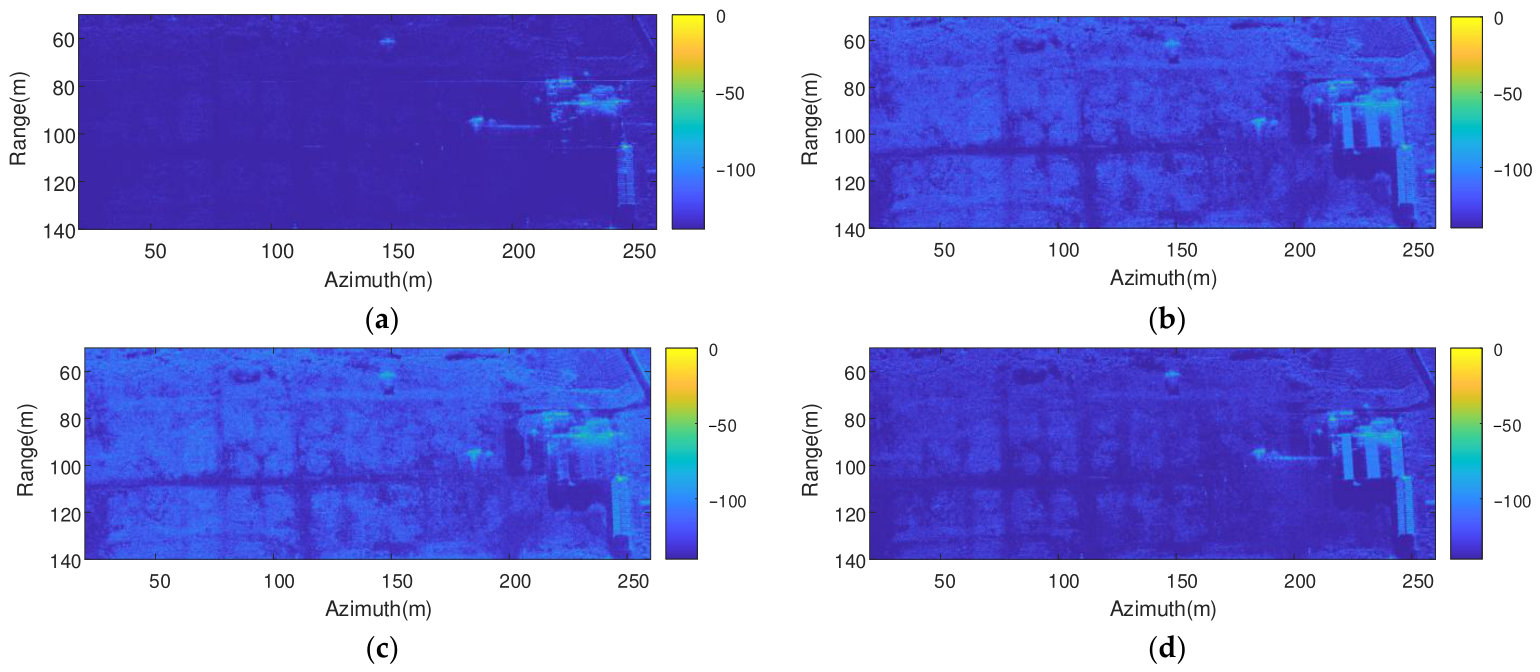
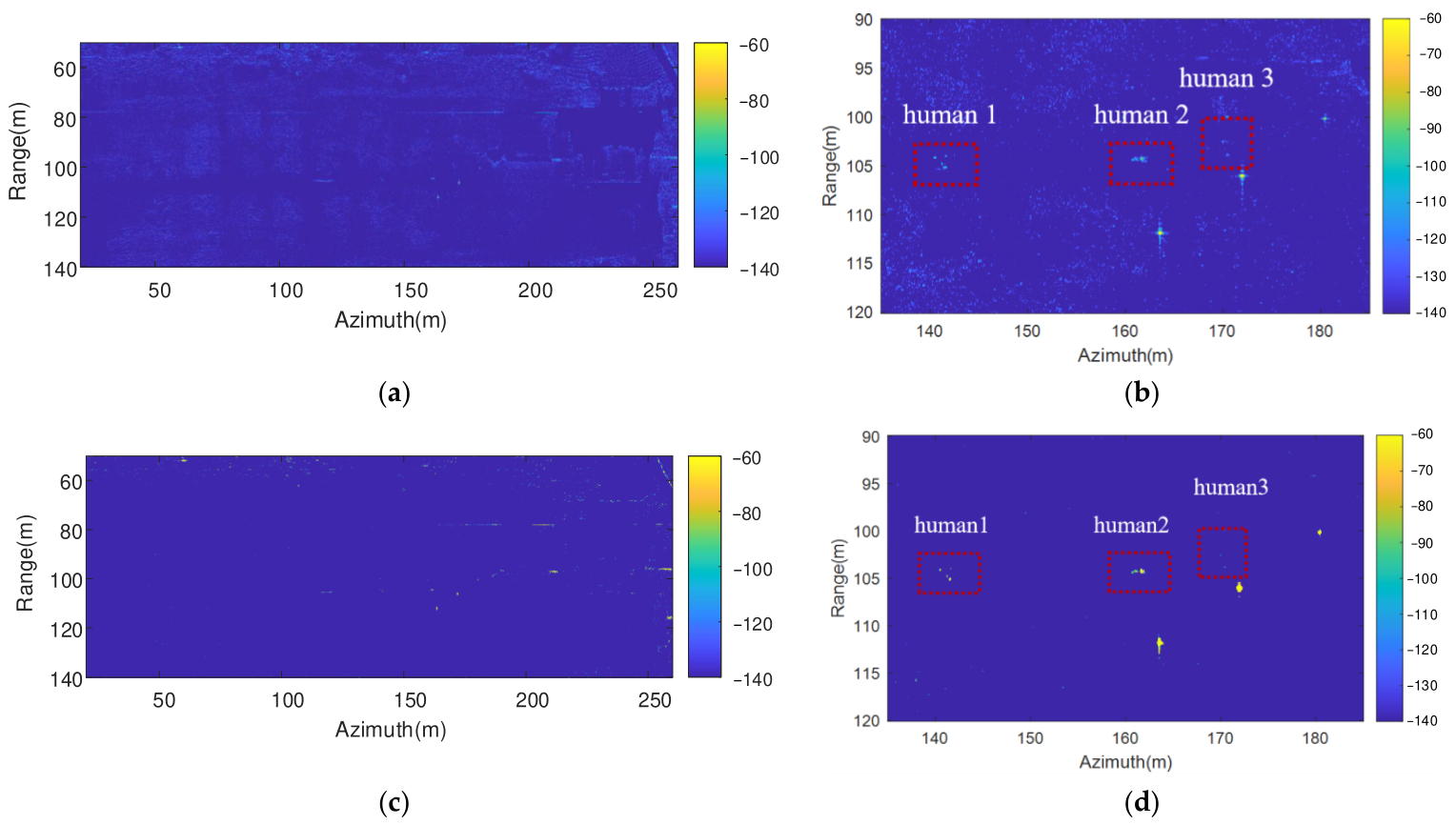
Figure 10 presents the imaging results of the experimental scene in the four polarimetric channels. A comparative analysis reveals the following. In the cross-polarization channels (HV and VH), natural ground objects such as grass and bare soil exhibit strong volume scattering echoes, causing the human targets to be obscured by background clutter and making them difficult to identify. In the VV channel, the ground clutter amplitude is relatively high, and the contrast between human targets and background is still insufficient. However, in the HH co-polarization channel, the scattering from stationary supine human targets is dominated by a mixture of odd-bounce and weak even-bounce scattering. This gives human targets the highest SCNR relative to the local background among the four channels. Thus, the pixel regions corresponding to the targets are distinguishable. Therefore, this paper selects the HH-polarization channel image as the input data for clutter suppression and target enhancement to ensure that subsequent processing can be carried out under optimal SCNR conditions.
In the imaging processing, we did not apply multilook processing. We also did not use any independent speckle filtering algorithm, such as the Lee filter. The reasons are as follows. Multilook processing reduces spatial resolution. This paper aims to detect weak human targets that occupy only a few pixels. Keeping the original resolution is critical for preserving target details. Speckle filtering can cause blurring and edge distortion in heterogeneous areas and near point targets. This may weaken the scattering features of human targets. The later processing includes neighborhood density filtering can effectively remove isolated noise points caused by speckle at the detection stage.
In this paper, we use the SCNR in the linear power domain, expressed as:
S C N R d B = 10 log 10 P ¯ t P ¯ b
P ¯ t is the mean linear power of all pixels within the target window. The target region is selected by manually choosing a rectangular window based on the position of the human target in the SAR image. The target window parameters used in this paper are as follows: for Human Target 1, the target window is 21 pixels in range and 20 pixels in azimuth; for Human Target 2, it is 15 pixels in range and 37 pixels in azimuth; for Human Target 3, it is 10 pixels in range and 14 pixels in azimuth.
P ¯ b is the mean linear power of all pixels within the background window. The background region is defined by taking the target window as the center and expanding it outward by 10 pixels on all sides to form a larger rectangular window. All pixels within the target window are then excluded, and the remaining annular region serves as the clutter estimation area.

3.4. Enhanced Imaging Results of Stationary Human Targets

The image after large-scale strong scattering clutter suppression processing on the original image is shown in Figure 11a. It can be observed that the strong clutter interference caused by man-made targets such as large buildings and vehicles is effectively removed, significantly reducing the overall dynamic range of the image. Meanwhile, the sidelobes of strong clutter are suppressed to a certain extent.
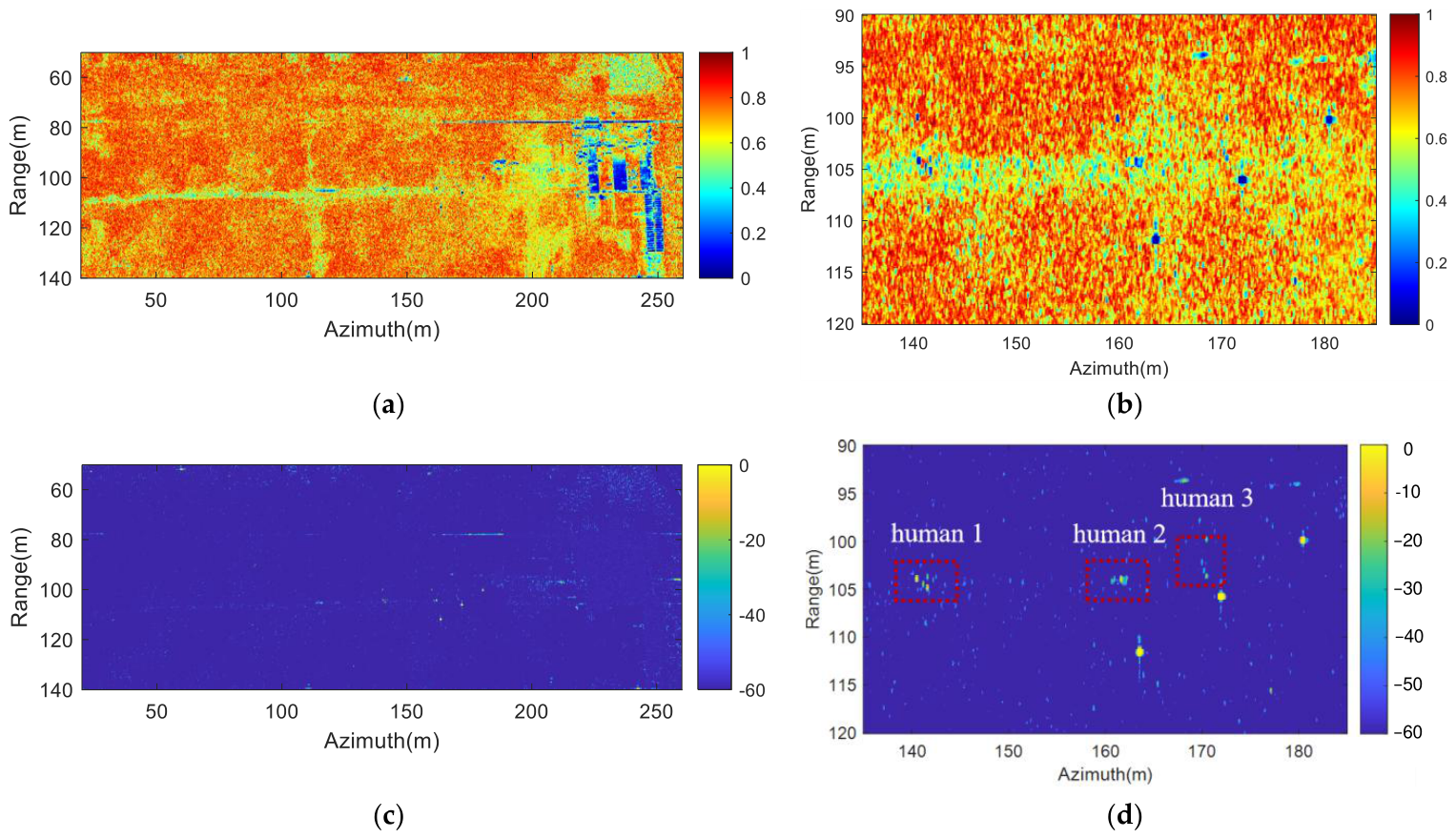
The image after background clutter suppression is shown in Figure 11c. The amplitude of the human target region is increased by approximately 60 dB compared with that before processing. For the trihedral corner reflector, the amplitude is increased by approximately 45 dB due to its strong scattering characteristics. Thus, effective background clutter suppression is achieved.
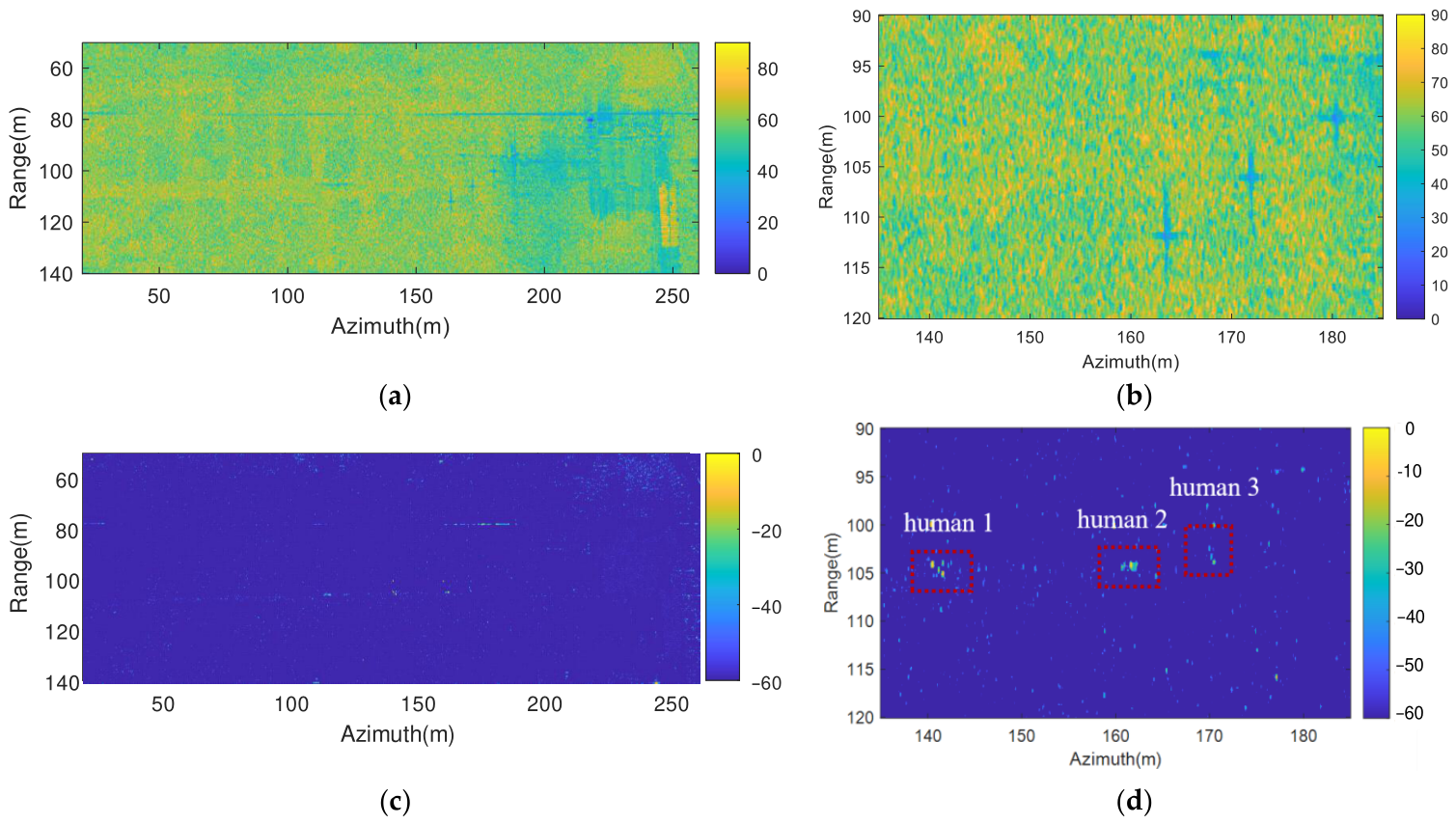
The amplitude of man-made regular scatterers such as trihedral corner reflectors is still much stronger than that of stationary human targets (approximately 60 dB stronger). However, their scattering mechanisms differ significantly from those of human targets. Human targets are characterized by a mixture of surface scattering and weak even-bounce scattering, and consequently exhibit higher polarimetric entropy compared with trihedral corner reflectors. According to statistical results from measured data, the mean polarimetric entropy of trihedral corner reflectors is 0.16, while that of human targets is 0.5, as shown in Figure 12b. By designing an attention factor based on polarimetric features such as polarimetric entropy and mean scattering angle, effective suppression of clutter that differs in polarimetric characteristics from human targets can be achieved. As shown in Figure 12d, the amplitude of stationary human targets is enhanced by approximately 40 dB, resulting in an amplitude difference of less than 20 dB relative to the trihedral corner reflector.
After human target enhancement processing using the polarimetric entropy attention factor, the amplitude of human targets is still approximately 40 dB lower than that of the trihedral corner reflector. According to statistical results from measured data, the mean scattering angle of trihedral corner reflectors is 35°, while that of human targets is 55°, as shown in Figure 13b. The Gaussian weighting function constructed in this paper effectively suppresses clutter with scattering angles in the range of 30° to 50°. As shown in Figure 13d, the amplitude intensity of stationary human targets is enhanced by approximately 50 dB compared with that of the trihedral corner reflector.
After human target enhancement processing using polarimetric features, the overall SCNR of the three human targets is improved by approximately 13 dB on average. Specifically, after human target enhancement using the polarimetric entropy attention factor, the SCNR of human target 1 is improved by approximately 30 dB, while the SCNR of the trihedral corner reflector is reduced by an average of approximately 10 dB, as shown in Figure 14b. Furthermore, after mean scattering angle suppression, the SCNR of human target 1 is further improved by approximately 7 dB, as shown in Figure 14c.

3.5. Ablation Study and Comparative Analysis

To evaluate the individual contribution of each key component in the proposed method and demonstrate its advantages over conventional SAR target detection approaches, this section presents a systematic ablation study and comparative analysis. In the field of SAR target detection, a classical processing chain typically comprises median filtering for speckle suppression, followed by CFAR detection, morphological filtering, clustering analysis, and target output. The core logic is to remove noise through preprocessing, extract candidate targets via CFAR, and eliminate false alarms through morphological operations and clustering. The proposed method builds upon this mature framework and introduces targeted enhancements and improvements for the specific target type of weakly scattering human targets. However, since there is currently no mature method in the open literature for detecting ground-based stationary human targets using UAV-borne fully polarimetric SAR at long ranges, a direct comparison with “similar methods” is not feasible. Therefore, the comparative strategy adopted in this paper is twofold: (1) through an ablation study, the proposed clutter suppression and polarimetric enhancement modules are incrementally ablated to quantify the individual contribution of each component, with the results presented in Table 5, and (2) through a horizontal comparison of different filtering algorithms, the effectiveness of the proposed false-alarm suppression strategy relative to conventional SAR image filtering methods is validated, with the results presented in Table 6.
From baseline A to the full pipeline F, the detection rate increases from 0% to 66.7%, while the number of NPINA drops from 10,243 to 0. Configuration B increases the detection rate to 66.7% and reduces NPINA by approximately 88.6%.The addition of polarimetric features (configurations C and D) further reduces NPINA based on physical scattering mechanisms.
Notably, the trihedral corner reflector is successfully suppressed in configuration D, validating the effectiveness of the scattering-angle-based discrimination. The NPINA count temporarily increases at configuration D because alpha-angle enhancement is a feature-weighting operation rather than a binary filter. These residual NPINA are then effectively removed by density filtering (configuration E) and dual-pass correlation (configuration F). The progressive reduction in NPINA from configuration A to F confirms that each module contributes meaningfully to the overall performance. In particular, the final dual-pass correlation step plays a critical role in eliminating all residual false alarms without compromising the detection rate.
The comparative results presented above demonstrate that the proposed neighborhood density filter achieves the best performance across all evaluation metrics, fully validating that the proposed neighborhood density filtering strategy can effectively distinguish dense pixel clusters of real human targets from isolated and randomly distributed clutter false alarms, significantly reducing the false alarm rate while maintaining a relatively high recall, and substantially outperforming conventional SAR image filtering algorithms.

3.6. Human Target Detection Result

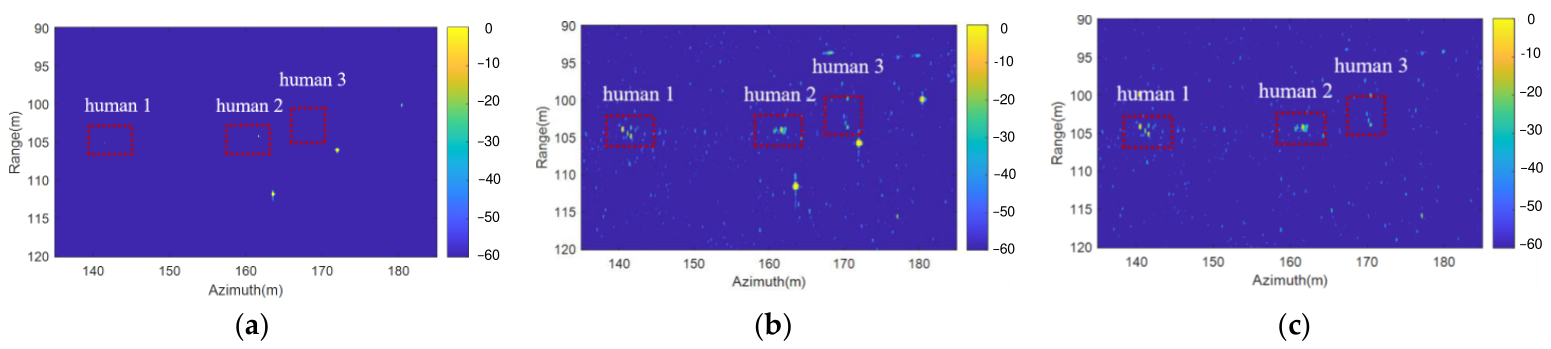
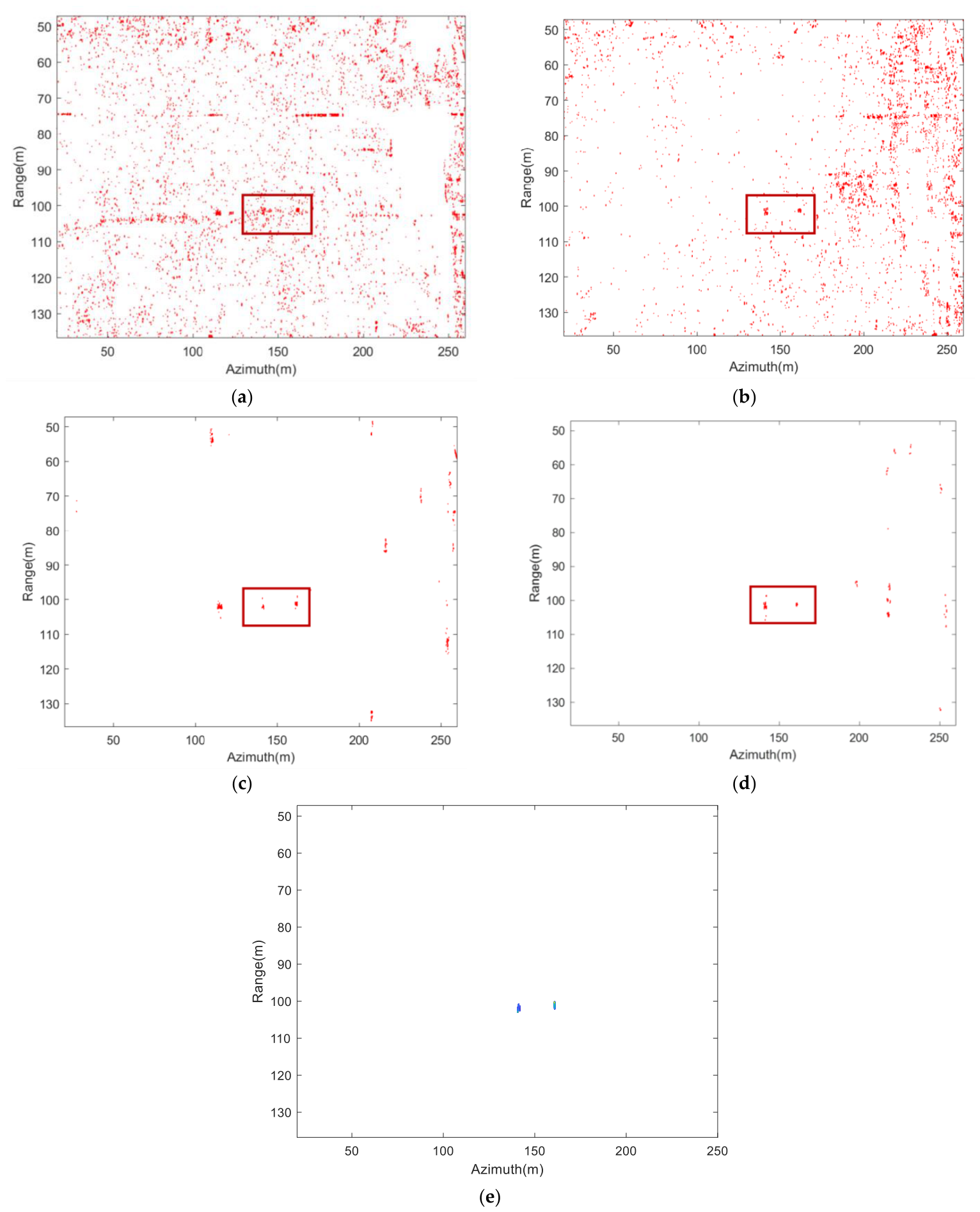
CA-CFAR is suitable for detecting weak and small targets and can preserve such targets effectively. To ensure detection performance, a false alarm rate of 10 6 is adopted in this paper. However, a drawback of this approach is that the detection results contain a large number of false alarms caused by clutter. As shown in Figure 15a,b, false alarms are present in the images. False alarms originating from background clutter such as vegetation are often isolated and dispersed, while those from residual clutter of buildings exhibit partial aggregation but with low density. In contrast, the scattering from stationary human targets appears as densely distributed target points within a certain region, as indicated by the red dashed boxes in the figures. Therefore, the distribution of stationary human targets differs from that of clutter in the CFAR results. In this paper, a filtering method based on local neighborhood density statistics is combined with CFAR detection, effectively removing randomly dispersed non-zero pixels in non-human-target areas in the CFAR detection maps while preserving the aggregated pixel clusters corresponding to human targets as shown in Figure 15c,d. Statistical results indicate that after filtering, in Pass 1, the number of non-zero pixels in non-human-target areas dropped from 25,517 to 1588, a reduction of 93.8%. In Pass 2, it dropped from 16,913 to 522, a reduction of 96.9%.
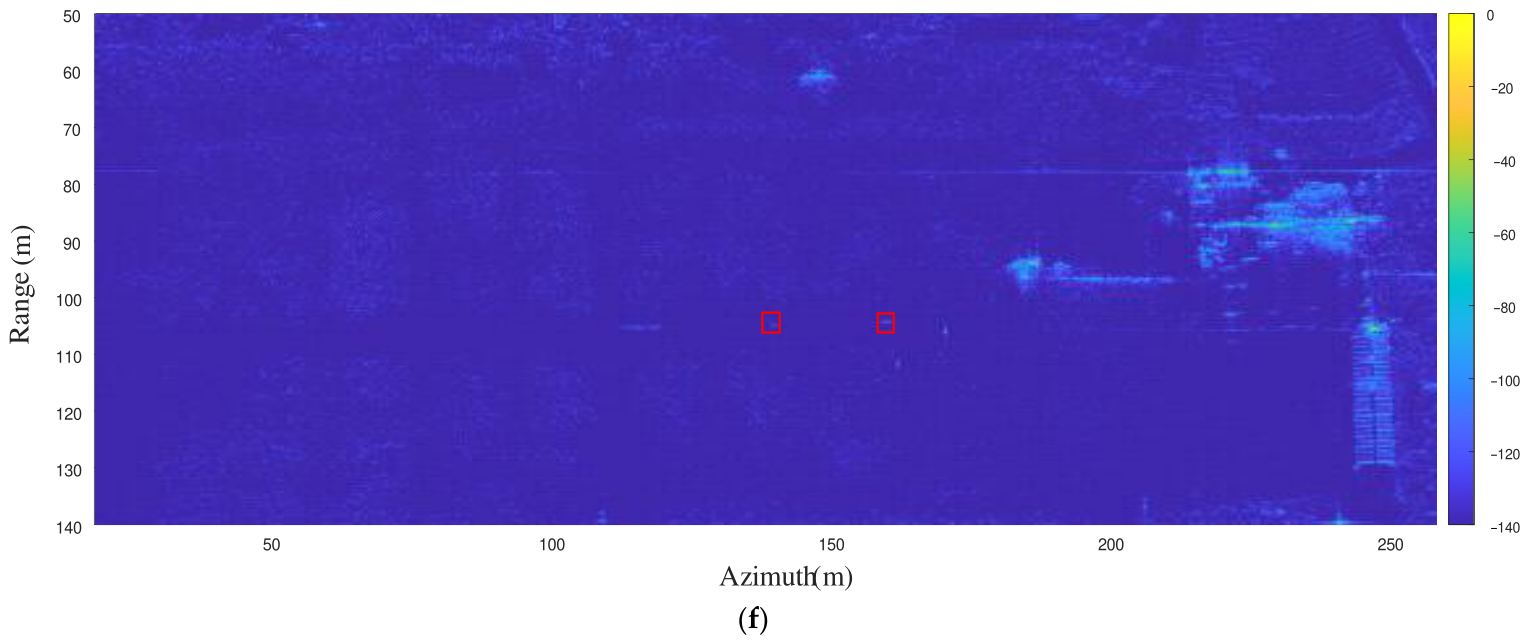
After the above processing, although the number of false alarm points is significantly reduced, it still far exceeds the number of human targets. This paper further applies local correlation to the dual-temporal CFAR maps acquired from two independent passes, retaining candidate target points that appear stably in both temporal detection results and exhibit strong correlation. Finally, two human targets are detected, as shown in Figure 15e. The SAR images preserve the imaging geometric relationship, facilitating convenient geocoding and enabling the acquisition of precise human target locations, as illustrated in Figure 15f. Additionally, terrain information around the human targets can be obtained from the SAR images, providing auxiliary information for human target rescue in wide-area complex environments.
The quantitative metrics presented in Table 7 provide a comprehensive performance evaluation of the proposed detection framework. The method successfully detected two out of three targets, achieving a detection probability of 66.7% and a precision of 100%—all detected targets after local binary-map correlation were genuine; no false-positive target indications were observed in this particular scene. The F1-score of 0.8 reflects a favorable balance between detection completeness and false-alarm suppression. The number of NPINA decreased from approximately 0.06 per square meter after density filtering to 0 per square meter after dual-pass local binary-map correlation, demonstrating the critical role of spatio-temporal consistency verification in eliminating residual NPINA. Nevertheless, these metrics also honestly reveal the limitations of the current method when confronted with extreme target configurations—namely, that the detection rate did not reach 100%, with one target being missed due to the extreme conditions.
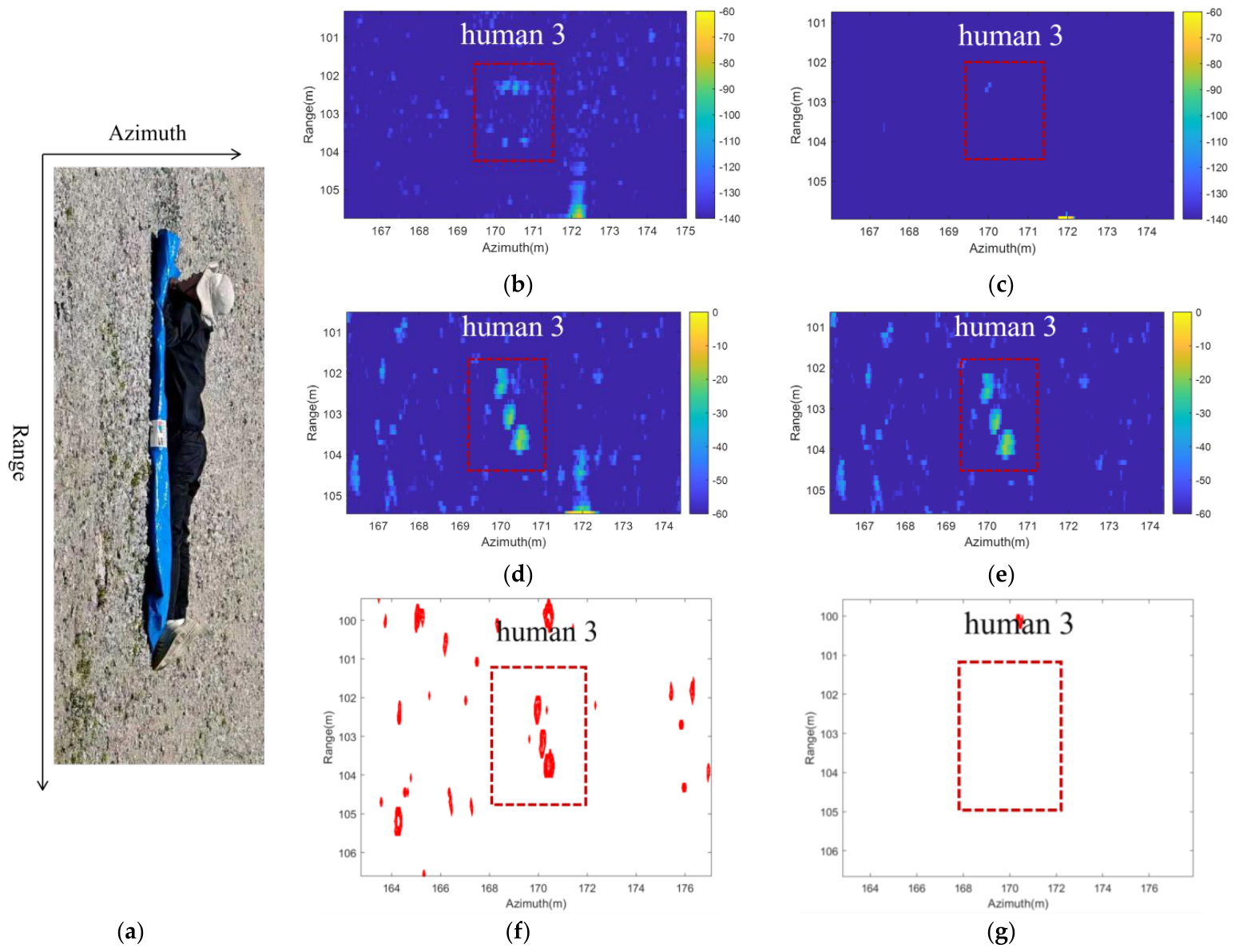
In this experiment, we set human 3 as an extreme target type which is difficult to detect. In PolSAR images, target 3 can be seen as very weak and non-contiguous clusters, but he was not detected in the final detection result. Figure 16 shows the imaging results of this target at different processing stages. The reasons for this missed detection are as follows. Firstly, this target has a relatively slim body shape, with a posture of lying prone perpendicular to the flight direction, arms close to the torso, and legs together. Under this posture, the RCS of the human body is relatively small. In addition, the target is located close to a trihedral corner reflector (with distances of less than 2 m in both the range and azimuth directions). The strong scattering from the trihedral corner reflector causes significant interference. The SCNR of this target in the image is −3.1 dB. Due to the weak scattering from certain body parts, the reflected signals are often undetectable under the interference of the trihedral corner, thereby preventing the formation of a human body contour. Therefore, the formed morphological features are different from normal human targets. Moreover, the scattering from this human target is dominated by reflections from the head and back, reducing the distinguishability of its polarimetric features from the background. Consequently, the proposed algorithm achieves only limited enhancement for this target. This missed detection target gives an extreme negative example under the influence of personnel type, posture, and strong clutter interference, illustrating the applicable scope of airborne PolSAR. Our future research will focus on further improvements through the introduction of micro-motion detection and deep learning after enlarging the sample size.

4. Discussion

It should be noted that both the polarimetric characteristics of human targets observed in this study and the parameters used in the polarimetric enhancement stage were obtained under this experimental configuration, involving stationary supine or prone postures, dry weather conditions, a grass-covered ground surface, X-band side-looking SAR, and an incidence angle of approximately 60°. The potential influences of different experimental conditions on these characteristics are discussed as follows. Previous studies have shown that human posture significantly affects detection difficulty, with the standing posture being the easiest to detect, followed by the sitting posture, and the lying posture being the most challenging [40]. In this paper, the lying posture (supine or prone) was selected precisely because of its strong relevance to search-and-rescue scenarios. However, when the posture changes, the geometric projection relative to the radar and the main scattering structures both change, which may affect the distribution of human target features in the H-α plane. Regarding clothing penetration, previous studies have demonstrated that X-band signals penetrate conventional dry or slightly moist clothing well, with only about 1 dB of attenuation [41]; nevertheless, direct experimental evidence for the specific effects of clothing on the polarimetric features of human targets is still lacking. Environmental moisture primarily alters the polarimetric scattering characteristics of background clutter, and its direct impact on the polarimetric features of the human target itself also lacks experimental verification. Under different radar observation geometries, the numerical values of polarimetric features may shift to some extent, but the relative separability between human targets and typical scatterers in the H-α plane is expected to be preserved. The above discussion is based on inferences drawn from existing indirect experimental results, as no directly comparable studies are currently available in the literature. The effects of different postures, clothing materials, moisture conditions, and radar geometries on the polarimetric features reported in this study will be a key focus of future research.
Beyond the technical considerations discussed above, several operational issues are also worth addressing. In terms of operational range, the current UAV data link can achieve more than 10 km of communication coverage under line-of-sight conditions. The scanning capability is mainly limited by the flight endurance of the UAV platform. The current endurance is approximately 0.5–1 h, and heavier payloads further reduce the flight time. Flight operations are also constrained by weather conditions and airspace regulations. Wind speeds exceeding 8 m/s or rainfall can degrade imaging quality. Regarding data processing, the current algorithm operates in offline mode, and the full processing chain takes approximately 3 min. For false-alarm handling, we propose a two-stage strategy combining “wide-area SAR search” and “close-range bio-radar confirmation.” In the first stage, SAR detects and outputs candidate target locations. In the second stage, the UAV approaches and hovers over the candidate position, using an onboard bio-radar to detect respiratory and heartbeat signals for secondary target confirmation. This approach can effectively eliminate false alarms and confirm the life status of the target. Moreover, SAR images reflect only the electromagnetic scattering characteristics of targets and cannot reveal facial features or personal identity. This gives SAR a natural advantage in privacy protection compared to optical or infrared sensors. These operational issues will be gradually addressed as the system transitions from laboratory validation to practical deployment, and they represent a key direction for our future research.

5. Conclusions

UAV-borne SAR offers the advantages of all-day, all-weather operation, long-range capability, and penetrative ability. This paper proposes the use of UAV-borne PolSAR for long-range detection of stationary human targets in field environments. A methodological framework encompassing strong clutter suppression, stationary human target enhancement, weak target detection, and false-alarm suppression is designed. Experimental results on measured data demonstrate that the polarimetric features of human targets are effectively exploited for detection, improving the SCNR of stationary human targets by approximately 13 dB. The proposed algorithms based on neighborhood density filtering and dual-pass local binary-map correlation reduce the number of non-zero pixels in non-human-target areas by 93.8% and 96.9% in the two passes. The above results demonstrate that UAV-borne SAR is feasible for stationary human target detection.
As a proof-of-concept study, this work acknowledges that when detecting stationary human targets at long range under strong clutter conditions in complex environments, substantial individual differences and diverse postures exist, which readily lead to missed detections. The measured data in this study indicate that under the extreme condition where a prone human target keeps the limbs close to the torso, the torso is oriented perpendicular to the flight direction, and the target is located immediately adjacent to a strong scatterer, the proposed algorithm yields only limited enhancement for such targets. Nevertheless, we contend that this limitation does not detract from the principal contribution of this work, namely the first experimental demonstration of the feasibility of the proposed technical approach.
In future research, we will optimize the operating modes of the SAR system, introduce the physiological micro-motion features of stationary human targets, increase the dataset size, and adopt deep learning methods to improve the detection rate of human targets. Further efforts will be directed toward a multi-mode operational scheme that combines long-range SAR detection with close-range hovering for vital sign extraction, as well as multi-sensor fusion with infrared sensors, thereby promoting the practical application of this technology.

Author Contributions

Conceptualization, F.L.; methodology, F.L. and M.B.; software, M.B. and X.L.; investigation, X.L. and H.M.; data curation, P.L. and C.G.; writing—original draft preparation, M.B.; writing—review and editing, F.L. and Y.Z.; visualization, M.B.; funding acquisition, F.L. All authors have read and agreed to the published version of the manuscript.

Funding

This research was supported in part by the National Natural Science Foundation of China under Grant 62371454 and the Xi’an Key Industry Chain Technology Research Project under Grant 25ZDLYB00002. The APC was funded by 62371454.

Institutional Review Board Statement

Because this study does not involve procedures that cause harm to human subjects, does not collect sensitive personal information, does not involve commercial interests, and the radar radiation power is far below the public exposure limit specified in the Chinese national standard GB 8702-2014 [42], it is exempted from ethical review in accordance with Article 32 of the Measures for Ethical Review of Life Sciences and Medical Research Involving Human Subjects (2023).

Informed Consent Statement

All volunteers who took part in this experiment are co-authors of this paper. The individual whose optical image is presented in the paper is the corresponding author. All participants were fully informed of the experimental purpose, procedures, and data usage. They gave their oral informed consent.

Data Availability Statement

The datasets presented in this article are not readily available because the raw data are still part of an ongoing study with unpublished results, the file size is extremely large, and the data are involved in a pending patent application.

Conflicts of Interest

The authors declare no conflicts of interest.

References

  1. Ahmed, S. Emergent Technologies in Human Detection for Disaster Response: A Critical Review. Sukkur IBA J. Emerg. Technol. 2024, 7, 56–78. [Google Scholar] [CrossRef] [Scilit]
  2. Abdelnabi, A.A.B.; Rabadi, G. Human Detection From Unmanned Aerial Vehicles’ Images for Search and Rescue Missions: A State-of-the-Art Review. IEEE Access 2024, 12, 152009–152035. [Google Scholar] [CrossRef] [Scilit]
  3. Zhang, X.; Feng, Y. Aerial Person Detection for Search and Rescue: Survey and Benchmarks. J. Remote Sens. 2025, 5, 0474. [Google Scholar] [CrossRef] [Scilit]
  4. Xu, L.; Zou, B.; Zhang, L. Collaborative Human Recognition with Lightweight Models in Drone-Based Search and Rescue Operations. IEEE Trans. Veh. Technol. 2023, 5, 14721–14734. [Google Scholar] [CrossRef] [Scilit]
  5. Yousaf, J.; Yakoub, S.; Karkanawi, S. Through-the-Wall Human Activity Recognition Using Radar Technologies: A Review. IEEE Open J. Antennas Propag. 2024, 5, 1815–1837. [Google Scholar] [CrossRef] [Scilit]
  6. Jing, T.; Song, Y. A Review of Through-Wall Radar Human Target Detection Technology. Chin. J. Radio Sci. 2020, 35, 486–495. [Google Scholar] [CrossRef]
  7. Ahmad, H.; Shahid, S.; Hameed, M. Vitality Detection with FMCW Radar Based SAR Imaging Technique at 24GHz. In Proceedings of the 2024 IEEE International Symposium on Antennas and Propagation and INC/USNC-URSI Radio Science Meeting (AP-S/INC-USNC-URSI), Firenze, Italy, 14–19 July 2024; pp. 165–166. [Google Scholar] [CrossRef] [Scilit]
  8. Zhang, G.; Yan, J.; Chen, H. Phase-demodulation based Human Identification for Vital-SAR-Imaging in Pure FMCW Mode. In Proceedings of the 2019 IEEE MTT-S International Microwave Symposium (IMS), Boston, MA, USA, 2–7 June 2019; pp. 152–155. [Google Scholar] [CrossRef] [Scilit]
  9. He, X.; Liu, K.; Gu, T. Ground Moving Target Detection with Adaptive Data Reconstruction and Improved Pseudo-Skeleton Decomposition. IEEE Trans. Geosci. Remote Sens. 2024, 62, 5219314. [Google Scholar] [CrossRef] [Scilit]
  10. Schires, E.; Georgiou, P.; Lande, T.S. Vital Sign Monitoring Through the Back Using an UWB Impulse Radar with Body Coupled Antennas. IEEE Trans. Biomed. Circuits Syst. 2018, 12, 292–302. [Google Scholar] [CrossRef] [Scilit] [PubMed]
  11. Song, P.; Wang, R.; Loetgering, L. Ptycho-endoscopy on a lensless ultrathin fiber bundle Tip. Light Sci. Appl. 2024, 13, 168. [Google Scholar] [CrossRef] [Scilit] [PubMed]
  12. Passah, A.; Sur, S.N.; Abraham, A. Synthetic Aperture Radar image analysis based on deep learning: A review of a decade of Research. Eng. Appl. Artif. Intell. 2023, 123, 106305. [Google Scholar] [CrossRef] [Scilit]
  13. Yan, J.; Zhang, G.; Hong, H. Phase-Based Human Target 2-D Identification with a Mobile FMCW Radar Platform. IEEE Trans. Microw. Theory Tech. 2019, 67, 5348–5359. [Google Scholar] [CrossRef] [Scilit]
  14. Guo, J. The Latest Development of Synthetic Aperture Radar: An Overview. Appl. Comput. Eng. 2024, 103, 78–85. [Google Scholar] [CrossRef] [Scilit]
  15. Han, Z.; Wang, C.; Fu, Q. Arbitrary-oriented target detection in large scene sar Images. Def. Technol. 2020, 16, 933–946. [Google Scholar] [CrossRef] [Scilit]
  16. Zhang, J.; Huang, W.; Zhuang, J. Detection Technique Tailored for Small Targets on Water Surfaces in Unmanned Vessel Scenarios. J. Mar. Sci. Eng. 2024, 12, 379. [Google Scholar] [CrossRef] [Scilit]
  17. Tian, S.; Jin, G.; Gao, J. Ship Detection in Synthetic Aperture Radar Images Based on BiLevel Spatial Attention and Deep Poly Kernel Network. J. Mar. Sci. Eng. 2024, 12, 1379. [Google Scholar] [CrossRef] [Scilit]
  18. Zhang, T.; Zhang, X. High-Speed Ship Detection in SAR Images Based on a Grid Convolutional Neural Network. Remote Sens. 2019, 11, 1206. [Google Scholar] [CrossRef] [Scilit]
  19. Lee, Y.-K.; Jung, H.C.; Kim, K. Assessment of Maritime Vessel Detection and Tracking Using Integrated SAR Imagery and AIS/V-Pass Data. Ocean Sci. J. 2024, 59, 27. [Google Scholar] [CrossRef] [Scilit]
  20. Zeng, Z.; Sun, J.; Yao, X. SAR-ATR with knowledge hierarchy division and information dissemination Networks. ISPRS J. Photogramm. Remote Sens. 2023, 206, 242–257. [Google Scholar] [CrossRef] [Scilit]
  21. Zhang, Y.; Hao, Y. A Survey of SAR Image Target Detection Based on Convolutional Neural Networks. Remote Sens. 2022, 14, 6240. [Google Scholar] [CrossRef] [Scilit]
  22. Li, Y.; Liu, W.; Qi, R. MFFC-SDN: Multi-level feature fusion codec-based ship detection network in SAR Images. Int. J. Remote Sens. 2024, 45, 4407–4427. [Google Scholar] [CrossRef] [Scilit]
  23. Zou, H.; Wang, Z. An enhanced object detection network for ship target detection in SAR Images. J. Supercomput. 2024, 80, 17377–17399. [Google Scholar] [CrossRef] [Scilit]
  24. Tao, D.; Doulgeris, A.P.; Brekke, C. A Segmentation-Based CFAR Detection Algorithm Using Truncated Statistics for MLI SAR Imagery. IEEE Trans. Geosci. Remote Sens. 2016, 54, 2673–2687. [Google Scholar] [CrossRef] [Scilit]
  25. Ai, J.; Luo, Q.; Yang, X. Outliers-Robust CFAR Detector of Gaussian Clutter Based on the Truncated-Maximum-Likelihood-Estimator in SAR Imagery. IEEE Trans. Intell. Transp. Syst. 2020, 21, 2673–2687. [Google Scholar] [CrossRef] [Scilit]
  26. Wang, X. Research on Landmine Target Detection Technology Based on Airborne SAR Images. Master’s thesis, National University of Defense Technology, Changsha, China, 2014. [Google Scholar]
  27. Fernández, M.G.; López, Y.Á. Synthetic aperture radar imaging system for landmine detection using a ground penetrating radar on board a unmanned aerial vehicle. IEEE Access 2018, 6, 45100–45112. [Google Scholar] [CrossRef] [Scilit]
  28. Garcia-Fernandez, M.; Alvarez-Lopez, Y.; Las Heras, F. Autonomous airborne 3D SAR imaging system for subsurface sensing: UWB-GPR on board a UAV for landmine and IED detection. Remote Sens. 2019, 11, 2357. [Google Scholar] [CrossRef] [Scilit]
  29. Chun, H.-I.; Jo, H.-J.; Ban, I.-M. Buried Low RCS Target Detection Using Drone-Based SAR System Based on Adaptive Compressive Sensing Algorithm. J. Korean Inst. Electromagn. Eng. Sci. 2021, 32, 990–1001. [Google Scholar] [CrossRef] [Scilit]
  30. Wang, Z.; Wang, B.; Xiang, M. A Potential Human Activity Detection Method Based on Multi-polarization InSAR. In Proceedings of the 2021 CIE International Conference on Radar (Radar), Haikou, China, 15–19 December 2021; pp. 982–985. [Google Scholar] [CrossRef] [Scilit]
  31. Liang, F.; Wang, P.; Lv, H.; Bai, M.; An, Q.; Han, S.; Zhang, Y.; Wang, J. Change Detection and Enhanced Imaging of Vital Signs Based on Arc-Scanning SAR. IEEE Sens. J. 2024, 24, 8304–8313. [Google Scholar] [CrossRef] [Scilit]
  32. Yan, J.; Peng, Z.; Hong, H. Vital-SAR-Imaging with a Drone-Based Hybrid Radar System. IEEE Trans. Microw. Theory Tech. 2018, 66, 5852–5862. [Google Scholar] [CrossRef] [Scilit]
  33. Rong, Y.; Richard, G.; Kumar, V. Noncontact Vital Sign Detection with UAV-Borne Radars: An Overview of Recent Advances. IEEE Veh. Technol. Mag. 2021, 16, 118–128. [Google Scholar] [CrossRef] [Scilit]
  34. Rong, Y.; Herschfelt, A.; Holtom, J.; Bliss, D.W. Cardiac and Respiratory Sensing from a Hovering UAV Radar Platform. In Proceedings of the IEEE Statistical Signal Processing Workshop (SSP), Rio de Janeiro, Brazil, 11–14 July 2021; pp. 541–545. [Google Scholar] [CrossRef] [Scilit]
  35. Karachristos, K.; Koukiou, G.; Anastassopoulos, V. A Review on PolSAR Decompositions for Feature Extraction. J. Imaging 2024, 10, 75. [Google Scholar] [CrossRef] [Scilit] [PubMed]
  36. Bay, H.; Ess, A.; Tuytelaars, T.; Van Gool, L. Speeded-Up Robust Features (SURF). Comput. Vis. Image Underst. 2008, 110, 077–3142. [Google Scholar] [CrossRef] [Scilit]
  37. Fischler, M.A.; Bolles, R.C. Random sample consensus: A paradigm for model fitting with applications to image analysis and automated cartography. Commun. ACM 1981, 24, 381–395. [Google Scholar] [CrossRef] [Scilit]
  38. Freeman, A.; Durden, S.L. A three-component scattering model for polarimetric SAR data. IEEE Trans. Geosci. Remote Sens. 1998, 36, 963–973. [Google Scholar] [CrossRef] [Scilit]
  39. Xiao, S.; Xu, Z. Radar Polarization Technology; Tsinghua University Press: Beijing, China, 2022; pp. 239–241. [Google Scholar]
  40. He, M.; Yan, S.X.; Liu, B.W. Polarization detection experiment analysis of concealed targets in woods. Chin. J. Radio Sci. 2025, 40, 896–902. [Google Scholar] [CrossRef]
  41. Millot, P.; Casadebaig, L. Ultra Wide X-Band Microwave Imaging of Concealed Weapons and Explosives Using 3D-SAR Technique. Int. J. Antennas Propag. 2015, 2015, 528103. [Google Scholar] [CrossRef] [Scilit]
  42. GB 8702-2014; Controlling Limits for Electromagnetic Environment. China Environmental Science Press: Beijing, China, 2015.
Figure 1. Workflow of the PolSAR-based stationary human target detection method.
Drones 10 00590 g001
Figure 2. Schematic diagram of polarimetric characteristics of human target.
Drones 10 00590 g002
Figure 3. Workflow of the method for enhancing human targets based on polarimetric characteristics.
Drones 10 00590 g003
Figure 4. False alarm suppression via density filtering and dual-pass local correlation verification.
Drones 10 00590 g004
Figure 5. Comparison of guard window sizes for the CA-CFAR detector.
Drones 10 00590 g005
Figure 6. Schematic diagram of the neighborhood density filtering principle.
Drones 10 00590 g006
Figure 7. Photograph of the fully polarimetric SAR system.
Drones 10 00590 g007
Figure 8. Functional block diagram of the SAR host.
Drones 10 00590 g008
Figure 9. Schematic diagram of the experimental scene.
Drones 10 00590 g009
Figure 10. Imaging results of PolSAR. (a) HH polarization imaging results; (b) HV polarization imaging results; (c) VH polarization imaging results; (d) VV polarization imaging results.
Drones 10 00590 g010
Figure 11. Clutter suppression result images. (a) Strong scattering clutter suppression results; (b) enlarged view of the region corresponding to the human targets; (c) background clutter suppression results; (d) enlarged view of the region corresponding to the human targets.
Drones 10 00590 g011
Figure 12. Clutter suppression results based on polarimetric entropy. (a) Polarimetric entropy result map of the original image; (b) enlarged view of the region corresponding to the human targets; (c) results after suppression based on polarimetric entropy; (d) enlarged view of the region corresponding to the human targets.
Drones 10 00590 g012
Figure 13. Mean scattering angle and mean scattering angle suppression result maps. (a) Mean scattering angle result map of the original image; (b) enlarged view of the region corresponding to the human targets; (c) mean scattering angle result map after suppression using the Gaussian weighting function; (d) enlarged view of the region corresponding to the human targets.
Drones 10 00590 g013
Figure 14. Comparison of SCNR for human targets and trihedral corner reflectors under different processing stages. (a) After clutter suppression; (b) after polarimetric entropy enhanced imaging; (c) after mean scattering angle suppression. The SCNR of human targets improves progressively.
Drones 10 00590 g014
Figure 15. Human target detection results. (a) CA-CFAR detection result map of Pass 1 data; (b) CA-CFAR detection result map of Pass 2 data; (c) result map of Pass 1 data after neighborhood density filtering; (d) result map of Pass 2 data after neighborhood density filtering; (e) detection result map after dual-pass local binary-map correlation; (f) indication of human targets in the SAR image. Two human targets are detected with zero false alarms in this particular scene. The red box shows the imaging results of the human targets.
Drones 10 00590 g015aDrones 10 00590 g015b
Figure 16. Imaging results of Human Target 3. (a) Optical image; (b) before processing; (c) after clutter suppression; (d) after polarimetric entropy suppression; (e) after mean scattering angle suppression; (f) after large guard window CA-CFAR detection; (g) after neighborhood density filtering. The target remains undetectable across all stages due to its extreme posture and adjacency to a strong corner reflector, delineating the failure boundary of the current method.
Drones 10 00590 g016
Table 1. Comparison of existing search-and-rescue techniques and the proposed method.
Research CategoryPlatformDetection RangeMain Limitations
UAV Optical/Infrared
[1,2,3,4]
UAVLine-of-sight (hundreds to thousands of meters)Susceptible to weather, lighting, and occlusion
Conventional
Bio-Radar [5,6,7,8,9,10,11]
Handheld
Ground-fixed
Short range (<50 m)Limited detection range; low efficiency for large-area search
UWB Through-Wall Radar [6,7,8,9,10]Handheld
Ground-fixed
Close range (<20 m)Confined to through-wall scenarios; range-limited
PolSAR Man-Made Target Detection
[17,18,19,20,21,22,23,24,25,26]
Spaceborne
Airborne
Long rangeTargets are rigid metallic strong scatterers; not applicable to weakly scattering human targets
Ground-Based SAR [32]Ground-based tripodMedium range
(50–100 m)
Limited coverage; poor mobility
UAV-Based
Vital-Sign Radar [34,35]
UAVShort range (<3 m)Typically requires hovering or close-range operation; difficult for wide-area search
UAV-Borne SAR (This Work)UAVLong range (>100 m)Small sample size; missed detection under extreme postures
Table 2. Comparison of polarimetric characteristics between stationary supine/prone human targets and typical clutter.
TargetRelative IntensityPolarimetric Entropy HMean Alpha Angle αH-α Region
Stationary supine/prone
human target
MediumMediumMedium-highMedium H Medium-high α
Trihedral corner reflectorHighRelatively lowMedium-lowLow H
Medium-low α
Grass/vegetationLowRelatively highHighHigh H
High α
BuildingHighestLowestMediumLow H
Medium α
Table 3. UAV-borne SAR system parameters.
ParameterValue
Radar center frequency9.6 GHz
Radar signal bandwidth1.2 GHz
Pulse repetition frequency (PRF)2000 Hz
Number of range sampling points50,000
Sampling rate100 MHz
Pulse width500 μs
BeamwidthElevation: 20°, Azimuth: 4°
ResolutionRange: 0.15 m, Azimuth: 0.125 m
Table 4. Algorithm parameter table.
SymbolValueLocation
T g (range: ±1%~5%)Section 2.2, Equations (1) and (2)
x 40 pixels (±20%)Section 2.2, Equation (3)
S T 1000 pixels (±500)Section 2.2, Equation (4)
μ 0 global meanSection 2.2, Equation (5)
σ g 0.3 (±0.1)Section 2.2, Equation (5)
α t 30°(±5°)Section 2.3, Equation (16)
σ 5°(±2°)Section 2.3, Equation (16)
P f a 10 6 Section 2.4.1
W g 3 m × 3 m (±0.5 m)Section 2.4.1
W b 2× guard windowSection 2.4.1
r 30 pixelsSection 2.4.2, Equation (18)
T d 130 pixelsSection 2.4.2, Equation (20)
γ 0.7 (±0.1)Section 2.4.2, Equation (21)
r 1 5 pixelsSection 2.4.2, Equation (21)
Table 5. Ablation study results under different configurations.
IDConfigurationDetection Rate of Human TargetsDetection Rate of Suspected Targets Similar to Human TargetsNumber of NPINA
AAmplitude-only + CA-CFAR 0%100%10,243
BA + Clutter suppression66.7%100%1168
CB + Entropy enhancement66.7%100%305
DC + Alpha-angle enhancement66.7%0%16,913
ED + Density filtering66.7%0%522
FE + Dual-pass correlation66.7%0%0
Table 6. Performance comparison of different filtering algorithms.
MethodPrecisionRecallF1-ScoreFalse Alarm Proportion
Median Filter24.39%51.41%33.08%75.61%
Morphological Filter0%0%0%100%
Area Threshold Filter37.86%54.00%44.51%62.15%
Gaussian Filter19.92%38.35%26.22%80.08%
DBSCAN10.78%31.20%16.02%89.22%
Neighborhood Density Filter78.06%59.94%67.81%21.95%
Table 7. Quantitative detection performance metrics of the proposed method.
MetricValueDescription
Probability of Detection66.7%2 out of 3 targets successfully detected
Missed Detection Rate33.3%Target 3 missed due to extreme conditions
NPINA Per Square Meter
(after density filtering)
0.06/m2The coverage area is approximately 18,000 m2
[(1588 + 522)/2]/18,000 m2 = 0.06/m2
NPINA Per Square Meter
(after local binary-map correlation)
0/m2No false-positive target indications observed after dual-pass local binary-map correlation in this scene
Precision100%All detections are human targets
Recall66.7%Same as probability of detection
F1-Score0.8Harmonic mean of precision and recall
Disclaimer/Publisher’s Note: The statements, opinions and data contained in all publications are solely those of the individual author(s) and contributor(s) and not of MDPI and/or the editor(s). MDPI and/or the editor(s) disclaim responsibility for any injury to people or property resulting from any ideas, methods, instructions or products referred to in the content.