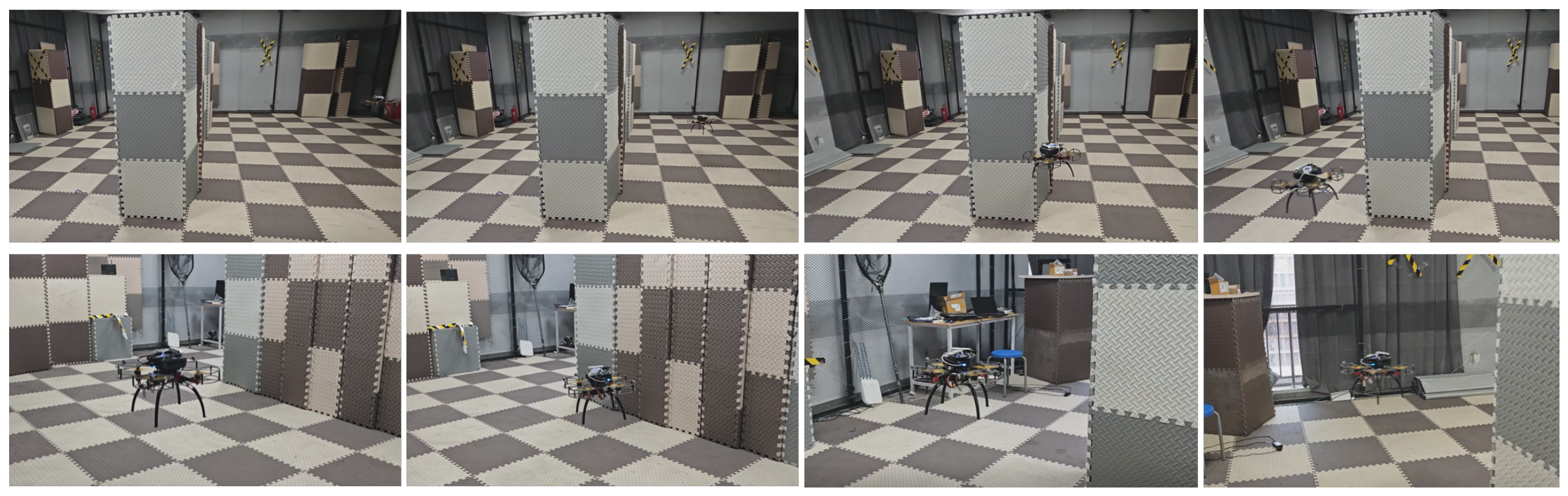
Trajectory Planning Framework for Drones Under Sensor Occlusion in Unknown Indoor Environments


Highlights
- A sensor occlusion detection algorithm is proposed for autonomous drone navigation in unknown indoor environments, which systematically classifies sensor occlusion into three categories: occlusion-free, partial occlusion, and full occlusion.
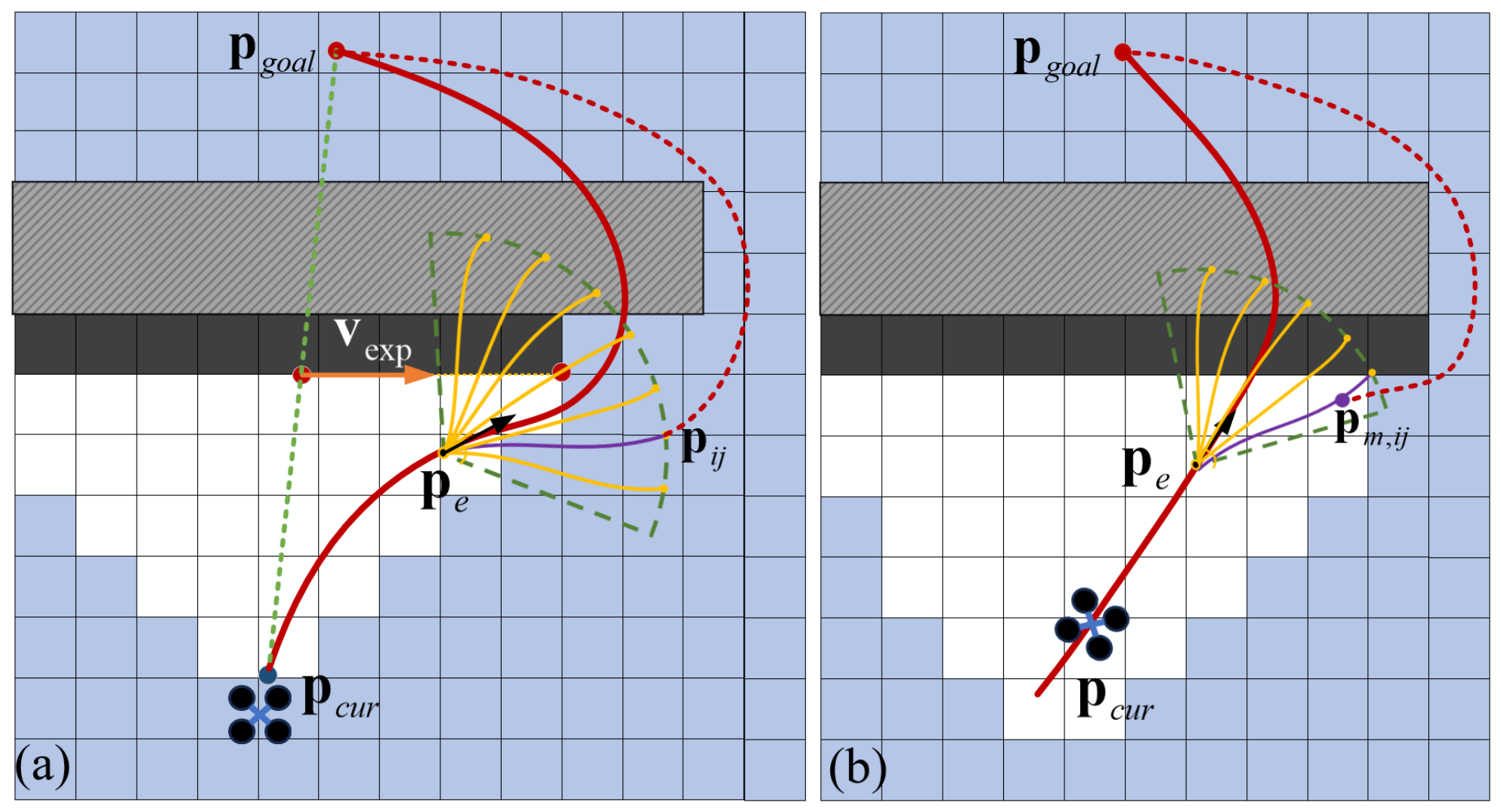
- An occlusion-aware trajectory replanning algorithm is proposed to handle partial and full occlusion conditions, generating candidate trajectories within occluded unknown regions to prevent collisions with obstacles.
- A novel trajectory planning framework is proposed for sensor occlusion scenarios, enhancing both the flight safety and navigation efficiency of drones operating autonomously in unknown indoor environments.
- The proposed framework can operate as an augmentation module while preserving the favorable characteristics of the underlying initial planning method, requiring only a 3D occupancy grid map and a parameterized trajectory.
Abstract
1. Introduction
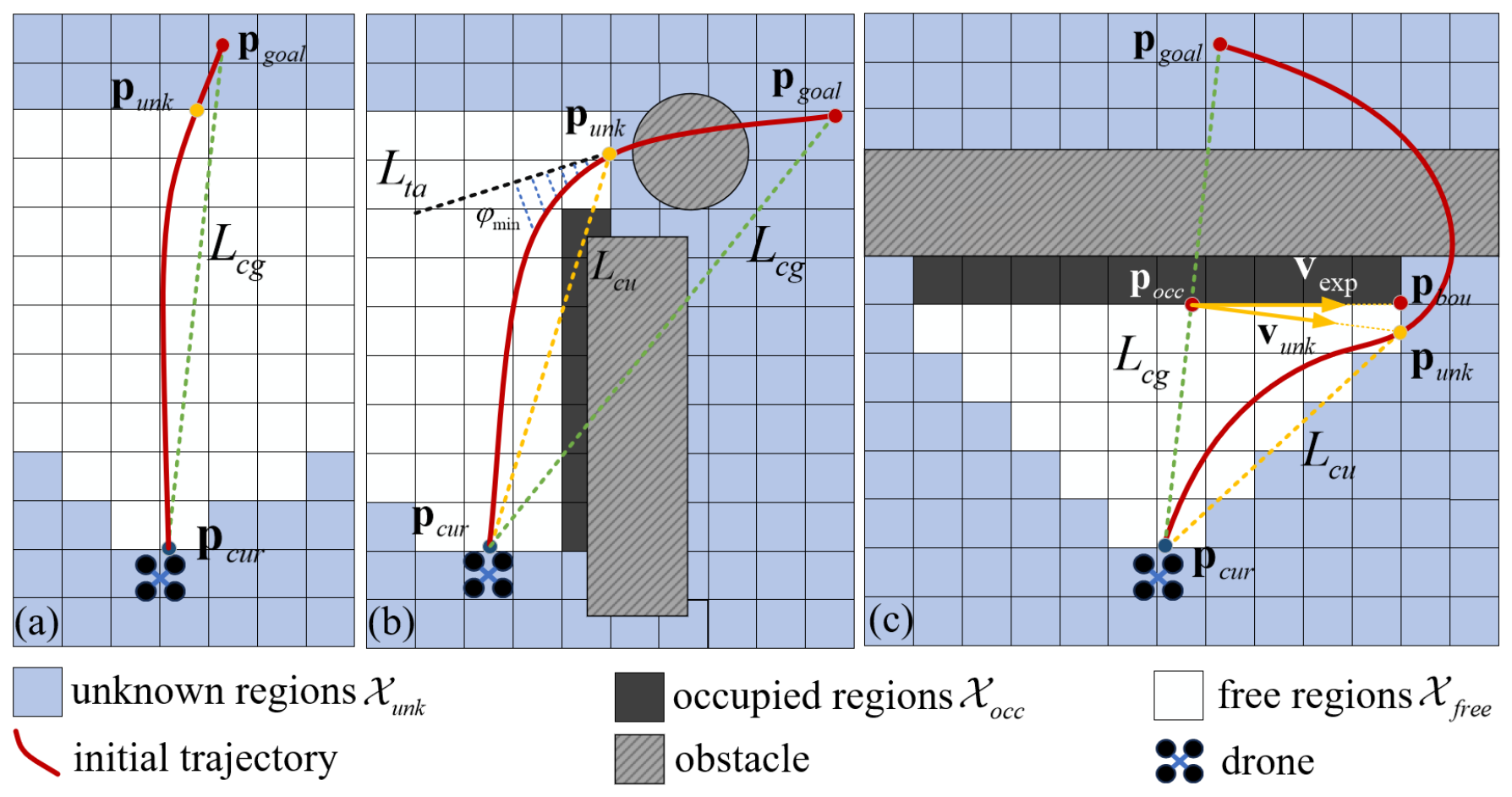
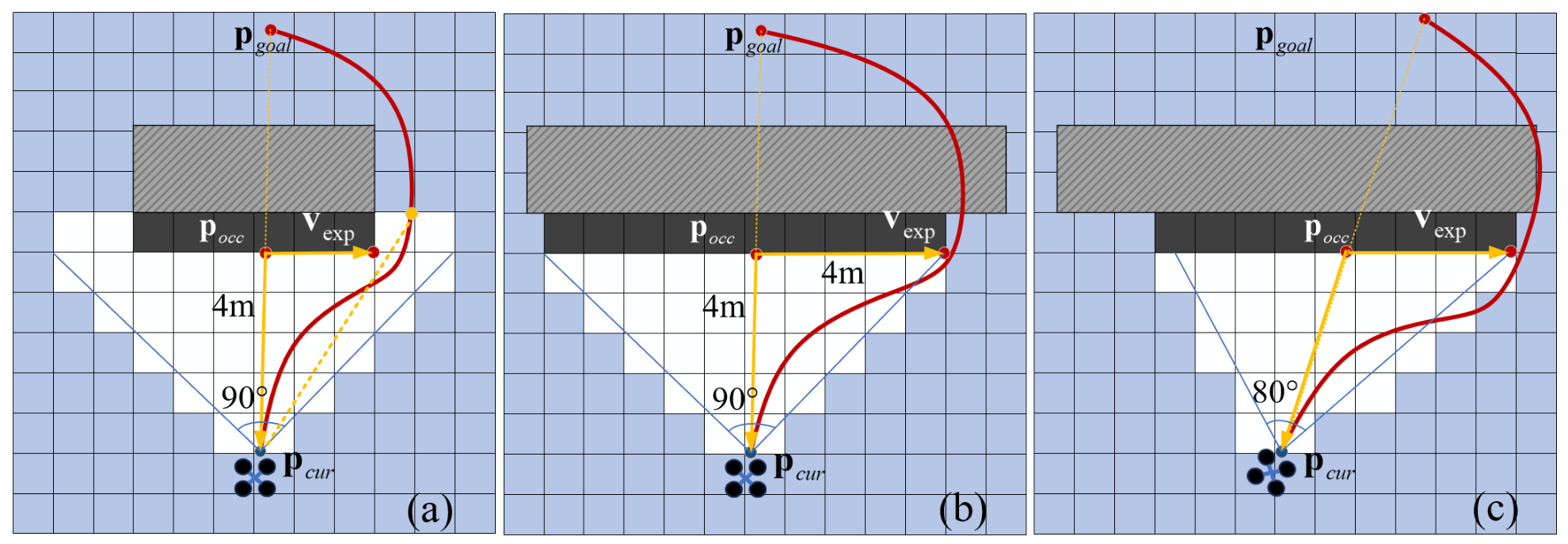
- The occlusion-free case refers to scenarios in which no obstacles are present between the drone’s current position and the goal point within the sensor’s field of view, representing a condition with no associated safety risk.
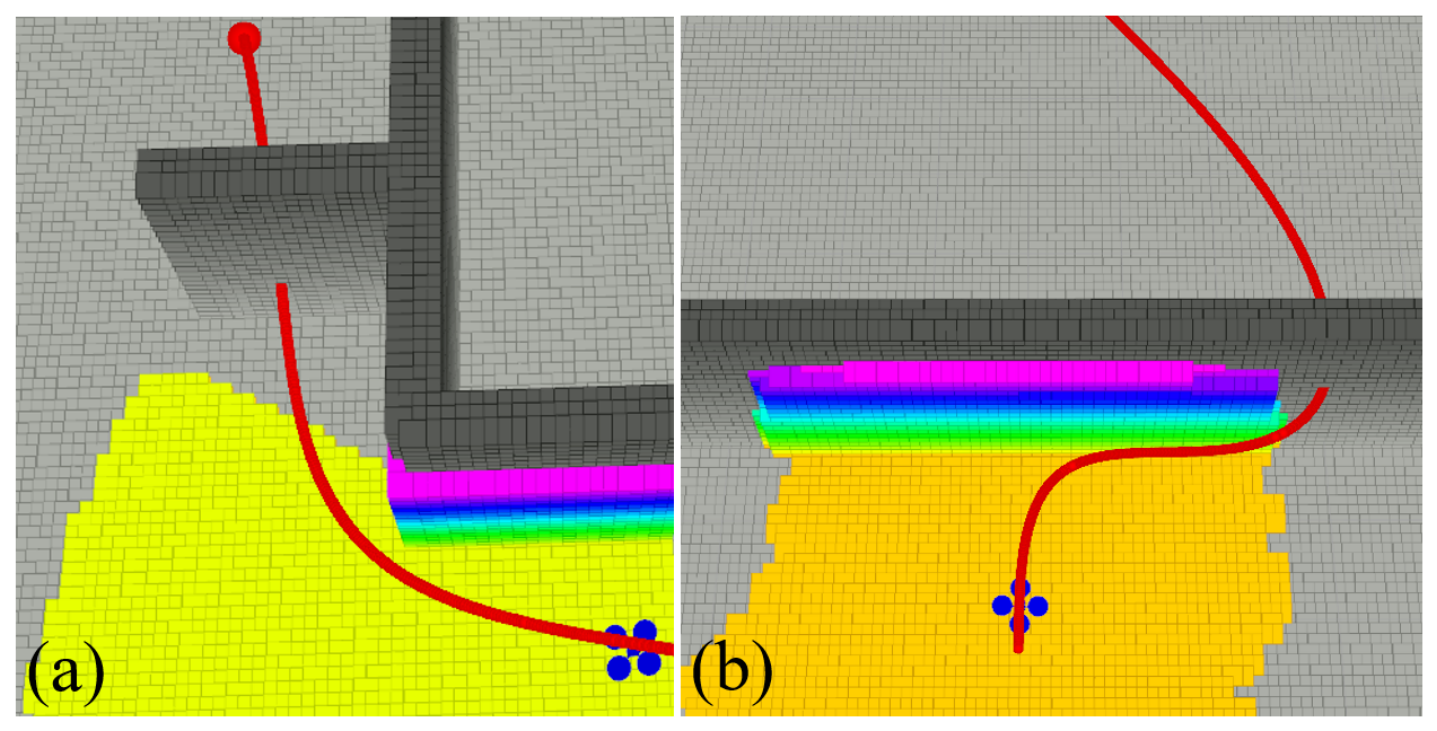
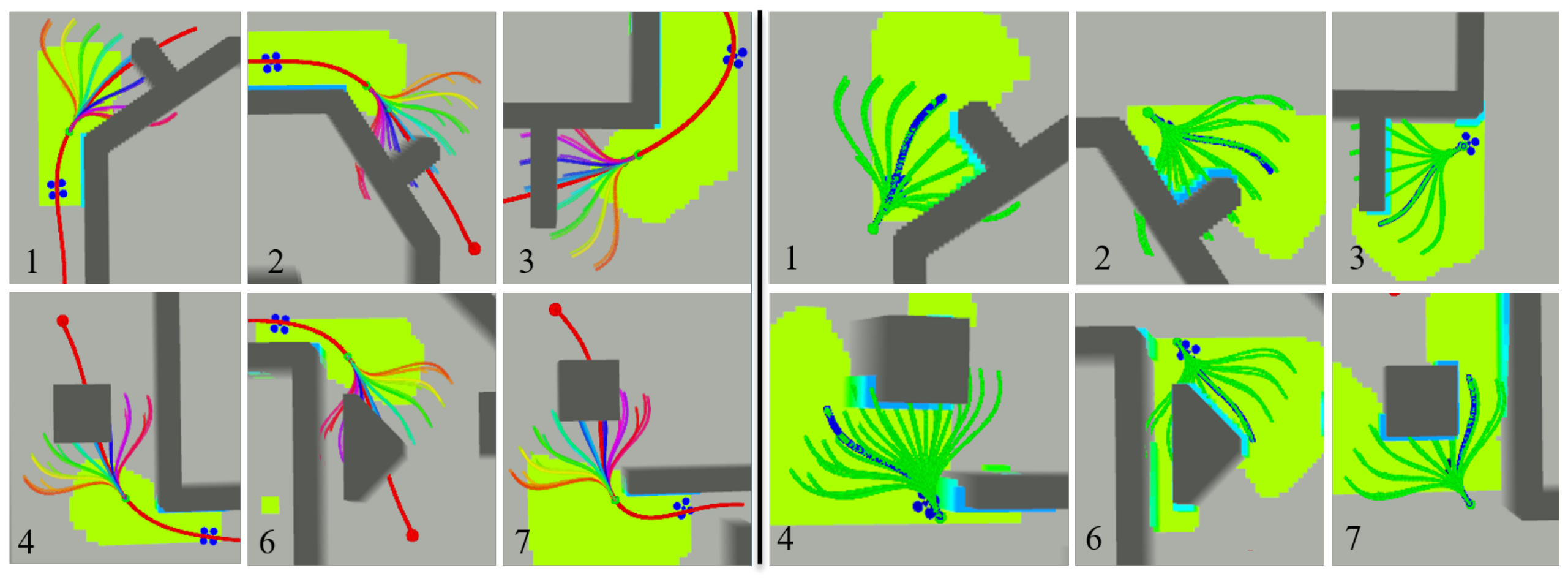
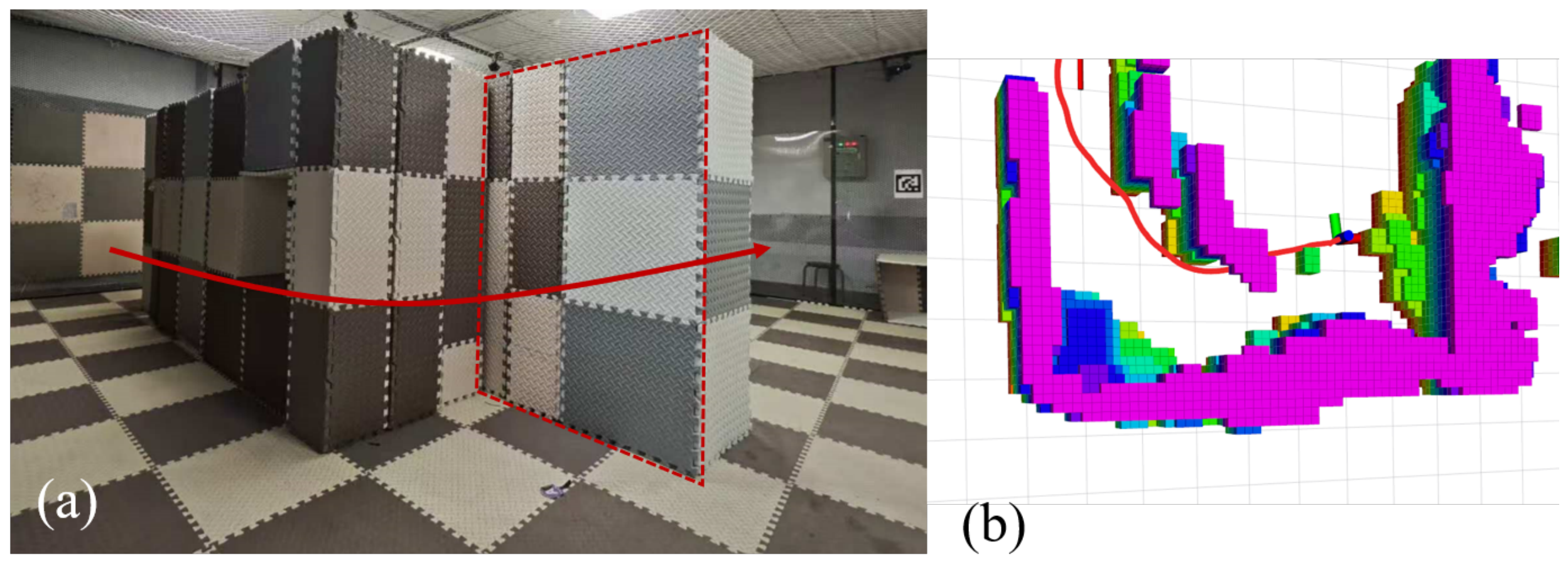
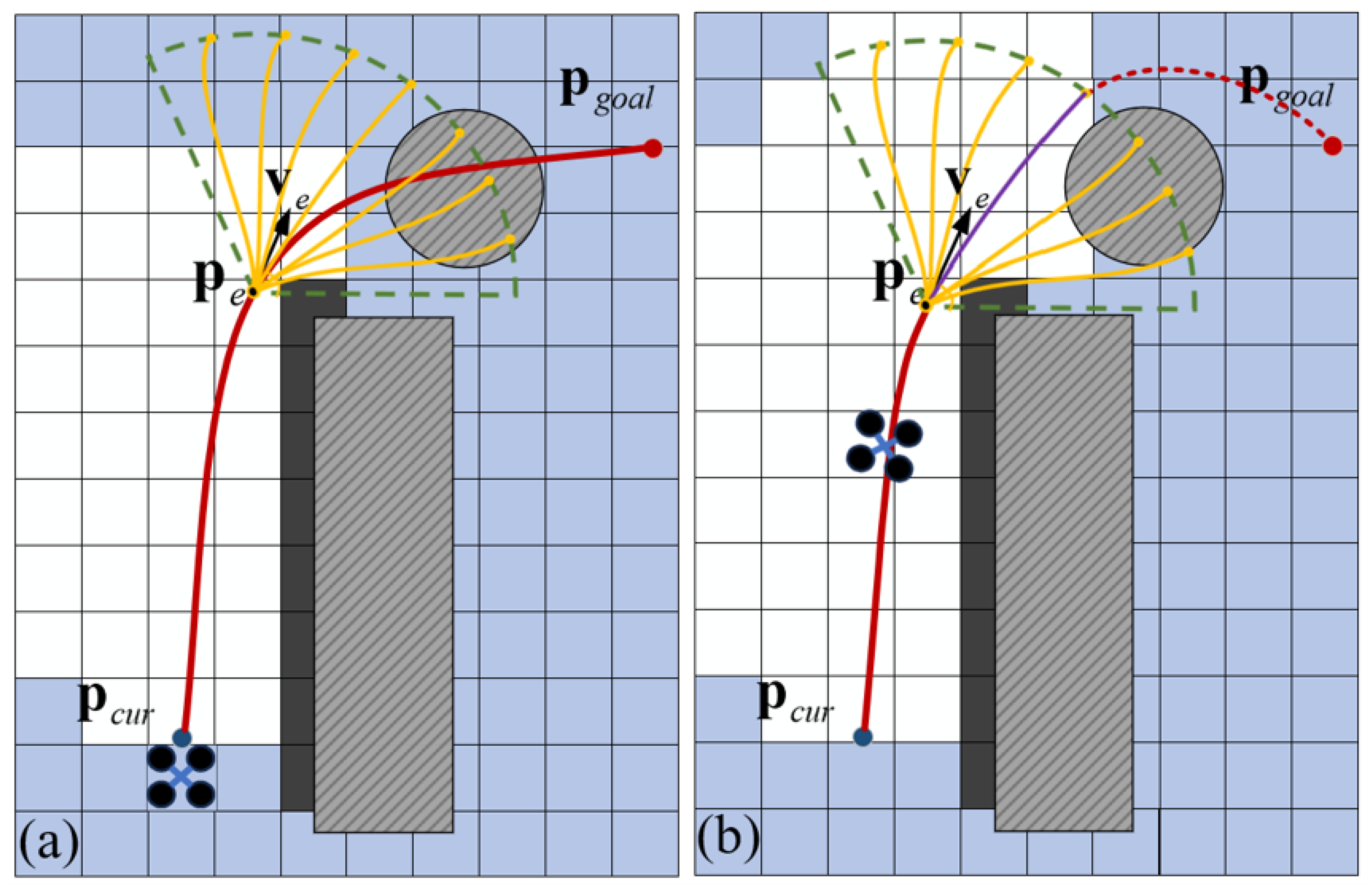
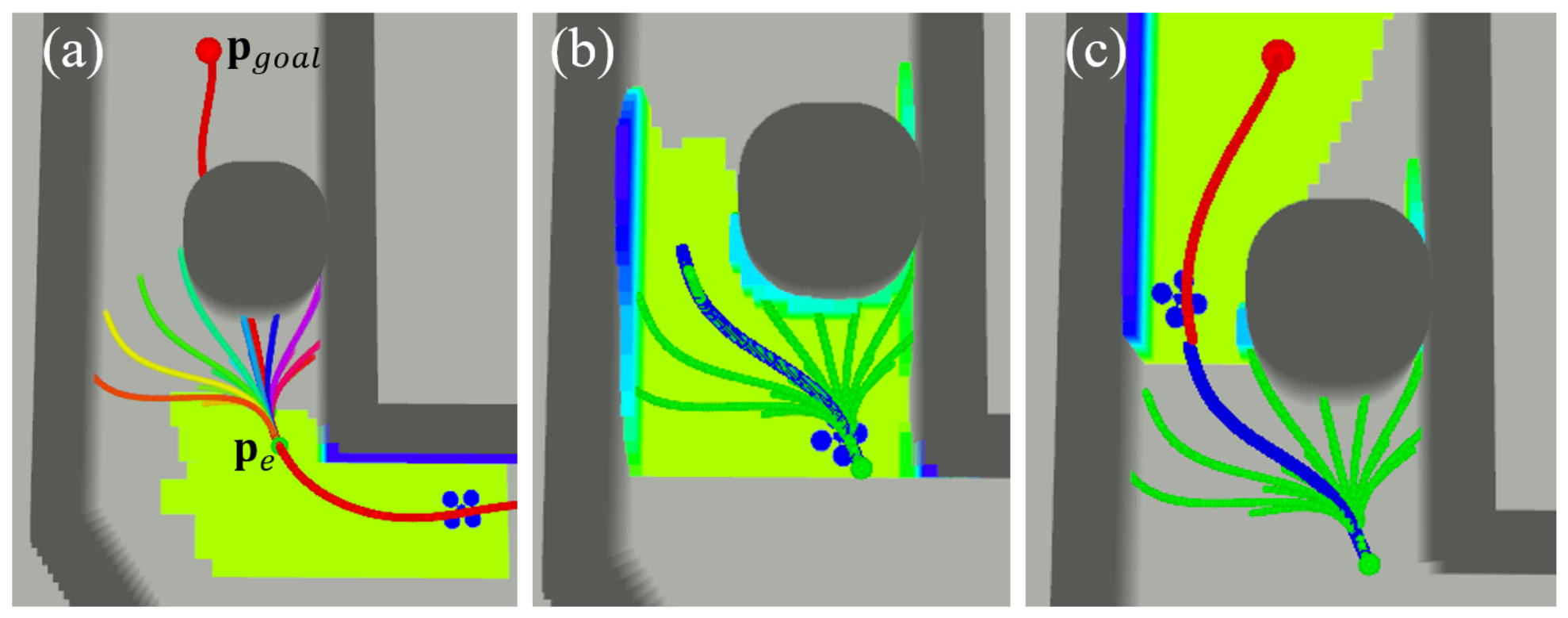
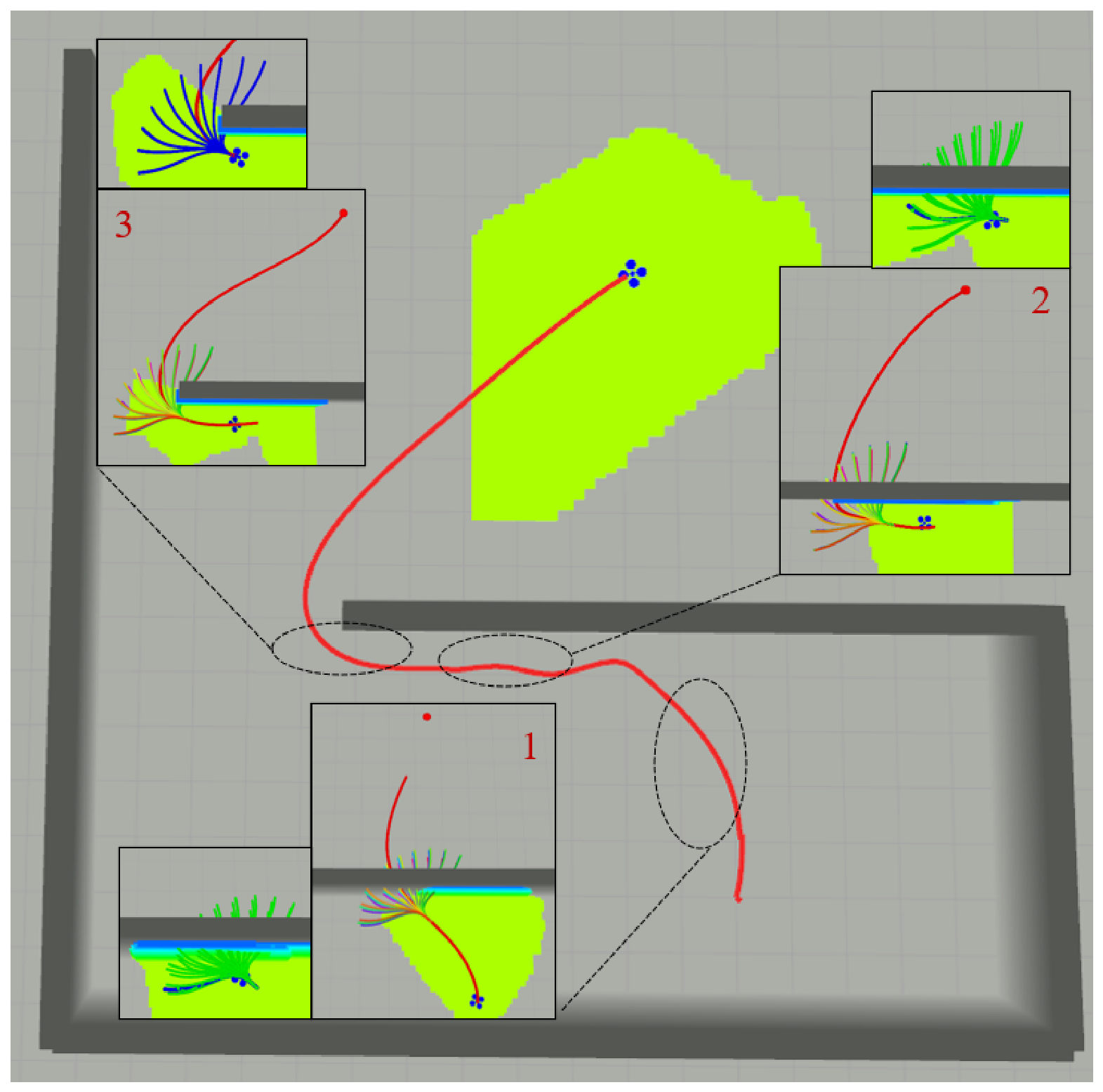
- The partial occlusion case, illustrated in Figure 1a, refers to the scenario in which obstacles partially obstruct the sensor’s field of view, creating blind spots within the effective sensing range. When obstacles are present within such unknown occluded regions, the risk of collision is substantially elevated.
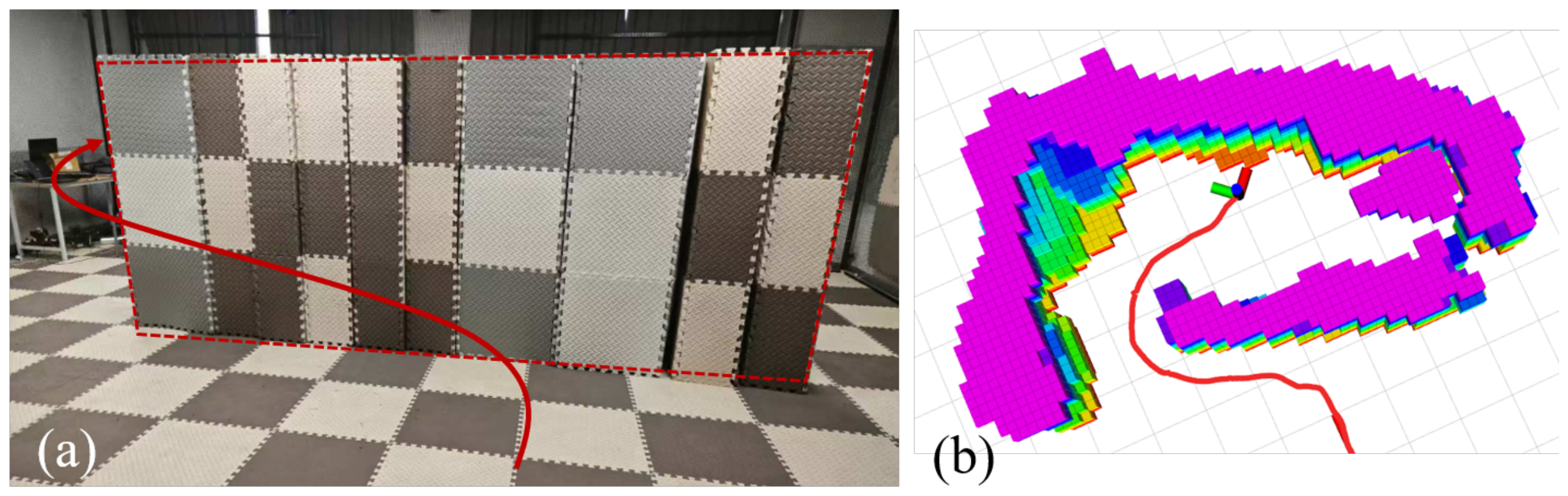
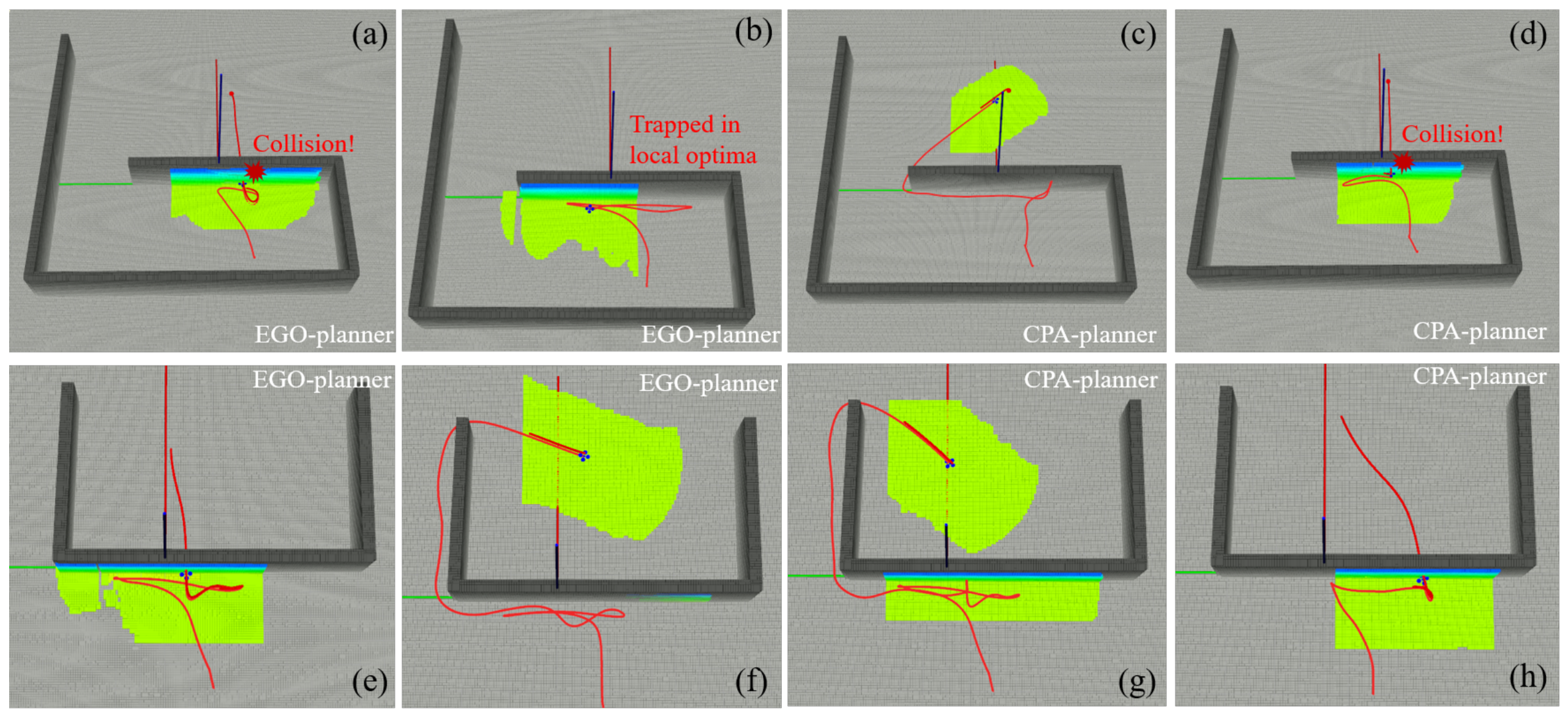
- The full occlusion case, illustrated in Figure 1b, refers to the scenario in which an obstacle is sufficiently large to cause full occlusion of all feasible paths toward the goal within the sensor’s field of view. In this case, the drones face not only an increased collision risk but also the potential to become trapped in a local optimum replanning cycle, as no feasible trajectory toward the goal can be identified in the vicinity of the current position.

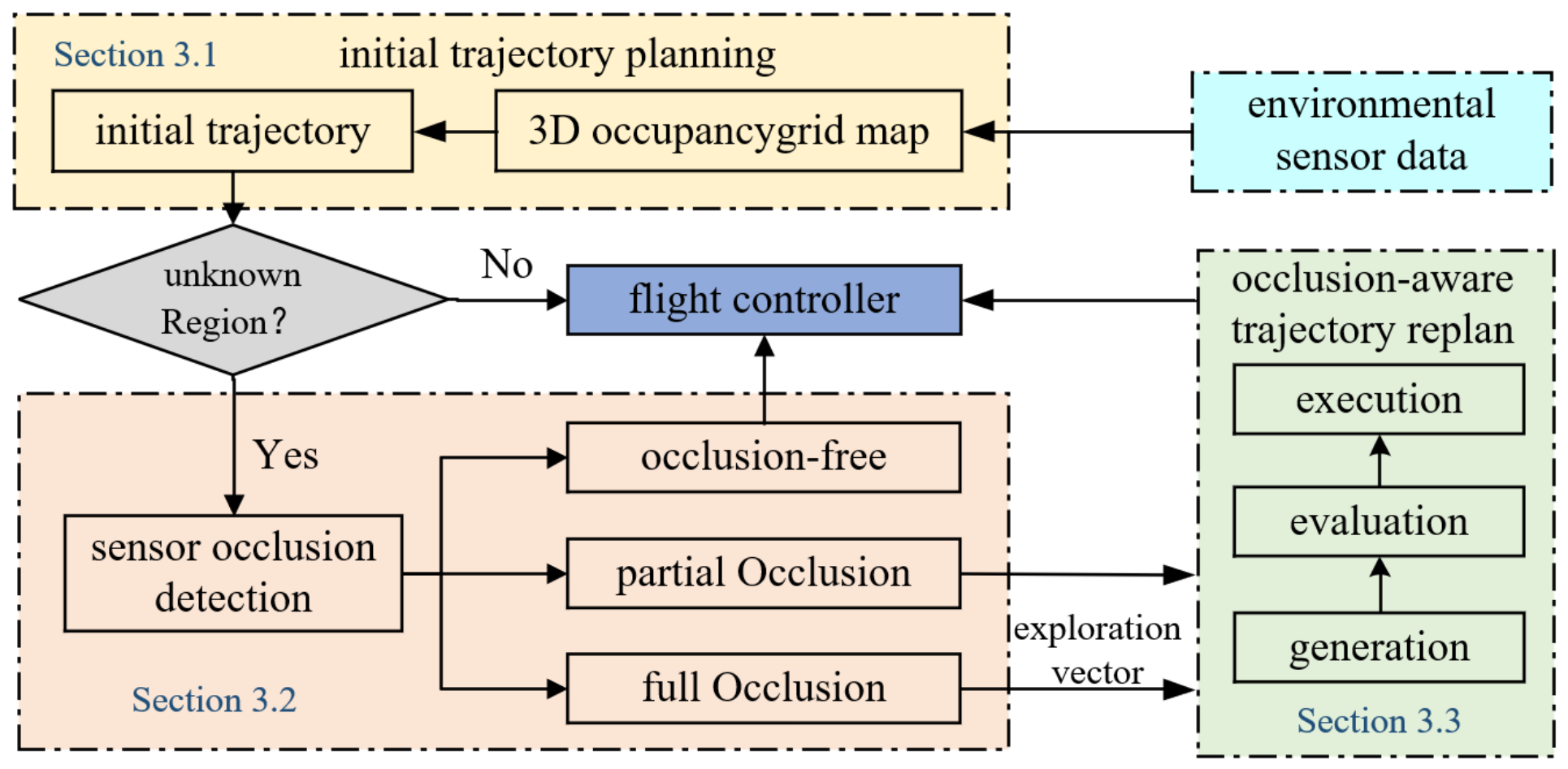
- A sensor occlusion detection algorithm is proposed to classify indoor sensor occlusion conditions into three categories: occlusion-free, partial occlusion, and full occlusion.
- An occlusion-aware trajectory replanning algorithm is proposed to handle partial and full occlusion scenarios, enhancing both trajectory safety and navigation efficiency.
- Comprehensive experiments are conducted in both simulated and real-world environments to validate the effectiveness of the proposed framework.
2. Related Work
3. Methodology
3.1. Initial Trajectory Planning
3.2. Sensor Occlusion Detection
3.2.1. Algorithm Procedure
| Algorithm 1: sensor occlusion detection |
 |
3.2.2. Threshold Determination
3.3. Occlusion-Aware Trajectory Replanning
3.3.1. Strategy for Partial Occlusion Conditions
3.3.2. Strategy for Full Occlusion Conditions
4. Experiments and Analysis
4.1. Partial Occlusion Simulation Experiments
4.1.1. Operational Process Analysis
4.1.2. Comparative Analysis
4.2. Full Occlusion Simulation Experiments
4.2.1. Operational Process Analysis
4.2.2. Comparative Analysis
4.3. Real-World Experiments
5. Discussion and Conclusions
5.1. Limitations in Practical Applications
5.2. Conclusions
Author Contributions
Funding
Data Availability Statement
Conflicts of Interest
Nomenclature
| control points of the drone trajectory | |
| smoothness constraint | |
| feasibility constraint | |
| obstacle collision constraint | |
| weight of the smoothness constraint | |
| weight of the feasibility constraint | |
| weight of the obstacle collision constraint | |
| drone’s current position | |
| unknown position | |
| local goal | |
| occupied regions on the grid map | |
| known-free regions on the grid map | |
| unknown regions on the grid map | |
| initial trajectory | |
| mean curvature threshold | |
| trajectory angle threshold | |
| obstacle size threshold | |
| collision point | |
| obstacle boundary | |
| exploration vector | |
| timestamp when sensor occlusion is detected | |
| timestamp when candidate trajectories are generated | |
| temporal relaxation factor | |
| starting position of candidate trajectories | |
| terminal position of candidate trajectory | |
| r | sampling length |
| maximum length of the candidate trajectory | |
| scaling parameter | |
| terminal direction of the candidate trajectory | |
| terminal velocity of the candidate trajectory | |
| , | weight of terminal direction |
| average speed of the initial trajectory | |
| polynomial representation of the candidate trajectory | |
| duration of the candidate trajectory | |
| scaling parameter | |
| candidate trajectory evaluation function | |
| safety score | |
| efficiency score under partial occlusion | |
| smoothness score | |
| weighting coefficient of the safety score | |
| weighting coefficient of the efficiency score | |
| weighting coefficient of the smoothness score | |
| maximum acceleration | |
| efficiency score under full occlusion | |
| collision timestamp of the candidate trajectory |
References
- Xiong, H.; Yu, B.; Zhang, Y. Research on autonomous navigation and obstacle avoidance methods for high-speed large-inertia rotor UAV. Drones 2026, 10, 259. [Google Scholar]
- Cheng, Z.; Yang, J.; Sun, J.; Zhao, L. Trajectory planning of unmanned aerial vehicles in complex environments based on intelligent algorithm. Drones 2025, 9, 468. [Google Scholar] [CrossRef] [Scilit]
- Xu, L.; Zhang, K.; Jiang, B. Re-Planning of Reconnaissance Missions for Multi-UAV Systems Under Potential Faults. In Proceedings of the 2025 4th Conference on Fully Actuated System Theory and Applications (FASTA), Nanjing, China, 4–6 July 2025; IEEE: Piscataway, NJ, USA, 2025; pp. 923–928. [Google Scholar]
- Menouar, H.; Guvenc, I.; Akkaya, K.; Uluagac, A.S.; Kadri, A.; Tuncer, A. UAV-enabled intelligent transportation systems for the smart city: Applications and challenges. IEEE Commun. Mag. 2017, 55, 22–28. [Google Scholar] [CrossRef] [Scilit]
- Huang, H.; Su, J.; Wang, F.-Y. The potential of low-altitude airspace: The future of urban air transportation. IEEE Trans. Intell. Veh. 2024, 9, 5250–5254. [Google Scholar] [CrossRef] [Scilit]
- Long, Y.; Xu, G.; Zhao, J.; Xie, B.; Fang, M. Dynamic truck–UAV collaboration and integrated route planning for resilient urban emergency response. IEEE Trans. Eng. Manag. 2024, 71, 9826–9838. [Google Scholar]
- Zhai, Y.; Reiter, R.; Scaramuzza, D. PA-MPPI: Perception-aware model predictive path integral control for quadrotor navigation in unknown environments. IEEE Robot. Autom. Lett. 2026, 11, 3804–3811. [Google Scholar] [CrossRef] [Scilit]
- Zhou, X.; Wen, X.; Wang, Z.; Gao, Y.; Li, H.; Wang, Q.; Yang, T.; Lu, H.; Cao, Y.; Xu, C.; et al. Swarm of micro flying robots in the wild. Sci. Robot. 2022, 7, 5954. [Google Scholar] [CrossRef] [Scilit]
- Nieuwenhuisen, M.; Behnke, S. Search-based 3D planning and trajectory optimization for safe micro aerial vehicle flight under sensor visibility constraints. In Proceedings of the 2019 IEEE International Conference on Robotics and Automation (ICRA), Montreal, QC, Canada, 20–24 May 2019; IEEE: Piscataway, NJ, USA, 2019; pp. 9123–9129. [Google Scholar]
- Lopez, B.T.; How, J.P. Aggressive 3-D collision avoidance for high-speed navigation. In Proceedings of the 2017 IEEE International Conference on Robotics and Automation (ICRA), Singapore, 29 May–3 June 2017; IEEE: Piscataway, NJ, USA, 2017; pp. 5759–5765. [Google Scholar]
- Liu, T.; Wang, Q.; Zhong, X.; Wang, Z.; Xu, C.; Zhang, F.; Gao, F. Star-convex constrained optimization for visibility planning with application to aerial inspection. In Proceedings of the 2022 IEEE International Conference on Robotics and Automation (ICRA), Philadelphia, PA, USA, 23–27 May 2022; IEEE: Piscataway, NJ, USA, 2022; pp. 7861–7867. [Google Scholar]
- Liu, S.; Watterson, M.; Mohta, K.; Sun, K.; Bhattacharya, S.; Taylor, C.J.; Kumar, V. Planning dynamically feasible trajectories for quadrotors using safe flight corridors in 3-D complex environments. IEEE Robot. Autom. Lett. 2017, 2, 1688–1695. [Google Scholar] [CrossRef] [Scilit]
- Chen, J.; Liu, T.; Shen, S. Online generation of collision-free trajectories for quadrotor flight in unknown cluttered environments. In Proceedings of the 2016 IEEE International Conference on Robotics and Automation (ICRA), Stockholm, Sweden, 16–21 May 2016; IEEE: Piscataway, NJ, USA, 2016; pp. 1476–1483. [Google Scholar]
- Wang, Q.; He, B.; Xun, Z.; Xu, C.; Gao, F. GPA-teleoperation: Gaze enhanced perception-aware safe assistive aerial teleoperation. IEEE Robot. Autom. Lett. 2022, 7, 5631–5638. [Google Scholar] [CrossRef] [Scilit]
- Zhou, B.; Pan, J.; Gao, F.; Shen, S. Raptor: Robust and perception-aware trajectory replanning for quadrotor fast flight. IEEE Trans. Robot. 2021, 37, 1992–2009. [Google Scholar] [CrossRef] [Scilit]
- Zhou, B.; Gao, F.; Wang, L.; Liu, C.; Shen, S. Robust and efficient quadrotor trajectory generation for fast autonomous flight. IEEE Robot. Autom. Lett. 2019, 4, 3529–3536. [Google Scholar] [CrossRef] [Scilit]
- Zhou, X.; Wang, Z.; Ye, H.; Xu, C.; Gao, F. EGO-planner: An ESDF-free gradient-based local planner for quadrotors. IEEE Robot. Autom. Lett. 2021, 6, 478–485. [Google Scholar] [CrossRef] [Scilit]
- Teissing, K.; Novosad, M.; Penicka, R.; Saska, M. Real-time planning of minimum-time trajectories for agile UAV flight. IEEE Robot. Autom. Lett. 2024, 9, 10351–10358. [Google Scholar] [CrossRef] [Scilit]
- Chen, M.; Lu, Q.; Liu, X. Map-Change-Driven Closed-Loop Replanning for UAV Navigation in Unknown Indoor Environments. Drones 2026, 10, 168. [Google Scholar] [CrossRef] [Scilit]
- Qiu, J.; Liu, Q.; Qin, J.; Cheng, D.; Tian, Y.; Ma, Q. PE-planner: A performance-enhanced quadrotor motion planner for autonomous flight in complex and dynamic environments. IEEE Robot. Autom. Lett. 2024, 9, 5879–5886. [Google Scholar] [CrossRef] [Scilit]
- Qi, M.; Zheng, H. Temporal-constrained DDPG-based path planning for UAV in dynamic environment. IEEE Sens. J. 2026, 26, 4301–4312. [Google Scholar] [CrossRef] [Scilit]
- Gao, Y.; Ji, J.; Wang, Q.; Jin, R.; Lin, Y.; Shang, Z.; Cao, Y.; Shen, S.; Xu, C.; Gao, F. Adaptive tracking and perching for quadrotor in dynamic scenarios. IEEE Trans. Robot. 2024, 40, 499–519. [Google Scholar] [CrossRef] [Scilit]
- Tordesillas, J.; Lopez, B.T.; Everett, M.; How, J.P. FASTER: Fast and safe trajectory planner for navigation in unknown environments. IEEE Trans. Robot. 2022, 38, 922–938. [Google Scholar] [CrossRef] [Scilit]
- Yu, Q.; Qin, C.; Luo, L.; Liu, H.H.T.; Hu, S. CPA-planner: Motion planner with complete perception awareness for sensing-limited quadrotors. IEEE Robot. Autom. Lett. 2023, 8, 720–727. [Google Scholar]
- Yu, C.; Lu, Z.; Mei, J.; Zhou, B. Perception-aware planning for quadrotor flight in unknown and feature-limited environments. In Proceedings of the 2025 IEEE/RSJ International Conference on Intelligent Robots and Systems (IROS), Hangzhou, China, 19–25 October 2025; IEEE: Piscataway, NJ, USA, 2025; pp. 3533–3540. [Google Scholar]
- Rekabi-Bana, F.; Hu, J.; Krajník, T.; Arvin, F. Unified robust path planning and optimal trajectory generation for efficient 3D area coverage of quadrotor UAVs. IEEE Trans. Intell. Transp. Syst. 2024, 25, 2492–2507. [Google Scholar] [CrossRef] [Scilit]
- Zhang, H.; Wang, S.; Liu, Y.; Ji, P.; Yu, R.; Chao, T. EFP: Efficient frontier-based autonomous UAV exploration strategy for unknown environments. IEEE Robot. Autom. Lett. 2024, 9, 2941–2948. [Google Scholar] [CrossRef] [Scilit]
- Varga, B.; Doer, C.; Trommer, G.F.; Hohmann, S. Validation of a Limit Ellipsis Controller for Rescue Drones. In Proceedings of the 2022 IEEE 16th International Symposium on Applied Computational Intelligence and Informatics (SACI), Timisoara, Romania, 25–28 May 2022; IEEE: Piscataway, NJ, USA, 2022; pp. 55–60. [Google Scholar]
- Zhang, X.; Xu, X.; Liu, Y.; Wang, H.; Zhang, X.; Zhuang, Y. FGIP: A frontier-guided informative planner for UAV exploration and reconstruction. IEEE Trans. Ind. Inform. 2024, 20, 6155–6166. [Google Scholar] [CrossRef] [Scilit]
- Chen, J.; Liu, X.; Sheng, G.; Shao, Q.; Zhao, B. A general path planning algorithm with soft constraints for UAVs in high-density and large-sized obstacle scenarios. Drones 2025, 9, 793. [Google Scholar] [CrossRef] [Scilit]
- Hu, Y.; Chen, X.; Tang, P.; Zhang, H.; Jin, J.; Mao, S. A path planning framework for robots based on improved parallel sampling RRT and offset guidance DWA. IEEE Sens. J. 2025, 25, 35597–35608. [Google Scholar] [CrossRef] [Scilit]
- Wang, Z.; Zhou, X.; Xu, C.; Gao, F. Geometrically constrained trajectory optimization for multicopters. IEEE Trans. Robot. 2022, 38, 3259–3278. [Google Scholar] [CrossRef] [Scilit]
- Mellinger, D.; Kumar, V. Minimum snap trajectory generation and control for quadrotors. In Proceedings of the 2011 IEEE International Conference on Robotics and Automation (ICRA), Shanghai, China, 9–13 May 2011; IEEE: Piscataway, NJ, USA, 2011; pp. 2520–2525. [Google Scholar]












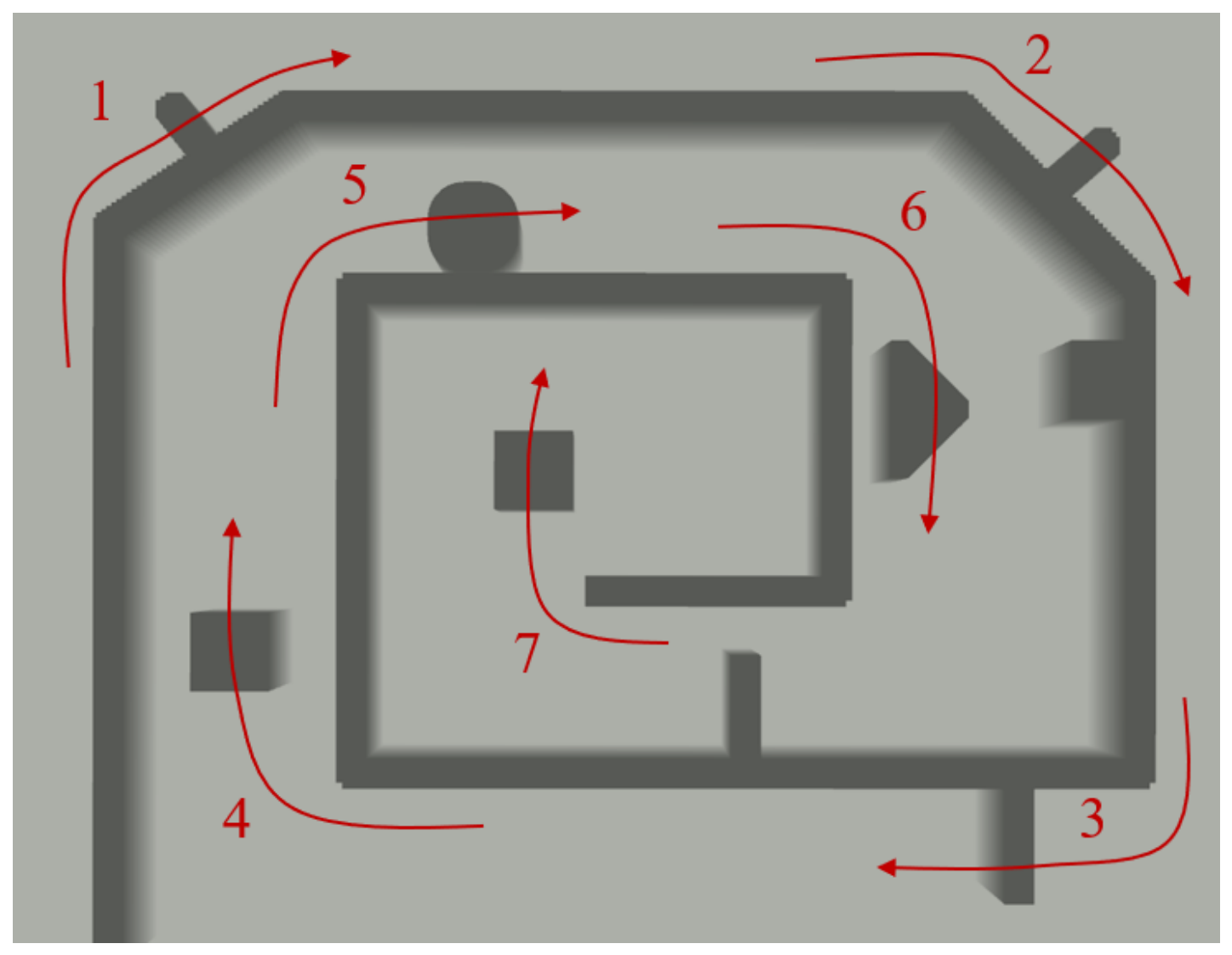
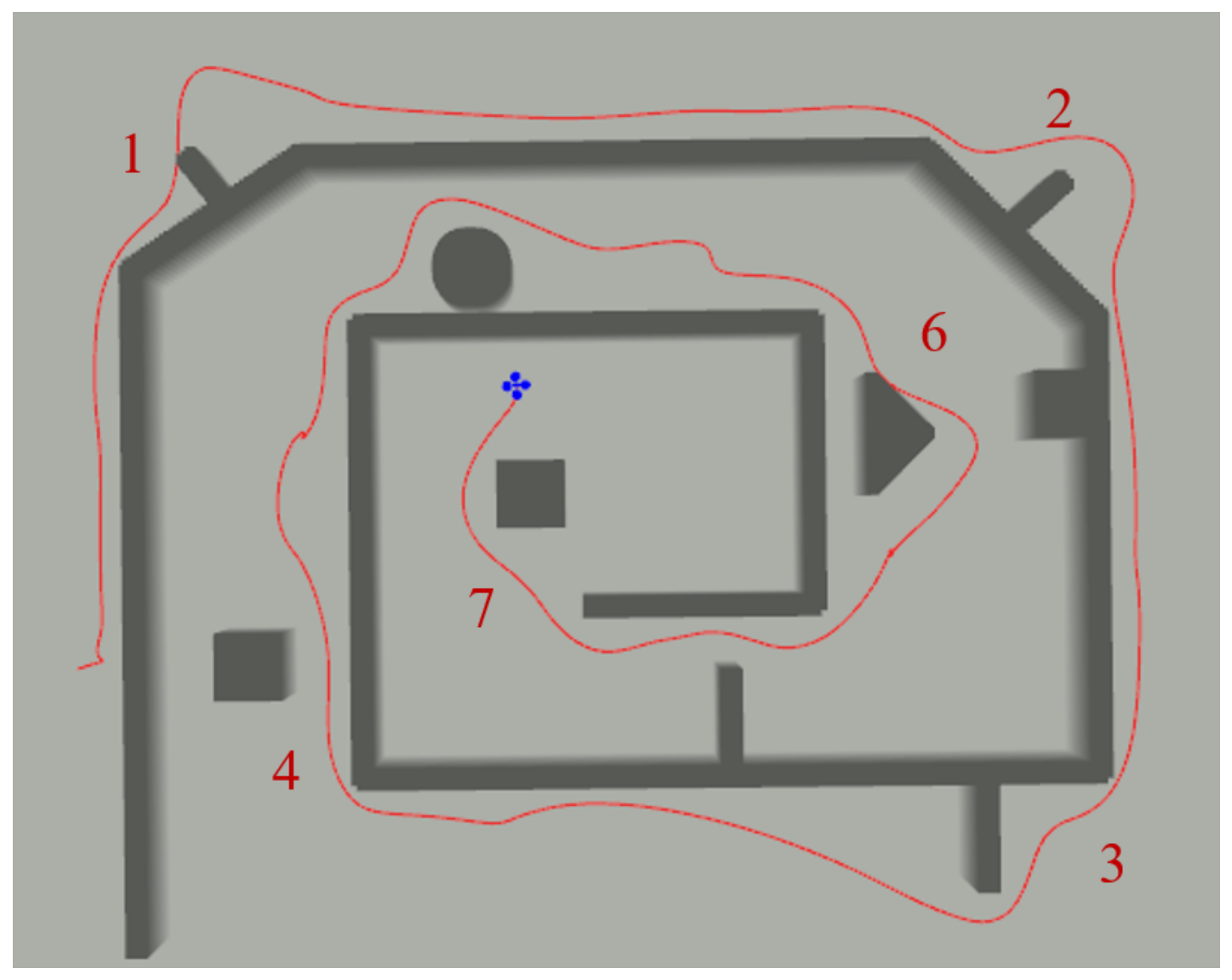
| Methods | Metrics | Route 1 | Route 2 | Route 3 | Route 4 | Route 5 | Route 6 | Route 7 |
|---|---|---|---|---|---|---|---|---|
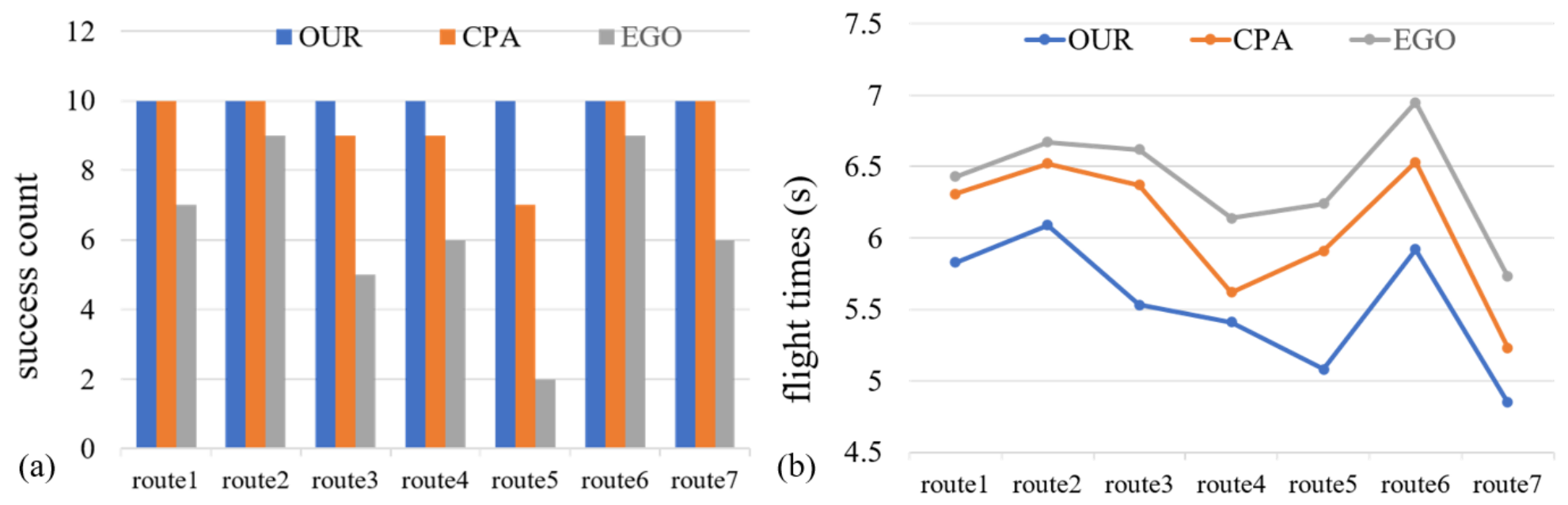
| Ours | ATL (m) | 11.64 | 12.15 | 10.97 | 10.82 | 10.16 | 11.84 | 9.63 |
| STL (m) | 0.2035 | 0.2317 | 0.1942 | 0.2461 | 0.2087 | 0.2918 | 0.1853 | |
| SFT (s) | 0.1031 | 0.1197 | 0.0924 | 0.1197 | 0.0959 | 0.1493 | 0.0817 | |
| ART (ms) | 1.51 | 1.47 | 1.49 | 1.45 | 1.43 | 1.47 | 1.52 | |
| SRT (ms) | 0.0403 | 0.0359 | 0.0297 | 0.0327 | 0.0415 | 0.0337 | 0.0416 | |
| EGO- planner | ATL (m) | 12.25 | 12.93 | 11.59 | 11.15 | 11.58 | 12.43 | 10.37 |
| STL (m) | 0.3428 | 0.2705 | 0.4418 | 0.3671 | 0.7200 | 0.3152 | 0.5371 | |
| SFT (s) | 0.1957 | 0.1529 | 0.2104 | 0.1798 | 0.3850 | 0.1549 | 0.2439 | |
| ART (ms) | 1.24 | 1.31 | 1.25 | 1.12 | 1.32 | 1.25 | 1.53 | |
| SRT (ms) | 0.1704 | 0.1425 | 0.1876 | 0.1439 | 0.1928 | 0.1342 | 0.1503 | |
| CPA- planner | ATL (m) | 11.89 | 12.57 | 11.35 | 11.18 | 10.98 | 12.11 | 10.04 |
| STL (m) | 0.2451 | 0.2349 | 0.2176 | 0.2613 | 0.3145 | 0.2392 | 0.1931 | |
| SFT (s) | 0.1295 | 0.1227 | 0.1137 | 0.1259 | 0.1393 | 0.1206 | 0.1039 | |
| ART (ms) | 3.45 | 3.32 | 3.17 | 3.53 | 3.51 | 3.24 | 3.47 | |
| SRT (ms) | 0.3629 | 0.3145 | 0.2975 | 0.3596 | 0.4107 | 0.3258 | 0.3173 |
| Value of | 0 | 0.1 | 0.5 | 1.0 | 2.0 | 10 | 100 |
|---|---|---|---|---|---|---|---|
| Number of success | 0 | 5 | 10 | 10 | 10 | 8 | 7 |
| Trajectory Length (m) | / | 19.73 | 20.75 | 20.63 | 21.35 | 25.49 | 30.43 |
| Flight Time (s) | / | 8.73 | 9.03 | 8.93 | 9.23 | 13.26 | 20.87 |
| Value of | 0 | 0.1 | 0.3 | 0.5 | 1.0 | 10 | 100 |
|---|---|---|---|---|---|---|---|
| Number of success | 7 | 10 | 10 | 10 | 10 | 5 | 0 |
| Trajectory Length (m) | 31.89 | 24.56 | 21.92 | 20.63 | 20.47 | 20.81 | \ |
| Flight Time (s) | 20.83 | 13.82 | 9.13 | 8.93 | 8.83 | 9.35 | \ |
| Value of | 0 | 0.1 | 0.5 | 1.0 | 10 | 30 | 100 |
|---|---|---|---|---|---|---|---|
| Number of success | 10 | 10 | 10 | 10 | 10 | 7 | 1 |
| Trajectory Length (m) | 21.08 | 20.53 | 20.63 | 20.74 | 21.47 | 25.68 | \ |
| Flight Time (s) | 9.23 | 9.06 | 8.93 | 9.15 | 9.34 | 12.65 | \ |
| Max Speed | Num. of Success | Avg. Traj. Length (m) | Max Traj. Length (m) | Avg. Flight Times (s) | Max Flight Times (s) |
|---|---|---|---|---|---|
| 3 m/s | 10 | 24.97 | 28.63 | 14.39 | 16.74 |
| 4 m/s | 10 | 25.84 | 29.06 | 11.26 | 14.51 |
| 5 m/s | 8 | 27.04 | 31.72 | 9.54 | 13.19 |
| Scenarios | Method | Avg. Traj. Length (m) | Avg. Flight Times (s) | Num. of Success | Std. Flight Times (s) | Std. Traj. Length (m) |
|---|---|---|---|---|---|---|
| scenario A | our method | 20.63 | 8.93 | 10 | 0.76 | 1.68 |
| CPA-planner | 29.54 | 18.73 | 8 | 2.31 | 3.51 | |
| EGO-planner | 33.71 | 21.53 | 7 | 3.08 | 4.43 | |
| scenario B | our method | 25.84 | 11.26 | 10 | 0.85 | 1.83 |
| CPA-planner | 34.41 | 23.54 | 7 | 3.25 | 4.56 | |
| EGO-planner | 36.93 | 27.83 | 5 | 4.17 | 5.31 | |
| scenario C | our method | 75.25 | 31.47 | 10 | 1.73 | 2.85 |
| CPA-planner | 95.76 | 58.62 | 5 | 5.63 | 9.31 | |
| EGO-planner | / | / | 1 | / | / |
| Avg. Traj. Length (m) | Avg. Flight Times (s) | Std. Traj. Length (m) | Std. Flight Times (s) | Number of Success | |
|---|---|---|---|---|---|
| partial occlusion | 8.73 | 5.54 | 0.2416 | 0.1672 | 10 |
| full occlusion | 9.34 | 6.08 | 0.2953 | 0.2094 | 10 |
Disclaimer/Publisher’s Note: The statements, opinions and data contained in all publications are solely those of the individual author(s) and contributor(s) and not of MDPI and/or the editor(s). MDPI and/or the editor(s) disclaim responsibility for any injury to people or property resulting from any ideas, methods, instructions or products referred to in the content. |
© 2026 by the authors. Licensee MDPI, Basel, Switzerland. This article is an open access article distributed under the terms and conditions of the Creative Commons Attribution (CC BY) license.
Share and Cite
Zhang, J.; Hou, B.; Yuan, X. Trajectory Planning Framework for Drones Under Sensor Occlusion in Unknown Indoor Environments. Drones 2026, 10, 499. https://doi.org/10.3390/drones10070499
Zhang J, Hou B, Yuan X. Trajectory Planning Framework for Drones Under Sensor Occlusion in Unknown Indoor Environments. Drones. 2026; 10(7):499. https://doi.org/10.3390/drones10070499
Chicago/Turabian StyleZhang, Jingsen, Biao Hou, and Xing Yuan. 2026. "Trajectory Planning Framework for Drones Under Sensor Occlusion in Unknown Indoor Environments" Drones 10, no. 7: 499. https://doi.org/10.3390/drones10070499
APA StyleZhang, J., Hou, B., & Yuan, X. (2026). Trajectory Planning Framework for Drones Under Sensor Occlusion in Unknown Indoor Environments. Drones, 10(7), 499. https://doi.org/10.3390/drones10070499