

Circumventing Blind Angles and Disturbance: Evaluating UAS for Monitoring Cliff-Nesting Seabirds

Highlights
- We investigate the applicability and effectiveness of drones for surveying cliff nesting seabirds, specifically northern fulmars in the Faroe Islands.
- We identify optimal survey distances to minimize disturbance, and optimal camera tilt angles to maximize bird visibility.
- Drone surveys of seabird cliffs can provide a major reduction in time for data collection and enable monitoring of otherwise inaccessible breeding sites.
- Standardized survey protocols can enhance reliability, repeatability, and data quality of future surveys.
Abstract
1. Introduction
2. Materials and Methods
2.1. Study Species
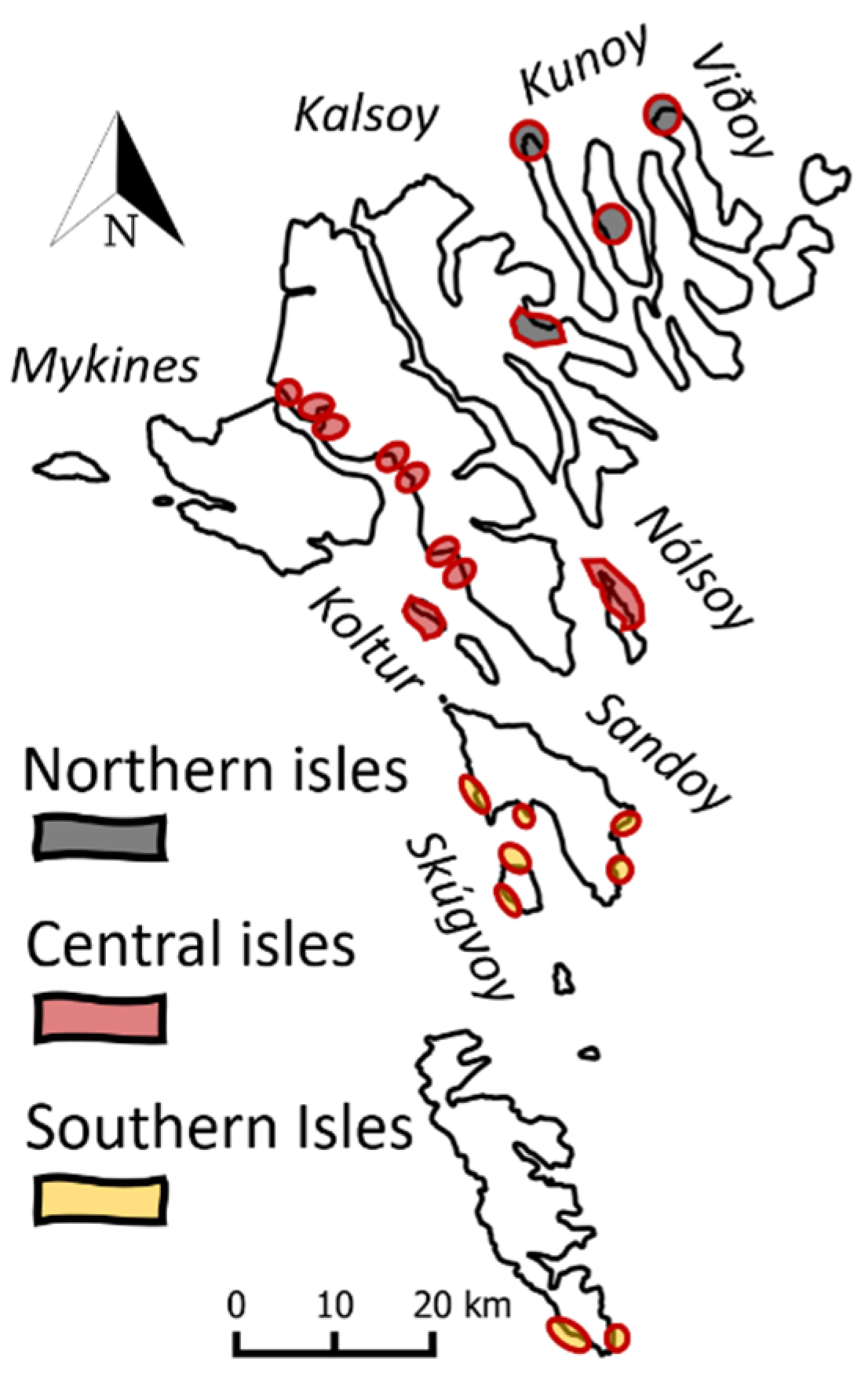
2.2. Field Work and Survey Sites
2.3. Survey Protocol
2.4. Behavioral Response Protocol
2.4.1. Video-Based Analysis
2.4.2. Observer-Based Analysis
2.5. Measurements of Optimal Observation Angles
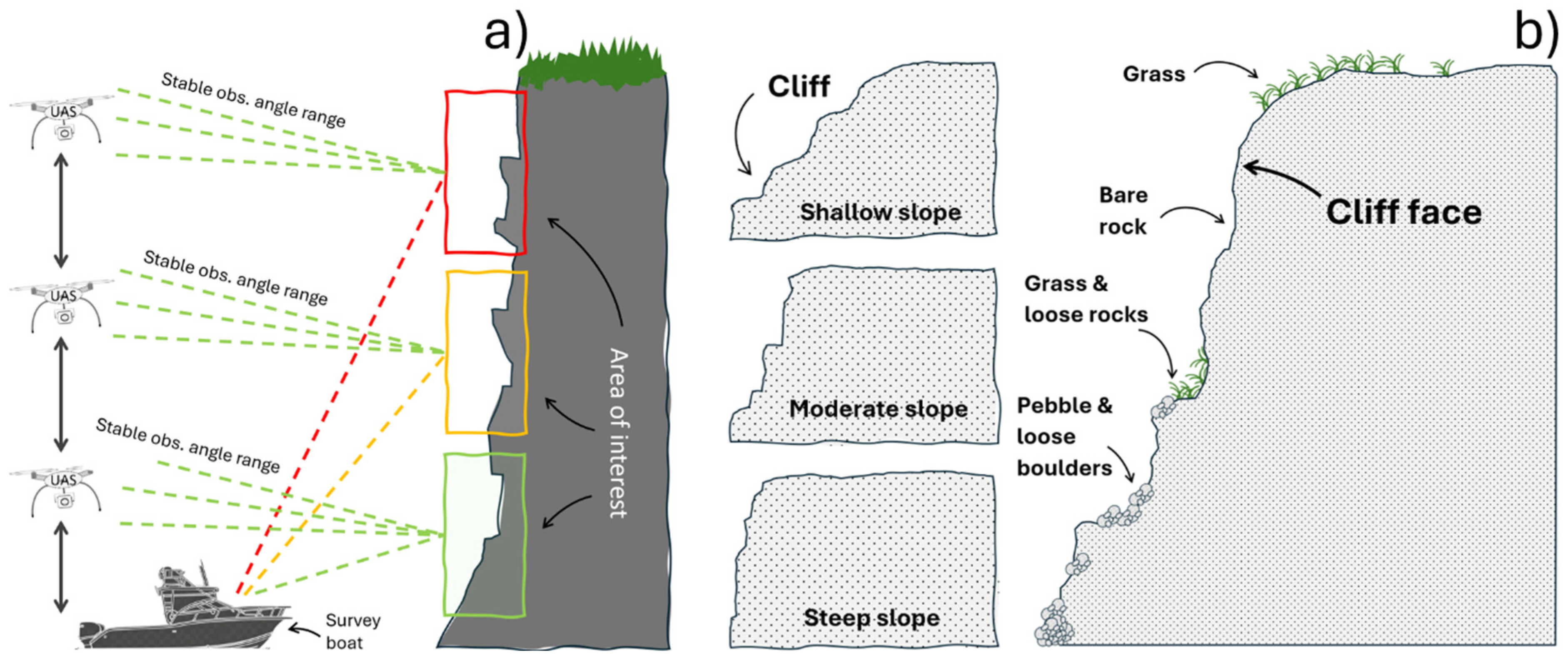
2.5.1. Differentiating for Site Characteristics
2.5.2. Video-Based Line-of-Sight Analysis
2.6. Data Analysis
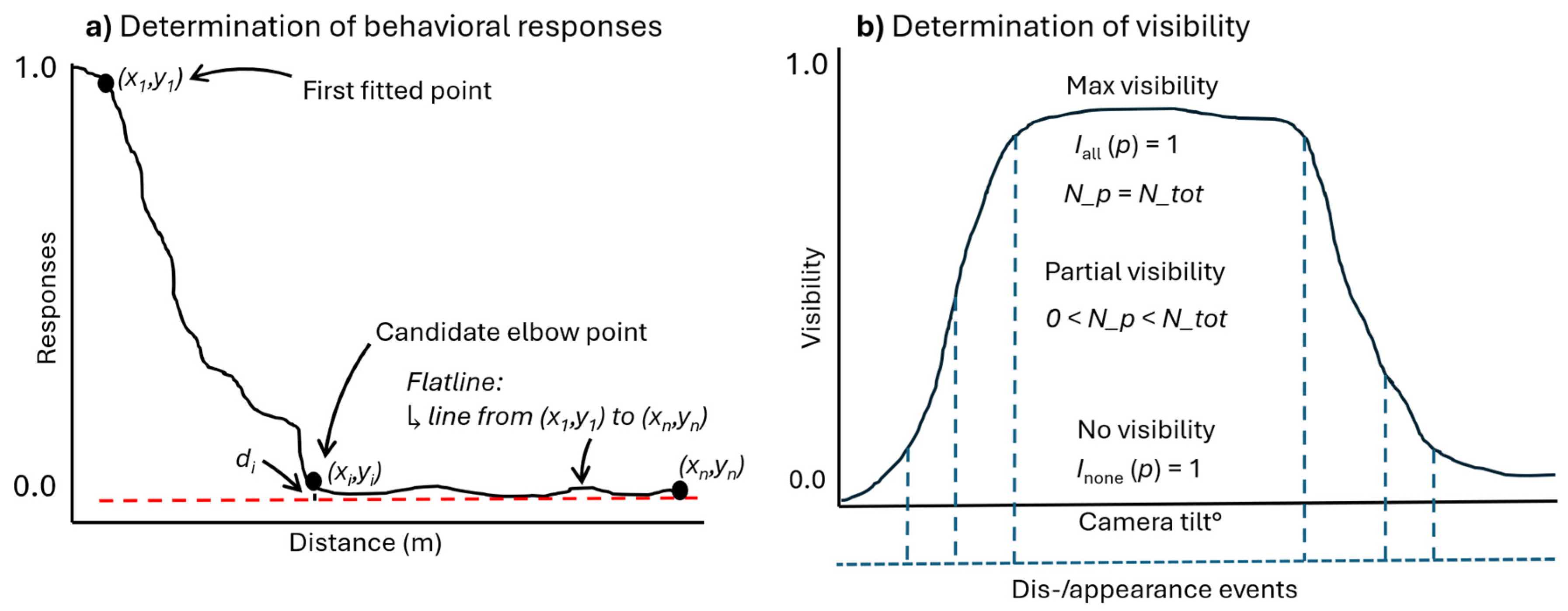
2.6.1. Analyzing Behavioral Responses
2.6.2. Analyzing the Optimal Tilt Range
3. Results
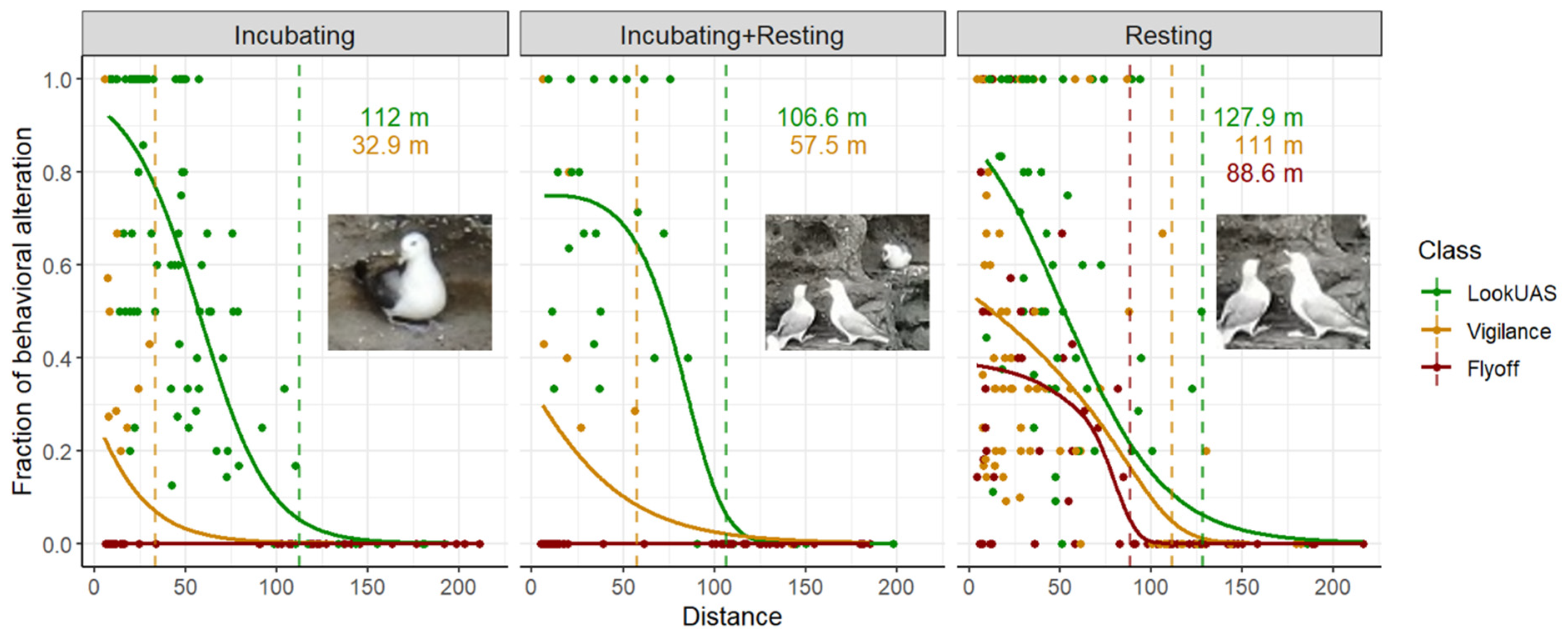
3.1. Behavioral Responses
3.2. Optimal Observation Angle
4. Discussion
4.1. Minimizing Behavioral Responses
4.2. Optimizing Bird Detection
4.3. Cliff Surveys Taken to New Heights
4.4. Practical Guidelines—A Promising Tool
5. Conclusions
Supplementary Materials
Author Contributions
Funding
Data Availability Statement
Acknowledgments
Conflicts of Interest
Abbreviations
| UAS | Unoccupied Aircraft Systems |
| GSD | Ground sample distances |
| AMSL | Elevation above mean sea level |
| ASL | Above sea level |
| LRF | Laser range finder |
| SRT | SubRip Text file |
| SCAM | Shape-constrained additive models |
| GAMM | Generalized additive mixed model |
References
- Walsh, P.M.; Halley, D.J.; Harris, M.P.; del Nevo, A.; Sim, L.M.W.; Tasker, M.L. Seabird Monitoring Handbook for Britain and Ireland: A Compilation of Methods for Survey and Monitoring of Breeding Seabirds; Walsh, P.M., Ed.; Joint Nature Conservation Committee: Peterborough, UK, 1995; ISBN 187370173x. [Google Scholar]
- Black, C.E. Spying on Seabirds: A Review of Time-Lapse Photography Capabilities and Limitations. SEABIRD 2018, 31, 1–14. [Google Scholar] [CrossRef]
- Edney, A.J.; Hart, T.; Jessopp, M.; Banks, A.; Clarke, L.; Cugniere, L.; Elliot, K.; Juarez Martinez, I.; Kilcoyne, A.; Murphy, M.; et al. Best Practices for Using Drones in Seabird Monitoring and Research. Mar. Ornithol. 2023, 51, 265–280. [Google Scholar] [CrossRef]
- Hayes, M.C.; Gray, P.C.; Harris, G.; Sedgwick, W.C.; Crawford, V.D.; Chazal, N.; Crofts, S.; Johnston, D.W. Drones and Deep Learning Produce Accurate and Efficient Monitoring of Large-Scale Seabird Colonies. Ornithol. Appl. 2021, 123, duab022. [Google Scholar] [CrossRef]
- Frederiksen, M.; Layton-Matthews, K.; Bennett, S.; Castenschiold, J.H.F.; Cruz-Flores, M.; Edney, A.J.; Fauchald, P.; Franklin, K.A.; Guímaro, H.R.; Hereward, H.F.R.; et al. Opportunities and Challenges for New Technologies in Seabird Population Monitoring. ICES J. Mar. Sci. 2025, 82, fsaf115. [Google Scholar] [CrossRef]
- Barnas, A.F.; Chabot, D.; Hodgson, A.J.; Johnston, D.W.; Bird, D.M.; Ellis-Felege, S.N. A Standardized Protocol for Reporting Methods When Using Drones for Wildlife Research. J. Unmanned Veh. Syst. 2020, 8, 89–98. [Google Scholar] [CrossRef]
- Anderson, K.; Gonzalez, F.; Gaston, K.J. Drones in Ecology: Ten Years Back and Forth. Bioscience 2025, 75, 664–680. [Google Scholar] [CrossRef] [PubMed]
- Bishop, A.M.; Brown, C.L.; Christie, K.S.; Kettle, A.B.; Larsen, G.D.; Renner, H.M.; Younkins, L. Surveying Cliff-Nesting Seabirds with Unoccupied Aircraft Systems in the Gulf of Alaska. Polar Biol. 2022, 45, 1703–1714. [Google Scholar] [CrossRef]
- Weimerskirch, H.; Prudor, A.; Schull, Q. Flights of Drones over Sub-Antarctic Seabirds Show Species- and Status-Specific Behavioural and Physiological Responses. Polar Biol. 2018, 41, 259–266. [Google Scholar] [CrossRef]
- Chabot, D.; Bird, D.M. Evaluation of an Off-the-Shelf Unmanned Aircraft System for Surveying Flocks of Geese. Waterbirds Int. J. Waterbird Biol. 2018, 35, 170–174. [Google Scholar]
- Jolly, D.W.; Passey, S.R.; Vosgerau, H.; Sørensen, E.V. Volcanic Landscape Controls on Pre-Rift to Syn-Rift Volcano Sedimentary Systems: The Prestfjall Formation Eruptive Hiatus, Faroe Islands Basalt Group, Northeast Atlantic. Earth Environ. Sci. Trans. R. Soc. Edinb. 2022, 113, 75–98. [Google Scholar] [CrossRef]
- Nørrevang, A. Fuglefangsten På Færøerne, 1st ed.; Rhodos, Copenhagen: København, Denmark, 1977; ISBN 8774966189. [Google Scholar]
- Jensen, J.-K.; Sørensen, S. Birds of the Faroe Islands—Facts and Numbers; Forlagid i Støplum: Tórshavn, Faroe Islands, 2015; ISBN 978-99918-77-06-8. [Google Scholar]
- Edney, A.J.; Wood, M.J. Applications of Digital Imaging and Analysis in Seabird Monitoring and Research. Ibis 2020, 163, 317–337. [Google Scholar] [CrossRef]
- Geldart, E.A.; Barnas, A.F.; Semeniuk, C.A.D.; Gilchrist, H.G.; Harris, C.M.; Love, O.P. A Colonial-Nesting Seabird Shows No Heart-Rate Response to Drone-Based Population Surveys. Sci. Rep. 2022, 12, 18804. [Google Scholar] [CrossRef] [PubMed]
- Jensen, J.-K. The Fulmar on the Faroe Islands, 3rd ed.; Jens-Kjeld Jensen: Nolsoy, Faroe Islands, 2019; ISBN 978-99918-3-349-1. [Google Scholar]
- Olsen, I.; Hammer, S.; Dinesen, L.; Sonne, J. Population Trends of Marine versus Terrestrial Bird Species on Skúgvoy, Faroe Islands, 1961–2023. Bird Study 2025, 72, 180–192. [Google Scholar] [CrossRef]
- Parsons, M.; Mitchell, I.; Butler, A.; Ratcliffe, N.; Frederiksen, M.; Foster, S.; Reid, J.B. Seabirds as Indicators of the Marine Environment. ICES J. Mar. Sci. 2008, 65, 1520–1526. [Google Scholar] [CrossRef]
- Frederiksen, M. Seabirds in the North East Atlantic. Summary of Status, Trends and Anthropogenic Impact. In Proceedings of the Workshop: Action Plan for Seabirds in Western-Nordic Areas, Malmö, Sweden, 4–5 May 2010; pp. 21–24. [Google Scholar]
- Frederiksen, M.; Anker-Nilssen, T.; Schekkerman, H.; Dierschke, V.; Parsons, M.; Marra, S.; Mitchell, I. Model-based Assessment of Marine Bird Population Status Using Monitoring of Breeding Productivity and Abundance. Ibis 2025, 166, 940–950. [Google Scholar] [CrossRef]
- Burg, T.M.; Bird, H.; Lait, L.; Brooke, M.d.L. Colonization Pathways of the Northeast Atlantic by Northern Fulmars: A Test of James Fisher’s ‘out of Iceland’ Hypothesis Using Museum Collections. J. Avian Biol. 2014, 45, 209–218. [Google Scholar] [CrossRef]
- Hatch, S.A.; Nettleship, D.N. Northern Fulmar (Fulmarus glacialis). In Birds of North America Online; Poole, A., Ed.; Cornell Lab of Ornithology: Ithica, NY, USA, 1998. [Google Scholar]
- Statistics Iceland Hunting 1995–2020. Available online: https://px.hagstofa.is/pxen/pxweb/en/Atvinnuvegir/Atvinnuvegir__landbunadur__landveidi/LAN10303.px (accessed on 18 October 2025).
- Danielsen, J. Diurnal Activity Patterns Suggest Nocturnal Foraging in Northern Fulmar (Fulmarus glacialis)/Dagligt Virksemi Hjá Havhesti (Fulmarus glacialis) Bendir á, at Hann Leitar Sær Føði Um Náttina. Fróðskaparrit—Faroese Sci. J. 2017, 59, 113–121. [Google Scholar] [CrossRef]
- Jarrett, D.; Calladine, J.; Cotton, A.; Wilson, M.W.; Humphreys, E. Behavioural Responses of Non-Breeding Waterbirds to Drone Approach Are Associated with Flock Size and Habitat. Bird Study 2020, 67, 190–196. [Google Scholar] [CrossRef]
- Mallory, M.L.; Forbes, M.R. Costly Pre-Laying Behaviours and Physiological Expenditures by Northern Fulmars in the High Arctic. Écoscience (Sainte-Foy) 2008, 15, 545–554. [Google Scholar] [CrossRef]
- Landsverk Weather Cameras. Available online: https://www.landsverk.fo/?id=837 (accessed on 18 October 2025).
- R Development Core Team. R: A Language and Environment for Statistical Computing; R Foundation for Statistical Computing: Vienna, Austria, 2025. [Google Scholar]
- Pya, N.; Wood, S.N. Shape Constrained Additive Models; Kluwer Academic Publishers: Alphen aan den Rijn, The Netherlands, 2025; Volume 25. [Google Scholar]
- Muggeo, V.M.R. Estimating Regression Models with Unknown Break-Points. Stat. Med. 2003, 22, 3055–3071. [Google Scholar] [CrossRef] [PubMed]
- Muggeo, V.M.R. Segmented: An R Package to Fit Regression Models with Broken-Line Relationships. R News 2008, 8, 20–25. [Google Scholar]
- Wickham, H. Ggplot2: Elegant Graphics for Data Analysis, 2nd ed.; Use R! Springer International Publishing: Cham, Switzerland, 2016; ISBN 9783319242750. [Google Scholar]
- Spearman, C. The Proof and Measurement of Association between Two Things. Am. J. Psychol. 1904, 15, 72–101. [Google Scholar] [CrossRef] [PubMed]
- Granadeiro, J.P.; Andrade, J.; Palmeirim, J.M. Modelling the Distribution of Shorebirds in Estuarine Areas Using Generalised Additive Models. J. Sea Res. 2004, 52, 227–240. [Google Scholar] [CrossRef]
- Wood, S.N. Generalized Additive Models: An Introduction with R, 2nd ed.; CRC Press: Boca Raton, FL, USA, 2017; ISBN 9781498728348. [Google Scholar]
- Tyndall, A.A.; Nichol, C.J.; Wade, T.; Pirrie, S.; Harris, M.P.; Wanless, S.; Burton, E. Quantifying the Impact of Avian Influenza on the Northern Gannet Colony of Bass Rock Using Ultra-High-Resolution Drone Imagery and Deep Learning. Drones 2024, 8, 40. [Google Scholar] [CrossRef]
- Cipriano, G.; Santacesaria, F.C.; Fanizza, C.; Cherubini, C.; Crugliano, R.; Maglietta, R.; Ricci, P.; Carlucci, R. Social Structure and Temporal Distribution of Tursiops Truncatus in the Gulf of Taranto (Central Mediterranean Sea). J. Mar. Sci. Eng. 2022, 10, 1942. [Google Scholar] [CrossRef]
- Rush, G.P.; Clarke, L.E.; Stone, M.; Wood, M.J. Can Drones Count Gulls? Minimal Disturbance and Semiautomated Image Processing with an Unmanned Aerial Vehicle for Colony-Nesting Seabirds. Ecol. Evol. 2018, 8, 12322–12334. [Google Scholar] [CrossRef] [PubMed]
- Brisson-Curadeau, É.; Bird, D.; Burke, C.; Fifield, D.A.; Pace, P.; Sherley, R.B.; Elliott, K.H. Seabird Species Vary in Behavioural Response to Drone Census. Sci. Rep. 2017, 7, 17884. [Google Scholar] [CrossRef] [PubMed]
- Holm, T.E.; Rasmussen, L.M.; Castenschiold, J.H.F.; Koffijberg, K.; Bregnballe, T. Usage of Drones in Assessing Bird Numbers Along the East Atlantic Flyway; DCE—Danish Centre for Environment and Energy: Roskilde, Denmark, 2024. [Google Scholar]
- Pandat, A.; Rajasekhar, P.; Vinod, G.; Shukla, R. Strategies for Improved Out-of-Distribution Detection in Drone vs. Bird Classification. Procedia Comput. Sci. 2025, 259, 398–407. [Google Scholar] [CrossRef]
- Valle, R.G.; Scarton, F. Do Oystercatchers Hate Drones? A Comparison of Flight Initiation Distances of Four Wader Species in Response to Drone Intrusion. Wader Study 2025, 131, 214–218. [Google Scholar] [CrossRef]
- Castenschiold, J.H.F.; Bruhn, D.; Pertoldi, C.; Bregnballe, T. Monitoring Roosting Waterbirds: The Use of Drones to Overcome the Challenge of Hidden Individuals in Blind Zones on Intertidal Flats. Wader Study 2023, 130, 239–253. [Google Scholar] [CrossRef]
- Hong, S.J.; Han, Y.; Kim, S.Y.; Lee, A.Y.; Kim, G. Application of Deep-Learning Methods to Bird Detection Using Unmanned Aerial Vehicle Imagery. Sensors 2019, 19, 1651. [Google Scholar] [CrossRef] [PubMed]
- Korczak-Abshire, M.; Zmarz, A.; Rodzewicz, M.; Kycko, M.; Karsznia, I.; Chwedorzewska, K.J. Study of Fauna Population Changes on Penguin Island and Turret Point Oasis (King George Island, Antarctica) Using an Unmanned Aerial Vehicle. Polar Biol. 2019, 42, 217–224. [Google Scholar] [CrossRef]
- Brisson-Curadeau, É.; Lacombe, R.; Gousy-Leblanc, M.; Poirier, V.; Jackson, L.; Petalas, C.; Miranda, E.; Eby, A.; Baak, J.; Léandri-Breton, D.; et al. A Meta-analysis of the Impact of Drones on Birds. Front. Ecol. Environ. 2025, 23, e2809. [Google Scholar] [CrossRef]
- Pfeifer, C.; Knetsch, S.; Maercker, J.; Mustafa, O.; Rümmler, M.-C.; Brenning, A. Exploring the Potential of Aerial Drone Imagery to Distinguish Breeding Adélie (Pygoscelis adeliae), Chinstrap (Pygoscelis antarcticus) and Gentoo (Pygoscelis papua) Penguins in Antarctica. Ecol. Indic. 2025, 170, 113011. [Google Scholar] [CrossRef]
- Afridi, S.; Laporte-Devylder, L.; Maalouf, G.; Kline, J.M.; Penny, S.G.; Hlebowicz, K.; Cawthorne, D.; Lundquist, U.P.S. Impact of Drone Disturbances on Wildlife: A Review. Drones 2025, 9, 311. [Google Scholar] [CrossRef]




| Tilt with Peak Visibility | Range to Cover for Full Visibility (100%) | |||||
|---|---|---|---|---|---|---|
| Grouping | Plots (n) | Peak Visibility Tilt° | Peak Visibility % | Lower Tilt° Range | Upper Tilt° Range | |
| Vegetation | BareRock | 29 | −6.3 | 92 | −19.9 | −6.2 |
| GrassRock | 155 | −15.6 | 92 | −20.0 | −6.9 | |
| Grass | 12 | −21.2 | 87 | −30.0 | −15.7 | |
| Slope | Steep ledge | 113 | −13.0 | 93 | −16.0 | −1.3 |
| Moderate ledge | 75 | −15.3 | 90 | −20.0 | −8.0 | |
| Shallow ledge | 7 | −15.6 | 88 | −30.0 | 25.7 | |
| Erosion | High erosion | 66 | −11.10 | 94 | −19.3 | −13.3 |
| Moderate erosion | 133 | −15.3 | 92 | −20.0 | −5.8 | |
| Low erosion | 16 | −20.1 | 90 | −26.0 | −6.2 | |
| Age group | Adult | 111 | −11.1 | 93 | −25.4 | −3.6 |
| Adult + Chick | 16 | −13.2 | 92 | −30.0 | −1.3 | |
| Chick | 58 | −13.7 | 94 | −18.0 | −5.8 | |
| Guideline Category | Recommendation | Rationale | |
|---|---|---|---|
| Preflight and initial parameters | |||
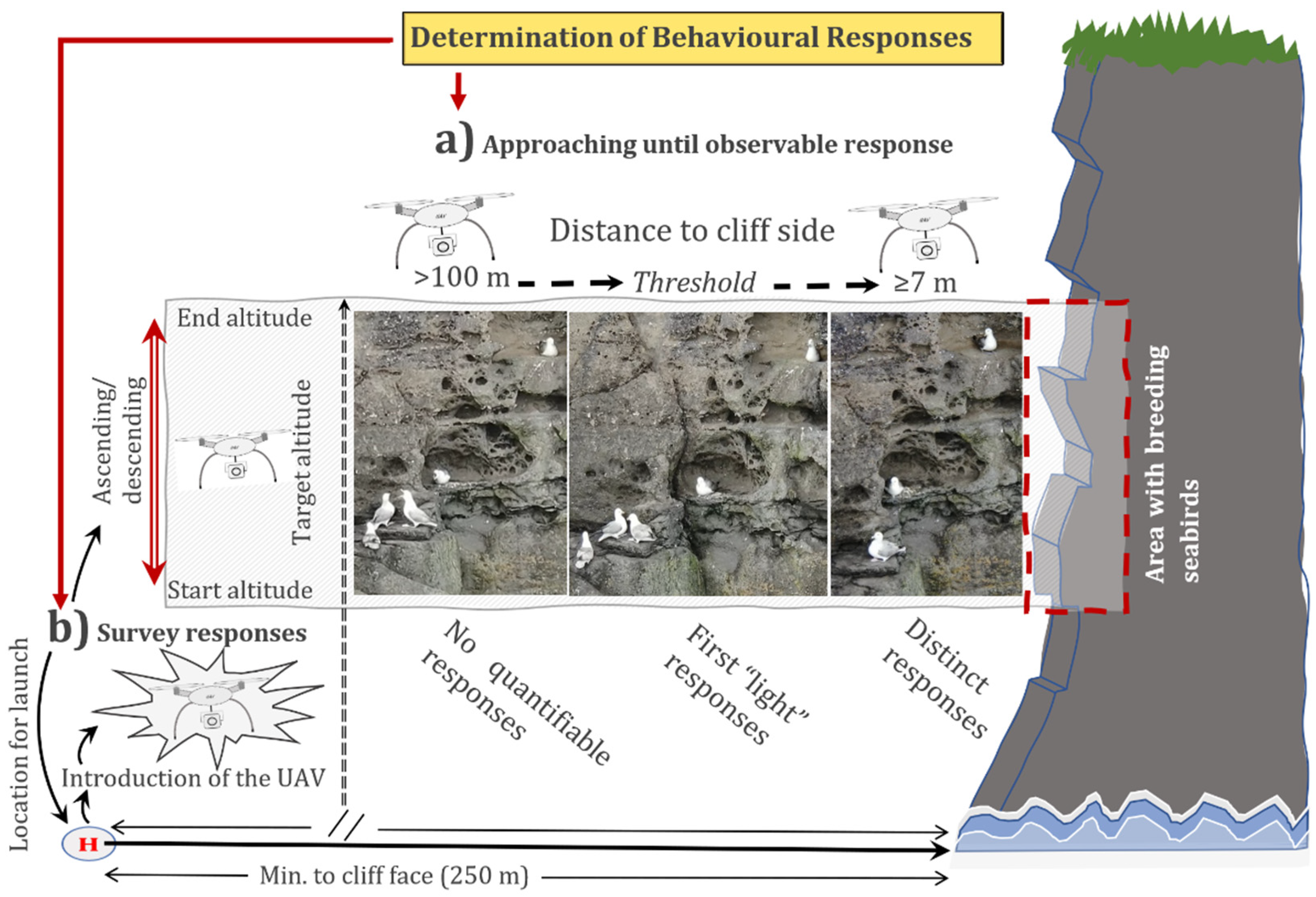
 | Launch distance | Launch the UAS at least 250 m from the survey site when possible. | A greater initial distance appeared to reduce immediate disturbance and allowed birds time to habituate before the survey began. |
 | Approach strategy | Use a slow, indirect, and flexible approach path rather than a direct approach. | Strategic flight paths helped reduce disturbance and allowed habituation to the UAS presence. |
| Minimum survey distance | |||
| Behavioral assessment minimizing responses | Maintain a UAS-to-bird distance of at least 57.5 m during surveys, especially in areas with mixed or non-incubating birds. | Vigilance responses began at 57.5 m in mixed groups and were therefore used as the conservative disturbance threshold. | |
 | Bird activity: Incubating | Avoid flying closer than 32.9 m even when only incubating birds are present. | Incubating fulmars showed measurable vigilance from 32.9 m. |
 | Bird activity: Resting | Flying closer than 111 m can provoke responses from resting birds. | Plots with only resting fulmars showed earlier vigilance (111 m) |
| Observation angles/camera tilt | |||
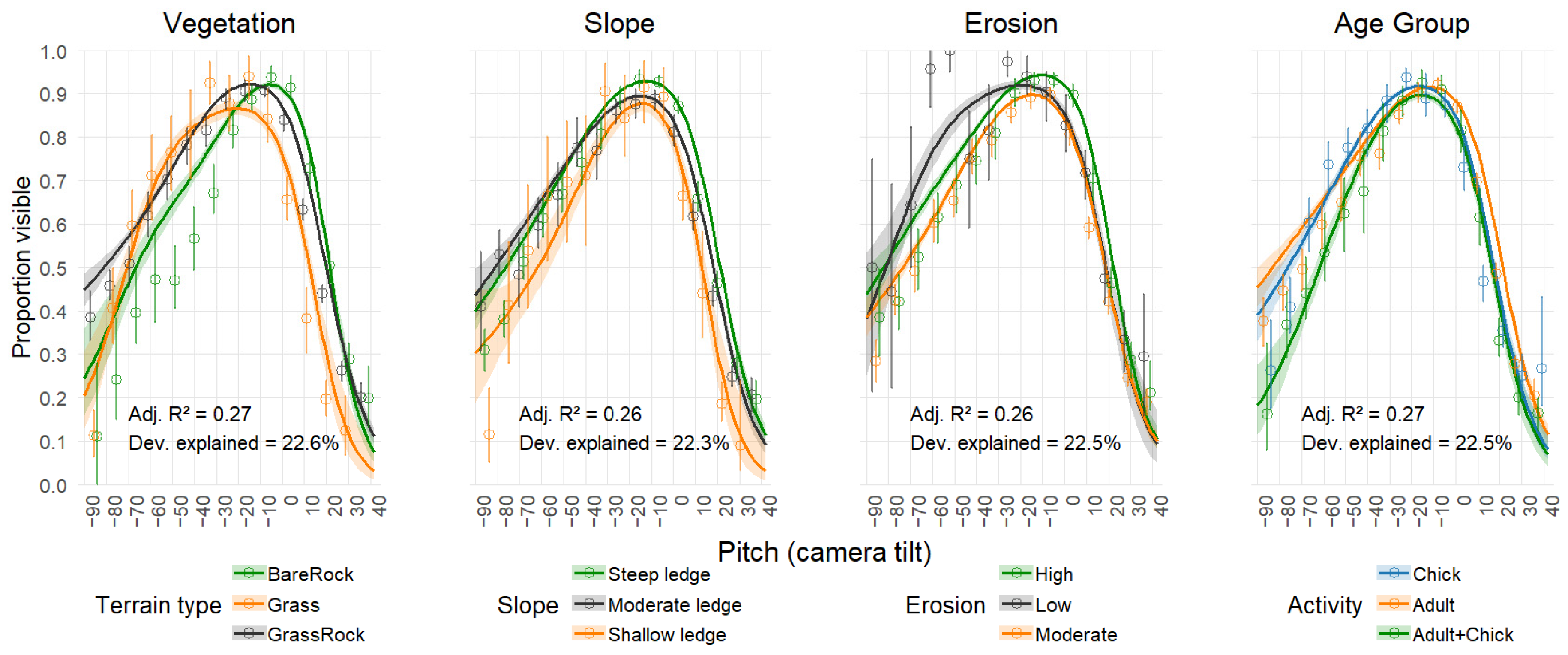
 | General optimum | Aim for a camera tilt near −13.8° during surveys. | This angle gave the highest average detection, with about 92–93% visibility across all plots. |
 | Full coverage range | Cover a tilt range of approx. −30° to −1.3° across all survey plots. | Full visibility across habitat types required a broader tilt interval. |
| Survey site considerations | |||
 | Terrain adjustments | Adjust tilt according to terrain: use less downward tilt on bare rock/steeper sites and more tilt in grassy, shallow, or eroded slopes. | Optimal pitch varied significantly with vegetation, slope, and erosion, affecting how quickly birds disappeared from view. |
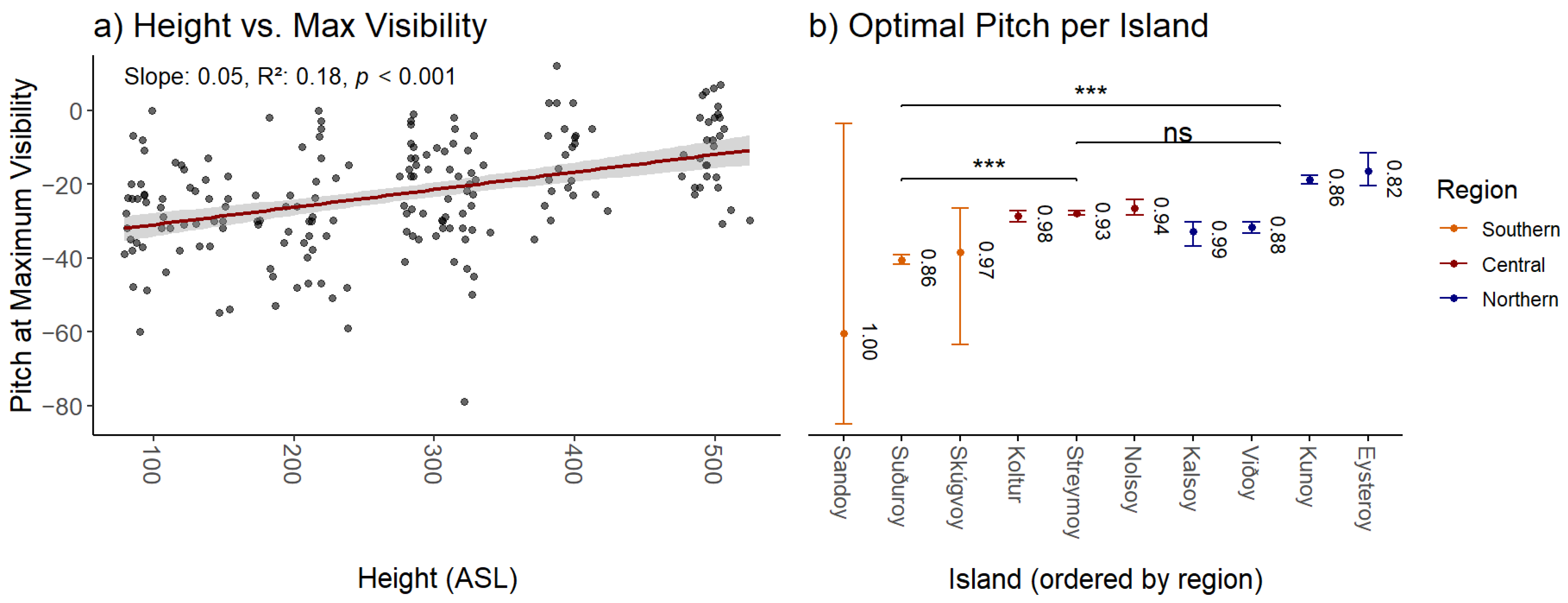
 | Elevation adjustment | At higher-elevation plots, use a slightly less steep downward tilt. | Optimal pitch showed a positive relationship with elevation, indicating cliff height as a factor. |
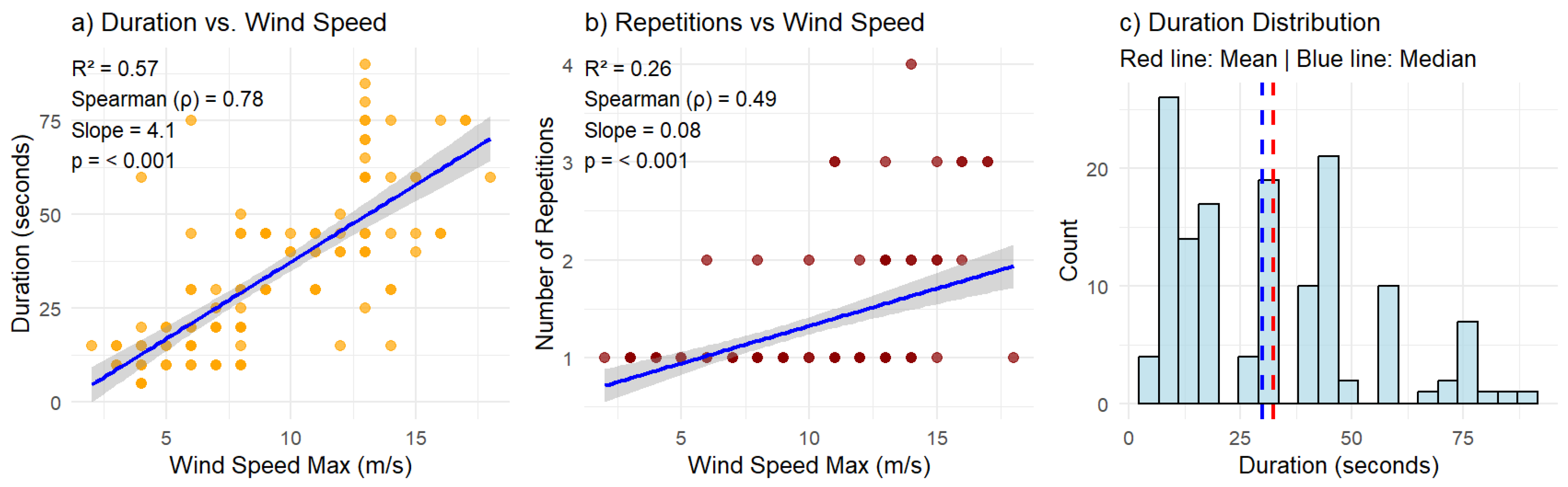
 | Weather adjustments | Prefer surveys in lower wind and, where feasible, more overcast conditions. | Stronger winds increased response duration and repetition, while thicker cloud cover was associated with fewer responses. |
Disclaimer/Publisher’s Note: The statements, opinions and data contained in all publications are solely those of the individual author(s) and contributor(s) and not of MDPI and/or the editor(s). MDPI and/or the editor(s) disclaim responsibility for any injury to people or property resulting from any ideas, methods, instructions or products referred to in the content. |
© 2026 by the authors. Licensee MDPI, Basel, Switzerland. This article is an open access article distributed under the terms and conditions of the Creative Commons Attribution (CC BY) license.
Share and Cite
Castenschiold, J.H.F.; Gullbein, M.B.; Hammer, S.; Frederiksen, M. Circumventing Blind Angles and Disturbance: Evaluating UAS for Monitoring Cliff-Nesting Seabirds. Drones 2026, 10, 490. https://doi.org/10.3390/drones10070490
Castenschiold JHF, Gullbein MB, Hammer S, Frederiksen M. Circumventing Blind Angles and Disturbance: Evaluating UAS for Monitoring Cliff-Nesting Seabirds. Drones. 2026; 10(7):490. https://doi.org/10.3390/drones10070490
Chicago/Turabian StyleCastenschiold, Johan H. F., Mækir B. Gullbein, Sjúrður Hammer, and Morten Frederiksen. 2026. "Circumventing Blind Angles and Disturbance: Evaluating UAS for Monitoring Cliff-Nesting Seabirds" Drones 10, no. 7: 490. https://doi.org/10.3390/drones10070490
APA StyleCastenschiold, J. H. F., Gullbein, M. B., Hammer, S., & Frederiksen, M. (2026). Circumventing Blind Angles and Disturbance: Evaluating UAS for Monitoring Cliff-Nesting Seabirds. Drones, 10(7), 490. https://doi.org/10.3390/drones10070490