5.2. Results and Analysis
5.2.1. Performance Comparison
Table 7 and
Table 8 report the mean ± std of MHV and MIGD over 30 runs of all algorithms across the three scenarios. Statistical significance is assessed by the Wilcoxon rank-sum test, and the
p-value results are presented in
Table 9.
MDCSATA achieves the best MHV and MIGD on all three scenarios, with relatively low standard deviations that indicate stable performance across independent runs. In S1, all comparisons are highly significant after Bonferroni correction, with MDCSATA outperforming DCTAEA and DNSGA-II by 7.69% and 8.49% in MHV, and by 32.00% and 39.92% in MIGD, respectively. In S2, DCTAEA is the only baseline whose MHV does not significantly differ from MDCSATA after Bonferroni correction, although MDCSATA still achieves a 0.93% improvement; DNSGA-II remains significantly worse in MHV. In MIGD, MDCSATA outperforms DCTAEA by 12.92% and DNSGA-II by 20.05%, demonstrating better preservation of front diversity. In S3, MDCSATA’s MHV advantage over DCTAEA is not statistically significant, but the 17.89% MIGD improvement over DCTAEA is significant. The advantage over DNSGA-II in S3 is significant for MHV at the 0.05 level and highly significant for MIGD. Across all settings, the only comparisons that fail to reach statistical significance are the MHV comparisons against DCTAEA in S2 and S3; every other pairwise test confirms the superiority of MDCSATA.
To further quantify the advantage, the per-algorithm improvement ratios on MHV and MIGD across the three scenarios are calculated. MDCSATA outperforms every baseline on both metrics in all scenarios. The largest gains are observed against DBCSA-II, where MHV improves by 71.00% in S1, 108.54% in S2, and 144.84% in S3, while MIGD improves by 74.44%, 80.58%, and 79.14%, respectively. Against DCMPSO, MHV gains range from 20.55% in S1 to 50.06% in S3, and MIGD gains range from 51.93% to 64.08%. Even against the strongest competitors, MDCSATA maintains consistent advantages: MHV improvements over DCTAEA and DNSGA-II reach 0.93%–8.49%, and MIGD improvements reach 12.92–39.92%, with only two comparisons lacking statistical significance. These consistent margins across metrics and scenarios underscore the superiority of MDCSATA.
Among the baselines, DBCSA-II and DCMPSO exhibit the worst performance. DMOAWPSO, SGEA, and MOEA/D-SVR all rank consistently below MDCSATA, with significant gaps on both metrics. These results collectively validate that the tailored strategies of MDCSATA enable efficient task allocation across diverse dynamic scenarios.
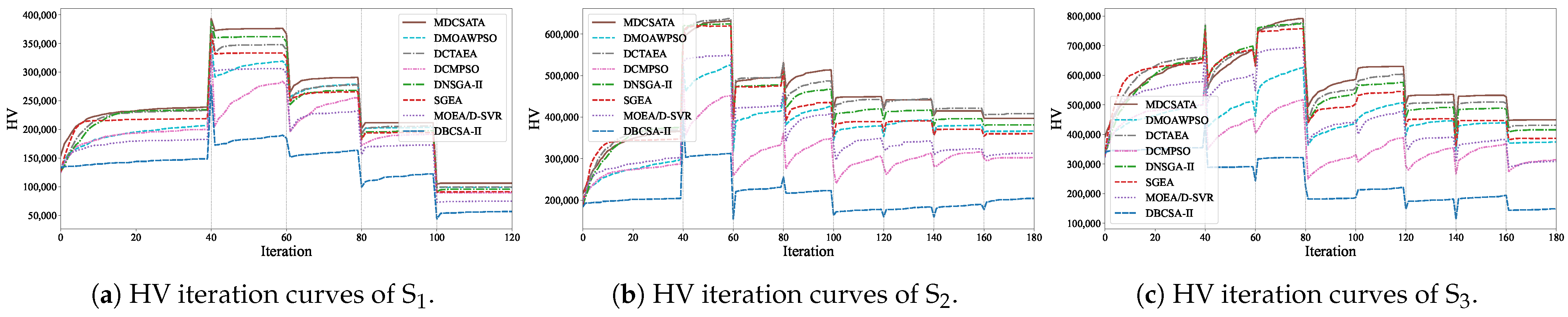
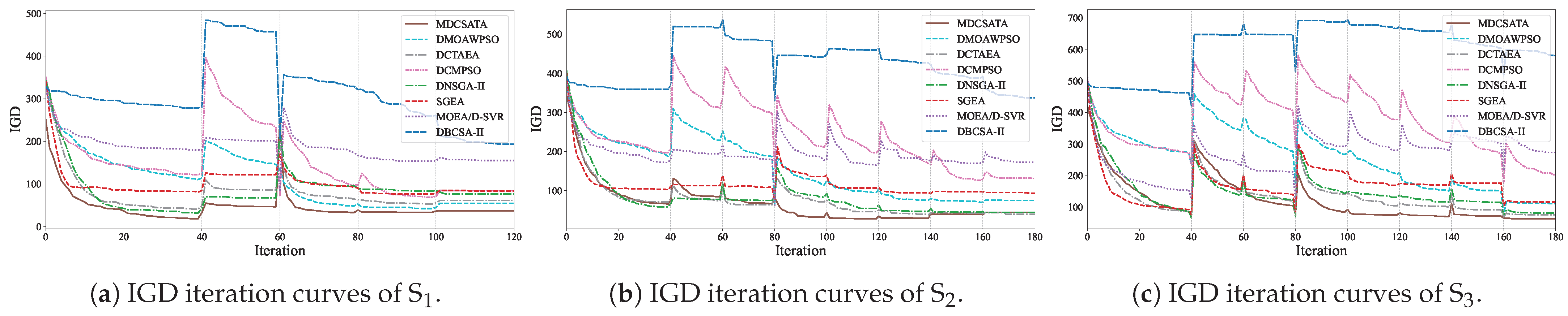
Figure 2 and
Figure 3 show the per-iteration HV and IGD convergence curves for all three scenarios. MDCSATA leads all algorithms from the earliest iterations, confirming that the objective-oriented heuristic initialization provides a well-informed starting population. It also converges faster within each environmental time step, reflecting the combined effect of the adaptive position update and the stagnation and elite guided perturbation. After each dynamic event, MDCSATA’s metric value recovers rapidly. This resilience is driven by the event-aware change response: the severity metric
quantifies each event’s impact and adjusts the regeneration ratios accordingly. As a result, MDCSATA reaches a higher performance level within each problem environment faster than the other algorithms.
By contrast, DNSGA-II uses a fixed-ratio random injection, which fails to redirect the population efficiently after disruptions such as UAV crashes, leading to slower performance recovery. SGEA and MOEA/D-SVR rely on prediction-based reinitialization, which becomes inaccurate under compound events and incurs a high change-response cost. DBCSA-II and DCMPSO exhibit curves that differ from others, consistent with the results reported above.
5.2.2. Ablation Study
To examine the contribution of each proposed strategy, an incremental ablation study is conducted with all settings identical to those described in
Section 5.1. The baseline MOCSA is a dynamic MOCSA core that includes a single-swarm CSA update, Pareto archive, and restart-based dynamic response. Starting from MOCSA, the proposed strategies are added sequentially. MOCSA
M introduces the violation-tolerant multi-swarm co-evolution mechanism; MOCSA
MH further adds objective-oriented heuristic initialization; MOCSA
MHA adds the adaptive position update strategy; MOCSA
MHAP adds stagnation and elite guided perturbation; and MDCSATA further activates the event-aware change response. The MHV and MIGD results are reported in
Table 10 and
Table 11.
The complete MDCSATA consistently improves over the dynamic MOCSA core by a large margin. Compared with MOCSA, MDCSATA increases MHV by 24.0%, 55.6%, and 75.4% in S1, S2, and S3, respectively, while reducing MIGD by 55.8%, 70.7%, and 71.0%. These results confirm that the performance advantage of MDCSATA does not come merely from the problem-specific encoding, but from the proposed algorithmic strategies.
The first increment from MOCSA to MOCSAM yields improvements in all scenarios, indicating that the violation-tolerant multi-swarm co-evolution mechanism helps preserve feasible search directions and front diversity under dynamic constraints. The most pronounced gain is observed from MOCSAM to MOCSAMH. After objective-oriented heuristic initialization is introduced, MHV increases by 14.4%, 20.0%, and 41.7%, and MIGD decreases by 40.3%, 45.9%, and 51.9% in the three scenarios. This demonstrates that initialization tailored to the remaining target value and makespan objectives provides high-quality starting solutions and the resulting PF approximation.
The adaptive position update further improves the performance in the scenarios. From MOCSAMH to MOCSAMHA, MHV increases by 4.2% in S2 and 9.6% in S3, and MIGD decreases by 10.9% and 20.1%, respectively. In S1, MOCSAMHA is slightly worse than MOCSAMH, this may suggest that the smaller search space already benefits sufficiently from heuristic initialization and that additional exploratory movement may introduce minor fluctuations. The stagnation and elite guided perturbation in MOCSAMHAP then improves both indicators in all scenarios, showing that local reallocation around stagnated and elite solutions is effective for refining PF approximations.
Finally, the event-aware change response provides smaller but generally favorable improvements over MOCSAMHAP. MDCSATA obtains the best MIGD at all three scales and the best MHV in S1 and S3; its MHV in S2 is only 0.2% lower than that of MOCSAMHAP. This indicates that the event-aware change response mainly stabilizes adaptation across changes rather than serving as the dominant source of improvement.
Overall, the ablation results support that all proposed components contribute to the performance of MDCSATA, validating their effectiveness.
5.2.3. Parameter Sensitivity Analysis
To evaluate the robustness of MDCSATA to the CSA search control parameters, a full-factorial sensitivity analysis is performed using
,
, and
. The resulting eight combinations are evaluated under the same settings as in
Section 5.1. This design examines both the marginal influence of each parameter and whether their effects depend on the other parameter settings. In addition, the sensitivity of the event-aware change response is examined using two fixed settings corresponding to the bounds of the adaptive rule: a conservative setting with
and an aggressive setting with
. The MHV and MIGD results are shown in
Table 12,
Table 13,
Table 14 and
Table 15.
The factorial results show that the effect of becomes clearer as the problem scale increases. The marginal differences between and are negligible in S1, whereas improves average MHV by 1.3% and 4.6% and reduces average MIGD by 7.0% and 13.8% in S2 and S3, respectively. A large triggers random relocation more frequently and may disrupt well-structured allocations in larger search spaces. The selected value consequently provides the more reliable cross-scenario setting.
The parameter has a more consistent influence. Averaged over and , improves MHV by 1.4%, 2.4%, and 4.3% and reduces MIGD by 7.1%, 8.3%, and 14.5% from S1 to S3. This suggests that an excessively large minimum movement can force substantial changes even when a crow should exploit a promising position. In contrast, the marginal influence of is small: is slightly better on average in S1 and S2, while is slightly better in S3. The default combination gives the best MIGD in S1, whereas gives the best MHV and MIGD in S2 and S3. Thus, the default is retained as a conservative cross-scenario setting, while a larger can assist exploration in larger search spaces.
The event-response sensitivity results in
Table 14 and
Table 15 further show that the
-based adaptive response is stable. It obtains the best MHV and MIGD in S
1 and S
3, while the aggressive fixed response is slightly better in S
2. The small gaps indicate that no fixed response intensity dominates across all scenarios. The adaptive rule therefore provides a robust compromise by adjusting regeneration according to the estimated severity of each environmental change.
Overall, the sensitivity study supports the selected parameter configuration and shows that the adaptive position update and the -based response remain stable under moderate parameter variations.
5.2.4. Preference-Weighted Solution Quality
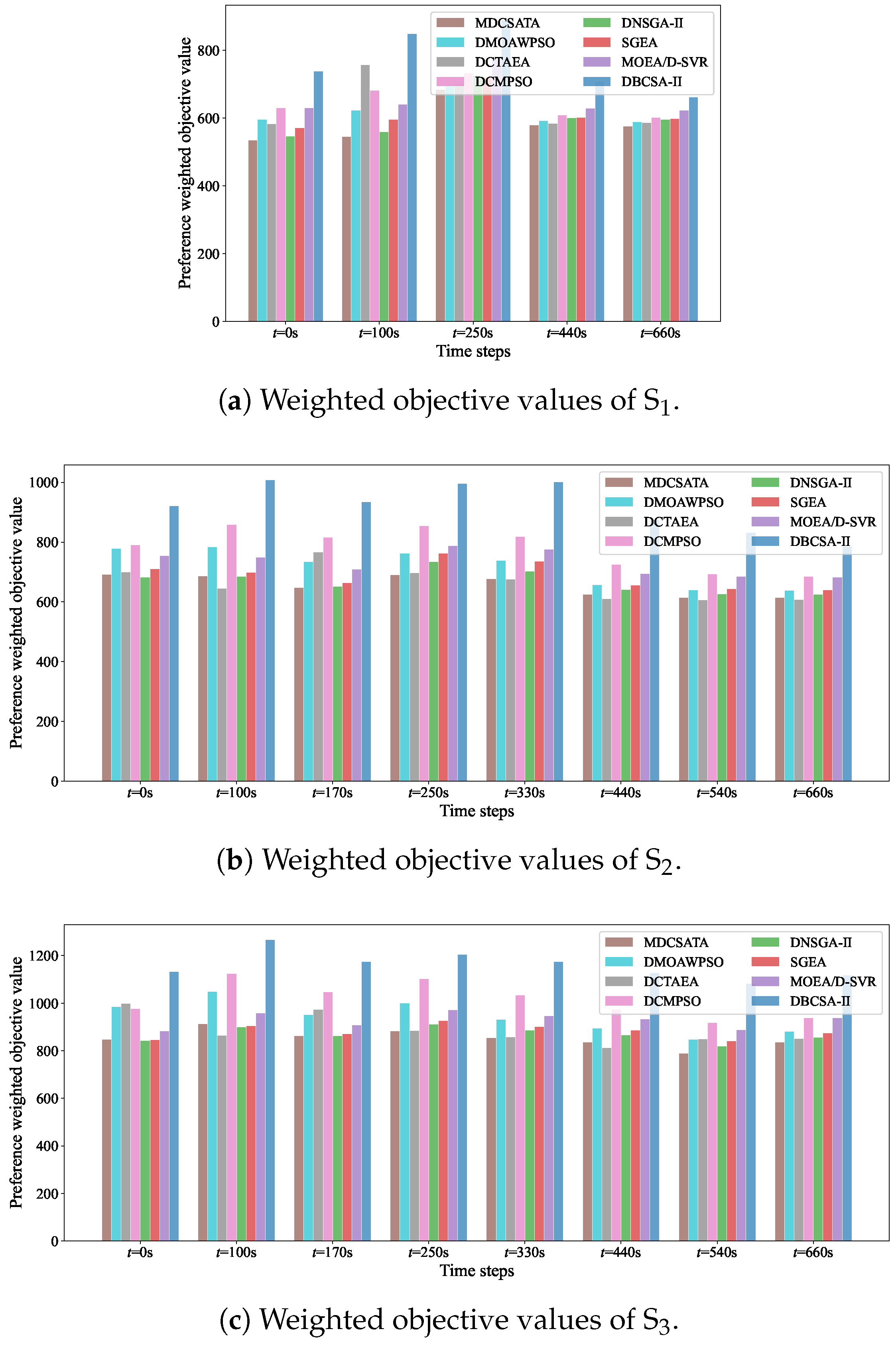
Figure 4 presents the preference-weighted objective value of the executed solution at each environmental time step, selected under the decision-maker’s preference weights. Across all three scenarios, MDCSATA delivers the lowest or near-lowest weighted objective value at most time steps, reflecting well-distributed PFs.
DCTAEA and DNSGA-II are the most competitive baselines and occasionally edge ahead of MDCSATA at certain time steps, which is consistent with their MHV and MIGD results. In S1, MDCSATA achieves a 3.56% improvement over DNSGA-II and a 9.05% improvement over DCTAEA across all time steps. In S2, MDCSATA holds a 1.09% improvement over DCTAEA and a 1.81% improvement over DNSGA-II. In S3, MDCSATA attains a 1.70% improvement over DNSGA-II and a 3.79% improvement over DCTAEA. This overall advantage indicates that MDCSATA sustains both front diversity and convergence more effectively as the problem environment evolves, whereas the competitors tend to lose solution quality.
SGEA also performs well among the algorithms and occasionally matches MDCSATA, but its solution quality fluctuates across time steps and rarely surpasses the top two. The remaining algorithms operate at larger disadvantages, suggesting that their PFs are either poorly converged or insufficiently diverse to provide strong candidates under the given preference weights. DMOAWPSO trails MDCSATA by 5.63% in S1, 8.41% in S2, and 9.53% in S3. Against DBCSA-II, the weakest baseline, the improvement of MDCSATA reaches 24.05% in S1, 28.58% in S2, and 26.48% in S3. These consistent margins indicate that MDCSATA not only produces high-quality PF approximations but also translates this advantage into superior executed-solution quality under shifting decision-maker preferences.
5.2.5. Task Allocation Visualization
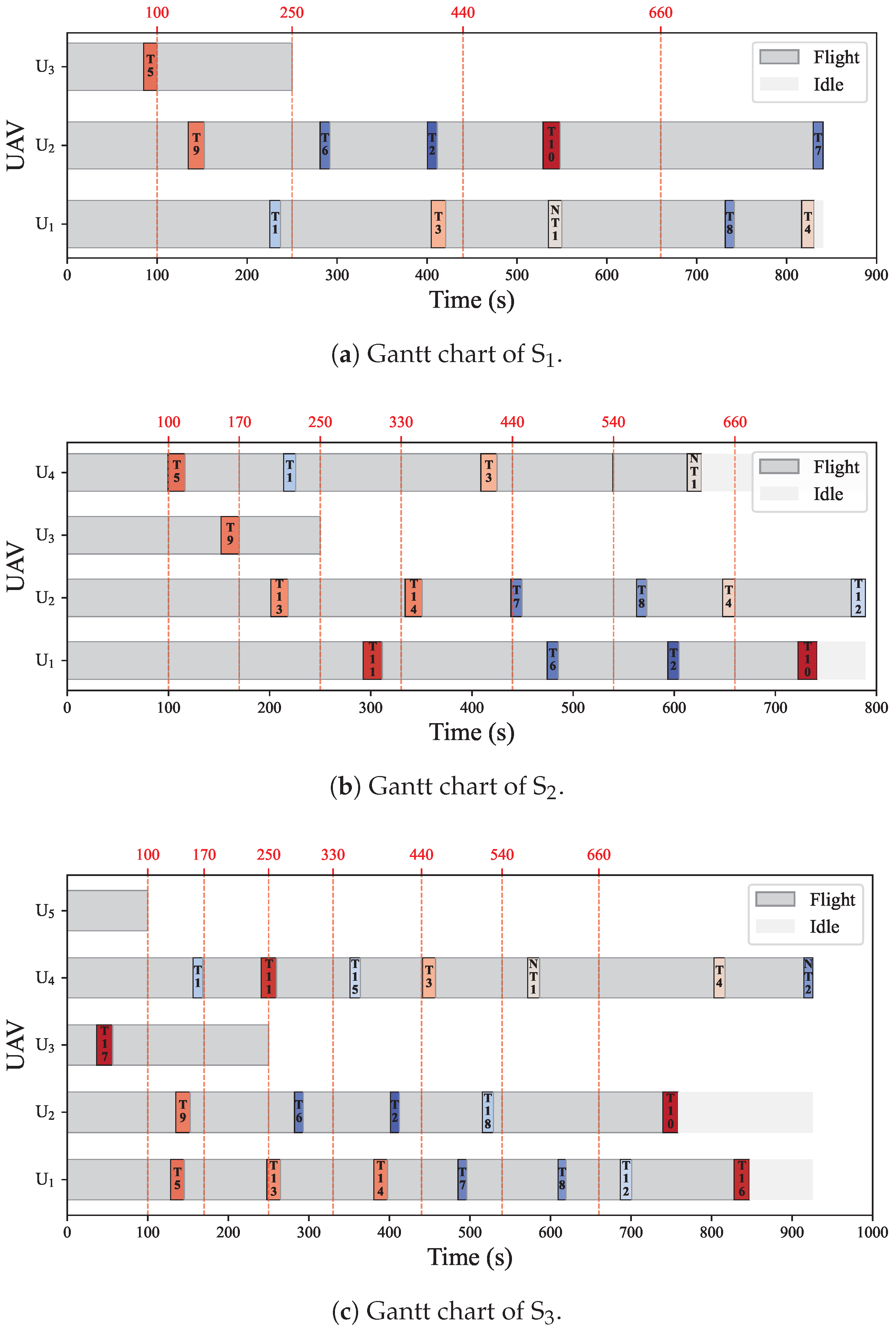
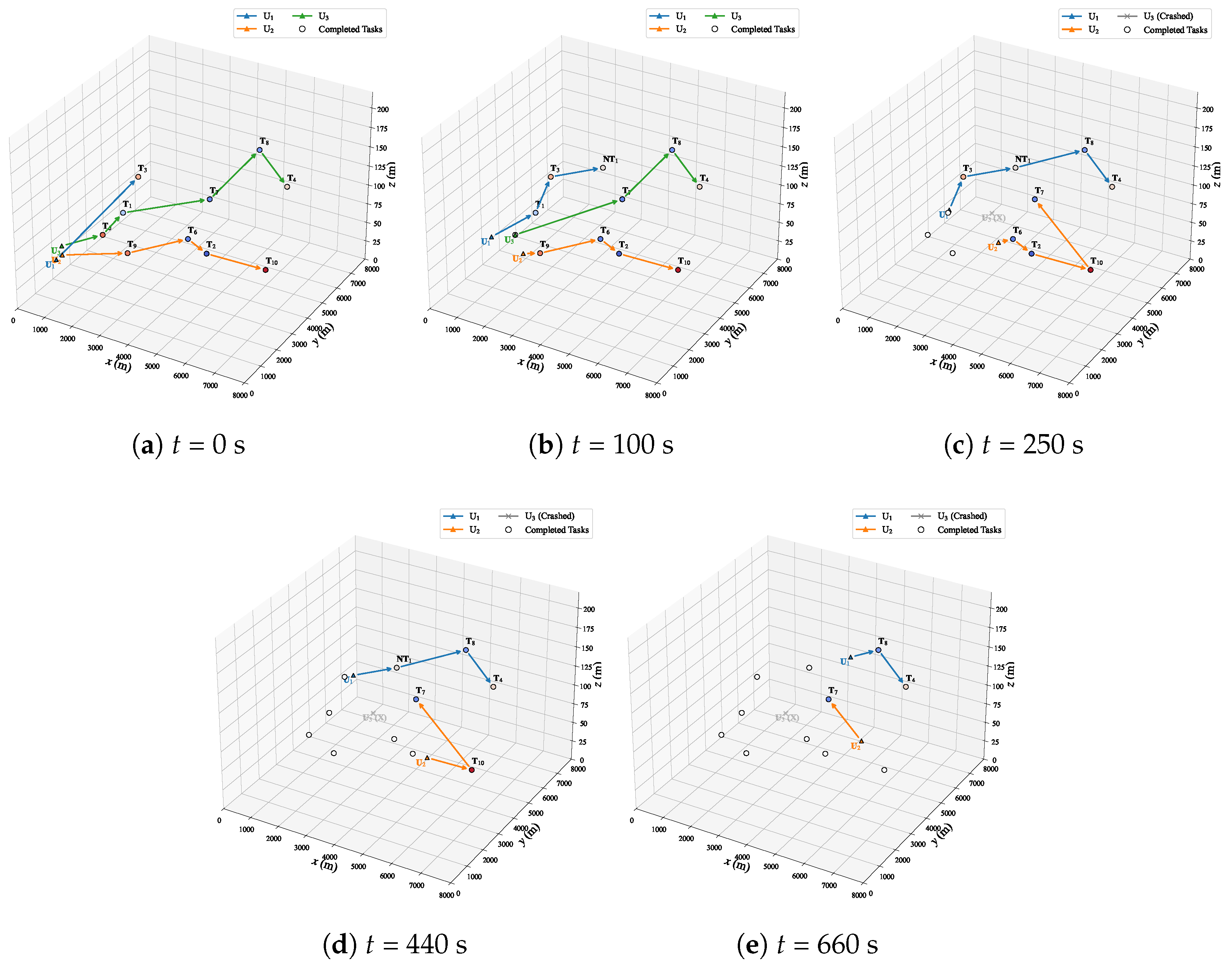
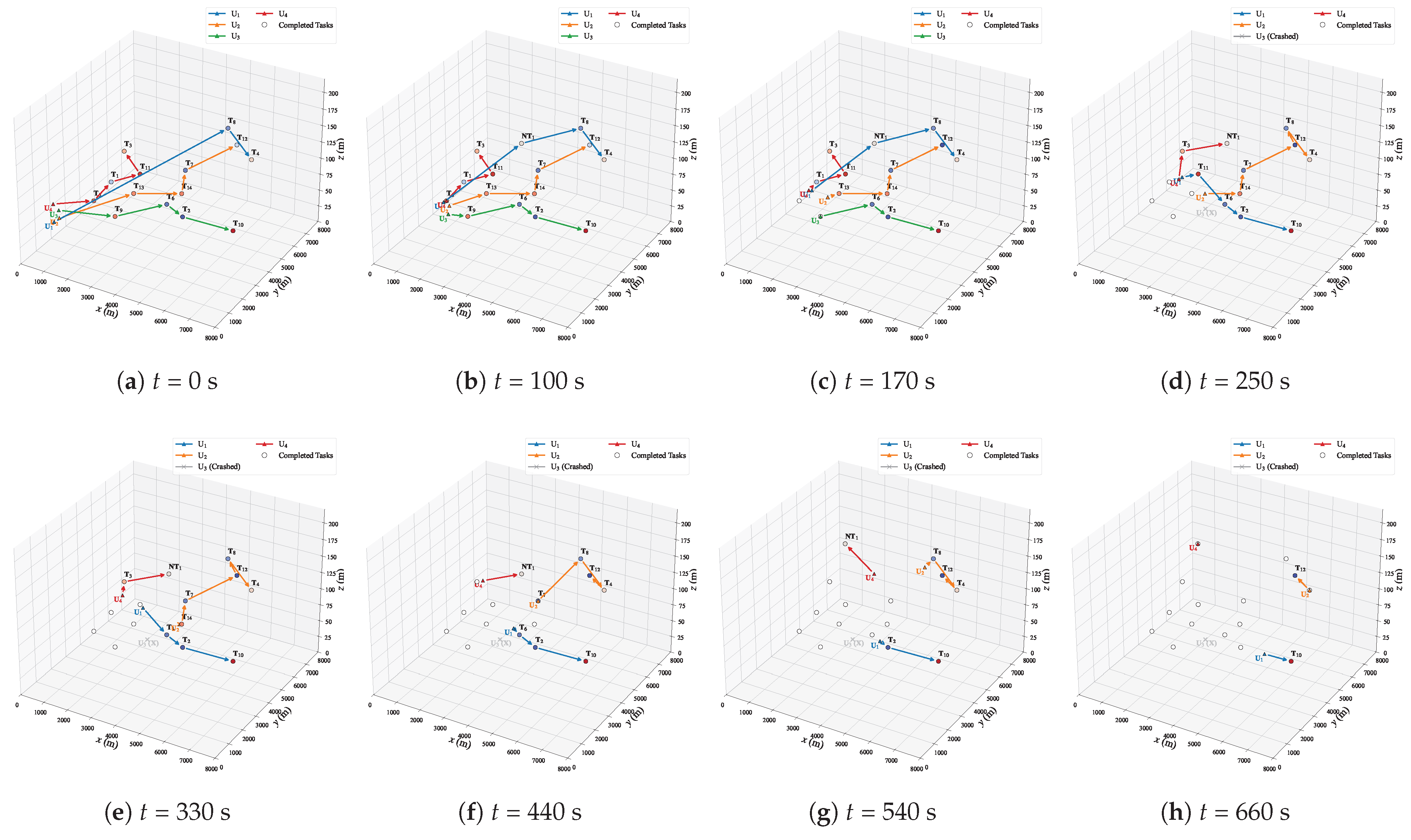
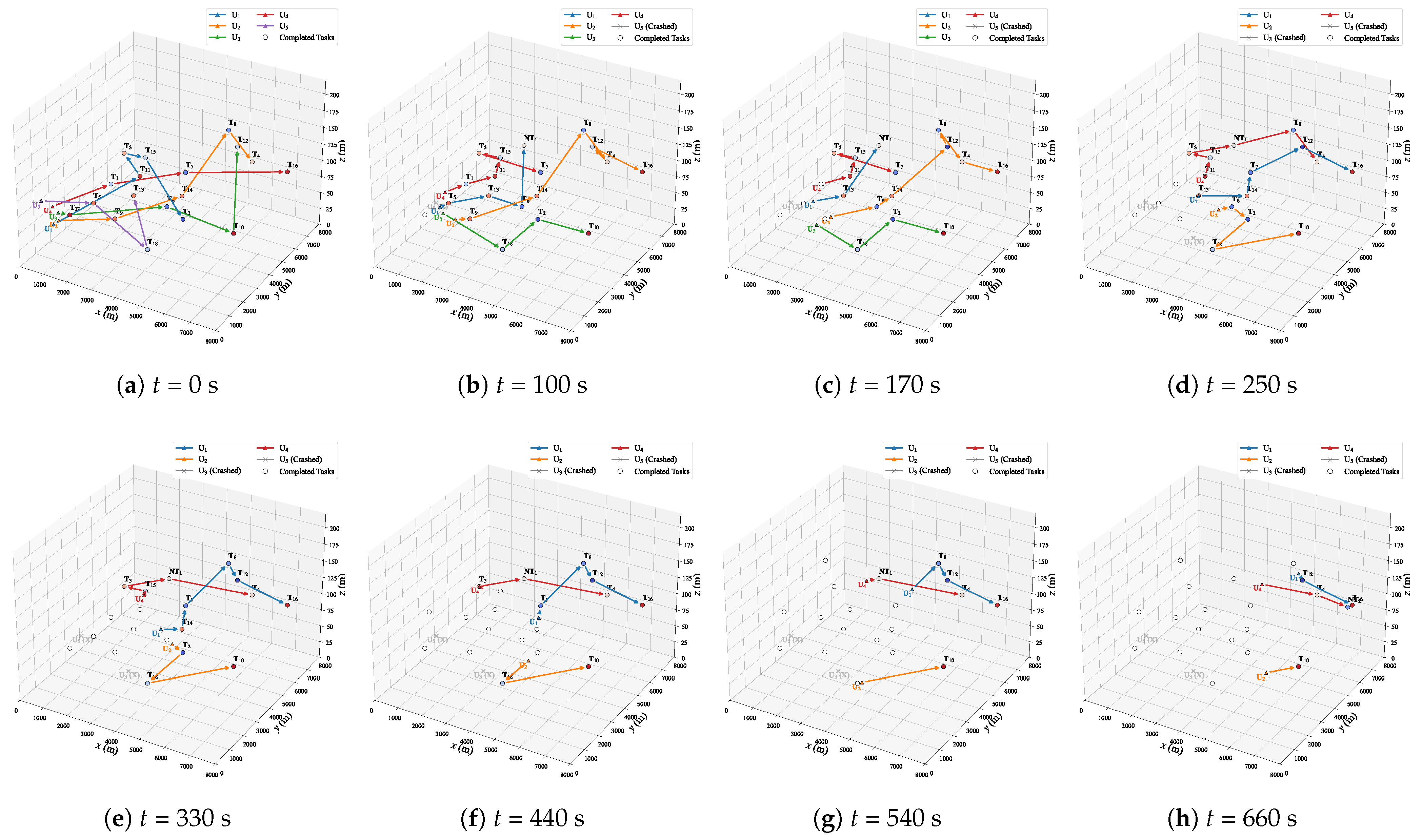
Figure 5 presents the Gantt chart of MDCSATA’s execution schedule across the scenarios, and
Figure 6,
Figure 7, and
Figure 8 show the per-time step spatial allocation maps for S
1, S
2, and S
3, respectively. Target colors are mapped from observational values using a cool-to-warm scale. For example, T
2 with value 52 appears blue, NT
1 with value 76 appears light gray, and T
10 with value 99 appears red.
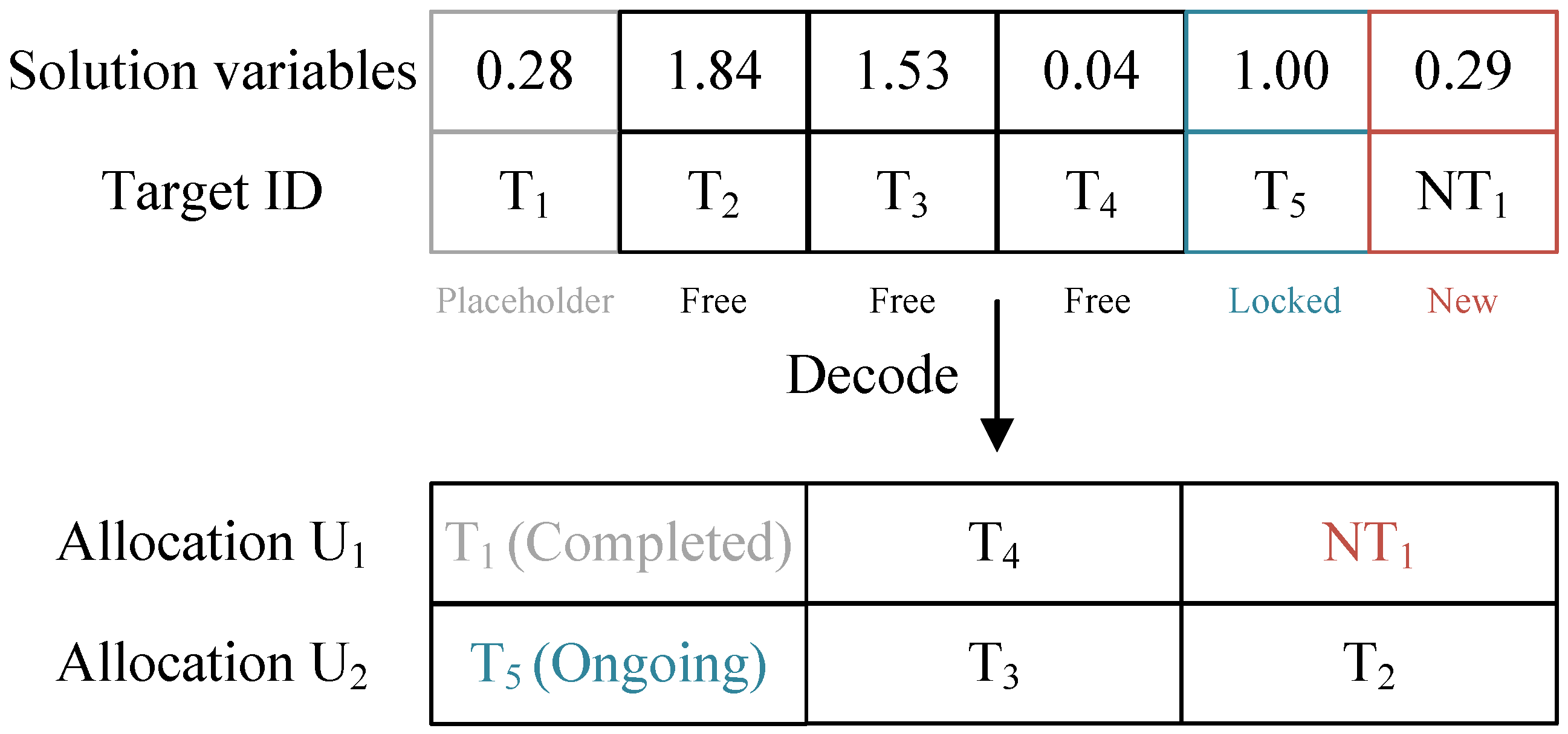
These visualizations highlight several advantages of the proposed model formulation and encoding design. Three validity properties are consistently maintained across all dynamic events. First, ongoing tasks are never interrupted, as the random-key encoding locks in-progress assignments to the executing UAV, preventing mid-task reassignment. Second, completed targets are never re-allocated, because the variable-length encoding grows monotonically as new targets appear while skipping completed targets when decoding. Third, newly appeared targets are integrated within the time steps, appearing immediately in the schedule of the following re-optimization phase. These properties are guaranteed by design, without relying on post-processing repair. The spatial allocation maps further illustrate the workload redistribution behavior under dynamic events. After a UAV crash, the surviving UAVs absorb the remaining unassigned targets with minimal makespan increase, driven by the -biased heuristic initialization that seeds the swarms with load-balanced assignments. After a sensor damage event, the affected UAV’s reduced sensing capability lowers its contribution to , causing high-value targets to be naturally shifted to UAVs with better sensing capability. These adaptive behaviors emerge directly from the objective formulation and MDCSATA’s framework, requiring no post-processing rules.
5.2.6. Runtime Efficiency
Table 16 gives the average runtime of all algorithms. Benefiting from the inherently simple search mechanism of CSA, both DBCSA-II and MDCSATA require very short optimization time. Three algorithms—DBCSA-II, DCMPSO, and MDCSATA—form a distinctly faster group across all scenarios. Among them, DBCSA-II and DCMPSO rank first or second, yet both exhibit severely degraded MHV and MIGD; in S
3, DBCSA-II fails to maintain meaningful PF tracking. MDCSATA ranks third in speed, with its additional overhead relative to the other two attributable to the integrated strategies, which is consistent with the complexity analysis in
Section 4.7. Despite this, MDCSATA achieves the best MHV and MIGD, striking a favorable balance between solution quality and efficiency. The remaining algorithms require obviously more runtime than the above group, with SGEA incurring overhead roughly 30 times that of MDCSATA, yet their allocation quality does not exceed that of MDCSATA. These results indicate that MDCSATA provides a highly effective trade-off between optimization performance and computational cost, making it well-suited for time-critical operations where both accuracy and responsiveness are essential.
In summary, MDCSATA consistently surpasses all seven comparison algorithms across the three scenarios on both MHV and MIGD, while maintaining third runtime. The advantage confirms that the integrated strategies deliver rapid PF tracking in the dynamically changing problem environment, which validates MDCSATA’s effectiveness in multi-UAV DTA for time-critical missions.