Adaptive Asymptotic Tracking Control for the Dynamic Models of Differential-Drive Unmanned Ground Vehicles Under Parametric Uncertainties


Highlights
- A dual-loop layered adaptive control framework based on the Immersion and Invariance (I&I) technique is developed for wheeled mobile robots, achieving exponential parameter convergence under a weaker, trajectory-dependent excitation condition.
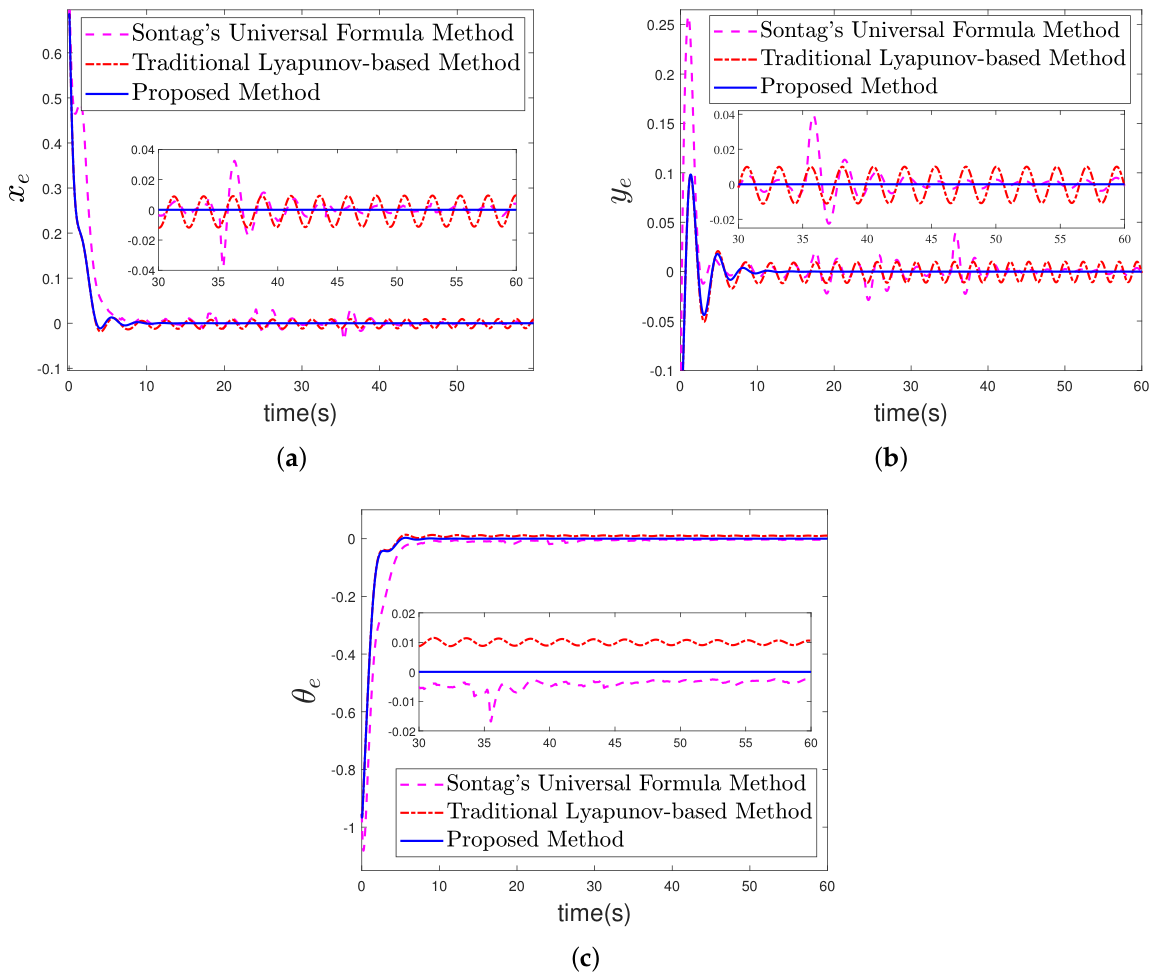
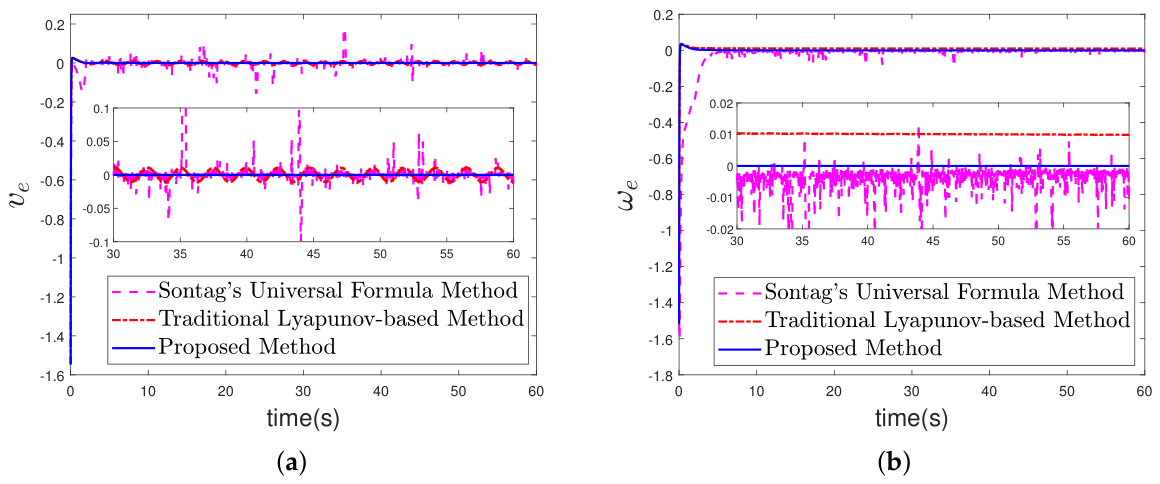
- The proposed control scheme effectively reduces steady-state fluctuations in time-varying trajectory tracking and guarantees asymptotic zero-error convergence, significantly improving both tracking accuracy and convergence rate compared with traditional adaptive methods.
- The proposed layered design breaks the limitation of the certainty equivalence principle, providing greater flexibility in adaptive controller synthesis and offering a new scheme for handling parametric uncertainties in underactuated non-minimum phase systems.
- This work advances the high-precision dynamic trajectory tracking control of non-holonomic UGVs under parametric uncertainties. By integrating kinematic and dynamic layers, the proposed method enables robust and reliable path following in practical scenarios such as autonomous navigation, intelligent logistics, and field robotics.
Abstract
1. Introduction
- (i)
- The complex nonlinear coupling inherent in UGVs is exacerbated by nonholonomic constraints, such as the no-lateral-slip condition in differential-drive robots [24]. Model uncertainties tend to amplify these coupling effects, thereby destabilizing the delicate equilibrium between tracking performance and internal states [25]. For instance, in car-like robots, uncertainties in wheel-ground friction coefficients can intensify the coupling between longitudinal velocity and yaw rate, leading to significant lateral error drift that is difficult to compensate for using kinematic-based methods alone.
- (ii)
- Traditional adaptation laws create a fundamental lag in parameter estimation due to their finite convergence rates. In these frameworks, estimation errors introduce persistent biases into the control inputs, and the controllers frequently lack the necessary bandwidth to compensate for the rapidly varying terms inherent in time-varying trajectories. A typical case is a UGV tracking a spiral reference path; the continuously changing curvature excites nonlinear coupling within the yaw dynamics, while the parameter estimates inevitably lag behind due to the aforementioned lack of sufficient excitation [26].
- (iii)
- The structural properties of UGV systems, particularly their non-minimum phase nature, can present a barrier to zero-error convergence [27], while minimum-phase systems possess inherently self-stabilizing internal dynamics [28]; many nonlinear tracking methods—such as feedback linearization, dynamic inversion, backstepping, or sliding mode—prioritize output tracking but may neglect internal state stabilization. Consequently, even if the nominal tracking error is driven to zero, uncompensated oscillations in the internal dynamics can manifest as persistent and irreducible fluctuations in the final position tracking error.
- (1)
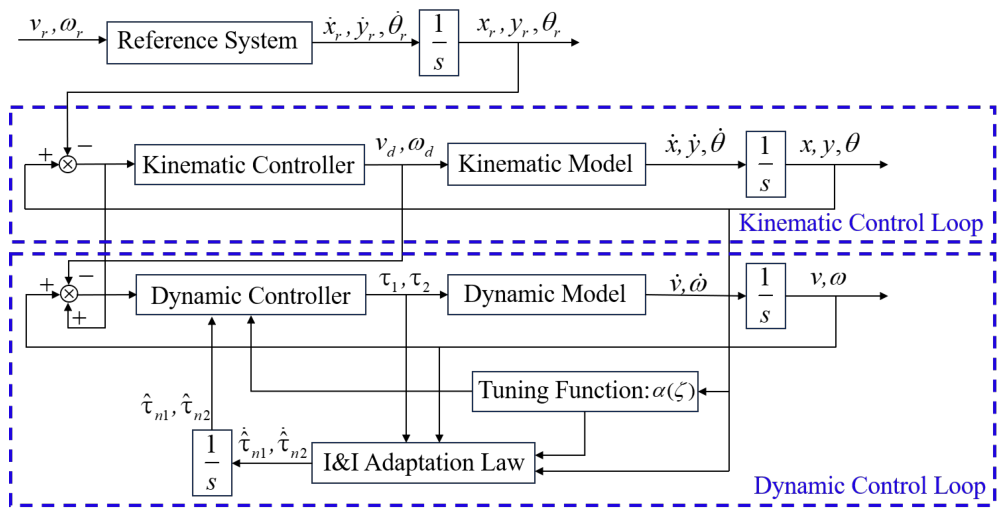
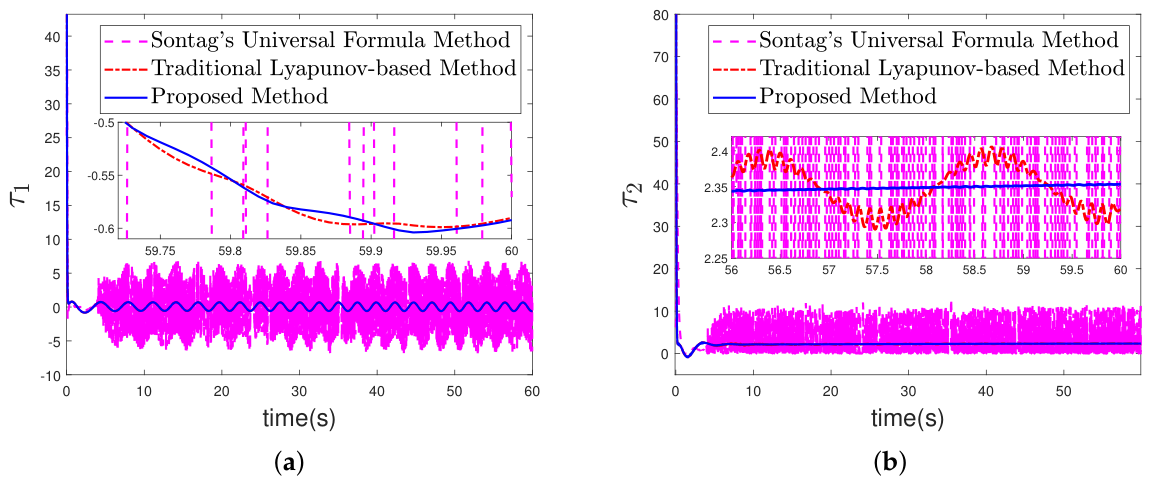
- Existing research on tracking control predominantly focuses on the kinematic models of UGVs. However, such models often neglect dynamic characteristics (e.g., inertial forces and friction effects), rendering them inadequate for high-speed, high-precision applications. To address the more complex dynamic models of UGVs, this paper proposes a layered adaptive dual-loop control mechanism based on the I&I technique. This mechanism conducts online estimation and compensation of system uncertainties to achieve precise reference trajectory tracking. Simulation experiments demonstrate the effectiveness of the proposed control mechanism.
- (2)
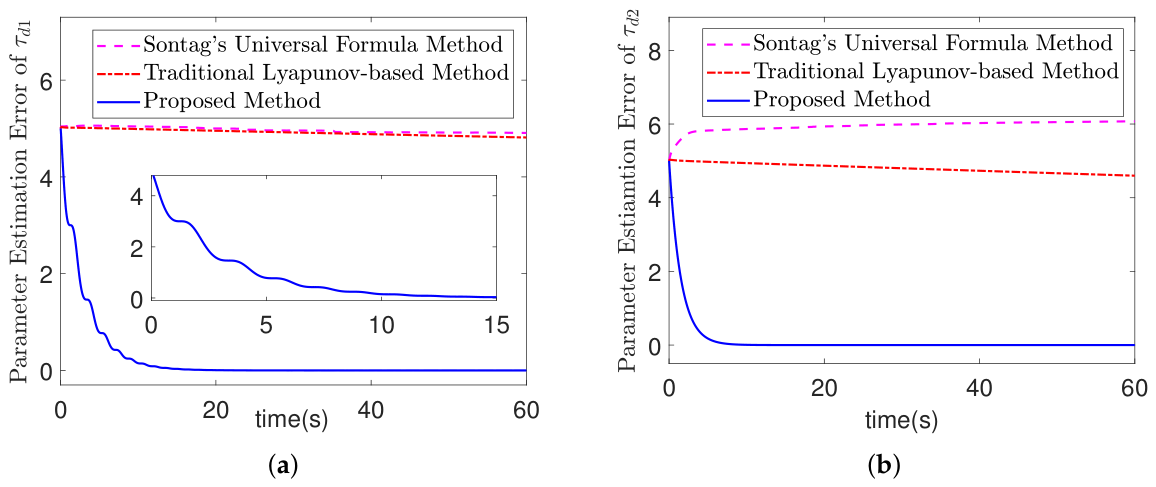
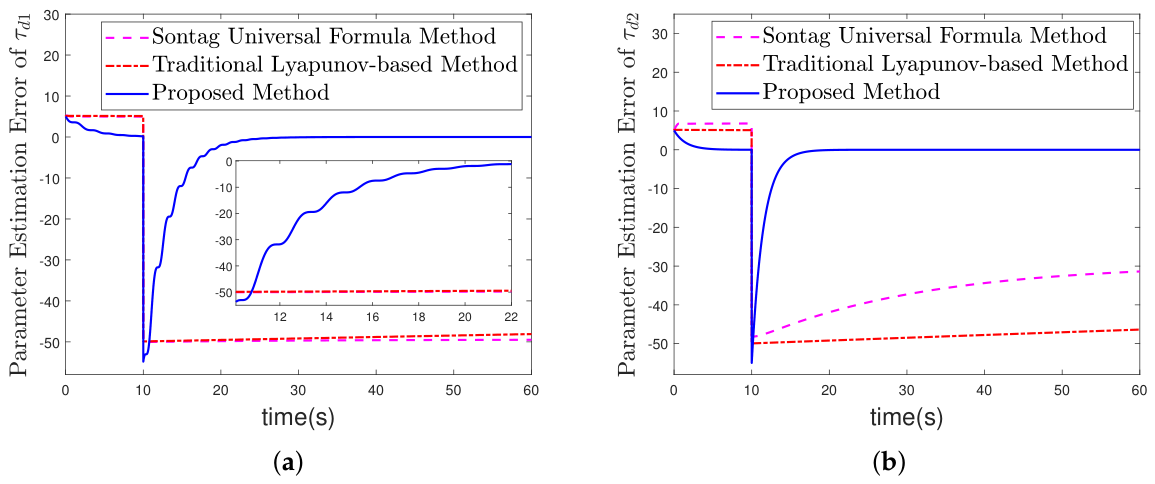
- Within the dynamic control loop, the proposed adaptive control strategy adopts a layered architecture comprising a parameter estimation layer and a controller design layer. This structure decouples the design of the adaptation law from that of the controller. Crucially, the parameter estimates are not solely generated by adaptation laws; rather, they integrate modification functions into the nominal parameter estimates. Compared with traditional methods, the layered adaptive control strategy proposed in this paper does not rely on the certainty equivalence principle. It offers more design degrees of freedom and ensures that the parameter estimation error exponentially converges to zero under a weaker excitation condition than the classical PE condition.
- (3)
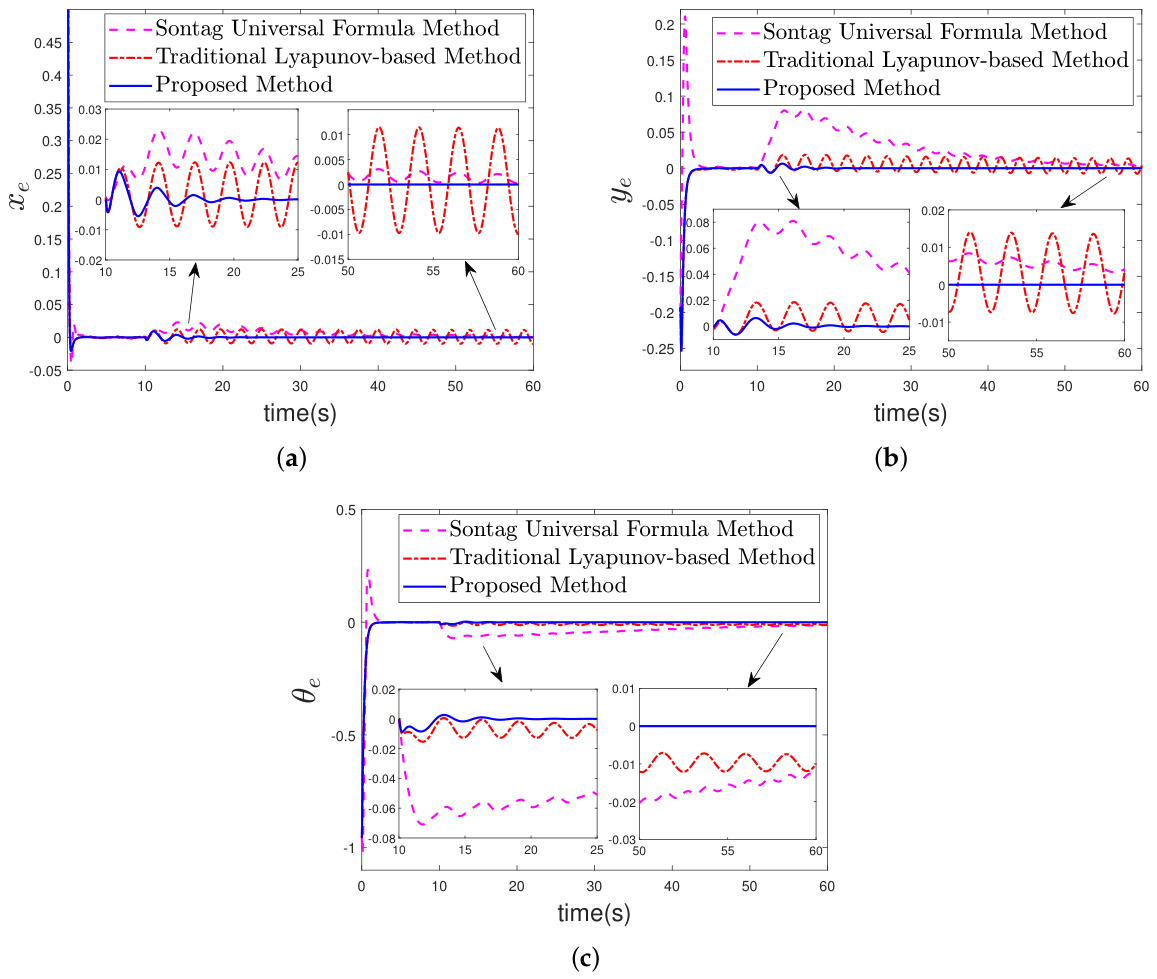
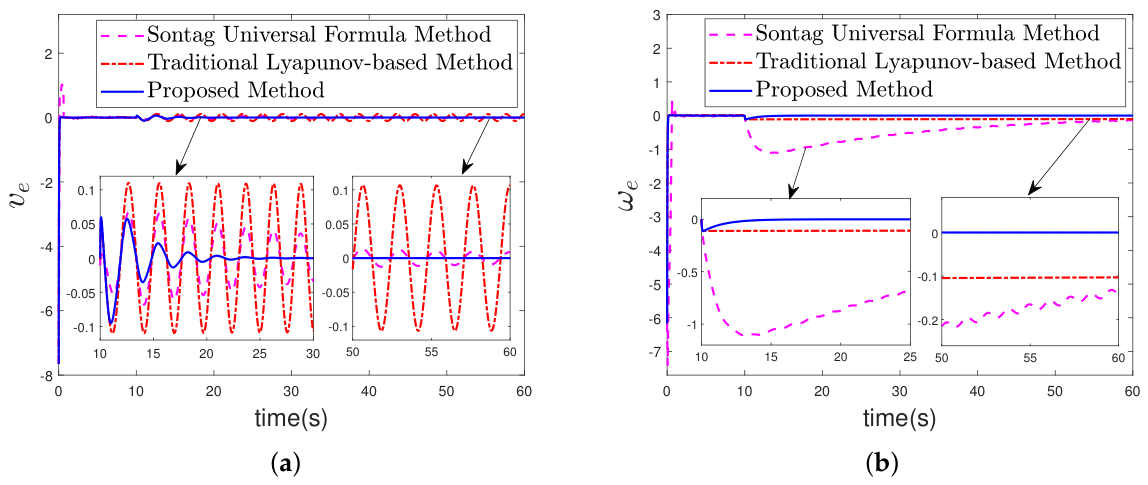
- Most of the existing adaptive control methods for wheeled mobile robots are designed to address the precise tracking problem of time-invariant trajectories (e.g., straight-line paths). However, when tracking time-varying trajectories, these methods—despite theoretically guaranteeing asymptotic system stability—fail to achieve zero position tracking error convergence in practice due to the non-minimum phase characteristics of UGVs. This limitation manifests as persistent position tracking error fluctuations. The dual-loop layered adaptive control mechanism based on the I&I technique proposed in this paper provides an effective solution for addressing the control challenge of non-minimum-phase characteristics for UGV systems. It effectively eliminates steady-state position tracking error fluctuations during time-varying trajectory tracking and demonstrably achieves precise convergence of position tracking errors to zero in both theoretical analysis and simulation experiments, significantly enhancing tracking accuracy.
2. Mathematical Model and Problem Formulation
3. Kinematic Model Control Design
4. Dynamic Model Control Design
4.1. Motivation
4.2. Adaptation Law Design
- (1)
- is bounded and converges exponentially to zero for any reference trajectory.
- (2)
- can converge exponentially to zero if for , one has for .
4.3. Controller Design
4.4. Improved Control Design
5. Simulation Experiments
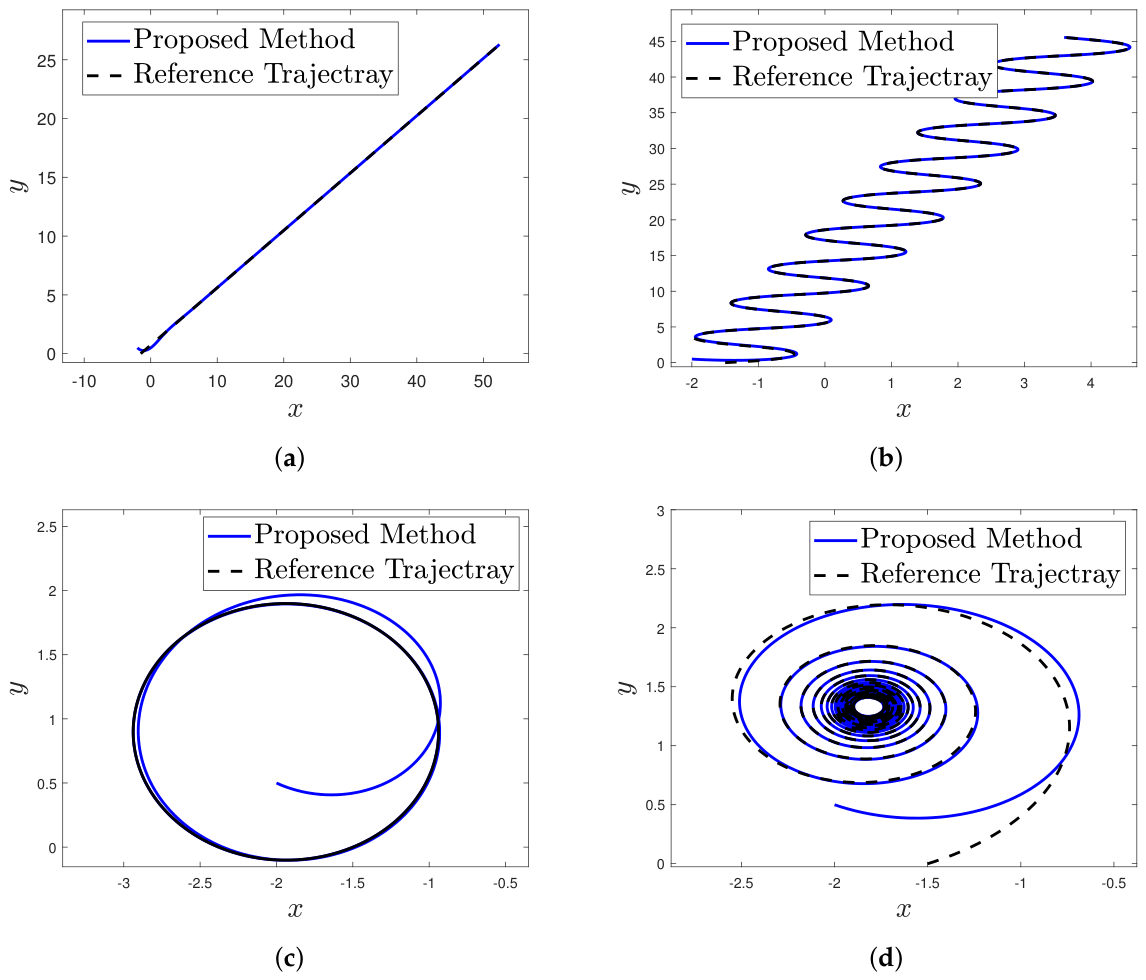
- (a)
- Straight Line: m/s, rad/s;
- (b)
- Trigonometric Function Curve: m/s, rad/s;
- (c)
- Circle: m/s, ;
- (d)
- Spiral: m/s, rad/s.
6. Conclusions
Author Contributions
Funding
Data Availability Statement
Conflicts of Interest
References
- Yan, L.X.; Ma, B.L.; Jia, Y.G.; Jia, Y.X. Observer-Based Trajectory Tracking Control of Nonholonomic Wheeled Mobile Robots. IEEE Trans. Control Syst. Technol. 2024, 3, 1114–1121. [Google Scholar] [CrossRef]
- Geng, Q.; Yang, H.J.; Li, L.; Hua, C.C. Hybrid Dynamic Event-Triggered Tracking Control of Wheeled Mobile Robots Against Stochastic DoS Attacks. IEEE Trans. Syst. Man Cybern. Syst. 2023, 53, 7805–7813. [Google Scholar] [CrossRef]
- Zhou, J.; Zhao, C.; Chen, Y.P.; Shi, K.B.; Chen, E.Y.; Luo, Z.Q. Trajectory Tracking Control of Unmanned Vehicles via Front-Wheel Driving. Drones 2024, 8, 543. [Google Scholar] [CrossRef]
- Gao, M.G.; Yan, T.; Fu, W.X.; Feng, Z.F.; Guo, H. Automated Flight Technology for Integral Path Planning and Trajectory Tracking of the UAV. Drones 2024, 8, 9. [Google Scholar]
- Bo, Q.; Yan, H.C.; Wang, M.; Rao, K.; Yang, P.H. Nolinear Tracking Differentiator Based Practical Prescribed Time Tracking Control for Perturbed Wheeled Mobile Robot. Nonlinear Dyn. 2025, 113, 1389–1400. [Google Scholar]
- Xu, L.; Su, Y.F.; Cai, H. Cooperative Global K-Exponential Tracking Control of Multiple Mobile Robots. IEEE Trans. Autom. Control 2025, 70, 1214–1221. [Google Scholar] [CrossRef]
- Ren, T.; Li, S.; Liu, Y.J.; Wan, F.; Liu, L.; Sun, C. Adaptive Event-Triggered Optimal Tracking Control for Wheeled Mobile Robots Considering Force-Velocity Hybrid Constraints. IEEE Trans. Intell. Transp. Syst. 2025, 26, 11945–11956. [Google Scholar] [CrossRef]
- Li, L.; Qiang, J.P.; Xia, Y.Q.; Cao, W.Q. Adaptive dual closed-loop trajectory tracking control for a wheeled mobile robot on rough ground. Nonlinear Dyn. 2024, 113, 2411–2425. [Google Scholar] [CrossRef]
- Chen, X.L.; Zhao, H.; Sun, H.; Zhen, S.C.; Huang, K. A Novel Adaptive Robust Control Approach for Underactuated Mobile Robot. J. Frankl. Inst. 2019, 356, 2474–2490. [Google Scholar] [CrossRef]
- Rabbani, M.J.; Memon, A.Y. Trajectory Tracking and Stabilization of Nonholonomic Wheeled Mobile Robot using Recursive Integral Backstepping Control. Electronics 2021, 10, 1992. [Google Scholar] [CrossRef]
- Xie, H.; Zheng, J.C.; Sun, Z.; Wang, H.; Chai, R.F. Finite-Time Tracking Control for Nonholonomic Wheeled Mobile Robot using Adaptive Fast Nonsingular Terminal Sliding Mode. Nonlinear Dyn. 2022, 110, 1437–1453. [Google Scholar] [CrossRef]
- Sarrafan, N.; Khoshnam, S.J. High-Gain Observer-Based Neural Adaptive Feedback Linearizing Control of a Team of Wheeled Mobile Robots. Robotica 2020, 38, 69–87. [Google Scholar]
- Han, Z.; Long, J.; Wang, W.; Wang, L. Adaptive Tracking Control of Two-Wheeled Mobile Robots under Denial-of-Service Attacks. ISA Trans. 2023, 141, 365–376. [Google Scholar] [CrossRef] [PubMed]
- Wang, J.; He, H.; Yu, J.F. Stabilization with Guaranteed Safety using Barrier Function and Control Lyapunov Function. J. Frankl. Inst. 2020, 357, 10472–10491. [Google Scholar] [CrossRef]
- Sontag, E.D. A ‘Universal’ Construction of Artstein’s Theorem on Nonlinear Stabilization. Syst. Control Lett. 1989, 13, 117–123. [Google Scholar] [CrossRef]
- Zhang, M.; Liu, X.B.; Su, H.Y. Distributed Adaptive Safe Fault-Tolerant Control for Nonlinear Systems based on Barrier Function. ISA Trans. 2025, 156, 20–29. [Google Scholar] [CrossRef] [PubMed]
- Liu, Y.D.; Sontag, E.D. A Universal Formula for Stabilization with Bounded Controls. Syst. Control Lett. 1991, 16, 393–397. [Google Scholar] [CrossRef]
- Arteaga, M.A. On the Exact Parameter Estimation for Robot Manipulators without Persistence of Excitation. Automatica 2024, 69, 410–417. [Google Scholar]
- Boyd, S.; Sastry, S.S. Necessary and Sufficient Conditions for Parameter Convergence in Adaptive Control. Automatica 1986, 22, 629–639. [Google Scholar] [CrossRef]
- Zhang, M.; Liu, X.B.; Su, H.Y. I&I Adaptive Fault-Tolerant Safe Control of Safety-Critical Systems. J. Frankl. Inst. 2023, 360, 14222–14236. [Google Scholar] [CrossRef]
- Sethares, W.A.; Lawrence, D.A.; Johnson, C.R. Parameter Drift in Equation Error Identification. In Proceedings of the IEEE Conference on Decision and Control; IEEE: Piscataway, NJ, USA, 1985; pp. 196–201. [Google Scholar]
- Zhang, M.; Liu, X.B.; Su, H.Y. Robust Immersion and Invariance Adaptive Fault-Tolerant Control of Nonlinear Systems with Non-Linearly Parameterized Faults. Syst. Control Lett. 2022, 159, 105099. [Google Scholar]
- Polycarpou, M.M.; Ioannou, P.A. A Robust Adaptive Nonlinear Control Design. Automatica 1996, 32, 423–427. [Google Scholar] [CrossRef]
- Li, Y.M.; Dong, S.J.; Li, K.W. Fuzzy Adaptive Finite-Time Event-Triggered Control of Time-Varying Formation for Nonholonomic Multirobot Systems. IEEE Trans. Intell. Transp. Syst. 2024, 9, 725–737. [Google Scholar] [CrossRef]
- Korayem, H.M.; Safarbali, M.; Lademakhi, N.Y. Adaptive Robust Control with Slipping Parameters Estimation Based on Intelligent Learning for Wheeled Mobile Robot. ISA Trans. 2024, 147, 577–589. [Google Scholar] [CrossRef] [PubMed]
- Zhang, J.; Gong, Q.J.; Zhang, Y.; Wang, J.H. Finite-Time Global Trajectory Tracking Control for Uncertain Wheeled Mobile Robots. IEEE Access 2020, 8, 187808–187813. [Google Scholar] [CrossRef]
- Nieuwstadt, M.J.; Murray, R.M. Approximate Trajectory Generation for Differentially Flat Systems with Zero Dynamics. In Proceedings of the IEEE Conference on Decision and Control; IEEE: Piscataway, NJ, USA, 1995; pp. 4224–4230. [Google Scholar]
- Khalil, H.K. Nonlinear Systems, 3rd ed.; Prentice Hall: Upper Saddle River, NJ, USA, 2002. [Google Scholar]
- Liu, X.B.; Ortega, R.; Su, H.; Chu, J. On Adaptive Control of Nonlinearly Parameterized Nonlinear Systems: Towards a Constructive Procedure. Syst. Control Lett. 2011, 60, 36–43. [Google Scholar] [CrossRef]
- Liu, P.; Yu, H.N.; Cang, S. Adaptive Neural Network Tracking Control for Underactuated Systems with Matched and Mismatched. Nonlinear Dyn. 2019, 98, 1447–1464. [Google Scholar] [CrossRef]



| Symbol | Quantity | Value |
|---|---|---|
| m | mass | 15 kg |
| J | moment of inertia | 15 kg |
| r | radius of the driving wheel | m |
| wheelbase of the rear wheels | m |
| Parameter | Value | Parameter | Value |
|---|---|---|---|
| 1 | 15 | ||
| 1 | 10 | ||
| 1 | 10 | ||
| 30 | 5 | ||
| 30 | 5 | ||
| 15 | - | - |
| State | Value | State | Value |
|---|---|---|---|
| −2 | −1.5 | ||
| 0.5 | 0 | ||
| −0.5 | 0.4538 | ||
| 0 | 10 | ||
| 0 | 10 |
| Metrics | Method | |||||
|---|---|---|---|---|---|---|
| RMS | I&I Method | |||||
| Traditional Method | ||||||
| Sontag Method | ||||||
| Max Value | I&I Method | – | – | |||
| Traditional Method | – | – | ||||
| Sontag Method | – | – | ||||
| Final Parameter Estimation Error | I&I Method | of : | of : | |||
| Traditional Method | of : | of : | ||||
| Sontag Method | of : | of : | ||||
Disclaimer/Publisher’s Note: The statements, opinions and data contained in all publications are solely those of the individual author(s) and contributor(s) and not of MDPI and/or the editor(s). MDPI and/or the editor(s) disclaim responsibility for any injury to people or property resulting from any ideas, methods, instructions or products referred to in the content. |
© 2026 by the authors. Licensee MDPI, Basel, Switzerland. This article is an open access article distributed under the terms and conditions of the Creative Commons Attribution (CC BY) license.
Share and Cite
Zhang, M.; Gao, S.; Chen, C.; Liu, Q.; Cao, K.; Ma, T. Adaptive Asymptotic Tracking Control for the Dynamic Models of Differential-Drive Unmanned Ground Vehicles Under Parametric Uncertainties. Drones 2026, 10, 465. https://doi.org/10.3390/drones10060465
Zhang M, Gao S, Chen C, Liu Q, Cao K, Ma T. Adaptive Asymptotic Tracking Control for the Dynamic Models of Differential-Drive Unmanned Ground Vehicles Under Parametric Uncertainties. Drones. 2026; 10(6):465. https://doi.org/10.3390/drones10060465
Chicago/Turabian StyleZhang, Min, Song Gao, Chaobo Chen, Qingmin Liu, Kai Cao, and Tianli Ma. 2026. "Adaptive Asymptotic Tracking Control for the Dynamic Models of Differential-Drive Unmanned Ground Vehicles Under Parametric Uncertainties" Drones 10, no. 6: 465. https://doi.org/10.3390/drones10060465
APA StyleZhang, M., Gao, S., Chen, C., Liu, Q., Cao, K., & Ma, T. (2026). Adaptive Asymptotic Tracking Control for the Dynamic Models of Differential-Drive Unmanned Ground Vehicles Under Parametric Uncertainties. Drones, 10(6), 465. https://doi.org/10.3390/drones10060465