1. Introduction
As global public security governance grows increasingly complex, non-traditional security threats including mass emergencies and regional riots persistently recur. These risks require more effective public-security control systems and modernized emergency-response capabilities [
1,
2]. In the on-site handling of public security emergencies, the dominant operational paradigms worldwide remain centered on human-led close-range dispersion and coordinated operations with ground-based anti-riot equipment. These approaches inherently exhibit several critical deficiencies. Benefiting from the key technological attributes of teleoperation capabilities, high-speed maneuverability, and comprehensive situational coverage, unmanned aircraft systems (UASs) have found extensive applications in various domains [
3]. Currently, there is a lack of systematic technical research, standardized operational scenario design, and validation of real-world deployment cases for UAV-platformed liquid anti-riot agent dispersion. Furthermore, unlike traditional agricultural spraying, which prioritizes droplet penetration and leaf coverage, anti-riot operations demand high-intensity instantaneous deposition and rapid spatial containment. The distinct rheological properties of anti-riot agents, such as specialized viscosity and density, lead to complex fragmentation and transport behaviors under intense rotor downwash that remain under-investigated in the current literature [
4]. This establishes the fundamental physical boundary for the agent’s trajectory from nozzle ejection to target deposition. The design of the nozzle layout exerts a direct and decisive influence on the coverage area, deposition uniformity, and local deposition intensity of the anti-riot agent. Consequently, it constitutes a critical variable governing the on-site response efficacy, control precision, agent utilization efficiency, and operational safety [
5].
In UAV spraying operations, nozzle count and nozzle spacing are the core layout variables [
6,
7]. From a fluid dynamics perspective, nozzle layout dictates the initial spatial distribution of the droplet cloud within the rotor flow field. On one hand, an insufficient number of nozzles leads to excessive flow load per nozzle, uneven droplet-size distribution, and difficulty in covering a wide working swath [
8]. Conversely, excessive nozzles increase payload and may intensify interactions between adjacent spray plumes, causing droplet coalescence and localized over-deposition. On the other hand, excessive spacing tends to create “missed spray zones” or weak areas between adjacent nozzles, while insufficient spacing leads to severe droplet overlap, causing localized agent overdosing, which not only wastes resources but may also cause phytotoxicity. Therefore, systematically optimizing the nozzle layout to find the optimal balance among deposition rate, uniformity, and coverage [
9] is the core pathway to enhancing UAV operational quality and reducing resource consumption.
Researchers worldwide have conducted extensive studies on UAV spray-pattern formation and spraying-performance optimization, mainly through experimental testing and numerical simulation. Experimental studies have been widely used to quantify spray deposition, droplet spectra, drift, and effective swath under different operating conditions. Li et al. [
10] investigated the effect of flight speed on deposition characteristics, identifying speed as a crucial variable for controlling coverage rate. Wang et al. [
11] identified optimal combinations under specific conditions by comparing different UAV models and nozzle types. Wang et al. [
12] used the Box–Behnken response surface method to rank the intensity of factors such as flow rate and spacing, finding that PWM duty cycle had the most significant effect on quality. Although these studies provide data support for engineering practice, they have significant limitations. Firstly, field experiments are susceptible to uncontrollable factors such as wind speed and humidity, resulting in poor repeatability and transferability of results. Secondly, the experimental process is time-consuming, labor-intensive, and costly, making it difficult to support high-dimensional, multi-level complex parameter space searches. To compensate for experimental shortcomings, Computational Fluid Dynamics (CFD) has been introduced into this field. Sun et al. [
13] revealed the spatial size grading law of droplets within the spray fan through simulations. Li et al. [
14] proposed two methods to reduce droplet drift through simulation. Subsequent studies [
15,
16,
17] further established three-dimensional droplet deposition models, quantifying the impact of ambient wind on drift. However, relying solely on CFD for layout optimization faces the challenge of immense computational cost. In such simulations, a single case often takes hours or even days to complete. Chen et al. [
7], to improve spray coverage, employed CFD to simulate downwash airflow distribution and droplet deposition for a UAV spraying system, where downwash flow field simulation consumed approximately 864 CPU hours and multiphase simulation about 1800 CPU hours. Similarly, Liu et al. [
18], in their study on UAV downwash flow field distribution characteristics, consumed substantial computational costs even with reasonably simplified models. In multi-objective optimization, traversing hundreds of layout schemes would entail computational costs that are prohibitive in engineering practice.
International studies have also provided important insights into UAV spray-pattern formation, droplet spectra, effective swath, and deposition uniformity. For example, Martin et al. [
19,
20] investigated the effects of application height and ground speed on spray pattern and droplet spectra for remotely piloted aerial application systems, showing that operational parameters can substantially affect effective swath and spray-pattern uniformity. These studies indicate that UAV spray performance is governed by the coupled effects of operational parameters, nozzle characteristics, rotor-induced downwash, and atmospheric conditions [
21]. However, most existing studies focus on agricultural spraying scenarios and operational-parameter selection, whereas systematic optimization of nozzle layout under a multi-objective framework remains relatively limited.
Precisely due to this high computational cost, existing optimization studies commonly exhibit two shortcomings. First, most research focuses on operational parameters while neglecting the fundamental influence of the nozzle layout as a basic structural parameter. Second, existing studies often employ single-objective optimization, whereas actual operations demand both high deposition and uniform distribution, which are often conflicting objectives. Ignoring the synergistic relationships among multiple performance indicators often leads to optimization results that sacrifice one aspect for another in practical applications. The prohibitive computational cost of high-fidelity Discrete Phase Model (DPM) simulations has historically served as a technical barrier, preventing exhaustive global searches within the continuous design space of structural parameters. Consequently, existing studies often rely on discrete experimental designs or simplified empirical rules, potentially missing the optimal performance gains hidden in the non-linear coupling of nozzle layouts. Addressing the contradiction between time-consuming simulations and multi-criteria decision-making, surrogate modeling technology offers a new pathway for optimizing complex engineering problems.
Among existing surrogate model applications, the Response Surface Method (RSM), while computationally simple, may fail to adequately capture the highly nonlinear characteristics of the spray deposition process [
22]. Artificial Neural Networks (ANNs), despite possessing strong nonlinear fitting capabilities, typically rely on large-scale samples, limiting their application when CFD simulations are computationally expensive [
23]. In contrast, the Kriging model, a spatial interpolation method based on stochastic processes, not only provides the best linear unbiased prediction but also offers strong local fitting capabilities. Its prediction accuracy and robustness are significantly superior to other models, especially when handling complex physical responses with limited samples and spatial correlation [
24,
25]. Combining Kriging with CFD allows training a prediction model covering the global parameter space using only a few sample points [
26,
27]. For instance, Zhou et al. [
28] optimized UAV controller parameters using a Kriging model, demonstrating its superiority in handling complex dynamic systems. After obtaining a high-precision prediction model, coordinating the trade-offs among deposition rate, uniformity, and coverage requires multi-objective evolutionary algorithms. NSGA-II is a classic algorithm for solving such Pareto optimality problems, providing a set of solutions that balance various objectives [
29]. However, existing studies involving surrogate models mostly focus on fitting and predicting single performance indicators, overlooking the inherent conflicts among deposition rate, uniformity, and coverage in nozzle layout optimization. Furthermore, they often lack an objective decision-making mechanism for selecting the optimal engineering solution from the multi-objective Pareto front, making it difficult to directly translate research outcomes into actionable engineering designs.
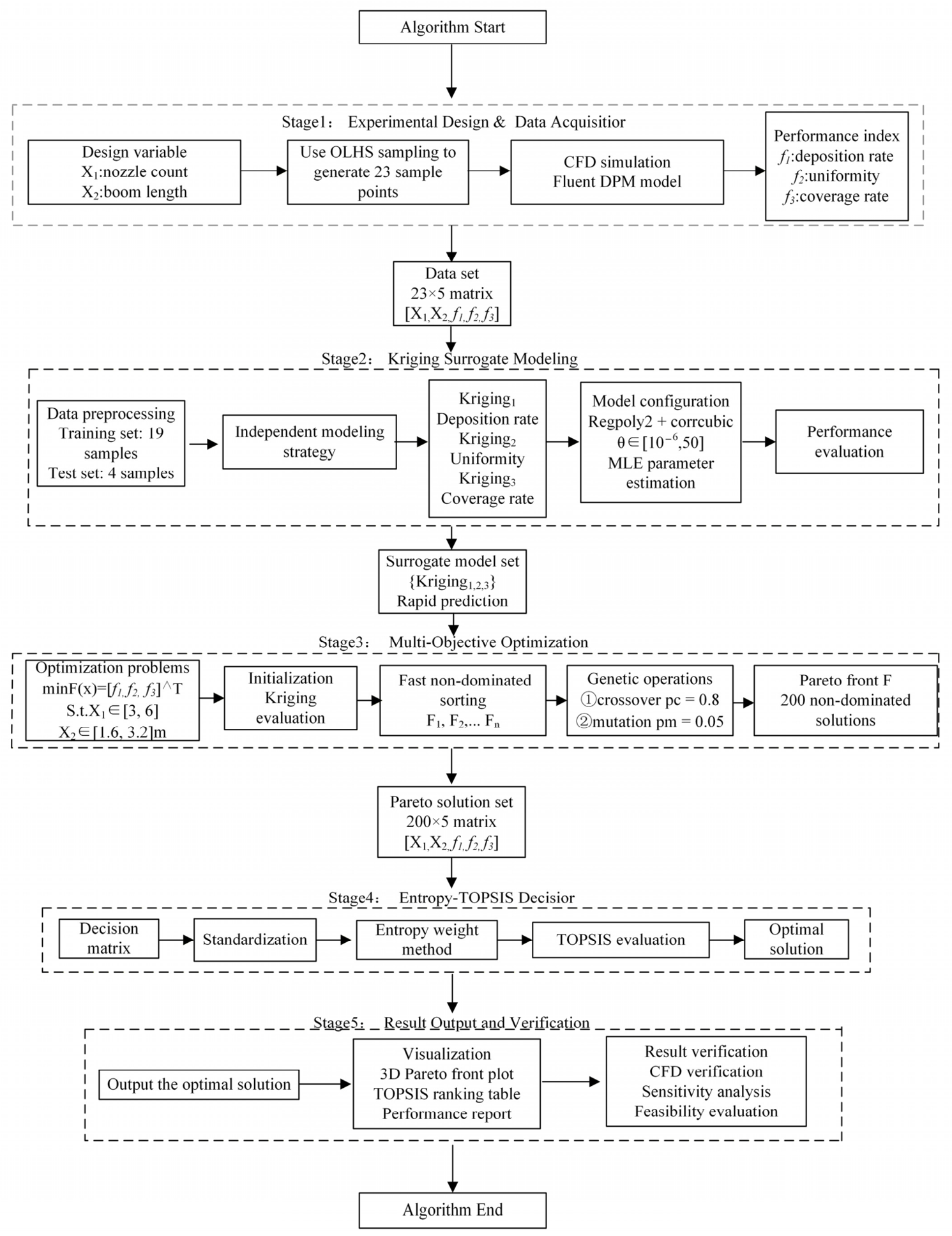
To address the aforementioned challenges, this study proposes a UAV nozzle layout optimization method based on an integrated “simulation–modeling–optimization–decision” framework, focusing on the refined design of the higher-performance linear layout. First, Optimal Latin Hypercube Sampling combined with CFD simulations is used to obtain multiple sets of high-quality sample data, and Kriging surrogate models are constructed to efficiently approximate the complex deposition responses. Subsequently, the NSGA-II multi-objective genetic algorithm is employed for global optimization within the design space to obtain the Pareto optimal solution set that balances deposition rate, uniformity, and coverage. Finally, the entropy-weighted TOPSIS method is integrated to select the engineering solution with the strongest comprehensive performance from the solution set. This study aims to provide a scientific theoretical basis and technical support for the structural design of plant protection UAV spray systems by reducing computational costs and introducing an objective decision-making mechanism. It should be noted that no direct human experiments were conducted in this study.
2. CFD Model Description
2.1. Physical Models
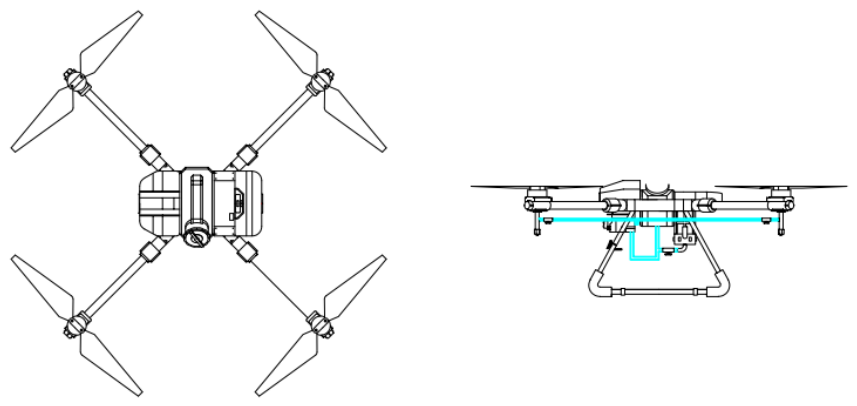
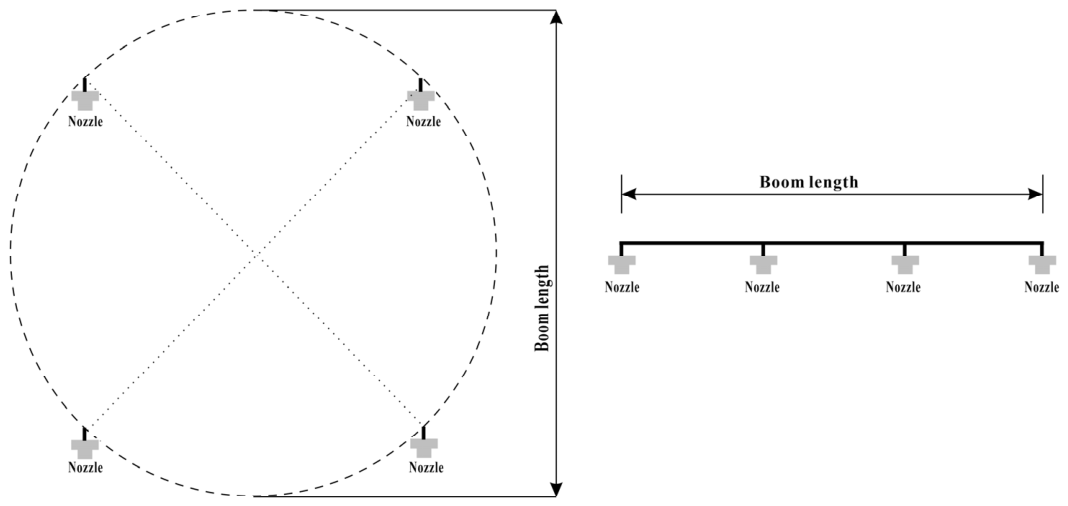
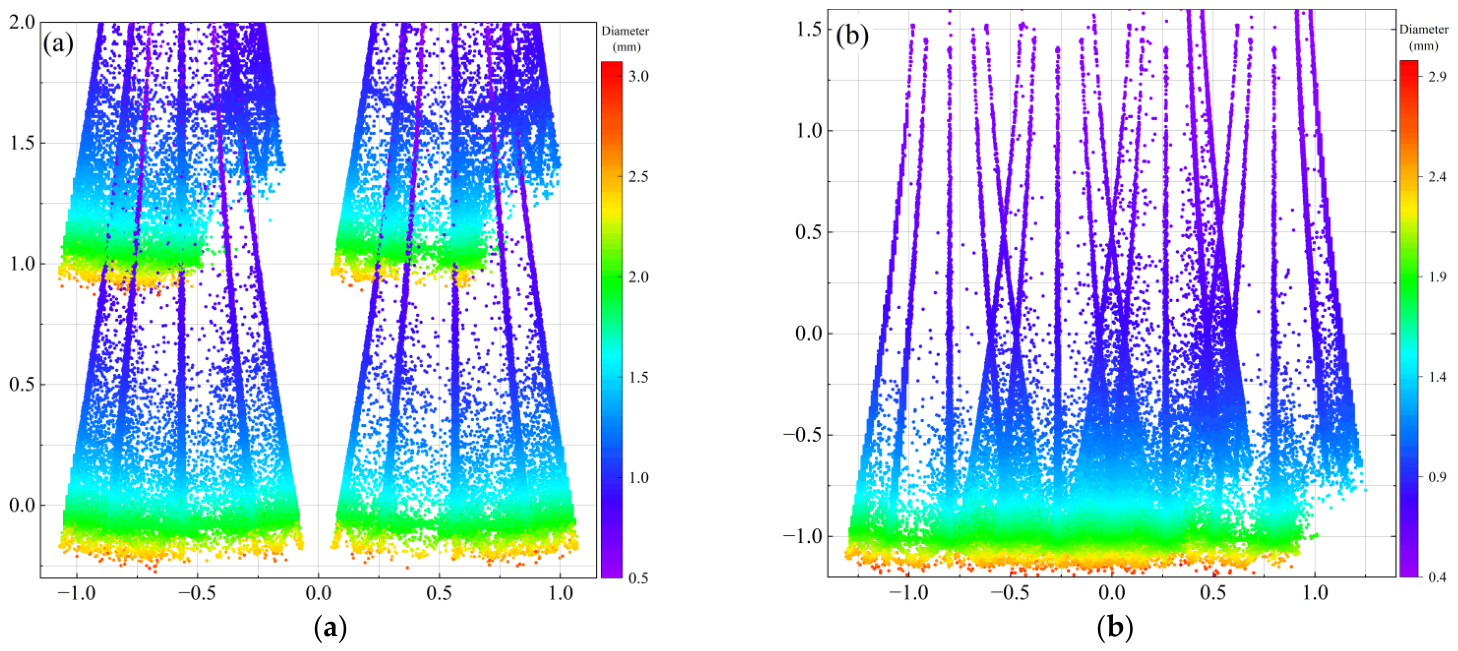
This study employs a CFD simulation method based on the Discrete Phase Model to simulate droplet deposition under different UAV nozzle layouts. The UAV platform prototype is a quadcopter, initially configured with four nozzles arranged in a circular pattern, as illustrated in
Figure 1. To meet low drift rate requirements and obtain accurate data, a cubic computational domain with a height of 2 m was established, with nozzles positioned at a height of 2 m.
The computational domain was discretized using structured hexahedral elements. Local mesh refinement was applied in the nozzle-outlet regions, the rotor-induced downwash region, and the main droplet-transport zone between the nozzles and the deposition surface, where strong velocity gradients and droplet–air momentum exchange were expected. The baseline mesh contained 1 × 10
6 cells. This baseline mesh was selected based on the mesh-independence analysis described in
Section 2.3. Regarding boundary condition settings, the inlet of the computational domain was defined as a velocity inlet, with wind speed set to 3 m/s, representing typical local operating conditions. The outlet was set as a pressure outlet. The bottom deposition surface was set as a trap type to record droplet impact locations, while the other lateral surfaces were set as escape types to account for drift losses.
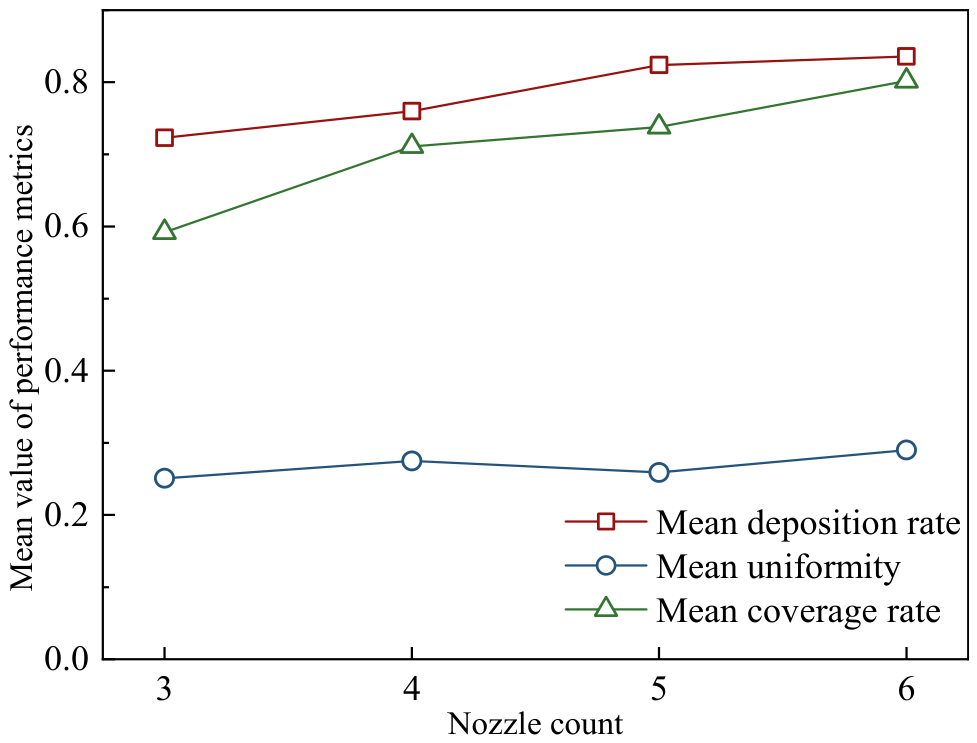
All nozzles were assigned identical injection parameters, including droplet diameter, injection velocity, spray angle, and per-nozzle mass flow rate. Therefore, the total spray flow rate increased with nozzle count according to Qtotal = Nq0, where N is the nozzle count and q0 is the mass flow rate of a single nozzle. This setting represents the practical engineering scenario in which additional identical nozzles are installed to improve the spraying capacity. It should therefore be noted that nozzle count in this study represents a coupled design variable involving both spatial layout and total spray-flow capacity, rather than a purely geometric variable under a fixed total flow rate.
2.2. Mathematical Model
2.2.1. Governing Equations
To accurately capture the motion characteristics of droplets in the turbulent flow field, the k-ε turbulence model is employed to describe the gas phase flow field. This model simulates turbulence effects by solving the turbulent kinetic energy k and its dissipation rate ε equations.
The turbulent kinetic energy equation is
The dissipation rate equation is
where
ρ is the fluid density,
vi is the mean velocity,
Gv is the generation term of turbulent kinetic energy,
μm is the dynamic viscosity, and
C1ε and
C2ε are model constants. The
k-
ε model was chosen for its high prediction accuracy in separated and swirling flows, coupled with moderate computational cost, making it suitable for the spray field simulation in this study.
For the liquid phase droplets, the Discrete Phase Model is used to track their trajectories in the Lagrangian coordinate system, and the random walk model is employed to simulate the stochastic diffusion process of droplets in the turbulent flow field. Numerical calculations were performed with a time step of 0.0005 s for a total physical simulation time of 2 s. This time step was selected based on the time-step sensitivity analysis presented in
Section 2.3. Data acquisition commenced after the flow field reached a quasi-steady state.
2.2.2. Evaluation Indicators
To comprehensively quantify the impact of nozzle layout on spraying effectiveness, this paper establishes performance evaluation indicators from three dimensions: agent utilization efficiency, deposition consistency, and coverage integrity. These three indicators collectively constitute the response functions for the multi-objective optimization in this study.
Deposition rate characterizes the effectiveness of droplet deposition, defined as the ratio of the total mass collected on the deposition surface to the total mass sprayed:
where
Ms is the total mass of droplets collected on the deposition surface, and
Mp is the total mass sprayed.
Uniformity describes the consistency of deposition distribution within the target area, expressed using the complement of the coefficient of variation:
where
σ is the standard deviation of the deposition amount, and
μ is the mean deposition amount.
Coverage rate indicates the effective extent to which the deposition material covers the target area:
where
Ac is the area actually covered by the deposited material, and
At is the total target area.
2.2.3. Trade-Off Relationships Among Evaluation Indicators
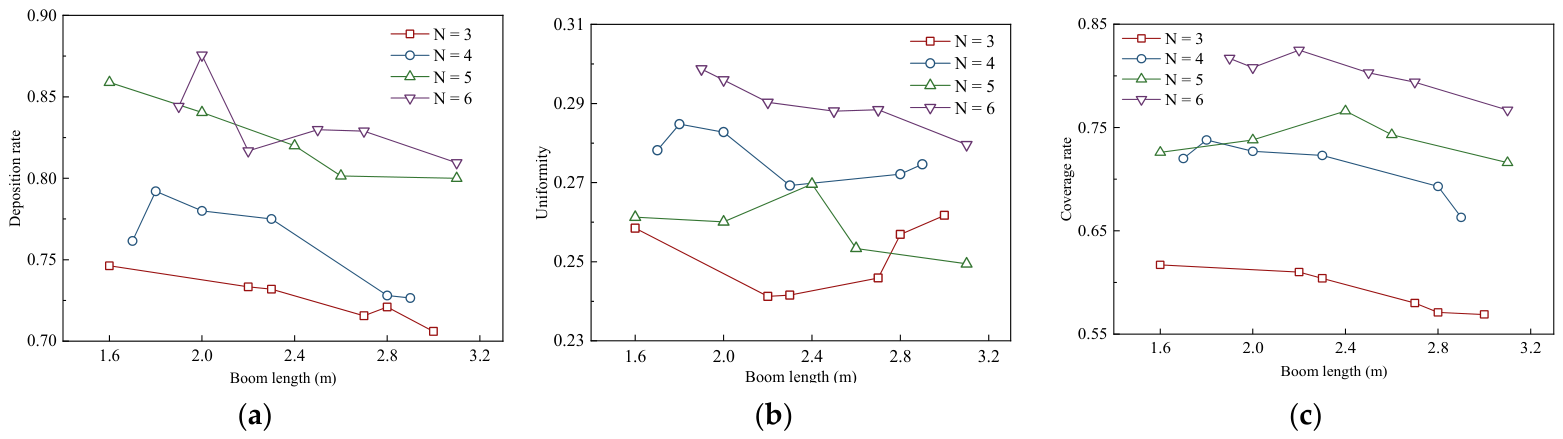
The three evaluation indicators used in this study characterize different aspects of spraying performance and may conflict with each other under practical nozzle-layout constraints. Deposition rate reflects the fraction of sprayed droplets that successfully reach the target surface. Increasing local droplet concentration or reducing lateral drift can improve deposition rate, but it may also cause excessive accumulation in limited regions, thereby reducing spatial uniformity. Therefore, a layout that maximizes deposited mass is not necessarily the layout that produces the most uniform deposition pattern.
Uniformity describes the consistency of droplet deposition across the target area. High uniformity requires appropriate overlap between adjacent spray plumes. If the nozzles are too close, excessive overlap may produce local over-deposition; if they are too far apart, weak-deposition zones may appear between neighboring plumes. Coverage rate, in contrast, emphasizes the effective spatial extent of droplet deposition. Increasing boom length can enlarge the spray swath and improve coverage, but excessive boom length may weaken plume overlap and reduce both uniformity and deposition rate.
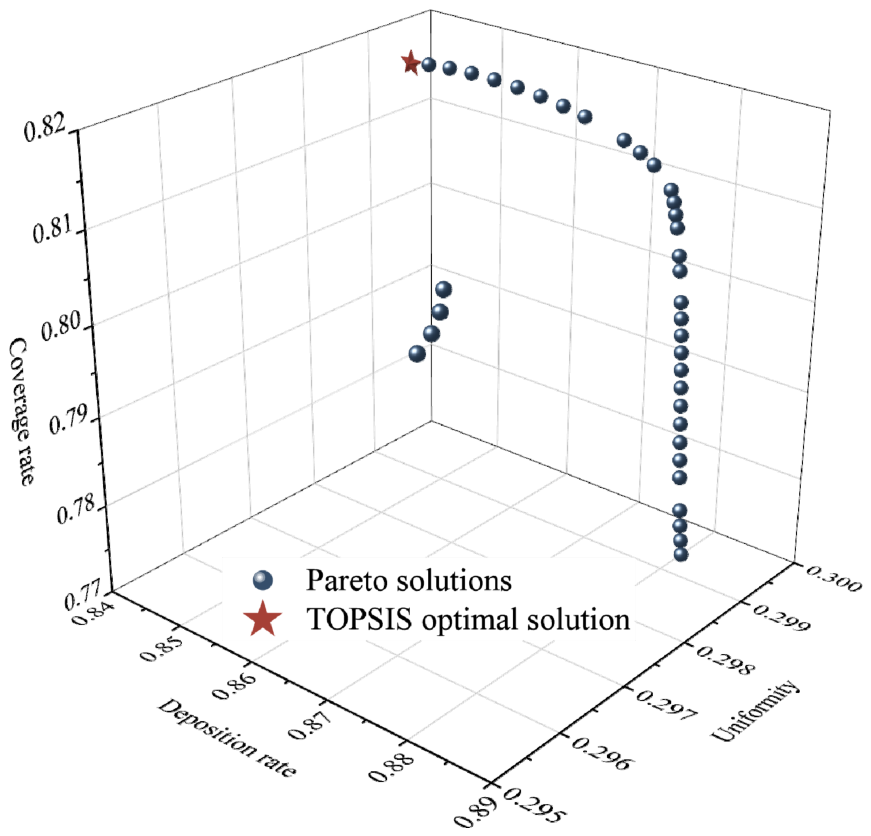
These physical compromises indicate that the three indicators cannot be optimized independently using a single-objective criterion. A nozzle layout with high deposition rate may sacrifice uniformity, whereas a layout with high coverage may suffer from insufficient deposition continuity. Therefore, a multi-objective optimization method is required to identify a Pareto solution set that balances deposition rate, uniformity, and coverage rate. This provides the theoretical basis for using NSGA-II and the subsequent TOPSIS decision-making process in this study.
2.3. Numerical Verification
To ensure that the CFD-DPM results were not significantly affected by spatial or temporal discretization errors, mesh-independence and time-step sensitivity analyses were performed before the parametric simulations and surrogate-model-based optimization. A representative pre-optimization case was selected for this numerical verification. The case corresponded to the linear nozzle layout with four nozzles and a boom length of 2.3 m. This case was selected because it uses the same layout form as the subsequent optimization, retains the original nozzle number of the prototype UAV, and is located near the middle of the boom-length design range. Therefore, it provides a representative verification case without relying on the final optimized solution.
Four systematically refined structured hexahedral meshes were generated, with cell numbers of 15,625, 125,000, 1,000,000, and 8,000,000, respectively. Local refinement was applied near the nozzle outlets, the rotor-induced downwash region, and the main droplet-transport zone. The deposition rate, uniformity, and coverage rate were selected as the main verification indicators. The mesh-independence results are summarized in
Table 1.
As shown in
Table 1, the predicted deposition indicators gradually approached stable values as the mesh was refined. Compared with the finest mesh containing 8,000,000 cells, the mesh containing 1,000,000 cells produced relative differences of approximately 0.51%, 0.74%, and 0.41% for deposition rate, uniformity, and coverage rate, respectively. These differences are sufficiently small for the present engineering CFD-DPM simulations. Considering the balance between numerical accuracy and computational cost, the mesh containing 1,000,000 cells was selected as the baseline mesh for all subsequent simulations.
A time-step sensitivity analysis was further conducted using the baseline mesh. Four time steps, namely 0.002 s, 0.001 s, 0.0005 s, and 0.00025 s, were tested while maintaining the same total physical simulation time of 2 s. Therefore, the corresponding numbers of time steps were 1000, 2000, 4000, and 8000, respectively. The results are presented in
Table 2.
The results show that the deposition indicators became insensitive to further time-step reduction when the time step was decreased to 0.0005 s. Compared with the smallest time step of 0.00025 s, the results obtained with Δt = 0.0005 s differed by approximately 0.00%, 0.37%, and 0.14% for deposition rate, uniformity, and coverage rate, respectively. Therefore, Δt = 0.0005 s was considered sufficient to ensure temporal accuracy while maintaining acceptable computational efficiency. Accordingly, the baseline mesh with 1,000,000 cells and a time step of 0.0005 s were used in the subsequent CFD-DPM simulations.
2.4. Model Verification and Applicability
To assess the credibility of the CFD-DPM framework, a literature-based benchmark validation was conducted using the field experimental data reported by Wang et al. [
11], which investigated spray deposition from a multi-rotor UAV in a vineyard canopy. It should be noted that this benchmark case was not intended to provide a one-to-one validation of the exact quadcopter configuration and flat deposition surface used in the present optimization study. Instead, it was used to evaluate whether the adopted turbulence model and discrete phase tracking scheme could reasonably reproduce the main droplet transport, crosswind drift, and deposition trends under UAV rotor-induced downwash.
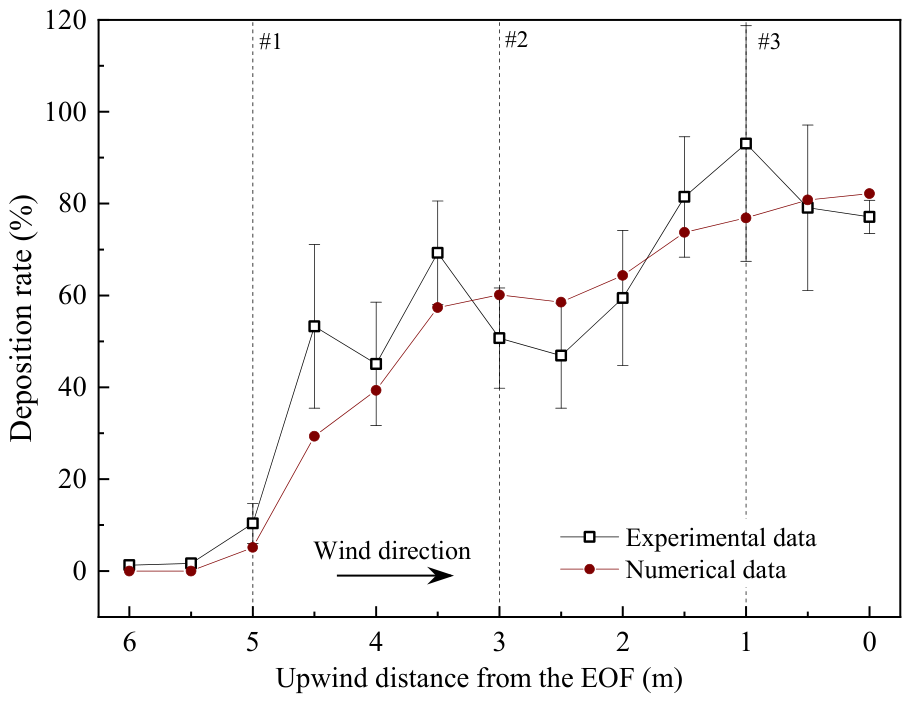
This benchmark dataset was selected because it provides quantitative field measurements of UAV spray deposition under crosswind conditions and includes spatially distributed deposition data suitable for CFD-DPM comparison. The benchmark experiment was performed in an open field, using an artificial vineyard canopy with a height of 2.0 m. A six-rotor UAV was utilized as the spraying platform, equipped with conventional hollow-cone nozzles. Droplet deposition was captured using rectangular PVC cards arranged at 0.5 m intervals on top of the canopy. The experiment involved three consecutive flight routes (#1, #2, and #3) positioned at upwind distances of 1.0 m, 3.0 m, and 5.0 m from the edge of the field (EOF), respectively.
The numerical model was configured to reproduce the main reported boundary conditions of the benchmark test. A 3D domain was established with a height of 3.5 m to reflect the actual flight altitude. The k-ε turbulence model was employed to resolve the coupling between the rotor-induced downwash and the atmospheric crosswind. A velocity inlet boundary was set to 3.79 m/s to represent the measured crosswind condition during the T4-HCN test. Droplets were modeled using the Discrete Phase Model (DPM) with a diameter of 114.9 μm. The canopy top, located 2.0 m above the ground, was defined as a trap surface to quantify the localized deposition rate.
The comparison between the numerical results (red dots) and experimental data (black squares) is illustrated in
Figure 2. The model shows reasonable agreement with the measured deposition distribution over the 0–6 m range, with an average relative error within 10%. More importantly, the simulation reproduced the cumulative deposition trend and the horizontal offset of the deposition peak caused by the 3.79 m/s crosswind. This indicates that the adopted CFD-DPM approach can capture the dominant droplet transport and drift behavior under UAV-induced downwash and ambient crosswind.
Despite this overall consistency, certain discrepancies at upwind distances of 3.0 m and 4.5 m are primarily attributed to the stochastic nature of the natural wind field and localized turbulence, which led to the substantial variability reflected in the experimental error bars. Additionally, the potential evaporation of fine droplets under high-temperature conditions (>30 °C) may have contributed to minor deviations not fully captured by the steady-state simulation. In addition, differences in rotor number, rotor arrangement, nozzle configuration, and target-surface characteristics may also alter the local interaction between rotor-induced downwash and droplet trajectories. Therefore, the benchmark comparison should be interpreted as support for the general droplet transport and deposition modeling capability, rather than as complete validation of the exact quadcopter–flat-surface configuration used in the present study.
In summary, the benchmark validation demonstrates that the CFD-DPM framework can reasonably reproduce the overall deposition trend, crosswind-induced drift direction, and approximate deposition magnitude observed in UAV spray experiments. However, because the benchmark case differs from the present study in UAV configuration and deposition boundary, the validation does not eliminate all uncertainties associated with the specific quadcopter–flat-surface scenario. For this reason, the subsequent optimization results are interpreted primarily as relative performance comparisons among different nozzle layouts under identical computational settings, rather than as absolute predictions of field performance. Further experimental validation using a quadcopter platform and flat deposition collectors is recommended before direct operational application.
Based on this benchmarked CFD-DPM framework and the clarified applicability range, the following sections use CFD simulations consistently as the high-fidelity data source for surrogate model construction and multi-objective nozzle-layout optimization.