Article

Multi-Objective Optimization of Nozzle Layout for UAV-Based Liquid Anti-Riot Agent Dispersion Using Kriging Surrogate Model and NSGA-II

School of Equipment Support and Management, Chinese People’s Armed Police Force Engineering University, Xi’an 710086, China
*
Author to whom correspondence should be addressed.
Drones 2026, 10(6), 436; https://doi.org/10.3390/drones10060436
Submission received: 31 March 2026 / Revised: 23 May 2026 / Accepted: 2 June 2026 / Published: 3 June 2026

Highlights

What are the main findings?
  • Linear nozzle layout significantly outperforms annular layout, boosting deposition rate by 44.8% under identical conditions.
  • The Kriging-NSGA-II-TOPSIS framework cuts CFD cost by 66% and locates the optimal scheme: six nozzles at 1.88 m.
What are the implications of the main findings?
  • This efficient optimization method enables fast, low-cost design of UAV spraying systems without massive simulations.
  • The optimized layout greatly improves deposition uniformity and coverage for liquid anti-riot agent application.

Abstract

The surging need for public security risk mitigation has placed stricter demands on the modernization of emergency response capacities. Unmanned aircraft systems (UASs) offer a promising solution for liquid anti-riot agent dispersion, yet the complex interaction between rotor-induced downwash and droplet trajectories makes nozzle layout optimization a significant challenge. To address the prohibitive computational costs of traditional Computational Fluid Dynamics (CFD) and the limitations of single-objective optimization, this study proposes an integrated “simulation–modeling–optimization–decision” framework. First, a linear nozzle layout was identified as superior to the traditional circular arrangement, achieving a 44.8% increase in deposition rate. Subsequently, Optimal Latin Hypercube Sampling (OLHS) and CFD simulations were combined to construct high-precision Kriging surrogate models for three key indicators: deposition rate, uniformity, and coverage rate. The NSGA-II algorithm was then employed to solve the multi-objective trade-off, followed by the entropy-weighted TOPSIS method to identify the optimal engineering solution. Results indicate that nozzle count is the dominant system-level variable under the constant per-nozzle flow-rate condition, showing strong positive correlations with all performance indicators. The identified optimal configuration (6 nozzles with a 1.88 m boom length) achieved a 66.1% increase in deposition rate and an 18.7% increase in coverage rate compared to the original circular layout. Furthermore, the surrogate-based framework improved optimization efficiency to 296% compared to full factorial methods. This study provides a scientific theoretical basis and a highly efficient technical pathway for the structural design of high-performance UAV spray systems.

1. Introduction

As global public security governance grows increasingly complex, non-traditional security threats including mass emergencies and regional riots persistently recur. These risks require more effective public-security control systems and modernized emergency-response capabilities [1,2]. In the on-site handling of public security emergencies, the dominant operational paradigms worldwide remain centered on human-led close-range dispersion and coordinated operations with ground-based anti-riot equipment. These approaches inherently exhibit several critical deficiencies. Benefiting from the key technological attributes of teleoperation capabilities, high-speed maneuverability, and comprehensive situational coverage, unmanned aircraft systems (UASs) have found extensive applications in various domains [3]. Currently, there is a lack of systematic technical research, standardized operational scenario design, and validation of real-world deployment cases for UAV-platformed liquid anti-riot agent dispersion. Furthermore, unlike traditional agricultural spraying, which prioritizes droplet penetration and leaf coverage, anti-riot operations demand high-intensity instantaneous deposition and rapid spatial containment. The distinct rheological properties of anti-riot agents, such as specialized viscosity and density, lead to complex fragmentation and transport behaviors under intense rotor downwash that remain under-investigated in the current literature [4]. This establishes the fundamental physical boundary for the agent’s trajectory from nozzle ejection to target deposition. The design of the nozzle layout exerts a direct and decisive influence on the coverage area, deposition uniformity, and local deposition intensity of the anti-riot agent. Consequently, it constitutes a critical variable governing the on-site response efficacy, control precision, agent utilization efficiency, and operational safety [5].
In UAV spraying operations, nozzle count and nozzle spacing are the core layout variables [6,7]. From a fluid dynamics perspective, nozzle layout dictates the initial spatial distribution of the droplet cloud within the rotor flow field. On one hand, an insufficient number of nozzles leads to excessive flow load per nozzle, uneven droplet-size distribution, and difficulty in covering a wide working swath [8]. Conversely, excessive nozzles increase payload and may intensify interactions between adjacent spray plumes, causing droplet coalescence and localized over-deposition. On the other hand, excessive spacing tends to create “missed spray zones” or weak areas between adjacent nozzles, while insufficient spacing leads to severe droplet overlap, causing localized agent overdosing, which not only wastes resources but may also cause phytotoxicity. Therefore, systematically optimizing the nozzle layout to find the optimal balance among deposition rate, uniformity, and coverage [9] is the core pathway to enhancing UAV operational quality and reducing resource consumption.
Researchers worldwide have conducted extensive studies on UAV spray-pattern formation and spraying-performance optimization, mainly through experimental testing and numerical simulation. Experimental studies have been widely used to quantify spray deposition, droplet spectra, drift, and effective swath under different operating conditions. Li et al. [10] investigated the effect of flight speed on deposition characteristics, identifying speed as a crucial variable for controlling coverage rate. Wang et al. [11] identified optimal combinations under specific conditions by comparing different UAV models and nozzle types. Wang et al. [12] used the Box–Behnken response surface method to rank the intensity of factors such as flow rate and spacing, finding that PWM duty cycle had the most significant effect on quality. Although these studies provide data support for engineering practice, they have significant limitations. Firstly, field experiments are susceptible to uncontrollable factors such as wind speed and humidity, resulting in poor repeatability and transferability of results. Secondly, the experimental process is time-consuming, labor-intensive, and costly, making it difficult to support high-dimensional, multi-level complex parameter space searches. To compensate for experimental shortcomings, Computational Fluid Dynamics (CFD) has been introduced into this field. Sun et al. [13] revealed the spatial size grading law of droplets within the spray fan through simulations. Li et al. [14] proposed two methods to reduce droplet drift through simulation. Subsequent studies [15,16,17] further established three-dimensional droplet deposition models, quantifying the impact of ambient wind on drift. However, relying solely on CFD for layout optimization faces the challenge of immense computational cost. In such simulations, a single case often takes hours or even days to complete. Chen et al. [7], to improve spray coverage, employed CFD to simulate downwash airflow distribution and droplet deposition for a UAV spraying system, where downwash flow field simulation consumed approximately 864 CPU hours and multiphase simulation about 1800 CPU hours. Similarly, Liu et al. [18], in their study on UAV downwash flow field distribution characteristics, consumed substantial computational costs even with reasonably simplified models. In multi-objective optimization, traversing hundreds of layout schemes would entail computational costs that are prohibitive in engineering practice.
International studies have also provided important insights into UAV spray-pattern formation, droplet spectra, effective swath, and deposition uniformity. For example, Martin et al. [19,20] investigated the effects of application height and ground speed on spray pattern and droplet spectra for remotely piloted aerial application systems, showing that operational parameters can substantially affect effective swath and spray-pattern uniformity. These studies indicate that UAV spray performance is governed by the coupled effects of operational parameters, nozzle characteristics, rotor-induced downwash, and atmospheric conditions [21]. However, most existing studies focus on agricultural spraying scenarios and operational-parameter selection, whereas systematic optimization of nozzle layout under a multi-objective framework remains relatively limited.
Precisely due to this high computational cost, existing optimization studies commonly exhibit two shortcomings. First, most research focuses on operational parameters while neglecting the fundamental influence of the nozzle layout as a basic structural parameter. Second, existing studies often employ single-objective optimization, whereas actual operations demand both high deposition and uniform distribution, which are often conflicting objectives. Ignoring the synergistic relationships among multiple performance indicators often leads to optimization results that sacrifice one aspect for another in practical applications. The prohibitive computational cost of high-fidelity Discrete Phase Model (DPM) simulations has historically served as a technical barrier, preventing exhaustive global searches within the continuous design space of structural parameters. Consequently, existing studies often rely on discrete experimental designs or simplified empirical rules, potentially missing the optimal performance gains hidden in the non-linear coupling of nozzle layouts. Addressing the contradiction between time-consuming simulations and multi-criteria decision-making, surrogate modeling technology offers a new pathway for optimizing complex engineering problems.
Among existing surrogate model applications, the Response Surface Method (RSM), while computationally simple, may fail to adequately capture the highly nonlinear characteristics of the spray deposition process [22]. Artificial Neural Networks (ANNs), despite possessing strong nonlinear fitting capabilities, typically rely on large-scale samples, limiting their application when CFD simulations are computationally expensive [23]. In contrast, the Kriging model, a spatial interpolation method based on stochastic processes, not only provides the best linear unbiased prediction but also offers strong local fitting capabilities. Its prediction accuracy and robustness are significantly superior to other models, especially when handling complex physical responses with limited samples and spatial correlation [24,25]. Combining Kriging with CFD allows training a prediction model covering the global parameter space using only a few sample points [26,27]. For instance, Zhou et al. [28] optimized UAV controller parameters using a Kriging model, demonstrating its superiority in handling complex dynamic systems. After obtaining a high-precision prediction model, coordinating the trade-offs among deposition rate, uniformity, and coverage requires multi-objective evolutionary algorithms. NSGA-II is a classic algorithm for solving such Pareto optimality problems, providing a set of solutions that balance various objectives [29]. However, existing studies involving surrogate models mostly focus on fitting and predicting single performance indicators, overlooking the inherent conflicts among deposition rate, uniformity, and coverage in nozzle layout optimization. Furthermore, they often lack an objective decision-making mechanism for selecting the optimal engineering solution from the multi-objective Pareto front, making it difficult to directly translate research outcomes into actionable engineering designs.
To address the aforementioned challenges, this study proposes a UAV nozzle layout optimization method based on an integrated “simulation–modeling–optimization–decision” framework, focusing on the refined design of the higher-performance linear layout. First, Optimal Latin Hypercube Sampling combined with CFD simulations is used to obtain multiple sets of high-quality sample data, and Kriging surrogate models are constructed to efficiently approximate the complex deposition responses. Subsequently, the NSGA-II multi-objective genetic algorithm is employed for global optimization within the design space to obtain the Pareto optimal solution set that balances deposition rate, uniformity, and coverage. Finally, the entropy-weighted TOPSIS method is integrated to select the engineering solution with the strongest comprehensive performance from the solution set. This study aims to provide a scientific theoretical basis and technical support for the structural design of plant protection UAV spray systems by reducing computational costs and introducing an objective decision-making mechanism. It should be noted that no direct human experiments were conducted in this study.

2. CFD Model Description

2.1. Physical Models

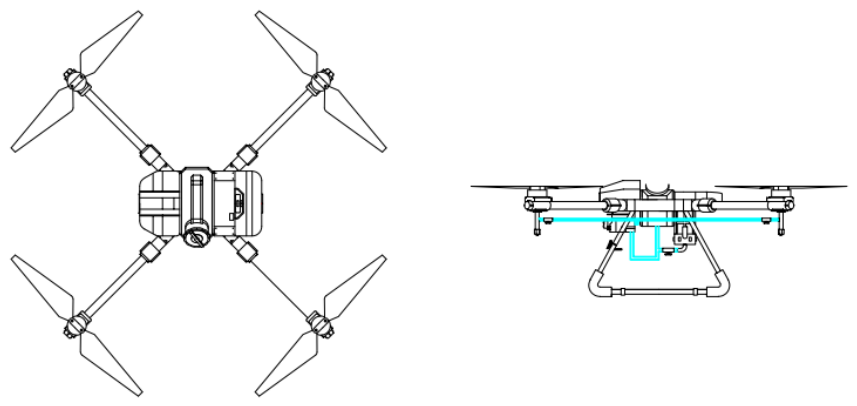
This study employs a CFD simulation method based on the Discrete Phase Model to simulate droplet deposition under different UAV nozzle layouts. The UAV platform prototype is a quadcopter, initially configured with four nozzles arranged in a circular pattern, as illustrated in Figure 1. To meet low drift rate requirements and obtain accurate data, a cubic computational domain with a height of 2 m was established, with nozzles positioned at a height of 2 m.
The computational domain was discretized using structured hexahedral elements. Local mesh refinement was applied in the nozzle-outlet regions, the rotor-induced downwash region, and the main droplet-transport zone between the nozzles and the deposition surface, where strong velocity gradients and droplet–air momentum exchange were expected. The baseline mesh contained 1 × 10⁶ cells. This baseline mesh was selected based on the mesh-independence analysis described in Section 2.3. Regarding boundary condition settings, the inlet of the computational domain was defined as a velocity inlet, with wind speed set to 3 m/s, representing typical local operating conditions. The outlet was set as a pressure outlet. The bottom deposition surface was set as a trap type to record droplet impact locations, while the other lateral surfaces were set as escape types to account for drift losses.
All nozzles were assigned identical injection parameters, including droplet diameter, injection velocity, spray angle, and per-nozzle mass flow rate. Therefore, the total spray flow rate increased with nozzle count according to Qtotal = Nq0, where N is the nozzle count and q0 is the mass flow rate of a single nozzle. This setting represents the practical engineering scenario in which additional identical nozzles are installed to improve the spraying capacity. It should therefore be noted that nozzle count in this study represents a coupled design variable involving both spatial layout and total spray-flow capacity, rather than a purely geometric variable under a fixed total flow rate.

2.2. Mathematical Model

2.2.1. Governing Equations

To accurately capture the motion characteristics of droplets in the turbulent flow field, the k-ε turbulence model is employed to describe the gas phase flow field. This model simulates turbulence effects by solving the turbulent kinetic energy k and its dissipation rate ε equations.
The turbulent kinetic energy equation is
t ρ k + x i ρ k v i = x i α k μ m k x i + G v ρ ε
The dissipation rate equation is
t ρ k + x i ρ ε v i = x i α ε μ m ε x i + C 1 ε G v ε k ρ C 2 ε ε 2 k
where ρ is the fluid density, vi is the mean velocity, Gv is the generation term of turbulent kinetic energy, μm is the dynamic viscosity, and C and C are model constants. The k-ε model was chosen for its high prediction accuracy in separated and swirling flows, coupled with moderate computational cost, making it suitable for the spray field simulation in this study.
For the liquid phase droplets, the Discrete Phase Model is used to track their trajectories in the Lagrangian coordinate system, and the random walk model is employed to simulate the stochastic diffusion process of droplets in the turbulent flow field. Numerical calculations were performed with a time step of 0.0005 s for a total physical simulation time of 2 s. This time step was selected based on the time-step sensitivity analysis presented in Section 2.3. Data acquisition commenced after the flow field reached a quasi-steady state.

2.2.2. Evaluation Indicators

To comprehensively quantify the impact of nozzle layout on spraying effectiveness, this paper establishes performance evaluation indicators from three dimensions: agent utilization efficiency, deposition consistency, and coverage integrity. These three indicators collectively constitute the response functions for the multi-objective optimization in this study.
Deposition rate characterizes the effectiveness of droplet deposition, defined as the ratio of the total mass collected on the deposition surface to the total mass sprayed:
R = M s M p
where Ms is the total mass of droplets collected on the deposition surface, and Mp is the total mass sprayed.
Uniformity describes the consistency of deposition distribution within the target area, expressed using the complement of the coefficient of variation:
U = 1 σ μ
where σ is the standard deviation of the deposition amount, and μ is the mean deposition amount.
Coverage rate indicates the effective extent to which the deposition material covers the target area:
C = A c A t × 100 %
where Ac is the area actually covered by the deposited material, and At is the total target area.

2.2.3. Trade-Off Relationships Among Evaluation Indicators

The three evaluation indicators used in this study characterize different aspects of spraying performance and may conflict with each other under practical nozzle-layout constraints. Deposition rate reflects the fraction of sprayed droplets that successfully reach the target surface. Increasing local droplet concentration or reducing lateral drift can improve deposition rate, but it may also cause excessive accumulation in limited regions, thereby reducing spatial uniformity. Therefore, a layout that maximizes deposited mass is not necessarily the layout that produces the most uniform deposition pattern.
Uniformity describes the consistency of droplet deposition across the target area. High uniformity requires appropriate overlap between adjacent spray plumes. If the nozzles are too close, excessive overlap may produce local over-deposition; if they are too far apart, weak-deposition zones may appear between neighboring plumes. Coverage rate, in contrast, emphasizes the effective spatial extent of droplet deposition. Increasing boom length can enlarge the spray swath and improve coverage, but excessive boom length may weaken plume overlap and reduce both uniformity and deposition rate.
These physical compromises indicate that the three indicators cannot be optimized independently using a single-objective criterion. A nozzle layout with high deposition rate may sacrifice uniformity, whereas a layout with high coverage may suffer from insufficient deposition continuity. Therefore, a multi-objective optimization method is required to identify a Pareto solution set that balances deposition rate, uniformity, and coverage rate. This provides the theoretical basis for using NSGA-II and the subsequent TOPSIS decision-making process in this study.

2.3. Numerical Verification

To ensure that the CFD-DPM results were not significantly affected by spatial or temporal discretization errors, mesh-independence and time-step sensitivity analyses were performed before the parametric simulations and surrogate-model-based optimization. A representative pre-optimization case was selected for this numerical verification. The case corresponded to the linear nozzle layout with four nozzles and a boom length of 2.3 m. This case was selected because it uses the same layout form as the subsequent optimization, retains the original nozzle number of the prototype UAV, and is located near the middle of the boom-length design range. Therefore, it provides a representative verification case without relying on the final optimized solution.
Four systematically refined structured hexahedral meshes were generated, with cell numbers of 15,625, 125,000, 1,000,000, and 8,000,000, respectively. Local refinement was applied near the nozzle outlets, the rotor-induced downwash region, and the main droplet-transport zone. The deposition rate, uniformity, and coverage rate were selected as the main verification indicators. The mesh-independence results are summarized in Table 1.
As shown in Table 1, the predicted deposition indicators gradually approached stable values as the mesh was refined. Compared with the finest mesh containing 8,000,000 cells, the mesh containing 1,000,000 cells produced relative differences of approximately 0.51%, 0.74%, and 0.41% for deposition rate, uniformity, and coverage rate, respectively. These differences are sufficiently small for the present engineering CFD-DPM simulations. Considering the balance between numerical accuracy and computational cost, the mesh containing 1,000,000 cells was selected as the baseline mesh for all subsequent simulations.
A time-step sensitivity analysis was further conducted using the baseline mesh. Four time steps, namely 0.002 s, 0.001 s, 0.0005 s, and 0.00025 s, were tested while maintaining the same total physical simulation time of 2 s. Therefore, the corresponding numbers of time steps were 1000, 2000, 4000, and 8000, respectively. The results are presented in Table 2.
The results show that the deposition indicators became insensitive to further time-step reduction when the time step was decreased to 0.0005 s. Compared with the smallest time step of 0.00025 s, the results obtained with Δt = 0.0005 s differed by approximately 0.00%, 0.37%, and 0.14% for deposition rate, uniformity, and coverage rate, respectively. Therefore, Δt = 0.0005 s was considered sufficient to ensure temporal accuracy while maintaining acceptable computational efficiency. Accordingly, the baseline mesh with 1,000,000 cells and a time step of 0.0005 s were used in the subsequent CFD-DPM simulations.

2.4. Model Verification and Applicability

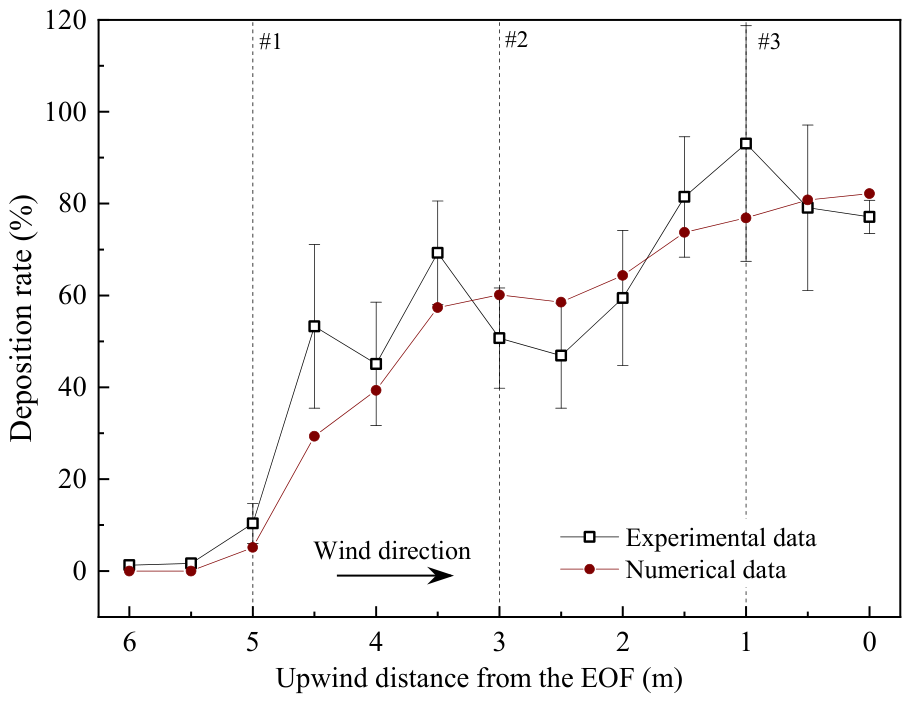
To assess the credibility of the CFD-DPM framework, a literature-based benchmark validation was conducted using the field experimental data reported by Wang et al. [11], which investigated spray deposition from a multi-rotor UAV in a vineyard canopy. It should be noted that this benchmark case was not intended to provide a one-to-one validation of the exact quadcopter configuration and flat deposition surface used in the present optimization study. Instead, it was used to evaluate whether the adopted turbulence model and discrete phase tracking scheme could reasonably reproduce the main droplet transport, crosswind drift, and deposition trends under UAV rotor-induced downwash.
This benchmark dataset was selected because it provides quantitative field measurements of UAV spray deposition under crosswind conditions and includes spatially distributed deposition data suitable for CFD-DPM comparison. The benchmark experiment was performed in an open field, using an artificial vineyard canopy with a height of 2.0 m. A six-rotor UAV was utilized as the spraying platform, equipped with conventional hollow-cone nozzles. Droplet deposition was captured using rectangular PVC cards arranged at 0.5 m intervals on top of the canopy. The experiment involved three consecutive flight routes (#1, #2, and #3) positioned at upwind distances of 1.0 m, 3.0 m, and 5.0 m from the edge of the field (EOF), respectively.
The numerical model was configured to reproduce the main reported boundary conditions of the benchmark test. A 3D domain was established with a height of 3.5 m to reflect the actual flight altitude. The k-ε turbulence model was employed to resolve the coupling between the rotor-induced downwash and the atmospheric crosswind. A velocity inlet boundary was set to 3.79 m/s to represent the measured crosswind condition during the T4-HCN test. Droplets were modeled using the Discrete Phase Model (DPM) with a diameter of 114.9 μm. The canopy top, located 2.0 m above the ground, was defined as a trap surface to quantify the localized deposition rate.
The comparison between the numerical results (red dots) and experimental data (black squares) is illustrated in Figure 2. The model shows reasonable agreement with the measured deposition distribution over the 0–6 m range, with an average relative error within 10%. More importantly, the simulation reproduced the cumulative deposition trend and the horizontal offset of the deposition peak caused by the 3.79 m/s crosswind. This indicates that the adopted CFD-DPM approach can capture the dominant droplet transport and drift behavior under UAV-induced downwash and ambient crosswind.
Despite this overall consistency, certain discrepancies at upwind distances of 3.0 m and 4.5 m are primarily attributed to the stochastic nature of the natural wind field and localized turbulence, which led to the substantial variability reflected in the experimental error bars. Additionally, the potential evaporation of fine droplets under high-temperature conditions (>30 °C) may have contributed to minor deviations not fully captured by the steady-state simulation. In addition, differences in rotor number, rotor arrangement, nozzle configuration, and target-surface characteristics may also alter the local interaction between rotor-induced downwash and droplet trajectories. Therefore, the benchmark comparison should be interpreted as support for the general droplet transport and deposition modeling capability, rather than as complete validation of the exact quadcopter–flat-surface configuration used in the present study.
In summary, the benchmark validation demonstrates that the CFD-DPM framework can reasonably reproduce the overall deposition trend, crosswind-induced drift direction, and approximate deposition magnitude observed in UAV spray experiments. However, because the benchmark case differs from the present study in UAV configuration and deposition boundary, the validation does not eliminate all uncertainties associated with the specific quadcopter–flat-surface scenario. For this reason, the subsequent optimization results are interpreted primarily as relative performance comparisons among different nozzle layouts under identical computational settings, rather than as absolute predictions of field performance. Further experimental validation using a quadcopter platform and flat deposition collectors is recommended before direct operational application.
Based on this benchmarked CFD-DPM framework and the clarified applicability range, the following sections use CFD simulations consistently as the high-fidelity data source for surrogate model construction and multi-objective nozzle-layout optimization.


3. Surrogate Modeling Method

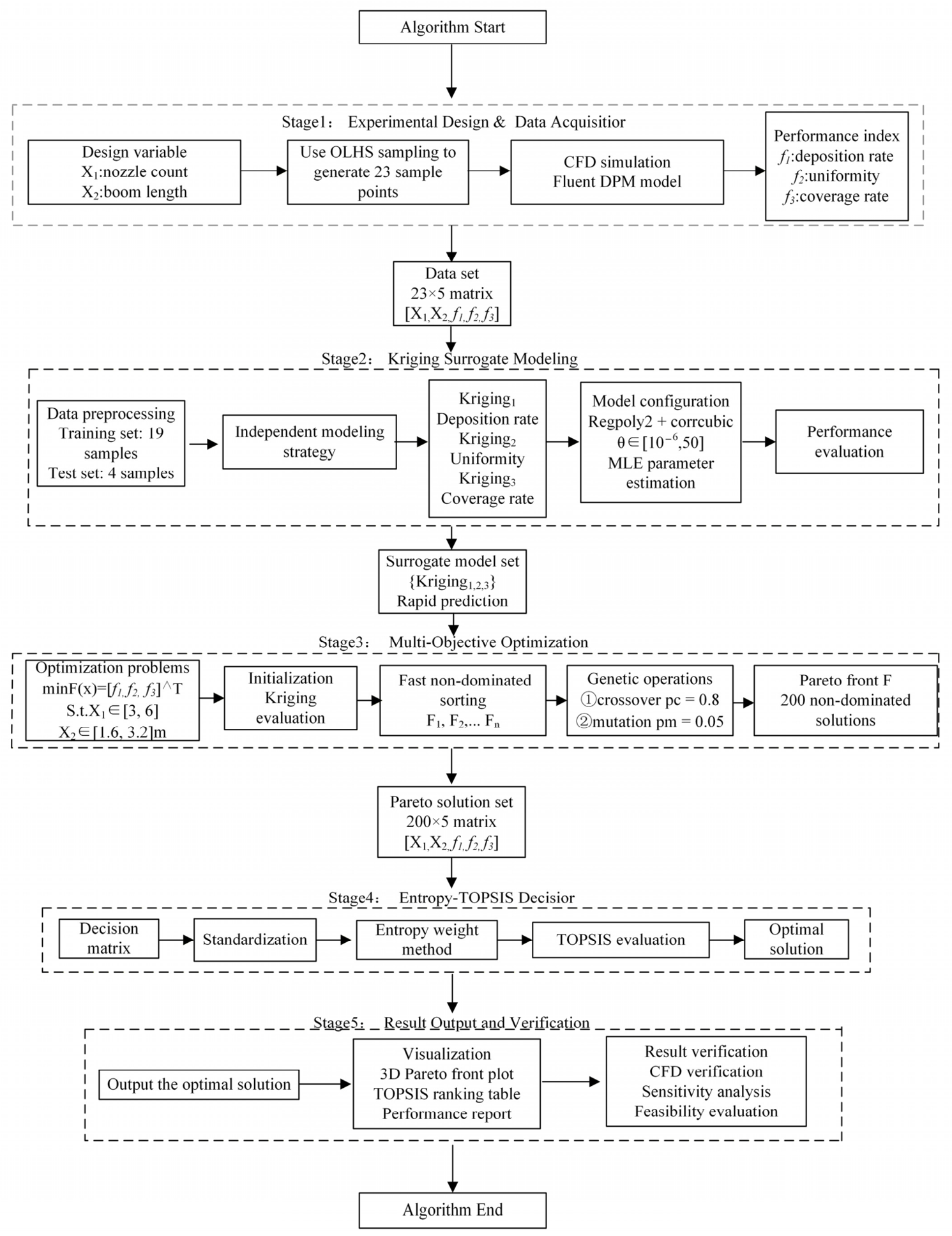
As shown in Figure 3, this study employs an integrated framework incorporating OLHS, Kriging surrogate modeling, NSGA-II optimization, and entropy-weighted TOPSIS decision-making to achieve multi-objective collaborative optimization within a continuous design space at a minimal computational cost.

3.1. Optimal Latin Hypercube Sampling

For the two-dimensional design space defined by nozzle count N and boom length L, N was treated as the number of active identical nozzles under a constant per-nozzle flow-rate condition. Therefore, the optimization examined the combined influence of nozzle number, spatial distribution, and total spray-flow capacity, rather than a flow-normalized comparison at a fixed total application rate. This study employs Optimal Latin Hypercube Sampling to generate training sample points. OLHS ensures uniform distribution of samples across each dimension through stratified random sampling and optimizes the spatial distribution of sample points using the maximin distance criterion, ensuring good space-filling and representativeness within the design space. Compared to a full factorial design requiring 68 sample sets, OLHS effectively covers the entire design space with only 23 sample sets, improving computational efficiency by 66%. This method not only flexibly generates an arbitrary number of samples but also ensures that sample points cover the boundaries and regions with significant nonlinear characteristics of the design space, thereby providing high-quality training data for the subsequent construction of Kriging surrogate models while significantly reducing the computational cost of CFD simulations.

3.2. Kriging Surrogate Model

The core idea of the Kriging surrogate model is to model the target response function as a superposition of a global regression model and local deviations. For any point X in the design space, its response value y(x) is expressed as
y x = f T x β + Z x
where f(x) is a vector of p known basis functions, β is the corresponding vector of unknown regression coefficients, and Z(x) is a stationary Gaussian random process with zero mean and variance σ2, used to characterize local deviations.
In this study, the same Kriging modeling strategy was adopted for the three response variables, namely deposition rate R, uniformity U, and coverage rate C. A quadratic polynomial regression function was used to describe the global trend, while a cubic correlation function was used to characterize the spatial correlation of the local deviation term. The correlation between two sample points xi and xj was defined as
R k x k i , x k j = 1 3 θ k 2 d k 2 + 2 θ k 3 | d k | 3 if   θ k d k 1 0 , otherwise
Here, d k = x k i x k j represents the distance between two points in the k-th dimension, and the correlation parameter θ k > 0 controls the rate at which correlation decays with distance in that dimension. The correlation parameters θk were optimized separately for the three Kriging models of R, U, and C by maximizing the likelihood function of the training samples. Therefore, each response variable had its own optimized correlation–parameter set, while the same cubic correlation-function type was retained for model consistency. For any new point x in the design space, the Kriging predictor is
y ^ ( x ) = f T ( x ) β ^ + r T x * R 1 y F β ^
In this prediction formula, y ^ and β ^ represent the estimates of the response values and regression coefficients, respectively; r(x*) is the correlation vector between the prediction point and the training sample points; R is the correlation matrix among the training samples; F is the regression matrix; and y is the vector of response values at the training samples. This predictor combines the global trend (first term) and local correction (second term), achieving exact interpolation at the training sample points for deterministic computer experiments when no nugget term is introduced [30].
Separate Kriging models were constructed for the three evaluation indicators: deposition rate, uniformity, and coverage rate. To eliminate dimensional differences and improve computational stability, all input and output variables were normalized to lie between 0 and 1. Finally, the coefficient of determination R2 and root mean square error RMSE were used to evaluate model accuracy, with the total sample set divided into 19 training samples and 4 test samples to validate the generalization ability of the surrogate models.

3.3. NSGA-II Algorithm

Based on the trade-off relationships among deposition rate, uniformity, and coverage rate discussed in Section 2.2.3, the NSGA-II algorithm was employed after establishing the Kriging surrogate models to solve the multi-objective optimization problem.
min x   F x = [ f 1 x , f 2 x , , f q x ] T s . t .     x m i n x x m a x
where the objective functions fj(x) are rapidly evaluated using the Kriging predictors. For two solutions x(1) and x(2), if x(1) is not worse than x(2) in all objectives and strictly better in at least one objective, then x(1) is said to dominate x(2). The NSGA-II algorithm stratifies the population through fast non-dominated sorting and introduces a crowding distance mechanism to maintain diversity in the solution set. The crowding distance for an individual pi is calculated as follows:
d j p i = f j p i + 1 f j p i 1 f j m a x f j m i n
The algorithm generates offspring using simulated binary crossover and polynomial mutation, with crossover probability pc set to 0.8 and mutation probability pm set to 0.05. Through the (N + N) elitism strategy, the algorithm ensures efficient convergence to the Pareto front and good spatial distribution. In this study, the population size is set to 200, the number of generations to 100, and the nozzle count is treated as an integer constraint.

3.4. Entropy-Weighted TOPSIS Decision Method

Since the Pareto optimal solution set generated by NSGA-II contains multiple non-dominated trade-off solutions, an objective decision-making process is required to select a final engineering solution. In this study, the set of alternatives used for entropy-weighted calculation and TOPSIS ranking consisted of all non-dominated Pareto solutions obtained from the final generation of NSGA-II. No additional subjective pre-screening was applied before the entropy-weighted TOPSIS analysis. This method first maps each indicator to the [0, 1] interval using range normalization, then objectively determines the weight wj for each objective based on the information entropy Ej:
w j = D j k = 1 q D k = 1 E j k = 1 q ( 1 E k ) , E j = 1 ln m i = 1 m p ij ln ( p ij )
where m is the number of alternatives, and pij is the proportion of the i-th alternative for the j-th objective. Subsequently, the Euclidean distances from each alternative to the positive ideal solution V+ and negative ideal solution V are calculated. Finally, alternatives are ranked according to their relative closeness Ci:
C i = D i D i + + D i
A Ci value closer to 1 indicates better comprehensive performance of the alternative. This solution, considering all objectives and their weights, is closest to the positive ideal solution and represents the best choice from the Pareto front.

4. Results and Analysis

4.1. Comparison of Nozzle Layout Configurations

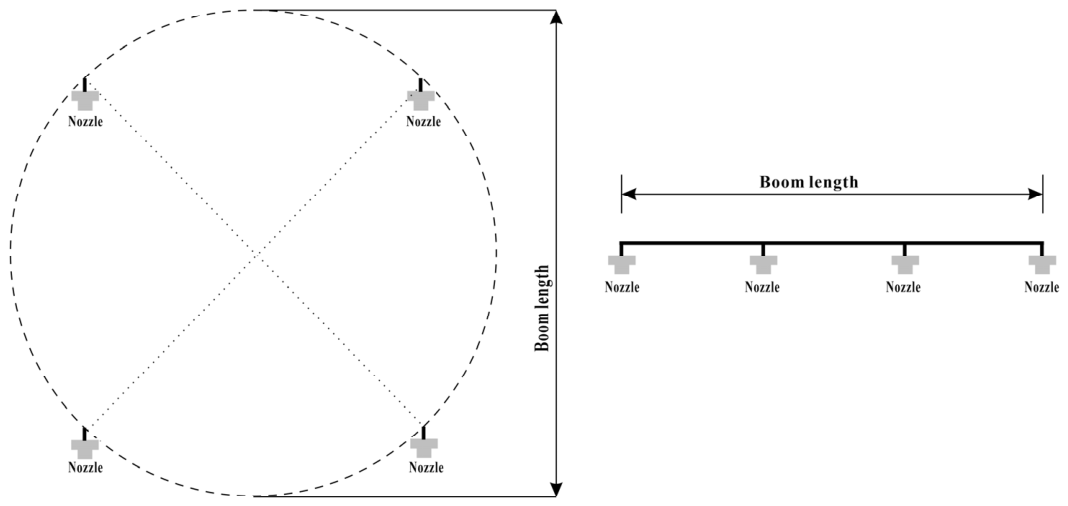
To compare the nozzle layout configurations shown in Figure 4, this study conducted an in-depth analysis of the performance differences between the circular arrangement and the linear arrangement. The prototype UAV adopted a circular layout, placing four nozzles directly under the rotors in a quadrilateral pattern. In contrast, the linear layout constructed in this study arranges the nozzles equidistantly along a spray boom, aiming to enhance spray swath continuity through parametric optimization.
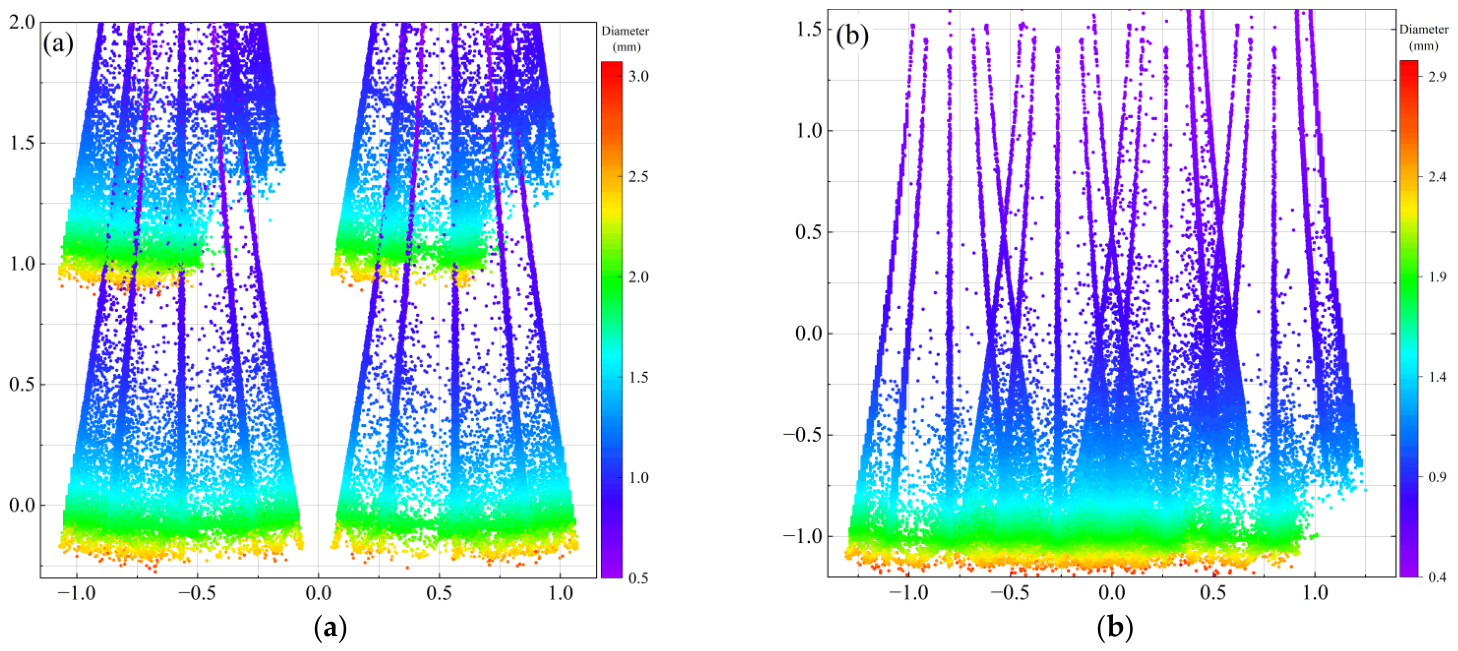
Figure 5 compares the droplet deposition patterns of the circular and linear layouts under the same four-nozzle condition and the same total spray flow rate. The circular layout produced a discontinuous deposition pattern, with a weak central deposition region and more evident lateral dispersion near the edge of the target area. This indicates that part of the droplet cloud was transported away from the effective deposition zone under the combined influence of rotor-induced downwash and crosswind.
In contrast, the linear layout generated a more continuous elongated deposition band. The adjacent spray plumes overlapped more effectively along the boom direction, which reduced the central weak-deposition zone and improved deposition continuity. This spatial redistribution of the droplet cloud explains why the linear layout achieved higher deposition rate, uniformity, and coverage rate under the same nozzle count and total spray flow rate. The scatter-based deposition map in Figure 5 directly visualizes the droplet landing positions and provides the basis for the quantitative performance comparison in Table 3.
Analyzing the simulation data, under the same nozzle count (four) and boom length (1.605 m) conditions, the linear layout achieved a deposition rate of 0.7425, a substantial 44.8% increase compared to the circular layout. Furthermore, its uniformity (0.236) and coverage rate (0.717) improved by 12.4% and 4.7%, respectively. Physical analysis indicates that the linear arrangement effectively reduces the risk of lateral droplet drift and compensates for deposition blind zones through the overlapping effect of multiple nozzle spray clouds. Therefore, this study selects the linear layout as the basic configuration for subsequent multi-objective optimization, aiming to further exploit its operational potential by adjusting parameters within the two-dimensional design space.

4.2. Numerical Simulation Results for Linear Distribution

Table 4 summarizes the CFD simulation results for 23 sample sets, with 100% data integrity and no outliers. The ranges of the three performance indicators are as follows: deposition rate ranges from 0.706 to 0.866, with a maximum difference of approximately 23%; uniformity ranges from 0.241 to 0.299, with a maximum difference of about 24%; and coverage rate ranges from 0.569 to 0.825, with a maximum difference of about 45%. Coverage rate exhibits the largest variation, indicating that nozzle layout has the most significant impact on deposition coverage integrity. Deposition rate and uniformity show similar ranges of variation, suggesting comparable sensitivity to layout parameters.
Table 2 shows that nozzle count has a stronger influence on the three performance indicators than boom length. In general, increasing nozzle count improves deposition rate, uniformity, and coverage rate, whereas increasing boom length tends to reduce deposition performance because of weakened overlap between adjacent spray plumes. These preliminary trends are further quantified through the correlation and segmented trend analyses in Section 4.3.

4.3. Correlation Analysis

4.3.1. Pearson Correlation Analysis

This study employs the Pearson correlation coefficient to quantify the strength of linear correlation between design variables and performance indicators. Although the Pearson correlation cannot fully characterize nonlinear or interaction effects, it provides an intuitive first-order indication of the dominant variables before the subsequent nonlinear trend analysis and Kriging-based optimization.
As shown in Table 5, the analysis results indicate that nozzle count has a significant positive correlation with deposition rate, uniformity, and coverage rate, with correlation coefficients of 0.881, 0.685, and 0.934, respectively. This strong positive correlation between nozzle count and the performance indicators should be interpreted with caution. In the present simulations, the per-nozzle flow rate was kept constant; therefore, increasing the nozzle count also increased the total spray flow rate. As a result, the influence of nozzle count reflects the combined effect of increased droplet release capacity and modified spatial distribution of the droplet cloud. Although the deposition rate is normalized by the total sprayed mass, the local droplet concentration, overlap between adjacent spray plumes, and coverage probability are still affected by the total number of released droplets. Therefore, the observed improvement with increasing nozzle count cannot be attributed solely to geometric layout optimization. In contrast, boom length shows a weak negative correlation with all three indicators. Increasing boom length means larger nozzle spacing, reducing the overlap area between droplet clouds from adjacent nozzles and potentially creating “missed spray zones”, leading to decreased coverage and deposition rates. Therefore, the Pearson correlation results suggest that nozzle count has a stronger first-order linear association with the performance indicators than boom length. However, because the Pearson correlation does not capture nonlinear responses or coupling effects, the detailed influence of boom length and its interaction with nozzle count is further examined through the segmented trend analysis in Section 4.3.2.

4.3.2. Parameter Influence Trend Analysis

To complement the linear Pearson correlation analysis, a segmented trend analysis was further conducted to reveal the nonlinear response patterns and coupling effects of nozzle count and boom length.
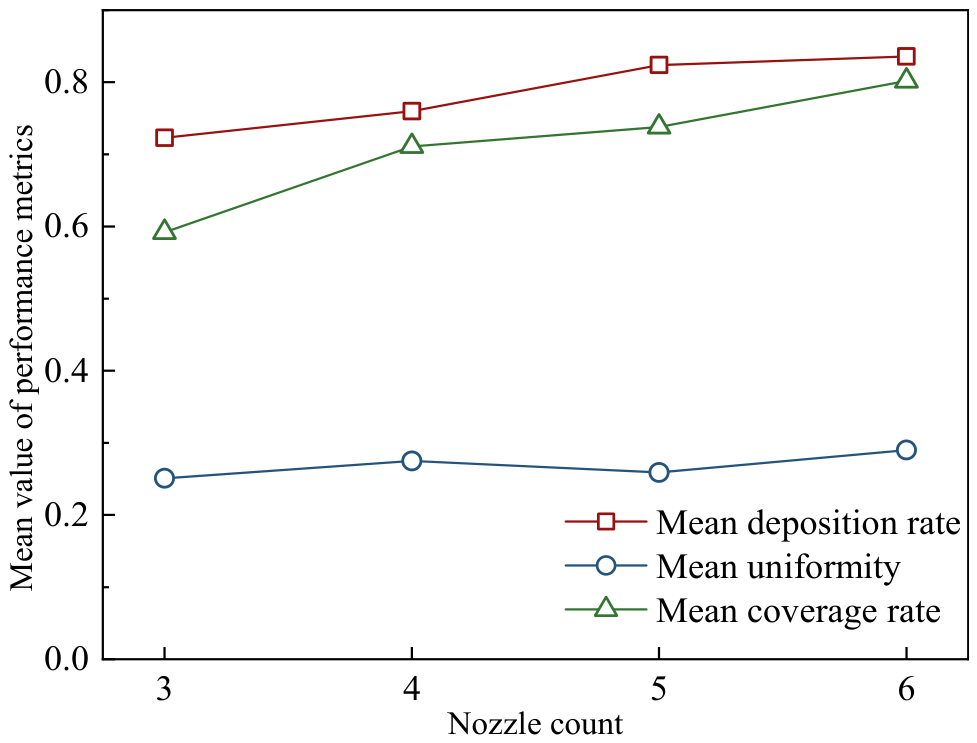
As shown in Figure 6, the performance indicators generally increase with nozzle count, but the marginal improvement gradually decreases. Under the constant per-nozzle flow-rate condition adopted in this study, this trend reflects the combined influence of increased droplet release capacity, enhanced spatial coverage, and spray-plume overlap. When the nozzle count becomes sufficiently high, additional nozzles may contribute less effectively to new coverage area or deposition uniformity because of increased overlap among adjacent spray plumes. Therefore, the five- to six-nozzle range can be regarded as a high-performance candidate interval under the present operating conditions.
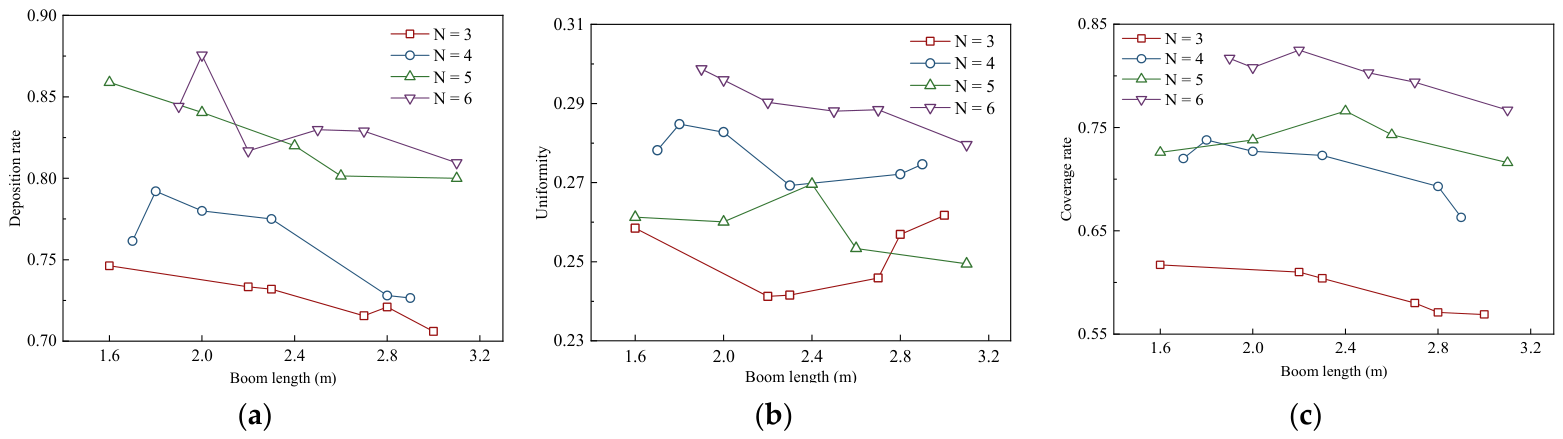
The influence trends of boom length on the three performance indicators are shown in Figure 7. Overall, boom length exhibits a nonlinear influence on spraying performance, and its effect varies with nozzle count. For deposition rate, configurations with more nozzles generally maintain higher values, with the six-nozzle configuration reaching its maximum near a boom length of 2.0 m. When boom length continues to increase, the deposition rate tends to fluctuate or decrease because the spacing between adjacent nozzles becomes larger and the overlap of neighboring spray plumes weakens.
For uniformity, the four-nozzle and six-nozzle configurations show relatively high values within the range of approximately 1.8–2.0 m, indicating that this interval provides more balanced overlap between adjacent droplet clouds. When boom length exceeds about 2.4 m, uniformity generally declines, suggesting that excessive spacing disrupts deposition continuity and increases spatial variation on the target surface.
For coverage rate, the high-nozzle-count configurations show better performance than the low-nozzle-count configurations. In particular, the six-nozzle configuration maintains coverage rates above 0.80 within the range of approximately 1.8–2.5 m, with a local maximum around 2.2 m. This indicates that moderate extension of the boom length can enlarge the effective spray swath. However, when the boom length is further increased, the coverage rate decreases because separated spray plumes may create low-deposition zones between adjacent nozzles.
Taken together, the results indicate that the boom length range of 1.8–2.2 m provides a favorable balance among deposition rate, uniformity, and coverage rate for the six-nozzle configuration. This range is therefore identified as the main candidate interval for subsequent multi-objective optimization, rather than as a single deterministic optimum.
Based on the above analysis, the six-nozzle configuration with a boom length of 1.8–2.2 m was identified as the primary high-performance candidate region. In contrast, configurations with 3 nozzles and large boom lengths showed relatively poor performance because of insufficient droplet release and weak plume overlap. These nonlinear trends and trade-offs indicate that manual selection is insufficient, and a surrogate-assisted multi-objective optimization framework is required to determine the final engineering solution.

4.4. Multi-Objective Optimization

4.4.1. Surrogate Model Construction and Accuracy Validation

Using 23 OLHS samples, 19 training sets and 4 test sets were divided according to a ratio of 83% to 17%, and independent Kriging models were constructed for the three objective functions. The models employed a quadratic polynomial regression basis function and a cubic correlation function, with hyperparameters determined via maximum likelihood estimation.
As shown in Table 6, the training-set R2 values of all three Kriging models are 1.0, which is expected for deterministic Kriging interpolation without a nugget term [31]. Therefore, the predictive capability of the surrogate models was evaluated mainly using the independent test set. The test-set R2 and RMSE values were 0.9411 and 0.0188 for deposition rate, 0.7558 and 0.0057 for uniformity, and 0.9908 and 0.0202 for coverage rate, respectively. These results indicate that the Kriging models provide sufficient predictive accuracy for the subsequent NSGA-II optimization.

4.4.2. Pareto Front Acquisition and Optimal Solution Decision-Making

Combining correlation analysis and segmented trend analysis further confirms that nozzle count is the dominant variable, showing a significant positive correlation with all three indicators; boom length is a secondary variable, showing a weak negative correlation. Accordingly, the optimization strategy follows the approach of “first determining the candidate interval for nozzle count, then fine-tuning the boom length” to achieve local performance gains under load constraints.
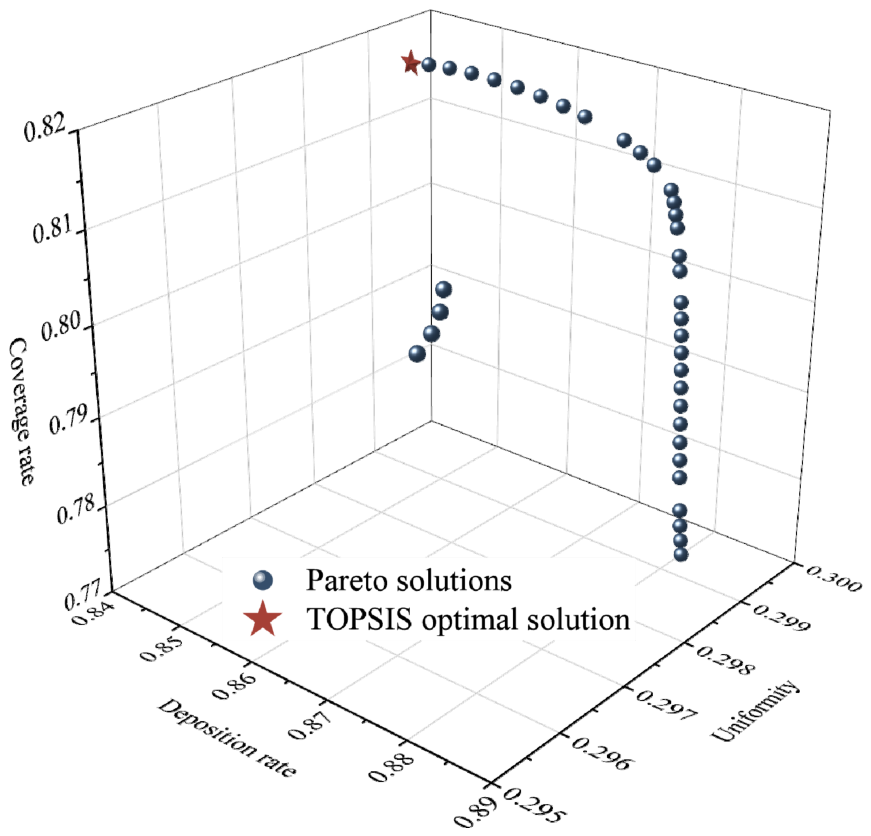
The NSGA-II algorithm was employed for global search with a population size of 200 and 100 generations. The final output contained 200 non-dominated Pareto solutions, which were all used as alternatives in the subsequent entropy-weighted TOPSIS analysis. Figure 8 shows the trade-off relationships among deposition rate, uniformity, and coverage rate in the three-dimensional objective space. Therefore, a decision-making method is needed to select a balanced engineering solution from the Pareto front.
As the solutions on the front are non-dominated with respect to each other, the entropy-weighted TOPSIS method was used for objective decision-making. The weights for each indicator, calculated based on information entropy, are deposition rate of 0.35, uniformity of 0.28, and coverage rate of 0.37. Coverage rate has the highest weight, reflecting its strongest discriminatory power within the design space. According to the relative closeness ranking, solution No. 127 was ultimately identified as the optimal solution, corresponding to parameters: nozzle count six, boom length 1.88 m. To verify reliability, an independent CFD validation was performed for this solution. The measured deposition rate was 0.852, uniformity 0.301, and coverage 0.813. The relative errors between predicted and simulated values were all less than 3%, supporting the engineering applicability of the optimization results.

4.4.3. Optimization Efficiency and Performance Improvement Assessment

The TOPSIS-selected solution should be interpreted as a balanced Pareto solution rather than the optimum of every single indicator. Compared with the original circular layout, the optimized configuration substantially improved deposition rate and uniformity, while the improvement in coverage rate was more moderate. This indicates that the final design enhances agent utilization and effective coverage while maintaining acceptable spatial consistency. Therefore, the selected solution reflects a compromise among deposition efficiency, uniformity, and coverage, which is consistent with the trade-off nature of the Pareto front.
As shown in Table 7 and Table 8, the surrogate-assisted framework substantially reduced the number of required CFD simulations and the total computational time compared with exhaustive CFD-based search. This confirms that the Kriging surrogate model can provide an efficient approximation tool for multi-objective nozzle-layout optimization. In addition to reducing computational cost, the entropy-weighted TOPSIS method provides a more objective procedure for selecting a balanced solution from the Pareto front. Although the optimized solution provides only limited improvement in individual indicators compared with the best sampled cases, it achieves a better overall balance among deposition rate, uniformity, and coverage rate. Under the constant per-nozzle flow-rate condition, the final configuration with six nozzles and a 1.88 m boom length achieved the best comprehensive performance among the investigated layouts. This improvement should be interpreted as the combined effect of increased nozzle number, enhanced total spray-flow capacity, and optimized spatial distribution.
Although the present study focuses on liquid anti-riot agent dispersion, the results also have broader implications for UAV spraying systems. In agricultural spraying, deposition efficiency, uniformity, and coverage are also key performance indicators. The findings suggest that nozzle layout should be considered an optimizable structural parameter rather than a fixed accessory configuration. However, the optimized six-nozzle, 1.88 m configuration should not be directly transferred to agricultural applications without further validation, because crop canopy structure, droplet retention, pesticide application rate, and drift-control requirements differ from the flat deposition surface and liquid-agent properties considered here. Future work should apply the proposed CFD–Kriging–NSGA-II–TOPSIS framework to crop-specific spraying scenarios to evaluate whether task-specific nozzle layouts can improve deposition quality and reduce chemical waste.

5. Conclusions

This study developed a CFD–Kriging–NSGA-II–TOPSIS framework for optimizing the nozzle layout of a UAV-based liquid agent dispersion system. The main conclusions are as follows:
(1)
Compared with the original circular layout, the linear nozzle layout produced a more continuous deposition pattern and improved deposition performance under the same four-nozzle condition. Therefore, the linear layout was selected for subsequent parametric optimization.
(2)
Under the constant per-nozzle flow-rate condition, nozzle count was identified as the dominant system-level variable, while boom length mainly adjusted the overlap and spatial distribution of adjacent spray plumes. The 5–6 nozzle range and the 1.8–2.2 m boom-length interval formed the main high-performance candidate region.
(3)
The Kriging surrogate models showed acceptable predictive accuracy on the independent test set. Based on the Pareto solutions generated by NSGA-II, the entropy-weighted TOPSIS method selected six nozzles with a boom length of 1.88 m as the best comprehensive solution.
(4)
The surrogate-assisted optimization framework reduced the required number of CFD simulations compared with exhaustive search, demonstrating its efficiency for UAV spray-system design.
A limitation of this study is that the total spray flow rate was not normalized with respect to nozzle count. Therefore, the effect of nozzle count represents the combined influence of layout geometry and total flow capacity. Future work should include flow-normalized simulations, experimental validation using a quadcopter platform and flat deposition collectors, and extension of the proposed framework to agricultural UAV spraying scenarios with crop-specific canopy structures and application requirements.

Author Contributions

Conceptualization, Y.T. and X.C.; Methodology, Y.T.; Software, Y.T.; Validation, Y.T., J.Q., W.P. and X.D.; Formal Analysis, Y.T.; Investigation, Y.T., J.Q. and X.D.; Resources, X.C. and W.P.; Data Curation, Y.T. and X.D.; Writing—Original Draft Preparation, Y.T.; Writing—Review and Editing, X.C., Y.T., W.P., J.Q. and X.D.; Visualization, Y.T.; Supervision, X.C. and W.P.; Project Administration, X.C.; Funding Acquisition, X.C. All authors have read and agreed to the published version of the manuscript.

Funding

This research was funded by the National Natural Science Foundation of China, grant numbers 72271243 and 71801222; the Natural Science Basic Research Program of Shaanxi Province, grant numbers 2018JQ6019 and 2024JC-YBMS-529; the National Postdoctoral Program for Innovative Talents, grant number BX201700104; and the Education and Teaching Fund of the Chinese People’s Armed Police Force, grant numbers WJY202237, WJX202331 and WJX2023100. The APC was funded by the above grants.

Data Availability Statement

The original contributions presented in this study are included in the article. Further inquiries can be directed to the corresponding author.

Acknowledgments

The authors would like to thank the School of Equipment Support and Management, Chinese People’s Armed Police Force Engineering University, for providing the high-performance computing workstations used for CFD simulation calculations and data processing.

Conflicts of Interest

The authors declare no conflicts of interest. The funders had no role in the design of the study; in the collection, analyses, or interpretation of data; in the writing of the manuscript; or in the decision to publish the results.

Abbreviations

The following abbreviations are used in this manuscript:
ANNsArtificial Neural Networks
CFDComputational Fluid Dynamics
DPMDiscrete Phase Model
NSGA-IINon-dominated Sorting Genetic Algorithm II
OLHSOptimal Latin Hypercube Sampling
R2Coefficient of Determination
RMSERoot Mean Square Error
RSMResponse Surface Method
TOPSISTechnique for Order Preference by Similarity to an Ideal Solution
UASsUnmanned Aircraft Systems

References

  1. Park, A.J.; Patterson, L.D.; Tsang, H.H.; Ficocelli, R.; Spicer, V.; Dodich, F. Testing Various Riot Control Police Formations Through Agent-Based Modeling and Simulation. In Proceedings of the 2020 11th IEEE Annual Information Technology, Electronics and Mobile Communication Conference (IEMCON), Vancouver, BC, Canada, 4–7 November 2020; pp. 0765–0770. [Google Scholar]
  2. Alafif, T.; Jassas, M.; Abdel-Hakim, A.E.; Alfattni, G.; Althobaiti, H.; Ikram, M.; Alharbi, A.; Alsharif, H.; Alshamrani, M.; Alharbi, E.; et al. Toward an Integrated Intelligent Framework for Crowd Control and Management (IICCM). IEEE Access 2025, 13, 58559–58575. [Google Scholar] [CrossRef]
  3. Wang, G.; Lan, Y.; Yuan, H.; Qi, H.; Chen, P.; Ouyang, F.; Han, Y. Comparison of Spray Deposition, Control Efficacy on Wheat Aphids and Working Efficiency in the Wheat Field of the Unmanned Aerial Vehicle with Boom Sprayer and Two Conventional Knapsack Sprayers. Appl. Sci. 2019, 9, 218. [Google Scholar] [CrossRef]
  4. Zhan, Y.; Chen, P.; Xu, W.; Chen, S.; Han, Y.; Lan, Y.; Wang, G. Influence of the Downwash Airflow Distribution Characteristics of a Plant Protection UAV on Spray Deposit Distribution. Biosyst. Eng. 2022, 216, 32–45. [Google Scholar] [CrossRef]
  5. Dai, S.; Ou, M.; Du, W.; Yang, X.; Dong, X.; Jiang, L.; Zhang, T.; Ding, S.; Jia, W. Effects of Sprayer Speed, Spray Distance, and Nozzle Arrangement Angle on Low-Flow Air-Assisted Spray Deposition. Front. Plant Sci. 2023, 14, 1184244. [Google Scholar] [CrossRef]
  6. Yallappa, D.; Kavitha, R.; Surendrakumar, A.; Suthakar, B.; Mohan Kumar, A.P.; Kannan, B.; Kalarani, M.K. Improving agricultural spraying with multi-rotor drones: A technical study on operational parameter optimization. Front. Nutr. 2024, 11, 1487074. [Google Scholar] [CrossRef]
  7. Chen, Q.; Zhang, J.; Zhang, C.; Zhou, H.; Jiang, X.; Yang, F.; Wang, Y. CFD analysis and RBFNN-based optimization of spraying system for a six-rotor unmanned aerial vehicle (UAV) sprayer. Crop Prot. 2023, 174, 106433. [Google Scholar] [CrossRef]
  8. Qiao, M.; Jing, Z.; Zhou, R.; Chen, C.; Zou, X.; Li, Y.; Zou, Q. The throttling characteristics of supercritical carbon dioxide in the flowback process of CO2 fracturing. Gas Sci. Eng. 2024, 121, 205184. [Google Scholar] [CrossRef]
  9. Yallappa, D.; Kavitha, R.; Surendrakumar, A.; Suthakar, B.; Kumar, A.P.M.; Kalarani, M.K.; Kannan, B. Effect of Downwash Airflow Distribution of Multi-Rotor Unmanned Aerial Vehicle on Spray Droplet Deposition Characteristics in Rice Crop. Curr. Sci. 2023, 125, 172–182. [Google Scholar] [CrossRef]
  10. Li, L.; Hu, Z.; Liu, Q.; Yi, T.; Han, P.; Zhang, R.; Pan, L. Effect of Flight Velocity on Droplet Deposition and Drift of Combined Pesticides Sprayed Using an Unmanned Aerial Vehicle Sprayer in a Peach Orchard. Front. Plant Sci. 2022, 13, 981494. [Google Scholar] [CrossRef]
  11. Wang, C.; Herbst, A.; Zeng, A.; Wongsuk, S.; Qiao, B.; Qi, P.; Bonds, J.; Overbeck, V.; Yang, Y.; Gao, W.; et al. Assessment of Spray Deposition, Drift and Mass Balance from Unmanned Aerial Vehicle Sprayer Using an Artificial Vineyard. Sci. Total Environ. 2021, 777, 146181. [Google Scholar] [CrossRef] [PubMed]
  12. Wang, D.; Xu, S.; Li, Z.; Cao, W. Analysis of the Influence of Parameters of a Spraying System Designed for UAV Application on the Spraying Quality Based on Box–Behnken Response Surface Method. Agriculture 2022, 12, 131. [Google Scholar] [CrossRef]
  13. Sun, Y.; Alkhedhair, A.M.; Guan, Z.; Hooman, K. Numerical and Experimental Study on the Spray Characteristics of Full-Cone Pressure Swirl Atomizers. Energy 2018, 160, 678–692. [Google Scholar] [CrossRef]
  14. Li, H.; Zhu, H.; Jiang, Z.; Lan, Y. Performance Characterization on Downwash Flow and Spray Drift of Multirotor Unmanned Agricultural Aircraft System Based on CFD. Int. J. Agric. Biol. Eng. 2022, 15, 1–8. [Google Scholar] [CrossRef]
  15. Sun, W.; Guo, Y.; Wang, H.; Sun, Y.; Xu, J.; Zhang, K.; Jin, H. Impact of Airflow-Assisted Spraying Technology on Droplet Drift: A Solution for Reducing Pesticide Drift under Multidirectional Strong Wind Conditions. Pest Manag. Sci. 2025, 81, 3312–3327. [Google Scholar] [CrossRef]
  16. Zhou, Q.; Zhang, S.; Huang, M.; Cai, C.; Zhang, H.; Jiao, Y.; Xue, X. Construction of a CFD Simulation and Prediction Model for Pesticide Droplet Drift in Agricultural UAV Spraying. Agronomy 2026, 16, 129. [Google Scholar] [CrossRef]
  17. Herkins, M.J.; Hong, S.-W.; Zhao, L.; Zhu, H.; Jeon, H. Computer simulation of pesticide deposition and drift by conventional and intelligent air-assisted sprayers in apple orchards. Smart Agric. Technol. 2025, 12, 101111. [Google Scholar] [CrossRef]
  18. Liu, Z.; Gao, R.; Zhao, Y.; Wu, H.; Liang, K.; Liu, D.; Huang, T.; Xie, S.; Lv, J.; Li, J. Study on the Characteristics of Downwash Field Range and Consistency of Spray Deposition of Agricultural UAVs. Agriculture 2024, 14, 931. [Google Scholar] [CrossRef]
  19. Martin, D.E.; Woldt, W.E.; Latheef, M.A. Effect of Application Height and Ground Speed on Spray Pattern and Droplet Spectra from Remotely Piloted Aerial Application Systems. Drones 2019, 3, 83. [Google Scholar] [CrossRef]
  20. Martin, D.E.; Latheef, M.A. Payload Capacities of Remotely Piloted Aerial Application Systems Affect Spray Pattern and Effective Swath. Drones 2022, 6, 205. [Google Scholar] [CrossRef]
  21. Restás, Á.; Szalkai, I.; Óvári, G. Drone Application for Spraying Disinfection Liquid Fighting against the COVID-19 Pandemic—Examining Drone-Related Parameters Influencing Effectiveness. Drones 2021, 5, 58. [Google Scholar] [CrossRef]
  22. Paturi, U.M.R.; Reddy, N.S.; Cheruku, S.; Narala, S.K.R.; Cho, K.K.; Reddy, M.M. Estimation of Coating Thickness in Electrostatic Spray Deposition by Machine Learning and Response Surface Methodology. Surf. Coat. Technol. 2021, 422, 127559. [Google Scholar] [CrossRef]
  23. Razavipour, M.; Legoux, J.G.; Poirier, D.; Guerreiro, B.; Giallonardo, J.D.; Jodoin, B. Artificial Neural Networks Approach for Hardness Prediction of Copper Cold Spray Laser Heat Treated Coatings. J. Therm. Spray Technol. 2022, 31, 525–544. [Google Scholar] [CrossRef]
  24. Moges, T.; Yang, Z.; Jones, K.; Feng, S.; Witherell, P.; Lu, Y. Hybrid Modeling Approach for Melt-Pool Prediction in Laser Powder Bed Fusion Additive Manufacturing. J. Comput. Inf. Sci. Eng. 2021, 21, 050902. [Google Scholar] [CrossRef]
  25. Shao, Y.-X.; Wang, Z.-F.; Naung, S.W.; Zhang, K.; Yao, Y.; Zhou, D. Towards High-Fidelity Wind Farm Layout Optimization Using Polynomial Chaos Expansion and Kriging Model. Energy 2025, 338, 138820. [Google Scholar] [CrossRef]
  26. Kops, R.B.; Papa, R.; Secco, N.R.; Malatesta, V. CFD-based Surrogate Modelling and Optimization of the Entrainment Efficiency of Supersonic Air Ejectors with Temperature Constraint. Therm. Sci. Eng. Prog. 2025, 67, 104051. [Google Scholar] [CrossRef]
  27. Han, Z.; Xu, C.; Zhang, L.; Zhang, Y.; Zhang, K.; Song, W. Efficient Aerodynamic Shape Optimization Using Variable-Fidelity Surrogate Models and Multilevel Computational Grids. Chin. J. Aeronaut. 2020, 33, 31–47. [Google Scholar] [CrossRef]
  28. Zhou, W.; Zhang, S.; Hu, X.; Zong, F. Rapid Optimization of Active Disturbance Rejection Controller Parameters for Quadrotor UAVs Using Kriging Surrogate Modeling. Drones 2024, 8, 658. [Google Scholar] [CrossRef]
  29. Zhu, F.; Liu, Y.; Lu, C.; Huang, Q.; Wang, C. Research on Thermal Energy Management for PHEV Based on NSGA-II Optimization Algorithm. Case Stud. Therm. Eng. 2024, 54, 104046. [Google Scholar] [CrossRef]
  30. Gramacy, R.B.; Lee, H.K.H. Cases for the nugget in modeling computer experiments. Stat. Comput. 2010, 22, 713–722. [Google Scholar] [CrossRef]
  31. Sacks, J.; Welch, W.J.; Mitchell, T.J.; Wynn, H.P. Design and Analysis of Computer Experiments. Stat. Sci. 1989, 4, 409–423. [Google Scholar] [CrossRef]
Figure 1. Schematic diagram of the quadcopter UAV platform used in this study.
Drones 10 00436 g001
Figure 2. Literature-based benchmark validation of the CFD-DPM: comparison of spray deposition rates between numerical simulation results and the field experimental data reported by Wang et al. [11].
Drones 10 00436 g002
Figure 3. Multi-objective optimization framework for UAV nozzle layout based on Kriging surrogate modeling, NSGA-II, and entropy-weighted TOPSIS.
Drones 10 00436 g003
Figure 4. Schematic diagrams of the two nozzle layouts: circular layout and linear layout.
Drones 10 00436 g004
Figure 5. Droplet deposition patterns on the deposition surface under the same four-nozzle condition and total spray flow rate: (a) circular layout and (b) linear layout. The color scale indicates droplet diameter.
Drones 10 00436 g005
Figure 6. Variation in deposition rate, uniformity, and coverage rate with nozzle count.
Drones 10 00436 g006
Figure 7. Effects of boom length on the three performance indicators: (a) deposition rate, (b) uniformity, and (c) coverage rate.
Drones 10 00436 g007
Figure 8. Pareto front and entropy-weighted TOPSIS-selected solution in the three-dimensional objective space of deposition rate, uniformity, and coverage rate.
Drones 10 00436 g008
Table 1. Mesh-independence analysis for the representative pre-optimization case.
Mesh No.Cell NumberDeposition RateUniformityCoverage Rate
115,6250.7380.2270.687
2125,0000.7610.2580.712
31,000,0000.7750.2690.723
48,000,0000.7790.2710.726
Table 2. Time-step sensitivity analysis for the representative pre-optimization case.
Time No.Time StepDeposition RateUniformityCoverage Rate
10.002 s0.7710.2610.720
20.001 s0.7680.2670.719
30.0005 s0.7750.2690.723
40.00025 s0.7750.2680.724
Table 3. Comparison of simulation results for different nozzle layouts.
Nozzle LayoutNozzle CountDeposition RateUniformityCoverage Rate
Circular40.51300.210.685
Linear40.74250.2360.717
Improvement-+44.8%+12.4%+4.7%
Table 4. Summary of simulation results.
No.Nozzle Count, NBoom Length, LDeposition Rate, RUniformity, UCoverage Rate, C
131.60.74630.2584930.617
232.20.73330.2412450.61
332.30.73190.2415600.604
432.70.71560.2459080.58
532.80.720990.2569160.571
6330.7060.2617430.569
741.70.76150.2782010.72
841.80.7920.2847850.738
9420.780.2827650.727
1042.30.7750.2693010.723
1142.80.7280.2721480.693
1242.90.72650.2746500.663
1351.60.85890.2612600.726
14520.84050.2600730.738
1552.40.820.2696250.766
1652.60.80150.2533690.743
1753.10.80.2494870.716
1861.90.84410.2987220.817
19620.86560.2959550.808
2062.20.81680.2903120.825
2162.50.82990.2881010.803
2262.70.8290.2884110.794
2363.10.80950.2796020.767
Table 5. Summary of correlation coefficients between independent and dependent variables.
Independent VariableCorrelation with Deposition RatesCorrelation with UniformityCorrelation with Coverage Rate
Nozzle count0.8810.6850.934
Boom length−0.353−0.207−0.221
Table 6. Kriging model fitting accuracy statistics.
Objective FunctionTraining Set R2Training Set RMSETest Set R2Test Set RMSEFit-Quality Assessment
Deposition rate100.94110.0188Excellent
Uniformity100.75580.0057Good
Coverage rate100.99080.0202Excellent
Table 7. Comparison of computational cost for different optimization methods.
MethodSampleCFD Processing TimeOptimization TimeTotal DurationRelative Efficiency
Traditional full-factor method (0.1 m precision)68272 h-272 hBaseline (100%)
Theoretical global search (0.01 m)6442576 h-2576 h10.6%
This study2392 h<1 min92 h296%
Table 8. Performance comparison of representative and optimized solutions.
CaseNozzle CountBoom Length (m)Deposition RateUniformityCoverage RateTOPSIS Ci
Optimal deposition rate sample62.00.86560.29600.8080.85
Best uniformity sample61.90.84410.29870.8170.87
NSGA-II optimization (prediction)61.880.8450.2990.8170.89
NSGA-II optimization (CFD validation)61.880.8520.3010.813-
Disclaimer/Publisher’s Note: The statements, opinions and data contained in all publications are solely those of the individual author(s) and contributor(s) and not of MDPI and/or the editor(s). MDPI and/or the editor(s) disclaim responsibility for any injury to people or property resulting from any ideas, methods, instructions or products referred to in the content.