
Adaptive Force Ratio Allocation for Multi-UAV Cooperative Multi-Target Encirclement


Highlights
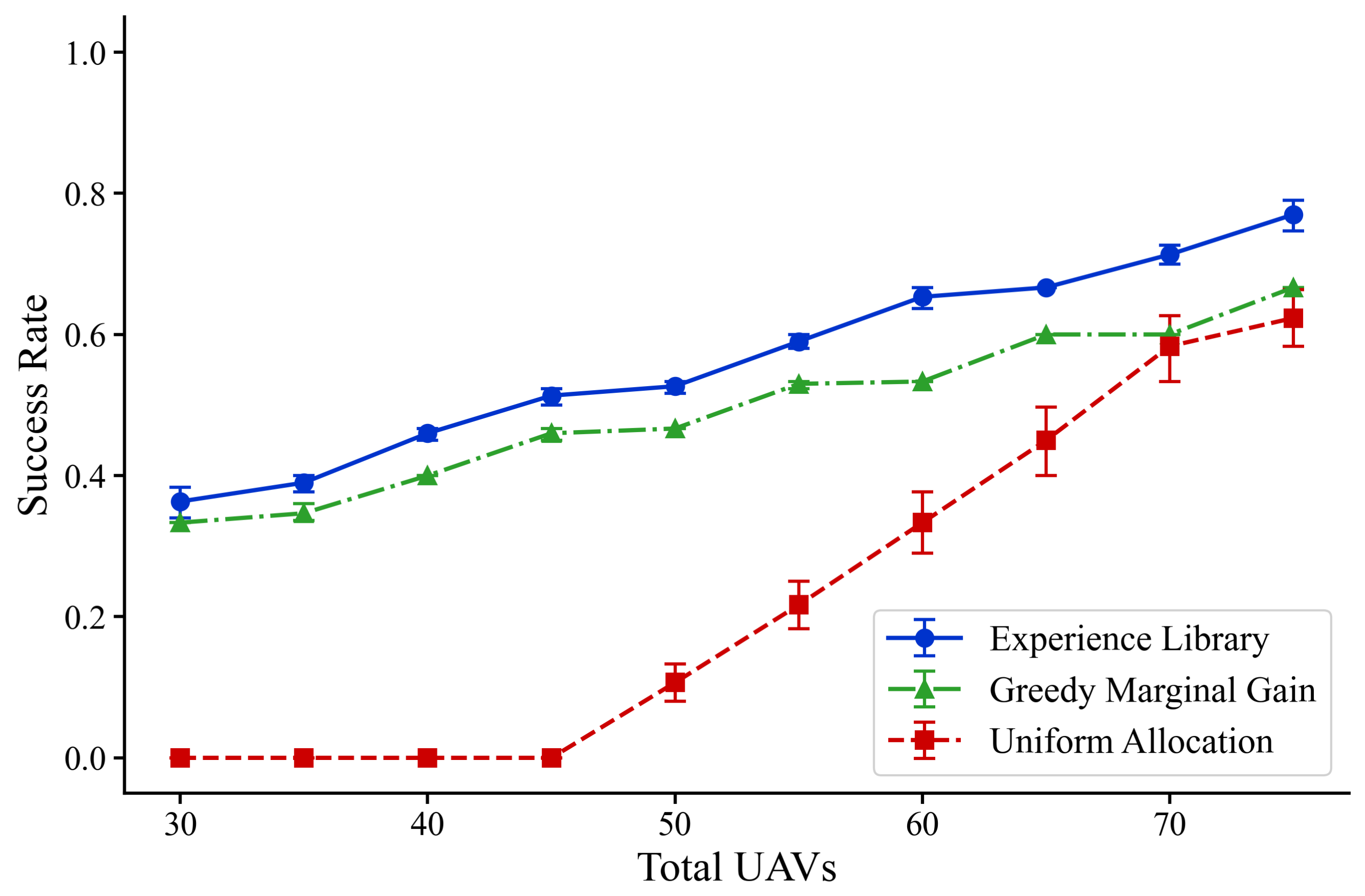
- The proposed Experience Library enables capability-aware force-ratio selection (i.e., non-uniform swarm sizing across targets), showing that allocation ratios have a decisive impact on mission completion: appropriate force distribution yields smooth and monotonic performance improvements across budgets, whereas Uniform Allocation can trigger threshold-like failures under heterogeneity.
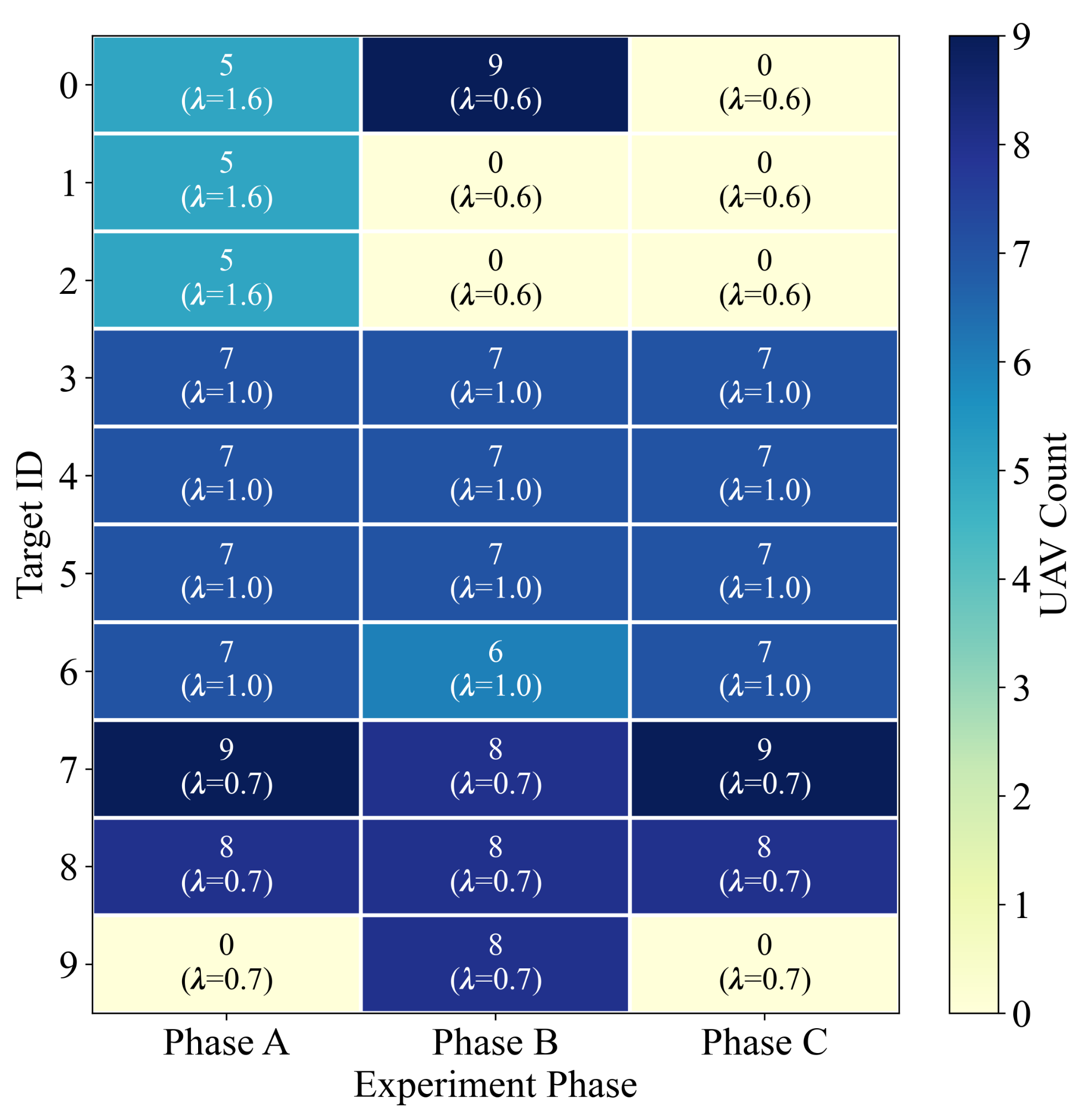
- Under dynamic disturbances and budget cuts, the method exhibits principled triage: allocation surges to the most demanding feasible targets and is withdrawn from lowreturn or infeasible ones.
- Capability-aware allocation improves mission resilience by maximizing global success rather than per-target persistence, delivering better continuity across changing conditions.
- The EL’s lightweight inference enables rapid re-optimization, supporting low-latency allocation computation with efficient budget usage and reduced redundant deployments.
Abstract
1. Introduction
- We formulate a force-ratio-aware effectiveness modeling framework for heterogeneous multi-target encirclement, explicitly characterizing how capture success varies with target speed ratio and assigned UAV number.
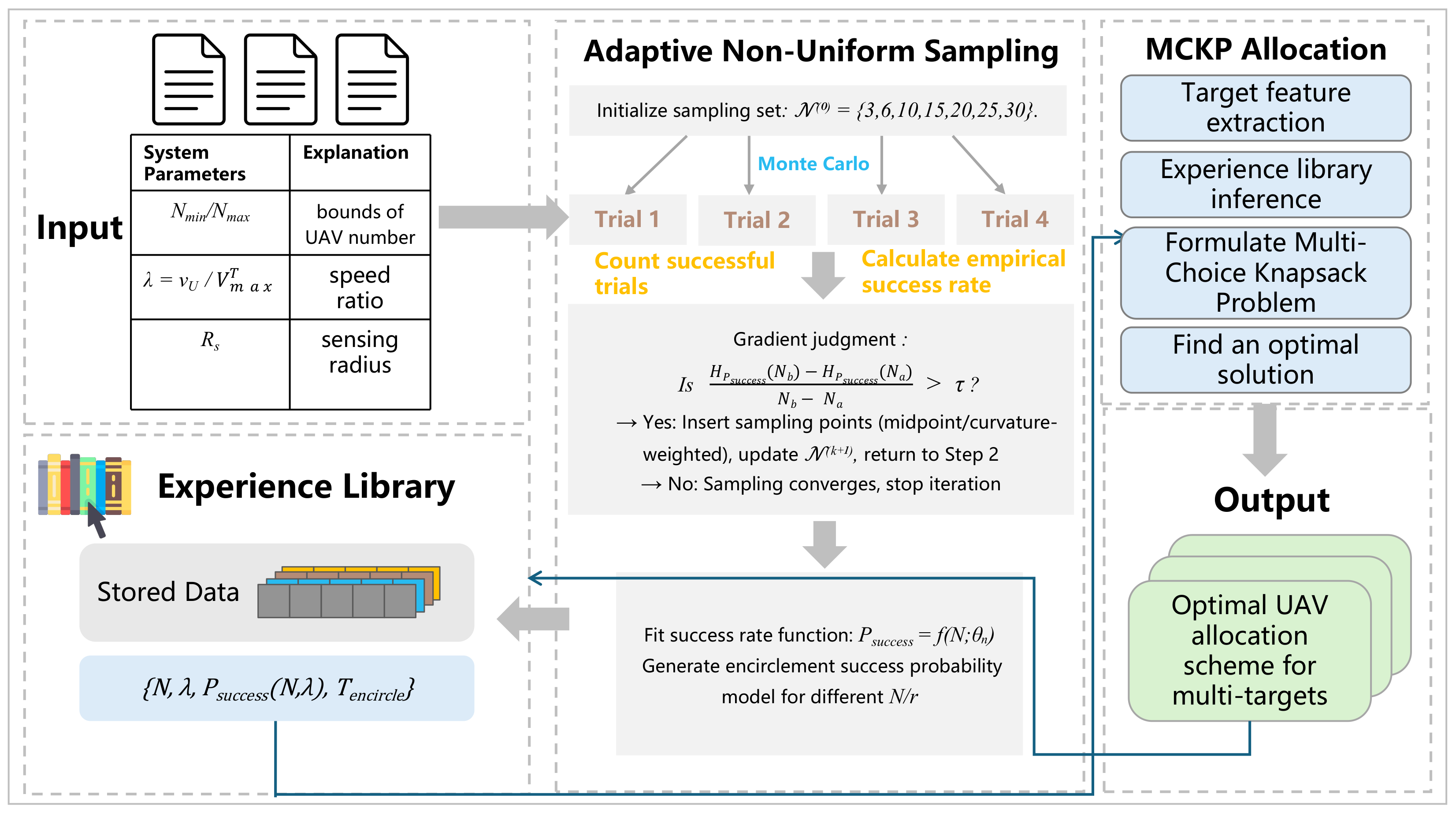
- We propose an Experience Library-based allocation mechanism that transforms multi-target UAV dispatch into a budget-constrained global optimization problem, enabling capability-aware allocation and fast online re-optimization when target conditions or available resources change.
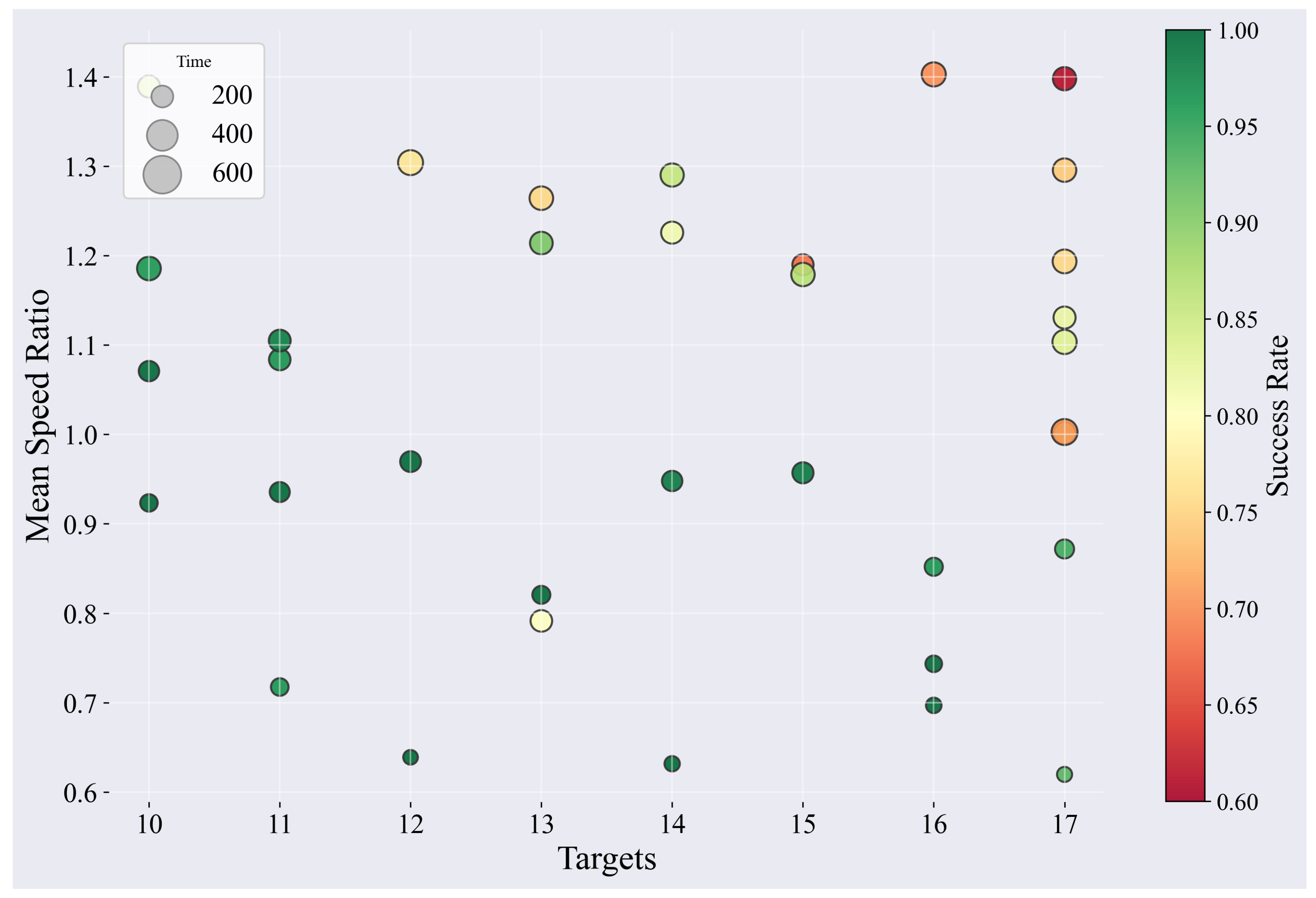
- We provide comparative experiments against Uniform Allocation and greedy marginal-gain baselines, together with adaptive non-uniform sampling and trajectory-level analysis, to show that the proposed method achieves more robust and consistent mission effectiveness under heterogeneous target difficulty.
2. Related Works
2.1. Adaptive Resource Allocation in Multi-UAV Systems
2.2. Mission Effectiveness Analysis for Encirclement and Pursuit–Evasion
2.3. Position of This Work
3. Single-Target Mission Effectiveness Analysis
3.1. System Description
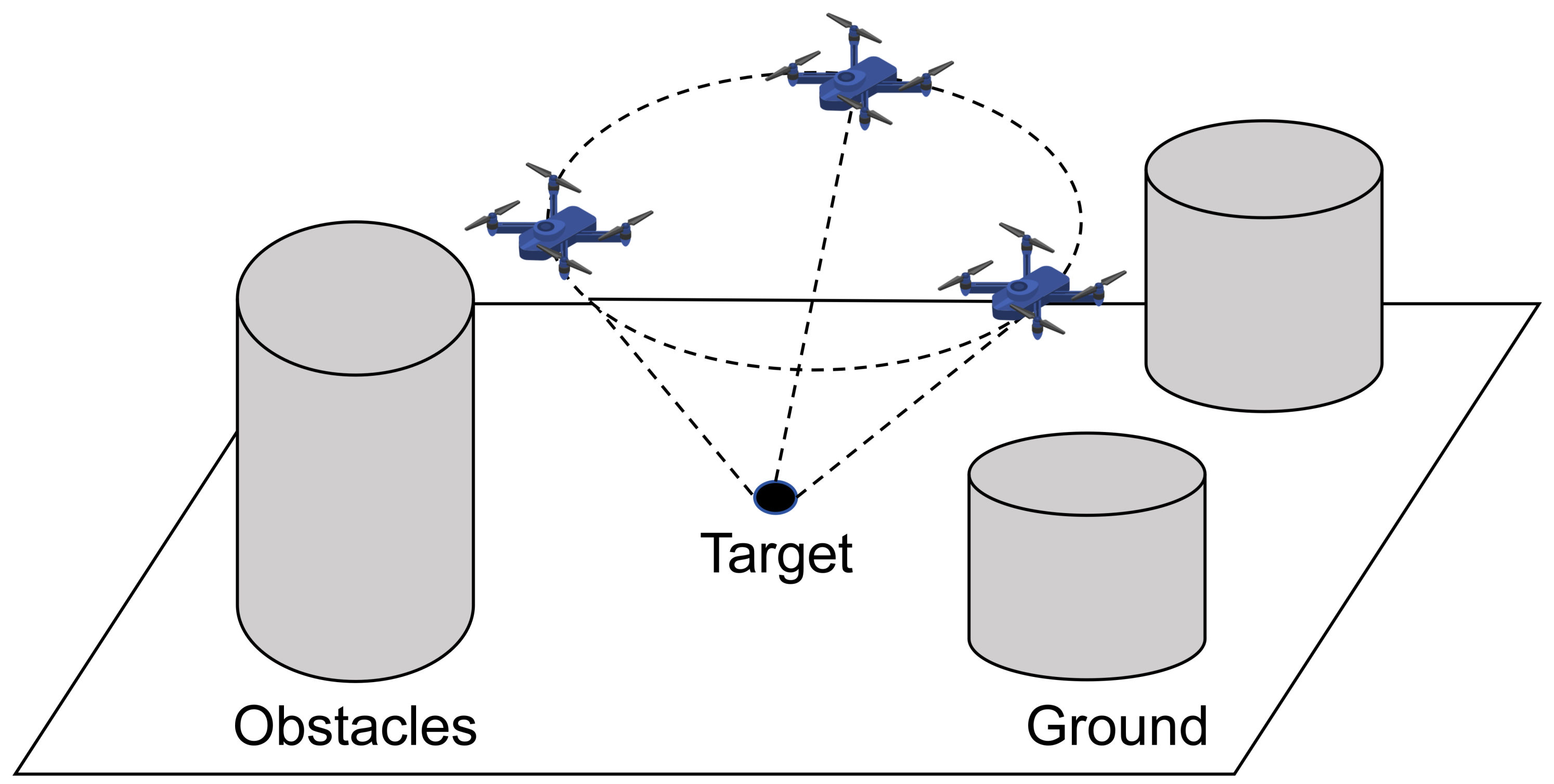
- Proximity: At least UAVs must enter the capture radius of the target: .
- Geometric Encirclement: The angular distribution of the encircling UAVs relative to the target must prevent escape. Let be the bearing of the i-th UAV relative to the target. The mission is successful if the maximum angular gap satisfies the following constraintwhere angles are sorted and .
3.2. Simulation Pipeline and Parameterization
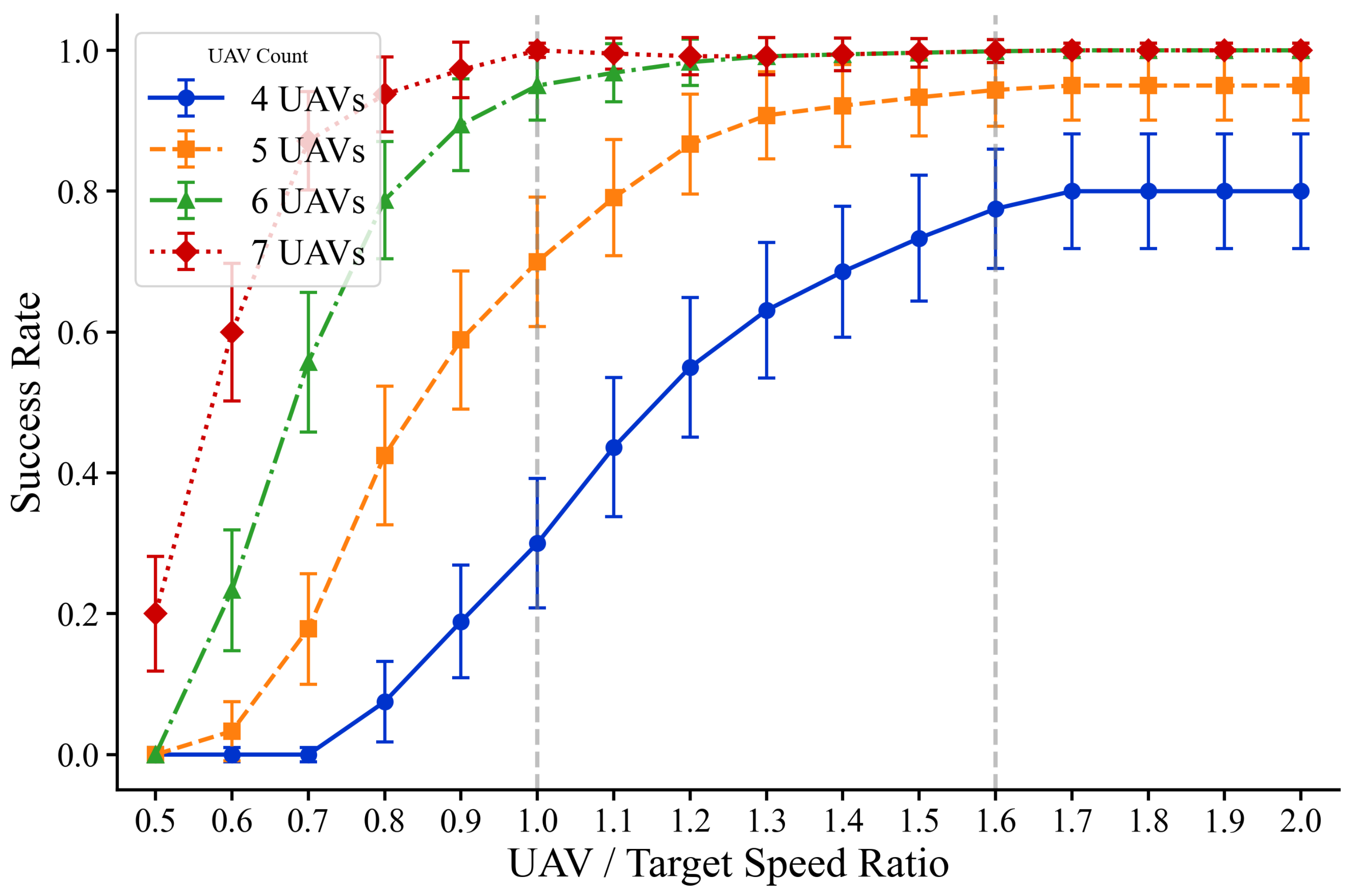
3.3. Mission Effectiveness Analysis Under Dynamic Speed Ratios
- 1.
- Highly Effective Regime (): When the UAVs are at least as fast as the target, all configurations maintain high mission effectiveness. In this region, increasing swarm size mainly improves robustness margin rather than fundamentally changing outcome. A saturation regime emerges around , beyond which further increases in the UAV/target speed ratio yield only marginal improvements.
- 2.
- Sensitivity/Transition Regime (): Around speed parity, success rate becomes strongly dependent on swarm size. Smaller teams (e.g., ) show a sharp effectiveness drop, while larger teams () degrade more gradually and preserve substantially higher success probability through stronger cooperative enclosure.
- 3.
- Resource-Limited Regime (): When the target is substantially faster than the UAVs, effectiveness declines across all settings, but the decline is not uniform: still retains non-trivial capture capability, whereas approaches near-failure. This highlights that additional agents remain beneficial, yet gains become increasingly costly and scenario-dependent.
4. Multi-Target Mission Effectiveness with Experience Library
4.1. Adaptive Non-Uniform Sampling Strategy
4.2. Experience-Library-Constrained Knapsack Formulation
5. Experimental Study
5.1. Resilience and Performance Characterization of Multi-Target Experience Library

5.2. Adaptive Resource Reallocation
5.2.1. Experimental Setup
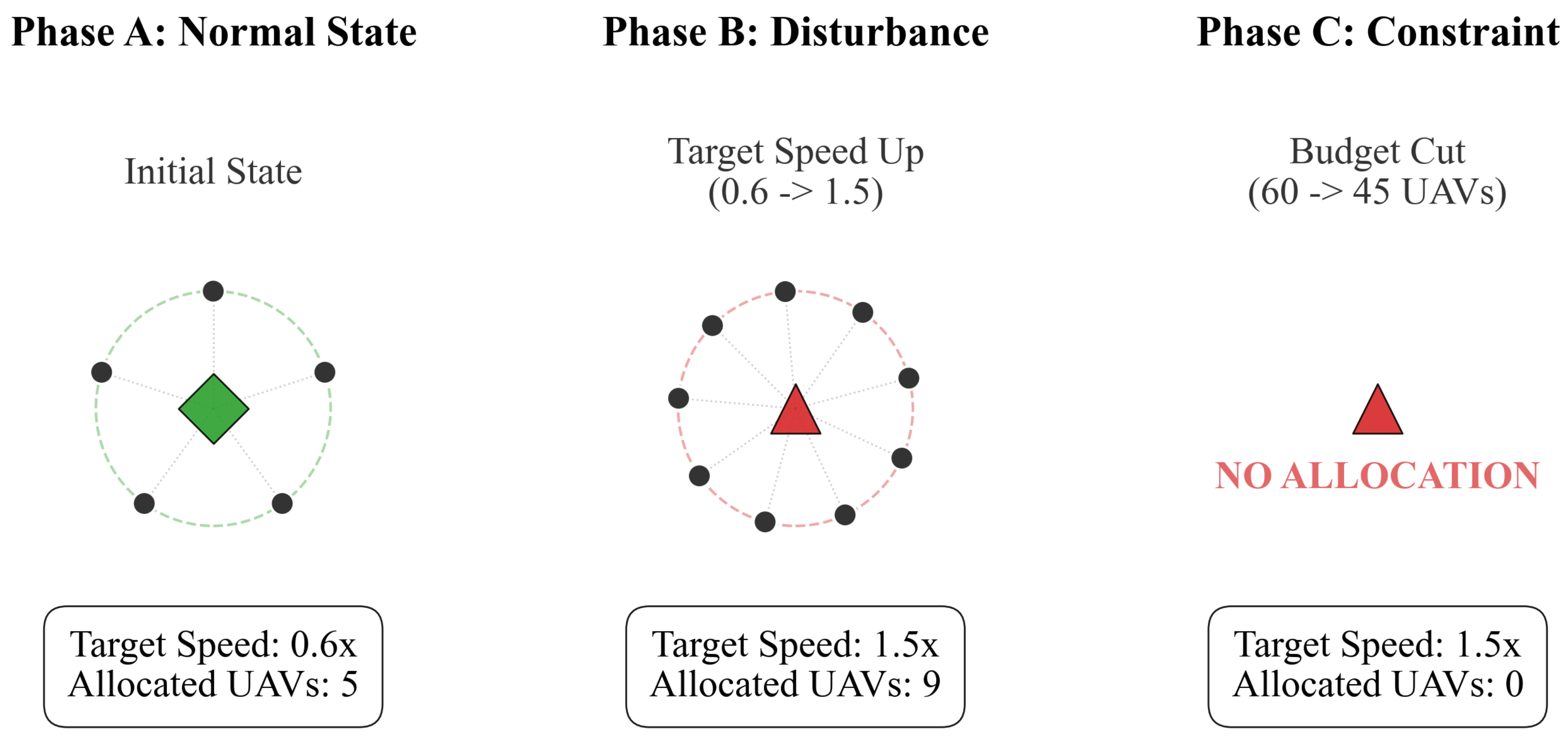
- Phase A (Normal State): A swarm of UAVs engages targets with mixed difficulty levels. Targets are Easy (), are Medium (), and are Hard ().
- Phase B (Disturbance): A sudden threat escalation occurs. The speed ratios of simultaneously decrease from to (Very Hard), drastically raising the resource demand.
- Phase C (Constraint): The mission encounters a severe resource shortage. The total number of available UAVs is reduced by 25% (), forcing the system to operate under strict constraints.
5.2.2. Global Resource Flow Analysis
5.2.3. Micro-Level Evolution (Target )
- Normal State: In the initial state, is an easy target, and a small, efficient formation of five UAVs is assigned to orbit it.
- Disturbance Response: When the speed ratio of drops from to , the EL algorithm dynamically recalculates the required force. Recognizing the increased difficulty, the number of allocated UAVs increases to nine, forming a dense encirclement to counter the target’s higher relative maneuverability.
- Dynamic Adjustment: In Phase C, as the global budget tightens, the cost to capture (nine UAVs) becomes prohibitively high relative to its contribution to the global success score. The system autonomously decides to abandon (zero allocation of UAV resources) to redirect those valuable assets to safeguard the capture of multiple medium-difficulty targets.

5.3. Comparison Experiment
5.3.1. Experimental Protocol
5.3.2. Runtime and Scalability of Online Reallocation
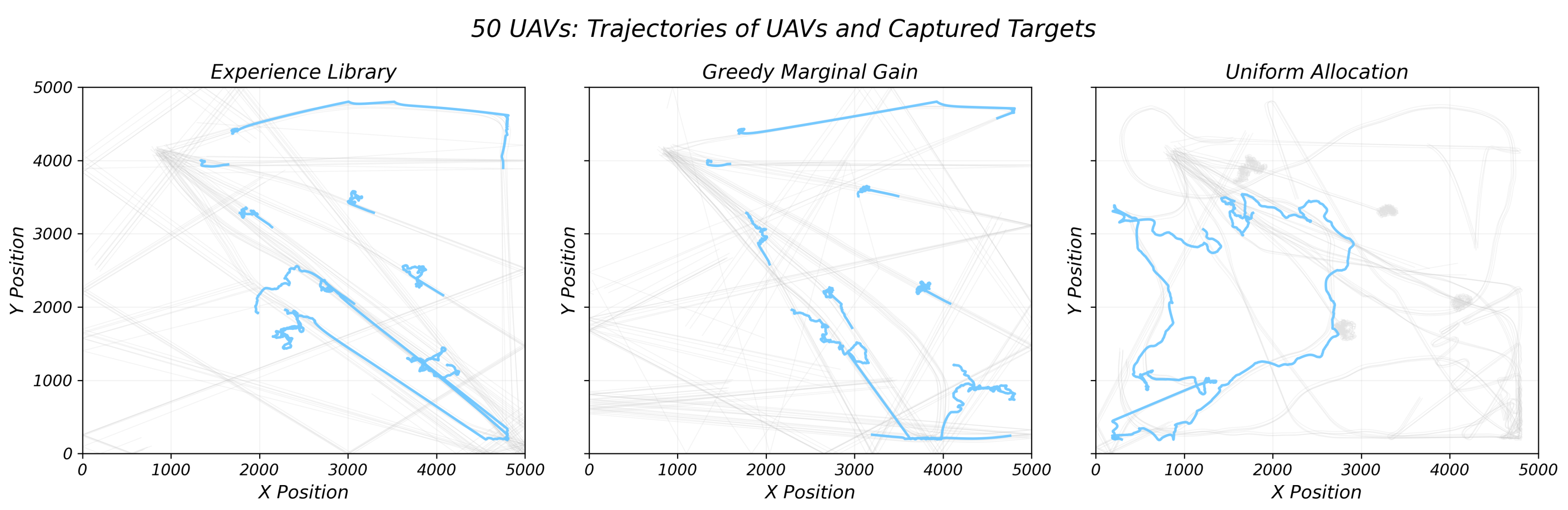
5.3.3. Trajectory-Level Interpretation

5.3.4. Quantitative Comparison

5.4. Discussion
6. Conclusions
Author Contributions
Funding
Data Availability Statement
DURC Statement
Conflicts of Interest
References
- Zhang, F.; Shao, X.; Xia, Y.; Zhang, W. Elliptical encirclement control capable of reinforcing performances for UAVs around a dynamic target. Def. Technol. 2024, 32, 104–119. [Google Scholar] [CrossRef]
- Zhang, C.; Zeng, R.; Lin, B.; Zhang, Y.; Xie, W.; Zhang, W. Multi-USV cooperative target encirclement through learning-based distributed transferable policy and experimental validation. Ocean. Eng. 2025, 318, 120124. [Google Scholar] [CrossRef]
- Liu, F.; Yuan, S.; Cao, K.; Meng, W.; Xie, L. Distance-Based Multiple Noncooperative Ground Target Encirclement for Complex Environments. IEEE Trans. Control Syst. Technol. 2025, 33, 261–273. [Google Scholar] [CrossRef]
- Zhao, X.; Tan, J.; Meng, W.; Yu, Z.; Yan, Y.; Zhang, Z. Cooperative Encirclement and Obstacle Avoidance of Fixed-Wing UAVs via MADDPG with Curriculum Learning. Drones 2025, 9, 727. [Google Scholar] [CrossRef]
- Yang, Z.; Cui, Y.; Li, Y. Transformer-Based Cooperative UAV Encirclement Policies Under Uncertainty in Low-Altitude Wireless Networks. IEEE Trans. Cogn. Commun. Netw. 2026, 12, 3525–3537. [Google Scholar] [CrossRef]
- Chen, J.; Wang, Y.; Zhang, Y.; Lu, Y.; Shu, Q.; Hu, Y. Extrinsic-and-Intrinsic Reward-Based Multi-Agent Reinforcement Learning for Multi-UAV Cooperative Target Encirclement. IEEE Trans. Intell. Transp. Syst. 2025, 26, 17653–17665. [Google Scholar] [CrossRef]
- Tillman, M. Optimizing force ratios to develop a course of action for the G3 (operations officer). Math. Comput. Model. 1996, 23, 55–63. [Google Scholar] [CrossRef]
- Fan, S.; Li, W.; Xu, C. Research on Optimization Algorithm of Air Defense Force Operation Method Based on Multi-Combat Environment. In Proceedings of the 2024 IEEE 2nd International Conference on Sensors, Electronics and Computer Engineering (ICSECE); IEEE: New York, NY, USA, 2024; pp. 1517–1522. [Google Scholar] [CrossRef]
- Pedroso, C.; Uehara de Moraes, Y.; Nogueira, M.; Santos, A. Managing Consensus-Based Cooperative Task Allocation for IIoT Networks. In Proceedings of the 2020 IEEE Symposium on Computers and Communications (ISCC); IEEE: New York, NY, USA, 2020; pp. 1–6. [Google Scholar] [CrossRef]
- Zhou, J.; Zhao, X.; Zhang, X.; Zhao, D.; Li, H. Task allocation for multi-agent systems based on distributed many-objective evolutionary algorithm and greedy algorithm. IEEE Access 2020, 8, 19306–19318. [Google Scholar] [CrossRef]
- Choi, H.L.; Brunet, L.; How, J.P. Consensus-Based Decentralized Auctions for Robust Task Allocation. IEEE Trans. Robot. 2009, 25, 912–926. [Google Scholar] [CrossRef]
- Mercker, T.; Casbeer, D.W.; Millet, P.T.; Akella, M.R. An extension of consensus-based auction algorithms for decentralized, time-constrained task assignment. In Proceedings of the 2010 American Control Conference; IEEE: New York, NY, USA, 2010; pp. 6324–6329. [Google Scholar] [CrossRef]
- Das, G.P.; McGinnity, T.M.; Coleman, S.A.; Behera, L. A fast distributed auction and consensus process using parallel task allocation and execution. In Proceedings of the 2011 IEEE/RSJ International Conference on Intelligent Robots and Systems; IEEE: New York, NY, USA, 2011; pp. 4716–4721. [Google Scholar] [CrossRef]
- Sujit, P.B.; Sinha, A.; Ghose, D. Multiple UAV task allocation using negotiation. In AAMAS ’06: Proceedings of the Fifth International Joint Conference on Autonomous Agents and Multiagent Systems; Association for Computing Machinery: New York, NY, USA, 2006; pp. 471–478. [Google Scholar] [CrossRef]
- Whitbrook, A.; Meng, Q.; Chung, P.W.H. A novel distributed scheduling algorithm for time-critical multi-agent systems. In Proceedings of the 2015 IEEE/RSJ International Conference on Intelligent Robots and Systems (IROS); IEEE: New York, NY, USA, 2015; pp. 6451–6458. [Google Scholar] [CrossRef]
- Sampedro, C.; Bavle, H.; Sanchez-Lopez, J.L.; Fernández, R.A.S.; Rodríguez-Ramos, A.; Molina, M.; Campoy, P. A flexible and dynamic mission planning architecture for UAV swarm coordination. In Proceedings of the 2016 International Conference on Unmanned Aircraft Systems (ICUAS); IEEE: New York, NY, USA, 2016; pp. 355–363. [Google Scholar] [CrossRef]
- Wang, S.; Liu, Y.; Qiu, Y.; Zhou, J. Consensus-Based Decentralized Task Allocation for Multi-Agent Systems and Simultaneous Multi-Agent Tasks. IEEE Robot. Autom. Lett. 2022, 7, 12593–12600. [Google Scholar] [CrossRef]
- Wang, S.; Liu, Y.; Qiu, Y.; Li, S.; Zhou, J. An Efficient Distributed Task Allocation Method for Maximizing Task Allocations of Multirobot Systems. IEEE Trans. Autom. Sci. Eng. 2024, 21, 3588–3602. [Google Scholar] [CrossRef]
- Yan, S.; Feng, J.; Pan, F. A Distributed Task Allocation Method for Multi-UAV Systems in Communication-Constrained Environments. Drones 2024, 8, 342. [Google Scholar] [CrossRef]
- Zhang, C.; Xu, C.; Li, G.; He, B. A distributed task allocation approach for multi-UAV persistent monitoring in dynamic environments. Sci. Rep. 2025, 15, 6437. [Google Scholar] [CrossRef] [PubMed]
- Hady, M.A.; Hu, S.; Pratama, M.; Kowalczyk, Z.C.R. Multi-agent reinforcement learning for resources allocation optimization: A survey. Artif. Intell. Rev. 2025, 58, 354. [Google Scholar] [CrossRef]
- Chen, F.; Ren, W.; Cao, Y. Surrounding control in cooperative agent networks. Syst. Control Lett. 2010, 59, 704–712. [Google Scholar] [CrossRef]
- Kim, T.H.; Hara, S.; Hori, Y. Cooperative control of multi-agent dynamical systems in target-enclosing operations using cyclic pursuit strategy. Int. J. Control 2010, 83, 2040–2052. [Google Scholar] [CrossRef]
- Lan, Y.; Yan, G.; Lin, Z. Distributed control of cooperative target enclosing based on reachability and invariance analysis. Syst. Control Lett. 2010, 59, 381–389. [Google Scholar] [CrossRef]
- Franchi, A.; Stegagno, P.; Oriolo, G. Decentralized multi-robot encirclement of a 3D target with guaranteed collision avoidance. Auton. Robot. 2016, 40, 245–265. [Google Scholar] [CrossRef]
- Hafez, A.; Iskandarani, M.; Givigi, S.; Yousefi, S.; Beaulieu, A. UAVs in Formation and Dynamic Encirclement via Model Predictive Control. IFAC Proc. Vol. 2014, 47, 1241–1246. [Google Scholar] [CrossRef]
- Hafez, A.T.; Iskandarani, M.; Givigi, S.N.; Yousefi, S.; Noureldin, A.; Beaulieu, A. Encirclement of moving target using linear model predictive control via feedback linearization. In Proceedings of the 2014 IEEE International Conference on Systems, Man, and Cybernetics (SMC); IEEE: New York, NY, USA, 2014. [Google Scholar]
- Lowe, R.; Wu, Y.; Tamar, A.; Harb, J.; Abbeel, P.; Mordatch, I. Multi-agent actor-critic for mixed cooperative-competitive environments. Adv. Neural Inf. Process. Syst. 2017, 30. [Google Scholar]
- Zhang, T.; Liu, Z.; Pu, Z.; Yi, J. Multi-Target Encirclement with Collision Avoidance via Deep Reinforcement Learning using Relational Graphs. In Proceedings of the 2022 International Conference on Robotics and Automation (ICRA); IEEE: New York, NY, USA, 2022; pp. 8794–8800. [Google Scholar] [CrossRef]
- Qu, X.; Li, C.; Jiang, S.; Liu, G.; Zhang, R. Multi-Agent Reinforcement Learning-Based Cooperative Encirclement Control of Autonomous Surface Vehicles Against Multiple Targets. J. Mar. Sci. Eng. 2025, 13, 1558. [Google Scholar] [CrossRef]
- Xing, L.; Johnson, B.W. Reliability Theory and Practice for Unmanned Aerial Vehicles. IEEE Internet Things J. 2023, 10, 3548–3566. [Google Scholar] [CrossRef]
- Feng, Q.; Liu, M.; Sun, B.; Dui, H.; Hai, X.; Ren, Y.; Lu, C.; Wang, Z. Resilience Measure and Formation Reconfiguration Optimization for Multi-UAV Systems. IEEE Internet Things J. 2024, 11, 10616–10626. [Google Scholar] [CrossRef]
- Wang, D.; Zong, Q.; Tian, B.; Lu, H.; Wang, J. Adaptive finite-time reconfiguration control of unmanned aerial vehicles with a moving leader. Nonlinear Dyn. 2019, 95, 1099–1116. [Google Scholar] [CrossRef]
- Yuan, H.; Li, R.; Wang, L.; Ren, B.; Chen, T.; Guo, D. Toward resilient communication architecture: Online network reconfiguration for UAV failure. Comput. Netw. 2025, 263, 111210. [Google Scholar] [CrossRef]
- Li, H. Robotic Path Planning Strategy Based on Improved Artificial Potential Field. In Proceedings of the 2020 International Conference on Artificial Intelligence and Computer Engineering (ICAICE); IEEE: New York, NY, USA, 2020; pp. 67–71. [Google Scholar] [CrossRef]
- Liu, C.; Qiming, M.; Yuhong, P.; Huakui, W. Unmanned Maneuvering Force Route Recommendation Method Based on Improved Artificial Potential Field Method. In Proceedings of the 2021 IEEE International Conference on Signal Processing, Communications and Computing (ICSPCC); IEEE: New York, NY, USA, 2021; pp. 1–5. [Google Scholar] [CrossRef]



| Item | Setting/Rule |
|---|---|
| Time step | |
| Horizon | steps () |
| Workspace | m, reflective boundary handling |
| UAV max speed | |
| Target max speed | (speed ratio ) |
| Acceleration limit | |
| Encirclement radius | m |
| Interaction radius | m |
| Safety distance | m |
| Obstacles | circles, radius m |
| Obstacle sampling | Uniform in workspace; reject near initial target/base (margin m) |
| Initial target position | Uniform in |
| UAV base position | Uniform in , with m |
| UAV initial jitter | , then clamp to workspace |
| APF gains | , , , |
| APF epsilons | , , |
| Obstacle detection margin | m |
| Target evasion | , , ; random walk if no UAV detected |
| Capture success | Capture criteria in Section 3.1; timeout counts as failure |
| Monte Carlo trials | Experience Library construction: per sampled ; comparison curves: per budget point |
| Comparison grid | |
| Random seeds | Heterogeneous target-set seed=42; fixed trajectory scenario seed=2026; Monte Carlo trials use independent RNG streams |
| Adaptive sampling | Gradient threshold ; anchor budgets |
| n (Targets) | (UAVs) | Runtime (ms) |
|---|---|---|
| 10 | 50 | 0.76/1.34 |
| 15 | 50 | 1.22/2.35 |
| 20 | 50 | 1.61/2.55 |
| 30 | 50 | 2.49/4.23 |
| 15 | 100 | 2.34/3.98 |
| 20 | 100 | 3.28/5.58 |
| 30 | 100 | 5.08/7.52 |
| 30 | 150 | 7.56/12.38 |
Disclaimer/Publisher’s Note: The statements, opinions and data contained in all publications are solely those of the individual author(s) and contributor(s) and not of MDPI and/or the editor(s). MDPI and/or the editor(s) disclaim responsibility for any injury to people or property resulting from any ideas, methods, instructions or products referred to in the content. |
© 2026 by the authors. Licensee MDPI, Basel, Switzerland. This article is an open access article distributed under the terms and conditions of the Creative Commons Attribution (CC BY) license.
Share and Cite
Liu, Q.; Li, M.; Zhu, X. Adaptive Force Ratio Allocation for Multi-UAV Cooperative Multi-Target Encirclement. Drones 2026, 10, 406. https://doi.org/10.3390/drones10060406
Liu Q, Li M, Zhu X. Adaptive Force Ratio Allocation for Multi-UAV Cooperative Multi-Target Encirclement. Drones. 2026; 10(6):406. https://doi.org/10.3390/drones10060406
Chicago/Turabian StyleLiu, Qiting, Meixuan Li, and Xianqiang Zhu. 2026. "Adaptive Force Ratio Allocation for Multi-UAV Cooperative Multi-Target Encirclement" Drones 10, no. 6: 406. https://doi.org/10.3390/drones10060406
APA StyleLiu, Q., Li, M., & Zhu, X. (2026). Adaptive Force Ratio Allocation for Multi-UAV Cooperative Multi-Target Encirclement. Drones, 10(6), 406. https://doi.org/10.3390/drones10060406