1. Introduction
The agricultural sector is undergoing a profound technological transformation, driven by the growing global demand for food and the urgent need to meet environmental sustainability targets. In this context, the integration of advanced technologies has become essential to increase productivity and reduce the ecological footprint of farming practices. One of the most dynamic areas of innovation is agricultural aviation, which has evolved from the use of manned aircraft regulated under FAA Part 137 [
1] to the widespread deployment of unmanned aerial vehicles (UAVs) for precision spraying, monitoring, and data acquisition [
2,
3].
Despite these advances, significant operational limitations persist. Multirotor UAVs typically suffer from low endurance and high energy consumption [
4], while conventional crop-dusting aircraft are unsuitable for irregular terrain, such as that found in Chihuahua, Mexico. These challenges have prompted the exploration of hybrid aerial platforms that combine aerodynamic efficiency with operational versatility. Recent studies have highlighted the potential of fixed-wing configurations to improve flight range and energy performance in agricultural UAVs [
5,
6,
7], while others have reviewed the design and control complexities associated with VTOL systems [
8]. However, there remains a gap in the aerodynamic optimization of UAVs specifically tailored for agricultural use, particularly in environments with uneven topography.
To establish a comparative foundation for the proposed design, three representative aircraft configurations were analyzed: (i) the Air Tractor AT-802A, a fixed-wing aircraft with a payload capacity exceeding 4000 kg and powered by a 1350 HP engine, which offers high aerodynamic efficiency but limited maneuverability in confined agricultural plots [
9]; (ii) the DJI Agras T100, a multirotor UAV with a maximum takeoff weight of 170 kg (90 kg payload), requiring 5704 W of power, characterized by low autonomy and high energy consumption, yet excelling in maneuverability within restricted spaces [
10]; and (iii) the US Patent 11,433,998 B2, a hybrid configuration combining fixed-wing lift with multirotor vertical flight capabilities, which provides both aerodynamic efficiency and operational versatility, though at the cost of increased design and control complexity [
11].
The limitations identified in these existing platforms underscore the complexity of hybrid aircraft design. The aerodynamic sizing of the wing in hybrid VTOL platforms constitutes a fundamentally multidisciplinary challenge, as it requires reconciling inherently conflicting lift requirements between vertical takeoff and landing and forward cruise. In contrast to conventional fixed-wing aircraft, where design strategies prioritize maximizing the lift-to-drag ratio (L/D) through high aspect ratios, VTOL configurations incur significant energetic penalties during hover and transition. Recent studies indicate that high lift coefficients can be achieved through propulsive–aerodynamic interactions between the wing and propellers at low speeds [
12]; however, these benefits are accompanied by power demands that may be up to an order of magnitude greater than those of cruise flight [
13]. Consequently, the geometric optimization of lifting surfaces, including the adoption of non-conventional planform configurations and the incorporation of wingtip devices such as winglets, represents a critical approach to mitigating efficiency losses and enhancing endurance in long-range agricultural missions [
14,
15].
This study presents the aerodynamic design of the wing system for a VTOL UAV with a payload capacity of 100 kg, developed specifically for agricultural applications. The research follows an explanatory methodology supported by experimental validation, including the selection of airfoils optimized for low-Reynolds-number conditions, computational fluid dynamics (CFD) simulations, winglet integration, and wind tunnel testing of scaled prototypes. The aim is to improve energy efficiency and extend operational autonomy. Preliminary results confirm the feasibility of the proposed design and suggest its potential to reduce energy consumption and expand coverage in large agricultural areas, contributing to innovation and sustainability in the agro-industrial sector.
2. Materials and Methods
2.1. Operational Parameter Definition
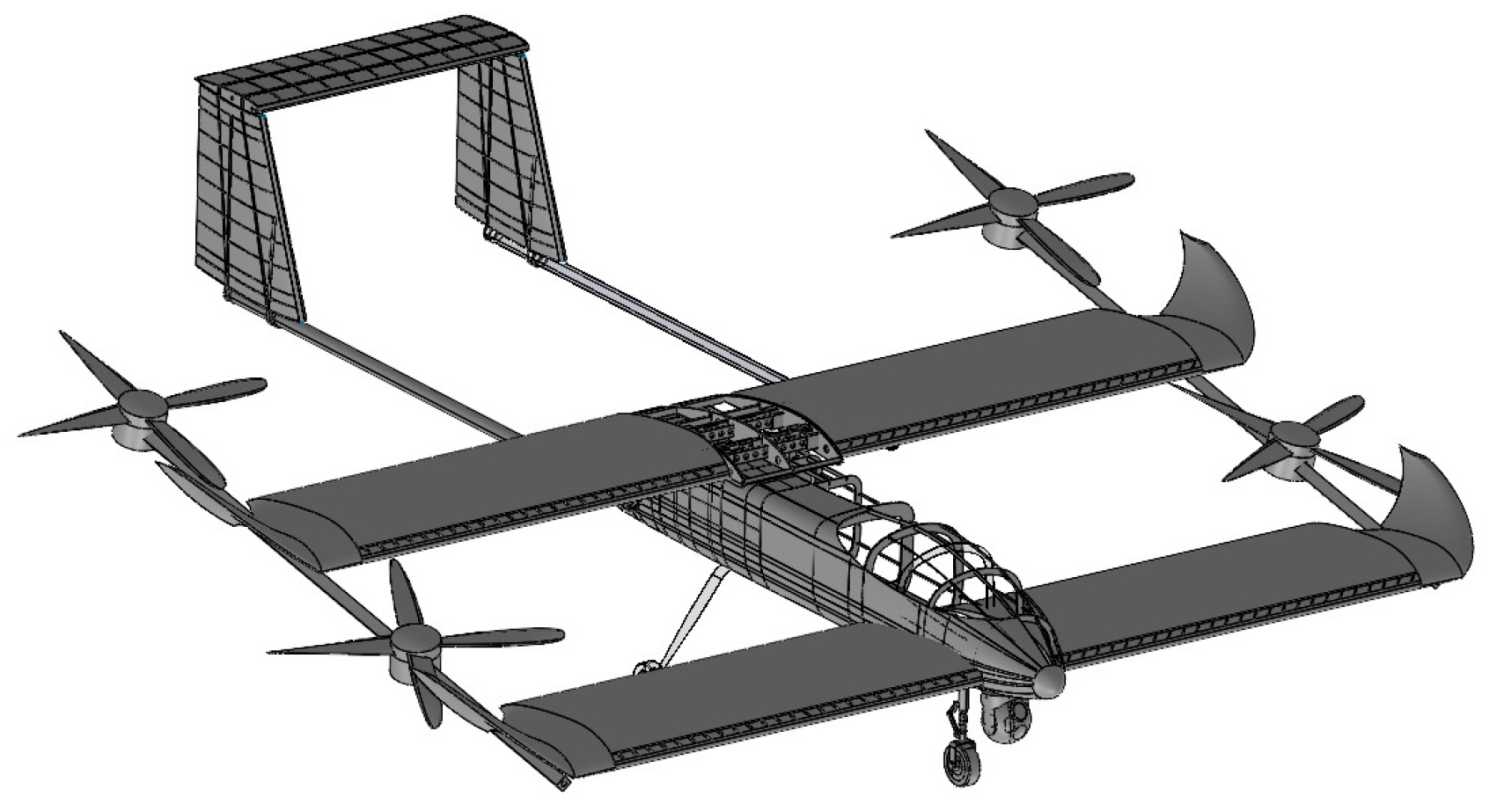
Based on the comparative analysis, a hybrid UAV concept was developed featuring two pairs of wings with identical airfoil profiles and a multirotor propulsion system, as detailed in
Appendix A. This configuration integrates vertical takeoff and landing (VTOL) capability with efficient horizontal flight.
According to the conceptual design framework by Raymer [
16], the initial development phase prioritizes the independent sizing and aerodynamic validation of lifting surfaces to establish a baseline for efficiency before analyzing complex multi-body interference.
During cruise, the thrust vector from the multirotor system induces a slight forward pitch due to force imbalance. To counteract this and maintain optimal lift, the wings were mounted with a 15° incidence angle, ensuring sufficient lift generation during level flight.
The defined operational parameters include:
The Reynolds number was calculated under the expected flight conditions to guide airfoil selection and aerodynamic analysis. By substituting the corresponding values into the Reynolds number equation [
17], and specifically utilizing the kinematic viscosity of air (
) adjusted for sea level conditions at 20 °C (
=
, it was determined that the UAV operates at a Reynolds number of 423,533, as shown in the equation below:
where
= Air density,
V = Velocity,
C = Chord length,
= Dynamic viscosity,
Kinematic viscosity.
2.2. Airfoil Selection and Wing Geometry
Four airfoil profiles suitable for low-Reynolds-number regimes were selected: GOE 508, GOE 481, EPPLER 1210, and SELIG 1223. Their stall characteristics and maximum lift coefficients (CL max) were obtained from the Airfoil Tools database [
18], considering the calculated Reynolds number and an angle of attack of 15°.
Using the lift equation [
19]:
where
= Lift Coefficient,
= Air density,
V = Velocity,
S = Wing area.
The required wing area “S” was determined using the geometric relationship [
20]:
where B is the wingspan and C is the chord length. Substituting this into the lift equation allowed for the analytical isolation of B, resulting in:
This formulation enabled the precise calculation of the wingspan required to generate the necessary lift under the defined operating conditions. Once the airfoil dimensions were established, each wing was modeled accordingly. The specific geometric details are presented in
Table 1.
2.3. Modeling and Simulation of the Selected Airfoil
Based on the aerodynamic calculations presented in the previous section, the SELIG 1223 airfoil was selected due to its ability to generate high lift with a relatively short wingspan, as well as its broad operational range before stall. The airfoil was modeled using the SolidWorks 2024 Student Edition, adopting a straight wing configuration suitable for low-Reynolds-number conditions. The resulting geometry was then exported and prepared for aerodynamic analysis in ANSYS Fluent 2025 R1 Student.
To perform the simulation, a computational mesh was generated according to the parameters listed in
Table 2, ensuring an appropriate balance between numerical accuracy and computational efficiency.
2.4. Aerodynamic Optimization
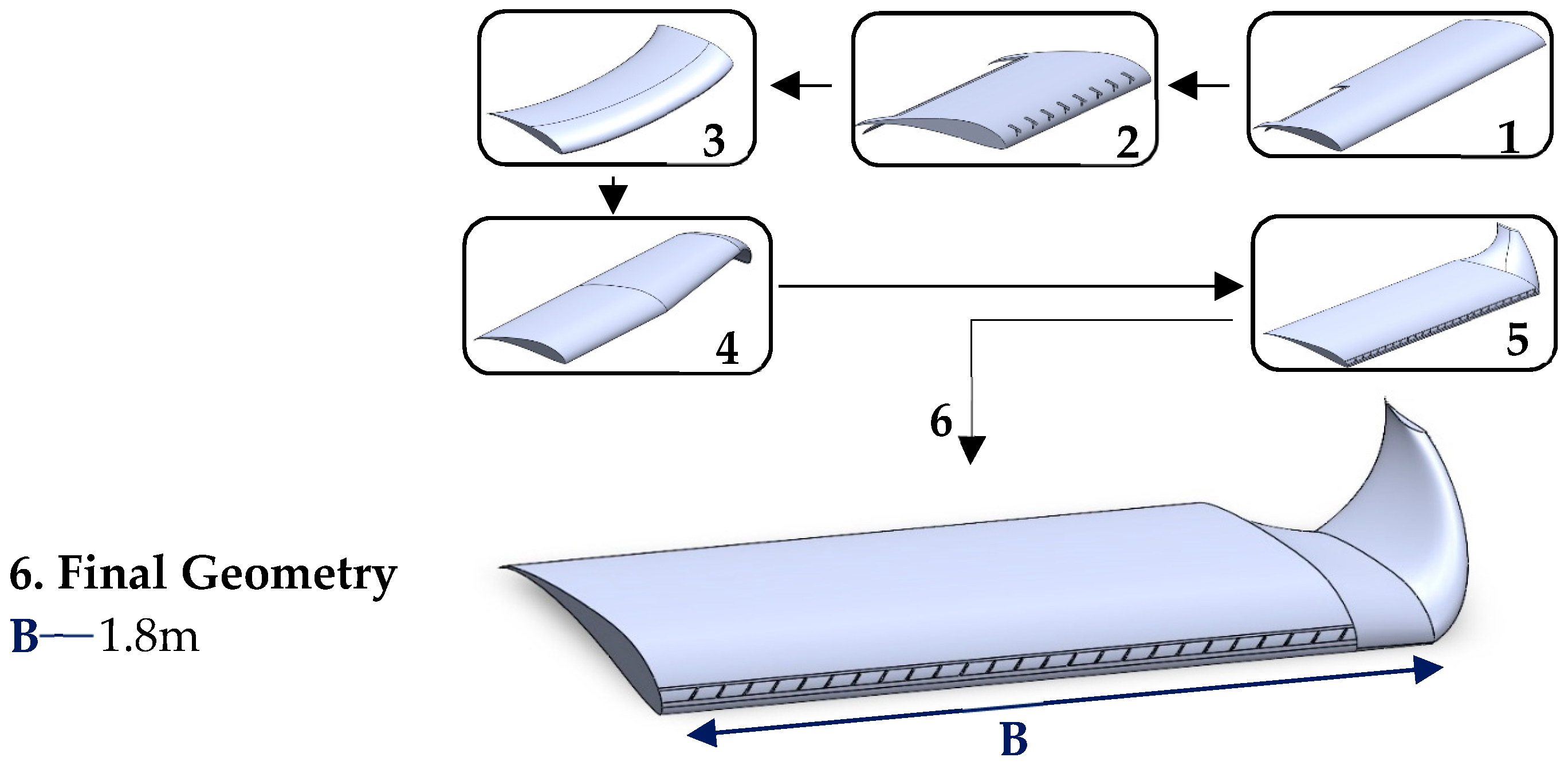
Following the initial Computational Fluid Dynamics (CFD) simulation, several areas were identified where aerodynamic performance could be improved. Based on these results, multiple geometric configurations were explored, as illustrated in
Figure 1, with the objective of enhancing lift generation while minimizing aerodynamic drag.
The design process began with a straight wing configuration incorporating high-lift devices. While these surfaces effectively increased lift, their deployment during flight led to a significant rise in drag. Subsequently, irregular geometries were evaluated; however, they proved impractical due to manufacturing complexity.
Ultimately, the final configuration was adopted: a straight wing equipped with winglets, vortex generators, and a designated space near the trailing edge adjacent to the winglet for rotor integration. This design was selected to maintain favorable aerodynamic performance by optimizing lift, reducing induced drag at the wingtips, and delaying boundary layer separation. Additionally, it facilitates propulsion system integration and simplifies wing fabrication [
21,
22].
2.5. Numerical and Experimental Validation
Once the final semi-wing geometry was defined, Computational Fluid Dynamics (CFD) simulations were conducted using ANSYS Fluent Student to quantify lift and aerodynamic drag, as well as to analyze the flow behavior over the wing surface. The computational mesh was generated according to the parameters listed in
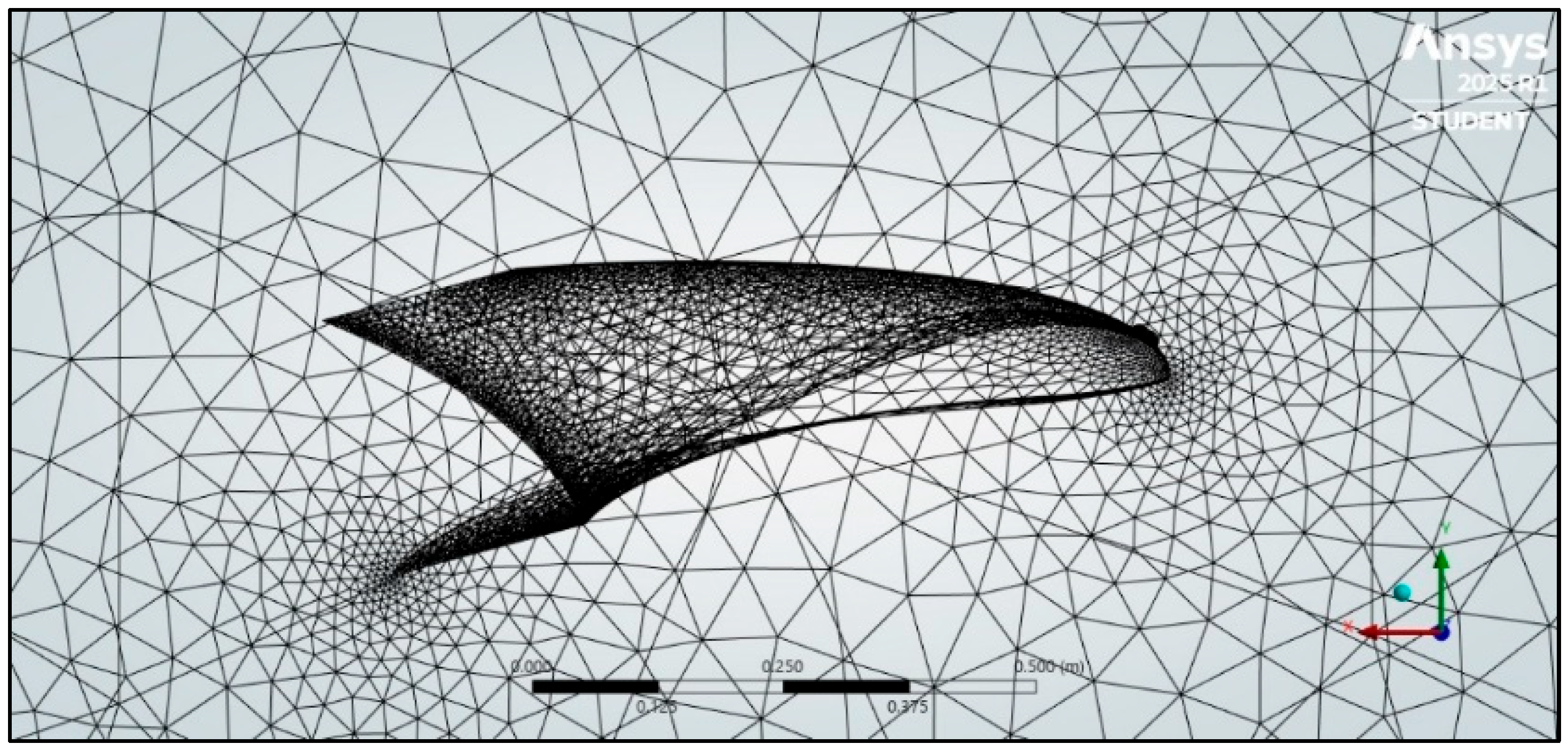
Table 3, and
Figure 2 illustrates the mesh elements surrounding the semi-wing. This visualization highlights how the simulation domain was discretized and ensures that the results are representative for subsequent experimental validation.
In addition to performance quantification, these simulations enabled the aerodynamic feasibility assessment of integrating vortex generators and winglets into the proposed configuration.
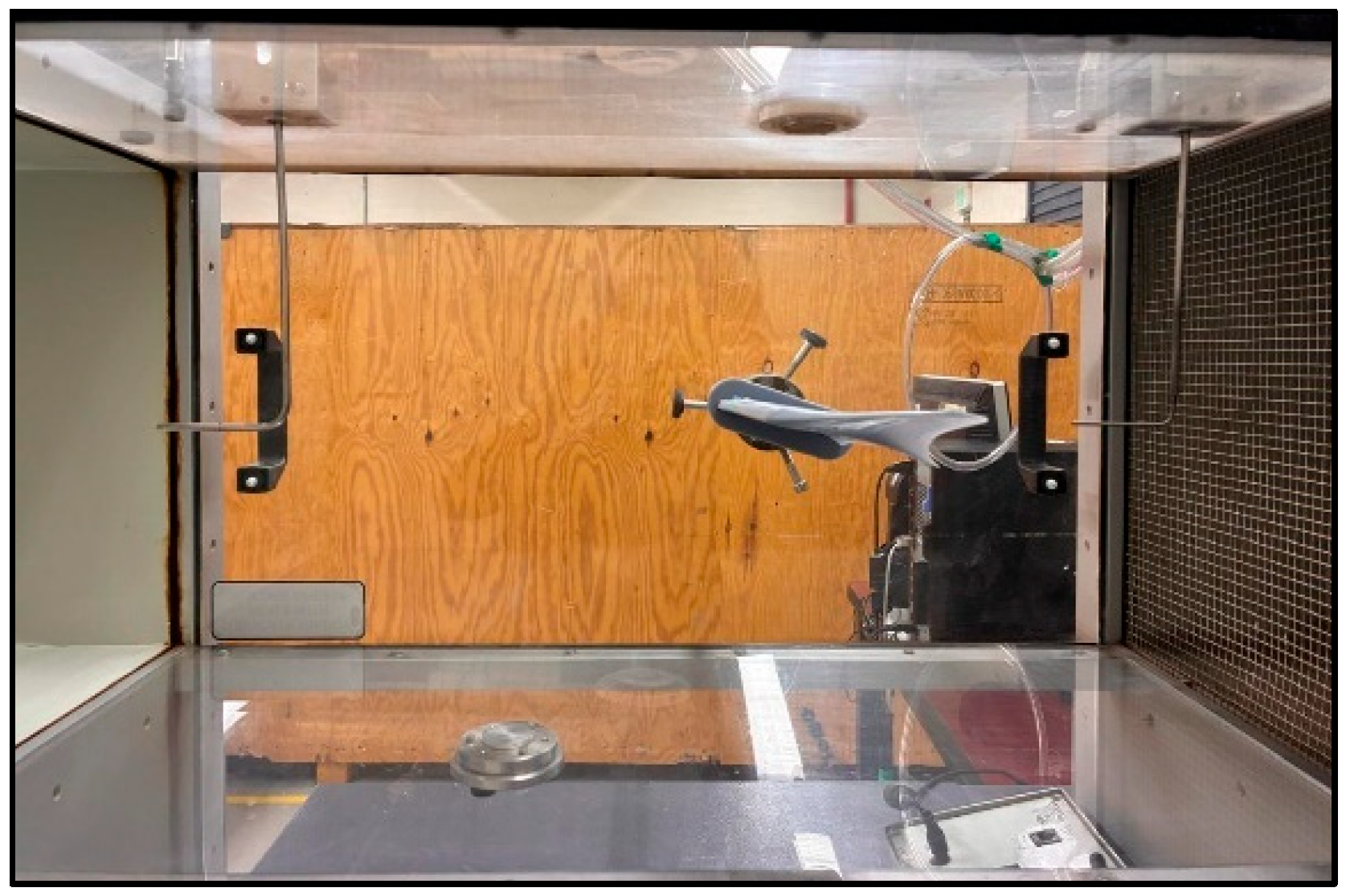
To validate the numerical results and support the final construction process, a 1:10 scale semi-wing was fabricated using resin-based 3D printing (SLA). The prototype was tested in the TecQuipment Subsonic Wind Tunnel at the Universidad Autónoma de Ciudad Juárez (UACJ) at an angle of attack of 15°, as shown in
Figure 3.
To maintain dynamic similarity with the full-scale flight conditions, a theoretical test velocity of approximately 80 m/s was determined to match the target Reynolds number, specifically accounting for the local atmospheric conditions of Ciudad Juárez (1140 m a.s.l., = 1.10 kg/m3). The experiments were conducted at the maximum operational limit of the facility to establish a representative turbulent flow regime, and the lift force was precisely quantified using the tunnel’s integrated digital aerodynamic balance.
2.6. Analysis of Energy Requirements
For the purposes of this comparison, the required thrust and power were calculated to evaluate energy efficiency, focusing on the steady-state cruise phase where the fixed-wing system generates aerodynamic benefits that directly impact energy consumption. To establish a comparison baseline, the calculations of lift and drag coefficients (
) maintain the equilibrium condition for level flight, where lift force (L) is set equal to the aircraft’s operational weight (W). These relationships are expressed through the following equations, as described by Anderson and Bowden [
17].
L = Lift Force,
Dynamic pressure,
Wing area.
Aspect ratio,
Oswald efficiency factor,
Wingspan,
Wing area.
Induced drag,
Parasite drag.
Aircraft weight,
Lift coefficient,
Total drag coefficient.
Required thrust,
Required velocity.
Based on the reviewed literature, it was determined that a multirotor drone with a payload capacity of 170 kg requires approximately 5824 watts per motor, resulting in a total power consumption of 23,296 watts to maintain level flight at a velocity of 14 m/s [
10]. Using this as a reference, the required power for cruise flight in a fixed-wing configuration was estimated. A per-motor load of 416 N was established, derived from the proportional weight distribution of the 170 kg reference aircraft (1667 N total weight distributed among four motors). Additionally, a flight velocity of 14 m/s was maintained to ensure a direct comparison with the operational conditions of the reference multirotor. An Oswald efficiency factor of 0.8 was assumed.
The following calculations demonstrate the values for the lift and drag coefficients, substituting the operational parameters into Equations (5), (6) and (8):
For the case in which the required thrust
was established, the following results were obtained by substituting the operational values into Equations (9) and (10). A comparative summary of these results is presented in
Table 4.
For the second scenario, where the weight “W” was defined as the reference parameter, the required thrust and power were calculated by substituting the operational parameters into Equations (9) and (10). The comparative results for both configurations are summarized in
Table 5.
3. Results
By comparing the results presented in
Table 4 and
Table 5, where both configurations were evaluated under equivalent conditions, it becomes evident that the fixed-wing system offers substantial performance improvements. When a constant thrust requirement of 416 N is established, the fixed-wing configuration is capable of supporting a payload of 927 N, compared to the 416 N limit of the multirotor system. This represents a 122.8% increase in payload capacity for the same energy expenditure, attributed to the system’s ability to harness aerodynamic lift from forward motion.
Furthermore, when a constant payload of 416 N is defined, a critical difference in energy demand emerges. The fixed-wing configuration requires only 186.6 N of thrust and 2612 W of power, whereas the multirotor requires 416 N of thrust and 5824 W per motor. This demonstrates a 55.1% reduction in power consumption for the proposed design.
It is important to note that additional factors associated with propeller operation may arise during field flight tests, such as propulsive efficiency and internal mechanical losses. These factors, along with the takeoff phase, are not considered in this comparison, despite their influence on the performance of both configurations and their tendency to increase energy consumption. However, the analysis focuses on the cruise phase, where the advantages of the fixed-wing configuration in terms of efficiency and flight endurance become more pronounced.
CFD simulations were conducted for both the straight-wing model and the configuration equipped with winglets, supported by experimental validation in a wind tunnel.
Table 6 presents the results and highlights the inherent differences between the validation approaches. The lift forces measured in the wind tunnel (1.34 N) differ significantly from the CFD predictions (140 N); however, this is a known consequence of the 1:10 scale and the lower Reynolds number achievable in the experimental setup. Despite this absolute discrepancy, the lift coefficients (
) show a consistent trend, with the experimental
of 2.38 showing reasonable correlation with the numerical value of 2.53. This confirms that while the wind tunnel cannot replicate full-scale loads, due to the inherent Reynolds number mismatch, it provides a qualitative validation of the aerodynamic trends and the effectiveness of the winglet geometry.
The inclusion of winglets and vortex generators led to a measurable improvement in performance. Although drag increased slightly from 15.64 N to 15.92 N, lift rose significantly from 117.6 N to 140 N. Consequently, the aerodynamic efficiency ratio (L/D) increased from 7.52 to 8.79, representing a 16.9% improvement in aerodynamic efficiency compared to the straight-wing baseline.
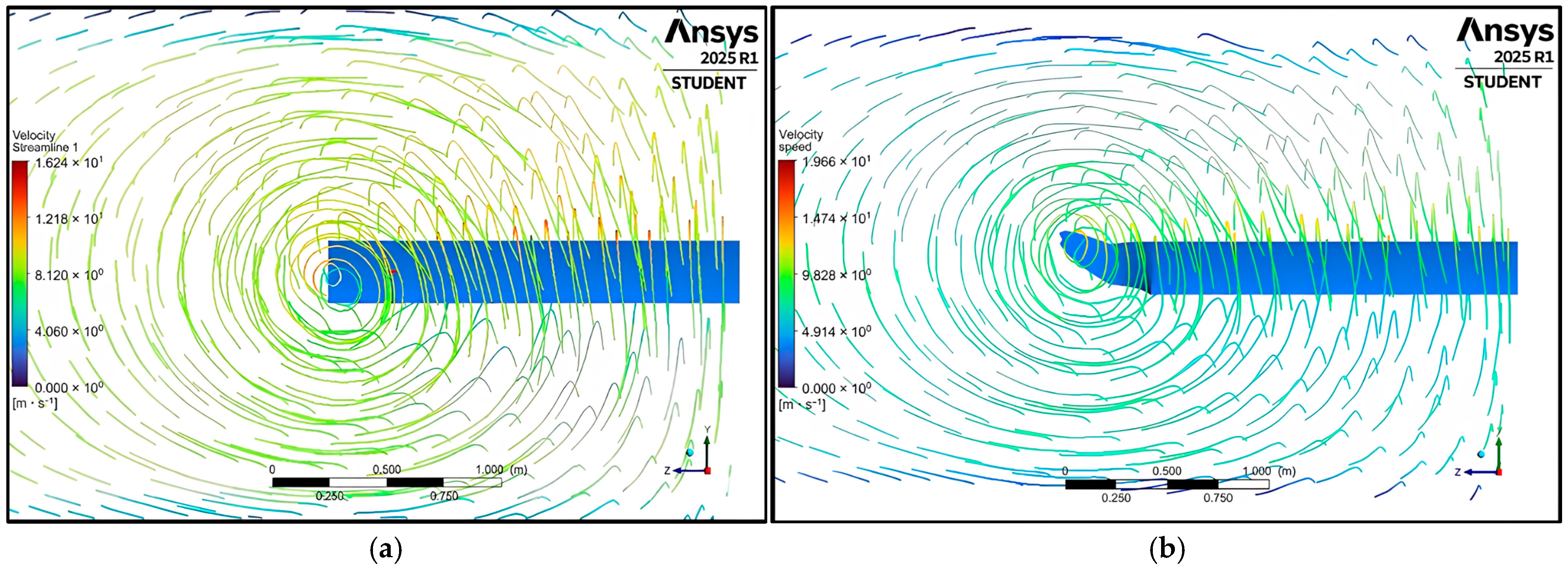
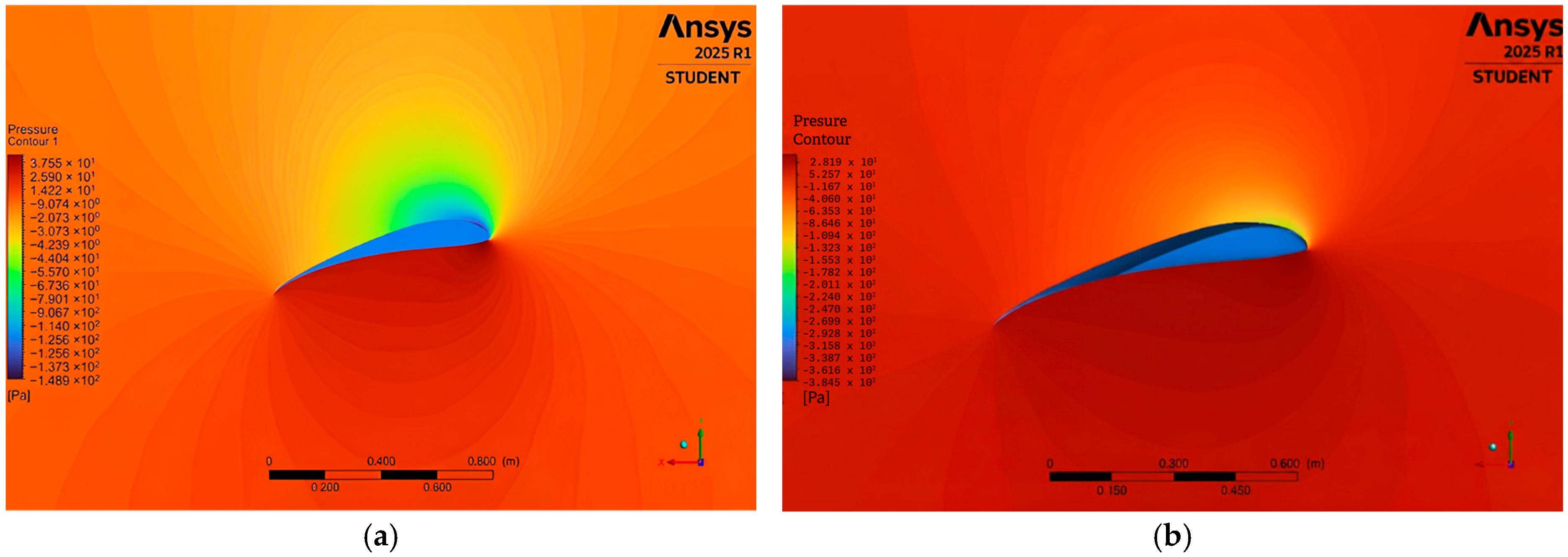
Figure 4 and
Figure 5 present CFD simulations that enable an analysis of how airfoil geometry influences pressure distribution and flow behavior. In
Figure 4a, corresponding to the straight-wing profile, a marked pressure difference between the lower and upper surfaces is observed, indicating greater local lift generation. However, this configuration also promotes the formation of wingtip vortices, caused by the displacement of air from the high-pressure region on the lower surface to the low-pressure region on the upper surface. This phenomenon increases induced drag and results in energy losses.
In contrast,
Figure 4b, which illustrates the winglet-equipped profile, shows a more uniform pressure distribution, suggesting a reduction in the intensity of marginal vortices and an improvement in aerodynamic efficiency. This behavior is further supported by the velocity contours shown in
Figure 5, viewed from the trailing edge of the wing. In the case of the straight-wing profile (
Figure 5a), a wide wake region is evident, associated with early boundary layer separation. This is characterized by the loss of flow adherence to the surface and the formation of large tip vortices, which increase velocity dispersion in the downstream region and contribute to induced drag.
On the other hand, the profile with winglets and vortex generators at the leading edge (
Figure 5b) exhibits a narrower and more organized wake. The vortex generators delay boundary layer separation, keeping the streamlines more attached to the surface, while the velocity magnitude in the downstream region is higher and more uniform. Taken together, these results indicate that the combination of winglets and vortex generators helps mitigate losses induced by wingtip vortices, promoting a more stable and uniform flow over the wing, which directly enhances lift and overall aerodynamic efficiency.
4. Discussion
The results obtained in this study confirm that the integration of winglets into agricultural VTOL UAVs can significantly enhance aerodynamic efficiency during cruise flight, increasing the lift-to-drag (L/D) ratio from a plain-wing baseline of 7.52 to 8.79, a 16.9% improvement. This finding aligns with the work of Nikolaou et al. [
21], who demonstrated that geometric optimization of winglets effectively redirects tip vortices, thereby reducing induced drag. Furthermore, the use of CFD for validating complex VTOL lifting surfaces is consistent with the methodology of Nugroho et al. [
15], who utilized similar simulations to assess the impact of empennage configurations on the performance of surveillance UAVs. However, unlike their surrogate modeling approach, the present study shows that even a basic winglet implementation can yield measurable improvements.
Similarly, Bardera [
18] explored the use of wingtip vortex generators to improve wake control in conventional fixed-wing UAVs. While his research focused on traditional configurations, the results presented here extend that logic to hybrid VTOL platforms, showing that the combination of winglets and vortex generators can mitigate aerodynamic losses during horizontal flight.
In terms of energy performance, Garg [
4] concluded that fixed-wing systems offer greater efficiency over long distances due to their ability to convert horizontal motion into lift. This necessity for efficiency is underscored by Courtin et al. [
13], who demonstrated that the power required for hover in VTOL platforms can be an order of magnitude higher than during cruise flight. This highlights the importance of the 55% power reduction achieved in the proposed design, as every efficiency gain in cruise is vital to offset the high energy cost of vertical phases. Additionally, Stahl et al. [
14] reported that configuration optimization can lead to variations of up to 34% in cruise range; the present findings reinforce this, showing that a fixed-wing hybrid configuration can support a payload of 927 N with the same energy expenditure as a 416 N multirotor.
While this study focuses on maximizing efficiency through passive geometric optimization, other research has explored active lift enhancement. For instance, Wang et al. [
12] achieved extremely high lift coefficients (
> 7.6) through propeller-induced interactions at low speeds. Although such configurations offer significant advantages for takeoff and heavy-lift capacity, they typically introduce design complexities and power penalties that may not be suitable for all mission profiles. In contrast, our approach prioritizes the use of high-lift airfoils like the SELIG 1223 and wingtip devices to ensure sustainable energy consumption during the extensive cruise periods required for precision agriculture.
Finally, in the agricultural context, Guebsi et al. [
3] and González et al. [
2] emphasized the importance of optimizing energy efficiency in UAVs deployed over large or irregular terrains. The results presented here provide technical evidence to support that need, offering concrete design strategies to improve performance in extended missions, particularly in regions like northern Mexico, where operational conditions demand both endurance and payload capacity.
5. Conclusions
This research provides a comparison of the aerodynamic advantages of integrating fixed-wing systems into agricultural VTOL (Vertical Take-Off and Landing) UAVs. A key factor in the efficiency difference between multirotor and fixed-wing configurations is that multirotor systems convert energy directly into vertical thrust, whereas fixed-wing systems generate lift through forward motion. Consequently, payload capacity can be significantly increased without raising energy consumption.
Specifically, the design based on the SELIG 1223 airfoil demonstrated that power requirements can be reduced by up to 55% compared to a multirotor system. To provide perspective, at a weight of 416 N in both cases, the fixed-wing UAV required only 2612 W, compared to 5824 W for the multirotor. Additionally, with a constant thrust of 416 N in both scenarios, the fixed-wing design was capable of supporting a load of 927 N, while the traditional configuration reached a limit of 416 N.
These findings offer a new direction for the development of agricultural drones designed to operate in the large or irregular terrains found in northern Mexico. While these results cannot be applied to all VTOL configurations, they establish a technical foundation for optimizing energy performance in long-duration missions. Future work will involve field validation to confirm these numerical findings under real-world operational conditions, as well as an assessment of acoustic noise levels to further optimize the environmental impact of the propulsion system. Finally, this work serves as a contribution for engineers, researchers, students, and producers seeking efficient and sustainable agricultural solutions.



 ,
,