1. Introduction
Recently, the application of Unmanned Aerial Vehicle (UAV) swarms in dynamic and complex scenarios has garnered increasing attention [
1,
2,
3,
4]. Boyd’s OODA loop model conceptualizes dynamic operational cycles as a continuous process of observation and reaction, where the party that executes the Observe–Orient–Decide–Act (OODA) loop more rapidly effectively gains operational advantage in response to environmental changes [
5]. In the context of UAV swarms deployed in dynamic scenarios, the traditional OODA loop is extended into a mission-oriented framework encompassing situation assessment, object recognition, mission planning, and maneuver decision-making [
6]. Within this framework, task allocation is central in mission planning, as it directly affects the operational efficiency and survivability of the swarm. UAVs can execute missions in both cooperative and non-cooperative scenarios [
7,
8]. In non-cooperative scenarios, UAV swarms typically conduct monitoring and interception missions against unauthorized objects [
9], where dynamic task allocation is required in response to uncertain object discovery and potential UAV loss. Compared to routine missions, such as surveillance [
10,
11,
12,
13,
14,
15,
16], transportation [
17,
18,
19,
20,
21,
22], and rescue [
23,
24,
25,
26], dynamic non-cooperative scenarios introduce greater uncertainty and risks, rendering dynamic task allocation significantly more challenging.
1.1. Related Work
Recent literature has seen an emerging focus on UAV swarm task allocation in complex dynamic scenarios [
27,
28,
29,
30]. As synthesized in [
31], the operational paradigm has shifted toward strategic interactions in contested environments, emphasizing the necessity of autonomous coordination under incomplete information. In parallel, recent energy-aware architectures [
32] and unified communication-control frameworks [
33] have been developed to enhance mission endurance and coordination tractability at the system level. Given the structural similarities between the multi-robot single-task (MRST) problem in robotics and UAV swarm task allocation in dynamic scenarios [
34], related robotics studies [
35,
36,
37,
38,
39,
40,
41,
42] provide practical insights for this research.
Studies addressing complex dynamic scenarios predominantly focus on cooperative exploration and mission engagement [
27,
29,
30,
43,
44]. Recently, the research paradigm has shifted toward intelligent decentralized coordination, employing bio-inspired mechanisms [
44] and strategic frameworks [
43] to facilitate autonomous group formation in contested environments. Concurrently, methodologies such as the SECA framework [
30] and multi-objective PSO [
29] have significantly improved operational efficiency. However, these advanced models often lack an explicit coupling between high-maneuverability requirements and nonlinear battery depletion. This omission creates a feasibility gap, where logically optimal assignments become physically unachievable due to unanticipated energy exhaustion.
Meanwhile, research on routine scenarios [
28,
35,
36,
37,
38,
39,
40,
41,
42,
45,
46,
47] is predominantly designed for stable settings. The current literature devotes more attention to coordination tractability and system reliability, such as resilient control for autonomous swarms [
45], stable heterogeneous scheduling [
46], and communication-aware strategies during task allocation [
47]. However, existing models still heavily rely on static resource buffers. These frameworks lack the mechanisms to cope with the stochastic volatility of non-cooperative objects, which necessitates frequent re-allocation and rapidly exhausts the resource margins assumed in traditional models.
1.2. Existing Issues and Analysis
The representative task allocation methods summarized in
Table 1 highlight a critical research gap: the integration of resource constraints into dynamic non-cooperative scenarios. Based on the synthesis of existing literature, we identify the technical challenges that render traditional deterministic models ineffective:
- 1.
In non-cooperative scenarios, the high degree of uncertainty in object states necessitates frequent, real-time task re-allocation. This dynamic process rapidly depletes pre-planned resource buffers [
48], making it difficult for traditional static methods to maintain mission continuity.
- 2.
Potential UAV loss or damage during engagement induces abrupt and nonlinear changes in total swarm capacity. Conventional allocation frameworks lack the operational resilience [
45] to adapt to such sudden structural fluctuations in available execution resources.
- 3.
The stringent requirements for high-maneuverability during interception significantly accelerate nonlinear battery decay. Traditional deterministic models often fail to account for this accelerated energy consumption, necessitating robust methods that couple resource-aware optimization with dynamic and complex scenarios.
1.3. Our Contributions
To address the aforementioned research gaps, this paper introduces the Dynamic Task Allocation Cooperative Strategy (DTACS) framework. The primary contributions are delineated as follows:
- 1.
Deviating from traditional models that overlook physical limitations, we formulate a dynamic allocation model that integrates non-linear battery depletion and discrete execution payload constraints. This provides a more rigorous representation of UAV operational capacities in hostile environments.
- 2.
Unlike conventional auction-based approaches that assume uniform task urgency, we develop a spatio-temporal priority value function. This enables the swarm to autonomously differentiate and prioritize high-urgency monitoring areas and high-threat targets, significantly improving mission responsiveness.
- 3.
We propose a cooperative interception logic characterized by dynamic activation thresholds. This mechanism transcends the limitations of individual engagement models by optimizing collective payload expenditure, ensuring robust mission success even under severe individual resource deficits.
The remainder of this paper is organized as follows.
Section 2 describes the dynamic and complex scenario and formulates the task allocation problem.
Section 3 presents the proposed DTACS method, including the cooperative engagement and execution resource allocation strategies.
Section 4 reports simulation results and performance comparisons. Finally,
Section 5 concludes the paper and discusses future research directions.
2. Scenario Description and Optimization Problem Modeling
This section describes the dynamic and complex scenario and formulates the task allocation optimization problem for resource-constrained UAV swarms. Given the emphasis on task allocation, including decision-making and task rescheduling in dynamic and complex scenarios, the task allocation layer is decoupled from the physical execution layer, and the task execution dynamics are not explicitly detailed.
2.1. Scenario Description
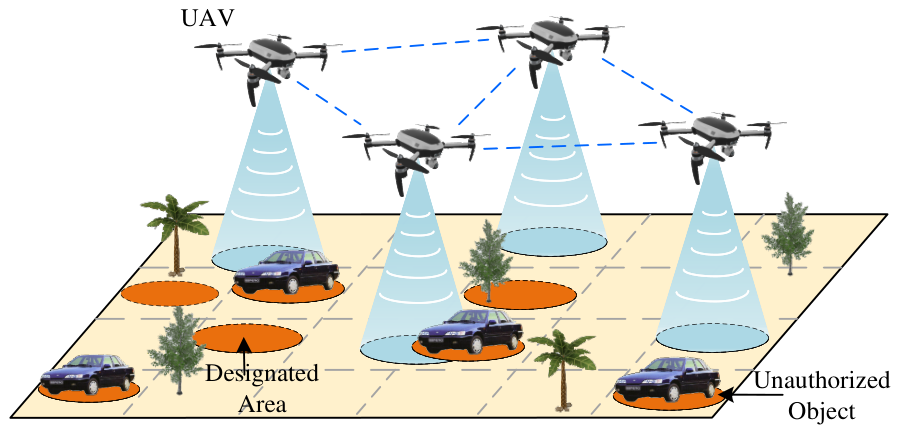
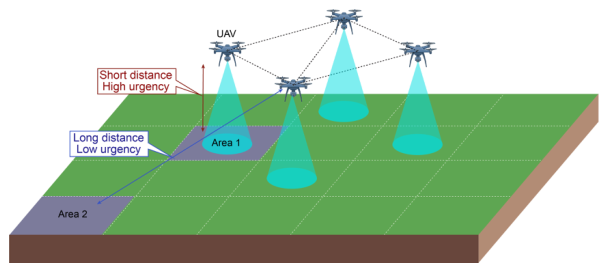
As shown in
Figure 1, the operational scenario considered involves a UAV swarm deployed to monitor multiple designated areas for the detection and neutralization of unauthorized objects. The mission comprises two primary task types: monitoring and interception.
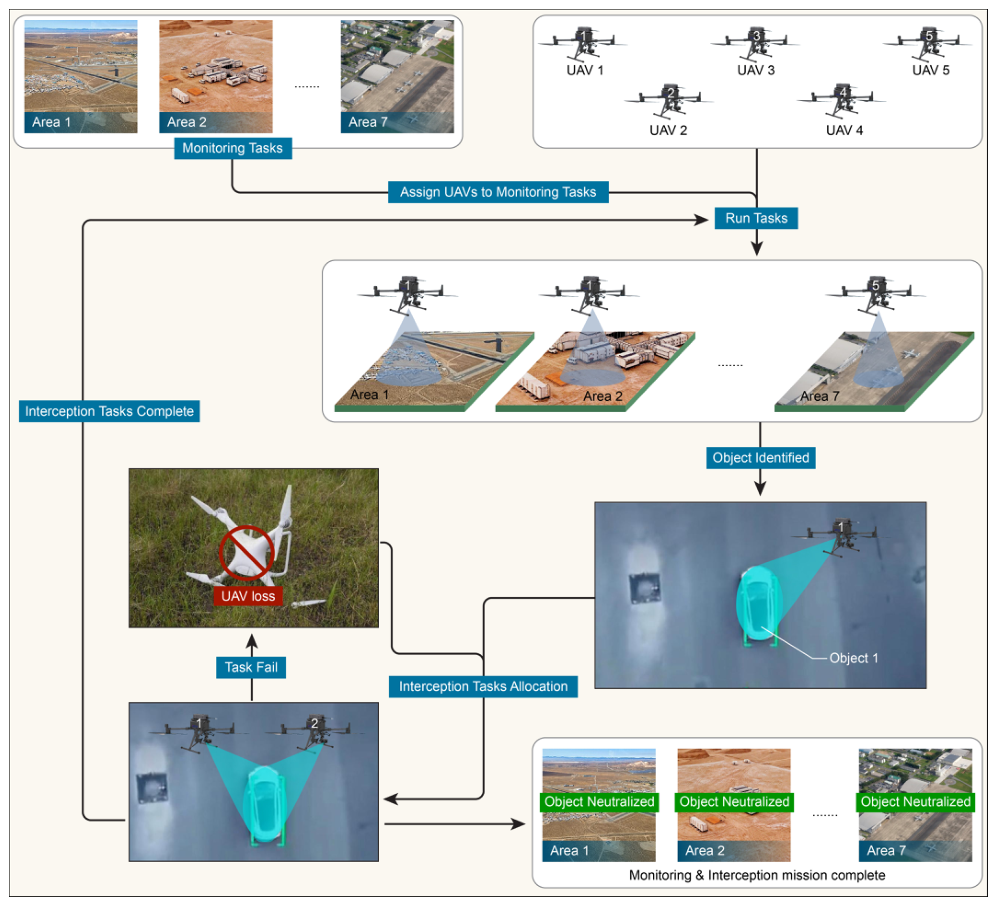
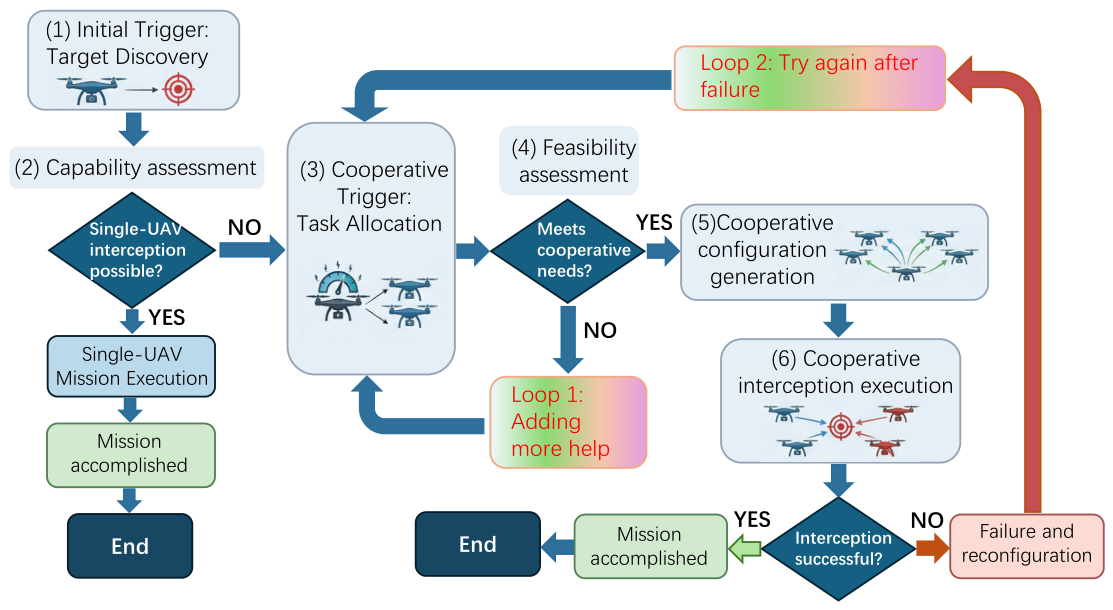
The mission workflow is further detailed in
Figure 2. Initially, UAVs are pre-allocated to perform persistent monitoring tasks across the designated regions. Upon the identification of an unauthorized object, a corresponding interception task is generated. Depending on the object’s neutralization requirements and the swarm’s real-time resource status, interception may be executed independently by a single UAV or cooperatively by multiple units.
Each UAV is subject to strict resource constraints: battery capacity and onboard execution payloads. These resources are consumed irreversibly during mission execution. The objective is to optimize task allocation to promote high mission success rates while maximizing the survivability of the resource-constrained swarm.
2.2. Fundamental Definitions
The UAVs, designated areas, unauthorized objects, and UAV tasks considered in the monitoring and interception scenario are defined in this subsection.
2.2.1. UAV
Let denote the set of UAVs, where is the number of UAVs. The state of is defined as , where is the real-time position of , and is the velocity of . denotes its remaining battery level, modeled as equivalent flight mileage to map energy depletion to spatial displacement, and represents finite, irreversible discrete payloads for target neutralization. A UAV with is excluded from further task allocation, while one with is excluded from further interception tasks. is updated following each engagement.
The UAVs in this study are modeled as point-mass agents governed by the velocity . This abstraction aims to balance the fidelity of mission-level coordination with the computational efficiency required for real-time swarm operations.
While the point-mass model omits low-level nonlinear dynamics, we argue that the potential gap between this abstraction and real-world kinematic boundaries does not lead to significant mission-level deviations. This is because mission-level task assignment is functionally decoupled from individual platform control. Furthermore, the inherent robustness of the proposed coordination logic acts as a functional safety buffer. By incorporating adaptive decision criteria detailed in
Section 3, the swarm can effectively absorb residual boundary uncertainties and maintain high survivability.
2.2.2. Designated Area and Unauthorized Object
represents designated areas to be monitored. Each designated area is associated with a state , where specifies its coordinates and denotes its initial monitoring deadline.
At most one unauthorized object is embedded within each designated area. The state of the area with one object is , where denotes the position of the object, which coincides with the position of , and denotes the true amount of true execution payload requirement for neutralizing object k. Upon object acquisition, the UAV estimates the target’s required execution payload. Owing to sensing uncertainty, may deviate from the true value and is updated after each engagement. Consequently, the information available to the UAV for object k is .
Each designated area requires a single UAV to monitor, whereas a interception task may require multiple UAVs, depending on the remaining execution payloads of the UAV that identifies the object. If the remaining execution payloads is sufficient, the interception is executed independently; otherwise, a cooperative interception by multiple UAVs is required.
2.3. Task Allocation Optimization Problem Modeling
The optimization objective is to maximize the UAV survival and task completion rates under resource constraints. The UAV survival rate is defined as the remaining number of intact UAVs following task execution, while the task completion rate is the number of successfully completed tasks.
Distinct from many existing studies that prioritize the minimization of execution time [
42,
49], this work adopts task completion and UAV survival rates as the primary optimization objectives. The rationale is twofold: First, in dynamic response environments, a higher completion rate reflects a more rational alignment of resources, which minimizes the likelihood of redundant task re-assignments and additional travel distances caused by initial mission failures. By maximizing the probability of fulfillment in the first attempt, the system inherently reduces cumulative resource consumption and achieves a statistically shorter overall execution time. Second, in the complex and dynamic scenarios, the cost of losing a UAV is non-linear; it represents a sharp and often irreversible contraction of the swarm’s functional capacity. Maintaining a mission-ready resource buffer through enhanced survivability is essential for handling the stochastic nature of object discovery under strict resource limits. This shift in focus ensures that the proposed strategy supports long-term operational sustainability rather than merely pursuing short-term efficiency.
The objective function consists of the monitoring and interception components. Prior to task execution, designated areas are assigned to UAVs according to the solution of the monitoring task allocation problem in (
1)–(
4) below. Upon object acquisition, UAVs are dispatched for interception tasks based on the solution of the interception task allocation problem in (
10)–(
12).
2.3.1. Monitoring Task Allocation Optimization Problem Modeling
In (
1),
refers to the reward for
to monitor
. The binary variable
indicates that
is assigned to
, whereas
indicates otherwise. Constraint (
3) ensures that each monitoring task is assigned to no more than one UAV. In (
4),
represents the flight distance required for
to execute the monitoring task, while
specifies its maximum flight distance. The optimization problem defined by (
1)–(
4) is intrinsically non-convex due to the binary nature of the decision variables
in (
2). This formulation represents a Mixed-Integer Linear Programming (MILP) problem, which is generally NP-hard. The discrete search space prevents the application of standard gradient-based convex optimization. Furthermore, the heterogeneous resource constraints in (
4) couple the assignments of different UAVs, significantly increasing the computational complexity as the swarm size
and task set
expand. Finding a global optimum in real-time under such constraints is computationally challenging for dynamic onboard execution.
To overcome these challenges, the DTACS framework leverages an auction-based mechanism. Compared to traditional centralized optimization, this approach provides high-quality, near-optimal solutions with polynomial-time complexity. This significantly reduces the computational burden while ensuring the rapid generation of feasible assignments under stringent resource and kinematic constraints.
Remark 1. Most existing studies on UAV swarm task allocation in dynamic and complex scenarios neglect onboard resource limitations, such as battery and execution payloads [27,28,29,30], since considering them increases problem complexity. In contrast, this work explicitly incorporates these resource constraints into the task allocation model and proposes DTACS to improve UAV survivability and mission success rates within a monitoring and interception framework. The reward term
in (
1) is defined as follows:
where
quantifies the reward for
to monitor
, and
is the Manhattan distance between
and
, representing the expected traversal cost. The coefficients
and
balance the relative contributions of the reward and cost terms, acting as regulators for the trade-off between search efficiency and energy endurance. By adjusting these weights, the framework can prioritize the rapid coverage of high-uncertainty areas while ensuring the long-term physical sustainability of the UAV swarm during persistent monitoring. The computation of
is detailed below:
is the base reward for
to monitor
.
is the reward decay coefficient with task duration, and
denotes the moment when
initiates the monitoring of
. The initial monitoring deadline
is defined in
Section 2.2. In search missions, the reward decay represents the cost of late discovery. Delaying discovery postpones the initiation of subsequent response actions, thereby reducing the overall tactical advantage. This exponential decay is introduced to characterize the operational urgency and diminishing marginal utility of time-critical missions [
50,
51]. This formulation functions as a temporal penalty mechanism to incentivize mission responsiveness, ensuring that the UAVs prioritize missions with higher immediate tactical value to maximize the global mission efficiency.
Although existing studies rarely specify these base rewards [
28,
29,
52,
53,
54], task priorities should vary across areas and objects in practical scenarios. The value of
depends on the distance between UAVs and designated areas, as detailed in
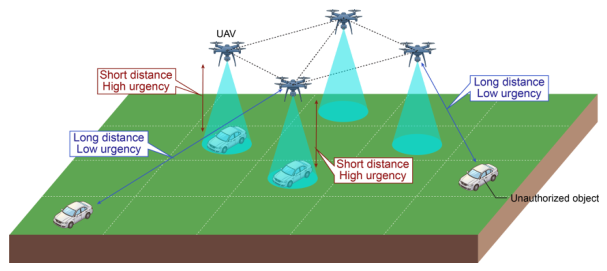
Section 3. As illustrated in
Figure 3,
is closer to the UAV swarm than
. Since a potential unauthorized object in
is closer to the defensive perimeter formed by the swarm, it compresses the time available for task planning and engagement. Consequently, monitoring
is prioritized to ensure early identification and subsequent response. This distance-based assessment can focus limited resources on regions with higher monitoring urgency.
Accordingly, the base reward for monitoring tasks is modeled by the average distance between
and the UAV swarm. The average distance is defined as
where
represents the distance between
and the
. The corresponding task reward is
With this definition, a smaller
means a larger
, thereby assigning a higher monitoring priority to higher-urgency areas.
The formulation of
is as follows:
where
represents the current position of
and
measures the distance from
to
. For simplicity, the Manhattan metric is adopted.
2.3.2. Interception Task Allocation Optimization Problem Modeling
indicates the number of unauthorized objects detected, and
denotes the reward for
for to intercept an object in
. The variable
indicates that the interception task is assigned to
, and
otherwise. Similar to the model in (
1)–(
4), the interception task allocation defined by (
10)–(
13) is a non-convex and NP-hard optimization problem due to the binary constraints and coupled resource limitations.
The value function
in interception task allocation is defined as
where
measures the distance from
to object
j, and
quantifies the reward for executing interception task
j. The coefficients
and
weight the reward and distance terms, respectively. Similar to (
5), these parameters regulate the trade-off between interception urgency and energy-related operational costs.
is set as
where
represents the base reward for
to intercept an object in
. The decay factor
reflects task duration, and
denotes the neutralization completion time.
is the expected interception deadline.
As in
,
is defined to incorporate both distance and neutralization success probability. As illustrated in
Figure 4, unauthorized objects closer to the UAV swarm warrant higher interception urgency. In addition, the likelihood of successful neutralization is considered, and the base reward for interception tasks is defined as
where
is a parameter measuring the success rate of neutralization, which is defined as
If
exceeds
,
is defined as their ratio; otherwise,
. Equation (
17) biases and therefore favors assigning interception tasks to UAVs with a higher probability of successful neutralization.
Remark 2. While existing studies rarely provide an explicit formulation for base rewards within the objective function [27,29,30], the reward design in this work is grounded in utility theory, specifically adopting the spatial urgency criterion. By formulating and as functions of the distance reciprocal, the coordination logic inherently aligns the optimization process with the swarm’s key performance indicators, namely travel cost, mission responsiveness, and survivability. This utility-based structure, supported by multi-agent resource allocation principles [34,55], enables limited resources to be effectively matched to tasks based on both geospatial priority and functional suitability, providing a rigorous mathematical basis for mission-level task allocation. Consistent with the monitoring task formulation, UAV resource constraints are considered in (
12). Consistently, (
13) enforces the payload constraint for interception tasks, where
indicates the execution payload consumption of
for task
j. Similar to the model in (
1)–(
4), the interception task allocation defined by (
10)–(
13) is a non-convex and NP-hard optimization problem due to the binary constraints and coupled resource limitations.
3. Proposed Algorithms
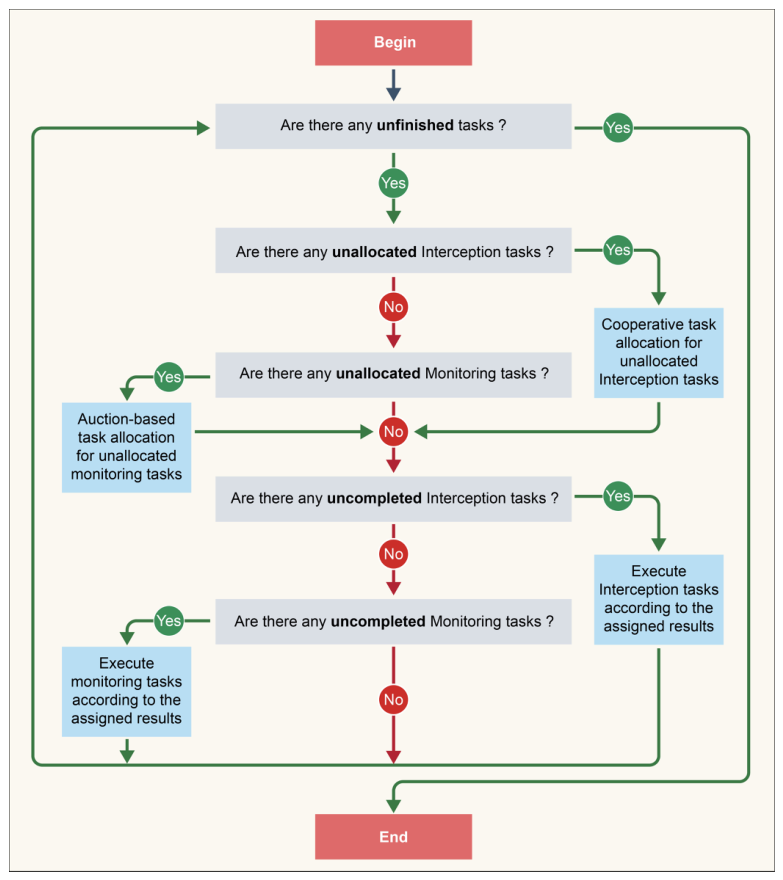
An auction-based task allocation algorithm is developed for UAV swarms conducting monitoring and interception in dynamic and complex scenarios. The overall allocation workflow is illustrated in
Figure 5. Unassigned tasks are iteratively allocated to optimal UAVs based on reward, and execution follows the allocation.
The workflow terminates upon completion of all tasks or the conclusion that resource constraints preclude task execution. A cooperative interception strategy is further proposed to address UAV selection, termination conditions, and execution payload allocation. Details are provided in
Section 3.2.
3.1. Auction-Based Monitoring and Interception Task Allocation Algorithm
Algorithm 1 defines the iterative decision-making logic that coordinates the swarm’s response to dynamic environmental changes. To maintain a rigorous coupling between mission requirements and available resources, the algorithm manages two primary data structures: Task List and Allocation List (Lines 4–5). Task List serves as a dynamic queue that distinguishes between persistent monitoring slots and reactive interception requirements, while Allocation List functions as a real-time state estimator, tracking the precise depletion of battery levels and execution payloads for every active unit.
The allocation phase (Lines 6–12) is executed through a priority-driven auction mechanism. In each iteration, the algorithm sorts
Task List to prioritize interception over monitoring, ensuring that newly identified threats receive immediate resource commitment. For each candidate pairing, a reward value
is computed to maximize global operational utility. If the payload requirement registered for a specific object exceeds the capacity of a single UAV, the algorithm flags the task for a multi-UAV cooperative sequence rather than attempting an insufficient single-unit assignment, as further detailed in the subsequent strategy analysis.
| Algorithm 1 Auction-based Monitoring and Interception Task Allocation Algorithm |
- 1:
Input: UAV states , designated area states . - 2:
Initialize environment - 3:
while incomplete tasks exist and UAVs available do - 4:
Update Task List (IDs, coordinates, status, deadlines) - 5:
Update Allocation List (UAV poses, execution payloads, status, battery) - 6:
if unallocated interception task exists then - 7:
Select UAVs for all interception tasks - 8:
else if unallocated monitoring task exists then - 9:
Calculate for each UAV i and unallocated area j - 10:
- 11:
Set task as Allocated in Task List and Allocation List - 12:
end if - 13:
if incomplete interception task exists then - 14:
Coordinate interception on all active targets - 15:
else if incomplete monitoring task exists then - 16:
for all unmonitored object Task List do - 17:
UAV i moves to area j - 18:
if object identified in area j then - 19:
Update status in Task List and Allocation List - 20:
end if - 21:
Set task j as Completed; - 22:
Update - 23:
end for - 24:
end if - 25:
end while
|
During the execution phase (Lines 13–24), the algorithm acts as a synchronization engine between physical outcomes and logical states. Any identification event recorded by a monitoring unit triggers a state synchronization of Task List (Line 19), effectively injecting a new interception mission into the subsequent allocation cycle. Similarly, the outcomes of engagement, whether successful neutralization or unit loss, prompt an immediate update to Allocation List (Line 22). This closed-loop feedback ensures that all subsequent auction cycles are predicated on the actual remaining capacity of the swarm, maintaining the feasibility of the mission plan under strict resource constraints.
The proposed allocation framework distinguishes itself through a targeted procedural adaptation for integrated surveillance-response cycles. Unlike generic auction models, the base reward is explicitly engineered as a utility tool that maps to three core optimization pillars: travel cost, completion rate and survival rate. This promotes that the centralized coordinator inherently prioritizes high-urgency objectives based on their relative proximity and the swarm’s functional capacities.
To evaluate the real-time performance of the proposed DTACS, we analyze its computational complexity. Let and denote the number of UAVs and monitoring areas, respectively. In the auction-based allocation (Algorithm 1), the reward matrix calculation requires operations. Since one task is assigned per iteration, the total complexity for monitoring task allocation is . Similarly, for interception tasks with objects, the complexity is . Given that , , and are typically bounded in practical swarm operations, the polynomial complexity enables that DTACS can be executed in real-time on resource-constrained onboard computers.
3.2. Cooperative Interception Strategy
The cooperative interception strategy mentioned in
Section 3.1 is specified here, and the workflow is shown in
Figure 6.
Key issues involved in cooperative interception task allocation include selecting UAVs to maximize the reward function and defining appropriate iteration termination conditions [
42], which are not fully addressed in existing studies [
28,
29]. To this end, a cooperative interception strategy is proposed with specified initiation criteria, UAV selection rules, termination conditions, and payload allocation.
The cooperative interception strategy comprises the UAV selection and payload allocation phases. The UAV selection phase relies on a threshold
defined as follows:
where
is the maximum error between the payload requirements of object
j and its true value, which is determined from historical data. Accordingly,
must satisfy:
Satisfying (
19) allows
to neutralize object
j. Let
represent the ratio of
to the
, the above inequality can be expressed as
Inequality (
20) serves as a decision boundary for response modes:
The threshold
in (
18) functions as a safety-critical boundary derived from the real-time statistical tracking of payload uncertainty
. Specifically,
is estimated by recording the peak discrepancies between sensed and actual objective requirements over previous mission intervals. Physically, it provides a capability buffer for single-UAV responses to guarantee mission reliability under data inaccuracies. The sensitivity of
represents a trade-off between mission safety and resource efficiency: an underestimated
increases the risk of individual failure due to insufficient payload, while an excessive
triggers coordination redundancy and resource over-allocation. By coupling
with the statistical error
, the strategy maintains operational robustness across varying sensor fidelities beyond specific simulation setups.
3.2.1. UAV Selection Phase
Based on the above definition, Algorithm 2 outlines the UAV selection procedure for cooperative interception. This phase is triggered when unfulfilled interception tasks exist in
Task List (line 2). Upon identifying an object in
,
evaluates whether a cooperative interception is required according to (
20) (lines 6 and 8). If not, interception task
j is marked as allocated (lines 6–7). Otherwise, the reward is computed for all UAVs not yet assigned to task
j (lines 8–9), as expressed below:
The parameters in (
22) are defined consistently with those in (
13) and (
14). With
calculated, the UAV–task pair yielding the maximum reward is identified (line 12). The status of
is then updated to
allocated for task
(line 13). UAV availability is checked following each assignment. If interception tasks remain unassigned and no UAV is available, task
j is marked as
incomplete.
| Algorithm 2 Selecting UAVs for Cooperative Interception |
- 1:
Input: Task List, Allocation List, - 2:
while unallocated interception tasks exist and UAVs available do - 3:
for all unallocated interception task Task List do - 4:
Compute for all UAVs i assigned to task j - 5:
Calculate - 6:
if then - 7:
Mark task j as Allocated in Task List - 8:
else - 9:
Calculate reward for each available UAV i and target j - 10:
end if - 11:
end for - 12:
Select the maximum , the corresponding UAV and task . - 13:
Update UAV status to Allocated for task in Allocation List - 14:
if unassigned interception tasks exist and no UAVs available then - 15:
Mark remaining tasks j as Incomplete in Task List - 16:
end if - 17:
end while
|
Inspired by [
42], Algorithm 2 defines an iteration termination criterion consistent with the corresponding initiation criterion (lines 6 and 8), while differing in the interpretation of allocated execution payloads. At initiation, only
is assigned to interception task
j, yielding a total allocated payload of
, and
. At termination,
represents the cumulative payload of multiple UAVs allocated to task
j.
Remark 3. Unlike [42], the object payload requirement is uncertain in this study and cannot be fully identified prior to initial monitoring. Consequently, the required number of UAVs for object neutralization is determined through the iteration termination criterion in (20). 3.2.2. Payload Allocation Phase
To improve task completion rate under resource constraints, an payload allocation strategy is proposed, as expressed in Algorithm 3.
| Algorithm 3 Cooperative Interception of Unneutralized Objects |
- 1:
Input: Task List, Allocation List, . - 2:
while incomplete interception tasks exist and UAVs available do - 3:
for all unallocated incomplete tasks Task List do - 4:
for all UAV i allocated to task j do - 5:
Update - 6:
UAV i proceeds to object j - 7:
Sort dispatched UAVs by (ascending) - 8:
Neutralize target j in sequence - 9:
Update UAV payload and object state - 10:
end for - 11:
if then - 12:
Mark task j as Completed in Task List - 13:
else - 14:
Update and mark task j as Unallocated - 15:
Set dispatched UAV status to Inactive - 16:
Reset all tasks assigned to this UAV to Unallocated - 17:
end if - 18:
Update - 19:
end for - 20:
end while
|
In the case of incomplete interception tasks (line 2), the total payloads of the dispatched UAVs is calculated (lines 3–5). Each UAV then proceeds to target j.
In the case of unfulfilled interception tasks (line 2), the cumulative payload of the dispatched UAVs is calculated (lines 3–5). Each UAV then proceeds to designated area j.
Upon arrival at the target, the UAV with the lowest battery among the dispatched ones executes the interception first, and the payload consumption is likely the lowest (lines 7–8). By expending payload from lower-energy UAVs first, this strategy preserves more resources (UAVs with higher battery levels) for subsequent missions, thereby improving overall task completion.
Upon arrival at the designated area, the UAV with the lowest energy level among the dispatched units executes the interception first, and the payload consumption is likely the lowest (lines 7–8). By deploying execution payloads from lower-energy UAVs first, this strategy preserves more mission-ready resources (UAVs with higher energy levels) for subsequent tasks, thereby improving overall mission success.
Following object neutralization, the payloads of the dispatched UAVs and object j are updated (line 9). If the cumulative payload of the dispatched UAVs matches or exceeds the identified requirement of object j, the interception is successful, and the status of task j in Task List is updated to Completed (lines 11–12). Otherwise, the interception fails, and all dispatched UAVs are marked as Inactive due to resource depletion or system failure (lines 14–16). In the case of interception failure, the payload requirement of object j and the status of interception task j in Task List are updated (lines 15–17). Once the interception process is completed, in Allocation List is updated (line 18).
Remark 4. While existing research on UAV swarms often overlooks dynamic resource constraints and explicit payload management [27,29,30], the proposed strategy integrates payload requirement estimation errors into the operational logic to enhance task reliability. The fundamental contribution lies in providing explicit operational boundaries, including rigorous initiation and termination criteria for multi-UAV joint actions. Furthermore, by optimizing functional resource expenditure relative to energy endurance, the strategy facilitates a deterministic transition from individual response to cooperative mode. This addresses the inherent uncertainty in objective demands and results in superior operational efficiency over conventional approaches [27,28,29,30] that fail to account for evolving mission requirements. 4. Simulation Results and Performance Analysis
Simulation experiments are conducted in MATLAB R2024a on a PC with an Intel Core i5-12400F CPU and 16 GB RAM. A 3-D longitude–latitude–altitude space is defined to simulate the airspace, with the longitude and latitude ranging from . The terrain data were sourced from Google Maps.
The simulation framework is designed to systematically evaluate the effectiveness and robustness of DTACS across multiple dimensions. First, the statistical robustness is verified by observing the average performance metrics over varying experimental iterations within the same simulation scenario. The scalability and operational boundaries of the system are then analyzed by scaling the number of UAVs from 5 to 20 and expanding the number of areas to observe the evolution of performance parameters under increasing complexity. Furthermore, ablation studies are conducted on the fundamental reward functions, coordination thresholds, and cooperative mechanisms, complemented by a sensitivity analysis of performance under different battery endurance limits to deeply resolve the influence of internal mechanisms on decision outcomes. Finally, the proposed algorithm is benchmarked against three representative methods to demonstrate its performance in terms of travel cost, survival rate, and completion rate.
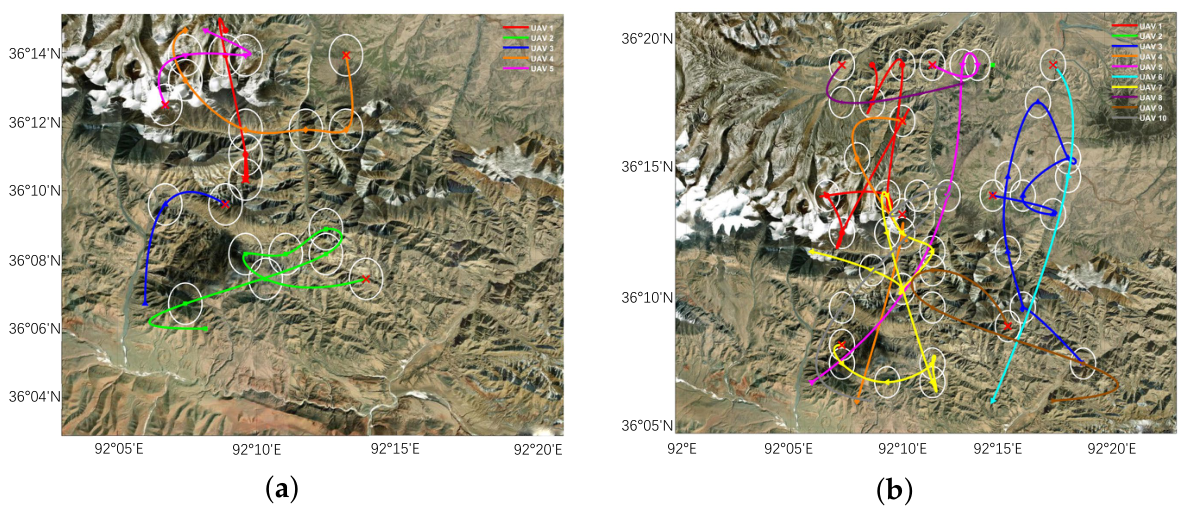
The simulation scenarios are categorized into four distinct scales, comprising five, 10, 15, and 20 UAVs, respectively. The specific parameter configurations and scenario setups tailored to each simulation type are detailed within their corresponding subsections. Robustness analysis and comparative performance evaluations are conducted within the five-UAV and 10-UAV scales to ensure a consistent baseline for reliability and benchmarking. Sensitivity analyses are performed specifically within the five-UAV scenario. To thoroughly assess the system’s operational boundaries, the scalability analysis encompasses all four simulation scales. As the primary scenarios, the five-UAV and 10-UAV simulation cases are depicted in
Figure 7.
To verify the robustness of results, the mission environment is randomized across each run, where monitored areas are generated using a two-dimensional discrete uniform distribution with a strict non-overlap constraint. Within these areas, this study employs a deterministic discovery mechanism where a task objective is identified immediately upon a UAV’s arrival at its localized position. The dynamic complexity is further enhanced by the stochastic generation of task objectives, whose positions are randomly localized within the monitored areas and assigned heterogeneous payload requirements within the range of
. These randomized settings, coupled with the real-time appearance of tasks, evaluate the algorithm’s adaptability in unpredictable and resource-constrained scenarios. To maintain a fair assessment, the core algorithmic parameters remain consistent across all simulations as detailed in
Table 2. These values are assigned based on the general mission requirements. Notably, they are maintained as a robust baseline throughout all scenarios without case-specific optimization to ensure the objectivity and generalization of the comparative results.
The performance of DTACS is evaluated using four key metrics. Travel cost is the total flight distance of the swarm, while completion rate and survival rate represent the percentage of finished tasks and active UAVs at the mission’s end, respectively. Computation time, used in scalability analysis, denotes the average duration of a single task allocation cycle. Notably, as a primary indicator, an improved Survival Rate preserves the swarm’s operational capacity, thereby effectively enhancing other performance metrics.
4.1. Robustness Analysis
During robustness analysis, the performance metrics were averaged across different experiments.
Table 3 details the initial positions and heterogeneous payload capacities of the UAVs. To validate DTACS under varying response conditions, each UAV was assigned a unique payload capacity (an integer from 1 to 100), facilitating both cooperative interception and potential resource depletion. Across the 20 monitored areas, 10 unauthorized objects were randomly distributed. To ensure robustness, the coordinates of monitored areas and objects, along with the objects’ payload requirements, were randomly generated for each experimental iteration.
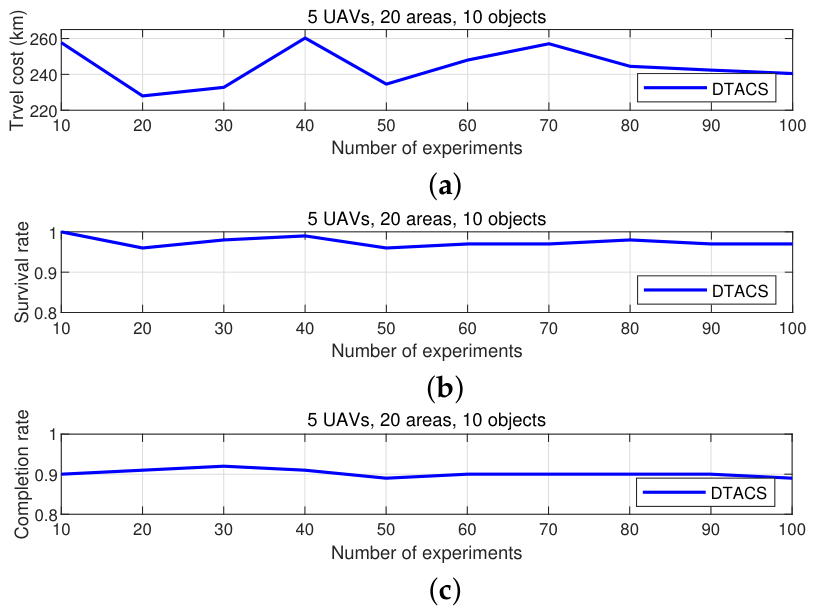
Figure 8 illustrates the performance metrics across 10 to 100 experimental iterations with the five-UAV configuration. As shown in
Figure 8a, the average traversal cost per UAV stabilizes at approximately 250 km. The minor fluctuations are attributed to the randomly generated monitored area coordinates and the increased maneuvering for cooperative interception. According to
Figure 8b,c, DTACS maintains a consistent average UAV active rate of 97% and a task completion rate of 90%, regardless of iteration counts. The residual incomplete tasks are primarily attributed to the strategy’s risk-preservation logic: UAVs with insufficient aggregate payloads opt to suspend interception tasks, thereby prioritizing survivability over unachievable objectives.
The 10-UAV configuration represents scaled-up scenarios with a larger number of UAVs and monitored areas. The initial states for the UAV swarm, including unique starting positions and heterogeneous payload capacities, are detailed in
Table 3. Across the expanded 40 monitored areas, 20 unauthorized objects were randomly distributed. Consistent with the previous evaluation, both the objects’ payload requirements and area coordinates were randomly generated.
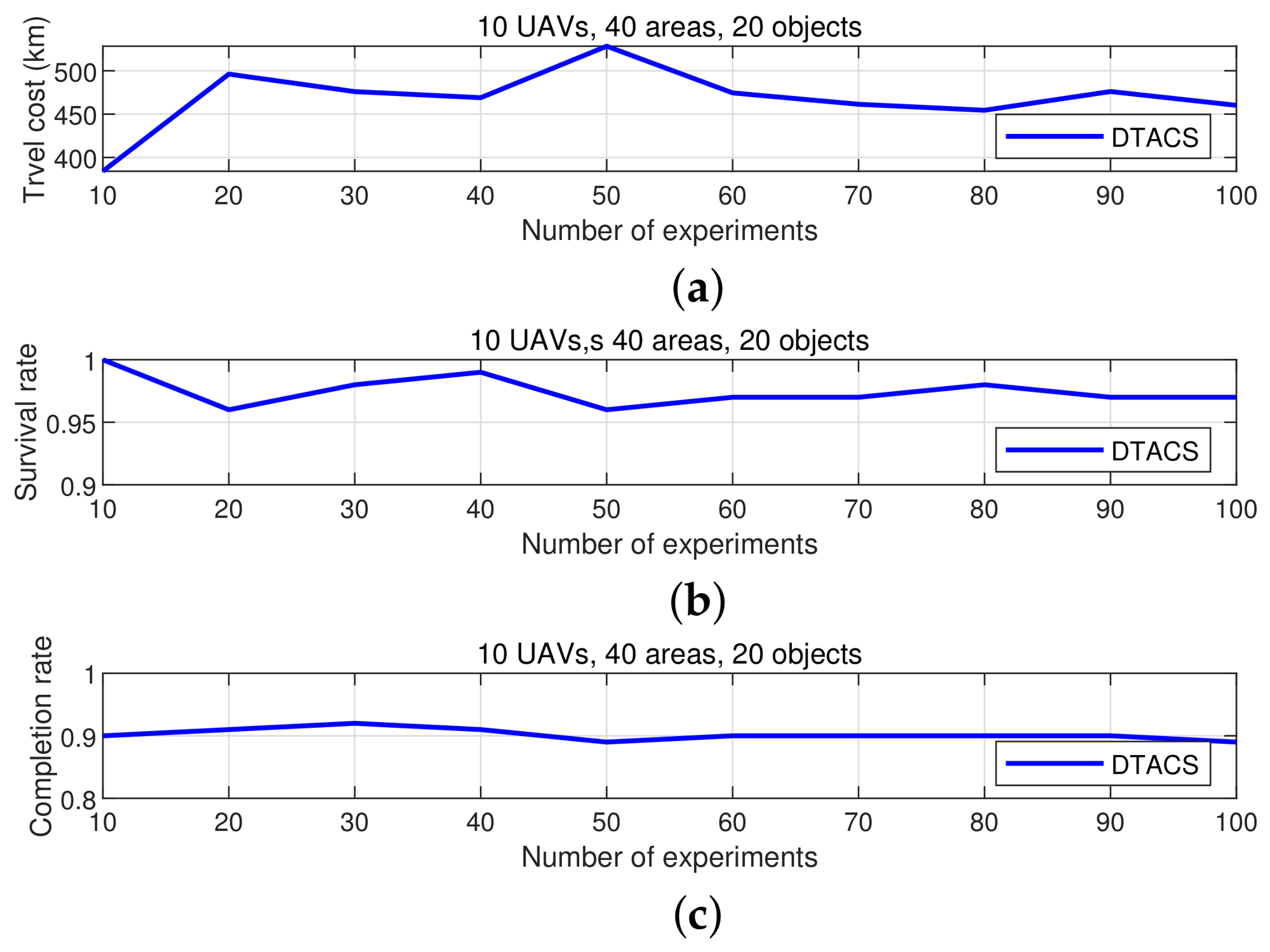
The results of the 10-UAV experiments are presented in
Figure 9.
Figure 9a, shows that DTACS maintains an average traversal cost of approximately 450 km for the UAV swarm in this scenario. The higher traversal cost compared to the five-UAV experiments is primarily due to the increased number of tasks. Additionally, the average traversal cost shows more pronounced fluctuations, mainly due to the expanded range of monitored areas as the map size increases.
Figure 9b indicates that the scale-up does not reduce the UAV survival rate. On the contrary, the survival rate remains close to 100% across different experimental iterations.
Figure 9c demonstrates that DTACS achieves a stable mission fulfillment rate, thereby validating its effectiveness in more complex scenarios.
4.2. Scalability Analysis
In this section, we evaluate the scalability of the DTACS framework across four swarm scales, ranging from five to 20 UAVs. The analysis focuses on Travel Cost, Survival Rate, Completion Rate, and Computation Time. To maintain consistent operational challenges as the swarm grows, the monitoring area and objective density are scaled accordingly, with specific configurations summarized in
Table 4.
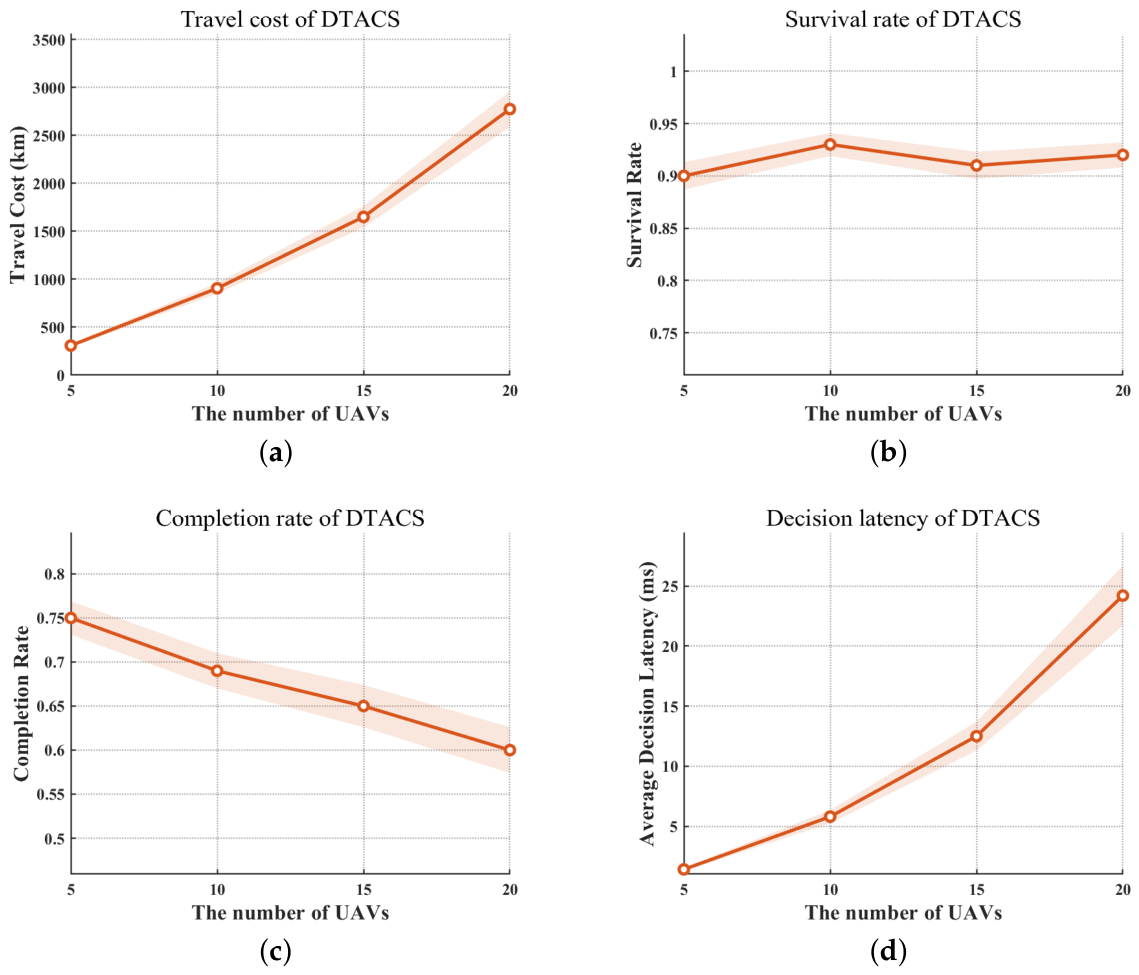
The simulation results across different swarm scales are illustrated in
Figure 10, providing a comprehensive evaluation of the DTACS framework’s scalability. In
Figure 10a, the total travel cost exhibits a near-linear growth as the number of UAVs increases from five to 20. This trend is consistent with the experimental setup where the monitoring area and task volume are scaled proportionally with the swarm size. The results indicate that the algorithm maintains stable path-planning efficiency without exponential distance inflation at larger scales. Notably, in
Figure 10b, the survival rate remains remarkably stable, fluctuating within a narrow range above 0.9 regardless of the swarm scale. This demonstrates the robustness of the proposed situation-aware mechanism, which effectively preserves the swarm’s operational integrity even as the complexity of the adversarial environment increases. While the completion rate in
Figure 10c shows a gradual downward trend as the scale increases, it remains within an acceptable performance envelope. This decline is primarily attributed to the increased coordination overhead and the heightened probability of task conflicts in high-density scenarios. However, the relatively gentle slope suggests that DTACS successfully mitigates the impact of scaling on overall mission success. As shown in
Figure 10d, the average decision latency increases with the swarm size but remains at a millisecond level. This low latency confirms that DTACS is well-suited for real-time task allocation within the evaluated range.
Beyond these numerical results, the scaling trends observed in the 5–20 UAV scenarios provide further insights into the operational boundaries of the DTACS framework. While the current logically centralized coordination ensures superior global optimality, it inherently relies on periodic state synchronization. The millisecond-level decision latency and the low-bandwidth metadata exchange observed in our tests suggest that for swarms of this scale, these centralized constraints do not yet constitute a performance bottleneck. However, we recognize that as the swarm scale increases further, the reliance on a single coordination node could introduce potential vulnerabilities regarding communication reliability and single-point failures. The lightweight and platform-independent nature of the DTACS algorithm provides a foundational capability for future integration of dynamic redundancy to mitigate these risks. This experimental evidence serves as a baseline for transitioning toward a hierarchical architecture, where the core DTACS logic could be adapted for autonomous sub-clusters to balance coordination gains with the robust fault tolerance required for larger-scale distributed operations.
4.3. Sensitivity Analysis
In this part, we analyze the sensitivity of task allocation performance to key parameters and constraints. The simulations are sequentially organized into four categories: base reward parameters ( and ), the threshold parameter (), the coordination mechanism, and battery capacity limits. All experiments are conducted in a five-UAV scenario with 20 monitoring areas to ensure a consistent baseline for comparison.
4.3.1. Sensitivity Analysis of Base Reward
The impact of the base reward parameters (
and
) on task allocation performance is illustrated in
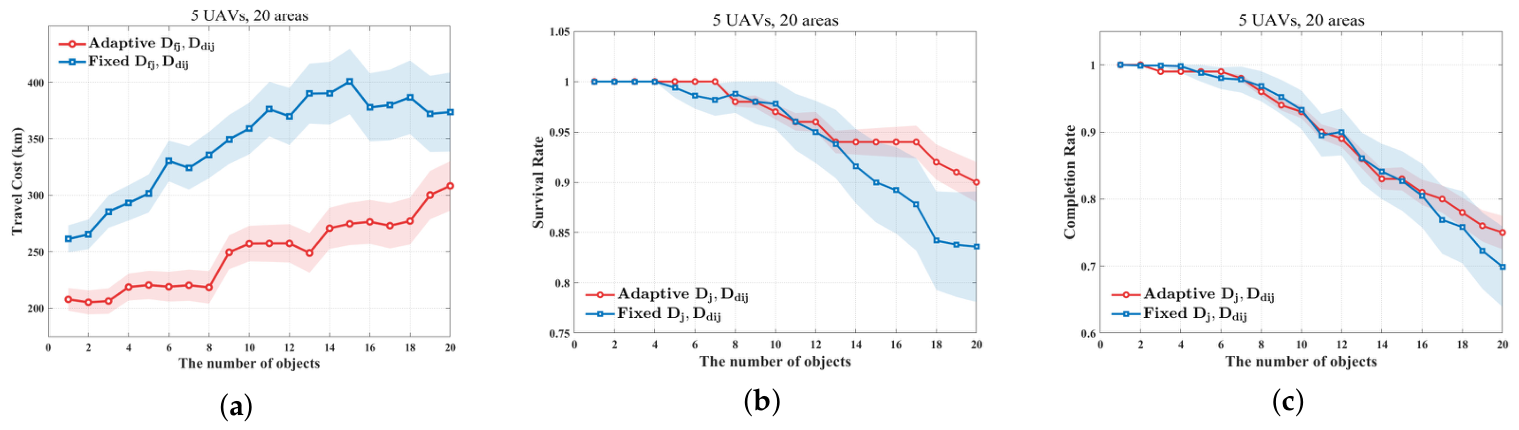
Figure 11. We compare the proposed adaptive reward definition with a fixed reward configuration across three key metrics as the number of objects increases. As shown in
Figure 11a, the adaptive reward mechanism consistently maintains a lower total travel distance compared to the fixed configuration. By dynamically scaling
and
based on task urgency and spatial distribution, the framework incentivizes UAVs to select more geographically efficient paths, effectively reducing the energy expenditure associated with redundant maneuvers.
Figure 11b demonstrates the impact on swarm safety. While both methods experience a decline in survival rate as the environment becomes more crowded, the adaptive reward definition exhibits a more robust resistance to asset loss. Particularly in high-density scenarios, the red curve stays significantly above the blue one, proving that the adaptive rewards better balance the trade-off between task attraction and risk avoidance.
Figure 11c illustrates mission success. In low-density scenarios, both reward settings achieve nearly 100% completion. However, as the number of objects increases, the adaptive mechanism shows the ability to sustain a higher completion rate. This indicates that the proposed definitions of
and
allow the swarm to manage limited resources more effectively, ensuring a higher percentage of tasks are finalized under pressure.
4.3.2. Sensitivity Analysis Results of Threshold
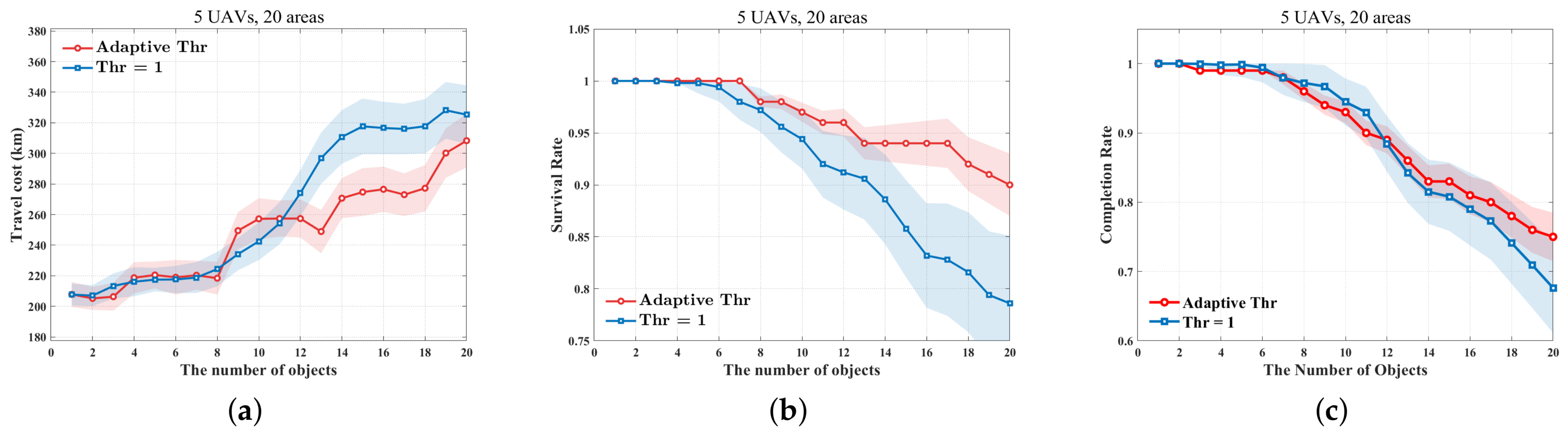
The sensitivity of DTACS to
is analyzed by comparing performance under the
determined by (
18) with that under a fixed
of 1 in scenarios with varying numbers of targets. The effects of these two thresholds on the UAV swarm’s traversal cost, task completion rate, and survival rate are evaluated. The experimental results are shown in
Figure 12.
As shown in
Figure 12a, the traversal cost under the
determined by (
18) becomes lower than under
as the number of objects increases. While
follows a greedy strategy that always permits task execution, the adaptive
forces UAVs to suspend interceptions when payload risks exceed safe margins. This prevents ineffective traversal toward high-risk targets, making the cost savings more pronounced in crowded scenarios.
Figure 12b,c show that the adaptive
maintains a higher survival rate, while the completion rate eventually surpasses the
baseline. The UAVs under
commit to underestimated targets, leading to fatal resource exhaustion or asset loss. Although
appears competitive in early stages, its higher attrition rate gradually depletes the swarm’s operational capacity. By contrast, the adaptive
preserves more functional agents through risk-aware pruning, which leads to a higher completion rate in the later stages by ensuring sufficient resources remain available for subsequent tasks.
This analysis shows that the definition of
derived from (
18) effectively improves the survival rate of UAVs.
4.3.3. Sensitivity Analysis of Cooperation Mechanism
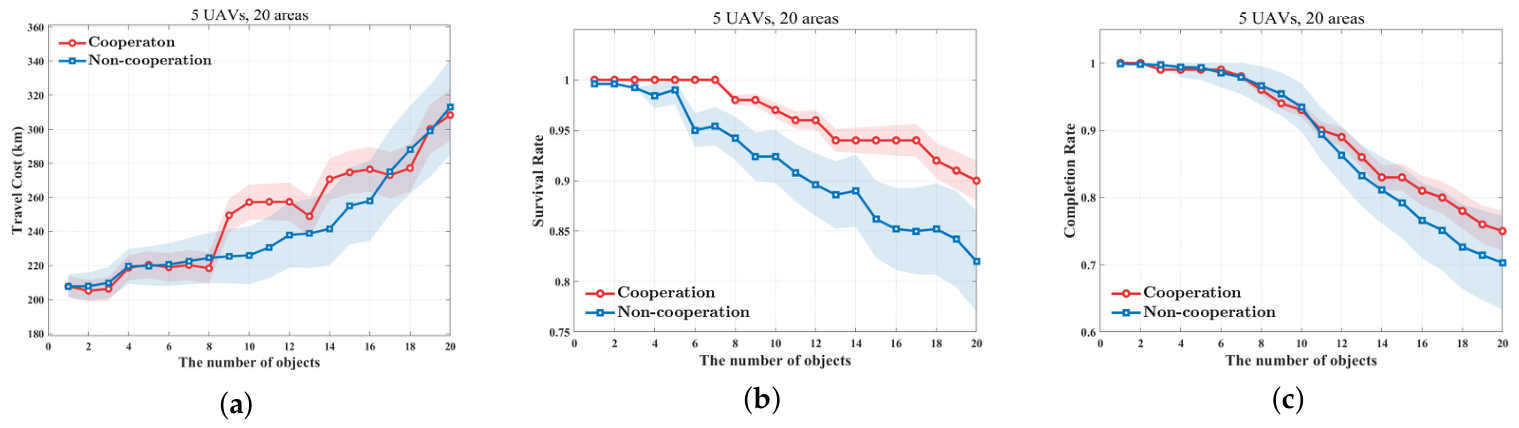
This section evaluates the sensitivity of the proposed collaborative task allocation and resource distribution strategies. We compare the DTACS framework against a non-cooperative baseline, where UAVs perform independent interceptions without inter-agent coordination.
In
Figure 13a, the cooperative strategy incurs a higher travel cost because the mechanism often coordinates multiple UAVs to intercept the same high-value or high-risk targets to ensure mission reliability, increasing the total flight distance. However, this collective investment significantly bolsters the survival rate in
Figure 13b, while the baseline suffers from sharp attrition as the number of objects grows, the cooperative strategy maintains a stable margin above 0.9 by preventing redundant risk exposure and resolving task conflicts.
Figure 13c demonstrates that such coordinated resource partitioning leads to a superior completion rate in high-density scenarios, proving that the increased travel distance is a necessary trade-off for maximizing the swarm’s overall resilience and mission success.
4.3.4. Sensitivity Analysis of Battery Capacity
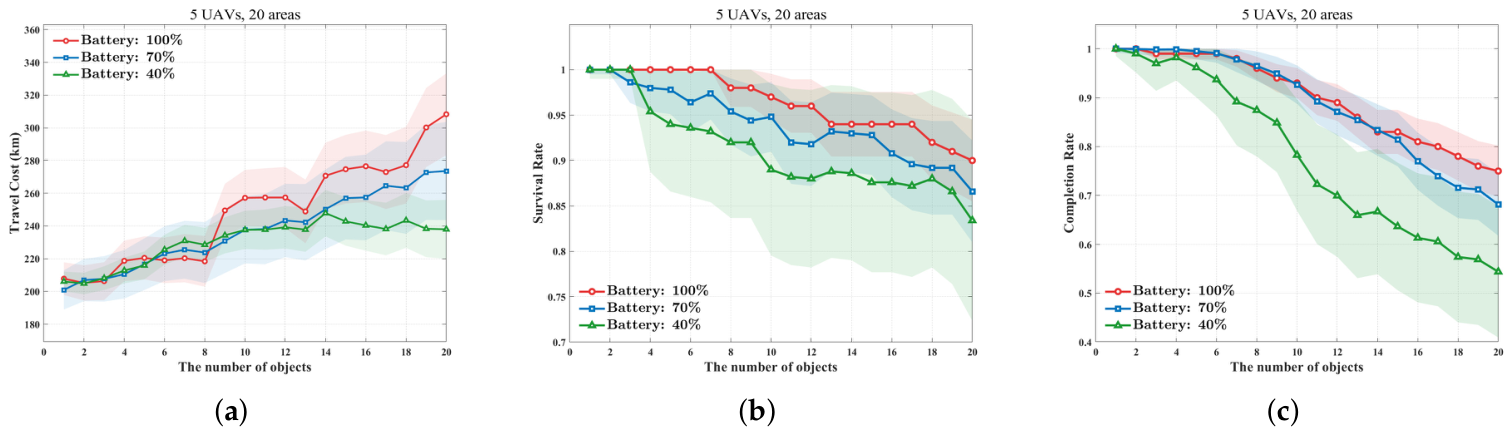
This section investigates the impact of battery constraints on mission performance by comparing three initial power levels: 100%, 70%, and 40%. As illustrated in
Figure 14, battery capacity serves as a critical influencing factor for both the endurance and the decision-making logic of the UAV swarm. As illustrated in
Figure 14, battery capacity constraints significantly dictate the swarm’s operational boundaries. In
Figure 14a, the lower travel cost at 40% capacity reflects a forced reduction in mission range rather than efficiency, as energy-limited UAVs are physically unable to pursue distant targets. This bottleneck directly compromises the survival rate in
Figure 14b, where the 40% scenario drops sharply due to the lack of power for energy-intensive evasive maneuvers in hazardous zones. Consequently, the completion rate in
Figure 14c shows a precipitous decline as objects exceed 6, confirming that insufficient battery capacity severely curtails both tactical flexibility and the swarm’s ability to neutralize multiple objectives safely.
4.4. Method Comparison
The proposed DTACS is benchmarked against three representative methods: Harmony Drone Task Allocation (DTA) [
56], the multimodal multiobjective evolutionary algorithm based on deep reinforcement learning (MMOEA-DL) [
57], and DTADQN [
27]. Harmony DTA is selected as a premier representative of advanced auction-based mechanisms, providing a baseline to evaluate our coordination efficiency against classical decentralized market-based logic. MMOEA-DL is included as it represents the latest progress in hybrid reinforcement learning, offering a rigorous comparison against the recent evolutionary multi-objective optimization in dynamic environments. Among the strategies presented in [
27], DTADQN is specifically selected as the primary reinforcement learning baseline for two key reasons. First, its underlying mission environment and UAV operational constraints are highly consistent with the high-density interception scenarios defined in this study, ensuring a fair and meaningful performance comparison. Second, while [
27] offers other heuristic alternatives, DTADQN represents a more sophisticated Deep Q-Network framework capable of handling high-dimensional state spaces, making it a more rigorous benchmark to validate the efficiency and adaptive decision-making of DTACS in complex, dynamic adversarial settings.
The performance of the four methods is evaluated in two distinct scenarios consisting of five and 10 UAVs, respectively. The initial configurations for the UAVs, monitored areas, and targets are specified in
Table 3. The performance of the four methods is evaluated through 100 experimental iterations with varying numbers of objects, and the average values of the three performance metrics are compared.
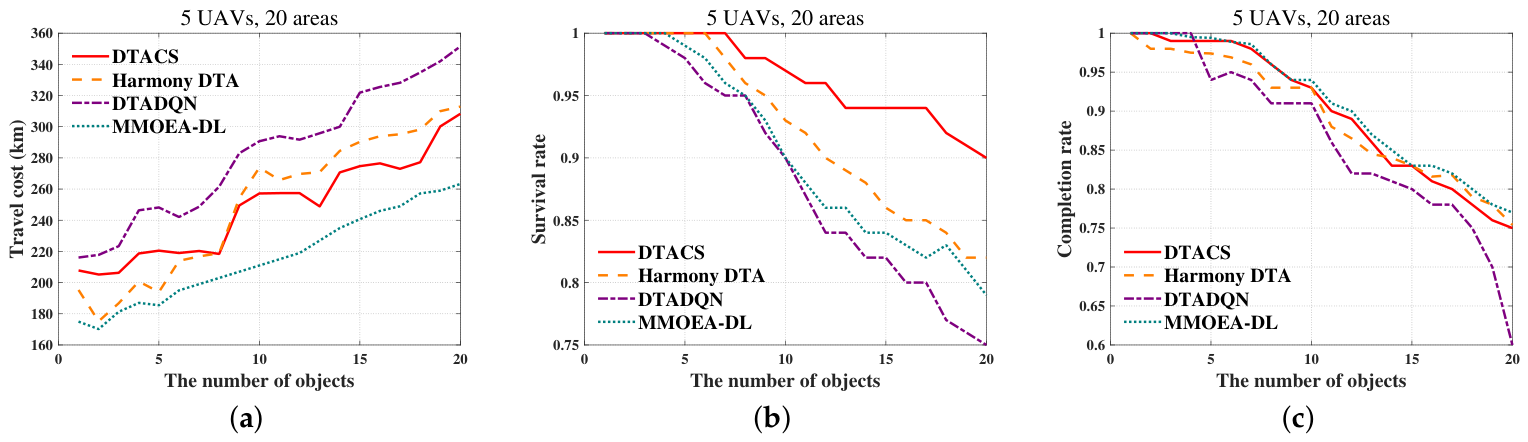
Figure 15 presents the comparative performance results in the scenario involving five UAVs. In
Figure 15a, DTACS maintains a more efficient travel cost than DTADQN and Harmony DTA. This is attributed to its centralized coordination, which optimizes global task-to-UAV matching to eliminate the redundant path overlaps often found in auction-based or independent RL frameworks. While MMOEA-DL shows the lowest cost, this stems from a conservative logic that filters out distant targets, thereby reducing total coverage. The most significant advantage of DTACS is its survival rate (
Figure 15b), which remains above 0.9, while DTADQN and MMOEA-DL drop to 0.75 and 0.8. This divergence is driven by the adaptive decision threshold in DTACS; by dynamically pruning high-risk tasks that exceed the swarm’s current payload capacity, the mechanism prevents UAVs from committing to fatal interceptions—a risk-aware safeguard that pure RL and auction methods lack. Consequently, as the scenario becomes denser, DTACS sustains a superior completion rate (
Figure 15c) compared to DTADQN, which collapses in the late stages. This resilience is a direct result of the prior survival advantage: by preserving more functional UAVs in the early stages through strategic pruning, DTACS retains sufficient collective resources to handle subsequent objectives. In contrast, the high attrition in other methods depletes the available workforce, proving that DTACS achieves a more robust balance between asset preservation and long-term mission success.
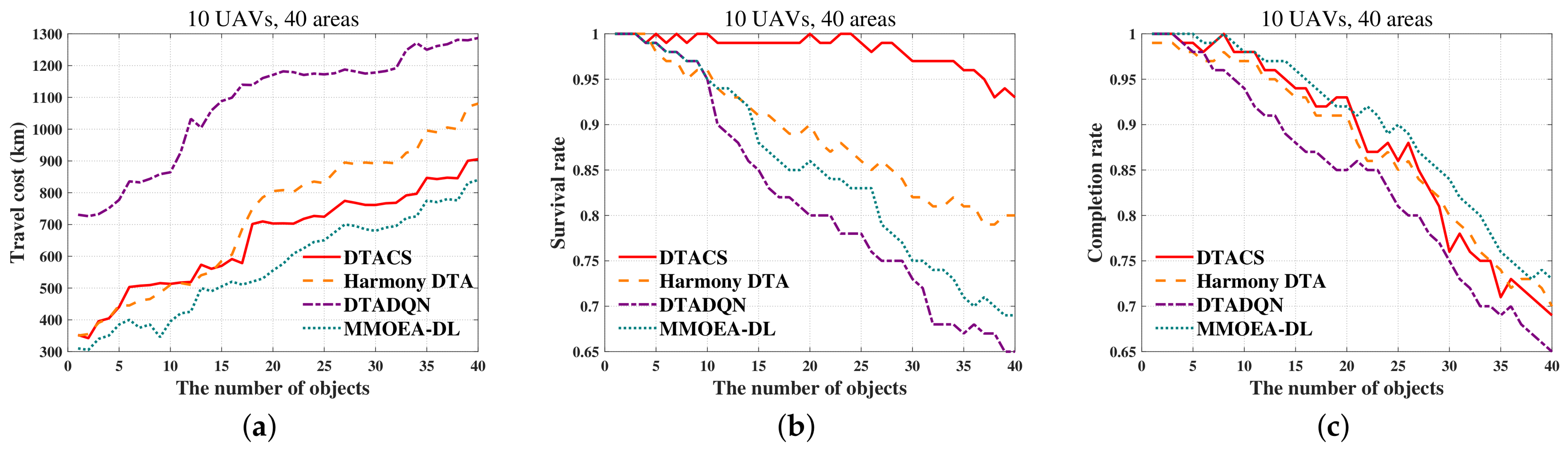
The performance metrics for the 10-UAV scenario are illustrated in
Figure 16, further validating the trends observed in the five-UAV analysis with enhanced statistical divergence. As shown in
Figure 16a, the travel cost advantage of DTACS becomes more pronounced at this scale. This underscores the scalability of our centralized coordination, which, unlike the decentralized auctioning in Harmony DTA or the independent policies of DTADQN, effectively eliminates the severe path redundancies that typically emerge as the fleet size expands. A critical distinction in this scale is the survival rate. While the benchmarks suffer from accelerated attrition as object density doubles—with DTADQN plummeting below 0.7—DTACS maintains an exceptionally stable margin above 0.9. This stability proves that the adaptive decision threshold is even more vital in high-density environments; by systematically bypassing tasks that threaten swarm integrity, DTACS prevents the failures seen in benchmarks that lack an integrated risk-mitigation layer. Furthermore, in
Figure 16c, although MMOEA-DL and Harmony DTA initially match DTACS in completion rate, they fail to sustain performance beyond 20 objects. This confirms that the asset preservation strategy of DTACS is a prerequisite for long-term mission success; by preserving operational capacity during the initial mission phases, the swarm maintains sufficient collective resource margins to engage late-appearing targets effectively. Ultimately, DTACS demonstrates that at larger scales, the synergy between risk-aware pruning and global coordination provides a more sustainable framework for high-intensity adversarial operations.
In summary, DTACS outperforms benchmarks by significantly improving UAV survival rates and maintaining stable task completion through resource-aware coordination. While these numerical results validate the algorithm’s logic, its operational boundaries must be identified. A primary failure case occurs when environmental stochasticity significantly exceeds the predefined empirical bound , where the safety buffer provided by may become insufficient to absorb sensed errors, leading to increased attrition. Additionally, in scenarios of extreme resource over-saturation, the risk-aware pruning logic may trigger “decision paralysis,” prioritizing swarm integrity to an extent that causes a sharp decline in mission completion. Furthermore, real-world deployment necessitates several engineering considerations. The observed millisecond-level decision latency must be sustained when competing with onboard perception and control processes. Unpredictable environmental factors, such as wind gusts, could also introduce stochastic energy consumption beyond the deterministic models used here. Finally, evolving toward a distributed architecture will be essential to mitigate communication latency and single-point failure risks in complex field operations, providing a foundational roadmap for the future enhancement of the DTACS framework.
5. Conclusions
This paper presents DTACS, an auction-based task allocation algorithm, to maximize the survivability and task completion rate of resource-constrained UAV swarms in dynamic and complex scenarios. By defining the task priority parameter, objects with higher urgency are prioritized for interception, thereby enhancing UAV survival rates. Meanwhile, a cooperative interception strategy is proposed to enhance mission success. Moreover, an energy-based payload allocation strategy is adopted for cooperative neutralization, further improving task completion. Finally, numerical simulation results demonstrate the strong robustness of DTACS across scenarios of different scales. Compared with other methods, DTACS achieves a significantly higher UAV survival rate by up to 27%, effectively reducing attrition and improving task execution sustainability in dynamic and complex scenarios.
Nonetheless, the centralized structure of DTACS still incurs high computational demands, and its performance may be compromised by communication interference or failed decision-making nodes. Furthermore, the impact of communication latency on the synchronization of task states across the swarm remains a critical factor in highly dynamic environments. Therefore, integrating DTACS with a distributed framework to mitigate the effects of network delays and enhance coordination reliability is a promising direction for future work. A significant challenge lies in achieving optimal task allocation while reducing communication costs and latency. Moreover, addressing communication interference among UAVs in the distributed framework is also a key issue.