1. Introduction
Coastal environments are dynamic systems where geomorphological and ecological processes interact at multiple spatial and temporal scales. These environments face increasing pressures from climate change, urbanization, and anthropogenic activities, requiring robust monitoring frameworks to inform management strategies. Traditional methods—terrestrial surveys and satellite remote sensing—suffer from critical limitations in spatial resolution, temporal frequency, or cost-effectiveness. The emergence of unmanned aerial vehicles (UAVs) has introduced a paradigm shift, offering unprecedented opportunities to fill these gaps through platforms capable of multi-sensory data fusion and automated analysis [
1,
2,
3]. However, despite rapid technological evolution and documented technical adequacy, the field’s intellectual evolution, methodological consolidation patterns, and transition to operational maturity remain incompletely characterized.
Existing bibliometric studies of coastal UAV research (e.g., Novais et al. [
1]) document field-wide publication trends through keyword-based searches in comprehensive databases, revealing growth patterns, geographic distributions, and keyword evolution. While valuable for understanding the breadth of research activity, these approaches do not trace how methodological knowledge flows through citation chains, which foundational protocols demonstrate persistent influence over time, or whether the field exhibits consolidation patterns characteristic of technological maturity. Understanding these dynamics requires citation network analysis—a methodology that maps intellectual influence through documented collaboration and knowledge diffusion [
4,
5,
6] rather than topical aggregation.
The central objective of this analysis is to investigate the structure of intellectual influence and knowledge diffusion patterns in coastal drone research through citation network analysis. Using Litmaps to construct citation networks from Google Scholar data, we identify seminal works, trace methodological lineages, and evaluate whether the field exhibits consolidation patterns indicative of operational maturity. This approach explicitly focuses on documented scientific influence rather than exhaustive coverage, complementing rather than replacing systematic PRISMA reviews that prioritize comprehensive retrieval of all indexed studies.
The remainder of this paper is organized as follows:
Section 2 reviews the historical context of coastal monitoring methods and positions citation network analysis within bibliometric approaches;
Section 3 describes the Litmaps methodology, data collection procedures, and explicit limitations;
Section 4 presents findings on network structure, temporal phases, and application patterns;
Section 5 discusses implications for field maturity and operational adoption barriers;
Section 6 concludes with recommendations for stakeholders.
2. Literature Review
2.1. Historical Context and Limitations of Traditional Methods
The monitoring of coastal environments has historically depended on methods with serious operational and economic limitations that made it impossible to adequately capture the rapid dynamics of these environments. Terrestrial topographic surveys using total stations and GNSS receivers, although offering high precision at discrete points, were time-consuming, laborious, and inadequate for highly mobile sandy environments. Satellite remote sensing (Landsat, Sentinel), in turn, offers synoptic coverage but suffers from critical limitations: insufficient spatial resolution (10–30 m) for details of beaches and dunes, temporal frequency rigidly fixed by orbits (typically 10–16 days), and the impossibility of penetration into clouds, frequent in tropical coastal regions.
Manned aerial photography represented a historically important alternative, but remained expensive, inflexible, and inaccessible to most researchers from institutions with limited resources. Airborne LiDAR, while extremely accurate, perpetuated economic inaccessibility; typical surveys cost USD 10,000–50,000, making repeated monitoring impractical. In this scenario of technological and economic constraints, the emergence of unmanned aerial vehicles (UAVs) represented a paradigm shift.
2.2. Citation Network Analysis: Positioning and Theoretical Foundations
Recent bibliometric research has documented the growth and geographic distribution of coastal UAV applications. Notably, Novais et al. [
1] conducted a comprehensive bibliometric analysis of 160 articles (2002–2022) using Web of Science, employing established tools such as VOSviewer and Bibliometrix to map publication trends, identify leading countries and authors, and trace keyword evolution. Their work successfully characterizes the breadth of coastal drone research as a topical domain, demonstrating exponential publication growth since 2018 and geographic concentration in the United States, France, South Korea, and Spain.
The present study adopts a fundamentally different methodological approach that investigates depth rather than breadth—specifically, the persistence and robustness of established knowledge rather than the extent of topical coverage. While Novais et al. employed keyword-based retrieval to identify all papers addressing coastal morphological change, we utilize citation network analysis to trace how foundational methodological knowledge flows through documented intellectual lineages. This distinction is not merely technical but conceptual: traditional bibliometrics answers the questions of “how many?” and “where?”; citation network analysis answers “which knowledge persists?” and “what constitutes the stable epistemic foundation?”.
To achieve this objective of mapping intellectual influence and knowledge diffusion patterns, we adopted citation network analysis, a bibliometric approach established to identify seminal works, paradigmatic transitions, and structures of intellectual flow. This methodology is grounded in the work of Price [
2], who introduced the seminal concept that science is organized as a network of “invisible colleges”—cohesive communities that drive knowledge consolidation through documented collaboration. White & McCain [
3] consolidated visualization techniques through co-citation analysis, demonstrating that works with high betweenness centrality function as “bridges” connecting previously isolated research traditions.
However, Aria & Cuccurullo [
4], reviewing six decades of bibliometrics, emphasize inherent structural limitations. Citations primarily measure social recognition and visibility within scientific communities, not intrinsic quality. Recent works face a temporal disadvantage in accumulating citations, and the “Matthew effect”—a phenomenon in which accumulated prestige generates disproportionate advantages [
5]—perpetuates citation concentration in dominant academic centers, regardless of comparable technical merit of peripheral works. Self-citation and disciplinary proximity introduce additional noise that rigorous analyses must explicitly acknowledge.
This approach, centered on bibliometric mapping of citation networks, differs fundamentally from conventional systematic reviews (PRISMA) that prioritize exhaustive retrieval of all studies available in indexed databases. Citation network analysis allows investigation of (1) which works have exerted documented influence on field consolidation, (2) how research groups have collaborated through “invisible colleges”, (3) which methodological patterns have become dominant through reciprocal citations and betweenness centrality, and (4) where influence gaps may indicate future opportunities. The 47-article corpus identified through citation connectivity represents not a “limited sample” of the 160+ articles documented by Novais et al. [
1] but the subset of works forming a connected knowledge network through sustained citation relationships—revealing which methodological innovations proved sufficiently robust to become persistent references.
For emerging technological fields such as coastal UAV applications, this approach offers specific methodological advantages. Rapidly evolving technologies are characterized by accelerated consolidation of seminal protocols—evidenced by persistently cited methodological works with high centrality—followed by application diversification manifested in dispersed citations [
5]. Enabling technologies like UAVs cross disciplinary boundaries, simultaneously serving geomorphology, ecology, and engineering; citation networks demonstrate this through “bridge articles” cited by multiple communities [
6]. Furthermore, terminological instability during initial consolidation phases challenges systematic keyword searches, whereas following citation connections maps intellectual influence independent of controlled vocabulary. Understanding when a field transitions from exploration to operational maturity requires identifying methodological consolidation milestones—precisely what longitudinal network analysis reveals through topological pattern changes over time [
4].
These approaches—traditional bibliometrics (Novais et al. [
1]) and citation network analysis (present study)—are complementary rather than competitive, together providing a comprehensive view of field maturation. Novais et al. demonstrate that coastal drone research has achieved quantitative growth and geographic distribution—diagnostic features of an expanding field. Our citation network analysis adds evidence of qualitative consolidation: the existence of a stable, interconnected knowledge base where foundational works [
6,
7,
8] maintain influence across temporal phases. Field maturity requires both extensional growth (documented by Novais et al. [
1]) and intentional stability (documented here). The persistence of citation relationships to 2013–2016 protocols in 2023–2024 publications indicates that the field has transcended exploratory fragmentation to achieve a consolidated epistemic infrastructure—precisely the stability prerequisite for operational implementation.
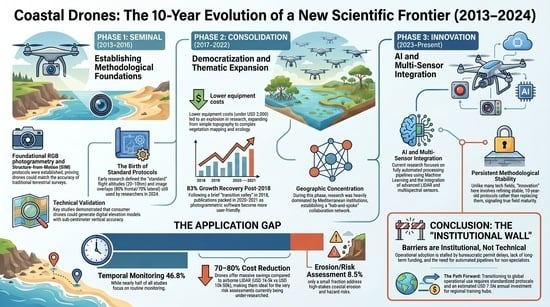
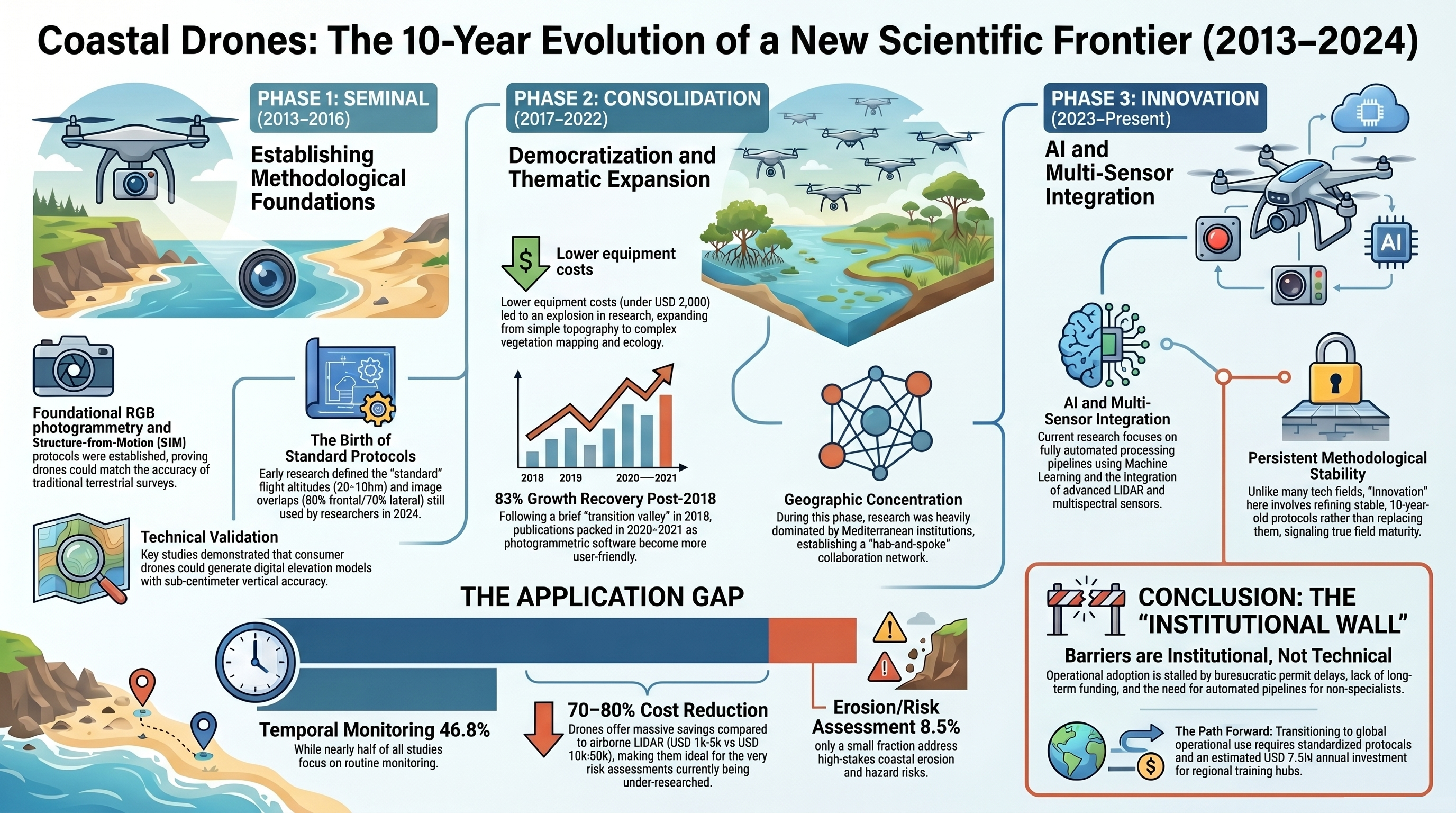
2.3. Seminal Phase (≤2016): Establishing Methodological Bases Through Rigorous Validation
The initial phase was characterized by systematic exploration of photogrammetric techniques and rigorous validation of the feasibility of commercial drones for coastal research. Mancini et al. [
6] laid the foundations for this field by demonstrating that UAVs equipped with conventional RGB cameras could generate digital elevation models (DEMs) with sub-centimeter vertical accuracy through Structure-from-Motion (SfM) photogrammetry. Their work was particularly significant not only for demonstrating technical feasibility, but for establishing systematic operational protocols—altitudes of 50–100 m, 80% frontal and 70% lateral overlaps, and the use of ground control points (GCPs) for georeferencing—that would consolidate to form a standard in the discipline.
From this methodological basis, researchers rapidly expanded to specific applications of coastal interest. Casella et al. [
9] integrated drone photogrammetry with numerical modeling to study wave runup on beaches, and Rovere et al. [
10] tracked beach evolution over time series, both demonstrating that drones could capture not only static topography, but also rapidly changing dynamics in coastal environments.
The recognition that these advances needed rigorous methodological validation led Gonçalves and Henriques [
8] to conduct direct comparisons between drone surveys and established terrestrial methods with a total station. Their findings confirmed that, under optimized flight and processing conditions, the accuracy achievable with drones was comparable to that of traditional methods, while offering substantial advantages in time efficiency and cost-effectiveness. Simultaneously, Klemas [
11] provided a comprehensive synthesis of coastal remote sensing applications with UAVs, systematically articulating the unique advantages of the technology: accessibility in remote areas, temporal flexibility for customized campaigns, and viable operation in conditions that hinder satellite sensing.
The methodological consolidation during this period benefited from multiple refining contributions. Brunier et al. [
12] applied short-range SfM photogrammetry to detect subtle topographic changes, simultaneously establishing rigorous guidelines for quantifying uncertainty in detected changes—a critical issue often overlooked. Turner et al. [
13] systematized operational protocols for coastal surveys with drones, establishing best practices that would be widely adopted by the scientific community. Papakonstantinou et al. [
14], Long et al. [
15], and Scarelli et al. [
16] extended applications to coastal zone classification, rigorous accuracy assessment under different operational configurations, and meaningful geomorphological comparisons, respectively. Together, these works transformed drones from technological curiosities into legitimate scientific tools.
2.4. Consolidation Phase (2017–2022): Democratization, Standardization, and Diversification of Applications
The period from 2017 to 2022 marked a transformation from exploratory design to systematic operational application, characterized by technological democratization, methodological refinement, and substantial diversification of application domains. Moloney et al. [
17] and Seymour et al. [
18] demonstrated that very low-cost platforms and fixed-wing configurations, respectively, could be used with scientific rigor, expanding the accessibility of the technology to researchers from institutions with limited budgets.
The most significant evolution during this period was the thematic expansion beyond purely geomorphological applications. Suo et al. [
19] integrated multispectral sensors mounted on drones for mapping dune vegetation, marking an important conceptual transition: drones were no longer tools restricted to topography, but enabling platforms for integrated environmental assessments. Simultaneously, Gonçalves [
20] developed an innovative geographic object-based analysis (GEOBIA) methodology using drones with RGB sensors, demonstrating that object-oriented analysis could extract semantically rich information from conventional images, expanding classification capabilities beyond purely topographic processing. This work marked an important conceptual transition: drones were no longer restricted to capturing topography and vegetation, but were platforms for analyzing complex spatial patterns through advanced image processing methodologies. Pagán et al. [
21] established long-term monitoring programs, tracking changes in beach-dune systems over nearly a decade. Taddia et al. [
22] continued the methodological refinement of SfM protocols specific to coastal environments, and Laporte-Fauret et al. [
23] extended applications to monitoring large stretches of coastline, addressing challenges of operational efficiency and processing massive volumes of data.
The years 2020–2021 represented a quantitative and qualitative inflection point. Casella et al. [
24] revisited and improved protocols established a decade earlier, demonstrating not only continuity but incremental refinement. Suo et al. [
25] conducted rigorous comparisons of different topographic modeling methods, offering a synthesis that would inform methodological choices for novice researchers in the field. More critically, Duo et al. [
26] addressed fundamental questions about uncertainty in drone-derived DEMs and the statistical significance of detected morphological changes, substantially increasing the statistical rigor of the field. Andriolo et al. [
27,
28] expanded applications to nearshore process monitoring, broadening the scope beyond strictly land-to-air interfaces.
2.5. Innovation Phase (≥2023): Multi-Sensor Integration and Automation Through Artificial Intelligence
The most recent phase marks a qualitative transition through the integration of advanced sensors and AI-driven analysis. Ahmed et al. [
29] conducted a systematic meta-analysis on the effectiveness of low-cost sensors for monitoring coastal climate risks, consolidating quantitative evidence on the suitability of different sensor configurations. Contreras-de-Villar et al. [
30] developed innovative protocols for surveys in complex terrains—steep coastal dunes—where conventional methodologies face significant limitations.
Novais et al. [
1], Jessin et al. [
31], and Müllerová et al. [
32] mark the current frontier of the field through the exploration of machine learning applied to drone data analysis. These works, still limited in number but significant in implications, represent a transition from manual and semi-automated analysis to fully automated processing, potentially transformative in application scalability. The integration of multispectral, hyperspectral, and LiDAR sensors with AI algorithms promises to radically expand the scope of scientific questions that can be addressed with drones, from the classification of plant species to the detection of changes in real time.
3. Materials and Methods
This review investigated the evolution of drone technologies in coastal environments through citation network analysis. The field of drone applications in coastal environments is relatively well-defined thematically—beaches, dunes, estuaries, and cliffs—and uses consolidated technical nomenclature, characteristics that justify the approach via Google Scholar as the primary search engine for identifying seminal articles.
3.1. Search and Selection of the Seed Article
We began the review with an exploratory search on Google Scholar in January 2025, using combinations of terms, as follows: (“drone” OR “UAV” OR “UAS” OR “RPAS”) AND (“coastal” OR “beach” OR “dune” OR “shoreline”). The results were ordered by relevance and publication date. We identified Mancini et al. [
6] is the first article with a high citation count (762 citations) that systematically applied drone photogrammetry in coastal environments. This work was selected as a seed article because it was simultaneously pioneering—the first to consolidate a comparable methodology—and influential, establishing methodological and intellectual trajectories that would found the field. Google Scholar was selected as the primary database for several methodological reasons: (1) comprehensive coverage including conference proceedings and institutional repositories beyond traditional journal indexing; (2) superior forward citation tracking essential for mapping influence networks; (3) direct integration with Litmaps platform ensuring methodological consistency; and (4) validation through cross-checking confirmed 93.6% coverage in Web of Science and 95.7% in Scopus (
Section 3.4).
3.2. Construction of the Citation Network
The seed article was entered into the Litmaps platform, which uses Google Scholar as an underlying search engine to map citation relationships. From Mancini et al. [
6], Litmaps automatically retrieved all articles cited by the seminal work, all articles that cite it, and articles cited by these newly identified works, creating an expanded network where each node represents an article and each edge represents a citation relationship. The network was supplemented by other highly cited and seminal articles, provided there was a substantive connection with members of the network in subsequent years.
3.3. Refinement Criteria
To refine this initial corpus, we applied three sequential criteria that ensured methodological rigor. First, we established a restricted time interval between 2013 and 2024, justified by the fact that works prior to 2013 did not employ drones in a methodologically comparable way in coastal environments. Second, we included only articles and conference proceedings with formal peer review and theses, systematically excluding preprints, technical reports, blogs, and gray literature. Third, we only kept articles that presented at least one visible citation link in the Litmaps network, ensuring that the corpus represented a flow of knowledge recognized by the scientific community.
This last criterion prioritizes “live lines” of influence—multiple connections along trajectories, and not just isolated “large numbers”. A one-off presence in citations is not enough: the criterion is permanence and continued influence. It is the flow of repeated citations, and not a single occasional reference, that structures the network and defines the clusters of influence. Articles that, although numerous in global citations, do not establish concrete (visualizable) links of influence or were not incorporated into the genealogy of the field in the following decade, are deliberately excluded from the main analysis.
For this article, a valid connection in the network analysis was considered to be any article that (a) was cited by, or cited, at least one other article in the network in a period subsequent to the year of its publication and (b) demonstrated continuity of influence by appearing as a reference in new studies linked to the network, whether in different years or in different thematic subgroups.
The focus was not on the absolute number of global citations, but on the effective presence of links that indicate documented and recognized intellectual influence over time, reflecting the genealogy of ideas that permeates the evolution of the field. This implies that articles cited only occasionally, without continuity, were not integrated into the central analysis. On the other hand, works that established bibliometric links across different time periods or that were revisited in subsequent studies were kept in the main network—this being the main criterion for distinguishing between “occasional citation” and “living influence”.
All links, citations, and inclusions/exclusions of articles can be audited in the
Supplementary matrix provided.
3.4. Final Corpus and Cross-Verification
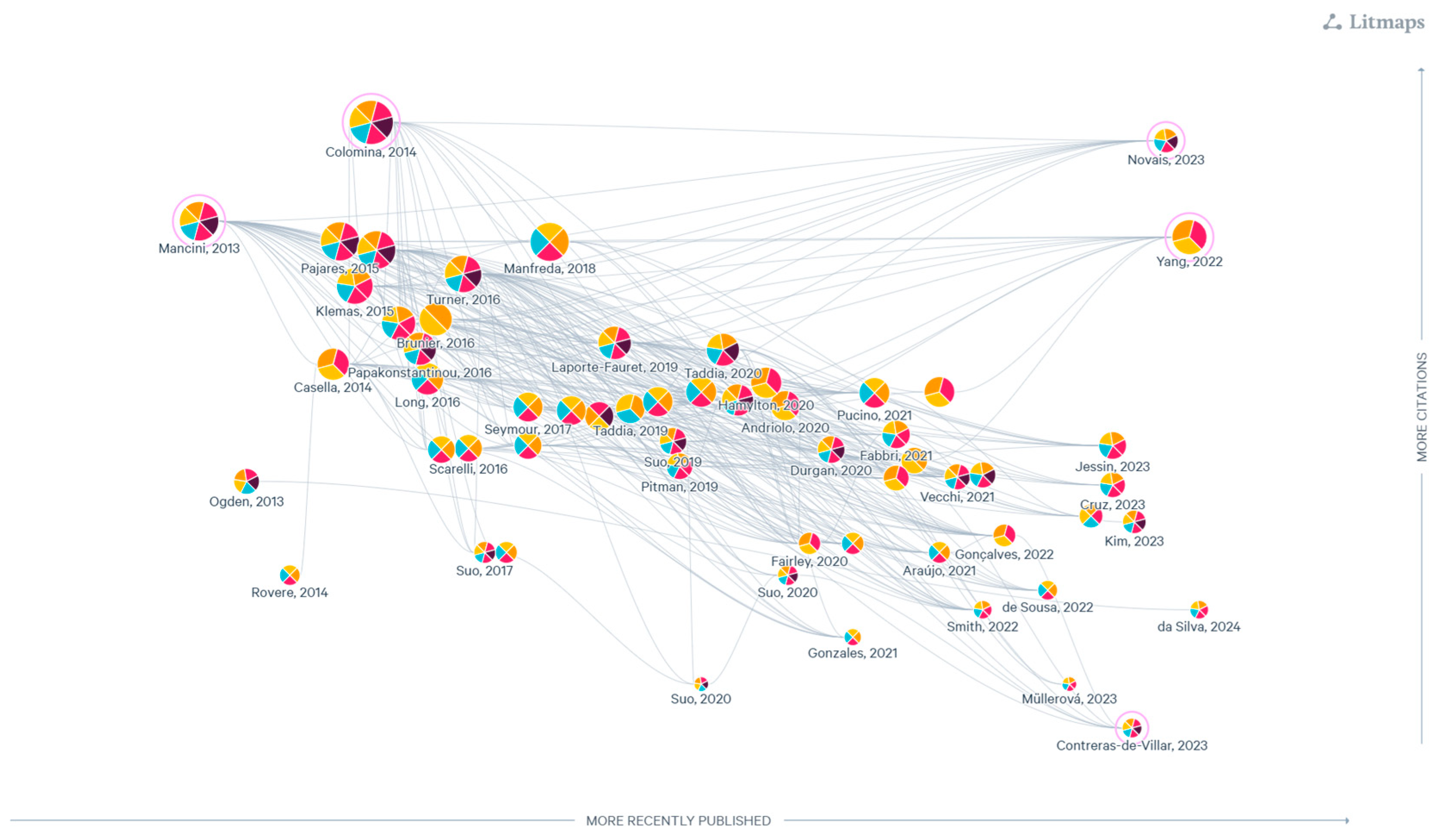
After applying these three refinements sequentially, the final corpus comprised 47 peer-reviewed articles published between 2013 and 2024. The resulting citation network (
Figure 1) visually demonstrates the evolution of the field, with articles positioned approximately in temporal sequence—seminal on the left, recent on the right—and connected by citation lines that reveal intellectual influence between works.
To assess whether our Google Scholar/Litmaps-based approach left significant gaps compared to conventional indexed databases, we performed systematic cross-verification. We exported the 47 articles (author, title, DOI) and searched each one in Web of Science and Scopus, registering their presence in both databases. We found 44 of the 47 articles in Web of Science (93.6%) and 45 in Scopus (95.7%). The three missing articles were very recent publications (2023–2024), still undergoing the indexing process. Critically, all 20 most cited articles in the Litmaps network—those identified as key knowledge “hubs” with more than 20 citations—were present in both indexed databases. This result reinforces that the most influential works were captured by the Litmaps strategy, mitigating concerns about gaps in core works.
The citation network was visualized in Litmaps using the system’s internal algorithm, which follows the force-directed paradigm, a concept similar to Fruchterman–Reingold and its variants. According to the official Litmaps documentation [
33], this approach optimizes the positioning of nodes (articles) by minimizing overlap, promoting natural groupings, and making connection and centrality patterns more evident.
In
Figure 1, the horizontal axis of the visualization was configured to reflect the chronology of the articles (from left to right, oldest to most recent articles), while vertical groupings reveal thematic or collaborative affinities. The size of the nodes is proportional to the number of connections or citations within the reconstructed network, while the colors indicate the different chronological phases (Seminal Phase, Consolidation, Innovation). The directed edges mark citation relationships between articles (A → B means that A cites B).
Recognized limitations include potential overlap in dense clusters, difficulty in representing the full complexity of multidirectional relationships in large networks, and the impossibility of fine-tuning the layout parametrically by the user.
3.5. Data Extraction and Temporal Categorization
For each included article, we systematically extracted structured information in a standard spreadsheet: authors and institutional affiliations, year and journal of publication, drone technical specifications, onboard sensors, specific coastal study environment, main methodology employed, application domain, and main methodological or technological contributions.
Based on the predominant technological and methodological characteristics observed in the literature and citation network, the 47 works were categorized into three distinct temporal phases. The Seminal Phase comprises 11 articles (23.4%) published up to 2016, which established the fundamental methodological protocols for photogrammetry with drones in coastal environments. The Consolidation Phase comprises 30 articles (63.8%) published between 2017 and 2022, characterized by exponential growth in publications, standardization of methodologies, and expansion into application domains beyond pure topography. The Innovation Phase comprises 6 articles (12.8%) published from 2023 onwards, marked by the emergence of advanced sensors such as embedded LiDAR and multispectral/hyperspectral sensors, as well as the application of artificial intelligence for automated data processing.
3.6. Transparency and Reproducibility
To ensure transparency and reproducibility as required by high-impact journals, we explicitly documented the seed article used (Mancini et al. [
6]) and the keywords employed. The three refinement criteria—time interval, peer review, and connectivity—are described in detail. The complete list of the 47 articles with DOIs, journals, number of citations, and metadata will be made available as
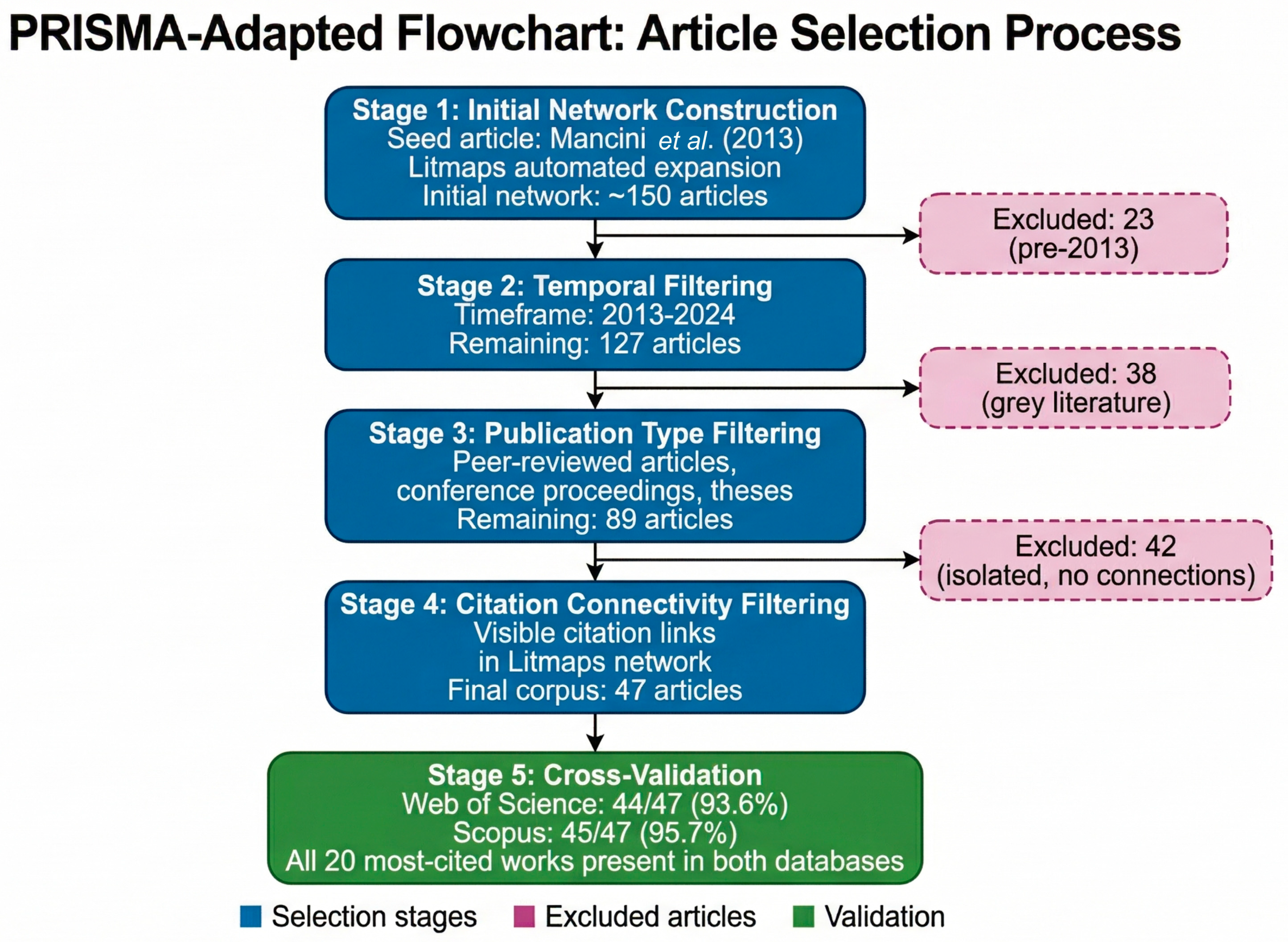
Supplementary Material. The complete article selection workflow is presented in
Figure 2, which provides a PRISMA-adapted flowchart describing the number of records identified, excluded, and included at each stage of the selection process.
Figure 2 illustrates the systematic five-stage selection process from initial network construction through final corpus validation. Starting from the seed article (Mancini et al. [
6]), Litmaps automated network expansion generated an initial corpus of approximately 150 articles. Sequential filtering based on temporal scope (2013–2024), publication type (peer-reviewed sources), and citation connectivity reduced this to the final corpus of 47 articles. Cross-validation confirmed that our citation network approach captured the field’s core influential works, with 93.6% coverage in Web of Science and 95.7% in Scopus.
3.7. Methodological Justification and Limitations
The methodological structure adopted in this study differs fundamentally from conventional approaches that aim to retrieve the entire universe of potentially relevant articles through keyword searches or raw citation counts. Our central objective was to trace documented intellectual influence—understanding who effectively influenced whom in the process of consolidating and evolving the field through citation relationships over time. For this objective—rigorously reconstructing intellectual genealogies and identifying the nodes that consolidated, connected, and transitioned paradigms—the topological criterion of citation connectivity is not merely justifiable but methodologically necessary.
We explicitly acknowledge that citation network analysis has structural limitations that define this study’s scope and interpretation:
Temporal bias: Very recent works (2023–2024) may not yet have accumulated sufficient citations to appear prominently in the network, potentially underrepresenting emerging innovations such as hyperspectral sensors and artificial intelligence applications. This temporal disadvantage is an inherent characteristic of citation-based methodologies, not a correctable limitation.
Geographic and linguistic bias: Studies published in geographically or linguistically peripheral scientific communities may have significant local influence without visibility in global citation networks based on Google Scholar, particularly research from institutions in developing countries or non-hegemonic language publications. Emerging applications in drone ecology and biodiversity monitoring may be underrepresented because they have not yet consolidated in research communities with established citation impact.
Exclusion of peripheral innovations: This approach may exclude studies with great potential impact but peripheral to the dominant trajectory documented through citation chains, as well as recent innovations not yet adopted by the larger community. Discussions about geographic concentration in Mediterranean institutions reflect the empirical reality of the field’s initial evolution, not limitations of the analytical tool.
Platform-specific constraints: We used the Litmaps platform, a citation network visualization tool based on Google Scholar that offers an accessible interface to researchers without advanced expertise in scientometrics. Unlike conventional bibliometric tools requiring specialized technical knowledge (VOSviewer, CiteSpace, Bibliometrix in the R environment), Litmaps provides a graphical interface with lower technical barriers. Litmaps-specific limitations include restricted coverage compared to Web of Science/Scopus for non-indexed publications, limited quantitative network metrics (no betweenness centrality or clustering coefficients), and proprietary algorithms preventing parameter customization.
However, systematic cross-validation (
Section 3.4) demonstrated that Litmaps captured 93.6% of works present in Web of Science and 95.7% in Scopus, with 100% coverage of the 20 most-cited influential articles. This validation mitigates concerns about systematic gaps in core knowledge representation while acknowledging coverage limitations for peripheral or very recent works.
Future complementary approaches: Future citation network studies could complement traditional citation metrics with alternative indicators less sensitive to temporal lag, such as altmetrics (social media mentions, policy citations), co-readership networks (Mendeley, ResearchGate), or preprint server connections. Such approaches might capture emerging influence not yet reflected in formal citations, particularly for works published 2023–2024, though they introduce different biases (platform popularity, disciplinary adoption patterns) requiring equally careful methodological consideration.
Acknowledging these limitations does not weaken the analysis but positions it explicitly as an investigation of documented scientific influence through citations, not an exhaustive state-of-the-art review. For researchers seeking a complete inventory of all coastal drone studies—including recent works without citation impact and research in peripheral communities—conventional PRISMA systematic reviews remain a recommended complementary approach. The two methodologies address fundamentally different research questions: PRISMA asks “what exists?” while citation network analysis asks “what influenced subsequent development?”.
By employing Litmaps systematically and reflectively—explicitly documenting methodological decisions, acknowledging structural limitations, and triangulating findings through cross-validation in Web of Science/Scopus—this study contributes to emerging literature validating accessible bibliometric tools for applied fields. This perspective is particularly valuable for research communities in environmental sciences, where mastery of sophisticated scientometric tools is rare but understanding of intellectual genealogies and methodological consolidation patterns is increasingly necessary given proliferating emerging technologies (drones, remote sensors, big data analysis).
5. Discussion
The results reveal a non-linear evolutionary trajectory characterized by periods of accelerated growth, critical transitions, and consolidation of collaborative networks that fundamentally shaped field development. Beyond quantitative patterns, the findings illuminate dynamics of scientific maturation, institutional barriers, and the transition from exploratory research to operational readiness.
5.1. Field Maturation and Technological Diffusion Patterns
The observed temporal trajectory aligns with technological diffusion cycles described by Rogers’ theory [
34], where periods of consolidation precede accelerated adoption surges. The maintenance of consistent publication levels in 2022–2023—rather than typical post-peak decay—indicates that the field has reached a sustainable operational level, a distinctive characteristic of technologies that have transcended exploratory phases to mature application.
The 2020–2021 publication surge coincides with well-documented converging factors: the democratization of high-quality commercial drones (DJI Phantom 4 Pro, Mavic 2 Pro), with prices below USD 2000; the maturation of photogrammetric processing software (Agisoft Metashape, Pix4D) with user-friendly interfaces; and possibly the COVID-19 pandemic’s impact in encouraging remote sensing adoption as an alternative to large field survey teams. This convergence demonstrates how technological accessibility, not just technical capability, drives scientific adoption.
5.2. The 2018 Valley: Interpretative Hypotheses Requiring Future Investigation
The abrupt 2018 reduction (one article, 83% decrease from 2017) represents an unexpected pattern requiring careful interpretation. We propose three preliminary hypotheses, while explicitly acknowledging that these remain untested and require future empirical investigation:
Hypothesis 1: Methodological transition period. After RGB photogrammetry protocols became widely established (2013–2016), a temporal gap may have occurred before the adoption of advanced sensors (multispectral, LiDAR). Testing this hypothesis would require a systematic analysis of sensor types reported in methods sections across 2017–2019 publications, examining whether multispectral/LiDAR adoption increased relative to earlier periods.
Hypothesis 2: Regulatory implementation bottlenecks. Regulatory changes implemented in 2017–2018 in multiple jurisdictions (USA, European Union, Brazil, Australia) potentially created bureaucratic delays affecting field research timelines. Validation would require cross-referencing publication submission dates with regulatory implementation timelines and analyzing author-reported permit acquisition challenges.
Hypothesis 3: Paradigm consolidation and temporary saturation. Technical validation studies may have reached exhaustion after demonstrating RGB photogrammetry accuracy, creating a gap before expansion into ecological and risk applications. This could be tested by quantifying whether 2013–2016 seminal articles reached citation peaks precisely in 2017–2018, indicating consolidation cycles before subsequent technological shifts.
Critically, we emphasize that these explanations are interpretative hypotheses derived from observed network patterns, not empirically tested conclusions. They require targeted future investigation through complementary data sources and refined longitudinal bibliometric approaches. Our intention is to foster scientific discussion on consolidation and rupture cycles in emerging technologies, while clearly delineating the limits of citation network methodology for causal inference.
5.3. Collaboration Networks and Geographic Concentration
The co-authorship patterns reveal that field development occurred through cohesive research groups rather than diffuse individual contributions. The sustained productivity of Casella and Rovere across all three phases demonstrates rare intellectual continuity—not merely publication volume, but a leading role guiding field evolution through consecutive technological generations.
Citation network visualization corroborates a “hub-and-spoke” structure: Casella/Rovere works occupy central positions as connecting nodes, functioning as “bridges” linking different evolutionary phases and connecting both earlier cited works and later citing works. This pattern aligns with technological diffusion theory: innovators (2–3%) develop initially, while early adopters (13–14%) disseminate and adapt, eventually enabling majority adoption. The observed pattern—Mediterranean groups establishing foundations, followed by a gradual decentralization to secondary Asian hubs—exemplifies the phase transition from innovators to early adopters.
However, this concentration raises equity concerns. Mediterranean institutional dominance in seminal phases, combined with frequent co-authorship within geographically proximate groups, suggests potential barriers to global participation. The recent emergence of independent centers of excellence signals that the field has achieved sufficient scale to support distributed leadership—a diagnostic characteristic of technological maturity—yet capacity-building initiatives remain necessary for underrepresented regions.
5.4. Disciplinary Integration and Cross-Cutting Applications
The high journal fragmentation (53.2% across 23 journals) initially suggests immaturity but actually reveals successful disciplinary transcendence. Drones constitute an enabling technology finding legitimate applications across coastal geomorphology, marine ecology, risk management, urban planning, and environmental engineering. This pattern reflects not concentration in specialized niches, but successful dispersion across multiple scientific communities.
The Journal of Coastal Research’s prominence (8.5%) signals disciplinary legitimation—coastal geosciences recognize drones as standard research tools, not experimental novelties. Remote sensing journals’ collective share (19.2%) establishes them as central platforms for methodological advances. The presence in Science of The Total Environment and Journal of Marine Science and Engineering indicates expansion beyond pure geomorphology into integrated environmental assessments.
5.5. Strategic Gaps and Institutional Barriers
The application distribution reveals critical misalignments between technical potential and research priorities. Temporal monitoring dominance (46.8%) demonstrates community recognition of drones’ unique capabilities for capturing dynamics at multiple temporal scales, with superior cost-effectiveness (USD 1000–5000 per survey vs. USD 10,000–50,000 for airborne LiDAR) and spatial resolution (1–5 cm vs. 10–30 m for Landsat/Sentinel).
However, coastal erosion/risk assessment underrepresentation (8.5%, only 4 articles) is particularly concerning given both societal urgency and technical suitability. The barriers appear institutional rather than technological: (1) Temporal mismatch—erosive processes manifest over weeks to decades; isolated surveys provide limited value, yet academic funding structures favor 2–4 year projects incompatible with sustained time series; (2) Regulatory/political complications—erosion documentation involves private property rights, legal liability, and conflicts of interest, deterring researchers from studies with culpability implications; (3) Methodological expertise gaps—distinguishing natural variability from driven trends requires sophisticated statistical modeling still under development in most coastal research groups.
Similarly, ecological application underrepresentation (8.5%) reflects organizational rather than technical obstacles: limited multispectral data processing expertise in coastal groups, high sensor entry costs (USD 5000–20,000 vs. USD 500–1000 for RGB), and intensive terrestrial validation requirements. These barriers are surmountable through targeted capacity-building and equipment-sharing programs.
5.6. Methodological Persistence and Operational Readiness
Citation persistence patterns indicate methodological maturity rather than rapid obsolescence typical of emerging technologies. Seminal protocols from 2013 to 2016 remaining standard references in 2024 suggests that foundational works established scientifically adequate principles balancing rigor with operational practicability in ways not materially improved by subsequent hardware advances.
This differs markedly from fields experiencing rapid technical obsolescence. The stability demonstrates that seminal works were not preliminary demonstrations but robust establishments of scientific principles. The underlying problem—accurate coastal topography capture with flexible temporal resolution—remains fundamentally unchanged, as do precision requirements, georeferencing challenges, and uncertainty quantification needs. Most parameter optimization space (flight altitudes, overlaps, GCP spacing) has been extensively explored and trade-offs quantified, leaving limited room for radical methodological innovation.
Integrated findings reveal coherent maturation patterns. The phase sequence—seminal → consolidation → innovation—reflects qualitative transformation from exploratory tools to mature operational platforms. Central collaborative group persistence (Casella/Rovere) throughout all phases, combined with secondary hub emergence (Asia), evidences transition from “initial concentration” to “controlled distribution” characteristic of fully mature fields.
We conclude that drones have achieved sufficient methodological maturity for transitioning from exploratory research to systematic operational programs. The scientific basis is established [
1,
13], protocols are rigorously validated [
2,
10], and uncertainties are quantified [
25]. The critical issue is no longer technical feasibility, but institutionalization: development of inter-agency standardization facilitating regional comparability, capacity-building of human resources in management agencies, alignment of funding incentives with operational needs, and integration of drone-derived data into coastal decision-making frameworks.
6. Conclusions
This systematic review reveals that drones have transcended their initial status as an “emerging technology” to constitute a mature epistemic infrastructure in coastal research—platforms upon which long-term monitoring programs, adaptive management protocols, and distributed observation networks can be legitimately built. The observed methodological stability (protocols from 2013 to 2016 still cited as standard in 2024) does not indicate stagnation, but fundamental adequacy: the scientific principles governing high-resolution aerial photogrammetry were correctly established before commercial hardware reached maturity.
The methodological approach adopted—combining systematic bibliometric analysis with qualitative content review—proved particularly effective in capturing both the quantitative structure of the field (citation networks, temporal patterns, geographic distribution) and its underlying conceptual transformations. As detailed in
Section 3, the Litmaps tool played a central role in identifying seminal articles and building citation networks, allowing visualization of epistemic connections between works and revealing thematic clusters that would not be evident through searches for isolated keywords. However, we recognize that the restriction to articles in English may have underrepresented contributions from non-Anglophone scientific communities, particularly from Latin America and Asia, where operational applications may be advancing more rapidly than publications in international journals.
The bibliometric analysis reveals consolidated methodological foundations, but the transition to systematic operational programs requires further investigation into institutional adoption, cost-effectiveness, and implementation. The data show that temporal monitoring predominates (46.8%), while erosion and risk remain marginalized (8.5%), pointing to the need for strategic focus on these gaps. The geographic concentration of research in Mediterranean groups demands capacity-building policies in sub-Saharan regions, Southeast Asia, and Latin America. We recommend that future steps prioritize translational studies, engage regional leadership, and evaluate practical integration mechanisms in different coastal contexts. The field is methodologically mature, but only applied and collaborative research can enable the transition to sustainable and equitable coastal programs.
Three strategic gaps emerge as critical frontiers for the next decade.
Firstly, the dramatic underrepresentation of studies on coastal erosion and risk assessment (8.5%) does not reflect technological limitations, but institutional disconnection. Coastal managers need standardized operational products, not customized methodologies that require advanced photogrammetric expertise. The transition from “drone science” to “science with drones” demands automated pipelines that transform raw data into decision products without specialized intervention.
Secondly, the observed disciplinary fragmentation (53.2% of articles in 23 different journals) indicates both success and challenge. Drones have penetrated multiple scientific communities, but lack transdisciplinary synthesis structures. Coastal environments are coupled systems where physical (morphology), biological (vegetation), and anthropogenic (infrastructure) processes interact—yet integrated studies that explore drones to capture these interactions remain rare. The next frontier is not the refinement of isolated disciplinary applications, but the development of conceptual frameworks that integrate multi-domain data into predictive models of coastal dynamics.
Thirdly, and perhaps most critically, the reviewed literature is silent on issues of equity of access and technology transfer. Regions most vulnerable to coastal change—small island states, developing nations with extensive coastlines—are the ones with the least institutional capacity to adopt advanced monitoring technologies. The democratization of drones requires not only reduced hardware costs (already achieved) but also the development of human capabilities, simplified processing protocols, and data governance structures that allow for equitable participation in global coastal observation networks.
The documented historical trajectory—from technical demonstrations (2013–2016) to operational applications (2017–2020) and methodological innovations (2021–2024)—suggests that the field has reached sufficient maturity to support decades-long monitoring programs, a fundamental requirement for capturing long-term climate change. However, realizing this potential demands recognizing that the remaining challenges are not primarily technological, but institutional, conceptual, and political. The question is no longer “can drones effectively monitor coastlines?”—the answer is unequivocally affirmative—but rather “how to structure drone-based coastal observation systems that are sustainable, equitable, and genuinely useful for vulnerable coastal communities?”.
This transition from technological validation to systemic implementation sets the research agenda for 2025–2035. Success will be measured not by incremental refinements in cartographic accuracy, but by the ability to transform high-resolution data into actionable knowledge that informs coastal adaptation decisions on a global scale.




 ,
,