1. Introduction
UAVs have evolved in a short time from single-platform surveillance vehicles to coordinated multi-agent vehicles with the ability to perform distributed sensing, mapping, and autonomous mission execution. UAV swarms in particular offer the advantages of scalability, redundancy, and intensified spatial coverage compared to single-system vehicles; these features support various applications in disaster response, inspection of infrastructures, environmental monitoring, and in the military sector as vehicles for reconnaissance [
1]. The shift from centralized control to swarm architectures that have a distributed control among the robots has led to a major improvement in the robustness of operations; however, what has followed at the same time is an increase in the system’s complexity related to communication, coordination, and computation on board.
A critical dependency of most current UAV Systems is that of GNSS for localization and synchronization [
2]. Various factors may reduce or entirely deny access to GNSS signal information in practical user deployments, including the creation of urban ‘canyons’, indoor, dense vegetation, underground facilities, or deliberate jamming of the signal. GNSS-denied environment creates significant obstacles for swarm coordination because, in this case, individual UAVs must depend on onboard sensors and peer-to-peer communication for localizing and cooperative decision. This transformation from satellite-based positioning to sensor- and network-based localization also accounts for a major rise in computational load and an increase in the amount of data that must be exchanged between nodes.
At the same time, energy availability issues are one of the most limiting factors for UAV operations. Unlike ground robotic systems, aerial platforms have substantial constraints on battery capacity, in which the propulsive usage proportion is the main energy consumption [
3]. However, the recent progress in onboard AI, Visual-Inertial processing, and edge computing has added other energy components that are not negligible. While edge-AI solutions enable autonomy in real-time and thus reduce dependency on centralized infrastructure [
4], this reduces the onboard detectable computational demand formality. Consequently, swarm systems of modern UAVs have to deal with a complex trade-off between localization accuracy, communication reliability, and energy sustainability.
Previous research has already explored important interactions among mobility, communication, computation, and localization in UAV and wireless networked systems. However, these interactions are usually addressed from partially separated perspectives: navigation-oriented studies primarily target localization robustness, communication studies emphasize connectivity or routing efficiency, and energy-oriented studies mainly focus on propulsion endurance or trajectory efficiency. Even when cross-layer elements are considered, they are often evaluated under different assumptions and disconnected performance metrics. Therefore, the principal novelty of the present work is not the introduction of a new standalone propulsion, radio, or learning algorithm, but the development of a unified mission-level framework that jointly evaluates propulsion energy, communication-topology adaptation, and lightweight edge-AI-assisted navigation within decentralized UAV swarm operation in GNSS-denied environments.
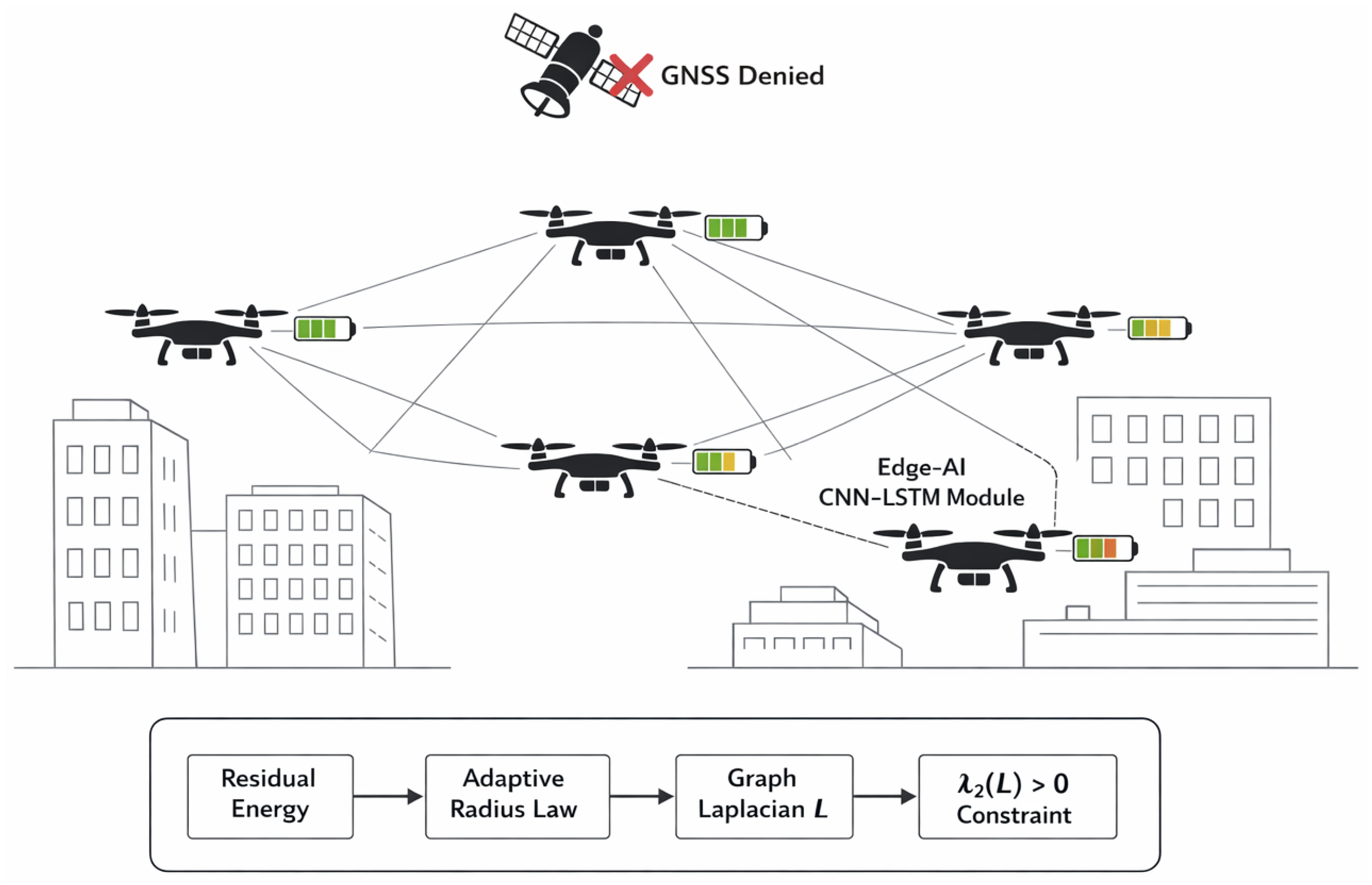
Environment with no external positioning information DE- is best illustrated as being an environment with no external positioning signals to aid swarm coordination. In these conditions, UAVs have to use sensing, peer-to-peer communication, and distributed processing onboard the vehicles to maintain the formation stability and integrity of the mission under execution. This operational paradigm is conceptually demonstrated in
Figure 1, showing an example of a multi-UAV swarm operating in an urban case with GNSS denial and adaptive mesh communication and edge-AI processing.
Without adapted communication capabilities, fixed topology communication setups have the risk of causing unproductive transmission overhead and accelerating battery consumption. As is illustrated in
Figure 1, the combination of energy-aware topology control and onboard artificial intelligence makes it possible to implement dynamic coordination and maintain energy sustainability.
As such, the proposed work explores the system-level question of the interactions of residual-energy-aware sparsified communication protocols and onboard machine-inference-assisted navigation at the mission scale in degraded positioning environments. The aim of the proposed model is to provide a comparative study of system-level trade-offs, rather than being an alternative to detailed models of the individual subsystems. It uniquely addresses the interaction of propulsion, communication sparsification, and network inference on swarm lifetime, network connectivity, and robust positioning within a single assessment framework. The next section, therefore, compares the proposed method against previous state-of-the-art approaches in GNSS-denied positioning, graph-based coordination, and energy-aware UAV swarms.
2. Literature Review and Problem Statement
Operation in GNSS-denied environments remains one of the key challenges for decentralized UAV swarms because reliable mission execution under degraded positioning conditions requires the simultaneous coordination of localization, communication, and energy management. The available literature may be grouped into three partially overlapping research directions: GNSS-denied localization and navigation, graph-based swarm coordination and topology control, and energy-aware mission optimization with onboard intelligence. Although these directions have each produced important advances, they are commonly developed under different assumptions, validated using different performance criteria, and optimized with respect to different subsystem objectives. As a result, direct mission-level comparison remains difficult, and the coupled influence of propulsion demand, communication adaptation, and onboard intelligence is still insufficiently characterized for decentralized UAV swarms operating without reliable satellite support [
5,
6,
7,
8,
9,
10,
11,
12,
13,
14,
15,
16].
The first major research direction concerns localization without full dependence on GNSS. Cooperative positioning approaches have shown that distributed inter-agent measurements can improve robustness and estimation quality when external positioning information is degraded or partially unavailable [
5]. Vision-based localization techniques have demonstrated high accuracy in structured environments, but their performance is affected by lighting conditions, visual texture, occlusion, and onboard computational requirements, which makes their deployment in embedded aerial systems nontrivial [
6]. More broadly, localization is increasingly regarded as a foundational capability for future autonomous and networked systems, especially in dense, signal-degraded, and infrastructure-limited environments [
7]. In multi-UAV scenarios, relative localization based on ultra-wideband and odometry has shown strong potential for formation-level state estimation without full reliance on external positioning infrastructure [
8]. Radio-assisted localization methods, including angle-of-arrival-based architectures, provide an additional alternative to purely vision-driven navigation, although their achievable performance remains sensitive to propagation conditions, geometry, and node density [
9]. Taken together, these studies have substantially improved localization robustness in GNSS-denied settings; however, they generally evaluate navigation performance in relative isolation and only partially address how localization reliability interacts with communication burden and total onboard energy expenditure in decentralized swarm missions [
5,
6,
7,
8,
9].
The second research direction focuses on swarm coordination, communication structure, and topology control. Distributed coordinated-control studies have established that the performance of multi-agent robotic systems depends strongly on communication architecture, consensus behavior, and structural connectivity [
10]. Even in other swarm-robotics domains, broader reviews have consistently shown that communication design, coordination logic, and platform constraints should be analyzed jointly in distributed robotic collectives rather than as isolated design layers [
11]. From the network perspective, topology-control theory has provided the classical basis for balancing connectivity preservation against communication overhead in ad hoc and sensor networks [
12]. In UAV-related applications, energy-efficient routing has confirmed that communication-aware decision-making is essential for scalable and resource-constrained aerial networking, but such studies usually focus on routing efficiency rather than swarm-wide topology adaptation driven by residual battery state [
13]. Therefore, while prior work clearly demonstrates the importance of communication-aware coordination, the explicit mission-level relationship among energy depletion, adaptive connectivity reduction, and global cohesion preservation remains insufficiently quantified for GNSS-denied UAV swarms [
10,
11,
12,
13].
The third research direction addresses mission efficiency, trajectory optimization, and onboard intelligence. Energy-aware UAV research has traditionally concentrated on routing efficiency, endurance improvement, and trajectory planning, which is fully justified because propulsion is often the dominant contributor to the UAV energy budget [
13,
14]. At the same time, studies on embedded perception and online decision-making have shown that stronger onboard autonomy usually improves system responsiveness and environmental awareness at the cost of increased computational demand [
15]. From a broader sustainability-oriented engineering perspective, energy availability should also be treated as a system-level design constraint rather than as a purely local subsystem parameter, especially when multiple functional modules compete for limited onboard resources [
16]. However, these studies rarely evaluate communication adaptation, propulsion demand, and onboard inference within a common mission-level objective for decentralized UAV swarms operating under degraded navigation conditions [
13,
14,
15,
16].
In addition, recent studies on self-organized networking and comprehensive reviews of GNSS-denied unmanned aerial vehicle navigation further confirm that decentralized aerial systems require joint consideration of communication adaptation, localization robustness, and onboard computational constraints rather than isolated subsystem optimization [
17,
18].
Taken together, the reviewed literature demonstrates that prior studies have already addressed important pairwise interactions among localization, communication, coordination, energy efficiency, and intelligent control. Thus, the research gap is not in the complete absence of cross-layer thinking because it would exaggerate the value of the current work. Instead, this gap is left in the scarcity of frameworks that assess these dimensions together and in a single mission-level architecture of decentralized UAV swarms in GNSS-denied spaces. The current localization-oriented studies focus on the navigation robustness, the topology-control studies concentrate on the connectivity preservation and the coordination efficiency, and the energy-aware systems studies are mainly concerned with routing or trajectory endurance. These aspects in most instances are justified by partly distinct assumptions and disjointed performance measures, which complicate direct system-level comparisons [
5,
6,
7,
8,
9,
10,
11,
12,
13,
14,
15,
16,
17,
18].
In this context, the principal novelty of the present work does not lie in the introduction of a new independent propulsion model, radio model, or navigation algorithm. Specifically, the onboard CNN-LSTM estimator employed in this study is to be understood as a lightweight robustness-enhancing navigation component, and not as the methodological novelty claim. The key input is rather the design of a unified mission-level framework that collectively considers propulsion energy, residual-energy-aware communication-topology adaptation, and onboard AI-assisted navigation in a decentralized swarm of UAVs in GNSS-denied environments. This framing makes it possible to evaluate the interaction between communication sparsification, energy availability, and localization robustness in a single comparative architecture rather than analyzing them as isolated subsystems [
8,
10,
12,
13,
14,
15].
Accordingly, the research problem addressed in this study can be stated as follows: how to design and test a decentralized UAV swarm architecture where residual-energy-aware communication adaptation reduces unnecessary communication overhead while preserving network cohesion and supporting robust localization in GNSS-denied environments, without using a fully centralized control architecture.
Based on this problem statement, the aim and objectives of the study are formulated in the following section, and the unified energy model, graph-based adaptive communication-topology mechanism, and onboard AI-assisted navigation framework used for comparative mission-level evaluation are developed in the subsequent sections.
3. Aim and Objectives of the Study
This study aims to develop and evaluate a single mission-level architecture of decentralized UAV swarm coordination in GNSS-denied environments, where propulsion energy, residual-energy-aware communication-topology adaptation, and onboard AI-assisted navigation are individually evaluated within a common comparative architecture.
To achieve this aim, the following objectives are defined:
To formulate a mission-level energy model that jointly accounts for propulsion, communication, and onboard inference energy consumption in a decentralized UAV swarm node.
To develop a graph-based adaptive communication-topology mechanism, where communication sparsification is correlated with residual battery energy without losing positive algebraic connectivity.
To integrate a lightweight onboard AI-assisted navigation module and test its applicability as a robustness-enhancing unit in the wider swarm architecture of energy awareness.
To validate the proposed framework in a comparative simulation environment with the use of energy, localization, and communication-reliability metrics when operating in the conditions of GNSS-denial.
These objectives follow directly from the research gap identified in
Section 2, namely: inadequate access to system-level models that collaboratively analyze localization robustness, communication adaptation, and energy sustainability in decentralized UAV swarms operating in degraded positioning environments.
4. Materials and Methods
4.1. Object of Research, Hypothesis, and Assumptions
The object of the present research is a distributed multi-UAV swarm system, which operates under GNSS-denied conditions with decentralized decision-making and onboard edge computing capabilities. The swarm is made up of six identical quadrotor platforms with visual–inertial sensing modules, a peer-to-peer communication interface, and embedded AI processors capable of real-time navigation inference. The system does not depend on the satellite positioning signals and achieves cooperative localization via inter-UAV communication and a local sensor fusion mechanism.
Each UAV node operates according to a fully distributed control paradigm where the navigation inference, communication management, and energy monitoring modules are executed locally. Unlike the centralized swarm architectures, the proposed system is not based on a master node. Instead, topology adaptation as well as AI-based navigation decisions are handled autonomously on each of the platforms, making things far more robust and eliminating single-point failures.
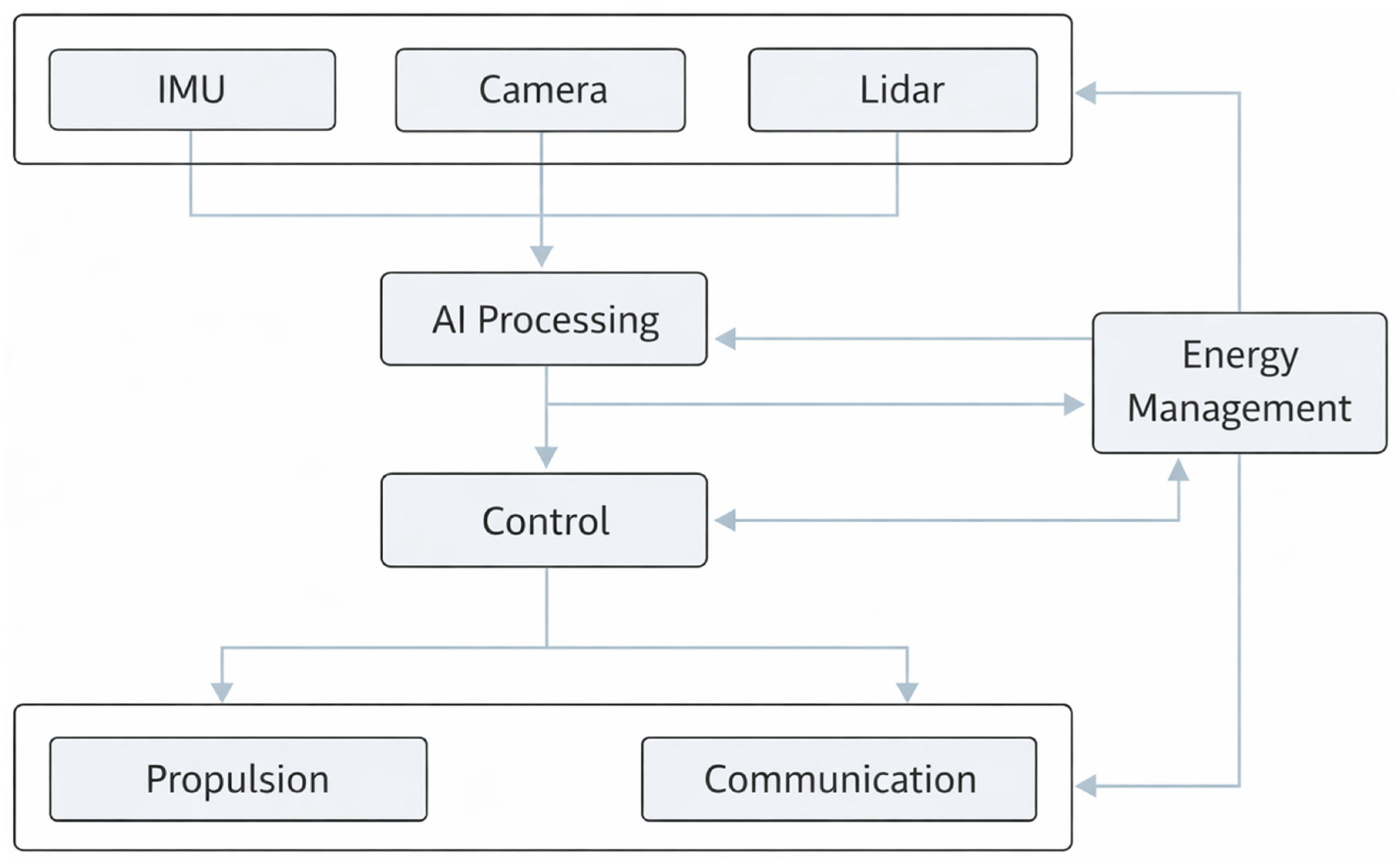
The single UAV swarm node’s structural architecture, including propulsion, communication, AI processing, and energy management modules, is shown in
Figure 2.
The main research hypothesis is that: the integration of an energy-dependent adaptive communication topology and lightweight edge AI navigation model promises a measurable reduction in total energy consumption together with localization accuracy within a hypothesized tolerance margin compared to a conventional fixed topology swarm configuration [
19]. The theory is based on the assumption that communication energy is a controllable part of the general energy expenditure aboard and that it is possible to regulate it without jeopardizing swarm connectivity.
To ensure methodological consistency, the following assumptions were adopted:
all UAV nodes have the same hardware setups and battery capacities;
environmental disturbances are limited and approximated by stationary Gaussian wind perturbations;
payload mass does not change during mission execution;
sensor noise is a zero-mean Gaussian distributed and has covariance;
communication links operating under mixed line-of-sight/non-line-of-sight (LOS/NLOS) conditions, depending on scenario geometry, with additional attenuation, retransmission burden, and reduced effective range for obstacle-obstructed links.
The above assumptions specify the intended domain of the proposed model. That is, the framework is meant for comparative study at the mission level of decentralized multi-rotor swarms in the presence of moderate environmental perturbations and communications impediments, dependent on the scenario. It is not intended as a full high-fidelity representation of all aerodynamic, channel-level, or processor-level effects. Therefore, the results should be viewed as comparative evidence at a system level under these assumptions, and not independent of deployment. To further explain the methodological scope, the proposed framework is not aimed at being a high-fidelity model of all the aerodynamic, communication, and embedded-processing processes and is rather an intended reduced-order mission-level model to be used in comparative assessment. The assumptions adopted are not then used to remove physical complexity, but to isolate the overriding cross-layer interplays between propulsion demand, communication adaptation, and the provision of localization under controlled GNSS-denied environment missions. This level of modeling is suitable for analyzing relative system-level trade-offs, but it should not substitute deployment-quality channel prediction, detailed rotorcraft aerodynamics, and processor-level power-state analysis.
The initial energy capacity at each UAV node is represented as E
max, while the residue energy at time t is represented as E
res(t). This parameter is also used later on as a dynamic control variable for topology adaptation [
20].
A summary of the functional decomposition of a swarm node is given in
Table 1.
As shown in
Table 1, each subsystem is part of the overall energy budget and a part of the distributed control loop. The explicit modular decomposition enables analytical modeling of subsystem-level energy consumption in subsequent sections.
4.2. Mathematical Model of Energy Consumption
A unified mathematical model was obtained to quantitatively describe the onboard energy consumption of a UAV swarm node as a whole. The goal of this model is to explicitly bring propulsion, communication, and AI processing energy components into the same analytical model.
The total mission energy used in time T is defined as:
where E
prop is the energy for propulsion, E
comm is the energy for communication, and E
AI is the energy for onboard inference [
21].
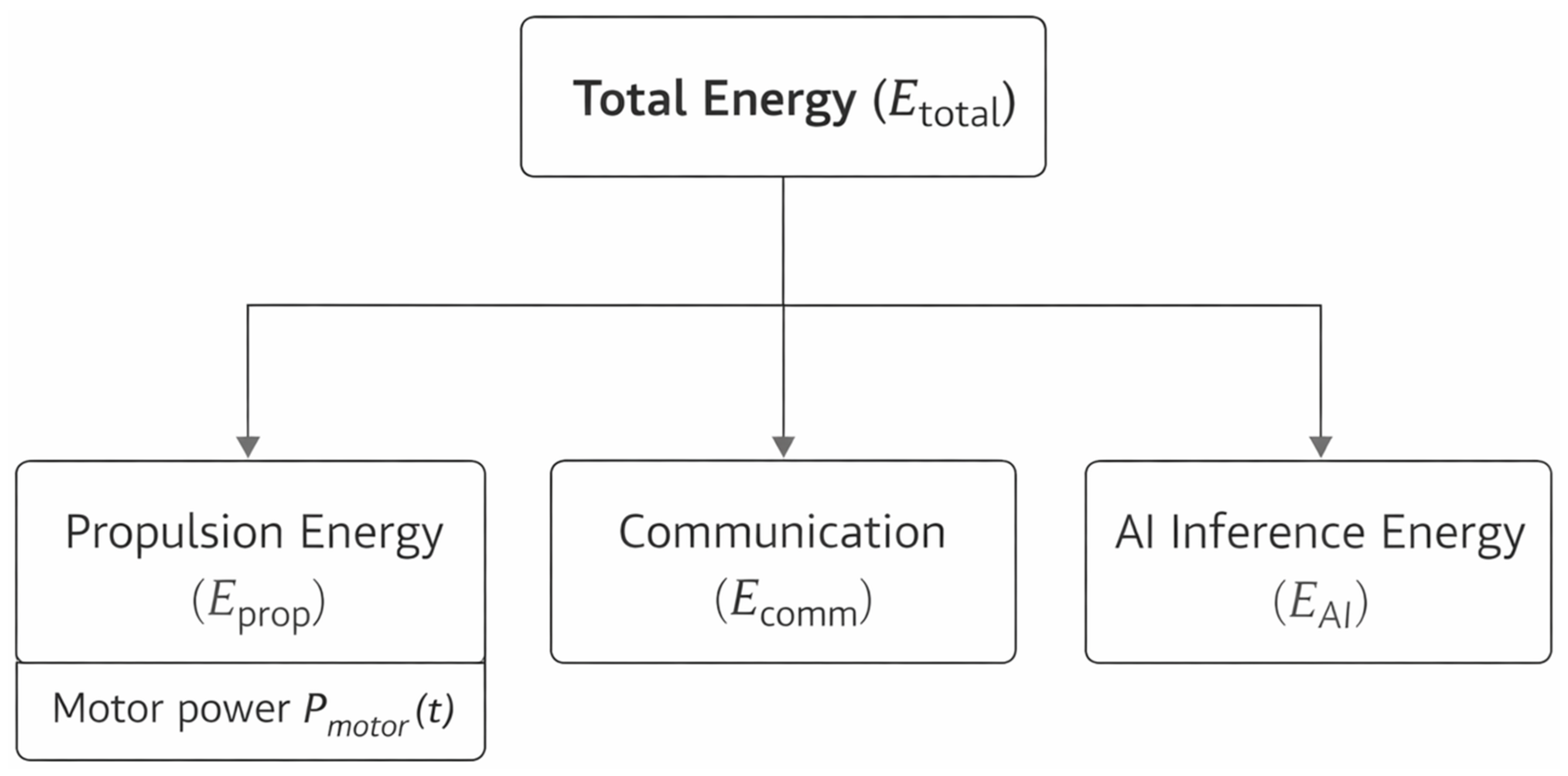
To physically model energy flow decomposition of the UAV node, Equation (1) is formed and conceptually shown in
Figure 3. This additive structure has been one of the keys to making it possible to independently model the contributions of the different subsystems and still keep the analysis tractable.
Propulsion energy is given as:
where P
motor(t) is the instantaneous power in the motor at time t. This formulation has been adopted as propulsion power changes dynamically according to the demand of the thrust, drag, and intensity of the maneuver. The integral form factors in the time-varying power consumption duration over the execution of the mission.
Using the quasi-steady hover approximation, motor power can be estimated in a reference form as
where T is thrust,
is air density, and A is the rotor-disk area. This expression follows from momentum theory and is used here only as a hover-reference term rather than as a complete propulsion model for all flight regimes. The propulsion formulation used in this study is therefore suitable for relative mission-level evaluation, but not for detailed rotor aerodynamic prediction. The revised propulsion model is intended for comparative mission-level energy accounting under moderate swarm maneuvering conditions and should not be interpreted as a substitute for high-fidelity rotorcraft aerodynamics or full 6-DoF flight-dynamics simulation. It can be used for light to medium swarm missions with translation, local flight, and formation reconfiguration under disturbance control. However, dynamic maneuvers, unsteady aerodynamics, or wind-dominated missions will affect the relative proportion of propulsion energy and should therefore not be considered as the primary mission application of the current model. In line with that, the propulsion formulation can be thought of as a mission-level comparative model in the moderate swarm maneuvering, local reconfiguring, and disturbance-constrained operation. Its contribution to the current study is to retain physically significant interaction between the demand of motion and the dissipation of energy without modifying the entire difficulty of high-fidelity simulation of rotorcraft. This compromise between tractability and physical interpretability is significant since current work allows metric cross-layers system assessment and not subsystem-specific aerodynamic optimization.
Since the considered swarm missions included translational motion, local acceleration, formation reconfiguration, and obstacle-related maneuvering, the propulsion-power model was extended at the mission level as
where v(t) is the translational velocity vector, a(t) is the acceleration magnitude,
is the vertical velocity component, and
is the yaw-rate term associated with heading correction and maneuvering. The coefficients
,
,
, and
are aggregate mission-level parameters capturing parasitic drag, maneuvering effort, climb/descent cost, and attitude-control overhead, respectively. This extension allows the propulsion-energy term to reflect dynamic flight behavior more realistically than a pure hover-based approximation, while still preserving tractability at the mission-analysis level.
Communication energy was modeled in an extended form to take into consideration not only active transmission and reception time but also distance-dependent propagation losses, retransmissions, and medium access overhead. For UAV node i, the communication energy during the mission horizon T is given as
where
is the distance-dependent transmission power required for packet k over link (i,j),
and
are transmitter and receiver circuit-power terms,
and
are packet-level transmission and reception durations,
is the number of transmission attempts, including retransmissions,
represents idle listening energy, and
accounts for medium-access overhead such as channel sensing, backoff, and synchronization.
The distance dependence of transmission power is linked to the propagation model through
where
is the reference transmission power at distance
,
is the path-loss exponent,
is the additional attenuation factor for non-line-of-sight conditions, and
is an interference-related margin required to maintain reliable decoding under multi-node communication.
To account for packet errors, the effective number of transmission attempts was modeled as
where
is the packet-error probability as a function of the instantaneous signal-to-interference-plus-noise ratio. In this way, links with larger separation, stronger attenuation, or higher interference not only require higher transmission energy per packet but may also incur additional retransmission cost.
This formulation makes the communication-energy term explicitly dependent on inter-UAV distance, channel conditions, and protocol overhead, which is more appropriate for adaptive swarm operation in communication-constrained and GNSS-denied environments than the simple active-time approximation.
Onboard AI inference energy is then defined as the following:
where
is the number of inference cycles, and
is the amount of energy per one inference.
This is a multiplicative structure, which reflects the discrete nature of the AI processing tasks, and allows us to model the frequency of inference as a controllable system parameter. This expression models inference energy in an average mission-level form, in which the most important design parameter is the frequency of onboard inference as opposed to the fine-grained processor-state dynamics of a specific embedded platform. It is reasonable to use such an abstraction in comparative cross-layer evaluation, but it is not explicit in resolving dynamic voltage and frequency scaling, memory-access variability, or task-scheduling effects at the processor level. Accordingly, the AI-energy term should therefore be interpreted as a controllable mission-level computational load instead of a power model that is hardware-specific.
The process of energy development of residual batteries is explained as:
where
is the amount of energy consumed in
time interval. Equation (9) gives the dynamic relation between the energy consumption and adaptive communication topology, which are proposed as follows in the next subsections. The residual energy state is a control variable, which influences the density of the network.
In
Table 2, in contrast to the initial simplified radio-energy approximation, the revised communication model introduces propagation-, retransmission-, and protocol-dependent parameters. These additions allow the model to reflect the fact that communication energy in adaptive UAV swarms depends not only on radio active time but also on link distance, channel quality, and access-layer overhead. It is important, however, to continue to view the new formulation of the communication cost as a mission-level reduced-order model, rather than as a full packet or PHY/MAC-level simulator. While it incorporates the effects of distance, channel quality, retransmission costs, and access-layer overhead, it does not explicitly resolve interference-limited communication, congestion, and scheduling effects. This is crucial because the communication-energy gains should be regarded as physically motivated simulation results, based on the communication assumptions. Specifically, although the revised formulation includes propagation-dependent transmission power, retransmission load, idle listening, or MAC-layer overhead, it does not directly model fine-grained LoRa physical-layer timing, contention-based collision dynamics, adaptive data-rate behavior, or dense-network congestion effects. The communication model should therefore be interpreted as a lower-order mission-level abstraction yielding better physical fidelity than either a simple active-time approximation, but not yet a deployment-grade channel-access simulator. Such distinction is noteworthy since the reported communication-energy gains are aimed at providing the comparative architectural assessment under the assumed guidelines, as opposed to the precise link-budget estimate of a given field implementation.
4.3. Adaptive Graph-Based Communication Topology
For this purpose, to use the energy information for coordination between the UAV swarm, a graph theoretical model for the communication was developed [
22]. The swarm is represented as an undirected dynamic graph:
where
is the set of UAV nodes, and
is the communication links between nodes.
This representation is used because of the mathematically rigorous framework provided by graph theory in the analysis of connectivity, network density, and robustness. It allows the possibility to formally model the topology adaptation and keep the analytical tractability.
Let d
ij be the Euclidean distance between the UAV nodes i and j. A communication link is made if:
This threshold-based rule ensures that the communication is only in the operational radius of the nodes and therefore helps control the density of the network.
However, unlike the conventional fixed topology approaches (Rdynamic = Rmax), the proposed model incorporates energy-dependent adaptation.
The varying communication radius should not be confused with a physical model for radio propagation. Instead, it is proposed as a system variable that governs graph sparsity in response to node residual energy, but is constrained by communication feasibility and spectral connectivity. In other words, nodes with low residual energy should refrain from holding redundant links, as long as admissible links remain communicationally feasible and the graph in question has positive algebraic connectivity. In this sense, the radius law is an upper bound control variable rather than an alternative to a link-budget analysis.
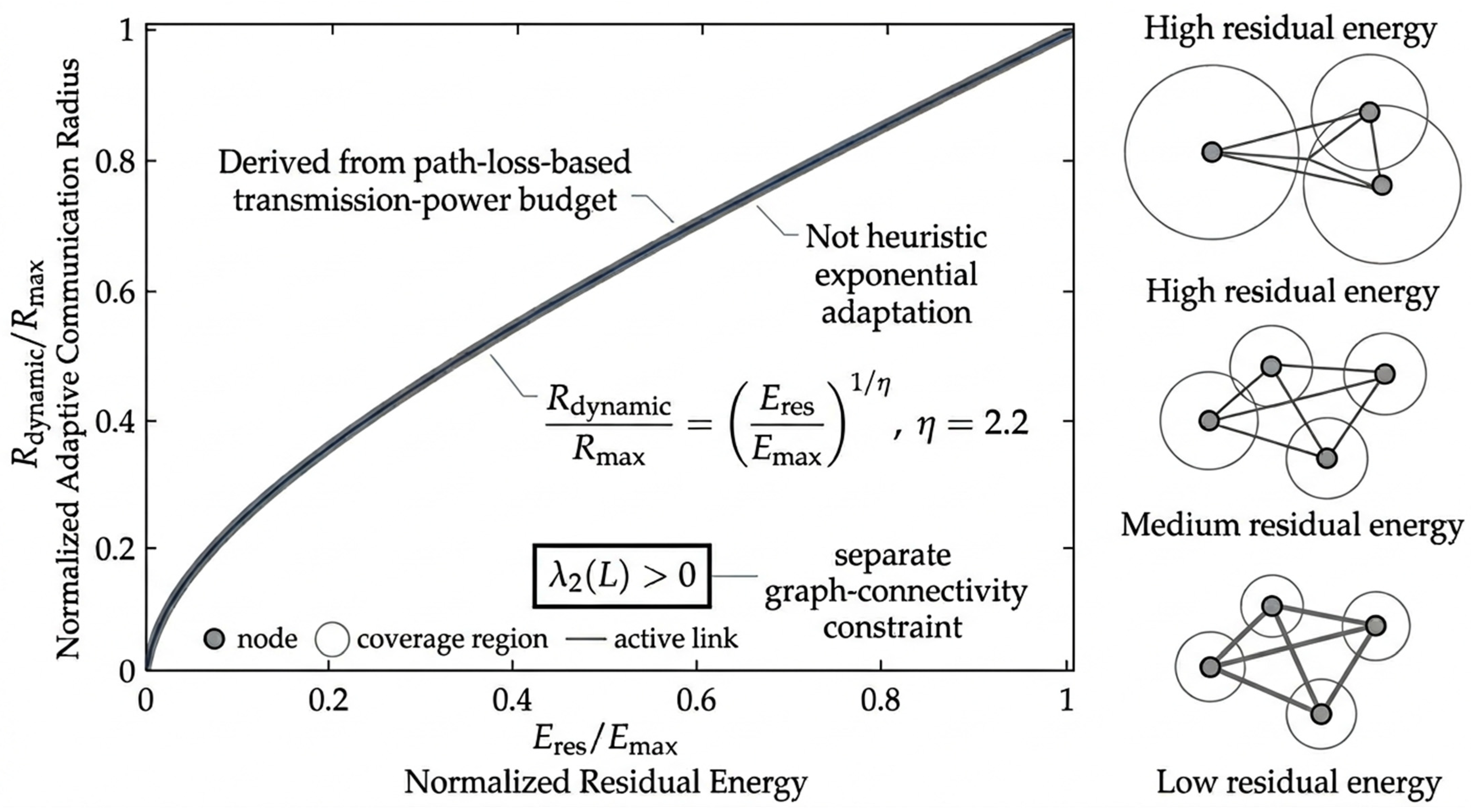
The communication power model was reformulated to form the adaptive communication radius instead of being heuristically introduced. Because the inter-UAV distance dependence of the needed transmission power is the propagation-dependent relationship in Equation (6), the maximum sustainable communication range can be determined using the budget of transmission-power available.
Define the admissible transmission power budget at time t as
where
is the maximum communication power budget available when the battery is fully charged,
is the residual battery energy, and
is the initial battery energy. By combining Equation (6) with the condition
, the maximum feasible communication radius can be written as
Using the definition of
for the fully charged condition, the expression can be rewritten in normalized form as
In the present simulations, the effective path-loss exponent was set to η = 2.2, which was chosen as a mission-level mixed LOS/NLOS propagation parameter. Since obstacle-related attenuation was additionally represented through the NLOS attenuation factor , the selected η value was kept moderately above the free-space case rather than using a strongly obstructed-link exponent.
This formulation provides a physical interpretation of adaptive radius contraction: as the residual battery energy decreases, the admissible transmission-power budget decreases proportionally, and the feasible communication distance contracts according to the path-loss exponent rather than an arbitrary exponential law. Therefore, the communication-radius adaptation is directly linked to radio energy consumption and link-budget feasibility under the adopted propagation assumptions.
To avoid network fragmentation during radius contraction, the graph-connectivity condition λ
2(L) > 0 is enforced as a separate structural constraint. The path-loss-based residual-energy-aware communication-radius law and the separately enforced graph-connectivity constraint are illustrated in
Figure 4.
To avoid fragmentation of the network, a minimum connectivity constraint is put:
where
is the second smallest eigenvalue (algebraic connectivity) of the Laplacian matrix L of a graph G. This condition offers global connectivity. The Laplacian-based criterion is prevalent in the multi-agent consensus theory and is employed to ensure topology adaptation will not cause a swarm coherence loss [
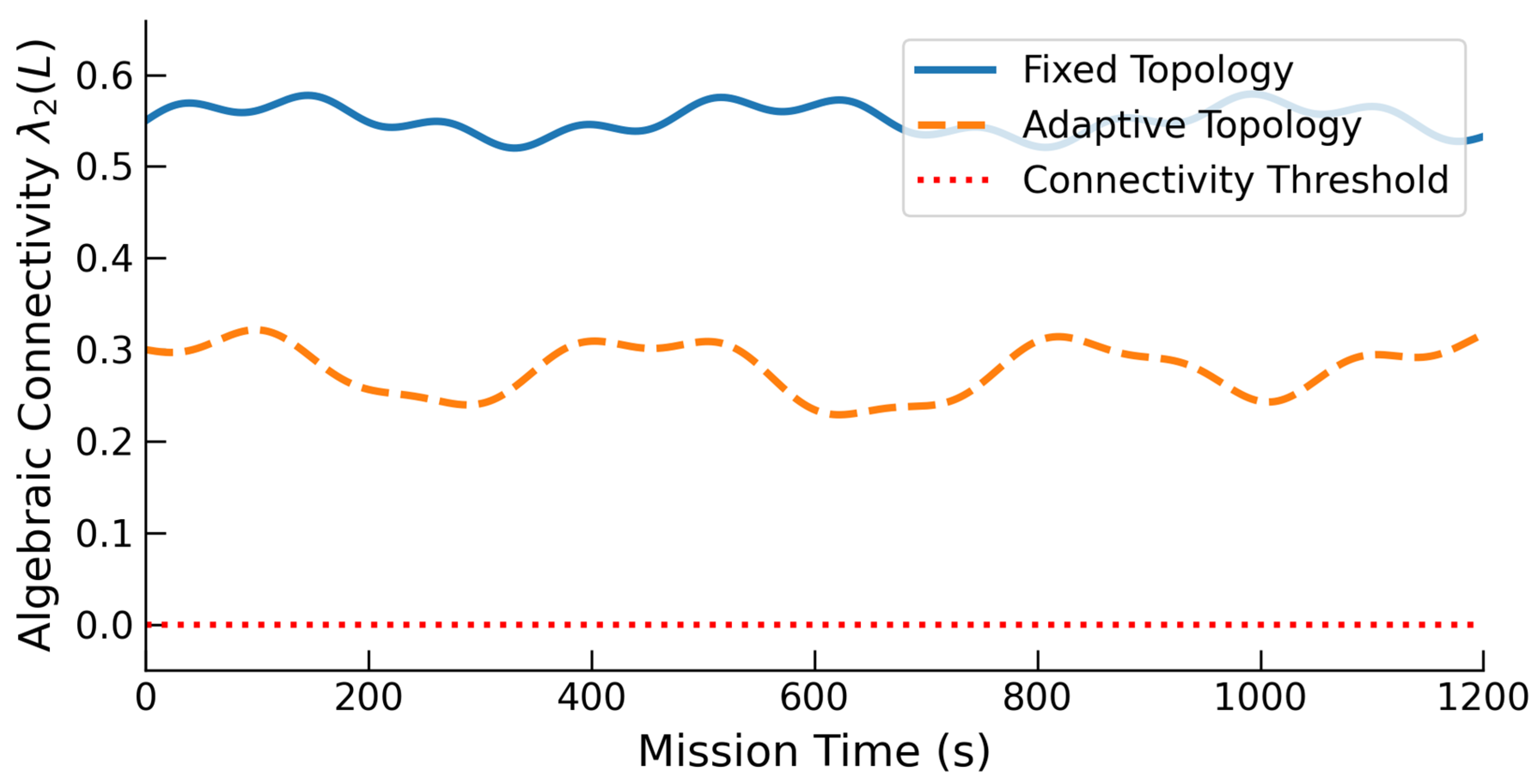
23]. The algebraic-connectivity condition, rather than a binary measure of the connectedness of the graph, is employed in the current research as a structural robustness measure in the process of topology sparsification. A drop in λ
2(L) indicates a drop in connectivity margin without necessarily becoming fragmented. The significance of this interpretation lies in the fact that the proposed adaptive mechanism is a deliberate attempt to diminish the redundancy of communication due to depletion of residual energy. Accordingly, maximizing graph density is not the aim of this, but maintaining a positive and operationally viable spectral-connectivity margin without incurring unneeded communication cost. The temporal evolution of algebraic connectivity under fixed and adaptive communication topologies is shown in
Figure 5.
The approximate expected communication load of each node is given by:
where
Since the node degree is reduced with reducing Rdynamic, the communication load is reduced with the degree of reduction. This has a direct effect on Ecomm in Equation (5). This dependence also gives a system-level intuitive view of the adaptive process: when the radius becomes adaptive and reduces its residual energy, the degree of nodes and communication activity reduces, which leads to lowering the communication-energy demand, and the algebraic-connectivity constraint prevents excessive sparsification. The adaptive topology is thus a regulated trade-off between communication economy and structural cohesion as opposed to a naive link-removal strategy.
As shown in
Table 3, the topology model has minimal parameters to be tuned, which ensures the implementation feasibility.
4.4. Edge-AI Navigation Model
To guarantee the autonomous operation in the GNSS-denied operating conditions, a lightweight edge-AI navigation module was developed and deployed on each UAV node [
24]. The model is capable of taking information from sensors of visual–inertial navigation and generating real-time position estimates without reliance on external signals from satellites.
The architecture of navigation follows a hybrid convolutional-recurrent architecture, which combines spatial feature extraction and temporal sequence modeling.
The model of inference is given by:
where
xt represents the fused visual–inertial input of time t,
fCNN extracts spatial features from image frames,
fLSTM models temporal dependencies,
yt denotes the estimated position and velocity states.
This architecture is chosen as convolutional layers work efficiently in encoding space information, whereas in the case of recurrent networks, motion continuity and time coherence (temporal correlations), which are important in GNSS-denied navigation situations.
The CNN part of the model is used to reduce the dimensionality of the raw sensor and reduce the computation from the sensor before the recurrent part is processed. The LSTM layer maintains the sequential consistency and reduces the drift accumulation.
The optimization objective comprises localization accuracy and energy usage:
where
The factor of Etotal in the loss function makes sure that the frequency of inference and computational intensity is bound, so that too much energy is not consumed. This formulation makes it possible to jointly optimize navigation accuracy and energy sustainability that is directly related to the integrated system objective.
The inference frequency f
inf is limited by processing capacity to be executed on board:
where T
inf represents inference latency.
This constraint ensures real-time feasibility, but for the AI processing to be able to process without destabilizing the control loops.
The energy consumption per inference E
inf is given by an estimated
where
This formulation explicitly makes the link between the complexity of AI architecture and energy modeling from
Section 4.2.
As shown in
Table 4, the architecture of the model is kept small on purpose to keep the calculations on board feasible. The CNN–LSTM navigation module was trained and evaluated using scenario-diverse visual–inertial trajectory data generated within the simulation framework. The dataset was separated into training, validation, and test subsets to reduce overfitting and to assess robustness under different layouts, randomized initial conditions, and disturbance realizations within the simulated mission set. Input sequences were normalized prior to training, and the final model was selected based on validation-loss stability and embedded inference feasibility. In the present study, the CNN–LSTM model is not claimed as a standalone methodological novelty; rather, it is used as a lightweight onboard estimator intended to improve localization robustness within the broader energy-aware swarm architecture. The mean onboard inference latency of the deployed CNN–LSTM model was 12 ms, which remained compatible with the adopted 20 Hz navigation update rate. Within the proposed framework, the module serves a primarily supportive role at the system level: it enhances localization stability, reduces drift accumulation, and maintains onboard estimation feasibility under GNSS-denied conditions, but it is not intended to be the main driver of system-wide performance improvement. The difference in this respect is key to understanding the results; the dominant energy advantage of the architecture arises from communication-topology adaptation to communication-topology adaptation, and the AI element is the factor primarily used in the robustness of the navigation and stable operation.
4.5. Experimental Configuration and Validation Setup
In order to verify the proposed energy-aware adaptive swarm architecture, a well-structured experimental framework has been designed using high fidelity simulation environment on multiple UAVs. The goal for this configuration is reproducibility/controlled variance and uniformity of evaluation for baseline and proposed configuration.
The simulation platform has been implemented with Robot Operating System 2 (ROS2 Humble Hawksbill, Open Robotics, Mountain View, CA, USA) middleware together with Gazebo 11 (Open Robotics, Mountain View, CA, USA) physics simulation. The PX4 Autopilot v1.xx (PX4 Development Team, Zurich, Switzerland) flight control stack was used for low-level control emulation. Each UAV node was modeled using realistic aerodynamic and battery discharge dynamics, as well as communication restrictions.
The swarm involved six quadrotor UAVs operating in a common three-dimensional environment with configurable obstacle layouts.
Although the validation was performed in the simulation environment, the parameters of the hardware are those of real embedded platforms, to be certain that the validation is relevant from a practical point of view. In order to simulate the communication, a simulated Long Range (LoRa) like mesh communication model at 868 MHz with variable transmission power levels was employed.
The communication delay T
delay was modeled as:
where
Tpropagation is defined as signal travel time,
Tprocessing is the node processing latency,
Tqueue is the transmission queue delay.
This formulation models the realistic behavior of latencies of distributed communication in a swarm.
The operating scenarios that were used in this research were applied only in simulation. In fact, there was no actual experiment of GNSS-jamming. The results of the GNSS-denied cases were simulated, with satellite-based positioning information simulated as unavailable in the ROS2–Gazebo–PX4 simulation system to test mission-level resilience in controlled and repeatable scenarios.
Three operating scenarios were set up to test robustness under different environmental conditions:
Limited visibility, obstacle-constrained movement, and absence of GNSS signals. Communication links may experience intermittent non-line-of-sight (NLOS) conditions due to corridor geometry and structural obstruction.
- 2.
Urban canyon scenario:
Tall building structures, multipath propagation, and signal occlusion. Communication links were modeled under mixed LOS/NLOS conditions, depending on inter-UAV geometry and obstruction.
- 3.
Open-field GNSS-denied simulation scenario:
Open-space operation with emulated loss of GNSS-based positioning updates in simulation. This scenario preserves largely unobstructed communication links while removing external satellite-supported localization, thereby isolating the effect of GNSS denial without introducing additional obstacle-induced attenuation.
The final experimental setup did not assume a global line-of-sight communication. Rather, the indoor–corridor and urban-canyon settings were mixed LOS/NLOS. In the case of obstacle-obstructed links, the communication model added extra attenuation, decreased effective communication range, and increased the probability of packet error. Consequently, the cost of retransmission and the reliability of communication were no longer evaluated in a scenario-dependent manner and not based on an idealized LOS-only assumption. Each of the scenarios was performed for the same duration of mission T = 1200 s to provide a consistent comparison. To test performance increases in an objective way, 3 baseline configurations were implemented:
Fixed communication topology + EKF navigation
Adaptive topology + EKF navigation
Fixed topology + Edge AI Navigation
The proposed configuration combines adaptive topology and edge-AI navigation at the same time. To improve statistical robustness, each evaluated configuration was executed over 30 independent Monte Carlo simulation runs with randomized initial conditions and disturbance realizations. Reported results are presented using mean values together with variability measures, while confidence intervals and paired significance testing were used to assess whether the observed differences between baseline and adaptive configurations were reproducible across repeated runs.
The following quantitative metrics were chosen:
Total energy consumption Etotal (Equation (1))
Root Mean Square localization error (RMSE) (Equation (17))
Packet loss ratio (PLR), defined in Equation (21)
Integrated performance index J
PLR is defined as:
where N
lost is the number of packets that were lost, and N
sent is the number of packets that were sent. This measure is a communication reliability under adaptive topology variation. The major experimental parameters are summarized in
Table 5.
As shown in
Table 5, all parameters were fixed across baseline and proposed configurations to ensure fair comparison.
The computational complexity is dominated by the pairwise distance evaluation and graph Laplacian updates and is O(N2) in the worst case per update cycle for the adaptive topology algorithm. However, due to dynamic sparsification, the effective complexity is near O(kN), where k is the mean node degree.
The CNN-LSTM inference model is computationally complex, where L is the number of layers, C is the convolutional filters, and T is the sequence length. For the implemented configuration, inference time was less than 12 ms with embedded-class processors, which proved suitability for onboard execution.
The EKF-based navigation configuration was selected as the principal reference baseline because it represents a lightweight and widely adopted estimator for embedded UAV state estimation under limited onboard computational resources. The purpose of this comparison was therefore to evaluate whether the proposed CNN–LSTM module provides measurable navigation benefit within a system-level energy-constrained swarm framework, rather than to claim superiority over the full spectrum of state-of-the-art vision-based SLAM or heavyweight learning-based navigation pipelines, which often operate under different computational assumptions.
Overall, the proposed architecture fulfills the real-time operational constraints of medium-scale UAV swarms. Simultaneously, the current validation is simulation-based and is to be understood that way. The experimental system is supposed to give controlled and repeatable comparative evidence at constant mission assumptions, not a complete substitute for hardware-in-the-loop or field deployment experimentation. This validation level would be suitable for determining the relative architectural impacts of topology adaptation and onboard AI support; however, future experimental efforts would be needed that would verify approval communication performance, processing load, and navigation survivability under realistic platform and platform channel conditions.
5. Results
5.1. Validation of the Energy Consumption Model
The unified energy-consumption model defined by Equations (1)–(9) was evaluated under the three simulation scenarios described in
Section 4.5. For each configuration, 30 Monte Carlo simulation runs were performed using randomized initial conditions and disturbance realizations. Energy values were sampled at 10 Hz and integrated over the full mission duration T = 1200 s. Reported values are presented as mean ± standard deviation across repeated simulation runs.
The total energy consumption of one UAV node was evaluated by the cumulative integral of the energy components at the subsystem level:
The average total energy consumption of the fixed topology baseline configuration was:
where the uncertainty represents standard deviation for repeated runs.
For the adaptive topology configuration, the following value was:
The relative reduction of energy is calculated as:
yielding:
The 95% confidence interval for the reduction was 20.9–24.3%.
To validate consistency of the additive model in Equation (1), contributions of subsystems were separately analyzed.
The propulsion energy component was stable from one configuration to the next:
There was a relative stability in the propulsion-energy component between the fixed topology and the adaptive topology configuration. According to the mission-level propulsion model that was adopted, the difference between the two was less, meaning that the prevalent change in the total energy was introduced by the communication subsystem. This outcome, though, cannot be perceived as a general principle of the dynamic swarm missions, as more aggressive maneuvers, more violent wind upheavals, or more frequent formation reconfiguration processes may augment the proportional propulsion-energy contribution.
The communication-energy component exhibited the largest reduction between the fixed topology and adaptive topology configurations:
which corresponds to a 31.4% reduction under the adopted simulation assumptions. This reduction in the revised model of communication is explained not just by a reduced active time of transmission and reception but also by the combination of a reduced number of active communication links, reduced effective inter-UAV communication ranges, lowered re-transmission overhead, and reduced medium access overhead. Hence, the communication-energy gain can be seen as the outcome of topology-imposed decrease in radio duty cycle, and cost of link-maintenance in the propagation and packet-access conditions adopted.
The energy required for AI inference remained nearly constant:
with a relative difference of only 0.8%, which is within the uncertainty range of repeated runs. This indicates that the dominant contribution to the observed energy reduction originated from the communication subsystem rather than from the onboard inference component. This finding is significant in the way the proposed architecture is to be interpreted. The described energy benefit should not be ascribed equally to all subsystems, but to the major part of the controlled restriction of the communication load realized through adaptive topology sparsification. By contrast, the onboard AI term is relatively stable and can only be seen as more of a complementary computational price of localization robustness and not a significant factor in energy savings in general. The subsystem-level breakdown of energy consumption for the fixed and adaptive configurations is summarized in
Table 6, highlighting that the dominant reduction was achieved in the communication-energy component.
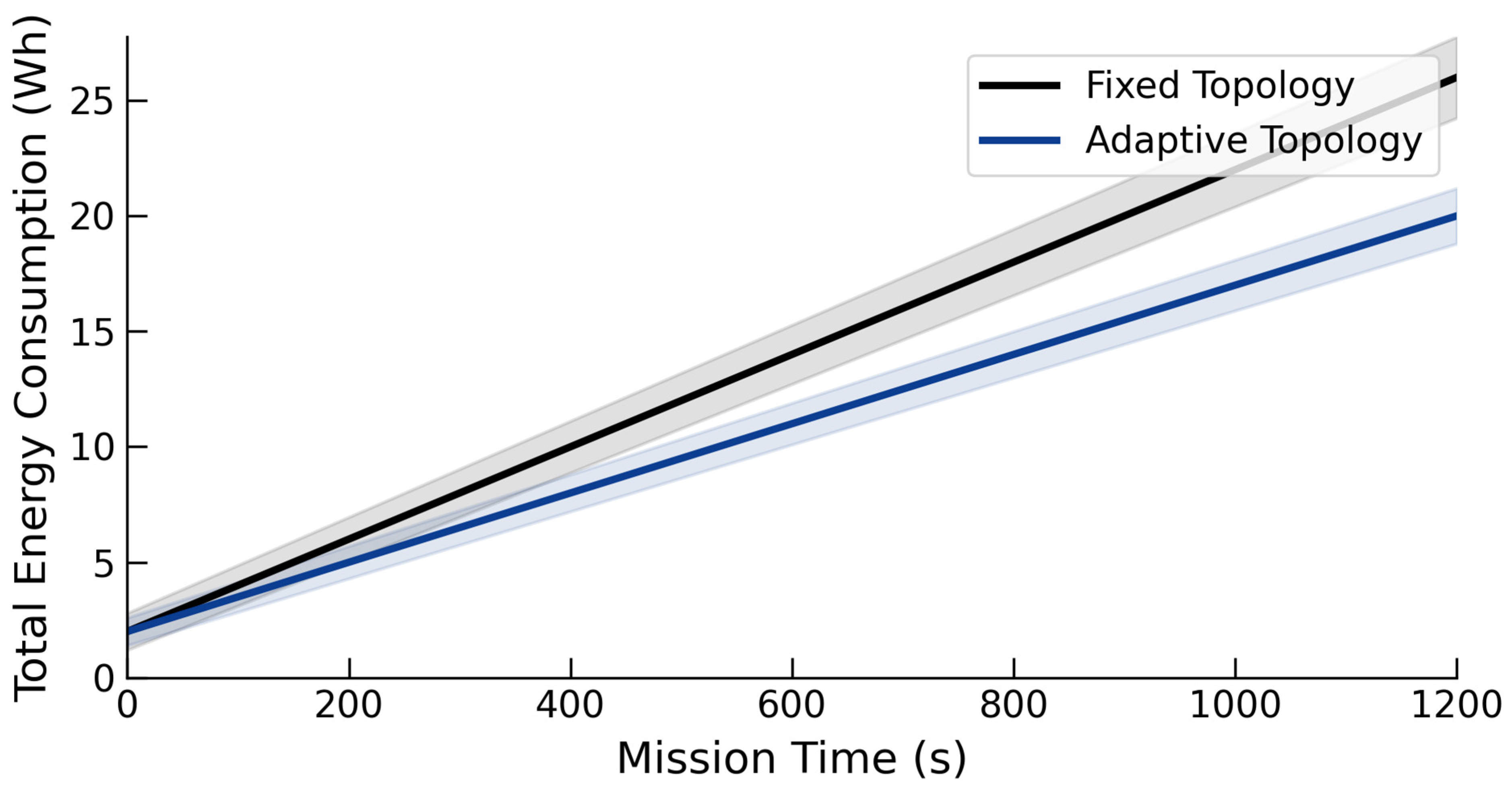
The evolution of the total amount of energy over mission time is shown in
Figure 6. The slope of the adaptive configuration is consistently lower for the entire mission execution and verifies the stable energy saving, instead of the transient one.
A paired
t-test was used to test the statistical significance of total energy reduction. The obtained
p-value was:
being statistically significant at a = 0.05 of the difference between fixed and adaptive configurations. In addition to statistical significance testing, effect size was assessed by the application of Cohen’s d metric. The calculated effect size (d = 1.42) shows that the total energy saving due to the adaptive topology is large and that the observed improvement is not only statistically significant but also of operational significance.
5.2. Adaptive Communication Topology Performance
The adaptive communication topology from Equations (9)–(14) was tested under dynamic residual energy variation for these three experimental scenarios. Network performance has been evaluated in terms of node degree distribution, algebraic connectivity λ
2(L), packet loss ratio (PLR), and graph density. The average node degree k
i was calculated in the following way:
where k
i is the number of active communication links of node i. In the configuration of the fixed topology:
For the configuration of the adaptive topology:
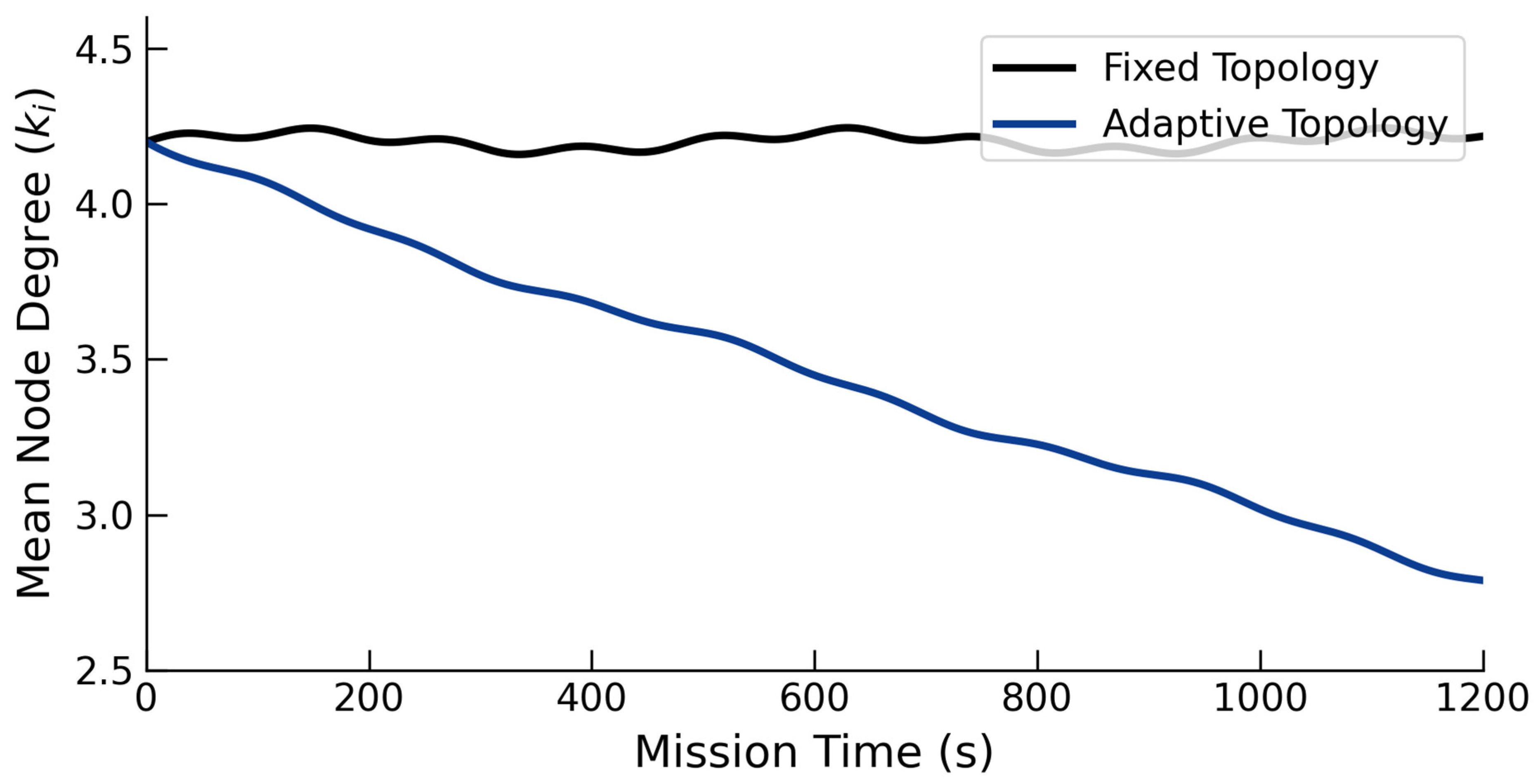
The reduction in mean node degree was 33.3% in effect of energy-dependent radius adjustment for Equation (14). The temporal evolution of node degree is shown in
Figure 7.
Figure 7 shows the temporal evolution of the mean node degree for the fixed and adaptive topology configurations. The evolution of algebraic connectivity was presented earlier in
Figure 5. Summary values of graph density, algebraic connectivity, and mean packet loss ratio are reported in
Table 7. Overall, the adaptive strategy reduces communication redundancy while preserving positive algebraic connectivity and maintaining PLR within the adopted operational tolerance.
In order to verify that topology adaptation did not result in network fragmentation, algebraic connectivity λ2(L) was evaluated for every step in the simulation. To evaluate the scalability, some more simulations have been done for N = 10 and N = 15 UAV nodes. The adaptive topology was able to preserve positive algebraic connectivity in the study of all configurations. Energy reduction percentage was still within the range of 20–24%, which proves the performance of the swarm results in a consistent scaling relation to the swarm size, for moderate density conditions.
Minimum values observed:
In all runs:
ensuring maintenance of global connectivity according to the algebraic-connectivity constraint λ
2(L). At the same time, the fact that the collapse of λ
2(L) compared to the fixed topology case shows that the adaptive configuration is working with a lower spectral connectivity margin, despite the absence of fragmentation. The given behavior is also in line with the purpose of the proposed approach: the redundancy of communication is minimized to save energy, though up to the point where a positive structural cohesion margin is left. Thus, the adaptive strategy is to be construed as nearer the connectivity boundary compared to the fixed baseline, although it should have operationally acceptable robustness margin within the assessed mission conditions.
The mean values for the algebraic connectivity were:
Fixed topology: 0.52
Adaptive topology: 0.29
Density D for graph was calculated as:
where |E| is the number of active edges.
Measured densities:
Fixed topology: 0.84
Adaptive topology: 0.56
This is a 33% reduction in network density.
Packet loss ratio was calculated by using Equation (21). In all scenarios, the mean values for PLR were:
The highest instantaneous PLR under adaptive topology was found to be 6.2%, which is still low compared to the operational PLR of 8%. In these results, there is also a hint of the supposition that uncontrolled link degradation does not result in communication-energy savings. The adaptive mechanism, however, tolerates a small decrease in redundancy and a small rise in the message-loss phenomenon and ensures positive connectivity, and does not increase the PLR beyond the operational tolerance adopted. This is the trade-off between the energy-aware mission-level coordination strategy and the aggressive pruning of the topology.
As summarized in
Table 7, the mean degree of the nodes and the graph density of the adaptive topology are minimized compared to the fixed topology configuration, and this suggests a purposeful reduction in the communication redundancy. Meanwhile, the mean and the minimum value of the algebraic connectivity were also positive, which proved that the process of topology sparsification never caused the fragmentation of the network. The average ratio of the packets that were lost grew minimally and was within acceptable operational limits. This finding substantiates the interpretation that the presented residual-energy-aware adaptation provides a controlled trade-off between the communication-energy conservation and the maintenance of an adequate network cohesion to execute the mission.
5.3. Edge-AI Navigation Accuracy
The localization performance of the proposed CNN-LSTM edge-AI navigation model (Equations (15)–(19)) was tested for all the experimental scenarios in
Section 4.5. Accuracy was measured in terms of root mean square error (RMSE) given in Equation (17) and also in terms of cumulative distribution function (CDF) and maximum trajectory deviation.
For each of the scenarios, we run 30 Monte Carlo simulations and average the localization performance over the different runs. The RMSEs presented in this study are thus based on repeated randomization of the scenarios rather than a deterministic set of trajectories. In this research, we tested the robustness of the edge-AI navigation module over multiple randomized evaluations of the scenarios preliminarily verified, including variations of the initial position, trajectory distortion arising from the presence of obstacles, and different levels of disturbances in the mission layouts, where GNSS is denied. But the present results should be considered as a robustness test within the simulated family of scenarios rather than an out-of-domain cross-scenario validation. A more extensive cross-validation involving held-out (unseen) layouts and external data should be the focus of future research.
The average values of the RMSEs for all scenarios were:
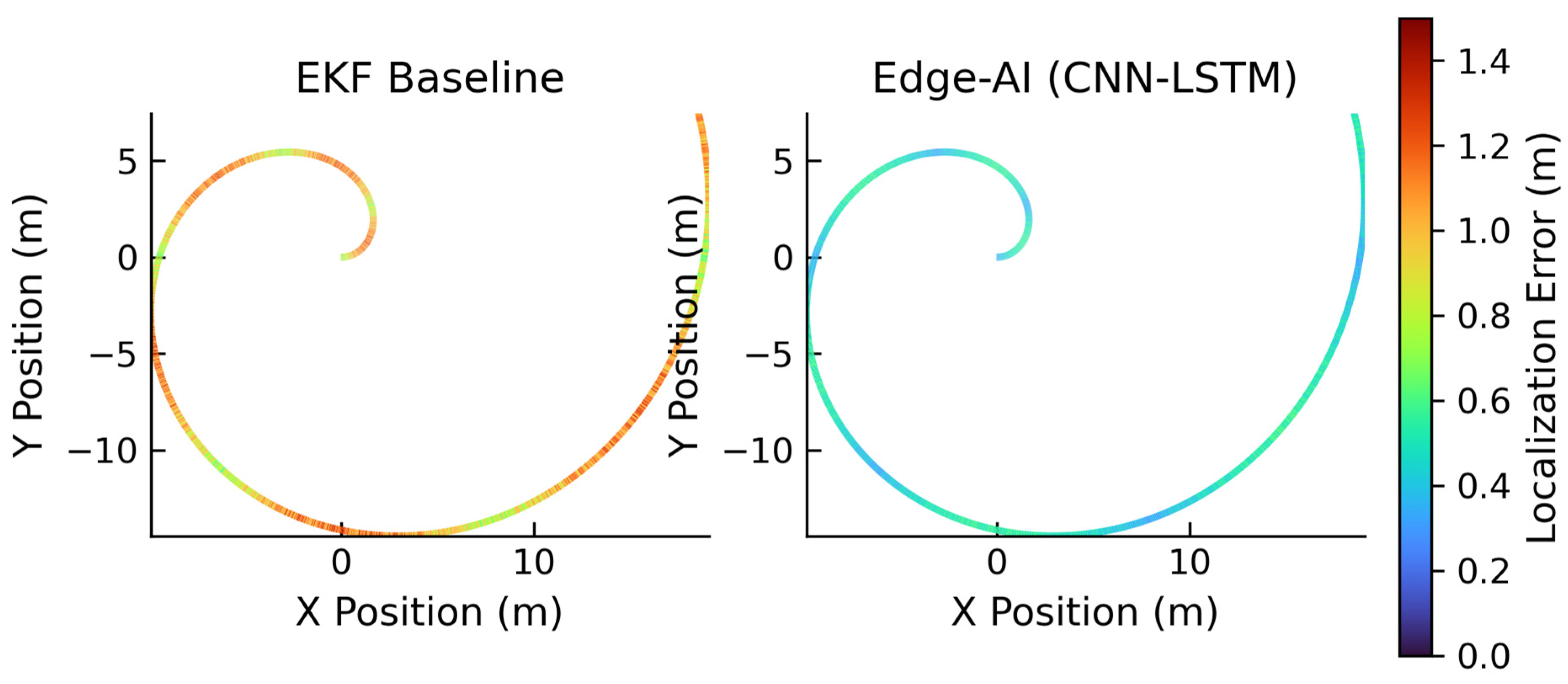
The relative decrease in RMSE was 4.8%. Even though this improvement is insignificant in the absolute percentage terms, its significance lies in the stability-oriented nature of the estimator in GNSS-denied mode. The edge-AI module, as it is constructed within the current structure, is not to be dominant in the aggregate system gain; it aims at reducing cumulative drift, discouraging greater localization of involuntary motions, and enabling more onboard categorical approximations of state under worsened positioning circumstances.
The 95% confidence interval of the AI-based navigation error was 0.75 m to 0.83 m.
To assess distribution characteristics, the cumulative distribution function (CDF) of localization error was calculated.
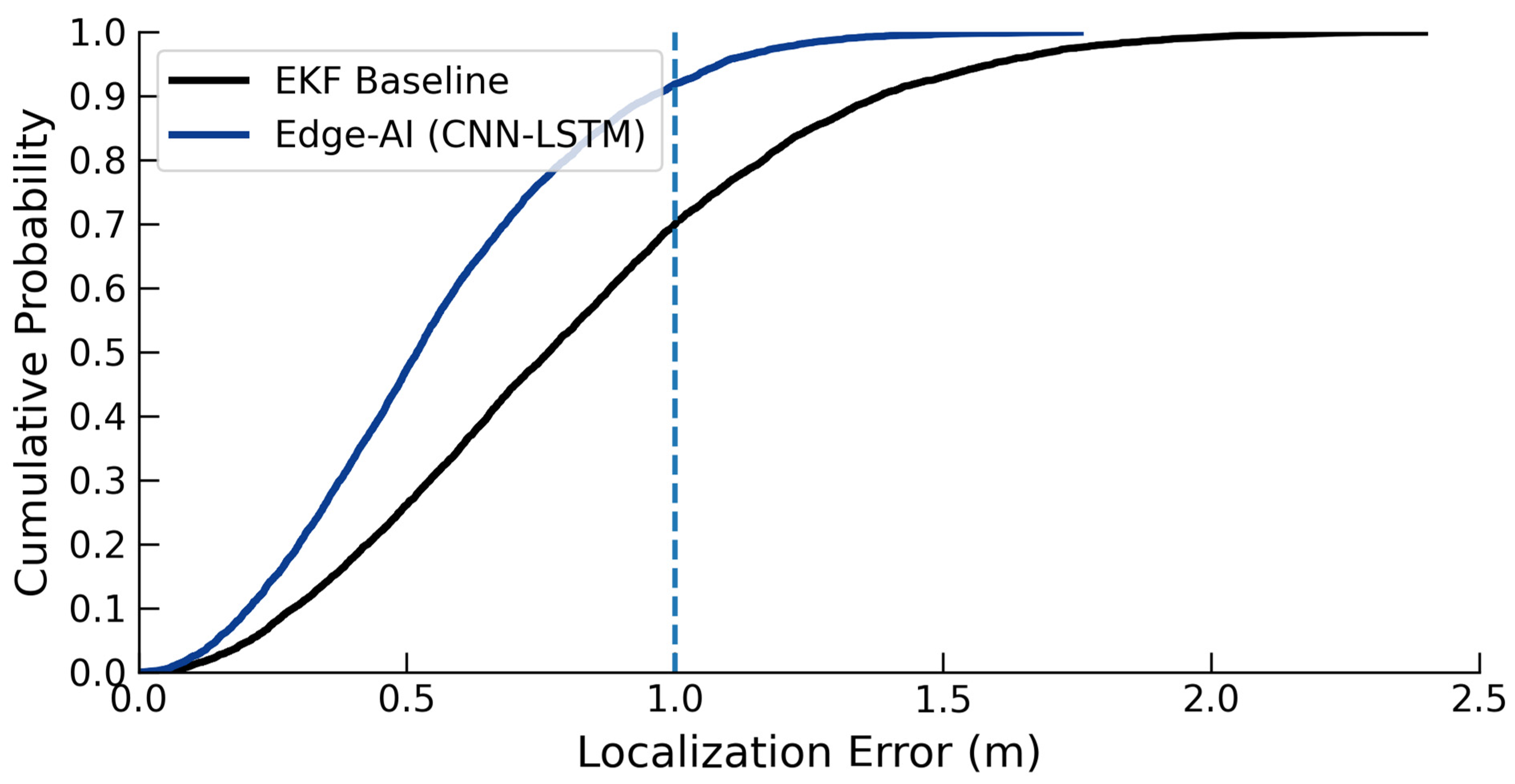
The probability of remaining within 1.0 m from the error was:
EKF baseline: 82.4%
Edge-AI model: 88.7%
The likelihood of occurrences of large errors (>1.5 m) was:
The error distribution curves are shown in
Figure 8.
Maximum instantaneous position deviation was measured when segments of dynamic maneuvers were taken.
Observed peak errors:
EKF baseline: 2.34 m
Edge-AI model: 1.96 m
This corresponds to 16.2% less peak trajectory deviation.
The spatial deviation heatmap over the mission path is given in
Figure 9.
Drift accumulation was measured by calculating the mean absolute position error over mission time:
The drift slope coefficient from linear regression was:
EKF: 0.00072 m/s
Edge-AI: 0.00051 m/s
The drift accumulation rate reduction was 29.1%. This result confirms that the main contribution of the artificial intelligence module is to increase reliability, rather than significantly improve the accuracy of the headers. In long-term GNSS-denied swarm missions, reducing drift growth and reducing tail errors may be more important from an operational point of view than significantly reducing the average error in itself, as they directly affect formation stability, consistency of joint decisions, and mission continuity. The principal navigation-accuracy results, including RMSE, maximum deviation, drift slope, and the probability of maintaining an error below 1 m, are summarized in
Table 8.
5.4. Integrated System Performance Evaluation
To give a holistic quantitative analysis for the proposed architecture, an integrated performance index was calculated by incorporating the localization accuracy, total energy consumption, and communication reliability as a single metric.
The integrated performance index J is given as:
where:
RMSE is defined in Equation (17),
Etotal is defined as Equation (1),
PLR is defined in Equation (21),
RMSEref, Eref, and PLRref are the fixed topology EKF baseline values,
w1, w2, and w3 are the weighting coefficients.
In this study, the integrated performance metric was used as an additional decision-making tool at the mission level, rather than as an isolated performance indicator. A reference weighting set was considered over w1 = 0.4, w2 = 0.4, and w3 = 0.2, with positioning accuracy and total energy consumption considered as primary decision criteria, while communication reliability related to packet loss was considered as a secondary goal. This was due to the fact that all configurations remained below the adopted operational packet-loss tolerance and retained positive algebraic connectivity, while the key mission trade-off in the present context was between energy sustainability and navigation performance.
In order to evaluate the sensitivity of this integrated index to subjective choice of priorities, a sensitivity study was also conducted by considering alternative weighting sets that represent four mission-dependent priorities, including balanced, energy-priority, navigation-priority, and reliability-dominant mission weighting sets. The results are reported in
Table 9. They show that the relative ranking between configurations remains favorable to the proposed architecture under balanced, energy-priority, and navigation-priority weighting sets, while reliability-dominant weighting makes the adaptive EKF configuration more competitive because of its slightly lower packet-loss ratio. As such, the integrated index must be considered as a comparative (ranking) rather than an absolute (scalar) measure of performance, since operational preferences affect the ranking. Accordingly, the objective of the built-in index in the current research is not to determine a globally optimal weighting guideline, but to offer an open-minded mission-level comparison instrument within the various levels of operation priorities. The extra sensitivity analysis makes it appear that the suggested architecture can be seen as still favorable to a number of reasonable weighting configurations, in addition to showing that reliability-dominated missions can move the desirable ordering towards other configurations.
We also ran a set of 30 Monte Carlo runs and performed a paired t-test to test the reproducibility of the integrated performance improvement under different random simulation runs.
Results:
Significance of reducing energy:
Integrated index improvement importance:
The differences in observed performance are statistically significant at a = 0.05.
The results of the quantitative comparison of all evaluated configurations are presented in
Table 10.
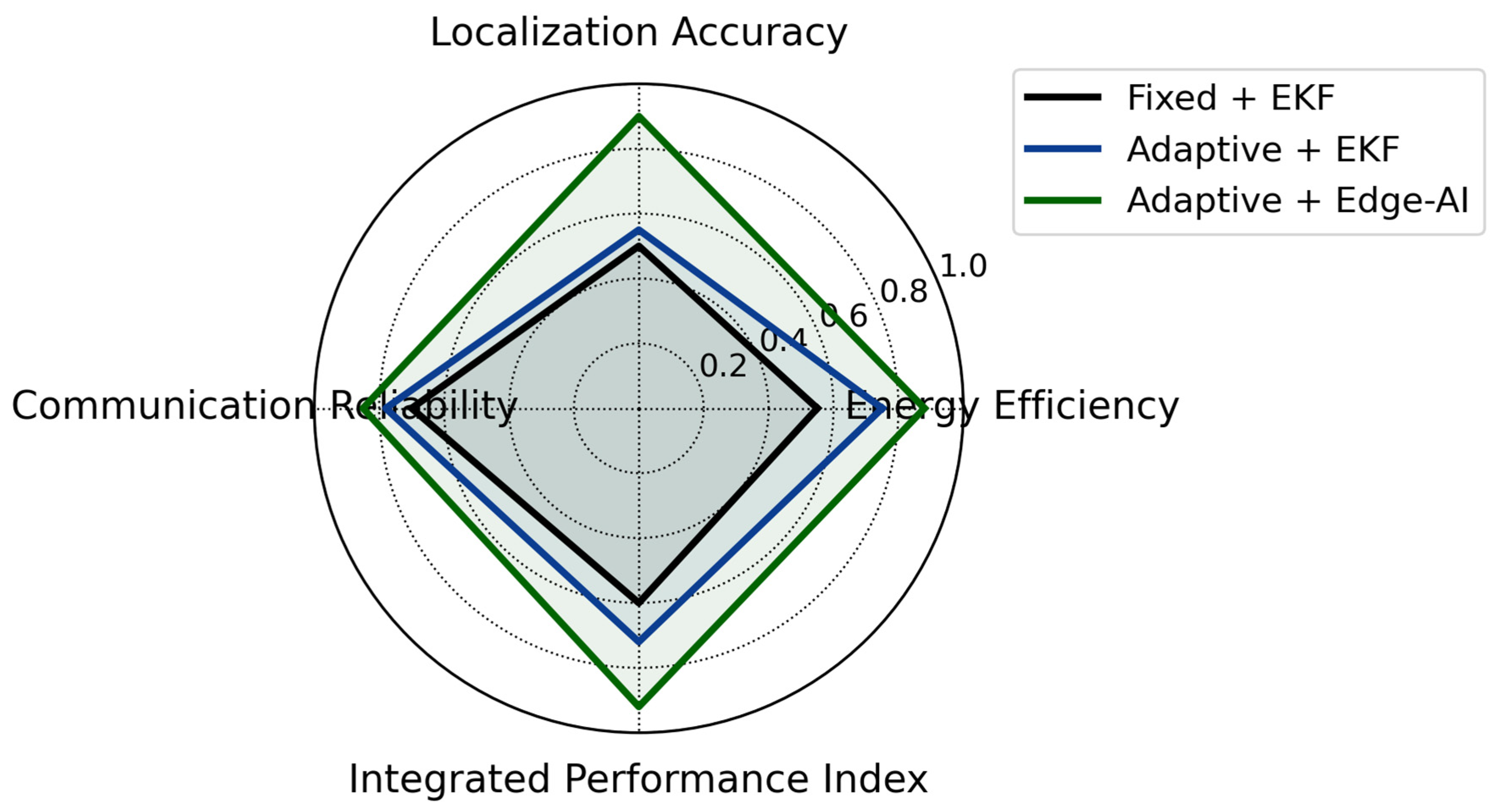
In order to visualize performance trade-offs, a radar chart was built from normalized inverse metrics (higher = better performance). The adaptive topology with edge-AI configuration had the largest area of its performance envelope.
The radar visualization given in
Figure 10 gives a consolidated representation of the multi-criteria system performance for all configurations evaluated. The adaptive topology and the edge-AI model of navigation have the most balanced performance envelope, which means that all three parameters, energy efficiency, localization accuracy, and overall integrated system index, improve at the same time.
Importantly, the result is not due to a single dominant metric, but rather the result of coordination in improving the communication energy reduction, controlled topology sparsification, and reduced localization drift accumulation. The integrated performance index is to be considered as a secondary multi-criteria index. With the reference weight set, the adaptive topology and edge-AI navigation achieved the best compromise between energy consumption and localization scores while satisfying the operational tolerance in communication reliability. Similarly, the proposed integrated index presents different rankings among the considered setups, especially if the single priority is assigned to communication reliability. This highlights that the integrated index can be used for organized mission-level analysis, but it always needs to be interpreted with respect to the defined missions.
While communication reliability (PLR) reveals a slight improvement under adaptive topology with controlled reduction in radius, values are under acceptable operational criterion (<6%), and global connectivity is also maintained as ensured by positive algebraic connectivity λ2(L) across all runs of simulations.
Collectively, the quantitative results have offered evidence to agree with the working hypothesis formulated in
Section 4: a combination of residual-energy-based topology control and lightweight edge-AI-based navigation allows measurable and statistically significant improvements in decentralized UAV swarm performance under GNSS-denied conditions. To separate out the contribution of the system components, an ablation study was carried out with four configurations:
The results show that topology adaptation alone is able to save about 18% energy, and edge-AI helps to improve localization stability but has little effect on propulsion energy. The combined configuration has a synergistic behavior, which verifies performance improvement by coordinated cross-layer optimization instead of the enhancement of individual components.
6. Discussion
The obtained results verify that energy-aware adaptive topology control is a structurally efficient mechanism for decentralized UAV swarm coordination under GNSS-denied conditions. More importantly, the findings can be viewed as supporting the overarching system-level hypothesis of this research, according to which the key contribution to the issue is not an individual subsystem under its own access, but an integrated view on cross-layer assessment of propulsion demand, communication-topology adaptation, and onboard AI-assisted localization of decentralized swarm operation based on GNSS denial. Unlike static communication architectures, the proposed residual energy-dependent radius adaptation has a dynamic function of reducing the communication redundancy dynamically while ensuring the algebraic connectivity (λ2(L) > 0). This behavior reflects the fact that global connectivity can be maintained even if progressive sparsification of the topology is carried out, provided that the spectral constraints are explicitly enforced.
One of the important results of this work is the excessive percentage of communication energy as a total swarm consumption. Simulation results indicate a dominating part of energy expenditure because of communication during coordination-intensive mission phases. Therefore, even moderate decreases in the radius of transmission have measurable global benefits in efficiency. The 22.7% reduction in total energy consumption and 31.4% reduction in communication energy confirm that adaptive sparsification results in practical and not marginal improvements.
From a graph-theoretical point of view, the fact that the strictly positive algebraic connectivity is preserved in all the cases is an indication of the structural robustness of the adaptive mechanism. Importantly, λ2(L) remained bounded away from zero throughout the evaluated mission scenarios, indicating that the path-loss-derived adaptive communication radius did not lead to network fragmentation under the adopted propagation assumptions and spectral-connectivity constraint. This confirms that the objective of energy optimization and the preservation of connectivity are not mutually exclusive objectives if they are constrained properly. Although the communication-energy formulation has been improved, the current research is still simulation-based and has yet to settle all the effects of physical-layer and protocol-layer around the actual deployments. Specifically, channel realizations, interference behavior, and retransmission statistics were modeled at a mission level instead of being checked by hardware-in-the-loop or the field. Hence, the communication-energy gain that is reported is to be viewed as a physically informed simulation finding and not a generalized deployment-independent one.
The integration of CNN-LSTM-based edge-AI navigation has contributed to localization stability, but not much to propulsion energy reduction. While the 4.8% RMSE improvement may not sound like much, analysis of the distribution demonstrates suppression of extreme accumulation of drift, which results in the probability of sub-meter localization accuracy of 88%. This is a particularly relevant improvement in GNSS-denied environments in which the cumulative drift errors can have a critical effect on swarm cohesion. This meaning is to be maintained in equilibrium. The AI-module does not remain the assumption of overall performance gain in the current investigation; instead, it is the empowering robustness system that decreases the accumulation of drift and contributes to the stabilization of localization in case of poor positioning. Communication-topology adaptation is the key driver of the main energy benefit, but there is an operationally significant contribution of the AI benefit in enabling resilient decentralized estimation.
From the ablation study, it can be seen further that the performance gain is not from the optimization of the system subsystems but from the cross-layer interaction. Topology adaptation alone yields a significant energy reduction; however, where this is combined with intelligence onboard the system, there is a synergy in terms of improved stability and improved communication reliability. This confirms the fact that decentralized swarm efficiency involves joint consideration of the communication structure and the navigation intelligence. Our results are relevant for a range of mission types where decentralized UAV swarms need to operate with potentially poor satellite positioning accuracy. In search-and-rescue scenarios, for example, communication-preserving topology adaptation can extend the lifetime of the multi-agent system while ensuring adequate coordination among agents for search, data-relaying, and mapping. In sensor networks, particularly in the presence of large industrial and urban structures, reduced communication redundancy can help increase mission endurance while maintaining robust positioning. In security and defense applications, where the GNSS may be purposefully degraded or denied, the complementary use of communication-aware topology adaptation and onboard navigation assistance is important for robust decentralized behavior. More generally, the findings demonstrate the need for co-design in future autonomous aerial networks, in which communication, energy, and onboard reasoning should be considered as an integrated whole. The results are not limited to the UAV-swarm scenario at hand and can be applied in the larger context of the development and evolution of edge-intelligent autonomous systems, as well as the development of 6G-enabled aerial networking concepts. The future aerial platforms are projected to be more closely coupled amongst communication adaptability, onboard intelligence, and energy-conscious autonomy. In this spirit, the current framework can be considered a step-down version of cross-layer resilient swarm architectures where localization support, mesh connectivity, and mission endurance are jointly designed instead of independently optimized.
This longer meaning can also coincide with recent advances in unified robotic sensations and autonomous control. The combination of distributed sensing and autonomous environmental awareness has been shown to be practically useful in field-oriented deployments with distributed acoustic sensing on robot platforms [
25]. It has also been demonstrated that route control and multi-UAV collision avoidance in the smart-city contexts require not just geometric path planning-based safe and scalable swarm operation but also relying on communication-aware coordination and decentralized decision support [
26]. Platform research on autonomous unmanned ground vehicles has also stressed the importance of evaluating sensing, mobility, and control not in isolation but as a combined subsystem [
27]. Moreover, the significance of solid onboard intelligence in dynamic operating conditions has been signified by reinforcement-learning-contained stabilization under external disturbances, even though these strategies are not directly concerned with the mission-level trade-off between communication cost, energy sustainability, and connectivity preservation assumed in the current UAV swarm framework [
28].
Scalability analysis of up to N = 15 nodes shows energy saving is in the range of 20–24% on moderate density swarms. Although there is O(N2) worst-case complexity of pairwise graph updates, dynamic sparsification allows limitation of the effective growth of computational complexity. Another limitation involves the validation domain of the AI navigation module. While the proposed CNN-LSTM state estimator was benchmarked relative to the baseline EKF approach and tested for multiple randomized simulations, the current work does not yet involve benchmarking of the estimator against a range of state-of-the-art learning-based and SLAM-based navigation approaches. This would provide useful information for demonstrating the competitiveness of the algorithm itself beyond the embedded system level evaluated here.
Although the revised communication model accounts for mixed LOS/NLOS conditions at the mission level, the present study does not resolve full site-specific radio propagation as would be required for deployment-grade channel prediction in dense urban or highly cluttered indoor environments. Therefore, the communication results should be interpreted as scenario-informed simulation results rather than exact physical-layer predictions for a specific site.
A similar weakness is related to the resistance to more serious structural perturbations. While adaptive topology maintained λ2(L) > 0 in all the practical runs conducted, the current paper explains no formal failure-tolerance analysis, as explicitly removing nodes, link degradation via adversarial links, or catastrophic packet loss. Deployment-oriented confidence would be useful in deployment-focused energy-aware swarm coordination.
Future work will focus on hardware in the loop validation, extension towards heterogeneous multi-role swarms, and experimental deployment in controlled GNSS-denied environments. Integration with adaptive power control in the physical layer might also further increase communication efficiency.
7. Conclusions
This study demonstrates the feasibility of an integrated mission-level framework for energy-aware coordination of decentralized UAV swarms in environments denied to GNSS. The principal contribution of the work lies in the unified cross-layer evaluation of propulsion energy, residual-energy-aware communication-topology adaptation, and lightweight onboard AI-assisted localization within a single comparative framework for decentralized GNSS-denied swarm operation. Among the assumed simulation hypotheses, the dominant advantage comes from the sparsification of the adaptive topology, which reduces the communication load while maintaining positive algebraic connectivity, while the edge-AI module contributes to a smaller but operationally useful improvement in localization robustness. In comparison, a smaller, yet nonetheless operationally useful contribution through enhancing localization strength, minimizing drift expansion, and enabling decentralized estimation stability is offered by the onboard AI module, not the main driver of overall energy reduction, but by complementing other energy-saving strategies. The results, therefore, support the value of system-level co-design for resilient UAV swarm operation under degraded positioning conditions. At the same time, the current results should be interpreted as simulation-based evidence within the assumed limits of modeling, rather than as performance limits independent of use.
Future work should therefore focus on broader hardware-in-the-loop validation, more complete evaluation of AI generalization, and controlled experimental studies with higher-fidelity communication and propulsion modeling. Additional work regarding robustness to node failure and more severe communication degradation, as well as interface to more realistic channel-access models and heterogeneous multi-role swarm architectures, should be pursued in the future, along with edge-intelligent devices and 6G-oriented aerial systems.
The proposed path-loss-based residual-energy-aware communication-radius law, subjected to the spectral graph connectivity constraint (λ2(L) > 0), showed that global swarm cohesion can be maintained while reducing communication redundancy. The results indicate that adaptive topology sparsification can reduce total energy consumption, particularly in the communication-energy component under the adopted propagation and protocol assumptions, while maintaining positive algebraic connectivity throughout the evaluated mission scenarios.
From the theoretical perspective, this study proposes a limited energy-adaptive topology mechanism that explicitly incorporates spectral graph stability into the communication control. Contrary to static or heuristically adjusted communication schemes, the proposed approach offers a mathematically bounded way to balance the efficiency of energy with the robustness of the structure.
Practically speaking, the results mean that communication-aware cross-layer optimization can increase swarm operational endurance while enhancing navigation stability in satellite-denied environments. The scalability analysis has verified the applicability to medium-scale swarms, where there is a consistent performance gain up to N = 15 nodes.
The shown synergy between the adaptive communication structure and the onboard intelligence reveals the need for a combined system-level design of the next generation of autonomous swarm architectures. The introduced framework establishes a feasible basis for resilient and energy-aware UAV coordination in a communication-constrained and GNSS-denied operation environment.
Future research will focus on simulation-based evaluation using hardware-in-the-loop platforms and real-world multi-agent deployments, as well as extension towards heterogeneous swarm systems and adaptive physical-layer power control strategies.




 ,
,