
Regulatory Frameworks and Development Standards for Civilian Unmanned Aircraft Systems: From Regulatory Safety Intent to Development Lifecycles


Highlights
- European regulations for unmanned aircraft systems (UAS) express safety intent primarily through operational approval artifacts (e.g., STS, PDRA, SORA). Existing international UAS standards address specific aspects of operation and classification but do not provide an integrated system and software development lifecycle comparable to those established in adjacent safety-critical domains such as automotive or avionics.
- Regulatory compliance for UAS operations does not translate directly into development and assurance goals for software-intensive UAS, leaving a gap between operational approval frameworks and systematic safety engineering practices at the system and software level.
- A structured engineering method can be used to systematically extract explicit system-level and software-level safety requirements from regulatory artifacts under stated operational assumptions.
- A software-centered, risk-proportionate development lifecycle can align regulatory safety intent with established assurance principles from avionics and automotive domains, enabling the identification of transferable practices and necessary adaptations for UAS.
Abstract
1. Introduction
- RQ-1 How can regulatory safety intent embedded in operational approval artifacts be systematically translated into system- and software-level safety requirements for UAS?
- RQ-2 How can the resulting safety requirements be integrated into a development lifecycle aligned with established safety assurance practices?
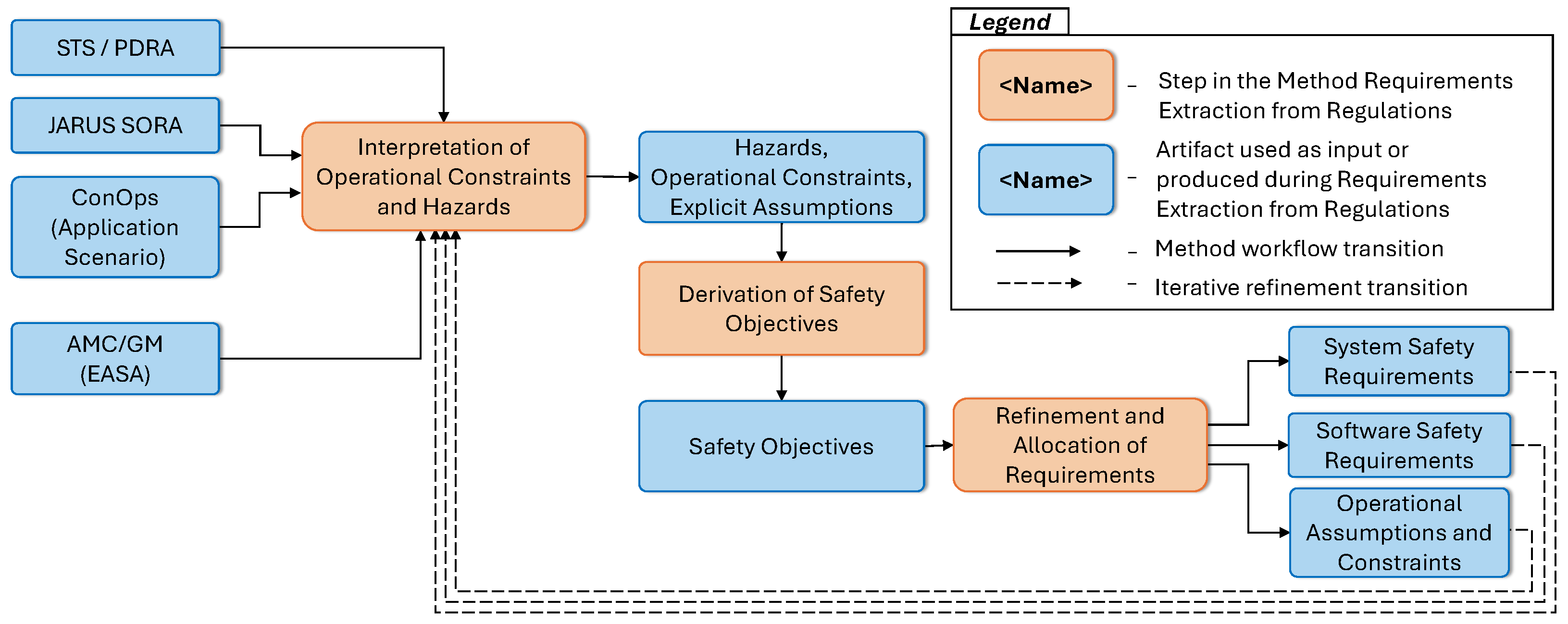
- It proposes a structured method for systematically translating regulatory safety intent—expressed in operational approval artifacts such as STS, PDRA, and SORA—into explicit system-level and software-level safety requirements under well-defined operational assumptions, explicitly bridging operational approval frameworks and system/software engineering practices.
- It introduces a software-centered system lifecycle that integrates these derived safety requirements into a structured development and assurance process, enabling traceability from regulatory constraints to system design, implementation, and verification activities.
- It provides a cross-domain analytical perspective that relates UAS regulatory constructs (e.g., SAILs and OSOs) to established safety assurance principles from avionics and automotive domains, identifying both transferable assurance concepts and necessary domain-specific adaptations for UAS without asserting direct equivalence.
2. Related Work
2.1. Regulations for Unmanned Aircraft Systems
2.2. Certification and Safety Engineering
2.3. Cross-Domain Safety Assurance
3. Analytical Approach
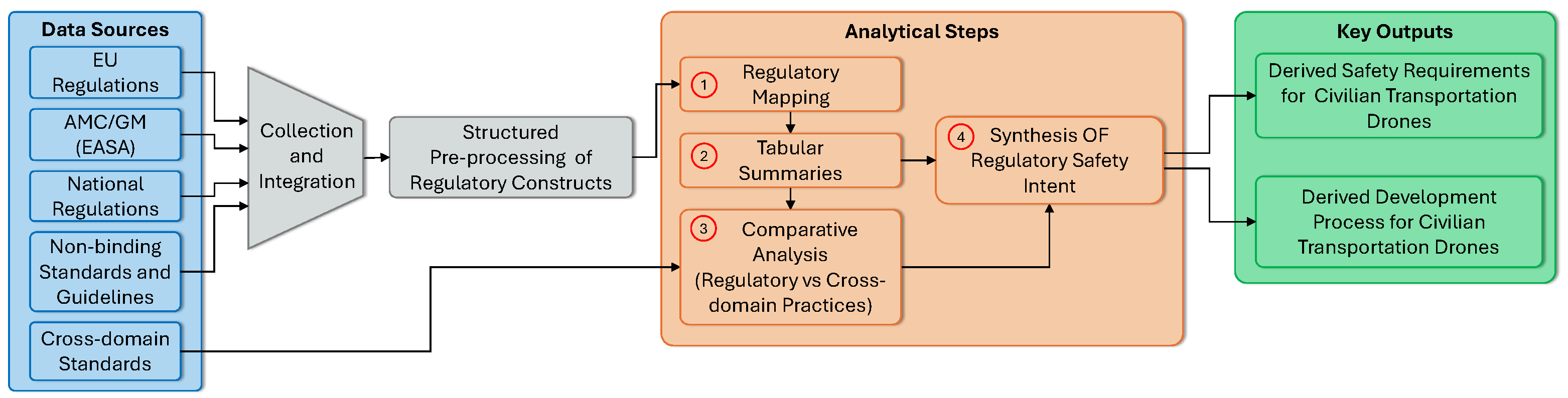
3.1. Data Sources
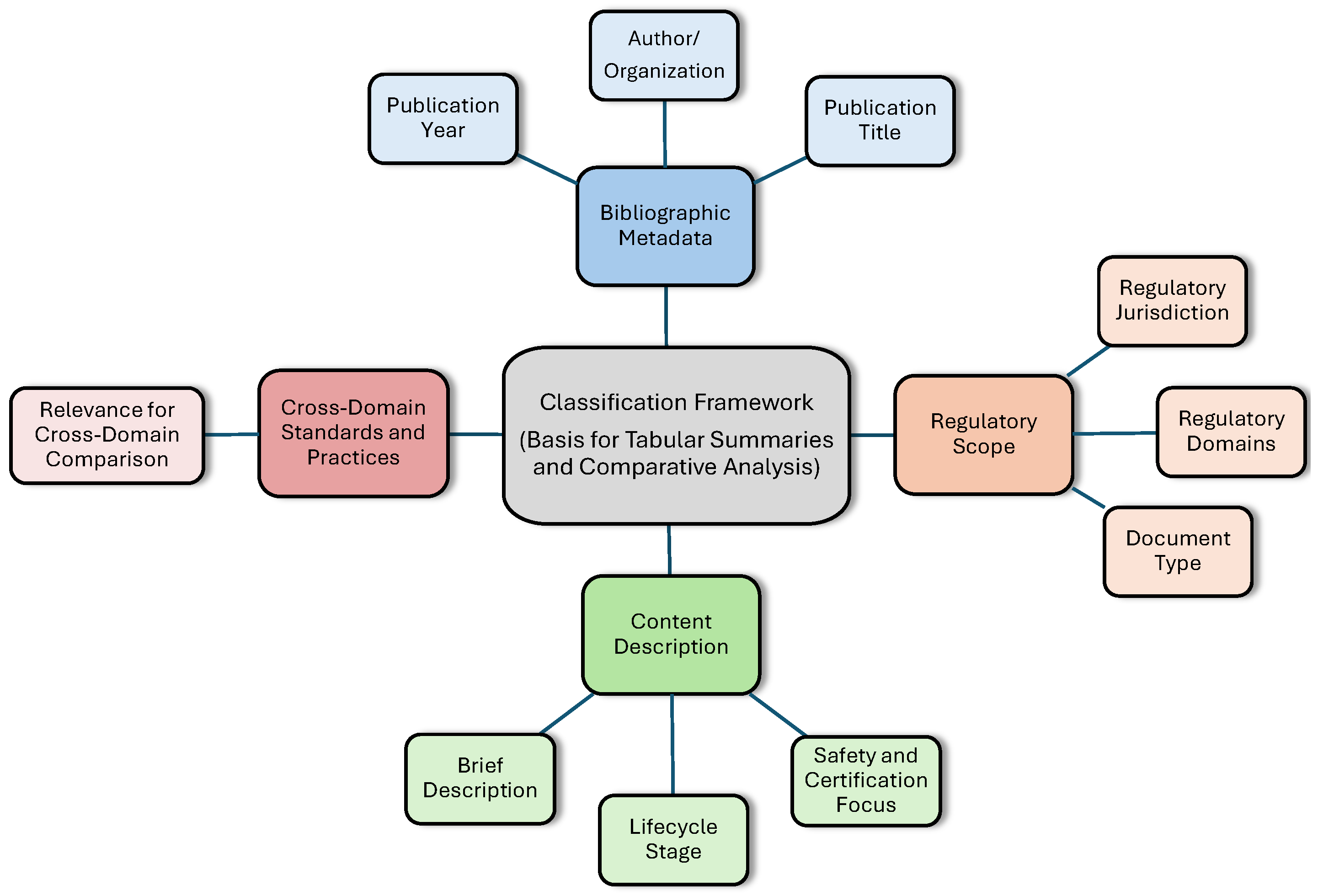
3.2. Classification Framework
3.3. Analytical Steps
4. Regulatory Framework for Unmanned Aircraft Systems at National and EU Level
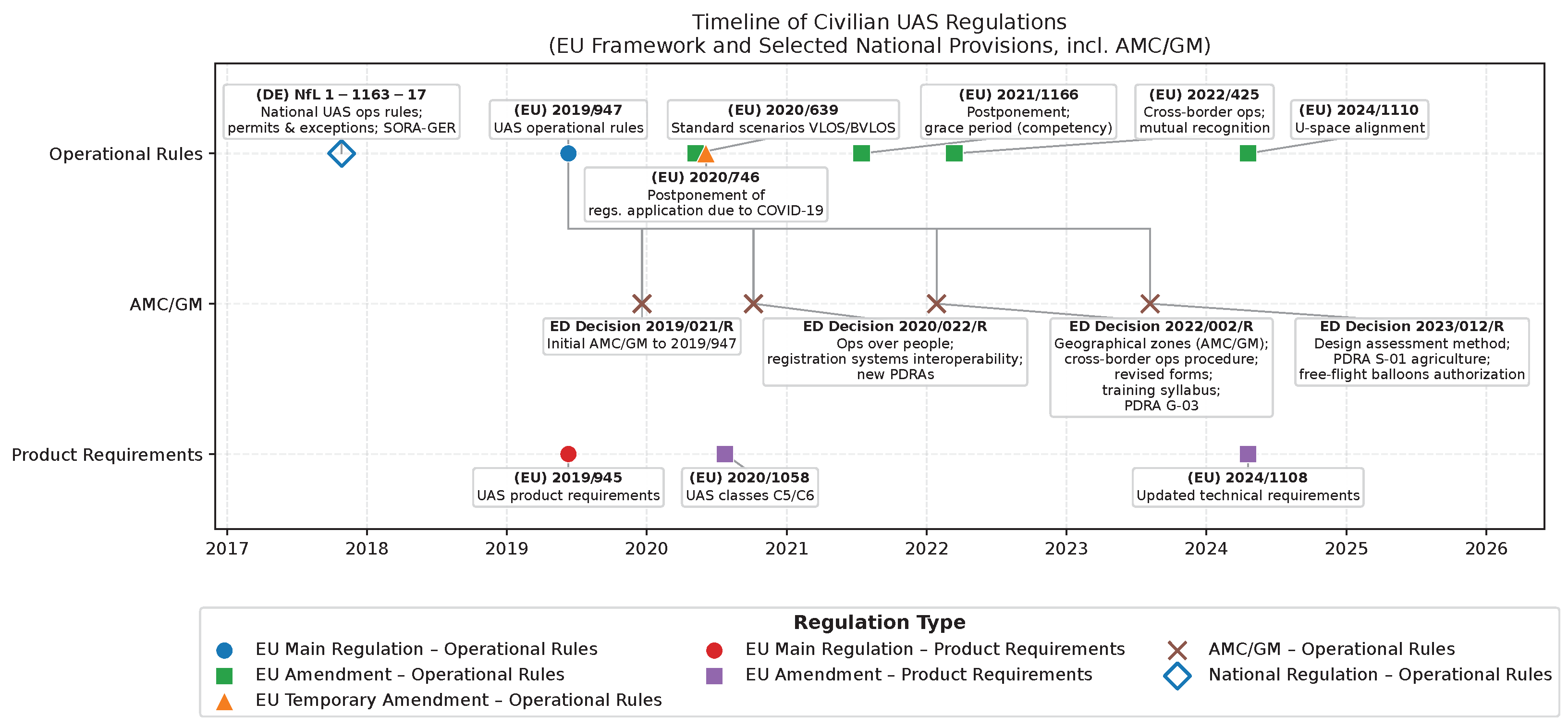
4.1. Evolution of the Regulatory Frameworks for Unmanned Aircraft Systems
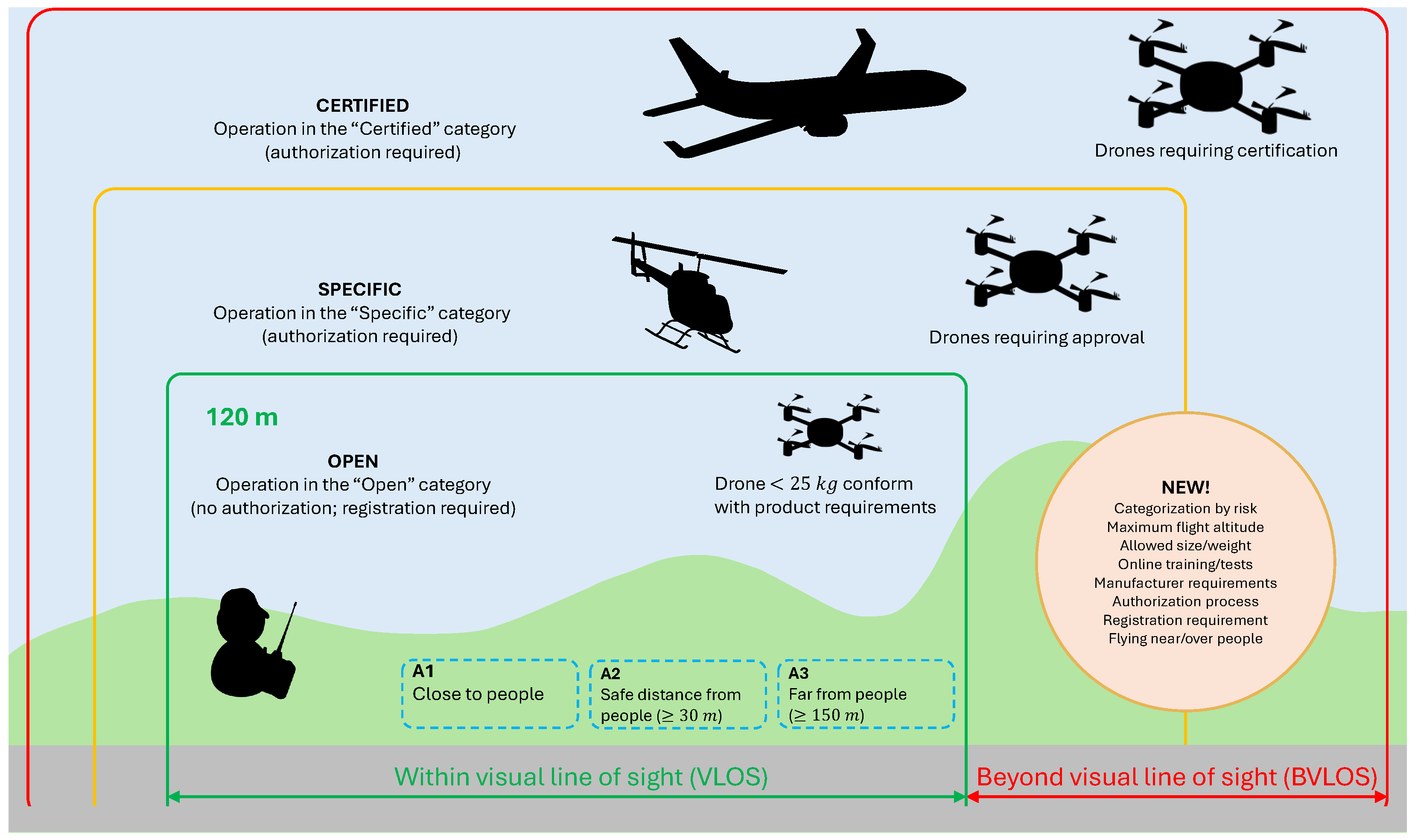
4.2. Classification of Unmanned Aircraft Systems and Their Operational Categories
4.3. Approval Processes for the Operation of Unmanned Aircraft Systems
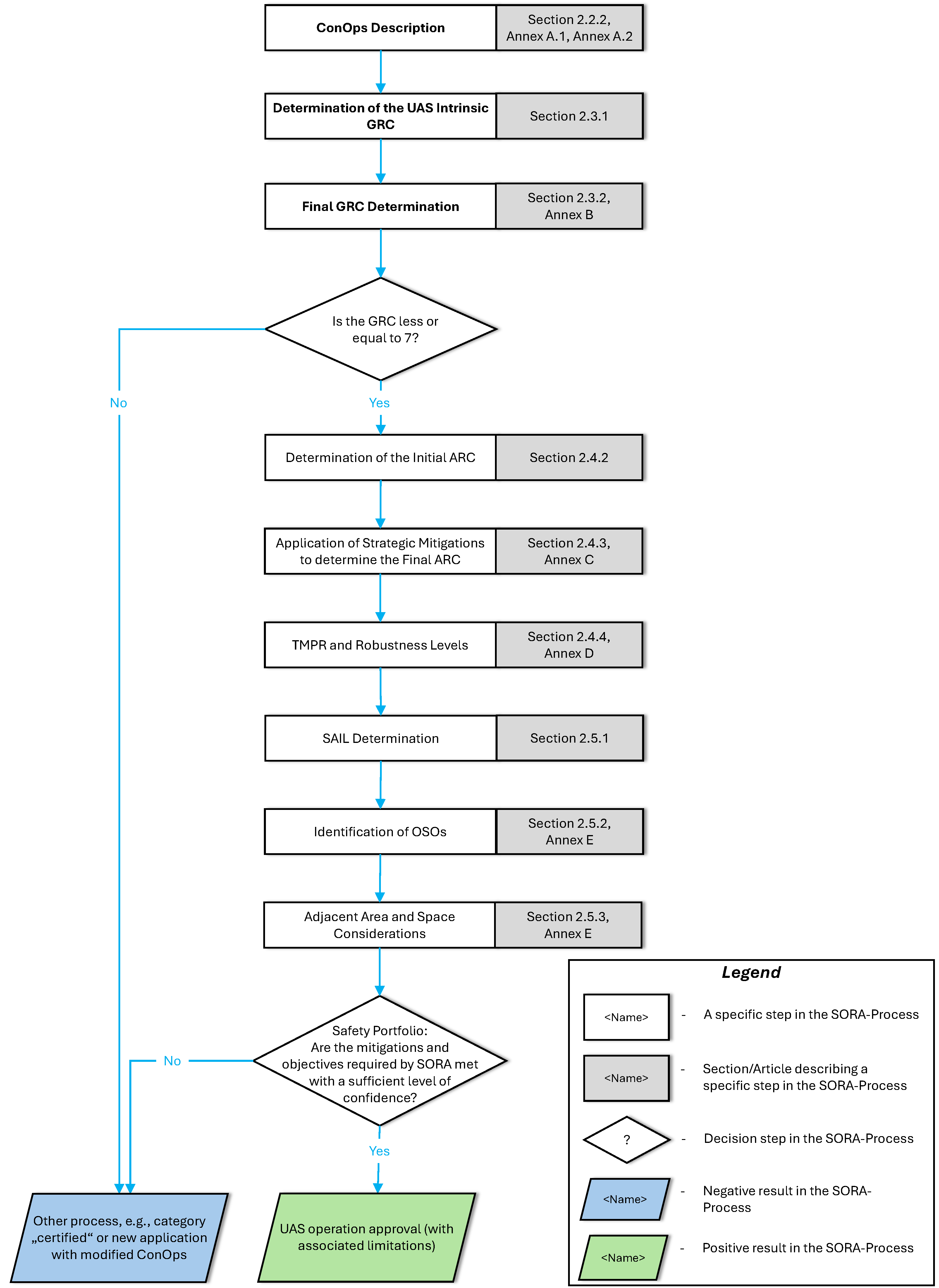
4.4. Specific Operations Risk Assessment
4.5. Synthesis and Implications
5. Cross-Domain Comparison of Safety Standards for Avionics and Automotive Systems
5.1. Overview of Development Standards for Commercial and General Avionics Systems
5.2. Overview of Development Standards for Automotive Systems
5.3. Comparative Analysis of Automotive and Avionics Standards
6. Results
6.1. Deriving Safety Requirements from Regulations for Unmanned Aircraft Systems
Illustrative Example: From SORA to Software Requirements
- Extraction of regulatory elements:
- Hazard: uncontrolled descent or fly-away
- Operational constraint: operation within defined geographic boundaries
- Mitigation: geofencing, fail-safe landing mechanisms
- Derivation of safety objectives:
- Ensure containment under nominal and degraded conditions
- Detect and mitigate navigation failures within bounded time
- Translation into system/software requirements:
- The system shall implement geofencing with enforcement latency < X ms
- The system shall detect GNSS degradation and trigger fail-safe behavior
- The flight control software shall ensure controlled descent upon loss of positioning
6.2. Defining a Software-Centered System Lifecycle for Unmanned Aerial Vehicles
6.2.1. Design Goals
6.2.2. Risk-Proportionate Assurance
6.2.3. Phases of the Development Lifecycle
6.2.4. Consideration of UAS Operational Infrastructure Context
6.3. Cross-Domain Interpretation of Assurance Levels and Safety Objectives
7. Conclusions and Future Work
Funding
Data Availability Statement
Conflicts of Interest
Abbreviations
| Abbreviation | Meaning |
| Core UAS/Regulatory Concepts | |
| UAS | Unmanned Aircraft System |
| UAV | Unmanned Aerial Vehicle |
| EU | European Union |
| EASA | European Union Aviation Safety Agency |
| JARUS | Joint Authorities for Rulemaking on Unmanned Systems |
| Operational Categories and Approval Instruments | |
| STS | Standard Scenario |
| PDRA | Pre-Defined Risk Assessment |
| SORA | Specific Operations Risk Assessment |
| AMC | Acceptable Means of Compliance |
| GM | Guidance Material |
| Risk and Assurance Concepts | |
| GRC | Ground Risk Class |
| ARC | Air Risk Class |
| SAIL | Specific Assurance and Integrity Level |
| OSO | Operational Safety Objective |
| TMPR | Tactical Mitigation Performance Requirement |
| Operational Concepts | |
| ConOps | Concept of Operations |
| VLOS | Visual Line of Sight |
| BVLOS | Beyond Visual Line of Sight |
| EVLOS | Extended Visual Line of Sight |
| AO | Airspace Observer |
| DAA | Detect and Avoid |
| UTM | Unmanned Aircraft System Traffic Management |
| Aircraft and Technical Characteristics | |
| MTOM | Maximum Take-Off Mass |
| MCD | Maximum Characteristic Dimension |
| KE | Kinetic Energy |
| C2/C3 link | Command and Control Link |
| Standards and Guidance Bodies | |
| ISO | International Organization for Standardization |
| RTCA | Radio Technical Commission for Aeronautics |
| Cross-domain Assurance Concepts | |
| DAL | Design Assurance Level (avionics) |
| ASIL | Automotive Safety Integrity Level (automotive) |
Appendix A. Classification Categories Used in the Analysis

| Field | Categories |
|---|---|
| Regulatory Domains | Airworthiness and Certification; Operations and Flight Rules; Airspace Management and UTM (U-Space); Safety Management and Risk Assessment; Environmental and Noise Protection; Security and Data Protection; Training and Licensing; Infrastructure and Support Systems; Cross-domain Harmonization |
| Regulatory Jurisdiction | National (Country Name); European Economic Area; International |
| Document Type | Regulation; Acceptable Means of Compliance and Guidance Material (AMC/GM); Non-binding Guideline; Standard |
| Lifecycle Stage | Concept and Requirements; Design and Development; Verification and Validation; Operations; Decommissioning |
| Safety/Certification Focus | Safety; Certification; Safety and Certification; None/Not explicit |
| Cross-Domain Relevance | Not applicable; Informative only; Comparable concepts; Transferable assurance principles |
| Brief Description | Free-text summary of the document scope and purpose |
| Author/Organization | Issuing regulatory authority, standards body, industry association, or author(s) |
| Publication Year | Year of publication, adoption, or revision |
| Publication Title | Official title of the regulation, standard, guideline, or other source |
Appendix B. Complete Set of Operational Safety Objectives
| OSO No. | OSO Description | SAIL | |||||
|---|---|---|---|---|---|---|---|
| I | II | III | IV | V | VI | ||
| Technical issue with the UAS | |||||||
| OSO#01 | Ensure the UAS operator is competent and/or proven | O | L | M | H | H | H |
| OSO#02 | UAS manufactured by competent and/or proven entity | O | O | L | M | H | H |
| OSO#03 | UAS maintained by competent and/or proven entity | L | L | M | M | H | H |
| OSO#04 | UAS developed to authority-recognized design standards | O | O | L | L | M | H |
| OSO#05 | UAS is designed considering system safety and reliability | O | O | L | M | H | H |
| OSO#06 | C3 link performance is appropriate for the operation | O | L | L | M | H | H |
| OSO#07 | Inspection of the UAS to ensure consistency with the ConOps | L | L | M | M | H | H |
| OSO#08 | Operational procedures are defined, validated and adhered to | L | M | H | H | H | H |
| OSO#09 | Remote crew trained and current and able to control the abnormal situation | L | L | M | M | H | H |
| OSO#10 | Safe recovery from a technical issue | L | L | M | M | H | H |
| Deterioration of external systems supporting UAS operations | |||||||
| OSO#11 | Procedures in-place to handle deterioration of external systems supporting UAS operations | L | M | H | H | H | H |
| OSO#12 | UAS designed to manage deterioration of external systems supporting UAS operations | L | L | M | M | H | H |
| OSO#13 | External services supporting UAS operations are adequate for the operation | L | L | M | H | H | H |
| Human error | |||||||
| OSO#14 | Operational procedures are defined, validated and adhered to | L | M | H | H | H | H |
| OSO#15 | Remote crew trained/current and able to control abnormal situation | L | L | M | M | H | H |
| OSO#16 | Multi-crew coordination | L | L | M | M | H | H |
| OSO#17 | Remote crew is fit to operate | L | L | M | M | H | H |
| OSO#18 | Automatic protection of the flight envelope from human error | O | O | L | M | H | H |
| OSO#19 | Safe recovery from human error | O | O | L | M | M | H |
| OSO#20 | Human factors evaluation and HMI appropriateness | O | L | L | M | M | H |
| Adverse operating conditions | |||||||
| OSO#21 | Operational procedures for adverse conditions | L | M | H | H | H | H |
| OSO#22 | Remote crew trained to identify/avoid critical environmental conditions | L | L | M | M | M | H |
| OSO#23 | Environmental conditions for safe ops are defined, measurable and adhered to | L | L | M | M | H | H |
| OSO#24 | UAS designed/qualified for adverse environmental conditions | O | O | M | H | H | H |
References
- ISO 21384-3:2023; Unmanned Aircraft Systems—Part 3: Operational Procedures. International Organization for Standardization: Geneva, Switzerland, 2023.
- ISO 21895:2020; Categorization and Classification of Civil Unmanned Aircraft Systems. International Organization for Standardization: Geneva, Switzerland, 2020.
- ISO/TR 23629-1:2020; Unmanned Aircraft Systems Traffic Management (UTM)—Part 1: Survey of UTM Concepts. International Organization for Standardization: Geneva, Switzerland, 2020.
- RTCA-DO-344:2013; Operational and Functional Requirements and Safety Objectives for Unmanned Aircraft Systems Standards. RTCA: Washington, DC, USA, 2013.
- Youn, W.K.; Hong, S.B.; Oh, K.R.; Ahn, O.S. Software Certification of Safety-Critical Avionic Systems: DO-178C and Its Impacts. IEEE Aerosp. Electron. Syst. Mag. 2015, 30, 4–13. [Google Scholar] [CrossRef]
- Moy, Y.; Ledinot, E.; Delseny, H.; Wiels, V.; Monate, B. Testing or Formal Verification: DO-178C Alternatives and Industrial Experience. IEEE Softw. 2013, 30, 50–57. [Google Scholar] [CrossRef]
- RTCA-DO-178C:2011; DO-178C: Software Considerations in Airborne Systems and Equipment Certification. RTCA: Washington, DC, USA, 2011.
- ISO 26262-1:2018; Road Vehicles—Functional Safety. Part 1: Vocabulary. International Organization for Standardization: Geneva, Switzerland, 2018.
- Machrouh, J.; Blanquart, J.P.; Baufreton, P.; Boulanger, J.L.; Delseny, H.; Gassino, J.; Ladier, G.; Ledinot, E.; Leeman, M.; Astruc, J.M. Cross-Domain Comparison of System Assurance. In Proceedings of the 6th European Congress on Embedded Real Time Software and Systems (ERTS 2012), Toulouse, France, 29 January–1 February 2012. [Google Scholar]
- Ledinot, E.; Astruc, J.M.; Blanquart, J.P.; Baufreton, P.; Delseny, H.; Gassino, J.; Ladier, G.; Leeman, M.; Machrouh, J.; Quéré, P.; et al. A Cross-Domain Comparison of Software Development Assurance Standards. In Proceedings of the International Conference on Embedded Real Time Software and Systems (ERTS 2012), Toulouse, France, 29 January–1 February 2012. [Google Scholar]
- Zrelli, R.; Misson, H.A.; Kamkuimo, S.; Ben Attia, M.; Shabah, A.; de Magalhaes, F.G.; Nicolescu, G. Integrating Formal Methods and Automated Tools for DO-178C Compliance in UAV Software. Inf. Softw. Technol. 2026, 194, 108068. [Google Scholar] [CrossRef]
- Baufreton, P.; Derrien, J.C.; Ricque, B.; Blanquart, J.P.; Boulanger, J.L.; Delseny, H.; Gassino, J.; Ladier, G.; Ledinot, E.; Leeman, M.; et al. Multi-Domain Comparison of Safety Standards. Rev. Electr. Electron. 2011, 2, 13–25. [Google Scholar]
- Alamouri, A.; Lampert, A.; Gerke, M. An Exploratory Investigation of UAS Regulations in Europe and the Impact on Effective Use and Economic Potential. Drones 2021, 5, 63. [Google Scholar] [CrossRef]
- Du, S.; Zhong, G.; Wang, F.; Pang, B.; Zhang, H.; Jiao, Q. Safety Risk Modelling and Assessment of Civil Unmanned Aircraft System Operations: A Comprehensive Review. Drones 2024, 8, 354. [Google Scholar] [CrossRef]
- Fakhraian, E.; Semanjski, I.; Semanjski, S.; Aghezzaf, E.H. Towards Safe and Efficient Unmanned Aircraft System Operations: Literature Review of Digital Twins’ Applications and European Union Regulatory Compliance. Drones 2023, 7, 478. [Google Scholar] [CrossRef]
- Habibi, H.; Rao, D.M.K.K.V.; Sanchez-Lopez, J.L.; Voos, H. On SORA for High-Risk UAV Operations under New EU Regulations: Perspectives for Automated Approach. In Proceedings of the International Conference on Unmanned Aircraft Systems (ICUAS), Warsaw, Poland, 6–9 June 2023; pp. 213–220. [Google Scholar] [CrossRef]
- Capitán, C.; Capitán, J.; Castaño, A.R.; Ollero, A. Risk Assessment Based on SORA Methodology for a UAS Media Production Application. In Proceedings of the International Conference on Unmanned Aircraft Systems (ICUAS), Atlanta, GA, USA, 11–14 June 2019; pp. 451–459. [Google Scholar] [CrossRef]
- Schnüriger, P.; Schreiber, J.; Widmer, K.; Lenhart, P.M. SORA Tool—A Specific Operation Risk Assessment Tool for Civilian Drone Operations. Drone Syst. Appl. 2025, 13, 1–11. [Google Scholar] [CrossRef]
- Nawaz, S.A. Towards Regulating Human Oversight: Challenges for EU Drone Law. Inf. Commun. Technol. Law 2025, 1–17. [Google Scholar] [CrossRef]
- Allouch, A.; Koubaa, A.; Khalgui, M.; Abbes, T. Qualitative and Quantitative Risk Analysis and Safety Assessment of Unmanned Aerial Vehicle Missions Over the Internet. IEEE Access 2019, 7, 53392–53410. [Google Scholar] [CrossRef]
- Guerin, J.; Delmas, K.; Guiochet, J. Certifying Emergency Landing for Safe Urban UAV. In Proceedings of the 51st Annual IEEE/IFIP International Conference on Dependable Systems and Networks Workshops (DSN-W), Taipei, Taiwan, 21–24 June 2021; pp. 55–62. [Google Scholar] [CrossRef]
- Alharbi, A.; Petrunin, I.; Panagiotakopoulos, D. Assuring Safe and Efficient Operation of UAV Using Explainable Machine Learning. Drones 2023, 7, 327. [Google Scholar] [CrossRef]
- Hawkins, R.; Habli, I.; Kelly, T.; McDermid, J. Assurance Cases and Prescriptive Software Safety Certification: A Comparative Study. Saf. Sci. 2013, 59, 55–71. [Google Scholar] [CrossRef]
- Zeller, M.; Höfig, K.; Rothfelder, M. Towards a Cross-Domain Software Safety Assurance Process for Embedded Systems. In Proceedings of the Computer Safety, Reliability, and Security (SAFECOMP); Springer: Berlin/Heidelberg, Germany, 2014; pp. 396–400. [Google Scholar]
- European Union. Regulation (EC) No 1592/2002 of the European Parliament and of the Council of 15 July 2002 on common rules in the field of civil aviation and establishing a European Aviation Safety Agency (Text with EEA relevance). Off. J. 2002, 240, 1–21. [Google Scholar]
- European Union. Regulation (EC) No 216/2008 of the European Parliament and of the Council of 20 February 2008 on common rules in the field of civil aviation and establishing a European Aviation Safety Agency, and repealing Council Directive 91/670/EEC, Regulation (EC) No 1592/2002 and Directive 2004/36/EC (Text with EEA relevance). Off. J. 2008, 79, 1–49. [Google Scholar]
- European Union. Regulation (EU) 2018/1139 of the European Parliament and of the Council of 4 July 2018 on common rules in the field of civil aviation and establishing a European Union Aviation Safety Agency, and amending Regulations (EC) No 2111/2005, (EC) No 1008/2008, (EU) No 996/2010, (EU) No 376/2014 and Directives 2014/30/EU and 2014/53/EU of the European Parliament and of the Council, and repealing Regulations (EC) No 552/2004 and (EC) No 216/2008 of the European Parliament and of the Council and Council Regulation (EEC) No 3922/91 (Text with EEA relevance). Off. J. 2018, 212, 1–122. [Google Scholar]
- European Union. Commission Delegated Regulation (EU) 2019/945 of 12 March 2019 on unmanned aircraft systems and on third-country operators of unmanned aircraft systems. Off. J. 2019, 152, 1–40. [Google Scholar]
- European Union. Commission Implementing Regulation (EU) 2019/947 of 24 May 2019 on the rules and procedures for the operation of unmanned aircraft (Text with EEA relevance). Off. J. 2019, 152, 45–71. [Google Scholar]
- European Union. Commission Implementing Regulation (EU) 2020/639 of 12 May 2020 amending Implementing Regulation (EU) 2019/947 as regards standard scenarios for operations executed in or beyond the visual line of sight (Text with EEA relevance). Off. J. 2020, 150, 1–31. [Google Scholar]
- European Union. Commission Delegated Regulation (EU) 2020/1058 of 27 April 2020 amending Delegated Regulation (EU) 2019/945 as regards the introduction of two new unmanned aircraft systems classes. Off. J. 2020, 232, 1–27. [Google Scholar]
- European Union. Commission Implementing Regulation (EU) 2021/1166 of 15 July 2021 amending Implementing Regulation (EU) 2019/947 as regards postponing the date of application for standard scenarios for operations executed in or beyond the visual line of sight (Text with EEA relevance). Off. J. 2021, 253, 49–50. [Google Scholar]
- European Union. Commission Implementing Regulation (EU) 2022/425 of 14 March 2022 amending Implementing Regulation (EU) 2019/947 as regards postponing the transition dates for the use of certain unmanned aircraft systems in the ‘open’ category and the date of application for standard scenarios for operations executed in or beyond the visual line of sight (Text with EEA relevance). Off. J. 2022, 87, 20–21. [Google Scholar]
- European Union. Commission Implementing Regulation (EU) 2024/1110 of 10 April 2024 amending Regulation (EU) No 748/2012 as regards the initial airworthiness of unmanned aircraft systems subject to certification and Implementing Regulation (EU) 2019/947 as regards the rules and procedures for the operation of unmanned aircraft. Off. J. 2024. Available online: http://data.europa.eu/eli/reg_impl/2024/1110/oj (accessed on 5 April 2026).
- European Union. Commission Delegated Regulation (EU) 2024/1108 of 13 March 2024 amending Regulation (EU) No 748/2012 as regards the initial airworthiness of unmanned aircraft systems subject to certification and Delegated Regulation (EU) 2019/945 as regards unmanned aircraft systems and third-country operators of unmanned aircraft systems. Off. J. 2024. Available online: http://data.europa.eu/eli/reg_del/2024/1108/oj (accessed on 5 April 2026).
- European Union Aviation Safety Agency. ED Decision 2019/021/R Issuing Acceptable Means of Compliance and Guidance Material to Commission Implementing Regulation (EU) No 2019/947 ‘Rules and Procedures for the Operation of Unmanned Aircraft’; Official Publication of the European Union Aviation Safety Agency: Cologne, Germany, 2019. [Google Scholar]
- European Union Aviation Safety Agency. ED Decision 2020/022/R Issuing Regular Update of the Acceptable Means of Compliance and Guidance Material to Regulation (EU) 2019/947; Official Publication of the European Union Aviation Safety Agency: Cologne, Germany, 2020. [Google Scholar]
- European Union Aviation Safety Agency. ED Decision 2022/002/R Issuing Regular Update of the Acceptable Means of Compliance and Guidance Material to Regulation (EU) 2019/947—Issue 1, Amendment 2; Official Publication of the European Union Aviation Safety Agency: Cologne, Germany, 2022. [Google Scholar]
- European Union Aviation Safety Agency. ED Decision 2023/012/R Issuing Regular Update of the Acceptable Means of Compliance and Guidance Material to Regulations (EU) 2019/945 and 2019/947 (Drones in the ‘Open’ and ‘Specific’ Category); Official Publication of the European Union Aviation Safety Agency: Cologne, Germany, 2023. [Google Scholar]
- Bundesministerium der Justiz und für Verbraucherschutz. Vierzehntes Gesetz zur Änderung des Luftverkehrsgesetzes—Hinzufügung von „Unbemannten Luftfahrtsystemen“ als Luftfahrzeuge (§ 1 Abs. 1 Nr. 2 LuftVG). BGBl. I 2012, S. 606; New Sentence Added to § 1 Abs. 1 LuftVG. 2012. Available online: https://www.buzer.de/gesetz/10159/index.htm (accessed on 15 October 2025).
- Bundesministerium der Justiz und für Verbraucherschutz. § 1 Luftverkehrsgesetz (LuftVG)—Luftfahrzeuge (Inkl. Flugmodelle und Unbemannte Luftfahrtsysteme). BGBl. I 1959, S. 733; Last Amended by Art. 4 G v. 31.1.2019 I 54. 2019. Available online: https://www.gesetze-im-internet.de/luftvg/__1.html (accessed on 20 October 2025).
- Bundesministerium der Justiz und für Verbraucherschutz. § 21a Luftverkehrs-Ordnung (LuftVO)—Erlaubnisbedürftiger Betrieb von Unbemannten Luftfahrtsystemen und Flugmodellen. Inserted by Verordnung v. 30.3.2017 I 626, in Force Since 7.4.2017. 2017. Available online: https://www.gesetze-im-internet.de/luftvo_2015/__21a.html (accessed on 30 October 2025).
- Bundesministerium der Justiz und für Verbraucherschutz. § 21b Luftverkehrs-Ordnung (LuftVO)—Betriebsverbote für Unbemannte Luftfahrtsysteme und Flugmodelle. Inserted by Verordnung v. 30.3.2017 I 626, in Force Since 7.4.2017. 2017. Available online: https://www.gesetze-im-internet.de/luftvo_2015/__21b.html (accessed on 5 November 2025).
- JARUS Working Group. JARUS SORA Annex F: Specific Assurance and Integrity Level (SAIL) Requirements. 2017. Available online: https://jarus-rpas.org/publications/ (accessed on 5 April 2026).
- JARUS Working Group. JARUS SORA Annex E: Tactical Mitigation Performance Requirements (TMPR). 2017. Available online: https://jarus-rpas.org/publications/ (accessed on 5 April 2026).
- SAE International. ARP4754A: Guidelines for Development of Civil Aircraft and Systems; EUROCAE ED-79A; SAE International: Warrendale, PA, USA, 2010. [Google Scholar]
- SAE International. ARP4761A: Guidelines and Methods for Conducting the Safety Assessment Process on Civil Aircraft; EUROCAE ED-135A; SAE International: Warrendale, PA, USA, 2023. [Google Scholar]
- Parasoft Corporation. What Is DO-178C? Software Considerations in Airborne Systems and Equipment Certification. 2023. Available online: https://www.parasoft.com/learning-center/do-178c/what-is/ (accessed on 10 December 2025).
- ISO 21448:2022; Road Vehicles—Safety of the Intended Functionality (SOTIF). International Organization for Standardization: Geneva, Switzerland, 2022.
- ISO 26262-3:2018; Road Vehicles—Functional Safety. Part 3: Concept Phase. International Organization for Standardization: Geneva, Switzerland, 2018.
- ISO 26262-4:2018; Road Vehicles—Functional Safety. Part 4: Product Development at the System Level. International Organization for Standardization: Geneva, Switzerland, 2018.
- ISO 26262-6:2018; Road Vehicles—Functional Safety. Part 6: Product Development at the Software Level. International Organization for Standardization: Geneva, Switzerland, 2018.
- Kapinski, J.; Deshmukh, J.V.; Jin, X.; Ito, H.; Butts, K. Simulation-Based Approaches for Verification of Embedded Control Systems: An Overview of Traditional and Advanced Modeling, Testing, and Verification Techniques. IEEE Control Syst. 2016, 36, 45–64. [Google Scholar] [CrossRef]
- Crots, K.; Skentzos, P.; Bartz, D. A Comparative Analysis of Aviation and Ground Vehicle Software Development Standards. In Proceedings of the 2014 Ground Vehicle Systems Engineering and Technology Symposium; National Defense Industrial Association Michigan Chapter: Novi, MI, USA, 2014. [Google Scholar] [CrossRef]
- Chen, Z.; Shum, H.Y.; Cao, X.; Hansen, M. Engineering and technology for low-altitude economy infrastructure. Front. Inf. Technol. Electron. Eng. 2025, 26, 2393–2396. [Google Scholar] [CrossRef]
- Weigang, L.; Maia, J.A.; Stenzel, E.; Siefert, L.R. Eixão-UAM: LLM-assisted iterative design of a low-altitude urban air mobility corridor in Brasilia. Front. Inf. Technol. Electron. Eng. 2025, 26, 2421–2439. [Google Scholar] [CrossRef]


| Drone Class ID | C0 | C1 | C2 | C3 | C4 | C5 | C6 |
|---|---|---|---|---|---|---|---|
| Maximum Take-off Mass | 250 g | 900 g | 4 kg | 25 kg | 25 kg | 25 kg | 25 kg |
| Maximum Speed | 19 m/s | 19 m/s | low-speed mode ≤ 3 m/s [b] | – | – | – | 50 m/s [e] |
| Maximum Flight Height | 120 m [a] | 120 m [a] | 120 m [a] | 120 m [a] | – | – | – |
| Adjustable Height | – | yes | yes | yes | – | – | – |
| Altimeter | – | yes | yes | yes | – | yes | yes |
| Remote Identification | – | yes | yes | yes | no [c] | yes [d] | yes [d] |
| Geo-awareness | – | yes | yes | yes | no [c] | yes [d] | yes [d] |
| STS ID | Edition/Date | UAS Characteristics | BVLOS/VLOS | Overflown Area | Max Range | Max Height | Airspace |
|---|---|---|---|---|---|---|---|
| STS–01 | June 2020 | C5 marking; MCD ≤ 3 m; MTOM ≤ 25 kg [a] | VLOS | Controlled; may be in populated area | VLOS | 120 m | Controlled/uncontrolled; low encounter risk [c] |
| STS–02 | June 2020 | C6 marking; MCD ≤ 3 m; MTOM ≤ 25 kg [a] | BVLOS | Controlled; entirely in sparsely populated area | 2 km with AO; 1 km if no AO [b] | 120 m | Controlled/uncontrolled; low encounter risk [c] |
| PDRA ID | Edition/Date | UAS Characteristics | BVLOS/VLOS | Overflown Area | Max Range | Max Height | Airspace | AMC ID |
|---|---|---|---|---|---|---|---|---|
| PDRA–S01 [a] | Amend. 3/October 2023 | MCD ≤ 3 m; MTOM ≤ 25 kg | VLOS | Controlled; may be in populated area (agricultural ops included) | VLOS | 120 m | Controlled/uncontrolled; low encounter risk | AMC 4 |
| PDRA–S02 | 1.0/July 2020 | MCD ≤ 3 m; MTOM ≤ 25 kg | BVLOS | Controlled; entirely in sparsely populated area | 2 km with AO; 1 km if no AO [c] | 120 m | Controlled/uncontrolled; low encounter risk | AMC 5 |
| PDRA–G01 [b] | Rev. October 2023 | MCD ≤ 3 m; KE ≤ 34 kJ | BVLOS | Sparsely populated area | up to 1 km if no AO [c] | 150 m (operational volume) | Uncontrolled; low encounter risk | AMC 2 |
| PDRA–G02 [b] | Rev. October 2023 | MCD ≤ 3 m; KE ≤ 34 kJ | BVLOS | Sparsely populated area | N/A | As established for reserved airspace | As reserved for the operation | AMC 3 |
| PDRA–G03 [b] | Rev. October 2023 | MCD ≤ 3 m; KE ≤ 34 kJ | BVLOS | Sparsely populated area | up to 1 km, with mitigations | 120–150 m (per reserved volume) | Uncontrolled; low encounter risk | AMC 6 |
| Operational Scenario | MCD < 1 m KE < 700 J | 1 m ≤ MCD < 3 m KE < 34 kJ | 3 m ≤ MCD < 8 m KE < 1084 kJ | MCD ≥ 8 m KE ≥ 1084 kJ |
|---|---|---|---|---|
| VLOS/BVLOS over a controlled ground area [a] | 1 | 2 | 3 | 4 |
| VLOS over a sparsely populated area [c] | 2 | 3 | 4 | 5 |
| BVLOS over a sparsely populated area [c] | 3 | 4 | 5 | 6 |
| VLOS over a populated area [c] | 4 | 5 | 6 | 7 |
| BVLOS over a populated area [c] | 5 | 6 | 7 | 8 |
| VLOS over an assembly of people | 7 | 8 [b] | 9 [b] | 10 [b] |
| BVLOS over an assembly of people | 8 | 9 [b] | 10 [b] | 10 [b] |
| Mitigation Sequence | Mitigations for Ground Risk | Robustness [d] | ||
|---|---|---|---|---|
| Low/None | Medium | High | ||
| 1 | M1—Strategic mitigations for ground risk [a] | 0: None; : Low | ||
| 2 | M2—Effects of ground impact are reduced [b] | 0 | ||
| 3 | M3—An emergency response plan (ERP) is in place, the UAS operator is validated and effective [c] | 0 | ||
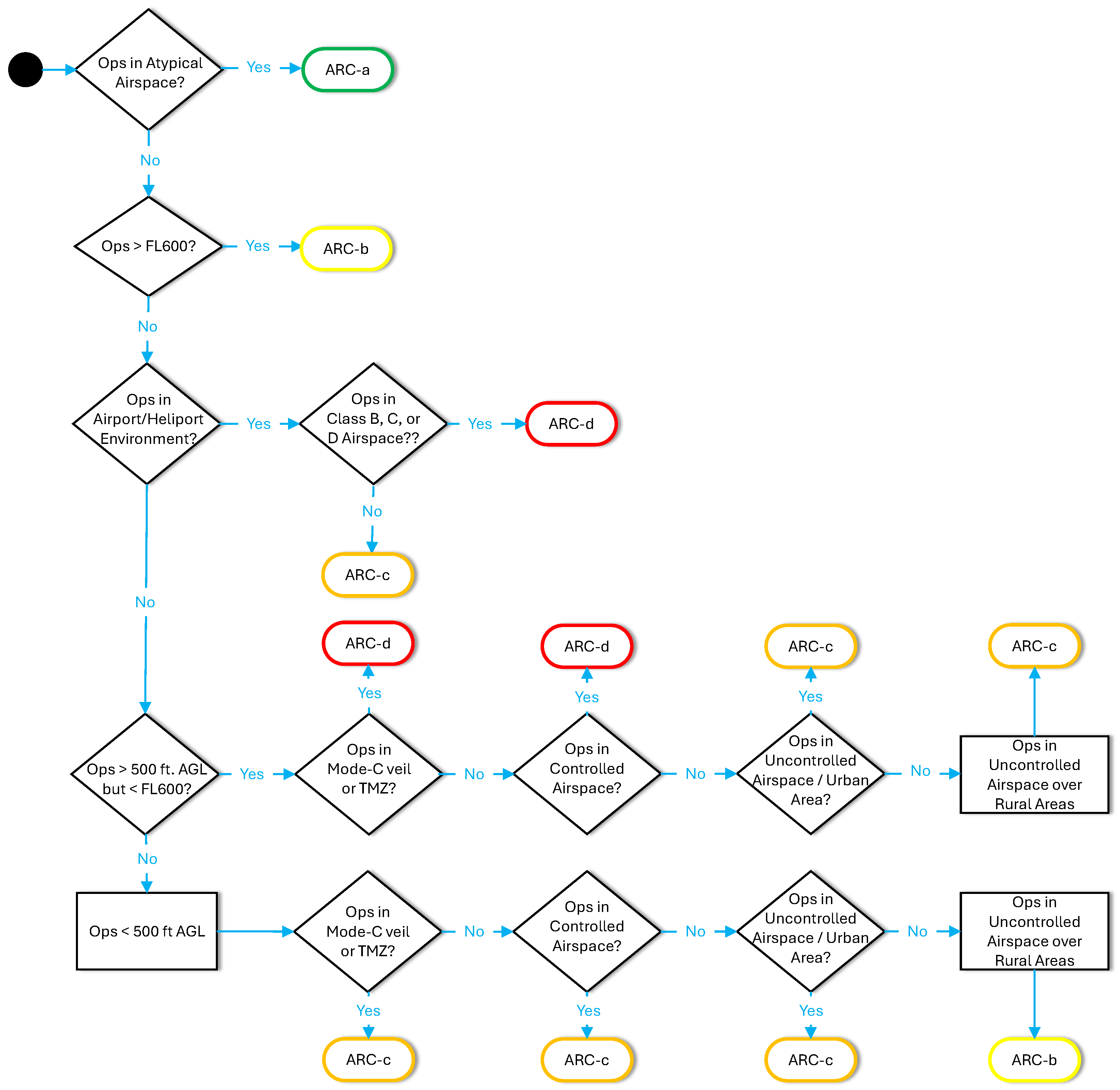
| Residual ARC | TMPRs | TMPR Level of Robustness [a] |
|---|---|---|
| ARC–d | High | High |
| ARC–c | Medium | Medium |
| ARC–b | Low | Low |
| ARC–a | No requirement [b] | No requirement |
| Final GRC | Residual ARC | |||
|---|---|---|---|---|
| a | b | c | d | |
| ≤2 | I [a] | II [a] | IV [a] | VI [a] |
| 3 | II [a] | II [a] | IV [a] | VI [a] |
| 4 | III [a] | III [a] | IV [a] | VI [a] |
| 5 | IV [a] | IV [a] | IV [a] | VI [a] |
| 6 | V [a] | V [a] | V [a] | VI [a] |
| 7 | VI [a] | VI [a] | VI [a] | VI [a] |
| >7 [b] | Category C operation | |||
| OSO No. | OSO Description | SAIL | |||||
|---|---|---|---|---|---|---|---|
| I | II | III | IV | V | VI | ||
| Technical issue with the UAS | |||||||
| OSO#01 | Ensure the UAS operator is competent and/or proven | O | L | M | H | H | H |
| ⋯ | ⋯ | ⋯ | ⋯ | ⋯ | ⋯ | ⋯ | ⋯ |
| OSO#04 | UAS developed to authority-recognized design standards | O | O | L | L | M | H |
| OSO#05 | UAS is designed considering system safety and reliability | O | O | L | M | H | H |
| ⋯ | ⋯ | ⋯ | ⋯ | ⋯ | ⋯ | ⋯ | ⋯ |
| OSO#08 | Operational procedures are defined, validated and adhered to | L | M | H | H | H | H |
| ⋯ | ⋯ | ⋯ | ⋯ | ⋯ | ⋯ | ⋯ | ⋯ |
| OSO#10 | Safe recovery from a technical issue | L | L | M | M | H | H |
| Deterioration of external systems supporting UAS operations | |||||||
| OSO#11 | Procedures in-place to handle deterioration of external systems supporting UAS operations | L | M | H | H | H | H |
| ⋯ | ⋯ | ⋯ | ⋯ | ⋯ | ⋯ | ⋯ | ⋯ |
| Human error | |||||||
| ⋯ | ⋯ | ⋯ | ⋯ | ⋯ | ⋯ | ⋯ | ⋯ |
| OSO#18 | Automatic protection of the flight envelope from human error | O | O | L | M | H | H |
| ⋯ | ⋯ | ⋯ | ⋯ | ⋯ | ⋯ | ⋯ | ⋯ |
| Adverse operating conditions | |||||||
| ⋯ | ⋯ | ⋯ | ⋯ | ⋯ | ⋯ | ⋯ | ⋯ |
| OSO#23 | Environmental conditions for safe ops are defined, measurable and adhered to | L | L | M | M | H | H |
| OSO#24 | UAS designed/qualified for adverse environmental conditions | O | O | M | H | H | H |
| Failure Condition | Description | DAL |
|---|---|---|
| Catastrophic | Failure conditions that could lead to multiple fatalities, usually with the loss of the aircraft | A |
| Hazardous | Conditions that severely reduce the crew’s ability to cope with adverse situations, leading to a major reduction in safety margins or serious injuries | B |
| Major | Conditions that significantly increase crew workload or reduce functional capability, possibly leading to discomfort or minor injuries | C |
| Minor | Conditions with limited impact on safety or workload; the crew can readily manage them | D |
| No safety effect | Faults with no impact on operational safety or crew workload | E |
| ASIL | Description | Relative Rigor |
|---|---|---|
| A | Lowest safety integrity level | Lowest safety-related rigor |
| B | Moderate safety integrity level | Increased safety measures |
| C | High safety integrity level | Strong safety measures |
| D | Highest safety integrity level | Most stringent safety measures |
Disclaimer/Publisher’s Note: The statements, opinions and data contained in all publications are solely those of the individual author(s) and contributor(s) and not of MDPI and/or the editor(s). MDPI and/or the editor(s) disclaim responsibility for any injury to people or property resulting from any ideas, methods, instructions or products referred to in the content. |
© 2026 by the author. Licensee MDPI, Basel, Switzerland. This article is an open access article distributed under the terms and conditions of the Creative Commons Attribution (CC BY) license.
Share and Cite
Aniculaesei, A. Regulatory Frameworks and Development Standards for Civilian Unmanned Aircraft Systems: From Regulatory Safety Intent to Development Lifecycles. Drones 2026, 10, 271. https://doi.org/10.3390/drones10040271
Aniculaesei A. Regulatory Frameworks and Development Standards for Civilian Unmanned Aircraft Systems: From Regulatory Safety Intent to Development Lifecycles. Drones. 2026; 10(4):271. https://doi.org/10.3390/drones10040271
Chicago/Turabian StyleAniculaesei, Adina. 2026. "Regulatory Frameworks and Development Standards for Civilian Unmanned Aircraft Systems: From Regulatory Safety Intent to Development Lifecycles" Drones 10, no. 4: 271. https://doi.org/10.3390/drones10040271
APA StyleAniculaesei, A. (2026). Regulatory Frameworks and Development Standards for Civilian Unmanned Aircraft Systems: From Regulatory Safety Intent to Development Lifecycles. Drones, 10(4), 271. https://doi.org/10.3390/drones10040271